Browse our range of reports and publications including performance and financial statement audit reports, assurance review reports, information reports and annual reports.
Auditor-General Report No. 19 of 2025–26
Closing the Gap in Schooling and Early Childhood Development — Partnership and Reporting
Published
Wednesday 21 January 2026
Portfolio
Across Entities
Entity
Across Entities
Contact
Please direct enquiries through our contact page.
Activity
Policy development
Sector
Prime Minister & Cabinet
Indigenous
Education
Social Services
Treasury
Audit snapshot
Why did we do this audit?
- Progress in Closing the Gap has been slow. All parties to the 2020 National Agreement on Closing the Gap committed to mobilising all avenues and opportunities available to meet the National Agreement’s objectives.
- Stakeholders rely on monitoring and reporting to understand the level of progress that is being made towards achieving the National Agreement’s socio‑economic outcomes and priority reforms.
Key facts
- Three of 19 Closing the Gap targets relate to schooling and early childhood development: preschool enrolment (Target 3), developmental progress (4) and year 12 completion (5).
- Four entities have key roles relating to Targets 3, 4 and 5: the Department of Education (Education); the Department of Social Services (DSS); the National Indigenous Australians Agency (NIAA); and the Productivity Commission (PC).
What did we find?
- Partnership arrangements and funding design activities for schooling and early childhood development commitments are largely effective and improving. There is a declining level of transparency over progress.
- Entities are largely working in partnership with First Nations people on policy options.
- The principles of the National Agreement have been increasingly applied over time in the design of key funding arrangements.
- Progress reporting for Targets 3, 4 and 5 could be more reliable and complete.
What did we recommend?
- There were three recommendations to the Australian Government regarding the completeness and meaningfulness of target reporting and one to Education regarding monitoring of funding to Aboriginal and Torres Strait Islander organisations.
- NIAA noted the recommendations made to the Australian Government and Education agreed with the recommendation made to it.
8 out of 9
The number of assessed ‘strong partnership’ elements exhibited by the Early Childhood Care and Development Policy Partnership.
0
The number of Australian Government entities publicly reporting on the proportion of Target 3, 4 and 5 grants funding provided to Aboriginal and Torres Strait Islander organisations.
None
Targets 3, 4 and 5 results included in the Australian Government’s 2024 Closing the Gap Annual Report.
Summary and recommendations
Background
1. In July 2020 the first ministers of all Australian governments, the lead convenor of the Coalition of Aboriginal and Torres Strait Islander Peak Organisations (Coalition of Peaks) and the President of the Australian Local Government Association signed the National Agreement on Closing the Gap (National Agreement).1 The objective of the National Agreement is to ‘overcome the entrenched inequality faced by too many Aboriginal and Torres Strait Islander people so that their life outcomes are equal to all Australians’.2 The Australian Government is jointly accountable with the state and territory governments for the implementation of the National Agreement.3
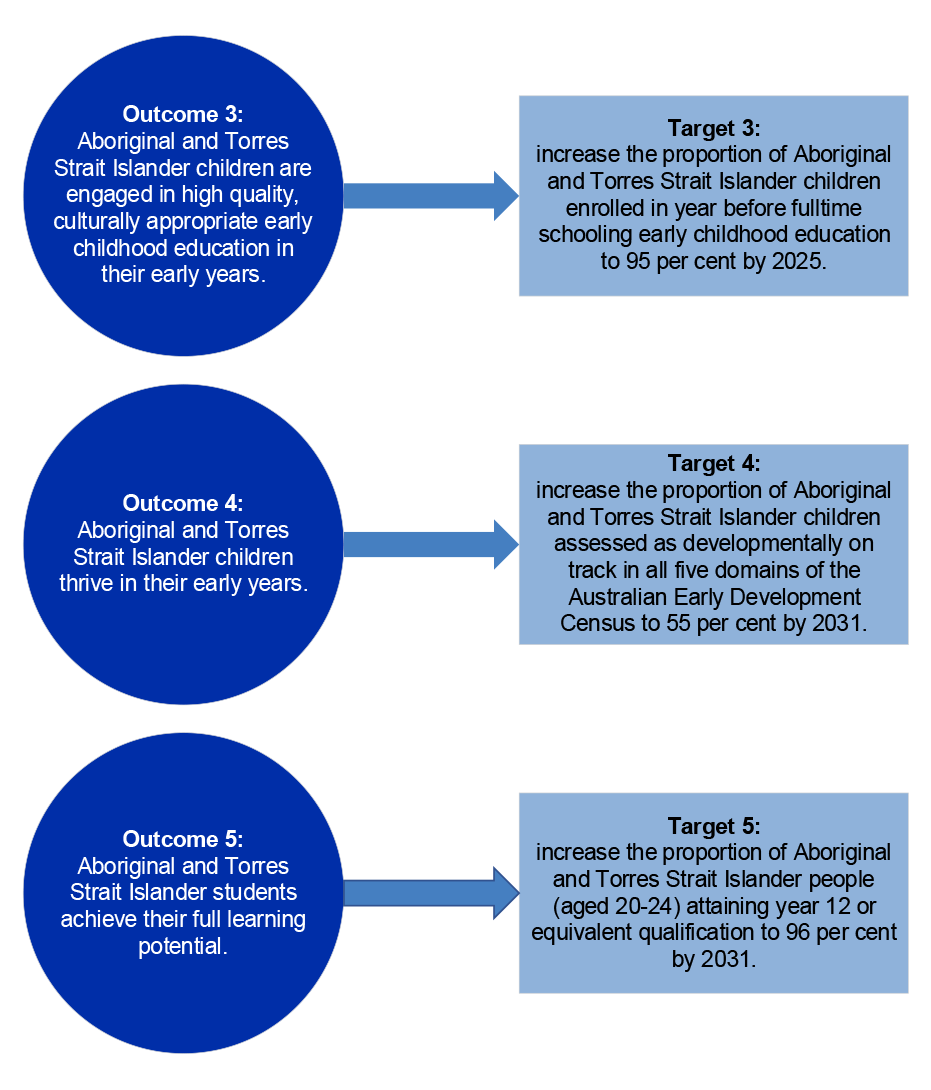
2. The National Agreement includes 17 socio-economic outcome areas with 19 targets. This audit focuses on activities related to the three outcome areas for schooling and early childhood development, which comprise Targets 3, 4 and 5:
- Target 3 is to increase the proportion of Aboriginal and Torres Strait Islander children enrolled in year before fulltime schooling early childhood education to 95 per cent by 2025.
- Target 4 is to increase the proportion of Aboriginal and Torres Strait Islander children assessed as developmentally on track in all five domains of the Australian Early Development Census to 55 per cent by 2031.
- Target 5 is to increase the proportion of Aboriginal and Torres Strait Islander people (aged 20–24) attaining year 12 or equivalent qualification to 96 per cent by 2031.
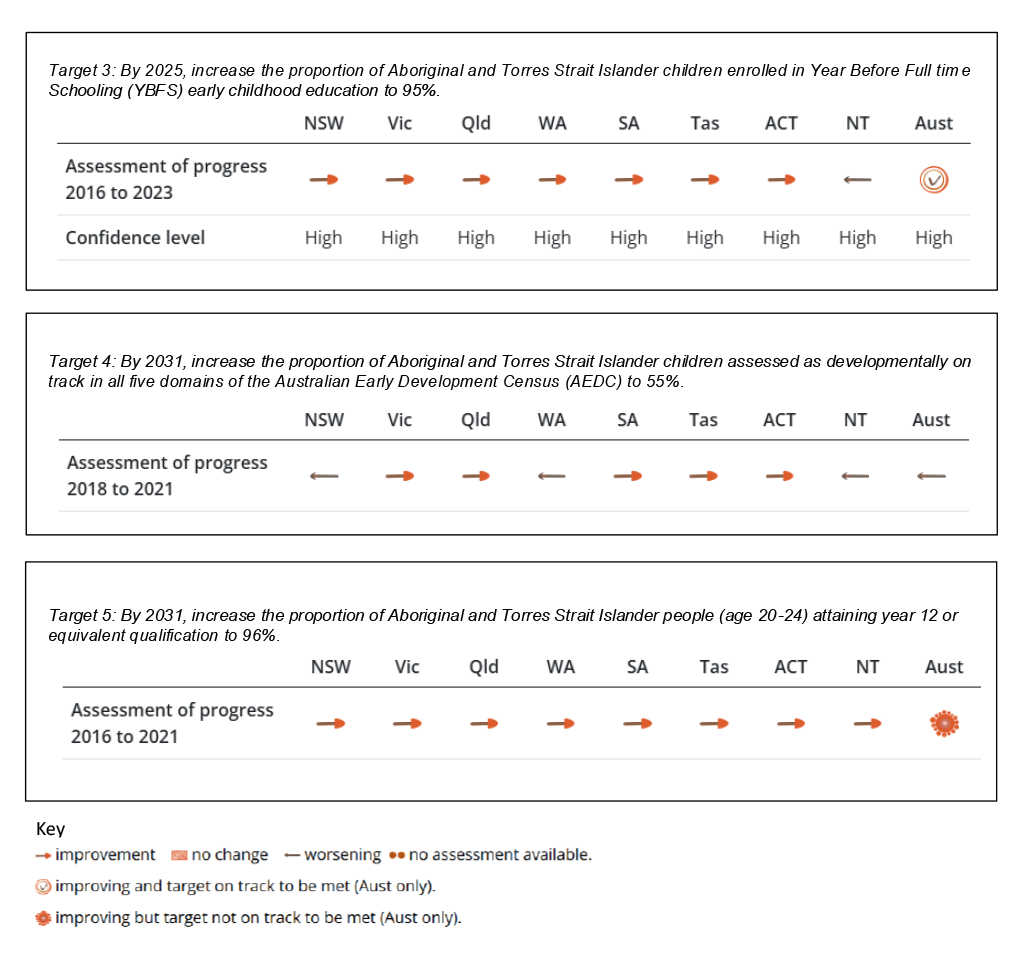
3. As at June 2025, for Australia as a whole, Target 3 was assessed to be improving and on track to be met, Target 4 was assessed to be worsening, and Target 5 was assessed to be improving but not on track to be met.
4. This audit examines the activities of four Australian Government entities with key roles relating to Closing the Gap in schooling and early childhood development and Targets 3, 4 and 5: the Department of Education (Education); the Department of Social Services (DSS); the National Indigenous Australians Agency (NIAA); and the Productivity Commission (PC).
Rationale for undertaking the audit
5. There is a high level of Parliamentary and community interest in policies that aim to address Aboriginal and Torres Strait Islander disadvantage. Multiple reviews have identified that progress in Closing the Gap has been slow. All parties to the National Agreement committed to:
mobilising all avenues and opportunities available to them to meet the objective of this Agreement … in a way that takes full account of, promotes, and does not diminish in any way, the cultures of Aboriginal and Torres Strait Islander people.4
6. The National Agreement on Closing the Gap, for the first time, formally recognised Aboriginal and Torres Strait Islander people as partners and established new ways of working called the priority reforms. The priority reforms are premised on an understanding that the way the commitments are delivered will influence the achievement of outcomes.
7. Stakeholders rely on the monitoring and reporting arrangements led by the NIAA and PC. Transparency is critical for understanding the level of progress that is being made towards achieving the Closing the Gap socio-economic outcomes and priority reforms.
8. This audit provides the Australian Parliament with assurance on whether activities of the audited entities have been effectively meeting the partnership requirements of the National Agreement in the areas of schooling and early childhood development, and whether there has been transparency in annual progress reporting.
Audit objective and criteria
9. The objective of the audit was to assess the effectiveness of partnership arrangements, funding design activities and measurement of progress for schooling and early childhood development commitments under the National Agreement on Closing the Gap.
10. To form a conclusion against the audit objective, the following high-level criteria were adopted.
- Are Australian Government entities working in partnership in developing policy options for schooling and early childhood development commitments under the National Agreement?
- Have fit for purpose Australian Government funding arrangements been designed for schooling and early childhood development commitments under the National Agreement?
- Is the Australian Government’s progress reporting reliable for schooling and early childhood development Closing the Gap socio-economic targets?
Conclusion
11. Partnership arrangements and funding design activities for schooling and early childhood development commitments under the National Agreement on Closing the Gap are largely effective and improving. There is a declining level of transparency over progress towards related Closing the Gap targets.
12. In the area of schooling and early childhood development, Australian Government entities are increasingly working in partnership with First Nations people in designing policy. Until June 2025 there was limited whole of Australian Government guidance on working in partnership with First Nations people. The Early Childhood Care and Development Policy Partnership (ECCDPP), of which the Department of Education is co-chair, is the most developed of several partnership arrangements in the area of schooling and early childhood development. The agreement to establish the ECCDPP and the way it is implemented align well with the ‘strong partnership’ elements of the National Agreement on Closing the Gap and the ECCDPP is a good example of a successful policy partnership. Place-based partnerships have not been established as required under the National Agreement. Evaluation of the success of policy partnerships is developing. Requirements for the Australian Government to report on the success of policy and place-based partnerships have not been met.
13. The principles of the National Agreement on Closing the Gap have been increasingly applied over time in the design of federal funding agreements for schooling and early childhood development commitments. More can be done to align mainstream federal funding agreements to the priority reforms. There is a lack of transparency over how federal funding agreements support Aboriginal community-controlled organisations. Relevant grant programs are partly aligned with the Closing the Gap principles, with deficiencies in how grant funding is used to support Aboriginal community-controlled and other Aboriginal and Torres Strait Islander organisations.
14. The Australian Government’s progress reporting for Targets 3, 4 and 5 could be more reliable and complete. Dashboard information published by the Productivity Commission on Targets 3, 4 and 5 is accurate, however Target 3 results (the only one of these three targets considered to be ‘on track’) are not fully meaningful due to a measurement issue. Many ‘supporting indicators’ set out in the 2020 National Agreement on Closing the Gap, which are intended to lead to greater understanding and insight into how governments are tracking against the targets, were not developed as at June 2025. The Australian Government’s annual reports on Closing the Gap are accurate but increasingly incomplete and unmeaningful. The NIAA has not done enough to appropriately advise the government about annual reporting requirements established in the National Agreement.
Supporting findings
Working in partnership
15. The Australian Government has made commitments since 2022 to develop guidance for how Australian Government entities can work in partnership with First Nations people. The Australian Public Service Commission’s (APSC) First Nations Partnership Playbook was published in June 2025. (See paragraphs 2.3 to 2.7)
16. The Early Childhood Care and Development Policy Partnership (a formal policy partnership established under the National Agreement on Closing the Gap) largely aligns with ‘strong partnership’ elements established in the National Agreement on Closing the Gap, in terms of both the agreement and its implementation. Recently established agreements for other schooling and early childhood development partnership arrangements (not established as formal policy partnerships under the National Agreement) are also aligned with relevant partnership principles. Guidance was developed for procuring evaluation of policy partnerships across all sectors in 2024. There has been some evaluation, with mixed findings about the effectiveness of policy partnerships generally. Reporting on policy partnerships in Australian Government Closing the Gap annual reports is deficient and worsening. (See paragraphs 2.8 to 2.20)
17. In 2021 it was agreed that state and territory governments would resource the establishment and governance costs for any place-based partnerships in their jurisdiction. Place-based partnerships were not fully established by 2024 as specified in the National Agreement on Closing the Gap. As at June 2025 governance arrangements for place-based partnerships, including partnership agreements, were developing. The NIAA, as the lead Australian Government entity responsible for supporting state and territory governments to establish place-based partnerships, did not have a strategy or practical plan to assist with their establishment. Education, DSS and the NIAA contributed to the development of draft partnership agreements for two place-based partnerships with a focus on the early years. The NIAA coordinated Australian Government participation in governance arrangements but did not coordinate with the relevant state governments to facilitate establishment of the two place-based partnerships. Australian Government reporting on place-based partnerships, including for place-based partnerships relevant to schooling and early childhood development, is deficient and worsening. (See paragraphs 2.21 to 2.34)
Funding design
18. Whole-of-government guidance on how to embed the priority reforms in federal funding agreements was finalised in April 2025. There are four federal funding agreements that are directly relevant to Closing the Gap Targets 3, 4 or 5 (Preschool Reform Agreement, On Country Learning, Better and Fairer Schools Agreements and Northern Territory Remote Aboriginal Investment Agreement). Between 2021 (the date of the first agreement) and 2025, alignment with the principles of working in partnership and enabling monitoring and evaluation against Closing the Gap targets has increased, however more can be done to align mainstream federal funding agreements to the priority reforms. Noting that specific funding schedules were still under negotiation for several of the agreements as at June 2025 and that there are constraints for two of the agreements under the Australian Education Act 2013, none of the four agreements directly relevant to Closing the Gap Targets 3, 4 or 5 explicitly required a meaningful proportion of funds to be directed to the Aboriginal community-controlled organisation (ACCO) sector or for parties to report on the proportion of funding provided to the ACCO sector. (See paragraphs 3.5 to 3.18)
19. A selection of four grant programs related to Closing the Gap Targets 3, 4 and 5 were not consistently aligned with working in partnership principles. A clear link to Closing the Gap targets was not always established. A commitment made by the Australian Government to finalise a grant connected policy that would enable the preferencing of ACCOs in mainstream grant programs has not yet been met. A selection of five grant programs demonstrated mixed degrees of ACCO preferencing. The NIAA and DSS monitor the proportion of grants allocated to Aboriginal and Torres Strait Islander organisations (including ACCOs); Education does not and as a result is not well placed to assess or evaluate the proportion of funding provided to ACCOs. The Australian Government has not met the requirement in the National Agreement on Closing the Gap to report annually on the allocation of grant funding to Aboriginal and Torres Strait Islander organisations (including ACCOs). (See paragraphs 3.19 to 3.46)
Progress reporting
20. The PC has published accurate data on the achievement of socio-economic outcomes at the required frequency. The PC provides appropriately disaggregated data for Targets 3, 4 and 5. The PC’s consultation with data stakeholders and governance bodies is appropriate. The PC is largely transparent about the currency and limitations of published data, some of which is outdated or limited for reasons beyond the control of the PC. The PC’s documentation of quality assurance processes for target reporting could be improved.
21. Data governance bodies, which the PC advises, make the decisions about target data. As at June 2025, there was no reporting on progress towards the priority reforms due to a lack of a finalised measurement approach. Results for Target 3 do not enable a meaningful conclusion on progress due to a known data limitation issue. This had not been resolved despite longstanding awareness of the problem. As at June 2025, for Targets 3, 4 and 5, most supporting indicators set out in the 2020 National Agreement on Closing the Gap (which were intended to provide ‘greater understanding’ and ‘insight’ into how governments are tracking against the socio-economic targets) had not been finalised. (See paragraphs 4.2 to 4.22)
22. The coordination and publication of the Australian Government’s annual reports on the Closing the Gap National Agreement have been facilitated by the NIAA. While accurately drawing on the PC dashboards, information on Targets 3, 4 and 5 has become less complete over time, reducing transparency over Closing the Gap progress in schooling and early childhood development. There has also been a reduction in meaningful information in annual reports about risks and lessons learned. (See paragraphs 4.23 to 4.35)
Recommendations
Recommendation no. 1
Paragraph 2.35
The Australian Government Closing the Gap Annual Report include information on policy and place-based partnerships, including the number of partnerships, those that have been reviewed, progress in establishing place-based partnerships, for each established partnership which strong partnership elements are met and unmet, and what has been achieved through the partnerships, as required under clause 37 of the National Agreement on Closing the Gap.
National Indigenous Australians Agency: Noted
Recommendation no. 2
Paragraph 3.47
The Australian Government include the number of Aboriginal community-controlled and other Aboriginal and Torres Strait Islander organisations that have been allocated funding and the amount allocated in annual Closing the Gap reports, as required under clause 118 of the National Agreement on Closing the Gap, to improve transparency over the achievement of Priority Reform 2.
National Indigenous Australians Agency: Noted
Recommendation no. 3
Paragraph 3.49
The Department of Education monitor the proportion of grants funding it provides to Aboriginal community-controlled and other Aboriginal and Torres Strait Islander organisations with a view to evaluating the proportion of funding provided.
Department of Education: Agreed
Recommendation no. 4
Paragraph 4.36
The Australian Government improve the completeness and meaningfulness of the Australian Government’s Closing the Gap annual reports and comply with clause 118 of the National Agreement on Closing the Gap by: drawing from the Productivity Commission dashboard to include information about target results and status; and including risks, successes, failures and lessons learned.
National Indigenous Australians Agency: Noted
Summaries of entity responses
23. The proposed audit report was provided to Education, DSS, the NIAA and the PC. An extract of the proposed audit report was provided to the Coalition of Peaks, SNAICC — National Voice for our Children (SNAICC), and National Aboriginal and Torres Strait Islander Education Corporation (NATSIEC). Summary responses for Education, the NIAA, PC and SNAICC are reproduced below, and full responses for these entities as well as DSS are in Appendix 1. The Coalition of Peaks and NATSIEC did not provide a letter of response. Improvements observed by the ANAO during the course of this audit are listed at Appendix 2.
Department of Education
The Department of Education (the department) acknowledges the Australian National Audit Office (ANAO) performance audit on Closing the Gap in schooling and early childhood development partnership and reporting.
The department welcomes the ANAO assessment that partnership arrangements and funding design activities for schooling and early childhood development commitments under the National Agreement on Closing the Gap are largely effective and improving. The department notes the areas the ANAO has identified where alignment could be strengthened and agrees to the recommendation and opportunity for improvement identified within the report that are relevant to the department.
The department is committed to working in partnership with Aboriginal and Torres Strait Islander peoples to ensure that all learners are provided the opportunity to achieve their educational potential.
National Indigenous Australians Agency
The National Indigenous Australians Agency (NIAA) welcomes the findings of the Closing the Gap in early childhood development and schooling audit (the audit).
The NIAA notes the recommendations directed to the Australian Government. Any amendments to the Commonwealth Closing the Gap Annual Report, including the inclusion or presentation of information, are matters for consideration by the Australian Government. The NIAA will brief the Government on the findings and recommendations of the audit.
The NIAA notes the audit’s observations regarding transparency of funding to Aboriginal community-controlled and other First Nations organisations. Reflecting this in the Annual Report requires substantial lead time and will be considered for inclusion in later Commonwealth Closing the Gap Annual Reports.
All Commonwealth Closing the Gap Annual Reports to date draw from the Productivity Commission Closing the Gap Information Repository Dashboard (Dashboard) data in line with clause 118 of the National Agreement on Closing the Gap — they do not duplicate the data unnecessarily. Any changes to this approach for future Commonwealth Closing the Gap Annual Reports is a matter for consideration by Government.
Productivity Commission
The Productivity Commission (PC) thanks the ANAO report on Closing the Gap in schooling and early childhood development.
The PC welcomes the ANAO’s findings that the Closing the Gap Information Repository, produced by the PC, provides accurate data on the achievement of socio-economic outcomes.
We remain committed to producing information that is accessible, meaningful, and of high quality. To support this, we will seek opportunities to further improve documentation of our data quality assurance processes.
The PC recognises the ongoing need to address data limitations (such as for Target 3) and to enhance the completeness of the Information Repository. The PC is committed to work in partnership with governments and Aboriginal and Torres Strait Islander people to develop the Information Repository so that it meets their needs.
SNAICC — National Voice for our Children
SNAICC — National Voice for our Children (SNAICC) thanks the ANAO for the opportunity to comment on the audit report into Closing the Gap in early childhood development and schooling. We also acknowledge the ANAO’s efforts to consult with SNAICC throughout this audit, in recognition of the importance of working in partnership with Aboriginal and Torres Strait Islander organisations on matters relating to Closing the Gap.
Australia is more than five years into the National Agreement on Closing the Gap and although we have seen some positive progress, many targets are off track. A dedicated focus on implementing the National Agreement, including the Priority Reforms, is needed to transform outcomes for our children. This audit, along with the Independent Aboriginal and Torres Strait Islander Review and Productivity Commission Review of the National Agreement, provides a clear path forward for the Australian Government.
We urge all government parties to deliver the recommended actions outlined in the report. In particular, SNAICC would welcome more transparency around the Australian Government’s efforts on Closing the Gap, including the proportion of funding agencies are providing to ACCOs. SNAICC will continue to work closely with the Australian Government to improve the lives of Aboriginal and Torres Strait Islander children.
Key messages from this audit for all Australian Government entities
24. Below is a summary of key messages, including instances of good practice, which have been identified in this audit and may be relevant for the operations of other Australian Government entities.
Group title
Policy/program design
Key learning reference
Group title
Grants
Key learning reference
Group title
Performance and impact measurement
Key learning reference
1. Background
Introduction
1.1 In 2006 the Council of Australian Governments (COAG)5 agreed to an intergovernmental approach to ‘closing the gap in outcomes between Indigenous people and other Australians in key areas’6, which led to the establishment of the National Indigenous Reform Agreement (Closing the Gap) (NIRA) in 2008. The NIRA committed the Australian, state and territory governments to a framework of Closing the Gap objectives, outcomes, outputs, performance measures and six targets (two of which related to schooling or early childhood development).
1.2 In February 2018, ten years after the establishment of the NIRA, a Special Gathering of prominent Aboriginal and Torres Strait Islanders presented a statement setting out priorities for a new Closing the Gap agenda. It called on governments to negotiate specific targets with Aboriginal and Torres Strait peoples across nine priority areas, one of which was education.7 In December 2018 COAG released a statement committing to a refresh of the Closing the Gap framework, which stated that the NIRA had been negotiated with little to no input from Aboriginal and Torres Islander peoples and with an inadequate understanding of the mechanisms and timeframes needed.8
1.3 In March 2019 the Coalition of Aboriginal and Torres Strait Islander Peak Organisations (Coalition of Peaks) was formed as a representative body of over 80 Aboriginal and Torres Strait Islander community-controlled peak organisations and 800 other member organisations.9 The Coalition of Peaks’ goal is to provide legitimate community-controlled representation on Aboriginal and Torres Strait Islander policy.10
1.4 In March 2019 the Coalition of Peaks and COAG signed the Partnership Agreement on Closing the Gap 2019–2029 (Partnership Agreement). The Partnership Agreement objectives are to enhance outcomes for Aboriginal and Torres Strait Islander people through full equitable participation of Aboriginal and Torres Strait Islander peoples in developing and implementing a framework for Closing the Gap.11
1.5 The Partnership Agreement established the Joint Council of Australian Governments and Aboriginal and Torres Strait Islander People on Closing the Gap (Joint Council). Membership of Joint Council comprises one minister from each jurisdiction, one representative of the Australian Local Government Association (ALGA) and 12 representatives nominated by the Coalition of Peaks. Joint Council has equal representation from the Coalition of Peaks and governments.12 Joint Council is supported by a Partnership Working Group (PWG), which is made up of senior government officials and representatives from the Coalition of Peaks and ALGA.
The National Agreement on Closing the Gap
1.6 From September to December 2019, the Coalition of Peaks held an ‘engagement process’ around Australia to inform the development of a new national agreement. In July 2020 the first ministers of all Australian governments, the lead convenor of the Coalition of Peaks and the President of ALGA signed the National Agreement on Closing the Gap (National Agreement).13 The objective of the National Agreement is to ‘overcome the entrenched inequality faced by too many Aboriginal and Torres Strait Islander people so that their life outcomes are equal to all Australians’.14
1.7 The Australian Government is jointly accountable with state and territory governments for the implementation of the National Agreement15 and each party has annual reporting requirements. The Prime Minister’s foreword to the 2024–25 Commonwealth Closing the Gap Annual Report and Implementation Plan stated:
The National Agreement on Closing the Gap is based on the understanding that when Aboriginal and Torres Strait Islander people have a genuine say in the programs and services that affect them, better outcomes are achieved … governments have to be willing to share decision-making with communities and empower the Aboriginal and Torres Strait Islander organisations delivering critical services on the ground.16
1.8 The NIAA advised the ANAO in August 2025 that the National Agreement is not a funding mechanism and does not facilitate funding allocations and that the NIAA does not collect aggregate data on overall investment.
1.9 As at June 2025 the National Agreement includes 17 socio-economic outcome areas with 19 targets. This audit focuses on the three outcome areas related to schooling and early childhood development, which comprise Targets 3, 4 and 5 (Figure 1.1).
Figure 1.1: Schooling and early childhood development outcomes and targets
Source: National Agreement on Closing the Gap.
1.10 As at June 2025, for Australia as a whole, Target 3 was assessed to be improving and on track to be met; Target 4 was assessed to be worsening; and Target 5 was assessed to be improving but not on track to be met (Figure 1.2).
Figure 1.2: Progress on achieving Targets 3, 4 and 5, reporting as at June 2025
Source: Productivity Commission, Closing the Gap Information Repository - Dashboard, PC, 2025, available from https://www.pc.gov.au/closing-the-gap-data/dashboard/ [accessed 22 June 2025].
1.11 In addition to including the Coalition of Peaks as a party to the National Agreement, a key difference between the NIRA and the National Agreement is the inclusion in the National Agreement of four ‘priority reforms’ that are focussed on changing ‘the way governments work to accelerate improvements in the lives of Aboriginal and Torres Strait Islander people’17 (Table 1.1).
Table 1.1: Priority reforms of the National Agreement on Closing the Gap
|
Priority reform |
Title |
Description |
|
Priority Reform 1 (clause 17a) |
Formal Partnerships and Shared Decision Making |
Aboriginal and Torres Strait Islander people are empowered to share decision-making authority with governments to accelerate policy and place-based progress on Closing the Gap through formal partnership arrangements. |
|
Priority Reform 2 (clause 17b) |
Building the Community-Controlled Sector |
There is a strong and sustainable Aboriginal and Torres Strait Islander community-controlled sector delivering high quality services to meet the needs of Aboriginal and Torres Strait Islander people across the country. |
|
Priority Reform 3 (clause 17c) |
Transforming Government Organisations |
Governments, their organisations and their institutions are accountable for Closing the Gap and are culturally safe and responsive to the needs of Aboriginal and Torres Strait Islander people, including through the services they fund. |
|
Priority Reform 4 (clause 17d) |
Shared Access to Data and Information at a Regional Level |
Aboriginal and Torres Strait Islander people have access to, and the capability to use, locally-relevant data and information to set and monitor the implementation of efforts to close the gap, their priorities and drive their own development. |
Source: Closing the Gap, Priority Reform Areas for Joint National Action, Closing the Gap, 2020, available from https://www.closingthegap.gov.au/national-agreement/national-agreement-closing-the-gap/ 6-priority-reform-areas [accessed 16 January 2025]; and Closing the Gap, Objective and Outcomes, Closing the Gap, 2020, available from https://www.closingthegap.gov.au/national-agreement/national-agreement-closing-the-gap/ 3-objective-and-outcomes [accessed 16 January 2025].
1.12 Under Priority Reform 1, the National Agreement recognises and requires two forms of partnership: policy partnerships and place-based partnerships.18
- Policy partnerships are partnerships created for the purpose of working on discrete policy areas, such as education, health or housing.
- Place-based partnerships are partnerships based on a specific region, between government and Aboriginal and Torres Strait Islander representatives, and others by agreement, from those specific areas.
1.13 In relation to Priority Reform 2, the National Agreement defines an Aboriginal and/or Torres Strait Islander community-controlled organisation as an organisation that delivers services, including land and resource management, that builds the strength and empowerment of Aboriginal and Torres Strait Islander communities and people and is: incorporated under relevant legislation and not-for-profit; controlled and operated by Aboriginal and/or Torres Strait Islander people; connected to the community, or communities, in which they deliver the services; and governed by a majority Aboriginal and/or Torres Strait Islander governing body.19
1.14 Other key terms used in this audit are explained in the glossary at Appendix 3.
Australian Government’s role in Closing the Gap in schooling and early childhood development
1.15 This audit examines four Australian Government entities with key roles relating to Targets 3, 4 and 5.
- Department of Education (Education) — Education’s role includes co-chairing the Early Childhood Care and Development Policy Partnership (ECCDPP); working with peak Aboriginal and Torres Strait Islander organisations (namely, SNAICC — National Voice for our Children (SNAICC) and the National Aboriginal and Torres Strait Islander Education Corporation (NATSIEC)); and participating in a place-based partnership in the East Kimberley, Western Australia.20 Since 2020 Education has led negotiations for four relevant federal funding agreements: the Preschool Reform Agreement (2021), On Country Learning (2023), the Better and Fairer Schools Agreement (2025–2034) and the Better and Fairer Schools Agreement — Full and Fair Funding (2025–2034).
- Department of Social Services (DSS) — DSS has programs that contribute to progressing achievement of Targets 3 and 4, including through implementation of the Early Years Strategy21 and the First Nations Playgroups pilot grant program; acting as an Australian Government partner of the ECCDPP; and supporting the East Kimberly place-based partnership.
- National Indigenous Australians Agency (NIAA) — The NIAA leads and coordinates the development and implementation of Closing the Gap targets in partnership with Indigenous Australians22 and is the lead agency for monitoring and reporting on the National Agreement. This includes responsibility for the coordination and production of the annual Australian Government implementation plan and annual report; managing the Commonwealth Closing the Gap Partnership Stocktake (see Appendix 6); developing and maintaining formal partnerships with the Coalition of Peaks and Aboriginal and Torres Strait Islander representative organisations; attending policy partnership meetings as a non-voting member; and supporting states and territories and Aboriginal and Torres Strait Islander people in the establishment of place-based partnerships. Through its regional network23 and funded programs including the Indigenous Advancement Strategy24, the NIAA has visibility of partnership approaches.
- Productivity Commission (PC) — The PC states that it is ‘the Australian Government’s independent research and advisory body on economic, social and environmental issues affecting the welfare of Australians’.25 The PC conducts a three-yearly review of the National Agreement; publishes an Annual Data Compilation Report; and maintains a Closing the Gap data dashboard on its website.26
Rationale for undertaking the audit
1.16 There is a high level of Parliamentary and community interest in policies that aim to address Aboriginal and Torres Strait Islander disadvantage. Multiple reviews have identified that progress in Closing the Gap has been slow. All parties to the National Agreement committed to:
mobilising all avenues and opportunities available to them to meet the objective of this Agreement … in a way that takes full account of, promotes, and does not diminish in any way, the cultures of Aboriginal and Torres Strait Islander people.27
1.17 The National Agreement on Closing the Gap, for the first time, formally recognised Aboriginal and Torres Strait Islander people as partners and established new ways of working called the priority reforms. The priority reforms are premised on an understanding that the way the commitments are delivered will influence the achievement of outcomes.
1.18 Stakeholders rely on the monitoring and reporting arrangements led by the NIAA and PC. Transparency is critical for understanding the level of progress that is being made towards achieving the Closing the Gap socio-economic outcomes and priority reforms.
1.19 This audit provides the Australian Parliament with assurance on whether activities of the audited entities have been effectively meeting the partnership requirements of the National Agreement in the areas of schooling and early childhood development, and whether there has been transparency in annual progress reporting.
Audit approach
Audit objective, criteria and scope
1.20 The objective of the audit was to assess the effectiveness of partnership arrangements, funding design activities and measurement of progress for schooling and early childhood development commitments under the National Agreement on Closing the Gap.
1.21 To form a conclusion against the audit objective, the following high-level criteria were adopted.
- Are Australian Government entities working in partnership in developing policy options for schooling and early childhood development commitments under the National Agreement?
- Have fit for purpose Australian Government funding arrangements been designed for schooling and early childhood development commitments under the National Agreement?
- Is the Australian Government’s progress reporting reliable for schooling and early childhood development Closing the Gap socio-economic targets?
1.22 In developing the audit scope and testing approach, the ANAO met with the Coalition of Peaks, SNAICC, NATSIEC, the Australian Public Service Commission, the Australian Human Rights Commission and the Audit Office of New South Wales.
Audit methodology
1.23 To address the audit objective, the audit methodology included:
- meeting with the Coalition of Peaks, SNAICC, NATSIEC, Indigenous Education Consultative Meeting (IECM) and the ECCDPP;
- meeting with Aboriginal and Torres Strait Islander stakeholders on country in Ceduna, South Australia;
- meeting with officials from the audited entities, other Australian Government entities, state and territory governments, the Australian Local Government Association and the Local Government Association of the Northern Territory;
- observing policy and place-based partnership meetings in person and online;
- reviewing entity documentation and undertaking walk-throughs of entity processes;
- analysing published submissions provided to related reviews;
- sharing and discussing content of report preparation papers with the Coalition of Peaks, SNAICC, NATSIEC, members of the ECCDPP, Aboriginal Peak Organisations Northern Territory, Binarri-binyja yarrawoo Aboriginal Corporation, Gunawuna Jungai Limited and Australian Public Service Commission officials;
- contacting 583 organisations to inform them of the audit and invite contributions28; and
- analysing 11 written contributions to the audit received from observers and providers of children’s services and education and several Aboriginal and Torres Strait Islander peak bodies.
1.24 The audit examines Targets 3, 4 and 5. In designing the criteria for this audit, ANAO incorporated elements of Priority Reforms 1 and 2. The ANAO acknowledges that all Closing the Gap socio-economic targets and priority reforms are inter-related, and that while the Australian Government has a critical role in the implementation of the National Agreement, responsibilities and accountability are shared between the parties to the National Agreement.
1.25 The audit does not make findings about: the adequacy of funding provided by the Australian Government; or whether the partnership approaches meet all expectations of signatories to the National Agreement or of Aboriginal and Torres Strait Islander peoples; and does not draw conclusions about why Closing the Gap outcomes are or are not being achieved. The PC’s Review of the National Agreement on Closing the Gap and the Independent Aboriginal and Torres Strait Islander-Led Review of Closing the Gap were published in January 202429 and June 2025, respectively, and address some of these matters.30
1.26 The audit was conducted in accordance with ANAO Auditing Standards at a cost to the ANAO of approximately $1,269,900.
1.27 The team members for this audit were April Howley, Tony Varnes, Katiloka Ata, Benjamin Foreman, Callum Mann, Yoann Colin, Dr Imogen Sykes-Bridge and Christine Chalmers.
2. Developing policy in partnership
Areas examined
This chapter examines how the Department of Education (Education), Department of Social Services (DSS) and National Indigenous Australians Agency (NIAA) work in partnership with Aboriginal and Torres Strait Islander people and coordinate across governments to develop policy options for schooling and early childhood development commitments under the National Agreement.
Conclusion
In the area of schooling and early childhood development, Australian Government entities are increasingly working in partnership with First Nations people in designing policy. Until June 2025 there was limited whole of Australian Government guidance on working in partnership with First Nations people. The Early Childhood Care and Development Policy Partnership (ECCDPP), of which the Department of Education is co-chair, is the most developed of several partnership arrangements in the area of schooling and early childhood development. The agreement to establish the ECCDPP and the way it is implemented align well with the ‘strong partnership’ elements of the National Agreement on Closing the Gap and the ECCDPP is a good example of a successful policy partnership. Place-based partnerships have not been established as required under the National Agreement. Evaluation of the success of policy partnerships is developing. Requirements for the Australian Government to report on the success of policy and place-based partnerships have not been met.
Areas for improvement
The ANAO made one recommendation to the NIAA to improve Australian Government annual reporting on the success of policy and place-based partnerships. The ANAO suggested that the NIAA could articulate a strategy or practical plan for supporting the establishment of place-based partnerships.
2.1 The National Agreement on Closing the Gap sets out obligations for the Australian Government to work in partnership with Aboriginal and Torres Strait Islander people and share accountability for the outcomes and targets with states and territories. Priority Reform 1 is ‘formal partnerships and shared decision-making’. The National Agreement on Closing the Gap states that:
The Parties commit to building and strengthening structures that empower Aboriginal and Torres Strait Islander people to share decision-making authority with governments to accelerate policy and place-based progress against Closing the Gap.31
2.2 The National Agreement on Closing the Gap states that Joint Council (see paragraph 1.5) will establish a joined-up approach between the Australian Government, state and territory governments and Aboriginal and Torres Strait Islander representatives in five priority policy areas, including early childhood care and development. While ‘partnership actions do not limit opportunities for pursuing joined up effort by the Parties in other policy areas and places’32, the National Agreement on Closing the Gap requires the establishment of two specific types of partnership: policy and place-based (see paragraph 1.12).
Is there guidance for Australian Government entities on how to work in partnership?
The Australian Government has made commitments since 2022 to develop guidance for how Australian Government entities can work in partnership with First Nations people. The Australian Public Service Commission’s (APSC) First Nations Partnership Playbook was published in June 2025.
2.3 Clause 32 of the National Agreement on Closing the Gap sets out the elements of ‘strong partnership’ (see Appendix 4). Between 2022 and 2024, the Australian Government committed to developing further guidance on working in partnership by 2023 in its annual Closing the Gap Commonwealth Implementation Plans (Implementation Plans) and related public documents (which by 2024 was not achieved).33
2.4 In April 2024 the APSC released the Charter of Partnerships and Engagement — Good practice guidance (Charter of Partnerships)34, which presented a spectrum of engagement and partnership approaches ranging from sharing to empowering.35 The guidance is not specific to partnering with Aboriginal and Torres Strait Islander people.
2.5 In May 2024 the Department of the Prime Minister and Cabinet (PM&C) drafted a Guidance Note: Embedding priority reforms in National Agreements (Guidance Note), which identifies actions that the Australian Government can take when developing other national agreements with the states and territories to meet commitments under the National Agreement on Closing the Gap. PM&C advised the ANAO in July 2025 that in April 2025 the First Deputies Group endorsed the Guidance Note.36
2.6 In April 2025 the Department of Health, Disability and Ageing (DHDA) published an Aboriginal and Torres Strait Islander Partnership and Engagement Framework, which has been designed for use by DHDA officials.37
2.7 In June 2025 the APSC published the First Nations Partnership Playbook (Playbook) on its website, describing it as ‘the first step toward consistent partnership skills and practice through the [Australian Public Service].’38
Did entities work in partnership through policy partnerships?
The Early Childhood Care and Development Policy Partnership (a formal policy partnership established under the National Agreement on Closing the Gap) largely aligns with ‘strong partnership’ elements established in the National Agreement on Closing the Gap, in terms of both the agreement and its implementation. Recently established agreements for other schooling and early childhood development partnership arrangements (not established as formal policy partnerships under the National Agreement) are also aligned with relevant partnership principles. Guidance was developed for procuring evaluation of policy partnerships across all sectors in 2024. There has been some evaluation, with mixed findings about the effectiveness of policy partnerships generally. Reporting on policy partnerships in Australian Government Closing the Gap annual reports is deficient and worsening.
2.8 There are three partnership arrangements, all administered by Education, where Australian Government entities worked with Aboriginal and Torres Strait Islander people to develop policy for schooling and early childhood development measures under the National Agreement on Closing the Gap, comprising:
- Early Childhood Care and Development Policy Partnership (ECCDPP) — established in 2022, as required under the National Agreement on Closing the Gap, between Education, other Australian Government entities, SNAICC — National Voice for our Children (SNAICC), First Nations representatives and state and territory governments under clause 3839 of the National Agreement on Closing the Gap;
- NATSIEC partnership agreement — established in 2025 between Education and the National Aboriginal and Torres Strait Islander Education Corporation (NATSIEC); and
- SNAICC partnership agreement — established in 2025 between Education and SNAICC.
2.9 A fourth arrangement — the Indigenous Education Consultative Meeting (IECM) — was established between Education and First Nations representatives from each state and territory in 2017, prior to the National Agreement on Closing the Gap. The IECM was Education’s formal engagement arrangement with First Nations people focused on education prior to 2025. The IECM supported the establishment of the NATSIEC partnership agreement and complements the other partnership arrangements described in paragraph 2.8. The ANAO did not further assess the IECM, which was intended as an engagement mechanism rather than a partnership.
Working in partnership arrangements to develop policy
2.10 At clause 35, the National Agreement on Closing the Gap states that formal policy partnerships will include elements outlined in clauses 32 and 33 (see Appendix 4).
- Clause 32 sets out ‘strong partnership’ elements across three categories: accountable and representative, a formal agreement in place, and shared decision-making.
- Clause 33 sets out ‘resourcing’ elements and states: ‘The Parties recognise that adequate funding is needed to support Aboriginal and Torres Strait Islander parties to be partners with governments in formal partnerships.’40
2.11 Effective policy partnerships also require coordination between Australian Government entities with shared responsibility, and with state and territory governments (which have joint accountability under the National Agreement).
Policy partnership under the National Agreement on Closing the Gap
2.12 The ECCDPP is a formal policy partnership under the National Agreement on Closing the Gap. The agreement to Implement the Early Childhood Care and Development Policy Partnership (ECCDPP Agreement) states its purpose is ‘to establish a mechanism for the Parties to develop a joined-up approach to Aboriginal and Torres Strait Islander early childhood care and development policy’. The ECCDPP is responsible for progressing Closing the Gap Targets 2, 3, 4, 12 and 13. The primary function of the ECCDPP is to make recommendations to all governments, through Joint Council, to improve the early childhood outcomes of Aboriginal and Torres Strait Islander children.
2.13 The ECCDPP is made of up of nine members from the Australian Government and state and territory governments, 11 members from the Coalition of Peaks or independent First Nations people, and 12 ‘partners’ (including DSS and the NIAA). Education and SNAICC are co-chair and co-secretariat. NATSIEC is not a member of the ECCDPP.
2.14 The ECCDPP Agreement largely aligned with clause 32 and fully aligned with clause 33 of the National Agreement on Closing the Gap (Table 2.1 and Appendix 4). The ECCDPP’s implementation as at June 2025 was also largely aligned. For example, and at the meetings observed by ANAO, decisions were made by consensus and Aboriginal and Torres Strait Islander members shared lived experience. Aboriginal and Torres Strait Islander members of the ECCDPP that spoke to the ANAO advised that the ECCDPP reflected a partnership approach and they felt they could speak freely in ECCDPP meetings. Minutes showed First Nations members engaging throughout partnership meetings in response to agenda items.
Table 2.1: ECCDPP — Alignment with ‘strong partnership’ principles, as at June 2025
|
Clause |
Assessment of agreement |
Alignment |
Assessment of implementation |
Alignment |
|
Accountable and representative |
||||
|
32.a(i) Appointed by and accountable to First Nations people |
States that the Coalition of Peaks can remove members and can call for expressions of interest for a replacement where membership is reconsidered. The Coalition of Peaks co-chair can appoint a suitable proxy. There are no clear appointment requirements for members. |
▲ |
The ECCDPP Operating Protocols support Aboriginal and Torres Strait Islander members choosing their own representatives. The Operating Protocols state that when new members are required, Aboriginal and Torres Strait Islander members in consultation with the Coalition of Peaks will support the process of selecting a new member and that SNAICC will advise the shared secretariat of the new member’s details. |
◆ |
|
32.a(ii) Between up to 3 levels of government, where government representatives have negotiating and decision-making authority |
The ECCDPP includes the Commonwealth and state and territory governments. The ECCDPP Agreement requires partners (who are representatives of another government department invited to attend by government members) to have an appropriate level of delegation equal to members. The ECCDPP Agreement does not include a requirement for members to have a specific level of negotiating or decision-making authority. |
▲ |
Between November 2022 and July 2024, there were six meetings. Education and DSS officers attended all meetings. A NIAA representative attended from January 2024, following the agreement to their membership. The officers attending meetings had a sufficient level of authority. Any additional Commonwealth membership was discussed and agreed to by the ECCDPP. The ECCDPP Operating Protocols require government parties to ensure incoming members and partners have sufficient seniority and authority. |
◆ |
|
32.a(iii) Includes other parties as agreed by First Nations representatives and governments |
States that, subject to the agreement of co-chairs, additional parties may be invited to attend ECCDPP meetings. |
◆a |
Additional parties attended meetings including other Australian Government entities, state and territory government entities, and guest speakers. At a meeting held on 9 October 2023, the ECCDP discussed the NIAA’s request for membership, which was approved by the ECCDPP. Meeting minutes did not demonstrate that there had been agreement by the Aboriginal and Torres Strait Islander representatives and governments to these parties’ attendance. |
▲ |
|
Formal agreement |
||||
|
32.b Formal agreement is in place |
A formal agreement is in place and signed by all parties. |
◆ |
N/A |
N/A |
|
32.b(i) … that includes roles, purpose, scope of shared decision-making, reporting, timeframes, monitoring, and dispute mechanisms |
The ECCDPP Agreement defines who the parties are, their roles, the purpose and objectives of the partnership, the scope of shared decision-making, and reporting arrangements, timeframes, monitoring, review and dispute mechanisms. |
◆ |
N/A |
N/A |
|
32.b(ii) First Nations parties can agree to the agenda |
The ECCDPP Agreement requires that the agenda is approved by the co-chairs. The agenda is informed by input from the parties. |
◆ |
Co-chairs’ approval of agendas was sought for 8 of the 10 meetings. |
◆ |
|
32.b(iii) … is public and easily accessible |
The ECCDPP Agreement does not contain a requirement to be made public. |
■ |
The ECCDPP Agreement is publicly available on Education’s website.b |
◆ |
|
Shared decision making |
||||
|
32.c(i) Decision-making is shared and made by consensus with equal weight given to First Nations parties |
The ECCDPP Agreement states that shared decision-making, determining whether a topic is in scope and all recommendations made pursuant to the ECCDPP Agreement are made by consensus. |
◆ |
The Operating Protocols state the ECCDPP will make decisions on the basis of consensus ‘wherever possible’. The Operating Protocols define consensus as not requiring uniformity of actions but agreement on the outcome and resolution wording. The Operating Protocols state a decision can only be deemed taken if quorum is achieved, and clear responses are received from all attendees. The ANAO observed two meetings, each of which demonstrated decision-making by consensus. For the other meetings, although minutes for two meetings indicated intent for specific decisions to be made by consensus, it was not possible for ANAO to ascertain from the meeting minutes whether decisions were consistently made by consensus. |
◆ |
|
32.c(ii) Matters can be understood by all parties |
Meeting papers are to be distributed with enough time to understand the implications. |
◆ |
Agendas and papers were distributed to members and partners more than seven days before the meeting for eight of the 10 meetings. |
◆ |
|
32.c(iii) First Nations representatives can speak without fear of reprisal |
N/A |
N/A |
Meeting minutes and observation of two ECCPP meetings demonstrated Aboriginal and Torres Strait Islander members and partners engaging, expressing concerns with the arrangement, making requests of government members and partners, and providing feedback. Aboriginal and Torres Strait Islander members of the ECCDPP that spoke to the ANAO advised that the ECCDPP reflected a partnership approach and they felt they could speak freely in ECCDPP meetings. Minutes showed First Nations members engaging throughout partnership meetings in response to agenda items. |
◆ |
|
32.c(iv) A wide variety of First Nations groups can be heard |
The ECCDPP Agreement supports the shared decision-making principle that a wide variety of groups (including women, young people, elders LGBTQIA+SB and Aboriginal and Torres Strait Islander people with a disability) can have their voice heard. |
◆ |
Not assessed |
N/A |
|
32.c(v) Self-determination is supported, lived experience is respected |
Not assessed |
N/A |
At two meetings, ANAO observed Aboriginal and Torres Strait Islander parties sharing lived experience and being treated with respect by members and partners. |
◆ |
|
Funding |
||||
|
33 Adequate funding is needed to support First Nations parties to be partnersc |
The ECCDPP Agreement states that the Commonwealth would provide funding for the establishment of the ECCDPP and support the participation of Aboriginal and Torres Strait Islander members. |
◆ |
In December 2022 Education awarded SNAICC a grant of $4.9 million to support its role as co-chair and co-secretariat for the ECCDPP. In 2024 Education awarded SNAICC a further $11.4 million in grant funding to extend the partnership for another three years to 2028. |
◆ |
Key: ◆ Largely or fully aligns with the strong partnership element ▲ Partly aligns with the strong partnership element ■ Does not align with the strong partnership element
Note a: It does not specify if other Coalition of Peaks members or independent Aboriginal and Torres Strait Islander representatives are also required to agree.
Note b: The ECCDPP Agreement is available on Education’s website at https://www.education.gov.au/closing-the-gap/closing-gap-early-childhood/early-childhood-care-and-development-policy-partnership.
Note c: Clause 33 states: ‘The Parties recognise that adequate funding is needed to support Aboriginal and Torres Strait Islander parties to be partners with governments in formal partnerships. This includes agreed funding for Aboriginal and Torres Strait Islander parties to: engage independent policy advice; meet independently of governments to determine their own policy positions; support strengthened governance between and across Aboriginal and Torres Strait Islander organisations and parties; and engage with and seek advice from Aboriginal and Torres Strait Islander people from all relevant groups within affected communities, including but not limited to Elders, Traditional Owners and Native Title Holders.’
Source: ANAO analysis.
2.15 The ANAO also assessed coordination across governments in relation to the ECCDPP. The ECCDPP Policy Partnership allowed for effective coordination between and across the Australian and state and territory governments. Local government is not represented on the ECCDPP.41 The ECCDPP Agreement allows for each government member to invite a ‘partner’ from a different government entity to attend meetings, with the aim of cross-portfolio engagement and sharing expertise (see paragraph 2.11). For some meetings, the ECCDPP invited guests from other Australian and state and territory government entities, including the Productivity Commission in three meetings. As the ECCDPP co-chair, Education has responsibility for managing engagement with government members. There is no established process for coordinated government input into meeting agenda, however Education coordinated pre-briefs for all government members to discuss the meeting agenda in advance of each ECCDPP meeting between November 2022 and November 2024. The Operating Protocols allow the presentation of papers with the co-chairs’ agreement. All of the eight state and territory government members and three partners that the ANAO met with advised that Education was working well across all levels of government in the ECCDPP.
Bilateral partnership arrangements
2.16 For the other two partnership agreements, the ANAO considered whether they were aligned with the principles of clauses 32 and 33 that are relevant to bilateral and less formal partnership arrangements (see Appendix 5). The ANAO did not assess implementation of these two agreements due to their recent establishment.
- The March 2025 NATISEC partnership agreement commits to implementing the priority reforms and Targets 3, 4, 5, 6, 7 and 16. The NATISEC partnership agreement was the first partnership arrangement dedicated to Target 5. The NATSIEC partnership agreement is fully aligned with relevant clause 32 and 33 principles (Appendix 4).
- In March 2025 Education signed a bilateral partnership agreement with SNAICC (SNAICC partnership agreement) relating to policy and program design and implementation for Targets 3 and 4. Education advised the ANAO in July 2025 that terms of reference for the SNAICC partnership were agreed in principle between the parties on 4 June 2025. The SNAICC agreement is fully aligned with relevant clause 32 and 33 principles (Appendix 5).
Evaluation
2.17 The Charter of Partnerships states that partners should have an agreed way to regularly review what works and does not work and why.42 This supports continuous improvement. Commonwealth Closing the Gap Implementation Plans have over time made various commitments to establish an evaluation methodology.
- The 2023 Implementation Plan committed to development of an evaluation methodology for the policy partnerships in 2023.43
- The 2024 Implementation Plan Action Status Table stated that the evaluation methodology had been delayed, that it was a priority for 2024, the Australian Government would engage a consultant to develop it, and that the ‘The Commonwealth has shifted to providing Policy Partnerships with a guideline to support consistent evaluations.’44 In November 2024 the NIAA developed the ‘Policy Partnership Evaluation Guideline Statement of Requirement’. It is a non-mandatory framework to guide policy partnerships’ statements of requirement when procuring a provider to develop and implement an evaluation methodology.
- The 2025 Implementation Plan Actions Table listed as an action to ‘Finalise the Policy Partnership Evaluation Guideline to support Policy Partnerships to develop individual, yet consistent, evaluations across the Commonwealth’ by 30 April 2025.45
2.18 As at August 2025 some evaluation activities have occurred with mixed reported effectiveness (Appendix 6).
- In 2023 the Australian Government’s Closing the Gap Partnership Stocktake (see paragraph 1.15) described the ECCDPP as meeting all applicable elements.
- At a 30 April to 1 May 2025 meeting, the ECCDPP conducted a health check, where members discussed strengths and potential areas for improvement. One area for improvement was arranging the meeting agenda so that strategic decisions were covered earlier in meetings.
- The 2025 Independent Aboriginal and Torres Strait Islander-led Review of Closing the Gap (see paragraph 1.25) found that there could be better coordination between policy and place-based partnerships; many policy partnerships still operate with government retaining ultimate decision-making authority; there was no clear mechanism for holding governments accountable where their actions diverge from policy partnership commitments; and policy partnerships, while highly valued, are not yet functioning as intended. These results were not specific to the schooling and early childhood development sector.
Reporting
2.19 Clause 37 of the National Agreement on Closing the Gap states that:
Government Parties will include in their annual reports (clauses 118 and 119) information on partnerships, including the number of partnerships, those that have been reviewed, for each partnership which strong partnership elements are met and unmet, and what has been achieved through the partnerships.
2.20 Although individual Australian Government entities and other parties to the National Agreement may report on progress through entity annual reports and other channels, the National Agreement establishes a clear requirement for the Australian Government Closing the Gap annual reports to include information about partnerships, including their achievements against intended outcomes. Table 2.2 assesses the Australian Government’s Closing the Gap annual reports against clause 37. The required information was fully provided in the Australian Government 2022 Annual Report and partly provided in the 2023 and 2024 annual reports. The drafts of the 2023 and 2024 annual reports provided by the NIAA to the Minister for Indigenous Australians did not include the information shown as missing in Table 2.2.
Table 2.2: Alignment of Australian Government annual reports with partnership reporting requirements
|
Requirement |
2022 Annual Report |
2023 Annual Report |
2024 Annual Report |
|
The number of partnerships |
◆ |
◆ |
▲a |
|
The partnerships that have been reviewed |
◆ |
■ |
■ |
|
For each partnership, which strong partnership elements were met and unmet |
◆ |
■ |
▲ |
|
What has been achieved through the partnerships |
◆ |
◆ |
◆ |
Key: ◆ Largely or full aligns with clause 37 ▲ Partly aligns with clause 37 ■ Does not align with clause 37
Note a: The 2024 Annual Report did not identify the number of partnerships, however it did state that a partnership ‘stocktake’ received information on 108 self-reported arrangements within government entities. The 2024 Annual Report stated that the partnership stocktake assessed the partnerships against the strong partnership elements. The stocktake results were not published as at August 2025.
Source: ANAO analysis.
Did entities work in partnership through place-based partnerships?
In 2021 it was agreed that state and territory governments would resource the establishment and governance costs for any place-based partnerships in their jurisdiction. Place-based partnerships were not fully established by 2024 as specified in the National Agreement on Closing the Gap. As at June 2025 governance arrangements for place-based partnerships, including partnership agreements, were developing. The NIAA, as the lead Australian Government entity responsible for supporting state and territory governments to establish place-based partnerships, did not have a strategy or practical plan to assist with their establishment. Education, DSS and the NIAA contributed to the development of draft partnership agreements for two place-based partnerships with a focus on the early years. The NIAA coordinated Australian Government participation in governance arrangements but did not coordinate with the relevant state governments to facilitate establishment of the two place-based partnerships. Australian Government reporting on place-based partnerships, including for place-based partnerships relevant to schooling and early childhood development, is deficient and worsening.
2.21 Clause 39 of the National Agreement on Closing the Gap states that:
By 2024, six new place-based partnerships will be established across Australia under Jurisdictional Implementation Plans. These place-based partnerships will be between the Commonwealth, relevant states or territories, local government and agreed communities. They will be consistent with the agreed partnership elements and build on existing place based approaches.
2.22 In 2021 it was agreed that the state and territory governments would resource the establishment and governance costs for any place-based partnerships (see paragraph 1.12) in their jurisdiction. As a party to the National Agreement on Closing the Gap, the Australian Government has a commitment to and interest in the establishment of the place-based partnerships, and is required to be a party to them.46
2.23 Place-based partnerships are referenced in the Australian Government’s Closing the Gap annual reports and implementation plans.
- The Australian Government’s 2022 Implementation Plan (published in July 2021) stated that the selection of locations for place-based partnerships would be made through shared decision-making between the relevant state/territory government, local government, Aboriginal and Torres Strait Islander communities and regional managers in the NIAA regional network (see paragraph 1.15), and that the Australian Government would support shared decision-making by ensuring that the scope and implementation was in line with the strong partnership elements outlined in the National Agreement on Closing the Gap, including building on existing place-based approaches that aligned with community aspirations.47 The 2022 Implementation Plan stated that locations would be considered by Joint Council by November 2021, with the place-based partnerships to be in place by 2024, in accordance with clause 39 of the National Agreement.
- The Australian Government’s 2023 Annual Report and 2024 Implementation Plan listed six locations agreed by Joint Council48: Doomadgee, Queensland; East Kimberley, Western Australia (WA); Gippsland, Victoria; Maningrida, Northern Territory; Tamworth, New South Wales; and western suburbs of Adelaide, South Australia. The 2024 Implementation Plan stated the place-based partnerships would be fully operational and established by the end of 2024.49
- As at June 2025 place-based partnerships were not fully established through a formal agreement. The 2025 Implementation Plan Action Table, which was considered by government, states that the Australian Government would support each of the state and territory jurisdictions to establish a formal agreement for the place-based partnership by 31 December 2025.50
2.24 As at June 2025 four of the six place-based partnerships had developed early indications of priorities. Two place-based partnerships had identified a focus on the early years: East Kimberley and Doomadgee (where early childhood is one of a range of initial priority areas).
Establishment of place-based partnerships
2.25 The NIAA advised the ANAO in February 2025 that the Australian Government’s participation in the development of place-based partnerships is undertaken by the NIAA regional network in the location of the place-based partnerships. The NIAA did not document a strategy for assisting with the establishment of, or engaging with, the place-based partnerships.
East Kimberley
2.26 In May 2024 the NIAA advised the Minister for Indigenous Australians that the NIAA was in a ‘unique position’ to assist in coordinating Australian Government effort in relation to the East Kimberley place-based partnership. As at June 2025, while a finalised partnership agreement was not yet in place, governance processes for the East Kimberly place-based partnership had been established.
- Backbone organisation — The East Kimberley is one of ten Empowered Communities regions.51 In each of the regions, a First Nations ‘backbone organisation’ is funded by the NIAA through grants to work with communities and partner organisations in the region to identify and progress local priorities. The Empowered Communities backbone organisation in the East Kimberley is Binarri-binyja yarrawoo (BBY). BBY also serves as the backbone organisation for the East Kimberley place-based partnership.
- Partnership Table (commencing November 2023) — Co-chaired by the Western Australian (WA) Government and BBY, the Partnership Table is also made up of Education, DHDA, the NIAA, local government and Indigenous organisations. Between November 2023 and December 2024 there were seven Partnership Table meetings, of which Education and the NIAA attended all and DSS attended six. April 2024 terms of reference state the purpose of the Partnership Table is, in part, to develop a partnership agreement. The development of the partnership agreement was discussed at all Partnership Table meetings.
- Partnership Operations Group (Operations Group) (commencing February 2024) — Co-chaired by the WA Government and BBY, attendees also include the NIAA and the WA Department of Premier and Cabinet. Between February 2024 and January 2025 there were six meetings, all of which were attended by the NIAA.
- Framework Agreement (2025) — This sets out how the partnership will operate and how the partnership agreement will be developed. The Framework Agreement states that Commonwealth partners comprise Education, DHDA, DSS and the NIAA, and that the Kimberley office of the NIAA regional network will support the coordination of the Australian Government agencies party to the Framework Agreement.
- Partnership agreement — Through Partnership Table and Operations Group meetings, the NIAA, Education and DSS contributed to draft versions of the partnership agreement. As at June 2025, the East Kimberley place-based partnership agreement was in draft form but not yet finalised.
2.27 As at June 2025 the draft partnership agreement reflects most of the ‘strong partnership’ elements (see Appendix 4), but does not consider appointment or selection of Aboriginal and Torres Strait Islander members (clause 32.a(i)); the negotiating and decision-making authority of government representatives (clause 32.a(ii)); and the requirement for Aboriginal and Torres Strait Islander agreement of agendas for discussions that lead to decisions (clause 32.b(ii)).
2.28 The NIAA has not developed formal coordination processes across the Australian Government or with the states and territories for the East Kimberley place-based partnership. The NIAA collated and provided Australian Government feedback on the draft partnership agreement at a December 2024 meeting. Feedback included the need to detail interaction between the place-based partnership and other initiatives already in place in the community, including Empowered Communities. The NIAA also facilitated the participation of an additional Australian Government entity (DHDA) in Partnership Table meetings.
Doomadgee
2.29 The Queensland Government and local Aboriginal backbone organisation Gunawuna Jungai Limited have led the development of the partnership agreement and processes for the Doomadgee place-based partnership. The NIAA is the Australian Government representative on the Doomadgee Place-based Partnership Working Group (Doomadgee Working Group).
- Terms of reference — Terms of reference for the Doomadgee Working Group were endorsed in January 2024.
- Partnership agreement — Between September 2023 and August 2024 there were 16 Doomadgee Working Group meetings with the NIAA attending all. At each of the 16 meetings, the place-based partnership agreement was discussed and drafts of the agreement were shared for feedback. As at June 2025, the Doomadgee place-based partnership agreement was not yet finalised.
2.30 The draft Doomadgee place-based partnership agreement reflects most of the ‘strong partnership’ elements (see Appendix 4), but does not align with requirements for appointment/selection of Aboriginal and Torres Strait Islander members (clause 32.a(i)); and Aboriginal and Torres Strait Islander agreement of agendas for discussions that lead to decisions (clause 32.b(ii)); the diversity requirements which allow for a wide variety of Aboriginal and Torres Strait Islander people to have their voice heard (clause 32.c(iv)); or transparent decision-making where there is enough time to understand the implications of required decisions (clause 32.c(ii)).
2.31 Effective place-based partnerships require coordination between Australian Government entities with shared responsibility and with state and territory governments, which have joint accountability. To support coordination across the Australian Government on the Doomadgee place-based partnership, the NIAA established in 2023 a relevant version of the Queensland Commonwealth Heads of Agency52 and in 2024 a subgroup called the Queensland Place-based Working Group (QLD PBWG). In addition to the NIAA, QLD PBWG membership comprises the Department of Employment and Workplace Relations; DHDA; the Department of Industry, Science and Resources; the Department of the Prime Minister and Cabinet, DSS; the National Emergency Management Agency; and the Department of the Treasury.
2.32 The NIAA advised ANAO in July 2025 that it is supporting Doomadgee to ‘reset its community governance mechanism’.
Opportunity for improvement
2.33 The NIAA could document a strategy or practical plan on how and when it can best work with state and territory governments, local communities and First Nations peoples to further progress and address delays in the establishment of place-based partnerships, as required under the National Agreement on Closing the Gap. This could include how it can support the finalisation of place-based partnership agreements in the context of community needs and expectations.
Reporting
2.34 Australian Government Closing the Gap annual reports for 2022, 2023 and 2024 did not fully align with the requirement in clause 37 (see paragraph 2.19) to report on place-based partnerships.
- 2022 Annual Report — The Doomadgee and East Kimberly place-based partnerships were mentioned.53 Noting that the two place-based partnerships were not established at this stage, they were not counted in the total number of partnerships, and were not included in the partnership stocktake.
- 2023 Annual Report — While a total number of partnerships was reported, it is not clear if this included place-based partnerships as a list was not included. The 2023 Annual Report did not describe what had been achieved through place-based partnerships.
- 2024 Annual Report — Place-based partnerships were not mentioned.
Recommendation no.1
2.35 The Australian Government Closing the Gap Annual Report include information on policy and place-based partnerships, including the number of partnerships, those that have been reviewed, progress in establishing place-based partnerships, for each established partnership which strong partnership elements are met and unmet, and what has been achieved through the partnerships, as required under clause 37 of the National Agreement on Closing the Gap.
National Indigenous Australians Agency response: Noted
2.36 Any amendments to the Commonwealth Closing the Gap Annual Report is a matter for consideration by Government. The NIAA will brief the Government on the Australian National Audit Office’s (ANAO) findings and recommendations.
3. Funding design
Areas examined
This chapter examines how the Department of Education (Education), the Department of Social Services (DSS) and the National Indigenous Australians Agency (NIAA) applied the principles of the National Agreement on Closing the Gap to the design of funding arrangements for schooling and early childhood development commitments under the National Agreement.
Conclusion
The principles of the National Agreement on Closing the Gap have been increasingly applied over time in the design of federal funding agreements for schooling and early childhood development commitments. More can be done to align mainstream federal funding agreements to the priority reforms. There is a lack of transparency over how federal funding agreements support Aboriginal community-controlled organisations. Relevant grant programs are partly aligned with the Closing the Gap principles, with deficiencies in how grant funding is used to support Aboriginal community-controlled and other Aboriginal and Torres Strait Islander organisations.
Areas for improvement
The ANAO made one recommendation to the Australian Government and one recommendation to the Department of Education to monitor and report on the proportion of organisations that have been allocated grant funding that are Aboriginal community-controlled organisations or other Aboriginal and Torres Strait Islander organisations. There was one suggestion for improvement relating to jurisdictional reporting under federal funding agreements.
3.1 Federal funding and grant agreements are the primary funding mechanisms used by the Australian Government to progress Closing the Gap commitments in schooling and early childhood development.
- A federal funding agreement is an agreement between the Australian Government and at least one state or territory government to provide funding to enact policy and support services.54
- An Australian Government grant is an arrangement for the provision of financial assistance to a grantee with the intention of addressing one or more of the Australian Government’s policy outcomes while assisting the grantee to achieve its objectives.55
3.2 Since 2009 federal funding agreements are subject to the requirements of the Intergovernmental Agreement on Federal Financial Relations (IGA FFR).56 The IGA FFR recognises that the states and territories have primary responsibility for many areas of service delivery, but that coordinated action is necessary to address Australia’s economic and social challenges. The August 2020 Federation Funding Agreement (FFA) Framework is a schedule to the IGA FFR and established new governance arrangements for federal funding agreements including the consolidation of all federal funding agreements into two categories.57
- National agreements — National agreements act as sources of ongoing funding. As at June 2025 six national agreements were listed on the FFR website, including the Better and Fairer Schools Agreement.58
- Sectoral agreements — Described as ‘FFA schedules’, bilateral and multilateral sectoral agreements address one of five specific sectors, including education and skills.59
3.3 Since July 2020 the Australian Government has committed over $20.2 billion to the states and territories for schooling and early childhood development through 10 federal funding agreements.
3.4 Thirty-three grant programs60 entered into by Education, DSS or the NIAA between July 2020 and September 2024 were specifically funding services for Aboriginal and Torres Strait Islander people and related to Closing the Gap Targets 3, 4 and/or 5. Of these: six were administered by Education, two were administered by DSS, and 25 were administered by the NIAA (see Appendix 7). The 33 grant programs comprise 726 individual grant agreements providing approximately $1.25 billion in total funding between July 2020 and September 2024.
Are federal funding agreements designed in line with Closing the Gap principles?
Whole-of-government guidance on how to embed the priority reforms in federal funding agreements was finalised in April 2025. There are four federal funding agreements that are directly relevant to Closing the Gap Targets 3, 4 or 5 (Preschool Reform Agreement, On Country Learning, Better and Fairer Schools Agreements and Northern Territory Remote Aboriginal Investment Agreement). Between 2021 (the date of the first agreement) and 2025, alignment with the principles of working in partnership and enabling monitoring and evaluation against Closing the Gap targets has increased, however more can be done to align mainstream federal funding agreements to the priority reforms. Noting that specific funding schedules were still under negotiation for several of the agreements as at June 2025 and that there are constraints for two of the agreements under the Australian Education Act 2013, none of the four agreements directly relevant to Closing the Gap Targets 3, 4 or 5 explicitly required a meaningful proportion of funds to be directed to the Aboriginal community-controlled organisation (ACCO) sector or for parties to report on the proportion of funding provided to the ACCO sector.
3.5 The 10 federal funding agreements for schooling and early childhood development (see paragraph 3.2) comprise two related national agreements (Better and Fairer Schools Agreement 2025–2034 and Better and Fairer Schools — Full and Fair Funding 2025–203461), and eight FFA schedules: Consent and Respectful Relationships Education; National Student Wellbeing Program; Northern Territory Remote Aboriginal Investment; On Country Learning; Preschool Reform Agreement; Schools Upgrade Fund Capital Investments; Student Wellbeing Boost; and Workload Reduction Fund. Of the 10 federal funding agreements, four are directly relevant to Closing the Gap Targets 3, 4 or 5:
- Preschool Reform Agreement (PRA) (2021);
- On Country Learning (OCL) (2023);
- Better and Fairer Schools Agreement (BFSA) (2025); and
- Northern Territory Remote Aboriginal Investment Agreement (NTRAI) (2025).
3.6 In September 2023 the Coalition of Peaks wrote to first ministers of all Australian governments with a proposal on how commitments in the National Agreement on Closing the Gap (including the priority reforms — see Table 1.1) should be embedded in mainstream Commonwealth-state funding arrangements. The letter described mainstream funding agreements as a ‘critical funding and performance mechanism’ for Closing the Gap, noting the ‘substantial service delivery’ supported by the agreements, which ‘fundamentally impacts on the lives of Aboriginal and Torres Strait Islander peoples and involve very significant transfers of funding’.
3.7 The National Agreement on Closing the Gap requires new funding initiatives to include a ‘meaningful proportion’62 of funding for Aboriginal and Torres Strait Islander organisations with relevant expertise, particularly ACCOs. The Coalition of Peaks’ 2023 letter to first ministers also emphasises the importance of identifying and allocating additional resourcing to build capacity in the community-controlled sector to support growth in the proportion over the period of the agreement.
3.8 The Guidance Note Embedding Priority Reforms in National Agreements (see paragraph 2.5) states that it ‘draws from’ the Coalition of Peaks’ proposal and restates the point that ‘mainstream National Agreements are a critical funding and performance mechanism to be mobilised by Governments to closing the gap’. To achieve this aim, the Guidance Note states that, whether through a renegotiation process or new negotiations, governments should63:
- engage with Aboriginal and Torres Strait Island parties to support the development, negotiation, implementation and evaluation of national agreements in accordance with clauses 32 and 33 of the National Agreement on Closing the Gap (see Appendix 4); and
- consider opportunities through national agreements to support, build the capacity of and transition services to the Aboriginal community-controlled and other Aboriginal and Torres Strait Islander organisations.
3.9 In July 2025 Education advised the ANAO that the Australian Education Act 2013 requirement for ‘needs based’ funding allocations prevented agreements allocating recurrent funding to schools from prescribing that a proportion of funding is provided to the ACCO sector. The Coalition of Peaks letter to first ministers noted that the nature of some national agreements (such as agreements involving funding for public schools) may require adaption of the approach, with governments working with Aboriginal and Torres Strait Islander representative organisations to agree policy reforms that meet the intent of the Priority Reform 2. While it listed the allocation of a meaningful proportion of funding to ACCOs as the primary means of achieving the intent of Priority Reform 2, the July 2025 Guidance Note also stated that:
all [national agreements] are different and will require different approaches, so governments should work with Aboriginal and Torres Strait Islander partners to agree policy reforms that meet the intent of [Priority Reform 2].
Preschool Reform Agreement
3.10 The PRA (1 January 2022 to 31 December 2025) was signed by all Australian governments in December 2021. Education is the lead Australian Government entity for the PRA. The PRA provides $2 billion in funding over four years to states and territories to ‘strengthen the delivery of preschool [and] better prepare children for the first year of school’.64 The PRA was negotiated as an FFA schedule in the education and skills sector. PRA has the potential to impact Targets 3 and 4.
3.11 The PRA is not aligned to the principles of working in partnership or strengthening the ACCO sector and is partly aligned to the principle of enabling monitoring and evaluation (Table 3.1).
Table 3.1: Alignment of Preschool Reform Agreement to key principles
|
Criteria |
Assessment |
|
Working in partnership ■ |
Education advised the ANAO in July 2025 that the PRA was largely a continuation of arrangements under a previous agreement that included targets to incentivise states and territories to support preschool participation by Aboriginal and Torres Strait Islander children. However, Education did not use formal partnerships with or consider the views of Aboriginal and Torres Strait Islander people when negotiating and establishing the PRA. No Indigenous representative bodies were consulted during PRA negotiations in 2021. Education did not seek to consider the views of the Indigenous Education Consultative Meeting (IECM) (see paragraph 2.9). In a PRA stakeholder engagement strategy, Education recognised SNAICC — National Voice for our Children (SNAICC) as an interested party. Across four categories of engagement outlined in the strategy (collaborate, involve, consult, or inform — in order of decreasing influence), SNAICC was categorised as a party to ‘inform’. |
|
Enabling monitoring and evaluation ▲ |
Education enabled monitoring of progress towards Target 3 by arranging the collection of data related to Aboriginal and Torres Strait Islander preschool enrolment and attendance. The PRA required all jurisdictions to record and submit data on preschool enrolment and attendance data. This allowed for the establishment of a national metric that will enable changes to Target 3to incorporate attendance and improve the method to measure enrolment. Under the PRA, Australian Government payments to state and territory governments were tied to performance. Performance requirements set out in the PRA included progressing data collection arrangements in 2022 and 2023, baseline data submission in 2024, and using the new data and methodologies to measure enrolment and attendance against targets in 2025. PRA performance indicators for measurement in 2025 included the ‘proportion of Aboriginal and Torres Strait Islander children enrolled in quality preschool program(s) … in the year before full-time school’ (from 2022 onwards) and the ‘proportion of Aboriginal and Torres Strait Islander children in the year before full-time school who are attending a preschool program(s)’ (from 2023 onwards). The PRA did not fully facilitate evaluation of activities and outcomes of the agreement, including impacts on Aboriginal and Torres Strait Islander children or the ACCO sector. There is a requirement for implementation of a ‘preschool outcomes measure’, with payments ‘tied to participation in trials in 2023, refinement in 2024, and implementation of the measure in 2025’. In February 2024 Nous Group was contracteda to conduct an evaluation of the development and trial of the preschool outcomes measure. Education advised the ANAO in July 2025 that this trial is due to be completed in early 2026. |
|
Strengthening the Aboriginal community-controlled sector ■ |
The PRA did not include any specific requirements for parties to support, build the capacity of or transition services to Aboriginal community-controlled or other Aboriginal and Torres Strait Islander organisations. There was no requirement for state and territory governments to allocate a meaningful proportion of funding to the ACCO sector beyond what ACCO-operated preschools would receive proportionately as one type of preschool provider, or to report on the proportion of funding provided to the ACCO sector. A 2024 SNAICC report Funding Model Options for ACCO Integrated Early Years Services identified the PRA as a national source of early years funding that does not consistently facilitate strengthening the ACCO sector. |
Key: ◆ Largely or fully aligned ▲ Partly aligned ■ Not aligned
Note a: AusTender reference CN4040019, valued at $1,430,000, 14 March 2024.
Source: ANAO analysis.
On Country Learning
3.12 OCL (2023 to 2025) was funded in 2023 as part of the Central Australia Plan: A Better, Safer Future for Central Australia (Central Australia Plan). OCL was negotiated between the Australian and Northern Territory (NT) governments as an FFA schedule in the education and skills sector. Education is the lead Australian Government entity for OCL. OCL provides $40.4 million in funding for 44 Central Australian schools to ‘support improved student enrolment, engagement, wellbeing and learning outcomes’.65 Activities funded by OCL included literacy and numeracy support, increased flexible learning for secondary students, increased employment of local Aboriginal people in schools, targeted engagement initiatives, and two-way learning opportunities. OCL has the potential to impact Target 5.
3.13 OCL is partly aligned to the three principles (Table 3.2).
Table 3.2: Alignment of On Country Learning to key principles
|
Criteria |
Assessment |
|
Working in partnership ◆ |
While consultations were undertaken, Education did not use formal partnerships in the negotiation of the OCL agreement. The OCL funding schedule stated that it was a shared Australian and NT Government responsibility to ‘engage in shared governance arrangements that bring together agreed education and Central Australia Aboriginal stakeholders’. There was a requirement for consultation with Indigenous people and bodies in delivery design. Education, the NIAA and the NT Government facilitated the development of School Action Plans and community consultations to guide OCL activities. The OCL agreement required School Action Plans to be developed in partnership with and endorsed by the community. The NT Government sought local cultural authorities’ endorsement. Education and the NT Department of Education sought the Central Australia Plan Aboriginal Leadership Group’sa guidance on how to seek community agreement. According to a March 2025 NT Government report on OCL, over 150 consultations were undertaken. The NT Government report states this enabled local decision-making about prioritisation of OCL activities across 44 schools. In November 2024, the Aboriginal Leadership Group Chair wrote to Australian and NT government ministers stating that the ALG was pleased how OCL information had been shared. |
|
Enabling monitoring and evaluation ■ |
OCL aimed to encourage school engagement. Education did not develop a ‘program logic’b linking OCL activities to Closing the Gap Target 5. Although Education required the NT Government to collect and report on school enrolment and attendance data, this did not include year 12 completion rates, which would have facilitated impact measurement for Target 5. The OCL agreement did not require a formal evaluation, and as at June 2025 no evaluation of OCL had been conducted. In September 2024 Inside Policy Pty Ltd was commissioned by the NIAA to conduct an evaluation of the broader Central Australia Plan.c The evaluation was due to be completed by 31 July 2025. |
|
Strengthening the Aboriginal community-controlled sector ▲ |
OCL funded 44 government and non-government Central Australia schools, two of which were ACCO-controlled. There was no specific allocation of funding for ACCO-controlled schools. Education advised that the OCL sought to strengthen the capacity of local schools, that the funding quantum aligned with an amount equivalent to 100% of the schooling resource standardd and that distribution aligned with the ‘core principles’ of the recurrent funding model.e The Coalition of Peaks’ 2023 letter to First Ministers (see paragraph 3.9) noted that the nature of some national agreements (such as agreements involving funding for public schools) may require adaption of the approach, with governments working with Aboriginal and Torres Strait Islander representative organisations to agree policy reforms that meet the intent of the Priority Reform 2. There was little evidence of governments working with Aboriginal and Torres Strait Islander representative organisations to agree other types of approaches through the OCL that met Priority Reform 2’s intent. Funding was used to increase the proportion of First Nations staff in Central Australian schools. There was no requirement for the NT Government to report on the proportion of funding provided to ACCO-controlled schools or on how the agreement would otherwise build the capacity of the sector. |
Key: ◆ Largely or fully aligned ▲ Partly aligned ■ Not aligned
Note a: The Central Australia Plan Aboriginal Leadership Group was formed in June 2023 to advise the Minister for Indigenous Australians, the NT Chief Minister and the Central Australian Regional Controller on the Central Australia Plan.
Note b: A program logic is a tool for program planning and for evaluation (making it easier to see what evaluation questions should be asked). Australian Institute of Family Welfare, How to develop a program logic for planning and evaluation, available from https://aifs.gov.au/resources/practice-guides/how-develop-program-logic-planning-and-evaluation [accessed 7 June 2025]. It is a step-by-step diagram that details inputs (e.g. money, staff, resources) needed to deliver activities and how they should lead to short, medium and long-term outcomes. Commonwealth Evaluation Toolkit Template 2 program logic, Australian Centre for Evaluation. https://view.officeapps.live.com/op/view.aspx?src=https%3A%2F%2Fevaluation.treasury.gov.au%2Fsites%2Fevaluation.treasury.gov.au%2Ffiles%2F2023-09%2Ftemplate-2-program-logic.docx&wdOrigin=BROWSELINK [accessed 14 July 2025]
Note c: AusTender reference CN4100620, valued at $379,500, 25 September 2024.
Note d: The Schooling Resource Standard is an estimate of how much total public funding a school needs to meet its students’ educational needs.
Note e: The Australian Government provides recurrent funding for every student enrolled at a school in accordance with the Schooling Resource Standard. Education calculates a school’s Commonwealth recurrent funding entitlement each year in accordance with the Australian Education Act 2013. In 2025, recurrent funding for schools was estimated by Education to total $31.1 billion, comprising $11.9 billion to government schools, $10.4 billion to Catholic schools and $8.7 billion to independent schools. See Department of Education, Recurrent funding for schools, Education, 2025, available from https://www.education.gov.au/recurrent-funding-schools [accessed 4 August 2025].
Source: ANAO analysis.
Better and Fairer Schools Agreement
3.14 The BFSA (2025–26 to 2034–35) is a national agreement, under which the Australian Government committed to provide an additional approximate $16.5 billion to the states and territories over 10 years.66 As at 30 June 2025 bilateral agreements under a BFSA heads of agreement had been finalised for all jurisdictions except Victoria. Education is the lead Australian Government entity for the BFSA. The BFSA will increase the Australian Government’s contribution for government schools from 20 to 25 per cent of the Schooling Resource Standard =, except for the NT, for which the contribution will be 40 per cent by 2029. Additional Australian Government funding is tied to reforms. The BFSA seeks to address outcomes in three national priority areas: equity and excellence, wellbeing for learning and engagement, and a strong and sustainable workforce.67 The BFSA has the potential to impact Target 5.
3.15 The BFSA is aligned to the principles of working in partnership and enabling monitoring and evaluation, and partly aligned to the principle of strengthening the ACCO sector (Table 3.3).
Table 3.3: Alignment of Better and Fairer Schools Agreement to key principles
|
Criteria |
Assessment |
|
Working in partnership ◆ |
Education used formal partnerships with Aboriginal and Torres Strait Islander people in the negotiation of the BFSA. The Australian Education Senior Officials Committee (AESOC) provides policy advice to the Education Ministers Meeting (the body that negotiates and finalises federal funding agreements in the education sector). Representatives of the Coalition of Peaks and National Aboriginal and Torres Strait Islander Education Corporation (NATSIEC) were invited to attend meetings of an AESOC sub-committee that was focused on the BFSA. Education consulted the IECM (see paragraph 2.9) at one meeting. During AESOC sub-committee meetings, a need to apply Closing the Gap priority reforms to all aspects of the BFSA was raised. Representatives discussed the importance of working in partnership, developing cultural safety, and providing a meaningful proportion of funding to ACCOs. The first two concepts were incorporated into the final BFSA heads of agreement. |
|
Enabling monitoring and evaluation ◆ |
The BFSA stated that ‘reporting of data under this Agreement should … align with the targets under the Closing the Gap Agreement’. A heads of agreement clause stated that the parties would agree to a set of ‘improvement measures’ against each of the 3 priority areas (see paragraph 3.14). One of the ‘equity and excellence’ priority area improvement measures was the proportion of Aboriginal and Torres Strait Islander students who attained year 12 or equivalent, with a target of 96 per cent by 2031. The BFSA definition of ‘year 12 or equivalent’ aligns with that used in the National Agreement on Closing the Gap. The BFSA heads of agreement set out requirements for two reviews to be completed across the lifespan of the agreement, in 2028 and 2033. |
|
Strengthening the Aboriginal community-controlled sector ▲ [as at June 2025] |
There was no specific allocation of funding for ACCO-controlled schools in the BFSA. In July and December 2025, Education advised the ANAO that funding provided by the Commonwealth under the BFSA is calculated using a needs-based funding model set through the Australian Education Act 2013, and that under current arrangements, Education is unable to require a specific proportion of recurrent schools funding be prioritised for the ACCO sector. The BFSA funding that is provided to state and territory governments to support schools includes a loading for Aboriginal and Torres Strait Islander students. In the context of the above constraint, there was some evidence of governments working with Aboriginal and Torres Strait Islander representative organisations to agree other types of policy reforms through the BFSA that meet the intent of the Priority Reform 2. The BFSA heads of agreement contained several high-level clauses stating the parties would ‘undertake to support and develop the [ACCO sector] to deliver culturally safe and appropriate services to support [Indigenous] students and the education workforce’. The BFSA contained commitments to increase the proportion of teacher education students who are Indigenous and improve cultural safety for Indigenous teachers. There were no reporting requirements that would allow the parties to assess how the support flowed to the ACCO sector, how the high-level requirement to develop the ACCO sector to deliver culturally safe and appropriate services would be monitored, or how the agreement otherwise helped to build the capacity of the sector. |
Key: ◆ Largely or fully aligned ▲ Partly aligned ■ Not aligned
Source: ANAO analysis.
Opportunity for improvement
3.16 When developing federal funding agreements involving schools funding, consideration could be given to requirements for jurisdictions to report on how the funding is used to support Aboriginal and Torres Strait Islander organisations, educators and students.
Northern Territory Remote Aboriginal Investment Agreement
3.17 The NTRAI (February 2025 to 30 June 2031) was established as the latest in a series of agreements that were first made in 2016.68 The NTRAI is a bilateral agreement between the Australian Government and the NT Government, and is supported by a trilateral partnership agreement between Aboriginal Peak Organisations NT, the Australian Government and the NT Government. The NIAA is the lead Australian Government entity for the NTRAI. The NTRAI will provide over $842 million over six years to deliver services to remote communities.69 The objective of the NTRAI is ‘to enable substantive and enduring opportunities for self-determination for remote Aboriginal communities to close the gap in life outcomes between those communities and other Australians’. The FFA schedules under the NTRAI were under negotiation as at June 2025. One schedule of the NTRAI is expected to focus on activities for early years and access to education.70 NTRAI has the potential to impact Targets 3 and 4.
3.18 The trilateral partnership agreement is aligned to the principle of working in partnership (Table 3.4). As at June 2025 the principles of enabling monitoring and evaluation and strengthening the ACCO sector could not be fully assessed given ongoing negotiations of specific bilateral funding schedules. These principles were partly addressed in the overarching partnership agreement.
Table 3.4: Alignment of NT Remote Aboriginal Investment Agreement to key principles
|
Criteria |
Assessment |
|
Working in partnership ◆ |
Over time there has been increased partnership with First Nations peoples in the negotiation and implementation of the NTRAI agreements.
The NTRAI explicitly referenced the strong partnership elements described in the National Agreement on Closing the Gap. |
|
Enabling monitoring and evaluation ▲ [as at June 2025] |
The partnership agreement stated that ‘alignment to Closing the Gap priority reforms is maximised in the implementation, monitoring and evaluation of NTRAI funded services’. Investment priorities listed in the partnership agreement included ‘Monitoring, Evaluation, Accountability and Learning’. No performance measures to enable monitoring were specified in the NTRAI, noting that as at June 2025 funding schedules were not yet settled. The NTRAI stated that ‘The NTRAI Joint Steering Committee will commission an independent review and evaluation’, comprising a mid-term review after three years and an evaluation in the final year of the NTRAI. |
|
Strengthening the Aboriginal community-controlled sector ◆ [as at June 2025] |
The NTRAI contained ‘Principles for Investment’ that support investment of funding in ACCOs and the transition of service delivery to the ACCO sector. The agreement explicitly reflects that the ‘funding architecture’ was designed to support sector strengthening. Ten million dollars (9% of available funds) was allocated in 2024–25 for ‘capacity building and sector strengthening’ under the NTRAI. There was no requirement in the NTRAI that parties report on or review the proportion of funding allocated to the ACCO sector, however mechanisms to monitor progress in strengthening the ACCO sector have been established in the design of the agreement, including:
|
Key: ◆ Largely or fully aligned ▲ Partly aligned ■ Not aligned
Source: ANAO analysis
Are grant programs designed in line with Closing the Gap principles?
A selection of four grant programs related to Closing the Gap Targets 3, 4 and 5 were not consistently aligned with working in partnership principles. A clear link to Closing the Gap targets was not always established. A commitment made by the Australian Government to finalise a grant connected policy that would enable the preferencing of ACCOs in mainstream grant programs has not yet been met. A selection of five grant programs demonstrated mixed degrees of ACCO preferencing. The NIAA and DSS monitor the proportion of grants allocated to Aboriginal and Torres Strait Islander organisations (including ACCOs); Education does not and as a result is not well placed to assess or evaluate the proportion of funding provided to ACCOs. The Australian Government has not met the requirement in the National Agreement on Closing the Gap to report annually on the allocation of grant funding to Aboriginal and Torres Strait Islander organisations (including ACCOs).
3.19 From the population of 33 relevant grant programs (see paragraph 3.4), the ANAO selected a risk-based71 sample of five grant programs (comprising 267 individual grant agreements valued at approximately $614 million) for more detailed analysis. These comprised: the Clontarf Foundation (administered by Education); Connected Beginnings (Education); First Nations Playgroups (DSS); Junior Rangers (NIAA); and Schooling Projects Operational72 (NIAA). Appendix 8 provides information on each grant program in the risk-based sample, including the objectives of the program.
Working in partnership
3.20 The Commonwealth Grants Rules and Principles (CGRPs) state that ‘officials should work together with government and non-government stakeholders to plan, design and undertake grants administration’.73 This is not a requirement for formal partnership, however formal partnerships with Aboriginal and Torres Strait Islander people provide a mechanism to establish shared decision-making and are a key component of Closing the Gap Priority Reform 1.74
3.21 Table 3.5 sets out grant opportunity guidelines (grant guidelines)75 and a selection of 26 grant agreements with individual grantees76 from four grant programs in the risk-based sample77, for evidence of partnership with Aboriginal and Torres Strait Islander people in:
- design — design of the grants program;
- funding allocation — selection of grant recipients (noting that the National Agreement on Closing the Gap states that funding decisions remain the responsibility of Australian governments, and noting that officials with spending delegations have legislative duties relating to the commitment of relevant money78); and
- delivery — ongoing delivery of the program.
Table 3.5: Alignment of grant programs — Working in partnership
|
Entity |
Grant program |
Partnership in designa |
Partnership in funding allocationb |
Partnership in deliveryc |
|
Education |
Clontarf |
■ |
■ |
▲ |
|
Education |
Connected Beginnings |
◆ |
◆ |
◆ |
|
DSS |
First Nations Playgroups |
◆ |
◆ |
◆ |
|
NIAA |
Junior Rangers |
◆ |
▲ |
◆ |
Key: ◆ Largely or fully aligned ▲ Partly aligned ■ Not aligned
Note a: Did the program build on a pilot designed by Aboriginal and Torres Strait Islander people and/or was there an agreement with Aboriginal or Torres Strait Islander people for their input on the original or revised grants program design?
Note b: Was there involvement of Aboriginal or Torres Strait Islander stakeholders in the selection of grant recipients by involvement in: design affecting the applicant pool or eligibility, development of a shortlist of potential applicants or applicants, and/or involvement in the decision to award the grant?
Note c: Did agreements (grant or other related partnership agreements) enable the ongoing input of Aboriginal or Torres Strait Islander stakeholders’ perspectives into the long-term delivery of the program?
Source: ANAO analysis.
3.22 Of the four grant programs, three were fully or largely aligned with the principle of working in partnership (Connected Beginnings, First Nations Playgroups and Junior Rangers); and one (Clontarf) was largely not aligned.
- Clontarf — The Clontarf grant program pre-dates the 2020 National Agreement on Closing the Gap and has received funding from the Australian Government since 2008. The NIAA was responsible for administering the program between 2019 and March 2023, and Education was responsible from April 2023.79 The grant program is a closed non-competitive program with funds provided exclusively to the Clontarf Foundation, which is an Australian public company registered with the Australian Charities and Not for Profit Commission.80 It is not an Aboriginal and Torres Strait Islander organisation. The April 2023 grant agreement between Education and Clontarf required that Clontarf ‘partner’ with schools to host academies, ‘in consultation’ with Aboriginal and Torres Strait Islander organisations and the broader community. Education advised the ANAO in July 2025 that, while the grant agreement does not explicitly require it, the Clontarf Foundation ‘works closely with requesting schools and communities to undertake a localised scoping study of the appropriateness of establishing an academy.’ Education advised the ANAO that it does not actively monitor the Clontarf Foundation’s consultation practices and that in relation to its scoping work, ‘The department does not require visibility of this operational detail’.
- Connected Beginnings — In 2022 Education contracted SNAICC — National Voice for our Children (SNAICC) to be the Connected Beginnings community partner. As community partner, SNAICC contributed to a site selection methodology that required non-Indigenous grantees to explore options to transition the grant to ACCOs or other community-controlled leadership options.81 Education contracted SNAICC to provide support to Connected Beginnings services, co-chair the Connected Beginnings Advisory Group, conduct on country community consultations and recommend eligible grantees to Education. SNAICC, in a submission to the ANAO, described Connected Beginnings as ‘a practical example of how working through genuine partnership is improving the availability and quality of universal services for Aboriginal and Torres Strait Islander children and families’.
- First Nations Playgroups — In 2024, DSS contracted SNAICC to be the First Nations Playgroups community partner. SNAICC’s role included input to program design, developing a shortlist of potentially eligible ACCOs and providing capacity-building support to these organisations. Although SNAICC did not have further involvement in funding allocation decisions82, an invitation to apply to the program was issued to all 19 shortlisted ACCOs. SNAICC was procured to provide design and support services for the program. In this role, SNAICC was required to provide support for the establishment of new playgroups and to collate client and community feedback and program data in the early stages of the program.
- Junior Rangers — The Junior Rangers Grant Design Strategy stated that the program contributed to Priority Reform 1 and that ‘junior ranger activities will be designed and delivered by local First Nations people’. The Grant Design Strategy drew substantially on the Learning on Country Program, which is described on its website as having been developed by four Northern Territory (NT) Aboriginal Ranger groups and local schools.83 The Grant Design Strategy and grant guidelines required that grant applications outline how communities have had input to the design of local activities. There is no requirement for First Nations people’s involvement in the assessment of grant applications unless Junior Rangers activities are conducted in a region with an Empowered Communities (see paragraph 2.26) joint decision-making process. The grant application assessment process included NIAA regional network staff and allowed for input from Empowered Community representatives if relevant. Grant assessors were required to confirm that students, communities and community groups supported the proposed activity, had participated in the planning and design of the proposed activity, and would be involved in delivery of the proposed activity.
Supporting the achievement of Closing the Gap outcomes
3.23 The ANAO examined a selection of grant guidelines (for all 33 grant programs) and a selection of 44 grant agreements (for the risk-based sample of five grant programs) (Appendix 9).84
Department of Education
3.24 All six of Education’s relevant program grant guidelines established clear links between funded activities and Closing the Gap outcomes and supported monitoring and evaluation. The two programs assessed as part of the risk-based sample (Clontarf and Connected Beginnings) also had grant agreements that established clear links and supported monitoring and evaluation.
- Clontarf — Program objectives in the grant agreement include to ‘increase year 12 attainment and pathways to further training, education and the workforce’. Monitoring aligns with Closing the Gap Target 5, with a key performance indicator being the ‘number and proportion of year 10 and 12 students participating in the program who have attained their … certificate’. Evaluation requirements are included in the April 2023 grant agreement. Since its inception, 10 evaluations of Clontarf have been conducted including a cost-benefit analysis completed in 2024.85
- Connected Beginnings — The standard grant agreement links funded activities with Closing the Gap Targets 3 and 4 and requires grant recipients to ‘comply with the Commonwealth’s reasonable requests, directions and monitoring requirements, in relation to the Activity and any Commonwealth review or evaluation of it’. A ‘mid-term evaluation’ of Connected Beginnings was published in 2023.86
Department of Social Services
3.25 Both of DSS’s relevant program grant guidelines included clear links between funded activities and Closing the Gap outcomes. The grant guidelines for the Early Childhood Outreach Initiative also supported monitoring and evaluation.87 First Nations Playgroups grant agreements had clear links between funded activities and Closing the Gap Target 4. Monitoring and evaluation was supported in the grant guidelines and monitoring but not evaluation was supported in the grant agreements. As community partner, SNAICC was contracted to conduct preliminary monitoring of ‘early-stage project progress’ in December 2024. DSS did not conduct further monitoring or evaluation of the First Nations Playgroups program, which runs until 2026.
National Indigenous Australians Agency
3.26 Of the 25 NIAA grants programs, two had program-specific grant guidelines and 23 used standing grant guidelines designed for broad application under the Indigenous Advancement Strategy.
- The program-specific grant guidelines for Junior Rangers and Girls Academies demonstrated clear links to Closing the Gap targets. The Junior Rangers Grant Design Strategy sets out a program logic connecting funded activities to Closing the Gap Targets 5, 7 and 15, and to Priority Reform 1.
- The standing ‘Local Investment Fund’ grant guidelines used for two grant programs (CS — Local Investment Fund and CAC Local Investments) did not include clear links between activities and specific Closing the Gap outcomes. The grant guidelines stated that the grant programs were connected to the Indigenous Advancement Strategy. The Indigenous Advancement Strategy broadly seeks to align investment with Closing the Gap targets.
- The 21 other grant programs assessed in Appendix 9 used standing Agency Collaborates grant guidelines.88 The Agency Collaborates grant guidelines do not include clear links between grant program activities and specific Closing the Gap outcomes. Grant applicants are encouraged to consider how their proposed funded activities relate to one or more of the six Indigenous Advancement Strategy programs.89 The NIAA has developed a ‘program logic’ that applies to the broader Children and Schooling Program 1.2. The NIAA advised the ANAO in February 2025 that it identifies and records which Closing the Gap targets grant agreements are expected to address in its internal grant management system after agreements have been finalised.
- All of the assessed grant guidelines, whether program-specific or for standing use in the Indigenous Advancement Strategy, supported monitoring by requiring reporting of relevant information and including evaluation participation requirements for grant recipients.
3.27 Grant agreements for the two NIAA grant programs in the risk-based sample established clear links and supported monitoring and evaluation.
- Junior Rangers — Sampled Junior Rangers grant agreements included a clear link between program activities and Closing the Gap Target 5 and had key performance indicators that support monitoring of progress toward Closing the Gap Target 5. Nine of the ten sampled grant agreements required grantee participation in evaluations if requested by the NIAA.
- Schooling Projects Operational — Sixteen of 18 sampled Schooling Projects Operational grant agreements included a clear link between program activities and Closing the Gap targets and had a requirement for monitoring of progress. Seven of the 18 sampled agreements facilitated participation in evaluation.
Strengthening the Aboriginal community-controlled sector
3.28 The parties to the National Agreement on Closing the Gap have agreed to increase the proportion of services delivered by Aboriginal and Torres Strait Islander organisations, particularly ACCOs, by implementing funding prioritisation policies.90 The parties have committed under Priority Reform 2 to building the ACCO sector (see paragraph 1.13).
3.29 The 2021 Commonwealth Closing the Gap Implementation Plan (Implementation Plan) committed the Australian Government, in consultation with the Coalition of Peaks, to develop a business case to support an Indigenous grant-connected policy91, which was to be established by 2024. The Indigenous grant-connected policy was to preference Aboriginal and Torres Strait Islander organisations, particularly ACCOs, across all Australian Government grants where they met all other application requirements, including demonstrating value for money. The 2024 Implementation Plan Actions Status report described the action as ‘delayed’ and stated that the business case would be completed by 31 December 2025.92
3.30 In 2023 the NIAA published the Closing the Gap — Grants Prioritisation Guide (Grants Guide)93 to assist government entities to meet sector-strengthening commitments under Priority Reform 2. The Grants Guide states that it includes practices that can be applied by all Australian Public Service employees to design and administer competitive grant opportunities that prioritise funding to Aboriginal and Torres Strait Islander organisations, particularly ACCOs. The Grants Guide states it should be used for all competitive grant rounds (all population and Indigenous specific) where programs deliver services to Aboriginal and Torres Strait Islander people. It also states that when designing grants, agencies should consider how grants contribute to Closing the Gap targets and outcomes and consider applying one or more ACCO prioritisation practices. It states that agencies need to ensure the grant guidelines include relevant details about how the grants will contribute to Closing the Gap targets and outcomes and prioritisation approaches.
Strategy and planning for sector strengthening
3.31 In 2021 the Joint Council agreed to a Strategic Plan for Funding the Development of the Aboriginal and Torres Strait Islander Community-Controlled Sector (ACCO Strategic Plan). The ACCO Strategic Plan sought to inform how governments, working in partnership with the Coalition of Peaks, determine investment priorities for each of the priority service sectors and across Closing the Gap funding streams. The ACCO Strategic Plan identified priority areas for investment including strengthening peak bodies to support and build the capability of organisations in the early childhood care and development sector.
3.32 A Sector Strengthening Plan: Early Childhood Care and Development (the ECCD SSP)94 was agreed in principle by Joint Council in 2021. The ECCD SSP stated its development was ‘informed by extensive consultations with [ACCOs] across Australia’ and aimed to achieve increased service delivery, coverage, capacity, quality and resources for ACCOs. The ECCD SSP identified 36 actions relating to workforce (10), capital infrastructure (4), service delivery (6), governance (5), funding models (7) and peak bodies (4). A 2023 review of the status of the ECCD SSP’s proposed actions identified that 29 of 36 did not have committed implementation funding.
3.33 In 2023 the NIAA developed a three-year Early Years and Education Sectoral Strategy (2023–2026) (Sectoral Strategy). Although the Sectoral Strategy seeks to increase the extent that processes led by other agencies (including the ECCD SSP and Commonwealth Early Years Strategy95) include content and plans specific to First Nations people and circumstances, it does not explicitly address the proportion of grants funding provided to ACCOs.
3.34 The Empowered Communities program (see paragraph 2.26) theory of change96 states that one key success factor is to establish and resource ‘regional enabling Indigenous organisations to strengthen the [ACCO] service sector, lead priority-setting, and broker and partner in policy development, program design and joint decision making for service investment’.
3.35 In April 2024 the NIAA commissioned IPS Management Consultants to develop an evaluation methodology for all Closing the Gap Sector Strengthening Plans.97 The NIAA advised the ANAO in July 2025 that the Partnership Working Group (see paragraph 1.5) was due to consider the draft methodology at its August 2025 meeting.
Sector-strengthening in grants programs
3.36 Table 3.6 shows that one of the five grant programs (First Nations Playgroups) fully aligned with principle of sector strengthening, three partly aligned and one (Clontarf) did not align.98
Table 3.6: Alignment of grant programs — Strengthening the ACCO sector
|
Entity |
Grant program |
Prioritisation mechanism outlined in the GOG |
Indigenous organisations are fundeda |
Agreements with non-Indigenous organisations support transition |
|
Education |
Clontarf (See paragraphs 3.37 to 3.39) |
■ |
■ |
■ |
|
Education |
Connected Beginnings (See paragraphs 3.40 to 3.41) |
■ |
▲ |
◆ |
|
DSS |
First Nations Playgroups (See paragraph 3.42) |
◆ |
◆ |
N/A |
|
NIAA |
Junior Rangers (See paragraph 3.43) |
◆ |
◆b |
■ |
|
NIAA |
Schooling Projects Operational (See paragraph 3.44) |
◆c |
▲ |
■d |
Key: ◆ Largely or fully ▲ Partly ■ Not aligned
Note a: The ANAO has adopted the categorisation used by the audited entities of an organisation as an Aboriginal and Torres Strait Islander organisation and/or as an ACCO.
Note b: This analysis based on the full population of 47 awarded grants.
Note c: This analysis is based on Agency Collaborates grant guidelines.
Note d: This analysis is based on the two largest Schooling Projects Operational grant agreements in monetary value awarded to non-Indigenous organisations.
Source: ANAO analysis of a risk-based sample of grant programs.
Clontarf
3.37 The grant guidelines did not include provisions for prioritising Aboriginal and Torres Strait Islander organisations. The grant agreement with the Clontarf Foundation did not include provision for transition to Aboriginal and Torres Strait Islander organisations.
3.38 Between April 2023 and April 2024, the Minister for Education considered and advised the government about other possible approaches to allocating program funding, including (in April 2024) the option of a competitive grants process. In November 2023, in preparation for a meeting with stakeholders, Education informed the Assistant Minister for Education about stakeholder concerns about the program, including concerns about transparency, consultation and partnership in funding decision-making and lack of similar funding opportunities for Indigenous organisations.
3.39 In the 2024–25 and 2025–26 Federal Budgets, government agreed to allocate $32.8 million and $33.6 million, respectively, to the Clontarf Foundation over two financial years, through closed non-competitive processes.
Connected Beginnings
3.40 Connected Beginnings grant applications are by invitation only. Connected Beginnings grant agreements and governance arrangements have increasingly incorporated transition to Aboriginal and Torres Strait Islander organisations over time. The Connected Beginnings grant guidelines did not address prioritisation of Aboriginal and Torres Strait Islander organisations.
- Ten Connected Beginnings sites were identified in 2016 by the Australian Government in consultation with state governments. In 2021 the Minister for Education and Youth approved an additional 27 sites. New and extended contracts in 2021 included clauses promoting ‘transition to ACCO Leadership’.
- From February 2022, the Connected Beginnings Advisory Group99 advised on site selection. Objectives of the Connected Beginnings Advisory Group included ‘strengthening capacity and involvement of the community-controlled sector’.
- In 2022, SNAICC became the Connected Beginnings community partner and was contracted to provide end-to-end support (including advice, coaching and mentoring) to Connected Beginnings grant recipients from 2021–22 to 2024–25 as well as to Connected Beginnings ‘backbone’ organisations.
- In 2023, SNAICC and Education jointly developed the ACCO Leadership Transition Framework (ALTF). The ALTF was designed to facilitate the transition of Connected Beginnings leadership and backbone functions from non-Aboriginal and Torres Strait Islander organisations to ACCOs through a structured process. Application of the ALTF is a grant agreement requirement for all Connected Beginnings grantees. According to SNAICC:
this type of supported transition is a strong example of good practice in transitioning services to ACCOs. It demonstrates that by putting community and cultural leadership at the centre, compelling organisations to plan for transition through contract requirements and investing in transition, services can be quickly and effectively transitioned to ACCOs from non-Indigenous organisations.100
3.41 As at October 2024 the Connected Beginnings Advisory Group anticipated other sites would apply the ALTF. By January 2025 the number of Connected Beginnings sites had grown to 50. Of these, 34 were led by an ACCO backbone organisation.
First Nations Playgroups
3.42 The grant guidelines stipulate that funding is exclusively for ACCOs or other Aboriginal and Torres Strait Islander organisations. In January 2024, SNAICC was contracted to provide a shortlist of ACCOs to be eligible for the program, and to provide capacity building support to these organisations. SNAICC shortlisted 19 organisations, all of which DSS invited to apply. Fourteen of the 19 ACCOs signed grant agreements and received funding.
Junior Rangers
3.43 The Junior Rangers grant guidelines include a section on the NIAA’s ‘Indigenous Preferencing Policy’, which outlines three tiers: ‘First Nations Organisations’; organisations with at least 50 per cent First Nations ownership, control or management; and any organisation ‘with a demonstrated commitment to increasing First Nations employment, supplier use and/or engagement’. A key selection criterion is that applicants should demonstrate ‘cultural competence’, including how they are accepted by the relevant community and how they propose to deliver culturally competent services to Aboriginal and Torres Strait Islander students. This preferences Aboriginal community-controlled and other Aboriginal and Torres Strait Islander organisations. As at May 2025, 42 of 47 grants were awarded to Aboriginal and Torres Strait Islander organisations. None of the grant agreements for the five grants awarded to non-Indigenous organisations included transition requirements.
Schooling Projects Operational
3.44 Agency Collaborates standing grant guidelines include provisions for prioritising Aboriginal and Torres Strait Islander organisations. Between July 2020 and September 2024, there were 162 active grants. Of these, 103 (64 per cent) were awarded to Aboriginal and Torres Strait Islander organisations. The total value of funding provided to Aboriginal and Torres Strait Islander organisations was $159 million (51 per cent), compared to $153 million provided to non-Indigenous organisations.101 Two of three largest value grants were awarded to non-Indigenous organisations and do not include provisions supporting transition to Aboriginal and Torres Strait Islander organisations.102 Seventy-six per cent of Schooling Projects Operational grant agreements in place in July 2025 were extensions of agreements in place at July 2020. Internal NIAA advice in March 2025 noted that:
the extension of large numbers of [Indigenous Advancement Strategy] grants over time … has created long-term expectations of ongoing funding and has created entry barriers to funding for alternative providers, including [ACCOs]. This has reduced investment flexibility in the [Indigenous Advancement Strategy] and its ability to respond to emerging critical needs and priorities.
Tracking and reporting of funding provided to ACCOs
3.45 None of the three entities publicly report on the proportion of grant funding provided to Aboriginal community-controlled or other Aboriginal and Torres Strait Islander organisations, although DSS and the NIAA monitor this internally.
- Education does not track the proportion of grant funding provided to Aboriginal and Torres Strait Islander organisations and as a result Education is not well placed to assess or evaluate the proportion of funding provided.
- DSS advised the ANAO in March 2025 that it tracks the proportion of grant funding provided to ACCOs for internal use, including to respond to inquiries and in anticipation of the planned grant connected policy. The Community Grants Hub103 tracks three categories of Aboriginal and Torres Strait Islander grant recipients according to the extent they are community-controlled. DSS advised the ANAO in July 2025 that, as at January 2025, 145 ACCOs and 19 other Aboriginal and Torres Strait Islander organisations received grant funding from DSS across all departmental programs, representing 3.9 per cent of grants administered by DSS.104 The extent to which DSS provides grant funding to ACCOs is not publicly reported.
- The NIAA monitors the proportion of funding provided to Aboriginal and Torres Strait Islander organisations though regular internal reporting. As at 25 February 2025 the proportion was reported to be 71 per cent on average across all NIAA programs and 58 per cent on average for Indigenous Advancement Strategy Program 1.2 (Children and Schooling) (55 per cent in 2020).
3.46 Clause 118 of the National Agreement on Closing the Gap requires annual reports to list the number of Aboriginal and Torres Strait Islander community-controlled organisations and other Aboriginal and Torres Strait Islander organisations that have been allocated funding and subject to confidentiality requirements, also list the names of the organisations and the amount allocated. The 2022 Australian Government Closing the Gap Annual Report did not identify the number of Aboriginal community-controlled or other Aboriginal and Torres Strait Islander organisations awarded Australian Government grant funding. The 2022 Annual Report attributed the lack of reporting to delays progressing a grant-connected policy (see paragraph 3.29) and a review of expenditure due in July 2022, and committed the Commonwealth to working with the Coalition of Peaks to develop approaches to give effect to the commitment by 2024. The 2023 and 2024 annual reports also did not identify the number. The NIAA did not advise the Minister for Indigenous Australians that the annual reports should include this information.
Recommendation no.2
3.47 The Australian Government include the number of Aboriginal community-controlled and other Aboriginal and Torres Strait Islander organisations that have been allocated funding and the amount allocated in annual Closing the Gap reports, as required under clause 118 of the National Agreement on Closing the Gap, to improve transparency over the achievement of Priority Reform 2.
National Indigenous Australians Agency response: Noted
3.48 Any amendments to the Commonwealth Closing the Gap Annual Report is a matter for consideration by Government. The NIAA will brief the Government on the ANAO findings and recommendations.
Recommendation no.3
3.49 The Department of Education monitor the proportion of grants funding it provides to Aboriginal community-controlled and other Aboriginal and Torres Strait Islander organisations with a view to evaluating the proportion of funding provided.
Department of Education response: Agreed
3.50 The department agrees with this recommendation and will implement the following actions:
- For Department of Education grants managed by the Community Grants Hub, request the Hub to provide metrics in line with their current monitoring process.
- For new grants, implement a process for recipients to indicate their status as an Aboriginal community-controlled and other Aboriginal and Torres Strait Islander organisation.
3.51 The department will continue engagement with the Department of Finance and National Indigenous Australians Agency on a whole-of-government validation process, noting this will be integral to effective and accurate monitoring.
4. Progress reporting
Areas examined
This chapter examines the reliability of Australian Government progress reporting for schooling and early childhood development Closing the Gap socio-economic Targets 3, 4 and 5.
Conclusion
The Australian Government’s progress reporting for Targets 3, 4 and 5 could be more reliable and complete. Dashboard information published by the Productivity Commission on Targets 3, 4 and 5 is accurate, however Target 3 results (the only one of these three targets considered to be ‘on track’) are not fully meaningful due to a measurement issue. Many ‘supporting indicators’ set out in the 2020 National Agreement on Closing the Gap, which are intended to lead to greater understanding and insight into how governments are tracking against the targets, were not developed as at June 2025. The Australian Government’s annual reports on Closing the Gap are accurate but increasingly incomplete and unmeaningful. The NIAA has not done enough to appropriately advise the government about annual reporting requirements established in the National Agreement.
Areas for improvement
The ANAO recommended the Australian Government improve the meaningfulness of Closing the Gap annual reports. The ANAO also suggested that the Productivity Commission could improve its documentation of data quality assurance processes.
4.1 The Productivity Commission (PC) is responsible for developing, maintaining and publishing a data dashboard105 and annual data compilation report106 on progress towards the 17 socio-economic outcomes and 19 targets (see paragraph 1.9).107 The National Agreement on Closing the Gap requires the parties to the agreement, which include the Australian Government, to publish annual progress reports.108 The National Indigenous Australians Agency (NIAA) coordinates and publishes the Australian Government’s annual report, which is agreed by government and tabled in the Parliament.
Is dashboard information accurate and meaningful?
The PC has published accurate data on the achievement of socio-economic outcomes at the required frequency. The PC provides appropriately disaggregated data for Targets 3, 4 and 5. The PC’s consultation with data stakeholders and governance bodies is appropriate. The PC is largely transparent about the currency and limitations of published data, some of which is outdated or limited for reasons beyond the control of the PC. The PC’s documentation of quality assurance processes for target reporting could be improved.
Data governance bodies, which the PC advises, make the decisions about target data. As at June 2025, there was no reporting on progress towards the priority reforms due to a lack of a finalised measurement approach. Results for Target 3 do not enable a meaningful conclusion on progress due to a known data limitation issue. This had not been resolved despite longstanding awareness of the problem. As at June 2025, for Targets 3, 4 and 5, most supporting indicators set out in the 2020 National Agreement on Closing the Gap (which were intended to provide ‘greater understanding’ and ‘insight’ into how governments are tracking against the socio-economic targets) had not been finalised.
Target data governance and quality assurance
Data governance
4.2 The PC works with Joint Council (see paragraph 1.5) and other Closing the Gap governance bodies (Figure 4.1) to produce the data dashboard.
- Partnership Working Group (PWG) — The PWG was established by Joint Council and is comprised of representatives from each of the parties to the National Agreement on Closing the Gap. The PWG is co-chaired by the NIAA and the Coalition of Aboriginal and Torres Strait Islander Peak Bodies (Coalition of Peaks).
- Data Reporting Working Group (DRWG) — The DRWG provides technical advice to the PWG and instructs the PC on matters relating to the dashboard. The NIAA co-chairs with the Coalition of Peaks. DRWG membership includes Australian Government data custodians and other Australian Government entities. The PC has observer status.
- Data Development Plan — Individual Australian Government entities are responsible for delivering specific data as set out in a Data Development Plan, which is required under the National Agreement on Closing the Gap109 and was endorsed by Joint Council in August 2022.110 Target 3 and 5 data is sourced from the Australian Bureau of Statistics (ABS) and Target 4 data is sourced from the Department of Education (Education).111
- Data Policy Partnership — In June 2025 Joint Council endorsed the Data Policy Partnership112, whose primary function is to make recommendations to Joint Council to progress Priority Reform 4 (see Table 1.1) and improve data on the priority reforms and socioeconomic outcomes, targets and indicators.113 The first meeting of the Data Policy Partnership was held on 16 October 2025.114
Figure 4.1: Closing the Gap target data governance
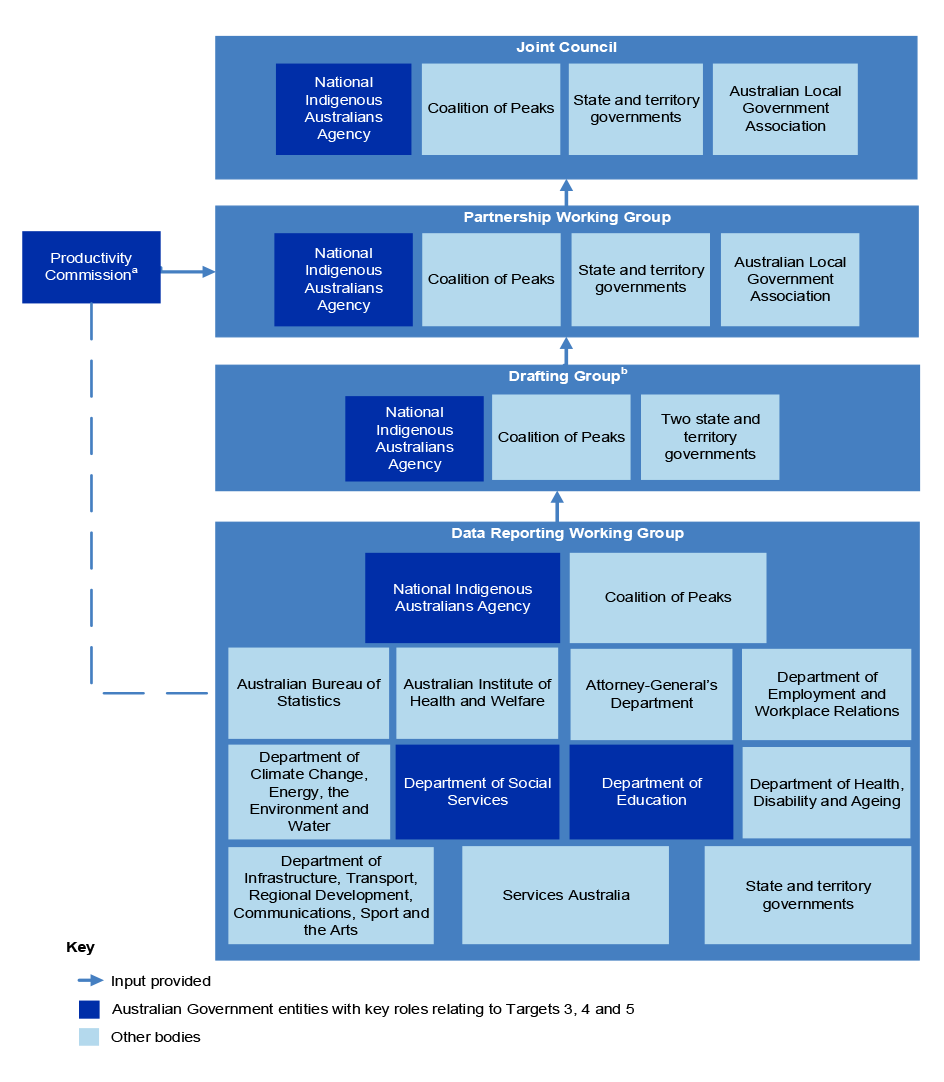
Note a: The Productivity Commission has observer status in the DRWG.
Note b: All papers for PWG consideration must be first considered by the Drafting Group.
Source: ANAO analysis based on the 2022 and 2023 Commonwealth Closing the Gap Annual Reports and PC documentation.
4.3 The PC uses Joint Council-endorsed data specifications (data sources and calculation methodologies) for targets and supporting indicators (see paragraph 4.18). Although it can advise Joint Council through the PWG, the PC advised the ANAO in April 2025 that any changes to the data specifications would require DRWG endorsement. Data specifications for Targets 3, 4 and 5 were endorsed by the DRWG in April 2021 prior to the initial dashboard being released in June 2021.
4.4 In addition to its advice to Joint Council via the PWG, the National Agreement on Closing the Gap requires the PC to produce a three-yearly progress review, which can include comments on the targets, supporting indicators and other data improvements. Joint Council provide advice to the Treasurer on the terms of reference for the three-yearly PC review.115
4.5 The data dashboard shows progress in meeting the 17 socio-economic outcomes and 19 targets and does not show progress towards the four priority reforms (see paragraph 1.11). In June 2023 the NIAA commissioned the Australia and New Zealand School of Government (ANZSOG) to conduct a review on how to measure and report on progress in achieving the priority reforms. The final report was provided by ANZSOG to the NIAA on 19 August 2024 and was discussed at PWG in March 2025, at which it was agreed to refer detailed consideration of the priority reforms measurement framework to the Data Policy Partnership, for advice back to PWG by the end of 2025.
Productivity Commission processes
4.6 The PC maintains clear records of its data calculation methodology and, for all three targets, the PC published the data specifications on the dashboard.116 This enables First Nations stakeholders and others to recalculate the results and conduct additional disaggregated analysis.
4.7 The PC’s processes for publishing Target 3, 4 and 5 results on the dashboard are supported by 18 guideline documents. The guideline documents were not endorsed or version controlled and while there was evidence of updates, the PC had no process for systematic review of the guideline documents. The PC had a handbook for its database which comprised 17 documents describing the use and management of the database.
4.8 Auditor-General Report No. 27 2018–19 Closing the Gap analysed target reporting under the National Indigenous Reform Agreement (NIRA) (see paragraph 1.1). The audit found that the PC did not have an overarching quality assurance framework and stated the PC should document its quality assurance processes to ensure they are consistently followed and reporting is accurate.117 The PC has not documented a process for validating the import and analysis of data. In October 2024 the PC documented its quality assurance processes in a draft ‘guidance’ document, which does not describe the whole data quality assurance process.
Opportunity for improvement
4.9 The PC could improve the documentation of its data quality assurance processes for Closing the Gap data quality and publication.
Accuracy of dashboard information
4.10 Following the PC’s documented calculation methodology, the ANAO was able to replicate the target results published on the data dashboard for Targets 3, 4 and 5.118
Meaningfulness of dashboard information
4.11 Table 4.1 shows Target 3, 4 and 5 results for Australia as a whole, as reported on the data dashboard in June 2025.
Table 4.1: Dashboard reporting for Targets 3, 4 and 5 (Australia), as at 1 June 2025a
|
Target |
Reported result (%) |
Status |
|
3. Early childhood education: By 2025, increase the proportion of Aboriginal and Torres Strait Islander children enrolled in Year Before Fulltime Schooling (YBFS) early childhood education to 95 per cent. |
101.8 |
Good improvement and on track |
|
4. Children thriving: By 2031, increase the proportion of Aboriginal and Torres Strait Islander children assessed as developmentally on track in all five domains of the Australian Early Development Census to 55 per cent. |
34.3 |
Worsening |
|
5. Student learning potential: By 2031, increase the proportion of Aboriginal and Torres Strait Islander people (age 20–24) attaining year 12 or equivalent qualification to 96 per cent. |
68.1 |
Improvement but target not on track to be met |
Note a: On 30 July 2025 the PC updated the data dashboard for Targets 3 and 4 based on 2021, instead of 2016, Census data and other refreshed data. The national result for Target 3 was 94.2 per cent (‘on track’) and the national result for Target 4 was 33.9 per cent (‘worsening’). The Target 3 results for the Australian Capital Territory, Tasmania, Victoria and Western Australia remained over 100 per cent (120.7, 110.1, 121.2 and 101.7 per cent, respectively). Available from https://www.pc.gov.au/closing-the-gap-data/dashboard/se/outcome-area3 [accessed 31 July 2025].
Source: ANAO analysis of Productivity Commission, Closing the Gap Targets and Outcomes, available from https://www.closingthegap.gov.au/national-agreement/targets [accessed 1 June 2025].
Data clarity
4.12 The Target 3 result (101.8 per cent119 in June 2025 and 94.2 per cent in July 2025) was used to describe enrolment in preschool as ‘improving and on track’.
- As noted in Appendix 10, Target 3 uses different data sources for the numerator (2023 Preschool Education Australia dataset) and the denominator (2016 Census, updated to 2021 Census in July 2025). The numerator estimate is based on the number of enrolments. The denominator is based on the estimated and projected number of relevant children in the estimated resident population in a given year. The mismatched analysis units can lead to a result exceeding 100 per cent and a potentially incorrect conclusion that the target is on track.
- The different data sources for Target 3 are from different time periods, further exacerbating an unclear result. In January 2025 the PWG agreed to use 2021 (instead of 2016) Census population estimates (to be implemented from July 2025), partly improving target result clarity. In relation to its use of the 2016 Census until June 2025, the PC stated on its website that:
ABS projections from the 2016 Census for selected indicators … are the best available data, however they underestimate the number of Aboriginal and Torres Strait Islander people in the years after the 2016 Census.120
4.13 The use of more recent Census data to develop estimates was expected to improve the meaningfulness of Target 3 at the national level although the underlying problem is not fixed and some sub-national estimates continue to exceed 100 per cent. Target 3 data specifications were established under the NIRA. In 2023 the PC commissioned the Australian National University to review the data specifications for all targets (ANU review).121 The November 2024 ANU review report recommended the numerator and denominator for Target 3 be derived instead from the Person Level Integrated Data Asset (PLIDA)122, ‘to avoid the biased and at times mathematically impossible observations that result from the numerator-denominator mismatch.’123 The ANU review report stated that:
issues of cultural safety and relevance of the data (rather than the method) were not within the scope of the project. However, we believe that they are fundamental and so wish to bring them to the attention of the PWG and the Productivity Commission.
4.14 As at June 2025 the PWG had not considered the recommendations of the ANU review to use PLIDA.124
Data currency
4.15 Under the National Agreement on Closing the Gap, the PC is required to update the dashboard at least annually.125 The PC has updated the dashboard at above the required frequency. Following first publication in June 2021, there were two updates in 2022 (March and June), two updates in 2023 (March and June), three updates in 2024 (March, July, and November) and, as at August 2025, two updates in 2025 (March and July).
4.16 There is no requirement in the National Agreement on Closing the Gap for the frequency of updates to individual target data. In practice, reflecting the characteristics of the PWG-approved data sources, the frequency of data collection, the time between data collection and public release by the data custodian, and other PWG decisions, as at June 2025 Target 3 had been updated annually and Targets 4 and 5 had been updated once since the National Agreement was established in 2020. The PC does not have early access to data holdings. The PC provides transparent information on its website about target data currency, and partial explanations for its use of outdated data (Appendix 10).
4.17 The ANU review made recommendations to improve the currency of Targets 4 and 5. For Target 4, the ANU review recommended greater resourcing of the Australian Early Development Census to allow the survey to be conducted biennially rather than every three years. For Target 5, the ANU review recommended annual monitoring using PLIDA data to increase the currency of the progress assessments.
Contextual and explanatory information
4.18 In addition to the socio-economic outcomes, targets and priority reforms, the National Agreement on Closing the Gap includes specifications for ‘supporting indicators’ and analysis disaggregation to supplement the outcome and target information.
- Supporting indicators — Supporting indicators are intended to provide ‘greater understanding’ and ‘insight’ into how governments are tracking against the targets, and are divided into ‘drivers’ and ‘contextual information’.126 The National Agreement on Closing the Gap lists three supporting indicators for Target 3, five for Target 4 and seven for Target 5 (see Table 4.2).
- Disaggregation — Disaggregation is needed to ‘understand where progress is being made and where greater effort is needed’. Disaggregation for Targets 3, 4 and 5 comprises analysis by: state / territory, remoteness areas, socio-economic status of the locality, and gender. For Target 5 there are two additional disaggregation variables: disability status, and year 12 versus Certificate III or above.
4.19 As at June 2025, four of the 15 supporting indicators relevant to Targets 3, 4 and 5 were reported on the PC’s dashboard (Table 4.2), with a fifth introduced in July 2025. The supporting indicator specifications (methodology and data sources) are not defined in the National Agreement on Closing the Gap. The PC advised the ANAO in April 2025 that the PWG decides which supporting indicators will be developed and progressed each year. In a 2024 public webinar a Productivity Commissioner stated that127:
We currently only report on 31 out of the 164 supporting indicators included in the national agreement, which is only a portion of those outlined in the agreement itself. We are working with the parties to the agreement to develop the supporting indicators to expand the range of indicators that are reported on each year. This requires a lot of effort on both sides, including jurisdictions making that data available.
Table 4.2: Reported supporting indicators for Targets 3, 4 and 5, as at June 2025
|
Supporting indicators |
Type |
Reported |
Date first reported |
|
Target 3 |
|||
|
Rate of attendance in early childhood education in the year before full-time schooling |
Contextual |
◆ |
June 2021 |
|
Number of Aboriginal and Torres Strait Islander early childhood education and care providers |
Contextual |
▲a |
November 2024 (includes data since 2016) |
|
Progress towards parity |
Contextual |
■ |
N/Ab |
|
Target 4 |
|||
|
Preschool attendance and enrolment |
Driver |
■ |
N/Ab |
|
Primary carer education level |
Driver |
■ |
N/Ab |
|
Outcomes by Australian Early Development Census domains (developmentally vulnerable, at risk, on track) |
Contextual |
■ |
N/Ab |
|
Australian Early Development Census Multiple Strengths Indicator (highly developed, well developed and emerging strengths) |
Contextual |
◆ |
June 2021 |
|
Progress towards parity |
Contextual |
■ |
N/Ab |
|
Target 5 |
|||
|
School attendance |
Driver |
■c |
N/Ab |
|
School retention rates |
Driver |
■ |
N/Ab |
|
At or above National Assessment Program — Literacy and Numeracy (NAPLAN) minimum standards in reading, writing and numeracy for Years 3, 5, 7 and 9 |
Driver |
◆d |
November 2024 (2023 baseline year) |
|
Mean scores of Aboriginal and Torres Strait Islander 15-year olds in the Programme for International Student Assessment (PISA) test |
Driver |
■ |
N/Ab |
|
Mean score of NAPLAN reading, writing and numeracy for Years 3, 5, 7 and 9 |
Contextual |
■ |
N/Ab |
|
Rates of highest education/training level completed (for those not completing year 12 or equivalent) |
Contextual |
■ |
N/Ab |
|
Progress towards parity |
Contextual |
■ |
N/Ab |
Key: ◆ Reported ▲ Partly reported ■ Not reported
Note a: Aboriginal community-controlled services and government and/or non-Indigenous controlled services were reported from 2022 to 2023. Data quality considerations state that data is not currently available for government and/or non-Indigenous controlled services that do not receive funding via the Australian Government’s childcare subsidy system or Community Childcare Fund (such as state and territory government funded preschool services).
Note b: The dashboard states that unreported supporting indicators are ‘under development’.
Note c: The 30 July 2025 update to the Closing the Gap data dashboard included a supporting indicator for school attendance.
Note d: The percentages presented in this supporting indicator are calculated by the Australian Curriculum Assessment and Reporting Authority.
Source: ANAO analysis of PC dashboard update documentation.
4.20 Required disaggregation reporting is complete except for disability status for Target 3, for which there is partial reporting (Table 4.3).
Table 4.3: Reported disaggregation, as at June 2025
|
|
Target 3 |
Target 4 |
Target 5 |
|||
|
Disaggregation |
Reported |
Date first reported |
Reported |
Date first reported |
Reported |
Date first reported |
|
States / territories |
✔ |
June 2021 |
✔ |
June 2022 |
✔ |
March 2023 |
|
Remoteness areas |
✔ |
June 2021 |
✔ |
June 2022 |
✔ |
March 2023 |
|
Socio-economic status of the locality |
✔ |
June 2021 |
✔ |
June 2022 |
✔ |
March 2023 |
|
Gender |
✔ |
June 2021 |
✔ |
June 2022 |
✔ |
March 2023 |
|
Disability |
✘ab |
June 2022 |
✔b |
June 2022 |
✔ |
March 2023 |
|
Attainment categoryc |
N/A |
N/A |
N/A |
N/A |
✔ |
March 2023 |
Key: ✔ Fully reported ✘ Not fully reported
Note a: Results are prepared for some jurisdictions for some years.
Note b: Disability disaggregation for Targets 3 and 4 was not specified in the National Agreement, however the PC proposed reporting disability status for Targets 3 and 4 to the PWG and it was agreed in September 2021.
Note c: Year 12 versus Certificate III or above completions (Certificate III but without year 12).
Source: ANAO analysis.
4.21 In October 2023 the PWG endorsed a PC proposal to include historical and ongoing context as part of the data dashboard and annual data compilation report. The inclusion of context aims to improve cultural safety and provide a more complete understanding of the data. As at June 2025 the inclusion of this additional context was implemented for Targets 3 and 5, which involved consultation with the PWG and SNAICC — National Voice for our Children (SNAICC).
Data limitations
4.22 The target data specifications set out on the dashboard include the data source, data provider, baseline year, target reporting period (latest data year), computation, and data quality considerations. The PC provides explanations of some data limitations for the three targets. In relation to the anomalous result for Target 3 (see paragraph 4.11), the PC states, ‘Enrolment proportions may exceed 100% for some areas due to the numerator and denominator being from different sources’.128
Is annual reporting accurate, complete and meaningful?
The coordination and publication of the Australian Government’s annual reports on the Closing the Gap National Agreement have been facilitated by the NIAA. While accurately drawing on the PC dashboards, information on Targets 3, 4 and 5 has become less complete over time, reducing transparency over Closing the Gap progress in schooling and early childhood development. There has also been a reduction in meaningful information in annual reports about risks and lessons learned.
4.23 Clause 118 of the National Agreement on Closing the Gap requires:
The Parties agree to make public information on their progress on the Agreement and their Implementation Plans through annual public reports, The annual public reports will:
a. draw from the dashboard and annual PC data compilation report, to ensure consistency of measures of progress
b. include information on efforts to implement this Agreement’s four Priority Reform areas, particularly outlining how implementation aligns with the principles for action
c. demonstrate how efforts, investment and actions are aligned and support the achievement of Closing the Gap goals
d. list the number of Aboriginal and Torres Strait Islander community-controlled organisations and other Aboriginal and Torres Strait Islander organisations that have been allocated funding for the purposes of Clause 24, 55a and 55b, and 135 of this Agreement; and subject to confidentiality requirements, also list the names of the organisations and the amount allocated.129
4.24 Under the 2019 Executive Order to Establish the National Indigenous Australians Agency as an Executive Agency, the NIAA’s functions include to ‘lead and coordinate the development and implementation of Australia’s Closing the Gap targets in partnership with Indigenous Australians’. The NIAA coordinates, compiles and advises the Australian Government on its annual report. The final content included in the Australian Government annual report is a decision of the Australian Government.
4.25 The Australian Government has produced a Closing the Gap annual report each year since 2022. In each year, the NIAA compiled a draft report based on contributions from Australian Government entities for the Minister for Indigenous Australians (the Minister). A lessons learned exercise following the 2023 process highlighted a lack of clarity in ownership of sections of the report, a need for improved central coordination by the NIAA and a need to establish a drafting plan that was adhered to. Of 12 entities providing lessons learned feedback, seven made comments that the NIAA needed to provide stronger leadership and guidance on the drafting and/or ministerial clearance process. Three made comments about better and earlier engagement of Aboriginal and Torres Strait Islander peak organisations in the process. In contrast to the process for 2023, for the 2024 report the NIAA prepared the first draft and requested comments from entities. Between February and May 2025, the NIAA conducted a feedback survey with Australian Government entities, to which 11 entities responded. A summary prepared by the NIAA stated that seven of the 11 responding entities considered the 2024 Closing the Gap Annual Report process to be at least satisfactory and three considered the process to be poor. Opportunities for improvement included improved: collaboration between entities; communications and information gathering and sharing; clearance requirements and timeframes to better support collaboration with peak partners. The Coalition of Peaks was not invited to participate in the survey.
Accuracy of annual target reporting
4.26 The Australian Government 2022 Annual Report130 accurately presented socio-economic target results that match those in the PC’s 2022 Annual Data Compilation Report, with a minor difference in the terminology used to describe Target 4 status.131 The 2023 Annual Report132 provided identical target status results to those in the 2023 Annual Data Compilation Report. The 2024 Annual Report133 did not include target results or status.
Completeness of annual reporting
4.27 When preparing the Australian Government 2022 Annual Report, a brief to the NIAA Chief Executive Officer from the Closing the Gap Branch stated that, in order to meet commitments under the National Agreement on Closing the Gap, the annual report would ‘at a minimum’ need to comply with Clause 118 of the agreement (see paragraph 4.23).
4.28 The 2022 Annual Report included the following information for Targets 3, 4 and 5:
- socio-economic outcome description;
- target description — targets described in full;
- baseline — baseline figures for the targets and the baseline year;
- target result — latest target percentage results;
- target result date — the date of the data source from which the target result was derived;
- target status — ‘on track’, ‘not on track’, or ‘no new data to assess progress’;
- overview sections outlining the importance of the targets;
- last target update dates;
- some data limitations134; and
- a list of Australian Government actions contributing to progress.
4.29 Since the 2022 Annual Report, for Targets 3,4 and 5, the completeness of target information included in the annual report has declined (Table 4.4), reducing transparency over outcome progress for schooling and early childhood development commitments.
Table 4.4: Australian Government annual report target reporting, 2022 to 2024
|
Report year |
Target description |
Baseline |
Target result |
Target result date |
Target statusa |
|
2022 |
◆ |
◆ |
◆ |
◆ |
◆ |
|
2023 |
▲b |
■ |
■ |
■ |
◆ |
|
2024 |
◆ |
■ |
■ |
■ |
■ |
Key: ◆ Reported ▲ Partly reported ■ Not reported
Note a: ‘On track’, ‘not on track’, ‘worsening’, ‘no new data to assess progress’, ‘good improvement and on track’, ‘worsening, not on track’, or ‘improvement but not on track’.
Note b: The 2023 Annual Report includes the socio-economic outcomes and does not include the targets. For example, for Target 3, the socio-economic outcome is that Aboriginal and Torres Strait Islander children are engaged in high quality, culturally appropriate early childhood education in their early years. Targets include a goal, such as to increase the proportion of Aboriginal and Torres Strait Islander children enrolled in Year Before Fulltime Schooling early childhood education to 95 per cent, and the target year to achieve the goal.
Source: ANAO analysis of tabled Australian Government Closing the Gap annual reports.
4.30 For the 2023 Annual Report, the NIAA provided the Minister with a draft for approval that did not include the target descriptions or results nor advise that clause 118 of the National Agreement requires the Australian Government’s annual report to ‘draw from the dashboard and annual PC data compilation report, to ensure consistency of measures of progress’.
4.31 For the 2024 Annual Report, the NIAA provided the Minister with drafts in October and November 2024 that did not include the Target 3, 4 and 5 results, but did include ‘traffic lights’ showing the statuses for Targets 3 (‘good improvement and on track’), 4 (‘worsening not on track’) and 5 (‘improvement but not on track’). On 17 December 2024 the Minister, through her office, suggested that the NIAA exclude the traffic light information, stating that reporting target status was the responsibility of the PC. The Minister, through their office, suggested ‘noting in the actions taken in 2024 or priorities for 2025 how targets are tracking as part of the context for why certain actions are being/will be taken’. The NIAA did not advise the Minister about clause 118. The tabled report excluded target results and status.
4.32 The NIAA advised the ANAO in July 2025 that:
Progress reporting for early childhood development and schooling Closing the Gap socioeconomic targets is broader than the Commonwealth’s Closing the Gap Annual Report. Activities contributing to early childhood development and schooling are also demonstrated in departmental annual reports, policy partnership annual reports, and state and territory annual reports. Through these processes there has [sic] been attempts to reduce duplication.
4.33 However, the National Agreement on Closing the Gap clearly states that the Australian Government must report on its overall progress against targets at the national level in its annual report.
Meaningfulness of annual reporting
4.34 In 2024 the PC’s three-yearly Review of the National Agreement on Closing the Gap found that implementation plans and annual reports were not fulfilling the intended purpose.135 The review found that the two documents did not reconcile (annual reports contained a limited set of the actions that governments had committed to and reported on actions not listed in the Closing the Gap implementation plan). The review found that reporting on progress was high level or incomplete, and delivery risk and issues were not included. The PC concluded:
By and large, the annual reports focus on listing activities that have been undertaken, while giving significantly less attention to describing what has not been delivered as planned and areas where there has been little progress. 136
4.35 All Australian Government Closing the Gap annual reports include ‘key achievements’ (Appendix 11).
- The 2022 Annual Report listed 15 key achievements linked to Targets 3, 4 or 5, of which two considered progress over time, and three discussed lessons learned.
- The 2023 Annual Report listed 11 key achievements, of which two considered progress over time, and one discussed lessons learned.
- The 2024 Annual Report listed six key achievements, of which two considered progress over time, and two provided discussed lessons learned. However, in 2024, for the first time, the NIAA separately published a more comprehensive list of progress against 2024 Implementation Plan commitments, a link to which is available on the 2024 Annual Report webpage.137
Recommendation no.4
4.36 The Australian Government improve the completeness and meaningfulness of the Australian Government’s Closing the Gap annual reports and comply with clause 118 of the National Agreement on Closing the Gap by: drawing from the Productivity Commission dashboard to include information about target results and status; and including risks, successes, failures and lessons learned.
National Indigenous Australians Agency response: Noted
4.37 Any amendments to the Commonwealth Closing the Gap Annual Report is a matter for consideration by Government. The NIAA will brief the Government on the ANAO findings and recommendations.
Appendices
Appendix 1 Entity responses
Department of Education
Department of Social Services
National Indigenous Australians Agency
Productivity Commission
SNAICC — National Voice for our Children
Appendix 2 Improvements observed by the ANAO
1. The existence of independent external audit, and the accompanying potential for scrutiny improves performance. Improvements in administrative and management practices usually occur: in anticipation of ANAO audit activity; during an audit engagement; as interim findings are made; and/or after the audit has been completed and formal findings are communicated.
2. The Joint Committee of Public Accounts and Audit (JCPAA) has encouraged the ANAO to consider ways in which the ANAO could capture and describe some of these impacts. The ANAO’s corporate plan states that the ANAO’s annual performance statements will provide a narrative that will consider, amongst other matters, analysis of key improvements made by entities during a performance audit process based on information included in tabled performance audit reports.
3. Performance audits involve close engagement between the ANAO and the audited entity as well as other stakeholders involved in the program or activity being audited. Throughout the audit engagement, the ANAO outlines to the entity the preliminary audit findings, conclusions and potential audit recommendations. This ensures that final recommendations are appropriately targeted and encourages entities to take early remedial action on any identified matters during the course of an audit. Remedial actions entities may take during the audit include:
- strengthening governance arrangements;
- introducing or revising policies, strategies, grant guidelines or administrative processes; and
- initiating reviews or investigations.
4. In this context, the below actions were observed by the ANAO during the course of the audit. It is not clear whether these actions and/or the timing of these actions were planned in response to proposed or actual audit activity. The ANAO has not sought to obtain assurance over the source of these actions or whether they have been appropriately implemented.
- In October 2024, the Productivity Commission (PC) documented elements of its quality assurance processes relating to the publication of content on the Closing the Gap dashboard in a draft guidance document (see paragraph 4.8).
- In November 2024, the National Indigenous Australians Agency (NIAA) developed the Policy Partnership Evaluation Guideline Statement of Requirement to guide policy partnerships tendering for the development and implementation of an evaluation methodology (see paragraph 2.3).
- In January 2025, the NIAA developed terms of reference for the Queensland Place-Based Working Group (see paragraph 2.31).
- In February 2025, the Department of Education (Education) finalised terms of reference for the Indigenous Education Consultative Meeting (see paragraph 2.9).
- In March 2025, Education signed a partnership agreement with the Secretariat of National Aboriginal and Islander Child Care — National Voice for Our Children (see paragraph 2.8).
- In March 2025, Education signed a partnership agreement with the National Aboriginal and Torres Strait Islander Education Corporation (see paragraph 2.8).
- In June 2025, the Australian Public Service Commission (APSC) published the First Nations Partnership Playbook (see paragraph 2.7).
Appendix 3 Glossary
|
Key terms |
Definition |
|
Aboriginal Community-Controlled Organisation (ACCO) |
An organisation controlled and operated by Aboriginal and/or Torres Strait Islander community members. Clause 44 of the National Agreement on Closing the Gap defines an Aboriginal and/or Torres Strait Islander community-controlled organisation (ACCO) as an organisation that delivers services, including land and resource management, that builds the strength and empowerment of Aboriginal and Torres Strait Islander communities and people and is: incorporated under relevant legislation and not-for-profit; controlled and operated by Aboriginal and/or Torres Strait Islander people; connected to the community, or communities, in which they deliver the services; and governed by a majority Aboriginal and/or Torres Strait Islander governing body. Priority Reform 2 seeks to ensure a meaningful proportion of government funding is provided to ACCOs. The sector uses the collective acronym ACCO. |
|
Agency Collaborates Grant Opportunity Guideline (AC GOG) |
Refers to a grant opportunity guideline (GOG) that is applied to the majority of the National Indigenous Australians Agency’s (NIAA) Indigenous Advancement Strategy grant funding. It has two versions: competitive and non-competitive, and can be applied to any grant program within NIAA. |
|
Australian Early Development Census (AEDC) |
A survey run triennially since 2009 by the Department of Education (Education) about the development of children in their first year of school. The Social Research Centre at the Australian National University is contracted to provide the survey, compilation and analysis of data. The survey is an Australian adapted version of a Canadian survey (the Early Development Instrument). The AEDC survey includes approximately 100 questions answered for each individual student by their teacher. The questions are grouped into 5 domains: physical health and wellbeing, social competence, emotional maturity, language and cognitive skills, and communication skills and general knowledge. |
|
Better and Fairer Schools Agreement (BFSA) |
A federal funding agreement (2025–2034) led by Education with a focus on primary and secondary school resourcing. It is a National Agreement. |
|
Clontarf |
Refers to the Clontarf Foundation, which is a recipient under a grant program led by Education. The Clontarf Foundation is a not-for-profit organisation that encourages young Aboriginal and Torres Strait Islander men to complete year 12 and enter employment by leveraging engagement in school-based sporting activities. |
|
Coalition of Aboriginal and Torres Strait Islander Peak Organisations (Coalition of Peaks) |
The Coalition of Peaks is a representative body comprised of Aboriginal and Torres Strait Islander peak organisations. Coalition of Peaks is a signatory of the National Agreement on Closing the Gap, is a member of Joint Council, and shares governance roles for Closing the Gap with the Australian Government and all state and territory governments. |
|
Connected Beginnings (CB) |
A grant program jointly funded by Education and the Department of Health, which supports 50 backbone organisations to coordinate community-led early childhood care and education initiatives alongside maternal and child health services. |
|
Data development areas |
Areas that are important for our understanding of Aboriginal and Torres Strait Islander outcomes but cannot be measured currently and where further work is required. The data development areas are included under each Target in Table B of the National Agreement on Closing the Gap. The structure of the socio-economic targets is provided in clause 82, which defines targets, indicators, disaggregation, and data development. |
|
Data Reporting Working Group (DRWG) |
Provides advice and technical support to the Partnership Working Group (PWG) and to the Productivity Commission (PC). The terms of reference indicate PWG maintains the primary relationship with the PC on the development of the dashboard and PC reviews. Membership of DRWG includes state and territory representatives, representatives from the Coalition of Peaks, Australian Bureau of Statistics, Australian Institute of Health and Welfare, Attorney-General’s Department, Department of Health and Aged Care, Department of Infrastructure, Transport, Regional Development, Communications and the Arts, Education, Department of Employment and Workplace Relations, Department of Social Services (DSS), Services Australia, and Department of Climate Change, Energy, the Environment and Water, with the Productivity Commission as an observer. The NIAA and Coalition of Peaks co-chair the DRWG. Reporting to the PWG occurs through the Drafting Group which is co-managed by the NIAA and Coalition of Peaks. |
|
Disaggregation |
How reporting of the target will be broken down and measured by groups of Aboriginal and Torres Strait Islander people (for example males/females, or geographical areas). This allows understanding of where progress is being made and where greater effort is needed. |
|
Joint Council (JC) |
Ministerial Council on Closing the Gap, with representation from Government parties and the Coalition of Peaks. |
|
Multiple Strengths Indicator (MSI) |
A subset of the AEDC survey. According to the AEDC, a group of early childhood experts selected 39 of the 96 AEDC survey questions to calculate the MSI. These 39 were selected as they provided an indication of whether a child showed advanced skills, or ‘better than expected development’ for their age. Children receive a score between 0 and 39. Children with strengths of 18 or less are categorised as having ‘emerging strengths’, 19 to 27 are categorised as having ‘well developed strengths’, and 28 to 39 are categorised as having ‘highly developed strengths’. |
|
Early Childhood Care and Development Policy Partnership (ECCDPP) |
ECCDPP was established under the National Agreement on Closing the Gap. It is co-chaired by the Department of Education and SNAICC. ECCDPP membership consists of independent Aboriginal and Torres Strait Islander members, Coalition of the Peaks representatives, SNAICC representatives, Education representatives, and state and territory government representatives. ECCDPP is responsible for delivering progress against Targets 2, 3, 4, 12 and 13 under the National Agreement on Closing the Gap. |
|
Early Years and Education Sectoral Strategy |
The Early Years and Education Strategy (2024–2034) is led by NIAA. It identifies Commonwealth priorities and the role the NIAA will play in contributing to Closing the Gap socio-economic outcomes and stewarding the priority reforms in the Early Years and Education sector. |
|
Federal funding agreement (FFA) |
A formal funding agreement between the Commonwealth and one or more states or territories in Australia. FFAs can be national agreements, or sector schedules. |
|
First Nations Playgroups (FN Playgroups) |
A grant program led by DSS to provide funding to 14 ACCOs to deliver culturally-informed playgroups and toy libraries. |
|
Grant Connected Policy (GCP) |
GCPs are Commonwealth policies that the Government has agreed to connect to the Commonwealth Grants Framework. |
|
Grants Prioritisation Guide |
A publicly available 2023 guidance document developed by NIAA, it provides guidance for Commonwealth entities on how to embody Indigenous prioritisation activities when developing and implementing grants. |
|
Indigenous Education Consultative Meeting (IECM) |
IECM was established in 2017. The IECM terms of reference state ‘The role of IECM is to share their perspectives with the department including input to inform decision making and policy development, and to ensure that Aboriginal and Torres Strait Islander voices are represented in education policy.’ IECM also had a role in the establishment of NATSIEC. IECM is not a partnership. |
|
Indigenous Expenditure Review |
The Indigenous Expenditure Review 2022 was a ‘one-off’ review of Commonwealth grant spending on Aboriginal and Torres Strait Islander specific programs and services for the 2020–21, as required by clause 133 of the National Agreement on Closing the Gap. |
|
Junior Rangers |
A grant program led by the NIAA, which funds on-country learning opportunities for Aboriginal and Torres Strait Islander students. Grant activities can include school-based activities and out-of-school activities, with a goal of improving engagement in education. The NIAA has 47 Junior Rangers grant agreements with various recipients across Australia. |
|
National Aboriginal and Torres Strait Islander Education Corporation (NATSIEC) |
NATSIEC is the national peak body for Aboriginal and Torres Strait Islander education across the lifelong learning cycle including early childhood education, primary and secondary schooling, and the skills and training, and higher education sectors. The partnership between NATSIEC and Education covers matters relating to outcomes 3, 4, 5, 6, 7, 14 and 16. |
|
Northern Territory Remote Aboriginal Investment Agreement (NTRAI) |
A Northern Territory (NT)-specific federal funding agreement —(2025–2031) led by NIAA. Funding is aimed to provide critical services to remote Aboriginal communities, including funding for child and family services. |
|
Northern Territory Remote Aboriginal Investment Joint Steering Committee (NTRAI JSC) |
The tripartite implementation working group for the NTRAI, which involves representatives from Aboriginal Peak Organisations NT, the NT Government, and the Australian Government. This Committee has oversight on decision-making for funding from the NTRAI. |
|
Partnership Working Group (PWG) |
Established by Joint Council, comprising representatives of each Government Party and the Coalition of Peaks, with the role of developing and progressing issues for upcoming Joint Council meetings. The PWG is co-chaired by the NIAA and the Coalition of Peaks, with the NIAA representing the Australian Government. |
|
Person Level Integrated Data Asset (PLIDA) |
An Australian Bureau of Statistics integrated data set that combines information on health, education, government payments, income and taxation, employment, and population demographics (including the Census) over time. First established as the Multi-Agency Data Integration Project (MADIP) in 2015. PLIDA partnership agencies are ABS, ATO, Education, Health and Aged Care, DSS, Services Australia, and Home Affairs. These agencies are also PLIDA board members, the additional board member agencies are AIHW, Dept Industry, Innovation and Science, Finance, Treasury, and DEWR. |
|
Place-based partnerships |
The National Agreement on Closing the Gap requires ‘partnerships based on a specific region, between government and Aboriginal and Torres Strait Islander representatives, and others by agreement, from those specific areas.’ The National Agreement on Closing the Gap set out the establishment of six place-based partnerships by 2024. |
|
Policy Partnership |
The National Agreement on Closing the Gap requires policy ‘partnerships’ created for the purpose of working on discrete policy areas. Five areas are listed, including early childhood care and development. |
|
Preschool Reform Agreement (PRA) |
A nation-wide federal funding agreement (2022–2025) led by Education with a focus on early childhood education and care in the year(s) before full-time school. |
|
Schooling Projects Operational (SPO) |
A broad grant program led by the NIAA which provides mostly one-off funding for operational projects in line with the Indigenous Advancement Strategy Program 1.2: Children and Schooling. The NIAA has awarded over 160 separate grants across Australia as part of this grant program. |
|
SNAICC — National Voice for Our Children |
SNAICC is the national peak body representing Aboriginal and Torres Strait Islander communities and community-controlled organisations on matters related to early childhood education, care and development. |
|
Strong partnership elements |
Strong partnership elements are set out under clause 32 of the National Agreement on Closing the Gap. These are:
|
|
Supporting Indicators (SI) |
Supporting measures that provide greater understanding of, and insight into tracking against Closing the Gap outcomes and targets. SIs are divided into either drivers or contextual information. Drivers measure those factors that significantly impact the progress made against a target, while contextual information provides insight into the experiences of Aboriginal and Torres Strait Islander people under each outcome |
Appendix 4 Elements of ‘strong partnership’ under the National Agreement on Closing the Gap
1. The table shows the elements of ‘strong partnership’ set out in clause 32 of the National Agreement on Closing the Gap, and those elements that were assessed by the ANAO for the Early Childhood Care and Development Policy Partnership (ECCDPP) and other partnership arrangements for schooling and early childhood development.
Table A.1: ‘Strong partnership’ elements of the National Agreement on Closing the Gap
|
Clause |
Strong partnership element |
ECCDPP: Written agreements |
ECCDPP: Implementation of agreements |
Other 2 partnership arrangements: Written agreements |
|
32.a(i) |
Partnerships are accountable and representative and are between: Aboriginal and Torres Strait Islander people, where participation in decision-making is done by Aboriginal and Torres Strait Islander people appointed by Aboriginal and Torres Strait Islander people in a transparent way, based on their own structures and where they are accountable to their own organisations and communities. |
Assessed |
Assessed |
Assessed |
|
32.a(ii) |
Partnerships are accountable and representative and are between: up to three levels of government, where government representatives have negotiating and decision-making authority relevant to the partnership context. |
Assessed |
Assessed |
Not applicable due to the bilateral nature of the relationship |
|
32.a(iii) |
Partnerships are accountable and representative and are between: other parties as agreed by the Aboriginal and Torres Strait Islander representatives and governments. |
Assessed |
Assessed |
Not applicable due to the bilateral nature of the relationship |
|
32.b(i) |
A formal agreement in place, that is signed by all parties and: defines who the parties are, what their roles are, what the purpose and objectives of the partnership are, what is in scope of shared decision-making, and what are the reporting arrangements, timeframes, and monitoring, review and dispute mechanisms. |
Assessed |
Not applicable to implementation |
Assessed |
|
32.b(ii) |
A formal agreement in place, that is signed by all parties and: is structured in a way that allows Aboriginal and Torres Strait Islander parties to agree the agenda for the discussions that lead to any decisions. |
Assessed |
Assessed |
Not applicable due to lower level of formality of meetings |
|
32.b(iii) |
A formal agreement in place, that is signed by all parties and: is made public and easily accessible. |
Assessed |
Assessed |
Assessed |
|
32.b(iv) |
A formal agreement in place, that is signed by all parties and: is protected in state, territory and national legislation where appropriate. |
Not assessed |
Not assessed |
Not assessed |
|
32.c(i) |
Decision-making is shared between government and Aboriginal and Torres Strait Islander people. Shared decision-making is: by consensus, where the voices of Aboriginal and Torres Strait Islander parties hold as much weight as the governments. |
Assessed |
Assessed |
Assessed |
|
32.c(ii) |
Decision-making is shared between government and Aboriginal and Torres Strait Islander people. Shared decision-making is: transparent, where matters for decision are in terms that are easily understood by all parties and where there is enough information and time to understand the implications of the decision. |
Assessed |
Assessed |
Not applicable due to lower level of formality of meetings |
|
32.c(iii) |
Decision-making is shared between government and Aboriginal and Torres Strait Islander people. Shared decision-making is: where Aboriginal and Torres Strait Islander representatives can speak without fear of reprisals or repercussions. |
Not applicable |
Assessed |
Not applicable |
|
32.c(iv) |
Decision-making is shared between government and Aboriginal and Torres Strait Islander people. Shared decision-making is: where a wide variety of groups of Aboriginal and Torres Strait Islander people, including women, young people, elders, and Aboriginal and Torres Strait Islander people with a disability can have their voice heard. |
Assessed |
Not assessed |
Not applicable due to the bilateral nature of the relationship |
|
32.c(v) |
Decision-making is shared between government and Aboriginal and Torres Strait Islander people. Shared decision-making is: where self-determination is supported, and Aboriginal and Torres Strait Islander lived experience is understood and respected. |
Not assessed |
Assessed |
Not assessed |
|
32.c(vi) |
Decision-making is shared between government and Aboriginal and Torres Strait Islander people. Shared decision-making is: where relevant funding for programs and services align with jointly agreed community priorities, noting governments retain responsibility for funding decisions. |
Not assessed |
Not assessed |
Not assessed |
|
32.c(vii) |
Decision-making is shared between government and Aboriginal and Torres Strait Islander people. Shared decision-making is: where partnership parties have access to the same data and information, in an easily accessible format, on which any decisions are made. |
Not assessed |
Not assessed |
Not assessed |
Source: Clause 32 of the National Agreement on Closing the Gap.
Appendix 5 Assessment of bilateral partnership arrangements
1. The NATSIEC partnership agreement was established in 2025 between the Department of Education (Education) and the National Aboriginal and Torres Strait Islander Education Corporation (NATSIEC).
Table A.2: NATSIEC partnership agreement — Alignment with relevant ‘strong partnership’ principles
|
Clause |
Assessment |
Alignment |
|
Formal agreement |
||
|
32.a(i) |
A formal agreement is in place and signed by all parties. |
◆ |
|
32.b(i) |
Identifies who the parties are, what their roles are, what the purpose and objectives of the partnership are, what is in scope of shared decision-making, and what are the reporting arrangements, timeframes, and dispute mechanisms. It does not identify reporting or monitoring arrangements. |
◆ |
|
32.b(iii) |
Includes a requirement for the NATSIEC partnership agreement to be made public. In March 2025 the partnership agreement was published on Education’s website.a |
◆ |
|
Shared decision-making |
||
|
32.c(i) |
States that both parties will work together to strengthen formal partnership, including in line with clause 32. |
◆ |
|
Funding |
||
|
33 |
A core funding agreement was executed in January 2025, which included $12,540,410 (GST exclusive) to support NATSIEC’s role. This included both operational funding and secretariat funding for NATSIEC’s role in the Education Minsters Meeting.b |
◆ |
Key: ◆ Largely or fully aligns with the strong partnership element ▲ Partly aligns ■ Does not align
Note a: The NATISEC Partnership Agreement is available on Education’s website at https://www.education.gov.au/closing-gap/resources/formal-partnership-agreement-australian-government-department-education-and-natsiec.
Note b: The Education Ministers Meeting is a forum for collaboration and decision-making on early childhood education and care, school education, higher education and international education. Australian state and territory government ministers responsible for education attend the meeting.
Source: ANAO analysis.
2. The SNAICC partnership agreement was established in 2025 between Education and SNAICC — National Voice for our Children (SNAICC).
Table A.3: SNAICC partnership agreement — Alignment with relevant ‘strong partnership’ principles
|
Clause |
Assessment |
Alignment |
|
Formal agreement |
||
|
32.a(i) |
A formal agreement is in place and signed by all parties. |
◆ |
|
32.b(i) |
Defines who the parties are, what their roles are, what the purpose and objectives of the partnership are, what is in scope of shared decision-making, timeframes, review and dispute mechanisms. It does not identify reporting or monitoring arrangements. |
◆ |
|
32.b(iii) |
Requires that the agreement be made public upon signing. In March 2025 the SNAICC partnership agreement was published on Education’s website.a |
◆ |
|
Shared decision-making |
||
|
32.c(i) |
The purpose affirms SNAICC will share decision making with Education on initiatives affecting Aboriginal and Torres Strait Islander children and families in early childhood education and care. States that Education will implement shared decision-making on relevant policy and program reform, including design and implementation. Commits to the implementation of shared decision making in line with clause 32. |
◆ |
|
Funding |
||
|
33 |
In January 2025, a core funding agreement was executed to provide $16.6 million (GST exclusive) to SNAICC for core operations as the peak body for Aboriginal and Torres Strait Islander children and to facilitate engagement with the Australian Government. |
◆ |
Key: ◆ Largely or fully aligns with the strong partnership element ▲ Partly aligns with the strong partnership element ■ Does not align with the strong partnership element
Note a: The SNAICC partnership agreement is available on Education’s website at https://www.education.gov.au/closing-gap/resources/formal-partnership-agreement-australian-government-department-education-and-snaicc-national-voice.
Source: ANAO analysis
Appendix 6 Evaluation of partnership arrangements for early childhood development
Table A.4: Evaluation of Closing the Gap partnership arrangements relating to early childhood development, as at June 2025
|
Evaluation type |
Evaluation activity |
Evaluation findings |
|
Stocktake As noted at paragraph 1.15, under clauses 36 and 37 of the National Agreement on Closing the Gap, the National Indigenous Australians Agency (NIAA) is responsible for managing the Commonwealth Closing the Gap Partnership Stocktake (stocktake), which is intended to measure the number and strength of partnership arrangements against the strong partnership elements set out in clauses 32 and 33, and is described by the NIAA as the ‘main indicator’ of progress against Priority Reform 1. |
|
|
|
Early Childhood Care and Development Policy Partnership (ECCDPP) partnership ‘health check’ |
At a 30 April to 1 May 2025 meeting, the ECCDPP conducted a health check, where members discussed strengths and potential areas for improvement. The meeting paper states that members were asked to consider and discuss processes and ways of working as well as opportunities to strengthen this in the second year of operation. |
The record of the meeting states the following:
|
|
Independent Aboriginal and Torres Strait Islander-led review An Independent Review is a commitment under clauses 125–127 of the National Agreement on Closing the Gap. |
Joint Council appointed the Jumbunna Institute for Indigenous Education and Research at the University of Technology Sydney to conduct the review, and a report was published in 2025 (see paragraph 1.25), with findings due to be considered by Joint Council in July 2025. |
In relation to policy and place-based partnerships generally (not specific to schooling and early childhood development), the Independent Review found thatd:
|
|
ECCDPP review The ECCDPP Agreement states that the ECCDPP will be reviewed after a three-year term. |
An ECCDPP ‘evaluation proposal’ presented to the ECCDPP by the co-chairs in November 2024 stated that the ECCDPP would deliver an evaluation of the partnership by 30 June 2025, with a final report likely to be provided to Joint Council in November 2025. The evaluation proposal stated that the objective of the evaluation would be to measure the effectiveness of the ECCDPP as a shared decision-making partnership under Priority Reform 1. The proposal suggested a consolidated evaluation of all policy partnerships led by the NIAA. On 6 June 2025 the Department of Education (Education) entered into a contract with Yamagigu Consulting Pty Ltd for $296,296 to undertake an ECCDPP evaluation. The contract period for the evaluation was June 2025 to January 2026. Education advised the ANAO in July 2025 that the ECCDPP co-secretariat had worked with the ECCDPP to develop the terms of reference and scope. |
Not available as at August 2025 |
Note a: NIAA, Commonwealth Closing the Gap 2022 Annual Report, NIAA, 2022, pp. 133-135, available from https://www.niaa.gov.au/sites/default/files/documents/publications/niaa-closing-the-gap-annual-report-2022.pdf [accessed 30 June 2025].
Note b: NIAA, 2023 Closing the Gap Commonwealth Partnership Stocktake, NIAA, available from https://webarchive.nla.gov.au/awa/20241019092022/https://www.niaa.gov.au/our-work/closing-gap/ 2023-closing-gap-commonwealth-partnership-stocktake [accessed 25 June 2025].
Note c: NIAA, Closing the Gap Commonwealth 2024 Annual Report and Commonwealth 2025 Implementation Plan, NIAA, 2025, p. 19, available from https://www.niaa.gov.au/sites/default/files/documents/2025-02/NIAA%20CTG%20Combined%20Report.pdf [accessed 30 June 2025].
Note d: Coalition of Peaks, Independent Aboriginal and Torres Strait Islander-Led Review of Closing the Gap, June 2025, pp. 19, 73, 75–76, available from https://www.coalitionofpeaks.org.au/independent-review-of-closing-the-gap [accessed 27 June 2025].
Source: ANAO analysis.
Appendix 7 Grant programs related to Targets 3, 4 and 5
1. The following table shows grant programs relevant to Targets 3, 4 and 5, as at September 2024.138 The universe of 44 grant programs (comprising 749 individual grant agreements valued at approximately $1.49 billion) was identified to the ANAO by the Department of Education (Education), Department of Social Services (DSS) and National Indigenous Australians Agency (NIAA) as relevant to Closing the Gap Targets 3, 4 and/or 5. The total values presented in the table represent the approximate cumulative value of funding committed in grant agreements between July 2020 and September 2024.
2. From this universe, a population of 33 grant programs (comprising 726 individual grant agreements approximately valued at $1.25 billion) was assessed by the ANAO as seeking to directly impact Closing the Gap Targets 3, 4 and/or 5 through funding services for Aboriginal and Torres Strait Islander people. Grant programs not exclusively for Aboriginal and Torres Strait Islander people were excluded from the population.
3. A risk-based sample of five grant programs (comprising 267 individual grant agreements approximately valued at $614 million) was selected for more detailed analysis. This sample was selected on the basis of financial materiality, the number of grant agreements supported and commentary about programs received or observed by the ANAO.
Table A.5: Grants programs related to Targets 3, 4, and 5
|
Entitya |
Grant program |
Grant opportunity (GO) ID / grant award (GA) IDb |
Universe No. of grant agreements |
Universe Total cumulative valuec |
Population Selected |
Population No. of grant agreements |
Population Total cumulative value |
Sample Sampled |
Sample No. of grant agreements |
Sample Total cumulative value |
|
Education |
Aurora RISE |
No grant opportunity guideline published on GrantConnect. GA315380 |
1 |
$4,950,000 |
Yes |
1 |
$4,950,000 |
No |
N/A |
N/A |
|
Education |
Australian Indigenous Education Foundation |
GO5949 |
1 |
$57,200,000 |
Yes |
1 |
$57,200,000 |
No |
N/A |
N/A |
|
Education |
City-country Partnerships |
GO5446 |
1 |
$27,064,400 |
Yes |
1 |
$27,064,400 |
No |
N/A |
N/A |
|
Education |
2023 Clontarf Foundation |
GO6190 |
1 |
$107,890,338 |
Yes |
1 |
$107,890,338 |
Yes |
1 |
$107,890,338 |
|
Education |
Community Child Care Fund Restricted Expansion Grants |
GO5658 |
10 |
$13,407,623 |
Yesd |
8 |
$12,252,750 |
No |
N/A |
N/A |
|
Education |
Connected Beginnings |
GO672 |
43 |
$134,518,705 |
Yes |
43 |
$134,518,705 |
Yes |
43 |
$134,518,705 |
|
Total Education |
6 programs |
|
57 |
$345,031,066 |
6 programs |
55 |
$343,876,193 |
2 programs |
44 |
$242,409,043 |
|
DSS |
Early Childhood Outreach Initiative |
GO7268 |
1 |
$3,232,744 |
Yes |
1 |
$3,232,744 |
No |
N/A |
N/A |
|
DSS |
Families and Children Program: HIPPY Brotherhood of St Laurence |
GO5608 |
1 |
$170,254,700 |
No |
N/A |
N/A |
No |
N/A |
N/A |
|
DSS |
First Nations Playgroups |
GO6858 |
14e |
$2,351,436 |
Yes |
14d |
$2,351,436 |
Yes |
14d |
$2,351,436 |
|
DSS |
Increasing the involvement of Aboriginal Community Controlled Organisations in the child and family sector (Stronger ACCOs, Stronger Families) |
No grant opportunity guideline published on GrantConnect GA246560 |
1 |
$2,064,555 |
No |
N/A |
N/A |
No |
N/A |
N/A |
|
DSS |
Online information for parents and carers of young children with disability or developmental concern |
GO6055 |
1 |
$1,699,500 |
No |
N/A |
N/A |
No |
N/A |
N/A |
|
DSS |
Stronger Places, Stronger People |
Not available |
10 |
$33,347,600 |
No |
N/A |
N/A |
No |
N/A |
N/A |
|
DSS |
Support and connection for young children with disability or developmental concerns |
GO5696 |
1 |
$7,590,000 |
No |
N/A |
N/A |
N/A |
N/A |
N/A |
|
DSS |
Supports for parents and carers of young children with disability or developmental concerns |
GO5693 |
1 |
$7,590,000 |
No |
N/A |
N/A |
N/A |
N/A |
N/A |
|
Total DSS |
8 programs |
|
30 |
$228,130,535 |
2 programs |
15 |
$5,584,180 |
1 program |
14 |
$2,351,436 |
|
NIAA |
Aboriginals Benefit Account |
GO504 |
2 |
$11,422,037 |
No |
N/A |
N/A |
No |
N/A |
N/A |
|
NIAA |
CAC — Closing the Gap |
No grant opportunity guideline published on GrantConnect GA258701 |
1 |
$2,078,750 |
Yes |
1 |
$2,078,750 |
No |
N/A |
N/A |
|
NIAA |
CAC Local Investments |
GO5900 |
1 |
$20,000 |
Yes |
1 |
$20,000 |
No |
N/A |
N/A |
|
NIAA |
CS — Academies & Mentoring |
GO4985c |
35 |
$45,965,349 |
Yes |
35 |
$45,965,349 |
No |
N/A |
N/A |
|
NIAA |
CS — BAR Operational Projects |
GO4985 or GO5948 |
48 |
$38,910,407 |
Yes |
48 |
$38,910,407 |
No |
N/A |
N/A |
|
NIAA |
CS — Cultural Safety |
GO4985 |
2 |
$560,808 |
Yes |
2 |
$560,808 |
No |
N/A |
N/A |
|
NIAA |
CS — Early Childhood Projects |
GO4985 |
5 |
$1,707,040 |
Yes |
5 |
$1,707,040 |
No |
N/A |
N/A |
|
NIAA |
CS — Early Learning Activities |
GO4985 |
24 |
$6,693,012 |
Yes |
24 |
$6,693,012 |
No |
N/A |
N/A |
|
NIAA |
CS — FACA Access and Engagement Services |
GO4985 |
40 |
$11,254,657 |
Yes |
40 |
$11,254,657 |
No |
N/A |
N/A |
|
NIAA |
CS — Family Carer and Parenting Support |
GO4985 |
33 |
$16,116,412 |
Yes |
33 |
$16,116,412 |
No |
N/A |
N/A |
|
NIAA |
CS — Girls Academies |
GO4516 |
15 |
$61,916,623 |
Yes |
15 |
$61,916,623 |
No |
N/A |
N/A |
|
NIAA |
CS — Innovative EC Approaches |
GO4985 |
7 |
$3,282,083 |
Yes |
7 |
$3,282,083 |
No |
N/A |
N/A |
|
NIAA |
CS — Integrated EC Approaches |
GO4985 |
50 |
$24,455,611 |
Yes |
50 |
$24,455,611 |
No |
N/A |
N/A |
|
NIAA |
CS — Junior Rangers |
GO6292 |
47 |
$56,903,163 |
Yes |
47 |
$56,903,163 |
Yes |
47 |
$56,903,163 |
|
NIAA |
CS — Other Evidence Based EC Approaches |
GO4985 |
7 |
$5,510,788 |
Yes |
7 |
$5,510,788 |
No |
N/A |
N/A |
|
NIAA |
CS — Outside of School Hours Care |
GO4985c |
18 |
$16,750,242 |
Yes |
18 |
$16,750,242 |
No |
N/A |
N/A |
|
NIAA |
CS — Scholarships |
GO4985 and GO148 |
10 |
$180,923,774 |
Yes |
10 |
$180,923,774 |
No |
N/A |
N/A |
|
NIAA |
CS — School Nutrition Projects |
GO4985 |
53 |
$17,360,576 |
Yes |
53 |
$17,360,576 |
No |
N/A |
N/A |
|
NIAA |
CS — Schooling Projects Operational |
GO4985 |
162 |
$312,816,506 |
Yes |
162 |
$312,816,506 |
Yes |
162 |
$312,816,506 |
|
NIAA |
CS — Local Investment Fund |
GO5900 |
2 |
$105,000 |
Yes |
2 |
$105,000 |
No |
N/A |
N/A |
|
NIAA |
Early Years Support |
GO4985 |
1 |
$2,310,000 |
Yes |
1 |
$2,310,000 |
No |
N/A |
N/A |
|
NIAA |
Facilitated Playgroups |
GO4985 |
45 |
$22,344,031 |
Yes |
45 |
$22,344,031 |
No |
N/A |
N/A |
|
NIAA |
Indigenous Culture Programme |
No grant opportunity guideline published on GrantConnect GA258967 |
1 |
$83,300 |
No |
N/A |
N/A |
No |
N/A |
N/A |
|
NIAA |
Intermediary Support Service Pilot |
GO4985 |
1 |
$9,292,913 |
Yes |
1 |
$9,292,913 |
No |
N/A |
N/A |
|
NIAA |
Remote Australia Strategies Identified Projects |
GO4985 |
1 |
$1,303,560 |
No |
N/A |
N/A |
No |
N/A |
N/A |
|
NIAA |
Remote School Attendance Strategy |
GO4985 |
38 |
$47,445,144 |
Yes |
38 |
$47,445,144 |
No |
N/A |
N/A |
|
NIAA |
Safety and Wellbeing Identified Projects |
GO4985 |
1 |
$153,392 |
Yes |
1 |
$153,392 |
No |
N/A |
N/A |
|
NIAA |
Stronger Communities for Children |
GO4985 |
10 |
$17,417,290 |
Yes |
10 |
$17,417,290 |
No |
N/A |
N/A |
|
NIAA |
SW — Health Wellbeing and Resilience Projects |
GO4985 |
1 |
$1,082,900 |
No |
N/A |
N/A |
No |
N/A |
N/A |
|
NIAA |
SW — Youth Engagement — Sport and Recreation |
GO4985 |
1 |
$252,000 |
No |
N/A |
N/A |
No |
N/A |
N/A |
|
Total NIAA |
30 programs |
|
662 |
$916,437,368 |
25 programs |
656 |
$902,293,571 |
2 programs |
209 |
$369,719,669 |
|
Grand total |
44 programs |
|
749 |
$1,489,598,969 |
33 programs |
726 |
$1,251,753,944 |
5 programs |
267 |
$614,480,148 |
Note a: Responsibility for programs related to disability transferred from the Department of Social Services to the Department of Health, Disability and Ageing in July 2025.
Note b: The Commonwealth Grants Rules and Guidelines 2017 required ‘Grant opportunity guidelines must be made publicly available on GrantConnect, except where there is a specific policy reason to not publicise the grant opportunity guidelines or grants are provided on a one-off or ad hoc basis.’ From 1 October 2024 the Commonwealth Grants Rules and Principles removed the exception.
Note c: All values presented in the table for grants for which DSS was responsible were calculated using amounts recorded on GrantConnect, other than one (First Nations Playgroups), which was based on grant agreements. For the Families and Children Program: HIPPY Brotherhood of St Laurence program, data shown captures the grant opportunity as advertised in the Grant Opportunity Guidelines from 1 July 2022 to 30 June 2027 (inclusive of GST). All values presented in the table for grants for which Education was responsible were calculated using amounts recorded on GrantConnect, or (where not fully recorded on GrantConnect) as advised by Education (Connected Beginnings, and two CCCF grants). All values presented in the table for grants for which the NIAA was responsible were calculated using amounts recorded on the NIAA’s internal grant management systems as advised by the NIAA. Total cumulative value includes all funding commitments made between July 2020 and September 2024, for grants that were active as at September 2024, and including activities beyond September 2024. The value may not align to entities’ reported grant commitments in other sources due to the time frame considered.
Note d: Two capital works agreements totalling $1,154,873 were excluded from the population.
Note e: Includes one agreement executed in February 2025, which was also included in ANAO analysis.
Source: ANAO analysis of grants information recorded on GrantConnect, in grant agreements or advice provided by Education and the NIAA.
Appendix 8 Profile of selected grant programs
Table A.6: Selected grant programs related to Targets 3, 4, and 5
|
Grant program |
Background information |
|
Clontarf Foundation (Clontarf) |
|
|
Connected Beginnings |
|
|
First Nations (FN) Playgroups |
|
|
Junior Rangers |
|
|
Schooling Projects Operational |
|
Note a: The Clontarf Foundation is a not-for-profit organisation incorporated as an unlisted public company limited by guarantee under the Corporations Act 2001.
Note b: Department of Education, Connected Beginnings, Education, 2025, available from https://www.education.gov.au/early-childhood/providers/extra-support/community-child-care-fund/connected-beginnings [accessed 17 June 2025].
Note c: National Indigenous Australians Agency, Creating Parity — the Forrest review, NIAA, 2014, available from https://www.niaa.gov.au/resource-centre/creating-parity-forrest-review [accessed 17 June 2025].
Note d: Indigenous ranger groups are made up of Aboriginal and Torres Strait Islander people who protect and manage their land, sea and culture.
Note e: The NIAA advised the ANAO In July 2025 that some funding for Junior Rangers activities was provided through Indigenous Advancement Strategy Program 1.2 Children and Schooling prior to the formal grants rounds that related to dedicated budget measures.
Source: ANAO analysis.
Appendix 9 Assessment of grant programs enabling monitoring and evaluation
1. The ANAO examined a selection of grant opportunity guidelines (grant guidelines) (for 33 grant programs linked to Targets 3, 4 and 5) and a selection of 44 grant agreements (for the risk-based sample of five grant programs), for evidence of:
- a link between grant activities and Closing the Gap Targets 3, 4 and/or 5, which could be articulated through a program logic (see note b to Table 3.2) developed for the grant program and through explanatory material in grant guidelines and/or grant agreements; and
- consideration of monitoring and evaluation, which could be established through requirements in grant guidelines and grant agreements for grantees to provide performance monitoring data and to participate in evaluations when requested.
Table A.7: Assessment of grants programs related to Targets 3, 4, and 5 — supporting monitoring and evaluation
|
Entitya |
Grant program |
Link to relevant targets |
Monitoring supported |
Evaluation supported |
|||
|
|
|
Grant guidelines |
Agreements |
Grant guidelines |
Agreements |
Grant guidelines |
Agreements |
|
Grants administered by the Department of Education (Education) |
|||||||
|
Education |
Aurora RISE |
◆b |
Not assessed |
◆ |
Not assessed |
◆ |
Not assessed |
|
Education |
Australian Indigenous Education Foundation |
◆ |
Not assessed |
◆ |
Not assessed |
◆ |
Not assessed |
|
Education |
City-country Partnerships |
◆ |
Not assessed |
◆ |
Not assessed |
◆ |
Not assessed |
|
Education |
Clontarf Foundation |
◆ |
◆ |
◆ |
◆ |
◆ |
◆ |
|
Education |
Community Child Care Fund Restricted Expansion Grants |
◆ |
Not assessed |
◆ |
Not assessed |
◆ |
Not assessed |
|
Education |
Connected Beginnings |
◆ |
◆ |
◆ |
◆ |
◆ |
◆ |
|
Grants administered by the Department of Social Services (DSS) |
|||||||
|
DSS |
Early Childhood Outreach Initiative |
◆ |
Not assessed |
◆ |
Not assessed |
◆ |
Not assessed |
|
DSS |
First Nations Playgroups |
◆ |
◆ |
◆ |
◆ |
◆ |
▲ |
|
Grants administered by the National Indigenous Australians Agency (NIAA) |
|||||||
|
NIAA |
CAC — Closing the Gap |
▲c |
Not assessed |
◆ |
Not assessed |
◆ |
Not assessed |
|
NIAA |
CAC — Local Investments |
▲d |
Not assessed |
◆ |
Not assessed |
◆ |
Not assessed |
|
NIAA |
CS — Academies & Mentoring |
▲c |
Not assessed |
◆ |
Not assessed |
◆ |
Not assessed |
|
NIAA |
CS — BAR Operational Projects |
▲c |
Not assessed |
◆ |
Not assessed |
◆ |
Not assessed |
|
NIAA |
CS — Cultural Safety |
▲c |
Not assessed |
◆ |
Not assessed |
◆ |
Not assessed |
|
NIAA |
CS — Early Childhood Projects |
▲c |
Not assessed |
◆ |
Not assessed |
◆ |
Not assessed |
|
NIAA |
CS — Early Learning Activities |
▲c |
Not assessed |
◆ |
Not assessed |
◆ |
Not assessed |
|
NIAA |
CS — FACA Access and Engagement Services |
▲c |
Not assessed |
◆ |
Not assessed |
◆ |
Not assessed |
|
NIAA |
CS — Family Carer and Parenting Support |
▲c |
Not assessed |
◆ |
Not assessed |
◆ |
Not assessed |
|
NIAA |
CS — Girls Academies |
◆ |
Not assessed |
◆ |
Not assessed |
◆ |
Not assessed |
|
NIAA |
CS — Innovative EC Approaches |
▲c |
Not assessed |
◆ |
Not assessed |
◆ |
Not assessed |
|
NIAA |
CS — Integrated EC Approaches |
▲c |
Not assessed |
◆ |
Not assessed |
◆ |
Not assessed |
|
NIAA |
CS — Junior Rangers |
◆ |
◆ |
◆ |
◆ |
◆ |
◆ |
|
NIAA |
CS — Other Evidence Based EC Approaches |
▲c |
Not assessed |
◆ |
Not assessed |
◆ |
Not assessed |
|
NIAA |
CS — Outside of School Hours Care |
▲c |
Not assessed |
◆ |
Not assessed |
◆ |
Not assessed |
|
NIAA |
CS — Scholarships |
◆ |
Not assessed |
◆ |
Not assessed |
◆ |
Not assessed |
|
NIAA |
CS — School Nutrition Projects |
▲c |
Not assessed |
◆ |
Not assessed |
◆ |
Not assessed |
|
NIAA |
CS — Schooling Projects Operational |
▲c |
◆ |
◆ |
◆ |
◆ |
▲ |
|
NIAA |
CS — Local Investment Fund |
▲d |
Not assessed |
◆ |
Not assessed |
◆ |
Not assessed |
|
NIAA |
Early Years Support |
▲c |
Not assessed |
◆ |
Not assessed |
◆ |
Not assessed |
|
NIAA |
Facilitated Playgroups |
▲c |
Not assessed |
◆ |
Not assessed |
◆ |
Not assessed |
|
NIAA |
Intermediary Support Service Pilot |
▲c |
Not assessed |
◆ |
Not assessed |
◆ |
Not assessed |
|
NIAA |
Remote School Attendance Strategy |
▲c |
Not assessed |
◆ |
Not assessed |
◆ |
Not assessed |
|
NIAA |
Safety and Wellbeing Identified Projects |
▲c |
Not assessed |
◆ |
Not assessed |
◆ |
Not assessed |
|
NIAA |
Stronger Communities for Children |
▲c |
Not assessed |
◆ |
Not assessed |
◆ |
Not assessed |
Key: ◆ Largely or fully ▲ Partly ■ Not aligned
Note a: Responsibility for programs related to disability transferred from the Department of Social Services to the Department of Health, Disability and Ageing in July 2025.
Note b: There were no grant guidelines published on GrantConnect in relation to this program. Education provided the ANAO with a copy of the relevant grant guidelines.
Note c: Uses NIAA’s standing grant guidelines, Agency Collaborates (see paragraph 3.26), for multiple grants. Where other grant guidelines were used, the ANAO assessed Agency Collaborates only.
Note d: Uses NIAA’s standing grant guidelines, ‘Local Investment Fund’ for multiple grants. Where other grant guidelines were used, the ANAO assessed Local Investment Fund only.
Source: ANAO analysis of relevant grant guidelines and grant agreements.
Appendix 10 Data specifications and currency for Targets 3, 4 and 5
Figure A.8: Data specifications for Targets 3, 4 and 5, as at June 2025
|
Target |
Denominator |
Denominator data source |
Numerator |
Numerator data source |
Result calculation |
|
3. Early childhood education: By 2025, increase the proportion of Aboriginal and Torres Strait Islander children enrolled in Year Before Fulltime Schooling (YBFS) early childhood education to 95 per cent. |
Estimated number of children in the state-specific ‘year before fulltime schooling’ population. |
Australian Census of Population and Housinga (2016) |
Estimated number of children in the state-specific ‘year before fulltime schooling’ age cohort who are enrolled in a preschool program. |
Preschool Education Australia data setb (up to 2023) |
Percentage of estimated enrolment in Year Before Fulltime Schooling. Results are analysed over time and the likelihood of achieving the target by the target date is determined based on the trend.c |
|
4. Children thriving: By 2031, increase the proportion of Aboriginal and Torres Strait Islander children assessed as developmentally on track in all five domains of the Australian Early Development Census (AEDC) to 55 per cent. |
Total number of Aboriginal and Torres Strait Islander children in the first year of fulltime schooling. |
Australian Early Development Census (AEDC)d |
Number of Aboriginal and Torres Strait Islander children in the first year of fulltime schooling who scored above the cut off score for developmentally on track in five domains (physical health and wellbeing, social competence, emotional maturity, language and cognitive skills, and communication skills and general knowledge). |
AEDC |
Percentage above the cut-off for being ‘on track’ for all 5 domains of the AEDC. Results are analysed over time and the likelihood of achieving the target by the target date is determined based on the trend.c |
|
5. Student learning potential: By 2031, increase the proportion of Aboriginal and Torres Strait Islander people (age 20–24) attaining year 12 or equivalent qualification to 96 per cent. |
Total number of Aboriginal and Torres Strait Islander people in the population aged 20–24 years. |
Australian Census of Population and Housing (up to 2021) |
Number of Aboriginal and Torres Strait Islander people aged 20–24 years old who have attained a school qualification of year 12 or equivalent, or a non-school qualification at Certificate III or above based on the Australian Qualifications Framework. |
Australian Census of Population and Housing (up to 2021) |
Percentage who have obtained year 12 or equivalent or a non-school qualification at Certificate III or above Results are analysed over time and the likelihood of achieving the target by the target date is determined based on the trend.c |
Note a: Estimates and projections are based on the 2016 Census of Population and Housing. There was a more recent Census conducted in 2021.
Note b: The data is collected within a reference period in each jurisdiction using administrative data that is provided by the Department of Education (Education) from the Child Care Subsidy System. The states/territories and Education collect relevant data on the first Friday in August each year. The data set is also used for reporting on Education’s Preschool Reform Agreement and the PC’s Report on Government Services, although the measures reported differ from Closing the Gap targets. Australian Bureau of Statistics, Preschool Education, ABS, 2025, available from https://www.abs.gov.au/statistics/people/education/preschool-education/2024 [accessed 11 June 2025].
Note c: The methodology involves statistical linear least squares regression analysis based on the baseline target result and the latest target result. The regression model is used to predict a result.
Note d: The AEDC is a survey run triennially since 2009, with data collection, analysis and reporting contracted by Education to the Social Research Centre at the Australian National University. The survey includes approximately 100 questions across the five domains, which are answered for each individual student by their teacher.
Source: ANAO analysis of Closing the Gap Dashboard and target/indicator specifications.
Table A.9: Data currency of Targets 3, 4 and 5, as at June 2025
|
Target |
Frequency of data collection |
Frequency of update since 2020 |
Latest data |
Data upon which latest result was based |
Explanation of data currency on PC website |
Next update |
|
3 |
Numerator: Annually |
The numerator is updated annually with new data. |
The 2024 Preschool Education Australia data was publicly released by the Australian Bureau of Statistics (ABS) on 28 March 2025. |
2023 |
Productivity Commission (PC) publishes the data source, frequency of data collection and latest date upon which the results are based in the ‘data source’ section of the ‘target data specifications’ part of the dashboard. There was no explanation as to why the numerator data had not been updated to more recent 2024 data. |
The next update was planned for 30 July 2025. On 30 July 2025 the PC updated the Closing the Gap data dashboard. |
|
Denominator: 5-yearly |
No update |
The 2021 Census data was publicly released by the ABS on 28 June 2022. |
2016 |
There was no explanation as to why the denominator data had not been updated to the 2021 Census. The PWG decided to wait to update the denominator to coincide with an update to the numerator. |
PC stated on its website that ‘The data on the dashboard will be revised following the release of 2021 Census-based population projections by the ABS’. On 30 July 2025 the PC updated the Closing the Gap data dashboard using the 2021 Census. |
|
|
4 |
3-yearly |
One update in June 2022 based on the 2021 Australian Early Development Census (AEDC). |
The 2024 AEDC was conducted in May–July 2024. The PC advised the ANAO in April 2025 that it did not have access to the 2024 AEDC data, which had not been publicly released. The 2024 AEDC National Report was released on 13 June 2025.a |
2021 |
PC publishes the data source, frequency of data collection and latest date upon which the results are based in the ‘data source’ section of the ‘target data specifications’ part of the dashboard. There was no explanation as to why the data has not been updated to more recent 2024 data. |
The PC stated on its website that an update was planned for July 2025. On 30 July 2025 the PC updated the Closing the Gap data dashboard. After July 2025, the next scheduled dashboard update is March 2026. |
|
5 |
5-yearly |
One update in March 2023 based on 2021 Census data. |
The 2021 Census data was publicly released by the ABS on 28 June 2022. |
2021 |
PC publishes the data source, frequency of data collection and latest date upon which the results are based in the ‘data source’ section of the ‘target data specifications’ part of the dashboard. |
Not statedb |
Note a: Department of Education, 2024 AEDC National Report, 2025, available from https://www.aedc.gov.au/resources/detail/2024-aedc-national-report [accessed 17 June 2025].
Note b: The PC advised the ANAO in July 2025 that the data custodian had not provided advice on the next update.
Source: ANAO analysis of PC dashboard and target/indicator specifications.
Appendix 11 Closing the Gap Annual Report information on key achievements
Table A.10: Australian Government Closing the Gap Annual Report information on key achievements, 2022 to 2024
|
Key achievementsa |
2022 Targetb |
Progress over timec |
Lessons learnedd |
Key achievements |
2023 Target |
Progress over time |
Lessons learned |
Key achievements |
2024 Target |
Progress over time |
Lessons learned |
|
Preschool Reform Agreement |
3 |
■ |
■ |
Strengthening partnership arrangements |
3, 4, 5 |
■ |
■ |
Improved access to culturally safe, high quality early education |
3 |
■ |
■ |
|
Child Care Subsidy |
3 |
▲e |
■ |
Research projects to support First Nations children to thrive |
3, 4, 5 |
■ |
■ |
Support children in their early years through education, health and family services |
4 |
■ |
■ |
|
National Aboriginal and Torres Strait Islander Early Childhood Strategy |
3, 4 |
■ |
■ |
Framework for transition of Connected Beginnings backbone teams |
3, 4, 5 |
▲j |
■ |
Reducing barriers to First Nations people continuing their education |
5, 6 m |
▲n |
■ |
|
Connected Beginnings expansion |
4 |
▲f |
■ |
Draft Early Years Strategy |
3, 4, 5 |
■ |
■ |
Increase access to culturally appropriate programs and services |
5, 7 o |
■ |
■ |
|
Community Child Care Fund expansion |
4 |
■ |
■ |
Plan for cheaper childcare |
3, 4, 5 |
■ |
■ |
Empowering Aboriginal and Torres Strait Islander people to share decision making authority with government |
3, 4, 5, 6, 7 p |
■ |
▲q |
|
Intensive early childhood education and care model trial |
4 |
■ |
■ |
First Nations Language Education |
3, 4, 5 |
■ |
■ |
Strengthening the Aboriginal and Torres Strait Islander Community-Controlled sector |
3, 4, 5, 6, 7 r |
▲s |
▲t |
|
Early Learning Teaching Trial |
4 |
■ |
■ |
On-Country Learning in Central Australia |
3, 4, 5 |
■ |
■ |
N/A |
N/A |
N/A |
N/A |
|
Quality Schools Funding |
5 |
■ |
■ |
Support for Indigenous Boarding |
3, 4, 5 |
■ |
■ |
N/A |
N/A |
N/A |
N/A |
|
NATSIEC |
5 |
■ |
■ |
Building Boarding Schools on Country |
3, 4, 5 |
■ |
■ |
N/A |
N/A |
N/A |
N/A |
|
First Nations engagement mechanism with Education Ministers |
5 |
■ |
■ |
City-Country Partnership Program |
3, 4, 5 |
■ |
■ |
N/A |
N/A |
N/A |
N/A |
|
Scaling up Proven Primary Reading Programs |
5 |
■ |
■ |
Early Years Support Program |
3, 4, 5 |
▲k |
▲l |
N/A |
N/A |
N/A |
N/A |
|
Scaling Up Success in Remote Schools |
5 |
■ |
▲g |
N/A |
N/A |
N/A |
N/A |
N/A |
N/A |
N/A |
N/A |
|
Building Boarding Schools on Country |
5 |
■ |
▲h |
N/A |
N/A |
N/A |
N/A |
N/A |
N/A |
N/A |
N/A |
|
City-Country Partnerships |
5 |
■ |
■ |
N/A |
N/A |
N/A |
N/A |
N/A |
N/A |
N/A |
N/A |
|
Disability Standards for education 2005 |
5 |
■ |
▲i |
N/A |
N/A |
N/A |
N/A |
N/A |
N/A |
N/A |
N/A |
Key: ◆ Included ▲ Partly included ■ Not included
Note a: Listed actions contributing to progress.
Note b: Assigned based on positioning in the report structure or by specific reference to the target.
Note c: For example, comparing effect of activity or improvement in measures year to year.
Note d: For example, evidence of program evaluation or reasons provided for changes made to activities.
Note e: Provided the number of First Nation children who were eligible and attended approved services for two quarters of 2021 and explains there was a 3.7 per cent increase during this period.
Note f: Included that there were seven new sites for 2021–22, of which five were led by community-controlled organisations, and that from 2023–24, the community partner was SNAICC. The number of existing sites prior to 2021–22 was not stated.
Note g: Outlined funding to expand ‘key elements of the Kimberley Schools Project’, which implied the key elements had a perceived benefit relevant to the target, although no evaluation or evidence was provided in the report.
Note h: Expansion of an existing program, described as an innovative model. The expansion of this model implies that there was a benefit to the target, however, no evaluation or evidence was provided in the report, and the number of sites was not stated.
Note i: This activity was described as being in response to recommendation 1 of the 2020 Review of the Disability Standards for Education 2005.
Note j: Stated the number of projects (41) and the increase in sites that were led by community-controlled organisations (from two in June 2022 to 23).
Note k: This program was included as a case study. The case study included discussion of the establishment of the program, difficulties related to the COVID-19 pandemic and the number of community-controlled organisation-led early years services in New South Wales (42), Western Australia (seven) and Victoria (11).
Note l: Included findings from a ‘First Year Evaluation Report’, including that 82 per cent of respondents reported strongly improved access to services.
Note m: ANAO analysis only provided in relation to Target 5.
Note n: Compared 2023 to 2024 attendance and enrolments and discussed a reduction in the average number of disengaged students.
Note o: ANAO analysis only provided in relation to Target 5.
Note p: ANAO analysis only provided in relation to Targets 3, 4 and 5. Also linked to Priority Reform 1.
Note q: Discussed research into funding model options for Aboriginal community-controlled organisation early years services and an evidence review in relation to the optimal hours for First Nations children in early childhood education and care. Stated that this report informed the PC’s Inquiry into Early Education and Care.
Note r: ANAO analysis only provided in relation to Targets 3, 4 and 5. Also linked to Priority Reform 2.
Note s: Discussion of the number of Connected Beginnings sites (50 total, 10 new in 2024), the number of sites that are Aboriginal community-controlled organisation led (all 10 new sites in 2024, 34 of the total of 50 sites).
Note t: Discussion of a 2023 mid-term evaluation finding that the program had a positive impact in creating culturally safe spaces, which provided confidence to engage in the program further.
Source: ANAO analysis of Commonwealth Closing the Gap Annual Report content related to Targets 3, 4 and 5.
Footnotes
1 Closing the Gap, National Agreement on Closing the Gap, 2020, available from https://www.closingthegap.gov.au/national-agreement [accessed 16 January 2025].
2 ibid., clause 15.
3 ibid., clause 102.
4 Closing the Gap, National Agreement on Closing the Gap, 2020, clause 16, available from https://www.closingthegap.gov.au/sites/default/files/files/national-agreement-ctg.pdf [accessed 7 February 2025]
5 COAG managed governmental relations within Australia’s federal system from 1992 to 2020 and was comprised of the Australian Government, the governments of the six states and two mainland territories and the Australian Local Government Association. On 29 May 2020 the Prime Minister announced that COAG would be replaced by a new structure based on the National Cabinet.
6 COAG, ‘Communique’, 14 July 2006, available from https://www.austlii.edu.au/cgi-bin/viewdoc/au/journals/AUIndigLawRpr/20… [accessed 10 June 2025].
7 Closing the Gap, Special Gathering Statement: Closing the gap refresh, building pathways for future prosperity, Closing the Gap, February 2018, available from https://www.closingthegap.gov.au/sites/default/files/files/special-gathering-statement-coag.pdf [accessed 16 January 2025].
8 Council of Australian Governments, COAG Statement on Closing the Gap Refresh, Commonwealth of Australia, 2018, p. 4, available from https://apo.org.au/node/219911 [accessed 16 January 2025].
9 SNAICC, Coalition of Peaks, SNAICC, available from https://www.snaicc.org.au/coalition-of-peaks/ [accessed 11 June 2025].
10 Coalition of Peaks, Terms of Reference for Governance and Operations, 2022, Coalition of Peaks, paragraph 3, available from https://static1.squarespace.com/static/62ebb08a9ffa427423c18724/t/644f6859ebba18525c1100b5/1682925660984/Coalition-of-Peaks-Terms-of-Reference-for-Governance-and-Operations.pdf [accessed 12 June 2025].
11 Federal Relations Architecture (Federation), Partnership Agreement on Closing the Gap 2019–2029, Federation, 2019, p. 4, available from https://federation.gov.au/sites/default/files/about/agreements/partnership-agreement-on-closing-the-gap_ 0.pdf [accessed 16 January 2025].
12 It is co-chaired by the Australian Government Minister with responsibility for Aboriginal and Torres Strait Islander affairs, and a representative nominated by Coalition of Peaks.
13 Closing the Gap, National Agreement on Closing the Gap, 2020, available from https://www.closingthegap.gov.au/national-agreement [accessed 16 January 2025].
14 ibid., clause 15.
15 The Australian Local Government Association is also a party to the National Agreement. Closing the Gap, National Agreement on Closing the Gap, 2020, clause 102.
16 National Indigenous Australians Agency, Closing the Gap Commonwealth 2024 Annual Report and Commonwealth 2025 Implementation Plan, paragraphs 5 and 7, available from https://www.niaa.gov.au/sites/default/files/documents/2025-02/NIAA%20CTG%20Combined%20Report.pdf [accessed 23 May 2025].
17 Closing the Gap, Priority Reforms, Closing the Gap, 2020, available from https://www.closingthegap.gov.au/national-agreement/priority-reforms [accessed 16 January 2025].
18 Closing the Gap, National Agreement on Closing the Gap, 2020. clauses 30 and 38.
19 ibid., clause 44.
20 Department of Education, Closing the Gap, available from https://www.education.gov.au/about-department [accessed 23 May 2025].
21 The Early Years Strategy is a 10-year framework to shape how the Australian Government prioritises young children’s wellbeing and deliver the best possible outcomes. DSS, The Early Years Strategy 2024–2034, paragraph 3, available from https://www.dss.gov.au/system/files/resources/early-years-strategy-2024-2034.pdf [accessed 23 May 2025].
22 Order to Establish the National Indigenous Australians Agency as an Executive Agency, 2019, sub-paragraph (e)(iii), available from https://www.legislation.gov.au/C2019G00474/latest/text [accessed 11 December 2025].
23 The regional network refers to NIAA regional offices across Australia. In its 2024–25 Corporate Plan, the NIAA lists 62 regional offices and remote sites across Australia (pp. 50–51).
24 The Indigenous Advancement Strategy (IAS) is the way the Australian Government funds and delivers a range of programs for First Nations peoples in Australia. It is administered by the NIAA. In the 2023–24 Budget, the Australian Government allocated $7.2 billion to the IAS over four years.
25 Productivity Commission, About, available from https://www.pc.gov.au/about [accessed 23 May 2025].
26 The PC has been involved in data collection and reporting of Closing the Gap targets since 2003 through tracking progress in Indigenous data pre-NIRA through its reports on ‘Overcoming Indigenous Disadvantage’ and for early targets that were set for the NIRA.
27 Closing the Gap, National Agreement on Closing the Gap, 2020, clause 16, available from https://www.closingthegap.gov.au/sites/default/files/files/national-agreement-ctg.pdf [accessed 7 February 2025].
28 The ANAO contacted by email organisations that had made published submissions to two PC reviews on topics related to the audit and/or were identified as recipients of relevant funding from the audited entities.
29 Productivity Commission, 2024 Review of the National Agreement on Closing the Gap, available from https://www.pc.gov.au/inquiries/completed/closing-the-gap-review/report [accessed 7 August 2025],
30 Coalition of Peaks, Independent Aboriginal and Torres Strait Islander-Led Review of Closing the Gap, June 2025, available from https://www.coalitionofpeaks.org.au/independent-review-of-closing-the-gap [accessed 27 June 2025].
31 Closing the Gap, National Agreement on Closing the Gap, clauses 7 and 28, available from https://www.closingthegap.gov.au/sites/default/files/files/national-agreement-ctg.pdf [accessed 3 June 2025].
32 ibid., clause 40.
33 This audit does not assess the guidance materials mentioned in paragraphs 2.4 to 2.7.
34 Australian Public Service Commission, Partnership good practice guidance, APSC, available from https://www.apsreform.gov.au/sites/default/files/2024-03/Good%20Practice%20Guidance%20-%20Charter%20of%20Partnerships%20and%20Engagement.pdf [accessed 27 June 2025].
35 The intervening steps were consulting, deliberative, collaborating, and partnering.
36 The First Deputies Group comprises deputy secretaries and deputy directors-general from First Ministers’ departments and may consider matters prior to consideration by National Cabinet. Australian Public Service Commission, Glossary of taskforce terms, 15 February 2021, available at https://www.apsc.gov.au/initiatives-and-programs/aps-mobility-framework/taskforce-toolkit/glossary-taskforce-terms [accessed 16 June 2025]
37 Department of Health, Disability and Ageing, Aboriginal and Torres Strait Islander Partnership and Engagement Framework, available from https://www.health.gov.au/resources/publications/aboriginal-and-torres-strait-islander-partnership-and-engagement-framework?language=en [accessed 27 June 2025].
38 Australian Public Service Commission, First Nations Partnership Playbook, APSC, available from https://www.apsc.gov.au/sites/default/files/2025-06/First%20Nations%20Partnerships%20Playbook%20-%20For%20publication%20-%20Accessible.pdf [accessed 16 June 2025]. The Playbook lists six functions of government as a partner: cultural capability, shared priority setting, shared accountability, shared data, flexible funding and shared decision-making. The ANAO did not assess partnership activities in schooling and early childhood development against the Playbook published in June 2025.
39 Clause 38 describes the establishment of a joined-up approach to five policy areas (including early childhood care and development) between the Commonwealth, states and territories and Aboriginal and Torres Strait Islander representatives by Joint Council.
40 This includes funding for Aboriginal and Torres Strait Islander parties to: engage independent policy advice; meet independently of governments to determine their own policy positions; support strengthened governance between and across Aboriginal and Torres Strait Islander organisations and parties; and engage with and seek advice from Aboriginal and Torres Strait Islander people from all relevant groups within affected communities, including but not limited to Elders, Traditional Owners and Native Title Holders. The ANAO did not assess the adequacy of funding.
41 The issue of local government resourcing and participation in Closing the Gap policy partnerships was raised by the Northern Territory Local Government Association in its published submission to Productivity Commission, Closing the Gap Review, available at: https://www.pc.gov.au/inquiries/completed/closing-the-gap-review/submissions [accessed 7 August 2025].
42 Australian Public Service APS Reform, Good Practice Guidance — Charter of Partnerships and Engagement, APSC, 2024, p. 16, available from https://www.apsreform.gov.au/news/charter-partnerships-and-engagement [accessed 17 June 2025].
43 National Indigenous Australians Agency, 2023 Commonwealth Closing the Gap Implementation Plan, NIAA, available from https://www.niaa.gov.au/2023-commonwealth-closing-gap-implementation-plan/changing-way-we-work/priority-reform-one-formal-partnerships-and-shared [accessed 12 August 2025]
44 National Indigenous Australians Agency, 2024 Commonwealth Closing the Gap Implementation Plan Action Status Table, NIAA, p. 24, available from https://www.niaa.gov.au/sites/default/files/documents/2025-02/2024%20Commonwealth%20Implementation%20Plan%20actions%20status%20-%20Closing%20the%20Gap.pdf [accessed 25 June 2025]
45 National Indigenous Australians Agency, 2025 Commonwealth Closing the Gap Implementation Plan Actions Table, NIAA, p. 4, available from https://www.niaa.gov.au/resource-centre/commonwealth-closing-gap- 2024-annual-report-and-2025-implementation-plan [accessed 25 June 2025]
46 Closing the Gap, National Agreement on Closing the Gap, clauses 35 and 39.
47 National Indigenous Australians Agency, Commonwealth Closing the Gap 2023 Implementation Plan, NIAA, pp. 15–16, available from https://www.niaa.gov.au/sites/default/files/documents/publications/commonwealth-implementation-plan-130821.pdf [accessed 25 June 2025]
48 National Indigenous Australians Agency, Closing the Gap Commonwealth 2023 Commonwealth Annual Report and 2024 Implementation Plan, NIAA, p. 65, available from https://www.niaa.gov.au/sites/default/files/documents/2024-02/ctg-annual-report-and-implementation-plan.pdf [accessed 25 June 2025]
49 ibid.
50 National Indigenous Australians Agency, Commonwealth Closing the Gap 202 Annual Report and 2025 Implementation Plan, NIAA, p. 3, available from https://www.niaa.gov.au/sites/default/files/documents/2025-03/2025-Commonwealth-Implementation-actions-table-Closing-the-Gap-final-v2.pdf [accessed 25 June 2025]
National Indigenous Australians Agency, 2025 Commonwealth Implementation Plan, NIAA, available from https://www.niaa.gov.au/sites/default/files/documents/2025-03/2025-Commonwealth-Implementation-actions-table-Closing-the-Gap-final-v2.pdf [accessed 28 May 2025]
51 Empowered Communities was initiated by 25 Indigenous leaders from remote, regional and urban areas across Australia who first came together in 2013 to identify a common vision. Once priorities are established by First Nations communities, funding is allocated though a ‘joint decision making’ process with government. Empowered Communities, Our Journey, Empowered Communities, available from https://empoweredcommunities.org.au/about-us/our-journey/ [accessed 21 June 2025] and National Indigenous Australians Agency, Culture and Empowering Communities, NIAA, available from https://www.niaa.gov.au/our-work/culture-and-empowering-communities [accessed 19 June 2025].
52 Terms of reference state that the Queensland Commonwealth Heads of Agency (established in 2017) provides an Australian Government mechanism that can address shortfalls in achieving the priority reforms under the National Agreement on Closing the Gap at a state/territory level.
53 The 2022 Annual Report stated that Doomadgee and East Kimberley had been agreed on as locations for place-based partnerships.
54 Federal Financial Relations, The Intergovernmental Agreement on Federal Financial Relations, Treasury, 2009, available from https://federalfinancialrelations.gov.au/intergovernmental-agreement-federal-financial-relations [accessed 11 June 2025].
55 Department of Finance, Commonwealth Grants Rules and Principles, 2024, section 2.3.
56 The IGA FFR outlines the objectives, principles and institutional arrangements governing financial relations between the Australian Government and state and territory governments. The Intergovernmental Agreement on Federal Financial Relations, available from https://federalfinancialrelations.gov.au/intergovernmental-agreement-federal-financial-relations [accessed 22 June 2025].
57 Australian Government, The Federation Funding Agreements Framework, 2020, available from https://federalfinancialrelations.gov.au/federation-funding-agreements-framework [accessed 9 June 2025].
58 Australian Government, Federal Financial Relations, available from https://federalfinancialrelations.gov.au/agreements [accessed 1 August 2025].The others were: National Access to Justice Partnership; Social Housing and Homelessness; National Health Reform; National Mental Health and Suicide Prevention; and National Skills.
59 The others were: health; infrastructure; environment; and affordable housing, community services and other.
60 Some groupings of NIAA grants, such as Schooling Projects Operational, are referred to within the NIAA as ‘sub-programs’ of Indigenous Advancement Strategy programs.
61 The ‘Better and Fairer Schools Agreement’ and the ‘Better and Fairer Schools Agreement — Full and Fair Funding’ are related national agreements signed by different jurisdictions at different times. The two agreements share the same commitments, objectives, and outcomes. For the purposes of this report, both agreements are analysed together. More information can be found here: Department of Education, The Better and Fairer Schools Agreement (2025–2034), Education, available from https://www.education.gov.au/recurrent-funding-schools/national-school-reform-agreement/better-and-fairer-schools-agreement-20252034 [accessed 23 July 2025].
62 Clause 55(b) defines a ‘meaningful proportion’ as taking into account the number and capacity of organisations. National Indigenous Australians Agency, National Agreement on Closing the Gap, NIAA, 2020, clause 55, available from https://www.closingthegap.gov.au/sites/default/files/files/national- agreement-ctg.pdf [accessed 3 June 2025].
63 Principle 8 of the FFA Framework is ‘accountability and transparency’; this includes that reporting should cover what measured outcomes were achieved and evidence on their cost effectiveness. Australian Government, The Federation Funding Agreements Framework, 2020, available from https://federalfinancialrelations.gov.au/federation-funding-agreements-framework [accessed 9 June 2025].
64 Department of Education, Preschool Reform Agreement, available from https://www.education.gov.au/early-childhood/about/preschool/preschool-reform-agreement [accessed 20 January 2025].
65 Federal Financial Relations, Central Australia Plan: On-Country Learning, Treasury, 2023, available from https://federalfinancialrelations.gov.au/agreements/central-australia-plan-country-learning [accessed 23 June 2025].
66 Prime Minister and Minister for Education, ‘All Australian public schools now on a path to full and fair funding’, media release, 24 March 2025.
67 Education, The Better and Fairer Schools Agreement (2025–2034), available from https://www.education.gov.au/recurrent-funding-schools/national-school-reform-agreement/better-and-fairer-schools-agreement-20252034 [accessed 29 April 2025].
68 NIAA, Partnership Agreement: Northern Territory Remote Aboriginal Investment, NIAA, 2025, available from https://www.niaa.gov.au/sites/default/files/documents/2025-02/Northern%20Territory%20Remote%20Aboriginal%20Investment%20Partnership% 20Agreement.pdf [accessed 26 June 2025].
69 NIAA, Northern Territory Remote Aboriginal Investment available from https://www.niaa.gov.au/our-work/grants-and-funding/northern-territory-remote-aboriginal-investment [accessed 19 April 2025].
70 There will be nine schedules under the NTRAI. These are remote policing, Aboriginal interpreter service, child and family, alcohol harm reduction, early years and access to education, oral and hearing health, peace making and mediation, community development, and evaluation. As at July 2025 negotiations were not finalised and proportions of funding committed to different NTRAI activities through these schedules were not decided.
71 Selection was based on grant value, the number of grant agreements supported and/or commentary about programs received or observed by the ANAO.
72 The NIAA refers to Schooling Projects Operational as a sub-program of Indigenous Advancement Strategy Program 1.2 (Children and Schooling).
73 Department of Finance, Commonwealth Grants Rules and Guidelines 2017, paragraph 7.2. The Commonwealth Grants Rules and Principles 2024 make the same point at paragraph 6.5.
74 Productivity Commission, Review of the National Agreement on Closing the Gap: Volume 1 — Study report, pp. 39–43, available from https://www.pc.gov.au/inquiries/completed/closing-the-gap-review/report/closing-the-gap-review-report.pdf [accessed 6 February 2025].
75 The Department of Finance describes grant opportunity guidelines as: ‘a document(s) containing the relevant information required for potential grantees to understand: the purpose, outcomes and objectives of a grant; the application and assessment process; the governance arrangements (including roles and responsibilities); and the operation of the grant.’
See Department of Finance, Grant Opportunity, Finance, available from https://www.finance.gov.au/about-us/glossary/pgpa/term-grant-opportunity-guidelines-gogs [accessed 15 July 2025].
Officials must develop and publish on GrantConnect grant guidelines for all new grant opportunities and revised grant guidelines where significant changes have been made to a grant opportunity (Commonwealth Grants Rules and Principles 2024, Clause 4.4(a)). Since 2024, this requirement applies to all types of grant opportunities, including closed non-competitive and ad hoc grants, unless a Minister seeks an exemption from the Minister for Finance.
76 A grant agreement sets out the relationship between the parties to the agreement and specifies the details of the grant. See Department of Finance, PGPA Glossary, Finance, available from https://www.finance.gov.au/about-us/glossary/pgpa/term-grant-agreement [accessed 15 July 2025].
77 A sample of grant agreements was examined for each of the four grant programs. The grant agreements sampled comprised: the current agreement with the Clontarf Foundation (for 2025 school year); one representative agreement for Connected Beginnings (noting that a standard template was applied to all grant agreements under the grant program); all 14 of the First Nations Playgroups grant agreements; and 10 of 47 Junior Rangers agreements. For Junior Rangers, the population was divided into low, medium and high risk, based on the NIAA’s assessments of grant recipients, with three agreements randomly selected in each strata. The Junior Rangers sample was supplemented by one additional agreement which represented the highest dollar value agreement. For other analysis in this chapter, the ANAO also examined 18 of 162 Schooling Projects Operational agreements. For Schooling Projects Operational, the population was divided into low, medium and high risk, based on the NIAA’s assessments of grant recipients, with five agreements randomly selected in each strata. The Schooling Projects Operational sample was supplemented by three additional agreements which represented the three highest dollar value agreements. The examined agreements were those current as at June 2025.
78 Closing the Gap, National Agreement on Closing the Gap, 2020, clause 32(c)(iv), available from https://www.closingthegap.gov.au/sites/default/files/files/national-agreement-ctg.pdf [accessed 3 June 2025]. Public Governance, Performance and Accountability Act 2013, section 15. Public Governance, Performance and Accountability Rule 2014, Guide to section 18. Commonwealth Grants Rules and Principles 2024, paragraphs 3.4 and 3.5.
79 Prior to this, the Clontarf grant program was administered by the Department of the Prime Minister and Cabinet. GrantConnect, Grant Award: Clontarf Academies Project — 2018 to March 2023, Department of Finance, 2018, available from https://www.grants.gov.au/Ga/Show/07825dcf-2cd2-4131-b08c-8875435c819c [accessed 9 July 2025].
80 Australian Business Register, Current details for ABN 77 131 909 405, Australian Government, available from https://abr.business.gov.au/ABN/View?id=77131909405 [accessed 20 August 2025].
81 SNAICC was not involved in shortlisting funding applications and did not have further involvement in funding allocation decisions.
82 DSS staff assessed the applications received and determined the merits of grant applications.
83 See: Learning on Country, Learning on Country, available from https://learningoncountry.com/ [accessed 6 August 2025]. The Learning on Country program is funded by the NIAA and administered by the Northern Land Council, working in partnership with the NT Government.
84 Resource Management Guide (RMG) 410 Commonwealth Grants states that evaluation strategies should be developed during the design phase of the grant lifecycle. Department of Finance, RMG 410 — Commonwealth Grants, DoF, available from https://www.finance.gov.au/government/managing-commonwealth-resources/commonwealth-grants-rmg-410/grants-process [accessed 14 July 2025].
85 A cost benefit analysis was undertaken in February 2024 for the Clontarf Foundation stated that the benefits outweighed the costs.
86 Inside Policy, Connected Beginnings Mid-term Evaluation Final Report, July 2023, p. 6, available from https://www.education.gov.au/early-childhood/resources/evaluation-connected-beginnings-midterm-report-2023 [accessed 14 July 2025].
The report states that early educational and well-being outcomes for Aboriginal and Torres Strait Islander children are being supported, more time and data is required to measure the population-level impact, and emerging data suggests a positive contribution to the four priority reforms.
87 The ANAO did not examine agreements for the Early Childhood Outreach Initiative program. Responsibility for the Early Childhood Outreach Initiative program transferred from the Department of Social Services to the Department of Health, Disability and Ageing in July 2025.
88 The NIAA uses standing grant guidelines called ‘Agency Collaborates’ for many of the grants awarded under Schooling Projects Operational that are classified as closed competitive, restricted / targeted or non-competitive. The NIAA advised the ANAO in August 2025 that ‘When open competitive approaches are desirable or necessary, the NIAA establishes grant guidelines specifically for that purpose. In most other cases, it is not administratively efficient to also establish separate grant guidelines for closed competitive, restricted / targeted and non-competitive approaches for each of the funding approaches under the [Indigenous Advancement Strategy].’
89 The six programs are: Jobs, Land and Economy; Children and Schooling; Safety and Wellbeing; Culture and Capability; Remote Australian Strategies; and Research and Evaluation.
90 Closing the Gap, National Agreement on Closing the Gap, 2020, clause 55.
91 A grant-connected policy is a whole-of-government policy that entities must take into account before awarding a grant, or which may impose requirements on grant applicants or recipients. Department of Finance, Commonwealth Grants and Procurement Connected Policies (RMG 415), DoF, available from https://www.finance.gov.au/publications/resource-management-guides/commonwealth-grants-and-procurement-connected-policies-rmg-415 [accessed 11 July 2025]. Commonwealth of Australia, Closing the Gap Commonwealth Implementation Plan, NIAA, 2021, p. 88, available from https://www.niaa.gov.au/sites/default/files/documents/publications/commonwealth-implementation-plan-130821.pdf [accessed 11 July 2025].
92 Commonwealth of Australia, Closing the Gap Commonwealth 2024 Implementation Plan Actions Status, NIAA, 2024, p. 26, available from https://www.niaa.gov.au/sites/default/files/documents/2025-02/2024%20Commonwealth%20Implementation%20Plan%20actions%20status%20-%20Closing%20the%20Gap.pdf [accessed 11 July 2025].
93 National Indigenous Australians Agency, Closing the Gap Grants Prioritisation Guide, NIAA, 2023, available from https://www.niaa.gov.au/sites/default/files/documents/2024-04/niaa-ctg-grants-prioritisation-guide-1.pdf [accessed 10 June 2025].
94 Closing the Gap, Sector Strengthening Plan: Early Childhood Care and Development, Closing the Gap, 2021, available from https://www.closingthegap.gov.au/sites/default/files/2021-12/sector-strengthening-plan-early-childhood-care-development.pdf [accessed 10 June 2025].
95 The Australian Government’s Early Years Strategy 2024-2034 sets the direction and course for coordinated actions to invest in early years and children’s wellbeing. Department of Social Services, Early Year Strategy 2024-2034, DSS, available from https://www.dss.gov.au/early-years-strategy/resource/early-years-strategy-2024-2034 [accessed 17 July 2025].
96 A theory of change is a framework that shows how and why an activity is expected to achieve its outcomes. The Empowered Communities theory of change was included in a draft 2024 University of Queensland Empowered Communities Partnerships JDM Lessons Learned Review Project report.
97 AusTender reference CN4046491, valued at $316,038,15 April 2024.
98 Based on grant guidelines and a selection of 44 grant agreements for the risk-based sample of five grant programs.
99 The Connected Beginnings Advisory Group meets four times a year. The Advisory Group is co-chaired by Education and SNAICC and includes representatives of the First Peoples Disability Network and Nikinpa (an Aboriginal family and childcare centre). Its activities include advising on strategy and implementation, selection of potential sites, community readiness assessments and program monitoring and evaluation.
100 SNAICC, SNAICC submission on the review of the National Agreement on Closing the Gap, Productivity Commission, 2023, p. 19, available from https://www.pc.gov.au/__data/assets/pdf_file/0005/368798/sub096-closing-the-gap-review.pdf [accessed 19 June 2025].
101 The largest grant for an Aboriginal and Torres Strait Islander organisation was $9 million.
102 Indigenous Youth Mobility Pathways (awarded to Career Employment Australia Ltd, $47 million since 2018); Raising Aspiration and Indigenous Girls’ STEM Academy (awarded to the Commonwealth Scientific and Industrial Research Organisation, $20 million since 2018).
103 The Community Grants Hub (the Hub) provides a shared-services arrangement to deliver grant administration services on behalf of Australian Government client agencies. Client agencies are responsible for grant policy and the development of grant programs, while the Hub is responsible for administering grant programs at the direction of policy owners. The Hub is housed in DSS.
104 The ANAO did not validate this data. DSS advised that this excludes Volunteer Grants and Disability Employment Services.
105 Productivity Commission, Closing the Gap Information Repository, available from https://www.pc.gov.au/closing-the-gap-data/dashboard [accessed May 2025].
106 The annual data compilation report is an annual point-in-time snapshot of the dashboard content. The PC refers to the dashboard report and annual data compilation report collectively as the ‘information repository’. PC, Closing the Gap Information Repository, About, available from Closing the Gap Information Repository - Productivity Commission [accessed 27 May 2025].
107 Closing the Gap, National Agreement on Closing the Gap, 2020, clause 117, available from https://www.closingthegap.gov.au/sites/default/files/files/national-agreement-ctg.pdf [accessed 3 June 2025].
108 ibid., clause 118.
109 Closing the Gap, National Agreement on Closing the Gap, 2020, clauses 92–95.
110 Joint Council on Closing the Gap, Eighth meeting of the Joint Council on Closing the Gap Communique, 26 August 2022, available from https://www.closingthegap.gov.au/joint-council-closing-gap [accessed 28 May 2025].
111 Department of Education, Access Under Agreement, available from https://www.aedc.gov.au/researchers/accessing-aedc-data/data-access-under-agreement [accessed 29 May 2025].
112 Joint Council on Closing the Gap, Fourteenth meeting of the Joint Council on Closing the Gap Communique, 20 June 2025, available from https://www.closingthegap.gov.au/joint-council-closing-gap [accessed 6 December 2025].
113 Joint Council on Closing the Gap, Agreement to the Data Policy Partnership, June 2025, available from https://www.abs.gov.au/about/aboriginal-and-torres-strait-islander-peoples/data-policy-partnership [accessed 6 December 2025].
114 Data Policy Partnership, Meeting One Communique, October 2025, available from https://www.abs.gov.au/about/aboriginal-and-torres-strait-islander-peoples/data-policy-partnership [accessed 6 December 2025].
115 Closing the Gap, National Agreement on Closing the Gap, 2020, clauses 121–124. The first three-yearly review was published in January 2024. Productivity Commission, Review of the National Agreement on Closing the Gap, PC, Canberra, 2024.
116 For example, Target 3 data specifications are available at: Productivity Commission, Socio-economic Outcome Area 3, available from https://www.pc.gov.au/closing-the-gap-data/dashboard/se/outcome-area3 [accessed 22 May 2025].
117 Auditor-General Report No. 27 2018–19, Closing the Gap, ANAO, Canberra, 2019, paragraph 3.23, available from https://www.anao.gov.au/work/performance-audit/closing-the-gap [accessed 26 May 2025].
118 The ANAO did not seek to verify the accuracy of the underlying data used in the calculations.
119 The estimated number of Aboriginal and Torres Strait Islander children who are enrolled in a preschool program (taken from Preschool Education Australia enrolment data) is greater than the estimated population of Aboriginal and Torres Strait Islander children in this age group (taken from the 2016 Census).
120 Productivity Commission, Socio-economic Outcome Area 3, available from https://www.pc.gov.au/closing-the-gap-data/dashboard/se/outcome-area3 [accessed 22 May 2025].
121 AusTender Contract Notice CN3987197, contract value $180,430, 14 July 2023.
122 PLIDA, formerly known as the Multi-Agency Data Integration Project, is a data asset that combines data from multiple agencies and includes information on health, education, government payments, income and taxation, employment, and Census data over time. PLIDA is managed by the ABS and the PLIDA Board includes the ABS, Education and DSS.
123 The same recommendation was made for Targets 10, 11 and 12.
124 The PC advised the ANAO in July 2025 that while PLIDA provides a potential data source, the feasibility of using PLIDA for preschool and/or early education outcomes has not been conducted or proven, that a study would need to be conducted to consider the accuracy and availability of outputs, and Aboriginal and Torres Strait Islander people’s support for the approach would need to be determined.
125 Closing the Gap, National Agreement on Closing the Gap, 2020, clause 116.
126 Drivers ‘measure those factors that significantly impact the progress made against a target’. Contextual information ‘provides insight into the experiences of Aboriginal and Torres Strait Islander people under each outcome’ (Closing the Gap, National Agreement on Closing the Gap, 2020, clause 82).
127 Productivity Commission, Webinar: Closing the Gap Information Repository, July 2024 Dashboard Update, 2024 Annual Data Compilation Report, available from Transcript - Webinar: Closing the Gap Dashboard and Annual Data Compilation Report [accessed 1 June 2025].
128 Productivity Commission, Socio-economic Outcome Area 3, available from https://www.pc.gov.au/closing-the-gap-data/dashboard/se/outcome-area3 [accessed 22 May 2025].
129 See Chapter 3 for examination of clause 118(d).
130 Commonwealth of Australia, Commonwealth Closing the Gap Annual Report 2022., available from https://www.niaa.gov.au/resource-centre/commonwealth-closing-gap-annual-report-2022 [accessed 27 May 2025].
131 The Commonwealth Closing the Gap Annual Report described the status of Target 4 as ‘not on track’ and, at the time, the PC reported Target 4 status as ‘worsening’. Commonwealth of Australia, Commonwealth Closing the Gap Annual Report 2022, p. 63 and Productivity Commission, Closing the Gap Annual Data Compilation Report, 2022, p. 31.
132 Commonwealth of Australia, Commonwealth Closing the Gap Annual Report 2023, available from https://www.niaa.gov.au/resource-centre/commonwealth-closing-gap- 2023-annual-report-and-2024-implementation-plan [accessed 13 June 2025].
133 Commonwealth of Australia, Commonwealth Closing the Gap 2024 Annual Report, available from https://www.niaa.gov.au/resource-centre/commonwealth-closing-gap- 2024-annual-report-and-2025-implementation-plan [accessed 13 June 2025].
134 For example, Target 4 text states ‘assessment should be used with caution as it is based on a limited number of data points’. Commonwealth of Australia, Commonwealth Closing the Gap Annual Report 2022, p. 63.
135 Productivity Commission, Review of the National Agreement on Closing the Gap, 2024 Study report, volume 1, pp. 35–37.
136 ibid., p. 37
137 National Indigenous Australians Agency, Closing the Gap Commonwealth 2024 Implementation Plan Actions Status, NIAA, available from https://www.niaa.gov.au/sites/default/files/documents/2025-02/2024%20Commonwealth%20Implementation%20Plan%20actions%20status%20-%20Closing%20the%20Gap.pdf [accessed 31 July 2025].
138 One additional agreement executed in February 2025 (First Nations Playgroups) was added to the analysis.