Browse our range of reports and publications including performance and financial statement audit reports, assurance review reports, information reports and annual reports.
Auditor-General Report No. 13 of 2025–26
Management of Service Delivery Arrangements for Australia’s External Territories
Published
Wednesday 10 December 2025

Portfolio
Infrastructure, Transport, Regional Development, Communications, Sport and the Arts
Entity
Department of Infrastructure, Transport, Regional Development, Communications, Sport and the Arts
Contact
Please direct enquiries through our contact page.
Activity
Service delivery
Sector
Infrastructure
Audit snapshot
Why did we do this audit?
- Christmas Island, Cocos (Keeling) Islands and Norfolk Island are external territories of Australia with a permanent population.
- The external territories of Norfolk Island and the Indian Ocean Territories (Christmas Island and Cocos (Keeling) Islands) are managed under their own administrative processes, governance and models of service delivery compared to mainland Australia.
- This audit provides assurance to the Parliament on whether the service delivery arrangements for the Australian external territories are being managed effectively.
Key facts
- There is no state level government for the external territories.
- The Department of Infrastructure, Transport, Regional Development, Communications, Sport and the Arts (Infrastructure) is responsible for delivering and administering state-type infrastructure and services to Australia's external territories.
What did we find?
- Infrastructure’s management of service delivery arrangements to the external territories is partly effective.
- Infrastructure has established largely fit-for-purpose governance arrangements for the delivery of services to the external territories.
- Infrastructure is partly effective in managing these arrangements.
What did we recommend?
- The ANAO made four recommendations to Infrastructure relating to performance monitoring, review of services and agreements, risk management and record keeping.
- Infrastructure agreed to two recommendations, agreed in principle to one recommendation and agreed in part to one recommendation.
2,900km
Distance of the Indian Ocean Territories from Perth.
$199.5m
Provided to Infrastructure in 2025–26 to fund the delivery of services to the external territories.
4,473
Total population of the Indian Ocean Territories and Norfolk Island combined.
Summary and recommendations
Background
1. The Australian Government has responsibility for three Australian external territories that have a permanent population:
- Christmas Island;
- Cocos (Keeling) Islands1; and
- Norfolk Island.
2. These territories do not fall under any state government jurisdiction. In the absence of a state government, the Department of Infrastructure, Transport, Regional Development, Communications, Sport and the Arts (Infrastructure) is responsible for delivering and administering state-type services to Australia’s external territories. Other Australian Government agencies have responsibility for matters which fall within their portfolios such as customs, social security and welfare payments, quarantine and immigration. Local shires in the territories manage specific local government functions, such as waste management.
Rationale for undertaking the audit
3. The external territories of Norfolk Island and the Indian Ocean Territories (IOTs) are managed under their own administrative processes, governance and models of service delivery. The remoteness of the Australian external territories presents risks and challenges in providing service delivery that achieve value for money. This audit provides assurance to the Parliament on whether the service delivery arrangements for the Australian external territories are being managed effectively.
Audit objective and criteria
4. The objective of the audit was to assess whether Infrastructure’s management of service delivery arrangements for the external territories was effective. To form a conclusion against the audit objective, the following high-level criteria were adopted:
- Has Infrastructure established fit-for-purpose governance arrangements for the delivery of services in the external territories?
- Does Infrastructure effectively manage service delivery for the external territories?
Conclusion
5. Infrastructure’s management of service delivery arrangements to the external territories is partly effective. While key arrangements are in place and services are being delivered, the overall effectiveness is reduced by gaps in performance management, long-term planning and evaluation of the arrangements.
6. Infrastructure has established largely appropriate governance arrangements for the delivery of services to the external territories through agreements with state governments and other providers. Infrastructure is partly effective in managing these arrangements. Governance, risk and performance management are predominantly managed reactively by Infrastructure and focused on operational continuity. This limits Infrastructure’s ability to take a forward-looking strategic approach to service delivery and risk management. There is limited evaluation of whether services are being delivered to the required quality or meeting community expectations.
Supporting findings
Service delivery in the Indian Ocean Territories
7. Infrastructure has service delivery arrangements (SDAs) and contracts in place for delivery of services in the IOTs. The SDAs and contracts include key elements expected to be in agreements of this nature. However, the SDAs do not cover the management of shared risk and performance expectations could be further tailored and outcomes focused. New services can be established under the agreements. Infrastructure has not documented how the current scope of services meets the program objective or the framework for making decisions on new services. (See paragraphs 2.4 to 2.17)
8. Infrastructure has established governance arrangements to support the delivery of services to the IOTs. Infrastructure has processes in place for the day-to-day management of service delivery issues and risks. Despite these operational mechanisms, Infrastructure has not documented in its program risk register how it is managing longer-term service delivery risks in a strategic or coordinated way. Additionally, the SDAs with state agencies do not clearly outline roles and responsibilities for managing shared risk. Infrastructure communicates with the IOT communities through a range of methods. Infrastructure could use complaints data more holistically to inform and improve service delivery. (See paragraphs 2.19 to 2.44)
9. Infrastructure’s contract management team relies on regular, direct communication with state agencies or private providers to monitor service delivery. The SDAs have performance indicators and measures, although these are not always tailored to the individual services. WA state agencies report annually on services delivered to Infrastructure which are collated and published on its website. This annual reporting does not report on the performance measures or indicators and therefore does not provide complete information on performance. There is no evidence that Infrastructure uses the performance information received to determine whether quality services are being delivered or acts where required. (See paragraphs 2.46 to 2.58)
10. Infrastructure has not completed an evaluation or obtained contemporary benchmarking of service delivery for the IOTs. The SDAs with WA state agencies include requirements for reviewing the agreements, and Infrastructure has established a program to review each agreement as it approaches expiry. Completion of these evaluations is not up to date, while a new SDA template is being negotiated. In the absence of this, Infrastructure is not reviewing if the arrangements remain appropriate or the effectiveness of the service delivery arrangements. (See paragraphs 2.59 to 2.70)
Service delivery on Norfolk Island
11. Infrastructure has arrangements in place for delivery of services on Norfolk Island with the Queensland Government, private providers, the Norfolk Island Regional Council (NIRC) and other service delivery partners. The service delivery agreements include the components expected to be in agreements of this nature. Some elements of the agreements are not fit for purpose. These include performance expectations, reporting requirements, and roles and responsibilities related to the service deliverables, particularly for the service delivery agreement with the NIRC. Further, Infrastructure has not maintained adequate records of variations to the service delivery agreement with the NIRC, which has created uncertainty on the agreement expiry date. There are processes in place to establish new services under the arrangements, although these were not always followed. (See paragraphs 3.3 to 3.17)
12. Infrastructure has developed governance arrangements for the delivery of services to Norfolk Island based on business-as-usual operations and governance forums. Infrastructure does not keep complete records of governance meetings with the NIRC. Infrastructure has processes in place for the day-to-day management of service delivery issues and risks in Norfolk Island and has developed a risk register to capture program and service delivery risks across the external territories. Infrastructure has not documented in its program risk register how it is strategically managing longer-term service delivery risks. The intergovernmental partnership agreement (IGA) with Queensland and the service delivery agreement with the NIRC both cover the risk management approach, including management of shared risks. Infrastructure has not implemented the risk process with the NIRC. It has put in place community consultation methods, although is not monitoring complaints data to help inform the effectiveness of the service delivery arrangements. (See paragraphs 3.18 to 3.36)
13. Infrastructure mainly monitors service delivery through regular communication directly with Queensland, the NIRC or private providers. Infrastructure has performance expectations and reporting in place. These do not completely enable Infrastructure to determine whether services are being delivered in line with expectations — for example, reporting is activity based and does not provide an assessment of performance against set key performance indicators. There is no evidence that Infrastructure uses the performance information received to determine whether quality services are being delivered and take action as required. (See paragraphs 3.37 to 3.46)
14. Infrastructure has not completed an overall evaluation of service delivery for Norfolk Island, although the governance arrangements for Norfolk more broadly have been the subject of external reviews. In 2022 Infrastructure commissioned a service mapping review of the services on Norfolk Island to support planning. The IGA with Queensland and service delivery agreement with NIRC contain review requirements. Infrastructure has not completed these as required. (See paragraphs 3.47 to 3.55)
Recommendations
Recommendation no. 1
Paragraph 2.29
The Department of Infrastructure, Transport, Regional Development, Communications, Sport and the Arts strengthen its risk planning and management including:
- detailing clear roles and responsibilities and implementing its approach to managing shared risks; and
- regularly reviewing its program risk register and controls to ensure they support strategic risk planning and management.
Department of Infrastructure, Transport, Regional Development, Communications, Sport and the Arts response: Agreed in principle.
Recommendation no. 2
Paragraph 2.51
The Department of Infrastructure, Transport, Regional Development, Communications, Sport and the Arts ensures that the performance framework for the external territories incorporates:
- fit-for-purpose performance measures into agreements where required;
- reporting requirements that allow it to make an assessment on performance; and
- periodic assessment of the performance of service delivery providers to inform whether outcomes are being achieved and take action where required.
Department of Infrastructure, Transport, Regional Development, Communications, Sport and the Arts response: Agreed in part.
Recommendation no. 3
Paragraph 2.67
The Department of Infrastructure, Transport, Regional Development, Communications, Sport and the Arts conduct periodic reviews of services and agreements to determine whether they are still fit for purpose, meeting community needs and are achieving the intended objectives and value for money.
Department of Infrastructure, Transport, Regional Development, Communications, Sport and the Arts response: Agreed.
Recommendation no. 4
Paragraph 3.25
To support strong governance, risk management, performance monitoring and business continuity the Department of Infrastructure, Transport, Regional Development, Communications, Sport and the Arts implement practices to record outcomes and key decisions of meetings/discussions with services providers and stakeholders.
Department of Infrastructure, Transport, Regional Development, Communications, Sport and the Arts response: Agreed.
Summary of entity response
15. The proposed audit report was provided to Infrastructure. Infrastructure’s summary response to the audit is provided below and its full response is at Appendix 1.
The Department of Infrastructure, Transport, Regional Development, Communications, Sport and the Arts (the department) welcomes the finding we have established largely fit-for-purpose governance arrangements for the delivery of services to the external territories. We agree there are opportunities to strengthen aspects of our governance, risk, and performance management arrangements.
The department is currently progressing a range of strategic initiatives to further strengthen service delivery across the external territories, including renegotiating arrangements to ensure they remain contemporary and fit-for-purpose. Our partnerships with state and local entities are essential in bringing the expertise and capability required to maintain service quality and consistency.
We note the inherent complexity of service delivery in the external territories and that some of the findings do not fully take account of the constraints under which the department operates. While improvements can be made to performance monitoring and reporting, we note these arrangements need to consider the funding constraints and unique operating contexts across the external territories, and translate into improved service delivery outcomes.
The report will assist the department in further enhancing its arrangements to support effective service delivery in the external territories.
Key messages from this audit for all Australian Government entities
16. Below is a summary of key messages, including instances of good practice, which have been identified in this audit and may be relevant for the operations of other Australian Government entities.
Group title
Performance and impact measurement
Key learning reference
1. Background
Introduction
1.1 The Australian Government has responsibility for three Australian external territories that have a permanent population:
1.2 No state government has responsibility for these territories. In the absence of a state government, the Department of Infrastructure, Transport, Regional Development, Communications, Sport and the Arts (Infrastructure) is responsible for administering state-level functions, such as health and education, to the external territories. Arrangements for service delivery in the Indian Ocean Territories (IOTs) and Norfolk Island outline that services will be delivered in a manner and to a similar standard to remote mainland communities.
1.3 Other Australian Government agencies have responsibility for matters which fall within their portfolios such as customs, social security and welfare payments, quarantine and immigration. Local shires manage specific local government functions, such as waste management. For the purposes of enrolment and voting in Federal elections, Christmas Island and the Cocos (Keeling) Islands are part of the electoral division of Lingiari in the Northern Territory. Norfolk Island is covered by the electorate of Bean in the Australian Capital Territory.
Indian Ocean Territories
1.4 Christmas Island and Cocos (Keeling) Islands are collectively known as the Indian Ocean Territories (IOTs). Figure 1.1 shows Christmas Island and Cocos (Keeling) Islands and the distance from Perth, Western Australia (WA).
1.5 Christmas Island is in the Indian Ocean, 2,604 kilometres north-west of Perth. In 2021, its population was approximately 1,692 people. The main types of employment on the island are government employment and trade.
1.6 The Cocos (Keeling) Islands are located 2,936 kilometres north-west of Perth and consist of 27 low-lying islands with a total area of approximately 14 square kilometres. There are two islands with a permanent population, Home Island and West Island. In 2021, the Cocos (Keeling) Islands had a population of approximately 593 people. The main types of employment on the islands are government employment and hospitality.
Figure 1.1: Christmas Island and Cocos (Keeling) Islands approximate distance from Perth, WA
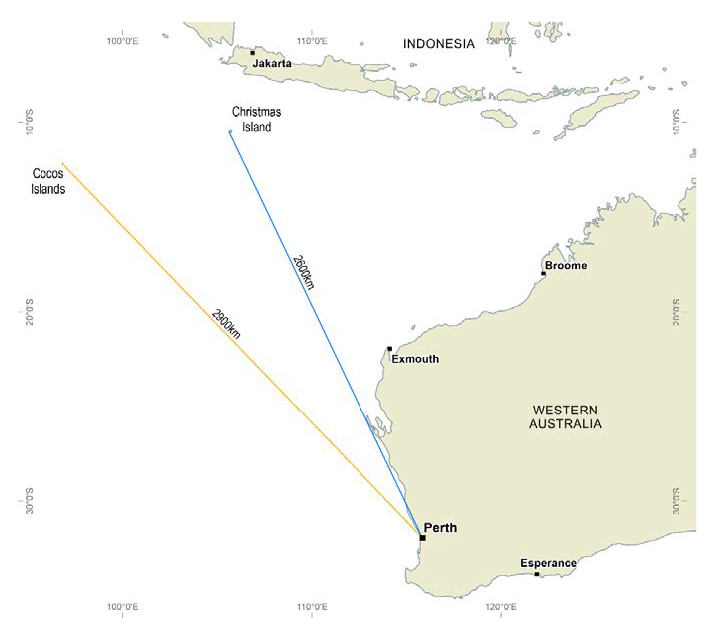
Source: WA Department of Primary Industries and Regional Development, the location of Christmas Island and the Cocos (Keeling) Islands in relation to Western Australia, available from https://marinewaters.fish.wa.gov.au/explore/indian-ocean-territories/ [accessed 30 June 2025].
Administration of the Indian Ocean Territories
1.7 The Christmas Island Act 1958 and the Cocos (Keeling) Islands Act 1955 establish Christmas Island and the Cocos (Keeling) Islands as territories under the responsibility of the Australian Government. Through this legislation, WA laws apply and the Australian Government may enter into arrangements with WA for the ‘effective application and administration of the laws in force in the territory’. The WA Government has also enacted the Indian Ocean Territories (Administration of Laws) Act 1992 to enable WA state agencies to exercise powers, perform functions and duties, and provide services in or in relation to the IOTs.
Norfolk Island
1.8 Norfolk Island is located 1,676 kilometres northeast of Sydney in the Pacific Ocean. In 2021 it had a population of approximately 2,188 people. Of this population, 25 per cent identified as Pitcairn Islanders.4 Figure 1.2. shows the approximate distances between Norfolk Island and nearby cities. Tourism is a key economic activity on Norfolk Island. The top three industries of employment on Norfolk Island are accommodation and food services, retail trade, and public administration and safety.
Figure 1.2: Norfolk Island, approximate distances from nearby cities
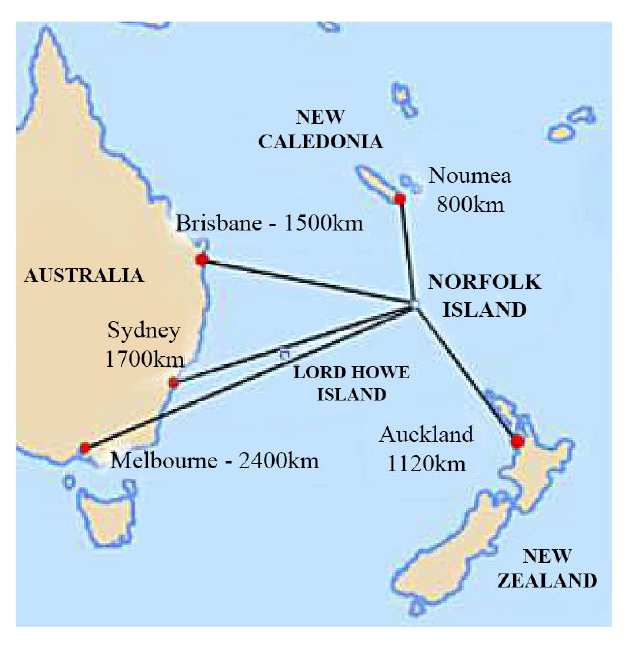
Source: Australian National Audit Office, Auditor-General Report No. 43 2018–19, Design, Implementation and Monitoring of Reforms to Services on Norfolk Island, ANAO, Canberra, 2019, Figure 1.1, available from https://www.anao.gov.au/work/performance-audit/design-implementation-and-monitoring-reforms-to-services-norfolk-island.
Norfolk Island governance, reform and service delivery
1.9 Norfolk Island is an external Australian territory governed under the Norfolk Island Act 1979. In 2015 the Australian Government announced reforms to Norfolk Island governance and service delivery arrangements, ending the period of self-government that had been in place since 1979.5 One objective of the reforms was ‘consistent with the general principle that as Norfolk Island is part of Australia, those Australians who live there should have the same obligations and receive the same access to benefits as other Australians.’ The Australian Government:
- assumed responsibility for funding and delivering both national and state-level services on the island;
- abolished the Norfolk Island Legislative Assembly and Executive Council; and
- transitioned local government services and government business enterprises to the Norfolk Island Regional Council (NIRC) which would be responsible for local and municipal matters and deliver some state-type services on behalf of Infrastructure through a service delivery agreement.6
Infrastructure’s administration of external territories services
Program outcome
1.10 Infrastructure’s Portfolio Budget Statements 2025–26 set out its responsibility to manage service delivery to the territories under Outcome 4.
Good governance and service delivery in the Australian territories including through the maintenance and improvement of the laws and services for non-self-governing territories, and the overarching legislative framework for non-self-governing territories.
1.11 The key activities in the Portfolio Budget Statements under this outcome for Infrastructure are:
- ensuring governance and legislative arrangements are fit for purpose to support delivery of services and programs to Australia’s non-self-governing territories and facilitate national interests in the Australian Capital Territory and Northern Territory; and
- provide essential infrastructure and deliver services to residents of the external territories (Norfolk Island and the Indian Ocean Territories) and the Jervis Bay Territory.
1.12 In the 2025–26 Budget, the Australian Government provided $199.5 million to Infrastructure for the administration of the external territories, including the delivery of infrastructure and essential services to the IOTs and Norfolk Island.7 This funding is separate to allocations to, for example, Services Australia for the delivery of social security and welfare payments.
1.13 The Territories Division manages the administration of the territories. The division has three branches: the Indian Ocean Territories Branch, the Territories Enabling Services Branch, and the Norfolk Island and Mainland Territories Branch. For 2025–26 the division had 136 staff.
Rationale for undertaking the audit
1.14 The external territories of Norfolk Island and the IOTs are managed under their own administrative processes, governance and models of service delivery. The remoteness of the Australian external territories presents risks and challenges in providing service delivery that achieves value for money. This audit provides assurance to the Parliament on whether the service delivery arrangements for the Australian external territories are being managed effectively.
Audit approach
Audit objective, criteria and scope
1.15 The objective of the audit was to assess whether Infrastructure’s management of service delivery arrangements for the external territories was effective. To form a conclusion against the audit objective, the following high-level criteria were adopted:
- Has Infrastructure established fit-for-purpose governance arrangements for the delivery of services in the external territories?
- Does Infrastructure effectively manage service delivery for the external territories?
1.16 The audit scope included an examination of the arrangements that Infrastructure has in place to deliver state-type services in the external territories through service delivery arrangements with state governments and other providers. The audit did not examine: management of assets; services delivered by other Australian Government entities in the territories, such as social security and welfare payments provided by Services Australia; other external or internal territories managed by Infrastructure (see footnote 3); or the transition of services on Norfolk Island from the New South Wales (NSW) Government to the Queensland Government. 8
Audit methodology
1.17 The audit methodology involved:
- examining documentation held by Infrastructure, including service agreements and policies and guidance documents;
- meeting with stakeholders and service providers on Norfolk Island, Cocos (Keeling) Islands and Christmas Island and state agencies; and
- meetings with Infrastructure staff.
1.18 The audit was conducted in accordance with ANAO Auditing Standards at a cost to the ANAO of approximately $560,500.
1.19 The team members for this audit were Jessica Carroll, Tessa Osborne, Sophie Crandall, Stephanie Bruce, Anne Rainger and Michelle Page.
2. Service delivery in the Indian Ocean Territories
Areas examined
This chapter examines whether the Department of Infrastructure, Transport, Regional Development, Communications, Sport and the Arts (Infrastructure) has established fit-for-purpose governance arrangements for the delivery of services on the Indian Ocean Territories (IOTs) of Christmas Island and Cocos (Keeling) Islands and if Infrastructure effectively manages these arrangements.
Conclusion
Infrastructure has established largely appropriate governance arrangements for the delivery of services to the IOTs and is partly effective in managing these arrangements. Service delivery is supported through agreements with the Western Australian (WA) Government and contracts with private providers. Governance, risk and performance management are predominantly managed reactively by Infrastructure and focused on operational continuity. This limits Infrastructure’s ability to take a forward-looking strategic approach to service delivery and risk management. There is limited evaluation of whether services are being delivered to the required quality or meeting community expectations.
Areas for improvement
The ANAO made four recommendations relating to risk management, performance management, record keeping and conducting periodic reviews of services and agreements to determine whether they are effective. The ANAO also suggested that Infrastructure regularly monitor complaints on service delivery to the external territories in order to inform its decisions on whether service delivery arrangements and contracts remain fit for purpose.
2.1 The accountable authority of a Commonwealth entity has duties under the Public Governance, Performance and Accountability Act 2013 (PGPA Act) to: govern the entity in a way that promotes the proper use and management of the public resources for which they are responsible; measure and assess the performance of the entity in achieving its purposes; and establish and maintain appropriate risk management practices.
2.2 Infrastructure has Service Delivery Arrangements (SDA) with Western Australian (WA) Government agencies, and contracts with private entities for service delivery in the IOTs. Regardless of the commissioning framework, to meet PGPA Act requirements entities should establish robust agreements that establish clear roles and responsibilities, performance expectations, a clear approach to risk management and appropriate reporting arrangements.
2.3 Service delivery in the IOTs presents a range of challenges for Infrastructure, including:
- the need for Infrastructure to partner with a state government to deliver services;
- the majority of services are provided by WA state agencies due to existing legislative frameworks in the IOTs (WA laws are applied in the IOTs), their proven experience in remote service delivery, established organisational and regulatory arrangements, and proximity to the IOTs;
- the economic base for the IOTs is narrow and heavily reliant on government support and limited industries;
- the extreme remoteness and isolation of the IOTs from the mainland; and
- higher service provision costs, with limited suppliers available to provide commercial services.
Do service delivery arrangements clearly set out deliverables, roles and responsibilities, performance expectations, risk and reporting?
Infrastructure has service delivery arrangements (SDAs) and contracts in place for the delivery of services in the IOTs. The SDAs and contracts include key elements expected to be in agreements of this nature. However, the SDAs do not cover the management of shared risk and performance expectations could be further tailored and outcomes focused. New services can be established under the agreements. Infrastructure has not documented how the current scope of services meets the program objective or the framework for making decisions on new services.
2.4 Infrastructure manages service delivery arrangements in the IOTs through the following mechanisms (see Figure 2.1):
- SDAs with WA state agencies for state-type services;
- contracts with private providers for the delivery of services such as for air passengers and freight; and
- direct delivery of Australian Government services (such as for primary healthcare, pathology and acute in-patient care) via the Indian Ocean Territories Administration (IOTA).9
Figure 2.1: Overview of service delivery in the Indian Ocean Territories
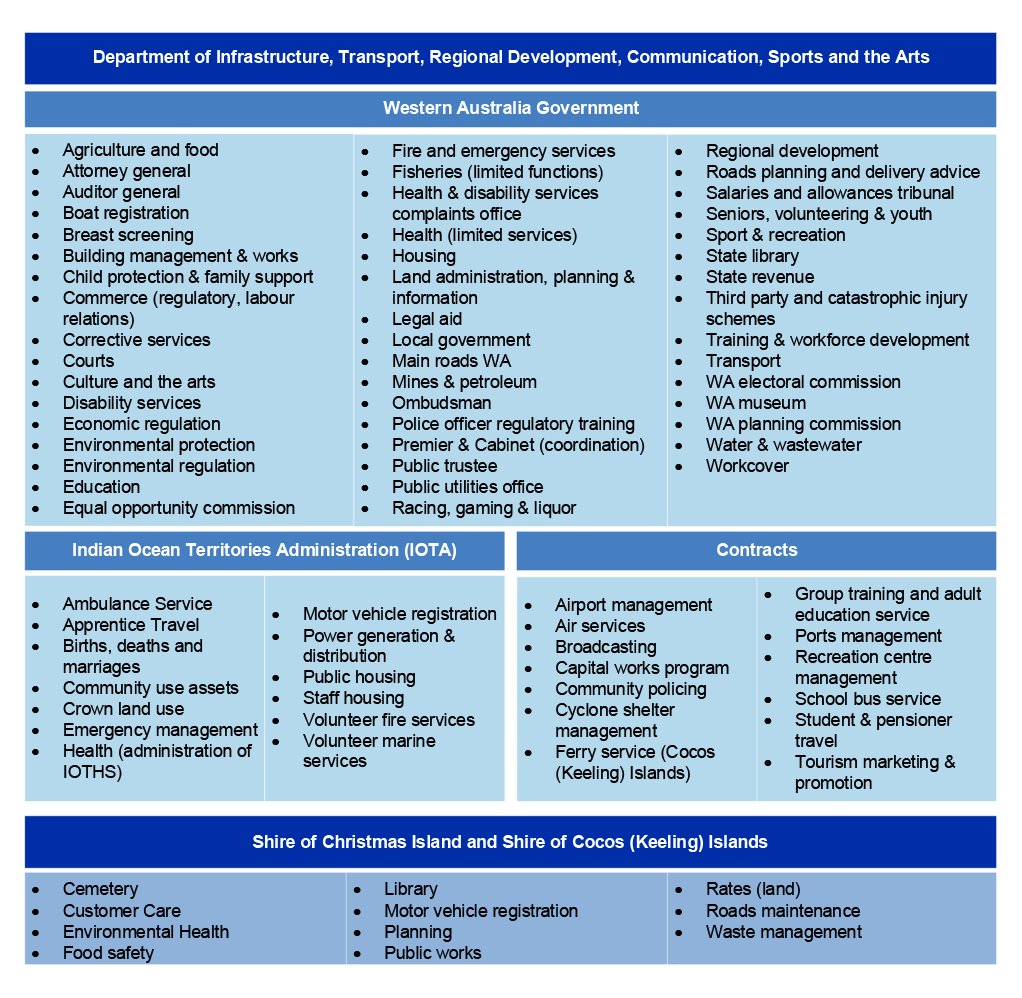
Note: The audit did not examine service delivery by the Shire of Christmas Island and the Shire of Cocos (Keeling) Islands.
Source: ANAO adaptation of Infrastructure records.
Service delivery arrangements with the WA Government
2.5 The Australian Government, represented by Infrastructure, has established SDAs with WA state agencies for delivery of state-type services in the IOTs. As at 1 September 2024, Infrastructure had 38 arrangements in place with state agencies for 55 services, through either an SDA or an exchange of letters.10 SDAs have been in place from 1992. Services provided under an SDA can include policy development, regulatory functions, and direct service delivery. For example, the WA Department of Education provides:
- kindergarten to year 12 classes at Christmas Island District High School;
- kindergarten to year 10 classes at Cocos (Keeling) Islands District High School — with services delivered across two campuses, one on West Island and one on Home Island; and
- other services such as recruitment of teaching staff, learning and development, and monitoring of school performance and effectiveness.
2.6 Each SDA uses a standardised approach set out in a template. The template provides the generic terms and conditions for use across all SDAs. Infrastructure negotiates the SDA template with the WA Department of the Premier and Cabinet (WA DPC) and the WA State Solicitor’s Office within the WA Department of Justice. In 2024 Infrastructure and the WA DPC commenced negotiations to develop a new SDA template. As at July 2025, these negotiations were ongoing.
2.7 The SDA template consists of:
- Header arrangement — contains the standard SDA terms and conditions. These include background, renewal or extension terms, delegations, reporting, cost recovery, review clauses, dispute resolution, indemnity and contract variation clauses;
- Schedule A — operational brief — contains objective of the state agency (in relation to the IOTs), description of services, obligation to provide services, statement on service levels, performance indicators and reporting; and
- Schedule B — financial provisions — contains the specific conditions of payment arrangements and initial budgets for services. Financial year budgets are provided as part of the yearly requirement to submit a work plan (see paragraph 2.10).
2.8 The ANAO assessed the content of 34 SDAs against the key components of service deliverables; roles and responsibilities; performance expectations; risk; and reporting. The results are set out in Table 2.1.
Table 2.1: Summary of ANAO analysis of the content of 34 Service Delivery Arrangements with WA state agencies
|
Element |
Finding |
Summary of analysis |
|
Service deliverables |
● |
Schedule A of the SDAs includes details of the services to be provided by the WA state agency. The SDAs are structured to encompass all the services offered by each state agency. The content of Schedule A varies to align with the state agency and services provided, including a high-level description of services a state agency is ordinarily responsible for. The SDAs also require state agencies to submit a work plan each year. |
|
Defined roles and responsibilities |
● |
Schedule A and Schedule B of the agreements specify roles and responsibilities relating to service delivery, service levels, reporting, performance, payments, budgets and approval of funding. |
|
Risk management |
◯ |
None of the SDAs provide the approach for communicating and managing risks associated with the delivery of the services or specify roles and responsibilities. See paragraphs 2.25 to 2.28 for further discussion of risk management. |
|
Issues escalation |
● |
The header agreement for each of the SDAs contains a high-level clause on dispute resolution. |
|
Performance expectations |
◑ |
Each SDA includes the section: Service Levels … the Services will be provided by the State Agency at the appropriate level to achieve the objectives. The State Agency will provide the Services in a manner and to the standard that would be exercised by the State Agency in providing similar services in the State. The State Agency will endeavour to ensure where possible efficiencies obtained through its other business are reflected in similar efficiencies in the Territories. Schedule A of the SDAs includes a set of performance indicators (see Table 2.5). Most (25 of 34) SDAs did not tailor performance indicators to the individual service. The corresponding performance measures provide examples of how the state agency could measure performance. The examples are largely output/activity-based rather than metrics or targets to match the performance indicators. |
|
Reporting arrangements |
◑ |
Schedule A outlines reporting requirements, including type of report, description of content and due date. Specific reporting on performance indicators is not required (see from paragraph 2.48). |
|
Term (length of agreement) |
● |
Each SDA specifies a term for the provision of services. |
|
Review of agreement |
● |
Each SDA contains a review clause: … parties will undertake a review of the operation of this arrangement in accordance with agreed terms of reference six months before the end of the Term or any Extended Term of this Arrangement. Implementation of these reviews is discussed in paragraph 2.64. |
|
Current and signed |
● |
Each SDA is current and signed using the appropriate delegations. This includes those that had been extended using the renewal and extension clause. |
Key: ◯ not met ◑ partly met ◕ largely met ● fully met
Note: The SDA procedures manual states that the First Assistant Secretary, Territories Division, is the delegate to sign the SDA.
Source: ANAO analysis of 34 SDAs for service delivery in the IOTs.
2.9 Infrastructure has prepared the SDA procedures manual to assist its SDA contract managers to manage the agreements and the Service Delivery Arrangements Information Kit for state agencies providing services to the IOTs. These manuals set out further background and details on the management of the SDAs.
Work plans
2.10 The SDA template requires that state agencies must, by 1 February, prepare and submit to Infrastructure for approval a work plan and budget for the following financial year. The work plan articulates the services the state agency will provide in the coming year. State agencies are only required to provide the services as described in the work plan. The Service Delivery Arrangements Information Kit states that ‘the work plan is a flexible document, negotiated annually, to allow the services to adapt to changing needs’. The type of information and level of detail differs across the work plans. For 2024–25 state agencies complied with these requirements.
Services delivered by private providers
2.11 The SDA procedures manual states that the Australian Government can engage external parties to ‘provide services where it is believed the other service provider is better able to meet the needs of the IOTs’. In practice, Infrastructure engages private providers to deliver services that states are unable to deliver or that require support in the absence of a viable commercial market. Examples include contracts with Toll Remote Logistics to manage the airport and related services, and with Virgin Australia Airlines (Virgin) to provide regular transport and freight services.11
2.12 Fourteen contracts were reviewed by the ANAO against the key components of service deliverables; roles and responsibilities; performance expectations; risk; and reporting arrangements. Results are set out in Table 2.2.
Table 2.2: Summary of ANAO analysis of the content of contracts for service delivery with private providers
|
Elements |
Finding |
Summary of analysis |
|
Service deliverables |
● |
Service levels and responsibilities are set out in each contract. |
|
Defined roles and responsibilities |
● |
The contracts specify roles and responsibilities for service delivery, service levels, reporting, performance, payments, budgets and approval of funding. |
|
Risk and issues escalation |
● |
Each contract requires providers to submit to Infrastructure plans that may include identified and potential risks to their areas of operation. Examples include emergency responses (e.g. port oil spill protocols), regulatory requirements (e.g. airport/port security plans) and general business continuity. |
|
Reporting arrangements |
● |
Each contract contains a section detailing the service provider reporting obligations. The frequency and type of reporting is suited to the service and contract. |
|
Performance expectations |
● |
The contracts contain key performance indicators (KPIs) that are measurable and specific to the services required under the contract. One service provider informed the ANAO in April 2025 that KPIs had not been reviewed since the original contracts were signed. The contracts have payments linked to performance reporting. |
|
Cost of services |
● |
The contracts contain appropriate sections that cover costs for the service. |
|
Term (length of agreement) |
● |
The contracts state the length of agreement and extension terms. |
|
Review of agreement |
● |
The contracts have appropriate review options/specified end dates. |
|
Current and signed |
● |
Each contract was signed and current or had been extended using the renewal and extension clause. |
Key: ◯ not met ◑ partly met ◕ largely met ● fully met
Source: ANAO analysis of contracts with private providers on the IOTs.
Contract extensions
2.13 The Commonwealth Procurement Rules (CPRs) provide that officials responsible for a procurement must consider relevant financial and non-financial benefits and be satisfied that the chosen tender achieves value for money. Infrastructure faces challenges in procuring services in the IOTs including supplier availability (see paragraph 2.3). The CPRs state that officials must demonstrate value for money even when a procurement involves a single tenderer — for example, by providing a strong rationale for sole sourcing, surveying the market and using benchmarks to assess offerings and prices.
2.14 Infrastructure extended the terms of seven of the 14 contracts in 2024–25 using an extension clause. For four contracts sampled by the ANAO, the brief to the delegate seeking approval for the extension:
- covered the need for the contract rollover, outlining circumstances of limited market options;
- outlined service delivery risks; and
- noted that service providers had longstanding presence in the IOT community.12
2.15 In the sample reviewed by the ANAO the rationale for extending the contract was largely sound. Infrastructure appropriately documented key value for money considerations, including the importance of ensuring continuity of service in the IOTs. One of the four briefs did not completely demonstrate how key factors, such as risk, service quality and past performance were considered collectively in supporting the value-for-money assessment.
Identifying service gaps
2.16 Infrastructure’s service delivery arrangements in the IOTs are generally long established, although occasionally a requirement for new services is identified (see Case study 1). The SDA procedures manual sets out that Infrastructure can agree with WA state agencies to include new services that fall within the scope of an existing SDA through executing a variation or amending annual work plans.13
2.17 Infrastructure has not documented how the current scope of services in the IOTs is sufficient to meet the program objective or service delivery needs of the IOT community. Infrastructure advised the ANAO on 31 March 2025 that requests for new services are managed on a case-by-case basis, considering factors including community need for the service and availability of funding. This framework for considering new services is not documented.
|
Case study 1. Identifying a new service need: Parks Australia |
|
Parks Australia (Parks) is responsible for conserving national parks in the Indian Ocean Territories (IOTs). WA Wildlife Hospital is based in Perth and assists Parks Australia rangers on Christmas Island to treat and rehabilitate wildlife. In July 2024 Parks and the WA Wildlife Hospital advised Infrastructure of their concerns about the availability and permitted use of veterinary medicines in the IOTs, following Veterinary Practice Board of Western Australia (VPBWA) advice that Christmas Island was outside its jurisdiction.14 This meant that Parks personnel were not legally permitted to stock or use certain veterinary medications on Christmas Island. Parks requested Infrastructure’s advice on appropriately adopting the use of specified veterinary medicines on the island. The Administrator15 of the IOTs supported the request and discussed it with Infrastructure officials. Infrastructure recognised the legitimate service gap and need for this service on Christmas Island. The issue was discussed with the VPBWA, Christmas Island National Park and the WA Department of the Premier and Cabinet. Infrastructure and the VPBWA have entered into an arrangement via a letter of exchange while they develop a service delivery arrangement. |
Are there fit-for-purpose governance and communication arrangements in place to manage risk and escalate issues?
Infrastructure has established governance arrangements to support the delivery of services to the IOTs. Infrastructure has processes in place for the day-to-day management of service delivery issues and risks. Despite these operational mechanisms, Infrastructure has not documented in its program risk register how it is managing longer-term service delivery risks in a strategic or coordinated way. Additionally, the SDAs with state agencies do not clearly outline roles and responsibilities for managing shared risk. Infrastructure communicates with the IOT communities through a range of methods. Infrastructure could use complaints data more holistically to inform and improve service delivery.
2.18 Governance arrangements to support service delivery should include appropriate decision-making structures, risk management frameworks and stakeholder engagement and communication.
Governance arrangements
2.19 Effective governance supports sound decision making, provides clear lines of communication and authority and facilitates the resolution and escalation of issues. Infrastructure manages the governance arrangements of service delivery for the IOTs through:
- day-to-day management by the branches within the Territories Division;
- internal governance forums within the Territories Division; and
- coordination through the WA DPC.
Indian Ocean Territories Branch
2.20 The Indian Ocean Territories Branch within the Territories Division is responsible for policy and service delivery in the IOTs. This branch includes IOTA staff on both islands and teams in Perth and Canberra who manage policy, SDAs and the service delivery contracts. Branch contract managers are responsible for overseeing the SDAs and contracts with private providers, are the key point of contact for issues relating to delivery of the SDAs and contracts, and hold regular meetings with their state agency counterparts.
2.21 In April 2025, the ANAO consulted with providers and WA state agencies delivering services in the IOTs.16 Stakeholders advised that:
- most service delivery issues were raised with Infrastructure in real time through direct communication with contract managers;
- they were comfortable raising issues with Infrastructure contract managers and confident a solution would be found; and
- the IOT Branch was responsive to on-island issues raised by stakeholders.
Territories Division governance forums
2.22 Infrastructure has two governance forums to support oversight and management of the Territories Division. Table 2.3 outlines these governance forums and their purpose.
Table 2.3: Infrastructure Territories Division governance forums
|
Forum |
Members |
Frequency |
Purpose |
|
Territories Governance Board (internal members only) |
|
Quarterly |
To provide strategic advice on core business activities, policy, projects and implementation to the first assistant secretary of the Territories Division. Items discussed include divisional financial report, risk, fraud and integrity, divisional planning and work, health and safety (WHS). |
|
Territories Division Project Board |
|
Monthly |
To approve and monitor infrastructure project delivery within the division. Items discussed include monthly capital works report, funding bids, public works committee, WHS and project communications. |
Source: ANAO analysis of board meeting minutes and board terms of reference.
WA Department of Premier and Cabinet
2.23 The WA DPC manages the relationship between state agencies and Infrastructure for the delivery of state-type services to the IOTs. The WA DPC facilitates the negotiation of new SDAs, reviews and renegotiates SDAs and assists in resolving SDA issues with state agencies. The WA DPC also oversees state agencies’ budgets, work plans, financial acquittals and the annual performance reports (see paragraph 2.48). The WA DPC and Infrastructure discuss service delivery to the IOTs fortnightly and more frequently when needed. Infrastructure advised the ANAO in July 2025 that meeting minutes were not kept prior to 30 June 2025 and meeting summaries will be produced for future meetings.
Risk management
Shared risk
2.24 The Commonwealth Risk Management Policy states that the management of shared risks should be agreed by all parties involved.17 The SDAs do not cover risk management or roles and responsibilities for risk management. Infrastructure advised the ANAO in January 2025 that each state agency that delivers services through SDAs has its own risk plans. Infrastructure does not confirm or review these risk plans. The Territories Division risk register (see paragraph 2.25) includes a column to capture if the program risk is a shared risk. None of the eight risks on the register are categorised as a shared risk. Most (nine of 14) of the private contracts included a requirement that risk frameworks/policies be submitted to Infrastructure as part of performance reporting.
Program risks
2.25 The Territories Division has a divisional risk register for program and service delivery risks — covering both the IOTs and Norfolk Island. The register includes the risk appetite and tolerance, and outlines the challenges in service delivery to the territories and unique risks for Infrastructure — for example, in providing direct service delivery through IOTA. The risk register is based on Infrastructure’s risk template. The Territories Governance Board approved the 2024 version in March 2024. It includes eight risks, two of which are managed in separate risk registers for fraud and climate. Table 2.4 outlines the key risks and their ratings.
Table 2.4: Key risk in Territories Divisional risk register
|
Risk description |
Risk rating (post controls) |
|
Failure of ageing infrastructure in the Territories due to lack of funding |
High |
|
Adverse program outcomes due to an unsustainable financial, legislative or governance structure supporting services to Territories program |
Medium |
|
Disruption to the delivery of essential services in the Territories |
Medium |
|
Failure to have adequate WHS systems in place |
Medium |
|
Failure to actively plan, manage and develop the workforce |
Medium |
|
Engagement with stakeholders at all levels is no longer effective which compromises the ability to deliver services in the Territories |
Medium |
|
Fraudulent activity compromises the delivery of policy |
Medium |
|
Climate change impacts the communities and services provided by the Territories |
Medium |
Note: Risk ratings are applied to risks after controls are put in place. A control is an action to mitigate and/or influence a risk. If the risk rating is deemed to be not accepted, treatments (future actions) are then actioned.
Source: Territories Division risk register.
2.26 The risk register is a standing agenda item of the Territories Governance Board, and this was reviewed at each meeting. The Territories Division also has a WHS risk register, which supports management of the territories’ WHS risk environment. The Territories Governance Board reviews the WHS risk register regularly.
2.27 Infrastructure has processes in place for managing day-to-day operational issues and risks on the IOTs such as active contract management, regular feedback from the Administrator (see from paragraph 2.39) and escalation of issues within the division or governance forums. These mechanisms are effective in addressing immediate and short-term service delivery challenges. However, Infrastructure has not documented in its program risk register how it is managing longer-term service delivery risks, including quality service delivery to the external territories. For example, two risks — unsustainable funding impacting program outcomes and the challenge of ageing infrastructure — have been identified in Infrastructure’s risk register (see Table 2.4). These risks were also raised by stakeholder during the audit (see paragraph 2.44). Controls for these risks include:
- estimates variation process18;
- reporting to governance forums;
- arrangements entered into on a short-term basis based on funding allocations; and
- development of an assets management strategy and framework by June 2025.19
2.28 These program risk register does not fully capture controls and treatments to support strategic risk management and provide long-term assurance over service delivery pressures and quality services.
Recommendation no.1
2.29 The Department of Infrastructure, Transport, Regional Development, Communications, Sport and the Arts strengthen its risk planning and management including:
- detailing clear roles and responsibilities and implementing its approach to managing shared risks; and
- regularly review its program risk register and controls to ensure they support strategic risk planning and management.
Department of Infrastructure, Transport, Regional Development, Communications, Sport and the Arts response: Agreed in principle.
2.30 The department agrees there are opportunities within its service delivery agreements and related documentation to more explicitly define the roles and responsibilities of relevant parties in the management of shared risks. Such enhancements will reinforce the department’s existing risk management practices.
2.31 Although the report finds service delivery arrangements in the Indian Ocean Territories do not cover the management of shared risk (paragraph 7), the department notes the Service Delivery Arrangements include a clause where the Australian Government indemnifies the Western Australian (WA) Government. This clause reflects the shared understanding that risks are born by the Commonwealth in relation to service delivery. Recent negotiations between governments have better clarified the parameters where the Australian Government indemnifies the WA Government, with resulting benefits for the management of Commonwealth risks. Nonetheless, the department is taking steps to strengthen the identification of emerging risks - and taking a more collaborative approach to risks with its state partners.
2.32 While we welcome the finding the department delivers operational continuity, we note the findings related to strategic risk planning and management do not recognise the department’s span of control. Funding decisions for Outcome 4 are a matter for Government, and any shortcomings in the strategies identified reflect these limits and budget constraints.
2.33 The department recognises the importance of actively identifying and managing risks. For example, the department is progressing strategic planning in relation to: climate change, such as the Coastal Hazard Risk Management and Adaption Plan for Cocos (Keeling) Islands; ageing assets, including through independent modelling reports and business case development; and work health and safety, including through a multi-year Work Health and Safety Management System Review. These substantial work programs, operating alongside the management of service delivery arrangements, demonstrate the department’s work in proactively managing long-term service delivery risks in a strategic and coordinated way.
2.34 Nonetheless, the department agrees with the importance of regularly reviewing its program risk register and controls to ensure they capture emerging challenges, mitigate risks, and respond to community needs in service delivery.
Community consultation and engagement
2.35 The SDA procedures manual sets out the importance of consultation with communities. It explains that determining community needs and delivery of corresponding services is done through ‘negotiating access to the full range of services that a state agency is ordinarily responsible for through the SDAs and implemented through the annual work plans’.
2.36 The IOT community can provide feedback and input into service delivery needs through:
- direct engagement with state agencies and/or Infrastructure contract managers when they travel to the IOTs or via email or phone contact20;
- engagement with the Administrator or their office; and/or
- participation in department-led community consultation forums for specific services or areas.
2.37 Case study 2 provides examples of community consultation.
|
Case study 2. Example of Indian Ocean Territories community consultation |
|
Tender for an air services and freight provider IOT communities regularly raise concerns about challenges relating to the movement of people and freight to and from the IOTs. In May 2024, Infrastructure approached the market to secure an air services partner to deliver regular passenger and freight transport services to Christmas Island and the Cocos (Keeling) Islands. In 2023, prior to the release of the request for tender (RFT) to the market, Infrastructure together with the Shire of Christmas Island and the Christmas Island and Cocos (Keeling) Islands Community Resource Centres (CRC), consulted the IOT communities on their preferences for future IOT air services arrangements. As part of these consultations, the CRC designed and hosted a multilingual survey, gathering 441 responses on community preferences for future air passenger and freight operations. Airfare and pricing, service reliability, seat availability, baggage limits and speed of recovery services were identified as key priorities by the community. Infrastructure advised the ANAO in April 2025 that it incorporated the survey results and key concerns identified through the consultations and included these in the IOT air services tender. This was done by the air services RFT requiring potential tenderers to address, amongst other factors, how they would: provide at least twice per week flights with three to four days between flights; provide at least one inter-island flight (each way) per week; and how they would minimise or eliminate instances of baggage offload. |
2.38 Infrastructure also distributes information to the community on how to access services through the Infrastructure website (including via factsheets on the SDAs available in English, Chinese, Malay and Cocos Malay languages21), local media and newsletters such as The Islander and The Atoll, and the publication of the IOTs SDA annual reports (see paragraph 2.49).
Role of the Administrator
2.39 The Administrator of the Territories of Christmas Island and the Cocos (Keeling) Islands (the Administrator) is a statutory appointee of the Governor-General of the Commonwealth of Australia. The Administrator has three key functions: representative of the Minister for Regional Development, Local Government and Territories; communication and advocacy; and facilitator — for example, in coordination between agencies with an on-island presence.
2.40 The Administrator releases a newsletter that is posted online for the IOT community. The newsletter covers updates of past and upcoming events, lists job vacancies and shares information on new projects for community consultation. The Administrator has requested community input on the management of IOTs marine parks, the coastal hazards risk plan and the Cocos runway project. There are also external forums to support consultation on key services outside the SDA governance such as the Emergency Management Committee and the Indian Ocean Territories Health Services Committee. 22
2.41 Infrastructure advised the ANAO in March 2025 that the Assistant Secretary and the IOT Branch meets with the Administrator of the IOTs fortnightly (or as needed) to discuss community issues or complaints. Minutes or records for these meetings are not kept. Infrastructure should implement practices to record outcomes and key decisions of meetings/discussions with key stakeholder (see Recommendation no. 4 at paragraph 3.25).
Complaints
2.42 Infrastructure advised the ANAO in March 2025 that it does not have an overall/formal complaints management framework for the IOTs, and that community members can lodge complaints and provide feedback through multiple channels — for example, state agencies, the Administrator, on-the-ground staff at IOTA or the Infrastructure website.23 Infrastructure manages complaints on a case-by-case basis though the IOT Branch. The ANAO saw examples of complaints received being sent to the responsible authority — for example, the relevant state agency.
Opportunity for improvement
2.43 Infrastructure should regularly monitor complaints on service delivery to the external territories to inform its decisions on whether service delivery arrangements and contracts remain fit for purpose and are meeting program outcomes (refer to Recommendation no. 3 at paragraph 2.67).
Concerns raised by stakeholders consulted for the audit
2.44 Stakeholders and service providers in the IOTs reported to the ANAO concerns around (see Appendix 3 for further details):
- being excluded from national and state grants and programs, resulting in inequitable treatment compared to mainland Australia;
- existing budgets are insufficient and hinder effective service delivery and long-term planning;
- with flight and freight reliability — such as offloaded baggage and limited access for essential personnel; and
- essential infrastructure suffering from maintenance backlogs due to environmental challenges, limited funding, and logistical constraints.
Does Infrastructure monitor and seek assurance that services are being delivered in line with the arrangements?
Infrastructure’s contract management team relies on regular direct communication with state agencies or private providers to monitor service delivery. The SDAs have performance indicators and measures, although these are not always tailored to the individual services. WA state agencies report annually on services delivered to Infrastructure which are collated and published on its website. This annual reporting does not report on the performance measures or indicators and therefore does not provide complete information on performance. There is no evidence that Infrastructure uses the performance information received to determine whether quality services are being delivered or acts where required.
2.45 Good quality performance information helps to demonstrate whether outcomes are being achieved. Regular and appropriate reporting by service providers/delivery partners allows entities to monitor whether quality services are being appropriately delivered and meeting the objectives of the program.
Performance information
WA state agency performance expectations under service delivery arrangements
2.46 Schedule A of Infrastructure’s SDAs with WA state agencies include standard performance indicators and examples of performance measures that could be used as set out in Table 2.5. The schedule states that these performance indicators ‘will be used by the Commonwealth in determining the effectiveness of the provision of services’. Twenty-five of the 34 SDAs reviewed by the ANAO only contain these generic set of performance indicators, with no corresponding performance measures or targets set.
2.47 This approach is not effective for measuring the quality of services being delivered, or to assess whether service delivery standards are consistently being met. Without clear performance measures, Infrastructure is unable to determine the effectiveness of services, identify areas for improvement, or ensure accountability in service delivery.
Table 2.5: Standard performance indicators in Service Delivery Arrangements with WA state agencies
|
Performance indicator |
Performance measure |
|
The extent to which the state agency has delivered services as agreed by the parties. |
What (and how much) did the state agency do? Quantified outputs as evidence of the state agency’s activities aligned to each service and referenced to the annual work plan. Examples can include but are not limited to:
|
|
The extent to which the objectives of this arrangement are achieved, or progress is made towards the objectives. |
Did the state agency’s services have an impact? Examples can include but are not limited to:
|
|
Deliver services to meet customer expectations. |
How well the state agency delivered the services to meet the objectives of the arrangement. Examples can include but are not limited to:
|
|
Reports, budgets and invoices are provided by the state agency within the timelines stated in this arrangement. |
Whether the below items have been provided on time:
|
|
The extent to which the state agency has delivered services within the budget agreed by the parties. |
Plus or minus 10% variance on agreed budget by line item. |
Source: ANAO adapted from service delivery arrangement with WA state agencies.
Performance reporting
2.48 The SDAs set out the reporting requirements for state agencies. The main form of state agency reporting is the annual performance report. Infrastructure provides state agencies with a report template that includes three sections:
- a summary of services provided;
- highlights and activities for the financial year; and
- any issues or matters that may arise during the following financial year that are not considered business-as-usual.
2.49 Once Infrastructure receives the annual performance reports, it consolidates them for the Assistant Secretary and IOT Branch approval. Infrastructure publishes the consolidated reports on its website (see Table 2.6 for examples from the past two years).
Table 2.6: Indian Ocean Territories service delivery arrangement annual reports
|
Year |
Date published |
Description |
|
2022–23 |
26 June 2024 |
Overview of 39 state agencies providing 55 services to the IOTs including a brief coverage of types of services, highlights and a horizon scan for 2022–23. |
|
2023–24 |
27 March 2025 |
Overview of 38 state agencies providing 54 services to the IOTs including a brief coverage of types of services, highlights and a horizon scan for 2023–24. |
Source: ANAO analysis of IOT SDA Annual Report 2022–23 and 2023–24 Infrastructure, Service Delivery Arrangements (SDA) Annual Report Indian Ocean Territories 2022–23 and 2023–24 available from https://www.infrastructure.gov.au/territories-regions-cities/territories/indian-ocean-territories-christmas-island-and-cocos-keeling-islands/service-delivery-arrangements.
2.50 The publication of the annual reports supports transparency and provides a degree of information about the services delivered on the IOTs. However, the WA state agency annual performance reports do not report against the performance indicators included in the SDAs and Infrastructure does not collect other data to enable it to report against those performance indicators or on the effectiveness or quality of service delivery in the territories. In addition, Infrastructure does not review the reports to determine whether services have been delivered in line with the agreements and whether action is required.
Recommendation no.2
2.51 The Department of Infrastructure, Transport, Regional Development, Communications, Sport and the Arts ensures that the performance framework for the external territories incorporates:
- fit-for-purpose performance measures into agreements where required;
- reporting requirements that allow it to make an assessment on performance; and
- periodic assessment of the performance of service delivery providers to inform whether outcomes are being achieved and act where required.
Department of Infrastructure, Transport, Regional Development, Communications, Sport and the Arts response: Agreed in part.
2.52 We recognise there are opportunities to strengthen performance monitoring across service delivery arrangements, noting these arrangements may require different approaches based on the operational context and relationships with state partners.
2.53 As noted in the report, the department is already strengthening performance monitoring through a refresh of the Service Delivery Arrangements with Norfolk Island Regional Council and updated arrangements for the Indian Ocean Territories. These initiatives aim to ensure that performance measures continue to be outcomes-focused, responsive to community needs, and appropriately calibrated to the delivery context.
2.54 We appreciate the finding that the department’s service delivery arrangements and contracts include the key elements expected in agreements of this nature. While we note the findings refer to a lack of evidence in evaluating service quality (including paragraphs 9 and 13), and that some elements are not fit-for-purpose (paragraph 11), we note there is no evidence services are failing to meet quality standards or that the department has not acted where required. In addition, the department welcomes further advice on the standard and benchmarks against which services should be assessed to meet the expectations identified in the audit.
2.55 The department recognise the expertise of its state partners in delivering services comparable to remote areas in mainland Australia, particularly in relation to regulatory functions. The department notes that states maintain their own performance arrangements, and the department would not want to incur higher costs or create inefficiencies by duplicating these requirements or requiring multiple reports and assessments. Consistent with the Federation Funding Agreements Framework, the department’s approach recognises states need the budget autonomy and flexibility to deliver services in a way they consider will most effectively and efficiently improve outcomes for Australians. While there was no evidence that this was not occurring, we note there could be improvements in documenting our assurance processes that performance had met expectations.
2.56 While the department is cognisant that improving performance frameworks would need to translate into improved service delivery outcomes for the community, the department will continue to look for opportunities to enhance performance monitoring and assessment.
Private provider performance reporting under contracts
2.57 The ANAO reviewed 14 arrangements Infrastructure has made with private providers. Each contract included performance measures that were specific and measurable (quantitative or qualitative) to the services set out in the contracts. For example, the contract with Casa Leisure for the management of Christmas Island Recreational Centre contains measures on memberships, occupancy and patronage. Corresponding targets are set, with written reporting to be submitted monthly.
2.58 A sample of reports tested by the ANAO for the airport contract, ferry service, port services, airline services, and recreation centre met the reporting requirements as outlined in the contract. Reports are reviewed by the relevant contract manager. For example, Virgin was required to provide weekly uplift and quarterly reports to Infrastructure on metrics including: passenger numbers; freight and mail in kilograms; and passenger baggage weight (including offloads due to aircraft weight restrictions). These reports were actively reviewed by contract managers and followed up with Virgin as needed. As the movement of passengers and freight to and from the IOTs is one of the key concerns of IOT stakeholders and residents, the flight uplift reports are also reviewed by the Administrator.
Does Infrastructure undertake evaluations of the service delivery arrangements for the Indian Ocean Territories?
Infrastructure has not completed an evaluation or obtained contemporary benchmarking of service delivery for the IOTs. The SDAs with WA state agencies include requirements for reviewing the agreements, and Infrastructure has established a program to review each agreement as it approaches expiry. Completion of these evaluations is not up to date, while a new SDA template is being negotiated. In the absence of this, Infrastructure is not reviewing if the arrangements remain appropriate or the effectiveness of the service delivery arrangements.
Benchmarking of services
2.59 In 2007 the Minister for Finance and Administration asked the Commonwealth Grants Commission to advise on the level of funding required to provide the IOTs with state-type services consistent with those in comparable WA communities. The Commission in its 2007 report noted that:
No communities in Western Australia are directly comparable with Christmas Island and the Cocos (Keeling) Islands. None are separated from the nearest centre by vast distances of ocean, nor do they have the same cultural mix in their populations.
2.60 The Commission further stated that the requirement ‘to take account of the circumstances of the Territories recognises that, in many ways, they are unique and a simple copy of Western Australian services and cost levels may not be appropriate.’ Notwithstanding challenges with the comparison, the Commission concluded that the arrangements at the time, with only minor adjustments, provide a level of services consistent with those in comparable communities in WA.
2.61 The SDA template specifies that ‘the state agency will provide the Services in a manner and to the standard that would be exercised by the state agency in providing similar services in the State’. The SDA procedures manual states that:
SDA work plans are the key mechanism through which DITRDCA [Infrastructure] ensures state agencies are providing comparable services … When discussing and reviewing work plans with a state agency, the intention is to capture how a particular work plan compares to the services and frequencies delivered in similar WA regional and remote communities.
2.62 Infrastructure has not undertaken any contemporary benchmarking of state-type services to the IOTs, nor has it assessed the SDAs (or work plans) made with the state agencies against any benchmark or comparable services on mainland Australia.
Review of service delivery arrangements
2.63 SDAs can be extended by a letter of extension or deed of variation.24 For example, Infrastructure has extended the SDA with the Department of Health 19 times, the SDA with BreastScreen WA 16 times, and the SDA with Water Corp five times.
2.64 Infrastructure has a documented process for reviewing individual SDAs, including a rolling program for review and renegotiation of a set number of SDAs each year from 2024–25 to 2028–29 based on expiry dates. The reviews are to include key activities such as confirming the template remains appropriate, meetings with state agencies and a consideration of state agency performance reports. Infrastructure advised the ANAO in March 2025 that the SDA review process had not occurred as per the schedule due to its negotiations with the WA Government on the new SDA template.
2.65 In June 2024, Infrastructure extended 11 of its 34 SDAs with WA state agencies through letters of extension. The letters stated that service delivery arrangements would continue on the same terms and conditions until July 2025. Updated SDAs were expected to commence, subject to negotiations, from 1 July 2025 with the new template. In June 2025 Infrastructure extended 14 arrangements via letters of extension (for the original 11 plus three new agreements that had been due to expire), given the delays in implementing the new SDA template.
2.66 The Assistant Secretary, IOT Branch, approved the 2024–25 and 2025–26 extensions via a minute. The minute set out the delays in negotiations for the new template and attached the letters for signature. The minute did not include details of a review, a value for money assessment or information around the performance or quality of service delivery, noting reviews of the agreements had been paused.
Recommendation no.3
2.67 The Department of Infrastructure, Transport, Regional Development, Communications, Sport and the Arts conduct periodic reviews of services and agreements to determine whether they are still fit for purpose, meeting community needs and are achieving the intended objectives and value for money.
Department of Infrastructure, Transport, Regional Development, Communications, Sport and the Arts response: Agreed.
2.68 The department agrees with this recommendation and notes that periodic reviews of services and arrangements are already a core part of its service delivery approach. We note that the first formal review of service delivery on Norfolk Island was completed in 2024, contrary to the findings in the audit report (paragraph 3.49), and the five-year review is underway as scheduled in the 2025 Norfolk Island Oversight Committee Work Plan.
2.69 The department conducts reviews at renewal points and through ongoing engagement with service providers, stakeholders, and communities to ensure services remain fit-for-purpose, responsive to local needs, and aligned with intended objectives and value for money.
External reporting
2.70 Infrastructure has two performance measures on service delivery to the territories in its corporate plan, described in Table 2.7. Infrastructure is required to self-assess its performance and report on these measures in its annual report. The performance measures and corresponding targets are primarily output and policy focused, and do not provide an assessment of the quality, effectiveness or outcomes of service delivery. This limits their usefulness in evaluating whether services are meeting their intended impact or meeting community service delivery needs.
Table 2.7: Infrastructure’s annual performance statements 2024–25
|
Year |
Key activity |
Performance measure |
Target |
2024–25 results |
|
2024–25 |
Ensuring governance and legislative arrangements are fit for purpose to:
|
Advice on governance and legislative arrangements in Australia’s territories. |
Policy advice is high quality, timely and evidence based. |
Substantially met |
|
Provide essential infrastructure, fund and deliver services to residents of the external territories (Norfolk Island and the Indian Ocean Territories) and the Jervis Bay Territory. |
Availability of key services in the non-self-governing territories. |
Active agreements are in place for the delivery of health, education and correction services in the non-self-governing territories. |
Met |
|
Source: Infrastructure’s 2024–25 Annual Report.
3. Service delivery on Norfolk Island
Areas examined
This chapter examines whether the Department of Infrastructure, Transport, Regional Development, Communications, Sport and the Arts (Infrastructure) has established fit-for-purpose governance arrangements for the delivery of services on Norfolk Island and whether Infrastructure effectively manages the arrangements.
Conclusion
Infrastructure has established largely fit-for-purpose governance arrangements for the delivery of services on Norfolk Island and is partly effective in managing these arrangements. Service delivery is facilitated through an agreement with the Queensland Government (Queensland) for state-type services, as well as arrangements with the Norfolk Island Regional Council (NIRC), private providers, and other service delivery partners. Some elements of the agreements with the NIRC are not fit for purpose. Governance, risk and performance of these arrangements are predominantly managed by Infrastructure reactively, through routine operational processes.
Areas for improvement
The ANAO made four recommendations relating to risk management, performance management, record keeping and conducting periodic reviews of services and agreements to determine whether they are effective. The ANAO also suggested that Infrastructure improve their contract management practices by specifying that the extension has explicit start and end dates and what terms and conditions apply and monitor complaints on service delivery to inform ongoing decisions on the effectiveness of the arrangements.
3.1 Service delivery in Norfolk Island involves unique challenges, including:
- the need for Infrastructure to partner with a state government to deliver services — with two state partners being involved (NSW and Queensland governments) since 2015, and supplementation from the NIRC;
- its remoteness and isolation;
- higher service provision costs, with limited suppliers available;
- a narrow economic base with a strong reliance on tourism;
- small population size; and
- unique governance arrangements together with ongoing changes in its governance models since 1979.
Do service delivery arrangements clearly set out deliverables, roles and responsibilities, performance expectations, risk and reporting?
Infrastructure has arrangements in place for delivery of services on Norfolk Island with Queensland Government, private providers, the NIRC, and other service delivery partners. The service delivery agreements include the components expected to be in agreements of this nature. Some elements of the agreements are not fit for purpose. These include performance expectations, reporting requirements, and roles and responsibilities related to the service deliverables, particularly for the service delivery agreement with the NIRC. Further, Infrastructure has not maintained adequate records of variations to the service delivery agreement with the NIRC, which has created uncertainty on the agreement’s expiry date. There are processes in place to establish new services under the arrangements, although these were not always followed.
3.2 Service delivery arrangements in Norfolk Island are delivered through the following mechanisms (see Figure 3.1).
- an intergovernmental partnership agreement (IGA) with the Queensland Government (Queensland);
- a service delivery agreement with the NIRC; and
- commercial contracts with private providers for services such as air freight and passenger services.
Figure 3.1: Overview of service delivery arrangements on Norfolk Island
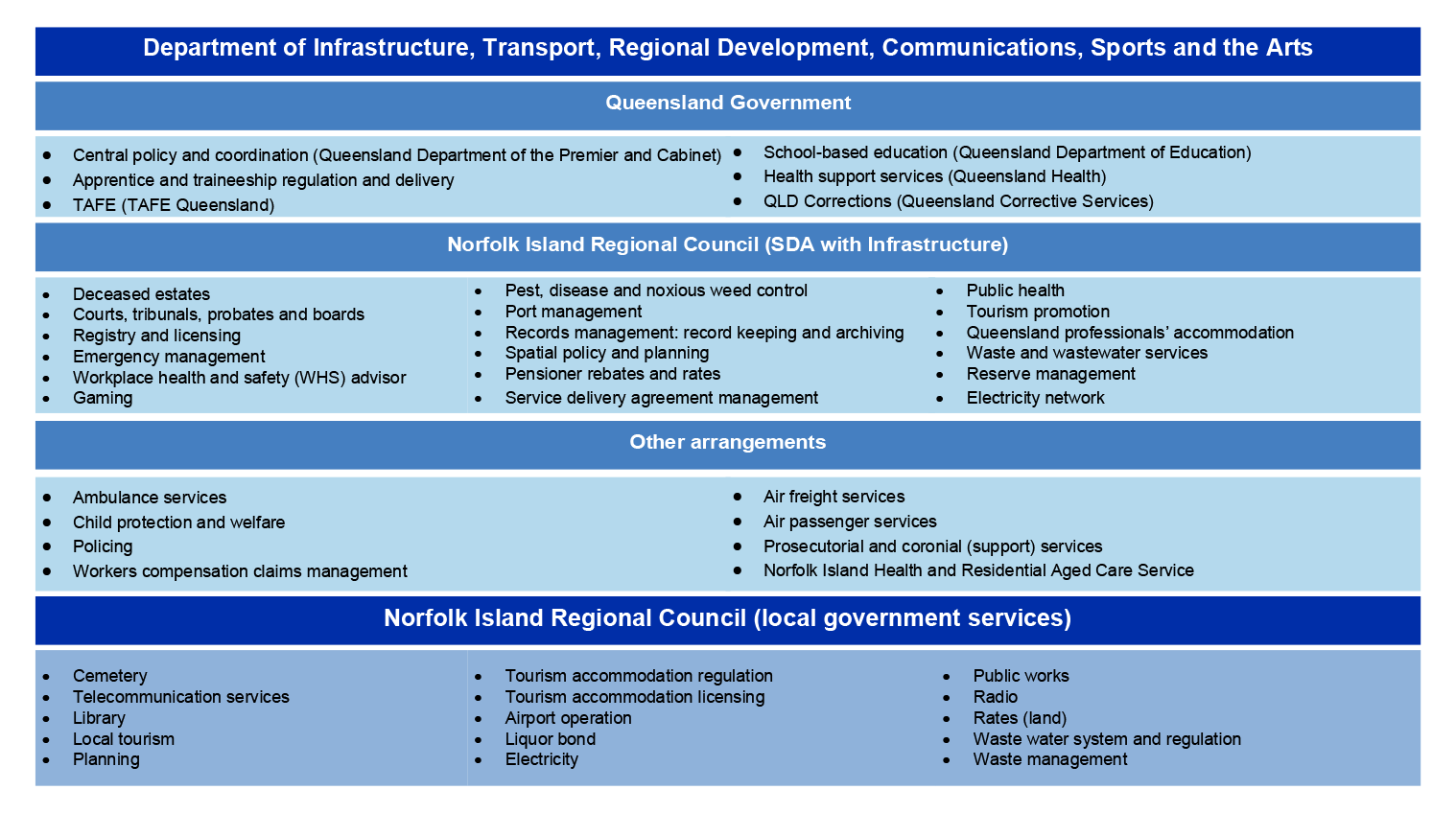
Note: The Norfolk Island Regional Council is responsible for delivering local government services. The audit did not examine the delivery of theses local government services.
Source: ANAO adaptation from Infrastructure records.
Intergovernmental partnership agreement with Queensland Government
3.3 Since 1 January 2022, Queensland has delivered state-type services to Norfolk Island under an IGA (see Figure 3.1).25 The IGA comprises:
- Head agreement — a high-level description of the legal framework, terms of the agreement, roles and responsibilities, governance and decision making, dispute resolution, activities to be undertaken, payments, work health and safety, risk, insurance, privacy, and confidentiality and security.
- Governance framework and guide — sets out oversight and governance arrangements to support implementation of the IGA.
- Service schedules — each service schedule includes sections on the legal framework for delivering services on Norfolk Island, term for provision of services, overarching principles and commitments, transition provisions, roles and responsibilities, deliverables, funding, governance, review and variation clauses and any terms and conditions.
3.4 The ANAO assessed whether the IGA contains the elements expected to be in agreements of this nature and the extent to which these are clearly set out. See Table 3.1 for results.
Table 3.1: Summary of ANAO analysis of the content of the intergovernmental partnership agreement with Queensland
|
Elements |
Finding |
Summary of analysis |
|
Service deliverables |
● |
Each service schedule contains a clear, high-level outline of the services to be delivered by the Queensland Government under the agreement. |
|
Defined roles and responsibilities |
● |
The IGA, governance framework and guide, and service schedules all include clearly defined roles and responsibilities for Infrastructure and the Queensland Government. |
|
Risk |
● |
Clearly outlines risk management approach, including appetite, monitoring and reporting process, and responsibilities depending on risk level. Risk is discussed further from paragraph 3.27. |
|
Issues escalation |
● |
Issues are escalated based on the level of risk and decisions delegated to the appropriate delegate. |
|
Performance expectations |
◑ |
Each service schedule includes a high-level description of service standards. The overarching commitment by Infrastructure and the Queensland Government is that services under the IGA will be delivered to ‘standards that are equal to or above current standards, comparable with similar mainland remote communities, considering the current availability of services, existing infrastructure and other factors unique to Norfolk Island’.a The service schedules do not include specific measures or targets that Queensland must report on. |
|
Reporting requirements |
◑ |
The reporting requirements for each service follow a standard reporting framework, including annual activity-based reporting, governance reporting and evaluation of frameworks. Queensland must submit an annual report and quarterly dashboard reports on the activities in the work plan to the Norfolk Island Oversight Committee (NIOC). Reporting does not include confirmation from state agencies that services are being delivered in line with performance expectations. |
|
Term (length of agreement) |
● |
The IGA and the service schedules do not include an expiration date. They will remain in force unless terminated by either party with a minimum of 24 months’ notice in writing or at any time by agreement in writing signed by both parties. |
|
Review of agreement |
● |
The IGA and each services schedule contain specified review clauses. The governance guide and framework note that these include a review of the service schedule to identify any recommended amendments and the legislative framework to ensure it supports the delivery of the services. Implementation of this process is discussed from paragraph 3.51. |
|
Current and signed |
● |
The Minister for Infrastructure, Transport and Regional Development and the Queensland Premier signed the IGA on 12 October 2021. Each service schedule has been signed by the appropriate delegate. |
Key: ◯ not met ◑ partly met ◕ largely met ● fully met
Note a: The IGA also provides that, where the standard of service delivery to Norfolk Island diverges substantially from standards in remote areas of Queensland, the reason is to be noted in the service schedule.
Source: ANAO analysis of IGA documentation.
Service delivery agreement with Norfolk Island Regional Council
3.5 Between 2014 and 2016, Infrastructure designed and implemented reforms to service delivery on Norfolk Island but was unable to obtain NSW Government agreement to deliver all state-type services.26 As a result, Infrastructure engaged the NIRC through a service delivery agreement to deliver certain state-type services.27 The service delivery agreement consists of:
- Head agreement — includes governance and decision making, roles and responsibilities, process for including new services, payment, performance management, fees and charges, risk management, reporting, assets, WHS requirements, dispute resolution, complaint and query handling, stakeholder consultation, privacy and confidentiality.
- Service schedule — the service schedule for each service includes a description of the service standard, key performance requirements and allocated budget.
3.6 Table 3.2 summarises the ANAO’s assessment of whether the service delivery agreement clearly set out deliverables, roles and responsibilities, performance expectations, risk and reporting.
Table 3.2: Summary of ANAO analysis of the content of the Norfolk Island Regional Council service delivery agreement
|
Requirements |
Finding |
Summary of analysis |
|
Service deliverables |
● |
Under the service delivery agreement service schedule, the NIRC delivers 19 services on behalf of Infrastructure. These services include the management of ports, pensioner rates and rebates, tourism, and waste and wastewater services |
|
Defined roles and responsibilities |
◑ |
The NIRC service delivery agreement includes a high-level description of roles and responsibilities for the NIRC and Infrastructure. The brief description of the services has led to some on-the-ground issues regarding where responsibilities for certain aspects reside in practice. |
|
Risk |
● |
The service delivery agreement includes a risk management process outlining the responsibilities and requirements of both parties. Risks are managed at the service level by the party best placed to do so. Implementation of the risk management process is discussed from paragraphs 3.27. |
|
Issues escalation |
● |
Dispute resolution is to be kept at the lowest, most informal level practical and will incorporate alternative dispute resolution procedures such as mediation. |
|
Performance expectations |
◑ |
The service schedule includes delivery standards, key performance indicators (KPIs) and the associated budget for each service. The service delivery agreement noted that these standards and KPIs were established against ‘a baseline’.a Infrastructure has not developed the baseline or used it to monitor provider or program performance. The service schedule includes delivery standards (KPIs) for each service. For example:
The KPIs are activity-based reporting/metrics, they do not have corresponding targets and do not always capture the full performance of the service. |
|
Reporting requirements |
● |
The service delivery agreement outlines the reporting requirements the NIRC must follow. These include quarterly reporting against KPIs; an annual summary; a financial statement; any identified risks, issues or obstacles to effective and efficient service delivery; the condition of existing assets; the completion of planned asset maintenance schedules; and the timing and nature of potential future asset needs and additional funds required. Implementation of the reporting requirements is discussed from paragraph 3.41. |
|
Term (length of agreement) |
◑ |
The service delivery agreement between Infrastructure and the NIRC commenced on 1 November 2021 and expired on 30 June 2024. Infrastructure varied the service schedule in June 2024 (see paragraph 3.8). The end date of the agreement is not clear. |
|
Review of agreement |
● |
Both parties to ‘meet and review its operation biannually for the duration of the agreement.’ Implementation of this requirement is discussed at paragraph 3.53. |
|
Current and signed |
◑ |
The current agreement and service schedule was updated in June 2024. Documentation on extensions that apply to multiple years could be improved (see paragraph 3.8). |
Key: ◯ not met ◑ partly met ◕ largely met ● fully met
Note a: Infrastructure intended to use the baseline to determine whether the NIRC was progressing towards meeting service delivery standards, to determine funding and service delivery models for future years and to build NIRC capability.
Source: ANAO analysis of NIRC service delivery agreement.
3.7 On 1 November 2021, Infrastructure entered into its most recent iteration of the service delivery agreement with the NIRC to deliver 15 services. Since then Infrastructure has made three variations to the service schedule:
- July 2022 — included four new services (discussed in paragraph 3.15);
- June 2024 — extended the agreement through an update to the service schedule; and
- September 2024 — increased funding for the Energy Bill Relief Fund service.
3.8 The 2021 head agreement was due to expire in June 2024. The service delivery agreement sets out that it can be extended as agreed in writing by both parties. In June 2024, Infrastructure extended the agreement via a new service schedule titled ‘Schedule of Service 2024–25’. In July 2025, Infrastructure advised the ANAO that services were ‘still being delivered and the department continue to make payments to the NIRC, based on the [2024–25] Schedule of Services, quarterly performance and financial reporting’. Infrastructure further advised the ANAO in August 2025 that it had interpreted its July 2024 variation to the service schedule, which included a budget for 2025–26, as sufficient to show that the schedule was intended to apply to 2025–26. Infrastructure further advised ‘We are looking to improve the record keeping around the SDA by working with NIRC now to adopt a modernised agreement’. Infrastructure did not provide the ANAO with any other evidence that the June 2024 extension was to apply for two years or on what terms and conditions.
3.9 Infrastructure advised the ANAO in July 2025 that it is implementing a service delivery agreement ‘uplift project’ to ensure the agreement is fit for purpose, including reviewing the service schedule and performance framework.
Opportunity for improvement
3.10 Infrastructure should ensure that:
- when extending agreements, the documentation has explicit start and end dates and specifies the applicable terms and conditions; and
- in developing the new agreement with the NIRC it strengthens key elements around defining roles and responsibilities and performance management and supports continuity of service through appropriate planning.
State-type services delivered through other arrangements
3.11 Infrastructure has eight arrangements in place to deliver other services to Norfolk Island:
- five contracts with private and not-for-profit organisations for airfreight (Toll Remote Logistics), air passenger (Qantas Airways Limited), workers compensation (Gallagher Bassett Services), child welfare (Key Assets the Children’s Services Provider Australia) and ambulance services (St Johns Ambulance NSW);
- a service delivery agreement with the Norfolk Island Health and Residential Aged Care Service (NIHRACS) for the island’s hospital.28
- a letter of exchange with the Australian Federal Police (AFP) for the provision of police services and regulatory services; and
- a memorandum of understanding with the Commonwealth Director of Public Prosecutions for prosecutorial and coronial (support) services.
3.12 Table 3.3 summarises the ANAO’s assessment of whether the five contracts with private providers clearly set out deliverables, roles and responsibilities, performance expectations, and risk and reporting.
Table 3.3: Summary of ANAO analysis of the content of contracts for service delivery with private providers
|
Requirements |
Finding |
Summary of analysis |
|
Service deliverables |
● |
Clearly outlined a description of services to be provided. |
|
Roles and responsibilities |
● |
Identifies service provider and Infrastructure obligations, including on conflict of interest, work health and safety, record keeping, dispute resolution, payment of fees, provision of services and invoicing. |
|
Risk |
◕ |
Four arrangements include a provision that the provider identifies and engages with risk. |
|
Issues escalation |
● |
Issues are identified and dealt with at the officer level. |
|
Reporting requirements |
◕ |
Four arrangements include a section detailing the reporting obligations for the service provider. The frequency and type of reporting varies between each contract. |
|
Performance expectations |
◕ |
Three contracts include specific and measurable KPIs. |
|
Term (length of agreement) |
● |
Each contract identifies start and end dates. |
|
Contract extension clause |
● |
Four contracts contain an extension clause. The child welfare contract does not identify a limit on the number of contract extensions. |
|
Current and signed |
● |
All contracts are current and signed. |
Key: ◯ not met ◑ partly met ◕ largely met ● fully met
Source: ANAO analysis of contracts.
Identifying service gaps
Intergovernmental partnership agreement with Queensland
3.13 Infrastructure is responsible for developing plans for additional services, including seeking agreement from the NIOC as part of the annual work plan process.29 Should Infrastructure and Queensland agree on a proposed new service, the relevant Queensland state agency develops a business case covering the delivery mechanism and commences developing or amending the relevant service schedule — including by identifying any legislative changes needed to enable Queensland to deliver the service on Norfolk Island. Case study 3 provides an example of Infrastructure exploring new services with Queensland.
|
Case study 3. New services under the IGA |
|
Infrastructure and Queensland committed to exploring options for providing additional services within one year of executing the IGA. These were to include regulation of early childhood education, and working with children and National Disability Insurance Scheme (NDIS) worker screenings. The then Queensland Department of Justice and Attorney-General was responsible for providing a feasibility analysis for Queensland to deliver these services on Norfolk Island. Early childhood education and care regulatory services are contingent on a worker screening regime already being in place. In February 2024, Queensland advised the NIOC of the issues potentially preventing it from delivering the workers screening, including:
The 2024 annual workplan identified that, by the end of December 2024, the AFP would undertake a project to digitise historical Norfolk Island court and police records, upload the historical criminal history data and resolve database system interface issues. The Queensland Department of Justice and Attorney-General would then complete its feasibility analysis and submit a business case to the NIOC. As of the 13 March 2025 NIOC meeting this work was still in progress. |
3.14 When the IGA commenced on 1 January 2022, Queensland delivered two services (education and health), with Queensland Department of the Premier and Cabinet (Queensland DPC) providing a central policy and coordination function. Apprenticeship and traineeship services (November 2022), Queensland Corrective Services (June 2024) and TAFE (December 2024) have since been added. In March 2025, the NIOC agreed to explore the potential delivery under the IGA of seven additional services — for example, Avian Influenza response planning.
Norfolk Island Regional Council
3.15 Infrastructure and the NIRC must develop a business case to include a new service or function. The business case sets out the terms and conditions, including resourcing requirements, fee structures and costs. Infrastructure and the NIRC must then agree to the business case before including the new service in the service schedule. In July 2022, four new services were included in the service schedule but Infrastructure did not develop a business case before these new services were included. In July 2025, Infrastructure advised the ANAO it ‘relied on regular engagement and operational review mechanisms’, including its monthly meetings with the NIRC and annual reviews of the service schedule. Infrastructure does not consistently record meeting minutes or outcomes of the monthly meetings with the NIRC. Infrastructure further advised that the annual reviews are completed informally.
Service delivery budgets
3.16 Under the IGA with Queensland, state agencies submit a budget for each service to Infrastructure for approval.31 State agencies must provide an annual statement of expenditure by October each year to acquit expenditure against the budget. For 2024–25, Queensland complied with these budget requirements.
3.17 The budget for the NIRC is set out in the service schedule to the service delivery agreement. Infrastructure budgeted $3.5 million for 2024–25 and $2 million for 2025–26. In addition to the service schedule, under the service delivery agreement Infrastructure must provide financial assistance grants that NIRC may allocate at its discretion.32 The service delivery agreement sets out that this amount is to be paid to the NIRC by 30 September each year.33
Are there fit-for-purpose governance and communication arrangements in place to manage risk and escalate issues?
Infrastructure has developed governance arrangements for the delivery of services to Norfolk Island based on business-as-usual operations and governance forums. Infrastructure does not keep complete records of governance meetings with NIRC. Infrastructure has processes in place for the day-to-day management of service delivery issues and risks in Norfolk Island and has developed a risk register to capture program and service delivery risks across the external territories. Infrastructure has not documented in its program risk register how it is managing longer-term service delivery risks. The IGA with Queensland and the service delivery agreement with the NIRC both cover the risk management approach, including management of shared risks. Infrastructure has not implemented the risk process with the NIRC. It has put in place community consultation methods, although is not monitoring complaints data to help inform the effectiveness of the service delivery arrangements.
Governance arrangements
3.18 Infrastructure manages the governance arrangements of service delivery for Norfolk Island through:
- day-to-day management by the branches within the Territories Division;
- internal governance forums within the Territories Division; and
- governance forums under the IGA with Queensland and the service delivery agreement with the NIRC.
Norfolk Island and Mainland Territories Branch
3.19 The Norfolk Island and Mainland Territories Branch of the Territories Division is responsible for policy and service delivery to Norfolk Island. The branch has staff located in Canberra and Brisbane and a smaller team based on Norfolk Island. Brisbane-based contract managers are responsible for overseeing the agreements with Queensland, the NIRC and private providers. Norfolk Island staff are responsible for operations including management of heritage sites, maintenance of assets, managing on-island relationships and meeting regularly with the NIRC and other private providers. The Territories Division governance forums outlined in Table 2.3 also cover service delivery in Norfolk Island.
Governance arrangements with Queensland
3.20 The IGA governance framework and guide outline governance arrangements for Queensland’s delivery of services to Norfolk Island. The corresponding toolkit includes procedures, templates and the terms of reference for individual governance forums.34 The governance arrangements for the IGA include three levels of governance committees, as set out in Table 3.4.35
Table 3.4: Governance forums for intergovernmental partnership agreement with Queensland Government
|
Forum |
Members |
Frequency |
Purpose |
|
Norfolk Island Oversight Committee (NIOC) |
Infrastructure and Queensland senior executive level officers with responsibility for Norfolk Island service delivery Current chair is Deputy Secretary — Infrastructure |
Quarterly |
Provides strategic direction and leadership to ensure effective delivery of services to Norfolk Island. The NIOC agrees to the key activities and delivery milestones for each service as part of a forward annual work plan. These are activities to progress the implementation of the arrangements. |
|
Norfolk Island Steering Committee |
Representatives from Infrastructure and Queensland DPC |
Quarterly |
Provide a forum for strategic decisions and centralised program management oversight on matters relating to the implementation, operation and expansion of services under the IGA. Will support and advise NIOC on the delivery of state-level services to Norfolk Island under the IGA. |
|
Service delivery Working Groups |
Representatives from Infrastructure, Queensland DPC and Queensland state agencies |
Monthly/Bi-monthly |
Responsible for the negotiation, establishment, implementation, ongoing oversight and management of services outlined in the schedules. Also responsible for reporting to NIOC through the Norfolk Island Steering Committee and undertaking periodic reviews of the service schedules as outlined in the reporting framework (see paragraph 3.51). |
Source: ANAO analysis of Infrastructure records.
3.21 The IGA governance framework and guide provides that the Queensland DPC coordinates Queensland’s involvement with the IGA. Functions are set out in a central policy and coordination schedule to the IGA.
Governance arrangements with the Norfolk Island Regional Council
3.22 The governance arrangements for the service delivery agreement with the NIRC are set out in a governance document. The document outlines the decision-making framework, governance forums and reporting requirements. The governance forums are set out in Table 3.5.
Table 3.5: Governance forums with Norfolk Island Regional Council
|
Forum |
Members |
Frequency |
Purpose |
|
Situation report meetings |
NIRC Administratora and General Manager. Executives from Infrastructure. |
Monthly |
Strategic discussions and progress updates on NIRC progress, objectives and current issues. |
|
Service delivery agreement meetings |
NIRC General Manager and Executive Managers and Assistant Secretaries in Infrastructure. |
Monthly |
Operational coordination and issue resolution, financial update on expenditure and budget alignment. |
Note a: In December 2021 the governing body of the NIRC was dismissed and a NIRC Administrator was appointed for three years as part of interim administrative measures. On 6 December 2024 the Minister for Regional Development, Local Government and Territories announced the new governance model for Norfolk Island and appointed two new NIRC administrators.
Source: ANAO analysis of Infrastructure records.
3.23 Infrastructure advised the ANAO in July 2025 that it does not take minutes for the situation report meetings. Infrastructure contract managers (rather than the assistant secretary) hold service delivery agreement meetings with the NIRC. Infrastructure started documenting meeting outcomes from January 2025 and has recorded outcomes from three of the 2025 meetings.
3.24 Infrastructure’s records of outcomes and decisions from meetings with the NIRC and other key stakeholders is not consistent or complete. Record keeping is particularly important given that it uses these governance committees and operational discussions to manage risk and performance of agreements.
Recommendation no.4
3.25 To support strong governance, risk management, performance monitoring and business continuity, the Department of Infrastructure, Transport, Regional Development, Communications, Sport and the Arts implement practices to record outcomes and key decisions of meetings/discussions with services providers and stakeholders.
Department of Infrastructure, Transport, Regional Development, Communications, Sport and the Arts response: Agreed.
3.26 The department agrees with this recommendation and acknowledges that strong records management is essential to strengthening accountability and transparency. While challenges such as remoteness, legacy IT systems, and connectivity limitations can affect consistency, recent upgrades to IT infrastructure are helping to address these barriers. The department is working to ensure systems are secure, user-friendly, and fit-for-purpose, and will continue to improve practices to ensure records of engagement support effective service delivery and informed decision-making.
Risk management
Shared risk
3.27 The IGA governance framework and guide sets out Infrastructure and Queensland’s approach to risk management. The guide provides that, while the Australian Government is ultimately responsible for ensuring the availability and quality of services to Norfolk Island, the Australian Government and Queensland have a shared responsibility to manage risks associated with service delivery. The framework covers the principles for risk management, approach and reporting requirements.
3.28 Infrastructure’s service delivery agreement with the NIRC included a requirement that NIRC keep a risk register and prepare a risk report as part of the reporting requirements. NIRC has not prepared this register nor completed reporting. Infrastructure advised the ANAO in July 2025 that the risk register is in development.
Program risk register
3.29 The Territories Division has developed a divisional risk register that outlines the high-level risks to service delivery to the territories, including Norfolk Island (see paragraph 2.25). The risks covered in the risk register also apply to Norfolk Island. The work, health and safety (WHS) risk register described in paragraph 2.26 also applies to Norfolk Island service delivery.
3.30 As with the IOTs (see paragraph 2.24) Infrastructure manages risks and issues to service delivery through operational, business-as-usual mechanisms. Infrastructure should strengthen its risk planning and management, including shared risk with the NIRC, documenting its strategies to mitigate longer-terms service delivery risks and regularly reviewing and updating its strategic risk assessment to capture emerging and future risks (see Recommendation no. 1 at paragraph 2.29).
Community consultation and engagement
3.31 Infrastructure states on its website that it is committed to ‘to open communication and engagement with Norfolk Island, working with the community to achieve mutually beneficial outcomes.’ To support consultation, Infrastructure:
- developed two strategy documents to guide its approach to community engagement on Norfolk Island — a 2019 community engagement framework it developed with contributions from members of the Norfolk Island community36 and a 2023 community consultation and engagement strategy for its partnership agreement with Queensland;
- published fact sheets, summaries and lists of frequently asked questions about its service delivery on its website and through media releases.37 Infrastructure has also published consultation papers and draft laws for public comment;
- established the Norfolk Island Governance Committee, which in addition to advising on governance-related matters would function as a ‘key channel for community engagement on the design and delivery of government services’; and
- receives feedback from staff located on the island or those who travel to the island.
Norfolk Island Governance Committee
3.32 The Norfolk Island Governance Committee (NIGC) is made up of the Administrator for Norfolk Island, a representative from Infrastructure and the Queensland DPC and three elected Norfolk Island community representatives. The NIGC meets quarterly and holds additional meetings as needed. Outcomes and status of the matters considered at the NIGC are published on the NIGC’s and Infrastructure’s websites.38 As at July 2025, the NIGC meetings have focused on the new governance model (see footnote 6).
3.33 On 1 November 2023 the NIOC agreed to establish formal two-way communication with the NIGC ‘to ensure that we are all progressing towards solutions that will provide benefits to the Norfolk Island community.’ The NIOC has been updated on the NIGC at its meetings on 23 February 2024, 16 May 2024 and 1 December 2024. The meetings covered the proposed new NIGC governance model and feedback from community consultation on matters including local government legislative powers. As at July 2025, the NIOC has not updated the NIRC on discussions.
Role of the Administrator
3.34 The Administrator of Norfolk Island (the Administrator) is appointed by the Governor-General of the Commonwealth of Australia. The Administrator is a representative of the minister, engages and advocates for the community, facilitates communication between the community and stakeholders and has a range of functions relating to the delivery of government services on the island.39 The Administrator prepares a newsletter for the Norfolk Island community, which is posted on Infrastructure’s website. It provides an update from the Administrator and information on past and upcoming events.
3.35 Infrastructure and the Administrator hold fortnightly meetings during which both parties provide operational updates. In addition, in November 2023, the Administrator provided community feedback to the NIOC, for example, on health service delivery and the aged care services provided at the hospital.
Complaints
3.36 Infrastructure advised the ANAO in July 2025 that it does not have an overall, formal complaints management framework for Norfolk Island. It noted that community members can submit complaints through different channels including the departmental website, the Administrator, service providers or the minister’s office. As with the IOTs, Infrastructure should monitor complaints on service delivery to inform ongoing decisions on the effectiveness of the arrangements (see paragraph 2.43).
Does Infrastructure effectively monitor and seek assurance that services are being delivered in line with the arrangements?
Infrastructure mainly monitors service delivery through regular communication directly with Queensland, the NIRC or private providers. Infrastructure has performance expectations and reporting in place. These do not completely enable Infrastructure to determine whether services are being delivered in line with expectations — for example, reporting is activity based and does not provide an assessment of performance against set key performance indicators. There is no evidence that Infrastructure uses the performance information received to determine whether quality services are being delivered and actioned as required.
Intergovernmental partnership agreement with the Queensland Government
3.37 Infrastructure and Queensland’s overarching commitment is that services under the IGA will be delivered to ‘standards that are equal to or above current standards, comparable with similar mainland remote communities, considering the current availability of services, existing infrastructure and other factors unique to Norfolk Island’.
3.38 The description of service standards in each service schedule is high-level. For example, the performance expectation for the apprentices and traineeship service schedule is:
Providing the full range of support services for Norfolk Island apprenticeships and traineeships that the States provides in Queensland… having regard to
a) the remote location, the unique needs of and size of the community, and other constraints on workforce availability and the provision of Services;
b) the role of other agencies in the maintenance and administration of the Services on Norfolk Island;
c) the legislative and regulatory framework relevant to the provision of the Services; and
d) the interdependencies between the Parties in the implementation of the governance arrangements to support service provision to the Norfolk Island community.
3.39 The service schedules do not include specific measures or targets on which Queensland must report on. The IGA outlines that ‘in many cases, certification by an appropriate authority in the Service Delivery Agency that the services have been delivered to a similar standard as services delivered in remote areas of Queensland will be sufficient evidence for the Commonwealth that Schedule commitments have been fulfilled.’ Queensland does not report on whether it has achieved the standard in its reporting to Infrastructure. In the absence of setting performance measure or targets or assurance/reporting from Queensland, Infrastructure is unable to determine if performance expectations are being met.
3.40 Infrastructure receives reporting on the IGA services through an annual report and quarterly dashboard reports on the activities outlined in the work plan. Table 3.6 provides details on the reports for 2024.
Table 3.6: Intergovernmental partnership agreement performance reporting requirements
|
Reporting requirement |
Description |
ANAO analysis |
|
Annual report |
The annual report template requires Queensland to include for each service under an IGA a high-level overview of the service delivery requirements including any issues or challenges encountered, anecdotal feedback from key stakeholders around the transition or delivery of services, any achievements, a case study and a high-level snapshot of key priorities for the next financial year. |
The 2024 annual report included the required performance information as outlined in the IGA. The annual report was not submitted to NIOC for approval as required. Instead it was submitted to Infrastructure, which reviewed and provided feedback to Queensland DPC before publishing the final report on its website on 28 November 2024.a The 2023–24 report included an overview of services, key achievements across the IGA and for each service a description of the service, achievements (both metrics and case studies) and focus for 2024–25. For example, for Queensland Health, the annual report included data on the number of outpatient referrals, inpatient admissions, surgical procedures and medical evacuations. |
|
Quarterly dashboard report |
Working groups for each service schedule must report quarterly to NIOC on their progress against the milestones agreed to in the annual workplan using a traffic light system. They must also include a strategic snapshot overview of budget, risk (including emerging risks, changing profiles, escalation), issues, opportunities and upcoming priorities. |
The dashboard reports did not always reflect the reporting period outlined in the reporting requirements. However, they were discussed around the expected time and noted by NIOC. Where issues were identified with the delivery of the activities in the workplan, these were discussed by NIOC and actions agreed as a result. |
Note a: Infrastructure, Norfolk Island State Services Partnership, available from https://www.infrastructure.gov.au/territories-regions-cities/territories/norfolk_island/norfolk-island-state-services-partnership [accessed 23 June 2025].
Source: IGA documentation and ANAO analysis.
Norfolk Island Regional Council
3.41 Under the service delivery agreement, Infrastructure and the NIRC agreed to ‘establish and continually improve performance management’ and that performance management ‘will be equitable and mutually beneficial’.
3.42 The NIRC provides Infrastructure with quarterly performance reporting against the KPIs for each service in the service schedule. The agreement with the NIRC includes around 140 KPIs for the 19 services it delivers. As identified in Table 3.2, these KPIs do not enable Infrastructure to make an assessment on the performance of service delivery against targets. Infrastructure has identified this issue and advised the ANAO in July 2025 they are reviewing the performance framework as part of the service delivery agreement ‘uplift project’. Table 3.7 provides an example of KPIs included in the service schedule for 2024–25 and corresponding reporting.
Table 3.7: Example of key performance indicators from the Norfolk Island Regional Council 2024–25 service schedule
|
Service |
Service standard |
KPIs |
Example of reporting for October to December 2024 |
|
Electricity networka |
Electricity network system improvements including smart meters and new Tesla Battery and business system upgrades. The Norfolk Island electricity system upgrades will enable Norfolk Island to transition the majority of the Island’s electricity generation to solar by 2027, with minimal reliance on diesel generators. Norfolk community have reduced energy costs from a variable tariff structure through access to subsidised solar and battery systems linked to the network. |
KPI 19.1.1 — Progress on improvements to the electricity network delivered on time and within the budget allocation including: replacing existing meters and provision of monitoring and billing software; provision of additional storage capacity; and upgrades undertaken to improve electricity network. |
KPI 19.1.1 (some disruption)b Highlights/Accomplishments for the Q2 period: Nil Roadblocks/risks: Some smart meters are not receiving sufficiently strong signal to communicate with BESYc, resulting [in] a need for laborious manual reading. Next steps/actions: Perform the necessary upgrades on the meters which are not receiving a signal. |
Note a: This is one of four KPIs for this function under the 2024–25 service schedule.
Note b: The NIRC classified KPIs not met as either ‘some disruption’ or ‘major disruption’.
Note c: BESY Energy is the energy retailer for Norfolk Island.
Source: ANAO analysis of performance reporting.
3.43 The ANAO assessed the four quarterly performance reports from NIRC between May 2024 and February 2025 and found:
- they were not always delivered on time, complete or signed off by the relevant officer;
- Infrastructure held monthly service delivery agreement meetings with the NIRC. Agenda items were operational updates and none focused on performance; meeting minutes for these meetings have only been kept since January 2025; and
- the NIRC reported a slight downward trend of KPIs being on track, with 92.2 per cent of KPIs being on track for quarter 3, 2023–24; 88.7 per cent on track for quarter 4, 2023–24; 79.9 per cent for quarter 1, 2024–25; and 79.2 per cent for quarter 2, 2024–25.
Private providers
3.44 Four of Infrastructure’s five contracts with private providers for service delivery to Norfolk Island include performance expectations or KPIs. Each contract requires that Infrastructure must be satisfied that services have been performed in line with the contracted requirements before making payment for services.
3.45 The ANAO reviewed a sample of the performance reporting required under the contracts for 2024–25. Of the contracts reviewed, Infrastructure did not receive reporting against the KPIs as required for three of the four arrangements. Instead, it received activity-based reporting that it then discussed at meetings with the providers. For example, St John Ambulance NSW provided Infrastructure with monthly reports that covered information on staff, total hours, an overview of training provided and planned, operational activity (number of emergency calls and medical evacuations) by month, and community engagement. These monthly reports did not include performance against the agreed 15 KPIs.
3.46 Infrastructure does not use the performance information provided by Queensland, the NIRC, private providers and other service delivery partners to determine whether they were providing quality services. Infrastructure should ensure that the performance framework for the arrangements on Norfolk Island incorporates appropriate performance measures, reporting and follow up actions where required (see Recommendation no. 2 at paragraph 2.51).
Does Infrastructure undertake evaluations of the service delivery arrangements for Norfolk Island?
Infrastructure has not completed an overall evaluation of service delivery for Norfolk Island, although the governance arrangements for Norfolk Island more broadly have been the subject of external reviews. In 2022 Infrastructure commissioned a service mapping review of the services on Norfolk Island to support planning. The IGA with Queensland and service delivery agreement with NIRC contain review requirements. Infrastructure has not completed these as required.
3.47 Norfolk Island’s governance arrangements have been the subject of several reviews, including parliamentary inquiries, financial audits and performance audits. For example:
- Auditor-General report No. 43 of 2018–19, Design, Implementation and Monitoring of Reforms to Services on Norfolk Island;
- 2019 Norfolk Island inquiry, Commonwealth Grants Commission, November 2019, requested by Infrastructure to provide costing related to state-type government and local government;
- Public Inquiry into the Norfolk Island Regional Council, Carolyn McNally, 4 November 2021 — requested by the minister to consider whether the NIRC had managed its finances in accordance with relevant principles and practices and the governing body had complied with relevant obligations;
- In 2022, to assist with planning Infrastructure engaged a consultant to undertake a detailed mapping of service delivery on Norfolk Island and consult with service providers to identify gaps. The review did not assess the arrangements against service delivery needs; and
- Restoring Democracy — Report of the inquiry into local governance on Norfolk Island — Joint Standing Committee on the National Capital and External Territories, November 2023.
3.48 Infrastructure has not undertaken an overall program evaluation of service delivery to the territories or Norfolk Island. Its corporate plan includes two performance measures that apply to service delivery to Norfolk Island (see paragraph 2.70).
Evaluation requirements for intergovernmental agreement with Queensland
3.49 The IGA requires that the parties formally review the agreement after two years of operation and evaluate and review the agreement every subsequent five years. The NIOC is to set the timing, scope and mechanism of the reviews. The first formal review (due in 2023) has not been undertaken. Infrastructure advised the ANAO in April 2025 that it will conduct the review internally in 2025.
3.50 In preparation for the formal review, Queensland consulted with state agencies, Queensland DPC and Infrastructure staff between January and March 2024. The review sought to understand stakeholder perspectives on the performance of the IGA in relation to decision making, risk management, cost recovery processes, legal framework and key achievements since the inception of the IGA. A summary of themes from the consultation was tabled at the NIOC in May 2024.
3.51 The IGA includes performance reporting requirements for each service schedule. Queensland and Infrastructure are to jointly review:
- individual service schedules to identify and recommend amendments to NIOC; and
- the legislative framework to ensure it supports the delivery of services as outlined in the individual service schedule.
3.52 The relevant working group for each service must complete the reviews and provide them to the NIOC. Infrastructure advised ANAO in July 2025 that these reviews had not been finalised and ‘work remains in the preliminary stages’.
Evaluation requirements with the Norfolk Island Regional Council
3.53 The service delivery agreement between Infrastructure and the NIRC includes a requirement that both parties ‘meet and review its operation biannually for the duration of the agreement’. Infrastructure advised the ANAO in April 2025 that:
Evidence of a formal review is unclear from our records. We know that over time amendments have been made via an exchange of letters between parties.
3.54 Under the service delivery agreement, the NIRC and Infrastructure are responsible for reviewing financial performance for each service and agreeing to any funding changes that might have been required in 2022–23 and 2023–24. This was to be based on a consideration of changes in service levels and risks, revenue and expenditure data from the previous year and projected revenue and expenditure for the coming year. Infrastructure did not undertake this process.
3.55 Infrastructure should conduct periodic reviews of service delivery arrangements to ensure they remain fit for purpose, meet service delivery needs and achieve value for money (see Recommendation no. 3 and paragraph 2.67).
Appendices
Appendix 1 Entity response
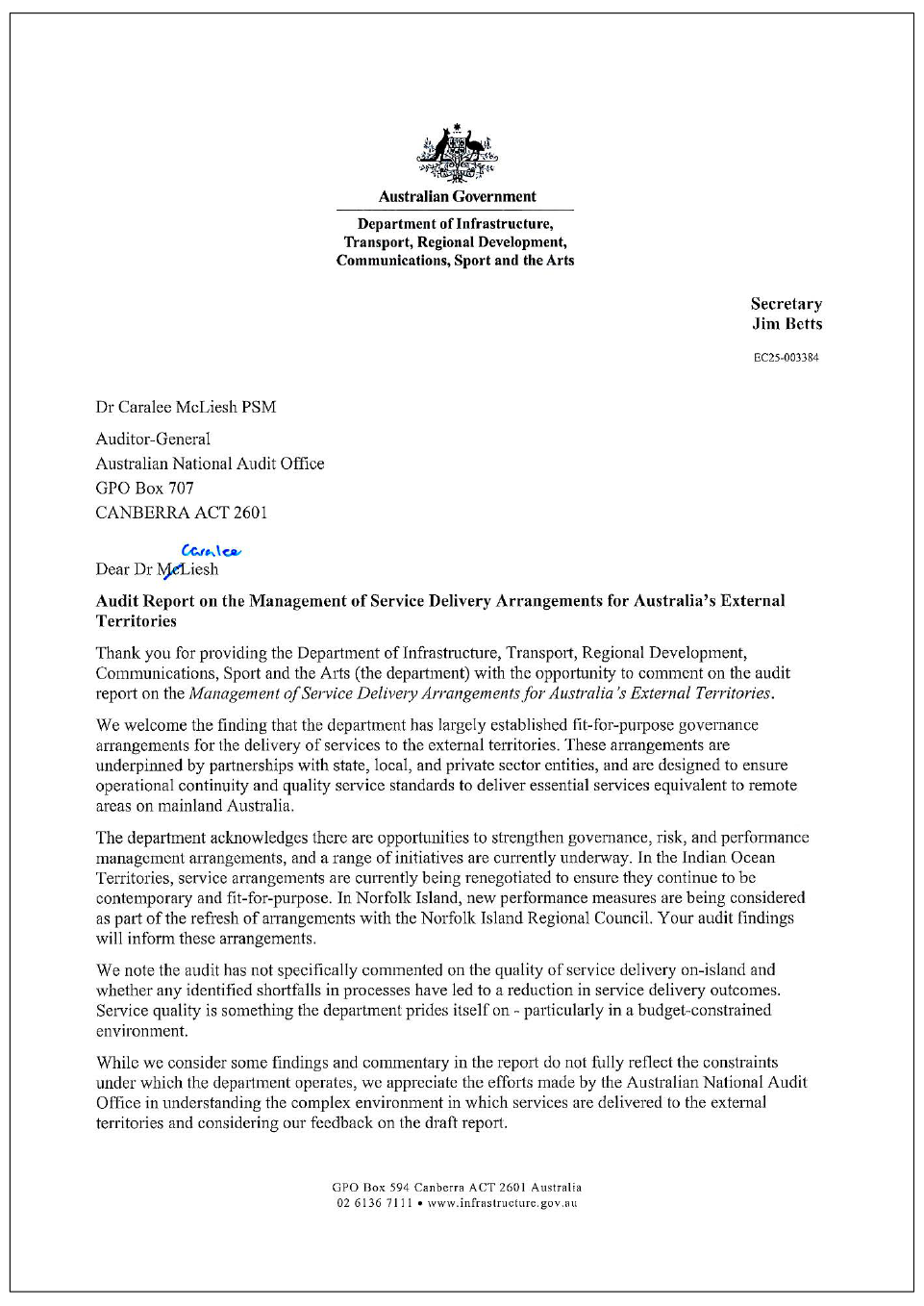
Appendix 2 Improvements observed by the ANAO
1. The existence of independent external audit, and the accompanying potential for scrutiny improves performance. Improvements in administrative and management practices usually occur: in anticipation of ANAO audit activity; during an audit engagement; as interim findings are made; and/or after the audit has been completed and formal findings are communicated.
2. The Joint Committee of Public Accounts and Audit (JCPAA) has encouraged the ANAO to consider ways in which the ANAO could capture and describe some of these impacts. The ANAO’s corporate plan states that the ANAO’s annual performance statements will provide a narrative that will consider, amongst other matters, analysis of key improvements made by entities during a performance audit process based on information included in tabled performance audit reports.
3. Performance audits involve close engagement between the ANAO and the audited entity as well as other stakeholders involved in the program or activity being audited. Throughout the audit engagement, the ANAO outlines to the entity the preliminary audit findings, conclusions and potential audit recommendations. This ensures that final recommendations are appropriately targeted and encourages entities to take early remedial action on any identified matters during the course of an audit. Remedial actions entities may take during the audit include:
- strengthening governance arrangements;
- introducing or revising policies, strategies, guidelines or administrative processes; and
- initiating reviews or investigations.
4. During the course of the audit, the ANAO did not observe changes in the Department of Infrastructure, Transport, Regional Development, Communications, Sport and the Arts approach to the audit topic.
Appendix 3 Key themes raised by stakeholders during fieldwork for Indian Ocean Territories
Table A.1: Key themes raised by stakeholders during audit fieldwork
|
Issue |
Overview |
|
Indian Ocean Territory (IOT) residents being excluded from ‘nation-wide’ grants and schemes (state and federal) |
Stakeholders raised the issue that the IOTs are often excluded from national and state grants and felt that they did not receive treatment equitable with their mainland counterparts. Examples provided include the Accessible Australia Initiative, the Housing Support Program, funding under the Attraction and Retention Packages for Regional Childcare Workers Program (WA) and disaster recovery related payments. |
|
Service delivery budgets and KPIs |
Service providers reported that budgets were often not adequate to deliver services required. Multiple stakeholders advised the ANAO that budget restrictions and the estimates variation process impact the delivery of services, business planning and continuity of longer-term projects. One service provider informed the ANAO in April 2025 that KPIs had not been reviewed since their original contract was signed. |
|
Passenger flight and freight reliability |
Stakeholders reported ongoing issues relating to flights and freight delivery. Passenger baggage is regularly offloaded for essential supplies, leaving visitors and residents without personal luggage for an undetermined time. Service providers must be highly organised and plan to secure flight bookings for key staff and contracted specialists to visit the island to carry out necessary work. Service providers reported challenges with obtaining seats and guarantees that workwear/equipment will not be offboarded. The extreme weather conditions in the IOTs impact the fragile supply chain and shipping arrangements. When essential repairs are needed on the islands, this presents challenges to guaranteeing timely arrival of essential goods. |
|
Port and other essential IOT infrastructure |
Service providers reported a maintenance backlog of essential IOT infrastructure due to environmental damage and limited funding, which does not stretch to covering all repairs. Funding is spent on maintaining old assets to keep them past their usable lifetime. Service providers reported challenges when repairing IOT infrastructure around limited timeframes due to unpredictable weather and getting equipment and people to island. |
Source: ANAO record of stakeholder meetings.
Footnotes
1 Christmas Island and Cocos (Keeling) Islands are collectively known as the Indian Ocean Territories (IOTs).
2 Collectively, Christmas Island and Cocos (Keeling) Islands are known as the Indian Ocean Territories (IOTs).
3 The Australian Government also has responsibility for the internal non-self-governing territory of Jervis Bay and the external territories without a permanent population of Ashmore and Cartier Islands and the Coral Sea Islands. The administration of these territories was not included in this audit.
4 Pitcairn Islanders are descendants of the HMS Bounty mutineers and Pasifika who settled on Norfolk Island in 1856.
5 In 2019, the Australian National Audit Office conducted a performance audit on the design, implementation, transition and delivery of reforms to services on Norfolk Island.
Auditor-General Report No. 43 2018–19, Design, Implementation and Monitoring of Reforms to Services on Norfolk Island, ANAO, Canberra, 2019, available from https://www.anao.gov.au/work/performance-audit/design-implementation-and-monitoring-reforms-to-services-norfolk-island [accessed 17 March 2025].
6 On 13 November 2024, the Minister for Regional Development, Local Government and Territories (the minister) announced a new governance model for Norfolk Island, planned to come into effect by the end of 2025. Under the model the Norfolk Island Assembly will replace the Norfolk Island Regional Council. The assembly will be empowered to make local laws. In October 2025, the minister announced the timeline to commence the new model has been extended.
7 This figure does not include Jervis Bay Territory administered expenses. It does include the special account: Indian Ocean, Jervis Bay and Norfolk Island Territories Special Account 2023. A special account is a limited special appropriation that sets aside an amount that can be expended for listed purposes.
8 The NSW Government was the state delivery partner for certain services on Norfolk Island prior to services being transferred to the Queensland Government from 1 January 2022.
9 Infrastructure advised the ANAO in June 2025 that direct service delivery by IOTA, including for health and power services in the IOTs, is provided in accordance with requirements as set out in relevant WA legislation and other accreditation standards where required. This was not examined as part of this audit.
10 Infrastructure has an exchange of letters in place with Australian Federal Police (community policing) and Parks Australia.
11 Qantas Airways Limited (Qantas) was selected as the new long-term air services delivery partner for the IOTs following an open tender process, taking over from Virgin Australia who had provided air services in the IOTs for over a decade. From November 2025, Qantas will deliver both passenger and air freight services to the IOTs for a period of five years, with two possible two-year extension options.
12 The four contractors were Cocos Island Co-op, Virgin, CKI Tourism and Christmas Island Pharmacy and News.
13 Infrastructure and the state agency can agree to add services that fit within the scope of an existing SDA to the annual work plan. They may need to execute an agreement variation for a new service that is not covered by an SDA.
14 Veterinary medicines are regulated at a national level by the Australian Pesticides and Veterinary Medicines Authority (APVMA) through the Agricultural and Veterinary Chemicals Act 1994. The IOTs are not a participating territory under this legislation.
15 Under Customs (Prohibited Imports) Regulation 1956 (CI)(CKI) [Regs 5, 5G and 5H] and Customs (Prohibited Exports) Regulations 1958 (CI)(CKI) [Regs 10, 10A and 10AB], the Administrator is an ‘Authorised Person’ and ‘Authorised Officer’ as delegated by the Secretary of the Department of Health. The Administrator can approve importation of 1080 poisons into the IOTs.
16 In April 2025 two ANAO staff travelled to the IOTs for a two-week period to undertake fieldwork. They conducted meetings with a range of stakeholders — for example, Infrastructure contract managers, state agencies and private providers, the local shires and the Administrator.
17 Department of Finance, Commonwealth Risk Management Policy, policy element six, available from https://www.finance.gov.au/government/comcover/risk-services/management/commonwealth-risk-management-policy [accessed June 2025].
18 An estimates variation includes changes to estimated expenditure for demand-driven programs. It is reported to Parliament through Portfolio Additional Estimates Statements, which explain changes to entities’ resourcing since the Budget. From 2021-22 to 2024-25, Infrastructure has required an additional $192 million through this process. The amount of additional funding requested has been increasing over the past four years. For example, Infrastructure required an additional $34 million on top of their allocated base funding of $173.3 million in 2021-22, and in 2024-25 required an additional $64.2 million on top of their base funding of $193.2 million.
19 Infrastructure has rated all controls in the risk register as ‘mostly effective’. Infrastructure’s enterprise-wide Risk Management Policy and Framework define this as the risk being adequately controlled, with some work required to improve operating effectiveness.
20 The Service Delivery Arrangements Information Kit provides guidance to state agencies on community engagements including possible methods, consultation with Infrastructure and principles such as coordinating visits to reduce the time requirements on the community.
21 Department of Infrastructure, Transport, Regional Development, Communications, Sport and the Arts, Service Delivery Arrangements—fact sheets, available from https://www.infrastructure.gov.au/territories-regions-cities/territories/indian_ocean/sda/sda-factsheets-wa [accessed 27 November 2025]
22 The Emergency Management Committee is appointed and chaired by the Administrator to prepare, and update as necessary, the Cocos (Keeling) Islands Emergency Management Plan and associated sub-plans. The Indian Ocean Territories Health Service Community Advisory Committee is intended to ensure the community is consulted on the design, delivery, measurement and evaluation of health services in the IOTs.
23 Department of Infrastructure, Transport, Regional Development, Communications, Sport and the Arts, Providing feedback on services to the Indian Ocean Territories, available from https://www.infrastructure.gov.au/territories-regions-cities/territories/providing_feedback_on_services_to_the_Indian_Ocean_Territories [accessed 16 June 2025].
24 Letters of extension are a high-level agreement between the department and contracted service that serve as an agreement to provide the current services for an ongoing period. The letters are signed by the Infrastructure Assistant Secretary, IOT Branch, and agreed and signed by the relevant provider or agency. Deeds of variation include minor changes to the SDAs and serve as an extension of services for a set amount of time.
25 As part of its 2015 reforms to services on Norfolk Island, Infrastructure entered into an agreement with the NSW Government on 29 June 2016 for it to deliver a limited number of state-type services. In 2017 the NSW Premier indicated that these existing service delivery commitments on Norfolk Island would continue until 30 June 2021. Infrastructure began negotiations with Queensland to deliver state-type services to Norfolk Island. In October 2021 Infrastructure entered into the IGA with Queensland, with priority services to commence from 1 January 2022.
26 In April 2017, the NSW Premier wrote to the Minister for Local Government and Territories that “NSW would not be in a position to consider any other additional services, given the complexity of services already being undertaken”.
Auditor-General Report No. 43 2018–19, Design, Implementation and Monitoring of Reforms to Services on Norfolk Island, paragraphs 3.49 to 3.54.
27 In Auditor-General Report No. 43 2018–19, Design, Implementation and Monitoring of Reforms to Services on Norfolk Island, the Australian National Audit Office noted that the NIRC’s ‘responsibilities are broad ranging … compared to typical mainland councils and the two shire councils in the Indian Ocean Territories. This is due to the NIRC retaining responsibility for [government business enterprises] and in the absence of a fully engaged state partner, also delivering some state-type responsibilities.’, paragraph 3.75.
28 The NIHRACS is a multi-purpose health service operated by the Australian Government on Norfolk Island. The Public Governance, Performance and Accountability Act 2013 Act does not apply to NIHRACS and as a result the Auditor-General is not appointed as the financial auditor. The Australian National Audit Office (ANAO) undertakes financial statements audits as an audit arising from a request by the Secretary of Infrastructure made under section 20 of the Auditor-General Act 1997.
29 The governance framework and guide outline principles for Infrastructure when identifying new services, with the highest priority given to those that support and protect the health and wellbeing of Norfolk Islanders.
30 The NPRS is an Australia-wide database that enables access to prescribed criminal history information held by the police services in each jurisdiction.
31 The budget is to be ‘based on the estimated demand and the resourcing that would be provided for delivery of comparable Queensland services, accounting for Norfolk Island’s remoteness’.
32 The Australian Government provides financial assistance grants to local governments under the Local Government (Financial Assistance) Act 1995. These grants can be spent according to priorities identified by the local government. The Australian Government pays the grants to state and territory governments who distribute the funding to local governments based on recommendations from their local grants commission. Since Norfolk Island does not fall under a state or territory government, and Infrastructure has not entered into a service delivery arrangement for a state or territory government to perform this function, Infrastructure identifies the amount of funding and pays it directly to the NIRC.
33 Infrastructure’s internal correspondence noted that the financial assistance payment to the NIRC has remained unchanged for several years, with concerns raised about potential impacts on service delivery and administrative capacity.
34 The IGA governance framework and guide include: the governance structure, roles and responsibilities, decision-making framework, processes for negotiating additional services or variations, legislative framework, approach to communication and engagement, complaints management, financial management, and risk management and reporting. It also lists templates and supplementary guidance materials such as governance forums, factsheets and reporting templates.
35 In 2024, Queensland commissioned a review of the IGA (see paragraph 3.50) and found that the middle layer of the original governance structure, the Central Policy Coordination working group, was duplicative and that governance structures could be streamlined, with reporting from the service delivery working groups directly to the NIOC. In March 2024, the NIOC approved a new governance model and terms of reference that included the establishment of the Norfolk Island Steering Committee and the reassignment of the Central Policy and Coordination Working Group to the service delivery working group level.
36 This framework functions as a guide, with a list of Infrastructure’s consultation principles and commitments together with examples of different methods Infrastructure may use to engage with the community.
37 Infrastructure published its most recent departmental media release in September 2022.
38 Infrastructure, Norfolk Island Governance Committee, available from https://www.infrastructure.gov.au/territories-regions-cities/territories/norfolk-island/norfolk-island-governance-administration/norfolk-island-governance-committee [accessed 23 June 2025].
39 For example, making statutory appointments, disaster and emergency management, and licensing and liquor importation.