Browse our range of reports and publications including performance and financial statement audit reports, assurance review reports, information reports and annual reports.
Events and seminars
Published: Friday 4 March 2016
Published
On 23 February 2016 the ANAO held its first CFO Forum - The Results of the 2014-15 Financial Statement audits. The Forum presented an opportunity to provide an overview of the end of year report tabled in Parliament in December 2015, the issues which arose during 2014-15, and the focus areas for the ANAO’s reporting to Parliament in 2015-16.
Contact
Please direct enquiries relating to our chief financial officer forum through our contact page.
Performance audit (Auditor-General Report No. 25 of 2010–11)
Published: Wednesday 2 February 2011
Published
The audit examined the effectiveness of DEEWR's: administrative framework for the program; management of the application, assessment and funding processes; and monitoring of and reporting on the program's performance.
In order to form an opinion against the audit objective, the ANAO primarily conducted fieldwork and documentation reviews at DEEWR's central office. A stratified random sample (in order to provide for representation from states, territories and school sectors) of 74 applications from Rounds 1 and 2 was also selected for detailed examination. Through this sample, the ANAO sought to determine whether funding applications had been assessed in accordance with the established assessment criteria and that quality assurance mechanisms for the assessment process were effective.
Entity
Department of Education, Employment and Workplace Relations
Performance audit (Auditor-General Report No. 22 of 2007–08)
Published: Thursday 14 February 2008
Published
The objective of this performance audit was to assess the effectiveness of the administration of grants made to the ARTC. The audit involved an examination of DOTARS' administration of the grant funding approved for, and paid to, the ARTC (in respect of both the grants paid for projects approved under legislation and the three special grants). It also involved consideration of the role of Finance and the Department of the Prime Minister and Cabinet (PM&C) in advising on the special grant funding and (in respect of Finance) the payment and reporting arrangements for the grants. The audit was conducted under Section 18 of the Auditor-General Act 1997.
Entity
Department of Infrastructure, Transport, Regional Development and Local Government
Insights: Audit practice
Published: Wednesday 25 October 2017
Published
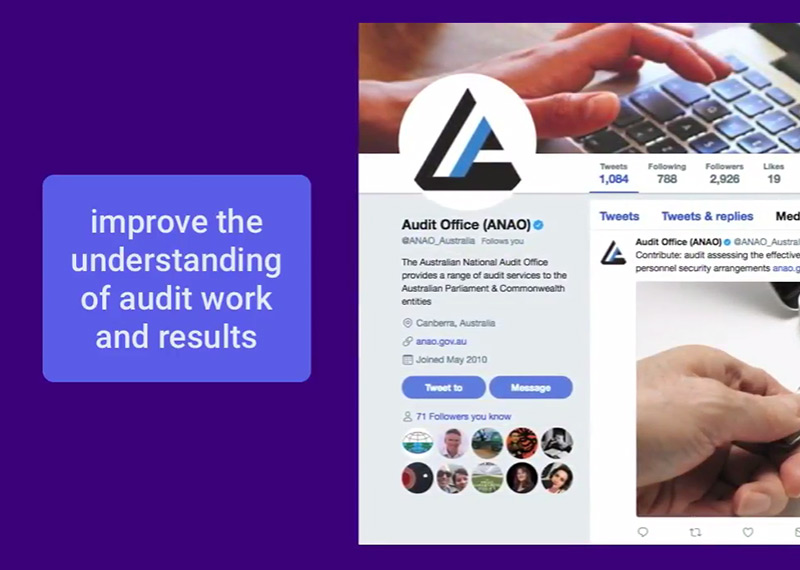
Effective, engaging and accessible communication remains an ongoing focus for the Australian National Audit Office (ANAO), given the important role that we play in providing assurance to the Parliament of Australia, and improving public sector administration.
In this edition of audit insights we discuss our external communication and engagement activities including website email subscriptions, our draft annual audit work program, contribute to an audit, our transparency and accountability initiatives, and social media.
Contact
Please direct enquiries relating to Audit insights through our contact page.
Speeches and papers
Published: Wednesday 14 February 1996
Published
Mr P.J. Barrett (AM) - Auditor-General for Australia, presented at the FINEST User Network Annual Conference 1996, Leura, NSW
Performance audit (Auditor-General Report No. 48 of 1999–2000)
Published: Monday 19 June 2000
Published
The objective of the follow-up audit was to review the effectiveness of the DETYA International Services (DIS) cost recovery operational model. The initial audit of DIS was undertaken in 1997-98 (Audit Report No.35).
Entity
Department of Education, Training and Youth Affairs
Performance audit (Auditor-General Report No. 9 of 2015–16)

Published: Tuesday 24 November 2015
Published
The audit objectives were to examine the effectiveness of Defence’s management of the test and evaluation (T&E) aspects of its major capital equipment acquisition program; and to report on Defence’s progress in implementing T&E recommendations made in the Senate Foreign Affairs, Defence and Trade References Committee’s August 2012 report, Procurement procedures for Defence capital projects.
Entity
Department of Defence
Contact
Please direct enquiries relating to reports through our contact page.
Corporate
Updated: Tuesday 13 August 2024
Updated
The objective of the Risk Framework and associated programs of risk management activities is to support effective risk management across all ANAO operations.
The 2025–27 version of this publication is available here.
Contact
Any queries about risk management in the ANAO should be directed to the Senior Executive Director, Corporate Management Group through our contact page.
Performance audit (Auditor-General Report No. 33 of 2003–04)
Published: Wednesday 3 March 2004
Published
The audit reviewed the ATO's collection and management of activity statement information. The audit paid particular regard to:
- the environment into which activity statements were introduced;
- taxpayer concerns with activity statement administration;
- the mechanisms the ATO uses to capture and process activity statements;
- the change processes the ATO uses to change and test activity statement IT systems; and
- the management methodology used to report on, and assess the performance of, activity statement related systems and processes.
Entity
Australian Taxation Office
Performance audit (Auditor-General Report No. 20 of 2004–05)
Published: Tuesday 21 December 2004
Published
The audit concluded that the ATO has an administratively effective framework for managing the Energy Grants (Credits) Scheme (EGCS), introduced in mid-2003. The planning, monitoring and reporting framework is structured and appropriate, the risk and compliance management framework is generally well-developed and the processes and controls framework is comprehensive. Changes in the Scheme, as foreshadowed in Government's Energy White Paper, Securing Australia's Energy Future, present the opportunity to enhance the transparency of Scheme objectives and develop ways to evaluate performance against these objectives
Entity
Australian Taxation Office