Browse our range of reports and publications including performance and financial statement audit reports, assurance review reports, information reports and annual reports.
Insights: Audit practice
Published: Wednesday 17 May 2017
Published
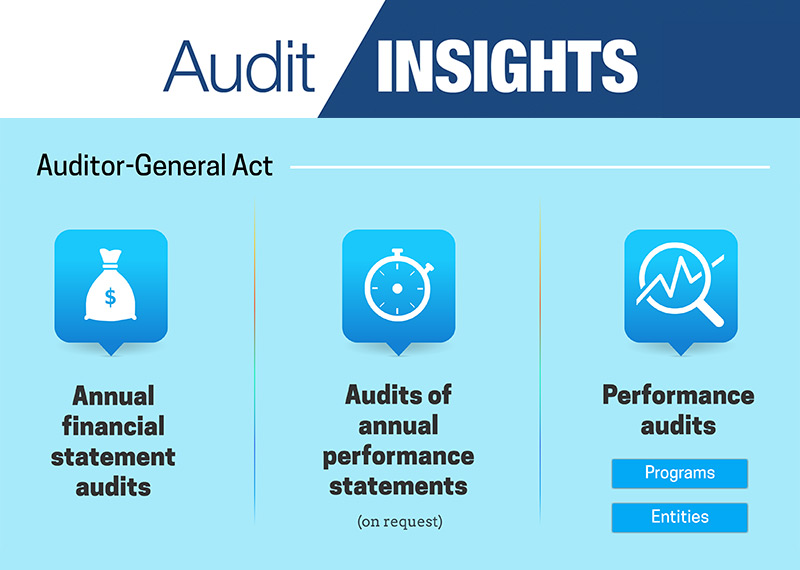
In this inaugural edition of audit insights, we look at the history and mandate of the Auditor-General of Australia, the functions delivered under the Auditor-General Act, the purpose of the Australian National Audit Office (ANAO) and our relationship with the Australian Parliament.
Contact
Please direct enquiries relating to audit insights through our contact page.
Performance audit (Auditor-General Report No. 35 of 2011–12)
Published: Tuesday 29 May 2012
Published
The objective of the audit was to examine the effectiveness of the Department of Health and Ageing’s administration of New Directions. In this respect the ANAO considered whether:
- planning processes were developed to support the program’s objectives and rationale;
- implementation arrangements were clearly defined and aligned to the objectives of the program; and
- robust performance management arrangements had been established and were in use by the department.
Entity
Department of Health and Ageing
Performance audit (Auditor-General Report No. 38 of 2007–08)
Published: Wednesday 4 June 2008
Published
The objective of this audit was to assess the effectiveness of DEEWR's administration of Job Network service fees. The ANAO examined DEEWR's arrangements to:
- specify the nature and level of services to be supplied by JNMs and to communicate this to the JNMS;
- calculate and pay service fees in accordance with the Employment Services Contract (ESC) 2006–2009 it has with JNMs; and
- obtain assurance that JNMs have delivered services in accordance with the contract.
Entity
Department of Education, Employment and Workplace Relations
Performance audit (Auditor-General Report No. 45 of 2007–08)
Published: Thursday 26 June 2008
Published
The audit objective was to assess the effectiveness of the department's administration of general recurrent grants paid to the States and Territories for government schools. To achieve this, the ANAO assessed whether the department:
- paid the correct amount of general recurrent grants to the States and Territories;
- effectively managed the agreements with the States and Territories; and
- monitored progress towards achieving the National Goals for Schooling in the Twenty-First Century.
Entity
Department of Education, Employment and Workplace Relations
Performance audit (Auditor-General Report No. 37 of 2011–12)
Published: Thursday 31 May 2012
Published
The objective of the audit was to examine the effectiveness of CSP’s feedback management system. CSP’s performance was assessed against the following criteria:
- CSP has appropriate channels to collect customer feedback;
- CSP effectively manages and resolves complaints; and
- CSP accurately reports on customer feedback, and analyses the information to improve aspects of child support administration.
Entity
Department of Human Services
Insights: Audit lessons

Published: Wednesday 14 June 2023
Published
This edition of Audit Insights is targeted at Australian Government officials who have responsibility for the implementation of cyber security controls or strategy for government systems. The aim is to communicate lessons from our audit work to make it easier for people working within the Australian public sector to apply those lessons. It is drawn from audit reports tabled in 2019–20, 2020–21 and 2022–23 into management of cyber security risks.
Contact
Please direct enquiries through our contact page.
Performance audit (Auditor-General Report No. 28 of 2006–07)
Published: Thursday 22 February 2007
Published
The objective of the audit was to assess the effectiveness of the major elements of Centrelink's central, strategic level project management arrangements, as defined in the CPMF. It focused on how well:
- the CPMF supports better management and service delivery in Centrelink;
- the CPMF supports project managers and projects to comply with better project management principles, relevant legislation and guidelines; and
- Centrelink monitors project performance and encouraged the attainment of project objectives.
Entity
Centrelink
Performance audit (Auditor-General Report No. 24 of 2003–04)
Published: Saturday 31 January 2004
Published
A Special Account is a mechanism used to record amounts in the Consolidated Revenue Fund that are set aside for specified purposes. A total of $3.40 billion was reported as held in Special Accounts as of 30 June 2003, with $10.33 billion reported as credited to Special Accounts in 2002-03 and $10.06 billion in reported payments (debits) from these Accounts. The audit examined the establishment, management and abolition of Special Accounts by Commonwealth agencies, as well as compliance with legal requirements
Entity
Across Agency
About

Updated: Monday 4 November 2024
Updated
The Auditor-General for Australia is an independent officer of the Parliament with responsibility under the Auditor-General Act 1997 for auditing Commonwealth entities and reporting to the Australian Parliament. The Auditor-General is supported by the Australian National Audit Office (ANAO).
The office of Auditor-General is a ten year statutory appointment made by the Governor-General on the advice of the Prime Minister. In recognition of the Auditor-General’s status as an officer of the Parliament, the Australian Parliament’s Joint Committee of Public Accounts and Audit (JCPAA) must approve any proposed recommendation for appointment.
Contact
Please direct enquiries through our contact page.
Performance audit (Auditor-General Report No. 54 of 2003–04)
Published: Friday 18 June 2004
Published
The objective of the audit was to assess the effectiveness of DIMIA's management of its detention agreements with ACM to operate Australia's mainland immigration detention centres. In particular, the ANAO examined: DIMIA's strategic approach to the management and coordination of the contract; how DIMIA defined the services to be delivered by ACM; the systems in place to monitor and report against contract performance; the effectiveness of controls over contract payment arrangements; and DIMIA's management of infrastructure through the detention agreements.
Entity
Department of Immigration and Multicultural and Indigenous Affairs