Browse our range of reports and publications including performance and financial statement audit reports, assurance review reports, information reports and annual reports.
Better practice guide
Updated: Wednesday 29 August 2018
Updated
The purpose of the Australian National Audit Office is to support accountability and transparency in the Australian Government sector through independent reporting to the Parliament, and thereby contribute to improved public sector performance.
The ANAO adopts a range of communication practices to strengthen the impact of its work and facilitate the sharing of audit insights. Communication practices had included the publication of better practice guides on aspects of Commonwealth administration, for the information of Australian Government entities.
The independent Review of Whole-of-Government Internal Regulation recommended that the ANAO take the opportunity to review whether there is a continuing need to develop and maintain separate guidance, where regulators and policy owners have developed or are developing policy guidance material. The ANAO consulted the Australian Parliament and public sector entities, including audit committees within these entities, about the future of better practice guides. The feedback received was that where another entity has produced, or will produce, a similar resource and has committed to continue to do so, the ANAO could add more value by monitoring the effectiveness of this resource. On this basis, the ANAO decided to discontinue and cease distribution of a range of better practice guides from 1 July 2017. Refer to our previously published message from July 2017 (below) for more information about the guides that were removed at this time.
It was also determined in July 2017 that the ANAO would retain three guides and withdraw three guides following a transition period:
Guides to be retained | Guides to be withdrawn following a transition period |
Successful Implementation of Policy Initiatives | Public Sector Financial Statements |
Public Sector Audit Committees | Developing and Managing Contracts |
Public Sector Governance | Administering Regulation |
Since July 2017, the ANAO has continued to work with policy owners as they have developed or revised their guidance material in relation to the six remaining guides.
In April 2018 we sought feedback from the accountable authorities of policy-owning entities on our intention to withdraw the six remaining guides. All relevant entities supported the removal of the guides, although the Department of the Prime Minister and Cabinet raised that the outcome of the work being conducted by the APS Reform Committee may lead to new guidance which supersedes the Successful Implementation of Policy Initiatives guide.
In May 2018 the Auditor-General wrote to the Joint Committee of Public Accounts and Audit (JCPAA) seeking the Committee’s feedback on the proposal to withdraw the remaining better practice guides. The Committee advised:
the JCPAA has no overall objection to the withdrawal of the Better Practice Guides from the ANAO website. We note the ANAO’s commitment to continue to monitor the effectiveness of the replacement guidance material, as appropriate, under its audit program. We further appreciate that the ANAO’s Audit Insights now provide information on audit issues and examples of good practice, as identified through financial statement and performance audit work, by way of shared learnings for all Commonwealth entities.
Considering the feedback from the JCPAA and policy-owning entities’ support, the remaining guides have now been removed from the ANAO website:
- Successful Implementation of Policy Initiatives
- Public Sector Audit Committees
- Public Sector Governance
- Public Sector Financial Statements
- Developing and Managing Contracts
- Administering Regulation
In 2017-18 the ANAO developed audit insights, a new product which identifies and discusses common recurring issues, shortcomings and good practice examples, identified through our financial statement and performance audit work. The objective of audit insights is consistent with the objective of better practice guides: improved public sector administration.
The ANAO will continue to monitor the effectiveness of guidance material, as appropriate, under our audit program.
If you require access to the withdrawn better practice guides listed above, you can find them through the National Library of Australia’s Australian Government Web Archive.
Contact
Please direct enquiries through our contact page.
Performance audit (Auditor-General Report No. 32 of 1996–97)
Published: Thursday 15 May 1997
Published
The objectives of the audit were to: examine the efficiency and administrative effectiveness of grant programs administered in the APS; and identify any specific problem areas and evidence of better practice in both program administration and agency guidelines not already included in the ANAO's 1994 Better Practice Guide on the Administration of Grants. The ANAO also sought to incorporate in the revision of the better practice guide the lessons learned through the audit to help ensure its continued relevance in public sector administration at all levels of government.
Entity
Across Agency
Performance audit (Auditor-General Report No. 12 of 2003–04)
Published: Wednesday 5 November 2003
Published
The primary objective of the audit was to assess whether the Department of Communications, Information Technology and the Arts (DCITA) and the Department of Transport and Regional Services (DOTARS) were administering a number of grant programs that are designed to enhance telecommunications infrastructure and services in regional, rural and remote areas of Australia according to better practice. The audit was also aimed at determining whether DCITA had implemented the recommendations of an earlier audit of Networking the Nation.
Entity
Department of Communications, Information Technology and the Arts
Performance audit (Auditor-General Report No. 38 of 2005–06)
Published: Thursday 4 May 2006
Published
The objective of this audit was to form an opinion on the Australian Research Council's (ARC's) management of research grants. To achieve this, ANAO centred the audit around the following aspects of ARC's grants administration: governance and structure, particularly the roles and responsibilities of those parties involved in administering ARC's grants (Chapter 2); the processes for assessing and selecting ARC grants (Chapter 3);post-award management of grants under the Funding Agreements (Agreements) between ARC and those universities that receive and administer the ARC grants to researchers (Chapter 4); and ARC's monitoring of its grant programs for management, performance improvement and reporting (Chapter 5). In its assessment, ANAO considered ARC's compliance with relevant sections of the Australian Research Council Act 2001 (ARC Act) and the Financial Management and Accountability Act 1997 (FMA Act). The assessment also took account of the ANAO's Better Practice Guides, particularly the Better Practice Guide—Administration of Grants. The audit focused mainly on ARC's administration of Discovery Projects, the largest scheme in ARC's National Competitive Grants Program (NCGP).
Entity
Australian Research Council
Performance audit (Auditor-General Report No. 52 of 2005–06)
Published: Thursday 29 June 2006
Published
The audit objectives were to examine the extent to which selected TSB2 and TSI Response programs: are achieving or had achieved their objectives; and had been administered effectively by DCITA according to better practice principles. To evaluate this aspect, the audit assessed DCITA's compliance with the better practice principles outlined in the Administration of Grants Better Practice Guide (May 2002) produced by the Australian National Audit Office (ANAO). There are 19 separate principles covered under the broad areas of: Planning for effective grant programs; Selecting projects; Managing and monitoring funding deeds; and Evaluating and reporting grant program performance.
Entity
Department of Communications, Information Technology and the Arts
Performance audit (Auditor-General Report No. 25 of 2003–04)
Published: Thursday 5 February 2004
Published
The audit examined agency approaches to the management of intellectual property under its control, and identified themes common to the management of all types of intellectual property. The audit objective was to:
(i) form an opinion on whether Commonwealth agencies have systems in place to efficiently, effectively and ethically manage their intellectual property assets; and
(ii) identify areas for better practice in intellectual property management by those agencies.
Entity
Australian Nuclear Science and Technology Organisation; Department of Defence
Speeches and papers
Published: Thursday 21 August 2003
Published
Mr P.J. Barrett (AO) - Auditor-General for Australia, presented at the National Institute for Governance Seminar, Canberra
Speeches and papers
Published: Tuesday 11 February 2003
Published
Mr P.J. Barrett (AM) - Auditor-General for Australia, presented to the Australian Communications Authority's Business Planning Workshop
Performance audit (Auditor-General Report No. 5 of 2010–11)
Published: Wednesday 15 September 2010
Published
The objective of the audit was to assess DoHA's effectiveness:
- in undertaking PIP program planning, program monitoring and review; and
- with Medicare Australia, in ensuring PIP program delivery to general practices and their medical practitioners.
In undertaking the audit, the ANAO considered the 12 incentives that comprised the PIP up to August 2009. The three most recently introduced incentives at the time of audit fieldwork, namely, Domestic Violence, GP Aged Care Access and eHealth incentives, were examined in greater detail and formed case studies to support audit analysis. The ANAO also sought views on the program administration from industry, including from general practices directly through an online survey.
With regard to accreditation of general practice, the audit scope did not include an assessment of the Standards nor the work of the bodies that undertake accreditation of general practices. The ANAO's focus on general practice accreditation related to DoHA's management of program entry criteria.
Entity
Department of Health and AgeingMedicare Australia
Performance audit (Auditor-General Report No. 1 of 2022–23)

Published: Thursday 28 July 2022
Published
The objective of the audit was to assess whether the award of funding under the Building Better Regions Fund was effective as well as being consistent with the Commonwealth Grant Rules and Guidelines.
Entity
Department of Industry, Science and Resources; Department of Infrastructure, Transport, Regional Development, Communications and the Arts
Contact
Please direct enquiries through our contact page.
Insights: Audit lessons

Published: Friday 28 June 2024
Published
This edition of Audit Lessons is targeted at those responsible for administering or overseeing grants programs. The aim of Audit Lessons is to communicate lessons from our audit work and to make it easier for people working within the Australian public sector to apply those lessons.
Contact
Please direct enquiries through our contact page.
Performance audit (Auditor-General Report No. 24 of 2010–11)
Published: Thursday 27 January 2011
Published
The objective of the audit was to assess whether the Better Regions Program has been effectively designed and administered. The audit scope included examination of all 106 Better Regions projects.
Entity
Department of Regional Australia, Regional Development and Local Government
Performance audit (Auditor-General Report No. 21 of 2011–12)
Published: Tuesday 24 January 2012
Published
The objective of the audit was to assess the implementation and effectiveness of the enhanced grants administration requirements for:
- reporting to the Finance Minister on the awarding of grants within their own electorate by Ministers who are Members of the House of Representatives;
- reporting to the Finance Minister on instances where Ministers have decided to approve a particular grant which the relevant agency has recommended be rejected; and
- the website reporting of grants awarded.
Entity
Department of Climate Change and Energy Efficiency; Department of Families, Housing, Community Services and Indigenous Affairs; Department of Infrastructure and Transport; Department of Regional Australia, Regional Development and Local Government
Performance audit (Auditor-General Report No. 55 of 2004–05)
Published: Thursday 23 June 2005
Published
The objective of the audit was to consider the status of workforce planning by APS agencies against the background of the ANAO's 2001 Better Practice Guide Planning for the Workforce of the Future, in light of there commendations made in the MAC Organisational Renewal 2001 and the Senate Finance and Public Administration References Committee report Recruitmentand Training in the Australian Public Service 2003. Workforce planning was defined as a continuous process of shaping the workforce to ensure it is capable of delivering organisational objectives now and in the future.
Entity
Across Entities
Performance audit (Auditor-General Report No. 19 of 2000–01)
Published: Monday 4 December 2000
Published
The objective of this follow-up audit was to provide assurance to the Parliament on the cost-effectiveness of public sector travel by:
- ascertaining the degree of acceptance, and the extent of implementation, of the previous audit recommendations and better practice principles; and
- establishing whether organisations were managing travel effectively, taking into consideration recommendations and findings detailed in the above Audit Reports and the Better Practice Guide Public Sector Travel.
Entity
Across Agency
Performance audit (Auditor-General Report No. 32 of 2012–13)
Published: Tuesday 7 May 2013
Published
The objective of the audit was to assess the awarding of funding for the construction of the Adelaide Desalination Plant (ADP) against the requirements of the Commonwealth's grants administration framework, which includes the Government’s policy requirements for the approval of grants, with a particular focus on the assessments undertaken of each proposed grant in terms of the guidelines for the National Urban Water and Desalination Plan (NUWDP); and identify any potential improvements in grants administration practices.
Entity
Department of Sustainability, Environment, Water, Population and Communities; Department of Finance and Deregulation; Department of the Prime Minister and Cabinet
Contact
Please direct enquiries relating to reports through our contact page.
Performance audit (Auditor-General Report No. 21 of 2009–10)
Published: Thursday 4 February 2010
Published
The objective of this audit was to assess whether the WSA program has been administered effectively by the NWC/DEWHA, as relevant, and is achieving its stated program objective. Specifically, the ANAO examined whether:
- funding proposals have been assessed and approved in a fair, consistent manner and in accordance with applicable criteria, program guidelines and better practice;
- appropriate funding arrangements have been established with proponents, having regard to the size of the grant, the type of entity involved and the nature of the project; and
- DEWHA (and previously the NWC) is actively monitoring whether proponents are complying with their obligations, and grant payments are made only in accordance with funding agreements.
More broadly, the audit examined DEWHA's strategy for evaluating and reporting on the long-term benefits of the program.
Entity
Department of the Environment, Water, Heritage and the Arts; National Water Commission
Performance audit (Auditor-General Report No. 7 of 2009–10)
Published: Tuesday 20 October 2009
Published
The audit objective was to form an opinion on the effectiveness of the NHMRC's grant administration. To meet this objective the NHMRC was assessed against four criteria:
- the NHMRC's governance arrangements provide appropriate accountability that it is meeting its objectives and obligations to Government (Chapter 2);
- there are strategic and systematic processes for developing and implementing grant programs (Chapter 3);
- the NHMRC manages grants post-award effectively, and complies with legislative requirements and program directives (Chapters 4 and 5); and
- the NHMRC monitors and evaluates its business to demonstrate that outcomes are being met (Chapter 6).
Entity
National Health and Medical Research Council
Performance audit (Auditor-General Report No. 7 of 2017–18)

Published: Tuesday 22 August 2017
Published
The audit objective was to determine whether selected grant programs are being administered efficiently by the Australia Council in relation to suitable comparators. The selected grant programs are collectively known as the Australia Council Grants Program.
Entity
Australia Council; Department of Social Services; National Health and Medical Research Council
Contact
Please direct enquiries relating to reports through our contact page.
Speeches and papers
Published: Friday 20 September 2002
Published
Mr P.J. Barrett (AM) - Auditor-General for Australia, presented at the CPA Australia's Government Business Symposium, Melbourne
Performance audit (Auditor-General Report No. 21 of 2021–22)
Published: Thursday 31 March 2022
Published
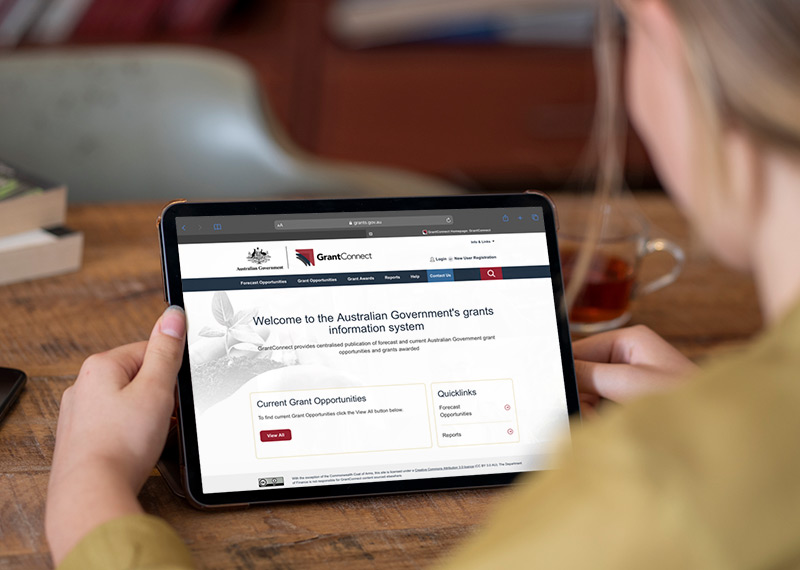
The audit assessed whether the Streamlining Government Grants Administration Program improved the effective and efficient delivery of grants administration.
Entity
Department of Finance; Department of Industry, Science, Energy and Resources; Department of Social Services
Contact
Please direct enquiries through our contact page.
Performance audit (Auditor-General Report No. 26 of 2009–10)
Published: Tuesday 20 April 2010
Published
The objective of this audit was to assess the effectiveness of the administration of specific climate change programs by the departments of the Environment, Water, Heritage and the Arts and Resources, Energy and Tourism. In undertaking this audit, particular emphasis was given to the implementation of good administrative practice and the extent to which the program objectives were being met. The audit followed four lines of inquiry:
- development of program objectives and assessment of program risks;
- assessment and approval of competitive grant applications;
- assessment and approval of rebate applications; and
- measurement and reporting of program outcomes.
Entity
Department of the Environment, Water, Heritage and the Arts; Department of Climate Change and Energy Efficiency; Department of Resources, Energy and Tourism
Performance audit (Auditor-General Report No. 25 of 2013–14)
Published: Thursday 17 April 2014
Published
The objective of the audit was to assess the effectiveness of the design and conduct of the funding round for the Building Better Regional Cities Program.
Entity
Department of Social Services; Department of the Environment
Contact
Please direct enquiries relating to reports through our contact page.
Performance audit (Auditor-General Report No. 31 of 1996–97)
Published: Tuesday 13 May 1997
Published
The ANAO's purpose was to report on:
- the HIC's management of approaches to minimise medifraud and inappropriate practice;
- HIC's reporting of its performance on these matters to stakeholders;
- the methodology used by the HIC to estimate the extent of fraud and inappropriate practice, including comment on the reliability of the estimates; and
- the HIC's implementation of the major recommendations from Medifraud and Excessive Servicing - Audit Report No.17 1992-93.
Entity
Health Insurance Commission
Performance audit (Auditor-General Report No. 27 of 2012–13)
Published: Tuesday 9 April 2013
Published
The audit objective was to assess the effectiveness of DIISTRE’s administration of the Research Block Grant schemes. The department’s performance was assessed against the following criteria:
- the schemes are effectively planned and administered;
- the processes and systems used for calculating and distributing funds reflect the allocation criteria specified for each scheme; and
- compliance with scheme guidelines is monitored and scheme performance and contribution to the broader goals of the RBG program is assessed.
Entity
Department of Industry, Innovation, Climate Change, Science, Research and Tertiary Education
Performance audit (Auditor-General Report No. 57 of 2004–05)
Published: Tuesday 28 June 2005
Published
The objective of the audit was to assess whether purchases of goods and services are conducted in accordance with relevant legislation, Government policies and guidelines, and sound purchasing principles and practices. The audit at each entity covered the internal control framework for purchasing and purchase transactions during 2002-03 and 2003-04 and, where applicable, was based on the CPGs current at that time. The audit examined all aspects of the purchasing process from the initial requirement for purchase through to the delivery of the supply and payment. It included an examination of aselection of individual purchases at each audited entity.
Entity
Australian National University; Australian Research Council; CRS Australia; The Department of Finance and Administration
Performance audit (Auditor-General Report No. 47 of 2005–06)
Published: Wednesday 21 June 2006
Published
The objective of the audit was to assess whether FaCSIA administers grants effectively, according to better practice guidelines, and consistently across geographic areas and the range of programmes included in the scope of the audit. The scope of the audit included grants administered by FaCSIA between 1 July 2002 and 30 June 2005, relating to programmes falling within four of the five groups of programmes providing funding for families and communities namely: Community Support; Family Assistance; Childcare Support; and Youth and Student Support. In total, these groups involved total expenditure of some $533 million in 2004–05.
Entity
Department of Families Community Services and Indigenous Affairs
Performance audit (Auditor-General Report No. 11 of 2012–13)
Published: Tuesday 27 November 2012
Published
The objective of this audit was to assess the efficiency and effectiveness of the establishment, implementation and administration of the quarantined heritage component of the Local Jobs stream of the Jobs Fund. A particular focus was on the establishment of program objectives and the extent to which approved grants have demonstrably contributed to the cost-effective achievement of those objectives. The audit approach has been influenced by recent audits of grants administration which have emphasised the importance of transparent and accountable grant decision-making processes to the cost effective achievement of stated program objectives, and having regard for recent government decisions to enhance the framework applying to the administration of grants.
Entity
Department of Sustainability, Environment, Water, Population and Communities
Performance audit (Auditor-General Report No. 16 of 2002–03)
Published: Monday 4 November 2002
Published
A Business Support Process audit of the administration of grants in small to medium organisations was undertaken across six Commonwealth organisations to assess whether agencies had implemented appropriate risk management strategies for grant programs; evaluate whether grants had been administered in accordance with the appropriate legislation, Commonwealth guidance, and other accepted internal controls; and to recommend improvements in the controls and practices relating to grants administration.
Entity
Across Agency
Performance audit (Auditor-General Report No. 41 of 2009–10)
Published: Wednesday 26 May 2010
Published
The audit objective was to assess whether agreements between Australian Government (Commonwealth) agencies reflect sound administrative practices. To meet this objective, the audit reviewed current government policy and a range of better practice guidelines, conducted interviews with agencies and examined cross-agency agreements, to formulate suitable audit criteria and subsequently develop better practice principles.
Entity
Across Entities