Browse our range of reports and publications including performance and financial statement audit reports, assurance review reports, information reports and annual reports.
Performance audit (Auditor-General Report No. 17 of 2005–06)
Published: Tuesday 29 November 2005
Published
The objective of the audit was to assess the ATO's administration of the LMR. Specifically, the audit sought to: examine and report on aspects of LMR governance; assess the systems, processes and controls used by the ATO to capture and process LMR data reported by providers; examine the mechanisms and strategies the ATO uses to gain assurance that providers are complying with LMR legislation; and assess the mechanisms and strategies the ATO uses to promote awareness of, and enable access to, the LMR.
Entity
Australian Taxation Office
Performance audit (Auditor-General Report No. 16 of 2018–19)

Published: Thursday 13 December 2018
Published
The objective of this audit was to assess the Australian Public Service Commission’s and selected entities’ implementation of the Australian Government’s Workplace Bargaining Framework.
Entity
Across entities (listed below)
Contact
Please direct enquiries through our contact page.
Performance audit (Auditor-General Report No. 43 of 2005–06)
Published: Wednesday 31 May 2006
Published
The overall objective of the audit was to assess whether the RSS Programme is effective and efficient in providing assurance on the levels of payment error and the resultant risks to the integrity of Australian Government outlays for payments administered by Centrelink. Specifically, the audit assessed whether: the RSS Programme meets the objectives outlined for it in the Portfolio Budget Statements under which funding was provided; there is an adequate methodology underpinning the RSS reviews; the RSS reviews are conducted effectively and efficiently, and adequate quality assurance mechanisms exist to assure the results obtained from the RSS reviews; and reporting by the agencies of the results of the RSS Programme is adequate and takes into consideration the issues identified in Audit Report No. 44 2002–03 Review of the Parenting Payment Single Program, and Audit Report No. 17 2002–03 Age Pension Entitlements.
Entity
Department of Family Community Services and Indigenous Affairs; Department of Employment and Workplace Relations; Department of Education Science and Training; Centrelink
Request for audit
Responded: Tuesday 17 January 2017
Response provided
The Auditor-General responded on 17 January 2017 to correspondence from the Hon. Linda Burney MP on 5 January 2017 requesting that the Auditor-General conduct an audit of the Centrelink debt recovery and welfare integrity programs.
Contact
Please direct enquiries relating to requests for audit through our contact page.
Performance audit (Auditor-General Report No. 51 of 2005–06)
Published: Wednesday 28 June 2006
Published
The audit objectives were to report on the implementation status of the parliamentary resolutions and other actions arising out of the six recommendations made in the final PSC Report, Review by the Parliamentary Service Commissioner of Aspects of the Administration of the Parliament. The audit also broadly examined the impact of implementation of the parliamentary resolutions on aspects of: the level of services provided to the Parliament generally following amalgamation of the three former parliamentary departments into the Department of Parliamentary Services; and accommodation space within Parliament House. The designated audit agency was the Department of Parliamentary Services (DPS).
Entity
Department of Parliamentary Services
Performance audit (Auditor-General Report No. 6 of 2019–20)

Published: Monday 5 August 2019
Published
The objective of the audit was to examine whether selected entities implemented agreed ANAO performance audit, the Joint Committee of Public Accounts and Audit, and other parliamentary committee recommendations.
Entity
Across Entities
Contact
Please direct enquiries through our contact page.
Performance audit (Auditor-General Report No. 15 of 2003–04)
Published: Monday 1 December 2003
Published
On 2 November 2000, the Senate agreed to a resolution that the Auditor-General be requested to review all expenditures and entitlements accruing to Parliamentarians and Ministers in 1999-2000. The resolution requested that the Auditor-General consider a number of specific matters, and report by 30 June 2001. In the course of that audit, examination of issues relating to Parliamentarians' staff was deferred in order to give the Auditor-General a reasonable chance of reporting reasonably close to the Senate's requested reporting timeframe. ANAO Audit Report No.5 2001-02, Parliamentarians' Entitlements: 1999-2000, was tabled in the Parliament in August 2001. A proposed audit of the administration by Finance of the entitlements of staff engaged under the Members of Parliament (Staff) Act 1984 (MOP(S) Act was included in the ANAO Audit Work Program for 2001-02. The objectives of this performance audit were to: review the effectiveness of the internal control structures in the Department of Finance and Administration (Finance) concerning the administration of entitlements for MOP(S) Act staff; review the effectiveness and efficiency of the procurement and support services Finance provides in relation to MOP(S) Act staff: and identify principles of sound administrative practices to facilitate improved administrative arrangements for the future. The audit covered Finance's administration of payments and services to MOP(S) Act staff during the period 1998-99 to 2001-02. Sub-section 15(c) of the Auditor General Act 1997 precludes an audit of persons who are engaged under the MOP(S) Act. Accordingly, the audit scope did not include examination of the responsibilities of MOP(S) Act staff.
Entity
Department of Finance and Administration
Speeches and papers
Published: Tuesday 30 September 2003
Published
Mr P.J. Barrett (AM) - Auditor-General for Australia, presented at the Committee for Economic Development of Australia, Sydney, 30 Sept
Speeches and papers
Published: Thursday 16 February 2006
Published
Mr Ian McPhee - Auditor-General for Australia, presented at the Canberra Evaluation Forum
Speeches and papers
Published: Tuesday 27 March 2001
Published
Mr P.J. Barrett (AM) - Auditor-General for Australia, presented at the Security in Government 2001 SES Seminar
Speeches and papers
Published: Thursday 2 November 1995
Published
Mr P.J. Barrett (AM) - Auditor-General for Australia, presented at the Security in Government 95 Conference, Canberra
Performance audit (Auditor-General Report No. 46 of 2011–12)
Published: Wednesday 20 June 2012
Published
The objective of the audit was to assess the effectiveness of the Department of Agriculture, Fisheries and Forestry’s administration of the Northern Australia Quarantine Strategy. The ANAO examined whether the department had established effective:
- administrative and governance arrangements to support NAQS;
- processes for identifying biosecurity risks and conducting scientific activities to address identified risks;
- arrangements for managing the quarantine aspects of Torres Strait border movements; and
- public awareness activities that reflect identified biosecurity risks and support the program’s objectives.
Entity
Department of Agriculture, Fisheries and Forestry
Insights: Audit lessons

Published: Tuesday 9 January 2024
Published
The aim of Insights: Audit Lessons is to communicate lessons from our audit work and to make it easier for people working within the Australian public sector to apply those lessons.
This edition of Insights: Audit Lessons is targeted at risk practitioners and officials responsible for government operations, projects, programs, services and regulatory activities. It would also be useful for accountable authorities, their senior executives and audit and risk committees.
Contact
Please direct enquiries through our contact page.
Speeches and papers
Published: Thursday 21 August 1997
Published
Mr P.J. Barrett (AM) - Auditor-General for Australia, presented to the Conference on 'Surviving the Year 2000 Computer Crisis' Canberra
Performance audit (Auditor-General Report No. 49 of 2005–06)
Published: Monday 26 June 2006
Published
The objective of the audit was to assess whether DEWR's management and oversight of Job Placement and matching services is effective, in particular, whether: DEWR effectively manages, monitors and reports the performance of JPOs in providing Job Placement services; DEWR effectively manages the provision of matching services (including completion of vocational profiles and provision of vacancy information through auto-matching) to job seekers; Job seeker and vacancy data in DEWR's JobSearch system is high quality and is managed effectively; and DEWR effectively measures, monitors and reports Job Placement service outcomes.
Entity
Department of Employment and Workplace Relations
Request for audit
Responded: Friday 22 April 2022
Response provided
The Auditor-General responded on 22 April 2022 to correspondence from Senator the Hon Eric Abetz dated 28 March 2022, requesting that the ABC’s defamation case payment be included as a topic in the ANAO’s Annual Audit Work Program 2022–23.
Contact
Please direct enquiries relating to requests for audit through our contact page.
Performance audit (Auditor-General Report No. 45 of 2016–17)

Published: Thursday 30 March 2017
Published
The objective of the audit was to assess whether the procurement by the Department of the Environment and Energy of a replacement Antarctic icebreaking vessel will provide value with public resources.
Entity
Department of the Environment and Energy
Contact
Please direct enquiries relating to reports through our contact page.
Speeches and papers
Published: Friday 5 November 2004
Published
Mr P.J. Barrett (AM) - Auditor-General for Australia, presented at the 2nd Taipai Corporate Governance Forum
Speeches and papers
Published: Tuesday 16 May 2000
Published
Mr P.J. Barrett (AM) - Auditor-General for Australia, presented at the Medibank Private Executive Seminar Breakfast, Perth
Performance audit (Auditor-General Report No. 7 of 2010–11)
Published: Wednesday 22 September 2010
Published
The audit objective was to assess the appropriateness of the use and reporting of confidentiality provisions in Australian Government contracts. This included assessing compliance with the Order and following up on the implementation of recommendations made in previous Senate Order audits.
The audit involved three components:
- an examination of a stratified random sample of 150 contracts listed as containing confidentiality provisions from material and small agencies across the Australian Government to determine whether confidentiality provisions were used and reported appropriately;
- an examination of all FMA Act agencies' calendar year 2009 contract listings, and ministers' letters of advice, to assess compliance with the requirements of the Order, and check reported instances of excluded contracts; and
- a follow-up of the implementation of previous audit recommendations relating to the administration of the Senate Order in four agencies. The selected agencies were the: Australian Agency for International Development (AusAID); Department of Families, Housing, Community Services and Indigenous Affairs (FaHCSIA); Department of Agriculture, Fisheries and Forestry (DAFF); and the Federal Court of Australia (Federal Court). The selected agencies were audited in one of the ANAO's previous five audits of Senate Order compliance.
Entity
NO-DEPTS-LISTED
Performance audit (Auditor-General Report No. 43 of 2017–18)

Published: Tuesday 29 May 2018
Published
The objective of this audit was to examine the extent to which the Department of Infrastructure and Regional Development, now the Department of Home Affairs (the Department) has implemented the recommendations made by the ANAO in Audit Report #5 2016–17, Passenger Security Screening at Domestic Airports.
Entity
Department of Home Affairs
Contact
Please direct enquiries through our contact page.
Performance audit (Auditor-General Report No. 21 of 2007–08)
Published: Thursday 7 February 2008
Published
The objective of this audit was to assess and report on the administration of the regional delivery of NHT 2 and the NAP.
The scope of the audit encompassed both Environment and DAFF, including the Joint Team of staff from both departments working together under a common management structure for the delivery of both programs. The audit focused on:
- the implementation of the regional delivery arrangements;
- governance and financial management for regional delivery; and
- monitoring, evaluation and reporting on the programs' performance.
Entity
Department of the Environment, Water, Heritage and the Arts; Department of Agriculture, Fisheries and Forestry
Speeches and papers
Published: Friday 27 June 2008
Published
Mr Ian McPhee - Auditor-General for Australia, presented for a video-conference of the International Federation of Accountants
Insights: Audit lessons
Published: Wednesday 22 August 2018
Published
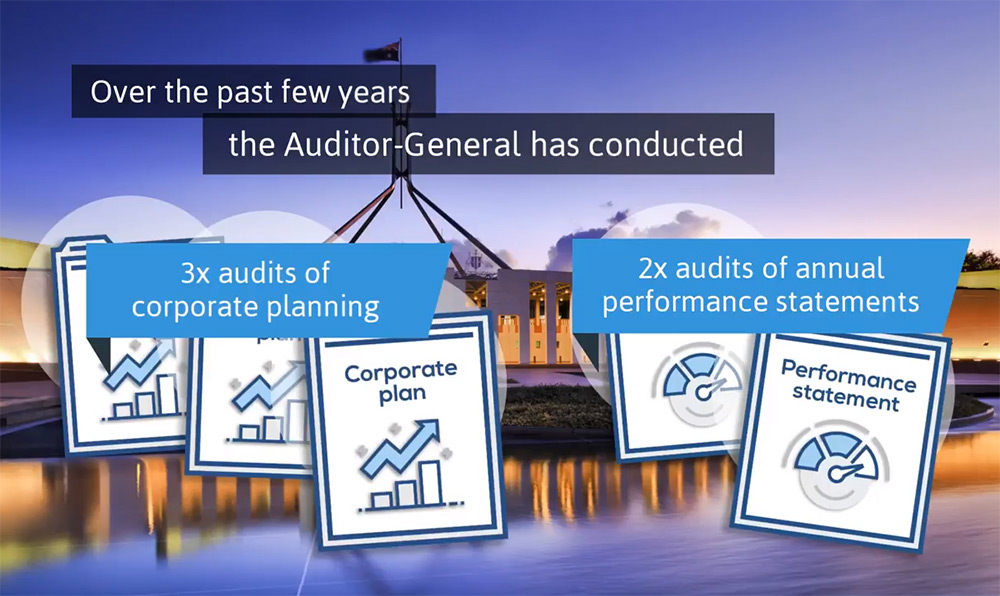
Over the past few years, the Auditor-General has conducted three audits of corporate planning and two audits of annual performance statements. This edition of audit insights examines the findings from these reports and discusses key learnings that are relevant for all Commonwealth entities.
Contact
Please direct enquiries through our contact page.
Performance audit (Auditor-General Report No. 52 of 2006–07)
Published: Thursday 28 June 2007
Published
This is the first of two audit reports concerning the Tax Office's administration of SMSFs pursuant to the provisions of the Superannuation Industry (Supervision) Act 1993.
This audit report examines the efficiency and effectiveness of the Tax Office's approach to regulating and registering self managed superannuation funds. Specifically the ANAO examined the:
- Environment in which SMSFs operate, including the Tax Office's regulatory roles and responsibilities;
- Tax Office's governance of its SMSF regulatory role; and
- Systems, processes and controls the Tax Office uses to register SMSFs, and enforce the lodgement of fund income tax and regulatory returns.
Entity
Australian Taxation Office
Performance audit (Auditor-General Report No. 27 of 2018–19)

Published: Wednesday 20 February 2019
Published
The objective of the audit was to assess the effectiveness of arrangements for monitoring, evaluating and reporting progress towards Closing the Gap in Aboriginal and Torres Strait Islander disadvantage.
Entity
Department of the Prime Minister and Cabinet; Productivity Commission
Contact
Please direct enquiries through our contact page.
Performance audit (Auditor-General Report No. 50 of 2005–06)
Published: Tuesday 27 June 2006
Published
The objective of the audit was to assess the framework being put in place to manage and account for aid funds provided under the AIPRD. In particular, the audit addressed: structures for oversighting the development and delivery of the AIPRD; planning and risk management (including those relating to fraud and corruption); financial management; and arrangements for ongoing monitoring and reporting. The audit focussed on the arrangements being established to monitor, evaluate and report on AIPRD implementation, rather than the management of activities and outcomes achieved. This reflects the fact that the long lead times associated with establishing such a large programme of assistance had meant that only limited activities were underway at the time of audit fieldwork. The ANAO anticipates undertaking an audit in the future of the management of activities and outcomes achieved, when more funds have been expended. It was not the purpose of this audit to examine Australia's immediate emergency and humanitarian response to the tsunami crisis.
Entity
Australian Agency for International Development; Department of Foreign Affairs and Trade
About

Updated: Monday 13 October 2025
Updated
Information on legislation that governs the work of the Auditor-General and the Australian National Audit Office (ANAO).
Contact
Please direct enquiries through our contact page.
Corporate
Published: Friday 4 May 2018
Published
This first e-newsletter of the Commonwealth Auditors General Group was produced by Sir Amyas Morse, UK Comptroller and Auditor General as guest editor, along with the editorial team of the Auditors General of Australia, Fiji, Jamaica and Tanzania. Cybersecurity is the theme for this newsletter, with articles from the Supreme Audit Institutions (SAIs) of Australia, Malta and the UK.
One of the main purposes of the e-newsletter is to share experiences and establish a dialogue based on the discussions that were started at the 23rd Conference of Commonwealth Auditors General in Delhi. For this edition the conversation is around ‘leveraging technology in public audit’, and it draws on international peers experiences and learnings from conducting cybersecurity audits.
Contact
If you have any thoughts on future technical content which you would like to propose, please contact international@nao.gsi.gov.uk
Speeches and papers
Published: Monday 4 September 1995
Published
Mr P.J. Barrett (AM) - Auditor-General for Australia, presented to the Australian Society of CPAs, Canberra