Browse our range of reports and publications including performance and financial statement audit reports, assurance review reports, information reports and annual reports.
Performance audit (Auditor-General Report No. 37 of 1996–97)
Published: Wednesday 18 June 1997
Published
The objective of the audit was to provide assurance about the Australian Taxation Office's risk management approach and to add value to its administration by analysing the economy, efficiency, administrative effectiveness, equity and accountability of the related processes employed within the organisation. The ANAO reviewed the formal risk management process that the ATO uses to deal with all sources of risk for the organisation.
Entity
Australian Taxation Office
Performance audit (Auditor-General Report No. 17 of 2012–13)
Published: Tuesday 29 January 2013
Published
The objective of the audit was to assess the effectiveness of the design and implementation of the EEIG program. The focus of the audit was the preparation for, and conduct of, the first funding round of the program.
Entity
Department of Climate Change and Energy Efficiency
Performance audit (Auditor-General Report No. 29 of 2003–04)
Published: Friday 20 February 2004
Published
The audit objective was to assess the effectiveness of the National Health and Medical Research Council's governance and administrative systems. In order to achieve this objective, the audit addressed three criteria to determine whether the Council had: identified its legislated responsibilities and monitored its legislative compliance; a sound corporate governance framework to support the performance of its legislated functions; and established robust administrative systems to support the performance of its legislated functions.
Entity
National Health and Medical Research Council; Department of Health and Ageing
Speeches and papers
Published: Tuesday 30 September 2003
Published
Mr P.J. Barrett (AM) - Auditor-General for Australia, presented at the Committee for Economic Development of Australia, Sydney, 30 Sept
Performance audit (Auditor-General Report No. 14 of 2011–12)
Published: Wednesday 23 November 2011
Published
The audit objective was to assess the effectiveness of SEWPaC’s management of the IPA program in relation to the two primary targets of the IPA program under the Caring for our Country initiative (2008–13) which are to:
- expand the contribution of the IPA program to the NRS by between eight and 16 million hectares (an increase of at least 40 per cent), of which 1.8 million hectares are to be in northern and remote Australia; and
- ensure the continued use, support and reinvigoration of traditional ecological knowledge to underpin biodiversity conservation in the Plans of Management of 32 newly initiated projects.
Entity
Department of Sustainability, Environment, Water, Population and Communities
Performance audit (Auditor-General Report No. 23 of 2002–03)
Published: Friday 20 December 2002
Published
Physical Security Arrangements in Commonwealth Agencies, No.23 2002-2003 Protective security involves the total concept of information, personnel, physical, information technology and telecommunications security. The Commonwealth's Protective Security policy is outlined in the Protective Security Manual (PSM). It provides specific guidance to agencies on the protection of the Commonwealth's assets, personnel and clients from potential security threats. This audit evaluated the protective security policies and practices of seven Commonwealth agencies to determine whether they had established an appropriate physical security control framework based on the principles outlined in Part E of the Commonwealth's Protective Security Manual. The ANAO also examined whether agencies had considered the risks of, and developed an appropriate policy statement on, the physical security arrangements for employees who work from home.
Entity
Across Agency
Performance audit (Auditor-General Report No. 34 of 1997–98)
Published: Tuesday 24 March 1998
Published
The audit reviewed the Defence's $5.05 billion New Submarine Project which commenced in 1982 and involves design and construction of six Collins class submarines and associated supplies and services. The objectives of the audit were to assess project management by the Department's Project Office in the light of accepted better-practice project management techniques. It also aimed to derive lessons learnt and recommendations that could be applied to the Project and to similar Defence projects now and in the future. The audit follows a 1992 audit of the Project by the ANAO and a review by the Joint Committee of Public Accounts in 1995.
Entity
Department of Defence
Performance audit (Auditor-General Report No. 45 of 1998–99)
Published: Wednesday 2 June 1999
Published
The audit is a follow-up to Audit Report 12, 1995-96 Risk Management by Commonwealth Consumer Product Safety Regulators. The objectives of this follow-up audit were to determine the extent to which ANZFA had implemented the agreed recommendations contained in the 1995 Audit Report, and to determine the effectiveness of the implemented recommendations in improving food safety regulation.
Entity
Australian New Zealand Food Authority
Performance audit (Auditor-General Report No. 50 of 2002–03)
Published: Wednesday 18 June 2003
Published
This is the second year of what may be a three-year longitudinal study of the effectiveness and efficiency of all aspects of people management in 13 agencies, covering some 36% of APS employees. The study assessed each people management practice area against four criteria: quality, HR integration, effectiveness & efficiency and business contribution.
Entity
Across agency
Performance audit (Auditor-General Report No. 8 of 2001–02)
Published: Thursday 9 August 2001
Published
The objective of the audit was to assess whether the disposal of 'infrastructure, plant and equipment' assets was being carried out in accordance with Government policy, relevant aspects of the asset management principles, and applicable internal controls. The scope of the audit covered all aspects of the disposal process from initial planning through to the receipt of proceeds and evaluation of the outcome. The audit examined eight organisations, which are not named in the report.
Entity
Across Agency
Performance audit (Auditor-General Report No. 4 of 1998–99)
Published: Monday 10 August 1998
Published
The objective of the audit was to evaluate the efficiency and effectiveness of Austrade's management of customer services to Australian exporters, with particular reference to:
- performance as a customer-focused organisation;
- achievement of quality customer service through its client service initiatives; and
- measurement and evaluation of its customer service performance.
Entity
Australian Trade Commission
Major projects report (Auditor-General Report No. 15 of 2012–13)

Published: Wednesday 19 December 2012
Published
The objective of this report is to provide comprehensive information on the status of selected Major Projects, as reflected in the Project Data Summary Sheets prepared by the DMO, and the Statement by the Chief Executive Officer (CEO) of the DMO, and including the ANAO’s review of the preparation of the PDSSs by the DMO.
Entity
Defence Materiel Organisation
Performance audit (Auditor-General Report No. 39 of 2007–08)
Published: Thursday 5 June 2008
Published
The objective of this follow-up audit is to examine DEEWR's implementation of the six recommendations made in the ANAO's 2003 report. This audit has had regard to the issues underlying the recommendations, and new administrative issues affecting their implementation.
Entity
Department of Education, Employment and Workplace Relations
Performance audit (Auditor-General Report No. 57 of 2004–05)
Published: Tuesday 28 June 2005
Published
The objective of the audit was to assess whether purchases of goods and services are conducted in accordance with relevant legislation, Government policies and guidelines, and sound purchasing principles and practices. The audit at each entity covered the internal control framework for purchasing and purchase transactions during 2002-03 and 2003-04 and, where applicable, was based on the CPGs current at that time. The audit examined all aspects of the purchasing process from the initial requirement for purchase through to the delivery of the supply and payment. It included an examination of aselection of individual purchases at each audited entity.
Entity
Australian National University; Australian Research Council; CRS Australia; The Department of Finance and Administration
Performance audit (Auditor-General Report No. 38 of 2012–13)
Published: Thursday 23 May 2013
Published
The objective of the audit was to assess the effectiveness of the Department of Education, Employment and Workplace Relations’ (DEEWR) role in the delivery of the Children and Family Centre (CFC) component of the National Partnership Agreement on Indigenous Early Childhood Development (IECD NP).
Entity
Department of Education, Employment and Workplace Relations
Contact
Please direct enquiries relating to reports through our contact page.
Annual report
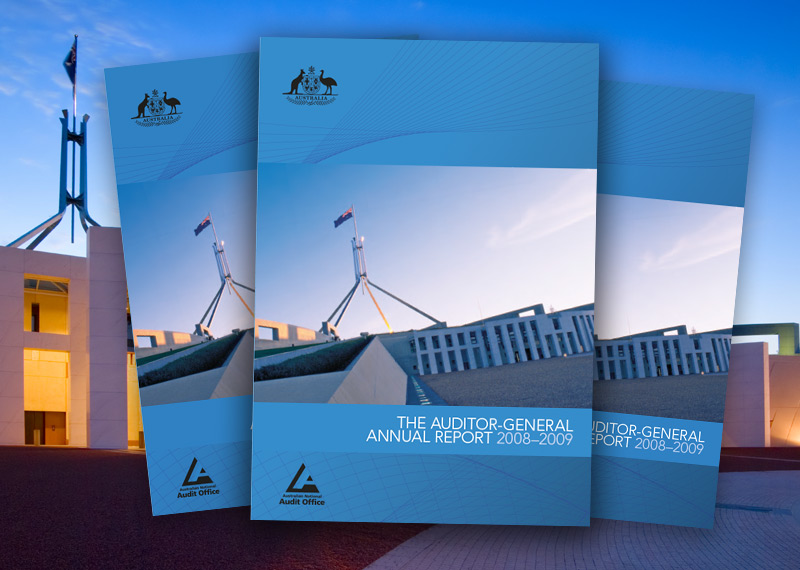
Published: Wednesday 16 September 2009
Published
This annual report documents the performance of the Australian National Audit Office (ANAO) in the financial year ending on 30 June 2009. It includes a foreword by the Auditor-General, an overview of the Office, a report on performance, details about management and accountability, and the financial results.
Speeches and papers
Published: Thursday 25 May 2000
Published
Mr P.J. Barrett (AM) - Auditor-General for Australia, presented at the Government in Excellence Summit 2000 - Reinventing Government - A Manifesto for Achieving Excellence and Managing for Results; Singapore
Performance audit (Auditor-General Report No. 6 of 2002–03)
Published: Thursday 29 August 2002
Published
The ANAO reviewed arrangements for the development of the department's fraud policy, fraud risk assessment and fraud control plan within the core functional areas of the department that are responsible for these activities. The audit also examined the operational procedures and guidelines that were in place to implement the departments' fraud policy. The objective of the audit was to assess whether DVA has implemented appropriate fraud control arrangements in line with the Fraud Control Policy of the Commonwealth and whether these arrangements operate effectively in practice.
Entity
Department of Veterans' Affairs
Speeches and papers
Published: Monday 7 October 2002
Published
Mr P.J. Barrett (AM) - Auditor-General for Australia, presented at the 18th Commonwealth Auditors-General Conference, Malaysia
Performance audit (Auditor-General Report No. 37 of 1999–2000)
Published: Tuesday 4 April 2000
Published
The audit reviewed the construction of facilities for the Australian Defence Force and the Department of Defence by the Defence Estate Organisation. The objective of the audit was to assess the efficiency and administrative effectiveness of the Organisation's project delivery function, highlighting effective practice and, where appropriate, making practical recommendations to enhance facilities project management. The main projects examined were the facilities required for the Army Presence in the North and the Russell Hill Redevelopment.
Entity
Department of Defence
Speeches and papers
Published: Tuesday 1 May 2001
Published
Mr P.J. Barrett (AM) - Auditor-General for Australia, presented at the IIR Conference 'Risks in Outsourcing in the Public Sector'
Performance audit (Auditor-General Report No. 46 of 2002–03)
Published: Friday 6 June 2003
Published
Australian Industry Involvement Program. Department of Defence The audit examined the management by Defence of its Australian Industry Involvement (AII) Program. AII is the major program through which Defence gives effect to government policy on Australian industry. The objective of the audit was to assess the extent to which the AII Program has achieved its two policy objectives, which are to :
- develop and sustain strategically important capabilities in Australian industry to support Australian Defence Force operations and Defence capability development; and
- maximise Australian industry involvement in Defence's procurement of goods and services, consistent with the government procurement policy objective of achieving best value for money to the Commonwealth.
Entity
Department of Defence
Speeches and papers
Published: Thursday 4 September 2008
Published
Mr Ian McPhee - Auditor-General for Australia, presented at the Public Sector Governance Forum of the Australian Institute of Company Directors and The Institute of Internal Auditors - Australia
Performance audit (Auditor-General Report No. 18 of 1998–99)
Published: Monday 7 December 1998
Published
Consistent with the ANAO's practices, and in response to a request from AusAID, a follow-up audit was conducted in the period May to November 1998 to assess the extent of implementation of the recommendations of a 1996 audit into the Management of Funding to Non-Government Organisations (NGOs)and whether the implementation of recommendations has effectively improved the management of funding to NGOs. The ANAO examined AusAID's key funding accountability documentation, tested the revised accountability arrangements and consulted a number of key stakeholders, including NGO representatives.
Entity
Australian Agency for International Development (AusAID)
Performance audit (Auditor-General Report No. 14 of 2001–02)
Published: Friday 28 September 2001
Published
The objective of this follow-up audit was to assess Austrade's implementation of the recommendations contained in ANAO Report No. 4 of 1998-99 (Client Service Initiatives - Australian Trade Commission (Austrade)), and whether the implementation of the recommendations or appropriate alternative measures has improved the management and delivery of Austrade's client service.
Entity
Australian Trade Commission
Performance audit (Auditor-General Report No. 47 of 1998–99)
Published: Tuesday 15 June 1999
Published
The objectives of the audit were to form an opinion on the management of Commonwealth agencies' compliance with the Commonwealth's energy efficiency requirements and to identify areas for better practice in energy management. The audit focussed on:
- the implementation of the Energy Policy by Commonwealth Agencies; promulgation and coordination of energy use targets;
- energy and associated reporting by Commonwealth agencies;
- identification, examination and analysis of systemic and procedural impediments to achieving the Energy Policy; and
- development and discussion of ways to address these impediments.
Entity
Department of Industry, Science and Resources; Australian Greenhouse Office
Performance audit (Auditor-General Report No. 28 of 1999–2000)
Published: Thursday 3 February 2000
Published
This report summarises audit and other related activities of the Australian National Audit Office in the period July to December 1999.
Entity
Across Agency
Major projects report (Auditor-General Report No. 20 of 2011–12)

Published: Tuesday 20 December 2011
Published
The objective of this report is to provide a formal conclusion on the review of the Project Data Summary Sheets by the Auditor-General, including comprehensive information on the status of projects as reflected in the PDSSs prepared by the DMO.
Entity
Defence Materiel Organisation
Performance audit (Auditor-General Report No. 13 of 2002–03)
Published: Wednesday 23 October 2002
Published
This benchmarking study was a follow on from ANAO Report No. 14 of 2000-01, Benchmarking the Internal Audit Function, which was published in October 2000. The objective of the study was to obtain and report qualitative and quantitative data on aspects of the internal audit function and compare the public sector internal audit results with equivalent international data to identify better practices and highlight areas for improvement.
Entity
Across Agency
Speeches and papers
Published: Thursday 20 November 2003
Published
Mr P.J. Barrett (AM) - Auditor-General for Australia, presented at the CPA Australia National Public Sector Convention, Perth
Performance audit (Auditor-General Report No. 19 of 2010–11)
Published: Thursday 9 December 2010
Published
The audit assessed FaHCSIA's management of AACAP and how the department monitors the contribution the program is making to the improvement of primary and environmental health, and living conditions, in remote Indigenous communities.
The audit examined program delivery under the 2006–2009 MoU, as well as the planning for the 2010 project under the variation to the 2006–2009 MoU. As part of the audit the ANAO considered:
- program strategy and implementation including the roles and responsibilities of the major stakeholders, community selection and scope of works (Chapter 2);
- the financial management of the program and the changing role of the Contracted Program Manager (Chapter 3); and
- performance measures, including FaHCSIA's performance reporting framework, and approach to monitoring and reporting performance against the stated program objectives (Chapter 4).
The audit focused on AACAP in so far as it relates to Indigenous community outcomes. It did not consider the program from the perspective of the Australian Defence Force capability building.
Entity
Department of Families, Housing, Community Services and Indigenous Affairs
Performance audit (Auditor-General Report No. 13 of 2000–01)
Published: Wednesday 4 October 2000
Published
The audit examined a range of issues in relation to the development of certified agreements in the APS with particular emphasis on the link between improved pay and conditions and increased productivity, and the funding of agreements. The objectives of the audit were to:
- provide an overview of the range of wage outcomes included in the first round of APS certified agreements;
- identify the administrative arrangements agencies have in place to measure any improvements in productivity that were linked to pay increases;
- determine how agencies funded their certified agreements;
- review the reporting and accountability arrangements agencies have in place to monitor progress and to evaluate the outcomes of their certified agreements;
- determine the extent to which agencies complied with the employment terms and conditions outlined in their certified agreements that contributed to paying for their agreement or measuring and/or assessing improvements in productivity; and
- examine the role of central coordinating agencies in reviewing agencies' certified agreements.
Entity
Across Agency
Performance audit (Auditor-General Report No. 35 of 2003–04)
Published: Wednesday 24 March 2004
Published
This report covers a number of the discretionary compensation and debt relief mechanisms that are available to Commonwealth agencies, where individuals or entities have been disadvantaged by legislation, or actions by agencies or staff, or some other negative circumstances. It deals mainly with two legislative mechanisms, namely, act of grace payments and waivers of debt, and one administrative mechanism, the Compensation for Detriment caused by Defective Administration (CDDA) scheme. This report also briefly covers two other mechanisms, namely ex gratia payments and payments in special circumstances relating to Australian Public Service (APS) employment. The main objective of the audit was to assess whether the management of claims for compensation and debt relief in special circumstances was in accordance with relevant legislative requirements and Commonwealth guidelines, and whether the current administrative policies and procedures were adequate.
Entity
Across Agency
Major projects report (Auditor-General Report No. 17 of 2010–11)

Published: Tuesday 30 November 2010
Published
The objective of this report is to provide comprehensive information on the status of projects as reflected in the Project Data Summary Sheets (PDSSs) prepared by DMO, and a review by the ANAO.
Entity
Defence Materiel Organisation
Speeches and papers
Published: Friday 31 May 2002
Published
Mr P.J. Barrett (AM) - Auditor-General for Australia, presented at the IPAA ACT Division, Half day seminar
Speeches and papers
Published: Tuesday 29 May 2001
Published
Mr P.J. Barrett (AM) - Auditor-General for Australia, presented at the Public Sector Risk Management Conference
Performance audit (Auditor-General Report No. 22 of 1999–2000)
Published: Wednesday 22 December 1999
Published
The audit reviewed the operations of the Bureau of Meteorology. The Bureau's functions include the taking and recording of meteorological observations and other observations required for the purposes of meteorology; the forecasting of weather and of the state of the atmosphere; the issue of warnings of weather conditions likely to endanger life or property; the supply, publication and promotion of meteorological information; and cooperation with international meteorological agencies in relation to the functions just listed. The objectives of the audit were to:
- use national and international benchmarks to evaluate the Bureau's performance in terms of timeliness, cost and quality of weather services to meet the needs of clients; and
- assess how well the Bureau is placed in measuring its outputs/outcomes within the context of the Accrual Budgeting Framework.
Entity
Department of the Environment and Heritage
Major projects report (Auditor-General Report No. 13 of 2009–10)

Published: Tuesday 24 November 2009
Published
The objective of this report is to provide information, prepared by both the ANAO and DMO, on the performance of major projects as well as providing the Auditor-General’s formal conclusion on the review of the Project Data Summary Sheets (PDSSs) prepared by DMO and contained in this report.
Entity
Defence Materiel Organisation
Performance audit (Auditor-General Report No. 26 of 1996–97)
Published: Tuesday 11 February 1997
Published
The objective of Phase Two of the audit was to examine the efficiency and effectiveness of operations of ATSIC Central, State and Regional Offices in relation to the administration of the Community Development Employment Projects Scheme. The ANAO established key criteria to assess progress against the implementation of the Phase One recommendations and further assess the efficiency and effectiveness of CDEP administration. The main areas examined were: planning, including reports of progress against plans and the development and use of performance information; monitoring, including client feedback and the review process at the Regional Office level; the implementation and effectiveness of management information systems in relation to CDEP; and the development and implementation of quality assuranced processes at State/Regional level.
Entity
Aboriginal and Torres Strait Islander Commission
Speeches and papers
Published: Thursday 18 October 2001
Published
Mr P.J. Barrett (AM) - Auditor-General for Australia, presented to the Senior Staff of the Board of Audit - Tokyo, Japan
Speeches and papers
Published: Friday 1 May 2009
Published
Mr Ian McPhee - Auditor-General for Australia, presented at the Institute of Chartered Accountants in Australia, Audit Conference, Melbourne
Performance audit (Auditor-General Report No. 27 of 2003–04)
Published: Tuesday 10 February 2004
Published
The primary objective of the audit was to assess FaCS' management of the Internet portals for which it had responsibility as lead agency, www.youth.gov.au, www.community.gov.au, and www.families.gov.au. The ANAO also included in the audit a website directed towards youth. The source which provided many of the services expected of a portal. The audit considered governance structures for the portals; measurement of efficiency and effectiveness; and control factors, such as change management,security, and legal issues.
Entity
Department of Family and Community Services
Speeches and papers
Published: Wednesday 27 November 1996
Published
Mr P.J. Barrett (AM) - Auditor-General for Australia, presented to COMNET - Canberra
Performance audit (Auditor-General Report No. 3 of 2005–06)
Published: Thursday 28 July 2005
Published
The objective of the audit was to provide an independent assurance on the effectiveness of the management of the upgrade of the M113 fleet for the Australian Defence Force (ADF). The audit sought to identify the initial capability requirements and approval process; analyse the contract negotiation process; and examine the management of the project and contracts.
Entity
Department of Defence
Performance audit (Auditor-General Report No. 4 of 2006–07)
Published: Tuesday 12 September 2006
Published
The objective of the audit was to review the operation of the ATO's Tax Agent and Business Portals. In conducting the audit the ANAO examined three key areas: governance – the governance arrangements supporting ongoing management of the Portals; portals development, user satisfaction and realisation of expected benefits – the ATO's processes for involving users in developing the Tax Agent and Business Portals, assessing user satisfaction, and evaluating business benefits arising from uptake of the Portals; and information technology (IT) security and user access controls – the ATO's IT security environment and user access controls supporting the operation of the Tax Agent and Business Portals.
Entity
Australian Taxation Office
Performance audit (Auditor-General Report No. 60 of 2002–03)
Published: Friday 27 June 2003
Published
Closing the books processes sometimes referred to as 'month-end or year-end processing' are those processes undertaken by organisations in order to generate periodic financial information. This audit focused on the monthly closing the books processes undertaken at six of the material Commonwealth organisations, in order to provide some generic conclusions on the operation and effectiveness of these periodic processes in the Commonwealth and to identify opportunities for improvement.
Entity
Across Agency
Performance audit (Auditor-General Report No. 54 of 2013–14)
Published: Thursday 26 June 2014
Published
The objective of the audit was to assess the extent to which agencies have arrangements to establish and use multi-use lists to support value for money, efficiency and effectiveness in procurement.
Entity
Across Agencies
Contact
Please direct enquiries relating to reports through our contact page.
Performance audit (Auditor-General Report No. 43 of 1997–98)
Published: Tuesday 12 May 1998
Published
The objective of the audit was to report on whether Defence applies Life-cycle Costing appropriately in support of decisions throughout the acquisition and management of its capital assets, and to make recommendations for any improvement. Criteria were established against each of the issues considered by the audit, namely LCC policy and coordination, use of LCC in investment decisions, use of LCC to support budgeting, data to support LCC and LCC training and education.
Entity
Department of Defence
Performance audit (Auditor-General Report No. 26 of 2001–02)
Published: Friday 14 December 2001
Published
This audit is one of a series of fraud control audits undertaken by the ANAO. The audit focussed on Centrelink's arrangements for the prevention, detection and treatment of incorrect payments to its customers. The objective of the audit was to assess whether Centrelink had implemented appropriate fraud control arrangements in line with the Fraud Control Policy of the Commonwealth.
Entity
Centrelink
Performance audit (Auditor-General Report No. 53 of 2002–03)
Published: Monday 23 June 2003
Published
In January 2000, the ANAO published a Better Practice Guide (BPG) Business Continuity Management, Keeping the wheels in motion (the Guide). The Guide established that the objective of Business Continuity Management (BCM) is to ensure the uninterrupted availability of all key business resources required to support essential (or critical) business activities. This is achieved by organisations building resilience (controls and redundancy) into business operations to prevent, or minimise, the likelihood of business continuity risks occuring and, also, developing plans that minimise the impact should they occur. The primary objective of this audit was to examine BCM arrangements across four Commonwealth organisations, to assess whether their existing BCM frameworks ( or frameworks under development) exhibit the principles espoused in the Guide. At the Commonwealth - wide level, the ANAO considered the continuing relevance of the principles presented in the Guide.
Entity
Across Agency
Performance audit (Auditor-General Report No. 29 of 2002–03)
Published: Friday 7 February 2003
Published
The Audit Activity Report: July-December 2002 summarises performance audit, financial audit and other related activities for the ANAO for the period. The key issues arising from the performance audits are summarised against the ANAO themes. The appendices in the report provide a short summary of each of the audits tabled for this period, the audits in progress as at 1 January 2003 and a list of the presentations and papers given by the Auditor-General and ANAO staff.
Entity
Audit Activity Report
Speeches and papers
Published: Saturday 26 October 1996
Published
Mr P.J. Barrett (AM) - Auditor-General for Australia, presented at the CPA Congress '96 - Profit from our Experience - Melbourne
Performance audit (Auditor-General Report No. 19 of 2002–03)
Published: Monday 2 December 2002
Published
The audit examined the ATO's management of its relationship with tax practitioners (tax agents and the wider group of professionals working on taxation matters for clients). However, our main focus was the ATO's management of its relationship with tax agents because they are the core element of the tax practitioner grouping and their role is fundamental to the effective operation of the tax system. The objective of the audit was to assess how well the ATO manages its relationship with tax practitioners, focussing on selected ATO relationships with tax practitioners, in particular its regulatory relationship with tax agents, its service support relationship with tax agents and its relationship with tax agents and members of the wider tax practitioner group in the professional bodies as key stakeholders in tax administration.
Entity
Australian Taxation Office
Performance audit (Auditor-General Report No. 19 of 2001–02)
Published: Thursday 15 November 2001
Published
The audit process involved an assessment of the payroll arrangements in Commonwealth organisations. The objectives of the audit were to determine whether organisations have established internal control frameworks for the management of payroll operations, assess whether payment of salaries and related expenditures is made in accordance with the relevant terms and conditions of employment, and identify better practices in the management and operations of payroll systems.
Entity
Across Agency
Speeches and papers
Published: Thursday 21 August 2003
Published
Mr P.J. Barrett (AO) - Auditor-General for Australia, presented at the National Institute for Governance Seminar, Canberra
Speeches and papers
Published: Tuesday 11 February 2003
Published
Mr P.J. Barrett (AM) - Auditor-General for Australia, presented to the Australian Communications Authority's Business Planning Workshop
Performance audit (Auditor-General Report No. 6 of 2000–01)
Published: Wednesday 23 August 2000
Published
The objective of the audit was to assess the framework and systems that DHAC has in place to prevent, control, monitor, detect and investigate fraud. The ANAO concluded that DHAC had taken appropriate steps to protect Commonwealth resources under its administration from fraudulent misappropriation by developing a sound fraud control framework, the effectiveness of which is illustrated by the relatively low incidence of reported fraud in the department over the last few years. The framework also includes key elements for preventing and dealing with fraud in line with the Commonwealth's Fraud Control Policy.
Entity
Department of Health and Aged Care
Speeches and papers
Published: Wednesday 12 June 2002
Published
Mr P.J. Barrett (AM) - Auditor-General for Australia, presented at the Attorney-General's Luncheon
Performance audit (Auditor-General Report No. 42 of 1997–98)
Published: Monday 11 May 1998
Published
In the light of the concerns raised by the Leader of the Opposition and some other Members of Parliament about the allocation of financial assistance approved under the NHT, it was decided to undertake preliminary inquiries. The inquiries focussed on the transparency and rigour of the decision-making process for projects approved for NHT funding.
Entity
Across Agency
Performance audit (Auditor-General Report No. 54 of 2002–03)
Published: Monday 23 June 2003
Published
The audit examined the management of computer software assets at four Commonwealth bodies. It focused on the capitalisation of software for the purposes of annual financial reporting. The specific objectives were to: determine whether the selected bodies had established effective internal control frameworks for the capitalisation of externally acquired and internally developed software; and assess whether software costs were capitalised in accordance with organisational policy, accounting standards and relevant legislation.
Entity
Across Agency