Browse our range of reports and publications including performance and financial statement audit reports, assurance review reports, information reports and annual reports.
Performance audit (Auditor-General Report No. 8 of 2000–01)
Published: Thursday 7 September 2000
Published
The audit reviewed the Amphibious Transport Ship Project, involving the acquisition and modification of two second-hand US Navy ships . The objective of the audit was to assess the efficiency and effectiveness of Defence's management of the project, focusing on the capability development process, costs and schedule issues, contract issues, the management of project risks and project review processes.
Entity
Department of Defence
Performance audit (Auditor-General Report No. 36 of 2002–03)
Published: Tuesday 1 April 2003
Published
The objective of the performance audit was to review the progress in the delivery of contractual commitments for Industry Development (ID) for the five contracts awarded under the IT Outsourcing Initiative. In particular, the audit examined the effectiveness of the monitoring by DCITA of achievement against contractual commitments for ID; assessed the impact of changes to the IT outsourcing environment on the management and monitoring of ongoing ID obligations; and identified practices that have improved administrative arrangements.
Entity
Department of Communications, Information Technology and the Arts
Performance audit (Auditor-General Report No. 28 of 2006–07)
Published: Thursday 22 February 2007
Published
The objective of the audit was to assess the effectiveness of the major elements of Centrelink's central, strategic level project management arrangements, as defined in the CPMF. It focused on how well:
- the CPMF supports better management and service delivery in Centrelink;
- the CPMF supports project managers and projects to comply with better project management principles, relevant legislation and guidelines; and
- Centrelink monitors project performance and encouraged the attainment of project objectives.
Entity
Centrelink
Performance audit (Auditor-General Report No. 6 of 1996–97)
Published: Thursday 12 September 1996
Published
The objectives for the audit were to examine Commonwealth guarantees, indemnities and letters of comfort in relation to:
- the potential size of the Commonwealth's exposure to these instruments;
- the extent to which the overall exposures of the Commonwealth are managed and monitored;
- the adequacy of administrative reporting arrangements;
- areas of better administrative practice relating to their management; and
- to raise agencies' awareness of appropriate risk management and accountability practices in relation to these instruments.
The audit set out to quantify the Commonwealth's exposure to guarantees, indemnities and letters of comfort.
Entity
Across Agency
Performance audit (Auditor-General Report No. 21 of 2006–07)
Published: Wednesday 31 January 2007
Published
The objective of the audit was to:
- assess, in a selection of FMA Act and CAC Act agencies, how well the revised Commonwealth Procurement Guidelines had been implemented; and
- identify any better practice or common problem areas to assist other agencies in their future procurement activities.
The audit focused on procurement requirements that had changed as a result of the revised CPGs, rather than being a more general audit of compliance with all procurement requirements.
The audit was conducted in the following entities:
- Australian Federal Police;
- Bureau of Meteorology;
- Commonwealth Scientific and Industrial Research Organisation (CSIRO);
- Department of Defence;
- Department of Education, Science & Training;
- Family Court of Australia; and
- National Museum of Australia.
Entity
NO-DEPTS-LISTED
Annual report
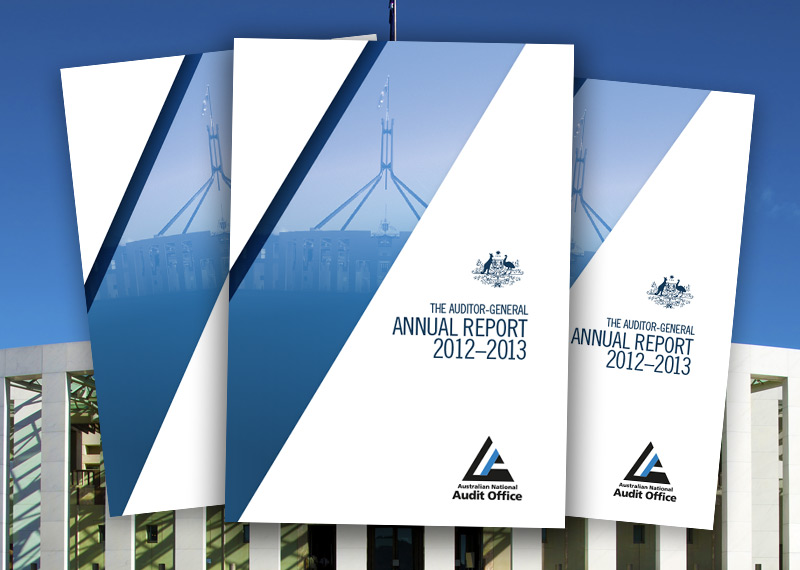
Published: Monday 30 September 2013
Published
This annual report documents the performance of the Australian National Audit Office (ANAO) in the financial year ending on 30 June 2013. It addresses the Requirements for Annual Reports for Departments, Executive Agencies and FMA Act Bodies approved by the Joint Committee of Public Accounts and Audit in June 2013; the performance measures set out in the outcomes and programs framework in the 2012–13 Portfolio Budget Statements; section 28 of the Auditor-General Act 1997; and other annual reporting requirements set out in legislation.
Performance audit (Auditor-General Report No. 2 of 1997–98)
Published: Wednesday 24 September 1997
Published
The audit reviewed the application by the Department of Finance and the portfolio departments of the 1993 Accountability and Ministerial Oversight Arrangements for Government Business Enterprises and any statutory monitoring and reporting requirements applying to the selected GBEs provided under their own establishing legislation. The objectives of the audit were to examine:
- the effectiveness of the GBE monitoring arrangements in providing appropriate performance information to the Government;
- the extent to which agencies and the selected GBEs comply with the monitoring arrangements and legislative requirements; and
- whether the GBE monitoring system provides an effective level of accountability to Ministers and to the Parliament.
Entity
Across Agency
Performance audit (Auditor-General Report No. 22 of 2004–05)
Published: Tuesday 18 January 2005
Published
The objective of the audit was to examine the investment of public funds by selected entities, including: compliance with relevant legislation, delegations and instructions; the value for money of investment strategies; and reporting of investment activities. Six entities were selected for audit, comprising three FMA Act agencies and three Commonwealth authorities. The six entities had aggregrate investments of $1.64 billion as at 30 June 2004 and realised investment earnings of some $80.4 million during 2003/04.
Entity
Across Entities
Performance audit (Auditor-General Report No. 28 of 1996–97)
Published: Thursday 6 March 1997
Published
This follow-up audit examined the actions taken by the Department of Veterans' Affairs to address the ANAO's recommendations made in Audit Report No.28 1993-94 regarding the use of private hospitals on behalf of the Repatriation Commission. The recommendations from that audit were aimed at improving the basis and consistency of contracts with the private sector for the use of private hospitals and providing added assurance that quality care was available to the veteran community.
Entity
Department of Veterans' Affairs
Performance audit (Auditor-General Report No. 15 of 1996–97)
Published: Monday 25 November 1996
Published
The objective of the audit was to assess the efficiency and effectiveness of administrative arrangements for the provision of food to the Australian Defence Force and identify possible areas for improvement. The audit criteria addressed the adequacy of policy guidance, planning, performance information and risk management in all areas of ADF food provisioning.
Entity
Across Agency