Browse our range of reports and publications including performance and financial statement audit reports, assurance review reports, information reports and annual reports.
Take our Insights reader feedback survey
Help shape the future of ANAO Insights by taking our reader feedback survey.
Insights: Audit lessons
Fraud and Corruption Control Arrangements
Published
Thursday 2 April 2026

Contact
Please direct enquiries through our contact page.
Fraud and Corruption Control Arrangements is targeted at Australian Government officials responsible for fraud and corruption control arrangements, and those engaged in program and policy delivery, including in grants administration and regulatory contexts.
Introduction
Fraud and corruption controls are critical to safeguarding the finances, assets, and benefits of Australian Government entities. Protecting resources available for delivering government program and policy objectives supports public trust in government.
As stewards of public funds, services, programs and resources, government officials are required to implement a system of strong fraud and corruption controls to assist them in promptly identifying and addressing misconduct. The controls adopted by each entity should be proportionate to its individual fraud and corruption risk profile, and encompass appropriate prevention, detection, investigation, referral and reporting mechanisms.
Benefits of effective fraud and corruption control arrangements
Early detection and prevention of fraud and corruption
Improved handling of fraud and corruption
Reduced financial and non-financial losses
More secure systems and processes
A stronger culture of integrity
Better ability to provide services, programs and funding to intended recipients
Greater assurance to the Parliament that legislative obligations are being complied with
Increased public confidence in government officials as trusted public stewards
Commonwealth Fraud and Corruption Control Framework 2024
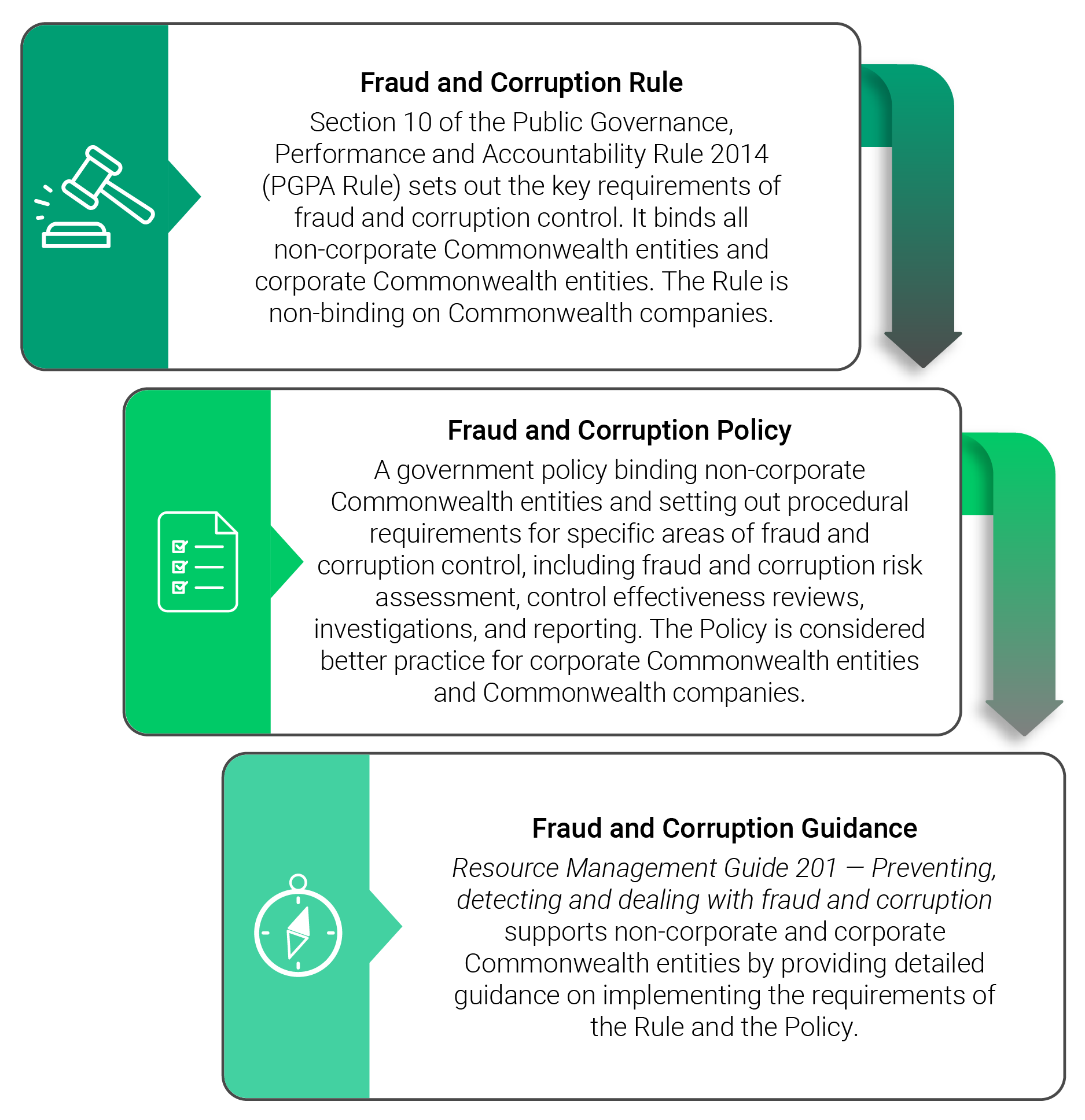
The Commonwealth Fraud and Corruption Control Framework 2024 (2024 Framework) sets out the Australian Government’s control requirements. It supersedes and expands on the Commonwealth Fraud Control Framework 2017 (2017 Framework), capturing amendments to section 10 of the Public Governance, Performance and Accountability Rule 2014 (PGPA Rule). The amendments include the addition of corruption and the types of requirements for Commonwealth entities to prevent, detect and respond to both fraud and corruption.
The 2024 Framework defines fraud as dishonestly obtaining (including attempting to obtain) a gain or benefit, or causing a loss or risk of loss, by deception or other means. Fraud includes ‘internal fraud’, which occurs where fraud against an entity is committed by its officials. It also includes ‘external fraud’, which is committed against a Commonwealth entity by external parties (including members of the public and those not engaged by a Commonwealth entity). In the 2024 Framework, corruption is defined broadly consistently with the National Anti-Corruption Commission Act 2022 (NACC Act) as any conduct that does or could compromise the integrity, accountability, or probity of public administration, and includes:
- any conduct of any person (whether or not a staff member of a Commonwealth agency) that adversely affects, or that could adversely affect, either directly or indirectly:
- the honest or impartial exercise of any staff member’s powers as a staff member of a Commonwealth agency; or
- the honest or impartial performance of any public official’s functions or duties as a public official;
- any conduct of a staff member of a Commonwealth agency that constitutes or involves a breach of public trust;
- any conduct of a staff member of a Commonwealth agency that constitutes, involves or is engaged in for the purpose of abuse of the person’s office;
- any conduct of a staff member of a Commonwealth agency, or former staff member of a Commonwealth agency, that constitutes or involves the misuse of information or documents acquired in the person’s capacity as a staff member of a Commonwealth agency.
Three tiers of the Commonwealth Fraud and Corruption Control Framework 2024
Fraud and corruption across the public sector
International estimates are that 3% to 5.95% of government expenditure worldwide could be lost to fraud and error. Non-financial losses are also incurred. Because fraud and corruption are difficult to detect and quantify, the scale and cost to the Australian Government and society is often underestimated.
Australian Institute of Criminology statistics on fraud
The Australian Institute of Criminology (AIC) conducts an annual census on fraud against the Commonwealth to assist the Australian Government in managing the risk of fraud. The findings of the 2023–24 census (published in July 2025) included:
- most responding Australian Government entities reported themselves to be fully compliant with the Fraud Rule;
- there were 288,808 allegations of fraud, of which 95% related to external fraud; and
- 32% of the responding entities had not tested the effectiveness of their fraud controls within the last two years.
The principal targets of substantiated internal fraud were program information, program payments and corporate funds. The principal target of substantiated external fraud was program payments.
National Anti-Corruption Commission statistics on corruption
In 2024, the NACC conducted the inaugural Commonwealth Integrity Survey, which received 58,309 survey responses from across 171 Commonwealth public sector agencies. Some significant findings were that 96% of employees were confident in their ability to identify corruption within their area of responsibility, and 79% of respondents had faith in the integrity of their agency.
The main domains in which the NACC is seeing both the perception and the actuality of corrupt conduct are procurement and recruitment, promotion and entitlements.
The predominant mechanisms of corruption are nepotism and cronyism (the preferring of family, friends and associates), and the misuse of official information to gain an advantage. Further, much of what the NACC sees occurs at the interface of the public and private sectors.
ANAO audit findings on fraud and corruption
In 2024–25, the Auditor-General presented four performance audit reports to the Parliament that examined the effectiveness of fraud and corruption control arrangements in four Australian Government entities. The first three reports focused on fraud control arrangements in 2022–23 and 2023–24, including compliance with the 2017 Framework and readiness to implement the 2024 Framework (which came into effect on 1 July 2024). The final report included examining compliance with the 2024 Framework.
- Auditor-General Report No. 7 of 2024–25 Fraud Control Arrangements in the Department of Health and Aged Care;
- Auditor-General Report No. 9 of 2024–25 Fraud Control Arrangements in the National Health and Medical Research Council;
- Auditor-General Report No. 10 of 2024–25 Fraud Control Arrangements in the Australian Skills Quality Authority; and
- Auditor-General Report No. 45 of 2024–25 Fraud and Corruption Control Arrangements in Creative Australia.
The four reports made 20 recommendations. Most of these recommendations related to revising fraud policies and plans (20%), testing the effectiveness of fraud controls (20%), improving capability (15%), and conducting fraud risk assessments (15%).
The ANAO audits the annual financial statements of Australian Government entities to provide independent assurance to the Parliament that the statements are reliable, having been prepared in accordance with Public Governance, Performance and Accountability Act 2013 (PGPA Act). Fraud and corruption arrangements were examined in Audits of the Financial Statements of Australian Government Entities for the Period Ended 30 June 2025. The report indicated that Commonwealth entities were largely compliant with the 2024 Framework and that they would benefit from establishing formal referral processes to the NACC.
Audit lessons
Set out below are seven lessons aimed at improving prevention, detection and correction of fraud and corruption in Australian Government entities, based on insights drawn from recent ANAO audits.
1
Link risk assessment outcomes to controls
2
Address fraud and corruption in controls
3
Address internal and external fraud in controls
4
Establish a roadmap for suspected fraud and corruption
5
Ensure responsible officials are appropriately qualified
6
Regularly test the effectiveness of controls
7
Capture good data and quantify losses
The further reading section provides links to relevant resources from the ANAO, AIC, Attorney-General’s Department (Commonwealth Fraud Prevention Centre), Department of Finance, NACC and additional Insights products.
1
Lesson 1: Link risk assessment outcomes to controls
Link risk assessment outcomes to controls
Fraud and corruption risk assessments enable entities to focus on areas of priority in managing fraud and corruption risk. They assist entities in determining necessary risk treatments and are necessary in a fraud and corruption plan. By linking the outcomes of risk assessments to fraud and corruption control plans, entities can check if their controls are up-to-date and fit for mitigating the identified risks and revise their plans accordingly. Entities should reassess their fraud and corruption risks regularly, including when there is a substantial change in the structure, functions or activities of the entity or the external environment.
Questions for consideration
Does our entity link risk assessment outcomes to controls?
- Does our entity assess both fraud and corruption as part of enterprise-level risk assessments and program-level risk assessments?
- Does our entity undertake fraud and corruption risk assessments when there is a substantial change in the structure, functions, or activities of the entity?
- Does our entity have established feedback loops to enable fraud and corruption risk assessments to inform the development and revision of controls?
- Does our entity build risk assessment outcomes into fraud and corruption plans and controls?
- Has our entity referred to the Commonwealth Fraud Prevention Centre’s Information Sheet - Element 1: Fraud and corruption risk assessments and Information Sheet - Element 2: Fraud and corruption control plans?
The Commonwealth Fraud Prevention Centre notes that entities should establish feedback loops to inform fraud and corruption risk assessments. Building risk assessment outcomes into fraud and corruption control plans creates a meaningful feedback mechanism. It avoids a passive ‘review, treat and forget’ approach that leaves the entity still vulnerable to risk.
Entities should seek to specifically assess fraud and corruption as an important component of enterprise risk assessments and program risk assessments. For more information and guidance on fraud and corruption risk assessments and control plans, see the Commonwealth Fraud Prevention Centre’s Information Sheet - Element 1: Fraud and corruption risk assessments and Information Sheet - Element 2: Fraud and corruption control plans.
Case study
Creative Australia is the Australian Government’s investment, development and advisory body for arts and culture. The ANAO found that Creative Australia’s Fraud and Corruption Control Plan was not updated to include existing fraud and corruption risks informed by risk assessments, and controls that align with assessed fraud and corruption risks.
2
Lesson 2: Address fraud and corruption in controls
Address fraud and corruption in controls
From 1 July 2024, entities have been required to address both fraud and corruption in their control arrangements. Entities should ensure frameworks, policies, plans and controls have been meaningfully revised to prevent, detect and deal with corrupt conduct.
Questions for consideration
Does our entity address both fraud and corruption in controls?
- Does our entity refer to the following resources in developing and updating fraud and corruption control arrangements?
- Does our entity thoughtfully consider the impacts of corruption (in addition to fraud) in the context of our business, including what actions staff will take to prevent, detect and deal with specific corruption risks?
- Does our entity have a fraud and corruption control plan that:
- considers how corruption could be addressed in relevant internal policies, rules, training, communications and other relevant artefacts?
- is documented and implemented to address fraud and corruption risks?
- is periodically reviewed and monitored to ensure it remains relevant and proportionate to identified risks?
- Does our entity have governance structures and processes in place to effectively oversee and manage fraud and corruption risks?
- Does our entity have officials who are responsible for managing fraud and corruption risks?
- Does our entity keep records identifying the required governance structures, processes and officials?
- Has our entity referred to the Commonwealth Fraud Prevention Centre’s Information Sheet - Element 4: Governance and oversight?
In alignment with the Fraud and Corruption Rule, corruption was added to the Fraud and Corruption Policy (formerly the Fraud Policy). The policy requires entities to have fraud and corruption control plans that are documented and implemented to address fraud and corruption risks and are periodically reviewed and monitored to ensure the plans remain relevant and proportionate to identified fraud and corruption risks. Additionally, entities should:
- have governance structures and processes in place to effectively oversee and manage fraud and corruption risks;
- identify officials who are responsible for managing fraud and corruption risks; and
- keep records identifying those structures, processes and officials, and keep the records up to date.
When the 2024 Framework was introduced, entities needed to consider how corruption could be addressed in their internal policies, risk assessments (including at the enterprise level), accountable authority instructions, finance business rules, mandatory training modules, intranet content, and other artefacts. Resources that entities may refer to include the:
- Fraud and Corruption Control Capability Self-Assessment Tool — this tool and related questionnaire help officials self-assess their organisational capability to manage corruption and fraud risks.
- Guide to incorporating corruption control into risk management frameworks — this guide provides practical strategies for overseeing and managing corruption risks in a consistent and coordinated manner.
- Commonwealth Integrity Maturity Framework — provides information to support entities to design, implement and review the effectiveness of their integrity frameworks so that they are tailored to the entity’s risk profile, size and context. The Framework is a set of eight Integrity Principles, each accompanied by a four-level maturity scale that allows entities to undertake a self-assessment of their integrity maturity.
Updating plans and related documentation to include the word ‘corruption’ is not sufficient. Entities should thoughtfully consider the impacts of the addition of corruption in the context of their entity’s business, including what actions staff will take to prevent, detect and deal with specific corruption risks, as well as fraud. Although some circumstances will constitute both fraud and corruption, particularly in the context of internal fraud, not all fraud is corrupt conduct, and not all corrupt conduct is fraud.
For more information about governance structures and processes entities should put in place to oversee and manage fraud and corruption risks, see the Commonwealth Fraud Prevention Centre’s Information Sheet - Element 4: Governance and oversight.
Case study
Case study 2. National Health and Medical Research Council’s introduction of corruption control into frameworks
The National Health and Medical Research Council (NHMRC) is a non-corporate Commonwealth entity that provides assistance for public health and medical research and training, primarily through grant programs. While the ANAO was auditing the NHMRC’s fraud control arrangements, the Framework commenced on 1 July 2024. Accordingly, the ANAO examined the NHMRC’s preparedness for the commencement of the revised Commonwealth Fraud and Corruption Policy, rather than complete implementation of the Policy.
- a definition of corruption that aligned with the meaning of corrupt conduct set out in section 8 of the National Anti-Corruption Commission Act 2022;
- reporting and referral obligations to the National Anti-Corruption Commission;
- corruption and control responsibilities of the Fraud and Corruption Control Officer; and
- details of corruption incidents to its Fraud Incident Report and Fraud Register.
- periodic review of the effectiveness of its fraud and corruption controls;
- review of its fraud and corruption risks at the enterprise level every two years;
- implementing appropriate arrangements to respond to suspected fraud or corruption incidents, including response plans; and
- requirements to have governance structures and processes to effectively oversee and manage risks of fraud and corruption and officials responsible for managing these risks.
3
Lesson 3: Address internal and external fraud in controls
Address internal and external fraud in controls
The 2024 Framework distinguishes between internal and external fraud. By applying the same categorisation to fraud planning and management, entities can better capture the full scope of its fraud risks.
Questions for consideration
Does our entity address both internal and external fraud controls, and corruption controls?
- Does our entity identify and include external fraud matters, in addition to internal matters, in entity fraud and corruption control plans and relevant policies?
- Do our entity’s fraud and corruption control plans and relevant policies cover the full extent of our functions?
- Does our entity assign an external fraud risk owner who reports on management of external fraud risks to the Audit and Risk Committee?
- Does our entity select at-risk program areas or business lines each quarter (or other suitable timeframe) to self-assess compliance with obligations to manage external fraud?
- Does our entity have an established system for receiving fraud referrals and tip-offs on our website (including from the public and other entities)?
- Does our entity require staff to categorise and record fraud matters as internal or external in registers and case management systems?
- Does our entity mandate the reporting of all suspected external fraud (including incidents associated with grant recipients)?
- For entities responsible for grants administration: Has our entity referred to the Commonwealth Fraud Prevention Centre’s Grants Administration Counter Fraud Toolkit?
- Has our entity referred to the Commonwealth Fraud Prevention Centre’s Controlling Fraud and Corruption Risk Leading Practice Guide and Information Sheet - Element 5: Preventing fraud and corruption?
ANAO audits have identified that some entities may focus on internal fraud in their planning, with minimal consideration of external fraud. External fraud can be committed by taxpayers, recipients of government services, service providers, grant recipients, other members of the public or organised criminal groups. This leaves entities vulnerable to risks that could have been mitigated.
External fraud matters may be addressed by:
- identifying and including external fraud matters, in addition to internal matters, in entity fraud and corruption control plans and relevant policies;
- assigning an external fraud risk owner who is responsible for reporting to the entity’s audit and risk committee on the entity’s management of its external fraud risks;
- selecting at-risk program areas or business lines each quarter (or other suitable timeframe) to self-assess compliance with obligations to manage external fraud;
- setting up a system for receiving fraud referrals and tip-offs on the entity’s website (including from the public and other entities);
- requiring staff to categorise and record fraud matters as internal or external in registers and case management systems; and
- mandating the reporting of all suspected external fraud to the entity (including incidents associated with grant recipients).
Further related resources are available through the Commonwealth Fraud Prevention Centre, including the Centre’s Grants Administration Counter Fraud Toolkit and Controlling Fraud and Corruption Risk Leading Practice Guide. There are also further resources available to help entities prevent fraud and corruption risks associated with contractors, consultants and third-party service providers in the Centre’s Information Sheet - Element 5: Preventing fraud and corruption.
Case study
The ANAO observed that in the Department of Health, Disability and Ageing, external fraud was considered alongside internal fraud in fraud and corruption control arrangements.
4
Lesson 4: Establish a roadmap for suspected fraud and corruption
Establish a roadmap for suspected fraud and corruption
Entities may effectively manage fraud and corruption matters by providing staff with a clear roadmap of formal processes that must be followed when suspected instances of fraud and corruption are encountered. The roadmap should cover detection, assessment, any investigations undertaken, and reporting.
Questions for consideration
Does our entity have an established roadmap for handling suspected fraud and corruption?
- Does our entity roadmap consider the requirements of the Commonwealth Fraud and Corruption Control Framework 2024 and the 8 integrity principles of the Commonwealth Integrity Framework?
- Does our entity roadmap include:
- clearly set out formal processes that staff must follow when suspected instances of fraud and corruption are encountered?
- detection, assessment, any investigations undertaken, and reporting?
- guidance for staff on decision-making (including ensuring suspected fraud and corruption issues are appropriately addressed, instead of regarded as non-compliance), documenting decisions made and compliance with legal advice?
- information that is fit for purpose, considering our unique operating environment, with sufficient resourcing considered for pursuing investigations?
- information that is consistent with whole of government guidance, including the Australian Government Investigations Standard?
- Does our entity roadmap set out when and where to refer and report suspected fraud and corruption, including:
- for mandatory referrals of serious or systemic corrupt conduct by agency heads and public interest disclosure officers to the NACC;
- to the entity’s minister for significant fraud and corruption matters (and to the Minister for Finance for significant non-compliance with finance law); and
- regular updates to responsible governance committees (including audit and risk committees), senior executives and relevant business areas?
- Has our entity referred to the Commonwealth Fraud Prevention Centre’s Information Sheet - Element 7: Investigation and other responses?
In developing a roadmap for appropriate handling of suspected fraud and corruption, entities may refer to the eight policy elements of the 2024 Framework. Entities may also give consideration to the eight integrity principles of the Commonwealth Integrity Maturity Framework and undertake a self-assessment. The roadmap should guide staff on decision-making (including ensuring suspected fraud and corruption issues are appropriately handled, instead of regarded as non-compliance), documenting decisions made and compliance with legal advice. Further, the roadmap should be fit for purpose, considering the entity’s unique operating environment, with sufficient resourcing considered for pursuing investigations. The roadmap must be consistent with whole of government guidance, including the Australian Government Investigations Standard.
The roadmap should set out when and where to refer and report suspected fraud and corruption. Referrals and reporting are integral to establishing investigative pathways and strengthening trust and transparency that fraud and corruption are being identified and handled appropriately. Alleged fraud or corruption should be reported to the appropriate authority.
- Under the Fraud and Corruption Policy, non-corporate Commonwealth entities must report potential serious or complex fraud to the Australian Federal Police.
- Under the NACC Act, agency heads and public interest disclosure officers of Commonwealth agencies and Intelligence agencies have mandatory obligations to refer suspected serious or systemic corrupt conduct to the NACC. The National Anti-Corruption Commissioner has issued guidance on what constitutes serious or systemic corrupt conduct.
- With the exception of matters that are accepted for investigation by the Australian Federal Police or the NACC, an entity is responsible for investigating or responding to suspected instances of fraud and corruption relating to the entity. Entities may outsource these investigations. For more information on conducting government investigations, see the Australian Government Investigations Standard.
- Fraud and corruption matters that the accountable authority considers to be significant must be reported to an entity’s minister in accordance with section 19 of the PGPA Act. Subject to any non-disclosure obligations, matters concerning significant non-compliance with finance law reported to an entity’s minister are required to be reported to the Minister for Finance (for more information and guidance, see RMG 214 – Notification of significant non-compliance with the finance law and see section 19 of the PGPA Act for exceptions to reporting requirements). Further, entities should regularly update responsible governance committees (including audit and risk committees), senior executives and relevant business areas.
Further guidance on managing suspected fraud and corruption incidents and mandatory reporting and referrals is available in the Commonwealth Fraud Prevention Centre’s Information Sheet - Element 7: Investigation and other responses.
Case study
Case study 4. Documented procedures for handling suspected fraud in the Department of Health, Disability and Ageing
The ANAO examined the Department of Health, Disability and Ageing’s documented procedures for fraud incidents.
5
Lesson 5: Ensure responsible officials are appropriately qualified
Ensure responsible officials are appropriately qualified
A requirement of the Fraud and Corruption Policy is that entities have officials who are responsible for managing fraud and corruption risks. Officials who are primarily engaged in fraud and corruption control activities should:
- receive relevant training (and obtain professional qualifications if involved in investigations);
- engage in ongoing professional development to further develop and update their expertise and skills; and
- refresh their knowledge and skills at least every three years.
Questions for consideration
Does our entity have officials who are appropriately qualified to manage fraud and corruption risks?
- Does our entity have officials who are primarily engaged in fraud and corruption control activities?
- Do our entity’s responsible officials:
- receive relevant training and obtain professional qualifications?
- engage in ongoing professional development?
- refresh their knowledge and skills at least every three years?
- Has our entity referred to training and qualification information available on the Commonwealth Fraud Prevention Centre’s website, including information about their Counter Fraud Practitioner Training Program?
Officials newly appointed to a role that involves primarily engaging in fraud and corruption control activities should receive training as soon as practicable. Until then, they must be supervised appropriately, ideally by a staff member who has undergone fraud and corruption control training themselves.
Key outcomes of training and qualifications include:
- understanding the fraud and corruption landscape and the wider context, including relevant legislation;
- understanding different types of fraud and corruption, as well as causes and motivators;
- recognising opportunities to develop controls, policies or processes to mitigate the probability, frequency, duration and impacts of fraud and corruption; and
- collaborating with others to design, implement and review controls.
The 2022 Australian Government Investigations Standard requires officials who investigate fraud and corruption to obtain a vocational and educational training qualification or equivalent. Australian recognised qualifications are:
- Certificate IV in Government Investigations (foundational — prerequisite for supervisory qualifications);
- Diploma of Government Investigations (supervisory); or
- Advanced Diploma of Government Investigations (extension supervisory).
More information on training and qualifications is available on the Commonwealth Fraud Prevention Centre’s website, including information about their Counter Fraud Practitioner Training Program.
Case study
Case study 5. Training and qualifications of officials with fraud and corruption responsibilities in NHMRC
NHMRC had officials who were responsible for fraud and corruption control activities. However, it was largely not compliant with the Fraud Rule, Guidance and Policy in relation to training and qualifications for officials with fraud control responsibilities.
6
Lesson 6: Regularly test the effectiveness of controls
Regularly test the effectiveness of controls
Controls can be processes, policies, devices, practices or other actions that regulate or modify the likelihood or consequence of risks. Consistent with Element 5 of the Commonwealth Risk Management Policy, the 2024 Framework requires that entities periodically review the effectiveness of their fraud and corruption controls through testing. Strong controls provide greater assurance that risks are being managed effectively.
Questions for consideration
Does our entity regularly test the effectiveness of fraud and corruption controls?
- Does our entity refer to the following controls testing resources?
- Does our entity periodically review its controls, prioritising review of those related to the entity’s highest risk activities, functions and programs?
- When selecting which controls to test, does our entity consider:
- the critical nature of the control;
- the risk appetite and tolerance of an entity; and
- recent changes to the internal or external operating environment of an entity?
- As a result of a review, does our entity update its fraud and corruption risk assessments, and include any risk treatments in fraud and corruption control plans?
- Does our entity:
- review the effectiveness of reporting mechanisms for non-compliance?
- monitor non-compliance trends to feed into risk assessments and controls?
- Has our entity referred to RMG 211 – Implementing the Commonwealth Risk Management Policy – Element 5: Control Effectiveness and the Commonwealth Fraud Prevention Centre’s Information Sheet - Element 3: Reviewing control effectiveness?
Testing the effectiveness of controls is a new requirement of the 2024 Framework (it was a suggestion only in the 2017 Framework). Entities should conduct periodic reviews of controls and may prioritise reviewing controls related to the entity’s highest risk activities, functions and programs. When selecting which controls to test, entities may consider:
- the critical nature of the control;
- the risk appetite and tolerance of the entity; and
- recent changes to the internal or external operating environment of the entity.
As a result of a review, fraud and corruption risk assessments should be updated as needed. Additionally, any risk treatments that the entity decides to apply must be included in their fraud and corruption control plans. For more information and guidance on effective controls testing, see RMG 211 – Implementing the Commonwealth Risk Management Policy – Element 5: Control Effectiveness and the Commonwealth Fraud Prevention Centre’s Information Sheet - Element 3: Reviewing control effectiveness.
For support in testing the effectiveness of fraud and corruption controls, entities may refer to the following resources published by the Attorney-General’s Department:
- International Public Sector Fraud Forum Fraud Control Testing Framework;
- How to Start Fraud Control Testing Guide; and
- Handbook of Fraud Control Testing Methods.
Controls testing has the additional benefit of raising staff awareness of fraud and corruption, which contributes to a culture of integrity.
Case study
The ANAO found that:
Case study
Case study 7. Fraud and corruption controls testing in the Department of Health, Disability and Ageing
Prior to July 2024:
From July 2024:
- assigned responsibility for control testing to the Fraud and Integrity Branch;
- outlined a high-level end-to-end testing process that was consistent with an international standard (Targeted Control Assessments — Procedural Guide FCTF-02); and
- set out eight types of control tests (desktop reviews; interviews, workshops or surveys; system or process walkthroughs; case studies; sample testing; data analytics; technical testing; and active controls testing).
7
Lesson 7: Capture good data and quantify losses
Capture good data and quantify losses
Entities that can capture good data on fraud and corruption are well-positioned to respond and act appropriately. As such, fraud and corruption registers and case management systems should be designed to capture fraud and corruption data which can inform planning and mitigation for the future. Effective use of these tools requires establishing a clear process for capturing any possible fraud and corruption matters and ensuring that those matters are directed to the responsible officials.
Where possible, fraud and corruption losses should be quantified to support the accountable authority’s assessment of whether the entity’s prioritisation of fraud and corruption risks is appropriate, the control framework is robust, and resourcing for implementation of controls is proportionate to risk.
Losses incurred due to fraud and corrupt activity go beyond the direct financial loss. Understanding the non-financial elements of fraud and corruption can lead to a better risk assessment and internal control measures.
Questions for consideration
Does our entity capture good data on fraud and corruption and quantify losses?
- Does our entity have registers and case management systems that:
- are based on risk assessments?
- are designed to capture required fraud and corruption data?
- are sufficiently aligned to accountabilities?
- support categorisation of instances of potential fraud and corruption by program and/or division, including procedures to require staff to do this?
- Does our entity train staff in recording and reporting suspected fraud and corruption?
- Does our entity quantify fraud and corruption losses to inform prioritisation of fraud and corruption risks, the control framework, and secure sufficient resourcing for implementation of controls that is proportionate to risk?
- Does our entity require or encourage those recording fraud and corruption matters in case management systems to estimate losses, including non-financial losses?
- Does our entity’s case management system have data fields for the estimated amount of potential loss for each incident?
- Does our entity provide staff with guidance on estimating potential cost, such as multiplying the likelihood of a risk occurring with the estimated cost of impacts (e.g., direct losses, investigation costs, and remediation)?
- Does our entity report estimated losses/recoveries to relevant governance committees in the AIC’s fraud and corruption census?
- Has our entity referred to the International Public Sector Fraud Forum Fraud Loss Measurement Framework for further guidance on estimating the costs of fraud and error?
- Has our entity referred to the International Public Sector Fraud Forum’s Guide to Understanding the Total Impact of Fraud?
- Does our entity promote employee participation in the annual APS Employee Census and the biennial Commonwealth Integrity Survey?
Fraud and corruption control plans should state what registers and case management systems the entity will use to capture potential fraud and corruption. Risks identified through fraud and corruption risk assessments form the basis for ensuring that selected registers and case management systems are sufficiently aligned to accountabilities. This supports entities in recording and addressing all instances of suspected fraud and corruption. Mechanisms to support this may include:
- having registers and case management systems that enable categorisation of instances of potential fraud and corruption by program and/or division;
- documenting procedures that require staff to link potential fraud and corruption matters with programs and/or divisions; and
- training staff in recording and reporting suspected fraud and corruption.
Further guidance on how to record and report suspected fraud and corruption can be found in the Commonwealth Fraud Prevention Centre’s Information Sheet - Element 8: Recording and reporting fraud and corruption.
Case study
The ANAO assessed the department’s fraud control arrangements for the Indigenous Australians’ Health Programme, which funds initiatives to increase access to health care and improve the health of Aboriginal and Torres Strait Islander people. It represents the Australian Government’s largest direct expenditure on Indigenous primary healthcare. The program administers grants through the Community Grants Hub, which is managed by the Department of Social Services. Weaknesses were observed in the department’s handling of potential fraud matters:
Practical steps entities can take to quantify estimated fraud and corruption losses include:
- ensure that case management systems have data fields for the estimated amount of potential loss for each matter;
- require or encourage those recording fraud and corruption matters in case management systems to estimate losses, including non-financial losses;
- provide staff with guidance on estimating potential cost, such as multiplying the likelihood of a risk occurring with the estimated cost of impacts (e.g., direct losses, investigation costs, and remediation); and
- report estimated losses and recoveries to relevant governance committees and in the AIC’s fraud and corruption census.
The International Public Sector Fraud Forum Fraud Loss Measurement Framework provides entities with further guidance on estimating the costs of fraud and error.
Further information about the non-financial impacts of fraud and corruption is available in the International Public Sector Fraud Forum’s Guide to Understanding the Total Impact of Fraud.
Case study
The ANAO found that:
Collection of good data on corruption is enhanced by participation in public sector-wide surveys, such as the annual APS Employee Census and the biennial Commonwealth Integrity Survey. The Commonwealth Integrity Survey helps the NACC to understand and measure observations and trends relating to integrity and corruption within agencies and across a diverse workforce. The NACC and agencies can use survey data to identify potential areas of corruption risk and inform anti-corruption strategies and corruption prevention and education initiatives. This helps better protect individuals and agencies from corruption.
Further reading
ANAO links
- Audit Committee Chairs Forum — Friday 6 December 2024 | Australian National Audit Office (ANAO)
- Audits of the Financial Statements of Australian Government Entities for the Period Ended 30 June 2024 | Australian National Audit Office (ANAO)
- Fraud Control Arrangements in the Australian Skills Quality Authority | Australian National Audit Office (ANAO)
- Fraud and Corruption Control Arrangements in Creative Australia | Australian National Audit Office (ANAO)
- Fraud Control Arrangements in the Department of Health and Aged Care | Australian National Audit Office (ANAO)
- Fraud Control Arrangements in the National Health and Medical Research Council | Australian National Audit Office (ANAO)
- Interim Report on Key Financial Controls of Major Entities | Australian National Audit Office (ANAO)
External links
Australian Institute of Criminology
- Community perceptions of corruption by public officials | Australian Institute of Criminology
- Fraud and its relationship to pandemics and economic crises: From Spanish flu to COVID-19 | Australian Institute of Criminology
- Understanding and responding to serious and organised crime involvement in public sector corruption | Australian Institute of Criminology
Attorney-General’s Department — Commonwealth Fraud Prevention Centre
- Commonwealth Fraud and Corruption Control Framework 2024 | Commonwealth Fraud Prevention Centre
- Understand the framework | Commonwealth Fraud Prevention Centre
- Information Sheet Element 1 – Fraud and Corruption Risk Assessments | Commonwealth Fraud Prevention Centre
- Information Sheet Element 2 – Fraud and Corruption Control Plans | Commonwealth Fraud Prevention Centre
- Information Sheet Element 3 – Reviewing control effectiveness | Commonwealth Fraud Prevention Centre
- Information Sheet Element 4 – Governance and oversight | Commonwealth Fraud Prevention Centre
- Information Sheet Element 5 – Preventing fraud and corruption | Commonwealth Fraud Prevention Centre
- Information Sheet Element 6 – Detecting fraud and corruption | Commonwealth Fraud Prevention Centre
- Information Sheet Element 7 – Investigation and other responses | Commonwealth Fraud Prevention Centre
- Information Sheet Element 8 – Recording and reporting fraud and corruption | Commonwealth Fraud Prevention Centre
- Fraud and Corruption Capability Self Assessment Tool | Commonwealth Fraud Prevention Centre
- Control fraud and corruption risk | Commonwealth Fraud Prevention Centre
- Guide to incorporating corruption control into risk management frameworks | Commonwealth Fraud Prevention Centre
- Grants Administration Counter Fraud Toolkit | Commonwealth Fraud Prevention Centre
- IPSFF Fraud Loss Measurement Framework | Commonwealth Fraud Prevention Centre
- Prevent fraud and corruption in grants administration | Commonwealth Fraud Prevention Centre
Department of Finance
- RMG 211 – Implementing the Commonwealth Risk Management Policy - Element 5: Control Effectiveness | Department of Finance
- Notification of significant non-compliance with the finance law (RMG 214) | Department of Finance
National Anti-Corruption Commission
- The National Anti-Corruption Commission | National Anti-Corruption Commission (NACC)
- National Anti-Corruption Commission Act 2022 - Federal Register of Legislation
- Commonwealth Integrity Maturity Framework | National Anti-Corruption Commission (NACC)
- Report corrupt conduct | National Anti-Corruption Commission (NACC)
- What is corrupt conduct | National Anti-Corruption Commission (NACC)
- What is serious or systemic corrupt conduct? | National Anti-Corruption Commission (NACC)
- Mandatory referrals | National Anti-Corruption Commission (NACC)
Other
- Australian Government Investigations Standard | Australian Federal Police
- International Public Sector Fraud Forum guidance - Fraud Loss Measurement Framework - GOV.UK
- PSPF Annual Release | Protective Security Policy Framework
- Public Governance, Performance and Accountability Rule 2014 - Federal Register of Legislation