Browse our range of reports and publications including performance and financial statement audit reports, assurance review reports, information reports and annual reports.
Auditor-General Report No. 20 of 2025–26
Administration of the Age Pension
Published
Tuesday 27 January 2026

Portfolio
Services Australia; Social Services
Entity
Services Australia; Department of Social Services
Contact
Please direct enquiries through our contact page.
Activity
Service delivery
Sector
Ageing
Social Services
Audit snapshot
Why did we do this audit?
- The age pension is the government’s means tested income support for eligible seniors.
- It is a significant component of Australian Government expenditure, comprising 8.4 per cent of the Federal budget and 42.5 per cent of social security payments in 2024–25.
- This audit provides assurance to Parliament on the Department of Social Services’ (DSS) and Services Australia’s administration of the age pension.
Key facts
- Between July 2021 and June 2024, estimated age pension payment inaccuracy was $5 billion. This includes $1.33 billion in underpayments to seniors eligible for higher benefits and $3.67 billion in overpayments.
- For the same period, the timeliness performance target (at least 80 per cent of claims are completely assessed within 49 days) was not met.
What did we find?
- DSS’ oversight of the age pension is partly effective.
- Services Australia’s processes to assess and review applicants’ and recipients’ age pension eligibility are partly effective.
- Services Australia does not fully use the information it has to improve its engagement with seniors.
What did we recommend?
- There were four recommendations to DSS on effective oversight and reporting on program effectiveness, six recommendations to Services Australia including on enhanced claims verification and compliance activities, and one to the Department of Veterans' Affairs (DVA) on program implementation.
- Services Australia and DVA agreed to all recommendations. DSS agreed to three and agreed in principle to one recommendation.
2.67 million
seniors receive the age pension (June 2025).
66.41%
of recipients receive the full age pension payment rate (June 2025).
$62.2 billion
age pension outlay for 2024‒25 (8.4 per cent of the Federal budget).
Summary and recommendations
Background
1. Introduced in 1909, the age pension is a means tested income support for eligible seniors. In 2024–25, age pension expenditure was $62.2 billion. It was the second largest Australian Government program expenditure (8.4 per cent of the Federal budget)1 and the biggest component of social security payments (42.5 per cent).2
2. There were 2.67 million age pension recipients as at June 2025. An applicant must meet the following requirements to receive the age pension:
- age: at least 67 years for people born on or after 1 January 19573;
- residence: must be, and have been an Australian resident4 for at least 10 years, five of which are continuous; and
- means test: the applicant’s and their partner’s assets and income are within legislated thresholds.
3. Services Australia administers the age pension program on behalf of the Department of Social Services (DSS) under an appropriated partnership arrangement. Services Australia receives departmental appropriation5 from government to deliver programs and services, including the age pension. DSS receives special appropriations for social security payments, including for the fortnightly age pension payments, and retains policy responsibility for program outcomes.
4. The Department of Veterans’ Affairs (DVA) has a purchaser-provider arrangement with DSS to administer the age pension. Under this arrangement, DSS pays DVA to deliver the program within agreed expectations and service levels. As at June 2024, DVA delivered the age pension to 3,818 veterans and their partners.
Rationale for undertaking the audit
5. The age pension is a significant component of Australian Government expenditure. In 2024–25, program outlay comprised 8.4 per cent of the Federal budget and 42.5 per cent of social security payments. DSS estimated that in 2023–24, $1.79 billion in age pension payments were incorrectly provided to recipients as underpayments ($0.44 billion) and overpayments ($1.35 billion). This audit was conducted to provide assurance to the Parliament on DSS’ and Services Australia’s administration of the age pension.
Audit objective and criteria
6. The audit objective was to assess the effectiveness of the Department of Social Services’ and Services Australia’s administration of the age pension.
7. To form a conclusion against the objective, the ANAO adopted the following high-level criteria.
- Does the Department of Social Services have effective oversight of the age pension?
- Does Services Australia have effective processes for assessing eligibility of age pension applicants and recipients?
- Does Services Australia effectively communicate and manage its engagement with age pension applicants and recipients?
Conclusion
8. The administration of the age pension is partly effective. Effectiveness could be improved by tightening processes to verify recipients’ eligibility and pension rates, simplifying and expediting access for applicants and recipients, and reporting on program effectiveness. Between 2021–22 and 2023–24, process deficiencies led to an estimated $5 billion in incorrect payments, including $1.33 billion (26.6 per cent) in underpayments to recipients eligible for higher benefits and $3.67 billion (73.4 per cent) in overpayments. For the same period, complex procedures and limited staffing resulted in seniors waiting an average of 48 days for claims to be processed. Maximum wait times for phone calls to be answered exceeded one hour in 435 days or 57.3 per cent of total days during the period.
9. DSS’ oversight of the age pension program is partly effective. DSS oversees program delivery and has ensured ongoing fortnightly income support to seniors. It has not promptly addressed issues to ensure that performance standards are met, IT systems supporting Services Australia’s claims assessment operate as intended, and DVA is set up to administer the program consistent with legislation. DSS evaluates and reports on age pension payment accuracy and the proportion of senior Australians receiving income support. DSS does not evaluate the program’s impact as required by the Social Security (Administration) Act 1999.
10. Services Australia’s claims assessment processes are partly effective. Gaps in Services Australia’s verification of assets and income, compliance activities and risks associated with the use of IT systems to assess claims limit Services Australia’s ability to correctly assess and confirm applicants’ and recipients’ age pension eligibility and payment rate.
11. Services Australia’s communication and engagement with age pension applicants and recipients is partly effective. Services Australia engages with seniors through a variety of channels (face to face, telephony and digital) and collects information on the quality of its engagement. Services Australia has not fully used the information it collects to address the needs of seniors for simpler claims processes, support with digital technology and shorter wait times for claims to be completed and phone calls to be answered.
Supporting findings
The Department of Social Services’ oversight of the age pension
12. DSS has not made full use of oversight arrangements to ensure that performance standards are met and issues that impact service delivery are promptly managed. (See paragraphs 2.5 to 2.58)
13. DSS has not reviewed the 2013 Memorandum of Understanding — which governs DVA’s administration of the age pension to veterans and their partners — since its execution. DSS’ oversight has not ensured that performance meets agreed standards and DVA is set up to administer the age pension consistent with legislation. (See paragraphs 2.59 to 2.72)
14. DSS evaluates the accuracy of age pension payments and the proportion of senior Australians supported in their retirement through the age pension or other income support. DSS does not evaluate program impact on recipients as required by the Social Security (Administration Act) 1999. (See paragraphs 2.79 to 2.99)
15. DSS advises government, including on age pension coverage, payment accuracy, proposed age pension policy and their potential impact such as equity across cohorts. DSS’ advice currently does not include information on program impact on recipients. (See paragraphs 2.100 to 2.103)
Services Australia’s age pension eligibility assessments
16. Services Australia has processes to assess applicants’ age pension eligibility and applicable payment rate. Services Australia relies primarily on assets and income information declared by applicants and does not make full use of available data sources to verify this information. The calculation of fortnightly pension rates is automated through Services Australia’s Income Security Integrated System (ISIS). Services Australia is yet to fully assess the risks associated with its reliance on ISIS automations, including system reliability and service officers’ limited training on manual calculations. ( See paragraphs 3.2 to 3.30)
17. When informed of changes to recipients’ circumstances, Services Australia updates their records to reassess continued eligibility and payment rates. Services Australia has not been able to update recipients’ records in a timely manner. Services Australia has processes to review recipients’ circumstances, including through data gathering arrangements with third parties such as the Australian Taxation Office and superannuation income stream providers. (See paragraphs 3.36 to 3.51)
18. Services Australia did not meet the 97 per cent age pension payment accuracy target in 2022–23 and 2023–24. Quality checks of service officers’ completed work (between 2021–22 to 2023–24) were below Services Australia’s 95 per cent correctness target. Services Australia’s compliance activities are not in line with risks that contribute the most to age pension payment inaccuracy. Services Australia does not evaluate its compliance activities to determine if intended outcomes (for example estimated savings) are being achieved. (See paragraphs 3.53 to 3.81)
Services Australia’s engagement with applicants and recipients
19. Services Australia has arrangements to engage with age pension applicants and recipients. This includes face to face communications, digital channels, telephony and letter correspondence. Services Australia’s debt letters do not always explain the rationale or basis for the debt. Age pension related complaints increased by 79.77 per cent (the number of recipients increased by 2.05 per cent) between 2021–22 to 2023–24. Maximum wait times for phone calls to be answered exceeded one hour in 435 days or 57.31 per cent of total days during the same period. (See paragraphs 4.3 to 4.37)
20. Services Australia collects information relevant to its engagement with age pension applicants and recipients. This information points to the needs of seniors for simpler and clearer claims processes, support with accessing digital technology and shorter wait times for claims to be completed and phone calls to be answered. Services Australia has not yet acted to improve the age pension application process or make digital services more accessible to older Australians. (See paragraphs 4.38 to 4.54)
Recommendations
Recommendation no. 1
Paragraph 2.32
In line with their joint responsibility to review payment assurance controls and ensure they are effective and appropriate:
- Department of Social Services requires Services Australia to disclose in the annual assurance statements the limitations and risks associated with Services Australia’s payment integrity assurance, and to advise of IT system issues in a timely manner;
- Services Australia fully discloses in its annual assurance statement the basis for, and limitations and risks associated with, its payment integrity assurance, and informs Department of Social Services as soon as practicable when it (Services Australia) identifies IT system errors impacting payment correctness; and
- Services Australia promptly rectifies issues identified in the IT systems which support the assessment of age pension, and implement controls to ensure IT systems are operating as intended.
Department of Social Services response: Agreed.
Services Australia response: Agreed.
Recommendation no. 2
Paragraph 2.54
Department of Social Services addresses payment accuracy and timeliness performance results by developing and implementing an approach to ensure that Services Australia’s assessment and compliance processes address risks to payment accuracy and timeliness.
Department of Social Services response: Agreed.
Recommendation no. 3
Paragraph 2.73
Department of Social Services and Department of Veterans’ Affairs complete the refresh of the 2013 Memorandum of Understanding to ensure that the Department of Veterans’ Affairs is set up to administer the program consistent with legislation, and establishes:
- arrangements for the Department of Social Services to oversee the Department of Veterans’ Affairs’ administration of the age pension;
- performance assurance arrangements that include reporting on performance and ensuring the effectiveness of strategies to address risks;
- methodology to monitor, measure and report on performance;
- regular reviews of processes and systems to administer the age pension to ensure they are operating as intended; and
- risk management processes and reporting.
Department of Social Services response: Agreed in principle.
Department of Veterans’ Affairs response: Agreed.
Recommendation no. 4
Paragraph 2.104
Department of Social Services revises the age pension program logic to support evaluation and reporting to government on program delivery with an emphasis on its impact on recipients.
Department of Social Services response: Agreed.
Recommendation no. 5
Paragraph 3.16
Services Australia develops and implements an approach to verify applicants’ assets and income to reduce risks to the correctness of age pension claims assessments.
Services Australia response: Agreed.
Recommendation no. 6
Paragraph 3.31
Services Australia develops and implements an approach to identify and manage risks arising from all its automated processes (to assess age pension claims), including by:
- documenting business rules that govern the assessment of age pension claims; and
- quality checking and reporting on the correctness of automation-derived age pension payment rates.
Services Australia response: Agreed.
Recommendation no. 7
Paragraph 3.73
In its stewardship of the age pension, Services Australia develops and implements an approach to ensure that:
- its Compliance Assurance Program includes activities to sufficiently address the risks of undeclared, incorrectly declared or incorrectly assessed assets and income from investments (other than income streams);
- the Automated Income Stream review, Proof of Life and other activities are being implemented as intended, are effective in addressing payment accuracy risks, and achieving intended savings; and
- its Compliance Assurance Program includes activities to identify and report on underpaid recipients.
Services Australia response: Agreed.
Recommendation no. 8
Paragraph 4.18
Services Australia reviews and as appropriate revises its letters notifying recipients on their possible debt to ensure that these specify the rationale or basis for the decision.
Services Australia response: Agreed.
Recommendation no. 9
Paragraph 4.55
Informed by the data it collects and the engagement needs and preferences of older Australians, Services Australia develops and implements an approach to:
- enable applicants to understand and confidently complete application forms and processes in a timely manner;
- consistent with its performance measures, reduce older Australians’ wait time for claims processes to be completed and phone calls to be answered; and
- provide older Australians targeted support for digital coaching and more access to service officers who have been trained on the needs of older Australians.
Services Australia response: Agreed.
Summary of entity responses
21. Entities’ summary responses to the report are provided below and their full responses are at Appendix 1. Improvements observed by the ANAO during the course of this audit are listed at Appendix 2.
Department of Social Services
The Department of Social Services (the department) notes the ANAO’s conclusion that the department’s oversight of the Age Pension is partly effective.
The department agrees, or agrees in principle, to all 4 recommendations and acknowledges the suggested opportunities for improvement. Steps have been taken to address some matters, with further work planned for coming months.
Department of Veterans’ Affairs
DVA supports the review of the 2013 MOU with a particular focus on performance assurance, performance measures and monitoring. DVA has been reviewing the administration of Age Pension having regard to the Social Security (International Agreements) Act 1999. DSS has provided an options paper, and after review, DVA acknowledges the issues with DVA undertaking the functions and administering the payment for veterans receiving an Age Pension in accordance with the provisions of an International Agreement. DVA will work with DSS to 1) develop a strategy (including communications) to resolve this issue, and 2) review the 2013 MOU.
DVA will complete a review of associated risks consistent with the Commonwealth Risk Management Policy. This work will better inform the review of performance measures and targets. DVA notes the requirement to monitor ongoing eligibility and consider that this should be covered under ongoing entitlement reviews. DVA is supportive of measures that are consistent with current Services Australia methodology.
DVA and DSS currently hold regular meetings to monitor performance. DSS and DVA initiated the process of reviewing the MOU with a meeting in April 2025. The review going forward will include the development of an agreed quantitative and qualitative methodology for monitoring performance.
Services Australia
The Agency welcomes the report and notes the report’s findings. The Agency’s focus is on efficiently and effectively delivering payments and services to the Australian community, and administration of payments to older Australians is an important aspect of this work.
The Agency is committed to continually improving the timeliness of services for Age Pension customers and providing support to staff to ensure the integrity of the Age Pension.
Key messages from this audit for all Australian Government entities
22. Below is a summary of key messages which have been identified in this audit and may be relevant for the operations of other Australian Government entities.
Group title
Governance and risk management, program implementation, policy design, performance and impact measurement
Key learning reference
1. Background
Introduction
1.1 Introduced in 1909, the age pension is the government’s means tested income support to eligible seniors. In 2024–25, program outlay was $62.2 billion. It was the second largest Australian government program expenditure (8.4 per cent of the Federal budget)6 and biggest component of social security payments (42.5 per cent).7
1.2 Based on June 2024 data, the Australian Government Actuary estimates the age pension program’s lifetime cost at $3.95 trillion, comprising 57.7 per cent of the $6.84 trillion estimated total social security cost.8 On average, a person new to the age pension is estimated to remain on the payment for 17 years.
1.3 There were 2.67 million age pension recipients as at June 2025. Figure 1.1 shows recipients by age group and gender. See Appendix 3 for more demographic information.
Figure 1.1: Total age pension recipients, by age group
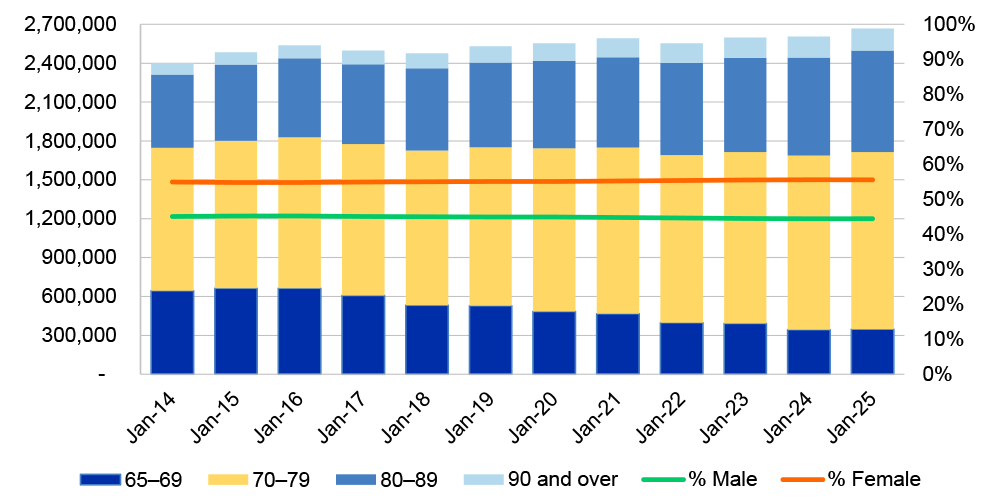
Source: ANAO analysis of DSS demographic information.
1.4 The Australian Government appropriates funding to the Department of Social Services (DSS) for social security payments (including the age pension) and separately appropriates funding to Services Australia for program delivery.
Eligibility requirements
1.5 The age pension is administered under the Social Security Act 1991, the Social Security (Administration) Act 1999 and the Social Security (International Agreements) Act 1999.
1.6 A person must meet the following requirements to get the age pension:
- age: at least 67 years for people born on or after 1 January 19579;
- residence: must be, and have been an Australian resident10 for at least 10 years, five of which are continuous; and
- means tests: an applicant’s and their partner’s assets and income meet legislated thresholds. See Appendix 4 for age pension thresholds.
1.7 International social security agreements11 between Australia and partner countries enable shared responsibility for supporting seniors who move and reside between countries.
Department of Social Services’ role as program and policy owner
1.8 The purpose of DSS is to improve ‘the economic and social wellbeing of individuals, families and vulnerable members of Australian communities’.12 Specific to the age pension, DSS’ Corporate Plan 2024–25 states:
[DSS] is responsible for designing and implementing the Age Pension, including providing advice to government on policy and legislation, program implementation and management, program performance, monitoring and meeting all relevant deliverables, setting guidelines and providing guidance and advice to Services Australia on the administration of the program.13
1.9 The Social Security (Administration) Act 1999 section 8 states that:
In administering the social security law, the Secretary is to have regard to the desirability of achieving the following results: …
- (iii) the delivery of services under the law in a fair, courteous, prompt and cost-efficient manner;
- (iv) the development of a process of monitoring and evaluating delivery of programs with an emphasis on the impact of programs on social security recipients.
Services Australia’s role in program delivery
1.10 Services Australia is an executive agency within the Finance portfolio.14 It delivers the age pension on behalf of DSS under an ‘appropriated partnership’ arrangement. Services Australia receives departmental appropriation from government to deliver the program. DSS retains policy responsibility for program outcomes.
1.11 To manage the partnership, DSS and Services Australia15 have bilateral management arrangements (BMA) which outline how they will work to achieve social security outcomes.16
Department of Veterans’ Affairs’ role in program delivery
1.12 The Department of Veterans’ Affairs (DVA) is responsible for developing and implementing programs to assist veteran and ex-service communities. In 1998, the then Department of Social Security17, DVA and Centrelink signed a Memorandum of Understanding (MOU) for DVA to administer the age pension to veterans and their partners. This arrangement continues and is governed by a January 2013 MOU between DVA and the then Department of Families, Housing, Community Services and Indigenous Affairs.18
1.13 Under a ‘purchaser-provider’ relationship, services are delivered and costs recovered under the Public Governance, Performance and Accountability Act 2013 section 74.19 DSS purchases services from DVA to administer the age pension within agreed expectations.
Rationale for undertaking the audit
1.14 The age pension is a significant component of Australian Government expenditure. In 2024–25, program outlay comprised 8.4 per cent of the Federal budget and 42.5 per cent of social security payments. DSS estimated that in 2023–24, $1.79 billion in age pension payments were incorrectly provided to recipients as underpayments ($0.44 billion) and overpayments ($1.35 billion). This audit was conducted to provide assurance to the Parliament on DSS’ and Services Australia’s administration of the age pension.
Audit approach
Audit objective, criteria and scope
1.15 The audit objective was to assess the effectiveness of the Department of Social Services’ and Services Australia’s administration of the age pension.
1.16 To form a conclusion against the objective, the ANAO adopted the following high level criteria:
- Does the Department of Social Services have effective oversight of the age pension?
- Does Services Australia have effective processes for assessing eligibility of age pension applicants and recipients?
- Does Services Australia effectively communicate and manage engagement with age pension applicants and recipients?
1.17 The ANAO examined DSS’ and Services Australia’s administration of the age pension with a focus on performance results from July 2021 to June 2024. The audit did not examine debt management or other programs to support seniors such as the Home Equity Access Scheme, or the Commonwealth Senior Health Card. The audit did not examine DVA’s processes to administer the age pension.
Audit methodology
1.18 The audit methodology included:
- reviewing DSS, Services Australia and DVA data and documentation;
- meeting with DSS and Services Australia staff;
- walkthroughs of Services Australia’s systems;
- visiting Services Australia’s Glen Waverley call centre, Victoria; and
- reviewing contributions made to the ANAO website’s audit contribution facility and in response to the ANAO’s request for stakeholder contributions.
1.19 The audit was conducted in accordance with ANAO Auditing Standards at a cost to the ANAO of approximately $927,686.
1.20 The team members for this audit were Elsie Alcordo, James Carrington, Magdalena Carrasco, Alexandra McFadyen, Nathan Daley, Alex Collins and Corinne Horton.
2. The Department of Social Services’ oversight of the age pension
Areas examined
This chapter examined the effectiveness of the Department of Social Services’ (DSS) oversight of the age pension.
Conclusion
DSS’ oversight of the age pension program is partly effective. DSS oversees program delivery and has ensured ongoing fortnightly income support to seniors. It has not promptly addressed issues to ensure that performance standards are met, IT systems supporting Services Australia’s claims assessment operate as intended and the Department of Veterans’ Affairs (DVA) is set up to administer the program consistent with legislation. DSS evaluates and reports on age pension payment accuracy and the proportion of senior Australians receiving income support. DSS does not evaluate the program’s impact on recipients as required by the Social Security (Administration) Act 1999.
Areas for improvement
The ANAO made four recommendations aimed at ensuring that: IT systems supporting the assessment of age pension operate as intended; payment accuracy and timeliness performance are addressed; DVA’s administration of the age pension is consistent with legislation and DSS evaluates and advises government on age pension program effectiveness. The ANAO identified an opportunity for improvement to expand bilateral governance bodies’ discussions to cover all components of age pension administration.
2.1 DSS is responsible for delivering ‘a sustainable social security system that incentivises self-reliance and supports people who cannot fully support themselves by providing targeted payments and assistance’.20 To contribute to this outcome, DSS’ age pension program is designed to provide fortnightly income support payments to eligible seniors.
2.2 As program and policy owner, DSS is accountable to government for age pension outcomes and all functions delegated to Services Australia and DVA to deliver the program. In these arrangements — where policy responsibility is separate from service delivery — effective oversight is critical to ensure the proper use and management of public resources.21
2.3 Effective oversight gives policy owners line of sight to determine if implementation is consistent with legislation, and to know about service delivery issues that should be managed to ensure the achievement of program outcomes.
2.4 Governance arrangements that support effective oversight include defined roles and responsibilities, performance and assurance22 reporting and risk management.
Does the Department of Social Services have oversight of Services Australia’s administration of age pension eligibility criteria?
DSS has not made full use of bilateral oversight arrangements to ensure that performance standards are met and issues that impact service delivery are promptly managed.
2.5 Services Australia administers age pension eligibility criteria by:
- assessing applicants’ age pension eligibility and payment rate;
- reviewing recipients’ ongoing eligibility and payment rate;
- implementing programs and activities to address risks to incorrect payments (overpayments and underpayments) such as incorrectly assessed assets and income; and
- monitoring its performance against agreed payment accuracy and timeliness standards.
Bilateral management arrangement
2.6 DSS’ and Services Australia’s Bilateral Management Arrangement (BMA) comprises three levels of agreements:
- The Head Agreement outlines the purpose of the BMA, defines roles and responsibilities and establishes governance and operational arrangements. In April 2023, DSS and the then Department of Human Services23 signed the Head Agreement relating to DSS programs delivered by Services Australia, including the age pension. DSS and Services Australia signed a revised Head Agreement in January 2025.
- Protocols outline frameworks and guidelines which subordinate services schedules must adhere to.
- Services schedules (operational arrangements) provide program details, including key performance measures, review procedures, and risk management.
2.7 Nine BMA agreements which include content relevant to Services Australia’s administration of age pension eligibility criteria are set out in Table 2.1.
Table 2.1: BMA agreements with content relevant to the administration of age pension eligibility criteria
|
Agreement |
Relevant content |
|
Head Agreement (2025) |
Provides governance framework for bilateral arrangements and risk management and outlines relevant governance bodies. Requires Services Australia to provide annual assurance statements to DSS on policy and service delivery, program delivery outcomes, systems, data continuity and interoperability, payment accuracy and timeliness, and key performance measures reporting. |
|
Corporate Services Protocol (2024) |
Requires both entities to share with each other their internal audit and management assurance reports. |
|
Joint Data Protocol ( 2024) |
Governs the collection, use, retention, disclosure and destruction of information between DSS and Services Australia. |
|
Services Schedule for Social Security and Family Payments (2024) |
Outlines roles and responsibilities, including on risk management and quarterly performance reporting. |
|
Services Schedule for Payment Accuracy Review Program (PARP) (2024) |
Provides for the mechanics of the PARP which is the primary assurance mechanism for the age pension. Outlines roles and responsibilities in implementing PARP. |
|
Shared risk management protocol (2024) |
Sets out how DSS and Services Australia will implement arrangements to manage shared risks consistent with the Commonwealth Risk Management Policy 2023. |
|
Payment Assurance Protocol (2024) |
Outlines roles and responsibilities in providing assurance to government that payments are delivered to eligible people at the right time and at the right rate. |
|
Indexation protocol (2024) |
Covers processes and procedures for implementing rates and threshold indexation for social security payments, including the age pension. |
|
Automation protocol (2023) |
Sets out automation objectives, governance arrangements, business principles, processes and guidelines. |
Note a: Senior Executive Service (SES).
Source: ANAO analysis of DSS’ and Services Australia’s BMA documents.
2.8 The BMA agreements listed in Table 2.1 provide arrangements for DSS to oversee Services Australia’s administration of age pension eligibility criteria.
Roles and responsibilities
2.9 The BMA’s Services Schedule for Social Security and Family Payments, Payment Assurance Protocol and Shared Risk Management Protocol define roles and responsibilities for DSS and Services Australia (see Appendix 5). For example, the Payment Assurance Protocol provides for responsibilities to ensure that payment assurance controls in assessing applicants and recipients’ eligibility are effective and appropriate.
Bilateral governance bodies
2.10 The Head Agreement established governance bodies for social security programs, including the age pension:
- Executive Portfolio meetings (EPM) (Senior Executive Service (SES) Band 3). Its purpose is to provide oversight and support the delivery of social security payments, set the strategic direction for social security payments, resolve program issues and escalate risks to the Secretary and Chief Executive Officer.
- Strategic Business Discussions (SBD) (SES Band 2). Its purpose is to provide oversight of operational matters, including payment integrity and payment accuracy, resolve program issues and escalate risks to the EPM.
- Program Managers’ meetings (SES Band 1). Its purpose is to support EPM and SBD by discussing operational issues and service delivery.
2.11 The Head Agreement provides that the DSS Secretary and Services Australia’s CEO will meet at least twice each year to discuss portfolio risks, cross-cutting strategic matters and the performance of services delivered under the BMA.
2.12 In meetings for the three-year period 2021–22 to 2023–24, EPM and SBD meetings focused on performance reporting, payment accuracy risks, progress in implementing recommendations to improve the PARP24 methodology and updates to BMA arrangements. Relevant to the administration of age pension eligibility criteria, the EPM and SBD meeting discussed:
- Payment accuracy performance results, the contribution of assets and income to incorrect payments and the program’s contribution to overall social security payment inaccuracy.
- Payment timeliness performance results and factors contributing to quarterly performance below agreed targets such as greater use of paper claims and redirection of older Australian staff to support other priorities of Services Australia.
2.13 According to their Terms of Reference, SBD and EPM members are responsible for providing operational guidance, monitoring and mitigating risks and ensuring achievement of performance outcomes. The EPM and SBD were unable to ensure achievement of performance targets for payment accuracy (2022–23 and 2023–24) and payment timeliness (2021–22 to 2023–24).
2.14 Program Managers met twice in 2022–23 and once in 2021–22 and 2023–24. The Head Agreement does not specify a required number of meetings. Meeting minutes outlined discussions on performance results and policy issues (in all four meetings) and service delivery issues (in three of the four meetings). Program managers did not raise issues for escalation to SBD at any of the four meetings. The minutes did not include detailed record of the issues discussed, such as their causes, impacts or required actions. Program managers’ meeting minutes indicate that SES Band 1 officers did not attend the meeting in 2023–24. DSS and Services Australia advised the ANAO in July 2025 that age pension SES Band 1 managers meet fortnightly on policy and operations, and consult weekly on means tests issues. There are no recorded minutes or evidence that these discussions inform EPM or SBD. DSS advised the ANAO in October 2025 that:
The Bilateral Management Arrangement Head Agreement states “Regular ongoing discussions and working groups between program owners at SES Band 1 level”, there is no requirement for discussions to be minuted.
2.15 In December 2025, DSS advised the ANAO that there is a:
myriad of exchanges of information between the department and Services Australia about functions directly and indirectly related to the Age Pension, such as public enquiries, ministerial correspondence, means testing (treatment of income and assets, deeming, compensation, etc.), supplementary payments (Rent Assistance, Remote Area Allowance, etc.), administrative appeals, residency, international agreements, debt policy, data, concession cards, the Home Equity Access Scheme, the Pension Bonus Scheme, etc. These functions are often decentralised to specialist teams across the department, where informal engagement and issues management takes place on a daily basis.
The department also notes that additional to the two meetings between the DSS Secretary and Services Australia’s CEO set out in the BMA Head Agreement, these 2 officials meet monthly to discuss cross-cutting strategic matters and the performance of services delivered under the BMA.
2.16 While DSS and Services Australia have arrangements for regular and ongoing exchange of information across the different areas of each entity that support the administration of the age pension, without documentation and systemic follow-up, valuable insights may be lost, duplicated, or fail to inform strategic decision-making.
Opportunity for improvement
2.17 To support EPM and SBD, Program managers could discuss all aspects of program delivery with a focus on continuous improvement, including compliance activities, planned and actual staff resourcing and work levels, service delivery issues and stakeholder feedback.
Assurance statements
2.18 Services Australia provides annual assurance statements to DSS. Auditor-General Report No. 4 2023–24, Accuracy and Timeliness of Welfare Payments found the statements do not provide ‘an objective and independent assessment of governance, risk management and controls processes’.25 The report recommended DSS and Services Australia establish ‘processes to exchange relevant internal audit and management assurance reports and a robust bilateral assurance framework’.
2.19 In response to this recommendation, DSS and Services Australia signed the:
- BMA Corporate Services Protocol in February 2024. This protocol requires both entities to share with each other their internal audit and management assurance reports (relevant to social security payments, including the age pension).
- BMA Payment Assurance Protocol in March 2024. This Protocol outlines payment assurance objective, governance arrangements and their respective roles and responsibilities.
Payment integrity assurance
2.20 Services Australia relies on its processes and IT systems to assess age pension eligibility and calculate payment rates. Its core system, the Income Security Integrated System (ISIS), automates many steps of the assessment process, including applying the means test and calculating fortnightly payment rates.
2.21 DSS is responsible for assuring government that there are effective payment assurance controls to manage social security payment risks, including for the age pension, and is jointly responsible with Services Australia for reviewing payment assurance controls to ensure they are effective and appropriate. The BMA Payment Assurance Protocol defines assurance as:
how entities obtain confidence that program structures and processes are designed, implemented, and operate as intended. It is represented by effective and efficient controls to manage risks and achieve payment assurance and payment integrity objectives.
2.22 Services Australia’s annual assurance statements for 2021–22 to 2023–24 included its payment integrity assurance for the age pension and other program, which states:
The following has been implemented and is operational for all listed DSS administered programs:
- Risk Management Plan
- Risks managed to an acceptable level
- Controls are in place and operating effectively
- Payment testing undertaken as per schedule.
2.23 Payment integrity is defined by the annual assurance statements as:
a measure of the extent to which payments made on behalf of the government are managed correctly and appropriate controls are in operation to minimise the likelihood of processing and system errors. Payment integrity does not consider the role of customer non-compliance in outcomes — that is a factor considered in payment accuracy.
2.24 Services Australia’s payment integrity assurance demonstrates its confidence that effective controls are in place to mitigate risks associated with process and IT systems errors. The ANAO examined Services Australia’s basis for its age pension payment integrity assurance for 2023–24:
- Services Australia’s 2023–24 age pension risk management plan identified the risk of incorrect payment due to IT system error. The controls and treatments indicated to address the risk include detection of fraud and corruption, compliance activities, staff training and customer education. The risk management plan included access controls to verify users. There were no other IT-specific controls or treatments indicated (for example regular systems testing) to detect or monitor IT system errors.
- The 2023–24 risk age pension management plan was not reviewed quarterly as required by Services Australia’s processes.
- No age pension post payment transaction testing was conducted in 2023–24.
2.25 Services Australia advised the ANAO in July 2025 that it has internal assurance processes to audit, monitor and assess its various IT systems and, ‘these processes have some gaps and could be strengthened to ensure the IT systems supporting the administration of age pension claims are operating as intended’.
2.26 Services Australia commissioned an August 2019 internal audit on age pension payment assurance which found that:
The Age Pension program relies on some detective measures to identify system errors … [T]hese activities do not provide coverage to identify errors during business-as-usual operations. Mechanisms sighted provide assurance over controls in place to specifically identify errors in relation to the implementation of new system functionality. Consequently, the department does not have sufficient mechanisms in place to provide assurance that instances of system errors for existing systems or functionality for the Age Pension program would be identified. This gap poses a risk of non-compliance with the requirements of the AAIs [Accountable Authority Instructions26] and non-identification of incorrect payments …
In relation to detecting ongoing system errors, the Age Pension Program Team relies on several mechanisms including staff raising issues with Information and Communications Technology (ICT), issues raised by other business areas and analysis of Level 2 and Level 3 Helpdesk queries. This would not proactively detect system errors that may occur, particularly in relation to uncommon scenarios. … Additionally, customer feedback and complaints can provide an indication of system errors. However, this relies on the customer advising that their payment is incorrect, and then it is investigated thoroughly. The program does not have arrangements in place to provide full assurance that system errors would be identified.
2.27 Case Study 1 describes an IT system error that incorrectly excluded certain applicants’ superannuation when assessing age pension eligibility and payment rate.
|
Case study 1. Superannuation excluded from age pension eligibility assessment |
|
In May 2019, when an applicant transferred to the age pension from another social security payment, their superannuation details which Services Australia already had, were incorrectly excluded in assessing their age pension eligibility. Services Australia considered the issue resolved when it released a system fix in December 2019. The problem continued with similar incidents (involving multiple applicants) raised in April 2021, May 2021 and April 2022. In April 2021, Services Australia formally identified an IT system issue as the cause of the incorrect assessments and fixed it in December 2022 with no subsequent incidents reported. In January 2023, Services Australia identified 175,032 age pension recipients impacted by the issue since 2010 and estimated the potential overpayment at $37 million. Services Australia advised the ANAO in August 2025 that it waived all 26,409 overpayments ($19.8 million) which resulted from the IT system error. These overpayments were not identified through the sample cases reviewed from 2010 to 2022 under the Payment Accuracy Review Program and not included in reported payment inaccuracy estimates. Services Australia’s January 2025 post implementation review of this IT system error stated that the problem likely started in June 2010 following a systems release which automated transfers to age pension for some eligible existing recipients, and that:
The review noted that Services Australia is reliant on non-ICT channels such as complaints, concerns raised by front-line staff, helpdesk escalations and analysis of debt reasons, to identify IT system issues. The review referred to key systemic factors which contributed to the delay in identifying and treating the superannuation systems issue, including:
The review identified the following measures as critical to ensure early identification and monitoring of IT system issues:
The review reported that Services Australia met with DSS about the issue in November 2022 to discuss the potential waiver of the overpayments. |
2.28 Case Study 1 shows how an IT system error which resulted in incorrect age pension payments27 remained unresolved for more than ten years. Gaps in Services Australia’s processes and IT system controls limit Services Australia’s ability to promptly identify and address IT systems error. Other IT systems issues discussed in the BMA’s age pension Program managers’ meeting minutes involve recipients’ entitlement to work bonus and partners’ joint claim applications.
2.29 Paragraphs 3.20 to 3.30 discuss Services Australia’s reliance on automation through its IT system (ISIS) to apply the means test and calculate age pension payment rates. Services Australia’s June 2024 internal audit on management of automation found that it ‘has not taken timely action to remediate risks associated with its use of legacy automations’ and recommended that:
[Services Australia] should, as a matter of priority, finalise the risk assessment of all automations in use across the agency.
2.30 In 2022–23 and 2023–24, the ANAO’s Financial Statements audits reported a significant (category A)28 finding on Services Australia’s IT governance. In particular, the ANAO identified IT control issues which indicates that Services Australia’s IT governance and monitoring processes are not providing appropriate assurance that policy requirements have been implemented and are operating effectively. In 2024–25, the ANAO downgraded this significant (Category A) finding to a moderate (Category B)29 finding to reflect Services Australia’s progress in implementing remediation activities. Despite these efforts, most IT findings remain open and the ANAO has continued to raise new IT findings. The moderate finding will be closed when Services Australia demonstrates that controls are operating effectively, evidenced through a significant reduction in IT findings.
2.31 DSS is jointly responsible with Services Australia for reviewing payment assurance controls ‘to ensure they are effective and appropriate’. DSS should be aware of IT system errors impacting age pension payment correctness, as well as the limitations and risks associated with Services Australia’s payment integrity assurance.
Recommendation no.1
2.32 In line with their joint responsibility to review payment assurance controls and ensure they are effective and appropriate:
- Department of Social Services requires Services Australia to disclose in the annual assurance statements the limitations and risks associated with Services Australia’s payment integrity assurance, and to advise IT system issues in a timely manner;
- Services Australia fully discloses in its annual assurance statements the basis for, and limitations and risks associated with, its payment integrity assurance, and informs Department of Social Services as soon as practicable when it (Services Australia) identifies IT system errors impacting payment correctness; and
- Services Australia promptly rectifies issues identified in the IT systems which support the assessment of age pension, and implements controls to ensure IT systems are operating as intended.
Department of Social Services response: Agreed.
2.33 The department will work with Services Australia to strengthen the existing processes under the Bilateral Management Arrangement to improve the payment integrity assurance provided by Services Australia.
Services Australia response: Agreed.
2.34 Services Australia will review its annual assurance statements. It will also rectify issues identified in the IT system which support assessment of age pension and implement effective IT controls.
Monitoring performance
2.35 Services Australia is responsible for assessing age pension performance against the following measures:
- payment accuracy: 97 per cent of total outlay is accurately paid; and
- payment timeliness: 80 per cent of claims is processed within 49 days.
Payment accuracy
2.36 The Payment Accuracy Review Program (PARP) is the primary assurance mechanism for social security payment outlays, including the age pension. Through PARP, Services Australia reviews sampled recipients’ circumstances (such as income, assets and relationship status), and reassesses their payment rates to determine if they were paid correctly, underpaid or overpaid on a particular fortnight.
2.37 Table 2.2 shows that Services Australia met the age pension payment accuracy target of 97 per cent in 2021–22. It did not meet the target in 2022–23 and 2023–24. The estimated dollar value of incorrectly paid age pension for the three-year period was $5 billion or 3.03 per cent of total age pension outlay of $165.02 billion.
Table 2.2: Age pension PARP results 2021–22 to 2023–24
|
Year |
Total age pension outlay ($m) |
Age pension payment accuracy (%)a |
Age pension payment inaccuracy (%) |
Estimated payment inaccuracy ($m)b |
Target met / not met |
|
2021–22 |
51,117.4 |
97 |
3.00 |
1,533.5 |
✔ |
|
2022–23 |
54,746.4 |
96.95 |
3.05 |
1,668.3 |
✘ |
|
2023–24 |
59,156.4 |
96.97 |
3.03 |
1,794.1 |
✘ |
|
2021–2022 to 2023–24 |
165,020.2 |
96.97 |
3.03 |
5,000.0 |
– |
Key: ✔ Met performance target ✘ Did not meet performance target – Not applicable
Note a: DSS advised the ANAO in October 2025 that age pension payment accuracy results have 95 per cent confidence intervals that include the 97 per cent benchmark — performance was between 96.60 to 97.40 per cent (2021–22), 96.56 to 97.34 per cent (2022–23) and 96.52 to 97.42 per cent (2023–24). In dollar terms, this means that estimated age pension payment inaccuracy was between $1,329 million to $1,738 million (2021–2022), $1,456 million to $1,883 million (2022–23) and $1,526 million to $2,059 million (2023–24) or a total estimated payment inaccuracy of between $4.31 billion to $5.68 billion for the three-year period.
Note b: Estimated payment inaccuracy is determined by dividing the sum of weighted overpayments and underpayments on a particular fortnight by the sum of weighted payments to all sampled customers on the same fortnight and applying the resulting percentage to the total age pension outlay for the financial year.
Source: ANAO analysis of DSS and Services Australia PARP results.
2.38 Available data from 2011–12, shows that age pension payment accuracy was above 97 per cent before 2021–22 (see Figure 2.1).
Figure 2.1: Age pension payment accuracy: 2011–12 to 2023–24a
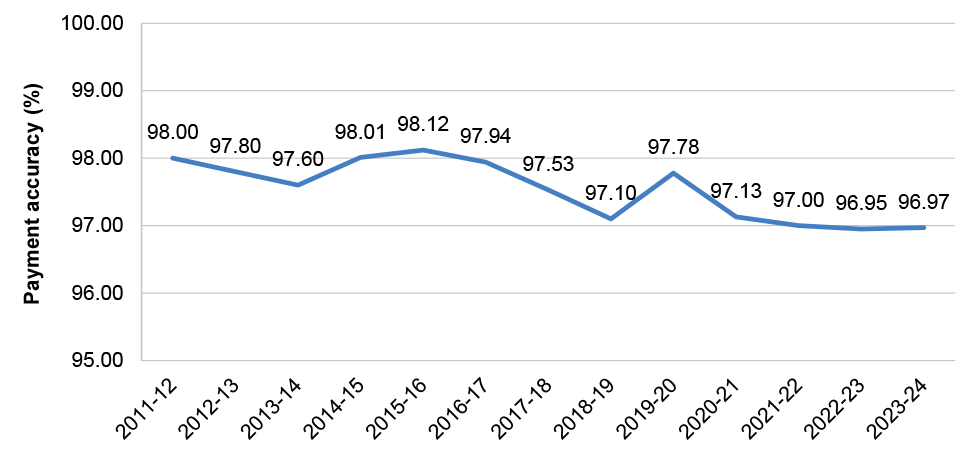
Note a: For clarity, the Y-axis (vertical axis) starts at 95 per cent.
Source: ANAO analysis of DSS data.
2.39 The estimated value of age pension payment inaccuracy rose by 16.99 per cent from $1.53 billion in 2021–22 to $1.79 billion in 2023–24 (see Figure 2.2). This aligned with the 15.73 per cent increase in the total age pension outlay for the same period.
Figure 2.2: Total dollar value of age pension payment inaccuracy: 2021–22 to 2023–24
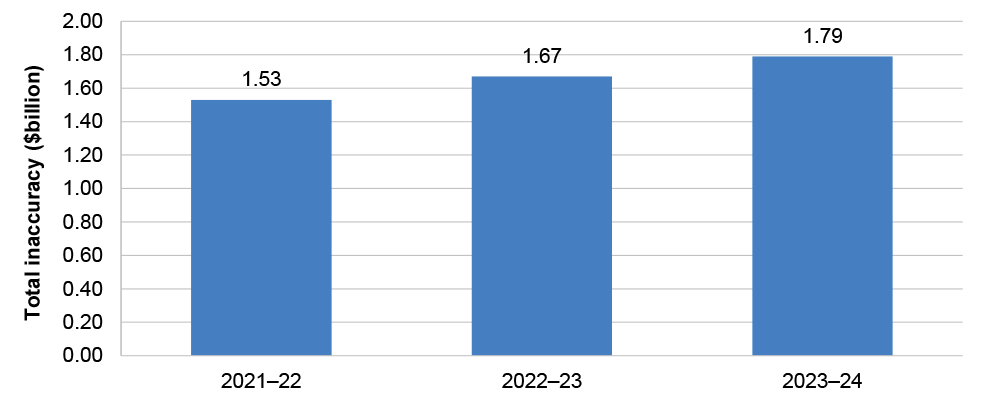
Source: ANAO analysis of DSS data.
2.40 Figure 2.3 shows that of the estimated $5 billion incorrectly paid age pension from 2021–22 to 2023–24, age pension recipients were underpaid by $1.33 billion and overpaid by $3.67 billion.
Figure 2.3: Age pension payment inaccuracy: overpayments and underpayments
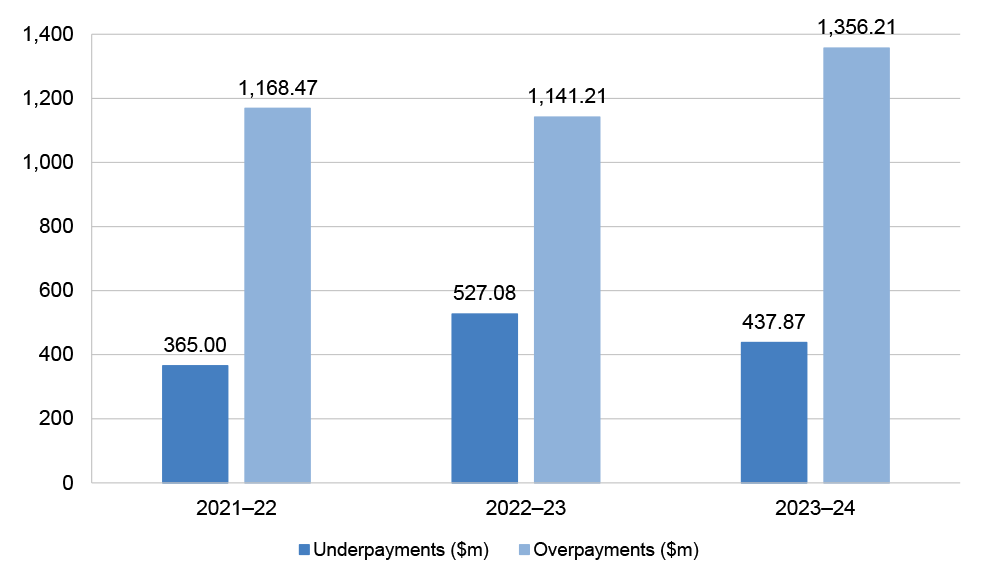
Source: ANAO’s analysis of DSS data.
2.41 Table 2.3 shows that for 2021–22 to 2023–24, 29.82 per cent of sampled recipients were incorrectly paid or received the wrong age pension payment rate.
Table 2.3: Proportion incorrectly paid age pension recipients: 2021–22 to 2023–24
|
Year |
Sampled recipients (no) |
Recipients incorrectly paid (no) |
Proportion of recipients incorrectly paid (%) |
|
2021–22 |
3,545 |
1,068 |
30.13 |
|
2022–23 |
3,908 |
1,189 |
30.42 |
|
2023–24 |
3,311 |
953 |
28.78 |
|
2021–2022 to 2023–24 |
10,764 |
3,210 |
29.82 |
Source: ANAO’s analysis of Services Australia data.
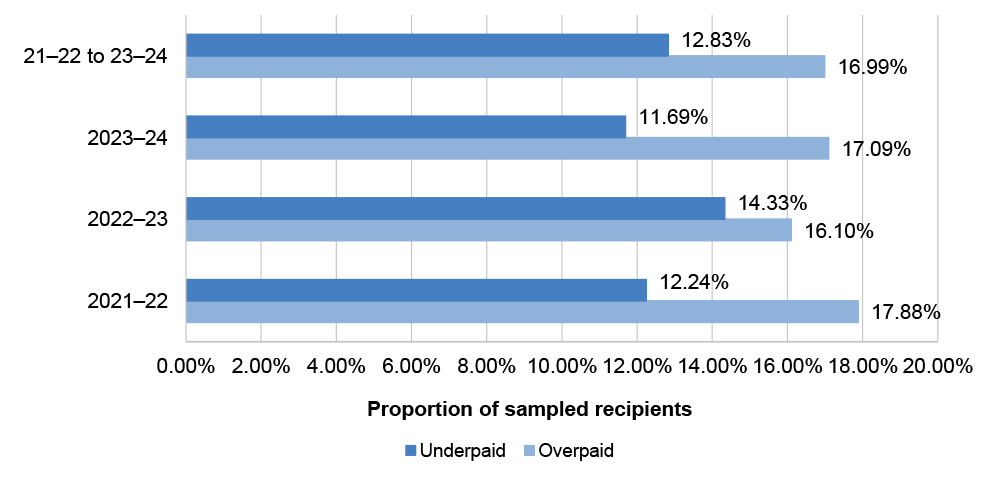
2.42 Figure 2.4 breaks down incorrectly paid recipients (29.82 per cent) to those who received less than they were entitled to (underpaid, 12.83 per cent) and those who received more than what they should have (overpaid, 16.99 per cent).
Figure 2.4: Proportion underpaid/overpaid age pension recipients: 2021–22 to 2023–24
Source: ANAO analysis of DSS data.
2.43 Services Australia informed the ANAO in August 2025 that:
when there is an underpayment (arrears) a recipient will be paid in line with the date of effect for a favourable determination under Social Security Law for Age Pension payments. Noting that if a recipient has a current debt, the arrears may be used to repay the debt on a case-by-case basis.
2.44 The risks that contribute the most to incorrect age pension payments are undeclared, incorrectly declared or incorrectly assessed assets and income from investments. Paragraphs 3.61 to 3.64 discuss these risks in further detail. Table 3.4 provides a breakdown of inaccurate payments resulting from recipient and administrative (Services Australia) error.
Payment timeliness
2.45 Services Australia provides quarterly reporting to DSS on payment timeliness results. Table 2.4 shows that Services Australia did not meet the payment timeliness performance target between 2021–22 to 2023–24. The quarterly average number of days to complete claims ranged from 29 to 84 days and there were between 9,788 and 42,232 claims outstanding at quarter end. The maximum number of days to complete claims was 1,527 calendar days or 4.2 years (see Note C in Table 2.4).
Table 2.4: Payment timeliness: 2021–22 to 2023–24
|
Quarter Financial year |
Claims finalised within 49 days (%) |
80% target met |
Average days to processa |
Minimum days to processb |
Maximum days to processc |
Number of claims outstanding at end of the quarter |
|
Q1 2021–22 |
68.19 |
✘ |
38 |
0 |
963 |
10,692 |
|
Q2 2021–22 |
71.40 |
✘ |
35 |
0 |
658 |
9,788 |
|
Q3 2021–22 |
79.40 |
✘ |
30 |
0 |
575 |
17,727 |
|
Q4 2021–22 |
66.83 |
✘ |
39 |
0 |
448 |
19,842 |
|
Q1 2022–23 |
70.52 |
✘ |
37 |
0 |
1,403 |
22,481 |
|
Q2 2022–23 |
69.16 |
✘ |
36 |
0 |
988 |
18,384 |
|
Q3 2022–23 |
72.05 |
✘ |
29 |
0 |
521 |
18,034 |
|
Q4 2022–23 |
75.77 |
✘ |
31 |
0 |
505 |
23,475 |
|
Q1 2023–24 |
51.61 |
✘ |
64 |
0 |
644 |
30,610 |
|
Q2 2023–24 |
47.30 |
✘ |
80 |
0 |
1,527 |
34,885 |
|
Q3 2023–24 |
38.64 |
✘ |
84 |
0 |
649 |
42,232 |
|
Q4 2023–24 |
52.74 |
✘ |
74 |
0 |
523 |
29,224 |
Key: ✔ Met performance target ✘ Did not meet performance target
Note a: Rounded to the nearest whole.
Note b: Claims assessment was completed on the day of receipt.
Note c: Calculation is based on the date a claim is received and when it is finalised. Where a claim has been rejected and later reassessed on appeal, it retains the original date of receipt.
Source: Services Australia data.
2.46 In its 2022–23 Annual Assurance Statement, Services Australia reported that it did not meet the payment timeliness target as:
- Age pension claims are complex and it takes time for staff to gain proficiency in processing these claims.
- Staff resources were diverted to other priorities. Staff that process age pension claims are responsible for other tasks in several program and service areas and their work is prioritised to ‘maximise available resource efficiency and balance the performance of programs, focusing on areas of greatest benefit to customers’.
2.47 In 2023–24, the Australian Government provided $228 million to increase Services Australia’s frontline staffing and operations. In its 2023–24 Annual Assurance Report to DSS, Service Australia said that it:
- hired 6,000 staff30 from October 2023 to improve access to services and help reduce the backlog of claims, including for the age pension; and
- was able to reduce the backlog of claims by 68 per cent as at June 2024.
2.48 The reduction was not observed across all payments. In the case of the age pension, outstanding claims increased by 24.5 per cent from the fourth quarter of 2022–23 to the fourth quarter of 2023–24 (see Table 2.4). Services Australia met the timeliness performance target in the second (84.8 per cent) and fourth (82 per cent) quarters of 2024–25. The yearly timeliness performance result was 76 per cent against the 80 per cent target.31
Addressing performance results
2.49 The BMA’s purpose for monitoring payment accuracy and timeliness performance results is to determine whether social security payments, including the age pension ‘are delivered to the right eligible people at the right time and at the right rate’. The BMA’s Payment Assurance Protocol provides that DSS is responsible for ‘monitoring, reviewing, and addressing payment assurance performance results and outcomes to ensure that strategies employed are proving effective’.
2.50 DSS receives quarterly results for payment timeliness and trimester results for payment accuracy. DSS and Services Australia SES officers discuss the results at EPM and SBD meetings. In November 2022, September 2023, March 2024 and December 2024, the DSS Secretary expressed concern about the results to the Services Australia CEO. From 2023–24 to 2024–25, DSS routinely advised the Minister for Social Services and Assistant Minister for Services on the results.
2.51 In November 2024, DSS facilitated a meeting between the Assistant Minister for Social Security and the Minister for Government Services. This meeting resulted in action items for DSS and Services Australia to work together to further understand age pension waiting time and conduct an end-to-end review of age pension policies and procedures. DSS advised the ANAO in August 2025 that these items continue to be monitored in SBD and EPM meetings.
2.52 In May 2025, DSS advised the incoming Minister of Social Services that legislation for social security programs, including the age pension is complex:
The underpinning legislation on which almost all social security policy is based is vast and complex. The last overhaul of the Social Security Act 1991 was 34 years ago, and it has been amended hundreds of times since. This complexity, and the sustained demand for social security, have led to service delivery challenges and claim backlogs.
2.53 Services Australia noted in its January 2025 post implementation review of an IT system error (see Case Study 1) that legislative complexity makes it difficult for seniors and service officers to understand age pension requirements (particularly income and asset assessments) and increases the risk of IT system errors that lead to incorrect assessments and payments. Services Australia’s 2022–23 annual assurance statement said that legislative complexity impacts service officers’ ability to process claims in a timely manner.
Recommendation no.2
2.54 Department of Social Services addresses payment accuracy and timeliness performance results by developing and implementing an approach to ensure that Services Australia’s assessment and compliance processes address risks to payment accuracy and timeliness.
Department of Social Services response: Agreed.
2.55 The department will continue to build upon work already undertaken to strengthen the approaches documented in the Bilateral Management Arrangement protocols and schedules to ensure performance and risk is understood.
Managing risks
2.56 DSS had an age pension risk register which it updated in January 2019. The ANAO assessed DSS’ age pension risk register and found that it did not comply with the mandatory requirements of the Commonwealth Risk Management Policy (see Table 2.5).
Table 2.5: ANAO assessment of DSS’ age pension risk register
|
Commonwealth Risk Management Policy requirements |
ANAO assessment |
|
|
Clear definition of risk management responsibilities |
✘ |
Risk register does not indicate who is responsible for the risks. |
|
Periodic review of the effectiveness of risk controls |
✘ |
DSS last reviewed the risks and controls in January 2019. |
|
Formalised approach to risk management |
✘ |
DSS does not have a risk management plan for the age pension. |
|
Arrangement to identify, manage and escalate risks |
✘ |
DSS does not have this arrangement. |
Key: ✔ Consistent with Commonwealth Risk Management Policy (CRP) ✘ Not consistent with CRP
Source: ANAO analysis of DSS documentation.
2.57 The BMA’s Shared Risk Management Protocol outlines the following responsibilities for managing shared risks for social security programs, including the age pension:
- DSS is responsible and accountable for managing risks related to social services policies and programs;
- Services Australia is responsible for managing risks related to the payments and services it delivers under the BMA; and
- DSS and Services Australia are jointly responsible for shared risks, including managing and maintaining a shared risk register which summarises all identified shared operational and strategic risks.
2.58 DSS advised the ANAO in July 2025 that together with Services Australia, it developed a shared risk plan and shared risk register for social security payments including the age pension.
Does the Department of Social Services have oversight of the Department of Veterans’ Affairs’ administration of age pension eligibility criteria?
DSS has not reviewed the 2013 Memorandum of Understanding — which governs DVA’s administration of the age pension to veterans and their partners — since its execution. DSS’ oversight has not ensured that performance meets agreed standards and that DVA is set up to administer the age pension consistent with legislation.
Oversight arrangements
2.59 DVA administers the age pension program to 3,818 veterans and their partners as at June 2024. This represents 0.15 per cent of all age pension recipients as at June 2024. The arrangement commenced in 1998 and is currently governed by the 2013 MOU between DVA and the then Department of Families, Housing, Community Services and Indigenous Affairs.
2.60 The MOU provides for the following governance arrangements:
- designated roles and responsibilities; and
- half-yearly performance assurance reporting — relevant to the administration of age pension eligibility criteria, the MOU requires these reports to cover performance results for payment correctness, ongoing assessments to ensure correct payment and service delivery issues.
2.61 The MOU does not provide for periodic meetings between DSS and DVA to discuss policy, service delivery issues and performance results. Beginning December 2024, DSS established an age pension program managers meeting with DVA.
2.62 DSS has not reviewed the MOU since its execution in 2013. The MOU sets out a requirement to review it annually ‘to ensure good governance, currency of information and scope of services’. DSS advised the ANAO in July 2025 that it commenced working with DVA to refresh the MOU in April 2025.
2.63 DSS does not identify and manage risks relative to DVA’s administration of the age pension.
Roles and responsibilities
2.64 Table 2.6 shows the roles and responsibilities as prescribed by the MOU.
Table 2.6: Roles and responsibilities per the MOU: DSS and DVA
|
DSS |
DVA |
|
|
Source: 2013 MOU between DSS and DVA.
Performance assurance reports
2.65 DVA is responsible for assessing its performance against:
- payment correctness: 95 per cent of total outlays are correctly paid; and
- payment timeliness: 80 per cent of claims are processed within 28 days.
2.66 Table 2.7 outlines DVA’s payment correctness performance results for the period May 2021 to April 2024. The limited number of assessments reviewed per performance cycle does not provide a representative sample of total claims completed. The MOU does not establish performance monitoring processes, including minimum sampling rates.
Table 2.7: Payment correctness: May 2021 to April 2024
|
Reporting period |
No. of claims completed |
No. of claims checked for correctness |
No. of claims correctly assessed (%) |
Performance target (95%) met |
|
May to October 2021 |
209 |
5 |
3 (60.0) |
✘ |
|
November 2021 to April 2022 |
178 |
2 |
2 (100.0) |
✔ |
|
May to October 2022 |
227 |
13 |
5 (38.5) |
✘ |
|
November 2022 to April 2023 |
222 |
15 |
15 (100.0) |
✔ |
|
May to October 2023 |
233 |
24 |
14 (58.3) |
✘ |
|
November 2023 to April 2024 |
180 |
17 |
8 (47.1) |
✘ |
|
Total |
1,249 |
76 |
47 (61.8) |
✘ |
Key: ✔ Met performance target ✘ Did not meet performance target
Source: ANAO analysis of DVA documentation.
2.67 Table 2.8 outlines DVA’s payment timeliness performance results for the period May 2021 to April 2024. The performance target was not met.
Table 2.8: Payment timeliness: May 2021 to April 2024
|
Reporting period |
Percentage of claims assessed within 28 days (%) |
Performance target (95%) met |
|
May to October 2021 |
11.0 |
✘ |
|
November 2021 to April 2022 |
21.3 |
✘ |
|
May to October 2022 |
15.4 |
✘ |
|
November 2022 to April 2023 |
22.1 |
✘ |
|
May to October 2023 |
38.2 |
✘ |
|
November 2023 to April 2024 |
33.9 |
✘ |
Key: ✔ Met performance target ✘ Did not meet performance target
Source: ANAO analysis of DVA documentation.
2.68 Consistent with the MOU, the six performance assurance reports included sections on: DVA’s strategies to ensure payment correctness and processes to confirm recipients’ ongoing eligibility. The six reports enumerated the same strategies and processes without explaining if and how they address payment accuracy risks such as undeclared, incorrectly declared or incorrectly assessed assets and income.
Administration inconsistent with legislation
2.69 DVA is not set up to support its age pension recipients who may be eligible under international social security agreements as required by the Social Security (International Agreements) Act 1999.32 DVA estimates that this issue potentially impacts 17.5 per cent of its age pension recipients (650 of 3,717 as at December 2022).
2.70 DSS learned about DVA’s non-compliance with the Social Security (International Agreements) Act 1999 in 2022 — 24 years after it first authorised DVA to administer the age pension in 1998. This occurred when an age pension recipient informed DVA in May 2022 that a pension they were receiving from another country was cancelled when they switched from Services Australia to DVA as administrator. On investigation, the pension from the other country was discontinued because DVA is not set up to deliver the age pension consistent with the Social Security (International Agreements) Act 1999:
- DVA is not specified as a liaison agency in Australia’s international social security agreements; and
- DVA does not have processes and IT systems to exchange data and information with partner countries for the assessment and payment of claims.
2.71 Unlike DVA, Services Australia is set up to administer the age pension in accordance with international social security agreements. As the liaison agency for Australia’s 32 international social security agreements, Services Australia’s Centrelink International Services can advise recipients on potential benefits, such as foreign payments or higher rates while overseas, and co-process claims and share information with partner countries.
2.72 DSS is yet to resolve this issue (as at December 2025). DSS documentation shows that while the issue remains unresolved, the Australian Government is paying the recipient the pension they should otherwise be receiving from the other country.
Recommendation no.3
2.73 Department of Social Services and Department of Veterans’ Affairs complete the refresh of the 2013 Memorandum of Understanding to ensure that the Department of Veterans’ Affairs is set up to administer the program consistent with legislation, and establishes:
- arrangements for the Department of Social Services to oversee the Department of Veterans’ Affairs’ administration of the age pension;
- performance assurance arrangements that include reporting on performance and ensuring the effectiveness of strategies to address risks;
- methodology to monitor, measure and report on performance;
- regular reviews of processes and systems to administer the age pension to ensure they are operating as intended; and
- risk management processes and reporting.
Department of Social Services response: Agreed in principle.
2.74 The department has commenced work with the Department of Veterans’ Affairs to review the Memorandum of Understanding between the two departments.
2.75 This work will consider a range of mechanisms to improve current administrative arrangements for the Age Pension, including those identified in Recommendation 3.
Department of Veterans’ Affairs response: Agreed.
2.76 DVA supports the review of the 2013 MOU with a particular focus on performance assurance, performance measures and monitoring. This review will be done in conjunction with DSS. DVA has been reviewing the administration of Age Pension having regard to the Social Security (International Agreements) Act 1999. DSS has provided an options paper and after review of the options put forward, DVA acknowledges the issues with DVA undertaking the functions and administering the payment for veterans receiving an Age Pension in accordance with the provisions of an International Agreement. DVA will work with DSS to develop a strategy to resolve this issue. The agreed approach will incorporate a communication strategy.
2.77 DVA will complete a review of associated risks consistent with the Commonwealth Risk Management Policy. This work will better inform the review of performance measures and targets. DVA notes the requirement to monitor ongoing eligibility and consider that this should be covered under ongoing entitlement reviews. DVA is supportive of measures that are consistent with current Services Australia methodology.
2.78 DVA and DSS currently hold regular meetings to monitor performance. DSS and DVA initiated the process of reviewing the MOU with a meeting in April 2025. The review going forward will include the development of an agreed quantitative and qualitative methodology for monitoring performance.
Does the Department of Social Services appropriately evaluate the age pension program?
DSS evaluates the accuracy of age pension payments accuracy and the proportion of senior Australians supported in their retirement through the age pension or other income support. DSS does not evaluate program impact on recipients as required by the Social Security (Administration Act) 1999.
2.79 Reporting on program performance promotes trust and confidence in the public sector.33 It is the primary means by which public entities demonstrate to Parliament and the Australian community how well they have used taxpayers’ money to deliver services and whether and to what extent they have achieved government outcomes.
2.80 The Social Security (Administration) Act 1999 section 8 states that the DSS Secretary should have a process to monitor and evaluate program delivery ‘with an emphasis on the impact of programs on social security recipients’.34
2.81 The government’s Commonwealth Evaluation Policy states that:
Commonwealth entities and companies are expected to deliver support and services for Australians by setting clear objectives for major policies, projects and programs, and consistently measuring progress towards achieving these objectives.
2.82 DSS’ 2023 Evaluation Manual: Introduction to Evaluation at the Department of Social Services: How to improve program design, performance and outcomes (the Evaluation Manual) is consistent with the Commonwealth Evaluation Policy. The Evaluation Manual states that evaluation should be designed ‘for the purposes of continuous improvement, accountability and decision-making’ and that evaluation is about determining ‘the progress it has made towards achieving its planned policy/program objectives’.
The Department of Social Services’ program logic for the age pension
2.83 The Evaluation Manual explains that to prepare a program for evaluation, DSS should have a program logic which sets out the change the program aims to achieve and how the program’s resources and activities will lead or contribute to planned outcomes. The Evaluation Manual states that ‘the program logic process will carefully define the outcomes to ensure that they can be monitored and valuated properly and will generate useful evidence’.
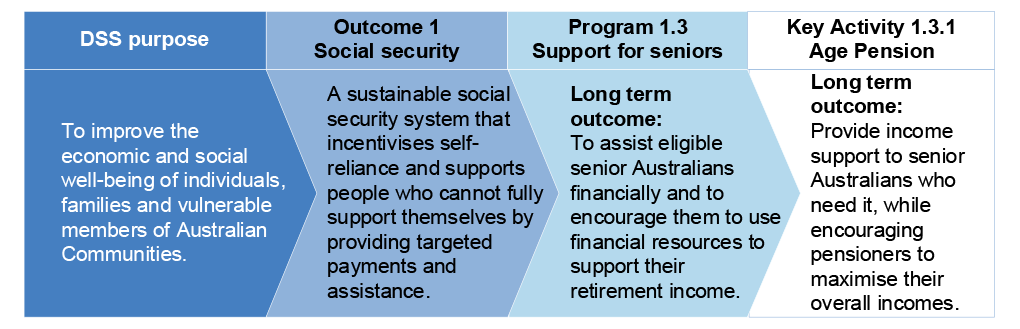
2.84 Figure 2.5 shows how DSS links its purpose to the age pension performance measure and key activity.
Figure 2.5: Department of Social Services age pension performance measure overview
Source: DSS’ Age pension program logic.
2.85 DSS’ 2024–25 program logic (Appendix 6) provides for age pension outcomes and a performance measure (Table 2.9).
Table 2.9: Age pension program logic: outcomes and performance measure
|
Program outcome |
Performance measure |
|
Key activity 1.3 age pension outcome To provide income support to Australians who need it, while encouraging pensioners to maximise their overall income. The program outcome is achieved by the delivery of the age pension. |
Extent to which people over the age pension qualification age are supported in their retirement through the age pension or other income support. Target: 75 per cent or below of age pension age are supported by the age pension or other income support. |
|
Long-term outcomes
|
|
|
Short-term outcomes
|
|
Source: DSS’ age pension program logic.
Intended outcome
2.86 When introduced in 1909, the age pension was subject to a means test to target the pension to those most in need. There have been changes to the calculation of the means test, its purpose has remained the same:
While the essential nature of the means test (ie the assessment of a pensioner’s eligibility for a pension based on their accumulated wealth) has not changed markedly since its introduction, the way in which the means test affects an individual’s pension rate has undergone significant change.35
2.87 DSS’ 2023 submission to the Senate Community Affairs References Committee’s Inquiry into the Extent and Nature of Poverty in Australia, referred to the aim of the age pension program to provide recipients an acceptable standard of living, accounting for prevailing community living standards.36
2.88 The age pension program logic identifies short term and long term outcomes that refer to the provision of financial assistance to eligible senior Australians to maintain their financial wellbeing.
Performance measure
2.89 DSS’ performance measure — the proportion of people over the age pension qualification age who are supported in their retirement through the age pension or other income support — does not measure the program’s impact on recipients. DSS is not evaluating the age pension program to assess the impact on recipients as required by the Social Security (Administration) Act 1999 section 8.37
2.90 DSS advised the ANAO in June 2025 that the performance measure:
does not directly quantify the program’s impact on recipients’ financial wellbeing. However, indicators such as poverty alleviation and self-reliance are inherently complex, multidimensional, and shaped by a range of external factors beyond the scope of the program or the department’s control.
2.91 DSS further advised the ANAO:
Measuring the extent to which people over the Age Pension qualification age are supported in their retirement through the Age Pension, or other income support, demonstrates that senior Australians with low to moderate means are assisted financially. This measure demonstrates the effectiveness of the Age Pension in achieving the objective of the key activity: Senior Australians are assisted financially in a manner that encourages them to productively manage resources and life transitions.
Targeting 75 per cent or below of people of Age Pension age, who are supported by the Age Pension or other income support payment, demonstrates the effectiveness of the key activity by showing:
- funding is targeted to senior Australians with low to moderate means to maintain their financial wellbeing, in a manner that encourages self-reliance during retirement
- the remaining proportion of senior Australians not receiving a payment can support themselves due to the level of their income and assets, consistent with the objective of self-reliance.38
2.92 The performance measure demonstrates that a proportion of senior Australians are assisted financially. By itself, the measure does not demonstrate that the payments were correctly paid to seniors with low to moderate means. DSS advised the ANAO in October 2025 that the 75 per cent target:
reflects the trend in Age Pension receipt from preceding years. It balances this trend in receipt with risks that could see the proportion of seniors in receipt of income support increase, such as major economic shocks (for example, the Global Financial Crisis and the COVID-19 pandemic). The 75 per cent also reflects that many current seniors have not benefited from the Superannuation Guarantee and are more likely to require income support.
Department of Social Services’ reporting on the age pension
2.93 In its annual reports, DSS reports on:
- the performance measure — the extent to which people over the age pension qualification age are supported in their retirement through the age pension or other income support; and
- age pension payment accuracy — using PARP results, DSS reports on the estimated proportion of total age pension outlay that was paid accurately.
2.94 The first measure reports on the proportion of senior Australians receiving income support. The second provides an indication on whether eligible senior Australians receive payments in accordance with legislation. There is no reporting on the program’s impact on recipients for example, whether it is maintaining their financial wellbeing or providing an acceptable standard of living, accounting for prevailing community living standards.
Adequacy of the age pension
2.95 In May 2008, the Department of Families, Housing, Community Services and Indigenous Affairs (the department then responsible for the age pension program) led a review on measures to strengthen the financial security of seniors, carers and people with disability. Outcomes from the review were published in February 2009 in the Pension Review Report (the 2009 Pension review report).39 The findings included:
- Payment rates did not fully recognise the costs faced by single pensioners living alone, and many pensioners who rent privately. The situation of pensioners with low to moderate reliance on the pension is different to those who are wholly reliant on it, and there is scope to better target income support to those who need it most.
- The long-term sustainability of the age pension is important. Raising the age pension eligibility above 65 years should be considered in light of increases in Australians’ life expectancy and length of retirement.
2.96 On 15 June 2009, a bill to amend the Social Security Act by increasing the qualifying age from 65 to 67 years was introduced in Parliament. It passed both houses of Parliament on 25 June 2009 and took effect on 29 June 2009.40 The 2009 Pension review report led to other age pension reforms, including changes to indexation, higher single age pension rates and the introduction of pension supplements.
2.97 Commissioned by the Treasurer in 2019, the Retirement Income Review Final Report (the 2020 Retirement income review report) was published in July 2020. It found that:
The Age Pension, combined with other support provided to retirees, is effective in ensuring most Australians achieve a minimum standard of living in retirement in line with community standards. Retirees receive health, aged care and other Government services worth more than the maximum rate of the single Age Pension. Some groups do not achieve this goal. A significant number of older Australians who are renting in the private market need additional assistance.41
2.98 The 2020 Retirement income review report recognised the role of the 2009 Pension review report in shaping age pension reforms, and highlighted the increasing role of superannuation and voluntary savings to maintain living standards in retirement. The 2020 Retirement income review report did not make recommendations. The 2020 Retirement income review report informed changes to legislation to protect seniors’ superannuation funds: Retirement Income Covenant42 and Your Future Your Super.43
2.99 Both the 2009 Pension review report and 2020 Retirement income review report pointed to senior cohorts that experience higher levels of financial stress compared to those who are not wholly reliant on the age pension. DSS advised the ANAO in July 2025 that no similar analysis on the adequacy of the age pension has been conducted since the 2020 Retirement income review report or is planned to be undertaken.
Does the Department of Social Services provide advice to government on the achievement of age pension program’s outcomes?
DSS advises government, including on age pension coverage, payment accuracy, proposed age pension policy and their potential impact such as equity across cohorts. DSS’ advice currently does not include information on program impact on recipients.
2.100 The Department of Prime Minister and Cabinet’s Cabinet Handbook (the Handbook) outlines the government’s expectations and requirements for entities in preparing advice to government. In particular, the Handbook requires entities to make sure that advice to government:
- clearly articulates the rationale for the proposal or the problem it seeks to address;
- focuses on what action the government could take;
- provides rationale for recommended action; and
- identifies implementation risks.44
2.101 The ANAO reviewed four DSS’ briefings to government for the period 2020 to 2024 relevant to the age pension. These were consistent with the requirements of the Handbook (Table 2.10).
Table 2.10: ANAO assessment of advice to government assessed against the Handbook
|
Advice |
Articulates the issue to be addressed |
Provides options/ recommended action |
Provides rationale for recommended action |
Identifies implementation risks |
|
Deeming rates 2020 |
✔ |
✔ |
✔ |
✔ |
|
Pension indexation 2020 |
✔ |
✔ |
✔ |
✔ |
|
Work bonus 2023 |
✔ |
✔ |
✔ |
✔ |
|
Indexation 2023 |
✔ |
✔ |
✔ |
✔ |
Key: ✔ Consistent with Handbook requirements ✘ Not consistent with Handbook requirements
Source: ANAO analysis of DSS’ advice to government.
2.102 DSS’ advice to government links policy settings and their potential impact on age pension recipients such as financial security in retirement, equity across cohorts, as well as potential outcomes due to indexation and deeming of investment income. DSS advises the government on the demographics of age pension, including those on full or part pension rate, or have access to income or assets to support their retirement. The advice does not include information on performance monitoring and evaluation results on program impact or whether the age pension program has achieved intended outcomes.
2.103 By not monitoring and reporting on program impact, DSS is not providing assurance to Parliament and the Australian community that age pension expenditure is providing seniors an acceptable standard of living accounting for prevailing community living standards.45 This exposes the government to the risk of program delivery that is not fit for purpose or consistent with the delivery of a ‘social security system that incentivises self-reliance and supports people who cannot fully support themselves’.46
Recommendation no.4
2.104 Department of Social Services revise the age pension program logic to support evaluation and reporting to government on program delivery with an emphasis on its impact on recipients.
Department of Social Services response: Agreed.
2.105 The department has a rolling schedule for reviewing logic maps in support of annual performance reporting. The Age Pension program is included in this schedule, and its logic map will be revised to ensure it remains current and fit for purpose. Logic mapping informs internal and external reporting through the annual performance statements.
3. Services Australia’s age pension eligibility assessments
Areas examined
This chapter examined whether Services Australia has effective processes to assess the eligibility of age pension applicants and recipients.
Conclusion
Services Australia’s claims assessment processes are partly effective. Gaps in Services Australia’s verification of assets and income, compliance activities and risks associated with the use of IT systems to assess claims, limit Services Australia’s ability to correctly assess and confirm applicants’ and recipients’ age pension eligibility and payment rate.
Areas for improvement
The ANAO made three recommendations aimed at tightening Services Australia’s claims assessment process, managing risks from its automated processes and improving compliance activities to address significant payment accuracy risks. The ANAO indicated four opportunities for improvement to fully implement treatments for the risks associated with its continued use of its core IT system, to agree on a performance target for change of circumstance updates, to regularly review its data sharing agreements, and to use the results of its quality checks for continuous program improvement.
3.1 Services Australia is responsible for delivering the age pension in accordance with policy and legislative requirements.
Does Services Australia have processes for assessing applicants’ eligibility for the age pension?
Services Australia has processes to assess applicants’ age pension eligibility and applicable payment rate. Services Australia relies primarily on assets and income information declared by applicants and does not make full use of available data sources to verify this information. The calculation of fortnightly pension rates is automated through Services Australia’s Income Security Integrated System (ISIS). Services Australia is yet to fully assess the risks associated with its reliance on ISIS automations, including system reliability and service officers’ limited training on manual calculations.
Assessing eligibility
3.2 Services Australia’s claims assessment process has three stages47 (set out in Figure 3.1) and leads to either an an application:
- being granted — applicant meets all eligibility criteria; or
- being rejected — applicant does not meet eligibility requirements or has not provided relevant information to support the application.
3.3 Services Australia places applications on hold when assessment by a specialist team is required or when waiting for the applicant to provide additional information.
Figure 3.1: Processing stages for the assessment of age pension applicationsa
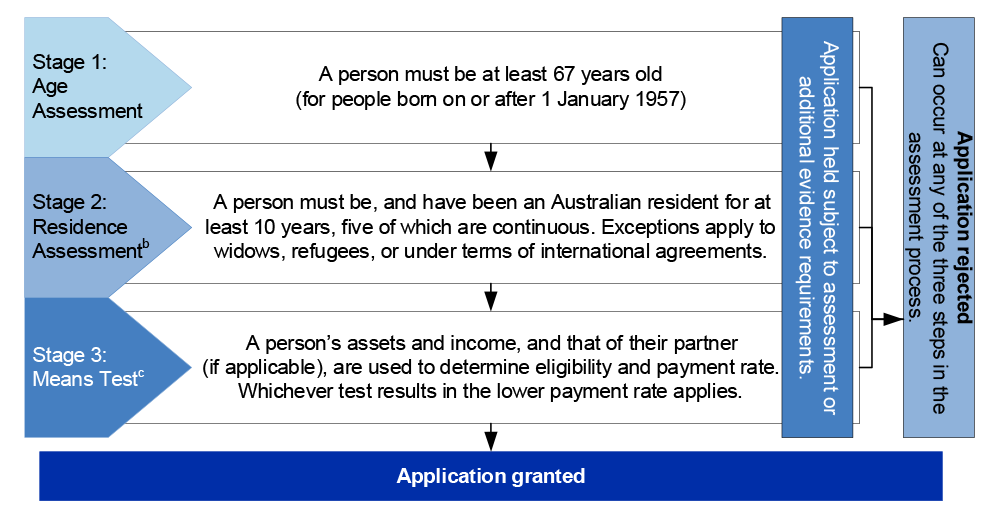
Note a: Guidance for determining age pension age is provided in the online Social Security Guide available at https://guides.dss.gov.au/social-security-guide/3/4/1/10.
Note b: An Australian resident is defined as a person who is residing in Australia and is an Australian citizen, permanent visa holder or protected Special Category Visa holder.
Note c: Applicants who meet criteria for permanent blindness under the Social Security Act 1991 section 95 are exempt from means testing, unless they are claiming rent assistance.
Source: ANAO analysis of Services Australia documents.
Age and residence assessment
3.4 Assessing an applicant against the age requirement is part of an automatic identity confirmation process which uses the Australian Government’s Document Verification Service (DVS).48 For applications that are not submitted online, staff intervention is required to complete age and identity checks.
3.5 The assessment of an applicant’s residence is based on:
- information provided by the applicant; and
- information sourced from the Department of Home Affairs’ Immigration Datalink (which has information on the applicant’s residence, citizenship or visa status and travels to and from Australia).49
3.6 If an applicant resides in a country that has an international social security agreement with Australia50, service officers refer the application to a specialist team within Services Australia. See Appendix 7 for exemptions to the residency requirement.
3.7 If an applicant does not meet either the age or residence requirement, the application is rejected. Service officers review the basis for the rejection and confirm that it is consistent with the applicant’s information.
Means test
3.8 When an applicant meets the age and residency requirements, the application progresses to the means test stage. Services Australia’s operational blueprint51 states that the means test aims to target the age pension in line with applicants’ capacity to provide for themselves — those with considerable means should use their resources before seeking income support from government.
3.9 According to Services Australia’s January 2025 post implementation review of an IT system error which impacted age pension claims assessments (see Case Study 1), the means test’s income and asset assessments are complex and difficult for staff and applicants to understand. For example, the assessment of income streams — as either an asset or an income — depends on several factors, including when they were purchased, the source of funds used to purchase them and how long the applicant will receive payment from them.
3.10 As at June 2024, 1,752,180 recipients received the full age pension rate, and 837,255 received a part payment rate (see Figure 3.2). A person receives a part payment rate when the value of their assets or income is above the full pension rate limit (see Appendix 4).
Figure 3.2: Recipients receiving full and part payment rates 2014 to 2024
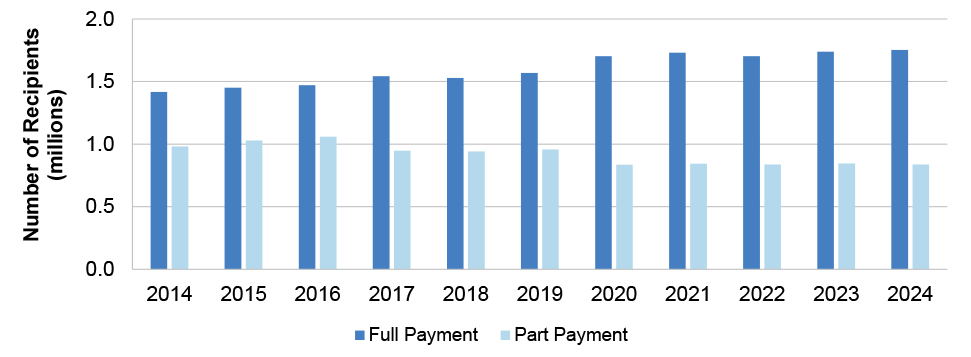
Source: ANAO analysis of DSS data.
3.11 For the assets assessment, Services Australia considers an applicant’s and their partner’s owned or partially owned properties — in Australia and/or overseas — including vehicles, real estate, personal belongings, investments, superannuation, trusts, shares, commercial interests, debts owed to the applicant, gifts (including transferred assets below market value) and inheritance. The applicant’s primary residence and up to two hectares of associated land are excluded from the assets assessment.
3.12 In applying the income assessment, Services Australia considers an applicant’s and their partner’s income from all sources in Australia or overseas.52 Income, including from employment, rental properties, dividends from a private trust or company, business earnings, and winnings earned by chance or skill, are assessed at their actual value. For financial assets (including savings accounts, term deposits, listed shares and securities and some income streams), Services Australia applies deeming rates, not actual returns. As at 20 September 2025 this is 0.75 per cent on the first $64,200 for singles (or $106,200 for couples) and 2.75 per cent for the remaining financial assets.53
3.13 Services Australia does not require service officers to request supporting documents for income and assets declared in application forms, except in specific circumstances such as when the applicant had a previous claim rejected.
3.14 Services Australia may — under the Social Security (Administration) Act 1999 section 19554 — require applicants, or third parties to verify information declared in social security application forms. For example, through data sharing arrangements, Services Australia can obtain information on applicants’ and recipients’ ownership of real estate properties and vehicles from state and territory authorities. Services Australia does not obtain this information from these government bodies. Paragraphs 3.49 to 3.51 discuss Services Australia’s data sharing arrangements.
3.15 Services Australia advised the ANAO in April 2025 that it does not use the Social Security (Administration) Act 1999 sections 192 to 197 to verify applicants’ assets and income and it is considering stronger verification mechanisms particularly for income streams and payroll.
Recommendation no.5
3.16 Services Australia implements an approach to verify applicants’ assets and income to reduce risks to the correctness of age pension eligibility assessments.
Services Australia response: Agreed.
3.17 Services Australia will continue to work with relevant stakeholders to maintain data exchanges with trusted sources of information, reducing risks to the correctness of Age Pension claim assessments.
3.18 The Agency notes that verification already occurs from reviewing supporting documentation provided by customers and that we have introduced further initiatives to help improve payment accuracy in 2025.
3.19 The Agency will continue working with the Department of Social Services to identify legislative reform opportunities to expand on the Agency’s capabilities to verify customer circumstances using third-party data.
Calculating age pension payment rate
3.20 Services Australia relies on its IT system, the Income Security Integrated System (ISIS) to apply the means tests and calculate applicants’ age pension payment rates.
3.21 ISIS has operated for over 40 years. Following advice from the Department of Human Services in 2014 about increasing delivery risks and high operating costs, the government initiated the Welfare Payment Infrastructure Transformation (WPIT) program in February 2015 to replace ISIS by mid-2022. A new calculation engine was piloted in 2022. The trial revealed that the new system could not accurately assess age pension payments. In 2023, Services Australia discontinued decommissioning ISIS and retained it for ongoing claims processing.
3.22 The Department of Finance’s September 2023 End Stage Gateway Review rated the WPIT program Amber/Red, mainly due to not delivering the calculation engine. The Department of Finance recommended Services Australia to assess the risks associated with continuing to use ISIS and develop and implement a risk management plan pending decommissioning.
3.23 Following a September 2024 review of the ISIS risk management plan, which assessed all risks to be within the agency’s risk tolerance, Services Australia closed the recommendation in November 2024. A summary of the risk management plan review is outlined in Table 3.1.
Table 3.1: Summary of Services Australia’s risk management plan for its continued use of ISIS
|
Risk |
Inherent risk ratinga |
Residual risk ratingb |
Post treatment risk ratingc |
Treatments completed as at September 2024d (no) |
|
High |
High |
Low |
0 of 2 treatments |
|
High |
Medium |
Low |
3 of 9 treatments |
|
Very high |
Medium |
Low |
2 of 10 treatments |
|
Medium |
Medium |
Low |
3 of 4 treatments |
Note a: Level of risk before any controls are implemented for mitigation.
Note b: Level of risk remaining after implementing controls for mitigation.
Note c: Level of risk after implementing treatments.
Note d: Treatments identified in this risk management plan are new controls and at varying stages of completion.
Source: ANAO analysis of Services Australia documentation.
3.24 Examples of treatments yet to be completed are outlined in Table 3.2.
Table 3.2: Risk management plan: examples of incomplete treatments
|
Treatment |
Priority |
Status |
Completion progress of treatments as at September 2024 (%)a |
|
Create Procurement Plan to document approach to vendor on roadmaps and solutions. (Risk 1) |
High |
Planned |
0 |
|
Development of Strategy Contract (Risk 1) |
High |
Planned |
20 |
|
Stocktake and remediate knowledge and documentation gaps in the current state ISIS applications. (Risk 2) |
High |
In progress |
25 |
|
Targeted Recruitment plan to ensure full bench strength for succession risks. (Risk 2) |
High |
In progress |
25 |
|
Define the holistic desired state and identify gaps and investment required. (Risk 3) |
High |
In progress |
25 |
|
Establish and implement processes to achieve data mastery to improve payment correctness. (Risk 3) |
High |
Delayed |
0 |
|
Develop a plan to decommission the legacy ISIS systems, including maintenance pending a long-term direction. (Risk4) |
High |
Proposed |
0 |
Note a: As at September 2024 when Services Australia reviewed the risk management plan.
Source: Services Australia’s Risk Management Plan: Continuing Use of ISIS for Welfare Systems.
Opportunity for improvement
3.25 Services Australia complete the implementation of treatments in its risk management plan for the continued use of its core IT system and reassess the risks.
3.26 ISIS has business rules55 incorporated in source code that translate social security legislation and polices. The business rules determine how the system undertakes assessments, including the calculation of payment rates. Services Australia advised the ANAO in November 2024 that:
Age Pension has been in the ISIS system for over 40 years, due to this there is no available documentation that lists the business rules for age pension within the ISIS system.
3.27 Services Australia’s 2024 internal audit on management of automation found that:
[Services Australia] has not taken timely action to remediate risks associated with its use of legacy automations. These automations were implemented prior to [Services Australia’s] introduction of enhanced automation approval and governance controls in July 2022 … The risks associated with the use of these legacy automations … [are] yet to be fully assessed, and an associated remediation plan (if required) had not been developed.56
3.28 The internal audit recommended that:
[Services Australia] should, as a matter of priority, finalise the risk assessment of all automations in use across the agency. [Services Australia] should then prepare and table a paper summarising the outcomes of the risk assessment, and proposed next steps, to an appropriate governance authority for endorsement. Depending on the outcomes of the risk assessment, the next steps may involve developing a remediation plan to mitigate the identified risk exposure and/or confirmed issues.
3.29 Services Australia agreed to action this recommendation by 31 December 2024. Services Australia advised the ANAO in May 2025 that it has not completed its assessment and the recommendation is overdue. Services Australia has not provided an estimate of when this recommendation will be finalised.
3.30 As discussed in Case Study 1, IT system errors in determining applicants’ age pension eligibility and calculating pension payment rates have occurred resulting in overpayments. An August 2019 internal audit on age pension payment assurance found Services Australia does not have arrangements to provide full assurance that system errors would be identified (see paragraph 2.26). Services Australia’s January 2025 post implementation review (see Case Study 1) found it does not have a process to independently calculate system-determined age pension payments, and it is difficult for staff to identify if system calculations are incorrect. Staff are trained to trust system calculations and received limited training on conducting manual calculations to verify system-determined payment rates.
Recommendation no.6
3.31 Services Australia develops and implements an approach to identify and manage risks arising from all its automated processes (to assess age pension claims), including by:
- documenting business rules that govern the assessment of age pension claims; and
- quality checking and reporting on the correctness of automation-derived age pension payment rates.
Services Australia response: Agreed.
3.32 Services Australia supports this recommendation and will work to ensure that business rules are appropriately documented.
3.33 The Agency will also ensure quality checking and reporting are conducted appropriately in alignment with program requirements.
3.34 Services Australia published the Automation and Artificial Intelligence (AI) Strategy 2025–27 in May 2025. The strategy helps guide the Agency in the responsible integration and use of automation and AI technologies through the development of the necessary culture, practices, processes, and governance. It positions the Agency as a best practice organisation where automation and AI is used responsibly, ethically and safely.
3.35 Services Australia are also working closely with the Attorney General’s Department to support the development of a framework to support the safe and ethical use of automation. Once endorsed, we will apply the framework across automation and AI initiatives as appropriate.
Does Services Australia have processes for reviewing recipients’ ongoing eligibility for the age pension?
When informed of changes to recipients’ circumstances, Services Australia updates their records to reassess continued age pension eligibility and payment rates. Services Australia has not been able to update recipients’ records in a timely manner. Services Australia has processes to review recipients’ circumstances including through data gathering arrangements with third parties such as the Australian Taxation Office and superannuation income stream providers.
Changes in recipients’ circumstances
3.36 A recipient’s ongoing age pension eligibility may be impacted by changes in their own or their partner’s circumstances.57 The Social Security (Administration) Act 1999 section 66A requires social security recipients to inform Services Australia within 14 days of changes in their circumstances that might affect their payment entitlement. This includes changes in their income, assets, residence and relationship status.
3.37 Services Australia is informed about changes in recipients’ circumstances in two ways — first, directly from recipients via their online account, by phone or face to face engagement in service centres and second, through Services Australia’s activities such as data sharing arrangements (see paragraphs 3.49 to 3.51) and targeted reviews. Services Australia advised the ANAO in October 2025 that it:
is beginning to implement Proactive Engagement Strategies to prompt customer to update their circumstances where it is identified the customer may be at risk of payment accuracy. Proactive Conversations commenced in February 2023 and Manage My Payment (MMP) commenced in April 2025, are both current examples of where the Agency proactively engages with AGE customers to check if their circumstances have changed.
Updating changes in recipients’ circumstances
3.38 Updates initiated by recipients require service officers to record the changes in Services Australia’s IT system.58 In 2023–24 service officers completed a monthly average of 11,458 updates of work classified as Older Australian updates59, taking an average of 12.25 days to process updates once received or generated by the automated systems.
3.39 Services Australia’s September 2024 internal report on older Australians’ use of digital technology found that service officers are not processing updates in a timely manner and this contributes to incorrect age pension payments. When changes in recipients’ circumstances are not promptly updated, there is a risk that recipients will continue receiving payment that they are not entitled to and incur debt.
3.40 Services Australia advised the ANAO in August 2025 that it has a target of three days to complete updates that may have a direct or immediate impact on qualification or payment accuracy (non-claim category 160). Figure 3.3 shows the number of age pension non-claim category 1 work items on hand and the proportion of these aged seven days or over. Between 2021–22 and 2023–24, 81.48 per cent of non-claim category 1 work items took longer than seven days to be completed.
Figure 3.3: Proportion of age pension non-claim category 1 work items (updates) aged over seven days, September 2021 to June 2024
Source: ANAO analysis of Services Australia data.
Opportunity for improvement
3.41 The Department of Social Services and Services Australia agree on a target and performance measure for the completion of change of circumstance updates.
3.42 Figure 3.4 shows that for the period September 2021 to June 2024 outstanding age pension change of circumstance work items ranged from 1,600 to 15,000. New claims on hand peaked at 43,400 in April 2024. Services Australia advised the ANAO in May 2025 that the reduction of outstanding work items from April 2024 to July 2024 was achieved by way of ‘increased staffing, increased overtime strategies’.
Figure 3.4: Age pension new claims and ‘non-new’ claims on hand, September 2021 to June 2024
Note: Non-new claims is Services Australia term from any task, such as change of circumstances updates, that are not associated with a new claim application.
Source: ANAO Analysis of Services Australia data.
Activities to confirm recipients’ ongoing eligibility
3.43 Services Australia has stewardship of activities that aim to confirm recipients’ circumstances and ensure they receive the right payment at the right time. Services Australia conducts activities either as business-as-usual processes or as part of its annual Compliance Assurance Program (CAP) for social security payments, including the age pension. The CAP is discussed in detail in paragraphs 3.59 to 3.72.
3.44 Services Australia’s activities to review recipients’ continued age pension eligibility are outlined in Table 3.3. As steward of government resources, Services Australia is responsible for safeguarding the integrity of the social security system by ensuring that payments are accurate and sustainable.
Table 3.3: Services Australia’s activities to review recipients’ age pension eligibility
|
Activity |
Description |
Criteria or circumstance impacted |
Scale of activities |
|
Automated Income Stream Reviewa (AISR) |
Automated matching of income stream data from providers with recipients’ assets and income.b |
Asset Income |
Over 1.5 million updates automatically applied to recipients’ files each year. |
|
Automation of Income Stream Review |
Manual processing of income stream data from providers after automated referral to compliance officer.c |
Asset Income |
2,057 reviews completed between 2021–22 to 2023–24. |
|
Corrective Services interventiond |
Matching corrective services data with recipients’ records. |
Incarceration |
179 reviews completed between 2021–22 to 2023–24. |
|
Customer based income stream review |
Requiring recipients to provide information on their Self Managed Super Fund (SMSF) or small APRA fund (SAF). |
Asset Income |
104,879 reviews completed between 2021–22 to 2023–24. |
|
Nudge interventionse |
Involves sending letters to identified customers requesting them to update their information with Services Australia. |
Asset Income Relationship status |
51,593 letters sent to social security payment recipients (2022–23 to 2023–24). |
|
Proof of Life review |
Verifying recipients residing overseas are still alive. |
Life |
44,091 reviews completed between 2021–22 to 2023–24. |
|
Registrar Generals Office interventionf |
Matching death records from the Registrar General’s Office with recipients’ records. |
Life |
79,852 reviews completed between 2021–22 to 2023–24. |
|
Relationship status intervention (RSI)g |
Verifying recipients’ relationship status. |
Single or partnered |
256 RSIs completed (2022–23 to 2023–24). |
|
Residence checks |
Matching travel entry and departure information records from the Department of Home Affairs. |
Residence |
Real time data link. |
|
Single Touch Payrollh (STP) |
Data matching of payroll information supplied by the Australian Taxation Office (ATO). |
Income |
Daily data exchange with the ATO for Single Touch Payroll data. |
|
STP interventionsi |
Completed when data supplied by the ATO is modified by the recipient. |
Income |
1525 reviews completed between 2021–22 to 2023–24. |
|
Proactive Conversations |
Services Officers prompt recipients to update their circumstances during interactions. |
All |
36,136 conversations in 2023–24. |
|
Tip-offsj |
Reviewing tip-off information from the public, internal Services Australia staff or external entities. |
Relationship status Asset Income |
168 tip-off interventions completed between 2021–22 to 2023–24. |
Note a: Subsection 195(3A) of the Social Security (Administration) Act 1999 gives specific powers to the Minister to obtain information in relation to income streams received by customers.
Note b: When an AISR activity is not recorded on a customer’s record it becomes an Automation of Income Stream Compliance review requiring action.
Note c: When an AISR activity identifies an income stream that is not recorded on a recipient’s file, it is referred to a compliance officer and becomes an Automation of Income Stream Review compliance activity.
Note d: The age pension is not payable to a person serving time in prison or correctional facilities.
Note e: No tracking or evaluation occurs to determine the success of nudge interventions.
Note f: Services Australia receives daily death data from State and Territory Registrars via the Queensland Registry of Births, Deaths and Marriages which consolidates all information into a centralised data file.
Note g: Relationship status determines recipients’ payment rate. Services Australia advised the ANAO in December 2024 that the most common investigation completed for age pension as part of RSIs relates to recipients and their partners who are ‘separated under the same roof’.61
Note h: STP involves employers reporting employees’ payroll information (including salaries and wages, pay as you go (PAYG) withholding and superannuation) to the ATO each time they are paid. The ATO shares salaries, wages and employment starting dates with Services Australia from STP data.
Note i: STP activities are referred to a CAP compliance officer when a recipient modifies the prefilled information from the STP data matching process.
Note j: Services Australia collects tip-off information submitted from the public, internal staff or external entities, via Australian Government Services Fraud Tip-offline, the Services Australia website or via Service Australia service centres.
Source: ANAO Analysis of Services Australia documentation.
3.45 When implementing the activities listed in Table 3.3, Services Australia requests information from recipients or from third party sources such as states’ and territories’ Registrar General’s Offices or the Australian Taxation Office (ATO). Requests are either manually initiated by service officers or as part of data gathering agreements. Services Australia advised the ANAO in July 2025 that its activities aim to assist recipients by simplifying reporting procedures. For example, through the Automated Income Stream Review, superannuation providers directly share recipients’ income stream information with Services Australia and the STP program prefills recipients’ employment income and details.
3.46 Information received from data sharing agreements is automatically matched and updated in the recipients’ records by Services Australia’s IT system. Automated activities can be referred to a service officer or a compliance officer when the system is unable to complete the task. With the updated information, the system reassesses recipients’ eligibility and payment rate. The reassessment may lead to a payment increase which is back dated to the event date62 or the day when the change was advised to Services Australia. When reassessment results in a payment reduction, Services Australia may raise a debt.
3.47 Gaps identified in Services Australia’s compliance interventions can lead to new activities. Examples of these include the Proof of Life review, introduced in January 2020 (see case study 2) and the Automated Income Stream Review initiated in January 2019.
|
Case study 2. Proof of Life reviews |
|
In 2018, DSS determined that there was underreporting of overseas pensioner deaths with Services Australia taking an average of five years to identify recipients’ death abroad and stop payments. To address this issue, the Overseas Pensioners Integrity Program measure was announced in the 2018–19 Midyear Economic and Fiscal Outlook with estimated savings of $153.5 million over four years from 2018–19 to 2021–22. In 2019, DSS revised estimated savings to $219 million over 4 years from 2019–20 to 2022–23. Costings were based on an estimate that the measure would identify around 6,000 people over four years who are deceased but still receive a pension. Legislation enabling Proof of Life (POL) reviews was approved on 20 September 2019 and Services Australia commenced POL reviews in January 2020.63 POL reviews require age pension, disability support payment and carer payment recipients — who are over 80 years of age and have continuously resided outside Australia for at least two years — to complete a POL certificate every two years.64 The certificate needs to be endorsed by an authorised certifier within the country of residence and returned to Services Australia within a set period.65 Services Australia advised the ANAO in July 2025 that it does not record the number of deceased recipients identified through POL reviews and therefore cannot report on savings achieved. |
3.48 In February 2023, Services Australia implemented a proactive conversations program in which service officers initiate brief discussions with recipients at the conclusion of telephone calls or in-person visits to service centres. These conversations are designed to verify recipients’ circumstances and help prevent overpayments and underpayments. Services Australia’s February 2024 post implementation review found that of the proactive conversations that resulted in updated recipients’ circumstances, on average 69.8 per cent led to no change, 21.3 to an increase and 8.9 per cent to a decrease in payment rates. Specific to the age pension, available data for 2023–24 shows that 16.11 per cent of proactive conversations led to updates in recipients’ circumstances.
Data gathering arrangements
3.49 Services Australia uses data gathering and data matching arrangements to review recipients’ eligibility and entitlement. Services Australia’s website states that ‘matching data is one of the key controls we use to manage the risk of fraud and non-compliance’. The Social Security (Administration) Act 1999 (Part V)66 gives Services Australia legislative authority to collect information to verify recipients’ circumstances.67 Services Australia maintains agreements with private and government bodies, including the ATO, states and territory corrective services and superannuation providers. In response to recommendation 16.1 of the July 2023 Report of the Royal Commission into the Robodebt Scheme, data exchange agreements between Services Australia and ATO, including the Annual Investment Income Report68, were suspended in October 2023.69
3.50 In 2018, Services Australia prepared a catalogue for all its Compliance Assurance Program data matching activities. Services Australia advised the ANAO in February 2025 that the catalogue remains current. It lists 29 activities, STP not included, and does not specify which ones have been suspended.
3.51 Services Australia does not have a program in place to regularly review its data gathering arrangements. Agreements with the ATO for STP and with Department of Home Affairs for applicants’ and recipients’ travels were reviewed in 2025 and 2023 respectively. Services Australia documentation provided to the ANAO in February 2025 shows that it has not reviewed six of its data gathering arrangements with states and territory corrective services agreed between 2004 and 2019. In October 2025, Services Australia advised the ANAO that, ‘Program Protocol documents and data sharing arrangements were reviewed in 2022. Data exchange with Queensland Births, Deaths and Marriages was reviewed in 2023 when it was renewed’.
Opportunity for improvement
3.52 Services Australia could establish a process to regularly review and update all data gathering agreements and maintain a complete register of all agreements.
Does Services Australia have assurance mechanisms for its assessment of age pension claims?
Services Australia did not meet the 97 per cent age pension payment accuracy target in 2022–23 and 2023–24. Quality checks of service officers’ completed work (between 2021–22 to 2023–24) were below Services Australia’s 95 per cent correctness target. Services Australia’s compliance activities are not in line with risks that contribute the most to age pension payment inaccuracy. Services Australia does not evaluate its compliance activities to determine if intended outcomes (for example estimated savings) are being achieved.
3.53 The BMA’s Payment Assurance Protocol defines assurance as:
how entities obtain confidence that program structures and processes are designed, implemented, and operate as intended. It is represented by effective and efficient controls to manage risks and achieve payment assurance and payment integrity objectives.
3.54 Services Australia’s assurance mechanisms for the age pension are:
- Payment Accuracy and Review Program (PARP);
- Compliance Assurance Program (CAP); and
- Quality Management Application (QMA) and Quality On Line (QOL).
Payment Accuracy Review Program
3.55 When recipients do not inform Services Australia of changes in circumstances, including changes in their assets, the income they earn, or when disclosed amounts are not accurate, there is a risk that they will not receive the correct payment rate.
3.56 Table 3.4 shows that over 90 per cent of recipients reviewed in PARP had errors (discrepancies in recipients’ actual and recorded circumstances) that were either caused by the recipient or Services Australia. These errors include those that resulted and did not result in changes to recipients’ payment rate. Paragraphs 2.36 to 2.44 discusses PARP results for the three year period 2021–22 to 2023–24 in further detail.
Table 3.4: Age pension PARP reviews: administrative and recipient errors
|
Year |
Proportion of reviews with at least one errora identified (%) |
Proportion of reviews with at least one administrativeb error identified (%) |
Proportion of reviews with at least one recipient errorc identified (%) |
|
2021–22 |
94.2 |
27.5 |
92.2 |
|
2022–23 |
92.6 |
26.8 |
90.1 |
|
2023–24 |
92.5 |
26.9 |
90.0 |
|
Average |
93.1 |
27.1 |
90.8 |
Note a: Errors resulting from both administrative and recipient errors.
Note b: Administrative errors include staff incomplete processing, system incorrect processing, staff incorrect application of legislation, staff incorrect information provided to customer, and outdated reference material that do not reflect legislative change.
Note c: Recipient errors include failure to declare circumstances/change in circumstances, and incorrect declaration of circumstances/change in circumstance.
Source: ANAO analysis of Services Australia documentation.
3.57 Services Australia prepares Payment Accuracy Risk Management (PARM) plans each year. PARM plans use PARP results for the last financial year to identify payment accuracy risks and outline recommended treatments to reduce payment accuracy risks. The risk assessment section of Services Australia’s age pension PARM plans include a description of possible causes of the identified risks, such as recipient error or fraud, staff or system errors or inappropriate staff guidance documentation.
3.58 Services Australia advised the ANAO in July 2025 that it was developing a new approach for PARM to better address payment accuracy risks. Services Australia advised the ANAO in October 2025 that, ‘the new approach was developed following consideration of comments in the Accuracy and Timeliness of Welfare Payments Performance Audit 2023’.
Compliance Assurance Program
3.59 Services Australia’s Compliance Assurance Program is not tied to specific payment types and its activities are focused on identified risks in PARM plans. The 2023–24 Compliance Assurance Program Methodology (the CAP methodology) states that its compliance model focuses on ‘making it easier for our customers to do the right thing’ through a range of education and prevention activities. Services Australia primarily relies on recipients to inform Services Australia when their circumstances change. PARP results from July 2021 to June 2024 show that on average, 90.8 per cent of sampled recipients’ records has an error caused by the recipient (see Table 3.4).
3.60 The BMA’s Payment Assurance Protocol states that Services Australia’s CAP aims to address the risk of inaccurate payments caused by customers’ non-compliance or potential non-compliance. The CAP methodology explains that Services Australia uses the payment accuracy risks identified in the PARM as basis for its development of CAP activities to target areas where there is a risk of overpayment. The CAP methodology includes a Risk Identification section that assigns a risk level to risks identified in the PARM against payment types. The matrix categorises investment value as very high, property/real estate and bank investments as high, and employment income as medium.
3.61 Table 3.5 outlines payment accuracy risks identified in the 2023–24 age pension PARM plan, their estimated contribution to payment inaccuracy and what CAP activities link to identified risks.
Table 3.5: Identified risks, inaccuracy value and linked CAP activities
|
Risk type |
Sub-risk type |
Inaccuracy value 2023–24 ($m) |
Services Australia activities linked to risks |
|
Assets |
Value of investments |
751.24 |
Nonea |
|
Property/real estate |
163.65 |
None |
|
|
Vehicles |
23.85 |
None |
|
|
Household contents and personal effects |
12.75 |
None |
|
|
Otherb |
3.29 |
None |
|
|
Unearned income or income from investment |
Investment income from banks/building societies |
141.39 |
None (Annual Investment Income Report suspended)c |
|
Investment income from property |
45.83 |
None |
|
|
Income from superannuation |
26.03 |
Automation of Income Stream Reviews |
|
|
Income from managed investments, life policies, etc |
20.06 |
None |
|
|
Change in relationship status |
72.13 |
Relationship Status interventions |
|
|
Earned income — partner |
49.82 |
Single Touch Payroll interventions |
|
|
Accommodationd |
35.08 |
None |
|
|
Earned income — self |
31.24 |
Single Touch Payroll interventions |
|
|
Payment after death |
31.07 |
Registrar General’s Offices interventions Proof of life reviews |
|
|
Residence |
22.78 |
None |
|
|
Other |
2.02 |
Corrective Services intervention |
|
Note a: Except for income streams that are considered as an assets in particular instances see paragraph 3.9.
Note b: ‘Other’ captures risks that do not fall within defined categories and may include rare or unique scenarios where the identified risk is outside the scope of standard risk categories.
Note c: The Annual Investment Income Report is currently suspended, see paragraph 3.49.
Note d: ‘Accommodation’ refers to Inaccuracies relating to the recipient’s living arrangements. This includes home ownership status, boarding arrangements, and any other housing related factors that may affect entitlement or payment rate.
Source: ANAO Analysis of Services Australia documents.
3.62 Table 3.5 demonstrates that Services Australia’s CAP activities:
- do not cover the risk of assets which contributes the most to age pension payment inaccuracy; and
- partly cover the risk of unearned income or income from investments which is the second biggest contributor to age pension payment inaccuracy.
3.63 For the three-year period 2021–22 to 2023–24, these two risks — undeclared, incorrectly declared and incorrectly assessed assets and unearned income — accounted for nearly three-quarters (74.21 per cent or $3.71 billion) of total estimated payment inaccuracy ($5 billion) (Table 3.6). Available data shows that these risks consistently contributed the most to payment inaccuracy from at least 2014–15.
Table 3.6: Top two payment accuracy risks by value: 2021–22 to 2023–24
|
Risks |
Estimated payment inaccuracy risk ($ million) |
||
|
|
2021–22 |
2022–23 |
2023–24 |
|
Assets |
864 |
871 |
1,001 |
|
Unearned income or income from investments |
305 |
363 |
303 |
|
Sub total |
1,169 |
1,234 |
1,305 |
|
Total |
$3,707 million (74.21% of total estimated $5 billion payment inaccuracy) |
||
Source: ANAO Analysis of Services Australia documents.
3.64 Not having compliance activities to directly address known significant risks points to poor stewardship of public resources. To safeguard the integrity of the age pension program and promote the interest of taxpayers and beneficiaries, Services Australia’s compliance activities should effectively deter applicants and recipients from not fully disclosing their circumstances that impact age pension eligibility and entitlement.
Reporting on Compliance Assurance Program
3.65 Services Australia provides quarterly reports to DSS on activities completed as part of the CAP. These reports outline the planned number of activities, number of completed activities, value of fortnightly reductions and debts raised as a result of compliance activities. The reports do not include information on the number for CAP activities that identified underpayments.
3.66 Services Australia prepares an annual CAP report for use internally. The report is provided to the National Manager of the Payment Accuracy Branch and the Payment Assurance Priorities Board (PAP Board). The annual CAP report consolidates the quarterly results and includes recommendations for the following year’s CAP methodology.
3.67 Table 3.7 summarises age pension CAP results from 2021–22 to 2023–24. It shows that 43.9 per cent of completed reviews identified overpayments amounting to $43.8 million. Of these, 10,439 debts were raised totalling $20.9 million.
Table 3.7: Summary of CAP age pension results between 2021–22 to 2023–24
|
|
2021–22 |
2022–23 |
2023–24 |
Total |
|
Reviews completeda |
48,908 |
49,024 |
43,213 |
141,145 |
|
Number of reductions |
19,441 |
22,028 |
20,499 |
61,968 (43.9%b) |
|
Value of reductions ($) |
14,081,935 |
14,816510 |
14,907,312 |
43,805,757 |
|
Number of debts raised |
3,730 |
3,426 |
3,283 |
10,439 (7.4%b) |
|
Value of debts raised ($) |
6,292,374 |
6,950,801 |
7,682,382 |
20,925,557 |
Note a: Reviews (interventions) for 2023–24 are significantly lower as tip-off activities were removed from the CAP program this year. Tip off activities were not examined as part of the audit.
Note b: Percentage of total reviews completed
Source: ANAO analysis of Services Australia data.
3.68 Table 3.8 shows that from 2021–22 to 2023–24, nearly all age pension reductions (96 per cent) are due to Registrar General’s Offices Interventions. Services Australia advised the ANAO in October 2025 that:
It is true that from 2021–22 to 2023–24, nearly all age pension reductions are due to the Registrar-General’s Offices Intervention. This is because we are unable to do reviews without data or staffing.
Table 3.8: Age pension reductions from Registrar General’s Offices Interventions
|
|
2021–22 |
2022–23 |
2023–24 |
Total |
|
Total age pension reductionsa ($) |
14,081,935 |
14,816510 |
14,907,312 |
43,805,757 |
|
Reductions due to Registrar Generals’ Office interventions ($) |
13,844,118 |
13,769,830 |
14,450,020 |
42,063,968 |
|
Proportion of total reductions (%) |
98.3 |
92.9 |
96.9 |
96.0 |
Note a: Reductions are the amount recipients’ payments is reduced by as a direct consequence of compliance activity. They are calculated using the reduction in payment entitlement in the fortnight immediately following compliance activities.
Source: ANAO Analysis of Service Australia documentation.
Oversight and assurance over compliance activities
3.69 The Payment Assurance Priorities Board (PAP Board) provides oversight of ‘priorities concerning payment assurance activities’ which includes managing issues and risk and has a role to ‘identify and address systemic issues or blockers impacting our payment assurance transformation initiatives.’ The PAP meets monthly to discuss payment accuracy, including CAP results and work being implemented or completed on improving payment accuracy. The PAP endorses the CAP quarterly and annual CAP reports and strategies for future compliance activities.
3.70 In December 2024 Services Australia advised the ANAO that:
Other than BAU management of the process no other reviews have been undertaken [POL]. … No formal reviews have been completed, however post implementation lessons learned out the project and initial implementation were compiled into a presentation. The AISR outcomes and processes have been under constant review for potential improvements, with the implementation of several improvements to cyber security options, capacity to remove or amend erroneous data, improved identity and product matching, and improved automation.
3.71 In October 2025, Services Australia advised the ANAO that:
In 2024, Fraud Control and Investigations Division undertook a Pressure Test on Proof of Life, the final report is in progress. In 2024 when Automation of Income Stream Review (AoIS) interventions recommenced a full review of the case selection risk rating approach was undertaken and changes to support the findings implemented.
3.72 The CAP methodology and strategy documents do not explain how and if the activities will be evaluated to determine achievement of intended outcomes. For example, whether Proof of Life (POL) reviews are achieving the estimated savings of $219 million over four years (see Case Study 2) and whether the program is able to undertake the required review of all age pension recipients over 80 years old and residing overseas for at least two years.
Recommendation no.7
3.73 In its stewardship of the age pension, Services Australia develops and implements an approach to ensure that:
- its Compliance Assurance Program includes activities to sufficiently address the risks of undeclared, incorrectly declared or incorrectly assessed assets and income from investments (other than income streams);
- the Automated Income Stream review, Proof of Life and other activities are being implemented as intended, are effective in addressing payment accuracy risks and achieving intended savings; and
- its Compliance Assurance Program includes activities to identify and report on underpaid recipients.
Services Australia response: Agreed.
3.74 Services Australia is supportive in applying an assurance mechanism that ensures proof of life reviews are implemented as intended by legislation.
3.75 In addition, the Agency will continue working with the Department of Social Services to consider improvements to the proof of life legislation.
3.76 Services Australia continues to monitor and invest in the Automation of Income Stream Reviews process, while addressing payment accuracy risks and achieving intended savings from the process.
Quality checking
3.77 Services Australia uses two quality control tools, Quality Management Application (QMA) and Quality On Line (QOL), to check the quality of service officers’ work on age pension claims.
3.78 QOL and QMA use an algorithm to automatically select work items for checking based on the proficiency of the service officers that completed them70 and assign the work items to quality checking officers for review.71 All work items completed as part of an age pension application or update may be selected for quality checking.
3.79 Services Australia has an internal target of 95 per cent correctness for QOL and QMA quality checks. Over the past three years, the results for quality checking of age pension assessments were below the 95 per cent target (see Table 3.9), with QMA results consistently lower than QOL results.
Table 3.9: QOL and QMA testing results for assessments of age pensiona
|
|
QOL |
QMA |
||
|
Financial yearb |
Number of checks |
Proportion of QOL checks with no errors (%) |
Number of checks |
Proportion of QMA checks with no errors (%) |
|
2021–22 |
2,792 |
89.61 |
15,276 |
81.80 |
|
2022–23 |
3,853 |
89.46 |
21,715 |
76.80 |
|
2023–24 |
3,512 |
86.08 |
27,249 |
79.13 |
Note a: Includes results for service officers that are in training and have 100 per cent of their work quality checked.
Note b: ANAO analysis of QMA data is based on point in time extracts taken at the end of each financial year, where Services Australia only stores QMA results for a period of 2 years within their SAP system. Services Australia noted due to filtering when these extracts were taken, QMA reviews occurring within each financial year that were sampled for review more than 12 months prior to the extraction occurring, will not be present within the data. As such these records are excluded from results.
Source: ANAO analysis of Services Australia data.
3.80 Quality checking results are accessible to staff via Services Australia’s intranet. Managers can access results to monitor individual and team performance. In 2019, Services Australia commissioned an internal audit on Claims Processing Productivity, which found that staff consider the QOL process more helpful as a learning and development tool compared to QMA. With QOL, errors identified by quality checking officers are returned to service officers for correction. In QMA, service officers do not participate in correcting errors as quality checking officers address errors as they identify them.
3.81 Services Australia does not report quality checking results to DSS.
Opportunity for improvement
3.82 Services Australia could analyse the nature and causes of the errors identified through its quality checking of age pension assessments and regularly share this with DSS for continuous program improvement.
4. Services Australia’s engagement with applicants and recipients
Areas examined
This chapter examined whether Services Australia effectively communicates and manages its engagement with age pension applicants and recipients.
Conclusion
Services Australia’s communication and engagement with age pension applicants and recipients is partly effective. Services Australia engages with seniors through a variety of channels (face to face, telephony and digital) and collects information on the quality of its engagement. Services Australia has not fully used the information it collects to address the needs of seniors for simpler claims processes, support with digital technology and shorter wait times for claims to be completed and phone calls to be answered.
Areas for improvement
The ANAO made two recommendations aimed at ensuring Services Australia’s debt letters comply with the requirements of the Social Security Act 1999, and Services Australia uses the data and information it collects to improve outcomes for older Australians. The ANAO indicated one opportunity for improvement for Services Australia to determine why authorised review officers disagree more than they agree with service officers original decisions.
4.1 The Public Governance, Performance and Accountability Rule 2014 (Schedule 1) states that one of the purposes of Services Australia is ‘to collaborate with other agencies, providers and businesses to deliver convenient, accessible and efficient services to individuals, families and communities’.72
4.2 Services Australia’s Corporate Plan 2024–25 states that its purpose is ‘to support Australians by efficiently delivering high-quality, accessible services and payments on behalf of government’.73 Services Australia’s corporate vision is ‘to make government services simple so people can get on with their lives’.74
Does Services Australia have arrangements to facilitate communication and engagement with age pension applicants and recipients?
Services Australia has arrangements to engage with age pension applicants and recipients. This includes face-to-face communications, digital channels, telephony and letter correspondence. Services Australia’s debt letters do not always explain the rationale or basis for the debt. Age pension related complaints increased by 79.77 per cent (the number of recipients increased by 2.05 per cent) between 2021–22 to 2023–24. Maximum wait times for phone calls to be answered exceeded one hour in 435 days or 57.31 per cent of total days during the period.
Face to face and digital engagement
4.3 Services Australia provides its services to age pension applicants and recipients through a variety of channels, including face to face and online (see Table 4.1).
Table 4.1: Services Australia’s face to face and digital services for the age pension
|
Digital or online |
Face to face |
|
|
Source: ANAO analysis of Services Australia’s face to face and digital engagement with applicants and recipients.
4.4 Services Australia’s preference is for social security applicants and recipients, including the age pension, to manage their claims and payments online instead of by telephone or face-to-face engagement.75
4.5 Applicants can lodge their age pension claims online through their Centrelink account, which is connected to myGov, or by visiting a service centre and submitting completed paper application forms. Applicants may request help from service centre officers in completing and submitting their application forms. This is referred to as assisted customer applications.
4.6 For the three-year period 2021–22 to 2023–24, Services Australia’s data shows that 52.75 per cent of applicants lodged their claims online and 24.83 per cent completed paper application forms lodged with customer service centres (see Figure 4.1). The proportion of claims lodged online or via paper forms was stable at 52.49 to 53.04 per cent and 24.09 to 25.70 per cent, respectively. There was a steady increase in claims via assisted customer applications from 16 per cent in 2021–22 to 20.85 per cent in 2023–24.
Figure 4.1: Percentage of age pension claim applications by method
Source: ANAO analysis of Services Australia data.
Telephony
4.7 Services Australia has an older Australians phone line for programs relevant to senior Australians, including the age pension and seniors’ health card. Table 4.2 outlines telephony data for 2021–22 to 2023–24.
Table 4.2: Older Australian phone line: 2021–22 to 2023–24
|
Description |
Results |
|
Number of calls to the older Australian phone line |
4,704,937 |
|
Number of answered calls |
2,284,198 (48.55%) |
|
Number of calls terminated by Services Australia (congested calls)a |
1,628,516 (34.61%) |
|
Number of calls terminated by callers |
792,223 (16.84%) |
|
Average wait time for calls to be answered |
30.5 minutesb |
|
Maximum wait time for calls to be answered |
2 hours and 24 minutes |
Note a: A congestion message is played to advise callers that service officers are busy, recommending the caller to use self-service. Callers are not given the option to stay on the line and wait for their call to be answered. Services Australia has no data on the number of callers who chose self-service after hearing the congestion message (for the period 2021–22 to 2023–24).
Note b: Services Australia advised the ANAO in October 2025 that the average wait time for all calls for the period July 2021 to June 2024 is 30.5 minutes. Data provided to the ANAO referred to daily average wait times for calls to be answered for the same period. From this data, the ANAO calculated the average daily average wait time as 33 minutes and 34 seconds.
Source: ANAO analysis of Services Australia data.
4.8 Services Australia aims to provide timely access to services via telephone calls. Its Strategic Performance Measure 4 sets a target for its service officers to answer at least 70 per cent of phone calls, including for the older Australian phone line, within 15 minutes.76 Services Australia, through its 2023–24 weekly operational plans77, projected that service officers would answer 36.7 per cent78 of all calls to its social security phone lines, including the older Australian phone line, within 15 minutes. The actual result for 2023–24, as reported in Services Australia’s annual report, was 34 per cent.79
4.9 Table 4.3 shows that the daily average wait time for calls to the older Australian phone line was less than 15 minutes on 71 days or 9.35 per cent of the total number of days (excluding weekends and holidays) for the three-year period 2021–22 to 2023–24.
Table 4.3: Older Australian phone line average daily wait times: 2021–22 to 2023–24
|
Range of average daily wait time |
Number of days |
Percentage number of days (%) |
|
Up to15 minutes |
71 |
9.35 |
|
Longer than 15 to 30 minutes |
274 |
36.10 |
|
Longer than 30 to 45 minutes |
204 |
26.88 |
|
Longer than 45 minutes |
210 |
27.67 |
Source: ANAO analysis of Services Australia data.
4.10 Table 4.4 shows that there were 25 days in the period from July 2021 to June 2024 when Services Australia took a maximum of over two hours to answer calls to the older Australian phone line, and a total of 435 days (or 57.31 per cent of the total number of days during the period) when the maximum wait was over one hour. See Appendix 8 for more details on telephony data.
Table 4.4: Older Australian phone line daily maximum wait times: 2021–22 to 2023–24
|
Range of daily maximum wait times |
Number of days |
Percentage number of days (%) |
|
Less than 30 minutes |
42 |
5.53 |
|
30 minutes to 1 hour |
282 |
37.15 |
|
1 hour to 2 hours |
410 |
54.02 |
|
Over 2 hours |
25 |
3.29 |
Source: ANAO analysis from Services Australia documentation.
4.11 Services Australia advised the ANAO in August 2025 that it has not recorded the reasons for recipients’ calls to the older Australian phone line for the period July 2021 to June 2024. It has not analysed the telephony data it collects to understand trends in calls to the older Australian phone line.
Letter correspondence from Services Australia
4.12 Services Australia sends letters to applicants and recipients — either through the myGov inbox or via post — to request information or to notify them of decisions (decision letters) on their application or payment. The ANAO requested copies of these types of letters and Services Australia provided 42 de-identified letters which included 11 debt letters.
4.13 The ANAO found that six of the 11 debt letters did not provide sufficient information explaining how the debt was incurred. The explanations included in the letters are generic and do not go to the individual circumstances of the recipients. For example:
- ‘the correct amount of income from your investments is different to the amount we used to pay you’;
- ‘an incorrect amount of employment income was used to work out the payments made to you’; and
- ‘the correct value of your assets is different to the amount we used in the payments made to you’.
4.14 The Social Security Act 1991 section 1229(1)(b) states that:
If a debt by a person to the Commonwealth under the social security law has not been wholly paid, the Secretary must give the person a notice specifying: …
(b) the reason the debt was incurred, including a brief explanation of the circumstances that led to the debt being incurred.
4.15 By not explaining how the debt was incurred, Services Australia is not providing sufficient information for age pension recipients to understand why they have a debt (which asset, income or investment is referred to), what information Services Australia relied upon to determine the value of the debt and what information they can use to verify the debt or question its correctness.
4.16 Documentation provided by Services Australia in July 2025 shows that it sought and received legal advice for debt letters in ten instances. Two of these were directly relevant to the application of the Social Security Act 1991 section 1229(1)(b).
4.17 Services Australia advised the ANAO in July 2025 that it:
previously obtained internal legal advice in respect of specific debt notice templates and whether those templates meet the requirements of section 1229 of the Social Security Act 1991. This has included advice on whether wording in a particular template met the requirements of section 1229(1)(b) (that the notice specify “the reason the debt was incurred, including a brief explanation of the circumstances that led to the debt being incurred”). The agency uses a large number of different templates, and there may be debt notice templates for which legal advice has not been obtained.
The reason a debt is incurred, and a brief explanation of the circumstances that led to a debt being incurred, will vary depending on the circumstances of an individual case. As a result, debt notices ordinarily require a delegate to manually draft the reason and explanation. As manual drafting is susceptible to human error, it is possible that the reason and explanation may, in some of Services Australia’s debt notices, not be to a standard that meets the requirements of section 1229(1)(b).
Recommendation no.8
4.18 Services Australia reviews and as appropriate revises its letters notifying recipients on their possible debt to ensure that these specify the rationale or basis for the decision.
Services Australia’s response: Agreed.
4.19 The Agency will review its Age Pension account payable letters to ensure they comply with the Social Security Act 1991 and make revisions if the review finds these are required.
4.20 Services Australia will continue its works with advocacy groups and stakeholders to enhance the clarity, tone and accessibility of debt notices, ensuring they are easy to understand and provide customers with the information and support they need.
Complaints
4.21 Services Australia’s Customer Complaints and Feedback Policy provides that social security payment applicants and recipients, including age pension applicants and recipients, may lodge a complaint in person, by phone, online through myGov, in writing (post or fax) or through an external organisation such as the Commonwealth Ombudsman.
4.22 Services Australia triages complaints received as either Level 1 or Level 2.
- Level 1 complaints cover non-complex issues and Services Australia has a target to resolve these within ten business days of receipt.
- Level 2 complaints are escalated to senior complaints officers with no indicated target time for resolution. These include those received via the Commonwealth Ombudsman or a member of Parliament, or of a sensitive nature that could harm a vulnerable applicant or recipient or impact the reputation of Services Australia.
4.23 Table 4.5 shows that Services Australia recorded increasing number of age pension complaints from 14,108 in 2021–22 to 25,362 in 2023–24, representing 79.77 per cent increase. For the same period, the number of age pension recipients grew by 2.05 per cent or from 2,557,691 as at June 2022 to 2,610,012 as at June 2024.
Table 4.5: Recorded age pension complaints for 2021–22, 2022–23 and 2023–24
|
Recorded complaints |
2021–22 |
2022–23 |
2023–24 |
|
Level 1 |
11,950 |
15,633 |
20,715 |
|
Level 2 |
2,158 |
2,512 |
4,647 |
|
Total |
14,108 |
18,145 |
25,362 |
Source: ANAO analysis of Services Australia documentation.
4.24 Services Australia resolved over a third (34 per cent) of all Level 1 complaints on the day they were received (Table 4.6). The 10-business day target to resolve level 1 complaints was not met in 12,524 or 25.9 per cent of complaints recorded during the period. The longest time it took for Services Australia to resolve a Level 1 complaint was 475 business days in 2022–23.
Table 4.6: Recorded age pension Level 1 complaints, by financial year
|
Category |
2021–22 |
2022–23 |
2023–24 |
|
Resolved on the day of receipt |
4,406 (36.87%) |
5,494 (35.14%) |
6,529 (31.52%) |
|
Resolved in 10 days or less |
8,256 (69.09%) |
12,574 (80.43%) |
14,944 (72.14%) |
|
Resolved in 11 daysb or more |
3,694 (30.91%) |
3,059 (19.57%) |
5,771 (27.86%) |
|
Average number of daysab to finalise complaints |
17 daysab |
6 daysab |
9 daysab |
|
Median number of daysab to finalise complaints |
3 daysab |
3 daysab |
5 daysab |
|
Maximum number of daysb to resolve complaint |
208 daysb |
475 daysb |
213 daysb |
Note a: The average number of days is rounded to the nearest whole number.
Note b: Days indicated in the table refer to business days and not calendar days.
Source: ANAO analysis of Services Australia documentation.
4.25 Table 4.7 shows that from 2021–22 to 2023–24, Services Australia resolved 1,238 or 13.29 per cent of all Level 2 complaints on the day they were received. The longest time to resolve a Level 2 complaint was 376 business days, which is less than the maximum 475 business days for Level 1 complaints.
Table 4.7: Recorded age pension Level 2 complaints, by financial year
|
Category |
2021–22 |
2022–23 |
2023–24 |
|
Resolved on the day of receipt |
217 (10.06%) |
245 (9.75%) |
776 (16.70%) |
|
Resolved in 10 daysc or lessa |
984 (45.60%) |
1,245 (49.56%) |
1,860 (40.03%) |
|
Resolved in 11 daysc or morea |
758 (35.13%) |
660 (26.27%) |
1,284 (27.63%) |
|
Average number of daysbc to finalise complaintsa |
18 daysbc |
15 daysbc |
15 daysbc |
|
Median number of daysbc to finalise complaintsa |
10 daysbc |
8 daysbc |
7 daysbc |
|
Maximum number of daysc to resolve complaintsa |
204 daysc |
376 daysc |
293 daysc |
Note a: Excludes Ombudsman and ministerial complaints.
Note b: The average number of days is rounded to the nearest whole number.
Note c: Days indicated in the table refer to business days and not calendar days.
Source: ANAO analysis of Services Australia documentation.
4.26 Beginning in February 2023, Services Australia provides monthly complaints data, including for the age pension, to its senior executive officers through its Customer Feedback High Level Summary reports. Services Australia advised the ANAO in February 2025 that it was ‘unable to provide a response of actions taken by SES, these reports are sent to each work group and is used to formulate their workplan if required’.
Issues raised in age pension complaints
4.27 Table 4.8 shows that for the three-year period 2021–22 to 2023–24, more than a third or 36.89 per cent of all age pension complaints referred to processes for claims, application and assessment as the reason for their complaints. At 28.45 per cent of all complaints received, decisions and outcomes from these processes were the second most cited reason for complaints.
Table 4.8: Reasons for age pension complaints between 2021–22 and 2023–24
|
Reason for complaint |
2021–22 |
2022–23 |
2023–24 |
Total |
Percentage (%) |
|
A claim, application or assessment process |
3,885 |
5,234 |
12,134 |
21,253 |
36.89 |
|
A decision, outcome or payment |
4,551 |
5,492 |
6,350 |
16,393 |
28.45 |
|
A digital service |
1,851 |
2,656 |
2,298 |
6,805 |
11.81 |
|
A phone service |
1,050 |
1,732 |
2,051 |
4,833 |
8.39 |
|
Written information |
904 |
936 |
787 |
2,627 |
4.56 |
|
A staff member |
678 |
745 |
673 |
2,096 |
3.64 |
|
A debt deduction or collection |
437 |
638 |
406 |
1,481 |
2.57 |
|
A service centre |
371 |
373 |
344 |
1,088 |
1.89 |
|
The rules |
381 |
339 |
319 |
1,039 |
1.80 |
|
Total |
14,108 |
18,145 |
25,362 |
57,615 |
100.00 |
Source: ANAO analysis from Services Australia documentation.
4.28 Table 4.9 shows the secondary reasons provided by applicants and recipients for their complaints on claim, application or assessment process (first row of Table 4.8). The length of wait time for claims processes to progress was indicated for 56.17 per cent of the complaints. This is followed by ‘not updated on progress’ at 11.84 per cent. Components of the claims process such as requests for information, multiple contacts to progress and incorrect information were indicated as secondary reason in 4,471 or 21.04 per cent of process complaints.
Table 4.9: Secondary reasons for complaints on age pension claims process between 2021–22 and 2023–24
|
Secondary reason |
2021–22 |
2022–23 |
2023–24 |
Total |
Percentage (%) |
|
I waited too long |
1,321 |
2,145 |
8,472 |
11,938 |
56.17 |
|
Not updated on progress |
498 |
714 |
1,305 |
2,517 |
11.84 |
|
Requests for information |
617 |
628 |
644 |
1,889 |
8.89 |
|
Multiple contacts to progress |
479 |
466 |
503 |
1,448 |
6.81 |
|
Information was incorrect |
329 |
417 |
388 |
1,134 |
5.34 |
|
Review |
227 |
297 |
317 |
841 |
3.96 |
|
Fix a computer system error |
179 |
311 |
248 |
738 |
3.47 |
|
Appeals or objection |
161 |
197 |
182 |
540 |
2.54 |
|
Lost documentation |
74 |
59 |
75 |
208 |
0.98 |
|
Total |
3,885 |
5,234 |
12,134 |
21,253 |
100.00 |
Source: ANAO analysis from Services Australia data.
Review of Services Australia decisions
4.29 Age pension applicants and recipients can request an explanation or review of a service officer’s decision.
4.30 Services Australia assigns a staff member to explain the decision within 14 days of the request. When a formal review is requested, an Authorised Review Officer (ARO), who is a Services Australia staff member, reviews the decision by looking into the circumstances and applying the law and policy applicable to the decision. AROs are required to make attempts to contact the person seeking the review, and will undertake the review even if they are unable to make contact. An applicant or recipient has a right of independent review of the ARO’s decision before the Administrative Review Tribunal.80
4.31 Table 4.10 shows that for the three-year period 2021–22 to 2023–24:
- Services Australia received a total of 25,833 requests to review service officers’ decisions; and
- AROs disagreed (38.33 per cent — the total of varied and set aside decisions) more than they agreed (34.91 per cent) with service officers’ original decisions.
Table 4.10: Data on Authorised Review Officer decisions
|
ARO decisiona |
2021–22 |
2022–23 |
2023–24 |
Total |
Percentage (%) |
|
Affirmedb |
2,882 |
4,081 |
2,055 |
9,018 |
34.91 |
|
Set aside and substitutedc |
1,428 |
2,697 |
1,061 |
5,186 |
38.33 |
|
Variedd |
1,477 |
2,400 |
838 |
4,715 |
|
|
Withdrawne |
1,647 |
1,669 |
1,337 |
4,653 |
18.01 |
|
Pending ARO decision |
279 |
302 |
1,378 |
1,959 |
7.58 |
|
Othersf |
84 |
159 |
59 |
302 |
1.17 |
|
Total |
7,797 |
11,308 |
6,728 |
25,833 |
100.00 |
Note a: Information in this table is derived from data extracted by Services Australia as at 13 June 2025 for ARO reviews requested in 2021–22, 2022–23 and 2023–24.
Note b: Affirmed means the original decision was upheld.
Note c: Set aside and substituted means the original decision was changed.
Note d: Varied means part of the original decision was upheld and part of it was changed.
Note e: Withdrawn means the review application was withdrawn by the applicant before the review is completed.
Note f: Others include: (1) No jurisdiction or dismissed not reviewable, (2) Transferred Interstate; (3) Deleted at the formal review level and (4) no longer at the formal review level.
Source: ANAO from Services Australia’s data on Decisions review 2021–22, 2022–23 and 2023–24.
4.32 Table 4.11 shows that the facts or circumstances considered by original decision makers were the same evidence AROs used when they set aside (52.64 per cent) and varied (60.41 per cent) original decisions.
Table 4.11: Evidence considered by Authorised Review Officers — original decisions set aside and varied
|
Evidencea |
Proportion (%) |
|
Set aside |
|
|
Same facts (discretion) |
52.64 |
|
Same evidence (factual — different view) |
|
|
Same evidence (factual — wrong finding) |
|
|
New information (discretion) |
45.76 |
|
New evidence (factual) |
|
|
Othersb |
1.60 |
|
Varied |
|
|
Same facts (discretion) |
60.41 |
|
Same evidence (factual — different view) |
|
|
Same evidence (factual — wrong finding) |
|
|
New information (discretion) |
38.55 |
|
New evidence (factual) |
|
|
Othersb |
1.04 |
Note a: Information in this table is derived from data extracted by Services Australia as at 30 June 2022 for decisions requested for review in 2021–22; 30 June 2023 for decisions requested for review in 2022–23 and 30 June 2024 for decisions requested for review in 2023–24. Data extracted by Services Australia on 13 June 2025 did not include information on the evidence considered by AROS for the review completed after the end of financial year when they were initiated.
Note b: Others include three categories: (1) law/policy wrong reference or incorrectly applied or changed, (2) Insufficient evidence (factual) and (3) automatic decision.
Source: ANAO analysis of Services Australia documentation.
4.33 Table 4.12 shows that the key reason for most age pension decisions requested for review referred to eligibility criteria. For the three-year period 2021–22 to 2023–24, 82.5 per cent of all decisions appealed to AROs required an assessment of applicants’ and recipients’ assets, income, age, relationship and residency status. Nearly half or 47.3 per cent referred to assets and 28 per cent referred to income.
Table 4.12: Reason for review
|
Issue for review |
2021–22 |
2022–23 |
2023–24 |
Total |
Total percentage (%) |
|
Assets |
3,685 |
5,535 |
2,989 |
12,209 |
47.3 |
|
Income |
2,103 |
3,352 |
1,772 |
7,227 |
28.0 |
|
Age/Relationship status |
424 |
325 |
142 |
891 |
3.4 |
|
Residency |
266 |
379 |
339 |
984 |
3.8 |
|
Others |
1,319 |
1,717 |
1,486 |
4,522 |
17.5 |
|
Total |
7,797 |
11,308 |
6,728 |
25,833 |
100.00 |
Source: ANAO from Services Australia’s data on Decisions review 2021–22, 2022–23 and 2023–24.
Reviews yet to be completed — awaiting Authorised Review Officer decision
4.34 Services Australia aims to complete reviews within 49 days of the request. Table 4.13 shows that of the 28,533 decisions requested for review in 2021–22 to 2023–24, 1,803 were yet to be completed as at 8 July 2025.
Table 4.13: Reviews yet to be completeda — awaiting Authorised Review Officer decision
|
Year review requested |
Number of reviews yet to be completed |
|
2021–22 |
200 |
|
2022–23 |
514 |
|
2023–24 |
1,089 |
|
Total |
1,803 |
Note a: Data as at 8 July 2025.
Source: ANAO analysis of Services Australia data.
Opportunity for improvement
4.35 Services Australia could assess overturned and set aside decisions to determine whether service officers require more training with age pension eligibility requirements, or process complexity contributes to varied decisions on the same facts and evidence.
Consultation with relevant stakeholder groups
4.36 Services Australia undertakes stakeholder engagement through its Civil Society Advisory Group (CSAG), to get feedback on service design and delivery, including:
- the quality and effectiveness of services provided by Services Australia;
- the impact of new and existing policies and/or legislation on customers; and
- insights on the customer service delivery experience, including pain points and areas of improvement.
4.37 The CSAG — Older Australians81 meets every second month and is a platform for discussion on programs for older Australians such as the age pension program.
Does Services Australia use information to drive continuous improvement?
Services Australia collects information relevant to its engagement with age pension applicants and recipients. This information points to the needs of seniors for simpler and clearer claims processes, support with accessing digital technology and shorter wait times for claims to be completed and phone calls to be answered. Services Australia has not yet acted to improve the age pension application process or make digital services more accessible to older Australians.
Applicants and recipients experience with age pension claims processes
Age pension experience (APEX) Usability Testing Report
4.38 In November 2018, Services Australia conducted a review which found that older Australians consider both paper and online age pension application processes complex, ambiguous and difficult to navigate (see Table 4.14).
Table 4.14: Pain points as indicated by applicants in APEX Usability Testing
|
Paper application process |
Online application process |
|
Participants were required to answer a lot of questions with no clear guidance about the information needed to complete the forms. Some claim questions in the Income Assets form were ambiguous and difficult to understand. The claim questions had been developed under the false assumption that applicants have high financial literacy. The forms were difficult to navigate, the instructions were not clearly visible and the page layout was inconsistent. The forms were difficult to read as large volumes of information were compressed together, with inadequate spacing between questions. |
The website content on eligibility was ambiguous. Content was difficult to understand as it includes departmental jargon, without sufficient explanation. Content and questions were ambiguous and falsely assumes that applicants have knowledge of departmental processes and have high financial literacy. The online help was not effective. Navigating multiple screens to complete a single task was time consuming. The system would automatically exit participants from the online claim process. |
Source: ANAO analysis of Services Australia documentation.
4.39 Services Australia identified the following opportunities from the review:
- use easy language and visual support on the website and online claim portal;
- review questions to ensure that only information necessary to determine applicants’ age pension eligibility is collected;
- provide a checklist of information and supporting evidence that may assist the claim; and
- redesign the paper application forms to improve readability and navigation.
4.40 Services Australia advised the ANAO in February 2025 that it had not made changes to the age pension paper and online application processes in response to the APEX report.
Digital usage of ageing Australians
4.41 As discussed in paragraph 4.4, Services Australia‘s preference is for its social security applicants and recipients, including the age pension, to manage their claims and payments online instead of by telephone or face-to-face engagement. It has a performance measure that targets at least 82 per cent of applicants and recipients’ transactions to be completed online or through its digital channels.
4.42 In September 2020, the eSafety Commissioner published a report which found that ‘older Australians aged 50 years and over are less confident using online technology than younger Australians’.82 In May 2018, the eSafety Commissioner reported that approximately 34 per cent of Australians aged 50 years and over ‘had either low digital literacy levels or did not use digital devices or the internet’.83
Older Australians Self Service Analysis
4.43 The Older Australians Self Service Analysis conducted in June 2021 compared the rates of self-service usage (by age) for 2019 and 2021. Self-service refers to recipients’ use of online access or phone self-service to manage Centrelink services. The analysis referred to older Australians as those aged from 66 years.
4.44 The analysis found that older Australians have a clear trend for lower levels of self-service usage. The report noted that it is important for Services Australia to consider older Australians’ preferences when targeting digital adoption strategies to customer groups.
4.45 The report said that the next step to this report is to determine opportunities to increase older Australians’ use of its digital claim lodgement or income and asset updates processes.
Digital usage amongst ageing Australians and its impact on payment accuracy Pre-Discovery Report
4.46 Services Australia’s September 2024 Digital usage amongst ageing Australians and its impact on payment accuracy Pre-Discovery Report found that:
- most older Australians do not engage digitally due to privacy or security concerns;
- digital literacy levels decline as people reach the age of 70 and beyond, leading to increased digital disengagement (citing previous research);
- although many age pension recipients are registered with myGov, there are still a significant number of manual forms and letters being sent out; and
- older Australians require support to confidently use digital services and devices.
4.47 The report recommended that Services Australia:
- engage with recipients to understand their pain points in using digital services; and
- work to understand why recipients choose to update their details via phone when many of them are registered online.
Age Pension Preferences Customer Engagement Report
4.48 Services Australia’s March 2025 Age Pension Preferences Customer Engagement Report talked with 20 age pension recipients via phone to obtain insights into their communication preferences.
4.49 The report found that 12 of the 20 recipients included in its study ‘have never checked the details Centrelink has recorded for them or have only reported fortnightly income, or checked payment amounts but no other details’.
4.50 When asked how often they check or update their details, 11 participants said they had not done either for the following reasons:
- They are not computer literate;
- They do not have access to a computer;
- They have difficulties accessing or using online services; and
- They prefer to speak to someone in person at a Service Centre.
4.51 Services Australia advised the ANAO in July 2025 that the findings from this report will support the development of tailored messaging strategies for older Australians.
Using information to drive continuous improvement
4.52 Service Australia’s minutes for the 2023 and 2024 CSAG — Older Australians consultation meetings show that concerns raised by stakeholders focus on older Australians’ challenges with:
- digital technology, especially those who are ‘isolated and non-digital’;
- the application process which is ‘too complicated for older Australians’; and
- wait times for claims assessment to be completed and phone calls to be answered.
4.53 Services Australia has used performance information on claims timeliness to manage its workforce. Services Australia advised the ANAO in August 2025 that it employed some 5,000 service officers (in 2023–24) to address the significant backlog in claims assessment, including for the age pension. Of the additional staff hired, 494 received training in age pension work. The temporary funding measure for additional staff lapses in 2026–27. The ANAO asked Services Australia regarding its plans when funding lapses. Services Australia told the ANAO that it would work with available staff over the coming financial years.
4.54 Services Australia has not used the information it has to improve applicants’ and recipients’ experience with age pension processes and address their lack of confidence and proficiency with digital transactions.
Recommendation no.9
4.55 Informed by the data it collects and the engagement needs and preferences of older Australians, Services Australia develops and implements an approach to:
- enable applicants to understand and confidently complete application forms and processes in a timely manner;
- consistent with its performance measures, reduce older Australians’ wait time for claims processes to be completed and phone calls to be answered; and
- provide older Australians targeted support for digital coaching and more access to service officers who have been trained on the needs of older Australians.
Services Australia’s response: Agreed.
4.56 Services Australia will continue to work in partnership with stakeholders to enhance the Age Pension claim experience, balancing customer needs with the requirement to maintain or improve processing and telephony performance within Agency benchmarks.
Appendices
Appendix 1 Entity responses
Department of Social Services
Department of Veterans’ Affairs
Services Australia
Appendix 2 Improvements observed by the ANAO
1. The existence of independent external audit, and the accompanying potential for scrutiny improves performance. Improvements in administrative and management practices usually occur in anticipation of ANAO audit activity; during an audit engagement; as interim findings are made; and/or after the audit has been completed and formal findings are communicated.
2. The Joint Committee of Public Accounts and Audit (JCPAA) has encouraged the ANAO to consider ways in which the ANAO could capture and describe some of these impacts. The ANAO’s corporate plan states that the ANAO’s annual performance statements will provide a narrative that will consider, amongst other matters, analysis of key improvements made by entities during a performance audit process based on information included in tabled performance audit reports.
3. Performance audits involve close engagement between the ANAO and the audited entity as well as other stakeholders involved in the program or activity being audited. Throughout the audit engagement, the ANAO outlines to the entity the preliminary audit findings, conclusions and potential audit recommendations. This ensures that final recommendations are appropriately targeted and encourages entities to take early remedial action on any identified matters during the course of an audit. Remedial actions entities may take during the audit include:
- strengthening governance arrangements;
- introducing or revising policies, strategies, guidelines or administrative processes; and
- initiating reviews or investigations.
4. In this context, the ANAO observed the below actions during the course of the audit. It is not clear whether these actions and/or the timing of these actions were planned in response to proposed or actual audit activity. The ANAO has not sought to obtain assurance over the source of these actions or whether they have been appropriately implemented.
- In December 2024, DSS commenced program managers meetings with the Department of Veterans Affairs (DVA) on the latter’s administration of the age pension. (Paragraph 2.61)
- In April 2025, DSS commenced working with DVA to review the 2013 Memorandum of Understanding regarding Social Security Payments to Entitled Persons. (Paragraph 2.62)
- In January 2025, DSS and Services Australia reviewed the 2023 BMA Head Agreement and signed a new Head Agreement. (Paragraph 2.6)
- From July 2025, Services Australia developed a new approach to developing its payment accuracy risk management plans to streamline time and effort in developing the plans and to support programs in addressing payment accuracy risks. (Paragraph 3.58)
- In January 2025, Services Australia completed a report on its post-implementation review of the causes that contributed to the issue of superannuation excluded from eligibility assessments of some senior cohorts and lessons learned. (Case Study 1)
- In September 2024, Services Australia completed its review of Digital usage amongst ageing Australians and its impact on payment accuracy pre-discovery report. (Paragraph 4.46)
- In March 2025, Services Australia completed its Age pension preferences customer engagement report. (Paragraph 4.48)
- In April 2025, Services Australia commenced the Manage My Payment program to prompt recipients to update their circumstances. (Paragraph 3.37)
Appendix 3 Demographics of age pension recipients
1. Table A.1 provides data on the percentage of age pension recipients that fall into different categories as at March 2025.
Table A.1: Age pension recipients’ data, March 2025
|
Age pension recipient that: |
Number of recipients |
Percentage of recipients (%) |
|
Own their own home |
1,933,885 |
72.85 |
|
Live in rural areasa |
931,025 |
35.07 |
|
Are female |
1,474,585 |
55.55 |
|
Are male |
1,180,140 |
44.45 |
|
Were born in Australia |
1,616,310 |
60.88 |
|
Are non-Australian Citizensb |
195,095 |
7.35 |
|
Are married or otherwise partnered |
1,358,545 |
51.17 |
|
Identify as Indigenous |
30,575 |
1.15 |
Note a: Age pension recipients living outside major cities as identified by DSS.
Note b: These are Australian residents or those with an exemption from the residence test. Australian citizenship is not a requirement to receive the age pension.
Source: ANAO analysis of DSS data.
2. Figure A.1 provides information on age pension recipients by age and location.
Figure A.1: Age pension recipients by state and territory by age group, December 2024
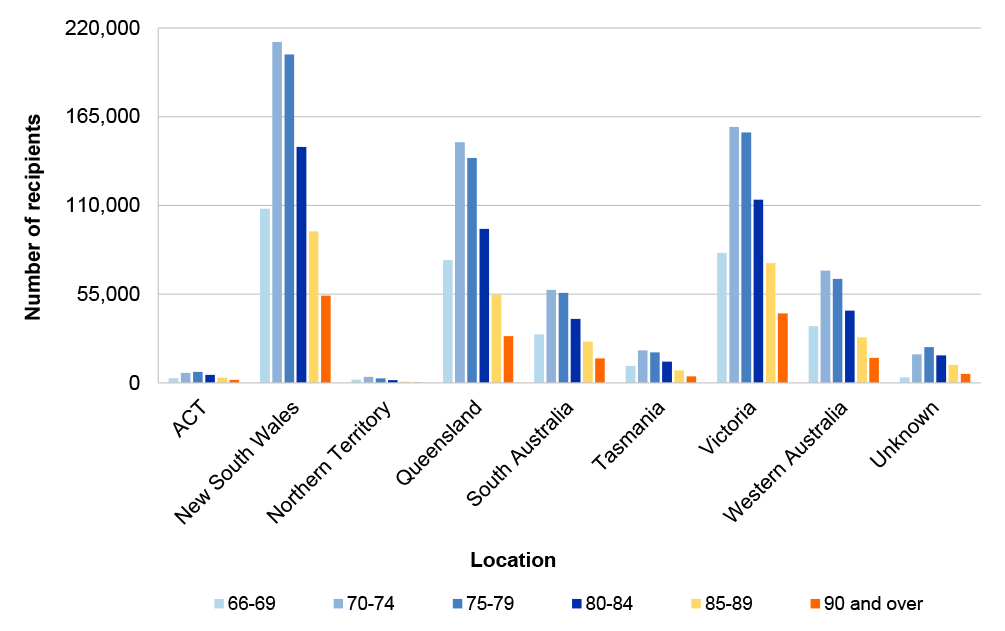
Source: ANAO analysis of DSS data.
3. Figure A.2 shows the percentage of age pension recipients for each state and territory.
Figure A.2: Age pension distribution across Australia, March 2025
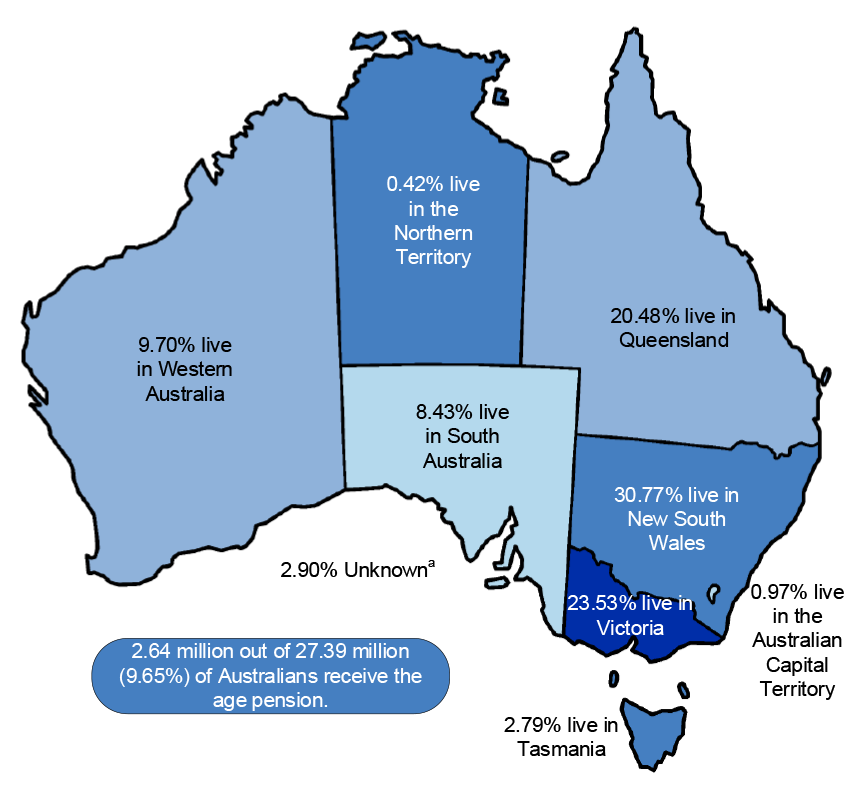
Note a: Individuals who live overseas or who are without a valid address cannot be assigned to a locational boundary (Local Government Area, postcode or electorate) are represented as ‘unknown’.
Source: ANAO analysis of DSS data.
4. Table A.2 shows the number of age pension recipients by area of remoteness.
Table A.2: Age pension distribution by remoteness
|
Remoteness area of recipients |
Number of recipients |
Percentage of recipients (%) |
|
Major Cities of Australia |
1,646,800 |
62.0 |
|
Inner Regional Australia |
636,300 |
24.0 |
|
Outer Regional Australia |
261,195 |
9.8 |
|
Remote Australia |
23,355 |
0.9 |
|
Very Remote Australia |
10,180 |
0.4 |
|
Unknowna |
76,895 |
2.9 |
Note a: Individuals who live overseas or who are without a valid address cannot be assigned to a locational boundary (Local Government Area, postcode or electorate) are represented as ‘unknown’.
Source: ANAO analysis of DSS data.
Appendix 4 Age pension means tests
1. Age pension applicants, and their partners (if applicable), are subject to asset and income means tests as part of the eligibility assessment for the age pension.
Income test
2. For the calculation of the rate of payment, a single person is able to earn, up to $218 per fortnight before it will impact their payment rate, known as the ‘free area’. For couples this amount is increased to $380. Once these thresholds are past payments rates are reduces by $0.50 per dollar for a single person or $0.25 per dollar for couples for each dollar earned over the free area. Table A.3 shows the cut off points for when a person becomes ineligible to receive the age pension.
Table A.3: Income test cut-off points as at 20 September 2025
|
Situation of recipient |
Fortnightly cut off point ($) |
|
Single person |
2,575.40 |
|
Couple living together |
3,934.00 combinedb |
|
Couple living apart due to ill health |
5,094.80 combinedb |
|
Single person — transitional ratea |
2,617.25 |
|
Couple living together — transitional ratea |
4,251.50 combined |
|
Couple living apart due to ill health — transitional ratea |
5,178.50 combined |
Note a: Transitional rates started in 2009 for pensioners who would get a lower payment rate if income test changes from 20 September 2009 are applied. It acts as safety net to ensure that these pensioners are not financially worse off. Eligible recipients continue to be paid under the old rules (plus an initial increase) until their potential rate under the current rules becomes the same or higher than the transitional rate.
Note b: Income for both applicant and their partner.
Source: Services Australia.
Asset test
3. All asset types are assessed for the age pension, with the exclusion of a person’s primary residential home. There are upper and lower limits that impact a person’s payment rate. If below the lower limit, the full rate pension will be paid. The payment amount reduces once over this amount until the upper limit is reached, at which point a recipient is no longer eligible for the pension. Table A.4 shows these limits.
Table A.4: Asset test lower and upper limits as at September 2025
|
Situation of recipient |
Lower limit (homeowner) ($) |
Lower limit (non-homeowner) ($) |
Upper limit (homeowner) ($) |
Upper limit (non-homeowner) ($) |
|
Single |
321,500 |
579,500 |
714,500 |
972,500 |
|
A couple, combineda |
481,500 |
739,500 |
1,074,000 |
1,332,000 |
|
A couple, separated due to illness, combineda |
481,500 |
739,500 |
1,267,500 |
1,525,500 |
|
A couple, one partner eligible, combineda |
481,500 |
739,500 |
1,074,000 |
1,332,000 |
Note a: Combined refers to the combined total of both members of a couple.
Source: Services Australia.
Appendix 5 Bilateral management arrangements — key roles and responsibilities for DSS and Services Australia
|
Department of Social Services |
Services Australia |
Joint responsibility |
|
Social security services schedule
Payment assurance protocol
Shared management risk protocol
|
Social security services schedule
Payment assurance Protocol
Shared management risk Protocol
|
Payment assurance protocol
Shared management risk protocol
|
Source: BMA Services Schedule for Social Security and Family Payments, Payment Assurance Protocol, and Shared Risk Management Protocol.
Appendix 6 Age pension program logic
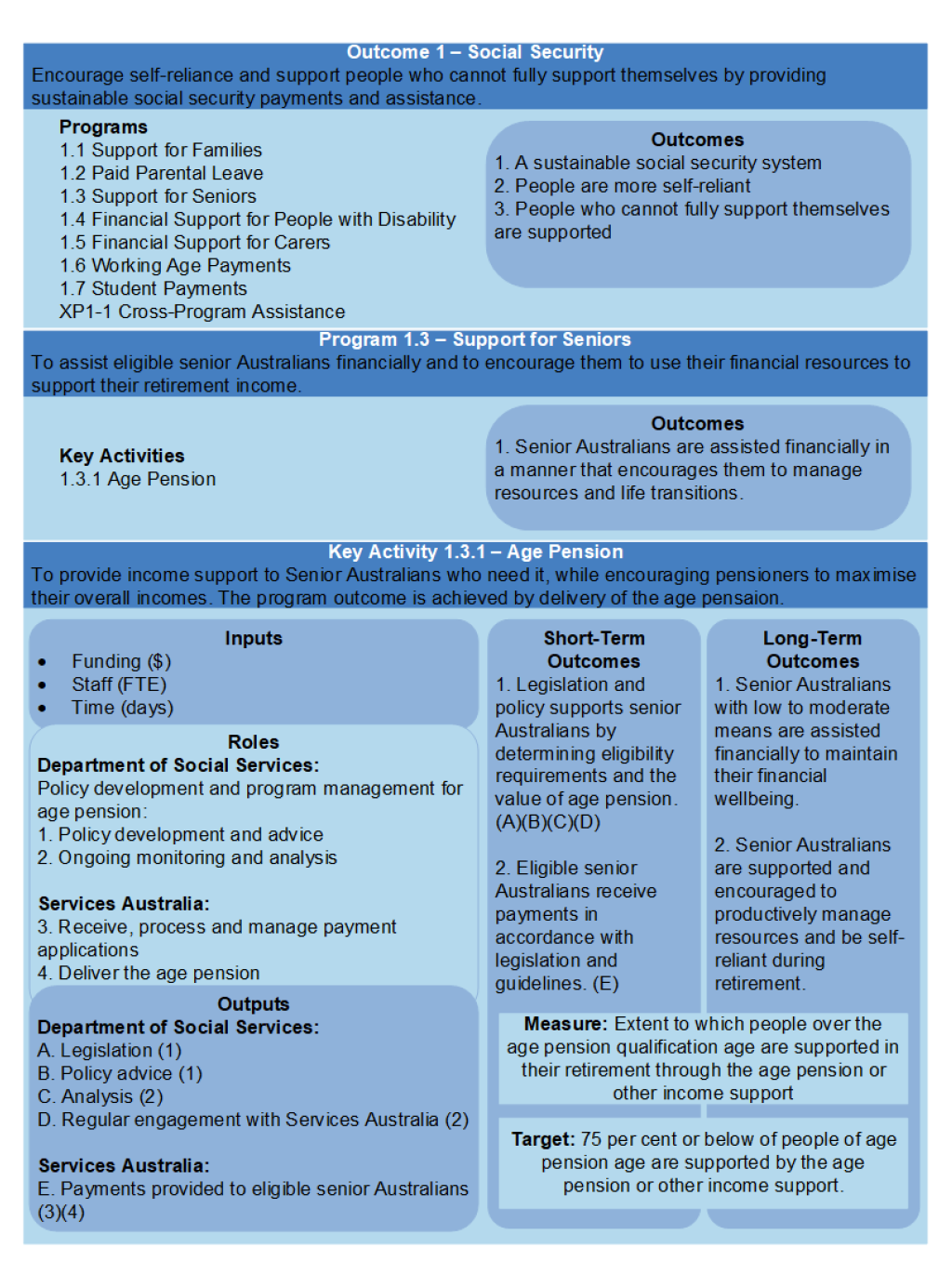
Source: DSS’ age pension program logic.
Appendix 7 Exemptions from the residency requirement
1. To satisfy the residence criteria for the age pension, an applicant should be an Australian resident and be in Australia at the time the application is made. An exemption or alternate qualification to this requirement applies where the applicant:
- is a refugee or former refugee;
- is a female who was widowed while both the applicant and partner were Australian residents and has at least 104 weeks Australian residence prior to claim;
- was in receipt of Widow B Pension, Widow Allowance, Mature Age Allowance or Partner Allowance immediately before turning age pension age;
- was receiving Widow B Pension, Widow Allowance or Partner Allowance on 19 March 1997 and had already turned age pension age at that date;
- was receiving Wife Pension on 19 March 2020 and was not receiving Carer Allowance at that time;
- was receiving Widow Allowance on 31 December 2021 and had already turned age pension age at that date;
- qualifies using an international social security agreement.
Appendix 8 Older Australians phone line: telephony data
Figure A.3: Monthly data for age pension calls showing average daily number of calls answer, calls terminated, longest wait time, average longest wait time and the average speed of answer (2021–22 to 2023–24)
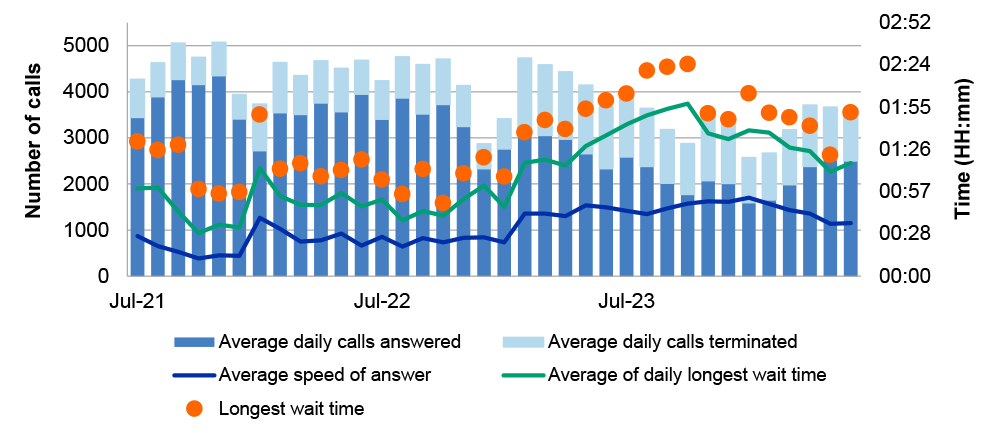
Note: Terminated calls are calls abandoned by the caller before being answered. No data is recorded on how long caller waited for before abandoning call.
Max wait and average wait times do not include data of wait time incurred by abandoned calls.
Services Australia’s Strategic Performance Measure 4 is a target for customers to be served within 15 minutes.
Source: ANAO Analysis of Services Australia call data.
Figure A.4: Monthly call data for age pension calls showing total calls offered and percentage of the outcome of each call (2021–22 to 2023–24)
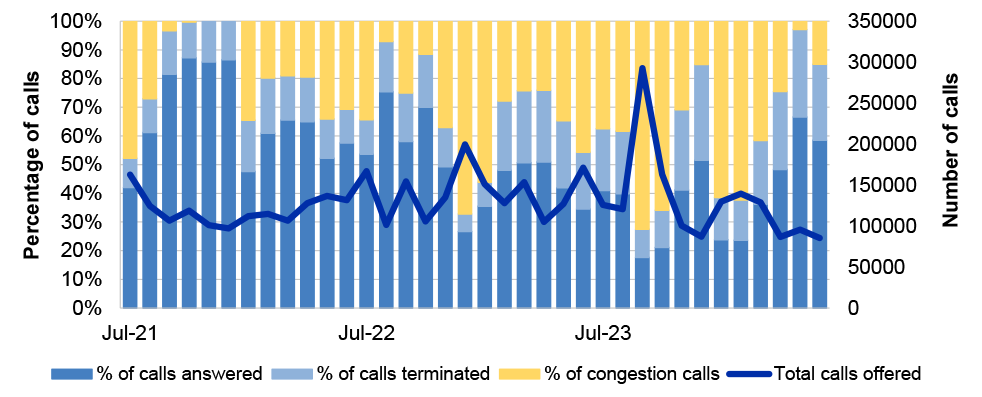
Note: Total calls offered includes all calls where the caller has selected an option related to age pension claims. This does not include self-managed calls completed using Services Australia’s IVR system.
Congestion calls occur when Services Australia stop calls from proceeding by playing a message that the call is unable to be answered and to call back.
Source: ANAO Analysis of Services Australia call data.
Footnotes
1 The largest program expenditure in 2024–25 was revenue assistance to states and territories. Parliamentary Budget Office, 2025–26 Budget snapshot, Top 20 Programs (Budget round 2024–25 and Year 2024–25) available from https://www.pbo.gov.au/publications-and-data/publications/budget-charts/2025-26-budget-snapshot [accessed 9 January 2026].
2 Department of Social Services 2024–25 Annual Report, Personal benefits financial statements Administered expenses, page 178, available from https://www.dss.gov.au/system/files/documents/2025-11/department-social-services-annual-report-2024-25.pdf [accessed 9 January 2026].
3 Qualification age has changed over time. When the age pension started in 1909, men qualified at 65 and women at 60 years old. From 1995, the qualification age for women increased to 65 (by phases until 2013). From July 2017, the age requirement for men and women increased from 65 to 67 (by phases until 2023).
4 An Australian resident is defined as a person who is residing in Australia and is an Australian citizen, permanent visa holder or protected Special Category Visa holder. Exceptions to the residence requirements apply to widows, refugees, or under terms of international agreements.
5 Departmental appropriations refer to government funding for ordinary operating costs such as salaries and operational expenditure.
6 The largest program expenditure in 2024–25 was revenue assistance to states and territories. Parliamentary Budget Office, 2025–26 Budget snapshot, Top 20 Programs (Budget round 2024–25 and Year 2024–25) available from https://www.pbo.gov.au/publications-and-data/publications/budget-charts/2025-26-budget-snapshot [accessed 9 January 2026].
7 Department of Social Services 2024–25 Annual Report, Personal benefits financial statements Administered expenses, page 178, available from https://www.dss.gov.au/system/files/documents/2025-11/department-social-services-annual-report-2024-25.pdf [accessed 9 January 2026].
8 The valuation is based on the expected net present value of all payments to the model population over their lifetimes. The model population comprised resident Australians and people living overseas receiving social security payments on 30 June 2024. The Commonwealth of Australia, Australian Government Actuary, Australian Priority Investment Approach to Welfare 30 June 2024 Valuation Report p. iii, Canberra, available from https://www.dss.gov.au/australias-approach-social-investment/resource/australian-priority-investment-approach-welfare-30-june-2024-valuation-report [accessed 16 December 2025].
9 Qualification age has changed over time. Before 1 July 2013, men qualified for the age pension at 65 while women qualified at age 60. From July 1995 to July 2013, the qualification age for women was raised by six months each year to 65. A further increase for all recipients occurred from July 2017 to July 2023, raising the qualification age to 67.
10 An Australian resident is defined as a person who is residing in Australia and is an Australian citizen, permanent visa holder or protected Special Category Visa holder. Exceptions apply to widows, refugees, or under terms of international agreements.
11 As at 22 September 2025, agreements are in place with three countries in Asia (India, Japan and Korea), 25 countries in Europe (Austria, Belgium, Croatia, Cyprus, Czech Republic, Denmark, Estonia, Finland, Germany, Greece, Hungary, Ireland, Italy, Latvia, Malta, Netherlands, North Macedonia, Norway, Poland, Portugal, Serbia, Slovak Republic, Slovenia, Spain and Switzerland), two countries in North America (Canada and United States of America), one country in South America (Chile) and one country in Oceania (New Zealand). Australia signed an agreement with the Oriental Republic of Uruguay on 26 August 2025. This agreement is expected to be operational in mid-2026.
12 Department of Social Services, Corporate Plan 2024–25, DSS, Canberra, 2024, p. 8, available from https://www.dss.gov.au/corporate-plans/resource/department-social-services-corporate-plan-2024-25 [accessed 08 May 2025].
13 ibid., p. 19.
14 Parliament of Australia, Administrative Arrangements Order — 26 June 2025, available from https://www.pmc.gov.au/resources/aao-13-may-2025 [accessed 15 July 2025]. On 1 July 2025, responsibility for the delivery of services and payments relating to social security policy was transferred from the Social Services portfolio to the Finance portfolio.
15 Predecessor entities to Services Australia with responsibility for delivering welfare payments were Centrelink from July 1997 to June 2011 and the Department of Human Services from July 2011 to January 2020. Services Australia was established as an executive agency within the Social Services portfolio in February 2020.
16 Accountable officers of DSS and Services Australia signed the BMA Head Agreement in December 2024, replacing the 2023 BMA Head Agreement.
17 Predecessor entities to the Department of Social Services with policy responsibility for social security and welfare payments were the Department of Social Security from 1972 to 1998, the Department of Family and Community Services from 1998 to 2006 and the Department of Families, Housing, Community Services and Indigenous Affairs from 2007 to 2013.
18 In September 2013 the Department of Families, Housing, Community Services and Indigenous Affairs became the Department of Social Services, with indigenous affairs functions moved to the Department of the Prime Minster and Cabinet.
19 Public Governance, Performance and Accountability Act 2013.
20 Department of Social Services, Portfolio Budget Statements 2024–25 Portfolio Budget Statements 2024–25 Budget Related Paper No 1.14 Social Services Portfolio, p. 6, Outcome 1 Social Security, available from https://www.dss.gov.au/budget-and-additional-estimates-statements/resource/portfolio-budget-statements-2024-25-budget-related-paper [accessed 28 July 2025].
21 Public Governance, Performance and Accountability Act 2013, sections 15 and 16.
22 Assurance is ‘an objective examination of evidence for the purpose of providing an independent assessment on governance, risk management, and control processes for the organization’. Australian Institute of Company Directors, Managing relationships with auditors, 2020, p. 6 available from https://www.aicd.com.au/good-governance/company-audit/internal/managing-relationships-with-auditors.html [accessed on 27 May 2025].
23 Predecessor entities to Services Australia with responsibility for delivering the age pension were Centrelink from July 1997 to June 2011 and the Department of Human Services from July 2011 to January 2020.
24 The PARP involves identifying a random sample of welfare payment recipients and reviewing their circumstances (PARP reviews) to confirm their eligibility and payment rate on a particular fortnight. Auditor-General Report No. 4 2023–24, Accuracy and Timeliness of Welfare Payments, ANAO, Canberra, 2024, para 1.10, available from https://www.anao.gov.au/work/performance-audit/accuracy-and-timeliness-welfare-payments [accessed 8 April 2025].
25 Auditor-General Report No. 4 2023–24, Accuracy and Timeliness of Welfare Payments, ANAO, Canberra, 2024, para 2.29, available from https://www.anao.gov.au/work/performance-audit/accuracy-and-timeliness-welfare-payments [accessed 8 April 2025].
26 Accountable Authority Instructions (AAIs) assist accountable authorities in meeting their general duties under the Public Governance, Performance and Accountability Act 2013 and establishing appropriate internal controls for their entity. Available in https://www.finance.gov.au/government/managing-commonwealth-resources/managing-risk-internal-accountability/risk-internal-controls/accountable-authority-instructions-aais-rmg-206 [accessed 16 December 2025].
27 Payment correctness is impacted by administrative error from staff and or IT system. Payment accuracy is impacted by both administrative and customer errors. Services Australia, Services Australia annual report 2023–24, page 134, available from https://www.servicesaustralia.gov.au/annual-report-2023-24 [accessed 20 August 2025].
28 Category A findings pose a significant business or financial management risk to the entity: these include findings that could result in the material misstatement of the entity’s financial statements. Australian Audit National Office, Financial statement audit information, ANAO, Canberra, available from https://www.anao.gov.au/financial-statement-audit-information [accessed 1 September 2025].
29 Category B findings pose moderate business or financial management risk to the entity; these may include prior year findings that have not been satisfactorily addressed’. Australian Audit National Office, Financial statement audit information, ANAO, Canberra, available from https://www.anao.gov.au/financial-statement-audit-information [accessed 1 September 2025].
30 Services Australia advised the ANAO in August 2025 that the number of additional services officers employed in 2023–24 was approximately 5,000.
31 Services Australia advised the ANAO in December 2025 that it ‘met the target in Q2, Q3 and Q4 of 2024/25 and met the target for the 2024/25 year’.
32 Social Security (International Agreements) Act 1999
33 Public Governance, Performance and Accountability Act 2013 paragraph 15(1)(b).
34 Social Security (Administration) Act 1999 section 8.
‘The [department] Secretary is to have regard to (a) the desirability of achieving the following results: …(iv) the development of a process of monitoring and evaluating delivery of programs with an emphasis on the impact of programs on social security recipients.’
35 Australian Treasury, Towards a higher retirement incomes for Australians: A history of the Australian retirement income system since Federation, Canberra, page 5 of the pdf, available at https://treasury.gov.au/sites/default/files/2019-03/round4.pdf [accessed on 16 July 2025].
36 Department of Social Services, Commonwealth Submission to the Senate Community Affairs References Committee’s Inquiry into the Extent and Nature of Poverty in Australia, DSS, Canberra, 2023, p. 19, available from https://www.aph.gov.au/Parliamentary_Business/Committees/Senate/Community_Affairs/PovertyinAustralia/Submissions [accessed 13 August 2025].
37 Social Security (Administration) Act 1999 section 8
‘The [department] Secretary is to have regard to (a) the desirability of achieving the following results: (iv) the development of a process of monitoring and evaluating delivery of programs with an emphasis on the impact of programs on social security recipients.’
38 Department of Social Services, Department of Social Services Annual Report 2023–24, Canberra, p. 37, available from https://www.dss.gov.au/annual-reports/resource/department-social-services-annual-report-2023-24 [Accessed on 12 July 2025].
39 Department of Families, Housing, Community Services and Indigenous Affairs, Dr Jeff Harmer, 2009 Pension Review Report, Canberra, p. xi, available from https://core.ac.uk/download/pdf/30685266.pdf [accessed 13 August 2025].
40 Parliament of Australia, Social Security and other legislation Amendment (Pension Reform and other 2009 Budget Measures) Bill 2009, Canberra, p. 7 available from https://www.aph.gov.au/~/media/wopapub/senate/committee/clac_ctte/completed_inquiries/2008_10/social_security_pension_reform_09/report/c01_pdf.ashx [accessed 8 August 2025]. The Bill states, ’In 2008, the Minister commissioned Dr Jeff Harmer to lead a review into measures ‘to strengthen the financial security of seniors, carers and people of disability’. The Pension Review Report (Harmer Review) informed the government in developing reform of Australia’s pension income system.’
41 Michael Callaghan, Deborah Ralston, Carolyn Kay, Retirement Income Review Final Report, Canberra, 2020 available from https://treasury.gov.au/sites/default/files/2021-02/p2 020-100554-udcomplete-report.pdf [accessed 13 August 2025].
42 Parliament of Australia, Superannuation Industry (Supervision) Act 1993, available from https://classic.austlii.edu.au/au/legis/cth/num_act/sia1993473/ [accessed 20 August 2025]. The Retirement Income Covenant was introduced as an amendment to the Superannuation Industry (Supervision) Act 1993. From July 2022, superannuation trustees are required to have a strategy to assist members to maximise their retirement income and have flexible access to their funds during retirement.
43 Parliament of Australia, Treasury Laws Amendment (Your Future, Your Super) Act 2021, available from https://classic.austlii.edu.au/au/legis/cth/num_act/tlafysa2021580/ [accessed 20 August 2025].
44 Department of the Prime Minister and Cabinet, 2022 Cabinet Handbook 15th edition, p. 30, Canberra, available from https://www.pmc.gov.au/sites/default/files/resource/download/cabinet-handbook-15th-edn-august-2024_1.pdf [accessed on 3 August 2025].
45 Department of Social Services, Commonwealth Submission to the Senate Community Affairs References Committee’s Inquiry into the Extent and Nature of Poverty in Australia, DSS, Canberra, 2023, p. 19, available from https://www.aph.gov.au/Parliamentary_Business/Committees/Senate/Community_Affairs/PovertyinAustralia/Submissions [accessed 13 August 2025].
46 Department of Social Services, Department of Social Services Annual report 2023–24, Canberra, 2024, p. iv, available from https://www.dss.gov.au/system/files/documents/2024-11/dss-annual-report-2023-24.pdf [accessed 25 August 2025]. Outcome 1: Social Security ‘A sustainable social security system that incentivises self-reliance and supports people who cannot fully support themselves by providing targeted payments and assistance.’
47 Applications for the age pension are made under the Social Security (Administration) Act 1999 section 29 or section 12. Services Australia explains the application process in https://www.servicesaustralia.gov.au/who-can-get-age-pension?context=22526 [accessed 31 August 2025].
48 DVS is an online system maintained by the Attorney-General’s Department that allows government agencies and businesses to verify personal information on identity documents against existing government records.
49 Services Australia’s guidance documentation states ‘Information provided by the Immigration Datalink takes precedence over any conflicting information provided by the applicant.’
50 International social security agreements aim to share social security costs between countries by:
- facilitating access to Australian pensions for applicants whether they are residing in Australia or the agreement country; and
- allowing applicants to combine periods of residence in Australia with periods of contribution/residence in the agreement country to meet any minimum residence or contribution periods required to qualify for a pension in either Australia or the agreement country.
51 Operational blueprints are guidance documents to support Services Australia’s service officers in doing their tasks.
52 Income sources include employment or earned income, distribution or dividends from private trusts or companies, income from real estate (such as rental properties), farms, sole trader or partnership business income and winnings earned by chance (paid over time) or skill.
53 Further information on deeming, including the current rates and thresholds are available at https://guides.dss.gov.au/social-security-guide/4/4.
54 The Social Security (Administration) Act 1999 section 195 provides the authority for the collection of information to verify the qualification of persons who have made claims for social security payments.
55 Business rules guide IT system decision making by creating relationships between data points. Business rules are a translation of operational requirements, such as legislation and policy, into logic qualifiers (for example, ‘IF’, ‘AND’ and ‘THEN’) which allows an IT system to generate outcomes based on data inputs.
56 The internal audit report describes automation as ‘the use of technology to monitor and control all or part of a process’.
57 Services Australia, Change of circumstances, Services Australia, Canberra, 2024, available from https://www.servicesaustralia.gov.au/change-circumstances-when-you-get-age-pension [accessed 2 November 2024].
58 Some updates made online do not require service officers to update, with changes being automatically applied to the recipient file.
59 These include updates advised by recipients and those unable to be completed through automated processes.
60 Services Australia classifies ‘critical work that may have a direct or immediate impact on qualification and/or payment accuracy’ as non-claim category 1 work. These work items have a processing target of three days.
61 Separation under one roof is when the parties in a marriage or de facto relationship separate and continue to live in the same home.
62 The event date refers to the day on which a change affecting a recipient’s eligibility or payment rate occurred.
63 Proof of Life reviews were initiated by Services Australia in January 2020 and were then paused in July 2020 in response to the COVID-19 pandemic. Reviews were restarted in July 2021.
64 Services Australia advised the ANAO in December 2024 that nearly all POL reviews it completed since the program began involved age pension recipients.
65 An authorised certifier is given under the Social Security (Administration) Act 1999 subsection 63A(9) and listed in the Social Security (Administration) (Authorised Certifier) Determination 2019, and include legal practitioners, notary publics, medical practitioners, police offices, judges or registrars and officials of a municipal authority or pension agency.
66 Social Security (Administration) Act 1999.
67 Where the requirement in the Social Security (Administration) Act 1999 section 191A is satisfied, section 192 gives the Department’s Secretary the power to require the provision of information on social security applicants and recipients. This power has been delegated to the CEO of Services Australia.
68 The Annual Investment Income Report shared data on bank deposits and investments reported to the ATO from financial institutions and was used in compliance activities.
69 Royal Commission into the Robodebt Scheme, Report, Royal Commission into the Robodebt Scheme, Canberra, 2023, page 22, available from https://robodebt.royalcommission.gov.au/publications/report [accessed 11 April 2025].
- Recommendation 16.1: Legal advice on end-to-end data exchanges. The Commonwealth should seek legal advice on the end-to-end data exchange processes which are currently operating between Services Australia and the ATO to ensure they are lawful.
- Recommendation 16.2: Review and strengthen governance of data-matching programs. The ATO and DHS should take immediate steps to review and strengthen their operational governance practices as applied to jointly conducted data-matching program.
70 The percentage of work items selected to be checked under QOL and QMA is linked to the staff proficiency (accuracy). A staff member who has just been trained on a particular work types have a quality check rate of 100 per cent. This rate reduces or increases based on the number of errors found by quality check of that work type. Staff can have differing levels of proficiency over multiple work types.
71 Services Australia requires quality checking officers to undertake and maintain the appropriate quality checking accreditation and reaccreditation processes.
72 PGPA Rule 2014, Schedule 1.
73 Services Australia, Services Australia Corporate Plan 2024–25, Canberra 2024, page 6, available from https://www.servicesaustralia.gov.au/corporate-plan?context=22 [accessed 16 April 2025].
74 Services Australia, Services Australia Corporate Plan 2024–25, Canberra 2024, page 6, available from https://www.servicesaustralia.gov.au/corporate-plan?context=22 [accessed 16 April 2025].
75 Services Australia, Services Australia annual report 2023–24, 2024, Canberra, page 45, available from https://www.servicesaustralia.gov.au/annual-report-2023-24 [accessed on 25 May 2025]. Strategic Performance Measure 7. Tasks managed by customers in digital channels. Performance target at least 82 per cent.
76 Services Australia, Services Australia Corporate Plan 2024–25, 2024, Canberra, p. 22, available from https://www.servicesaustralia.gov.au/corporate-plan?context=22 [accessed 16 April 2025]. The performance measure covers both face-to-face contact and phone calls.
77 Services Australia refers to these weekly operational documents as Service Delivery Game Plans.
78 Services Australia’s weekly Service Delivery Game Plans for 2023–24 projected varying service levels for the programs it administers for different entities. For example, around 99 per cent of calls to the Pharmaceutical Benefits Scheme phone lines were projected to be answered within 15 minutes.
79 Services Australia, Services Australia Annual Report 2023-24, Canberra, p. 36 row 1 Table 14, available from https://www.servicesaustralia.gov.au/sites/default/files/2024-10/annual-report-2023-24.pdf [accessed 11 September 2025].
80 The Administrative Appeals Tribunal was replaced by the Administrative Review Tribunal on 14 October 2024.
81 The group was called the Civil Society Advisory Group — Age Pension until February 2024.
82 eSafety Commissioner, Building Australian adults’ confidence and resilience online, 2020, page 6, available from https://www.esafety.gov.au/research/adults-confidence-and-resilience [accessed 16 April 2025].
83 eSafety Commissioner, Digital behaviours of older Australians, 2018, page 5, available from https://www.esafety.gov.au/research/digital-behaviours-older-australians [accessed 16 April 2025].