Browse our range of reports and publications including performance and financial statement audit reports, assurance review reports, information reports and annual reports.
Auditor-General Report No. 24 of 2025–26
Community Batteries for Household Solar Program
Published
Thursday 12 March 2026
Portfolio
Climate Change, Energy, the Environment and Water
Entity
Department of Climate Change, Energy, the Environment & Water; Australian Renewable Energy Authority
Contact
Please direct enquiries through our contact page.
Activity
Grants administration
Sector
Energy
Audit snapshot
Why did we do this audit?
- The Australian Government is targeting 82 per cent renewables in Australia’s electricity grid by 2030 and net zero by 2050.
- The Department of Climate Change, Energy, the Environment and Water (DCCEEW) is responsible for transforming Australia’s energy systems to support net zero.
- The Australian Renewable Energy Agency (ARENA) funds innovative pre-commercial technology to support the transition to net zero.
- This audit was conducted to provide assurance to the Parliament that the Community Batteries for Household Solar program (the program) has been effectively administered.
Key facts
- In October 2022, the Australian Government provided $200 million to fund 400 community batteries across Australia.
- DCCEEW engaged the Business Grants Hub to deliver batteries to 58 pre-determined locations.
- ARENA was funded to provide grants for 342 community batteries.
What did we find?
- DCCEEW and ARENA’s delivery of the program has been largely effective.
- The program was largely designed to achieve desired program outcomes.
- Application assessment and funding decision-making was largely appropriate. Conflict‑of‑interest controls could be strengthened.
- Monitoring and reporting arrangements are in place. Evaluation arrangements are not well established.
What did we recommend?
- There were three recommendations to ARENA, and two to DCCEEW, to strengthen the management of conflicts of interest and evaluation.
- ARENA agreed to the three recommendations.
- DCCEEW agreed to both recommendations.
491
Number of batteries funded by January 2026.
58
Number of batteries operational by January 2026.
$205.6m
Amount of grant funds committed by January 2026.
Summary and recommendations
Background
1. The Australian Government (the government) is aiming to reduce Australia’s emissions by 62–70 per cent below 2005 levels by 2035 and to achieve net zero by 2050. It is also aiming to increase the proportion of electricity from renewable sources to 82 per cent by 2030.
2. In October 2022, the government committed $222.43 million over four years from 2022–23 for the Community Batteries for Household Solar program (the program).1
- The Department of Climate Change, Energy, the Environment and Water (DCCEEW) received $30.6 million to deliver 58 community batteries at pre-determined locations. It engaged the Business Grants Hub (BGH) to run four rounds of grants from 30 January 2023 to 8 November 2024.
- The Australian Renewable Energy Agency (ARENA) received $188.5 million to deliver 342 community batteries. It ran two rounds of grants — the first ran from 31 March 2023 to 29 March 2024, and the second round ran from 17 March 2025 to 1 September 2025.
3. The program aims to lower household electricity costs; contribute to lower emissions; support the electricity network; increase solar hosting capacity; and share benefits with households without solar installations.
Rationale for undertaking the audit
4. The government funded the program in 2022 to contribute to the target of net zero carbon emissions by 2050, and the target of 82 per cent of electricity from renewable sources by 2030.
5. Previous ANAO audits of grants programs administered by DCCEEW or ARENA have found the entities did not always have appropriate arrangements in place to evaluate and report on the achievement of program outcomes.
6. The audit was conducted to provide assurance to the Parliament as to whether DCCEEW and ARENA are effectively managing the program.2
Audit objective and criteria
7. The objective of the audit was to assess the effectiveness of DCCEEW’s and ARENA’s delivery of the Community Batteries for Household Solar program.
8. To form a conclusion against the objective, the following high-level criteria were adopted.
- Was the program effectively designed and planned?
- Were funding decisions made appropriately?
- Have effective monitoring, evaluation and reporting arrangements been established?
Conclusion
9. Delivery of the program by DCCEEW and ARENA is largely effective, consistent with the government’s policy intent and stakeholder feedback. Program planning, assessment and decision-making have largely occurred in accordance with requirements, however, program evaluation was not adequately considered during planning. The program is expected to deliver more than the planned 400 batteries. The program has experienced delays, with 66 per cent of the DCCEEW-funded projects having extended their project end dates by an average of 40 weeks. As at January 2026, 41 DCCEEW-funded and 17 ARENA-funded batteries were operational.
10. Program design and planning was largely effective. DCCEEW and ARENA largely had regard to required program design considerations and developed grant guidelines that largely reflected the government’s policy intent. DCCEEW did not provide the Australian Government with advice on the appropriateness of the pre-determined locations announced during the election. DCCEEW and ARENA did not fully coordinate to consider how different program approaches may influence the overall program outcomes. Both entities took into account stakeholder feedback and legal advice in designing and planning the program, and prepared program probity plans.
11. DCCEEW’s and ARENA’s assessment and decision-making was largely appropriate. Both entities considered external technical advice, in accordance with the grant opportunity guidelines and probity advice. For both entities, there were deficiencies in the management of conflicts of interest. DCCEEW did not assess grant applications against an agreed provision related to the cost per kilo-watt hour (kWh) of battery capacity, potentially impacting value for money.
12. DCCEEW and ARENA have partly effective arrangements to monitor, evaluate and report on the achievement of objectives and outcomes. Both entities are managing grant agreements in accordance with requirements. There have been delays with the delivery of batteries under DCCEEW’s program. Neither DCCEEW nor ARENA adequately prepared for program evaluation during program planning. In 2025, both entities developed approaches to program evaluation. There is a risk of duplicating evaluation effort. All grants must report on progress against program outcomes. ARENA has provided guidance for data collection. DCCEEW has not provided such guidance and it is not clear how reporting will be aggregated to provide evaluation of program outcomes. Public reporting on the program does not provide sufficient information about the effective and efficient delivery of the program.
Supporting findings
Design and planning
13. Program costs and benefits were determined by modelling commissioned by the Australian Labor Party when in opposition. DCCEEW tested this modelling through stakeholder feedback. It did not provide advice to the government on program costs and benefits, the suitability of pre-determined battery locations, or suggest alternative locations. A higher percentage of marginal electorates and Labor-held electorates received community batteries in pre-determined locations. DCCEEW advised the government on the risks to achieving stated program benefits. Grant opportunity guidelines reflected the government’s policy intent. DCCEEW ensured the legal basis for its delivery, had regard to the Commonwealth grants rules and guidelines (2017), and used lessons learnt to inform later grant rounds. DCCEEW did not finalise its probity controls until it assessed round 1 applications. (See paragraphs 2.3 to 2.48)
14. ARENA’s planning for the delivery of the program largely addressed the requirements of its Grants Management Policy. ARENA used stakeholder feedback to design the program, which resulted in some program parameters that differed from the government-approved implementation plan. ARENA and DCCEEW did not fully coordinate to consider how the different program delivery approaches may influence the overall program outcomes. ARENA advised the minister through their office of its intended program design. The minister was not formally advised on how ARENA’s decisions differed from the expected program design parameters. ARENA did not consider how success would be measured during program design. ARENA updated the guidelines in its second funding round based on feedback from round 1. (See paragraphs 2.49 to 2.83)
Funding decisions
15. All grants funded by DCCEEW met eligibility criteria, although grants were not assessed against all provisions in the grant opportunity guidelines, potentially affecting value for money. The average approved amount of grant funding per kWh of battery capacity was $1,586 and the maximum amount was $2,488 per kWh. This was against an agreed provision of $1,000 per kWh. DCCEEW appointed an external technical advisor to assist with grant application assessment. The decision-maker approved funding as recommended and in accordance with delegations, and all funding decisions were appropriately documented. DCCEEW staff involved in receiving BGH assessment recommendations completed conflict-of-interest declarations after receiving BGH’s assessment of round 1 applications, rather than as commencing program involvement. ( See paragraphs 3.3 to 3.34)
16. ARENA assessed applications in round 1 consistent with its core assessment principles of value for money, awarding grants on merit, and achieving program outcomes. Program-specific probity controls did not extend to decision-makers and one potential conflict of interest was not identified for the program. Decisions to award funding in round 1 were made by ARENA’s Board as required, and Board conflicts of interest were managed. ARENA’s Board approved projects for funding as recommended, based on merit and additionality considerations. The Board was provided with appropriate information and reasons for decisions were recorded. (See paragraphs 3.35 to 3.75)
Grants management and evaluation
17. DCCEEW’s ongoing management of grants is in accordance with its responsibilities under agreements with BGH, and DCCEEW’s grants policy. DCCEEW has approved all requested variations, in accordance with documented tolerances and delegations. At August 2025, there had been 78 variations across 58 grant agreements, 88 per cent of which include extensions to project end dates. The average total extension to end dates for DCCEEW projects is 40 weeks. BGH provides DCCEEW with a spreadsheet tracking variations and monthly reports on the progress of individual projects. DCCEEW uses this and information from grantees to track progress of the program against its targets. (See paragraphs 4.3 to 4.20)
18. ARENA’s ongoing management of grants is in accordance with its grants management and variations policies. Milestone payments have occurred following delegate approval of milestone reports. As at September 2025, ARENA had approved 45 variations across 16 grant agreements in accordance with its policy. At January 2026, four projects had extensions to project end dates. During 2025, ARENA established impact teams to improve its visibility over program management. (See paragraphs 4.21 to 4.34)
19. DCCEEW and ARENA have both established program evaluation approaches. There is a risk that evaluation performed by both entities will result in a duplication of effort. Performance measures are set out in the program implementation plan and DCCEEW’s evaluation framework (finalised in October 2025) should allow it to assess the program’s performance against these measures. It intends to evaluate the impact of both the DCCEEW and ARENA components of the program. ARENA did not plan for program evaluation during the design phase, as required by its internal policies. In July 2025, it prepared a program monitoring and evaluation plan and intends to evaluate the program in 2027–28. (See paragraphs 4.35 to 4.65)
20. DCCEEW receives end-of-project reports from grant recipients that contain information that is expected to assist DCCEEW evaluate delivery of the budget measure. Inconsistent methodologies implemented by grant recipients may result in difficulties in collating and validating the information. DCCEEW did not provide any guidance to grant recipients to encourage reporting that could be more effectively collated but expects that its evaluation framework will support qualitative analysis. Similarly, ARENA requires that grant recipients report on progress against program outcomes at milestones and the completion of the project. ARENA has provided guidance on data collection methodologies. Both entities produce a range of reporting. Public reporting does not include the operational status of batteries. (See paragraphs 4.66 to 4.92)
Recommendations
Recommendation no. 1
Paragraph 3.30
The Department of Climate Change, Energy, the Environment and Water require all officers involved in grants programs to complete conflict-of-interest declarations as soon as possible following commencement of involvement in the program.
Department of Climate Change, Energy, the Environment and Water response: Agreed
Recommendation no. 2
Paragraph 3.71
The Australian Renewable Energy Agency strengthens its management of conflicts of interest by:
- ensuring key persons lists are complete by including all program staff and decision-makers;
- ensuring that decision-makers complete program conflict-of-interest declarations; and
- providing guidance about what constitutes a ‘funding decision’ to guide the management of potential conflicts of interest.
Australian Renewable Energy Agency response: Agreed
Recommendation no. 3
Paragraph 4.42
The Department of Climate Change, Energy, the Environment and Water and the Australian Renewable Energy Agency collaborate on program evaluation so as to minimise duplication of effort and provide comparison of the different program design approaches.
Department of Climate Change, Energy, the Environment and Water response: Agreed
Australian Renewable Energy Agency response: Agreed, where appropriate
Recommendation no. 4
Paragraph 4.62
The Australian Renewable Energy Agency decides during program design as to whether new programs will be subject to program evaluation, and how the program may contribute to strategic priority evaluations and ARENA-wide impact assessments.
Australian Renewable Energy Agency response: Agreed
Summary of entity response
21. Relevant parts of the proposed audit report were provided to DCCEEW and ARENA. Summary responses are reproduced below, and full responses are at Appendix 1. Improvements observed by the ANAO during the course of this audit are listed in Appendix 2.
Department of Climate Change, Energy, the Environment and Water
The department acknowledges the ANAO’s audit report on the Community Batteries for Household Solar program and appreciates ANAO’s recognition that administration of the Community Batteries for Household Solar program has been largely effective.
The department is committed to continuous improvement and agrees with the two recommendations for the department. Actions to operationalise each recommendation are either in place or underway.
Australian Renewable Energy Agency
We are pleased the ANAO’s conclusion is that ARENA’s delivery of the program has been largely effective, with program design, assessment and decision-making largely appropriate, and with monitoring and reporting arrangements in place. ARENA accepts all recommendations and has commenced implementation.
Key messages from this audit for all Australian Government entities
22. Below is a summary of key messages, including instances of good practice, which have been identified in this audit and may be relevant for the operations of other Australian Government entities.
Group title
Policy and program design
Key learning reference
Group title
Governance and risk management
Key learning reference
Group title
Performance and impact measurement
Key learning reference
1. Background
Introduction
1.1 The Australian Government (the government) has committed to reduce carbon emissions by 62–70 per cent of 2005 levels by 20353 and to achieve net zero by 2050. It is also aiming to have 82 per cent of electricity supported by renewable energy by 2030.4 In 2024, renewable energy generation made up to 36 per cent of Australia’s total electricity generation.5 The largest source of renewable generation was solar, making up 18 per cent of the total generation.
1.2 The government’s 2024 National Energy Performance Strategy aims to support the provision of affordable energy for Australians and to enable the energy transformation. One component of this strategy is to assist communities to improve energy performance, including through the installation of community batteries to provide shared storage of solar-generated electricity.
Community batteries
1.3 Community batteries6 allow excess solar energy from rooftop solar panels, collected when production is greatest but demand is low, to be stored and then used later. These batteries can be owned by the community, or operated for community benefit through commercial arrangements.
1.4 Community batteries can sit on the distribution side of an electricity customer’s meter (known as front-of-meter), or on the customer’s side of the electricity meter (known as behind-the-meter). This distinction is illustrated in Figure 1.1.
Figure 1.1: Community and residential batteries in the distribution network
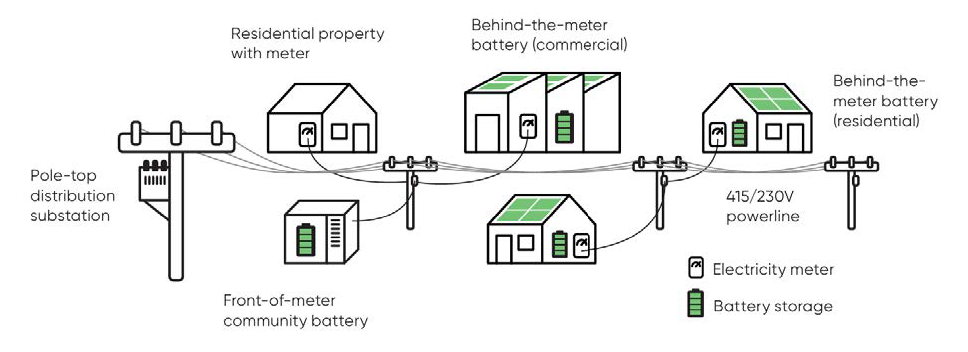
Source: AusNet, Front-of-meter and behind-the-meter community batteries fact sheet, available from https://www.ausnetservices.com.au/community-batteries [accessed 9 October 2025].
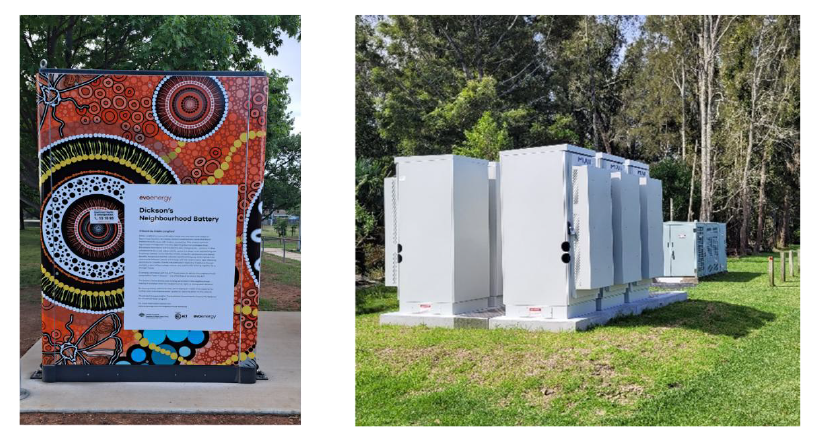
1.5 Front-of-meter community batteries are typically located in public spaces such as parks or on streets. A community battery could be a ground-mounted, or a series of pole-mounted batteries. Two front-of-meter, ground mounted community batteries are shown in Figure 1.2.
Figure 1.2: Community batteries at Dickson, ACT and Maloneys Beach, NSW
Source: ANAO.
1.6 Behind-the-meter community batteries can store energy from rooftop solar panels at the property and can supply electricity to the property as well as the electricity network.
1.7 Community batteries can provide the following benefits to the electricity network, local community or commercial customers:
- help manage voltage and network constraints where large numbers of existing solar panels are feeding excess power back into the grid during peak production periods; and
- participate in the electricity and ancillary services markets for financial gain, including through providing frequency control services.7
1.8 Households may be able to benefit from reduced electricity costs because of the operation of a community battery. Households may also benefit when a community battery reduces pressure on the local grid and enables greater use of solar panels.
2022 election commitment — Community Batteries for Household Solar
1.9 Prior to the 2022 Federal Election, the Australian Labor Party committed to the installation of 400 community batteries across Australia. The October 2022 Federal Budget allocated funding:
over 4 years from 2022–23 to deploy 400 community batteries across Australia to lower bills, cut emissions and reduce pressure on the electricity grid by allowing households to store and use excess power they produce.8
1.10 Table 1.1 shows the funding provided to the Department of Climate Change, Energy, the Environment and Water (DCCEEW), the Australian Renewable Energy Agency (ARENA), and the Australian Competition and Consumer Commission (ACCC) to deliver the Community Batteries for Household Solar program (the program).
- DCCEEW received $30.6 million — $29 million of administered funding to deliver in grants and $1.6 million to support the administration of the grants through the Business Grants Hub (BGH). DCCEEW was to absorb $1.9 million worth of costs within existing resourcing.
- ARENA received $188.5 million — $171 million of administered funding to deliver in grants and $17.5 million to administer the grants.
- The Australian Energy Regulator (AER), via the ACCC, received $3.3 million.9
Table 1.1: October 2022 Federal Budget measure
|
|
2022–23 ($m) |
2023–24 ($m) |
2024–25 ($m) |
2025–26 ($m) |
Total ($m) |
|
DCCEEW |
4.4 |
10.5 |
10.5 |
5.2 |
30.6 |
|
ARENA |
0.9 |
29.1 |
80.1 |
78.4 |
188.5 |
|
ACCC / AER |
0.6 |
1.1 |
0.8 |
0.8 |
3.3 |
|
Total |
5.9 |
40.7 |
91.4 |
84.4 |
222.4 |
Source: Australian Government Budget Papers.
1.11 The program implementation plan (see paragraphs 2.21 to 2.24) sets out the following outcomes for the program:
- lower household electricity costs;
- contribute to lower emissions;
- support the electricity market;
- increase solar hosting capacity; and
- share benefits with households without solar installations.
Grant funding rounds
1.12 Table 1.2 provides an overview of the grant rounds of the program.
- DCCEEW initially ran two grant opportunities through BGH10 that closed in February 2023. The first was a targeted competitive process (stream 1, round 1) and the second a closed non-competitive process (stream 2).11 In both rounds, the battery installation locations were those announced by the Australian Labor Party during the 2022 election (see Appendix 3 for the list of announced locations). DCCEEW ran two further grant rounds (stream 1, rounds 2 and 3) during 2023 and 2024 to target locations where no suitable projects had been funded in the previous rounds.
- ARENA ran two grant rounds. The first closed in April 2023. As of January 2026, ARENA’s Board had approved funding applications under the second round.
Table 1.2: Program grant rounds
|
Entity |
Grant round |
Typea |
Available funding ($m) |
Grantees funded |
Batteries funded |
Grants funded ($m) |
|
DCCEEW |
Stream 1 round 1 |
Targeted competitive |
28 |
18 |
55b |
26.9 |
|
Stream 1 round 2 |
Targeted competitive |
|||||
|
Stream 1 round 3 |
Closed competitive |
|||||
|
DCCEEW |
Stream 2 |
Closed non-competitive |
1 |
2 |
2 |
1 |
|
ARENA |
Round 1 |
– |
120 |
16 |
345 |
123.8 |
|
ARENA |
Round 2c |
– |
46.3 |
6 |
89 |
53.9d |
|
Total as of January 2026 |
195.3 |
42 |
491 |
205.6 |
||
Note a: ‘Type’ as defined by the Commonwealth grants rules and guidelines 2017 (CGRGs). ARENA is not required to comply with the CGRGs.
Note b: DCCEEW signed 56 grant agreements under stream 1. As of January 2026, one grant had been terminated.
Note c: As at January 2026, ARENA’s Board had approved six projects to be funded under round 2. The final number of grants, number of batteries, and amount of grant funding may alter during contract negotiations.
Note d: Section 67 of the Australian Renewable Energy Agency Act 2011 allows ARENA to provide additional funds from uncommitted appropriations, above the allocated program funding.
Source: DCCEEW and ARENA information as of January 2026.
1.13 As at January 2026, DCCEEW-approved grants had funded batteries in 57 of the 58 locations at a total cost of $27.9 million, and an average cost of $489,474 per grant agreement.12 Forty-one (72 per cent) of the 57 batteries funded through DCCEEW were operational. DCCEEW initially approved 58 grants however one grant agreement was terminated.
1.14 As at January 2026, ARENA had approved 22 grant agreements for 434 batteries at a total cost of $177.7 million, and an average cost of $8.1 million per grant agreement.13 Seventeen (four per cent) of the 434 batteries funded through ARENA were operational.
1.15 A timeline of the program is included in Appendix 4. The budget measure was designed to finish in June 2026.
Grants management framework
1.16 The Australian Government Grants Framework was established to guide administration and improve grants management transparency for non-corporate Commonwealth entities.
1.17 In 2017, the government released the Commonwealth grants rules and guidelines (CGRGs) under subsection 105C of the Public Governance, Performance and Accountability Act 2013. The CGRGs were designed to simplify and improve the transparency of grants administration. The CGRGs are mandatory for non-corporate Commonwealth, including DCCEEW. In November 2024, the government released the Commonwealth grants rules and principles (CGRPs) to replace the CGRGs. All DCCEEW grants rounds opened prior to the introduction of the CGRPs. The ANAO has assessed DCCEEW against the CGRGs in this audit.
1.18 As a corporate Commonwealth entity, ARENA is not required to comply with the CGRGs. ARENA’s Grants Management Policy and supporting policies set out the rules, procedures and best practice to be followed in administering grants programs.14 ARENA’s grants policy also aims to support compliance with the Australian Renewable Energy Agency Act 2011 (the ARENA Act).
Department of Climate Change, Energy, the Environment and Water
1.19 DCCEEW was established in July 2022, combining functions previously held by four different agencies. DCCEEW’s purpose is to:
drive Australian climate action; transform Australia’s energy system to support net zero emissions while maintaining its affordability, security and reliability; protect, sustainably manage, and mobilise investment in our environment, water resources and external territories in Antarctica and the Southern Ocean; protect our cultural heritage; support national efforts to improve waste management and reduce pollution; and contribute to international progress on these issues.15
1.20 Under Outcome 1, DCCEEW seeks to ‘support the transition of Australia’s economy to net zero emissions by 2050’ through reducing Australia’s greenhouse gas emissions (key activity 1.1).
1.21 DCCEEW reported an estimated actual average staffing level of 4,731 and an estimated actual departmental resourcing of $1.73 billion in 2024–25.16
Australian Renewable Energy Agency
1.22 ARENA was established in July 2012 by the ARENA Act. It is a corporate Commonwealth entity governed by a board. The ARENA Board consists of up to eight members: seven members appointed by the minister; and the secretary of the portfolio department or their nominee.17 At October 2025, there were eight board members.18
1.23 ARENA seeks to:
support improvements in the competitiveness and supply of renewable energy and the uptake of energy efficiency and electrification by providing financial assistance and sharing knowledge, to accelerate innovation that benefits all Australians, and facilitates the achievement of Australia’s greenhouse gas emissions targets.19
1.24 In September 2025, ARENA reported that since 2012 it had supported 805 projects with $3.27 billion in funding commitments, with a total project value of $14.87 billion.20
Rationale for undertaking the audit
1.25 The government funded the program in 2022 to contribute to the target of net zero carbon emissions by 2050, and the target of 82 per cent of electricity from renewable sources by 2030.
1.26 Previous ANAO audits of grants programs administered by DCCEEW or ARENA have found the entities did not always have appropriate arrangements in place to evaluate and report on the achievement of program outcomes.
1.27 The audit was conducted to provide assurance to the Parliament as to whether DCCEEW and ARENA are effectively managing the program.21
Audit approach
Audit objective, criteria and scope
1.28 The objective of the audit was to assess the effectiveness of DCCEEW’s and ARENA’s delivery of the Community Batteries for Household Solar program.
1.29 To form a conclusion against the objective, the following high-level criteria were adopted.
- Was the program effectively designed and planned?
- Were funding decisions made appropriately?
- Have effective monitoring, evaluation and reporting arrangements been established?
Audit methodology
1.30 The audit methodology included:
- examining DCCEEW and ARENA documentation, including reporting provided by BGH;
- analysing data from ARENA’s grants management system; and
- meetings with DCCEEW and ARENA staff.22
1.31 The audit was conducted in accordance with ANAO Auditing Standards at a cost to the ANAO of approximately $540,173.
1.32 The team members for this audit were Johanna Bradley, Marcus Newberry, Elise Hore, Jade Ryan, and Nathan Callaway.
2. Design and planning
Areas examined
This chapter examines whether the Community Batteries for Household Solar program (the program) was effectively designed and planned.
Conclusion
Program design and planning was largely effective. The Department of Climate Change, Energy, the Environment and Water (DCCEEW) and the Australian Renewable Energy Agency (ARENA) largely had regard to required program design considerations and developed grant guidelines that largely reflected the government’s policy intent. DCCEEW did not provide the Australian Government with advice on the appropriateness of the pre-determined locations announced during the election. DCCEEW and ARENA did not fully coordinate to consider how different program approaches may influence the overall program outcomes. Both entities took into account stakeholder feedback and legal advice in designing and planning the program, and prepared program probity plans.
Areas for improvement
The ANAO made no recommendations. The ANAO suggested that, where it is involved in delivery, ARENA could apply its expertise to the policy and program development.
2.1 Commonwealth entities are required to manage public resources in accordance with the Public Governance, Performance and Accountability Act 2013 (PGPA Act). The delivery of election commitments through a grants program must be consistent with this legislation and represent efficient, effective, economical and ethical use of public resources.23
2.2 The program was delivered by DCCEEW (through Business Grants Hub — BGH) and ARENA. DCCEEW was responsible for delivering $29 million worth of grants for community batteries in 58 pre-determined locations. ARENA was responsible for delivering $171 million worth of grants for 342 community batteries across Australia. As the policy entity, DCCEEW had overall responsibility for program design and delivery.
Did the Department of Climate Change, Energy, the Environment and Water appropriately design and plan for the program?
Program costs and benefits were determined by modelling commissioned by the Australian Labor Party when in opposition. DCCEEW tested this modelling though stakeholder feedback. It did not provide advice to the government on program costs and benefits, the suitability of pre-determined battery locations, or suggest alternative locations. A higher percentage of marginal electorates and Labor-held electorates received community batteries in pre-determined locations. DCCEEW advised the government on the risks to achieving stated program benefits. Grant opportunity guidelines reflected the government’s policy intent. DCCEEW ensured the legal basis for its delivery, had regard to the Commonwealth grants rules and guidelines (2017), and used lessons learnt to inform later grant rounds. DCCEEW did not finalise its probity controls until it assessed round 1 applications.
2.3 The Australian Public Service is required to be impartial and provide ‘the Australian Government with advice that is frank, honest, timely and based on the best available evidence’.24 The Joint Committee of Public Accounts and Audit reported in 2023 that it is appropriate for a department to advise its minister as to whether an election commitment demonstrates value for money.25
Advice supporting policy development
2.4 DCCEEW is responsible for developing and implementing policies and initiatives to help Australia respond to and address climate change. It develops policy advice to drive the transition to an economy that supports net zero emissions by 2050.26
2.5 Prior to its election to government on 21 May 2022, the Australian Labor Party committed to installing 400 community batteries across Australia as part of its Powering Australia plan, including at 58 pre-determined locations. These locations are listed in Appendix 3.
2.6 In 2021, the Australian Labor Party commissioned RepuTex Energy to analyse the impact on carbon emissions and economic impacts of its Powering Australia plan.27 This report cited previous feasibility studies that suggested community scale batteries had capital costs of around $500,000 ($1,000 per kWh28), in which case a $200 million investment could ‘deliver at least 400 community batteries, benefitting up to 100,000 households, with these numbers likely to grow if battery costs continue to fall’. It was also estimated that such an investment could reduce carbon dioxide emissions by 1.1 megatonnes (Mt) between 2022 and 2050 and 86 kilotonnes (kt) in 2030.
2.7 DCCEEW sought stakeholder feedback to inform its estimation of battery costs and the number of households that might benefit from a battery. DCCEEW did not commission its own modelling to determine if the costings and anticipated emissions reduction were appropriate. DCCEEW advised the ANAO on 31 October 2025 that ‘where sectors are at an early stage of innovation there are limitations on the ability of models to accurately predict outcomes or benefits’. See paragraph 1.13 for information on the batteries funded.
2.8 Discussions in 2022 between DCCEEW and the Minister for Climate Change and Energy (the minister) through his office, focused on delivery methods for the program that would deliver batteries to the 58 pre-determined locations quickly, while at the same time testing the application of the technology in the electricity market. DCCEEW worked with the minister through their office to confirm the pre-announced locations and did not provide any advice on the potential suitability of the locations to achieve the program outcomes.
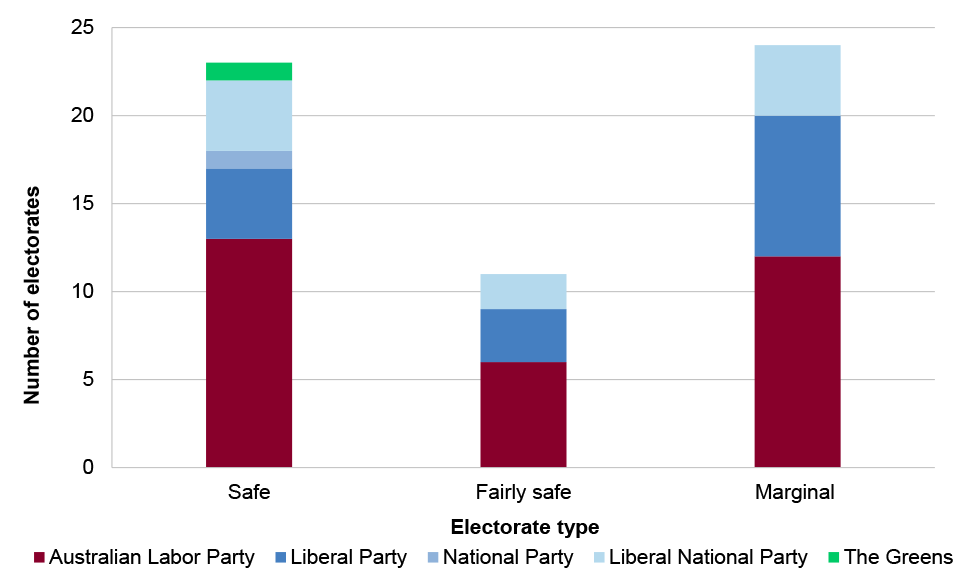
2.9 Figure 2.1 illustrates the marginal status and sitting party for each of the electorates at the 2022 Federal Election with a pre-determined battery location. The list of battery suburbs and electorates is in Appendix 3.
2.10 A higher percentage of marginal electorates received community batteries. Of the 151 electorates at the 2022 Federal Election, 58 batteries were pre-announced in 56 electorates. Batteries were announced in:
- 23 (47 per cent) of the 49 ‘marginal’ electorates29; and
- 33 (32 per cent) of the 102 ‘fairly safe’30 or ‘safe’ electorates.31
2.11 A higher percentage of electorates held by the Australian Labor Party before the 2022 Federal Election received community batteries.
- Thirty-one (53 per cent) of the 58 batteries were announced in Labor-held electorates and 27 (47 per cent) of the 58 batteries were announced in non-Labor-held electorates.
- Labor held 69 electorates and batteries were announced in 29 (42 per cent) of those 69 electorates. There were 82 non-Labor-held electorates, and batteries were announced in 27 (33 per cent) of those 82 electorates.
Figure 2.1: Electorates at the 2022 Federal Election for the 58 pre-determined locations: margins and sitting party
Source: ANAO analysis of DCCEEW documentation and Australian Electoral Commission information.
2.12 DCCEEW initially considered whether ARENA could deliver the whole program. After consulting with ARENA, DCCEEW decided not to recommend this approach because the Australian Renewable Energy Agency Act 2011 (ARENA Act) does not allow the minister to direct ARENA to fund specific projects.
2.13 During the development of the program, and prior to the approval of the implementation plan (see paragraph 2.21) DCCEEW met with ARENA; the Australian Energy Regulator; state and territory governments; electricity companies; battery suppliers; and electrical network industry groups.
2.14 On 17 August 2022, DCCEEW recommended to the minister that it use BGH to deliver batteries to the 58 pre-determined locations, and that ARENA run a grants program to deliver the remaining batteries. The minister did not approve the proposal at this time due to timeline concerns.
2.15 On 3 September 2022, the minister agreed that the program be delivered through ARENA and DCCEEW’s engagement of BGH.32 DCCEEW advised the minister that BGH would be able to deliver batteries at the pre-determined locations ‘faster than alternative solutions and in line with best practice grants administration’, and that ARENA had ‘the necessary expertise to assess technical, commercial and regulatory aspects of applications’. While approving the proposed program delivery method, the minister was ‘concerned at late 2023 for delivery’ and hoped that ‘some [batteries] can be up and running by mid-2023’. The first DCCEEW-funded battery was launched in September 2023 (see Appendix 4 for a timeline illustrating key milestones).
2.16 DCCEEW briefed the minister on implementation risks, including:
- safety and environmental risks;
- slow implementation due to the capacity of community groups to deliver batteries;
- supply chain constraints limiting the availability of batteries; and
- that there could be limited eligible applicants for the 58 pre-determined locations.
2.17 These risks were all noted in program risk management plans, and controls put in place. Risks and mitigation strategies have been reported to government since August 2023 (see Table 4.5 for reporting by DCCEEW).
- Since August 2023, failure to attract high merit applications and supply chain constraints were reported as risks, along with mitigation strategies.
- Too few applicants was identified as an issue in government reporting in December 2023, in relation to round 2.
- Safety risks have not been reported on.
2.18 At October 2025, one grant agreement had been terminated because of the inability to find a suitable site. DCCEEW did not identify this as a risk in its briefings to the minister.33
Implementation plan
2.19 As outlined in paragraph 1.9, the Australian Government (the government) funded the ‘Powering Australia – Community Batteries for Household Solar’ measure in the October 2022 Federal Budget.34 The government requested the Minister for Climate Change and Energy prepare an implementation plan to be finalised through correspondence with the Prime Minister, Treasurer, and Minister for Finance.
2.20 On 1 November 2022, DCCEEW established a committee to ‘provide input’ into the design of the community batteries program and the implementation plan. The committee consisted of representatives from the Department of Finance, the Department of the Prime Minister and Cabinet, the Department of the Treasury, the Australian Energy Regulator, and ARENA. Prior to the approval of the implementation plan, DCCEEW also met with state and territory governments, electricity companies, battery suppliers and electrical network industry groups.
2.21 The minister, the Prime Minister, and the Treasurer approved the implementation plan on 22 November 2022. On 23 November 2022, the Minister for Finance approved the implementation plan and grant guidelines, on the condition of ‘a merits assessment for all eligible applications that are received in the timelines set out in the Guidelines’. BGH and DCCEEW updated the guidelines and implementation plan based on the Minister for Finance’s feedback and the Minister for Climate Change and Energy approved the revised guidelines and revised implementation plan on 14 December 2022. The BGH component of the program was launched on 17 December 2022.
2.22 Under the implementation plan, it was agreed that DCCEEW would deliver $29 million through two grant streams.
- Stream 1 would be a targeted, competitive stream that would deliver on the commitment of 56 batteries.
- Stream 2 would be a closed, non-competitive stream to deliver two batteries where the government had made commitments to specific project proponents.
2.23 The implementation plan covered implementation parameters for both the DCCEEW and ARENA-delivered funds noting that ARENA would continue to undertake consultation to inform the final design and delivery of the ARENA-led program. The implementation plan included a definition of community batteries; that value for money would be achieved through merit-based assessment of eligible applications; key stakeholders for consultation; and timing of key planning deliverables. It did not include program end dates.
2.24 The implementation plan set a value for DCCEEW grants at ‘$1000 per kWh of battery capacity up to a cap of $500,000 per battery’. This was intended to ‘incentivise larger battery deployment for greater community and grid benefits, and … ensure sufficient funding is available for all 58 batteries’. This grant restriction was included in the grant guidelines for both stream 1 (rounds 1 and 2) and stream 2. It was removed in round 3 of stream 1 (see paragraph 2.42).
Coordination with the Australian Renewable Energy Agency
2.25 DCCEEW is responsible for the coordination of climate change adaptation and renewable energy policy. In this capacity, DCCEEW should provide advice to the government and keep its minister informed of how the government’s policy agenda is being implemented.
2.26 DCCEEW regularly met with ARENA during program design and developed the overall program design in consultation with ARENA (see paragraphs 2.13 and 2.20).
2.27 DCCEEW ‘advised ARENA of (DCCEEW’s) understanding of the minister’s expectations’ and assessed ARENA’s program design, believing that ‘(b)roadly, ARENA’s proposal for community batteries aligns with our expectations’ and that ‘ARENA’s four program outcomes are broadly consistent with the outcomes in the BGH administered community batteries program’.
2.28 DCCEEW sought updates from ARENA on the progress of ARENA’s program implementation to report on overall program progress to the government (see Table 4.5) and regularly set up meetings between DCCEEW, ARENA, and the Minister’s Office.
Planning in accordance with the Commonwealth grants rules and guidelines
2.29 Non-corporate Commonwealth entities must put in place practices and procedures to promote robust planning and design of grants programs.35 Relevant planning issues that applied to DCCEEW are assessed in Table 2.1.36 The ANAO found that DCCEEW had largely considered the ‘relevant planning issues’ from the Commonwealth grants rules and guidelines (CGRGs), except in relation to designing grant opportunities to achieve value with relevant money. As discussed in paragraph 2.7, DCCEEW did not undertake analysis or provide advice to the minister as to whether opportunities existed within the design of the grants program to achieve better value for money.
Table 2.1: Commonwealth grants rules and guidelines planning issues
|
CGRG provision |
ANAO assessment |
|
Establish a rationale for grant opportunities, particularly what outcomes are expected and how these will be measured. |
◆ |
|
Communicate effectively with potential grantees and key stakeholders. |
◆ |
|
Undertake risk identification and engagement. |
◆ |
|
Design grant opportunities to achieve value with relevant money. |
▲ |
|
Define operational objectives. Ensure that eligibility criteria reflect the operational objectives and policy intent. |
◆ |
|
Clearly identify decision makers and their roles and implement robust governance arrangements. |
◆ |
|
Design grant opportunities for accountability, probity, and transparency. |
◆ |
|
Consider legal and policy matters. |
◆ |
Key: ◆ CGRG provision was fully or largely considered during planning ▲ CGRG provision was partly considered during planning ■ CGRG provision was not considered during planning
Note: Issues listed in section 7.5 of the CGRGs not tested include: consider carefully the application and selection process to be used; select an appropriate funding strategy and grant agreement; consider taxation matters and seek advice where appropriate; and consider the Australian Government’s accounting treatment.
Note a: Matters relating to performance measures are addressed in paragraphs 4.46 to 4.52, and the development of appropriate grant opportunity guidelines are addressed in paragraphs 2.30 to 2.42.
Source: CGRGs, section 7.5 and ANAO analysis of departmental documentation.
Development of grant opportunity guidelines
2.30 The CGRGs require Australian Government officials to ‘develop grant opportunity guidelines for all new grant opportunities, and revised guidelines where significant changes have been made to a grant opportunity’; and to ‘ensure that grant opportunity guidelines and related internal guidance are consistent with the CGRGs’.37
2.31 BGH was required to develop and publish the grant opportunity guidelines for each funding round with DCCEEW to contribute to the development of the guidelines.
2.32 DCCEEW ran one grant opportunity round to deliver batteries in two locations with pre-determined proponents (stream 2), and a further three grant opportunity rounds to deliver the remaining 56 batteries (stream 1, rounds 1 to 3; see paragraph 1.12). Grant guidelines for each of the four rounds were developed by BGH with DCCEEW contributing to their development as required by the service schedules.38
2.33 The implementation plan listed five intended outcomes of the program.
- Projects must put downward pressure on household electricity costs …
- Projects must contribute to lowering emissions …
- Projects must provide a net benefit to the electricity network, including having regard to matters such as network constraints …
- Projects should store solar energy for later use and support further solar installations …
- Projects should allow households that can’t install solar panels to enjoy the benefits of renewable energy through shared community storage.
2.34 The first three outcomes state that ‘projects must’ achieve these outcomes, while the last two outcomes state that ‘projects should’ achieve these outcomes. This could imply that all projects must contribute to the first three outcomes. DCCEEW advised the ANAO on 31 October 2025 that it considers that it ‘was not a requirement that three of the outcomes must be achieved by funded projects’.
2.35 Grant opportunity guidelines for the four grants rounds reflected the policy intent of the budget measure and implementation plan through embedding the intended outcomes of the program in the assessment criteria.39 Grant opportunity guidelines required applicants to demonstrate how their project would deliver on all five program outcomes documented in the implementation plan.
2.36 The CGRGs list eight pieces of information that should be included in grant opportunity guidelines to ensure the guidelines are clear, consistent and well documented.40 The four grant opportunity guidelines developed by BGH and DCCEEW covered all eight requirements.
Subsequent rounds
2.37 DCCEEW undertook evaluation of round 1 to inform rounds 2 and 3, in accordance with the implementation plan and made three material changes.
- The project period (i.e. the time to deliver a battery) was reduced from 21 to 16 months.
- Round 3 was a closed competitive round, rather than open competitive.
- The requirement for grants to be $1,000 per kWh was removed in round 3.
2.38 The round 2 grant opportunity guidelines reduced the project period (and therefore the time to install a battery) from 21 to 16 months with the addition of a clause that a project delegate may approve an extension beyond the stated project end date on a case-by-case basis. Projects funded in round 2 would therefore be due for completion at the same time as the projects funded in round 1, while allowing flexibility if projects needed additional time.
2.39 The project period was reduced from 21 to 16 months due to the funding profile of the budget measure into 2025–26. DCCEEW identified risks associated with reducing the possible project period and included the possibility of extending project end dates to mitigate the risks. DCCEEW advised the minister that feedback from stakeholders was that the timeframe of 16 months was achievable. DCCEEW did not advise the minister of the risks associated with this timeframe. All three projects funded in round 2 have sought project variations to extend their project end date by seven months beyond the end date published in the grant opportunity guidelines.41
2.40 Rounds 1 and 2 (see Table 1.2) were targeted competitive rounds and round 3 was a closed competitive round.42 The minister informed the Prime Minister that a closed grant round allowed DCCEEW to consult with potential applicants to reduce the risk of unsuitable applications. The minister also stated that a closed grant round may have increased interest from potential applicants who may have been discouraged by the assumption that the local Distributed Network Service Provider (DNSP) would be the preferred delivery partner.
2.41 DCCEEW obtained probity advice and policy authority from the Assistant Minister to the Prime Minister, on behalf of the Prime Minister, to run round 3 as a closed competitive round. DCCEEW invited existing grant recipients under rounds 1 and 2 to express interest in applying for funding under round 3. The minister approved the two organisations DCCEEW recommended be invited to apply for round 3.
2.42 The requirement that grants will be $1,000 per kWh (see paragraph 2.24) was removed in round 3. This was an unintentional change, there was no documented rationale and the minister was not advised. See paragraph 3.17 for the application of this provision during grant assessment.
Approval of grant opportunity guidelines
2.43 The minister approved the grant opportunity guidelines for each grant round.
2.44 Following the approval and publication of the grant opportunity guidelines, the submission closing dates for rounds 2 and 3 were extended by seven and 29 days respectively. The grant opportunity guidelines did not outline how an extension to the closing date would be managed.
- The minister through their office requested the closing date of round 2 be extended. DCCEEW has no record of approving the extension to round 2, or the reason for the extension.
- Round 3 was extended following a request from one of the two eligible entities. The extension to round 3 was approved by the DCCEEW delegate.
2.45 The Minister for Finance must approve grant opportunity guidelines for grant rounds that are determined to be medium or high risk. The Minister for Finance approved the grant guidelines for stream 1 round 1 and stream 2 (see paragraph 2.21). The Minister for Finance was not required to approve the grant guidelines for subsequent rounds as these were assessed as being low risk.43
Probity
2.46 In October 2022, BGH advised DCCEEW that it would prepare a probity plan to guide its administration of the program, which it expected would ‘address any probity concerns that may arise’. BGH also mentioned that DCCEEW may wish to prepare its own probity plan. BGH requested DCCEEW’s program delegate complete a conflict-of-interest form under BGH’s program probity plan.
2.47 On 31 October 2022, DCCEEW engaged the Australian Government Solicitor as the probity advisor for the program. In November 2022, the Australian Government Solicitor commenced drafting a probity plan for DCCEEW’s management of the program. The probity plan was not progressed at that time.
2.48 During discussions with BGH about the assessment of round 1 applications (see paragraph 3.9), DCCEEW restarted the development of its own probity plan. The plan was finalised on 2 May 2023. See paragraphs 3.25 to 3.29 for further assessment of DCCEEW’s probity considerations during grant application assessments.
Did the Australian Renewable Energy Agency appropriately plan for the program?
ARENA’s planning for the delivery of the program largely addressed the requirements of its Grants Management Policy. ARENA used stakeholder feedback to design the program, which resulted in some program parameters that differed from the government-approved implementation plan. ARENA and DCCEEW did not fully coordinate to consider how the different program delivery approaches may influence the overall program outcomes. ARENA advised the minister through their office of its intended program design. The minister was not formally advised on how ARENA’s decisions differed from the expected program design parameters. ARENA did not consider how success would be measured during program design. ARENA updated the guidelines in its second funding round based on feedback from round 1.
2.49 In November 2022, ARENA’s Chief Executive Officer approved ARENA’s Grants Management Policy (GMP). The GMP ‘outlines the rules, procedures and best practice to be followed’ by ARENA. ‘ARENA workers’ must comply with this policy when undertaking a grant process.
Planning in accordance with the Australian Renewable Energy Agency’s Grant Management Policy
2.50 ARENA’s GMP lists 10 issues that ‘must be considered’ at the program design stage. There is supporting guidance against each of these issues that ‘should’ be considered. As documented in Table 2.2, ARENA took seven of the 10 issues into consideration and partly considered three issues. Paragraphs 2.51 to 2.53 provide further detail for the three GMP issues that were partly considered.
Table 2.2: ARENA program delivery and design
|
Considerations in the GMP |
ANAO assessment |
|
Lessons learnt from the delivery of previous programs or projects. |
▲ |
|
How the program contributes to achieving ARENA’s priorities and objectives. |
◆ |
|
What success looks like and how it will be measured. |
▲ |
|
Consideration of risks and what could go wrong. A risk management plan must be in place. |
◆ |
|
Whether an open or competitive process best achieves value for money in the context of the program objectives. |
◆ |
|
Key knowledge needs the program will address. |
◆ |
|
Planning with respect to how funds will be delivered. |
◆ |
|
Allocating responsibilities — who does what? |
◆ |
|
Whether it is appropriate to use ARENA overarching documentation and/or processes. |
◆ |
|
Record keeping: ARENA workers must keep a program file; a key documents checklist; and specific project files. |
▲ |
Key: ◆ Taken into consideration ▲ Partly taken into consideration ■ Not taken into consideration
Source: ANAO analysis of ARENA documentation.
2.51 The GMP suggests that the ARENA Board should be advised how lessons learnt from previous programs have been taken into account in the development of the program concept. ARENA advised its Board of similar programs that it had contributed to, and on 9 February 2026, ARENA advised the ANAO that it incorporated lessons learnt from previous programs into the recommendations presented to the Board. ARENA did not document how lessons learnt from previous programs informed this program. ARENA advised the ANAO on 31 October 2025 that it ‘delivers multiple new programs or rounds each year’ and is continually learning from this delivery.
2.52 The Board should be advised how success and outcomes will be measured and reported. ARENA did not inform its Board how program success would be measured, however the Board was informed of the program objectives, and the knowledge ARENA hoped to gain from the program, including how community batteries may deliver community and market benefits.
2.53 ARENA kept a program file and project files as required by the GMP. While ARENA developed a log to track key documents and activities relevant to round 1, it did not keep a key documents checklist as required by the GMP.
Stakeholder consultation
2.54 According to ARENA’s GMP, ‘[s]takeholder consultation is an important element of Grants administration in ARENA and must be considered in the plan and design stage’. ARENA’s GMP suggests ‘a plan for stakeholder consultation should be developed and provided to the ARENA Board for agreement in seeking program approval’.
2.55 ARENA documented stakeholders to be consulted during the development of this program in the Community Battery Log. ARENA’s Board was not provided with a plan for stakeholder consultation. ARENA advised the ANAO on 31 October 2025 that the Board was provided with a summary of consultation that had occurred, rather than a plan for consultation, to allow accelerated delivery of the program.
2.56 ARENA’s approach to stakeholder consultation for the design of round 1 is described in Table 2.3.
Table 2.3: ARENA’s stakeholder consultation
|
Date |
Consultation type |
Consulted with |
|
From April 2022 |
Meetings and emails to discuss the design of the program. |
Entities including DCCEEW, the Australian Energy Regulator and the Australian Energy Market Operator, and the minister through their office. |
|
October 2022 |
Discussions regarding the status of battery supplies. |
Battery supply companies. |
|
November and December 2022 |
Meetings to test the appetite from the market to build batteries and to gather learnings from any previous trials. |
Major electricity retailers, industry and consumer advocacy groups, research institutions, government bodies and DNSPs.a |
|
December 2022 and January 2023 |
Two webinars and a subsequent survey. |
212 webinar participants and 87 survey responses including from community groups, DNSPs, retailers, developers and local governments. |
Note a: DNSPs build, maintain and operate the distribution networks. The National Electricity Rules set out a national framework for transmission and distribution network planning and expansion.
Source: ANAO analysis of ARENA documentation.
2.57 ARENA’s program design was informed by stakeholder consultation.
- ARENA divided round 1 into two separate categories to prevent competition between DNSPs and non-DNSPs due to the perception that DNSPs have a market advantage.
- ARENA identified a range of readiness in the market and a broad range of potential project proponents. Two rounds were recommended to accommodate those who were ready and those who needed more time to develop projects. Delivering the program across two rounds was to allow lessons learnt from round 1 to inform round 2 applicants.
- ARENA allowed for a range of battery configurations, including front-of-meter, behind-the-meter, smaller and larger batteries ‘to allow a range of technology and business models to be tested’.
- The market for community batteries was developing at the program design stage, and it was expected most applicants would require support and collaboration from ARENA to develop their applications. ARENA would provide this collaboration following the selection of expressions of interest (see paragraphs 3.41 to 3.52).
Program implementation plan
2.58 ARENA is a corporate Commonwealth entity and is legally separate to the Commonwealth. ARENA’s responsible minister (the Minister for Climate Change and Energy) can approve funding and appoint members to the ARENA Board. The minister cannot direct ARENA to fund particular projects.
2.59 In 2022, in the Statement of Expectations to ARENA, the minister requested that ARENA ‘seek opportunities, in line with its expertise, knowledge and functions, to contribute to the development or implementation of relevant initiatives in the Powering Australia plan’.44 In response to this request, in November 2022, ARENA agreed to ensure ‘that the knowledge we have accumulated can help the Government’s policy and program development in support of the Powering Australia plan’ and that ARENA would ‘continue to share important data, learnings and insights from ARENA-funded projects and initiatives … including informing policy and program development’.
2.60 As discussed in paragraph 2.20, DCCEEW provided ARENA with draft versions of the implementation plan and ARENA contributed to discussions during the drafting of the plan.
2.61 On 7 August 2025, ARENA advised the ANAO that the ‘Implementation Plan was owned and managed by DCCEEW. ARENA reviewed specific drafting related to ARENA’s role in the delivery of its portion of the program to ensure this was appropriate based on the intended design approach. ARENA did not propose any edits or feedback on elements not intended to be delivered by ARENA’.
2.62 The program may have benefited from a greater degree of input by ARENA during program design.
Opportunity for improvement
2.63 When ARENA is involved in program delivery, it could seek to apply its knowledge and expertise to whole of policy and program development.
2.64 ARENA did not request or receive a copy of the implementation plan once it had been approved. The ARENA Board did not consider the implementation plan.
2.65 In February 2023, the ARENA Board articulated its funding parameters in the round 1 funding announcement. These parameters differed from the approved implementation plan. The plan defined a community battery as ‘a distribution-level front-of-meter battery or aggregation of batteries with total storage capacity between 100 kWh and 5 MWh’.
- ARENA decided to fund batteries both in front of the meter and batteries behind the meter (i.e. on consumer premises) provided the battery was connected to the network. ARENA funded behind-the-meter batteries to allow potential non-DNSP grant applicants to compete with potential DNSP grant applicants.
- ARENA defined community batteries by power capacity (between 50 kW and 5 MW) instead of total energy storage capacity (kWh).45 ARENA explained to the ANAO on 11 November 2025 that this decision allowed developers to maximise the power capacity connected to the grid based on expected grid connection costs and existing regulatory settings.
- The implementation plan stated that ARENA would implement a competitive grants program to encourage co-funding from the private sector and ‘improve value for money and program outcomes’. Round 1 was ‘not … a competitive process as defined in … the ARP [Advancing Renewables Program] Guidelines’. The Board was informed an open, merit-based process would allow applicants to benefit from feedback — ‘This is considered preferable to a closed, competitive round that limits collaboration and consultation with applicants’. Rather than ranking proposals against the merit criteria and funding proposals with the highest ranking within the budget for the round, ARENA funded all projects of high merit (see paragraphs 3.41 to 3.60). This decision deployed more batteries sooner. It also reduced the amount of funding available in the second round, potentially disadvantaging any potential applicants that had decided to wait until the second round to apply for funding.
2.66 ARENA’s legislation provides it with independence from ministerial decision-making. ARENA’s Board is generally its decision-making authority. While ARENA must consider a request from the minister to fund a particular project, it is not bound by that request.46 The government has a strong interest in how entities such as ARENA meet their government-set policy objectives, while recognising their independence and autonomy.47 ARENA informed the minister in November 2022 that it would work with DCCEEW to ‘ensure quality briefing and support’ to the minister.
2.67 On 24 January 2023, ARENA informed the minister through their office of its intention to fund behind-the-meter batteries, and its intended battery capacity definition. Ministerial staff reiterated that the program was intended to benefit non-solar households. Neither ARENA nor DCCEEW formally notified the minister of ARENA’s decisions.
2.68 ARENA reports to the minister on the progress of grant agreements (see paragraph 4.90). It does not report on progress against the implementation plan to DCCEEW or the minister.
Development of program guidelines
2.69 ARENA must ‘ensure that decisions about the provision of financial assistance are based on merit’.48 The ARENA Act requires the Board to ‘develop guidelines for a grant program if, under the program, the total of all grants for a particular project could exceed $15 million’.49
2.70 ARENA has established the Advancing Renewables Program (ARP) to fund renewable energy projects at various stages of development. This program is continuously open for applications. ARENA used its ARP as the mechanism to deliver its funding under the program. It developed a program-specific funding announcement under the ARP guidelines for each funding round (see Table 1.2). The ARP guidelines allow for funding announcements to be published by ARENA to provide further clarification of eligibility and merit criteria under the ARP guidelines, and to define an assessment process.
Round 1
2.71 ARENA’s GMP lists 11 issues ‘program guidelines should consider’.50 The ARP guidelines and round 1 funding announcement considered these 11 issues appropriately.
2.72 In round 1, ARENA sought to ‘fund activities that contribute to one or more’ of the program outcomes. ARENA-funded projects were not required to contribute to all three of the necessary outcomes described in the implementation plan (see paragraph 2.33).
2.73 The ARP guidelines explain that the application and assessment process ‘typically consists of two stages’ — expression of interest (EOI) and full application stages. Eligibility and merit criteria are clearly defined in both the ARP guidelines and funding announcement. The funding announcement states that the criteria in the funding announcement are in addition to the criteria in the ARP guidelines.
2.74 The Auditor-General previously recommended ARENA ‘clearly outlines in its grant guidelines how it assesses the additionality of project applications so that it can better demonstrate that the projects it funds would not have proceeded without public funding’.51 Merit criterion D in the ARP guidelines assesses the financial viability of the project, including ‘whether the Activity is commercially viable without ARENA funding’.
Round 2
2.75 As set out in the implementation plan, ARENA was required to evaluate each funding round to inform the design of subsequent funding rounds.52 ARENA engaged enX Consulting to collate data and insights from round 1 funded projects (see paragraph 4.64). ARENA considered these insights along with information from ongoing engagement with industry and the development of other battery initiatives. In response, it made the following changes to the funding announcement for round 2.
- An additional funding round outcome to support the integration of distributed energy resources into Australia’s energy markets and market operator systems.
- Applying a competitive assessment process, rather than individually merit-based (see paragraph 2.65).
- Funding bigger projects by increasing the minimum grant amount from $3 million to $5 million and the minimum number of batteries to be deployed in any one grant from five to 10.
- Funding a maximum of 50 per cent of battery capital expenditure, rather than 100 per cent.
Approval and publication of program guidelines
2.76 The ARENA Board is the accountable authority for ARENA and is responsible for all decisions related to grants, including the approval of grant guidelines, unless it delegates decision-making responsibility to the Chief Executive Officer (CEO).53
2.77 The Board must develop guidelines for a grant program and seek ministerial approval for those guidelines when the total of all grants for a particular project under the program could exceed $15 million.54 The funding announcement was approved by the Board under the ARP guidelines (see paragraph 2.70).
2.78 The Board approved the round 1 funding announcement on 21 February 2023, and approved the round 2 funding announcement on 19 February 2025. The Board delegated authority to the ARENA CEO to make minor changes to the funding announcement grant guidelines.
2.79 The round 1 funding announcement was published on ARENA’s website on 4 April 2023 and the round 2 funding announcement on 25 February 2025, as required by the ARENA Act.55
Probity
2.80 On 22 December 2022, ARENA’s Chief Financial Officer approved the probity plan for the program. The probity plan was designed ‘to ensure there are no constraints at either stage on ARENA’s ability to collaborate with applicants, unlike a competitive round process’ to enable ARENA to support applicants through the application process (see paragraphs 3.41 to 3.52). See paragraph 2.65 for a discussion on competitive and non-competitive rounds.
2.81 The probity plan also sought to ensure clear guidance was issued to the Advisory Panel members as to the portfolio approach to assessment (see paragraphs 3.48 and 3.49), and to establish appropriate document management processes.56
2.82 On 21 December 2022, ARENA engaged Sparke Helmore Lawyers as probity advisors for the program.
2.83 The management of conflicts of interest during application assessments and decision-making is discussed at paragraphs 3.61 to 3.75.
3. Funding decisions
Areas examined
This chapter examines whether the Community Batteries for Household Solar program (the program) funding decisions were made appropriately.
Conclusion
The Department of Climate Change, Energy, the Environment and Water’s (DCCEEW’s) and the Australian Renewable Energy Agency’s (ARENA’s) assessment and decision-making was largely appropriate. Both entities considered external technical advice, in accordance with the grant opportunity guidelines and probity advice. For both entities, there were deficiencies in the management of conflicts of interest. DCCEEW did not assess grant applications against an agreed provision related to the cost per kilo-watt hour (kWh) of battery capacity, potentially impacting value for money.
Areas for improvement
The ANAO made two recommendations to strengthen DCCEEW and ARENA’s management of conflicts of interest.
3.1 The Australian Government (the government) expects that grant assessment, selection and agreement negotiations by officials are consistent with the published grant opportunity guidelines, that decision-makers are well informed, and appropriate records of decisions are kept.57
3.2 Value for money is listed as one of the seven key principles in the Commonwealth grants rules and guidelines (CGRGs) and should be considered in all phases of grants administration.58 Grants are to be selected based on best value for money and should add value by contributing to something worthwhile that would not have happened without the grant. Competitive merit-based selection processes can achieve better outcomes and value for money.
Did the Department of Climate Change, Energy, the Environment and Water appropriately assess applications and make decisions?
All grants funded by DCCEEW met eligibility criteria, although grants were not assessed against all provisions in the grant opportunity guidelines, potentially affecting value for money. The average approved amount of grant funding per kWh of battery capacity was $1,586 and the maximum amount was $2,488 per kWh. This was against an agreed provision of $1,000 per kWh. DCCEEW appointed an external technical advisor to assist with grant application assessment. The decision-maker approved funding as recommended and in accordance with delegations, and all funding decisions were appropriately documented. DCCEEW staff involved in receiving BGH assessment recommendations completed conflict-of-interest declarations after receiving BGH’s assessment of round 1 applications, rather than as commencing program involvement.
Assessment of grant applications
3.3 Officials should conduct grants processes to provide equitable treatment and assurance that money has been spent for the approved purposes and is achieving the best possible outcome. This includes transparent and systematic application of the selection process.
- In open, competitive funding rounds, eligible applications are to be assessed against nominated selection criteria.
- In closed, non-competitive rounds, applications are not assessed against other applicants’ submissions, but assessed individually against the criteria.59
3.4 As outlined in paragraph 1.12, DCCEEW contracted BGH to administer the grants for the 58 batteries in pre-determined locations. BGH was responsible for assessing the applications against eligibility and merit criteria. BGH provided its assessment of grant applications to DCCEEW for decision-making. The ANAO assessed DCCEEW’s role in the assessment and decision-making process and did not assess BGH’s role.
3.5 DCCEEW was responsible for coordinating additional advice from independent technical experts and briefing the decision-maker, drawing on BGH’s eligibility and merit assessments.
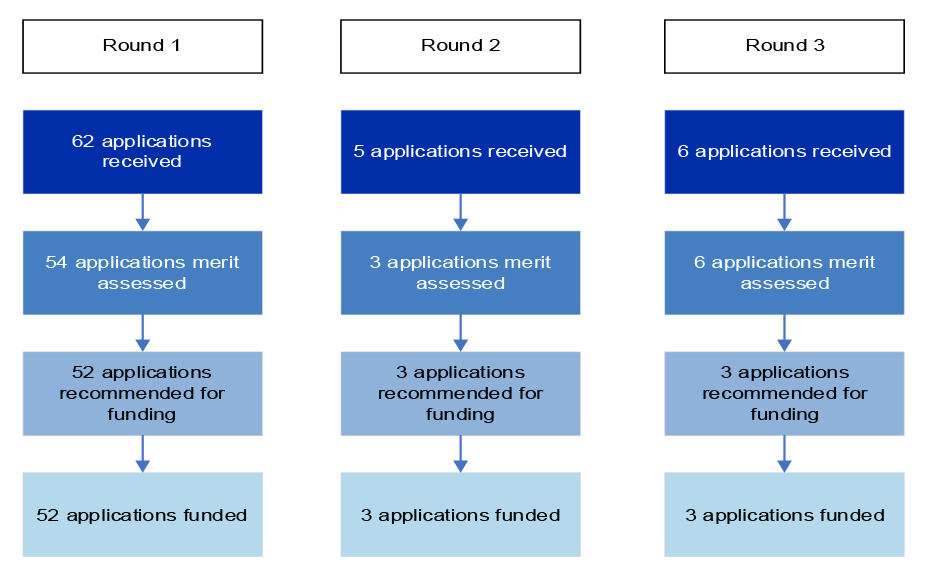
3.6 Figure 3.1 shows the number of applications received, merit assessed, recommended for funding and funded for each of the three grant rounds under stream 1 (see Table 1.2 for an overview of the rounds). Under stream 2, two applications were assessed, recommended, and funded.60
Figure 3.1: Stream 1 — grant applications received, merit assessed, recommended and funded
Source: ANAO analysis of DCCEEW documentation.
3.7 The grant opportunity guidelines for each grant opportunity identified that independent technical advice may be used to review the applications. DCCEEW used independent technical advice in accordance with grant opportunity guidelines and probity advice in rounds 1 to 3.
Technical advice — round 1
3.8 BGH received and assessed round 1 applications. BGH provided its round 1 assessments to DCCEEW over two days, on 27 and 29 March 2023.61 BGH assessed 54 applications to be eligible and, of these, found that 22 did not score sufficiently against assessment criterion two around capability, capacity and resources ‘due to the quality of the information submitted’. BGH recommended that 32 of 62 applications submitted were suitable for funding.
3.9 DCCEEW was concerned that BGH’s assessment may not have had the relevant technical expertise to adequately assess the grant applications, and that the BGH assessments did not accurately reflect the relative merit of the applications against the merit criteria. After seeking advice from its probity advisor, DCCEEW requested BGH reconsider all grant applications seeking input from an independent technical advisor. BGH advised DCCEEW if BGH was to consider technical advice, ‘this should have occurred prior to BGH’s assessment recommendation to the DCCEEW delegate’.
3.10 Following further advice from its probity advisor, DCCEEW engaged an independent technical advisor on 28 April 2023.62
3.11 BGH and DCCEEW established a committee consisting of BGH, DCCEEW and the independent technical advisor to consider eligible applications against the assessment criteria and recommend projects for funding to the decision-maker. BGH developed a terms of reference that defined its role in the committee was to chair the discussion and answer questions, not to change its own assessment recommendations following the committee’s discussion.
3.12 Following the committee review of all eligible applications on 3 May 2023, BGH prepared a second assessment pack for DCCEEW on 8 May 2023 that presented the committee’s recommendation to fund 52 applications.
Technical advice — rounds 2 and 3
3.13 On 16 December 2024, DCCEEW requested advice from its probity advisor (the Australian Government Solicitor) on how to consider independent technical advice on the assessment of grant applications for round 3, as the round was a closed grant round.
3.14 On 20 December 2024, the probity advisor advised that the grant opportunity guidelines left some flexibility in how the technical expert’s advice was used, with the preferable approach being for BGH to review its assessment in light of the technical report. Alternatively, the technical expert’s advice could be provided to the decision-maker alongside BGH’s assessment.
3.15 In both rounds 2 and 3 BGH provided its merit assessment report to DCCEEW for DCCEEW to forward onto the technical advisor. Following technical review, DCCEEW forwarded the technical advisor’s comments to BGH, to prepare a final assessment pack. The technical advisor agreed with BGH’s assessments in rounds 2 and 3. Paragraph 3.23 describes the information provided to the decision-maker.
Assessment of grant provisions
3.16 The grant guidelines for rounds 1 and 2 and stream 2 (see Table 1.2 for an explanation of the program grant rounds) included the provision that ‘The grant amount will be $1000 per kilowatt hour (kWh) of battery capacity’. See paragraph 2.42 for information on round 3.
3.17 This provision was not applied across all grant applications. The average amount of grant funding approved per kWh of battery capacity for each of the grants, was $1,586 and the maximum amount was $2,488 per kWh.63
- Forty-five (79 per cent) of the approved grant applications were above this provision.
- Eight (14 per cent) of the approved applications applied this provision.
- Four (seven per cent) of the approved applications demonstrated better value for money — the grant amount per kWh of battery capacity was less than $1,000.
3.18 Because neither DCCEEW nor BGH applied this provision to the assessment of grant applications, those applicants that applied this provision may have been disadvantaged, and not applying this provision may have impacted value for money.
Decision-making
3.19 The CGRGs require officials to follow relevant legislative and administrative frameworks, provide clear and accurate advice to the decision-maker, and record the reasons for funding decisions.64
3.20 DCCEEW was to ‘brief the decision maker … to support the decision-making process drawing on eligibility and merit assessments’ and ‘manage the decision making process’.
3.21 On 16 February 2023, the Secretary of DCCEEW signed the Department of Climate Change, Energy, the Environment and Water Delegation (Community Batteries for Household Solar program – Delivery of Election Commitments) 2023 instrument. This delegated powers under subsection 36(3) of the Industry Research and Development Act 1986, and subsection 110(1) of the Public Governance, Performance and Accountability Act 2013 to DCCEEW officials with responsibility for delivery of the program.
3.22 The awarding of funding for the grants was approved by the appropriate DCCEEW delegate across both streams of the program (program streams and rounds are explained in Table 1.2). Program funding decisions were all made by senior executive service staff in accordance with the delegations.
3.23 In each round, the decision-maker was provided with BGH’s assessment and technical advisor comments.65 The decision-makers’ approval of grants for funding was appropriately documented.
3.24 All grants recommended for funding met eligibility criteria and were the highest ranked against the merit criteria, as required by the implementation plan. The decision-maker agreed to fund grants as recommended.66 DCCEEW documented the reasons for decisions.
Conflicts of interest
3.25 The CGRGs outline that officials should establish transparent processes to help manage misconceptions and the potential for personal gain, including identifying and managing potential conflicts of interest for grants opportunities.67
3.26 As addressed in paragraphs 2.46 to 2.48, DCCEEW finalised its program probity plan in May 2023, during discussions with BGH about the assessment of round 1 grant applications. Prior to this, DCCEEW relied on BGH’s program probity plan and the DCCEEW decision-maker signed a BGH conflict-of-interest declaration on 7 March 2023.
3.27 DCCEEW program staff signed conflict-of-interest declarations on 2 May 2023.68 This was after BGH provided DCCEEW with stream 1 round 1 and stream 2 assessments in March 2023 (see paragraph 3.8), and prior to DCCEEW and the technical advisor meeting with BGH to consider the round 1 applications on 3 May 2023 (paragraphs 3.11 to 3.12). No conflicts were identified.
3.28 Four staff were involved in making recommendations or decisions. All four completed conflict-of-interest declarations and were listed in the register of program participants.
3.29 The government expects entities to conduct grants processes in a transparent and equitable manner. Actual or perceived conflicts of interest can be damaging. The Australian Public Service Commission encourages those participating in grant selection processes to complete a conflict-of-interest declaration at the start of the process.69 Completing conflict-of-interest declarations after DCCEEW received assessment reports from BGH may have reduced DCCEEW’s ability to manage risks and impacted the perceived transparency of the assessment process.
Recommendation no.1
3.30 The Department of Climate Change, Energy, the Environment and Water require all officers involved in grants programs to complete conflict-of-interest declarations as soon as possible following commencement of involvement in the program.
Department of Climate Change, Energy, the Environment and Water response: Agreed
3.31 The department understands the importance of complying with the Commonwealth Grant Rules and Principles (2024) (CGRPs), including the requirement for timely declaration and management of conflicts of interest to ensure that all grants processes are conducted transparently, ethically and fairly.
3.32 Since its establishment in 2022, the department has implemented a comprehensive suite of resources to support consistent and robust adherence to the CGRGs (2017) and subsequently, the CGRPs (2024). This has included reviewing and adapting the former framework developed by the Department of Agriculture, Water and Environment (DCCEEW’s predecessor department) and developing the updated DCCEEW Grants Administration Framework. Conflicts of interest considerations have been embedded throughout this Framework, including grant inclusion in the Conflict of Interest Playbook as a dedicated Conflict of Interest Guide outlining key risks and appropriate mitigation strategies across each stage of the grants process.
3.33 In line with the CGRPs, the Framework requires staff involved in grants administration — including ministerial staff — to complete a program-specific conflict of interest declaration and to update it throughout the grant lifecycle in accordance with their role. Each grant program area is responsible for maintaining an up-to-date conflict-of-interest register. A range of supporting materials, including a register template and detailed guidance, are now readily accessible through the department’s grants intranet.
3.34 To further strengthen capability and compliance, the department has introduced compulsory training modules for all personnel involved in grants administration, including a dedicated module on probity and conflict of interest. Additionally, all conflict-of-interest declarations must be completed through an online system at the commencement of any involvement in grants programs.
Did the Australian Renewable Energy Agency appropriately assess applications and make decisions?
ARENA assessed applications in round 1 consistent with its core assessment principles of value for money, awarding grants on merit, and achieving program outcomes. Program-specific probity controls did not extend to decision-makers and one potential conflict of interest was not identified for the program. Decisions to award funding in round 1 were made by ARENA’s Board as required, and Board conflicts of interest were managed. ARENA’s Board approved projects for funding as recommended, based on merit and additionality considerations. The Board was provided with appropriate information and reasons for decisions were recorded.
Assessment of grant applications
3.35 According to ARENA’s Grants Management Policy (GMP), the selection methodology for a grants program should be proportionate to the level of risk associated with the activity. The process of grants assessment should ‘best align with the ARENA Act objects and should ensure value for money … be based on risk and be proportionate’.
3.36 The ARENA Board agreed to the following assessment process for the program, which was articulated in the program guidelines.
- Expressions of interest (EOIs) would be assessed against the merit criteria in the funding announcement and ARP guidelines.
- Applicants who submitted EOIs assessed as being of high merit against the merit criteria would be invited to submit a full application.
- Full applications would be assessed against the merit criteria and only full applications assessed as being of high merit would be considered for funding.
3.37 ARENA would not work with applicants in submitting EOIs, but would work with successful EOI applicants in the development of full applications. The process of inviting EOIs before full applications provided ARENA with the ability to ‘collaborate’ with applicants as they developed full applications. This assessment approach was applied to enable applicants to benefit from feedback from ARENA.
3.38 ARENA developed assessment plans for both rounds 1 and 2, to implement the process described in the ARP guidelines, funding announcement and in a February 2023 Board paper.
3.39 ARENA’s GMP outlines value for money, awarding grants on merit and achieving program outcomes as core principles underpinning its grant assessment processes. ARENA’s assessment of applications met these three principles.
- ARENA achieved value for money by considering the proportion of funding to total project cost, potential knowledge sharing benefits, expected costs over the life of the project, and how the project would contribute to the program objectives.
- Only ‘high merit’ projects (assessed against the merit criteria) would be invited to submit a full application and only full applications assessed as being of ‘high merit’ against the merit criteria would be recommended for funding. ‘High merit’ is not defined in the funding guidelines.
- The objective of round 1 was to fund activities that contribute to one or more of the round 1 outcomes. ARENA identified program outcomes, including the outcomes in the implementation plan. However, as noted in paragraph 2.72, ARENA did not require projects to contribute to all program outcomes as defined in the implementation plan. ARENA could undertake a portfolio review to take into consideration how projects contribute to the round outcomes either uniquely or as part of the suite of projects.
3.40 ARENA assessed round 1 applications in line with its round 1 assessment plan, seeking independent advice during the assessment of both the EOIs and full applications.70 Figure 3.2 depicts the assessment steps undertaken by ARENA, ARENA’s use of its Advisory Panel71, and the number of applications at each stage of round 1.
Figure 3.2: ARENA assessment of round 1 applications
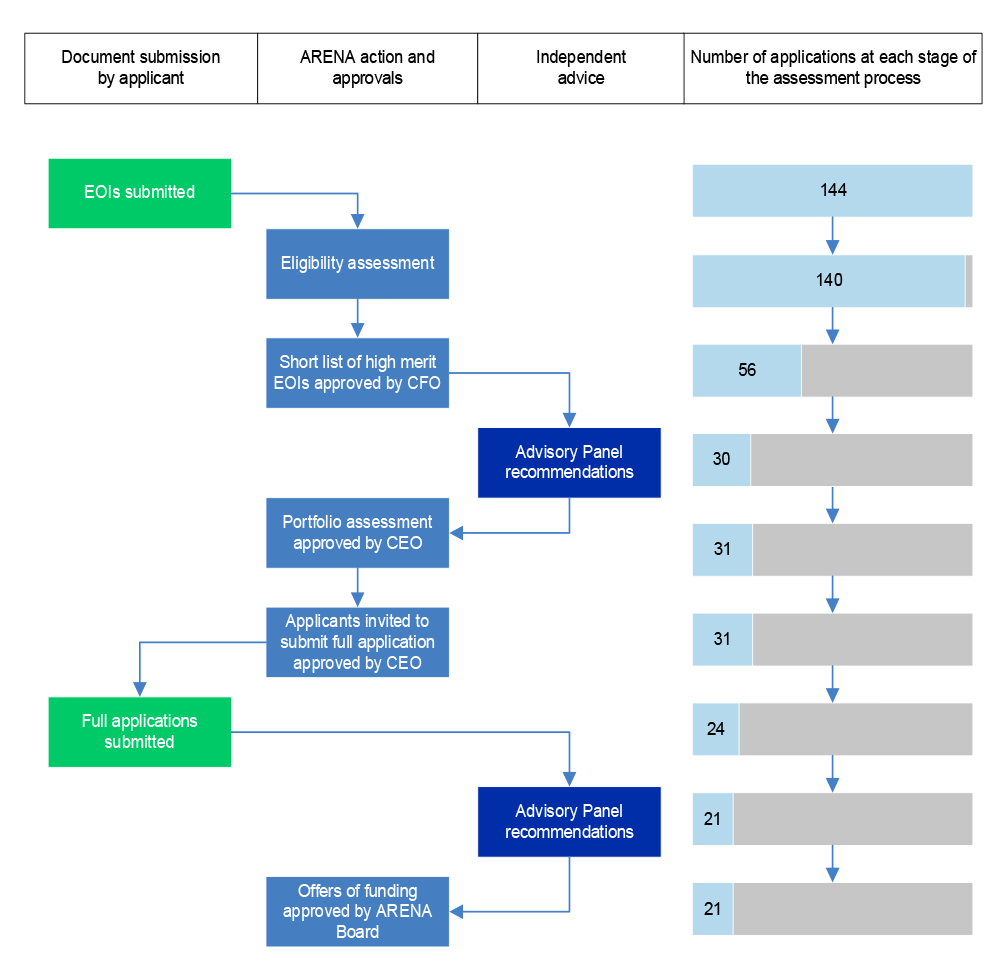
Note: The size of each box depicting the number of applications at each stage of the assessment process is scaled to the number of applications at that stage relative to the number of EOI applications submitted.
CFO refers to Chief Financial Officer; CEO refers to Chief Executive Officer.
Source: ANAO assessment of ARENA documents.
Eligibility and Expression of Interest assessment
3.41 Following the submission of EOIs, ARENA undertook an initial screening assessment of the merit of applications before determining which EOIs would proceed to be assessed by the Advisory Panel.
3.42 The assessment of eligibility of funding proposals was approved in accordance with delegations.
3.43 Under the ARP guidelines, ‘EOIs or Full Applications that fail to meet one or more of the eligibility criteria, or that ARENA considers to be of low merit against one or more Merit Criteria, will be considered unsuccessful’. EOIs and full applications assessed as having satisfied all the merit criteria to a high standard (or can reach a high standard) could be invited to proceed to the next assessment stage.
3.44 The round 1 funding announcement listed five merit criteria. ARENA developed an assessment matrix to guide how it would assess high merit against each of the merit criteria for the assessment of EOIs to proceed to the Advisory Panel.72 Each of the merit criteria were assessed as high, medium or low.
3.45 ARENA selected 56 applications for review by the Advisory Panel, from the 140 eligible applications (see Figure 3.2). When making this initial assessment, ARENA made the following judgements.
- Applications with a grant request of more than $1.5 million per battery were rated as low merit unless there was a pathway to high merit.
- Projects with five batteries (the minimum number under the funding announcement) would not be rated above medium.
- Similar projects that requested less grant funding per battery were assessed as having higher merit.
- Proposals outside the scope of activity described in the funding announcement would generally be low merit.
- Applications with two or more low ratings against the five merit criteria were rated overall as low merit.
3.46 ARENA documented how it ensured a fair and equitable assessment process.
- Every application was assessed by at least two staff and reviewed by a senior team member.
- Applications were all assessed against the same merit criteria in accordance with the funding announcement and ARP guidelines.
- Applications that did not receive any low merit assessments against any criterion were provided to the Advisory Panel.
- Only those applications with one low merit assessment or two or more high merit assessments were provided to the Advisory Panel.
3.47 ARENA’s assessment plan stated that ‘applications that do not comply with the Scope of Activity may be assessed as being of obvious low merit’. Two EOIs were not within the scope of activity and were assessed as medium merit for one of the two assessment criteria, due to having high potential to contribute to the round outcomes.73 ARENA documented the reasoning for the decision to assess these EOIs outside the assessment plan suggestion.
3.48 ARENA provided the Advisory Panel with a probity briefing and instructions on how to assess applications. The panel was instructed that any application with a low merit classification against any of the merit criteria would not be invited to submit a full application. All EOIs were provided to three panel members to assess individually, then the panel met at a moderation meeting to agree on recommended applications. ARENA developed an Advisory Panel handbook to guide the operation of the Advisory Panel.
3.49 On 11 September 2023, ARENA’s Probity Advisor completed a probity report on the EOI assessment process conducted by ARENA. The probity advisor reviewed key round 1 documents including the funding announcement and assessment plan, the instructions ARENA provided the Advisory Panel, and the merit assessment matrix. The probity advisor also attended the Advisory Panel EOI moderation meetings to advise on probity obligations and observe panel deliberations. The report concluded that ‘there is no probity impediment to ARENA acting on the recommendations of the Panel … regarding which Applicants should be invited to participate in the Full Application stage’.
3.50 Following the Advisory Panel assessment of EOIs, ARENA reviewed the geographic coverage of the applications to be invited to submit full applications. This ‘portfolio approach’ to assessment was described in the ARP guidelines. The Chief Executive Officer (CEO) approved one further EOI to be invited to submit a full application, provided the applicant provide additional information.74 The addition of this project was to increase coverage in northern Western Australia. This EOI was approved by the Advisory Panel although the Panel assessed it has having low merit against one of the five merit criteria.
Full application assessment
3.51 The CEO approved successful EOI applicants for invitations to submit full applications, in accordance with the round 1 assessment plan. ARENA staff reviewed all full applications submitted before providing the applications to the Advisory Panel for review.
3.52 Only full applications assessed as high merit would be funded. Only full applications assessed by the Advisory Panel as high merit or having a pathway to high merit were recommended for funding approval.
Decision-making
3.53 ARENA’s legislation requires it to ensure that decisions about the provision of financial assistance are based on merit.75 Reasons for ARENA’s final decisions must be recorded and provided to the appropriate delegate or ARENA Board for approval. The implementation plan stated that ARENA’s Board would make decisions relating to the award of funding for this program.
3.54 ARENA’s Board approved round 1 funding at two meetings.
- On 27 February 2024, ARENA’s Board approved funding for three projects totalling $28 million for 65 batteries.
- On 23 May 2024, the Board approved funding for 18 projects totalling $115 million for 306 batteries.76
3.55 For each project, the Board was provided with a project overview; the funding request and financial details; additionality considerations77; project outcomes and deliverables (including knowledge sharing); comment on the applicant’s capability and capacity; and a summary of project design, including risks and mitigations.
3.56 Merit assessment reports were made available to the Board, and the Board was informed the projects would be unlikely to proceed without government support, as required by the GMP.
3.57 The Board approved offers for funding up to specified amounts in accordance with the recommendations and its responsibility to make merit-based decisions. Reasons for the Board’s decisions were documented in accordance with ARENA’s governing legislation.78
3.58 When approving the funding announcement for round 1 on 21 February 2023, the Board allocated $120 million to the round, with round 2 to fund the remaining $51 million. The Board was informed on 27 February 2024 that ARENA expected to seek the Board’s approval to allocate more than $120 million to round 1, due to the strong demand. The Board was advised that increasing round 1 funding would allow for a larger volume of batteries to be deployed earlier, optimise funding required to achieve the budget measure and reduce risks of projects being unable to secure funding. Adjusting the allocated funds between grant rounds was allowed under the grant opportunity funding announcement. The Board agreed with this change in the allocation of funding between the rounds and, as outlined in paragraph 3.54, approved $143 million of funding for round 1 projects.
3.59 The Board was informed that the number of batteries delivered by each project, size of batteries in the project and battery locations, may change during negotiation of the funding agreements, and during the administration of the funding agreements after they had been signed. The Board delegated authority to the CEO to negotiate and execute the funding agreements.
3.60 The CEO negotiated funding agreements in accordance with the Board’s decisions. Sixteen of the 21 round 1 projects approved by the Board proceeded to signed funding agreements, the remaining five projects were terminated during negotiations. The 16 funding agreements were for 318 batteries, with $124.7 million of funding.79
Conflicts of interest
3.61 Disclosure and effective management of real, apparent, and potential conflicts of interest is central to maintaining integrity in government. Distributing grants is a government activity with heightened risks related to conflicts of interest.80
3.62 ARENA ‘is committed to ensuring the highest level of integrity and public trust are achieved and maintained through its management of conflicts of interest, whether actual, potential or apparent’. ARENA’s conflict-of-interest policy, program probity plan and Advisory Panel handbook contain provisions regarding the management of conflicts of interest during grant assessments.
3.63 ARENA is to maintain a conflict-of-interest register for key persons involved in the program. ARENA did not consider decision-makers to be key persons with regards to the probity plan.
Staff
Round 1
3.64 All 22 ARENA staff listed in the program key person list for round 1 filed conflict-of-interest declarations. Ten of the 22 declarations did not answer the question as to whether there were conflicts to declare, although the staff acknowledged the requirement to disclose any potential conflicts. One ARENA worker declared a potential conflict of interest. This was assessed in accordance with ARENA’s policy and deemed to be immaterial.
3.65 One of the two staff who recommended applicants to progress through the assessment process was not in the key persons list, and did not submit a program-specific conflict-of-interest declaration.
3.66 Four ARENA staff made decisions during the assessment process.81 None of these staff were listed in the key person list. Decision-makers did not make program-specific conflict-of-interest declarations. These staff members used ARENA’s enterprise conflict management system to submit annual conflict-of-interest forms.
3.67 One staff member who approved assessments of eligibility of the EOIs declared a potential conflict of interest through ARENA’s enterprise conflict management system. This was assessed and deemed to be potentially material and managed in accordance with the assessment.82
3.68 The ARENA staff member who signed the minute approving 56 of the 140 eligible EOIs to progress to review by the Advisory Panel in July 2023, had previously declared a potential conflict of interest that was relevant to the program, through an annual conflict disclosure in ARENA’s enterprise conflict-of-interest system.
- In October 2021, ARENA determined that in the event a matter or decision involves the potential conflict, ‘the matter should be reviewed to determine whether mitigations strategies … are required’. The officer was ‘not to make decisions’ regarding the potential conflict.
- ARENA’s conflict-of-interest policy identifies signing off on assessments of EOIs as a higher risk activity and more likely to lead to a conflict being material.
- ARENA advised the ANAO on 1 December 2025 that the ‘approval minute was a process step to move EOIs to Advisory Panel assessment and did not constitute a funding decision or a recommendation to award funding’ and was ‘consistent with the conflict mitigation in place’.
3.69 ARENA managed the potential conflict of interest in accordance with a narrow definition of decision-making. It is appropriate in order to maintain the highest level of integrity, that ARENA broaden its definition of decision-making, and require program-specific conflict-of-interest declarations for decision-makers as well as application assessment and project management personnel.
Round 2
3.70 Seventeen ARENA staff completed conflict-of-interest declarations for round 2 and no potential conflicts were identified. All decisions during the round 2 assessment process were made by the CEO, who had submitted annual conflict disclosures in ARENA’s enterprise conflict-of-interest system. No relevant conflicts were identified.
Recommendation no.2
3.71 The Australian Renewable Energy Agency strengthens its management of conflicts of interest by:
- ensuring key persons lists are complete by including all program staff and decision-makers;
- ensuring that decision-makers complete program conflict-of-interest declarations; and
- providing guidance about what constitutes a ‘funding decision’ to guide the management of potential conflicts of interest.
Australian Renewable Energy Agency response: Agreed
Advisory panel
3.72 Prior to assessing the round 1 EOIs, members of ARENA’s Advisory Panel completed conflict-of-interest declarations based on a list of applicants, in accordance with ARENA’s conflict-of-interest policy and Advisory Panel handbook. For each identified conflict, the Chief Financial Officer made a determination on the materiality of the conflict, as required.83 Panellists with material conflicts were not involved in assessing the applications related to that conflict. Due to the timing of the audit, the ANAO did not review conflict-of-interest declarations of the Advisory Panel in relation to round 2.
Board
3.73 The Board’s charter and ARENA’s conflict-of-interest policy require Board members to declare conflicts of interest in writing and with sufficient detail to enable proper assessment of the conflict. Board members are to disclose conflicts as soon as practicable upon commencement as a member of the Board, annually, and any time a new conflict arises.
3.74 Prior to providing papers for each Board meeting, Board members are provided with a list of entities who will be discussed in the Board papers. If there may be a conflict of interest related to any of these entities, the Board member is to provide an updated disclosure. The Board papers record one conflict-of-interest declaration relevant to the program. The conflict was determined not to be material for the Board discussion of the round 1 funding announcement in February 2023. The relevant Board member left the Board prior to further discussions about the program.
3.75 No Board members involved in making decisions to fund community batteries projects in round 1 identified any conflicts of interest relating to grant recipients. Due to the timing of the audit, the ANAO did not review conflict-of-interest declarations of the Board in relation to round 2.
4. Grants management and evaluation
Areas examined
This chapter examines whether the Community Batteries for Household Solar program (the program) has effective arrangements to monitor, evaluate and report on the achievement of objectives and outcomes.
Conclusion
The Department of Climate Change, Energy, the Environment and Water (DCCEEW) and the Australian Renewable Energy Agency (ARENA) have partly effective arrangements to monitor, evaluate and report on the achievement of objectives and outcomes. Both entities are managing grant agreements in accordance with requirements. There have been delays with the delivery of batteries under DCCEEW’s program. Neither DCCEEW nor ARENA adequately prepared for program evaluation during program planning. In 2025, both entities developed approaches to program evaluation. There is a risk of duplicating evaluation effort. All grants must report on progress against program outcomes. ARENA has provided guidance for data collection. DCCEEW has not provided such guidance and it is not clear how reporting will be aggregated to provide evaluation of program outcomes. Public reporting on the program does not provide sufficient information about the effective and efficient delivery of the program.
Areas for improvement
The ANAO made two recommendations aimed at embedding planning for evaluation into program design, and reducing duplication of evaluation efforts. The ANAO identified one opportunity to improve the transparency of public reporting.
4.1 Monitoring grant recipient performance and compliance with the grant agreement, managing risks and issues, and making payments under the grant agreement are aspects of appropriate grant management.84
4.2 The Commonwealth Evaluation Policy establishes key principles to guide evaluation across the Australian Government. Evaluation should be considered during program design and built into program governance.85 Evaluation of grant programs includes assessing the performance of individual grant recipients against agreed performance indicators; evaluating the grant opportunity against identified performance indicators; and determining if the government’s desired outcomes were achieved.86
Are appropriate arrangements in place to support the ongoing management of grants?
DCCEEW’s ongoing management of grants is in accordance with its responsibilities under agreements with BGH, and DCCEEW’s grants policy. DCCEEW has approved all requested variations, in accordance with documented tolerances and delegations. At August 2025, there had been 78 variations across 58 grant agreements, 88 per cent of which included extensions to project end dates. The average total extension to end dates for DCCEEW projects is 40 weeks. BGH provides DCCEEW with a spreadsheet tracking variations and monthly reports on the progress of individual projects. DCCEEW uses this and information from grantees to track progress of the program against its targets.
ARENA’s ongoing management of grants is in accordance with its grants management and variations policies. Milestone payments have occurred following delegate approval of milestone reports. At September 2025, ARENA had approved 45 variations across 16 grant agreements in accordance with its policy. At January 2026, four projects had extensions to project end dates. During 2025, ARENA established impact teams to improve its visibility over program management.
Department of Climate Change, Energy, the Environment and Water
4.3 The Australian Government Grants Framework states that grant agreements should be supported by ongoing communication and active grants management. DCCEEW’s grants policy requires that:
The responsible grant policy or program owner must ensure that grant agreements are supported by ongoing communication, active grants management and performance monitoring requirements, which are proportionate to the risks involved. At a minimum, this will involve monitoring grantee performance and compliance with the grant agreement, and ensuring all grants are properly acquitted.
4.4 The Business Grants Hub (BGH) was responsible for ongoing communication and grants management for the program including: compliance; assessing progress reports and making payments; managing variation requests; and advising DCCEEW of program funding impacts as a result of variations.
Communication
4.5 DCCEEW generally met with BGH on a fortnightly basis in relation to the program. Between 21 May 2024 and 7 May 2025, there were 17 meetings. These meetings were primarily focussed on variations, including the processes underpinning variation management and potential future requests for variation or termination of grant agreements.
4.6 In addition to meetings with BGH, DCCEEW met with grant recipients to understand how the community battery projects were progressing. These meetings allowed DCCEEW to understand ongoing challenges to delivery. Over the 15-month period from 9 February 2024 to 6 May 2025, DCCEEW documented 30 conversations with 12 grant recipients.87
Reporting and assurance
4.7 BGH is required to provide DCCEEW with reports based on information provided by grant recipients, and as agreed with DCCEEW. At the commencement of the program, DCCEEW did not make any requests to BGH regarding the content or frequency of this reporting. DCCEEW advised the ANAO on 30 October 2025 that during program implementation it requested progress reports to assist in responding to enquiries from Members of Parliament and the Minister’s Office.
4.8 From July 2023, following the first payment to grant recipients in June 2023, BGH provided DCCEEW with monthly reports covering milestone completion, payments, and emerging issues and risks. These reports provide information on a project-by-project basis and at the program level. In February 2024, BGH commenced reporting on overall progress against the grant agreement for each battery project. This information is self-reported by grant recipients. DCCEEW advised the ANAO on 31 October 2025 that it keeps informed of program progress through meetings (paragraphs 4.5 and 4.6), rather than BGH reporting. DCCEEW keeps an updated table of the implementation of the batteries for reporting to the minister.
4.9 DCCEEW did not develop its own assurance framework for the program but agreed that the BGH Grants Assurance Framework would be applied to the program. This framework is designed to enable BGH to provide confidence it is meeting its grants management obligations. BGH provides DCCEEW with an annual statement of compliance to provide DCCEEW with confidence that BGH is managing grant programs in compliance with relevant legislation, policies and agreements.
Variations
4.10 BGH is responsible for managing variation requests in accordance with the grant opportunity guidelines and managing the agreed variations. BGH is to advise DCCEEW of any program funding impacts. The program delegation instrument requires that variation decisions for extensions of time or change in project milestones that are likely to result in a need to vary annual capped amounts, must be made by DCCEEW, not BGH.88 BGH may make decisions about variation requests that are not likely to require a variation to annual capped amounts.
4.11 In addition to the requirements determined by the delegation instrument, BGH also seeks DCCEEW delegate approval for variations requesting an extension to the project end date beyond the end date or project period published in the grant opportunity guidelines.
4.12 As of 27 August 2025, for the 58 funded batteries, 78 variations had been requested and all had been approved.89 BGH had requested DCCEEW consideration of 48 variations; and BGH had approved 30 variation requests. All variations assigned to DCCEEW for approval were approved by a senior executive service staff member with responsibility for the program, in accordance with the delegation instrument.
4.13 Sixty-nine (88 per cent) of the 78 variations included a variation to end date.
- Thirty-eight (66 per cent) of the 58 projects requested an extension to the end date and the average total extension to end date as a result of multiple variation requests, was 40 weeks.90
- Delays in securing a site were reported in 25 (32 per cent) of the 78 variations.91
- The greatest project delay DCCEEW has approved is 43 weeks. This variation was the most recent of three variations that resulted in extending the initial project end date from 31 August 2024 to 31 March 2026 — a total project delay of 82 weeks.92 The applicant cited the inability to secure a battery location as the reason for the delay.
4.14 The delegation instrument requires officials to ‘make a written record of each exercise of a power delegated under this instrument and retain the records on a corporate file’. DCCEEW kept records of all of the 48 variations it considered.
4.15 DCCEEW and BGH developed a spreadsheet to track variations in May 2024. BGH provided DCCEEW with the tracking spreadsheet on a monthly then fortnightly basis as the program progressed. The variations spreadsheet included a description and status of variation requests.
4.16 In August 2025, BGH commenced providing weekly updates on variations to DCCEEW, and expanded the spreadsheet to record the entity responsible for the approving the variations. Previous tracking tools did not track whether DCCEEW or BGH were responsible for variations that had been approved.
4.17 The spreadsheet supplied by BGH does not include the date all variations were approved, and dates in the spreadsheet do not always match the dates in BGH’s assessment reports.
4.18 DCCEEW uses BGH data and information from meetings with grantees to update the expected operational date of each battery, project cost, grant amount, battery size and capacity, and number of households serviced by each battery.
4.19 DCCEEW advised the ANAO on 31 October 2025 that it is able to track the cumulative impact of multiple variations on a project as this is documented in the BGH assessment report. DCCEEW advised it has visibility over the cumulative impact of variations through the program budget and any movement of funds across financial years, and through maintaining its own tracker.
4.20 While the program did not have a completion date, the original latest end date of DCCEEW-funded grant agreements was 31 March 2025 (i.e. all batteries were to be delivered by 31 March). At August 2025, 21 of the 58 projects had extended their project end date to later than July 2025, and two projects had extended their end date to March 2026.
Australian Renewable Energy Agency
4.21 ARENA’s Grants Management Policy sets out ARENA’s expectations in relation to the effective management of grants including setting milestones, approving variations, and monitoring performance and compliance.
Governance and assurance
4.22 ARENA’s Board approved its enterprise-wide assurance framework in May 2020, and approved revisions to this framework in June 2021 and September 2023.93 Assurance practices during project management include:
- review of performance and governance through internal committees and teams (see paragraphs 4.23 to 4.26);
- milestone assessments conducted by the Project Delivery branch and reviewed by managers prior to acceptance (see paragraphs 4.27 to 4.29);
- variations managed in accordance with ARENA’s Variation Policy (see paragraphs 4.30 to 4.34); and
- internal audits and evaluations (see paragraphs 4.57 to 4.62).
4.23 Under ARENA’s assurance framework, the Project Portfolio Management Committee (PPMC) was to review performance of ARENA funded projects to ensure the projects were governed in a manner consistent with Australian Government expectations. The PPMC considered delivery risks across ARENA’s project portfolio so as to identify common themes. ARENA disbanded the PPMC on 1 November 2024 and the PPMC did not consider any community batteries projects.
4.24 During 2025, ARENA developed Impact Teams around ARENA’s strategic focus areas and budget measures. Teams consist of staff from across the grant life-cycle and ARENA strategic communications. Impact Teams are intended to:
- ensure delivery of impact against long term ‘Impact Area’ objectives;
- ensure grant cycle activities support the portfolio; and
- enact faster and more efficient delivery of impact, including providing consistent accountability and communication.
4.25 ARENA advised the ANAO on 14 November 2025 that the program has been overseen by an Impact Team since 13 October 2025. ARENA intends Impact Teams will respond to contract and milestone variations; identify and escalate issues and priorities; and promote consistency and quality of ARENA’s practices.
4.26 ARENA’s Grants Management Policy states that the management of project risk is ‘fundamental to the sustainability and financial stability of ARENA, and to the efficient and effective use of its resources’. ARENA has reviewed project risk assessments in accordance with its policies.
- All 16 round 1 projects had initial risk assessments — 13 were low risk and three were medium risk.
- The low risk projects had six-monthly risk assessment reviews in February 202594 and September 2025.
- The round 1 projects rated as medium risk have had quarterly risk reviews since being rated medium risk.
Milestones
4.27 ARENA’s Grants Management Policy states that ‘regular monitoring of funded projects is essential to ensure compliance with the terms and conditions of the funding agreement, to ensure the project is delivered as per the project deliverables, and to minimise the risk of fraud, waste or mismanagement’. Grant recipient performance against milestones should be documented.
4.28 Grant recipients must provide evidence in line with milestone requirements before milestone payments are made. ARENA’s financial delegations document responsibilities for approving milestone reports.
4.29 ARENA’s round 1 projects have between three and seven milestones. The exact nature of each milestone differs depending on the project, however milestone one tends to require the grant recipient to submit a project plan and evidence of battery procurement. As of 19 November 2025, ARENA’s 16 grant recipients had completed 11 milestones.95 ARENA approved all milestones. As of 19 June 2025, all milestone payments to grant recipients were paid following appropriate approval of milestone completion.
Variations
4.30 Variations to funding agreements require approval from the ARENA delegate or ARENA Board and must comply with the ARENA variation policy. The reasons for the variation must be fully documented and delegates must consider risk, probity concerns and value for money.
4.31 ARENA’s Chief Executive Officer approved ARENA’s variation policy in 2018.96 The variation policy determines the tolerance for variations to grant agreements. It defines key material variations as amendments to the schedule that exceed six months, changes to the outcomes and delivery of a project, and changes of a project participant or major subcontractor.
4.32 As of 5 September 2025, there had been 45 variation requests across ARENA’s 16 round 1 projects. ARENA approved all 45 requests in accordance with its delegations. Forty-four of the variations were assessed as non-material in accordance with non-material variations as outlined in the variations policy. Nineteen of the 45 variation requests were requests to extend milestone submission dates.
4.33 One variation was assessed as material. This variation requested to reduce scope from 10 to seven sites, and decrease ARENA’s contribution to the project budget by $804,090 (a 19 per cent reduction in funding). ARENA’s assessment determined the variation did not negatively affect value for money; did not impact the merit of the project; and that the project adhered to the probity principles of transparency and confidentiality. The variation was approved by the General Manager, Project Delivery, in accordance with ARENA’s delegations.
4.34 At January 2026, ARENA had approved variations to the end dates of four projects.
Has an appropriate program evaluation framework been established?
DCCEEW and ARENA have both established program evaluation approaches. There is a risk that evaluation performed by both entities will result in a duplication of effort. Performance measures are set out in the program implementation plan and DCCEEW’s evaluation framework (finalised in October 2025) should allow it to assess the program’s performance against these measures. It intends to evaluate the impact of both the DCCEEW and ARENA components of the program. ARENA did not plan for program evaluation during the design phase, as required by its internal policies. In July 2025, it prepared a program monitoring and evaluation plan and intends to evaluate the program in 2027–28.
4.35 The Commonwealth Evaluation Policy emphasises the importance of establishing evaluation arrangements early. Arrangements should include robust performance monitoring, baseline data, and credible data. Baseline data allows for changes to be assessed over time.97
4.36 Under the Administrative Arrangements Order, DCCEEW is responsible for the development and coordination of household and community climate action, greenhouse gas abatement programs, and renewable energy.98 DCCEEW is responsible for the evaluation of the overall program against its intended outcomes, as well as the component of the program administered by BGH. ARENA is responsible for evaluating its program delivery against its outcomes.
Program-level evaluation
4.37 DCCEEW did not include an estimate of evaluation costs in the program costing.99 ARENA’s evaluation costs were included in program costings proposed to the Australian Government. In August 2025, DCCEEW updated its internal guidance that new policy proposals ‘must outline how the proposal’s outcomes will be measured and assessed over time’ and the cost of evaluation should be factored into the planning and costing for all proposals.
4.38 On 3 October 2025, DCCEEW engaged the Nous Group to establish an evaluation framework encompassing both the ARENA and DCCEEW funding streams; and assess the BGH portion of grants.100
4.39 The program evaluation framework was finalised on 31 October 2025. The framework documents evaluation questions, timing, roles and responsibilities, a program logic, and data and data sources for each evaluation question. Two evaluation approaches were proposed.
- Initial evaluation of the BGH component of the program is to commence in ‘early 2026’ and evaluation of the ARENA component is to commence ‘mid 2027’.
- Evaluation of the impact of both the DCCEEW and ARENA components of the program on energy costs, network services, and rooftop solar installations, as well as a value-for-money comparison of the DCCEEW and ARENA delivery is to occur several years after projects are completed.
4.40 The ARENA-DCCEEW Memorandum of Understanding (MoU) states that ARENA’s program evaluation ‘will be completed by mid-2027’. As ARENA anticipates data being available from 2027 and plans to evaluate the program during 2027–28, ARENA will not be able to meet this MoU requirement.
4.41 There is a risk that DCCEEW and ARENA evaluation will duplicate effort rather than be complimentary. Both entities should ensure they work together to maximise the efficiency and value of program evaluation.
Recommendation no.3
4.42 The Department of Climate Change, Energy, the Environment and Water and the Australian Renewable Energy Agency collaborate on program evaluation so as to minimise duplication of effort and provide comparison of the different program design approaches.
Department of Climate Change, Energy, the Environment and Water response: Agreed
4.43 The department will continue to work closely with ARENA to ensure our efforts on program evaluation are complementary. This includes both entities are represented in all work streams relating to community batteries program evaluation.
Australian Renewable Energy Agency response: Agreed, where appropriate
4.44 ARENA will collaborate with DCCEEW on evaluations of ARENA’s programs: that are closely related to a DCCEEW program; where it is effective, efficient, economical; and where it does not compromise ARENA’s independence, object or functions under the ARENA Act 2011 to do so.
4.45 The budget measure sought to fund 400 batteries across Australia. At January 2026, 58 batteries were operational, and grant agreements had been approved for 491 batteries. The distribution of the DCCEEW- and ARENA-funded batteries across Australia, at November 2025, is illustrated in Figure 4.1.
Figure 4.1: Distribution of batteries across Australia
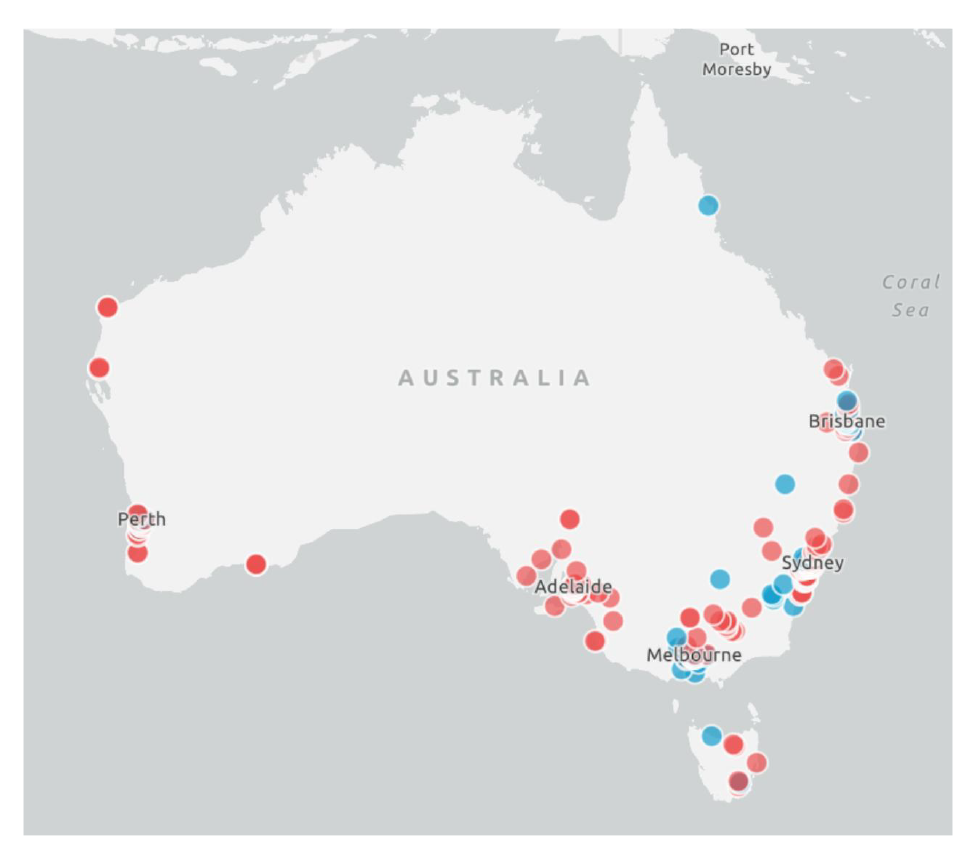
Key: ● Batteries funded by ARENA ● Batteries funded by DCCEEW
Note: 332 of the 491 battery locations are plotted on the map, where grant recipients had provided location information. Location information not available includes: 89 batteries funded under ARENA’s round 2; 16 batteries to be installed by Power and Water Corporation in the Northern Territory; and 27 batteries to be installed by Mondo in Victoria.
Where a postcode is recorded in the grant agreement and the battery address is unavailable, a data point has been generated based on the postcode.
Source: ANAO analysis of DCCEEW and ARENA documentation.
Department of Climate Change, Energy, the Environment and Water
Program performance measures
4.46 As at the end of January 2026, 41 of the intended 58 batteries had been built. One grant agreement had been terminated because a suitable battery site could not be found. The actual location of installed batteries (as of 31 October 2025) and the intended locations as pre-announced prior to the 2022 Federal Election (see paragraph 1.12) are listed in Appendix 3. Batteries have been installed, or are planned to be installed, in the announced locations, as intended.
4.47 Program performance measures are documented in the implementation plan. Each of the six performance measures is described in Table 4.1.
Table 4.1: Program performance measures
|
Program outcome |
Performance measure |
Type of measure |
Target |
|
Contribute to lowering emissions |
Number of community batteries delivered against the election commitment |
Output Quantitative |
Yes: 58 batteries |
|
Total number of batteries installed |
Output Quantitative |
Yes: 400 batteries |
|
|
Total capacity of batteries installed |
Output Quantitative |
No |
|
|
Lower household electricity costs |
Financial returns to participating customers |
Outcome Quantitative |
No |
|
Share benefits with households without solar installations |
|||
|
Support the electricity network |
Avoided network expenditure |
Outcome Quantitative |
No |
|
Increase solar hosting capacity |
Improved solar hosting capacity of networks |
Outcome Quantitative |
No |
Source: ANAO analysis of DCCEEW documentation.
4.48 The measures of success cover the five intended program outcomes in the implementation plan. The three measures that align with the program outcome to contribute to lowering emissions are proxies.
4.49 Emissions reduction is not a program performance measure despite requiring grantees to report on emissions reduction (see paragraph 4.76). DCCEEW advised the ANAO on 31 October 2025 that emission reduction was not a performance measure as it is difficult to calculate emission reductions arising from individual battery storage projects.
4.50 There are no targets set against four of the six performance measures. Where targets were not established prior to program implementation, progress may be difficult to assess. Without targets or baseline measurements, evaluation is at risk of bias as any progress can be considered program success. DCCEEW advised the ANAO on 31 October 2025 that baseline measurements would have been difficult to quantify due to limited available data.
4.51 Performance measures should use data sources that can be relied upon and trustworthy, and that can be verified to be proven to be true. DCCEEW relies on grant recipients to provide credible and trustworthy information, including data source, as required under their grant agreements. A measure that does not identify a data source or collection methodologies is less reliable and may be difficult to compare. Three of the six program performance measures may be informed from a variety of data sources and collection methodologies, resulting in less reliable performance information and more emphasis on qualitative information.
4.52 The evaluation questions in the evaluation framework will allow DCCEEW to report against the performance measures in the program implementation plan.
Australian Renewable Energy Agency response
4.53 ARENA funded 345 batteries in round 1. As of January 2026, ARENA had verified the installation of 16 community batteries.101 As illustrated in the timeline in Appendix 4, ARENA program delivery was slower than that for DCCEEW batteries. This was anticipated in the program design (see paragraph 2.15) due to ARENA’s two-stage application and assessment process (as described in Figure 3.2).
4.54 ARENA’s Grants Management Policy requires all ARENA programs to be evaluated to demonstrate proper use and management of public resources and provide accountability. ARENA’s 2020 evaluation framework sets out ARENA’s approach to evaluation and required a plan to evaluate the effectiveness of a program to be integrated into the design of new programs.
4.55 In September 2025, ARENA’s Senior Leadership Team endorsed a new evaluation framework to guide the retrospective assessment of the effectiveness, efficiency and appropriateness of an activity. Under the new evaluation framework, budget measures may be selected for evaluation against the budget measure outcomes. In addition to evaluation of some specific programs (such as budget measures), ARENA will undertake ARENA-wide impact assessments every three to five years, and evaluate progress against strategic priorities every two to three years. Under this framework, ARENA plans to evaluate the impact of the community batteries program in 2027–28.
4.56 Both the 2020 and 2025 evaluation frameworks emphasise that evaluation is a component of ARENA’s core business. ARENA evaluations are to be timely, evidence-based, scaled to the risk and impact of the activity, independent and transparent.
Evaluation design
4.57 Under the evaluation framework current at the time of program development, all new funding initiatives required a decision as to whether the program required a new monitoring and evaluation (M&E) plan be developed, or whether it could be combined into an existing ‘parent’ plan. An M&E plan links ARENA’s legislative objectives to ARENA’s key activities and specific program outcomes, including documenting how those outcomes would be tracked.
4.58 ARENA did not prepare or adapt an M&E plan at the start of the program, as required. It also did not document the decision not to prepare an M&E plan, as required by its evaluation framework.
4.59 ARENA prepared an M&E plan for the program in July 2025 and updated it in September 2025. The M&E plan documents a program logic, evaluation questions, metrics against each of the outcomes of the funding announcements, and data sources.
4.60 The M&E plan does not provide sufficient information to guide measurement of progress against the program outcomes. The plan states that ARENA’s program evaluation will ‘be shared to complement the evaluation activities of DCCEEW’ and ARENA will ‘collaborate on the design of the evaluation approach’.
4.61 Under ARENA’s current evaluation framework, budget measures may be selected for evaluation, and progress against strategic priorities will be evaluated every two to three years. If the role of each program in impact evaluation is not identified during program planning, the program may not be established in such a way that supports any future evaluation, and baseline data may not be available.
Recommendation no.4
4.62 The Australian Renewable Energy Agency decides during program design as to whether new programs will be subject to program evaluation, and how the program may contribute to strategic priority evaluations and ARENA-wide impact assessments.
Australian Renewable Energy Agency response: Agreed
Knowledge-sharing
4.63 One of ARENA’s functions under the Australian Renewable Energy Agency Act 2011 is to share information and knowledge about renewable energy technologies.102 Sharing knowledge is one of ARENA’s key activities, as defined in its corporate plan.103
4.64 On 19 January 2024, ARENA engaged enX Consulting to collate, analyse and communicate insights from ARENA’s community batteries projects. As of August 2025, enX Consulting had delivered two knowledge-sharing reports for ARENA (Table 4.2).
Table 4.2: ARENA’s knowledge sharing deliverables
|
Product |
Date |
Details |
|
Snapshot reporta |
28 February 2025 |
Report providing a summary of applications, financial models, and early insights on state of the market relating to commercial, technical, regulatory and social opportunities and barriers. |
|
Pre-deployment challenges and best practices reportb |
4 September 2025 |
Lessons learnt by project proponents during the early pre-deployment stages of community battery rollouts. |
Note a: Available at https://arena.gov.au/knowledge-bank/community-battery-market-snapshot-report/ [accessed 24 September 2025].
Note b: Available at https://arena.gov.au/knowledge-bank/arena-community-battery-round-1-pre-deployment-challenges-best-practice-report/ [accessed 24 September 2025].
Source: ANAO analysis of ARENA documentation.
4.65 Grant recipients must agree to knowledge-sharing requirements. Funding agreements include a knowledge-sharing plan outlining the type and frequency of knowledge-sharing that grant recipients must provide. These knowledge-sharing deliverables include technical reports on barriers, impacts to local networks, financial modelling, lessons learnt reports, and quarterly ARENA surveys.
Do monitoring arrangements support assessment against funding objectives and outcomes?
DCCEEW receives end-of-project reports from grant recipients that contain information that is expected to assist DCCEEW evaluate delivery of the budget measure. Inconsistent methodologies implemented by grant recipients may result in difficulties in collating and validating the information. DCCEEW did not provide any guidance to grant recipients to encourage reporting that could be more effectively collated but expects that its evaluation framework will support qualitative analysis. Similarly, ARENA requires that grant recipients report on progress against program outcomes at milestones and the completion of the project. ARENA has provided guidance on data collection methodologies. Both entities produce a range of reporting. Public reporting does not include the operational status of batteries.
4.66 Reporting program progress communicates information that holds people accountable and supports learning and evidence-based decision-making.104 Reporting based on robust data and evidence can provide performance insights and drive continuous improvement and provide accountability.105
4.67 Table 4.3 provides an overview of the progress of the program, as of January 2026.
Table 4.3: Delivery of the program — status as of January 2026
|
Parameter |
Requirement |
Status update — January 2026 |
|
Quantity |
Number of batteries:
|
491 batteries have been funded (57 by DCCEEW and 434 by ARENA). |
|
Timeliness |
The implementation plan did not set out a timeframe for the delivery of the program. The budget measure provided funding until the end of June 2026. |
At August 2025, 88% of DCCEEW batteries had extended their project end date. All were due for completion by June 2026. ARENA’s round 2 grant agreements are due to be signed in early 2026. |
|
Cost |
Total funding for batteries:
|
$205.6m in grants funding had been approved:
|
|
Administrative cost per battery. |
DCCEEW — $42,895 per batteryb ARENA — $40,323 per battery |
|
Note a: ARENA’s Board approved grants of $6.7 million more than the total funding allocation for the program. The ARENA Act allows ARENA to provide additional funds above the allocated program funding, from uncommitted appropriations.
Note b: DCCEEW administrative costs is the cost of contracting BGH to administer the program. It does not include costs absorbed by DCCEEW (see paragraph 1.10).
Source: ANAO analysis of DCCEEW and ARENA documentation.
Department of Climate Change, Energy, the Environment and Water
4.68 Non-corporate Commonwealth entities should include performance measures in grant opportunity guidelines; agreements; other documentation; and each entity’s broader performance management framework.106 Requesting appropriate targeted performance information assists grant recipients and officials to draw well-informed conclusions and contributes to timely and effective decision-making in managing grant activities. It can provide useful information on which to base future decisions for designing, continuing or concluding grant opportunities, and can contribute to the accountability of entities for their performance.107
Information from grant recipients
4.69 Grant recipients within the program are required to report through progress reports, end-of-project reports, and post-project reports. These reports are sent to BGH. BGH is responsible for assessing these reports in line with grant opportunity guidelines and agreed reporting questions in the grant agreements to monitor grant recipient performance.
4.70 Progress reports include: progress against schedule and any justifications; achievement of project outcomes; project expenditure; and contributions to project funding.
4.71 BGH has provided monthly reports to DCCEEW since July 2023. Since February 2024, these monthly reports included a report based on data extraction from grant recipients progress reports.108 Each month, the progress is reported on the same 10 questions including:
- whether the overall project proceeding in line with the grant agreement;
- progress towards gaining access to a site for the community battery; and
- progress on delivering benefits to the community and delivering on community expectations, including any changes since the project application to the likely community benefits.
4.72 These regular reports, as well as the ongoing contact with grant recipients (see paragraph 4.6), provide DCCEEW with information to support timely decision-making and ongoing policy development.
4.73 Guidance provided to grant recipients should clearly outline the nature of information expected to be collected and reported by grant recipients as part of an evaluation, including performance measures, performance indicators, data sources intended to be used, and what methods will be used to analyse the data.109
4.74 Grant agreements include information grant recipients are required to provide in the end-of-project report.
4.75 All end-of-project reports are to comment on the project outcomes achieved by the project end date. In addition to this requirement, other end-of-project reporting requirements align directly with three of the six program performance measures, as illustrated in Table 4.4.
Table 4.4: End-of-project reporting aligned with performance measures
|
Performance measure |
End of project reporting requirement |
|
Number of community batteries delivered against the election commitment |
End-of-project reports do not include information against these performance measures. Data on these measures is collected during project delivery. |
|
Total number of batteries installed |
|
|
Total capacity of batteries installed |
|
|
Financial returns to participating customers |
Estimate the average annual cost reductions for serviced households. |
|
Avoided network expenditure |
Estimate the annual net benefit to the electricity network from the community battery. |
|
Improved solar hosting capacity of networks |
Estimate the number of households unable to install solar panels that will benefit from the community battery. Estimate the reduction in rooftop solar curtailment and/or the amount of additional rooftop solar capacity the local network can support. |
Source: ANAO analysis of departmental documentation.
4.76 In addition to the reporting requirements in Table 4.4, end-of-project reports must include the number of households being serviced by the battery; an estimate of the annual emissions reductions due to the battery; and the total energy stored that is sourced from and supplied to participating household’s rooftop solar systems.
4.77 Grant recipient data should be comparable to allow analysis. This may be through standardised reporting, or analytical work performed during evaluation. End-of-project reporting is not supported by consistent methodologies and DCCEEW has not provided grant recipients with any guidance on calculating these figures.
4.78 On 18 September 2025, DCCEEW advised the ANAO that for the measure of ‘number of households being serviced by the batteries’, ‘some grantees have reported on the number of ‘directly subscribed’ households only (via a tariff arrangement), whereas others have reported the number of households connected to the part of the network that the battery is on (the feeder), as all these households will benefit from voltage support provided by the battery which can reduce solar containment’.
4.79 DCCEEW advised the ANAO on 18 September 2025 the different approaches to measuring some outcomes, such as emissions reduction estimates, ‘inform the department’s understanding and knowledge of the dominant/preferred approaches led by industry’. DCCEEW has not collected information on the methodologies used to calculate these estimates.
4.80 Incomplete, inconsistent, and poor quality data is identified as a risk in DCCEEW’s evaluation framework. The controls were to develop a ‘data matrix identifying indicators, data collection methodology, responsibility and timeframes’ and to ‘use qualitative analysis to assess the achievement of outcomes where quantitative measures are not available’.
4.81 The different approaches taken by grant recipients may limit DCCEEW’s ability to consistently report on projects. On 18 September 2025, DCCEEW advised the ANAO that grant recipient reporting ‘has provided a rich dataset; and although it has challenges for direct comparison, it does not preclude assessment of achievement of outcomes’. DCCEEW expects the evaluation framework will validate end-of-project reports, and will bring together ‘the diverse and disparate insights and metrics being used across the program (by design)’.
Reporting
4.82 As of September 2025, progress of the delivery of the community batteries program was reported to multiple areas as depicted in Table 4.5.
Table 4.5: Program reporting
|
Recipient |
Reporting mechanism |
Description |
|
Public |
Annual Climate Policy Trackera |
The reporting is a short description of the program and does not currently include reporting on program progress. |
|
DCCEEW websiteb |
Grant recipients, the amount of grant funding and battery capacity for DCCEEW grants are published on the website. Successful applicants announced by ARENA are also published. |
|
|
Priority and Delivery Committee of Cabinet (PDC) |
PDC Implementation Priority Report |
PDC provides oversight of the delivery of government priorities. The program has been included in PDC reporting four times since February 2023. Reported information has included key dates, targets, and progress of the program. |
|
Minister for Climate Change and Energy |
Briefings, dashboards and project lists |
From February 2025, DCCEEW has provided the minister through their office with progress reports (generally fortnightly) on its part of the program. These reports include detail on the expected total battery capacity; the expected total number of households serviced; and all projects, their location and status update. |
|
Powering Australia Inter-departmental Committee |
Powering Australia Tracker and Climate and Energy Tracker |
The implementation of initiatives under the government’s Powering Australia plan is reported using a tracker to an inter-departmental committee. Reporting includes current status, key decisions, upcoming milestones, and a risk rating for the program. Reports until February 2025 assign the program with a green risk rating.c In February and June 2025 the program was rated amber. On 30 October 2025 DCCEEW advised the ANAO the risk rating was changed to amber due to the number of variations to extend project end dates. No additional mitigations were documented. |
|
DCCEEW internal Climate and Energy Project Board |
No regular reporting |
DCCEEW’s executive Climate and Energy Project Board provides ‘oversight of project management and delivery against outcomes across the Climate and Energy portfolios … for high priority projects’ and has ‘formal oversight of the program’. The board considered the program once, at its fourth meeting, in August 2023. The board noted the transparency of decision-making, and that no grant recipients had indicated they would not ‘meet deadlines’. In August 2023, the board consisted of two DCCEEW deputy secretaries and three division heads within DCCEEW, in addition to an external member. In August 2025, the board approved a risk-based methodology for the selection of projects to present to the board. During 2025 the program was considered as a ‘potential presenter’ to the board. |
Note a: Available at https://www.climatechangeauthority.gov.au/climate-policy-tracker [accessed 1 December 2025].
Note b: Available at https://www.dcceew.gov.au/energy/renewable/community-batteries [accessed 13 February 2026].
Note c: The program was rated amber in one report on 24 February 2024 and then green again until February 2025.
Source: ANAO analysis of DCCEEW documentation.
4.83 Public reporting on the program through the Annual Climate Policy Tracker does not include information the progress of program implementation, such as the number of grants funded, the amount of funding delivered, or the number of operational batteries. DCCEEW’s website lists grant recipients under DCCEEW and ARENA programs, and the location, grant amount, and battery capacity for DCCEEW grant recipients.110 Public reporting does not include the amount of ARENA funding delivered or the number and operational status of funded batteries.
Opportunity for improvement
4.84 The transparency of the program could be improved by expanding public reporting for both DCCEEW- and ARENA-funded batteries to include battery location, operational status, expected delivery dates, and grant funding expended against funding targets.
4.85 Reporting on the progress of the whole program is provided to the Priority and Delivery Committee of Cabinet, and to the Powering Australia Inter-departmental Committee. Both provide reporting on the number of batteries funded and operation status. DCCEEW and ARENA report separately to the minister (see paragraph 4.90 for ARENA’s reporting to the minister).
Australian Renewable Energy Agency
Information from grant recipients
4.86 ARENA’s Grants Management Policy states that when designing a program, ARENA should consider the information that must be reported annually including the renewable energy technology supported by the project. Funding agreements should specify any obligations of the funding recipient to cooperate with evaluations of the project or program, including post completion of the project.
4.87 ARENA’s funding agreements set out the reporting requirements for grant recipients. All grant recipients are required to submit milestone reports and a final report. ARENA may also request progress reports in addition to the documented milestone and final reports.
- Each milestone report must include an update on the progress of the project relevant to the outcomes, and an update on the knowledge-sharing deliverable of the project.
- Final project reports must include evidence the project has been completed, details of the extent to which the project achieved the outcomes, and information on the knowledge-sharing deliverables completed.
4.88 The grant agreements require grant recipients to ‘provide such further information as reasonably requested by ARENA with respect to the project’ for a period of five years following the final milestone date. This requirement may allow ARENA to collect other information from grant recipients that may assist ARENA in concluding against the program outcomes.
4.89 In September 2024, ARENA contracted enX Consulting to run a workshop on data collection for grant recipients. In December 2024 enX Consulting provided training to grant recipients on data collection, including how to meet data reporting requirements using a data template.
Reporting
4.90 ARENA provides reporting on program progress to the minister directly and through their office, through:
- letters from the ARENA Board Chair to the minister outlining Board decisions following every Board meeting111;
- quarterly meetings between the ARENA CEO and the minister;
- formal briefings, when the need arises — briefings were provided regarding the two enX reports on round 1, and two progress briefings;
- monthly progress reports on milestone status, project location, and battery capacity; and
- meetings with ARENA staff when the need arises.
4.91 The Chief Executive Officer informs the ARENA Board of progress in signing community battery funding agreements.
4.92 ARENA publishes details of approved projects on its website including grant recipients, grant amount and total project cost.112
Appendices
Appendix 1 Entity responses
Department of Climate Change, Energy, the Environment and Water
Australian Renewable Energy Agency
Appendix 2 Improvements observed by the ANAO
1. The existence of independent external audit, and the accompanying potential for scrutiny improves performance. Improvements in administrative and management practices usually occur: in anticipation of ANAO audit activity; during an audit engagement; as interim findings are made; and/or after the audit has been completed and formal findings are communicated.
2. The Joint Committee of Public Accounts and Audit (JCPAA) has encouraged the ANAO to consider ways in which the ANAO could capture and describe some of these impacts. The ANAO’s corporate plan states that the ANAO’s annual performance statements will provide a narrative that will consider, amongst other matters, analysis of key improvements made by entities during a performance audit process based on information included in tabled performance audit reports.
3. Performance audits involve close engagement between the ANAO and the audited entity as well as other stakeholders involved in the program or activity being audited. Throughout the audit engagement, the ANAO outlines to the entity the preliminary audit findings, conclusions and potential audit recommendations. This ensures that final recommendations are appropriately targeted and encourages entities to take early remedial action on any identified matters during the course of an audit. Remedial actions entities may take during the audit include:
- strengthening governance arrangements;
- introducing or revising policies, strategies, guidelines or administrative processes; and
- initiating reviews or investigations.
4. In this context, the below actions were observed by the ANAO during the course of the audit. It is not clear whether these actions and/or the timing of these actions were planned in response to proposed or actual audit activity. The ANAO has not sought to obtain assurance over the source of these actions or whether they have been appropriately implemented.
- DCCEEW and BGH improved detail in the reporting on variations (paragraph 4.16).
- In August 2025, DCCEEW updated its internal guidance to require new policy proposals to include how the proposal’s outcomes will be measured and assessed over time and factor the cost of evaluation into costings (paragraph 4.37).
- In October 2025, DCCEEW developed a program evaluation framework (paragraph 4.38).
- In September 2025, ARENA finalised a revised enterprise evaluation framework which details the approach to evaluation of the delivery of budget measures (paragraph 4.55).
- In September 2025, ARENA updated the program M&E plan (paragraph 4.59).
Appendix 3 Pre-determined locations
1. A summary of the Community Batteries for Household Solar program election commitments announced and installed batteries locations as of 31 October 2025 is presented in Table A.1.
Table A.1: Announced, installed and electoral locations of community batteries electoral commitments
|
Announced location |
Installed locationa |
Electorate |
Installation stage |
|
Alphington, Vic |
Alphington, Vic |
Cooper, Vic |
Development |
|
Altona, Vic |
Altona, Vic |
Gellibrand, Vic |
Development |
|
Bayswater, WA |
Bayswater, WA |
Perth, WA |
Operational |
|
Bellfield, Vic |
Bellfield, Vic |
Jagajaga, Vic |
Launched |
|
Bidwill, NSW |
Bidwill, NSW |
Chifley, NSW |
Launched |
|
Birkdale, Qld |
Birkdale, Qld |
Bowman, Qld |
Operational |
|
Blaxland, NSW |
Blaxland, NSW |
Macquarie, NSW |
Launched |
|
Bondi/Bondi Beach, NSW |
Bondi, NSW |
Wentworth, NSW |
Launched |
|
Brunswick, Vic |
Brunswick, Vic |
Wills, Vic |
Development |
|
Breakfast Point/Cabarita, NSW |
Cabarita, NSW |
Reid, NSW |
Launched |
|
Caboolture, Qld |
Caboolture, Qld |
Longman, Qld |
Operational |
|
Cabramatta, NSW |
Cabramatta, NSW |
Fowler, NSW |
Launched |
|
Cairns North, Qld |
Cairns North, Qld |
Leichhardt, Qld |
Operational |
|
Caloundra, Qld |
Caloundra, Qld |
Fisher, Qld |
Operational |
|
Cammeray, NSW |
Cammeray, NSW |
North Sydney, NSW |
Launched |
|
Carrum Downs, Vic |
Carrum Downs, Vic |
Dunkley, Vic |
Development |
|
Casey, ACT |
Casey, ACT |
Fenner, ACT |
Development |
|
Coburg, Vic |
Coburg, Vic |
Wills, Vic |
Launched |
|
Coogee, WA |
Coogee, WA |
Fremantle, WA |
Operational |
|
Coorparoo, Qld |
Coorparoo, Qld |
Griffith, Qld |
Operational |
|
Dapto, NSW |
Dapto, NSW |
Whitlam, NSW |
Launched |
|
Daylesford, Vic |
Leonards hill, Vic |
Ballarat, Vic |
Development |
|
Dianella, WA |
– |
Cowan / Perth, WA |
Terminated |
|
Dickson, ACT |
Dickson, ACT |
Canberra, ACT |
Development |
|
Edwardstown, SA |
Edwardstown, SA |
Boothby, SA |
Launched |
|
Fadden, ACT |
Fadden, ACT |
Bean, ACT |
Development |
|
Flemington, Vic |
Flemington, Vic |
Maribyrnong, Vic |
Operational |
|
Flinders, Vic |
Flinders, Vic |
Flinders, Vic |
Launched |
|
Goulburn, NSW |
Goulburn, NSW |
Hume, NSW |
Launched |
|
Griffin, Qld |
Griffin, Qld |
Petrie, Qld |
Operational |
|
Hobartville, NSW |
Hobartville, NSW |
Macquarie, NSW |
Launched |
|
Howrah, Tas |
Howrah, Tas |
Franklin, Tas |
Operational |
|
Kallangur, Qld |
Kallangur, Qld |
Dickson/ Longman, Qld |
Operational |
|
Kinross, WA |
Kinross, WA |
Moore, WA |
Operational |
|
Leeton, NSW |
Leeton, NSW |
Farrer, NSW |
Launched |
|
Magill, SA |
Magill, SA |
Sturt, SA |
Launched |
|
Maldon, Vic |
Maldon, Vic |
Bendigo, Vic |
Development |
|
Maloneys Beach, NSW |
Maloneys Beach, NSW |
Gilmore, NSW |
Launched |
|
Manor Lakes, Vic |
Not yet confirmed |
Lalor, Vic |
Development |
|
Moorooka, Qld |
Moorooka, Qld |
Moreton, Qld |
Operational |
|
Narara, NSW |
Narara, NSW |
Robertson, NSW |
Launched |
|
Narrabri, NSW |
Narrabri, NSW |
Parkes, NSW |
Development |
|
Newmarket, Qld |
Not yet confirmed |
Brisbane, Qld |
Development |
|
Noosaville, Qld |
Noosaville, Qld |
Wide Bay, Qld |
Development |
|
North Epping, NSW |
North Epping, NSW |
Bennelong, NSW |
Launched |
|
Nundah, Qld |
Not yet confirmed |
Lilley, Qld |
Development |
|
Pimpama, Qld |
Pimpama, Qld |
Fadden/ Forde, Qld |
Operational |
|
Port Kennedy, WA |
Port Kennedy, WA |
Brand, WA |
Development |
|
Richmond, Vic |
Richmond, Vic |
Melbourne, Vic |
Development |
|
Shorewell Park, Tas |
Shorewell Park, Tas |
Braddon, Tas |
Operational |
|
Southbank, Vic |
Southbank, Vic |
Macnamara, Vic |
Development |
|
Stratton, WA |
Stratton, WA |
Hasluck, WA |
Operational |
|
Sunshine, Sunshine West, Sunshine North, Albion, Ardeer, Vic |
Sunshine West, Vic |
Fraser, Vic |
Development |
|
The Gap (Brisbane), Qld |
Not yet confirmed |
Ryan, Qld |
Development |
|
Torquay, Vic |
Not yet confirmed |
Corangamite, Vic |
Development |
|
Warrawong, NSW |
Warrawong, NSW |
Cunningham, NSW |
Launched |
|
Warriewood, NSW |
Warriewood, NSW |
Mackellar, NSW |
Launched |
|
Yarra Junction, Vic |
Yarra Junction, Vic |
Casey, Vic |
Launched |
Note a: For batteries that are under development, installed locations are expected installed locations and may not be confirmed.
Where installed locations are ‘Not yet confirmed’, a project location has not been secured and the project may not continue.
Source: ANAO analysis of DCCEEW and Australian Electoral Commission documentation.
Appendix 4 Program timeline
1. Figure A.1 illustrates planned and actual dates following the program budget commitment in October 2022, divided by activities of the Department of Climate Change, Energy, the Environment and Water (DCCEEW) and the Australian Renewable Energy Agency (ARENA). Planned dates as documented in the program implementation plan are above the timeline. Actual dates of milestones are below the timeline.
Figure A.1: Program timeline
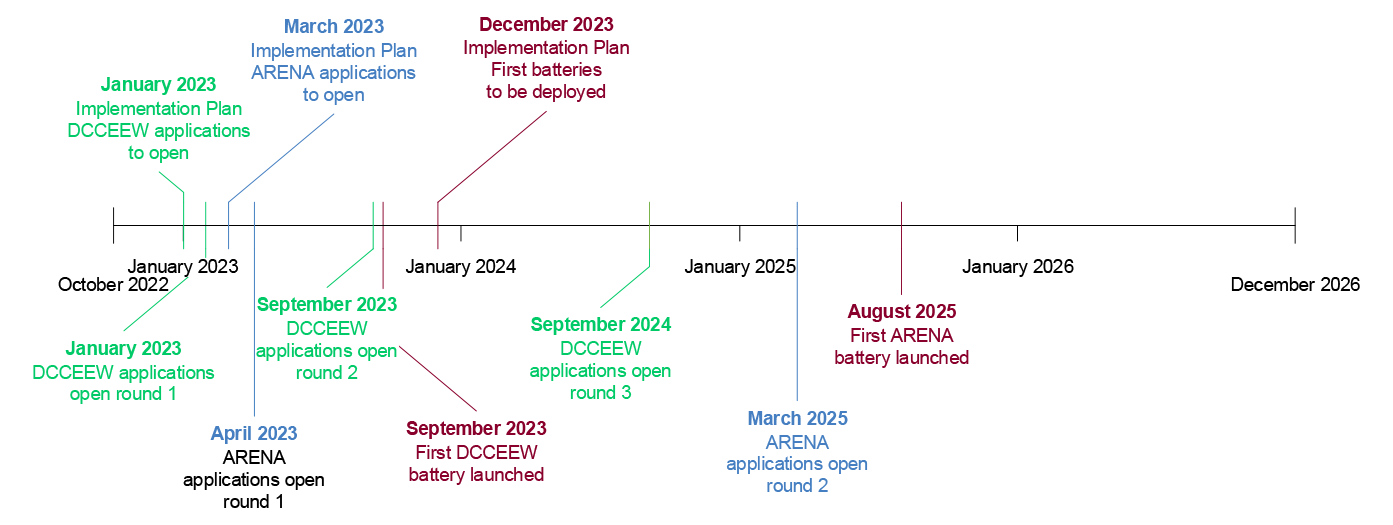
Note: Green denotes DCCEEW activities; Blue denotes ARENA activities; Red denotes the planned and actual dates of the first batteries to be deployed.
Source: ANAO analysis of departmental documentation.
Footnotes
1 The Australian Energy Regulator received $3.3 million of this funding to process regulatory waivers.
2 Rebekah Sharkie MP requested an audit into the program on 3 April 2023. Australian National Audit Office, Community Batteries for Household Solar Program, 23 May 2023, available from https://www.anao.gov.au/work/request/community-batteries-household-solar-program [accessed 12 December 2025].
3 Department of Climate Change, Energy, the Environment and Water, Net Zero – DCCEEW, DCCEEW, Canberra, 25 September 2025, available from https://www.dcceew.gov.au/climate-change/emissions-reduction/net-zero [accessed 14 October 2025].
4 Department of Climate Change, Energy, the Environment and Water, Electricity and Energy Sector Plan – DCCEEW, DCCEEW, Canberra, 17 September 2025, available from https://www.dcceew.gov.au/climate-change/emissions-reduction/net-zero/electricity-and-energy-sector-plan [accessed 14 October 2025].
5 Department of Climate Change, Energy, the Environment and Water, Australian Energy Statistics, Table O Electricity generation by fuel type in 2023–24 and 2024, DCCEEW, Canberra, June 2025, available from https://www.energy.gov.au/publications/australian-energy-statistics-table-o-electricity-generation-fuel-type-2023-24-and-2024 [accessed 1 December 2025].
6 Community batteries are also known as neighbourhood and mid-scale batteries, as they are larger than household solar batteries but smaller than utility scale batteries.
7 Controlling power system frequency involves balancing electricity supply and demand so as to maintain a consistent frequency within the electricity network.
8 Australian Government, Budget Paper No. 2: Budget Measures, October 2022–23, Commonwealth of Australia, Canberra, 2022, available from https://archive.budget.gov.au/2022-23-october/ [accessed 10 November 2025].
9 Funding was allocated to allow the AER to support it to undertake regulatory functions in relation to assessing waivers under the ring-fencing guidelines. Ring-fencing is the separation of regulated and competitive business activities of electricity network service providers (known as Distribution Network Service Providers, DNSPs). The AER granted a class waiver, effective from 3 February 2023 to 30 June 2041, to allow DNSPs to operate batteries funded from the program.
10 DCCEEW contracted BGH to provide grants administration and payment services for the program. BGH is part of the Department of Industry, Science and Resources, and is one of two grants hubs established to deliver grant administration. DCCEEW is one of 14 entities that must deliver grants programs through one of the two grants hubs. In exceptional circumstances, the responsible minister may seek an exemption from this requirement.
11 Stream 1 lists 56 eligible locations. Stream 2 lists two eligible locations and the single organisations eligible to apply at each of these two locations.
12 The 57 ongoing grant agreements included funding 98 individual batteries across 57 locations: one battery was to be built in each of 48 locations; and multiple batteries were to be built in each of nine locations. The average grant amount per battery was $284,694.
13 The average grant amount per battery under ARENA’s round 1 was $413,256.
14 Supporting policies include Conflict of Interest Policy, Advisory Panel Management Policy, Variations Policy, and Complaints Policy.
15 Department of Climate Change, Energy, the Environment and Water, Corporate Plan 2025–26, DCCEEW, Canberra, 2025, p. 6, available from https://www.dcceew.gov.au/sites/default/files/documents/corporate-plan-2025-26.pdf [accessed 23 September 2025].
16 Australian Government, Portfolio Budget Statements 2025–26 Budget Related Paper No. 1.3: Climate Change, Energy, the Environment and Water Portfolio, Commonwealth of Australia, Canberra, 2025, pp. 19–20, available from https://www.dcceew.gov.au/about/reporting/budget [accessed 10 November 2025].
17 Sections 29 and 30 of the ARENA Act.
18 A list of ARENA’s board members is available at https://arena.gov.au/about/board/ [accessed 12 October 2025].
19 Australian Renewable Energy Agency, ARENA Corporate Plan 2024–25, ARENA, Canberra, August 2024, p. 6, available from https://arena.gov.au/assets/2024/09/ARENA-Corporate-Plan-2024.pdf
20 Australian Renewable Energy Agency, ARENA at a Glance, ARENA, Canberra, September 2025, available from https://arena.gov.au/arena-at-a-glance/ [accessed 28 November 2025].
21 Rebekah Sharkie MP requested an audit into the Community Batteries for Household Solar Program on 3 April 2023. See Australian National Audit Office, Community Batteries for Household Solar Program, 23 May 2023, available from https://www.anao.gov.au/work/request/community-batteries-household-solar-program [accessed 12 December 2025].
22 Until December 2024, ARENA was only allowed to directly employ two staff. For ease of understanding, the phrase ‘ARENA staff’ will be used throughout this report regardless of whether staff were directly employed by ARENA, were contractors, consultants, or were seconded from DCCEEW.
23 Paragraph 15(1)(a) of the PGPA Act requires an accountable authority of a Commonwealth entity to govern in a way that promotes the efficient, effective, economical and ethical use and management of public resources.
24 Section 17 of the Australian Public Service Commissioner’s Directions 2022.
25 Parliament of Australia, Report 495 Inquiry into Commonwealth Grants Administration, Commonwealth of Australia, 2023, pp. iv and 5, available from https://parlinfo.aph.gov.au/parlInfo/download/committees/reportjnt/RB000137/toc_pdf/Report495InquiryintoCommonwealthgrantsadministration.pdf [accessed 18 August 2025].
26 Department of Climate Change, Energy, the Environment and Water, Corporate Plan 2025–26, DCCEWW, Canberra, 2025, Secretary’s foreword, p. 2, available from https://www.dcceew.gov.au/about/reporting/corporate-plan [accessed 23 September 2025].
27 RepuTex Energy, Report: The economic impact of the ALP’s Powering Australia Plan, 2021, available from https://www.reputex.com/research-insights/report-the-economic-impact-of-the-alps-powering-australia-plan/ [accessed 7 August 2025].
Prime Minister of Australia, ‘Powering Australia – Labor’s plan to create jobs, cut power bills and reduce emission by boosting renewable energy’, media release, Anthony Albanese PM, Canberra, 3 December 2021, available from https://anthonyalbanese.com.au/media-centre/powering-australia-plan-create-jobs-reduce-emissons-renewable-energy [accessed 23 September 2025].
28 kWh means kilowatt hour. It is a measurement of energy and is used to describe battery capacity.
29 Two batteries were announced in Macquarie, which was a marginal electorate.
30 Two batteries were announced in Wills, which was a fairly safe electorate.
31 Figures are based on Australian Electoral Commission records of seat status as a result of the 2019 Federal Election, including post-redistribution notional seat status for divisions that had undergone redistributions since the 2019 Federal Election.
Australian Electoral Commission, National Seat Status, 2022, AEC, available from https://www.aec.gov.au/Elections/federal_elections/2022/files/downloads/fact-sheet-national-seat-status-2022-federal-election.pdf, [accessed 16 December 2025].
Marginal, fairly safe and safe electorates are defined by the Australian Electoral Commission (available from https://www.aec.gov.au/footer/Glossary.htm; accessed 3 December 2025):
- In marginal electorates, the elected candidate received less than 56 per cent of the vote.
- In fairly safe electorates, the elected candidate received between 56 and 60 per cent of the vote.
- In safe electorates, the elected candidate received more than 60 per cent of the vote.
32 The approved timeline included a program launch of the BGH component of the program in November 2022.
33 A further three grant agreements are at risk of being terminated due to an inability to secure a suitable site.
34 Australian Government, Budget Paper No. 2: Budget Measures October 2022–23; Commonwealth of Australia, Canberra, 2022, available from https://archive.budget.gov.au/2022-23-october/ [accessed 23 September 2025].
35 Department of Finance, Commonwealth Grant Rules and Guidelines, Finance, Canberra, 2017, paragraphs 6.2 and 6.3, available from https://www.communitygrants.gov.au/sites/default/files/documents/2022-07/5096-commonwealth-grants-rules.pdf [accessed 12 March 2025].
36 Relevant planning issues are outlined in paragraph 7.5 of the CGRGs (p. 17).
37 Department of Finance, Commonwealth Grant Rules and Guidelines, paragraphs 4.4 and 8.7, pp. 11 and 21.
38 There were four service schedules for the program: one for each of the three rounds in stream 1; and one for stream 2.
39 There were three sets of grant opportunity guidelines for stream 1, and one for stream 2.
40 CGRGs, paragraph 8.6 (p. 21): Grant objectives and purpose; eligibility criteria; clear assessment criteria; weighting of assessment criteria; detail of the approval process; terms and conditions of the grant agreement; reporting and acquittal requirements; and a description of complaint handling and freedom of information request mechanisms.
41 All three projects have approved variations to extend the project end dates from 31 March 2025 to 31 October 2025.
42 The round was defined as closed competitive as two applicants were invited to submit grant applications for each location. The two applications would be assessed against each other.
43 Stream 1 round 1, and stream 2 were assessed as high risk as they were awaiting legislative authority for program spending. On 17 January 2023, prior to the opening of the grants program (stream 1, round 1 opened on 30 January 2023), the Minister made an instrument under section 33 of the Industry Research and Development Act 1986 to provide authority for the spending activities in relation to the program — Industry Research and Development (Community Batteries for household Solar Program) Instrument 2023.
44 A Statements of Expectation can be issued by a responsible minister to provide greater clarity about government policies and objectives.
45 kW refers to kilowatts (1000 Watts) and MW refers to megawatts (1,000,000 Watts). Both are measures of the speed of flow of energy or power output, for batteries these are measures of how fast energy can be discharged from the battery.
46 Sections 11 and 12 of the ARENA Act. Under section 12, ARENA must not, without written approval of the Minister, make grants totalling more than $50 million for a particular project. This was not relevant for the program.
47 Department of Finance, Specialist Investment Vehicles (RMG 127), Finance, Canberra, 2024, available from https://www.finance.gov.au/government/managing-commonwealth-resources/specialist-investment-vehicles-sivs-rmg-127 [accessed 15 December 2025].
48 Subsection 9(b) of the ARENA Act.
49 Subsection 24(2) of the ARENA Act. The maximum grant amount available under the program was $20 million.
50 Examples of these issues include: purpose of the program and its outcomes; criteria to be used, including eligibility and merit criteria; and specifying how applicants can apply for funding and the assessment process.
51 Auditor-General Report No. 35 2019–20, Grant Program Management by the Australian Renewable Energy Agency, ANAO, Canberra, 2020, paragraph 2.43, available from https://www.anao.gov.au/work/performance-audit/grant-program-management-the-australian-renewable-energy-agency [accessed 16 October 2025].
52 DCCEEW was also required to evaluate each funding round as set out in the implementation plan. See paragraph 2.37.
53 Section 24 of the ARENA Act requires the Board to develop guidelines if the total of all grants for a particular project could exceed $15 million.
54 Sections 24 and 25 of the ARENA Act.
55 Section 26 of the ARENA Act. ARENA referred to the grant guidelines as funding announcements.
56 A portfolio approach to assessment considers how projects ‘contribute to the program outcomes either uniquely or as part of a suite of complementary ARENA activities (see paragraph 3.50).
57 Department of Finance, Commonwealth Grants Rules and Guidelines, paragraph 12.7, p. 33.
58 ibid., chapter 11, pp. 29–31.
59 ibid., paragraphs 13.9 and 13.11, pp. 36–37.
60 The grant opportunity for stream 2 closed on 24 February 2023.
61 The grant opportunity closed on 24 February 2023.
62 The technical advisor was an ARENA staff member who did not charge either DCCEEW or ARENA for this service.
63 Eleven grants to Energex Limited in Queensland, were funded $2,488 per kWh.
The calculations in this paragraph do not include the grant for a battery at Cabramatta as the decision-minute did not specify the battery capacity of the approved project.
The average of the total amount of grant funding approved for the total kWh of battery capacity approved, across all of all 58 batteries was $1,227.
64 Department of Finance, Commonwealth Grants Rules and Guidelines, paragraph 6.2, p. 16.
65 In round 1, the technical advisor comments were incorporated into the DCCEEW recommendations. In following rounds, the technical advisor comments were provided separately. Technical advisor comments were not sought for stream 2.
66 The 58 funding agreements were for single or multiple batteries at one or several sites involving ground or pole mounted batteries.
67 Department of Finance, Commonwealth Grants Rules and Guidelines, paragraphs 13.7 and 13.8, p. 36.
68 DCCEEW’s probity plan (finalised on 2 May 2023, see paragraph 2.48) required all departmental officers and advisors involved in the program to make a conflict-of-interest declaration as soon as possible following commencement of involvement in the program, in the form set out in the program’s probity plan.
69 Australian Public Service Commission, Case studies: Theme 5 Procurement Activity and Grants Selection, APSC, Canberra, available from https://www.apsc.gov.au/working-aps/integrity/aps-conflict-interest-man… [accessed 1 December 2025].
70 The ANAO did not assess the round 2 application process as this was underway during the audit.
71 The ARENA Advisory Panel provides advice to support the development and selection of projects. It is comprised of experts from different fields across the renewable and clean energy sector, including technical experts, business and financial specialists as well as generalists with expertise across various areas of the renewable energy sector and energy sector more broadly. Panellist are engaged by ARENA as requested on a fee-for-service basis.
72 Advisory Panel members were to assign a low, medium or high classification to each of the merit criteria and suggest an overall classification following a moderation meeting.
73 The minimum grant size in the scope of activity was $3 million and these two applications were for $2.5 million and $2.3 million.
74 Regional Power Corporation (Horizon Power) was invited to submit a full application because of this portfolio review. The ARENA Board approved funding following submission of a full application.
75 Subsection 9(b) of the Australian Renewable Energy Agency Act 2011.
76 Exclusive of the Goods and Services Tax.
77 Additionality refers to the idea that the battery installations would not have occurred if ARENA grant money was not provided. i.e. that grant funds were really necessary for the installations of the batteries.
78 Subsection 47(4) of the Australian Renewable Energy Agency Act 2011.
79 Variations since the funding agreements were signed have resulted in an increase in the number of batteries funded under round 1 and a decrease in the total funding, as described in Table 1.2.
80 Australian Public Service Commission, APS Values and Code of Conduct in practice, APSC, Canberra, September 2021, available from https://www.apsc.gov.au/publication/aps-values-and-code-conduct-practice/section-5-conflict-interest [accessed 16 October 2025].
81 A staff member approved the eligibility assessments, the Chief Financial Officer approved the shortlisting of EOIs to provide to the Advisory Panel, the Chief Executive Officer approved the EOI applicants to invite to submit a full application and approved funding agreements with successful applicants, and the Chief Operating Officer (while acting as the Chief Executive Officer) approved funding agreements with successful applicants.
82 A different staff member approved the eligibility assessment of the application for which there was a potential conflict.
83 Six of the 12 panel members declared potential conflicts of interest. All were reviewed by the Chief Financial Officer and three were considered material. These related to the Victorian Department of Families, Fairness and Housing, AGL, AusNet, HydroElectric, Indigo Power and Zen Energy.
84 Department of Finance, The grants process, Finance, Canberra, 2024, available from https://www.finance.gov.au/government/managing-commonwealth-resources/commonwealth-grants-rmg-410/grants-process [accessed 3 October 2025].
85 Department of the Treasury, Commonwealth Evaluation Policy, Treasury, Canberra, 1 December 2021, available from https://evaluation.treasury.gov.au/about/commonwealth-evaluation-policy [accessed 1 October 2025].
86 Department of Finance, Commonwealth Grants; Resource Management Guide 410, Finance, Canberra, 2025, available at https://www.finance.gov.au/government/managing-commonwealth-resources/commonwealth-grants-rmg-410/grants-process [accessed 26 September 2025].
87 There are 22 grant recipients.
88 Annual capped amounts are each year’s budget figures for the program as stated in the portfolio budget statement.
89 The grant agreement for one battery has been terminated. This is included in the number of variations.
90 Three of the variations to end date are not included in this calculation as they were approved by BGH and BGH’s reporting to DCCEEW did not include the initial project end date to be varied.
91 Some delays in site selection and approval have not resulted in delays to end dates but have resulted in variations to battery type or capacity.
92 This project is in Narrabri.
93 ARENA’s Assurance Framework is due for revision early in 2026.
94 Four of the 16 round 1 projects had not signed funding agreements by February 2025 and therefore did not have risk reviews in February 2025.
95 This included 10 milestone one reports, and one milestone two report.
96 ARENA’s variations policy was updated to version five in April 2024 and version six in June 2025.
97 Department of the Treasury, Commonwealth Evaluation Policy.
98 Department of the Prime Minister and Cabinet, Administrative Arrangement Order — 13 May 2025, PM&C, Canberra, 13 May 2025, available at https://www.pmc.gov.au/government/administration/administrative-arrangements-orders [accessed 19 February 2026].
99 DCCEEW was to absorb administrative program costs into its existing resourcing.
100 Nous Group were engaged for $143,000 and the Contract Notice ID is CN4195294.
101 One additional battery had been reported to ARENA as installed, but ARENA had not verified the installation as of January 2026.
102 Paragraph 8(a)(iii) of the Australian Renewable Energy Agency Act 2011.
103 Australian Renewable Energy Agency, Corporate Plan 2025–26 to 2028–29, ARENA, Canberra, 2025, p. 10, available at https://arena.gov.au/assets/2024/09/ARENA-Corporate-Plan-2024.pdf [accessed 1 December 2025].
104 Department of the Treasury, Evaluation Toolkit, Treasury, Canberra, available at https://evaluation.treasury.gov.au/toolkit/why-evaluate [accessed 27 August 2025].
105 Department of the Treasury, Commonwealth Evaluation Policy.
106 Department of Finance, Commonwealth Grant Rules and Guidelines, paragraph 10.8, p. 27.
107 ibid., paragraph 10.9, p. 28.
108 These reports have been provided to DCCEEW every month since February 2024, with the exception of April 2025.
109 Department of Finance, Commonwealth Grants, Resource Management Guide 410, Evaluation strategies.
110 DCCEEW’s program website is available at https://www.dcceew.gov.au/energy/renewable/community-batteries [accessed 17 December 2025].
111 ARENA’s Board typically meets eight to 10 times a year.
112 Available at https://arena.gov.au/projects/ [accessed 13 February 2026].