Browse our range of reports and publications including performance and financial statement audit reports, assurance review reports, information reports and annual reports.
Compliance with Gifts, Benefits and Hospitality Requirements in the Department of Defence
Please direct enquiries through our contact page.
Audit snapshot
Why did we do this audit?
- The giving or receiving of gifts, benefits and hospitality can create the perception that an official may be subject to inappropriate external influence.
- This audit is one of a series in relation to gifts, benefits and hospitality, which continues the ANAO’s examination of integrity in Commonwealth entities.
- This audit was conducted to provide assurance to the Parliament on the extent to which the Department of Defence (Defence) is complying with its gifts, benefits and hospitality policies and requirements.
Key facts
- Defence’s gifts and benefits receiving policy has been updated three times since October 2020.
- The most recent September 2025 policy update prohibits Defence personnel from accepting a gift or benefit from commercial entities or individuals who do or intend to do business with Defence.
- For the audit period July 2022 to December 2025, Defence recorded a total of 1,828 gifts, benefits and hospitality on its register.
What did we find?
- Defence has partly effective arrangements for gifts, benefits and hospitality reflecting weaknesses in implementation, assurance and oversight.
- Defence does not have a risk-based, targeted compliance program to inform whether its controls to manage risks with the giving and receiving of gifts, benefits and hospitality are operating as intended.
- Defence’s online mandatory training module was not consistent with its policy requirements until it was updated in April 2026.
- Approval processes are not operating as an effective control. Compliance with Defence’s policy requirements was achieved in an average of 56 per cent of cases.
What did we recommend?
- There were three recommendations to Defence on reviewing its fraud and corruption controls, developing a compliance program, and reporting on gifts, benefits and hospitality.
- Defence agreed to the three recommendations.
112,723
Total Defence personnel (APS, ADF and ADF reserves) in 2024–25.
751
Number of gifts, benefits and hospitality recorded by Defence personnel in 2025.
$120
The median value of gifts, benefits and hospitality recorded on Defence’s register.
Summary and recommendations
Background
1. The Public Service Act 1999 (Public Service Act) requires APS employees, agency heads and statutory office holders to uphold the APS Values and Code of Conduct. The APS Code of Conduct, consistent with duties under the Public Governance, Performance and Accountability Act 2013 (PGPA Act), requires officials not to improperly use their duties, status, power or authority to gain, or seek to gain, a benefit for themselves or any other person, or to cause, or seek to cause, detriment to the entity, the Commonwealth, or any other person. Collectively, these requirements establish obligations for officials and Commonwealth entities in relation to how they manage the provision and receipt of gifts, benefits and hospitality.
2. There is no APS-wide guidance or direction to entities as to how they should manage the giving and receiving of gifts, benefits and hospitality in their entities. The Australian Public Service Commission (APSC) expects to issue guidance on managing gifts and benefits to APS agencies and its employees in mid-2026. As at May 2025, available resources include the APSC’s Guidance for Agency Heads – Gifts and Benefits1 and the Department of Finance’s Resource Management Guide (RMG) 206 Model accountable authority instructions non-corporate Commonwealth entities.2
3. Defence has a gifts, benefits and hospitality receiving policy which since October 2020 has been updated three times to include changes primarily around disclosure thresholds, approvals, and conflict-of-interest delegations. Defence also has a policy for gifts, benefits and hospitality spending.
Rationale for undertaking the audit
4. Section 27 of the PGPA Act states that an official must not improperly use their position to gain, or seek to gain, a benefit to themselves or another person, or to cause, or seek to cause, detriment to the entity, the Commonwealth, or any other person. Public service entities must meet public expectations of integrity, accountability, independence, transparency, and professionalism. Acceptance of a gift or benefit that relates to an official’s employment can create a real or apparent conflict of interest that should be avoided.
5. The APSC states in its publication APS Values and Code of Conduct in practice, that the risk of the appearance of a conflict can be damaging to public confidence.3
6. This audit was conducted to provide assurance to the Parliament on the extent to which the Department of Defence (Defence) is complying with its gifts, benefits and hospitality policies and requirements.
Audit objective and criteria
7. The objective of the audit was to assess whether Defence has complied with gifts, benefits and hospitality requirements.
8. To form a conclusion against the objective, the ANAO adopted the following high-level audit criteria:
- Does Defence have effective arrangements in place to manage gifts, benefits and hospitality?
- Has Defence implemented effective controls and processes for gifts, benefits and hospitality in accordance with its policies and procedures?
Conclusion
9. Defence’s compliance with its gifts, benefits and hospitality requirements is partly effective, primarily due to weaknesses in assurance and oversight. Defence has made efforts to routinely update its policies and set clear requirements for accepting and providing gifts, benefits and hospitality. These requirements have not been supported by a risk-based, targeted compliance program or regular executive reporting to inform whether controls are operating as intended.
10. Defence has partly effective arrangements in place to manage gifts, benefits and hospitality. Defence’s gifts, benefits and hospitality receiving policy has evolved since 2020. Adjustments to its policy have included: removing the requirement to obtain approvals; requiring conflicts of interest to be recorded; increasing the reporting threshold from $100 to $300; and reintroducing the requirement to obtain approval when accepting gifts, benefits and hospitality from commercial entities or individuals who do or intend to do business with Defence. Defence has not tested the effectiveness of the established controls in accordance with the Commonwealth Fraud and Corruption Control Policy. Regular communications on gifts, benefits and hospitality are issued to personnel. Mandatory training did not reflect current policy requirements or address spending on gifts, benefits and hospitality until it was updated in April 2026.
11. Defence’s implementation of its controls and processes for the management of gifts, benefits and hospitality is partly effective. Defence has not established a risk-based, targeted compliance program. Regular executive reporting to monitor the effectiveness of controls and detection of non-compliance with its policies is not in place. Compliance with Defence policy requirements, including approval to retain gifts and benefits, recording conflicts of interest, and approval to accept gifts and benefits from commercial entities or individuals, was achieved at an average rate of 56 per cent.
Supporting findings
Fit-for-purpose policies and procedures for gifts, benefits and hospitality
12. Defence’s gifts, benefits and hospitality receiving policy sets out the obligations and requirements of personnel who accept gifts, benefits or hospitality and the arrangements for managing them. The policy has been updated three times between 2020 and 2025. In July 2023, Defence increased its disclosure threshold for the acceptance of gifts by SES Band 2 or 2-Star personnel and below to $300. The APSC’s Guidance for Agency Heads – Gifts and Benefits has a strong expectation that the threshold is $100. From July 2023, individual personnel were responsible for assessing whether accepting gifts, benefits or hospitality would create a conflict of interest. In September 2025, Defence updated its policy to prohibit the acceptance of gifts or benefits from commercial entities or individuals who do or intend to do business with Defence unless approval is provided by SES Band 3 or 3-Star personnel. Defence maintains a separate policy on gifts, benefits and hospitality spending. Defence has not tested the effectiveness of relevant controls in accordance with the Commonwealth Fraud and Corruption Control Policy. (See paragraphs 2.3 to 2.44)
Effective training and education arrangements to promote compliance
13. Defence training has not fully supported compliance with its gifts, benefits and hospitality policies. Defence provides training on the receiving of gifts, benefits and hospitality through the mandatory fraud and integrity awareness training and gifts and benefits information sessions. Defence’s online mandatory training (November 2024) did not cover its spending policy and did not reflect its current September 2025 gifts and benefits receiving policy, until the training was updated in April 2026. Communications and guidance (in various formats) are provided to Defence personnel and external stakeholders on the gifts, benefits and hospitality policy requirements. (See paragraphs 2.46 to 2.64)
Effective controls for the receipt or provision of gifts, benefits and hospitality
14. Defence has not enforced compliance with its gifts, benefits and hospitality policies. Between July 2022 and June 2023, Defence policy required personnel to receive approval to retain a gift or benefit. During that period, around 40 per cent of personnel did not record an authorised approval. From July 2023, this approval requirement was removed and the policy required personnel to declare conflicts of interest on the gifts and benefits register. Between July 2023 and September 2025, Defence retained the appropriate conflict-of-interest form in 64 per cent of cases. The September 2025 policy amendment prohibits personnel from accepting gifts, benefits and hospitality from commercial entities or individuals without the written approval of SES Band 3 or 3-Star personnel. Fifty-seven per cent of the entries on the register did not have the required written approvals between September and December 2025. Defence has not established a targeted, risk-based compliance program for accepting and providing gifts, benefits and hospitality. (See paragraphs 3.2 to 3.41)
Effective processes for managing non-compliance
15. Defence monitors approvals for spending on gifts, benefits and hospitality through the PGPA Act Non-Compliance Register, and since November 2024 has implemented a process to check the submission of conflict-of-interest declarations. These two activities do not provide a systematic approach to manage non-compliance with policy. (See paragraphs 3.41 to 3.48)
Analysis and reporting
16. On three occasions between September 2024 and August 2025, Defence reported data on the volume and value of gifts, benefits and hospitality to its Enterprise Business Committee. In 2024 and 2025, Defence provided data from the register to its Group Heads and Service Chiefs on the numbers of acceptance and spending on gifts, benefits and hospitality. There is no routine reporting to Defence senior executive on compliance with the gifts, benefits and hospitality policies including analysis of patterns, risks and trends. Defence publishes its gifts, benefits and hospitality register on its website as it applies to SES Band 3 or 3-Star personnel and above, in accordance with the APSC’s guidance. (See paragraphs 3.49 to 3.59)
Recommendations
Recommendation no. 1
Paragraph 2.44
The Department of Defence periodically reviews the effectiveness of fraud and corruption controls to ensure compliance with the Commonwealth Fraud and Corruption Control Policy.
Department of Defence response: Agreed
Recommendation no. 2
Paragraph 3.39
The Department of Defence develops a targeted, risk-based compliance program to assure controls for the management of gifts, benefits and hospitality are operating effectively and to assess residual risk.
Department of Defence response: Agreed
Recommendation no. 3
Paragraph 3.52
The Department of Defence develops reporting on gifts, benefits and hospitality and associated non-compliance to support assessment of risk and ensure policies remain fit-for-purpose.
Department of Defence response: Agreed
Summary of entity response
17. The proposed audit report was provided to Defence. The summary response to the report is below and the full response is at Appendix 1.
Defence acknowledges the findings of the Auditor-General’s Performance Audit report: Compliance with Gifts, Benefits and Hospitality Requirements in the Department of Defence and accepts the observations and recommendations made.
Defence is committed to ensuring its gifts, benefits and hospitality policies remain fit-for-purpose and continue to meet expectations of integrity, accountability, transparency and professionalism. Defence recognises the effective management of gifts, benefits and hospitality is underpinned not only by policy, but by a strong integrity culture, supported by ethical decision making at all levels.
Since mid-2024, Defence has prioritised educating personnel on the risks gifts, benefits and hospitality may pose to public confidence, while reinforcing obligations to comply with policy. Defence has commenced targeted activities to evaluate the effectiveness of existing controls and inform continuous policy improvement.
Defence has also initiated a review of its gifts and benefits and hospitality policy suite to support alignment with the Australian Public Service Commission’s updated gifts and benefits guidance for agencies.
The revised policies will be supported by a strengthened risk-based compliance program to enhance oversight, monitoring, reporting and assurance. These measures will support implementation of the Auditor-General’s recommendations and provide Defence senior leadership with greater confidence in compliance and integrity outcomes.
Key messages from this audit for all Australian Government entities
18. Below is a summary of key messages, including instances of good practice, which have been identified in this audit and may be relevant for the operations of other Australian Government entities.
Governance and risk management
1. Background
Introduction
1.1 In the course of their duties, Australian Public Service (APS) and Australian Defence Force (ADF) employees may interact with many people and organisations and may be offered gifts, benefits or hospitality as part of these interactions. These offers could range from small token items to larger more expensive gifts such as an invitation to a gala dinner, sporting event or travel. The acceptance of these offers can create conflicts of interest and pose risks to public confidence in Defence and the APS and ADF more broadly, particularly in the public’s expectations of integrity, accountability, independence, transparency and professionalism.
1.2 The Public Service Act 1999 (Public Service Act) requires APS employees, agency heads and statutory office holders to uphold the APS Values and Code of Conduct. The APS Code of Conduct, consistent with duties under the Public Governance, Performance and Accountability Act 2013 (PGPA Act), requires officials not to improperly use their duties, status, power or authority to gain, or seek to gain, a benefit for themselves or any other person, or to cause, or seek to cause, detriment to the entity, the Commonwealth, or any other person. Collectively, these requirements establish obligations for officials and Commonwealth entities in relation to how they manage the provision and receipt of gifts, benefits and hospitality.
1.3 The Australian Public Service Commission (APSC) expects to issue guidance on managing gifts and benefits to APS agencies and its employees in mid-2026. As at May 2026, there is no APS-wide guidance or direction to entities as to how they should manage the giving and receiving of gifts, benefits and hospitality in their entities. The APSC has published Guidance for Agency Heads – Gifts and Benefits.4 Although the guidance is expressed as only applying to agency heads, the underpinning principles are:
- agency heads are meeting public expectations of integrity, accountability, independence, transparency, and professionalism in relation to gifts and benefits; and
- there is consistency in relation to agency heads’ management of gifts and benefits across Commonwealth entities and companies.5
1.4 In relation to the development of entity-specific policies and procedures, the Department of Finance has published Resource Management Guide (RMG) 206 Model accountable authority instructions non-corporate Commonwealth entities. The model instructions provide guidance for Accountable Authorities about matters that should be covered in the instructions they issue. The model instructions include a section on gifts and benefits that suggest all officials are provided with the following instructions:
You must not:
- ask for, or encourage, the giving of gifts to yourself or other officials.
- accept a gift of money (except in exceptional circumstances).
- accept a gift or benefit that influences, or could be perceived to influence, your decision or action on a particular matter.
If you decide to accept a gift or benefit, your decision must be defensible and able to withstand public scrutiny. You must have regard to the general duties of officials in deciding whether to accept a gift.
1.5 The model instructions also suggest additional points that could be covered, including: the entity’s policy for receiving gifts, benefits and hospitality; any restrictions on the acceptance of gifts and benefits by members of an official’s family; and a requirement to inform an appropriate official when offered gifts or benefits.
1.6 The absence of APS-wide guidance gives entities broad scope to develop policies and instructions that best suit the entity while being compliant with the Public Service Act and the PGPA Act.
The Department of Defence
1.7 The Department of Defence (Defence) is a non-corporate Commonwealth entity. Its mission and purpose is to defend Australia and its national interests in order to advance Australia’s security and prosperity. In its Corporate Plan 2025–29, Defence has two outcomes:
- defend Australia and its national interests through the conduct of operations and the provision of support for the Australian community and civilian authorities in accordance with Government direction; and
- protect and advance Australia’s strategic interests through the provision of strategic policy, the development, delivery and sustainment of military, intelligence and enabling capabilities, and the promotion of regional and global security and stability as directed by Government.6
1.8 In its 2024–25 Annual Report, Defence reported that as at 30 June 2025 it had 20,545 ongoing APS employees, 58,909 permanent ADF members and 33,269 ADF Reserve members.7
1.9 Defence’s gifts, benefits and hospitality policies apply to all Defence APS and ADF personnel as well as contractors and consultants and outsourced service providers where compliance is a term of their engagement with Defence.8 For the purposes of this audit, they will collectively be referred to as ‘personnel’.
Previous ANAO audit coverage
1.10 Auditor-General Report No. 47 2017–18 Interim Report on Key Financial Controls of Major Entities reviewed the gifts and benefits policies of 26 major Australian Government entities, including all departments of state.9 This report identified:
- the merit of developing a whole-of-government gifts and benefits policy setting the minimum requirements for entities to include within their policies;
- regular review and monitoring of entities’ gifts and benefits policies increases accountability;
- centrally maintained gifts, benefits and hospitality registers assist entities in meeting accountability and transparency obligations; and
- transparency is enhanced through the publication of entities’ gifts and benefits registers on the internet.
1.11 The Australian Public Service Commissioner issued guidance on 18 October 2019 for reporting of gifts and benefits. The ANAO reviewed the status of the implementation of the guidance as part of Auditor-General Report No. 38 2019–20 Interim Report on Key Financial Controls of Major Entities. The report found that all 24 entities covered by the report had established a register of gifts and benefits, and that except for one entity, all had recorded gifts and benefits received by the agency head which exceeded $100. Publication of received gifts and benefits was undertaken by approximately 79 per cent of entities.10
1.12 The ANAO presented to the Parliament two performance audit reports related to gifts, benefits and hospitality in 2023–24 and one audit report in 2024–2511:
- Auditor-General Report No. 44 2023–24 Compliance with Gifts, Benefits and Hospitality Requirements in the Department of the Treasury;
- Auditor-General Report No. 46 2023–24 Compliance with Gifts, Benefits and Hospitality Requirements in the Australian Communications and Media Authority; and
- Auditor-General Report No. 15 2024–25 Compliance with Gifts, Benefits and Hospitality Requirements in the Murray-Darling Basin Authority.
1.13 In October 2024, the ANAO published Insights: Audit Lessons — Gifts, Benefits and Hospitality.12 This publication was based on observations from ANAO performance audits over the past two years, including the two 2023–24 performance audits focused on compliance with gifts, benefits and hospitality requirements. There were seven lessons identified for those responsible for implementing relevant internal policies and controls in Australian Government entities.
1.14 The Insights product stated that the average number of reported gifts, benefits and hospitality for agencies with staff numbers over 10,000 was 151 (as at August 2024).
Rationale for undertaking the audit
1.15 Section 27 of the PGPA Act states that an official must not improperly use their position to gain, or seek to gain, a benefit to themselves or another person, or to cause, or seek to cause, detriment to the entity, the Commonwealth, or any other person. Public service entities must meet public expectations of integrity, accountability, independence, transparency, and professionalism. Acceptance of a gift or benefit that relates to an official’s employment can create a real or apparent conflict of interest that should be avoided.13
1.16 The APSC states in its publication APS Values and Code of Conduct in practice, that the risk of the appearance of a conflict can be damaging to public confidence.14
1.17 This audit was conducted to provide assurance to the Parliament on the extent to which Defence is complying with its gifts, benefits and hospitality policies and requirements.
Audit approach
Audit objective, criteria and scope
1.18 The objective of the audit was to assess whether Defence has complied with gifts, benefits and hospitality requirements.
1.19 To form a conclusion against the objective, the ANAO adopted the following high-level audit criteria:
- Does Defence have effective arrangements in place to manage gifts, benefits and hospitality?
- Has Defence implemented effective controls and processes for gifts, benefits and hospitality in accordance with its policies and procedures?
1.20 The audit examined the management of gifts, benefits and hospitality in Defence over the period 1 July 2022 to 31 December 2025.
Audit methodology
1.21 The audit methodology included:
- examining Defence’s documentation including its policies, procedures, risk assessments, registers, assurance and reporting activities;
- meetings with Defence personnel regarding the control frameworks and assurance activities; and
- testing the effectiveness of Defence’s control framework for gifts, benefits and hospitality.
1.22 The audit was conducted in accordance with ANAO Auditing Standards at a cost to the ANAO of approximately $778,600.
1.23 The team members for this audit were Hugh Balgarnie, Kim Murray, Finn Coverdale, Jaskeerat Kaur, and Susan Drennan.
2. Arrangements for managing gifts, benefits and hospitality
Areas examined
This chapter examines whether the Department of Defence (Defence) has effective arrangements in place to manage gifts, benefits and hospitality.
Conclusion
Defence has partly effective arrangements in place to manage gifts, benefits and hospitality. Defence’s gifts, benefits and hospitality receiving policy has evolved since 2020. Adjustments to its policy have included: removing the requirement to obtain approvals; requiring conflicts of interest to be recorded; increasing the reporting threshold from $100 to $300; and reintroducing the requirement to obtain approval when accepting gifts, benefits and hospitality from commercial entities or individuals who do or intend to do business with Defence. Defence has not tested the effectiveness of the established controls in accordance with the Commonwealth Fraud and Corruption Control Policy. Regular communications on gifts, benefits and hospitality are issued to personnel. Mandatory training did not reflect current policy requirements or address spending on gifts, benefits and hospitality until it was updated in April 2026.
Areas for improvement
The ANAO made one recommendation for Defence to review the effectiveness of its fraud and corruption controls.
The ANAO made one opportunity for improvement for Defence to align its gifts, benefits and hospitality receiving policy with the requirements of the PGPA Act.
2.1 Section 20A of the Public Governance, Performance and Accountability Act 2013 (PGPA Act) sets out that an Accountable Authority of a Commonwealth entity can instruct officials about any matters regarding the finance law. Since July 2020, Defence’s Accountable Authority Instruction (AAI) 1 — Managing Risk and Accountability, has required personnel to comply with Defence’s policies for accepting and providing gifts, benefits and hospitality.
2.2 Commonwealth officials must also uphold and promote the Australian Public Service (APS) Values and Employment Principles, and abide by the Code of Conduct contained in the Public Service Act 1999 (the Public Service Act) and the Australian Public Service Commission (APSC) Guidance for Agency Heads – Gifts and Benefits November 2021 (updated in October 2023).
Has Defence developed fit-for-purpose policies and procedures for gifts, benefits and hospitality?
Defence’s gifts, benefits and hospitality receiving policy sets out the obligations and requirements of personnel who accept gifts, benefits or hospitality and the arrangements for managing them. The policy has been updated three times between 2020 and 2025. In July 2023 Defence increased its disclosure threshold for the acceptance of gifts by SES Band 2 or 2-Star personnel and below to $300. The APSC’s Guidance for Agency Heads – Gifts and Benefits has a strong expectation that the threshold is $100. From July 2023, individual personnel were responsible for assessing whether accepting gifts, benefits or hospitality would create a conflict of interest. In September 2025, Defence updated its policy to prohibit the acceptance of gifts or benefits from commercial entities or individuals who do or intend to do business with Defence unless approval is provided by SES Band 3 or 3-Star personnel. Defence maintains a separate policy on gifts, benefits and hospitality spending. Defence has not tested the effectiveness of relevant controls in accordance with the Commonwealth Fraud and Corruption Control Policy.
Gifts, benefits and hospitality receiving policy
2.3 In October 2020, Defence’s Chief Finance Officer (CFO) issued the Financial Policy, Gifts and Benefits policy that set out the arrangements for spending on and acceptance of gifts, benefits and hospitality. 15 In July 2023, the policy was replaced by two separate polices: Financial Policy, Gifts and Benefits (including Hospitality) — Receiving; and Financial Policy, Gifts and Benefits (including Hospitality) — Spending.
2.4 In July 2024, the CFO advised the Associate Secretary that the policy and functions for managing gifts, benefits and hospitality had ‘better alignment with the Integrity Policy and Industry Engagement Directorate in Defence Integrity Division.’ 16 The function was moved to the Associate Secretary Group, where the Gifts and Benefits (including Hospitality) Receiving Policy was reissued by the Associate Secretary in July 2024 with minor administrative changes.
2.5 In September 2025, the Associate Secretary reissued the Gifts and Benefits (including Hospitality) Receiving Policy. Defence’s policy principles, approval requirements and the circumstances where personnel are permitted to accept gifts, benefits and hospitality have changed over time. Prohibited items and activities have remained consistent (see Table 2.1).
Table 2.1: Summary of Defence’s policy on accepting gifts, benefit and hospitality, October 2020 to September 2025
|
Policy updates |
October 2020 |
July 2023 (reissued in July 2024) |
September 2025 |
|
Application |
APS, Australian Defence Force (ADF) and family membersa |
APS, ADF, family members of SES Band 3 or 3-Star and above personnela and persons engaged under a contract and suppliers where compliance is a term of their engagement with Defence. |
|
|
Overarching principle |
Personnel should maintain integrity standards when accepting gifts, benefits and hospitality. |
Defence personnel should not accept gifts, benefits and hospitality in the course of their official duties where possible and should maintain integrity standards when they do. |
|
|
Permitted circumstances |
In circumstances where it may be appropriate and/or unavoidable, for example:
|
||
|
Gifts received in a public forum where refusal could cause embarrassment. |
Gifts, benefits and hospitality can be accepted from international military or government stakeholders, if it assists Defence to develop and maintain constructive relationships. |
||
|
Hospitality can be accepted if it assists Defence to maintain constructive relationships with stakeholders. |
Gifts, benefits and hospitality can be accepted if it assists Defence to develop and maintain constructive relationships with stakeholders. |
||
|
Prohibited |
Accepting any gifts, benefits or hospitality that could lead to a conflict of interest.b Soliciting gifts, benefits or hospitality; accepting gifts, benefits or hospitality from a person or organisation whose primary purpose is to lobby ministers, members of Parliament or Commonwealth Government agencies; accepting cash or cash equivalents including gift vouchers or cards. |
||
|
Approval |
Required for personnel to retain items valued at $100 or more. Required for personnel to accept hospitality of any value. |
Not required |
Required to accept gifts, benefits and hospitality from commercial entities or individuals who do or intend to do business with Defence where accepting would not give rise to an actual or potential conflict of interest.c,d |
Note a: This is restricted to Defence personnel’s family members who receive gifts, benefits or hospitality in relation to official duties performed by those Defence personnel.
Note b: In September 2025, Defence added a provision requiring SES Band 2 or 2-Star and below personnel to inform a SES Band 3 or 3-Star personnel in writing and within 10 working days when a gift, benefit or hospitality was accepted and it was not practical to obtain prior approval due to, for example, ad hoc hospitality or non-discretionary flight upgrades. See paragraph 2.24 for changes made to conflict-of-interest terminology.
Note c: In January 2026 Defence removed the word ‘potential’ when referring to conflict of interest in the policy.
Note d: This only applies to Defence personnel at SES Band 2 or 2-Star and below.
Source: ANAO analysis of Department of Defence documentation.
2.6 The July 2023 policy restricted the acceptance of gifts, benefits and hospitality, while expanding the circumstances that were permitted for maintaining stakeholder relations. In September 2025, the stakeholder relations provision was limited to international military or government stakeholders.
2.7 The September 2025 policy defines gifts and benefits as ‘anything not paid for by Defence, another Commonwealth entity, or a member of Parliament or their staff.’ Table 2.2 outlines the items considered to be a gift and benefit across Defence’s gifts, benefits and hospitality policies.
Table 2.2: Summary of inclusions and exclusions in Defence’s gifts, benefits and hospitality receiving policies, October 2020 to September 2025a
|
Inclusions |
Exclusions |
|
|
Note a: From July 2023, items gifted to and retained by Defence for the purpose of historical retention, display in a Defence museum and/or to directly support a Defence museum, where the acceptance of that item does not give rise to a conflict of interest or cause harm to the reputation of Defence, were excluded from the scope of the policy.
Source: ANAO analysis of Department of Defence documentation.
Gifts benefits and hospitality register
2.8 From 2015, Defence maintained a centralised register to allow personnel to disclose gifts, benefits and hospitality accepted within 28 days of receipt, as required by the policies.17 The register was hosted on a SharePoint platform and required personnel to enter details about the item/s accepted, the purpose of accepting them and who provided the item/s. In July 2023, new fields were added for personnel to record whether a conflict of interest was identified.
2.9 In June 2025, due to a SharePoint platform no longer being supported on Defence’s intranet, the Defence Integrity Division implemented a new process requiring personnel to enter gifts, benefits and hospitality information using a spreadsheet available on Defence’s intranet. The form captures the same information previously recorded in the SharePoint register.18 Once complete, personnel are required to email the form to the Defence Integrity Division, where the information is manually entered into a consolidated register spreadsheet. To support access to the new process and form, the Defence Integrity Division updated the gifts and benefits intranet site and related communications by replacing references to the register with a link to the form.
2.10 Defence established a separate register in October 2023 for internal reporting of airline lounge memberships in order to capture additional data, as required under the updated October 2023 APSC guidance.19
Arrangements for accepting, retaining and disposing a gift, benefit or hospitality
2.11 Defence’s Gifts, Benefits and Hospitality Policy (October 2020) required personnel to obtain approval should they retain a gift or benefit valued at $100 or more or accept hospitality of any value. This requirement was removed in the July 2023 Gifts and Benefits (including Hospitality) — Receiving Policy to streamline processes, reduce administrative burden on supervisors/approvers and place more individual responsibility on Defence personnel who receive gifts and benefits to identify and record any conflict-of-interest incident.20
2.12 The Gifts, Benefits and Hospitality Policy (September 2025) re-established an approval process and requires personnel to obtain written approval from personnel at the Senior Executive Service (SES) Band 3 or 3-Star level to accept a gift, benefit or hospitality from a commercial entity or individual who does or intends to do business with Defence where acceptance would not give rise to an actual conflict of interest. Defence personnel must not accept a gift or benefit where an actual conflict of interest exists. If it is not practical to obtain prior approval, a SES Band 3 or 3-Star must be informed in writing within 10 working days. Where acceptance would not cause a conflict of interest, and meets other policy requirements (see Table 2.1), the policy permits personnel to accept gifts, benefits and hospitality without approval if they are offered by non-commercial entities and individuals or commercial entities or individuals who are not doing business with, or not intending to do business with, Defence.
2.13 Defence’s Gifts, Benefits and Hospitality Policy (September 2025) also states:
Where you have accepted a gift or benefit, you must either:
a. Display or store the item on Defence premises, and nominate the location of storage and the Defence custodian who is responsible for the safekeeping of the item;
b. Dispose of the item in accordance with Clauses 38 and 39 of this policy21; or
c. Personally retain the item.
2.14 The Department of Finance’s Model Accountable Authority Instructions (Model AAIs) state that gifts provided to officials in the course of their work immediately become relevant property when received and that relevant property is property that is owned or held by the Commonwealth.22 This means that when Defence personnel receive a gift, it becomes the property of the department. Between July 2023 and September 2025, Defence’s policy allowed personnel to decide whether to retain the gift themselves or provide it to Defence to become departmental property.
2.15 While the September 2025 receiving policy introduced the requirement for approval to be obtained to accept gifts and benefits from commercial entities who do or intend to do business with Defence, the policy still allows Defence personnel to decide whether to retain, dispose or relinquish the gift or benefit. This does not align with Finance’s guidance that gifts automatically become relevant Commonwealth property.
Opportunity for improvement
2.16 Defence could put a mechanism in place to facilitate the transfer of ownership of gifts and benefits from the Commonwealth (Defence) to individuals that aligns with PGPA Act requirements.
Declaring conflicts of interest
2.17 Since July 2023, Defence personnel were required to exercise personal judgement in assessing whether the acceptance of gifts, benefits or hospitality creates an actual, potential or perceived conflict of interest and to declare this on Defence’s gifts, benefits and hospitality register. Defence commenced monitoring conflict-of-interest declarations in November 2024.
2.18 The October 2020 policy required authorised approvers to be satisfied that, among other things, the retention of a gift, benefit or hospitality did ‘not create a potential conflict of interest for the individual, business area, Defence, the APS or the Australian Government either now or in the future’.
2.19 In June 2023, the CFO was advised by the Budgets and Financial Services Division (the business area responsible for managing gifts, benefits and hospitality at the time)23 that removing approval requirements in the July 2023 policy would ‘streamline processes, reduce administrative burden on supervisors/approvers and place more individual responsibility on Defence personnel who receive gifts and benefits to identify and record any conflict of interest incident’. The CFO was also advised that ‘In order maintain appropriate controls and manage risk within the business process’ the new policy would need to include additional information to ‘emphasise individual responsibility for managing and reporting COI’. Table 2.3 outlines these changes.
Table 2.3: Key changes in conflict-of-interest arrangements between the October 2020 and September 2025 versions of the gifts, benefits and hospitality policies
|
Control |
2020 policy |
July 2023 (reissued July 2024) |
September 2025 |
|
Instructions |
You must not accept or provide gifts or benefits if the acceptance or provision would create an inappropriate impression or create a perception or expectation of preferential treatment. |
You must not accept gifts or benefits if the acceptance would create an inappropriate impression, create a perception or expectation of preferential treatment or result in an actual, potential or perceived conflict of interest. |
You must not accept gifts or benefits if the acceptance would create an inappropriate impression, create a perception or expectation of preferential treatment or result in a conflict of interest. |
|
Approvals |
Delegate is to be satisfied that accepting the gift does not create a potential conflict of interest for the individual, business area, Defence, the APS or the Australian Government either now or in the future. |
No approval required. |
Personnel at or below the level/rank of SES Band 2 or 2-Star require SES Band 3 or 3-Star approval to accept gifts, benefits and hospitality from commercial entities or individuals who do or intend to do business with Defence where accepting will not give rise to an actual conflict of interest (see paragraph 2.23). |
|
Register arrangements |
Does not provide for recording conflict of interest information. |
The recipient must record whether an actual, potential or perceived conflict of interest was or was not identified on the register and record whether a conflict-of-interest declaration form has been submitted. |
The recipient must record whether accepting the item gave rise to a conflict of interest or not, and if it did, whether a conflict-of-interest declaration form has been submitted. |
|
Conflict of interest guidance |
The policy referred to the Defence Integrity Policy Manuala that contained guidance on identifying conflicts and instructions on the process and procedures for managing conflicts of interest in Defence. |
The policy referred to the Defence Integrity Policy Manual and Defence Instruction Administrative Policy. Together they provided guidance on identifying conflicts and instructions on the process and procedures for managing conflicts of interest in Defence. |
The policy referrers to Defence Instruction Administrative Policy that provides instruction on the process and procedures for managing conflicts of interest in Defence and provides a link to Defence’s intranet for information on applying the instructions. |
Note a: The Defence Integrity Policy Manual provided instruction to personnel on the process and procedures for managing conflicts of interest. In September 2024, Defence cancelled the Defence Integrity Policy Manual and advised personnel that its conflict-of-interest policy is contained in the Defence Instructions. In July 2023, the Defence Integrity Policy Manual and Defence Instruction Administrative Policy were both in effect.
Source: ANAO analysis of Department of Defence policies and supporting documents.
2.20 From July 2023, individual personnel were responsible for assessing whether the acceptance of gifts, benefits or hospitality created an actual, potential or perceived conflict of interest. The CFO approved the changes on the basis that appropriate controls would be maintained to manage risk. The register was updated in July 2023 to enable personnel to record conflict-of-interest declarations. Conflict-of-interest declarations were not monitored between July 2023 and October 2024 as monitoring commenced in November 2024 (see paragraphs 3.17 to 3.18).
2.21 As part of the process of seeking approval to issue the September 2025 policy, Defence Integrity Division advised the Associate Secretary that there was an ‘inherent risk of a conflict of interest arising when Defence personnel accept gifts and benefits from commercial entities and individuals.’24The Associate Secretary approved the policy on 15 September 2025. The policy states that personnel must not accept gifts or benefits from a commercial entity or individual who does or intends to do business with Defence, where acceptance could give rise to an actual or potential conflict of interest.
2.22 Reference to perceived conflicts of interest was removed when the September 2025 policy was issued. In January 2026, Defence removed references to potential conflict of interest from the policy. As at June 2026, the policy only refers to actual conflicts of interest. Defence advised the ANAO in April 2026 that it removed references to potential conflict of interest to align with whole of government terminology (which no longer refers to potential as a category of conflict of interest). The Department of Finance RMG 208 Managing conflicts of interest and confidentiality with the non-government sector, provides a common definition of conflicts of interest and separates them into two types — ‘A real (actual) conflict of interest’ and ‘An apparent (perceived) conflict of interest‘.25 The APSC’s Guidance for Agency Heads – Gifts and Benefits notes that ‘The appearance of a conflict can be just as damaging to public confidence in public administration as a conflict which gives rise to a concern based on objective facts.’
2.23 SES Band 2 or 2-Star personnel and below can accept a gift or benefit from a commercial entity or individual who does or intends to do business with Defence, where acceptance would not result in an actual conflict of interest if that person obtains written approval from SES Band 3 or 3-Star personnel. Where it is not practicable to obtain written approval prior to accepting the gift, benefit or hospitality, personnel are required to notify a SES Band 3 or 3-Star in writing within 10 business days.
2.24 The September 2025 policy provides a link to an Acceptance Approval Form that personnel can use to request approval from SES Band 3 or 3-Star personnel and an Acceptance Notification Form that personnel can send to SES Band 3 or 3-Star personnel to inform them of relevant accepted gifts, benefits or hospitality.
2.25 Defence’s Commercial Division maintains a range of documents to support personnel involved in procurement activities.26 The Defence Procurement Manual and the Probity Toolkit include information on Defence’s gifts, benefits and hospitality policy and provides links to the gifts and benefits intranet page. Defence has included references to the Financial Policy Gifts and Benefits in templates that are part of its Australian Standard for Defence Contracting (ASDEFCON) suite of tendering and contracting templates. Defence advised the ANAO in May 2026 that the templates would be updated in May 2026 to reflect the current policy name. In August 2024, Defence advised its personnel that provisions were added to the ASDEFCON suite to align it with the Commonwealth Supplier Code of Conduct. The Code outlines the Commonwealth’s minimum expectations of suppliers and their subcontractors, including ethical behaviour.27
Disclosure thresholds
2.26 APSC’s Guidance for Agency Heads – Gifts and Benefits states that ‘there is a strong expectation that agency heads will also publish gifts and benefits received by staff in their agency that exceed the threshold of $AUD100.00 (excluding GST)’.28
2.27 In October 2020, Defence’s policy set a disclosure threshold of $100 (GST inclusive) for all personnel who accepted gifts and benefits and required all personnel to disclose when hospitality was accepted, regardless of value. The July 2023 policy established a standard disclosure framework for gifts, benefits and hospitality that was GST exclusive. This framework imposed separate requirements for personnel who are at the level/rank above SES Band 2 or 2-Star. For personnel at the SES Band 2 or 2-Star level and below, the threshold was lifted to $300, which is not consistent with the expectations outlined in the APSC’s Guidance for Agency Heads – Gifts and Benefits (see Table 2.4).
Table 2.4: Defence’s gifts, benefits and hospitality register — disclosure threshold changes, October 2020 to September 2025
|
October 2020 policy |
July 2023 (re-issued July 2024) policy |
September 2025 policy |
|
Gift or benefit $100 or more |
Defence personnel $300 or more |
Defence personnel $300 or greater, or if an item is accepted from a commercial entity or individual who does or intends to do business with Defence, it must be registered, regardless of the value. |
|
Hospitality Any value |
SES Band 3 / 3-Star Defence personnel and abovea $100 or more |
SES Band 3 / 3-Star Defence officials and abovea $100 or greater or, if an item is accepted from a commercial entity or individual who does or intends to do business with Defence, it must be registered, regardless of the value. |
Note a: Including gifts or benefits accepted by immediate families and dependents, but only in relation to or consequential to the official duties of the Secretary, Chief of the Defence Force (CDF), SES Band 3 and 3-Star Defence officials.
Source: Department of Defence.
2.28 Defence advised the ANAO in May 2025 that:
The increased recording threshold from $100 [under the October 2020 policy] to $300 [under the July 2023 policy] for Defence officials up to and including Band 2 and 2 Star was seen as taking a risk-based approach to the management of gifts and benefits recorded in the Defence Gifts and Benefits register. The increase in reporting threshold did not change the obligations under the conflict-of-interest policy. In addition, the policy required Band 3 to report gifts received at over $100 EX GST as per APSC guidelines.
2.29 From July 2022 to June 2023, Defence’s gifts, benefits and hospitality registers recorded 104 entries by personnel below the SES Band 3 or 3-Star level that were valued over $100.29 Of the 104 entries, 71 (68 per cent) were valued greater than $100 and less than $300. Of the 71 items, 21 (30 per cent) were from suppliers listed on AusTender as having contracts with Defence. Of these, six items were received by individuals or organisations listed on the Australian Government Register of Lobbyists, which is prohibited under Defence’s gifts and benefits policies.30
2.30 The September 2025 policy changes retained the disclosure thresholds, addressed conflict-of-interest risks, and introduced the requirement to disclose gifts, benefits and hospitality accepted from commercial entities or individuals who are doing or intend to do business with Defence regardless of the value.
2.31 Defence’s gifts, benefits and hospitality receiving policies (October 2020, July 2023, reissued July 2024, and September 2025) provide guidance to Defence personnel on determining the value of gifts or benefits. The October 2020 policy directed personnel to record GST inclusive values which was not consistent with the APSC’s Guidance for Agency Heads – Gifts and Benefits. This was addressed when the July 2023 policy was issued and since then the policy has been consistent with the APSC guidelines. The September 2025 policy provides the following guidance on valuation:
a. The value of the gift or benefit is the equivalent Recommended Retail Price AUD (exclusive of GST).
b. The exact value of some gifts or benefits may be difficult to determine and a best estimate based on the value of a similar item, which can be valued, should be used. Where a range of valuations exists for the item the higher figure should be used.
c. Where a gift or benefit consists of a number of items the cumulative value of those items must be used.
Policy for spending on gifts, benefits and hospitality
2.32 Defence’s Gifts and Benefits (including Hospitality) – Spending policy issued in July 2023 (the spending policy) sets out the requirements for Defence personnel when providing gifts, benefits and hospitality to a person, stakeholder or organisation in the course of official duties. As was the case with the receiving policy, ownership of the spending policy was transferred to the Integrity Division and re-issued by the Associate Secretary in July 2024 (see paragraph 2.4).
2.33 The overarching principles of the policy state that the expenditure will: achieve Defence outcomes and deliverables; be an efficient, effective, economical and ethical use of public funds; align with Defence and Australian Government policies and uphold their reputations; and stand up to scrutiny. In addition, Defence personnel must:
- not use resources to seek to gain a benefit or advantage or cause disadvantage;
- not provide cash or cash equivalent gifts or benefits;
- not purchase items for the purpose of providing a gift to Defence personnel or personnel of other Australian Government agencies;
- have the approval of an authorised delegate; and
- record the expense in the gifts and benefits spending register.
2.34 Table 2.5 outlines the spending policy, including what can and cannot be purchased.
Table 2.5: Summary of inclusions and exclusions — Defence’s gifts, benefits and hospitality spending policy, July 2024
|
Inclusions |
Exclusions |
|
|
Source: ANAO summary of the Department of Defence’s spending policy 2024.
2.35 The approvals and associated spending thresholds are set out in the spending policy and require: Executive Level 1 or equivalent approval for up to $300; Executive Level 2 or equivalent for up to $500; SES Band 1 or equivalent up to $2,000; SES Band 2 or equivalent up to $10,000; and SES Band 3 or equivalent or above up to the authorised delegation spending approval under the PGPA Act.31
Spending register
2.36 Similar to the receiving register, Defence maintains a spending register to allow personnel to disclose spending on gifts, benefits and hospitality. The threshold for recording spending is $300 (GST exclusive) and the spending must be recorded on the register within 28 days of purchase.
2.37 Since June 2025, the process for recording spending is the same as that for recording the receipt of gifts, benefits and hospitality — personnel must fill out an Excel spreadsheet form and email it to the Defence Integrity Division, who manually enters the information into a consolidated spreadsheet.
Risk management
2.38 In June 2023, Defence commenced the 2024–26 fraud and corruption risk assessment. In July 2024, the Enterprise Business Committee (EBC)32 was provided with a draft Fraud and Corruption Plan 2024–26 and a report that detailed the results of the risk assessment. The report and draft plan identified 20 risks across five areas: human resources; corporate information; assets; procurement and contract management; and corporate funds.
2.39 Defence’s final Fraud and Corruption Plan 2024–26 identifies fraud and corrupt behaviours such as ‘obtaining, offering or soliciting secret commissions, kickbacks or gratuities’ and key fraud and corruption risks to Defence. The Defence Fraud and Corruption Risk Register identifies ‘Defence personnel, contractor, consultant or outsourced service providers fraudulently accept gifts, benefits or sponsorship contrary to the Gifts, Benefits and Sponsorship Policy for financial or personal benefit’ as a root cause for all fraud and corruption risks. The policy is also an identified control.
2.40 Defence’s Fraud and Corruption Plan 2024–26 does not identify specific risks relating to gifts, benefits and hospitality but the gifts, benefits and hospitality receiving policy is a mitigating control in the plan.
2.41 In July 2025, Defence presented the Fraud Control Biannual Report to its Audit and Risk Committee. The report noted that Defence was ‘scheduled to develop a risk-based program to test fraud and/or corruption controls to provide assurance that they are operating as designed by May 2025’, however the test program had been delayed.
2.42 The Commonwealth Fraud and Corruption Control Policy 2024 (the Policy) sets the requirements that corporate and non-corporate Commonwealth entities must implement, including the requirement to periodically review the effectiveness of fraud and corruption controls.33 Policy guidance states that these reviews provide ‘assurance to accountable authorities that the entities efforts to prevent, detect and response to fraud and corruption are adequate and effective.’34 In the absence of this review, Defence has limited assurance that relevant controls are adequate and effective, and that fraud and corruption risks associated with gifts, benefits and hospitality are appropriately managed.
Recommendation no.1
2.43 The Department of Defence periodically reviews the effectiveness of fraud and corruption controls to ensure compliance with the Commonwealth Fraud and Corruption Control Policy.
Department of Defence response: Agreed
Has Defence developed effective training and education arrangements to promote compliance with policy and procedural requirements?
Defence training has not fully supported compliance with its gifts, benefits and hospitality policies. Defence provides training on the receiving of gifts, benefits and hospitality through the mandatory fraud and integrity awareness training and gifts and benefits information sessions. Defence’s online mandatory training (November 2024) did not cover its spending policy and did not reflect its current September 2025 gifts and benefits receiving policy, until the training was updated in April 2026. Communications and guidance (in various formats) are provided to Defence personnel and external stakeholders on the gifts, benefits and hospitality policy requirements.
Training
2.44 Defence’s mandatory Fraud and Integrity Awareness training includes information about Defence’s gifts, benefits and hospitality receiving policy, and since April 2026 has included information about its spending policy. The Secretary of Defence requires Defence personnel and its contracted external workforce35 to complete the online Fraud and Integrity Awareness training at least every two years.
2.45 The July 2022 Fraud and Integrity Awareness training had six topics: defining fraud; Commonwealth Fraud Control Framework; types of fraud; detection; reporting; and response. Information about gifts and benefits is covered in the detection topic. Defence updated the detection topic in March 2023 in response to a recommendation from Defence’s August 2022 internal audit (see paragraphs 3.33 to 3.35).
2.46 In November 2024, Defence released a new Fraud and Integrity Awareness training course which is available online or can be delivered by an instructor. It is comprised of six modules: introduction; the Commonwealth Fraud and Corruption Control Framework; what is fraud and corruption; identifying fraud and corruption; your obligations; and reporting.
2.47 Gifts and benefits are covered in ‘module 5 – your obligations’ and includes:
- the general principle from the July 2023 policy that personnel should not accept gifts, benefits and hospitality in the course of their official duties, and the requirements that must be met if personnel decide to accept a gift, benefit or hospitality;
- internal disclosure requirements including the applicable thresholds and requirement to record on the register within 28 days; and
- a link to Defence’s gifts and benefits intranet page where the module states that further information can be found with specific links to the gifts and benefits register and to a frequently asked questions document.
2.48 As at March 2026, the module did not cover spending on gifts, benefits and hospitality and did not reflect the September 2025 policy changes, which require personnel to:
- obtain approval from SES Band 3 or 3-Star personnel to accept gifts, benefits and hospitality from commercial entities or individuals who do or intend to do business with Defence;
- notify a SES Band 3 or 3-Star within 10 working days if it is not practicable to obtain prior approval; and
- disclose accepted gifts, benefits and hospitality from commercial entities or individuals on the internal register regardless of the value.
2.49 In April 2026 Defence updated the online Fraud and Integrity Awareness training course so that Defence’s spending policy is included and the receiving content is aligned to the September 2025 policy.
2.50 Defence Integrity Division receives monthly Fraud and Integrity Awareness Mandatory Training Compliance reports from the Defence People Group. The reports show the number and proportion of APS and ADF personnel in Defence who have completed the training within the required timeframe at the time the report was generated.36 Defence provides these results to its senior leadership in Senate Estimates briefs. Defence advised the ANAO in June 2026 that ‘all leaders within Defence … can review the competencies of their people through Defence’s HR systems’.
2.51 Between January 2024 and April 2025, the monthly compliance rates across Defence’s groups, services and organisations for APS personnel and ADF permanent members was consistently above 90 per cent. Compliance rates for ADF reserve members were variable. The Military Personnel Organisation had the lowest average monthly rate (47 per cent) and the Naval Shipbuilding and Sustainment Group had the highest (93 per cent). Defence advised the ANAO in May 2026 that supervisors and managers can view their personnel’s training completion proficiencies in Defence’s human resource management system. Defence’s policy on mandatory training states that if the mandatory training has not been completed, personnel may not be eligible for performance progression.
2.52 In 2025, Defence also provided non-mandatory information sessions on gifts and benefits to its personnel. These sessions were available face-to-face or online and covered elements of the receiving and spending policies and also included the September 2025 updates to the receiving policy related to accepting gifts or benefits from commercial entities or individuals. Defence advised the ANAO in April 2026 that between 8 September 2025 and 24 March 2026, 782 Defence personnel participated in the information sessions.
Communications
2.53 The Defence Finance Group developed a Gifts and Benefits Ongoing Awareness Communications Program to accompany the release of the July 2023 gifts, benefits and hospitality policies. The program consisted of:
- quarterly DEFGRAMS37 on Defence’s intranet to remind personnel of reporting obligations and to provide links to policy;
- providing an overview of compliance results to Defence Finance Group personnel in a fortnightly newsletter;
- annual presentations to Defence Finance Group’s leadership group and key stakeholders to promote general awareness and report on compliance results and other trends; and
- quarterly email reminder to key business areas reminding them of the APSC reporting deadlines.
2.54 As discussed in paragraph 2.4, the Defence Integrity Division assumed responsibility for the gifts, benefits and hospitality policy and functions in July 2024. In October 2024, it developed a communications program to support messaging of the policy and a plan to educate personnel on the September 2025 policy changes.
2.55 Between October 2024 and December 2025, Defence issued regular communications to remind personnel of their obligations with respect to receiving gifts, benefits and hospitality. These included: various news articles published on the intranet or circulated through emails; reminder emails to senior personnel and their support staff; and internal directives to inform personnel of policy changes.
2.56 Defence Integrity Division also promoted compliance by issuing targeted communications. Between June 2024 and September 2025, it sent 11 emails to the support staff of senior personnel reminding them to review the disclosure requirements and ensure relevant information is entered on the register. Since March 2025, Defence has issued a monthly email to the Executive Assistant Network requesting that instances of gifts, benefits and hospitality be recorded in the receiving register.
2.57 Following the September 2025 updates to the receiving policy, Defence increased its communications on the new requirements, both internally and externally. This included sending a letter to the Defence industry peak bodies — the Australian Industry and Defence Network Ltd and the Australian Industry Group — setting out the policy change relating to receiving gifts, benefits or hospitality from commercial entities that do or intend to do business with Defence.
2.58 Since Defence Integrity Division assumed responsibility for gifts, benefits and hospitality policy in July 2024, Defence advised the ANAO in April 2026 that it noted an increase in the number of gifts and benefits register entries and more enquiries to the Integrity Help Desk regarding the application of the policy.
2.59 In 2022, Defence published on its website Defence and the Private Sector – Working with Integrity, which ‘establishes the expected standards for ethical conduct and probity by both Defence and the private sector’.38 The document39 included a section on gifts, benefits and hospitality that was aligned to the 2020 version of the gifts and benefits policy, until Defence updated it in May 2026 to reflect Defence’s September 2025 policy.
Other supporting guidance
2.60 Since July 2022, Defence has provided guidance and supporting resources to assist personnel in understanding and complying with its gifts, benefits and hospitality policies and procedures, set out in Table 2.6.
Table 2.6: Summary of policy guidance and other supporting resources, July 2022 to September 2025
|
Policy guidance |
Register guidance |
Forms |
|
Frequently Asked Questions document, July 2022 (updated October 2023 and October 2025) Policy Process Flowcharts, July 2023 (updated September 2025) Hospitality and working meals guidance, July 2023 (updated September 2025) Seven fact sheets, March – October 2025a Guidance on accepting gifts, benefits and hospitality from commercial entities or individuals (September 2025) |
Standard Operating Procedures for the SharePoint register, July 2023 Register template, June 2025 (developed after the SharePoint Register ceased operating in June 2025 Standard Operating Procedures for the Register template, October 2025 |
Approval to retain form, July 2022 Acceptance Approval form, September 2025 Acceptance Notification form (for when prior approval was not obtained), September 2025 Disposal Approval form, (September 2025) |
Note a: The fact sheets were published between March and October 2025 covering topics relating to: accepting gifts, benefits and hospitality from a commercial entity or individual; defining a commercial entity or individual; disposing items; determining whether accepting supports Defence’s objectives; categorising the type of engagement or context associated with accepting gifts, benefits and hospitality; airline lounge memberships; and flight upgrades.
Source: Department of Defence guidance and policies on gifts and benefits.

3. Implementation of effective controls and processes for gifts, benefits and hospitality in accordance with policies and procedures
Areas examined
This chapter examines whether the Department of Defence (Defence) has implemented effective controls and processes for gifts, benefits and hospitality in accordance with its policies and procedures.
Conclusion
Defence’s implementation of its controls and processes for the management of gifts, benefits and hospitality is partly effective. Defence has not established a risk-based, targeted compliance program. Regular executive reporting to monitor the effectiveness of controls and detection of non-compliance with its policies is not in place. Compliance with Defence policy requirements, including approval to retain gifts and benefits, recording conflicts of interest, and approval to accept gifts and benefits from commercial entities or individuals, was achieved at an average rate of 56 per cent.
Area for improvement
The ANAO made two recommendations for Defence: develop a risk-based targeted compliance program to identify the extent that personnel are complying with the gifts, benefits and hospitality receiving and spending policies; and report to senior executives including analysis on compliance.
3.1 Section 16 of the Public Governance, Performance and Accountability Act 2013 (PGPA Act) requires accountable authorities of Commonwealth entities to establish and maintain appropriate systems of internal control. Implementation of effective controls assists in managing identified risks in relation to gifts, benefits and hospitality, particularly the risk of fraud and corruption. In addition, compliance with the Australian Public Service (APS) Values and Code of Conduct requirements for gifts, benefits and hospitality supports agencies to manage actual and perceived conflicts of interest.
Has Defence implemented effective controls for the receipt or provision of gifts, benefits and hospitality?
Defence has not enforced compliance with its gifts, benefits and hospitality policy. Between July 2022 and June 2023, Defence policy required personnel to receive approval to retain a gift or benefit. During that period, around 40 per cent of personnel did not record an authorised approval. From July 2023, this approval requirement was removed and the policy required personnel to declare conflicts of interest on the gifts and benefits register. Between July 2023 and September 2025, Defence retained the appropriate conflict-of-interest form in 64 per cent of cases. The September 2025 policy amendment prohibits personnel from accepting gifts, benefits and hospitality from commercial entities or individuals that do, or intend to do, business with Defence without the written approval of Senior Executive Service (SES) Band 3 or 3-Star personnel.
Fifty-seven per cent of the entries on the register did not have the required written approvals between September and December 2025. Defence has not established a targeted and risk-based compliance program for accepting and providing gifts, benefits and hospitality.
3.2 In addition to the requirements under the PGPA Act, the Department of Finance’s Risk Management Toolkit defines a control as ‘any process, policy, device, system, practice or other action that is put in place to modify the likelihood or consequence of a risk or to detect if a risk is happening.’40 Element 5 of the Toolkit states that controls can fall into the below categories.
- Preventive controls reduce the likelihood of the risk occurring and can include procedures, delegations, policies, system controls, and training.
- Detective controls identify failures in the risk management environment and help to identify if a risk has occurred, and include reconciliations, exception reporting, investigations, performance reviews and staff surveys.41
3.3 The detective controls for managing compliance with the acceptance of gifts, benefits and hospitality receiving policy in Defence include: SES annual declarations of interest; conflict-of-interest declarations; regular reconciliations of the conflict-of-interest forms with the gifts and benefit register; and a review of the register to verify a sample of entries where Defence personnel had recorded that items were stored on Defence premises. Preventive controls include: the policies and training (discussed in Chapter 2); SES annual declarations; and internal audits.
3.4 Detective controls for the gifts, benefits and hospitality spending policy include: regular reviews of the spending register to ensure that a corresponding dollar value was recorded, where a cost could be reasonably expected42; and bi-monthly reviews of the spending register to identify where spending has been approved by someone with the correct delegation under section 23 of the PGPA Act.
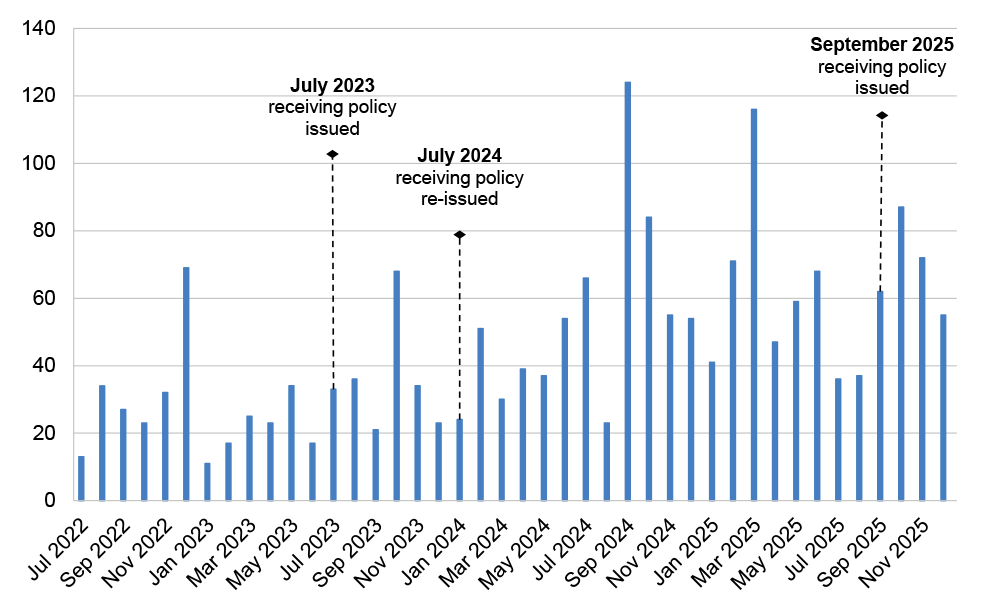
3.5 Defence personnel reported on the register between July 2022 and December 2025 that 1,828 gifts, benefits and hospitality items were accepted. This included 751 recorded in the 2025 calendar year. Figure 3.1 outlines the monthly totals from July 2022 to December 2025 and depicts the release of three versions of the gifts, benefits and hospitality receiving policy — July 2023, July 202443 and September 2025.
Figure 3.1: Accepted gifts, benefits and hospitality recorded by Defence personnel, July 2022 to December 2025
Source: ANAO analysis of Department of Defence records.
Compliance with Defence’s October 2020 receiving policy and approval requirements
3.6 Defence’s October 2020 Financial Policy, Gifts and Benefits required personnel to obtain approval to personally retain a gift or benefit valued at $100 or more and to accept hospitality of any value (see paragraph 2.29). The policy states that approval to retain items should not be provided unless the delegate is satisfied that approval will uphold the overarching principles of the policy and not create a potential conflict of interest for the individual, business area, Defence, the APS or the Australian Government.
3.7 Between October 2020 and July 2023, Defence maintained two separate SharePoint registers — one for gifts and one for hospitality. The operating procedures for these registers recommended that entries attach supporting material including relevant approval documentation. In June 2025, the SharePoint platform ceased to operate and was removed from Defence’s intranet. Defence advised the ANAO in February 2026 that individuals were responsible for maintaining records and ‘any documents that may have been attached to the register from July 2022 have not been retained’.
3.8 While a centralised repository of attachments was not retained, Defence extracted the relevant information (text and numbers) from SharePoint and saved it in an Excel spreadsheet. Table 3.1 outlines the register records, including: the number of recorded gifts, benefits and hospitality items that required approval; and the number of entries that recorded the name and rank of the official authorised to approve the retention or acceptance.
Table 3.1: Approval records for gifts and benefits retained and hospitality accepted, July 2022 to June 2023
|
Register |
Items recorded on the register that met the approval threshold |
Number of personnel that reported an authorised official had approved the item |
Number of personnel that did not report an authorised official had approved the item |
|
Gifts and benefitsa |
57 |
43 (75%) |
14 (25%) |
|
Hospitality |
188 |
97 (52%) |
91 (48%)b |
|
Total |
245 |
140 (57%) |
105 (43%) |
Note a: 12 entries could not be assessed as they either had no recorded value or the entry did not record whether the gift or benefit was retained or not.
Note b: The 91 includes 62 entries where Defence personnel had recorded that they approved their own acceptance of hospitality.
Source: ANAO analysis of Department of Defence’s gifts, benefits and hospitality registers and supporting documentation.
3.9 The 14 gifts and benefits register entries that did not record approval by an authorised official to retain a gift or benefit included:
- 10 entries that recorded an approval that was provided by a person who was not authorised to approve the retention of the gift or benefit; and
- four entries that did not record data in the relevant field of the register to determine whether an authorised official had approved the retention or not.
3.10 The 91 entries in the hospitality register that did not record approval by an authorised official to accept hospitality included:
- 17 entries that recorded an approval by a person who was not authorised to approve the acceptance of hospitality;
- 12 entries did not include sufficient information to determine whether approval was authorised; and
- 62 personnel approved the acceptance of their own hospitality.
3.11 Defence’s policy does not specify whether personnel could approve their own hospitality. Section 27 of the PGPA Act requires that officials must not improperly use their position to gain, or seek to gain, a benefit to themselves.44 These arrangements should be subject to appropriate oversight to ensure transparency and defensible decision making.
3.12 Accepting hospitality from a lobby group is prohibited under the policy. The hospitality register contains three entries where approval had been recorded to accept hospitality from an entity or individual listed on the Australian Government Register of Lobbyists.45This non-compliance was not detected by Defence, and together with the records listed in paragraph 3.10, indicates that the register was not an effective control.
Compliance with Defence’s July 2023 receiving policy and conflict of interest requirements
3.13 Defence’s July 2023 policy did not require personnel to gain approval to accept or retain gifts, benefits or hospitality.
3.14 To align with the release of the July 2023 policy, Defence removed the approvals field from the register and added new fields so personnel could record whether a conflict of interest was identified and whether the required conflict-of-interest form was submitted. The data from these fields is outlined in Table 3.2.
Table 3.2: Conflict-of-interest declarations on the gifts, benefits and hospitality register, July 2023 to September 2025a
|
Register field |
Response |
|
|
|
Yes |
No |
|
Did the acceptance cause an actual, potential or perceived conflict of interest? |
16 |
1,345 |
|
Has a Defence Conflict of Interest Declaration Form been submitted for this gift or benefit? |
11 |
26b |
Note a: This table shows entries recorded in the register up to 15 September 2025 when the July 2023 policy was replaced by the September 2025 policy. Entries recorded in the register after 15 September 2025 are covered in Table 3.4. The table does not include five entries where the register field was left blank.
Note b: Where personnel declare that they have no conflict of interest, they may still choose to complete a declaration form, even though this is not a requirement.
Source: ANAO analysis of Department of Defence data.
3.15 Of the 11 entries where a conflict-of-interest declaration form was recorded as submitted, Defence retained completed forms for seven entries.46 Defence could not provide evidence of completed forms for the remaining four entries (36 per cent) that recorded a form as submitted. Of the seven forms that were retained:
- four personnel declared a perceived conflict of interest relating to gifts, benefits and hospitality that they accepted, which their managers agreed should be recorded on the register as required under the policy;
- one individual declared a potential conflict of interest that their manager agreed to address if a future engagement arose;
- one form declared no conflict of interest; and
- one manager determined a conflict of interest was not a conflict.
3.16 An example from one of the seven conflict-of-interest forms highlights the types of gifts, benefits and hospitality arrangements that can give rise to an actual, perceived or potential conflict of interest.
- In July 2025, an Australian Defence Force (ADF) member accepted a ticket as a uniformed representative to an industry awards event, valued at $375, from an entity contracted by Defence. The ADF member declared a perceived conflict of interest advising their manager of prior involvement in a tender evaluation process, which awarded a contract to the entity. The ADF member advised they would not be involved in the forthcoming open tender process for a new contract.
- The ADF member’s manager (2-Star rank) recognised the perceived conflict of interest, confirmed that the ADF member was not involved in the new contract negotiations and decision processes for the award of contract, and undertook to monitor and review the conflict-of-interest management strategy. The gift was declared as per policy.
3.17 To mitigate conflict-of-interest risk, Defence’s September 2025 policy update established a new process for personnel to obtain approval from SES Band 3 or 3-Star personnel to accept gifts, benefits and hospitality from commercial entities or individuals who are doing or intend to do business with Defence. A key gap in this control is covered in paragraph 3.20.
Conflict of interest checks (November 2024 – December 2025)
3.18 In November 2024, Defence commenced reviewing the receiving register every two months to identify where personnel have recorded a conflict of interest but have not submitted the required form.
3.19 Between November 2024 and December 2025, Defence emailed 16 personnel who created register entries and requested that they provide a conflict-of-interest form or advise if the record was incorrect. Of these requests, three provided conflict-of-interest forms, six advised that the discrepancy was the result of a data entry error and the record was updated, and seven did not respond. Defence advised the ANAO in April 2026 that it did not follow up with the seven officials who did not respond as the compliance process was in its early implementation phase and that ‘as a general rule, across all gifts and benefits compliance activities, Defence Integrity Division now follows-up with individuals who do not respond to our initial request on a least one occasion.’
Compliance with Defence’s September 2025 receiving policy including approvals and conflict of interest
3.20 Defence introduced a new control in the September 2025 policy update to manage conflict-of-interest risks associated with commercial entities providing gifts, benefits and hospitality to Defence personnel. The control requires personnel to obtain approval from SES Band 3 or 3-Star personnel to accept gifts, benefits and hospitality from commercial entities or individuals who do or intend to do business with Defence, where acceptance would not cause an actual conflict of interest. If it is not practical to obtain prior approval, personnel must inform SES Band 3 or 3-Star personnel in writing within 10 working days. Personnel at the SES Band 3 or 3-Star level are exempt.
3.21 Table 3.3 outlines for the period between September and December 2025, 28 Defence personnel recorded on the register that they had accepted gifts, benefits and hospitality from commercial entities or individuals. Of these, 16 (57 per cent) did not obtain the required written approval or notification.
Table 3.3: Approval and notifications for gifts, benefits and hospitality accepted from commercial entities or individuals, September to December 2025
|
|
Number recorded on register |
Prior approval obtained |
Notification provided |
Neither approval or notification |
|
Accepted by Defence personnel with a level/rank below SES Band 3 or 3-Star |
28 |
4 |
8 |
16 |
Source: ANAO analysis of Department of Defence records.
3.22 In April 2026 Defence commenced a quarterly activity to check that approvals and notifications had been completed when required.
3.23 Defence has not established steps or assurance activities to determine if the 28 records presented in Table 3.3 is complete and accurate. For example, Defence has not sought to obtain information from commercial entities or individuals who are doing or intend to do business with Defence in order to determine whether gifts and benefits have been provided to Defence personnel.47
Opportunity for improvement
3.24 The Department of Defence could periodically request gifts, benefits and hospitality records from commercial entities or individuals who are doing or intend to do business with Defence. This could be incorporated in the establishment of a broader compliance program.
3.25 Table 3.4 outlines the number of Defence personnel who declared whether they had a conflict of interest when accepting gifts, benefits and hospitality between September and December 2025.
Table 3.4: Conflict-of-interest declarations on the gifts, benefits and hospitality receiving register, September to December 2025a
|
Register field |
Response |
|
|
|
Yes |
No |
|
Did the acceptance cause an actual, potential or perceived conflict of interest? |
6 |
233 |
|
Has an AF220 Defence Conflict of Interest Declaration Form been submitted for this gift or benefit? |
4 |
1 |
Note a: This table shows entries recorded in the register from 16 September 2025 to 31 December 2025. The table does not include six entries where the conflict-of-interest field was left blank.
Source: ANAO analysis of Department of Defence records.
3.26 Of the 239 conflict-of-interest declarations in the register, four personnel identified that the acceptance of a breakfast ($15), dinner ($150), a plaque ($100) and a gift ($150) gave rise to a conflict of interest. A fifth individual declared that accepting an invitation to an event ($45) created a perceived conflict of interest, but their manager did not agree that a conflict existed. Defence’s Integrity Division does not assess conflict-of-interest management plans, rather it merely confirms that the declarations are endorsed at the required level.
3.27 Defence’s register guidance requires mandatory fields to be completed. These include the conflict-of-interest fields and the field to record the entity or individual who provided the gift. Between September to December 2025, six entries did not complete the mandatory fields and these related to meals that were valued at or below $150 and a gift valued at $250.
Compliance with Defence’s spending policies
3.28 The decision to purchase items for the purpose of providing gifts, benefits and hospitality requires approval from a section 23(3) of the PGPA Act delegate who holds an APS level or ADF rank specified in the delegation thresholds. For the October 2020 policy, the delegation threshold table covers the audit period between July 2022 and June 2023. In the July 2023 policy, the delegation thresholds changed and continued under the July 2024 and September 2025 iterations of the policy.
3.29 Table 3.5 outlines the proportion of personnel who recorded purchases in the spending register between July 2022 and June 2023. In total, 32 per cent of the entries did not record that approval had been provided by a section 23(3) delegate with the correct level/rank as outlined in the October 2020 policy. The spending records indicate policy non-compliance and potential breaches of the PGPA Act.
Table 3.5: Register entries with authorised delegate approval recorded, July 2022 to June 2023 (under the October 2020 policy)
|
Value of gift or benefit |
Met (delegate held the required level/rank) |
Not met (delegate did not hold the required level/rank) |
Total |
|
Gifts and benefits |
|||
|
Less than $100 |
22 (67%) |
11 (33%) |
33 |
|
Up to $200 |
55 (63%) |
32 (37%) |
87 |
|
Greater than $200 |
51 (45%) |
63 (55%) |
114 |
|
Sub total |
128 (55%) |
63 (55%) |
234 |
|
Hospitality |
|||
|
Less than $2,000 |
318 (71%) |
128 (29%) |
446 |
|
Up to $10,000 |
134 (77%) |
39 (23%) |
173 |
|
Greater than $10,000 |
25 (71%) |
10 (29%) |
35 |
|
Sub total |
477 (73%) |
177 (27%) |
654 |
|
Total |
605 (68%) |
283 (32%) |
888 |
Source: ANAO analysis of Department of Defence records.
3.30 Table 3.6 outlines the proportion of personnel who recorded purchases in the spending register and obtained the correct approvals between July 2023 and December 2025. Overall, the majority of entries recorded the correct approvals.
Table 3.6: Register entries with authorised delegate approval recorded, July 2023 to December 2025 (July 2023 – reissued July 2024, September 2025 policy updates)
|
Threshold |
Met (delegate held the required level/rank) |
Not met (delegate did not hold the required level/rank) |
Total |
|
Less than $300 |
483 (93%) |
38 (7%) |
521 |
|
Up to $500 |
189 (84%) |
36 (16%) |
225 |
|
Up to $2,000 |
533 (86%) |
84 (14%) |
617 |
|
Up to $10,000 |
317 (78%) |
91 (22%) |
408 |
|
Over $10,000 |
74 (67%) |
36 (33%) |
110 |
|
Total |
1,596 (85%) |
285 (15%) |
1,881a |
Note a: This number does not include six register entries where Defence personnel did not record sufficient information to determine the level or rank of approving delegates.
Source: ANAO analysis of Department of Defence records.
3.31 In April 2025, the Defence Integrity Division reviewed register entries recorded from July 2024 to December 2025 and emailed those personnel where records indicated the expenditure had been approved by the incorrect delegate. The email requested that personnel review the register entry and where appropriate, record any non-compliance on Defence’s PGPA Act Non-Compliance Register. The Defence Integrity Division found that:
- 77 officials (53 per cent) advised that the information was incorrect or incomplete and that they would amend the record;
- 40 officials (28 per cent) advised that they had approved spending above their delegated threshold; and
- 28 officials (19 per cent) did not respond to the email or the response was unclear.
3.32 Defence advised the ANAO in April 2026 that it did not escalate or follow up when officials did not respond to email requests and that it has now commenced following up. This is after the ANAO had raised the matter with Defence. In March 2026 Defence commenced cross-checking spending approval forms received by the Defence Integrity Division with entries in the gifts, benefits and hospitality spending register.
Senior Executive Service annual declarations
3.33 Defence’s SES personnel are required to submit an annual declaration of interest by 31 October each year. Declarations are made to ascertain whether personal interests and those of the SES personnel’s family could cause an actual, potential or perceived conflict of interest. The supporting guidance lists a range of interests that should be covered including gifts. SES compliance with the 31 October 2025 deadline for submitting the annual declarations was 99 per cent (1,285 of 1,303 declarations).
Internal audit
3.34 Defence has established an internal audit function as part of its requirements under section 16 of the PGPA Act. In August 2022, the Defence Integrity Division completed an internal audit to assess the effectiveness of Defence’s management of gifts, benefits and sponsorship. The internal audit reviewed its policies and processes, training and user support, and mechanisms for communicating and enforcing the policy relating to the receiving and the provision of gifts, benefits and hospitality.
3.35 The overall finding was that Defence is not effectively managing gifts and benefits activity, including:
- ineffective controls to detect and prevent non-compliance;
- the gifts and benefits policy does not align with the APSC guidance; and
- the current gifts and benefits training module is out of date and not aligned to the policy.
3.36 The internal audit made five recommendations, which were all agreed to by Defence (see Table 3.7).
Table 3.7: 2022 internal audit findings and recommendations
|
Key finding |
Recommendation |
Defence’s assessment of implementation |
|
Defence did not have effective controls in place to monitor gifts, benefits and hospitality activity, and ensure that public reporting is accurate and complete. |
1a. Establish a compliance program to support compliance with policy |
Implemented Closure approved in August 2023 Updated the gifts and benefits policies, introduced new SharePoint registers. Quarterly compliance program reporting was planned but did not progress (see paragraph 3.36 below). |
|
1b. Review the gift and benefit register to support the detection of conflict-of-interest risks |
Implemented Closure approved in February 2022 New SharePoint register allowed recording of COI information |
|
|
Defence’s policy was inconsistent with APSC Guidance for Agency Heads — Gifts and Benefits |
2a. Review and revise the Defence Financial Policy – Gifts and Benefits to align with the APSC guidance |
Implemented Closure approved in November 2023 Various changes made to the July 2023 policy, including to align with elements of the APSC guidance, especially around the $100 threshold |
|
2b. Improve the application of gifts and benefits policy to different roles and operating contexts |
Implemented Closure approved November 2023 The policy on gifts, benefits and hospitality spending was updated to exclude international agreements and Defence would rely on direction from International Policy Division. |
|
|
Defence’s gifts and benefits training did not align with current policy |
3. Review and update the Mandatory ‘Fraud and Integrity Awareness’ training to ensure it is aligned with policy, raises awareness of conflict-of-interest risk and includes updated links to the intranet. |
Implemented Closure approved February 2023 Updated training content developed for inclusion in the Fraud and Integrity Awareness course. |
Source: Defence documentation.
3.37 Recommendation 1a proposed that the Defence Finance Group establish a compliance program to support compliance with the gifts, benefits and sponsorship policy. In September 2023, Defence provided an update on the progress of implementing the audit recommendations and advised its Audit and Risk Committee that the Chief Audit Executive had assessed and closed recommendation 1a. As at March 2026, a compliance program has not been implemented.
Opportunity for improvement
3.38 The Department of Defence could improve its assurance over the reporting on the implementation of internal audit recommendations.
3.39 Establishing a compliance program for gifts, benefits and hospitality is important because these activities are a well-recognised source of fraud and corruption risk. A risk-based approach targets oversight and testing to higher risk areas, helps identify emerging issues such as conflicts of interest or improper influence, and provides assurance that controls are operating effectively.
Recommendation no.2
3.40 The Department of Defence develops a targeted, risk-based compliance program to assure controls for the management of gifts, benefits and hospitality are operating effectively and to assess residual risk.
Department of Defence response: Agreed
3.41 Defence advised the ANAO in April 2026 that ‘Defence intends to align the revised [receiving] policy as appropriate, with the updated APSC guidance anticipated to be released in the first half of 2026. Once the revised policy is reissued, Defence will develop and implement a risk-based compliance program to support and reinforce the new policy settings.’
Does Defence have effective processes for managing identified instances of non-compliance?
Defence monitors approvals for spending on gifts, benefits and hospitality through the PGPA Act Non-Compliance Register and since November 2024 has implemented a process to check the submission of conflict-of-interest declarations. These two activities alone do not yet provide a systematic approach to manage non-compliance with policy.
Receiving policy non-compliance follow up
3.42 As discussed in paragraph 2.12, in the September 2025 policy update approval was required to accept a gift for benefit from a commercial entity or individual who does or intends to do business with Defence. These approvals are not routinely monitored or enforced. Defence advised the ANAO in April 2026 that it has ‘commenced work to develop a compliance activity to assess adherence to policy’s approval requirements, with the activity scheduled to commence in April 2026.’48
3.43 Since November 2024, Defence centrally monitors the gifts and benefits register for conflict-of-interest declarations and follows up when the required conflict-of-interest declaration forms have not been submitted. As discussed in paragraph 3.18, between November 2024 and December 2025, seven personnel did not respond to requests to provide the forms. Defence advised the ANAO in April 2026 that ‘While there is no formal follow up or escalation process in place, Integrity Policy (DID) have commenced [copying] supervisors where individuals do not respond to compliance-related notifications.’
Spending policy non-compliance
3.44 The Defence Integrity Division emails personnel where register entries indicate potential instances of non-compliance with the policy and PGPA Act requirements, and requests that entries be reviewed and any non-compliance reported on Defence’s PGPA Non-Compliance Register.
3.45 The Defence Finance Group manages the PGPA Non-Compliance Register. Defence’s Financial Assurance and Compliance Strategy (February 2020) states that ‘all instances of reported non-compliance will be assessed to determine the appropriate response’. The response will consider the seriousness of the matter and apply an appropriate approach.49
3.46 Between July 2022 to May 2025, there were 112 recorded breaches related to gifts, benefits and hospitality where 48 were due to not obtaining prior approval for purchasing a gift, benefit or hospitality and 34 related to the value of the purchase exceeding the delegate’s spending approval threshold.50 The register can record the corrective action that was taken as a result of the breach which may entail providing education and training, taking administrative action such as correcting records on the register, or undertaking further investigation.
3.47 The Defence Finance Group advised the ANAO in May 2026 that it undertook a weekly review of the register. In September 2025, it introduced an automated monthly review process to ensure breaches are managed by checking that repayments are made. From April 2026, non-compliance with the gifts and benefits policy is reported to the Defence Integrity Division.
3.48 Defence provides financial compliance reports to the Defence Audit and Risk Committee twice a year, including data and analysis of breaches reported on the PGPA Non-Compliance Register. The report also includes instances of non-compliance that have met a set of principles defined by Defence, and applies these to determine the significance of any identified non-compliance.51 The analysis does not detail where non-compliance with the gifts and benefits policy has occurred.
3.49 In April 2026, Defence amended its receiving and spending policies and introduced requirements for managing identified non-compliance. The requirements state that when non-compliance is identified or notified by the Defence Integrity Division this must be reported in writing to supervisors within 24 hours and recorded on the PGPA Non-Compliance Register within three business days. Defence requires evidence of these actions to be retained.
Does Defence analyse and report on the receipt and provision of gifts, benefits and hospitality?
On three occasions between September 2024 and August 2025, Defence reported data on the volume and value of gifts, benefits and hospitality to its Enterprise Business Committee. In 2024 and 2025, Defence provided data from the register to its Group Heads and Service Chiefs on the numbers of acceptance and spending on gifts, benefits and hospitality. There is no routine reporting to the Defence senior executive on compliance with the gifts, benefits and hospitality policies including analysis of patterns, risks and trends. Defence publishes its gifts, benefits and hospitality register on its website as it applies to SES Band 3 or 3-Star personnel and above, in accordance with the APSC’s guidance.
Reporting to Defence senior leadership
3.50 Between September 2024 and August 2025, Defence Integrity Division has included gifts, benefits and hospitality information in three reports to the Enterprise Business Committee.
- September 2024 — included the volume, financial value and business areas that received and provided gifts, benefits and hospitality in 2022–23 and 2023–24.52
- May 2025 — included the volume and financial value of gifts, benefits and hospitality received, and the proportion personally retained by personnel. It also provided a draft receiving policy with proposed amendments to mitigate conflict-of-interest risk.
- August 2025 — included the volume and financial value of gifts, benefits and hospitality received, a revised draft policy to address committee input from the May 2025 meeting, and a communication plan for the amended policy.
3.51 These reports do not include information about Defence personnel’s compliance with the policy or provide analysis of the information to identify trends and risks for the committee to consider.
3.52 In January 2025 and March 2026, the Defence Integrity Division provided Defence’s Group Heads and Service Chiefs with register data. This data showed those Defence personnel who had accepted or provided gifts, benefits, and hospitality in the 2024 and 2025 calendar years. Defence Integrity Division has undertaken to provide Groups Heads and Service Chiefs with this data every six months, commencing in July 2026. Defence advised the ANAO in April 2026 that these updates can enable senior personnel the opportunity to monitor adherence to policy requirements specific to their group or service area. No analysis of the data is provided on trends and patterns or areas of risk. Defence’s reporting arrangements do not enable the identification of emerging risks, the assessment of whether gifts, benefits and hospitality policies remain appropriate, and whether senior leaders and personnel are acting with integrity.
Recommendation no.3
3.53 The Department of Defence develops reporting on gifts, benefits and hospitality and associated non-compliance to support assessment of risk and ensure policies remain fit-for-purpose.
Department of Defence response: Agreed
Reporting to the Australian Public Service Commission
3.54 The APSC Guidance for Agency Heads — Gifts and Benefits requires agency heads to publish on their entity’s website a register of gifts, benefits and hospitality valued at over $100 that have been accepted by agency heads. This disclosure includes gifts, benefits and hospitality accepted by their immediate families and dependants where it is related to the official duties of the agency head. The APSC guidance also includes a ‘strong expectation’ that items received by staff are also published on the register. Registers are to be published on a quarterly basis by 30 April, 31 July, 30 October and 31 January each year.
3.55 Defence’s October 2020 Financial Policy Gifts and Benefits required gifts and benefits accepted, retained and valued at over $100 to be published on Defence’s website.53 In January 2023, the Chief Finance Officer (CFO) advised the Secretary and the Chief of the Defence Force (CDF) that the October to December 2022 disclosure, and all future disclosures, would focus on personnel at SES Band 3 or 3-Star and above. From July 2023 Defence’s gifts, benefits and hospitality policies stated that:
Where the Secretary, CDF or Band 3 and 3 Star Defence officials (or immediate family or dependents) receive a gift or benefit valued at $100 AUD or greater (exclusive of GST), they will be publicly disclosed on the Defence internet site in accordance with the APSC and Defence guidance.
3.56 Defence has created standard operating procedures for reporting on gifts and benefits to meet APSC’s Guidance for Agency Heads — Gifts and Benefits public disclosure requirements. The procedures require Defence to extract data from the registers, identify entries that meet the external reporting requirements, transfer those entries into a reporting template, and send the report and covering brief to the Secretary and CDF.
3.57 Up until July 2024, the CFO provided written briefs to the Secretary and CDF. From July 2024, these written briefs were provided by the First Assistant Secretary of the Integrity Division. The briefings include: items that were to be publicly disclosed; updates on APSC requirements; changes to the policy, process or arrangements for managing gifts, benefits and hospitality; and provided information on the preparation of the external reporting. Approval to publish the registers is provided by the Secretary and CDF.
3.58 The ANAO reconciled the items on the gifts, benefits and hospitality registers that met Defence’s external reporting thresholds with items that were published on Defence’s website, set out in Table 3.8.
Table 3.8: Disclosure of gifts, benefits and hospitality on Defence’s website, July 2022 to December 2025
|
Register |
Threshold |
ANAO assessment |
|
|
|
|
Items that met the reporting threshold |
Items that met the threshold but were not externally reported |
|
Gifts register (July 2022 – June 2023) |
Gifts, benefits and hospitality accepted and retained by individuals (and their family members) valued over AUD$100 (GST exclusive).a |
29b |
2e |
|
Hospitality register (July 2022 – 2023) |
19c |
4e |
|
|
Received register (July 2023 – December 2025) |
Items received by officials (and their family members) with a level/rank of Band 3 or 3-Star or above and valued at $100 or more (GST exclusive). |
491d |
12e |
Note a: Between October 2022 and December 2022, Defence only disclosed gifts, benefit and hospitality accepted and retained by SES Band 3 or 3-Star personnel. This was a decision made by the CFO under delegation provided to them by the Secretary.
Note b: An additional 12 entries did not record sufficient information to determine the level/rank of the recipient, or the level/rank of the Defence official whose family member or dependant accepted the gift or benefit; and an additional three entries did not disclose whether the gift/s was personally retained or not.
Note c: An additional 24 entries did not record sufficient information to determine the level/rank of the recipient or the level/rank of the Defence official whose family member or dependant received the hospitality.
Note d: An additional 12 entries did not record sufficient information to determine the level/rank of the recipient, or the level/rank of the Defence official whose family member or dependant accepted the gift or benefit.
Note e: The 18 items that met the threshold but were not externally reported included items such as memorial or ceremonial gifts, and hospitality provided by international government representatives or commercial entities.
Source: ANAO analysis of Department of Defence’s gifts, benefits and hospitality registers.
3.59 Table 3.8 shows a significant increase in the number of gifts, benefits and hospitality that met the threshold, which cannot be attributed to the change in threshold parameters alone. Defence advised the ANAO in May 2026 that the increase could be attributed to the suite of targeted communications that accompanied the release of the July 2023 policy and further investment in communication activities after the policy and functions transitioned to the Defence Integrity Division in July 2024.
3.60 In October 2023, the APSC amended its Guidance for Agency Heads — Gifts and Benefits and included a requirement to publicly report airline lounge memberships gifted to agency heads annually. Defence reports airline lounge memberships accepted by SES Band 3 or 3-Star personnel and above, including their family members. Defence reported 79 airline lounge memberships had been accepted between October 2023 and December 2025. Prior to October 2023, Defence had a standing disclosure on its website that stated ‘Complimentary Airline Lounge Memberships’ were received from QANTAS Airways and Virgin Australia Airlines on an ongoing basis by ‘Qualifying Department/Defence executive officials’.
Appendices
Appendix 1 Entity response
Appendix 2 Improvements observed by the ANAO
1. The existence of independent external audit, and the accompanying potential for scrutiny improves performance. Improvements in administrative and management practices usually occur: in anticipation of ANAO audit activity; during an audit engagement; as interim findings are made; and/or after the audit has been completed and formal findings are communicated.
2. The Joint Committee of Public Accounts and Audit (JCPAA) has encouraged the ANAO to consider ways in which the ANAO could capture and describe some of these impacts. The ANAO’s corporate plan states that the ANAO’s annual performance statements will provide a narrative that will consider, amongst other matters, analysis of key improvements made by entities during a performance audit process based on information included in tabled performance audit reports.
3. Performance audits involve close engagement between the ANAO and the audited entity as well as other stakeholders involved in the program or activity being audited. Throughout the audit engagement, the ANAO outlines to the entity the preliminary audit findings, conclusions and potential audit recommendations. This ensures that final recommendations are appropriately targeted and encourages entities to take early remedial action on any identified matters during the course of an audit. Remedial actions entities may take during the audit include:
- strengthening governance arrangements;
- introducing or revising policies, strategies, guidelines or administrative processes; and
- initiating reviews or investigations.
4. In this context, the below actions were observed by the ANAO during the course of the audit. It is not clear whether these actions and/or the timing of these actions were planned in response to proposed or actual audit activity. The ANAO has not sought to obtain assurance over the source of these actions or whether they have been appropriately implemented.
- The Associate Secretary issued a revised policy in September 2025 that requires personnel below SES Band 3 or 3-Star to obtain written approval from SES Band 3 or 3-Star personnel to accept a gift, benefit or hospitality from a commercial entity or individual who does or intends to do business with Defence (refer to paragraphs 2.3 to 2.5).
- Defence increased communication and education activities and created new resources on its intranet to inform and support Defence personnel compliance with the policy (refer to paragraphs 2.56 to 2.59).
- In April 2026 Defence commenced a quarterly activity to check that approvals and notifications had been completed when required (refer to paragraphs 3.21)
- Since November 2024, Defence has reviewed the receiving register to identify when conflict-of-interest declarations have not been submitted (refer to paragraphs 3.173.44 to 3.183.45). Since March 2025, Defence has reviewed the spending register to identify when information is incomplete or indicates non-compliance (refer to paragraph 3.30).
- In March 2026 Defence commenced cross checking spending approval forms received by the Defence Integrity Division, with entries in the gifts, benefits and hospitality spending register (refer to paragraph 3.31).
- In April 2026, Defence amended its receiving and spending policies by introducing requirements for managing non-compliance. The requirements state that when non-compliance is identified ‘or notified by Defence Integrity Division’ this must be reported in writing to supervisors within 24 hours and recorded on the Financial Non Compliance Register within three business days. Defence requires evidence of these actions to be retained (refer to paragraph 3.49).
- In September 2024, Defence commenced reporting information on gifts, benefits and hospitality to its Enterprise Business Committee, and provided register data to Group Heads and Service Chiefs on the gifts, benefits, and hospitality that had been accepted and purchased by Defence personnel in their respective group or service (refer to paragraph 3.51).
Footnotes
1 Australian Public Service Commission, Guidance for Agency Heads Gifts and Benefits, APSC, Canberra, 2021, available from www.apsc.gov.au/working-aps/integrity/integrity-resources/guidance-agency-heads-gifts-and-benefits [accessed January 2026].
2 Department of Finance, RMG 206 Model Accountable Authority Instructions for corporate Commonwealth entities, Finance, Canberra, April 2023 (updated December 2025), available from https://www.finance.gov.au/government/managing-commonwealth-resources/managing-risk-internal-accountability/risk-internal-controls/accountable-authority-instructions-aais-rmg-206 [accessed May 2026]
3 Australian Public Service Commission, APS Values and Code of Conduct in practice, APSC, Canberra, 2021, available from https://www.apsc.gov.au/publication/aps-values-and-code-conduct-practice [accessed January 2026].
4 Australian Public Service Commission, Guidance for Agency Heads Gifts and Benefits, APSC, Canberra, 2021 (updated October 2023), available from www.apsc.gov.au/working-aps/integrity/integrity-resources/guidance-agency-heads-gifts-and-benefits [accessed January 2026].
5 Agency heads must publish a register of gifts and benefits, valued at over $100 (excluding GST), that they accept on a quarterly basis. A link to the register must also be provided to the APSC for publication on APSC’s website. The guidance notes that although it is not a requirement, ‘there is a strong expectation that agency heads will also publish gifts and benefits received by staff in their agency that exceed the threshold of $AUD100.00 (excluding GST).’
6 Department of Defence, 2025–29 Defence Corporate Plan, Defence, Canberra, August 2025, p. 6, available from https://www.defence.gov.au/about/strategic-planning/defence-corporate-plan [accessed January 2026].
7 Internal reporting to Defence’s senior leadership showed that as at March 2025 Defence had also engaged 5,858 contractors and consultants.
Department of Defence, Defence Annual Report 2024–25, Defence, Canberra, 2025, p. 119, available from https://www.defence.gov.au/about/accessing-information/annual-reports [accessed March 2026].
8 From October 2020 to June 2023, the policies applied to family members of Defence personnel. From July 2023 they applied to family members of Defence personnel at the level/rank of SES Band 3/3-Star and above.
9 Auditor-General Report No. 47 2017–18, Interim Report on Key Financial Controls of Major Entities, ANAO, Canberra, 2018, paragraphs 9, 1.24–1.32 and Appendix 2, available from https://www.anao.gov.au/work/financial-statement-audit/interim-report-key-financial-controls-major-entities-2017-18 [accessed March 2026].
10 Auditor-General Report No. 38 2019–20, Interim Report on Key Financial Controls of Major Entities, ANAO, Canberra, 2020, Table 1.1, available from https://www.anao.gov.au/work/financial-statement-audit/interim-report-key-financial-controls-major-entities-2019-20 [accessed March 2026].
11 These reports were: Auditor-General Report No. 44 2023–24, Compliance with Gifts, Benefits and Hospitality Requirements in the Department of the Treasury, ANAO, Canberra, 2024, available from https://www.anao.gov.au/work/performance-audit/compliance-gifts-benefits-and-hospitality-requirements-the-department-of-the-treasury [accessed March 2026]; Auditor-General Report No. 46 2023–24, Compliance with Gifts, Benefits and Hospitality Requirements in the Australian Communications and Media Authority, ANAO, Canberra, 2024, available from https://www.anao.gov.au/work/performance-audit/compliance-gifts-benefits-and-hospitality-requirements-the-acma [accessed March 2026]; Auditor-General Report No. 15 2024–25, Compliance with Gifts, Benefits and Hospitality Requirements in the Murray-Darling Basin Authority, ANAO, Canberra, 2025, available from https://www.anao.gov.au/work/performance-audit/compliance-gifts-benefits-and-hospitality-requirements-the-murray-darling-basin-authority [accessed March 2026].
12 Australian National Audit Office, Insights: Audit Lessons — Gifts, Benefits and Hospitality, ANAO, Canberra, 2024, available from https://www.anao.gov.au/work/insights/gifts-benefits-and-hospitality [accessed March 2026].
13 National Anti-Corruption Commission, Towards Integrity Maturity: Mapping the Commonwealth integrity landscape, NACC, Canberra, 2022, available from https://www.nacc.gov.au/towards-integrity-maturity-mapping-commonwealth-integrity-landscape [accessed March 2026].
14 Australian Public Service Commission, APS Values and Code of Conduct in practice, APSC, Canberra, 2024, Section 5: Conflict of Interest, available from www.apsc.gov.au/publication/aps-values-and-code-conduct-practice/section-5-conflict-interest [accessed March 2026].
15 This audit reviewed the October 2020 policy as it was in effect from July 2022 to June 2023, which is within the scope of the audit.
16 The Defence Integrity Division was formerly part of the Defence’s Associate Secretary Group. On 16 December 2024 it became part of Defence’s Governance Group.
17 The 28-day timeframe has been in place across the October 2020, July 2023 (reissued July 2024) and September 2025 gifts, benefits and hospitality policies.
18 Defence changed the process as the SharePoint platform was no longer available after June 2025.
19 The APSC amended the Guidelines for Agency heads – Gifts and benefits in October 2023 by including a requirement to publicly report airline memberships gifted to agency heads annually.
20 A conflict-of-interest field was added to the gifts, benefits and hospitality register where personnel could record whether a conflict of interest was identified in relation to accepting the gift, benefit or hospitality and whether a conflict-of-interest declaration form had been submitted.
21 Clauses 38 and 39 provide for individuals to dispose of gifts and benefits to Defence affiliated social clubs and public non-for-profit organisations with approval from SES Band 2 or 2-Star personnel.
22 Model AAIs are templates designed by Finance that cover core business topics, including managing property, and are issued by Finance ‘to help accountable authorities provide operational instructions to their officials’. See RMG 206 Model accountable authority instructions non-corporate Commonwealth entities, available from https://www.finance.gov.au/government/managing-commonwealth-resources/managing-risk-internal-accountability/risk-internal-controls/accountable-authority-instructions-aais-rmg-206 [accessed February 2026].
23 In July 2024, the responsibility was transferred to the Defence Integrity Division in the Associate Secretary Group (see paragraph 2.4).
24 The brief also advised the Associate Secretary that the policy was being amended to align with APSC guidance and allow gifts and benefits to be donated to Defence affiliated social clubs for raffle or auction, and to public or private not-for-profit organisations, or disposed of in an alternative way that would not offend the giver or cause embarrassment to the Commonwealth or Defence.
25 Department of Finance, Common definition of conflict of interest, Finance, Canberra, 14 April 2026, available from https://www.finance.gov.au/government/managing-commonwealth-resources/managing-conflicts-interest-and-confidentiality-non-government-sector-rmg-208/common-definition-conflict-interest [accessed May 2026].
26 The Department of Finance reported that in 2024–25, Defence’s total contracts were valued at $58.7 billion as notified on AusTender, available from https://www.finance.gov.au/government/procurement/statistics-australian-government-procurement-contracts- [accessed April 2026].
27 The Commonwealth Supplier Code of Conduct came into effect in July 2024.
Department of Finance, Commonwealth Supplier Code of Conduct, Finance, Canberra, 19 December 2025, available from https://www.finance.gov.au/government/procurement/ethical-conduct-suppliers/commonwealth-supplier-code-conduct-overview [accessed May 2025].
28 Australian Public Service Commission, Guidance for Agency Heads — Gifts and Benefits, APSC, Canberra, 2021 (updated October 2023), paragraph 13, available from https://www.apsc.gov.au/working-aps/integrity/integrity-resources/guidance-agency-heads-gifts-and-benefits [accessed October 2025].
29 There were an additional 64 entries in the register where the level or rank of the recipient of the gifts, benefits and hospitality valued at greater than $100 was blank or did not contain enough information to determine the level or rank.
30 Defence’s October 2020 and July 2023 gifts, benefits and hospitality policies prohibit personnel from accepting gifts, benefits and hospitality ‘from persons or organisations whose primary purpose is to lobby ministers, Members of Parliament or Commonwealth Government agencies, including Defence or the ADF’.
31 The term ‘or equivalent’ relates to an equivalent military ranking to and APS official.
32 The EBC provides assurance to Defence’s executive committee that the enterprise strategy, capability and resources align with government policies, legislative requirements and priorities. It is chaired by the Associate Secretary, consists of SES Band 3 or 3-Star membership and meets monthly.
33 The Policy is part of the Commonwealth Fraud and Corruption Control Framework 2024 that includes Section 10 of the PGPA Rule that establishes minimum standards for Commonwealth entities, and Resource Management Guide 201: Preventing, detecting and dealing with fraud and corruption that provides detailed guidance for Commonwealth entities. See https://www.counterfraud.gov.au/sites/default/files/2024-06/cfpc-framework-2024.pdf [accessed May 2026].
34 Attorney-General’s Department, Resource Management Guide 201 – Preventing, detecting and dealing with fraud and corruption, AGD, Canberra, 1 February 2024, p. 24, available from https://www.counterfraud.gov.au/library/framework-2024/fraud-and-corruption-guidance [accessed May 2026].
35 Referred to in the AAIs as ‘contractors, consultants and outsourced service providers undertaking work duties at the direction of Defence.’ Defence advised the ANAO in June 2026 that these personnel are required to complete the training where compliance with Defence policy is a term of their engagement.
36 APS personnel are proficient if they completed Fraud and Integrity Awareness Training in the required timeframe. ADF personnel are proficient if they have completed a larger training package that includes Fraud and Integrity Awareness training.
37 A DEFGRAM is an internal communication mechanism used by Defence. DEFGRAM documents are published on Defence’s intranet to make personnel aware of relevant/important information.
38 Department of Defence, Defence and the Private Sector: Working with Integrity, Defence, Canberra, 2022, available from https://www.defence.gov.au/business-industry/industry-governance/defence-private-sector-working-integrity [accessed February 2026].
39 The document includes forwards from Defence’s Secretary and CDF, the CEO of the Australian Industry Group and the CEO of the Australian Industry and Defence Network.
40 Department of Finance, Risk Management Toolkit: Element 5 Control Effectiveness, Finance, Canberra, 2023, available from https://www.finance.gov.au/government/comcover/risk-services/management/risk-management-toolkit/element-5-control-effectiveness [accessed February 2026].
41 Lessons 2 of the ANAO’s Insights: Audit Lessons — Gifts, Benefits and Hospitality, has further information on establishing controls to manage risks associated with gifts and benefits, available from https://www.anao.gov.au/work/insights/gifts-benefits-and-hospitality [accessed March 2026].
42 Defence advised the ANAO in June 2026 that since October 2024 this check has also applied to the receiving register.
43 The July 2024 policy included only minor administrative changes. See paragraph 2.4.
44 Section 27 of the PGPA Act, available from https://www.legislation.gov.au/C2013A00123/latest/text [accessed April 2026].
45 The Australian Government Register of Lobbyists is a public, searchable database administered by the Attorney-General’s Department to increase transparency in political lobbying. The register is available at https://www.ag.gov.au/integrity/australian-government-register-lobbyists#:~:text=We%20administer%20the%20Lobbying%20Code,Get%20more%20information [accessed March 2026].
46 Two forms were completed by personnel but they were not endorsed by an authorised Decision Maker in accordance with Defence’s conflict of interest instructions.
47 In June 2024, the Joint Committee of Public Accounts and Audit recommended that the ANAO consider audits in relation to gifts and hospitality, which may include obtaining information from the private sector order to determine whether gifts and benefits have been provided to public officials.
Joint Committee of Public Accounts and Audit, Report 504: Inquiry into procurement at Services Australia and the NDIA, Parliament of Australia, Canberra, June 2024, available from https://www.aph.gov.au/Parliamentary_Business/Committees/Joint/Public_Accounts_and_Audit/SAandNDIA/Final_Report [accessed May 2026].
48 Defence advised the ANAO in June 2026 that it had ‘conducted checks on relevant acceptances from January to March 2026 … with the next iteration scheduled to examine register entries for April to May 2026’.
49 The Strategy outlines possible corrective actions that increase in severity in proportion to the seriousness of the incident, they include: ‘encouraging compliance’; ‘assist, help and educate’; ‘correcting behaviour’; ‘penalising behaviour’; and ‘enforcement with criminal and civil sanctions’.
50 The remaining breaches related to not reporting the spending on the gifts, benefits and hospitality register, using incorrect financial system codes, and purchasing a gift, benefit or hospitality that was not permitted under the gifts and benefits policy.
51 The principles are a set of non-compliant circumstances that Defence considers to be significant: Fraud by a Defence official resulting in a loss to Defence that is greater than $2,000; Non-compliance that results in a loss to Defence of at least 0.02 per cent of its annual appropriation; 10,000 similar non-compliant financial transactions per year that indicate potential systemic control issues; fraud committed by non-Defence personnel due to an absence of controls that would reasonably be expected to be in effect; and significant.
52 Some of the values of recorded gifts, benefits and hospitality reported to the EBC in that period were inconsistent with records in the registers due to the method of data extraction which Defence advised has since been remedied.
53 An August 2022 internal audit of Defence’s gifts, benefits and sponsorship arrangements found that this was not consistent with the APSC’s Guidance for Agency Heads — Gifts and Benefits because gifts and benefits that were accepted and not personally retained still required disclosure. In July 2023 Defence updated its policy so that all gifts accepted required disclosure, regardless of whether the gift was personally retained or not.