Browse our range of reports and publications including performance and financial statement audit reports, assurance review reports, information reports and annual reports.
Auditor-General Report No. 33 of 2025–26
Defence’s Collins Class Submarines Life of Type Extension — Planning and Implementation
Published
Friday 22 May 2026
Portfolio
Defence
Entity
Department of Defence
Contact
Please direct enquiries through our contact page.
Activity
Asset management & sustainment
Sector
Defence
Audit snapshot
Why did we do this audit?
- Australia relies on the Collins class submarines as a core element of its maritime defence capability.
- As the fleet ages, a Life of Type Extension (LOTE) is required to maintain submarine capability and availability until Australia transitions to a future nuclear‑powered submarine fleet under AUKUS.
- Without a service life extension, these submarines would be withdrawn from service between 2026 and 2036.
- The LOTE project involves significant public expenditure. It is critical to avoiding a submarine capability gap during the transition to nuclear‑powered submarines under the AUKUS partnership.
- The audit provides independent assurance to Parliament on the effectiveness of the Department of Defence’s (Defence) planning and implementation of the LOTE project to date.
Key facts
- Since the system and detailed design contract was awarded in February 2022, it has been varied 53 times, increasing by $688 million to more than five times its original value.
- Four of the five key design reviews were not achieved as scheduled.
What did we find?
- Defence’s planning and implementation of the Collins class Life of Type Extension project was partly effective.
- Defence adopted a delivery strategy that involved major redesign and replacement of key submarine systems using common equipment, suppliers and technologies selected for the former Attack class submarine program, to reduce risks in that program. This decision significantly increased the technical complexity and risk profile of the LOTE project.
- When the Attack class submarine program was cancelled in 2021, Defence did not reassess the LOTE delivery approach or present government with alternative options.
- The risks associated with this approach have been realised. Costs have grown, delays have accumulated and the scope of the project was reduced.
- In May 2026, Defence proposed and government agreed, a revised service life extension strategy.
What did we recommend?
- There were five recommendations to the Defence aimed at improving project planning, risk management and the quality of advice provided to government.
- Defence agreed to all five recommendations.
$1.56 billion
estimated cost of the project (2022–23 to 2031–32)
$693 million
spent on LOTE design-related work to February 2026.
12 months
average delay against key design milestones.
Summary and recommendations
Background
1. The Royal Australian Navy (Navy) operates a fleet of six Collins class submarines. These submarines are among the Australian Government’s key strategic military assets, providing anti-submarine warfare, anti-surface warfare, intelligence, surveillance and reconnaissance, mine warfare capabilities and support to special operations. The Collins class fleet entered service between 1996 and 2003. Each submarine has a design life (life of type) of 28 years and, without an extension, was scheduled to be withdrawn from service between 2026 and 2036.
2. The Collins Life of Type Extension (LOTE) project was established to avoid a submarine capability gap by extending the service life of the Collins class during Defence’s transition to a larger and more capable submarine fleet. At the time the LOTE was initiated, the program to replace the Collins class submarines — the Future Submarine Program — envisaged a conventionally powered replacement fleet. The program was announced in April 2016 and later designated the Attack class in December 2018. That program has since been superseded by the nuclear-powered submarines to be delivered under the AUKUS agreement.
3. Work to determine the scope of the Collins class LOTE commenced in June 2016, initially focused on extending the service life of three submarines — HMAS Farncomb, HMAS Collins and HMAS Waller. The LOTE project formally commenced in September 2018. In September 2021, the Australian Government announced that the service life of all six Collins class submarines would be extended by a further 12 years.1 The original planned withdrawal dates and the amended planned withdrawal dates for each submarine are set out in Table S.1.
Table S.1. Original and amended planned withdrawal dates for the Collins class
|
Name |
Commissioned (entered service) |
Originally planned withdrawal date |
Amended planned withdrawal date |
|
HMAS Collins |
27 July 1996 |
2028 |
2040 |
|
HMAS Farncomb |
31 January 1998 |
2026 |
2038 |
|
HMAS Waller |
10 July 1999 |
2030 |
2042 |
|
HMAS Dechaineux |
23 February 2001 |
2032 |
2044 |
|
HMAS Sheean |
23 February 2001 |
2034 |
2046 |
|
HMAS Rankin |
29 March 2003 |
2036 |
2048 |
Note: Defence’s initial LOTE planning was to extend the service life of the three oldest Collins submarines by an extra 12 years (10 years’ operating plus a two-year Full Cycle Docking). This was to avoid a capability gap until the new Attack class submarines entered service in the early-to-mid 2030s. Withdrawal dates are shown as calendar years, consistent with Defence planning documentation.
Source: Defence documentation.
Rationale for undertaking the audit
4. The Collins class submarines are a key strategic asset for Australia. Successful execution of the LOTE project is critical to maintaining Australia’s submarine capability during the transition to a future fleet of nuclear-powered submarines under the AUKUS partnership.2 The LOTE project has an approved budget of $1.56 billion (2021–22 to 2031–32) and has been assessed by Defence as a ‘high’ risk project. Given ongoing parliamentary interest in the project, this audit provides independent assurance to Parliament on the effectiveness of Defence’s planning and implementation of the Life of Type Extension, including progress achieved to date.
Audit objective and criteria
5. The audit objective was to examine the effectiveness of Defence’s planning and implementation of the Life of Type Extension for the Collins class submarine fleet.
6. To form a conclusion against the objective the following high-level criteria were adopted.
- Did Defence effectively identify requirements and assess options?
- Has Defence established effective governance, oversight and risk management arrangements?
- Has Defence effectively undertaken the planning and implementation activities required to commence the life of type extension?
7. The audit examined Defence’s planning, governance, risk management and project management arrangements for the Collins class submarines Life of Type Extension, including implementation against agreed project plans and milestones, and the monitoring and reporting of progress. The audit did not examine Collins class submarines operations, the effectiveness of sustainment arrangements, or the management of capability upgrades.
Conclusion
8. Defence’s planning and implementation of the Collins class Life of Type Extension (LOTE) project was partly effective, with the project not managed in a way that was commensurate with its complexity, risk profile and strategic purpose. The project was intended to sustain Collins class capability and availability through the transition to the future submarine fleet. Against that strategic purpose, Defence’s approach to defining the scope, assessing options and advising government did not adequately adapt following the cancellation of the Attack class submarine program. As a result, substantial further expenditure has been incurred, delays have accumulated and capability risks have remained. This means that Defence is not well-placed, as at May 2026, to demonstrate that the project will achieve its intended capability outcomes or represent value for money.
9. Defence’s arrangements to identify requirements and assess options for the Collins class LOTE were partly effective. Defence identified a business need to avoid a capability gap by extending the service life of the Collins class submarines. The LOTE project was originally positioned to mitigate risks with Defence’s transition from the Collins class submarines to the Attack class. Defence did not ensure that emerging risks to the Attack class program, or the fact that alternative submarine capability options were being examined, were disclosed to the personnel making key LOTE scope, procurement and design decisions. Following the cancellation of the Attack class program, the LOTE became critical as the bridging capability to support the transition to the nuclear-powered submarines under the AUKUS trilateral partnership. This heightened the importance of robust option-setting and clear, timely advice to government when key assumptions changed.
10. From 2019, Defence shaped the scope and delivery approach for the LOTE around an explicit decision to align the LOTE with the Attack class submarine program. This alignment involved a major redesign of the Collins class submarines that required the replacement of key equipment and systems. This decision was driven by an expectation of cost and schedule benefits, from having common systems and as a method to mitigate risks in the Attack class program. Alignment of the Collins LOTE with the Attack class program was adopted without robust options analysis or a comprehensive risk assessment. This effectively foreclosed consideration of alternative delivery strategies and constrained advice to government at key decision points. Subsequent reviews found the decision to align the LOTE with the Attack class program transferred significant design, schedule and integration risks to the project.
11. When the Attack class program was cancelled in 2021, the rationale for the alignment strategy no longer held. Defence did not systematically reassess the scope, delivery strategy or available options for the LOTE, nor did it present alternatives or advise government of the risks in a timely way. In May 2026, Defence proposed, and the government agreed, to a revised delivery approach for the LOTE. This revised approach is centred on refurbishing and retaining existing systems and equipment to maintain availability of the Collins class submarines out to 2048.
12. Governance, oversight and risk management arrangements were partly effective. Defence had oversight mechanisms that supported senior visibility of project status and emerging risks. The governance and risk management settings did not provide commensurate assurance that key risks were being managed in line with the project’s complexity and risk profile. Capability development framework requirements supporting disciplined risk-based decision-making were not consistently met, including articulation of the risk tolerance and evaluation of whether controls and mitigation measures were operating effectively.
13. Oversight arrangements provided multiple avenues for risk reporting and senior visibility, supported by independent assurance activity and advisory scrutiny. These arrangements did not provide clear, centralised assurance that risk treatments and controls were effective, and several strategic risks remained above tolerance levels during the period examined. Weaknesses in the mandated risk reporting system also affected the reliability of risk information, requiring project personnel to implement workarounds to support data integrity.
14. Planning and implementation of the LOTE project has not been effective. Defence was slow to establish project and contract management arrangements commensurate with the scale, complexity and risks of the project. Key management artefacts were absent or delayed, and baseline controls were not established when design work was initiated and progressed, reducing Defence’s ability to manage delivery in a disciplined way during critical early phases.
15. Defence has committed substantial funding without demonstrating commensurate progress against contracted milestones. The system and detailed design contract, awarded in February 2022, has been amended 53 times and increased from $125 million to $813 million. By February 2026, Defence had spent $693 million on project definition and design activities, and related equipment procurements to replace key systems and extend the service life of the Collins class submarines. While the project was under its approved budget as at March 2026, this reflects missed milestones and scope reductions rather than delivery efficiencies.
16. Delays have accumulated and Defence has adjusted the delivery strategy and scope of the project to manage emerging risks. As at May 2026, Defence was not on track to install the LOTE updates on the first submarine in June 2026 as originally planned. Ten years after the initial decision to establish the LOTE project, Defence was also not well-placed to demonstrate that the project will achieve its objective to maintain Collins class capability and availability to 2048. In May 2026, Defence proposed, and government agreed to, an alternative service life extension strategy, changing the direction of the project after ten years of planning and design activity.
Supporting findings
Identify requirements and assess options
17. Defence identified that the business need for the Collins class LOTE was to maintain submarine capability and availability through the transition to the future submarine fleet. From 2019, however, Defence shaped the project scope to align the LOTE with the Attack class submarine program, including the adoption of common designs, systems and equipment. This approach established a significant interdependency and materially increased the scope’s complexity by introducing major system replacement and integration activities on an ageing platform before feasibility, whole-of-platform impacts and workforce requirements were well understood.
18. Following the cancellation of the Attack class program, Defence did not adequately reassess the project scope to reflect the changed circumstances. Subsequent scope reviews, revisions and reductions indicate that this interdependency altered the project’s risk profile and reduced the stability and defensibility of the scope approved at key decision points. ( See paragraphs 2.2 to 2.27)
19. Defence’s approach to identifying, assessing and evaluating options for the LOTE was constrained by its decision to align the project with the Attack class submarine program. Once adopted, this approach effectively foreclosed consideration of alternative delivery strategies. Defence did not present government with alternative options to deliver the LOTE, including after the cancellation of the Attack class program in 2021, and this constraint persisted despite the changed circumstances.
20. Although Defence undertook a LOTE project scope review in 2022, the review did not examine alternative delivery approaches or test whether continuing with major system replacement remained justified. Work to identify possible alternative approaches to deliver a life of type extension for the Collins class submarines commenced in June 2024, however Defence continued to progress major system replacement as the preferred approach until October 2025, when risks were unable to be reduced to an acceptable level.
21. In March 2026, Defence proposed an alternative option to deliver a life of type extension for the Collins class submarines. The recommended option was presented to government in May 2026 and involves refurbishing and maintaining existing systems instead of redesigning and replacing them for five of the six Collins class submarines. This is a fundamental shift in the delivery strategy for the project. (See paragraphs 2.28 to 2.43)
22. Prior to the cancellation of the Attack class submarine program, Defence’s advice to government and senior Defence leadership emphasised the anticipated benefits and opportunities associated with aligning the Collins class LOTE with the Attack class submarine program.
23. Following the cancellation of the Attack class program, Defence did not clearly advise government of the implications of continuing the original LOTE delivery approach. Nor was government presented at that time with alternative delivery options or a reassessment of the Life of Type Extension strategy. In contrast, senior Defence leadership was progressively informed of the significance, challenges and risks that had been transferred to the LOTE project. (See paragraphs 2.47 to 2.70)
Governance, oversight and risk management
24. Defence was slow to establish governance arrangements that reflected the project needs and risk profile. Governance forums included overlapping membership of key decision-makers, which provided redundancy and supported visibility of the risks and issues, yet these arrangements were not efficient in practice. Governance bodies largely operated as information sharing forums and decisions were largely made by individual authorised delegates. Delays in reporting, escalating and addressing high and very high risks occurred. Decisions were not recorded in a centrally managed register or captured in Defence’s enterprise task and action tracking tool, limiting transparency and Defence’s ability to monitor the implementation of decisions.
25. In contrast, the oversight arrangements were fit for purpose, with Independent Assurance Reviews conducted and recommendations largely implemented. Capability Manager Gateway Reviews and reporting from the Submarine Advisory Committee provided ongoing scrutiny and visibility to senior leaders of emerging and persistent risks. (See paragraphs 3.3 to 3.30)
26. Risk management arrangements were not mature and did not operate effectively. The project risk management plan was not approved until October 2022 and did not include a project risk appetite or tolerance statement as required. Strategic risks exceeded tolerance levels, and the mandated risk reporting system often lacked documented controls and assessments of control effectiveness. Deficiencies in the risk reporting tool and data governance affected the reliability of risk information and required the development of workarounds, limiting assurance that risk controls and treatments were effective. (See paragraphs 3.31 to 3.52)
Planning and implementation
27. Defence’s project and contract management arrangements were not commensurate with the LOTE project’s complexity and risk profile during critical early phases. Key project and contract management documents were absent or delayed, including the late establishment of baseline schedule controls and delayed approval of the integrated project management plan in June 2024. The system and detailed design contract has been amended 53 times, since it was awarded in February 2022, increasing from $125 million to $813 million. This indicates that scope, complexity, cost and risks were not well understood when the contract was awarded. (See paragraphs 4.2 to 4.24)
28. Defence has not achieved planned milestones and delays have accumulated over the life of the project. Only one of five key design reviews (contract milestones) was achieved on schedule, and Defence has modified milestone approaches and baselines as design issues emerged. The accumulated delays contributed to the decision to reduce the scope planned for installation on HMAS Farncomb, with design work for the full core work package not complete as at early 2026. ( See paragraphs 4.25 to 4.41)
29. A separate performance management framework for the Life of Type Extension (LOTE) project was not established, and no project-specific performance measures were included in either the In-Service Support Contract or the system and detailed design contract. Defence advised that LOTE performance is managed through the projects’ governance arrangements and milestone-linked profit payments, and that overall outcomes would be assessed through the In-Service Support Contract performance management framework. (See paragraphs 4.44 to 4.54)
30. In practice, these arrangements provided limited leverage over performance. Key design milestones were amended or replaced as delays accumulated, reducing the effectiveness of milestone-linked payments as an incentive for delivery. Project reporting did not provide an effective basis for oversight during earlier phases of the project and, in October 2022, was not adequate to support proper governance. Reporting arrangements improved from late 2024 following the transition to acquisition-project reporting requirements, with regular scope, cost, schedule, workforce and risk updates provided to Defence senior leadership and relevant governance committees. (See paragraphs 4.55 to 4.61)
Recommendations
Recommendation no. 1
Paragraph 2.40
The Department of Defence ensure that, following significant program changes or shifts in its strategic environment, all underlying assumptions, risks and delivery approaches are systematically reassessed, and alternative options are presented for government consideration.
Department of Defence response: Agreed
Recommendation no. 2
Paragraph 2.45
The Department of Defence strengthen its processes for documenting and presenting the rationale, value for money analyses, and risks of establishing significant interdependencies with other projects or programs when making major capability investment decisions.
Department of Defence response: Agreed
Recommendation no. 3
Paragraph 2.53
The Department of Defence ensure that its advice to government on strategically important projects such as the Collins class LOTE clearly articulates both risks and opportunities, including interdependencies with other major projects.
Department of Defence response: Agreed
Recommendation no. 4
Paragraph 2.61
Department of Defence ensure that decisions that are likely to materially affect the dependent programs or projects are disclosed to relevant stakeholders where a clear ‘need to know’ exists, so that risk management and project direction can be appropriately informed.
Department of Defence response: Agreed
Recommendation no. 5
Paragraph 3.53
The Department of Defence ensure that the effectiveness of the controls and mitigation measures are evaluated, recorded and regularly reviewed, in line with the requirements of the Risk Management Manual.
Department of Defence response: Agreed
Summary of entity response
31. The proposed audit report was provided to the Department of Defence. Defence’s summary response is provided below. The full response is reproduced at Appendix 1.
Defence acknowledges the findings of the Auditor-General’s report on the planning and implementation of the Collins class Life of Type Extension (LOTE).
The LOTE was undertaken as a deliberate force design risk-mitigation measure to maintain Australia’s undersea warfare capability and avoid a submarine capability gap during the transition to future nuclear-powered submarines. The strategic necessity of sustaining Collins class availability remained constant, while the delivery environment evolved significantly following changes to Australia’s future submarine program. In the event of strategic shifts impacting programs, Defence’s primary focus has been to maintain continuity of capability and avoid a capability gap, which has, in practice constrained the extent to which comprehensive reassessment of underlying assumptions, risks and alternative options could be undertaken. Defence is strengthening its processes to ensure that future strategic shifts trigger more structured and timely reassessment alongside continued delivery.
Defence will continue to engage industry through approaches consistent with Commonwealth and departmental legislative and policy frameworks and guidance.
Key messages from this audit for all Australian Government entities
32. Below is a summary of key messages, including instances of good practice, which have been identified in this audit and may be relevant for the operations of other Australian Government entities.
Group title
Program/project design
Key learning reference
1. Background
Introduction
1.1 The Royal Australian Navy (Navy) operates a fleet of six Collins class submarines. These submarines are among the Australian Government’s key strategic military assets providing anti-submarine warfare, anti-surface warfare, intelligence, surveillance and reconnaissance, mine warfare capabilities and support to special operations. The Collins class fleet entered service between 1996 and 2003. Each submarine has a design life (life of type) of 28 years and, without an extension, was scheduled to be withdrawn from service between 2026 and 2036.
1.2 The Collins Life of Type Extension (LOTE) project commenced in September 2018. In September 2021, the Australian Government announced that the service life of all six Collins class submarines would be extended by a further 12 years.3 The original planned withdrawal dates, and the amended planned withdrawal dates following the September 2021 government decision, for each submarine are set out in Table 1.1.
Table 1.1: Originally and amended planned withdrawal dates for the Collins class
|
Name |
Commissioned (entered service) |
Originally planned withdrawal date |
Amended planned withdrawal date |
|
HMAS Collins |
27 July 1996 |
2028 |
2040 |
|
HMAS Farncomb |
31 January 1998 |
2026 |
2038 |
|
HMAS Waller |
10 July 1999 |
2030 |
2042 |
|
HMAS Dechaineux |
23 February 2001 |
2032 |
2044 |
|
HMAS Sheean |
23 February 2001 |
2034 |
2046 |
|
HMAS Rankin |
29 March 2003 |
2036 |
2048 |
Note: Defence’s initial LOTE planning was to extend the service life of the three oldest Collins submarines by one extra 12 years (10 years’ operating plus a two-year Full Cycle Docking). This was to avoid a capability gap until the new Attack class submarines entered service in the early-to-mid 2030s. Withdrawal dates are shown as calendar years, consistent with Defence planning documentation.
Source: Defence documentation.
The Collins class submarine life of type extension project
1.3 The Collins LOTE project was established in part to support Defence’s transition to a larger, more capable submarine fleet. At the time the LOTE was initiated, the program to replace the Collins class submarines — the Future Submarine Program — envisaged a conventionally powered replacement fleet. That program was announced in April 2016, and the future submarines were later designated the Attack class in December 2018. The Future Submarine Program has since been superseded by the nuclear-powered submarines to be delivered under the AUKUS trilateral partnership. The cancellation of the Attack class is discussed further in paragraphs 1.13 to 1.16.
1.4 Scoping work for a Life of Type Extension for the Collins class submarines commenced in June 2016 and initially focused on extending the service life of three submarines — HMAS Farncomb, HMAS Collins and HMAS Waller.
1.5 Between 2016 and 2022, ASC Pty Ltd (ASC), a Commonwealth-owned company and the platform systems integrator for the Collins class submarines4, was engaged by Defence to undertake scoping studies and early planning work to define the scope of the Collins class LOTE. ASC was also responsible for procuring the equipment required to install the upgrades on the submarines. This work informed key decisions on the scope of the project and identified the submarine systems and equipment that would need to be upgraded or replaced. A timeline of the design phases and key project decisions is set out in Figure 1.1.
Figure 1.1: Collins class submarine life of type extension — systems engineering design phases and key decisions
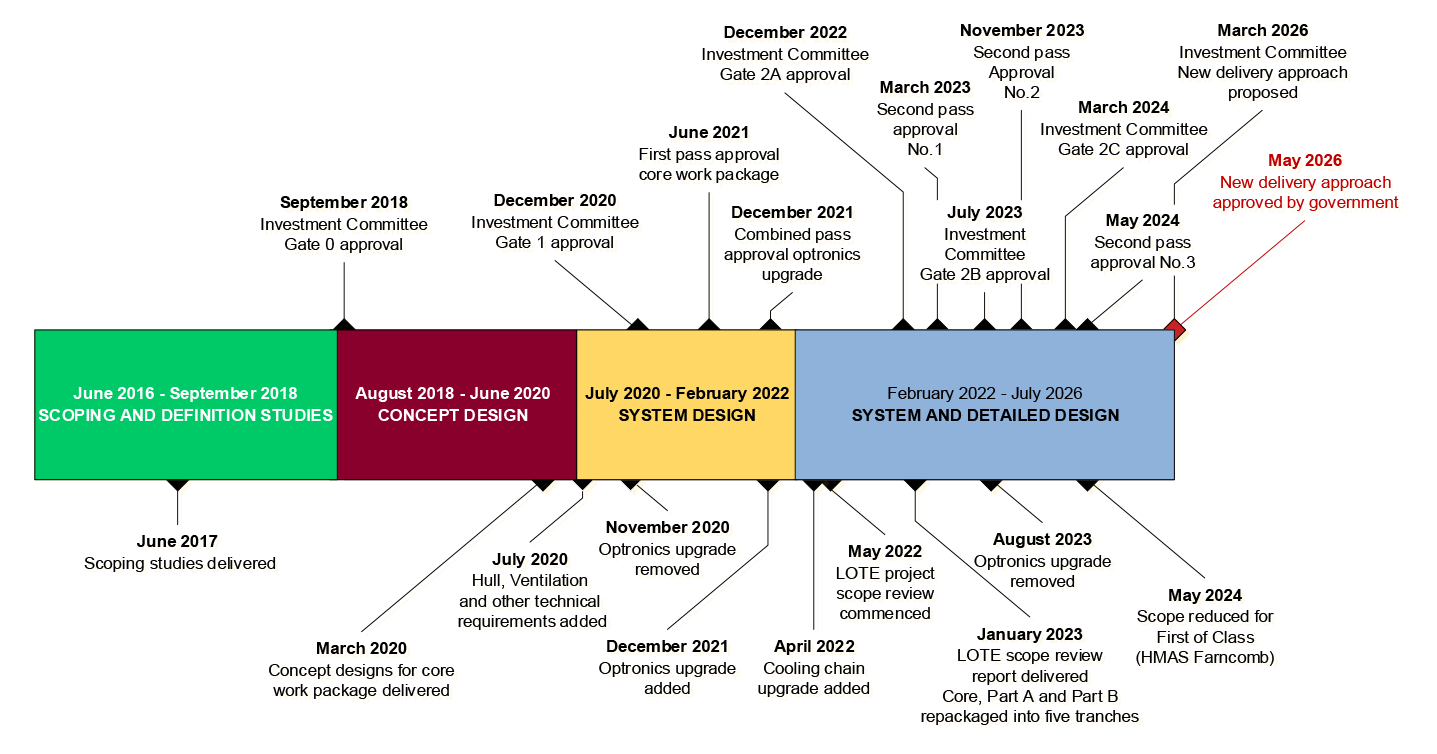
Note: As Defence progressed through the systems engineering lifecycle, funding for the Collins class LOTE was sought and approved incrementally. The funding requested by Defence and approved by government for the project is examined at Table 1.3.
Source: ANAO analysis of Defence documentation.
Project scope and schedule
1.6 According to the project schedule, concept design activities for the Collins class LOTE were to be completed by 30 June 2020 with all non-recurring engineering (design) work completed by June 2024.5 The upgraded systems and equipment developed under the project were intended to be installed on each submarine during its two-year Full Cycle Docking (FCD).6 The project schedule and delivery strategy approved in February 2021 are set out in Appendix 3, Figure A.1.
1.7 In May 2024, government agreed to reduce the scope of upgrades to be installed on the first-of-class submarine, HMAS Farncomb, during its FCD scheduled to commence in June 2026. This decision occurred following delays in completing the design work and advice from Defence that development of a new approach to install the equipment and system updates into the submarines within a two-year FCD was required. Figure 1.2 shows the scope of system upgrades planned for the Collins class submarines as at February 2026.
Figure 1.2: Collins class submarine — project scope as at February 2026
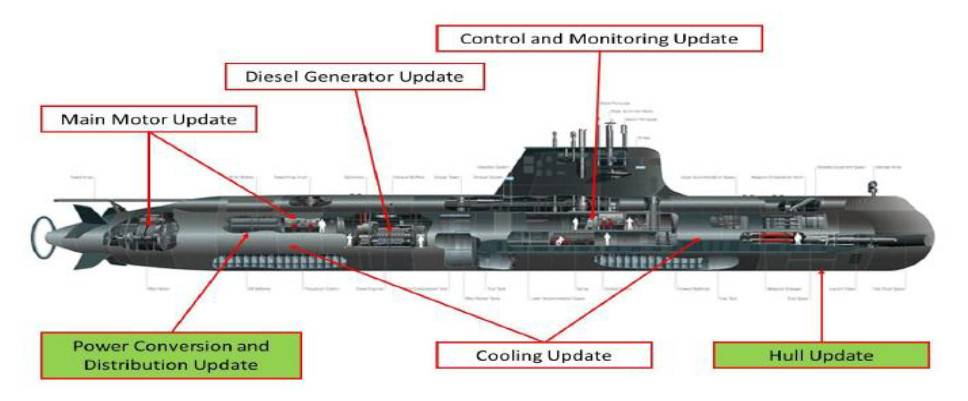
Note: The system updates highlighted in green were originally planned to be installed on HMAS Farncomb during its full cycle docking commencing in June 2026. As at February 2026, all six system designs are intended to be available for implementation across the remaining five Collins class submarines, commencing with HMAS Collins in 2028.
Note: The replacement main motor, diesel engine and power conversion and distribution system required associated updates to the control and monitoring system. In February 2022, Defence decided that the control and monitoring system upgrades would be managed as a separate sub-project.
Source: Extract from Defence documentation.
1.8 In May 2026, Defence advised government that design work was not complete, that the proposed upgrades could not be installed within a two-year full cycle docking period, and recommended that the delivery strategy for the LOTE project should be changed. Defence recommended, and government agreed, to a revised delivery strategy for the LOTE project that involves refurbishing and maintaining the existing systems instead of redesigning and replacing them for up to five of the six Collins class submarines. This is a fundamental shift in the delivery strategy.
Early funding prior to project approval
1.9 Until November 2020, the Collins LOTE did not have an approved project budget. Early scoping, definition and concept design activities were funded by the Collins Submarine and Future Submarine Programs. Between June 2016 and October 2020, Defence approved $58.2 million to support scoping studies, project definition and concept design work for the LOTE project.7
1.10 Of the $58.2 million approved during this period, $14.2 million was for scoping studies, $23.8 million to project definition studies and concept design work, and $20.2 million for determining Life of Type Buy requirements — that is, identifying the spare parts required to support the continued operation of key submarine systems until their originally planned withdrawal dates (see Table 1.2).
Table 1.2: Early funding for the Collins Life of Type Extension
|
Item |
Description |
Year approved |
Funding ($m) |
|
Scoping studies |
Platform, signature and combat system scoping studies. |
2016–17 |
14.2 |
|
Project definition and concept design |
Develop the LOTE project plan. Commence concept design activities and engage with suppliers. |
2017–18 |
16.5 |
|
2020–21 |
8.8 |
||
|
Life of Type Buy requirements |
Identification of spares to support the continued operation of the existing main motor, control system, power conversion and distribution systems. |
2019–20 |
20.2 |
|
Total funding for early planning and concept design work |
58.2 |
||
Source: ANAO analysis of Defence documentation.
Government approval of Collins class Life of Type Extension project funding
1.11 By March 2026, Defence had sought government approval of funding for the LOTE project on seven occasions. These approvals were sought progressively as the scope of the project developed and as design and procurement activities progressed.
1.12 The funding that has been approved by government for the LOTE project between November 2020 and May 2024 is set out at Table 1.3.
Table 1.3: Government-approved funding for the Collins class Life of Type Extension
|
Date |
Description |
Funding ($m) |
|
30 November 2020 |
Early access to $40 million of funding to procure long lead items. |
40.0 |
|
8 June 2021 |
First pass approval for the core work package and procurement of the replacement main motor and control system for First of Class (HMAS Farncomb). |
340.0 |
|
13 December 2021 |
Combined pass approval for an upgraded (non-hull penetrating) optronics and associated cooling system. |
381.0a |
|
12 September 2022 |
Additional funds for core work package. |
32.8 |
|
20 March 2023 |
Procurement of the replacement diesel generators for the First of Class (HMAS Farncomb). Completion of design and procurement of replacement main motor and control system for Second of Class (HMAS Collins). |
245.9 |
|
6 November 2023 |
Procurement of the replacement power conversion and distribution system, cooling chain upgrade, and the control and monitoring system for First of Class (HMAS Farncomb). |
219.8 |
|
6 May 2024 |
Continue design work and procurement of equipment and installation of completed work packages onto the First of Class (HMAS Farncomb). |
570.8 |
|
Total funding approved by government |
1,830.3 |
|
Note: In October 2025, Defence advised the ANAO that $27 million of the $381 million approved in December 2021 for the upgrade of the optronics and associated cooling system had been retained for the cooling system. Defence further advised that the remaining $354 million allocated for the optronics system had not been returned to consolidated revenue but could only be accessed with the approval of the Defence Finance Group.
Source: ANAO analysis.
Government direction
1.13 In October 2017, government directed that no capability gap was to emerge during the transition from the Collins class submarines to the Future Submarine fleet (the Attack class).8
1.14 In response to this direction, Defence advised its Investment Committee that the Collins LOTE project would need to extend the service life of no fewer than five Collins class submarines to maintain Australia’s submarine capability during the transition period.
1.15 In September 2021, government cancelled the Attack class submarine program and announced that Australia would pursue conventionally armed, nuclear-powered submarines through a new trilateral enhanced security partnership with the United States of America and the United Kingdom — known as AUKUS.9 On the same day, government also announced the approval of up to $6.4 billion to extend the service lives of all six Collins class submarines.10
1.16 The first SSN-AUKUS submarine is not expected to be delivered before the 2040s.11 To avoid a capability gap, in March 2023 the government announced that three Virginia class submarines would be procured from the United States of America and delivered from the early 2030s. Government has also directed Defence to maintain the in-service Collins class submarine capability until the Virginia class submarines are introduced into service and the transition to the future nuclear-powered submarine fleet has commenced.12
Administrative arrangements
1.17 The Royal Australian Navy (Navy) operates the Collins class submarines, with the Chief of Navy designated as the ‘Capability Manager’.
1.18 The Naval Shipbuilding and Sustainment Group (NSSG) is responsible for the delivery of the Collins class submarine program, including the management of ongoing sustainment activities, planned capability upgrades and the Collins LOTE project (see Figure 1.3).
Figure 1.3: Administrative arrangements for the Collins class submarines
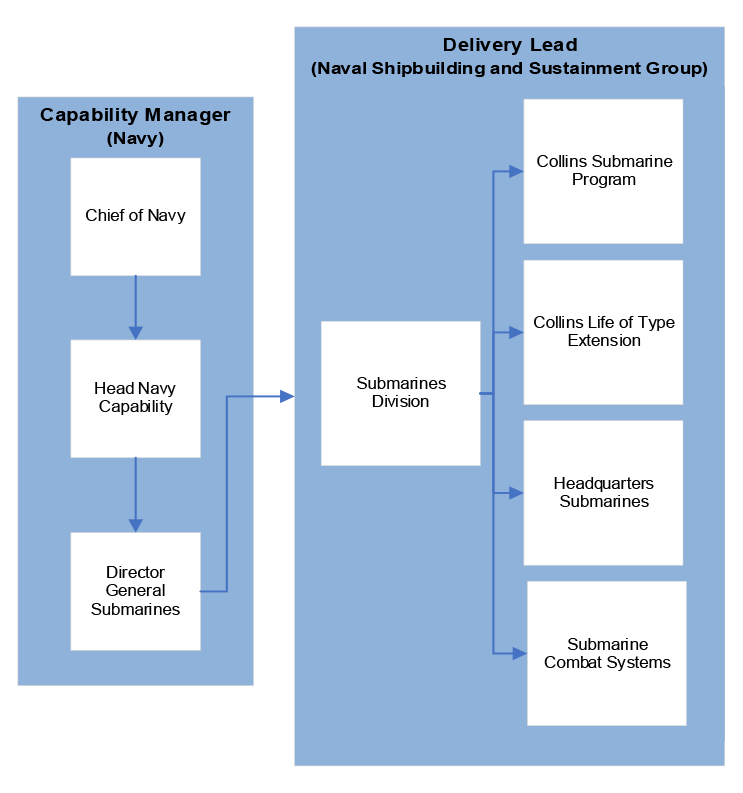
Note: Within NSSG, the Collins submarine program office is responsible for delivering safe and reliable submarines to meet government availability requirements. This includes planning and scheduling of maintenance activities, implementation of planned capability upgrades and managing the In-Service Support Contract with ASC.
Note: The Collins LOTE project office is responsible for managing the development of the system upgrades that Defence advised were required to extend the life of the Collins class submarines.
Source: ANAO analysis of Defence documentation.
Relationship and dependencies with other projects
1.19 The successful extension of the service life of the Collins class submarines depends on the timely and coordinated delivery of three related activities: the ongoing sustainment of the Collins class submarine fleet; the design, delivery and installation of the replacement equipment and upgraded systems being developed under the LOTE project; and the implementation of planned capability upgrades.
1.20 While these activities are managed as separate work programs, they are interdependent. Delays or constraints in one activity affects the scheduling, scope or delivery of the others.
Ongoing sustainment of the Collins class submarines
1.21 In September 2024, the ongoing sustainment of the Collins class submarines was designated a Product of Interest (POI) and escalated to a Product of Concern (POC) in November 2024. Product of Interest and Product of Concern reports are provided to the Minister for Defence Industry and to Defence’s Investment Committee monthly.
1.22 Defence’s POC reporting indicates that the escalation reflected forecasted impacts on submarine availability arising from delays in completing planned maintenance activities, the age of the platform, and the effects of industrial action undertaken by the ASC workforce between May and November 2024. As at March 2026, Defence documentation indicates that the Collins class submarine program is expected to remain a POC until October 2028.
Life of Type Extension project system replacements and upgrades
1.23 The Collins class LOTE project encompasses the design, delivery and installation of replacement equipment and upgraded systems that Defence advised was required to extend the service life of the submarines. The time available to install and test the upgrades is dependent on the timely completion of planned capability upgrades and on the availability of sufficient capacity during full cycle dockings.
Capability upgrade projects
1.24 Planned capability upgrades for the Collins class submarines (known as SEA1439) were intended to be installed on each submarine incrementally and accepted into service before the implementation of the LOTE upgrades, to ensure sufficient capacity within two-year full cycle dockings to install, test and evaluate the LOTE systems. The status of each capability upgrade project is set out in Table 1.4.
Table 1.4: Capability upgrade projects for the Collins class submarines (status as at February 2026)
|
Title |
Identifier |
Description |
Status |
|
Platform system improvements |
SEA1439PH3 |
Installation of upgrades to improve the reliability, sustainability, safety and capability of the Collins class submarines, including modifications to enable Special Forces exit and re-entry in selected hulls. |
Final operational capability (FOC)a was achieved in December 2023; project closed in 2024. |
|
Obsolescence management |
SEA1439PH3.1 |
Resolution of obsolescence issues in the Integrated Ship Control Monitoring and Management System (ISCMMS) and restoration of baseline functionality. The project did not introduce new capability. |
As at May 2025, the ISCMMS remediation had been installed on five of the six submarines.b |
|
Combat system sustainment |
SEA1439PH4 |
Replacement Combat System (RCS) and Combat System Continuous Improvement Program (CSCIP). Conducted as under a separate MOU with the USN. It is intended to deliver the USN AN/BYG-1 (V8) Tactical and Weapon Control System (TWCS) in a continuous improvement program that delivers regular hardware and software upgrades and shore facilities for integration, testing and training. |
FOC was achieved 2019; memorandum of understanding has been renewed to sustain the systems for a further 15-year period. |
|
Weapons and sensor improvements |
SEA1439PH4B |
Capability upgrades to address sonar and navigation system issues and to design, install and test an improved communications system. |
FOC achieved in early 2019. |
|
Replacement communications mast and antenna |
SEA1439PH5B.1 |
Capability upgrades to improve communications and electronic warfare systems and deliver the improved communications system to the remaining submarines. |
FOC achieved in October 2019; project closed in March 2021. |
|
Modernised submarine communications system |
SEA1439PH5B.2 |
Upgraded communications centre and improved capacity to enable high-data-rate satellite communications, to be delivered in two stages. |
Stage one installed in HMAS Collins and HMAS Sheean. Stage two approved in 2017, with FOC scheduled for 2026. FOC revised and now scheduled for 2029.b |
|
Sonar capability assurance program |
SEA1439PH6 |
Major system upgrade to improve sonar capability and performance, to be delivered in two phases. |
Tranche one approved in 2018, with installations occurring during Full and Mid-cycle dockings.b |
Note a: Final operational capability marks the point at which the capability manager (for example, the Chief of Navy) agrees that all the other prerequisites to a functional capability have been delivered and that the final, or full, capability can be employed operationally.
Note b: In April 2024, the SEA1439PH3.1, SEA1439PH5B.2 and SEA1439PH6 projects were merged into a single project: SEA1439PH6, to upgrade the communications and sonar systems of the Collins class submarines. The upgrades are to be installed across the fleet by 2029.
Source: ANAO analysis of Defence documentation.
Rationale for undertaking the audit
1.25 Successful execution of the Collins class Life of Type Extension project is critical to maintaining Australia’s submarine capability during the transition to the SSN-AUKUS fleet of nuclear-powered submarines. The project has an approved budget of $1.56 billion (2021–22 to 2031–32) and has been assessed by Defence as a high-risk project. Given ongoing parliamentary interest in the project, this audit provides independent assurance to Parliament on the effectiveness of Defence’s planning and implementation of the Life of Type Extension, including progress achieved to date.
Audit approach
Audit objective, criteria and scope
1.26 The audit objective was to examine the effectiveness of Defence’s planning and implementation of the Life of Type Extension for the Collins class submarine fleet.
1.27 To form a conclusion against the objective the following high-level criteria were adopted.
- Did Defence effectively identify requirements and assess options?
- Has Defence established effective governance, oversight and risk management arrangements?
- Has Defence effectively undertaken the planning and implementation activities required to commence the life of type extension?
1.28 The audit examined Defence’s planning, governance, risk management, project management, and monitoring and reporting of progress. The audit did not examine Collins class submarines operations, the effectiveness of sustainment arrangements, or the management of planned capability upgrades.
Audit methodology
1.29 The audit methodology involved:
- review of documentation held by Defence relevant to the Collins Life of Type Extension project;
- meetings with Defence personnel and contractors, including ASC Pty Ltd; and
- on-site fieldwork at Defence premises in Canberra and Osborne North in South Australia, where the Full Cycle Dockings of the Collins class submarines are conducted.
1.30 The audit was conducted in accordance with the ANAO Auditing Standards at a cost to the ANAO of approximately $1,330,300.
2. Identify requirements and assess options
Areas examined
This chapter examines whether the Department of Defence (Defence) effectively identified the requirements and assessed available options to extend the life of the Collins class submarines.
Conclusion
Defence’s arrangements to identify requirements and assess options for the Collins class LOTE were partly effective. Defence identified a business need to avoid a capability gap by extending the service life of the Collins class submarines. The LOTE project was originally positioned to mitigate risks with Defence’s transition from the Collins class submarines to the Attack class. Defence did not ensure that emerging risks to the Attack class program, or the fact that alternative submarine capability options were being examined, were disclosed to the personnel making key LOTE scope, procurement and design decisions. Following the cancellation of the Attack class program, the LOTE became critical as the bridging capability to support the transition to delivery of the nuclear-powered submarines under the AUKUS trilateral partnership. This heightened the importance of robust option-setting and clear, timely advice to government when key assumptions changed.
From 2019, Defence shaped the scope and delivery approach for the LOTE around an explicit decision to align the LOTE with the Attack class submarine program. This alignment involved a major redesign of the Collins class submarines that required the replacement of key equipment and systems. This decision was driven by an expectation of cost and schedule benefits, from having common systems and as a method to mitigate risks in the Attack class program. Alignment of the Collins LOTE with the Attack class program was adopted without robust options analysis or a comprehensive risk assessment. This effectively foreclosed consideration of alternative delivery strategies and constrained advice to government at key decision points. Subsequent reviews found the decision to align the LOTE with the Attack class program transferred significant design, schedule and integration risks to the project.
When the Attack class program was cancelled in 2021, the rationale for the alignment strategy no longer held. Defence did not systematically reassess the scope, delivery strategy or available options for the LOTE, nor did it present alternatives or advise government of the risks in a timely way. In May 2026, Defence proposed, and the government agreed, to a revised delivery approach for the LOTE. This revised approach is centred on refurbishing and retaining existing systems and equipment to maintain availability of the Collins class submarines out to 2048.
Areas for improvement
The ANAO made four recommendations aimed at improving the identification and evaluation of options and completeness of advice provided to government and senior leaders.
2.1 The Defence Capability Manual applies to all major expenditure decisions taken by Defence, including major military equipment projects. The manual emphasises the importance of clearly identifying and defining the business need, capability requirements and project scope during the early planning phases. It also sets out expectations that, in developing major investment proposals, Defence will identify, evaluate and assess available options, and provide accurate and timely advice to support informed investment decisions by senior Defence leaders and government.
Did Defence effectively identify and define the business need, capability requirements and scope of the project?
Defence identified that the business need for the Collins class LOTE was to maintain submarine capability and availability through the transition to the future submarine fleet. From 2019, however, Defence shaped the project scope to align the LOTE with the Attack class submarine program, including the adoption of common designs, systems and equipment. This approach established a significant interdependency and materially increased the scope’s complexity by introducing major system replacement and integration activities on an ageing platform before feasibility, whole-of-platform impacts and workforce requirements were well understood.
Following the cancellation of the Attack class program, Defence did not adequately reassess the project scope to reflect the changed circumstances. Subsequent scope reviews, revisions and reductions indicate that this interdependency altered the project’s risk profile and reduced the stability and defensibility of the scope approved at key decision points.
Business need
2.2 The need for a potential Life of Type Extension (LOTE) of the Collins class submarines was first identified by Defence in 2009.13 In April 2011, Defence commenced work to determine whether a service life extension was technically feasible. As part of this work, Defence engaged with industry and sought input from subject matter experts, including the United States Navy (US Navy), Babcock Pty Ltd (Babcock) and Saab Kockums, the original designer of the Collins class submarines.
2.3 This work culminated in the ‘Service-life Evaluation Program Report’, delivered by Defence and ASC Pty Ltd (ASC) in October 2012. The report noted that the US Navy had recommended further review and additional information in some areas. Overall, the report concluded that:
no single technical issue in isolation was identified that would fundamentally prevent the Collins Class Submarines from achieving their Planned Withdrawal Dates or an extension of one operating cycle14, providing that identified remedies (Obsolescence Management Plan) are further developed and implemented and that sufficient resources are allocated to the identified tasks.
2.4 In 2014, Defence engaged Babcock to conduct an independent engineering review of the October 2012 Service-Life Extension Program Report. This review found that the methodology used provided adequate analysis at the equipment and sub-system level. It also concluded that, as presented, the report did not provide sufficient evidence to demonstrate that risks could be mitigated at a whole-of-platform (‘whole boat’) level to support a service life extension.
2.5 At the same time, in October 2014, Defence commissioned a separate study into the feasibility of developing an ‘evolved’ Collins class submarine in collaboration with Saab Kockums.15 This work was undertaken as part of Defence’s broader efforts to identify options to replace the ageing Collins class submarines.16 The study found that modifying the existing Collins class design to incorporate contemporary systems was technically feasible. It also found that replacing major systems — such as the main motor, diesel generators, and power conversion and distribution system — would require design work comparable to that of a new submarine build and a funding profile consistent with a new acquisition.
2.6 Work to develop the capability requirements and scope of the LOTE project commenced in June 2016. In September 2018, Defence formally established the Collins class LOTE project. The objective of the project, which has largely remained unchanged, is to prevent a capability gap emerging during the transition to the future submarine fleet, by ensuring that the Collins class submarine fleet can continue to operate, and remain available and reliable, through to 2048 (see Table 1.1).
Capability requirements
2.7 In planning for a Life of Type Extension, Defence sought to consolidate the operating requirements for the Collins class submarines through the development of a Statement of Operating Intent. The Statement of Operating Intent was approved in April 2013 and revised in November 2018.17 The purpose of this document is to:
clearly articulate the Capability Manager’s needs regarding the Submarine Capability … and provide the context and boundaries to enable effective, sustainable, safe and environmentally compliant operation through the Capability Life Cycle.
2.8 In other words, the document explains what the Capability Manager (the Chief of Navy) requires from the submarines, how they are to be used, and any limits that apply so the submarine can be operated effectively, safely, and sustainably. To meet preparedness requirements, Defence must have at least two submarines consistently available (see Figure 2.1).
Figure 2.1: Availability requirements of the Collins class submarines
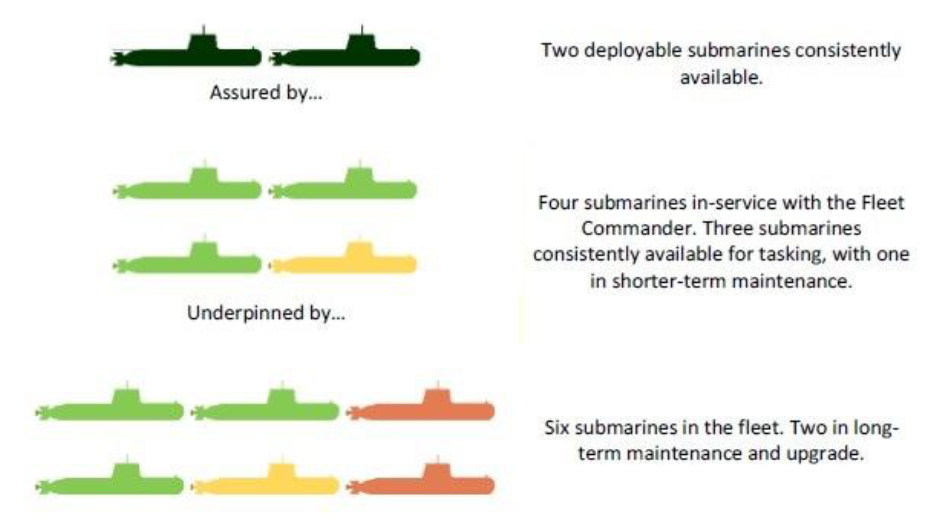
Source: J Coles, Study into the Business of Sustaining Australia’s Strategic Collins Class Submarine Capability, Beyond Benchmark Report, May 2016, Commonwealth of Australia 2016.
2.9 The Materiel Acquisition Agreement for the LOTE project states that its purpose is to ensure that a capability gap does not emerge during the transition to the future submarine fleet by maintaining Australia’s existing in-service submarine capability. In other words, the project aims to ensure that the submarines can continue to do everything they are currently capable of doing. Between 2016 and 2017, Defence engaged ASC, Thales, BAE and Raytheon Australia to conduct platform, combat system and signature scoping studies. These studies identified equipment and systems exposed to ‘very high’, ‘high’ or ‘medium’ risk of failure that could prevent the Collins class submarines from operating for a further 12 years, out to 2048.
2.10 Between June 2016 and April 2022, the project scope was revised five times. These changes were made in response to shifts in planning assumptions, delays in finalising the core work package, and the realisation of design, technical and schedule risks.
Planning assumptions
2.11 Defence’s planning assumptions for the life of type extension evolved over time in response to changes in the anticipated withdrawal of the Collins class submarines and delays in the introduction of their replacement. In 2016, Defence planned for three of the six Collins class submarines to undergo a service life extension. In December 2018, these assumptions were re-examined due to expected delays in the delivery of the Attack class submarines. In November 2020, Defence recommended, and government agreed, that at least five submarines would undergo a life of type extension. This decision was also intended to support broader government priorities, including those outlined in the 2017 Continuous Naval Shipbuilding Plan and the Submarine Capability Transition Plan. In June 2021, government agreed that all six Collins class submarines would undergo a service life extension to avoid a capability gap as Navy transitioned to the future submarine fleet — previously, the Attack Class submarines, and now the nuclear-powered submarine.
Delays to finalise the core work package
2.12 The project definition phase commenced in July 2017. During this phase, Defence identified and prioritised the proposed system updates into three work packages: Core, Part A and Part B.18 By August 2018, Defence had established 17 sub-projects to oversee the design, development and implementation of the proposed system and equipment upgrades across eight systems (see Table 2.1).
Table 2.1: List of sub-projects proposed for each work package in August 2018
|
Count |
System |
Sub-project title |
Description |
Work package |
Estimated cost ($m) |
|
1 |
Hull |
Hull, Tank, Pressure Vessel and Casing |
Develop and implement measures to better manage the condition of pressure vessels, hull, tanks, and casing and conduct hull fatigue data collection, research and modelling. |
Core |
74.3 |
|
2 |
Hull and Hull Fitting Procurement |
Conduct life of type buys for acoustic windows, hull plate, hull forgings, hatches, flexible couplings. |
Part A |
249.0 |
|
|
3 |
Combat |
Combat system |
Conduct technology refresh updates of combat systems to support the amended planned withdrawal date. |
Part A |
324.1 |
|
4 |
Non-Hull Penetrating Search Periscope Update |
Replace current hull penetrating search periscope with non-hull penetrating periscope consisting of optronic payload on mast raising equipment. |
Core |
266.6 |
|
|
5 |
Combat system |
Conduct life of type buy for spares for current combat systems to achieve planned withdrawal date and conduct technology refresh updates of the systems to achieve the amended planned withdrawal date. |
Core |
507.1 |
|
|
6 |
Combat system |
Conduct technology refresh updates of combat systems to achieve amended planned withdrawal date. |
Part B |
382.1 |
|
|
7 |
|
Power conversion and distribution system |
Conduct life of type buy of spares for current power conversion and distribution system to achieve planned withdrawal date and replace power conversion and distribution system to achieve amended planned withdrawal date. |
Core |
203.8 |
|
8 |
Electrical |
Degaussing control system and coil system |
Update current degaussing and control system with closed loop control system and update degaussing coils.a |
Part A |
109.6 |
|
9 |
Gas detection system |
Update the gas detection and radiac systems.b |
Part A |
49.6 |
|
|
10 |
Mechanical |
Weight compensation, trim and control system |
Replace weight compensating, trim and control system to achieve amended planned withdrawal date. |
Part A |
143.0 |
|
11 |
Weapon discharge system, submerged signal ejector and air purification |
Conduct life of type buy for spares to implement rotatable pool and conduct additional maintenance on the weapons discharge system and submerged signal ejectors to achieve amended planned withdrawal dates and replace air purification unit. |
Part A |
611.1 |
|
|
12 |
General mechanical system upkeep and update |
Conduct multiple minor life of type buys and upkeep and update activities to achieve amended planned withdrawal date. |
Part B |
578.1 |
|
|
13 |
Propulsion |
Diesel generator update |
Conduct life of type buy of spares for current diesel generators to achieve planned withdrawal dates and replace diesel generators to achieve amended planned withdrawal dates. |
Core |
536.4 |
|
14 |
Main motor and control system |
Conduct life of type buy of spares for the current main motor and control system to achieve planned withdrawal date and replace main motor and control system to achieve planned withdrawal date. |
Core |
896.0 |
|
|
15 |
Safety |
Halon system update |
Conduct life of type buy of halon for current fire suppression system to achieve planned withdrawal date and replace the halon system and Aqueous Film Forming Foam (AFFF) system to achieve amended planned withdrawal date. |
Core |
101.3 |
|
16 |
Signatures |
Signature remediation |
Conduct ranging activity after major wargaming activity (RIMPAC) scheduled for 2020. |
Core |
9.8 |
|
Conduct multiple minor updates to remediate signature deficiencies. |
Part B |
269.1 |
|||
|
17 |
Control |
Ship control system update |
Update Ship Control System to achieve amended planned withdrawal date. |
Part B |
192.3 |
|
Total cost estimate of all work packages |
5,503.3 |
||||
Note a: Degaussing is the process of decreasing or eliminating remnant magnetic fields from equipment.
Note b: Radiac systems are used for radiation, detection, indication and computation.
Note: The shaded rows identify the sub-projects that were to comprise the core work package. The other sub-projects designated as ‘core’ that are not highlighted were proposed but not selected.
Source: Defence documentation.
2.13 In December 2019, Defence advised ASC that three sub-projects — the main motor and control system upgrade and diesel generator update projects (together comprising the propulsion system), and the power conversion and distribution system (the electrical system) — would be included in the core work package (see Table 2.1). In February 2020, the planned replacement of the periscope (the optronics system) was reintroduced into the core work package.
2.14 Defence completed a risk assessment of the updates that had been proposed for inclusion in the core work package in May 2020. The findings from the risk assessment highlighted that the designs of the main motor, diesel generator, optronics system, and the power conversion and distribution system were feasible, however the impact of the proposed updates on other systems had been overlooked. The risk assessment further found that the design of the replacement diesel generators reduced the submarine’s ability to clear toxic gases and maintain airflow, and that the replacement propulsion and optronics systems would consume more power. As a result, the scope of the project was expanded to: include updates to the induction and battery ventilation system; additional technical requirements; and re-introduce hull, pressure vessel and casing work (see Figure 2.3).
2.15 In November 2020, the optronics upgrade was removed from the core work package due to affordability issues. Following government approval in December 2021, the optronics upgrade was re-instated. In April 2022, an update to the cooling system was added. The scope of the core work package as at June 2022 is shown in Figure 2.2.
Figure 2.2: Collins class submarine: core work package — June 2022
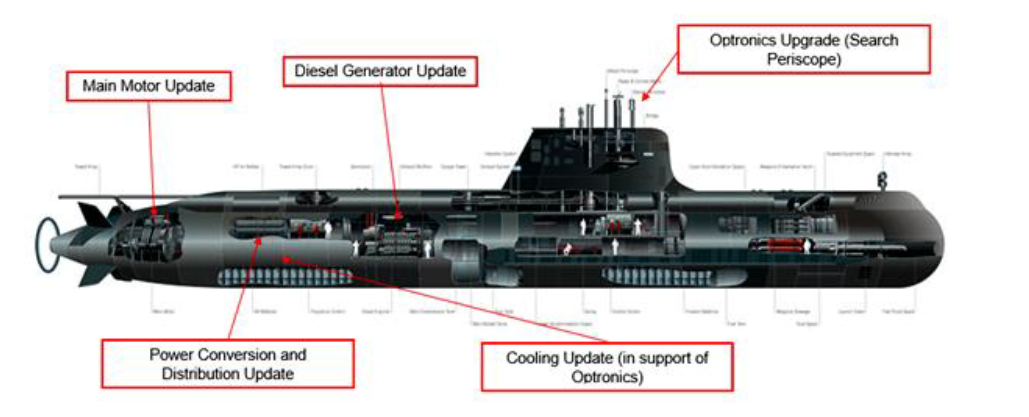
Source: Defence documentation.
2.16 Figure 2.3 identifies the changes that have been made to the scope of the project between February 2020 and March 2026.
Figure 2.3: Changes made to the scope of the Life of Type Extension project
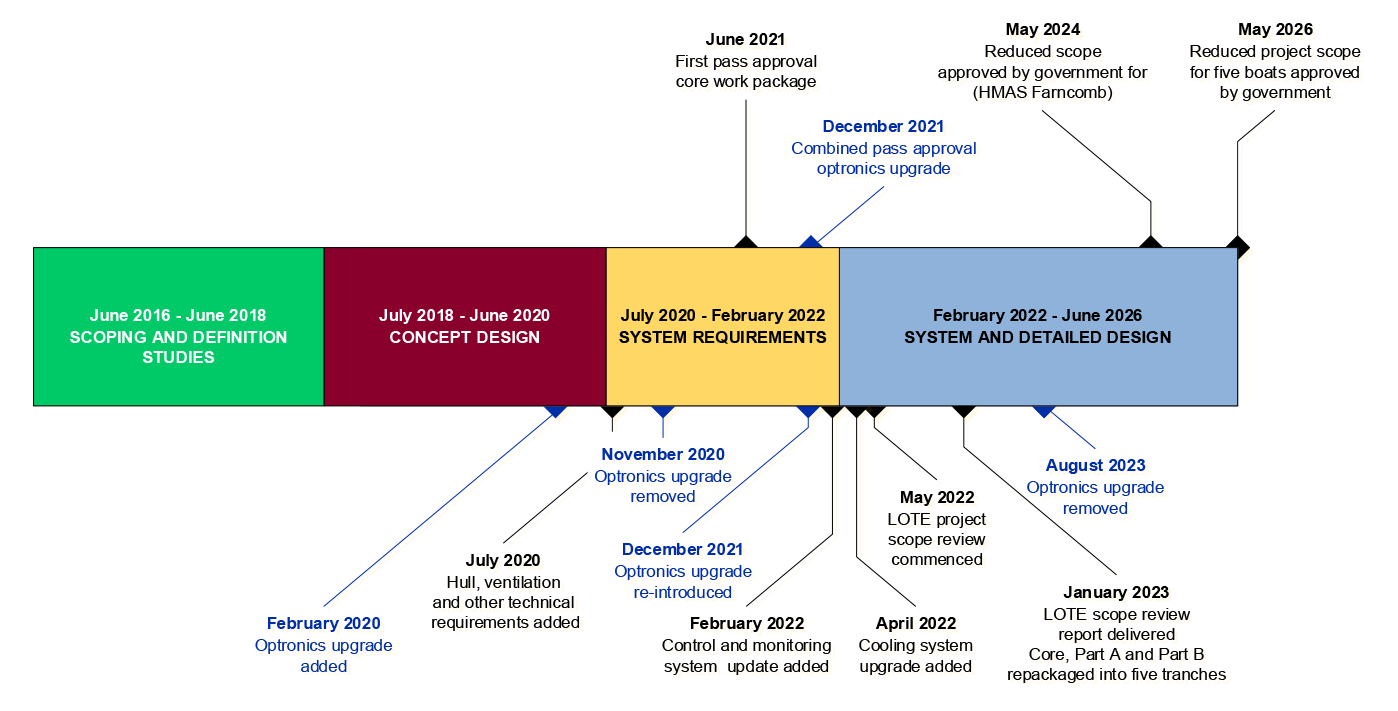
Note: Blue text indicates the decisions relating to the proposed optronics upgrade.
Source: ANAO analysis of Defence documentation.
Realisation of design, technical and schedule risks
2.17 In February 2019, Defence decided to maximise design and cost efficiencies for the Attack class submarine program by using common equipment, technologies and suppliers for the Collins Life of Type Extension project. The intended benefit of this approach was to generate synergies in design, manufacture, testing, operations and in-service support.
2.18 As a consequence, the LOTE project was expected to resolve certain design risks for the Attack class submarine program. At the same time, the project was also required to integrate the new equipment into an ageing platform within a two-year full cycle docking period.
2.19 A Defence risk assessment of the concept designs undertaken in May 2020 noted that the feasibility of installing the updates within the two-year full cycle docking period had not been assessed. The risk assessment also stated that elements of the design for a replacement propulsion system were either unproven at sea or exhibited low technical readiness. In this context, the risk assessment acknowledged that:
given the [Commonwealth] specified the propulsion motor to align with the [Attack Class Submarine Program], we must accept an element of ‘we get what we get’.
2.20 The highest design risks identified related to the replacement main motor and control system and the diesel generators. The assessment identified that:
- an additional eight cubic metres of space would be required to accommodate the new equipment, increasing the extent of changes required to the submarines’ general arrangement;
- the increased power consumption of the replacement propulsion system would require additional cooling, with potential implications for the submarines’ signature and other key operating characteristics; and
- the replacement diesel generators were smaller and less effective at clearing toxic gases, increasing the amount of time required for ‘snorting’ — a process involving the submarine rising to periscope depth and extending its snorkel mast to exchange air.
2.21 In November 2021, ASC reviewed the suitability of the LOTE scope. In this review, ASC observed that many of the risks that had originally supported a major system update had been addressed and that retaining the existing propulsion system may present a lower technical risk than introducing a new system. The review also noted that non-technical factors and possible future performance requirements during the LOTE period would need to be considered in determining the optimal approach. ASC therefore recommended that the scope of the project be comprehensively reassessed. These considerations informed Defence’s decision to undertake a scope review in 2022.
Scope reviews
2.22 As outlined in paragraphs 2.3 to 2.5, Defence had received advice as early as 2014 that replacing major propulsion and electrical systems on the Collins class submarines would involve whole-of-platform integration challenges comparable to those associated with a new-build submarine.
2.23 Following the cancellation of the Attack class program, Defence and ASC conducted a LOTE scope review in 2022. The review revisited the 2017 scoping studies, 2018 principal engineer reviews, the 2021 ASC review, and changes in the operating environment to test whether the original scope and delivery approach remained appropriate. The review found that the risks associated with the existing propulsion system had reduced, except for one component — the main propulsion switchboard — which remained assessed as ‘very high’. Overall, it concluded that the risk associated with retaining the main propulsion system and diesel generators had reduced, from ‘very high’ to ‘high’. Defence then decided to proceed with the previously planned, Attack class-aligned approach to replace the propulsion system (rather than retain the existing main motor and diesel generators).
2.24 The 2022 LOTE scope review was not a full reassessment of the impact of the cancellation of the Attack class. Rather, it reassessed the previously assessed risks associated with continuing to operate the Collins class with existing equipment out to between 2038 and 2048 — the amended planned withdrawal dates set out in Table 1.1. It did not reconsider the risks associated with continuing to integrate new equipment and systems into the submarines or the feasibility of installing the upgrades within the schedule. Defence assumed that these risks would be reduced as the project progressed through the systems engineering lifecycle. Those risks were not reduced as assumed. While earlier planning documents had emphasised the benefits of aligning the LOTE with the Attack class program, the 2022 review framed the proposed scope primarily in terms of keeping the Collins class submarines operational, without revisiting the original rationale for selecting Attack-aligned solutions.
2.25 By May 2024, design, schedule and integration risks associated with of the core work packages had materialised and could not be reduced as planned. Defence sought and obtained government approval to reduce the scope of the project for installation on HMAS Farncomb (see Figure 1.2)19, removing three elements of the core work package that were similar to those that had previously been identified in 2014 as technically complex to integrate (see paragraph 2.5).
2.26 The scope reduction was intended to provide additional time to address these design, schedule and integration risks by deferring installation of the removed work packages to later submarines, commencing with HMAS Collins during its next full cycle docking period, scheduled for 2028. However, Defence had not demonstrated that the underlying integration challenges associated with these work packages — which had been identified in earlier planning — had been resolved or materially changed.
2.27 By October 2025, the design, technical and schedule risks had not been reduced to an acceptable level and Defence acknowledged that the original approach was no longer feasible. In March 2026, Defence proposed to its Investment Committee that the scope of the LOTE project be significantly reduced. The proposed approach included refurbishing and maintaining the existing propulsion system, rather than redesigning and replacing it for up to five of the six Collins class submarines. This work did not provide assurance that the integration and installation risks associated with the previously deferred work packages could be resolved within the project’s schedule or delivery constraints and in May 2026, Defence recommended and government agreed to the revised delivery strategy.
Did Defence effectively identify, assess and evaluate the available options?
Defence’s approach to identifying, assessing and evaluating options for the LOTE was constrained by its decision to align the project with the Attack class submarine program. Once adopted, this approach effectively foreclosed consideration of alternative delivery strategies. Defence did not present government with alternative options to deliver the LOTE, including after the cancellation of the Attack class program in 2021, and this constraint persisted despite the changed circumstances.
Although Defence undertook a LOTE project scope review in 2022, the review did not examine alternative delivery approaches or test whether continuing with major system replacement remained justified. Work to identify possible alternative approaches to deliver a life of type extension for the Collins class submarines commenced in June 2024, however Defence continued to progress major system replacement as the preferred approach until October 2025, when risks were unable to be reduced to an acceptable level.
In March 2026, Defence proposed an alternative option to deliver a life of type extension for the Collins class submarines. The recommended option was presented to government in May 2026 and involves refurbishing and maintaining existing systems instead of redesigning and replacing them for five of the six Collins class submarines. This is a fundamental shift in the delivery strategy for the project.
Identification of available options
2.28 Defence commenced work to identify available options to deliver a Life of Type Extension (LOTE) in 2016, completing initial scoping studies in July 2017. In 2018, Defence conducted risk assessments for the systems proposed for replacement or upgrade, as the project prepared for Gate 0 consideration by Defence’s Investment Committee.20
2.29 Defence’s capability development framework in effect at the time required the Gate 0 business case to present a set of feasible and achievable options to meet the business need. Instead, the LOTE business case focused on determining the number of submarines to be extended and prioritising systems to be addressed, rather than presenting alternative delivery approaches for achieving the life of type extension. It stated that the project aimed to extend the service life of the Collins class submarines by sustaining the existing submarine capability largely on a like-for-like basis.
Assessment and evaluation of options
2.30 In August 2018, Defence engaged ASC to develop concept design reports and business cases for further consideration as part of the project definition phase.
2.31 By early December 2018, Defence identified that the LOTE project could be used to ‘de-risk’ the Attack class submarine program by selecting, designing, and trialling common equipment and technologies across both submarine classes. This approach was intended to reduce delivery risk and delays for the future fleet.
2.32 Defence formalised this approach when it issued updated tasking statements to ASC in August 2019. The tasking statements directed that, as far as practicable, the development of the replacement systems for the Collins — particularly the main motor and control system — be aligned with those proposed for the Attack class submarine program to maximise synergies in equipment and the supply chain and minimise duplication.
2.33 In October 2020, Defence reviewed the business case and project execution strategy prior to seeking Gate 1 approval from Defence’s Investment Committee. As part of this process, the Chief of Navy was provided with advice from Defence’s Contestability function.
Since Gate 0 it has been decided that, where possible, Collins class LOTE will act as a mitigation activity by replacing systems with those of the same type as the selected suppliers for the Attack class. The Sponsor [Navy] has advised that using the same equipment suppliers for both the Attack and Collins classes will maximise synergies and minimise costs for design, manufacture, test and trials, operation and in-service integrated logistic support and benefit crew training in the transition from Collins to Attack class.
2.34 The same advice noted that the Gate 1 business case did not present alternative options for government consideration or include a value for money assessment. Nevertheless, Defence’s Investment Committee endorsed the project progressing to First Pass.21
2.35 In June 2021, the project received government approval to proceed with engineering and design work to: update the main motor; diesel generators and power conversion and distribution systems of the Collins class fleet; and procure a replacement main motor and control system for installation on HMAS Farncomb in June 2026.
Cancellation of the Attack class submarine program
2.36 The cancellation of the Attack class program in September 2021 removed the anticipated design, trial and testing, training, and integrated logistic support synergies that had underpinned the LOTE delivery approach. This materially altered the assumptions used to justify the selection of common equipment, technologies and suppliers across the two submarine classes (see paragraph 2.19).
2.37 In November 2021, ASC conducted a study examining whether the proposals to replace key systems — including replacing the main motor and diesel generators — should be reconsidered.22 The study identified improvements in maintenance processes since the 2017 scoping studies were undertaken and concluded that the risk that the propulsion system would fail prior to the amended planned withdrawal dates had reduced from ‘very high’ to ‘high’.23
2.38 Defence and ASC subsequently conducted a scope review between May 2022 and January 2023 to consider ASC’s November 2021 recommendations and validate the project’s scope. The review confirmed that replacing key systems remained the preferred approach but did not examine alternative delivery options or fully assess the risks associated with integrating new equipment and technologies into the Collins class submarines (see paragraph 2.25).
2.39 Advice from Defence’s Contestability function in March 2023 described the scope review as a missed opportunity to revisit the assumptions underpinning the LOTE delivery approach. This concern was reinforced by the independent review commissioned by the Minister for Defence Industry in October 2023 and delivered to government in June 2024. This review (led by Gloria Valdez24) found that Defence did not revisit the project strategy following the cancellation of the Attack program and remained focused on major system replacement.
Recommendation no.1
2.40 The Department of Defence ensure that, following significant program changes or shifts in its strategic environment, all underlying assumptions, risks and delivery approaches are systematically reassessed, and alternative options are presented for government consideration.
Department of Defence response: Agreed
2.41 Defence’s early decision to align the LOTE project with the Attack class submarine program created significant interdependencies between the two projects. While this approach offered potential efficiencies if the Attack class program proceeded, Defence did not present alternative options to government and did not reassess the delivery strategy when the underlying assumptions changed.
2.42 The risks inherited by the Life of Type Extension project as a result of these interdependencies remained following the cancellation of the Attack class submarine program and were realised in May 2024, resulting in a reduction in scope for the installation on HMAS Farncomb (see paragraph 2.25). Early work to identify possible alternative approaches to deliver a life of type extension for the Collins class submarines commenced in June 2024, however Defence continued to progress major system replacement as the preferred approach until October 2025, when the risks had not reduced to an acceptable level.
2.43 In March 2026, Defence proposed an alternative strategy to deliver a life of type extension for the Collins class submarines to its Investment Committee. The proposed alternative strategy is to refurbish and maintain existing systems, instead of redesigning and replacing them for up to five of the six Collins class submarines. This represents a fundamental shift in the delivery strategy for the project. In May 2026, Defence recommended, and government agreed, to this revised delivery strategy.
Recommendation no.2
2.44 The Department of Defence present the rationale, value for money analyses, and risks to major capability investments when establishing significant interdependencies between projects or programs.
Department of Defence response: Agreed
Has Defence appropriately advised senior leadership and government?
Prior to the cancellation of the Attack class submarine program, Defence’s advice to government and senior Defence leadership emphasised the anticipated benefits and opportunities associated with aligning the Collins class LOTE with the Attack class submarine program.
Following the cancellation of the Attack class program in 2021, Defence did not clearly advise government of the implications of continuing the original LOTE delivery approach. Nor was government presented at that time with alternative delivery options or a reassessment of the Life of Type Extension strategy. In contrast, senior Defence leadership was progressively informed of the significance, challenges and risks that had been transferred to the LOTE project
Early advice to senior leadership and government
2.45 The Life of Type Extension (LOTE) of the Collins class submarines is a critical initiative to sustain Australia’s sovereign submarine capability and mitigate the risk of a capability gap emerging during the transition to a future submarine fleet. As a ‘high’ risk project, the provision of accurate and timely advice to Defence senior leadership and government is essential.
2.46 The requirement for a LOTE was first included in advice to government in October 2014. Government subsequently agreed to extend the life of the Collins class and directed Defence to maintain a regionally superior submarine capability.25 Between 2014 and 2018, Defence provided regular updates to government on the state and availability of the Collins class submarine fleet, as well as ongoing work to identify the requirements and potential scope for a life of type extension.26 These updates also supported funding requests, including a $24 million allocation in October 2016 to conduct scoping studies27, the results of which were presented to government in November 2017.
2.47 Advice provided during this period supported government decision-making regarding the materiel state of the Collins fleet and the measures required to avoid a capability gap emerging during the transition to the Attack class submarines.
Role of the Collins Class Life of Type Extension in transition planning
2.48 In December 2018, Defence identified opportunities to achieve efficiencies in design, testing, evaluation, and submariner workforce training by trialling the new equipment and systems intended for the Attack class submarine on the Collins class submarines as part of the LOTE.28 Defence’s advice to government between 2018 and 2020 highlighted the efficiencies expected from aligning the LOTE with the Attack class program, including opportunities to de-risk future submarine delivery by aligning equipment and suppliers, and trialling new equipment on the Collins class submarines.
2.49 This advice did not comprehensively articulate the risks associated with the proposed approach. In particular that:
- pursuing common equipment and suppliers created significant interdependencies between the Collins LOTE and future submarine program, transferring design and integration risks to the LOTE project; and
- the risks associated with integrating new equipment into an existing platform — particularly those relating to existing technologies, physical access limitations and fixed scheduling constraints — exceeded those typically encountered in new-build programs.
2.50 Defence did not provide government with a balanced assessment of both the risks and opportunities associated with the proposed approach or provide alternative options (delivery strategies) to extend the life of the Collins class submarines, as required.
Recommendation no.3
2.51 The Department of Defence ensure that its advice to government on strategically important projects such as the Collins class LOTE clearly articulates both risks and opportunities, associated with the delivery strategy for a project, particularly where there are significant interdependencies with other major projects or programs.
Department of Defence response: Agreed
First and Second pass approvals for the Life of Type Extension project
2.52 Government provided First and Second pass approvals for the LOTE project through broader program updates. These included the continuous naval shipbuilding program, overseen by the Naval Shipbuilding Enterprise and Governance (NSEG) committee29, and the Maritime Undersea Combat and Surveillance program until May 2024. Defence sought First Pass approval in June 2021 as part of a Naval Shipbuilding Enterprise and Governance update.
2.53 A series of Second Pass approvals for the project were sought in September 2022, March 2023 and November 2023 through Maritime Undersea Combat and Surveillance program updates for the core work package, design work and the procurement of a replacement power conversion and distribution system, cooling chain upgrade, and the control and monitoring system for installation on HMAS Farncomb (see Table 1.3). In May 2024, Defence gained approval for a further $570.8 million in funding to complete design work and procure the remaining equipment through a specific SEA1450 project update provided to government.
Impact of the decision to cancel the Attack class program
2.54 Between December 2020 and June 2021, Defence advised government that significant risks had been identified in the Attack class submarine program. These risks were first communicated to government in December 2020. In response, government agreed to progress work to identify alternative submarine capability delivery options. This work commenced in early 2021, concluded in mid-2021, and included an examination of possible alternative delivery options.
2.55 While alternative submarine capability options were under development following the identification of risks in the Attack class program, Defence did not advise government of the likely implications for the LOTE project arising from the extent of the interdependencies and shared design risks. When the Attack class program was cancelled, this resulted in the loss of anticipated design, manufacture, testing, operations and in-service support efficiencies, and contributed to the realisation of significant risks in the LOTE project. Defence acknowledged these implications in advice provided to government in October 2025.
2.56 Personnel responsible for defining the requirements and scope of the LOTE project, approving procurement decisions30, and implementing design choices intended to support efficiencies for the Attack class program were not informed that alternatives to the Attack class submarines were being examined or that there was a risk to the continuation of the Attack class program. As a result, key decisions relating to the LOTE project continued to be made on the assumption that the Attack class program would proceed.
2.57 Given the extent of interdependency between the two projects, timely disclosure of the emerging risks, likelihoods and potential impacts was necessary to support informed decision making and effectively manage the risks within the LOTE project. This did not occur.
Recommendation no.4
2.58 Department of Defence ensure that decisions that are likely to materially affect programs or projects that are inter-dependent are disclosed to the relevant personnel where a clear ‘need to know’ exists, so that management of risks and project direction can be appropriately informed.
Department of Defence response: Agreed
Other mechanisms used to provide advice to government
Maritime Undersea Combat and Surveillance program
2.59 In December 2021, Defence began reporting to government on the Collins class submarine as a part of the Maritime Undersea Combat and Surveillance (MUCS) program. In addition to providing updates on the Collins class, reporting was expanded to include the broader undersea capability program, including the nuclear-powered submarines announced in September 2021, as part of the AUKUS trilateral security partnership, and other capability projects.31
2.60 While MUCS updates provided government with increasing visibility of undersea capability projects, they did not clearly convey the full extent of risks inherited by the LOTE project, including workforce, design, and schedule risks.
2.61 Internal assurance activities identified these risks more clearly. Independent Assurance Reviews (IAR)32, conducted in February 2022 and October 2022 noted that while ASC had strong experience in planning and delivering major docking cycles, its capability to manage complex capital acquisition projects was still developing. The reviews also identified that these strategic risks were not being adequately assessed, monitored or reported through the submarine enterprise governance framework.33 The reviews recommended that the March 2023 MUCS update (and future updates):
- reflect the change in project risk following the cancellation of the Attack class submarine program;
- clarify how project boundaries would be managed across the LOTE project, ongoing sustainment of the Collins class submarines, and associated capability upgrade activities; and
- identify where changes to the scope of the LOTE project were required to implement additional risk treatments.
Independent assurance activity
2.62 In October 2023, the Minister for Defence Industry commissioned an independent assurance activity of the LOTE project to provide advice on Defence and industry’s preparedness to deliver the life of type extension. The review was undertaken to provide an independent assessment of:
- the feasibility of completing the planned service life extension within the scheduled timeframe, including the adequacy of Defence’s evaluation of associated risks and uncertainties;
- the suitability of the high-level planning considerations guiding preparations for the service life extension;
- the appropriateness and timeliness of actions taken to support a successful outcome, particularly in addressing risks related to cost, capability, and availability; and
- the capacity of the supporting industrial base to deliver the activities required for the extension.
2.63 The report (known as the Valdez report) was delivered to the Minister in June 2024.34 It found that while the context and rationale for key decisions had fundamentally changed after the cancellation of the Attack class program, the LOTE project strategy had not been revised accordingly. The report identified that the scope of the LOTE — including the replacement of major systems — was significantly more extensive than any previous changes implemented to date, and expressed low confidence that the replacements, if installed, would operate together as intended. The report made nine recommendations and concluded that government, informed by Defence advice, would need to consider and approve trade-offs between cost, capability, and availability of the Collins class fleet over the next decade.
Project specific updates
2.64 Project-specific updates on the LOTE have been provided to government since May 2024. These updates have more accurately reflected the project’s risk profile and have been used to seek government approval for:
- funding of $570.3 million for engineering and design work, procurement of long lead items and support costs; and
- the proposed reduction in the scope of the LOTE work package to be installed on HMAS Farncomb during its two-year full cycle docking, scheduled to commence in June 2026.
Recent developments
2.65 In October 2025, Defence provided its response to the independent assurance activity report, and agreed to implement the nine recommendations. In its response, Defence acknowledged that the cancellation of the Attack class program had significantly changed the context in which the LOTE project was being delivered. Defence also acknowledged that it had not recognised this as an opportunity to reassess the risks to the LOTE program or to amend the delivery approach in response to those changed circumstances.
2.66 The delivery strategy originally proposed for the project has now fundamentally shifted. In May 2026, Defence recommended, and government agreed, to a revised strategy to extend the service life of the Collins class submarines. This involves refurbishment and maintenance of existing equipment and systems, rather than redesigning and replacing them for at least five of the six Collins class submarines (see paragraph 2.28 and 2.44).35
3. Governance, oversight and risk management
Areas examined
This chapter examines whether Department of Defence (Defence) established effective governance, oversight and risk management arrangements for the Life of Type Extension project.
Conclusion
Governance, oversight and risk management arrangements were partly effective. Defence had oversight mechanisms that supported senior visibility of project status and emerging risks. The governance and risk management settings did not provide commensurate assurance that key risks were being managed in line with the project’s complexity and risk profile. Capability development framework requirements supporting disciplined risk-based decision-making were not consistently met, including articulation of the risk tolerance and evaluation of whether controls and mitigation measures were operating effectively.
Oversight arrangements provided multiple avenues for risk reporting and senior visibility, supported by independent assurance activity and advisory scrutiny. These arrangements did not provide clear, centralised assurance that risk treatments and controls were effective, and several strategic risks remained above tolerance levels during the period examined. Weaknesses in the mandated risk reporting system also affected the reliability of risk information, requiring project personnel to implement workarounds to support data integrity.
Areas for improvement
The ANAO has made one recommendation to improve risk management and identified one opportunity to improve the transparency and timeliness of decision making.
3.1 Effective governance, oversight and risk management arrangements support compliance with the Public Governance, Performance and Accountability Act 2013 (the PGPA Act) and Defence’s Accountable Authority Instructions for proper resource use, achievement of value for money, transparency and accountability.
3.2 For complex acquisition and sustainment projects, effective governance, oversight and risk management arrangements support informed risk-based decision making by ensuring that decision-makers are well informed of project performance, progress and emerging risks.
Has Defence established fit for purpose governance and oversight arrangements that support risk-based decision making?
Defence was slow to establish governance arrangements that reflected the project needs and risk profile. Governance forums included overlapping membership of key decision-makers, which provided redundancy and supported visibility of the risks and issues, yet these arrangements were not efficient in practice. Governance bodies largely operated as information sharing forums and decisions were largely made by individual authorised delegates. Delays in reporting, escalating and addressing high and very high risks occurred. Decisions were not recorded in a centrally managed register or captured in Defence’s enterprise task and action tracking tool, limiting transparency and Defence’s ability to monitor the implementation of decisions.
In contrast, the oversight arrangements were fit for purpose, with Independent Assurance Reviews conducted and recommendations largely implemented. Capability Manager Gateway Reviews and reporting from the Submarine Advisory Committee provided ongoing scrutiny and visibility to senior leaders of emerging and persistent risks.
3.3 The governance arrangements for the LOTE project sit within the broader Submarine Enterprise Governance framework (framework). The framework was established in December 2013 in response to the Coles Review, updated in 201736 and again in 2025.37 Prior to August 2025, the framework consisted of the Submarine Enterprise Board, the Program Review Board (PRB), the Program Delivery Board, the Enterprise Forward Planning Team38, and the Projects Control Board.
3.4 Following first pass approval (June 2021) an Integrated Project Team (IPT) was established in line with the requirements of Defence’s capability development framework.39 To better reflect the complexity and risk profile of the Life of Type Extension project the governance arrangements were updated in March 2022 to include a Program Management Review Board (PMRB), and in July 2022 a Technical Advisory Panel was added. The governance arrangements that apply to the LOTE project, as of April 2026, are illustrated at Figure 3.1.
Figure 3.1: Governance arrangements for the Collins class submarine program as at April 2026
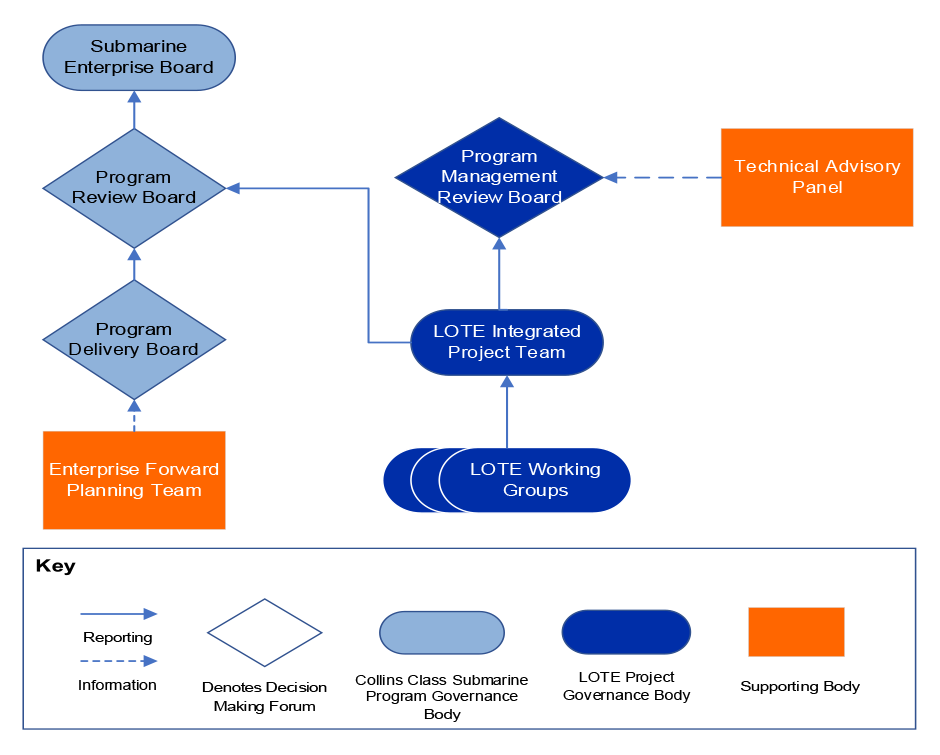
Note: In August 2025, the SEB was replaced by the Australian Submarine Coordination Group. The Australian Submarine Coordination Group is the band two/two-star body in the updated Submarine Enterprise Governance Framework.
Note: Governance forums that are not marked as decision-making forums operate primarily as consultative forums.
Source: ANAO analysis of Defence documentation.
Technical Advisory Panel
3.5 The Technical Advisory Panel reports to the PMRB and briefs the Submarine Advisory Committee as required.40 The Technical Advisory Panel reviews technical processes and designs developed for Defence consideration at each Mandated System Review.41
3.6 Since its establishment, the Technical Advisory Panel has produced six technical reports identifying critical issues, including the availability of suitably qualified and experienced personnel, the feasibility of implementing the full project scope during a two-year full cycle docking period, design maturity, and the impact of whole of boat requirements such as cyber, human machine interface, and signature management.
Decision making
3.7 To determine whether the governance arrangements support informed, risk-based decision making, the activities of the Integrated Project Team (IPT), Program Review Board (PRB), and Program Management Review Board (PMRB) have been examined. The activities and decisions of the Submarine Enterprise Board have not been examined as it has not received project specific updates since August 2022. The PMRB provides high-level senior executive oversight at the LOTE project and there is a large degree of overlap in membership between the Submarine Enterprise Board and the PMRB.42
Integrated project team
3.8 The LOTE IPT first convened in September 2021.43 It is the core forum for project execution and is responsible for monitoring delivery of the project against scope, schedule and budget. The Executive Director (ED) LOTE chairs the IPT, is the project delegate, and is authorised to manage ‘high’ risks.44 The Director General Submarine Sustainment (DGSMS) is a member of the IPT and is authorised to manage ‘very high’ risks.
3.9 The IPT supports risk-based decision-making by the contract, engineering, design, project and risk management delegates. The IPT reviews medium, high and very high risks managed by the working groups and agrees to establish or disestablish working groups and refer matters for resolution. It has also noted where the authorised delegate/s are required to make decisions to manage risks and resolve issues.
3.10 Until June 2023, the IPT reported to the Projects Control Board and the Projects Control Board provided updates on the progress and risks of the project to the Program Review Board (PRB). From June 2023 the IPT reports to the PMRB. It also reports to the PRB on matters affecting the Submarine Enterprise (see Figure 3.1). There is a large degree of overlap in membership between the IPT and PRB.45
Program Review Board
3.11 The Program Review Board (PRB) is a band one/one-star body, and its membership includes key decision-makers.46 The PRB monitors the: overall performance of the Collins class submarines; completion of planned maintenance activities and availability of the Collins class submarines; and implementation of planned capability upgrades.47 Prior to the establishment of the LOTE IPT in September 2021, specific LOTE updates were provided to the PRB. Once the IPT and project specific governance arrangements were established, the LOTE project updates were provided to the Projects Control Board and the Projects Control Board reported to the PRB until June 2023, when the LOTE IPT commenced reporting directly to the PRB.48
3.12 Over the period examined (March 2017 to December 2025), the PRB has raised and monitored action items and been advised of the very high and high risks being managed by the LOTE project and the Collins class submarine program (CSMP). The decisions made by the PRB allocate responsibility to address the risks or issues raised by the relevant individual officer/s responsible. For the LOTE project this is Director General Submarine Sustainment (DGSMS) and ED LOTE. Where the issue exceeds the authority of the individual the matter has been escalated to the band three/three-star Capability Manager Steering Group (CMSG).
Program Management Review Board
3.13 The Program Management Review Board (PMRB), established in March 2022 provides visibility at the band two/two-star level and is co-chaired by ASC and the Director General Submarine Sustainment. The Director-General Submarine Sustainment is also the authorised contract delegate and risk management authority for ‘very high’ risks. The Principal Engineer — the Design Acceptance Authority and Engineering Authority — for the Collins class submarines also attends PMRB meetings.
3.14 Between 2022 and 2025, the PMRB met quarterly, received updates on the development of the design, progress against project and contract milestones, the ‘very high’ and ‘high’ risks being managed by the project, and the plans to manage the risks and resolve issues. The PMRB supports senior engagement between ASC and Defence to manage risks and resolve issues that exceed the IPT’s authority and supports decision-making by the authorised delegates for contract, design, engineering, project or risk management.
3.15 The Integrated Project Team, Program Review Board and Program Management Review Board raise action items and make decisions, however in practice, they operate largely as information-sharing bodies. Each body records and tracks action items in the meeting minutes, including decisions to refer matters to other working groups, or governance bodies. Actions are referred to and decisions largely made by the individually authorised design, engineering, contract, project or risk delegate. Decisions made for the LOTE project have not been recorded centrally. Defence has a centrally managed tool to track action items and decisions raised by the Collins class governance bodies, but this tool has not been updated to reflect the establishment of the LOTE project governance arrangements and is not being used as required.
Opportunity for improvement
3.16 Updating the Task and Action Tracker to include the LOTE project would enable the project team to log and monitor action items and record decisions. This would improve transparency and strengthen record keeping.
Timeliness of decision making
3.17 The governance framework in Figure 3.1 illustrates the relationship and reporting lines between the governance bodies involved in monitoring the performance and progress of the LOTE project. The overlapping membership across the governance bodies provides redundancy and helps to maintain awareness of the risks and issues being managed by the LOTE project. For example, the Executive Director LOTE chairs the IPT, co-chairs the PMRB and attends the PRB and the Submarine Enterprise Board. The DG SMS chairs the PRB and is a member of the PMRB, IPT and the Submarine Enterprise Board. The Principal Engineer is a member of the Technical Working Group and attends the PMRB, PRB, IPT and the Program Delivery Board.
3.18 In practice, these arrangements have not been efficient. Decision-making is occurring both inside and outside the established governance arrangements and is not being effectively tracked or monitored. Project risks have been reported to program-level governance bodies but were not escalated in a timely manner, delaying informed, risk-based decision making. Case study no.1 sets out the time taken to respond to the risk that the replacement equipment and upgraded systems could not be installed within a two-year full cycle docking.
|
Case study 1. Case study no.1: Timeliness of decision-making to address implementation risk |
|
Defence identified a ‘high’ risk in May 2020 that completing installation of the core work package within a two-year full cycle docking might not be achievable. In June 2020, Defence directed ASC to assess feasibility and propose options to reduce any forecast over-run. ASC provided its assessment to Defence in August 2020, concluding that installation within a two-year full cycle docking was feasible. No further action was undertaken. When ASC commenced providing Contract Status Reports in July 2021, the risk was ‘high’. The risk remained ‘high’ until August 2022, when ASC reported that it had escalated to ‘extreme’. In September 2022, ASC advised the Program Management Review Board that the two-year full cycle docking goal was not realistic. In November 2022, the Integrated Project Team was informed that ASC was developing an implementation plan and a test and evaluation strategy to address the risk. In February 2023, ASC delivered its assessment, reiterating the advice provided in September 2022, six months earlier, that implementing the full scope within a two-year full cycle docking was not feasible. In June 2023, the Program Review Board received similar advice from the Technical Advisory Panel, which was then provided to the Program Delivery Board and the Program Management Review Board in August 2023. In October 2023, the Capability Manager Steering Group — the band three/three-star body responsible for the Collins class submarine capability — was advised that LOTE upgrades could not be installed within the scheduled required using traditional measures and adjustments to scope, schedule and risk appetite were being considered. Escalation was required due to the enterprise-wide impacts, including the ability of the LOTE project and the submarine enterprise to meet government’s availability requirements. |
3.19 As illustrated above, the implementation risk was first identified in May 2020, reported as ‘high’ by ASC in July 2021 and was raised to ‘extreme’ in August 2022.49 Advice confirming the risk, provided in September 2022, was reiterated in February 2023 and again in June and August 2023 — twelve months later.
3.20 In October 2023, the Capability Manager Steering Group was advised that the LOTE upgrades could not be installed within the schedule using traditional implementation measures and adjustments to the scope, schedule, and risk appetite were being considered. In May 2024, Defence reduced the scope of the project to be installed on HMAS Farncomb to gain more time to address the design and implementation risks that had eventuated (see paragraph 2.25) and in October 2025, commenced work to investigate alternative options to deliver a LOTE for the Collins class submarines — two years after the risk had been escalated.
Oversight arrangements for the life of type extension project
3.21 From 2018 to 2026, the LOTE project has been subject to Independent Assurance Reviews and Capability Manager Gateway Reviews — now referred to as Capability Gate Reviews — in line with the requirements of Defence’s Capability Lifecycle Framework. The Submarine Advisory Committee, established in 2017 to oversee the transition from the Collins class to the Attack class submarines, has also provided advice to Defence senior leaders on the status of the LOTE project.
Independent Assurance Reviews
3.22 Defence conducts Independent Assurance Reviews (IARs) to assess project progress and performance before all approval gates and critical milestones. As at March 2026, six IARs have been conducted, identifying risks and evaluating the progress and performance of the project since 2018 (see Table 3.1).
Table 3.1: Independent Assurance Reviews of the Life of Type Extension project
|
Project milestone |
Date endorsed |
Endorsed by |
Recommendationsa |
Findings and observations |
|
Readiness for Gate 0 |
6 September 2018 |
Director General Submarines |
The first IAR made five recommendations, including:
|
|
|
Readiness for Gate 1 consideration and progression to First pass |
3 November 2020 |
Director General Submarines |
The second IAR made five recommendations, including:
|
|
|
Project performance assessment against agreed outcomes from First pass |
10 February 2022 |
Director General Submarines |
The third IAR made seven recommendations, including:
|
|
|
Readiness for Gate 2A consideration |
10 November 2022 |
Head Navy Capability |
The fourth IAR made seven recommendations including:
|
|
|
Readiness for Gate 2B and 2C consideration and progression to Second pass |
5 February 2024 |
Director General Submarines |
The fifth IAR made three recommendations:
|
|
|
Assess whether the project remains on track to deliver the required capability on time and within budget |
14 October 2024 |
Director General Submarines |
The IAR made two observations. That the risk rating could be retained and the LOTE project did not need to be elevated to a POC/POI. |
|
Note a: Due the relationship between the ongoing sustainment of the Collins class submarines and the LOTE project the recommendations and observations made were not limited to the LOTE project.
Source: ANAO analysis of Defence documentation.
Capability Manager Gateway Reviews
3.23 Capability Manager Gateway Reviews (CMGRs) are used by Defence to assess project readiness for consideration by the Investment Committee. The CMGR process was used prior to seeking Investment Committee endorsement and government approval for the funding requested (see Figure 1.1). Since October 2023 — when the CMGR was advised that LOTE project updates could not be installed within a two year full cycle docking — CMGR consideration has occurred in December 2024, April 2025, December 2025 and February 2026. These reviews were used to inform Defence senior leaders of project risks, provide visibility of impacts across the submarine enterprise, and outline work underway to reduce and/or resolve those risks.
Submarine Advisory Committee
3.24 Established in 2017, the Submarine Advisory Committee (SAC) provides independent oversight of the Collins class upgrade program, the former Attack class submarine program, and the LOTE project. Given the significance of the LOTE project, the Submarine Advisory Committee (SAC), established to oversee the transition to a future submarine fleet, has also been involved in overseeing the LOTE project.
3.25 The SAC reports to the Chief of the Defence Force (CDF) and the Secretary of Defence, with reviews also provided to the Naval Shipbuilding Advisory Board and to the Minister for Defence and the Minister for Defence Industry as directed.50
3.26 Between 2019 and 2023, SAC reviews consistently highlighted the significance, complexity and risks of the LOTE project, ensuring senior Defence leaders were informed of key challenges and risk mitigation efforts. In March 2019, the SAC advised the Chief of the Navy, CDF and Secretary that:
In our view LOTE is the biggest challenge facing the submarine capability in the 2020s. Re-design of the entire Collins propulsion system, integration into the platform, then implementation without impact to availability is a significant task, far greater in scope and complexity than the large number of smaller projects integrated to date.
3.27 Throughout 2020, the SAC reviews raised concerns about delivering the LOTE within existing constraints, highlighting that the propulsion system replacement was a significant risk due to the complex design, integration and testing demands on the systems engineering ability and resourcing of ASC Pty Ltd.
3.28 In 2022, the SAC reviews highlighted the risks stemming from the cancellation of the Attack class program and advised Defence to reconsider its earlier decisions to use the life of type extension project to ‘de-risk’ the Attack class program, use common equipment and technologies, and replace key equipment and systems of the Collins class submarines to extend their service life. Technical, management and systems engineering risks were also reported.
3.29 Throughout 2023, the SAC continued to raise concerns about technical risk, feasibility of installing the LOTE upgrades in a two-year full cycle docking, decision making support, and the balance of risk. In July 2023, the SAC reported that the planned scope for the LOTE was incompatible with the two-year full cycle docking schedule using current processes. Proposed novel methods added technical risk rather than resolving schedule constraints. Efforts to upgrade ageing systems introduced further reliability challenges, and the organisation lacked experience in managing such changes within tight timelines. The SAC suggested a more risk-balanced approach to propulsion upgrades, including retaining some of the original, legacy systems.
3.30 In late 2023, the SAC was supporting the Independent Assurance activity (see paragraphs 2.67 and 2.68). In March 2025, the SAC reported that the design schedule for the full LOTE scope remained at significant risk, despite a May 2024 decision to reduce the scope for HMAS Farncomb and focus on completing design and testing of the system upgrades for HMAS Collins, during its next full cycle docking, scheduled to commence in June 2028.
Are risks being effectively managed?
Risk management arrangements were not mature and did not operate effectively. The project risk management plan was not approved until October 2022 and did not include a project risk appetite or tolerance statement as required. Strategic risks exceeded tolerance levels, and the mandated risk reporting system often lacked documented controls and assessments of control effectiveness. Deficiencies in the risk reporting tool and data governance affected the reliability of risk information and required the development of workarounds, limiting assurance that risk controls and treatments were effective.
3.31 Defence’s capability manual sets out that Defence is required to assess risk across the acquisition and sustainment phases for a project or program.51 The risk profile developed from this process, combined with the approved risk management plan for the project sets out how risks are to be managed. Defence has also developed and issued a Risk Management Manual that projects are required to use to guide the identification, assessment, monitoring, review and reporting of risks to support effective risk management.
Risk management plan
3.32 Projects are required to develop and follow a Risk Management Plan (RMP) that identifies the project scope, objectives, risk thresholds, tolerance levels, governance arrangements, roles, responsibilities, and risk authorities.
3.33 A risk management plan for the LOTE project was developed and approved in October 2022 and updated in 2024. The RMP for the LOTE project identifies the risk authorities, roles and responsibilities, and the risk management process. It does not include a risk appetite statement or identify the risk thresholds or tolerance levels of the project as required. The LOTE RMP is subordinate to the Enterprise RMP and states that project risks are to be managed in accordance with the hierarchy outlined in the Enterprise RMP.
Identification and assessment
3.34 From 2018, the LOTE project has been required to identify and assess risks in accordance with the business rules and processes set out in the Risk Management Manual. The business rules and processes state that projects must establish and maintain risk appetite and tolerance statements, use standard templates, criteria, processes and matrices to assess and rate risks, and record risks in Defence’s risk management system (Predict!). Projects are also required to evaluate the effectiveness of existing controls and identify mitigation measures (introduce new controls) to reduce risks to acceptable levels. Risks that eventuate are to be treated.
Risk identification and assessment
3.35 Between December 2017 and June 2021, the LOTE project used a risk register to identify and assess risks. Project risks were also recorded in a central risk register used by the Projects Control Board (PCB) to monitor the progress of all the projects responsible for delivering planned capability upgrades to the Collins class submarines (see Table 1.4). The LOTE project commenced recording its risks in Predict! (Defence’s mandated risk management system) in October 2021.
3.36 Between 2022 and 2026, the LOTE project has used a new risk register developed in May 2022 to triage risks before entering them into Predict!. As at February 2026, there are 59 project risks recorded in Predict!, eight strategic (parent) risks and 51 child (tactical/operational) risks. The initial, current and target risk rating for the strategic risks currently being managed by the project is at Table 3.2.
Table 3.2: Project initial, current and target risk ratings — February 2026
|
Risk |
Risk description |
Active / retired |
Initial risk rating |
Current risk rating |
Target risk rating |
|
Implementationa |
Risk that the complexity and volume of updates to be installed on the Collins class submarines cannot be completed within the implementation phase of the project. |
Active |
Medium |
Very high |
Low |
|
Schedule |
Risk that the design and procurement phase of the project will be delayed and contracted milestones missed. |
Active |
High |
High |
Low |
|
Cost |
Risks that costs increase due to changing market conditions, lack of competition and schedule requirements. |
Active |
High |
High |
Very low |
|
Delivery strategyc |
Risk that the delivery strategy will be unable to meet the objectives of the project. |
Retired |
High |
High |
Not recorded |
|
Supply Chaind |
Risk that subcontractor procurements will have a negative impact on objectives caused by delays to procurement timeframes, resulting in delays. |
Active |
High |
Medium |
Low |
|
Integrationb |
Risk that the project updates and upgrades will be impacted by inadequate program level integration. |
Active |
High |
Medium |
Very low |
|
Workforce |
Risk that Defence and Industry cannot recruit and maintain sufficient skilled qualified and experienced personnel to deliver the project. |
Active |
Medium |
Medium |
Medium |
|
Technical |
Risk that the technical performance and maturity of the solution is unable to meet the objectives of the project. |
Active |
High |
Medium |
Very low |
|
Safetyc |
Risk that safety and seaworthiness requirements are not met by the project and the design solution is not accepted. |
Retired |
High |
Medium |
Low |
|
Scopec |
Risk that interactions between ongoing sustainment work, and capability upgrades are not maintained, resulting in project scope creep. |
Retired |
Medium |
Medium |
Not recorded |
|
Regulatoryd |
Risk that additional or unforeseen regulatory requirements will have a negative impact on objectives, resulting in additional scope, cost, or schedule. |
Active |
Low |
Low |
Very low |
Note a: Refers to the risk that the full scope of the upgrades to extend the life of the Collins class submarines cannot be implemented within a two-year Full Cycle Docking.
Note b: Refers to the risk that the boundaries between ongoing sustainment of the Collins class submarines and the scope of the LOTE project are not maintained.
Note c: The delivery strategy, safety, and scope risks were retired in September 2025. The delivery strategy risk was retired due to the changes made to the delivery model in May 2024. The safety risk was retired and absorbed into the technical risk. The scope risk was retired as the risk was specific to the alignment between the LOTE project and Collins class submarine sustainment and was being effectively managed through the governance arrangements.
Note d: These risks were raised in September 2025.
Source: ANAO analysis of Defence documentation.
Appetite, tolerance and control effectiveness
3.37 Risk appetite statements describe the level of risk senior management is prepared to accept to achieve objectives. A risk appetite and tolerance statement for the LOTE project was not developed, as required.
3.38 The Enterprise RMP states that very high and high risks cannot be accepted and must be treated, indicating that the Collins submarine enterprise has a risk tolerance of ‘medium’. Between October 2021 and September 2025, seven strategic risks identified by the LOTE project were assessed as ‘high’, exceeding the established tolerance. As at February 2026, the LOTE project has three strategic risks (two high risks and one very high risk) — implementation, schedule and cost — that exceed the established tolerance levels.
3.39 As at February 2026, 24 (41 per cent) of the 59 risks being managed in Predict!, do not identify the controls in place and 55 (93 per cent) do not include an evaluation of the effectiveness of the control/s. The success of managing risks relies on the effectiveness of the controls that are in place and requires that the controls are monitored and regularly reviewed. If the controls are insufficient, then mitigation measures (new controls) and treatments are to be developed and implemented to lower the risk to an acceptable level.
Risk ratings and mitigations
3.40 Since the LOTE project was established in 2018 the likelihood and consequence of each risk occurring has been documented and rated in accordance with the relevant risk matrix.
3.41 Between 2018 and 2020, a project and a central risk register identified if the risk was to be treated (reduced or retained) and documented the mitigation measures (action strategy) to manage the risk. Since 2022, the risk register has been used by the project to triage and identify risks prior to transferring them into Predict! and documents the mitigation measures (action strategy) that will be implemented to manage the risk. The action strategies that have been documented include the development and approval of schedules and planning documents, cost estimates, achievement of contracted milestones, the governance arrangements, reporting requirements, and day to day project activities.
3.42 The action strategy is recorded for 57 (97 per cent) of the 59 risks being managed in Predict!. The ANAO analysis found that, except for the technical and safety risks, the action strategies were not successful in mitigating the risk. Between 2022–23 and 2025–26, five (55 per cent) of the nine strategic risks52 increased or did not change (see Figure 3.2).
Figure 3.2: Strategic (parent) risk ratings — 2022–23 to 2025–26
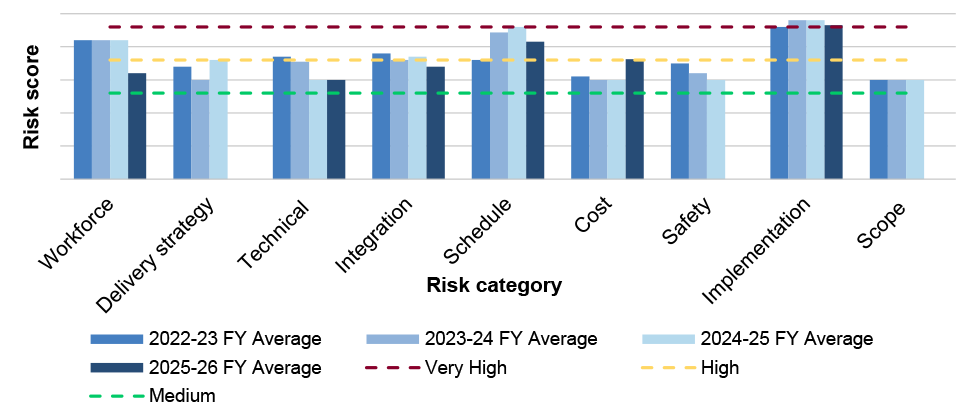
Note: The risk descriptions have been amended to use common and simplified terminology that accurately reflects the risk being managed.
Note: The data for 2022–23 is for six months, starting from January 2023. Workforce and implementation risks were initially assessed as ‘medium’ and increased to ‘high’ in November 2022.
Note: The data for 2025–26 is for five months, starting from July 2025 to November 2025.
Note: The parent risks for Delivery Strategy, Safety and Scope were retired in September 2025 as such there is no recorded data for these parent risks for FY 2025–26 as a result.
Source: ANAO analysis.
Treatments
3.43 To treat the schedule and implementation risks, in May 2024, Defence sought and obtained approval from government to change the delivery approach. The change to the delivery approach was requested to allow more time to complete design work and reduced the scope of the project to be implemented on HMAS Farncomb (see paragraph 2.25).
3.44 As part of treating these risks, Defence and ASC commenced developing engineering solutions that include new hull cuts to install the equipment and system updates into the submarine, and the manufacture of specialised equipment to build and test the new equipment and systems before they are installed. This approach was intended to increase the amount of work that can be done outside of the Collins class submarine, reduce the time required to build and test the new equipment and systems, and support installation of the new equipment and systems into each submarine within a two-year Full Cycle Docking.
3.45 The risks had not reduced to an acceptable level by October 2025, and as such new treatments including investigating revised approaches to deliver the LOTE project commenced. As at February 2026, Defence was developing alternative options to deliver a Life of Type Extension for the Collins class submarines. The options developed were presented to Defence’s Investment Committee in March 2026. In May 2026, government approved Defence’s recommended revision to the Collins class life-extension strategy, shifting to refurbishment and maintenance for at least five submarines (see paragraph 2.66).
Monitoring and review
3.46 Once the risks have been identified, assessed and rated they are to be monitored and reviewed. Defence’s Risk Management Manual states that the purpose of monitoring and reviewing risks is to ensure that the assessment is still current, risks that are no longer applicable are closed, new risks are identified and assessed as early as possible, and that the controls, mitigation measures, and the project’s risk management processes are effective.
3.47 Between 2018 and 2021, LOTE project risk reviews were not conducted as required. During this time the project was being overseen by the PCB. The ANAO examination of the PCB meetings found that the LOTE project provided progress updates and identified the risks being managed, however risk reviews were not being conducted as required.
3.48 According to the Enterprise RMP, medium risks were to be reviewed by the PCB, high risks were to be reviewed by the PDB, with very high risks reviewed by the PRB. In practice, since May 2022, the LOTE project has conducted monthly risk reviews, discussing the status of risks, identifying any new risks, and retiring existing risks. High risks have been monitored but not actively reviewed by the PCB. The IPT has monitored high and very high risks along with the PMRB after it was established in July 2022.
Reporting
3.49 Between 2018 and 2021, project risks were to be reported to the Projects Control Board (PCB) and the PCB was to escalate risks to the Program Delivery Board (PDB) and Program Review Board (PRB) as required. In December 2022, the PRB tasked the PCB to record ‘high’ and ‘very high’ risks within the Predict! system and report ‘high’ and ‘very high’ risks to the PRB. Over this period the ANAO has identified that the project provided status updates to the PCB with project risks reported between April 2022 and August 2023.
3.50 Project risks have been reported to the Integrated Project Team (IPT) since its establishment in September 2021, with quarterly reporting commencing in March 2023. The IPT receives summaries of the highest risks from each working group. Risks exceeding established tolerances are reviewed by the Project Management Review Board (PMRB), and since March 2022, risks beyond the IPT chair’s authority have been reported to the PMRB.
Risk reporting tool
3.51 In 2022–23, the ANAO found that the Predict! system could not be assured.53 Data accuracy was dependent on user input, data validation was a manual process, risk ratings could be manipulated by any project user, and administrator privileges were not controlled.
3.52 The ANAO found that these deficiencies affected the LOTE project. For example, between October 2021 and June 2023, risk ratings were changed and risks were closed by users outside the project.54 To address this, the project team now extracts risks from Predict! monthly and retains copies outside the system, enabling restoration of incorrectly changed or retired risks. Monthly risk reviews are conducted, and proposed retirements in Predict! are examined as part of the review process.
Recommendation no.5
3.53 The Department of Defence ensure that the effectiveness of the controls and mitigation measures are evaluated, recorded and regularly reviewed, in line with the requirements of the Risk Management Manual.
Department of Defence response: Agreed
4. Planning and implementation
Areas examined
This chapter examines whether the Department of Defence (Defence) has established effective arrangements to plan for and implement a Life of Type Extension of the Collins class submarines.
Conclusion
Planning and implementation of the LOTE project has not been effective. Defence was slow to establish project and contract management arrangements commensurate with the scale, complexity and risks of the project. Key management artefacts were absent or delayed, and baseline controls were not established when design work was initiated and progressed, reducing Defence’s ability to manage delivery in a disciplined way during critical early phases.
Defence has committed substantial funding without demonstrating commensurate progress against contracted milestones. The system and detailed design contract, awarded in February 2022, has been amended 53 times and has increased from $125 million to $813 million. By February 2026, Defence had spent $693 million on project definition and design activities and related equipment procurements to replace key systems and extend the service life of the Collins class submarines. While the project was under its approved budget as at March 2026, this reflects missed milestones and scope reductions rather than delivery efficiencies.
Delays have accumulated and Defence has adjusted the delivery strategy and scope of the project to manage emerging risks. As at May 2026, Defence was not on track to install the LOTE updates onto the first submarine in June 2026, as originally planned. Ten years after the initial decision to establish the LOTE project, Defence was also not well placed to demonstrate that the project will achieve its objective to maintain Collins class capability and availability to 2048. In May 2026, Defence proposed, and government agreed to, an alternative service life extension strategy, changing the direction of the project after ten years of planning and design activity.
4.1 Defence requires effective arrangements to manage the Life of Type Extension (LOTE) project, achieve key milestones, and monitor and report on progress. These arrangements provide assurance that the project remains on schedule and Defence is well positioned to prevent a capability gap emerging during the transition to the future submarine fleet, previously the Attack class submarines, now the Nuclear-Powered submarines.
Has Defence established fit-for-purpose arrangements to manage the project?
Defence’s project and contract management arrangements were not commensurate with the LOTE project’s complexity and risk profile during critical early phases. Key project and contract management documents were absent or delayed, including the late establishment of baseline schedule controls and delayed approval of the integrated project management plan in June 2024. The system and detailed design contract has been amended 53 times, since it was awarded in February 2022, increasing from $125 million to $813 million. This indicates that scope, complexity, cost and risks were not well understood when the contract was awarded.
Project management
4.2 Between 2018 and 2020, the LOTE project was being managed within the Collins class submarine program and was seen as an extension of the existing sustainment program. A business case and project execution strategy was developed in 2018, refined in 2020 and 2023 as the project progressed through the capability lifecycle and government approval of funding was sought and obtained (see Figure 1.1 and Table 1.3). 55 Development of key agreements and plans, including the Materiel Sustainment Agreement (MSA) commenced in November 2020 and the MSA for the LOTE project was endorsed and approved in February 2021. The Integrated Project Management Plan (IPMP) was not in place until June 2024.
4.3 The LOTE project office was established in May 2021 and the Integrated Project Team (IPT) convened for the first time in September 2021. These arrangements were implemented after the concept design phase had nominally concluded and the system requirements and detailed design work had commenced.
Contract management
4.4 For the LOTE project, Defence decided to use the existing arrangements with ASC as the platform systems integrator (PSI) and Raytheon Australia as the Collins combat systems integrator (CSI). The existing arrangement with ASC, the In-Service Support Contract (ISSC), includes provisions that allow Defence to use the ISSC for sustainment and capital acquisition projects, including implementation the SEA1439 projects (see Table 1.4).
4.5 Defence issued separate contracts for each phase of the LOTE project as it progressed through the systems engineering lifecycle. Between 2016 and 2024, Defence awarded 15 separate contracts for: project scoping studies; life of type buys; project definition and concept design work; system requirements, and system and detailed design work (see Table A.1). The contracts were awarded using a mix of priority purchase orders and tasking statements issued under the survey and quote provisions of the ISSC with ASC and direct contractual arrangements with BAE Systems, Thales and Raytheon Australia (see Table A.1 and Table A.2).
4.6 In April 2021, Defence identified that as the LOTE project was a complex acquisition the standard provisions of the ISSC were not appropriate and the work should not be delivered as a survey and quote service.56 Defence decided that a special survey and quote would be developed using elements from Defence’s complex acquisition templates and the Strategic Partnering Agreement (SPA) that had been developed for the Attack Class Submarine program.57
4.7 The special terms and conditions of the system and detailed design contract changed terms and conditions of the ISSC for the LOTE project (see Table 4.1).
Table 4.1: Changes made to the terms and conditions of the ISSC
|
Schedule |
Changes made |
|
Special conditions |
|
|
Statement of work |
|
|
Price and Payment |
|
|
Contract document requirements list |
|
|
Australian Industry Capability |
|
Note a: Mandated System Reviews are a suite of systems engineering reviews that are used for strategic and/or complex materiel acquisition projects and are not a feature of the ISSC with ASC.
Source: ANAO analysis of Defence documentation.
4.8 This work commenced in May 2021 to develop a longer-term arrangement for the remainder of the design phase (the system and detailed design), that included the special terms and conditions. Negotiations were conducted in November and December 2021 and in February 2022 the system and detailed design contract was awarded. The scope of work included all activities necessary to design and develop the new and upgraded systems for installation including project management, systems engineering, integrated logistics support, configuration management, and verification and validation activities. Under this contract ASC was also to develop and submit quotations to procure the replacement equipment to be installed on the first of the Collins class submarines to undergo a life of type extension.
4.9 The system and detailed design contract also required ASC to develop and maintain a:
- contract master schedule (CMS);
- contract work breakdown structure (CWBS); and
- program cost estimate (PCE).
Together, these documents were to detail how the contractor (ASC) would deliver the project within the approved scope, schedule and budget and achieve the key design milestones.
Contract management plan
4.10 Defence did not develop a contract management plan for the LOTE project in accordance with Defence guidance. In August 2023, the LOTE project team produced documentation describing the business processes used to manage the systems and detailed design contract. The ANAO found that this guidance is focused on processing contract amendments rather than managing performance. The number and value of contract amendments executed since the award of the system and detailed design contract are examined further in paragraphs 4.13 to 4.14, Figure 4.1 and Table A.3.
Contract master schedule
4.11 The Contract Master Schedule (CMS) is to describe the planned sequence of activities, milestones and decision points. Approval of a CMS is required to establish an agreed baseline and enable Defence to monitor progress, identify emerging risks, and provide assurance that key design milestones will be met as scheduled. An approved CMS was to be in place by the end of July 2022.58 Development commenced in July 2022, but a baseline was not approved until June 2023. The CMS was re-baselined in May 2024 to introduce a distributed Detailed Design Review process and again in October 2025 to reflect the decision to reduce the scope of project to be installed on HMAS Farncomb (see paragraph 2.25).
Program cost estimate
4.12 The purpose of a program cost estimate (PCE) is to define overall program costs, including future phases of the LOTE project not yet contracted, and enable Defence to test the reasonableness of cost estimates for any additional work or changes in project scope. The PCE was to be approved and in place by the end of June 2022 and updated annually. In August 2022, Defence and ASC agreed to delay delivery by 12 months and develop the estimate collaboratively. ASC submitted a PCE of $6.9 billion for the duration of the project (2021–22 to 2043–44) in June 2023, as agreed. Defence completed its review in October 2023 and approved the PCE in November 2023. In 2024, ASC provided an updated PCE of $6.5 billion, reflecting the removal of the optronics scope (see Figure 2.3). In September 2025, ASC provided an updated PCE of $5.5 billion, reflecting the reduced scope of work for implementation on HMAS Farncomb.
Contract amendments
4.13 Since the system and detailed design contract was awarded in February 2022, it has been amended 53 times and the value has increased from $125 million to $813 million (see Figure 4.1).
Figure 4.1: Growth in contract value — 2021–22 to 2025–26
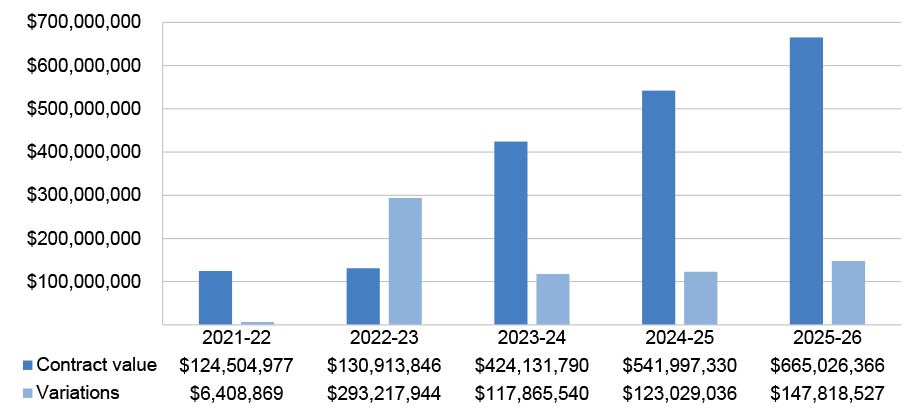
Note: Values are AUD equivalent and GST exclusive.
Source: ANAO analysis of Defence documentation.
4.14 The amendments have altered the special conditions, deliverables, milestones, and the price and payment schedule. A detailed assessment of these changes is at Appendix 6 (see Table A.3). The number and scale of amendments that have been made to the system and detailed design contract to date demonstrate that the scope, complexity, cost and risks of the project were not well understood when the contract was awarded. The impact of these changes on the achievement of the key contracted milestones is examined on the following page (see Table 4.5).
Financial management
4.15 The Materiel Acquisition Agreement (MAA) was approved in October 2024 and set an agreed price (budget) of $1.56 billion for 2021–22 to 2031–32. The $1.56 billion budget is inclusive of $271.2 million spent in 2021–22 and 2022–23, and $24.9 million in contingency.
4.16 The first budget review for the LOTE project was conducted in July 2024. In 2023–24, the project underspent by $128.0 million (40 per cent) against the approved budget of $317.8 million, primarily due to missed milestones and the removal of the optronics upgrade. In November 2024, Defence proposed reducing the 2024–25 budget from $176 million to $156 million to reflect continued underspend due to missed milestones and schedule delays. In July 2025, Defence proposed reducing the 2025–26 budget from $264 million to $205 million.
4.17 As at March 2026, the LOTE project is under budget. This is due to missed milestones, the removal of the optronics upgrade, and the changes that have been made to the scope of the project since the system and detailed design contract was awarded in February 2022.
Price and payment model
4.18 The LOTE pricing model is a Not-to-Exceed (NTE) model59 comprising an estimate of the direct costs (including labour, material, subcontract and other costs60), corporate overhead, and profit. The pricing model has been adopted from the In-Service Support Contract, using the agreed labour rates and allowable costs and modified to include profit payment milestones.
4.19 Under the price and payment model, invoices are submitted and paid monthly. Profit payment milestones are split with 30 per cent payable monthly and 70 per cent tied to achievement of key design and other contracted milestones. This equates to approximately five per cent ($37.5 million) of the total contracted price being tied to completion of milestones. Over the duration of the contract, 20 new profit milestones have been added (see paragraph 4.36). Out of these 20, twelve (60 per cent) do not require Commonwealth approval or acceptance effectively reducing the extent to which the profit payments incentivise performance. The model also allows price adjustments for agreed scope changes.
4.20 Since February 2022, the scope of the project has been modified and the contract price has increased by $688 million, from $125 million to $813 million (see Figure 4.1). The cost increases have been required to fund specialist support, insert new technical requirements, amend subcontracts, apply price escalation, re-work proposed designs due to the impacts on other submarine systems, and develop new methods to install the upgrades onto the submarines (see Figure 4.1 and paragraph 4.22).
4.21 The price and payment model requires Defence to reconcile monthly invoices against actual costs and conduct periodic cost reviews. Defence has conducted annual reconciliation exercises, referred to as a ‘true ups’, to monitor project expenditure incurred since 2021–22. These ‘true-up’ exercises have been conducted for 2021–22, 2022–23 and 2023–24. In October 2025, Defence advised that the ‘true-up’ for 2024–25 was underway and was scheduled for completion by February 2026. In March 2026, Defence advised that the ‘true-up’ for 2024–25 had not yet been completed.
Value for money
4.22 Defence is not well placed to demonstrate that the LOTE project has provided value for money. Since February 2022, the contract has been amended 53 times increasing its value from $125 million to $813 million.61 Out of the total $688 million increase to the Not-to-Exceed price, $187 million (27 per cent) relates to procurement of the replacement main motor, diesel generator and other equipment and components that were selected to ‘de-risk’ the Attack class submarine program and were not included in the initial estimate.62 The remaining $501 million (73 per cent) covers specialist support, new technical requirements, amendments to subcontracts, price escalation, and re-work required to address the impacts of the selected upgrades on other submarine systems.
4.23 As at January 2026, Defence had spent $693 million to design the new propulsion system, diesel generators and other upgrades, procure equipment, and determine how to install the redesigned systems and integrate them into the Collins class submarines (see Table 4.2).
Table 4.2: Life of type extension project — breakdown of expenditure
|
Description |
2020–21 |
2021–22 |
2022–23 |
2023–24 |
2024–25 |
2025–26 |
Total |
|
|
$ million |
||||||
|
Admin and expenses |
0.6 |
1.6 |
5.5 |
6.9 |
5.8 |
5.2 |
25.5 |
|
Program management |
1.3 |
3.6 |
16.4 |
13.7 |
– |
– |
35.0 |
|
Replacement diesel generator |
8.4 |
5.0 |
21.7 |
19.8 |
16.2 |
15.4 |
86.6 |
|
Replacement propulsion system |
6.7 |
9.4 |
80.0 |
66.4 |
31.1 |
7.2 |
200.7 |
|
Integrated Ships Control Management and Monitoring System |
0.2 |
3.4 |
1.7 |
11.8 |
7.0 |
3.9 |
27.9 |
|
Power Conversion and Distribution |
0.9 |
2.2 |
6.2 |
9.5 |
8.9 |
2.9 |
30.7 |
|
Optronics |
– |
3.9 |
28.6 |
2.2 |
9.5 |
4.8 |
49.0 |
|
Hull and Pressure Vessels |
– |
0.7 |
0.9 |
1.4 |
1.0 |
0.5 |
4.4 |
|
Cooling system upgrade |
– |
– |
– |
14.2 |
12.8 |
6.8 |
33.8 |
|
Impacted systems |
– |
– |
– |
– |
1.0 |
1.4 |
2.4 |
|
Life of type buys/Inventory |
15.5 |
0.1 |
– |
– |
– |
– |
15.6 |
|
Platform integration |
1.6 |
8.2 |
15.9 |
27.3 |
46.0 |
25.6 |
124.5 |
|
Other |
1.5 |
4.5 |
15.2 |
16.6 |
12.6 |
6.3 |
56.8 |
|
Total |
36.6 |
42.6 |
192.0 |
189.8 |
151.9 |
80.0 |
692.9 |
Note: The breakdown of expenditure is as at January 2026 and covers the project definition, concept design, system requirements, system and detailed design work.
Source: ANAO analysis of Defence documentation.
4.24 In 2026, Defence developed alternative options to deliver a Life of Type Extension for the Collins class submarines. In March 2026, Defence’s Investment Committee agreed to no longer replace key equipment and systems of the Collins class submarines and instead, retain the existing systems on up to five of the Collins class submarines. In May 2026, the proposal was presented to, and agreed by, government. The impact of the decision not to replace key equipment and systems will need to be factored into any future revaluation activity.
Has Defence achieved planned milestones to date?
Defence has not achieved planned milestones and delays have accumulated over the life of the project. Only one of five key design reviews (contract milestones) was achieved on schedule, and Defence has modified milestone approaches and baselines as design issues emerged. The accumulated delays contributed to the decision to reduce the scope planned for installation on HMAS Farncomb, with design work for the full core work package not complete as at early 2026.
4.25 The LOTE project was originally envisaged as a series of updates that were to be implemented through the existing processes outlined in the Engineering and Configuration Management plans for the In-Service Support Contract (ISSC) with ASC.
4.26 In April 2021, Defence determined this approach was unsuitable and adopted a systems engineering approach consistent with complex acquisition projects. This methodology comprises the following four phases.
- Concept design phase — establishes baseline requirements and develops concept designs for each sub-project within the core work package.
- System design — refines proposed changes and includes three Mandated System Reviews (MSRs): Systems Requirements Review (SRR), Support System Definition Review (SSDR), and the Systems Design Review (SDR).
- Detail design — commences following SDR completion and finalises the detailed design of the proposed changes to the submarine.
- Implementation — commences after the detailed design review (DDR) and involves preparing work packages, configuration change instructions and installing and testing the new equipment and systems.
4.27 In May 2024, due to the impact of cascading delays and design issues, Defence recommended (and government agreed) to reduce the scope of updates for HMAS Farncomb’s next full cycle docking, scheduled to commence in June 2026.
4.28 In August 2025, design work had been divided into two tranches, referred to as LOTE 1, covering the power conversion, hull work and other upgrades to be installed on HMAS Farncomb (see Figure 1.2), and LOTE 2, addressing the propulsion, diesel generators, and cooling system upgrades for the remaining five submarines. The Detailed Design Review for LOTE 1 was completed in July 2025, with configuration change instructions, support system updates, and procurement of material ongoing as at April 2026.
Concept design phase
4.29 The purpose of the concept design phase was to baseline the requirements for each component (sub-project). Defence engaged ASC to undertake this work between August 2018 and August 2019.
4.30 Business cases and concept design summary reports were delivered by ASC between December 2019 and March 2020. Defence conducted a cumulative risk assessment in May 2020 that found the proposed designs to be feasible, however identified two ‘high’ risks requiring remediation to reduce risks to an acceptable level. The remediations proposed included:
- incorporating additional scope in the system design stage to address deficiencies in the replacement diesel generator design; and
- assessing ASC’s capacity to complete installation within a two-year full cycle docking.
4.31 Defence requested ASC provide cost estimates for the additional scope in July 2020, marking nominal completion of the concept design phase as scheduled.
System requirements
4.32 Defence initiated system requirements and design activities prior to completing the concept design phase and before obtaining First Pass approval. Between December 2019 and February 2022, Defence issued two tasking statements and a $21.4 million priority purchase order to ASC to maintain progress on non-recurring engineering and system design work for the core work package.63
- In December 2019, Defence issued a tasking statement to ASC to commence systems requirements and system design work for the proposed upgrades to the diesel engine, main motor and control system, and power conversion and distribution system.
- In February 2020, Defence issued another tasking statement that added optronics system updates into the proposed core work package and authorised essential non-recurring engineering to continue prior to receiving project approval.64
- Defence issued a priority purchase order in December 2020 to ASC for $21.4 million (GST Exclusive), comprising $12.7 million and €5.3 million ($8.7 million AUD Equivalent) to continue system design work for 2020–21.65
4.33 These arrangements, including a six-month interim agreement in May 2021 to complete the System Requirements Review (SRR)66, were implemented to mitigate schedule risk. The May 2021 tasking statement included four key milestones required to successfully exit the SRR (see Table 4.3). Commencing work ahead of approval increased exposure to governance and procurement risks and reflected Defence’s reliance on interim measures to sustain project momentum.
Table 4.3: Milestones required to complete System Requirements Review phase
|
Milestone |
ANAO observations |
Due date |
Completed |
|
Technical Performance Measures Review |
|
10 September 2021 |
✔ |
|
Requirements and Verification and Validation Review |
|
11 October 2021 |
Not applicable |
|
Allocated Baseline Tracing Review |
1 November 2021 |
Not applicable |
|
|
System Requirements Review |
|
26 November 2021 |
✔ |
Note a: Sprints are smaller and shorter tasks used to develop design documentation incrementally and involved conducting collaborative workshops with Defence and ASC representatives.
Note b: The nine sprints that replaced the Requirements and Verification and Validation Review; and Allocated Baseline Tracing Review were: Human engineering requirements; States, modes and conditions requirements; cyber requirements; non-acoustic signature requirements; technical performance measures, definitions, requirements, plan and models; architecture alignment; margins; integrated logistic support and logistics engineering requirements; and refinement of the mission system specifications (MSS) Verification Cross Reference Matrix. The sprints were to culminate in the endorsement of the System Requirements Review.
Source: ANAO analysis of Defence documentation.
System and detailed design phases
4.34 The system and detailed design phase was originally scheduled to commence in July 2022 and be completed by June 2024. The purpose of this phase is to complete the design work, develop configuration change instructions for approval, and prepare for installation of the system updates on the submarines as planned.
4.35 When the contract was awarded in February 2022, five key design milestones were identified in the Statement of Work. Of these, the SRR had been conducted but not closed. Defence’s progress against the remaining four milestones is outlined in Table 4.4.
Table 4.4: System and detailed design phase — contracted milestones
|
Milestone |
Purpose |
Key contract deliverables |
Original due date |
Amended due date |
Date conducted |
Date closed |
Delay |
ANAO observations |
|
Support System Definition Review |
Establish and approve the Support System Functional Baseline for the LOTE project. |
|
30 June 2022 |
– |
23 March 2023 |
26 May 2023 |
9 months |
|
|
Integrated Baseline Review |
Establish agreed baseline cost and schedule for the scope of the LOTE project. |
|
29 July 2022 |
– |
16 – 22 September 2022 |
23 June 2023 |
11 months |
|
|
System Design Review |
Finalise the Functional Baseline (FBL) for the Mission and Support System. Establish and approve the Allocated Baseline (ABL). Confirm the design will meet the capability requirements, as outlined in the Operating and Support Intent. |
|
30 November 2022 |
26 June 2023 |
26 – 30 June 2023 |
11 December 2023b |
13 months |
|
|
Detailed Design Review |
Establish and approve the As-designed Product Baseline (PBL). |
|
29 May 2024 |
24 November 2024 |
22 – 23 July 2025 (LOTE 1) |
19 September 2025b (LOTE 1) |
16 months |
|
Note a: The update to the interim Functional Baseline for the Mission System was required to incorporate the new cooling and updated signature requirements.
Note b: The System Design Review and Detailed Design Review for LOTE 1 have not been formally closed, however have met the exit criteria. Formal closure requires completion of all corrective action requests.
Source: ANAO analysis of Defence documentation.
4.36 Between February 2022 and June 2025, 20 additional milestones were incorporated into the contract (see Table 4.5). Original milestones dates were removed from the Statement of Work and incorporated into the approved CMS.
4.37 These changes reflected the design issues that had been encountered (see paragraphs 2.18 to 2.22). In August 2022, Defence noted that the proposed updates to the propulsion, diesel generator and power conversion and distribution systems would affect 37 submarine systems, including damage control, heating, ventilation and air conditioning (HVAC), firefighting, and atmosphere management.
4.38 In October 2023, ASC advised Defence that scope additions — such as cooling system upgrades and signature management requirements — required ‘significant’ design changes. ASC advised that completing a single Detailed Design Review (DDR) by November 2024 was not feasible and proposed a distributed Detailed Design Review (dDDR) process.67 Defence approved this approach in May 2024, and the contract was amended to include new milestones. Table 4.5 details the status of milestones as at August 2025.
Table 4.5: Milestones inserted into the system and detailed design contract – as at February 2026
|
ANAO count |
Milestone |
Tasking Statement Amendment |
Date executed |
Due date |
Achieved |
|
1 |
Develop system design for the upgrade of the cooling system |
TSA 4 |
27 January 2023 |
22 May 2024 |
✔ |
|
2 |
Training support design review |
TSA 14 |
4 May 2023 |
22 May 2024 |
✔ |
|
3 |
Distributed detailed design review — ventilation services |
26 August 2024 |
✔ |
||
|
4 |
Distributed detailed design review — main propulsion system |
3 January 2025 |
✘ |
||
|
5 |
Distributed detailed design review — diesel generation system |
10 January 2025 |
✘ |
||
|
6 |
Distributed detailed design review — power conversion and distribution system |
21 January 2025 |
✘ |
||
|
7 |
Distributed detailed design review — cooling system |
14 February 2025 |
✘ |
||
|
8 |
Factory acceptance testing of diesel engine |
15 January 2024 |
✔ |
||
|
9 |
Factory acceptance testing of replacement diesel generator |
24 June 2024 |
✔ |
||
|
10 |
Acceptance of replacement diesel generators |
28 August 2026 |
– |
||
|
11 |
Successful execution of replacement propulsion system approved subcontracts (Jeumont and Schneider) |
TSA 16 |
23 June 2023 |
30 June 2023 |
✔ |
|
12 |
Successful completion of replacement propulsion system integrated test, ASC approval and Defence endorsement of subcontractor integrated test report |
30 November 2025 |
✘ |
||
|
13 |
Delivery and receipt of replacement propulsion system by ASC |
3 June 2027 |
– |
||
|
14 |
Delivery and receipt of power conversion and distribution system |
TSA 23 |
21 December 2023 |
16 February 2026 |
– |
|
15 |
Delivery, receipt and acceptance of water chiller units by ASC |
TSA 32 |
12 August 2024 |
12 October 2026 |
– |
|
16 |
Delivery, receipt and acceptance of heat exchangers by ASC |
27 February 2026 |
– |
||
|
17 |
Delivery, receipt and acceptance of cooling water system pumps by ASC |
26 November 2026 |
– |
||
|
18 |
Delivery of yard standard capability document |
TSA 37 |
27 November 2024 |
16 December 2024 |
✔ |
|
19 |
Delivery and receipt of platform steel |
22 January 2026 |
✘ |
||
|
20 |
Delivery and completion of platform |
29 January 2027 |
– |
||
Note: As at February 2026, the milestones in the statement of work do not reflect the change in delivery approach agreed in August 2025 and due dates are as per the last baselined Contract Master Schedule (October 2025).
Source: ANAO analysis of Defence documentation.
Distributed Detailed Design Review
4.39 The first dDDR was conducted on the Ventilation Services System, which was affected by changes to the propulsion system and diesel generator (see paragraph 4.37). The replacement diesel generators are smaller, take longer to replenish the atmosphere and clear toxic gases, and requires the submarine to ‘snort’ for longer. This dDDR commenced in November 2024 and was approved in December 2024. The remaining five dDDRs were scheduled for completion between March and May 2025. As at August 2025, these reviews were incomplete and a revised delivery approach was being implemented.
Revised approach
4.40 In May 2024, government agreed to reduce the scope of system updates for HMAS Farncomb during its full cycle docking commencing in June 2026 (see Figure 1.2 and paragraph 2.25). The intention was to allow sufficient time to resolve identified design issues and deliver the full scope of updates — the core work package — on HMAS Collins during its full cycle docking scheduled to commence in 2028. To reflect the revised approach, new milestones were added to the contract in August and November 2024 (see Table 4.5).
4.41 The revised approach includes a single detailed design review (DDR), developing revised mission system and support system specifications, and preparing a design summary report for the limited scope planned to be implemented on HMAS Farncomb. The agreed contractual milestones are to be detailed in an approved Contract Master Schedule. Defence reported that the DDR for the limited scope (LOTE 1) on HMAS Farncomb was conducted in July 2025 and completed in September 2025. In October 2025, Defence advised the ANAO that the CMS for the revised approach had been approved.
4.42 As at May 2026, Defence has proposed, and government has agreed, to a revised approach to extend the service life of the Collins class submarines, involving refurbishment and maintenance of existing equipment and systems, rather than redesigning and replacing them for five of the six Collins class submarines.68
Does Defence have effective monitoring and reporting arrangements?
A separate performance management framework for the Life of Type Extension (LOTE) project was not established, and no project-specific performance measures were included in either the In-Service Support Contract or the system and detailed design contract. Defence advised that LOTE performance is managed through the governance arrangements and milestone-linked profit payments, and that overall outcomes would be assessed through the In-Service Support Contract performance management framework.
In practice, these arrangements provided limited leverage over performance. Key design milestones were amended or replaced as delays accumulated, reducing the effectiveness of milestone-linked payments as an incentive for delivery. Project reporting did not provide an effective basis for oversight during earlier phases of the project and, in October 2022, was not adequate to support proper governance. Reporting arrangements improved from late 2024 following the transition to acquisition-project reporting requirements, with regular scope, cost, schedule, workforce and risk updates provided to Defence senior leadership and relevant governance committees.
Performance management framework
4.43 The LOTE project has been contracted using a mix of priority purchase orders and tasking statements, issued under the survey and quote provisions of the In-Service Support Contract (ISSC) with ASC (see paragraph 4.5 and Table A.1.) As such, a separate performance management framework for the Life of Type Extension (LOTE) project was not established. In December 2025, Defence advised the ANAO that performance is managed through the project and contract governance mechanisms and payment model that includes milestone linked profit payments as set out in the systems and detailed design contract. Defence also advised that overall LOTE project outcomes and their impact on the Collins class submarines will be assessed using the In-Service Support Contract (ISSC) performance management framework. This framework consists of:
- performance measures;
- performance payments;
- performance reporting; and
- performance reviews and assessments.
Performance measures
4.44 The ISSC performance measures were initially established in July 2012, when the contract was awarded and included four types of performance measures. Seven Key Result Areas (KRAs), six Key Performance Indicators (KPIs), 30 System Health Indicators (SHIs) and 11 Strategic Objectives (SOs).
4.45 Prior to awarding performance period three (1 July 2017 to 30 June 2020), Defence advised ASC that the performance measures of the ISSC should be updated to better align with the performance measures of the Materiel Sustainment Agreement (MSA).69 A revised performance management framework was proposed by ASC in March 2017and agreed and implemented in December 2018. The revised framework did not include the SHIs or SOs, but included five KPIs.70 These performance measures were in place until July 2024, when the ISSC KPIs were reduced to three to align with the KPIs of the broader Submarine Enterprise. The performance measures of the ISSC are below (see Figure 4.2).
Figure 4.2: Performance measures of the In-Service Support Contract
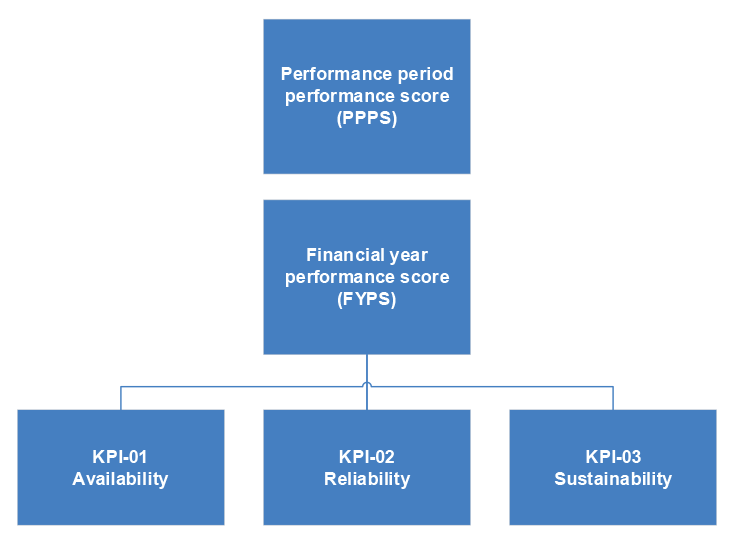
Note: KPI-01 Availability is based on the percentage of availability calculated using a Materiel Available Day (MAD) basis against the agreed targets outlined in the Materiel Sustainment Agreement between Navy and NSSG.
Note: KPI-02 Reliability is based on the number of priority two defects attributable to an individual operational platform.
Note: KPI-03 Sustainability is based on the operational demand fill rate for priority one and priority two urgent defects.
Source: ANAO analysis of Defence documentation.
4.46 There are no performance measures for the LOTE project in the ISSC or in the systems and detailed design contract. In December 2025, Defence advised that there are profit payments and a pricing model that reduces profit as a percentage of the contract value as costs increase in the ISSC, however confirmed that there were no performance measures for the LOTE project.
Performance payments
4.47 Under the ISSC for each performance period, ASC estimates the cost to sustain the Collins class submarines for the next five years, including profit. Eighty-five per cent of the profit is paid monthly, with 15 per cent ‘at risk’, meaning it is retained by the Commonwealth and paid upon completion of an annual reconciliation, ‘true-up’ exercise.
4.48 The LOTE project uses a Not-to-Exceed (NTE) pricing model that includes a contracted level of profit. The contracted level of profit has remained largely consistent as a percentage of total costs in line with the NTE. Seventy per cent is payable on completion of key design and other contracted milestones with the remaining 30 per cent payable on a monthly basis.
4.49 Linking profit payments to milestone achievement was intended to incentivise performance. This approach has not been successful. Key design milestones have been replaced and/or amended to reflect revised delivery approaches (see paragraphs 4.36 to 4.42) and, except for the Systems Requirement Review, none of the key design milestones have been completed as scheduled (see Table 4.5).
Performance reporting
4.50 The Program Review Board and Program Delivery Board oversee the performance of the submarine enterprise. The Boards meet quarterly and receive updates on the performance of the submarine enterprise against the KPIs of the MSA.
4.51 Under the In-Service Support Contract, ASC provides a monthly Contractor Performance Report (CPR). The CPRs report progress against the contracted KPIs and the System Health Indicators (SHIs) despite the SHIs no longer being part of the Performance Management Framework of the ISSC (see Figure 4.3). The ANAO examined the CPRs submitted by ASC since 2020 and found that ASC has reported against the required KPIs — five initially, now three — and included LOTE project updates from July 2017 to July 2022.
Performance reviews and assessments
4.52 The ISSC performance management framework is used by Defence to evaluate ASC’s performance annually and determine if a contract extension will be granted. The KPIs of the ISSC inform two performance scores (see Figure 4.2). The first score is the Financial Year Performance Score (FYPS) and is calculated annually. The average FYPS over the performance period is used to calculate the performance period performance score (PPPS).
4.53 To determine if a contract extension will be granted, Defence undertakes a strategic review. Where the strategic review deems that ASC’s performance has been ‘satisfactory’ Defence is to notify ASC that it intends to grant an extension of the term of the contract and submit a statement of requirement for the next performance period. The next step in the process is for ASC to develop a proposal for Defence’s consideration. Negotiations are held between Defence and ASC, and a new performance period commences upon Defence approval. Since the contract was awarded in 2012, and the two-year transition period was completed in July 2014, four contract extensions have been granted. As at April 2026, the In-Service Support Contract is in performance period five (2024 to 2028).71
4.54 In December 2025, Defence confirmed that there are no performance review or performance assessment mechanisms in the systems and detailed design contract for the LOTE project, with performance monitored through the governance arrangements, as the LOTE project is considered as part of the ISSC strategic review process.
Monitoring and reporting
Contract monitoring and reporting
4.55 As discussed at paragraph 4.5, the LOTE project used a mix of tasking statements and priority purchase orders issued under the survey and quote provisions of existing In-Service Support Contract with ASC and directly contracted with BAE, Raytheon and Thales to conduct scoping studies, project definition, concept design, systems requirements, and system and detailed design work. The monitoring and reporting arrangements established for the contracts that were awarded for the scoping, definition and concept design phases are examined in Appendix 4 (see Table A.1).
4.56 Under the system and detailed design contract awarded in February 2022, the monitoring and control arrangements are comprised of the preparation and delivery of quarterly Contract Status Reports (CSRs). The ANAO examined the 41 CSRs submitted by ASC between February 2022 and June 2025 and found that the CSRs include a financial, human resources, risk, export, and technical data report that have largely met contracted requirements.
Project monitoring and reporting
4.57 During the scoping phase, the combat and platform system IPTs established in 2016 were responsible for monitoring the progress of the project. During the project definition, concept design, system requirements and design phases progress has been monitored by the governance arrangements established for the LOTE project and the governance arrangements of the Submarine Enterprise.
4.58 The progress of the LOTE project was reported through monthly program summary reports submitted between September 2018 and June 2020. Weekly updates were provided to the Director General, Collins Submarine Program between December 2019 and June 2021. Monthly performance reports have been generated since June 2023, however did not include progress against an agreed schedule until October 2023. The LOTE project also reports to the Program Review Board and the Submarine Enterprise Board (see Figure 3.1).
Materiel Sustainment Agreement
4.59 Between 2021 and 2023, monitoring and reporting arrangements for the LOTE project were outlined in the Materiel Sustainment Agreement (MSA). The MSA identified two KPIs: budget and schedule variance and one KHI to measure funding adequacy over the forward estimates period. The key events identified in the project delivery strategy were the completion of the concept design phase, and the systems and detailed design phase, long lead item procurements, and commencement of implementation planning and integrated logistics support. The project delivery strategy identifies the three design reviews required to progress to the installation phase of the project. The design reviews are the: System Requirements Review (SRR); System Design Review (SDR): and Detailed Design Review (DDR). The reviews that were identified were to be completed by the approved subcontractor for each of the sub-projects, within the LOTE project. For example, the SRR for the upgraded Power Conversion and Distribution system was to be completed by February 2021, the SDR by August 2022, and the DDR by May 2024 (see Appendix 3, Figure A.1.)
4.60 As a sustainment project, reporting was to be entered into the Sustainment Project Management System (SPMS). Reports were provided between August 2021 and June 2023. The reports did not include progress against an agreed integrated master schedule as contracted milestones had not been uploaded into the SPMS reporting module. In October 2022, an Independent Assurance Review (IAR) found that reporting provided through the sustainment reporting tool SPMS was inadequate for proper governance of the project.
Materiel Acquisition Agreement
4.61 The reporting requirements were modified when the project was transferred from a sustainment to an acquisition project in June 2023. The applicable Defence guidance material requires acquisition projects to upload scope, cost, schedule, workforce and risk updates monthly into Defence’s Project Performance Review Information Platform (PPRIP). The LOTE project commenced providing these updates in November 2024. The ANAO has examined the information provided and has made the following observations.
- Overall project status is accurately reported as ‘red’, due to the number of ‘very high’ and ‘high’ risks that the project is attempting to manage and issues with the performance of the prime contractor (ASC Pty Ltd) and the Approved Subcontractors.
- Workforce is reported as ‘green’ despite noting that the workforce realisation plan is still under development, and the availability of engineering and project management specialists is an ongoing concern.
Recent developments
4.62 In May 2026, Defence proposed, and government agreed, to a revised approach to extending the service life of the Collins class submarines. The revised approach was necessary to address design, integration and schedule risks that had not been reduced to acceptable levels. It involves refurbishing and maintaining the existing equipment and systems rather than redesigning and replacing them for five of the six Collins class submarines. The revised approach represents a fundamental shift in the project’s delivery strategy after ten years of planning and design activity.72
Appendices
Appendix 1 Entity response
Appendix 2 Improvements observed by the ANAO
1. The existence of independent external audit, and the accompanying potential for scrutiny improves performance. Improvements in administrative and management practices usually occur: in anticipation of ANAO audit activity; during an audit engagement; as interim findings are made; and/or after the audit has been completed and formal findings are communicated.
2. The Joint Committee of Public Accounts and Audit (JCPAA) has encouraged the ANAO to consider ways in which the ANAO could capture and describe some of these impacts. The ANAO’s corporate plan states that the ANAO’s annual performance statements will provide a narrative that will consider, amongst other matters, analysis of key improvements made by entities during a performance audit process based on information included in tabled performance audit reports.
3. Performance audits involve close engagement between the ANAO and the audited entity as well as other stakeholders involved in the program or activity being audited. Throughout the audit engagement, the ANAO outlines to the entity the preliminary audit findings, conclusions and potential audit recommendations. This ensures that final recommendations are appropriately targeted and encourages entities to take early remedial action on any identified matters during the course of an audit. Remedial actions entities may take during the audit include:
- strengthening governance arrangements;
- introducing or revising policies, strategies, guidelines or administrative processes; and
- initiating reviews or investigations.
4. In this context, the below actions were observed by the ANAO during the course of the audit. It is not clear whether these actions and/or the timing of these actions were planned in response to proposed or actual audit activity. The ANAO has not sought to obtain assurance over the source of these actions or whether they have been appropriately implemented.
- Defence’s elevation of the CN10 sustainment program to a product of concern in 2024 increased focus on the Collins class capability during the transition to the future nuclear-powered submarine fleet. This provided the Collins LOTE program with an opportunity to revisit planning assumptions, reassess risk, and develop a new strategy.
- Since May 2024, Defence has provided government with information that supports informed, risk-based decision-making across Australia’s submarine capability.
- The establishment of the Australian Submarine Enterprise governance structure, which oversees both the Collins class and nuclear-powered submarine capabilities, provides a mechanism for improved workforce planning and greater visibility of risks across: ongoing sustainment, capability upgrades, and the life of type extension of the Collins class submarines; work underway to procure Virgina class submarines; and planning for the design and construction of the SSN-AUKUS fleet of nuclear-powered, conventionally armed submarines.
Appendix 3 LOTE project delivery strategy
1. The delivery strategy from 2018 to 2043, illustrated in Figure A.1, shows that concept design was to be completed by June 2020, with system and detailed design work completed by June 2024. Two years were allocated to identify, define and develop integrated logistics support requirements and commence planning for installation of the upgrades. Design reviews were identified at the sub-project level, reflecting that until February 2022, LOTE project effort was managed as a suite of smaller, discrete projects.
Figure A.1: Life of Type Extension project strategy — February 2021
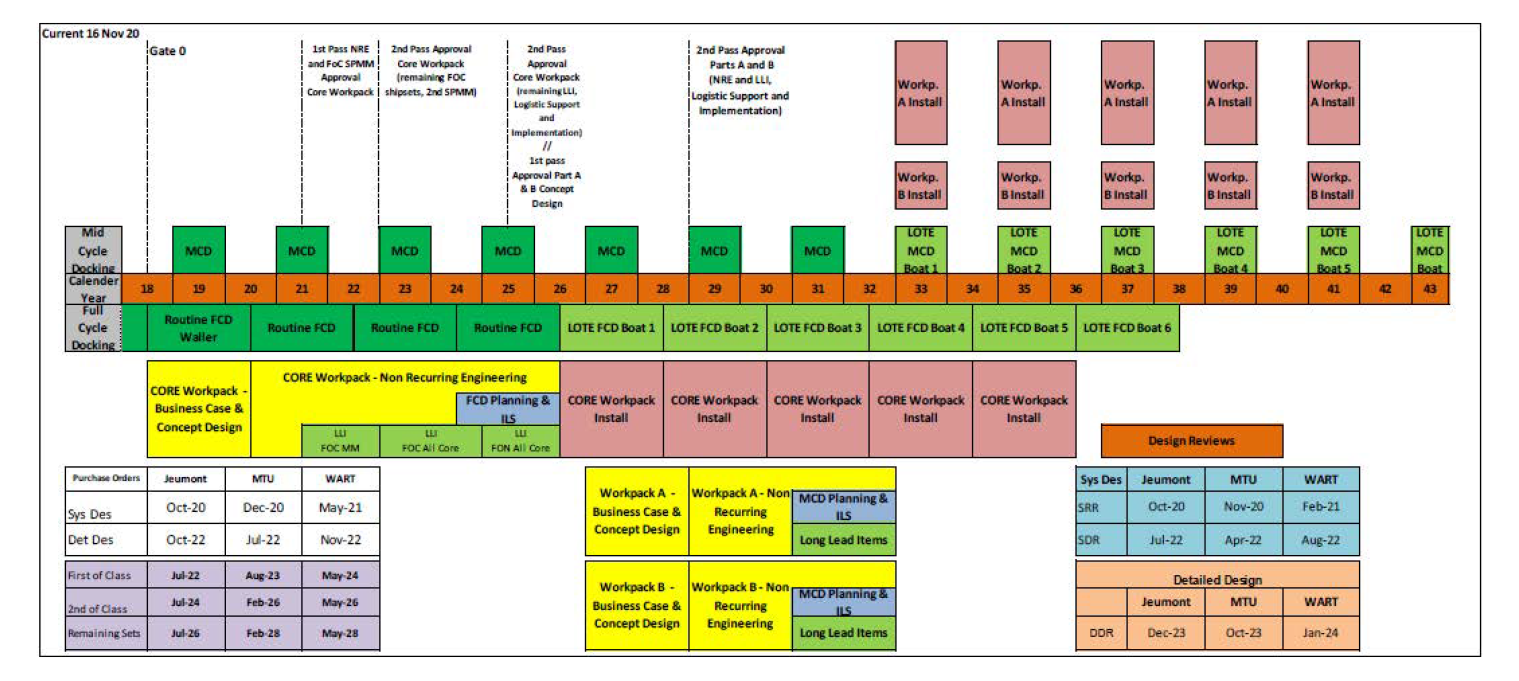
Source: Defence documentation.
Appendix 4 Procurements conducted and contracts awarded
1. Between September 2016 and June 2025, Defence awarded 15 contracts for project scoping, signature studies, life of type buys, project definition and concept design work, systems requirements, and system and detailed design work. Table A.1 provides an analysis of the procurements conducted, the contracts awarded and how each contract has been managed over this period.
Table A.1: Collins Life of Type Project — procurements conducted and contracts awarded (2016 to 2025)
|
Supplier |
Description of Services |
Date contract awarded |
Initial value |
Amended value |
ANAO observations |
ANAO assessment |
|
|
AUD equivalent $m (GST exclusive) |
|
||||
|
ASC Pty Ltd
|
Platform system scoping study |
15 September 2016 |
4.091 |
4.991 |
|
◆ |
|
Signatures study |
26 June 2017 |
3.910 |
– |
|
■ |
|
|
Project definition and concept design |
26 June 2018 |
29.40 |
35.210 |
|
▲ |
|
|
Life of Type Buys
|
12 November 2019 |
4.886 |
– |
|
▲ |
|
|
2 September 2019 |
8.635 |
10.087 |
|
▲ |
||
|
7 November 2019 |
3.340 |
3.841 |
|
■ |
||
|
System requirements and system design for the core work package |
11 December 2020 |
21.488 |
– |
|
▲ |
|
|
System and detailed design (Interim) |
26 July 2021 |
26.763 |
– |
|
▲ |
|
|
System and detailed design for the core work package and procurement of long lead items
|
10 February 2022 |
124.506 |
812.845 |
|
▲ |
|
|
Optronics risk reduction |
18 February 2022 |
3.000 |
– |
|
◆ |
|
|
Cooling chain upgrade |
29 July 2022 |
0.230 |
– |
|
◆ |
|
|
|
Weapons discharge and firefighting systems |
3 October 2024 |
1.024 |
– |
|
◆ |
|
BAE Systems Australia Pty Ltd |
Combat system scoping study |
13 December 2016 |
0.467 |
– |
|
◆ |
|
Thales Australia Ltd |
18 November 2016 |
1.313 |
– |
|
◆ |
|
|
Raytheon Australia Pty Ltd |
18 October 2016 |
2.892 |
– |
|
◆ |
|
|
Total |
235.945 |
866.974 |
– |
▲ |
||
Note a: These documents include Project Management Plans, Contract Master Schedules, Contract Work Breakdown Structure, Program Cost Estimates, Systems Engineering Management, Test and Evaluation, Integrated Logistic Support, and Verification and Validation plans.
Key
◆ The process used to award the contract complied with the requirements of the In-Service Support Contract and the applicable Defence guidance material.
▲ The process used to award the contract partly complied with the requirements of the In-Service Support Contract and the applicable Defence guidance material.
■ The process used to award the contract did not comply with the requirements of the In-Service Support Contract or the applicable Defence guidance material.
Source: ANAO analysis of Defence documentation.
Appendix 5 Contractual mechanisms used to award the contracts (2016 to 2019)
1. Table A.2 examines the contractual mechanisms used to award the contracts for: project scoping studies; project definition; life of type buys; and concept designs.
Table A.2: Contractual mechanisms used to award the contracts for project scoping studies; project definition; life of type buys; and concept designs (2016 to 2019)
|
Supplier |
Services |
Contractual mechanism used |
Form of request documentation |
ANAO observations |
|
ASC Pty Ltd |
Platform Scoping Study |
Survey and Quote |
Tasking Statement |
Defence issued a letter and tasking statement to ASC on 3 June 2016 requesting ASC develop a project plan and schedule to complete the equipment and systems assessment and deliver a formal engineering report into a possible Life of Type Extension for the Collins class submarines. On 11 July 2016, ASC provided its response and a quote to conduct the work, however the quote was withdrawn and resubmitted 24 August 2016. On 5 September 2016, approval was provided to engage ASC Pty Ltd to develop a scoping study for $4.1 million (GST Exclusive). On 15 September 2016, Defence notified ASC Pty Ltd that it had accepted the quote for the services and a purchase order was raised (contract was awarded). |
|
|
Signatures scoping study |
Survey and Quote |
Covering letter and statement of work |
On 24 November 2016, Defence issued a letter and statement of work to ASC. A tasking statement or priority purchase order did not accompany the letter and there is no evidence that one was issued. On 16 January 2017, ASC wrote to Defence and advised that additional information and engagement was required before a project plan or cost estimate to develop a signature scoping study could be provided. On 29 May 2017, ASC submitted a quote of $3.9 million (GST Exclusive) to develop a signature scoping study. The quote was submitted using the correct form however did not identify under what provision of the ISSC the quote was being submitted. On 19 June 2017, approval to engage ASC to conduct the signatures scoping study for $3.9million (GST Exclusive) was provided. On 26 June 2017, Defence raised a purchase order for $3.9 million (GST Exclusive) and the work was to be conducted from July 2017 through to November 2018. |
|
|
Project definition and concept design |
Survey and Quote |
Tasking Statement |
On 19 July 2017, Defence issued a tasking statement to ASC for project definition services. On 14 August 2017, ASC submitted a quote of $12.3 million (GST Exclusive) to conduct the project definition work. There is no evidence that the quote provided was accepted or rejected by Defence. There is no record of financial approval and a no evidence that a purchase order was raised. |
|
|
– |
– |
Priority Purchase Order |
On 10 May 2018, ASC submitted an ‘unsolicited offer’ to develop the capability of ASCs submarine workforce. In response to the offer, Defence issued a Letter of Intent to ASC on 19 June 2018. The letter of intent proposed that $29.4 million would be used to fund training, develop courses and provide on the job training. On 26 June 2018, Defence issued a Priority Purchase Order to ASC for $29.4 million (GST Exclusive) to enact the Letter of Intent. The Priority Purchase Order required ASC to develop a Submarine Workforce Capability Development Plan and LOTE Project Plan. Out of the $29.4 million, $15 million (51 per cent) was used to conduct project definition and concept design work for the LOTE project. There is no evidence that funding approval (s23 approval) as required under the PGPA Act 2013 was provided until an additional $8.8 million was requested and approved in October 2020. |
|
|
Life of Type Buys |
Survey and Quote |
Tasking Statement |
Between 18 and 22 August 2018, Defence issued three tasking statements to ASC requesting a quote for ASC to develop and deliver contract quality and commercially binding cost estimates to procure life of type spares for the current Main Motor and Control System; diesel generators and their control systems; and power conversion and distribution system. . Between September and November 2019, the quantity and price of the Life of Type Buys were discussed via email with excel spreadsheets attached listing the part, recommended quantity and total price. Between September and November 2019, approval to purchase critical items required to ensure CCSMs achieve their planned withdrawal dates for a total of $16.6 million was provided. The process used to procure the life of type buys was poor. The request and offer documentation generated to support the procurement was insufficient and did not comply with the process or requirements of the In-Service Support Contract that the activity was nominally conducted under. |
|
|
Concept design |
Survey and Quote |
Tasking Statement |
On 6 August 2019, Defence issued three tasking statements to request ASC develop a quote to undertake concept design work to replace the Main Motor and Control System; Diesel Generators and update the Power Conversion and Distribution Systems of all six Collins class submarines. No formal quotations have been located for concept design work. Concept design work was funded by the Priority Purchase Order issued to ASC in June 2018. |
|
BAE Systems Australia |
Combat system scoping studies |
– |
Clause 3.11 “Ad-hoc Supplies” |
Defence issued a letter and a draft Statement of Work to BAE in July 2016 requesting BAE provide a quote to conduct a scoping study. The letter issued to BAE did not identify the provisions of the contract that were being invoked or identify that the letter was being issued under the In-Service Support Contract. On 31 October 2016, BAE provides its response. The response identifies that the work will be contracted under the “ad-hoc supplies” provisions of the In-Service Support Contract. On 4 November 2016, Defence requests that BAE provide additional information to support evaluation of BAE’s proposal. On 2 December 2016, approval is provided to engage BAE Systems Australia to procure a Collins Submarine Combat System Life of Type Extension Scoping Study for $1.1 million (GST Exclusive). On 5 December 2016, Defence notifies BAE that it has accepted the quote and on 14 December 2016 two purchase orders are raised. One for the AUD component and one for the GBP component. |
|
Raytheon Australia Pty Ltd |
– |
– |
Survey and Quote |
On 27 July 2016, Defence issued a letter and a draft Statement of Work requesting Raytheon provide a quote to conduct a possible Combat System Life of Type Extension for the Collins class submarines. On 24 August 2016, Raytheon provided a quote of $2.8 million (GST Exclusive) to develop the scoping study and coordinate a Combat System LOTE IPT. On 13 September 2016, Defence advised Raytheon that it had formally appointed a project authority for the LOTE Combat System Scoping Study, specifying that the delegation was limited to discussion and correspondence. No financial delegation or power to enter into agreements with Raytheon was conferred. On 17 October 2016, Defence provided approval to engage Raytheon to coordinate a Combat System LOTE IPT and develop a Combat System LOTE Scoping Study for $2.8 million (GST Exclusive) and on 18 October 2016 the purchase order was raised. |
|
Thales Group Australia |
– |
– |
– |
On 29 July 2016, Defence issued a letter and a draft Statement of Work requesting Thales provide a quote to conduct a possible Combat System Life of Type Extension for the Collins class submarines. On 20 October 2016, Thales provided a quote of $1.3 million (GST Exclusive) to develop a scoping study for a possible Combat System Scoping Study. On 16 November 2016, Defence provided approval to engage Thales for $1.3 million (GST Exclusive) to contribute to conducting a Combat System LOTE Scoping Study. |
Source: ANAO analysis of defence documentation.
Appendix 6 Contract amendments — system and detailed design contract
1. As discussed at paragraph 4.14, 53 amendments have been made to the system and detailed design contract since it was awarded in February 2022. Table A.3 details the amendments that have been made to date.
Table A.3: Tasking Statement Amendments (contract changes) executed
|
Count |
Contract amendment |
Description of the changes made |
Date executed |
Increase in price ($m) |
Total ($m) |
|
1 |
TSA-001 |
|
4 April 2022 |
6.760 |
125.760 |
|
2 |
TSA-003 |
|
16 September 2022 |
1.270 |
127.030 |
|
3 |
TSA-008 |
|
16 September 2022 |
33.617 |
160.647 |
|
4 |
TSA-007 |
|
23 September 2022 |
8.878 |
169.525 |
|
5 |
TSA-009 |
|
7 October 2022 |
10.591 |
180.116 |
|
6 |
TSA-005 |
|
21 October 2022 |
1.562 |
181.678 |
|
7 |
TSA-002 |
|
2 November 2022 |
14.971 |
196.649 |
|
8 |
TSA-006 |
|
4 November 2022 |
10.550 |
207.199 |
|
9 |
TSA-011 |
|
30 November 2022 |
21.997 |
229.196 |
|
10 |
TSA-004 |
|
27 January 2023 |
12.206 |
241.402 |
|
11 |
TSA-012 |
|
16 February 2023 |
– |
– |
|
12 |
TSA-013 |
|
23 April 2023 |
– |
– |
|
13 |
TSA-014 |
|
4 May 2023 |
40.444 |
281.846 |
|
14 |
TSA-019 |
|
15 May 2023 |
9.242 |
291.088 |
|
15 |
TSA-015 |
|
23 June 2023 |
49.474 |
340.562 |
|
16 |
TSA-016 |
|
23 June 2023 |
75.183 |
415.745 |
|
17 |
TSA-022 |
|
19 July 2023 |
2.144 |
417.889 |
|
18 |
TSA-010 |
|
8 August 2023 |
7.025 |
424.914 |
|
19 |
TSA-021 |
|
25 September 2023 |
2.846 |
427.760 |
|
20 |
TSA-026 |
|
25 September 2023 |
2.482 |
430.242 |
|
21 |
TSA-028 |
|
20 October 2023 |
1.318 |
431.560 |
|
22 |
TSA-018 |
|
16 November 2023 |
35.058 |
466.618 |
|
23 |
TSA-017 |
|
1 December 2023 |
0.986 |
467.604 |
|
24 |
TSA-034 |
|
1 December 2023 |
2.715 |
470.319 |
|
25 |
TSA-023 |
|
21 December 2023 |
16.574 |
486.893 |
|
26 |
TSA-030 |
|
21 December 2023 |
1.991 |
488.884 |
|
27 |
TSA-027 |
|
15 January 2024 |
0.772 |
489.656 |
|
28 |
TSA-020 |
|
16 February 2024 |
11.744 |
501.400 |
|
29 |
TSA-035 |
|
15 March 2024 |
10.636 |
512.036 |
|
30 |
TSA-031 |
|
8 April 2024 |
6.446 |
518.482 |
|
31 |
TSA-024 |
|
20 May 2024 |
14.176 |
532.658 |
|
32 |
TSA-025 |
|
26 June 2024 |
7.510 |
540.168 |
|
33 |
TSA-042 |
|
26 June 2024 |
– |
– |
|
34 |
TSA-032 |
|
12 August 2024 |
10.608 |
550.776 |
|
35 |
TSA-039 |
|
13 September 2024 |
7.033 |
557.809 |
|
36 |
TSA-041 |
|
31 October 2024 |
5.789 |
563.598 |
|
37 |
TSA-047 |
|
31 October 2024 |
1.128 |
564.726 |
|
38 |
TSA-046 |
|
4 November 2024 |
1.515 |
566.241 |
|
39 |
TSA-037 |
|
27 November 2024 |
24.295 |
590.536 |
|
40 |
TSA-048 |
|
20 December 2024 |
12.908 |
603.444 |
|
41 |
TSA-054 |
|
20 December 2024 |
5.951 |
609.395 |
|
42 |
TSA-036 |
|
19 March 2025 |
3.900 |
613.295 |
|
43 |
TSA-058 |
|
8 May 2025 |
1.553 |
614.848 |
|
44 |
TSA-050 |
|
28 May 2025 |
27.743 |
642.591 |
|
45 |
TSA-056 |
|
28 May 2025 |
1.841 |
644.432 |
|
46 |
TSA-061 |
|
27 June 2025 |
1.154 |
645.586 |
|
47 |
TSA-065 |
|
30 July 2025 |
12.654 |
658.240 |
|
48 |
TSA-53 |
|
19 December 2024 |
9.717 |
667.957 |
|
49 |
TSA-55 |
|
5 September 2025 |
72.245 |
740.202 |
|
50 |
TSA-63 |
|
11 April 2025 |
– |
– |
|
51 |
TSA-72 |
|
11 September 2025 |
1.128 |
741.330 |
|
52 |
TSA-44 |
|
15 January 2026 |
12.319 |
753.649 |
|
53 |
TSA-75 |
|
15 April 2026 |
53.787 |
807.436 |
|
Total |
688.435 |
807.436 |
|||
Source: ANAO analysis of Defence documentation.
Appendix 7 Changes made to the core work package
Table A.4: Life of Type Extension project — changes to the core work package between 2020 and 2024
|
Project title |
Project description |
ANAO observations |
2020 |
2022 |
2024 |
|
Hull, Tanks, Pressure Vessel and Casing Project |
Develop and implement systems to better manage the condition of pressure vessels, hull, tanks and casing and conduct hull fatigue data collection, research and modelling |
Work to develop cost estimates and schedules to implement the scope of twelve recommendations from the hull related scoping studies commenced in August 2018. The scope of the project was reduced from implementing all 12 recommendations to one in February 2019. In June 2020, Defence requested that the original scope of the project (all 12 recommendations) be included in the core work package. |
✔ |
✔ |
✔ |
|
Diesel Generator Upkeep and Update Project |
Conduct Life of Type Buy (LOTB) for spares for the current Diesel Generators to achieve the Planned Withdrawal Date (PWD) and replace the Diesel Generators during LOTE FCD to achieve the Amended Planned Withdrawal Date |
Work to identify the LOTB requirements commenced in August 2018. Work to develop the concept design and business case to upgrade/replace the diesel generator commenced in August 2019. The concept design report was delivered in January 2020 and the business case was delivered in March 2020. |
✔ |
✔ |
✔ |
|
Main Motor and Control System Update Project |
Conduct Life of Type Buy (LOTB) for spares for the current Main Motor and Control System to achieve the Planned Withdrawal Date (PWD) and replace the Main Motor and Control Systems to achieve the Amended Planned Withdrawal Date |
Work to identify the LOTB requirements commenced in August 2018. Work to develop the concept design and business case commenced in August 2019. The concept design report and business case for the upgrade/replacement of the main motor and control system was delivered in March 2020. |
✔ |
✔ |
✔ |
|
Power Conversion and Distribution System Update Project |
Conduct Life of Type Buy (LOTB) for spares for the current Power Conversion and Distribution System to achieve the Planned Withdrawal Date (PWD) and replace the Power Conversion and Distribution system during LOTE FCD to achieve the Amended Planned Withdrawal Date (AWPD) |
Work to identify the LOTB requirements and develop a concept design report and business case commenced in August 2018. Work to develop the concept design and business case for the upgrade/replacement of the power conversion and distribution system was tasked to ASC again in August 2019. The concept design report for the upgrade/replacement of the power conversion and distribution system was delivered in December 2019 and the business case was delivered in February 2020. |
✔ |
✔ |
✔ |
|
Halon System Update Project |
Conduct Life of Type Buy (LOTB) for spares for the current Halon system to achieve the Planned Withdrawal Date (PWD) and replace the Halon system and AFFF system during LOTE FCD to achieve the Amended Planned Withdrawal Date (AWPD) |
Identification of LOTB requirements commenced in August 2018. The Halon system update project was removed from the core work package in July 2019. |
✘ |
✘ |
✘ |
|
Combat System Update Project |
Conduct Life of Type Buy (LOTB) for spares for the current Combat Systems Capability to achieve PWD and conduct technology refresh updates of the combat systems during FCD and/or MCD to achieve the Amended Planned Withdrawal Date |
This project did not progress. In July 2020, the project had been removed from the core work package. |
✘ |
✘ |
✘ |
|
Non-Hull Penetrating Search Periscope Update Project |
Replace current hull penetrating search periscope with a non-hull penetrating periscope |
Work to develop a concept design report and business case for the upgrade/replacement commenced in March 2019. The project was moved into the core work package in December 2019. The concept design report and business case were delivered in April 2020. The project was removed from the core work package in November 2020and the project was put ‘on hold’ in June 2021. Additional funding was approved in December 2021 and in February 2022 the project recommenced. In August 2023, the project was ‘paused’ and removed from the core (Tranche 1A) work package. |
✘ |
✔ |
✘ |
|
Cooling chain upgrade |
Upgrades to the cooling systems to address additional heat loads generated by the non-hull penetrating search periscope (optronics) scope of work, future updates and upgrades, and warmer external environmental conditions. |
In April 2022, Defence requested that ASC incorporate cooling requirements into the ‘core’ work package. |
✘ |
✔ |
✔ |
|
Control and Monitoring (Integrated Ships Control Management and Monitoring System — ISCMMS) |
Updates to the Integrated Ships Control Management and Monitoring System (ISCMMS). Software and Platform Equipment LAN. |
In March 2020, the program cost estimate delivered by ASC identified five projects in the core work package, including an update of the ISCMMS. In October 2021, as part of engaging ASC to continue system design work, the Statement of Work included updates to the Integrated Ships Control Management and Monitoring System in the core work package. In February 2022, an updated ISCMMS was added to the scope of the core work package. |
✘ |
✔ |
✔ |
Note: Tranche 1A formally known as the ‘core’ work package includes changes and additions identified after the concept design phase of the project was completed in November 2020 and as advised to Defence’s Investment Committee in December 2020.
Source: ANAO analysis of Defence documentation.
Footnotes
1 This extension comprises one additional ‘Usage and Upkeep Cycle’, consisting of 10 years of operation and a two-year Full Cycle Docking.
2 Under the AUKUS trilateral security partnership, Australia will acquire conventionally armed, nuclear-powered submarines. Nuclear-powered submarines are commonly referred to using the North Atlantic Treaty Organisation (NATO) designation of SSN.
Prime Minister, Minister for Defence, Minister for Foreign Affairs Joint media statement, ‘Australia to pursue nuclear-powered submarines through new trilateral enhanced security partnership’, 16 September 2021, available from https://www.minister.defence.gov.au/statements/2021-09-16/joint-media-statement-australia-pursue-nuclear-powered-submarines-through-new-trilateral-enhanced-security-partnership [accessed 25 August 2025].
3 This extension comprises one additional ‘Usage and Upkeep Cycle’, consisting of 10 years of operation and a two-year Full Cycle Docking.
4 ASC Pty Ltd is a government business enterprise wholly owned by the Australian government, with the Minister for Finance as its sole shareholder. ASC was established in 1985 and constructed the Collins class submarines. Since the final Collins class submarine entered service in 2003, ASC has been engaged by Defence to maintain the fleet. ASC is also the prime systems integrator responsible for installing capability upgrades on the Collins class submarines.
5 The design work to be completed was for six system updates, referred to as ‘the core work package’, comprised of a: Main Motor Update Project; Diesel Generator Update Project; Control and Monitoring System Update; Power Conversion and Distribution Update Project; and Hull and Cooling System Updates.
6 A Full Cycle Docking is conducted on each submarine after it has been operating for 10 years. It is where the maintenance required to maintain certification of the submarines is undertaken and where complex system and equipment upgrades are installed and tested.
The full cycle docking duration is growing as the Collins class reaches the end of its designed life, but averages approximately 970,000 hours.
7 The funding required to conduct the work was sourced from the Collins sustainment and SEA1000 (Future Submarine Program) budgets. In 2016, $24 million from the Future Submarine Program was allocated for early planning and scoping work for a Life of Type Extension for the Collins class submarines.
8 On 13 December 2018, the Minister for Defence announced that the Future Submarines would be known as the Attack class.
9 Prime Minister, Minister for Defence, Minister for Foreign Affairs, Joint media statement: Australia to pursue nuclear-powered submarines through new trilateral enhanced security partnership, 16 September 2021, available from the internet https://www.minister.defence.gov.au/statements/2021-09-16/joint-media-statement-australia-pursue-nuclear-powered-submarines-through-new-trilateral-enhanced-security-partnership [accessed 16 March 2026].
10 Prime Minister, Minister for Defence, Minister for Finance, Joint media statement, ‘Key naval projects confirmed for South Australia’, 16 September 2021, available from internet https://www.minister.defence.gov.au/media-releases/2021-09-16/key-naval-projects-confirmed-south-australia [accessed 16 March 2026].
11 Conventionally armed nuclear-powered submarines use the North Atlantic Treaty Organisation (NATO) designation of SSN.
12 As at February 2026, Defence plans to decommission one Collins class submarine every two years, from 2038 to 2048.
13 The 2009 Defence White Paper provided an overview of the desired state of the future submarine capability and noted that to achieve this, government had agreed to further incremental upgrades to the Collins class submarines throughout the next decade.
14 The operating cycle for the Collins class submarine is also known as the Usage Upkeep Cycle. The Usage Upkeep Cycle is comprised of 10 years of operations and a two-year Full Cycle Docking.
15 An evolved Collins class was essentially a new submarine design that would incorporate new technologies into the platform used by the Collins class submarines.
16 The options for a replacement submarine were being undertaken as part of the Future Submarine Program. The acquisition strategy that would be used by the Future Submarine Program was announced in February 2015 and in April 2016, government announced that Direction de Constructions Navales Services (DCNS) of France (Naval Group) had been selected to design and build the Future Submarine (Attack class submarines) for Australia.
17 The revised statement of operating intent was also renamed the operating and support intent.
18 The core work package was to update/replace the submarine systems that had been assessed as being at the greatest risk of not achieving the Planned Withdrawal Date and the Amended Planned Withdrawal Date.
19 These design risks and schedule delays related to the lack of a specialised workforce that is capable of designing and installing new systems to address obsolescence issues, in part, due to the cancellation of the Attack class program. For example, the decision to install a new, smaller main motor added complexity to the completion of a full cycle docking using a workforce that is optimised for sustainment activities, not design tasks that installing new equipment requires.
20 Defence uses a staged project approval process comprising internal reviews, or Gates. Gate 0 is an early high-level review of the capability need, options development, risk and strategy. Gate 1 is only required for complex and high-risk proposals or when a government decision is required in order to narrow the field of options. Gate 2 is the development of a business case which forms the basis of the proposal to government for approval.
21 The Investment Committee is responsible for exercising strategic control over the investment portfolio and is the approving authority for the individual projects within the Integrated Investment Program (IIP). It is chaired by VCDF and its members include the Military Service Chiefs, Deputy Secretaries, Chief Finance Officer, Chief of Joint Capabilities and representatives of the Department of Finance, the Department of the Prime Minister and Cabinet, and the Office of National Intelligence.
22 These were the main motor and control system and diesel generators (propulsion system), power conversion and distribution system, and associated equipment selections.
23 ASC recommended that a comprehensive reassessment of the main motor and diesel engine systems, citing improvements achieved during sustainment and the loss of testing facilities following the cancellation of the Attack program. ASC determined that the need to upgrade the power conversion and distribution system had not changed and was still the optimum solution.
24 Gloria Valdez is a retired civilian senior executive officer of the United States Navy and Department of Homeland Security. She led the review, with the support of the Submarine Advisory Committee, established in 2017 to oversee the transition from the Collins class submarine fleet to the future submarine fleet, and the LOTE Technical Advisory Panel established in July 2022.
25 Defence defines regionally superior as the ‘ability for Australia to effectively operate and support its submarines in our region at will, in peace and war, to persistently achieve national tasking in any area of Government’s choosing and in the presence of the most capable adversary forces.’
26 For the period 2016–17 to 2018–19, the Collins fleet availability met or exceeded international benchmarks.
27 Funding for the scoping studies was provided by the SEA1000 (Future Submarine) program, as agreed by government in September 2016.
28 Defence identified the LOTE’s contribution to uplifting and training the submariner workforce and developing industry in support of broader government objectives, including the 2017 continuous naval shipbuilding plan.
29 The Naval Shipbuilding Enterprise and Governance committee was established by government. It is a cabinet committee established to oversee the implementation of the Continuous Naval Shipbuilding Plan. The two key projects associated with the plan were the Attack class submarine program and the Hunter Class Frigates.
30 The procurements were for the replacement main motor and diesel generators.
31 Other projects included in the Maritime Undersea Combat and Surveillance Program include undersea surveillance, combat and associated command, communications, control and supporting infrastructure.
32 Independent Assurance Reviews are management-initiated reviews to provide the Defence Senior Executive with assurance that projects and products will deliver approved objectives, are on track to meet key milestones, and can progress to the next stage of activity.
33 The submarine enterprise refers to all parties involved in sustaining the Collins class submarines and includes the Navy, CASG (now transitioned to NSSG) and industry partners (ASC, Raytheon and Thales).
34 An interim report was delivered in February 2024, and the final report was delivered in June 2024.
35 For the remaining Collins class submarine, Defence intends to continue the design work required to successfully install the upgraded systems and equipment and will come back to government in 2028.
36 The framework was updated in 2017 to reflect the establishment of the Submarine Enterprise Board to replace the Collins Transformation Program Board (TPB). The TPB was established to oversee the implementation of the recommendations from the Coles review.
37 In August 2025, the Australian Submarine Enterprise Governance Framework was updated to address risks and opportunities across the submarine enterprise. It is comprised of a band three/three-star body – the Senior Submarine Executive Committee – and a band two/two-star body – the Australian Submarine Coordination Group. The Senior Submarine Executive Committee is authorised to make decisions on issues that are likely to have impacts across the submarine enterprise. It is co-chaired by Chief of Navy, the Director General of the Australian Submarine Agency and the Deputy Secretary Naval Shipbuilding and Sustainment. Both bodies include representatives from the Nuclear-Powered Submarine industry and other government departments involved in delivering Nuclear-Powered Submarines to Australia under the AUKUS arrangement.
38 The Enterprise Forward Planning Team (EFPT) reports to the Program Delivery Board, see Figure 3.1. The EFPT is responsible for developing the schedule and plan for capability inserts (such as SEA1439 projects) for the six Collins class submarines during respective maintenance periods including the LOTE Full Cycle Dockings, currently scheduled to commence in June 2026 with HMAS Farncomb.
39 The IPT was to be supported by nine working groups the seaworthiness, security, technical, commercial, signatures, sustainment, integration, integrated logistics support, and training working groups.
40 The Naval Shipbuilding Expert Advisory Panel (NSEAP) provides expert advice directly to Ministers, including members of the Naval Shipbuilding Enterprise Governance Committee. It was established in February 2021 to monitor the implementation of the Continuous Naval Shipbuilding Plan and identify emerging issues that require government consideration.
41 Mandated System Reviews are to be achieved incrementally as the project progresses through the systems engineering lifecycle. For the LOTE project they are the key design milestones in the system and detailed design contract and are used to develop, refine and finalise the design of the system upgrades.
42 The First Assistant Submarines (band two) is the Chair of the SEB and a member of the PMRB. The DGSMS and DGSM (one-star) are members of the PMRB and SEB.
43 In 2018 a LOTE IPT was stood up and met three times between October 2018 and December 2018. The IPT did not meet again until the LOTE IPT was re-established in May 2021. Between December 2018 and September 2021, LOTE project oversight was provided by the Project Controls Board.
44 In October 2024, the risk management plan for the LOTE project was updated. The update modified the risk authorities, identifying that ED LOTE was the risk authority for ‘very high’ and ‘high’ project risks.
45 The DGSMS, DGSM (one-star) and ED LOTE (EL2) are members of the IPT and PRB.
46 The key decision makers are the Director General, Submarine Sustainment (DGSMS) and the Director General, Submarines (DG SM).
47 The Integrated Master Schedule (IMS) is reflected in the High Level Work Program (HLWP) of the In-Service Support Contract with ASC. The HLWP sets out the maintenance plan and each planned maintenance activity for the Collins class submarines over an eight-year period.
48 The Projects Control Board has not convened since August 2023 and has been dissolved.
49 The ‘extreme’ risk rating provided by ASC is equivalent to Defence’s ‘very high’ risk rating.
50 The National Shipbuilding Advisory Board replaced the Naval Shipbuilding Expert Advisory Panel in 2021.
51 Defence uses the Smart Buyer process to assess risk across the acquisition and sustainment phases and identify the risk profile of a project or program. The Smart Buyer process involves conducting a series of workshops to assess risk across the acquisition and sustainment phases. In 2017, there were nine acquisition and eight sustainment risk categories used. The nine risk categories used to assess the risk profile of the acquisition phase are: needs, technology, schedule, commercial, project integration and fundamental inputs to capability, defence and program integration, financial, strategic, and industry capability. The eight risk categories used to identify the risk profile of the sustainment phase are: in-service considerations, obsolescence, commercial, fundamental inputs to capability, financial, strategic, support on operations and industry capability.
52 The nine parent risks are the risks active through the life of the Project to date. Three were retired in September 2025 and two more parent risks were raised. There are currently eight parent risks being managed by the Project.
53 The Major Projects Report for 2023–24 stated that the control weaknesses in the Predict! system identified in 2022–23 had not been addressed by Defence.
Auditor General Report No. 14 2023–24, 2022–23 Major Projects Report, ANAO, Canberra, 2024, paragraph 1.92, available from https://www.anao.gov.au/work/major-projects-report/2022-23-major-projects-report [accessed on 10 March 2026].
54 This was done by Defence to address data quality issues in Predict!.
55 In April 2016, Defence issued the Interim Capability Development Life Cycle Manual, replacing the Defence Capability Development Handbook. Defence guidance in both frameworks describes capability documentation as ‘progressively refined’ across the capability lifecycle. Earlier documents are retained as part of the project’s documented decision trail, enabling decision-makers to understand how and why the acquisition strategy, risk settings and delivery approaches have evolved over time.
56 Survey and quote provisions are generally used to engage service providers to deliver additional quantities of goods or provide services that are not part of the core or recurring services however are within the scope of the contract.
57 Defence developed Special Conditions and a detailed Statement of Work for the system and detailed design contract that it then issued under the survey and quote provisions of the In-Service Support Contract.
58 The Contract Data Requirements List of the System and Detailed Design contract identifies that draft CMS and CWBS were to be delivered six months after the commencement date of the contract with final versions delivered for approval by Defence nine months after the commencement date of the contract. The commencement date is defined in the glossary as 1 July 2021.
59 A Not to Exceed Model is where the contractor provides a cost estimate that sets a limit, or ceiling, for the goods or services that are to be provided under the contract.
60 The labour rates, direct project costs and corporate overheads to provide the services under the tasking statement are those of the In-Service Support Contract.
61 All figures are AUD equivalent and GST exclusive.
62 The statement of work for the system and detailed design contract stated that ASC was to provide tender quality estimates to procure the replacement main motor, diesel engine and power conversion and distribution system. The quotations were accepted and added to the contract in May and June 2023.
63 In December 2019, the core work package comprised of three sub-projects. The replacement diesel generator, replacement main motor and control system and power conversion and distribution update.
64 The additional scope was the non-hull penetrating optronics system upgrade project. The tasking statement also made the following statement.
This tasking statement is being forwarded in advance of the CoA approval of Collins Life of Type Extension Project (SEA1450) to enable ASC and its subcontractors to continue the minimum essential only non-recurring engineering up to 31 December 2020.
65 The priority purchase order was issued under the survey and quote provisions of the In-Service Support Contract.
66 In May 2021, Defence and ASC entered an interim arrangement for six months (July to December 2021) to enable system design work to continue and the System Requirements Review (SRR) to be completed while ASC and Defence were negotiating a longer-term arrangement.
67 The distributed Detailed Design Review process involved undertaking a Detailed Design Review of each of the updated systems followed by a Detailed Design Review of the impacted systems. The individual detailed design reviews for each system and the impacted systems were then to be consolidated into a Detailed Design Review across the whole of the submarine. ASC also advised that achievement of the DDR would not be achieved until April 2025.
68 For the remaining Collins class submarine, Defence intends to continue the design work required to successfully install the upgraded systems and equipment and will come back to government in 2028.
69 The Materiel Sustainment Agreement (MSA) is the agreement between Navy (Owner) and CASG (Delivery Lead). It sets out key performance and key health indicators intended to ensure that capable submarines are available for deployment in line with preparedness requirements; and that the submarines are being sustained efficiently.
70 The five KPIs were: KPI-01 Materiel Readiness Days; KPI-02 Materiel Capable Days Lost; KPI-03 DMDR plan milestone achievement; KP-04 Open priority 2 (P2) URDEFS; KPI-05 Priority 1 Contractor Demand Satisfaction Rate.
71 The term of the In-Service Support Contract does not specify an end date, or a limit to the number of contract extensions (performance periods) that can be awarded, however does state that the contract cannot be extended beyond the date the last Collins class submarine is decommissioned and removed from Service.
72 For the remaining Collins class submarine, Defence intends to continue the design work required to successfully install the upgraded systems and equipment and will further advise government in 2028.