Browse our range of reports and publications including performance and financial statement audit reports, assurance review reports, information reports and annual reports.
Auditor-General Report No. 30 of 2025–26
Department of Education’s Administration of the National Collaborative Research Infrastructure Strategy
Published
Wednesday 6 May 2026

Portfolio
Education
Entity
Department of Education
Contact
Please direct enquiries through our contact page.
Activity
Grants administration
Sector
Education
Audit snapshot
Why did we do this audit?
- The National Collaborative Research Infrastructure Strategy (NCRIS) funds nationally significant assets that are too large to be funded by individual organisations.
- Australian Government funding for NCRIS facilities allows users to access infrastructure that would not otherwise be available.
- Between 2004–05 and 2028–29, approximately $5 billion in grant funding will be provided to selected Australian universities, publicly funded research agencies, and private companies through NCRIS.
Key facts
- Strategic priorities for NCRIS funding are set out in a roadmap which is developed every five years.
- The most recent roadmap is the 2021 National Research Infrastructure Roadmap.
- NCRIS funding is allocated through closed non-competitive grants, meaning only eligible invited applicants can apply.
What did we find?
- The Department of Education’s (Education) administration of NCRIS is partly effective.
- Education’s administration of funding opportunities and funding decisions partly promotes the proper use and management of public resources. While grant assessments and approvals are largely compliant with requirements, strategic planning is not effectively linked to funding decisions.
- Partly appropriate arrangements to measure and assess the outcomes from grant funding have been established. Performance monitoring and reporting arrangements are in place, but are not used to monitor program outcomes.
What did we recommend?
- There were three recommendations to Education on grant planning and risk management, evaluation and reporting.
- Education agreed to two recommendations and agreed in principle to one recommendation.
$5bn
Estimated in NCRIS grants between 2004–05 to 2028–29.
26
National Research Infrastructure facilities currently funded through NCRIS.
91,527
Australian and international users of NCRIS facilities
in 2023–24.
Summary and recommendations
Background
1. The National Collaborative Research Infrastructure Strategy (NCRIS) provides national research infrastructure (NRI) grants to selected Australian universities, publicly funded research agencies, and private companies.1 NRI is defined as ‘nationally significant assets, facilities and services that support leading-edge research and innovation’ (for example, see Case study 1, a full list of NCRIS funded projects is at Appendix 3).
2. NCRIS was established in 2006 in response to the March 2004 Final Report of the National Research Infrastructure Taskforce, which stated:
The consensus across all Australian Governments and research institutions is that, while decisions on research themes or projects might be made through a competitive process, investment in research infrastructure should be made in a strategic, collaborative manner.2
Rationale for undertaking the audit
3. From 2004–05 to 2028–29, NCRIS will deliver an estimated $5 billion in grants. NCRIS facilities are nationally significant assets, which are usually too large to be funded by individual research organisations. This means that without effective Australian Government support, these facilities would not be available to researchers.
4. This audit was conducted to provide assurance to the Parliament over the effectiveness of Education’s administration of NCRIS.
Audit objective and criteria
5. The objective of this audit was to assess the effectiveness of the Department of Education’s administration of NCRIS in achieving the outcomes of the program.
6. To form a conclusion against the objective, the following high-level audit criteria were adopted:
- Does the administration of funding opportunities and funding decisions promote the proper use and management of public resources?
- Have appropriate arrangements been established to measure and assess the outcomes from grant funding?
7. The audit focused on NCRIS funding delivered from 2022 to 2025. This included all funding under the 2021 NCRIS Roadmap, except for the outcomes of the second funding round of 2025, which was still in progress at the time of the audit, with an anticipated completion date of early to mid-2026.
Conclusion
8. The Department of Education’s administration of NCRIS is partly effective. While strategic planning arrangements are a strength of the NCRIS program design, elements of this have not been effectively implemented under the 2021 Roadmap, and deficiencies in grant assessments and approvals undermine Education’s ability to demonstrate proper use and management of public resources. The development of an approach to program evaluation, and improved use of grant recipients’ reported performance information in public reporting of program performance could help Education understand if they are achieving the outcomes of the program.
9. Education’s administration of funding opportunities and funding decisions partly promotes the proper use and management of public resources. An effective planning process has been designed in the form of five-yearly roadmaps and two-yearly investment plans, but under the 2021 Roadmap, the investment planning process has not supported strategic planning of NCRIS investments. Processes to ensure probity and transparency in grant administration have not been fully established. The application assessment approach can be strengthened through more transparency and effective documentation of the process which meets requirements of the applicable Commonwealth Grant Rules and Principles (previously Commonwealth Grant Rules and Guidelines).
10. Education has established partly effective arrangements to measure and assess the outcomes from grant funding. Education has established processes for twice yearly reporting by NCRIS grant recipients. Key performance information does not always relate directly to grant purposes, and Education does not confirm the accuracy of information collected from grant recipients. Education does not monitor and evaluate progress against NCRIS roadmap priorities and recommendations. Education has worked to establish improved performance reporting in line with the Commonwealth Performance Framework by publishing more NCRIS specific performance information in its 2024–25 annual performance statements.
Supporting findings
Administration of funding
11. Education allocates NCRIS funding through closed non-competitive grants, supported by a strategic planning process designed to consist of five-yearly roadmaps and two-yearly investment plans. Investment plans under the 2021 Roadmap have not supported strategic planning of NCRIS investments, compared with previous investment plans released in 2018 and 2020. (See paragraphs 2.3 to 2.20)
12. Between 2022 and 2025, Education’s assessment and approval processes for grants did not meet all requirements of the Commonwealth Grant Rules and Principles (or previously, Commonwealth Grant Rules and Guidelines). Education’s process included additional assessment criteria not set out in guidelines, did not specifically document consideration of value for money in assessments and approvals and did not provide complete advice to grant approvers. (See paragraphs 2.21 to 2.39)
13. Arrangements to ensure probity and transparency such as conflict-of-interest declaration and management arrangements, have improved since mid-2025, but as of December 2025 have not been fully implemented. (See paragraphs 2.46 to 2.47, and Table 2.7)
Performance measurement and reporting
14. At the individual grant recipient level, Education has established reporting and information gathering arrangements with grant recipients to enable collection of performance information. Improvements to develop more relevant key performance measures at a grant recipient level are in progress. While this performance information provides a picture of performance at the level of individual grant recipients, it is not used to evaluate NCRIS program outcomes, to report on progress against NCRIS roadmaps, or to report overall program performance. Education assesses, but does not verify, reported information. (See paragraphs 3.4 to 3.23)
Recommendations
Recommendation no. 1
Paragraph 2.48
The Department of Education improves its processes for the assessment and approval of NCRIS grant applications by:
- ensuring that grant guidelines clearly describe the assessment criteria and approval process, including how all criteria and strategic considerations, and the assessment of value for money, will contribute to grant assessment;
- ensuring that grant assessment and approvals are undertaken as described in the grant guidelines; and
- ensuring advice to approvers of grants includes merits of proposed grants relative to the grant guidelines and indicates if grant applications met the selection criteria.
Department of Education response: Agreed.
Recommendation no. 2
Paragraph 2.54
The Department of Education ensures the allocation of NCRIS funding is supported by a planning process which:
- identifies how roadmap priorities will be achieved and how success against these priorities will be measured;
- tests whether there are opportunities to achieve better value for money; and
- is published.
Department of Education response: Agreed.
Recommendation no. 3
Paragraph 3.24
The Department of Education monitors and evaluates the achievement of outcomes against priorities set out in each roadmap, by:
- developing, in conjunction with grant recipients, meaningful shared performance metrics across facilities;
- ensuring that performance metrics for grant recipients are clearly linked to the roadmap;
- adopting an assurance approach over collected performance information;
- improving the use of collected performance information to monitor, assess and report achievement of roadmap priorities; and
- developing and publishing an evaluation report at the conclusion of each roadmap, which assesses whether the roadmap priorities and recommendations have been met.
Department of Education response: Agreed in principle.
Summary of entity response
15. The proposed audit report was provided to the Department of Education. The summary response to the report is below and the full response is at Appendix 1. Improvements observed by the ANAO during the course of this audit are listed in Appendix 2.
Department of Education
The Department of Education (the department) acknowledges the Australian National Audit Office (ANAO) performance audit of the department’s administration of the National Collaborative Research Infrastructure Strategy (NCRIS).
NCRIS is a significant national investment supporting Australia’s research and innovation system. The department recognises the importance of transparent investment planning, robust grant administration and well evidenced decision making to ensure strong stewardship of the program.
Over the past three years, the department has undertaken substantial work to strengthen its administration of NCRIS. This includes clearer documentation of assessment processes, strengthened record keeping, enhanced probity arrangements and formalised conflict of interest processes. Work to address the opportunities identified by the ANAO commenced in 2025 and will continue to be progressively implemented as part of our ongoing commitment to strengthening program delivery.
The department notes that recent NCRIS investment rounds were informed by a strong strategic foundation, including the 2021 National Research Infrastructure Roadmap, NRIAG advice, expert committees, and step change priorities, with robust and transparent assessment and approval processes. The department acknowledges the value of clearly communicating forward planning for NCRIS, the rationale behind investment decisions, and how project level success relates to program level goals.
The department welcomes the three Recommendations and affirms its commitment to continuous improvement to support the effective long term delivery of NCRIS.
Key messages from this audit for all Australian Government entities
16. Below is a summary of key messages, including instances of good practice, which have been identified in this audit and may be relevant for the operations of other Australian Government entities.
Group title
Grants
Key learning reference
Group title
Performance and impact measurement
Key learning reference
1. Background
Introduction
1.1 The National Collaborative Research Infrastructure Strategy (NCRIS) provides national research infrastructure (NRI) grants to selected Australian universities, publicly funded research agencies, and private companies.3 NRI is defined as ‘nationally significant assets, facilities and services that support leading-edge research and innovation’ (for example, see Case study 1, a full list of NCRIS funded projects is at Appendix 3).
1.2 NCRIS was established in 2006 in response to the March 2004 Final Report of the National Research Infrastructure Taskforce, which stated:
The consensus across all Australian Governments and research institutions is that, while decisions on research themes or projects might be made through a competitive process, investment in research infrastructure should be made in a strategic, collaborative manner.4
1.3 In the 2004–05 Federal Budget, the government announced NCRIS’s establishment, to ‘ensure that research infrastructure is directed to the highest priority research projects and that universities and public research organisations actively collaborate on research projects and use of infrastructure’.5
1.4 The 2015 Research Infrastructure Review Final Report found that Australian Government funding for NRI is critical, as there is ‘no precedent anywhere in the world to suggest that industry, state and territory governments or not-for-profit agencies would accept sole responsibility if the Australian Government stepped away’.6 The Review recommended the government regard its investment in NRI ‘as the patient capital required to secure Australia’s future in research’.7
1.5 The design of NCRIS is generally supported by the Australian research sector, with the December 2023 Australian Universities Accord Final Report noting NCRIS is:
a highly collaborative and distinctively Australian program which maximises Australia’s NRI investments by coordinating open access, targeted specialities and co-funding by government, universities and, sometimes, publicly funded research agencies (PFRAs) and industry across the research sector.8
Funding arrangements
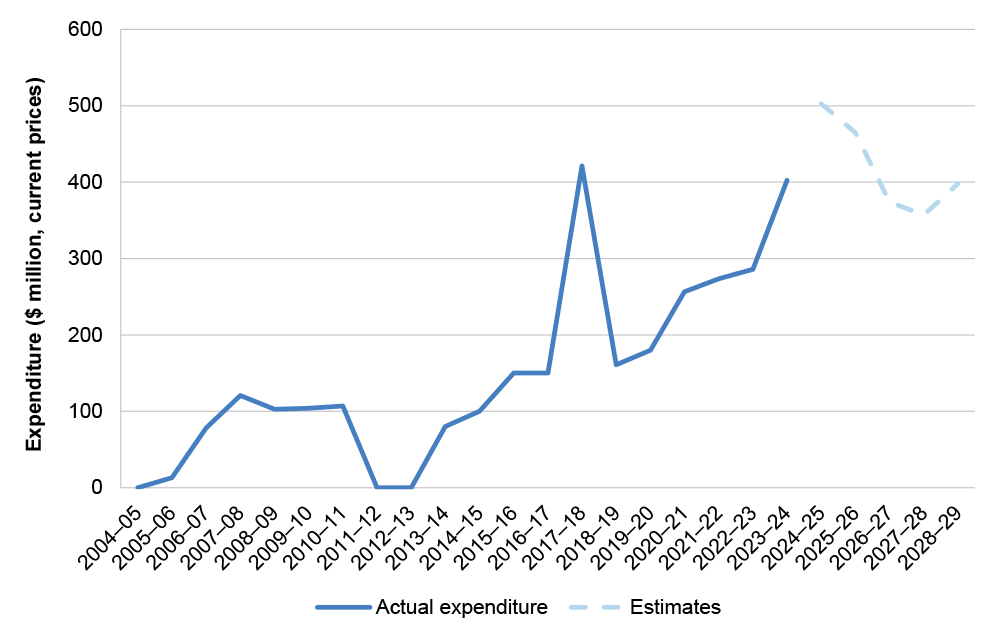
1.6 Between 2004–05 and 2028–29, NCRIS will provide an estimated $5 billion in grants, with annual expenditure peaking in 2024–25 at $503 million (Figure 1.1). NCRIS funds 26 NCRIS facilities, and one associate membership payment to access international research infrastructure. NCRIS has ongoing funding.9 A budget measure provided additional NCRIS funding of $1.9 billion over 12 years from 2017–18 to 2028–29.10 As of December 2025 funding agreements with NCRIS facilities conclude on 30 June 2028 (Figure 1.1).
Figure 1.1: NCRIS expenditure, 2004–05 to 2028–29
Source: ANAO analysis of Science, Research and Innovation Budget Tables for 2025–26, 2024–25 and 2013–14, and Education 2025–26 Portfolio Budget Statements.
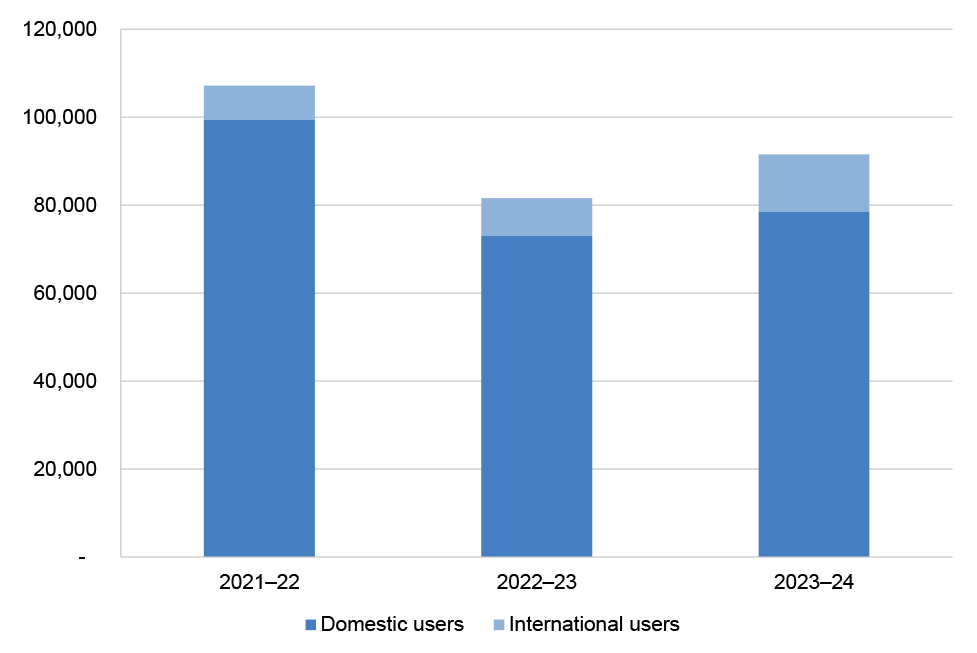
1.7 NCRIS funded NRI must be made widely accessible to researchers and industry, with barriers to access as low as practicable. A website, Research Infrastructure Connected, is funded by NCRIS to help users identify the right research infrastructure for their needs.11 NCRIS facilities were used by 78,586 Australian researchers and 12,941 international researchers in 2023–24 (Figure 1.2).
Figure 1.2: Totala NCRIS facilities users, 2021–22 to 2023–24b
Note a: Education manually removes outliers from this dataset. ANAO has not undertaken further data cleaning or data verification.
Note b: Verified data is not available for the period after 2023–24.
Source: ANAO based on Education data.
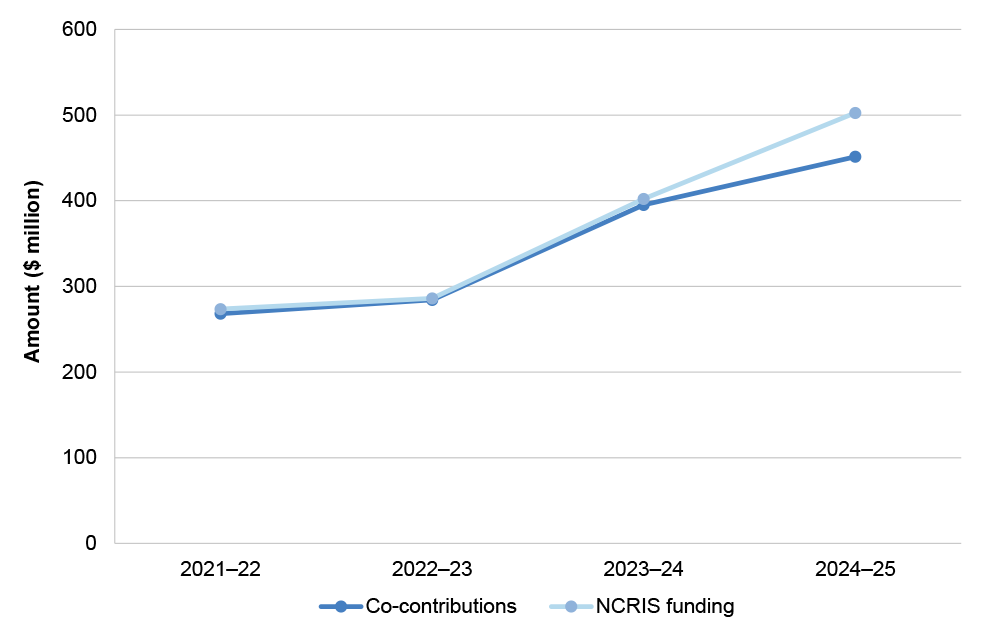
1.8 NCRIS funding is allocated using closed non-competitive grants, which were available for up to five years in the 2022 funding round, and up to four years in 2023 and 2025 funding rounds.12 To facilitate collaboration, the Grant Guidelines require applicants to commit their own contributions and seek other contributions to support the funded activity. Total co-contributions estimated by facilities between 2019–20 and 2024–25 (Figure 1.3) amounted to $1.9 billion against NCRIS funding of $1.9 billion. There is no required minimum level of contributions, but according to the Grant Guidelines, ‘it is expected other contributions will at least match the NCRIS grant for each project’.
Figure 1.3: Total NCRIS facilities co-contributionsa and NCRIS funding, 2021–22 to 2024–25b
Note a: Total co-contributions include both cash and in-kind (provision of staff and other non-monetary resources) contributions. The value of in-kind contributions are estimates only, provided by NCRIS facilities in reporting to Education.
Note b: Reliable data outside of 2019–20 to 2024–25 is not currently available. ANAO has not undertaken further data cleaning or data verification.
Source: ANAO based on Education data.
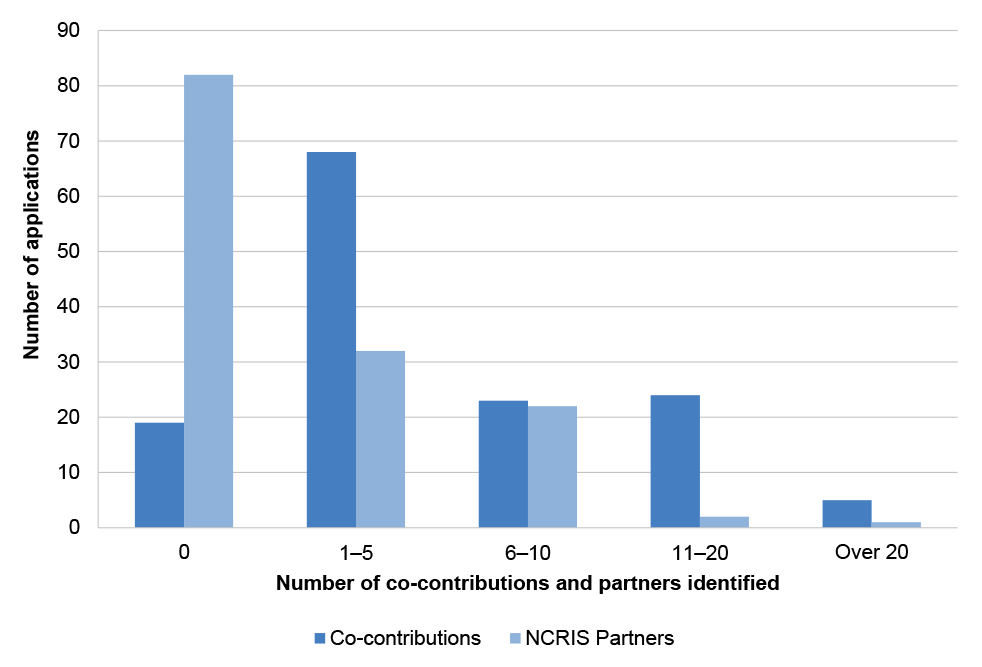
1.9 NCRIS projects collaborate with organisations such as universities, publicly-funded research agencies, Australian and state and territory governments, companies, and other NCRIS projects (Case study 1 provides an example of NCRIS project collaboration). NCRIS projects disclosed this collaboration by listing co-contributors and NCRIS partner projects in their applications for the 2023 and 2025 grant rounds (Figure 1.4).
|
Case study 1. Integrated Marine Observing System |
|
The Integrated Marine Observing System (IMOS) was established in 2006 to ‘collect observations and measurements of ocean conditions, species and habitats — from the open ocean to coastal waters’. IMOS received a total of $158.5 million in funding from NCRIS grant rounds in 2022 to 2025, making it the third largest NCRIS grant recipient for the period (see Appendix 4). IMOS operates through 12 facilities that undertake systematic and sustained observations of Australia’s marine environment, from open ocean to the continental shelf and into the coast. All observations are turned into quality-controlled data that can be discovered, accessed, downloaded, used and reused by the Australian and international marine and climate science community. IMOS also collaborates with other NCRIS facilities (see paragraph 1.9) via Coastal Research Infrastructure (CoastRI), a cross-NCRIS collaboration between 13 NCRIS facilities, which will aim to ‘provide national-scale coastal observing and modelling capability’ to address challenges presented by coastal change. Funding for a pilot was provided as part of the 2023 NCRIS funding round. |
Source: Integrated Marine Observing System, What is the Integrated Marine Observing System? [Internet], IMOS, available from https://imos.org.au/about [accessed 9 January 2026]. Coastal Research Infrastructure, CoastRI: Research Infrastructure Connecting Land and Sea [Internet], Coastal Research Infrastructure, 2026, available from https://www.coastri.org.au/ [accessed 16 January 2026].
Figure 1.4: Co-contributors and NCRIS partners identified in grant applications 2023–25a
Note a: Application forms for the 2022 grant round did not include a specific question addressing co-contributors or NCRIS partners so are not included in this figure
Source: ANAO analysis of NCRIS grant applications.
1.10 As of 2025–26, NCRIS is the ninth largest Australian Government research and development (R&D) funding program (Figure 1.5). In addition to NRI funding administered by the Department of Education (Education) via NCRIS, research infrastructure is also funded by other Australian Government R&D programs. For example, the Australian Research Council (ARC)13, the National Health and Medical Research Centre (NHMRC) grants14, and the Medical Research Future Fund (MRFF) each administer infrastructure funding programs.15 In total, Australian R&D funding is provided across 193 programs in 14 portfolios.16 The Australian Government is undertaking a strategic examination of the research and development (R&D) system.17 The panel commissioned to lead the examination has delivered a report with 20 recommendations to government.18 The report stated that the ‘future of our national research infrastructure and National Collaborative Research Infrastructure Scheme (NCRIS) [sic] is uncertain’, reflecting that a portion of NCRIS funding is only budgeted to 2028–29 (see paragraph 1.6); the panel recommended that ‘Governments commit ongoing funding to ensure sustainability of research infrastructure’ (Recommendation 4a).19 As of March 2026, the Government has not responded to the report.
Figure 1.5: Australian Government R&D programs and activities estimated at over $100 million in 2025–26
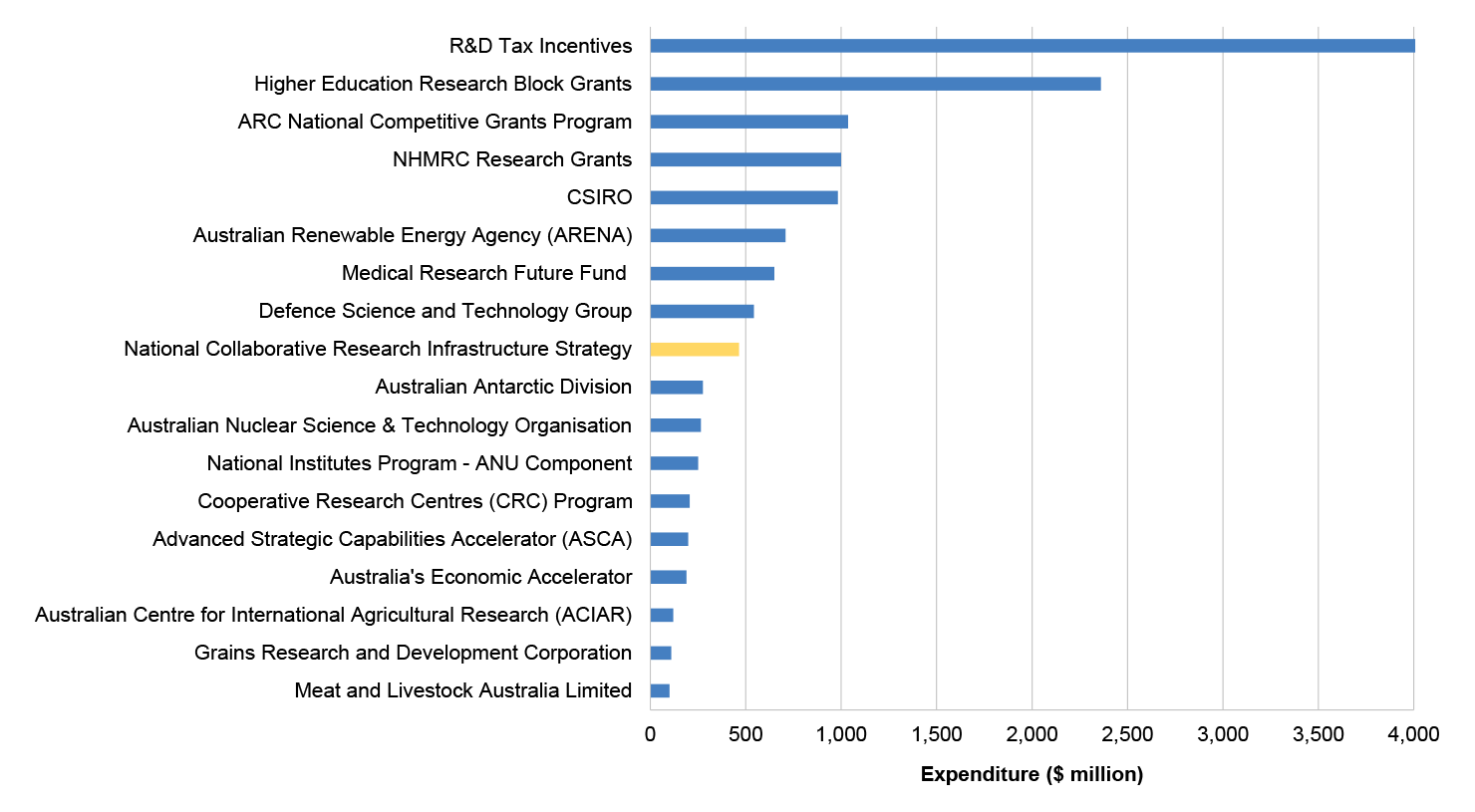
Key: Yellow bar represents the expenditure of NCRIS; blue bars represent the expenditure of other Australian Government R&D programs and activities.
Note: Some programs are presented together for the purposes of this chart: Higher education research block grants comprise the Research Support Program and Research Training Program; R&D Tax Intensives comprise refundable and non-refundable R&D tax incentives.
Source: ANAO analysis of Science, Research and Innovation Budget Tables for 2025–26.
1.11 NCRIS is administered by Education. Education’s resourcing for the administration of NCRIS has declined since 2022–23 (Table 1.1).
Table 1.1: Resourcing for NCRIS administration, 2022–23 to 2025–26
|
|
2022–23 |
2023–24 |
2024–25 |
2025–26 |
|
Departmental funding ($ million) |
2.3 |
2.2 |
1.8 |
1.5 |
|
Average Staffing Level (Full-time equivalent) |
18.47 |
17.84 |
12.13 |
9.96 |
Source: ANAO based on Department of Education data.
Rationale for undertaking the audit
1.12 From 2004–05 to 2028–29, NCRIS will deliver an estimated $5 billion in grants.20 NCRIS facilities are nationally significant assets, which are usually too large to be funded by individual research organisations. This means that without effective Australian Government support, these facilities would not be available to researchers.
1.13 This audit was conducted to provide assurance to the Parliament over the effectiveness of Education’s administration of NCRIS in achieving the outcomes of the program.
Audit approach
Audit objective, criteria and scope
1.14 The objective of this audit was to assess the effectiveness of the Department of Education’s administration of NCRIS in achieving the outcomes of the program.
1.15 To form a conclusion against the objective, the following high-level audit criteria were adopted:
- Does the administration of funding opportunities and funding decisions promote the proper use and management of public resources?
- Have appropriate arrangements been established to measure and assess the outcomes from grant funding?
1.16 The audit focused on NCRIS funding delivered from 2022 to 2025. This included all funding under the 2021 NCRIS Roadmap, except for the outcomes of the second funding round of 2025, which was still in progress at the time of the audit, with an anticipated completion date of early to mid-2026.
Audit methodology
1.17 To assess the audit objective and criteria, the audit methodology included examination and analysis of Education documentation; meetings with relevant departmental staff on site in Canberra and remotely; and site visits to selected NCRIS-funded facilities.
1.18 The audit was open to contributions from the public between 15 September and 21 December 2025. The ANAO received and considered six submissions.
1.19 The audit was conducted in accordance with ANAO Auditing Standards at a cost to the ANAO of approximately $351,526.
1.20 The team members for this audit were Nancy Jin, Renae Lowden, Alyssa McDonald, Fin Wardman, Hazel Ferguson, and David Tellis.
2. Administration of funding
Areas examined
This chapter examines whether the Department of Education (Education) administered National Collaborative Research Infrastructure Strategy (NCRIS) funding opportunities and funding decisions between 2022 and 2025 to promote the proper use and management of public resources.
Conclusion
Education’s administration of funding opportunities and funding decisions partly promotes the proper use and management of public resources. An effective planning process has been designed in the form of five-yearly roadmaps and two-yearly investment plans, but under the 2021 Roadmap, the investment planning process has not supported strategic planning of NCRIS investments. Processes to ensure probity and transparency in grant administration have not been fully established. The application assessment approach can be strengthened through more transparency and effective documentation of the process which meets requirements of the applicable Commonwealth Grant Rules and Principles (previously Commonwealth Grant Rules and Guidelines).
Areas for improvement
The ANAO made two recommendations aimed at improving the assessment and approval of NCRIS grants, and at ensuring the administration of NCRIS is consistent with the purpose of the program.
2.1 Effective grants administration promotes the proper use and management of public resources. The Commonwealth Grant Rules and Guidelines 2017 (CGRGs) and Commonwealth Grants Rules and Principles 2024 (CGRPs, replacing the CGRGs from 1 October 2024) establish the overarching grants policy framework and articulate the expectations for all non-corporate Commonwealth entitles in relation to grants administration to achieve this objective.21
2.2 The CGRPs (and previously the CGRGs) are made by the Finance Minister under subsection 105C(1) of the Public Governance, Performance and Accountability Act 2013 (PGPA Act) and thus form part of the finance laws. Compliance with the finance laws is a requirement of the Australian Public Service (APS) Code of Conduct.22
Does Education’s administration of funding opportunities and funding decisions promote the proper use and management of public resources?
Education allocates NCRIS funding through closed non-competitive grants, supported by a strategic planning process designed to consist of five-yearly roadmaps and two-yearly investment plans. Investment plans under the 2021 Roadmap have not supported strategic planning of NCRIS investments, compared with previous investment plans released in 2018 and 2020.
Between 2022 and 2025, Education’s assessment and approval processes for grants did not meet all requirements of the CGRPs (previously CGRGs). Education’s process included additional assessment criteria not set out in guidelines, did not specifically document consideration of value for money in assessments and approvals, and did not provide complete advice to grant approvers.
Arrangements to ensure probity and transparency such as conflict-of-interest declaration and management arrangements, have improved since mid-2025, but as of December 2025 have not been fully implemented.
Approach to allocating NCRIS funding
2.3 The CGRPs state ‘[a]chieving value with relevant money should be a prime consideration in all phases of grants administration.’23 Appropriately designed grant opportunities ensure resources are ‘deployed in an efficient, effective, economical and ethical manner, while not imposing overly burdensome requirements on grantees’.24 NCRIS grants are described as ‘closed non-competitive’ in the 2022, 2023 and 2025 NCRIS Grant Guidelines, which describe the NCRIS grant program and details of the grant opportunity.
2.4 The most recent assessment of the appropriateness of Education’s use of the ‘closed non-competitive’ method25 for allocating NCRIS funding was in 2015. In 2015, the Research Infrastructure Review Final Report found that NCRIS’s ‘consensus driven approach’ has been ‘more effective than competitive bidding’ to align strategic investments with national research priorities.26 This is consistent with the establishment of NCRIS investment in ‘a strategic, collaborative manner’, rather than as a competitive process for investing in research infrastructure (paragraphs 1.2 to 1.3).
Managing risks associated with restrictive eligibility criteria
2.5 Targeted or restrictive eligibility criteria may assist where narrowing the field of potential applicants aims to achieve a particular policy outcome. However, care needs to be taken that restrictive eligibility criteria does not exclude potential applicants that may be better placed to contribute to the policy outcomes or provide better value with relevant money.27 Education’s grant planning process aims to manage this risk.
NCRIS roadmaps
2.6 The planning process for the allocation of NCRIS funding begins with the development of a roadmap every five years by sector experts. Roadmaps set out national research infrastructure (NRI) funding priorities, based on an assessment of capabilities and future areas of need for the next five to ten years. As the ‘key policy document on NRI requirements’, a roadmap should ‘enable Australia to maintain its research excellence, increase innovation and address emerging research challenges’.28
2.7 Development of the 2021 Roadmap (the most recent as of December 2025) was led by an Expert Working Group29 with membership agreed to by the Minister for Education and the Minister for Industry and Science, supported by a departmental taskforce. The process involved:
- seeking expert advice;
- consulting with the research community, the university sector, research funders, state and territory governments, peak organisations, existing facility operators, publicly funded research agencies, private research institutes, international organisations, Government agencies and industry and business;
- providing stakeholders and the community with the opportunity to input on policy discussion papers and a draft Roadmap; and
- providing updates on progress to the responsible ministers.
2.8 The resulting roadmap (as summarised in Figure 2.1) set funding priorities through ‘key challenges’, ‘opportunities for system-wide enhancements in NRI’ and ‘step changes’ and made eight recommendations. The government agreed to the recommendations of the 2021 Roadmap on 31 March 2022. The 2021 Roadmap also committed to conducting a Roadmap process every five years and an investment plan process every two years.
2.9 The 2021 Roadmap recommended the establishment of ‘an Expert NRI Advisory Group to drive a more effective NRI ecosystem’. The National Research Infrastructure Advisory Group30 (NRIAG) held its first meeting on 1 February 2023, and is responsible for the development of future roadmaps, including the 2026 Roadmap, which is under development as of December 2025. The NRIAG is also responsible for ‘informing the strategic direction of NRI investment plans’. (paragraph 2.12).
2.10 Each set of guidelines (2022, 2023 and 2025) describes the purpose of the grant round in reference to the purposes of NCRIS and the 2021 Roadmap.
Figure 2.1: NCRIS investment prioritisation approach, 2022 to 2025
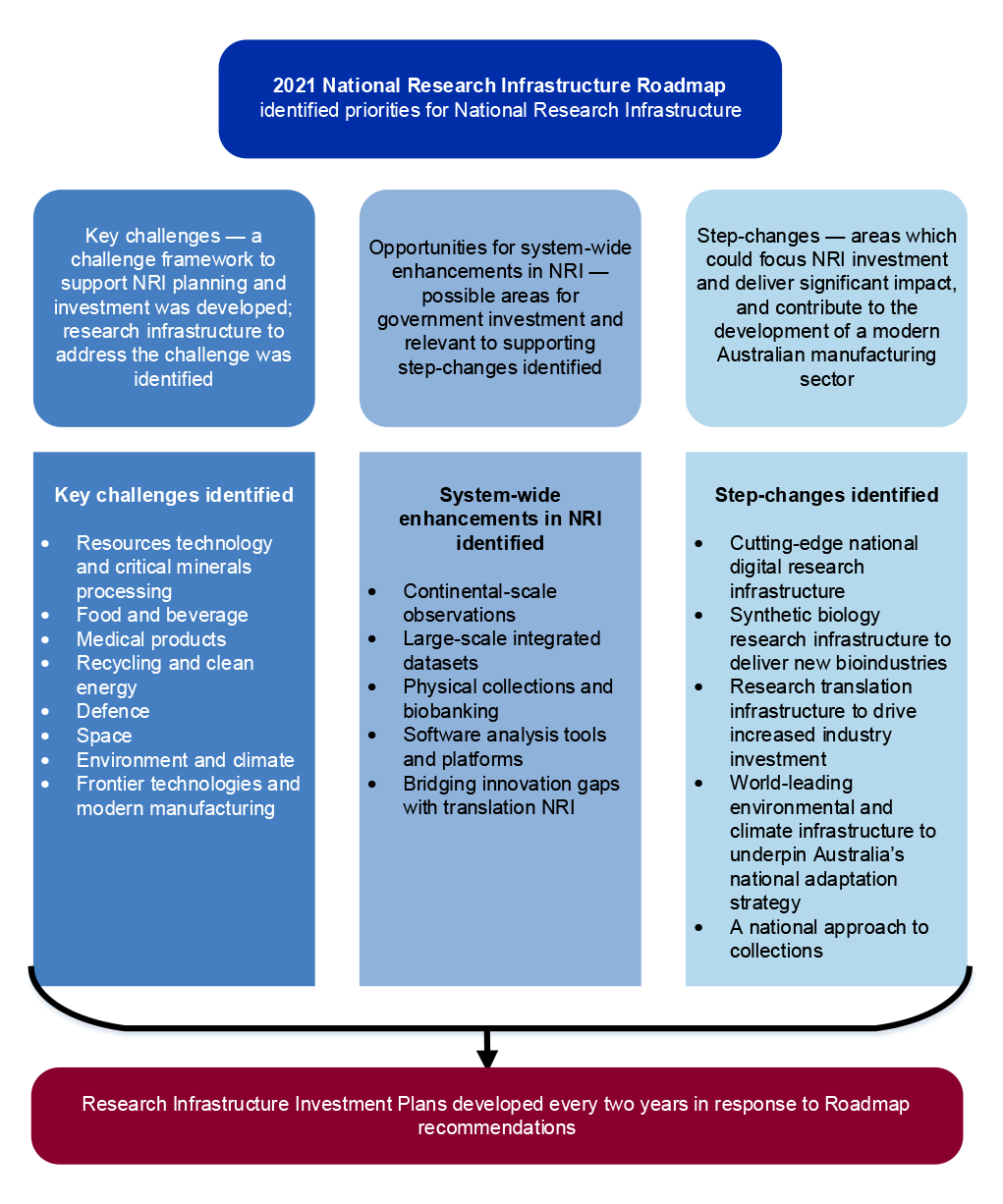
Source: ANAO analysis of 2021 Roadmap.
NCRIS investment plans
2.11 Previously, the 2016 Roadmap set out priorities for investment, and the two-yearly 2018 and 2020 investment plans set out the government’s response to these priorities. Education has not undertaken a strategic planning process to determine funding required for each priority under the 2021 Roadmap, as was delivered via previous investment plans.
2.12 Under the 2021 Roadmap, the outcomes of grant funding rounds in 2022, 2023 and 2025 were described as investment plans, and a document was developed for one ‘step change area’ (national digital research infrastructure, NDRI, see paragraph 2.13) and described as a ‘draft final investment plan’. Submissions received by the ANAO from stakeholders raised concerns about recent investment planning processes in relation to the timing of investments and the inconsistent processes used in investment planning across grant rounds and step changes under the 2021 Roadmap.
2.13 The document described as the ‘draft final investment plan’ for NDRI was developed by an NRIAG working group.31
- At the 2 December 2024 meeting of the working group, Education undertook to provide the document to NRIAG for endorsement.
- This working group document was published by Education on 13 December 2024 as containing recommendations for NDRI investment from the working group and as a draft for community comment. Consultation closed 7 January 2025.
- As of February 2026, funding for one area of NDRI has been implemented via a 2025 funding round for High Performance Computing (HPC). The HPC round sought grant applications to address funding needs in one of the sixteen investment areas identified in the working group document. The ‘indicative maximum investment’ in the working group document was $100 million. Actual grant funding allocated was $77 million for one year, with a further investment of $23 million to be considered in subsequent grant rounds.
- Education advised the ANAO on 6 February 2026 that the working group document has not been put to NRIAG for endorsement (though updates were provided to the NRIAG), or the Education Minister for approval, as the working group ‘draft final investment plan’ is advice that will be used as input to the ‘final investment plan’. The ‘final investment plan’ is the outcome of the grant funding round, which is informed by NRIAG as an advisory body and is approved by the minister as part of grant assessment processes.
2.14 The NRIAG 2024–25 work plan, agreed by the Minister for Education on 12 September 2024, indicated ‘investment plans’ would be developed for three other step change areas and NRI workforce. As of February 2026, planning for investment in two step changes (Research translation infrastructure, World-leading environmental and climate infrastructure) and NRI workforce has been informed by surveys. Documents akin to the ‘draft final investment plan’ for NDRI, are not intended to be developed for other step changes and NRI workforce.
2.15 Table 2.1 sets out the differences between Education’s previous planning process and the current process. It shows that processes under the 2021 Roadmap do not demonstrate the same level of strategic planning of NCRIS investments by Education as was undertaken under the previous 2016 Roadmap. Further, the use of ‘investment plan’ to refer to NRIAG working group advice (and the substitution of said advice with surveys in three of the four areas where planning work has been undertaken) has the potential to create confusion among working group members and stakeholders, particularly when coupled with Education’s characterisation of outcomes of grant funding rounds as ‘investment plans’.
Table 2.1: Planning under the 2016 Roadmap and the 2021 Roadmap
|
Planning element |
2016 Roadmap |
2021 Roadmap |
|
Planning approach |
Development of investment plans every two years which were the government response to the Roadmap. Investment plans were approved by government. |
Lists of outcomes of grant funding rounds are called ‘investment plans’. Various approaches contribute to this, principally NRIAG having responsibility for development of four ‘investment plans’ — as of February 2026, one has been developed, which was for NDRI. |
|
Targeted consultation (additional to Roadmap consultation) |
Targeted consultation was undertaken to identify business cases and rationale for their funding which informed published investment plans. |
Public consultations surveys were undertaken for four step changes (NDRI, translation research infrastructure, synthetic biology research infrastructure, and environment and climate research infrastructure) and the national research infrastructure workforce. Surveys informed grant opportunity planning (see paragraphs 2.14 to 2.15). Education advised the ANAO on 25 March 2026 that the surveys will inform the assessment of grant applications. |
|
Planning the timing of investments |
A long-term approach to NCRIS investments was evident, with planned investments over a five-year and ten-year horizon contained in published investment plans, with planned reassessments of investment priorities every two years. |
No long-term approach to NCRIS investments evident. The ‘NDRI draft final investment plan’ lacked timeframes for planned investments. Additional NCRIS funding is ending in 2028–29 (see paragraph 1.6). |
|
Planning the funding amount of investments |
Planned funding commitments over five-year and ten-year horizons were evident in published investment plans. |
Funding outcomes published for each grant round, and the ‘NDRI draft final investment plan’ made recommendations for ‘indicative maximum investment’ across 16 investment areas to a total of $400 million in one step change area. |
|
Alignment with priorities in the roadmap |
How investments would align with the priorities set out in the roadmap was documented in published investment plans. |
How investments would meet priorities set out in the roadmap, including investments across the suite of challenges, opportunities and step changes, was not documented. |
|
Monitoring and evaluating |
The 2020 Investment Plan incorporated performance reporting. |
Performance reporting was not evident. |
Source: ANAO analysis of Education documentation.
Other mechanisms to mitigate risks associated with restrictive eligibility criteria
2.16 The NCRIS encourages partnering with existing NCRIS facilities which allows new organisations to engage with the program. Between 2019–20 and 2024–25, approximately 311 unique partners have co-invested in NCRIS projects (either via cash contributions or in-kind contributions such as the use facilities owned by the partner organisation).32 While many work with multiple NCRIS facilities and have sustained partnerships across all four years, there is evidence of new entrants to the program via this pathway. For example, in 2024–25, NCRIS facilities recorded co-contributions from 41 new organisations that had not been recorded as co-contributors in the previous five years.
Residual risk
2.17 While Education’s planning process and collaborative focus provide opportunities for open consultation on NCRIS funding priorities and the introduction of new organisations to the program, risks remain. Education has not considered nor mitigated the risk associated with the exclusion of potential applicants that may be better placed to contribute to the policy outcomes or provide better value for money (paragraph 2.5).
2.18 These risks are indicated by:
- the high degree of stability in NCRIS funding recipients:
- since 2022, a total of 26 NCRIS facilities and one international membership have received funding, of which one was a new entrant to the program (i.e. had not received NCRIS funding prior to grant funding rounds under the 2021 Roadmap);
- some environmental scanning is evident, but in the 2025 HPC grant round, all organisations that were invited to apply had previously received NCRIS funding (albeit for different projects in some cases); and
- a lack of structured assessment of outcomes against roadmaps or investment plans, meaning there is no process for identifying when outcomes from funding have been achieved, or NCRIS investments in particular facilities should be wound down and infrastructure decommissioned.
2.19 Submissions received by the ANAO from stakeholders raised concerns relating to potential users’ access to NCRIS facilities and potential unmet demand due to low levels of awareness in user groups. This is supported by a survey of industry respondents undertaken as part of Research Infrastructure Connected (funded by NCRIS), which found that 31 per cent were not at all familiar with NCRIS in 2024, although this reduced to 23 per cent in 2025.
2.20 Education does not have a policy or process for identifying NCRIS complaints and concerns, or managing inquiries from prospective applicants seeking access to NCRIS funding. Complaints would be subject to Education’s formal Complaints Handling Policy.
Application assessment and approval
2.21 The CGRPs state ‘[g]rants administration should provide value, as should the grantees in delivering grant activities.’33 This requires the careful comparison of the costs and benefits of feasible options in all phases of grants administration, particularly when planning and designing grant opportunities and when selecting grantees.34 Consistency with grant guidelines and established processes is key to better practice grants administration.35
Assessment of applications
2.22 The 2022, 2023 and 2025 NCRIS Guidelines required applicants to submit proposals for assessment against weighted criteria. Assessment was to be completed by an assessment committee of Education staff, with the option to seek external experts or advisors, or additional information. During this period, three rounds of funding allocation were completed, each with a different scope to address different priorities under the 2021 Roadmap, as summarised in Table 2.2.
Table 2.2: NCRIS funding rounds, 2022 to 2025
|
Guidelines |
Eligible entities |
Funding scope |
Allocation approach |
|
NCRIS 2022 Guidelines |
Existing NCRIS projects funded under the 2018 and/or 2021 Guidelines. |
Operational funding to provide continuity and long-term funding to NRI (recommendation 2 of the 2021 Roadmap). |
Funding allocations for existing NCRIS projects determined by a formula were included in the NCRIS 2022 Guidelines (see Box 1). Education assessed applications against the selection criteria after the 2022 Guidelines were approved and published. |
|
NCRIS 2023 Guidelines |
Entities funded through the 2018, 2021 and/or 2022 Guidelines, or identified through consultationa as positioned to meet needs not covered by existing projects. |
All step change areasb in the 2021 roadmap, and other national prioritiesc |
Funding allocations based on an assessment of applications against the selection criteria and additional strategic assessment criteria and expert advice. |
|
NCRIS 2025 Guidelinesd |
Entities funded through the 2018, 2021, 2022 and/or 2023 Guidelines, or identified through the Investment Plan process. |
Three step change areas (digital research, research translation, environmental and climate) and NRI workforce. As of December 2025, funding has been provided for one component of digital research infrastructure, and allocation of further funding under the 2025 Guidelines is ongoing. |
Funding allocations based on an assessment of applications against the selection criteria and additional strategic assessment criteria and expert advice. |
Note a: The consultation referenced here was undertaken in 2021 and 2022 for three of eight subject-specific ‘scoping studies’ funded under the 2018 Investment Plan, and through 2021 Roadmap processes and Education’s stakeholder engagement.
Note b: The 2021 Roadmap identified five step change areas: national digital research infrastructure; synthetic biology research infrastructure to deliver new bioindustries; research translation infrastructure to drive increased industry investment; world-leading environmental and climate infrastructure to underpin Australia’s national adaptation strategy; scoping future requirements to understand the opportunities that arise from taking a national approach to collections.
Note c: The National Reconstruction Fund Corporation identifies the following as priority areas: resources; transport; medical science; defence capability; renewables and low emissions technologies; agriculture, forestry and fisheries; and manufacturing technologies and products that support the advancement of Australia’s industrial capability.
Note d: As of December 2025, a second funding round under the 2025 NCRIS Guidelines is in progress and has not been considered as part of this audit.
Source: ANAO analysis of NCRIS Guidelines, 2022, 2023 and 2025.
|
Box 1: Formula approach to operational funding in 2022 |
|
Funding for the operation and maintenance of existing NCRIS facilities (referred to as ‘operational funding’) was introduced in 2013. Based on work by the Organisation for Economic Co-operation and Development (OECD), annual operating expenses are calculated at approximately 10 per cent of a facility’s establishment costsa: Operational funding = (Project Establishment cost) x (operational benchmark of 10%) x (number of years funding is for) The same method was used in 2022 to allocate funding for the 2023–24 to 2027–28 period, with an annual indexation of 1.5 per cent applied to 2022–23 funding amounts.b The approach does not account for how NCRIS facilities may have actually grown since establishment. |
Note a: The funding formula has been amended by the ANAO to remove a reference to ‘eligible provisions’, which was part of the calculation in 2013, but not in 2022. ‘Eligible provisions’ referred to amounts deducted in 2013 in recognition that some facilities had already received support for facility maintenance.
Note b: As of December 2025, funding agreements with NCRIS facilities conclude on 30 June 2028 (Figure 2.2).
2.23 Table 2.3 outlines the ANAO assessment of Education’s processes for assessing applications in 2022, 2023 and 2025.
2.24 Formula-based funding allocations for the 2022 grant round were approved before an assessment of applications was undertaken (see paragraph 2.31).
2.25 In 2023 and 2025 funding rounds, the assessment of applications for NCRIS funding followed a two-step process, including:
- initial assessment against criteria by an individual Education staff member, with either a ‘met’ or ‘not met’ outcome; and
- strategic assessment, with expert input, against considerations such as whether the application related to a continuing activity (research infrastructure capability which would be lost without funding), sovereign capability and urgency.36
2.26 The initial assessment against selection criteria in the 2023 and 2025 funding rounds did not take into account the weighted allocations for criteria included in the Guidelines for both rounds.
2.27 Following the strategic assessment, Education documented funding outcomes and a rationale for funding decisions for each application received in 2023 and 2025. The rationale for some decisions included considerations not clearly articulated against the criteria in the grant guidelines, such as: the urgency of funding sought; previous NCRIS funding which would cover the period of the proposal; and Education’s plans to develop additional step change strategies.
2.28 Education did not undertake a strategic planning process which considered all 2021 Roadmap priorities, including step changes (see paragraphs 2.11 to 2.12 and Table 2.1).
Table 2.3: ANAO assessment of Department of Education NCRIS assessment process, 2022 to 2025
|
Requirement from guidelines |
Education processes |
2022 |
2023 |
2025a |
|
Submission of proposals |
Submissions for NCRIS funding were received from applicants using a template based on the established assessment criteria for the 2022, 2023 and 2025 funding rounds. |
● |
● |
● |
|
Assessed against weighted criteria |
Assessment processes were different across 2022, 2023 and 2025 funding rounds. In all funding rounds, weighted assessment criteria were developed in Guidelines, but these weightings were not used in grant assessment. All submissions were assessed as ‘met’ or ‘not met’ against assessment criteria. In the 2022 and 2025 funding rounds all applications were found to have met all criteria, while three applications were found to have not met the criteria in 2023. These three applications were not funded. In each funding round, the assessment against selection criteria was not the only basis for determining funding, leading to issues of lack of transparency. In 2022, the assessment against criteria was completed after allocations had already been approved and published in the 2022 Guidelines. No strategic assessment was undertaken. In 2023 and 2025, a strategic assessment was completed in addition to the assessment against weighted criteria, including consideration of urgency. This additional assessment step and consideration of urgency were not identified in the Guidelines or submission response template provided to applicants. An information sheet advised 2023 applicants that grants will not be based solely on the criteria set out in the Guidelines but did not identify the additional factors which may be considered. This risks applicants being unaware of, or not given sufficient opportunity to address, certain assessment criteria. |
◑ |
◑ |
◑ |
|
Consideration of value for money |
The 2022 Guidelines do not identify value for money as a relevant consideration and funding decisions under these Guidelines were determined using a formula rather than assessment against criteria (see Box 1). The 2023 Guidelines identify value for money as an assessment consideration. The 2025 Guidelines specify that value for money is a ‘prime consideration’. Education did not specifically document an assessment of value for money in 2023 or 2025, but ANAO analysis found Education considered issues relevant to value for money in line with the principles in the CGRGs and CGRPsb, and definition of value for money provided in the Grant Guidelinesc, in both initial and strategic assessments. |
◔ |
◕ |
◕ |
|
Assessment committee recommendations |
In all funding rounds, initial assessment of each application as ‘met or not met’ against the criteria was undertaken by individual Education officers. In each funding round, there was no evidence of an assessment panel in accordance with the grant guidelines. The grant guidelines did not accurately describe who would be undertaking the assessment. In 2022, calculated funding allocations for the funding round were approved by the Minister for Education and published in the NCRIS Guidelines prior to this assessment (see Box 1) which undermines the role of the assessment committee to recommend funding decisions. In 2023, after the initial assessment, a strategic assessment was undertaken by Education and shared with other departments for feedback. Consultation with synthetic biology experts and the NRIAG also occurred. In 2025, after the initial assessment, consultation with NDRI experts took place. The NCRIS Guidelines in 2023 and 2025 allowed for consultation with experts. In the 2023 and 2025 funding rounds, a final grant recommendation (that is, combining the initial assessment against weighted criteria and strategic assessment, including consultation with experts) was produced only in the form of a recommendation to the delegate, which failed to record the basis for approval relative to the guidelines. |
◔ |
◑ |
◑ |
Key: ● completely met all relevant requirements ◕ mostly met relevant requirements ◑ partly met relevant requirements ◔ met some relevant requirements ◯ did not meet relevant requirements.
Note a: As of December 2025, a second funding round under the 2025 NCRIS Guidelines is in progress and has not been considered as part of this audit.
Note b: The CGRGs applied to NCRIS grant rounds completed in 2022 and 2023. The CGRPs replaced the CGRGs in 2024 and applied to the 2025 NCRIS grant round.
Note c: The Glossary of the 2025 NCRIS Guidelines provides consideration of value with relevant money includes: the quality of the project proposal and activities; fitness for purpose of the proposal in contributing to government objectives; that the absence of a grant is likely to prevent the grantee and the government’s outcomes being achieved; and the potential grantees relevant experience and performance history.
Source: ANAO analysis of Education documentation.
Approval of grants
2.29 The NCRIS 2022 and 2023 Guidelines state funding approval is to be provided by the First Assistant Secretary, Research Division, Department of Education, while the 2025 Guidelines state funding approval is to be provided by the Minister for Education (the Minister). Education advised the ANAO on 3 February 2026 that the 2025 Guidelines did not represent an update in process, the approval of NCRIS grants has always sat with the Minister in practice and is followed by a separate approval from the First Assistant Secretary for agreed funding to be actioned.
2.30 Table 2.4 below outlines ANAO’s assessment of Education’s advice to the Minister when seeking approval of NCRIS grants against the requirements for advice to ministers in the CGRGs and CGRPs.
Table 2.4: ANAO assessment of advice to the Minister for approval of NCRIS grants
|
CGRGs and CGRPs requirementa |
2022b |
2023 |
2025c |
|
Explicitly state the spending proposal is a grant (paragraph 4.6a) |
✔ |
✔ |
✔ |
|
Provide information on the applicable requirements of the PGPA Act and Rule and the CGRGs/CGRPs, including legal authority for the grant (paragraph 4.6b) |
✘ |
✘ |
✔ |
|
Outline the application and selection process followed, including the selection criteria used (paragraph 4.6c) |
✘ |
✔ |
✔ |
|
Include the merits of proposed grants relative to the grant opportunity guidelines and key principle of achieving value for money (paragraph 4.6d) — the CGRPs require this to be ‘clear advice’ |
✘ |
✔ |
✔ |
|
Indicate which grant applications fully or partially meet the selection criteria and which applications do not meet any of the selection criteria (paragraph 4.7) — the CGRPs require these specific categories to be used |
✘ |
✘ |
✘ |
Key: ✔ meets requirement; ✘ does not meet requirement.
Note a: Requirements and paragraph number references are common between both the CGRGs and CGRPs unless otherwise specified. The CGRGs apply to NCRIS grant rounds in 2022 and 2023, and the CGRPs apply to the 2025 grant round.
Note b: The ANAO’s assessment of advice in 2022 noted that the advice considered by the minister did not meet requirements of the CGRGs due to the sequencing of approvals and assessments by Education (see paragraph 2.32).
Note c: As of December 2025, a second funding round under the 2025 NCRIS Guidelines is in progress and has not been considered as part of this audit.
Source: ANAO analysis of Education advice to the Minister.
2.31 In 2022, Education sought ministerial approval of the NCRIS 2022 Guidelines, to extend funding for existing NCRIS projects until 30 June 2028. The proposed Guidelines specified:
- grant allocation amounts for each NCRIS project, determined by a formula; and
- that eligible applicants would be required to submit a proposal, which would be assessed against criteria.
2.32 The Minister approved the 2022 Guidelines on 12 September 2022 based on the advice from Education.37 Education then completed an assessment of applications against the criteria in the 2022 Guidelines and no further ministerial approval was sought after this assessment. Due to the sequencing of approvals and assessments by Education, the advice considered by the minister did not include the following items, which were at the time required by the CGRGs:
- the application and selection process followed, including the selection criteria, that were used to select potential grantees;
- the merits of the proposed grants relative to the grant opportunity guidelines; and
- which grant applications fully, partially, and did not meet the selection criteria.38
2.33 In addition to the specific deficiencies identified in the sequencing of the 2022 approval process, Education’s advice to the Minister:
- in 2022 lacked an explanation of applicable legal requirements;
- in 2023 did mention some applicable legal requirements, but this information was not complete, and the advice lacked a clear link between reasons for recommending funding of applications (or not) and assessment criteria; and
- in the 2025 HPC round, reasons for recommending funding of applications (or not) were not clearly linked to assessment criteria.
2.34 Education’s advice to the Minister has improved over funding rounds from 2022 to 2025. By 2025, the lack of indication of which grants met the selection criteria remained the only deficiency, which impacts the Minister’s ability to appropriately record the basis for grant approval relative to the grant guidelines as required by the CGRGs and CGRPs.39
2.35 Following assessment of applications and approval from the Minister, the relevant First Assistant Secretary provided approval for funding arrangements under the Public Governance, Performance and Accountability Act 2013 (PGPA Act) in each grant round from 2022 to 2025.
2.36 An Education internal audit in 2025 included a recommendation to ensure the legislative basis for NCRIS grants is documented when the First Assistant Secretary approves funding arrangements under the PGPA Act. This recommendation was implemented in the approval minute to the First Assistant Secretary regarding outcomes of the 2025 NCRIS grant round. The internal audit did not make any recommendations regarding the approval process from the Minister and did not consider whether this met the CGRP requirements (or previously, the CGRGs).
2.37 Education advised the ANAO on 31 March 2026 that in ongoing and future NCRIS grant funding rounds, a department-wide template for advice to the minister for the approval of grants will be used, which provides guidance on relevant requirements of the CGRPs, including advice on whether grants have met assessment criteria.
Grants to the European Molecular Biology Laboratory
2.38 NCRIS grant funding is used to pay for Australia’s associate membership of the European Molecular Biology Laboratory (EMBL) which allows Australian researchers to access EMBL facilities. This membership is established by an agreement between Australia and the EMBL signed on 29 June 2015 by the Branch Manager, Research and Higher Education Infrastructure on behalf of the Australian Government and the Director General of the EMBL; an associate membership fee is required to be paid annually under this agreement. The membership was established for two years under the 2015 Agreement, then extended automatically after expiration, with termination of the membership requiring notice by Australia a year in advance. The 2021 Roadmap notes that the funding for EMBL membership supports international collaboration.
2.39 In the 2022 grant round, $15 million in funding was granted for EMBL associate membership fees over three years when the Guidelines were approved (see paragraph 2.31).
Efficiency of the allocation process
2.40 Education does not measure the efficiency of its grant allocation process or have targets for assessment timeframes.40
2.41 The approximate cost of allocating NCRIS grants between 2022 and 2025 is shown in Table 2.5.41 While Education was able to assess 134 applications comparatively rapidly in 2023 (approximately 1.2 days each), the average cost of each successful applicant assessed was $10,743, an increase on the $4,013 in 2022. The average cost per successful applicant assessed continued to increase in 2025, with two successful applicants receiving funding assessed at a cost of $16,358 each.
Table 2.5: Time and staff cost to allocate NCRIS grants, 2022 to 2025
|
Funding round |
Number of applications |
Time to grant outcomes (days)a |
Total working daysb |
Staffing cost during assessment ($)c |
Outcome of assessment |
Average time to grant outcomes per application (days)d |
Average staff cost per application ($)e |
Average cost per successful applicant ($)f |
|
2022 |
24 |
118 |
147.5 |
96,309 |
$921.4 million to 24 applicants |
4.9 |
4,013 |
4,013 |
|
2023 |
134g |
156 |
392.6 |
268,586 |
$650 million to 25 applicants |
1.2 |
2,004 |
10,743 |
|
2025 |
5 |
79 |
40.5 |
32,716 |
$77 million to 2 applicants |
15.8 |
6,543 |
16,358 |
Note a: Time to grant outcomes is the number of days between the date submissions closed and the date grant outcomes were approved by Education’s First Assistant Secretary, Research Division.
Note b: In 2022, 9 staff worked a total of 147.5 days on grant assessments. In 2023, 18 staff worked a total of 392.6 days on grant assessments (including staff from outside of the NCRIS team) and in 2025 five staff worked 40.5 days.
Note c: Staffing cost during assessment is based on Education’s estimates of the time staff members spent working on assessments, and takes into account their salaries under Education’s 2024 Enterprise Agreement and staff on costs (based on Education’s staff on cost estimates for 2024–25). On costs include the costs of employees in addition to their salary, such as superannuation and leave entitlements.
Note d: Average time to grant outcomes per application calculated using time to grant outcomes divided by the number of applications.
Note e: Average cost per application calculated using staffing cost during assessment divided by number of applications.
Note f: Average cost per successful applicant calculated using staffing cost during assessment divided by number of successful applicants in outcome of assessment.
Note g: Applications in 2023 were sought on an activity basis with each applicant able to submit multiple proposals, resulting in 134 applications from 27 applicants (applicants in 2023 included EMBL as they proposed an activity separate from the associate membership described in paragraph 2.38).
Source: ANAO analysis of Department of Education documents.
Funding outcomes
2.42 The 2021 Roadmap identified five step change areas to ‘enhance its sovereign capability’ while exploring new opportunities building on existing research infrastructure. Table 2.6 outlines the activities funded to support each step change area, and funding for continuing activities. Funding from January 2022 to December 2025 for each step change ranged from $0.00 (scoping future requirements for collections) to $116.86 million (climate and environment). Funding for continuing activities was provided to address Recommendation 2 of the 2021 Roadmap. Between 2022 and 2025, Education directed 80.5 per cent of approved NCRIS grants towards continuing activities.
Table 2.6: Number and total value of NCRIS activities by continuing fundinga or 2021 Roadmap ‘step change’, 2022 to 2025
|
Activity type |
Fully funded |
Partly funded |
Not funded |
Total |
Value of total grants ($m) |
|
Continuingb |
43 |
34 |
16 |
93 |
1,327.73 |
|
Climate and environment |
2 |
11 |
2 |
15 |
116.86 |
|
National Digital Research Infrastructurec |
1 |
8 |
15 |
24 |
104.70 |
|
Synthetic Biology |
1 |
2 |
3 |
6 |
62.99 |
|
Research translation |
2 |
4 |
21 |
27 |
36.08 |
|
Scoping future requirements for collections |
– |
– |
– |
– |
–d |
|
Total |
49 |
59 |
54 |
165e |
1,648.36 |
Note a: Continuing funding is allocated to maintain an existing NCRIS facility and is not identified as relating to a specific step change area. In 2023, continuing funding was also mapped by Education against step changes, with 67 per cent of funded continuing activities identified by Education as supporting a step change.
Note b: The 2022 funding round provided a funding amount NCRIS facilities could apply for, to meet their ongoing operating costs. As such, no applicants requested more funding than they were provided, and there was no assessment of applications against step change areas. All 2022 applicants have been included in the ‘fully funded’ column in this table, under ‘continuing’. Total funding for 2022 was $921.36 million for 25 projects and one international membership. An additional NCRIS facility, Australian Access Federation (AAF), was funded in 2023, bringing the total number of NCRIS projects to 26.
Note c: All 2025 funding allocated as of December 2025 was for national digital research infrastructure. Total funding was $77.0 million for two activities, both of which were partly funded.
Note d: The Collections step change was not supported in NCRIS grant rounds from 2022 to 2025. Education is in the process of determining the scope and priorities for a national approach to the step change.
Note e: Over this period, Education considered 165 activities for funding from 163 applications. Two activities considered did not have applications as: the Marine National Facility was part of the Integrated Marine Observing System (IMOS) when 2022 applications were received but was considered for funding as a separate project; and European Molecular Biology Laboratory (EMBL) did not submit an application in 2022 as this is an international membership fee covered by NCRIS.
Source: ANAO analysis of Education documentation.
Funding continuity
2.43 Funding stability (or ‘patient capital’, see paragraph 1.4) allows NCRIS projects to secure highly skilled staff, meet existing and future demands for the research sector and pursue relationships with industry. Submissions received by the ANAO from stakeholders raised concerns in relation to the funding duration of grants, noting short durations of funding may lead to uncertainty and lack of ability to plan long term.
2.44 In March 2022, Education identified NCRIS funding agreements were due to cease in June 2023. The lack of funding certainty beyond this date was affecting industry engagement in long term research and causing operational issues relating to staff recruitment and ability to seek co-investment. This led to the 2022 NCRIS funding round using a formula-based approach (see Box 1 and Table 2.2) which provided base operational funding to sustain ongoing NCRIS projects to 2027–28 to provide certainty and continuity to the research sector.
2.45 As of December 2025, NCRIS grants are of four to five years in duration, with the exception of two one-off payments provided in 2025 (Figure 2.2). While funding for NCRIS is ongoing and additional funding has been budgeted to 2028–29 (see paragraph 1.6), most funding agreements end on 30 June 2028 — two funding agreements end before this date.42 Appendix 4 provides the annual NCRIS funding awarded from grant rounds between 2022 and 2025.
Figure 2.2: NCRIS annual funding provided in grant rounds between 2022 and 2025a
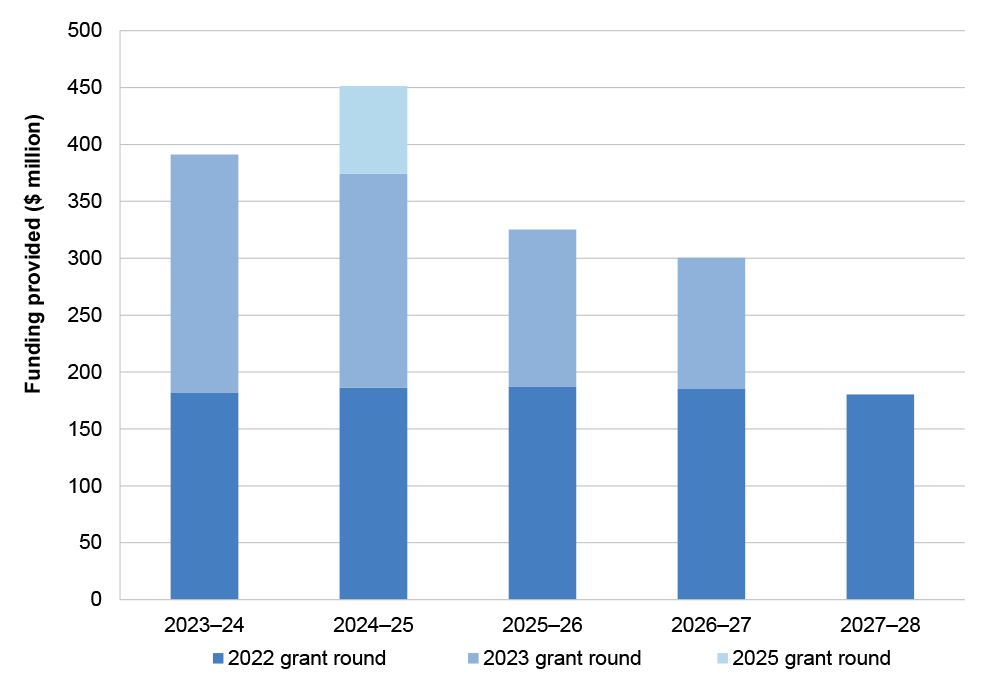
Note a: The 2025 funding round provided one-off payments in 2025, to support two high performance computing investments. Grants approved under the 2022 Guidelines commenced payments in 2023–24. As of December 2025, funding agreements with NCRIS facilities conclude on 30 June 2028.
Source: ANAO analysis of Education documentation.
Processes to ensure probity and transparency
2.46 The CGRPs state that ‘maintaining probity involves applying and complying with public sector values’ and that ‘transparency provides assurance that grants administration is appropriate and that legislative obligations and policy commitments are being met’.43
2.47 Table 2.7 outlines the ANAO assessment of Education’s processes to ensure probity and transparency in grant administration for funding rounds from 2022 to 2025.
Table 2.7: ANAO assessment of Education processes to ensure probity and transparency in NCRIS grant administration
|
Requirementsa |
2022 |
2023 |
2025b |
ANAO observations as of December 2025 |
|
Justification of the closed non-competitive approach in the NCRIS grant guidelines (paragraph 11.5) |
◯ |
◯ |
◯ |
Grant guidelines from 2022 to 2025 do not provide justification of the closed non-competitive approach. Providing this justification in grant guidelines was identified as an Education internal audit recommendation in 2025, and Education agreed to the recommendation. |
|
Declaration of conflicts of interest for all Education staff and external representatives involved in assessing applications for NCRIS funding (CGRGs paragraph 13.8 and CGRPs paragraph 15.8) |
◔ |
◔ |
● |
Education lacked a process for all internal and external representatives involved in assessing grants to declare conflicts of interest in 2022 and 2023. Conflicts of interest were not declared for all grant assessors in 2022 and 2023. Before 9 May 2024, Education’s conflict of interest policy did not require all officials involved in grant processes to complete conflict of interest declarations. Instead, conflicts of interest were declared annually and when identified. Relevant SES annual declarations were evident in 2022 and 2023; declarations of Education officers from 2022 and 2023 could not be located. Not all external assessors and experts consulted provided conflict of interest declarations in 2023. This did not meet all requirements of the CGRGs which required Accountable Authorities to have appropriate mechanisms for identifying and managing potential conflicts of interest for grant opportunities. An Education internal audit of the NCRIS 2023 grant round found that ‘the evaluation panel members did not proactively complete conflict of interest declaration forms in relation to [the 2023 grant round].’ The audit recommended that it be required for members of the grant evaluation panel to complete conflict of interest forms. The recommendation was agreed to be implemented immediately. A process requiring internal and external grant assessors to declare conflicts of interest was evident in 2025. Conflict of interest declarations were made by all internal and external grant assessors in 2025. |
|
Evidence of identified conflicts being managed (CGRGs paragraph 13.8 and CGRPs paragraph 15.8) |
◯ |
◯ |
◔ |
How declared conflicts were to be managed was unclear in 2022, 2023 and 2025. A probity plan was approved on 26 November 2025. The plan outlines the roles and responsibilities of officials, probity principles, and probity controls. A probity advisor was engaged on 8 October 2025 to manage probity risk. Probity briefings were held on 23 October and 26 November 2025, which discussed general probity management and the responsibilities of officials under legislation. |
|
Reasons for decisions appropriately documented (paragraph 4.5) |
◑ |
◑ |
◑ |
Education documented reasons for funding decisions in all grant rounds. However, these decisions were made using a formula without undertaking any formal assessment process in 2022, and included considerations not specified in the Guidelines in 2023 and 2025 (see paragraphs 2.24 to 2.27). |
|
Approvals and written advice to approvers documented as required (paragraphs 4.6 and 4.7) |
◔ |
◑ |
◑ |
Grant approvals were documented but do not meet all requirements of the CGRGs (2022 and 2023 funding rounds) and CGRPs (2025 funding round) (see Table 2.4). Ministerial approval of grants in the 2022 funding round was sought prior to an assessment against selection criteria (see paragraphs 2.31 to 2.32). |
Key: ● completely met all relevant requirements ◕ mostly met relevant requirements ◑ partly met relevant requirements ◔ met some relevant requirements ◯ did not meet relevant requirements.
Note a: Requirements and paragraph number references are common between both the CGRGs and CGRPs unless otherwise specified. The CGRGs apply to NCRIS grant rounds in 2022 and 2023, and the CGRPs apply to the 2025 grant round.
Note b: As of December 2025, a second funding round under the 2025 NCRIS Guidelines is in progress and has not been considered as part of this audit.
Source: ANAO analysis of Education documentation.
Recommendation no.1
2.48 The Department of Education improves its processes for the assessment and approval of NCRIS grant applications by:
- ensuring that grant guidelines clearly describe the assessment criteria and approval process, including how all criteria and strategic considerations, and the assessment of value for money, will contribute to grant assessment;
- ensuring that grant assessment and approvals are undertaken as described in the grant guidelines; and
- ensuring advice to approvers of grants includes merits of proposed grants relative to the grant guidelines and indicates if grant applications met the selection criteria.
Department of Education response: Agreed
2.49 The department agrees to provide further clarity in future grant guidelines on how the assessment criteria, strategic considerations, and the assessment of value for money, will contribute to grant assessments and approvals. The department agrees to then ensure that grant assessment and approvals are undertaken as described in these updated guidelines.
2.50 The department agrees to structure future briefing materials to address all requirements of the Commonwealth Grants Rules and Principles (CGRPs) to further strengthen clarity and transparency for decision makers.
2.51 The department considers that existing briefing to the approver was comprehensive, well structured and supported informed decision making, including through clear articulation of strategic context, assessment processes, comparative merit, and value for money considerations.
2.52 Explicit adherence to the structure and terminology of the CGRPs will be incorporated as a matter of good practice.
2.53 These enhancements will build on an already robust approach to briefing, ensuring the continued strong stewardship of NCRIS, while improving consistency and clarity of documentation.
Recommendation no.2
2.54 The Department of Education ensures the allocation of NCRIS funding is supported by a planning process which:
- identifies how roadmap priorities will be achieved and how success against these priorities will be measured;
- tests whether there are opportunities to achieve better value for money; and
- is published.
Department of Education response: Agreed
2.55 The department has strengthened NCRIS investment planning to more clearly align funding decisions with Roadmap and step change priorities, including identifying aligned outcomes and success measures for each investment.
2.56 The department will continue to review and improve its planning processes ahead of future investment opportunities.
2.57 Comparative assessment and expert advice are being used to test opportunities to achieve better value for money across NCRIS investments.
2.58 Key planning artefacts, including updated NCRIS Guidelines and associated investment plans, will continue to be published to support transparency in investment decision making.
2.59 The department acknowledges and agrees with the ANAO’s advice that more detail should be included in the published versions of these artefacts.
3. Performance measurement and reporting
Areas examined
This chapter examines whether the Department of Education (Education) has established appropriate arrangements to measure and assess the outcomes from National Collaborative Research Infrastructure Strategy (NCRIS) grant funding.
Conclusion
Education has established partly effective arrangements to measure and assess the outcomes from grant funding. Education has established processes for twice yearly reporting by NCRIS grant recipients. Key performance information does not always relate directly to grant purposes, and Education does not confirm the accuracy of information collected from grant recipients. Education does not monitor and evaluate progress against NCRIS roadmap priorities and recommendations. Education has worked to establish improved performance reporting in line with the Commonwealth Performance Framework by publishing more NCRIS specific performance information in its 2024–25 annual performance statements.
Areas for improvement
The ANAO made one recommendation aimed at improving the evaluation of outcomes against each roadmap and Education’s performance measures.
3.1 Program performance measurement and reporting allow a reader (including the Parliament) to understand if an entity’s intended results are being achieved, and the factors affecting its performance.44
3.2 The Public Governance, Performance and Accountability Act 2013 (the PGPA Act) requires entities to measure and assess their performance in achieving their purposes.45 Additionally, the government’s Commonwealth Evaluation Policy states that:
Commonwealth entities and companies are expected to deliver support and services for Australians by setting clear objectives for major policies, projects and programs, and consistently measuring progress towards achieving these objectives.46
3.3 Effective evaluation allows for corrections, informs future design, and evidence gained from monitoring and evaluation supports government decision-making.47 For grants, appropriate performance evaluation and reporting arrangements allow funders to evaluate whether outcomes have been achieved and whether a particular grant activity achieved value with relevant money.48
Have appropriate arrangements been established to measure and assess the outcomes from grant funding?
At the individual grant recipient level, Education has established reporting and information gathering arrangements with grant recipients to enable collection of performance information. Improvements to develop more relevant key performance measures at a grant recipient level are in progress. While this performance information provides a picture of performance at the level of individual grant recipients, it is not used to evaluate NCRIS program outcomes, to report on progress against NCRIS roadmaps, or to report overall program performance. Education assesses, but does not verify, reported information.
Monitoring NCRIS facilities
3.4 Between 2022 and 2025, the NCRIS grant guidelines provided that grant recipients would be required to provide Education with progress reports, a final report within six months of grant completion, and independently audited financial acquittal reports, and (if requested) ad hoc reports. The guidelines also specified the following monitoring arrangements:
- Education may conduct compliance visits and inspect records kept; and
- Education will evaluate the grant program to measure how well the outcomes and objectives have been achieved, and may use information from the recipient, including application information, interviews, or other requested information, for this purpose.
3.5 Each Grant Agreement and Deed of Variation includes reporting requirements for recipients of NCRIS funding. Grant Agreements contain clauses which allow for monitoring and evaluation, including that grantees provide Education with an Annual Activity Plan, Mid-Year Activity Report, and Annual Report. Templates for these are provided in the Grant Agreement. The Grant Agreement also establishes powers to collect information through ad-hoc reports. Key performance indicators (KPIs) are required for each grant activity, and are to be reported in each Mid-Year Activity Report and Annual Report. These reporting arrangements are outlined in Figure 3.1.
Figure 3.1: Performance reporting arrangements for NCRIS facilities
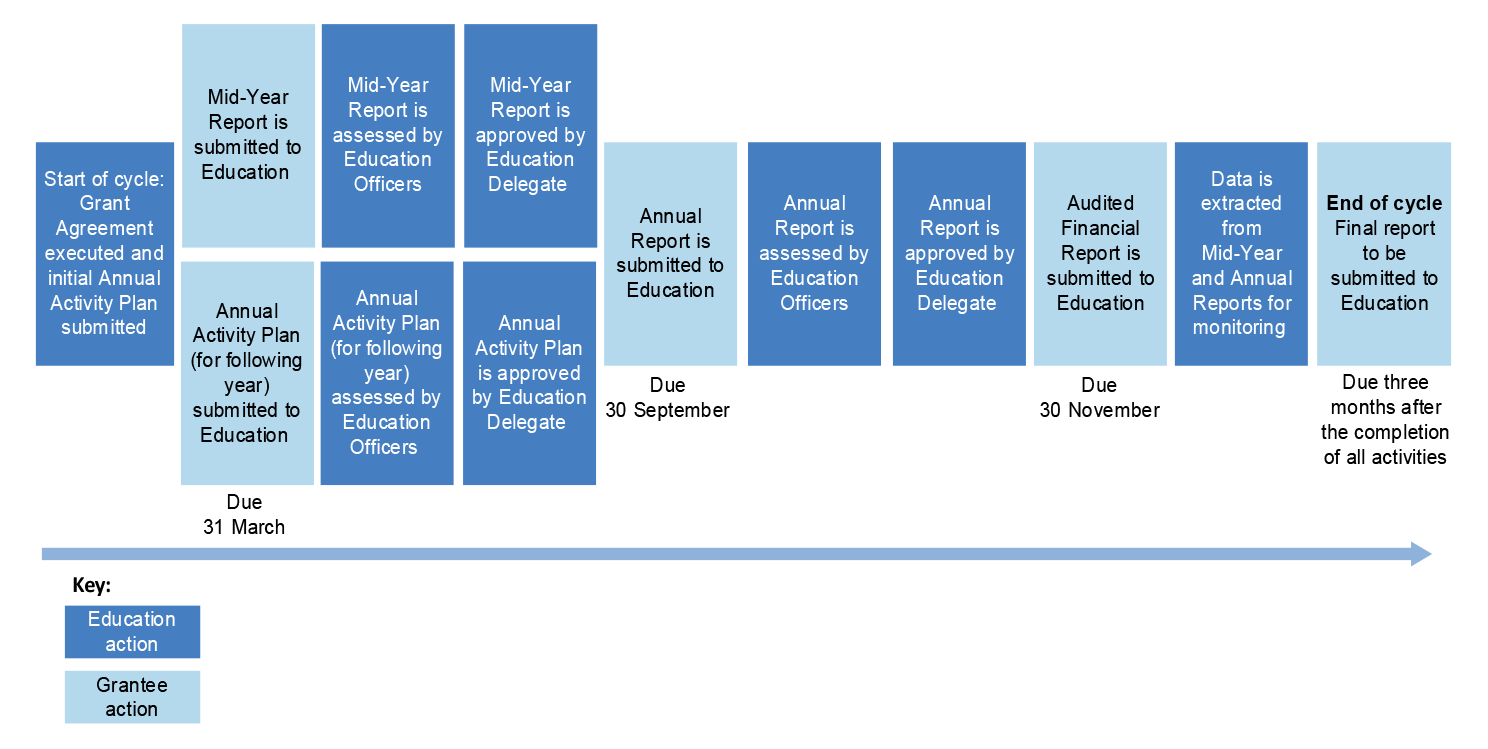
Source: ANAO analysis of Education documentation.
3.6 The ANAO examined Education’s assessment of reporting using a selection of six (of 26) NCRIS grant recipients with reporting obligations between 2022 and 2025. Education collects and assesses the Annual Activity Plan, Mid-Year Report and Annual Report provided by NCRIS grant recipients, and approves each milestone payment following approval of the milestone report. Education assesses risks, compliance, project performance and organisational processes, procedures and systems to produce the information (including value for money considerations from 2025).
3.7 In cases where assessment identified issues in reporting, Education sought more information from the grant recipient, and required resubmission with improved information. If Education does not accept submitted reporting, grant milestone payments may be withheld, but this has not occurred since 2021.
3.8 ANAO testing identified the following deficiencies in Education’s assessment of reporting:
- Education does not have an assurance process over the information provided by grant recipients.
- While Education collates risks reported in the Mid-Year and Annual Reports, it has not established an approach to ensuring these risks are managed effectively.
- In Education’s assessment of performance:
- KPIs ‘vary in breadth and consistency’, and are sometimes ‘very vague or non-existent’, which creates challenges for measuring facility and program performance (paragraph 3.11); and
- it does not use information from the reports to evaluate the grant program to measure how well program outcomes and objectives have been achieved (paragraphs 3.14 to 3.17).
- No compliance visits or record inspections were conducted between 2022 and 2025 (see paragraph 3.17).
European Molecular Biology Laboratory associate membership reporting requirements
3.9 Under the agreement between the EMBL and Australia, there are no requirements for monitoring and performance reporting — no regular reporting in relation to the EMBL associate membership is submitted to and assessed by Education.
Work underway to improve monitoring of NCRIS facilities
3.10 A draft KPI framework was developed to encourage better practice and presented to a Reporting Working Group of NCRIS Directors49 on 9 August 2023. Education implemented the framework in its assessment of the Mid-Year Report 2023–24 and Annual Activity Plan 2024–25. ANAO examined the KPIs collected by NCRIS facilities in 2025–26 (see Table 3.1). All facilities examined had KPIs relating to governance and management, engagement, and service delivery, but other kinds of KPIs were more specific to the NCRIS facility.
Table 3.1: Number of NCRIS projects with KPIs by activity type for 2025–26
|
Activity type |
Number of facilities with KPI(s) of activity type |
Proportion of total NCRIS facilitiesa (%) |
|
Governance and management |
26 |
100 |
|
Engagement |
26 |
100 |
|
Service delivery |
26 |
100 |
|
Infrastructure usage |
19 |
73 |
|
Research infrastructure impact |
20 |
77 |
|
Data — processing and linkage |
12 |
46 |
|
Data — collections and observations |
15 |
58 |
|
Otherb |
16 |
62 |
Note a: A total of 26 projects receive NCRIS funding and report against KPIs. The European Molecular Biology Laboratory is an associate membership and does not provide reporting KPIs.
Note b: Other activities KPIs related to included completing new research infrastructure (28 KPIs), maintaining existing infrastructure (18 KPIs), administering grant programs (two KPIs), IT security (two KPIs), sustainability (two KPIs) and identifying development opportunities (one KPI).
Source: ANAO analysis of Annual Activity Plans 2025–26.
3.11 In July 2025, an internal NCRIS Governance Review50 by Education found that of 26 NCRIS facilities with reporting obligations, four had KPIs which were ‘very vague or non-existent’ and eight had KPIs which relate to ‘goals of governance but aren’t measurable or specific’. Education provided recommendations of the Governance Review to individual NCRIS projects, and requested NCRIS projects to outline actions to be taken to implement recommendations, including that they should form the basis of governance and management activities for projects, with a planned review of outcomes in 2027–28.
3.12 In response to an internal audit recommendation, Education developed a ‘Performance Evaluation Framework’ to assess grantee performance over time starting from assessment of 2024–25 Annual Reports in October 2025. The Framework seeks to assess performance against the common sub-clauses of grant agreements51 on a scale of one to three.
3.13 While this approach provides a framework to assess performance over time (for example, indicating where facility performance improves over time), it does not provide, or include any plans to deliver, an ‘assessment of the design, implementation or results of [NCRIS]’ to determine if the intended outcomes of the program are being delivered.52 As of February 2026, implementation of the ‘Performance Evaluation Framework’ is at an early stage, and no clear outcomes have been observed.
Program evaluation
3.14 The NCRIS program has not been evaluated between 2022 and 2025.53 On 17 December 2025, Education advised the ANAO that ‘each successive roadmap builds on lessons learned from previous iterations and reflects the evolving nature of technology, research priorities and sector needs’. Education considered the implementation of recommendations and priorities for funding in the 2016 Roadmap as part of development of the 2021 Roadmap, but how this informed the content of the 2021 Roadmap, or resulted in changes to NCRIS program management is not clear. No evaluation reports of the 2016 Roadmap or 2021 Roadmap have been published.
3.15 Under the 2016 Roadmap, Investment Plans (paragraphs 2.11 to 2.12) were developed as a government response. This approach has not been used under the 2021 Roadmap. The 2021 Roadmap contains eight recommendations which were agreed by government (see paragraph 2.8) and some planning processes were undertaken (see paragraphs 2.11 to 2.15). There is no evidence Education tracks the implementation of recommendations.
3.16 Education collects ‘impact stories’ to emphasise what it calls the ‘real-life’ outcomes facilitated by NCRIS projects, in the form of, for example, research outcomes or commercial products (for example, see Case study 2). Impact stories are used by Education to ‘answer information requests and create communications materials’.
|
Case study 2. Printed solar panels |
|
As of early 2023, over 3.4 million traditional silicon solar power systems had been installed on Australian homes and small businesses. Many industrial roof spaces could not adopt solar technology, because of the weight of traditional solar panel arrays, which weigh 20 kilos per square metre. Researchers at the University of Newcastle used roll-to-roll printers (like those for printing newspapers) at the Australian National Fabrication Facility (ANFF) to print ultralight, low-cost, printed solar panels, which are as thin as a sheet of paper and weigh only 300 grams per square metre. Printed solar technology uses ink that contains semiconductor materials and electrodes for generating solar energy on recyclable PET plastic. The ANFF production of printed solar provided proof-of-concept, which provided the basis to build Australia’s first printed solar manufacturing facility in Newcastle. Printed solar technology makes solar installation viable for previously unsuitable commercial and industrial spaces. ANFF received $122.8 million in funding in NCRIS grant funding rounds in 2022 to 2025, making it the fourth largest NCRIS grant recipient for the period (see Appendix 4). |
Source: Australian National Fabrication Facility, ANFF Casebook 2024 [Internet], ANFF, Victoria, Australia, 2024, available from https://anff.org.au/wp-content/uploads/2025/03/ANFF-Casebook-2024.pdf [accessed 28 January 2026].
3.17 The National Research Infrastructure Advisory Group (NRIAG) is tasked with ‘ongoing review of the NRI principles, research challenges framework, and step change opportunities to ensure the continued alignment of NRI with national priorities’, and ‘reviewing current NRI facilities and services’.54 In June 2024, the NRIAG assessed the alignment of NRI principles and NRI investment principles with current funding activities, and determined that the investment in NRI has aligned with the principles and the principles are still relevant for decision-makers. Education advised the NRIAG that further work could include ‘an improved performance framework for all NRI activities’. No further work has occurred which was reported back to the NRIAG. As part of NRIAG meetings, the group visited NCRIS facilities, though documented review of these facilities was not evident.
Reporting
3.18 Demonstrating the environmental, economic and social returns on public investment in research is increasingly important.55 Measuring the impact of research infrastructure investment remains challenging (Box 2).56
|
Box 2: Measurement of impact of research infrastructure |
|
In 2019 the Organisation for Economic Co-operation and Development (OECD) noted the following complexities in evaluating the impact of research infrastructure:
To address these complexities, using different indicators across different categories of impact best demonstrates impacts generated by research infrastructure. This can also address different stakeholders’ needs for assessing the impact of research infrastructure; for example governments and funders are primarily interested in return on (public) investment and value for money. Impact indicators which are broadly applicable to most research infrastructures include:
|
Source: OECD, Reference Framework for Assessing the Scientific and Socio-economic Impact of Research Infrastructures, OECD Science, Technology and Industry Policy Papers, No. 65, OECD Publishing, 2019.
Program performance measures
3.19 Performance planning and reporting should draw clear links between an entity’s key activities and the results achieved and provide meaningful performance information with a clear line of sight between planned and actual performance.57
3.20 Meaningful performance statements show what entities planned to achieve in the reporting period and how well they performed. If prepared in accordance with the requirements of the PGPA Act, they should provide performance information in a form that can be easily used by Parliament, government and the public to hold entities to account. They should help readers understand:
- the purposes and intended outcomes an entity has been funded to deliver;
- the key activities being undertaken by the entity in pursuit of those purposes and outcomes; and
- the results achieved, the impact the entity is having and the progress it is making.58
3.21 The ANAO has conducted audits of annual performance statements of Education since 2021–22 — performance statements audits encourage entities to invest in the processes, systems and capability needed to develop, monitor and report high quality performance information.59
3.22 Education’s 2024–25 performance statements included a performance measure PM019 ‘the proportion of research publications in Australia that are among the world’s top 10% most highly-cited journals’. This measure has been used to report performance for Program 2.5 (Investment in Higher Education Research) and Program 2.6 (Research Capacity) in the entity’s Portfolio Budget Statements. NCRIS funding is reported under Program 2.6, comprising 61 per cent of the budgeted expenditure of the program in 2025–26.60
Other published information
3.23 In addition to performance information published in Education’s annual report, other information about NCRIS outcomes is published on Education’s website. ANAO assessment of the suitability of these to understand NCRIS program performance is provided in Table 3.2. Published information is directly related to the purpose of NCRIS and demonstrates other categories of impact; further work could be undertaken to improve reporting as:
- the relationship between Education’s management of NCRIS and the outcomes reported is not specified;
- user numbers and co-contribution amounts are sourced from grant recipients and do not undergo an assurance process;
- selection of case studies is based on Education’s identification of stories that have a ‘defined, realised outcome’ and demonstrate a ‘core’ NCRIS objective — this does not address the risk of bias where favourable ‘success stories’ are selected61; and
- each NCRIS program or facility has different characteristics and objectives, which means that performance information such as co-contribution amounts and number of users is not meaningful when aggregated for the purpose of measuring program performance.
Table 3.2: ANAO assessment of published performance information
|
Published information |
Detailed description |
Outcome of assessment against RMG 131a |
|
Case studies |
Examples of ‘real-life outcomes of research conducted at NCRIS facilities’ intended to ‘demonstrate the social and economic return’ from investment in national research infrastructure.b |
▲ |
|
Co-contribution amounts |
There are both monetary and ‘in-kind’ co-contributions. ‘In-kind’ co-contributions include the provision of staff and other non-monetary resources by a co-contribution partner. |
▲ |
|
Numbers of users |
The number of users of an NCRIS project or facility. The kind of user is dependent on the research infrastructure. |
▲ |
Key: ◆ fully meets suitability requirements of a performance measure ▲ partly meets suitability requirements of a performance measure ■ does not meet suitability requirements of a performance measure.
Note a: The ANAO has assessed the published information against the better practice guidance in the Department of Finance’s Developing performance measures (RMG 131).
Note b: Department of Education, National Collaborative Research Infrastructure Strategy Case Studies [Internet], Education, Canberra, 2025, available from https://www.education.gov.au/ncris/case-studies [accessed 15 December 2025].
Source: ANAO analysis of Education documentation.
Recommendation no.3
3.24 The Department of Education monitors and evaluates the achievement of outcomes against priorities set out in each roadmap, by:
- developing, in conjunction with grant recipients, meaningful shared performance metrics across facilities;
- ensuring that performance metrics for grant recipients are clearly linked to the roadmap;
- adopting an assurance approach over collected performance information;
- improving the use of collected performance information to monitor, assess and report achievement of roadmap priorities; and
- developing and publishing an evaluation report at the conclusion of each roadmap, which assesses whether the roadmap priorities and recommendations have been met.
Department of Education response: Agreed in principle.
3.25 The department agrees in principle and notes that NCRIS performance is already monitored through a robust PM19 performance framework, which provides a strong foundation for measuring outcomes against Roadmap priorities.
3.26 The department is working with NCRIS grant recipients to further strengthen performance metrics and ensure clearer alignment between facility-level performance information and the Roadmap priorities.
Appendices
Appendix 1 Entity response
Appendix 2 Improvements observed by the ANAO
1. The existence of independent external audit, and the accompanying potential for scrutiny improves performance. Improvements in administrative and management practices usually occur: in anticipation of ANAO audit activity; during an audit engagement; as interim findings are made; and/or after the audit has been completed and formal findings are communicated.
2. The Joint Committee of Public Accounts and Audit (JCPAA) has encouraged the ANAO to consider ways in which the ANAO could capture and describe some of these impacts. The ANAO’s corporate plan states that the ANAO’s annual performance statements will provide a narrative that will consider, amongst other matters, analysis of key improvements made by entities during a performance audit process based on information included in tabled performance audit reports.
3. Performance audits involve close engagement between the ANAO and the audited entity as well as other stakeholders involved in the program or activity being audited. Throughout the audit engagement, the ANAO outlines to the entity the preliminary audit findings, conclusions and potential audit recommendations. This ensures that final recommendations are appropriately targeted and encourages entities to take early remedial action on any identified matters during the course of an audit. Remedial actions entities may take during the audit include:
- strengthening governance arrangements;
- introducing or revising policies, strategies, guidelines or administrative processes; and
- initiating reviews or investigations.
4. In this context, the below actions were observed by the ANAO during the course of the audit. It is not clear whether these actions and/or the timing of these actions were planned in response to proposed or actual audit activity. The ANAO has not sought to obtain assurance over the source of these actions or whether they have been appropriately implemented.
- Education has accepted internal audit recommendations in relation to Education’s administration of the NCRIS program — including in relation to developing evaluation frameworks (paragraphs 3.12 to 3.13) and validating accuracy of performance information (paragraphs 3.6 to 3.8), incorporating a more fulsome rationale for the use of closed non-competitive grants (paragraphs 2.3 to 2.4), documenting grant approval decisions (paragraphs 2.29 to 2.36), completing conflict of interest declarations (paragraphs 2.46 to 2.47) and uploading information to GrantConnect within the 21-day reporting period.
- Education undertook an internal Governance Review of NCRIS projects. Education has consulted with NCRIS projects to implement changes from the Governance Review, and plans to monitor improvements in 2027–28 (paragraph 3.11).
Appendix 3 NCRIS projects, as of August 2025
|
Name |
Description |
|
Australian Access Federation (AAF) |
The AAF is Australia’s leading provider of identity and access management services to the education and research sector. The AAF is leading the development for a common set of policies, standards, and technologies, creating a more connected and collaborative research ecosystem, accessible by industry, research and government. |
|
Astronomy Australia Ltd (AAL) |
AAL helps Australian-based astronomers to access the best observatories in the world. They also help these astronomers to access high-performance computers to analyse their data. AAL supports several different facilities in Australia that boost astronomy research. AAL also helps researchers to work with astronomy facilities overseas. |
|
Atlas of Living Australia (ALA) |
The ALA is Australia’s national biodiversity database. It lets people share, access and analyse data about Australia’s plants, animals and fungi. It is used by researchers, decision makers such as the government, and the community. The ALA also supports international biodiversity research. It does this by providing Australian data to the Global Biodiversity Information Facility. |
|
AuScope |
AuScope provides research infrastructure to Australia’s Earth and Geospatial Science community, enabling access, creation, analysis and sharing of data about Earth as it has evolved over time. As Earth continues to change — naturally and a result of human impact — scientists can also start to predict changes in the future, and how these might affect future generations. |
|
Australian Centre for Disease Preparedness (ACDP) |
ACDP is Australia’s national biocontainment facility. They study both human and animal diseases. They have the highest possible level of safety measures to allow them to safely research the most dangerous diseases in the world. |
|
Australian Community Climate and Earth System Simulator (ACCESS) |
ACCESS uses a wide range of environment data and combines the data to be able to predict the weather. This project made the existing ACCESS an NRI project and brings experts together allowing them to collaborate. This helps Australia predict bushfires, farm more effectively, and supports climate change research. |
|
Australian National Fabrication Facility (ANFF) |
ANFF enables users to process, transform and manufacture materials. This includes hard materials such as metals and ceramics, and soft materials such as polymers. These materials have a wide range of uses across many fields of research and industry. ANFF helps researchers access these tools and trains researchers in how to use them. |
|
Australian Plant Phenomics Facility (APPF) |
This project measures the physical qualities of plants, also called the “phenotype” of a plant. The APPF provides phenotyping technology, expertise and data to support the development of new and improved crops. They also contribute to developing more secure and healthier food, sustainable and profitable agricultural practices, and plant-based pharmaceuticals. |
|
Australian Research Data Commons (ARDC) |
The ARDC enables Australian researchers to better access and use data. They provide and support data, research analysis platforms, data expertise, and digital data skills and training. |
|
Australian Urban Research Infrastructure Network (AURIN) |
AURIN is a national platform that helps researchers and decision makers to access detailed, curated, and easy-to-use data about people in Australian towns and cities. They also provide high-quality tools to access, analyse and visualise the data. They work with researchers, industry, and government on research in many areas. AURIN users and data partners also contribute software and data to AURIN to further research efforts across Australia. |
|
Bioplatforms Australia |
Bioplatforms Australia helps researchers access equipment to study DNA, proteins, small biological molecules and ways to redesign organisms for new purposes. They also provide access and training in specialised computing and software services, as this research uses large amounts of data. This helps researchers analyse and share their data, and allows them to work in partnership with researchers worldwide. |
|
European Molecular Biology Laboratory (EMBL) Australia |
EMBL Australia enables Australian researchers access to cutting-edge infrastructure and scientific services in Europe via Australia’s associate membership of EMBL and actively fosters the growth of the next generation of life science researchers in Australia. The EMBL Australia Partner Laboratory Network’s unique model supports ambitious research projects and provides training to early-career Australian scientists and emerging research leaders. |
|
Heavy Ion Accelerators (HIA) |
HIA upgrades Australia’s heavy ion accelerators to be the best in the world, and helps researchers and industry access them. This helps us to understand the world at a very detailed level, which is important for research in many areas and for industry uses such as mining exploration. It also lets us create useful new materials and technology. |
|
Integrated Marine Observing System (IMOS) |
IMOS is a national system for collecting multiple types of data in the oceans around Australia. The data is publicly available, and it also feeds into international datasets. This data enables ocean research that has benefits for Australian society, our environment and our economy. |
|
Marine National Facility (MNF) |
MNF has ships with equipment to study Australian seas, and how they interact with the land, air, and plant and animal life. This helps Australia better understand and protect our environment. |
|
Microscopy Australia |
Microscopy Australia provides access to sophisticated microscopes and expertise across the country. They choose their locations strategically so they can support high-impact research in a wide range of fields. |
|
National Computational Infrastructure (NCI) |
NCI provides high performance computing to Australian researchers, government and industry. They also provide storage and data services. NCI’s services and expertise support many important research outcomes. Many research areas need large amounts of computing time and data, including environment, climate change, energy and medicine. |
|
National Deuteration Facility (NDF) |
This project created Australia’s only deuteration facility and one of the very few in the world. Deuteration means to replace the hydrogen atoms in a molecule with deuterium. Deuterium is a heavy isotope of hydrogen. This helps researchers understand those molecules better and how they interact with themselves and others, and also creates useful new materials with superior properties. At the NDF, deuteration can be done using chemical and/or biological techniques. |
|
National Imaging Facility (NIF) |
NIF is a national network of state-of-the-art imaging equipment and expertise for human, animal, plant and material research. |
|
National Sea Simulator (SeaSim) |
SeaSim is a world-class marine research aquarium facility. This project will expand the SeaSim current facilities, and create a merit-based pathway for external users. SeaSim will allow Australian and international scientists to research the impact of complex environmental changes. |
|
Nuclear Science Facilities |
This project has two major components, and both analyse samples at the sub-atomic level. The Australian Centre for Neutron Scattering (ACNS) uses beams of neutrons, the neutral particles found inside atoms, to understand the structure of matter. The Centre for Accelerator Science (CAS) uses accelerators, machines that propel particles to high speeds, to unravel key information stored in the sample make-up, or to bombard materials with radiation to test how they behave. |
|
Pawsey Supercomputing Centre (Pawsey) |
Pawsey provides high performance computing to researchers across Australia. They also help their users store and visualise their data. Many research fields have large amounts of data to store and analyse. This includes astronomy, life sciences, medicine, energy, resources and artificial intelligence. |
|
Phenomics Australia |
This project provides Australian and international researchers with cell, tissue and animal models to study disease, underpinning what is widely known as Precision Medicine. They also have experts to help researchers study their models and manage their research projects. This helps us to better understand what genes do, find genetic causes of diseases, and create better health treatments. |
|
Population Health Research Network (PHRN) |
The PHRN connects a diverse range of data about people in Australia from state, territory and federal governments. Researchers use the linked data to improve health and wellbeing for people in Australia and worldwide. Governments also use the data to make health and human services more efficient and effective. The data is linked and shared in highly secure environments in ways that minimise risks to privacy. |
|
Southern Coastal Research Vessel Fleet |
This project coordinates research vessels, which are used to monitor the ocean around Australia. It will help coordinate the vessels in the south, east and west of Australia and give researchers more time on them. It will also help plan a new vessel for southern Australia. |
|
Terrestrial Ecosystem Research Network (TERN) |
TERN collects environmental data and samples from around Australia by doing field surveys, using remote-sensing technologies such as drones and satellites, and by monitoring specific sites across the country in great detail. TERN shares this data to enable Australia’s world-leading research on climate change, biodiversity, water and soil. |
|
Therapeutic Innovation Australia (TIA) |
TIA is focussed on helping researchers turn their discoveries into new treatments for the health sector. It also looks for areas where there are gaps in the tools, services and expertise needed for medical research and helps to fill those gaps. |
Source: Department of Education, Funded research infrastructure projects [Internet], available from https://www.education.gov.au/national-research-infrastructure/funded-research-infrastructure-projects [accessed 8 April 2025].
Appendix 4 NCRIS annual funding from grant rounds, 2022 to 2025
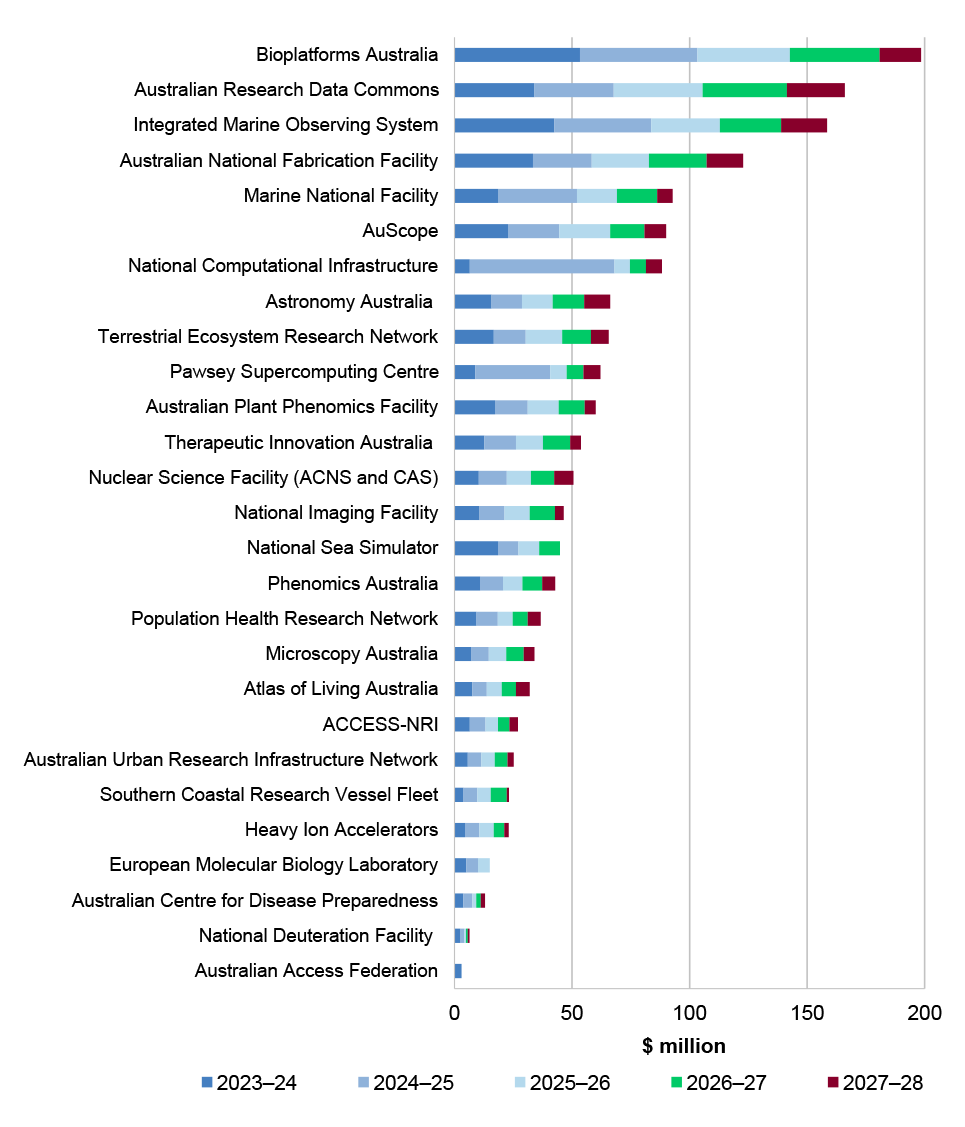
Note: European Molecular Biology Laboratory is funded by NCRIS under an international associate membership arrangement (see paragraph 2.38). The remaining 26 NCRIS funding recipients are Australian research facilities.
Source: ANAO analysis of Education documentation.
Footnotes
1 Grants are made under section 32B of the Financial Framework (Supplementary Powers) Act 1997, as provided by item 231 of Schedule 1AB to the Financial Framework (Supplementary Powers) Regulations 1997.
2 Department of Education, Science and Training, National Research Infrastructure Framework The Final Report of the National Research Infrastructure Taskforce, DEST, Canberra, 2004, p. 2, available from https://www.education.gov.au/national-research-infrastructure/resources/national-research-infrastructure-taskforce-final-report-2004 [accessed 28 April 2026].
3 Grants are made under section 32B of the Financial Framework (Supplementary Powers) Act 1997, as provided by item 231 of Schedule 1AB to the Financial Framework (Supplementary Powers) Regulations 1997.
4 DEST, National Research Infrastructure Framework The Final Report of the National Research Infrastructure Taskforce, p. 2.
5 Department of the Treasury, Budget 2004-05: Budget Measures Budget Paper No. 2, Treasury, Canberra, 2004, p. 130, available from https://archive.budget.gov.au/2004-05/bp2/bp2.pdf [accessed 24 April 2026].
NCRIS replaced the Major National Research Facilities (MNRF) program and the Systemic Infrastructure Initiative (SII), which were funded under the 2001 Backing Australia’s Ability research package. Unlike NCRIS, the MNRF and SII front loaded funding for capital and did not support the ongoing operation of facilities.
6 Department of Education and Training (DET), Research Infrastructure Review Final Report, DET, September 2015, p. 12, available from https://www.education.gov.au/national-research-infrastructure/strategic-framework/research-infrastructure-review [accessed 16 January 2026].
7 ibid., page xi.
8 Department of Education, Australian Universities Accord Final Report, Education, December 2023, p. 206, available from https://www.education.gov.au/australian-universities-accord/resources/final-report [accessed 16 January 2026].
9 Department of the Treasury, Mid-Year Economic and Fiscal Outlook 2015–16, Treasury, Canberra, 2015, p. 163, available from https://archive.budget.gov.au/2015-16/myefo/MYEFO_2015-16_Final.pdf [accessed 17 April 2026].
Ongoing funding for NCRIS was $157.3 million in 2018–19 (indexed annually ongoing). In 2025–26, this ongoing funding was $186 million out of a total of $465 million in NCRIS funding as at the Mid-Year Economic and Fiscal Outlook 2025–26.
10 Department of the Treasury, Budget 2018–19: Budget Measures Budget Paper No. 2, Treasury, Canberra, 2018, p. 92, available from https://archive.budget.gov.au/2018-19/bp2/bp2.pdf [accessed 17 April 2026].
11 Research Infrastructure Connected [Internet], 2026, available from https://riconnected.org.au/about/ [accessed 9 January 2026].
12 Department of Finance, PGPA Glossary: Closed non-competitive processes [Internet], Finance, Canberra, 2025, available from https://www.finance.gov.au/about-us/glossary/pgpa/term-closed-non-competitive-processes [accessed 15 January 2026].
Closed non-competitive processes are where grant applicants are invited to apply for a grant, and applications are not assessed against other applications but individually against the selection criteria.
13 Australian Research Council, Linkage Infrastructure, Equipment and Facilities (LIEF) [Internet], ARC, Canberra, 2026, available from https://www.arc.gov.au/funding-research/funding-schemes/linkage-program/linkage-infrastructure-equipment-and-facilities [accessed 7 January 2026].
14 National Health and Medical Research Council, NHMRC grant program schemes [Internet], NHMRC, Canberra, available from https://www.nhmrc.gov.au/funding/nhmrc-grant-program/schemes [accessed 7 January 2026].
15 Department of Health, Disability and Ageing, National Critical Research Infrastructure initiative [Internet], DOHDA, Canberra, 2025, available from https://www.health.gov.au/our-work/mrff-national-critical-research-infrastructure-initiative?language=en [accessed 7 January 2026].
16 Strategic Examination of R&D, National coordination for RD&I Impact, Department of Industry, Science and Resources, Canberra, 27 August 2025, p. i, available from https://consult.industry.gov.au/strategic-examination-rd-issues-papers [accessed 15 January 2026].
17 Department of Industry, Science and Resources, Strategic Examination of Research and Development Terms of Reference [Internet], DISR, Canberra, 2025, available from https://www.industry.gov.au/science-technology-and-innovation/strategic-examination-research-and-development/strategic-examination-research-and-development-terms-reference [accessed 6 March 2026].
18 Department of Industry, Science and Resources, Ambitious Australia: Strategic Examination of Research and Development final report [Internet], DISR, 2026, available from https://www.industry.gov.au/publications/ambitious-australia-strategic-examination-research-and-development-final-report [accessed 24 March 2026].
19 ibid.
20 Grants are made under section 32B of the Financial Framework (Supplementary Powers) Act 1997, as provided by item 231 of Schedule 1AB to the Financial Framework (Supplementary Powers) Regulations 1997.
21 Department of Finance, Commonwealth Grants, Finance, Canberra, 26 February 2025, available from https://www.finance.gov.au/government/commonwealth-grants [accessed 15 January 2026].
22 Public Service Act 1999, subsection 13(8).
Public Governance, Performance and Accountability Act 2013, section 15 and section 32.
Australian Public Service Commission, APS Values and Code of Conduct in practice, section 7: Using Commonwealth Resources, APSC, August 2017, pp. 59–61, available from https://www.apsc.gov.au/ publication/aps-values-and-code-conduct-practice/section-7-using-commonwealth-resources [accessed 23 February 2026].
23 Commonwealth Grant Rules and Principles 2024, paragraph 12.1.
24 ibid.
25 Commonwealth Grant Rules and Principles 2024, paragraph 11.3 states that officials should consider the options available for selection processes, including open competitive, targeted or restrictive competitive, non-competitive open, demand-driven, closed non-competitive, and one-off ad hoc grant selection processes.
26 Department of Education and Training, Research Infrastructure Review Final Report, DET, September 2015, p. 14, available from https://www.education.gov.au/download/3436/research-infrastructure-review-2016/4984/document/pdf [accessed 2 April 2026].
27 Commonwealth Grants Rules and Principles 2024, paragraph 11.
28 Department of Education, 2021 National Research Infrastructure Roadmap, Education, 7 April 2022, p. 91 Appendix 2: Terms of Reference, available from https://www.education.gov.au/national-research-infrastructure/resources/2021-national-research-infrastructure-roadmap [accessed 11 February 2026].
29 The Expert Working Group comprised of Dr Ziggy Switowski AO (Chair), Professor Barbara Howlett, Dr Michelle Perugini, Dr Chris Roberts AO, Professor Elizabeth (Liz) Sonenberg, Ms Lauren Stafford, Mr Tony Cook PSM, Dr Cathy Foley AO PSM and Ms Jane Urquhart PSM.
30 Members of the NRIAG as of February 2026 are Professor Elizabeth (Liz) Sonenberg (Chair), Emeritus Professor Joseph (Joe) Shapter, Professor Calum Drummond AO, Ms Suzanne Toumbourou, Professor Stephen van Leeuwen, Professor Mark Western, Emeritus Professor Caroline McMillen AO, Ms Sue MacLeman and Distinguished Professor Brian Schmidt AC. The ex-officio members are: Mr Sam Rosevear, Ms Helen Wilson, Professor Tony Haymet, Professor Ute Roessner AM and Mr Andrew Gilbert.
31 This was the NDRI working group, which comprised Emeritus Professor Joseph (Joe) Shapter (Chair), Professor Elizabeth (Liz) Sonenberg, Mr Mike Hill, Emeritus Professor Robyn Owens AM, Mr Richard Northam and Professor Elanor Huntington.
32 For the purpose of analysis of the number of unique co-investing organisations, and analysis of new entrants, minor data cleaning has been undertaken by the ANAO. Those identified in the data as ‘other’ or non-specifically such as ‘government’ have been omitted. Clearly identical names that have been written differently in the source data, such as ‘University of Melbourne’ and ‘The University of Melbourne’, have been matched.
33 Commonwealth Grants Rules and Principles 2024, paragraph 12.1.
34 ibid.
35 ibid., paragraph 13.1.
36 In 2023, expert input consisted of an Interdepartmental Committee and Investment Advisory Committee. In 2025, expert input was from the National Digital Research Infrastructure (NDRI) working group, a sub-group of the NRIAG.
37 Education sought and received ministerial approval of an updated version of the NCRIS 2022 Guidelines on 31 October 2022 as the Department has ‘applied incorrect indexation’ on the version of the Guidelines initially approved by the Minister.
38 Commonwealth Grant Rules and Guidelines 2017, paragraphs 4.6, 4.7 and 4.10.
39 ibid., paragraph 4.10.
Commonwealth Grant Rules and Principles 2024, paragraph 4.10.
40 The ‘proper’ use or management of public resources under the PGPA Act is efficient, effective, economical and ethical.
PGPA Act, section 8 (definition of ‘proper’).
41 The costs used in this analysis to measure efficiency are limited to the approximate costs of staff involved in assessment of NCRIS grants. A complete efficiency measure would consider all inputs, such as the funding and resources consumed by grant administration, and any costs to the community.
Commonwealth Grant Rules and Principles 2024, paragraph 10.4.
42 Grants to EMBL are provided under an ongoing membership agreement (see paragraph 2.38). As of January 2026, this was most recently funded by a three-year grant in the 2022 NCRIS round, providing payment until June 2026.
43 Commonwealth Grants Rules and Principles 2024, paragraph 15.1.
44 Department of Finance, Commonwealth Performance Framework [Internet], Finance, Canberra, 2024, available from https://www.finance.gov.au/government/managing-commonwealth-resources/planning-and-reporting/commonwealth-performance-framework [accessed 16 January 2026].
45 Public Governance, Performance and Accountability (PGPA) Act 2013, section 38.
46 The Treasury, Commonwealth Evaluation Policy, The Treasury, Canberra, available from https://evaluation.treasury.gov.au/about/commonwealth-evaluation-policy [accessed 23 February 2026].
47 Australian Centre for Evaluation, Why evaluate [Internet], Treasury, Canberra, available from https://evaluation.treasury.gov.au/toolkit/why-evaluate [accessed 20 February 2026].
48 Commonwealth Grant Rules and Principles 2024, paragraph 10.7.
49 NCRIS Directors are a group comprised of senior leadership representatives from NCRIS projects who meet monthly.
50 The NCRIS Governance Review was undertaken as a follow up to an earlier 2014 governance review of all NCRIS projects by KPMG in 2014, which found governance issues with some NCRIS projects.
51 The common sub-clauses of grant agreements with NCRIS facilities relate to the following: governance and management, access regime for users, access to and use of data, technical support or training to users, operation of research infrastructure and managing relationships.
52 Australian Centre for Evaluation, What is evaluation, The Treasury, Canberra, available from https://evaluation.treasury.gov.au/toolkit/what-evaluation [accessed 12 February 2026].
53 In 2021, Lateral Economics was engaged by the NCRIS facilities to undertake an economic analysis of the stimulus delivered via NCRIS organisations. The analysis found each dollar of NCRIS funding generated $1.29 of co-contributions, with an estimated economy-wide total return on investment of $7.50 for each dollar of NCRIS funding.
AuScope, NCRIS explained [Internet], AuScope, Melbourne, available from https://www.auscope.org.au/ncris [accessed 25 February 2026].
54 Department of Education, National Research Infrastructure (NRI) Advisory Group Terms of Reference [Internet], Education, Canberra, 2025, available from https://www.education.gov.au/national-research-infrastructure/advisory-group/terms-reference [accessed 2 February 2026].
55 Australian Research Council, Research Impact Principles and Framework [Internet], ARC, Canberra, 2026, available from https://www.arc.gov.au/about-arc/strategies/research-impact-principles-and-framework [accessed 6 January 2026].
56 Organisation for Economic Co-operation and Development, Reference Framework for Assessing the Scientific and Socio-economic Impact of Research Infrastructures, OECD Science, Technology and Industry Policy Papers, No. 65, OECD Publishing, 2019.
57 Department of Finance, Commonwealth Performance Framework [Internet], Finance, Canberra, 2024, available from https://www.finance.gov.au/government/managing-commonwealth-resources/planning-and-reporting/commonwealth-performance-framework [accessed 7 January 2026].
58 Department of Finance, Developing performance measures (RMG 131), Finance, Canberra, 2025, available from https://www.finance.gov.au/government/managing-commonwealth-resources/developing-performance-measures-rmg--131 [accessed 3 December 2025]; and
Department of Finance, Corporate plans for Commonwealth entities (RMG 132), Finance, Canberra, 2025, available from https://www.finance.gov.au/government/managing-commonwealth-resources/corporate-plans-commonwealth-entities-rmg-132 [accessed 3 December 2025].
59 Auditor-General Report No. 13 2023–24, Audits of the Annual Performance Statements of Australian Government Entities — 2021–22, ANAO, Canberra, 2023, paragraph 5, available from https://www.anao.gov.au/work/performance-statements-audit/audits-the-annual-performance-statements-australian-government-entities-2021-22 [accessed 25 February 2026].
60 Department of Education, Portfolio Budget Statements 2025-26 Education Portfolio, Education, Canberra, 2025, p. 62, available from https://www.education.gov.au/download/19070/2025-26-education-portfolio-budget-statements-and-paes/40877/2025-26-education-portfolio-budget-statements/pdfb [accessed 2 April 2026].
61 Department of Finance, Unbiased measurement & assessment [Internet], Finance, Canberra, 2025, available from https://www.finance.gov.au/government/managing-commonwealth-resources/developing-performance-measures-rmg--131/unbiased-measurement-assessment [accessed 15 December 2025].