Browse our range of reports and publications including performance and financial statement audit reports, assurance review reports, information reports and annual reports.
Auditor-General Report No. 27 of 2025–26
Safer Local Roads and Infrastructure Program
Published
Tuesday 31 March 2026

Portfolio
Infrastructure, Transport, Regional Development, Communications, Sport and the Arts
Entity
Department of Infrastructure, Transport, Regional Development, Communications, Sport and the Arts
Contact
Please direct enquiries through our contact page.
Activity
Policy development
Sector
Infrastructure
Audit snapshot
Why did we do this audit?
- The Safer Local Roads and Infrastructure Program’s (SLRIP) objective is to support the delivery of safer and more productive roads across Australia.
- The Department of Infrastructure, Transport, Regional Development, Communications, Sport and the Arts (Infrastructure) administer the SLRIP under the Infrastructure Investment Program (IIP).
- The SLRIP was created as part of broader reforms to improve the sustainability of the IIP.
Key facts
- The Bridges Renewal Program and the Heavy Vehicle Safety and Productivity Program were combined to create the SLRIP.
- The SLRIP commenced on 1 July 2024, with at least $200 million available each year for projects.
- State and territory governments and Local Government Authorities can apply for SLRIP funding.
What did we find?
- The design of the SLRIP was largely effective and its early implementation was partly effective.
- The new program was created as recommended by an external review of the IIP. The design of the program could have been further improved, including by providing greater clarity on how value for money is achieved through project selection.
- Early implementation could have better contributed to administrative efficiencies for Infrastructure. Risk management and performance measurement could be further improved.
What did we recommend?
- The ANAO made four recommendations related to: providing greater clarity in how project selection achieves value for money; improved tracking of assessment and approvals timeframes; improving risk management; and better monitoring and reporting on program performance.
- Infrastructure agreed to the recommendations.
$2.3bn
Funding available for projects under the SLRIP over 11 years from 2024–25.
75%
Total national road length for which local councils are responsible.
89
Number of projects completed with SLRIP funding as at November 2025.
Summary and recommendations
Audit objective
1. The audit objective was to assess the design and implementation of the Safer Local Roads and Infrastructure Program (SLRIP). To form a conclusion against the objective, the ANAO examined the following criteria:
- Was the SLRIP designed to support project delivery and achieving value for money?
- Has the SLRIP implementation resulted in improved administration and performance?
Audit conclusion
2. The Department of Infrastructure, Transport, Regional Development, Communications, Sport and the Arts’ (Infrastructure) design of the SLRIP was largely effective. In response to expert review recommendations, Infrastructure consolidated two sub-programs and introduced five design changes. Early implementation was partly effective. Infrastructure took steps to launch the program and maintain continuity with the previous sub-programs using existing administrative processes. The establishment of a new initiative such as the SLRIP provides opportunities for entities to embrace best practice and strengthen mechanisms to achieve administrative efficiency and such opportunities remain available to Infrastructure. Further improvements in defining value for money considerations, strengthening mechanisms to achieve efficiencies, managing risk, and improved measuring of performance would enhance ongoing delivery of this new program.
Supporting findings
3. The design of the SLRIP was largely effective in supporting project delivery and achieving value for money. Expert reviews were commissioned in 2023 to improve the sustainability and project delivery of the Infrastructure Investment Program (IIP) and its sub-programs. Infrastructure implemented the recommendation from one of these reviews to combine two sub-programs into one, with the SLRIP commencing on 1 July 2024 with five design changes. Infrastructure could have further improved the design and early implementation by applying the lessons from broader IIP reform findings, in particular around risk management, streamlining data systems and managing cost escalation.
4. The SLRIP guidelines set out how Infrastructure will determine value for money for individual projects, based on merit-based criteria. The process could be strengthened by: further consideration of project cost relative to the other criteria; the opportunity to validate and assess applicant information; and consideration of relative need and benefit across the selected projects. The moderation component of the assessment undertaken for tranche two was not referred to in the SLRIP guidelines.
5. The early implementation of the SLRIP was partly effective in improving administration and performance. Infrastructure’s administrative processes for SLRIP applications were processed the same as under the Bridges Renewal Program and the Heavy Vehicle Safety and Productivity Program (including the Heavy Vehicle Rest Area initiative) and it does not adequately track internal assessment and approval timeframes to manage internal efficiencies, with timeframe targets not met for tranches one and two. Risk management of the SLRIP could be improved, particularly through tracking individual project risks and their impact on overall program risk. The SLRIP’s current agreed budget will require careful management to ensure it is expended in line with project funding agreements. Infrastructure has a program logic and draft evaluation framework in place. The outcomes in these documents do not align and the project data being collected will need to be improved to support an outcomes-based evaluation.
Recommendations
6. The ANAO made four recommendations aimed at Infrastructure achieving:
- further transparency in how projects selected achieve value for money (see paragraph 2.51);
- improved tracking and managing the timeframes of funding assessment and approvals (see paragraph 3.6);
- improved risk management (see paragraph 3.23); and
- better use of data to monitor performance and measure outcomes (see paragraph 3.51).
Rationale for undertaking the audit
7. The SLRIP aims to ‘strengthen investment to support the delivery of safer and more productive roads across Australia’. This performance audit provides assurance to Parliament on whether the design and early implementation of the SLRIP is achieving value for money and delivering the expected outcomes.
Audit approach
8. This audit focused on the design and early implementation of the SLRIP to support improvements to future funding rounds and ongoing management of the program. The audit was conducted in accordance with ANAO Auditing Standards at a cost to the ANAO of approximately $240,000. The team members for this audit were Rowena Thomson, Thea Ingold, Jessica Bracken, Lachlan Rowe, Anne Rainger and Ben Siddans.
Summary of entity response
9. The proposed final report was provided to Infrastructure. The summary response from Infrastructure to the report is provided below. The full response is at Appendix 1.
10. The Department of Infrastructure, Transport, Regional Development, Communications, Sport and the Arts (the department) welcomes the finding that the design of the Safer Local Roads and Infrastructure Program (the Program) was largely effective. The department notes the finding that the Program’s early implementation was partly effective and has asked the ANAO to consider the factual basis and emphasis given to some of the findings and commentary in the report.
11. Notwithstanding the above, the department agrees there are opportunities to further improve some aspects of the program’s implementation. The report’s recommendations will be considered in the review and development of any future program documentation and as part of the program’s outcomes evaluation.
Key messages from this audit for all Australian Government entities
12. Below is a summary of key messages which have been identified in this audit and may be relevant for the operations of other Australian Government entities.
Group title
Policy or program design
Key learning reference
Group title
Governance and risk management
Key learning reference
Group title
Performance and impact measurement
Key learning reference
1. Background
The Safer Local Roads and Infrastructure Program
1.1 The Australian Government invests in land transport infrastructure throughout Australia in partnership with the states and territories. Investment in land transport projects and local road infrastructure from the Australian Government is made through the Infrastructure Investment Program (IIP). The IIP is managed by the Department of Infrastructure, Transport, Regional Development, Communications, Sport and the Arts (Infrastructure) and includes funding for larger rail and road infrastructure projects as well as for targeted investment to address specific infrastructure needs through sub-programs.
1.2 In 2023 two external reviews were undertaken into the funding for land transport infrastructure. The reviews examined the IIP and its large national infrastructure projects as well as its sub-programs. The Australian Government supported the review recommendations.1 Both review reports were released on 16 November 2023.
1.3 The Independent Strategic Review of the IIP (the Strategic Review) found there was an estimated $32.8 billion in known cost pressures on existing infrastructure projects and that the 10-year pipeline of projects at the time could not be delivered within the allocated $120 billion Australian Government contribution.2 The Strategic Review found that sub-programs ‘provide critical funding to councils to build and maintain local infrastructure’ and the annual spend on sub-programs had increased from $1 billion to $2.5 billion per year from 2020–21 to 2024–25 due to COVID-19 pandemic economic stimulus funding and impacts of national disasters.
1.4 The Independent Review of the National Partnership Agreement on Land Transport Infrastructure Projects (the NPA Review) reviewed the framework that governs payments to states and territories for land infrastructure projects.3 The report highlighted the need ‘to reform the current administrative arrangements into a more effective model’. The NPA Review found that sub-programs played an important role in funding for local government areas and that if a sub-program is agreed to be part of the IIP, the arrangements should be clearly set out in any new agreement.
1.5 In response to the reviews, two IIP sub-programs — the Bridges Renewal Program and the Heavy Vehicle Safety and Productivity Program4 — were combined to create the Safer Local Roads and Infrastructure Program (SLRIP). The SLRIP commenced on 1 July 2024 and provides funding for projects to address current and emerging priorities in road infrastructure. The Australian Government contributes up to $5 million per project. As at December 2025, the funding for the SLRIP is $2.3 billion over 11 years from 2024–25 with the funding to be ongoing at 2034–35 levels from 2035–36.5 Appendix 3 provides a timeline of key points in program design and early implementation.
Applicable legislation and frameworks
1.6 Infrastructure administers the SLRIP and is responsible for program outcomes. Infrastructure manages the guidelines, funding rounds (including assessing applications and making funding recommendations), recommends payments against completed milestones and reports on delivery of SLRIP projects. 6
1.7 SLRIP projects are funded under the National Land Transport Act 2014 (the NLT Act) with payments made to states and territories through the federation funding system, including where the funding recipient is a Local Government Authority (LGA). The governance framework of the SLRIP is comprised of the following:
- the NLT Act that provides ‘for the funding of projects related to land transport matters, and for related purposes’7;
- the Federal Financial Relations Act 2009 (the FFR Act) and Federation Reform Fund Act 2008 that sets the framework for payment to states and territories;
- the Public Governance, Performance and Accountability Act 2013 that establishes governance and accountability for public resources, with an emphasis on planning, performance and reporting;
- the Intergovernmental Agreement on Federal Financial Relations that establishes the detail for funding to states and territories, including finances and collaboration on policy development and service delivery;
- the Federation Funding Agreement — Infrastructure and the Land Transport Infrastructure Projects Schedule that sets out the governance, reporting and financial arrangements for the funding of land transport infrastructure projects8; and
- the SLRIP guidelines that set out the key policy and process parameters.9
Audit scope
1.8 The audit focused on assessing whether the design of the SLRIP supports identifying the best value for money projects and whether the early implementation improved administration to support the delivery of the projects. The audit scope did not include:
- the Bridges Renewal Program and the Heavy Vehicle Safety and Productivity Program (including the Heavy Vehicle Rest Area initiative) prior to projects from these programs being rolled into the SLRIP;
- retesting the assessment results of individual projects awarded funding; and
- the role of states and territories and LGA’s, including the arrangements that exist between funded entities and project contractors or sub-contractors.
Audit methodology
1.9 The audit involved examining departmental records, conducting process walkthroughs and meetings with relevant Infrastructure staff.
2. Program design
Areas examined
The ANAO assessed whether the design of the Safer Local Roads and Infrastructure Program (SLRIP) is supporting project delivery and achieving value for money.
Conclusion
The design of the SLRIP was largely effective in supporting project delivery and achieving value for money.
Expert reviews were commissioned in 2023 to improve the sustainability and project delivery of the Infrastructure Investment Program (IIP) and its sub-programs. The Department of Infrastructure, Transport, Regional Development, Communications, Sport and the Arts (Infrastructure) implemented the recommendation from one of these reviews to combine two sub-programs into one, with the SLRIP commencing on 1 July 2024 with five design changes. Infrastructure could have further improved the design and early implementation by applying the lessons from broader IIP reform findings, in particular around risk management, streamlining data systems and managing cost escalation.
The SLRIP guidelines set out how Infrastructure will determine value for money for individual projects, based on merit-based criteria. The process could be strengthened by: further consideration of project cost relative to the other criteria; the opportunity to validate and assess applicant information; and consideration of relative need and benefit across the selected projects. The moderation component of the assessment undertaken for tranche two was not referred to in the SLRIP guidelines.
Areas for improvement
The ANAO made one recommendation aimed at improving how value for money is articulated as part of the SLRIP project assessment process. The ANAO also suggested that Infrastructure: develop information to clarify definitions and applicable guidelines for sub-programs; incorporate additional data sources to support achieving value for money; and implement a fit for purpose cost escalation model.
Infrastructure established the Safer Local Roads and Infrastructure Program as recommended by an external review. Opportunities exist to enhance its design by applying the broader review findings
Expert advice was commissioned to improve the sustainability and project delivery under the Infrastructure Investment Program and sub-programs
National Partnership Agreement for Land Transport Infrastructure Projects review
2.1 The National Partnership Agreement for Land Transport Infrastructure Projects (the NPA) was in place between 1 July 2019 and 30 June 2024. It set out the arrangements for Australian Government investment in land transport infrastructure in partnership with the states and territories. The NPA included a requirement for an independent review of the agreement. The Independent Review of the National Partnership Agreement on Land Transport Infrastructure Projects (the NPA Review) was completed in September 2023. The purpose of the NPA Review was ‘to assess the degree to which the agreed objectives and outcomes and/or outputs of this Agreement have been achieved and inform decisions regarding the appropriate treatment following its expiry’.
2.2 The NPA Review found that the framework supporting the NPA:
- ‘does not tie investment decisions to joint planning, priorities setting or a long-term investment horizon’;
- did not provide transparency in relation to ‘distinguishing sub-program investments from larger individual projects’ and facilitated potential sub-program funding duplication, resulting in the Australian Government ‘not receiving consistent information about its investments to improve road safety objectives’;
- needed ‘to reform the current administrative arrangements into a more effective model’; and
- did not provide sufficient oversight for the Australian Government based on risk and that together with ‘poor cost estimation and scoping processes’ had led to poor project outcomes.
2.3 Recommendation one of the NPA Review was to replace the NPA funding mechanism with a Federation Funding Agreement to better enable priority setting, risk management, delivery, and transparency of investment under the IIP. The Federation Funding Agreement — Infrastructure and the associated Land Transport Infrastructure Projects Schedule commenced in August 2024 to replace the NPA and establish the arrangements for land transport infrastructure investment. This was one of 12 recommendations that the Australian Government agreed to in principle to ‘support the Australian Government to deliver on its infrastructure investment priorities and objectives’.
Strategic Review of the Infrastructure Investment Program
2.4 The Independent Strategic Review of the IIP (the Strategic Review) was announced by the Minister for Infrastructure, Transport, Regional Development and Local Government (the minister) in May 2023. The purpose of the review was to ‘ensure that federally funded infrastructure projects meet government policy objectives and deliver benefits for Australians’. It evaluated the merit of continuing with certain ‘in-scope’ projects and made recommendations on reforms to the IIP, including sub-programs.
2.5 The Strategic Review10 found:
- the pipeline of land transport projects at that time was financially unsustainable, with many unlikely to be delivered;
- governance and assurance frameworks were insufficient and cost pressures and delivery delays were addressed by the Australian Government in an ad hoc manner;
- sub-programs provided critical funding to Local Government Authorities (LGA’s) to build and maintain local infrastructure and current programs were delivering positive outcomes and value for money, although improvements in program design were required; and
- data driven decision-making could be improved, project investment and strategic priorities better aligned, and the National Land Transport Act 2014 (NLT Act) reviewed to ‘reflect modern transport and infrastructure needs’.11
Infrastructure implemented the recommendation to combine two sub-programs
2.6 The Strategic Review examined five ongoing and three terminating sub-programs, focusing on sub-programs that most targeted needs of LGA’s which are responsible for approximately 75 per cent of the total national road length.12 The Strategic Review found that the annual spend through these specific sub-programs increased from $1 billion to $2.5 billion per year from 2020–21 to 2024–25 for reasons including COVID-19 pandemic economic stimulus funding and impacts of national disasters. The in-scope sub-programs were:
- ongoing — Roads to Recovery, Black Spot Program, Bridges Renewal Program, Heavy Vehicle Safety and Productivity Program (including the Heavy Vehicle Rest Area initiative), and National Land Transport Network Maintenance; and
- terminating — Local Roads and Community Infrastructure Program, Road Safety Program, and Remote Roads Upgrade Pilot Program.
2.7 Recommendation 11 of the Strategic Review was to: ‘create a targeted application-based infrastructure rolling program over ten years that allows local governments the flexibility to apply for funding against key government priorities which could include freight productivity, bridge upgrades and road safety.’ This recommendation was informed by:
- the Road Safety Program terminating in 2024–25, which presented ‘a significant gap in sub-program funding for road safety’13; and
- findings related to the Bridges Renewal Program and the Heavy Vehicle Safety and Productivity Program, including that these sub-programs were of greatest financial importance to local councils, involved administrative burden and that funding was being directed to priorities identified by the Australian Government rather than aligned with strategic infrastructure priorities.
2.8 In response, the Australian Government created the SLRIP which combined the Bridges Renewal Program and the Heavy Vehicle Safety and Productivity Program (including the Heavy Vehicle Rest Area initiative). There were also six other findings and recommendations from the Strategic Review and the NPA Review that were relevant to improving the combined program (see Table 2.1).
The Safer Local Roads and Infrastructure Program commenced on 1 July 2024, supported by program guidelines and five design changes
2.9 The SLRIP commenced on 1 July 2024 to support ‘safer and more productive roads across Australia’. The SLRIP is a sub-program of the IIP for the purposes of the Land Transport Infrastructure Projects Schedule. The SLRIP is aligned to the Land Transport Infrastructure Projects Schedule objective of ‘aspir[ing] to deliver a national land transport system that contributes to productivity, sustainability, safety, network resilience … as guided by the Infrastructure Policy Statement’.
2.10 There were five changes implemented by Infrastructure in combining the Bridges Renewal Program and the Heavy Vehicle Safety and Productivity Program (including the Heavy Vehicle Rest Area initiative) into the SLRIP. These were:
- adding three additional focus areas — road safety, road resilience and road sustainability;
- making co-funding contributions for states and territories 50:50 for urban, regional and remote areas;
- changing project reporting requirements from monthly to quarterly;
- adding an extension option for project delivery timeframes of up to an additional year in exceptional circumstances; and
- removing the state and territory assessment component for LGA applications.
2.11 The SLRIP is open to all state and territory governments and LGAs.14 Applications can be submitted at any time, with Infrastructure assessing applications in tranches with at least $200 million available each year.15 The minister approves project funding, informed by Infrastructure’s recommendations. The SLRIP guidelines (dated June 2024) set out the program parameters including:
- the SLRIP is an application-based merit assessment, open to state and territory governments and LGAs16;
- applications must directly address at least one of the six focus areas of road safety, productivity, bridge renewal, road resilience, road sustainability and heavy vehicle rest areas; and
- eligible projects must:
- be for construction on an existing or proposed road;
- be on a public road;
- be a whole and complete project that is not dependent on other work being undertaken;
- request Australian Government funding of up to $5 million; and
- have secured a funding co-contribution17 and if applied for by a state or territory, seek up to 50 per cent of the project cost (capped at $5 million) irrespective of the project location; or, if submitted by an LGA seek up to 50 per cent of the project cost (capped at $5 million) for projects in urban areas and up to 80 per cent for projects in regional areas.
Six other findings from the National Partnership Agreement Review and the Strategic Review had relevance for design improvement
2.12 In 2023 advice to the Australian Government on implementing IIP and sub-program reform, Infrastructure stated that the Strategic Review and the NPA Review ‘stressed the need’ for a more integrated and strategic approach to investing in land transport infrastructure. In the advice, Infrastructure noted the interrelated nature of the findings of the two reviews and identified five key themes: strategic alignment to priorities; risk-based governance and improved project planning; streamlined ways of working; sub-program reform; and long-term enabling functions.
2.13 The ANAO identified that six of the broader recommendations or findings had relevance to the SLRIP successfully supporting ‘safer and more productive roads across Australia’ and assessed whether the findings or recommendations are reflected in the design and early implementation of the SLRIP. Table 2.1 sets out the results of this analysis.
Table 2.1: The six findings/recommendations mapped to the key strategic themes and reflection in the SLRIP design
|
Reform theme |
Recommendation |
SLRIP design |
|
Strategic Review |
||
|
Sub-program reform |
Adopt a 50:50 standard funding split, with flexibility to apply other funding splits (where supported by evidence), particularly for smaller jurisdictions and remote locations (see paragraphs 2.10 and 3.20). |
● |
|
Streamlining |
Improve data systems and practices to reflect contemporary approaches to managing and reporting data consistent with the level of risk (see paragraphs 3.8 to 3.11). |
◑ |
|
Strategic |
Incorporate the Infrastructure Policy Statement into project planning processes (see paragraph 2.9). |
● |
|
NPA Review |
||
|
Risk |
Develop a risk framework that includes consideration of the delivery of small, low-risk infrastructure projects (see paragraphs 3.12 to 3.18). |
◑ |
|
Streamlining |
Reporting arrangements should be streamlined (see paragraphs 2.10 and 3.40). |
● |
|
Enabling |
Review the cost escalation model to ensure it is fit for purpose (see paragraphs 2.53 to 2.58). |
◯ |
Key: ● Fully reflected in the SLRIP ◑ Partially reflected in the SLRIP ◯ Not reflected in the SLRIP
Source: ANAO analysis.
There is a lack of clarity around sub-programs in the Infrastructure Investment Program
2.14 The sub-programs under the IIP were previously implemented through the NPA and now through the Federation Funding Agreement — Infrastructure. Sub-programs provide funding for lower-cost and less complex land transport infrastructure projects.
2.15 The NPA Review and the Strategic Review both identified that the sub-programs supported the viability of road infrastructure, particularly by funding construction and upkeep in local government areas.18 The reviews identified that there was no definition for what a ‘sub-program’ is and that not all sub-programs were supported by the IIP, identifying that sub-programs had evolved over time to ‘fill gaps’ or respond to ‘specific needs’ rather than following a coordinated strategy.19
2.16 The process for establishing a sub-program or allocating funding via sub-programs established under the IIP is not specified in legislative or administrative arrangements.20 Infrastructure has taken no steps to define sub-programs.
2.17 The SLRIP operates under its own guidelines. Larger projects (and some sub-programs) operate under the Notes on Administration for Land Infrastructure Projects 2024–2029 (the Notes) which provide the administrative detail to support the Federation Funding Agreement — Infrastructure.21 The NPA Review recommended that the Notes be rewritten for clarity and to better support robust decision-making on infrastructure investment and to improve transparency. Following the agreement of the new Land Transport Infrastructure Projects Schedule in August 2024, senior officials from Infrastructure and individual states and territories agreed to a revised version of the Notes in June 2025.22 This provided an opportunity to address the lack of clarity around sub-programs identified by the reviews, however this did not occur.23
2.18 Lack of clarity around sub-programs limits transparency on how land transport infrastructure is prioritised and funded. The NPA Review and the Strategic Review noted this issue however Infrastructure has not made use of opportunities to be responsive to these reviews in the design of SLRIP.
Opportunity for improvement
2.19 The Department of Infrastructure, Transport, Regional Development, Communications, Sport and the Arts could provide clear, current publicly available information on:
- identification of which programs are sub-programs under the IIP, and which are not;
- which sub-programs operate under their own guidelines, and which operate under the Notes on Administration for Land Infrastructure Projects 2024–2029; and
- the circumstances in which a new sub-program might be created.
Project assessment processes are established, with scope to improve guidance and better documentation of achieving value for money
The program guidelines establish a competitive process, with applicants assessed against specified merit-based criteria
2.20 In general terms, entities achieve value for money when the projects selected will individually deliver the desired outcomes and collectively maximise the achievement of the policy objective within the funding available.24 The SLRIP guidelines set out that Infrastructure will assess each application based on how well it meets specified criteria, compared to other applications and provides value for money. It further states:
When assessing the extent to which the application represents value of relevant money, the Department will have regard to:
- the overall objective/s to be achieved in providing the funding;
- the relevant value of the funding sought; and
- the extent to which the evidence/information/analysis in the application demonstrates that it will contribute to meeting the outcomes/objectives.
In addition, the Department will also consider proper use of relevant money in accordance with the Public Governance, Performance and Accountability Act 2013.
2.21 Infrastructure assesses eligible applications against three equally weighted criteria for the SLRIP and four equally weighted criteria for Heavy Vehicle Rest Area projects, as described in Table 2.2.25 The criteria do not include a robust assessment of the cost of projects relative to the other criteria. Infrastructure advised the ANAO in November 2025 that: ‘The department considers it is appropriate given the nature of projects to be funded under the SLRIP program to assess the potential benefits of a project independently of the cost and this is reflected in the structuring of the assessment criteria.’
Table 2.2: SLRIP assessment criteria
|
Criterion |
Merit criterion description |
|
Criterion 1 |
Strategic fit — outline the rationale for the project, why there is a strong case for action, how it will achieve the stated objectives, and how it meets the needs of the community. |
|
Criterion 2 |
Project impact and benefits — demonstrate the social, economic and environmental value of the project with evidence-based analysis. This includes direct project benefits as well as benefits during the construction of the project. |
|
Criterion 3 |
Project deliverability — demonstrate the capability and capacity to deliver the project, including mitigating identified risks. |
|
Criterion 4 (Heavy Vehicle Rest Area specific only) |
Improvement to the Heavy Vehicle Rest Area network across Australia — demonstrate how the project improves the usability or capacity of the rest area network across Australia in a way that is fit for purpose and meets the needs of truck drivers for the specific location proposed. |
Source: ANAO presentation of the SLRIP assessment criteria.
2.22 Infrastructure has developed the SLRIP Assessment Guide to support its assessment of applications against the criteria. It is an internal document that assists departmental officers to undertake SLRIP assessments. Infrastructure has also developed the following documents:
- ‘Steps to locate a project in IMS [Infrastructure Management System]’ for staff to locate applications and attachments for assessment;
- ‘Applications tracker spreadsheet’ for staff to assess the eligibility of an application before it proceeds to the criteria assessment;
- ‘Assessments training session’ which is available for staff reference;
- Standard operating procedure — ‘Creation of Proposal for Projects’ and ‘Individual Project Instruments’ for staff to create projects in IMS once the project is approved by the minister; and
- ‘Inception meeting and feedback session checklists’ for staff to hold initial meetings with funded recipients and to provide feedback to applicants as requested.
2.23 Infrastructure officers use a rubric provided in the SLRIP Assessment Guide to award a rating from 0 to 5 representing an assessment of ‘incomplete’ to ‘excellent’. Half points are allowable.26
2.24 Each criterion (see Table 2.2) comprises ‘elements’ for assessors to consider (five for criterion one, three for criterion two, eight for criterion three and seven for criterion four) as shown in Table 2.3. These elements are not individually rated. Each criterion is given one rating against the six-point scale. This is then combined for an overall rating out of 15 for the SLRIP and 20 for the Heavy Vehicle Rest Area initiative.27 The assessments are then quality checked by executive level officers. Infrastructure relies on the scores awarded as the basis for assessing whether each proposal represents value for money.
Table 2.3: The elements of the SLRIP criteria
|
Criterion 1 —strategic fit |
Criterion 2 — project impact and benefits |
Criterion 3 — project deliverability |
Criterion 4 — HVRA specific |
|
State which focus area(s) the project aligns with and the outcomes it aims to achieve. |
Explain if the proposal provides social benefits, including improving the quality of life for users, providing safety and accessibility benefits and/or advancing equity for Indigenous Australians and vulnerable communities. |
Outline the plan to deliver the project by its proposed timeframes. |
Provide information on the current and future maximum vehicle sizes the site will cater for (only for formal rest areas). |
|
Explain the case for change, including what the problems and opportunities are, and how the works will address the issue/s. |
Explain if the project provides economic benefits, including productivity and efficiency benefits, employment benefits and regional significance benefits. |
Detail the skills, capacity and experience of those being engaged to deliver the project. |
Provide information if the site will have separate parking areas for the different types of traffic and the signage that will be installed (only for formal rest areas). |
|
Justify why the proposal is the most appropriate response to address the issue/s and opportunities. |
Explain if the project will impact the environment and if a plan is in place to manage any adverse impacts. |
State if the required approvals to deliver the project successfully have been obtained, including development, cultural and environmental approvals. If they have not been granted, outline when they will be sought and expected timeframe for approvals. |
Detail the ongoing maintenance plan for the asset (only for formal rest areas). |
|
Explain how the project directly contributes to relevant national, state, territory and local government goals, objectives, policies and strategic plans. |
– |
State if land acquisition and/or the relocation of utilities is required, and if consent has been provided. If it has not been provided outline when it will be sought and expected timeframe for consent to be granted. |
Provide information about the closest alternative facilities to the proposed site (only for formal rest areas). |
|
State if there is sufficient support for the proposal and buy-in from stakeholders and the community, noting how it responds to their needs. |
– |
Explain the size and adequacy of the project budget, including allowances for contingency. |
Provide information if the project will repurpose or enhance existing roadside facilities as a way to lower costs (only for formal and informal rest areas). |
|
– |
– |
Outline the governance and how it is appropriate for successful delivery of the project. |
Detail how green reflectors and signage will be installed (for informal rest areas and signage/green reflector upgrades). |
|
– |
– |
Outline the procurement model for your project and how it may contribute to wider outcomes as well as deliver value for money. |
Provide metrics related to the type of project (formal rest area/ informal rest area/ signage and green reflector upgrades). |
|
– |
– |
Outline project risks and mitigation strategies, including where there may be project delays, cost overruns and/or changes in scope. |
– |
Source: ANAO presentation of assessment criteria.
Guidance for applicants and assessors on how value for money is achieved in the assessment process could be clearer
2.25 Clear assessment process guidance can provide transparency to applicants, support them in submitting high-quality applications, and assist assessors in administering a fair and effective process that identifies suitable projects for funding.
2.26 The SLRIP Assessment Guide (versions one and two) state: ‘This guide does not cover the assessment of the eligibility criteria, how the application compares to other applications and value of relevant money, which are covered in the Assessments Team’s Standard Operating Procedure’. The Assessment Team’s Standard Operating Procedure document does not exist.
2.27 Infrastructure advised the ANAO in September 2025 that:
There was an oversight error in the SLRIP Assessment Guide v2 Introduction section that states the document does not cover assessment of eligibility criteria, how applications compare to other applications and value of relevant money, and refers to a SOP. The document does28 include guidance on each of these aspects of assessment, including assessing value for relevant money in the Merit Assessment Section, and also against relevant criteria.
2.28 The SLRIP Assessment Guide (versions one and two) duplicate the value-for-money content from the SLRIP guidelines (see paragraph 2.20) with no additional information or guidance. It does not effectively align value for money considerations (as set out in the SLRIP guidelines) with the criteria, and the rubric does not adequately support an assessment of those considerations. While examples of acceptable information that could be provided by applicants is included in the ‘assessments training session’ presentation (see paragraph 2.22), a range of descriptors are used in the rubric for elements within each criterion without a measurement framework. There is no guidance or information on what these descriptors mean in the context of the assessment or the threshold that must be met to achieve being assessed at the level of each descriptor. This elevates the risk of subjective and inconsistent assessment.
2.29 The SLRIP Assessment Guide (versions one and two) rubric includes one explicit reference to value for money as part of the assessment for criterion three (project deliverability), which requires applicants to include information on how any procurements they will undertake as part of the project will deliver value for money (see Table 2.3). Despite applicants being required to provide information on value for money for this element of the criterion, the rubric provided to assessors only requires assessment to be against how ‘clear and appropriate the procurement model is and how it may contribute to wider outcomes listed under Section 13 of the Guidelines’.30
2.30 Funding applicants self-identify which of the six focus areas (all with different objectives, see Table 3.7) they are applying for and may select more than one focus area. The rubric for criterion one (strategic fit) includes assessment against ‘how it [the project] will achieve the stated objectives’ and ‘state which focus area(s) the project aligns with and the outcomes it aims to achieve’. There is no guidance for assessment on which objective and which outcome an assessor is to assess against if there are multiple focus areas selected. There is also no guidance on how value-for-money consideration should be applied to ‘the overall objective/s to be achieved in providing the funding’ in instances where applicants nominated more than one focus area compared to those who only nominate one.
2.31 For criterion two (project impact and benefits), the assessment rubric focuses on social and economic benefits and environmental impact, but it does not assess the cost of the project against these.
2.32 Cost is addressed in criterion three (project deliverability) in relation to how well the applicant explains ‘the size and adequacy of the project budget, including allowances for contingency’ along with how any risks of cost overruns will be mitigated. Infrastructure could use this to inform consideration of ‘the relevant value of the funding sought’ as per the SLRIP guidelines, but this is not part of the assessment process.
Infrastructure is not using available verifying data as part of project assessment
2.33 The rubric for assessors does not provide for assessment of information and metrics collected from applicants such as: how often the road/bridge is impassable; what detours are provided; and the length of a detour if the load limit is reduced for haulage vehicles. Assessors do not confirm the accuracy or reliability of the information and metrics provided by applicants with third party data sources.
2.34 For example, the Commonwealth Scientific and Industrial Research Organisation’s (CSIRO) Transport Network Strategic Investment Tool (TraNSIT) has ‘mapped millions of vehicle trips across thousands of supply chain routes across Australia to assess the impacts of disruptions’31 and can inform ‘national and local governments to direct road and rail investment to the areas where it will have the most impact’.32 Infrastructure advised the ANAO in August 2025 that ‘the CSIRO TraNSIT is a tool used to identify where supply chains are moving to and from. We are currently using it as part of our investment strategies (especially our rail investments) but is not a tool you would use to develop guidelines. It could help us assess projects.’
Relative need and comparison of like-projects is not part of the project assessment
2.35 Assessment of relative need for financial assistance is not undertaken for the SLRIP. The Strategic Review noted that LGAs ‘have limited means to raise revenue while having extensive responsibilities for the construction and maintenance of Australian roads’. The SLRIP does not consider LGA’s road infrastructure responsibilities relative to their broader revenue status, potentially leading to available funding not being directed to the LGAs most in need of financial assistance.
2.36 The SLRIP assessment process does not include a comparative assessment of lower-value projects against higher-value projects. For example, it does not compare projects seeking $2 million with those seeking $5 million to assess whether the best use of money would be to support more lower-value projects or fewer higher-value projects or an optimal mix of both. Further, the assessment process does not specifically allow for comparison of similar projects. This means different types of road infrastructure projects compete against each other despite addressing different objectives, since each of the six focus areas has its own specific objective(s) (see Table 3.7).33 Infrastructure advised the ANAO in November 2025 that ‘like projects are compared, but not exclusively against one another, as this type of differentiation is not provided for in the guidelines’.34
2.37 Supplementing the assessment of applications with other data points and assurance on how projects achieve value for money is likely to become more critical, noting the demand for the SLRIP (see paragraphs 2.39 and 2.42) and as applicants’ proposals become more targeted and evidenced-based in future tranches.
Opportunity for improvement
2.38 The Department of Infrastructure, Transport, Regional Development, Communications, Sport and the Arts could consider incorporating other data sources and conducting further comparative assessment to provide greater assurance that the SLRIP assessment process is identifying projects that are best targeted to need and will achieve the best value for money.
Funding for tranche one projects was approved as required. Infrastructure could have better documented value-for-money considerations.
2.39 Tranche one applications were open from 1 July to 30 September 2024. Infrastructure received 255 applications for tranche one and funded 29 projects. Infrastructure publishes details of approved projects on its website and lists them in the schedules of the Land Transport Infrastructure Projects Schedule (see paragraph 1.7).
2.40 The minister approves SLRIP projects and their funding under sections 9 and 17 of the NLT Act. The minister must also comply with section 71 of the Public Governance, Performance and Accountability Act 2013 (the PGPA Act), which states that ‘a minister must not approve a proposed expenditure of relevant money unless the minister is satisfied, after making reasonable inquiries, that the expenditure would be a proper use of relevant money’.35 The PGPA Act defines ‘proper’ as efficient, effective, economical and ethical.
2.41 On 12 December 2024, Infrastructure provided a written brief to the minister to inform funding decisions for tranche one applications. The brief provided statistical data on the recommended projects, the assessment process undertaken, the impact of the recommended projects on the budget and a project approval instrument listing recommended projects. The project instrument included a description of the projects Infrastructure recommended for approval, plus the individual criterion scores, the combined total score and a summary of the assessment. The brief could have been improved by including explicit information on how the applicants’ responses demonstrated value for money for the individual projects and how collectively the projects recommended achieved value for money.
The program guidelines did not cover the moderation process Infrastructure undertook as part of tranche two assessment
2.42 Tranche two opened on 1 October 2024 and closed on 31 January 2025. Of the 167 applications received Infrastructure funded 23 projects.36
2.43 As with tranche one, Infrastructure provided a brief to the minister that included information on the projects, the assessment process undertaken, the financial impact of the recommended projects on the budget and a project approval instrument that included a summary for each project. The project summary did not document how value for money was achieved but included a description of the project and a sentence outcome against each of the criterion, the individual criterion scores and a combined total score.
2.44 Eighteen tranche two applications achieved a score of 13.5 out of 15. Funding was not available for all 18, so Infrastructure added a moderation component to the assessment process. In response to funding constraints, it is not uncommon for Australian Government departments to apply moderation, however its use should be articulated in the relevant guidelines.
2.45 Infrastructure advised the ANAO in August 2025 that the moderation was ‘not a value for money process’; rather, it was a second assessment that reviewed the initial application, including looking at the information originally provided in the context of ‘significant practical need’, for example, the incidence of fatalities. ‘Significant practical need’ is not covered or defined in the SLRIP guidelines.
2.46 Nine of the 18 equally competitive applications were approved, including three that were noted as having significant practical need. The Strategic Review (see paragraph 2.4) noted that stakeholders’ experience of road safety programs was of reactive treatments after fatalities or other issues, to the detriment of proactive and preventative treatments that could address such issues.37 The moderation process as undertaken for tranche two introduced this as a potential risk for the SLRIP.
2.47 Infrastructure advised the ANAO in August 2025 that the moderation process also involved applying a ‘proportional lens’. In a departmental document this was described as an ‘attempt to ensure there is an even spread of jurisdictions, focus areas, proponent types (council v state) location types (regional v metro)’. In the email to the departmental delegate regarding the recommended projects from the moderation process, it was explained as:
Looked at what projects that scored 13.5 could be added to the list of recommended projects so that the proportions of recommended projects with a given attribute would roughly reflect the proportions of eligible projects e.g.: 40% of eligible applications were for projects in NSW. 20% of projects that scored 14+ were for projects in NSW. 6 projects in NSW that scored 13.5 were recommended through moderation to bring the percentage of recommended projects that were in NSW up to 38%. 17% of eligible applications were for projects in urban areas. 7% of projects that scored 14+ were for projects in urban areas. 3 projects in urban areas that scored 13.5 were recommended through moderation to bring the percentage of recommended in urban areas up to 17%.
2.48 This ‘proportional lens’ approach is in contrast to the publicly available SLRIP frequently asked questions (FAQs) document dated January 2025 stating: ‘The SLRIP and the HVRA do not allocate percentage of projects based on location.’ Infrastructure advised the ANAO in November 2025 that ‘the ‘proportional lens’ approach was to ensure meritorious projects recommended reflected where need had been identified through applications submitted.’
2.49 The approval brief to the minister for tranche two set out that ‘in some tranches moderation is required where there are more projects at the same score than can be funded based on the amount of funding available for a tranche’.38 The approval brief gave the option for the minister to approve projects outside the department’s recommendations for the projects that received the same total score. The minister did not approve any projects that Infrastructure did not recommend.39
2.50 Documentation relating to the moderation process included the description in the brief to the minister, the email to the departmental delegate and a spreadsheet that provided information about the applications. The documentation did not demonstrate how Infrastructure determined value for money was achieved from the process or how potential or actual conflicts of interest were managed. The brief to the minister did not advise that the moderation process:
- was not included in the approved guidelines;
- did not request additional information from applicants to support a projects ‘significant practical need’; and
- did not align with publicly available SLRIP material on allocating funding based on location.
Recommendation no.1
2.51 The Department of Infrastructure, Transport, Regional Development, Communications, Sport and the Arts:
- strengthen the guidance for assessing value for money and document the value for money assessment and outcome clearly to support funding decisions; and
- ensure value for money is considered and documented for any moderation process and that clear information about the process is included in the SLRIP guidelines.
Department of Infrastructure, Transport, Regional Development, Communications, Sport and the Arts response: Agreed.
2.52 The department has already begun a review of the assessment guidance and program guidelines ahead of future funding tranches being opened for applications.
A fit-for-purpose cost escalation model could ensure funded projects are best placed to achieve value for money
2.53 The Strategic Review set out that the IIP was financially unsustainable and highlighted cost management problems, stating that cost escalations and project delays were handled in an ad hoc way that lacked transparency and consistency. The NPA Review ‘heard consistently that the cost escalation model that is used when estimating the financial commitments required for project delivery is contributing to overruns’ and recommended that Infrastructure’s 2015 cost escalation model be reviewed to ensure it remained fit for purpose.40
2.54 Contingency budgets and potential cost overruns are key to value for money considerations. In the SLRIP assessment process, cost escalation is considered under criterion 3, under the element of: ‘outline project risks and mitigation strategies, including where there may be project delays, cost overruns and/or changes in scope’ and ‘explain the size and adequacy of the project budget, including allowances for contingency’ (see Table 2.3).
2.55 The SLRIP application form sets out that the recommended contingency amount for construction-only projects is 15 to 22 per cent and for design and construction projects it is 20 to 30 per cent. Internal correspondence stated the predecessor programs had ‘a lot of cost overruns on existing projects’ and Infrastructure sought internal advice in April 2024, which was that it seek a project-based contingency value (and justification) from applicants. Additional internal correspondence shows that it did not act on this advice and made a decision based on cost variation averages that occurred under the predecessor programs. The SLRIP guidelines state that costs ‘should be developed using a rigorous cost estimation process to avoid cost overruns’. Applicants are required to justify the contingency amount, with the SLRIP guidelines stating that applicants ‘may be asked for further details on how the estimate was developed during the assessment process’.
2.56 The Notes that govern the larger land transport infrastructure projects (and some sub-programs) state that for projects under $25 million, applicants ‘must use the departmental escalation rates as per the department’s cost estimation guidance’. Recommendation 6 of the Strategic Review was to review the process of setting project escalation rates to be used in business cases and project funding in consultation with industry, Infrastructure Australia and states and territories. Infrastructure commissioned KPMG to review the cost escalation model, and it updated its ‘cost estimation guidance’ in 2023. Infrastructure advised the ANAO in September 2025 that it would make further updates in 2025 as it progressively implemented the KPMG review recommendations.41
2.57 Infrastructure has not incorporated existing guidance on cost escalation or aligned the approach across the sub-programs of the IIP. A robust approach to cost-escalation assists in ensuring projects continue to achieve value for money after approval and reduces risks of unsustainable cost increases. This is particularly relevant for the SLRIP that has a history of cost overruns for its predecessor programs (see paragraph 2.55) and currently a high number of project variations (see paragraph 3.35).
Opportunity for improvement
2.58 The Department of Infrastructure, Transport, Regional Development, Communications, Sport and the Arts could create a fit for purpose cost escalation model for projects under $25 million, inclusive of SLRIP projects.
3. Program implementation
Areas examined
The ANAO assessed whether the implementation of the Safer Local Roads and Infrastructure Program (SLRIP) resulted in improved administration and performance.
Conclusion
The early implementation of the SLRIP was partly effective in improving administration and performance.
The Department of Infrastructure, Transport, Regional Development, Communications, Sport and the Arts’ (Infrastructure) administrative processes for SLRIP applications were processed the same as under the Bridges Renewal Program and the Heavy Vehicle Safety and Productivity Program (including the Heavy Vehicle Rest Area initiative) and it does not adequately track internal assessment and approval timeframes to manage internal efficiencies, with timeframe targets not met for tranches one and two. Risk management of the SLRIP could be improved, particularly through tracking individual project risks and their impact on overall program risk. The SLRIP’s current agreed budget will require careful management to ensure it is expended in line with project funding agreements. Infrastructure has a program logic and draft evaluation framework in place. The outcomes in these documents do not align and the project data being collected will need to be improved to support an outcomes-based evaluation.
Areas for improvement
The ANAO made three recommendations aimed at tracking and managing assessment and approval processes, improved risk management and effective use of performance data to measure outcomes. The ANAO also suggested that Infrastructure align the application form and the quarterly reporting template to enable continuous reporting on risks.
Early implementation of the program created opportunities to enhance administrative efficiency
Infrastructure has not established a plan to track assessment timeframes
3.1 SLRIP applications can be submitted to Infrastructure at any time and are assessed in tranches, which generally close in January, May and September. The SLRIP guidelines and factsheet sets out that Infrastructure takes up to six weeks to check projects for eligibility and conduct the assessment, and the recommendations and approvals process takes an additional four weeks. Infrastructure then informs applicants of the outcomes and issues funding offers. The process and timeframes are set out in Figure 3.1.
Figure 3.1: SLRIP assessment and approval process with timeframes
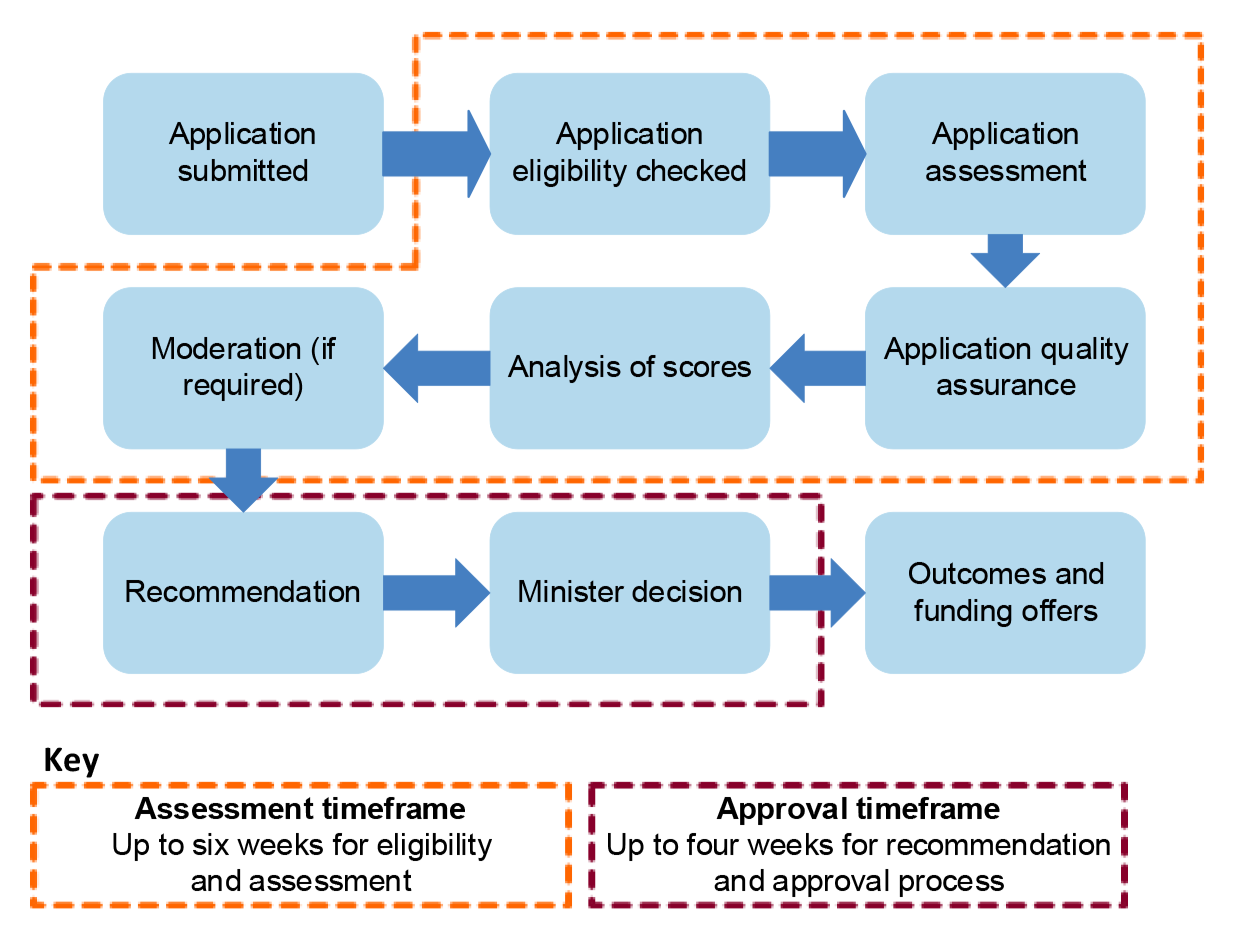
Note: Other than the Heavy Vehicle Rest Area (HVRA) steering committee that provided input towards the HVRA assessment process for tranches four and five, at the time of the audit the projects were managed the same as the SLRIP, and the reporting requirements were the same.
Source: ANAO analysis.
3.2 These timelines were included in the SLRIP guidelines based on feedback from stakeholders in February 2024 relating to the streamlining of the application process. In an internal departmental report on the feedback, key themes from stakeholders included: approving projects ‘efficiently within appropriate timeframes’ and ‘setting timeframes or communicating when open tranches would be assessed’.
3.3 The Infrastructure team responsible for tranche two assessments provided email updates at the executive officer level. However, these updates were irregular and no plan was established on how to track the timeliness of assessment and approvals.42 The combined assessment and approval timeframes for tranche one and tranche two were 12 weeks and 21 weeks respectively, based on the date of tranche closure to ministerial approval of the recommendations.43
3.4 The Australian Public Service Framework for Engagement and Participation provides that a crucial element for effective stakeholder engagement is trust, particularly in relation to being transparent and managing expectations.44 In not adequately monitoring the time it takes for end-to-end assessment and approvals, Infrastructure may not meet stakeholder expectations. Tracking assessment and approval timeframes would also enable Infrastructure to establish a timeliness baseline with a view to monitor and manage efficiency in the process moving forward.
3.5 The Department of Finance encourages Australian government entities to ‘continually seek ways of improving the performance of existing or proposed government functions’ noting that ‘efficiency and performance of the public sector must continue to improve if it is to meet longer term challenges such as tighter budgets and demand for better-quality services for the Australian community’.45
Recommendation no.2
3.6 The Department of Infrastructure, Transport, Regional Development, Communications, Sport and the Arts improve tracking of the SLRIP assessment and approval processes to ensure consistency against publicly advised timeframes for program management and internal reporting purposes.
Department of Infrastructure, Transport, Regional Development, Communications, Sport and the Arts response: response: Agreed.
3.7 The department notes that timeframes for assessment and approval of applications are not the only measure of administrative efficiency in program management. Timeframes published in the program guidelines are indicative, and there are several factors that can impact achievement of those timeframes, including the number and quality of applications, the adequacy of available resourcing in peak assessment periods and the availability and competing priorities of the decision maker.
Infrastructure’s administration process for tranches one and two was not streamlined, although a new IT system provides this opportunity
3.8 In 2023 advice to the Australian Government, Infrastructure set out that the Infrastructure Investment Program (IIP) processes were unclear, labour-intensive or misaligned with day-to-day management of projects, with a range of data system limitations impacting efficiency and imposing administrative burden. Applications and assessments for tranches one and two of the SLRIP were processed through the Infrastructure Management System (IMS), in conjunction with spreadsheets.46 Infrastructure collected and assessed the same information for the SLRIP in the IMS as it did for the predecessor programs.
3.9 Recommendation 13 of the Independent Strategic Review of the IIP (the Strategic Review) was: ‘The Australian Government increase the investment in data systems and practices, to reflect contemporary approaches to manage and report data, in accordance with the level of risk evident in the total pipeline funding and the spread of the budget allocation’.
3.10 Infrastructure had identified longstanding issues with the IMS, which were captured in the SLRIP program risk register (see paragraph 3.13). The primary treatment for the risk was an IT support team to assist SLRIP applicants with IMS issues.47 The IMS did not include an incident reporting function and could not track or monitor the type of details on issues reported. The IT support team relied on an ‘email categorisation’ process to assign and resolve issues. Between July 2024 and September 2025 the IT support team had filed 868 emails relating to instances of external user issues with the IMS.
3.11 Infrastructure has been progressively rolling out a replacement IT system (the Reporting and Program Management (RPM) portal).48 Infrastructure advised the ANAO in December 2025 that the system commenced for SLRIP administration on 1 December 2025 and that the roll out of the RPM portal within Infrastructure is now complete. Given this timing, the ANAO was not able to assess the extent to which the RPM portal has improved the consistency, quality and accessibility of data at the SLRIP project and program levels.
Program risk management is in place, although it could be improved
3.12 The Independent Review of the National Partnership Agreement on Land Transport Infrastructure Projects (the NPA Review) found that ‘a differentiated approach which calibrates project oversight according to their risk rating, would enable a great focus on high-risk projects’ and ‘where practical, low risk activities should be subsumed within (sub) programs’. This aligns with guidance provided by the Department of Finance on implementing the Commonwealth Risk Management Policy that states responsibility for managing risk should be allocated proportionately and in line with the nature, complexity and severity of the risks being managed. The guidance also identifies the need to effectively manage shared risks, which are those that extend across entities and/or involve other jurisdictions and ‘require a collaborative effort of shared oversight and management’.49
3.13 The SLRIP program risk management plan and risk register were approved on 25 August 2025. The risk register identified 10 program risks. Six of those were rated low and four were rated medium after application of controls. No treatments were proposed in the register, as all the risks were ‘accepted’ as being within Infrastructure’s risk appetite and tolerance settings. The four medium rated risks were:
- The program is undersubscribed. States, Territories and LGAs do not engage sufficiently;
- IT Systems failure — IMS technical failures; migration to RPM failures; RPM technical failures;
- Program appropriation underspent with projects not being completed on time, or at all, due to uncontrollable factors including adverse weather events, and supply chain or labour issues; and
- Program appropriation underspent with projects not being completed on time, or at all, due to controllable factors including poor capacity and management capability of proponents.
3.14 One of the low-rated risks was: ‘There is insufficient program funding to meet demand’. This risk has eventuated, with over-subscriptions in the first two tranches and more higher quality applications being received than could be funded in tranche two, resulting in a moderation process being applied (see paragraphs 2.42 to 2.51). The risk register was not updated to increase the level of this risk or include the treatment that was applied. The risk register was also not updated to include any potential risks from the moderation process.
3.15 Infrastructure does not have a specific risk register for individual SLRIP projects. Infrastructure advised the ANAO in August 2025 and September 2025 that due to advice from the Australian Government Solicitor on constitutional and legislative authority risk50, all projects under the SLRIP are regarded as ‘low risk’ and the key mitigation is that: ‘When signing a funding offer, proponents agree to abide by the terms of the funding offer, Guidelines for the Program and relevant legislation and regulations’.
3.16 Infrastructure has scheduled meetings with officials from New South Wales, Queensland and South Australia on a monthly basis and Victoria on a quarterly basis to discuss projects.51 These meetings are not minuted and there is no register for follow-up actions. Infrastructure advised the ANAO in November 2025 that ‘there can be ad hoc meetings with project proponents throughout the project lifecycle’ and ‘risk management is undertaken at the program level primarily and these meetings form a component of the department’s program management’. Infrastructure provided one email as evidence in relation to the ad hoc meetings and advised the ANAO in November 2025 that: ‘Infrastructure noted that in the time available a search of all project files to locate similar correspondence was not possible to be undertaken, but this should not be interpreted as there being only a single instance of this type of program management activity occurring in the course of administering the program’.
3.17 As part of the application form, applicants provide advice on seven identified potential risks. The quarterly reporting template did not require funding recipients to report on the seven identified risks identified in the application form. It did require that they advise on any ‘risks or sensitivities for the project’. Infrastructure could align the application form and the quarterly reporting template to enable reporting on initial identified risks throughout the life of the project, as well as identifying any new or emerging risks for Infrastructure to manage. While funding recipients are responsible for delivering SLRIP projects, Infrastructure shares the risk of delays and non-delivery. Being able to monitor and report on project risks at the individual level would enable Infrastructure to better manage risk when and if individual projects place the overall program at risk.
Opportunity for improvement
3.18 The Department of Infrastructure, Transport, Regional Development, Communications, Sport and the Arts could consider aligning the application form and the quarterly reporting template to enable continuous reporting on risks identified at the initial application stage.
Projects in regional areas where resources are in short supply compared with demand
3.19 In December 2023, Infrastructure Australia published the 2023 Infrastructure Market Capacity Report (the Report).52 The Report found that the supply of building workers and materials did not meet construction activity demand at the time.53 Infrastructure Australia advice to the Australian Government in 2024 was that this directly led to challenges with the delivery of the transport infrastructure pipeline and that projects needed to be matched to locations and areas where resources were available.54 The Report also identified nine regional areas ‘where demand is far outweighing supply’. These areas are shown in Table 3.1.
Table 3.1: Regional areas where resource demand exceeded supply in 2023–24
|
Area |
State |
|
The Murray |
New South Wales |
|
The Mid North Coast |
New South Wales |
|
The Northern Territory Outback |
The Northern Territory |
|
Central Queensland |
Queensland |
|
The Riverina |
New South Wales |
|
The Barossa, Yorke, Mid North |
South Australia |
|
Warrnambool and South West |
Victoria |
|
West and North West |
Tasmania |
|
The Wheatbelt |
Western Australia |
Source: Infrastructure Australia, 2023 Infrastructure Market Capacity report
3.20 The SLRIP guidelines do not limit applications from any location in Australia. The funding arrangements provide for a higher co-funding ratio of up to 80:20 from the Australian Government (rather than 50:5055) for applications submitted by LGAs for projects in regional and remote areas, up to the funding cap of $5 million per project.56
3.21 As at September 2025 six of the 6257 (9.68 per cent) new projects funded under the SLRIP since 1 July 2024, are located in regional areas where demand is outweighing supply (see Table 3.1).58 Infrastructure advised the ANAO in August 2025 that the information from Infrastructure Australia was not considered in the context of the SLRIP because: ‘One of Infrastructure Australia’s roles is to evaluate business cases for projects seeking $250 million or more in Australian Government funding. Projects under the SLRIP are only seeking up to $5 million Australian Government funding’.
3.22 In August 2025 the ANAO asked Infrastructure what risk mitigation strategy was in place for the six projects that are in areas where resource demand exceeds supply. Infrastructure advised the ANAO that: ‘applicants are required to demonstrate deliverability in their application to be scored highly’.
Recommendation no.3
3.23 The Department of Infrastructure, Transport, Regional Development, Communications, Sport and the Arts regularly review and update program risks, including how individual SLRIP project risks impact overall program delivery and risks.
Department of Infrastructure, Transport, Regional Development, Communications, Sport and the Arts response: Agreed.
3.24 The department notes that the ANAO concluded in its report that program risk management is in place but could be improved. The department undertakes risk management activities as part of day-to-day management of the program, including working with project proponents on progress of individual projects and identifying risks as they emerge.
Projects are at different stages of delivery and Infrastructure will need to monitor the program budget
Projects are at different completion stages, based on whether they commenced in the predecessor programs or under the SLRIP from July 2024
3.25 Infrastructure provides SLRIP project reporting to Minister for Infrastructure, Transport, Regional Development and Local Government (the minister) through their office every two months (the bi-monthly report) that includes an update of all projects and their status (see Table 3.2).59 As at 1 November 2025, the SLRIP comprised 269 projects of which 89 had been completed (all which were commenced under the predecessor programs).60 From the ministerial reporting via their office in November 2025, of the 71 projects under construction, 43 were due to be completed by the end of January 2026.
Table 3.2: Status of SLRIP projects as at 1 November 2025
|
Sub-program |
In planning |
Under construction |
Complete |
Total |
|
Bridges Renewal Program |
24 |
31 |
53 |
108 |
|
Heavy Vehicle Safety and Productivity Program |
17 |
32 |
35 |
84 |
|
SLRIP |
48 |
4 |
0 |
52 |
|
HVRA |
20 |
4 |
1 |
25 |
|
Total |
109 |
71 |
89 |
269 |
Source: ANAO analysis of Infrastructure internal documents.
The current agreed program budget will require careful management to ensure it is expended in line with the current agreements
Funding arrangements
3.26 Funding under the Land Transport Infrastructure Projects Schedule is recorded in individual state and territory schedules.61 These schedules list the Australian Government’s forecast contribution at the program level.
3.27 The SLRIP was funded for $1.8 billion over nine years from 2024–25. It included funding for projects that were rolled over into the SLRIP from the predecessor programs.62 In 2025–26, the funding allocation was varied to $2.1 billion over ten years to 2034–35.63 With the funding expended in 2024–25, the current approved funding is $2.3 billion over 11 years.
3.28 According to Infrastructure documentation, annual funding reporting is based on expected yearly expenditure for existing projects (allocated funds), and an estimated allocation for future tranches (unallocated funds).Yearly expenditure includes any cost savings from completed projects. If agreed by the minister or the delegate, these savings can be used for any cost overruns on projects still underway in the same jurisdiction.
3.29 Funding is allocated across financial years as per funding agreements. The annual funding amount can be adjusted up and down in the Australian Government’s annual Federal Budget or Mid-Year Economic and Fiscal Outlook, to support the delivery of existing and new projects. According to Infrastructure documentation dated September 2025, at least $200 million is available each year for the program, if more than $200 million is approved in any one year, this amount needs to be offset in the next financial year.
Funded projects
3.30 From data extracted from the Infrastructure website on 9 November 2025, the total cost of the 29 projects funded under tranche one of the SLRIP, the 23 projects funded under tranche two of the SLRIP and the 10 projects funded under tranches 4 to 5 of the HVRA, the total cost was $223,390,819. Table 3.3 sets out the Australian Government contribution to the total cost awarded by jurisdiction and tranche. This funding does not include the funding needed for the projects that were rolled into the SLRIP from the Bridges Renewal Program and the Heavy Vehicle Safety and Productivity Program.
Table 3.3: Australian Government SLRIP funding by jurisdiction and tranche
|
Jurisdiction |
SLRIP — tranche one funding |
SLRIP — tranche two funding |
HVRA — tranches four–five funding |
Total Australian Government funding |
|
NSW |
28,632,828 |
22,449,186 |
2,952,366 |
54,034,380 |
|
Vic |
13,760,080 |
19,532,256 |
297,900 |
33,590,236 |
|
Qld |
14,172,119 |
15,679,104 |
5,900,000 |
35,751,223 |
|
WA |
7,534,079 |
1,487,712 |
0 |
9,021,791 |
|
SA |
5,000,000 |
0 |
,280,000 |
9,280,000 |
|
Tas |
0 |
4,830,400 |
0 |
4,830,400 |
|
ACTa |
0 |
0 |
0 |
0 |
|
NT |
1,918,669 |
0 |
0 |
1,918,669 |
|
Total |
71,017,775 |
63,978,658 |
13,430,266 |
148,426,699 |
Note a: Infrastructure advised the ANAO that the ACT did not apply for any SLRIP funding in tranche 1 and 2 or HVRA.
Source: ANAO analysis of data extracted from the Infrastructure website on 9 November 2025.
3.31 For 2024–25, 64 projects from the Bridges Renewal Program and the Heavy Vehicle Safety and Productivity Program (which are now part of the SLRIP) were completed across New South Wales, Queensland, South Australia, Tasmania, Victoria and Western Australia. The total Australian Government approved program funding amount for these projects included in the bi-monthly report to the minister (via their office) was $103,382,052 with the total project cost (i.e. including co-contributions) being $201,844,568.
3.32 For the financial year 2025–26 (as at November 2025), 25 projects from the Bridges Renewal Program and the Heavy Vehicle Safety and Productivity Program were completed. Based on the bi-monthly reporting to the minister (via their office), as at 1 November 2025, a total of 89 projects have been completed since the SLRIP commenced, 109 are in planning and 71 are under construction at a current expected cost to the Australian Government of $631,710,573. Due to the timing of payments based on milestones, $536,407,348 of the $631,710,573 has been allocated to projects64 since 1 July 2024 when the SLRIP commenced. The current agreed total budget to 2034–35 is $2.3 billion (see paragraph 3.27).
3.33 The current 10-year budget profile is front-loaded to meet funding obligations as at 25 March 2025. Funding for tranche two recipients was approved on 1 July 2025. Based on 2025–26 Federal Budget papers, the spend for the two years 2025 to 2027 is forecast to be $560,000,000 with the proposed budget not coming back under $200 million per year until 2029–30. To achieve this forecast and remain within the current agreed budget to 2034–35, fewer projects or less expensive projects, will need to be funded in future tranches.
Individual projects are being updated through variations
3.34 As set out in the SLRIP guidelines, funding recipients enter into funding agreements with Infrastructure. These set out the project scope, project budget, deliverables, milestones and payment. Under the SLRIP guidelines, ‘construction only projects must be complete within 24 months, and design and construct projects within 36 months, of receiving the funding offer’. Variations to extend these timeframes to three and four years respectively are considered by Infrastructure on a case-by-case basis. Cost variations of $400,000 or less can be approved by the minister’s delegate65 appointed under Schedule One, Item 1.03 of the National Land Transport Delegation Instrument. Amounts over $400,000 are approved by the minister. The request for variation documentation provided to the departmental delegate for decision includes: authority for the decision; reason for the request; assessment to support the recommendation; and recommendation to agree or not agree the variation request.
3.35 Since the introduction of the SLRIP on 1 July 2024, funding recipients have submitted 118 applications for project variations relating to cost, scope, name changes, schedule, withdrawal and cancellation.66 Of these 118 applications, 116 related to projects rolled over from the predecessor programs into the SLRIP with the other two variations related to projects awarded funding since the SLRIP commenced on 1 July 2024, as shown in in Figure 3.2.
Figure 3.2: Variation applications since 1 July 2024a
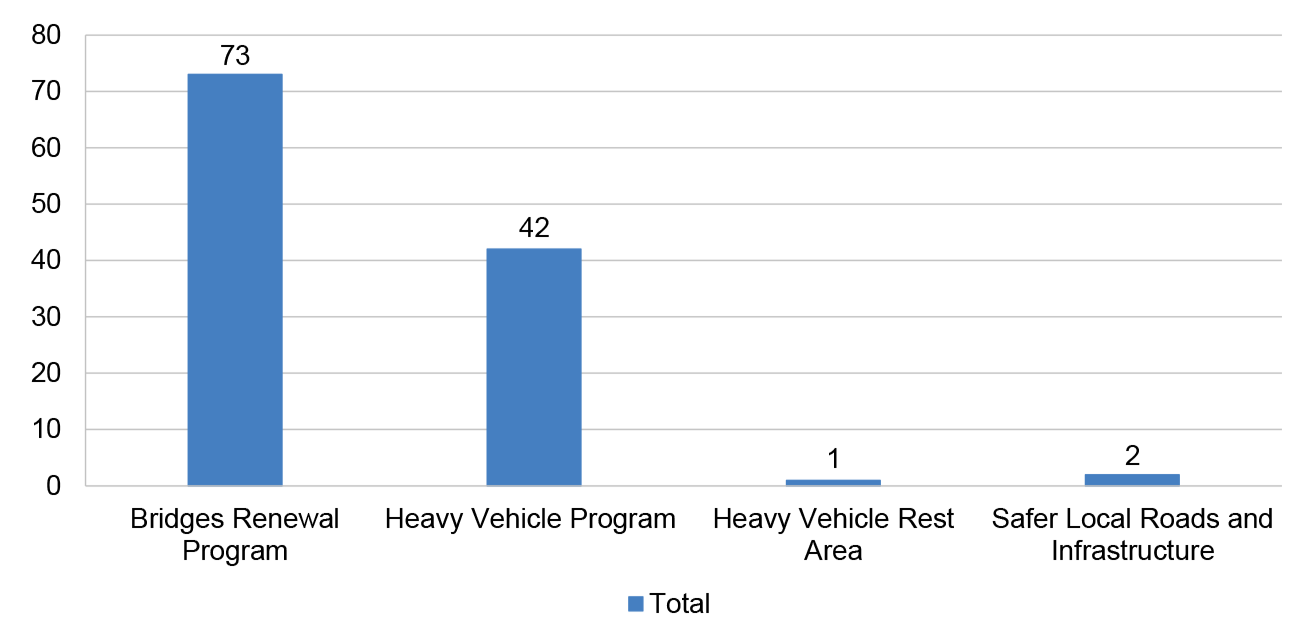
Note a: Includes projects that were rolled over into the SLRIP from the predecessor programs and the Heavy Vehicle Rest Area initiative.
Source: ANAO analysis.
3.36 Supporting reasons for variations to the project schedule included: the impacts of COVID-19 on construction costs; effects of weather events; protracted contractual negotiations with suppliers; and delays in environmental and heritage approvals. Supporting reasons for variations to costs included: requests for additional project funding; the return of unused budget due to final spend after project completion; project withdrawal; and decrease in scope. Variations to the project schedule represented the most variations at 38.1 per cent, followed by cost variations at 29.7 per cent and a combination of scope and schedule making up 8.5 per cent. Cost increases totalled $5,906,247 and costs decreases totalled $12,587,742.67 The department approved 114 variation applications, did not approve three requests for variation and requested one proponent withdraw their project from the Bridges Renewal Program due to ineligibility.
Payments are based on milestones
3.37 States and territories manage payments to funding recipients (including to LGAs) under the Land Transport Infrastructure Projects Schedule. The Department of the Treasury (the Treasury) administers the payments to states and territories based on confirmation from Infrastructure. The SLRIP Factsheet sets out that ‘the state/territory government may have additional requirements of the LGA before funding can be paid, such as the provision of an invoice’.68
3.38 Infrastructure has a SLRIP project management standard operating procedure in place (dated June 2024), providing information and instructions on payments, reporting, variations and project completion. It sets out that states and territories must provide supporting evidence to demonstrate milestone completion and enable associated milestone payments. This evidence includes: photographs with geographical identifiers; invoices; design drawings; and expenditure reports. Infrastructure officers assess individual projects based solely on the evidence provided, accepting milestones and making payments or rejecting and not making payments.69
3.39 Based on information provided by Infrastructure to the ANAO in December 2025, $183,594,305 of the total funding allocated to SLRIP projects (including those that were rolled over from the predecessor programs) has been released to the states and territories as set out in Table 3.4.70
Table 3.4: SLRIP funding released, by jurisdiction, between 1 July 2024 and 1 November 2025
|
Jurisdiction |
Funding releaseda ($) |
|
NSW |
49,348,263 |
|
Vic |
27,399,030 |
|
Qld |
41,303,423 |
|
WA |
36,046,094 |
|
SA |
21,713,717 |
|
Tas |
7,576,016 |
|
ACT |
0 |
|
NT |
207,762 |
|
Total |
183,594,305 |
Note a: Includes funding for 40 projects that were completed prior to 1 July 2024 and had payments finalised in the following financial year. ‘Slippage’ (allocated funds not released due to milestones being delayed) was identified by Infrastructure in advice to the Australian Government in 2025 in relation to the IIP.
Source: ANAO analysis of Infrastructure data.
Project reporting
3.40 Reporting on project delivery is made quarterly (August, November, February and May) via the relevant state or territory. LGAs must complete and submit the quarterly reporting template to the relevant state or territory, except for Victoria and South Australia.71 State and territory officers upload the quarterly reporting information into the IT system provided by Infrastructure which includes details on: project progress; timelines; project risks/sensitivities; and finances (for example, on cost overruns or potential savings).
Performance mechanisms are partly in place. Infrastructure is yet to measure if projects are meeting program outcomes
3.41 Infrastructure has developed a SLRIP program logic and a draft monitoring and evaluation framework document (dated September 2024), which was developed in consultation with Infrastructure’s internal evaluation unit. The program logic includes short, medium and long-term outcomes as described in Table 3.5. The draft monitoring and evaluation framework document is yet to fully align with the program logic outcomes, stating that a ‘more detailed evaluation plan will be developed at a later stage’ for an outcomes-based evaluation.
Table 3.5: SLRIP logic outcomes
|
Short-term outcomes |
Medium-term outcomes |
Long-term outcomes |
|
Program material is able to be communicated to proponents effectively — increased awareness of program and applications submitted against key government priorities. |
Improved quality of applications against key government priorities. State/local governments linking projects to existing road safety network plans |
Improved input from proponents on road safety network plans, which is more nationally consistent. |
|
Improvement/upgrade to road infrastructure (once projects are completed). |
Improved resilience outcomes for road infrastructure. |
Improvement to the resilience of state and local roads networks (particularly in regional areas). |
|
Road improvements are used by targeted vehicle types (e.g., bridges for all vehicles, rest areas for heavy vehicles). |
Efficiency of freight movements on the network (reduced travel time, or increased tonnages for bridges). |
Improved heavy vehicle network across Australia, which supports safety, productivity, and other emerging priorities. |
Source: ANAO presentation of departmental documents.
3.42 Infrastructure has planned an ‘implementation evaluation’ within 18 to 24 months of program commencement and an ‘interim outcomes evaluation’ between mid-2029 and mid-2031.72 The first is to review ‘the program’s application, administration and governance arrangements; capture lessons learned; and identify improvements for future tranches of the program’. Infrastructure advised the ANAO in September 2025 that ’the review has not yet commenced. The review would be conducted internally by the department in line with the department’s Evaluation Strategy 2024–27, and in consultation with the department’s evaluation unit’.
Project data is being collected but will need to be improved to measure program outcomes
3.43 The monitoring and evaluation framework sets out that the data for measuring the short, medium and long-term outcomes in the program logic will be collected from the quarterly reporting provided by funding recipients (see paragraph 3.40), along with the ‘post-completion report’ that reports ‘against outcomes listed in the project proposal and agreement’. Analysis of the data requested in the report templates demonstrates a focus on project level outputs not program level outcomes. One question asks funding recipients to describe the outcomes of their project against the relevant focus area selected during the application stage, demonstrating alignment to key government objectives (see Table 3.7). This is unlikely to enable Infrastructure to measure the program logic outcomes.
3.44 The previously determined outcomes of the Bridges Renewal Program and Heavy Vehicle Safety and Productivity Program align with the objectives of the current focus areas of the SLRIP (see Table 3.7) and the overall outcome of the SLRIP (see paragraph 2.9).73 Despite 89 projects having been completed (see Table 3.2), Infrastructure advised the ANAO in November 2025 that: ‘while outcomes of these completed projects may be taken into account in future program evaluation, it may be unbalanced to treat these projects in the same light as future completed projects undertaken in line with the current SLRIP guidelines’.
3.45 As the projects rolled over from the Bridges Renewal Program and Heavy Vehicle Safety and Productivity Program have been delivered with SLRIP funding since 1 July 2024, these projects should be assessed by Infrastructure to determine if the funding provided is delivering the expected outcomes. Not undertaking analysis and quality assurance of the delivery of outcomes, was a concern raised in both the NPA Review and the Strategic Review.
External performance measures
3.46 Section 16EA of the PGPA Rule and the Department of Finance Resource Management Guide (RMG) 131 Developing good performance information requires entities to have meaningful performance information. Infrastructure has a performance measure that covers the SLRIP in its corporate plan (see Table 3.6). Infrastructure is required to self-assess its performance and report on this measure in its annual report. During Infrastructure’s performance statements audit, the ANAO recommended to Infrastructure that across its performance measures it revise or develop new performance measures, with a focus on the effectiveness and outcomes of its activities.
Table 3.6: External performance measure covering the SLRIP
|
Program and key activity |
Performance measure |
Performance target |
2024–25 result |
|
Program 1.1 Infrastructure Investment Key activity — advise on, deliver and manage the IIP |
Assessment of milestone claims for payments on IIP projects (listed in the relevant tables in the Federation Funding Agreements Schedule). |
100 per cent of milestone claims received have been assessed and accurate and complete claims authorised for payment. |
Met |
Source: Infrastructure’s Annual Report 2024–25.
Focus areas
3.47 The principles underpinning the SLRIP (agreed by the Australian Government in May 2024) included that: ‘Flexible funding [be] provided to support local road safety to meet current, future and emerging road infrastructure priorities’ with ‘no funding quota or target per focus area, allowing flexibility for funding to be used according to local, state, and territory infrastructure priorities’. The SLRIP guidelines state that: ‘the Australian Government may from time to time choose to seek applications that address only one specific focus area as priorities emerge. For example, a tranche may only be open to applications for the replacement of timber bridges across the local road network. In addition, it is anticipated that the focus areas outlined above may be updated to accommodate future infrastructure priorities as they are identified’.
3.48 Applicants self-identify which of the six focus areas they wish to apply for and may select more than one focus area. Table 3.7 sets out the number of projects funded that align with each focus area, as Infrastructure advised the minister.
3.49 There are two pathways to apply for funding for heavy vehicle rest areas, either through the SLRIP or as an HVRA initiative74, which may cause confusion for applicants, potential administrative duplication and implications for performance management data and outcomes reporting. Under tranches one and two of the SLRIP, three awarded applicants self-selected for the heavy vehicle rest area and 10 HVRA projects are listed on Infrastructure’s website as being awarded under the dedicated HVRA funding stream.75
Table 3.7: Awarded projects by focus area as nominated by SLRIP tranches one and two funding recipientsa
|
Focus areas |
Objectives |
Awarded projectsb |
|
Road safety |
To improve road safety across Australia for all road users (including heavy vehicle users) through the improvement of road infrastructure.
|
51 |
|
Productivity |
To improve productivity and efficiency outcomes through connecting and improving road networks:
|
40 |
|
Bridge renewal |
To improve access for communities and facilitate higher productivity vehicle access through the upgrade and replacement of bridges, including culverts. |
13 |
|
Road resilience |
To improve the resilience, including adaptation and recovery, of critical road corridors by upgrading existing road assets that are vulnerable to closure or reduced capacity, enhancing networks to achieve greater route diversity, as well as building to a higher standard where appropriate to create infrastructure which is designed to withstand and recover from disasters. To give consideration to future proofing infrastructure to address the impact of changes to heavy vehicle fleet, including the increased mass impacts of electric and hydrogen trucks. |
34 |
|
Road sustainability |
To contribute to decarbonisation goals by minimising or avoiding embodied, operational and/or enabled emissions. This can include:
|
19 |
|
Heavy vehicle rest areas |
To have the primary purpose of facilitating rest for heavy vehicle drivers at locations of need, through the construction or upgrade of heavy vehicle rest areas and amenities. |
3c |
Note a: Funding applicants may select more than one focus area.
Note b: Projects awarded funding since 1 July 2024.
Note c: A total of 13 HVRA projects have been funded under the SLRIP and HVRA Program.
Source: ANAO analysis.
3.50 The Commonwealth Evaluation Policy toolkit sets out that it is good practice for entities to ‘collect robust performance information that supports continuous improvement, risk management, accountability and decision-making at all policy stages’.76 Categorising SLRIP projects into one primary focus area would contribute to accurate internal reporting on the aggregate spread of projects across the six focus areas and support outcomes measurement, future evaluations and identification of whether changes in program settings are required. Doing this would assist Infrastructure to answer the questions relating to ‘appropriateness of program design’ as set out in the draft ‘Monitoring and Evaluation Framework’. These include:
- what is the make-up of approved projects across focus areas?
- are particular focus areas under-represented in applications?
- overtime, do the focus areas still address current and emerging priorities in road infrastructure?
Recommendation no.4
3.51 To better inform monitoring of projects and reporting on outcomes, the Department of Infrastructure, Transport, Regional Development, Communications, Sport and the Arts should:
- reconcile project data with the program logic;
- commence extraction and collation of project performance data; and
- categorise and collate performance data into focus areas.
Department of Infrastructure, Transport, Regional Development, Communications, Sport and the Arts response: Agreed.
3.52 The department agrees there are opportunities to strengthen the current processes for extracting and collating project data to inform reporting on program outcomes. The department also notes the Program is in its early stages, with no new projects (approved since the commencement of the program on 1 July 2024) having yet completed. This recommendation will be considered in the course of the program’s evaluation.
Appendices
Appendix 1 Entity response
Appendix 2 Improvements observed by the ANAO
1. The existence of independent external audit, and the accompanying potential for scrutiny improves performance. Improvements in administrative and management practices usually occur: in anticipation of ANAO audit activity; during an audit engagement; as interim findings are made; and/or after the audit has been completed and formal findings are communicated.
2. The Joint Committee of Public Accounts and Audit (JCPAA) has encouraged the ANAO to consider ways in which the ANAO could capture and describe some of these impacts. The ANAO’s corporate plan states that the ANAO’s annual performance statements will provide a narrative that will consider, amongst other matters, analysis of key improvements made by entities during a performance audit process based on information included in tabled performance audit reports.
3. Performance audits involve close engagement between the ANAO and the audited entity as well as other stakeholders involved in the program or activity being audited. Throughout the audit engagement, the ANAO outlines to the entity the preliminary audit findings, conclusions and potential audit recommendations. This ensures that final recommendations are appropriately targeted and encourages entities to take early remedial action on any identified matters during the course of an audit. Remedial actions entities may take during the audit include:
- strengthening governance arrangements;
- introducing or revising policies, strategies, guidelines or administrative processes; and
- initiating reviews or investigations.
4. During the course of the audit, the ANAO did not observe changes in the Department of Infrastructure, Transport, Regional Development, Communications, Sport and the Arts’ approach to the audit topic.
Appendix 3 Safer Local Roads and Infrastructure Program timeline
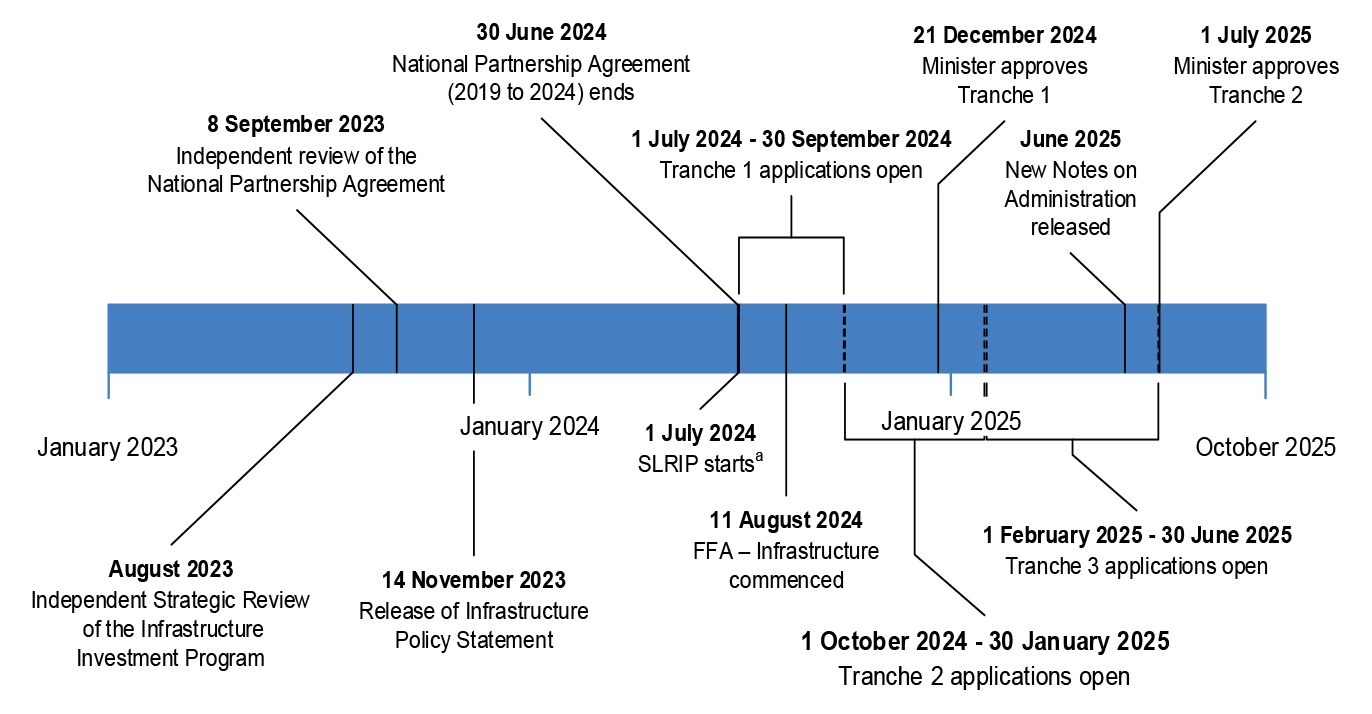
Note a: Bridges Renewal Program — started on 1 July 2014, merged into the SLRIP on 1 July 2024; Heavy Vehicle Safety and Productivity Program — started 10 November 2021, merged into the SLRIP on 1 July 2024.
Footnotes
1 The Australian Government issued a media release on 16 November 2023, which indicated broad support for the Independent Strategic Review of the IIP. The Australian Government agreed in principle to all 12 recommendations from the Independent Review of the National Partnership Agreement on Land Transport Infrastructure Projects.
2 C Gardiner-Barnes, M Mrdak AO and R Waldock AM, Independent Strategic Review of the Infrastructure Investment Program — Executive Summary, Canberra, 2023, available from https://investment.infrastructure.gov.au/about/budget-announcements/infrastructure-investment-program-strategic-review [accessed 2 September 2025].
The Strategic Review executive summary has been publicly released; the full Strategic Review report has not been released publicly.
3 J Halton and D Crawford, Final Report of the Independent Review of the National Partnership Agreement on Land Transport Infrastructure Projects, 2023, available from https://www.infrastructure.gov.au/department/media/publications/final-report-independent-review-national-partnership-agreement-land-transport-infrastructure [accessed 2 September 2025].
The NPA Review was commissioned in line with the review requirement under the NPA. The NPA Review was led by Professor Jane Halton AO PSM and supported by Ms Dixie Crawford, First Nations adviser.
4 This includes the Heavy Vehicle Rest Areas Program (HVRA). The HVRA retained its separate funding when it was brought into the SLRIP.
5 $2.101 billion was provided for the SLRIP over ten years from 2025–26. This was in addition to the funding for 2024–25 of $196.2 million.
6 Under the federation funding system that governs payments to states and territories, the Department of the Treasury (Treasury) is responsible for facilitating payments under a centralised model where Treasury is appropriated the funding and makes the payments to states and territories.
7 Projects are funded as ‘Investment Projects’ under Part 3 of the NLT Act. Projects are funded under the definitions of ‘construction’ and a ‘road’ in the NLT Act, available from https://www.legislation.gov.au/C2005A00093/latest/text [accessed 2 September 2025].
8 States and territories have specific Land Transport Infrastructure Projects schedules which list the amount of funding the Australian Government intends to provide to the states and territories for land transport infrastructure projects.
9 SLRIP projects are not covered by the Notes on Administration for Land Infrastructure Projects 2024–2029 that govern the administrative arrangements for major rail and road programs (and some sub-progams) under the IIP.
10 The Strategic Review was completed in August 2023, and the Executive Summary was published on 16 November 2023.
11 Infrastructure advised the ANAO in August 2025 that it is examining options for the review of the legislation, and a briefing was requested by the minister through their office in-line with the government’s agreement to the Strategic Review recommendation. Infrastructure further advised that ‘while SLRIP is administered under the Act, we do not anticipate a Review of the Act will have substantial impacts on the administration and objectives of the Program (or other IIP Programs)’.
12 Objective 3 of the Strategic Review was: ‘make recommendations on reforms to ongoing and terminating infrastructure investment sub-programs, including whether the sub-programs: i) are appropriate for delivering the Government’s strategic priorities, including supporting safety, resilience and maintenance outcomes; and ii) could be delivered more efficiently and effectively, having regard to the constitutionality of programs.’ The Strategic Review did not include the Regional Australia Crossing Upgrade Program and the Active Transport Fund.
13 This program’s funding was approximately $600 million per year.
14 A private entity may co-fund a project (for example, a company building a highway service centre), however only states and territories and LGAs can apply to the SLRIP. Infrastructure advised the ANAO in September 2025 that no current SLRIP projects have a private co-contribution.
15 Infrastructure assesses applications in up to three tranches per year.
16 The Strategic Review provided steps for a ‘proposed reform pathway’ for the SLRIP which included restricting ‘eligibility for the combined program to local councils’. Infrastructure advised the ANAO in September 2025 that: ‘Consistent with minimal administrative changes agreed by the Government, the program retained the payment structures of its predecessor programs and remained open to states and territories and paid through the Federation Funding Agreement’.
17 Co-contributions can be from: other Australian Government programs, states and territories, LGAs or private funding (projects on privately owned roads are ineligible).
18 As at November 2022, local councils owned and maintained ‘approximately 75 per cent of the total national road length’.
SGS Economics and Planning and Prof G Sansom, 2022 Local Government Workforce Skills and Capability Survey — Final Report, Australian Local Government Association, Canberra, 2022, p. 25, available from https://alga.com.au/wp-content/uploads/2025/04/2022-Local-Government-Workforce-Skills-and-Capability-Survey-National-Report.pdf [accessed 10 September 2025].
19 The NPA Review identified eight sub-programs with a collective allocation worth $13 billion.
20 The Federation Funding Agreement — Infrastructure and the Land Transport Infrastructure Projects Schedule set out that sub-programs are ‘any other purpose-specific funding program administered under the Schedule that is designated in the Notes on Administration as a sub-program’. The Notes provide administrative detail for implementation and set out that major road and rail projects are covered by the Notes but other sub-programs of the IIP operate under their own guidelines.
21 The Notes set out that some sub-programs are not covered by the document and operate under separate guidelines.
22 Infrastructure advised the ANAO in August 2025 that agreement was made at the Deputy Secretary (or equivalent) level.
23 Infrastructure advised the ANAO in December 2025 that: ‘the department will look to include greater clarity on the specific sub-programs under the IIP in the next update to the Notes on Administration’.
24 Auditor-General Report No. 47 2020–21 Administration of Commuter Care Park Projects within the Urban Congestion Fund, ANAO, Canberra, 2021, p. 47, available from: https://www.anao.gov.au/work/performance-audit/administration-commuter-car-park-projects-within-the-urban-congestion-fund [accessed 5 November 2025].
25 Infrastructure conducts an initial check that a project is an eligible project.
26 The six-point scale is: 0 = incomplete; 1 = very poor; 2 = poor; 3 = fair; 4 = good and 5 = excellent.
27 The fourth criterion for the HVRA initiative is assessed by the HVRA Steering Committee.
28 Emphasis in original response from Infrastructure.
30 Section 13 of the SLRIP guidelines sets out the requirements for funding recipients in conducting procurement as part of delivering projects.
31 Commonwealth Scientific and Industrial Research Organisation, Solving Australia’s transport and supply chain challenges, CSIRO, Canberra, 2023 p. 3, available from https://www.csiro.au/en/research/technology-space/it/Transport-logistics-TRANSIT [accessed 10 September 2025]
32 Infrastructure did not use modelling data from TraNSIT or input from CSIRO in designing the SLRIP or providing broader reform advice to the Australian Government on directing IIP investment to the areas where it would have the most impact and potentially provide best value for money.
33 Criterion one requires applicants to provide a rationale for how the project will achieve the stated objectives against the specific focus area(s) they have selected.
34 Infrastructure has responsibility for the guidelines and can seek approval from the minister to update these as required.
35 Infrastructure and the minister must also comply with the requirements under the Federation Reform Fund Act 2008 and the Federal Financial Relations Act 2009.
36 The brief to the minister stated 166 applications were received as one was withdrawn.
37 The review notes ‘some stakeholders remarked that the Black Spot Program is overly focused on reactive road safety treatments after a fatal crash had occurred, rather than proactive treatments to prevent fatalities in the first place’.
C Gardiner-Barnes, M Mrdak AO and R Waldock AM, Independent Strategic Review of the Infrastructure Investment Program — Executive Summary, Canberra, 2023, available from https://investment.infrastructure.gov.au/about/budget-announcements/infrastructure-investment-program-strategic-review [accessed 2 September 2025].
38 Infrastructure advised the ANAO in October 2025 that: ‘This process was developed internally and was not communicated with the minister or their office prior to the brief being provided for approval’.
39 Infrastructure advised the ANAO in November 2025 that: ‘The department did not consider electorate information or perform electorate research for any applications, including as part of the moderation process in tranche two. The department does not consider electorate information for applications other than to identify whether a recommended project falls in the approving Minister’s electorate, in which case alternate approval arrangements are made for those projects.’
40 Infrastructure provides and maintains cost estimation guidance to inform and assist applicants in improving and establishing cost estimation practices for land transport infrastructure projects.
41 Department of Infrastructure, Transport, Regional Development, Communications, Sport and the Arts, Guidance notes Infrastructure, Canberra 2023, available from https://investment.infrastructure.gov.au/resources-funding-recipients/cost-estimation-guidance [accessed 3 November 2025]
42 Infrastructure advised the ANAO in February 2026 that four internal emails between SLRIP team members relating to tranche two progress and a three-page word document setting out the process and expected timing for tranche two was evidence that it tracked the assessment and approval timeframes for tranches one and two.
43 Infrastructure advised the ANAO in December 2025 that: ‘The timeframes for tranche two assessment and recommendation preparations crossed over with the federal caretaker period, and assessment timeframes for tranche two were also impacted by availability of resourcing, with the assessment team also undertaking implementation of the Active Transport Fund in a surge capacity at the same time’. The delay occurred in the assessment, not the approval stage of the timeframe.
44 Department of Industry, Science and Resources, A message for public servants, DISR, Canberra, 2022, available from: https://www.industry.gov.au/publications/aps-framework-engagement-and-participation/message-public-servants [accessed 3 November 2025].
45 Department of Finance, Contestability in the Public Sector Canberra, 2025, available from: https://www.finance.gov.au/publications/policy/contestability-public-sector[accessed 6 November 2025].
46 Tranches four and five for Heavy Vehicle Rest Areas were also assessed in this way.
47 Infrastructure advised the ANAO that the team assist the user to upload their application, upload the application on the users’ behalf or escalate the issue to the Information Technology Division (within Infrastructure) if it cannot resolve the issue.
48 The RPM portal was approved by Infrastructure’s Executive Board in November 2018.
49 Department of Finance, Implementing the Commonwealth Risk Management Policy (RMG 211), Finance, Canberra, 2022, available from https://www.finance.gov.au/government/comcover/risk-services/management/commonwealth-risk-management-policy [accessed 1 September 2025].
50 In March 2024, Infrastructure received a constitutional and legislative authority risk assessment for the changes to the IIP. For the SLRIP, the constitutional risk was rated as ‘low’ due to limiting Australian Government payments to State and Territory governments. The legislative authority was also rated as ‘low’ risk as the National Land Transport Act 2014 provides the authority to spend the money.
51 These meetings are scheduled with the state as the funding recipient.
52 Infrastructure Australia, 2023 Infrastructure Market Capacity report, Infrastructure Australia, Canberra, 2023, available from https://www.infrastructureaustralia.gov.au/publications/2023-infrastructure-market-capacity-report [accessed 28 August 2025]. Infrastructure Australia provides advice to the Australian Government on ‘nationally significant infrastructure investment planning and project prioritisation’.
53 Infrastructure Australia, 2024 Infrastructure Market Capacity report, Infrastructure Australia, Canberra, 2024, available from https://www.infrastructureaustralia.gov.au/2024-infrastructure-market-capacity-report [accessed 28 August 2025]. The 2024 report also stated that: ‘demand still significantly outweighs supply’ in relation to infrastructure delivery.
54 In advice to the Australian Government in 2025, Infrastructure stated that projects under the Land Transport Infrastructure Projects Schedule need equilibrium between supply and demand.
55 Recommendation seven of the Strategic Review noted that where supported by evidence, other funding splits could be considered, particularly for smaller jurisdictions and remote locations.
56 Advice to the Australian Government included that the 80:20 funding split was ‘the practice’ under the predecessor programs and ‘not recommended to change due to existing funding pressures on local governments’.
57 This includes 10 projects under the Heavy Vehicle Rest Area Initiative.
58 Projects funded in tranches one and two of the SLRIP and tranches four and five of the HVRA program.
59 This report was generated from IMS.
60 This number does not include projects that have withdrawn or been cancelled since the SLRIP commenced.
61 The individual state and territory schedules are available from https://federalfinancialrelations.gov.au/agreements/land-transport-infrastructure-projects-2024-2029.
62 This included an additional $89 million over seven years from 2026-2027.
63 The SLRIP is an ongoing program, and the agreed funding is taken into account when the new tenth year of IIP funding is considered each year in the Australian Government Budget.
64 This includes projects that were rolled into the SLRIP from the predecessor programs, tranches one and two of the SLRIP and tranches four and five of the HVRA.
65 The Senior Executive Service Band 1 officer responsible for the SLRIP.
66 Variations can be for more than one of the listed reasons.
67 Some of the cost decreases occurred in the context of reductions in project scope.
68 Infrastructure advised the ANAO in September 2025 that ‘there is no requirement for the Australian Government to have visibility of these details’.
69 Infrastructure does not undertake independent verification.
70 For SLRIP tranches one to two and HVRA tranches one to five.
71 LGA SLRIP funding recipients in Victoria and South Australia report directly to Infrastructure. Infrastructure advised the ANAO in September 2025 that this is the administrative preference of Victoria and South Australia funding recipients.
72 As at 1 January 2026, the SLRIP had been in place for 18 months.
73 The purpose of the Bridges Renewal Program was: ‘to enhance access for local communities and facilitate higher productivity vehicle access’. The purpose of the Heavy Vehicle Safety and Productivity Program was to ‘improve the productivity and safety outcomes of heavy vehicle operations across Australia’.
74 Applicants are required to use a different online portal when applying for a HVRA initiative funding.
75 The awarded HRVA projects are listed from tranches four and five.
76 Department of the Treasury Why evaluate, Treasury, Canberra, n.d., available from https://evaluation.treasury.gov.au/toolkit/why-evaluate [accessed 10 September 2025].