Browse our range of reports and publications including performance and financial statement audit reports, assurance review reports, information reports and annual reports.
Request for audit
Commonwealth Procurement Rules — paragraph 2.6 exemptions
Response provided
Responded: Wednesday 3 June 2026
Contact
Please direct enquiries through our contact page.
The Auditor-General responded on 3 June 2026 to correspondence from Dr Monique Ryan MP dated 18 May 2026, requesting that the Auditor-General include a performance audit on Commonwealth procurement in the 2026–27 Annual Audit Work Program, with a particular focus on the use of paragraph 2.6 exemptions under the Commonwealth Procurement Rules.
Auditor-General's response
3 June 2026
Dr Monique Ryan MP
Member for Kooyong
Parliament House
CANBERRA ACT 2600
By email: Monique.Ryan.MP@aph.gov.au
Dear Dr Ryan
Request for a performance audit on Commonwealth procurement
Thank you for your correspondence dated 18 May 2026 requesting a performance audit on Commonwealth procurement, with a particular focus on the use of paragraph 2.6 exemptions under the Commonwealth Procurement Rules.
I can advise that the topic will be considered in the finalisation of the Australian National Audit Office’s (ANAO’s) Annual Audit Work Program (AAWP) for 2026–27. The AAWP reflects the ANAO’s audit strategy and informs the Parliament, government entities and the public of the planned audit coverage for the Australian Government sector. The 2026–27 AAWP is expected to be published on the ANAO website in early July 2026.
If in the implementation of the AAWP I decide to commence an audit on this topic, details will be provided on the ANAO’s Performance audits in progress webpage.
Yours sincerely
Dr Caralee McLiesh PSM
Auditor-General
Correspondence from Dr Monique Ryan MP
.
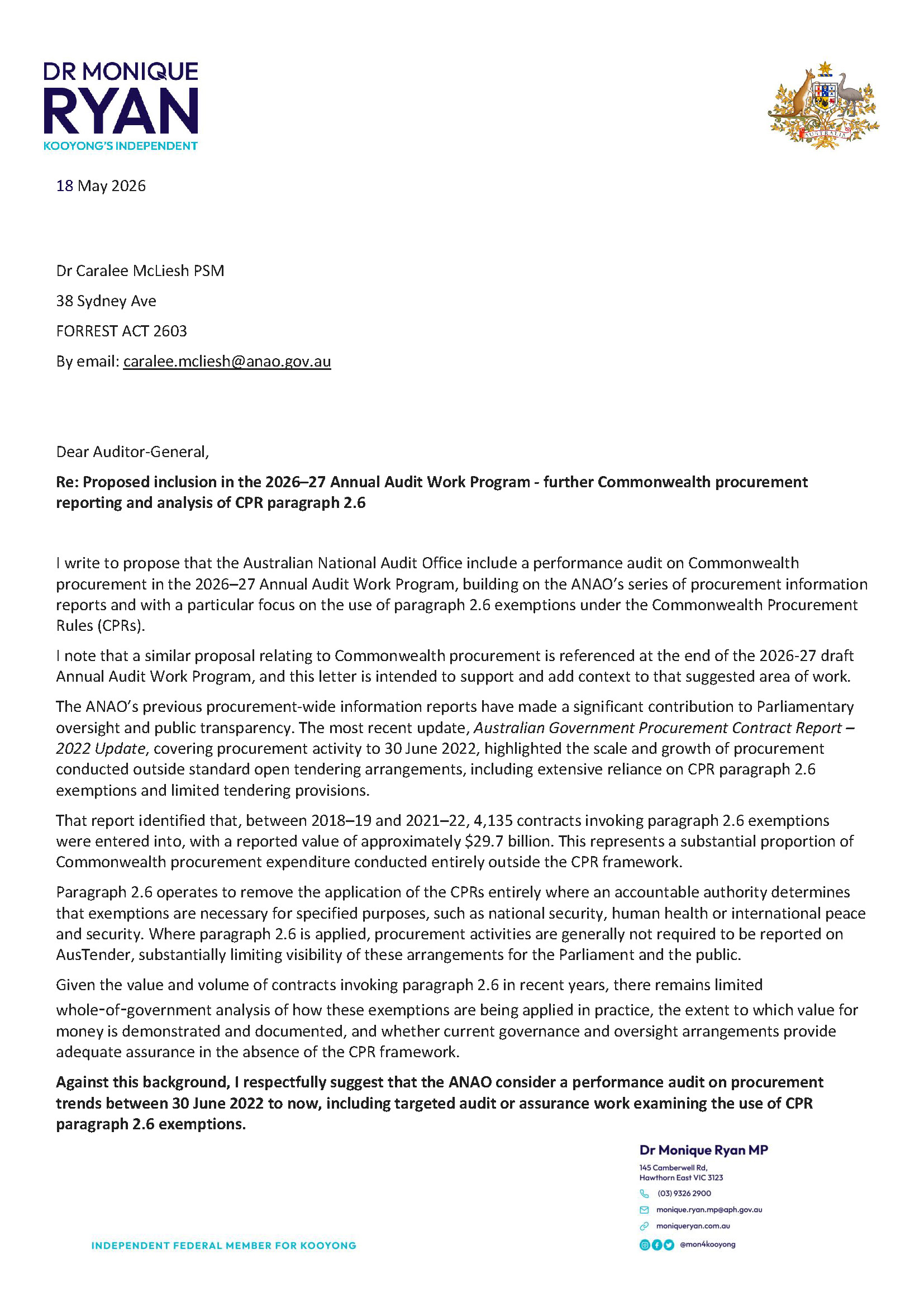
Transcript of letter from Dr Monique Ryan MP
18 May 2026
Dr Caralee McLiesh PSM
38 Sydney Ave
FORREST ACT 2603
By email: caralee.mcliesh@anao.gov.au
Dear Auditor-General,
Re: Proposed inclusion in the 2026–27 Annual Audit Work Program - further Commonwealth procurement reporting and analysis of CPR paragraph 2.6
I write to propose that the Australian National Audit Office include a performance audit on Commonwealth procurement in the 2026–27 Annual Audit Work Program, building on the ANAO’s series of procurement information reports and with a particular focus on the use of paragraph 2.6 exemptions under the Commonwealth Procurement Rules (CPRs).
I note that a similar proposal relating to Commonwealth procurement is referenced at the end of the 2026-27 draft Annual Audit Work Program, and this letter is intended to support and add context to that suggested area of work.
The ANAO’s previous procurement-wide information reports have made a significant contribution to Parliamentary oversight and public transparency. The most recent update, Australian Government Procurement Contract Report – 2022 Update, covering procurement activity to 30 June 2022, highlighted the scale and growth of procurement conducted outside standard open tendering arrangements, including extensive reliance on CPR paragraph 2.6 exemptions and limited tendering provisions.
That report identified that, between 2018–19 and 2021–22, 4,135 contracts invoking paragraph 2.6 exemptions were entered into, with a reported value of approximately $29.7 billion. This represents a substantial proportion of Commonwealth procurement expenditure conducted entirely outside the CPR framework.
Paragraph 2.6 operates to remove the application of the CPRs entirely where an accountable authority determines that exemptions are necessary for specified purposes, such as national security, human health or international peace and security. Where paragraph 2.6 is applied, procurement activities are generally not required to be reported on AusTender, substantially limiting visibility of these arrangements for the Parliament and the public.
Given the value and volume of contracts invoking paragraph 2.6 in recent years, there remains limited whole-of-government analysis of how these exemptions are being applied in practice, the extent to which value for money is demonstrated and documented, and whether current governance and oversight arrangements provide adequate assurance in the absence of the CPR framework.
Against this background, I respectfully suggest that the ANAO consider a performance audit on procurement trends between 30 June 2022 to now, including targeted audit or assurance work examining the use of CPR paragraph 2.6 exemptions.
Such work would support informed Parliamentary scrutiny of public expenditure conducted outside the standard CPR framework and assist in assessing whether existing policy settings and accountability mechanisms remain fit for purpose.
I appreciate the Auditor-General’s independence in determining the content of the Annual Audit Work Program and offer this proposal for consideration as part of that process.
Your sincerely,
Dr Monique Ryan MP