Browse our range of reports and publications including performance and financial statement audit reports, assurance review reports, information reports and annual reports.
Request for audit
Resolution of the Senate requesting the Australian National Audit Office reinstate the Defence major projects report
Response provided
Responded: Thursday 23 April 2026
Contact
Please direct enquiries through our contact page.
The Auditor-General responded on 23 April 2026 to correspondence from the President of the Senate dated 1 April 2026, regarding a resolution agreed by the Senate requesting that the Auditor-General reinstate the annual major projects report.
Auditor-General's response
23 April 2026
Senator the Hon Sue Lines
President of the Senate
Parliament House
Canberra ACT 2600
Dear President
Resolution of the Senate requesting the Australian National Audit Office reinstate the Defence major projects report
Thank you for your correspondence of 1 April 2026 drawing attention to the resolution of the Senate requesting that the Australian National Audit Office (ANAO) urgently re-instate the annual Defence major projects report (MPR) in order to continue reviewing the Department of Defence’s (Defence) major equipment acquisition projects.
The ANAO is committed to its purpose to support accountability and transparency in the Australian Government sector through independent reporting to the Parliament. As you know, the purpose can be achieved through a variety of reporting mechanisms supported by the Auditor-General Act 1997. I acknowledge the critical importance of continuing to bring transparency and accountability to Defence capability acquisitions.
There is no doubt that the MPR, as part of a suite of reporting tools, has served the Parliament well over the last 18 years. The report has been commissioned by the Joint Committee of Public Accounts and Audit (JCPAA) as a priority assurance review under the Auditor General Act 1997. The JCPAA has established guidelines for Defence to prepare a report on major projects and requested that the ANAO conduct an assurance review over the material presented by Defence. The JCPAA’s guidelines required material to be presented by Defence in a way that allows for unclassified publication.
Since 2021–2022, Defence has taken decisions that some of the information covered by the guidelines is not able to be disclosed as it would or could be reasonably expected to cause damage to the security, defence or international relations of the Commonwealth. Information designated by Defence as ‘not for publication’ included project level capability milestones and delivery dates. Notwithstanding its removal, the ANAO has had access to the material for the purposes of conducting its limited assurance review.
As a result of Defence’s removal of information, transparency has diminished, as has the ANAO’s ability to provide meaningful analysis in the report. An Emphasis of Matter has been included by the ANAO in the MPR since 2021–2022 drawing Parliament’s attention to the impact of Defence’s removal of information from its project level material. The ANAO has raised the issue of diminishing transparency in the MPR in its engagement with JCPAA inquiries into the MPR and through its Annual Reports presented in the Parliament in 2022–2023 and 2023–2024. The JCPAA has considered the issue of diminishing transparency and ‘not for publication’ by Defence in Report 503, Inquiry into the Defence Major Projects report 2020–21 and 2021–22 and Procurement of Hunter Class Frigates; and Report 507, Inquiry into the Defence 2022–23 Major Projects Report.
In light of the growing non-disclosure of information, I have come to the conclusion that the MPR is no longer fit for purpose as the vehicle to bring the transparency and accountability that it has in the past. A copy of my advice to the JCPAA on this matter is attached as further background. As you know, the JCPAA has resolved to not request Defence and the ANAO to continue to produce the MPR.
I am committed to maintaining or enhancing the ANAO’s assurance over Defence’s acquisition program. A description of the range of reporting I propose or have underway is attached. Importantly, the ANAO has recently commenced a performance audit of Defence’s management of its capability investment priorities, which will bring transparency to capability investment performance and how Defence manages the biennial Integrated Investment Program. I am considering this as a biennial performance audit.
The audit will consider whether the governance arrangements for managing Defence’s capability investments are fit-for-purpose and whether Defence is delivering on its capability investment priorities on time, on budget, and to scope. It includes reviewing Defence major equipment acquisition projects with respect to agreed cost, scope and schedule. In doing so, the ANAO will draw upon data from more than 100 capability investments included in Defence’s performance measure 6.1 to: report on the aggregate analysis across major acquisition projects under this measure by domain; provide dashboards of selected major projects, including analysis on the projects reported in the 2024–25 MPR; and demonstrate performance against Government second pass approval (similar to the MPR) and latest amended approval (Defence’s performance measure 6.1).
This performance audit is part of the ANAO’s audit work program of performance audits of Defence focussed on acquisition and sustainment activities and the Auditor-General’s audits of Defence’s financial statements and performance statements, which include targets for delivery of future capability.
Undertaking performance audits under the Auditor-General Act 1997 provides a number of benefits. Performance audits are deep dives with recommendations and are conducted to a higher level of assurance (reasonable assurance) than the MPR (limited assurance). In a performance audit the Auditor-General determines the audit approach, scope and what information is disclosed to Parliament. While the Auditor-General Act 1997 requires consideration by the Auditor-General of sensitive information in public reports, the ANAO has long been able to present information in a way that supports scrutiny by the Parliament of key issues in cost, schedule and capability.
The approach to scrutiny that is proposed is in line with the US Government Accountability Office, which conducts the Annual Weapons Systems Assessment as a performance audit, and the UK National Audit Office (NAO), which discontinued its Defence major projects report in 2015.
If the MPR were to be reinstated in its current form, that would require a request from the JCPAA under the Auditor General Act 1997. It would also require reductions in the planned performance audit program given the ANAO’s current resources.
For transparency purposes, consistent with standard ANAO practice in correspondence with parliamentarians, a copy of this letter will be published on the ANAO website. I am also copying the chair of the JCPAA given the Committee’s role in the MPR.
Thank you and I am available to provide additional information or discuss this letter further with you.
Yours sincerely
Dr Caralee McLiesh PSM
Auditor-General for Australia
Attachment A - advice to JCPAA from 8 December 2025
Attachment B - ANAO assurance over Defence Capability Acquisitions
Correspondence from the President of the Senate
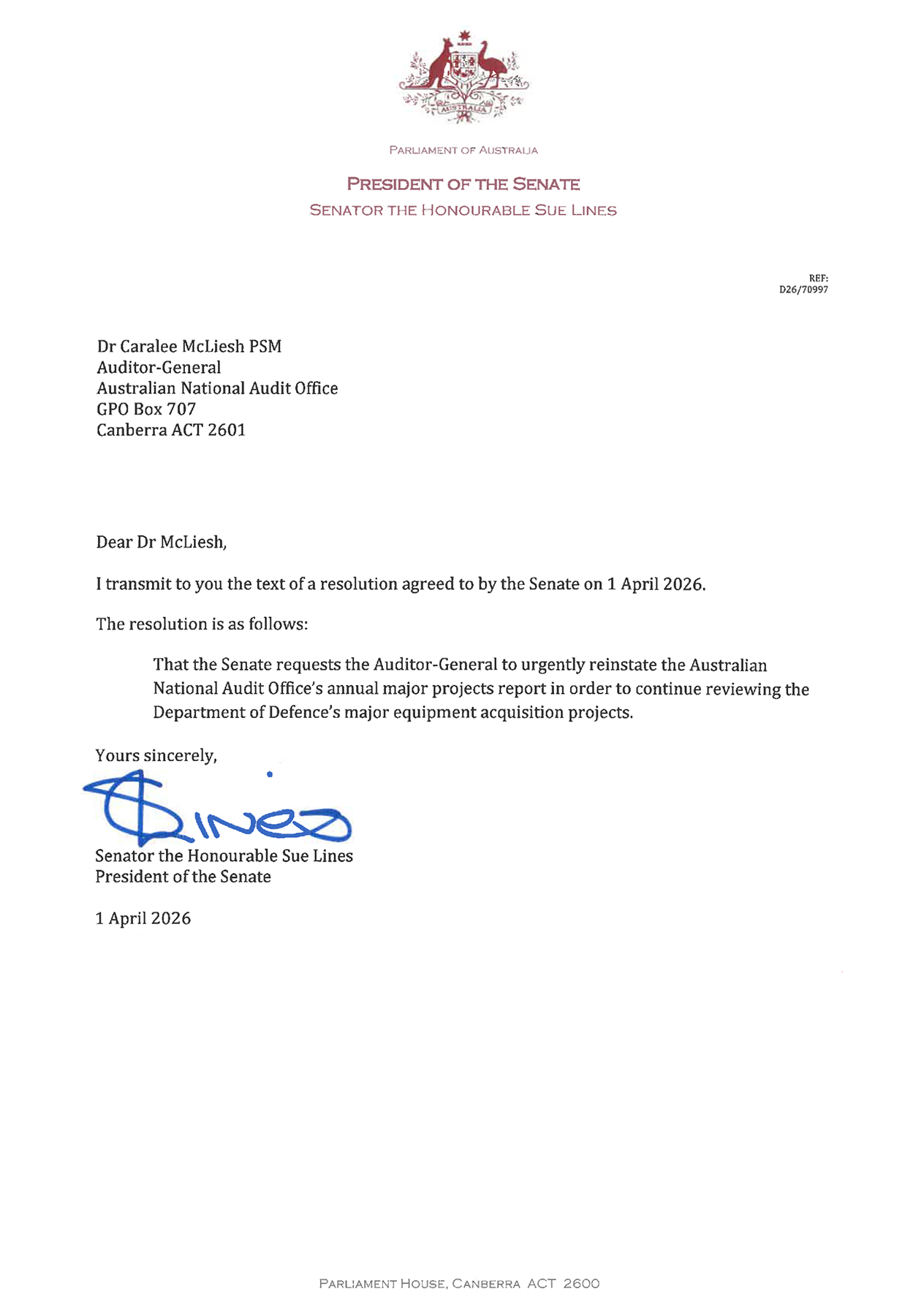
Transcript of letter from Senator the Honourable Sue Lines, President of the Senate
Dr Caralee McLiesh PSM
Auditor-General
Australian National Audit Office
GPO Box 707
Canberra ACT 2601
Dear Dr McLiesh,
I transmit to you the text of a resolution agreed to by the Senate on 1 April 2026.
The resolution is as follows:
That the Senate requests the Auditor-General to urgently reinstate the Australian National Audit Office’s annual major projects report in order to continue reviewing the Department of Defence’s major equipment acquisition projects.
Yours sincerely,
Senator the Honourable Sue Lines
President of the Senate
1 April 2026