Browse our range of reports and publications including performance and financial statement audit reports, assurance review reports, information reports and annual reports.
Performance audit (Auditor-General Report No. 32 of 2012–13)
Published: Tuesday 7 May 2013
Published
The objective of the audit was to assess the awarding of funding for the construction of the Adelaide Desalination Plant (ADP) against the requirements of the Commonwealth's grants administration framework, which includes the Government’s policy requirements for the approval of grants, with a particular focus on the assessments undertaken of each proposed grant in terms of the guidelines for the National Urban Water and Desalination Plan (NUWDP); and identify any potential improvements in grants administration practices.
Entity
Department of Sustainability, Environment, Water, Population and Communities; Department of Finance and Deregulation; Department of the Prime Minister and Cabinet
Contact
Please direct enquiries relating to reports through our contact page.
Performance audit (Auditor-General Report No. 21 of 2009–10)
Published: Thursday 4 February 2010
Published
The objective of this audit was to assess whether the WSA program has been administered effectively by the NWC/DEWHA, as relevant, and is achieving its stated program objective. Specifically, the ANAO examined whether:
- funding proposals have been assessed and approved in a fair, consistent manner and in accordance with applicable criteria, program guidelines and better practice;
- appropriate funding arrangements have been established with proponents, having regard to the size of the grant, the type of entity involved and the nature of the project; and
- DEWHA (and previously the NWC) is actively monitoring whether proponents are complying with their obligations, and grant payments are made only in accordance with funding agreements.
More broadly, the audit examined DEWHA's strategy for evaluating and reporting on the long-term benefits of the program.
Entity
Department of the Environment, Water, Heritage and the Arts; National Water Commission
Performance audit (Auditor-General Report No. 43 of 2000–01)
Published: Friday 1 June 2001
Published
The audit examined the design, management and reporting of performance information for the Natural Heritage Trust (NHT) which is administered by the Commonwealth Departments of Environment and Heritage, and Agriculture, Fisheries and Forestry. The objective of the audit was to examine and report on the performance information used to support the administration of $1.5 billion in Commonwealth financial assistance; and compliance with legislative requirements for performance monitoring and reporting.
Entity
Agriculture Fisheries and Forestry - Australia; Department of the Environment and Heritage; Department of Agriculture
Performance audit (Auditor-General Report No. 22 of 2005–06)
Published: Thursday 22 December 2005
Published
The objective of the audit was to assess and report on the progress being made by agencies subject to the Financial Management & Accountability Act 1997 and entities subject to the Commonwealth Authorities & Companies Act 1997: in realising value for money from the procurement process, with a specific focus on buildings, services and products using whole of life cycle assessments; and in the consideration and management of environmental impacts in specifications and contracts. The emphasis of the audit was on green office procurement and sustainable business practices and the value for money within this context. As such, the audit report provides a status report on the implementation of ESD within the office environment of the Australian Government. The audit used a survey approach in conjunction with selected audit investigations to obtain information across 71 agencies and entities selected on the basis of materiality in procurement and coverage across large, medium and small organisations. The agencies selected represented approximately 35 per cent of all government bodies and over 95 per cent of all procurement spending noted on the Department of Finance and Administration (Finance) database on contracts.
Entity
across agency
Performance audit (Auditor-General Report No. 20 of 2003–04)
Published: Friday 19 December 2003
Published
The objective of the audit was to assess the Australian Agency for International Development's (AusAid) planning for, and management of, the delivery of aid to East Timor. The audit examined Australia's emergency and humanitarian response following the crisis in East Timor in 1999; AusAID's post-crisis strategy for assisting East Timor; coordination with overseas donors; and financial contributions to multilateral reconstruction assistance. Australia's bilateral assistance, comprising shorter-term transitional assistance and medium-term development assistance, was also examined.
Entity
Australian Agency for International Development (AusAID)
Performance audit (Auditor-General Report No. 3 of 2002–03)
Published: Wednesday 31 July 2002
Published
HMAS Cerberus is a Navy base situated south-east of Melbourne, Victoria. As a major Navy training establishment, it conducts initial recruit training, and specialist category training in areas such as communications and engineering. The Australian Defence Force (ADF) Schools of Catering and Physical Training are situated there, as is a major health centre for operational and training needs. The health centre and other facilities at HMAS Cerberus were re-developed several years ago. In August 2001, the then Minister for Defence announced that, in response to continuing concern over facilities management at HMAS Cerberus, he had asked the Australian National Audit Office (ANAO) to conduct an independent investigation. The ANAO agreed to review these matters. The objective of the audit was to examine facilities management issues at HMAS Cerberus with a view to clarifying those of concern and ensuring that lessons would be learned from them to assist Defence facilities management generally.
Entity
Department of Defence
Annual report
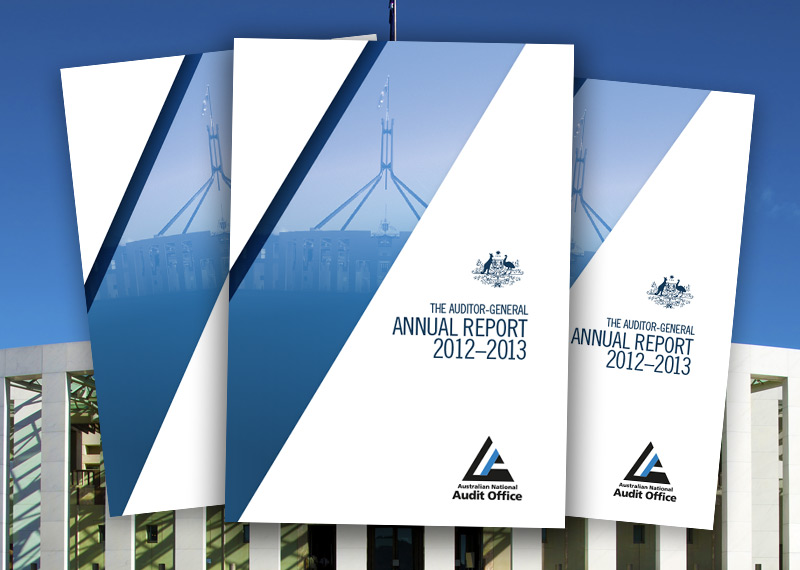
Published: Monday 30 September 2013
Published
This annual report documents the performance of the Australian National Audit Office (ANAO) in the financial year ending on 30 June 2013. It addresses the Requirements for Annual Reports for Departments, Executive Agencies and FMA Act Bodies approved by the Joint Committee of Public Accounts and Audit in June 2013; the performance measures set out in the outcomes and programs framework in the 2012–13 Portfolio Budget Statements; section 28 of the Auditor-General Act 1997; and other annual reporting requirements set out in legislation.
Performance audit (Auditor-General Report No. 36 of 1996–97)
Published: Thursday 5 June 1997
Published
The audit covered major program elements within the Department of Primary Industries and Energy and Environment Australia that are managed:
- directly by DPIE or Environment Australia;
- through the One-Stop-Shop project assessment process administered by the States/Territories; or
- by non-government organisations.
The purpose of the audit was to examine and benchmark the administrative processes established for these programs. The primary focus of the audit was to draw on the best elements of past practice (particularly in relation to programs involving the One-Stop-Shop) and highlight any shortcomings so that the risks to program effectiveness and accountability could be addressed in the implementation of the Natural Heritage Trust.
Entity
Across Agency
Performance audit (Auditor-General Report No. 8 of 2003–04)
Published: Monday 20 October 2003
Published
The audit is a follow-up of ANAO Audit Report No.33 of 1997-98, which assessed the effectiveness and efficiency of the Commonwealth's management of the Great Barrier Reef and made seven recommendations for improvement. The objective of the follow-up audit was to assess the extent to which the Great Barrier Reef Marine Park Authority, which is responsible for advising the Commonwealth on the care and developement of the Marine Park, has implemented the recommendations of the earlier audit.
Entity
The Great Barrier Reef Marine Park Authority
Performance audit (Auditor-General Report No. 6 of 2008–09)
Published: Tuesday 30 September 2008
Published
The objective of the audit was to assess whether Customs has implemented effective measures to control IUU fishing in the Southern Ocean. The audit examined Customs' management and coordination of enforcement operations in the Southern Ocean, with particular emphasis on:
- the approach to assessing and reporting SOMPR program performance, and whether outcomes are being met;
- coordination with other stakeholder agencies to meet program outcomes;
- the operational planning framework, management of human and physical resources and contract management; and
- the management of the deployment and operation of program maritime assets.
Entity
Australian Customs Service