Browse our range of reports and publications including performance and financial statement audit reports, assurance review reports, information reports and annual reports.
Corporate
Published: Monday 19 October 2020
Published
The ANAO Quality Assurance Framework is the system of quality control that the ANAO has established to provide the Auditor-General with reasonable assurance that the ANAO complies with the ANAO standards and applicable legal and regulatory requirements and reports issued by the ANAO are appropriate in the circumstances.
The Audit Quality Report demonstrates the ANAO assessment of the implementation and operating effectiveness of the elements of the ANAO Quality Assurance Framework. The report provides transparency in respect of the processes, policies, and procedures that support each element of the ANAO Quality Assurance Framework, and reports audit quality indicators measuring ANAO performance against target benchmarks.
This report also includes the achievement of the quality assurance strategy and deliverables set out in the ANAO Quality Assurance Framework and Plan 2019–20.
Contact
Please direct enquiries through our contact page.
Performance audit (Auditor-General Report No. 40 of 1996–97)
Published: Thursday 26 June 1997
Published
The ANAO's audit aims were to: examine the efficiency and effectiveness of DFAT's human resource management; and identify good practice, which could position the Department, and other APS agencies, to maximise opportunities afforded by the Government's emerging public sector reform agenda. The audit addressed a range of issues including the effectiveness of HR planning and forecasting, staff selection and deployment, performance management, and the fostering of relevant skills and knowledge.
Entity
Department of Foreign Affairs and Trade
Performance audit (Auditor-General Report No. 14 of 1999–2000)
Published: Tuesday 12 October 1999
Published
The audit reviewed Commonwealth debt management procedures. The audit objectives were to:
- review, and consider opportunities to improve, the reporting and disclosure of the Commonwealth's public debt;
- assess the effectiveness of the raising, management and retirement of Commonwealth debt, consistent with an acceptable degree of risk exposure; and
- determine whether there are opportunities to improve the Commonwealth's approach to the raising, management and retirement of Commonwealth debt.
Entity
Across Agency
Performance audit (Auditor-General Report No. 50 of 2000–01)
Published: Friday 15 June 2001
Published
The ANAO concluded that DHAC's administration of the National Cervical Screening Program is generally sound. The ANAO found that the department has a key role in the Program by providing secretariat services and other support to the NAC, which provides policy advice to AHMAC, and by supporting initiatives to further develop the Program. Some areas of DHAC's administration of the Program provide examples of good practice. Related examples are the early identification of the need to monitor the Program, the early identification of possible data sources for monitoring, and the use of an independent body to provide advice, through the Australian Institute of Health and Welfare, on performance indicators and data sources. A further example is DHAC's administration of the provision of cervical screening funding assistance to the States and Territories through Public Health Outcome Funding Agreements, which complies with the principles for sound Specific Purpose Payments program administration advocated by the Joint Committee of Public Accounts and Audit in their Report 362. On the other hand, the ANAO has identified areas for improvement in quality assurance for the analysis of Pap smears by pathology laboratories.
Entity
Department of Health and Aged Care
Speeches and papers
Published: Monday 27 August 2007
Published
Mr Ian McPhee - Auditor-General for Australia, presented at the Australian Corporate Lawyers Association (ACT Division) Conference
Speeches and papers
Published: Wednesday 7 February 1996
Published
Mr P.J. Barrett (AM) - Auditor-General for Australia, presented to the Corporate Management Network Meeting, Rydges Lakeside, Canberra
Performance audit (Auditor-General Report No. 19 of 2006–07)
Published: Thursday 25 January 2007
Published
The objective of this audit was to determine whether Health adequately assessed the State and Territory Governments' compliance with their obligations under the terms of the AHCAs. In conducting the audit, ANAO addressed the following criteria:
- if Health assessed whether the States and Territories were adhering to the AHCAs clause 6 principles that all eligible persons had equitable access to free public health and emergency services on the basis of clinical need within an appropriate period;
- if Health assessed whether the States and Territories were increasing their own source funding at the rate specified in the AHCAs; and
- if Health assessed whether the States and Territories were meeting the performance reporting requirements set out in the AHCAs.
Entity
NO-DEPTS-LISTED
Performance audit (Auditor-General Report No. 35 of 2003–04)
Published: Wednesday 24 March 2004
Published
This report covers a number of the discretionary compensation and debt relief mechanisms that are available to Commonwealth agencies, where individuals or entities have been disadvantaged by legislation, or actions by agencies or staff, or some other negative circumstances. It deals mainly with two legislative mechanisms, namely, act of grace payments and waivers of debt, and one administrative mechanism, the Compensation for Detriment caused by Defective Administration (CDDA) scheme. This report also briefly covers two other mechanisms, namely ex gratia payments and payments in special circumstances relating to Australian Public Service (APS) employment. The main objective of the audit was to assess whether the management of claims for compensation and debt relief in special circumstances was in accordance with relevant legislative requirements and Commonwealth guidelines, and whether the current administrative policies and procedures were adequate.
Entity
Across Agency
Performance audit (Auditor-General Report No. 36 of 1998–99)
Published: Wednesday 28 April 1999
Published
The objective of the audit was to assess key aspects of the Australian Taxation Office's administration of the PAYE system in relation to employers' remittances and to identify opportunities for improvement. The audit focussed on four areas:
- remittance monitoring, especially managing late remittances;
- follow-up action for end of year reconciliation, including discrepancies;
- handling compliance intelligence gained from the public; and
- ATO compliance projects.
Entity
Australian Taxation Office
Annual report
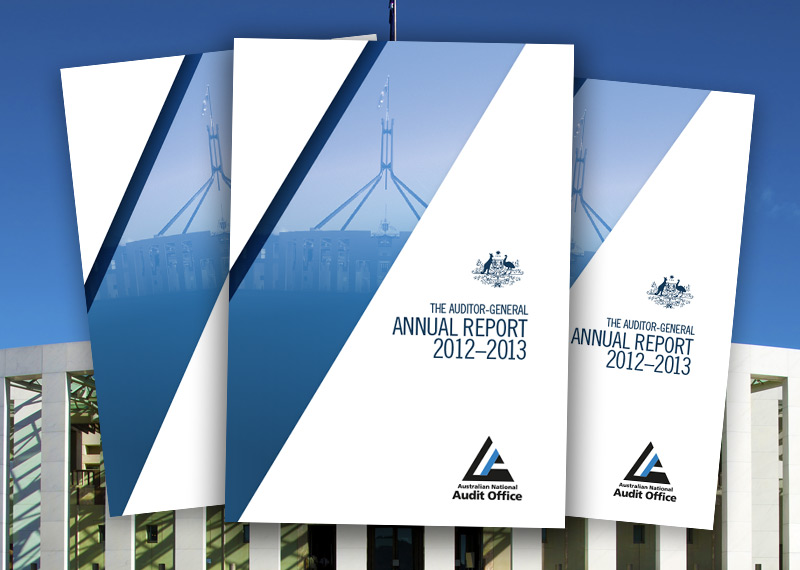
Published: Monday 30 September 2013
Published
This annual report documents the performance of the Australian National Audit Office (ANAO) in the financial year ending on 30 June 2013. It addresses the Requirements for Annual Reports for Departments, Executive Agencies and FMA Act Bodies approved by the Joint Committee of Public Accounts and Audit in June 2013; the performance measures set out in the outcomes and programs framework in the 2012–13 Portfolio Budget Statements; section 28 of the Auditor-General Act 1997; and other annual reporting requirements set out in legislation.