Browse our range of reports and publications including performance and financial statement audit reports, assurance review reports, information reports and annual reports.
Performance audit (Auditor-General Report No. 37 of 2005–06)
Published: Wednesday 3 May 2006
Published
The objective of the audit was to assess whether selected Australian Government entities were effectively supporting their business requirements through planning for, and management of, the acquisition, disposal and use of their IPE assets. The audit reviewed each entity's policies and practices against a series of audit criteria across the following components of asset management: control environment; planning; acquisitions; operations; and disposals.
Entity
Across agencies
Performance audit (Auditor-General Report No. 9 of 2021–22)

Published: Wednesday 24 November 2021
Published
The objective of the audit was to examine the Department of Agriculture, Water and the Environment’s effectiveness in implementing the Regional Land Partnerships program.
Entity
Department of Agriculture, Water and the Environment
Contact
Please direct enquiries through our contact page.
Performance audit (Auditor-General Report No. 13 of 2017–18)

Published: Thursday 19 October 2017
Published
The objective of this audit was to assess the effectiveness of controls being implemented and/or developed by the National Disability Insurance Agency (NDIA) to ensure National Disability Insurance Scheme (NDIS) access decisions are consistent with legislative and other requirements.
Entity
National Disability Insurance Agency; Department of Human Services
Contact
Please direct enquiries relating to reports through our contact page.
Performance audit (Auditor-General Report No. 3 of 2021–22)

Published: Thursday 9 September 2021
Published
The audit objective was to assess whether the Department of Health is effectively managing financial assistance under the Medical Research Future Fund.
Entity
Department of Health
Contact
Please direct enquiries through our contact page.
Performance audit (Auditor-General Report No. 31 of 2020–21)

Published: Thursday 18 March 2021
Published
The objective was to examine whether the award of funding under the Supporting Reliable Energy Infrastructure Program was informed by an appropriate assessment process and sound advice that complied with the Commonwealth Grant Rules and Guidelines.
Entity
Department of Industry, Science, Energy and Resources
Contact
Please direct enquiries through our contact page.
Annual report
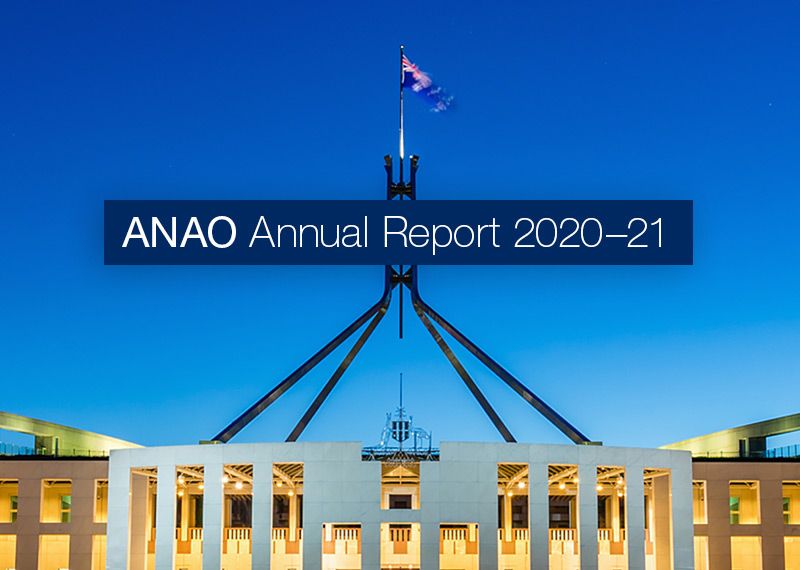
Published: Thursday 26 August 2021
Published
This annual report documents the performance of the Australian National Audit Office (ANAO) in the financial year ended 30 June 2021. The report addresses all applicable obligations under the Public Governance, Performance and Accountability Act 2013; the Public Governance, Performance and Accountability Rule 2014; the Auditor-General Act 1997; the performance measures set out in the outcome and programs framework in the ANAO’s Portfolio Budget Statements 2020–21 and the ANAO Corporate Plan 2020–21; and annual reporting requirements set out in other relevant legislation.
Contact
Please direct enquiries relating to annual reports through our contact page.
Performance audit (Auditor-General Report No. 20 of 2012–13)
Published: Tuesday 5 February 2013
Published
The objective of the audit was to assess the effectiveness of the Australian Fisheries Management Authority’s administration of its Domestic Fishing Compliance Program.
Entity
Australian Fisheries Management Authority
Performance audit (Auditor-General Report No. 37 of 2006–07)
Published: Thursday 17 May 2007
Published
The audit objective was to assess the effectiveness of DIAC's administration of the health requirement of the Migration Act 1958 (the Act). To achieve this objective, the ANAO examined whether DIAC was setting and implementing the health requirement in accordance with the Act, the Migration Regulations 1994 (the Regulations), and DIAC's own guidelines.
Entity
Department of Health and Ageing
Performance audit (Auditor-General Report No. 14 of 2005–06)
Published: Wednesday 19 October 2005
Published
The audit assessed whether FaCS effectively undertakes its coordination, monitoring and other roles according to the CSTDA. The audit examined all disability services provided for under the CSTDA, except for disability employment services. The ANAO met relevant officers from FaCS' national office and State and Territory offices, and with 22 stakeholder organisations including: advocacy groups; peak national and State bodies representing the interests of disability service providers and people with disabilities; members of national and State Disability Advisory Bodies funded by FaCS; State and Territory governments; relevant Australian Government agencies; In particular, the Department of Health and Ageing and the Australian Institute of Health and Welfare. and local government bodies. Fieldwork for the audit was primarily undertaken during the period September 2004 to February 2005.
Entity
Department of Family and Community Services
Performance audit (Auditor-General Report No. 50 of 2000–01)
Published: Friday 15 June 2001
Published
The ANAO concluded that DHAC's administration of the National Cervical Screening Program is generally sound. The ANAO found that the department has a key role in the Program by providing secretariat services and other support to the NAC, which provides policy advice to AHMAC, and by supporting initiatives to further develop the Program. Some areas of DHAC's administration of the Program provide examples of good practice. Related examples are the early identification of the need to monitor the Program, the early identification of possible data sources for monitoring, and the use of an independent body to provide advice, through the Australian Institute of Health and Welfare, on performance indicators and data sources. A further example is DHAC's administration of the provision of cervical screening funding assistance to the States and Territories through Public Health Outcome Funding Agreements, which complies with the principles for sound Specific Purpose Payments program administration advocated by the Joint Committee of Public Accounts and Audit in their Report 362. On the other hand, the ANAO has identified areas for improvement in quality assurance for the analysis of Pap smears by pathology laboratories.
Entity
Department of Health and Aged Care