Browse our range of reports and publications including performance and financial statement audit reports, assurance review reports, information reports and annual reports.
Performance audit (Auditor-General Report No. 47 of 2010–11)
Published: Wednesday 8 June 2011
Published
The objective of the audit was to assess the effectiveness of CSIRO’s development and administration of selected National Research Flagships. In assessing CSIRO’s performance, the ANAO examined whether:
- mechanisms were in place to develop and implement the Flagships, within the context of the broader CSIRO change program;
- governance arrangements for Flagships incorporated sound oversight, planning and reporting arrangements; and
- periodic review activities were used to assess and improve the operation of the Flagships.
Entity
Commonwealth Scientific and Industrial Research Organisation
Performance audit (Auditor-General Report No. 50 of 2013–14)
Published: Tuesday 24 June 2014
Published
The audit objective was to assess selected agencies’ compliance with the four mandatory ICT security strategies and related controls in the Australian Government Information Security Manual.
Entity
Across Agencies
Contact
David Gray, Executive Director - Phone (02) 6203 7377
Performance audit (Auditor-General Report No. 53 of 2011–12)
Published: Wednesday 27 June 2012
Published
To assess the extent to which agencies create, manage and dispose of records in accordance with key business, legal and policy requirements.
The agencies included in the audit were the: Australian Customs and Border Protection Service (Customs); Department of Immigration and Citizenship (DIAC); and the Department of the Treasury (Treasury). The audit also considered the Archives' response to Recommendation No. 1 from ANAO Audit Report No.6 2006, 07 Recordkeeping including the Management of Electronic Records, including whether they had clarified Australian Government records management requirements for agencies.
Entity
Across agencies
Performance audit (Auditor-General Report No. 14 of 2009–10)
Published: Wednesday 25 November 2009
Published
The audit objective was to assess the effectiveness of agencies' contract management by determining if they had sound practices and systematic approaches to this activity. Particular attention was given to each agency's:
- day-to-day management of individual contracts; and
- approach to managing its contract population.
Entity
Australian Federal Police; Austrade; Department of Foreign Affairs and Trade
Performance audit (Auditor-General Report No. 50 of 2004–05)
Published: Thursday 2 June 2005
Published
The objective of this audit was to assess the administration and implementation of the drought assistance measures. The audit focussed on EC, including prima facie EC, and key aspects of the additional drought assistance measures.
Entity
Department of Agriculture, Fisheries and Forestry; Centrelink; The Department of the Prime Minister and Cabinet
Performance audit (Auditor-General Report No. 53 of 2003–04)
Published: Thursday 17 June 2004
Published
The overall objective of the audit was to assess CrimTrac's progress in achieving the key deliverables it was established to provide, given that the agency had been in operation for some three years. The Australian Government provided $50 million for the implementation of CrimTrac, with an expectation that significant progress would be made within the first three years. The audit further examined whether CrimTrac had progressed the key deliverables efficiently and effectively, and whether the data either held by CrimTrac, or accessed through CrimTrac, for matching purposes is secure.
Entity
CrimTrac
Performance audit (Auditor-General Report No. 26 of 2011–12)
Published: Thursday 9 February 2012
Published
The objective of the audit was to assess the extent to which FaHCSIA, DEEWR and DoHA seek to reduce service delivery risks posed by capacity constraints in Indigenous organisations.
Entity
Department of Families, Housing, Community Services and Indigenous Affairs, Department of Education, Employment and Workplace Relations and Department of Health and Ageing
Performance audit (Auditor-General Report No. 16 of 2003–04)
Published: Thursday 4 December 2003
Published
The objectives of the follow-up audit were to assess DFAT's implementation of the six recommendations made by the ANAO in the previous audit. It also sought to determine whether implementation of these recommendations, or alternative action, had improved DFAT's administration of consular services. The audit focused on management processes and supporting systems for the delivery of consular services. It also reviewed DFAT's implementation of recommendations of the Senate Foreign Affairs, Defence and Trade References Committee that were outstanding from the previous audit.
Entity
Department of Foreign Affairs and Trade
Performance audit (Auditor-General Report No. 35 of 2009–10)
Published: Tuesday 18 May 2010
Published
The objective of the audit was to assess the effectiveness of the Tax Office's administration of the Superannuation Co-contribution Scheme.
The audit reviewed five key areas: governance arrangements; information technology systems and controls; co-contribution processing; compliance approaches; and communication with clients.
Entity
Australian Taxation Office
Performance audit (Auditor-General Report No. 40 of 2001–02)
Published: Monday 8 April 2002
Published
The audit was undertaken following advice from the Joint Committee of Public Accounts and Audit (JCPAA) to the Auditor-General that assurance that ABC programming adequately reflects the ABC's Charter was an audit priority of Parliament. The objective of the audit is to provide Parliament with this assurance. The focus of the audit was on the governance arrangements of the ABC Board and management that enable the ABC to demonstrate the extent to which it is achieving its' Charter obligations, and other related statutory requirements, efficiently and effectively. The scope of the audit was as follows:
- Review the ABC's corporate governance framework against better practice models. The ANAO had regard to the ABC's unique role as a national public broadcaster established as a budget funded Commonwealth statutory authority subject to the Commonwealth Authorities and Companies Act 1997.
- Examine the ABC Board's approach to the interpretation of the Charter requirements of the ABC and the setting of strategic directions, and management's administrative arrangements for implementing the strategic directions established by the Board.
- Examine the ABC's performance information framework, the development, documentation and use of performance measures in relation to targets and/or objectives, the monitoring and reporting of performance and its' inter-relationship with the corporate planning and budgetary processes, particularly in relation to the strategic directions set by the Board.
The audit did not examine the overall management of the ABC. In keeping with the audit scope, the audit examined ways in which the ABC aligns its' strategic directions with its' Charter requirements for programs broadcast on radio, television and on-line and assures itself, and Parliament, about the achievement of its' Charter obligations. Further, the audit did not examine the operations of ABC Enterprises or symphony orchestras that operate as ABC-owned subsidiary companies.
Entity
Australian Broadcasting Corporation
Speeches and papers
Published: Thursday 21 February 2008
Published
Mr Ian McPhee - Auditor-General for Australia, presented at the Canberra Evaluation Forum
Performance audit (Auditor-General Report No. 9 of 2012–13)
Published: Thursday 1 November 2012
Published
The objective of the audit was to assess the management and effectiveness of DCO’s delivery and coordination of support services to ADF families, in particular support services provided when an ADF member is seriously injured or ill, or dies in service.
Entity
Department of Defence, Department of Veterans' Affairs
Performance audit (Auditor-General Report No. 20 of 2005–06)
Published: Tuesday 6 December 2005
Published
The objective of this audit was to assess the Private Health Insurance Administration Council's (PHIAC's) administrative effectiveness as a regulator of private health insurance. In making this assessment, the Australian National Audit Office (ANAO) addressed the following criteria: whether PHIAC monitored compliance with its legislative requirements and analysed related data; whether PHIAC addressed and managed non-compliance with its legislative requirements; and whether PHIAC's governance and organisation supported the performance of its legislative functions. Although the Department of Health and Ageing (Health) also has a role in the regulation of the private health insurance industry under the National Health Act 1953 (Health Act), Health's regulatory activities were outside the scope of this audit.
Entity
Private Health Insurance Administration Council
Performance audit (Auditor-General Report No. 41 of 2013–14)
Published: Tuesday 17 June 2014
Published
The audit objective was to assess the effectiveness of the Department of Industry's administration of the Commercialisation Australia Program.
Entity
Department of Industry
Contact
Please direct enquiries relating to reports through our contact page.
Speeches and papers
Published: Wednesday 21 June 2006
Published
Mr Mr Ian McPhee - Auditor-General for Australia, presented at the Leadership Development Network Breakfast Seminar
Corporate

Published: Thursday 5 July 2018
Published
The ANAO Corporate Plan 2018–19 is the ANAO's key strategic planning document. It guides our operating environment and sets out how we will deliver on our purpose. The corporate plan is complemented by the annual audit work program which reflects the ANAO's audit strategy and deliverables for the coming year.
Contact
Please direct enquiries about our corporate plan through our contact page.
Performance audit (Auditor-General Report No. 40 of 2008–09)
Published: Tuesday 2 June 2009
Published
The objective of the audit was to assess the effectiveness of DoHA's management of the planning and allocation of aged care places and capital grants, in accordance with the Aged Care Act 1997.
Entity
Department of Health and Ageing
Performance audit (Auditor-General Report No. 12 of 2012–13)
Published: Wednesday 5 December 2012
Published
The audit objective was to assess the effectiveness of the Department of Health and Ageing and the Australian National Preventive Health Agency in fulfilling the Commonwealth’s role in implementing the Council of Australian Government’s National Partnership Agreement on Preventive Health, to achieve the Agreement’s objectives, outcomes and outputs, including supporting all Australians to reduce their risk of chronic disease.
Entity
Australian National Preventive Health Agency; Department of Health and Ageing
Performance audit (Auditor-General Report No. 37 of 1999–2000)
Published: Tuesday 4 April 2000
Published
The audit reviewed the construction of facilities for the Australian Defence Force and the Department of Defence by the Defence Estate Organisation. The objective of the audit was to assess the efficiency and administrative effectiveness of the Organisation's project delivery function, highlighting effective practice and, where appropriate, making practical recommendations to enhance facilities project management. The main projects examined were the facilities required for the Army Presence in the North and the Russell Hill Redevelopment.
Entity
Department of Defence
Performance audit (Auditor-General Report No. 43 of 2007–08)
Published: Tuesday 24 June 2008
Published
The objectives for the audit of the third tranche sale of Telstra shares were to:
- assess the extent to which the Government's sale objectives were achieved, including maximising overall value for money;
- assess the effectiveness of the management of the sale; and
- identify principles of sound administrative practice to facilitate potential improvements in any future asset sales.
Entity
Department of Finance and Deregulation
Performance audit (Auditor-General Report No. 53 of 2012–13)
Published: Tuesday 25 June 2013
Published
The objective of the audit was to assess the effectiveness of agencies’ arrangements for monitoring and implementing ANAO performance audit recommendations.
Entity
Department of Education, Employment and Workplace Relations (DEEWR); Department of Families, Housing, Community Services and Indigenous Affairs (FaHCSIA); Department of Finance and Deregulation (DoFD); Department of Infrastructure and Transport (DIT)
Contact
Please direct enquiries relating to reports through our contact page.
Performance audit (Auditor-General Report No. 16 of 2017–18)

Published: Tuesday 28 November 2017
Published
The audit objective was to assess whether nbn co limited effectively administered the National Broadband Network Satellite Support Scheme.
Entity
Department of Communications and the Arts; nbn co limited; Department of Finance
Contact
Please direct enquiries relating to reports through our contact page.
Performance audit (Auditor-General Report No. 1 of 2021–22)

Published: Monday 16 August 2021
Published
The audit objective was to examine the effectiveness to date of the Department of Defence’s administration of the Enterprise Resource Planning (ERP) program, with a focus on ERP Tranche 1 activities.
Entity
Department of Defence
Contact
Please direct enquiries through our contact page.
Annual report
Published: Monday 4 September 2017
Published
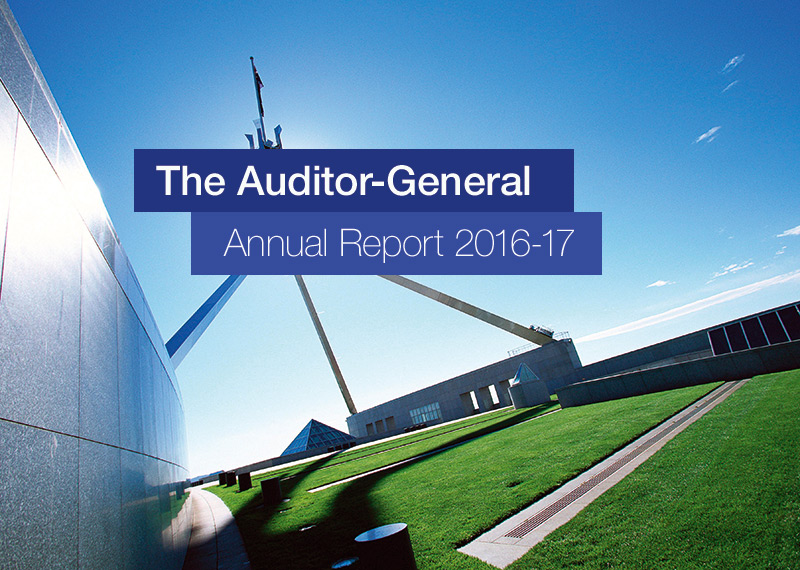
This annual report documents the performance of the Australian National Audit Office (ANAO) in the financial year ending on 30 June 2017. The report addresses all applicable obligations under the Public Governance, Performance and Accountability Act 2013 (PGPA Act); the Public Governance, Performance and Accountability Rule 2014 (PGPA Rule); the Auditor-General Act 1997; the performance measures set out in the outcome and programs framework in the ANAO’s 2016–17 Portfolio Budget Statements (PBS) and the ANAO 2016–20 Corporate Plan and annual reporting requirements set out in other relevant legislation.
Contact
Please direct enquiries relating to annual reports through our contact page.
Performance audit (Auditor-General Report No. 1 of 2003–04)
Published: Thursday 31 July 2003
Published
The audit objective was to assess the adequacy of the Commonwealth's administration of three key components of the Agriculture - Advancing Australia package: the FarmBis II program, the Farm Help program and the Farm Management Deposits scheme. Broadly, the audit examined the areas of strategic management, managing compliance, program promotion, performance monitoring and evaluation, and performance results.
Entity
Department of Agriculture, Fisheries and Forestry; Centrelink; Australian Taxation Office
Performance audit (Auditor-General Report No. 47 of 2018–19)

Published: Tuesday 18 June 2019
Published
The objective of this audit was to examine the effectiveness of the design and implementation of the Department of the Prime Minister and Cabinet’s (PM&C’s) evaluation framework for the Indigenous Advancement Strategy (IAS), in achieving its purpose to ensure that evaluation is high quality, ethical, inclusive and focused on improving outcomes for Indigenous Australians.
Entity
Department of the Prime Minister and Cabinet
Contact
Please direct enquiries through our contact page.
Performance audit (Auditor-General Report No. 49 of 2006–07)
Published: Monday 25 June 2007
Published
The objective of the audit was to assess the management practices undertaken by APS agencies to achieve value for money and transparency in dealing with contracts for non-APS workers. The focus of the audit was on circumstances where agencies had a significant reliance on a non-APS workforce to assist in achieving their core functions. Regular reporting by agencies of expenditure on non-APS workers was outside the scope of this audit.
Entity
NO-DEPTS-LISTED
Performance audit (Auditor-General Report No. 17 of 2021–22)

Published: Thursday 17 February 2022
Published
The objective of this audit was to assess the effectiveness of the Department of Finance and selected entities’ implementation of the Australian Government’s campaign advertising framework.
Entity
Across Entities
Contact
Please direct enquiries through our contact page.
Performance audit (Auditor-General Report No. 50 of 2014–15)

Published: Wednesday 10 June 2015
Published
The objective of the audit was to assess the effectiveness of the administration of the Defence Home Ownership Assistance Scheme by the Department of Defence and the Department of Veterans’ Affairs.
Entity
Department of Defence; Department of Veterans' Affairs
Contact
Please direct enquiries relating to reports through our contact page.
Performance audit (Auditor-General Report No. 39 of 2009–10)
Published: Monday 24 May 2010
Published
The objective of this audit was to examine the effectiveness of Medicare Australia's administration of the PBS. In assessing the objective, the audit considered three key areas:
- Medicare Australia's relationship with the PBS policy agency (DoHA) and service delivery policy agency (Department of Human Services (DHS));
- the management arrangements and processes underpinning Medicare Australia's delivery of the PBS (including the means by which Medicare Australia gains assurance over the integrity of the PBS); and
- how Medicare Australia undertakes its three main responsibilities relating to the delivery of the PBS, namely: approving pharmacies; approving authority prescriptions; and processing PBS claims.
Entity
Medicare Australia; Department of Human Services; Department of Health and Ageing