Browse our range of reports and publications including performance and financial statement audit reports, assurance review reports, information reports and annual reports.
Performance audit (Auditor-General Report No. 40 of 2002–03)
Published: Tuesday 22 April 2003
Published
The audit assessed DITR's and the ATO's administration of the R&D Tax Concession including review processes for registration and subsequent expenditure claims, by eligible companies. In particular, the audit focussed on measuring performance, risk management, and information systems including security and data integrity.
Entity
Australian Taxation Office; Department of Industry Tourism and Resources
Performance audit (Auditor-General Report No. 33 of 1997–98)
Published: Monday 23 February 1998
Published
The objective of this audit was to assess the efficiency and effectiveness of the Commonwealth's management of the Great Barrier Reef as implemented by the Authority. This audit was undertaken because of the environmental significance of the Great Barrier Reef Region; its growing economic importance; recent changes to the Authority's budget arrangements; and because the Authority had not been subject to a performance audit since its establishment approximately 20 years ago.
Entity
Great Barrier Reef Marine Park Authority
Performance audit (Auditor-General Report No. 16 of 2004–05)
Published: Tuesday 14 December 2004
Published
The objective of the audit was to assess the administrative effectiveness of Customs' Container Examination Facilities. Particular emphasis was given to the following areas: target selection processes; target development strategies; intervention processes; and facilities operation.
Entity
Australian Customs Service
Speeches and papers
Published: Wednesday 24 May 2000
Published
Mr P.J. Barrett (AM) - Auditor-General for Australia, presented at the Association of Risk and Insurance Managers of Australasia - South Australia Chapter
Speeches and papers
Published: Friday 18 May 2007
Published
Mr Ian McPhee - Auditor-General for Australia, presented at the Queensland Regional Heads Forum
Performance audit (Auditor-General Report No. 46 of 2000–01)
Published: Wednesday 6 June 2001
Published
The objective of the audit was to report to Parliament on the ATO's management of its performance reporting within the outcomes and outputs framework and to identify potential areas for improvement in specifying, measuring, administering and reporting under that framework.
Entity
Australian Taxation Office
Performance audit (Auditor-General Report No. 55 of 2001–02)
Published: Friday 7 June 2002
Published
Although the audit examined broader aspects of the ATO's administration (such as, tobacco excise governance arrangements, intelligence capability and compliance and investigations activities), we placed particular emphasis on the strategies used by the ATO to address the proliferation of chop-chop (Australian grown tobacco sold illicitly in a chopped up form for $80 to $100 per kilogram. In comparison, 50 grams of legal roll-you-own tobacco costs around $16 i.e. $320 per kilogram) in the Australian markets, as it is an area of major risk to tobacco excise revenue.
Entity
Australian Taxation Office
Annual report
Published: Tuesday 7 October 2003
Published
This annual report documents the performance of the Australian National Audit Office (ANAO) in the financial year ending on 30 June 2003. It includes a comment by the Auditor-General; an overview of the report; a report on performance; details about management and accountability, and the financial statement for the year.
Speeches and papers
Published: Thursday 1 April 2004
Published
Mr P.J. Barrett (AM) - Auditor-General for Australia, Address to University of Canberra students participating in the Graduate Certificate in Performance Auditing
Performance audit (Auditor-General Report No. 27 of 2002–03)
Published: Thursday 30 January 2003
Published
The audit reviewed the management and recording of guarentees, warranties, indemnities and letters of comfort issued by the Commonwealth and also assessed action taken in the relation to the recommendations from ANAO Audit Report No. 47 1997-98. The objectives of the audit were to assess the extent of:
- improvement in agencies' management and monitoring of the Commonwealth's exposure to these instruments;
- changes in the size and nature of the exposure since 30 June 1997; and
- the approach of agencies to effective risk management and control of Commonwealth exposures to these instruments.
Entity
Across Agency
Performance audit (Auditor-General Report No. 2 of 2003–04)
Published: Wednesday 13 August 2003
Published
The Audit Activity Report: January to June 2003 summarises the activity and outputs of the Australian National Audit Office for the second half of the 2002-03 reporting year. The Report outlines the key findings of performance and financial control audits, and summarises audits tabled and better practice guides published during January to June 2003.
Entity
Australian National Audit Office; Parliament
Performance audit (Auditor-General Report No. 47 of 2000–01)
Published: Thursday 7 June 2001
Published
Quarantine policies and operations are the responsibility of the Department of Agriculture, Fisheries and Forestry - Australia (AFFA). The objective of this audit was to assess AFFA's management of plant and animal quarantine services, and the implementation and impact of the Government Response (1997) to the Quarantine Review Committee Report. The audit in particular assessed the setting of quarantine priorities through assessing and managing risk; management of the continuum of quarantine operations; and management of Import Risk Analyses to deliver and review quarantine policies. Stakeholder consultation and advisory processes were also assessed in addressing these issues. A key issue examined was the effectiveness of AFFA quarantine operations in international mail and airports preventing the entry of quarantinable material. The ANAO made eight recommendations aimed at improving operational risk based resource allocation; pre-border management of quarantine risk; the effectiveness of quarantine operations at the Australian border; and priority setting and transparency of the IRA process. AFFA agreed to all eight ANAO recommendations.
Entity
Agriculture Fisheries and Forestry - Australia Department of Agriculture
Performance audit (Auditor-General Report No. 7 of 2000–01)
Published: Tuesday 29 August 2000
Published
The audit objective was to examine the administrative effectiveness of the ATO's use of AUSTRAC data. The audit reviewed the use of AUSTRAC data across three of the ATO Business Service Lines (BSLs) namely, Large Business and International (LB&I), Small Business (SB) and Individuals Non Business (INB). These are the most significant BSLs in terms of revenue collection. The audit focussed on the ATO's use of AUSTRAC data at the strategic and operational levels and its management of AUSTRAC data. Aspects examined include the ATO's relationship with AUSTRAC as well as training, data quality, data privacy and security issues.
Entity
Australian Taxation Office
Performance audit (Auditor-General Report No. 49 of 2001–02)
Published: Monday 13 May 2002
Published
The audit reviewed Commonwealth National Parks involving total assets of $105 million with net operating costs of $41.77 million. Nineteen Commonwealth reserves are declared comprising six terrestrial national parks, one botanic garden and twelve marine parks and reserves totalling some 23 million hectares across Australia, its external territories and Commonwealth marine areas. The objective of the audit was to examine and report on the adequacy of the planning, management and reporting systems which support the Director of National Parks in the achievement of required functions under relevant legislation and agreed outputs and outcomes.
Entity
Department of the Environment and Heritage
Performance audit (Auditor-General Report No. 8 of 1999–2000)
Published: Monday 23 August 1999
Published
The objective of this audit was to assess the systems put in place by Centrelink to protect data privacy. The audit reviewed the adequacy of the policies, procedures and the administrative framework associated with data privacy, and the computer systems that are used to store and disseminate data. The ANAO also examined compliance with legislative requirements.
Entity
Centrelink
Speeches and papers
Published: Friday 23 August 2002
Published
Mr P.J. Barrett (AM) - Auditor-General for Australia, presented at the Forum of Commonwealth Agencies Seminar, Sydney, NSW
Performance audit (Auditor-General Report No. 17 of 2001–02)
Published: Friday 26 October 2001
Published
The audit's objective was to assess, and report to Parliament on, the ATO's administration of petroleum excise collections. The audit examined whether the ATO had implemented effectively administrative arrangements for the collection of petroleum excise since the transfer of the function from Customs in 1999. Areas that were examined relating to administration of petroleum excise were:
- governance arrangements;
- licensing arrangements;
- compliance management;
- investigations; and
- revenue management.
The audit also reviewed the role of Customs in performing functions directly related to petroleum excise collections and key elements of the management relationship between the ATO and Customs in this area.
Entity
Australian Taxation Office
Performance audit (Auditor-General Report No. 42 of 2001–02)
Published: Thursday 18 April 2002
Published
The Commonwealth electoral roll is managed by the Australian Electoral Commission (AEC) and lists the names and addresses of people entitled to vote in federal elections. The objectives of the audit were twofold. The first objective was to provide an opinion on the integrity of the electoral roll, for the purpose of the audit, integrity was defined as accuracy, completeness, validity and security. The second objective was to examine the effectiveness of the AEC's management of the electoral roll in ensuring the roll's integrity.
Entity
Australian Electoral Commission
Contact
Please direct enquiries relating to reports through our contact page.
Speeches and papers
Published: Thursday 29 July 1999
Published
Mr P.J. Barrett (AM) - Auditor-General for Australia, presented at the 1999 Department of Employment, Training and Industrial Relations Biennial Risk Management Conference, Brisbane
Performance audit (Auditor-General Report No. 36 of 1997–98)
Published: Monday 2 March 1998
Published
This report is the second in a series of reports to be tabled at six-monthly intervals. It summarises the audit and other activities of the ANAO in the period July to December 1997.
Entity
Audit Activity Report
Performance audit (Auditor-General Report No. 48 of 1998–99)
Published: Monday 21 June 1999
Published
The sale of leases for the 14 Phase 2 Federal airports was completed by 30 June 1998, in accordance with the Government's timetable. This represented a significant achievement given that it constituted the largest completed airport trade sales program in the world to that date and achieved the Government's sales objectives.
Entity
Across Agency
Speeches and papers
Published: Monday 13 September 1999
Published
Mr P.J. Barrett (AM) - Auditor-General for Australia, presented at the Defence and Strategic Studies Course, Australian Defence College, Canberra
Performance audit (Auditor-General Report No. 65 of 2001–02)
Published: Friday 28 June 2002
Published
The audit reviewed the administrative effectiveness of ComSuper in providing benefits to members of the CSS and PSS. The objectives of the audit were to assess the effectiveness of ComSuper's performance in regard to the establishment of new purchaser/provider arrangements; the integrity of the ComSuper databases for the payment of CSS and PSS benefits; and the accuracy and effectiveness of benefit processing and payment for resignation, retirement and retrenchment.
Entity
ComSuper
Performance audit (Auditor-General Report No. 45 of 2003–04)
Published: Thursday 29 April 2004
Published
The objective of the current audit was to assess Army's progress in implementing the ANAO recommendations and to examine and assess any developments in relation to AIRN since the 1999?2000 audit report and the 2001 JCPAA report. Army updated AIRN policy in 2001 and 2004, and the ANAO has assessed, where appropriate, the implementation of the 1999?2000 audit recommendations for these two policy reissues.
Entity
Department of Defence
Performance audit (Auditor-General Report No. 33 of 1998–99)
Published: Tuesday 9 March 1999
Published
This report summarises audit and other related activities of the Australian National Audit Office in the period July to December 1998.
Entity
Audit Activity Report
Performance audit (Auditor-General Report No. 16 of 1996–97)
Published: Monday 25 November 1996
Published
The main objectives of the audit were to assess the management and administration of the payment of accounts function in the Commonwealth and to identify, develop and report better practice to promote overall improvements in public administration.
Entity
Across Agency
Speeches and papers
Published: Friday 16 November 2001
Published
Mr P.J. Barrett (AM) - Auditor-General for Australia, presented at the CPA South Australia Annual Congress 2001, 'Riding the Next Wave'
Speeches and papers
Published: Wednesday 16 October 2002
Published
Mr Ian McPhee - Deputy Auditor-General, presented at the National Institute for Governance, Canberra
Performance audit (Auditor-General Report No. 42 of 1998–99)
Published: Wednesday 26 May 1999
Published
The objective of the audit was to examine the effectiveness and efficiency of the administrative arrangements for the establishment and operation of the Green Corps program. Green Corps is a voluntary program for young Australians between 17 and 20 years old to receive accredited training in a range of skills such as bush regeneration and habitat protection. The program is delivered through a contractual arrangement. It was introduced in 1996 with a program allocation of $41.7 million over three years. The focus of the audit was on the Department of Education, Training and Youth Affair's administration of the program, including the management of the contract.
Entity
Department of Education, Training and Youth Affairs
Annual report
Published: Wednesday 16 September 2009
Published
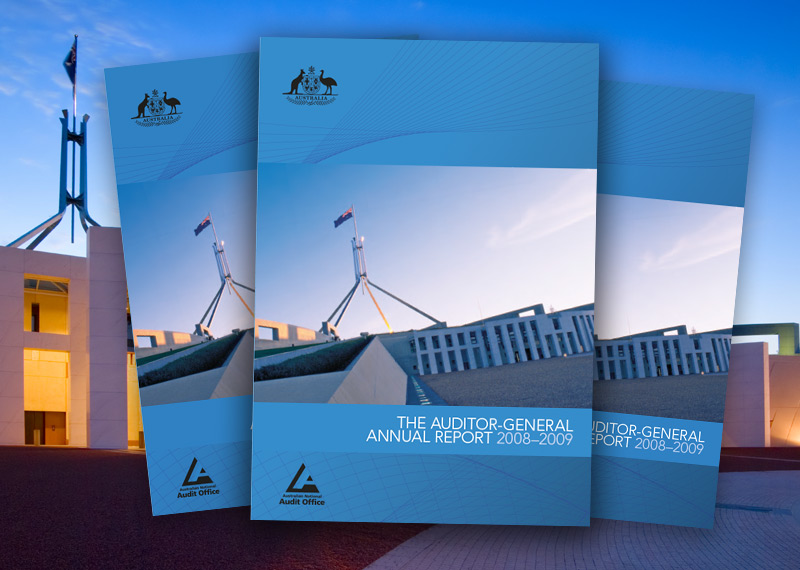
This annual report documents the performance of the Australian National Audit Office (ANAO) in the financial year ending on 30 June 2009. It includes a foreword by the Auditor-General, an overview of the Office, a report on performance, details about management and accountability, and the financial results.