Browse our range of reports and publications including performance and financial statement audit reports, assurance review reports, information reports and annual reports.
Annual report
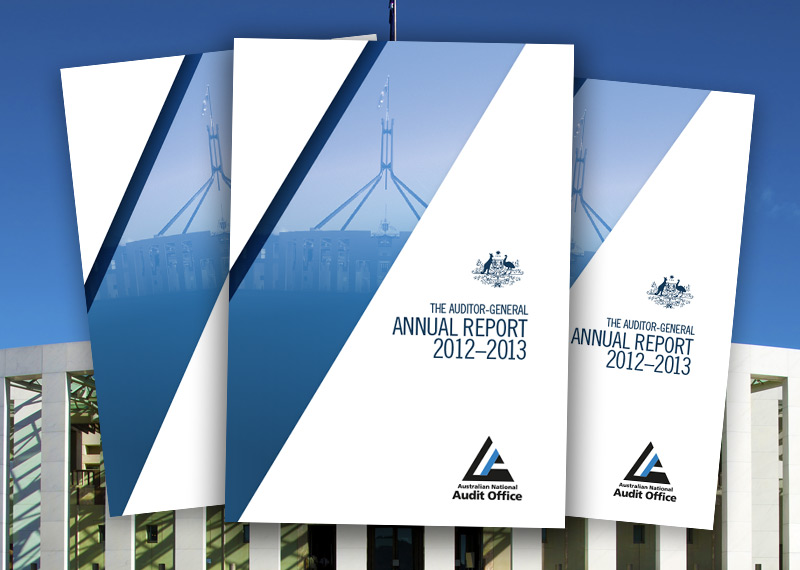
Published: Monday 30 September 2013
Published
This annual report documents the performance of the Australian National Audit Office (ANAO) in the financial year ending on 30 June 2013. It addresses the Requirements for Annual Reports for Departments, Executive Agencies and FMA Act Bodies approved by the Joint Committee of Public Accounts and Audit in June 2013; the performance measures set out in the outcomes and programs framework in the 2012–13 Portfolio Budget Statements; section 28 of the Auditor-General Act 1997; and other annual reporting requirements set out in legislation.
Performance audit (Auditor-General Report No. 29 of 2006–07)
Published: Wednesday 7 March 2007
Published
The objective of the audit was to assess the implementation and administration of the movement limit and the Slot Management Scheme at Sydney Airport.
The scope of the audit included the development and administration of the SADM Act. The scope also included the development and administration of the relevant legislative instruments and determinations, particularly those which put in place the monitoring and compliance frameworks that support the legislation.
Entity
NO-DEPTS-LISTED
Performance audit (Auditor-General Report No. 54 of 2012–13)
Published: Wednesday 26 June 2013
Published
The audit objectives were to assess the effectiveness of:
- selected agencies’ administration in developing advertising campaigns and implementing key processes against the requirements of the Australian Government’s campaign advertising framework, and other key legal and administrative requirements; and
- the ongoing administration of the campaign advertising framework.
Entity
Across Entities
Contact
Please direct enquiries relating to reports through our contact page.
Performance audit (Auditor-General Report No. 54 of 2003–04)
Published: Friday 18 June 2004
Published
The objective of the audit was to assess the effectiveness of DIMIA's management of its detention agreements with ACM to operate Australia's mainland immigration detention centres. In particular, the ANAO examined: DIMIA's strategic approach to the management and coordination of the contract; how DIMIA defined the services to be delivered by ACM; the systems in place to monitor and report against contract performance; the effectiveness of controls over contract payment arrangements; and DIMIA's management of infrastructure through the detention agreements.
Entity
Department of Immigration and Multicultural and Indigenous Affairs
Performance audit (Auditor-General Report No. 44 of 2006–07)
Published: Thursday 14 June 2007
Published
The objective of the audit was to assess the effectiveness of the Tribunals' management of their operations. To this end, the audit examined whether the MRT and the RRT:
- have achieved intended operational efficiencies from the introduction of common facilities, services and resourcing;
- have established appropriate arrangements for governance, business planning and guidance of Members and staff, and for performance monitoring and reporting of Tribunal operations;
- finalise cases within Tribunal time and productivity standards; and
- provide applicants with services in accordance with service standards.
The audit covered Tribunal operations for review of visa decisions. The correctness of individual decisions was not assessed as part of the audit.
The audit focused particularly on developments in the Tribunals' management performance in the four year period from 2001–02 to 2004–05.
Entity
Migration Review Tribunal; Refugee Review Tribunal
Performance audit (Auditor-General Report No. 3 of 2011–12)
Published: Tuesday 30 August 2011
Published
The objective of this audit is to examine the effectiveness of the TGA’s administration of complementary medicines regulation in Australia. The primary focus is on listed complementary medicines, which comprise about 98 per cent of these medicines.
Entity
Department of Health and Ageing
Performance audit (Auditor-General Report No. 21 of 2003–04)
Published: Monday 22 December 2003
Published
Directly after the collapse of Ansett in September 2001, most of its estimated 15 000 employees faced the possibility of retrenchment The Government immediately announced the introduction of the Special Employee Entitlements Scheme for Ansett group employees (SEESA) to address two risks facing the employees:
- the risk-to a certain limit - of a shortfall in their payments of accrued employee entitlements from Ansett and,
- the risk of delay in their being paid.
The objective of the audit was to determine how efficiently and effectively the two key elements of SEESA were managed: DEWR's management of the mechanism for making SEESA payments and DOTARS' management of the associated Air Passenger Ticket Levy.
Entity
Department of Employment and Workplace Relations; Department of Transport and Regional Services
Performance audit (Auditor-General Report No. 45 of 2006–07)
Published: Tuesday 19 June 2007
Published
The objective of this performance audit was to assess the administration of the National Black Spot Programme. It was undertaken in a manner similar to the audit of the Roads to Recovery Programme. Specifically, the audit approach involved:
- examination of DOTARS records and discussions with officers in DOTARS and four of the State road transport authorities responsible for administering the Programme;
- analysis of project monitoring, reporting and payment arrangements; and
- selecting a sample of 45 LGA areas across four States so that ANAO could examine projects delivered with Commonwealth funding.
Entity
NO-DEPTS-LISTED
Major projects report (Auditor-General Report No. 15 of 2012–13)

Published: Wednesday 19 December 2012
Published
The objective of this report is to provide comprehensive information on the status of selected Major Projects, as reflected in the Project Data Summary Sheets prepared by the DMO, and the Statement by the Chief Executive Officer (CEO) of the DMO, and including the ANAO’s review of the preparation of the PDSSs by the DMO.
Entity
Defence Materiel Organisation
Major projects report (Auditor-General Report No. 12 of 2013–14)

Published: Tuesday 17 December 2013
Published
The objective of this report is to provide the Auditor-General’s independent assurance over the status of selected Major Projects, as reflected in the Project Data Summary Sheets (PDSSs) prepared by the DMO, and the Statement by the Chief Executive Officer (CEO) DMO. Assurance from the ANAO’s review of the preparation of the PDSSs by the Defence Materiel Organisation (DMO) is conveyed in the Auditor-General’s Independent Review Report, prepared pursuant to the endorsed Guidelines, contained in Part 3.
Entity
Defence Materiel Organisation
Contact
Michael White, Executive Director, Phone: (02) 6203 7393