Browse our range of reports and publications including performance and financial statement audit reports, assurance review reports, information reports and annual reports.
Corporate
ANAO Integrity Framework 2026–27
Published
Wednesday 22 July 2026

Contact
Please direct enquiries through our contact page.
The ANAO regards integrity as a core value of the organisation — critical in sustaining the confidence of Parliament, strengthening public trust in government and delivering quality audit products. Maintaining strong institutional integrity is critical to the operations and reputation of the ANAO.
The ANAO Integrity Framework provides an overarching structure to the integrity control system, supporting our institution’s integrity. The framework serves to assist in ethical decision-making and risk, fraud and misconduct management.
Beyond its control system, the ANAO maintains an enduring focus on promoting integrity as a value that is embedded in our work and culture. The ANAO recognises that integrity demands quality not only in our products, but also in the behaviours of our people and those we contract to deliver work.
The ANAO Integrity Advisor supports the effective and ongoing application of the Integrity Framework by providing advice to staff regarding integrity matters. The Integrity Advisor is responsible for increasing integrity awareness across the organisation and for reporting annually to the ANAO Executive Board of Management on actions taken under the Framework.
The Auditor-General publishes the ANAO Integrity Framework and an annual Integrity Report to provide increased transparency of the measures we undertake to maintain a high-integrity culture in the ANAO.
1. ANAO Integrity Framework
Purpose
1.1 The ANAO is an integrity institution and maintaining credibility and independence is essential in exercising the Auditor-General’s powers and delivering against the mandate of the Auditor-General Act 1997. To demonstrate these qualities, the ANAO regards integrity as a core value of the organisation — critical in sustaining the confidence of Parliament, strengthening public trust in government and delivering quality audit products. It is critical to the operations and reputation of the ANAO that the organisation maintains strong institutional integrity.
1.2 The Auditor-General, and everyone authorised to act on their behalf (including employees and contracted personnel) occupy a position of trust. The ANAO is entrusted by the Parliament and the public to perform a critical accountability and transparency role across the public sector. This comes with a high-level of responsibility to behave in line with and perform work to the highest ethical standards, including maintaining confidentiality and demonstrating professional conduct.
1.3 The ANAO Integrity Framework provides an overarching structure to the ANAO’s integrity control system, supporting our institution’s integrity. The Framework serves to assist in ethical decision making and risk, fraud and misconduct management.
ANAO Values and Culture
1.4 The ANAO upholds the Australian Public Service (APS) Values as set out in the Public Service Act 1999. In addition to the APS Values, the ANAO places particular focus on respect, integrity and excellence. The ANAO values guide the Office in performing its role objectively, with impartiality, and in a manner that supports the Parliament.
1.5 Beyond its control system, the ANAO maintains an enduring focus on promoting integrity as a value that is embedded in our work and culture. The ANAO recognises that integrity demands quality not only in our products but also in the behaviours of our people. The APS Values and ANAO values reflect our unique role and purpose, relationship to the Parliament and operating environment. Our values underpin our approach to culture, performance outcomes and businesses processes. They define the behaviours we expect of our people, and those we contract with, in representing our organisation.
Definition of integrity
1.6 The ANAO defines integrity as the practice of demonstrating honesty and uncompromising adherence to strong ethical principles.
1.7 We expect our people to demonstrate integrity in their behaviours – as auditors, public servants, officials and professionals. The ANAO Integrity Statement outlines the five key principles of integrity – independence, honesty, openness, accountability and courage – and expected behaviours of staff at the ANAO. In the ANAO, integrity means more than simply complying with requirements, it means acting to achieve the intent and spirit of the requirements.
The ANAO Integrity Statement
The ANAO upholds five key principles of integrity – independence, honesty, openness, accountability and courage. In demonstrating integrity behaviours, ANAO staff are expected to:
Independence
- guard against decision making that puts their own interests above the public interest;
- take action against actual, perceived or potential independence threats; and
- fully disclose conflicts of interest and always act to minimise the impact of actual, perceived or potential conflicts of interest.
Honesty
- always act to achieve the intent of the ANAO and APS Code of Conduct;
- ensure decision making is consistent with the purpose and intent of the law, policy and guidelines; and
- promote a culture of trust and shared responsibility to maintain the ethical standards of the ANAO consistently and fairly.
Openness
- be transparent through open communication and active listening;
- communicate honestly, respectfully and clearly with everyone internally and externally; and
- encourage and acknowledge alternative and diverse views, ideas and concerns.
Accountability
- practise ethical decision making and preparedness to give reasons for decisions;
- promote transparency and accountability for decision making, behaviours and outcomes; and
- hold themselves and others to account for their behaviours and actions.
Courage
- apply public duty principles consistently, regardless of pressure to do otherwise;
- challenge behaviours that conflict with the values and standards of the ANAO; and
- support others in the face of adversity and act on reports of suspected wrongdoing.
Overview of the Framework
1.8 The Australian Public Service Commission (APSC) states that integrity in the APS is a multi-layered concept that is shaped by frameworks, policies, assurance mechanisms, its employees and broader organisational culture.
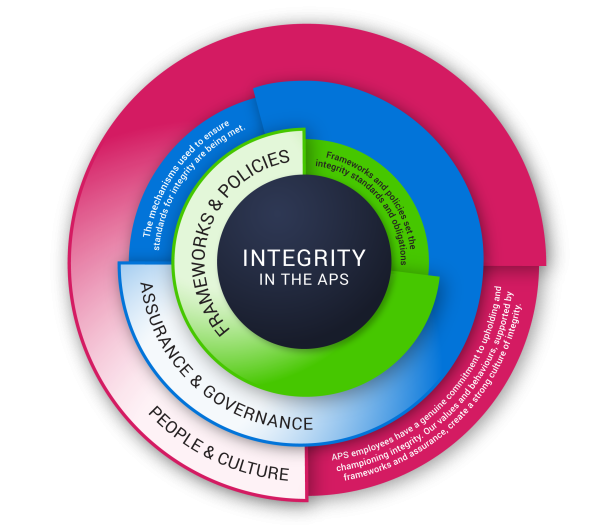
Source: Australian Public Service Commission Integrity (apsc.gov.au)
1.9 The ANAO Integrity Framework identifies the legislation, policies, processes, practices and reporting mechanisms that promote proactive integrity management. The Integrity Framework has been specifically designed to assist in improving governance practices and ethical decision making, including maintaining confidentiality; and supporting risk, fraud and misconduct management.
1.10 The application of the Framework supports the ANAO to have an organisational culture focused on integrity. Our Integrity Framework supports the ANAO’s transparency, accountability and credibility by:
- integrating processes and controls within the Framework;
- connecting ANAO policies, frameworks and guidelines that influence integrity across the organisation; and
- promoting the responsibilities and behaviours expected within the ANAO’s value-driven organisational culture.
ANAO Integrity Framework
Frameworks and Policies
Commonwealth frameworks and policies set the standards and obligations for the conduct, performance and behaviour of APS organisations and employees, and the APS as a whole. This includes the APS Values and Code of Conduct. The ANAO frameworks and policies that make up the Integrity Framework include:
Legislation, legislative instruments and standards
- Auditor-General Act 1997
- Public Service Act 1999
- Public Governance, Performance and Accountability Act 2013
- Public Interest Disclosure Act 2013
- Fair Work Act 2009
- Work Health and Safety Act 2011
- Freedom of Information Act 1982
- National Anti-Corruption Commission Act 2022
- Australian National Audit Office Auditing Standards 2026
- Australian Standard / International Standard Organisation, Risk management — Guidelines (ISO 31000:2018)
- Accounting Professional and Ethical Standards Board APES 110 Code of Ethics for Professional Accountants (including Independence Standards)
Commonwealth and ANAO frameworks and policies, including risk and fraud controls, and conflict of interest and gift and benefit procedures
- APS Code of Conduct
- Auditor-General Instructions
- Commonwealth Integrity Strategy
- Commonwealth Risk Management Policy
- Commonwealth Procurement Rules
- Ethics and Probity in Procurement: Principles guidance (issued by the Department of Finance)
- Protective Security Policy Framework
- ANAO Quality Management Framework and Plan
- Human Resources (HR) Delegations and Authorisations
- Financial Delegations and Authorisations
- Performance and Career Development Policy and procedures
- SES Remuneration Policy
- SES Performance Leadership Policy
- Work Health and Safety Policy
- ANAO Audit Manual, including independence policies
- Risk Management Framework
- Commonwealth Fraud and Corruption Control Framework 2024
- ANAO Fraud and Corruption Strategy and Control Plan 2026-28
- National Anti-Corruption Commission guidance, including the Commonwealth Integrity Maturity Framework
- ANAO Financial Management Procedures
- Procurement procedures and guidance
- Security Management Framework
- ANAO Artificial Intelligence Usage Policy
- Information, ICT, personnel and physical security policies and guidance Data Governance Guidelines
- Recognition and Awards Guidelines
- Declaration of Personal Interests Policy
- Gifts and Benefits Register
- Protective Security Governance Policy
- Enterprise Agreement 2024–27
- Employment Manual
- Outside Activities and Employment Policy
- ANAO Social Media Policy
- ANAO Guidance – Engagement with the National Anti-Corruption Commission
Assurance and Governance
Assurance and governance mechanisms ensure that integrity standards are being met. This includes:
Agency reporting
- ANAO Corporate Plan – including review of Strategic Planning Framework
- ANAO Annual Report – including Performance and Financial Statements
- Reports to the ANAO Audit Committee
- Reports to the Executive Board of Management (EBOM), including annual integrity maturity assessments
- Reports to ANAO Governance Committees
- Publication of the Auditor-General’s expenses and gifts and benefits
- Compliance Survey
- Annual ANAO policy and legislation compliance review
Audit
- External Audit – independent external review
- Internal Audit
Parliamentary oversight
- Reports to the Joint Committee of Public Accounts and Audit
People and culture
The ANAO has a strong pro-integrity culture. A pro-integrity culture involves the embedding of integrity into an agency’s culture, where it is a core consideration of all it does. In a pro-integrity culture, the primary motivating factor in the day-to-day conduct of APS employees is a genuine commitment to upholding and championing integrity as a core component of a professional public service.
Leadership and role-modelling
- Auditor-General’s Monthly Messages
- Auditor-General communications in ANAO Town Hall meetings
- SES Connect sessions and leadership forums
- Employee behaviours and integrity principles
- The Secretaries’ Charter of Leadership Behaviours (DRIVE)
Capability development
- Learning and Development – Employee Training
- Mandatory e-learning training, including annual training for all staff on the APS Values and Code of Conduct
- New starter induction program, including an integrity session
- LearnFest sessions on integrity
- Staff advisory and support, including the Integrity Advisor, Public Interest Disclosure Officers and Harassment Contact Officer network
Awareness raising
- Annual Integrity Awareness Week
- Integrity Advisor activities including communications, attendance at group all staff meetings, and various cohort meetings and forums
- Service group-led integrity activities and discussions
Communication
- Integrity intranet page and resources
- Internal integrity communications, including reminders on video display units, ANAO bulletin boards and Teams channels.
ANAO Integrity Advisor
1.11 To support the Integrity Framework the ANAO has an appointed Integrity Advisor. The Integrity Advisor is responsible for matters associated with integrity. The role of the Integrity Advisor includes responsibilities to:
- increase integrity awareness across the organisation;
- support the effective, ongoing application of the Integrity Framework; and
- report annually to the ANAO Executive Board of Management (EBOM) on actions taken under the Framework.
1.12 The Integrity Advisor is a point of contact for staff who are seeking advice and support on the application of the Integrity Framework. The Integrity Advisor is not responsible for determining if a matter is an integrity breach, or for making decisions about matters raised. Staff members seeking advice from the Integrity Advisor remain responsible for applying ANAO policies in the Framework and acting on the advice provided.
1.13 The annual report prepared by the Integrity Advisor is published on the ANAO website and includes a summary of enquiries and matters raised with the Integrity Advisor during the year.
ANAO Public Interest Disclosure (PID) Officers
1.14 PID Officers maintain key responsibilities under the Public Interest Disclosure Act 2013 (PID Act) and Public Interest Disclosure (PID) Scheme to promote integrity within the public service by supporting the effective functioning of public authorities and facilitating confidence in public institutions.
1.15 ANAO PID Officers support the Integrity Framework by demonstrating best practice, adherence to the legislation and ethical leadership. They also support the responsibilities of the Integrity Advisor.
1.16 The ANAO PID officers also have mandatory referral obligations under the National Anti-Corruption Commission Act 2022 (NACC Act). A PID authorised officer must refer corruption issues they become aware of in the course of performing their functions under the PID Act, if they suspect the issue could involve corrupt conduct that is serious or systemic.
2. 2026–27 Integrity Strategy and Plan
The Integrity Strategy and Plan sets out the forward activities the ANAO will undertake under the Integrity Framework. The Integrity Advisor leads delivery of these activities, working in collaboration across the ANAO to promote and maintain a pro-integrity culture and an enduring focus on integrity as a value that is embedded in our work and culture.
2.1 As set out in the ANAO Corporate Plan 2026-27, integrity and ethics remain an ongoing focus for the ANAO, not only in our audit work, but also in performance of our mandate and functions. This ensures we maintain independence, professionalism, integrity, ethics and quality in our work.
2.2 The Parliament is increasingly seeking insights from the ANAO on the relationship between compliance and organisational culture. Compliance — not just with mandatory requirements, but also the intent — is a hallmark of integrity, and essential to public administration craft. The ANAO will continue to focus on providing transparency and accountability on regulatory frameworks and the relationship with organisational culture through our audit work.
2.3 Audit work has demonstrated that a culture of integrity in an organisation flows from the standards set by its leaders, including expectation setting through regular communications. The ANAO will continue to focus on the ethical aspect of proper use and management of public resources, including entity governance and ethical frameworks.
2.4 In 2026–27, the ANAO will continue to advance integrity maturity across its frameworks, processes, and capabilities to uphold independence and the highest ethical standards. As a strategic enabler, integrity will guide continuous improvement efforts aligned with the ANAO 2026–27 Corporate Plan and strategy on a page (SoAP); focusing on impact where it matters, driving performance through innovation, and inspiring and developing our people.
2.5 In addition to the ongoing support and advisory role, the following table sets out key ANAO-wide integrity strategy deliverables the Integrity Advisor will lead and coordinate for 2026–27. Additionally, a range of service group-led integrity activities will also occur to support integrity awareness and capability, tailored to the operating environment.
|
Activity |
Measure of success |
|
Deliver an annual review and update of the Integrity Framework. |
The Integrity Framework 2026–27 published on the ANAO website. |
|
Deliver reports to EBOM on actions taken under the Framework, including:
|
|
|
Support awareness of the Integrity Framework, Integrity Advisor and staff responsibilities through activities such as:
|
|
|
Support ANAO participation in the National Anti-Corruption Commission delivery of the Commonwealth Integrity Survey (17 August to 25 September 2026) |
|
|
Undertake maturity assessment of the ANAO Integrity Framework against the Commonwealth Integrity Maturity Framework. |
Maturity self-assessment presented to EBOM (May 2027). |
|
Support integrity by design in development and review of ANAO policies and procedures through:
|
Ongoing and as required. |
|
Support Auditor-General and Deputy Auditor-General engagement with APS Integrity Agencies, where appropriate, to share ANAO insights and support cross-agency initiatives. |
Ongoing and as required. |
2.6 The Integrity Advisor will report on the status of these actions to EBOM, including through Framework and ANAO business plan reporting.