Browse our range of reports and publications including performance and financial statement audit reports, assurance review reports, information reports and annual reports.
Take our Insights reader feedback survey
Help shape the future of ANAO Insights by taking our reader feedback survey.
Official Travel
Please direct enquiries through our contact page.
Audit Lessons aim to share insights from our audit work to make it easier for people working within the Australian public sector to improve performance.
Audit Lessons — Official Travel is aimed at officials who undertake, manage or oversee domestic and international travel arrangements in Australian Government entities.
Introduction
Australian Government officials may need to travel domestically and/or internationally in the course of their duties. In most cases, the relevant Australian Government entity pays official travel costs, including airfares, accommodation, vehicle rental, and meals and incidentals. Effective travel arrangements help entities comply with the Whole of Australian Government Travel Arrangements (WoAG Travel Arrangements), achieve value for money, and manage integrity risks.
Benefits of having effective travel arrangements
Instils public confidence and trust in the efficient, ethical, economical and effective use of public resources.
Supports the objectives of the WoAG Travel Arrangements.
Provides entity assurance of achieving value for money and meeting business objectives.
Supports a strong integrity culture in the Australian Public Service (APS).
Enables informed executive decision-making through oversight of travel risks.
Whole of Australian Government Travel Arrangements
The Department of Finance (Finance) introduced the WoAG Travel Arrangements in 2010. The WoAG Travel Arrangements are coordinated procurements under the Commonwealth Procurement Rules and are intended to streamline how travel is booked and managed across the Australian Public Service. Non-corporate Commonwealth entities must follow the WoAG Travel Arrangements. Corporate Commonwealth entities, Commonwealth companies and Authorised Organisations can elect to adopt elements via an agreement with Finance. The WoAG Travel Arrangements encompass five components outlined in the table below.
Whole of Australian Government Travel Arrangements — services and suppliers
|
Component |
Services |
Suppliers (as at May 2026) |
|
Book |
The Travel Management Services (TMS) supplier provides booking services for air travel, hotel, bus, sea, rail, car rental, ground transport services, and charter flights. |
Corporate Travel Management (CTM) |
|
Fly |
Domestic and international air travel suppliers. The panel of airlines is not exclusive. Airlines included in the panel provide ‘discounted airfares and beneficial fare conditions’ to the Australian Government. |
Panel of 18 airlines
|
|
Stay |
All domestic accommodation must be booked through the sole supplier. Booking international accommodation through the supplier is encouraged but is not required. |
CTM |
|
Drive |
Domestic vehicle rental services supplier. Bookings can be made via the TMS or directly with the supplier via a WoAG portal. |
Hertz |
|
Pay |
Travel and Procurement Payments Services. For official travel booked via the TMS, entities are required to use a ‘lodge card’. Commonwealth credit cards are utilised for other expenses associated with travel such as meals and incidentals. |
National Australia Bank (NAB) |
Finance supports the WoAG Travel Arrangements through guidance, including Resource Management Guide (RMG) 404 (Domestic Travel Policy) and RMG 405 (Official International Travel).
The RMGs set out guidance for travellers and approvers. Two key considerations for officials undertaking and approving domestic and international travel are value for money and necessity of travel.
- Value for money requires ‘the use of Commonwealth resources in an efficient, effective, economical and ethical manner that is consistent with the policies of the Commonwealth and is reinforced through competitive decision making. Accordingly, when booking travel, officials must make decisions based on impartial consideration of fares available … ’
- Delegates, in approving official travel, ‘must be satisfied there is a demonstrated business need for the travel’ and that ‘Air travel must only to be undertaken where other communication tools, such as teleconferencing and videoconferencing, are ineffective’.
These policies also require travellers to select the Lowest Practical Fare (LPF) for domestic flights and the International Best Fare (IBF) for international flights.
- The LPF is ‘the lowest fare available at the time the travel is booked on a regular service (not a charter flight), that suits the practical business needs of the traveller’.
- The IBF is ‘the lowest fare on the day the travel is booked on a regular scheduled service (not a charter flight), that suits the practical business needs of the traveller and maximises overall value for money for the total cost of the trip’.
In 2024–25, $953 million was spent on travel through the WoAG Travel Arrangements.For further WoAG Travel statistics, see the Department of Finance’s website.The further reading section provides links to additional Department of Finance resources and relevant ANAO Insights products.
ANAO performance audits on travel arrangements
In 2025–26, the Auditor-General presented for tabling five performance audit reports that examined the effectiveness of travel arrangements in selected Australian Government entities.The audits examined if entities had appropriate: policies and procedures; internal controls; non-compliance arrangements; and monitoring and reporting arrangements.
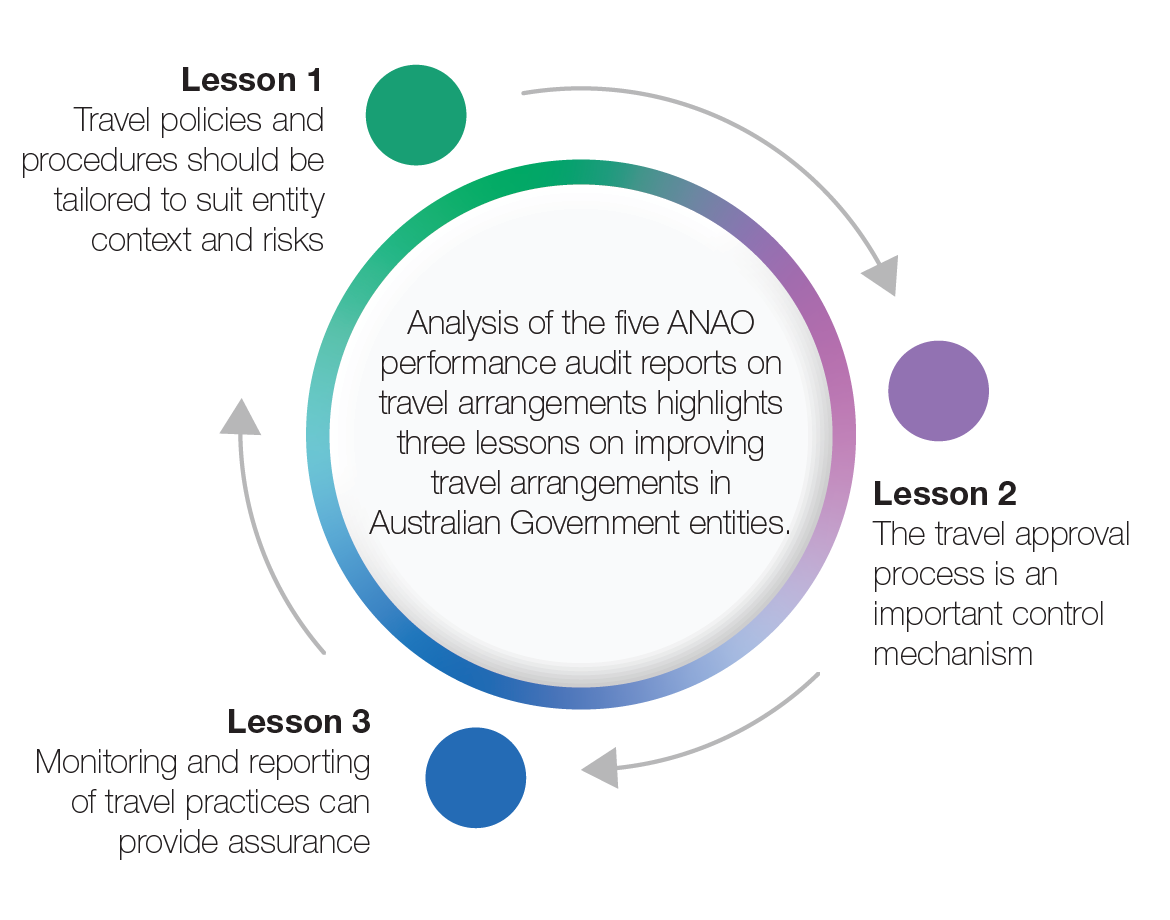
The five ANAO performance audit reports found that the majority of entities had sound arrangements in place with some areas for improvement. Ten recommendations were made across the five audits.
- Four recommendations focused on monitoring and reporting, especially to support oversight of travel risks and to ensure value for money across the organisation.
- Three recommendations related to evidence and documentation, of which two related to approval of travel under the Public Governance, Performance and Accountability Act 2013 (PGPA Act).
- Two recommendations focused on travel policy non-compliance.
- One recommendation related to monitoring of mandatory training.
Audit lessons
Lesson 1: Travel policies and procedures should be tailored to suit entity context and risks
Travel policies and procedures should be tailored to suit entity context and risks
Entities must ensure their travel policies and procedures support appropriate expenditure of money, reflect their specific context and risk profile, and (for non-corporate Commonwealth entities) comply with the WoAG Travel Arrangements.
Entities should regularly review and update travel policies to manage risk and reflect changes in operations. Policies should also align with related guidance, such as gifts and benefits, credit cards and conflicts of interest.
Lesson 1 questions for consideration
Does our entity have appropriate travel policies and procedures?
- For non-corporate Commonwealth entities: Do our policies and procedures comply with WoAG Travel requirements?
- For corporate Commonwealth entities and Commonwealth companies: Have we considered which WoAG Travel Arrangements elements to follow, what entity-specific arrangements need to be established and how our arrangements achieve value for money?
- Have we tailored our travel policies/procedures to suit our entity context, including travel patterns, risks and systems?
- Have we ensured there is alignment and cross-referencing (where relevant) to our other related policies, such as those for gifts and benefits and conflict of interest?
- Do we evaluate and review our policies to ensure travel arrangements achieve value for money and address changes in circumstances and requirements, and in response to non-compliance trends?
Entities need to determine travel policy settings and procedures relevant to their operations and risk settings. This includes, for example: approval and acquittal processes; and whether travel allowance or payment of actual costs for meals and incidentals via credit card is appropriate. Policies, procedures and processes should be clearly set out in easily accessible documents and guidance material and be supported by training.
Entities should review and update travel policies and procedures to reflect changes in an entity’s approach, operations and risk settings, and to support continuous improvement. Reviews may reveal opportunities to improve policies where appropriate, for example:
- updating roles and responsibilities, which may be required due to a substantial change in structure, functions, or activities, including a machinery of government change;
- updating thresholds, such as maximum travel expenditure limits and approval levels; and
- improving transparency and assurance, such as level of detail provided to delegates in the approval process.
Corporate Commonwealth entities and Commonwealth companies may elect to adopt some or all of the arrangements. Corporate Commonwealth entities and Commonwealth companies should ensure their travel arrangements are informed by an evidence-based value for money proposition and periodically assess whether their arrangements achieve value for money, including if they elect to use elements of the WoAG Travel Arrangements.
Case study
Observed examples from ANAO performance audits include:
Where there are multiple entity policies that contain travel information, the content across them should be consistent and complementary, e.g. across corporate credit card and travel policies or records management. Entities could review whether guidance they provide on memberships of airline loyalty programs, lounges or status credits (including personal memberships) are reflected in conflict-of-interest policies and/or their gifts and benefits policy. Entities could also review their credit card policy so that it aligns with travel approval requirements, timeframes, requirements for acquittals and endorsements of transactions.
Case study
Department of Agriculture, Fisheries and Forestry (DAFF)
Lesson 2: The travel approval process is an important control mechanism
The travel approval process is an important control mechanism
Delegates approving travel expenditure serve as an important control. Effective approval processes provide assurance that travel is necessary, represents value for money, and complies with entity policy and the WoAG Travel Arrangements.
Lesson 2 questions for consideration
Do delegates approving travel in our entity have visibility of appropriate information to assure themselves that travel is necessary, represents value for money and complies with entity policy and the WoAG Travel Arrangements?
- What do delegates do to ensure they receive relevant information?
- Do our systems, templates, checks and approval flows support delegates receiving this information as part of the process for approving trips and any variations?
- Do acquittal processes for travel expenditure ensure the delegate approving the acquittal has visibility of the original expenditure approval?
Under subsection 23(3) of the PGPA Act, accountable authorities can approve commitments of relevant money and may delegate this power to officials.
Delegates should receive adequate information to exercise professional judgement and assure themselves that approval of the travel is appropriate and meets value-for-money and necessity requirements.
Entities should have risk-based procedures to determine if approval processes are being followed. Further, the point in the travel process when approval should be recorded needs to be clearly documented in entities’ travel policies. ANAO audits identified variation in the quality and timing of travel approvals across entities.
Case study
Services Australia
Department of Agriculture, Fisheries and Forestry
Lesson 3: Monitoring and reporting of travel practices can provide assurance
Monitoring and reporting of travel practices can provide assurance
When entities actively monitor official travel arrangements, they can identify trends, assess risks and inform continuous improvement. Travel risks should inform the level of executive oversight, with observations reported periodically to appropriate levels of management.
Lesson 3 questions for consideration
Does our entity monitor and report travel information to provide assurance and inform continuous improvement?
- Do we monitor travel practices and risks, including non-compliance with travel policies and procedures?
- Do our systems and processes support the recording of the right information to enable effective monitoring?
- Do we provide reports to executive management at a frequency and scope that is proportionate to our entity’s travel risks and meaningful for oversight and inquiry?
- Does our monitoring and reporting inform updates to policies and procedures to address non-compliance and support the achievement of value for money, where required?
Monitoring and reporting of travel practices helps entities identify risks, assess compliance, and inform executive oversight. These insights support continuous improvement and responses to emerging issues, including the need to refine existing arrangements, or provide further training and guidance to officials.
Entities should design monitoring and reporting arrangements that are proportionate to risk, meaningful for oversight, and fit for purpose. Depending on their specific circumstances, entities should:
- Set up procedures and systems enabling officials to consistently record, and track and analyse travel practices, including types, approvals, expenditure and non-compliance.
- Provide periodic reports to executive management and relevant committees with the appropriate content and detail for the audience and proportionate to risk.
- Establish suitable monitoring and reporting, such as:
- non-compliance related to travel practices, including the types and reasons;
- travel budget and expenditure;
- emerging risks;
- completion of mandatory training related to travel; and
- the rate of the cheapest fare compared with other LPF and IBF booking codes and how these represent value for money for the entity and are appropriate in the context of its business operations.
Further reading
ANAO links
- Management of Corporate Credit Cards | Australian National Audit Office (ANAO)
- Gifts, Benefits and Hospitality | Australian National Audit Office (ANAO)
External links
Legislation
Department of Finance
- Accountable Authority Instructions (AAIs) - (RMG 206) | Department of Finance
- Commonwealth Procurement Rules | Department of Finance
- Domestic Travel Policy (RMG 404) | Department of Finance
- Non-Corporate Commonwealth Entities - key information (for RMG 400) | Department of Finance
- Official International Travel – Use of the best fare of the day (RMG 405) | Department of Finance
- Whole of Australian Government Travel Arrangements | Department of Finance