Browse our range of reports and publications including performance and financial statement audit reports, assurance review reports, information reports and annual reports.
Compliance with Domestic and International Travel Requirements in Services Australia
Please direct enquiries through our contact page.
Audit snapshot
Why did we do this audit?
- In 2024–25, $953 million was spent on travel through the Whole of Australian Government Travel Arrangements (the WoAG Arrangements). All non-corporate Commonwealth entities must comply with the WoAG Arrangements.
- The approach of an entity to official travel can reflect whether staff within the entity are behaving with integrity.
- The audit was conducted to provide assurance to the Parliament as to whether Services Australia has effective arrangements to comply with domestic and international travel requirements.
Key facts
- Services Australia is a non-corporate Commonwealth entity and must comply with all elements of the WoAG Arrangements.
- The Department of Finance manages the WoAG Arrangements.
What did we find?
- Services Australia’s arrangements for compliance with domestic and international travel requirements were effective.
- Services Australia has appropriate arrangements for managing domestic and international travel in accordance with WoAG requirements.
- Services Australia has implemented largely effective controls for official travel.
What did we recommend?
- There was one recommendation to Services Australia to monitor its purchases of airline memberships for officials to ensure value for money.
- Services Australia agreed to the recommendation.
995
number of Services Australia officials with domestic travel plans between 1 July 2022 and 30 June 2025.
$30.5m
spent by Services Australia officials on domestic and international travel in 2024–25.
457
airline lounge membership purchases, including renewals, for Services Australia officials between 1 July 2022 and 30 June 2025.
Summary and recommendations
Background
1. Staff in Australian Government entities undertake domestic and international travel for the purpose of achieving the objectives of the entity. The Whole of Australian Government Travel Arrangements (the WoAG Arrangements) are coordinated procurements established and managed by the Department of Finance. The WoAG Arrangements encompass five components: book; fly; stay; drive; and pay. The WoAG Arrangements are supported by resource management guides outlining the Australian Government policies for domestic and international air travel.
2. All non-corporate Commonwealth entities must comply with all elements of the WoAG Arrangements. Corporate Commonwealth entities and Commonwealth companies may elect to use some or all the arrangements. As a non-corporate Commonwealth entity, Services Australia must comply with the WoAG Arrangements.
Rationale for undertaking the audit
3. In 2024–25, $953 million was spent on travel through the WoAG Arrangements and Services Australia reported spending $30.5 million on travel. The purpose of the whole-of-government policy for travel is to maximise value for money. An entity’s approach to official travel reflects whether the entity is behaving with integrity by meeting the intent of the WoAG Arrangements. There has been parliamentary and public interest in relation to government travel arrangements and expenditure. The audit was conducted to provide assurance to the Parliament as to whether Services Australia has effective arrangements to comply with domestic and international travel requirements.
4. This audit is part of a series of domestic and international travel compliance audits. The entities included in the ANAO’s travel compliance series are: Department of Industry, Science and Resources; Department of Agriculture, Fisheries and Forestry; Civil Aviation Safety Authority; Australian Criminal Intelligence Commission; and Services Australia.
Audit objective and criteria
5. The objective of the audit was to assess whether Services Australia has effective arrangements to comply with domestic and international travel requirements.
6. To form a conclusion against the objective, the ANAO adopted two high-level audit criteria.
- Did Services Australia develop appropriate arrangements to manage domestic and international travel in accordance with whole of Australian Government requirements?
- Did Services Australia implement effective controls and processes for domestic and international travel in accordance with its policies and procedures?
Conclusion
7. Services Australia has effective arrangements in place to comply with domestic and international travel requirements except for aspects of its monitoring and review of travel-related data. The agency could strengthen its monitoring and review, including of its airfare selections and airline lounge membership purchases, to identify related potential or emerging risks or improvement opportunities.
8. Services Australia has established appropriate arrangements for managing domestic and international travel in accordance with the WoAG Arrangements. The agency has policies and procedures that align with the WoAG Arrangements. Training relating to official travel is provided on an on-the-job basis to relevant staff. There is a wide range of guidance on official travel and helpdesk support available to staff to assist in promoting compliance.
9. Services Australia was largely effective in implementing controls and processes for domestic and international travel in accordance with its policies and procedures. Officials consistently selected the lowest practical fare for domestic travel and international best fare for overseas travel. Trips were not consistently acquitted on time — from a sample reviewed by the ANAO, 79 per cent of domestic trips and 67 per cent of international trips were acquitted on time. The agency had limited processes to support compliance with airline loyalty and lounge program arrangements. Airline lounge membership purchases for non-Senior Executive Service (SES) staff were not always supported by documented approvals showing consideration of a significant need for travel. The agency has processes to identify and respond to non-compliance, implemented across two separate teams and collects data about non-compliance but does not analyse it to inform continuous improvement initiatives.
Supporting findings
Arrangements for managing domestic and international travel
10. Services Australia has developed policies and procedures for domestic and international official travel that align with the WoAG Arrangements. Services Australia has identified an integrity-related enterprise risk that it has rated as ‘medium’ and within tolerance. The agency also identified an enterprise fraud risk involving five travel controls — it advised the ANAO in December 2025 that it had revised its control effectiveness ratings and rated four controls fully effective (relating to policies, procedures and compliance assessments) and one partially effective (IT system controls). (See paragraphs 2.2 to 2.21)
11. Services Australia requires all officials to complete mandatory training on the duties and responsibilities of officials under the Public Governance, Performance and Accountability Act 2013 (the PGPA Act), including on the appropriate use of public resources. This mandatory training largely does not cover travel — two courses include travel-related content for SES and non-SES staff. Most learning for travel bookers takes place on-the-job — the agency does not deliver a travel-specific training module. Services Australia has a range of travel policy, procedures and supporting detailed guidance documents available for staff on its intranet. Guidance did not consistently present steps from a traveller’s perspective. Further support is available through a helpdesk provided by the agency’s Travel Services team, and from a virtual travel network for agency staff. (See paragraphs 2.22 to 2.40)
Controls and processes for managing domestic and international travel
12. Services Australia has implemented controls for domestic travel across planning and approval, booking and acquittal of expenses. Officials may not approve their own travel and approval by a financial delegate is required to be recorded in the agency’s IT system, ESS, prior to travel. The ANAO reviewed a random sample of 73 domestic trips and found 86 per cent had a record in ESS of approval prior to travel. In relation to air travel, Services Australia officials consistently selected the lowest practical fare, in compliance with the Whole of Australian Government (WoAG) travel policy — the lowest fare was selected for 33 per cent of trips. A Travel Allowance, for meals and incidentals, is payable after a trip has been approved in ESS. Most domestic trips (73 per cent) were appropriately acquitted. (See paragraphs 3.3 to 3.37)
13. Services Australia has implemented controls for international travel. Between July 2022 and June 2025, agency staff undertook 64 official international trips. The Travel Services team centrally manages all international arrangements, including bookings and acquittals. Approval for one of 13 international trips reviewed by the ANAO was not supported by evidence, as required by Services Australia’s Travel Policy. All 13 international flights were booked using the International Best Fare, consistent with the WoAG travel policy. A Travel Allowance is payable to staff during official travel, and while overseas this is payable at a higher rate than for domestic travel. The Travel Allowance is manually calculated and was correct for 12 of the 13 international trips the ANAO reviewed. Acquittals were not consistently completed within the required 28 days or supported by complete documentation. (See paragraphs 3.38 to 3.60)
14. Services Australia does not collect information on officials’ memberships of airline loyalty programs. The agency does not assess whether officials are being influenced by preferences for airlines, lounge, reward or loyalty programs when planning and undertaking official travel. Under Services Australia’s gifts and benefits policy, officers are required to declare gifted airline lounge memberships and upgrades due to status credits accrued from official travel, within 28 days — the median time for reporting these gifts and benefits was 42 days. Approval for purchases of lounge memberships for non-SES officials was not consistently recorded and did not always reflect consideration of a significant need for travel. (See paragraphs 3.61 to 3.77)
15. Services Australia has processes in place to identify and respond to non-compliance, implemented across two separate teams. The agency collects data about non-compliance but does not analyse it to inform continuous improvement initiatives. A 2023 assessment of Services Australia’s fraud controls for official travel resulted in five recommendations to improve some of the agency’s processes. Services Australia has since implemented four of these recommendations and advised the ANAO that the fifth is no longer required. (See paragraphs 3.78 to 3.101)
16. Reporting of non-compliance with finance law, including section 23 of the PGPA Act, is provided to Services Australia’s Audit and Risk Committee, and contains information on official travel. More detailed official travel compliance reporting was limited to the Payroll and Corporate Operations Branch until January 2025, after which all non-compliance was recorded in Services Australia’s Financial Management Compliance System. Public reporting on official travel includes responses to Questions on Notice which have not always been timely. (See paragraphs 3.102 to 3.116)
Recommendation
Recommendation no. 1
Paragraph 3.70
Services Australia monitor, on a risk basis, that its purchases of airline memberships are in accordance with its policy and represent value for money.
Services Australia response: Agreed.
Summary of entity response
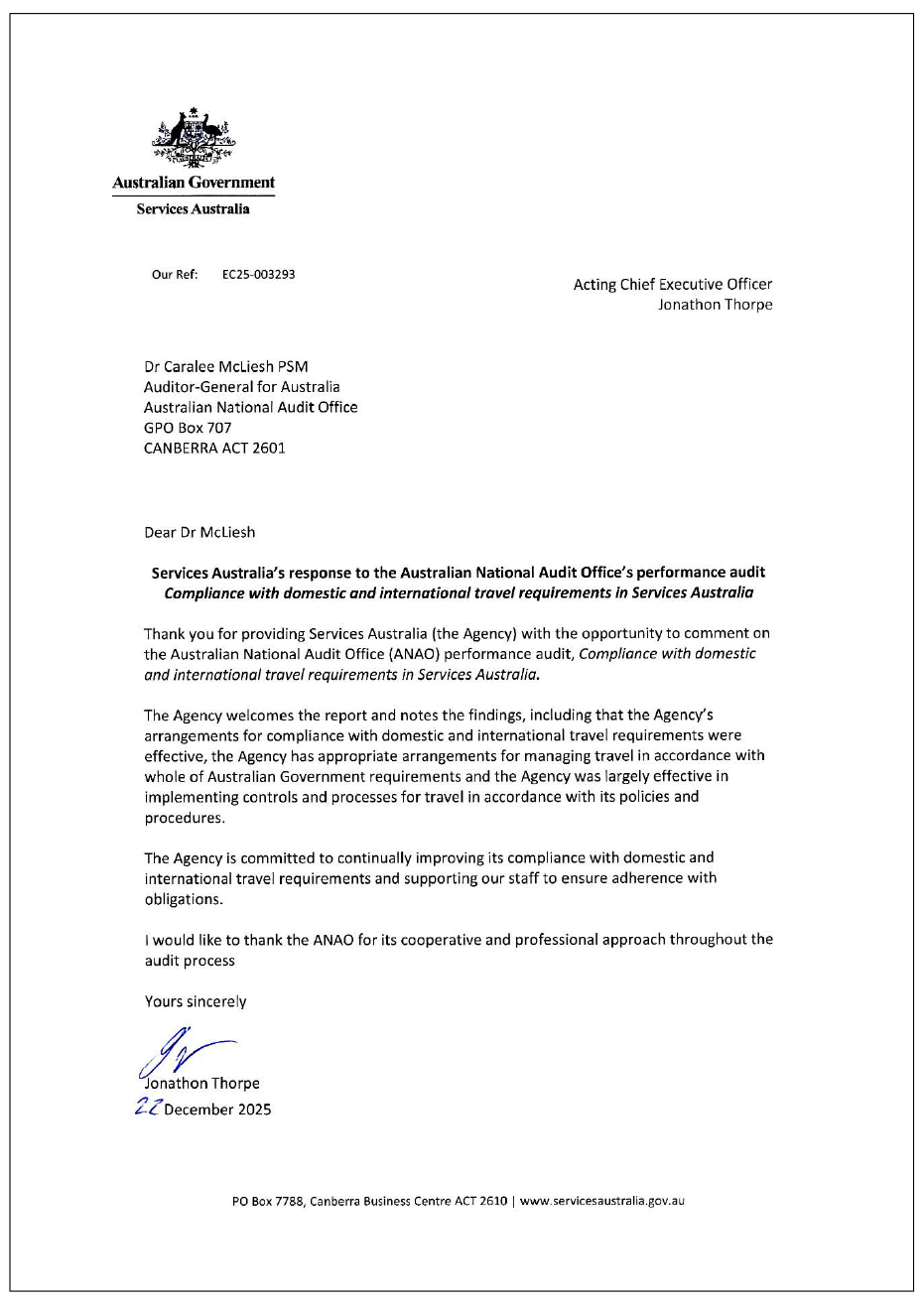
17. The proposed audit report was provided to Services Australia. Services Australia’s summary response is provided below. The full response from Services Australia is at Appendix 1. Improvements observed by the ANAO during the course of the audit are listed in Appendix 2.
Services Australia
Services Australia (the Agency) welcomes the report and notes the findings, including:
- The Agency’s arrangements for compliance with domestic and international travel requirements were effective
- The Agency has appropriate arrangements for managing travel in accordance with whole of Australian Government requirements; and
- The Agency was largely effective in implementing controls and processes for travel in accordance with its policies and procedures.
The Agency also acknowledges the one recommendation aimed at strengthening the monitoring of airline membership purchases to ensure they are in accordance with the Agency’s policy and represent value for money.
The Agency is committed to continually improving its compliance with domestic and international travel requirements and support our staff to ensure adherence with obligations.
The Agency would like to thank the ANAO for its cooperative and professional approach throughout the audit process.
Key messages from this audit for all Australian Government entities
18. Below is a summary of key messages, including instances of good practice, which have been identified in this audit and may be relevant for the operations of other Australian Government entities.
Governance and risk management
1. Background
Introduction
1.1 Staff in Australian Government entities undertake domestic and international travel for the purpose of achieving the objectives of the entity. Official travel is:
any travel where a Commonwealth entity is ultimately responsible for any of the direct or indirect costs associated with that travel … This includes travel by officials, contractors and consultants to undertake work duties at the direction of the employer to achieve one or more Commonwealth objectives.1
Australian Government framework for travel
1.2 The Commonwealth resource management framework governs how Australian Government entities use and manage public resources. The foundation of the framework is the Public Governance, Performance and Accountability Act 2013 (the PGPA Act). Under the PGPA Act, accountable authorities are required to promote the proper use and management of public resources.2
1.3 The Commonwealth Procurement Rules (CPRs) are issued by the Minister for Finance under section 105B of the PGPA Act. Compliance with the CPRs is mandatory for officials of non-corporate Commonwealth entities (NCEs). The CPRs require NCEs to use coordinated procurements where they exist.3 The Whole of Australian Government Travel Arrangements (the WoAG Arrangements) are coordinated procurements established and managed by the Department of Finance (Finance). All NCEs must comply with all elements of the WoAG Arrangements.4 Corporate Commonwealth entities (CCEs) and Commonwealth companies may elect to use some or all of the arrangements.
1.4 Finance has published model accountable authority instructions (AAIs), which include model instructions for official travel (see Box 1).5
|
Box 1: Model accountable authority instructions for official travel — non-corporate Commonwealth entities |
|
You must:
Where the government has established coordinated procurements for a particular travel activity, you must use the arrangement established for that activity, unless:
You must:
|
Whole of Australian Government Travel Arrangements
1.5 The WoAG Arrangements commenced in 2010 and aim to:
- reduce travel costs by aggregating government buying power to secure competitive pricing and discounts;
- decrease administrative costs for suppliers and entities by removing procurement duplication;
- simplify processes by integrating technology, unifying pricing and aligning systems;
- optimise savings by promoting efficient booking behaviour and value for money choices; and
- support Australian Government policies.6
1.6 The WoAG Arrangements encompass five components as outlined in Table 1.1.
Table 1.1: Whole of Australian Government Travel Arrangements — services and suppliers, July 2025
|
Component |
Services |
Suppliers (as at November 2025) |
|
Booka |
|
Corporate Travel Management (CTM) |
|
Flyc |
|
Panel of 18 airlines
|
|
Staya |
|
CTM |
|
Drivee |
|
Hertz |
|
Payf |
|
National Australia Bank (NAB) |
Note a: Standing Offer Notice ID SON3979293, available from https://www.tenders.gov.au/Son/Show/b3e4c6ad-ab57-4d46-a3c6-d0ce7b083ac7 [accessed 30 June 2025].
Note b: The supplier of Travel Management Services is known as the Travel Management Company (TMC).
Note c: Standing Offer Notice ID SON3337469, available from https://www.tenders.gov.au/Son/Show/606ca6fd-c615-d94c-905e-491969f2a3ba [accessed 30 June 2025].
Note d: Given the panel is not exclusive, entities are permitted to book both domestic and international air travel with non-panel airlines. Domestic flights and international flights departing Australia must be booked through the TMS.
Note e: Standing Offer Notice ID SON35277487, available from https://www.tenders.gov.au/Son/Show/1545a9af-e0d4-bab4-60d4-e03aed0558db [accessed 30 June 2025].
Note f: Standing Offer Notice ID SON3637640, available from https://www.tenders.gov.au/Son/Show/ad2d8b17-c42e-4601-a757-72568eafa384 [accessed 30 June 2025].
Note g: A lodge card is the digital number stored in the Travel Management Services supplier user profile.
Source: Department of Finance, Whole of Australian Government Travel Arrangements, About the Travel Arrangements and Department of Finance, Whole of Australian Government Procurement.
Lowest Practical Fare
1.7 The WoAG Arrangements are supported by resource management guides (RMGs) outlining the Australian Government policies for domestic and international air travel. The policies require travellers to select the ‘Lowest Practical Fare’ (LPF) for domestic flights and the ‘International Best Fare’ (IBF) for international flights.
- The LPF is ‘the lowest fare available at the time the travel is booked on a regular service (not a charter flight), that suits the practical business needs of the traveller’.7
- The IBF is ‘the lowest fare on the day the travel is booked on a regular scheduled service (not a charter flight), that suits the practical business needs of the traveller and maximises overall value for money for the total cost of the trip’.8
1.8 The LPF and IBF policies allow officials to book flights which are not the lowest (cheapest) fare. Officials select a booking code to explain why the lowest fare has not been chosen (see Table 1.2). Booking codes 1 to 6 are compliant with LPF and IBF policies. If flights are not compliant, then code 7 (‘Outside of LPF policy’) is to be used.
Table 1.2: Policy booking codes for Lowest Practical Fare and International Best Fare
|
Policy booking code |
Requirement |
|
|
1 |
Lowest fare |
Domestic: This is the cheapest available fare taking into account the one-hour window.a International: This is the cheapest fare taking into account the 24-hour booking window.b |
|
2 |
Timing, routing, connection or baggage charges |
Domestic: Where the fare selected is not the lowest fare because it:
International: Where the fare selected is not the lowest fare because it:
|
|
3 |
Approval/entitlement to travel at a higher fare class |
Domestic: All air travel is to be at the lowest practical fare in economy class unless there is a business case or entitlement to travel outside these guidelines. In these circumstances, officials are still required to obtain the lowest practical fare within the entitlement. International: All air travel is to be at the international best fare in the appropriate classc (having regard to internal travel policy) unless there is a business case or entitlement to travel outside these guidelines. In these circumstances, officials are still required to obtain the international best fare within the entitlement. |
|
4 |
Health issues |
Health issues for officials requiring certain facilities. A medical certificate is required to support use of this code. |
|
5 |
Personal responsibilities |
Impact on personal responsibilities such as family. |
|
6 |
Require flexibility to change booking |
Where flexibility is required for air travel, travel bookers must consider selecting a semi-flexible fare type instead of a fully flexible fare. |
|
7 |
Outside of LPF policy |
Preference for particular aircraft or airlines, availability of access to airline lounges, accumulation of airline benefits such as reward or loyalty points (including status credits). |
Note a: According to RMG 404 – Domestic Travel Policy, the one hour ‘time window’ is used by the TMS supplier to ‘monitor whether the lowest practical fare has been selected and assess potential missed savings … For outbound flights, the window commences 1 hour prior to the booked flight … For inbound flights, the window commences 1 hour after the booked flight’.
Note b: According to RMG 405 – Official International Travel – Use of the best fare of the day, the TMS supplier ‘applies the 24-hour window to the booked flight time from the point of departure to monitor whether the international best fare has been selected.’
Note c: RMG 405 – Official International Travel – Use of the best fare of the day requires officials to select ‘business class or equivalent or lower class airfare’.
Source: RMG 404 – Domestic Travel Policy and RMG 405 – Official International Travel – Use of the best fare of the day.
1.9 The RMGs set out additional guidance for travellers and approvers. Two key considerations for officials undertaking and approving travel are value for money and necessity of travel.9
- Value for money requires ‘the use of Commonwealth resources in an efficient, effective, economical and ethical manner that is consistent with the policies of the Commonwealth … Accordingly, when booking travel, officials must make decisions based on impartial consideration of fares available …’
- Delegates, in approving official travel, ‘must be satisfied there is a demonstrated business need for the travel’ and that ‘air travel must only be undertaken where other communication tools, such as teleconferencing and videoconferencing, are ineffective’.
Review of travel purchasing policies
1.10 In August 2024, the Australian Government published the Aviation White Paper to set out the ‘Australian Government’s vision for Australia’s aviation sector towards 2050 to ensure it remains safe, competitive, productive and sustainable.’ The White Paper contains 56 new policy initiatives. Under the banner of a ‘competitive and efficient aviation sector’, Initiative 17 is:
Review government travel purchasing policies to consider whether changed policy settings could better support competition. The Department of Finance will conduct the review in 2024.10
1.11 Finance finalised the ‘Review of Australian Government Travel Policies’ in December 2024.11 The review made seven recommendations.
- Publish WoAG Travel Arrangements usage and expenditure.
- Update policy to explicitly deal with flight upgrades.
- Return to market for a full re-tender of the Airline Panel following consultation with the market on the approach to status credits.
- Create one Government Travel Policy, including mandating economy class for flights under three hours, enhanced guidance on gifts and benefits and setting a two-year review period.
- Booking codes for best value fare to be updated to include a justification for selecting the booking code for delegate consideration.
- Work with the contracted TMS to improve services.
- Remove the requirement for accountable authorities to seek Ministerial approval for international travel over a certain threshold.
1.12 The Australian Government’s response to the recommendations is detailed in the ‘Review of Australian Government Travel Policies – What We’re Doing’, which stated ‘the Review found that the travel policies are generally fit for purpose and deliver significant savings for government.’12 Finance published the review and response on its website on 1 August 2025.
Airline loyalty programs
1.13 Airline loyalty programs (also known as frequent flyer programs) are customer loyalty schemes. According to the Australian Competition and Consumer Commission, customer loyalty schemes offer points or discounts with the purpose of increasing repeat business. There are two types of points offered by Australian airlines through their airline loyalty programs.13
- Reward points (also known as frequent flyer points) are awarded to travellers who are members of the airline’s loyalty program for certain flights.
- Status credits are also awarded to members of the airline’s loyalty program on certain flights and contribute to the tier status of a loyalty program membership (for example silver or gold).
1.14 Reward points and status credits can only be accrued by travellers who are members of an airline’s loyalty program. Since commencement of the WoAG Arrangements in 2010, government policy prohibits the accrual of reward points for official travel. The accrual of status credits is permitted for official travel.
Airline lounge access
1.15 Membership of an airline lounge is separate to membership of an airline loyalty program and membership to a loyalty program does not in itself provide access to airline lounges. Membership of an airline lounge alone does not entitle members to accrue reward points or status credits. Access to airline lounges is available to travellers based on the class of travel, i.e. business and first class.
1.16 Airline lounges can be accessed by officials who have purchased a membership. Both Qantas and Virgin Australia offer discounted lounge memberships as part of the WoAG Arrangements to Commonwealth officials. The discount is available if the entity purchases a membership for an official or if the official purchases it themselves in a personal capacity.
1.17 Qantas’ Chairman’s Lounge and Virgin Australia’s Beyond are by invitation-only memberships that provide access to premium airline lounges. Qantas and Virgin Australia may gift memberships of airline lounges, including invitation-only lounges, to senior officials. The Australian Public Service Commission (APSC) requires the annual reporting of gifted airline lounge memberships by agency heads.14
Services Australia
1.18 Services Australia (the agency) is an Australian Government agency that ‘supports Australians by efficiently delivering high-quality, accessible services and payments on behalf on the government.’15 These services include Medicare, Centrelink, Child Support and myGov. The Chief Executive Officer is the accountable authority for the purposes of the PGPA Act and the agency head for the purposes of the Public Service Act 1999. Services Australia is an NCE and it must comply with all elements of the WoAG Arrangements.
1.19 Official travel within Services Australia is arranged on a ‘self-service’ model for domestic trips, with bookings made either directly by travellers, or with the help of one of the agency’s 517 travel coordinators (often Executive Assistants). A central Travel Services team, within the Payroll and Corporate Operations Branch, is available to provide support, including a helpdesk. The Travel Services team also manages all international trip bookings. Every trip is required to be recorded in the agency’s IT system, SAP Essentials (ESS), which generates a unique trip number to assist the Travel Services team with monitoring trips and reconciling expenses.
1.20 In 2024–25 Services Australia’s total resourcing was $9.9 billion, departmental resourcing was $5.9 billion, and the average staffing level was 30,218. In 2024–25, Services Australia reported its expenditure on travel as $30.5 million, compared to $21.7 million in 2023–24 and $17.4 million in 2022–23. The agency is within the top ten of reported travel expenditure by NCEs in 2024–25.
1.21 Services Australia’s records indicate that between 1 July 2022 and 30 June 2025, nearly 1,000 officials planned over 42,000 official domestic trips16, with an average trip cost of $1,700. Over the same period, 48 officials completed 64 international trips, with an average trip cost of $12,500.
Previous ANAO audit coverage
1.22 Previous ANAO audits have identified issues in other entities with credit cards and travel. In 2023–24, the ANAO conducted a series of audits assessing compliance with corporate credit card requirements.17 These reports identified:
- positional authority risks with expenditure on travel and credit cards being approved by officials junior to the traveller;
- approval of travel not being provided prior to travel being undertaken; and
- failure to identify, record or respond to instances of non-compliance with travel requirements.
1.23 This audit is part of a series of audits on compliance with the WoAG Arrangements. The entities included in the series are: Department of Industry, Science and Resources; Department of Agriculture, Fisheries and Forestry; Civil Aviation Safety Authority; Australian Criminal Intelligence Commission; and Services Australia.
Rationale for undertaking the audit
1.24 In 2024–25, Australian Government entities spent $953 million on travel through the WoAG Arrangements. The purpose of whole-of-government policy for travel is to maximise value for money. An entity’s approach to official travel reflects whether the entity is behaving with integrity by meeting the intent of the WoAG travel framework. There has been parliamentary and public interest in relation to government travel arrangements and expenditure. The audit was conducted to provide assurance to the Parliament as to whether Services Australia has effective arrangements to comply with domestic and international travel requirements.
Audit approach
Audit objective, criteria and scope
1.25 The objective of the audit was to assess whether Services Australia has effective arrangements to comply with domestic and international travel requirements.
1.26 To form a conclusion against the objective, the ANAO adopted two high-level audit criteria.
- Did Services Australia develop appropriate arrangements to manage domestic and international travel in accordance with whole of Australian Government requirements?
- Did Services Australia implement effective controls and processes for domestic and international travel in accordance with its policies and procedures?
1.27 The audit examined the management of domestic and international travel by Services Australia officials from 1 July 2022 to 30 June 2025.
Audit methodology
1.28 To address the audit objective, the audit methodology included:
- reviewing legislative, policy and internal frameworks;
- examining Services Australia’s policies, procedures, travel management systems, assurance and reporting activities;
- meeting with Services Australia officials;
- testing the effectiveness of Services Australia’s control framework for travel; and
- analysing travel data from Services Australia’s systems and entity-level data from the WoAG travel management system.
1.29 The audit was conducted in accordance with ANAO Auditing Standards at a cost to the ANAO of approximately $363,555.
1.30 The team members for this audit were Barbara Das, Sonya Carter, Tim Fuller, Scott Lang, Steven Meyer, Danielle Page and Corinne Horton.
2. Arrangements for managing domestic and international travel
Areas examined
This chapter examines whether Services Australia (the agency) has appropriate arrangements in place to manage domestic and international travel in accordance with the Whole of Australian Government Travel Arrangements (WoAG Arrangements).
Conclusion
Services Australia has established appropriate arrangements for managing domestic and international travel in accordance with the WoAG Arrangements. The agency has policies and procedures that align with the WoAG Arrangements. Training relating to official travel is provided on an on-the-job basis to relevant staff. There is a wide range of guidance on official travel and helpdesk support available to staff to assist in promoting compliance.
Area for improvement
The ANAO suggested Services Australia could review its range of travel guidance to ensure it covers the process from a traveller’s perspective.
2.1 Entities need to establish arrangements for managing official travel in line with the requirements of the WoAG Arrangements. Entity policies and procedural guidance, as well as training, should be available, fit for purpose and easily accessible. Entity arrangements should be informed by an assessment of entity-specific risks.
Has Services Australia developed appropriate policies and procedures for domestic and international travel?
Services Australia has developed policies and procedures for domestic and international official travel that align with the WoAG Arrangements. Services Australia has identified an integrity-related enterprise risk that it has rated as ‘medium’ and within tolerance. The agency also identified an enterprise fraud risk involving five travel controls — it advised the ANAO in December 2025 that it had revised its control effectiveness ratings and rated four controls fully effective (relating to policies, procedures and compliance assessments) and one partially effective (IT system controls).
Framework for official travel
2.2 Services Australia’s framework for managing domestic and international travel is established through its:
- Accountable Authority Instructions (AAIs);
- Public Governance, Performance and Accountability (PGPA) Act 2013 (Chief Executive Officer, Services Australia) Delegation 2022;
- Services Australia Enterprise Agreement 2024–202718; and
- collective policy documents including a Travel Policy, Domestic Travel Procedure, International Travel Procedure, Travel Compliance Framework, Commonwealth Credit Card Policy and Gifts and Benefits Policy.
Accountable Authority Instructions
2.3 Services Australia’s AAIs, effective 31 January 2025, set out the Chief Executive Officer’s (CEO’s) instructions related to official travel:
Official travel is any travel where a Commonwealth entity is ultimately responsible for any of the direct or indirect costs associated with that travel (noting the exceptions for using the coordinated travel procurements). This includes travel by officials, contractors and consultants to undertake work duties, at the direction of the employer, to achieve one or more Commonwealth objectives.
Official travel should only be undertaken when there is a demonstrated business need and when other communication tools, such as teleconferencing and videoconferencing, are an ineffective option.
Arrangements for the purpose of official travel will generally be entered into under section 23 of the PGPA Act.
2.4 The Official Travel section of Services Australia’s AAIs is consistent with model AAIs issued by the Department of Finance. Three prior versions of the AAIs were in place between 1 July 2022 and 30 June 2025 — all versions issued reflected the model AAIs’ official travel content.
2.5 Services Australia’s AAIs include instructions for approval of travel and reflect the WoAG travel requirements to apply the Commonwealth Procurement Rules, use established coordinated procurement arrangements and not accrue reward or loyalty points.19 The AAIs include links to Services Australia’s various travel policy documents, contact information for the Travel Services team and related Australian Government guidance for the WoAG Arrangements.
PGPA Act 2013 (Chief Executive Officer, Services Australia) Delegation 2025
2.6 The PGPA Act 2013 (Chief Executive Officer, Services Australia) Delegation, dated 31 January 2025 establishes delegations in line with subsection 23(3) of the PGPA Act for the power to approve expenditure for procurements.20
Services Australia Enterprise Agreement 2024–27
2.7 Services Australia’s Enterprise Agreement for 2024–27 includes provisions for work-related travel, including a Travel Allowance to cover officials’ meals and incidentals. Additional expenses incurred due to the travel may be reimbursed with supporting evidence. For official international travel, the enterprise agreement states Services Australia ‘will meet reasonable costs of accommodation, meals and incidentals incurred on official travel overseas, either through the provision of a Corporate Credit Card or by payment of relevant components of a daily travel allowance …’.21
Travel policy
Domestic travel
2.8 Services Australia’s domestic travel policy is set out in its Travel Policy and detailed in the Domestic Travel Procedure. Between 1 July 2022 and 30 June 2025, an earlier version of the Travel Policy applied until it was reviewed in June 2024.22 The Domestic Travel Procedure issued in July 2021 was reviewed and updated in March 2025.
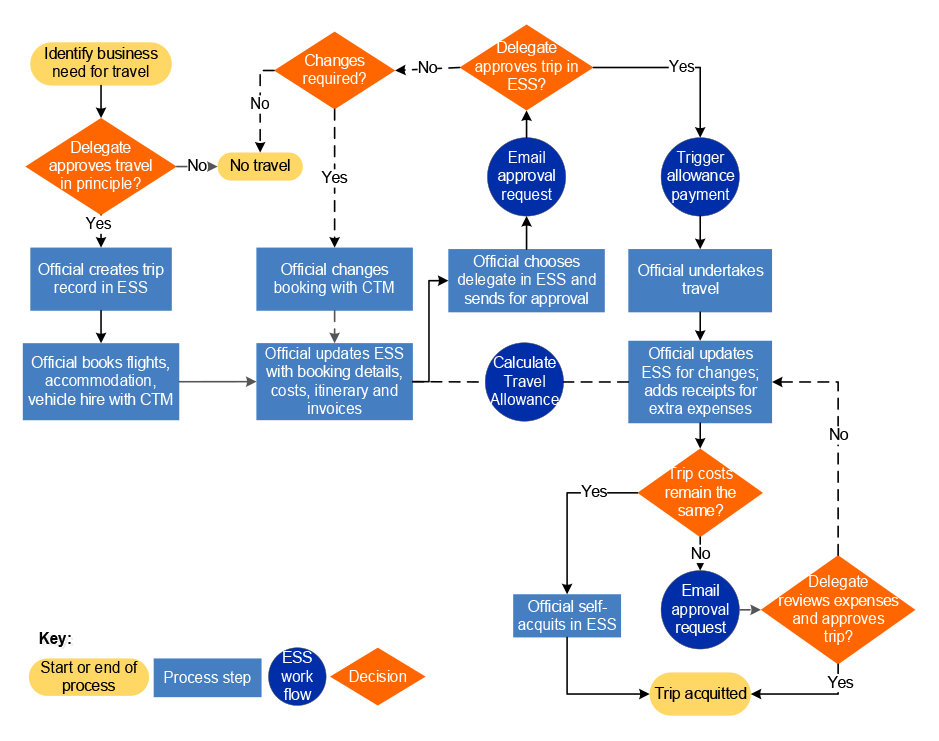
2.9 Travel policy updates reflected changes in broader WoAG Arrangements and a new enterprise agreement. Minor changes were also made to action advice from a Fraud Intelligence review in January 2023. Figure 2.1 below, sets out the agency’s domestic travel process during audit fieldwork in October 2025.
Figure 2.1: Domestic travel process at Services Australia
Note: All trips are required to be recorded in Services Australia’s IT system, SAP ESSentials (ESS). To create a trip record in ESS, officials enter basic trip details, including travel dates, destination, reason and business case.
The ‘delegate’ is the travel approver (generally the traveller’s manager) recognised by ESS as having sufficient financial delegation to authorise the trip.
Source: ANAO, based on Services Australia documentation.
2.10 The ANAO’s assessment of Services Australia’s domestic travel policy alignment with requirements of the WoAG Arrangements and Resource Management Guide (RMG) 404 is set out in Table 2.1.
Table 2.1: Alignment of Services Australia’s domestic travel policy with the Whole of Australian Government Travel Arrangements
|
WoAG requirement |
ANAO assessment of Services Australia’s policy |
|
|
Select lowest practical fare — the lowest fare available, that suits the practical business needs. |
◆ |
Officials are required to select the lowest practical fare and are given guidance to do so in the Travel Policy and the Domestic Travel Procedure. |
|
Value for money — use of resources in an efficient, effective, economical and ethical manner that is consistent with Australian Government policies.a |
◆ |
The Travel Policy states, ‘Your official travel must represent value for money and the efficient use of Commonwealth resources.’ The Travel Policy and AAIs require compliance with Australian Government policy. |
|
Necessity of travel — air travel must only be undertaken where other communication tools are ineffective. |
◆ |
Services Australia staff may undertake official travel where there is an essential business need. Reason and business case are mandatory fields for all trips to be recorded in the travel IT system, ESSentials. |
|
Diligence — officials must act in accordance with travel policies and with the Code of Conduct. |
◆ |
The requirement to comply with the APS Values, Code of Conduct and travel policies is set out in the Travel Policy and AAIs. |
|
Use contracted travel management services (TMS)b to book domestic flights and accommodation. |
◆ |
Services Australia’s AAIs and Domestic Travel Procedure set out requirements to use the TMS. |
|
Use the contracted hire car provider for car rental. |
◆ |
The AAIs and Domestic Travel Procedure require use of the contracted hire car provider. |
|
Domestic airfares must be economy class unless there is a reason or entitlement to travel business class. |
◆ |
The Travel Policy and Domestic Travel Procedure set economy as the standard class of domestic air travel. Exceptions are discussed in paragraph 2.11. |
|
Airline reward and loyalty points. |
◆ |
Services Australia’s policy aligns with the WoAG Arrangements. |
|
Use of virtual travel card (lodge card) when booking in the TMS supplier portal. |
N/A |
While Services Australia’s policy does not document this requirement, its practice is consistent with it. The agency has two credit lodge cards: one for air and accommodation purchases; and one for vehicle hire. The Travel Services team manages these to pay WoAG travel suppliers on behalf of all agency staff. The minority of staff with corporate credit (purchase) cards may not use them to pay WoAG travel suppliers.c |
Key: ◆ Fully aligned ▲ Partly aligned ■ Not aligned N/A Not applicable
Note a: Officials must make decisions based on an impartial consideration of the fares available and not on a personal preference for a particular airline, aircraft, airline lounges or airline reward and loyalty program.
Note b: Since 1 July 2023, the contracted TMS supplier has been Corporate Travel Management (CTM). Previously it was QBT. See Table 1.1.
Note c: Purchasing cards are physical cards issued to officials to make purchases of goods and services, while travel cards are ‘virtual’ cards only used for bookings made through the travel management system.
Source: ANAO analysis.
2.11 Under Services Australia’s Travel Policy, non-SES staff may only travel business class in exceptional circumstances, with evidence of a relevant disability or medical condition and prior written approval. SES employees may fly business class for single-leg trips of over two hours, or multi-leg trips. Prior to 17 March 2024, SES officials were only required to fly economy class on single-leg journeys between Canberra and Sydney and between Canberra and Melbourne.
International travel
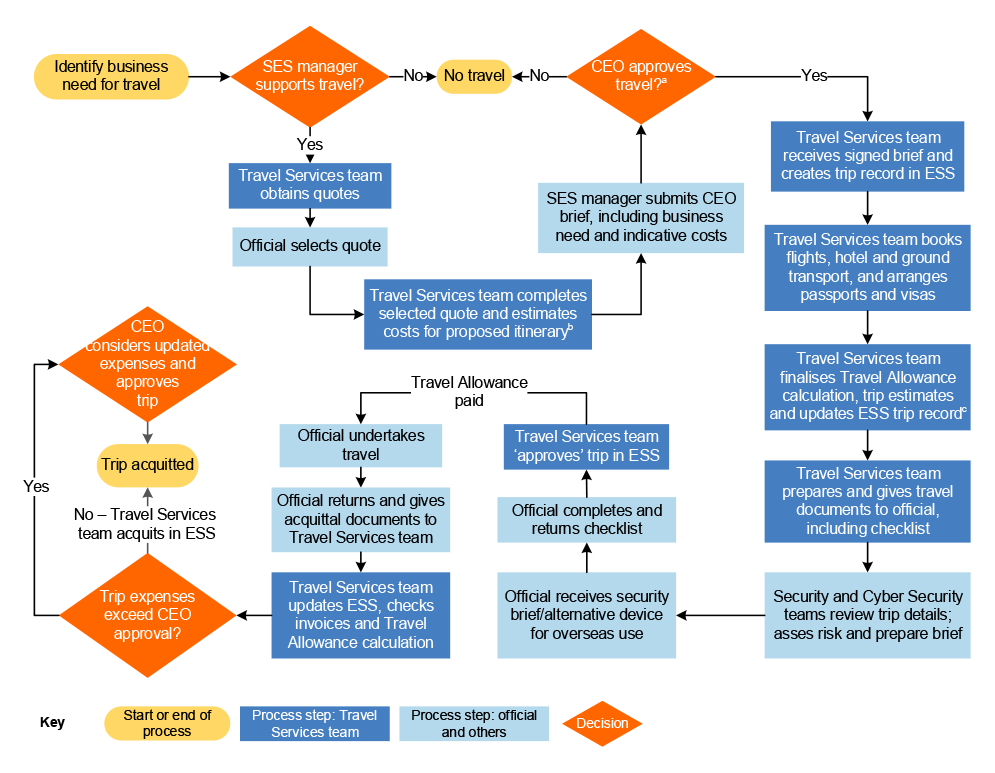
2.12 Services Australia’s requirements for international travel are set out in its Travel Policy and expressed in more detail in its International Travel Procedure. During the period 1 July 2022 to 30 June 2025, the International Travel Procedure was reviewed and updated twice, in November 2022 and March 2025.23 Unlike domestic travel, which is booked directly by travellers across Services Australia, the central Travel Services team arranges all international trips. Figure 2.2 below, shows the agency’s international travel process during audit fieldwork in October 2025.
Figure 2.2: International travel process at Services Australia
Note a: In some instances, the Executive Committee may approve travel without a brief. Since April 2025, Services Australia has required a detailed CEO brief to follow Executive Committee approval (see paragraph 2.15).
Note b: The Travel Services team estimates all costs for the proposed itinerary, including flights, accommodation, ground transport, Travel Allowance and equipment allowance. Indicative costs in the CEO brief include a 10 per cent allowance for potential variation above estimated costs.
Note c: Overseas Travel Allowance is calculated manually and paid at a higher rate than for domestic travel — the amount payable depends on the country visited.
Source: ANAO, based on Services Australia documentation.
2.13 The ANAO’s assessment of Services Australia’s international travel policy alignment with requirements of the WoAG Arrangements and Resource Management Guide (RMG) 405 is set out in Table 2.2.
Table 2.2: Alignment of Services Australia’s international travel policy with Whole of Australian Government Travel Arrangements
|
WoAG requirement |
ANAO assessment of Services Australia’s policy |
|
|
International Best Fare (IBF) — the lowest fare at the time of booking considering business needs, to maximise value for money. |
◆ |
Services Australia’s Travel Policy states that for international travel, officials must choose the IBF. The International Travel Procedure sets out the IBF in more detail and links to RMG 405. |
|
Value for money. |
◆ |
Official travel is required to represent value for money and efficient use of Commonwealth resources. The International Travel Procedure includes considerations for travellers to maximise value for money. |
|
Necessity of travel. |
◆ |
Services Australia’s employees may undertake official travel where there is an essential business need. |
|
Approval of the need to travel — officials are to use the entity’s internal controls for the approval requirements that apply to international travel. |
◆ |
International travel must be approved by the CEO, informed by a brief that includes indicative costs, prior to arranging travel. In some instances, the Executive Committee may approve travel without a brief.a |
|
Use of contracted TMS to book international air travel departing Australia. |
◆ |
Services Australia’s AAIs and Travel Policy set out requirements to use the TMS. Full procedural requirements are not set out as international flights are only booked by the central Travel Services team. |
|
Class of travel — officials must select a business class or equivalent, or lower-class airfare. |
◆ |
Officials may travel overseas in business class (or equivalent). If business class is not available, they may travel in premium economy or economy class. |
|
Airline reward and loyalty points. |
◆ |
Policy documents align with the WoAG Arrangements. |
|
Safety |
◆ |
Safety guidance is in the International Travel Procedure and travellers are instructed to subscribe to the Smartraveller website.b A security briefing is to be provided and a security risk assessment undertaken. |
|
Use of virtual Travel card (lodge card) when booking in the TMS supplier portal. |
N/A |
The Travel Services team manages Services Australia’s two lodge cards to pay WoAG travel suppliers on behalf of the whole agency. WoAG suppliers are booked by this team, rather than individual officials. The minority of staff with corporate credit cards (not lodge cards) may not use them to pay WoAG travel suppliers. |
Key: ◆ Fully aligned ▲ Partly aligned ■ Not aligned N/A Not applicable
Note a: Since April 2025, Services Australia has required a detailed CEO brief to follow Executive Committee approval (paragraph 2.15). Until June 2024, the agency’s Travel Policy stated that minister approval was required for trips with total cost of over $30,000. The agency assessed the requirement as outdated and corrected it when updating its Travel Policy in June 2024. The requirement was not in the International Travel Procedure.
Note b: The Department of Foreign Affairs and Trade’s website is at https://www.smartraveller.gov.au/ [accessed September 2025].
Source: ANAO analysis.
2.14 Services Australia’s travel policy largely reflects the contents of RMG 405 (international travel), and the International Travel Procedure includes links to RMG 405. As the Travel Services team centrally arranges all international travel, the following procedural statements from RMG 405 are not directly included in the agency’s travel policy:
- including WoAG transaction/administration fees in the IBF calculation;
- obtaining three airline quotes;
- booking strategies detail, such as considering different routes and ‘through’ fares; and
- identifying the IBF policy code for the fare chosen.
2.15 From April 2025, Services Australia has required Executive Committee approvals of international trips to be followed by a formal CEO brief, with full trip details, costs, dates and risks.
Services Australia’s credit card policy
2.16 Services Australia’s ‘Commonwealth Credit Card Policy’ sets out the rules officials must follow when using and managing Commonwealth credit cards. Credit card transactions must be acquitted within 28 days within ESS, with supporting documentation. While the credit card policy does not set out requirements for acquitting purchases made during overseas travel, the International Travel Procedure instructs officials to retain receipts of expenditure on incidental official travel related items to validate expense claims.
Assessment of risk
2.17 Services Australia’s Corporate Plan 2024–25 sets out nine enterprise risks. Official travel is a component of enterprise risk three, ‘Organisational integrity: We fail to maintain the governance, processes and training that support the integrity of our people and contracted third parties.’ In August 2025, Services Australia reported to its Audit and Risk Committee that it assessed the risk as ‘medium’24, and within tolerance.
2.18 Within the 2022–23 Enterprise Fraud and Corruption Risk Management Plan (EFCRMP), official travel was one of multiple contributing causes identified for Risk 2 — ‘theft, misdirection or misuse of agency funds and/or assets.’ One of the 16 identified causes of Risk 2, was ‘The agency fails to prevent, detect or respond to staff and/or contractors fraudulently claiming pay, travel and other employee entitlements.’ Four agency-wide controls were identified for Risk 2 that relate to travel.
2.19 Services Australia’s EFCRMP dated 31 July 2024 includes travel as a cause against the same risks, and identified the same controls, as the previous plan. Services Australia’s assessment of control effectiveness as at 31 July 2024 is in Table 2.3.
Table 2.3: Services Australia’s assessment of the effectiveness of travel-related fraud-risk controls — as at 31 July 2024
|
Control description |
Control effectiveness rating 31 July 2024 |
|
ACL215 — Travel Compliance Framework. |
◑a |
|
C3 — The agency manages travel, leave, pay, allowance, overtime, reimbursement and workplace injury and illness in accordance with Commonwealth legislation. The agency maintains, reviews and promotes a suite of policies that are available on the intranet. |
● |
|
C53 — The agency conducts regular compliance checks to ensure official travel that is undertaken complies with travel policy, travel information sheets and the travel compliance framework. |
◑a |
|
C55 — The agency provides staff with procedural instructions and guidelines in line with current legislation and/or policy that they are required to follow to enable consistent processes for travel, leave, pay, allowance, overtime, reimbursement and workplace injury and illness. |
● |
|
C100 — Staff use the ESSentials system to record, report and approve all HR activities, including leave requests and travel. |
◑a |
Key: ● Fully effective ◑ Partially effective ◯ Not effective
Note a: Services Australia advised the ANAO in December 2025 that it has since updated its assessment of controls ALC215 and C53 to ‘fully effective’ (see paragraph 2.20). Services Australia also advised that it had assessed control EFC100 as partially effective due to risks with both travel and non-travel uses of ESS.
Source: Services Australia documentation.
2.20 In 2025, Services Australia reviewed its EFCRMP, including its approach to documenting and reporting risks and controls. The agency advised the ANAO in December 2025 that, as part of the review, it had updated its assessment of travel-related controls ALC215 and C53 (see Table 2.3) to ‘fully effective’. As at January 2026, the 2024–25 EFCRMP was yet to be formally approved. Services Australia advised:
The majority of documented fraud controls and treatments were reassessed by the relevant control owners in the last quarter of 2025 as an interim refresh of content, and control owners’ confirmation of content accuracy is in the final stages and due for completion by end January 2026. Following this Security Committee will be given visibility of the EFCRMP review outcomes and any fraud and corruption risk issues requiring escalation through the agency’s regular quarterly Fraud and Corruption Control reporting (next report due March 2026).
2.21 The agency’s Travel Compliance Framework’s purpose is to provide the information necessary to evaluate the agency’s internal controls for travel policy and procedural compliance. The framework also outlines travel risks — that non-compliance with the Travel Policy, and associated policies, would result in increased travel costs, including from unnecessary travel, negative public perception of official travel and unethical use of public money. The Travel Compliance Framework is further discussed from paragraph 3.79.
Has Services Australia developed appropriate training and education arrangements to promote compliance with travel requirements?
Services Australia requires all officials to complete mandatory training on the duties and responsibilities of officials under the PGPA Act, including on the appropriate use of public resources. This mandatory training largely does not cover travel — two courses include travel-related content for SES and non-SES staff. Most learning for travel bookers takes place on-the-job — the agency does not deliver a travel-specific training module. Services Australia has a range of travel policy, procedures and supporting detailed guidance documents available for staff on its intranet. Guidance did not consistently present steps from a traveller’s perspective. Further support is available through a helpdesk provided by the Travel Services team, and from a virtual travel network for agency staff.
2.22 The Australian Public Service Commissioner’s Directions 2022 mandates integrity training for all employees of the Australian Public Service, with entities to provide a range of additional mandatory training and education to officials. The PGPA Act requires accountable authorities to establish and maintain measures to ensure officials comply with the finance law. Failure to comply with the finance law is a breach of the APS Code of Conduct.
2.23 While there is no requirement for entities to provide travel-specific training or education to officials, the WoAG Arrangements form part of the Commonwealth Procurement Rules, which are part of the finance law. Providing training and education to officials to support compliance with the WoAG Arrangements is a measure to support officials to comply with the finance law.
Mandatory training at Services Australia
2.24 Services Australia provides the following Enterprise Mandatory Training for staff in its Learning Management System (LMS), accessed through ESSentials:
- Mandatory Induction Program (MIP) — five modules to be completed within a week of commencement that cover values and integrity, Work, Health and Safety (WHS), security, privacy, and fraud and corruption.
- Five courses covering records management, child safety, family and domestic violence, Indigenous cultural learning and building multicultural awareness — to be completed within three months of commencement.25
- Mandatory Refresher Program — one course covering core elements of the above courses that staff are required to complete annually.
2.25 The Values and Integrity and Fraud and Corruption MIP modules, and the Mandatory Refresher Program, cover behaviours and examples relevant to supporting compliance with travel requirements. The Values and Integrity and Fraud and Corruption modules were updated within the past 12 months.
2.26 Services Australia advised the ANAO that SES officials must complete the following:
- SES Mandatory Induction training on commencement — including Values and Integrity; WHS; Security; Privacy; Fraud; Child Safety — General Awareness; Indigenous Cultural Learning; Building Multicultural Awareness; Privacy Fundamentals.
- SES Mandatory training — SES Procurement and Contract Management; Conflict of Interest; Safety Leadership; Due Diligence Information Pack; Records Management; Exploring our Culture; Multicultural Awareness SES; SES Changing Mindsets: Direct Management Program; and SES WHS Annual Due Diligence.
The Security module included travel-related cyber-security guidance, and the Fraud module included travel-related examples.
2.27 Services Australia also delivers two courses that include content relevant to official travel requirements:
- Finance Essentials — which covers the Commonwealth Resource Management Framework, Services Australia’s Financial Framework, including guidance on spending agency money, and relevant travel policies, including how staff can comply with key travel requirements.
- Corporate Credit Card Training — intended to help card holders perform their roles and responsibilities under the PGPA Act and Services Australia’s Financial Framework. This training is relevant to staff who may have to use a corporate credit card for purchase of non-WoAG travel services (e.g. taxi or overseas accommodation).
2.28 While the Finance Essentials and Corporate Credit Card Training courses are not mandatory for all agency officials, the Corporate Credit Card Training is mandatory for cardholders — 1,167 staff held a credit card between 1 July 2022 and 30 June 2025. As at 30 June 2025, there were 808 active credit cards.
Monitoring of mandatory training completion
2.29 Services Australia advised the ANAO that compliance against Enterprise Mandatory Training requirements is reported monthly to General Managers and quarterly to its People Committee through a Learning Update report. From 1 July 2022 to 30 June 2025:
- 24,617 individuals completed the online Values and Integrity course, and 23,530 passed; and
- 23,461 individuals completed the online Fraud and Corruption course, and 22,558 passed.
2.30 Services Australia advised the ANAO in November 2025 that additional staff completed equivalent mandatory training in person, bringing the total number of staff who completed the Values and Integrity training to 28,905 and the Fraud and Corruption training to 28,064.
2.31 In relation to SES mandatory training with some travel-related content, Services Australia advised the ANAO that:
- 48 individuals completed the Security induction training; and
- 41 individuals completed the Fraud induction training.
2.32 Services Australia records but does not monitor or report completion rates for the Financial Essentials and Credit Card training packages.
- From 1 July 2023 to 30 June 2025, 473 staff undertook and passed the Financial Essentials Training.
- From 1 July 2022 to 30 June 2025, 733 staff undertook and passed the Credit Card Training — equivalent to 91 per cent of all staff with a credit card at 30 June 2025.
Travel-specific training
2.33 Services Australia advised the ANAO that travel-related training includes on-the-job training provided to the Travel Services team, Executive Assistants and other travel coordinators across the agency. Services Australia does not offer staff training packages specific to official travel.
Guidance material
2.34 A range of travel guidance is available for Services Australia officials through the agency’s intranet, including:
- policy documents — Travel Policy, Domestic Travel Procedure, and International Travel Procedure;
- a travel page that sets out key elements of the overall travel process, with links to further detail on specifics, such as allowances, airline lounge memberships, and Frequently Asked Questions (FAQs); and
- links to user guidance for ESS and CTM’s online travel-booking portal.
2.35 Additional guidance and support are available through the following:
- ESS includes guided procedures and a workflow that prompts steps such as acquittal after travel dates have passed and automatically generates template emails with advice to travellers and spending approvers. The CTM portal also includes built-in guidance, automatically identifying airfare and accommodation options within allowable rates.
- The Travel Services team provides a help desk for all staff for domestic travel and directly manages all international travel bookings.
- Viva Engage — an IT communication platform — provides a virtual network for staff across the agency to share advice on travel.
2.36 The guidance is consistent with WoAG policy and between 1 July 2022 and 30 June 2025, relevant guidance was updated to reflect changes in WoAG Arrangements (suppliers and booking fees) and introduction of a new Enterprise Agreement. The majority of the guidance documents have not required significant change since 1 July 2022. Services Australia advised the ANAO that additional updates to guidance, including FAQs, were also informed by:
- IT system enhancements;
- policy changes (such as to SES business class travel, discussed at Table 2.1);
- recommendations from a January 2023 review of the Travel Compliance Framework, by Services Australia’s Fraud intelligence team (paragraph 3.99);
- patterns identified from quarterly compliance and operational dashboard reporting, discussed from paragraphs 3.104 and 3.109; and
- recurring questions to the Travel helpdesk.
2.37 ANAO analysis identified, across the suite of guidance material:
- Requirements for international trip approval (a CEO brief) in the Travel Policy were not also in the International Travel Procedure.
- Guidance was not updated to reflect an April 2025 change requiring a CEO brief follow Executive Committee approval of international travel (paragraph 2.15).
- The travel procedure intranet page did not include a summary of the steps for making bookings with CTM, referring instead to external CTM user guidance.
- International travel guidance explains entitlement to an overseas travel allowance while overseas; it does not clarify a traveller’s entitlement to domestic travel allowance while travelling within Australia as part of the same trip.
Opportunity for improvement
2.38 Services Australia could review its range of documented travel guidance to ensure it provides current end-to-end process direction from a traveller’s perspective.
Communicating changes
2.39 Changes related to travel policy, procedure or broader WoAG supplier arrangements or issues are communicated across Services Australia through its intranet, using all-staff notices (‘huddle messages’), Viva Engage posts and entries on the HR Policy Hub. Cytric, the CTM online portal, also includes updates relevant to travellers making bookings.
2.40 In June 2024, the Department of Finance issued a WoAG Travel Advice to participating entities advising them of a Qantas remediation program for passengers impacted by past Qantas flight cancellations. Entities were advised to ensure officials impacted did not claim a refund under the program for cancelled official travel, paid for under WoAG Arrangements, to ensure they met their APS Code of Conduct obligations. Services Australia shared this advice with its staff in June 2024 through a post on Viva Engage.
3. Controls and processes for managing domestic and international travel
Areas examined
This chapter examines whether Services Australia’s (the agency’s) controls and processes for domestic and international travel were implemented effectively in accordance with its policies and procedures.
Conclusion
Services Australia was largely effective in implementing controls and processes for domestic and international travel in accordance with its policies and procedures. Officials consistently selected the lowest practical fare for domestic travel and international best fare for overseas travel. Trips were not consistently acquitted on time — from a sample reviewed by the ANAO, 79 per cent of domestic trips and 67 per cent of international trips were acquitted on time. The agency had limited processes to support compliance with airline loyalty and lounge program arrangements. Airline lounge membership purchases for non-Senior Executive Service (SES) staff were not always supported by documented approvals showing consideration of a significant need for travel. The agency has processes to identify and respond to non-compliance, implemented across two separate teams and collects data about non-compliance but does not analyse it to inform continuous improvement initiatives.
Areas for improvement
The ANAO made one recommendation, that Services Australia monitor airline lounge memberships that it purchases for its staff. The ANAO also identified opportunities for improvement relating to the agency reinforcing the scope of allowed travel purchases in its credit card policy and undertaking periodic qualitative reviews of its travel compliance data to inform continuous improvement initiatives.
3.1 Section 16 of the Public Governance and Accountability Act 2013 (PGPA Act) requires accountable authorities of Commonwealth entities to establish and maintain appropriate systems of internal control. Entities should have an effective, evidence-based assurance framework in place to validate control effectiveness and monitor compliance with policy requirements for the purposes of continuous improvement.
3.2 Effectively implementing an appropriate process for management of non-compliance is necessary to ensure entities’ adherence to both internal policies and legislative requirements and serves as a deterrent for future non-compliance by officials. Responding to identified instances of non-compliance allows an entity to demonstrate that its officials are discharging their duties and facilitates continuous improvement and refinement in the entity’s control framework.
Has Services Australia implemented effective controls for domestic travel?
Services Australia has implemented controls for domestic travel across planning and approval, booking and acquittal of expenses. Officials may not approve their own travel and approval by a financial delegate is required to be recorded in the agency’s IT system, ESS, prior to travel. The ANAO reviewed a random sample of 73 domestic trips and found 86 per cent had a record in ESS of approval prior to travel. In relation to air travel, Services Australia officials consistently selected the lowest practical fare, in compliance with the Whole of Australian Government (WoAG) travel policy — the lowest fare was selected for 33 per cent of trips. A Travel Allowance, for meals and incidentals, is payable after a trip has been approved in ESS. Most domestic trips (73 per cent) were appropriately acquitted.
Records of domestic travel
3.3 Domestic travel by Services Australia staff is required to be recorded, approved, acquitted and reconciled within its IT systems, using SAP software, ESSentials (ESS). ESS has a ‘Trips & Expenses’ module and is structured to store travel information relevant for demonstrating policy compliance and includes automated workflow steps and template emails. Officials (traveller or travel arranger)26 are required to create a trip record in ESS including travel dates, first destination, trip reason and business case. Officials separately book flights, accommodation and vehicle hire with Corporate Travel Management (CTM) before returning to ESS to update the trip record with booking details and costs and seek approval. After travel, officials receive an automated system email prompting them to update the ESS record for any changes and complete acquittal.
Business need
3.4 ESS includes mandatory fields for a travel ‘reason’ and ‘business case’, consistent with the RMG 404 requirement that official travel take place where there is a necessity, and the approving delegate is satisfied there is a demonstrated business need for the travel. Within ESS, the following guidance appears on screen for staff when their cursor sits above the relevant field:
- ‘Reason’ field — ‘specific reason for trip eg meeting with Fairfield CSC, training for Call staff, conference for social work.’
- ‘Business Case’ field — ‘The business case must include number of people travelling, why video or teleconferencing was not suitable and why the trip is necessary.’
3.5 Between 1 July 2022 and 30 June 2025, nearly 1,000 Services Australia staff had over 42,000 official domestic trip records in ESS. The ANAO selected and reviewed a random sample of 73 domestic trips with a departure date between 1 July 2022 and 30 June 2025. Trip reasons are recorded in a free-text field in ESS rather than set categories. Across the 73 domestic trips the ANAO reviewed, reasons for travel often related to attending a meeting or conference (58 per cent), public-facing service delivery (19 per cent), training (14 per cent), and office relocation or refurbishment (10 per cent).
3.6 While the mandatory business case was entered in ESS for all 73 trips reviewed, most entries repeated the trip ‘reason’ without explaining why options such as video or teleconferencing were not suitable. Of the 73 sampled trips, 32 (44 per cent) included a business case with a clear rationale for the travel, in accordance with Services Australia’s guidance.
Booking
3.7 Once travellers have set up initial trip details in ESS, it generates a unique trip number. Travellers then make their flight, accommodation, or vehicle hire bookings with the Travel Management Services (TMS) supplier (CTM, previously QBT), either online or by phone. By agreement with CTM, Services Australia staff are required to include their trip number and Australian Government Service number (staff number) in the CTM booking record. This supports reconciliation of ESS trip details with WoAG travel supplier invoices and payment, managed centrally by the Travel Services team.
3.8 CTM’s online portal automatically identifies for staff which fares for their selected dates and routes are consistent with WoAG travel policy and which accommodation options are within allowed rates. Once bookings are made, the traveller receives an itinerary from CTM with trip costs and details. The traveller returns to ESS to complete the trip record, adding details for each element of the trip (flights, accommodation, vehicle hire or taxi/Uber), and attaching the itinerary.27 The value of air fares and accommodation for the trip are manually transcribed into ESS by the official after being booked through CTM.
3.9 ESS calculates the proposed total cost of the trip, by combining the costs of air fares, accommodation, vehicle hire, taxis/Uber and CTM fees with an automated calculation of Travel Allowance payable (see paragraph 3.31). To obtain spending delegate approval for the trip, the traveller then selects the ‘Ready for Approval’ button in ESS. Text displayed next to this button informs the traveller that by selecting it they are ‘declaring that you have read & understood the Travel Policy & that, to the best of your knowledge, all details entered are true & correct.’ The domestic trip then ‘workflows’ to the travel approver for review and approval.
3.10 CTM bookings are not reviewed directly by the travel approver although staff are instructed to save the CTM itinerary in ESS before requesting approval — where this occurs, the travel approver can access the itinerary and see the fare class and details as booked with CTM. If the itinerary is not attached to the trip record, the only details visible to the travel approver (including policy booking codes for LPF and reason codes for over-rate accommodation booked) are those entered in ESS by the traveller. The details entered in ESS do not include the class of air travel. Trip approval is further discussed from paragraph 3.26.
3.11 Of the 73 sampled trips reviewed, 64 included a CTM (or QBT) booking reference number. The remaining nine trips were either cancelled, did not involve flights, accommodation or vehicle hire (for example, the trip involved a claim for a private motor vehicle allowance only), or booking detail was unable to be viewed.28 Of the 64 trips with a booking reference, an itinerary was saved in ESS for 51 (80 per cent).
3.12 As part of its ongoing compliance monitoring under Services Australia’s Travel Compliance Framework, the Travel Services team routinely checks trips with selected characteristics. For travel between October 2022 and June 2025, the team identified 10 instances of flights, and a further 10 instances of accommodation, booked directly by travellers outside of the WoAG travel arrangements (the WoAG Arrangements). Non-compliance is further discussed from paragraph 3.78.
Lowest Practical Fare and fare class
3.13 The WoAG Arrangements require officials to book flights at the lowest practical fare (LPF) for domestic travel and the international best fare (IBF) for overseas travel. If a flight is booked that is not the lowest fare in the appropriate class (usually economy for domestic travel), officials are required to select the ‘booking code’ from a drop-down list within the TMS, which includes six options other than ‘lowest fare’ (see Table 1.2).
3.14 The distribution of LPF and IBF codes across all air travel by Services Australia officials between 1 July 2022 and 30 June 2025 is at Table 3.1.
Table 3.1: Lowest practical fare and international best fare policy booking codes for Services Australia — 2022–23 to 2024–25a
|
Booking code |
Domestic (%)b |
International (%)b |
|
Lowest fare |
51.43 |
89.92 |
|
Require flexibility to change booking |
27.74 |
8.4 |
|
Unsuitable due to time routing connections or baggage charges |
17.65 |
1.68 |
|
Approval or entitlement to travel at a higher fare class |
3.22 |
0.00 |
|
Personal responsibilities |
1.04 |
0.00 |
|
Outside of LPF/IBF policy |
0.34 |
0.00 |
|
Health issues |
0.08 |
0.00 |
|
Blankc |
0.05 |
0.00 |
Note a: The data is based on LPF or IBF code for each booking reference. The Department of Finance advised the ANAO that booking references are not unique.
Note b: Booking references may include multiple flights for the same instance of travel, each associated with a different LPF or IBF code. Where this occurs, the booking reference will be included under multiple booking codes meaning results will not add to 100 per cent. Bookings may also contain both domestic and international flights.
Note c: Blank refers to records where an LPF or IBF code has not been recorded in the TMS.
Source: ANAO presentation of LPF and IBF data extracted from the contracted TMS. The ANAO was unable to provide assurance over the data in the report from the TMS due to a lack of information captured during the individual bookings and anomalies in the aggregated data.
3.15 Services Australia includes combined CTM summary data on LPF and IBF booking codes in Travel Reporting Quarterly Operational Dashboards (see paragraph 3.109). Table 3.2 shows the policy codes selected for Services Australia’s domestic and international flights, as reported quarterly by its Travel Services team using CTM data for travel from 1 July 2022 to 30 June 2025.
Table 3.2: Whole of Australian Government booking codes for Services Australia— 1 July 2022 to 30 June 2025a
|
Code |
Number (percentage) of tickets |
|
Lowest fare |
67,633 (53.4%) |
|
Require flexibility to change booking |
33,002 (26.1%) |
|
Timing, routing, connection or baggage charges |
20,407 (16.2%) |
|
Approval or entitlement to travel at higher fare class |
3,968 (3.1%) |
|
Personal responsibilities |
1,144 (0.9%) |
|
Outside of LPF/IBF policy |
392 (0.3%) |
|
Health issues |
64 (0.1%) |
Note a: As CTM booking code data is based on number of tickets, it does not match Services Australia’s booking code data, which is based on number of trips (and can include multiple tickets) and does not sum to 100. For example, one trip could include a departing flight with Virgin and a returning flight with Qantas, which would be two tickets.
Source: CTM data reported by Services Australia in its Travel Reporting Quarterly Operational Dashboards.
3.16 Of the 73 domestic trips sample reviewed by the ANAO, 57 involved air travel. For all 57 trips (100 per cent), the traveller had reported (in ESS) that they had selected the fare in compliance with the LPF policy, and for 18 of the trips (33 per cent), reported selecting the lowest fare. None reported selecting a fare outside of LPF policy. The ANAO also reviewed CTM data for the 57 trips and found all fares were recorded as LPF. For six trips (11 per cent) the traveller’s record in ESS of using the lowest fare was not matched by CTM reporting, which reflected a higher fare having been selected.29
3.17 While Services Australia monitors CTM summary data on LPF and IBF booking codes (paragraph 3.15) it does not analyse the use of different policy codes through its Travel Compliance Framework (see paragraph 3.79). The agency could strengthen its oversight of risks and opportunities for improvement by undertaking periodic analysis of this data. The ANAO identified a related opportunity for improvement at paragraph 3.106.
3.18 Services Australia routinely monitors whether airfares are booked in the correct class (see Table 3.3). Between October 2022 and June 2025, the agency identified 29 instances of non-compliance relating to travellers selecting a higher fare class than permitted by policy or entitlement (non-compliance is discussed further from paragraph 3.78). Of the 57 trips sampled by the ANAO involving air travel, flights were booked in economy class for 54 trips. The three trips involving business class fares were booked for SES travellers in circumstances that complied with Services Australia’s Travel Policy.
Accommodation
3.19 Services Australia’s Domestic Travel Procedure requires all commercial accommodation to be booked through CTM and to ‘not exceed the current rate for the applicable destination (as set by the relevant subscription service), except where approved by the delegate …’.30 It states:
The delegate may determine it is in the agency’s interest for an employee to stay at a venue where the cost exceeds the prescribed rate via CTM (for example, where accommodation is overrate but the office is within walking distance therefore cab/bus fares are not required).
In such cases, the agency will meet the full cost of the accommodation, however prior approval by the delegate is required in writing before booking.
3.20 The ANAO’s review of a sample of 73 trips identified 57 that included an accommodation booking. All of the trips used commercial, rather than private, accommodation. Of these 57 trips, accommodation for 31 (54 per cent) was booked within the APSC reasonable rates. Of the 26 (46 per cent) trips with over-rate accommodation, all 26 included a reason (from a pre-defined set of options) in ESS.
Vehicle hire
3.21 Services Australia’s routine monitoring of compliance for travel between October 2022 and June 2025 identified one instance of vehicle hire being booked outside of the WoAG Arrangements. Within the 73 sampled trips the ANAO reviewed, eight trips involved vehicle hire. For all eight trips, vehicle hire was booked with the contracted supplier, Hertz, via CTM.
Private travel
3.22 Under Services Australia Travel Policy, staff may combine private and official travel. The Domestic Travel Procedure states:
Combining official travel with private travel, for example, taking annual leave or staying over the weekend at the business destination, is not encouraged.
Where a traveller is wanting to combine private travel with official travel, they are required to obtain written approval from the relevant delegate, prior to undertaking the travel.
The private component must be shorter than the official component of the trip …
3.23 Services Australia’s policy requires that where the private travel outweighs the official travel, the traveller must arrange and pay for the costs of the private travel component of the trip outside of the WoAG Arrangements (for example, their own return trip) or repay additional costs.
3.24 Private travel is voluntarily identified in ESS by staff entering it as an additional destination with the activity type label, ‘private travel’. Services Australia’s routine travel compliance monitoring identified one trip between 1 July 2022 and 30 June 2025 that was non-compliant due to private travel exceeding official travel.
3.25 Of the ANAO’s sample review of 73 trips, two were recorded in ESS as including private travel. One trip did not comply with Services Australia’s travel policy, as the private travel component exceeded the business component.
Approval
3.26 Services Australia’s Travel Policy states, ‘where there is a business need to travel, your manager must approve all domestic travel in ESSentials in advance. You cannot approve your own travel.’ The agency’s Domestic Travel Procedure provides further detail on approval requirements, set out in Box 2, below.
|
Box 2: Domestic trip approval requirements |
|
3.27 Services Australia does not require trip records in ESS to include documentation of the initial, ‘in principle’ approval to travel. In relation to recording approvals, Services Australia’s December 2022, ‘Approving Expenditure’ quick guide, states:
The ESSentials system is used to electronically exercise and record spending approvals for any transaction that utilises an ESSentials purchase order. When using ESSentials to approve a spending proposal, no further documentation is required.
3.28 Of the 73 domestic trips the ANAO reviewed, approval was required and viewed for 7231 of the trips. Of the 72 trips, 62 (86 per cent) were approved prior to travel. Of trips approved after travel, two did not involve flights, accommodation or vehicle hire. One trip record was for Private Motor Vehicle Allowance, and the other was for part-day Travel Allowance — entitlements that are paid after system approval has been granted. None of the trips approved late, or not clearly approved, were for emergency travel — the only circumstance permitted for late approval.
3.29 Services Australia documentation reflects that only officials with an appropriate financial delegation can be selected in ESS as travel approvers. When a potential travel approver requests delegation access in ESS, the Financial Policy team, as owner, confirms that the requested access role aligns with the agency’s Instrument of Financial Delegation before approving and facilitating the requested access. The team conducts reviews monthly to ensure that delegations remain current.
3.30 When travellers are selecting the appropriate delegate to send their request for trip approval, ESS provides a list of financial delegates associated with the traveller’s work unit. Travellers may search for and select an alternative delegate, for example, if their manager has not yet been given ESS access as a spending approver, or where a staff member is travelling to assist with a project managed by another unit.
Travel allowance
3.31 Services Australia pays staff a Travel Allowance (TA), intended to cover the cost of meals and incidentals, up to three days ahead of travel, after a trip has been approved in ESS. TA amounts are set to reflect current advice on reasonable rates from the APSC Allowance Subscription Service (see paragraph 3.19). Staff are not required to acquit against actual expenditure. The meal component of TA is not payable for any meals separately provided (for example, lunch at a conference). ESS calculates the TA payable based on recorded trip dates and times and number of separately supplied meals the traveller has recorded in the system. Following trip approval within ESS, the system sends an update to Services Australia’s financial system to trigger payment of TA.
3.32 ESS automated workflows result in an email being sent to the traveller after the trip, reminding them to update the trip details and acquit within 14 days. If the dates or times changed, leading to a change in TA entitlement, ESS calculates the difference which must be acquitted (acquittal of travel expenses is discussed from paragraph 3.34).
3.33 Services Australia’s CFO division undertakes monthly reviews of credit card expenditure, including monitoring for expenditure that TA is expected to cover (see paragraph 3.78). The Travel Services team’s separate routine compliance monitoring of trips includes checking travel start and end times and meals recorded in ESS are consistent with transport booked and the TA payment. For travel between 1 October 2022 and 30 June 2025, the agency identified one instance of TA overpayment due to a change in travel dates that occurred following trip approval.32
Acquittal of travel expenses
3.34 Services Australia’s Domestic Travel Procedure states:
Travellers must acquit their domestic trip record within 14 days of completion of the travel. The travel acquittal must include all expenses for the travel undertaken and any changes to the travel must be updated in the trip record.
3.35 Once a traveller has completed their trip and updated ESS with any changes, such as changed flights due to airline cancellation, or additional taxi or Uber charges, ESS calculates the new total trip costs, including recalculating any Travel Allowance component. Trips with no change to total expenditure, or reduced expenditure, may be self-acquitted in ESS by travellers. Trips with an increase in costs must be re-approved by the financial delegate. The workflow built into ESS means such trips may not be self-acquitted in the system and must instead be sent again through ESS to the travel approver for approval.
3.36 The ANAO reviewed acquittal detail for 73 sampled trips, of these:
- 58 (79 per cent) were acquitted within the required 14 days;
- 15 (21 per cent) were either not acquitted, or acquitted late (comprised of nine acquitted late and six not acquitted);
- 47 (64 per cent) were self-acquitted in ESS, with 17 (23 per cent) approved for acquittal purposes by a separate delegate33;
- eight (11 per cent) claimed additional expenses without supporting evidence on ESS — for four of these trips a relevant attachment was listed but unviewable; and
- 53 (73 per cent) trips were both acquitted on time and supported by relevant evidence.
3.37 Services Australia’s ongoing travel compliance monitoring identified 18 instances of non-compliance relating to excess travel cost reimbursement.
Has Services Australia implemented effective controls for international travel?
Services Australia has implemented controls for international travel. Between July 2022 and June 2025, agency staff undertook 64 official international trips. The agency’s Travel Services team centrally manages all international arrangements, including bookings and acquittals. Approval for one of 13 international trips reviewed by the ANAO was not supported by evidence, as required by Services Australia’s Travel Policy. All 13 international flights were booked using the International Best Fare, consistent with the WoAG travel policy. A Travel Allowance is payable to staff during official travel, and while overseas this is payable at a higher rate than for domestic travel. The Travel Allowance is manually calculated and was correct for 12 of the 13 international trips the ANAO reviewed. Acquittals were not consistently completed within the required 28 days or supported by complete documentation.
International travel at Services Australia
3.38 Official international trips by Services Australia’s staff are managed centrally by the Travel Services team. Travellers are encouraged to contact the team early, at least a month before travel. The Travel Services team arranges visas and official passports and obtains initial quotes from CTM compliant with IBF policy for the traveller to include in their request for CEO travel approval. Once a trip is approved, the Travel Services team makes bookings, calculates TA payable34 and enters trip details in ESS. The Security Branch is notified to provide the traveller with a briefing.
3.39 While overseas, all travellers are required to complete a ‘Travel Diary’ with their actual locations, activities and expenses, and on return provide this with receipts to the Travel Services team. The Travel Services team subsequently assists with acquittal and completing the ESS record. Between 1 July 2022 and 30 June 2025, 48 Services Australia staff completed 64 official international trips.
Planning and approval
Business need and planning
3.40 International trip records are maintained in ESS (as for domestic travel, discussed at paragraph 3.3). An additional trip file is created and maintained on Services Australia’s Electronic Document and Records Management System for documents including approvals, quotes and TA calculations, separate from the ESS system.
3.41 Services Australia’s Travel Policy requires a business need for travel to be identified:
‘official travel must only occur where there is an essential need for travel, and alternate methods such as virtual meetings, teleconference or other solutions are not available or suitable to the agency’.
3.42 The ANAO selected 13 international trips for review where the departure date was between 1 July 2022 and 30 June 2025. The ANAO found that for all 13 trips a business case was included in documentation seeking travel approval, although business cases did not include a rationale for the need to travel rather than conduct business remotely for three of the 13 trips. Accordingly, there was no evidence a requirement to travel was consistently considered, in terms of alternatives such as virtual meetings, teleconferences, or other solutions, as required by the Travel Policy.
3.43 Services Australia’s Travel Policy permits, but does not encourage, staff combining private and official travel. One of the 13 trips reviewed by the ANAO involved private travel — a staff member secured a scholarship from a separate organisation for overseas PHD research. Services Australia’s CEO determined the trip be made using an official passport to support the security of the staff member travelling, and approved payment of the additional associated costs (passport and business class fares).
Approval
3.44 International travellers are required by Service’s Australia’s Travel Policy to seek CEO approval prior to travel, in the form of a signed CEO brief. The agency’s Travel Policy allows, ‘Alternatively, approval can occur through agreement documented in the minutes of SES Matters, as part of an Executive Committee meeting or Executive Stand-up.’ Since April 2025, a CEO brief has been required to follow Executive Committee approvals (paragraph 2.15). Where a CEO brief is provided, the Travel Services team provides an estimate of the total and component travel costs using a set format. The estimated total cost includes a 10 per cent allowance for price variance.35
3.45 Across the 13 international trips reviewed by the ANAO, CEO approval prior to travel was provided for 10 trips. For the remaining three trips, prior approval to travel came from the Executive Committee (chaired by the CEO). The required CEO brief was provided in eight of the 13 trips, with briefs completed more consistently in the later parts of the sample period. For one trip, a separate SES official (a former Chief Operating Officer) advised the traveller and Travel Services team that the CEO had verbally approved the travel. There was no supporting documentation for this approval as required by policy.
Booking
Flights
3.46 All international flight bookings are made by Services Australia’s Travel Services Team. For the 13 international trips reviewed by the ANAO, Services Australia’s records showed all were compliant with IBF policy and all were booked as the lowest fare. Services Australia’s Travel Policy requires that business class or lower is the standard class of air travel for all travellers undertaking international air travel. Of the 13 trips the ANAO reviewed, business class or below was booked for all international flights.
Accommodation
3.47 International accommodation is excluded from the WoAG Arrangements. Services Australia’s International Travel Procedure states that overseas accommodation is organised by the traveller and requires that accommodation be:
based on their location in relation to the course/conference/office, standard (star rating), reputation, safety standards and proximity to all amenities. The most cost effective accommodation is to be selected, taking into account travel to and from the venue the business is being conducted. Value for money must be demonstrated when booking accommodation.
3.48 Across the 13 international trips reviewed by the ANAO, there was no record of what consideration was given to whether the selected accommodation provided value for money, except for one trip where a group rate for accommodation had been organised. Services Australia advised the ANAO that its Travel Services team usually obtains quotes for properties close to where official business is being conducted and books the one offering most value for money. Where a specific property is requested (for example, the conference being at the same venue, or safety reasons), the Travel Services team will obtain a quote and book the specific property.
3.49 The ANAO reviewed the accommodation costs for 12 of the 13 international trips.36
- Whether accommodation costs approved by the CEO were consistent with the actual costs of accommodation was able to be viewed for four trips.37 For two of these trips, the actual costs were within the range of estimated costs the CEO approved prior to travel. For the remaining two, costs were higher as the initial quote was for the room rate. For both trips, significant daily taxes and fees (for example, ‘occupancy tax’ and ‘destination fee’) were added by the accommodation provider at the end of the stay.
- The ANAO reviewed whether accommodation costs in the itinerary were consistent with the actual accommodation costs. Of the nine trips able to be reviewed38, the actual accommodation costs were close to the itinerary costs for three trips; while for the remaining six, accommodation costs exceeded the costs in the itinerary. The difference for these six trips averaged $400. For four of the six trips, costs were higher as the initial quote was for the room rate only, and significant daily taxes and fees were added by the accommodation provider at the end of the stay.
Travel allowance
3.50 A Travel Allowance (TA) is provided to staff undertaking official travel overseas to cover the costs of their meals and incidental expenses. Services Australia’s International Travel Procedure states that overseas travel allowance ‘is payable from the arrival time at the first overseas locality (does not include stopovers) until the departure time from the last overseas locality’.
3.51 Services Australia’s Travel Services team manually calculates TA entitlements prior to travel, with reference to the relevant Australian Taxation Office (ATO) determination for international travel allowances. The determination includes tables outlining reasonable meals and incidentals rates according to salary levels and country visited.
3.52 Of the 13 international trips reviewed by the ANAO, 11 included a TA component. In one of the 11 trips with TA, the TA calculation used the incorrect country cost group, which resulted in a TA overpayment.
Security
3.53 Under Services Australia’s International Travel Procedure, all staff travelling overseas are to receive a security briefing. The agency’s Security and cyber teams are notified of planned travel and complete background checks on travel plans and destinations before providing a briefing tailored to the risks assessed for the country visited. Services Australia advised the ANAO that one planned trip in 2024–25 was cancelled due to security concerns.
3.54 Under Services Australia’s Cyber Security Policy — Traveling Overseas with Mobile Devices, staff must obtain permission prior to taking any agency-issued mobile devices overseas, must not keep sensitive or security classified information on the device and must avoid remotely accessing security classified information.
3.55 Services Australia advised the ANAO that its Cyber Security Operations Centre monitors and blocks access to its network from unapproved devices overseas — this includes to any staff who may have privately travelled and attempted to work while overseas without permission. Between 1 July 2022 and 30 June 2025, one breach was recorded in Services Australia’s non-compliance register against staff for using a work device overseas without permission. A further instance of taking a device overseas without permission was separately identified by the Cyber Security team, resulting in the device being blocked.
3.56 Of the 13 international trips the ANAO reviewed, the travellers received security briefings for 10 trips — one was briefed in person and the others received written advice. One of the 13 trips was cancelled with no briefing required. Of the remaining two trips, there was no record of a briefing provided — both trips related to overseas study by staff. All 10 briefings were recorded in Services Australia’s cybersecurity travel register.
Acquittal of travel expenses
Travel diary and receipts
3.57 As part of the acquittal process, travellers are required to provide a travel diary and receipts to the Services Australia Travel Services team, who acquit the trip in ESS. Services Australia’s International Travel Procedure requires travellers to provide:
- A completed travel diary documenting all activities and expenses.
- Boarding passes39, accommodation receipts, and ground transport receipts.
- Receipts for official travel-related expenses (such as taxis and meals).
3.58 Services Australia’s International Travel Procedure provides that reimbursement for additional reasonable expenses will be paid by the agency on presentation of receipts and approval from Services Australia’s CEO.
3.59 The ANAO identified instances of incomplete documentation required for acquittals across 12 of the 13 trips reviewed40, including:
- travel diary incomplete for one trip;
- boarding passes missing or partly missing for eight trips 39; and
- CEO approval to reimburse additional costs incurred missing for three trips.
Timeliness of acquittals
3.60 International trips are required to be acquitted within 28 days of return. Of the 13 international trips reviewed by the ANAO, eight were acquitted within 28 days; four were acquitted late; and one trip was cancelled so did not require acquittal. For three of the 13 trips, an overpayment to the official was identified through the acquittal process, due to more meals having been provided while travelling than expected. All overpayments were repaid.
Has Services Australia implemented effective processes to support compliance with airline loyalty and lounge program arrangements?
Services Australia does not collect information on officials’ memberships of airline loyalty programs. The agency does not assess whether officials are being influenced by preferences for airlines, lounge, reward or loyalty programs when planning and undertaking official travel. Under Services Australia’s gifts and benefits policy, officers are required to declare gifted airline lounge memberships and upgrades due to status credits accrued from official travel, within 28 days— the median time for reporting these gifts and benefits was 42 days. Approval for purchases of lounge memberships for non-SES officials was not consistently recorded and did not always reflect consideration of a significant need for travel.
3.61 The WoAG Arrangements prohibit accrual of frequent flyer points by travellers for official travel. The accrual of status credits is permitted.41 Domestic Travel Policy (Resource Management Guide 404) and Official International Travel – Use of the best fare of the day (Resource Management Guide 405) require that value for money considerations do not include preferences for a particular airline or aircraft types, access to airline lounges or the accumulation of airline reward and loyalty points (including status credits).
Airline loyalty programs
3.62 Membership of airline loyalty programs is at the discretion of an individual, and officials who join a loyalty program do so in a personal capacity. Consistent with WoAG travel policy, Services Australia’s travel policy and guidance do not permit accrual of airline loyalty points for official travel or use of personal points for an upgrade to the class of travel for official business. The agency does not collect information on officials’ membership of airline loyalty programs.
Travel Management System traveller profiles
3.63 Membership of loyalty programs can be recorded as part of an official’s traveller profile in the TMS system.42 The Department of Finance (Finance) encourages officers to do this. The ANAO reviewed the CTM profiles of the 73 officials in the ANAO’s domestic trip sample and 13 officials in the international trip sample (see paragraphs 3.11 and 3.42). As at September 2025, two of the 86 travellers had recorded membership of an airline loyalty program in their profile.
Reward points
3.64 The TMS supplier and the airlines are responsible for blocking the accrual of reward points to members of airline loyalty programs. During the audit period, there was one instance of failure by the TMS to block reward points. Services Australia, along with other entities using the WoAG Arrangements, received advice from Finance that in April 2023 the TMS advised Finance (as the TMS contract manager) that some Qantas flights booked via the TMS, over a period of one month, had ‘inadvertently’ accrued frequent flyer points. The error was rectified, and reversal of inappropriately allocated frequent flyer points was actioned. In response, Services Australia issued a notice on its virtual network for staff, Viva Engage, advising the error had occurred and was being rectified.
Status credits
3.65 Under WoAG Arrangements, officials are allowed to accrue status credits. As status credits are allocated to an individual’s loyalty program membership, Services Australia advised the ANAO in May 2025 that it has no visibility of personal loyalty program accounts, where the accrual of status credits is recorded. Between 1 July 2022 and 30 June 2025, five Services Australia officials declared in the agency’s Gifts and Benefits Register (see paragraph 3.74) that they received a gift of an airline lounge membership due to having accumulated status credits through prior travel, including private travel.
Airline lounges
3.66 Individuals electing to purchase lounge memberships can access discounted rates available to APS officials. Services Australia’s SES officers are eligible to have up to two memberships paid for by the agency. Services Australia may also purchase airline lounge memberships for non-SES staff if a spending approver determines there is a significant requirement for work-related travel (including considering whether they will travel more than 10 times per year). Services Australia intranet guidance states, ‘Written approval from the spending approver should be kept on file for audit purposes.’ Which file is not specified.
3.67 Services Australia’s financial transaction records show that from 1 July 2022 to 30 June 2025 it purchased 457 lounge memberships for staff. The membership purchases, made up of 314 for Qantas and 143 for Virgin, included renewals, and totalled over $200,000.43
3.68 Services Australia staff are required to label lounge membership purchases with the airline name, level of traveller and name of traveller when recording them in ESS. This transaction naming protocol was not consistently followed, limiting the agency’s oversight of individuals in receipt of purchased memberships. Services Australia does not monitor or report on purchased memberships or whether staff have used them to access airline lounges. Services Australia held some records of staff memberships with Qantas and Virgin, and in relation to these, advised the ANAO:
On occasion we request a membership report from Qantas if staff have a query about their membership …
All Virgin memberships expire on the same date. To ensure the Travel Services Team are not inundated with requests to renew their memberships, we run a report from our Virgin account, mark staff who are no longer with the agency and email those who are still active to ask if they are still entitled to a membership.
3.69 Of the 457 lounge memberships that Services Australia purchased, records largely omitted the name of the official receiving the membership and whether the purchase was for an SES or non-SES official. Records specified ‘SES’ for 83 (18 per cent) of the 457 purchases and specified ‘non-SES’ for 21 (five per cent).44 Of the 21 purchases for non-SES officials, eight (31 per cent) purchases were supported by documented approval required by Services Australia’s policy. Of the 18 named non-SES officials, 11 travelled 10 or more times in at least one year between 1 July 2022 and 30 June 2025. For the seven remaining non-SES purchases reviewed, Services Australia’s expectation that the purchase support significant travel (see paragraph 3.66) was not met.
Recommendation no.1
3.70 Services Australia monitor, on a risk basis, that its purchases of airline memberships are in accordance with its policy and represent value for money.
Services Australia response: Agreed.
3.71 Services Australia agrees with the recommendation and will update the Travel Compliance Framework to monitor lounge membership purchases in accordance with policy and value for money considerations.
Invitation-only lounges
3.72 Since October 2023, the APSC Guidance for Agency Heads — Gifts and benefits has required agency heads to publish quarterly a register of gifts and benefits they accept that are valued at over $100 (excluding GST) on their departmental or agency website. Services Australia’s Gifts and Benefits Policy requires gifts over $100 to be recorded and externally reported, while gifts under $100 are registered but not reported externally.
3.73 As at August 2025, Services Australia published on its website that 10 invitation-only lounge memberships had been gifted to nine individuals between December 2023 and April 2025. From April 2022 to October 2024, Services Australia’s internal gifts and benefits register included 23 complimentary or invitation-only airline lounge memberships for 15 listed individuals. Of those 23, there are nine invitation-only lounge memberships for eight individuals.
Timeliness of declarations of gifts and benefits
3.74 Services Australia requires all gifts and benefits45 be recorded on its Gifts and Benefits register within 28 days. Across all 23 airline lounge memberships gifted, 10 (44 per cent) were declared within 28 days. Of the nine invitation-only memberships, three (33 per cent) were declared within 28 days. On average, recipients of both complimentary and invitation-only lounge memberships took 204 days to declare the gifts with a median time of 42 days.
Declaration of interests
3.75 Finance’s Resource Management Guide 203: General Duties of Officials (RMG 203) provides guidance on general duties of officials, including the duty to disclose material personal interests in accordance with the PGPA Act. RMG 203 states:
The overriding principle for a declaration of a material personal interest should be: if in doubt, declare the interest in accordance with the appropriate process. Taking this step should protect both the official and the Commonwealth entity.
A material personal interest is one that can give rise to a real or apparent conflict of interest that could affect the ability of an official to discharge their duties.
3.76 Services Australia’s Conflict of Interest Policy states that staff must identify and record into Lighthouse, its Financial Management Compliance System (FMCS) and take reasonable steps to manage or avoid, a real, perceived or potential conflict of interest. There is no guidance on conflict of interest for airline memberships. Of the 15 individuals that had received a complimentary or invitation-only airline membership, three (20 per cent) identified a potential perceived conflict of interest in Services Australia’s internal gifts and benefits register.
3.77 All SES employees are required to complete an annual declaration of any material conflict of interest, whether it is actual, potential or perceived. The ANAO reviewed the material declarations of interests for the 15 officials who were gifted airline lounge memberships and found that of the 23 membership gifts accepted between April 2022 and October 2024, nine SES officials declared 13 airline lounge memberships. There were seven officials gifted one membership who did not declare a conflict. Of the nine officials with a standing declaration on Services Australia’s website for their gifted invitation-only lounge membership, all included the membership within their declarations of material interests for 2024–25.
Has Services Australia implemented effective assurance processes, including for managing identified instances of non-compliance?
Services Australia has processes in place to identify and respond to non-compliance, implemented across two separate teams. The agency collects data about non-compliance but does not analyse it to inform continuous improvement initiatives. A 2023 assessment of Services Australia’s fraud controls for official travel resulted in five recommendations to improve some of the agency’s processes. Services Australia has since implemented four of these recommendations and advised the ANAO that the fifth is no longer required.
Identifying non-compliance
Defining non-compliance
3.78 Services Australia’s suite of travel policy documents set out actions required for compliance with official travel requirements. Defining non-compliance is not an explicit focus. The agency’s Commonwealth Credit Card policy defines non-compliance for credit card expenditure as personal expenditure and inappropriate use of cards.46
Travel compliance activities
3.79 Services Australia has had a Travel Compliance Framework since February 2014, which aims to ‘provide assurances to the agency’s executive that appropriate controls are in place for policy and procedural compliance for travel that mitigates the risk of fraud or travel misuse.’ The current Travel Compliance Framework outlines eight compliance activities47, to be completed by the Travel Services team, as set out in Table 3.3. Results of compliance activities are reported in Quarterly Travel Compliance Reports (see paragraph 3.104).
Table 3.3: Planned compliance activities outlined in the Travel Compliance Framework
|
Activitya |
Purpose |
Review frequency |
Data source |
|
Accommodation allowance |
Ensure travellers are receiving the correct accommodation allowance entitlements. |
Monthly |
ESS |
|
Excess travel cost reimbursements |
Check that excess travel cost reimbursement claims are genuine and appropriately evidenced. |
Monthly |
ESS |
|
Unreconciled travel costs |
Ensure WoAG supplier costs are accurately reflected in Services Australia systems. |
Monthly |
ESS |
|
Fare type |
Ensure staff travel by business class only in accordance with the Travel Policy. |
Monthly |
CTM |
|
Separation of staff |
Check staff who have left the agency cannot access systems to charge travel supplier costs under agency accounts. |
Weekly |
ESS, WoAG providers |
|
Combined private and official travel |
Ensure any private travel undertaken alongside an official trip is approved and is not longer than the official component. |
Monthly |
ESS |
|
Random sampling |
Test overall compliance with Travel Policy requirements — see paragraph 3.80. |
Monthly |
ESS |
|
Permanent relocation withdrawals |
Identify staff who ceased employment within 12 months of receiving relocation assistance. |
Quarterly |
ESS |
Note a: Three versions of the Travel Compliance Framework have been released since June 2020. These compliance activities are from the current framework, released in May 2024. Prior versions also examined: Private Motor Vehicle Allowance; ancillary charges made to the WoAG accommodation provider; and reunion trips.
Source: Services Australia Travel Compliance Framework, May 2024.
3.80 As part of its planned compliance activities, Services Australia selects a random sample of 50 trip records each month. The selected records are reviewed for compliance with Travel Policy requirements, including that: documents are attached correctly; travel times are correct; the trip does not remain open; and the trip has been approved. Services Australia also reviews other aspects of the sampled trips, such as correct LPF booking policy coding recorded in CTM (see paragraph 3.15), reimbursements and whether completed trips were acquitted in ESS.
3.81 Services Australia did not record why compliance activity topics were originally selected. Prior to May 2024, Services Australia also examined: Private Motor Vehicle Allowance48; ancillary charges made to the WoAG accommodation provider49; and reunion trips.50 The agency’s records included internal advice from April 2024 that it had analysed the compliance activities in the framework, including number of trips, resourcing effort and value of each activity, and that this analysis supported a proposal to discontinue the three compliance activities.
3.82 Existing travel compliance activities do not include analysis of compliance risks relating to: the adequacy of the reported need for travel (business cases); trends over time in reasons for booking air travel above the lowest fare; trips taken prior to, or without, approval; or whether trips were acquitted within required timeframes. This reduces Services Australia’s visibility of possible travel compliance vulnerabilities and opportunities for continuous improvement. The ANAO has identified an opportunity for improvement at paragraph 3.106.
Reconciliations
3.83 Services Australia conducts reconciliations in ESS each month between credit card data and WoAG supplier transactions to ensure agency records of payments are accurate. Bulk data is obtained from the credit card provider daily, which is automatically uploaded into Services Australia’s SAP system. Transactions are compared with trip details recorded in ESS, with incorrectly entered details manually amended by the Travel Services team.
Monthly credit card data compliance reviews
3.84 In addition to compliance activities undertaken by the Travel Services team, a separate team in the CFO Division conducts monthly credit card data compliance reviews to identify:
- taxi, rideshare service, train or paid parking charges within a three-hour radius of the usual place of work (for SES only);
- accidental personal usage of Commonwealth credit cards;
- non-compliance with agency policies relating to rideshare services; and
- travel expenses purchased outside of the WoAG Arrangements.
3.85 Services Australia recorded seven instances where accommodation, flights or car hire were purchased outside of the WoAG Arrangements between July 2023 and June 2025 (see Table 3.6).
Opportunity for improvement
3.86 Services Australia could update its credit card policy and guidance to reinforce that agency credit cards must not be used to make official travel purchases under the WoAG Arrangements.
Recording non-compliance
3.87 Services Australia uses Lighthouse, its FMCS, to record instances of financial non-compliance identified during monthly credit card reviews, including travel non-compliance. Where credit card transactions indicate potential travel-related non-compliance, transaction details are required to be forwarded to the Travel Services team to verify whether there is an approved exemption in place or non-compliance.
3.88 Non-compliance identified by the Travel Services team through Travel Compliance Framework monitoring has also been recorded in Lighthouse, since January 2025. Prior to this, the team maintained separate records of non-compliance for each quarter, which had limited their use for tracking and analysis of trends over time.
Staff reporting
3.89 Services Australia’s Compliance Quick Guide requires that staff ‘report all known instances of non-compliance via the Non-Compliance Reporting Form in FMCS as soon as practicable.’ Services Australia advised the ANAO in October 2025 that to date, only the Travel Services team had reported travel non-compliance through FMCS.
Responding to non-compliance
3.90 Services Australia has documented planned responses to non-compliance in its Travel Compliance Framework, Monthly Credit Card Review Procedure and its Compliance Quick Guide.
Corrective actions under the Travel Compliance Framework
3.91 Under the Travel Compliance Framework, non-compliance may be addressed by:
- educating the staff member on correct process;
- registering an instance of non-compliance in Lighthouse; and/or
- escalating to the Internal Intelligence Team where fraud is suspected.
3.92 From the April to June quarter of 2022–23, the Travel Services team started including an attachment to the Quarterly Travel Compliance Report, detailing the non-compliance and what corrective actions the team undertook and/or recommended. In reporting across April 2023 to June 2025, the team identified 50 instances of non-compliance. Records accompanying these reports showed the team responded to 24 (48 per cent) by educating the staff member and 32 (64 per cent) by recommending the non-compliance be recorded in Lighthouse. Services Australia recorded 22 of these instances of non-compliance in Lighthouse — it did not begin referring non-compliance identified through the Travel Compliance Framework to Lighthouse until January 2025.
Corrective actions under the Monthly Credit Card Review Procedure
3.93 Where instances of non-compliance are identified through the monthly credit card data compliance review, Services Australia may: refer the non-compliance to other internal areas, such as the Travel Services team, for follow-up; provide guidance to the staff member; record an instance of non-compliance in Lighthouse; and/or pursue recovery for accidental personal usage of funds.
3.94 Internal guidance for travelling officials states that Services Australia may raise a debt to recover costs where travel is found to be non-compliant. Services Australia’s debt recovery process includes multiple reminders and follow-up phone contact with staff members. Services Australia may negotiate the debt with the staff member or ‘Recommend write off/uneconomical to pursue.’
Corrective actions under the Compliance Quick Guide
3.95 The Compliance Quick Guide relates to all forms of compliance, not limited to travel or credit cards, and lists the consequences of non-compliance as:
- Retraining
- Formal and informal counselling by a line manager
- Performance Management
- Removal of a Commonwealth credit card or changes to transaction and card limits
- Removal of financial delegations
- Disciplinary action under the Public Service Act 1999.
Managing repeated non-compliance
3.96 The Travel Compliance Framework states that ‘Where repeat offenders are identified the staff member will be escalated to the appropriate contact to ensure that there are no underlying integrity issues’. Services Australia may also direct a staff member to complete training or development. A 2023 Targeted Fraud Control Assessment of the travel compliance activities (see paragraph 3.99) recommended Services Australia ‘Create the ability to track details of high risk and repeated non-compliance, to support identification of trends, areas and individuals where further support and response may be required’.
3.97 The Compliance Quick Guide requires any significant non-compliance identified to be reported to the agency’s senior leaders, its CEO and the finance minister and notes instances of significant non-compliance can include high volume, high value and/or repeated issues reflecting failure of internal controls.
3.98 Services Australia collects data relating to instances of official travel non-compliance in Lighthouse, including names and other identifiers of staff, but it does not analyse its Lighthouse data for repeated travel non-compliance. Using Lighthouse data for 2023–24 and 2024–25, the ANAO identified eight staff members with more than one instance recorded. These staff accounted for 20 instances of travel non-compliance, out of a reported 121 instances (17.5 per cent; see Table 3.6).
Reviews
3.99 In January 2023, Services Australia undertook a ‘Targeted Fraud Control Assessment’ of its activities under the Travel Compliance Framework. The assessment rated the risk of ‘theft, misdirection or misuse of agency funds’ related to official travel as ‘low’ with existing controls. Table 3.4 outlines the fraud treatments the assessment recommended and their implementation.
Table 3.4: Implementation of fraud treatments recommended in the January 2023 Targeted Fraud Control Assessment
|
Recommended treatment |
Services Australia response |
Signoff date |
|
Develop a fraud awareness training package. |
Services Australia did not complete this treatment and decided to discontinue it in August 2025, due to the implementation of monthly meetings between the Travel Services team and Internal Fraud Intelligence to address fraud risks. |
Not implemented — no longer required |
|
Document a regular review process for high-risk fraud categories, including seeking internal fraud intelligence and trend data. |
The Travel Compliance Framework has outlined an annual review process since September 2023. The process involves meeting with Internal Fraud Intelligence to discuss high-risk travel fraud and annual trend data. Services Australia did not keep records of these meetings. |
5 October 2023 |
|
Implement a capability to track details of high-risk and repeated non-compliance, to support identification of trends and areas for response. |
The agency uses its FMCS to record non-compliance. Repeated instances can be tracked in a ‘non-compliance history’ section for each official. |
1 July 2024 |
|
Amend procedural guidance to include instructions on detection and reporting of suspected fraud. |
A process for escalating employee fraud incidents was added to the Compliance Framework in September 2023. |
5 October 2023 |
|
Introduce a warning into staff acquittal workflow in ESS. |
The ESS acquittal workflow was updated. |
1 July 2024 |
Source: ANAO, based on Services Australia documentation.
3.100 In August 2025, Services Australia advised the ANAO that its Fraud Detection and Investigation team receives a low volume of referrals, with no significant cases or prosecutions relating to official travel and had assessed the fraud risk for official travel as low. The agency also advised the ANAO that since 1 July 2022, in relation to official travel, it:
- Has not received any Public Interest Disclosures.
- Completed two Code of Conduct investigations, finding allegations unsubstantiated in one case and the result of an honest mistake in the second.
- Received three requests for review related to staff initially declined travel-related entitlements. Two staff were found eligible on review; the third was not.
3.101 Services Australia has not conducted an internal audit of its official travel compliance arrangements during the audit period.
Has Services Australia developed appropriate arrangements for monitoring and reporting to executive management on domestic and international travel requirements?
Reporting of non-compliance with finance law, including section 23 of the PGPA Act, is provided to Services Australia’s Audit and Risk Committee, and contains information on official travel. More detailed official travel compliance reporting was limited to the Payroll and Corporate Operations Branch until January 2025, after which all non-compliance was recorded in Services Australia’s Financial Management Compliance System. Public reporting on official travel includes responses to Questions on Notice which have not always been timely.
3.102 Entities should have appropriate arrangements for reporting to the accountable authority and executive management. Early identification of potential issues, through regular monitoring and reporting, enables the accountable authority and executive management to refine existing arrangements, provide further training or guidance to officials, manage expenditure on travel and manage any non-compliance.
3.103 According to the APSC:
Agencies that can effectively measure, monitor and report on their integrity performance will be better positioned to identify risks; action and remedy integrity issues; and embed integrity into all aspects of workplace culture and practice.51
Internal reporting
Quarterly Compliance Report
3.104 The Travel Services team produces Quarterly Travel Compliance Reports, which show results of its Travel Compliance Framework monitoring activities. Table 3.5 outlines key information and results in the Quarterly Travel Compliance Reports between October 2022 and June 2025.
Table 3.5: Quarterly Travel Compliance Reports — key information and results reported, October 2022 to June 2025
|
Key information includeda |
Key results reported |
|
Results of compliance activities undertaken over the quarter. |
64 identified instances of travel non-compliance. |
|
Actions taken to address identified instances of non-compliance. |
32 incidences of non-compliance recommended for referral to Lighthouse. |
|
Assessment of current state of travel compliance (high, reasonable or limited degree of compliance). |
Rating recorded as ‘high degree’ of compliance for all quarters in the period. |
|
Remedial actions or recommendations for process improvement. |
No remedial actions recommended. |
Note a: The above table sets out key report information. Reports also included: numbers of open items (such as flight purchases) requiring acquittal or reconciliation; open, unapproved or unacquitted trips; numbers of invoices raised for debt recovery; advice that staff separations and engagements are actioned weekly.
Source: ANAO analysis of Services Australia Quarterly Compliance Reports, October 2022 to June 2025.
3.105 The Quarterly Travel Compliance Reports have had largely consistent data and reporting categories since 1 July 2022. Services Australia does not present analysis of this data, or observations of trends across time, and did not propose any recommendations for travel compliance process improvement. The agency advised the ANAO that that Travel Services and fraud teams met regularly to discuss potential fraud instances and the Travel Services team also undertakes ‘an annual review process for any high-risk travel fraud categories and supporting compliance activities, including seeking internal fraud intelligence and trend data.’ See discussion at Table 3.4.
Opportunity for improvement
3.106 Services Australia could undertake periodic qualitative reviews of its travel compliance data to inform continuous improvement initiatives.
3.107 The Travel Services team provides the reports and details of individual cases to the National Manager, Payroll and Corporate Operations Branch. Before January 2025, when the team started reporting travel non-compliance to Lighthouse, the information in the Quarterly Compliance Report was not reported beyond the Payroll and Corporate Operations Branch.
3.108 As discussed at paragraphs 3.28 to 3.36, the ANAO identified in its review of a sample of domestic trips, instances of travel taken without approval, late acquittals and trips taken without a clear business case. As Services Australia did not cover these types of non-compliance in its compliance activities (see Table 3.3), they have not been reported in the quarterly compliance reports, resulting in an incomplete view of travel compliance presented in the reports.
Quarterly Operational Dashboard
3.109 The Travel Services team also produces a Travel Reporting Quarterly Operational Dashboard, provided to the National Manager, Payroll and Corporate Operations Branch. The dashboard includes data on both travel compliance and travel expenditure: rates of CTM policy booking code selections; trip volumes; financial year-to-date expenditure on travel; trips open in ESS; and results of selected compliance activities, such as combined private and official travel (see Table 3.3). Most of this data is presented as a monthly time series for the financial year.
Chief Financial Officer Report
3.110 Services Australia provides a Chief Financial Officer (CFO) Report to the Audit and Risk Committee at each meeting. Since May 2023, the CFO Report included the total number of instances of financial non-compliance recorded in Lighthouse for the financial year to date, although it has not included this section for every meeting. CFO Report categories indicate the nature of non-compliance and are largely consistent across time, allowing for identification of trends by year. The reports do not include comparative results from prior years. Table 3.6 shows the instances of travel-related non-compliance in the CFO Report reported to the Audit and Risk Committee for 2023–24 and 2024–25.
Table 3.6: Number of instances of travel-related non-compliance reported in the CFO Report in 2023–24 and 2024–25
|
Non-compliance categorya |
Count — 2023–24 |
Count — 2024–25 |
|
Official drove a Commonwealth entity vehicle without relevant approval |
4 |
8 |
|
Official did not obtain prior written approval from the SES line manager and the Cyber Security Branch prior to taking the Agency mobile device out of Australia |
1 |
0 |
|
Official did not comply with the agency’s Fleet Vehicle Guidelines or Remote Travel Standard Operating Protocols |
43 |
4 |
|
Official booked accommodation, flights or hire car outside of the Whole of Australian Government procurement arrangementsb |
3 |
4 |
|
Official charged personal trip to agency’s Uber[/Cabcharge] account |
3 |
1 |
|
Official linked a Commonwealth credit card to an Uber or ride share account |
27 |
9 |
|
Official used Commonwealth funds to tip in Australia (including Cabcharge and Uber) |
4 |
1 |
|
Official drove a Commonwealth entity vehicle for private use without relevant approval |
– |
1 |
|
Official purchased fare type outside of entitlements |
– |
7 |
|
Official’s private component of combined travel was greater than the official component |
– |
1 |
|
Total instances of non-compliance |
85 |
36 |
Note a: The CFO Report included non-compliance categories relating to misuse of official credit cards. These categories did not specify whether the misuse related to official travel.
Note b: This category of non-compliance addressing the WoAG Arrangements was added after November 2023.
Source: ANAO analysis of Services Australia financial compliance data.
3.111 In November 2025, Services Australia identified an error with its non-compliance reporting from Lighthouse, where some older instances of recorded non-compliance were omitted. Services Australia advised the ANAO it had corrected the error and provided an updated non-compliance report. The new report shows that against the categories in Table 3.6, there were a total of 90 instances of non-compliance in 2023–24, and 43 in 2024–25.
3.112 The CFO Division also produces a dashboard detailing travel expenditure. The agency advised the ANAO it provides this to National Managers to help manage branch travel budgets.
Reporting to Parliament
3.113 Ministers must answer senators’ questions at Senate estimates hearings, with assistance from the relevant agency. Where questions are taken on notice, they must be answered within 30 days, or another timeframe set by the relevant Senate committee. Since February 2022, Services Australia provided responses to 25 questions on notice relating to staff travel costs. Of these, 13 (52 per cent) were overdue, with an average response time of 46.4 days (from 19 to 70 days) and an average time overdue of 19.5 days (from zero to 35 days). The agency’s response timeliness has improved since February 2024.
3.114 Between May 2023 and June 2024, Services Australia responded to seven questions on notice seeking an itemised breakdown of CEO and Deputy CEO travel expenses, by stating the information relating to travel expenses could be found in its annual reports. Services Australia’s annual reports for 2022–23 and 2023–24 included total agency travel expenditure, without itemisation. Since November 2024, the agency provided requested details in its responses.
3.115 In April 2024, Services Australia responded to one question on notice that sought details of CEO travel expenses by stating that, ‘Consistent with the approach of some other agencies, Services Australia is preparing to publish information of this kind on its website.’ As at November 2025, no itemisation of staff travel expenses is available on the Services Australia website.
3.116 Services Australia advised the ANAO in November 2025 that, following completion of Finance’s Review into Australian Government Travel Policies (see paragraph 1.11):
Further data on the Whole of Australian Government Travel Arrangements will be published in early 2026.
Given the Department of Finance will be publishing the travel data, the agency is not proposing to duplicate this reporting to avoid confusion. The agency will work with the Department of Finance to provide any relevant commentary prior to the data being published.

Appendices
Appendix 1 Entity response
Services Australia
Appendix 2 Improvements observed by the ANAO
1. The existence of independent external audit, and the accompanying potential for scrutiny improves performance. Improvements in administrative and management practices usually occur: in anticipation of ANAO audit activity; during an audit engagement; as interim findings are made; and/or after the audit has been completed and formal findings are communicated.
2. The Joint Committee of Public Accounts and Audit (JCPAA) has encouraged the ANAO to consider ways in which the ANAO could capture and describe some of these impacts. The ANAO’s corporate plan states that the ANAO’s annual performance statements will provide a narrative that will consider, amongst other matters, analysis of key improvements made by entities during a performance audit process based on information included in tabled performance audit reports.
3. Performance audits involve close engagement between the ANAO and the audited entity as well as other stakeholders involved in the program or activity being audited. Throughout the audit engagement, the ANAO outlines to the entity the preliminary audit findings, conclusions and potential audit recommendations. This ensures that final recommendations are appropriately targeted and encourages entities to take early remedial action on any identified matters during the course of an audit. Remedial actions entities may take during the audit include:
- strengthening governance arrangements;
- introducing or revising policies, strategies, guidelines or administrative processes; and
- initiating reviews or investigations.
4. In this context, the below actions were observed by the ANAO during the course of the audit. It is not clear whether these actions and/or the timing of these actions were planned in response to proposed or actual audit activity. The ANAO has not sought to obtain assurance over the source of these actions or whether they have been appropriately implemented.
- In April 2025, Services Australia updated its approval requirements for official international travel. Travel approvals from an Executive Committee are to be followed up with a formal CEO brief setting out full trip details, including costs, dates and risks (see paragraph 2.15).
- In October 2025, Services Australia updated its International Travel Procedure to remove reference to an outdated requirement for boarding passes to be provided for acquittal (see paragraph 3.57).
- In November 2025, Services Australia corrected an error it identified with its Financial Management Compliance System non-compliance reporting, used to populate the CFO Report, where some older instances of recorded non-compliance had been omitted and instances of non-compliance under-reported (see paragraph 3.111).
Footnotes
1 Department of Finance, Model accountable authority instructions for non-corporate Commonwealth entities, Finance, 2021, p. 40, available from https://www.finance.gov.au/government/managing-commonwealth-resources/managing-risk-internal-accountability/risk-internal-controls/accountable-authority-instructions-aais-rmg-206 [accessed 7 May 2025].
2 Public Governance, Performance and Accountability Act 2013, Section 15(1)(a).
3 Coordinated procurements are whole-of-government arrangements for procuring goods and services.
4 Section 4 of the CPRs mandates all NCEs that are subject to the PGPA Act must participate in all elements of coordinated procurements. Finance’s website lists mandatory coordinated procurements for NCEs, including the WoAG Arrangements.
5 AAIs are ‘written instruments that may be issued by the accountable authority to instruct officials on matters relating to the finance law … AAIs include instructions that the accountable authority expects officials to follow when exercising powers and carrying out functions and duties under the PGPA Act.’ Department of Finance, Accountable Authority Instructions (AAIs) — (RMG 206), available from https://www.finance.gov.au/government/managing-commonwealth-resources/managing-risk-internal-accountability/risk-internal-controls/accountable-authority-instructions-aais-rmg-206 [accessed 7 May 2025].
6 Department of Finance, Whole of Australian Government Travel Arrangements, About the Travel Arrangements, Finance, 5 July 2024, available from https://www.finance.gov.au/government/travel-arrangements/about-travel-arrangements [accessed 17 April 2025].
7 Department of Finance, Domestic Travel Policy (RMG 404), available from https://www.finance.gov.au/publications/resource-management-guides/domestic-travel-policy-rmg-404 [accessed 17 April 2025].
8 Department of Finance, Official International Travel – Use of the best fare of the day (RMG 405), available from https://www.finance.gov.au/publications/resource-management-guides/official-international-travel-use-best-fare-day-rmg-405 [accessed 17 April 2025].
9 Department of Finance, RMG 404 - Domestic Travel Policy, Finance, Canberra, 16 November 2023, available from https://www.finance.gov.au/publications/resource-management-guides/domestic-travel-policy-rmg-404 [accessed 17 April 2025].
10 Australian Government, Aviation White Paper — Towards 2050, August 2024, p. 14, available from https://www.infrastructure.gov.au/infrastructure-transport-vehicles/aviation/aviation-white-paper [accessed 3 November 2025].
11 Department of Finance, Report of the Review of Australian Government Travel Policies, 24 December 2024, available from https://www.finance.gov.au/publications/reviews/report-review-australian-government-travel-policies [accessed 1 August 2025].
12 Department of Finance, Review of Australian Government Travel Policies – What We’re Doing, undated, available from https://www.finance.gov.au/publications/reviews/report-review-australian-government-travel-policies [accessed 1 August 2025].
13 Department of Finance uses the term ‘reward and loyalty points’ to collectively refer to reward points and status credits.
14 The requirement is ‘in circumstances where agency heads are gifted airline lounge memberships (including those which are invitation only), these must be recorded in their agency’s gifts and benefits register annually or when circumstances change, such as a new or cancelled membership.’ Australian Public Service Commission, Guidance for Agency Heads – Gifts and Benefits, APSC, 2021, available from https://www.apsc.gov.au/working-aps/integrity/integrity-resources/guidance-agency-heads-gifts-and-benefits [accessed 3 November 2025].
15 Services Australia, Who we are, Canberra, 2024, available from https://www.servicesaustralia.gov.au/who-we-are [accessed 1 September 2025].
16 This figure includes over 2,000 cancelled trips, which can still incur administrative and cancellation fees.
17 The ANAO developed the Audit Lessons — Management of Corporate Credit Cards to share lessons from these audits. Available from https://www.anao.gov.au/work/insights/management-of-corporate-credit-cards [accessed 16 April 2025].
18 The official travel provisions within the Enterprise Agreement are also largely reflected in the separate agreement for specialist staff — the Services Australia Medical Officers Enterprise Agreement 2024–2027.
19 Use of a virtual (lodge) card for travel is not included in the AAIs due to Services Australia’s use of a limited number of cards (see Table 2.1).
20 Subsection 23(3) of the PGPA Act provides for the accountable authority to ‘on behalf of the Commonwealth, approve a commitment of relevant money for which the accountable authority is responsible’.
21 Services Australia, Services Australia Enterprise Agreement 2024–2027, 2024, p. 88, clause J5.8, available from https://www.servicesaustralia.gov.au/sites/default/files/2024-04/services-australia-agreement-2024-2027.pdf [accessed September 2025].
22 Travel policy updates reflected changes in broader WoAG Arrangements and Services Australia’s new enterprise agreement. Minor changes were also made to action advice from a Fraud Intelligence review of travel compliance arrangements in January 2023 (discussed from paragraph 3.99).
23 Services Australia made minor updates to its International Travel Procedure in October 2025 (paragraph 3.57).
24 The ‘medium’ risk rating was assessed through a risk matrix, based on a combination of assessed likelihood and consequence. For example, risks assessed as unlikely and with insignificant consequences attract a ‘low’ rating. Enterprise risk three was assessed as ‘unlikely’ to occur and having ‘moderate’ potential consequences.
25 Staff may opt out of the child safety and family and domestic violence modules if they would find the topic distressing. Otherwise, staff are to complete the child safety training within one month of commencement.
26 A travel arranger assists with managing and booking travel for officials and guest travellers (travellers who are not Services Australia officials).
27 Services Australia’s Travel Policy permits officials to combine private and official travel. This must be reflected as an additional destination in the ESS trip record. The duration of the private travel should be less than the official component and not result in additional cost to Services Australia.
28 Two of the trips were archived within the system and unable to be fully viewed. ESS automatically archives trips older than two years — some detail is retained but most workflow detail is removed through the archiving process.
29 The higher fare had been selected due to time, routing, connection or baggage charges, or because the traveller required flexibility to change the booking — reasons compliant with the LPF policy.
30 Services Australia subscribes to the APSC Allowance Subscription Service which provides advice on reasonable travel allowance rates, including accommodation rates, for travel to different Australian geographic areas.
31 One trip was cancelled prior to approval.
32 The Travel Services team identified additional trips with incorrect start and end times potentially impacting TA accuracy — management reporting reflected the team sought to educate and help the travellers to correct these trip records and make them compliant.
33 For three trips the detail of who acquitted was unclear from the ESS record.
34 Travel Allowance for international travel is paid at a higher rate than for domestic travel.
35 For example, variances could arise from fare increases occurring after a quote is provided and before a flight is booked, or from additional accommodation costs being incurred during travel due to a flight cancellation.
36 Costs for one trip were not reviewed as it was cancelled.
37 For four trips this was because there was no CEO brief or approval, or no breakdown of costs presented to the CEO (or provided to the ANAO); for three trips the accommodation was arranged and paid for the by another organisation (for example, the Australian diplomatic post in the country visited); for one trip there was no credit card reconciliation or full sets of receipts to test against; and one trip was cancelled.
38 Three trips could not be reviewed as the accommodation was arranged and paid for by another organisation (for example, the Australian diplomatic post in the country visited). One additional trip was cancelled.
39 In October 2025, Services Australia advised the ANAO that it does not require boarding passes and updated its International Travel Procedure to remove the outdated requirement.
40 Acquittal for one trip was not reviewed as it was cancelled.
41 Guidance from the Department of Finance states that officials should not accept bonus status credits. Department of Finance, FAQs – Airlines and Travel Management Services, Finance, Canberra, 2025, Q21, available from https://www.finance.gov.au/government/travel-arrangements/faqs-airlines-and-travel-management-services [accessed 15 September 2025]
42 The TMS is discussed in Chapter 1, Table 1.1 — since July 2023 CTM has been the TMS supplier.
43 Qantas transactions totalled $163,375, Virgin transactions totalled $37,047.
44 Of the 21 identified non-SES, 18 were explicitly named in membership data.
45 ‘Token’ gifts are not required to be recorded on the register, but staff must advise their line manager in writing. Services Australia’s Gifts and Benefits Policy includes guidance on what is a token gift, stating they are assessed on a case-by-case basis and that, ‘As a guideline, token gifts may be $20 or under.’
46 Examples of inappropriate use include cash withdrawal, fuel for fleet vehicles, traffic infringements and tipping within Australia.
47 Services Australia provides shared services to the National Disability Insurance Agency (NDIA), including support for official travel. Services Australia undertakes compliance activities relating to both the agency and the NDIA. One compliance activity relating to travel undertaken over a weekend applies to NDIA only. Past versions of the Travel Compliance Framework contained three further compliance activities (paragraph 3.81).
48 Staff may claim allowances for using their own vehicle for official travel. Services Australia reviewed whether relevant evidence had been provided to ensure eligibility, and whether staff have claimed for this and other car transport, such as car hire, in the same trip.
49 Ancillary charges from the WoAG accommodation provider include mini bar usage, room service and breakfast costs. These costs are the responsibility of staff.
50 Staff on a temporary transfer with dependants who have not moved with them may be eligible to claim a reunion fare every three months.
51 APSC, Integrity Metrics Resource, APSC, available from https://www.apsc.gov.au/working-aps/integrity/integrity-metrics-resource [accessed 15 August 2025].