Browse our range of reports and publications including performance and financial statement audit reports, assurance review reports, information reports and annual reports.
Corporate
Audit Quality Report 2025–26
Published
Thursday 26 November 2026
Contact
Please direct enquiries through our contact page.
Quality in the delivery of the ANAO’s audit services is critical in supporting the integrity of our audit reports and maintaining the confidence of the Parliament and public sector entities. The ANAO Corporate Plan is the ANAO’s primary planning document. It outlines our purpose; the dynamic environment in which we operate; our commitment to building capability; and the priorities, activities and performance measures by which we will be held to account.
The ANAO Quality Management Framework and Plan complements the Corporate Plan. It describes the ANAO’s system of quality management and reflects the ANAO’s responses to identified quality risks. The ANAO Quality Management Framework is the ANAO’s established system of quality management to provide the Auditor-General with reasonable assurance that the ANAO complies with the ANAO Auditing Standards and applicable legal and regulatory requirements, and reports issued by the ANAO are appropriate in the circumstances.
This Audit Quality Report sets out the Auditor-General’s evaluation on the implementation and operating effectiveness of the ANAO Quality Management Framework. The report:
- provides transparency in respect of the processes, policies, and procedures that support each element of the ANAO Quality Management Framework;
- outlines ANAO performance against benchmarks on audit quality indicators; and
- outlines the ANAO’s performance against the quality assurance strategy and deliverables set out in the Quality Management Framework and Plan 2025–26.
1. Overview
1.1 The Australian National Audit Office’s (ANAO) purpose is to support accountability and transparency in the Australian Government sector. This is achieved through independent reporting to the Parliament and thereby contributing to improved public sector performance.
1.2 The ANAO defines audit quality as the provision of timely, accurate and relevant audits, performed independently in accordance with the Auditor-General Act 1997, ANAO Auditing Standards and methodologies, which are valued by the Parliament. Delivering quality audits results in improved public sector performance through accountability and transparency.
1.3 This is the ANAO’s seventh Audit Quality Report. It covers the audit quality program for the year ended 30 June 2026.
1.4 As the audits of financial statements and performance statements are finalised between August and December each year, the results for those audit products refer to audits for the 2024–25 financial year as they were performed in the 2025–26 financial year.
ANAO’s System of Quality Management
1.5 The quality of ANAO audit work is reliant on the strength of its independence and System of Quality Management (SOQM). The ANAO SOQM aligns with the requirements of Auditing Standard ASQM1 Quality Management for firms that perform audits or reviews of financial reports and other information, or other assurance or related services engagements (ASQM 1) and enables the Auditor-General to have confidence in the opinions and conclusions contained in the reports prepared for the Parliament. This facilitates the confidence of the Parliament that the ANAO operates with independence and that the audit approach meets the auditing standards set by the Auditor-General.
1.6 Reviewed annually, the SOQM is set out in the ANAO Quality Management Framework and is designed to provide the Auditor-General with reasonable assurance that:
- the ANAO and its staff fulfil their responsibilities in accordance with the ANAO Auditing Standards and applicable legal and regulatory requirements, and conduct engagements in accordance with such standards and requirements; and
- reports issued by the ANAO are appropriate in the circumstances.
1.7 This Audit Quality Report provides transparency in respect of the processes, policies, and procedures that support each element of audit quality as described in the ANAO Quality Management Framework and Plan 2025–26, and reports ANAO performance against the 2025–26 audit quality indicators.
2025–26 Quality Snapshot
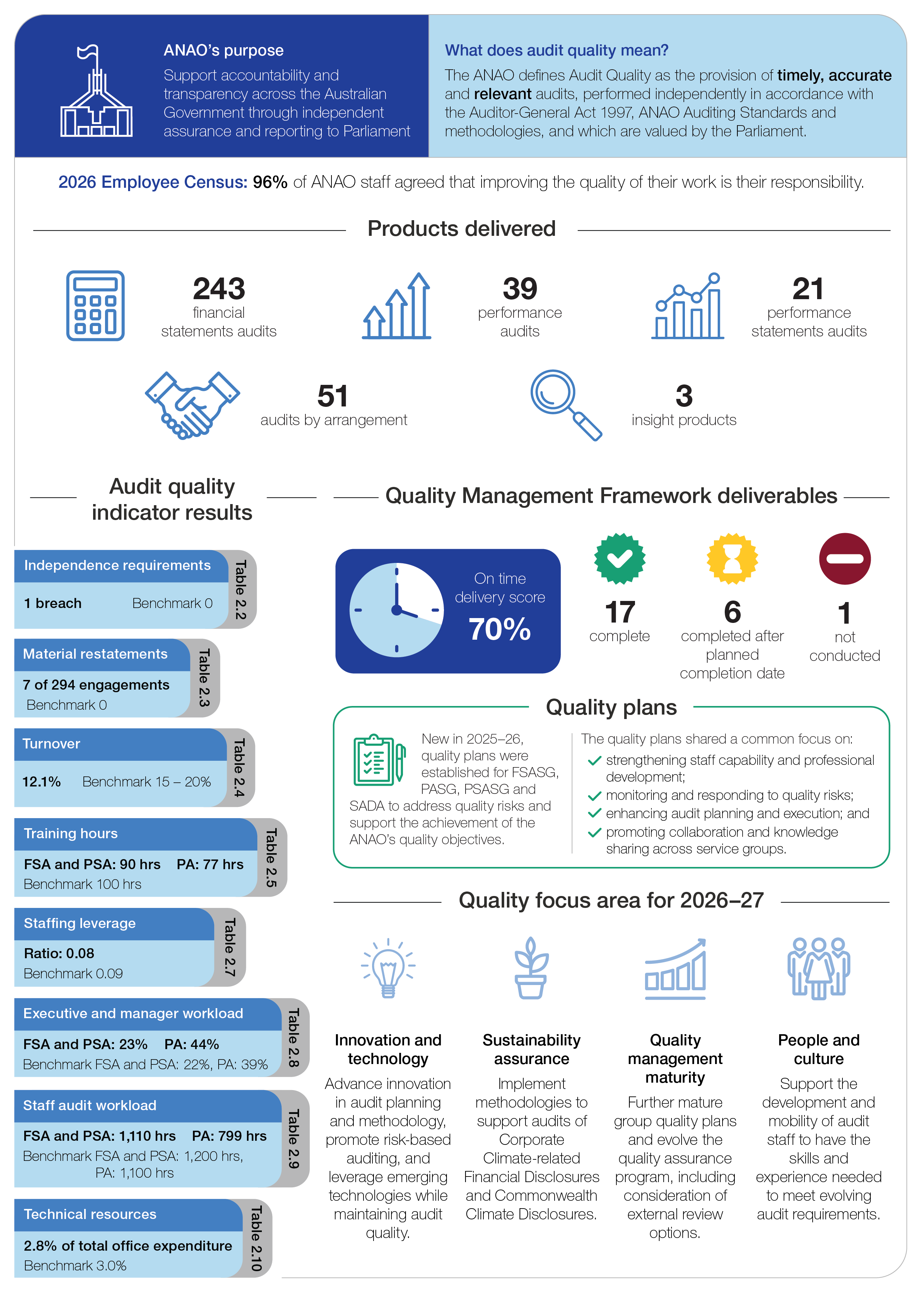
Auditor-General’s conclusion on the System of Quality Management effectiveness
As Auditor-General, I am responsible for the evaluation of the Australian National Audit Office (ANAO) System of Quality Management. My evaluation is based on the matters outlined in the accompanying ANAO Audit Quality Report 2025–26.
Based on my evaluation, I have concluded that the System of Quality Management was operating effectively for the year ended 30 June 2026, and provides reasonable assurance that:
- The ANAO and its personnel fulfil their responsibilities in accordance with AUASB standards and applicable legal and regulatory requirements, including the Auditor-General Act 1997 and the Australian National Audit Office Auditing Standards 2024, and conduct engagements in accordance with such standards and requirements; and
- Engagement reports issued by the ANAO are appropriate.
The ANAO has also designed and implemented remedial actions that strengthen the System of Quality Management in response to opportunities for improvement identified, including in our quality assurance review program and through root cause analysis. Through the completion of remediation procedures, I am satisfied that the deficiencies have been appropriately remediated at the time of this evaluation.
Dr Caralee McLiesh, PSM
Auditor-General
20 November 2026
2. ANAO’s System of Quality Management: Results and Analysis
2.1 This chapter outlines the activities undertaken by the ANAO in 2025–26 under each element of the ANAO SOQM. It also presents the results of the 2025–26 Audit Quality Indicators (AQIs) against established benchmarks.
Figure 2.1: ANAO’s System of Quality Management
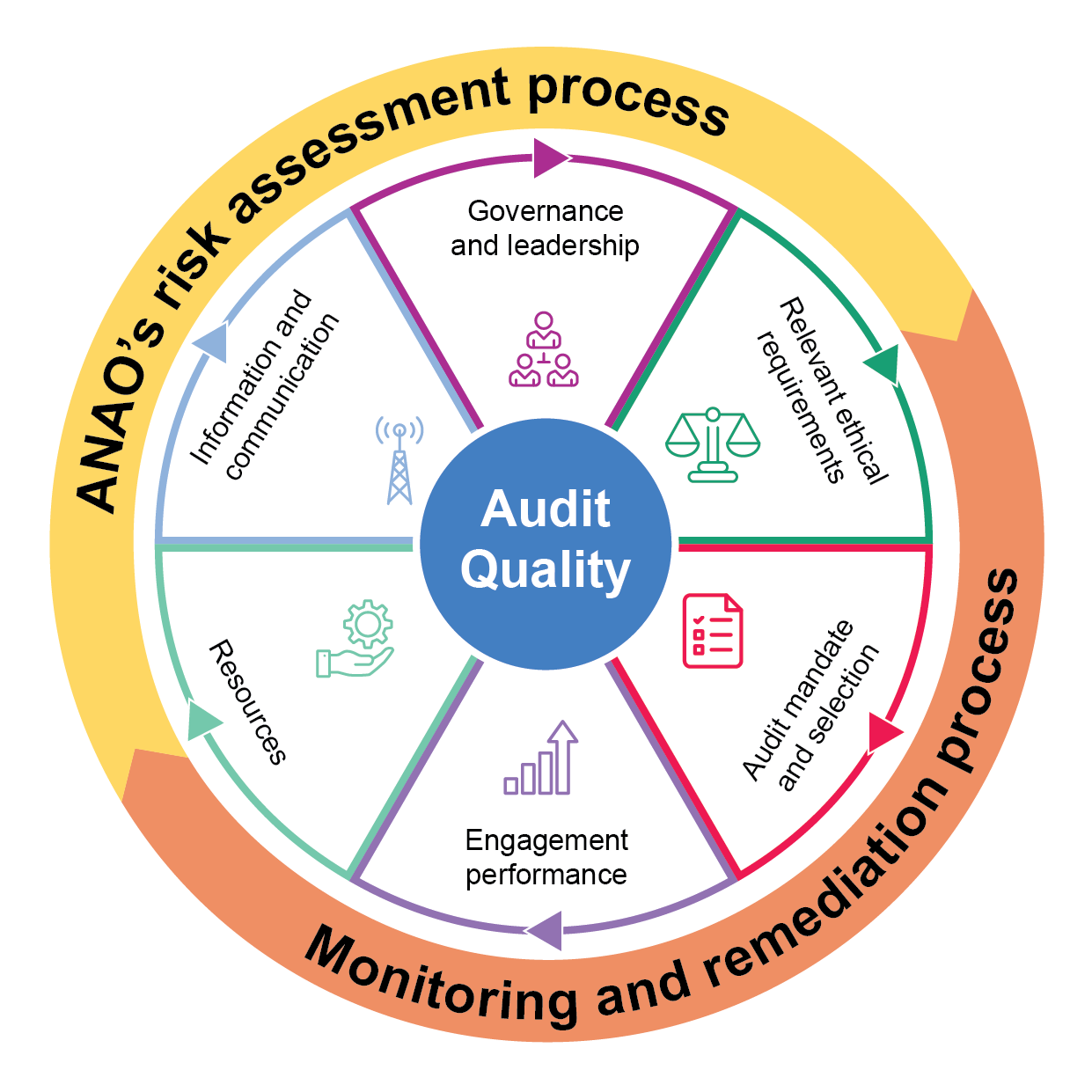
Responsibilities for the System of Quality Management
2.2 The ANAO’s SOQM is supported by clearly defined governance and accountability arrangements, with the Auditor-General ultimately responsible and accountable for the quality of all assurance and related activities undertaken by the ANAO.
2.3 The figure below outlines the key leadership responsibilities and governance arrangements that support audit quality.
Figure 2.2: Governance and leadership for audit quality
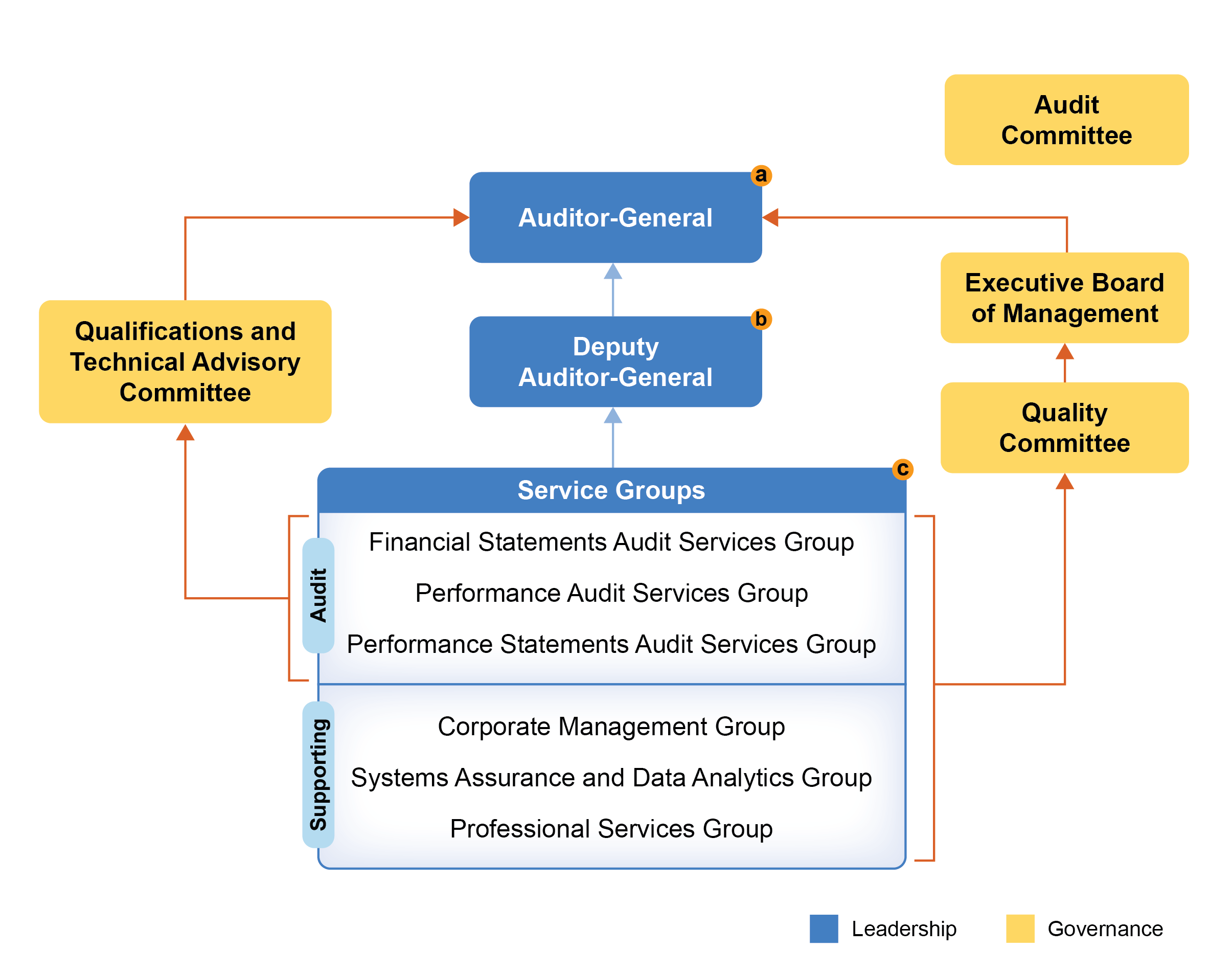
Note a: Auditor-General – Ultimately responsible and accountable for the SOQM for all assurance and related activities undertaken by the ANAO.
Note b: Deputy-Auditor General – Operational responsibility for ensuring that the SOQM satisfies the requirements of the ANAO Auditing Standards.
Note c: Service Groups
Financial Statements Audit Services Group (FSASG); Performance Audit Services Group (PASG); Performance Statements Audit Services Group (PSASG)
Group Executive Directors – responsible for the quality of audit services delivered by their business groups, including implementing and monitoring service group Quality Plans aligned to the Quality Management Framework.
Engagement Executives – responsible for quality within their portfolio of audits and supporting the GEDs in the delivery and management of quality audit services.
Corporate Management Group (CMG)
Chief Operating Officer – responsible for the policies, systems and capabilities that support the Quality Management Framework. This includes, finance, human resources, IT security, external communications, learning and development, and legal support.
System Assurance and Data Analytics Group (SADA)
Group Executive Director – responsible for the quality of audit services delivered by the group, including implementing and monitoring of the Quality Plan.
Executives – responsible for quality within their portfolio of audits and supporting the GED in the delivery and management of quality audit services.
Professional Services Group (PSG)
Group Executive Director – responsible for the ANAO audit methodology and Quality Management Framework, including supporting policies and procedures, independence requirements, approval of non-audit services, monitoring and remediation activities.
The Quality Committee
2.4 Governance for audit quality is provided through the Quality Committee, a sub-committee of the Executive Board of Management (EBOM). Comprised of representatives from across ANAO business groups and chaired by the PSG Group Executive Director (GED), the Quality Committee’s role includes monitoring the implementation of the ANAO’s Quality Management Framework and Plan.
2.5 A summary of the Quality Committee membership and meetings attended in 2025–26 is provided in the table below.
Table 2.1: Quality Committee membership and meetings attended 2025–26
|
Members |
2025 |
Membersb |
2026 |
|||
|
|
Septembera |
October |
December |
|
March |
June |
|
PSG Group Executive Director (Chair) |
✔ |
✔ |
✔ |
Chair |
✔ |
✔ |
|
Deputy Chair |
✔ |
✔ |
✔ |
Deputy Chair |
✘ |
✘ |
|
FSASG Senior Executive Director |
✔ |
✔ |
P |
PSG nominee |
✔ |
✔ |
|
CMG Deputy Chief Operating Officer |
✔ |
✔ |
P |
CMG nominee |
P |
✔ |
|
SADA Group Executive Director |
✔ |
✔ |
P |
SADA nominee |
✔ |
✔ |
|
PASG Executive Director |
✔ |
✔ |
✔ |
PASG nominee |
✔ |
✔ |
|
FSASG Executive Director |
V |
V |
V |
FSASG nominee |
✔ |
✔ |
|
PSASG Executive Director |
✔ |
✔ |
✔ |
PSASG nominee |
✔ |
P |
|
278 |
99 |
73 |
91 |
135 |
64 |
64 |
Key: P = Proxy – a nominated representative attended the meeting on behalf of the Quality Committee member.
V = Vacant position.
Note a: A special Quality Committee meeting was held to discuss evaluation of ANAO SOQM.
Note b: Reflects revised committee membership following amendments to the Quality Committee Terms of Reference in early 2026. The Chair and Deputy Chair are appointed by EBOM.
2.6 The Quality Committee met five times during 2025–26, including a special meeting to support the 2024–25 evaluation of the SOQM. The Committee reports annually to EBOM and provides advice, papers and risk updates throughout the year as required. In accordance with its responsibilities, the Committee:
- reviewed the findings of internal and external reviews in relation to quality and monitored the ANAO’s progress in addressing the findings and recommendations made;
- monitored and reported to EBOM on the implementation, operating effectiveness and efficiency of the Quality Management Framework, having regard to the findings of external and internal reviews and the AQIs;
- advised the Auditor-General on whether the operation of the Quality Management Framework provides reasonable assurance that the ANAO’s quality objectives are being achieved;
- monitored the strategic and operational risks associated with quality;
- considered and endorsed proposed amendments to the ANAO Audit Manual that substantially impact the conduct of an audit prior to the Auditor-General’s approval; and
- monitored workforce resourcing risks to provide strategic advice to the People and Culture Committee (PC&C) for consideration in people and capability.
The ANAO’s quality risk assessment process
2.7 The ANAO Risk Management Framework complies with the Commonwealth Risk Management Policy and is informed by the international risk management standard ISO 31000. Risk management is a critical component of ANAO’s governance arrangements, strategic planning, decision-making processes, and day-to-day operations. The framework is supported by the Enterprise Risk Register, which identifies and assesses the ANAO’s strategic and operational risks and is regularly monitored by EBOM.
2.8 The ANAO’s Quality Management Framework incorporates a quality-specific risk assessment process that aligns with ASQM 1 and is integrated with the broader ANAO Risk Management Framework. Consistent with ASQM 1, the ANAO has established quality objectives and maintains a Quality Risk Register to identify, assess and monitor risks that may affect the achievement of those objectives. The Quality Risk Register is reviewed annually by the Quality Committee, having regard to the results of monitoring activities, identified deficiencies, emerging risks and changes in the operating environment.
2.9 The quality-specific risk assessment process is informed by the Enterprise Risk Register and considers enterprise risks in the context of their impact on audit quality. While all enterprise risks are considered, Enterprise Risk 4 – the ANAO issues an incorrect audit opinion or an audit opinion not supported by sufficient evidence – is directly related to audit quality and is overseen by the Quality Committee. The Quality Committee reviews Risk 4 quarterly and reports to the EBOM on the risk and effectiveness of associated controls.
2.10 Each audit service group and SADA maintains a Quality Plan aligned with the ANAO Quality Management Framework. The plans support the implementation and monitoring of activities designed to address quality risks and achieve the ANAO’s quality objectives. Each plan is reviewed annually, and progress updates are provided to the Quality Committee on a quarterly basis. 2025–26 marked the completion of the ANAO’s first annual cycle of Quality Plans.
Governance and leadership
Commitment to quality through culture, actions and behaviours
2.11 The Auditor-General sets the tone at the top and demonstrates leadership commitment to quality through a culture that promotes integrity, independence and accountability. During 2025–26, this included reinforcing the importance of these principles through Executive discussions, monthly EBOM meetings, all staff communications including Town Hall meetings and the Auditor-General’s monthly messages. In doing so, the Auditor-General reinforces the expectation that all ANAO staff share responsibility for quality and engage with monitoring activities as a means of continuous improvement. This is reflected in the 2026 APS Employee Census, where 96 per cent of staff indicated that improving the quality of their work is their responsibility.
2.12 The ANAO emphasises quality through its planning processes, including the Corporate Plan, all group business plans, and quality plans for the audit service groups. The Corporate Plan identifies quality and independence as fundamental to the ANAO’s purpose and credibility and embeds quality across its strategic priorities, audit delivery, capability development and governance arrangements. Group business plans and quality plans translate these priorities into planned activities and performance measures.
2.13 GEDs further reinforce the Auditor-General’s expectations by embedding quality considerations within their service group business planning, governance arrangements and staff communications. Engagement Executives support the implementation of these expectations in the delivery of audit work through directing and supervising audit teams, reviewing audit work, monitoring quality outcomes, and increasing their involvement in areas involving significant risk, judgement, or difficult and contentious matters.
Leadership roles and responsibilities
2.14 Consistent with ASQM 1, the ANAO Audit Manual assigns quality-related roles and responsibilities to senior leaders. This establishes clear accountability for the implementation and monitoring of the SOQM, as illustrated in Figure 2.2.
2.15 These responsibilities are complemented by the ANAO’s performance management framework, which articulates the technical and behavioural capabilities expected of all staff in contributing to audit quality, including senior leaders. The ANAO’s Senior Executive Service (SES) performance framework is further underpinned by the APS Secretaries Charter of Leadership Behaviours (DRIVE), which outlines the leadership behaviours expected of SES officers in delivering results and leading with integrity. SES performance assessments are further informed by annual upward feedback from staff.
2.16 ANAO Census results provide additional insight into culture and leadership and inform actions to strengthen the behaviours that support audit quality. In the 2026 APS Employee Census, 81 per cent of staff indicated that SES clearly articulate the direction and priorities of the ANAO, 11 percentage points higher than the overall APS result.
Resource needs consistent with commitment to quality
2.17 The ANAO takes a strategic approach to resourcing and workforce planning to support the delivery of high-quality audit work and ensure resources are directed to areas of highest priority, risk and impact. This includes investment in technical, digital and leadership capability through different initiatives such as the ANAO Academy, opportunities for staff to develop experience across audit products, the development of specialist expertise in highly technical areas, and measures that support staff wellbeing. These initiatives support the ANAO’s ability to respond to the evolving demands of public sector auditing while maintaining audit quality.
Relevant ethical requirements
2.18 The ANAO’s commitment to high ethical and professional standards underpins the quality of its work. The ANAO Audit Manual outlines the ethical requirements that apply to ANAO staff and contracted service providers, including compliance with APES 110 Code of Ethics for Professional Accountants (APES 110). These requirements operate alongside the ethical obligations that ANAO staff have as Commonwealth public servants under the Public Service Act 1999.
2.19 The ANAO’s Integrity Framework supports ethical decision-making. It provides an overarching structure to the ANAO’s integrity control system by bringing together the key legislation, policies and practices that promote and support ethical practice across the organisation. The ANAO has appointed an Integrity Advisor to support the framework and provide staff with advice on integrity matters.
Independence
2.20 Independence and trust are fundamental to the ANAO’s mandate and audit work. The Auditor-General is established as an independent officer of the Parliament under the Auditor-General Act 1997, which underpins the ANAO’s ability to provide impartial and credible information to assist the Parliament in holding the executive government to account. Independence is also a cornerstone of the professional and ethical standards applicable to audit engagements and supports the ANAO’s ability to conduct audits objectively, free from undue influence and conflicts of interest.
2.21 The ANAO’s independence policies incorporate the requirements of APES 110 and cover areas including financial and personal relationships, rotation of key audit personnel, confidentiality, the provision of non-assurance services by contracted service providers, and gifts and benefits. These requirements are regularly reinforced through training, guidance materials and communications for staff and contracted service providers.
2.22 Under ANAO policy, suspected or actual contraventions of the independence requirements of legislation, APES 110 or ANAO independence policies must be reported without delay to the responsible GED and the PSG GED.
Independence breaches
Audit Quality Indicator – Compliance with independence requirements
2.23 The AQI for compliance with independence requirements measures the number of breaches of independence requirements identified during the year.
Table 2.2: Audit Quality Indicator result – Compliance with independence requirement
|
Breaches of independence requirements (excluding documentation deficiencies) |
|||
|
Benchmark |
2025–26 result |
2024–25 result |
Potential risk to audit quality |
|
0 |
1 |
4 |
Yes |
|
152 |
152 |
152 |
152 |
2.24 In 2025–26, one breach of independence requirements was identified. The result is not consistent with the benchmark, however, represents a decrease from the number of breaches identified in 2024–25.
2.25 The independence breach involved an ANAO staff member whose actions created a potential self-interest threat and was identified following concerns raised by the auditee. To address the identified threat, the individual was removed from the engagement and counselling was provided. The matter was assessed as an isolated incident and does not indicate a pervasive issue with compliance with independence requirements.
Compliance with independence documentation requirements
2.26 ANAO audit policies and methodologies require that independence be assessed, reviewed and documented prior to staff performing audit procedures and at key stages of an audit engagement. Compliance with these requirements is monitored through quality assurance reviews and internal audits.
2.27 In 2025–26, no dedicated internal audit of independence compliance was conducted. However, other internal review activities continued to provide oversight of independence requirements and identified opportunities to improve the timely completion and review of independence declarations.
2.28 While identified matters reflected non-compliance with ANAO policy requirements, they related to the timing of independence procedures rather than actual independence breaches. No quality risks were identified, and all required independence declarations were ultimately completed. The ANAO continues to reinforce compliance with independence requirements through staff training, leadership communications and ongoing monitoring activities.
Rotation of key audit personnel
2.29 Rotation requirements for audits limit the number of consecutive years that key audit personnel can work on the same audit. While APES 110 establishes rotation requirements for financial statements audits, the ANAO Audit Manual includes additional requirements that also apply to performance statements audits. For all engagements, familiarity threats arising from a long association with an auditee must be appropriately managed.
2.30 In 2025–26, all key audit personnel rotation requirements for financial statements audits were complied with and no breaches were identified. One extension to the standard rotation period was approved in accordance with ANAO independence policies. Rotation requirements were introduced for performance statements audits in 2024–25, and no rotations were required as no key audit personnel have yet reached the five-year threshold. The ANAO will continue to monitor the impact of increased collaboration and resource sharing across FSASG and PSASG on future key audit personnel rotation requirements.
Other services
2.31 The ANAO contracts private sector audit firms to perform some of its audit work where additional resources or specialist skills are required. APES 110 restricts the other services these contracted service providers may provide to audited entities to address potential conflicts of interest and other threats to objectivity. These requirements are incorporated into the ANAO Audit Manual, and requests by contracted service providers to provide other services are subject to approval by the PSG GED.
2.32 In 2025–26, 22 requests from contracted service providers to provide other services to ANAO auditees were approved, with no requests declined. The proposed services primarily comprised of assurance and agreed-upon procedures engagements, including grant acquittal audits, regulatory reporting assurance, project expenditure reviews, and sustainability and emissions-related assurance.
Gifts and benefits monitoring
2.33 ANAO employees must report any offered gift or benefit (whether accepted or refused) in the ANAO Gifts and Benefits Register. Information collected through the register is reported to EBOM, and deidentified information is also reported on the ANAO website.
2.34 During 2025–26, 181 gifts and benefits were declared, with all declarations assessed by the delegate in accordance with ANAO policy. No gifts or benefits were identified as resulting in an independence breach.
Audit mandate and selection
2.35 The Auditor-General publishes an Annual Audit Work Program (AAWP) in July each year which outlines the proposed audit activities to be undertaken in the financial year. The AAWP supports decisions regarding audit commencement with consideration to audit priorities, risk and the ANAO’s ability to undertake engagements in accordance with ANAO Auditing Standards and applicable legal and regulatory requirements.
2.36 During 2025–26, 33 audits were commenced from the 83 potential topics identified in the AAWP. Topics not commenced during the year are considered through subsequent planning cycles, with some incorporated into the 2026–27 AAWP and others retained for consideration in future years.
2.37 The ANAO is transitioning to an integrated multi-year AAWP from 2026–27 to provide greater visibility of potential audit activity in the forward years. The ANAO provided a draft AAWP to the Parliament for consultation through the Joint Committee of Public Accounts and Audit (JCPAA), consistent with the Auditor-General’s requirement in the Auditor-General Act 1997 to have regard to the audit priorities of the Parliament. The JCPAA identified 13 audit priority topics, including one new topic for consideration. Of these, 10 were included, in whole or in part, in the 2026–27 AAWP and three had already commenced. The ANAO considers Parliamentary priorities in the development and commencement of its non-mandated audit program.
2.38 The ANAO established a Sustainability Assurance Services Implementation Plan for providing sustainability assurance services under the Corporate Climate-related Financial Disclosure regime. Sustainability reporting under section 292A of the Corporations Act 2001 is being phased in over three years from 1 January 2025, with four Commonwealth companies required to report from 1 January 2025. The four sustainability audits commenced during 2025–26 are being undertaken under section 20 of the Auditor-General Act 1997.
Engagement performance
Consultation
2.39 The ANAO Audit Manual includes policies requiring consultation on difficult or contentious audit matters. The Engagement Executive is responsible for ensuring the appropriate consultation is undertaken, including with the responsible GED, Engagement Quality Reviewers (EQR), PSG GED and the ANAO’s Qualifications and Technical Advisory Committee (QTAC) as appropriate.
Qualifications and Technical Advisory Committee
2.40 The QTAC provides a forum for Engagement Executives to consult on difficult or contentious matters and, where necessary, resolve differences of opinion on audit related matters.
2.41 In 2025–26, QTAC was consulted on 21 matters, compared with 26 matters in 2024–25. During the year, ANAO revised the QTAC policy to align the level of technical oversight with the significance and risk of each audit matter. Under the new QTAC policy, higher risk audit matters continue to be escalated to a full QTAC meeting and approval by the Auditor-General. Other matters are addressed through a streamlined QTAC process.
Material restatements
Audit Quality Indicator – Material restatements resulting from a prior period error
2.42 The AQI for material restatements resulting from a prior period error measure the number and magnitude of material restatements. The results are generally considered a signal of possible areas of concern in the audit process. This indicator places restatements in context by focusing on their magnitude and overall impact on the financial statements. While restatements are assessed for materiality at the individual engagement level, the measure includes all financial statements audits, including non-mandated audits. Restatements that were below materiality or related to reclassifications or disclosures with no net impact on the financial result or position have not been included in the totals.
Table 2.3: Audit Quality Indicator result – Material restatements resulting from a prior period error
|
Material restatements resulting from a prior period errora |
|||
|
Benchmark |
2025–26 results |
2024–25 results |
Potential risk to audit quality |
|
Number and % of material restatements: 0 |
7 (2.8%) out of 294 engagements Errors range from $562,000 to $6.972b net impact on the individual financial statements |
14 (4.7%) out of 296 engagements Errors range from $32,333 to $128.962m net impact on the individual financial statements. |
Yes |
|
140 |
155 |
144 |
124 |
Note a: The financial statements audit cycle for 30 June year end reports is 1 October to 30 September. Therefore the 2025–26 results in the table above record the number of restatements identified in 2024–25 financial statements audits which are finalised within the 2025–26 reporting period.
2.43 In 2025–26, seven material restatements resulting from a prior period error were identified. This result is not consistent with the benchmark, however, represents a decrease from the number of material restatements that occurred in 2024–25.
2.44 The largest material restatement related to the valuation of a significant long-term provision. During the current year, it was identified that a cohort of beneficiaries had not been appropriately incorporated into the underlying actuarial model despite the relevant information being available in prior periods. This resulted in a material increase to the provision balance and associated expense.
2.45 Identification of prior period errors can reflect improved quality and highlights the critical role of the audit process in upholding the integrity and reliability of an entity’s financial information. To maintain confidence of the Parliament, the ANAO evaluates the root cause of identified material restatements to determine whether these are errors that should have been identified in the previous year audit and if so, whether there are risks to audit quality that need to be addressed. Evaluation of prior period errors remains an ongoing focus of the ANAO and includes detailed analysis and trend monitoring of all identified prior period errors to identify recurring themes, emerging risks and opportunities for continuous improvement in audit quality.
Engagement Quality Reviewers
2.46 An EQR is required under ANAO Audit Manual policy to be appointed to certain audits, including high risk audits and audits of entities determined to be public interest entities (PIEs)1. The EQR provides an objective evaluation of the significant judgements made by the audit team and conclusions reached in formulating the audit report.
2.47 Reviews conducted as part of the quality assurance review program consider compliance with the EQR policy including assessment of whether an EQR was required to be appointed, if an appointed EQR met the eligibility criteria, and if the documentation of that involvement throughout the audit was in accordance with the ANAO Audit Manual requirements.
2.48 In 2025–26:
- 10 financial statements engagements were rated as high-risk and an EQR was appointed;
- 14 financial statements engagements were conducted over auditees assessed as PIEs, with two of these engagements also assessed as high-risk;
- three performance statements audits were rated as high-risk audits and an EQR was appointed; and
- one performance audit started as a high-risk audit and an EQR was appointed. At the second formal progress review, the audit risk was reassessed and reduced to medium, and consequently the EQR was removed.
Resources
Human resources
Qualified personnel
2.49 The ANAO’s human resources policies and procedures support the selection of employees who have the necessary integrity, capability and competence to perform the work required.
2.50 The ANAO employed 444 ongoing staff as at 30 June 2026 (30 June 2025: 471). ANAO staff come from diverse disciplines, including commerce, accounting, finance, economics, public policy, law, science, social sciences, and information technology.
Audit Quality Indicator – Turnover of audit personnel
2.51 The AQI for turnover of audit personnel measures the annual turnover rate of audit personnel. The degree and nature of the changes in FSASG and PSASG audit teams is a factor in determining the readiness and ability of the team to perform a high-quality audit. Some level of attrition is expected, however a comparatively high rate of turnover or frequent auditor transfers within the office may adversely affect audit quality. The benefit of retaining an audit team’s experience with a particular auditee needs to be carefully balanced with the benefit of adding new auditors who may provide a fresh look at audit issues.
Table 2.4: Audit Quality Indicator result – Turnover of audit personnel
|
Turnover of audit personnel (average annual turnover rate expressed in percentages) |
|||
|
Benchmark |
2025–26 results |
2024–25 results |
Potential risk to audit quality |
|
15–20%a |
ANAO: 12.1% |
ANAO: 14.8% |
No |
|
Audit group turnover rates |
FSASG staff: 9.7% PASG staff: 9.9% SADA staff: 19.0% PSASG staff: 15.0% |
FSASG staff: 20.1% PASG staff: 8.3% SADA staff: 17% PSASG staff: 9.6% |
n/a |
|
135 |
149 |
149 |
135 |
Note a: This is an ANAO-wide benchmark for ongoing staff.
Note: Movement between business areas within the ANAO is not counted as turnover in this table; only departures of ongoing staff leaving the ANAO are reported.
2.52 In 2025–26, the ANAO turnover rate decreased to 12.1 per cent. The result is not consistent with the benchmark; however, is not considered a risk to audit quality. The reduction in turnover reflects a period of workforce stabilisation following elevated turnover in prior years and reduced recruitment activity across audit service groups.
2.53 The decrease in overall turnover supported retention of organisational knowledge, experience and capability necessary to deliver quality audits. The ANAO continued to invest in learning and development, leadership capability, workforce mobility and succession planning to support future workforce needs.
Performance and career development
2.54 The ANAO recognises that its reputation relies on high-performing individuals. During 2025–26, the ANAO continued to support employee capability and career development through performance assessment, professional development and the introduction of an internal mobility register. The mobility register provides employees with opportunities to broaden their skills and experience across the organisations, helping to build a high-performing workforce aligned with the ANAO’s strategic priorities.
2.55 The ANAO performance assessment cycle is from 1 November to 31 October. For the performance cycle ending 31 October 2025, 99 per cent of ANAO staff were rated as meeting expectations or higher (31 October 2024: 99 per cent).
Learning and development
2.56 As a learning organisation with a focus on audit quality, the ANAO supports staff with continuous learning and development. Learning and development opportunities include mandatory e-learning, mandatory attendance at technical updates and contractor webinars, external training opportunities and on-the-job training, mentoring, and coaching.
Audit Quality Indicator – Training hours per audit professional
2.57 The AQI for training hours per audit professional measures the average annual continuing professional development hours completed by audit professionals.
Table 2.5: Audit Quality Indicator result – Training hours per audit professional
|
Training hours per audit professional (average annual hours of continuing professional education by audit service group) |
|||
|
Benchmark |
2025–26 |
2024–25 |
Potential risk to audit quality |
|
100 hours |
FSASG and PSASG staff: 90 hours PASG staff: 77 hours |
FSASG and PSASG staff: 128 hours PASG staff: 104 hours |
No |
|
140 |
140 |
140 |
140 |
Note: The ANAO minimum training requirements are set at 20 hours in the ANAO Audit Manual policy. The benchmark of 100 hours (an increase from 90 hours in 2024–25) is from the results of comparable Australasian Council of Auditors-General (ACAG) audit offices.
2.58 In 2025–26, the training hours per audit professional for all audit groups decreased compared to the prior year and is not consistent with the benchmark. The 2025–26 result excludes on-the-job coaching and mentoring hours, consistent with the revised benchmarking survey methodology used by comparable ACAG audit offices. As the benchmark is based on a three-year rolling average, it continues to reflect coaching and mentoring hours included in earlier years.
2.59 The decrease in FSASG and PSASG staff training hours reflects a stabilisation of capability development activities across both service groups. FSASG and PSASG had lower recruitment activity, reducing the need for onboarding and foundational training. The maturity of performance statements auditing, minimal changes to auditing standards and audit methodology also reduced the need for specialised technical training and capability uplift activities. Learning and development activities focused on maintaining technical capability and leadership development through targeted training on key audit risk areas.
2.60 The decrease in PASG staff training hours reflects a stabilisation of capability and reduced demand for foundational training. PASG had no APS level recruitment activity, including no graduate intake, resulting in a reduced demand for induction and core training modules. With existing staff having already completed mandatory and core performance audit courses, learning and development activities were targeted towards audit-specific capability development and leadership training.
ANAO Induction and Mandatory eLearning modules
2.61 Completion of mandatory training is essential to maintaining integrity and public trust at the ANAO. As part of a pro-integrity culture, mandatory training reinforces the ANAO’s commitment to high ethical standards, accountability and transparency.
2.62 On commencement at the ANAO, all staff must complete the ANAO Induction Learning Pathway which includes mandatory eLearning courses and familiarisation with the ANAO Essentials Hub. This pathway equips new staff with the knowledge needed to work lawfully, ethically and safely at the ANAO, and is required to be completed within one month of commencement.
2.63 All staff are required to complete the mandatory annual refresher training. An overall completion rate for all mandatory training cannot be reliably reported at a single point in time as due dates vary according to commencement and refresher dates. The ANAO has a comprehensive system in place to communicate mandatory training requirements, track completion, and address instances of non-compliance. Key support and monitoring activities include:
- reminders on commencement and ahead of refresher deadlines;
- access to modules via the intranet and Learning Management System;
- performance management communications;
- biannual compliance surveys to confirm training is up to date;
- SES oversight of mandatory training completion through the staffing dashboard; and
- individual follow up on non-compliance, where required.
Table 2.6: Overview of mandatory training
|
All staff (commencement and annual refresher) |
Additional new starter modules |
Cohort Specific |
|
|
|
Technical updates
2.64 Regular technical update training sessions are provided to audit staff. Technical updates cover changes to auditing and accounting standards, financial reporting frameworks, integrity requirements, and audit policy and methodology. Quality considerations are incorporated throughout technical updates, including communication of quality assurance review program results, relevant audit quality findings and reminders where applicable.
2.65 In 2025–26, eight technical update sessions were held for FSASG staff, five for PASG staff, six for PSASG staff and eight for SADA staff.
Formal training, on-the-job training, mentoring and coaching
2.66 The Learning and Development Plan for 2025–26 includes capability priorities identified through the Corporate Plan, Workforce Action Plan and 2025 Learning Needs Survey. The ANAO continues to invest in leadership development, stakeholder engagement capability and technical learning, coaching, mentoring and on-the-job learning opportunities.
2.67 Capability development activities included targeted technical training, individual and small-group coaching and mentoring, the FSASG and SADA Peer Review Program, knowledge-sharing activities, and training for staff rotating between different audit service groups. All capability development activities are designed to support knowledge sharing and the transfer of practical audit experience across audit staff.
Contractor webinar
2.68 In 2025–26, the ANAO made a webinar recording available to contracted service provider staff that conduct financial statements audits on behalf of the ANAO. The webinar communicated public sector specific audit considerations, lessons learnt from quality assurance reviews, and ANAO expectations for quality, ethical conduct, independence, conflicts of interest and confidentiality. Contracted service providers are required to provide annual attendance confirmations to the ANAO, with the ANAO monitoring attendance and following up any late completions or exceptions.
Staff workloads
2.69 ANAO policies for the allocation of Engagement Executives and staff to audits ensure that engagement teams have the appropriate level of expertise and time to perform their role. Under these policies the workload and availability of Engagement Executives is monitored to ensure they have sufficient time to adequately discharge their responsibilities.
Audit Quality Indicator – Staffing leverage
2.70 The AQI for staffing leverage ratio provides information about the time FSASG and PSASG engagement leaders spend on in-house audits. The engagement leader is the Engagement Executive with direct responsibility for the conduct of an audit and is either the signing officer or who makes recommendations to the signing officer regarding the audit opinion. The Engagement Executive is responsible for oversight of the audit and the audit team. Sufficient time to oversee the work of the audit team is critical to quality.
Table 2.7: Audit Quality Indicator result – Staffing leverage
|
Staffing leverage (ratio of engagement leader hours charged to in-house financial statements and performance statements audit work to lower-level audit staff hours) |
|||
|
Benchmark |
2025–26 results |
2024–25 results |
Potential risk to audit quality |
|
0.09 |
FSASG – 0.07 PSASG – 0.10 Total – 0.08 |
FSASG – 0.08 PSASG – 0.10 Total – 0.09 |
FSASG – Yes PSASG – No |
|
152 |
152 |
152 |
152 |
2.71 In 2025–26, the total ratio of engagement leader hours decreased to 0.08. The total result is consistent with the benchmark, however the FSASG result has decreased to 0.07 and is not consistent with the benchmark. The FSASG result indicates a reduction in the number of Engagement Executive hours spent on in-house financial statements audits.
2.72 The benchmark is based on the ACAG benchmarking survey data, which currently does not capture data for PASG. The ANAO is exploring the inclusion of PASG results in future reporting to enhance comparability and transparency.
Audit Quality Indicator – Engagement Executive and manager audit
2.73 The AQI for Engagement Executive and manager audit workload measures the proportion of total audit hours performed by Engagement Executives, managers and Engagement Quality Reviewers against total hours charged to audits. Sufficient senior involvement supports effective supervision, review and audit quality.
Table 2.8: Audit Quality Indicator result – Engagement Executive and manager audit workload
|
Engagement Executive and manager audit workload (hours charged by audit staff who are classified as an Engagement Leader, Manager, Engagement Quality Reviewer or higher as a percentage of total hours charged to audits) |
|||
|
Benchmarka |
2025–26 results |
2024–25 results |
Potential risk to audit quality |
|
FSASG and PSASG: 22% |
23% |
25% |
No |
|
PASG: 39% |
44% |
40% |
|
|
152 |
152 |
152 |
152 |
Note a: In line with the three-year rolling average, AQI benchmarks for 2025–26 increased from the prior year, FSASG and PSASG increased from 21 per cent to 22 per cent and PASG increased from 38 per cent to 39 per cent.
2.74 In 2025–26, the FSASG and PSASG Engagement Executive and manager audit workload has decreased compared to the prior year and is consistent with the benchmark.
2.75 In 2025–26, the PASG Engagement Executive and audit manager workload increased compared to the prior year and the result is not consistent with the benchmark. This result reflects the composition of PASG’s workforce during the year. The absence of APS-level recruitment and graduate intake, combined with low APS level staff attrition, resulted in a greater proportion of audit work being delivered by senior audit staff.
Audit Quality Indicator – Staff audit workload
2.76 The AQI for staff audit workload measures chargeable audit hours per full-time equivalent audit professional. This indicator can provide insights into audit staff capacity. Excessive staff audit workloads increase the risk that audit procedures may not be performed effectively. Consistent with ASQM 1, the ANAO’s resourcing model and policies are designed to ensure staff have sufficient capacity to undertake quality audits and that senior staff have adequate time for supervision, review, coaching and mentoring. Reduced workloads reflect lower audit activity undertaken by staff throughout the year. This increases the risk that staff are not spending sufficient time to deliver quality audit work and underutilisation can influence staff morale.
Table 2.9: Audit Quality Indicator result – Staff audit workload
|
Staff audit workload (chargeable hoursa per full-time equivalent professional) |
|||
|
Benchmark |
2025–26 results |
2024–25 results |
Potential risk to audit quality |
|
FSASG and PSASG: 1,200 hrs |
1,110 hrs |
1,109 hrs |
Yes |
|
PASG: 1,100 hrs |
799 hrs |
1,023 hrs |
|
|
146 |
146 |
146 |
146 |
Note a: Chargeable hours refer to the number of hours charged to audits.
2.77 In 2025–26, staff audit workload for FSASG and PSASG audit staff remained consistent with the benchmark. Staff audit workload for PASG audit staff decreased significantly and is not consistent with the benchmark.
2.78 The significant decrease in PASG staff audit workload has highlighted limitations in the systems used to monitor staff allocation and utilisation, making it difficult to determine the underlying cause. Potential contributing factors include delays in the commencement of performance audits and the increased support by PASG staff for financial statements audits. The result may also reflect uneven workflow or inaccurate time charging. Irrespective of the cause, the result presents a potential risk to audit quality through staff underutilisation. Monitoring of PASG staff utilisation throughout the year has commenced and will remain a key focus area.
Internal and external specialists and technical resources
2.79 PSG provides technical accounting and auditing support, methodology and quality assurance services. This resource enables audit teams to consult on difficult or complex matters identified during an audit. QTAC provides a further forum for consultation on complex matters, with PSG providing technical advice and secretariat services.
2.80 The AQI for technical accounting and auditing resources shows the ANAO’s expenditure on technical accounting and auditing resources, including PSG accounting and audit technical, methodology support and training expenditure as a proportion of overall expenditure.
Table 2.10: Audit Quality Indicator result – Technical accounting and auditing resources
|
Technical accounting and auditing resources (percentage of total office expenditure allocated to technical resources) |
|||
|
Benchmarka |
2025–26 results |
2024–25 results |
Potential risk to audit quality |
|
3.0% |
2.8% |
2.3% |
No |
|
135 |
135 |
135 |
135 |
Note a: In line with the three-year rolling average, AQI benchmarks for 2025–26 increased from the prior year from 2 per cent to 3 per cent.
2.81 In 2025–26, the expenditure on technical resources has increased and remains consistent with the benchmark. The ANAO continues to provide technical resources for a range of products, including performance statements audit and standardised data analytics solutions which require methodology and quality assurance.
Technological resources
2.82 The ANAO’s SADA group supports audit evidence-gathering and analysis through providing Information Technology (IT) and data specialists with audit capability for analysing the IT environment, IT general and application controls, system-generated reports, and data. SADA is responsible for developing standardised data analytics solutions that provide a consistent, data-driven approach to common areas of audit testing, improving audit efficiency and quality.
2.83 In 2025–26, SADA:
- continued delivery of three existing standardised solutions for employee expenses, general ledger journals, and appropriations;
- developed and released a new AASB16 leases standardised solution for the 2025–26 audit cycle, replacing multiple overlapping audit approaches with a consistent solution;
- commenced development of a future standardised solution to support consistent filtering and sampling for financial statements audit testing. This forms phase two of a longer-running project to centralise general ledger and trial balance data for audit use;
- selected a potential future standardised solution for further feasibility analysis; and
- continued to advance application development capability to support the delivery of more scalable, auditor-driven standardised solutions.
2.84 The standardised data analytics solutions have been designed to support teams in executing the procedures by providing standardised data requests and templates and identifying exceptions and risk areas for further investigation. This allows teams to spend more time focusing on judgements and conclusions rather than developing their own processes. The ANAO Quality Committee approves the development of standardised solutions. PSG approves that the standardised solutions align with the ANAO’s audit methodology.
Intellectual resources
2.85 ANAO auditors apply a robust methodology which includes the ANAO Audit Manual and standardised tools and templates to assist in the consistent application and documentation of audit procedures. Application of this methodology ensures compliance with the ANAO Auditing Standards and provides for consistent quality across audits.
2.86 The ANAO Audit Manual, methodology and supporting tools and templates are reviewed on an annual basis. The review process incorporates any improvements or amendments arising from changes in the ANAO auditing standards, responses to findings from quality monitoring processes and audit staff consultation.
2.87 In 2025–26, the ANAO continued to refine its methodology to ensure alignment to changed practices and the ANAO’s operating environment. This included:
- development of a sustainability assurance services implementation plan for Commonwealth entities required to prepare a sustainability report under the Corporations Act 2001, and collaboration with Australasian Council of Auditors-General peer audit offices to determine a suitable sustainability assurance methodology; and
- enhancements to the performance statements audit methodology related to risk assessments and test programs, focusing on auditing to risk and the development of templates and guidance to facilitate and document reliance on IT specialists.
Contracted resources
2.88 The ANAO engages contracted service providers and external experts to supplement internal capability where specialised knowledge or expertise is required, including:
- the engagement of audit firms to conduct financial statements audits when specialist industry knowledge is not readily available in-house; and
- the engagement of auditor experts in both financial statements and performance audits, as required.
2.89 Contracted service providers are required to comply with the ANAO’s contractual, independence and confidentiality requirements, which includes being subject to the confidentiality obligations under section 36 of the Auditor-General Act 1997. These obligations restrict the use and disclosure of information obtained in the course of performing audit activities. More information regarding ANAO’s information-gathering, confidentiality and reporting methodology can be found in the Audit Practice Insights report on Information-gathering, Confidentiality and Reporting.
2.90 Reporting and parliamentary scrutiny regarding KPMG in 2025–26 has generated considerable discussion across the profession and within the ANAO. KPMG’s admissions and related allegations are serious, damaging, and go to the heart of the trust that underpins auditing and assurance work.
2.91 As a contract service provider of financial statements audit work in respect of Commonwealth entities to the ANAO, there is a risk to the ANAO arising from the admissions and allegations. In response to this matter, the ANAO sought assurances from KPMG regarding the arrangements it has in place to meet its integrity, independence and confidentiality obligations in relation to work performed for the ANAO. The ANAO also responded to the risk in respect of individual engagements contracted to KPMG for the 2025–26 financial year audits, as well as considering procurement and contracting implications.
2.92 The ANAO also conducted an internal review of its assurance framework in respect of contract firms’ audit work to assess whether it needed to be strengthened in light of these events and the increased risk to the ANAO. Recommendations arising from this review have been, or are being, implemented subsequent to 30 June 2026.
Information and communication
Information systems
2.93 Information systems and digital tools support the operation of the SOQM by enabling the collection, analysis and communication of information required to perform audits and monitor audit quality. CMG is responsible for resolving issues affecting systems used to support the ANAO’s SOQM.
2.94 During 2025–26, the ANAO continued to implement initiatives aligned to its Digital Strategy, including cyber security improvements and the ongoing governance of emerging technologies such as artificial intelligence. Changes implemented in 2025–26 included the following:
- Strengthening of ANAO’s overall security posture and risk resilience through implementation of the Security Improvement Plan (SIP) 2025–2029, focused on reducing enterprise security risks, particularly risks relating to unauthorised access, data loss and cyber threats.
- Ongoing uplift of cyber security controls and monitoring capabilities, with a continued focus on strengthening Essential Eight Maturity and reducing exposure to common cyber threats, vulnerabilities and system compromise.
- Modernisation of the ICT environment to mitigate security and operational risks, including rollout of Windows 11 Standard Operating Environment across the ANAO, decommissioning of unsupported legacy systems, and implementation of cloud-based device management and virtual desktop solutions to improve security, control and resilience.
- Enhancement of protective security governance and policy framework, including alignment to updated PSPF 2025 requirements and ongoing review and uplift of security policies to address emerging risks and ensure consistent security practices.
2.95 In response to developments in the artificial intelligence (AI) landscape, the ANAO expanded its use of AI capabilities during 2025–26, supported by strengthened governance and risk management arrangements, including:
- Expansion of the trial use of AI tools (including Microsoft Copilot) across the ANAO to support business processes, with implementation aligned to controlled environments and enterprise security requirements.
- Review and republication of the ANAO AI Transparency Statement on 26 June 2026, improving accountability and transparency regarding the use of AI and demonstrating alignment with Commonwealth expectations for responsible AI adoption.
- Implementation and update of the ANAO AI Policy and associated procedures, establishing clear governance, risk controls and guidance to manage risks relating to data security, privacy, and appropriate use of AI technologies.
- Alignment with mandatory Commonwealth AI and digital policy requirements, ensuring AI adoption is consistent with whole-of-government standards and reduces risks of non-compliance and inappropriate use.
- Consideration of future AI developments and capabilities, including ongoing assessment of emerging risks, opportunities and control requirements to support secure, scalable and responsible adoption of AI across the ANAO.
- Establishment of Chief AI Officer to oversee the responsible use of AI and to share appropriate mechanisms within the ANAO.
- Updates to the Contractor Representation Letter proforma template for the use of AI in contracted financial statements audits, including incorporation of a new representation regarding ANAO approval and compliance with the ANAO AI Policy.
Communication within the ANAO
2.96 The ANAO encourages collaboration and information-sharing between staff in accordance with the Auditor-General Act 1997 and the Classification and Access to Information Policy. ANAO audit manual policies and processes support collaboration and appropriate information sharing practices between audit service groups. The Classification and Access to Information Policy applies to all ANAO personnel and details processes for accessing and storing information.
2.97 During 2025–26, the ANAO continued to strengthen collaboration between service groups through governance forums, joint financial statement audit and performance statement audit planning, and portfolio planning processes that brought together staff from different service groups to discuss risks, emerging issues and opportunities for improvement.
2.98 The ANAO communicates changes to the SOQM through governance forums, technical updates, SharePoint resources, induction programs and service group quality management activities. These channels provide new and existing staff with access to current policies, methodology, monitoring insights and information on emerging quality risks. This supports consistent understanding and application of quality requirements across the ANAO.
Communication with external parties
2.99 The ANAO communicates with external parties to support audit quality and the effective operation of the SOQM, including auditees, service providers, Parliament, the Australasian Council of Auditors-General2 and the International Organisation of Supreme Audit Institutions3.
2.100 During 2025–26, key communication activities included:
- participation in audit committee meetings of Commonwealth entities and Commonwealth companies as observers, where appropriate;
- communication between audit teams and audited entities throughout the conduct of audits;
- holding two Audit Committee Chairs Forums to share insights from the ANAO’s audit program and to provide relevant updates and information to assist committees to meet the requirements of the Public Governance, Performance and Accountability Act 2013 and Public Governance, Performance and Accountability Rule 2014;
- holding two Financial and Performance Reporting Forums to share audit insights, findings, conclusions and recommendations with audited entities; and
- communicating methodology, policy, quality updates and changes to the SOQM to contracted service providers through contractor webinars and GovTEAMs.
Monitoring and remediation process
Monitoring
2.101 Monitoring is a key element of the ANAO Quality Management Framework and supports the Auditor-General’s assessment of whether the SOQM is operating effectively. Through internal and external quality assurance reviews and other monitoring activities, the ANAO assesses compliance with the ANAO Auditing Standards, relevant regulatory and legal requirements, ANAO policies, and whether reports issued are appropriate in the circumstances. PSG is responsible for delivering the monitoring program, including the coordination of external reviews, and reports the results of monitoring activities to EBOM, the Quality Committee and the ANAO Audit Committee.
2.102 Monitoring activities also support the identification and assessment of quality risks across the ANAO. Results arising from monitoring activities are analysed to identify themes, emerging risks and potential deficiencies in the SOQM. These insights inform the ANAO’s assessment of quality risks and contribute to the ongoing maintenance of the QRR, supporting Quality Committee in determining whether quality objectives, policies and procedures are operating as intended and where remediation activities may be required to strengthen audit quality.
2.103 During 2025–26, the ANAO undertook a range of monitoring activities to identify quality risks and opportunities for improvement, and assess the effectiveness of the SOQM.
Table 2.11: Monitoring activities reported on during 2025–26
|
Quality assurance reviews |
Service group |
Reviewed Audit files |
Total files reviewed |
|
Annual quality assurance reviews |
FSASG |
6 |
10 |
|
PSASG |
2 |
||
|
PASG |
2 |
||
|
Real-time quality assurance reviews |
FSASG |
3 |
5 |
|
PSASG |
2 |
||
|
The Audit Office (New Zealand) – Peer review |
PASG |
2 |
2 |
Internal reviews
Annual quality assurance review
2.104 The ANAO selects audits and other engagements for quality assurance review in accordance with the requirements of the ANAO Audit Manual to provide coverage of all responsible Engagement Executives at least once every three years.
2.105 The ANAO’s quality assurance review program has continued to evolve in response to ANAO’s strategic direction to audit to risk. The program has moved away from assessing audit files through individual finding ratings and towards a more holistic assessment of quality risks, themes and opportunities for improvement across audits. This approach is intended to provide more meaningful insights into audit quality and support targeted remediation activities.
2.106 During 2025–26, the quality assurance review program focused on auditing to risk. Reviews considered whether audit effort was appropriately directed towards areas of higher risk and whether audit strategies responded effectively to assessed risks. Findings and observations were assessed collectively to identify themes, emerging quality risks and opportunities for continuous improvement. Reviews also considered positive examples where audit teams refined their audit approaches to efficiently and effectively respond to identified risks.
2.107 The quality assurance review program brought together reviews of financial statements audits, performance statements audits and performance audits to provide an ANAO-wide assessment of audit quality and the effectiveness of audit responses to risk. The quality assurance reviews for performance audits were conducted under a reciprocal arrangement with the Victorian Auditor-General’s Office, providing an independent external perspective as part of the review process. The reciprocal arrangement also provided opportunities for the sharing of better practice.
2.108 The reviews found that teams were actively considering risk and, in the financial statements and performance statements audits reviewed, had adjusted audit approaches in response to assessed risks. Positive observations were identified where audit teams redirected effort towards areas of higher risk and improved audit efficiency without compromising audit quality.
2.109 The reviews identified quality risks relating to two items assessed as high or elevated risk. These quality risks related to determining audit approaches that met the requirements of the auditing standards and obtaining sufficient, and appropriate audit evidence where reliance was placed on information provided by the auditee. The reviews also identified thematic and repetitive quality risks relating to the sufficiency and appropriateness of audit evidence, auditing accounting estimates, and IT testing over change management and batch processing. Lower-risk observations related primarily to audit documentation, independence requirements and file administration.
2.110 In response to identified high or elevated quality risks, remedial actions are designed to address the underlying risk. The Quality Committee monitors implementation, with audit teams required to provide evidence to support the completion and closure of each action.
2.111 Root cause analysis was undertaken for higher-risk and thematic quality risk items identified through the reviews. The analysis identified a range of contributing factors, including methodology and process design, training and capability, consultation practices, resourcing decisions and the documentation of key professional judgements. Several quality risks reflected challenges associated with implementing more tailored audit approaches while ensuring that key decisions and compliance with auditing standards were clearly documented.
2.112 The quality risks and root causes identified through the quality assurance review program informed the development of targeted follow-up actions. These actions focused on sharing lessons learned, strengthening documentation practices, reinforcing professional scepticism and professional judgement, enhancing methodology guidance, and delivering targeted training to staff and contracted service providers. The actions are intended to support the continued implementation of the ANAO’s auditing-to-risk approach.
Real-time quality assurance review
2.113 The real-time quality assurance reviews focused on auditing to risk and considered whether audit effort was proportionate to assessed risks and whether opportunities existed to improve efficiency without compromising audit quality. Three review matters were identified relating to sampling methodology, substantive testing and the timely completion of planning activities. The reviews also identified thematic opportunities for improvement and positive observations relating to auditing to risk that audit teams will consider in future audit cycles. Proposed actions focused on reinforcing the importance of designing audit procedures in response to assessed risks and materiality.
External reviews
The Audit Office New Zealand peer review
2.114 The Audit Office New Zealand reviewed two ANAO performance audits using a methodology aligned with the ANAO’s quality assurance review program. The review concluded that both audit files complied with most review requirements and met expectations for evidence linkage. Three minor opportunities for improvement were identified relating to independence, the design and performance of audit procedures, and the sufficiency of evidence supporting audit findings.
Internal audit on the ANAO’s quality assurance review program
2.115 Internal Audit reviewed the efficiency and effectiveness of the ANAO’s quality assurance review program, including planning and resource allocation, execution processes, quality risk management and communication activities. The review also examined the ongoing transition to a more risk-based quality assurance approach. The review did not identify deficiencies in the established quality assurance approach. It identified opportunities to further strengthen implementation of the program through monitoring outcomes from the revised approach, continuing stakeholder engagement and refining measures used to assess program effectiveness.
Performance audit sampling methodology review
2.116 A review of the performance audit sampling methodology to improve efficiency commenced in 2025–26. The ANAO applies a performance audit sampling methodology whenever sampling (whether representative or targeted) is used to obtain audit evidence in performance audits. The ANAO engaged the Australian Bureau of Statistics (ABS) to undertake an independent statistical review of the proposed performance audit sampling methodology. The ABS concluded that the methodology is a credible response to the practical constraints of performance auditing and can support reasonable assurance objectives. The revised performance audit sampling methodology is undergoing pilot testing and remains subject to formal approval.
Audit quality indicators for quality assurance reviews
2.117 From 2025–26, the ANAO no longer reports against the quality assurance review coverage AQI. The AQI measured the percentage of Engagement Executives and contracted service providers selected for review annually. While intended to support review coverage over time, the measure was not a direct indicator of compliance with ANAO policy requirements and could be influenced by Engagement Executive turnover or the targeting of audits for review.
2.118 In 2025–26, the ANAO did not assess quality assurance review findings using the individual rating of significant, moderate or minor. The evolution of the ANAO’s quality assurance review program towards a risk-based approach now considers the risk posed by the deficiencies relative to the risk of the underlying financial statements line item, performance measure or subject matter information. This approach is consistent with the ANAO’s increased strategic emphasis on auditing to risk and supports targeted remediation activities across the SOQM.
2.119 The quality assurance reviews continue to consider if the identified findings result in an audit opinion or conclusion that is not supported by sufficient and appropriate audit evidence. In 2025–26, all audit opinions and conclusions subject to monitoring were appropriate in the circumstances.
Recommendation processes
2.120 Quality risks, themes and observations identified through monitoring activities informed the development of remediation activities designed to strengthen the SOQM. Actions were prioritised based on the significance of the underlying quality risk and focused on addressing common themes and opportunities for improvement identified across reviews.
2.121 The Quality Committee oversees the implementation of remediation activities and monitors progress against agreed actions. This oversight provides accountability for the timely completion of actions and supports the ANAO’s ongoing assessment of quality risks and opportunities to strengthen audit quality.
Table 2.12: Summary of recommendations from quality assurance reviews in the annual inspection program
|
Category |
Opening position 1 July 2025 |
New follow-up action items |
Resolved follow-up action items |
Closing position 30 June 2026 |
|
FSASG |
9 |
7 |
11 |
5 |
|
PASG |
17 |
4 |
17 |
4 |
|
PSASG |
3 |
5 |
4 |
4 |
|
ANAO |
2 |
4 |
4 |
2 |
|
Total |
31 |
20 |
36 |
15 |
2.122 Remediation activities and lessons learned are communicated across the ANAO through technical updates, training activities and engagement with contracted service providers. These activities support continuous improvement and strengthen the consistent application of ANAO policies, methodology and auditing-to-risk principles.
Complaints and allegations
2.123 The ANAO Audit Manual sets policies and processes for the formal management of any complaints or allegations that the work performed by the ANAO does not comply with applicable standards, requirements, systems of quality management or independence policies.
2.124 During 2025–26, the ANAO received one complaint from an audited entity relating to the professional conduct and quality of an audit. This complaint was resolved through ANAO executive discussions with entity senior management. One complaint was also made to the Independent Auditor of the ANAO, in respect of another audit. The Independent Auditor considered the complaint and responded to the complainant. The outcomes of these complaints did not identify any systemic deficiencies in the ANAO’s SOQM.
3. Quality Management Strategy and Deliverables for 2025–26
3.1 The key deliverables for 2025–26 were set out in the Quality Management Framework and Plan 2025–26. The status of the deliverables is set out below.
Table 3.1: 2025–26 Quality Management Framework and Plan deliverables
|
Quality Management Framework element |
Brief scope of work |
Planned completion date |
Outcome at 30 June 2026 |
|
All elements |
Objective: To evaluate the system of quality management and conclude whether the ANAO Quality Management Framework provides the ANAO with reasonable assurance that the ANAO quality objectives are being achieved |
||
|
Annual evaluation and conclusion on the ANAO Quality Management Framework. |
31 October 2025 |

14 October 2025 |
|
|
Annual review of quality objectives and quality risks |
31 March 2026 |
12 March 2026 |
|
|
Annual audit manual review – shared content |
30 June 2026 |

Completed 13 August 2026 |
|
|
Objective: To communicate to external parties to support their understanding of the ANAO’s system of quality management |
|||
|
Publication of the Audit Quality Report |
31 October 2025 |
20 October 2025 |
|
|
Engagement performance |
Objective: To ensure that the ANAO audit methodology is compliant with the ANAO Auditing Standards |
||
|
Annual audit manual review – financial statements audits |
30 June 2026 |
Completed 13 August 2026 |
|
|
Annual audit manual review – performance audits |
|||
|
Annual audit manual review – performance statements audit |
|||
|
Annual financial statements audit methodology and templates update – in-house audits |
31 October 2025 |
21 October 2025 |
|
|
Annual financial statements audit methodology and template update – contract-out audits |
30 November 2025 |
21 October 2025 |
|
|
Annual assessment of performance audit methodology and template updates |
30 June 2026 |
Completed 1 July 2026 |
|
|
Annual performance statements audit methodology and template updates |
31 October 2025 |
7 November 2025 |
|
|
Annual communication template updates |
30 June 2026 |
31 March 2026 |
|
|
Objective: To ensure ANAO staff are supported in the application of ANAO audit methodology and ANAO Auditing Standards |
|||
|
Financial statements audit peer review program |
31 October 2025 |
Ongoing |
|
|
Objective: To maintain a high level of audit quality by keeping ANAO staff knowledge up-to-date and fostering continuous improvement |
|||
|
Training on methodology and standards updates, quality findings and other relevant issues |
30 June 2026 |
30 June 2026 |
|
|
Release of regular and timely methodology reminders, communicating areas of focus identified in quality assurance and peer reviews. |
30 June 2026 |
30 June 2026 |
|
|
Objective: To maintain a high level of audit quality by keeping contracted service provider’s knowledge up-to-date and fostering continuous improvement |
|||
|
Contractor webinar on methodology and standards updates, quality findings and other relevant issues including topic specific training to address knowledge gaps identified in quality assurance reviews |
31 May 2026 |
29 May 2026 |
|
|
Presentation to contracted service provider relationship partners on ANAO expectations for quality and results of quality inspections |
30 June 2026 |
Incorporated into Contractor webinar in 2026 |
|
|
Monitoring and Remediation |
Objective: To determine whether audits have been performed in accordance with the ANAO Auditing Standards |
||
|
Annual internal quality assurance review of a sample of completed financial statements audits |
30 April 2026 |
26 May 2026 |
|
|
Annual internal quality assurance review of a sample of completed performance audits |
|||
|
Annual internal quality assurance review of a sample of completed performance statements audits |
|||
|
Annual internal real-time quality assurance review of in-progress financial statements audits |
31 December 2025 |
18 November 2025 |
|
|
Annual internal real-time quality assurance review of in-progress performance statements audits |
|||
|
Annual external review by ASIC of a sample of completed financial statements audits |
30 June 2026 |

Not conducted in 2025–26a |
|
|
Biennial peer review by NZ OAG of a sample of completed performance audits |
30 June 2026 |
12 March 2026 |
|
|
Internal audit of compliance with selected requirements of the ANAO audit manual |
30 June 2026 |
23 September 2025 |
|
|
Objective: To operationalise the Quality Management Framework aligned with audit group quality risks |
|||
|
Quarterly reporting to Quality Committee against the annual Quality Plans for Financial Statement, Performance Statement, Performance Audit and Systems Assurance and Data Analytics groups. |
30 June 2026 |
11 June 2026 |
|
|
Objective: To obtain insights on audit quality from entity feedback on their experience with the audit process. |
|||
|
Annual independent external surveys of entities that have been involved in a performance audit. The surveys are performed in three rounds throughout the year and focus on the audit process, audit reporting and value of the performance audits. |
30 April 2026 |
12 June 2026 |
|
|
Annual independent survey of entities that have been involved in an annual financial statement audit. The survey focusses on the knowledge, skills and conduct of the audit staff and the value of the financial statement audit services. |
31 January 2026 |
31 January 2026 |
|
|
Objective: To identify the root cause(s) of inspection findings to determine most appropriate remedial actions. |
|||
|
Root cause analysis of significant and thematic findings and observations |
Completed in conjunction with internal quality assurance reviews and reporting |
26 May 2026 |
|
|
Objective: To monitor themes arising in inspections of contracted service providers. |
|||
|
Review of published results of quality assurance reviews of firms, firm transparency reports and the annual ASIC audit inspection report. |
31 December 2025 |
20 October 2025 |
|
|
Key: |
Completed |
Completed after the planned completion date |
Not completed or conducted |
|||
|
Note a: The annual external reviews by ASIC were paused due to resourcing challenges for both ASIC and ANAO to appropriately manage a perceived threat to independence in 2024–25. The pause continued in 2025–26. |
||||||
Appendix
Table A.1: ANAO audit quality indicator history for 2022–23 to 2025–26
|
Audit Quality Indicator |
Unit of measure |
2022–23 results |
2023–24 results |
2024–25 results |
2025–26 results |
2025–26 benchmark |
2025–26 variance to prior year |
|
|
Compliance with independence requirements – Breaches of independence policy |
Number |
3 |
0 |
4 |
1 |
0 |
↓ 3 |
|
|
Staffing leverage – Ratio of engagement executive hours charged to in-house financial audit work to lower-level audit staff hours |
Ratio |
0.10 |
0.08 |
0.09 |
0.08 |
0.09 |
↓ 0.01 |
|
|
Engagement executive and manager workload – Hours charged by audit staff who are classified as an engagement executive, Manager, EQR executive or higher as a percentage of total hours charged |
FSA & PSA |
Per cent |
25 |
23 |
25 |
23 |
22 |
↓ 2 |
|
PA |
Per cent |
34 |
44 |
40 |
44 |
39 |
↑ 4 |
|
|
Staff workload – Chargeable hours per FTE professional |
FSA & PSA |
Hours |
1,272 |
1,177 |
1,109 |
1,110 |
1,200 |
↑ 1 |
|
PA |
Hours |
1,009 |
997 |
1,023 |
799 |
1,100 |
↓ 224 |
|
|
Technical accounting and auditing resources – Percentage of total office expenditure allocated to technical resources |
Per cent |
2.6 |
2.4 |
2.3 |
2.79 |
3 |
↑ 0.49 |
|
|
Turnover of audit personnel |
Per cent |
25 |
22.3 |
14.8 |
12.1 |
15–20 |
↓ 2.7 |
|
|
Training hours per audit professional |
FSA & PSA |
Hours |
119 |
92 |
128 |
90 |
100 |
↓ 37 |
|
PA |
Hours |
97 |
109 |
104 |
77 |
100 |
↓ 27 |
|
|
Frequency and impact of material financial statement restatements and errors – Number and percentage (of audited financial statements) of restatements for material errors, computed annually, and the magnitude of those restatements |
Number (Per cent) |
2 (0.7) |
6 (2.0) |
14 (4.7) |
7 (2.8) |
0 |
↓ 7 (1.9) |
|
|
Internal quality review results – Percentage of engagement executives subject to review annually |
FSA – in house |
Per cent |
35 |
45 |
26 |
n/a |
n/a |
n/a |
|
FSA – contracted service provider |
Per cent |
33 |
36 |
36 |
n/a |
n/a |
n/a |
|
|
PA |
Per cent |
33 |
50 |
22 |
n/a |
n/a |
n/a |
|
|
PSA |
Per cent |
33 |
33 |
33 |
n/a |
n/a |
n/a |
|
|
Internal quality review results – Number of ‘significant’ findings identified in the ANAO Annual Inspection Program |
Number |
5 |
2 |
3 |
n/a |
n/a |
n/a |
|
|
181 |
130 |
86 |
80 |
80 |
80 |
80 |
102 |
102 |
Key: SA – Financial statements audit PSA – Performance statements audit PA – Performance audit
Footnotes
1 PIEs refer to those auditees which have a fiduciary or other financial trust relationship with a large number and wide range of stakeholders. The following meet the definition of a PIE under APES 110:
- a publicly traded entity, including listed entities as defined in section 9 of the Corporations Act; or
- an entity one of whose main functions is to take deposits from the public;
- An entity one of whose main functions is to provide insurance to the public; or
- An entity specified as such by law, regulation or professional standards to meet the purpose described in paragraph 400.15.
The ANAO additionally applies PIE status for entities which the ANAO’s policy has determined to treat as PIE because they have a large number and wide range of stakeholders.
2 The Australasian Council of Auditors-General is an association of the Auditors-General of Australia, New Zealand, Papua New Guinea, Fiji and the Australian states and territories.
3 The International Organisation of Supreme Audit Institutions is an international organisation of public sector external auditors.