Browse our range of reports and publications including performance and financial statement audit reports, assurance review reports, information reports and annual reports.
Corporate
Diversity and Inclusion Strategy 2026–30
Published
Friday 30 October 2026
Contact
Please direct enquiries through our contact page.

Prelims
Acknowledgement of Country
The Australian National Audit Office (ANAO) acknowledges and respects that Aboriginal and Torres Strait Islander peoples are the First Peoples and Traditional Custodians of Country throughout Australia.
We recognise their enduring connection to land, sea, skies, waterways, and culture, and we pay our deepest respects to Elders past and present. We extend that respect to all Aboriginal and Torres Strait Islander peoples and communities.
We acknowledge the importance of culture and continuing connection to Country as central for First Nations people.
As an institution of public integrity, we commit to a culturally safe and inclusive workplace, and to ensuring that our work respects, reflects, and supports the voices, perspectives, and rights of First Nations peoples.
Auditor-General foreword
As Auditor-General, I have seen how much stronger our work becomes when people feel respected, supported and valued. Diversity of thought, background, identity and experience enriches our perspectives, strengthens our insights and enhances the way we serve the Parliament and the Australian community. The quality of our work, including our audits, depends on our ability to listen openly, consider different perspectives, challenge our own assumptions and make objective, evidence-based judgements.
I am committed to fostering a workplace where everyone feels they belong and can contribute fully. Inclusion is not simply about representation, it is about recognising the importance of identity, the value of different lived experiences, and the role that each of us plays in creating a respectful and supportive and collaborative culture. Language matters. The words we use shape how people experience our workplace, influence whether they feel seen and valued, and help create an environment built on dignity, respect and collaboration.
Our Diversity and Inclusion Strategy 2026–30 reflects the voices and lived experiences of our people. It sets out a shared commitment to fostering a workplace where everyone feels they belong, can contribute fully, and is treated with dignity and respect.
Inclusion is a shared responsibility. It means listening, valuing different perspectives, and creating a respectful, accessible and culturally safe workplace. It also includes strengthening our understanding of and engagement with First Nations peoples and communities.
While we will continue to learn and improve, this Strategy provides a clear path forward. Together, we will build on our strengths and continue creating a workplace where all staff feel safe, respected and able to do their best work.
Dr Caralee McLiesh PSM
Introduction
A positive workplace culture starts with wellbeing, diversity, inclusion and innovation. Diversity brings fresh thinking, improves how we work and helps us deliver value to the Parliament. Our people do their best work when they feel valued, supported and respected.
We are committed to a respectful, inclusive, accessible and culturally safe workplace where people feel they belong. By valuing diverse identities, experiences and perspectives, we strengthen collaboration and help our people thrive. This Strategy sets out the actions, measures and annual planning that will support this work.
This Strategy helps shape people’s everyday experience at work. It supports a workplace where people feel safe, respected and able to contribute, with fair access to development, career opportunities and inclusive leadership.
The Strategy aligns with the ANAO People Strategy 2026–29 and the ANAO Strategy on a Page, reflected in the 2026–27 Corporate Plan. These documents place people at the centre of capability and identify Respect, Integrity and Excellence as the foundation for how the ANAO works.
It also supports the DRIVE leadership principles by valuing our people, strengthening relationships and enabling high performance across the ANAO.
Our strategy
Our Strategic Objective
The Diversity and Inclusion Strategic Objective, which provides the overarching purpose and direction for the Strategy and states:
We are committed to fostering a respectful, trusting, collaborative, inclusive, accessible and culturally safe workplace where everyone feels they belong and can bring their authentic selves to work. We recognise and value the unique perspectives, experiences and skills that each person contributes to the ANAO, and we harness these differences through collaboration to strengthen our work and outcomes.
By embedding accessibility, inclusion, collaboration and valuing diversity into everything we do, we empower our people to learn from one another, contribute fully and realise their full potential.
We will put this Strategy into practice by embedding its principles into our everyday behaviours, decisions and ways of working, supported by an annual action plan to ensure it remains effective and responsive to the needs of our people and the ANAO as a whole.
Our diverse workforce
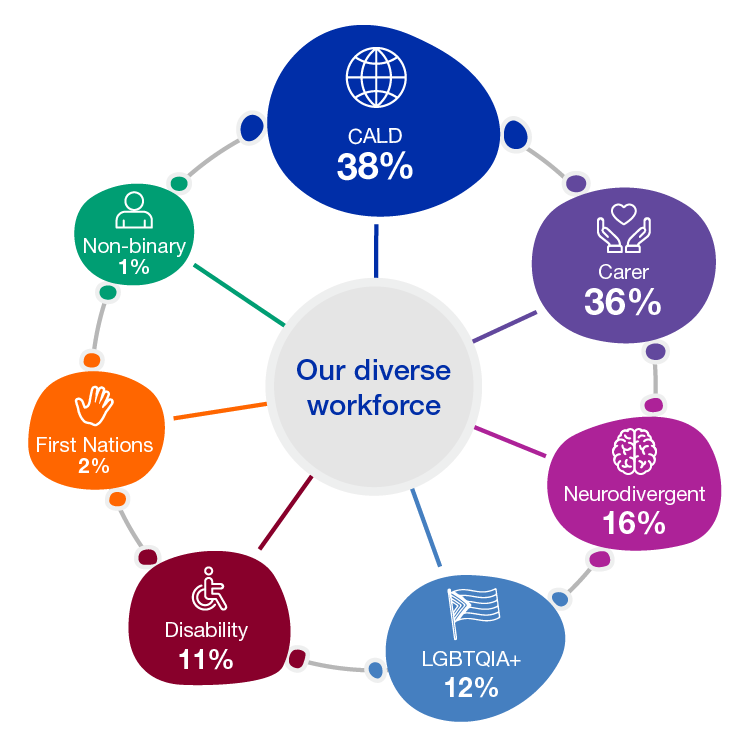
The information below is derived from the ANAO results from the 2026 APSC Census Survey and represents our diverse workforce. The ANAO also acknowledges that a person can belong to many groups simultaneously and the value of intersectionality in a diverse and inclusive workforce.
Staff lived experience story
I’m a queer disabled person with significant caring responsibilities, and I’ve been working at the ANAO for a number of years. My experience at the ANAO has been positive in several respects. While working at the ANAO, I have been able to work out of state to assist a loved one accessing medical treatment.
Flexible working arrangements, including working from home, are critical in helping me manage my disabilities and maintain productivity, even on more challenging days.
The ANAO has also created an environment where I feel supported in expressing my queer identity, including through initiatives such as Wear It Purple Day and Pride Month.
Our journey so far
The ANAO has progressively strengthened its diversity and inclusion efforts since establishing an initial framework in 2013. This has evolved into a more mature, organisation-wide approach, including the establishment of its first Diversity and Inclusion Strategy in 2021, which embedded awareness, leadership and inclusive practices. We have matured further with coordination of cultural events including diversity and inclusion event days, regular corporate messaging and the establishment of a Diversity & Inclusion Council in 2025.
The ANAO is now building on this strong foundation through the implementation of the 2026–30 Diversity and Inclusion Strategy, developed through extensive workforce consultation.
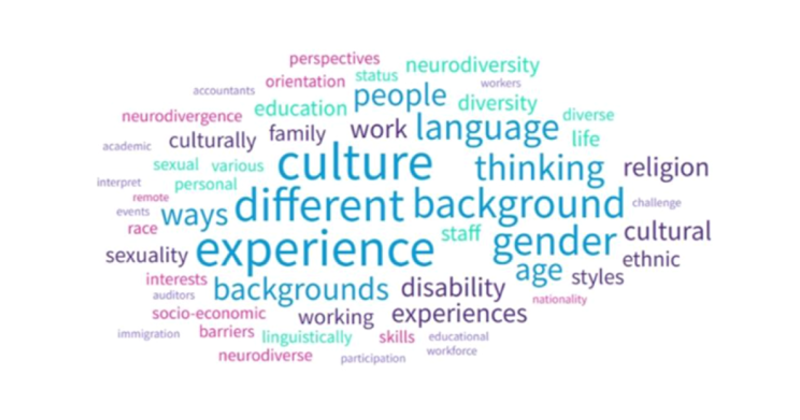
Source: The word diagram provides the concepts that emerged from an ANAO consultation session as being meaningful to our staff for an inclusive workplace conducted in October 2025.
Diversity and inclusion framework
The ANAO is committed to a diverse, inclusive and accessible workplace where everyone feels valued, respected and able to contribute. The Our ANAO approach is supported by our Diversity and Inclusion Strategic Objective, guiding principles and a shared focus on awareness.
Together, these provide a clear framework for embedding inclusion in our culture, leadership, decisions and ways of working throughout the life of the Strategy.
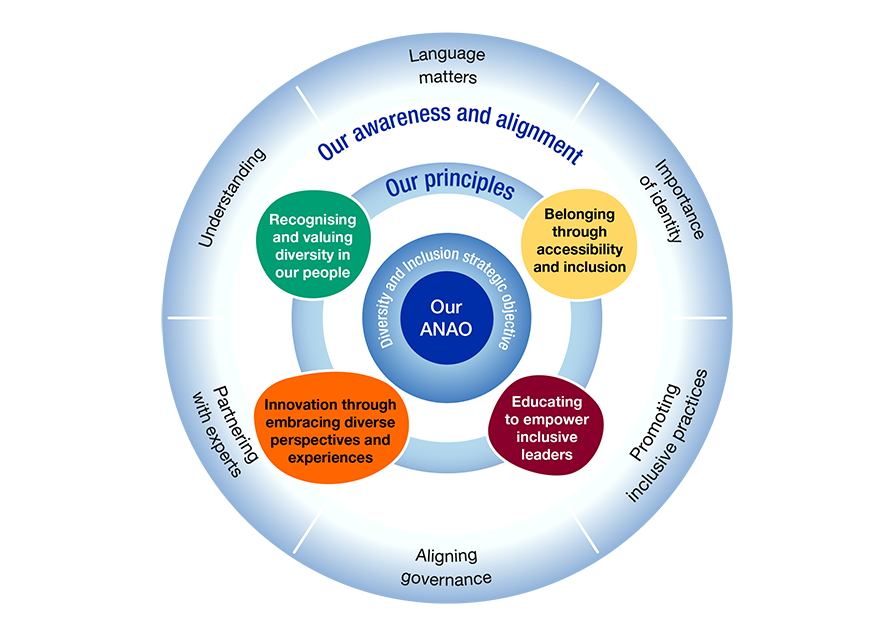
Explaining the four framework layers
‘Our ANAO’ approach
At the centre of the framework is the Our ANAO approach. Through collaboration across audit, specialist and enabling functions, we harness the strengths, expertise and perspectives of our people to delivery quality outcomes to support accountability and transparency in the Australian Government sector.
By placing people at the centre of our work, and embracing diverse experiences and perspectives, we build a workplace where everyone feels included, respected, connected and able to contribute fully to a shared purpose.
Diversity and inclusion strategic objective
The second layer of the framework is the Diversity and Inclusion Strategic Objective, below summarises this objective.
We are committed to a respectful, inclusive, accessible and culturally safe workplace where people work collaboratively, feel they belong, and are empowered to contribute fully.
We value and actively draw on the diverse perspectives, experiences and skills of our people, recognising that collaboration strengthens our work and outcomes.
We will put this Strategy into practice through an annual action plan, engaging our people in the design, delivery and continuous improvement of annual action plans that keep our approach current and effective.
Our principles
The third layer of the framework is built around the four principles of:
- Recognising and valuing diversity in our people;
- Belonging through accessibility and inclusion;
- Educating to empower inclusive leaders; and
- Innovation through embracing diverse perspectives and experiences.
These principles recognise the richness of our differences and the strength of our shared purpose. Each principle is supported by a goal that helps ensure the diverse identities, experiences and perspectives of our people are understood, valued, and reflected in how we work.
Together, the principles and goals provide a practical foundation for fostering an inclusive, respectful and culturally safe workplace where everyone can contribute and thrive.
Our awareness and alignment
The fourth and final layer of the framework focuses on building awareness and alignment across the ANAO. It is supported by six key enablers:
- understanding diversity;
- recognising that language matters;
- acknowledging the importance of identity;
- promoting inclusive practices;
- aligning governance and policies; and
- partnering with experts.
Together, these elements help embed inclusion into everyday behaviours, decision-making and organisational systems, ensuring our principles are understood, applied and sustained across the ANAO.
Principle 1: Recognising and valuing diversity in our people
GOAL 1
Our people are supported to thrive, adapt and succeed through a collaborative and inclusive culture, with fair access to opportunities, meaningful career pathways, and a shared commitment to attracting, developing and retaining a diverse workforce.
Key outcomes for this goal
- The ANAO celebrates Diversity and Inclusion event days, including events relating to LGBTQIA+, First Nations, gender equality, cultural inclusion, neurodivergence, recognising carers and people with disabilities.
- The ANAO supports First Nations employees to foster cultural connection. In addition, supports strengthened cultural awareness for all staff developing policies, initiatives and audits related to First Nations peoples.
- Lived experience, cultural expertise and other competencies are reflected in internal and external diversity and inclusion-related policies and audits, where appropriate
- Staff can express preferred pronouns and Acknowledgement of Country.
- Recruitment practices to align with contemporary and inclusive practices in line with the APS Disability Employment Strategy to allow for equal participation for people with disabilities and neurodivergent people.
- Development of an ANAO CALD Strategy.
- Leadership pathways support equitable access to development and advancement opportunities, resulting in increased representation of diverse groups in leadership pipelines and appointments, while upholding the APS merit principle.
Principle 2: Belonging through embedding accessibility and inclusion
GOAL 2
Accessibility and inclusion are embedded in our workplace culture and practices, and our people feel safe, respected and valued for their perspectives, with a sense of organisational belonging.
Key outcomes for this goal
- Internal learning, meetings and communications are accessible and inclusive.
- Staff confidently engage with available support resources and services for staff from diverse groups.
- Induction materials support new employees to be aware of provisions and support available for all employees
Principle 3: Educating to empower inclusive leaders
GOAL 3
To enhance our workplace capability and inclusive practice through developing and empowering inclusive leaders at all levels and supporting all staff to realise their full potential.
Key outcomes for this goal
- Leadership models cultural capability, inclusive practices and demonstrate capability to work effectively across diverse teams.
- Staff outside the Diversity and Inclusion Council are involved in events and celebrations which complement the Diversity and Inclusion calendar.
- Guidance and practical resources are available to support managers in leading diverse and inclusive teams, including supporting staff with reasonable adjustments align with APS wide resources and initiatives where appropriate.
- Representatives from ANAO partake in and collaborate with APS diversity networks.
Principle 4: Innovation through embracing diverse perspectives and experiences
GOAL 4
Organisational performance is enhanced through increased innovation, objective decision-making and willingness to explore new approaches, informed by carefully listening to and considering the diverse perspectives and experiences of our workforce, entities and stakeholders.
Key outcomes for this goal
- Innovation related to Diversity and Inclusion is recognised.
- Staff report increased opportunities to collaborate across teams and functions, and a greater willingness to share diverse perspectives, challenge thinking and contribute ideas that improve how we work.
- Our people seek out and consider diverse perspectives, listen respectfully, challenge assumptions and apply objective judgement to support high-quality audit outcomes.
Putting the strategy into practice
Diversity and inclusion in practice
The Diversity and Inclusion Strategy and associated inclusion action plans outline the ANAO’s commitment to APS equity and inclusion priorities and principles. These commitments are embedded in, and supported by, key ANAO corporate and workforce frameworks, including:
- ANAO Corporate Plan;
- ANAO People Strategy 2026–29;
- Annual Workforce Action Plans;
- Annual ANAO Census Action Plan;
- ANAO’s commitment to respectful and productive workplace; and
- Annual Diversity and Inclusion Strategy Action Plan.
This integrated approach ensures that inclusion is reflected consistently across governance, planning and operational settings, and reinforces alignment with the ANAO’s broader strategic intent.
Governance and accountability
Everyone at the ANAO contributes to creating a respectful, inclusive and culturally safe workplace. Delivering the Diversity and Inclusion Strategy is a shared responsibility, with the Diversity and Inclusion Council coordinating implementation across the ANAO.
The Strategy is supported by governance arrangements that provides oversight, accountability and continuous improvement. The People and Culture Committee provides strategic oversight and receives regular progress updates. Guided by the SES Champion and Chief People Office, the Diversity and Inclusion Council leads implementation, monitors progress and reports on outcomes. It is further supported by the APS Values and the Code of Conduct and relevant legislative frameworks including anti-discrimination, privacy, and work health and safety legislation.
Annual Diversity and Inclusion Action Plans will support delivery by setting out key actions, responsibilities and measures, helping to embed diversity and inclusion across the ANAO and track progress over time.
The table below summarises the roles and responsibilities of SES, managers, APS staff and committees in embedding inclusive practices and supporting all staff to deliver their best.
|
Level or group |
Role in strategy |
Key responsibilities |
Governance function |
Reporting or checkpoint |
|
SES |
Strategic leadership and sponsorship |
Champion culture, model inclusive leadership, remove barriers |
Oversight and direction |
Quarterly through P&CC and/or EBOM |
|
Managers |
Team implementation |
Embed inclusive practices, support participation, escalate barriers |
Implementation and operational support |
Group business plan reporting |
|
APS staff |
Everyday inclusion |
Model respectful behaviour, participate in initiatives, provide feedback |
Application of the strategy |
Pulse surveys and APS census |
|
Diversity & Inclusion Council |
Strategy coordination |
Lead action plan, event days, checkpoint reporting |
Direction, monitoring and reporting |
Monitoring monthly Report biannually to P&CC |
|
P&CC |
Governance review |
Review progress and link strategy to broader priorities |
Oversight |
Quarterly |
|
EBOM |
Executive oversight |
Champion desired culture and strategic alignment |
Oversight |
Quarterly or as required |