Browse our range of reports and publications including performance and financial statement audit reports, assurance review reports, information reports and annual reports.
Auditor-General Report No. 32 of 2025–26
Administration of the Freedom of Information Act 1982 by Selected Entities
Published
Wednesday 20 May 2026

Portfolio
Prime Minister and Cabinet; Infrastructure, Transport, Regional Development, Communications, Sport and the Arts; Treasury
Entity
Cross Entity
Contact
Please direct enquiries through our contact page.
Activity
Regulation
Sector
Prime Minister & Cabinet
Infrastructure
Treasury
Audit snapshot
Why did we do this audit?
- The purpose of the Freedom of Information (FOI) Act is to give the Australian community access to Australian Government information.
- A December 2023 Senate inquiry report concluded that the ‘system is not working effectively and for some time has not functioned as it was intended.’
- The audit provides assurance to Parliament over the effectiveness of entity administration of FOI Act requests in achieving the objects of the FOI Act.
Key facts
- Audited entities were the departments of: Prime Minister and Cabinet; Treasury; and Infrastructure, Transport, Regional Development, Communications, Sport and the Arts.
- The audit analysis focussed on 1,111 non‑personal information FOI requests across the three entities. The audit scope involved requests that were active at any time during 2024.
What did we find?
- Administration of FOI Act requests by the audited entities has been partly effective in giving the community access to information.
- The audited entities provided some documents to the applicant for 43 per cent of the requests examined. The audit identified a range of shortcomings with entity administration of FOI Act requests that are inconsistent with the pro-disclosure objects of the FOI Act.
- Decision-making in the three audited entities was not consistently transparent and accountable.
What did we recommend?
- There were six recommendations made to the audited entities to improve their administration of FOI Act requests, and three recommendations made to the Office of the Australian Information Commissioner relating to system-wide improvements. All entities agreed or agreed in principle to the recommendations directed at them.
43,456
FOI requests were received by all agencies and ministers in
2024–25.
79%
of the 25,211 decisions made by agencies in 2024–25 were to refuse access in part or full.
62%
of Information Commissioner review decisions in 2024–25 were to ‘set aside’ a decision of the agency.
Summary and recommendations
Background
1. The Freedom of Information Act 1982 (FOI Act) is the legislative basis for open government in Australia at the Commonwealth level. Each person has legally enforceable rights under and subject to the FOI Act to obtain access to government documents and to apply for the amendment or annotation of records of personal information held by government.
2. In 2024–25, 43,456 Freedom of Information (FOI) requests were received by agencies and ministers, a 25 per cent increase on 2023–24. FOI complaints and applications for review in 2024–25 also increased significantly (by 26 per cent and 21 per cent respectively). The Office of the Australian Information Commissioner (OAIC) stated in its 2024–25 Annual Report that:
- the percentage of FOI requests decided outside the applicable statutory timeframe in 2024–25 remained unchanged from the previous year at 27 per cent;
- of the 25,211 decisions made on FOI requests, 25 per cent were to refuse access in full, 54 per cent granted access in part and 21 per cent granted full access; and
- 62 per cent of Information Commissioner decisions ‘set aside’1 the decisions under review. The OAIC stated that this ‘high set-aside rate indicates there is more work to do to embed a pro-disclosure approach. This work is important to ensure proper alignment with the objects of the FOI Act, to increase public participation in Government processes and to increase scrutiny, discussion, comment and review of the Government’s activities’.
Rationale for undertaking the audit
3. The purpose of the FOI Act is to give the Australian community access to Australian Government information. Parliament intended that the functions and powers under the FOI Act ‘are to be performed and exercised, as far as possible, to facilitate and promote public access to information, promptly and at lowest reasonable cost’. A December 2023 Senate inquiry report concluded that the ‘system is not working effectively and for some time has not functioned as it was intended.’2
4. The audit provides assurance to Parliament over the effectiveness of entity administration of FOI Act requests in achieving the objects of the FOI Act.3
Audit objective and criteria
5. The objective of this audit was to assess whether the selected entities’ administration of FOI Act requests is effective in giving the community access to Australian Government information.
6. To form a conclusion against the objective, the following high-level criteria were adopted:
- Did entities facilitate access to requested documents, promptly and at the lowest reasonable cost?
- Was decision-making transparent, accountable and pro-disclosure?
7. The ANAO audited three entities: the Department of the Prime Minister and Cabinet (PM&C); the Department of the Treasury (Treasury); and the Department of Infrastructure, Transport, Regional Development, Communications, Sports and the Arts (Infrastructure). The audit also engaged with the Office of the Australian Information Commissioner in light of the preliminary audit findings and potential recommendations.
8. The scope of the FOI requests examined was those seeking access to documents other than those containing the applicants own personal information, that were active at any time during 2024. ANAO identified 1,111 FOI requests within scope of the audit, across the three entities. When undertaking testing and analysis, ANAO applied a representative sampling methodology, in line with ANAO auditing standards.
Conclusion
9. The FOI system is recognised as a critical pillar of open government and robust democracy in Australia. Australian Government information is a national resource that should be available for community access and use. Administration of Freedom of Information Act (FOI Act) requests by the audited entities has been partly effective in giving the community access to information.
10. The administration of FOI Act applications by the audited entities resulted in a decision to provide some documents to the applicant for under half (43 per cent) of the requests examined by the ANAO. The audit identified a range of shortcomings with entity administration of FOI Act requests that are inconsistent with the pro-disclosure objects of the FOI Act, including:
- entities are not demonstrably meeting their obligations to take reasonable steps to assist applicants make FOI requests and to then find the requested documents. For 79 per cent of requests examined as part of the audit, the three entities had not met their own requirements to evidence the reasonableness of the searches they had undertaken to locate the requested documents;
- in addition to 57 per cent of requests not leading to the release of any documents to the applicant, public disclosure of released documents, via each entity’s disclosure log, has been incomplete. This has been the case notwithstanding that the FOI Commissioner has identified disclosure log reporting as a way that agencies to reduce the impact of FOI Act administration on their activities; and
- statutory timeframes for decision-making and disclosure are not consistently being met. For 63 per cent of the FOI requests examined departments decided to make use of one or more provisions in the Act allowing for a longer response period than 30 days. Even then, for 29 per cent of requests examined, the decision was taken outside the statutory timeframe (after allowing for any extensions and excluding those with insufficient records). Entity disclosure logs were also not being updated in accordance with statutory timeframes (23 per cent of disclosures were late).
11. Decision-making in the three audited entities was not consistently transparent, accountable and pro-disclosure. A key factor was the lack of records around decision-making with no record maintained of the advice to the decision-maker for 30 per cent of FOI requests examined by the ANAO. Records were also lacking in terms of the impact that consultation with minister’s offices was having on decision-making, including when they shouldn’t be.
12. Reviews of agency decision-making demonstrated do not evidence a pro-disclosure approach. Of the internal reviews within the three audited entities, 24 per cent resulted in a decision to provide more information to the applicant. For 54 per cent of reviews undertaken by the Information Commissioner, the result involved further information being provided to the applicant.
13. Requested documents were exempted, and/or information redacted, in 53 per cent of the FOI requests examined by the ANAO. There are inaccuracies in reporting by entities to the Office of the Australian Information Commissioner reflecting, among other things, inaccurate data held in entity case management systems. This included the outcome of the request advised to the OAIC (based on what was recorded in the case management system) being different to the outcome notified to the applicant in 19 per cent of requests examined.
Supporting findings
Administration of the Freedom of Information Act
14. The three audited entities do not have appropriate policies and procedures in place to meet their responsibilities under the Freedom of Information Act. Of the three audited entities, Treasury had no finalised policy or procedures in place, while Infrastructure and PM&C did. A number of shortcomings were evident in the documented policies and procedures in PM&C. (See paragraphs 2.3 to 2.31)
15. It is not evident that entities are meeting their obligation to take reasonable steps to assist applicants make FOI requests. None of the internal guidance of the entities outlined what the entities considered to be reasonable steps to assist applicants. This approach is not pro-disclosure. (See paragraphs 2.32 to 2.49)
16. The three audited entities are unable to demonstrate that they have met the obligation to take all reasonable steps to find requested documents. Entities are not maintaining adequate records of the searches they undertake in response to FOI applications to assure completeness. Entity records also do not consistently support decisions to refuse access because records could not be located or do not exist. (See paragraphs 2.50 to 2.65)
17. Charges were not often notified by the three audited entities. In 2024: PM&C did not notify any applicant of any charges; Infrastructure notified one applicant of two charges; and Treasury notified 26 applicants of 30 charges (10 per cent of requests received). In the case management systems of each of the audited entities, costs are not calculated for each application, nor are there time or effort records for each application. (See paragraphs 2.66 to 2.72)
18. A decision to provide some documents to the applicant was made for 43 per cent of the requests examined by the ANAO across the three audited entities. Documents are predominantly provided to the applicant by email (95 per cent of requests where the audited entity retained a record of release). (See paragraphs 2.73 to 2.77)
19. Public disclosure of released documents, via the disclosure log required under the FOI Act, was incomplete and not in accordance with the law. The websites used by each audited entity are variable in terms of the information provided and their useability. In addition, each entity’s disclosure log was incomplete (8 per cent of expected disclosures had not been made) and the logs were not being updated in accordance with statutory timeframes (26 per cent of disclosures were late). (See paragraphs 2.78 to 2.94)
20. The three audited entities are not maintaining adequate records to demonstrate compliance with statutory timeframes for processing FOI applications. Where records were available, statutory timeframes were not consistently met, particularly in relation to decision-making on requests.
- Notification to applicants that their request had been received: seven per cent of requests examined by the ANAO (where records were available) were outside the statutory timeframe.
- Decision-making notification to applicants: for 63 per cent of the FOI requests examined, the statutory response timeframe was greater than 30 days due to departments deciding to make use of one or more provisions in the Act allowing for a longer response period. After allowing for extensions, there were 28 per cent of requests examined by the ANAO (where records were available) that were outside the statutory timeframe. (See paragraphs 2.95 to 2.112)
Decision-making
21. Entities have in place delegations that assist with transparent and accountable decisions in relation to access under the FOI Act. The policies of the three audited entities vary on requirements of decision-making artefacts. No entity had in place policies that address all of the consultations they may undertake on FOI requests, including consultations not specifically provided for in the FOI Act (and the FOI Guidelines issued by the OAIC also do not address those consultations). (See paragraphs 3.2 to 3.16)
22. The poor state of recordkeeping around FOI decisions does not demonstrate that decisions are being adequately informed. In relation to the 498 FOI requests examined by the ANAO across the three audited entities:
- for 32 per cent there was no record maintained of the advice provided to the decision-maker;
- a record of the decision was not evident for 30 per cent; and
- the record of the decision provided to the applicant was not retained for 11 per cent. (See paragraphs 3.17 to 3.42)
23. Documents were exempted, and information was redacted, in 53 per cent of the sampled FOI requests. Decisions to exempt a document or redact information were often not recorded, beyond the decision notice to the applicant. It was not clear from entity records how decisions to exempt information were made, nor how decisions were made not to exempt information and release information where an exemption may have applied. Overall, entity records do not demonstrate a pro-disclosure approach to FOI requests. (See paragraphs 3.43 to 3.71)
24. Decisions taken were recorded by each of the three audited entities in their case management system. Decision notices issued to applicants were comprehensive, and consistent with templates each entity has in place. The notifications issued to applicants were largely consistent with the records of the decision. (See paragraphs 3.72 to 3.77)
25. The three audited entities appropriately engaged with complaints and review mechanisms. Each of the audited entities informed applicants of internal review processes that were available, and provided information on the complaints and review processes of the OAIC. Where there was a request for an Information Commissioner review of a decision, and there was a record of a revised decision or outcome from the OAIC, the decision was to provide further information in 54 per cent of instances. (See paragraphs 3.78 to 3.82)
26. Each of the three audited entities extract reports from their respective case management systems to provide information and statistics to the OAIC. These reports to the OAIC reflect the level of accuracy of the information. There are inaccuracies within each of the entity case managements systems. For example, in 19 per cent of sampled requests the outcome advised to the applicant did not match the outcome recorded in the case management system. Further, information in the case management system could not be verified to records in 47 per cent of sampled requests. (See paragraphs 3.84 to 3.92)
Recommendations
Recommendation no. 1
Paragraph 2.24
Entities review, update and finalise a complete Freedom of Information policy and procedure(s), and undertake regular review to ensure these policies and procedures remain accurate and up to date.
Department of the Prime Minister and Cabinet response: Agreed
Department of the Treasury response: Agreed
Department of Infrastructure, Transport, Regional Development, Communications, Sport and the Arts response: Agreed
Office of the Australian Information Commissioner: Agreed
Recommendation no. 2
Paragraph 2.60
Entities each implement a monitoring and assurance framework over their internal requirements to record: the searches they undertake in response to Freedom of Information applications; and decisions to refuse access because records could not be located or do not exist.
Department of the Prime Minister and Cabinet response: Agreed
Department of the Treasury response: Agreed
Department of Infrastructure, Transport, Regional Development, Communications, Sport and the Arts response: Agreed
Office of the Australian Information Commissioner: Agreed
Recommendation no. 3
Paragraph 2.88
Entities comply with the objects of the Freedom of Information Act and periodically review the level and timeliness of disclosures they make in response to Freedom of Information applications as an indicator of whether their organisational culture, policies and practices are effective in providing the Australian community with access to information held by the Australian Government.
Department of the Prime Minister and Cabinet response: Agreed
Department of the Treasury response: Agreed
Department of Infrastructure, Transport, Regional Development, Communications, Sport and the Arts response: Agreed
Office of the Australian Information Commissioner: Agreed
Recommendation no. 4
Paragraph 2.111
The Office of the Australian Information Commissioner investigate and advise the Australian Government on the merits of developing a Commonwealth-wide case management system or approach for all entities subject to the Freedom of Information Act use to manage requests as well as to monitor and report on their performance in meeting their obligations under the Act. This system could also be used by the Commissioner to compile the statistics that it publishes with its annual report.
Office of the Australian Information Commissioner: Agreed in principle
Recommendation no. 5
Paragraph 3.12
The Office of the Australian Information Commissioner strengthen its guidance by identifying to entities better practice approaches to implementing the principles for good decision-making under the Freedom of Information Act that are set out in its Guidelines, including ensuring all decisions of a decision-maker are clearly recorded, along with evidence of the decision-maker making the decision and their considerations.
Office of the Australian Information Commissioner: Agreed
Recommendation no. 6
Paragraph 3.18
Entities implement a monitoring and assurance framework over adherence to their policies and procedures for decision-making under the Freedom of Information Act.
Department of the Prime Minister and Cabinet response: Agreed
Department of the Treasury response: Agreed
Department of Infrastructure, Transport, Regional Development, Communications, Sport and the Arts response: Agreed
Office of the Australian Information Commissioner: Agreed
Recommendation no. 7
Paragraph 3.41
The Office of the Australian Information Commissioner strengthen the Freedom of Information Guidelines to address the conduct of courtesy consultations undertaken in addition to those provided for in the Freedom of Information Act, as well as imminent release notification processes, including how entities are to manage the risks to the independence of agency decision-making that can arise from those processes.
Office of the Australian Information Commissioner: Agreed
Recommendation no. 8
Paragraph 3.65
Entities:
- strengthen their recordkeeping over decisions about exemptions and redactions in response to FOI requests; and
- issue guidance to decision-makers that emphasises the importance of adopting a pro-disclosure posture, combined with monitoring whether the frequency and extent use of exemptions and redactions by decision-makers is consistent with a pro-disclosure posture.
Department of the Prime Minister and Cabinet response: Agreed
Department of the Treasury response: Agreed
Department of Infrastructure, Transport, Regional Development, Communications, Sport and the Arts response: Agreed
Office of the Australian Information Commissioner: Agreed in principle
Recommendation no. 9
Paragraph 3.87
Assurance frameworks be developed and implemented by:
- each entity, over the data they extract from their case management systems to report data to the Office of the Australian Information Commissioner; and
- the Office of the Australian Information Commissioner, over the data received from entities and reported publicly by the Office of the Australian Information Commissioner.
Department of the Prime Minister and Cabinet response: Agreed
Department of the Treasury response: Agreed
Department of Infrastructure, Transport, Regional Development, Communications, Sport and the Arts response: Agreed
Office of the Australian Information Commissioner: Agreed
Summary of entity responses
Department of the Prime Minister and Cabinet
PM&C thanks the Australian National Audit Office (ANAO) for the opportunity to respond to its audit report on the administration of the Freedom of Information Act. PM&C acknowledges the findings and values the ANAO’s examination of agencies’ practices, noting the report will support improved administration of the FOI Act in support of its objects. PM&C recognises the findings were affected by insufficient record-keeping, particularly the need to clearly evidence searches and reasons for FOI decisions. PM&C agrees strong record-keeping is essential to meeting statutory obligations, supporting accountability, and enabling accurate reporting. Work is underway to improve record management and data quality. PM&C reiterates its commitment to accountability, transparency, and compliance, including proactively publishing information through the Information Publication Scheme (IPS). PM&C accepts the entity recommendations.
Department of the Treasury
Treasury welcomes the report on the administration of the Freedom of Information Act 1982 by selected entities. Treasury is committed to addressing the findings of the report and agrees with the recommendations directed at Treasury. Treasury considers the shortcomings identified by the report around our administration and record keeping offer opportunities for improvement, which Treasury will address.
Treasury’s FOI Policy has been updated to consolidate existing guidance and will shortly be considered by Treasury’s Executive Board. The Policy now more clearly articulates Treasury’s expectations, is more accessible to decision makers and will be reviewed annually to incorporate developments in the law and external guidance. Treasury has also commenced development of other supporting documents to further information request processing and improve assurance frameworks.
Department of Infrastructure, Transport, Regional Development, Communications, Sport and the Arts
The department recognises the importance of the Freedom of Information Act 1982 in supporting open government and robust democracy and takes a continuous improvement approach to FOI processing. For example, we implemented an FOI specific Case Management System in July 2023, established an FOI Processing Framework in August 2024, and are building a catalogue of quick reference guides to support consistent and timely processing.
The department welcomes and appreciates the findings and improvements identified in the audit report and acknowledges the need to strengthen aspects of our FOI processing. This work is well underway as part of an ongoing program of uplift and continuous improvement.
Office of the Australian Information Commissioner
The FOI system is a critical pillar of open government and robust democracy in Australia. As an independent agency within the Attorney-General’s portfolio, the OAIC provides regulatory oversight of the operation of the Freedom of Information Act 1982 (FOI Act), including through the handling of complaints and conducting merits review of decisions of agencies and ministers under the Act. The OAIC’s role as a Commonwealth integrity agency is also secured by both the FOI Act and the Australian Information Commission Act 2010. In this regard FOI performance metrics under the Commonwealth Integrity Strategy are key indicators of the strength of the Commonwealth Integrity Framework.
The OAIC’s regulatory priorities include promoting compliance with the FOI Act and supporting public sector capability in the administration of the FOI Act. The OAIC will continue to exercise its regulatory powers and review and update the FOI Guidelines, Procedure Directions, guidance and education materials to reflect best practice and promote improved compliance with the FOI Act.
The OAIC supports, or supports in principle, recommendations that relate to the OAIC’s regulatory functions and will continue to consider the insights garnered from the audit.
Key messages from this audit for all Australian Government entities
27. Below is a summary of key messages, including instances of good practice, which have been identified in this audit and may be relevant for the operations of other Australian Government entities.
Group title
Governance and risk management
Key learning reference
Group title
Records management
Key learning reference
1. Background
Introduction
1.1 The Freedom of Information Act 1982 (FOI Act) is the legislative basis for open government in Australia at the Commonwealth level. Each person has legally enforceable rights under and subject to the FOI Act to obtain access to government documents and to apply for the amendment or annotation of records of personal information held by government. The FOI Act also requires agencies to publish specified categories of information and encourages the proactive release of other government held information.
1.2 In 2024–25, 43,456 Freedom of Information (FOI) requests were received by agencies and ministers, a 25 per cent increase on 2023–24. According to the Office of the Australian Information Commissioner (OAIC)4, the number of requests received in 2024–25 was the highest received on record. FOI complaints and applications for review in 2024–25 also increased significantly (by 26 per cent and 21 per cent respectively). In addition, 93 applications for review of FOI decisions were filed with the Administrative Review Tribunal (ART), which was a four per cent decrease on 2023–24 (after a 20 per cent increase between 2022–23 and 2023–24). The OAIC reported in its 2024–25 Annual Report that:
- ‘agencies continue to face challenges meeting processing timeframes against a rising trend in FOI request numbers’ with the percentage of FOI requests decided outside the applicable statutory timeframe remaining unchanged from the previous year at 27 per cent;
- 25,211 decisions were made on FOI requests: 25 per cent of decisions were to refuse access in full; 54 per cent granted access in part; and 21 per cent granted full access; and
- 62 per cent of Information Commissioner decisions ‘set aside’5 the decisions under review. The OAIC stated that this ‘high set-aside rate indicates there is more work to do to embed a pro-disclosure approach. This work is important to ensure proper alignment with the objects of the FOI Act, to increase public participation in Government processes and to increase scrutiny, discussion, comment and review of the Government’s activities’.
Rationale for undertaking the audit
1.3 The purpose of the FOI Act is to give the Australian community access to Australian Government information. Parliament intended that the functions and powers under the FOI Act are to be performed and exercised, as far as possible, to facilitate and promote public access to information, promptly and at lowest reasonable cost.
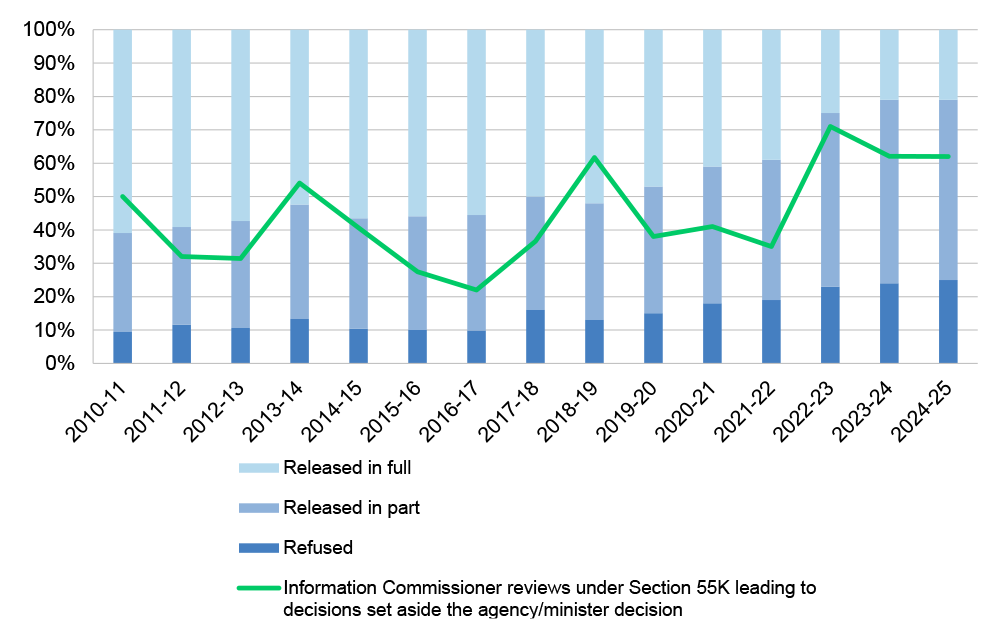
1.4 As illustrated by Figure 1.1, the proportion of FOI requests reported by entities as granted in full has declined significantly over the last 15 years.6 Up to 2018–19, the majority of requests were granted in full whereas that figure has been below 25 per cent since 2022–23.7 Just over half of requests now result in partial release of information (up from around one third in the first nine years after the 2010–11 reforms to the FOI Act) with refused requests having more than doubled to now be around one quarter of all requests that are decided each year. Full refusals have risen since 2018–19 and were above 20 per cent of decisions in 2022–23 and have continued to increase. Further, over this 15-year period, there has been a marked increase in the proportion of Information Commissioner reviews that result in a decision to set aside the original decision taken by the agency or minister, a situation that the OAIC has identified as being inconsistent with a pro-disclosure approach by entities.8
Figure 1.1: FOI access decisions and Information Commissioner decisions to set aside original access decisions: 2010–119 to 2024–25
Source: ANAO analysis of OAIC annual reports.
1.5 A December 2023 Senate inquiry report concluded that the ‘system is not working effectively and for some time has not functioned as it was intended.’10 The Government responded to Parliament in September 2025, noting the introduction of a Bill to amend the FOI Act.11 This Bill was discharged from the Senate Notice Paper on 5 March 2026.12 The audit provides assurance to Parliament over the effectiveness of entity administration of FOI Act requests in achieving the objects of the FOI Act.13
Audit approach
Audit objective, criteria and scope
1.6 The objective of this audit was to assess whether the selected entities’ administration of Freedom of Information Act 1982 requests is effective in giving the community access to Australian Government information.
1.7 To form a conclusion against the objective, the following high-level criteria were adopted:
- Did entities facilitate prompt access to requested documents?
- Was decision-making transparent, accountable and pro-disclosure?
1.8 The ANAO audited three entities: the Department of the Prime Minister and Cabinet (PM&C); the Department of the Treasury (Treasury); and the Department of Infrastructure, Transport, Regional Development, Communications, Sports and the Arts (Infrastructure). The audit also engaged with the Office of the Australian Information Commissioner in light of the preliminary audit findings and potential recommendations.
1.9 The scope of the FOI requests examined was those seeking access to documents other than those containing the applicants own personal information, which were active at any time during 2024. Specifically, FOI requests each auditee:
- had on hand at 1 January 2024 or received during 2024;
- had received directly or via transfer, assessed as a valid or invalid request, or transferred to another agency or a minister;
- had or had not made a decision on by 31 December 2024;
- had conducted an internal review of during 2024, regardless of the date of the original request; and/or
- had been contacted about by the OAIC, Commonwealth Ombudsman, Administrative Review/Appeals Tribunal or Federal Court during 2024, regardless of the date of the original request.
1.10 ANAO identified 1,111 FOI requests within scope of the audit, across the three entities (see Table 1.1). When undertaking testing and analysis, ANAO applied a representative sampling methodology, in line with ANAO audit standards.
Table 1.1: Number of in scope FOI request on hand in 2024 for each of the three audited entities
|
Audited entity |
Total number of FOI requests |
Received by transfer |
Number of FOI requests made by Individuals / Parliamentarians / Media a |
Received on or after 1 January 2024 |
Finalised during 2024 |
|
PM&C |
422 b |
20 (4.74%) |
197 / 87 / 99 47% / 21% / 23% |
332 |
337 |
|
Treasury |
291 |
2 (0.69%) |
107 / 67 / 92 37% / 23% / 32% |
258 |
257 |
|
Infrastructure |
398 |
23 (5.78%)b |
112 / 152 / 80 28% / 38% / 20% |
339 |
352 |
|
Total in audited population |
1,111 |
45 (4%) |
420 / 307 / 275 38% / 28% / 25% |
929 |
946 |
Note a: ANAO has reflected the three largest cohorts of applicants in these figures. As such these figures do not add to the total number of requests received in 2024.
Note b: Included in these figures are 10 FOI requests submitted by a single applicant to PM&C on a single day and subsequently transferred to Infrastructure, see Footnote 38. The outcome for all 10 requests was for access to be refused in full.
Source: ANAO analysis of entity records.
Audit methodology
1.11 The audit method included:
- consideration of the FOI Act, the Freedom of Information (Charges) Regulations 2019, and the ‘FOI Guidelines’ issued by the Australian Information Commissioner under section 93A of the FOI Act14;
- examination of entity procedures, policies and guidance relevant to the performance of functions, or exercise of powers, under the FOI Act;
- examination of records for samples of FOI requests and correspondence, including correspondence between the entity and applicant, internal entity correspondence regarding a request, briefs or minutes to decision-makers, decision letters, and information published by the entity about FOI and FOI requests; and
- consultation with staff, including entity FOI coordination teams, FOI decision-makers, and the senior responsible officers for FOI administration.
1.12 The audit was conducted in accordance with ANAO Auditing Standards at a cost to the ANAO of approximately $725,000.
1.13 The team members for this audit were Hannah Conway, William Mussared, Tracey Bremner, Tomislav Kesina, and Brian Boyd.
2. Administration of the Freedom of Information Act
Areas examined
The ANAO examined whether the selected entities facilitate prompt access to requested documents.
Conclusion
The administration of Freedom of Information Act (FOI Act) applications by the audited entities resulted in a decision to provide some documents to the applicant for under half (43 per cent) of the requests examined by the ANAO. The audit identified a range of shortcomings with entity administration of FOI Act requests that are inconsistent with the pro-disclosure objects of the FOI Act, including:
- entities are not demonstrably meeting their obligations to take reasonable steps to assist applicants make FOI requests and to then find the requested documents. For 79 per cent of requests examined as part of the audit, the three entities had not met their own requirements to evidence the reasonableness of the searches they had undertaken to locate the requested documents;
- in addition to 57 per cent of requests not leading to the release of any documents to the applicant, public disclosure of released documents, via each entity’s disclosure log, has been incomplete. This has been the case notwithstanding that the FOI Commissioner has identified disclosure log reporting as a way that agencies to reduce the impact of FOI Act administration on their activities; and
- statutory timeframes for decision-making and disclosure are not consistently being met. For 63 per cent of the FOI requests examined departments decided to make use of one or more provisions in the Act allowing for a longer response period than 30 days. Even then, for 29 per cent of requests examined, the decision was taken outside the statutory timeframe (after allowing for any extensions and excluding those with insufficient records). Entity disclosure logs were also not being updated in accordance with statutory timeframes (23 per cent of disclosures were late).
Areas for improvement
The ANAO made three recommendations to the audited entities to improve their approach to FOI applications, and one recommendation to the Office of the Australian Information Commissioner to improve the overall system. The ANAO also identified three opportunities for improvement for the audited entities and two opportunities for improvement for the Office of the Australian Information Commissioner.
2.1 Section 3 of the Freedom of Information Act 1982 states:
(1) The objects of this Act are to give the Australian community access to information held by the Government of the Commonwealth, by:
(a) requiring agencies to publish the information; and
(b) providing for a right of access to documents …
(4) The Parliament also intends that functions and powers given by this Act are to be performed and exercised, as far as possible, to facilitate and promote public access to information, promptly and at the lowest reasonable cost.
2.2 Effective administration of the FOI Act is a cornerstone of integrity in the Australian Public Service and trust in government. In this context, the Commonwealth Integrity Strategy was released in December 2025. The Strategy was developed by the Attorney-General’s Department and the Australian Public Service Commission to strengthen integrity across the Commonwealth public sector.15 The Strategy included a number of FOI related metrics (as distinct from performance measures, see Appendix 3) to measure progress with improving transparency and accountability, being the percentage of:
- FOI requests finalised in accordance with statutory timeframes;
- FOI requests refused; and
- OAIC reviews of decisions and FOI complaints finalised each financial year.
Do the entities have appropriate policies and procedures?
The three audited entities do not have appropriate policies and procedures in place to meet their responsibilities under the Freedom of Information Act. Of the three audited entities, Treasury had no finalised policy or procedures in place, while Infrastructure and PM&C did. A number of shortcomings were evident in the documented policies and procedures in PM&C.
2.3 Consistent with requirements under the PGPA Act for entities to establish systems of internal control, documented policies and procedures are important as they provide a clear, consistent framework for operations, behaviour, and decision-making which, in turn, helps ensure legal compliance, promotes efficiency, and manages risks.
2.4 As outlined in Table 2.1, the three audited entities have adopted different approaches to establishing policies and procedures to administer their obligations under the FOI Act. Only the Department of Infrastructure, Transport, Regional Development, Communications, Sport and the Arts’ (Infrastructure) policy, dated June 2024, includes version control, release date and endorsement from a delegate.
Table 2.1: Overview of FOI Act policies, procedures and templates in operation during audit period
|
Audited entity |
Policy |
Procedures |
Templates |
|
PM&C |
FOI Business Rules, undateda |
10 standard operating procedures, user guides and fact sheets, 5 checklists, undated |
40 |
|
Treasury |
Noneb |
None |
73 |
|
Infrastructure |
FOI Processing Framework, June 2024 |
15 quick reference guides, last updated between March 2023 and March 2025 |
25 |
Note a: On 20 October 2022, PM&C released these business rules on its public facing webpage. The document released publicly, as with the internal held version, has no date, no version control and no executive sign off or endorsement (https://www.pmc.gov.au/resources/freedom-information-business-rules).
Note b: In February 2026, Treasury provided ANAO with a finalised FOI Policy albeit with no version control or executive sign off or endorsement.
Source: ANAO analysis of entity records.
2.5 There were various shortcomings in the policies, procedures and guidance of each of the three entities.
Prime Minister and Cabinet
2.6 Prime Minister and Cabinet (PM&C) has a five page ‘Business Rules’ document. It is located on the department’s intranet page. The document states that it was developed to:
- ensure staff are aware of PM&C’s legal obligations under the FOI Act
- set out the structure of FOI processing at PM&C, and
- provide guidance for line area staff who are involved in the processing of an FOI request
2.7 The document contains no executive endorsement or sign off, with the last recorded approval being via email in June 2022. The document has no recorded release or publication date within it, only the public facing website’s record of publication as 20 October 2022. There is also no version control table.
2.8 The ‘Business Rules’ set the expectations for how the subject matter areas within PM&C will engage and work with the FOI team to meet the obligations of the FOI Act. These rules make no reference to the objectives of the FOI Act.16 They do not provide a link to the legislation, but do reference and link to the FOI Guidelines.
2.9 PM&C also has 10 standard operating procedures, user guides and fact sheets as well as five checklists. These documents are all undated, with no version control. There is no order or structure to the supporting documents, for example to align with a workflow, and support staff to refer to and apply the right procedure at the right time in the right circumstance.
Treasury
2.10 At the time of audit, the Department of the Treasury (Treasury) had a draft policy, last edited in December 2023.
2.11 The December 2023 document had substantial elements not yet finalised. It also included various margin comments from Treasury officials offering suggestions and asking questions about the contents.
2.12 The draft policy promoted some practices that are inconsistent with the FOI Act. For example, it stated that it ‘is the Department’s policy to send FOI decisions that include documents for release on Fridays’. This approach, which the ANAO observed was being implemented by Treasury in relation to various requests examined as part of the audit, delays release until Friday of each week. It is not consistent with the FOI Act which requires that decision notification be done ‘as soon as practicable’.17
2.13 Treasury’s draft policy had not been finalised or approved and was out of date with changes to the FOI Act and case law.18 In October 2025, Treasury advised the ANAO that the December 2023 draft policy was the ‘most advanced’ version and that it ‘nevertheless governs our operating framework’.
2.14 The procedures document under the December 2023 draft policy continued to advise Treasury staff, that ‘The application of the FOI Act to documents ‘in the possession of a minister’ excludes by implication documents held by a former minister’ and that ‘If the requested document is not in the possession of the new minister, the FOI Act will not apply as the document is no longer an ‘official document of the minister’. The correct position, following a 2024 decision of the Federal Court of Australia19, has been reflected in an update by the OAIC to its Guidelines to recognise that a document does not cease to be an ‘official document of a minister’ if the incoming minister does not have possession of the document.
2.15 Treasury’s draft policy listed five FOI ‘procedures’ documents. Those five procedure documents do not exist. Rather, Treasury has a single draft procedure. That document attempts to encompass the whole FOI process. It was last edited in November 2022.
2.16 None of the Treasury documents included: executive endorsement or sign off; recording of the release or drafting date; or a version control table.
2.17 In February 2026, Treasury finalised its FOI Policy. Treasury removed the reference to former guidance from PM&C on being consulted when entities process Freedom of Information (FOI) requests for documents that contain Cabinet material (see paragraph 3.39). The policy was amended to address this issue which was raised by the ANAO during the course of the audit. The finalised policy also removed some important requirements that were in the draft policy. For example, the finalised policy does not require a record be made of document searches that were undertaken. As discussed at paragraph 2.59, Treasury had not maintained a record of searches for 73 per cent of requests examined by the ANAO notwithstanding that guidance from the OAIC identifies the importance of this being done (see paragraph 2.57).
Infrastructure
2.18 Infrastructure’s current policy was endorsed by its Chief Counsel on 24 June 2024. This document included improvements20 on the previous document, from May 2022.21
2.19 The June 2024 policy is recorded as Version 1.0. It links to: the FOI Act; the Charges Regulations (made under the FOI Act); and the FOI Guidelines. This version of the policy also makes reference to the objects of the FOI Act, and the department’s records management framework including obligations under the Archives Act 1983.
2.20 The department’s FOI team also maintain a range of quick reference guides. They are numbered in a sequence equivalent to the steps of administering an FOI request.
2.21 None of the quick reference guides include any version control, or endorsement dates.
2.22 Not all of the guides have been finalised. For example, some end with ‘to be continued’.
2.23 The oldest of the guides is dated March 2023. There is evidence of updates, with some created or updated in 2024, and one updated in March 2025.
Recommendation no.1
2.24 Entities review, update and finalise a complete Freedom of Information policy and procedure(s), and undertake regular review to ensure these policies and procedures remain accurate and up to date.
Department of the Prime Minister and Cabinet response: Agreed
2.25 PM&C has prepared an FOI process map to support the identification of a suite of policy and procedure materials required to support the administration of the FOI Act.
2.26 A review of the PM&C FOI Business Rules (policy) has commenced and will be complete by September 2026. In line with the opportunity for improvements PM&C will seek executive endorsement of the policy.
2.27 PM&C will prepare an annual project plan to review, update and finalise policy and procedures for the administration of Freedom of Information requests. To be in place by 30 September 2026.
Department of the Treasury response: Agreed
Department of Infrastructure, Transport, Regional Development, Communications, Sport and the Arts response: Agreed
2.28 The department welcomes the ANAO’s recognition that the 2024 policy reflects significant improvements on the previous version and appreciates the identification of areas where the quick reference guides can be further strengthened. As part of its commitment to continuous business improvement, the department will continue to review and update its FOI Processing Framework and supporting guidance material to ensure these documents remain accurate and up to date.
Office of the Australian Information Commissioner: Agreed
2.29 The OAIC considers that documented and regularly reviewed governance practices relating to record keeping and FOI procedures are beneficial in supporting compliance and provide a sound basis for self-assessment. The OAIC also encourages agencies to apply the FOI Self-Assessment Tool (see Self-assessment tool for agencies https://www.oaic.gov.au/freedom-of-information/freedom-of-information-guidance-for-government-agencies/self-assessment-tool-for-agencies) to help identify areas for improvement and support compliance with the FOI Act.
2.30 The OAIC considers that documented agency FOI procedures, where operational in nature, would be suitable for publication, supported by sections 8A and 8B of the FOI Act (Information Publication Scheme (IPS)).
2.31 The OAIC will continue to recommend agencies update policies and procedures to improve FOI administration and compliance. For example, see recommendations made in recent FOI investigations (available from the OAIC website, https://www.oaic.gov.au/freedom-of-information/information-commissioner-decisions-and-reports/freedom-of-information-investigation-outcomes) - where concerns of timeliness were identified, the OAIC included recommendations to review and update FOI processing manuals and internal policies to ensure compliance with statutory timeframes, as well as other practice improvements such as:
- keeping the applicant informed of the progress of their application and engaging with them to explore options for faster outcomes, and
- preparing training and guidance for decisions makers, in particular on statuary timeframe requirements and independent decision making.
Did entities take reasonable steps to assist applicants to make FOI requests?
It is not evident that entities are meeting their obligation to take reasonable steps to assist applicants make FOI requests. None of the internal guidance of the entities outlined what the entities considered to be reasonable steps to assist applicants. This approach is not pro-disclosure.
2.32 An agency has a duty to take reasonable steps to assist a person to make a request so that it complies with the formal requirements of the FOI Act (subsection 15(3)). The formal requirements include that a request must be in writing (paragraph 15(2)(a)) and must state that it is a request for the purposes of the FOI Act (paragraph 15(2)(aa)). The FOI Guidelines state that this duty applies both when a person wishes to make a request and when they have made a request that does not meet the formal requirements.
2.33 Each of the three audited entities maintain a ‘freedom of information’ webpage on their public facing websites.22 Each of the three audited entities include on their website details on how to contact, via email, the relevant department’s FOI team to make an FOI request. Of the three audited entities, only Treasury has an online form option for submitting FOI requests.
Opportunity for improvement
2.34 To support applicants there would be benefit in PM&C and Infrastructure considering establishing an online form to assist with the submission of FOI requests.
Office of the Australian Information Commissioner response:
2.35 The OAIC is supportive of better practice approaches to assist with FOI processing and meeting the objects of the FOI Act and observes that a uniform FOI case management (Rec. 4) should also include a centralised lodgement system that harnesses existing technology to direct the application to the appropriate agency and minimise effort for agencies and applicants.
2.36 The OAIC notes the information provided at paragraph 3.21 of the FOI Guidelines regarding online forms.
2.37 When submitting a request via email, no template is provided for applicants to ensure the FOI request complies with the formal requirements of an FOI as set out in the FOI Act.
2.38 Two of the audited entities (Treasury and Infrastructure) are not able to report on the number of requests received that do not meet the formal requirements of an FOI request under the FOI Act. While PM&C records all requests, the other two audited entities advised ANAO that they only generate an FOI request number and track receipt of FOI requests deemed ‘valid’ under the FOI Act.23 Treasury and Infrastructure each cited not being required to report this data to OAIC as a reason for not recording all requests received, although some requests assessed as invalid were recorded in each entity’s case management system.
Opportunity for improvement
2.39 Reflecting the obligation to assist applicants make FOI requests, entities could consistently record in their case management system:
- each request received; and
- the nature and extent of any steps taken to assist the person make a request that complies with the legislative requirements; and
- whether the request was assessed to be valid.
Office of the Australian Information Commissioner response:
2.40 The OAIC is supportive of best practice record keeping measures to ensure compliance with the FOI Act and notes Recommendation 4 in this regard.
2.41 The FOI policies of each of the audited entities recognise the requirement to assist applicants make a valid request:
- PM&C’s FOI policy states that ‘If required, assist applicant to make a valid request’;
- The Treasury draft policy states ‘FOI team refines scope with Applicant (if applicable)’; and
- Infrastructure’s policy states that ‘Where an applicant submits and invalid FOI request, the Applicant must be given reasonable assistance to make a valid request.’
2.42 None of the audited entities include in their FOI policies information on what is considered reasonable steps to assist an FOI applicant to make a valid request.
2.43 Further, only two of the three audited entities make reference to ‘administrative release’ of information, as a potential response to an FOI request:
- Treasury’s draft FOI policy states that ‘In certain circumstances, it may be appropriate to respond to an FOI request by providing information or documents outside the FOI Act (i.e. ‘administratively’). However, where this is being considered, it should first be discussed with the [Information Law Unit] before any documents are provided’; and
- Infrastructure’s FOI Policy states that ‘Documents and information should be released informally through administrative access arrangements (i.e. outside the formal FOI process) wherever possible. If documents can be released administratively, this should be discussed with the Applicant and written confirmation of the withdrawal of their FOI request (or relevant part of their request) should be obtained.’
2.44 Not outlining what each entity will do to ensure applicants are reasonably assisted to make valid requests, or how prioritisation of administrative access to records will be supported, and coordinated, is not in keeping with the objects of the FOI Act, and is not pro-disclosure.
High volume of standardised, or templated, requests
2.45 As part of discussions about potential changes to the FOI Act, Parliament has asked questions and heard from departments on FOI request challenges, including volume, scope, repetitiveness and potential use of Artificial Intelligence bots to submit requests.24 In this respect:
- there was no evidence in entity records of automated mechanisms being used to submit requests; and
- there have been FOI requests where the FOI applicant employs a template. ANAO analysis identified 11 such instances within the sampled population. In these instances, the requestor has typically been a Parliamentarian or staff member of a Parliamentarian. These requests have sought greater information on particular programs, often grant programs, with a template used to seek documents for different program participants/grant recipients. More proactive release of information, including through GrantConnect, may assist in reducing the volume of these types of requests.
Submissions from third party freedom of information requesting organisations
2.46 In addition to applicants submitting directly to the entities, entities also receive requests from organisations such as ‘Right to Know’ or ‘Transparency Warrior’. These organisations offer applicants assistance with managing the engagement with the Australian Government entities and applying their understanding of the FOI Act to increase the likelihood that applicant will get a full response. In the case of ‘Right to Know’, the website provides a form to submit, and coordinates between the department and FOI applicant. Of the three audited entities, Treasury and Infrastructure maintain data on the source of the request, including whether a request was sent from the ‘Right to Know’ portal.25 Table 2.2 sets out the frequency and outcomes of FOI requests submitted by third party FOI requesting organisations for requests in the audit population.
Table 2.2: Frequency and outcomes of FOI requests submitted by third party FOI requesting organisations
|
|
PM&C |
Treasury |
Infrastructure |
|
Total number of requests |
422 |
291 |
398 |
|
Requests from third party requesting organisationsa |
66 |
28 |
116 |
|
Resolved through full release of information |
11 (17%) |
0 (0%) |
0 (0%) |
|
Partial release of information |
29 (44%) |
14 (50%) |
9 (41%) |
|
Refused in full |
22 (33%) |
11 (39%) |
7 (32%) |
Note a: PM&C does not separately classify in its case management system if an FOI request is submitted by Right to Know. None of the three audited entities separately identify in their case management systems whether an FOI request is received from Transparency Warrior.
Note: Numbers in this table do not sum as not all requests were resolved through these three decision types during the period.
Source: ANAO analysis of entity records
2.47 In January 2026, the OAIC advised the ANAO that:
There may be a number of motivators for applicants to utilise such services that may not directly correlate with compliance with the FOI Act. Examples include ease of anonymity, support of public interest goals or enabling easy and immediate publication. However, the manner in which the third-party services record-keep and publish correspondence may assist applicants in engaging with agencies generally.
Practical refusal process
2.48 After an application has been determined to be valid under the FOI Act, the department may still refuse an FOI request if a ‘practical reason’ exists (under section 24 of the FOI Act). This decision can only be made following a ‘request consultation process’, as set out in section 24AB of the FOI Act. Two practical refusal reasons exist within the FOI Act:
- a request does not sufficiently identify the requested documents (paragraph 24AA(1)(b)); or
- the work involved in processing the request would substantially and unreasonably divert the resources of the agency from its other operations (subparagraph 24AA(1)(a)(i)).
2.49 The FOI Guidelines support the Act by setting out that, in circumstances where a practical refusal reason exists, the contact persons should take all reasonable steps to assist the applicant to revise the scope of the request so that a practical refusal reason no longer exists (for example, by suggesting what would be a reasonable request in the circumstances). As outlined in Table 2.3, where a practical refusal consultation occurred, information was not provided in response to a request in 59 per cent of cases.
Table 2.3: Practical refusals by audited entities
|
Audited entity |
Sample size |
Practical refusal process consultations |
Number not resolved through provision of information |
|||
|
|
|
|
Refused on practical refusal grounds |
Deemed withdrawn a |
Refused on other grounds |
Total |
|
PM&C |
422 |
57 (13.5%) |
8 |
33 |
1 |
42 (74%)b |
|
Treasury |
291 |
83 (29%) |
10 |
21 |
20 |
51 (61%) |
|
Infrastructure |
398 |
57 (14%) |
3 |
20 |
7 |
30 (53%) |
|
Total |
1,111 |
195 (18%) |
21 |
74 |
28 |
116 (59%) |
Note a: FOI applications are able to be ‘deemed withdrawn’ under the FOI Act, where an applicant fails to respond to a practical refusal process within the consultation period (14 days unless agreed otherwise).
Note b: Of these templated requests, 18 were submitted by a single Parliamentarian’s office within the space of three days. PM&C combined the administration of these 18 requests into one practical refusal consultation process. None of the 18 requests were resolved through the provision of information. The applicant later re-requested the same documents under 30 separate FOI requests.
Source: ANAO analysis of entity records.
Had all reasonable steps been taken to find the requested documents?
The three audited entities are unable to demonstrate that they have met the obligation to take all reasonable steps to find requested documents Entities are not maintaining adequate records of the searches they undertake in response to FOI applications to assure completeness. Entity records also do not consistently support decisions to refuse access because records could not be located or do not exist.
Refusing requests where documents cannot be found or do not exist
2.50 An agency may refuse a request if it has taken ‘all reasonable steps’ to find the document requested, and is satisfied that the document cannot be found or does not exist (subsection 24A(1)). The FOI Guidelines support the Act by outlining that there are two elements that must be established before an agency or minister can refuse a request for access to a document under subsection 24A:
- the agency or minister must have taken all reasonable steps to find the document; and
- the agency or minister is satisfied that the document cannot be found or does not exist.
2.51 Each of the three audited entities record, to vary levels of detail, decisions to refuse access because they could not locate records (or records did not exist); or if the information was located, and refused for other reasons. Those records reveal that each entity does not maintain accurate records on the extent to which it is making these types of refusal decisions, leading to inaccurate reporting to the OAIC. For example, in relation to requests received or on hand in 2024:
- Infrastructure’s case management system that underpins reporting to the OAIC recorded 24 uses of the section 24 (practically refused) or section 24A (no documents) clauses within the audit sample (12 per cent). ANAO analysis identified 36 notices to applicants citing section 24 or section 24A, a figure 50 per cent higher than that recorded in the case management system.
- Treasury’s case management system that underpins reporting to the OAIC, records 17 uses of section 24A (no documents) and six uses of section 24 (practically refused) within the audit sample (13 per cent). ANAO analysis identified:
- one additional FOI request where the notification of outcome to the applicant made clear that the application was refused under practical refusal grounds; and
- one additional FOI request where Treasury did not provide an official decision notice to the applicant, rather they advised the applicant that ‘We think it likely that you are seeking documents that would not be ordinarily held by the Treasury’, and advised the applicant that the matter would be considered ‘closed’ if no response was received. This does not meet the FOI Act requirements of a practical refusal notification, nor a decision notice.
- PM&C’s case management system that underpins reporting to the OAIC, records 40 uses of sections 24 or 24A within the audit sample (19 per cent). ANAO analysis identified
- 48 notices to applicants citing section 24 or section 24A, (a figure 20 per cent higher than that reported to OAIC) of which nine are not recorded in the case management system as having used either of these clauses26; and
- of the 40 PM&C report instances of section 24 or section 24A used, ANAO identified 16 instances where records in the record management system did not support the reporting from the case management system. In February 2026, PM&C provided ANAO with records from their FOI group mailbox confirming use of these clauses.
2.52 PM&C advised ANAO in January 2026 that ‘In 2025, we reviewed and updated our monitoring and assurance protocols surrounding quarterly reporting to identify and correct missing entries.’
2.53 There is complexity in how many decisions may be issued against a single FOI request. The audited entities each adopted their own approach, and there were also internal inconsistencies. This has implications for the accuracy of reporting to the OAIC.
Opportunity for improvement
2.54 There would be benefit in the OAIC providing guidance to entities on what to report where multiple decisions are made on one FOI request.
Office of the Australian Information Commissioner response:
2.55 The OAIC will continue to regularly review and update the FOI Guidelines, Procedure Directions, guidance and educational materials to promote compliance with the FOI Act.
2.56 The OAIC will consider insights from this Report when undertaking its review, including when clarifying the guidance currently provided at page 7 of the FOI stats guide https://www.oaic.gov.au/__data/assets/pdf_file/0018/225351/FOI-Statistics-Guide-June-2024.pdf.
Recording the extent of searches undertaken
2.57 The FOI Guidelines state that ‘A record of searches to plan and keep track of the steps taken to search for a document will be useful, particularly when managing complex requests for many documents or in later explaining the search that was undertaken.’27
2.58 To assist entities, the OAIC has published a checklist and search minute which sets out the steps that an agency should follow to locate documents within the scope of an FOI request and the steps taken when searching for documents.28 To varying extents, each of the three audited entities incorporated the OAIC Checklist and Search Minute into their processes and procedures.29
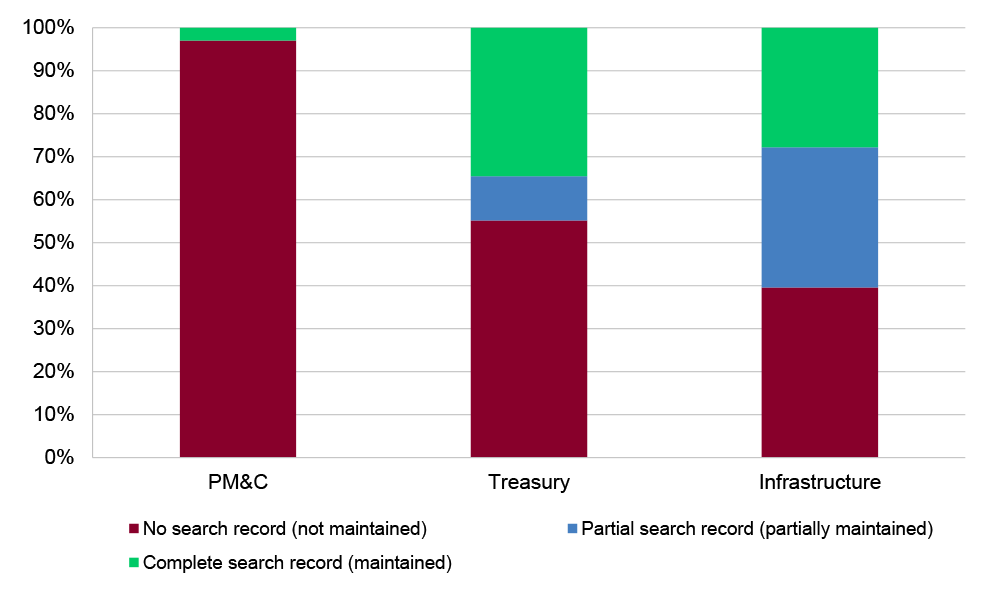
2.59 As illustrated in Figure 2.1, none of the three audited entities maintained sufficient and appropriate records against their own requirements to evidence the reasonableness of the searches undertaken. Infrastructure did not maintain the two records (a checklist and schedule of documents) required of its internal policy in 40 per cent of the sampled requests. For 65 per cent of requests examined in Treasury, the required checklist and record of searches was not maintained on file. In PM&C, a record of searches on the prescribed template was not maintained for 97 per cent of sampled requests.
Figure 2.1: Records maintained by audited entities demonstrating reasonableness of searches undertaken for each FOI request in testing sample
Source: ANAO analysis of entities records for sampled requests.
Recommendation no.2
2.60 Entities each implement a monitoring and assurance framework over their internal requirements to record: the searches they undertake in response to Freedom of Information applications; and decisions to refuse access because records could not be located or do not exist.
Department of the Prime Minister and Cabinet response: Agreed
2.61 PM&C has updated its decision templates to incorporate details of the recorded searches and will ensure an authoritative schedule and a monitoring checklist is developed.
Department of the Treasury response: Agreed
Department of Infrastructure, Transport, Regional Development, Communications, Sport and the Arts response: Agreed
2.62 The department will continue to monitor the completion of search and retrieval documentation by business areas, including evidence of searches undertaken in requests where a decision to refuse access is made because documents could not be located or do not exist. The department will incorporate monitoring and assurance controls within the FOI Processing Framework.
Office of the Australian Information Commissioner: Agreed
2.63 The OAIC is supportive of measures that support compliance with record keeping requirements. The OAIC will continue to undertake its functions in accordance with the statutory framework, including to review decisions where claims relating to adequacy of searches and access refusals in the absence of documents are in issue. The OAIC will also pursue proactive compliance activities to examine this issue.
2.64 The AIC has issued specific guidance in relation to documenting searches – see, paragraph 3.148 and 3.150-3.161. of the FOI Guidelines, as well as the searches checklist and template minute: ‘Taking all reasonable steps to find documents in a freedom of information request’.
2.65 The OAIC notes that, through the FOI Guidelines, the AIC also encourages agencies and ministers to have regard to the ARC’s best practice guidance on administrative decision-making, including in relation to drafting statements of reasons (see, for example, paragraphs 3.103-3.105 of the FOI Guidelines). The ARC series is available from the AGD website, see in particular Administrative Review Council Best Practice Guide: Statements of Reasons https://www.ag.gov.au/legal-system/publications/administrative-review-council-best-practice-guide-statements-reasons.
Had proposed charges been assessed at the lowest reasonable cost?
Charges were not often notified by the three audited entities. In 2024: PM&C did not notify any applicant of any charges; Infrastructure notified one applicant of two charges; and Treasury notified 26 applicants of 30 charges (10 per cent of requests received). In the case management systems of each of the audited entities, costs are not calculated for each application, nor are there time or effort records for each application.
2.66 Section 29 of the FOI Act provides a discretion for an agency or minister to impose a charge for processing a request or providing access to a document. Imposition of a charge must be assessed at the lowest reasonable cost under the Freedom of Information (Charges) Regulations 2019 (Charges Regulations). The OAIC’s FOI Guidelines, in recognising that imposing a charge can deter members of the public from seeking access to documents and can delay access state that ‘A charge must not be used to unnecessarily delay access or to discourage an applicant from exercising the right of access conferred by the FOI Act.’
2.67 According to OAIC data, Commonwealth agencies collected $73,067 and $65,181 in charges from applicants respectively in 2023–24 and 2024–25. This represented 0.08 per cent and 0.07 per cent of the estimated whole of government cost of administering the FOI Act. The average cost of administering an FOI request was $2,485 and $2,255 in 2023–24 and 2024–25 respectively.
2.68 In 2024, the OAIC finalised 261 reviews of FOI decisions, of which five related to charges.30 The OAIC did not uphold a single charge appealed. Rather, agency decisions were consistently set aside with the Information Commissioner referencing a previous decision explaining that:
a charge should not be imposed in circumstances where the cost of assessing, imposing and collecting a charge is likely to be greater than the charge itself. In those circumstances, imposing a charge will generally only serve to delay or discourage access while incurring a net cost to the Commonwealth.
2.69 The total value of the charges considered in these five decisions was $2,355. None of these five decisions were for charges notified by any of the three audited entities.
2.70 Of the three entities audited PM&C did not impose any charges for matters on hand in 2024.
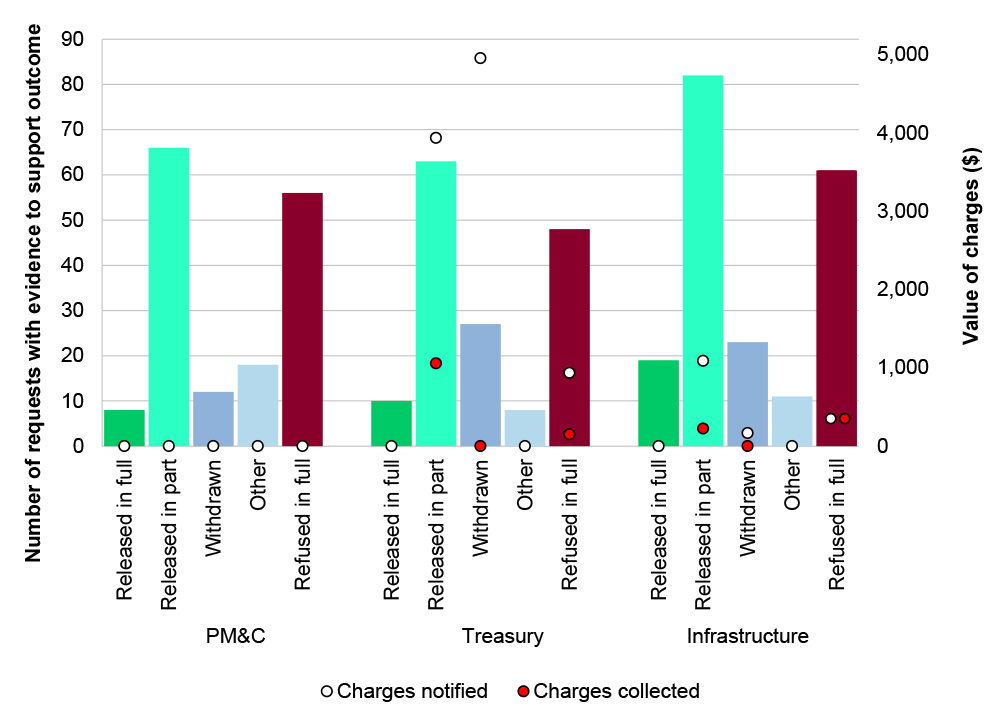
2.71 The discretion to notify and collect charges was used on a small number of occasions in 2024 by Treasury and Infrastructure (see Figure 2.2).
- Treasury: Of the 291 FOI applications received or on hand in 2024, Treasury notified 30 applicants of charges, totalling $11,413. Of the 30 applications notified of charges, 16 were subsequently withdrawn, 12 of which were considered withdrawn by Treasury when the applicant failed to respond to the charges notification. The OAIC Guidelines recognise that there is a risk imposing a charge may have a deterrent effect.31
- Infrastructure: Of the 398 FOI applications received or on hand in 2024 for Infrastructure, one FOI applicant (for two FOI applications) was notified of charges. In May 2025, Infrastructure advised the ANAO that it frequently received FOI requests from this applicant who it considered to ‘meet the normally understood definition of “vexatious”’ but that it considered a vexatious applicant declaration ‘draconian’ and ‘not the preferable course of action’.32 This applicant submitted 25 FOI requests during 2024.33 ANAO analysis is that there were at least a further five applicants each submitting more than 12 FOI requests during the same period, for which Infrastructure did not notify of charges, or consider the applicants potentially vexatious. Neither of the two charges were subsequently collected by Infrastructure. One application was withdrawn, the other was granted in part. Infrastructure’s approach was not consistent with the FOI Guidelines (see paragraph 2.66) which state that ‘A charge must not be used to unnecessarily delay access or to discourage an applicant from exercising the right of access conferred by the FOI Act.’ In January 2026, Infrastructure advised the ANAO that:
the comment that a vexatious applicant declaration being ‘draconian’ was intended to reflect the department’s reluctance to utilise that process due to the serious consequences of doing so for the applicant (that is, inability to make further FOI applications).34
Figure 2.2: Value of charges notified and collected according to outcome of request
Source: ANAO analysis of entity records
2.72 None of the three audited entities have systematically tracked costs for each FOI application received. The FOI Charges Regulations requires charges to be assessed at the lowest reasonable cost, and the FOI Guidelines provide a range of principles relevant to charges, including that charges ‘should be justified on a case by case basis’. In the case management systems of each of the audited entities, costs are not calculated for each application, nor are there time or effort records for each application. Where charges have been reviewed by the OAIC, charges have rarely been considered justified, as demonstrated by the OAIC’s 100 per cent set aside rate in 2024 of decisions by departments to apply charges to applicants.
Were disclosed documents provided to the applicant and published?
A decision to provide some documents to the applicant was made for 43 per cent of the requests examined by the ANAO across the three audited entities. Documents are predominantly provided to the applicant by email (95 per cent of requests where the audited entity retained a record of release).
Public disclosure of released documents, via the disclosure log required under the FOI Act, was incomplete and not in accordance with the law. The websites used by each audited entity are variable in terms of the information provided and their useability. In addition, each entity’s disclosure log was incomplete (8 per cent of expected disclosures had not been made) and the logs were not being updated in accordance with statutory timeframes (26 per cent of disclosures were late).
2.73 Where a decision has been made to give an applicant access to a requested document, that access should be given as soon as practicable, but only after:
- any charges the applicant is liable to pay are paid (paragraph 11A(1)(b) and regulation 11, Charges Regulations), and
- all opportunities a third party may have to seek review of the decision have run out, and the decision still stands or is confirmed (subsections 26A(4), 27(7) and 27A(6)).
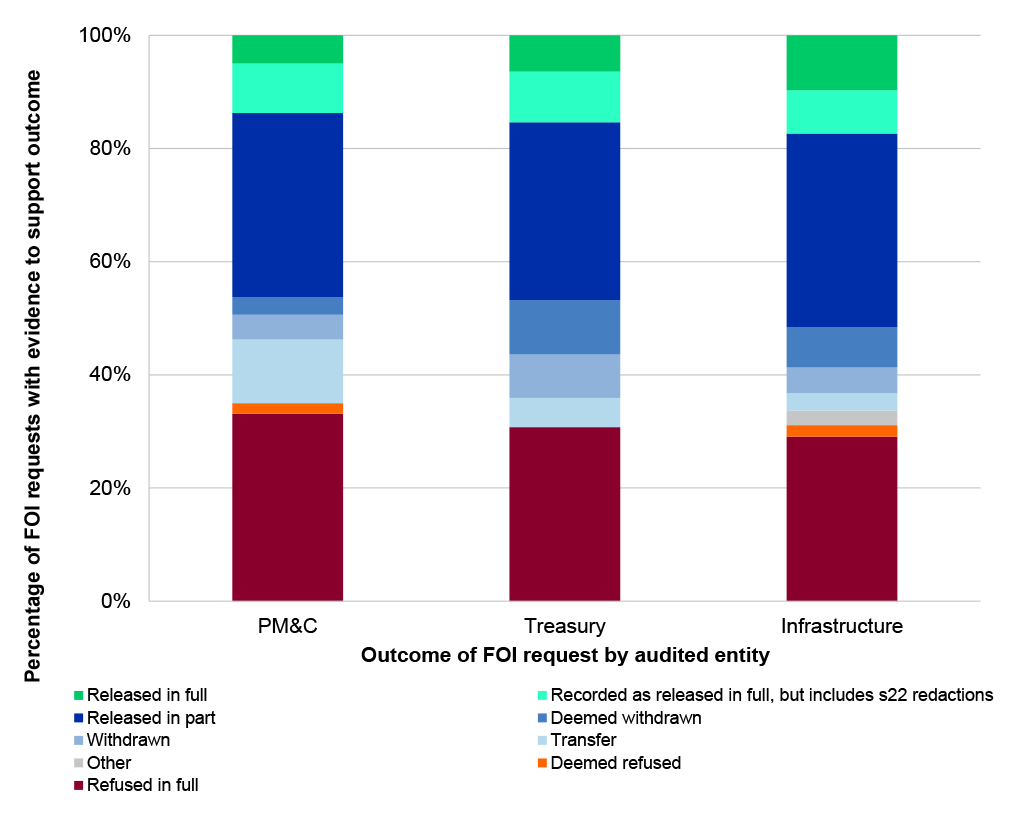
2.74 As illustrated in Figure 2.3, in the majority of cases the three audited entities made a decision to provide partial access (including those incorrectly reported to OAIC as released in full), or refuse access.
Figure 2.3: Decision outcomes for sample of FOI requests received or on hand in 2024
Source: ANAO analysis of entity records.
2.75 As outlined in Table 2.4, the three audited entities made a decision to provide full access to documents identified for seven per cent of FOI requests. Access to documents was restricted or refused in 73 per cent of requests. In the 41 per cent of FOI requests where partial access was granted to the request documents, access was not partially granted to all the identified documents, rather 14 per cent of identified documents were refused in full, with other documents for the same FOI request released in part or in full.
Table 2.4: Decision outcomes for sample of FOI requests received or on hand in 2024
|
|
|
FOI request outcome |
|||||||
|
|
|
Released in full |
Released in part |
Refused in full |
Other |
Total |
|||
|
Audited entity |
Sample size |
Documents released in full (%) |
Documents released in part (%) |
Documents refused (%) |
FOI requests |
||||
|
PM&C |
210 |
8 (5%) |
4.02 |
87.13 |
8.85 |
66 (41%) |
56 (35%) |
30 (19%) |
160a |
|
Treasury |
169 |
10 (6%) |
19.14 |
63.75 |
17.31 |
63 (40%) |
48 (31%) |
35 (22%) |
156b |
|
Infrastructure |
197 |
19 (10%) |
2.03 |
83.62 |
13.86 |
82 (42%) |
61 (31%) |
34 (17%) |
196c |
|
Total |
576 |
37 (7%) |
16 |
79 |
14 |
211 (41%) |
165 (32%) |
99 (19%) |
512 |
Note a: There were a further 50 requests for which there is no record of an outcome, but for which a record of decision is expected, and three records for which there is no outcome listed in the case management system either.
Note b: There were a further 11 requests for which there is no record of an outcome, and two requests that were invalid.
Note c: There is one request for which there is no record of an outcome.
Source: ANAO analysis of entity records.
Providing applicants with access to released documents
2.76 The FOI Guidelines, Part 3, describe how a document is to be provided to an applicant. This includes: providing information stored in electronic form as a written document; in the particular form requested by the applicant; and the expectation ‘to make reasonable use of available technology to facilitate access to documents … Access to documents by means that do not require physical inspection in an agency office should generally be preferred’.
2.77 Entity policies and procedures, where they were in place, provide limited instruction as to how documents are to be released to applicants. Across the three audited entities, a decision to release information to an FOI applicant was made for 43 per cent of applications examined by the ANAO. As illustrated by Table 2.5, the most common means of releasing information was via email attachment. It was less common for entities to release documents via links to publicly available information being provided to the applicant (10 requests in Treasury) or using a secure file transfer online facility (two requests in Infrastructure).
Table 2.5: Release of documents by audited entities
|
Entity |
Sample examined |
Decision to release some information |
Proportion released by email attachment |
|
PM&C |
210 |
74 (35%) |
91% |
|
Treasury |
169 |
73 (43%) |
97% |
|
Infrastructure |
197 |
101 (51%) |
97% |
|
Total |
576 |
248 (43%) |
95% |
Source: ANAO analysis of departmental records.
Providing public access to released documents
2.78 Agencies and ministers must publish the released information to members of the public generally on a website, subject to certain exceptions (section 11C). This publication is known as a ‘disclosure log’. The FOI Act requires that the disclosure log reporting occur within 10 working days of the applicant being given access to the document. The FOI Commissioner has identified disclosure logs as an ‘effective strategy for agencies to reduce the likelihood of receiving multiple FOI requests for the same information’, thereby reducing the FOI impact on agencies.35
2.79 Each of the three audited entities maintain a website as their disclosure log.36 The PM&C and Treasury websites are more useable and searchable than Infrastructure’s. PM&C and Treasury each provide a single website with a searchable data base, while Infrastructure provide a list of recent disclosures, and links to previous lists of disclosures. None of the audited entities provided a single downloadable list which could be used by applicants to filter and search before submitting requests, potentially reducing repeat requests.
Opportunity for improvement
2.80 To support applicants when making FOI request, and consistent with the openness objectives of the FOI Act, there would be benefit in entities providing a searchable and downloadable FOI disclosure log. This would enable applicants to confirm that their request had not been disclosed previously, potentially reducing the number of requests for similar information.
Office of the Australian Information Commissioner response:
2.81 The OAIC considers that publication of documents via IPS and FOI disclosure logs can support FOI processing and the objects of the FOI Act and notes Rec. 4 in this regard.
2.82 The OAIC notes that some agencies have implemented disclosure log search functionality.
2.83 The FOI Guidelines recommend that to ‘provide transparency in relation to the time of publication and [an entity’s] compliance’ with the disclosure log requirements that ‘both the date the FOI applicant was given access to the documents and the date the documents were published is listed on the disclosure log.’
2.84 Of the three audited entities, PM&C’s disclosure log included the two dates that the OAIC’s FOI Guidelines recommended. Infrastructure and Treasury each provides the date that the FOI applicant was given access to the documents (referred to as ‘disclosure date’ by Infrastructure in its log and ‘release date’ by Treasury in its log).
2.85 From examination of a sample of requests, it was evident that the dates provided by Treasury and Infrastructure in their logs are accurate. This was not consistently the case for PM&C.
2.86 As illustrated by Table 2.6, the disclosure logs of the three audited entities are not complete (eight per cent of required disclosures had not been made). Publication was also not timely, with 26 per cent of disclosures (where records were available) outside the 10 day timeframe specified in the FOI Act. PM&C’s disclosures were the least complete, with that department and Infrastructure exhibiting the highest non-compliance with the timeframe requirement. When PM&C did not meet the timeframe requirement, the delays were significant with disclosures on average 53 days late.
Table 2.6: Disclosure log uploading by audited entities
|
Audited entity |
Sample examined |
Expected on disclosure log at time of audit |
Proportion disclosed |
Compliance with 10-day timeframe |
|
PM&C |
210 |
75 |
65 (87%)a |
78% |
|
Treasury |
169 |
73 |
68b (93%) |
99%c |
|
Infrastructure |
197 |
106 |
100d (94%) |
57%e |
|
Total |
576 |
254 |
233 (92%) |
74% |
Note a: This figure is impacted by deficiencies in PM&C record keeping. This figure does not include 12 requests for which there is no record of a decision outcome to release information, yet information has been included on the disclosure log.
Note b: This figure is impacted by deficiencies in Treasury’s record keeping. This figure does not include one request for which there is no record of a decision outcome to release information, yet information has been included on the disclosure log. Further, for 54 the 68 disclosed requests, Treasury maintained records of an internal email approving the release of documents on the disclosure log. For 35 (65 per cent) of those with internal approvals, the instructions provided to the Information Technology team requested that the release not occur until after or near close of business (see paragraphs 2.12, 2.95 and 3.23).
Note c: Treasury’s disclosure log does not reflect when a disclosure on the log has been updated. In two instances the ‘release date’ reported on the disclosure log does not accurately reflect that the disclosure was made in two parts. For one FOI request, a review decision by the OAIC decided more information be released, yet the release date is for the initial release only, with no annotation that an update had been made to the record; and for a second FOI request, a part of the disclosure was initially withheld to allow for third party review rights with the OAIC. This review right was not enacted and the remaining document loaded to the disclosure log. Only the secondary release date is included on the disclosure log.
Note d: Determining timeliness of upload for this cohort is impacted by deficiencies in Infrastructure’s record keeping. This figure includes 10 requests for which there is no record confirming when information was uploaded to Infrastructure’s disclosure log.
Note e: Infrastructure’s disclosure log does not reflect whether or when a disclosure on the log has been updated, recording only the notification date to applicant. There were seven FOI requests where information was released in two parts, as a result of third-party review rights, and led to revised decisions to provide increased access to information by the department. There is no record for any of these seven requests that the disclosure log was updated to reflect the additional provision of information.
Note: Figures for compliance with the 10-day timeframe relate to those requests where records were available.
Source: ANAO analysis of departmental records.
2.87 The FOI Guidelines state that ‘agencies and minister should seek to make all documents released in response to an FOI request available for download from the disclosure log or another website … This approach is consistent with the objects of the FOI Act.’ Consistent with this, where a record is included on the disclosure log (92 per cent of sampled records), all three audited entities included downloadable records as released to the applicant for each of the FOI requests.
Recommendation no.3
2.88 Entities comply with the objects of the Freedom of Information Act and periodically review the level and timeliness of disclosures they make in response to Freedom of Information applications as an indicator of whether their organisational culture, policies and practices are effective in providing the Australian community with access to information held by the Australian Government.
Department of the Prime Minister and Cabinet response: Agreed
2.89 PM&C has and will continue to improve its organisational culture by actively monitoring the level and timeliness of access decisions. The OAIC FOI Statistics Dashboard shows the number of decisions PM&C has granted access (in part or in full) has been increasing.
2.90 PM&C will review and analyse its quarterly reporting to the OAIC as part of its established protocols and measure its performance against the FOI metrics set out in the Commonwealth Integrity Strategy.
Department of the Treasury response: Agreed
Department of Infrastructure, Transport, Regional Development, Communications, Sport and the Arts response: Agreed
2.91 The department will continue to manage FOI requests in accordance with the statutory framework established by the FOI Act and with regard to the FOI Guidelines issued by the Information Commissioner under section 93A of the Act. This includes applying the statutory provisions relating to the release of information and, where relevant, the application of exemptions.
2.92 The department will periodically review the level and timeliness of disclosures under the FOI Act, noting that these metrics are not the sole indicators of organisational culture, policies and practices but are two indicators of agency engagement with public requests for information as set out in the Commonwealth Integrity Strategy.
2.93 The department’s continuous improvements in organisational culture, policies and practices are reflected in the audit’s positive findings that FOI decision notices are comprehensive and the high rate of compliance with statutory timeframes. Furthermore, since 1 January 2024, only 1 departmental decision has been set aside or revised by the Information Commissioner.
Office of the Australian Information Commissioner: Agreed
2.94 The OAIC considers that agency FOI disclosure log practices and IPS implementation are key indicators of agency transparency. Proactive compliance activities are under development to examine compliance with statutory obligations in relation to disclosure logs.
Were statutory timeframes met?
The three audited entities are not maintaining adequate records to demonstrate compliance with statutory timeframes for processing FOI applications. Where records were available, statutory timeframes were not consistently met, particularly in relation to decision-making on requests.
- Notification to applicants that their request had been received: seven per cent of requests examined by the ANAO (where records were available) were outside the statutory timeframe.
- Decision-making notification to applicants: for 63 per cent of the FOI requests examined, the statutory response timeframe was greater than 30 days due to departments deciding to make use of one or more provisions in the Act allowing for a longer response period. After allowing for extensions, there were 29 per cent of requests examined by the ANAO (where records were available) that were outside the statutory timeframe.
2.95 The FOI Act (Part 2 subsection 15(5)) involves two key timeframes:
- notification of receipt of request: all reasonable steps are to be taken to provide notification as soon as practical but in any case not later than 14 days after the day on which the request was received; and
- notification of decision: all reasonable steps are to be taken to provide notification of a decision as soon as practical but in any case not later than 30 days after the request was received, pending any allowable extensions.
2.96 In its administration of FOI requests, it was evident that Infrastructure was interpreting the decision-making timeframe as being 30 days rather than, as set out in the FOI Act, ‘as soon as practicable’ but in any case not later than 30 days. For example, in January 2026, the department advised the ANAO that the requirement for decision notification involved an ‘initial 30-day processing timeframe’ (see Table 2.7 and Figure 2.6 for statistics on timeliness of responses).
Notification of receipt
2.97 The audited entities had different approaches to recording in their case management systems the date requests are received.
- The case management system used by Infrastructure does not have a specific field to record the date an acknowledgement of the FOI request is made to an applicant. In January 2026, Infrastructure advised the ANAO that it records the dispatch of the formal acknowledgement in its case management system as a file note. The department’s approach makes monitoring of compliance with the statutory timeframe more difficult.37
- Receipt dates recorded by PM&C in their case management systems was not always accurate. Underlying records for a sample of requests identified accurate records of the receipt date for 89 per cent of PM&C requests sampled.
- The ANAO was able to confirm the receipt dates in the Treasury case management system for all sampled requests.
2.98 Each of the entities on occasion failed to meet the statutory timeframe of ‘as soon as practicable but in any case not later than 14 days’ (see Figure 2.4).
- In Infrastructure, ANAO examination of 197 requests received or on hand in 2024 identified that 12 requests (six per cent) were acknowledged later than the statutory period, an average of 18 days overdue.
- A key shortcoming in PM&C was the high proportion of requests where no acknowledgment to the applicant was maintained on file by the department. This affected 123 of the 210 requests sampled by the ANAO (59 per cent).38 Of the remaining 87 sampled requests, ten (11 per cent) were later than 14 days, averaging 17 days overdue.
- Missing records was also a shortcoming within Treasury, with no acknowledgment on file for eight per cent of the 169 Treasury requests sampled by the ANAO. Of those where an acknowledgment was on file, there were nine of 153 (six per cent) acknowledged outside of the statutory period, averaging 11 days overdue.
Figure 2.4: Timeliness of acknowledging FOI request
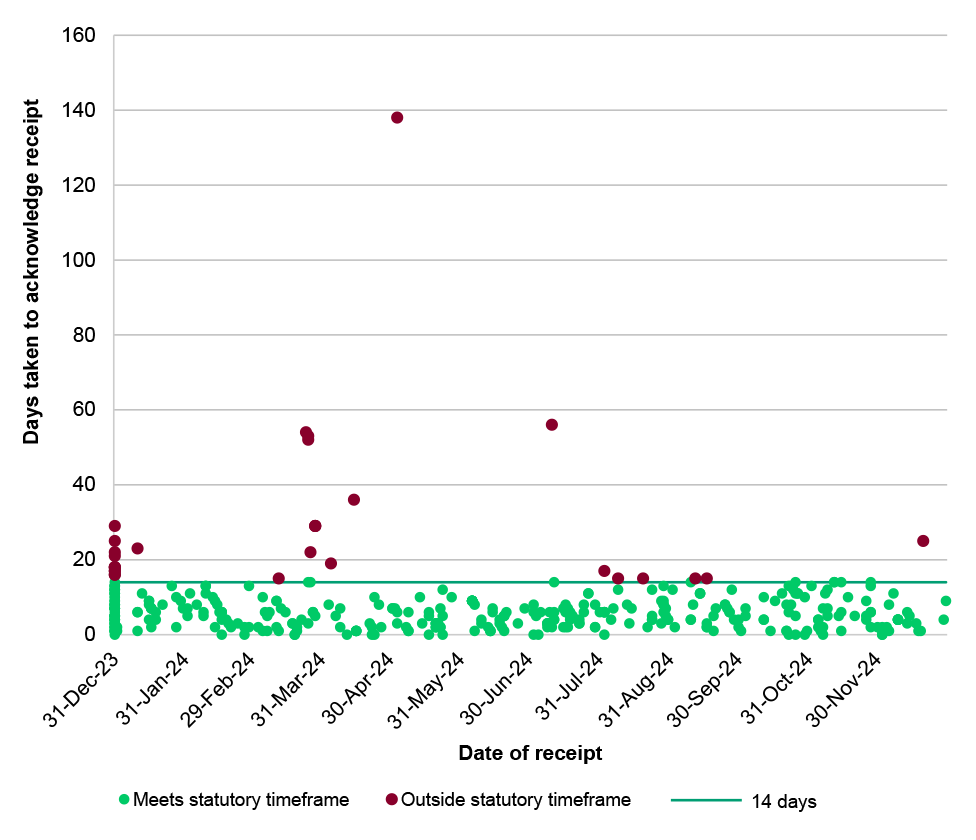
Note: Where a request was received prior to 1 January 2024, the ANAO has included this within the 31 December 2023 date to support readability of receipt of requests across the 2024 year.
Source: ANAO analysis of entity records
Notification of decision on the request
2.99 None of the case management systems used by the three audited entities clearly record whether: extensions have been sought or provided; or revised due dates where there has been an extension. As outlined in Table 2.7, analysis of each entity’s case management system indicates that there are a significant number of FOI requests processed later than 30 days. Being processed later than 30 days does not mean that statutory timeframes have not been met, due to the frequency with which entities employ statutory provisions to extend the timeframe for decision.
Table 2.7: Timeliness of acknowledgements and responses to FOI requests
|
Audited entity |
Sample population |
Confirmed receipt within 14 days |
Decision on request made within 30 days |
Decision on request made within 31–60 days |
Decision on request made and notified after 60 days |
|
PM&C |
422 |
Case management system does not record date of acknowledgement — department records this in a file note. |
62 (15%) |
115 (27%) |
245 (58%) |
|
Treasury |
291 |
Case management system does not have a field to record date of acknowledgement — department records this in a file note. |
112 (38%) |
130 (45%) |
49 (17%) |
|
Infrastructure |
398 |
Case management system does not have a field to record date of acknowledgement — department records this in a file note |
134 (34%) |
127 (32%) |
137 (34%) |
|
Total |
1,111 |
– |
308 (28%) |
372 (33%) |
431 (39%) |
Source: ANAO analysis for entity records.
2.100 The FOI Act allows for extensions to the ‘not later than’ 30 day decision notification period for up to 30 days when: agreed with the applicant; when the department determines that third party consultations are required on the information potentially to be released; and on approval from the Information Commissioner where a request is considered ‘complex or voluminous’ (see further in Table 2.8). There are also provisions within the FOI Act that ‘stop the clock’ on the statutory period, including: the practical refusal process, where the statutory period is recommenced when an agreement is reached between applicant and department on a revised scope; and when charges are notified to the applicant, the clock is ‘stopped’ until at least a deposit is paid. Where the department failed to provide a response within the statutory period, or where all extensions have elapsed and the department knows it will be unable to deliver a response in the statutory period, the department may seek approval for an extension to remediate a ‘deemed refusal’ and be given a revised time period, determined by the Information Commissioner, in which to deliver the response.
Table 2.8: Extensions used by departments within FOI requests sampled for audit testing
|
Extension type |
PM&C |
Treasury |
Infrastructure |
|
|
Maximum 30-day extension per extension type |
Agreed with applicant |
100 |
34 |
59 |
|
Third Party Consultation (section 26A, 27 or 27A) |
15 |
52 |
73 |
|
|
Information Commissioner approved for ‘complex or voluminous’ |
5 |
6 |
8a |
|
|
Clock stopped |
Practical Refusal Process |
25, including 8 revised scope, 11 no record of outcome, 6 deemed withdrawn |
54, including 41 revised scope, 6 deemed withdrawn |
35, including: 21 revised scope, 12 deemed withdrawn, 1 withdrawn by applicant |
|
Charges notification |
0 |
30 charges notified, 9 deemed withdrawn, 3 withdrawn by applicant |
7 charges notified, 1 deemed withdrawn |
|
|
Time period as determined by Information Commissioner |
Information Commissioner remediating a ‘deemed refusal’ |
7 |
None identified in records |
5 |
|
Total extensions used |
152 |
176b |
187 |
|
Note a: This includes one request where Infrastructure received two extensions to enable ‘courtesy’ consultations with PM&C’s Cabinet Division (see paragraphs 3.34 to 3.42).
Note b: Not included in this figure is one instance where Treasury extended the due date of a request by 30 days after an applicant altered the scope of the request. When ANAO queried this, Treasury advised that it chose to calculate ‘processing time from the date of the supervening event (the changed request) that fundamentally changed the request, but for which the FOI Act made no provision’, citing a 2013 Information Commissioner review as precedent. This is not an extension type available under the Act.
Note: This table does not include extensions where the department sought to apply an extension and the extension was not agreed to or was declined.
Source: ANAO analysis of entity records.
2.101 Figure 2.5 shows that the three audited entities are not always maintaining adequate records to demonstrate compliance with statutory timeframes for processing FOI applications.
Figure 2.5: Existence of records of FOI request processing from receipt date to outcome notice
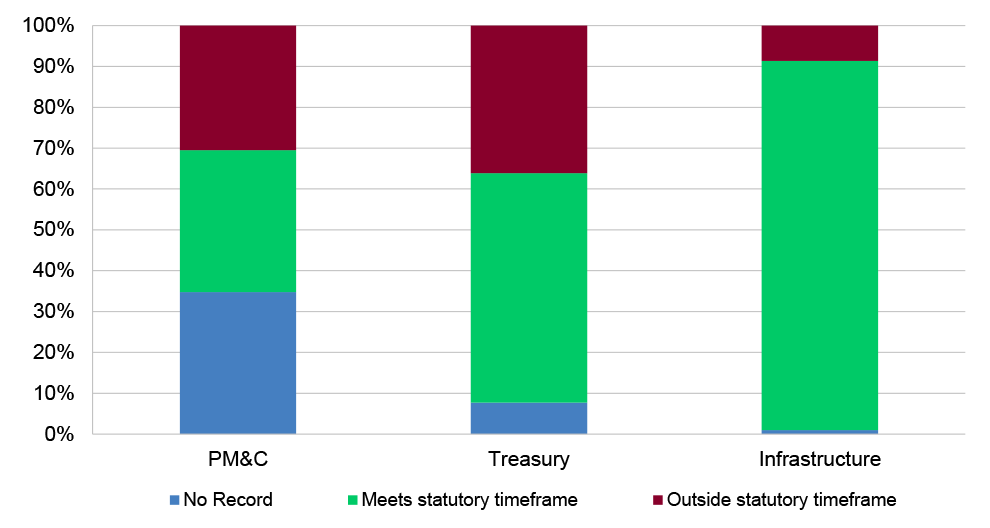
Source: ANAO analysis of entity records.
2.102 Figure 2.6 shows that the frequent use by the audited entities of extensions and clock stops mean that the statutory processing timeframe for FOI applications is often more than 30 days.
- Of the 488 FOI applications cross the three audited entities where the records enabled the ANAO to analyse the time taken to make a decision, 346 (71 per cent) were assessed as meeting the statutory timeframes. A significant proportion of those 346 applications (217 or 63 per cent) had a processing time of more than 30 days.
- The average response time from receipt of FOI request to outcome notice was 57 days (where records were maintained). PM&C response times were, on average, significantly longer (82 days compared with 48 days for Treasury and 48 days for Infrastructure). Response times ranged from one day to 583 days.
2.103 After allowing for extensions, and excluding those requests where the audited entity had not maintained adequate records to demonstrate compliance with statutory timeframes, there remained a number of instances in each entity where the decision-making was in breach of the statutory timeframes.39 This was the case for 142 of 488 (29 per cent) sampled requests across the three audited entities, comprising:
- 64 of the 137 (47 per cent) sampled requests where records existed in PM&C;
- 61 of the 156 (39 per cent) sampled requests where records existed in Treasury; and
- 17 of the 197 (nine per cent) sampled requests in Infrastructure.
Figure 2.6: Timeliness of FOI request processing from receipt date to outcome notice
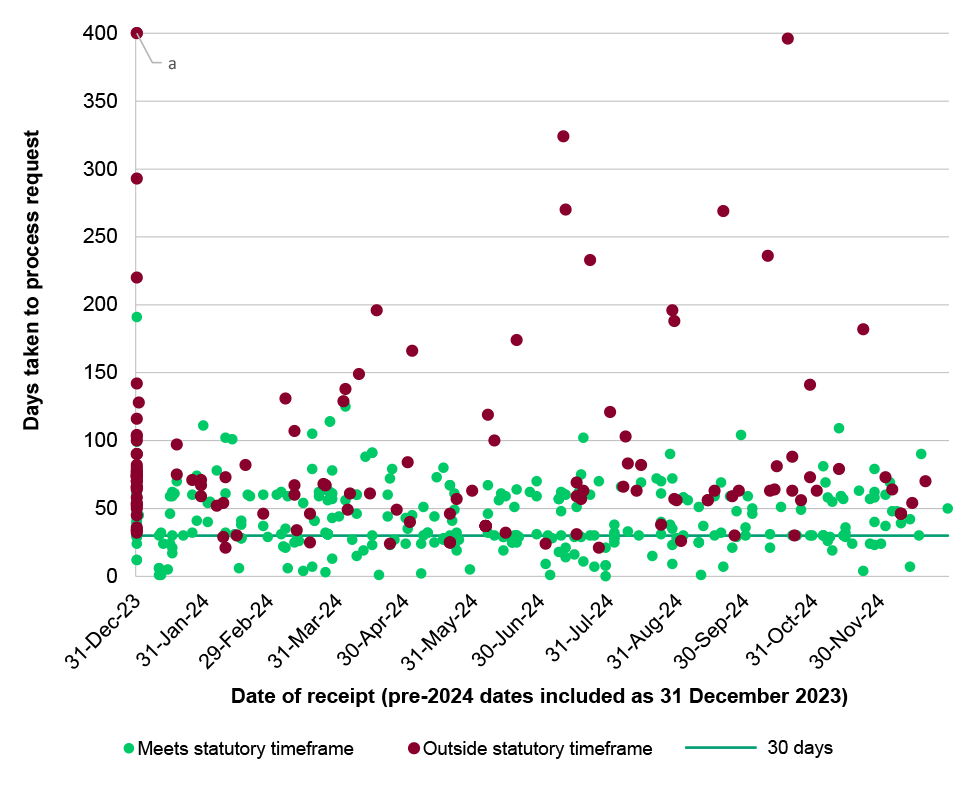
Note a: This marker represents three FOI requests, two of which are overdue taking 496 and 553 days to process; and one within statutory timeframe, that took 583 days to process. These were all restricted to 400 days for readability of the chart, and all were received prior to 1 January 2024. Three further FOI requests, not included in this chart, had no initial decision record on file, only review decisions. These review decisions were made 601 to 1335 days after receipt of the request.
Note: Where a green mark is recorded above the not later than 30 day line, there is evidence to support the extension of the statutory period in line with the FOI Act (see Table 2.8).
Note: Where a red mark is recorded, there is evidence to support that the request was either overdue, or that the request was not decided ‘as soon as practicable’, as required by the FOI Act (see paragraphs 2.12, 2.95 and 3.23)
Note: For readability, this chart has been restricted to a maximum of 400 days on the y-axis.
Source: ANAO analysis of entity records
Consequence of failure to meet the statutory deadline
2.104 Where no decision is provided within the statutory period this is considered a ‘deemed refusal’ (subsection 15AC(3)).
2.105 The FOI Act allows an agency to seek an extension from the Information Commissioner where a request has a deemed refusal. None of the three audit entities record in their case management systems where such deemed refusals have occurred.
2.106 The FOI Act (subsection 15AC(17)), states that a deemed refusal ‘does not apply, and is taken never to have applied’ if, when an extension of this type is granted by the Information Commissioner, the department then issues a decision within the revised time, and complies with any other conditions imposed by the Information Commissioner. In this way, the recordkeeping in the case management systems not identifying that a deemed refusal has occurred, and a specific approval is required from the Information Commissioner, does not accurately reflect the status, and actions against an FOI request.40
2.107 There were also inconsistent practices evident in the handling of statutory timeframes where the statutory timeframe is not met. Of note:
- In Infrastructure the ANAO identified two instances in the sampled population where the department requested applicants withdraw and resubmit requests. This has the effect of impacting OAIC reporting, by making the initial request be reported as withdrawn and/or completed within the statutory timeframe. This also has the effect of restarting all process and timeframes, essentially providing a further 30 day statutory timeframe, and reopening all allowable extension clauses.
- PM&C adopted a different approach, advising applicants that ‘Where a decision is not made within time, the Department follows the Guidelines issued by the Information Commissioner … Accordingly, we will process your request as quickly as possible and we will update you once we have a firm indication of when a decision is likely to be issued.’ In January 2026 PM&C advised the ANAO that ‘PM&C follows the [FOI] Guidelines and continues to process [an FOI request] until a decision is issued.’
Opportunity for improvement
2.108 To support understanding and expectations of FOI processing the OAIC could develop detailed guidance clarifying the preferred approach to addressing requests outside of the statutory time period ensuring consistency with the objects of the FOI Act.
Office of the Australian Information Commissioner response:
2.109 The OAIC will continue to regularly review and update the FOI Guidelines, Procedure Directions, guidance and educational materials to promote compliance with the FOI Act.
2.110 Paragraphs 3.265 - 3.271 of the Guidelines provide information on the required approach in handling requests that are considered as deemed refusals due to lapse of the statutory timeframe before a decision on access was made. The OAIC will consider the insights from this Report when developing further guidance for agencies and applicants, and when providing capability support to FOI practitioners through webinars and other forums.
Recommendation no.4
2.111 The Office of the Australian Information Commissioner investigate and advise the Australian Government on the merits of developing a Commonwealth-wide case management system or approach for all entities subject to the Freedom of Information Act use to manage requests as well as to monitor and report on their performance in meeting their obligations under the Act. This system could also be used by the Commissioner to compile the statistics that it publishes with its annual report.
Office of the Australian Information Commissioner response: Agreed in principle
2.112 The OAIC considers that initiatives that would support effectiveness in the case-management of FOI requests would likely promote overall efficiencies and improvements in agency administration under the FOI Act. Such a system would also promote centralised disclosure logs and therefore likely reduce FOI requests. These initiatives would also likely support improvements in the accuracy of agency reporting to the OAIC, consistent with their obligations under the FOI Guidelines.
2.113 The OAIC encourages agencies to use its Self-Assessment Tool (see https://www.oaic.gov.au/freedom-of-information/freedom-of-information-guidance-for-government-agencies/self-assessment-tool-for-agencies) to identify areas for improvement and support compliance with the FOI Act. The OAIC also hosts practitioner events such as the OAIC’s regulatory webinars and regularly publishes educational and guidance material and a practitioner newsletter. The OAIC’s “FOI Essentials” training series for Australian Government agencies and ministers is also promoted through the APS academy (see https://education.oaic.gov.au/foi-essentials/).
2.114 To the extent that this recommendation relates to the regulatory role of the OAIC, the OAIC supports the recommendation. Any decision to deploy a standardised Commonwealth-wide case management system would be a decision for government. The OAIC is positioned to provide advice to ensure that any such system is designed in a manner that aligns with statutory requirements.
3. Decision-making
Areas examined
The ANAO examined whether entity decision-making was transparent, accountable and pro-disclosure.
Conclusion
Decision-making in the three audited entities was not consistently transparent, accountable and pro-disclosure. A key factor was the lack of records around decision-making with no record maintained of the advice to the decision-maker for 30 per cent of Freedom of Information (FOI) requests examined by the ANAO. Records were also incomplete in terms of the impact that consultation with minister’s offices was having on decision-making, including consulting when they shouldn’t be.
Reviews of agency decision-making demonstrated that initial decisions of agencies are not always applying a pro-disclosure approach. Of the internal reviews within the three audited entities, 24 per cent resulted in a decision to provide more information to the applicant. For 54 per cent of reviews undertaken by the Information Commissioner, the result involved further information being provided to the applicant.
Requested documents were exempted, and/or information redacted, in 53 per cent of the FOI requests examined by the ANAO. There are inaccuracies in reporting by entities to the Office of the Australian Information Commissioner (OAIC) reflecting, among other things, inaccurate data held in entity case management systems. This included the outcome of the request advised to the OAIC (based on what was recorded in the case management system) being different to the outcome notified to the applicant in 19 per cent of requests examined.
Areas for improvement
The ANAO made three recommendations to entities and two to the OAIC to improve FOI decision-making. The ANAO also identified one opportunity for improvement for entities.
3.1 The FOI Guidelines outline that:
The public expects agencies and ministers to act fairly, transparently and consistently in their administrative decision making and to be accountable for the decisions they make. The quality of decisions under the FOI Act is particularly important given the integral role freedom of information requests can have in securing open government.
Decisions made under the FOI Act must be consistent both with the requirements of the Act and with general principles of good decision making. Those general principles are explained in five best practice guides published by the Administrative Review Council (ARC).
Were decision-makers appropriately informed?
Entities have in place delegations that assist with transparent and accountable decisions in relation to access under the FOI Act. The policies of the three audited entities vary on requirements of decision-making artefacts. No entity had in place policies that address all of the consultations they may undertake on FOI requests, including consultations not specifically provided for in the FOI Act (and the FOI Guidelines issued by the OAIC also do not address those consultations).
The poor state of recordkeeping around FOI decisions does not demonstrate that decisions are being adequately informed. In relation to the 498 FOI requests examined by the ANAO across the three audited entities:
- for 32 per cent there was no record maintained of the advice provided to the decision-maker;
- a record of the decision was not evident for 30 per cent; and
- the record of the decision provided to the applicant was not retained for 11 per cent.
3.2 There are various decisions to be made when processing an FOI request. In line with subsection 23(1) of the FOI Act41, the Secretary of each agency has delegated officials in the entity to make decisions and undertake actions required under the FOI Act.
3.3 In Infrastructure and Treasury, the officials that have been delegated to make FOI access decisions are Senior Executive Service (SES) officers. In PM&C, the delegated officials are SES officers as well as Senior Advisers, Legal Policy Branch in the Government Division of the department. While none of the delegation instruments require that the SES officer be from the relevant subject matter area to make a decision on the FOI request, each entity has established this expectation through their respective policies and practices.
Opportunity for improvement
3.4 Entities could identify in their delegation instruments where it is expected that decision-makers for FOI access decisions be from the relevant subject matter area.
Office of the Australian Information Commissioner response:
3.5 The OAIC considers that appropriate delegations and knowledgeable decision-makers are important to support good and timely decision-making. The OAIC notes that FOI Act does not prescribe specific criteria for FOI delegations.
3.6 Each entity, upon receipt of an FOI request, identifies the relevant SES officer in the relevant subject matter area, and seeks confirmation that the identified SES officer will assume the role as decision-maker. Once confirmed, each FOI Team requests the decision-maker to appoint an action officer. The action officers selected by the decision-maker is typically an executive level officer already working to the decision-maker. It is the role of the action officer to work with the agency’s FOI team to complete the FOI searches, provide the FOI team with advice and recommendation on potential sensitivities, redactions, or exemptions to FOI material, and provide input to the FOI team on the draft decision presented to the decision-maker. The FOI team within each of the audited entities are not privy to all engagements between the action officer and the decision-maker. Across the sample of FOI requests tested by ANAO, it was usual practice in all three audited entities for the action officer to operate as a conduit between the decision-maker and the FOI team, including forwarding formal execution of decisions and sign offs for processes stages from the decision-maker to the FOI team. No records of meetings between the FOI officer, action officer and decision-maker were maintained for any of the tested FOI requests.
3.7 Decision-makers are required to make decisions on: application of exemptions and redactions; need for third party consultations; and access. In the sample tested by ANAO for each of the three entities, it was uncommon for the FOI team to have a record of anything more than a decision notice (or a draft decision notice) being agreed to by the decision-maker. These decision notices (as issued to applicants) are templated, and where exemptions or redactions have been applied to information, the templated record of how a decision was arrived at are included. There were few instances of any record of a decision-maker being separately informed of, or participating in, decisions regarding exemptions, redactions or third-party consultation. Where records did exist regarding this part of the process, this was most frequently between the action officer and the FOI officer.
3.8 The policies of the three audited entities vary on requirements of decision-making artefacts. The common feature was that each required: the FOI team to provide a draft decision to the decision-maker for approval; the decision-maker to approve or amend a draft decision; and the decision-maker’s e-signature to be affixed to a decision notice.
3.9 PM&C has a multi-stage approval process. This process first requires that upon the decision-maker agreeing to the draft decision this decision be circulated to ‘senior officers and the PMO [Prime Minister’s Office]’ (see paragraphs 3.23 to 3.33).42 Once circulated, this is then required to be ‘noted’ by the senior executive officer responsible for the FOI team.43 Once ‘noting’ is received, the FOI team then affix the decision-maker’s electronic signature to the decision notice and issuing the decision notice to the applicant. This process usually takes one to two days.
3.10 Treasury’s policy only requires the FOI team to provide a draft decision to the decision-maker. ANAO analysis of a sample of FOI requests did not locate evidence of any additional briefings to the decision-maker, no other evidentiary requirements, or information consultation or noting with other senior officers or with the Minister through his office.
3.11 Infrastructure’s FOI policy:
- addresses the department’s practice of informing senior officers and the Minister through her office of the receipt of ‘sensitive issue’44 FOI requests prior to any consideration of the request. This tailoring of approach after consideration of the applicant’s identify is in contrast to the OAIC’s advice to ANAO in January 2026 that, in the context of the FOI requests from third party freedom of information requesting organisations (see paragraph 2.46), ‘the identity of the requester or the platform of request should not be considered by entities when processing FOI requests (unless it is relevant to an access decision — such as for personal information)’;
- requires the decision-maker review the ‘Decision Pack’ prepared by the FOI team and to complete a ‘Decision Maker checklist’ to be returned to the FOI team once a decision is finalised. This checklist requires the decision-maker’s confirmation and sign off that:
- ‘all reasonable searches have been undertaken’;
- where documents have been identified the list is complete (that the ‘Schedule of Documents … are all the documents relevant to the request’);
- the decision is the decision-maker’s own and was arrived at ‘in an independent manner and in accordance with the FOI Act’; and
- the decision has ‘taken into account all relevant information … has regard to the objects of the FOI Act and OAIC’s FOI Guidelines [and] considered any legal advice provided by Legal Services’.
- These checklists are rarely completed.
- addresses the department’s practice of advising the same senior officers and ministers though their office of the decision at least two days prior the applicant being notified (see paragraphs 3.23 to 3.33).45
Recommendation no.5
3.12 The Office of the Australian Information Commissioner strengthen its guidance by identifying to entities better practice approaches to implementing the principles for good decision-making under the Freedom of Information Act that are set out in its Guidelines, including ensuring all decisions of a decision-maker are clearly recorded, along with evidence of the decision-maker making the decision and their considerations.
Office of the Australian Information Commissioner response: Agreed
3.13 The OAIC will continue to regularly review and update the FOI Guidelines, Procedure Directions, and guidance and educational materials to promote compliance with the FOI Act.
3.14 The OAIC notes that, through the FOI Guidelines, the Australian Information Commissioner (AIC) also encourages agencies and ministers to have regard to the Administrative Review Council’s (ARC) best practice guidance on administrative decision-making, including in relation to drafting statements of reasons (see, for example, paragraphs 3.103-3.105 of the FOI Guidelines). The ARC series is available from the Attorney General’s Department (AGD) website, see in particular https://www.ag.gov.au/legal-system/publications/administrative-review-council-best-practice-guide-statements-reasons.
3.15 In relation to record keeping for searches (evidence of agency performance of search functions), the OAIC has published a checklist and template searches record minute which set out the steps that an agency or minister should follow when searching for documents within the scope of an FOI request. These are available on the OAIC website: https://www.oaic.gov.au/freedom-of-information/freedom-of-information-guidance-for-government-agencies/guidance-on-handling-a-freedom-of-information-request/checklists,-handouts-and-templates/taking-all-reasonable-steps-to-find-documents-in-a-freedom-of-information-request. The FOI Guidelines also provide specific guidance on searches, see paragraphs 3.148 and 3.150-3.161. The FOI Guidelines are also available on the OAIC website: Part 3: Processing and deciding on requests FOI access https://www.oaic.gov.au/freedom-of-information/freedom-of-information-guidance-for-government-agencies/foi-guidelines/part-3-processing-and-deciding-on-requests-foi-access#_ftnref72.
3.16 The FOI Guidelines outline principles of good decision-making under the FOI Act, including: lawfulness; procedural fairness; the importance of decisions being based on facts and evidence; and the giving of reasons to applicants.
3.17 The ANAO examined a sample of FOI requests on hand in 2024. As illustrated by Table 3.1, entity records did not demonstrate that decisions are being adequately informed.
Table 3.1: Records of advice to and decision made by the decision-maker
|
Audited entity |
Sample size |
Expected to have a decision pack provided to decision-maker a |
Record of advice to and decision by decision-maker |
||
|
|
|
|
Record of advice to decision-maker (draft decision pack) |
Record of decision made by decision-maker |
Decision notice issued to applicant |
|
PM&C |
210 |
170 |
77 (45%) |
77 (43%) (this includes 18 for which there is no record of the advice to the decision-maker)b |
130 (62%) (this includes 44 for which this is the only record of the decision-maker’s decision) |
|
Treasury |
169 |
151 |
113 (75%) |
119 (79%) (this includes 14 for which there is no record of the advice to the decision-maker) |
139 (92%) (this includes 13 for which this is the only record of the decision-maker’s decision) |
|
Infrastructure |
197 |
177 |
147 (83%) |
153 (86%) (this includes 10 for which there is no record of the advice to the decision-maker) |
176 (99%) (this includes 23 for which this is the only record of the decision-maker’s decision) |
|
Total |
576 |
498 |
337 (68%) |
349 (70%) |
445 (89%) |
Note a: Not all FOI requests are expected to have an associated decision pack and/or decision notice. The ANAO has determined this population based on a review of individual FOIs sampled for each of the three entities. Each of the three entities operate slightly differently and depending on the timing of events for an FOI request a decision pack may or may not be expected. Examples include when the FOI request has been: withdrawn by the applicant; deemed withdrawn after an applicant failed to respond to a practical refusal notice or charges notification; transferred to another agency; or deemed refused when no decision notice has been issued within the statutory time period.
Note b: The PM&C FOI team has a process of decision approval where, after the draft decision is agreed by the decision-maker, the senior executive officer of the FOI team ‘notes’ the decision prior to broader circulation to other senior executive officers and the Prime Minister through their office. After this circulation, the decision-maker is advised that noting and circulation has occurred, with no issues raised, and the decision-maker is asked for approval to affix their e-signature to the decision. A further four requests only have the post-noting agreement from the decision-maker recorded.
Source: ANAO analysis of entity records.
Recommendation no.6
3.18 Entities implement a monitoring and assurance framework over adherence to their policies and procedures for decision-making under the Freedom of Information Act.
Department of the Prime Minister and Cabinet response: Agreed
3.19 PM&C will introduce a monitoring and assurance framework to ensure officers adhere to its policy and procedures for decision making under the FOI Act.
Department of the Treasury response: Agreed
Department of Infrastructure, Transport, Regional Development, Communications, Sport and the Arts response: Agreed
3.20 The department will continue to apply the FOI Processing Framework when processing FOI requests, noting that the merits of each decision is reviewable in accordance with Parts VI, VIl and VIIA of the FOI Act. The department will incorporate monitoring and assurance controls within the FOI Processing Framework.
Office of the Australian Information Commissioner: Agreed
3.21 The OAIC is supportive of better practice approaches to ensure compliance with the FOI Act and the objects of the FOI Act.
3.22 The OAIC also notes the Commonwealth Integrity strategy, in which FOI timeliness is a key integrity metric. The OAIC is developing a standard reporting framework for FOI related measures under the Integrity Strategy to promote consistency in reporting and maximise existing frameworks.
Consultations made outside the FOI Act
3.23 The FOI Act sets out requirements, and associated extensions to the statutory decision-making timeframe, to respond to requests where the request relates to information requiring consultation with third parties. These parties, and their connection with the information under request, is established within the FOI Act as:
- paragraph 15(7)(a): foreign governments, authority of a foreign government, and/or an international organisation;
- section 26A: State and Territory governments as it relates to documents affecting Commonwealth-State relations;
- section 27: a person, organisation or proprietor of an undertaking as it relates to business documents of the person, organisation or undertaking; and
- section 27A: a person or their legal representative as it relates to documents affecting personal privacy.
3.24 Where third party consultation occurs it remains the case that decisions under the FOI Act must remain the independent judgement of the delegate.
3.25 The FOI Act does not accommodate for or require any other consultations.
3.26 The FOI requests examined as part of the audit included two particular types of consultations that are not specifically addressed by the FOI Act and where records did not clearly demonstrate that the decisions had remained the independent judgment of the delegate. These relate to consultations by entities with their minister (through the minister’s office), and consultation with PM&C in relation to Cabinet material. Additional ‘courtesy’ consultations also bring a risk of increasing the time taken to make a decision on FOI requests, noting that the Act requires those decisions be made as soon as practicable.
Consultation with ministers through their offices
3.27 The FOI Guidelines identify it to be ‘good practice to consult other relevant agencies’ particularly when ‘the agency does not intend to disclose the document’ as through the consultation process the ‘decision-maker may discover that another agency has already disclosed the document in response to an FOI request, or made it publicly available.’ That is, the focus of such consultations is to be reflective of a pro-disclosure approach to FOI requests. The Guidelines also note that consultation with other relevant agencies may assist an agency in managing requests ‘where an FOI applicant has requested access to the same or similar documents from several agencies’.
3.28 Neither the FOI Act, nor the FOI Guidelines, address ‘courtesy consultations’ with ministers through their offices on FOI requests. Notwithstanding this, each of the three audited entities has undertaken such consultations with their respective Ministers through their offices on FOI requests focussed on departmental matters. ANAO identified 129 such consultations by the three audited entities (see Table 3.2).
Table 3.2: Records of courtesy consultations with Ministers (through their offices)
|
Audited entity |
Sample size |
Courtesy consultation requests with ministerial office |
Record of response from Minister’s office |
Imminent release notice |
|
PM&C |
210 |
42 (20%) |
8 (19%) |
62 |
|
Treasury |
169 |
5 (7%) |
0 |
n/a |
|
Infrastructure |
197 |
82 (42%) |
20 (26%) |
92 |
|
Total |
576 |
129 (22%) |
28 (22%) |
154 |
Note: An imminent release notice is advice to internal stakeholders, including media teams and the minister through their office, advising that a decision is to be provided the following day to an FOI applicant, and where applicable records released to the public disclosure log. This notice is not required by the FOI Act or the FOI Guidelines. The APSC’s guidance to the APS on working with ministers advises the APS to provide advice to ministers on policy and brief ministers on policy implementation challenges, which does not extend to FOI Act decision-making within agencies.
Source: ANAO analysis of entity records.
3.29 Infrastructure’s internal FOI policy advises staff that ‘informal inter-agency consultation’ ‘can include Minister’s offices (including Ministers within and outside the Department’s portfolio)’ and that this informal consultation be on a document originating with or relating to the ‘functions of another Commonwealth agency or Minister, that other agency or Minister should be consulted about the potential release of the documents.’46 In each of the 78 instances where ANAO identified that Infrastructure undertook consultation with its Minister through their offices (see Table 3.2), the documents originated with the department, not within the Minister’s office. Where there was a record of the response from the Minister through her office, the response either advised no concerns, queried whether this type of information had been provided before, or recommended further redactions. In January 2026, Infrastructure advised the ANAO that ‘A document relating to the functions of the Minister’s Office does not have to be a document which originated with the Minister’s office’.
3.30 PM&C’s internal policy states that the subject matter area will ‘consult internal stakeholders’. It provides no guidance on how to determine stakeholders and whether this would include ministers. In January 2026, PM&C advised the ANAO that ‘a minister as well as agencies or external third parties’ are intended to be included under the consultation with ‘external parties’, and that ‘PM&C consult with a minister or agency when the requested document (or material in that document) was created by or originated from that minister or agency’. According to PM&C’s internal policy, the Prime Minister’s office is to be notified of the FOI decision, one day before release to the applicant.
3.31 ANAO identified 42 instances where PM&C consulted its Minister (through their office):
- in 28 of the instances the consultation was to ‘notify’ the office of the receipt of the request, providing a copy of the request only;
- in the remaining 14 cases advice was sought. Of those 14 cases, four document packs included at least one letter originating from the Minister’s office; and
- the ANAO identified 62 requests where the Minister’s office was notified of an outcome, including 22 of the requests for which a courtesy consultation with the Minister’s office had also made been.
3.32 Treasury’s draft policy includes ‘courtesy consultation’, being consultations with relevant Commonwealth agencies. No mention is made of the minister or their office. There were five instances where ANAO identified that Treasury consulted its Minister through their office (see Table 3.2). In each instance, the documents originated with the department itself. There was no record of the Treasurer’s office responding to any consultation.
3.33 There was a lack of records in all three audited entities to be able to determine whether advice or feedback led to a change in decision by the decision-maker.
Consultation with Cabinet Division of PM&C
3.34 As set out in Table 3.5, the exemption provided by section 34 relating to Cabinet documents, was the most common exemption in Division 2 of the FOI Act relied upon by the three audited entities. Section 34 provides that the Cabinet documents exemption applies to:
- documents that: have been submitted to Cabinet; are or were proposed by a minister to be submitted to Cabinet; were proposed to be submitted but were not submitted to Cabinet and were brought into existence for the dominant purpose of submission for the consideration of Cabinet;
- official records of the Cabinet;
- documents prepared for the dominant purpose of briefing a minister on a Cabinet submission; and
- drafts of a Cabinet submission, official records of the Cabinet or a briefing prepared for a minister on a Cabinet submission.
3.35 In October 2020, PM&C issued a Cabinet Circular (Number 4) to all departments and agencies placing a responsibility on ‘all agencies to consult with [PM&C] when processing Freedom of Information (FOI) requests for documents that contain Cabinet material.’ There is no requirement in the FOI Act for this to occur, and it is also not addressed in the FOI Guidelines issued by OAIC.
3.36 PM&C advised all departments and agencies that each agency is ‘responsible in the first instances for identifying Cabinet-related material failing within scope of an FOI request, including identifying all possible relevant Cabinet reference numbers or titles.’ This is largely consistent with the FOI Act, where agencies may then consider whether the information amounts to Cabinet documents, and could be considered to be exempt from disclosure under section 34.
3.37 The PM&C circular requests all agencies to ‘Please ensure your agency does not make any FOI decisions relating to access or release of Cabinet-related documents until and unless consultation has occurred with, and advice has been received from, PM&C.’ As a consultation with PM&C does not meet the third party consultation definition, there is no additional time provided to an entity under the FOI Act when responding to FOI requests for compliance with the PM&C direction (see paragraph 3.23). In one case, PM&C took 59 days to provide an incomplete response to a consultation request from Treasury.
3.38 PM&C also provided agencies with a ‘Quick Reference Guide’ outlining how this consultation was to occur.
3.39 PM&C has relied on paragraph 5.57 of the FOI Guidelines issued by the OAIC, stating that ‘agencies should refer to the Cabinet Handbook [Edition 13] issued by DPMC for guidance about Cabinet processes and underlying principles of the Cabinet system’, and paragraph 140 of that Cabinet Handbook advising requests for access to Cabinet documents under the FOI Act ‘must be handled in consultation with the Freedom of Information Coordinator of PM&C.’ This requirement was removed in the August 2024 update (Edition 15) of the Cabinet Handbook. As illustrated in Table 3.3, consultation with PM&C continued after edition 15 of the Cabinet Handbook was released in August 2024. In January 2026, PM&C advised the ANAO that:
while the current Cabinet Handbook does not reflect a request to consult on FOI decisions, footnote 52 to para 5.67 [of the OAIC’s FOI Guidelines] does retain PM&C’s request that agencies consult us on Cabinet related material identified as part of an FOI request. I would observe the removal of this reference from the Cabinet Handbook (which I note is issued under the authority of the Prime Minister, not the department, as per ie the Caretaker guidelines) should not be read to mean we no longer wish to be consulted. We welcome the continued consultation which has occurred since 2024 and we emphasise this in our engagement with departments.
Table 3.3: Consultations with PM&C Cabinet Division on FOI requests
|
Audited entity |
Number of requests to which Cabinet document redaction was applied |
Pre-August 2024 |
Post-August 2024 |
Total |
|
PM&C |
16 |
4 |
5 |
9a |
|
Treasury |
13 |
12 |
12 |
24b |
|
Infrastructure |
15 |
18 |
4 |
22c |
|
Total |
44 |
34 |
21 |
55 |
Note a: Of the 16 FOI requests for which the Cabinet document exemption under section 34 of the FOI Act was applied, there was no record of consultation with PM&C Cabinet Division on two of the FOI requests. Of the nine consultations with PM&C, for two requests the use of section 34 was not supported, and not used. For one request, there was no response within the statutory period, and the request was deemed refused and, for two requests, there was no record of a decision notice.
Note b: This number is greater than the number of FOI requests to which a section 34 exemption was applied for two reasons: firstly, PM&C did not support the use of section 34 exemption for seven of the FOI requests, instead suggesting section 47C be applied; and secondly, four were deemed withdrawn after the applicant did not respond to a charges notification, and a further two were recorded as withdrawn in the case management system, with no records available to confirm how the withdrawal was arrived at.
Note c: This number is greater than the number of FOI requests for which a section 34 exemption was applied as seven of the FOI requests consulted on were not supported to use a section 34 exemption. There is also no record of consultation with PM&C on two of the FOI requests against which a section 34 exemption was applied.
Source: ANAO analysis of entity records.
3.40 In January 2026, the OAIC advised the ANAO that:
The OAIC notes that the FOI Guidelines at paragraphs 3.82 and 3.8347 currently capture information relating to informal consultations. The OAIC undertakes to reviewing the Guidelines to ensure it is clear that the decision must ultimately be the independent judgement of the delegate.
It is concerning that record-keeping practices around these courtesy consultations are inadequate and inconsistent, clarification in the Guidelines may assist in ensuring records are maintained.
Recommendation no.7
3.41 The Office of the Australian Information Commissioner strengthen the Freedom of Information Guidelines to address the conduct of courtesy consultations undertaken in addition to those provided for in the Freedom of Information Act, as well as imminent release notification processes, including how entities are to manage the risks to the independence of agency decision-making that can arise from those processes.
Office of the Australian Information Commissioner response: Agreed
3.42 The OAIC considers that consultation is expected to occur as prescribed under the FOI Act and that it will be guided by the objects of the Act together with specific timeframes. The FOI Guidelines, at paragraphs 3.81-3.102, provide specific information about different consultation mechanisms. Additionally, the FOI Guidelines can be enhanced to reflect that other forms of consultation are not prohibited. However, these consultations should also respect the objects of the Act, in particular they should not result in delay and they should be recorded to ensure that transparency and independent decision making is demonstrably preserved.
Was decision-making on exempt documents pro-disclosure?
Documents were exempted, and information was redacted, in 53 per cent of the sampled FOI requests. Decisions to exempt a document or redact information were often not recorded, beyond the decision notice to the applicant. It was not clear from entity records how decisions to exempt information were made, nor how decisions were made not to exempt information and release information where an exemption may have applied. Overall, entity records do not demonstrate a pro-disclosure approach to FOI requests.
3.43 Where an FOI request has been made and any required charges have been paid, an agency must give access to a document unless at that time of its decision it is an ‘exempt document’. Documents may be exempted under with Division 2 (see paragraph 3.46) or Division 3 (see paragraph 3.50) of the FOI Act. Where the decision-maker has decided to apply an exemption to an FOI document, they may choose to:
- exempt the whole document; or
- apply a redaction (as allowed under paragraph 22(1)(b) of the FOI Act) to the document where exempt information is and allow the release of the remaining information in the document.48
3.44 The FOI Act provides the decision-maker with discretion to release a document, even where an exemption may apply.
3.45 None of the three audited entities record decisions on the application of exemptions separate to the decision-maker’s approval of the draft decision notice. This is reflected Table 3.4, where only 15 per cent of FOI requests examined during the audit included records evidencing the decision-maker’s consideration of exemptions and redactions, separate to signing the final decision notice. Records of considerations to apply some of the exemptions or redactions for individual FOI requests were able to be identified elsewhere for a further 50 per cent of applications examined. For 17 per cent of applications examined, there was no record of the consideration of exemptions or redactions.
Table 3.4: Records of decisions on exemptions and redactions
|
|
Number of FOI requests with a record of decision |
|||||
|
Audited entity |
Sample size |
Expected to have record of decision on exemption or redaction a |
Separate record of a specific decision |
Any other records of decision on exemption or redactions |
Only Decision Notice (as issued to applicant) |
No record |
|
PM&C |
210 |
96 |
10 (10%) |
57 (59%) |
8 (8%) |
26 (27%) |
|
Treasury |
169 |
89 |
6 (7%) |
36 (40%) |
41 (46%) |
10 (11%) |
|
Infrastructure |
197 |
118 |
28 (24%) |
59 (50%) |
38 (32%) |
14 (12%) |
|
Total |
576 |
303 |
44 (15%) |
152 (50%) |
87 (29%) |
50 (17%) |
Note a: Given none of the three entities record where a decision was made not to apply an exemption or redaction, it was not possible for ANAO to examine decisions not to apply exemptions or redactions. As such, this population is determined based on a record or the case management system noting an exemption was applied.
Source: ANAO analysis of entity records.
Documents exempt under Division 2
3.46 If a document is exempt under Division 2 of Part IV of the FOI Act, an agency is not required to give access to a document. This is discretionary, and the decision-maker may decide to disclose the information.
3.47 Exemptions specified in Division 2 include documents:
- affecting national security, defence or international relations (section 33);
- affecting Cabinet documents (section 34) 49;
- affecting enforcement of law and protection of public safety (section 37);
- to which secrecy provisions of enactments apply (section 38);
- subject to legal professional privilege (section 42);
- containing material obtained in confidence (section 45);
- Parliamentary Budget Office documents (section 45A);
- of which the disclosure would be contempt of Parliament or contempt of court (section 46);
- disclosing trade secrets or commercially valuable information (section 47); and
- being Electoral rolls and related documents (section 47A).
3.48 The FOI Act sets out individual definitions for each of these exemptions, including for some exemptions ‘general rules’ and also ‘exceptions’ to these exemptions. As illustrated by Table 3.5, where an exemption or redaction decision had been made, this was most often due to the requested items being Cabinet documents (see paragraph 3.34).
Table 3.5: Frequency of Division 2 exemptions used
|
Audited entity |
Expected to have exemption record of decision |
s33 |
s34 |
s37 |
s38 |
s42 |
s45 |
s45A |
s46 |
s47 |
s47A |
Total FOI requests |
|
PM&C |
96a |
21 |
16 |
1 |
0 |
7 |
3 |
0 |
0 |
0 |
0 |
38 (40%) |
|
Treasury |
89b |
3 |
15 |
5 |
3 |
7 |
5 |
0 |
0 |
10 |
0 |
42 (47%) |
|
Infrastructure |
118c |
4 |
15 |
1 |
1 |
14 |
15 |
0 |
0 |
22 |
0 |
49 (42%) |
|
Total |
303 |
28 |
46 |
7 |
4 |
28 |
23 |
0 |
0 |
32 |
0 |
129 (43%) |
Note a: No records exist to confirm whether exemptions were considered for 26 of these requests.
Note b: No records exist to confirm whether exemptions were considered for 10 requests.
Note c: No records exist to confirm whether exemptions were considered for 14 requests.
Source: ANAO analysis of entity records.
3.49 Entity records did not include consideration of the merit or otherwise of exercising the discretion to not apply these exemptions. Where a decision was to be made to apply an exemption, the decision was either to apply the proposed exemptions, or apply an alternative exemption clause. The decision notices, provided to applicants, explain why an exemption was applied. Where there were entity records other than the decision notice (15 per cent of requests, see Table 3.4) these largely amount to the decision-maker agreeing to exemptions drafted by the FOI team in response to the Action Officer raising sensitivities. There were no records of advice, deliberations and decisions not to apply an exemption in favour of increased disclosure. Reviews on the decisions, including applications of exemptions were undertaken through internal review, Information Commissioner reviews and Administrative Review Tribunal reviews, see Table 3.11 and paragraphs 3.78 to 3.82).
Documents conditionally exempt under Division 3
3.50 Division 3 of Part IV of the FOI Act establishes eight conditional exemptions, including where information related to:
- Commonwealth-State relations (section 47B);
- deliberate processes (section 47C);
- financial or property interests of the Commonwealth (section 47D);
- ‘certain operations of agencies’ (section 47E);
- ‘personal privacy’ (section 47F);
- ‘business’ (section 47G);
- ‘research’ (section 47H); and
- ‘the economy’ (section 47J).
3.51 If a document meets a conditional exemption under Division 3 of Part IV of the FOI Act, the agency must decide if disclosing the document or the information would be against the public interest. The public interest test under subsection 11A(5) is weighted in favour of disclosure. As illustrated by Table 3.6, conditional exemptions were applied to 62 per cent of relevant FOI requests examined as part of the audit.
Table 3.6: Frequency of Division 3 conditional exemptions used
|
Audited entity |
Expected to have exemption record of decision |
s47B |
s47C |
s47D |
s47E |
s47F |
s47G |
s47H |
s47J |
Total FOI requests with Div 3 exemptions |
|
PM&C |
96a |
7 |
25 |
0 |
36 |
31 |
14 |
0 |
0 |
58 (60%) |
|
Treasury |
89b |
1 |
8 |
1 |
26 |
15 |
17 |
0 |
1 |
49 (55%) |
|
Infrastructure |
118c |
14 |
35 |
1 |
13 |
47 |
23 |
0 |
0 |
81 (69%) |
|
Total |
303 |
22 |
68 |
2 |
75 |
93 |
51 |
0 |
1 |
188 (62%) |
Note a: No records exist to confirm whether exemptions were considered for 26 of these requests.
Note b: No records exist to confirm whether exemptions were considered for 10 requests.
Note c: No records exist to confirm whether exemptions were considered for 14 requests.
Source: ANAO analysis of entity records.
3.52 Entity records did not include discussions and decisions on the application of these conditional exemptions beyond what was included in the decision notice provided to the applicant. These decision notices explained why an exemption was applied. Where there were records of decision-making processes beyond approval of the decision notice (15 per cent of cases, see Table 3.4), these records did not evidence advice, deliberations and decisions not to apply an exemption, that is where the public interest of disclosure outweighed the considerations to apply the exemption.
3.53 There were no records of advice, deliberations and decisions not to apply a conditional exemption in favour of increased disclosure. Reviews on the decisions, including applications of exemptions, were undertaken through internal review, Information Commissioner reviews and Administrative Review Tribunal reviews (see Table 3.11 and paragraphs 3.78 to 3.82).
Applying section 22 of the FOI Act to redact information
3.54 Entities may also redact information within a relevant document to an FOI request when ‘to give access to a document would disclose information that would reasonably be regarded as irrelevant to the request for access’ and after making the redactions ‘the edited copy would not disclose any information that would reasonably be regarded as irrelevant to the request’.
3.55 As outlined in Table 3.7, the three audited entities used section 22 to redact information in 70 per cent of instances examined as part of the audit.
Table 3.7: Use of section 22 to redact information
|
|
|
Section 22 redactions applied |
|
|||
|
Audited entity |
Expected to have record of decision on exemption or redaction |
Details of entity staff |
Content of an FOI |
Both details of staff and content of an FOI |
Total |
Reported as released in full |
|
PM&C |
96 |
43 |
5 |
26 |
74 (77%) |
22 |
|
Treasury |
89 |
16 |
8 |
37 |
61 (69%) |
14 |
|
Infrastructure |
118 |
35 |
21 |
20 |
76 (69%) |
12 |
|
Total |
303 |
94 |
34 |
83 |
211 (70%) |
48 |
Source: ANAO analysis of entity records.
3.56 The OAIC released a position paper in August 2020, on the ‘Disclosure of public servants’ names and contact details’. The OAIC stated that:
- In general it will only be appropriate to delete public servants’ names and contact details as irrelevant under section 22 of the FOI Act if the FOI applicant states, clearly and explicitly, that they do not require this information. Agencies may ask this question of applicants in an access request form.
- It is not generally appropriate to treat non-response to advice that, unless told otherwise the agency or minister will treat this information as being irrelevant to the FOI request, as agreement to this revision of scope (unless the exclusion of names and contact details is apparent on the face of the request). …
- Specific concerns about the health, safety and wellbeing of staff are most appropriately addressed under the conditional exemption in section 47E(c) of the FOI Act, which is subject to the public interest test.
3.57 Each audited entity has adopted approaches that are not consistent with this guidance (see Table 3.8). In this context, agencies have not used an access request form to clarify if public servant names and contact details are outside the scope of the request. Rather, the entities, in acknowledging receipt of a valid FOI request, include wording advising applicants that certain matters are considered outside of the scope of a request, unless advised otherwise (see Table 3.8). Application of a subsection 47E(c) exemption is not a scope consideration, and instead the FOI Guidelines published by the OAIC requires ‘An assessment conducted on a case-by-case basis, based on objective evidence’.
Table 3.8: Matters automatically deemed by the audited entities outside of scope
|
Matter |
PM&C |
Treasury |
Infrastructure |
|
Personal Information of individuals |
‘any person’s signature’; ‘the names and contact details of Australian Public Service officers not in the Senior Executive Service (SES)’; ‘the mobile or direct numbers of SES officers’; and ‘the names and contact details of Ministerial staff at a level below Chief of Staff’ |
Of government employees or the personal contact details of senior government employees (including those in Treasury) |
and all email addresses, signature and direct telephone numbers. |
|
Any duplicates of documents captured under the request |
✘ |
only the final version of a document will be considered within scope. |
or drafts of final versions |
|
Any correspondence sent directly to or from the applicant. |
✘ |
✘ |
✔ |
|
Opt-out clause |
If you consider that the information categorised above is relevant to the terms of your request please let us know at foi@pmc.gov.au, otherwise we will take it that you agree to that information being excluded from the scope of your request (that is, the information will be treated as irrelevant and deleted from any documents for release). |
Please inform us if you do not agree to the request being processed with the above assumptions. If we do not hear from you, your request will be processed on the basis that these documents are outside the scope of your request. |
Please note that the Department considered the following information outside the scope of your request unless you specifically request it. |
Source: ANAO analysis of entity records.
3.58 After the August 2020 position paper, the OAIC’s December 2021 update to Part 3 of the FOI Guidelines included:
A request should be interpreted as extending to any document that might reasonably be taken to be included within the description the applicant has used. … There have been instances of agencies using s 22 to delete the names of government officials below the Senior Executive Service (SES) rank on the basis that those names are irrelevant to the scope of an FOI request. There is no apparent logical basis for treating the names of SES officials as being within the scope of a request, but other officials as being irrelevant to the request. Without further explanation as to why the names of government officials are irrelevant to the scope of an applicant’s request, it is unlikely that the application of s 22 is appropriately justified.
3.59 Of the 211 instances where section 22 was used to redact staff member names and details there was no recorded decision to specifically state why names of staff members were considered outside the scope of an FOI request.50 Redactions, a task carried out by FOI staff, were either applied without recorded discussion as a matter of standard process, or were applied at the request of the subject matter team.
3.60 Part 6 ‘Conditional exemptions’ of the FOI Guidelines in place since May 2024 includes:
Previous IC review decisions, and previous versions of these Guidelines, expressed the view that where a public servant’s personal information is included in a document because of their usual duties or responsibilities, it will not be unreasonable to disclose it unless special circumstances exist. Further, previous versions of the FOI Guidelines considered that agencies and ministers should start from the position that including the full names of staff in documents released in response to FOI requests increases transparency and accountability of government and is consistent with the objects of the FOI Act …
When considering whether it would be unreasonable to disclose the names of public servants, there is no basis under the FOI Act for agencies to start from the position that the classification level of a departmental officer determines whether their name would be unreasonable to disclose …
3.61 For each of the 211 instances where section 22 was used to redact staff member names and details there was no recorded decision on applying subsection 47E(c)51.
3.62 In 48 instances where section 22 was applied, the agencies reported the release of information as ‘full release’ (see Table 3.7). This means that statistics published by the OAIC have overstated the extent of full release by the three audited entities.
3.63 The OAIC FOI Guidelines note that in ‘some circumstances it may be appropriate to address concerns about the work health and safety impacts of disclosing public servants’ personal information (such as names and contact details’ and, consistent with the FOI Guidelines, advised that ‘An assessment conducted on a case-by-case basis, based on objective evidence, is required’. Entity records did not include evidence of such considerations for any of the applications of section 22 to redact staff details.
3.64 In response to queries from ANAO regarding the use of section 22 to redact staff information, PM&C advised that:
The department takes its WHS obligations to maintain the well-being and safety of its staff seriously. The department’s approach to the treatment of staff names in the FOI context is managed to meet our WHS obligations. The policy relies on an opt out position which is clearly stated as part of the Department’s acknowledgement to the applicant … Where the application of the policy becomes subject to a decision by the Information Commissioner, and may be set aside, we consider the circumstances of each case and will work with both the Office of the Australian information Commissioner and FOI applicant to mitigate and manage the disclosure of the information.
Recommendation no.8
3.65 Entities:
- strengthen their recordkeeping over decisions about exemptions and redactions in response to FOI requests; and
- issue guidance to decision-makers that emphasises the importance of adopting a pro-disclosure posture, combined with monitoring whether the frequency and extent use of exemptions and redactions by decision-makers is consistent with a pro-disclosure posture.
Department of the Prime Minister and Cabinet response: Agreed
3.66 PM&C will develop support materials for decision-makers to strengthen a culture of pro disclosure and ensure adequate records are maintained.
3.67 PM&C has reviewed its case management system and implemented an update to ensure data about decisions and the exemptions or redactions applied is captured and recorded effectively to support reporting. Following this, guidance materials will be reviewed and updated to ensure FOI staff are supported in recording accurate information about FOI requests processed by PM&C.
Department of the Treasury response: Agreed
Department of Infrastructure, Transport, Regional Development, Communications, Sport and the Arts response: Agreed
3.68 The department currently records its decisions in accordance with section 26 of the FOI Act, and in alignment with the FOI Guidelines. As part of its ongoing business improvement, the department will review and where necessary strengthen its support material for FOI decision makers to reinforce the existing obligation to release material unless it is exempt under Part IV of the FOI Act.
Office of the Australian Information Commissioner: Agreed in principle
3.69 In relation to part (a), the OAIC is supportive of good record keeping practices and agrees that this is a key indicator of good decision-making. In relation to (b), the OAIC supports the importance of adding a pro disclosure posture.
3.70 However, the OAIC notes that the frequency and extent of utilising exemptions may not automatically correlate with non-compliance with the FOI Act. Review of content of decisions must be considered to determine whether exemptions have been applied lawfully.
3.71 The OAIC encourages consideration of disclosure even where the document could be exempt under the FOI Act. However, withholding an exempt document under the FOI Act does not in itself result in non-compliance with the Act if the exemptions have been lawfully applied.
Were decisions taken properly recorded and communicated to the applicant?
Decisions taken were recorded by each of the three audited entities in their case management system. Decision notices issued to applicants were comprehensive, and consistent with templates each entity has in place. The notifications issued to applicants were largely consistent with the records of the decision.
Providing a statement of reasons to the applicant
3.72 Section 26 of the FOI Act requires that where a decision is made to refuse access, or deferring access to a document, the decision-maker must give the applicant notice, in writing, that states:
- the findings on any material facts (and refer to the material on which the findings were based),
- the reasons for the decision; and
- the public interest reasons taken into account when deciding the information was exempt (if the document was conditionally exempt).
3.73 If access is refused in respect to any part of a request for access, the decision-maker must provide a statement of reasons under section 26 of the FOI Act. That provision also applies in relation to a decision to refuse to amend or annotate a record (subsection 51D(3)).
3.74 The three audited entities each draft decision notices using entity specific templates. As outlined in Table 3.9, each of the templates used by the audited entities include information that would be expected in a decision notice.
- Infrastructure has a streamlined and advanced template, using only one template that includes the required information elements, and associated templated wording options for each element, including use of exemptions and public interest test.
- Treasury has five templates, and 10 ‘sample exemption text’ documents, used to draft together a single response for an FOI request.
- PM&C has five templates for decision notice drafting, but no equivalent ‘exemption text’ templates or samples was in its records.
Table 3.9: Content of decision notice templates used to notify applicants of outcomes
|
Decision notice element |
PM&C |
Treasury |
Infrastructure |
|
Details of the original request |
✔ |
✔ |
✔ |
|
Details of any agreed changes to scope of the request (where applicable) |
✔ |
✔ |
✔ |
|
Details on any extensions to statutory timeframes, including any practical refusal processes (where applicable) |
✔ |
✔ |
✔ |
|
Details on are charges notified (where applicable) |
✔ |
✘ in a separate ‘example’ document |
✔ |
|
Confirmation that the decision-maker has authority to make the decision |
✔ |
✔ |
✔ |
|
High level decision, including number of documents located by search |
✔ |
✔ |
✔ |
|
Details of ‘facts’ and ‘reasons for decision’ including exemptions applied |
✔ |
✔ |
✔ |
|
Public Interest considerations (where applicable) |
✔ |
✔ |
✔ |
|
Information on material taken into consideration by the decision-maker |
✔ |
✔ |
✔ |
|
Link to the FOI Act |
✘ |
✘ |
✔ |
|
Details on review rights |
✔ |
✔ with details in a separate attachment |
✔ |
|
Advice that information will be included on disclosure log |
✔ |
✔ |
✔ |
|
Contact details if further information is required |
✔ |
✘ |
✔ |
Note: Shaded cells align with requirements of the FOI Act for a decision notice to refuse or defer access.
Source: ANAO analysis of entity records
3.75 As outlined in Table 3.4 the three audited entities do not often record how decisions on applying exemptions or redactions are arrived at by the decision-maker. The decision notice only records where a decision has been made to apply an exemption or redaction. There is no record of where decision has been made not to apply an exemption or redactions. In a highly templated environment, entities need to manage the risk that the template dictates the behaviour rather than reflecting a considered decision-making process, taking into account the objects of the FOI Act.
Recording of decisions
3.76 ANAO experienced challenges with lack of records in record management systems, incomplete information in case management systems, and misalignment between information in records and case management systems across the three audited entities. As outlined in Table 3.10, ANAO analysis of a sample of FOI requests was that a complete record of decision, including evidence that the decision notice was provided to the applicant, existed in 89 per cent of cases (see Table 3.7 on frequency with which entities have incorrectly attributed outcomes as ‘full release’ despite using section 22 to redact information). Records were consistent with information in the case management system in 74 per cent of cases.
Table 3.10: Alignment between decision notices and record keeping by audited entities
|
Audited entity |
Sample size |
Decision notice expected |
Record of decision notice issue located |
Decision notice aligns with case management system outcome |
|
PM&C |
210 |
170 |
130 (62%) |
83 (64%) |
|
Treasury |
169 |
151 |
139 (92%) |
121 (87%) |
|
Infrastructure |
197 |
177 |
176 (99%) |
126 (72%) |
|
Total |
576 |
498 |
445 (89%) |
330 (74%) |
Source: ANAO analysis of entity records.
3.77 Inconsistent and contradictory information between records and case management systems reduces the reliability of the case management system to accurately reflect the status and decision of FOI requests. This has contributing implications for the reliability of reporting out of such systems, including statistics published by the OAIC.
Did entities engage appropriately with complaints and review mechanisms?
The three audited entities appropriately engaged with complaints and review mechanisms. Each of the audited entities informed applicants of internal review processes that were available, and provided information on the complaints and review processes of the OAIC. Where there was a request for an Information Commissioner review of a decision, and there was a record of a revised decision or outcome from the OAIC, the decision was to provide further information in 54 per cent of instances.
3.78 The FOI Act (paragraph 26(1)(c)), requires the decision notice to also include information regarding the applicant’s rights regarding review of the decision (including internal review options), to make a complaint to the Information Commissioner in relation to the decision; and how to exercise these rights. As outlined in Table 3.9, each of the three audited entities include information in their decision notice to applicants on how to make a complaint to the Information Commissioner, and how to seek an internal review, or contact the OAIC to seek a review by the Information Commissioner. Infrastructure and PM&C include the information within their template decision notice. Treasury includes an attachment to its decision notice, setting out a page of details on review options, and how to make a complaint to the Information Commissioner.
3.79 ANAO’s testing of the FOIs sampled across the three entities identified 89 FOI requests that had records of at least one type of review (see Table 3.11).
Table 3.11: Number of reviews recorded by audited entities
|
|
|
FOI requests with a record of reviews |
|||||||
|
Audited entity |
Sample population |
Total |
Internal reviews |
Information Commissioner reviews |
Administrative Appeal/Review Tribunal |
||||
|
S55Ga revised decisions by audited entity |
Information Commissioner decision |
Total unique FOI request |
|||||||
|
Provide more information to applicant |
No record of decision |
Withdrawn by applicant or discontinued by Information Commissioner |
|||||||
|
PM&C |
210 |
35 |
14 (1 change to a redaction, 5 no record of outcome |
6 |
2 decisions to provide applicant with more information (set aside original decision)b |
13 no record of a decisionc |
14 reviews withdrawn by applicant or discontinued.d |
29 |
1 (no record of outcome) |
|
Treasury |
169 |
22 |
11 (2 decision to waive charge, 1 no record of outcome) |
6 |
1 decision to provide applicant with more information (set aside original decision) 1 decision to affirm the original decision with no impact on information released to applicant |
5 no record of a decisione |
5 reviews withdrawn by applicant or discontinued.f |
12 |
1 (ongoing, no record of outcome) |
|
Infrastructure |
197 |
32 |
16 (9 to vary the decision) |
4 |
1 decision to provide applicant with more information (set aside original decision)g |
12 no record of a decisionh |
11 reviews withdrawn by applicant or discontinuedi |
26 |
2 (ongoing, no record of outcome) |
|
Total |
576 |
89 |
41 |
16 |
4 |
30 |
30 |
67 |
4 |
Note a: The FOI Act, under section 55G, only allows a revised decision on a refused access decision or partial access decision where the revised decision would have the effect of providing increased access to information, see paragraph 3.81.
Note b: PM&C does not have a record of two further Information Commissioner decisions: one to provide increased access to information; and a second to overturn a practical refusal reason.
Note c: Absent from PM&C records is a decision of an Information Commissioner review, for which PM&C has issued a revised decision (section 55G) to provide with increased access to information.
Note d: Of the 14 withdrawn or discontinued by the Information Commissioner, one applicant was provided further information as a result of an internal review decision; five applicants were provided further information as a result of section 55G revised decision; and two FOI requests were discontinued by the Information Commissioner with the recommendation the matters be referred to the ART instead. One was referred, one there is no record of a referral.
Note e: Absent from Treasury records was a decision of an Information Commissioner review to vary the original decision of the department. The variation has no effect on the volume of information released to the applicant, only the clauses used to exempt and redact the information. Also absent from Treasury records was two decisions of Information Commissioner reviews, for which Treasury has issued revised decision (section 55G) to provide the applicants with increased access to information.
Note f: Of the five withdrawn or discontinued by the Information Commissioner, four applicants were provided further information as a result of section 55G revised decisions by Treasury.
Note g: There were three recorded Information Commissioner decisions to set aside the original department’s decisions. One related to setting aside a decision on the application of exemptions and redactions; one related to setting aside charges; and a third overturned a practical refusal reason, yet not further information had yet been provided to the applicant.
Note h: Absent from Infrastructure records is a decision of an Information Commissioner review for two FOI requests which Infrastructure had issued a revised decision (section 55G) to provide with increased access to information.
Note i: Of these 11 withdrawn or discontinued by the Information Commissioner, one applicant was provided further information as a result of an internal review decision; two applicants were provided further information as a result of a section 55 revised decisions; and one FOI requests was discontinued by the Information Commissioner with the Commissioner recommending the matter be referred to the ART instead.
Source: ANAO analysis of entity records.
3.80 ANAO’s examined the 41 internal reviews for which there were records. The records demonstrated appropriate internal reviews were undertaken. An SES officer different to the decision-maker was appointed to undertake the review, and reconsider the decision. Of the 41 recorded internal reviews, there were 10 decisions (24 per cent) to provide more information to the applicant.
3.81 ANAO examined the 67 FOI requests for which records of Information Commissioner reviews were maintained. The records demonstrated that each of the three entities appropriately engaged with the OAIC. Timeliness of OAIC reviews was an issue52, with the relevant department often completing either an internal review, or issuing a section 55G revised decision, prior to the OAIC undertaking a review53:
- The entities issued 16 section 55G revised decisions (24 per cent of OAIC reviews) prior to the OAIC issuing a decision on a review. These decisions provided more information, either through the removal of some redactions or locating and providing additional records. It was not clear from entity records why they decided to reconsider the decision prior to the OAIC completing its review, when other reviews continued to wait for the OAIC to conclude;
- The OAIC discontinued reviews for 11 FOI requests as a result of the relevant entity issuing section 55G revised decisions; and
- The entities have not recorded outcomes for five OAIC reviews, despite issuing section 55G revised decisions. It was not clear if this information gap was the result of the OAIC not formally discontinuing the reviews, or if the reviews remain underway.
3.82 Where there was a request for an Information Commissioner review of a decision, and there was a record of a revised decision or outcome from the OAIC, the decision was to provide further information in 20 of the 37 instances (54 per cent).
3.83 The records held for FOI progress at the Administrative Review Tribunal (previously Administrative Appeals Tribunal) are not well maintained in each entity. These cases are managed by the legal teams within each entity, with limited54 to no records of engagement between the FOI team and the legal team on these matters.
Did entities provide accurate information and statistics to the Information Commissioner?
Each of the three audited entities extract reports from their respective case management systems to provide information and statistics to the OAIC. These reports to the OAIC reflect the level of accuracy of the information. There are inaccuracies within each of the entity case managements systems. For example, in 19 per cent of sampled requests the outcome advised to the applicant did not match the outcome recorded in the case management system. Further, information in the case management system could not be verified to records in 47 per cent of sampled requests.
3.84 Under section 93 of the Freedom of Information Act (1982), agencies and ministers ‘must give to the Information Commissioner the information that the Information Commissioner requires to prepare reports’. Part 15 of the FOI Guidelines specifies the information required to be reported by agencies to the OAIC. Part 15 of the FOI Guidelines requires that agencies and ministers provide data to the OAIC on information regarding:
- The number of FOI Requests made;
- The number of decisions to grant, partially grant or refuse access;
- The number and outcome of requests to amend personal records under s48 of the FOI Act;
- Charges collected for processing FOI Requests; and
- The number and outcome of applications for internal review under s54 of the FOI Act.
3.85 The OAIC uses the data provided by agencies and ministers to prepare its annual report. All three audited entities have dedicated case management software that is used to manage and report on FOI requests. Each of the three audited entities extract reports from these case management systems to provide to the OAIC. These reports to the OAIC reflect the level of accuracy of the information in the case management systems. The OAIC does not undertake an assurance review of the data provided by agencies.
3.86 As outlined in Table 3.12, there are inaccuracies in the information held in the case management systems. ANAO analysis of a sample of FOI requests received or on hand in 2024 identified 271 instances (47 per cent) where the information that was used to generate the reporting for the OAIC was not supported by the records. This included 111 instances (19 per cent) where the reported outcome in the case management system was different to that recorded in the decision notice. In addition, there is an issue regarding the accurate reporting of partial release of information were section 22 redactions were applied to information, and recorded as ‘released in full’ (see paragraphs 3.54 to 3.55).
Table 3.12: Divergence between records and information in case management system
|
Audited entities |
Sample size |
Information in the case management system that is missing or does not match to records |
||||
|
|
|
Date received |
Due date |
Date finalised |
Outcome |
Total |
|
PM&C |
210 |
13 |
74 |
17 |
55 |
99 (47%) |
|
Treasury |
169 |
0 |
97 |
10 |
18 |
105 (62%) |
|
Infrastructure |
197 |
30 |
30 |
39 |
38 |
67 (40.6%) |
|
Total |
576 |
43 (7%) |
201 (35%) |
66 (11%) |
111 (19%) |
271 (47%) |
Note: These results do not include where records are missing from the electronic document record management systems of the audited entities. As such the numbers in this table may be understated.
Source: ANAO analysis of entity records.
Recommendation no.9
3.87 Assurance frameworks be developed and implemented by:
- each entity, over the data they extract from their case management systems to report data to the Office of the Australian Information Commissioner; and
- the Office of the Australian Information Commissioner, over the data received from entities and reported publicly by the Office of the Australian Information Commissioner.
Department of the Prime Minister and Cabinet response: Agreed
3.88 PM&C has implemented an assurance framework to ensure data extracted from the case management system is accurate and up to date. This framework is set out in our reporting guidelines and was updated in February 2026.
Department of the Treasury response: Agreed
Department of Infrastructure, Transport, Regional Development, Communications, Sport and the Arts response: Agreed
3.89 The Department’s senior FOI staff will continue to quality control its quarterly data prior to lodgement with the OAIC. Periodic review by the Department’s internal audit team on risk basis can also be considered.
Office of the Australian Information Commissioner: Agreed
3.90 The OAIC is supportive of better practice approaches to assist with FOI processing and meeting the objects of the FOI Act.
3.91 The OAIC is supportive of better practice approaches to improve agency compliance and administration of the FOI Act. The OAIC will continue to review and update its collection methodology and guidance for agencies to support the lodgement of statistical returns, and improved compliance by agencies, in accordance with the FOI Guidelines. Oversight by way of assurance will be built into the OAIC’s proactive regulatory activity.
3.92 The OAIC will also continue to exercise its powers, including under section 93 and Part IIB of the FOI Act, in accordance with the statutory framework and the OAIC’s statement of regulatory priorities. The OAIC notes that, in addition to specific obligations under the FOI Act, agency heads, ministers and public servants also have obligations under other relevant frameworks such as the PGPA Act, Public Service Act and the National Archives Act, and related legislation.
Appendices
Appendix 1 Entity responses
Department of the Prime Minister and Cabinet
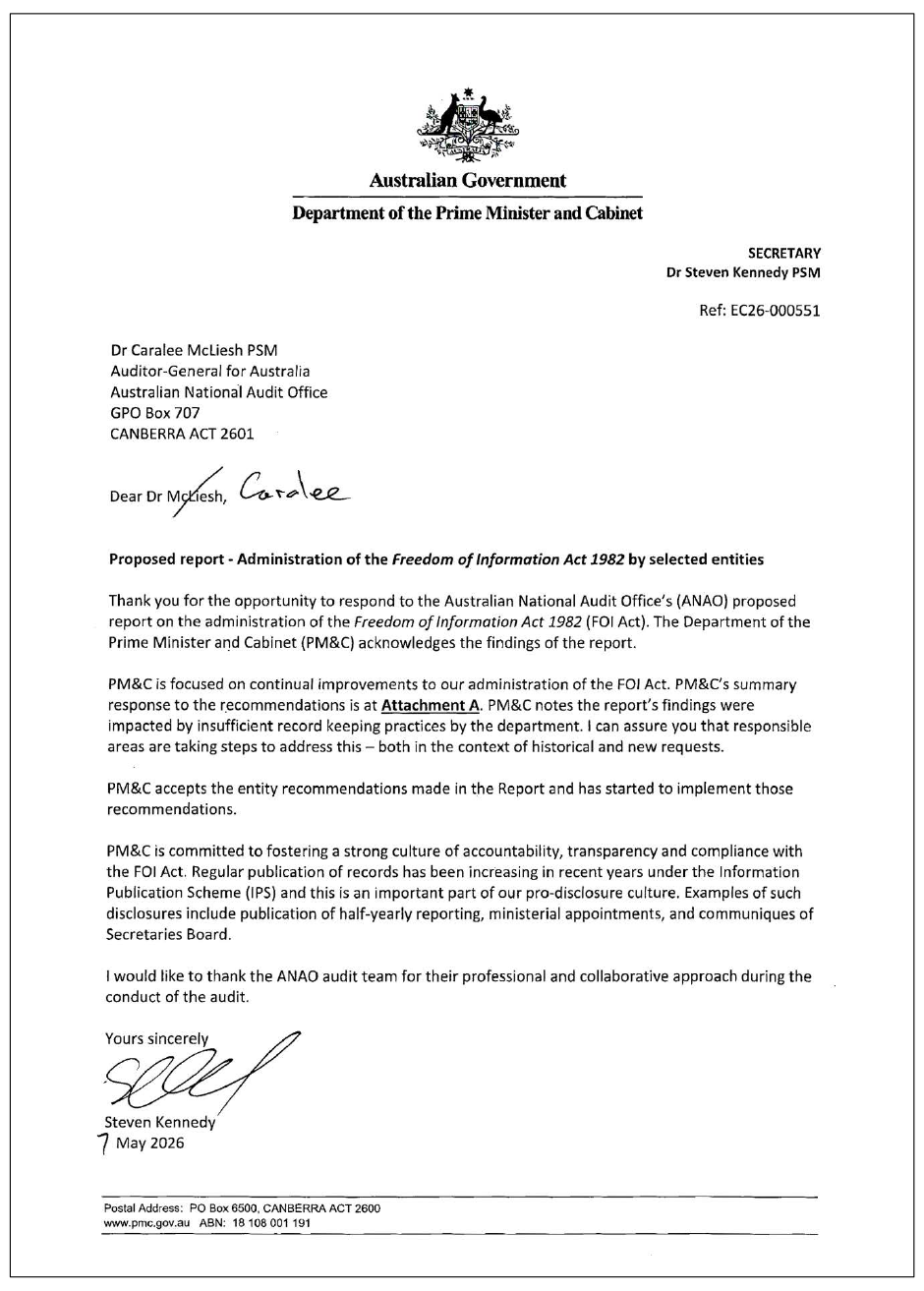
Department of the Treasury
Department of Infrastructure, Transport, Regional Development, Communications, Sport and the Arts
Office of the Australian Information Commissioner
Appendix 2 Improvements observed by the ANAO
1. The existence of independent external audit, and the accompanying potential for scrutiny improves performance. Improvements in administrative and management practices usually occur: in anticipation of ANAO audit activity; during an audit engagement; as interim findings are made; and/or after the audit has been completed and formal findings are communicated.
2. The Joint Committee of Public Accounts and Audit (JCPAA) has encouraged the ANAO to consider ways in which the ANAO could capture and describe some of these impacts. The ANAO’s corporate plan states that the ANAO’s annual performance statements will provide a narrative that will consider, amongst other matters, analysis of key improvements made by entities during a performance audit process based on information included in tabled performance audit reports.
3. Performance audits involve close engagement between the ANAO and the audited entity as well as other stakeholders involved in the program or activity being audited. Throughout the audit engagement, the ANAO outlines to the entity the preliminary audit findings, conclusions and potential audit recommendations. This ensures that final recommendations are appropriately targeted and encourages entities to take early remedial action on any identified matters during the course of an audit. Remedial actions entities may take during the audit include:
- strengthening governance arrangements;
- introducing or revising policies, strategies, guidelines or administrative processes; and
- initiating reviews or investigations.
4. In this context, the below actions were observed by the ANAO during the course of the audit. It is not clear whether these actions and/or the timing of these actions were planned in response to proposed or actual audit activity. The ANAO has not sought to obtain assurance over the source of these actions or whether they have been appropriately implemented.
- The Department of the Prime Minister and Cabinet, in acknowledging that record keeping was an area for improvement undertook a ‘new weekly process to remind staff to save records appropriately’ including:
- a weekly calendar appointment to schedule and remind staff to complete record keeping. This is in addition to a one-off records management day where a senior adviser paid for lunch for the staff who spent the entire day saving records for FOI requests to the official record repository; and
- ‘create and maintain SOPs [standard operating procedures] for repeated aspects of the FOI process’.
- The Department of the Treasury advised ANAO in December 2025 that it:
- ‘has instituted regular filing time twice a week, and staff are regularly reminded to file their FOI matters completely and promptly’; and
- is ‘also considering how we can make our record keeping more robust, including by investigating options for dealing with technical barriers to easier record management’.
- The Department of the Treasury issued its first Freedom of Information (FOI) policy on 17 February 2026 with a planned review date of February 2027. Version 1.1 of the policy was issued on 23 February 2026, to address an issue identified by the ANAO in relation to the content of the first version. The finalised policy removed some important requirements that were in the draft policy. For example, the finalised policy does not require a record be made of document searches that were undertaken.
- The Department of the Treasury’s disclosure log is now searchable.
- The Office of the Australian Information Commissioner released an updated set of FOI Guidelines in March 2026. The updates were reported as largely relating to updating the references from the Administrative Appeals Tribunal to the Administrative Review Tribunal.
Appendix 3 Commonwealth Integrity Strategy — Freedom of Information metrics
Extract of the Freedom of Information relevant metrics in the Commonwealth Integrity Strategy
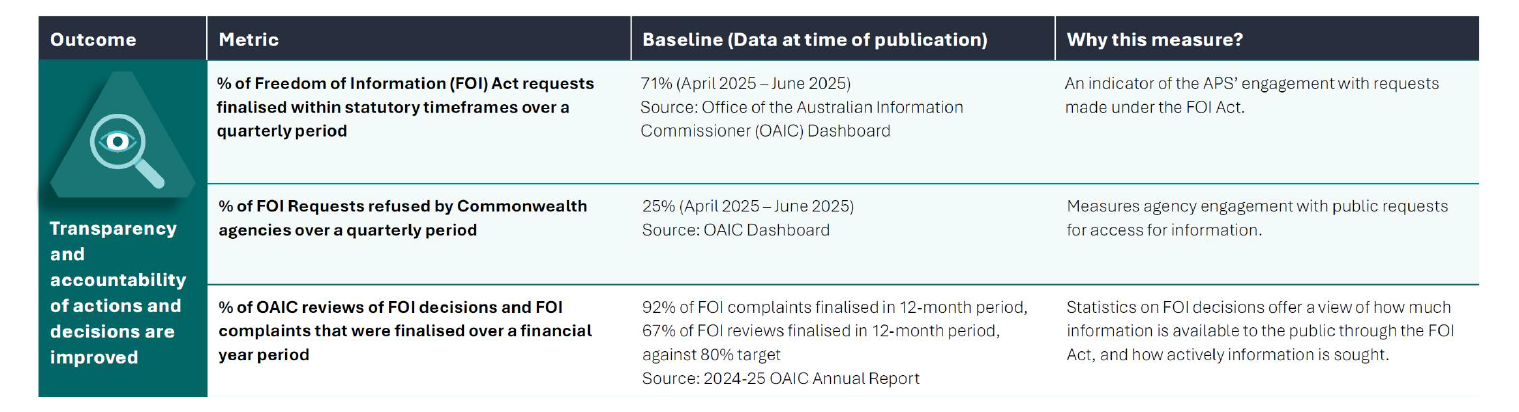
Source: Attorney-General’s Department and Australian Public Service Commission, Commonwealth Integrity Strategy, Canberra, December 2025, page 20 [accessed online] https://www.ag.gov.au/integrity/publications/commonwealth-integrity-strategy
Footnotes
1 Set aside is described by the Office of the Australian Information Commissioner (OAIC) on its website as making a ‘new decision (the original decision is replaced with a new decision)’. This is different to ‘vary the decision’, where the OAIC describes this as ‘only some parts of the original decision are changed’.
Office of the Australian Information Commissioner, Receiving a decision by a Commissioner or delegate under s55K, OAIC, Sydney, available from https://www.oaic.gov.au/freedom-of-information/your-freedom-of-information-rights/freedom-of-information-reviews/how-we-handle-an-information-commissioner-review-application [accessed March 2026].
2 Legal and Constitutional Affairs References Committee, The operation of Commonwealth Freedom of Information (FOI) Laws, Parliament of Australia, Canberra, December 2023, paragraph 5.9, available from https://www.aph.gov.au/Parliamentary_Business/Committees/Senate/Legal_and_Constitutional_Affairs/CommonwealthFOI2023 [accessed March 2026].
3 The ANAO has conducted two previous performance audits relating to the FOI Act. A 2017 report (Auditor-General Report No. 8 2017–18) concluded that the three audited entities’ administration of FOI applications was generally effective. A 2004 report (Auditor-General Report No. 57 2003–04) concluded that, to varying degrees, the six audited agencies had in place appropriate policies and processes to support the processing of FOI requests and other obligations of the FOI Act.
4 Office of the Australian Information Commissioner, Annual Report 2024–25, Volume 2, Report on information provided by agencies and ministers subject to the Freedom of Information Act 1982, OAIC, Sydney, November 2025, https://www.oaic.gov.au/about-the-OAIC/our-corporate-information/oaic-annual-reports/annual-report-2024-25 [accessed March 2026].
5 Set aside is described by the OAIC on its website as making a ‘new decision (the original decision is replaced with a new decision)’. This is different to ‘vary the decision’, where the OAIC describes this as ‘only some parts of the original decision are changed’.
OAIC, Receiving a decision by a Commissioner or delegate under s55K.
6 As set out in Figure 2.3 on page 29, along with Table 3.7 on page 51, the audit identified that entities are reporting some FOI requests as being granted in full when redactions have been applied meaning the outcome should have been reported as a partial release of information.
7 The Commonwealth Integrity Strategy, released in December 2025 (see further at paragraph 2.2), included a number of FOI related metrics to measure progress with improving transparency and accountability, including the percentage of FOI requests refused.
8 OAIC, Annual Report 2024–25, Volume 2, Report on information provided by agencies and ministers subject to the Freedom of Information Act 1982.
9 The Freedom of Information Amendment (Reform) Act 2010 was passed by Parliament in May 2010. That Act was a response to proposals by the Australian Law Reform Commission and the Administrative Review Council to reform the FOI Act. The amendments took effect from 1 November 2010, with the exception of the information publication scheme and disclosure log requirements, which commenced on 1 May 2011.
10 Legal and Constitutional Affairs References Committee, The operation of Commonwealth Freedom of Information (FOI) Laws, Parliament of Australia, Canberra, December 2023, paragraph 5.9, available from https://www.aph.gov.au/Parliamentary_Business/Committees/Senate/Legal_and_Constitutional_Affairs/CommonwealthFOI2023 [accessed March 2026].
11 Legal and Constitution Affairs References Committee, Government Response, The operation of Commonwealth Freedom of Information (FOI) Laws, Parliament of Australia, Canberra, December 2025, available from https://www.aph.gov.au/Parliamentary_Business/Committees/Senate/Legal _and_Constitutional_Affairs/CommonwealthFOI2023/Government_Response [accessed March 2026]
12 Details about the proposed Freedom of Information Amendment Bill 2025 can be found at: https://parlwork.aph.gov.au/bills/r7371.
13 The ANAO has conducted two previous performance audits relating to the FOI Act. A 2017 report (Auditor-General Report No. 8 2017–18) concluded that the three audited entities’ administration of FOI applications was generally effective. A 2004 report (Auditor-General Report No. 57 2003–04) concluded that, to varying degrees, the six audited agencies had in place appropriate policies and processes to support the processing of FOI requests and other obligations of the FOI Act.
14 The Guidelines state that they ‘are not a legislative instrument (sub-section 93A(3)) and, by contrast with the provisions of the FOI Act, do not have binding force. However, it is well established that decision-makers should, at a minimum, have regard to the Guidelines in discharging the powers and functions under the FOI Act.’
15 The Strategy was developed in response to Australia’s Third Open Government Partnership National Action Plan and the Louder than Words report of the APS Integrity Taskforce (the Taskforce) that was established by Secretaries Board.
16 In January 2026 PM&C advised ANAO that the business rules ‘captured the intent of the objects of the FOI Act’ and cited two references made to section 3(1) of Act, that the Act ‘provides a legally enforceable right of access’ and that the Act requires ‘agencies to publish specified categories of information’.
17 In January 2026, Treasury advised the ANAO that ‘Treasury’s operational practice is to release documents on a Friday. However, to ensure compliance with statutory timelines, Treasury’s practice is also to release documents on the due date if it is a Friday, or before the due date if the decision is due on a Monday to Thursday.’ Of the 155 FOI requests where there was a record of an outcome notification issued to the applicant, there were two instances where extensions were sought to extend a due date to Friday, despite the decision being made. There were a further 40 instances where a request was held for release on Friday (with an additional 21 decided on Thursday, with an applicant notified on Friday). Timeliness of responses by all three entities is illustrated in Figure 2.6.
18 In November 2025, Treasury advice to the ANAO was to ‘assure you that we process new requests according to the current case law and legislation’ advising that ‘Our out of date guidance is partly as a result of structural factors relating to how we train new FOI staff and a consistent increase in the FOI workload over the past few years. This has meant we haven’t prioritised updating and finalising our FOI policy and procedures.’ Treasury advised the ANAO that it has ‘been fortunate to have an experienced and relatively stable FOI team for the last 4–5 years’.
19 Federal Court of Australia, Patrick v Attorney -General (Cth) [2024] FCA 268, Federal Court of Australia, Sydney, 2024, available from https://www.judgments.fedcourt.gov.au/judgments/Judgments/fca /single/2024/2024fca0268 [accessed on March 2026].
20 The previous policy set out the ‘key timeframes and milestones for processing FOI requests’. It had: no version control; no approval authority; no reference or link to the FOI Act or it’s objects; no reference or link to the OAIC FOI Guidelines; no reference or link to any existing supporting templates or guidance documents; no information on how a decision on a request be arrived at; no information on when extensions, exemptions, or redactions may be sought or applied; and no contact details for entity staff to contact the FOI Officers on.
21 The previous policy, in place for half the period audited by the ANAO, contained no executive endorsement or sign off, and no version control table. It was intended to ‘set out the key timeframes and milestones for processing FOI requests’ but contained no detail or link to the FOI Act or the FOI Guidelines. This version largely delineated responsibilities between the FOI team and the relevant subject matter area in administering an FOI request.
22 PM&C: https://www.pmc.gov.au/about-us/accountability-and-reporting/information-and-privacy/freedom-information;Treasury: https://treasury.gov.au/the-department/accountability-reporting/foi; Infrastructure: https://www.infrastructure.gov.au/about-us/freedom-information.
23 The ANAO located within its sample testing two applications in Infrastructure’s FOI case management system and one application in Treasury’s case management system that were determined by each department to not be valid FOI requests. These three each were allocated an FOI request number.
24 Attorney-General’s Department, Legal and Constitutional Affairs Legislation Committee - 01/12/2025 - Estimates - ATTORNEY-GENERAL’S PORTFOLIO - Attorney-General’s Department, Parliament of Australia, Canberra, December 2025, available from https://www.aph.gov.au/Parliamentary_Business/Hansard /Hansard_Display?bid=committees/estimate/29006/&sid=0002 [accessed on March 2026].
25 Entities are able to identify that an FOI request was submitted via the Right to Know website, as the request is submitted to entities as an email, from a unique ‘@righttoknow.org.au’ email address. Both Treasury and Infrastructure have a distinct applicant category for applications from Right to Know (other distinct categories include: media/journalist; individual; industry/business; legal; political party).
26 See paragraph 3.86 on inaccuracies in reporting to OAIC.
27 The OAIC has advised all agencies that, in line with section 55D of the FOI Act, if an Information Commissioner review of an agency’s decision to refuse access to documents is undertaken, the onus of establishing that all reasonable steps have been taken to find a requested document rests with the agency.
28 The checklist and search minute can be found on the OAIC website at https://www.oaic.gov.au/freedom-of-information/guidance-and-advice/processing-foi-requests-taking-all-reasonable-steps-to-find-documents/.
29 The February 2026 Treasury FOI Policy removed the requirement that a record be made in a manner that aligns with the OAIC guidance, see further at paragraph 2.17.
30 The OAIC upload finalised decisions to the University of Technology Sydney’s Australasian Legal Information Institute (AustLII) website: https://www.austlii.edu.au/cgi-bin/viewtoc/au/cases/cth/AICmr/2024/#.
31 In November 2025, Treasury advised ANAO that: ‘Each decision to charge or not charge is taken by the decision-maker, noting the general guideline in place in 2024 as set out in our policy to not recommend the decision-maker consider charges unless the charge is likely to be more than $200 (as in the FOI Procedures). We comply with OAIC’s guidance on charges … each request is individual and it’s hard to make any sweeping generalisations about the impact of charging on any particular request. It is worth noting that once an FOI request is made then the FOI Act puts the obligation on Treasury to process and respond to the request without further input from the applicant unless charges are issued or the request consultation process in section 24AB applies. It would be very unusual for an applicant to make a request and subsequently withdraw it without any input from us (either because they have failed to reply to a section 24AB consultation or charges notification or because we’ve asked them to withdraw for other reasons (for example, the information they are seeking is already publicly available)). We also don’t ask for reasons when an applicant withdraws their requests (whether charges are issued or not) so our information on this is mostly anecdotal.’
32 The FOI Guidelines sets out in Part 12, the grounds for and process to apply to have an applicant declared vexatious. Such a declaration can only be made by the OAIC’s Information Commissioner, either on their own initiative, or on the application of an agency or minister. The Information Commissioner must be satisfied that the person has repeatedly engaged in access actions that involve and abuse of process; is engaged in an access action that would involve an abuse of process; or a particular access action by a person is manifestly unreasonable. Abuse of process is described in the guidelines as including but not limited to: harassing or intimidating an individual or an agency employee; unreasonably interfering with an agency’s operations; or seeking to use the FOI Act to circumvent access restrictions imposed by a court.
33 This includes the 10 FOI requests submitted to PM&C and subsequently transferred to Infrastructure, see Table 1.1, note a, and Footnote 38.
34 A vexatious applicant declaration can only be made by the Information Commissioner, under the FOI Act. The Information Commissioner sets terms of that declaration, and may include allowing an agency or minister to refuse to process a request (unless the vexatious applicant first receives written permission from the Information Commissioner). While this does provide agencies an avenue to refuse to process a request, it does not prevent an agency from choosing to process a request from a vexatious applicant.
35 Office of the Australian Information Commissioner, Annual Report 2024–25, Volume 2, Report on information provided by agencies and ministers subject to the Freedom of Information Act 1982, FOI Commissioner’s Foreword, page 5.
36 PM&C: https://www.pmc.gov.au/about-us/accountability-and-reporting/information-and-privacy/foi-disclosure-logs; Treasury: https://treasury.gov.au/the-department/accountability-reporting/foi-disclosure-log; Infrastructure: https://www.infrastructure.gov.au/about-us/freedom-information/freedom-information-disclosure-log.
37 Infrastructure further advised the ANAO that it employs this approach for extensions of time for making a decision on FOI requests: ‘Our case management system records each extension of time and the relevant extension type as a file note. The due date within the system cumulatively updates as each extension is entered into the system.’
38 The test sample of PM&C records included six of the 10 FOI requests made to PM&C transferred to Infrastructure (See Table 1.1, note a). All six of these requests had no record of acknowledgement of the requests. Three of the 10 requests were included in the tested sample for Infrastructure, with one request included in both PM&C and Infrastructure samples. Infrastructure records record that the transfer was received after the acknowledgement statutory timeframe had expired. Infrastructure’s subsequent acknowledgement of the transfer and receipt of the request to the applicant occurred after the required statutory timeframe.
39 One factor for some of the requests was that the audited entities were undertaking consultations that were additional to those specifically required by, and addressed in, the FOI Act. See further at paragraphs 3.27 to 3.39.
40 In January 2026, PM&C advised ANAO that OAIC advice to agencies was ‘not to report on deemed refusals as a decision outcome’. ANAO notes that there is a difference between reporting deemed refusals as a decision outcome to the OAIC, and recording and monitoring at an entity level the processing of an FOI; and the range of decisions and statutory events of an FOI accurately to better understand individual entity processes and identified areas for process improvement.
41 Subsection 23(1) of the FOI Act, allows for decisions to be made by an authorised officer of the agency, within the scope of their authorised authority as approved by the accountably authority of the agency.
42 This circulation of the decision internally, prior to public release, is not considered within the FOI Act. While the Australia Public Service Commission advises public servants to brief ministers on policy design and implementation (see: https://www.apsc.gov.au/publication/working-ministers), there is no guidance that ministers be informed of FOI decision-making.
43 Given an absence of records, it was not clear to the ANAO what the implications for a decision-maker’s decision was had any of the senior officers or Prime Minister through their office raised concerns.
44 Defined by Infrastructure as those: received from a journalist, media organisation or politician; or concerns documents or a subject matter that is or may be of media or parliamentary interest.
45 In the sample, where matters were raised in response by Ministers through their offices, there was an absence of records setting out any impact on decision-making. There is no guidance that deals with how to address any matters when they are raised with the department.
46 The FOI Act does not include the minister as a third party, and imposes no requirement to consult with the minister in relation to agency decision-making. Where third party consultation is required under the FOI Act, the act does not include a broad reference to information relating to the ‘functions’ of a third party. Rather, for state and territory information, the FOI Act refers to documents ‘originating with, or received from’ and ‘contains information … that originated with, or was received from [third party]’. Similarly, the FOI Act specified that business information is ‘information about the business, commercial or financial affairs of the organisation or undertaking’.
47 These sections of the Guidelines relate to ‘Consultation with other agencies’. The example given is where ‘more than one agency will be involved in creating a document, such as through an inter-agency working group’.
48 See Part IV, Division 1, section 31A, of the FOI Act for a table outlining five examples of how the FOI Act applies to exempt and conditionally exempt documents.
49 The Royal Commission into the Robodebt Scheme made 56 recommendations and one closing observation, which was that section 34 of the FOI Act should be repealed to end the blanket approach to confidentiality of Cabinet documents. The closing observation included that ‘confidentiality should only be maintained over any Cabinet documents or parts of Cabinet documents where it is reasonably justified for an identifiable public interest reason.’ The Government Response of November 2023 did not accept the closing observation to repeal section 34.
50 As set out in paragraph 3.44 and Table 3.4, there is rarely a record a decision on exemptions beyond the notice to apply an exemption to an applicant in the decision notice.
51 OAIC took the position, and this is reflected in the OAIC FOI Guidelines (6.109–6.111, 6.146–6.152) that subsection 47E(c) is ‘generally more appropriate than section 47F (personal privacy) for specific concerns about the health, safety and wellbeing of staff’ explaining that subsection 47E(c) provides that a document is conditionally exempt if disclosure would or could ‘have a substantial adverse effect on the management or assessment of personnel by the Commonwealth or by an agency’. The OAIC explained that the ‘personal privacy exemption may continue to be more appropriately considered where documents are sought that relate to an individual’s disposition or private character, such as reasons for taking personal leave, information about performance management, or whether the person was unsuccessful during a recruitment process.’
52 For example, for one of the FOI requests tested during the audit, the OAIC contacted the entity on 20 December 2022, advising that ‘The OAIC is currently prioritising all outstanding 2018 and 2019 IC reviews.’ The FOI request was first submitted in November 2018, with the original decision notice issued in January 2019.The OAIC review was requested in March 2019. The OAIC has publicly reported this matter to have been closed with a variation to the decision in January 2024, five years after the original decision was provided to the applicant.
53 The FOI Act, under section 55G, only allows a revised decision on a refused access decision or partial access decision where the revised decision would have the effect of providing increased access to information.
54 Treasury advised ANAO in January 2026 that ‘lawyers are embedded in its FOI Team so there will not be internal correspondence between internal lawyers and the FOI team.’ Where AGS was engaged, correspondence between Treasury FOI Officers and AGS was recorded.