Browse our range of reports and publications including performance and financial statement audit reports, assurance review reports, information reports and annual reports.
Auditor-General Report No. 43 of 2025–26
Artificial Intelligence Use in IP Australia
Published
Monday 29 June 2026

Portfolio
Industry, Science and Resources
Entity
IP Australia
Contact
Please direct enquiries through our contact page.
Activity
Governance
Sector
Industry
Audit snapshot
Why did we do this audit?
- Artificial intelligence (AI) is increasingly becoming a part of the Australian Public Service. AI offers the promise of better services, enhanced productivity and efficiency — but has the potential for increased risk and unintended consequences.
- IP Australia has deployed AI tools to assist patent examiners in the patent application process.
- The audit was conducted to provide assurance to the Parliament as to whether IP Australia has effective arrangements in place to support its adoption of AI in the patent rights process.
Key facts
- IP Australia deployed the first AI tool into the patent examination process in 2018.
- The AI tools are designed to provide examiners with information to make better decisions.
What did we find?
- IP Australia’s use of AI in the patent rights process was largely effective.
- IP Australia has been an early adopter of artificial intelligence and governance has matured over time to meet the changing environment. There are opportunities for IP Australia to further refine and mature its processes.
- IP Australia implemented largely effective arrangements for the design, development and deployment of AI tools in the patent examination process.
- Strategic oversight of the implementation and associated benefits of AI is not yet fully established.
What did we recommend?
- The ANAO made two recommendations to IP Australia aimed at improving management of cyber security risks and improving strategic oversight of AI implementation.
- IP Australia agreed to the two recommendations.
29,999
Patent applications filed with IP Australia in 2024–25.
2.8 years
Median time of a patent being granted.
4
Number of AI tools deployed by IP Australia in the patent examination process.
Summary and recommendations
Background
1. Artificial intelligence (AI) is increasingly becoming a part of everyday lives, including in the work of the Australian Public Service (APS). The Australian Government has adopted the Organisation for Economic Co-operation and Development (OECD) definition of an AI system:
An AI system is a machine-based system that, for explicit or implicit objectives, infers, from the input it receives, how to generate outputs such as predictions, content, recommendations, or decisions, that can influence physical or virtual environments. Different AI systems vary in their levels of autonomy and adaptiveness after deployment.1
2. Automated decision making (ADM) and AI are distinct but closely intersecting technologies that are often used together. ADM is the use of technology to make decisions with little to no human intervention, and may or may not employ AI.
3. The Australian Government has committed to adopting artificial intelligence to ‘improve user experience, support evidence-based decisions and gain efficiencies in agency operations’.2 Within the Australian Government sector, requirements and guidance for AI governance and management are evolving. The Policy for the responsible use of AI in government3 took effect on 1 September 2024 and the AI Plan for the Australian Public Service4 was released in November 2025.
4. IP Australia states ‘[a]rtificial intelligence (AI) is rapidly transforming our world and we are committed to innovating to improve the accessibility of the IP rights system and efficiency of its administration through its responsible use.’5 IP Australia applies a risk-based approach to the governance of AI and ADM that ‘ensures the ethical and responsible implementation of any AI and ADM tools that deliver tangible benefits.’6 IP Australia reported its use of AI in its AI Transparency Statement published in February 2025, and updated in February 2026.7
Rationale for undertaking the audit
5. Artificial intelligence is an emerging technology that is increasingly becoming a part of the APS. AI can offer the promise of better services, enhanced productivity and efficiency but has the potential for increased risk and unintended consequences.
6. In 2024–25 there were 29,999 patent applications filed with IP Australia, with the median time between filing of an application and the grant of a patent being 2.8 years.8 The number of patent applications in the examination pipeline peaked in 2023–24 and has declined since. IP Australia began adopting AI in 2018 and has increasingly implemented AI to improve efficiency and productivity as it manages its patent application workload.
7. This audit continues the ANAO’s work in examining the governance of emerging technologies and is the first audit examining the implementation of a mature AI model across the full development lifecycle against the Technical standard for government’s use of artificial intelligence.9 It provides independent assurance to the Parliament as to whether IP Australia has effective arrangements in place to support its adoption of AI in the patent rights process.
Audit objective and criteria
8. The objective of this audit was to assess whether IP Australia’s use of artificial intelligence in the patent rights process is effective. To form a conclusion against the objective, the ANAO examined the following criteria:
- Does IP Australia have appropriate governance arrangements supporting the adoption of AI?
- Does IP Australia have fit-for-purpose arrangements for the design, development and deployment of AI tools in the patent rights process?
- Is IP Australia effectively monitoring and reporting the impact of the use of AI?
Conclusion
9. IP Australia’s use of AI in the patent rights process is largely effective. IP Australia has progressively implemented AI over approximately eight years. The agency has invested significant effort in defining strategic possibilities and considering opportunities for innovation and has embedded several AI tools into the patent rights process.
10. IP Australia continues to evolve its governance processes for AI. Key risks related to the design, development and deployment of AI in the patent rights process were largely addressed through proportionate controls and procedures. There are opportunities available to the agency to better measure and monitor the outcomes achieved from AI to support benefits realisation and inform future strategy. It will be important for IP Australia to continue to develop and adapt its governance arrangements as it increasingly adopts AI into its operations.
Supporting findings
Governance arrangements for artificial intelligence
11. IP Australia has largely appropriate governance arrangements to support the adoption of AI. Governance has matured over time through the introduction of an AI governance policy, risk-scaled assessment mechanisms and clearer enterprise accountability roles, reflecting a shift from experimentation to more structured oversight. The strategic framework does not consistently link AI initiatives to defined business outcomes, and the AI inventory, role clarity across committees and use-case ownership remain in progress. Improvements in these areas would support IP Australia’s own assurance and clear accountability for AI-enabled tools embedded in the patent rights process. (See paragraphs 2.4 to 2.71)
Design, development and deployment of artificial intelligence in the patent rights process
12. IP Australia has largely fit-for-purpose arrangements for the design, development and deployment of AI tools in the patent rights process. The four tools that have been deployed were designed and implemented as part of a strategy of experimentation and capability building, before current governance and assurance requirements were established. IP Australia has retrospectively applied its current governance arrangements for risk, legal, privacy and security matters for these tools and is implementing these assessments for tools currently being designed and developed. While the Patent Auto Classifier tool demonstrates stronger development and deployment controls and IP Australia has since introduced improved processes (including retrospective use case documentation and risk assessments), robust documentation of planning and design considerations is not yet consistently embedded across tools and stages. (See paragraphs 3.4 to 3.28)
Monitoring and reporting
13. IP Australia’s monitoring and reporting of the impact of its use of AI is partly effective. Monitoring practices varied across patent rights tools, and scheduled review processes under the new governance framework are not yet fully implemented. AI tools are integrated into business-as-usual operations and identified as strategically significant. Benefits realisation has been inconsistently defined and measured, with qualitative evidence of improved quality and efficiencies but limited quantification of impacts. These limitations affect IP Australia’s ability to demonstrate ongoing effectiveness and manage emerging risks of AI. (See paragraphs 4.3 to 4.29)
Recommendations
Recommendation no. 1
Paragraph 4.5
IP Australia review its current controls for cyber security governance in relation to AI and ensure there is a structured approach to assess, reassess and authorise AI systems.
IP Australia response: Agreed
Recommendation no. 2
Paragraph 4.24
IP Australia establish clearly defined, risk-based monitoring and reporting arrangements on AI implementation, to enable strategic oversight of benefits, costs and risks that inform planning and future strategy.
IP Australia response: Agreed
Summary of entity response
14. The proposed audit report was provided to IP Australia. The summary response to the report is below and the full response is at Appendix 1.
We welcome this audit as an opportunity to share IP Australia’s experience with other entities, and to support responsible adoption of artificial intelligence across government.
The proposed report presents insights from IP Australia’s artificial intelligence journey over eight years, during which technology, community expectations and government policy has evolved significantly. Our approach to AI experimentation and adoption has consistently reflected our risk appetite settings, with early deployment in lower-risk areas providing the foundation for more innovative customer-facing tools now in use or development. These tools are delivering benefits for our customers and stakeholders, including improved access to the IP rights system for small and medium enterprises.
We acknowledge the findings of the report and agree with the recommendations. We are committed to maintaining the security of our systems in an emerging technology landscape and will continue to mature our risk-scaled governance arrangements supporting the implementation of artificial intelligence within our agency.
Consistent with our purpose, we look forward to continuing to foster innovation through our engagement and experimentation with artificial intelligence, and to improve the efficiency and accessibility of the IP rights system through the delivery of innovative digital and data-driven customer and staff experiences.
Key messages from this audit for all Australian Government entities
15. Below is a summary of key messages, including instances of good practice, which have been identified in this audit and may be relevant for the operations of other Australian Government entities.
Group title
Innovation
Key learning reference
Group title
Governance and risk management
Key learning reference
1. Background
Introduction
1.1 Artificial intelligence (AI) is increasingly being adopted by both the Australian Public Service (APS) and the broader economy. The Australian Government has adopted the Organisation for Economic Co-operation and Development (OECD) definition of an AI system:
An AI system is a machine-based system that, for explicit or implicit objectives, infers, from the input it receives, how to generate outputs such as predictions, content, recommendations, or decisions, that can influence physical or virtual environments. Different AI systems vary in their levels of autonomy and adaptiveness after deployment.10
1.2 Automated decision making (ADM) and AI are distinct but closely intersecting technologies that are often used together. ADM is the use of technology to make decisions with little to no human intervention, and may or may not employ AI. The Senate Select Committee on Adopting AI (see paragraph 1.12) defined automated decision making as:
the application of automated systems in any part of a decision-making process. ADM includes using automated systems to: make the final decision; make an interim assessment or decision leading up to the final decision; recommend a decision to a human decision-maker; guide a human decision-maker through relevant facts, legislation or policy; and automate aspects of the fact-finding process which may influence an interim decision or the final decision.11
1.3 The government has stated that AI has the potential to enhance Australia’s wellbeing, quality of life and economic growth.12 In its Data and Digital Government Strategy published in December 2023, the government committed to adopting AI to ‘improve user experience, support evidence-based decisions and gain efficiencies in agency operations’ and to equip entities to safely engage with emerging technologies, including AI.13 The 2025 Implementation Plan for the Data and Digital Strategy describes AI as a 2026 government priority.14 The AI Plan for the Australian Public Sector sets out the path to accelerating the adoption of AI across the public sector through leveraging the technology to allow officials to unlock productivity gains.15
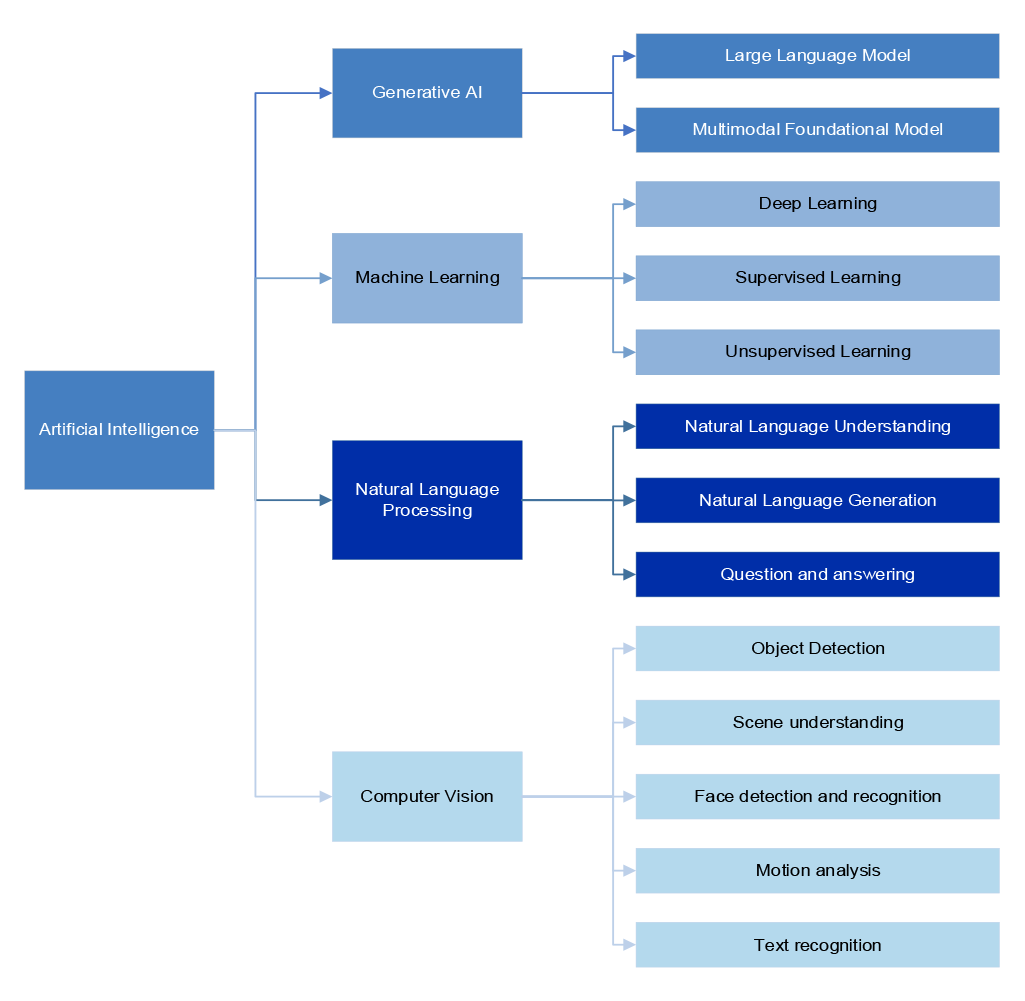
1.4 AI encompasses four specialised domains (see Figure 1.1):
- Generative AI is focused on creating new content such as text, images, video, code or data using patterns from data already learnt. Examples of generative AI referred to in the AI Plan for the Australian Public Sector include ChatGPT, Claude and Gemini.
- Machine learning (ML) involves algorithms learning patterns from data and improving over time without the need for explicit programming, for the purposes of making predictions or decisions. An example of machine learning is an algorithm that predicts the movies a user of a streaming service might like based on movies they have already watched.
- Natural language processing (NLP) enables a computer to process and generate human language. Translation features on a computer or chatbots are an example.
- Computer vision enables a computer to process and interpret visual information such as images or camera feeds. Applications include facial recognition and self-driving cars.
Figure 1.1: Specialised AI domains
Source: Adapted by the ANAO from Digital NSW, A common understanding: simplified AI definitions from leading standards, available from https://www.digital.nsw.gov.au/policy/artificial-intelligence/a-common-understanding-simplified-ai-definitions-from-leading [accessed 25 March 2025].
1.5 AI systems differ in their technical characteristics, intended purposes and deployment contexts, resulting in varying levels and types of risk. Australian Government guidance and assurance frameworks recognise that generative AI, ADM and safety-critical applications such as clinical or regulatory decision support present distinct risks, including differences in transparency, predictability, potential for misuse and consequences of failure. Entities using different types of AI need to identify and manage risks and potential impacts of the AI they implement, including risks arising from specific use cases of AI, rather than apply uniform requirements across all AI uses.
Artificial intelligence in the Australian Government sector
1.6 Within the Australian Government sector, requirements and guidance for AI governance and management are evolving. The Policy for the responsible use of AI in government took effect on 1 September 2024 and the AI Plan for the Australian Public Service was released in November 2025. Further information on initiatives and developments related to AI and the APS is at Appendix 3.
Policy for the responsible use of AI in government
1.7 The government released the Policy for the responsible use of AI in government to ‘position the Australian Government as an exemplar under its broader safe and responsible AI agenda’ and ‘to create a coordinated approach to government’s use of AI’.16 The policy17 required entities to:
- designate ‘accountable officials’ by 30 November 202418; and
- publish AI transparency statements by 28 February 2025.19
1.8 Version 2.0 of the policy was released on 15 December 2025.20 Version 2.0 defines an AI use case as ‘a specific application of an AI system or systems to achieve certain objectives or perform certain tasks.’ The policy specified that an AI use case is considered ‘in-scope’ of the policy where any of the following apply:
- The use, misuse or failure of AI could lead to more than insignificant harm to individuals, communities, organisations, the environment or the collective rights of cultural groups including First Nations peoples.
- The use of AI will materially influence administrative decisions that affect individuals, communities, organisations, the environment or the collective rights of cultural groups including First Nations peoples.
- It is possible the public will directly interact with, or be significantly impacted by, the AI or its outputs without human review.
- The AI is designed to use personal or sensitive data or security classified information.
- It is deemed an elevated risk AI use case as directed by the [Digital Transformation Agency].21
1.9 Version 2.0 of the policy required entities to develop a strategic approach to AI adoption within six months of the policy coming into effect (that is, by 15 June 2026) and implement training and governance arrangements for AI use cases within 12 months of the policy coming into effect (that is, by 15 December 2026). Further details of the policy requirements can be found in Appendix 4.
AI Plan for the Australian Public Service
1.10 The AI Plan for the Australian Public Service outlines a series of objectives for government, including to improve AI literacy, drive AI adoption through a coordinated approach and lead by example. The plan requires entities to appoint Chief AI Officers (CAIO) by July 2026 to promote adoption of AI and encourage collaboration across the public service.22
1.11 CAIOs are responsible for leading change while AI Accountable Officials are responsible for the governance required to comply with government policy. Department of Finance guidance states that CAIOs are ‘expected to be existing senior leaders in their agency, separate to the Accountable Official where possible.’
Previous reviews and audits relating to the governance of artificial intelligence
1.12 The Senate Select Committee on Adopting AI tabled its report in November 2024, which made 13 recommendations including that the Australian Government introduce new legislation to regulate high-risk uses of AI; increase its support to sovereign AI capability in Australia; extend and apply the existing work health and safety legislative framework to the workplace risks posed by AI adoption; and introduce a right for individuals to request information about how substantially automated decisions with legal or similarly significant effect are made.23 The Australian Government’s April 2026 response stated that it would: support sustainable AI infrastructure; support the growth of Australia’s AI ecosystem and the widespread responsible adoption of AI; prevent and mitigate AI harm; build a workforce ready for a future enabled by AI; support the creative sector during the AI age; ensure the transparent use of automated decision-making by the government to improve public services; and expand digital literacy to safeguard elections in Australia.24
1.13 The Joint Committee of Public Accounts and Audit (JCPAA) conducted an inquiry into the use and governance of artificial intelligence systems by public sector entities and tabled its report in February 2025.25 The report made four recommendations relating to collecting data on the use and understanding of AI in the APS; convening a whole-of-government working group; establishing a Joint Committee on Artificial Intelligence and Emerging Technologies; and Digital Transformation Agency guidance. The Chair of the JCPAA noted the need for effective and coordinated governance frameworks for AI systems within the APS. The government had not responded to the report as at June 2026.
1.14 Auditor-General Report No. 22 2024–25 Audits of the Financial Statements of Australian Government Entities for the Period Ended 30 June 2024 stated that during 2023–24:
64 per cent of entities that used AI had also established internal policies governing the use of AI (2022–23: 44 per cent). Twenty-seven per cent of entities had established internal policies regarding assurance over AI use.26
1.15 Auditor-General Report No. 26 2024–25 Governance of Artificial Intelligence at the Australian Taxation Office assessed the Australian Taxation Office’s governance of AI at the enterprise level. The audit found it had partly effective arrangements to support the adoption of AI, including arrangements for governance, design, development and deployment and monitoring, evaluation and reporting.
IP Australia
1.16 IP Australia is a non-corporate Commonwealth entity that administers intellectual property (IP) rights for patents, trademarks, design rights and plant breeder’s rights (known collectively as IP rights groups). It is a portfolio agency of the Department of Industry, Science and Resources, with $440.3 million total estimated resourcing for 2026–27 and an average staffing level of 1,100. More than 97 per cent of IP Australia’s costs are recovered by charging fees for the services administered.
1.17 The Strategic Corporate Plan 2025–26 (the Corporate Plan) outlines IP Australia’s operating context as well as its approach to managing risk and measuring performance against its objectives. According to the Corporate Plan, the purpose of IP Australia is ‘[e]nabling Australians to benefit from great ideas by providing a world-leading IP system.’27 The key outcome that IP Australia has identified against its purpose is:
Increased innovation, investment and trade in Australia, and by Australians overseas, through the administration of the registrable intellectual property rights system, promoting public awareness and industry engagement, and advising government.28
1.18 The Corporate Plan sets out nine strategic objectives under four categories: Impact, Customer, Capability, and Innovation. The objectives include:
- Increase trust and confidence by maintaining a high-quality, customer-centric, efficient IP rights system.
- Increase access to and benefits from IP rights ownership.
- Create and continually improve capabilities that meet the current and future needs of the IP rights system.
- Create innovative contemporary digital and data driven customer services and staff experiences.
Artificial intelligence use at IP Australia
1.19 IP Australia has been adopting AI and ADM capabilities over many years and deployed its first AI tool in 2018. Adoption of AI began with experimentation and a desire to develop staff capability with AI tools. As IP Australia’s implementation of AI matured, it has sought to identify and realise longer-term efficiency gains.
1.20 In its Corporate Plan IP Australia states ‘[a]rtificial intelligence (AI) is rapidly transforming our world and we are committed to innovating to improve the accessibility of the IP rights system and efficiency of its administration through its responsible use.’29 IP Australia applies a risk-based approach to the governance of AI and ADM that ‘ensures the ethical and responsible implementation of any AI and ADM tools that deliver tangible benefits.’30 IP Australia reported its use of AI in its AI Transparency Statement published in February 2025, with an update in February 2026.31
1.21 As at May 2026, IP Australia identified 30 AI tools in use across the agency including those that have been developed internally and purchased from third-party providers. None of the AI deployed by IP Australia decides the outcome of an IP rights application. Examples of tools in use, and their role in supporting staff and business processes; include:
- Generative AI tools that assist with general administrative tasks, writing, image, and video generation. These tools include specialised models for staff training and media generation, enterprise-wide general-purpose tools such as Microsoft Copilot, and generative AI functionality embedded in existing software such as Adobe Acrobat. IP Australia also has a small number of licences for publicly available generative AI models. Additionally, in April 2026 IP Australia released its own generative AI chatbot to respond to queries from the public regarding intellectual property rights.
- Other off-the-shelf solutions that use AI functionality to support administration, manage and categorise customer enquiries and contacts, and manage internal documentation.
- Internally developed tools that assist with managing the workflow for IP rights applications. These tools use AI to streamline manual tasks in the examination process, such as by examining IP rights applications to categorise them by type for assignment to an appropriate team, and searching for existing intellectual property. Several of these tools were examined by this audit and are discussed further in Chapter 3.
1.22 IP Australia’s registers of AI use do not currently identify if use cases meet the in-scope criteria of the Policy for the responsible use of AI in government (described in paragraph 1.8); work to update these registers is in progress. Noting that this assessment is not yet complete, and definitions have evolved over time, the registers identify that some use cases would be considered in-scope.
Rationale for undertaking the audit
1.23 Artificial intelligence is an emerging technology that is increasingly used by the APS. AI can offer the promise of better services, enhanced productivity and efficiency, but has the potential for increased risk and unintended consequences.
1.24 In 2024–25, there were 29,999 patent applications filed with IP Australia, with the median time between the filing of an application and the grant of a patent being 2.8 years.32 The number of patent applications in the examination pipeline peaked in 2023–24 and has declined since. IP Australia began adopting AI in 2018 and has increasingly implemented AI to improve efficiency and productivity as it manages its patent application workload.
1.25 This audit continues the ANAO’s work in examining the governance of emerging technologies and is the first audit examining the implementation of a mature AI model across the full development lifecycle, against the Technical standard for government’s use of artificial intelligence.33 It provides independent assurance to the Parliament as to whether IP Australia has effective arrangements in place to support its adoption of AI in the patent rights process.
Audit approach
Audit objective, criteria and scope
1.26 The objective of this audit was to assess whether IP Australia’s use of artificial intelligence (AI) in the patent rights process is effective. To form a conclusion against the objective, the ANAO examined the following criteria:
- Does IP Australia have appropriate governance arrangements supporting the adoption of AI?
- Does IP Australia have fit-for-purpose arrangements for the design, development and deployment of AI tools in the patent rights process?
- Is IP Australia effectively monitoring and reporting the impact of the use of AI?
Audit methodology
1.27 The audit methodology involved:
- examining IP Australia’s documentation including its policies, procedures, risk assessments, registers, assurance and reporting activities relating to AI;
- meetings with IP Australia officers;
- walkthroughs of IP Australia systems and analysis of selected AI tools; and
- testing of the design, development and deployment processes of AI models related to patent rights.
1.28 The audit was conducted in accordance with ANAO Auditing Standards at a cost to the ANAO of approximately $449,575.
1.29 The team members for this audit were Jenny Broome, Jessica Bracken, Kai Clark, Lachlan Rowe, Qing Xue, Zhuo Li, Nathan Daley, Anne Rainger and Ben Siddans.
2. Governance arrangements for artificial intelligence
Areas examined
This chapter examines whether IP Australia’s governance arrangements are appropriate to support the adoption of artificial intelligence (AI).
Conclusion
IP Australia has largely appropriate governance arrangements to support the adoption of AI. Governance has matured over time through the introduction of an AI governance policy, risk scaled assessment mechanisms and clearer enterprise accountability roles, reflecting a shift from experimentation to more structured oversight. The strategic framework does not consistently link AI initiatives to defined business outcomes, and the AI inventory, role clarity across committees and use-case ownership remain in progress. Improvements in these areas would support IP Australia’s own assurance and clear accountability for AI-enabled tools embedded in the patent rights process.
Areas for improvement
The ANAO identified four opportunities for improvement for IP Australia related to: its strategic position on AI; guidance and training for staff on generative AI; updating policies to align with whole-of-government guidance and formalising requirements for completion of AI governance documents; and the roles and responsibilities for outcomes of AI systems.
2.1 AI governance guidance is evolving, with a common theme that there is no one-size-fits-all governance model. The National Framework for the assurance of artificial intelligence states that ‘[g]overnance structures should be proportionate and adaptable to encourage innovation while maintaining ethical standards and protecting public interests’.34 The Policy for the responsible use of AI in government is intended to ‘complement and strengthen … existing frameworks in use by the [Australian Public Service]’.35 The policy provides a framework to support government agencies to ‘embrace AI while continuing to position government as an exemplar in responsible AI use’.36
2.2 IP Australia has adopted AI and automated decision-making (ADM) capabilities since 2018, including deploying AI tools to support elements of the patent rights process. As AI use in government has increased, expectations have also evolved that entities put in place governance arrangements that are fit-for-purpose, risk-scaled and capable of providing clear accountability for decisions and outcomes across the AI lifecycle.37
2.3 This chapter assesses whether IP Australia has appropriate governance arrangements to support the adoption of AI in the patent rights process. In doing so, it examines whether IP Australia has: an effective strategic framework that links AI use to business needs and intended outcomes; arrangements to identify and manage AI-related risks within its broader risk management framework; and clearly defined and communicated roles, responsibilities and oversight mechanisms to support accountability and effective control.
IP Australia has had strategies for AI adoption and experimentation since 2017
2.4 Version 2.0 of the Policy for the responsible use of AI in government states that government agencies must develop a strategic position on AI adoption within six months of the policy taking effect (that is, by 15 June 2026) and requires agencies to embed responsible AI practices within 12 months of the policy taking effect (that is, by 15 December 2026).38
2.5 IP Australia’s strategy for AI adoption has been driven by its desire to demonstrate innovation, including through the use of AI. IP Australia advised the ANAO in February and March 2026 that its early strategies were also informed by an interest in exploring non-tangible benefits resulting from AI experimentation, such as building staff capability and organisational understanding. IP Australia’s AI Transparency Statement (published in February 2026) states that the agency is ‘committed to fostering innovation and engaging AI and ADM to improve the efficiency and accessibility of the IP rights system’.39
Cognitive Futures Strategy
2.6 First published in 2017, IP Australia’s Cognitive Futures Strategy and Roadmap (the Strategy) provided the strategic direction for cognitive computing to improve the efficiency of the administration, examination and enforcement of IP rights.40 IP Australia pursued AI under the Strategy. The Strategy was updated in 2021, and again in 2023 to provide ‘a consolidated view of the strategic direction, inclusive of resourcing, sustainment, ethics, explainability, and ongoing funding for cognitive computing across IP Australia over the next three years.’41 Under the Strategy, ‘business problems and opportunities’ were reviewed to identify potential use cases for prioritisation with business owners, and if a viable proof of concept was discovered, funding was requested through the Investment, ICT and Property Committee (IIPC).
2.7 The 2023 Strategy acknowledges the progression of cognitive computing from research and development to a core supporting capability at IP Australia. IP Australia’s Delivery Model for cognitive computing products, from identification of a business problem to identification of potential use cases, to proof of concepts, budget allocation and an agile build approach prior to release into production is set out in the Strategy.
2.8 Each year, Cognitive Futures Roadmaps set out specific initiatives that are scheduled, pending or paused. The 2025–26 roadmap includes a number of initiatives ranging from research and development activities, business-as-usual updates to existing AI systems, and work to implement both new systems and improvements to existing solutions. The Strategies did not list any specific outcome measures or actions by which the annual roadmaps of activities would be considered a success.42
Innovation Framework
2.9 IP Australia developed its Innovation Framework in 2023 to support the associated objectives of its Corporate Plan, noting ‘[a]s our operating context changes — such as shifts in technology, economic activity, or societal expectations — we also need to change to ensure that we remain relevant and ready and able to deliver’. The Innovation Framework is not specific to artificial intelligence and is intended to be complementary to other strategic initiatives such as the Cognitive Futures Strategy.
2.10 IP Australia has defined three characteristics for innovation within the agency:
- novel — innovation should be something new to the agency;
- achieves impact — innovation must make a real or significant difference to what has happened before; and
- more than an idea or an invention — ideas must be implemented to achieve value.
2.11 The Executive Board43 has responsibility for oversight of the Innovation Framework and undertakes an annual stocktake of innovation activities and reviews the framework every two years. There were no changes to the framework or its direction as a result of the review conducted in October 2025.
People, Technology and Efficiency Program
2.12 The People, Technology and Efficiency Program (the P+T+E Program) was stood up in late 2024 in an effort to maintain IP Australia’s long term budget position following executive discussions about productivity and efficiency, especially in the context of the implementation of AI. The P+T+E Program was initiated through four projects: Investment and resource allocation, AI use cases, Organisational structure, and Enterprise cultural change.44 The Program operates in parallel to the existing Cognitive Futures Strategy and Innovation Framework.
2.13 The P+T+E Program reports monthly to the Management Committee (MCM).45 The P+T+E Annual Report published in June 2025 indicated that the program had been focusing on initiatives such as completion of AI use cases for key business areas, establishing data and AI governance arrangements, alignment of internal budget, investment and other planning processes, and combining data and technology functions in IP Australia’s organisational structure.
Strategic position on AI adoption
2.14 In December 2025, IP Australia’s MCM identified the need for a clear, agency-wide AI adoption strategy that describes the integration of its various AI-related initiatives, noting that ‘current documents and communications lack cohesion and do not fully explain how all the different components fit together’.46 IP Australia advised the ANAO on 16 April 2026 that it is currently developing a Strategic Position on AI Adoption, which will ‘draw on and connect to existing programs and artefacts including P+T+E, Corporate Plan and ICT Strategy.’
2.15 IP Australia also advised that it is developing a separate AI Adoption approach as part of the P+T+E Program (refer to paragraph 2.12). Aligned to the People Pillar of the AI Plan for the Australian Public Service, the purpose of this document is to:
explain what staff are expected to do when AI is introduced into their work, what support IP Australia will provide, and how individuals and the agency can understand where they are on the AI adoption journey.
2.16 IP Australia advised the ANAO in June 2026 that it planned to release the documents on 15 June 2026.
2.17 IP Australia was an early adopter of AI, with the first AI tool being deployed in 2018. Strengthening processes to define and measure benefits at different stages of the AI lifecycle and inform future strategic positioning would allow IP Australia to further leverage this experience to inform its future directions.
Opportunity for improvement
2.18 IP Australia could ensure its Strategic Position on AI Adoption describes its alignment with its AI Adoption approach and other enterprise strategies, how it will leverage AI experimentation, with lessons from benefits realisation for its existing AI activities, to inform its strategic direction.
Identification of use cases for AI in patent rights has been business led
2.19 The Policy for the responsible use of AI in government defines an AI use case as ‘specific application of an AI system or systems to achieve certain objectives or perform certain tasks’ (refer to paragraph 1.8).47 Policy requirements for ‘in-scope’ use cases are more in depth than for those that do not meet the ‘in-scope’ criteria (refer to Appendix 4). IP Australia’s identification and selection of AI use cases has developed over time, informed by its strategic frameworks and priorities being identified by the different IP rights groups.48
Examination Excellence Working Group
2.20 In 2018 IP Australia’s Examination Excellence Working Group49 produced a report that proposed goals, measures, training and opportunities to explore efficiencies in the patent examination process. The efficiencies included ‘embrac[ing] automation and artificial intelligence and seek to encourage examiners to identify new opportunities such that productivity gains may be created’. The report noted:
There is little doubt that in working to improve quality, we must look for efficiency gains in all aspects of examination. Automation and the use of artificial intelligence is fast becoming a necessity for progress. A soon to be conducted trial will seek to automate classification of applications, and it has been suggested that automation and AI could be used to conduct pre-examination searches to prepare a list of potential prior art citations for examiners. While no specific additional ideas manifested in the focus groups, it is clear that the patents group must seek to employ such technologies wherever possible and beneficial.
2.21 IP Australia established the Examination Process Improvement Working Group (EPIWG) to assess ideas proposed by patent examination staff for automation and AI opportunities. Potential AI use cases in relation to patent rights were identified through a series of working group meetings in 2018. The Automation and Artificial Intelligence in Patent Examination report outlined 18 areas for automation and AI. In response, the Executive Board noted that the use of automation and AI by the business area would allow reinvestment of time saved into excellence and quality outcomes.
2.22 Three of the four AI tools that have been implemented in the patent examination process were identified through the work of the EPIWG. These are the Patent Auto Classifier, Automated Preliminary Search Tool and Family Member Analyser.
IPAVentures
2.23 Created in 2021, IPAVentures is a team of eight staff within IP Australia that identifies and explores new opportunities in the IP rights system through innovative business ventures that may focus on or include the use of AI. Oversight is provided by IP Australia’s Venture Board.50 IPAVentures undertook a scenario-based discovery process in 2023 to identify potential impacts of generative AI on IP rights.51
2.24 The development of the AI tools used in patent rights processes (discussed in Chapter 3) occurred before IPAVentures was established. IPAVentures explored the design of a generative AI chatbot as part of the IP First Response website. The AI chatbot was released in April 2026 (see paragraph 3.21).
P+T+E Program
2.25 Project 2 of the P+T+E Program (refer to paragraphs 2.12 and 2.13) is AI Use Cases. As part of Project 2, the Patents Examination Group (PEG) conducted a Patents AI Use Case Project. The project has five phases: Discovery and Ideation; Analysis, Testing and Reporting; Refinement of Ideas; Piloting; and Delivery and Benefits Realisation. The project is currently in the Piloting phase. Oversight of the Program is through the Management Committee, while decisions regarding AI use cases identified through the project are made by the Venture Board.
2.26 Phase 1 of the AI Use Cases project was conducted between September and November 2024 and involved consultation with 85 members of PEG and other relevant business areas. The consultation identified 12 potential AI use cases across the patent process, based on identified problems and opportunities. Under phase 2, the Patents AI Use case team provided concepts and preferred options to IP Australia’s Venture Board. The Venture Board approved two use cases to progress to potential business cases and pilots. As at May 2026, one AI use case has been approved to move to a standalone project.
Policies and procedures for AI governance have been established but could provide more practical guidance
2.27 In 2018, amendments were introduced to Parliament to legislate the use of ‘computer programs’ by the Commissioner of Patents. Section 223A of the Patents Act 1990 allows for the Commissioner to ‘arrange for the use, under the Commissioner’s control, of computer programs for any purposes for which the Commissioner may, or must, under this Act’ for making a decision, or exercising any power and complying with any obligation.52 IP Australia’s 2018 Automated Decision Governance Framework and Policy (2018 ADM policy) set out its ‘framework to govern the design and use of automated decision-making systems’ in line with the legislative amendments. The 2018 ADM policy described core stages of the automated decision-making framework and associated objectives, activities and mandatory requirements.
2.28 IP Australia’s Artificial Intelligence Governance Policy (AI Governance Policy) was published in May 2025.53 The AI Governance Policy adopts the OECD definition of AI (refer to paragraph 1.1) and sets out the principles and governance processes for the implementation of AI. The AI Governance Policy establishes risk-based governance mechanisms, requiring all new AI use cases to be assessed using a specific template, be documented in a ‘use case card’ and added to the AI and ADM Inventory (refer to paragraphs 2.58 to 2.61). The level of initial approval and documentation is determined by the risk rating of the use case.
2.29 IP Australia’s AI Governance Policy does not define ‘use case’. In practice, IP Australia uses the term ‘use case’ differently from that of the DTA and refers to an AI system more broadly rather than a specific objective or task. For example, IP Australia treats Microsoft Copilot as an AI use case, rather than identifying the specific objective or task the system has been implemented to achieve such as document summarisation and analysis or image generation. Considering specific implementation of tools would support IP Australia in understanding both the AI systems it has deployed and how they are being applied to specific business problems.
2.30 At the time IP Australia released its AI Governance Policy, it was participating in the DTA-led whole-of-government trial of the Commonwealth AI Assurance Framework.54 As a result, IP Australia’s AI Governance Policy refers to older guidance issued by the DTA for the purpose of the pilot. IP Australia has not updated the AI Governance Policy to reflect recent guidance.
2.31 The AI Governance Policy states that use case cards and risk assessments should be reviewed ‘at each stage of their life cycle’.55 The policy does not articulate how ongoing review and monitoring of AI use cases and tools will occur or the key information required at each stage. The policy does not indicate at which stage mandatory security requirements would need to be completed or provide specific guidance to officials regarding consideration of legal, privacy and security issues.
2.32 IP Australia does not have up-to-date IT security risk assessments for any of the tools used in the patent rights process (refer to Table 4.1). Three use cases were described as existing in multiple stages of the life cycle simultaneously. For example, the use case card for the Family Member Analyser tool records the tool as being in both ‘design, data and models’ and ‘operation and monitoring’ stages.
2.33 Design documentation and risk assessments must evolve in line with the evolution of a system. Formalising requirements for completion of assessments at key lifecycle stages would support IP Australia to assure that assessments are finalised in advance of potential business use or changes in model design.
2.34 IP Australia advised the ANAO in February 2026 that the use case cards are intended to be ‘live documents’ and are updated as the use case is reviewed or information changes. In April 2026, IP Australia advised that it is continuing to develop the format of the use case cards.
Opportunity for improvement
2.35 IP Australia could update its Artificial Intelligence Governance Policy by:
- formalising requirements for completion and approval of key AI governance documents to ensure relevant risks are identified, managed and monitored; and
- ensuring ongoing alignment with Australian Government advice and guidance.
Policies for generative artificial intelligence
2.36 The DTA coordinated a whole-of-government trial for Microsoft 365 Copilot. IP Australia participated in the trial which concluded on 1 July 2024. Following the trial, IP Australia decided to implement Microsoft Copilot with 300 licences made available to staff. As at 31 May 2026, IP Australia had allocated 608 licences for Microsoft Copilot (51 per cent of employees).
2.37 The Australian Government released guidance on the use of publicly available generative AI tools in July 2023, with updated guidance released in November 2023 and December 2025.56 IP Australia’s AI Governance Policy states ‘IP Australia staff who develop and/or use [generative AI] tools at work must read and understand Australia’s AI Ethics principles and Australian Government issued Interim guidance on government use of public generative AI tools.’ The AI Governance Policy requires staff to comply with all relevant laws, regulations and policies, and consider privacy, confidentiality, sensitivity and classification of data and information inputs.
Staff training on artificial intelligence
2.38 Version 1.1 of the Policy for the responsible use of AI in government strongly recommended that agencies implement AI fundamentals training within six months of the policy taking effect (that is, by 1 March 2025).57 Version 2.0 of the Policy for the responsible use of AI in government requires agencies to ‘communicate their strategic position on AI to give staff clear direction on AI adoption’ and implement mandatory training for all staff on responsible AI use within 12 months of the policy taking effect (that is, by 15 December 2026).58 The DTA’s Guidance for staff training on AI (December 2025) suggests agencies consider if it is appropriate for staff to complete annual refresher training.59
2.39 In August 2025 DTA released AI in Government Fundamentals, an online course which aims to provide staff with foundational knowledge, and principles regarding the safe and responsible use of AI in an APS context. While IP Australia’s AI Governance Policy does not outline staff training requirements, it has implemented DTA’s course. As at 31 May 2026, 838 employees had completed the course (70 per cent of employees), and all staff were directed to complete it by 30 June 2026.
2.40 As part of the whole-of-government trial of Microsoft Copilot, access to a training module was provided to participating entities by DTA. The content of the module relates to the whole-of-government trial of Microsoft Copilot, and does not provide specific guidance on the use of Copilot or its use in an IP Australia context. Following the trial, staff were directed to complete the training module as a pre-requisite to obtaining a licence for Microsoft Copilot.60 As at 30 September 2025, 119 staff had completed the module (31 per cent of staff with a licence). On 1 October 2025, IP Australia updated its guidance to staff indicating the AI in Government Fundamentals course was the required training prior to obtaining a licence.
2.41 At governance committee level, IP Australia’s executive indicated they did not have clarity over how staff might use generative AI tools and were unclear about potential risks. For example, executives were unclear on whether patent-related information could be used in Microsoft Copilot. Following this discussion, a staff message was issued on the IP Australia intranet advising that Microsoft Copilot is approved for data with a security classification up to and including Official Sensitive. Providing clarity at an operational level through guidance and training, in addition to over-arching principles, would improve IP Australia’s policy framework and ensure that understanding is communicated to new staff.
Opportunity for improvement
2.42 IP Australia could improve its training and guidance to support staff in the use of AI, including commercially available generative AI, by ensuring training and guidance is actionable, relates to relevant use cases and provides clarity at an operational level.
IP Australia’s enterprise risk forecast identifies AI as both an opportunity and a threat to its strategic risks
2.43 In May 2019, IP Australia’s Executive Board identified an emerging risk of ‘effectively adopt AI and automation — to achieve Strategy 2030 outcomes’. The risk was rated ‘Substantial’ and controls were considered ‘partially effective’. The critical controls were the Cognitive Futures Strategy and Roadmap (refer to paragraphs 2.6 to 2.8), the 2018 ADM policy and business-led working groups identifying AI and automation.
2.44 The Executive Board approved the addition of the risk to IP Australia’s Corporate Risk Register. In approving the risk, the Executive Board requested a benefits realisation plan for AI initiatives estimating and tracking time savings and quality improvements. There is no evidence that the plan was commenced. The Corporate Risk Register, including the risk related to adoption of AI, was reviewed quarterly by the Executive Board until mid-2020, when IP Australia’s approach to enterprise risk management was updated.
2.45 IP Australia’s approach to risk management is supported by the Risk Management Policy and Framework (the Policy), the Risk Management Plan (the Plan) and the Risk Objectives, Appetites and Tolerances.61 IP Australia’s risk tolerance level determines the level of escalation required to make decisions regarding a risk. These are defined on a scale from ‘missed opportunity’ through to ‘threat to objectives’. The Policy defines IP Australia’s strategic risks, objectives and the risk appetite and tolerance against six risk categories62:
- IP Ecosystem: uphold the integrity of the system, encourage innovation and add value to the global IP community;
- Confidence: customers have confidence in IP services and have access to accurate information;
- Customer and Stakeholder Engagement: collaborate and engage with stakeholders to focus on performance;
- Governance: meet and administer legislative responsibilities and whole-of-government policy;
- Financial: Invest strategically for long term sustainability and capacity to adapt to customer needs; and
- People and Technology: capable workforce, innovative and flexible working options.
2.46 A Strategic Risk Forecast that ‘describes what we are trying to achieve (risk objectives) and the strategic threats and opportunities to those objectives’ is reviewed quarterly by the Executive Board. As at December 2025, IP Australia had identified threats and opportunities relating to emerging technology and AI specifically against five out of the six strategic risks. Opportunities included AI enhancing customer support options, such as reducing cultural and linguistic barriers in participating in the IP system. Threats included the pace of change of technology and government requirements around AI, as well as lack of transparency around AI use.
2.47 The Strategic Risk Forecast does not refer to any of the AI tools that IP Australia has implemented or is planning to implement. Tools recently implemented by IP Australia include public-facing AI (see Case Study 1), and the forecast does not identify how these may impact on the threats or opportunities aligned to its enterprise risk categories. The Strategic Risk Forecast does not include controls or treatments for the strategic risks. IP Australia advised the ANAO on 11 February 2026 that ‘treatments, controls or actions [are] delegated to appropriate risk owners … and [are] monitored through the Agency’s governance committee structure.’
2.48 IP Australia’s Risk Management Framework does not prescribe group level risk registers that would provide operational-level detail regarding risk management. Senior Executives are responsible for risk management within their respective business units and projects, including how risks are identified, managed, monitored and documented. IP Australia’s monitoring arrangements for AI could be strengthened (see Chapter 4), which would provide the agency with greater assurance that the strategic risk posture is reflected at an operational level.
IP Australia’s approach to managing AI use cases is underpinned by a risk-scaled governance framework, with requirements and oversight tailored according to the assessed risk rating
Artificial intelligence and automated decision-making risk assessments
2.49 IP Australia has established AI-specific risk assessment and management requirements that align to its agency level risk management framework, identified as ‘risk-scaled governance’. As discussed at paragraphs 2.29 to 2.33, the level of documentation approval and period of review of an AI use case is determined by the risk rating.
2.50 IP Australia’s requirement to complete an AI-specific risk assessment commenced in December 2024 to align with the release of its updated Automated Decision-Making Governance Policy. The same requirement is included in the AI Governance Policy. The risk assessment template sets out risk categories, and staff need to identify the consequence level, controls and control effectiveness. IP Australia has established AI-specific consequences aligned to AI risk categories.
2.51 Of the 30 AI tools in use by IP Australia, there are completed and endorsed risk assessments for 13, five have risk assessments in draft, and 12 do not have a documented risk assessment. IP Australia has identified one tool, the IP First Response generative AI chatbot, as a medium risk (see paragraph 3.21). The remaining 17 AI tools which have undergone a risk assessment have been assessed as low risk. For tools that have been assessed, IP Australia identified four where a privacy threshold assessment was required and determined that the tools are consistent with relevant legislation.
AI and ADM Assessment Panel
2.52 IP Australia has established the Artificial Intelligence and Automated Decision-Making Assessment Panel. The role of the panel is to review and ‘provide assurance’ over the risk assessment and rating of AI use cases and provide feedback to the business area on the risk rating. The panel is made up of subject matter experts from: IT security governance, strategy and architecture, data and information governance, legal, and risk. The panel is supported by a panel administrator who is responsible for organising panel meetings and maintaining records of the meeting.
2.53 The responsibilities of the panel are to:
- as subject matter experts, individually review and endorse the use case card, risk assessment and risk rating, and governance plan for each AI use case; and
- provide expert advice on the deployment, implementation and maintenance of AI and ADM use cases within IP Australia, including supporting policies and guidance materials.
2.54 Records of the panel assessment and endorsement are stored and linked in the AI and ADM Inventory. Feedback from the panel members is provided to the business area for its consideration. The process by which feedback is provided varies and includes markups to draft documents, emails, and other approaches that do not systematically record the feedback provided or the changes made in response. The lack of a formal process to capture feedback and responses for endorsed use cases can affect the ability to review decisions made (refer to paragraph 2.35).
2.55 Where a use case is not endorsed the feedback from the panel is collated and provided to the business area. The business area is responsible for actioning the feedback and submitting the use case for further consideration by the panel. If the use case is not endorsed or is identified as a higher risk after a second assessment by the panel, it is escalated for assessment by the AI and ADM Assessment Panel which includes the relevant Senior Responsible Officer (for the AI use case) as a member of the panel.
2.56 Since its inception, the panel has been retrospectively assessing deployed AI tools. On 7 August 2025, the panel estimated it would take around six to 12 months to complete its retrospective assessments. IP Australia advised the ANAO on 16 April 2026 that it has paused the work on retrospective use case assessments until an internal AI governance review is completed. As noted in paragraph 2.51, the panel has assessed 13 of the 30 AI tools that have been identified by IP Australia.
2.57 The AI Governance Policy prescribes a minimum frequency of use case review following the initial assessment and approval (between three and 12 months based on the risk rating). IP Australia advised the ANAO on 18 February 2026 that the review process has not yet been undertaken as part of IP Australia’s AI governance process and has not yet been conceptualised.
Work to complete an inventory of artificial intelligence tools in use is ongoing
2.58 Version 2.0 of the Policy for the responsible use of AI in government requires agencies to create a register of in-scope AI use cases including certain minimum information by December 2026. The Standard for accountability outlines the minimum requirements.63
2.59 IP Australia established an AI and ADM Inventory in February 2025 to serve as a record of both AI and ADM systems across the agency.64 IP Australia advised the ANAO on 16 April 2026 that the Inventory is ‘iteratively updated to document uses cases’, and that it had completed a point in time ‘stocktake of all historic and new use cases at IP Australia’.65 The Inventory includes linked artefacts (use case cards, risk assessments and technical documentation for models). The categorisation of use cases as AI or ADM is not consistent across these artefacts.
2.60 Three use cases were endorsed for inclusion into the Inventory but are not included in the stocktake. IP Australia advised the ANAO on 31 March 2026 that it obtained licences for six commercial generative AI tools. These are not recorded on the stocktake or the Inventory. The absence of a complete inventory of AI impacts the ability of IP Australia to effectively oversee and be accountable for its AI use.
An accountable official for artificial intelligence has been appointed. The clarity of roles and responsibilities supporting AI adoption could be improved
2.61 Version 1.1 of the Policy for the responsible use of AI in government required entities to designate an accountable official(s) for implementing the policy within 90 days of the policy taking effect (that is, by 1 December 2024). Version 2.0 of the policy required entities to designate an accountable official and follow the Standard for accountability when designating officials and implementing the policy. The accountable official should have the ‘authority and influence to effectively drive the policy’s implementation in their agency.’ 66
2.62 The responsibilities of accountable officials ‘may be vested in an individual or in the chair of a body. The responsibilities may also be split across officials or existing roles (such as Chief Information Officer, Chief Technology Officer or Chief Data Officer) to suit agency preferences’.67 In November 2024, IP Australia appointed its Deputy Director General as its accountable official.
2.63 The AI Plan for the Australian Public Service requires entities to appoint Chief AI Officers (CAIO) by July 2026 ‘in recognition of the fundamental shift that generative AI is bringing to government operations.’68 According to the AI Plan for the Australian Public Service, CAIOs are responsible for leading change while AI accountable officials are responsible for the governance required to comply with government policy. Department of Finance guidance provides flexibility to entities in determining who best meets the needs of the CAIO role, and that smaller entities may opt to have both roles filled by the same official.69
2.64 IP Australia appointed the Deputy Director General as its Chief AI Officer in February 2026. IP Australia determined that, in appointing the Deputy Director General to both roles:
…it would be inconsistent with our [risk] framework and positive risk culture to set up a dichotomy between driving adoption and engagement with AI and being accountable for governance and risk of AI use by appointing two different officials.
Governance committees
2.65 Roles and responsibilities relating to AI governance are described in IP Australia’s AI Governance Policy. The policy refers to the Interim AI Governance Committee (IAIGC), which has a responsibility to ‘approve the policy and monitor its implementation’. In operation between October 2024 and November 2025 the IAIGC was established ‘for a specific purpose while [IP Australia] developed [its] approach for AI governance.’ The purpose of the IAIGC was to support the Investment, ICT and Property Committee70 (IIPC) ‘in the governance of AI risks, to achieve the agency’s strategic objectives, within the risk appetite and parameters set by the Executive Board.’ The policy does not refer to governance committees other than the IAIGC.
2.66 To identify key governance roles and responsibilities, the ANAO analysed the terms of reference and meeting papers of governance committees active during the period in which IP Australia developed AI relevant to this audit.71 AI at the enterprise level was regularly discussed at both strategic and operational committees, and operational aspects of AI such as design and approval of specific tools were managed through both strategic and operational forums. IP Australia finalised a Committee Governance Review in October 2025, which resulted in the transition of the IIPC to the Data and Technology Committee (a strategic governance committee). The Data and Technology Committee is ‘responsible for governance of ICT, AI, ADM, information, data and analytics to achieve IP Australia’s strategic objectives within the risk appetite and parameters set by the Executive Board.’ The AI Governance Policy has not been updated to reflect changes to AI governance at an enterprise level. There is no other artefact that documents the assignment of roles and responsibilities related to AI adoption to each of the relevant IP Australia governance committees.
Artificial intelligence system level responsibilities and accountabilities
2.67 The accountability principle of Australia’s AI Ethics Principles states that ‘people responsible for the different phases of the AI system lifecycle should be identifiable and accountable for the outcomes of the AI systems, and human oversight of AI systems should be enabled’.72 DTA’s Standard for accountability requires each in-scope use case to have an accountable use case owner.73
2.68 IP Australia’s AI Governance Policy outlines roles and responsibilities for automated decision-making systems. The policy does not state the roles and responsibilities include AI systems. The policy defines the Deputy Director General as the accountable AI official for implementing the Policy for the responsible use of AI in government. The policy does not define the responsibilities of the accountable use case owner or who occupies the role. Responsibilities for matters such as assessment, approval and implementation of use cases are defined.
2.69 The AI Governance Policy stipulates ‘approval’ of an AI use case is required. The approver depends on the risk rating of the AI use case, with use cases that have been risk rated as ‘just right’ requiring no further approval. AI use cases risk rated as ‘warm’ or above must be approved by at least a Director (Executive Level 2 officer).
2.70 Effective governance requires that responsibilities and accountabilities, including decision-making and oversight roles, are clearly defined and communicated.74 For AI, ‘existing decision-making and accountability structures should be adapted and updated to govern the use of AI’.75 It should be clear who is responsible and accountable for determining and implementing an entity’s overarching approach to AI and for individual AI systems or uses of AI.76
Opportunity for improvement
2.71 IP Australia could clarify the responsibilities of individual use case owners and governance forums for the outcomes of AI systems to ensure accountability and transparency of AI use.
3. Design, development and deployment of artificial intelligence in the patent rights process
Areas examined
This chapter examines whether IP Australia has fit-for-purpose arrangements for the design, development and deployment of artificial intelligence (AI) in the patent rights process.
Conclusion
IP Australia has largely fit-for-purpose arrangements for the design, development and deployment of AI tools in the patent rights process. The four tools that have been deployed were designed and implemented as part of a strategy of experimentation and capability building, before current governance and assurance requirements were established. IP Australia has retrospectively applied its current governance arrangements for risk, legal, privacy and security matters for these tools and is implementing these assessments for tools currently being designed and developed. While the Patent Auto Classifier tool demonstrates stronger development and deployment controls and IP Australia has since introduced improved processes (including retrospective use case documentation and risk assessments), robust documentation of planning and design considerations is not yet consistently embedded across tools and stages.
Areas for improvement
The ANAO identified two opportunities for improvement for IP Australia related to: strengthening controls to provide assurance over model risks and processes to review model accuracy.
3.1 AI systems used in operational settings can introduce risks and assurance challenges across the lifecycle, which is ‘the sequence of phases that an AI system goes through, from its conception, all the way through its development, testing, deployment, use and eventual retirement.’77 Australian Government and international better practice guidance emphasises that entities should establish controls that enable transparency, traceability and risk management throughout the lifecycle, and which are tailored to the system’s purpose, complexity and potential impacts.
- The Policy for the responsible use of AI in government outlines the framework to ensure that AI is being designed, developed, deployed and monitored effectively. Principles include that ‘AI use is lawful, ethical, responsible, transparent and explainable to the public.’78
- The Australian Government AI technical standard ‘sets consistent practices for government agencies adopting [AI] systems across the AI lifecycle’ and is voluntary for entities to implement.79
- The Organisation for Economic Co-operation and Development (OECD) report Advancing Accountability in AI recommends five elements of risk management and governance across the AI lifecycle: monitoring and reviewing, documenting, communicating, consultation and embedding risk management culture.80
3.2 IP Australia has deployed four AI tools to the patent examination process that are intended to support efficiency, consistency and quality. IP Australia’s design, development and deployment of these AI tools predates the policy, the OECD report and the technical standard.
3.3 This chapter assesses whether IP Australia has fit-for-purpose arrangements for the design, development and deployment of AI tools in the patent rights process. It focuses on whether IP Australia has put in place appropriate lifecycle practices, including: clear problem definition and design documentation; identification and management of legal, privacy, ethical and security considerations; development practices that support testing, reproducibility and assurance; and deployment practices that support controlled release, change management and operational monitoring. The ANAO conducted detailed testing on one tool (the Patent Auto Classifier or PAC tool) due to the greater extent of customisation and development undertaken by IP Australia for this tool.
Four AI models are integrated into the patent rights process
3.4 A patent protects new inventions such as devices, substances, methods or processes. For a patent to be granted, an invention must be new, useful, inventive and a suitable subject matter.81 Once a patent is granted, it provides the inventor with exclusive commercial rights to the invention, freedom to license another manufacturer, and the right to take legal action that stops others from manufacturing, using and/or selling the invention without permission.
3.5 Patents may be granted in Australia following examination of a patent application by IP Australia. If there are issues raised during IP Australia’s examination, applicants have specified time to resolve the issues. A patent is granted when a patent application has been successful. IP Australia accepts patent applications from both national and international applicants. In 2024–25, 29,999 patent applications were filed with IP Australia.
3.6 A typical process for a standard patent application is described in Figure 3.1, illustrating key processes relevant to understand IP Australia’s use of AI, and the stages at which AI tools have been deployed or are being developed. None of the deployed AI tools make a decision that impacts a patent application. The tools are designed to create efficiency and quality in the administrative process of managing applications and managing manual tasks required as part of the examination process (see paragraph 4.7).
Figure 3.1: Patent application, assessment and granting process, including AI tools, as at April 2026
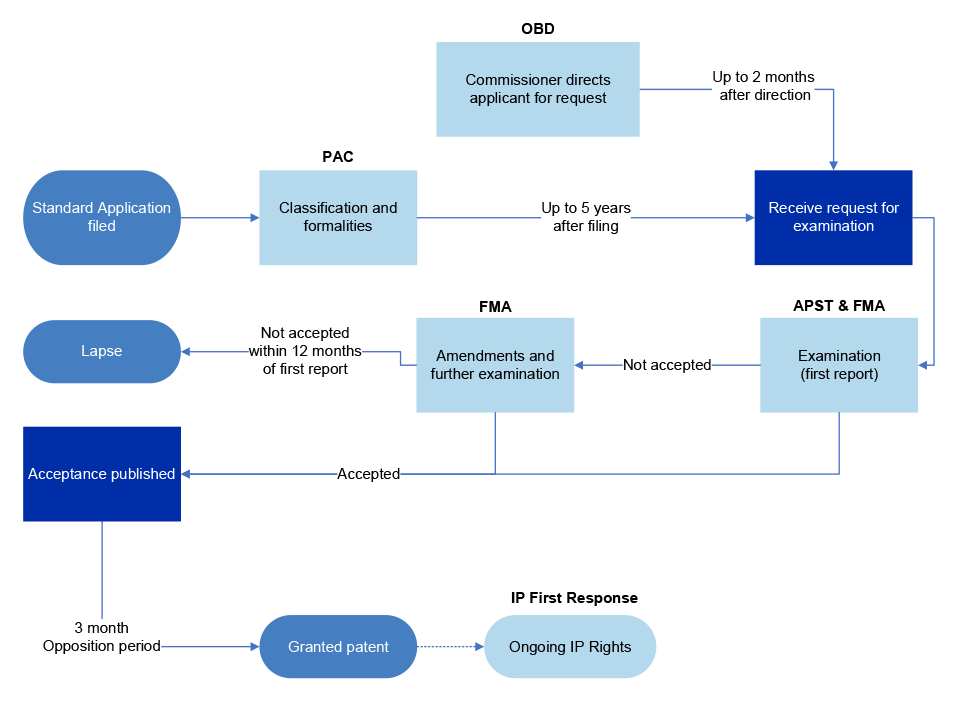
Note: IP Australia has deployed four AI tools into the patent examination process. Two additional tools, the Interactive Foreign Examination Report Summary and the Citation Retrieval Evaluation Search Tool are in conceptual stages of development that are expected to provide additional functionality to the FMA and APST tools respectively. IP Australia released the IP First Response chatbot for testing via the IP First Response website in late April 2026.
Note: Light blue boxes reflect processes with AI incorporated, while dark blue boxes are processes without AI.
PAC: Patent Auto Classifier
OBD: Outcomes Based Directions
APST: Automated Preliminary Search Tool
FMA: Family Member Analyser
Source: ANAO analysis of IP Australia documentation.
Application filing by applicant
3.7 IP Australia’s Customer Experience Group is responsible for reviewing patent applications to determine if they are complete. If issues are identified, the applicant is contacted to address the issue before the application will continue.
Classification and formalities
3.8 Every application is assigned one or more classification symbols to identify the type of invention (for example, a pharmaceutical or a mechanical device), using the International Patent Classification (IPC) system.82 The IPC is developed and managed by the World Intellectual Property Organization and is used internationally. IPC symbols are hierarchical codes that describe categories for inventions and consist of five parts or levels: section, class, sub-class, group and sub-group, each of progressively greater specificity. Figure 3.2 describes the IPC classification system for a type of shoe.
Figure 3.2: Application of the International Patent Classification system for a type of shoe
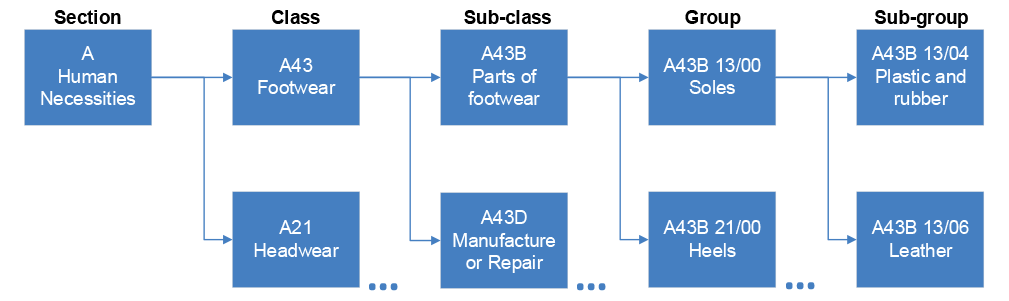
Source: ANAO presentation of World Intellectual Property Organization documentation.
|
Box 1: AI Use Case — Patent Auto Classifier |
|
The Patent Auto Classifier (PAC) is an AI system that uses natural language processing (NLP) to process the text contained in a patent application and determines a score for how relevant each IPC symbol is to the application. The application is then forwarded to the ‘workbasket’ (assessment queue) for the examination area associated with the highest relevance as determined by PAC. If the tool forwards the application to the incorrect workbasket, a patent examiner is required to redirect the application in the correct workbasket. IP Australia states that using AI ‘provides a streamlined, rule based and consistent approach to classification which can be trained and improved over time.’ PAC was implemented in 2018. |
Request for examination by applicant
3.9 Applications will not be assessed by IP Australia until the applicant submits a Request for Examination. The applicant must submit this request within five years (60 months) from the date the application was originally filed.83 An applicant may withdraw an application at any point during the application process.
3.10 The Patents Act 1990 (the Patents Act) gives the Commissioner of Patents the power to direct an applicant to request examination.84 This process is known as a direction and is used to manage the inventory of applications and examination requests. The applicant must submit a request for examination within two months of receiving the direction.
|
Box 2: AI Use Case — Outcomes Based Directions |
|
Outcomes Based Directions (OBD) is a machine learning model that identifies patent applications that are likely to be ready for examination earlier than 57 months and issues an automated direction to the applicant to request examination. The decision to issue the direction is not reviewed by an IP Australia staff member prior to being issued. Applicants may appeal directions regardless of whether it was issued by OBD or by an IP Australia staff member. The purpose of the tool is to identify applicants that are more likely to be ready for examination, reduce examination effort on applications that may lapse and to supply examination areas with additional applications when that area has capacity on top of the current requests. OBD was implemented in mid-2021 and the system has not been used since December 2021 as IP Australia’s examination staff have been consistently engaged in examinations.85 The directions issued as a result of OBD did not reference the fact that AI had been used in selecting the application for direction. |
Examination — first report
3.11 Examination consists of one or more reports that assess whether the claims are suitable for a patent. Assessment is based on patentability, novelty and whether there is an inventive step.86 Patent examinations are undertaken by specialised teams in the Patents Examination Group based on the type of invention that is being examined (refer to paragraph 3.8). As part of the patent examination process, examiners search through reports previously completed by IP Australia or an international patent office for the same and similar inventions to identify issues with the claims that may have already been identified.
3.12 IP Australia’s Customer Service Charter states that first examination reports should be completed within 12 months of the applicant’s Request for Examination. As at March 2026, response times range from 11 to 20 months, depending on the type of invention.87
|
Box 3: AI Use Case — Automated Preliminary Search Tool |
|
The Automated Preliminary Search Tool (APST) performs a search of IP Australia and other published databases using applicant and inventor names. The results of the search are each provided with a relevance rating based on the claims in each of the results. This rating is determined using AI by applying NLP to the claims in the application and to each of the results to compare the similarity. APST replaces the need for examiners to manually visit multiple databases and systems by automatically conducting the searches and presenting the results in categories. The AI is applied to assess and rate the relevance of the retrieved documents to assist the examiners to prioritise the review of the documents. The rating does not affect which results are considered in the search. Examination staff are required to review all search results necessary to inform IP Australia’s response to the patent application. Staff are able to view the text similarities identified by the rating. APST was implemented in 2020. |
|
Box 4: AI Use Case — Family Member Analyser |
|
Family Member Analyser (FMA) identifies family members (applications for the same invention lodged in other countries) for patent applications through NLP. It assigns a rating from one to five stars for each of the family members to measure the degree of relevance that a family member has to the application under examination. Examination staff are required to review all family members to inform IP Australia’s response to the application. Staff are able to view the text similarities identified by the rating. FMA is designed to reduce the time taken to retrieve relevant family members that must be reviewed by examiners. FMA was implemented in 2020. |
Examination — further reports
3.13 If an examination report contains objections against some or all of the claims, the application is not accepted. The applicant has the opportunity to respond to the objections raised in the report; this can be done by either making amendments to the specification and claims that address the objections or providing an argument against the reasoning for the objections. IP Australia will issue additional reports responding to comments and amendments submitted by the applicant. The patent will ultimately lapse if no version has been accepted within 12 months of the first examination report being issued.
Acceptance, publishing and opposition
3.14 An application is accepted when there are no objections raised. The initial version of an application is published in the Australian Official Journal of Patents 18 months after the filing date, unless a final version has already been accepted. The final version is published in the journal after it has been accepted.
3.15 After the final specification has been published there is a period of three months for members of the public to submit an opposition to the patent. Oppositions received by IP Australia are reviewed by the Oppositions team. The substantive matters in an opposition are reviewed by Patent Oppositions and Hearings Officers. The Hearing Officer may recommend re-examination of the application. If oppositions are unsuccessful or not received, the patent is granted.
Quality assurance
3.16 IP Australia conducts a standards-based quality assurance process over patent examination reports.88 The reports selected for the quality assurance process include all reports written by trainee examiners or other staff without delegation for approvals, as well as a random sample of reports.
The design of the four AI models are being retrospectively documented in line with new governance requirements
3.17 The ANAO assessed the design practices for the four AI tools that have been deployed in the patent rights process. Business requirements were considered and addressed as part of design. Broader governance documentation was incomplete at the time of design.
3.18 Since the introduction of IP Australia’s AI Governance Policy, business owners are required to complete documentation for AI use cases. The AI Use Case Card records the description of the use case, roles and responsibilities, and links to risk assessments (which includes consideration of ethics) and privacy impact assessments.
3.19 A summary of the design components for each of the four tools is shown at Table 3.1.
Table 3.1: Assessment of the planning, governance and design of IP Australia’s patent rights process AI tools
|
Component |
ANAO assessment |
|
Business problem |
For all tools, business problems were clearly identified before development. While not required at the time of development, alternative solutions to AI were not considered or documented.a |
|
Roles and responsibilities |
Roles and responsibilities were not always clearly defined. One of the tools had identified three product owners, and two of the tools had not defined responsibilities for performance or data management. |
|
Planning |
High level design documentation was provided for all four of the tools. For two of the tools there was further project planning documentation that included timelines, performance monitoring and oversight arrangements. There was no evidence of cost estimates or approvals prior to development for any of the tools. |
|
Risk management |
There are no records of assessment of risk prior to initial deployment for three of the four tools. |
|
Ethical, privacy, legal and security |
Considerations of ethical or privacy principles were not documented prior to deployment for any of the tools. These issues have been considered in subsequent re-assessment of the tools. Legal assessments were not documented prior to deployment. Alignment to the Patents Act was documented for two of the tools. One tool had a draft IT security risk assessment which has not been finalised. The remaining three tools were not formally security assessed. |
|
Stakeholder engagement |
All four models were identified by working groups which facilitated collaboration between business and technology subject matter experts. IP Australia has advised the ANAO there is ongoing collaboration between business and technical areas for all four of the deployed tools. |
Note a: The four AI tools were designed in the context of IP Australia experimenting with AI in the patent examination process (see paragraphs 2.20 to 2.22). Criterion 28 of the Technical standard for government’s use of artificial intelligence, released in 2025 is currently voluntary, requires agencies to assess alternatives to AI.
Note: The components in this table were informed by better practice drawn from AS ISO/IEC 42001:2023 Information technology — Artificial intelligence — Management system, the DTA Technical standard for government’s use of artificial intelligence, and relevant IP Australia policy.
Source: ANAO analysis of IP Australia documentation.
AI tools being designed follow governance processes with improved consideration and management of key design issues
3.20 IP Australia is currently exploring new ways for small business IP rights holders to quickly identify and understand their enforcement options. In April 2025, the Venture Board agreed to progress a proposal to develop a generative AI-powered chatbot to be published on the IP First Response website. In May 2025, the IPAVentures team sought advice regarding the governance requirements for this proposed AI use case. Case study 1 sets out the governance approach of IP Australia for the IP First Response chatbot.
|
Case study 1. IP First Response chatbot |
|
IP First Response is a pilot tool to help IP rights holders navigate potential protection and enforcement options when they are facing a potential IP infringement. It consists of two parts:
An AI use case card and an AI risk assessment for the generative AI chatbot were drafted by the IPAVentures team for consideration by the AI and ADM Assessment Panel in June 2025. Members of the AI and ADM Assessment Panel did not endorse the AI use case for the IP First Response chatbot. The Panel rejected the assessment by the business owner that some of the risks identified were rated as ‘low’ risk. These risks related to:
The AI and ADM Assessment Panel and business owner were unable to agree on the risk level of the AI use case. In line with the terms of reference of the AI and ADM Assessment Panel, the matter was escalated to an SES-led Escalated Panel. The role of the panel was not to approve or deny the project, but ‘rather to ensure that the project team have appropriately described the risks and have the right level of governance commensurate with those risks.’ The Escalated Panel determined that IP Australia’s Director General would be allocated as the risk steward for the AI use case, and that a governance plan and a privacy impact assessment were required to be completed with relevant subject matter experts. Following the Escalated Panel meeting, a Privacy Impact Assessment was completed and additional legal advice obtained regarding the implications of generative AI giving advice that could be considered ‘legal advice’. Following the completion of the additional assessments and changes made to the approach in light of Panel concerns, IP Australia decided to proceed with the project. IP Australia released the IP First Response chatbot for testing via the IP First Response website in late April 2026. |
Development of the PAC AI model addressed development risks
3.21 To assess fit-for-purpose arrangements to support the development and deployment of AI models, the ANAO completed detailed testing of the Patent Auto Classifier (PAC) tool. While IP Australia has developed and deployed four tools in the patent rights process, the ANAO considered PAC in additional detail due to the greater extent of customisation and development undertaken by IP Australia.
3.22 IP Australia’s processes for the development of the PAC model address key risks in the development process, as shown in Table 3.2.
Table 3.2: Assessment of the development of the PAC model
|
Component |
Better practicea |
ANAO assessment |
|
Key responsibilities |
Key roles, responsibilities and accountable parties are defined across the AI lifecycle. |
Roles and responsibilities for PAC model development, monitoring, and change management are clearly defined, with structured processes for consultation, approval, and documentation at each stage. |
|
Data collection and preparation |
Data sources and data preparation processes are documented, traceable, and subject to defined data quality controls across the AI lifecycle. |
The PAC tool is retrained every year. Retraining reports identify datasets used and model changes. Traceability of data is supported through risk lifecycle artefacts and versioning. Preparation of datasets is robust, data cleaning steps are documented and there is a clear separation of data used for training, validation, and final testing. |
|
Modelling |
Model choice aligns with business needs and data suitability. Training and evaluation processes are documented, implemented, and risk based. |
The PAC model was selected and managed in line with the nature, quality and scale of available data. Models were trained using methods suitable for their intended task, and performance was compared to decide on the best model approach. Elements of the model development process, relating to optimisation and tuning of the model (such as parameter tuning and validation) were not clearly documented. More consistent documentation of these processes would improve IP Australia’s ability to reperform and monitor the PAC model. |
|
Bias and fairness |
AI models are designed, developed, deployed and monitored in a manner that identifies, mitigates, and manages bias, and supports fair outcomes. |
IP Australia has not developed formal metrics or documented fairness assessments to assure itself that the PAC model is unbiased and fair. The extent to which bias and fairness may influence PAC outcomes is limited, as the incorrect assignment of a patent application will be readily detected by an assessing officer, and IP Australia captures these events. IP Australia relies on broader design and development processes, such as the use of representative training data, model retraining and testing, and human review of outputs, to identify potential fairness and bias issues. Since the development of the PAC model, IP Australia has developed an AI risk assessment template to be completed by business areas proposing AI use cases. These include consideration of risks and existing controls against discrimination and stereotyping from a business perspective only. These could be strengthened by incorporating technical assurance that the implementation of controls matches business intent. |
|
Evaluation |
System validation is conducted using fit-for-purpose evaluation methods with appropriate governance processes. |
The validation method used in model retraining uses stratified datasets and unseen test data, with datasets and performance metrics aligned to established machine learning classification practices. While there are no formal risk assessments, risk is being managed. Annual model retraining indicates that the risk of model drift is being managed. |
|
Auditability and reproducibility |
AI systems are designed and operated to enable end-to-end auditability, supported by traceability, audit logging and version control to allow reconstruction and inspection of AI system states, decisions and outcomes at a point in time. |
PAC has end-to-end logging across the preprocessing, model training, deployment and inference cycles. Key artefacts like data, evaluation reports and job identifications are retained. There are systems to enable manual review for anomalies and low prediction confidence. The PAC system retains all model artefacts and metadata allowing previous versions of the PAC model to be restored. IP Australia has not formally tested that outputs of the PAC model are reproducible and could improve its processes by formally considering when and how it might undertake such testing (see paragraph 3.24). |
|
Peer review and assurance |
Appropriate peer review and assurance arrangements are implemented within the development process to ensure AI systems meet operational requirements and outputs are correct, consistent and complete. |
The PAC model development and retraining process is documented and peer reviewed at different stages in its lifecycle. These include the creation and review of evaluation reports, validation by subject matter experts, version-to-version performance comparisons, and formal endorsements by reviewers prior to deployment. |
Note a: The components in this table were informed by better practice drawn from AS ISO/IEC 42001:2023 Information technology — Artificial intelligence — Management system and the Technical standard for government’s use of artificial intelligence.
Source: ANAO analysis.
Opportunity for improvement
3.23 IP Australia could consider strengthening existing processes by including consideration of bias and fairness risks introduced through the technical implementation of AI models, and building in technical assurance that risks are being addressed.
Deployment of the PAC AI model addressed deployment risks
3.24 The ANAO considered the deployment process for PAC in detail as the development of an internal tool can contain greater risks than procuring off-the-shelf. IP Australia has implemented an automated pipeline to deploy PAC from its version control system into a cloud environment. As shown in Table 3.3 this process addresses key risks in the deployment process.
Table 3.3: Assessment of deployment of the PAC model
|
Component |
Better practicea |
ANAO assessment |
|
Business verification, validation and approval |
Business end-users have verified and validated outputs to ensure they meet operational requirements and follow expected behaviour. Business approval has been provided and documented for deployment of the AI system. |
IP Australia’s business verification and validation process includes review of model performance against the previous deployed version, supported by consultation with key business and technical stakeholders. Business approval is provided manually based on an evaluation report generated after each retraining, and is typically evidenced through email correspondence and retained for governance purposes. |
|
Technical verification, validation and approval |
The technical authority has performed verification and validation activities to verify the correctness, consistency and completeness of the AI system. Technical approval has been provided and documented for deployment of the AI system. |
Technical verification of PAC retraining is performed through automated pipelines comparing performance against the previously deployed model. Technical validation is undertaken through staged deployments across development, test, user acceptance testing and production environments, supported by quality assurance testing and documented evidence. Approvals are required at each stage and are recorded within IP Australia’s enterprise change management tool. |
|
Deployment and change management |
AI system deployments are planned, documented, approved, and controlled prior to release, and align with the agency’s established governance, change management and delivery processes. |
Deployment of the PAC model is managed through a change management process. Deployments are executed using an automated deployment pipeline and are governed by IP Australia’s enterprise change framework. IP Australia advised that rollback of deployments is feasible but relies on manual intervention and individual practitioner knowledge. Integrating documented business approval, and requirements to update AI use case cards for selected types of changes, into the change and release workflow would enhance traceability and accountability of changes made. |
|
Operational monitoring in production |
Operational metrics and risk management are in place to continuously monitor system performance and manage risks. |
Key operational metrics are tracked. PAC integrates application monitoring and logging infrastructure into the design. Monitoring tools are used to provide ongoing tracking of operational metrics. PAC has automated alerting and anomaly-detection mechanisms, including alarms for system anomalies and flagging for low-confidence predictions. PAC uses a threshold to identify low-confidence predictions and gives confidence scores for each prediction. |
|
Ongoing testing and continuous improvement |
AI systems are monitored during operation to ensure they continue to operate as intended and remain suitable for their purpose. |
Prior to release, new model versions are evaluated against prior versions using the same confidence threshold and consistent evaluation datasets. Drift analysis is managed through annual retraining and subject matter expert-governed threshold reviews. Feedback from manual review and reclassification of low-confidence predictions is captured. There are no established processes to analyse trends in feedback to inform model improvements (see paragraph 3.26). |
Note a: The components were drawn from AS ISO/IEC 42001:2023 Information technology — Artificial intelligence — Management system and the Technical standard for government’s use of artificial intelligence.
Source: ANAO analysis.
3.25 IP Australia collects data on the accuracy of PAC classifications, which provides insight into the extent to which AI is involved in classifying patent applications and the accuracy with which this occurs. The ANAO analysed this data and as at November 2025, the model’s classifications are on average 64.7 per cent correct, with 27.5 per cent of its classifications missing and 7.8 per cent of its classifications being incorrect (see Figure 3.3).
Figure 3.3: PAC classification results, December 2022 to November 2025
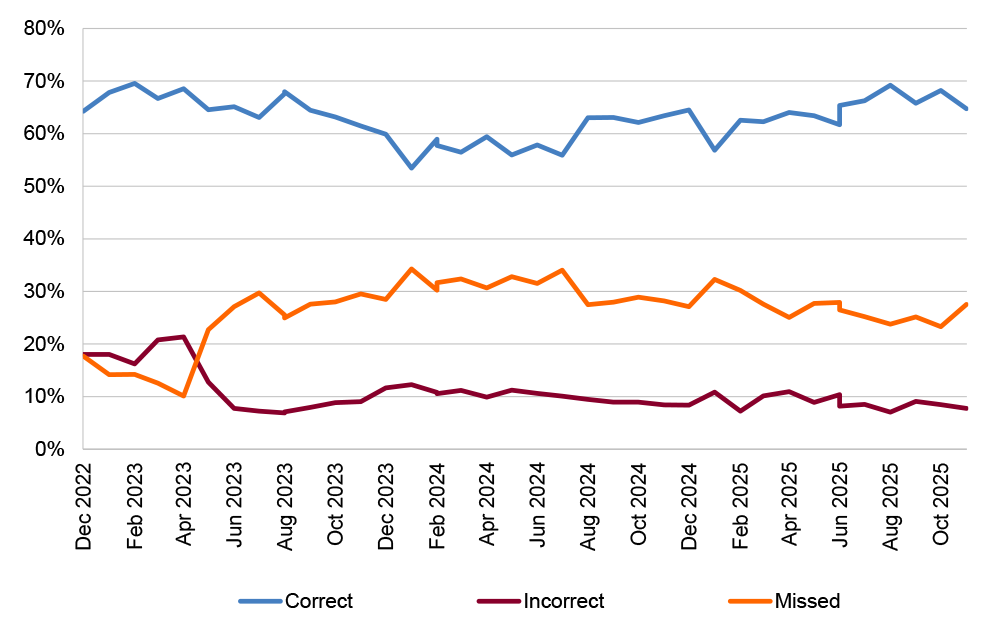
Source: ANAO analysis of PAC classification data results.
3.26 The accuracy of PAC has remained consistent between December 2022 and November 2025. IP Australia retrains the model annually, which addresses the overall risk that model performance may deviate over time. Monitoring the underlying classification data IP Australia already collects to identify potential patterns may assist in identifying potential misclassification of applications early and improve performance.
Opportunity for improvement
3.27 IP Australia could consider implementing processes to monitor trends in existing model performance data to identify emerging issues and better inform continuous improvement.
4. Monitoring and reporting the impact of artificial intelligence
Areas examined
This chapter examines whether IP Australia is effectively monitoring and reporting the impact of the use of artificial intelligence (AI) in the patent rights process.
Conclusion
IP Australia’s monitoring and reporting of the impact of its use of AI is partly effective. Monitoring practices varied across patent rights tools, and scheduled review processes under the new governance framework are not yet fully implemented. AI tools are integrated into business-as-usual operations and are identified as strategically significant. Benefits realisation has been inconsistently defined and measured, with qualitative evidence of improved quality and efficiencies but limited quantification of impacts. These limitations affect IP Australia’s ability to demonstrate ongoing effectiveness and manage emerging risks of AI.
Areas for improvement
The ANAO made two recommendations aimed at improving IP Australia’s management of cyber security risks and defining strategic oversight of the implementation of AI systems.
The ANAO also suggested that IP Australia consider a proportionate approach to benefits management for AI projects.
4.1 As AI tools are integrated into business processes, entities need mechanisms to monitor whether tools remain fit-for-purpose, risks remain within tolerance and expected benefits are being realised. Monitoring should track operational performance and consider governance compliance, emerging risks and whether oversight bodies receive timely information to support decisions.
4.2 This chapter assesses whether IP Australia is effectively monitoring and reporting on the impact of its use of AI. It examines monitoring and reporting at two levels:
- whether IP Australia monitors, evaluates and reports on AI tools used in the patent rights process in a structured and consistent way; and
- whether IP Australia has enterprise-level arrangements that support strategic oversight of AI adoption, including visibility of risks and benefits realisation.
The ongoing monitoring and evaluation of AI can be improved
Monitoring of AI model performance
4.3 The ANAO examined the monitoring practices for the four AI models in use in the patent rights process. Monitoring processes were inconsistent and varied by tool, however the relevant models have been assessed by IP Australia as low risk use cases. Table 4.1 provides a summary of the ANAO’s assessment.
Table 4.1: Assessment of the monitoring of IP Australia’s AI models
|
Component |
ANAO assessment |
|
Ongoing monitoring of ethical risks |
IP Australia does not have formal guidance on updating the AI use case cards and risk assessments to assess the currency of ethical risks on an ongoing basis. |
|
Issues logging and management |
IP Australia’s issue logging and management varied across the four AI tools. The Patent Auto Classifier (PAC) is retrained on an annual basis including updates to the model and definition of retraining triggers based on performance metrics, which had been endorsed by relevant staff members. Issues or errors made by PAC are manually checked by staff. Processes for Outcomes Based Directions (OBD), Automated Preliminary Search Tool (APST) and Family Member Analyser (FMA) were not clearly articulated. IP Australia advised on 21 January 2026 that staff are encouraged to report issues with AI tools to their managers or team clusters who will escalate if the issue cannot be resolved. |
|
Staff training |
Of the four AI tools examined by the ANAO, only two (FMA and APST) are used directly by IP Australia staff members. For these tools, training is provided in the form of procedure documents and communications where key improvements or changes are made to the tool. |
|
Ongoing model performance monitoring |
PAC has clearly defined performance indicators and is retrained on an annual basis to monitor the impact of these metrics on business outcomes. The OBD Use Case Card (in draft, 2024) assigns a clear responsible person for monitoring and performance. OBD has key performance indicators that are clearly defined and measurable. Limited monitoring and review has occurred because the tool is not actively in use. FMA’s Use Case Card (in draft) does not assign a key contact who is responsible for performance monitoring because it is defined as an ADM tool, despite FMA being identified as an AI system elsewhere. FMA does not have clearly defined or measurable performance indicators. The APST Use Case Card (2025, in draft) tool has an assigned responsible person for monitoring and performance. APST does not have clearly defined or measurable performance indicators, and real-time error monitoring does not occur. All tools are required to be reviewed at different frequencies, depending on the assessed risk level.a IP Australia advised the ANAO on 18 February 2026 that the review process has not yet been undertaken as part of IP Australia’s AI governance process and has not yet been conceptualised. |
|
Security governance |
PAC is the only tool that had received an IT security risk assessment during the design phase. The assessment was not current and represented an outdated system architecture. IP Australia has not conducted third-party supply chain assessments for third-party components of its AI tools. |
Note a: IP Australia has assessed the four AI tools as low risk. IP Australia requires review of the use case 12 months after the initial risk rating.
Note: This table summarises the ANAO’s assessment of the arrangements in place to monitor AI model operations. The components were informed by AS ISO/IEC 42001:2023 Information technology — Artificial intelligence — Management system, the Technical standard for government’s use of artificial intelligence, and IP Australia policy.
Source: ANAO analysis.
4.4 Regular monitoring of the currency of security controls for AI systems is important to ensure that they continue to remain relevant and effective. The Information Security Manual89 identifies ‘continuous cyber security improvement’ as a core principle whereby:
security risk management and associated cyber security activities are continually measured and reviewed using cyber threat intelligence and assurance activities, including exercises informed by real-world cyber threats, to identify, prioritise and incorporate improvements in governance arrangements, shared responsibilities and the effectiveness of controls.90
Recommendation no.1
4.5 IP Australia review its current controls for cyber security governance in relation to AI and ensure there is a structured approach to assess, reassess and authorise AI systems.
IP Australia response: Agreed
4.6 IP Australia is committed to maintaining the security of our systems in an emerging technology landscape. Consistent with our obligations under the Protective Security Policy Framework, and our ICT Strategy 2026–2030, we will continue to strengthen the cyber-resilience and sustainability of our ICT environment to respond to current and emerging threats, including those posed by the development and use of, or interaction with, artificial intelligence by our agency.
Evaluating the impact of AI tools
4.7 The Commonwealth Evaluation Policy states that entities are expected to deliver support and services for Australians by setting clear objectives for major policies, projects and programs, and consistently measuring progress towards achieving these objectives.91
4.8 IP Australia has been experimenting with AI since 2018 (see paragraph 2.6). Initially, the impetus to engage with the emerging technology was not specifically about efficiencies but exposing staff to AI and building capability within the agency (see paragraph 1.19). In regard to the four tools tested as part of this audit, IP Australia advised the ANAO on 9 December 2025 that:
when these tools were developed, the common understanding was that any efficiencies realised would be reinvested into the quality of examination … rather than focusing on harvesting time savings, the intent of the tools was to provide better, more relevant information to examiners so that they could make well informed, robust decisions.
4.9 IP Australia operates on a cost-recovery basis, which is a process where the Australian Government charges for the costs of providing a specific government activity to a non-government recipient. Compared to 2018–19, the number of applications for all IP rights92 in 2024–25 has increased by 13.5 per cent compared to a 5.2 per cent increase in average staffing levels (see Figure 4.1).
Figure 4.1: Percentage change in all IP rights applications and staffing compared to 2018–19
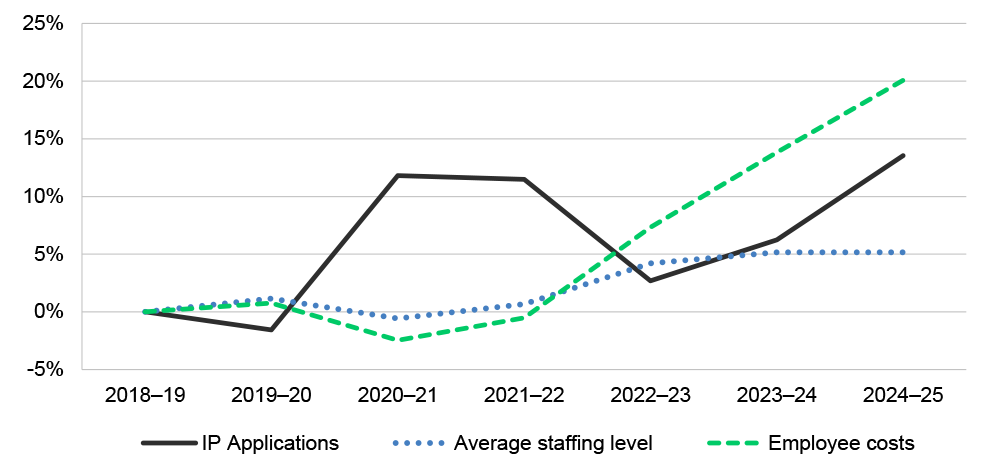
Source: ANAO analysis of IP Australia’s annual reports and portfolio budget statements from 2018–19 to 2024–25.
4.10 When comparing against the processing times for all IP rights in 2018–19, the average time taken for an IP right to be registered from the date it was lodged increased by 8.9 per cent in 2024–25. Patent processing times took 45.9 per cent longer on average in 2024–25 compared to patents registered in 2018–19. In 2024, IP Australia forecasted that without an increase in patent examination staff the number of patent applications in the examination pipeline would continue to grow until 2030–31.
4.11 IP Australia uses a resource planning and forecasting tool to estimate workload and staffing needs for patent examination which is referred to as the Patents Production Model.93 On 2 December 2025, IP Australia advised that it measures the impact of AI and ADM tools through operational metrics and performance reporting and that any efficiency gains resulting from these tools are reflected through revisions of the Patent Production Model. IP Australia’s analysis, undertaken in December 2024 and March 2026 as part of these processes, indicated that patent assessment quality had been maintained, and patent examiners provided qualitative feedback that AI tools had supported them in undertaking tasks more effectively. While IP Australia has been successful in integrating AI into aspects of the patent rights application process, it has not substantiated a link between the effect of AI tools and changes in the efficiency of patent examination.
4.12 IP Australia has previously expressed an intention to quantify benefits resulting from AI use in the patent examination process. The Cognitive Futures Strategy (refer to paragraphs 2.6 to 2.8) established a project to document benefits profiles for AI tools. Of the four tools tested by the ANAO, three had draft benefits profiles. The tangible benefits that were estimated included savings of average staffing levels and increased quality of searches. The three benefits profiles were not finalised and did not include project costs for comparison to estimated benefits.
4.13 IP Australia introduced a Benefits Management Framework in 2019, and an updated version was endorsed in 2022 to ‘support all IP Australia staff and contractors involved with managing projects and programs and/or tracking/monitoring benefits’.94
4.14 IP Australia’s patent rights AI tools are established and integrated into business processes and have scaled beyond pilots and proofs of concept at which benchmarks might be more readily established and comparisons more easily made. There are opportunities for IP Australia to consider how future tools and improvements to existing tools might be aligned with its frameworks to ensure that benefits are measured and realised.
Opportunity for improvement
4.15 IP Australia could consider an approach to benefits realisation that includes proportionate requirements for pilots and proofs of concept, while ensuring AI investment aligns with the Benefits Management Framework when use cases progress to production.
Strategic oversight of AI benefits realisation can be improved
4.16 Section 35 of the Public Governance, Performance and Accountability Act 2013 requires entities to publish a corporate plan. A corporate plan is designed to be an entity’s primary planning document that sets out how the entity undertakes its key activities and how it will measure performance in achieving its purposes.95
4.17 Two of IP Australia’s strategic objectives under its Corporate Plan 2025–26 are to:
- increase innovation and adaptiveness in our stewardship of the IP rights system; and
- create innovative contemporary digital and data driven customer services and staff experiences.96
4.18 The Corporate Plan states that a significant initiative has been to ‘continue to innovate with AI and Automated Decision Making (ADM) tools in accordance with government requirements for their responsible use, enhancing our efficient and effective administration of the IP system.’97
4.19 To manage risks associated with this initiative, IP Australia applies a risk-based governance framework that ‘assesses AI and ADM on a case-by-case basis, managing risks with appropriate guardrails’ so to ensure ‘the ethical and responsible implementation of any AI and ADM tools that deliver tangible benefits’.98
4.20 IP Australia has governance committees that have a role in oversight of AI (refer to paragraph 2.66). The Data and Technology Committee’s purpose is to achieve the agency’s strategic objectives, within set risk tolerances, through its governance of ICT, AI, ADM, data and analytics.
4.21 The Data and Technology Committee exercises oversight of IP Australia’s AI and ADM policies, and has a standing agenda item to discuss AI and ADM governance. Committee minutes did not record reviews of endorsed AI or ADM tools or whether they had achieved intended tangible benefits in line with strategic objectives.
4.22 IP Australia’s Benefits Management Framework identifies that benefits must be aligned to its strategic objectives. The framework states that this alignment is necessary so that agency investment decisions are based upon the realisation of benefits that support the delivery of strategic goals.
4.23 Strategic monitoring and reporting of project benefits can support entities in ensuring strategic goals are being achieved through the effective use of resources. Monitoring and reporting should be proportionate to the risk of the project and differentiate between business-as-usual projects and experimentation and novel developments.
Recommendation no.2
4.24 IP Australia establish clearly defined, risk-based monitoring and reporting arrangements on AI implementation, to enable strategic oversight of benefits, costs and risks that inform planning and future strategy.
IP Australia response: Agreed
4.25 IP Australia will continue to mature our risk-scaled governance arrangements as they relate to the implementation of artificial intelligence within our agency. This included appropriate monitoring and oversight of the benefits, costs and risks associated with artificial intelligence use.
Reviews into AI governance are being implemented but are not consistently monitored
4.26 The Commonwealth Evaluation Policy supports entities to improve evaluation practices and capability, with the intent of improving the way entities assess implementation, measure the impact of government programs and activities and frame policy decisions on revised or new programs.99
4.27 Between September 2023 and January 2026, IP Australia undertook seven reviews into its governance arrangements related to AI and ADM, with several findings and recommendations for implementation. IP Australia advised the ANAO on 16 April 2026 that ‘where appropriate, recommendations have either been addressed or are being addressed through other relevant strategies or programs of work’. IP Australia has not systematically tracked and monitored these recommendations to inform ongoing continuous improvement of IP Australia’s AI governance.
4.28 IP Australia advised the ANAO on 16 April 2026 that to ensure necessary improvements are being implemented, an external reviewer was engaged in December 2025 to review the current state of its AI and ADM governance arrangements and identify improvements.100 As at 8 May 2026, the contract for the engagement had been extended from April to June 2026.
Appendices
Appendix 1 Entity response
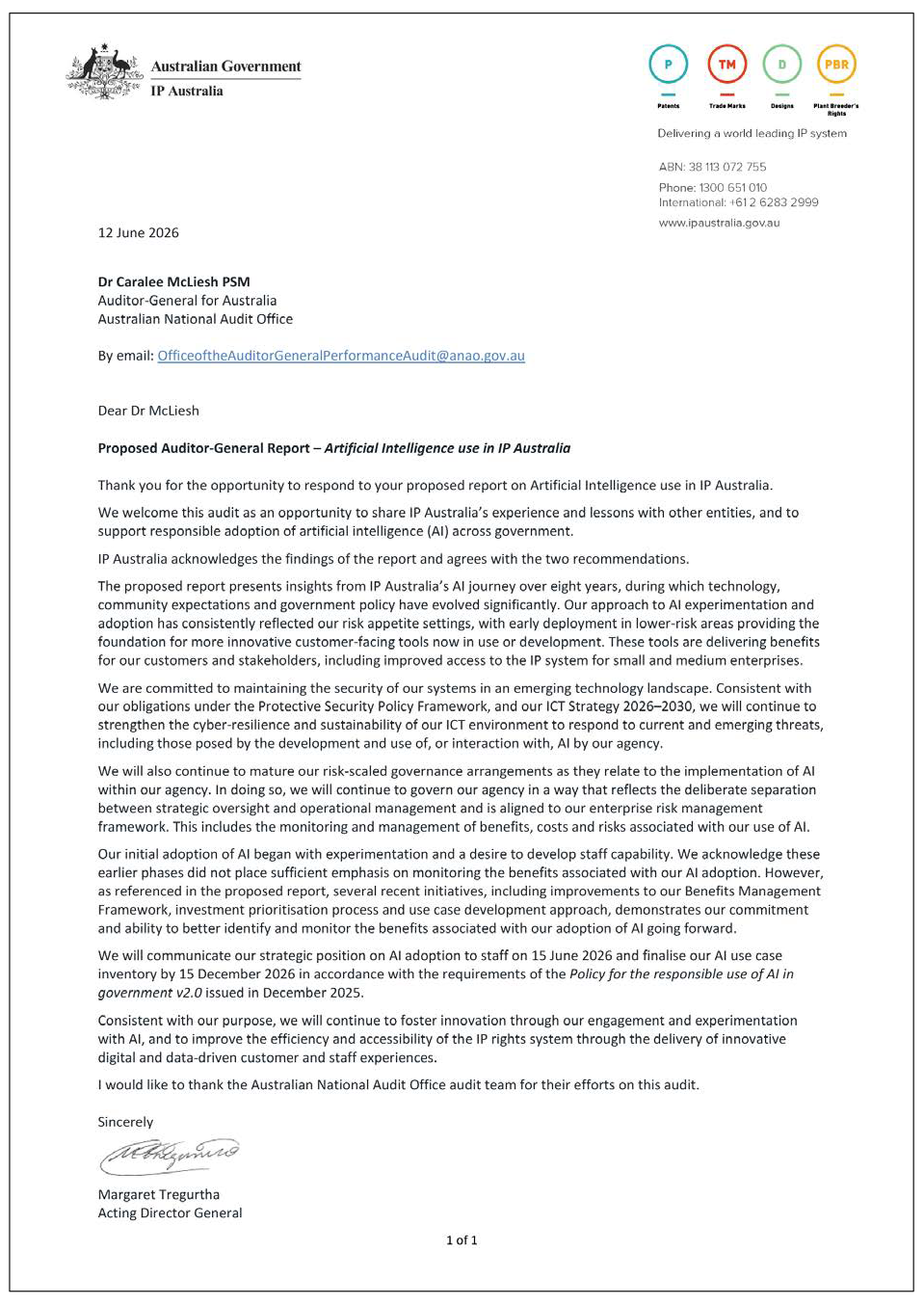
Appendix 2 Improvements observed by the ANAO
1. The existence of independent external audit, and the accompanying potential for scrutiny improves performance. Improvements in administrative and management practices usually occur: in anticipation of ANAO audit activity; during an audit engagement; as interim findings are made; and/or after the audit has been completed and formal findings are communicated.
2. The Joint Committee of Public Accounts and Audit (JCPAA) has encouraged the ANAO to consider ways in which the ANAO could capture and describe some of these impacts. The ANAO’s corporate plan states that the ANAO’s annual performance statements will provide a narrative that will consider, amongst other matters, analysis of key improvements made by entities during a performance audit process based on information included in tabled performance audit reports.
3. Performance audits involve close engagement between the ANAO and the audited entity as well as other stakeholders involved in the program or activity being audited. Throughout the audit engagement, the ANAO outlines to the entity the preliminary audit findings, conclusions and potential audit recommendations. This ensures that final recommendations are appropriately targeted and encourages entities to take early remedial action on any identified matters during the course of an audit. Remedial actions entities may take during the audit include:
- strengthening governance arrangements;
- introducing or revising policies, strategies, guidelines or administrative processes; and
- initiating reviews or investigations.
4. In this context, the below actions were observed by the ANAO during the course of the audit. It is not clear whether these actions and/or the timing of these actions were planned in response to proposed or actual audit activity. The ANAO has not sought to obtain assurance over the source of these actions or whether they have been appropriately implemented. During the course of the audit, IP Australia advised that it had:
- endorsed and released an updated ICT Strategy in December 2025, that includes IP Australia’s plan to explore and apply new capabilities such as artificial intelligence;
- commissioned KomplyAI to undertake a review (which commenced in December 2025) of the current state of IP Australia’s AI and ADM governance arrangements and provide recommendations for improvement;
- made changes to the structure of governance committees;
- required all staff to complete the AI in Government Fundamentals course by June 2026; and
- released the IP First Response generative AI chatbot to public trial in April 2026.
Appendix 3 Key Australian Government and Parliamentary AI initiatives
Table A.1: Timeline summary of key Australian Government and Parliamentary initiatives relating to AI since November 2019
|
Date |
Title |
Summary |
|
November 2019 |
AI Ethics Principles |
As part of the ‘developing’ AI Ethics framework to ‘guide businesses and governments looking to design, develop and implement AI in Australia. |
|
March 2020 |
Better Practice Guide for Automated-Decision Making |
Originally published in 2007 but updated in 2020. Guidance document to ‘be a practical tool for agencies’ and includes a checklist to assist staff with the design and deployment of new automated systems, including assurance once deployed. |
|
November 2020 |
AI Action Plan |
A public consultation that occurred on the ‘development of a whole-of-government AI Action Plan … to help us maximise the benefits of AI for all Australians’. |
|
March 2021 |
Human Rights and Technology Report |
A report providing a roadmap for how Australia should protect and promote human rights in time of unprecedented change in how technologies are developed and used. |
|
May 2021 |
Digital Economy Strategy 2030 |
A strategy that builds on the Australian Government’s existing digital and data initiatives and defines pathways to 2030 for how Australia will secure its ‘future as a modern and leading digital economy’. |
|
June 2021 |
Australia’s AI Action Plan |
Sets out the Australian Government’s plan to responsibly leverage AI. Builds on already existing Australian Government guidance. |
|
November 2021 |
Digital Government Strategy |
Strategy that sets out government direction and guidance for APS on how to utilise digital government for the benefit of people, business, and the APS. |
|
March 2022 |
Issues Paper: Positioning Australia as a leader in digital economy regulation, Automated Decision Making and AI Regulation |
A paper for consultation and feedback on the regulation and use of AI and ADM including clarifying the application of existing laws on AI and ADM and developing best practice implementation standards. |
|
July 2023 |
Discussion Paper: Safe and responsible AI in Australia |
Paper seeking feedback on how Australia can mitigate the potential risks of AI. Seeking system-wide feedback on actions that could be taken across the economy on AI regulation and governance. |
|
July 2023 |
Report: Royal Commission into the Robodebt Scheme |
The final report made two recommendations that were related to ADM: 17.1: the Commonwealth should consider legislative reform to introduce a consistent legal framework in which automation in government services can operate. Where automated decision-making is implemented:
17.2: The Commonwealth should consider establishing a body, or expanding an existing body, with the power to monitor and audit automated decision-making processes with regard to their technical aspects and their impact in respect of fairness, the avoiding of bias, and client usability. |
|
July 2023 |
Interim Guidance on Generative AI for Government agencies |
A guidance document to staff within APS agencies. Does not replace any generative AI policies made by individual entities, intends to supplement them while further work is undertaken to develop a whole-of-government position. |
|
September 2023 |
AI in Government Taskforce |
Jointly led by the Digital Transformation Agency and the Department of Industry, Science and Resources, the Taskforce has representatives from agencies across the APS and is focused on the safe and responsible use of AI by the APS. |
|
October 2023 |
How might artificial intelligence affect the trustworthiness of public service delivery? |
Paper that explores how the APS could integrate AI into service delivery. |
|
November 2023 |
Interim Guidance on Generative AI for Government agencies |
Updated to include ‘two golden rules’ around ownership of outputs of generative AI and the risks of revealing classified or sensitive information. |
|
December 2023 |
Copyright and Artificial Intelligence Reference Group |
A standing mechanism for ongoing engagement with stakeholders across various sectors including creative, media and technology. |
|
December 2023 |
Data and Digital Government Strategy |
Strategy that outlines how the Australian Government will use data and digital technologies to deliver connected, accessible services which are centred around the needs of people and business. |
|
December 2023 |
2023 Data and Digital Government Strategy Implementation Plan |
The plan outlines the actions the Government will take to achieve the Strategy’s 2030 vision to deliver simple, secure and connected public services for all people and business through world class data and digital capabilities. |
|
December 2023 |
Third Open Government National Action Plan 2024–25 |
A plan focused on the delivery of eight commitments to improve public participation and engagement in government, strengthen government and corporate sector integrity and enhance Australia’s democratic processes. |
|
January 2024 |
Interim response to the consultation on Safe and responsible AI |
Response noting the government ‘will consider possible legislative vehicles for introducing mandatory guardrails for AI in high-risk settings in close consultation with industry and the community. |
|
January 2024 |
Engaging with Artificial Intelligence (AI) |
Provides guidance to organisations on how to use AI systems securely |
|
January 2024 |
Trial of Copilot for Microsoft 365 |
Coordinated by DTA, entities across the APS explored the use of Copilot for Microsoft 365 for routine, day-to-day tasks. |
|
February 2024 |
AI Expert Group |
Temporary group to advise on testing, transparency and accountability for AI in legitimate but high-risk settings. Operated until June 2024. |
|
February 2024 |
Making the most of the AI opportunity: productivity, regulation and data access |
Papers from the Productivity Commission that places Australia’s AI opportunity in a global context. |
|
March 2024 |
Select Committee on Adopting Artificial Intelligence (AI) |
An inquiry into the opportunities and impacts for Australia arising out of the uptake of AI technology. |
|
May 2024 |
Supporting Safe and Responsible AI — Budget |
The Government announced it would provide $39.9 million over five years from 2023–24 for the development of policies and capability to support the adoption and use of artificial intelligence, including: $21.6 million over four years from 2024–25 to establish a reshaped National AI Centre and an AI advisory body within the Department of Industry, Science and Resources $15.7 million over two years from 2024–25 to support industry analytical capability and coordination of AI policy development, regulation and engagement. $2.6 million over three years from 2024–25 to respond to and mitigate against national security risks related to AI. |
|
June 2024 |
National Framework for the assurance of artificial intelligence in government |
Provides a framework for cornerstones and practices of AI assurance within the broader governance of how governments use AI. |
|
September 2024 |
Policy for the responsible use of AI in government |
Version 1 released. Provides a framework to position the Australian Government as an exemplar under its broader safe and responsible AI agenda. |
|
September 2024 |
Standard for accountable officials |
Provides guidance for entities in implementing the Policy for the responsible use of AI in government with additional information on the roles and responsibilities of accountable officials |
|
September 2024 |
Standard for transparency statements |
Provides guidance for entities in implementing the Policy for the responsible use of AI in government with additional information on the requirements of AI transparency statements. |
|
September 2024 |
Mandatory guardrails for safe and responsible AI proposals paper |
Proposed guardrails that set expectations from the Australian Government on how to use AI safely and responsibly when developing and deploying AI in high-risk settings. Includes a proposed definition of high-risk AI. |
|
September 2024 |
Voluntary AI Safety Standard |
Practical guidance to all Australian organisations on how to safely and responsibly use and innovate with artificial intelligence. |
|
September 2024 |
Inquiry into the use and governance of artificial intelligence systems by public sector entities |
The Committee examined the adoption and use of artificial intelligence systems and processes by public sector entities to conduct certain functions. |
|
September 2024 |
Pilot of the draft AI assurance framework for the Australian Government |
Coordinated by DTA, entities across the APS piloted the draft framework. |
|
October 2024 |
AI in government fundamentals training module |
Training module for APS staff that offers a consistent understanding of how AI works and what to consider when making responsible choices. |
|
October 2024 |
Evaluation of the whole-of-government trial of Microsoft 365 Copilot |
Report outlining the summary of evaluation findings from the trial of Microsoft 365 Copilot. |
|
November 2024 |
Use of automated decision-making by government — Consultation paper |
A consultation paper on the opportunity for legislative reform to introduce a consistent legal framework for ADM. |
|
November 2024 |
Select Committee on Adopting Artificial Intelligence (AI) |
The Final Report from the Senate committee makes 13 recommendations. |
|
December 2024 |
2024 Data and Digital Government Strategy Implementation Plan |
Describes actions and progress to achieve the vision of the strategy. First annual update to the initial 2023 Implementation Plan. |
|
February 2025 |
Inquiry into the use and governance of artificial intelligence systems by public sector entities — ‘Proceed with Caution’ |
Final report from the Joint Committee of Public Accounts and Audit examination into the adoption and use of AI systems and processes by public sector entities to conduct certain functions, including but not limited to the delivery of services, to help achieve their objectives. |
|
March 2025 |
Better Practice Guide: Automated Decision Making |
This guide provides practical guidance for agencies aimed to ensure compliance with administrative law and privacy principles, and best practice administration. |
|
March 2025 |
AI Model Clause Bank |
Addition of AI model clauses into the BuyICT ClauseBank. The ClauseBank is made up of legally pre-drafted terms designed to be used in ICT or digital procurement documents and contracts. |
|
July 2025 |
GovAI |
An APS-only platform to help public servants learn about and use artificial intelligence in practical, responsible and collaborative ways. |
|
July 2025 |
Australian Government AI Technical Standard |
The AI technical standard sets consistent practices for government agencies adopting artificial intelligence systems across the AI lifecycle. |
|
October 2025 |
Staff guidance on public generative AI |
Replaces the previous interim guidance on using public generative AI tools, providing clear direction for Australian Government staff. Outlines how staff remain accountable for their advice and decisions when using generative AI. |
|
October 2025 |
Agency guidance on public generative AI |
Replaces the previous interim guidance on using public generative AI tools, providing advice for Australian Government agencies on managing access to public generative AI tools for personnel working with government information. |
|
October 2025 |
Guidance for AI adoption |
Updated guidance for industry that evolves on the Voluntary AI Safety Standard. |
|
November 2025 |
2025 Data and Digital Government Strategy Implementation Plan |
Third annual updated on the Australian Government’s progress against the Data and Digital Government Strategy. |
|
November 2025 |
AI Plan for the Australian Public Service |
The plan provides practical actions that can accelerate the safe and responsible use of AI adoption across the public service. It sets clear expectations for every agency including leadership accountability, mandatory capability development for staff, and transparent reporting on outcomes. |
|
November 2025 |
Pilot implementation report: Australian Government artificial intelligence assurance framework |
Report presenting the findings from a pilot conducted by DTA from September to November 2024, which tested a draft artificial intelligence impact assessment tool, known at the time as the ‘Pilot Australian Government AI Assurance Framework’ |
|
November 2025 |
AI Safety Institute |
The AISI was announced as an organisation to provide trusted, expert capability to monitor, test and share information on emerging AI technologies, risks and harms. |
|
November 2025 |
Being clear about AI-generated content |
Provides a guide for businesses on transparency of AI-generated content. |
|
December 2025 |
National AI Plan |
The plan sets out the steps the government will take to support Australia to build an AI-enabled economy that is more competitive, productive and resilient. |
|
December 2025 |
Policy for the responsible use of AI in government |
Version 2 of the policy released. |
|
December 2025 |
AI Impact assessment tool and guidance documentation |
Designed to help government teams identify, assess and manage AI use case impacts and risks against Australia’s AI Ethics Principles. Released with guidance documentation. |
|
December 2025 |
Guidance on AI procurement in government |
Provides advice on procuring AI products and services through BuyICT. |
|
Early 2026 |
AI Safety Institute |
Established in the Department of Science, Industry and Resources, the AI Safety Institute will analyse emerging AI capabilities, risks, harms and trends. |
|
March 2026 |
Guidance for AI proof of concept to scale |
The guidance assists agencies in moving beyond AI experiments and achieve business adoption. |
|
April 2026 |
Memorandum of understanding with Anthropic |
One of the commitments under the AI plan is to enter collaborative arrangements with leading AI and tech companies to build Australia’s AI capabilities. The commitment is high-level and non-legally-binding and sets expectations aligned with Australia’s national interest. |
|
April 2026 |
Memorandum of understanding with Microsoft |
One of the commitments under the AI plan is to enter collaborative arrangements with leading AI and tech companies to build Australia’s AI capabilities. The commitment is high-level and non-legally-binding and sets expectations aligned with Australia’s national interest. |
|
April 2026 |
AI in APS Recruitment |
Guidance released by the APSC on managing agency and candidate use of AI during APS recruitment. |
|
May 2026 |
AI Workforce Planning Taskforce |
Established in the Australian Public Commission (APSC), the taskforce will support entities to better understand and respond to the workforce impacts of AI. |
|
May 2026 |
AI.gov.au |
Release of AI.gov.au as the website hosting National AI Centre products. |
|
June 2026 |
Australian Government AI Technical Standard |
An addendum has been added to cover Agentic AI. |
Source: ANAO analysis of Australian Government AI information
Appendix 4 Mandatory requirements of the Policy for responsible use of artificial intelligence in government
1. Version 2 of the Policy for the responsible use of AI in government outlines principles and mandatory requirements that entities must follow. The requirements are divided into sections: strategy and oversight, preparedness and operations and AI use case impact assessment.
|
Mandatory requirements of the Policy for responsible use of AI in government |
|
Strategy and oversight Principles
Mandatory Requirements AI transparency statement Agencies must make a publicly available statement outlining their approach to AI adoption and use, as prescribed under the Standard for transparency statements. The statement must be reviewed and updated annually or sooner, should the agency make significant changes to its approach AI. Agencies must notify the DTA when they publish and make changes to their AI transparency statement by emailing ai@dta.gov.au. Strategic position on AI adoption Agencies must develop a strategic position on AI adoption within 6 months of this policy taking effect. This position is to emphasise how AI opportunities can be identified and embraced by the agency. Agencies must communicate their strategic position on AI to give staff clear direction on AI adoption. In line with their current and anticipated use of AI, agencies can develop a standalone AI strategy, augment an existing strategy or create other materials to communicate the approach to staff. Accountable officials Agencies must designate accountable official(s) to take accountability for implementing this policy. Agencies must follow the Standard for accountability when designating accountable when designating accountable official(s) and implementing this requirement. The responsibilities of accountable officials are set in the standard. Agencies must notify the DTA when they designate and make any changes to their accountable official(s) by emailing ai@dta.gov.au. Accountable use case owners Agencies must designate an accountable use case owner for each in-scope AI use case within 12 months of this policy taking effect. Accountable official(s) are to maintain a register of accountable use case owners. Agencies must follow the Standard for accountability when implementing this requirement. The responsibilities of accountable use case owners are set in the standard. Internal AI use case register Agencies must create a register of in-scope AI use cases to enable accountable official(s) to record accountable use case owners within 12 months of this policy taking effect. Agencies must share the register with the DTA every 6 months, commencing from when they create the register to meet the above requirement. The Standard for accountability lists the minimum fields agencies must capture in the use case register. Agencies can add additional fields to meet their organisational needs. An existing register may be reused for the purposes of meeting this requirement. The standard also provides the instructions for how to share agency registers with the DTA. Preparedness and operations Principles
Mandatory requirements Operationalise the responsible use of AI Agencies must establish an approach to embed responsible AI practices within 12 months of this policy taking effect. This may vary according to the scale and scope of agency AI use. At a minimum, the approach will provide an agency with:
Staff training on AI Agencies must implement mandatory training for all staff on responsible AI use within 12 months of this policy taking effect. Agencies should consider the Guidance for staff training on AI and can use the AI fundamentals training module to meet the requirement. They can use the module as provided, modify it, or incorporate it into an existing training program based on their specific context and requirements. Alternatively, agencies can allow their staff to access the module directly through APSLearn. AI use case impact assessment Principles
Mandatory requirements All new AI use cases Agencies must assess all new AI use cases against the in-scope criteriaa to determine if they are in scope of the policy. The assessment must be documented and take place during the design phase while developing requirements. Agencies must begin AI use case assessments within 12 months of this policy taking effect. For existing use cases not yet assessed, agencies must determine whether they are in scope of this policy and apply all relevant policy actions by 30 April 2027. In-scope AI use cases For AI use cases that are in scope, agencies must conduct an AI use case impact assessment. Agencies are to commence an assessment at the design stage. Before the solution is deployed, agencies must finalise the assessment and apply any agreed risk treatments. Agencies may conduct an AI use case impact assessment by using either:
Where an agency integrates the tool, they must ensure:
Agencies must be able to revise their internal process in response to any impact assessment tool updates. Agencies must add each in-scope AI use case to their internal register of AI use cases and update it as required. Include risk rating and accountable use case owner changes. When deploying an in-scope AI use case, agencies must:
High-risk AI use cases If an agency determines their in-scope AI use case has an inherent high-risk rating when completing an AI use case impact assessment, they must:
Once an agency has decided to deploy the use case, they must:
Out-of-scope AI use cases If an agency adopts an out-of-scope AI use case, they must assess whether the use case becomes in-scope of this policy if there is a material change in the scope, usage or operation of the solution. If a use case is in scope, agencies must follow any applicable actions in this policy. |
Note a: Australian Government, Digital Transformation Agency, Policy for the responsible use of AI in government, Appendix C, p. 21, available from https://www.digital.gov.au/ai/ai-in-government-policy, [accessed 8 May 2026].
Footnotes
1 Organisation for Economic Co-operation and Development, Recommendation of the Council on Artificial Intelligence, OECD, amended 3 May 2024, available from https://legalinstruments.oecd.org/en /instruments/OECD-LEGAL-0449 [accessed 27 October 2025].
2 Australian Government, Data and Digital Government Strategy, Australian Government, Canberra, 15 December 2023, p. 16, available from https://www.dataanddigital.gov.au/ [accessed 13 October 2025].
3 Digital Transformation Agency, Policy for the responsible use of AI in government, v1.1, DTA, Canberra, August 2024.
4 Digital Transformation Agency, AI Plan for the Australian Public Service 2025, DTA, Canberra, November 2025, available from https://www.digital.gov.au/policy/ai/australian-public-service-ai-plan-2025 [accessed 15 February 2026].
5 IP Australia, Strategic Corporate Plan 2025–26, IP Australia, Canberra, 2025, p. 3, available from https://www.ipaustralia.gov.au/about-us/accountability-and-reporting/corporate-plan [accessed 11 February 2026].
6 ibid., p. 10.
7 IP Australia’s AI Transparency Statement is available at https://www.ipaustralia.gov.au/about-us/accountability-and-reporting [accessed 29 April 2026].
8 This analysis is based on filings from 2020. Under relevant patent legislation, an applicant has five years to request examination of their application, therefore data is currently unavailable to determine a more recent timeframe: IP Australia, Australian IP Report 2025, IP Australia, Canberra, 2025, available from https://www.ipaustralia.gov.au/tools-and-research/professional-resources/data-research-and-reports/Australian-IP-Report-2025 [accessed 12 February 2026].
9 Digital Transformation Agency, Australian Government AI technical standard, v. 1, DTA, Canberra, August 2025, available from https://www.digital.gov.au/policy/ai/AI-technical-standard [accessed 8 May 2026].
10 OECD, Recommendation of the Council on Artificial Intelligence.
11 Select Committee on Adopting Artificial Intelligence (AI), Parliament of Australia, Final Report, (2024), available from https://www.aph.gov.au/Parliamentary_Business/Committees/Senate/Adopting_ Artificial_Intelligence_AI/AdoptingAI/Report [accessed 7 October 2025].
12 Department of Industry, Science and Resources, Safe and responsible AI in Australia Consultation — Australian Government’s interim response, DISR, Canberra, 2024, p. 4, available from https://www.industry.gov.au/news/australian-governments-interim-response-safe-and-responsible-ai-consultation [accessed 4 March 2026].
13 Australian Government, Data and Digital Government Strategy, pp. 16 and 20.
14 Australian Government, 2025 Implementation Plan, Australian Government, Canberra, November 2025, available from https://www.dataanddigital.gov.au/implementation-plan/2025 [accessed 4 March 2026].
15 DTA, AI Plan for the Australian Public Service.
16 Digital Transformation Agency, Policy for the responsible use of AI in government, v1.1, DTA, Canberra, August 2024, available from https://www.digital.gov.au/ai/policy/download [accessed 12 June 2026].
17 The policy is mandatory for non-corporate Commonwealth entities, except for the Defence portfolio and the national intelligence community. Corporate Commonwealth entities are encouraged to apply the policy.
18 Accountable officials must be accountable for implementation of the policy within their entities, notify the Digital Transformation Agency (DTA) where the entity has identified a new high-risk use case, be a contact point for whole-of-government AI coordination, engage in whole-of-government AI forums and processes, and keep up to date with changing requirements.
19 This statement must provide the public with relevant information about the entity’s use of AI including information on: compliance with this policy; measures to monitor the effectiveness of deployed AI systems; and efforts to protect the public against negative impacts.
20 Digital Transformation Agency, Policy for the responsible use of AI in government, v2.0, DTA, Canberra, December 2025, available from https://www.digital.gov.au/ai/ai-in-government-policy [accessed 15 February 2026].
21 DTA, Policy for the responsible use of AI in government, v2.0.
22 DTA, AI Plan for the Australian Public Service.
23 Select Committee on Adopting Artificial Intelligence (AI), Parliament of Australia, Final Report, (2024), available from https://www.aph.gov.au/Parliamentary_Business /Committees/Senate/Adopting_Artificial_Intelligence_AI/AdoptingAI/Report [accessed 7 October 2025].
24 Department of Industry, Science and Resources, Australian Government response to the Senate Select Committee on Adopting Artificial Intelligence (AI) report: Final Report and Interim Report, DISR, Canberra, April 2026, available from https://www.aph.gov.au/Parliamentary_Business/Tabled_Documents/15891 [accessed 6 May 2026].
25 Joint Committee of Public Accounts and Audit, Parliament of Australia, Inquiry into the use and governance of artificial intelligence systems by public sector entities – ‘Proceed with Caution’, (2025), available from https://www.aph.gov.au/Parliamentary_Business/Committees/Joint/Public_Accounts_and_Audit/PublicsectoruseofAI/Report [accessed 30 March 2025].
26 Auditor-General Report No. 22 2024–25, Audits of the Financial Statements of Australian Government Entities for the Period Ended 30 June 2024, ANAO, Canberra, para. 10, available from https://www.anao.gov.au/work/financial-statement-audit/audits-of-the-financial-statements-of-australian-government-entities-the-period-ended-30-june-2024 [accessed 30 March 2026].
27 IP Australia, Strategic Corporate Plan 2025–26, p. 5.
28 ibid.
29 IP Australia, Strategic Corporate Plan 2025–26, p. 3.
30 ibid., p. 10.
31 IP Australia’s AI Transparency Statement is available at https://www.ipaustralia.gov.au/about-us/accountability-and-reporting [accessed 29 April 2026].
32 This analysis is based on filings from 2020. Under relevant patent legislation, an applicant has five years to request examination of their application, therefore data is currently unavailable to determine a more recent timeframe: IP Australia, Australian IP Report 2025, available from https://www.ipaustralia.gov.au/tools-and-research/professional-resources/data-research-and-reports/Australian-IP-Report-2025 [accessed 12 February 2026].
33 DTA, Australian Government AI technical standard.
34 Australian Government et al., National framework for the assurance of artificial intelligence in government, Australian Government, Canberra, 21 June 2024, p. 7, see ‘Governance’, available from https://www.finance.gov.au/government/public-data/data-and-digital-ministers-meeting/national-framework-assurance-artificial-intelligence-government [accessed 15 February 2026].
35 DTA, Policy for the responsible use of AI in government, v2.0.
36 ibid.
37 DTA defines the AI system lifecycle as ‘a structured process that occurs in stages, ensuring the holistic coverage of the AI system from discovery to retirement.’ The stages of the lifecycle are discover (design, data, train, evaluate), operate (integrate, deploy, monitor) and retire (decommission); Digital Transformation Agency, Australian Government AI Technical Standard, v1.0, DTA, Canberra, p. 13, available from https://www.digital.gov.au/policy/ai/AI-technical-standard [accessed 8 May 2026].
IP Australia’s stages of the AI lifecycle are early experimentation, design, data and models, verification and validation, deployment, operation and monitoring and retirement.
38 DTA, Policy for the responsible use of AI in Government, v2.0, p. 12; Version 1.1 (effective September 2024 to 14 December 2025) did not require agencies to develop a strategic position.
39 IP Australia, AI Transparency Statement, IP Australia, Canberra, January 2026, available from https://www.ipaustralia.gov.au/about-us/accountability-and-reporting [accessed 25 March 2026]; IP Australia published its first AI Transparency Statement in February 2025 to comply with the Policy for responsible use of AI in government. Its Transparency Statement broadly reflects the uses of AI across the agency. IP Australia is working to produce a complete register of its use of AI and accordingly the ANAO did not examine the completeness or accuracy of the transparency statement.
40 In 2017, IP Australia defined cognitive computing as systems that ‘use techniques like natural language processing and machine learning algorithms to comprehend, find patterns, hypothesise from a body of information, and predict responses.’
41 In 2023, IP Australia defined ‘cognitive computing as referring ‘to systems that learn at scale, reason with purpose, and interact with humans naturally. By means of self-teaching algorithms that use data mining, visual recognition, and natural language processing, the computer is able to solve problems and thereby optimise human processes.’
42 IP Australia advised the ANAO in April 2026 that for AI projects initiated under the People + Technology + Efficiency Program (refer to paragraph 2.12), performance metrics are documented as part of a project specific Benefits Management Plan.
43 IP Australia’s Executive Board sets the strategic direction of IP Australia as set out in the Corporate Plan.
44 IP Australia advised the ANAO in June 2026 that the P+T+E Program was consolidated into three projects in December 2025: ICT Strategy, Investment and Delivery, AI Uses Cases and Enterprise Cultural Change.
45 IP Australia’s Management Committee is an operational committee that is responsible for ‘the governance and operational issues within the risk parameters set by the Executive Board’.
46 The purpose of an entity’s strategic position on AI adoption ‘is to emphasise how AI opportunities can be identified and enhanced’; DTA, Policy for the responsible use of AI in government, v2.0, p. 10.
47 ibid., p. 19.
48 Intellectual property rights groups refers to the four areas of intellectual property rights that IP Australia administers; Trade Marks, Plant Breeder’s Rights, Designs and Patents.
49 The Examination Excellence Working Group’s purpose was to ‘establish a coherent vision of Examination Excellence in Patent Examination’.
50 IP Australia’s Venture Board provides direction, ensures effective governance and risk management, and supports the achievement of IPAVentures’ goals and objectives.
51 More information on IPAVentures, and the current and previous ventures is available from https://www.ipaustralia.gov.au/about-us/our-agency/Innovation-at-IP-Australia [accessed 30 March 2026].
52 Section 135A of the Designs Act 2003, section 76B of the Plant Breeder’s Rights Act 1994 and section 222A of the Trade Marks Act 1995 state that ‘the Registrar may arrange for the use, under the Registrar’s control, of computer programs for any purposes which the Registrar may, or must under this Act make a decision, or exercise any power or comply with any obligation, or do anything else related to making a decision … exercising a power, or complying with an obligation applies’.
53 IP Australia advised the ANAO in November 2025 that the AI Governance Policy incorporated the outcome of a review into automated decision making and the 2018 ADM policy. IP Australia considered combining its AI and ADM governance policies into one document but decided to develop separate policy documents. The governance requirements for ADM and AI are identical.
54 Between September and November 2024, the DTA conducted a pilot of an AI impact assessment tool based on the National Framework for the assurance of AI in government. IP Australia participated in the pilot along with 20 other entities. Participating entities trialled a draft AI impact assessment tool, known at the time as the ‘Pilot Australian Government AI assurance framework’. More information on the Pilot is available at https://www.digital.gov.au/policy/ai/ai-assurance-framework-pilot-report.
55 IP Australia describes six lifecycle stages: early experimentation, design, data and models, verification and validation, deployment, operation and monitoring and retirement.
56 The DTA has published staff and agency guidance on the use of publicly available generative AI. Staff guidance on public generative AI is available at https://www.digital.gov.au/policy/ai/staff-guidance-public-generative-ai [accessed 14 April 2026] and Agency guidance on public generative AI is available at https://www.digital.gov.au/policy/ai/agency-guidance-public-generative-ai [accessed 14 April 2026].
57 DTA, Policy for the responsible use of AI in Government, v1.1, p. 13.
58 DTA, Policy for the responsible use of AI in Government, v2.0, pp. 10 and 13.
59 Digital Transformation Agency, Guidance for staff training on AI, DTA, Canberra, December 2025, p. 4, available from https://www.digital.gov.au/sites/default/files/documents/2025-12/Guidance%20for%20staff%20training%20on%20AI%202.0.pdf [accessed 14 April 2026].
60 For staff that were issued a licence as part of the trial, staff were directed to complete the module as soon as practicable.
61 IP Australia’s risk management artefacts were updated in April 2025.
62 IP Australia publishes it strategic risk categories in its Corporate Plan.
63 Digital Transformation Agency, Standard for accountability, version 2.0, DTA, Canberra, December 2025, p. 9, available from https://www.digital.gov.au/ai/ai-in-government-policy/accountability [accessed 14 April 2026].
64 IP Australia first established a Computerised Decision-Making Register in August 2018 that provided a ‘record of decisions, powers or obligations under the Acts or regulations that the Commissioner of Patents, Registrar of Trade Marks, Registrar of Designs and Registrar of Plant Breeder’s Rights has arranged and authorised the use of a computer program, under the Commissioner or Registrar’s control, to make, exercise or comply with.’
65 The AI and ADM Stocktake is dated March 2025. IP Australia advised the ANAO that the purpose of the Stocktake was to assist in having AI use cases assessed prior to inclusion on the AI and ADM Inventory.
66 DTA, Standard for accountability, v2.0.
67 ibid.
68 DTA, AI Plan for the Australian Public Service.
69 The Australian Public Service Commission (APSC) groups APS entities by headcount of staff. The APSC defines small agencies as those with less than 250 employees. More information is available at https://www.apsc.gov.au/aps-agencies-size-and-function [accessed 13 May 2026].
70 The Investment, ICT and Property Committee was responsible for ‘governance of investment planning, ICT, security and property matters to achieve the agency’s strategic objectives, within the risk appetite and parameters set by the Executive Board’. The committee was in operation until December 2025.
71 The ANAO’s analysis included strategic and operational committees and group level working groups across IP Australia.
72 Department of Industry, Science and Resources, Australia’s AI Ethics Principles, DISR, Canberra, 2019, available from https://www.industry.gov.au/publications/australias-artificial-intelligence-ethics-principles [accessed 23 February 2026].
73 DTA, Standard for accountability.
74 Section 15 of the Public Governance, Performance and Accountability Act 2013 requires that accountable authorities must govern their entities in way that promotes the: proper use and management of public resources; achievement of the purposes of the entity; and financial sustainability of the entity. This includes establishing decision-making processes, appropriate oversight and reporting arrangements.
75 Australian Government et al., National framework for the assurance of artificial intelligence in government, see ‘Governance’.
76 See AS ISO/IEC 42001:2023, Information technology — Artificial intelligence — Management system, 16 February 2024, sections 5.1 and 5.3.
77 National Artificial Intelligence Centre, Guidance for AI Adoption: implementation guidance, National AI Centre, October 2025, p. 22, available from https://www.ai.gov.au/staying-safe-and-responsible/essential-ai-practices/guidance-ai-adoption-implementation-guidance [accessed 8 May 2026].
78 DTA, Policy for the responsible use of AI in government, v2.0, p. 14
79 DTA, Australian Government AI Technical Standard, v1, p. 8.
80 The Organisation for Economic Co-operation and Development, Advancing Accountability in AI; Governing and Managing Risks Throughout the Lifecycle for Trustworthy AI, OECD Digital Economy Papers, February 2023, No. 349, p. 10, available from https://www.oecd.org/en/publications/advancing-accountability-in-ai_2448f04b-en.html [accessed 4 February 2026].
81 More information about patents can be found on the IP Australia website, https://www.ipaustralia.gov.au/patents/what-are-patents [accessed 25 March 2026].
82 The International Patent Classification (IPC), established by the Strasbourg Agreement (1971), provides for a hierarchical system of language independent symbols for the classification of patents and utility models according to the different areas of technology to which they pertain. A new version of the IPC enters into force each year on January 1. Available from https://www.wipo.int/en/web/classification-ipc [accessed 23 February 2026].
83 IP Australia advised the ANAO that this is to allow applicants to monitor the patent environment before deciding whether to continue with the application process.
84 The power of the Commissioner of Patents to direct an applicant to request examination is based on one or more prescribed grounds. The prescribed grounds by which the Commissioner can issue a direction is outlined in section 3.16 of the Patents Regulations 1991.
85 IP Australia advised the ANAO in February 2026 that the development and deployment cost of OBD (from 2019–20 to 2024–25) was $256,315 and the annual maintenance cost (2024–25) was $49,713.
86 Patentability, or manner of manufacture, is an assessment of whether the invention presented in the application is suitable for patent. Novelty is an assessment of whether a claim already exists in substantially the same form. An inventive step is determined using an examiner’s judgement of whether the invention would be reasonably obvious expert in the relevant field.
87 The level of priority of applications is specified by the Customer Service Charter. IP Australia’s Timeliness customer commitment is available at https://www.ipaustralia.gov.au/about-us/our-customer-promise/timeliness, [accessed 23 February 2026].
88 IP Australia maintain certification for ISO 9001:2015 Quality Management Systems (QMS).
89 The Information Security Manual is ‘a cyber security framework that an organisation can apply … to protect their information technology and operational technology systems from cyber threats’.
90 Australian Signals Directorate, Information Security Manual, ASD, Canberra, March 2026, available from https://www.cyber.gov.au/business-government/asds-cyber-security-frameworks/ism [accessed 12 June 2026].
91 Australian Centre for Evaluation, Commonwealth Evaluation Policy [Internet], ACE, Canberra, available from https://evaluation.treasury.gov.au/about/commonwealth-evaluation-policy [accessed 29 April 2026].
92 The four areas of intellectual property rights that IP Australia administers are Trade Marks, Plant Breeder’s Rights, Designs and Patents.
93 IP Australia advised the Patents Production Model is reviewed annually through regression analysis to ensure the task completion times and model assumptions remain reasonably accurate.
94 Following its endorsement in 2022, the Benefits Management Framework was updated in 2023 and 2024.
95 Department of Finance, What is a corporate plan? [Internet], Finance, Canberra, 2025, available from https://www.finance.gov.au/government/managing-commonwealth-resources/corporate-plans-commonwealth-entities-rmg-132/what-corporate-plan [accessed 23 April 2026].
96 IP Australia, Strategic Corporate Plan 2025–26, p. 7.
97 ibid., p. 8.
98 ibid., p. 10.
99 Australian Centre for Evaluation, Commonwealth Evaluation Policy [Internet], ACE, Canberra, available from https://evaluation.treasury.gov.au/about/commonwealth-evaluation-policy [accessed 29 April 2026].
100 AusTender contract notice CN4213952, KomplyAi Pty Ltd, published on 16 January 2026, contract value $153,175 at date of execution, available from, https://www.tenders.gov.au/Cn/Show/09bd853d-4266-48b6-a0f1-f8c6e68d5d85 [accessed 29 April 2026].