Browse our range of reports and publications including performance and financial statement audit reports, assurance review reports, information reports and annual reports.
Auditor-General Report No. 45 of 2025–26
Australian Taxation Office Management of Small Business Collectable Debt
Published
Tuesday 30 June 2026

Portfolio
Australian Taxation Office
Entity
Australian Taxation Office
Contact
Please direct enquiries through our contact page.
Activity
Regulation
Sector
Taxation
Audit snapshot
Why did we do this audit?
- Collecting the right amount of tax, including tax debts, enables the delivery of services to the Australian community.
- Small business collectable tax debt was $35.9 billion of $54.2 billion total collectable debt in 2024–25. By comparison, age pension expenditure was $62.2 billion in 2024–25.
- The audit provides assurance to the Parliament that the ATO effectively manages small business collectable debt.
Key facts
- The ATO’s 2024–25 financial statements show there is a risk it will not collect $49.8 billion of the $98.4 billion total tax owing.
- Small business is the largest driver of overall tax debt, with 1,338,387 small businesses with an average of $26,797 in collectable debt in 2024–25.
- Small business collectable tax debt increased by $19.4 billion between 2018–19 to 2024–25. The ATO reduced debt collection measures to assist taxpayers in response to natural disasters, the COVID-19 pandemic and economic shocks.
What did we find?
- The ATO’s management of collectable small business debt risks is partly effective.
- The ATO’s self-assessment is that the risk of unacceptable levels of small business debt is out of tolerance.
- Internal targets to reduce debt volumes for small business are absent. The whole of collectable debt performance measure does not identify small business debt performance.
- Rising debt volumes create risks, including that some taxpayers obtain an unfair financial advantage over others.
- Pay As You Go Withholding and GST debt are the largest proportion of the overall collectable debt book.
What did we recommend?
- There were eight recommendations relating to performance measures, benchmarks, communication, and better use of data.
- The ATO agreed to all eight recommendations.
66.1%
The percentage of the ATO’s total collectable debt in 2024–25 belonging to small business.
34.2%
The small business collectable debt ratio in 2024–25, compared to the overall collectable debt ratio of 8.1%.
0.5%
The percentage of small business debt collection interactions in 2024–25 that were ‘firmer and stronger’ actions, down from 1.2% in 2018–19.
Summary and recommendations
Background
1. The Australian Taxation Office (ATO) is the principal revenue collection agency of the Australian Government. Its roles and responsibilities include administering legislation governing tax, superannuation and the Australian Business Register. The ATO’s corporate plan 2025–261 identifies ‘strengthening payment performance and debt collection’ as an enterprise priority.
Rationale for undertaking the audit
2. The ATO is responsible for managing the compliance of taxpayers in the Australian taxation and superannuation system, including pursuing tax debt. Debt that is undisputed, that is not subject to an objection, appeal, insolvency or not on hold, is considered collectable debt. Collectable tax debt from small business was $35.9 billion in 2024–25, an increase of $19.4 billion from 2018–19 and approximately two-thirds of the $54.2 billion total 2024–25 collectable tax debt.2
3. The ATO corporate plan 2025–26 identifies strengthening payment performance and debt collection as an enterprise priority.3 The key focus area of improving small business tax performance was removed from the corporate plan in 2024–25.4 After reducing collection activities during the COVID–19 pandemic, in 2023–24, the ATO recommenced the application of a range of firmer actions, including garnishee actions, directions to pay, director penalty notices and disclosure of business tax debt actions. Subsequent to the audit, in April 2026 the ATO introduced temporary assistance for businesses to assist in managing their tax obligations, which may include pauses to some compliance and debt collection actions in affected industries, in response to the increased economic impact of fuel costs arising from the conflict in the Middle East.
4. This audit provides assurance to the Parliament that the ATO effectively manages small business taxpayer debt.
Audit objective and criteria
5. The audit objective was to assess the effectiveness of the Australian Taxation Office’s management of small business collectable debt.
6. To form a conclusion against the objective, the following criteria were developed:
- Are the risks relating to small business collectable debt appropriately managed?
- Does the ATO have a sound strategic framework to manage small business collectable debt?
- Does the ATO effectively apply its strategic framework to manage small business collectable debt?
Conclusion
7. The ATO’s management of collectable small business debt is partly effective. Small business collectable tax debt increased by $19.4 billion, or 118 per cent, between 2018–19 and 2024–25. The ATO recognises that the risk of this debt rising to unacceptable levels is out of tolerance. The ATO does not use specific performance targets to reduce small business debt. Public reporting on performance does not provide Parliament with sufficient visibility of the risks and the ATO’s management of them. A continued rise in debt volumes creates a number of risks, including that some taxpayers obtain an unfair financial advantage over others.
8. The ATO’s management of collectable small business debt risks is partly effective. The ATO’s pausing of debt collection measures in response to natural disasters, the COVID-19 pandemic and global economic shocks resulted in rapid growth of the debt book. The ATO has assessed that its risk of unacceptable levels of unpaid debt remains out of tolerance, and will not be brought back into tolerance in the immediate future. The ATO considers its controls to reduce this risk to be partly effective. The ATO has not set specific internal targets to reduce debt volumes. The ATO reports publicly in its annual performance statements on a whole-of-collectable debt performance measure that does not enable identification of small business debt performance.
9. The ATO has a largely sound strategic framework for debt collection. This is a whole-of-debt strategy that is not specific to small business. Small business collectable debt makes up 66.1 per cent of total collectable debt. The ATO recognised that measures adopted during the COVID-19 pandemic ‘normalised into poor payment behaviours’ among taxpayers and commenced a Lodge and Pay Reset to return to business-as-usual recovery actions. The ATO has assessed that a significant behavioural shift by small business taxpayers is required to bring the collectable small business debt risk into tolerance. The ATO is able to measure payment behaviour, response rates, debt outcomes and changes in lodgment and payment compliance. The ATO has not fully incorporated best practice principles in communicating with taxpayers about debt. Given the continued increase in volumes of small business collectable debt there would be benefit in the ATO evaluating the effectiveness of each form of interaction and based on this, developing an approach specifically supporting its engagement with small business taxpayers.
10. The ATO’s application of its strategic framework is partly effective. The ATO effectively identifies taxpayers with debt, issues automated communications about debts, and identifies taxpayers for firmer and stronger actions. Inaccurate unit costs are used to determine cost effectiveness, meaning the ATO is unable to distinguish between firmer and stronger debt recovery actions. Resource prioritisation by the ATO results in a small proportion of all taxpayer groups (not just small businesses) identified for firmer and stronger actions directed to staff to progress. This limits the ATO’s effectiveness. Effectiveness is further reduced by not measuring how efficiently taxpayer debt is being recovered.
Supporting findings
Managing risks related to small business collectable debt
11. The ATO has established processes to manage both enterprise and business level risks. Risk assessments and treatment plans relating to small business debt at the enterprise and business line level have been created in accordance with ATO requirements. The ATO has assessed its controls to manage small business debt as partly effective. Risks to small business debt are generally managed in accordance with ATO requirements. Complete documentation evidencing formal endorsement of the enterprise level risk between 2020–21 and 2024–25 was not maintained, and the 2023 risk review occurred seven months late. (See paragraphs 2.2 to 2.19)
12. The ATO had 13 committees or groups considering small business debt between 2019–20 and 2024–25. The ATO Risk Committee has increased its focus since 2021–22 on the management of the payment risk. It has sought assurance over the effectiveness of controls and has requested the development of key performance indicators. The Risk Committee was advised in June 2024 that small business debt will likely remain out of tolerance for a further one to two years. Given the significant proportion of total collectable debt that is owed by small business, the collection of small business collectable debt should remain a focus of oversight and reporting. The small business collectable debt ratio is a major contributor to the ATO’s overall collectable debt ratio but public reporting is minimal. Recommendations from the Tax Ombudsman concerning public reporting of debt have not been fully implemented. Improved public reporting of the ATO’s performance in reducing collectable debt would improve transparency and oversight of risks and the ATO’s management of them. (See paragraphs 2.20 to 2.55)
13. Within its risk management framework, the ATO has a stated objective of reducing small business collectable debt. It measures its performance through the ratio of collectable debt to net tax collections. This ratio does not provide transparency on small business collectable debt as the debt ratio may be able to be reduced while the total volume of small business collectable debt continues to rise. The ATO does not set specific measurable targets regarding the reduction in the volume of small business collectable debt. Doing so would assist the ATO in its efforts to reduce small business collectable debt. (See paragraphs 2.56 to 2.66)
The ATO’s strategic framework to manage small business collectable debt
14. The ATO has a whole-of-debt framework. The framework is informed by a management-initiated review, and the ATO’s Risk Management Framework. It is also based on several OECD sources including the OECD Tax Debt Management Maturity Model. The ANAO’s assessment of the ATO against this model found less mature arrangements on risk management and performance indicators, and more mature arrangements on IT strategy relative to the ATO’s self-assessment. (See paragraphs 3.2 to 3.12)
15. The ATO has a broad engagement strategy for all taxpayers with debt. It does not have a specific engagement approach for small business. Aged debt continues to grow, making it less likely to be collected. The ATO seeks to engage with taxpayers primarily through SMS and letters. Direct taxpayer responses to SMS and letters have decreased over time. Financial resilience is assessed, and where taxpayers have the capacity to pay, the ATO offers various payment methods and encourages the use of payment plans. Taxpayer vulnerability is considered by the ATO. The ATO considers feedback from taxpayers to improve engagement. The ATO has largely implemented best practice principles when communicating to small business taxpayers with debt. (See paragraphs 3.13 to 3.57)
16. The ATO applies a whole-of-debt collection strategy for all taxpayers. The current strategy, implemented in 2024, is the Payment Strategy, a key aspect of which is segmentation to enable priority taxpayers to be identified for firmer debt collection activities. Implementation of segmentation by the ATO was underway as at February 2026. (See paragraphs 3.58 to 3.94)
Application of the ATO’s strategic framework to manage small business collectable debt
17. The ATO monitors taxpayers with debt and selects which debts to action using its analytic or machine-learning models, risk-based triggers, and defined business rules. It does not prioritise small business taxpayers with debt over other taxpayers. The ATO has processes for assessing and reviewing analytic models, including business verification processes, data and ethics assessment processes, and internal audits and reviews. When models were retrained in 2025, verification tests showed there had been a decline in performance over time. The ATO’s retraining schedule for analytic models, proposed in 2020, was not met until late in 2024. The ATO paused its firmer and stronger debt collection activities during the COVID-19 pandemic, which deprived the machine-learning models of up-to-date data. As at September 2025, the ATO did not have a monitoring model in place and ceased monitoring model performance in June 2025. (See paragraphs 4.2 to 4.23)
18. Overall, debt collection interactions with small business taxpayers increased from 4.1 million in 2018–19 to 17.0 million in 2024–25. Stronger actions comprise a small proportion of the total small business debt collection interactions. In 2024–25, garnishees, disclosures of business tax debts, pre-legal and legal actions combined comprised 0.5 per cent (or 85,078 interactions) of total small business debt collection interactions, down from 1.2 per cent in 2018–19. Firmer and stronger debt actions are resource intensive. The ATO has extensive internal data stores, data reports and visualisations which are not being fully utilised to analyse debt taxpayer interactions and measure payment behaviour, response rates, debt outcomes, and changes in lodgment and payment compliance. The ATO does not use its performance measures to routinely benchmark, monitor and report performance of its debt recovery interactions or changes over time. (See paragraphs 4.24 to 4.85)
Recommendations
Recommendation no. 1
Paragraph 2.36
The Australian Taxation Office, as part of its review of its enterprise governance framework, ensure clear accountabilities and reporting lines regarding small business taxpayer debt.
Australian Taxation Office response: Agreed
Recommendation no. 2
Paragraph 2.54
The Australian Taxation Office publicly report the current annual proportion of payments made on time, collectable debt ratio, disputed debt, debt non-pursued — uneconomical to pursue, and irrecoverable at law in a timely manner and on a recurring basis to increase transparency around the scale of small business taxpayer debt, and the effectiveness of the ATO’s strategies in reducing it.
Australian Taxation Office response: Agreed
Recommendation no. 3
Paragraph 2.66
The Australian Taxation Office:
- set a specific measurable target to reduce the volume of small business collectable debt; and
- assess the effectiveness of its actions to improve payment and debt outcomes.
Australian Taxation Office response: Agreed
Recommendation no. 4
Paragraph 3.26
The Australian Taxation Office review engagement with taxpayers with small business debt to determine the effectiveness of each form of interaction to assess taxpayer behaviour, and to inform its future small business debt approach.
Australian Taxation Office response: Agreed
Recommendation no. 5
Paragraph 4.23
The Australian Taxation Office establish a schedule for regular monitoring and retraining of the performance of Payment and Receivables Management analytic models and document monitoring outcomes and retraining changes.
Australian Taxation Office response: Agreed
Recommendation no. 6
Paragraph 4.56
Following implementation of relevant performance measures as outlined in Recommendation 3, the Australian Taxation Office establish business-level benchmarks for performance measures for its debt recovery interactions to enable regular monitoring over time.
Australian Taxation Office response: Agreed
Recommendation no. 7
Paragraph 4.60
The Australian Taxation Office develop a data reporting approach to enable understanding of whether debts are moving through the treatment pathway efficiently to reduce small business collectable debt. This may include measurement of the average time between interactions, or number of consecutive interactions a taxpayer may receive.
Australian Taxation Office response: Agreed
Recommendation no. 8
Paragraph 4.80
The Australian Taxation Office revise unit cost on a regular basis including the costs of using external collection agencies (mercantile referrals), to ensure accuracy when reporting on return on investment.
Australian Taxation Office response: Agreed
Summary of entity response
19. The proposed audit report was provided to the ATO. The ATO’s summary response is reproduced below, and its full response is at Appendix 1. Improvements observed by the ANAO during the course of this audit are listed in Appendix 2.
Australian Taxation Office
The Australian Taxation Office (ATO) welcomes the ANAO’s report and the finding that the ATO has a largely sound taxpayer debt management framework, and we agree to all recommendations.
Our core focus on collecting the right amount of tax owed to the Australian community has not changed, however our approach evolved in response to unprecedented impacts, such as COVID-19, which resulted in rapid growth in taxpayer debt. Further, the fuel response announced in April 2026 to support ABN holders experiencing difficulties arising from increased fuel costs demonstrates adaptation and responsible stewardship in a changing environment.
We continue to seek to collect all debt owed, balancing firm and timely action with community expectations. While small business debt is the largest contributor to collectable debt, we manage debt across all taxpayer groups, including individuals, private wealth and large businesses. We’re funded specifically under the Tax Avoidance Taskforce and the Tax Integrity Program to ensure large businesses pay their fair share of tax. In 2024–25 we collected $459.7 billion tax from them (72% of total collections) compared to $96.8 billion from small business.
We also assist in preventing debt by supporting small businesses through education, engagement and targeted initiatives, including the Getting It Right campaign. Preventing and reducing debt is critical to maintaining community confidence, supporting voluntary compliance and ensuring funding for essential government services.
Key messages from this audit for all Australian Government entities
20. Below is a summary of key messages, including instances of good practice, which have been identified in this audit and may be relevant for the operations of other Australian Government entities.
Group title
Governance and risk management
Key learning reference
Group title
Policy/program implementation
Key learning reference
Group title
Performance and impact measurement
Key learning reference
1. Background
Introduction
1.1 The Australian Taxation Office (ATO) is the principal revenue collection agency of the Australian Government. Its roles and responsibilities include administering legislation governing tax, superannuation and the Australian Business Register. As at 30 June 2025, it comprised 19,741 full time equivalent staff, and had an operating budget of $4.5 billion.5 The ATO’s corporate plan 2025–266 identifies ‘strengthening payment performance and debt collection’ as an enterprise priority.
1.2 The ATO defines small businesses as: any sole trader, company, trust, or partnership with annual business income of less than $10 million.7 As at July 2025, the ATO reported the number of active small businesses at 4.9 million, with an additional 2.6 million linked individuals.8 Around 71 per cent of these small businesses had an annual business income below $75,000 and 4 per cent had an annual business income between $1 million and $10 million. Of the 4.7 million active small businesses:
- 2.31 million (47.3 per cent) were sole traders, with an average annual business income of $60,000;
- 1.37 million (28.0 per cent) were companies, with an average annual business income of $412,000;
- 0.9 million (19.3 per cent) were trusts, with an average annual business income of $205,000; and
- 0.3 million (5.4 per cent) were partnerships, with an average annual business income of $204,000.
1.3 For 2023–24 the small business net income tax reported by the ATO was $91.6 billion, an increase from $76.4 billion in 2022–23.
1.4 ATO reporting categorises tax debt as: collectable debt, debt subject to objection or appeal (disputed debt), insolvent debt or debts on hold (debt that is uneconomical to pursue). Debt not pursued as irrecoverable at law is extinguished and not included in tax debt. Small business debt constitutes the majority of collectable debt. As at 30 June 2025, small business debt comprised 66.1 per cent of the value of collectable debt ($35.9 billion of $54.2 billion collectable debt) and small businesses contributed approximately 15 per cent of net tax collections. An average of 87 per cent of small business taxpayers lodged their income tax return via a tax or Business Activity Statements (BAS) agent between 2019–20 and 2024–25, while an average of 60 per cent of small business taxpayers lodged their activity statements via a tax or BAS agent between 2019–20 and 2024–25.
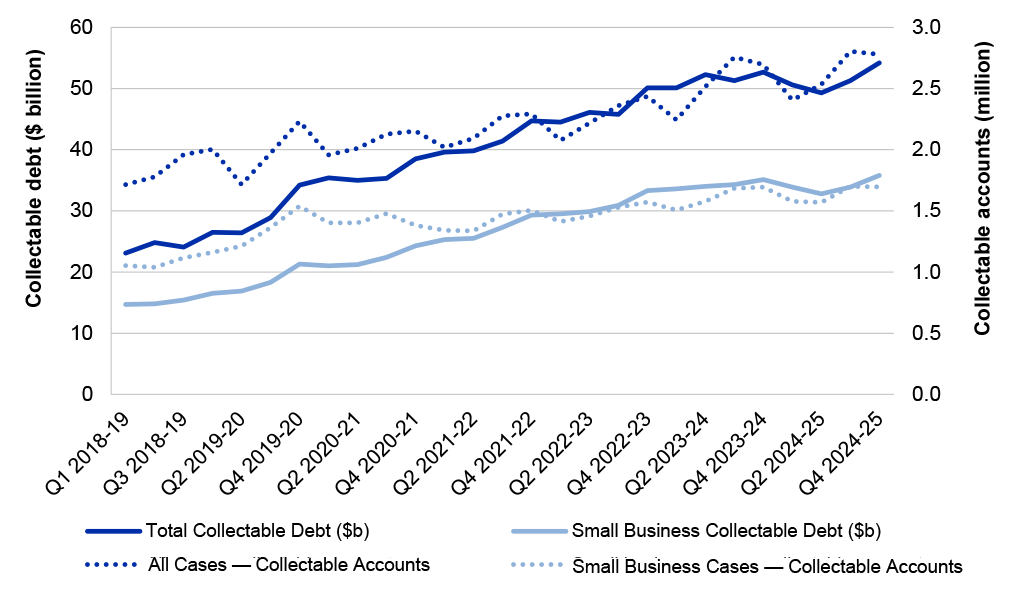
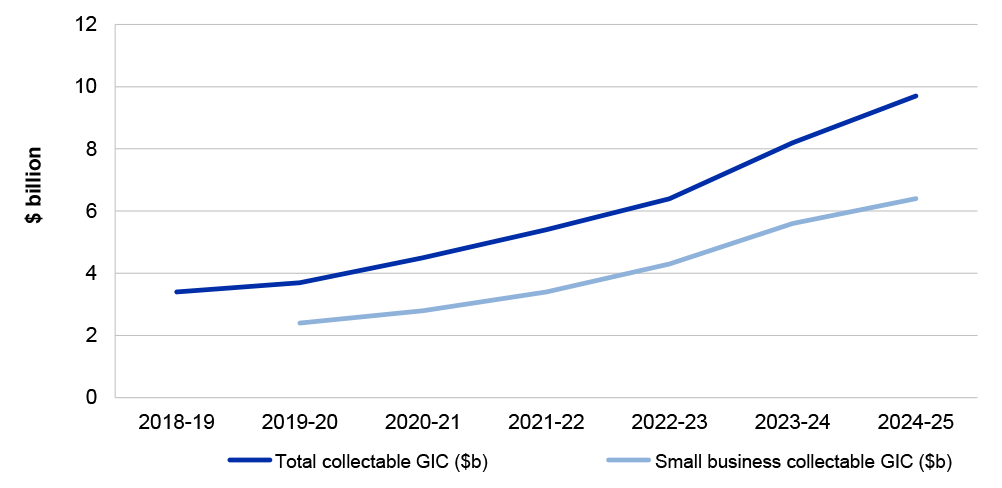
1.5 Figure 1.1 shows the growth of total collectable tax debt and small business collectable tax debt from July 2019 to June 2025.
Figure 1.1: Total collectable debt and accounts and small business collectable debt and accounts 2018–19a to 2024–25
Note a: Figure includes data from 2018–19 to provide pre-COVID-19 pandemic context.
Source: ANAO analysis of ATO data.
1.6 The 2024–25 ATO annual report indicates that $49.8 billion of the total $98.4 billion total tax owing is subject to an impairment allowance.9 The ATO states: ‘An impairment allowance is created when there is evidence that the ATO will not be able to collect all of the amounts due’.10
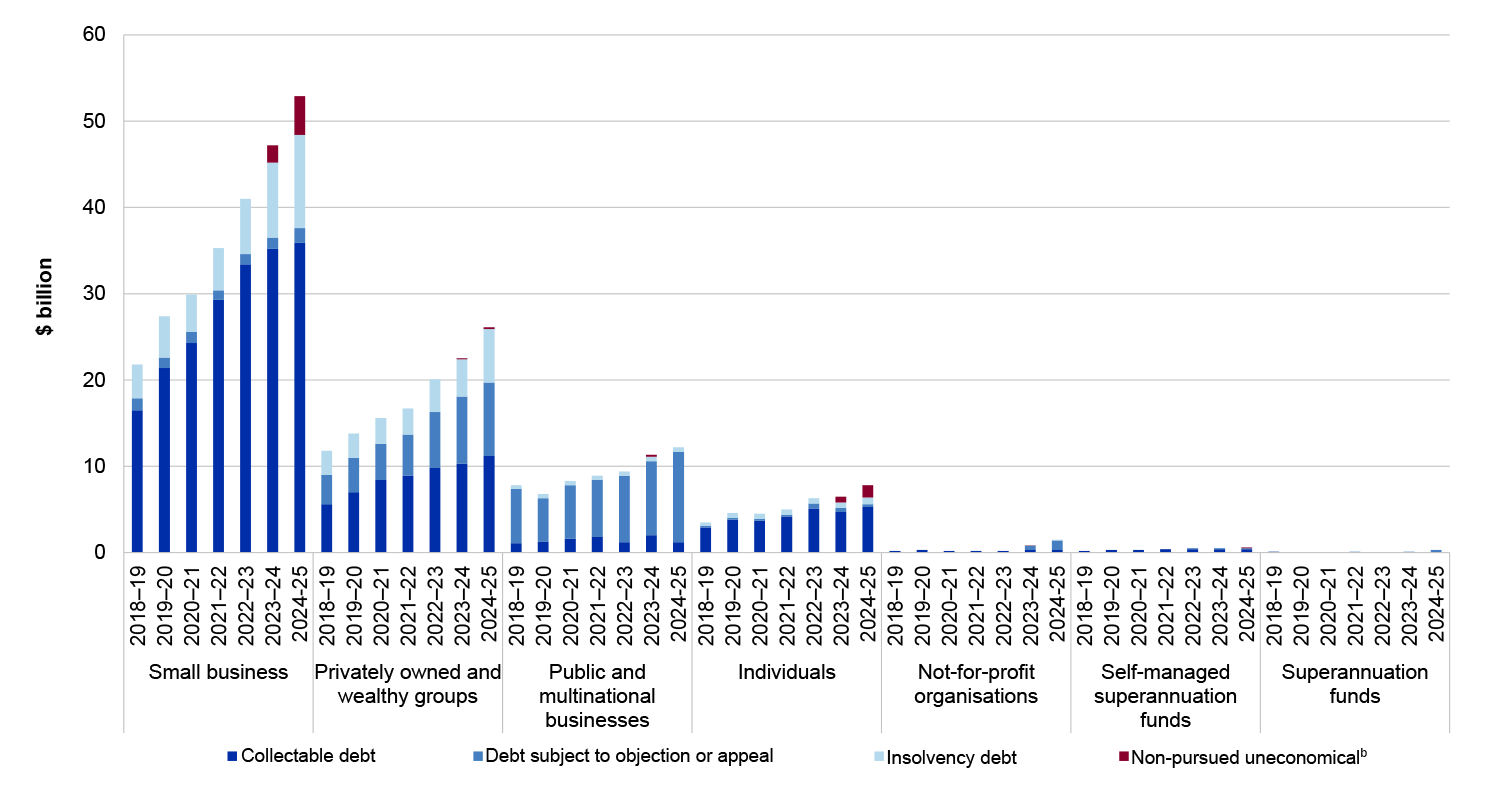
1.7 Figure 1.2 shows total tax debt owed by taxpayer group from 2018–19 to 2024–25. The ATO advised the ANAO in February 2026 that the impairment allowance was ‘not calculated in a manner that enables us to provide a breakdown by taxpayer groups.’
Figure 1.2: Total tax debt owed by group 2018–19a to 2024–25
Note a: Figure includes data from 2018–19 to provide pre-COVID-19 pandemic context.
Note b: The ‘non-pursued uneconomical debt type relates to debts placed on hold from November 2023 and is not a full representation of all non-pursued uneconomical debt. Amounts of non-pursued uneconomical debt prior to November 2023 are not visible on taxpayers’ accounts during the period of this graph and therefore not included.
Source: ANAO analysis of ATO data.
1.8 Figure 1.3 shows the growth in small business collectable tax debt aged over 10 years from 2020–21 to 2024–25.
Figure 1.3: Aged small business debt 10 years and over, and trend, 2020–21 to 2024–25
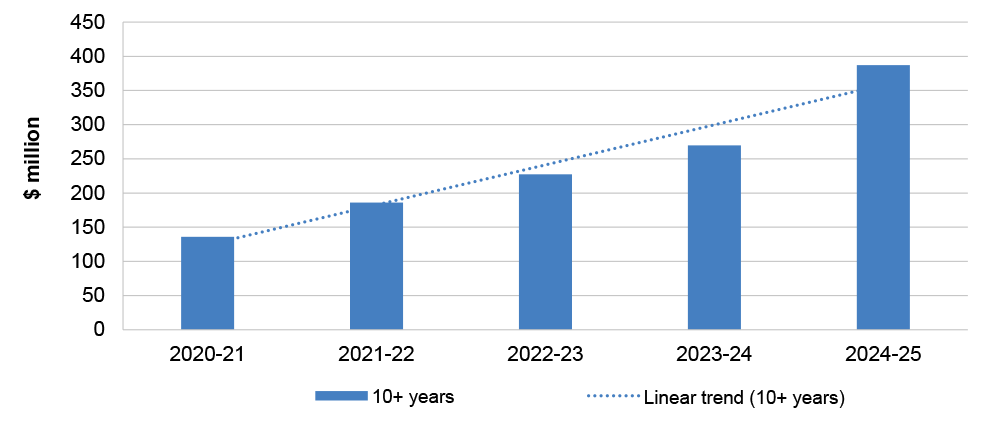
Note: In November 2025 the ATO advised: ‘In 2014, the ATO moved Super Guarantee Charge transactions from a legacy system (which was decommissioned in December 2015) into its Integrated Core Processing System. As a result, these old transactions will only be appearing in the greater than 10-year-old debt although the liabilities would have been more than 10 years old prior to 2025.
The introduction of the director penalty regime (in particular the introduction of GST DPNs in 2020) means that debts owed by insolvent and deregistered companies are now less likely to be non-pursued as irrecoverable at law as the ATO considers opportunities to pursue directors. This also impacts on the growth of aged debt.’
Source: ANAO analysis of ATO data.
1.9 Figure 1.4 shows small business tax debt composition from 2020–21 to 2024–25.
Figure 1.4: Small business tax debt composition over time 2020–21 to 2024–25
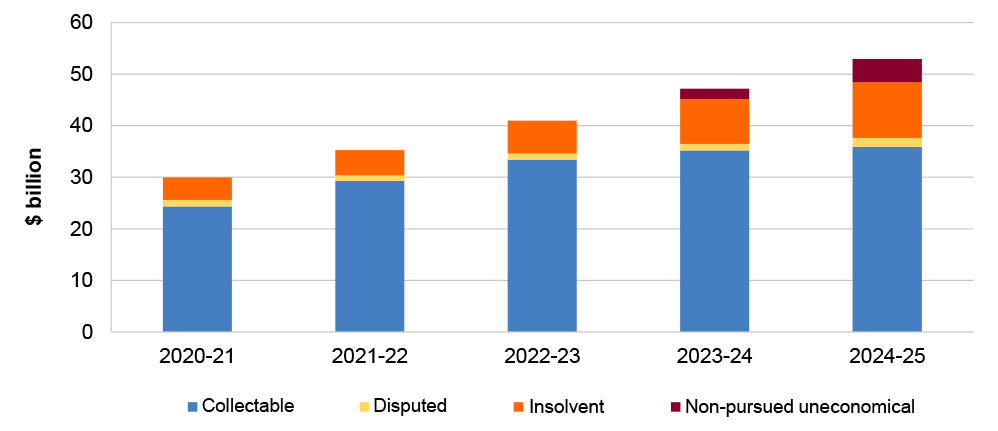
Note: The ‘non-pursued uneconomical debt type relates to debts placed on hold from November 2023 and is not a full representation of all non-pursued uneconomical debt. Amounts of non-pursued uneconomical debt prior to November 2023 are not visible on taxpayers’ accounts during the period of this graph and therefore not included.
Source: ANAO analysis of ATO data.
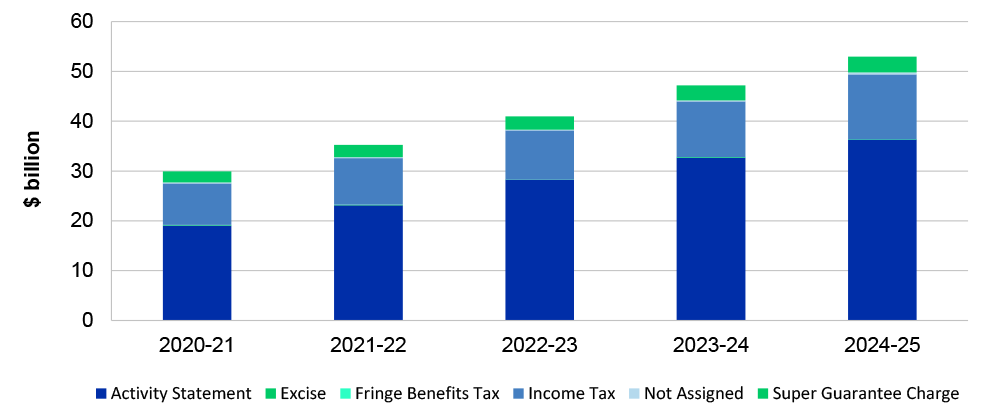
1.10 Figure 1.5 shows small business tax debt by debt source from 2020–21 to 2024–25.
Figure 1.5: Small business tax debt by tax debt source 2020–21 to 2024–25
Source: ANAO analysis of ATO data.
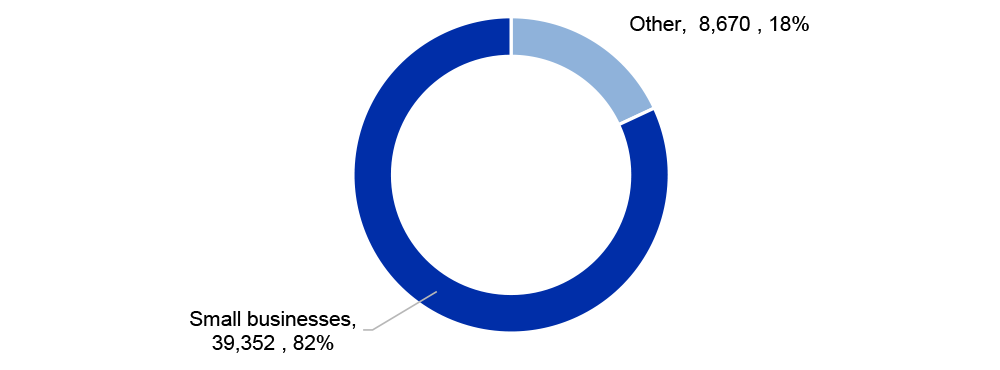
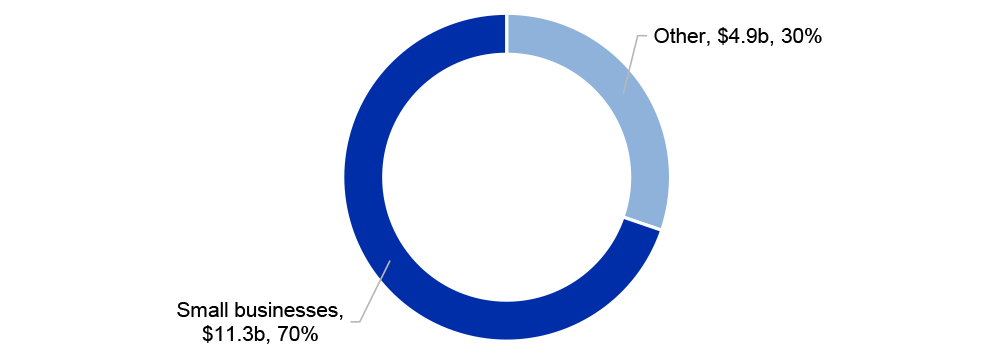
1.11 In 2024–25 the ATO identified 48,022 ‘disengaged taxpayers’ owing a total of $16.2 billion in collectable debt. The ATO defines disengaged taxpayers as those with collectable debts over $100,000 and older than 90 days that were not actively engaged with the ATO in respect of their debt. Of these disengaged taxpayers, 39,352 were small businesses owing $11.3 billion in collectable debt.11 Figure 1.6 and Figure 1.7 show the number and percentage of disengaged taxpayers with collectable small business debt and the value and percentage of disengaged small business taxpayer debt respectively.
Figure 1.6: Disengaged small business taxpayers with collectable debt 2024–25
Source: ANAO analysis of ATO data.
Figure 1.7: Value of disengaged small business taxpayers with collectable debt 2024–25
Source: ANAO analysis of ATO data.
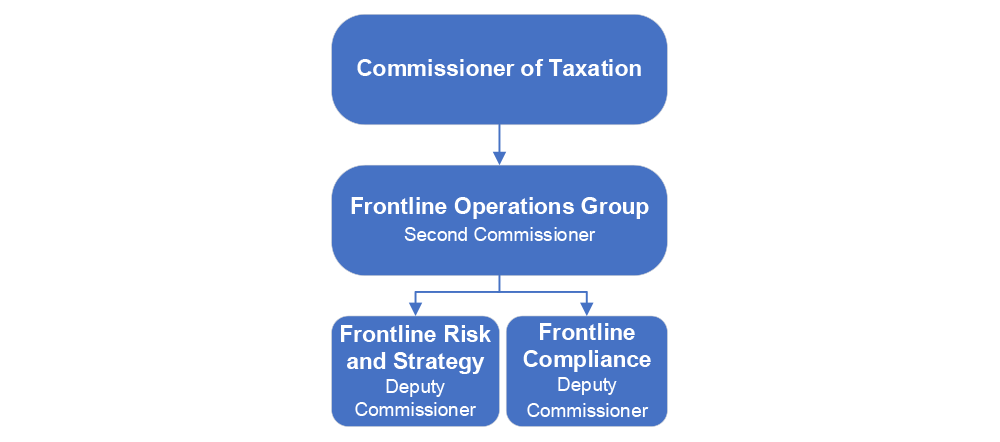
1.12 Figure 1.8 depicts the areas with accountability for the management of small business debt.
Figure 1.8: Areas in the ATO with accountability for small business debt
Note: This is not an exhaustive list of every area in the ATO with responsibility for small business debt.
Source: ANAO analysis of ATO data.
1.13 The Small Business line sits within the Compliance and Engagement group and is the business line within the ATO responsible for managing the taxation of small businesses. It seeks to ‘identify and treat risks, while delivering infrastructure, services and interventions to increase willing participation by small businesses in the tax and superannuation systems.’ Officers that manage cases in the Small Business line may refer debt matters to the Frontline Compliance12 business line if they are complex or high risk, require tailored solutions, further expertise or firmer action. Frontline Risk and Strategy is responsible for the delivery of the Payment Strategy to address tax debt through more effective and efficient debt recovery pathways. The Frontline Compliance business line is within Frontline Operations and is focused on addressing the collectable debt balance by resetting expectations and shifting taxpayers’ payment behaviour.
Support provided during natural disasters and the COVID-19 pandemic
1.14 At the direction of government, the ATO has taken action to implement relief measures for small business taxpayers due to natural disasters, the COVID-19 pandemic and global economic shocks. These impact the overall debt book. The ATO implemented several administrative measures to aid taxpayers impacted by the 2019 bushfires and the COVID-19 pandemic.13 The ATO reduced debt collection activities, offering taxpayers additional time to pay. The ATO attributed the 89 per cent increase in total collectable debt from June 2019 to June 2023 in part to these COVID-19 pandemic measures.
1.15 The ATO offered interest free payment plans and considered taxpayers’ circumstances when deciding to remit interest and penalties incurred on or after 23 January 2020 for taxpayers impacted by the COVID-19 pandemic. This was part of the ATO’s deliberate shift in focus from firmer debt collection actions to assist businesses through the pandemic.14
1.16 In a speech at the Tax Institute’s 2023 Tax Summit, the Lodge and Pay Deputy Commissioner stated that there has been an increased expectation amongst taxpayers that interest penalties will be remitted due to the ATO’s ‘lenient approach’ during the COVID-19 pandemic.15 At the 2024 Tax Summit, the Commissioner of Taxation stated that the ATO had ‘tightened up on payment plans and general interest charge remissions’.16
Actions taken since the COVID-19 pandemic
1.17 Following the peak of the COVID-19 pandemic the ATO resumed debt recovery actions. In October 2022 the ATO undertook an awareness program, contacting approximately 15,000 businesses and 18,000 directors17 with significant outstanding tax obligations totalling $1.4 billion.18 Over 5,000 taxpayers subsequently contacted the ATO and paid back $570 million. Over 4,000 of these taxpayers entered payment plans worth $492 million.19 The ATO escalated taxpayers that did not engage with awareness campaigns to enforcement actions.
1.18 In 2023–24, for all taxpayers, the ATO issued 35,774 director penalty notices20, 6,150 garnishees, 51,451 intent to disclose notices21 and 38,409 disclosures of business tax debts to credit reporting agencies.22 In 2024–25, the ATO issued 64,342 director penalty notices, 15,199 garnishees, and 29,049 intent to disclose notices and 24,533 disclosures of business tax debts to credit reporting agencies.
1.19 A small business lodgment penalty amnesty program operated from 1 June 2023 to 31 December 2023 in respect of unlodged forms. This led to over 14,000 small businesses lodging and to the remission of over $48 million failure to lodge penalties on lodgments originally due between 1 December 2019 and 28 February 2022.23 The ATO calculated that the amnesty program resulted in $344.3 million in additional liabilities being raised, with a $221.8 million net impact to the debt book due to forms that had a credit. $263.5 million in payments were received in relation to the $344.3 million of raised liabilities due to this amnesty program.
1.20 As a result of returning to business-as-usual collection activities, the growth of collectable debt decreased from 12 per cent ($5.4 billion) in 2022–23 to 5.2 per cent ($2.6 billion) in 2023–24 (see Figure 1.1).
1.21 On 14 May 2024, as part of the 2024–25 Federal Budget, the government announced it would provide the Commissioner of Taxation with the discretion not to apply refunds or credits owing to a taxpayer against debts that:
- were put on hold before 1 January 2017;
- the Commissioner is not currently pursuing recovery of; and
- are held by an individual, small business or not-for-profit entity.
1.22 This measure is not yet law.24
1.23 General Interest Charge (GIC) incurred in income years starting on or after 1 July 2025 are not tax deductible. GIC that was incurred before 1 July 2025 could be claimed as a tax deduction for the 2024–25 tax year.25
1.24 Figure 1.9 shows the value of collectable GIC for both small business and all taxpayers from 2018–19 to 2024–25.
Figure 1.9: Value of General Interest Charge on collectable debt 2018–19a to 2024–25
Note a: Figure includes data from 2018–19 to provide pre-COVID-19 pandemic context.
Small business data was not collected until 2019–20.
Source: ANAO analysis of ATO data.
1.25 In response to the increased economic impact of fuel costs arising from the conflict in the Middle East, in April 2026 the ATO introduced temporary assistance for businesses to assist in managing their tax obligations. Measures included changes to payment plans, remission of penalties and interest, varying Pay As You Go instalments, discretion not to offset debts using taxpayer credits or refunds, and may include pauses to some compliance and debt collection actions in affected industries.26
Previous audits and reviews
1.26 In March 2019 the Inspector-General of Taxation and Taxation Ombudsman27 released a Review into the Australian Taxation Office’s use of garnishee notices.28 The review concluded that the ATO’s garnishee policy generally sought to balance the ATO’s obligation of collecting debt and the need to take appropriate care in exercising garnishee powers. The review made four recommendations to which the ATO agreed including:
The IGTO recommends the ATO to develop a communication strategy for the Debt business line local site management and staff which includes a facility for direct communication from the Debt Executive for critical or complex messages where major changes to personnel resource deployment occur, particularly where personnel are new or are undertaking new work or expected to carry out work they have not engaged in for a period, so as to facilitate consistency of expectations between all levels of staff, including team working groups, at all site locations.29
1.27 Auditor-General Report No. 42 2018–19 Management of Small Business Tax Debt found that the ATO’s management of small business tax debt had been largely effective.30 The report considered the ATO’s arrangements and processes for managing small business tax debt arising from compliance activities, along with relevant monitoring and reporting activities. Recommendations were made regarding the ATO’s quality assurance framework for debt activities and performance framework for debt management. The ATO agreed to both recommendations.
1.28 The Inspector-General of Taxation and Taxation Ombudsman released an Investigation and Exploration of Undisputed Tax Debts in Australia report in 2021.31 The report found that the Australian tax system operates with a high level of voluntary compliance and that approximately 90 per cent of liabilities are paid by their respective due date and 3 per cent are unpaid after a year. The report found that collectable debt continues to grow and is the largest component of the ATO’s debt book. The ATO agreed to recommendations regarding stakeholder consultation, return on investment metrics, reporting debt past a benchmark, communication with and accessibility for businesses, and segmentation reporting. It disagreed to two recommendations regarding communication to taxpayers that their debts have passed benchmarks, and working with the Australian Bureau of Statistics to improve segmentation and reporting of industry data divisions and occupation codes.
1.29 In March 202432, the Commonwealth Ombudsman, the ACT Ombudsman, and the Inspector-General of Taxation and Taxation Ombudsman released How to tell people they owe the government money best practice principles. This best practice guide laid out five principles for contacting taxpayers and informing them about their debt status, noting that some agencies paused debt collection activities during the COVID-19 pandemic. The principles were:
- be transparent and accountable;
- tell people what the debt is and where it comes from;
- provide clear information for requesting review, debt waivers and repayment arrangements;
- provide contacts for people to find out more information; and
- learn and improve.
1.30 Actions taken by the ATO in relation to this better practice guide are explored further from paragraph 3.51.
Rationale for undertaking the audit
1.31 The ATO is responsible for managing the compliance of taxpayers in the Australian taxation and superannuation system, including pursuing tax debt. Debt that is undisputed, that is not subject to an objection, appeal, insolvency or not on hold, is considered collectable debt. Collectable tax debt from small business was $35.9 billion in 2024–25, an increase of $19.4 billion from 2018–19 and approximately two-thirds of the $54.2 billion total 2024–25 collectable tax debt.33
1.32 The ATO corporate plan 2025–26 identifies strengthening payment performance and debt collection as an enterprise priority.34 The key focus area of improving small business tax performance was removed from the corporate plan in 2024–25.35 After reducing collection activities during the COVID–19 pandemic, in 2023–24, the ATO recommenced the application of a range of firmer actions, including garnishee actions, directions to pay, director penalty notices and disclosure of business tax debt actions. Subsequent to the audit, in April 2026 the ATO introduced temporary assistance for businesses to assist in managing their tax obligations, which may include pauses to some compliance and debt collection actions in affected industries, in response to the increased economic impact of fuel costs arising from the conflict in the Middle East.
1.33 This audit provides assurance to the Parliament that the ATO effectively manages small business taxpayer debt.
Audit approach
Audit objective, criteria and scope
1.34 The audit objective was to assess the effectiveness of the Australian Taxation Office’s management of small business collectable debt.
1.35 To form a conclusion against the objective, the following criteria were developed:
- Are the risks relating to small business collectable debt appropriately managed?
- Does the ATO have a sound strategic framework to manage small business collectable debt?
- Does the ATO effectively apply its strategic framework to manage small business collectable debt?
1.36 The audit scope includes the ATO’s management of small business collectable debt (including interest and penalties) from June 2020 to June 2025. It does not include management of debt subject to objection or appeal, uneconomical to pursue, irrecoverable at law, or insolvent debt.
Audit methodology
1.37 The audit methodology included:
- review of relevant ATO documentation and walkthroughs of processes and procedures with ATO staff;
- review of publicly available ATO guidance for small businesses and taxpayers with debt;
- review of two public submissions; and
- meetings with relevant ATO staff.
1.38 The audit was conducted in accordance with ANAO Auditing Standards at a cost to the ANAO of approximately $915,500.
1.39 The team members for this audit were Shane Armstrong, Shannon Clark, Ally Cerritelli, Taylah Morgan, Jay Banpel, and David Tellis.
2. Managing risks related to small business collectable debt
Areas examined
This chapter examined whether the ATO has sound processes to manage small business collectable debt, whether these processes have occurred, whether oversight of these risks is fit for purpose, and whether the risks have been appropriately managed.
Conclusion
The ATO’s management of collectable small business debt risks is partly effective. The ATO’s pausing of debt collection measures in response to natural disasters, the COVID-19 pandemic and global economic shocks resulted in rapid growth of the debt book. The ATO has assessed that its risk of unacceptable levels of unpaid debt remains out of tolerance, and will not be brought back into tolerance in the immediate future. The ATO considers its controls to reduce this risk to be partly effective. The ATO has not set specific internal targets to reduce debt volumes. The ATO reports publicly in its annual performance statements on a whole-of-collectable debt performance measure that does not enable identification of small business debt performance.
Areas for improvement
The ANAO made three recommendations: to improve clarity of oversight of small business taxpayer debt, to improve transparency by increasing public reporting, and to set specific measurable targets regarding the reduction of the volume of small business collectable debt and assess the effectiveness of its actions to improve payment and debt outcomes.
2.1 The ATO’s corporate plan 2025–2636 identifies the following key activity: ‘Collect the right amount of tax in the most efficient way for government and the taxpayer’. Appropriate management of risks to payment is required to ensure that debt collection is efficient for both the government and the taxpayer.
Does the ATO have processes to manage risks to small business collectable debt, and are they managed in accordance with ATO requirements?
The ATO has established processes to manage both enterprise and business level risks. Risk assessments and treatment plans relating to small business debt at the enterprise and business line level have been created in accordance with ATO requirements. The ATO has assessed its controls to manage small business debt as partly effective.
Risks to small business debt are generally managed in accordance with ATO requirements. Complete documentation evidencing formal endorsement of the enterprise level risk between 2020–21 and 2024–25 was not maintained, and the 2023 risk review occurred seven months late.
The ATO’s risk management process
2.2 The documents that govern risk management at the ATO are the Risk Management Framework (RMF), and Risk Management Chief Executive Instructions (CEIs).
2.3 The RMF states that these documents ‘outline the components and arrangements that articulate the directions and approach for managing risks and expectations for all officials’. The ATO’s risk management process was developed to meet its obligations under the Commonwealth Risk Management Policy, and is based on the international standard.37
2.4 Guidance on risk management is made available to staff through internal risk management training courses, and risk management templates are provided on the ATO intranet. The ATO also uses a CEI on risk management, which outlines staff responsibilities for risk management.38
Risks relating to small business taxpayer debt
2.5 The ATO has identified risks to small business taxpayer debt at both the enterprise, and business levels.39
Enterprise level
2.6 The enterprise level risk Payment and Debt Performance has the objective of ‘[reducing] the collectable debt ratio using core strategies, enhanced through the Lodge and Pay Reset program.’ This enterprise level risk covers payment and debt management risk across all taxpayers with liabilities. The risk event as described is:
There is a risk that payment and debt performance declines to unacceptable levels, caused by volatility in economic conditions and/or ineffective ATO strategies. There is a risk ATO payment may decrease and/or debt will increase caused by taxpayers not meeting their payment obligations on-time and in full. This may result in revenue impacts for the Commonwealth, and reduced community services and broader levels of voluntary compliance.
2.7 Risk drivers identified by the ATO include taxpayers delaying payment, using delayed payment to gain a competitive advantage, using strategies to push boundaries in the tax system, potential fraud, ATO compliance treatment resulting in a debt the ATO knows the taxpayer has little or no capacity to pay, and reduced taxpayer and community sentiment towards paying tax and the benefits of taxation.
Business level
2.8 The business level risk, Small Business Client Experience Payment Risk has the objective of ‘reducing collectable debt in the small business client experience’. This risk was first endorsed in September 2024, and did not exist prior.
2.9 The risk event is identified as small businesses:
Paying tax liabilities late or not at all, trading while insolvent, using amounts withheld from employees or on behalf of the Commonwealth40 to artificially support cash flow, and prioritising payment of suppliers over the ATO.
2.10 Risk drivers identified by the ATO include: poor accounting practices, cash flow issues, prioritisation of payment of suppliers over the ATO, avoidance or delay in payment to gain a commercial advantage, broader economic conditions, and the inability of the ATO to collect tax debt early, resulting in insolvency.
2.11 The risk assessment identifies the risk likelihood as ‘even chance’, the consequence as ‘severe’, the overall risk as ‘high’, and the tolerance level as ‘medium’, noting:
We need to balance our approach with the government and community’s appetite to pursuing small business debt. Decreasing the current rating presents a challenge in the current economic environment.
Risk Management
Risk controls and treatments
2.12 Risk controls and treatments are considered at both the business and enterprise level to manage the identified risks. The business level treatment is identified as the Payment Strategy (see from paragraph 3.10). The enterprise level risk treatment notes the treatment identified in the business level risk assessment.
2.13 The ATO assesses its overall controls at the enterprise level as ‘partially effective’. Business level controls are also identified as ‘partially effective’. Table 2.1 outlines the ATO’s corrective controls at the business level.
Table 2.1: Corrective business level controls as at June 2025
|
Control name |
Control effectiveness |
|
Payment plans (see from paragraph 3.31) |
Partially effective |
|
Debt letters (see from paragraph 3.18) |
Partially effective |
|
Director Penalty Notices (DPNs) (see paragraph 4.25) |
Partially effective |
|
Garnishees (see paragraph 4.28) |
Partially effective |
|
ATO initiated insolvency/bankruptcy (see paragraph 4.31) |
Effective |
|
General Interest Charge (see paragraph 3.36) |
Partially effective |
|
Disclosure of business tax debt (see paragraph 4.28) |
Ineffective |
|
External Collection Agency (see from paragraph 3.69) |
Partially effective |
|
Dialler campaignsa |
Partially effective |
Note a: The ATO advised the ANAO in August 2025 that data was ‘not readily available’ for outbound telephony, so this control was not assessed by the ANAO.
Source: ANAO analysis of ATO documentation.
Management of risks in accordance with ATO requirements
2.14 The ATO assigns risk owners at both the enterprise and business levels to each risk. The role of risk owners is to take accountability for risks, provide direction on relevant risk management activities, oversee the status of risks, controls, and treatment strategies, and endorse risk assessments and treatment plans.
Enterprise level risk
2.15 The enterprise level risk owner is identified as the Frontline Risk and Strategy Deputy Commissioner.41 The enterprise level risk assessment and treatment plan was not appropriately endorsed by the risk owner on one occasion.
2.16 While the consequence of the enterprise level risk has consistently been considered ‘major’, the likelihood was considered ‘unlikely’ until 2023, when it was increased significantly to ‘almost certain’. This moved the risk from ‘within tolerance’ to ‘above tolerance’, with the ATO identifying the Lodge and Pay Reset (see from paragraph 3.8) and associated treatments as the way of bringing the risk back within tolerance.
2.17 The enterprise level risk plan notes that all treatments will be implemented by 30 May 2025. While initial implementation of Client Prioritisation and Segmentation was completed by May 2025, and initial implementation of data and analytics requirements were a month away from completion, implementation of an integrated treatment plan with enduring controls was scheduled for implementation in June 2026. As at February 2026, the ATO has commenced updating systems to enable segmentation, expected to be completed in the 2026 calendar year.
2.18 The enterprise level risk is scheduled for review every two years, with the review required to occur by 31 December 2023 occurring in July 2024 which is inconsistent with the required review schedule. The ATO next reviewed the risk in June 2025.
Business level risk
2.19 The business level risk owner is identified as the Assistant Commissioner, Lodgment, Payment and Data Strategy. The business level risk assessment and treatment plan was appropriately endorsed by the risk owner. The risk was reviewed in June 2025 by the Band 1 Frontline Risk and Strategy Committee, which concluded that while some risk controls had seen performance improvements, that there had been no material change in control effectiveness.
Is oversight of the management of small business collectable debt fit for purpose?
The ATO had 13 committees or groups considering small business debt between 2019–20 and 2024–25. The ATO Risk Committee has increased its focus since 2021–22 on the management of the payment risk. It has sought assurance over the effectiveness of controls and has requested the development of key performance indicators. The Risk Committee was advised in June 2024 that small business debt will likely remain out of tolerance for a further one to two years.
Given the significant proportion of total collectable debt that is owed by small business, the collection of small business collectable debt should remain a focus of oversight and reporting.
The small business collectable debt ratio is a major contributor to the ATO’s overall collectable debt ratio but public reporting is minimal. Recommendations from the Tax Ombudsman concerning public reporting of debt have not been fully implemented. Improved public reporting of the ATO’s performance in reducing collectable debt would improve transparency and oversight of risks and the ATO’s management of them.
Risk oversight bodies
2.20 The ATO stated in April 2025 that between 2019–20 and 2024–25, 13 committees or groups met to discuss small business taxpayer debt either exclusively, or as part of a broader conversation around ATO debt management.42
2.21 The Australian Public Service Commission’s capability review of the ATO, finalised in 2025 identified as a priority area for development: ‘Addressing the organisational strategy capability gaps identified … including streamlining internal governance and ensuring clear accountabilities.’43
Enterprise level
2.22 As outlined in paragraph 2.2, the ATO has a Risk Management Framework and Risk Management Chief Executive Instructions (CEIs), which establish that a Risk Owner is personally accountable for identified risks. The Frontline Risk and Strategy Deputy Commissioner is identified as the enterprise level risk owner (paragraph 2.15).44 The ATO Risk Committee, chaired by a Second Commissioner, and comprising four Deputy Commissioners, engages with enterprise level risks. Its engagement with the small business Payment and Debt Performance risk has increased between 2021–22 and 2024–25. Initial meetings were provided with high level information that generally mentioned small business without detail. This changed in 2024, with small business identified as a key driver of the overall debt problem. In September 2024, the ATO Risk Committee requested further evidence that the treatment strategy was driving progress. Minutes of the meeting noted:
Development of the treatment strategy was acknowledged, while the committee were [sic] encouraged by the approach, there hasn’t yet been enough progress to give the committee adequate assurance. On this basis, the Chair was not assured yet and has asked the risk owner to return to the committee to report on progress.
2.23 The issue of the efficacy of the treatment strategy was brought back to the Committee in February 2025, with the ATO summary of the meeting noting:
The Committee requested the key performance indicators to be prioritised, confirmation of timeframes to bring the risk within tolerance, and validation of the effectiveness of key controls.
2.24 The ATO Risk Committee was advised in June 2024 that:
it is expected the risk will continue to reduce towards in tolerance within the next 12 months.
While at an enterprise level the risk may expect to come back towards in tolerance within the next 12 months, it is likely that Small Business debt will remain out of tolerance for a further 1–2 years, noting the significant shift in behaviour required for this taxpayer segment.
2.25 The minutes of this meeting state that the Chair noted ‘the significant progress made to date with respect to this enterprise risk’, ‘that what in tolerance of this enterprise risk looks like is under review’, and ‘the feedback provided by the Committee on the measures and KPIs’ and ‘noted that the view of in tolerance of this enterprise risk is evolving.’
2.26 The Committee also queried the methodology applied to make assessments about the effectiveness of controls. The Committee also considered what ‘in tolerance’ would look like for this risk, with a Deputy Commissioner’s reply summarised as:
if we tie it to a number we may never be within tolerace [sic]. Tolerance needs to be determined for payment to ensure it is maximised, and for management of debt, to prevent significant growth. It was about strengthening controls to as good as they can be and demonstrating that those controls are effective in managing the risk.
2.27 The ATO has focused its reporting to the ATO Risk Committee on preventative measures rather than on measures to pursue outstanding debt, particularly aged debt.
2.28 The ATO advised the ANAO in February 2026 that it had commenced work on improving risk controls, and measurement and evaluation.
2.29 The Lodge and Pay Band 1 Risk Committee was established in August 2020 with a purpose of driving the identification and management of enterprise lodgement and payment risks. The Lodge and Pay Band 1 Risk Committee discussed small business taxpayer debt risk at nine of its thirteen meetings, with most mentions in relation to the proportion of small business debt to overall debt.
Business level
2.30 As outlined in paragraph 2.2, the ATO has a Risk Management Framework and Risk Management Chief Executive Instructions (CEIs), which establish that a Risk Owner is personally accountable for identified risks. The Assistant Commissioner, Lodgment, Payment and Data Strategy is the business level risk owner (paragraph 2.19). The ATO advised in October 2025 that Frontline Risk and Strategy (FRS) executives ‘held the primary responsibility for the payment and debt risk at the enterprise level, including the payment and debt risk for Small Business.’ Further, the ATO advised:
FRS inform and consult with a number of committees that have oversight of the payment and debt risk across the ATO. There are also specialist committees that deal specifically with Small Business issues (FRS inform, consult and engage with these committees).
2.31 The ATO stated that a number of committees were in operation at the business level, including:
- a Frontline Risk and Strategy Committee established following the merger of the Lodge and Pay Risk Committee and the Registration Risk Committee in May 2025, with ‘direct accountability for the governance and management of business-level payment risks’;
- a Registration, Lodgment and Payment Risk and Strategy Assurance Committee, established in September 2024, which the above Committee reports to. This Committee is intended to facilitate a whole-of-ATO response to relevant risks, and undertake a risk call-over process, risk assessments, and treatment plans. This committee has met twice between September 2024 and June 2025; and
- other specialist committees that deal specifically with small business issues.
2.32 While the ATO has several committees that discuss small business taxpayer debt, it is not clear that any of them have direct responsibility to monitor the measures used to reduce small business taxpayer debt, and to make recommendations on how to improve performance around debt reduction.
2.33 This is consistent with the findings of the Australian Public Service Commissioner’s 2025 Capability Review of the Australian Taxation Office:
The review observed that the ATO has an extensive governance architecture, but it is not always fit for purpose. Stakeholders said there are too many governance committees and some lack a clear purpose. At times they are treated as forums for consultation and consensus rather than making decisions and negotiating trade-offs.45
2.34 The Australian Public Service Commissioner also observed:
ATO leadership has plans to conduct a review of its enterprise governance framework. Such a review would provide a good opportunity to streamline the committee structure, consider ways to leverage these forums to facilitate agency-wide prioritisation, and ensure accountabilities are appropriately allocated and not diluted by committees.46
2.35 The Commissioner of Taxation formally responded to the Capability Review, stating that the ATO would ensure ‘effective internal collaboration’, and that everyone understands ‘their contribution, not just to their direct responsibilities and functional accountabilities, but to broader outcomes.’47
Recommendation no.1
2.36 The Australian Taxation Office, as part of its review of its enterprise governance framework, ensure clear accountabilities and reporting lines regarding small business taxpayer debt.
Australian Taxation Office response: Agreed
The ATO Executive, the Commissioner of Taxation and the Treasurer
2.37 The ATO Executive48 engages specifically with small business debt issues infrequently, and in a superficial manner. Where small business debt is mentioned in Executive meetings, it is part of a more general discussion on debt, including the proportion of small business debt in the total debt book, and in relation to the Lodge and Pay Reset (see paragraph 3.8). The ATO Executive is not provided with detailed data on the ATO’s performance in managing small business taxpayer debt.
2.38 The Commissioner was provided with a briefing on the ATO’s debt book as a whole in January 2024. The briefing contained high level information on small business debt, noting it comprised 65 per cent of total debt, that activity statement debt from small business had increased, and that insolvent small business debt from activity statements had driven increases in insolvent debt. Graphing also showed the collectable debt ratio for small business, and total small business debt.
2.39 The ATO’s Statement of Intent49 outlines the ATO’s undertaking to the Treasurer: ‘The ATO will keep the responsible Minister informed with accurate and timely advice on significant issues in its core area of business.’
2.40 Between 2022 and 2025, the ATO provided two submissions to the Treasurer relating to small business tax debt, both in 2025.
2.41 The first submission was in response to a request from the Treasurer in August 2025 for further information on measures to prevent small business debt. The response did not include information on the totality of small business debt, trends, or the issue of aged debt.
2.42 The second submission elaborated further on the preventative measures identified in the first submission.
ATO reporting
2.43 The publicly reported performance measures relating to taxpayer debt are:
- proportion of payments made on time;
- collectable debt ratio50;
- debt non-pursued — uneconomical to pursue; and
- debt non-pursued — irrecoverable at law.
2.44 The ATO reports against these measures in its annual report51, reported in totality across all groups.52
2.45 Volumes of small business collectable debt, debt subject to objection or appeal, and insolvent debt are publicly reported in the ATO’s annual report.53
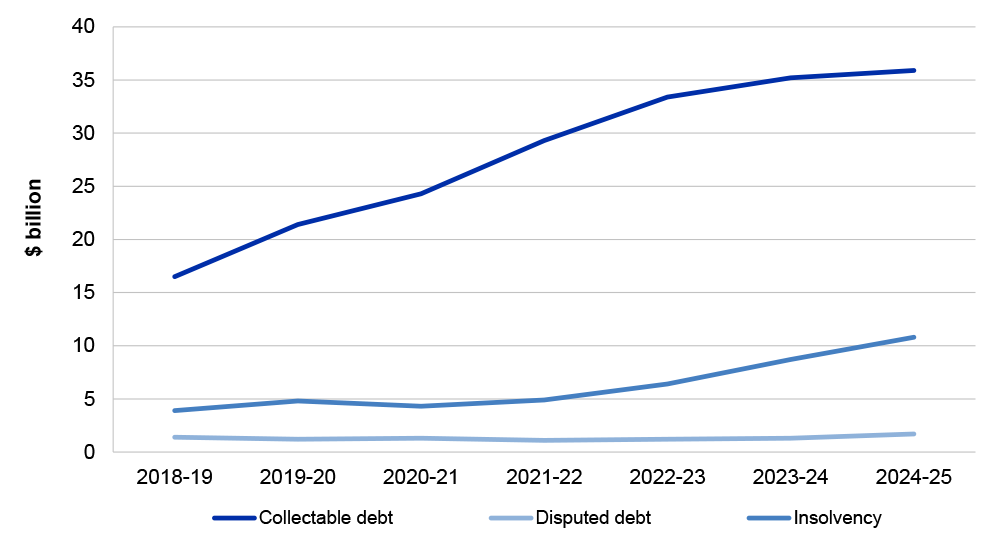
2.46 Figure 2.1 depicts collectable debt, disputed, and insolvent debt — all the publicly reported small business data contained in the ATO annual report between 2018–19 and 2024–25. It shows a rise in collectable debt, disputed debt and insolvency debt across the period.
Figure 2.1: Publicly reported small business debt data 2018–19a to 2024–25
Note a: Figure includes data from 2018–19 to provide pre-COVID-19 pandemic context.
Source: ANAO analysis of ATO data.
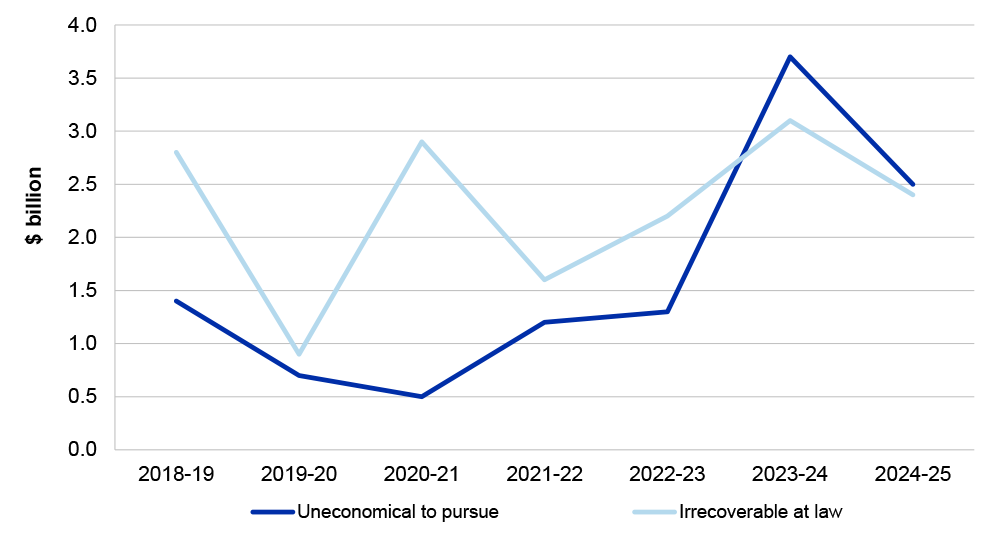
2.47 Figure 2.2 depicts debt considered uneconomical to pursue and irrecoverable at law across all taxpayer groups.54 There was a significant increase in debt deemed uneconomical to pursue between 2022–23 and 2023–24. The ATO annual report 2024–25 states: ‘The year-on-year decrease is a result of 2023–24 being an anomalous year that included the identification of debts uneconomical to pursue or irrecoverable following the COVID-19 pandemic.’55
Figure 2.2: Publicly reported debt uneconomical to pursue and irrecoverable at law (all groups), 2018–19a to 2024–25
Note a: Figure includes data from 2018–19 to provide pre-COVID-19 pandemic context.
Source: ANAO analysis of ATO data.
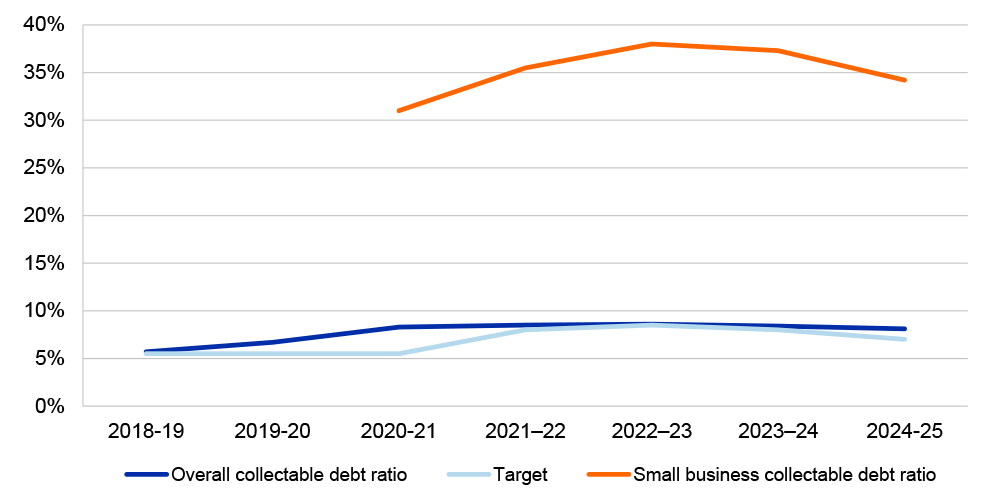
2.48 The collectable debt ratio is a measure of the effectiveness of the ATO’s debt prevention, collection, and management strategies, reflecting the proportion of collectable debt compared to net tax collections. A lower collectable debt ratio indicates that debt is being recovered relatively effectively. A higher ratio indicates lower effectiveness in recovery. The collectable debt ratio is used by the ATO as a performance measure to determine the effectiveness of the ATO’s debt prevention, collection and management strategies. Figure 2.3 depicts the overall collectable debt ratio, the small business collectable debt ratio, and the ATO’s target collectable debt ratio from 2018–19 to 2024–25.
Figure 2.3: Overall collectable debt to net tax collections ratio, small business collectable debt to small business net tax collections ratio, and ATO target collectable debt ratio 2018–19a to 2024–25
Note a: Figure includes data from 2018–19 to provide pre-COVID-19 pandemic context.
The ATO only started recording the small business collectable debt ratio from 2020–21.
Source: ANAO analysis of ATO data.
2.49 While the ATO reports on the overall collectable debt ratio, it does not publicly report on the small business collectable debt ratio. For more information on the collectable debt ratio, see from paragraph 2.60. The ATO’s annual report includes in an appendix small business debt broken down by collectable debt, debt subject to objection or appeal, insolvency debt, and from 2024–25, non-pursued uneconomical.56
2.50 The 2021 Inspector-General of Taxation and Taxation Ombudsman57 report An investigation and exploration of undisputed tax debts in Australia recommended that the ATO consult with key stakeholders to co-design enhanced reporting in relation to the debt book and debt recovery activities, and stated that the enhanced reporting ‘may be shared publicly or with discrete stakeholders, as appropriate’.58 The ATO advised the ANAO in June 2025 that all recommendations had been fully implemented. Following external consultation, the ATO identified its annual Taxation statistics publication as the best way to share data on tax debt. The information was planned for inclusion in 2024.
2.51 The ATO’s most recent Taxation statistics publication is for 2022–23 (published 27 June 2025).59 Information about tax debt is not included.60
2.52 The ATO advised the ANAO in September 2025 that:
Subsequent to endorsement of the recommendation the publishing of the data was paused. This was due to changes in the internal ATO operating environment and other external factors.
We remain committed to transparency with taxpayers and the community about debt and using this to inform. In light of our refreshed strategies and approaches to managing debt such as the payment strategy and making debts on hold visible we are reviewing the information we publish on debt.
2.53 It has been five years since the Tax Ombudsman made the initial recommendation about public reporting. The ATO has not publicly reported data as recommended and agreed. It should also be noted that the Taxation statistics publication publishes two years prior to the current financial year data to allow for sufficient lodgment to increase confidence that the statistics are accurate. More contemporary data would enable the Parliament and the general public to better understand the ATO’s performance in managing small business taxpayer debt.
Recommendation no.2
2.54 The Australian Taxation Office publicly report the current annual proportion of payments made on time, collectable debt ratio, disputed debt, debt non-pursued — uneconomical to pursue, and irrecoverable at law in a timely manner and on a recurring basis to increase transparency around the scale of small business taxpayer debt, and the effectiveness of the ATO’s strategies in reducing it.
Australian Taxation Office response: Agreed
2.55 Internally, the ATO monitors various aspects of its performance in managing small business taxpayer debt via the Payment Risk Performance Update, and Debt Segmentation Analysis dashboards. Data is also available for analysis in the ATO’s Debt Client Engagement Interactions Cube, which enables data to be analysed by numerous dimensions, including client experience (such as small business), industry group, interaction type, next interaction type and direction (inbound, outbound). For more information on these monitoring tools and how they are used by the ATO, see from paragraph 4.51.
Is the small business collectable debt risk appropriately managed?
Within its risk management framework, the ATO has a stated objective of reducing small business collectable debt. It measures its performance through the ratio of collectable debt to net tax collections. This ratio does not provide transparency on small business collectable debt as the debt ratio may be able to be reduced while the total volume of small business collectable debt continues to rise.
The ATO does not set specific measurable targets regarding the reduction in the volume of small business collectable debt. Doing so would assist the ATO in its efforts to reduce small business collectable debt.
2.56 As set out in paragraph 2.8 the mitigations of the Small Business Client Experience Payment Risk have the objective of ‘reducing collectable debt in the small business client experience’.
2.57 The ATO advised in November 2025 that:
It is unlikely small business collectable debt will reduce due to the legislative framework under which the ATO operates, including imposition of General Interest Charge, and the limited avenues that extinguish debt. Our focus is on containing the growth of debt.
2.58 The view that the reduction in small business debt is unlikely is not reflected in the ATO’s risk management documents.
2.59 Figure 2.4 depicts the volume of small business collectable debt, and the small business collectable debt ratio from 2020–21 to 2024–25. It indicates that while the small business collectable debt ratio has begun to trend downward, the volume of collectable debt continues to grow.
Figure 2.4: Small business collectable debt volume and ratio 2020–21 to 2024–25
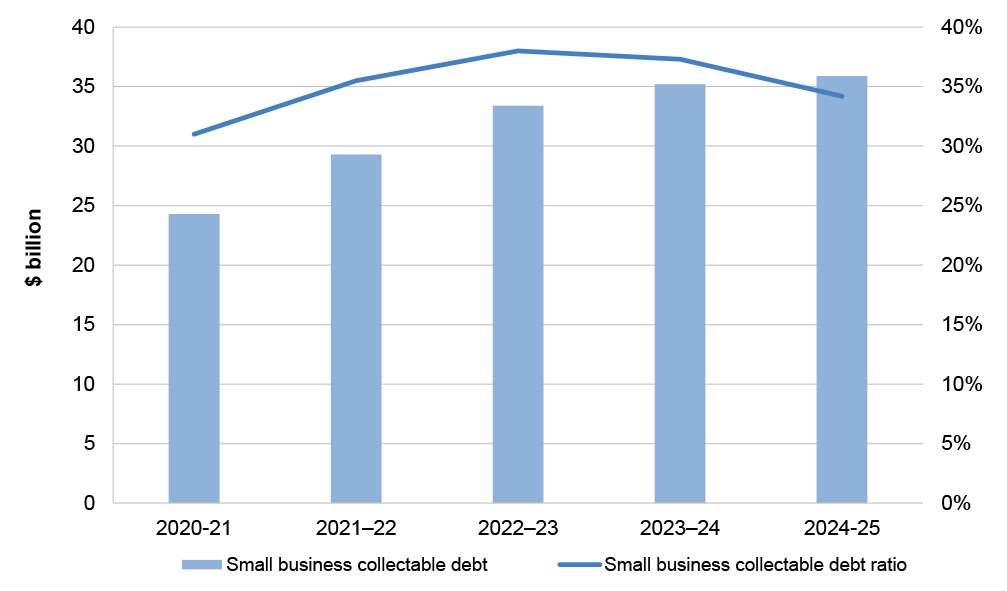
Note: The collectable debt ratio is a measure of the effectiveness of the ATO’s debt prevention, collection, and management strategies, reflecting the proportion of collectable debt compared to net tax collections.
Source: ANAO analysis of ATO data.
2.60 While there has been a downward trend in the collectable debt ratio since 2022–23 the small business collectable debt ratio remains high. A document provided to the Frontline Risk and Strategy Committee in June 2025 stated:
As of 31 March 2024, the ratio of collectable debt to net tax collections for the small business client experience is 36.8% compared to the ATO [debt] ratio of 8.7%. The ATO performance target for the 2023–24 year is between 7.5% and 8.0%, indicating that small business is above this target with a 28% deviation. The consequence level is Catastrophic (> 25% variance) — severe impact on achievement of outcomes and performance.
2.61 The small business collectable debt ratio is a significant contributor to the overall collectable debt ratio, due to small business collectable debt representing a significant proportion of total collectable debt. The ATO advised in November 2025 that the 8.5 per cent collectable debt (monthly) ratio recorded for June 2025 would reduce to 3.8 per cent were small business to be excluded. While there are no clearly identified targets concerning the volume of small business collectable debt, reducing the small business collectable debt ratio is a measure that has been discussed within the ATO, though no target has been set.
2.62 The ATO’s goal to reduce the broader collectable debt ratio to six per cent by 2026–27 is part of its formal performance measures.61 The ATO’s documentation notes that it does not ‘have reliable modelling to predict the debt book response to our enhanced strategies’, but has outlined the following internal targets. Table 2.2 outlines the ATO’s ‘pathway to tolerance’, outlining desired net increases in collections, and the projected collectable debt ratio.
Table 2.2: ATO ‘pathway to tolerance’ 2024–25 to 2026–27
|
End of financial year |
Desired net increase in collections ($b) |
June collectable debt ratio targets (%) |
|
2024–25 |
3.2 |
6.5–7 |
|
2025–26 |
3.6 |
7 |
|
2026–27 |
3.9 |
6a |
Note a: The ATO stated in April 2026 that the six per cent target had been revised to seven per cent for 2026–27 in March 2026.
Source: ANAO analysis of ATO data.
2.63 ATO documentation stated:
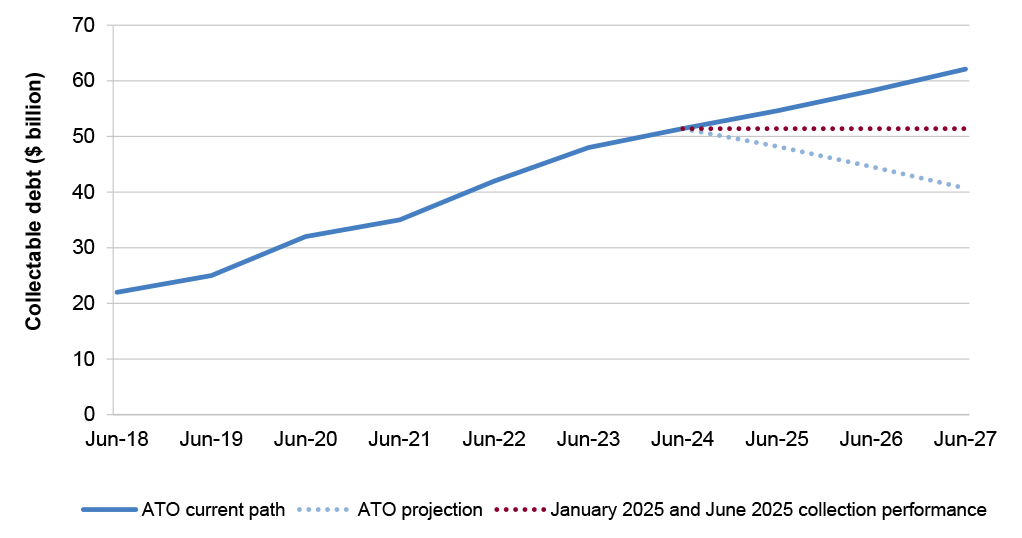
Achieving [a] 6% ratio by [the] end of [the] 2027 financial year would require reducing the net collectable debt book by $10.7b to $40.6b. This is over and above the current collections achieved and requires a shift in strategy in terms of seeking to reduce the amount of debt incurred, as well as timely payment by clients who incur a debt and more timely exit62 of taxpayers without capacity to pay.63
2.64 The ANAO analysed the ATO’s projection, applying six months of actual figures between January and June 2025 to assess progress against the ATO’s projection. Figure 2.5 depicts the ATO’s identified current trajectory as at January 2025, the ATO’s desired projection of the reduction in collectable debt to return to a six per cent collectable debt ratio by 2026–27, and progress should collection performance continue on the trajectory set between January 2025 and June 2025.
Figure 2.5: Collectable debt volumes and forward projections 2018–2027
Source: ANAO analysis of ATO data.
2.65 The absence of clearly defined targets or performance measures for each control designed to actively reduce the volume of small business debt and to reduce the small business collectable debt ratio means the ATO is unable to define what success looks like as it seeks to bring the overall collectable debt ratio back to six per cent. Without the inclusion of measurable targets, the ATO is unable to adequately evaluate its current performance.
Recommendation no.3
2.66 The Australian Taxation Office:
- set a specific measurable target to reduce the volume of small business collectable debt; and
- assess the effectiveness of its actions to improve payment and debt outcomes.
Australian Taxation Office response: Agreed
3. The ATO’s strategic framework to manage small business collectable debt
Areas examined
This chapter examined whether the Australian Taxation Office (ATO) has a sound strategic framework to manage small business collectable debt.
Conclusion
The ATO has a largely sound strategic framework for debt collection. This is a whole-of-debt strategy that is not specific to small business. Small business collectable debt makes up 66.1 per cent of total collectable debt. The ATO recognised that measures adopted during the COVID-19 pandemic ‘normalised into poor payment behaviours’ among taxpayers and commenced a Lodge and Pay Reset to return to business-as-usual recovery actions. The ATO has assessed that a significant behavioural shift by small business taxpayers is required to bring the collectable small business debt risk into tolerance. The ATO is able to measure payment behaviour, response rates, debt outcomes and changes in lodgment and payment compliance. The ATO has not fully incorporated best practice principles in communicating with taxpayers about debt. Given the continued increase in volumes of small business collectable debt there would be benefit in the ATO evaluating the effectiveness of each form of interaction and based on this, developing an approach specifically supporting its engagement with small business taxpayers.
Areas for improvement
The ANAO made a recommendation that the ATO determine the effectiveness of its engagement with small business taxpayers with debt by monitoring and reviewing taxpayer responses to inform its future small business debt management approach.
The ANAO also suggested that there were opportunities for the ATO to establish an engagement approach specifically for small business taxpayers with debt, and to incorporate the principles articulated in the Ombudsmen’s report How to tell people they owe the government money: Best practice principles for notifying people about debts.
3.1 The ATO’s corporate plan 2025–2664 identifies the following key activity: ‘Collect the right amount of tax in the most efficient way for government and the taxpayer’. A sound strategic framework is required to ensure that debt collection is efficient for both the government and the taxpayer.
Is the framework to manage small business taxpayer debt well designed?
The ATO has a whole-of-debt framework. The framework is informed by a management-initiated review, and the ATO’s Risk Management Framework. It is also based on several OECD sources including the OECD Tax Debt Management Maturity Model. The ANAO’s assessment of the ATO against this model found less mature arrangements on risk management and performance indicators, and more mature arrangements on IT strategy relative to the ATO’s self-assessment.
3.2 As discussed in paragraph 1.14 the ATO reduced debt collection activities due to the 2019 bushfires and COVID-19 pandemic. Prior to 2023, the ATO’s debt and lodgment operational delivery plan consisted of three phases to recommence engagement.
- Prevention through communication.
- Educating and supporting taxpayers to meet their obligations.
- Firmer actions where appropriate and stronger actions for high-risk taxpayers.
3.3 In 2022 the ATO established the Lodge and Pay Engagement and Action Differentiated Framework. This framework categorised taxpayers by risk level and behavioural groups to determine the ATO’s approach to assist taxpayers in meeting their obligations. For medium and high-risk taxpayers, machine learning models drove the Next Best Action (NBA) framework (see from paragraph 3.78) which included warning letters and legal action.
2023 review of Tax Debt Management Strategy
3.4 As a result of the ‘out-of-pattern growth of collectable debt and deteriorating lodgement outcomes’ the ATO engaged McKinsey & Company (McKinsey Co.) to conduct a review of the ATO’s tax debt management strategy in January 2023.65 The resulting reports ‘ATO Lodge and Pay Strategy Part A: Assessment of the existing Lodge and Pay Strategy’ and ‘Part B: Opportunities for the future’ were finalised in April 2023.
3.5 Part A drew from five sources of insight interviews with the ATO Executives, an assessment of collections maturity, a data deep dive, interviews with taxpayers, and best practice case studies. McKinsey Co. found:
- the ATO is among the top five performers in the OECD on tax collection and performs well relative to peers on key debt collection metrics;
- the ATO needs to understand the outcomes of initiatives and the opportunity for segmentation of taxpayers;
- a significant proportion of taxpayers are likely to have capacity to pay;
- a significant portion of the ATO debt book is likely irrecoverable and consuming collections capacity;
- that taxpayers used avoidance as a coping mechanism when facing acute financial pressure; and
- opportunities existed for optimised channels for taxpayers.
3.6 Part B identified opportunities for the ATO to achieve its short-term goal of six per cent collectable debt ratio by June 2025, and its long-term goal of making lodgement and payment ‘just happen’ by 2030. McKinsey Co. determined three central themes to achieving these goals: enhanced ability to differentiate and target collections interventions; collect tax sooner and more frequently; and to enhance transparency of data and operation performance. McKinsey Co. recommended six priority initiatives66 to achieve the ATO’s short-term goals and provided a one year roadmap as guidance.
3.7 McKinsey Co. recommended 40 potential initiatives and 12 capabilities.67 The capabilities included:
- segmentation and analytics (see from paragraph 3.59);
- contact strategies (see from paragraph 3.18);
- collection/treatment strategies (see from paragraph 3.58);
- External Collections Agency management (see from paragraph 3.69);
- recovery (see from paragraph 4.24);
- frontline performance (see from paragraph 3.18); and
- advanced analytics (see from paragraph 4.5).
Lodge and Pay Reset
3.8 The ATO commenced a Lodge and Pay (LAP) Reset from September 2023.68 The purpose of the reset was to return to business-as-usual debt recovery actions after the ‘help and assist’ posture the ATO adopted during the COVID-19 pandemic ‘normalised into poor payment behaviours.’ The ATO adopted a firmer posture in response to the rapidly growing debt book and declining payment culture. The ATO developed a three-phase strategic communication approach. This was aligned with OECD Successful Tax Debt Management: Measuring Maturity and Supporting Change (Successful Tax Debt Management)69 strategic principle one.70 Phases one and two of this approach ended in 2023, and phase three commenced in 2024.71
3.9 The LAP Reset focused on five key segments: new self-assessed debts; Superannuation Guarantee Charge debts; refund fraud; ATO-initiated debts; and aged debts more than two years old. In alignment with Successful Tax Debt Management strategic principle three the ATO improved synchronisation of firmer and stronger actions and commenced a garnishee (see paragraph 4.28) pilot. The ATO retrained staff, remodelled its resource allocation, increased focus on the visibility of fraud in the debt book, and consistent with Successful Tax Debt Management strategic principle three expanded its segmentation approach to include a differentiated approach for vulnerable taxpayers (see from paragraph 3.27).
3.10 Following the LAP Reset, the Payment Strategy, which is a whole-of-debt strategy, was ‘defined’ in 2024. The Payment Strategy focuses on three of the five pillars (see from paragraph 3.58) identified in the Risk Treatment Plan.72 The treatment plan is centred on the following five pillars:
- client prioritisation and segmentation;
- realistic recovery;
- leveraging through others;
- data and analytics driven; and
- operational excellence.
OECD Tax Debt Management Maturity Model
3.11 In 2024, the ATO undertook a self-assessment against the pilot version of the OECD Tax Debt Management Maturity Model. The self-assessment was finalised and endorsed by the ATO on 6 September 2024. For each of the OECD’s themes in the self-assessment, an agency can be rated on an ascending scale from one to five: emerging, progressing, established, leading, and aspirational. In the 2025 edition, the average placement from 36 tax administrations was between Progressing and Established. Figure 3.1 depicts the ATO’s self-assessment and the OECD average. Against the seven criteria the ATO assessed itself to be largely compliant, rating in the Established and Progressing areas. The ANAO assessment largely concurs with the ATO’s self-assessment, finding less mature arrangements on risk management and, performance indicators, and more mature arrangements around IT strategy.
Figure 3.1: ATO self-assessment and OECD average against the OECD Tax Debt Management Maturity Model
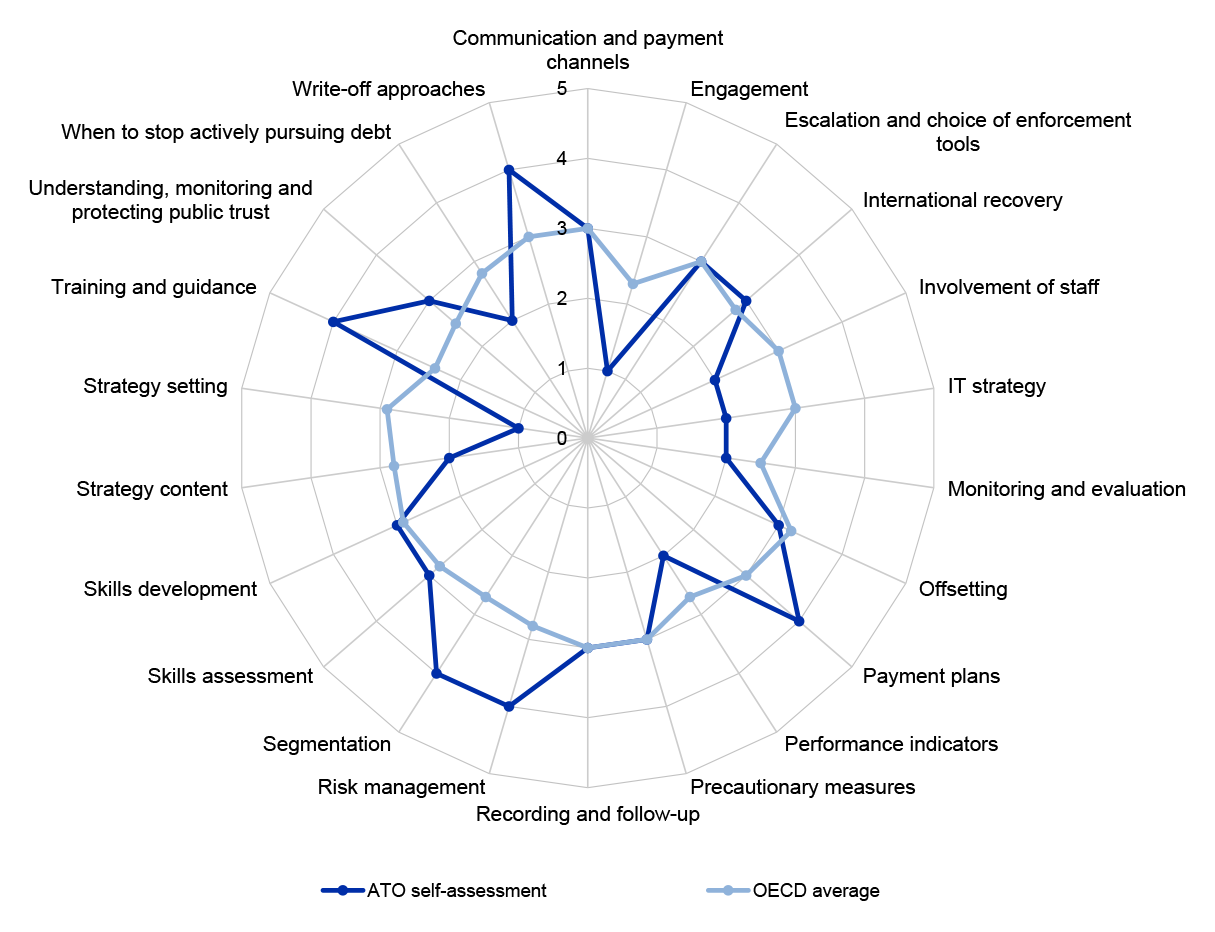
Source: ANAO analysis of ATO data.
3.12 In the 2025 edition of the model, the ATO provides multiple examples of better practice. The ATO’s Disclosure of Business Tax Debt and Director Penalties (see from paragraph 4.25) were examples of better practice in maximising collection before legal enforcement measures are taken, and the ATO’s Realistic Recovery strategy (see from paragraph 3.64) was identified as a better practice example in decision making on recoverability.
Has the ATO developed a strategy to engage with small business taxpayers with collectable debt?
The ATO has a broad engagement strategy for all taxpayers with debt. It does not have a specific engagement approach for small business. Aged debt continues to grow, making it less likely to be collected. The ATO seeks to engage with taxpayers primarily through SMS and letters. Direct taxpayer responses to SMS and letters have decreased over time. Financial resilience is assessed, and where taxpayers have the capacity to pay, the ATO offers various payment methods and encourages the use of payment plans. Taxpayer vulnerability is considered by the ATO. The ATO considers feedback from taxpayers to improve engagement. The ATO has largely implemented best practice principles when communicating to small business taxpayers with debt.
Engaging with small business taxpayers with debt
3.13 Effectively engaging with small business taxpayers who have collectable debt is required by the ATO. The ATO’s engagement strategy seeks to build trust, confidence and fairness and to ‘reassure the community’ that the ATO ‘target those who are doing the wrong thing.’ There is no discretion in legislation to allow the ATO to forgive or waive collectable debt73, including aged debt (see Figure 1.3), which continues to grow, making it less likely to be collected. The Minister for Finance can waive amounts owing to the Commonwealth.
3.14 The ATO has developed an engagement strategy for all taxpayers around their obligations and debt issues. The ATO does not have an engagement strategy specifically targeted at small business taxpayers with debt. In 2024, the External Engagement strategy: supporting the ATO Payment Strategy74 (Engagement Strategy) was developed to ‘ready the community’ for a faster approach to recovering tax. The strategy aims to shift payment culture to improve on time payment.
3.15 Figure 3.2 depicts payments made on time and in full across the four main client experiences that account for debt owed to the ATO between 2018–19 and 2024–25. It indicates that small business taxpayers are less likely to pay on time and in full than privately owned and wealthy groups and public and multinational businesses. Compared with individuals, small businesses have been less likely to pay on time and in full since 2021–22.
Figure 3.2: Payment on time and in full 2018–19 to 2024–25
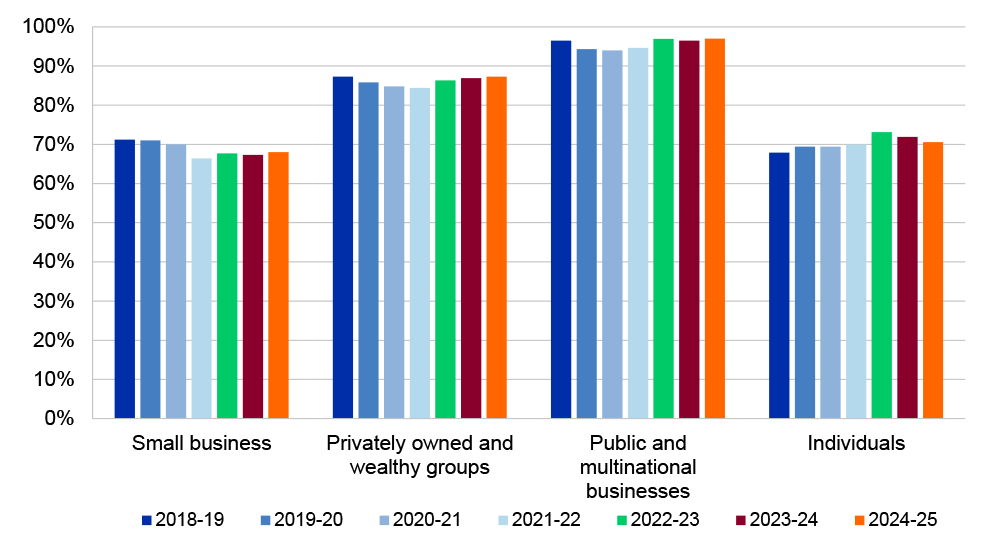
Source: ANAO analysis of ATO data.
3.16 Auditor-General Report No. 42 2018–19, Management of Small Business Tax Debt, found that 86 per cent of money owed by small business taxpayers to the ATO was paid on time or up to 90 days past the due date.75 Figure 3.3 depicts the same metric, illustrating a decline in performance from pre-COVID pandemic years from 86.3 per cent in 2018–19 to 83.0 per cent in 2024–25.
Figure 3.3: Small business payment on time, or up to 90 days past due date 2018–19 to 2024–25
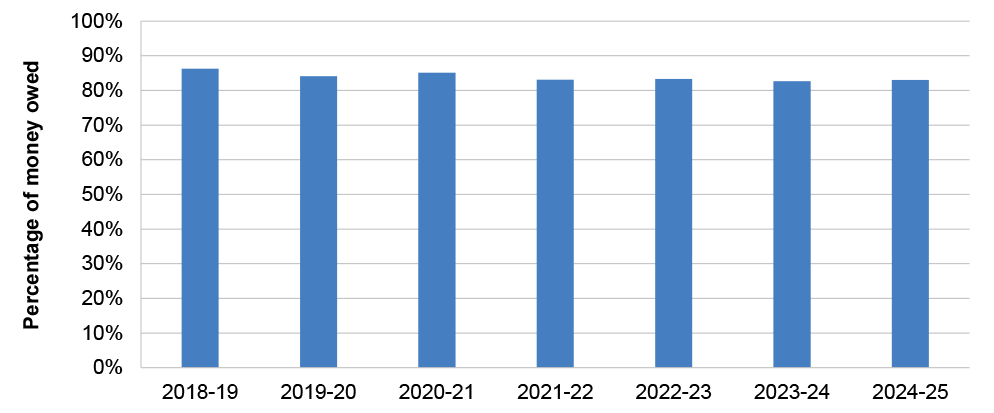
Source: ANAO analysis of ATO data.
3.17 Given the difference in payment and debt outcomes for small business taxpayers compared to those of other taxpayers (see Figure 1.2 and Figure 3.2), the decline in pre-COVID pandemic payment performance, and that small business constitutes 66.1 per cent of the ATO’s total debt book (see paragraph 1.4), there may be benefit in the ATO developing a specific engagement approach for small business taxpayer debt.
Opportunity for improvement
The Australian Taxation Office could develop an engagement approach specifically for small business taxpayers with debt to improve the ATO’s likelihood of recovering debt.
Engagement interactions
3.18 The ATO interacts with taxpayers via SMSs, letters76 and phone to encourage engagement from small business taxpayers with debt. Depending on the circumstances of the debt (such as a history of non-compliance), the ATO may also choose to take firmer actions (see from paragraph 3.90). There are 39,392 small business taxpayers without a reliable address indicator and that are not contactable by the ATO, as at 30 June 2025. If a taxpayer does not respond to requests to pay, the ATO may send a pre-referral warning letter to the taxpayer regarding the potential involvement of an external debt collection agency. This method of debt collection is known as a mercantile referral. Figure 3.4 depicts small business pre-referral warning letters and mercantile referrals between 2018–19 and 2024–25.
Figure 3.4: Small business pre-referral warning letters and mercantile referrals 2018–19a to 2024–25
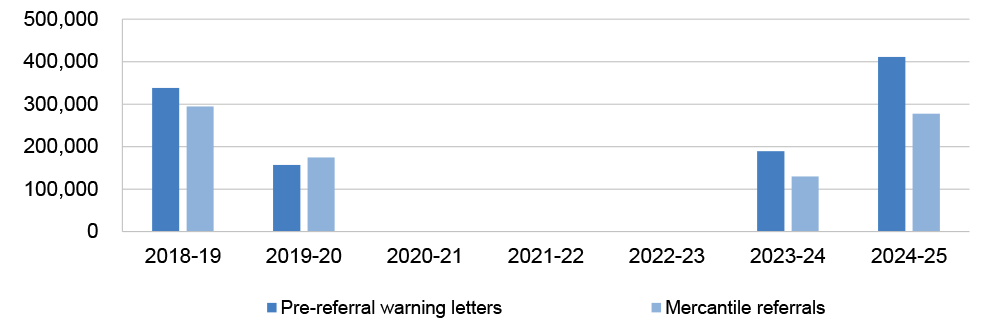
Note a: Figure includes data from 2018–19 to provide pre-COVID-19 pandemic context. Mercantile referrals exceeded pre-referral warning letters in 2019–20 as another letter type also referenced the possibility of a mercantile referral being conducted.
Pre-referral warning letters and mercantile referrals were not used between 2020–21 and 2022–23.
Source: ANAO analysis of ATO data.
3.19 Figure 3.5 depicts the ATO’s top interactions with taxpayers between 2020–21 and 2024–25. The ATO began sending ‘re-engagement’ letters77 to small business taxpayers with debt in 2020–21. All other ATO interactions regarding due dates, overdue payments, new debt and payments plans have increased between 2020–21 and 2024–25.
3.20 All SMS and letter templates are inspected and approved by ATO staff. SMS and letters are progressed through a set of systems, including an automated system. There is a limit to how many interactions can be sent each day by the ATO78, as it is dependent on the capacity of call centre staff to manage the volumes of inquiries generated by interactions.
Figure 3.5: Top interactions with taxpayersa 2020–21 to 2024–25
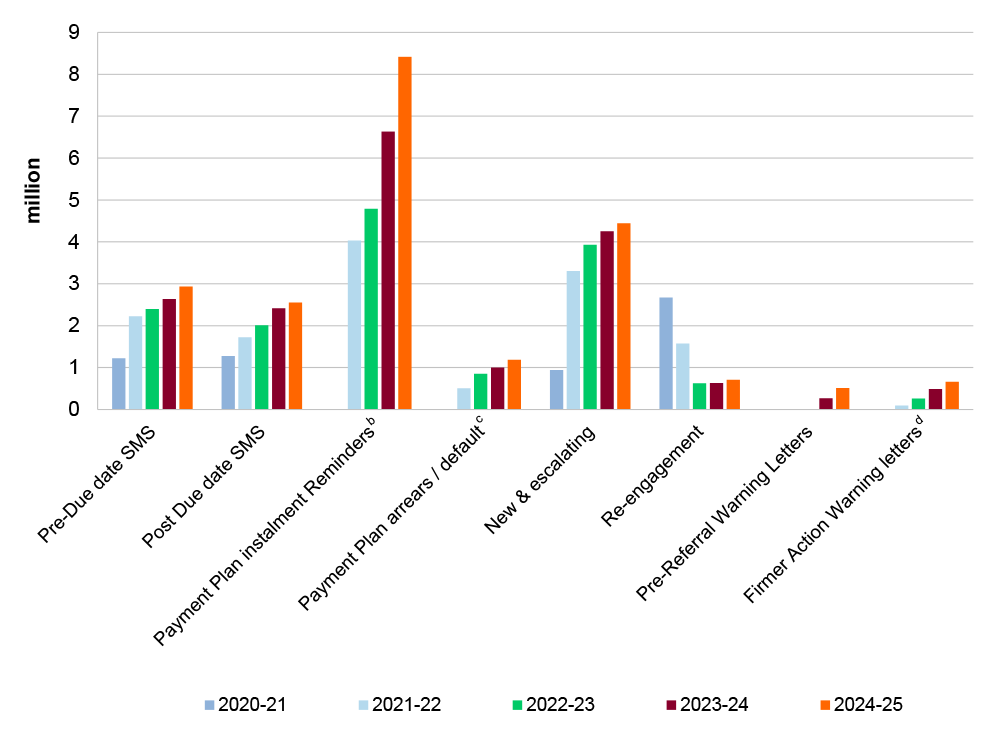
Note a: A small business taxpayer with debt may have more than one collectable debt owing, so a taxpayer can receive more than one interaction per interaction type.
Note b: Prior to December 2020, the ATO did not send Payment Plan instalment reminder letters to taxpayers.
Note c: The ATO developed Payment Plan arrears letters in December 2020. Letters were not sent until August 2021.
Note d: Orange letters sent to a taxpayer by the ATO are firmer action warning letters.
Source: ANAO analysis of ATO data.
SMS and letters
3.21 SMS is the primary method used to engage with small business taxpayers with debt prior to the due date, as well as five to ten days post-due date. ATO data indicates that as at 29 July 2025, 20 per cent of small business taxpayers with collectable debt did not have a valid mobile phone number registered with the ATO.
3.22 The ATO advised in September 2025, that engagement with small business taxpayers with debt is guided by data-driven collection mechanisms and Payment and Receivables Management (PRM) (see from paragraph 3.78).79 The only measure of effectiveness that enables assessment of taxpayer behaviour used by the ATO on outbound communication (SMS, letter, etc.) is based on how much debt is collected as a result of these interactions (see from paragraph 4.43). The ATO does not routinely examine response rates to its outbound communications.
3.23 The ATO has conducted analysis on average response rates of taxpayers who have received multiple communications. These have an average response rate of between six and 16 per cent. Between three and 18 per cent of recipients of blue or orange letters80 resolve their obligations following mailout. The ATO has reported that taxpayers ‘ignore SMS messages and letters’. The low response rates to these interactions suggests that the strategy of encouraging engagement by SMS and letters is of limited effectiveness. The ATO advised that the large ranges of response rates are due to the confidence intervals81 and small sample size.82 The ATO has the ability to analyse the behaviour of taxpayers in response to outbound interactions by determining whether the taxpayer contacted the ATO following the interaction (see from paragraph 4.51). Figure 3.6, Figure 3.7, and Figure 3.8 depict volumes of SMS, blue, and orange letters sent between 2018–19 and 2024–25.
Figure 3.6: Volumes of SMSs sent to small business taxpayers with debt 2018–19a to 2024–25
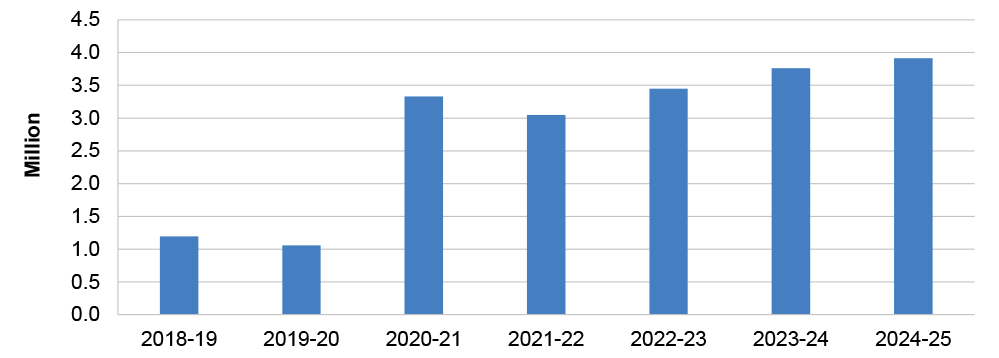
Note a: Figure includes data from 2018–19 to provide pre-COVID-19 pandemic context.
Source: ANAO analysis of ATO data.
Figure 3.7: Volumes of blue letters sent to small business taxpayers with debt 2018–19a to 2024–25
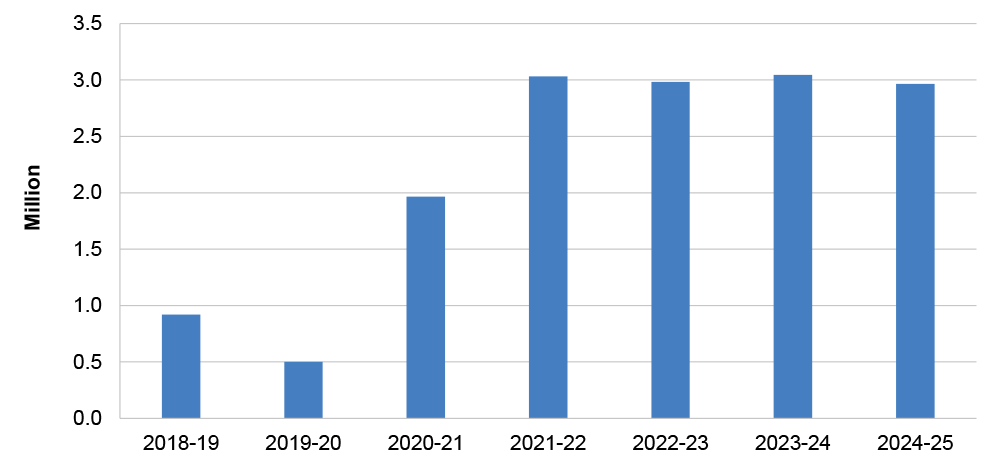
Note a: Figure includes data from 2018–19 to provide pre-COVID-19 pandemic context.
Source: ANAO analysis of ATO data.
Figure 3.8: Volumes of orange letters sent to small business taxpayers with debt 2018–19a to 2024–25
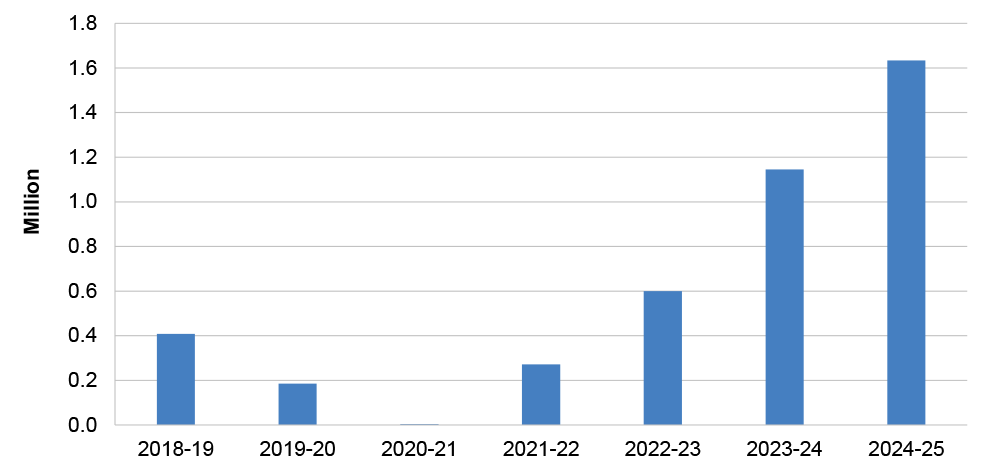
Note a: Figure includes data from 2018–19 to provide pre-COVID-19 pandemic context.
Source: ANAO analysis of ATO data.
3.24 Figure 3.9 depicts the response rates of taxpayers to orange letters from 2018–19 to 2024–25. It depicts a general decline in effectiveness from 2019–20 to 2024–25.
Figure 3.9: Response rates to orange letters 2018–19a to 2024–25b
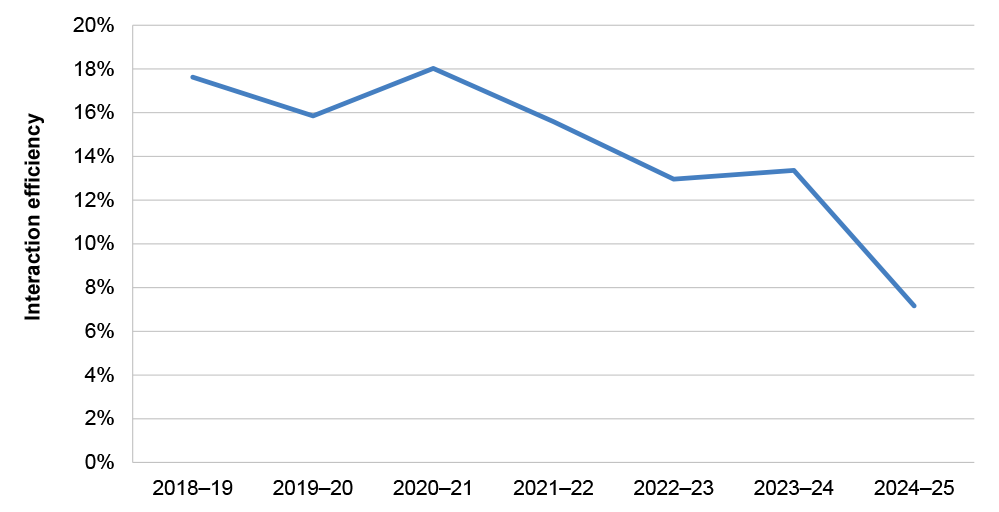
Note a: Figure includes data from 2018–19 to provide pre-COVID-19 pandemic context.
Note b: This figure does not include situations where a subsequent lodgment has extinguished a debt, part payments, payments made in full, or payment plans entered into online. Data relating to SMSs and blue letters was unable to be used for analysis due to quality reasons.
Source: ANAO analysis of ATO data.
3.25 The ATO has not conducted trend analysis of inbound communications from taxpayers to establish the effectiveness of different interactions and to assess taxpayer behaviour. Analysis of these trends, and developing the capacity to determine whether an outbound interaction has led to a partial or full payment, or entering into a payment plan would enable the ATO to better assess the effectiveness of its outbound interactions83 and to assess changes in taxpayer behaviour.
Recommendation no.4
3.26 The Australian Taxation Office review engagement with taxpayers with small business debt to determine the effectiveness of each form of interaction to assess taxpayer behaviour, and to inform its future small business debt approach.
Australian Taxation Office response: Agreed
Vulnerable small business taxpayers with debt
3.27 For those taxpayers who are unable to pay, the ATO has support available. Since the COVID-19 pandemic, the ATO has committed to providing support to vulnerable taxpayers who do not have the capacity to engage.
3.28 In August 2024, the ATO established an additional Support Hub84, to help taxpayers who find it difficult to engage, lodge or pay due to vulnerable circumstances. The ATO engaged with industry and peak bodies85 in September 2024 to discuss the increasing number of taxpayers presenting with a range of vulnerable circumstances, seeking access to support services since the COVID-19 pandemic.
3.29 The ATO sought feedback on the draft ATO vulnerability framework. The framework underwent public consultation and was published in October 2025.86 The ATO undertook to include flexible payment plan options for people experiencing vulnerability (factors other than financial hardship were a consideration) and the Commissioner of Taxation has committed to a series of actions to address this issue.87
Communicating payment options to taxpayers
3.30 The ATO website and blue and orange letters have information available to small business taxpayers on how to pay a debt with various payment methods available.88 Where small business taxpayers find it difficult to repay debt, taxpayers are encouraged to contact the ATO.89
Payment Plans
3.31 If a small business taxpayer cannot pay their debt upfront, they are encouraged by the ATO to set up a payment plan. As at 30 June 2025, the ATO advised the ANAO that there were over 1 million small business accounts without a payment plan.
3.32 The ATO assists taxpayers to estimate how much they can afford for a payment plan, and taxpayers can also utilise the payment plan estimator on its website.90 The estimator includes payment frequency, payment period of time, and an estimate of the General Interest Charge (GIC) that will accrue over the payment plan period. The ATO advised in November 2025, that it may offer 12-month interest-free payment plans to taxpayers provided they meet certain eligibility requirements.91 Table 3.1 illustrates a general decline in the number of small business concessional payment plans and the amount of remission of GIC concessional transactions between 2020–21 to 2024–25.
Table 3.1: Number of small business concessional payment plans and amount of remission of GIC concessional transactions: 2020–21 to 2024–25
|
Year |
Number of concessional payment plansa |
Amount of remission of GIC concessional transactionsb ($) |
|
2020–21 |
16,091 |
22,401,201 |
|
2021–22 |
8,684 |
18,828,383 |
|
2022–23 |
2,038 |
5,956,494 |
|
2023–24 |
297 |
572,117 |
|
2024–25 |
151 |
155,165 |
Note a: Number of GIC concessional payment plans granted is based on payment plans entered by staff for small business client experience only. These figures do not fully reconcile with Table 3.2 as this data is from an ATO Datawarehouse bespoke query conducted on 29 January 2026.
Note b: Data restricted to remission of GIC concessional amounts only. It does not include any GIC remitted as part of an automatic GIC remission thresholds.
Source: ANAO analysis based on information provided by the ATO.
3.33 A small business taxpayer with debt may have multiple payment plans. There is some flexibility in payment plan parameters (period and debt limits, however, taxpayers may only have one active payment plan at a time per account). Payment plans can be arranged online by self-service channels for amounts of $200,000 or less.92 Payment plans for debts above $200,000 need to be negotiated with the ATO. Taxpayers who have the capacity to pay via a payment plan are presented with an optimal payment and duration arrangement which can then be varied within ATO determined boundaries.
3.34 The ATO can analyse the financial eligibility scores of taxpayers on the likelihood they will complete a payment plan in two years. Taxpayers with the bottom 10 per cent of financial eligibility scores—those most unlikely to complete a payment plan—are prevented from creating a payment plan through the online self-service channels and are directed to call the ATO.
3.35 Table 3.2 illustrates that for the period 2020–21 to 2024–25, the number of payment plans approved increased. As at 30 June 2025, 32.9 per cent of accounts with debt were subject to an active payment plan.
Table 3.2: Payment plans for small business taxpayers: 2020–21 to 2024–25a
|
|
2020–21 |
2021–22 |
2022–23 |
2023–24 |
2024–25 |
|
Small business taxpayers with collectable debtb |
1,018,300 |
1,115,049 |
1,215,939 |
1,324,757 |
1,338,387 |
|
Payment plans granted/approved |
377,795 |
539,323 |
630,339 |
773,152 |
901,028 |
|
Active payment plansb |
214,538 |
326,460 |
318,079 |
385,138 |
440,609 |
|
Paid in full payment plans |
161,632 |
201,219 |
234,013 |
283,943 |
217,971 |
|
Concessional (GIC) payment plans grantedc |
16,702 |
8,923 |
2,090 |
309 |
151 |
Note a: A taxpayer can have more than one payment plan.
Note b: These figures are point in time as at 30 June each financial year.
Note c: Since 1 July 2025, taxpayers are unable to claim the GIC as a tax deduction.
Source: ANAO analysis based on information provided by the ATO.
General Interest Charge
3.36 If a debt remains unpaid, the ATO publicly states that it ‘may apply’ GIC93, or offset future refunds to cover the debt. For businesses that do not engage with the ATO about their circumstances or set up a payment plan, the ATO stated in its Engagement Strategy it will ‘move more quickly to firmer actions’, such as Director Penalty Notices (DPNs)94 and garnishee notices95 (see from paragraph 4.28).
3.37 The ATO advised the ANAO in November 2025:
The cost to collect small GIC amounts that have accrued on taxpayer accounts is high … [so] an automated remission process is in place that remits small GIC amounts at the time they are imposed. This means, that people with debts under a certain amount may have interest automatically remitted according to a set of business rules … it is widely known by the tax profession that small amounts of GIC are remitted and that debts under approximately $10,000 generally don’t attract GIC.
3.38 The ATO provides guidance for taxpayers about how to request a GIC remission on its website.96 The ATO automatically remits requests that meet a set of low-risk GIC remission criteria. Online applications are assessed using an automated function which checks against the criteria. Staff manually processing GIC remission requests use the same criteria. When all low-risk criteria are met, GIC remission requests are automatically processed and the taxpayer is advised.
3.39 Under the rules for automatic GIC remission, the ATO remits amounts that are under a daily threshold, under the minimum imposition remission amount, and under a small debit balance amount.
3.40 Table 3.3 outlines total collectable debt, total collectable GIC, GIC remissions, and the percentage of GIC remissions for small business granted between 2018–19 and 2024–25. It indicates that total collectable GIC continues to accrue, and is currently 2.7 times larger than it was in 2019–20.
3.41 High rates of GIC remission may provide incentives to taxpayers who have had GIC remitted to again enter into debt with the ATO with the expectation that once their circumstances improve and they are able to pay off the principal debt, the GIC will be remitted.
Table 3.3: Small business collectable debt, General Interest Charge and remissions granted, 2018–19a to 2024–25b,c
|
Year |
Collectable debt ($b) |
Collectable GIC ($b) |
GIC remissions ($b) |
GIC remissions granted |
GIC remissions granted (%) |
|
2018–19 |
16.5 |
N/A |
0.7 |
31,157 |
94.4 |
|
2019–20 |
21.4 |
2.4 |
0.9 |
28,990 |
94.0 |
|
2020–21 |
24.3 |
2.8 |
0.9 |
23,220 |
93.0 |
|
2021–22 |
29.3 |
3.4 |
0.9 |
29,761 |
93.3 |
|
2022–23 |
33.4 |
4.3 |
1.1 |
36,155 |
93.7 |
|
2023–24 |
35.2 |
5.6 |
1.3 |
44,901 |
86.7 |
|
2024–25 |
35.9 |
6.4 |
1.1 |
33,994 |
75.2 |
Note a: Table includes data from 2018–19 to provide pre-COVID-19 pandemic context, data on the small business component of total collectable GIC was not recorded until 2019–20.
Note b: GIC remissions ($b) includes all GIC remissions and is not limited to those requested by the taxpayer.
Note c: The ATO advised in May 2025 that the number of GIC remissions granted is derived from a bespoke query of Siebel activities using specified finalisation codes. As the data is sourced from activity records, its accuracy is dependent on consistent application of established procedures.
Source: ANAO analysis of ATO data.
Taxpayers who raise a dispute about a debit assessment
3.42 A taxpayer cannot dispute a debt; only an assessment made by the ATO can be disputed. The ATO website has information available for all taxpayers if they need to contact the ATO to dispute a debit assessment.
3.43 The ATO considers a tax-related liability that is subject to an objection, review or appeal of the tax assessment under the Taxation Administration Act 1953 (Part IVC) to be disputed debt. It includes both the disputed principal tax debt and related amounts. These amounts could also include GIC and penalties.97
3.44 If a small business taxpayer disputes a debit assessment, the ATO pauses debt collection activities for the taxpayer, where it does not represent a high risk. For larger value debt or higher risk taxpayers (that is, dissipation of assets, audit raised) these cases remain subject to case management. ATO staff are required to adhere to instructions provided to them.98 During 2024–25 there were 4,271 small business taxpayers who had a debt and an active dispute.
Best practice principles for notifying people about debt
3.45 Following the ANAO’s finding99 that the ATO was not treating debts considered to be uneconomical to pursue in accordance with the law100, the ATO conducted a ‘debt awareness campaign’101 as part of a 2023–24 engagement strategy.
3.46 In November 2023, the ATO paused its debt awareness campaign with a media release issued on 28 November 2023102, stating that the ATO:
- would review the overall approach on how to communicate about debts on hold;
- wanted to ensure people had full visibility of their existing debts, where collection had been put on hold;
- issued a reminder about existing debts but did not require payment;
- accepted the communication approach caused unnecessary distress; and
- confirmed that no further action was required by anyone who has received a letter.
3.47 The ATO’s strategy to engage with taxpayers during this debt awareness campaign was used as a case study in the Commonwealth Ombudsman, ACT Ombudsman, Inspector General of Taxation and Taxation Ombudsman103 (the Ombudsmen), How to tell people they owe the government money: Best practice principles for notifying people about debts.
3.48 The Ombudsmen reported:
The ATO sent around 200,000 letters advising people they owed tax debts, ranging from a few cents to thousands of dollars. At the time, ATO systems did not display taxpayer debts which had been ‘’written off’’ — deemed uneconomical to pursue. People reported the letters did not explain how or when debts were incurred, causing concern and confusion about their validity. The age of some debts made it difficult to verify or indeed challenge them, as people no longer held relevant records. In response to community concerns, the ATO stopped sending the debt letters and undertook to review its approach to communicating with people.
It is disappointing this occurred. Such issues may have been mitigated if the ATO had regard to the lessons previously learnt … Agencies should have regard to current and past observations and recommendations of oversight bodies. Don’t just re-commit past failings! The community is entitled to expect agencies have a corporate memory.104
3.49 The Ombudsmen outlined five best practice principles in notifying people of a debt (see paragraph 1.29).
3.50 In a media release of 26 March 2024, the ATO made a commitment to apply the principles outlined in the Ombudsmen’s report.
3.51 The ATO advised the ANAO in August 2025 that it had undertaken activities in response to the Ombudsmen’s report to improve communications about debt. It advised that all bulk debt communications have clear instructions and headings on what taxpayers owe; explain what actions are required; and provide clear instructions on how to pay and the options available. The ATO stated that external communications and web content use accessible language and consider readability; web content is reviewed regularly; and clear information is provided on the ‘ATO Community’105 website.
3.52 As at August 2025, the ATO had not updated the ‘broader suite of debt letters’. The ATO advised the ANAO in November 2025 that training guidelines had been updated in April 2024, but did not incorporate the principles.
Opportunity for improvement
3.53 The ATO could consider incorporating the best practice principles outlined in How to tell people they owe the government money: Best practice principles for notifying people about debts in training and reference materials for staff, and across all forms of debt letters.
Taxpayer feedback
3.54 There is no dedicated feedback mechanism specifically for small business taxpayers with collectable debt. The ATO advised the ANAO in August 2025, that ‘feedback is captured more broadly through existing communication and engagement channels’, including surveys, consultations forums, and stakeholder engagement activities.’
3.55 The ATO tracks complaints106 relating to small business taxpayer debt. The ATO advised the ANAO in July 2025 that it receives complaints, including but not limited to, the following debt issues: GIC Remission; payment plans; PAYG Instalments; overdue liabilities; and insolvency. Figure 3.10 depicts an increasing trend in the number of complaints received about small business taxpayer debt from the fourth quarter of 2021–22 to 2024–25. This is consistent with the increase in debt collection activities.
Figure 3.10: Complaints about small business taxpayer debt from the fourth quarter of 2021–22 to 2024–25
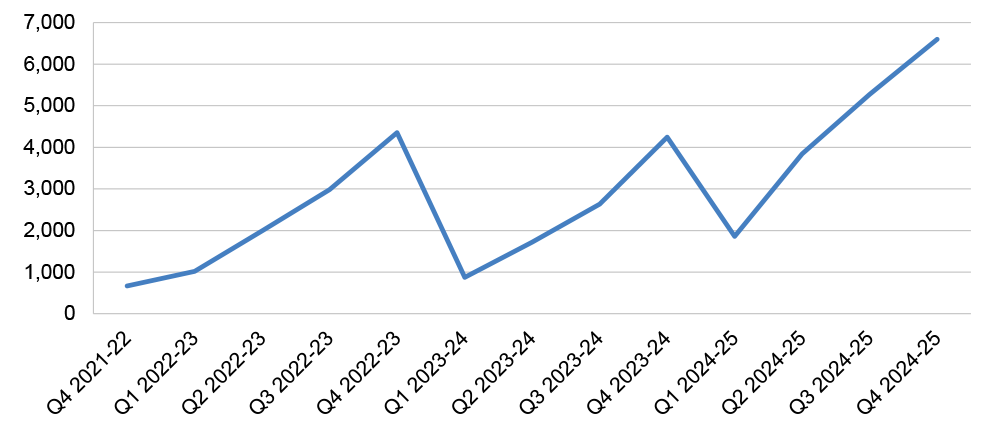
Note: The ATO only commenced collection of this data from the fourth quarter of 2021–22.
Source: ANAO analysis of ATO data.
3.56 ATO staff monitor feedback from all taxpayers and a Business Improvement Register is maintained to collate information and implement improvements where needed.
3.57 Between 2020–21 and 2024–25 the ATO implemented improvements based on feedback relevant to the engagement of small business taxpayers with debt:
- updating guidance and forms in relation to payment plans;
- providing website guidance to include the ‘Money Smart Budget Planner’ to assist taxpayers when applying for payment plans;
- creating a payment plan request form107, with scope to enhance this for remission requests;
- advising eligible taxpayers that payment plans can be modified online108; and
- streamlining processes for staff so they can enter payment plans for all debt types.109
Has the ATO developed a strategy to effectively collect small business taxpayer debt?
The ATO applies a whole-of-debt collection strategy for all taxpayers. The current strategy, implemented in 2024, is the Payment Strategy, a key aspect of which is segmentation to enable priority taxpayers to be identified for firmer debt collection activities. Implementation of segmentation by the ATO was underway as at February 2026.
Key strategies
3.58 The ATO’s current strategy for managing taxpayer debt is the whole-of-debt Payment Strategy. The Payment Strategy was ‘defined’ in 2024, initially focusing on:
- client prioritisation and segmentation;
- data and analytics driven; and
- operational excellence.
3.59 Segmentation was one of six priority workstreams of the Lodge and Pay (LAP) Reset (see paragraph 3.8).110 The purpose of segmentation is to identify priority taxpayer segments for the ATO to apply ‘faster and firmer debt collection action’. The priority segments are high value debts, Pay As You Go Withholding (PAYGW) and GST, Superannuation Guarantee Charge (SGC), and fraud debts. The segmentation implementation timeline had three phases; phase one in 2023 was to establish the segmentation framework, phase two in 2024 was to deliver iterative system and process changes, and phase three in 2025 and onwards is to deliver full segmentation implementation. A Segmentation Framework was endorsed on 19 January 2024. As at February 2026, phase 3 implementation is ongoing.
3.60 The ATO assigns taxpayers to segments based on segmentation rules.111
- Taxpayers can only be in one segment at any given time.
- Taxpayers must have collectable debt over $100 to be allocated into one of the segments.
- A taxpayer’s segment will depend on which type of debt they have in the order of Super Guarantee Charge Debt followed by PAYGW or GST followed by High Value Debt. Capacity to pay segments are dependent on age of debt and Financial Resilience Insights (FRI) score.112
- A taxpayer’s debt can be categorised as either self-assessed or Commissioner-assessed, depending on whichever amount is greater.
3.61 As of May 2025, taxpayers with PAYGW or GST debt are the segment of small business taxpayers with the largest proportion of the overall debt book. This segment comprised 31.83 per cent of the ATO’s overall debt with $17.3 billion in debt.113
3.62 The ATO advised the ANAO in June 2025 that segmentation was partially implemented. Pilots testing firmer and faster approaches for priority segments began in August 2024.
Lodge and Pay Realistic Recovery strategy
3.63 In alignment with the OECD’s Successful Tax Debt Management: Measuring Maturity and Supporting Change strategic principle four (see paragraph 3.8), ATO developed the LAP Realistic Recovery strategy in 2022–23.114 The strategic principles were:
- help and assist;
- enhanced engagement;
- escalated actions; and
- realistic recovery.
3.64 The four priority areas of the Realistic Recovery strategy were analytical model-driven bulk non-pursuit (BNP), manual non-pursuit actioned by individual staff, deregistered companies and doubtfully registered entities, and account remediation and general housekeeping. This is done by two BNP processes. One process classifies debt as uneconomical to pursue, pausing proactive collection and recovery plans. A second process non-pursues debts owed by deregistered companies as irrecoverable at law.
3.65 The ATO identified enhancing the BNP process as a key element of the Realistic Recovery strategy. The trigger for this priority was to align with best practice taxation management as outlined by the OECD Tax Debt Management Maturity Model. The ATO has $11.2 billion of small business debt classified as non-pursued as at 30 June 2025.
3.66 Debts classified as uneconomic to pursue are subject to offsetting required at law (see paragraph 3.71).115 Decisions to treat debt as non-pursuable are guided by Practice Statement Law Administration 2011/17 Debt relief, waiver and non-pursuit.116 The ATO uses data and analytics to derive a base population. Data focuses on specific behavioural characteristics including:
- Financial Resilience Insight score — a holistic view of a taxpayer’s financial resilience at any given point in time;
- Firmer Action Warning Letter score — Payment and Receivables Management (PRM) (see from paragraph 3.78) insights to classify a taxpayer’s likelihood of debt reduction following a firmer or stronger action within 90 days;
- Financial Distress score — determines a taxpayer’s financial circumstances and most relevant attributes to provide a prediction of a taxpayer’s likelihood of experiencing financial distress within the next two years;
- Debt Danger Range score — determines a taxpayer’s overdue and predicted debt position when compared to similar taxpayers; and
- Payment Plan score — determines a taxpayer’s likelihood of completing a payment plan over a 24-month period.
3.67 Exclusionary business rules are applied after filtering the base population through the analytical models. As at April 2024, there were 23 business rules in use. The post-exclusion rules output is put through a quality assurance process and final check, and a request for processing is then placed. Where taxpayer circumstances change including insolvency, preventing an incorrect refund, and where there is new evidence that recovery action is now viable, the ATO may perform a review to determine the most appropriate recovery action.
3.68 For deceased taxpayers there is an alternative treatment pathway. This pathway delivers an activity to staff to take appropriate action including non-pursuit, letters to estates, and ‘alternative pathways.’
External collection agencies
3.69 The ATO ceased using External Collection Agencies (ECAs) during the COVID-19 pandemic starting in March 2020. In June 2022 the ATO created a strategy to resume using ECAs. The use of ECAs was outlined as supporting the strategic principles of ‘help and assist’ and ‘enhanced engagement’ of the LAP strategy. ECA supports the ATO in managing the existing debt stock with timely and tailored actions, optimise the ATO’s systems and resources, and delivering on Government commitments and community expectations. This strategy had two stages.
- Use of an insource ECA arrangement for six months, using ATO branding and existing campaigns which will allow a direct comparison between internal and external outcomes.
- Establish a more traditional offsite ECA arrangement, using their own branding and processes which will test the effectiveness of external best practice, within the scope of ATO requirements and values.
3.70 Insource ECA was deployed in August 2022 and offsite ECA was deployed in October 2022. In 2024–25 insource ECAs contributed $2.54 billion in balance reductions and had a payment conversion rate of 7.7 per cent from 509,000 calls. Offsite ECAs referred 222,597 cases for debt with a total value of $2.26 billion, and contributed $668 million in balance reduction in 2024–25.
Offsetting
3.71 The ATO is required at law to offset refunds and credits against debts. Debts placed on hold before 2017 are not subject to offsetting pending proposed law change. The ATO paused offsetting in response to a system issue in January 2020, and a decision was made to leave the offsetting functionality switched off in March 2020 in response to the COVID-19 pandemic. This pause was performed using the Commissioner’s power to defer recovery action under the Taxation Administration Act 1953 (paragraph 8AAZL(3)(c)). The ATO resumed offsetting in June 2022.
3.72 Exclusionary criteria are applied to the offsetting process, preventing offsetting in circumstances where the exclusionary criteria are not met. In June 2022 the ATO reinstated the exclusionary criteria used before the COVID-19 pandemic pause. These criteria were:
- date the debt was placed on hold is on or after 1 January 2017;
- amount of debt placed on hold is $2,500 or greater;
- amount of credit available to offset is $1,600 or greater;
- applicable only to individuals — individual age is less than 70; and
- applicable only to individuals — individual taxable income or loss is $50,000 or more on the latest of the last two financial year tax returns.
3.73 As a result, debts that did not meet the criteria were excluded from offsetting. In December 2022 the ATO removed the two criteria applicable to individuals only. In June 2023 the ATO removed both value related exclusionary criteria.
3.74 Pre-2017 debts on hold were debts placed on hold starting before 2008 with more debts being placed on hold each subsequent year until 2017. As at 30 June 2025, there is a total of 1,087,006 taxpayers with pre-2017 debts on hold paused from offsetting, worth approximately $6.8 billion. This process is enacted through a temporary deferral.
3.75 In the 2024 financial year there was an increase in both the number of taxpayers having credits offset from 12,679 as at 30 June 2023 to 68,450 as at 30 June 2024, and the total value of offsets each year from $65.7 million to $119.7 million. The value of the average offset per taxpayer decreased in 2024 from 2023. The ATO attributes this to lower-value credits and debts on hold that were previously excluded from offsetting.
Egregious behaviour
3.76 The ATO commenced an egregious taxpayer117 pilot program starting in October 2024 and ending in June 2025. As at 20 January 2025, 34 per cent of the taxpayer pilot population engaged following initial interactions. As at 5 September 2025, the egregious taxpayer pilot had not been finalised.
Debt management approach
3.77 The ATO does not have a small business specific debt management approach. The ATO uses multiple interacting platforms, systems and processes for: identifying and selecting candidate taxpayers with likely or actual debt and assigning appropriate next actions; prioritising and regulating the distribution of cases to staff for treatment, based on the ATO’s business needs and capacity to action them; and actioning treatments, including issuing automated debt interactions—such as SMSs and letters—and delivering taxpayers with debt to frontline staff to undertake firmer and stronger recovery activities.
Identifying and selecting candidate taxpayers and assigning appropriate next actions
3.78 Since January 2020, the ATO has implemented its debt strategies via its debt management system, Payment and Receivables Management (PRM) and the Next Best Action (NBA) Framework. PRM and NBA enable the ATO to identify and select candidate taxpayers for a range of debt-related treatments and determine the most appropriate action for selected taxpayers.
3.79 Each day, PRM runs across all taxpayers with upcoming liabilities or tax debts to identify candidate taxpayers for appropriate debt activities. PRM selects taxpayers for debt-related actions in five streams:
- Stream 1 — Pre and post due date SMS;
- Stream 2 — Purposeful action for new liabilities;
- Stream 3 — Differentiated payment plan service;
- Stream 4 — Outcome analytics; and
- Stream 5 — Client behaviour prediction.
3.80 Table 3.4 shows the average number of candidate taxpayers selected by PRM stream per day overall and for small business.
Table 3.4: Average number of candidate taxpayers selected by Payment and Receivables Management by stream per day
|
Stream |
Total average per day |
Total small business average per daya |
Small business as percentage of total (%) |
|
Stream 1 — Pre and post due date SMS |
22,652 |
14,533 |
64.16 |
|
Stream 2 — Purposeful action for new liabilities |
17,480 |
9,462 |
54.13 |
|
Stream 3 — Differentiated payment plan service
|
2,367 10,096 |
1,551 6,973 |
65.51 69.07 |
|
Stream 4 — Outcome analytics
|
2,483 318 |
1,585 227 |
63.85 71.32 |
|
Stream 5 — Client behaviour predictionc |
N/A |
N/A |
57.00d |
Note a: The ATO advised in February 2026 that numbers provided for small business were estimates based on data as at 28 January 2026 as information is not retained at the point of treatment.
Note b: Firmer/Stronger action activities include Client Solutions Activities and Tailored Outcome Activities.
Note c: Stream 5 scores all taxpayers with debt. The total scored population for the 12 months to 28 January 2026 was 20,138,671. The ATO advised in February 2026 that it could not provide total average per day or total small business average per day for Stream 5.
Note d: The ATO advised in February 2026 that small business comprises 57 per cent of the total scored population across the previous 12 months.
Source: ANAO analysis based on information provided by the ATO.
3.81 Streams comprise triggers, and business rules and can have one or more analytic or machine-learning models.118
- Triggers identify events or conditions which must be met for a candidate to be selected for a stream.
- Business rules exclude taxpayers meeting specified conditions (for example, if a taxpayer is deceased, in a natural disaster area, or has debt less than $100).
- Analytic or machine learning models make predictions about taxpayer behaviour and the likely effectiveness of a treatment based on statistical properties of the population (further information on PRM’s analytic models is discussed from paragraph 4.5).
3.82 Models progress from early interventions to stronger actions.
3.83 Figure 3.11 depicts a simplified pathway for a taxpayer with debt who does not pay their liabilities, either in full or by entering a payment plan, or engage with the ATO. For simplicity, Stream 3, which relates to payment plans (see from paragraph 3.31), has been excluded.
Figure 3.11: Simplified engagement pathway for a non-paying taxpayer with debta,b
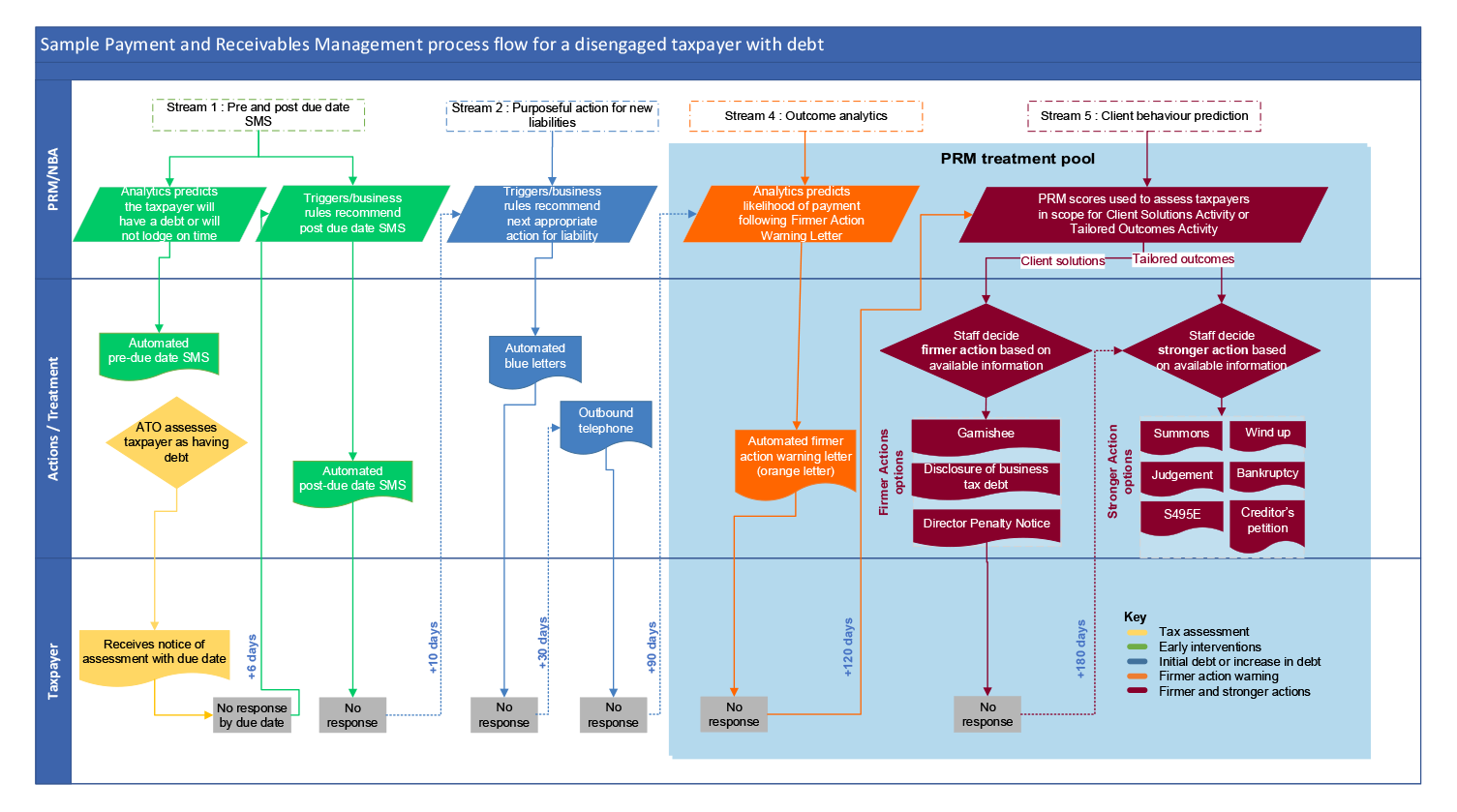
Note a: Timeframes are indicative and assume highest prioritisation and no disruption to debt recovery actions such as payment plans or pauses due to disasters, etc.
Note b: An ‘s459E’ notice is a creditor’s statutory demand on a company for payment of debt, made under section 459E of the Corporations Act 2001, available from: https://www.legislation.gov.au/C2004A00818/latest/text/2 [accessed 5 May 2025].
Source: ANAO analysis of ATO documentation.
3.84 The ATO advised the ANAO in September 2025 that the timeframes between debt interactions are not determined by policy or practice guidance.119 Timeframes take into consideration:
- the payment behaviour of the taxpayer (additional non-payment events can result in additional interactions);
- system processing times of payments;
- the cost and timeliness of interactions;
- resourcing constraints (including expected inbound interactions as a result of outbound interactions, also staff skilling and availability); and
- likely outcomes and response times based on historic data.
3.85 The ATO also advised that timeframes are estimates and do not apply to all treatment pathways. The ATO’s Practice Statement Law Administration PS LA 2011/18 Enforcement measures used for the collection and recovery of tax-related liabilities and other amounts states that: ‘there is no legislative requirement for us to issue a final demand or similar notice prior to the start of collection activity’.120
Prioritising and regulating the release of taxpayers for treatment
3.86 PRM produces a list of taxpayers for further processing in a separate platform, Candidate Aggregation, Selection and Processing (CASP).121 CASP loads the list for each PRM stream and checks another system for the next best action for each taxpayer—automated, manual or no action.
3.87 For taxpayers selected for automated and manual actions, CASP applies ordered rules to prioritise their release for processing. Automated actions are sent to Outbound—the ATO’s automated system for sending SMS and letters. Cases requiring manual action are sent to staff via intelligent Workload Distribution (iWD), the ATO’s workload management system for allocating cases to ATO staff, and Siebel, the ATO’s case management platform.
3.88 CASP regulates the release of taxpayers according to downstream systems’ limits and the ATO’s operational capacity to action treatments. ATO staff can configure CASP rules to filter and prioritise which candidates are sent for actioning, and the timing. Each taxpayer is scheduled for release, with taxpayers automatically scheduled evenly across the timeframe specified in the rule to reduce burden on downstream systems.
Actioning treatments
3.89 Following release from CASP, automated treatments are scheduled for release from Outbound. Letter and SMS quantities are planned in advance. The staggered release of SMSs and letters are used by the ATO to manage the inbound phone calls the ATO’s call centres may receive in response.
3.90 Taxpayers who have not responded to early engagement actions may be selected by PRM/NBA analytics for firmer and stronger actions. These taxpayers receive an automated Firmer Action Warning Letter (FAWL) and enter the ‘Firmer Action pool’. PRM scores in Streams 4 and 5 are used to assess whether taxpayers will be in scope for a Client Solutions Activity (CSA) or Tailored Outcomes Activity (TOA). CSAs typically involve the pursuit of debt collections whereas TOAs involve legal actions, such as insolvency.
3.91 For taxpayers selected for manual treatment, CASP releases cases to ATO staff via iWD, which prioritises and allocates work to the next available staff member with appropriate skills. Skill sets are determined by the work a staff member is trained to action.
3.92 The number of ATO staff with at least one active debt-related skill is set out in Table 3.5.
Table 3.5: Staff with debt-related skills
|
Datea |
No. of staff |
|
20 October 2022 |
835 |
|
30 June 2023 |
599 |
|
3 December 2024 |
874 |
|
27 October 2025 |
770 |
Note a: Data is only available on a point in time basis, it is not recorded for each financial year.
Source: ANAO analysis of ATO data.
3.93 Information about taxpayers is displayed in the ATO’s Enterprise Client Profile (ECP) to assist staff to decide on appropriate treatments and tailor their interactions to the taxpayer’s circumstances. Information displayed includes demographics, the taxpayer’s compliance history, circumstances, behaviours and risks. ECP also includes information about taxpayer’s financial resilience and segmentation category (see paragraph 3.60). Information from PRM Stream 4 predictive models on the likelihood of a particular stronger action being effective were available to assist staff in decision-making from 2022 until removed in June 2025 due to model performance issues identified in retraining (see paragraph 4.18).
3.94 Taxpayers’ potential eligibility is assessed daily until a treatment is executed. Taxpayers who are not released from CASP for treatments are ‘recycled’ and are again available to be selected as candidates in the next run. Taxpayers can keep being recycled until the conditions for selection are no longer met.
4. Application of the ATO’s strategic framework to manage small business collectable debt
Areas examined
This chapter examines whether the Australian Taxation Office (ATO) effectively applies its strategic framework to manage small business collectable debt.
Conclusion
The ATO’s application of its strategic framework is partly effective. The ATO effectively identifies taxpayers with debt, issues automated communications about debts, and identifies taxpayers for firmer and stronger actions. Inaccurate unit costs are used to determine cost effectiveness, meaning the ATO is unable to distinguish between firmer and stronger debt recovery actions. Resource prioritisation by the ATO results in a small proportion of all taxpayer groups (not just small businesses) identified for firmer and stronger actions directed to staff to progress. This limits the ATO’s effectiveness. Effectiveness is further reduced by not measuring how efficiently taxpayer debt is being recovered.
Area/s for improvement
The ANAO made four recommendations relating to: improving processes for monitoring and retraining PRM machine-learning models, establishing business-level benchmarks and performance measures, developing a data reporting approach to enable understanding of whether debts are moving through the treatment pathway efficiently, and revising unit costs, including the use of external collection agencies, to accurately reflect actual costs of firmer actions.
The ANAO also suggested that the ATO could develop a consistent format for operational plans relating to debt risk and recovery, incorporating measures such as total debt reduction, average debt reduction and average handling time.
4.1 The ATO’s corporate plan 2025–26122 identifies the following key activity: ‘Collect the right amount of tax in the most efficient way for government and the taxpayer’. Appropriate identification of taxpayers with debt and efficient collection of tax debt is required to ensure that debt collection is efficient for both the government and the taxpayer.
Does the ATO effectively monitor taxpayers with small business debt, and select taxpayers for further action?
The ATO monitors taxpayers with debt and selects which debts to action using its analytic or machine-learning models, risk-based triggers, and defined business rules. It does not prioritise small business taxpayers with debt over other taxpayers.
The ATO has processes for assessing and reviewing analytic models, including business verification processes, data and ethics assessment processes, and internal audits and reviews. When models were retrained in 2025, verification tests showed there had been a decline in performance over time. The ATO’s retraining schedule for analytic models, proposed in 2020, was not met until late in 2024. The ATO paused its firmer and stronger debt collection activities during the COVID-19 pandemic, which deprived the machine-learning models of up-to-date data.
As at September 2025, the ATO did not have a monitoring model in place and ceased monitoring model performance in June 2025.
Using data and analytics to select debts to action
4.2 The ATO’s Practice Statement Law Administration PS LA 2011/6 Risk management in the enforcement of lodgement obligations and debt collection activities states that:
we are not resourced to chase every last dollar of revenue payable under the law. This means that we are required to make intelligent choices about what compliance risks will be addressed, how such risks will be addressed and where to best apply available resources.123
4.3 The ATO stated that where there is no active pursuit of a taxpayer with debt, the ‘baseline consequence’ is the accrual of interest via the General Interest Charge (GIC).124
4.4 In relation to debts that are uneconomical to pursue and the bulk non pursuit (BNP) process (see from paragraph 3.64), the ATO advised that:
Improvements to the ongoing visibility of debts once they are placed on hold has been a focus in recent years and is expected to ensure taxpayers retain an awareness of these debts and the need to pay – with GIC applied as normal.
PRM models
4.5 The ATO’s Payment and Receivables Management (PRM) system includes the use of triggers, business rules, and analytic or machine learning models to select which debts to action, with the aim of maximising collections, reducing debt and improving payments on time.
4.6 The ATO deployed PRM in January 2020 as a new approach to managing taxpayer debt. The ATO described PRM as enabling the ATO to tailor the debt collection approach to the taxpayer by recognising specific situations, assessing them using data analytics and business rules, and take action (whether automatic, manual or do nothing). PRM uses data and analytics to:
- identify triggers, such as events or changes in circumstances for taxpayers;
- initiate automated actions, such as nudges, reminders and prompts;
- predict the likely effectiveness of actions;
- optimise payment plans; and
- provide information to assist debt-recovery staff’s decision-making.
4.7 PRM includes a suite of analytic or machine learning models. In a data ethics assessment in 2023, the ATO described machine learning models in PRM:
The machine learning models are complex models, and any one prediction made by the model is based on statistical properties of the population, and is most often not easily understood by a human.
The machine learning models are mostly tree-based models, which means they have a medium level of complexity/interpretability. We have some idea about which client attributes are used to split clients into different catogories (e.g. high risk/low risk) in general, but cannot say for an individual clients, which client attribute was most influential in determining their final risk score.
A mitigating factor is that they are mostly supervised125 models, which means we have used previous treatment results as labels to train the model. This means the model is informed by historical results, and so long as the model “aligns” with the actual outcomes we have assurance that the complex model is behaving as expected.
4.8 When PRM was deployed, there were initially 13 machine learning models. As at 30 June 2025, there were eight models in use (further information about PRM models is provided in Appendix 3).
4.9 Models progress from early interventions to stronger actions. As such, the eligible pool of taxpayers with debt narrows progressively, focusing in on taxpayers who have not responded to early engagement measures or who have been identified as high-risk for other reasons. Of the models in use at 30 June 2025, five were corrective controls, and three were preventative controls. Models generate output scores, with thresholds then used to select candidate taxpayers for treatment (see Appendix 3).126
4.10 Machine learning model scores are one input in the overall process of treatment. Business rules (see paragraph 3.81) exclude taxpayers meeting specified conditions such as not having a mobile telephone number recorded for an SMS, being impacted by a natural disaster, not reaching analytic thresholds, operational capacity, or other business indicators.
Automation and human oversight
4.11 There are different levels of automation and human oversight across the models and debt actions. Earlier models in the process initiate automated treatments. For example, model 1.1 initiates nudge SMS messages to be sent directly to eligible taxpayers, ‘without human intervention’ or oversight. Humans are involved in capacity management of the number of SMSs released from Candidate Aggregation, Selection and Processing (CASP). For models 3.1 Financial Eligibility Model and Optimal Controls, the automated aspects are taxpayers’ ability to generate their own payment plan via self-service channels and providing the optimal and lower bound payment plan within ATO determined bounds.
4.12 For later models, the automated aspect is the scoring and ranking of candidate taxpayers for delivery to staff and the information that is available to staff in the user interface for decision-making. Staff review business rules and the outputs of models, such as information about the taxpayer’s financial resilience, before deciding to apply debt recovery actions.
PRM review processes
4.13 The ATO has processes for assessing and reviewing PRM models, including business verification processes, data and analytic ethics assessment processes, and internal audits and reviews.
- Before deploying PRM analytic models, the ATO undertook business verification processes, including documenting the business need for each aspect of PRM, model validation, and user and production testing. ATO documents described business verification processes as involving the comparison of a prediction before an event or action with the end result. The ATO used a ‘champion-challenger modelling scenario’ to compare, test and select the machine learning algorithms.
- ATO staff are required to complete a Data and Analytics Ethics Assessment for all new or significantly changed projects or data activities.127 Data and analytics ethics assessments were completed for PRM in 2023 (covering all 13 models) and 2025 (covering eight models still in use).
- ATO analysis of the performance of PRM 4.1 models for garnishees, DPNs, s459E notices and summonses in December 2021 found that the four models were not performing to the ATO’s expected levels for predicting debt reduction and were therefore not appropriate for candidate selection. Analysis also identified that the Firmer Action Warning Letter (FAWL), which was not being used in candidate selection, was more accurate in predicting debt reduction. The ATO discontinued using the four individual PRM 4.1 models in candidate selection in July 2022.
- An internal audit in 2022 examining the ATO’s firmer and stronger action case selection process by PRM concluded that procedural and administrative arrangements were sound, but there was an opportunity to use data more coherently ‘to drive end-to-end effectiveness and efficiency’.
- A review of PRM models 4.1, 5.1 and 5.2 was undertaken by Deloitte in 2023 to support the recommendations of the internal audit findings.128
- An internal audit report in 2025 examined the Payment Strategy Pilot and concluded the pilot’s design was partially effective as it did not enable effective evaluation of its performance. This included a lack of established timeframes that made it difficult to assess whether pilot treatments resulted in faster escalation of firmer actions, and a lack of specific performance measures to demonstrate the success of the pilot.
Model retraining
4.14 When PRM was deployed in 2020, the ATO identified the need for models to be retrained after deployment to minimise model ‘drift’—changes in a model’s predictive power over time. The effectiveness of PRM models relies on their predictive powers. The ATO set out the initial training dates for the models and the required dates for retraining, ranging from 3 days for model 1.1 to two years for model 3.1 and 5.2 (see Appendix 3).
4.15 Following their deployment, analytic models were not retrained until late 2024. The ATO stated that suggested retraining schedules for PRM were not met ‘due to COVID-19 constraints and competing business priorities’. The ATO paused its firmer and stronger debt collection activities during the COVID-19 pandemic which ‘deprived PRM’s machine-learning models with up-to-date data’.
4.16 The impact of not retraining the models was degradation over time. The ATO stated in August 2024:
Predictions found within the PRM scoring models showed a decline in PRM model performance, particularly where population scores no longer aligned with model intent or the original training population.
4.17 The ATO advised in July 2025 ‘[t]he drift in performance has an impact on key performance measures such as payment on time and debt reduction’.
4.18 The ATO stopped using scores from PRM 4.1 models for garnishee, DPNs, s459Es notices and summonses in candidate selection in July 2022 after the COVID-19 pandemic due to poor performance (see Paragraph 4.13). The information continued to be displayed in taxpayers’ Enterprise Client Profile (ECP) for use by staff in deciding which firmer or stronger actions to implement. In May 2025, the ATO decided to retire the information displayed in ECP as the data outputs were found to not accurately represent real-world behaviour and were therefore no longer fit for purpose.
4.19 The ATO undertook pre-production verification of the re-trained PRM analytic models, except model 3.1 — Optimal controls, in 2024–25.
Performance monitoring
4.20 Alongside the development of PRM analytic models, the ATO developed functionality to measure and report on the effectiveness of PRM models and the effectiveness of actions. The ATO advised the ANAO a dashboard for monitoring PRM model performance was decommissioned on 24 June 2025. As at September 2025, the ATO did not have a monitoring model for PRM.
4.21 The ATO maintains a register of incidents, service requests and remediations relating to PRM. The ATO recognised the need for better documentation and oversight of PRM models in the 2025 Data and Analytics Ethics Assessment, and noted the potential impact on business continuity for the ATO.
4.22 Auditor-General Report No. 26 2024–25 Governance of Artificial Intelligence at the Australian Taxation Office, made seven recommendations, including in relation to the development of policies and procedures to support the effective design, development, deployment and assurance of AI models.129 The ATO agreed to the recommendations.130
Recommendation no.5
4.23 The Australian Taxation Office establish a schedule for regular monitoring and retraining of the performance of Payment and Receivables Management analytic models and document monitoring outcomes and retraining changes.
Australian Taxation Office response: Agreed
Does the ATO effectively use debt collection activities?
Overall, debt collection interactions with small business taxpayers increased from 4.1 million in 2018–19 to 17.0 million in 2024–25. Stronger actions comprise a small proportion of the total small business debt collection interactions. In 2024–25, garnishees, disclosures of business tax debts, pre-legal and legal actions combined comprised 0.5 per cent (or 85,078 interactions) of total small business debt collection interactions, down from 1.2 per cent in 2018–19. Firmer and stronger debt actions are resource intensive.
The ATO has extensive internal data stores, data reports and visualisations which are not being fully utilised to analyse debt taxpayer interactions and measure payment behaviour, response rates, debt outcomes, and changes in lodgment and payment compliance.
The ATO does not use its performance measures to routinely benchmark, monitor and report performance of its debt recovery interactions or changes over time.
Range of debt collection activities
4.24 The ATO’s Practice Statement Law Administration PS LA 2011/18 Enforcement measures used for the collection and recovery of tax-related liabilities and other amounts provides an overview of the ATO’s collection processes and outlines the policies and guidelines for enforcement measures available to the Commissioner.131 PS LA 2011/18 states that:
There are a number of options available to us to recover outstanding tax-related liabilities. We, as a creditor, are entitled to make use of the legislation that provides sanctions and will use the sanction that is considered the most appropriate for dealing with the tax debtor. The final legislative sanction for tax debtors who do not pay or enter into an arrangement to pay by instalments is the sequestration of an individual’s estate in bankruptcy or the liquidation of a company. These actions will normally be used only after other collection and enforcement measures have been taken and proven unsuccessful (that is, the tax debtor can be, by their actions or inaction, reasonably be categorised as high risk).132
4.25 The ATO uses the full range of its debt collection activities, in that it undertakes activities from early engagement actions—such as SMSs, blue letters and reminders, through to firmer actions (Firmer Action Warning Letter (FAWL), garnishee, Director Penalty Notices (DPNs) and Disclosure of Business Tax Debt) and stronger actions (for example, s459E, wind ups and insolvencies) to recover debt from small businesses.
4.26 As at 2024–25, the ATO’s Debt Client Engagement Interactions Cube grouped its debt interactions with taxpayers into 11 broad types (Blue letters; Debt reduction; Garnishee; Legal action; Mercantile referral; Negotiation; Orange letters; Payment arrangements; Pre legal action; Reminder; and SMS).133 Each interaction type has subtypes (a list of debt interaction types and their sub-types is provided in Appendix 5).
4.27 Overall, small business debt collection interactions for collectable debt increased from 4.1 million in 2018–19 to 17.0 million in 2024–25 (see Figure 4.1).134 There was a reduction in the number of debt collection interactions in 2019–20, down to 3.5 million, reflecting the ATO’s pause in debt recovery activities in response to the COVID–19 pandemic. A breakdown of the number and proportion of interactions by type for small business collectable tax debt from 2018–19 to 2024–25 is available in Table A.3 in Appendix 4.
Figure 4.1: Number of small business debt collection interaction types (collectable debt), 2018–19a to 2024–25b
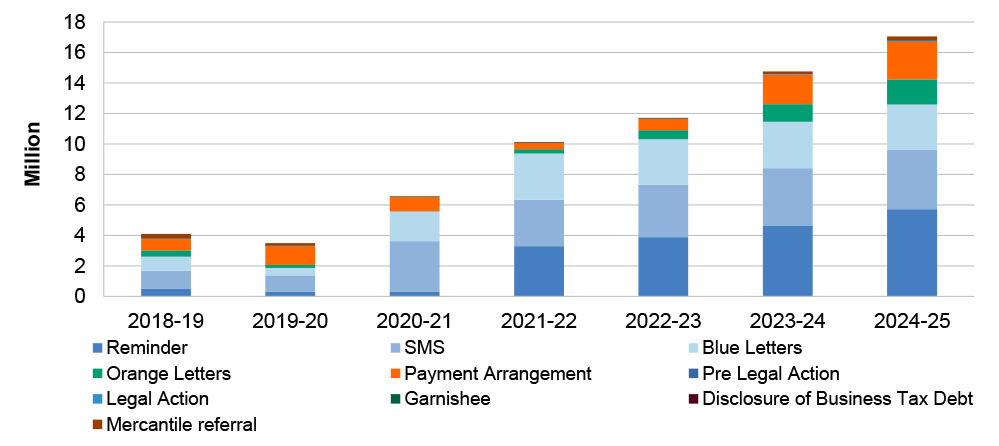
Note a: Figure includes data from 2018–19 to provide pre-COVID-19 pandemic context.
Note b: Debt reduction and negotiation interactions have been removed as they are not debt collection activities.
Source: ANAO analysis of ATO data.
4.28 In 2024–25, firmer and stronger actions (garnishees, disclosures of business tax debt, pre-legal and legal actions) combined were 0.5 per cent (85,078 interactions) of total small business interactions, down from 1.2 per cent in 2018–19. Figure 4.2 illustrates the number of garnishees, disclosures of business tax debt, pre-legal and legal action interactions between 2018–19 to 2024–25.
Figure 4.2: Small business firmer and stronger interactions (collectable debt), 2018–19a to 2024–25
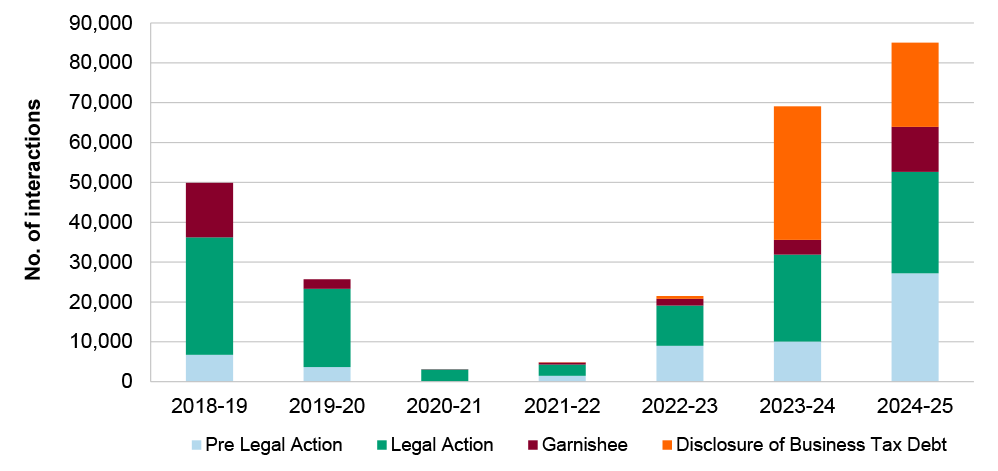
Note a: Figure includes data from 2018–19 to provide pre-COVID-19 pandemic context.
Source: ANAO analysis of ATO data.
4.29 Reminders increased in number and as a proportion of the small business debt collection interactions following the ATO’s return to normalised debt collection activities from July 2021. The number of reminders in 2021–22 (3.3 million interactions) increased 11-fold from 2020–21 (296,150 interactions). In 2024–25, the ATO issued 5.7 million reminders, comprising 33.5 per cent of all small business debt collection interactions.
4.30 Mercantile referrals, or the use of External Collection Agencies (ECAs) (see from paragraph 3.69), were used by the ATO for debt management services from 2006 to March 2020. The ATO recommenced the use of ECAs in January 2024. Prior to the pause in the use of ECAs, mercantile referrals comprised 7.2 per cent (294,278 interactions) of small business debt collection interactions in 2018–19 and 5.0 per cent (174,322 interactions) in 2019–20. In 2023–24, the ATO recorded 129,902 mercantile referrals, or 0.9 per cent of small business debt collection interactions, which increased to 275,548 mercantile referrals, or 1.6 per cent in 2024–25.
4.31 The ATO has the ability to initiate insolvencies—personal bankruptcy and corporate wind-up proceedings. Figure 4.3 shows the number of ATO-initiated insolvencies for small businesses from 2018–19 to 2024–25.
Figure 4.3: Number of Australian Taxation Office initiated small business insolvencies 2018–19 to 2024–25
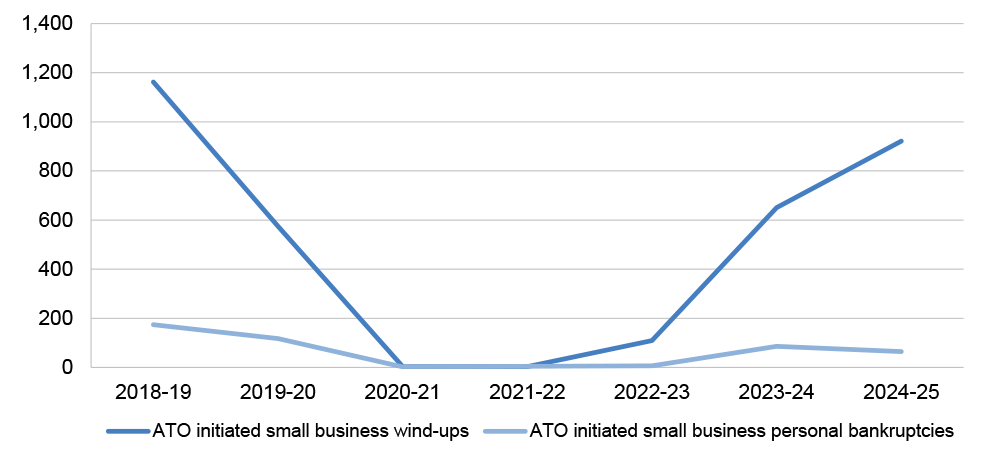
Note: Wind-ups relate to companies, personal bankruptcies relate to individuals.
Source: ANAO analysis of ATO data.
Actioning debt treatments
4.32 There is a substantial ‘funnelling’ effect between the identification of candidate taxpayers with debt, the assignment of a next best action, the release of candidates to staff, and staff actioning debt recovery treatments. High volumes of automated SMSs and letters can be issued with minimal human oversight at low cost.135 Stronger and firmer actions are subject to the availability of trained personnel, as they require human decision-making, checking and action.
4.33 An internal audit conducted in July 2022 found that ‘Day-to-day operations do not fully complement PRM’s risk-based selection process’. The report noted that the population of cases selected daily by PRM was significantly reduced by capacity caps in CASP designed to accommodate to staffing levels, and then further by allocated cases not being actioned:
On a daily basis PRM suggests a case population that could be subject to firmer and stronger actions. Currently the daily suggested population is significantly reduced by Candidate Aggregation Selection and Processing (CASP) capacity caps to cater to staffing levels and then further reduced because a considerable proportion of allocated cases are not actioned. What ends up being manually actioned by case officers could be 1% or less of what PRM has identified as the total firmer and stronger action case pool on any given day (before applying CASP capacity cap filters).
4.34 As described in paragraph 3.86, CASP regulates the execution of treatments based on business needs and the ATO’s operational capacity to action them. The quantities of correspondence and staff allocated to specific work types occur through the ATO’s regular planning and forecasting processes. Operational plans set out volumes for debt treatments, such as the planned number of SMSs or letters to be sent, garnishees or DPNs to be issued, broken down by month.
4.35 A small proportion of the taxpayers identified by PRM/NBA for firmer or stronger actions are released by CASP to staff as CSAs or TOAs. As discussed in paragraph 3.90, CSAs typically involve the pursuit of debt collections whereas TOAs involve legal actions, such as insolvency. The ATO internally reports information about ‘stock on hand’ including activity types, capacities, the volume released in the week and the stock remaining for all taxpayers, including small business. The ATO advised the ANAO in October 2025 that data from these tables is not aggregated but provides a ’real time’ view on the day the models have run.
4.36 The ATO provided a sample daily report for all taxpayers from 4 September 2025. Of the total number of activities for delivery, the volume released in the week was 3,595 and the stock remaining was 291,371 (Table 4.1). The volume of stock released in the week was 1.2 per cent of the total.136 Of those released, 2,685 were disclosures of business tax debt. As at 27 October 2025 770 ATO staff had at least one skill related to debt collection (see Table 3.5).
Table 4.1: Sample CASP Stock on Hand report—firmer and stronger activities for all taxpayers released to ATO staff for actiona
|
|
Stock remaining |
Volume released in the week |
Total |
Percentage released (%) |
|
No. of activities |
291,371 |
3,595 |
294,966 |
1.2 |
Note a: The ATO advised the ANAO in November 2025 that ‘The figures are correct as at Thursday 4 September 2025 and is a sample only and not indicative of regular volumes or releases. The report is updated each day that the model runs to include refreshed candidates and updated with volumes released. The volumes show all available candidates for that model at that point in time, not solely Small Business taxpayers’.
Source: ANAO analysis of ATO data.
4.37 There can be delays in CSA or TOA activities being delivered to staff, depending on available resources and how many taxpayers are in queues. The ATO stated that it tries ‘to prioritise debts relating to super employer obligations in the first instance as well as higher value’.137
4.38 ATO data on the volumes of CSAs and TOAs released to staff for each financial year from 2020–21 to 2024–25 is set out in Table 4.2. It shows that in recent years, most CSAs and TOAs released to staff were marked by staff as completed. Activities released in one financial year may be completed in the next financial year, as can be seen when the proportion marked as complete is greater than those released.
Table 4.2: Activities released to staff by type and activities marked as completeda
|
Financial year |
Activity |
Total volume released |
Volume set to be done by staff |
Completedb (%) |
|
2020–21 |
Client Solutions |
637 |
273 |
42.9 |
|
Tailored Outcomes |
42 |
2 |
4.8 |
|
|
2021–22 |
Client Solutions |
8,591 |
8,024 |
93.4 |
|
Tailored Outcomes |
1,601 |
1,130 |
70.6 |
|
|
2022–23 |
Client Solutions |
14,477 |
14,168 |
97.9 |
|
Tailored Outcomes |
7,818 |
7,182 |
91.9 |
|
|
2023–24 |
Client Solutions |
26,851 |
25,190 |
93.8 |
|
Tailored Outcomes |
6,568 |
6,338 |
96.5 |
|
|
2024–25 |
Client Solutions |
46,081 |
46,208 |
100.3 |
|
Tailored Outcomes |
6,029 |
6,268 |
104.0 |
|
Note a: Volumes are for all taxpayer experiences, not just small business.
Note b: Volumes of ‘set to be done’ and ‘released’ by financial years are distinct. Some activities released in one financial year are completed in the following financial year. This explains why some ‘Completed’ proportions exceed 100 per cent.
Source: ANAO analysis of ATO data.
Using data and analytics to improve debt recovery actions
4.39 The ATO has extensive data stores, data reports and visualisations which enable analysis of small business payment and debt information.
Internal reporting
4.40 The ATO’s RMC Operational and Performance and Analysis—SNAP Report (SNAP report) provides a weekly view of operational activities. Information is provided on the number of activities completed in the previous week and year-to-date, compared to the previous week and year-to-date. For example, the report provides the number of firmer action activities (DPNs and garnishees) issued and conversion rates138; the number of tailored outcome activities completed; legal action outcomes; and taxpayer-initiated correspondence. The reports do not provide analysis of debt outcomes or response rates. The SNAP report library has reports available via the ATO’s intranet from July 2023.
4.41 The Frontline Operations Performance Report provides updates addressing current and emerging risks. In relation to service outcomes relating to debt, the January–March 2025 report included as measures:
- debt reduction — impacts to account balance (high volume treatments; help and assist; firmer action; legal action; other interactions);
- percentage of GIC remissions granted; and
- payment plans — keep rate 30 days.
4.42 Targets for debt reduction for 2024–25 were ‘to be confirmed’ and ‘not applicable’ for GIC and payment plans.
Dashboards — Payment Risk Performance Update and Debt Segmentation Analysis
4.43 The ATO monitors its performance against lodgment and payment measures via monthly reporting in the Payment Risk Performance Update. These reports were initially developed in 2017 and ‘focussed on payment risk and collectable debt through a client experience lens’, one of which is small business.
4.44 In 2024, the ATO developed PowerBI dashboards to make production of the reports faster and to allow end-users to select and filter views for improved analysis of data and trends.
4.45 The Payment Risk Performance Update dashboard includes an Insights page, which provides a brief overview of key insights. The monthly update is emailed to 150 ATO officers and mailboxes. Pages included in the update are:
- debt overview;
- payment performance;
- lodgment performance;
- debt flow;
- aged debt;
- financial resilience; and
- historical trends.
4.46 The update provides information about the amount and composition of debt and payments, which can be filtered by debt type, client experience (one of which is small business), revenue product, and industry. It does not provide information on the performance of actions to recover debt.
4.47 In 2024, following the completion of the segmentation data feature in May 2024, the ATO developed an internal Debt Segmentation Analysis PowerBI dashboard (Segmentation dashboard) as a platform for storing and visualising information about segmentation and investment.
4.48 The dashboard allows analysis by investment in debt collection activities by segment. The dashboard breaks interactions into high-cost interactions (interactions with a unit cost above $20) and low-cost interactions (interactions with a unit cost below $20). Cost-effectiveness is discussed further from paragraph 4.69.
4.49 The Segmentation dashboard’s ‘Investment types’ page provides a visualisation of various debt collection activities undertaken in the past 12 months, showing for each: the number of taxpayers by interaction, the number of interactions, and investment by interaction. As the Segmentation dashboard was developed in 2024, historical trends are not available.
4.50 The investment information in the Segmentation dashboard is based on unit costs discussed in paragraph 4.70. As discussed below, these unit costs do not accurately reflect differences in the time taken to complete different firmer and stronger actions or include a unit cost for mercantile referrals. As such, investment costs displayed in the dashboard use an estimate of unit costs to establish low and high cost interactions for risk treatment purposes. The ATO advised the ANAO in November 2025 that these were not to be used as an accurate unit cost methodology.
Debt Client Engagement Interactions Cube
4.51 The Debt Client Engagement Interactions Cube (DCEIC), within the ATO Reporting Portal, enables business areas to analyse debt taxpayer interactions. Historical data is available for each financial year from 2017–18. Data can be analysed by numerous dimensions, including client experience (such as small business), industry group, interaction type, next interaction type and direction (inbound, outbound). The ATO advised the ANAO on 9 September 2025 that the DCEIC ‘gives outcomes which help to analyse and refine collection strategies’. Measures of effectiveness outlined were:
- Payment Behaviour: the proportions of taxpayers who make payments after an action has taken place. It also provides insights into payment plans which is also an indicator or payment behaviour;
- Response Rates: assessing engagement with tailored communications and actions, including the response to reminders and notices;
- Debt Outcomes: tracking levels of collectible debt, resolutions rate and the active payment plans; and
- Behavioural Shifts: analysing changes in lodgment and payment compliance over specific time frames (e.g. 7, 30, 60 Days).
4.52 Analysis of the effectiveness of interaction types is used for forecasting purposes. The ATO advised in October 2025 that it uses the total debt reduction at 60 days for SMSs and letters for its forecasting purposes. The ATO looks at the historic debt reduction by letter/SMS category for the previous year and applies the debt reduction per letter to its forecast for the current or future year to understand the potential debt reduction impact for the collectable debt book (forecasting used in operational plans is discussed further from paragraph 4.82).
4.53 Such measures are used to inform and compare potential changes that the ATO considers making to its debt recovery processes. For example, use of the response rate measure was included in the report of a trial of letter designs. In December 2022, the ATO’s Behavioural Insights Unit trialled new letters aiming to improve taxpayers’ compliance using ‘deliberate choice’ messaging.139 Two randomised controlled trials tested the effectiveness of the letters against two business as usual control letters.140 The report used data on response rates as benchmarking analysis for the trial, stating:
Analysis has shown that taxpayers who received multiple communications from the ATO have an average response rate of between 6–16% to the different letters of the ATO lodgment letter suite.
4.54 The ATO stated in September 2025 that it had developed a Performance Measurement Framework (endorsed in May 2025) which provides principles for performance measurement. The ATO is developing proposed enhancements to payment system performance measures with initial stages of implementation planned for August–September 2025. The ATO advised the ANAO in February 2026 that a multi-year program of work to develop its payment and debt performance metrics had been approved and had commenced.
4.55 While there is extensive data available for analysis, the ATO does not routinely benchmark, monitor and report its performance of its debt recovery interactions or changes over time.
Recommendation no.6
4.56 Following implementation of relevant performance measures as outlined in Recommendation 3, the Australian Taxation Office establish business-level benchmarks for performance measures for its debt recovery interactions to enable regular monitoring over time.
Australian Taxation Office response: Agreed
4.57 There are limitations in the ATO’s data collections to allow for the analysis of debt recovery actions over time.
4.58 The DCEIC has time-based measures, such as client-level debt reductions, the number of client debts finalised, total balance reductions, payment counts, and payment reductions. It also enables analysis of interaction types, the next interaction type that occurs, its direction (for example, inbound or outbound), and the next interaction period.
4.59 The ATO cannot report in aggregate on the debt recovery pathway for taxpayers, for example, the length of time from a debt first being raised, the time between debt interactions, or the number of interactions for a taxpayer.141 As a result, the ATO is not able to report on changes over time in the debt recovery pathway, such as whether the length of time between taxpayers incurring a tax debt to the initiation of firmer or stronger actions is increasing or reducing over time, or whether the number of interactions the ATO initiates before issuing firmer or stronger actions is increasing or reducing.142
Recommendation no.7
4.60 The Australian Taxation Office develop a data reporting approach to enable understanding of whether debts are moving through the treatment pathway efficiently to reduce small business collectable debt. This may include measurement of the average time between interactions, or number of consecutive interactions a taxpayer may receive.
Australian Taxation Office response: Agreed
Measuring and reporting cost-effectiveness of debt interactions
Effectiveness of low and high-cost interactions on total debt reduction
4.61 As described above, the DCEIC enables the analysis of debt-related interactions and their impact on debt holdings by numerous dimensions. The DCEIC’s purpose is to assist the ATO to answer key questions such as:
- How many and what types of interactions are we having with our clients?
- Which types of interactions have a higher return on investment?
- Do certain types of interaction drive reengagement with a client?
4.62 For example, the ATO can work out the amount of total debt reduction at 7, 30, and 60 days by interaction type.
4.63 Using the ATO’s distinction of high and low-cost interactions (see paragraph 4.48; discussed further from paragraph 4.71), Figure 4.4 shows the total balance reduction for small business collectable debt from the day of an interaction to 60 days after the interaction from 2018–19 to 2024–25. High-cost interaction types (garnishee, legal action, pre-legal action, and payment arrangement) are on the right; low-cost interaction types are on the left (blue letters, orange letters, reminders and SMSs). As discussed in paragraph 4.72, the ATO does not calculate the unit cost of mercantile referrals. For the purposes of Figure 4.4, the ANAO has included mercantile referrals as a high-cost interaction. Disclosures of business tax debt are not included in the DCEIC and are not included in the analysis of total balance reduction.
Figure 4.4: Total balance reduction (at 60 days) by interaction typea,b for small business collectable debt, 2018–19c to 2024–25
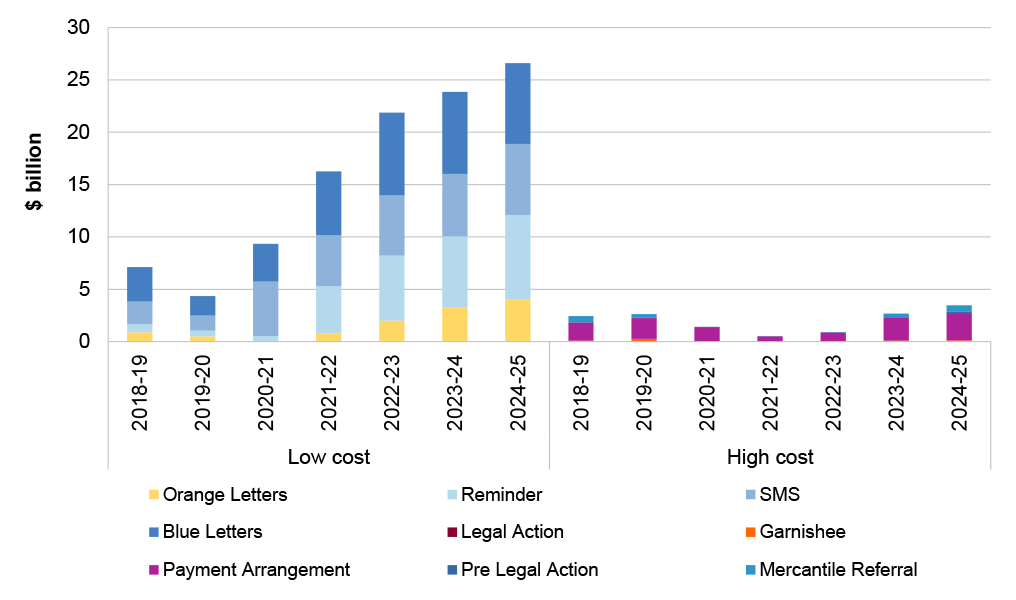
Note a: Debt reduction and negotiation interactions have been removed as they are not debt collection activities.
Note b: Disclosure of business tax debts are not included here as they are not included in the DCEIC.
Note c: Figure includes data from 2018–19 to provide pre-COVID-19 pandemic context.
Source: ANAO analysis of ATO data.
4.64 The figure shows how each interaction type contributes to total balance reductions on a yearly basis. Low-cost actions impact total balance reductions more each year compared to high-cost interaction types.
4.65 The quantum of low-cost interactions is far higher than high-cost interactions. For example, in 2024–25, the ATO recorded 3.9 million SMS collectable debt interactions to small business taxpayers, following which, the total balance reduced by $6.8 billion (at 60 days). In contrast, in 2024–25 the ATO recorded 11,242 garnishee, 27,164 pre-legal action, and 25,505 legal action collectable debt interactions for small business taxpayers. These firmer and stronger interactions reduced the total balance by $97.0 million, $132.1 million, and $14.2 million respectively.
4.66 When the total balance reduction is divided by the number of interactions by type, it can be seen that on a per interaction basis (see Table 4.3), garnishees and pre-legal actions generally deliver the greatest total balance reduction at 60 days.
Table 4.3: Average total balance reductiona (at 60 days) by debt interaction type for small business collectable debt, 2018–19b to 2024–25c
|
|
2018–19 ($) |
2019–20 ($) |
2020–21 ($) |
2021–22 ($) |
2022–23 ($) |
2023–24 ($) |
2024–25 ($) |
|
SMS |
1,823 |
1,349 |
1,565 |
1,589 |
1,666 |
1,589 |
1,733 |
|
Reminder |
1,526 |
1,772 |
1,736 |
1,377 |
1,598 |
1,464 |
1,418 |
|
Blue letters |
3,575 |
3,697 |
1,831 |
2,014 |
2,653 |
2,566 |
2,599 |
|
Payment arrangement |
2,335 |
1,617 |
1,420 |
1,087 |
1,097 |
1,097 |
1,063 |
|
Mercantile referral |
1,979 |
2,024 |
– |
– |
– |
2,546 |
2,244 |
|
Garnisheed |
4,949 |
100,920 |
3,446 |
15,100 |
10,959 |
6,944 |
8,625 |
|
Orange letters |
2,157 |
2,709 |
2,077 |
2,808 |
3,361 |
2,838 |
2,451 |
|
Pre legal action |
6,303 |
4,447 |
5,664 |
2,773 |
6,106 |
7,432 |
4,864 |
|
Legal action |
689 |
633 |
943 |
174 |
1,082 |
4,194 |
555 |
Note a: Balance reduction may include other reductions in balance not related to payment, such as remission of GIC.
Note b: Table includes data from 2018–19 to provide pre-COVID-19 pandemic context.
Note c: Debt reduction and negotiation interactions have been removed as they are not debt collection activities.
Note d: Garnishees in 2019–20 is an outlier due to a spike in total debt reduction. The ATO advised the ANAO in November 2025 that this anomaly had been caused by one taxpayer, and that ‘the debt reduction that has been attributed to this taxpayer is in excess of one billion dollars.’
Source: ANAO analysis of ATO data.
4.67 Figure 4.5 illustrates the total balance reduction (at 60 days) divided by number of interactions by type to show the average total balance reduction per interaction.
Figure 4.5: Average total balance reduction by debt interaction typea,b for small business collectable debt, 2018–19c to 2024–25
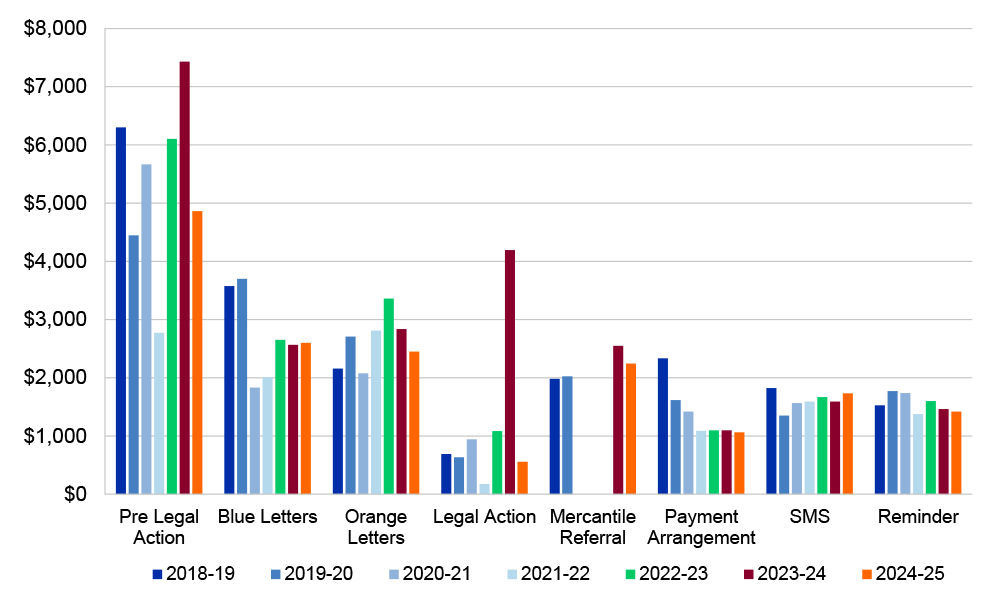
Note a: Garnishee interaction types have been excluded from this graph for ease of reading, due to an outlier in 2019–20.
Note b: Disclosure of business tax debts are not included here as they are not included in the DCEIC.
Note c: Figure includes data from 2018–19 to provide pre-COVID-19 pandemic context.
Source: ANAO analysis of ATO data.
4.68 For taxpayers who are issued a firmer or stronger debt recovery action, the ATO does not have data available on the average time taken from the taxpayer incurring a debt to the point at which they receive a firmer or stronger debt recovery action, nor the average number of interactions that have occurred.
Cost-effectiveness of high and low-cost debt interactions
4.69 Effective 13 December 2023, the ATO implemented cost effectiveness and return on investment (ROI) metrics in the DCEIC. The metrics were introduced in response to a recommendation from the Tax Ombudsman.143 Cost effectiveness measures in the DCEIC are:
- estimated cost of collection—the unit cost multiplied by the number of interactions; and
- return on invested cost (7, 30 and 60 days)—the amount of debt reduced minus the cost of collection.
4.70 The unit cost is the cost of a single interaction, and is derived from definitions in another ATO system. Unit costs were calculated using 2022–23 costing information based on the ATO’s draft Cost-of-Service Framework. Total cost per interaction is the sum of direct full time employee costs, direct supply costs, and corporate overheads.
4.71 The unit costs of debt interactions and high-cost/low-cost categorisations are also used in the ATO’s Segmentation Analysis PowerBI dashboard. Table 4.4 sets out the unit costs for debt engagement interaction types as set out in the dashboard.
Table 4.4: ATO unit costs for debt engagement interaction typesa
|
Low-cost interactions ($) |
High-cost interactions ($) |
||
|
Blue letters |
1.45b |
Garnishee |
83.38 |
|
Orange letters |
1.45b |
Legal action |
83.38e |
|
SMS |
0.18 |
Pre-legal action (Director Penalty Notice; s459E) |
83.38e |
|
Reminder |
1.86c |
Payment arrangement |
33.62f |
|
Debt reduction |
10.45d |
Negotiation |
21.74g |
Note a: Mercantile referral, which refers to the use of External Collection Agencies, is not classified as high or low-cost and is excluded from cost schedules ‘due to costing being privileged information.’
Note b: Digital letters transmitted through myGov are attributed cost of $0.10.
Note c: Reminder value ‘was calculated by dividing costs of reminder by interaction. The logic behind this is that approximately 94 per cent of the interactions were low-cost and therefore reasonable to update to $1.86. While most interactions are automatic via SMS or email, where there is a phone call (inbound/outbound) or correspondence (inbound/outbound) that is a manual rather than automatic transaction, they will be attributed either an inbound cost ($33.62) or outbound cost ($28.16)’.
Note d: The ATO notes: ‘This is for internal costs, while the cost of correspondence is ($3.32). Where there is a phone call (inbound/outbound), that is a manual rather than automatic transaction, they will be attributed either an inbound cost ($33.62) or outbound cost ($28.16)’.
Note e: Legal and pre-legal action do not include costs of court related expenses, which are outside of the Debt Client Engagement Interactions Cube (DCEIC) and Payment Receivable Management (PRM). Frontline Operations is accountable for Summons, Credit Petition and Wind-up costs.
Note f: Payment arrangements have ‘a varied number of unit costs across channels, $33.62 is appropriate with most interactions occurring via inbound telephony. Figures are lower for SMS sent ($0.18), myGov messages and IVR ($0.10), but higher for outbound, inbound calls and portal work ($28.16 and $33.62) respectively.’
Note g: Negotiations have ‘a varied number of costs across channels, $21.74 is appropriate for work types conducted but figures are lower for SMS sent ($0.18), myGov messages and IVR ($0.10). Figures are higher for outbound and inbound calls and portal work ($28.16 and $33.62) respectively.’
Source: ANAO analysis of ATO data.
4.72 The ATO did not include the cost of using external debt collection agencies in its investment profile due to the information being ‘Commercial in Confidence’.
4.73 The ATO advised the ANAO in February 2026 that external collection agencies manage referred debt cases via a range of communication channels, such as telephone calls, letters, and electronic communications such as SMS, email, web chat, and online portals. ECAs may request payment in full or by instalments; establish, negotiate and maintain adherence to payment arrangements; update debtor information; and communicate with debtors, including escalations, enquiries and managing complaints. ECA personnel must follow the Debt Management Services Guidelines.
4.74 The ATO advised the ANAO that the average unit cost per mercantile referral between 1 April 2025 to 31 December 2025 was $27.63 (including GST).
4.75 The ATO had six contracts in place with external collection agencies between 2020–21 and 2024–25. Contracts with Illion Australia and Collection House concluded on 30 September 2020.144 The ATO did not make any referrals to these suppliers between 1 July 2020 and 30 September 2020 due to the ATO’s pause in debt recovery actions (see paragraph 1.14). The ATO has had four contracts with Recoveries Corporation since 14 October 2022, with a total value of $42.8 million.145 The value of the current contract is $3.5 million (including GST).
4.76 The ATO used a weighted average to calculate the unit cost amounts for legal action, garnishee, and pre-legal action.
4.77 The calculations for the unit cost of $83.38 used for legal action, garnishee, and pre-legal action interaction types included costs for activities that are not directly related to the recovery of tax debt. The unit costs are based on 2022–23 processing costs and have not been updated.
4.78 In September 2025, staff from the ATO demonstrated to the ANAO the processes undertaken by staff allocated a CSA or TOA to issue a garnishee, DPN, and s459E. The steps involved differ by action. This includes preliminary checks and checking that the taxpayer has received a recent (within 210 days) warning of recovery action, procedural steps, and approvals. Accordingly, the time required to complete activities differs by action and complexity of the individual case.
4.79 To plan its workforce, the ATO uses internal planning metrics that include anticipated average handling time as set out in Table 4.5.
Table 4.5: Anticipated average handling times for selected debt recovery activities
|
Debt recovery activity |
Average handling time (minutes) |
|
Director Penalty Notice consideration |
75 |
|
Garnishee consideration |
99 |
|
Client Solutions Activity |
150 |
|
Tailored Outcomes Activity — Company |
262 |
|
Tailored Outcomes Activity — Individual |
340 |
Source: ANAO analysis of ATO data.
4.80 The estimated unit costs of $83.38 for interaction types legal action, garnishee, and pre-legal action do not reflect differences in the length of time it takes to complete different debt recovery activities. The ATO excludes the costs of referring to external collection agencies (mercantile referral) in its cost schedules and calculations for return on investment. Additionally, as the costs are based on 2022–23 processing data, they do not take into account changes in costs over time. As such, the unit costs of $83.38 each for firmer and stronger actions underestimate the costs of firmer and stronger actions. Using the same unit costs also does not enable the ATO to distinguish between firmer and stronger debt recovery actions.
Recommendation no.8
4.81 The Australian Taxation Office revise unit cost on a regular basis including the costs of using external collection agencies (mercantile referrals), to ensure accuracy when reporting on return on investment.
Australian Taxation Office response: Agreed
4.82 Differences in the estimated time taken to complete different treatments are evident in inputs used in operational planning (see Table 4.6). As described in paragraph 4.83, operational plans set out volumes for debt treatments, such as the planned number of SMSs or letters to be sent, or garnishees or DPNs to be issued, broken down by month.
4.83 ATO operational plans were inconsistent in the information included and their finalised status. Of the six operational plans in place for financial years 2019–20 to 2024–25, two were drafts and one was not endorsed until past the mid-year point. A further two plans only included forecast numbers for treatments, without context or inputs.
4.84 Three of the six operational plans set out the inputs used to forecast the number of interactions planned for the year, derived from the previous year, or for one conducted mid-year, the first two quarters. The most explicit of these, the draft 2024–25 operational plan, included ‘Debt Plan inputs’ as an appendix, with information about rolling average debt reduction and average handling time (in minutes).
Table 4.6: Debt reduction inputs used in operational planning
|
Stronger and firmer debt actions |
Rolling average debt reductiona ($) |
Average handling time (minutes)b |
|
Director Penalty Notice |
17,217 |
136 |
|
Garnishee |
14,653 |
136 |
|
s459E |
11,271 |
274 |
|
Summons |
1,962 |
340 |
|
Judgement |
1,431 |
340 |
|
Bankruptcy |
1,196 |
200 |
|
Creditors petition |
40 |
800 |
|
Windup |
– |
790 |
Note a: Debt reduction attributed per debt outcome, rolling average over four quarters.
Note b: Number of minutes taken to complete the debt activity by ATO ongoing staff. Average handling times for DPNs and Garnishees vary from the times in Table 4.5 as in this table as they include time taken to consider the next best action as well as the time taken to issue the DPN or Garnishee.
Source: ANAO analysis of ATO data.
Opportunity for improvement
4.85 The Australian Taxation Office could develop a consistent format for operational plans relating to debt risk and recovery, incorporating measures such as total debt reduction, average debt reduction and average handling time, and ensure these documents are finalised and endorsed.
Appendices
Appendix 1 Entity response
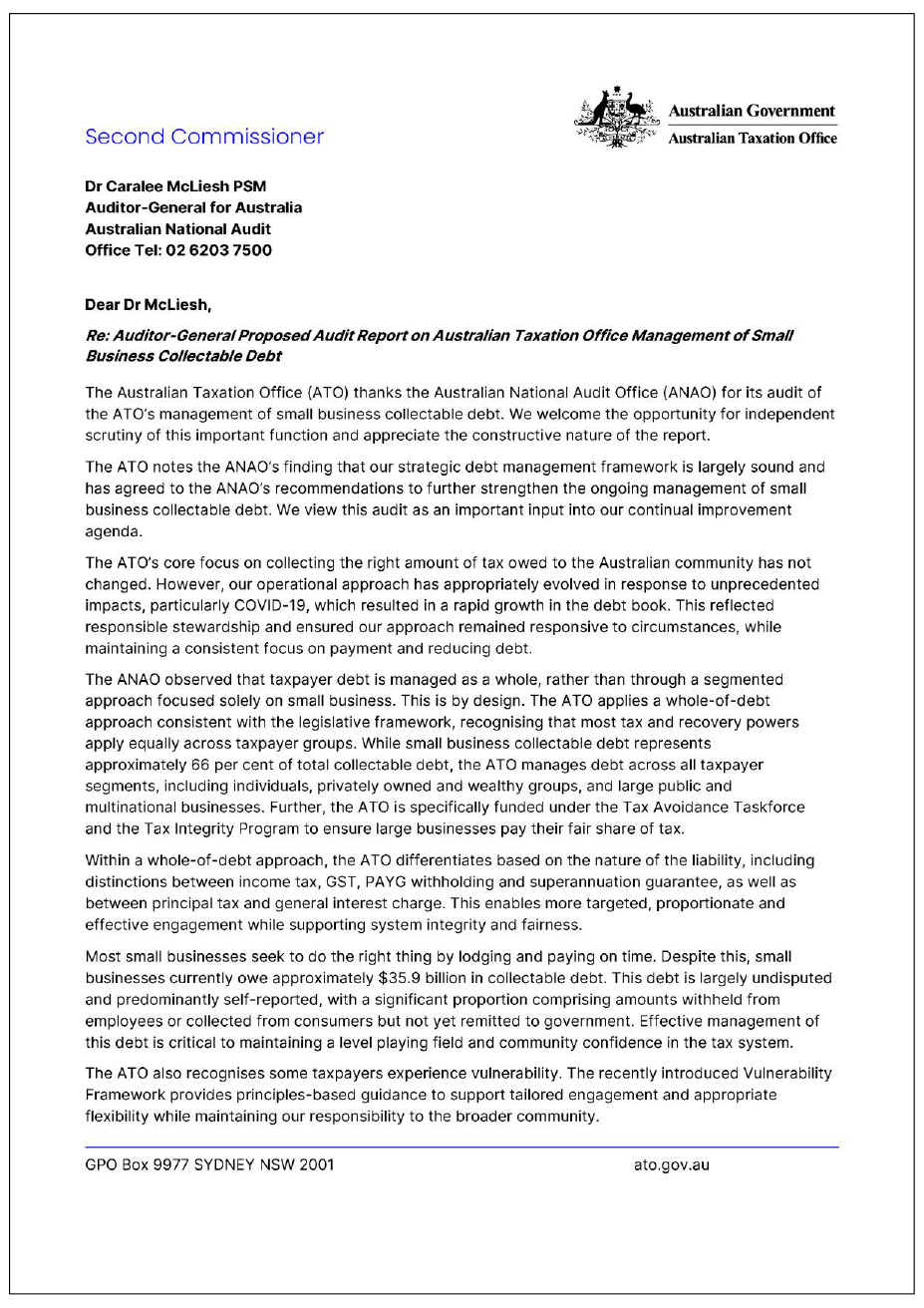
Appendix 2 Improvements observed by the ANAO
1. The existence of independent external audit, and the accompanying potential for scrutiny improves performance. Improvements in administrative and management practices usually occur: in anticipation of ANAO audit activity; during an audit engagement; as interim findings are made; and/or after the audit has been completed and formal findings are communicated.
2. The Joint Committee of Public Accounts and Audit (JCPAA) has encouraged the ANAO to consider ways in which the ANAO could capture and describe some of these impacts. The ANAO’s corporate plan states that the ANAO’s annual performance statements will provide a narrative that will consider, amongst other matters, analysis of key improvements made by entities during a performance audit process based on information included in tabled performance audit reports.
3. Performance audits involve close engagement between the ANAO and the audited entity as well as other stakeholders involved in the program or activity being audited. Throughout the audit engagement, the ANAO outlines to the entity the preliminary audit findings, conclusions and potential audit recommendations. This ensures that final recommendations are appropriately targeted and encourages entities to take early remedial action on any identified matters during the course of an audit. Remedial actions entities may take during the audit include:
- strengthening governance arrangements;
- introducing or revising policies, strategies, guidelines or administrative processes; and
- initiating reviews or investigations.
4. During the course of the audit, the ANAO did not observe changes in the ATO’s approach to management of small business taxpayer debt.
Appendix 3 Payment and Receivables Management machine learning models by stream
Table A.1: Payment and Receivables Management machine learning models by stream — models in use at 30 June 2025
|
Stream |
Machine learning models |
Function |
Treatment |
Initial training date |
Required re-training increments |
Preventative or corrective control |
|
Stream 1 —Pre and post due date SMS |
1.1 Income Tax model |
Predicts the likelihood of taxpayer paying future income tax payment late. |
Automated preventative SMS nudge sent to eligible candidates. |
29 May 2019 |
3 days |
Preventative |
|
1.1 Activity Statement model |
Predicts the likelihood of taxpayer paying future activity statement payment late. |
Automated preventative SMS nudge sent to eligible candidates. |
21 May 2019 |
3 days |
Preventative |
|
|
Stream 3 — Differentiated payment plan service |
3.1 Financial eligibility model |
Predicts the likelihood of taxpayer completing a payment plan within 24 months. |
Restricts user’s ability to generate their own payment plan. High-risk clients (bottom 10% of scores on given day) are blocked from self-service payment plan service and advised to call to negotiate a payment plan. |
4 February 2020 |
2 years |
Corrective |
|
3.1 Optimal controls |
Presents optimal payment plan terms in the form of upfront amount and duration to taxpayers that are based on nearest neighbours who have completed payment plans. |
Eligible taxpayers are presented with tailored payment plan offerings in the form of an optimal upfront payment and duration which they can vary within analytically determined boundaries. |
Corrective |
|||
|
3.3 Predicting Payment Plan Default |
Predicts the likelihood of taxpayer paying future payment plan instalment late. |
Taxpayers already in an active payment plan and ‘unlikely to pay’ their next instalment on time are in scope to receive an SMS nudge before next instalment is due. |
21 July 2020 |
Not stated |
Preventative |
|
|
Stream 4 — Outcome analytics |
4.1 Firmer Action Warning Letter (FAWL) model |
Predicts the likelihood of FAWL obtaining a debt reduction within 30 days of sending. |
Predictive models generate scores, which are used in candidate selection processes for firmer and stronger action consideration, as well as providing staff with insights in Enterprise Client Profile (ECP). |
22 July 2019 |
90 days |
Corrective |
|
Stream 5 — Client Behaviour Prediction |
5.1 Debt danger range model |
Nearest neighbour model that groups similar taxpayers together and compares how much debt they have in comparison to their neighbours. |
Provides staff with insights in the ECP relating to taxpayer’s financial resilience. This is intended to tailor the staff member’s conversation with the taxpayer. |
17 December 2020 |
Bimonthly |
Corrective |
|
5.2 Severe Financial distress model |
Predicts the likelihood of taxpayer going insolvent within 2 years. |
9 September 2020 |
2 years |
Corrective |
||
Source: ANAO analysis of ATO data.
Table A.2: Payment and Receivables Management machine learning models by stream — discontinued models at 30 June 2025
|
Stream |
Machine learning models |
Function |
Treatment |
Initial training date |
Required retraining increments |
Cessation |
|
Stream 2 — Purposeful action for new liabilities |
2.1 First interaction (Letters) after the initial liability/Early Warning Letters |
Predicts the amount of debt reduction a blue letter or Pre-Referral Warning Letter (PRWL) will obtain within 30 days of initiating. |
Automated early warning letter sent to eligible candidates. |
16 July 2019 |
30 days |
Discontinued in February 2021. |
|
Stream 4 — Outcome analytics |
4.1 Garnishee model |
Predicts the amount of debt reduction a garnishee will obtain 90 days after initiating. |
Predictive models generate scores, which are used in candidate selection processes for firmer and stronger action consideration, as well as providing staff with insights in Enterprise Client Profile (ECP). |
22 July 2019 |
90 days |
Use in candidate selection discontinued in 2022 but continued to display to staff in ECP. Decision to cease displaying to staff made in May 2025, for retirement on 17 June 2025. |
|
4.1 Director Penalty Notice model |
Predicts the amount of debt reduction a DPN will obtain 90 days after initiating. |
|||||
|
4.1 Summons model |
Predicts the amount of debt reduction a Summons will obtain 90 days after initiating. |
|||||
|
4.1 s459E model |
Predicts the amount of debt reduction a s459E will obtain 90 days after initiating. |
|||||
Source: ANAO analysis of ATO data.
Appendix 4 Number and proportion of small business collectable debt interaction types
Table A.3: Number and proportion of small business collectable debt interaction types, 2018–19 to 2024–25a
|
Interaction type |
2018–19 |
% |
2019–20 |
% |
2020–21 |
% |
2021–22 |
% |
2022–23 |
% |
2023–24 |
% |
2024–25 |
% |
|
Reminder |
496,437 |
12.1 |
315,011 |
9.0 |
296,150 |
4.5 |
3,296,469 |
32.6 |
3,877,366 |
33.2 |
4,648,218 |
31.6 |
5,718,482 |
33.5 |
|
SMS |
1,194,707 |
29.1 |
1,056,776 |
30.2 |
3,329,133 |
50.7 |
3,047,460 |
30.2 |
3,448,877 |
29.5 |
3,762,138 |
25.6 |
3,913,248 |
23.0 |
|
Blue letters |
920,656 |
22.4 |
501,628 |
14.3 |
1,965,278 |
29.9 |
3,032,638 |
30.0 |
2,983,192 |
25.5 |
3,044,414 |
20.7 |
2,966,185 |
17.4 |
|
Payment arrangement |
739,156 |
18.0 |
1,237,423 |
35.4 |
969,775 |
14.8 |
451,508 |
4.5 |
754,863 |
6.5 |
1,953,793 |
13.3 |
2,453,336 |
14.4 |
|
Orange letters |
407,703 |
9.9 |
184,965 |
5.3 |
3,677 |
0.1 |
271,560 |
2.7 |
599,431 |
5.1 |
1,145,507 |
7.8 |
1,633,051 |
9.6 |
|
Mercantile referral |
294,278 |
7.2 |
174,322 |
5.0 |
– |
0.0 |
– |
0.0 |
– |
0.0 |
129,902 |
0.9 |
275,548 |
1.6 |
|
Disclosure of business tax debt |
– |
– |
– |
– |
– |
– |
39 |
0.0 |
671 |
0.0 |
33,510 |
0.2 |
21,167 |
0.1 |
|
Pre legal action |
6,726 |
0.2 |
3,681 |
0.1 |
54 |
0.0 |
1,461 |
0.0 |
8,996 |
0.1 |
10,099 |
0.1 |
27,164 |
0.2 |
|
Legal action |
29,487 |
0.7 |
19,652 |
0.6 |
2,966 |
0.0 |
2,819 |
0.0 |
10,120 |
0.1 |
21,767 |
0.1 |
25,505 |
0.1 |
|
Garnishee |
13,695 |
0.3 |
2,363 |
0.1 |
69 |
0.0 |
546 |
0.0 |
1,675 |
0.0 |
3,728 |
0.0 |
11,242 |
0.1 |
|
Total all interaction types |
4,102,845 |
100 |
3,495,821 |
100 |
6,567,102 |
100 |
10,104,461 |
100 |
11,684,520 |
100 |
14,719,566 |
100 |
17,044,928 |
100 |
Note a: Debt reduction and Negotiation interactions have been removed as they are not debt collection activities.
Source: ANAO analysis of ATO data.
Appendix 5 Australian Taxation Office debt interaction types and sub-types, 2024–25
Table A.4: Debt interaction types and sub-types in Debt Client Engagement Interactions Cube 2024–25
|
Interaction type and ATO definition |
Interaction sub-type |
|
Blue letters An interaction grouping for letters with a blue background that trigger when a taxpayer enters into debt for the first time or when their debt increases on one or more accounts. Blue letters do not include legal consequences wording. |
|
|
Debt reduction An interaction grouping which refers to actions that reduce or remove the requirement to actively pursue recovery of an outstanding debt. Actions may be temporary or permanent and are based on policy, discretion, or changes in circumstances. Debt reduction also includes remissions of penalties and interest imposed. |
|
|
Garnishee A garnishee notice directs the recipient or a third party to forward to the Commissioner any funds held on behalf of, or owed to, the client, instead of paying them to the client. |
|
|
Legal action Legal action refers to formal steps taken under law to enforce recovery of a debt or to protect the ATO’s interests. These actions may involve court proceedings, statutory notices, or other legal instruments. |
|
|
Mercantile referral Mercantile referral occurs when outstanding debts are formally transferred to an external mercantile (debt collection) agency for recovery on behalf of the ATO. The agency acts under agreed terms to pursue payment using lawful collection methods, while the debt remains legally owed to the ATO. |
|
|
Negotiation Negotiation refers to interactions between the ATO and debtor (or their representative) aimed at resolving an outstanding debt through agreed arrangements, dispute resolution, or provision of information. These actions are non-legal and focus on achieving compliance or settlement without formal enforcement. |
|
|
Orange letters An interactional grouping which includes the Firmer Action Warning letter (FAWL) that has an orange background and provides legal warnings to the taxpayer. If the taxpayer increases their debt on one or more account within 180 days of receiving the FAWL, instead of receiving a Blue increase debt letter, they will receive an Orange variant that provide legal warnings again. For the purposes of considering whether legal warnings have been provided to the taxpayer in the last 180 days, all Orange letter variants are considered, i.e. the original FAWL and/or any subsequent Orange increasing debt letters. |
|
|
Payment Arrangement A payment arrangement is a formal agreement between the ATO and debtor that specifies how an outstanding debt will be repaid over time. These arrangements are structured, documented, and monitored for compliance. |
|
|
Pre-legal Pre-legal refers to actions taken prior to initiating formal legal proceedings. These steps are intended to compel compliance or payment through statutory notices or warnings, without commencing court action which includes issuing a statutory demand under section 459E of the Corporations Act or a notice issued to company directors advising them of the amount of director penalty the Commissioner believes they are liable for and the options available to them to have the penalty remitted. |
|
|
Reminder Reminder refers to actions taken to notify or prompt a debtor about an outstanding obligation, missed payment, or compliance requirement. These actions are non-legal and aim to encourage voluntary resolution before escalation. |
|
|
SMS An interaction grouping of all SMS reminder interactions, from pre-due date to post-due date to payment plan instalment nudges and opt-in reminders for payment plans. |
|
Source: ANAO analysis of ATO data.
Footnotes
1 Australian Taxation Office, ATO corporate plan 2025–26, ATO, Canberra, 2025, p. 10, available from https://previewapi.transparency.gov.au/delivery/assets/80a82ed1-3e33-027b-b7e0-6493f97f18f8/1b6cc581-22ac-4f18-886a-ba7f3d35326f/2025-26%20Australian%20Taxation%20Office%20corporate%20plan.pdf [accessed 15 October 2025].
2 Australian Taxation Office, Commissioner of Taxation annual report 2024–25, ATO, Canberra, 2025, p. 253, available from https://www.ato.gov.au/api/public/content/bed7b201d8834d21b6b28f69ee2e8313?v=9bab1e97 [accessed 18 November 2025].
3 ATO, ATO corporate plan 2025–26, p. 10.
4 Australian Taxation Office, ATO corporate plan 2024–25, ATO, Canberra, 2024, available from: https://www.ato.gov.au/about-ato/managing-the-tax-and-super-system/corporate-plan/ato-corporate-plan-2024-25/1-australian-taxation-office [accessed 10 December 2025].
5 ATO, Commissioner of Taxation annual report 2024–25.
6 ATO, ATO corporate plan 2025–26.
7 Australian Taxation Office, Key issues, risks and opportunities for small business that a practitioner should be aware of as they approach year-end, ATO, Canberra, 7 April 2022, available from https://www.ato.gov.au/media-centre/key-small-business-issues-risks-and-opportunities-for-tax-practitioners-to-be-aware-of [accessed 14 October 2025].
8 Such as a director, partner, shareholder, or beneficiary.
9 ATO, Commissioner of Taxation annual report 2024–25.
10 ibid., p. 223.
11 ibid., Appendix 7.
12 Lodge and Pay prior to July 2024.
13 Timeline of administrative measures implemented to assist with bushfires and the COVID-19 pandemic:
- November 2019 – automatic deferrals of lodgment and payment obligations were granted for a period of two months for taxpayers in 18 local government areas (LGAs) in New South Wales;
- December 2019 – four additional LGAs were included in automatic deferrals, and the deferral period was extended a further two months;
- January 2020 – the deferral period was extended to 30 June 2020;
- February 2020 – further LGAs were added to the deferral program, including those affected by fires in Tasmania and floods in North Queensland; and
- 20 March 2020 – a deferral of lodgment and payment obligations was granted for a period of six months for taxpayers affected by the COVID-19 pandemic.
14 Taxpayers can request an interest remission from the ATO. The ATO assesses the request, taking into account the exceptional circumstances that are contributing to the small business being unable to pay the tax debt.
15 Australian Taxation Office, Addressing collectable tax debt – Tax Institute’s Tax Summit 2023, ATO, 7 September 2023, available from https://www.ato.gov.au/media-centre/addressing-collectable-tax-debt-tax-institute-s-tax-summit-2023 [accessed 22 October 2025].
16 Australian Taxation Office, Commissioner’s address to the Tax Institute’s Tax Summit 2024, Sydney, 12 September 2024, available from: https://www.ato.gov.au/media-centre/commissioners-address-to-the-tax-institutes-tax-summit-2024 [accessed 24 February 2025].
17 Communications were issued by the ATO according to taxpayers’ selected preferences, including via tax agents.
18 Australian Taxation Office, Australian Taxation Office annual report 2022–23, ATO, Canberra, 2023, available from https://www.transparency.gov.au/publications/treasury/australian-taxation-office/australian-taxation-office-annual-report-2022-23/part-2---year-in-review/our-progress-in-2022%E2%80%9323 [accessed 13 October 2025].
19 The ATO was unable to separate the small business population from the broader taxpayer population for this data.
20 The ATO may recover a company’s unpaid Pay as You Go Withholding (PAYGW), Goods and Services Tax (GST) or Super Guarantee Charge (SGC) from a current or former director personally after issuing a director penalty notice. If a company has more than one director the amounts owed will likely be the same for all directors as the company liability and director penalty liability are parallel in nature.
Australian Taxation Office, Director Penalties, 6 May 2022, available from https://www.ato.gov.au/businesses-and-organisations/hiring-and-paying-your-workers/engaging-a-worker/in-detail/director-penalty-regime [accessed 15 October 2025].
21 The ATO may disclose business tax debt information to credit reporting bureaus (CRBs) if taxpayers meet the following criteria:
- having an Australian Business Number and are not an excluded entity;
- having one or more tax debts and at least $100,000 is overdue by more than 90 days;
- they are not engaging with us to manage their tax debt; and
- do not have an active complaint with the Tax Ombudsman about our intent to report their tax debt information.
Prior to disclosing a business tax debt, the ATO sends taxpayers a written notice of its intent to disclose. Australian Taxation Office, Disclosure of business tax debts, ATO, Canberra, 21 December 2023, available from https://www.ato.gov.au/individuals-and-families/paying-the-ato/if-you-don-t-pay/disclosure-of-business-tax-debts [accessed 15 October 2025].
22 Australian Taxation Office, Australian Taxation Office annual report 2024–25, ATO, Canberra, 2025, available from https://www.transparency.gov.au/publications/treasury/australian-taxation-office/australian-taxation-office-annual-report-2024-25/part-7-%E2%80%93-appendices/appendix-16%3A-corrections [accessed 16 April 2026].
23 Australian Taxation Office, Clock is ticking on small business lodgment penalty amnesty, ATO, Canberra, 6 December 2023, available from https://www.ato.gov.au/media-centre/clock-is-ticking-on-small-business-lodgment-penalty-amnesty [accessed 15 October 2025].
24 Australian Taxation Office, Changes to offsetting debts on hold, ATO, Canberra, 8 July 2025, available from https://www.ato.gov.au/about-ato/new-legislation/in-detail/businesses/changes-to-offsetting-debts-on-hold [accessed 10 June 2026].
25 Australian Taxation Office, Changes to deductibility of interest on ATO debts, ATO, Canberra, 6 June 2025, available from https://www.ato.gov.au/tax-and-super-professionals/for-tax-professionals/tax-professionals-newsroom/changes-to-deductibility-of-interest-on-ato-debts [accessed 16 October 2025].
26 Treasurer, Minister for Small Business, and Assistant Treasurer, ‘Government and private sector working together to back families and small businesses’, media release, Treasury, 1 April 2026, available from: https://ministers.treasury.gov.au/ministers/jim-chalmers-2022/media-releases/government-and-private-sector-working-together-back [accessed 13 May 2026].
Australian Taxation Office, ATO fuel response, ATO, Canberra, 2 April 2026, available from: https://www.ato.gov.au/individuals-and-families/financial-difficulties-and-disasters/tax-support-for-individuals-businesses-not-for-profits-and-tax-professionals/ato-fuel-response [accessed 13 May 2026].
27 In 2025, the Inspector-General of Taxation and the Taxation Ombudsman rebranded to the Tax Ombudsman, see, Tax Ombudsman, About us, available from: https://taxombudsman.gov.au/about-us/ [accessed 21 May 2026].
28 Inspector-General of Taxation and Taxation Ombudsman, Review into the Australian Taxation Office’s use of garnishee notices, Inspector-General of Taxation and Taxation Ombudsman, March 2019, available from https://www.taxombudsman.gov.au/wp-content/uploads/2021/07/162_190313-Review-into-the-ATOs-use-of-Garnishee-Notices-FINAL.pdf [accessed 31 October 2025].
29 ibid., p. ix.
30 Auditor-General Report No. 42 2018–19, Management of Small Business Tax Debt, ANAO, Canberra, 2019, p. 8, available from https://www.anao.gov.au/work/performance-audit/management-small-business-tax-debt [accessed 15 October 2025].
31 Inspector-General of Taxation, An Investigation and Exploration of Undisputed Tax Debts in Australia, Inspector-General of Taxation and Tax Ombudsman, June 2021, available from https://www.igt.gov.au/wp-content/uploads/2021/07/Final-Report-Investigation-and-Exploration-of-Undisputed-Tax-Debts-in-Australia_1.pdf [accessed 30 October 2025].
32 Inspector-General of Taxation and Taxation Ombudsman, How to tell people they owe the government money best practice principles, Inspector-General of Taxation and Taxation Ombudsman, March 2024, available from https://www.ombudsman.gov.au/__data/assets/pdf_file/0022/302935/How-to-tell-people-they-owe-the-Government-money.pdf [accessed 30 October 2025].
33 Australian Taxation Office, Commissioner of Taxation annual report 2024–25, ATO, Canberra, 2025, p. 253, available from https://www.ato.gov.au/api/public/content/bed7b201d8834d21b6b28f69ee2e8313?v=9bab1e97 [accessed 18 November 2025].
34 ATO, ATO corporate plan 2025–26, p. 10.
35 Australian Taxation Office, ATO corporate plan 2024–25, ATO, Canberra, 2024, available from: https://www.ato.gov.au/about-ato/managing-the-tax-and-super-system/corporate-plan/ato-corporate-plan-2024-25/1-australian-taxation-office [accessed 10 December 2025].
36 Australian Taxation Office, ATO corporate plan 2025-26, ATO, Canberra, 2025, available from https://www.ato.gov.au/about-ato/managing-the-tax-and-super-system/corporate-plan/ato-corporate-plan-2025-26 [accessed 4 November 2025].
37 International Organization for Standardization, ISO 31000:2018 Risk management — Guidelines, ISO, 2018, available from https://www.iso.org/standard/65694.html [accessed 14 August 2025].
38 The CEI is a direction issued by the Commissioner of Taxation. It outlines the ATO’s principles for risk management, summarises the RMF, describes the ATO’s risk appetite and tolerance, and outlines the roles and responsibilities of staff and risk specialists.
39 Enterprise level risks are strategic or operational risks to the entirety of an entity. Business level risks are risks to specific areas of an entity.
40 Such as Superannuation Guarantee, Pay as You Go withholding tax, or the Goods and Services Tax.
41 Formerly known as the Lodge and Pay Deputy Commissioner.
42 These include: the ATO Executive, the ATO Risk Committee, the Lodge and Pay Executive, the Lodge and Pay Risk Committee, the Small Business Stewardship Group, the Reset Band 2 Steering Committee, the Lodge and Pay Special Purpose Working Group, the Frontline Risk and Strategy Executive, the Strategy Committee, the Band 1 Visibility of Non-Pursued Debt Committee, the Registration, Lodgment and Payment Risk and Strategy Committee, and the Client Engagement Executive Committee.
43 Australian Public Service Commission, Capability Review: Australian Taxation Office, APSC, Canberra, 2025, p. 4, available from https://www.apsc.gov.au/sites/default/files/2025-03/ATO%20capability%20review%20-%20final%20endorsed_accessible.pdf [accessed 1 June 2025].
44 Formerly known as the Lodge and Pay Deputy Commissioner.
45 APSC, Capability Review: Australian Taxation Office, p. 14.
46 ibid., p. 21.
47 Commissioner of Taxation, Our Performance Evolution, 2025, p. 11, available from https://www.ato.gov.au/api/public/content/56ec8387f2c7487faafb4cf6e4048407?v=24a43911 [accessed 15 December 2025]
48 The ATO Executive consists of the Commissioner of Taxation, Second Commissioners for Client Engagement, Frontline Operations, and Law Design and Practice, and the ATO’s Chief Operations and Information Officers.
49 Australian Taxation Office, Australian Taxation Office Statement of Intent, ATO, Canberra, available from https://treasury.gov.au/sites/default/files/2019-03/ATO_Statement_of_Intent.pdf [accessed 1 October 2025].
50 The collectable debt ratio is a measure of the effectiveness of the ATO’s debt prevention, collection, and management strategies, reflecting the proportion of collectable debt compared to net tax collections.
51 See, for example ATO, Commissioner of Taxation Annual Report 2024–25, p. 51.
52 The ATO divides taxpayers into specific groups, including individuals, small business, privately owned and wealthy groups, public and multinational businesses, not-for-profit organisations, superannuation funds, and self-managed superannuation funds.
53 See, for example ATO, Commissioner of Taxation Annual Report 2024–25, Appendix 7: Debt management, pp. 253–6.
54 These figures relate to the net value of non-pursuit decisions made in each year, not net debt on hand.
55 ATO, Commissioner of Taxation Annual Report 2024–25, p. 94.
56 See, for example ATO, Commissioner of Taxation Annual Report 2024–25, p. 253.
57 In 2025, the Inspector-General of Taxation and the Taxation Ombudsman rebranded to the Tax Ombudsman, see, Tax Ombudsman, About us, available from https://taxombudsman.gov.au/about-us/ [accessed 21 May 2026].
58 Inspector-General of Taxation and Taxation Ombudsman, An investigation and exploration of undisputed tax debts in Australia, p. 37.
59 Australian Taxation Office, Taxation statistics, ATO, Canberra, 2025, available from https://www.ato.gov.au/about-ato/research-and-statistics/in-detail/taxation-statistics [accessed 24 October 2024]; and
Australian Taxation Offoce, Taxation statistics 2022–23, ATO, Canberra, 2025, available from https://www.ato.gov.au/about-ato/research-and-statistics/in-detail/taxation-statistics/taxation-statistics-2022-23 [accessed 24 October 2025].
60 ATO, Statistics in Taxation statistics 2022–23.
61 ATO, ATO corporate plan 2025-26, p. 72.
62 ‘Exit’ in this context means wind-up for companies and personal bankruptcy for individuals.
63 The ATO stated in April 2026 that the 6 per cent target had been revised to 7 per cent for 2026–27 in March 2026.
64 ATO, ATO corporate plan 2025-26, p 5.
65 The McKinsey Co. contract was valued at $1,903,000 (original value $1,045,000) and was in effect from 16 January 2023 to 28 June 2023. AusTender, Contract Notice View CN3945726, available from https://www.tenders.gov.au/Cn/Show/8c259494-b8f1-4df2-b58d-d7dbb2584ac4 [accessed 25 October 2025].
66 The initiatives were: prevention, segmentation, omni-channel contact, Payment Receivables Management decision logic, dialler operations, and training and performance management.
67 The ATO did not implement the 2030 Lodge and Pay Strategy recommended by McKinsey Co. due to prioritising the short-term opportunities and workstream recommendations.
68 The Lodge and Pay Reset commenced to staff in June 2023.
69 Organisation for Economic Co-operation and Development, Successful Tax Debt Management: Measuring Maturity and Supporting Change, OECD, Paris, 2019, available from: https://www.oecd.org/content/dam/oecd/en/publications/reports/2019/03/successful-tax-debt-management_0a9ce41f/e8fdb816-en.pdf [accessed 8 December 2025]
70 The four strategic principles are:
- engage with taxpayers before the due date;
- maximise collection before enforcement measures;
- effective use of enforcement tools; and
- realistic recovery: recognising debt which is not economical to recover as well as write-off policy.
71 Phase 1 was building the case for debt through communication to taxpayers to remind them of debt obligations. Phase 2 involved developing internal readiness through staff training and developing an external engagement strategy. Phases 1 and 2 ran concurrently ending at the end of 2023. Phase 3 was a change in external positioning that commenced in 2024.
72 The Small Business Client Experience Payment Risk business level risk and Payment and Debt Performance Enterprise level risk (see from paragraph 2.6) are linked risks.
73 Australian Taxation Office, Practice Statement Law Administration PS LA- 2011/17 Debt relief waiver and non-pursuit, page 4, available from https://www.ato.gov.au/law/view/document?docid=PSR/PS201117/NAT/ATO/00001 [accessed 10 December 2025].
The ATO Commissioner does not have the power to grant a waiver. Section 63 of the Public Governance, Performance and Accountability Act 2013, allows the Minister of Finance to waive amounts owing to the Commonwealth. This waiver permanently extinguishes the debt owed to the Commonwealth.
74 The ATO advised the ANAO in September 2025 that the ATO Payment Strategy will be implemented by 30 June 2026.
75 Auditor-General Report No. 42 2018–19, Management of Small Business Tax Debt, p. 17.
76 Australian Taxation Office, Current SMS and email activities by the ATO, ATO, Canberra, available from https://www.ato.gov.au/online-services/online-services-for-individuals-and-sole-traders/ato-online-services-and-mygov/ato-and-mygov-communications/current-sms-and-email-activities [accessed 15 October 2025].
The ATO will send correspondence/interaction based on the taxpayer’s communication preference, including a letter via a MyGov account linked to the ATO, via the post to a registered address or via their tax agent. Letters may have either a blue or orange band on the letter. Blue signals an initial communication usually a reminder or a payment is overdue. Orange signals a warning notice, usually a default or firmer action.
77 The ATO advised in November 2025, a re-engagement letter is sent to a taxpayer who has not engaged with the ATO for approximately six months (180 days), so the taxpayer remains aware of their debts, how much to pay, how to pay information and the potential consequences of not paying.
78 The ATO advised in September 2025, the number of pre-due date SMSs sent per day range from 35 to 170,000 SMSs and the number of post-due payment SMSs could range from 10 to 140,000 per day. These ranges are based on SMSs sent during August 2025.
79 PRM, the ATO’s debt management system, selects taxpayers for appropriate debt activities across five streams, as discussed in paragraph 3.79.
80 Blue letters are the first items of correspondence sent to taxpayers with debt. Orange letters relate to firmer actions.
81 The average response rates quotes are 95 per cent Confidence Intervals for the measure.
82 The sample size was reduced by an error during randomisation that impacted the debt letter trials, thus impacting the resolving power of the analysis.
83 The Tax Ombudsman report Letters from the ATO also examines the effectiveness of ATO letters.
Taxation Ombudsman, Letters from the ATO, available from https://taxombudsman.gov.au/wp-content/uploads/2025/07/Letters-from-the-ATO-Review-Report-18-July-2025.pdf [accessed 15 June 2026].
84 The ATO’s Tailored Support Hub assists vulnerable taxpayers with: education and processing of hardship and release applications; severe and immediate vulnerabilities such as coercion or domestic violence; an Indigenous Help Line to assist First Nations People with inquiries, with a particular focus on differentiated identity requirements for proof of record of ownership (PORO); and access to Financial Counsellors and National Tax Clinics.
85 The industry and peak body participants included: the First Nations Foundation; tax clinics from University of NSW, Curtin, Western Sydney; Financial Counselling Australia; Justice Connect; and the Council on the Aging.
86 Australian Taxation Office, Our Vulnerability Framework, ATO, Canberra, available from https://www.ato.gov.au/about-ato/commitments-and-reporting/our-support-for-people-experiencing-vulnerability/our-vulnerability-framework [accessed 19 November 2025].
87 The Commissioner committed to: a review of the relevant Practice Statement Law Administration guidance; make it easier for First Nations people to engage with the tax system; understand the information sharing pathways that exist in government; identify opportunities to leverage to better support people experiencing vulnerability; consider new Practice Statement Law Administration guidance for dealing with people experiencing domestic violence; and explore alternative forms of identification to make it easier for taxpayers.
Australian Taxation Office, Vulnerability capability implementation, ATO, Canberra, available from https://www.ato.gov.au/about-ato/commitments-and-reporting/our-support-for-people-experiencing-vulnerability/vulnerability-capability-implementation [accessed 19 May 2026].
88 Australian Taxation Office, Paying the ATO, ATO, Canberra, available from https://www.ato.gov.au/individuals-and-families/paying-the-ato [accessed 19 May 2026]. A taxpayer can pay by BPAY, utilise online payment services, electronic transfer, direct debit, Government Easy Pay and in person at Australia Post.
89 Australian Taxation Office, Help with paying, ATO, Canberra, available from https://www.ato.gov.au/individuals-and-families/paying-the-ato/help-with-paying [accessed 20 October 2025].
90 Australian Taxation Office, Payment Plan Estimator, ATO, Canberra, available from https://www.ato.gov.au/single-page-applications/calculatorsandtools?anc… [accessed 19 May 2026].
91 The ATO stated in November 2025 that the eligibility requirements for a 12-month-interest free payment plan for a small business taxpayer include: turnover under $2 million; owe $50,000 or less in activity statement debt overdue for up to 12 months; have a good compliance history (no more than one default in 12 months); cannot access finance through normal channels; can demonstrate ongoing viability; and if approved and paid via direct debit, interest will be remitted. The ATO noted that, existing payment plans can also be converted to interest-free payment plans if the eligibility criteria are met.
92 Australian Taxation Office, Payment Plans, ATO, Canberra, available from https://www.ato.gov.au/individuals-and-families/paying-the-ato/help-with-paying/payment-plans [accessed 19 May 2026].
If taxpayers are having difficulty with the online application process for a Payment Plan ATO staff will guide them through each step of the process.
93 Australian Taxation Office, General Interest Charge, ATO, Canberra, available at https://www.ato.gov.au/individuals-and-families/paying-the-ato/interest-and-penalties/interest-we-charge/general-interest-charge [accessed 19 May 2026].
The ATO will apply a General Interest Charge only (no penalty for late payment is applied) on unpaid amounts. The ATO stated in November 2025, under s8AAG of the Taxation Administration Act 1953, the Commissioner has the power to remit GIC, for example where there has been a circumstance outside the taxpayer’s control or when it would be considered fair and reasonable to do so. Taxpayers’ and their representatives are able to request this remission. When taxpayers enter into payment plans, they are advised that they are able to request remission at the end, once the debt has been paid.
94 Australian Taxation Office, Director Penalties. A Director Penalty Notice (DPN) is a notice the ATO can issue, that allows the ATO to recover a company’s unpaid tax amounts.
95 A garnishee is a legal order requiring a third party to pay a debt. An ATO issued garnishee notice is issued to a person or business (usually a bank) that holds money for a taxpayer. This requires the third party to pay money directly to the ATO to reduce a taxpayer’s debt. The ATO will send a copy of the garnishee notice to the taxpayer.
96 Australian Taxation Office, Remission of interest charges, ATO, Canberra, available from https://www.ato.gov.au/individuals-and-families/your-tax-return/if-you-disagree-with-an-ato-decision/dispute-interest-or-penalties/remission-of-interest-charges [accessed 15 April 2026].
Instructions to staff about GIC remission is also available: Australian Taxation Office, Practice Statement of Law Administration PS LA 2011/12, Remission of General Interest Charge, available from https://www.ato.gov.au/law/view/document?docid=psr/ps 201112/nat/ato/00001 [accessed 15 April 2026].
97 Australian Taxation Office, Practice Statement of Law Administration PS LA 2011/4 Collection and recovery of disputed debts, page 2, available from https://www.ato.gov.au/law/view/document?DocID=PSR/PS20114/NAT/ATO/00001&PiT=99991231235958 [accessed 10 December 2025].
98 The following statements are instructions for ATO staff: Practice Statement Law Administration PS LA 2011/4 Collection and recovery of disputed debts, available from https://www.ato.gov.au/law/view/document?DocID=PSR/PS20114/NAT/ATO/00001&PiT=99991231235958 [accessed 10 December 2025]; and
Practice Statement Law Administration PS LA 2011/6 Risk management in the enforcement of lodgment obligations and debt collection activities, available from https://www.ato.gov.au/law/view/document?docid=PSR/PS20116/NAT/ATO/00001 [accessed 24 June 2025].
99 Auditor-General Report No. 8 2022–23, Audits of the Financial Statements of Australian Government Entities for the Period Ended 30 June 2022, ANAO, Canberra, paragraph 4.14.59, available from https://www.anao.gov.au/work/financial-statement-audit/audits-the-financial-statements-australian-government-entities-the-period-ended-30-june-2022 [accessed 19 May 2025].
100 The 2024–25 Federal Budget contained a measure to: ‘Amend the tax law to give the Commissioner of Taxation (Commissioner) a discretion to not use a taxpayer’s refund to offset old tax debts, where the Commissioner had put that old tax debt on hold prior to 1 January 2017.’ As at December 2025, this measure has not been legislated.
101 The debt awareness campaign did not relate to collectable debt – it related to debts previously placed on hold and removed from taxpayer accounts.
102 Australian Taxation Office, ‘ATO pauses debt awareness campaign: information about our debt awareness campaign’, media release, 28 November 2023, available from https://www.ato.gov.au/api/public/content/0-db418235-1563-4f89-8cb9-6442fccd9a34 [accessed 7 May 2024].
103 In 2025, the Inspector-General of Taxation and the Taxation Ombudsman rebranded to the Tax Ombudsman, see, Tax Ombudsman, About us, available from https://taxombudsman.gov.au/about-us/ [accessed 21 May 2026].
104 Commonwealth Ombudsman, ACT Ombudsman, Inspector General of Taxation and Taxation Ombudsman, How to tell people they owe the government money: Best practice principles for notifying people about debts, March 2024, page 4, available from https://www.ombudsman.gov.au/__data/assets/pdf_file/0022/302935/How-to-tell-people-they-owe-the-Government-money.pdf [accessed 30 October 2025].
105 Australian Taxation Office, Welcome to the ATO’s online Community: join the conversation and find answers to your tax and super questions, ATO, Canberra, available from https://community.ato.gov.au/s/ [accessed 19 May 2026].
The ATO Community is an online platform that allows the community to ask and share information about tax issues. Through a team of moderators, the ATO provides a safe platform for users to anonymously interact with each other.
106 Auditor-General Report No. 28 2024–25, Management of Complaints by the Australian Taxation Office, ‘Snapshot’, ANAO, Canberra, p. 6, available from https://www.anao.gov.au/work/performance-audit/management-of-complaints-the-australian-taxation-office [accessed 19 May 2026].
107 Australian Taxation Office, Payment Plan request form, ATO, Canberra, refer to excel spreadsheet of the request form available from https://www.ato.gov.au/forms-and-instructions/payment-plan-request-for-registered-agents [accessed 30 October 2025]
108 ATO, Payment Plans.
109 The ATO stated in November 2025 that updates ensure staff can enter payment plans for all debt types reducing the requirement to manually each type of payment plan.
110 Prior to segmentation, the ATO described its approach as ‘one paced—agnostic to clients [sic] behaviour and risk to revenue. Therefore, those willing to pay, but cannot, are treated at the same pace as those committing fraud or deliberately avoiding payment’.
111 The Fraud and Egregious segment was unable to be refined sufficiently to be included in the segmentation data sets. The Egregious Behaviours model was developed to enable visibility of the fraud and egregious segment.
112 FRI score is a four-category score system assigned using analytical models and methods. The more financially resilient a taxpayer is, the more capable they are of meeting payment obligations.
113 This figure is the total collectable debt owed by the taxpayers in this segment, and may include debts in addition to GST and Pay As You Go Withholding Tax.
114 OECD, Successful Tax Debt Management: Measuring Maturity and Supporting Change, OECD, Paris, available from https://www.oecd.org/content/dam/oecd/en/publications/reports/2019/03/successful-tax-debt-management_0a9ce41f/e8fdb816-en.pdf [accessed 8 December 2025].
115 A taxpayer with a debt classified as non-pursuable who claims a refund at tax time would instead have that refund amount go towards paying that debt.
116 Australian Taxation Office, Practice Statement Law Administration PS LA 2011/17 Debt Relief, waiver and non-pursuit, available from https://www.ato.gov.au/law/view/document?docid=PSR/PS201117/NAT/ATO/00001 [accessed 10 December 2025].
117 The ATO has not defined egregious behaviour. For the purposes of the pilot, the type of behaviours that may indicate egregious behaviour were assessed through a model that scored companies and directors using factors including:
- previous engagement history with the ATO;
- lodgement compliance;
- previous fine and penalty application;
- debt level changes; and
- payment on-time compliance across all entities in a group or a director portfolio.
118 The ATO describes PRM models as:
A PRM ‘model’ can be a business rules model (if-then-else, deterministic), or a machine learning (ML) model (statistical model, trained on data). ML models can also be called analytical models.
PRM analytic models were included in the list of 43 of models in production that the ATO defined as being artificial intelligence, provided by the ATO on 14 May 2024 as part of the Auditor-General Report No. 26 2024–25, Governance of Artificial Intelligence at the Australian Taxation Office, ANAO, Canberra, 2025, see for example, p. 27, available from https://www.anao.gov.au/work/performance-audit/governance-of-artificial-intelligence-the-australian-taxation-office [accessed 27 October 2025].
119 The disclosure of business tax debt is an exception. A debt can only be disclosed to credit reporting bureaus if the debt is more than 90 days overdue and the business has not effectively engaged with the ATO.
120 Australian Office of Taxation, Practice Statement Law Administration PS LA 2011/18, Enforcement measures used for the collection and recovery of tax-related liabilities and other amounts, clause 19, ATO, Canberra, available from https://www.ato.gov.au/law/view/document?docid=PSR/PS201118/NAT/ATO/00001 [accessed 26 September 2025].
121 Candidate Aggregation, Selection and Processing is an intermediary platform which manages data and communicates between different applications.
122 ATO, ATO corporate plan 2025-26, ATO, p. 5.
123 Australian Taxation Office, Practice Statement Law Administration PS LA 2011/6, Risk management in the enforcement of lodgment obligations and debt collection activities, paragraph 2, available from https://www.ato.gov.au/law/view/document?docid=PSR/PS20116/NAT/ATO/00001 [accessed 24 June 2025].
124 A taxpayer may also receive a statement of account.
125 ‘Supervised’ and ‘unsupervised’ refers to different ways that the machine-learning models are trained. The ATO’s supervised models are trained on historic data to predict what will happen in the future, whereas the unsupervised model (model 5.1) does not use past data, but compares taxpayers’ current situations to that of similar taxpayers.
126 For example:
- PRM 1.1 models score taxpayers on the likelihood of paying a future income tax or activity statement payment late. The top 50 per cent of scores—those most unlikely to pay—are in scope for a preventative SMS on a given day.
- PRM model 3.1—Financial Eligibility scores taxpayers on the likelihood they will complete a payment plan in two years. The bottom 10 per cent of payment plans—those most unlikely to complete—are prevented from creating a payment plan through the online self-service channels and are directed to call the ATO to negotiate a plan.
127 Ethics threshold assessments and impact assessments for data activities were discussed in Auditor-General Report No. 26 2024–25, Governance of Artificial Intelligence at the Australian Taxation Office, ANAO, Canberra, ANAO, 2025, paragraphs 2.80–2.83, available from https://www.anao.gov.au/work/performance-audit/governance-of-artificial-intelligence-the-australian-taxation-office [accessed 28 October 2025].
128 The ATO advised in November 2025 that a Deloitte contractor was engaged for this work via an already established contract, RFQ016 – Smarter Data Program of Work Strategy (SON: 3520191). Smarter Data did not approach the market for this work and there was no Contract Notice. The value of work undertaken under contract RFQ016 was $126,884.82.
129 Auditor-General Report No. 26 2024–25, Governance of Artificial Intelligence at the Australian Taxation Office, Canberra, ANAO, 2025, Recommendation no. 5, paragraph 3.30, available from https://www.anao.gov.au/work/performance-audit/governance-of-artificial-intelligence-the-australian-taxation-office [accessed 28 October 2025].
130 Auditor-General Report No. 26 2024–25, Governance of Artificial Intelligence at the Australian Taxation Office, Canberra, ANAO, 2025, paragraph 3.31, available from https://www.anao.gov.au/work/performance-audit/governance-of-artificial-intelligence-the-australian-taxation-office [accessed 28 October 2025].
131 Australian Office of Taxation (ATO), Practice Statement Law Administration PS LA 2011/18 Enforcement measures used for the collection and recovery of tax-related liabilities and other amounts, available from https://www.ato.gov.au/law/view/document?docid=PSR/PS201118/NAT/ATO/00001 [accessed 26 September 2025].
132 ibid., clause 16.
133 Interactions such as entering into a payment plan via online channels are not captured by the DCEIC. Disclosures of business tax debt are also not captured in the DCEIC but have been manually included.
134 Debt reduction and negotiation interactions have been removed as they are not debt collection activities.
135 The release of SMS and letters occurs without human oversight or intervention. The ATO advised in February 2026 that substantial human oversight occurs prior to the deployment of automation through testing and validation processes. Automated releases are planned, monitored and reported on regular basis, with humans involved when exceptions, errors (such as systems issues), or risks (such as taxpayer/agent feedback) are detected.
136 This example is illustrative and may not be representative of regular volumes or releases. The volumes show all available candidate taxpayers at that point in time, not solely small business taxpayers.
137 Prioritisation here refers to delivery thresholds used for firmer actions delivered to staff as CSAs/TOAs via CASP. The ATO prioritises candidates for activities based on total debt and whether they have a Superannuation Guarantee Charge (SGC) debt. Where there is an SGC debt, the total debt threshold is $50,000; where there is not an SGC debt the total debt threshold is $100,000.
138 Conversion rates refer to the number of entities receiving a DPN or garnishee treatment divided by the number of DPN or garnishee activities finalised.
139 Deliberate choice messaging seeks to encourage taxpayers to resolve outstanding tax obligations (outstanding lodgment or overdue debt) by advising them that while past non-compliance may have been a mistake or oversight, from now on, it is presumed that the taxpayer is making a deliberate choice not to comply.
140 The ATO advised in October 2025 that deliberate choice letters were not implemented due to the commencement of the Lodge and Pay Reset and prioritisation of segmentation.
141 Information about individual taxpayers, including their debt history, previous interactions and timing is recorded in Siebel and is available to staff for consideration in the Enterprise Client Profile.
142 The ANAO asked the ATO about the availability of aggregated data for small business taxpayers who are subject to stronger and firmer actions to enable a breakdown of the average length of time from when the debtor first went into debt to the issuing of the action, and the average number of interactions the taxpayer had previously had with the ATO prior to the issuing of the action. The ATO advised in October 2025 that this data is not available.
143 Inspector-General of Taxation and Taxation Ombudsman, An investigation and exploration of undisputed tax debts in Australia, p. 40
In 2025, the Inspector-General of Taxation and the Taxation Ombudsman rebranded to the Tax Ombudsman, see, Tax Ombudsman, About us, available from https://taxombudsman.gov.au/about-us/ [accessed 21 May 2026].
144 The contracts with Illion Australia and Collection House were:
- Illion Australia – $5,179,252.85 and in effect from 1 July 2019 to 30 September 2020. AusTender, Contract Notice View CN3610585-A2, available from https://www.tenders.gov.au/Cn/Show/3f94e556-298d-4ba5-842d-9d6c0cf6fde9 [accessed 18 November 2025].
- Collection House – $3,147,832.44 and in effect from 1 July 2019 to 30 June 2020. AusTender, Contract Notice View CN3610572-A2, available from https://www.tenders.gov.au/Cn/Show/5154d64e-cf51-41a5-a10c-ef753ab598fc [accessed 18 November 2025]. The ATO advised in November 2025 that the contract was extended for the period 1 July 2020 to 30 September 2020, but the ATO was not able to source an executed copy of the contract variation.
145 The Recoveries Corporation contracts were valued at:
- $11,544,964.07 and in effect from 14 October 2022 to 28 June 2024. AusTender, Contract Notice View CN3926944-A2, available from https://www.tenders.gov.au/Cn/Show/9741a4f4-fcb9-457f-8dda-989256c0f492 [accessed 18 November 2025].
- $7,235,864.80 and in effect from 6 November 2023 to 31 March 2025. AusTender, Contract Notice View CN4021921-A2, available from https://www.tenders.gov.au/Cn/Show/af026a5a-5444-480e-a469-adb6e0197e2f [accessed 18 November 2025].
- $20,471,027.08 and in effect from 1 July 2024 to 30 June 2026. AusTender, Contract Notice View CN4085736-A2, available from https://www.tenders.gov.au/Cn/Show/97f60211-1aff-4290-8206-f527cd6af26c [accessed 18 November 2025].
- $3,536,111.76 and in effect from 1 April 2025 to 30 June 2026. AusTender, Contract Notice View CN4138572-A1, available from https://www.tenders.gov.au/Cn/Show/b7f6c454-8fee-49b4-8c61-63e37a01ecdd [accessed 18 November 2025].
The ATO stated in February 2026 the variations in contracts with Recovery Corporation were due to the ATO taking up available options to extend the services, fee indexation, and increases in workloads.