Audit snapshot

Why did we do this audit?

  • The Commonwealth‑owned facilities at Benalla and Mulwala are strategically important to Defence’s munitions production and supply, and to sustaining a domestic manufacturing capability.
  • Thales Australia has managed and operated the Benalla and Mulwala sites under contracts with Defence since 1999.
  • This audit provides independent assurance to the Parliament on Defence’s management of the Strategic Domestic Munitions Manufacturing (SDMM) contract, including the management of the facilities as a critical sovereign capability.

Key facts

  • The SDMM contract has an initial term of ten years (July 2020 to June 2030) and as at June 2026 has an estimated value of $1.9 billion.
  • The contract is designed to change over time by using survey and quote work orders to commission additional work, including munitions orders, capital works and research and development.

What did we find?

  • Defence’s management of the SDMM contract was partly effective and has provided limited assurance that value for money has been achieved to date.
  • The contract was designed to preserve existing manufacturing capability while supporting cost and efficiency improvements over time.
  • Defence increasingly used work orders to pursue longer-term objectives, without making effective use of available commercial levers to manage delivery and performance risks.
  • Defence’s contract management did not provide sufficient assurance over complex work orders, including those intended to support new munitions manufacturing capability.
  • Weaknesses in contract and financial management have limited Defence’s ability to demonstrate progress towards sustaining an effective domestic munitions manufacturing capability.

What did we recommend?

  • There were four recommendations aimed at strengthening transparency, approvals and day‑to‑day management of this high‑value contract.
  • Defence agreed to the four recommendations.

$607.6 m

increase in contract value, since July 2020.

$42.5 m

spent on products that have not been delivered as planned, or on orders that have been cancelled.

70%

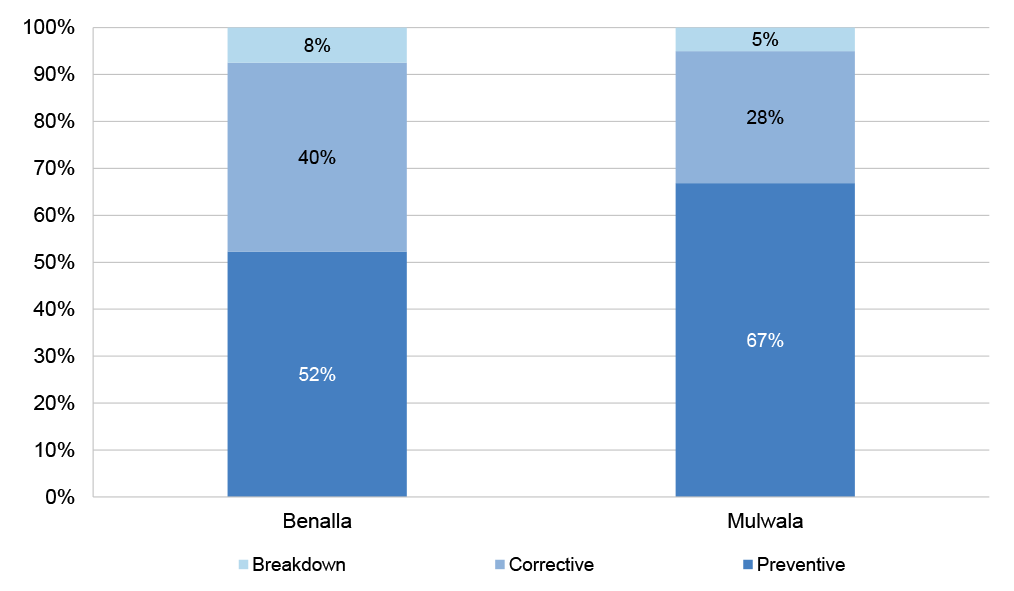
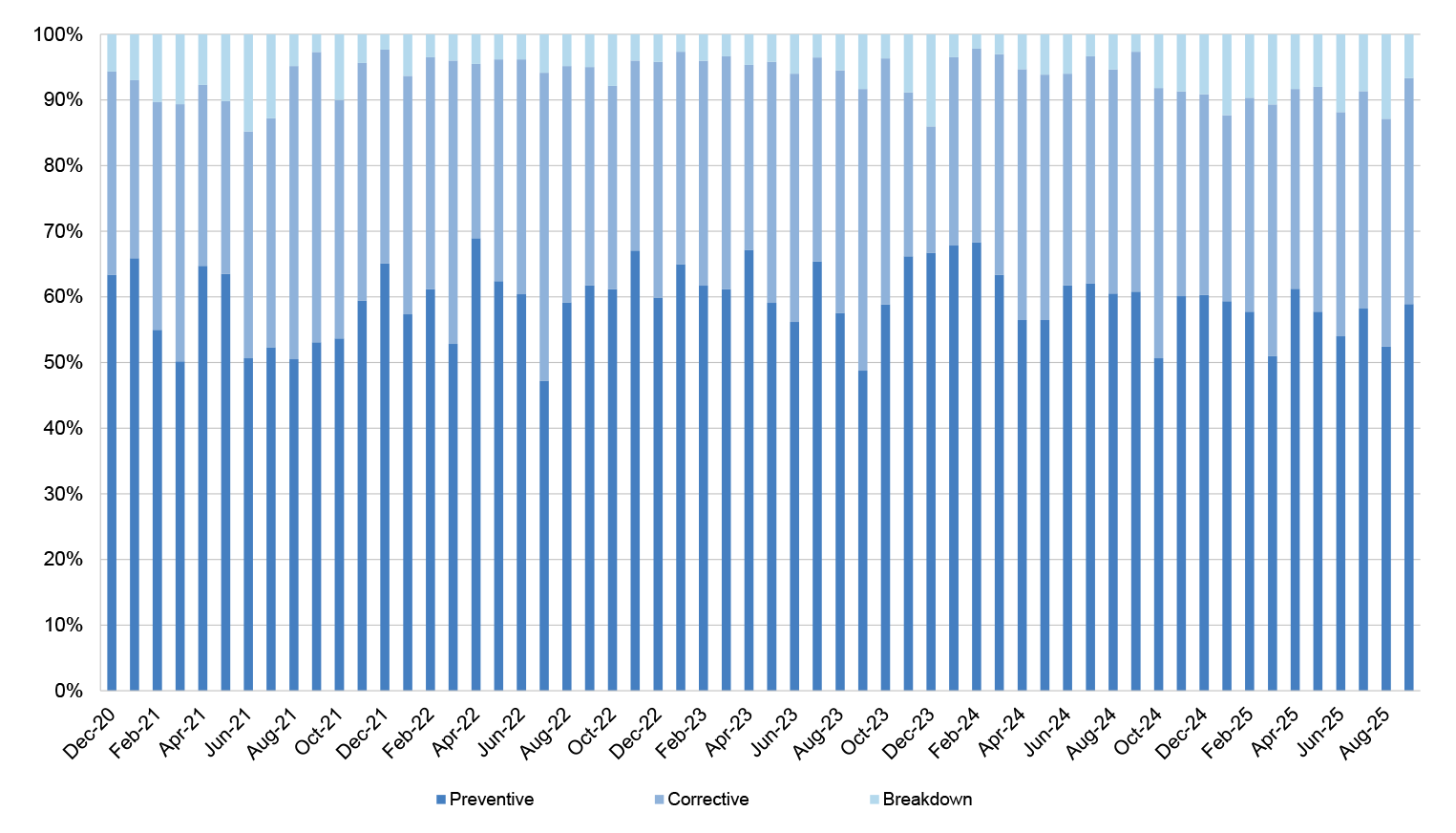
increase in breakdown maintenance required since April 2022.

Summary and recommendations

Background

1. The two Commonwealth-owned munitions factories at Mulwala and Benalla are national strategic assets that provide much of the industrial foundations to support and expand domestic production of guided weapons, explosive ordnance and other types of munitions. The Mulwala facilities were established in 1943 (83 years ago) and the Benalla site was established in 1994 (32 years ago). Thales Australia (trading as Australian Munitions) is the current operator of these facilities.

2. On 29 June 2020, the Australian government announced that Defence had signed a new 10-year agreement valued at $1.1 billion (GST exclusive) with Thales for the continued management and operation of the Mulwala and Benalla sites under — the Strategic Domestic Munitions Manufacturing (SDMM) contract.1 On the same day, the government also announced that a new contract between Defence and NIOA Munitions (NIOA) for a tenancy at the Benalla site had been signed.

3. The intention of these arrangements, among other things, was to: provide surety of supply of key munitions and components for the ADF; strengthen and diversify the supply chain; maintain domestic munitions manufacturing capability; and identify, develop, and manufacture new types of munitions to expand domestic capacity and meet Defence’s capability requirements into the future.2

Rationale for undertaking the audit

4. Defence has contracted with Thales Australia as its long-term ‘strategic partner’ for the management and operation of the Commonwealth-owned Benalla and Mulwala munitions factories. The contract — the SDMM contract — has an initial term of ten years and as at June 2026 was valued at $1.9 billion (GST inclusive). This audit examined the effectiveness of Defence’s management of the SDMM contract to date and the achievement of value for money through Defence’s contract management activities.

5. This audit builds on previous ANAO work examining Defence’s management of the Benalla and Mulwala facilities and provides independent assurance to Parliament on Defence’s contracting, governance, and management of the SDMM contract to date.

Audit objective and criteria

6. The audit objective was to examine whether Defence has achieved value for money through its management of the Strategic Domestic Munitions Manufacturing (SDMM).

7. To form a conclusion against the objective, the following high-level criteria were adopted.

  • Does Defence have effective contracting and governance arrangements in place?
  • Has Defence managed the contract effectively and achieved value for money?

8. This audit is the second of two performance audit reports examining Defence’s arrangements for the operation, since the SDMM contract was awarded in June 2020. This audit focused on Defence’s management of the 2020–30 SDMM contract with Thales for the operation and maintenance of the facilities. Auditor-General Report No. 47 2023–24 Defence’s Management of Contracts for the Supply of Munitions — Part 1, focused on the establishment of the 2020–30 contract, including tendering, advice to decision-makers and the decision to conduct a sole source procurement.

9. The first report was tabled in Parliament on 25 June 2024. It concluded that Defence’s conduct of the sole source procurement for the operation and maintenance of the Benalla and Mulwala facilities beyond June 2020 was partly effective. The report made eight recommendations that Defence agreed to.

Conclusion

10. Defence’s administration of the SDMM contract has been partly effective and has provided limited assurance that value for money has been achieved to date. Defence’s financial management, payment administration and reporting has not been effective in key respects, including instances of non-compliance with the Public Governance, Performance and Accountability Act 2013 (PGPA Act). The condition and configuration of key assets and maturity of supporting production processes is constraining the ability of the Benalla and Mulwala factories to meet future needs. These constraints limit the extent to which the contract, as currently administered, can support the resilient and scalable domestic manufacturing capability envisaged by the Australian Guided Weapons and Explosive Ordnance Plan (GWEO Plan).

11. The SDMM contracting arrangements were partly effective. The contract was designed to sustain the long-term operation of the Benalla and Mulwala facilities, manage costs and deliver efficiencies over time. While industrial preparedness and manufacturing uplift activities were envisaged as an intended outcome of the contract, they were not included as core contract deliverables. The strongest performance incentives and commercial levers remain concentrated on baseline operations and delivery of mature products. Domestic munitions manufacturing uplift activities delivered through work orders issued under the SDMM contract have less effective performance incentives and commercial levers.

12. Defence has established largely appropriate governance, monitoring and reporting arrangements. Performance assessment reviews, financial cost model audits, and periodic cost reviews have been conducted in line with contract requirements. External reviews have been commissioned as needed and risks have been reported and managed, although Defence was slow to implement fit-for-purpose performance reporting arrangements.

13. Defence’s management of the SDMM contract has been partly effective. Key contract mechanisms intended to support cost reduction and achieve efficiencies have not been fully implemented or were not mature for much of the period examined. An agreed total cost of ownership model is not in place, constraining Defence’s ability to validate contract pricing and reported efficiencies. Defence have increasingly used work orders to commission activities beyond the core services in order to pursue longer-term objectives, without making effective use of available commercial levers to manage performance risks. Delivery outcomes for routine munitions are stronger than for the developmental and emerging products. As at June 2026, Defence has spent $42.5 million on developmental and emerging products that have not been delivered, due to technical, quality and certification issues and related production challenges, or where the order has been cancelled. External reviews have identified persistent reactive maintenance management practices below relevant benchmarks and standards.

14. Defence’s financial management, payment administration and reporting for the SDMM contract was not effective. As at June 2026, there is a gap of at least $109 million between the publicly reported total contract value and Defence’s total financial commitments under the contract. Price escalation for 2022–23 and 2023–24 was applied in a manner that did not comply with the Public Governance, Performance and Accountability Act 2013 (PGPA Act). Value for money assessments for work orders placed under the contract have not been consistently documented. Collectively, these matters have reduced transparency and weakened assurance that Defence is managing the contract effectively and achieving value for money.

Supporting findings

Contracting and governance arrangements

Contracting arrangements

15. Defence established the SDMM contract as a long-term arrangement for operating, maintaining and managing the Benalla and Mulwala facilities. The performance requirements of the contract emphasise safe, secure and legally compliant operations, reducing the total cost of ownership and delivering efficiencies. The contract refers to supporting ‘industrial preparedness’, framed as an intended outcome rather than a specific deliverable. The contract provides mechanisms to place additional orders for munitions and commission work beyond the core services, including for capital works and research and development activities to support more advanced industrialisation.

16. The performance management framework and commercial leverage is focused on maintaining baseline operations of the existing facilities and the delivery of mature munitions products, with more limited coverage for activities contracted through the survey and quote work order provisions. Accountability for broader capability uplift and longer-term outcomes therefore relies more on strategic governance, planning and decision-making mechanisms. Defence has acknowledged these limitations and commenced work to refresh the performance framework to improve the clarity, consistency and usefulness of performance information. (See paragraphs 2.2 to 2.41)

Governance, monitoring and reporting arrangements

17. Defence established largely appropriate governance, monitoring and reporting arrangements. Contract governance arrangements include a contract steering committee, contract management board and subordinate contract management working groups, however key governance artefacts, including a contract management plan were not developed in a timely manner. Risks are reported in Thales’ register and managed in Defence’s risk management system (Predict!). As at June 2026, a new risk management plan that reflects the establishment of the Factories Operations Branch is being developed however the plan has not been finalised or approved and as such is not yet in place. From July 2024 monthly performance reports have been provided to senior leaders that include a dashboard view of all GWEO acquisition projects and sustainment products, including the manufacturing facilities at Benalla and Mulwala. (See paragraphs 2.43 to 2.66)

Contract management

Cost of the facilities for Defence and financial reliance on the Commonwealth

18. The contract has not reduced the cost of the facilities for Defence or reduced financial reliance on the Commonwealth. The SDMM contract includes cost reduction mechanisms, including a continuous improvement and efficiency program. The mechanisms require that an approved total cost of ownership model is in place to underpin pricing decisions, validate reported efficiencies and cost savings and conduct periodic cost reviews. As at April 2026, an agreed model was not in place. The absence of an agreed total cost of ownership model has constrained Defence’s ability to validate reported efficiency savings, and verify that the cost reduction outcomes, including a reduced cost of facility ownership and financial reliance on the Commonwealth, have been achieved. (See paragraphs 3.2 to 3.14)

Use and management of Commonwealth land and assets

19. External reviews and Defence data have identified persistent patterns of reactive asset management and maintenance practices that are below the applicable industry benchmarks and standards. An asset condition assessment finalised in February 2026 identified systemic weaknesses affecting asset management, including incomplete baselines and insufficient linkage between asset condition, capability outcomes and investment planning. Critical assets at both Benalla and Mulwala were assessed as below target condition and while Defence has commenced remediation and investment planning, these efforts remain ongoing as at April 2026. (See paragraphs 3.16 to 3.38)

Management of multi-tenancy

20. Multi-tenancy arrangements at the Benalla site required the establishment of additional governance structures, including coordination mechanisms between tenants and a joint safety committee. These arrangements have delivered limited improvements in site utilisation and production diversification. Defence’s risk assessments of the transition focused on commercial and legal considerations and did not address the likely impact or consequence of disruptions across the supply chain. Defence initially relied on NIOA and Thales to negotiate key commercial and operational arrangements. Delays were encountered due to commercial, intellectual property and regulatory issues and Defence did not respond in a timely manner to mitigate the supply chain risks associated with establishing the arrangements. (See paragraphs 3.43 to 3.50)

Delivery of munitions orders

21. The management and delivery of routine munitions is supported by established planning, ordering and governance processes, including structured annual ordering cycles. Delivery performance is assessed against a dedicated performance measure and regularly reported. Developmental and emerging products have not been delivered as scheduled due to technical, quality, certification and production challenges, including those associated with the condition of the Benalla and Mulwala facilities and infrastructure. As at June 2026, Defence has spent $42.5 million on developmental and emerging products that have not been delivered, or on orders that have been cancelled. To address the non-delivery, Defence has requested remediation plans, applied commercial levers, paused activity and, in some cases, discontinued effort where delivery was not achievable without investment in facilities and equipment. (See paragraphs 3.51 to 3.64)

Management of performance shortfalls

22. The SDMM contract has a performance management framework that includes a range of provisions to manage performance and address performance shortfalls. Despite the deficiencies in the design and implementation of the performance management framework that have not yet been resolved, Defence is managing performance shortfalls. As at June 2026, Defence has requested Thales submit three remediation plans that have been approved, however implementation of the agreed actions to resolve the performance shortfall are at an early stage. (See paragraphs 3.65 to 3.75)

Financial management arrangements

23. Over the period examined (2020 to 2025), shortcomings were identified in the financial management and reporting of the SDMM contract. The contract was designed to change over time through variations (including price escalation) and the issuing of work orders for additional activity. As at June 2026, there is a gap of at least $109 million between the publicly reported total contract value on AusTender of $1,868.6 million and Defence’s total financial commitments under the contract.

24. Defence did not consistently follow key contract processes or obtain the required approvals to apply price escalation and as such payments were made in a manner that did not comply with the PGPA Act. Defence has not consistently documented a value-for-money assessment for work commissioned through work orders. Financial cost audits generally concluded that incurred costs were materially correct, however identified recurring issues across several cost categories, including repair and maintenance. (See paragraphs 3.76 to 3.90)

Supporting government industrial policy objectives through the contract

25. The condition of facilities and assets have constrained Defence’s ability to deliver industrial policy objectives through the contract. Defence finalised a Joint Strategic Plan in September 2025 to guide longer-term development of the Benalla and Mulwala facilities. Prior to this, Defence did not have an agreed long-term planning framework to support the prioritisation and sequencing of investments aligned to evolving strategic priorities.

26. Assessments and independent reviews identified that ageing facilities and equipment have constrained the expansion of manufacturing capacity and contributed to delays in filling orders. As at June 2026, these constraints — together with shortcomings in asset management and maintenance practices and insufficient capital investment and sustainment funding — limit the extent to which the contract can support delivery of key elements of the Australian Guided Weapons and Explosive Ordnance Plan (GWEO Plan) without coordinated remediation and sustained investment over time. (See paragraphs 3.91 to 3.96)

Recommendations

Recommendation no. 1

Paragraph 3.15

The Department of Defence clarify its requirements for supporting tools and processes (including a total cost of ownership model) and implement fit for purpose arrangements to manage the SDMM contract effectively, improve decision-making and support the achievement of longer-term contract and strategic objectives.

Department of Defence response: Agreed

Recommendation no. 2

Paragraph 3.35

The Department of Defence strengthen its oversight of asset management and maintenance under the SDMM contract, including by ensuring that existing performance measures, reporting and management processes provide sufficient visibility of whether arrangements are supporting the long-term reliability and sustainability of assets at the sites to support contract management and investment decisions.

Department of Defence response: Agreed

Recommendation no. 3

Paragraph 3.86

The Department of Defence strengthen its AusTender reporting practices by ensuring a consistent approach, in accordance with the intent and requirements of the Commonwealth Procurement Rules, to reporting the total value of contractual arrangements, including where those arrangements contain provisions that allow for commissioning additional work over time.

Department of Defence response: Agreed

Recommendation no. 4

Paragraph 3.89

The Department of Defence strengthen its contract and financial management arrangements by ensuring that all survey and quote work orders comply with the Commonwealth Procurement Rules and are supported by a documented value for money assessment specific to the goods or services to be delivered under the work order.

Department of Defence response: Agreed

Summary of entity response

27. The proposed report was provided to the Department of Defence. Extracts from the proposed report were also provided to Thales Australia Limited (Thales). The Defence and Thales summary responses are provided below and the full responses are provided at Appendix 1.

Department of Defence

Defence acknowledges the Auditor-General’s findings on the Strategic Domestic Munitions Manufacturing (SDMM) contract and accepts the recommendations.

Since establishing the Guided Weapons and Explosive Ordnance (GWEO) Group in 2023, Defence has strengthened governance, senior executive oversight, and risk management and improved transparency. Defence welcomes the Auditor-General’s recognition of these ongoing improvements, including enhanced asset management, validation of contractor performance data, and the development of the Strategic Domestic Munitions Manufacturing Joint Strategic Plan.

Defence accepts that aspects of performance management, contract administration, transparency and governance for the supply of munitions require ongoing improvement. Defence is strengthening controls, enhancing governance and improving decision support to ensure value for money outcomes are maintained. Defence remains committed to transparency and integrity, and takes matters of non-compliance seriously.

Thales Australia Limited

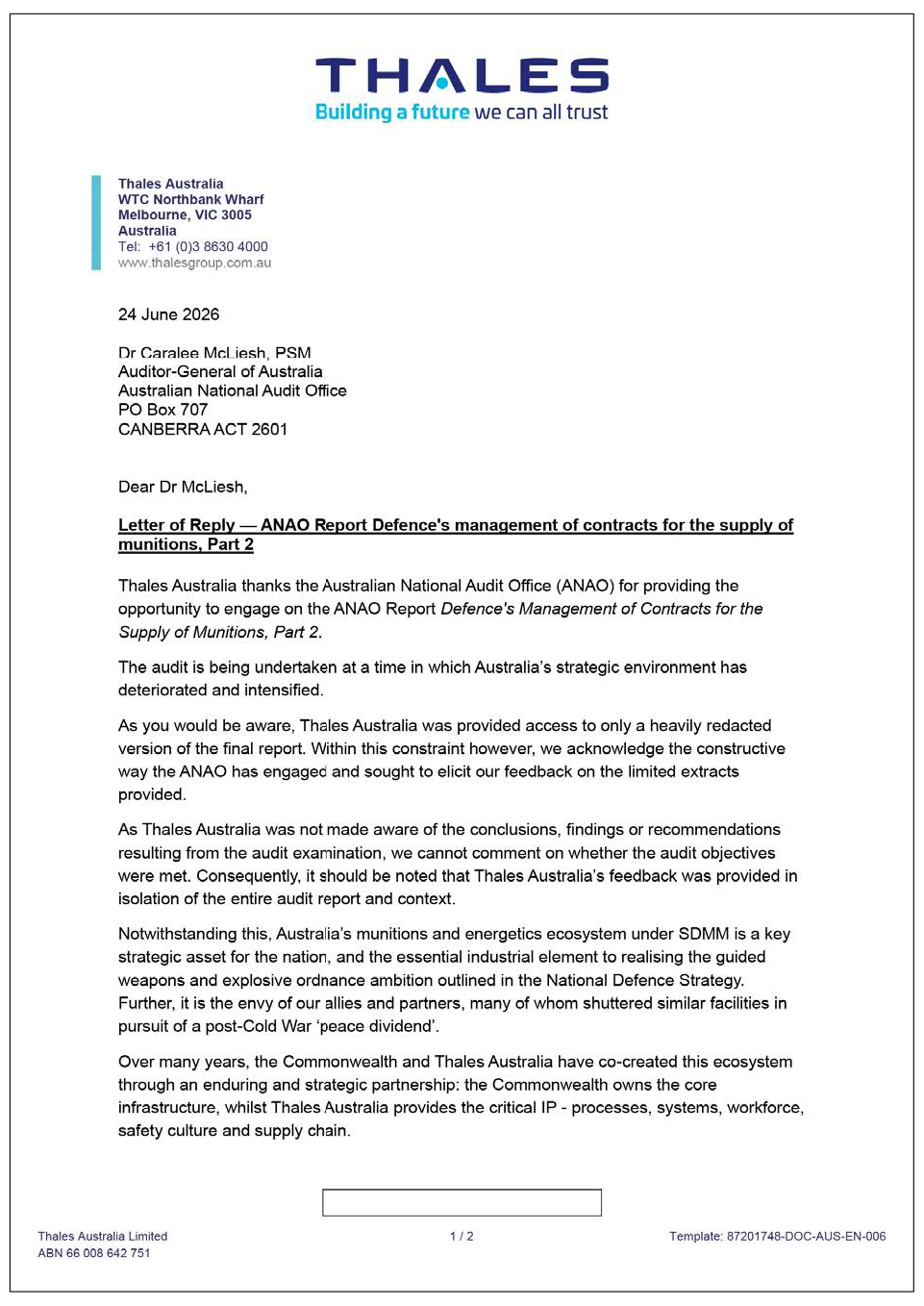
Thales Australia thanks the Australian National Audit Office (ANAO) for providing the opportunity to engage on the report.

Thales Australia was provided access to only a heavily redacted version of the final report. Within this constraint however, we acknowledge the constructive way the ANAO has engaged and sought to elicit our feedback on the limited extracts provided.

Notwithstanding this, Australia’s munitions and energetics ecosystem under SDMM is a key strategic asset for the nation, and the essential industrial element to realising the guided weapons and explosive ordnance ambition outlined in the National Defence Strategy. Further, it is the envy of our allies and partners, many of whom shuttered similar facilities in pursuit of a post-Cold War ‘peace dividend’.

Over many years, the Commonwealth and Thales Australia have co-created this ecosystem through an enduring and strategic partnership: the Commonwealth owns the core infrastructure, whilst Thales Australia provides the critical IP - processes, systems, workforce, safety culture and supply chain.

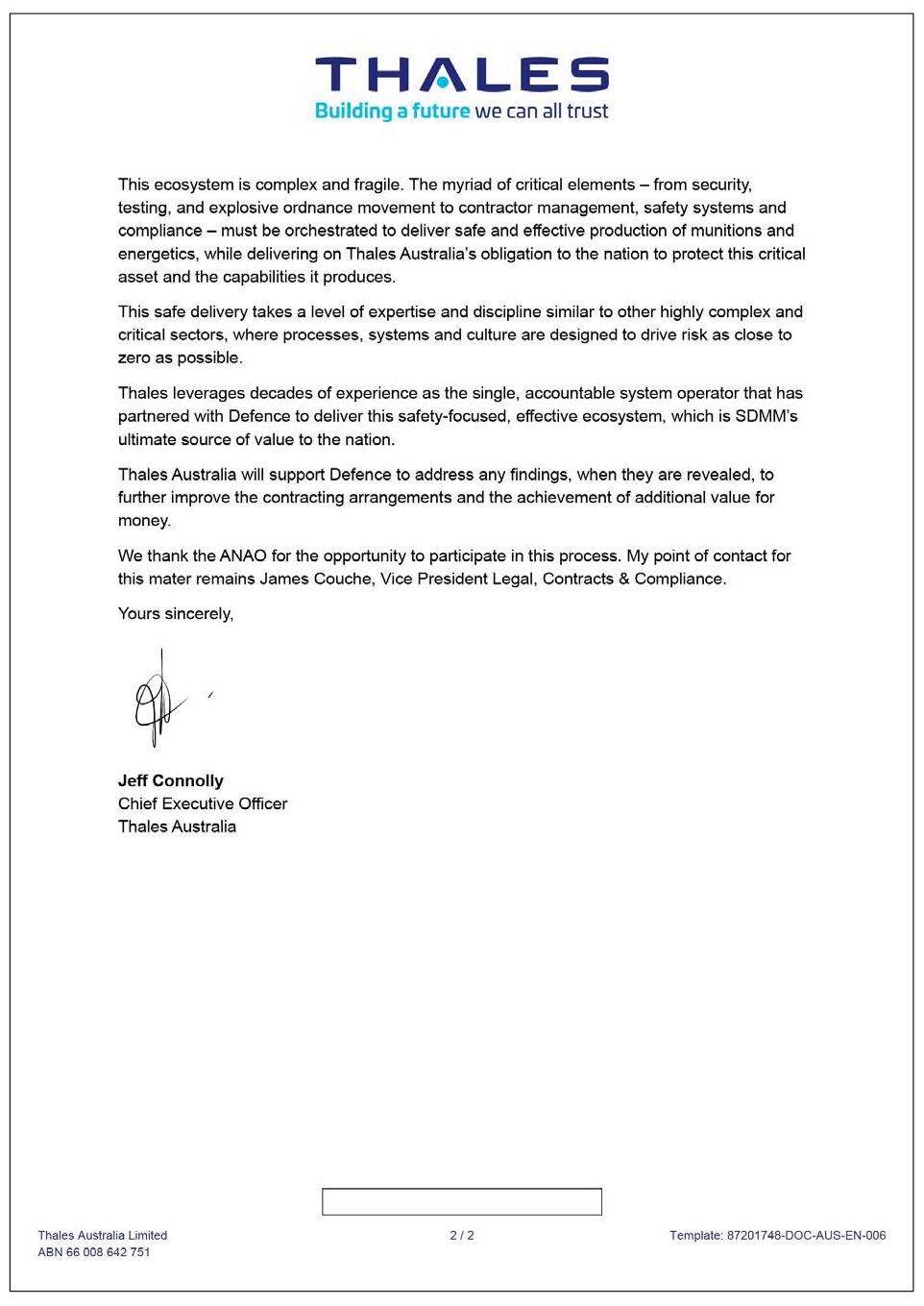
Thales leverages decades of experience as the single, accountable system operator that has partnered with Defence to deliver this safety-focused, effective ecosystem, which is SDMM’s ultimate source of value to the nation.

Thales Australia will support Defence to address any findings, when they are revealed, to further improve the contracting arrangements and the achievement of additional value for money.

Key messages from this audit for all Australian Government entities

28. Below is a summary of key messages, including instances of good practice, which have been identified in this audit and may be relevant for the operations of other Australian Government entities.

Group title

Performance and impact measurement

Key learning reference
  • Entities should ensure that they establish contract performance management frameworks that comprehensively address the contract objectives and drive desired behaviours.

1. Background

Introduction

1.1 The two Commonwealth-owned munitions factories at Mulwala and Benalla are national strategic assets that provide much of the industrial foundations to support and expand domestic production of guided weapons, explosive ordnance and other types of munitions.3 The Mulwala facilities were established in 1943 (83 years ago) and the Benalla facilities were established in 1994 (32 years ago). Thales Australia (trading as Australian Munitions) is the current operator of these facilities.

1.2 On 29 June 2020, the Australian government announced that Defence had signed a new 10-year agreement valued at $1.1 billion (GST exclusive) with Thales for the continued management and operation of the Mulwala and Benalla sites under the Strategic Domestic Munitions Manufacturing (SDMM) contract. On the same day, the government also announced that a new contract between Defence and NIOA Munitions (NIOA) for a tenancy at the Benalla site had been signed.

1.3 The intention of these arrangements, among other things, is to: provide surety of supply of key munitions and components for the Australian Defence Force (ADF); strengthen and diversify the supply chain; maintain domestic munitions manufacturing capability; and identify, develop, and manufacture new types of munitions to expand domestic capacity and meet Defence’s capability requirements into the future.4

Defence industry policies

1.4 Since the commencement of the SDMM contract in 2020 Defence’s strategic environment and capability priorities have shifted materially. Successive strategic documents — including the National Defence Strategy and the Australian Guided Weapons and Explosive Ordnance (GWEO) Plan — place increased emphasis on the industrialisation of munitions production, manufacturing uplift and the development of domestic capacity for a wider range of products.5 Within this strategic context, the objectives of the SDMM contract align with and support the strategic priorities set out in the 2024 and 2026 versions of the National Defence Strategy and the Australian Guided Weapons and Explosive Ordnance Plan.6 Among other things, these documents identify:

  • the importance of advanced munitions manufacturing, with an immediate focus on establishing a domestic manufacturing capability7;
  • domestic manufacture of guided weapons and explosive ordnance (GWEO) and munitions as one of seven ‘Sovereign Defence Industrial Priorities’8;
  • government investment of $26–36 billion in GWEO between 2025–26 and 2035–36 to:
    • maintain existing capabilities to manufacture munitions and explosive ordnance;
    • develop sovereign ability to produce, maintain, repair and overhaul selected weapons;
    • construct additional storage and distribution facilities to accommodate Defence’s growing GWEO inventory9; and
    • invest in facilities, equipment and infrastructure to support capability development activities.10

Contracting arrangements

1.5 Defence is responsible for contract management and operation of the Benalla and Mulwala facilities. Both contracts — the SDMM with Thales and the Munitions Manufacturing Arrangement (MMA) with NIOA Munitions— have an initial term of 10 years (to 30 June 2030) and maximum terms of 15 years (to 30 June 2035).

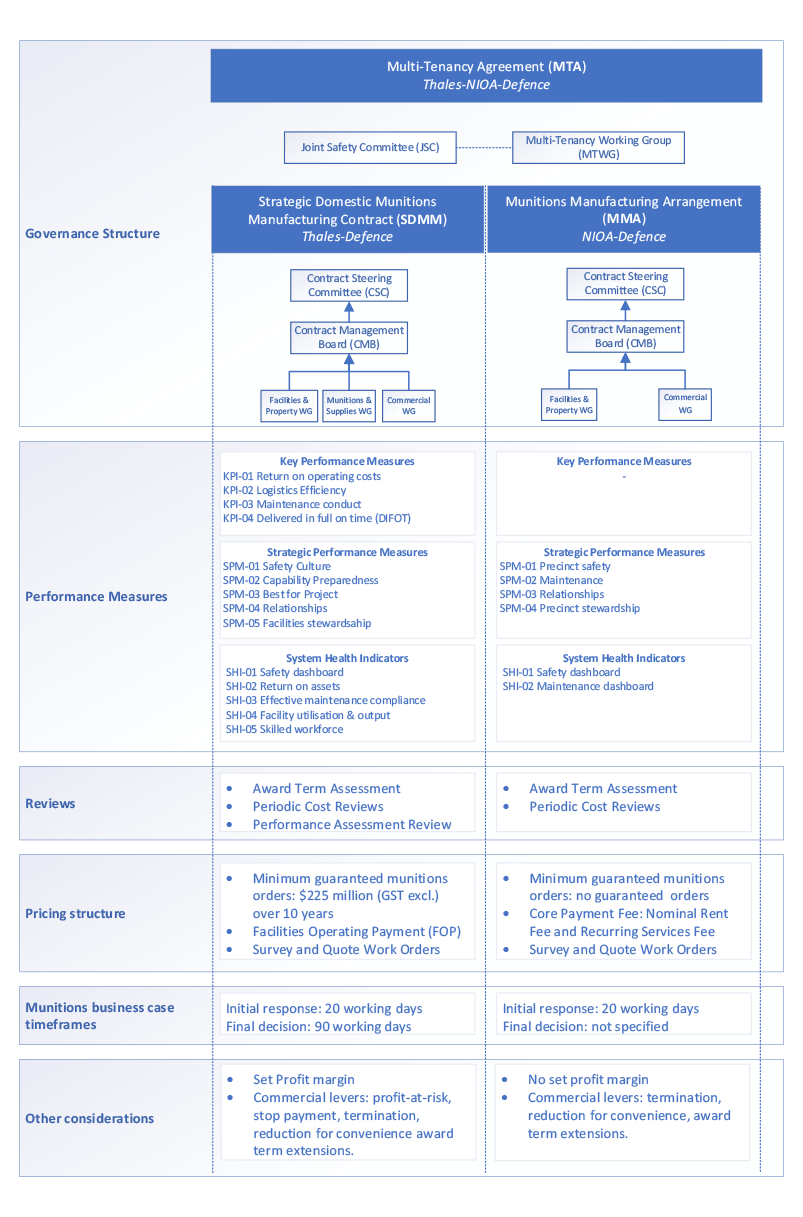
1.6 The SDMM contract is comprised of an agreement to manage the facilities and provide services and supplies to the ADF. The MMA contract comprises a lease covering a number of buildings at the Benalla site, which were operated and managed by Thales prior to 1 July 2020. The contract requires NIOA to manage and maintain the facilities within its tenancy area and work with Defence to develop opportunities for new or upgraded munitions manufacturing capabilities. A side-by-side comparison of the key features of the SDMM and MMA contracts is at Appendix 7.

Rationale for undertaking the audit

1.7 Defence has contracted with Thales Australia as its long-term ‘strategic partner’ for the management and operation of the Commonwealth-owned Benalla and Mulwala munitions factories. The contract — the Strategic Domestic Munitions Manufacturing (SDMM) — has an initial term of ten years and by June 2026 had a reported value of $1.9 billion (GST inclusive). This audit examined the effectiveness of Defence’s management of the SDMM contract to date and the achievement of value for money through Defence’s contract management activities.

1.8 This audit builds on previous ANAO work examining Defence’s management of the Benalla and Mulwala facilities over time and provides independent assurance to the Parliament on Defence’s contracting, governance, and management of the SDMM contract to date.

Audit approach

Audit objective, criteria and scope

1.9 The audit objective was to examine whether Defence’s management of the Strategic Domestic Munitions Manufacturing (SDMM) contract has achieved value for money and the effective delivery of the contracted arrangements.

1.10 To form a conclusion against the objective, the following high-level criteria were adopted.

  • Does Defence have effective contracting and governance arrangements in place?
  • Has Defence managed the contract effectively and achieved value for money?

1.11 This audit is the second of two performance audit reports examining Defence’s arrangements for the operation of the facilities from July 2020. This audit focused on Defence’s management of the 2020–30 SDMM contract with Thales for the operation and maintenance of the facilities. Auditor-General Report No. 47 2023–24, focused on Defence’s establishment of the 2020–30 contract, including the tender process, advice to decision-makers and the decision to conduct a sole source procurement.

1.12 The first report was tabled in Parliament on 25 June 2024. It concluded that Defence’s conduct of the sole source procurement for the operation and maintenance of the Benalla and Mulwala facilities beyond June 2020 was partly effective and that Defence’s management of probity was not effective. Defence agreed to the eight recommendations.

Audit methodology

1.13 The audit procedures included:

  • reviewing Defence records, including advice to decision-makers and contract documentation;
  • on-site fieldwork at the Mulwala and Benalla facilities; and
  • meetings with Defence personnel and Defence contractors.

1.14 The audit was conducted in accordance with ANAO Auditing Standards at a cost to the ANAO of approximately $1,110,000.

2. Contracting and governance arrangements

Areas examined

This chapter examines whether Defence has effective contracting and governance arrangements in place for the Strategic Domestic Munitions Manufacturing (SDMM) contract.

Conclusion

The SDMM contracting arrangements were partly effective. The contract was designed to sustain the long-term operation of the Benalla and Mulwala facilities, manage costs and deliver efficiencies over time. While industrial preparedness and manufacturing uplift activities were envisaged as an intended outcome of the contract, they were not included as core contract deliverables. The strongest performance incentives and commercial levers remain concentrated on baseline operations and delivery of mature products. Domestic munitions manufacturing uplift activities delivered through work orders issued under the SDMM have less effective performance incentives and commercial levers.

Defence has established largely appropriate governance, monitoring and reporting arrangements. Performance assessment reviews, financial cost model audits, and periodic cost reviews have been conducted in line with contract requirements. External reviews have been commissioned as needed and risks have been reported and managed, although Defence was slow to implement fit-for-purpose performance reporting arrangements.

Areas for improvement

The ANAO has identified two opportunities for improvement aimed at Defence’s contract and probity management activities.

2.1 The Australian Government Contract Management Guide states that contracts should reflect the complexity, risk profile and value of the goods or services being delivered. For higher risk contracts, this can include additional mechanisms — such as performance management or continuous improvement arrangements and bespoke payment models — to support effective oversight and value for money.11

Was a fit-for-purpose contract established, including clear performance requirements?

Defence established the SDMM contract as a long-term arrangement for operating, maintaining and managing the Benalla and Mulwala facilities. The performance requirements of the contract emphasise safe, secure and legally compliant operations, reducing the total cost of ownership and delivering efficiencies. The contract refers to supporting ‘industrial preparedness’, framed as an intended outcome rather than a specific deliverable. The contract provides mechanisms to place additional orders for munitions and commission work beyond the core services, including for capital works and research and development activities to support more advanced industrialisation.

The performance management framework and commercial leverage is focused on maintaining baseline operations of the existing facilities and the delivery of mature munitions products, with more limited coverage for activities contracted through the survey and quote work order provisions. Accountability for broader capability uplift and longer-term outcomes therefore relies more on strategic governance, planning and decision-making mechanisms. Defence has acknowledged these limitations and commenced work to refresh the performance framework to improve the clarity, consistency and usefulness of performance information.

2.2 The Strategic Domestic Munitions Manufacturing (SDMM) contract with Thales took effect on 1 July 2020. It has an initial term of 10 years and a maximum term of 15 years. The contract is a long-term arrangement for operating, maintaining and managing the Commonwealth’s munitions facilities at Benalla and Mulwala, while also supporting Defence’s ability to meet evolving munitions capability requirements over the life of the contract.

2.3 Figure 2.1 illustrates the contract’s principal components — the core services, survey and quote provisions, price and payment mechanisms, and the performance management framework. The survey and quote provisions provide a means for Defence to commission additional work beyond the core services, including additional munitions orders, capital works and research and development activities, within the overarching contractual framework. The price and payment mechanisms and the performance management framework are used by Defence to manage performance, cost and capability outcomes over the life of the contract.

Figure 2.1: Key elements of the Strategic Domestic Munitions Manufacturing (SDMM) contract

Figure shows the key elements of the Strategic Domestic Munitions Manufacturing contract. The core services, the survey and quote mechanism, the price and payment components, and the performance measures and commercial levers of the performance management framework.

Source: ANAO analysis of Defence records.

Scope and focus of the core services

2.4 The core services are primarily structured around the operation, maintenance and management of the Benalla and Mulwala sites. The contract places emphasis on maintaining safe, secure and legally compliant facilities, reducing the total cost of ownership to Defence, and delivering efficiencies over time. The extent to which these services have been implemented and delivered is examined in Chapter 3 (see paragraphs 3.5 and 3.51–3.74). These services were intended by Defence to maintain a level of ‘industrial preparedness’ within Australia’s explosive ordnance manufacturing base in support of Australian Defence Force (ADF) capability needs.

2.5 Industrial preparedness, as reflected in the contract and its statement of work, extends beyond day-to-day production. It encompasses the readiness of the facilities, systems and workforce to meet future Defence requirements, including adapting or scaling production to accommodate different types of munitions, when requested by Defence, over the life of the contract.12 It also allows for Thales to use the facilities, subject to Defence approval, to manufacture non-ADF products for sale to commercial markets.

Survey and quote work orders

2.6 As outlined by Figure 2.1, the survey and quote provisions under the contract are used by Defence to place orders for munitions and commission other services such as capital works and research and development activities. There are three categories of munitions products that are supplied or offered by Thales under the contract:

  • mature products, including products subject to exclusive supply arrangements13;
  • products subject to Thales’ first-right-of-offer; and
  • developmental and emerging products.

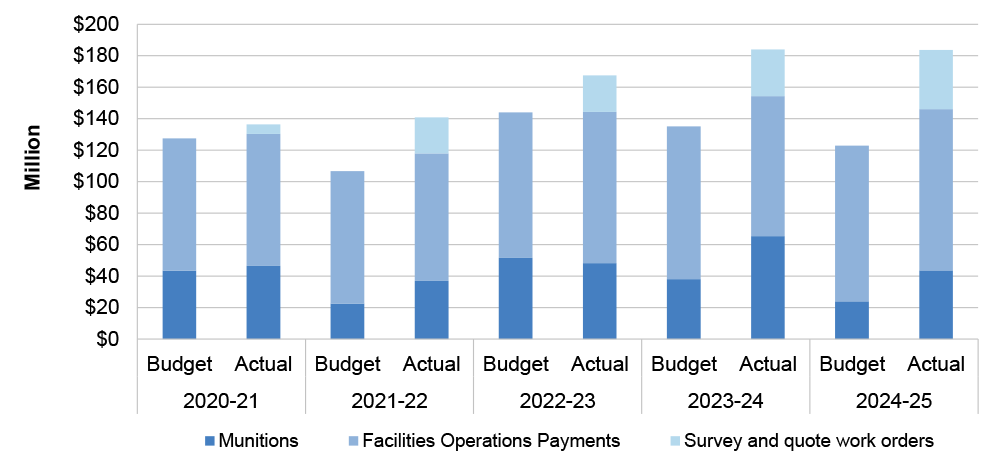
2.7 Orders for munitions are placed annually and Defence is contractually obligated to place minimum orders totalling $25 million per year for munitions, explosive ordnance and other ADF products for the period 2020–21 to 2024–25 (years one to five), and $20 million per year for 2025–26 to 2029–30 (years six to ten). Additional munitions orders, including for developmental and emerging products, can also be placed outside of the annual ordering cycle. As set out in Table 2.1, the total cost for munitions and munitions-related services over the first six years of the contract to May 2026 was $633 million (GST inclusive).

2.8 Some first-right-of-offer products have been treated by Defence as developmental and emerging where they had not previously been manufactured by Thales. These distinctions are relevant to how performance expectations and commercial levers apply across different categories of activity under the contract.

Pricing and payment mechanisms

2.9 The SDMM contract was designed so that its total value would vary over time rather than remain fixed. The contract includes a recurring facilities operations payment to cover the ongoing costs of operating and maintaining the facilities, alongside mechanisms that allow Defence to commission additional work through the survey and quote arrangements. These arrangements enable Defence to fund activities beyond the contract’s baseline operating and maintenance services — such as capital works and capability-related tasks — within the overarching contractual framework.

2.10 The contract had an initial value of $1,261.0 million (GST inclusive) at contract signature.14 As at June 2026, the estimated contract value, as reported on AusTender for the initial 10 year period (2020–21 to 2029–30) has increased by $607.6 million (48.2 per cent) to $1,868.6 million (GST inclusive), largely through the commissioning of additional work and the application of the price adjustment mechanisms. Table 2.1 sets out the value of each pricing component of the SDMM contract, as publicly reported, for the initial 10-year period.

Table 2.1: Value of each price component of the Strategic Domestic Munitions Manufacturing (SDMM) contract — as at June 2026

Price component

Value ($ million)

Facilities operations payment

1,235.5

Minimum munitions order valuea

247.5

Munitions orders and work orders for munitions-related services above the minimum order value

183.3

Non-munitions work orders

202.3

Total

1,868.6


Note a: The minimum order value comprises $27.5 million per year for the first five years and $22 million per year for the remaining five years of the initial contract term.

Source: ANAO analysis of Defence records.

2.11 The values in Table 2.1 are those reported by Defence on AusTender, as at June 2026. The ANAO has found that this value does not accurately reflect the total value of work that has been placed under the SDMM contract, using the survey and quote provisions (see paragraphs 3.80 and 3.81).

Facilities operations payment and commissioning mechanisms

2.12 The facilities operations payment is the largest price component of the contract.15 It is paid six-monthly in advance and the individual cost elements of the component are escalated16, reconciled, and adjusted in accordance with the assurance mechanisms in the contract.17 These mechanisms are designed to provide assurance to Defence that the facilities operation payments have been calculated and paid in line with the agreed financial cost model. They are also intended to manage cost pressures over time while maintaining fixed-price discipline for defined operating costs.

2.13 In addition to the facilities operations payment and minimum munitions order value over the initial term, the contract provides for additional munitions and non-munitions work to be commissioned. These work orders are priced separately using specified mark-ups depending on the type of service requested for example, capital works, munitions orders, and or research and development-related activities.

2.14 The contract also includes mechanisms intended to adjust the facilities operations payment over time, including through financial cost model audits, periodic cost reviews, and provisions intended to capture efficiency savings, as well as annual retrospective escalation of the facilities’ operating costs component.

Performance measures in the SDMM contract

2.15 Since the commencement of the SDMM contract in 2020, Defence’s strategic environment and capability priorities have shifted materially (see paragraph 1.4). As a result, the SDMM contract has increasingly been used not only to support the operation and sustainment of established facilities and product lines, but also as a vehicle to uplift domestic capacity to manufacture and deliver strategically important developmental and emerging products and support Defence’s longer-term industrial and capability uplift objectives.

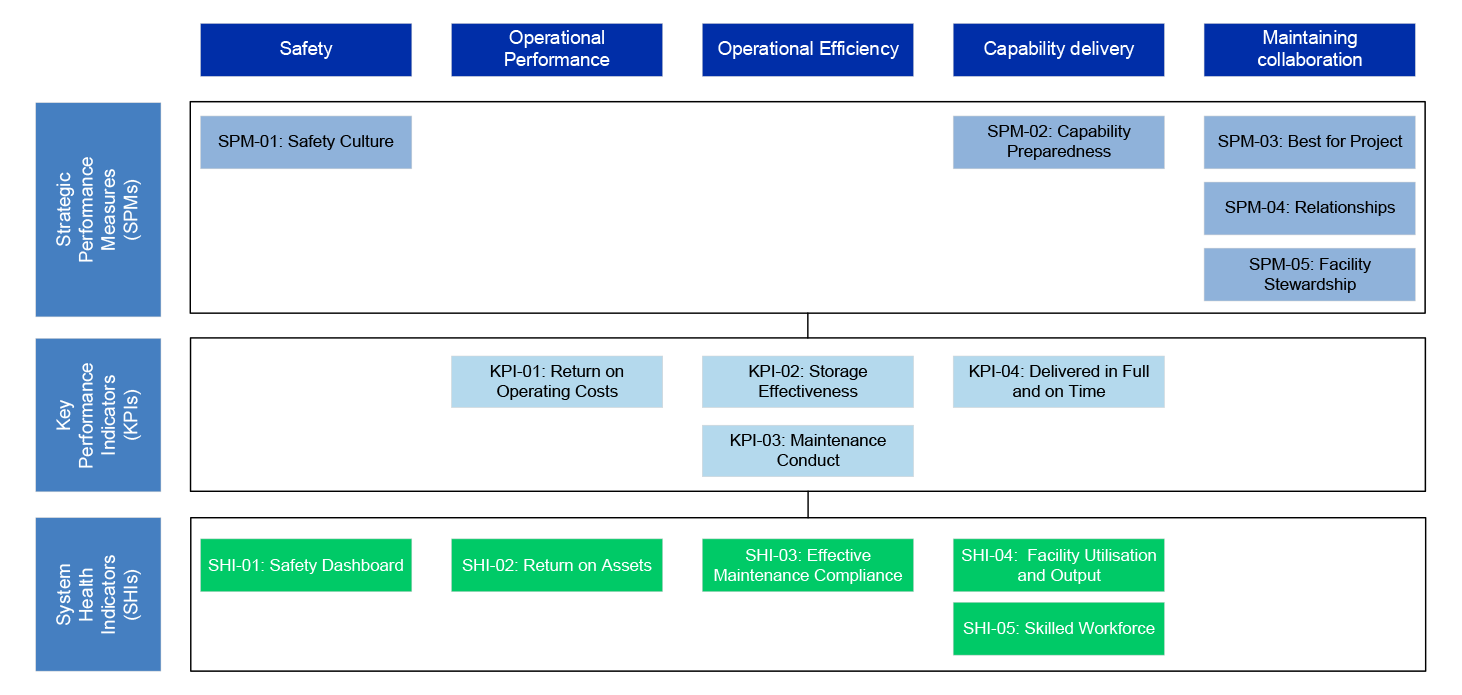
2.16 The SDMM contract includes a multi-tiered performance management framework, comprised of key performance indicators (KPIs), strategic performance measures (SPMs) and system health indicators (SHIs). KPIs are directly linked to performance payments. Strategic performance measures and SHIs provide additional visibility of service quality, behaviours, capability and supporting systems, but are not linked to performance payments in the same way as KPIs. Performance against the measures is assessed on a scheduled basis and reported by Thales in its quarterly contract status reports.18

2.17 The KPIs measure performance in four areas: return on operating costs; logistics efficiency; maintenance conduct; and delivery in full, on time (DIFOT) for certain munitions orders. Each KPI result falls into performance bands (A through D). Thales performance against the KPIs is linked to the retention or loss of profit. Collectively, the KPIs provide visibility of operational activity and the effectiveness of the controls associated with operating the facilities and maintaining the infrastructure, including services such as storage and waste management; maintenance of buildings, plant and equipment; and delivery of established munitions products and those treated as applicable for KPI assessment.19

2.18 The SPM and SHI components cover more qualitative or long-term aspects not easily captured in KPIs such as capability development, collaboration, safety culture, and contractor behaviours.20 These measures were expected to provide Defence with visibility over how the contractor was managing the facilities and workforce to respond to evolving strategic requirements. For example, SPM-02 (Capability Preparedness) assesses the contractor’s ability to operate and maintain the facilities to deliver capability in accordance with the Joint Strategic Plan and includes a performance attribute on timely implementation of the plan’s obligations. Under the contract, two of the five strategic performance measures SPM-02 and SPM-05 (Facility Stewardship) are self-assessed by Thales, with the other three measures assessed by Defence. This means that Defence’s assessment of Thales’ performance against the SPMs may not be accurately reflected in the reported ratings.

2.19 The SHIs comprise dashboard-style measures intended to provide visibility of safety, asset management, maintenance compliance and facility utilisation. Some indicators support trend monitoring rather than outcome-level assessment, depending on how underlying attributes are defined and applied over time.

2.20 Defence is required to consider Thales’ performance against the KPIs and SPMs when making determinations on award term extensions. As part of this process Thales is required to provide the underlying data for all measures, which Defence is to review during performance assessment reviews. Following a 12-month implementation period all performance measures were intended to operate in full and form Defence’s primary mechanisms for applying performance-linked commercial consequences under the contract. Figure 2.2 illustrates the aspects covered by the performance measures.

Figure 2.2: Performance measures of the Strategic Domestic Munitions Manufacturing (SDMM) contract

Figure showing how each type of performance measure (strategic performance measures, key performance indicators, and system health indicators) relates to the five key results areas (KRAs) of the performance management framework. The five KRAs are safety; operational performance; operational efficiency; capability delivery; and maintaining collaboration.

Note: Key result areas (listed across the top row of the figure) are an organisational schema developed by Defence and Thales to categorise the performance measures.

KPI-04 relates to the delivery in full and on time of munitions ordered under the SDMM contract.

Source: ANAO representation of Defence records.

Alignment of the performance measures with evolving strategic and industrial objectives

2.21 As indicated by Figure 2.1, the KPIs are focused on operation of the factories and timely delivery of munitions orders. This focus reflects the contract’s original design and was inherited from the interim contract.21 As Defence’s strategic priorities expanded to include the industrialisation of developmental and emerging products, an increasing proportion of contract activity — including non-munitions survey and quote work orders and work associated with emerging and first-right-of-offer products — sits outside the areas directly assessed by KPIs. While KPI results demonstrate whether specified controls and outputs have been achieved, they do not provide a complete basis for assessing delivery against the contract’s broader long-term outcomes and evolving industrial objectives.

2.22 The SHIs present similar limitations. Some indicators are assessed as satisfactory or unsatisfactory, and not all indicators were defined with measurable performance attributes at contract execution.22 This structure supports visibility and trend reporting, but it does not necessarily provide outcome-level measurement unless underlying attributes and thresholds are clearly defined and consistently applied.

Joint Strategic Plan and its role

2.23 The SDMM contract required Defence to develop a Joint Strategic Plan with Thales to guide strategic capability decisions relating to the operation, maintenance, outputs and future investment of the Benalla and Mulwala facilities. The plan was intended to establish a shared strategic framework to inform capability, operational and investment decisions under the SDMM contract, aligned with Defence’s priorities as set out in the National Defence Strategy and the Australian Guided Weapons and Explosive Ordnance Plan. The plan is defined in the contract as a document setting the intended strategic direction for informed decision-making, rather than a performance assessment tool.

2.24 The Joint Strategic Plan was finalised on 8 September 2025. It provides a framework to agree capability uplift priorities and associated investment planning and establishes governance and reporting arrangements, including oversight through a Joint Strategic Planning Board. The plan explicitly states that its metrics do not replace the performance measures within the SDMM performance management framework.

2.25 Accordingly, the Joint Strategic Plan and the performance management framework serve different but complementary purposes under the contract. The performance framework is intended to provide structured, periodic visibility of operational performance and applies defined commercial consequences where thresholds are met or missed. The Joint Strategic Plan is intended to operate as a strategic governance and planning mechanism, supporting Defence’s longer-term capability and industrial preparedness decisions that sit outside the scope of KPI-linked performance payments.

2.26 The practical consequence is that Defence’s strongest day-to-day commercial leverage is concentrated in areas measured by the KPIs, while accountability for broader capability uplift and longer-term outcomes relies on strategic governance, planning and decision-making mechanisms established through the Joint Strategic Plan and associated forums. As Defence’s reliance on the SDMM contract to support manufacturing uplift and emerging capability outcomes increased, this separation between performance-linked commercial levers and strategic planning mechanisms became more pronounced.

Implementation and evolution of the framework

2.27 The contract included a performance implementation period ending July 2021 to validate and refine performance measures and reporting processes before profit moderation commenced.23 Defence and Thales concluded that the framework was operating as intended at the end of this period, with limited changes made to specific performance attributes and thresholds.24 At that point, contract activity was largely focused on operating the facilities and delivering established munitions, consistent with the contract’s original design assumptions.

2.28 Following the implementation period, Defence and Thales continued to review aspects of the framework where performance measurement had evolved in practice. By 2023, this work included maintenance-related measures, after concerns emerged that the maintenance KPI did not provide a sufficiently accurate measure of maintenance efficiency. This reflected a growing emphasis by Defence on maintenance performance as an indicator of facility condition and operational readiness as demands on the sites evolved, even though the contracted maintenance performance measures were structured primarily around activity completion rather than whether maintenance approaches supported efficient operations and sustained asset performance (see paragraphs 3.23 to 3.28).

2.29 From 2023, this work developed into a broader review of the performance management framework.25 The review considered whether the framework was providing accurate, outcome-focused and sufficient performance information across the full range of contracted activities to improve the clarity, consistency and usefulness of performance information for decision making. As at June 2026, Defence and Thales were continuing to progress amendments through the performance management framework refresh.

Commercial levers

2.30 The SDMM contract includes a range of commercial levers to encourage satisfactory performance and address under performance. These include profit moderation linked to KPI performance, payment suspension and contract termination in specified circumstances, and the granting or withholding of award term extensions based on assessed performance against contractual criteria.

2.31 Profit moderation is Defence’s most routinely applied day-to-day commercial mechanism under the contract, as the remaining levers generally apply only in cases of contractual default or sustained underperformance. The contract provides that 60 per cent of the facilities operations payment and munitions order profit is intended to be ‘at-risk’, with the amount retained by Thales determined by its performance against the KPIs.26 As facilities operations payment profit is paid in advance, the application of profit moderation may require Defence to recover profit already paid to Thales.

2.32 The application of profit moderation is limited to the KPIs and does not apply to the SPMs or SHIs of the SDMM. As a result, profit moderation does not apply to the following categories of activity under the contract:

  • non-munitions survey and quote work orders;
  • work orders for industrialising and delivering developmental and emerging products; and
  • work orders for first-right-of-offer products where they have not been treated as munitions for the relevant assessment period.27
Payment suspension and contract termination

2.33 In circumstances involving significant performance concerns, Defence may suspend some or all of the facilities operations payment or require Thales to develop a remediation plan. These measures may be applied where Thales has not delivered or complied with a remediation plan, or where Thales’ performance against one or more SPMs and/or KPIs performance has fallen short. A remediation plan may also be triggered where munitions orders are delayed by more than three months.28

2.34 Contract termination represents Defence’s most severe commercial lever. The contract permits termination where Thales fails to remedy a default within a specified period or breaches the contract in a manner that cannot be remedied, or where KPI performance has consistently fallen short across three out of four consecutive periods. The contract also includes provisions that allow Defence broad discretion, including the ability to terminate the contract or reduce its scope, for convenience, at any time.

Award terms

2.35 The contract allows for two possible award term extensions — of three years and two years respectively — that are contingent on satisfactory performance. Defence is to determine whether to grant these extensions at the seven and nine-year point of the initial contract term (July 2027 and July 2029). Defence may also decide to not offer an extension for reasons including national security, withdrawal of the facilities from service, or significant changes in the domestic explosive ordnance landscape, by 30 June 2027.

2.36 Award term determinations are informed by periodic performance assessments conducted on a two-yearly cycle from 2024–25 (year four) of the contract. The third assessment period (1 July 2025 to 30 June 2027) carries the greatest weight for the first award term decision, and the fourth period (1 July 2027 to 30 June 2029) for the second. If both extensions are granted, three further assessments apply to the remaining years of the 15-year maximum contract term.

2.37 Under the contract, Defence is to assess Thales’ performance against five award term criteria, with at least four required to be met to achieve an overall ‘satisfactory’ rating. These criteria include limits on lower-band performance outcomes, such that Thales may have no more than:

  • three KPI assessments, where Thales’ performance has been assessed as tolerable for a short term, but unsatisfactory over the medium to longer term; and
  • two SPM ratings of ‘fair or amber’ and one ‘poor or red’.

2.38 Award term assessments are to take into account outcomes of the periodic cost reviews and performance outcomes from previous periods, although the contract does not specify how this is to occur. The contract also allows a ‘satisfactory’ rating to be awarded where a remediation plan remains in place. These features provide Defence with discretion in determining how historical performance and remediation activity influence award term outcomes.

Probity and conflicts of interest

2.39 The Australian Government Contract Management Guide states that where significant risks are identified, entities should prepare additional plans — such as probity plans — to support contract delivery.29 The SDMM arrangement includes several recognised probity risk drivers, including its long duration, partnership-style operating model, and the high level of routine interaction and information-sharing between Defence and Thales. Defence’s Complex Procurement Guide identifies such characteristics — high value, sensitivity and intensive industry engagement — as indicators of elevated probity risk, for which a contract-specific probity approach is regarded as better practice.30

2.40 The SDMM contract includes provisions intended to manage probity risks during contract delivery, including post-separation employment requirements that require Thales to seek approval before engaging former Defence personnel or service providers who were involved in the contract within the previous 12 months. These provisions address post-separation risks, Thales’ disclosure obligations, and allow Defence to request that staff reassignment for probity reasons. Defence did not undertake a documented assessment of probity risks at contract establishment, or afterwards, and the SDMM contract management plan does not address probity risks.

2.41 In January 2024, Defence became aware of a close personal relationship between SDMM staff from Defence and Thales. Defence applied its internal procedures, including staff reassignment, probity training, and exclusion from relevant procurement activities. While these actions were consistent with Defence policy, the absence of a documented contract specific probity plan limits the assurance available to Defence that probity risks arising from close working relationships are being identified in a timely manner and managed consistently.

Opportunity for improvement

2.42 There would be benefit in Defence developing contract management plans that include how probity risks are to be managed where the contract displays characteristics consistent with an elevated probity risk, including where the arrangement is long-term and/or considered a ‘strategic partnership.’

Has Defence established and implemented appropriate governance, monitoring and reporting arrangements?

Defence has established largely appropriate governance, monitoring and reporting arrangements. Contract governance arrangements include a contract steering committee, contract management board and subordinate contract management working groups, however key governance artefacts, including a contract management plan were not developed in a timely manner. Risks are reported in Thales’ register and managed in Defence’s risk management system (Predict!). As at June 2026, a new risk management plan that reflects the establishment of the Factories Operations Branch is being developed however the plan has not been finalised or approved and as such is not yet in place. From July 2024 monthly performance reports have been provided to senior leaders that include a dashboard view of all GWEO acquisition projects and sustainment products, including the manufacturing facilities at Benalla and Mulwala.

Governance arrangements

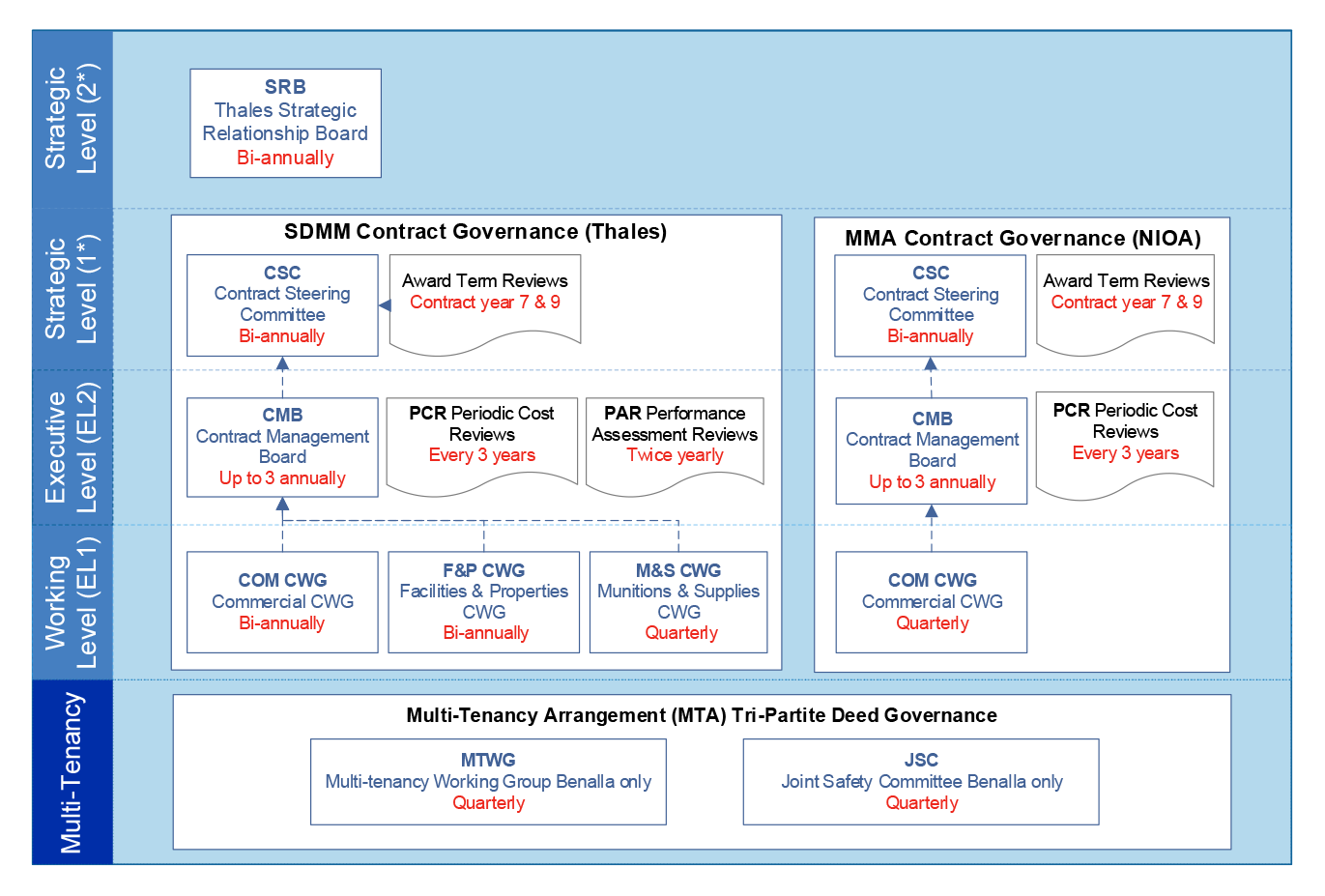
2.43 The governance arrangements for the SDMM and Munitions Manufacturing Arrangement (MMA) are set out in the contracts. Each contract establishes a Contract Steering Committee, Contract Management Board and subordinate Contract Management Working Groups. The roles of the governance bodies include monitoring contractor performance and progress against contract objectives, reviewing quarterly contract status reports, managing risk, and supporting performance assessment reviews and other assurance activities. The relationships and reporting lines between the individual bodies within the governance framework are illustrated at Appendix 3.

Contract steering committee

2.44 The Contract Steering Committee is the senior forum for strategic oversight, relationship management and contract governance for the SDMM contract. It is co-chaired by Defence and Thales, first met in September 2020, and between 2020 and 2025 has met bi-annually. The committee’s remit has included oversight of the development of key plans, the establishment of the annual munitions ordering process, and delivery of munitions and other work orders. It is also responsible for considering business cases seeking Defence approval to invest in specialist equipment and/or modify building use and has been involved in managing issues arising from the multi-tenancy.

Contract management board

2.45 The Contract Management Board reports to the Contract Steering Committee and provides direction to the contract working groups. It is the main interface between the working groups and the Contract Steering Committee and its functions include reviewing contractor performance, helping to resolve issues, setting priorities, and supporting performance assessment reviews. The board meets up to three times a year and is authorised to endorse contract change proposals; direct, seek input from, and monitor the working groups; resolve disputes and/or escalate matters to the Contract Steering Committee; monitor and evaluate implementation of the continuous improvement and efficiency program; and review and endorse business cases for consideration by the Contract Steering Committee.

Contract working groups

2.46 Three contract working groups operate under the SDMM contract: the Munitions and Supplies Contract Working Group; the Facilities and Properties Working Group; and the Commercial Contract Working Group. Their areas of focus are as follows.

  • Munitions and Supplies contract working group — munitions and supplies to be delivered and new products and energetics (explosive, propellant and pyrotechnic inputs into munitions).
  • Facilities and Properties contract working group — facilities and property matters, including capital and minor works, asset management and maintenance, environment, and work, health and safety.
  • Commercial contract working group — commercial, contractual, finance and administrative matters arising from, or referred by, the other working groups or related to the contract, and matters outside the other working groups’ remits.
Multi-tenancy agreement

2.47 The tripartite Benalla Multi-Tenancy Agreement (MTA) between the Commonwealth, Thales and NIOA requires two additional forums: a Joint Safety Committee and a Multi-Tenancy Working Group. The Joint Safety Committee was established in August 2020 and the Multi-Tenancy Working Group was established in November 2021.

2.48 The Joint Safety Committee’s purpose is to support safe operation of the facilities and compliance by Thales and NIOA with legislative workplace health and safety and environmental obligations. Between 2020 and 2025, the committee provided a forum for reporting incidents, identifying and assessing safety risks, requesting information and resolving disputes.

2.49 The Multi-Tenancy Working Group reports to the Joint Safety Committee and provides a forum for Thales and NIOA to share information to support safe and effective coordination of operations at the Benalla site. The working group provides a mechanism to address matters requiring coordination across the site, including land, waste and emergency management, shared infrastructure and other enabling services (such as utilities and telecommunications).

Contract management plan

2.50 While the contract sets out governance, risk management and monitoring and reporting arrangements Defence policy and procedures also state that a contract management plan is to be developed prior to contract award, in consultation with the contractor, jointly signed and maintained as a ‘living document’.31 Development of a contract management plan for the SDMM contract commenced in June 2020, however the plan was not approved until 29 February 2024, 43 months after the contract was awarded.

Opportunity for improvement

2.51 There would be benefit in Defence ensuring that contract management plans are developed prior to contract award, finalised in a timely manner following contract signature, and reviewed and updated regularly throughout the life of the contract.

Risk management

2.52 The SDMM contract requires Thales to address and manage risks in accordance with the approved Support Services Management Plan (SSMP). Defence is required to manage risks, including contract management risks, in line with the Defence Risk Management Framework and the Guided Weapons and Explosive Ordnance Division, Infrastructure Delivery Branch (GWEO IDB) Risk Management Plan. Defence is also required to record all relevant risks in its mandated risk management system, Predict!.

Risk management plan

2.53 The SDMM contract does not require Thales to develop and maintain a separate risk management plan. The SSMP serves this purpose. The SSMP was approved in July 2020, last updated in March 2025 and sets out procedures to identify and record, assess and analyse, treat, report, and monitor and review risks.

2.54 Defence is to manage the risks associated with the services contracted under the SDMM contract in line with the GWEO Industrial Delivery Branch (IDB) Risk Management Plan.32 This plan was approved in July 2023 and was due to be updated in July 2025. The plan included a risk appetite statement, as required, and authorised the individual business unit to manage ‘low’ to ‘medium’ risks, with risks rated ‘high’ or above, after treatment, to be managed at the branch level. In October 2025, the GWEO Group Risk Management Plan was released, superseding the GWEO IDB Risk Management plan. The plan specifies that it applies to all risk management activities conducted within the GWEO Group and requires each division, branch, and project to establish a risk management plan. As at June 2026, a new risk management plan that reflects the establishment of the Factories Operations Branch within the Domestic Manufacturing Branch, (previously known as the Industrial Delivery Branch) is being developed however the plan has not been finalised or approved and as such is not yet in place.

Identification, analysis and assessment

2.55 Thales has identified, analysed and assessed risks in its risk and opportunities register. Between 2020 and 2025, the register had identified 60 risks and opportunities. The register records the risk analysis (including an assessment of control effectiveness), the risk rating (very high, high, medium, low and very low), and the proposed risk response (treat, avoid, transfer or accept).

2.56 Defence used Thales’ risk and opportunities register to inform development of its risk register. This risk register was last updated in October 2023. The Defence register identified nine risks rated ‘high’ before treatment and one risk rated ‘high’ after treatment. The high risks identified for treatment included supply chain interruptions; management of business cases; resourcing (availability of skilled, qualified and experienced personnel); total cost of ownership reduction; and loss of or reduced capability. Unlike Thales’ register, Defence’s register did not include an assessment of control effectiveness.

2.57 Defence is recording risks relevant to its management of the SDMM contract and the Benalla and Mulwala sites in Predict!, the mandated risk management system. In December 2025, Defence was managing three ‘very high’ and three ‘high’ risks. By May 2026, three ‘very high’ and three ‘high’ risks had been retired and two new ‘high risks’ had been raised (see Table 2.2).

Table 2.2: Very high and high risks as at May 2026

Risk category

Risk description

Status

Risk rating

Target risk rating

Financial

Allocation of funding from 2027–28 is insufficient to meet contractual arrangements

Retired

Very high

High

Planned expenditure on facility upgrades exceeds available or allocated funding

Retired

High

Very Low

Security

Physical security breach occurs at the facilities

Retired

Very High

Not recorded

Schedule

Time to procure components, source support, and install the required updates to maintain critical infrastructure poses a risk to maintaining factory capability

Retired

Very High

Very Low

Enabling ICT systems

Enabling systems are unavailable, implementation is delayed, and/or cannot be accessed

Retired

High

Low

Asset and inventory management

Inability to replace critical plant equipment as scheduled or planned, due to extended lead times or obsolescence

Retired

High

Not recorded

Capability

Primary explosives manufacturing capability will further degrade and be lost due to limited utilisation and a shrinking pool of specialist personnel

Active

High

Not recorded

Asset condition

Roof failures during operation allow water into production areas disrupting operations and creating safety hazards

Active

High

Not recorded


Source: ANAO analysis of Defence documentation.

Monitoring, review and reporting

2.58 Risks and opportunities identified by Thales are recorded in its register and reported in quarterly contract status reports. These are monitored and reviewed through the contract governance structure, including the Contract Working Groups, Contract Management Board and Contract Steering Committee (see paragraphs 2.46 to 2.48). Between 2020 and 2025, Thales reported risks, opportunities, problems and issues in each contract status report and maintained its register in accordance with contract requirements. The Contract Working Groups, Contract Management Board and Contract Steering Committee monitored and reviewed these matters, together with risks identified by Defence.

Monitoring and assurance arrangements

2.59 The SDMM contract includes a range of monitoring and assurance mechanisms. These comprise performance assessment reviews, regular audits of the agreed financial cost model, periodic cost reviews, and business reviews conducted by subject matter experts.

Performance assessment reviews

2.60 The contract requires Defence and Thales to conduct six-monthly performance assessment reviews. These reviews are intended to validate performance scores, assess claims for adjustment or performance relief, determine performance payments, and consider proposed and approved efficiencies. The outcomes of these reviews inform Defence’s decisions on awarding contract term extensions. As at May 2026, performance assessment reviews had been completed covering the period 1 July 2021 to 30 June 2025. Thales’ performance over the four periods covering 2021–22 to 2022–23 was rated as ‘satisfactory’. Thales’ performance assessment across the four periods covering 2023–24 to 2024–25 has not been completed with a performance rating yet to be determined.

Audits of the financial cost model

2.61 The contract permits Defence to audit the approved SDMM financial cost model and the facilities operations payment twice a year, with additional audits able to be undertaken where audits identify errors or discrepancies or where there is a material change in contract scope or operations. Through its audit program, Defence has identified recurring issues, including incorrect or missing values and formula errors, see Table 3.6. As at June 2026, Defence has completed five financial audits of the SDMM. A financial cost model audit for the first half of 2025–26 (year six) was in progress at the time of this performance audit.

Periodic cost reviews

2.62 The contract required a periodic cost review in August–September 2021 (year two), with subsequent reviews every three years and additional reviews linked to each potential award term. The first periodic cost review was conducted between October 2021 and June 2022 and completed in September 2022. The second periodic cost review commenced in February 2025, was completed in April 2026, and the contract change proposal executed in May 2026. These reviews are intended to assess: whether costs incurred are allowable; quantify efficiency savings; and assess the likely cost of proposed award terms to support value for money decisions. They also provide a mechanism to consider and negotiate proposed changes to the financial cost model.

Subject matter expert business reviews

2.63 The contract allows Defence or Thales to appoint an independent subject matter expert to examine specific aspects of site operations and facilities management, including asset management, facilities maintenance, and utilisation, including the use of excess capacity. The subject matter expert provides recommendations in the form of a business review, which are intended to identify opportunities to improve value for money and reduce the Commonwealth’s total cost of ownership.

2.64 As at November 2025, seven such reviews had been undertaken. The reviews have identified savings opportunities and areas for improvement in asset management, maintenance and security. The recurring themes from these reviews are detailed at Table 3.2. While reviews have been conducted the contract does not include mechanisms to provide assurance that recommendations from the reviews have been implemented. Thales has reported progress on implementing some recommendations through its quarterly contract status reports.

Reporting requirements

Contract status reports

2.65 Thales must submit quarterly contract status reports (CSRs) to Defence covering financial and non-financial performance, efficiencies, workforce, asset management, risks, opportunities and issues, and munitions orders. Thales has provided the CSRs as required and Defence has reviewed all submissions, provided comments to Thales, and sought clarification on maintenance performance, efficiencies, and workforce movements.

Monthly sustainment reporting

2.66 Defence has used its Sustainment Performance Management System (SPMS) to monitor and report on performance of the facilities as a sustainment product.33 SPMS reporting to Defence leadership and stakeholders, including its Ministers, has largely focused on Australian Industry Content, availability and budget expenditure.

2.67 Between March and July 2023, Defence prepared fortnightly dashboard reports to support coordination of projects and priorities for the facilities’ sustainment. Following the establishment of GWEO group in May 2023, Defence commenced work to develop updated performance reporting arrangements. From July 2024 performance reports have included a dashboard view of all GWEO acquisition projects and sustainment products (including the manufacturing facilities at Benalla and Mulwala).34 These dashboards are presented at the GWEO Manufacturing Monthly Management Meetings.35

3. Contract management

Areas examined

This chapter examines whether Defence has effectively managed the Strategic Domestic Munitions Manufacturing (SDMM) contract and is achieving value for money.

Conclusion

Defence’s management of the SDMM contract has been partly effective. Key contract mechanisms intended to support cost reduction and achieve efficiencies have not been fully implemented or were not mature for much of the period examined. An agreed total cost of ownership model is not in place, constraining Defence’s ability to validate contract pricing and reported efficiencies. Defence have increasingly used work orders to commission activities beyond the core services in order to pursue longer-term objectives, without making effective use of available commercial levers to manage performance risks. Delivery outcomes for routine munitions are stronger than for the developmental and emerging products. As at June 2026, Defence has spent $42.5 million on developmental and emerging products that either have not been delivered, due to technical, quality and certification issues and related production challenges, or where the order has been cancelled. External reviews have identified persistent reactive maintenance practices below relevant benchmarks and standards.

Defence’s financial management, payment administration and reporting for the SDMM contract was not effective. As at June 2026, there is a gap of at least $109 million between the publicly reported total contract value and Defence’s total financial commitments under the contract. Price escalation for 2022–23 and 2023–24 was applied in a manner that did not comply with the Public Governance, Performance and Accountability Act 2013 (PGPA Act). Value for money assessments for work orders placed under the contract have not been consistently documented. Collectively, these matters have reduced transparency and weakened assurance that Defence is managing the contract effectively and achieving value for money.

Areas for improvement

The ANAO made four recommendations aimed at improving Defence’s contract management and supporting the achievement of cost reduction objectives under the contract.

3.1 The Department of Finance’s (Finance) Contract Management Guide states that value for money is first assessed at the evaluation phase of a procurement but is not fully realised until the contract is completed.36 The guide further states that effective contract management will assist in achieving the realisation of the value for money proposition approved by the delegate.37

Has the contract reduced the cost of the facilities for Defence and reduced financial reliance on the Commonwealth?

The contract has not reduced the cost of the facilities for Defence or reduced financial reliance on the Commonwealth. The SDMM contract includes cost reduction mechanisms, including a continuous improvement and efficiency program. The mechanisms require that an approved total cost of ownership model is in place to underpin pricing decisions, validate reported efficiencies and cost savings and conduct periodic cost reviews. As at April 2026, an agreed model was not in place. The absence of an agreed total cost of ownership model has constrained Defence’s ability to validate reported efficiency savings, and verify that the cost reduction outcomes, including a reduced cost of facility ownership and financial reliance on the Commonwealth, have been achieved.

Cost reduction mechanisms under the SDMM contract

3.2 The objectives of the Strategic Domestic Munitions Manufacturing (SDMM) contract included increasing production efficiency, reducing the costs to maintain the facilities and minimising financial reliance on the Commonwealth. To support these aims, the contract included a requirement for Thales to develop and implement a Continuous Improvement and Efficiencies (CIE) Program — supported by a total cost of ownership model — and validated through periodic cost reviews. The associated plan to implement the program was to be provided by Thales to Defence in June 2020 and approved and in place by 1 July 2020. These arrangements were intended to address information gaps identified during SDMM contract negotiations and provide assurance over allowable costs, reported efficiencies and forward pricing.

3.3 As at 30 June 2025, Defence had expended $812.4 million under the SDMM contract (GST exclusive). Over the first five years of the contract, the Facility Operations Payments (FOP) accounted for 56 per cent of annual expenditure on average. When combined with the non-munitions costs (the FOP and non-munitions survey and quote work orders) represented 70 per cent of expenditure. Over the term to date, overall expenditure under the SDMM contract has trended upward due to increased munitions orders and capital and other non-munitions work orders (see Figure 3.1).

Figure 3.1: Strategic Domestic Munitions Manufacturing (SDMM) contract budget versus actual (1 July 2020 to 30 June 2025)

The figure compares the budgeted and actual costs for the 2020-21 to 2024-25 financial years. The budgeted and actual costs and the portion of each price component (survey and quote, facilities operation payments, and munitions orders) is presented for each financial year examined.

Source: ANAO analysis.

3.4 The contract includes offsets intended to reduce the facilities operations payments payable by Defence when the facilities are used to manufacture and supply ADF and non-ADF products to other commercial entities and governments. Payment reductions are provided in the form of an ‘offset’ and are comprised of guaranteed minimum amount on ADF products and non-ADF products and a percentage of the activity provision and usage allowance included in the financial cost model. As at 30 June 2025, offsets totalled $32.4 million, reducing the FOP by an average of $6.5 million (seven per cent) per year. The value of the reductions achieved between 2020–21 to 2024–25, are illustrated below (see Figure 3.2).

Figure 3.2: Facilities Operations Payments — Offsets — Budget versus Actuals — 1 July 2020 to 30 June 2025

This figure compares the budgeted and actual returns achieved by Defence broken down by four categories. The four categories are: the Return on Facilities Operations Payments for the production of ADF products, return on Facilities Operations Payments for the production of non-ADF products (commercial), the non-ADF usage allowance, and the non-ADF activity provision. The table notes that the non-ADF usage allowance is calculated from the direct materials and labour costs to manufacture and sell non-ADF prod

Note: This chart presents the offsets in the financial year in which they were incurred.

Note: Non-ADF usage allowance is calculated from the costs of direct materials and labour used to manufacture and sell non-ADF products at the Mulwala and Benalla sites.

Note: The non-ADF activity provision is calculated from the mark up applied. The SDMM contract sets out the per cent of the allowance and provision that is to be included in the calculations used to determine the Return on the Facilities Operation Payment.

Source: ANAO analysis.

The Continuous Improvement and Efficiency Program

3.5 The stated purpose of the CIE program is to identify and implement initiatives to reduce Defence’s total cost of ownership. Under the contract, the program’s requirements include:

  • development and maintenance of a total cost of ownership model;
  • preparation of an efficiency implementation plan that describes the processes and tools for modelling and analysing cost drivers; and
  • implementation of approved efficiency initiatives in accordance with that plan.38

3.6 Thales reported in its January–March (Q3 2025–26) contract status report that the CIE program had achieved $14.7 million in savings from approved efficiency initiatives, with projected savings totalling $22.4 million to 2028–29.39 Thales advised the ANAO in June 2026 that savings under the CIE program may be realised through reductions to Facility Operations Payments (FOP), reductions in the rate of annual FOP increases, or lower prices for ADF products delivered under the contract.

3.7 The value of the savings reported has not been verified by Defence as an agreed total cost of ownership model was not in place. In the absence of this verification, Defence has had limited assurance that reported efficiencies have translated into measurable reductions in the cost of facility ownership.

3.8 In October 2025, Defence identified that it was unable to validate cost reductions from proposed efficiency initiatives without a working and usable total cost of ownership model. Defence has paused the assessment of all efficiency proposals until the model meets its expectations. This action was undertaken as part of a broader Defence review of the CIE program, initiated in June 2025 and scheduled to conclude in September 2026. One of the desired outcomes of the review is the delivery of a revised efficiency implementation plan. The review includes examining the scope of the total cost of ownership model and assessing and verifying the processes for proposed efficiencies. In February 2026, Defence advised Thales of its concern that the CIE program was not achieving adequate cost reductions.

Total cost of ownership model

3.9 The total cost of ownership model is central to assessing whether approved efficiencies have reduced, or are likely to reduce, Defence’s cost of ownership. The model is linked to the Financial Cost Model and the Strategic Asset Management Plan (see Table 3.1 and paragraph 3.21). Under the contract, the model is required to identify the costs of operating and supporting the facilities, providing contracted services, and delivering cost savings through approved efficiencies. It also supports periodic cost reviews.

3.10 Thales was required to develop and maintain the total cost of ownership model as part of the contract’s capability assurance transformation activities. The November 2023 Contract Steering Committee minutes stated that Defence had endorsed a working model.40 This did not resolve all matters relating to the model, with Defence continuing to review it and raising issues including undocumented assumptions and limited functionality. As at April 2026, an agreed total cost of ownership model meeting Defence’s requirements was not in place (see paragraph 3.14).

3.11 The unresolved status of the model limited its utility for robust cost analysis. Thales considered that the model had been delivered and put into use, while Defence continued to raise concerns about whether it could reliably support scenario analysis, pricing decisions, and validation of reported efficiency savings. Despite successive revisions, the model had not been agreed as meeting Defence’s requirements.

Periodic cost reviews

3.12 Periodic cost reviews (PCRs) were introduced because Defence lacked the information needed to validate Thales’ pricing during contract negotiations. Defence uses the PCRs to determine allowable costs incurred, assess savings achieved from approved efficiency initiatives, update the financial cost model, and set an agreed price for subsequent years. The reviews are also intended to support assurance that the contract represents, and continues to represent, value for money, and to verify the accuracy of the total cost of ownership model.

3.13 In April 2022, Defence noted that no progress on the development of the total cost of ownership model had been reported since the contract commenced in June 2020. Thales provided a model in March 2022 to support the first periodic cost review, conducted between October 2021 and May 2022. Defence found that the model: could not be used to identify and support the analysis of cost drivers; had not been developed using a ‘bottom-up’ approach; relied on pricing that had been reversed engineered from the previous contract; and was not mature enough to support the periodic cost review. Nevertheless, Defence proceeded to use the model to set the FOP for years three to five and achieved an $8.8 million contract reduction through the first cost review process.

3.14 In response to these deficiencies, Defence advised Thales in August 2022 that it intended to conduct a verification and validation activity and requested that Thales update and resubmit the total cost of ownership model for review. A revised model was resubmitted in March 2023 and again in November 2023.41 In August 2024, Defence wrote to Thales to advise them that the model had been reviewed and assessed as ‘not being fit for purpose’. Thales responded in October 2024 that the model had been endorsed and was in use. Defence and Thales continue to disagree on the status of the model and as at April 2026, the matter has not been resolved. The absence of an agreed total cost of ownership model continues to limit Defence’s ability to validate pricing and verify efficiency claims, reducing assurance over whether the contract’s cost-reduction objectives are being met.

Recommendation no.1

3.15 The Department of Defence clarify its requirements for the supporting tools and processes (including a total cost of ownership model) and implement fit for purpose arrangements to manage the SDMM contract effectively, improve decision-making and support the achievement of longer-term contract and strategic objectives.

Department of Defence response: Agreed

Has Defence ensured that Commonwealth land and assets are used and managed effectively?

External reviews and Defence data have identified persistent patterns of reactive asset management and maintenance practices that are below the applicable industry benchmarks and standards. An asset condition assessment finalised in February 2026 identified systemic weaknesses affecting asset management, including incomplete baselines and insufficient linkage between asset condition, capability outcomes and investment planning. Critical assets at both Benalla and Mulwala were assessed as below target condition and while Defence has commenced remediation and investment planning, these efforts remain ongoing as at April 2026.

3.16 The contract requires Thales to maintain and operate the sites in a ‘safe and continuous manner’. This includes maintaining the assets at the sites in a serviceable and working condition that enables them to be used to perform their intended function. It also specifies permitted uses of the land and assets comprising the sites and associated asset management requirements.

Use of Commonwealth land and assets

3.17 At contract signature, Defence approved the use of Commonwealth land and assets for non-ADF production for the first two years (2020–21 to 2021–22). From 2022–23, there are two mechanisms that can be used to approve the use of Commonwealth land and assets for non-ADF production. The first mechanism is the annual order cycle — the Capability Assurance Cycle Munitions Recommendations (CACMR) process. Where Thales proposes to use the facilities to produce additional quantities or new products that have not been approved as part of the annual ordering cycle, a second mechanism, requiring submission of a business case can be used.

3.18 The submission of a business case is intended to ensure that proposed changes to product types, volumes or manufacturing activity are subject to Defence assessment and approval, including consideration of the impact on agreed production and capability settings. Defence records reviewed by the ANAO indicated that the applicable approval pathway was not always clear or completed before related activities were progressed. Where the applicable approval pathway is not clear or has not been completed before related activities are progressed, there is reduced assurance that proposals have been subjected to appropriate scrutiny and risks assessed to provide assurance that the activity will not adversely impact Thales’ ability to meet Defence’s needs.

Asset management and maintenance

3.19 Thales is contractually required to develop and maintain asset management plans for the Benalla and Mulwala sites. As at February 2026, all plans were current and had been approved as required. Table 3.1 provides further detail on each plan.

Table 3.1: Key plans governing asset management under the Strategic Domestic Munitions Manufacturing (SDMM) contract

Plan

Update frequency

Description

Strategic Asset Management Plan (StAMP)

Annually (six-monthly submissions agreed for 2023–2024).

Sets out proposed facilities works for the next ten years and tracks progress on approved works.

Asset Management Plan (AMP)

Six-monthly to 30 June 2022, then annually.

Describes Thales’ asset management approach, including asset types, age profiles, and processes for funding, replacement and disposal of assets.

Maintenance Management Plan (MMP)

Annually.

Describes Thales’ plans and processes for meeting maintenance requirements for buildings, plant, equipment, land, environment, and subleased/sublicensed areas.


Note: Thales provided draft submissions in February and April 2025. In June 2025, Defence and Thales agreed to delay the next submission from October 2025 to February 2026. It was submitted in February 2026.

Source:ANAO analysis of Defence records.

3.20 The Strategic Asset Management Plan (StAMP) is a standing agenda item at Facilities and Properties Contract Working Group meetings. Defence advised the ANAO in August 2024 that the StAMP was the ‘main mechanism’ for informing funding decisions for asset, equipment and infrastructure maintenance.

3.21 Between August 2023 and April 2024, Defence reviewed the Asset Management Plan (AMP) and Maintenance Management Plan (MMP), identifying the need for improved asset condition and performance data, maintenance record-keeping and access to Thales’ maintenance management system.42

3.22 The contract requires Thales to commission maintenance audits every two years in accordance with the MMP and to provide the audit reports to Defence on request.43 In April 2025, Defence requested copies of the two completed biennial Maintenance Audit Program reports. The reports provided by Thales were a 2022 benchmarking study, and a maintenance audit report in July 2024 (see Table 3.2). Thales advised the ANAO in June 2026 that the next biennial maintenance audit is scheduled to commence by July 2026.

External review findings

3.23 External reviews commissioned by either Defence or Thales between 2021 and 2025 have provided insights into Thales’ asset management approaches and maintenance practices, and the underlying condition of key production assets at the Benalla and Mulwala sites. Together, they provide insight into how maintenance is being conducted, how well it aligns with industry standards, and the extent to which the available data supports effective planning. Across the reviews, common themes were identified. These are summarised in Table 3.2.

Table 3.2: Themes identified in external reviews — 2021 to 2025

Theme

Findings from the external review

Implications

Reactive maintenance and low preventative effort

  • Complete Lean Solutions (CLS, May 2021): Benalla assessed as operating a ‘run-to-failure’ maintenance model.
  • GHD Advisory (GHD, July 2022): Thales operated in a ‘reactive maintenance environment’.
  • GHD (2022): Preventative maintenance 22 per cent at Benalla, 45 per cent at Mulwala (vs 75–85 per cent in mature organisations).
  • GHD (2022): High corrective maintenance: 71 per cent at Benalla and 49 per cent at Mulwala (vs 10–20 per cent benchmark in ‘best-in-class organisations’).a
  • GHD (2022): Breakdown maintenance within benchmark range (five–10 per cent).b
  • GHD (July 2024): Preventative maintenance increased (+32 per cent Benalla; +24 per cent Mulwala) but remained below benchmark.

Increased likelihood of unplanned failures, lower asset reliability and less predictable production outcomes.

Insufficient maintenance budget and expenditure

  • GHD (2022): maintenance expenditure was insufficient to achieve the equipment reliability and performance required.c
  • GHD (2024): the maintenance budget was insufficient given age, operational demand and maintenance requirements of the assets.

Increased likelihood of unplanned failures, lower asset reliability and less predictable production outcomes.

Insufficient alignment with asset management standards

  • Jacobs (August 2023): Asset management requirements under the contract were maintenance–focused and did not require alignment with ISO 55001.d

Limits asset management maturity and constrains Defence’s ability to drive long-term improvement.

Data quality and transparency risks

  • GHD (2022): Breakdown maintenance may be recorded as corrective, reducing transparency.e

Inhibits accurate assessment of reliability, obscures failure patterns and affects sustainment planning.

Incremental improvement

  • GHD (2024): Facilities maintained in accordance with the MMP. Corrective and breakdown maintenance performance improved.

Demonstrates progress but not sufficient to close benchmark gaps.


Note a: Corrective maintenance is reactive maintenance and is intended to address equipment that is not functioning as required.

Note b: Breakdown maintenance is reactive maintenance required to remedy breakdowns or address equipment failure.

Note c: Maintenance cost rates at Benalla (0.9 per cent) and Mulwala (1.1 per cent) were below a benchmark of 2–3 per cent. These rates reflected annual maintenance costs of $4.3 million at Benalla and $15.3 million at Mulwala as percentages of asset replacement values of $465.5 million at Benalla and $1.4 billion at Mulwala. In July 2025, Defence estimated the combined maintenance cost rate to be no higher than 1.8 per cent based on the same asset replacement values used by GHD advisory, which were assessed in 2018.

Note d: ISO 55001 is the international standard for asset management systems.

Note e: Breakdown maintenance rates were within the benchmark range of five to 10 per cent, although the review noted that these rates, in combination with observed corrective maintenance rates, might suggest breakdown maintenance was being captured as corrective maintenance, reducing transparency around asset reliability and performance.

Source: ANAO analysis of Defence records.

3.24 The collective results of these reviews indicate that while partial improvements in preventative maintenance have been made, a pattern of reactive maintenance, misalignment with industry benchmarks and standards, data quality and transparency issues, and constraints on the visibility of the condition of assets persist.

Implementation of external review findings

3.25 In response to the findings of the external reviews, Defence commenced work in August 2024 to assess replacement and upgrade needs for major equipment. This work was subsequently incorporated into a broader asset remediation program, established in November 2024. The objective of this program is to implement the recommendations from the external reviews conducted since 2021 (see Table 3.2) and address the identified maintenance, data, and asset-condition deficiencies.

3.26 The asset condition assessment under this program was finalised in February 2026. It found systemic issues affecting asset management maturity, including incomplete technical baselines, limited visibility of system interdependencies and insufficient linkage between asset condition and investment planning. It stated that these issues constrained Defence’s ability to prioritise remediation work, assess residual risk, and develop sound sustainment and capital investment proposals.

3.27 The asset condition assessment also found that a significant proportion of assets at both the Benalla and Mulwala sites were below target condition. In December 2025, Thales reported that the estimated cost to replace several assets was substantially higher than their original acquisition value. As at February 2026, a business case to support advice to government on future sustainment investment proposals and associated funding requirements was being developed. In March 2026, Defence advised government that additional investment would be required to improve the condition of the facilities to a level capable of supporting production requirements, achieving strategic objectives and meeting government priorities.

3.28 The asset condition assessment found that while a number of projects had been identified in the Strategic Asset Management Plan, to address asset condition issues, only a small proportion of the projects were included in the planned works. The assessment recommended Defence prioritise uplifting assets assessed as below target condition and establish projects to manage the work required.

Performance management framework findings and limitations

3.29 The contract’s performance management framework provides Defence with a basis to assess and monitor aspects of asset use and maintenance at the Benalla and Mulwala sites. The respective assessment results have highlighted issues consistent with those identified by the external reviews into maintenance practices and asset condition.44 In particular, maintenance work order data indicates that the mix of preventative, corrective and breakdown maintenance at the sites is broadly consistent with the findings from the reviews, (see Table 3.2). A detailed analysis of the maintenance work orders raised between June 2020 and September 2025 is at Appendix 5. Preventative maintenance between December 2020 and September 2025 remained below the industry benchmark, (see Figure 3.3). In July 2025, Defence identified that breakdown maintenance had increased by 70 per cent since April 2022. These results present an ongoing risk to long-term asset reliability and sustainability.

Figure 3.3: Completion of maintenance work by category at Benalla and Mulwala — December 2020 to September 2025

The figure provides a comparison of the completion of maintenance work orders by category (breakdown, corrective and preventative) at the Benalla and Mulwala sites. At Benalla, 52 per cent of maintenance work orders have been categorised as preventive, 40 per cent as corrective and eight per cent as breakdown. At the Mulwala site, 67 per cent of maintenance work orders have been categorised as preventative, 28 per cent as corrective and five per cent as breakdown. The figure includes a note that the industr

Note: The industry benchmark for preventative maintenance is (75 per cent to 85 per cent). For corrective maintenance (10 per cent to 20 per cent) and for breakdown maintenance (five per cent to 10 per cent).

Source: ANAO analysis.

3.30 While assessments under the performance framework have highlighted issues to date, the current measures provide limited information about whether asset and maintenance management is effective over the longer term. Thales’ reported performance against the strategic performance measures (SPMs) and key performance indicators (KPIs) has largely been rated favourably, including Band A results for relevant KPIs and ‘satisfactory’ self-assessments for system health indicators to June 2025. However, analysis of the underlying performance attributes, or sub-measures, and other data indicates deficiencies in areas such as maintenance effectiveness and asset utilisation that are not captured by the headline ratings alone. As at June 2026, Defence and Thales were undertaking a staged refresh of the framework, with correction and clarification activities scheduled between June and August 2026 and a further review of updated measures scheduled to commence in July 2027.

3.31 The design of the KPI set contributes to this limitation. Of the four KPIs, only one relates to maintenance (KPI-03, ‘Maintenance Conduct’), and there are no KPIs that measure asset management effectiveness. KPI-03 measures completion of maintenance activities against planned maintenance, rather than whether the planned maintenance approach is supporting efficient operations and sustained asset performance. The KPI relies on measures such as the number of outstanding safety-critical maintenance issues, work orders completed, and the maintenance backlog.

3.32 In July 2024, Defence advised the ANAO that it intended to replace KPI-03 with an ‘Overall Equipment Effectiveness’ (OEE) measure as part of the performance management framework refresh. Defence’s stated intent was that OEE would better capture equipment availability, performance and quality loss, and provide a stronger basis to incentivise maintenance approaches that support efficient production and reduce failures.45 To support this work, Thales provided precinct-level OEE data for January 2022 to June 2024, indicating average precinct-level scores ranging from 68 to 82 per cent and site-level averages of 74 per cent at Benalla and 78 per cent at Mulwala (see Appendix 4).

3.33 Other performance data indicates that, despite increasing production demands linked to higher ADF orders, underutilisation of site capacity has persisted over the life of the contract. For the ‘Facility Utilisation and Output’ SHI, utilisation was consistently below 59 per cent for three precincts between October 2020 and December 2025, including two precincts that were consistently below 48 per cent.

3.34 Taken together, the maintenance and utilisation information indicates that the performance management framework is identifying persistent issues but is limited in its ability to measure whether asset and maintenance management arrangements are supporting the longer-term reliability, sustainability and efficient use of Commonwealth land and assets and will reduce the total cost of ownership over time.

Recommendation no.2

3.35 The Department of Defence strengthen its oversight of asset management and maintenance under the SDMM contract, including by ensuring that existing performance measures, reporting and management processes provide sufficient visibility of whether arrangements are supporting the long-term reliability and sustainability of assets at the sites to support contract management and investment decisions.

Department of Defence response: Agreed

Impact of asset condition on current and future manufacturing capability

3.36 The age and condition of the assets at the Benalla and Mulwala factories is affecting their capability and capacity to meet current and future manufacturing needs.

3.37 Thales advised Defence in July 2020 that investment was required to maintain certain existing manufacturing capability at Benalla. In June 2025, Thales further advised Defence that a specific manufacturing line was nearing the end of its useful life and required upgrades to continue supporting existing production. Thales stated that a major failure of obsolete equipment and unsupported control systems could impair certain production for up to 18 months while a replacement system was procured.

3.38 Defence subsequently approved the development of a detailed business case for upgrades to maintain the existing capability in November 2025. The business case was submitted by Thales in January 2026 and provided two options for Defence to consider. The business case stated that both options were expected to take the equipment out of service and impair the existing capability for at least 12 months. Defence evaluated the options, and in March 2026, approved an order for priority equipment replacement and associated engineering work.

3.39 More broadly, Defence advised the ANAO during the course of this performance audit that the Benalla and Mulwala facilities had ‘suboptimal production capacity’, ‘a dependence on offshore precursors and raw materials’, and required further investment to meet the 2024 and 2026 National Defence Strategy priorities. Defence further advised government in March 2026 that the performance of the sites was constrained by ageing plant, equipment and infrastructure that was increasingly costly to maintain and did not align with contemporary production requirements.46

Impact on future needs

3.40 The ability of the Benalla and Mulwala factories to meet future needs is also affected by the condition and configuration of key assets, and by the maturity of supporting production processes. These factors are evident in Thales’ work to expand the large calibre manufacturing capability to include the production of 155mm M795 High Explosive filled projectiles (see Case study 1). In July 2020, Thales advised Defence that upgrades would be required before the capability could be relied on for 155mm M795 manufacture.

3.41 In June 2026, Thales advised the ANAO that the key equipment used to manufacture the existing range of large calibre projectiles was designed to be capable of producing 155mm M795 projectiles. Information from Defence and Thales indicates that, although the equipment was designed with this capability, the facilities still require adaptation to establish the production, testing and quality control processes needed to successfully certify the production line and manufacture the projectiles in the quantities required to meet Defence’s needs.

Has Defence effectively managed the multi-tenancy arrangements in place at the Benalla site?

Multi-tenancy arrangements at the Benalla site required the establishment of additional governance structures, including coordination mechanisms between tenants and a joint safety committee. These arrangements have delivered limited improvements in site utilisation and production diversification. Defence’s risk assessments of the transition focused on commercial and legal considerations and did not address the likely impact or consequence of disruptions across the supply chain. Defence initially relied on NIOA and Thales to negotiate key commercial and operational arrangements. Delays were encountered due to commercial, intellectual property and regulatory issues and Defence did not respond in a timely manner to mitigate the supply chain risks associated with establishing the arrangements.

Multi-tenancy arrangements at the Benalla site

3.42 Establishing multi-tenancy at the Benalla site was intended to increase competition, reduce operating costs, expand ADF munitions production, and improve site utilisation.47 These objectives were to be achieved through Defence’s contracts with NIOA and Thales. The site, built between 1993 and 1996, comprises purpose-built buildings for specific manufacturing processes.48 Under the SDMM contract and the Munitions Manufacturing Arrangement (MMA) contract with NIOA, designated buildings were to be transferred to NIOA from 1 July 2022.

Governance arrangements and administrative processes

3.43 Before multi-tenancy commenced in July 2020, Defence’s responsibilities at Benalla were limited to managing its contract with Thales and its associated governance arrangements. Introducing the multi-tenancy required Defence to implement additional governance structures to coordinate tenants, allocate risk and establish joint safety oversight — significantly increasing Defence’s administrative burden.

Implementation of the multi-tenancy agreement

3.44 The MMA contract operates as a lease, with Defence paying NIOA a fee for asset and maintenance management. The contract requires NIOA and Defence to collaboratively identify and develop opportunities for new or upgraded munitions manufacturing capabilities within NIOA’s tenancy, to maximise its utilisation.

3.45 To progress identified opportunities, NIOA must submit a business case for approval before using Commonwealth-owned equipment for production. In December 2020, Defence, NIOA and Thales discussed draft principles to guide the development and submission of munitions manufacturing proposals as set out below.

  • Where Defence-leased facilities are designed and can only be used for a specific purpose, the facility should be operated by the allocated tenant for that intended purpose.
  • Defence will not support Commonwealth investment in duplicate capabilities, such as multiple domestic large calibre forging capabilities, without a compelling justification.

3.46 As at November 2025, Defence has approved three NIOA business cases (see Table 3.3). The multi-tenancy has seen minimal improvement in site utilisation or the range and volume of munitions manufactured for ADF use, and it has not delivered the expected utilisation or production-diversification benefits previously identified by Defence as central to its value-for-money rationale for entering into a multi-tenancy.49

Table 3.3: Munitions manufacturing business cases submitted by NIOA and Thales and assessed by Defence, as at November 2025

Business cases

NIOA

Thales

  • Total submitted

15

26

  • Approved

3 (20%)

14 (54%)

  • Declined

5 (33%)

8 (31%)

  • Under Assessment

0 (0%)

0 (0%)

  • Pauseda

7 (47%)

4 (15%)

Contracted Defence review time

20 working days

20 working days

Contracted outcome notification requirement

Not specified

Within 90 days

Nature of approved cases

Establishing new manufacturing capability for commercial and ADF sales.

Supply and assembly of products from imported components and end-to-end manufacture.


Note a: Paused business cases were neither approved nor rejected as at November 2025, with the relevant tenant advised by Defence to pause any further work pending further consideration of relevant matters by Defence.

Source: ANAO analysis.

Impact of the transition on munitions production

3.47 On 1 July 2022, buildings housing key manufacturing capabilities at the Benalla site used in ADF munitions were transferred from Thales to NIOA. This transition necessitated a change of manufacturer for some ADF products and split production across both tenants for others. Risk assessments prepared by Defence focussed on commercial and legal risks and did not consider potential capability impacts arising from supply chain disruptions. Further, Defence depended on Thales and NIOA to establish arrangements to effect the transition. Implementation of these arrangements was delayed due to commercial, intellectual property and regulatory compliance issues. To address these, NIOA and Thales negotiated a temporary licence agreement allowing Thales to access buildings within NIOA’s tenancy between November 2022 and June 2024.

3.48 Defence provided both tenants until 31 January 2025 to reach a solution and reserved its right to seek alternative suppliers if the issues preventing placement of munitions orders for 2025–26 could not be resolved by 1 February 2025. By then, notice requirements in NIOA’s contract precluded directing NIOA to licence buildings to Thales or surrender part of its tenancy to ensure supply for 2025–26. In response to this direction, Thales and NIOA presented a plan to establish enduring cross-tenancy production arrangements. Oversight of the implementation required significant additional engagement by Defence from November 2024 to January 2025.

3.49 By 1 February 2025, Defence was unable to place 2025–26 munitions orders but did not engage its contractual rights to consider alternative sources of supply. By August 2025 cumulative delays and supply chain challenges where NIOA inputs were required, but could not be produced due to the licencing issues, had been encountered. Thales subsequently advised Defence that delivery of the products, scheduled for delivery in 2026–27 would now be delayed until 2027–28. It wasn’t until October 2025, that NIOA and Thales completed the work necessary to support cross-tenancy production.

Has Defence effectively managed supply of munitions, including developmental and emerging products?

The management and delivery of routine munitions is supported by established planning, ordering and governance processes, including structured annual ordering cycles. Delivery performance is assessed against a dedicate performance measure and regularly reported. Developmental and emerging products have not been delivered as scheduled due to technical, quality, certification and production challenges, including those associated with the condition of the Benalla and Mulwala facilities and infrastructure. As at June 2026, Defence has spent $42.5 million on developmental and emerging products that have not been delivered, or on orders that have been cancelled. To address the non-delivery, Defence has requested remediation plans, applied commercial levers, paused activity and, in some cases, discontinued effort where delivery was not achievable without investment in facilities and equipment.

3.50 The SDMM contract states that, among other things, ‘the parties recognise the intent of the arrangement is to ensure industrial preparedness of explosive manufacturing in support of ADF capabilities’, including the ability to identify, develop and manufacture new types of munitions aligned with Defence’s ongoing capability requirements.50 This intent aligns with government’s strategic priorities outlined in the GWEO Strategic Plan and National Defence Strategy (NDS).51

Munitions orders placed under the contract

3.51 The contract identifies three categories of munitions products: mature products for which Thales has supplier exclusivity rights; products for which Thales has first right of offer; and developmental and emerging products. The contract lists the specific product or type of munitions included in each category. For simplicity, mature products and first right of offer products are referred to as routine munitions.

Routine munitions

3.52 The munitions orders are determined annually using the Capability Assurance Cycle Munitions Recommendations (CACMR) process. The process established by the contract is used to identify the routine munitions — mature products and first right of offer products — that are to be produced at the Benalla and Mulwala sites over a four-year period.52 The process applies to ADF and non-ADF products, and involves Defence providing inventory data to Thales in February of each year. Developing, assessing and approving the CACMR, and submitting the resulting Requests for Quotation (RFQ)s is to happen in May. Thales is to provide its response to the RFQs by mid-June for orders to be placed in July.53

3.53 To provide assurance that the routine munitions orders have been delivered Thales’ quarterly contract status reports include a munitions and supplies component. The munitions and supplies contract working group, established as part of the governance framework, reviews the contract status reports and the development of the CACMR.

3.54 Over the period examined (2021 to 2025) the contract status reports have identified the products that have been delivered, products where delivery was deemed to be ‘at risk’, products that have been delayed, and the work underway to resolve any delays that have been encountered. The munitions and supplies working group reviews the munitions and supplies report, the Capability Assurance Cycle and Munitions Recommendation process, and monitors the planned and actual delivery of munitions.

3.55 The performance management framework includes a KPI that measures the proportion of planned orders delivered in full and on time each financial year.54 Since the contract was awarded in June 2020, Thales has reported that it has consistently delivered over 90 per cent of munitions orders on time and in full. In April 2024, as part of a Performance Assessment Review, Defence assessed Thales’ reported performance against KPI-04 and found that for 2020–21 and 2023–24 Thales’ reported performance had been overstated due to a lack of clarity in the underlying business rules. Despite that overstatement, Defence subsequently found that Thales delivered munitions orders on time, as planned, 89 per cent of the time on average and Thales’ performance largely meet contractual requirements.

Developmental and emerging products

3.56 The SDMM contract states that the arrangement is intended to support industrial preparedness for explosive ordnance manufacturing, including the ability to identify, develop and manufacture new types of munitions aligned with the Commonwealth’s ongoing capability requirements. Consistent with this, one of the objectives of the contract is:

to deliver assurance to the ADF that explosive ordnance capability preparedness requirements have been met … through either planning, prepositioning or manufacture of: ADF munitions; approved non ADF munitions; emerging ADF munitions through collaborative development.

3.57 While the delivery of developmental and emerging products is not a contracted requirement, the intent and objective of the contract include supporting Defence’s ability to develop sovereign capability and strengthen supply chains to meet the strategic priorities outlined in the GWEO Strategic Plan and NDS. Therefore, the contract includes a list of developmental and emerging products that Defence considers to be within Thales’ manufacturing capability.55

3.58 Since the contract was awarded in June 2020, Defence has engaged Thales to build domestic capacity and strengthen supply chains by developing production processes to manufacture and deliver developmental and emerging products. Table 3.4 shows that Defence has spent $42.5 million to manufacture and deliver two new types of developmental and emerging products that have not been delivered as scheduled or where the order has been cancelled. The supporting case study illustrates that between 2020 and 2025 Defence issued seven separate survey and quotes to Thales to establish domestic production of a type of large calibre ammunition, the 155mm M795 projectile.56

Table 3.4: Delivery of developmental and emerging products

Type of munition

Product

Due date

Expenditurea

(million)

Status

ANAO observations

Large Calibre Ammunition

155mm M795 projectiles

December

2022

$41.6

Not delivered

Defence placed an initial order for these projectiles in July 2020. By December 2025, Defence had directed Thales to pause all activity due to trial, certification and production delays. In May 2026, Defence lifted the order to cease activity as an agreed remediation plan was in place.

This product is discussed further in Case study 1.

Aircraft Bombs

BLU-117

June

2023

$0.9

Order cancelled

Defence placed an order in September 2022 for qualification and introduction into service for this munition.

In August 2024, Defence found that the products produced to date had failed to meet specifications as required.

By December 2025, Defence had advised Thales that the work was no longer a priority and continuation of the effort was no longer supported.

BLU-111

July

2027

$29.2

Deliveries occurring as scheduled

Defence placed an order for these munitions in May 2022. As at December 2025, 70 per cent of the order has been delivered, with the remaining 30 per cent due to be delivered between January 2026 and June 2027.

Demolition charges

Ausrick, Aushive and Beehive

July

2028

Order on hold

Defence approved $12 million of funding in November 2025 to manufacture the products. As at December 2025, the orders had been cancelled or placed on hold.

Scalable blast grenades

Practice and live rounds

November

2023

$1.5

Delivered

Defence approved funding of $1.7 million in November 2023. As at December 2025 the order had been delivered.


Note a: Expenditure and status as at December 2025.

Source: ANAO analysis of defence documentation.

Case study 1. Delays and assurance challenges in industrialising a developmental munition

In July 2020, Defence issued a work order valued at $17.6 million (AUD equivalent and GST inclusive) for Thales to industrialise and deliver a quantity of United States (US) 155mm M795 artillery rounds by December 2022. A further work order was placed in March 2022 to procure equipment required to support Thales’ industrialisation of the developmental munition. Two separate work orders totalling $2.4 million were issued for certification and qualification activities in July and December 2023 respectively.

Delivery of the initial quantity was originally scheduled for December 2022. Despite the delays encountered, Defence approved funding of $45.6 million (AUD equivalent and GST inclusive) and placed an additional order for a larger number of projectiles in December 2023, a fourth work order. Another order was placed in June 2024, for material required to produce the munitions.

The due date for the initial order was extended to May 2025 and then August 2025 after production line qualification activities identified quality and certification issues that still needed to be resolved before product could be accepted for supply.a The delays did not affect the KPI scores, as the rounds were classified as a developmental and emerging product.b By December 2025, Defence had issued seven separate work orders, committed $76.7 million, and paid $41.6 million for Thales to produce this type of large calibre ammunition.c

In response to the sustained delays, Defence required Thales to submit a remediation plan in August 2025. Thales submitted three plans between September and December 2025, which Defence rejected because they proposed delivering fewer certified rounds than a minimum quantity specified by Defence and did not sufficiently address the risk of further delay. Defence subsequently directed Thales in December 2025 to pause all activity while Defence completed a desktop review of all the relevant work orders. Defence accepted a revised remediation plan in May 2026 and lifted the order to cease activity. Under the accepted remediation pathway, Thales agreed that additional metal parts required to achieve the revised delivery quantity would be funded by Thales. Qualification and delivery outcomes remain to be demonstrated.

The desktop review identified a range of shortcomings in Defence’s administration of the relevant work orders, including record-keeping deficiencies related to the procurement processes used, the exercise of delegations, and the inclusion of pre-payments with limited protection in the event of non-performance. It also found that each work order had been raised and managed in isolation — an approach that was not reflective of, or commensurate with, the scale, scope, budget and complexity of the activity. A separate technical review examined factors relevant to the delays and ongoing qualification risk, including differences between Australian and US manufacturing inputs and processes and the age and condition of facilities and equipment at the Benalla site. These reviews highlighted the need for stronger assurance over the pathway to qualification, delivery and contract administration.

Note a: ‘Qualification/certification’ refers to the testing and approval steps required before product can be accepted for supply against the relevant specification.

Note b: The rounds were listed as such because they had not been previously manufactured in Australia.

Note c: Further payments totalling $13.4 million were to fall due in May 2026 and June 2027 under the additional quantities order regardless of progress on certification.

3.59 The qualification issues were largely attributed to differences between the facilities, equipment and environmental conditions at Benalla and those used at US manufacturing sites.

3.60 Thales reports on progress to deliver munitions orders, including those for developmental and emerging products, in its quarterly contract status reports and the munitions and supplies contract working group monitors status. The working group escalates matters as required to the contract management board and the contract steering committee. For matters that have a broader impact across the GWEO enterprise, the contract governance bodies provide input into the performance reports presented to the GWEO Monthly Munitions Manufacturing Meeting (see paragraph 2.67).

3.61 There is no KPI within the performance management framework that applies to the delivery of developmental and emerging products. There is a strategic performance measure that applies — SPM-02 Capability Preparedness — which is intended to assess the Contractor’s ability to operate and maintain the Benalla and Mulwala facilities to enable capability in accordance with the Joint Strategic Plan, however the Joint Strategic Plan was not in place until September 2025 (see paragraph 2.26).

Opportunity for improvement

3.62 Defence could consider, as part of the performance management framework refresh, amending the contract to better support investment in the facility and infrastructure uplift required to produce and deliver all the contracted munitions and explosive ordnance products, including developmental and emerging munitions products.

3.63 Over the period examined (2020 to 2025), delivery of developmental and emerging munitions has encountered technical challenges including, quality, certification and production, issues exacerbated by the poor condition of infrastructure and facilities. These challenges have reduced Defence’s ability to enhance domestic munitions manufacturing capabilities and build the necessary capacity to support achievement of the intent and objectives of the contract, as well as government’s strategic priorities outlined in the Guided Weapons and Explosive Ordnance Strategic Plan and National Defence Strategy.57

Has Defence managed any performance shortfalls?

The SDMM contract has a performance management framework that includes a range of provisions to manage performance and address performance shortfalls. Despite the deficiencies in the design and implementation of the performance management framework that have not yet been resolved, Defence is managing performance shortfalls. As at June 2026, Defence has requested Thales submit three remediation plans that have been approved, however implementation of the agreed actions to resolve the performance shortfall are at an early stage.

3.64 The SDMM contract with Thales includes a range of provisions to manage performance, including provisions to verify and validate the effectiveness of service delivery; identify and address performance shortfalls; and address any failure to deliver services in accordance with agreed remediation plans.

Verification and validation

3.65 Under the contract, Thales is to develop and implement a verification and validation plan and once approved the plan is to be maintained ‘as required’. The verification and validation plan was approved by Defence in August 2020 and sets out how Thales’ performance will be measured, reported and assured. The plan sets out that Thales’ performance will be: measured in accordance with the performance management framework; reported in the quarterly contract status reports; and discussed at the contract management working groups, contract management board and contract steering committee. In December 2025, Thales reported that the verification and validation plan will be updated after the performance management framework refresh has been completed.

Identification and management of performance shortfalls

3.66 Defence is able to use the mechanisms within the performance management framework to identify and manage performance shortfalls. Where shortfalls have been identified the contract authorises Defence to direct Thales to develop and implement a remediation plan to rectify the issue. Where Defence determines that the performance shortfall is not the fault of, or not within the control of the contractor, Defence can provide performance relief.

Performance management framework

3.67 The performance management framework of the contract consists of three types of performance measures, strategic performance measures (SPMs), key performance indicators (KPIs), and system health indicators (SHIs).

3.68 Thales’ performance against the SPMs, KPIs and SHIs are reported in the quarterly contract status reports and discussed at the relevant working groups. These reports are also assessed through the Performance Assessment Review (PAR) process. The KPIs have performance payments attached and Thales’ entitlement to performance payments is subject to its performance against the KPIs. While there are no specific performance payments identified in the price and payment schedule of the contract, Thales’ performance against the KPIs is used to determine the percentage of profit ‘at risk’ that Thales is able to retain.58

3.69 As the KPIs are the only performance measure tied to a financial lever, it is important that Defence validates the accuracy of the performance information provided. Until July 2023 — three years into the contract, and two years after the performance implementation period concluded — Defence accepted Thales’ reported KPI scores without validating the underlying calculations. When Defence attempted to validate the 2022–23 results in July 2023, it identified calculation errors and missing data for KPI-01 (Return on operating costs), but accepted the reported scores and requested supporting calculations. In April 2024, after receiving calculations for all prior periods, Defence’s position was that Thales had incorrectly calculated this KPI for 2020–21 to 2022–23. Defence and Thales subsequently recognised errors in the contracted KPI-01 formula, and Defence and Thales worked between April 2024 and September 2025 to resolve the calculation methodology issue.

3.70 In correspondence issued to Thales in September 2025 Defence noted that neither party had identified the error during contract negotiations, the performance implementation period, or as part of the performance assessment reviews for 2020–21 to 2022–23. Defence also recognised that the current formula unintentionally incentivised Thales’ to increase production of non-ADF products, contrary to the stated intent of the contract.

3.71 As a result of the misalignment Defence and Thales agreed to review the KPI during the performance management framework refresh and Defence approved performance relief for the KPI for 2023–24 and 2024–25. Thales advised the ANAO in June 2026 that a ‘correction to the formula, addressing the mathematical error, is scheduled to be completed via [contract change proposal] by the end of June 2026.’

Remediation plans

3.72 Where Defence has identified a performance shortfall or Thales has failed to deliver munitions orders within the timeframes specified in the contract, or as otherwise agreed, the contract enables Defence to require the contractor to prepare and implement a remediation plan.

3.73 As at December 2025, Defence had requested and Thales had submitted three remediation plans.

  • In September 2024, Defence requested that a remediation plan to address the delay in achieving accreditation requirements for the Mulwala Inert Storage Warehouse Project be developed and implemented. Defence advised the ANAO in June 2026 that Thales resubmitted the remediation plan in October 2024 and that work to implement the plan commenced in November 2024. In April 2025, Defence recommended that the activity be cancelled and the future storage needs be incorporated into a separate project being managed by the security and estate group.
  • In November 2025, Defence formally requested that Thales develop and submit a remediation plan to address the issues that had been encountered regarding the production of mature capability, specifically a type of large calibre naval ammunition (the 5 inch naval projectile). Thales submitted its remediation plan in December 2025 and in February 2026, Defence had agreed to extend the due date for the remediation plan until late March 2026. In April 2026, Defence approved the remediation plan and as at June 2026, work to implement the plan has commenced.
  • In August 2025, Defence requested that Thales develop a remediation plan to address the production issues that had been identified regarding the manufacture of the 155mm M795 projectile, a type of large calibre ammunition (see Table 3.4 and Case Study 1). Defence approved the remediation plan in May 2026 and as at June 2026, Thales and Defence were working to agree a path forward to implement the remediation plan and address the issues that had been encountered.

3.74 Over the period examined (2021 to 2025) Thales has reported its performance, including its progress to develop and implement approved remediation plans in the quarterly contract status reports. Thales’ progress to develop and implement actions undertaken to implement the agreed remediation plans is discussed at the contract management working groups, contract management board and contract steering committee as required. Progress is also monitored by the GWEO Monthly Munitions Manufacturing Meeting through the provision of performance reports to the forum (see paragraph 2.67).

Has Defence’s financial management and reporting been effective?

Over the period examined (2020 to 2025), shortcomings were identified in the financial management and reporting of the SDMM contract. The contract was designed to change over time through variations (including price escalation) and the issuing of work orders for additional activity. As at June 2026, there is a gap of at least $109 million between the publicly reported total contract value on AusTender of $1,868.6 million and Defence’s total financial commitments under the contract.

Defence did not consistently follow key contract processes or obtain the required approvals to apply price escalation and as such payments were made in a manner that did not comply with the PGPA Act. Defence has not consistently documented a value-for-money assessment for work commissioned through work orders. Financial cost audits generally concluded that incurred costs were materially correct, however identified recurring issues across several cost categories, including repair and maintenance.

Financial management

3.75 The SDMM contract is financially material, valued at $1.9 billion (GST inclusive) as at June 2026, and includes a range of price and payment mechanisms to fund operations of the Benalla and Mulwala facilities, manufacture munitions and explosive ordnance, fund capital works, and engage in research and development activities. Due to the variety of services, the value, and duration of the contract effective financial management and accurate reporting is critical to support transparency.

Price and payment arrangements

3.76 The price and payments schedule of the SDMM contract sets out the different types of payments to be made and the mechanisms that apply. The payments include:

  • Facilities operation payments — calculated in accordance with the agreed financial cost model, paid in July and January each financial year, and then adjusted to reflect the outcomes from the annual reconciliation ‘true-up’ process.
  • Munitions orders — calculated in accordance with the agreed financial cost model and paid in line with the contracted milestones of the order. Over the initial 10 year term of the contract Defence has committed to placing a minimum of $25 million (GST exclusive) per annum in munitions orders for 2020–21 to 2024–25 and $20 million (GST exclusive) for 2025–26 to 2029–30.
  • Other survey and quote orders — calculated in accordance with the agreed financial cost model and paid in line with the agreed price basis (not to exceed or firm price).

3.77 Thales may claim payment by submitting an invoice for the facilities operations payment, munitions orders, and survey and quote services. For the facilities operations payment, Defence established a pre-payment model requiring invoices on the first business day after 1 July and 1 January.59 Other payments are to be processed as invoiced.

Contract variations and price escalation

3.78 The SDMM contract was designed to operate over an extended period and includes mechanisms to adjust the contract price over time and to authorise additional activities through placing work orders. By November 202560, Defence had executed five contract variations, including two that changed the contract price. The mechanisms that Defence has used to vary the SDMM contract are listed in Box 1 below.

Box 1: Key terms used in this section

Contract variation — a formal change to the head contract (for example, to change the contract price).

Price adjustment (escalation) — an annual process in the contract to update certain cost components using indices and a formula.

Survey and quote work order (work order) — an approved activity under the contract for additional work/services, raised through a purchase order (or ‘tasking statement’).

Price escalation

3.79 In June 2023, Defence paid $13.3 million (GST exclusive) for escalation relating to years three and four without requiring Thales to submit a contract change proposal or documenting the delegate’s approval under section 23 of the PGPA Act. Year five escalation payments were also made in a manner that was inconsistent with the contracted approach and resulted in an overpayment that later required a credit adjustment.

3.80 In January 2025, Defence advised the ANAO that the price escalation payments applied to years three to five of the contract (2022–23 to 2024–25) had breached section 23 of the PGPA Act because funds were committed above the agreed contract price without delegate approval. In July 2025, Defence approved $86.3 million to meet actual escalation costs for years three to five. The funding required exceeded the sustainment budget, leaving insufficient capacity to fund years eight to 10 of the contract — the remainder of the initial ten-year term.

Opportunity for improvement

3.81 There is scope for Defence to strengthen its management of price adjustment provisions by ensuring that:

  • escalation adjustments are calculated and implemented promptly in line with the contract;
  • contract price changes are approved by the appropriately authorised delegate prior to being implemented to ensure compliance with the PGPA Act; and
  • payments align with the contract price in effect at the time the payment is made.

AusTender reporting

3.82 Defence reported the original SDMM contract notice on AusTender 13 days after contract execution, within the timeframe set by the CPRs.By 30 June 2025, Defence had reported multiple amendments, increasing the reported contract value by $107.3 million (8.5 per cent) to $1,368.3 million (GST inclusive).61A further variation executed on 5 August 2025 increased the contract price by $95.1 million and was reported on AusTender on 4 November 2025, 49 days later than required under Commonwealth Procurement Rules (CPRs) reporting timeframes.62

3.83 As at 17 June 2026, the ANAO has identified a gap of at least $109 million between the publicly reported total contract value on AusTender of $1,868.6 million and Defence’s total financial commitments under the contract. The total value of the work awarded under the SDMM has been calculated to be at least $1,977.5 million. This gap is largely due to the inconsistent treatment and reporting of work orders.

Work orders

3.84 Prior to March 2023, work orders under the contract were reported as separate contracts on AusTender and not as amendments to the SDMM contract. In March 2023, Defence undertook a data cleansing exercise to consolidate SDMM purchase orders under a single identifier, however following completion of this exercise, Defence approved 60 additional work orders. Of these, 32 were separately reported on AusTender and 28 were identified as amendments to the SDMM contract.63 By 30 June 2025, Defence had approved 219 work orders with a total value of $483.0 million. Of these, 70 work orders (32 per cent), valued at $251.4 million were reported as separate contracts rather than as an amendment to the contract (see Table 3.5).

Table 3.5: Comparison of AusTender-reported values and actual work order values at 30 June 2025

Work orders categories (or AusTender amendment)

Amendments to the original AusTender contract notice

Work orders reported as separate AusTender contracts

Total executed work orders (reported and not reported on AusTender)


#

$AUD million

#

$ AUD million

#

$AUD million

Capital works

80

76.0

40

67.7

138

151.9

Miscellaneous

1

0.1

5

31.8

8

32.2

Munitionsa

12

14.4

21

145.9

52

270.1

Pass-through costs

10

15.9

1

5.3

7

20.7

Research and development

4

1.1

3

0.7

14

8.1

Other amendmentsb

1

-0.3

N/A

N/A

N/A

N/A

Total

108

107.2

70

251.4

219

483.0


Note a: Approved survey and quote work orders in the munitions category include both munitions orders and related services such as disposal, introduction into service and remediation activities.

Note b: Other amendments’ are amendments to the AusTender value but not linked to a work order.

Note: Values may not add up due to rounding and are all GST inclusive.

Source: ANAO analysis.

Recommendation no.3

3.85 The Department of Defence strengthen its AusTender reporting practices by ensuring a consistent approach, in accordance with the intent and requirements of the Commonwealth Procurement Rules, to reporting the total value of contractual arrangements, including where those arrangements contain provisions that allow for commissioning additional work over time.

Department of Defence response: Agreed

Value for money assessments

3.86 To assess whether work orders were supported by appropriate approvals and records, the ANAO tested 180 work orders approved between 1 July 2020 and 30 June 2024. Most of these work orders (135, or 75 per cent) exceeded the relevant $200,000 procurement threshold and required delegate approval before approaching the market.64 Fifteen work orders with a combined value of $22.2 million were identified where delegate approval was not documented (14 work orders) and one instance where the requesting official for the work order also provided the approval.65

3.87 A separate value for money assessment for fifty-seven, (32 per cent) of the 180 work orders, with a combined value of $28.8 million was not completed. The approval documentation referred to the value for money assessment undertaken for the original SDMM head contract, rather than assessing the specific activities and outputs to be delivered under the work order. These work orders were for capital works, munitions deliveries, testing, research and development activities, and temporary leasing arrangements. These activities were not within the scope of the original value for money assessment for the head contract and required consideration of their own costs, risks and expected benefits.66

Recommendation no.4

3.88 The Department of Defence strengthen its contract and financial management arrangements by ensuring that all survey and quote work orders comply with the Commonwealth Procurement Rules and are supported by a documented value for money assessment specific to the goods or services to be delivered under the work order.

Department of Defence response: Agreed

Financial cost audits

3.89 As the price for the varying services provided, and that can be ordered, are to be calculated in line with the agreed financial cost model (see paragraph 3.75) the contract authorises Defence to audit the costs incurred up to two times each financial year. As at June 2026, Defence has completed five financial cost audits.67 Each concluded that the costs incurred were materially correct and represented actual costs incurred. The ANAO has reviewed the results of the cost audits and has identified 10 cost categories where recurring findings or issues have been observed (see Table 3.6).

Table 3.6: Recurring findings or issues 2020–21 to 2024–25

Cost category

2020–21

2021–22

2022–23

2023–24

2024–25

Recurring finding or issue

Average risk ratinga

Labour

Costs incorrectly classified reducing traceability.

Medium

Non ADF sales

Cost risk transferred to Defence.

Medium

Return on facilities operation price

Costs overstated.

Medium

Repair and Maintenance

Costs incorrectly classified, managed and treated.

High

Workforce implementation

Lack of agreed process to build, verify and validate quote provided.

Critical

Utilities

Clerical errors due to manual entry of invoices.

Low

Contingent liability

Cost classification and traceability.

Low

Facilities operation price — contingency

Cost classification and traceability.

Medium

Shared services

Cost attribution and risk of duplication, overpayment or inaccurate allocation.

Low

Survey and Quotes

Overpayment, inaccurate cost allocation. Reduced transparency in procurement and cost.

High


Note a: The risk rating is an average of the risk rating identified in the four cost audits that have been examined.

Note: Issues or recurrent findings where the risk has been rated as ‘critical’ require action to resolve immediately. Issues or recurrent findings where the risk has been rated as ‘high’ require action to ensure that the contract, policies and procedures have not been breached. Issues or findings where the risk has been rated as ‘medium’ are a significant issue that requires action to avoid unnecessary exposure to financial risk. Issues or findings where the risk has been rated as ‘low’ are matters that require attention or action where desirable.

Source: ANAO analysis of defence documentation.

Are the Australian Government’s industrial policy objectives being supported by Defence’s administration of the contract?

The condition of facilities and assets have constrained Defence’s ability to deliver industrial policy objectives through the contract. Defence finalised a Joint Strategic Plan in September 2025 to guide longer-term development of the Benalla and Mulwala facilities. Prior to this, Defence did not have an agreed long-term planning framework to support the prioritisation and sequencing of investments aligned to evolving strategic priorities.

Assessments and independent reviews identified that ageing facilities and equipment have constrained the expansion of manufacturing capacity and contributed to delays in filling orders. As at June 2026, these constraints — together with shortcomings in asset management and maintenance practices and insufficient capital investment and sustainment funding — limit the extent to which the contract can support delivery of key elements of the Australian Guided Weapons and Explosive Ordnance Plan (GWEO Plan) without coordinated remediation and sustained investment over time.

Strategic planning and capability upgrades

3.90 The SDMM contract required Defence to develop a Joint Strategic Plan with Thales and NIOA to guide capability decisions at Benalla and Mulwala. Originally focussed on operational and sustainment decisions, by late 2023 the plan’s scope had expanded to align with the new strategic priorities articulated in the Defence Strategic Review (DSR), National Defence Strategy (NDS) and the GWEO Plan.

3.91 Defence finalised the Joint Strategic Plan on 8 September 2025. It outlines a program to guide progressive development of the Benalla and Mulwala facilities into a more resilient and adaptable munitions base. Prior to its finalisation, Defence did not have an agreed long-term planning framework to ensure prioritisation and sequencing of capability investments at the sites were aligned with strategic priorities set out in key strategic policy documents.

3.92 Defence provided advice to government in June 2023 and June 2024 that further investment across the Benalla and Mulwala sites was required to provide the capability and capacity uplift required to achieve the strategic priorities. In response, between June 2023 and June 2024 government approved $280.2 million in funding to support capability and capacity upgrades at the Benalla and Mulwala sites.

3.93 In addition to these measures, in June 2024 government agreed Defence would, subject to value for money, establish a forge and fill capability for US M795 155mm artillery ammunition by 2028. This commitment was reflected in the GWEO Plan, which stated that Defence would establish the capability by the end of the decade to produce 15,000 rounds annually, with a surge capacity of 100,000.68 This was one of four manufacturing projects prioritised under the plan. The commitment was restated in the 2026 Integrated Investment Program.69

3.94 Defence ran a limited tender for the forging element of the 155mm M795 capability from September 2023 to May 2025. Defence terminated the procurement on 27 May 2025 due to changes in the strategic environment and announced on 27 June 2025 that it would refine its requirements and re-approach the market to support delivering the capability by 2028.70 The market was re-approached in August 2025 and in June 2026 the government announced that Defence had entered into a contract with Rheinmetall NIOA Munitions to deliver a 155mm M795 domestic forging capability.

3.95 Other challenges in manufacturing developmental and emerging products are the age and condition of the assets. Maintenance data and external review findings suggest that the asset management approach and sustainment funding profile for the sites are contributing factors (see Table 3.2). As at February 2026, Defence was not well placed to deliver key elements of the Australian Guided Weapons and Explosive Ordnance Plan (GWEO Plan) due to the condition of the facilities, shortcomings in the contract and inadequate capital investment and sustainment funding.

3.96 In March 2026, Defence requested and government approved an additional $240.5 million in funding over 2025–26 to 2029–30 to meet cost increases and fund further investment in asset maintenance and management across this period.

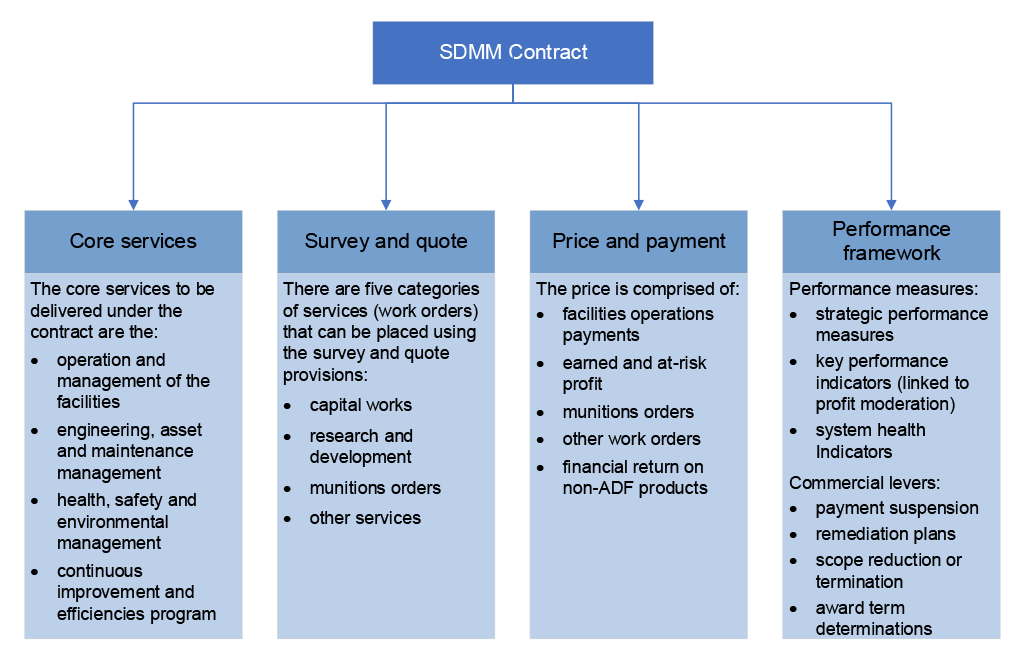
Appendices

Appendix 1 Entity responses

Department of Defence

Page one of the response from the Defence. A summary of the response can be found in the summary and recommendations chapter.

Page two of the response from the Defence. A summary of the response can be found in the summary and recommendations chapter.

Thales Australia Limited

Page one of the response from the Thales. A summary of the response can be found in the summary and recommendations chapter.

Page two of the response from the Thales. A summary of the response can be found in the summary and recommendations chapter.

Appendix 2 Improvements observed by the ANAO

1. The existence of independent external audit, and the accompanying potential for scrutiny improves performance. Improvements in administrative and management practices usually occur: in anticipation of ANAO audit activity; during an audit engagement; as interim findings are made; and/or after the audit has been completed and formal findings are communicated.

2. The Joint Committee of Public Accounts and Audit (JCPAA) has encouraged the ANAO to consider ways in which the ANAO could capture and describe some of these impacts. The ANAO’s Corporate Plan states that the ANAO’ s annual performance statements will provide a narrative that will consider, amongst other matters, analysis of key improvements made by entities during a performance audit process based on information included in tabled performance audit reports.

3. Performance audits involve close engagement between the ANAO and the audited entity as well as other stakeholders involved in the program or activity being audited. Throughout the audit engagement, the ANAO outlines to the entity the preliminary audit findings, conclusions and potential audit recommendations. This ensures that final recommendations are appropriately targeted and encourages entities to take early remedial action on any identified matters during the course of an audit. Remedial actions entities may take during the audit include:

  • strengthening governance arrangements;
  • introducing or revising policies, strategies, guidelines or administrative processes; and
  • initiating reviews or investigations.

4. In this context, the below actions were observed by the ANAO during the course of the audit. It is not clear whether these actions and/or the timing of these actions were planned in response to proposed or actual audit activity. The ANAO has not sought to obtain assurance over the source of these actions or whether they have been appropriately implemented.

  • Defence and Thales commenced work for a broader review of the performance management framework from July 2023, see paragraph 2.28 and 2.29.
  • Defence commenced a review of the Continuous Improvement and Efficiency Program under the contract in June 2025, see paragraph 3.8.
  • Defence commenced developing an asset remediation program for the Benalla and Mulwala sites in November 2024, see paragraphs 3.21 and 3.22.
  • As discussed in paragraphs 3.48 to 3.49, since October 2024 Defence has taken a more active role in managing the multi-tenancy arrangements at the Benalla site.
  • Defence commenced validation and verification of performance information reported by Thales in contract status reports in July 2023, see paragraph 3.70.
  • As discussed in paragraph 3.92, Defence finalised a strategic plan for the Benalla and Mulwala facilities in September 2025.

Appendix 3 Contract governance for the Benalla and Mulwala sites as of November 2025

1. Figure A.1 identifies the individual governance bodies, relationships and reporting lines within the governance framework for the Benalla and Mulwala sites as of November 2025, as established by the Strategic Domestic Munitions Manufacturing (SDMM) and Munitions Manufacturing Arrangement (MMA) contracts and Multi-Tenancy Arrangement.

Figure A.1: Strategic Domestic Munitions Manufacturing (SDMM) and Munitions Manufacturing Agreement (MMA) contracts

The figure illustrates the governance arrangements of the SDMM and MMA contracts, including the multi-tenancy agreement. For reporting lines from the working groups into the management boards and committees are detailed alongside the assurance arrangements. For the MMA contract this includes a quarterly commercial contract working group that reports to a contract management board and contract steering committee. For the SDMM contract three working groups are identified, the commercial, facilities and proper

Note: Defence advised the ANAO in June 2026 that the Commercial and Facilities and Properties Contract Working Groups (CWGs) of the SDMM have been combined.

Source: ANAO analysis of Defence records.

Appendix 4 Average overall equipment effectiveness (both sites) January 2022–June 2024

Figure A.2: Average overall equipment effectiveness at the Benalla and Mulwala sites (January 2022 to June 2024)

The figure provides a longitudinal analysis of the overall equipment effectiveness rating in the form of a percentage. The rating for each month from January 2022 to June 2024, a period of 30 months.

Source: ANAO analysis.

Appendix 5 Maintenance work orders (both sites) December 2020 to September 2025

Figure A.3: Breakdown of maintenance work orders — Benalla and Mulwala — December 2020 to September 2025

The figure provides a longitudinal analysis of the ratio of maintenance work orders from December 2020 to August 2025, broken down by preventative, corrective and breakdown categories. The table provides the ratio as measured every two months in (February, April, June, August, October and December) of each year over a period of just over three and a half years (32 months).

Source: ANAO Analysis.

Appendix 6 Key features of the Strategic Domestic Munitions Manufacturing and Munitions Manufacturing Arrangement contracts as of November 2025

Figure A.4: Comparison of Strategic Domestic Munitions Manufacturing (SDMM) and Munitions Manufacturing Agreement (MAA) contracts

The figure provides a side-by-side comparison of the governance structure, performance measures, review mechanisms, pricing structures, submission timeframes for business cases, and other key matters to illustrate the commonalities and differences between the SDMM contract with Thales and the MMA contract with NIOA.

Note: ‘WG’ stands for working group.

Source: ANAO analysis.

Footnotes

1 Auditor–General Report No. 47 2023–24 Defence’s Management of Contracts for the Supply of Munitions — Part 1, ANAO, Canberra, paragraphs 2.2–2.13, available from: https://www.anao.gov.au/work/performance-audit/defences-management-of-contracts-for-the-supply-of-munitions-part-1 [accessed 26 June 2024].

2 Minister for Defence and Minister for Defence Industry, ‘Boosting munitions manufacturing capability in Australia’, joint media release, 29 June 2020, available from https://www.minister.defence.gov.au/media-releases/2020-06-29/boosting-munitions-manufacturing-capability-australia [accessed 11 October 2023].

3 The Mulwala facility produces propellants and high explosives. The 1,030-hectare site is near the border of New South Wales and Victoria and consists of approximately 300 buildings, the majority of which were constructed in the early 1940s and the remainder in the 1990s. The munitions facility at nearby Benalla, Victoria, uses some of the output of the Mulwala Facility, in its operations.

4 Minister for Defence and Minister for Defence Industry, ‘Boosting munitions manufacturing capability in Australia’, joint media release, 29 June 2020, available from: https://www.minister.defence.gov.au/media-releases/2020-06-29/boosting-munitions-manufacturing-capability-australia [accessed 11 October 2023].

5 Department of Defence, Defence Strategic Review, 24 April 2023, available from: https://www.defence.gov.au/about/reviews-inquiries/defence-strategic-review [accessed 11 October 2023]; Department of Defence, Defence Industry Development Strategy, 29 February 2024, available from https://www.defence.gov.au/about/strategic-planning/defence-industry-development-strategy [accessed 29 February 2024]; Department of Defence, 2024 Integrated Investment Program, 17 April 2024, available from: https://www.defence.gov.au/about/strategic-planning/2024-national-defence-strategy-2024-integrated-investment-program [accessed 22 April 2024]; Department of Defence, 2024 National Defence Strategy, 17 April 2024, available from https://www.defence.gov.au/about/strategic-planning/2024-national-defence-strategy-2024-integrated-investment-program [accessed 22 April 2024]; Department of Defence, Australian Guided Weapons and Explosive Ordnance Plan, 30 October 2024, available from https://www.defence.gov.au/about/strategic-planning/australian-guided-weapons-explosive-ordnance-plan [accessed 11 November 2024]; Department of Defence, 2026 Integrated Investment Program, 16 April 2026, available from: https://www.defence.gov.au/about/strategic-planning/2026-national-defence-strategy-2026-integrated-investment-program [accessed 16 April 2026]; and Department of Defence, 2026 National Defence Strategy, 16 April 2026, available from https://www.defence.gov.au/about/strategic-planning/2026-national-defence-strategy-2026-integrated-investment-program [accessed 16 April 2026]

6 Department of Defence, Defence Strategic Review, 24 April 2023, available from: https://www.defence.gov.au/about/reviews-inquiries/defence-strategic-review [accessed 11 October 2023]; Department of Defence, Defence Industry Development Strategy, 29 February 2024, available from https://www.defence.gov.au/about/strategic-planning/defence-industry-development-strategy [accessed 29 February 2024]; Department of Defence, 2024 Integrated Investment Program, 17 April 2024, available from: https://www.defence.gov.au/about/strategic-planning/2024-national-defence-strategy-2024-integrated-investment-program [accessed 22 April 2024]; Department of Defence, 2024 National Defence Strategy, 17 April 2024, available from https://www.defence.gov.au/about/strategic-planning/2024-national-defence-strategy-2024-integrated-investment-program [accessed 22 April 2024]; Department of Defence, Australian Guided Weapons and Explosive Ordnance Plan, 30 October 2024, available from https://www.defence.gov.au/about/strategic-planning/australian-guided-weapons-explosive-ordnance-plan [accessed 11 November 2024]; Department of Defence, 2026 Integrated Investment Program, 16 April 2026, available from: https://www.defence.gov.au/about/strategic-planning/2026-national-defence-strategy-2026-integrated-investment-program [accessed 16 April 2026]; and Department of Defence, 2026 National Defence Strategy, 16 April 2026, available from https://www.defence.gov.au/about/strategic-planning/2026-national-defence-strategy-2026-integrated-investment-program [accessed 16 April 2026]

7 Department of Defence, Defence Strategic Review, p. 68.

8 Department of Defence, Defence Industry Development Strategy, pp. 18–19.

9 Department of Defence, 2024 National Defence Strategy, p. 43; Department of Defence, 2024 National Defence Strategy, p. 55.

10 ibid.

11 Department of Finance, Australian Government Contract Management Guide, Finance, Canberra, 12 July 2023, pp. 12–15, available from: https://www.finance.gov.au/government/procurement/contract-management-guide [accessed 3 July 2025].

12 According to the SDMM contract overview:

the intent of the arrangement is to ensure industrial preparedness of explosive manufacturing in support of ADF capabilities. This includes the ability to identify, develop and manufacture new munition natures aligned with the Commonwealth’s ongoing capability requirements.

13 That is, under the contract Thales has exclusive supply rights for certain munitions products, and Defence’s ability to source those products from other suppliers is limited.

14 Unless otherwise stated, all financial figures in this chapter are GST inclusive.

15 As at 30 June 2026, the facilities operations payment accounted for 66 per cent of the contract value.

16 These elements comprise: facilities operating costs, utilities pass through costs, facilities operating payment contingency, general and administrative costs, and Thales’ corporate fee and profit margin.

17 The reconciliation and adjustment mechanisms cover, among other things: a contingency amount for unplanned operating costs, offsets where the facilities are used for non-Defence purposes, and reconciliation of utilities costs.

18 The SPMs are to be assessed six-monthly, the SHIs three-monthly, and two KPIs (KPIs 1 and 4) are assessed annually while the other two (KPIs 2 and 3) are six-monthly.

19 The munitions delivery KPI is applied to all munitions in the established products list and first-right-of-offer products where Defence has deemed them applicable for KPI assessment in the relevant assessment period.

20 The SPMs cover delivery of non-munitions survey and quote work orders, industrialisation activities, delivery of developmental and emerging munitions products, and delivery of first-right-of-offer products not treated as munitions for the relevant assessment period.

21 The interim contract was the Strategic Munitions Interim Contract (SMIC). The SMIC was in place between 2015 and 2020.

22 Two of the five SHIs did not have defined performance attributes at contract execution. These remained undefined as at January 2026, and Defence was engaging with Thales to establish them as part of a refresh of the performance management framework.

23 Defence intended to validate during the performance implementation period whether the KPIs were effective measures of Thales’ contribution to the contract objectives.

24 Changes arising from the implementation period were included replacing two performance attributes for one SPM and removing an attribute from another.

25 By July 2023, Defence and Thales had agreed to introduce an ‘overall equipment effectiveness’ measure targeting maintenance in precincts aligned with capability priorities or representing single points of failure. ‘Overall equipment effectiveness’ identifies the percentage of truly productive planned production, where 100 per cent represents perfect production — manufacturing only good parts, as fast as possible, with no downtime.

26 The contract’s calculation method results in a lower proportion of facilities operations payment profit being subject to moderation in practice. As identified in Auditor-General Report No. 47 2023–24, 51 per cent of facilities operations payment profit is effectively at risk. See Auditor-General Report No. 47 2023–24, paragraph 3.120 and footnote 150.

27 Defence identified during contract negotiations that the profit moderation provisions would be constrained, as non-munitions work order profit was not at-risk.

28 In such circumstances Defence can: recover milestone payments; source the munitions from another supplier; and when a remediation plan is not prepared and complied with, terminate the order or reduce its scope.

29 Department of Finance, Australian Government Contract Management Guide, p. 18.

30 Defence’s 2022 Contract Management Handbook similarly recognises that probity obligations continue throughout the contract-management lifecycle and treats breach of probity and blurred customer-supplier roles as specific contract-management risks to be actively identified, documented and managed.

31 This guidance was retained in the subsequent version and remained in place until 18 July 2022, when Defence issued its Contract Management Framework. The framework provides broadly consistent guidance and notes that ‘Actions taken during the Contract Start Up component will determine the success of the contract.’

32 The risks associated with the services under the Munitions Manufacturing Agreement (MAA) with NIOA also needed to be managed in line with the GWEO Industrial Delivery Branch (IDB) Risk Management Plan.

33 SPMS is Defence’s primary sustainment reporting and performance management system. From July 2020–October 2023 reporting reflected funding shortfalls that were resolved in June 2023.

34 The dashboard is an overview of the acquisition projects and sustainment products being delivered by Guided Weapons and Explosive Ordnance Group. There are two acquisition projects: the development of sovereign weapons manufacturing (GWEO2087); and guided weapons explosive ordnance enterprise (GWEO2092) and two sustainment products: the Guided Weapons Explosive Ordnance Manufacturing Facilities (GWEO01); and the Guided Weapons Explosive Ordnance Test and Evaluation Equipment (GWEO02) included in the overview.

35 The Terms of Reference for the GWEO Group Manufacturing Monthly Management Meeting were approved in March 2026. The GWEO Manufacturing Monthly Management Meeting is the band one/one star forum within the revised performance reporting framework that is responsible for conducting regular reviews of its program, lines of effort, and business operations.

36 Department of Finance, Australian Government Contract Management Guide, 12 July 2023, p. 4.

37 ibid.

38 The efficiency implementation plan describes the processes and tools for total cost of ownership modelling and how the model will be used to analyse cost drivers. It was developed by Thales and approved by Defence in August 2020 and was last updated in July 2022.

39 These reported savings included $2.1 million per year (from 2023–24) from initiatives identified in a May 2021 review conducted by Complete Lean Solutions (see Table 3.2).

40 The November 2023 minutes stated that the ‘SDMM [Program Director for Thales] advised the Commonwealth has endorsed the working model and the front-end model has been finalised and is undergoing testing by KPMG. The front-end model provides the Commonwealth with ability to scenario test current capability.’

41 Thales advised Defence’s Contract Steering Committee in November 2023 that the model had been endorsed and agreed by the Commonwealth.

42 Other areas for improvement related to actioning fire safety defects, and Thales’ asset management system not including key requirements for effective asset management.

43 Maintenance audits are intended to confirm the facilities are maintained to required standards and assess Thales’ maintenance approach and outcomes against industry benchmarks. Where audits identify issues, Thales must implement remedial actions and provide Defence with reports and outcomes upon request.

44 Three of the key performance indicators (KPIs) and all the Strategic Performance Measures (SPMs) and System Health Indicators (SHIs) under the SDMM performance management framework cover Thales’ use and management of Commonwealth land and assets.

45 Defence proposed this measure during the SDMM procurement, but it was replaced with the current KPI during negotiations to achieve a $100,000 price reduction. At that time, Defence noted that Thales carried ‘minimal financial risk or incentive to reduce maintenance costs’, and that transferring maintenance and asset management costs into product prices would incentivise it to identify efficiencies and achieve cost reductions.

46 In June 2026, the Australian Government announced a $9.2 million investment for Thales Australia to modernise and refurbish large calibre projectile production facilities at Benalla.

47 The establishment of multi-tenancy was discussed in Auditor-General Report No. 47 2023–24 in paragraphs 3.16 to 3.27 and 3.38 to 3.40.

48 It was constructed by ADI Limited (now Australian Munitions) prior to ADI’s acquisition by Thales in 1999.

49 Auditor-General Report No. 47 2023–24 Defence’s Management of Contracts for the Supply of Munitions — Part 1, paragraphs 2.70 and 3.31 and footnote 87.

50 To ‘industrialise’ means establishing a stable production process suitable for ongoing domestic manufacture.

51 Department of Defence, Australian Guided Weapons and Explosive Ordnance Plan, pp. 47–49.

52 Mature products for which Thales has supplier exclusivity rights are listed in Table 1, Annex A of the Statement of Work. Products that Thales has first right of offer to provide are listed in Table 2, Annex A of the Statement of Work.

53 The Capability Assurance Cycle Munitions Recommendation (CACMR) has been developed collaboratively between the Commonwealth and Australian Munitions and documents the recommended Munitions and Non-ADF Products to be produced across four financial years. Each financial year is referred to in the CACMR as an Order Cycle.

54 The munitions delivery KPI does not cover developmental and emerging products and only applies to first right of offer products ‘when [deemed] applicable’.

55 While the contract includes a list of developmental and emerging products, the list is not prescriptive and has been provided to Thales for information only. The contract does not guarantee that Defence will engage Thales to provide any of the products listed. Under the contract, Defence has retained its rights to source these products using existing arrangements, including through Foreign Military Sales with the US Government and direct purchases of munitions from European suppliers or seek from alternative suppliers.

56 The 155mm M795 projectiles are categorised as a developmental and emerging product in the SDMM contract.

57 Department of Defence, Australian Guided Weapons and Explosive Ordnance Plan, pp. 47–49.

58 There are two types of profit ‘at risk’ under the contract. The first type is the profit that applies to the Facilities Operating Payment. The second type is the profit that applies to munitions orders. Thales’ performance against KPI-01 to KPI-03 is used to calculate the amount of profit ‘at risk’ associated with the Facility Operational Payments and KPI-04 is used to calculate the amount of profit ‘at risk’ associated with the munitions orders.

59 The same payment model was in place under the previous contract. Defence agreed to retain it, and to other concessions, during contract negotiations to reduce Thales’ ADF products net profit margin by two per cent.

60 The contract had been varied five times in total by 30 November 2025. Two were to incorporate pricing amendments and three were for changes with no impact on pricing.

61 See https://www.tenders.gov.au [accessed 1 December 2025].

62 Under the CPRs and Department of Finance (Finance) guidance, entities are required to report contracts on AusTender within 42 days where the total value meets the reporting threshold of $10,000, or where an amendment increases or decreases the previously published value by $10,000 or more. Finance guidance states that amendments include variations such as price adjustments, extensions, additional services, and other changes to the contract.

Department of Finance, Commonwealth Procurement Rules, Finance, Canberra, 1 July 2024 (in effect at the time of the 5 August 2025 contract variation), paragraph 7.19, (this requirement remained unchanged in the 17 November 2025 updated CPRs), available from https://www.finance.gov.au/government/procurement/commonwealth-procurement-rules [accessed 8 December 2025].

63 The 32 reported work orders were published on AusTender and created in ROMAN as new contracts.

64 Under Defence procurement policy, an ‘Endorsement to Proceed’ is a mandatory governance requirement for procurements valued at or above $200,000 (GST inclusive), prior to approaching the market.

65 Delegate approval was not documented for 14 work orders ($20.5 million). Separately, one $1.6 million work order lacked independent approval because the requesting officer also approved it.

66 Fifty of these work orders related to capital works projects. Two related to munitions products. The remaining five related to testing and research and development activities and temporary amenities leasing at Benalla. Defence guidance in effect during the relevant period stated that approving a survey and quote work order includes deciding whether the proposed services align with the contract and will achieve value for money.

67 As at June 2026, a sixth financial cost audit is in progress.

68 Department of Defence, Australian Guided Weapons and Explosive Ordnance Plan, pp. 39, 47–49.

69 Department of Defence, 2026 Integrated Investment Program, p. 90.

70 Defence reapproached the market in August 2025.