Browse our range of reports and publications including performance and financial statement audit reports, assurance review reports, information reports and annual reports.
Auditor-General Report No. 39 of 2025–26
Delivery of Snowy 2.0
Published
Thursday 18 June 2026

Portfolio
Climate Change, Energy, the Environment and Water
Entity
Snowy Hydro Limited
Contact
Please direct enquiries through our contact page.
Activity
Governance
Sector
Energy
Audit snapshot
Why did we do this audit?
- Snowy 2.0 (the project) is the largest committed renewable energy project in Australia in 2026. It is expected to support Australia’s energy transition.
- It is funded through government loans and equity, and funding raised by Snowy Hydro Limited (Snowy Hydro).
- In 2023, the project was reset with costs increasing from $6.1 billion to $12 billion. The project’s expenditure as of 31 March 2026 is $11.1 billion.
- This audit was conducted to provide assurance to Parliament whether Snowy Hydro is effectively managing the delivery of Snowy 2.0 in support of value for money.
Key facts
- Snowy Hydro is a government business enterprise, fully owned by the Commonwealth of Australia.
- The Snowy Hydro board of directors is Snowy Hydro’s accountable authority under the Public Governance, Performance and Accountability Act 2013.
What did we find?
- The delivery of the Snowy 2.0 project is facing delays, cost increases and problems with delivery, despite the project reset in 2023, which responded to similar concerns.
- Snowy Hydro’s management of the project has been partly effective. There is increasing risk to the planned delivery and cost of the project in an environment where the cost risk is being held primarily by the Australian Government.
- Deficiencies in project governance arrangements have impacted value for money, including inadequate implementation of measures to mitigate cost and delivery risks.
- Snowy Hydro is undertaking a detailed cost reassessment of the project, which is expected to report by mid-2026.
What did we recommend?
- There were five recommendations to Snowy Hydro.
- Snowy Hydro agreed to four recommendations and partly agreed to a fifth recommendation.
27km
of power waterway tunnels to be excavated to build Snowy 2.0
73%
Project completion as of 31 March 2026
$11.1 billion
Project expenditure as of 31 March 2026
Summary and recommendations
1. The Snowy 2.0 project (the project) aims to expand the pumped hydro-electric generation capacity of the Snowy Mountains Hydro-electric Scheme. It involves linking two dams, Tantangara and Talbingo, through 27km of tunnels and building a new underground power station.
2. In 2018, the final investment decision estimated the cost to deliver Snowy 2.0, excluding exploratory works, to be $5.9 billion ($6.1 billion with early works).1 At that time, the government provided $1.38 billion as an equity investment in Snowy Hydro Limited (Snowy Hydro) for the delivery of Snowy 2.0.2 The remainder of the project was to be financed by Snowy Hydro from its balance sheet and debt funding.
3. On 31 August 2023, Snowy Hydro publicly announced adjusted cost and completion dates for Snowy 2.0 along with a reset of the delivery model from an engineer, procure and construct (EPC) contract to a hybrid incentivised target cost (ITC) contract with reimbursable cost elements. This announcement included a revised total cost of $12 billion and first power in the second half of 2027, with a target date for commercial operation of all units of December 2028.
4. In October 2025, Snowy Hydro announced a further cost reassessment, with an indication that costs will increase. There is likely to be a further request to government for financial support.
Rationale for undertaking the audit
5. Snowy 2.0 is the largest committed renewable energy project in Australia in 2026. It is expected to underpin Australia’s secure and stable transition to a low-carbon emissions future. The 2024–25 Federal Budget announced additional funding of $7.1 billion over four years to Snowy Hydro to support continued construction of Snowy 2.0.3 This audit was conducted to provide assurance to Parliament that Snowy Hydro is effectively managing the delivery of Snowy 2.0 in support of value for money.
Audit objective and criteria
6. The objective of the audit was to assess the effectiveness of Snowy Hydro Limited’s management of the delivery of Snowy 2.0 in support of achieving value for money. To form a conclusion against this objective, the following high-level audit criteria were adopted:
- Was the 2023 project reset informed by sound planning and advice?
- Has Snowy Hydro implemented effective project governance arrangements?
- Is Snowy Hydro effectively managing project performance to achieve value for money and to deliver the outcomes required of the project?
Conclusion
7. Snowy Hydro has been partly effective in managing the delivery of Snowy 2.0 in support of achieving value for money. Since the 2023 reset, Snowy Hydro has continued to identify project delays and problems with delivery, and has announced a cost reassessment that is likely to result in cost increases. As a result of the reset, Snowy Hydro took on the cost risk for the project. Since then, it has not effectively held the contractors to account for delivery, has not effectively implemented measures that were intended to manage project risks, and does not have access to quality data that would allow it to appropriately monitor the project.
8. The negotiation of the project reset in 2023 was informed by a largely sound approach to planning and advice. Snowy Hydro decided not to re-negotiate the contract in a competitive process as it considered this would have resulted in additional costs and delays. It identified the key reasons why the project needed to be reset and used this information to design the revised contract. The shift of the cost risk from the contractor to Snowy Hydro occurred in an environment where cost estimates ranged significantly and relied on the successful implementation of delivery efficiencies. Snowy Hydro designed mitigants to the cost risk including a gain-share and capped pain-share mechanism and an incentive framework. Snowy Hydro did not seek external verification of its own costs and underestimated the cost risk related to the renegotiation of an enterprise bargaining agreement. While the board challenged information provided to it by management, sufficient board consideration of the project reset risks was not demonstrated. Snowy Hydro kept shareholder ministers informed about the reset, and obtained their approval for the reset. An updated business case was publicly released in May 2024.
9. Snowy Hydro’s implementation of project governance arrangements has been partly effective. Delays in the development of governance arrangements following the reset resulted in the project being executed without updated internal management plans for a significant period. Although Snowy Hydro has taken on the cost risk, a reliable cost forecasting system is still not developed, and data assurance processes are not well established. Deficiencies in risk management and performance management arrangements are still present. Snowy Hydro rates project costs, geotechnical and construction productivity residual risks as ‘extreme’, with the latter two risks outside the target level. The Snowy Hydro board accepted reporting and interrogated information provided to it, but direction by the board to the project has been limited. There is an internal assurance framework for the Snowy 2.0 project, which has provided a level of independent assurance.
10. Snowy Hydro has been partly effective in managing project performance to support the achievement of value for money and to deliver the outcomes of the project. The project is currently behind schedule and is undertaking a cost reassessment that is likely to result in a further cost increase. This is despite the reset in 2023 which extended the commercial operation date for the project from May 2026 to December 2028, and almost doubled the delivery cost. Significant deficiencies in Snowy Hydro’s project management include the following.
- Key quality controls have not been effectively implemented.
- There is no agreed baseline schedule for the project.
- Snowy Hydro has reported that productivity gains assumed at reset are proving difficult to realise.
- Snowy Hydro does not have a robust understanding of the forecast cost to complete of the project.
- The incentive framework is not working as intended.
- Snowy Hydro does not have adequate arrangements to monitor the impact of adjustments on value for money.
Supporting findings
Project reset
11. In the lead up to the reset in August 2023, the delivery (productivity, quality and safety) of Snowy 2.0 was not meeting Snowy Hydro’s expectations, impacted by issues experienced by the principal contractor, its subcontractor, and a number of claims that were disputed between the contractor, subcontractor and Snowy Hydro. Snowy Hydro relied on legal advice, scenario modelling, dispute analysis and contractor performance data to inform the reset. Snowy Hydro did not test the market to determine if there were alternative contractors willing or able to deliver the works required to finish the contract. Snowy Hydro did consider (and sought external advice on) the potential impact on time and cost if another contractor was engaged. (See paragraphs 2.2 to 2.44)
12. Snowy Hydro undertook planning to inform the design of the project reset. It identified what it considered was required from the reset contract, which included cost, schedule and behaviour outcomes, improved oversight and decision-making influence. Snowy Hydro put in place a framework for contract negotiation and finalisation through the agreement of deeds of engagement and a non-binding heads of agreement. It identified and reported on potential risks related to resetting the project, with the most significant change to the risk profile being the reallocation of cost risk from the contractor to Snowy Hydro. Snowy Hydro sought external advice in support of ensuring that the terms of the reset were value for money. Contractual elements aimed at cost management in an uncertain environment included a pain-share and gain-share and incentive framework. The pain-share that may impact the principal contractor was capped. The incentive framework was designed to provide mitigations to schedule risk. The risk related to settlement may have been overstated. At the conclusion of negotiations, Snowy Hydro obtained appropriate approvals. (See paragraphs 2.45 to 2.108)
13. The Snowy Hydro shareholder ministers provided relevant approvals prior to the execution of the reset contract. Snowy Hydro published an updated business case in May 2024, approximately eight months after the reset. The value calculation in the updated business case does not represent a whole of life asset cost. (See paragraphs 2.109 to 2.125)
Project governance
14. New governance arrangements were introduced to support the delivery of the reset contract, although documentation of contract management arrangements were delayed. Prior to February 2025, internal management plans to support the delivery of the reset were not reviewed or created. Data assurance processes over contractor data and contractor cost forecast systems relied on by the project are not well established. Snowy Hydro has an internal assurance framework. Snowy Hydro updated its policy to manage conflicts of interest and gifts and benefits in November 2025. Changes to monitoring and reporting are still being implemented. (See paragraphs 3.2 to 3.54)
15. Snowy Hydro developed a risk management plan for Snowy 2.0 in May 2025. Prior to this, there was no approved risk management plan that reflected the reset. Risk management arrangements are still being established for the project. Risk ownership is not always clearly documented, and risk appetite and tolerance have not been defined. Snowy Hydro rates project costs, geotechnical and construction productivity residual risks as ‘extreme,’ with the latter two risks outside target. (See paragraphs 3.55 to 3.71)
16. Snowy Hydro has established performance metrics for the project and for its project team. There are no performance measures relating to the efficiency or effectiveness of Snowy Hydro’s internal management and delivery of the project. (See paragraphs 3.72 to 3.76)
Project management
17. Snowy has a quality management plan in place and has implemented some quality management improvements following two internal audits, one of which found a ‘deficient control environment’. There are schedule management arrangements in place, however, there is no agreed baseline schedule. The February 2026 schedule forecasts from the contractor are unapproved by Snowy Hydro, in part due to the forecast completion proposed by the contractor being materially later than the contractual time for completion. Initiatives are being implemented to assist with the achievement of the project’s schedule. Public reporting on schedule progress is not informed by risk or the criticality of project works. Snowy Hydro does not have a robust understanding of the cost to complete the project. As a result, in September 2025 it commenced in-depth cost reviews with the aim of better understanding the cost to complete the project. (See paragraphs 4.2 to 4.88)
18. Snowy Hydro has implemented payment management processes for interim payments, including engaging a third party to verify claims for payments from the contractor. There are risks related to Snowy Hydro’s oversight of payments to secondary subcontractors. It has not implemented sufficient controls over its payments to contractors other than its primary contractor for civil works and subcontractor for engineering and mechanical works. The incentive framework is not working to incentivise performance as intended. Snowy Hydro does not monitor contract adjustments to provide sufficient oversight of their impact on the delivery of the project, particularly in relation to cost impacts. (See paragraphs 4.89 to 4.132)
Recommendations
Recommendation no. 1
Paragraph 3.45
Snowy Hydro strengthens its management of project transitions through the early identification of, and clear planning for, how to implement required project management changes. This includes the timely development of governance structures and documentation, internal resourcing plans and management of relationship risks.
Snowy Hydro Limited response: Agreed.
Recommendation no. 2
Paragraph 3.77
Snowy Hydro establishes performance measures that reflect the efficiency and effectiveness of its oversight and management of the delivery of Snowy 2.0 and use these to support Snowy Hydro’s management of the project including the allocation of its resources.
Snowy Hydro Limited response: Agreed.
Recommendation no. 3
Paragraph 4.43
Snowy Hydro develops regular public reporting on project schedule that includes information on project progress against published targets.
Snowy Hydro Limited response: Partly agreed.
Recommendation no. 4
Paragraph 4.87
Snowy Hydro strengthens its project management to manage risks to schedule, quality and cost, to safeguard that its contractors are meeting the requirements of the contract.
Snowy Hydro Limited response: Agreed.
Recommendation no. 5
Paragraph 4.115
Snowy Hydro continues to monitor its payment of contractors to ensure that controls are not bypassed and that payments are made on time.
Snowy Hydro Limited response: Agreed.
Summary of entity response
19. The proposed audit report was provided to Snowy Hydro. Extracts of the proposed audit report were provided to the principal contractor for civil works, Future Generation Joint Venture (FGJV) and the subcontractor for electrical and mechanical works, Voith Hydro GmbH & Co (Voith). Snowy Hydro’s and FGJV’s summary responses are provided below and all entity responses are provided at Appendix 1. Improvements observed by the ANAO during the course of this audit are listed in Appendix 2.
Snowy Hydro Limited
Snowy 2.0 is our nation’s most critical energy project. Designed to operate for 150 years, it represents a generational investment in Australia’s energy sovereignty. Providing over half the storage the network needs, its 350GWh capacity will be able to power three million homes for a week.
We agree with four of the ANAO’s five recommendations covering enhanced documentation, reporting traceability, and performance measurement within the existing governance framework. We partially agree with the remaining recommendation relating to public reporting.
While the recommendations do not propose fundamental changes to Snowy 2.0’s underlying delivery model, governance structure or management approach, we are committed to continually testing and improving our delivery oversight. The ANAO’s guidance is informing the continuous improvement initiatives we have underway or already completed, which the draft report acknowledges.
Many matters discussed in the draft report reflect deliberate commercial positions. We will continue to exercise our contractual rights as appropriate, holding our contractors accountable.
Snowy Hydro remains committed to strong governance and oversight of Future Generation Joint Venture’s delivery of Snowy 2.0.
Future Generation Joint Venture (FGJV)
Future Generation Joint Venture (FGJV) is the principal contractor for the Snowy 2.0 project (Project) and welcomes the opportunity to provide a response to extracts of the proposed report which have been provided. The Project was significantly impacted by various challenges (outside FGJV’s control) in the lead up to the reset in 2023, which saw FGJV and SHL [Snowy Hydro] move away from the unworkable lump-sum EPC contract model towards an ITC model better equipped to address the challenges faced in delivering a project of this magnitude. This shift allowed for closer collaboration between FGJV and SHL and aligned their collective interests on the Project. FGJV has, and continues to, use its best endeavours to comply with all contractual processes and obligations under the new contract model. There continue to be a number of challenges on the Project outside FGJV’s control, which might impact the Project. FGJV is tackling these challenges, and those faced by the industry more broadly, head on. FGJV remains committed to collaborating with SHL to ensure processes followed under the contract on the Project are robust and efficient moving forward and identify solutions on a best for project basis.
Key messages from this audit for all Australian Government entities
20. Below is a summary of key messages, including instances of good practice, which have been identified in this audit and may be relevant for the operations of other Australian Government entities.
Group title
Procurement
Key learning reference
Group title
Governance and risk management
Key learning reference
Group title
Contract management
Key learning reference
Group title
Performance measurement
Key learning reference
1. Background
Introduction
1.1 The Snowy 2.0 project (the project) aims to expand the pumped hydro-electric generation capacity of the Snowy Mountains Hydro-electric Scheme. The project involves linking two existing dams, Tantangara and Talbingo, through 27km of tunnels and building a new underground power station (see Figure 1.1). Water will be pumped to the upper dam (Tantangara) when there is surplus energy production and the demand for energy is low, and then released back to the lower dam (Talbingo) to generate energy when electricity demand is high.
Figure 1.1: Map of the Snowy Mountains Hydro-electric Scheme including Snowy 2.0
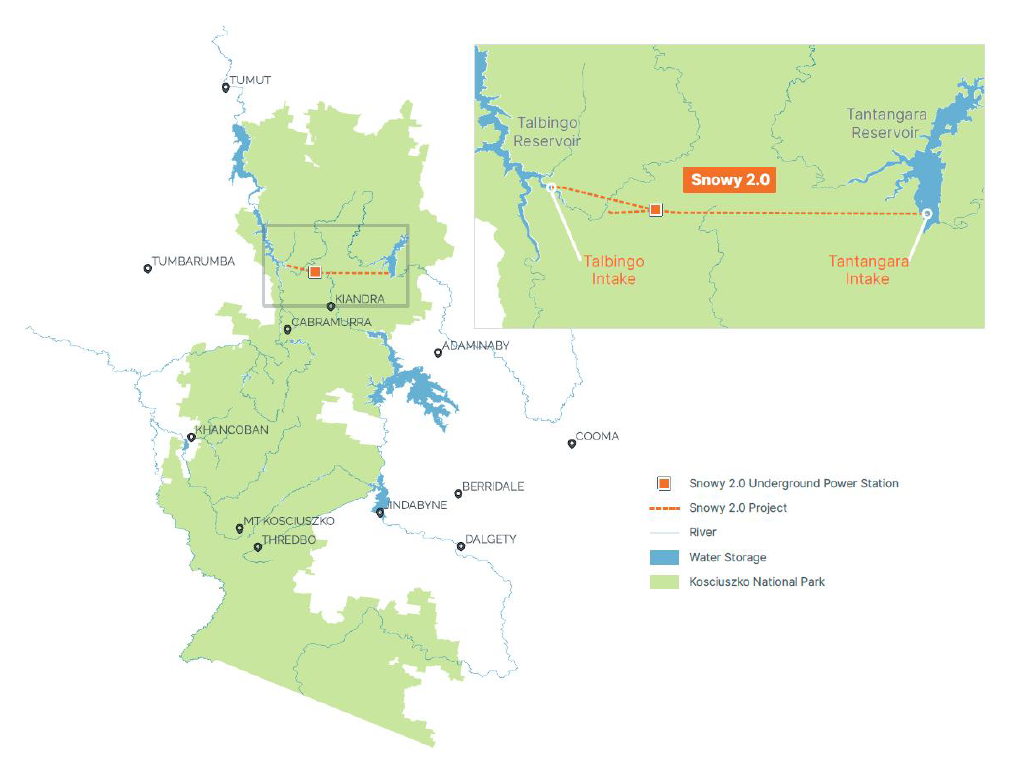
Source: Snowy Hydro Limited, Project Update Snowy 2.0 Pumped Hydro project, Snowy Hydro, Cooma, 2018, p. 9, available from https://www.snowyhydro.com.au/wp-content/uploads/2018/10/SH1309_SQUARE-BOOKLET_Snowy-2-Project-Update_OCTOBER_2018_web.pdf [accessed 3 December 2025].
1.2 Snowy Hydro Limited (Snowy Hydro) has stated that Snowy 2.0 is the largest committed renewable energy project in Australia.4 When complete, it is expected to provide a generation capacity of 2.2 gigawatts of immediately dispatchable on-demand electricity and approximately 350 gigawatt hours of storage capacity to the National Electricity Market, estimated by Snowy Hydro as enough to power three million homes for one week.5
1.3 Snowy 2.0 is expected to act as a massive, on-demand battery, storing surplus renewable energy when wind and solar generation is high and demand is low, and releasing it to generate electricity during peak demand periods, supporting grid reliability.6 Snowy Hydro has reported that it expects this will enable 6,600 megawatts of new wind and solar to come online.7
Legislative structure, ownership and governance
1.4 Snowy Hydro is an unlisted public company limited by shares and incorporated under the Corporations Act 2001. It is identified through the Public Governance, Performance and Accountability Rule 2014 as a government business enterprise (GBE).
1.5 On 29 June 2018, the Commonwealth of Australia (the Commonwealth) became Snowy Hydro’s sole shareholder8, with Snowy Hydro becoming a Commonwealth company and subject to the Public Governance, Performance and Accountability Act 2013 (PGPA Act). Snowy Hydro is also subject to the requirements of the Snowy Hydro Corporatisation Act 1997.
1.6 Snowy Hydro has two shareholder ministers (the shareholders) representing the Commonwealth: the Minister for Climate Change and Energy; and the Minister for Finance. The shareholders have issued a Statement of Expectations, last updated on 20 December 2024, outlining Snowy Hydro’s responsibilities supporting Australia’s transition to a renewable energy system. This states Snowy Hydro’s primary objective as to provide and enable reliable, secure, affordable, renewable and firming energy in Australia including through the:
- development, operation and maintenance of the Snowy Mountains Hydro-electric Scheme;
- construction, ownership and operation of other electricity generation and energy storage facilities; and
- facilitation of decarbonisation of the National Energy Market.
1.7 The Snowy Hydro board of directors (the board) is the accountable authority of Snowy Hydro with specific responsibility for leading, governing and setting the strategic direction for the entity under the PGPA Act. The board has responsibility for: the performance of the company; internal governance; strategic direction; ongoing compliance with external governance frameworks; and timely, accurate and transparent provision of information.
Project approval and contractors
1.8 On 12 December 2018, the board reached a final investment decision (FID) and approved Snowy Hydro to proceed with Snowy 2.0. In February 2019, the project received shareholder minister agreement to the FID.
1.9 The notice to proceed under the engineer, procure and construct (EPC) contract, which included reconsideration of the business case and finalisation of financing arrangements, as well as key risks and proposed treatments, was approved by the board on 16 July 2020. Shareholder minister approval was provided in August 2020.
1.10 Snowy Hydro appointed Future Generation Joint Venture (FGJV) as the principal contractor to lead the civil works for the project. Voith Hydro GmbH & Co (Voith) is delivering the hydro-generation technology in the underground power station (electrical and mechanical works) through a sub-contracting arrangement.9
1.11 Originally (2019), the FGJV partnership included Webuild SpA (formerly Salini Impregilo (SpA)), The Lane Construction Corporation (100 per cent owned by Webuild SpA) and Clough Projects Australia Pty Ltd. Through Webuild and Lane, Salini Impregilo SpA represented a majority (65 per cent) share in the joint venture, and Clough Projects Australia (Clough) represented the remaining share (35 per cent). Clough was formally acquired by the Webuild Group on 16 February 2023, after entering voluntary administration.
Project cost and 2023 project reset
1.12 In 2018, the FID estimated the capital costs to deliver Snowy 2.0, including exploratory works, to be $6.1 billion. At that time, the government provided $1.38 billion as an equity investment in Snowy Hydro, intended to support the delivery of Snowy 2.0.10 The remainder of the project was to be financed by Snowy Hydro from its balance sheet and debt funding.11
1.13 On 31 August 2023, Snowy Hydro announced adjusted cost and completion dates for Snowy 2.0 along with a reset of the project delivery model from an engineer, procure and construct (EPC) contract to a hybrid incentivised target cost (ITC) contract12, which included some reimbursable elements.13 This announcement included that the revised total cost to complete was $12 billion and that first power was expected to be delivered in the second half of 2027, with a target date for commercial operation of all units of December 2028. In May 2024, Snowy Hydro published an updated business case.14
1.14 These costs do not include expenses related to project oversight and management by government departments, which were included in the 2024–25 budget as $3.5 million over four years and $0.4 million per year ongoing to administer the loan and equity investment. It also does not include costs related to ancillary projects such as the transmission lines linking Snowy 2.0 to the grid. As at 15 October 2025, the Australian Government had provided support to these projects though the Rewiring the Nation fund, including $2.1 billion to Transgrid for the construction of HumeLink and Victoria-NSW Interconnector (VNI) West early works in New South Wales and an additional $120 million for VNI West early works in Victoria.15
1.15 In October 2025, Snowy Hydro announced a cost reassessment of the project. A timeline of public announcements related to the cost of the project is shown at Figure 1.2.
Figure 1.2: Timeline of public announcements related to the project
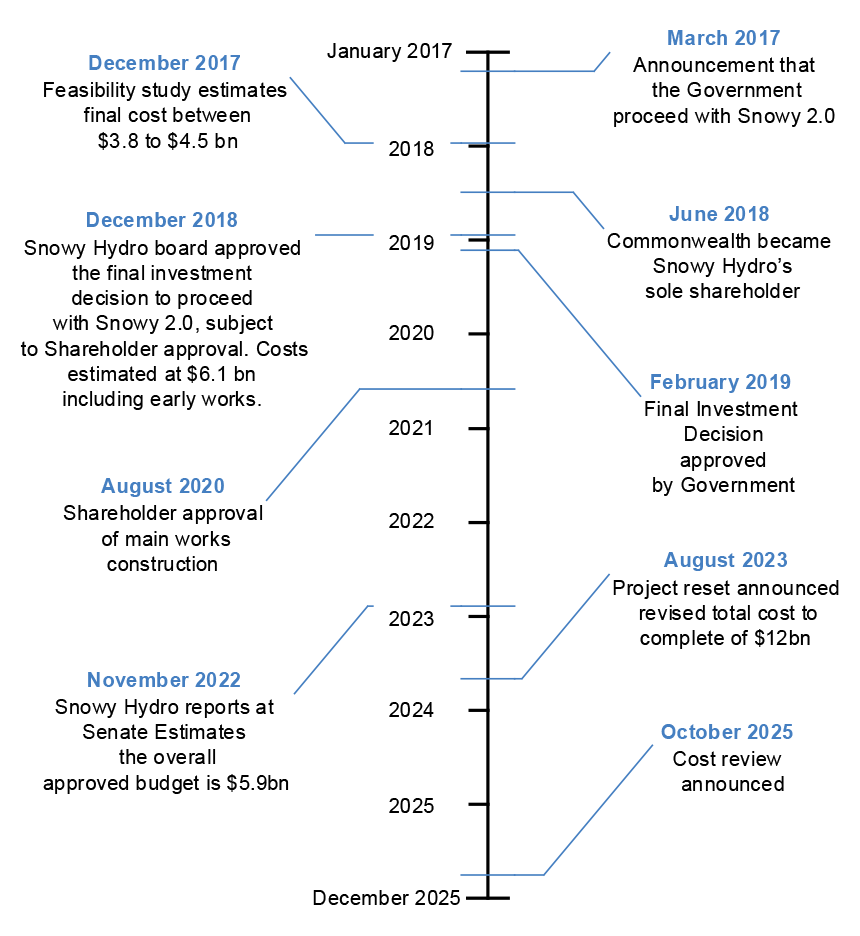
Source: ANAO.
Previous ANAO audit
1.16 Auditor-General Report No. 33 2021–22, Snowy 2.0 Governance of Early Implementation, assessed whether Snowy Hydro had effective governance arrangements for the early implementation of Snowy 2.0. The audit found Snowy Hydro had effective governance for the early implementation of Snowy 2.0.16
Rationale for undertaking the audit
1.17 Snowy 2.0 is the largest committed renewable energy project in Australia in 2026. It is expected to underpin Australia’s secure and stable transition to a low-carbon emissions future. The 2024–25 Federal Budget announced additional funding of $7.1 billion over four years to Snowy Hydro to support continued construction of Snowy 2.0.17 This audit was conducted to provide assurance to Parliament that Snowy Hydro is effectively managing the delivery of Snowy 2.0 in support of value for money.
1.18 Under subsection 17(2) of the Auditor-General Act 1997, performance audits of government business enterprises, such as Snowy Hydro, can be conducted only at the request of the Joint Committee of Public Accounts and Audit (JCPAA). The Auditor-General received this request from the JCPAA on 14 March 2025.
Audit approach
Audit objective, criteria and scope
1.19 The objective of the audit was to assess the effectiveness of Snowy Hydro Limited’s management of the delivery of Snowy 2.0 in support of achieving value for money.
1.20 To form a conclusion against this objective, the following high-level audit criteria were adopted:
- Was the 2023 project reset informed by sound planning and advice?
- Has Snowy Hydro implemented effective project governance arrangements?
- Is Snowy Hydro effectively managing project performance to achieve value for money and to deliver the outcomes required of the project?
1.21 The scope of this audit focused on Snowy Hydro’s delivery of Snowy 2.0 from the lead up to the project reset, from 2022, to December 2025 including:
- arrangements to maximise value for money through the negotiation of the 2023 reset; and
- project management since the 2023 reset.
1.22 The audit scope did not include: decisions around and delivery of related transmission projects; decisions by the government, shareholder ministers and other third parties; decisions and actions of FGJV and Voith beyond their interactions with Snowy Hydro; the government’s decision to provide equity investments; assessments of engineering quality; evaluation of the validity of the Snowy 2.0 project; or evaluation of Snowy’s Hydro’s management of its generation division, retail division or other major projects.
Audit methodology
1.23 The audit methodology involved:
- reviews of Snowy Hydro documentation;
- meetings with Snowy Hydro staff;
- observations of Snowy Hydro meetings with contractors;
- a visit to the Snowy 2.0 construction site;
- walkthroughs of systems, processes and procedures with Snowy Hydro staff;
- consideration of five contributions from the public; and
- review by a subject matter expert in areas of infrastructure development and project and government business enterprise governance.
1.24 The audit was conducted in accordance with ANAO auditing standards at a cost to the ANAO of $764,146.
1.25 The team members for this audit were Kate Cummins, Ella Garrett, Elise Hore, Adrita Inam, Chayathri Kulatunge, Alexandros Soundias, Lorcan Stevens and Nathan Callaway.
2. Project reset
Areas examined
This chapter examines whether the 2023 project reset was informed by a sound approach to planning and advice.
Conclusion
The negotiation of the project reset 2023 was informed by a largely sound approach to planning and advice. Snowy Hydro decided not to re-negotiate the contract in a competitive process as it considered this would have resulted in additional costs and delays. It identified the key reasons why the project needed to be reset and used this information to design the revised contract. The shift of the cost risk from the contractor to Snowy Hydro occurred in an environment where cost estimates ranged significantly and relied on the successful implementation of delivery efficiencies. Snowy Hydro designed mitigants to the cost risk including a gain-share and capped pain-share mechanism and an incentive framework. Snowy Hydro did not seek external verification of its own costs and underestimated the cost risk related to the renegotiation of an enterprise bargaining agreement. While the board challenged information provided to it by management, sufficient board consideration of the project reset risks was not demonstrated. Snowy Hydro kept shareholder ministers informed about the reset, and obtained their approval for the reset. An updated business case was publicly released in May 2024.
Areas for improvement
The ANAO identified two opportunities for improvement in relation to the management of conflicts of interest during negotiation processes, and evaluating the whole of life cost of the project.
2.1 To achieve value for money during the life of a contract, project managers should ensure both the entity and the supplier meet their obligations under the contract and assess whether the contract continues to accurately reflect the entity’s requirements.18
Were there appropriate arrangements in place to maximise value for money through the planning of the reset?
In the lead up to the reset in August 2023, the delivery (productivity, quality and safety) of Snowy 2.0 was not meeting Snowy Hydro’s expectations, impacted by issues experienced by the principal contractor, its subcontractor, and a number of claims that were disputed between the contractor, subcontractor and Snowy Hydro. Snowy Hydro relied on legal advice, scenario modelling, dispute analysis and contractor performance data to inform the reset. Snowy Hydro did not test the market to determine if there were alternative contractors willing or able to deliver the works required to finish the contract. Snowy Hydro did consider (and sought external advice on) the potential impact on time and cost if another contractor was engaged.
Project performance prior to the reset
2.2 Delays, budget pressures, safety, environmental and quality issues were experienced during project delivery in the lead up to the reset in August 2023. Prior to the reset, the project team19 regularly reported to the Snowy Hydro board (the board) the need for improvements from the contractors.
2.3 The Snowy Hydro Chief Executive Officer (CEO) and project director reported to the board that in February 2022 Future Generation Joint Venture (FGJV) considered itself to be significantly over budget and was requesting additional payments to mitigate cashflow shortages. The board was informed that FGJV considered that delays were due to COVID-19. The project team reported that it considered that the delays were the product of poor planning, execution and performance.
2.4 In March 2022, the project director reported to the board that there was ‘poor programme performance across all project areas, as well as overall safety performance remaining below SHL’s [Snowy Hydro’s] expectations’, and that this had been reiterated to FGJV. Reporting noted that ‘the FGJV quality program on-site require[d] considerable improvement’, and that over the reporting period, Snowy Hydro and FGJV senior management had met on multiple occasions to discuss this poor performance.
2.5 In April 2022, a ‘moving forward plan’ focused on safety leadership, the productivity of the tunnel boring machines, resource availability, procurement, design and program completion was required from FGJV. The response provided was reported to the project advisory sub-committee of the board as being ‘inadequate with insufficient detail on proposed mitigants’.
2.6 In May 2022, Snowy Hydro provided an update to the Department of Finance and the Department of Climate Change, Energy, the Environment and Water (the shareholder departments) that noted the need for the project to ‘drive’ contractors to improve safety leadership, productivity, resource availability, procurement, design and programme completion. This update noted the potential for a cost and schedule review, which would result from negotiations underway at the time with FGJV to mitigate its schedule delays.
2.7 In June 2022, the Managing Director reported to the board that FGJV had written highlighting challenges it was experiencing with the delivery of the project and requesting assistance. The report to the board noted that prior to considering changes to the project delivery, FGJV would need to ‘demonstrate their capability of improving their performance and committing to a mitigation plan’ that would address the delays experienced on the project. The report noted concerns regarding FGJV’s willingness to complete the project under current arrangements.
2.8 On 18 October 2022, Snowy Hydro agreed an adjustment to payment milestones to effectively pre-fund cash flow to FGJV. This did not change the contract price or milestone completion under the contract. The agreed adjustments initiated $100 million advance monthly payments to FGJV for 12 months ‘to simplify the cashflow structure for the Contractor enabling the delivery of critically important works fronts …’. In addition, it was agreed that the contractor would be paid an amount to cover electrical and mechanical works based on Voith’s actual approved payment plus a contractor’s markup.
2.9 During October 2022, Snowy Hydro was concerned that Clough (which held a 35 per cent share of the joint venture) may become, or already was, insolvent, and sought advice on the impact of potential insolvency. On 5 December 2022, Clough was placed under voluntary administration. On 9 December 2022, Snowy Hydro released a public statement noting the disclosure and stating that it was ‘working closely with the joint venture to ensure construction on the project progresses smoothly’.
2.10 On 14 December 2022, Webuild published an announcement that it had reached an agreement with the administrators to acquire Clough’s share of the Snowy 2.0 project and related workforce.20 The project provided updates to the shareholder departments on this transaction as a project risk and, once completed, provided assurance that this would have no impact on the project.
2.11 In November 2022, the Dispute Avoidance and Adjudication Board, responsible for decision-making where disputes arise between FGJV and Snowy Hydro, recorded that ‘to date, Voith has been unwilling to engage on matters such as equipment procurement and finalisation of an integrated program until the commercial issues were resolved’. The Dispute Avoidance and Adjudication Board noted that between 21 and 23 November 2022, Snowy Hydro and FGJV representatives were to meet with Voith ‘to reset Voith’s expectations in respect of Voith’s current commercial claims’. Reporting to the board on the commercial position of Voith in July 2023, the project stated that:
Voith has in discussions stated to Snowy Hydro senior leadership that under the current EPC [Engineering, Procurement, and Construction] Contract arrangement, Voith would not be able to complete Snowy 2.0 under the existing lump sum contract value and would abandon Snowy 2.0 if its economically unsustainable position cannot be addressed.
2.12 This meeting occurred, and included discussions regarding a pathway forward that covered the material cost escalation for contractors and a pathway forward for the project.
2.13 Over 2022, the project team reported increasing and unresolved issues being reported from both FGJV and Voith to the dispute resolution process. These claims stemmed from issues with geology, agreement on project design, co-ordination challenges between the civil and electrical and mechanical contractors, and a lack of subcontractor input into schedules.21 In November 2022, Snowy Hydro recorded 47 open dispute claims and a further four notices to claim related to $2.35 billion in costs and 664 days’ extension of time, with an expectation that further claims were being developed.
2.14 On 15 February 2023, Snowy Hydro received advice on contractor claims and a strategy for managing seven of these claims (key claims). This advice reflected the engineer, procure and construct (EPC) framework which was in effect at the time of advice. This advice concluded that Snowy Hydro’s best interests were likely to be served by following processes in place and allowing the claims that have been submitted to run their course. On 9 March 2023, the project team provided the Snowy Hydro Chief Operating Officer advice that Snowy Hydro was in a good position to defend the claims.
2.15 In April 2023, a report to the project advisory subcommittee of the board22 noted that the estimated unmitigated completion date was 11 September 2029 (875 days from the most recent agreed date) with the first power on 17 November 2027. This report noted that the project Total Recordable Injury Frequency Rate23 had dipped below the target for the first time in 18 months. Investigations were underway and penalties had been applied related to water pollution.
2.16 In May 2023, Snowy Hydro analysed ideas and feedback from the project team on the ‘key issues, root causes and potential solutions with the current Contract’. Feedback included that:
- culturally, within contractor teams, quality supervision and experience was lacking, with it being difficult to attract and retain ‘good quality’ people;
- there were ‘walls’ or ‘silos’ between the contractor and Snowy Hydro teams, with segregation resulting in ‘a divisive culture’;
- it was noted that time and cost appeared to be a key driver of contractor decisions, including moving focus away from quality outcomes and resulting in poor procurement decisions, rather than what was ‘best for project’; and
- there was not a resource loaded programme24 linked to a target cost and budget or incentive framework.
2.17 In July 2023, while updating the board on the negotiation progress, the project director reported that FGJV was focused on managing commercial exposures and minimising substantial losses, by prioritising cost-saving measures and a claims-driven behaviour over delivery. As a result, ‘project completion, safety, environment and quality outcomes are continuing to deteriorate’. The project reported to the Snowy Hydro board that:
The current progress of works has been underwhelming. Snowy 2.0 is incurring $100m to $150m in costs each month, however the earned value against planned over the 12-month period from June 2022 has only been 40 percent.25
Understanding the market
2.18 Procurement processes are best selected and tailored to deal effectively and efficiently with the known complexities and risks of a specific project, and to optimise value for money outcomes.26 The selection of a project delivery approach should be supported by robust analysis to determine the most appropriate procurement method in the circumstances, including prevailing market conditions.
2.19 In the lead up to the reset, Snowy Hydro obtained advice on traditional design and construct and incentivised target cost (ITC) contracting frameworks. It did not directly engage with the market to test the feasibility of alternative delivery approaches. It undertook some research and some benchmarking of contract terms and conditions against other large infrastructure projects that were using an ITC structure as a part of their contact models.
2.20 In January 2020, Snowy Hydro engaged an external advisor to provide an analysis of the time and cost implications of replacing FGJV under various scenarios, as well as an assessment of Snowy Hydro taking on the principal contractor role.
2.21 The advice, provided in draft and not finalised, considered ‘generally accepted market assumptions as well as Snowy-specific factors including geographic location, project scale, and EPC contract risk allocation’. It concluded that should FGJV need replacing, there would be an estimated delay to the project of between eight and 12 months, and replacement costs equal to approximately 25 per cent of the contract value. The report noted that these figures were ‘highly contingent on the factors leading to the replacement and the market at the time of the replacement, including contractor capacity’.
2.22 In August 2022, Snowy Hydro received updated advice (also in draft and not finalised) in the context of the potential insolvency of Clough. This advice estimated reapproaching the market would result in additional delay to the project of between 25 and 34 months and replacement costs equal to approximately 35 to 46 per cent of the original contract value of $5.3 billion. These costs were in addition to actual project costs.27
2.23 This advice further noted that, depending on Snowy Hydro’s risk appetite, Snowy Hydro may consider a range of delivery options, including a full re-tender, entering into a different contracting arrangement with a new contractor, or self-performing works. Advice highlighted risks related to the complexity of the scheme, location and competition with other projects for contractors. This advice identified potential parties that were considered capable of delivering the project, including parties that had previously bid on the project. Snowy Hydro did not engage directly with any of these parties.
2.24 On 20 February 2023, Snowy Hydro sought advice on its rights should it wish to terminate or descope elements of the project. The advice highlighted risks including those related to non-cooperation and protracted litigation with FGJV, reputational damage to the project impacting the ability to procure other contractors, and the potential for increased time and cost requirements.
2.25 On 18 April 2023, Snowy Hydro received advice on key elements of an ITC contract model, distinct from other forms of contracting.
2.26 At the 12 May 2023 board meeting, the project team put forward the preliminary view that the fixed price contract should be amended to an ITC contract model — a cost reimbursable model that incorporated a collaboration and an incentive framework. The advice reported that:
ITC is currently considered as being best able to facilitate a reset in behaviour and culture away from the current adversarial approach to a collaborative relationship, which is necessary in order to maximise productivity without compromising on safety or quality. It is also consistent with the manner in which major infrastructure projects are now being delivered in order to drive optimised behaviours and manage the unpredictable, and potentially material, impacts of the persisting local and global factors …
2.27 At the 12 May 2023 meeting, the board authorised the continuation of negotiations (see paragraph 2.48). The minutes record that the board and the project team discussed: reset activities, issues and risks; forensic accounting and analysis to support an ITC contract; the engagement of external consultants to support the reset; work to improve the resourcing and capability of the Snowy Hydro project management team; an upcoming meeting with FGJV; direction on outstanding claims; and forward-looking performance of the project.
2.28 The minutes noted that the Snowy Hydro CEO would continue to report to the board on the reset process, including reporting any material issues arising from discussions with FGJV. It was also noted the importance of ongoing engagement with the shareholder ministers (the shareholders).
2.29 In addition to the ITC contract model proposed on 12 May 2023, on 25 July 2023, the board considered other project delivery options including:
- retaining the EPC contract with Snowy Hydro and enforcing its rights against FGJV for poor performance, or negotiating an increase to the lump sum contract price (not recommended);
- descoping either FGJV and, or, Voith to bring on other contractors to deliver elements of the project (not recommended);
- terminating FGJV and engaging an alternative civil contractor (not recommended); or
- retaining FGJV and Voith with amendments to the risk allocation under the EPC contract (the recommended option).
2.30 Snowy Hydro determined that the ‘do-nothing’ base case option of continuing under the existing contractual mechanism would not provide it with the ability to effect the required changes to achieve its project completion milestones and would see Snowy Hydro and FGJV likely to enter into lengthy legal disputes.
2.31 The minutes of the 25 July 2023 board meeting record board and project team discussion around the reset including in relation to: risks; engagement with and approvals from the shareholders; cost to date and forecast cost to complete; the importance of the Snowy Hydro team having appropriate controls to drive the requisite project outcomes; and reputational risks for Snowy Hydro. The board requested action from the project team in relation to: costings; organising a meeting with, and writing to, the shareholders; and a forward funding plan.
Project change risk management
2.32 Snowy Hydro’s board is accountable for establishing and maintaining a culture that meets the high standards expected by the public, including in relation to risk oversight and management, and integrity and probity.
Risks related to changing the contract style
2.33 The board was advised of risks related to engaging alternative contractors for either all or part of the remaining project. These risks included that key equipment (camps, tunnel boring machines and underground machinery) would remain the property of FGJV in the event of termination, and therefore would be removed resulting in cost and time delays for reestablishment under a different contractor. They were further advised that due to the technical nature of the plant to be supplied by Voith, bringing in a new electrical and mechanical contractor would involve significant delays and raise risks in the areas of interface between the civil and electrical and mechanical project delivery.
2.34 The board was advised that project delays and cost increases were not unique to Snowy 2.0 and were occurring on multiple construction projects in Australia, at that time, particularly major infrastructure developments involving large workforces and international supply chains. The advice concluded that FGJV should first be afforded the opportunity to improve its performance ‘under an economically sustainable contractual risk allocation’ prior to termination options being considered, and that the reset would be negotiated with termination for convenience rights significantly streamlined and commercially favourable.
2.35 As a result, the board was advised that the ITC model would best facilitate the successful completion of Snowy 2.0 by:
- ensuring that the impacts of persisting local and global time and cost risks are re-allocated between Snowy Hydro, FGJV and Voith such that they can be appropriately managed; and
- providing a commercial and contractual framework which promotes a high degree of collaboration between the parties, whilst ensuring that FGJV remains principally responsible for safety, environment and quality.
2.36 The board was informed that risks related to a lack of competitive tension could be mitigated by requiring open access to FGJV costs and schedule data to validate the revised project schedule and cost to complete targets. Snowy Hydro expected to engage external experts to conduct full reviews of FGJV and Voith costs to date and to build up costs to complete (see paragraphs 2.69 to 2.77 for a description of this process).
2.37 Other risks that were raised to the board included that:
- the revised schedule and cost targets might be incorrectly sized;
- Snowy Hydro’s project delivery team may not be appropriately resourced to administer the amended commercial and contract structure;
- the reset may not result in behavioural and cultural change; and
- persisting local and global factors may not be optimally managed.
2.38 The board noted these risks in the context of a broader Snowy 2.0 reset update. The board meeting minutes note a ‘broad ranging discussion on the principles underpinning the reset including the activities and the analysis being undertaken to further inform the board’s consideration of the potential advantages, disadvantages and risks associated with the reset’.
2.39 The board used subsequent meetings prior to agreeing the reset to challenge project responses to reset risks including the cost target, the cost structure, the importance of the delivery team and project controls, and the progress of cultural changes to drive project outcomes. Documentation of the details of concerns underpinning the challenges and management’s in-meeting response is limited. Examples include the following.
- In July 2023, the board discussed risks, engagement with the shareholders and timing considerations for the reset to mitigate further performance issues relating to safety, time, cost, quality, schedule and environmental performance. The minutes do not provide information on the feedback or assurances provided by management in the meeting in response to these challenges.
- In August 2023, the board tested and challenged management on the assumptions embedded in advice supporting the cost estimate and discussed ‘key factors’ underpinning management’s recommendation that the board approve the matters set out in the report. The meeting minutes do not record what these key factors were, and their relative weighting prior to the board approving the reset. Paragraphs 3.29 to 3.37 provide further discussion of board minutes.
Probity risks during reset
2.40 Probity risks are found in all negotiation processes, and particular care is required in negotiating contracts with a collaborative element. For higher risk procurements, including higher cost and complexity procurements, it is appropriate to implement more rigor in dealing with suppliers.
2.41 Snowy Hydro did not request probity advice from its probity advisor to the project prior to renegotiating the contract. Probity considerations, including risks related to actual, potential or perceived conflict of interest, when negotiating with an incumbent contractor where there was a long standing and ongoing working relationship, were not reported as a risk to the shareholders or the board in the recommendation to progress negotiations to reset the project.
2.42 During the negotiation of the reset, Snowy Hydro had an internal procedure for employees to support the management of conflicts of interest and gifts and benefits. This policy required employees of Snowy Hydro to declare any perceived, potential and, or, real conflicts of interest and any reportable gifts or benefits in accordance with this procedure. Snowy Hydro reminded its staff of conflict-of-interest declaration requirements and solicited declarations from reset team staff. This process occurred 10 days after the board provided its support to negotiate amendments to the contract. The resulting register included limited information, and documentation related to one probity decision was not retained.
2.43 The absence of specific probity management arrangements when negotiating with an incumbent contractor, especially one who has been in place and working closely with staff, raises risks related to conflict of interest.
Opportunity for improvement
2.44 Snowy Hydro could create probity plans to manage potential, perceived or actual conflict of interest risks when negotiating with an incumbent contractor.
Were there appropriate arrangements in place to maximise value for money through the negotiation of the reset?
Snowy Hydro undertook planning to inform the design of the project reset. It identified what it considered was required from the reset contract, which included cost, schedule and behaviour outcomes, improved oversight and decision-making influence. Snowy Hydro put in place a framework for contract negotiation and finalisation through the agreement of deeds of engagement and a non-binding heads of agreement. It identified and reported on potential risks related to resetting the project, with the most significant change to the risk profile being the reallocation of cost risk from the contractor to Snowy Hydro. Snowy Hydro sought external advice in support of ensuring that the terms of the reset were value for money. Contractual elements aimed at cost management in an uncertain environment included a pain-share and gain-share and incentive framework. The pain-share that may impact the principal contractor was capped. The incentive framework was designed to provide mitigations to schedule risk. The risk related to settlement may have been overstated. At the conclusion of negotiations, Snowy Hydro obtained appropriate approvals.
2.45 Adequate planning assists in achieving efficient, effective, ethical and economical procurement practices. A thorough consideration of value for money begins by officials clearly understanding and expressing the goals and purpose of a procurement.28
Negotiation planning
2.46 On 12 May 2023, the project, through the CEO, provided advice to the board regarding the potential project reset. Incorporated in this advice was notification of the establishment of a core reset team, a timeline with key dates that included approvals and stakeholder communications, and the identification of workstreams.
2.47 Snowy Hydro defined its negotiation objectives for the reset. The overall objective of the reset was to: ‘effect behavioural change to increase productivity to the required levels without compromising on safety or quality; and to deliver the Project within Snowy’s required schedule, cost and risk parameters’. More detailed objectives as reported to the board in May 2023 included:
- to reset the commercial structure of the contract;
- a settlement of all FGJV claims to reset project behaviours away from the current claims culture, which was requiring significant resources to resolve, and to avoid multiple, separate concessions totalling a larger overall payment and time concessions;
- settlement of key outstanding design and construction elements to facilitate the creation of a credible revised target cost and target schedule;
- agreement on a revised target cost and target schedule; and
- a collaborative operating model for project delivery to support the changes in behaviour and culture amongst all project teams needed to deliver required improvements in productivity.
Negotiation frameworks
2.48 On 12 May 2023, the board authorised the CEO to:
- negotiate the contractual and commercial arrangements with FGJV, including a settlement of all claims made by FGJV to 30 June 2023 and changes to the EPC contract;
- execute a rules of engagement deed setting out the negotiation protocols between Snowy Hydro and FGJV and to preserve Snowy Hydro’s contractual rights under the EPC contract during the negotiations; and
- execute a non-binding heads of agreement in relation to contractual and commercial arrangements, provided that any commitment that would constitute a material change to the terms of the original final investment decision (FID) approval is subject to the further approval of the board and shareholders.
Rules of engagement
2.49 On 12 May 2023, the same day that the CEO received board approval to negotiate, Snowy Hydro and FGJV agreed a rules of engagement deed (the Deed), which reflected the board’s approval to negotiate.
2.50 The Deed included a commitment that during the negotiations both parties would continue to perform obligations under the EPC contract, and that negotiations made under the rules of engagement would not amend the original contract until a settlement contract is agreed. The Deed also suspended the settlement of claims under the EPC contract until the execution of a settlement deed.
2.51 An additional rules of engagement deed was agreed on 1 June 2023. This document set out the conditions for an open book cost audit of Voith, to inform the discussions regarding improving the execution of the project and achieving the ‘E&M Subcontractor’s Sustainable Project Outcome’. These conditions included: Voith having at least neutral cash flow for its costs to date, with audited forecast costs to then be paid as actually incurred; and a mechanism for settlement of existing claims under the electrical and mechanical subcontract to be negotiated through amendments to the subcontract.
Non-binding heads of agreement
2.52 On 25 May 2023, FGJV signed, with Snowy Hydro, a non-binding heads of agreement (HOA). This document provided a further framework for discussions and negotiations in pursuit of a reset.. The HOA set out the three key terms sought by Snowy Hydro and FGJV. These were:
- settling all claims, including known, unknown, pre-contractual representations and anything that might arise out of facts and circumstances before 30 June;
- transitioning to an ITC contract model; and
- agreeing cost to complete and schedule for the delivery of the project.29
2.53 The use of the Deed and HOA allowed reset negotiations to continue, while relieving the pressure to manage claims during the negotiations. These documents outlined the key outcomes expected from the negotiations.
Negotiation of the reset
2.54 Snowy Hydro advised the ANAO in May 2025 that from about 18 April 2023 until execution of the reset contract30 on or around 13 September 2023, Snowy Hydro, FGJV and Voith, supported by their legal advisors, undertook workshops to negotiate the reset contract.
2.55 Snowy Hydro advised the ANAO that there were approximately 61 meetings that occurred during this period, with no formal agendas or meeting minutes. It further advised that the meetings were driven by the issues included in the latest drafts of the reset documentation issued in advance of the meetings. Snowy Hydro recorded negotiation considerations and outcomes through draft contractual revisions and working documents. Key elements of the contractor offer in this negotiation, including an increase to power generation and improved collaboration, had been discussed with FGJV and Voith in November 2022 (see paragraph 2.11).
Key design features of the reset contract
Commercial elements
2.56 The outcome of the negotiation of commercial elements was a change from the original lump sum style EPC contract to an ITC contract with a reimbursable element. This incorporated a target cost with a ‘pain-share or gain-share’ model supplemented with an incentive framework (see Appendix 4 and paragraphs 2.58 to 2.65).
2.57 The target cost is an estimate of project costs. It is used as a threshold above which the contractor is expected to share ‘pain’, and below which the contractor can share the ‘gain’. While the target cost is defined in the contract, it can be varied over the project, for example through an annual cost escalation process or through contract adjustments.31 The reimbursable works are completed on a cost reimbursable basis. These categories are described in Appendix 3, Table A.1. Detail of the cost structure for target cost works and reimbursable works are in Appendix 4, Table A.2 and Table A.3).
Pain-share or gain-share
2.58 The reset contract included a ‘pain-share gain-share’ mechanism to incentivise FGJV and Voith to realise cost reductions. In the ‘pain-share gain-share’ element of the contract, the contractor is rewarded with a portion of costs avoided through the efficient delivery of the aspects of the project covered by the final target cost (gain-share), shown in Table 2.1. It is also liable, to a limited extent, for project costs above the agreed target price (pain-share). Pain-share for FGJV is capped. Pain-share and gain-share payments are implemented at the end of the contract and reflect the whole of project costs including agreed adjustments (target outturn cost, TOC). The TOC was $4.8 billion at reset (September 2023).
Table 2.1: Snowy 2.0 pain-share or gain-share thresholds
|
Pain-share or gain-share threshold |
Implication on contractor profit |
|
Gain-share threshold 2 |
FGJV receives an increased percentage of any additional savings on the target cost. |
|
Gain-share threshold 1 |
FGJV receives an agreed percentage of the savings up to gainshare threshold 1. |
|
Target outturn costa |
Target cost plus or minus any adjustments. |
|
Pain-share buffer |
There is a buffer where FGJV receives an agreed percentage of its direct costs, plus a management fee. In this scenario, FGJV’s profit margin is impacted. |
|
Pain-share threshold 1 |
At this point, FGJV foregoes an agreed percentage of its direct costs and future management fee. |
|
Pain-share threshold 2 |
At this point, FGJVs direct costs and management fees are further impacted. |
|
Pain-share threshold 3 |
At this point, Snowy Hydro takes on liability for all costs. Therefore, if the TOC continues to increase, Snowy Hydro’s costs will continue to increase but FGJV’s pain-share is capped. The contract includes a termination clause if costs exceed an agreed percentage of the TOC. |
Note a: Prior payments (costs to date at reset) are excluded from this calculation.
Source: ANAO summary of Snowy Hydro documentation.
2.59 For Voith, the gain-share available is an agreed per cent of savings against the target cost, for pain-share, there is a similar buffer followed by incremental changes to the percentage of allowable costs and corporate overheads that will be paid by Snowy Hydro based on overrun thresholds.
Incentive framework
2.60 The reset included the introduction of an incentive framework aimed at achieving productivity improvements via financial incentives while also requiring that quality, safety and environmental requirements are met. This is made up of key performance indicators (KPIs), which are grouped into key result areas (KRAs). The model included a series of interim incentives (productivity targets and progress milestones) as well as a bonus for on-time or better than on-time project completion. McKinsey Pacific Rim (McKinsey)32 advised Snowy Hydro that ‘Snowy Hydro are relying heavily on financial incentives for the contractor to complete the project on time’.
2.61 In July 2023, the project team informed the board that the design of the incentive framework was aimed at incentivising performance by FGJV and Voith for the duration of the remaining construction term. It was noted that the framework would be weighted towards time over cost.
2.62 Incentive payments are contingent on FGJV or Voith satisfying conditions precedent and ‘baseline criteria’. Baseline criteria require that FGJV and Voith meet performance standards relating to quality, safety and the environment.
2.63 For FGJV, key result areas relate to: progress milestones; excavation productivity; and commercial operation. For Voith, there are five KRAs related to: equipment delivery; commissioning; research and development; progress; and commercial operations. The total pool of money available for incentive payments does not adjust with changes to the target cost. The payment amount against each performance indicator may be adjusted upwards or downwards based on over or under performance against the KPI.33
2.64 The contract includes provisions for the review of the incentive framework. Reviews are to include a consideration of whether the regime is ‘driving the intended behaviours and outcomes’. For more information on changes to the incentive framework, see paragraphs 4.117 to 4.125.
2.65 Overall, the incentive framework was designed with the potential to address schedule risk through performance payments. The implementation of the framework is discussed in chapter 4.
Settlement
2.66 Under the reset contract, a settlement payment was agreed. The payment released Snowy Hydro from pre-reset claims made by FGJV under the contract, and included a consideration of the risk related to the settlement of claims. This payment was developed to bring FGJV to a cost neutral position.
2.67 As outlined in paragraph 2.13, there were substantial open dispute claims at the time of reset. In June 2023, the board was informed that there were 38 open claims. It was reported that these claims had ‘a merited range of $588.2m — $2,131.2m, with a likely outcome of $1,027.5m if taken through the full contractual processes’. The advice linked the settlement payment to the relinquishing by contractors of open disputes.
2.68 Snowy Hydro advised the ANAO that the estimated value of claims that would be relinquished was formed through advice from its internal commercial experts, supported by advice from other subject matter experts. Snowy Hydro has not documented its assessment of how it balanced and assessed external and internal advice to develop the upper, lower and merited range for this risk. This impairs the quality of the advice, as that advice was not able to be examined and challenged by the board in its decision-making.
Development of the estimated total cost to complete at reset
2.69 The risk to value for money outcomes increases when target cost is agreed through negotiation rather than competition. In the absence of competition, agreeing a value for money target cost relies on the buyer’s ability to source up-to-date and leading industry knowledge of market conditions and pricing to formulate benchmarks.
2.70 Snowy Hydro engaged external advisors to support the reset. This included advice on:
- Webuild and its ability (financial, reputational, operational and people risks) to deliver the final stages of the project;
- National Electricity Market modelling;
- costs to date and costs to complete the project — this analysis was undertaken through assessment of FGJV and Voith costs separately, as well as through schedule analysis;
- Voith and FGJV proposed costs benchmarked, including against other pumped hydro projects;
- performance and productivity improvements available to the project; and
- optimisation of the project operating model.
Estimated total cost to complete project
2.71 The estimated target cost to complete was developed based on the estimated costs of delivery, taking into account potential project efficiencies that Snowy Hydro considered could improve project delivery. Snowy Hydro considered assessments of quality, cost (direct and indirect) and time for each remaining task as outlined by the contractor. This analysis utilised information collected on costs to date and projected costs to complete provided by contractors and subcontractors and construction experience of advisors, factoring in anticipated unit rates for plant materials, labour and subcontract elements.
2.72 In developing these estimated costs, Snowy Hydro engaged forensic accountants to review FGJV’s and Voith’s costs. As at July 2023, costs to complete estimated by FGJV exceeded Snowy Hydro’s estimated target cost by 22 per cent.
2.73 Snowy Hydro did not seek independent verification of its own cost estimates (that is, the costs related to Snowy Hydro’s oversight of the project).
2.74 Analysis of FGJV accounts identified that in the context of the reset, Snowy Hydro should consider the need for a reliable estimating system to track subcontractor costs, including more detailed visibility of estimated work and actual work from subcontractors, tracking of purchase orders and procurement reporting. An external cost review noted the ‘urgent need’ for a centralised payroll approach with underlying source evidence of costs retained by FGJV in Australia.
2.75 Analysis by Snowy Hydro of the FGJV delivery schedule noted to the board that it ‘is being currently utilised as a reporting mechanism, rather than a planning tool. The programme [schedule] is not currently resource-loaded and is of insufficient detail, and feedback received is that the construction team does not trust the programme’. As part of the reset, Snowy Hydro identified the need for an integrated working schedule incorporating Voith, FGJV and Snowy Hydro resources. (For a discussion on data quality in the delivery of the contract, see paragraphs 3.20 to 3.29, for a discussion on schedule management, see paragraphs 4.16 to 4.42).
2.76 Reviews of Voith costs that were undertaken to determine project costs to date and costs to complete identified: the duplication of direct costs and overheads; limited substantiation for costs incurred by related parties and allocated to the project; overheads being developed from a standard percentage, and not linked to the actual costs of services; understatement of order interest value; and potential cost escalation and inflation estimation (see paragraphs 4.89 to 4.115 for a discussion of payment management).
2.77 The cost to complete assessment included a contingency allowance to offset risks such as schedule delays, tunnel boring machine (TBM) stoppages, supply chain shortages or the contract not achieving efficient and effective production rates. It did not include probabilistic estimation of the contingency due to the unknown probability of these events occurring.
Productivity improvement
2.78 Through analysis undertaken by project advisor McKinsey, Snowy Hydro was advised of areas where the efficiency of delivery could be improved, and areas where there remained significant schedule risks, which would impact the project through increased cost. One advisory report noted that:
all parties acknowledge that drastic improvement in performance is possible; site observations and analysis indicate that if performance is lifted to an ‘aspirational level’ over the next 18 months, it will be possible to complete Snowy 2.0 within a schedule range of approximately July 2027-May 2028 with total completion cost of about A$10.5-12 billion (equivalent to a cost to complete of approximately A$6.5-8 billion).
2.79 This report noted that the ‘aspiration is realistic’, with site observations indicating that there was opportunity to increase productivity by 50 per cent across all work fronts.
2.80 McKinsey provided Snowy Hydro with a prioritisation of improvement initiatives, with an expectation that further initiatives could be identified. An example of an initiative was improving the productivity of the TBMs, which was suggested to offer potentially 55 to 60 months schedule saving and about $0.8 to $1.0 billion in cost savings. These costs and timeframes were presented in contrast to a ‘momentum’ case where:
continue[d] dysfunctional collaboration, with a siloed, disengaged owner’s [Snowy Hydro’s] team, prickly comm[unications] between the contractor and subcontractors, reactive approach[es] to potential issues, lack of accountability across HSE [Health Safety and Environment], quality and delivery metrics …
would result in a cost to complete between $13 and $14 billion, with a full power commissioning date of July 2032. See paragraphs 4.29 to 4.33 for a discussion on the management of project acceleration and efficiency initiatives.
Contractor staffing capacity and costs
2.81 The project team identified that to deliver the project, FGJV would be required to fill approximately 240 white collar roles by March 2024 and 350 blue collar roles by June 2024, while Voith would need approximately an additional 90 white collar roles by 2026 and 400 blue collar workers during peak construction period.
2.82 Snowy Hydro briefed the shareholder departments regarding project resourcing risks in 2023, noting challenges and risks to staffing, including: low attraction to the project; staff burn out and poor retention; an unattractive working location and that staff recruitment would occur in competition with other major infrastructure projects in metro cities. Mitigation strategies identified at the time of reset included a financial retention scheme for white collar workers, camp improvements and an upcoming salary review.
2.83 Snowy Hydro was aware at the time of the reset that FGJV staff (through their employing company SC Hydro) would be renegotiating their employment conditions during the project delivery period.
2.84 Under the reset contract, the contractors’ personnel costs are reimbursed by Snowy Hydro and FGJV would be held responsible for the management of employee and industrial relations matters. This included all loss, delay or disruption it suffers arising out of, or in connection with any industrial action.
2.85 The reset contract requires that personnel are ‘engaged on reasonable terms and conditions in the best interests of both the contractor and the employer for the purposes of the contractor’s activities’. The reset contract included provisions for an independent consultant to determine whether the terms of any proposed future enterprise agreement are reasonable terms and conditions for the purpose of the contract.34 The contract also allows Snowy Hydro, at its discretion, to develop a worker incentive payment, which as of 15 September 2025 had not been progressed.
2.86 Snowy Hydro did not implement any further guardrails on how personnel cost changes that could result from SC Hydro’s EBA negotiations would impact the project, taking on the cost risk of this negotiation. Paragraphs 4.59 to 4.68 discuss the outcomes of the SC Hydro EBA negotiation on overall project cost, demonstrating that the assessment of cost risk related to resourcing at the reset was underestimated.
Negotiating behavioural elements
2.87 The reset contract included four elements aimed at modifying behaviour: a Tripartite Deed and Direct Payment deed (Tripartite Deed); Collaboration Criteria Framework (CCF) with two contractual review periods; Relationship Principles; and changes to procurement processes for contractors.
Tripartite Deed
2.88 The Tripartite Deed established a contractual relationship between Snowy Hydro and Voith. The deed is supported by a Direct Payment Deed, which provides for direct payment obligations from Snowy Hydro to Voith. The purpose of the Tripartite Deed is to facilitate improved collaboration between the parties.
2.89 The Tripartite Deed included clauses that: required Snowy Hydro to make determinations regarding the payment of the subcontractor including assessment of incentive payments; increased oversight by Snowy Hydro of Voith’s secondary subcontracting (see also paragraphs 4.69 to 4.72); aimed to improve the management of design and interfaces; and obliged FGJV and Voith to work collaboratively. The Tripartite Deed placed restrictions on the ability of both FGJV and Voith to enforce termination and suspension rights under the subcontract.
2.90 Snowy Hydro’s increased oversight and engagement with Voith has increased its administrative burden through direct involvement in processes involving Voith, which were previously managed by FGJV.
Collaboration Criteria Framework and contractual review periods
2.91 The Collaboration Criteria Framework (CCF) sets out requirements the contractor must satisfy in the first six and 12 months after the reset, and thereafter use reasonable endeavours to continue to satisfy (see paragraphs 3.15 to 3.19).35 These clauses provided Snowy Hydro with the option, but not a requirement, to terminate the contract should FGJV not comply with the criteria set for each review period.
2.92 The basis for these review periods was to hold FGJV to assurances it provided with respect to: improved behaviours and productivity; and project administration being up to date. The CCF provided Snowy Hydro with a management tool in the event that FGJV did not demonstrate a meaningful change in behaviour.
Relationship Principles
2.93 The reset included Relationship Principles with which each party must use reasonable endeavours to comply. These included ‘establishing and maintaining a culture that emphasises, promotes and reinforces safety, productivity, cooperation, collaboration, information sharing, responsiveness, integrity, mutual trust and respect, best-for-project behaviour and personal relationships’ and ‘acting in a manner that delivers value for money for the Project’.
2.94 Through the inclusion of collaboration criteria and the relationship principles, Snowy Hydro put in place contractual arrangements to meet the negotiation principle set out in the heads of agreement of the promotion of productivity, cooperation, collaboration and best-for project behaviour.
Procurement
2.95 In August 2023, McKinsey identified procurement as one of the core functional processes that was critical for Snowy 2.0 to realise value through the delivery of the project. The reset increased Snowy Hydro’s oversight of FGJV and Voith procurement of subcontractors, including different levels of review and approval based on contract value (see paragraphs 4.69 to 4.72).
2.96 The reset included a provision that FGJV must ensure that all subcontract tender documentation is prepared and all tender processes for its activities are conducted: on terms which maximise value for money for Snowy Hydro; and with the highest standards of probity, fairness and equal opportunity and in accordance with the procurement management plan.
Power generation increase by 0.2 gigawatts
2.97 On 30 June 2023, Voith agreed to ensure that Snowy 2.0 can be operated safely at a maximum generation capacity of 2.2 gigawatts, a 10 per cent increase on the original capacity. This increase was realised through utilising redundancy that was already in the system, which did not require significant reengineering and was able to be achieved through a removal of a contractual restriction to cap generation at 2000 megawatts, at no cost to the project. Snowy Hydro included this generation capacity increase in its valuation of the reset project.
Negotiation advice
2.98 Snowy Hydro spent $14.3 million (excluding GST) on external advisor costs to support the negotiation, documentation and finalisation of the reset. This figure does not include costs related to National Electricity Market assessments, due diligence report on Webuild and reviews of Voith estimated costs to complete, funding package design, staffing strategy, and corporate financing strategy. These costs were commissioned as part of Snowy Hydro’s broader corporate strategy, financing, and workforce management functions, and Snowy Hydro considered them to be corporate (non-project) expenditure. The costs represented an additional $0.5 million.
2.99 Several advice work packages supporting the reset were not provided in a ‘Final’ form.
Project delivery risk
2.100 Managing risk is an essential part of procurement and contract management. The reset reallocated the cost risk from the contractor to Snowy Hydro. Other risks remained largely as per their pre-reset allocation.
2.101 The project team reported to the board in July 2023 that ‘The EPC contract currently provides for a highly favourable contractual risk allocation for Snowy Hydro, under which time and cost risk is borne by FGJV’. Following the reset, the allocation of responsibility for the top six project risks changed as follows.
- Cost — this risk moved from FGJV to Snowy Hydro, mitigated through the ‘open-book access to FGJV pricing, programme and costing to ensure that project cost is optimised’ and the pain-share and gain-share framework.
- Time — while FGJV continued to be responsible to deliver against the schedule, Snowy Hydro adopted an active role in schedule management.
- Safety — this risk remained with FGJV, but effectively became a shared risk as all costs of avoiding or dealing with a safety incident are included in the target cost, and costs are Snowy Hydro’s risk.
- Environment — this risk remained a shared risk. Under the reset contract, Snowy Hydro was to be ‘more involved’ in collaborating on ensuring environmentally responsible practices.
- Quality — this risk remained with FGJV, moderated with the incentive framework to reward quality outcomes.
- Geological uncertainty — Snowy Hydro retained the risk of unknown ground conditions or hazards, whilst FGJV retained the risk of achieving productivity.
2.102 The project team reported to the board on reset risks. Key additional risks associated with changing to an ITC contract from the original EPC contract were described as: cost uncertainty; administration burden; and behavioural impacts.
2.103 This advice concluded that if a ‘pure’ ITC model were to be adopted (where broadly only the cost elements rather than underlying risk allocation is amended), then time and performance risks should otherwise be neutral (if not improved) when compared to a fixed price model. The advice outlined a number of risks related to the contractual changes being considered through the reset, identifying potential risk mitigations that Snowy Hydro could incorporate into negotiations. Notwithstanding a delay in finalising the form of cost reporting (see paragraphs 4.54 to 4.57), the reset contract included provisions that addressed all except one of the mitigation strategies suggested in the advice. The unaddressed mitigation reflected an aspect of cost risk allocation, for pain-share thresholds see Table 2.1Table 2.1.
2.104 In June 2023, the board received an update on risks related to the reset. This reporting identified seven risks and associated controls, including the status of controls. It did not define the post-mitigation risk levels, or seek agreement to a risk tolerance level. The risks represented ongoing risks that would be in effect for the delivery of the project. One risk — the risk that the contractor abandons, may seek insolvency, or is unable or willing to operate on the project — was included in the August 2025 project risk register as ‘retired’.36
2.105 In response to the update, the board discussed the activities being undertaken to reset the project and achieve the outcomes, and to mitigate the risk of future performance issues relating to safety, time, cost, quality and schedule, prior to noting the report.
2.106 As discussed in paragraph 2.39, the July 2023 board meeting included a discussion of financial and non-financial risks; the activities being undertaken to reset the project to achieve the requisite outcomes and to mitigate further performance issues relating to safety, time, cost, quality, schedule and environmental performance; costs to date; and the integrity of the cost performance target. The board tested and challenged management on the assumptions embedded in an advisor cost estimate, and the importance of the project team and appropriate project controls to drive the requisite project outcomes. Actions requested by the board to support its decision-making subsequent to this discussion included that management consider requesting a probabilistic cost estimate; and provide the rationale for the increase in costs, prior to noting the report.
2.107 Over the course of the project reset negotiations, the board reviewed reporting and discussed risks. On 24 August 2023, the board considered the key contract terms for the reset. It approved the reset, subject to shareholder ministers’ approval, and the fulfilment of other conditions subsequent noting that there were a small number of matters to be finalised in the commercial and contractual negotiations. The board noted through its approval that the project would not incur or accrue expenditure for the project above the previously approved project cost limits prior to achieving unconditional shareholder approval.
2.108 On 5 May 2026, Snowy Hydro advised the ANAO that the separation of options analysis from formal approval allowed for strategic and shareholder dependencies to be addressed prior to contract execution.
Was sound and timely advice provided to key stakeholders on the 2023 reset?
The Snowy Hydro shareholder ministers provided relevant approvals prior to the execution of the reset contract. Snowy Hydro published an updated business case in May 2024, approximately eight months after the reset. The value calculation in the updated business case does not represent a whole of life asset cost.
Shareholder ministers
2.109 Snowy Hydro is required to provide progress reports to the shareholders regularly and upon any material change to the project, which includes: spending amounts; risks and mitigation; any material variance to agreed risk factors; and others.37
2.110 Between April 2022 and April 2025, Snowy Hydro provided the shareholder departments with operational reports and financial reports, and monthly briefings. The ANAO tested the period between June 2023 and December 2025, to confirm that Government Partnership Group Meetings were held between Snowy Hydro’s Chair and the Secretary and Deputy Secretaries of the shareholder departments.
2.111 Until 11 May 2023, Snowy Hydro’s reporting to the shareholder departments assessed the project to be on track in terms of cost and schedule. Separately, management reported emerging delivery pressures, contractor performance issues and the need for cost and schedule reassessment. On 3 March 2026, Snowy Hydro advised the ANAO that ‘at the time referenced, no formal re-baseline of the Corporate Plan had occurred, no contingency had been drawn, and the approved cost and schedule parameters remained in effect. Accordingly, reporting that performance remained aligned to Plan reflected the formal governance position’.
2.112 The total cost limit for Snowy 2.0 was agreed with government at the final investment decision (2019). The agreement outlined that if the cost forecast were to exceed this limit, this would trigger a review, including further approvals by the board and shareholders. Between May 2023, when the shareholders were updated on the project’s schedule and cost, including notification of the reset, and the shareholders providing their agreement for the reset contract on 21 December 2023 the board provided updates to the shareholders. Funding arrangements for government support to the project was announced in the 2024–25 budget.
Public communication
2.113 The Statement of Expectations from the shareholders sets out the expectation that Snowy Hydro’s board meet the highest standards of transparency, governance and accountability for corporate and government-owned entities.
2.114 On 3 May 2023, Snowy Hydro released an update that communicated the reset to the public. This communication noted that there were ‘delays to Snowy 2.0’s contracted schedule and likely cost impacts beyond the contingency allowed, which remain under review by Snowy Hydro’.
2.115 The statement provided an anticipated revised timeline noting a potential delay of a further 12–24 months from the then current publicly released dates to first power: earliest June 2027–December 2027, latest June 2028–December 2028; and commercial operation of all units between December 2028 and December 2029.
2.116 On 31 August 2023, Snowy Hydro released a further public statement on the reset. This statement outlined: the change to contract styles; the increase in cost to complete to $12 billion; and the expected delays to delivery. The statement pointed to several key reasons for the cost escalation and delay including: shortages of skilled labour; inflation; design immaturity at final investment decision; and geological conditions. These reasons were restated in Snowy Hydro’s 2023 Corporate Plan.38
2.117 At Senate Estimates in October 2023, Snowy Hydro noted that it ‘may’ release a business case, related to the reset contract, and was awaiting ‘formal approval’ from the shareholders.39 Unconditional approval for the reset contract was provided by the shareholders in December 2023.
2.118 On 17 May 2024, the board approved the publication of the updated business case to Snowy Hydro’s website. On 22 May 2024, Snowy Hydro received approval from the Minister for Climate Change and Energy through their office, agreeing to the publication of the business case.
2.119 Snowy Hydro published a public facing version of the revised business case on 24 May 2024, eight months after the reset contract was signed, and five months after unconditional shareholder support was received.
2.120 The public facing business case included an updated overview of Snowy 2.0, outlining changes to the project outcomes which were featured in the reset, including in generation and storage capacities, costs, risks, and the net present value (NPV) of the project. This was condensed compared to the detail of information offered in the original 2018 final investment decision documentation, which was provided publicly. The updated business case focussed on the economic benefit of the project to the organisation (in the form of revenues), and its support to the National Electricity Market. The updated business case did not include a whole of life cost for the asset.
2.121 For the purposes of the NPV calculation (at both the final investment decision and at the reset), the cash flows captured were through to 2075, approximately a 50-year time span. Costs were discounted to 2018, to provide a like for like comparison of key financial metrics.
2.122 The 50-year NPV does not reflect the 150-year design life stated in the updated business case. In effect, the 150-year design life referred only to the concrete structures (critical or inaccessible). Other elements, including intakes, tunnels, the power station complex, turbines and pumps had a 100-year design life, while motors, generators and rotor windings and transformer windings, turbine runners had a 50-year design life with at least 40 years of reliable services before the need for refurbishment.
2.123 The 50-year NPV period selected by Snowy Hydro concludes prior to the end-of-life of several key generation components, excluding operating and maintenance cost spikes, that could be expected to occur following the end of their design life.
2.124 Notwithstanding cost uncertainty which increases where cost models extend over a significant time period, the selection of a NPV period which does not include an indication of the costs of end of life, maintenance or replacement of key aspects of the project infrastructure may have reduced the transparency of reporting on the value for money of the project to the public and the shareholders. To address this risk, a cost that includes longer term cost elements could be developed and reported separately to the NPV.
Opportunity for improvement
2.125 Snowy Hydro could publish a whole of life cost in addition to the NPV to provide an indication of significant maintenance and end-of-life costs in scenario evaluations to help to ensure that these costs are reflective of whole of life asset management.
3. Project governance
Areas examined
This chapter examines whether Snowy Hydro Limited (Snowy Hydro) implemented effective governance arrangements.
Conclusion
Snowy Hydro’s implementation of project governance arrangements has been partly effective. Delays in the development of governance arrangements following the reset resulted in the project being executed without updated internal management plans for a significant period. Although Snowy Hydro has taken on the cost risk, a reliable cost forecasting system is still not developed, and data assurance processes are not well established. Deficiencies in risk management and performance management arrangements are still present. Snowy Hydro rates project costs, geotechnical and construction productivity residual risks as ‘extreme’, with the latter two risks outside the target level. The Snowy Hydro board accepted reporting and interrogated information provided to it, but direction to the project has been limited. There is an internal assurance framework for the Snowy 2.0 project, which has provided a level of independent assurance.
Areas for improvement
The ANAO made two recommendations aimed at strengthening Snowy Hydro’s management of project transitions and the establishment of internal efficiency and effectiveness performance measures. The ANAO also suggested that Snowy Hydro could improve its data assurance processes, increase its third line assurance audits and improve its risk management.
3.1 Appropriate governance arrangements should support effective contract management which should in turn support the achievement of value for money. Contract governance and risk management can include the following.
- Contract governance can include: stakeholder engagement; contract oversight; processes for the escalation of issues or disputes; and internal reporting arrangements.
- Contract risk management can include details of risks that have been identified and how and by whom they will be managed (for more complex contracts this may be a separate risk management plan or risk register).40
Have effective project governance arrangements been established?
New governance arrangements were introduced to support the delivery of the reset contract, although documentation of contract management arrangements were delayed. Prior to February 2025, internal management plans to support the delivery of the reset were not reviewed or created. Data assurance processes over contractor data and contractor cost forecast systems relied on by the project are not well established. Snowy Hydro has an internal assurance framework. Snowy Hydro updated its policy to manage conflicts of interest and gifts and benefits in November 2025. Changes to monitoring and reporting are still being implemented.
3.2 Conducting proper planning when undertaking contract management is vital to the success of managing a contract. Having the correct plans in place enables the identification of risks, conflicts and other issues in advance and support their effective treatment. Failure to undertake appropriate planning for transition of contracts and not addressing performance problems with a supplier are key sources of risk in contract management.41
Project governance arrangements
3.3 Project governance was modified as part of the reset, with the creation of operational groups and committees, some of which were defined through the contract, and revised project governance groups. The project governance structure is shown in Figure 3.1.
Figure 3.1: Project governance structure
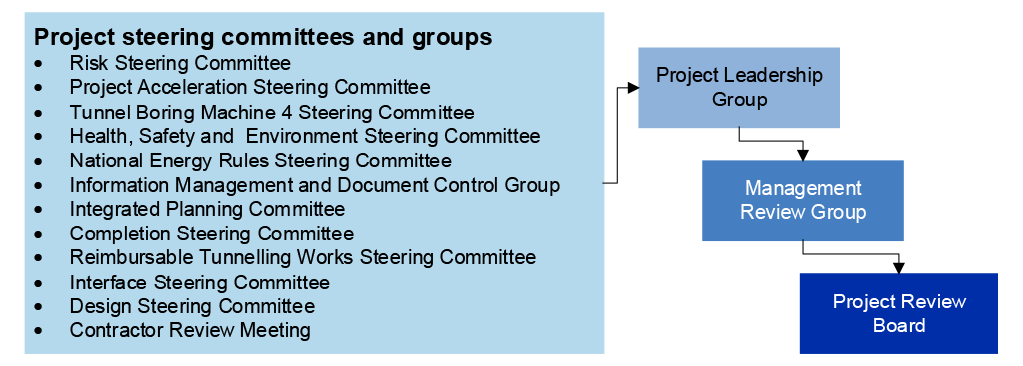
Source: ANAO from Snowy Hydro documentation.
Project management documentation framework
3.4 Project management plans contain key information about how a project will be managed over its life to support the achievement of value for money. More complex or higher risk projects usually require a detailed project management plan.
3.5 Snowy Hydro approved the Snowy 2.0 governance management plan in May 2025, almost 17 months after the reset approval. The purpose of the plan was to define a framework for decision-making, accountability and oversight for the Snowy 2.0 project. Prior to May 2025, there was no equivalent framework document.
3.6 Between the reset and February 2025, Snowy Hydro did not update project execution planning documents. Internal audits on quality management and schedule management completed in February and March 2025 found that teams were referencing an ‘insufficiently structured and undocumented approach’, using documentation labelled ‘preliminary’ and ‘draft’.
3.7 In February 2025, Snowy Hydro developed the Snowy 2.0 project management plan (PMP) procedure. Snowy Hydro has since documented a review and approval process for PMP documents, supported by a PMP register that outlines the timeframes for the review of internal management plans. Table 3.1 provides an overview of key project management documentation.
Table 3.1: Snowy 2.0 project management documentation
|
Document |
Purpose |
Date approved or established |
|
Standalone documents |
||
|
Contract manual |
The contract manual is a standalone document that assists staff and contractors in accessing key aspects of the reset contract. |
November 2023 |
|
Internal management plans (21 approved plansa) |
||
|
Project execution plan (PEP) |
The PEP details the approach to deliver Snowy 2.0, including the processes for monitoring and delivering the scope. |
March 2025 |
|
PMP procedure |
The PMP procedure provides guidance on the document management of the entire collection of Snowy 2.0 PMP documentation and supports the execution of the PEP. |
February 2025 |
|
PMP collection |
As at December 2025, Snowy Hydro had established a collection of internal project management plans under the PMP. This collection included a quality management plan, commercial management plan, programme (schedule) management plan, and a risk management plan. |
|
Note a: One additional plan was in draft as of December 2025.
Source: ANAO from Snowy Hydro documentation.
3.8 There was a lack of planning to support the delivery of the reset. This represents a deficiency in project management planning, including the identification of how the reset would be implemented to effect the changes in delivery required. The absence of, or the use of outdated management plans, for a significant period of delivery increased the risk of non-compliance with internal standards and may have introduced operational inefficiencies, leading to inconsistencies in processes and uncertainties in project delivery. The approval of project documentation, although delayed, is better supporting the delivery of the project.
Transition planning
3.9 Where significant contractual changes occur, the Australian Government Contract Management Guide recommends that entities identify what is required to transition effectively from one contract to another; ‘If the transition arrangements are complex, you may need to develop a separate written transition plan considering the contractual obligations under both the old and the new contracts’.42
3.10 In September 2023, Snowy Hydro established a Snowy 2.0 post-execution checklist, which listed activities that Snowy Hydro, Future Generation Joint Venture (FGJV) and Voith were required to complete to transition from the engineer, procure, and construct (EPC) contract to the incentivised target cost (ITC) contract. Snowy Hydro generated a supporting tracker to manage progress against the checklist. The tracker included information regarding task ownership, due dates and status for Snowy Hydro, FGJV and Voith. Snowy Hydro did not track the completion of activities between October 2023 and July 2025.43 As the completion date of activities was not recorded, the ANAO was not able to assess whether activities had been completed on time.
3.11 In November 2023, a contractor to Snowy Hydro developed a contract manual to assist its staff and contractors in accessing relevant parts of the reset contract. Snowy Hydro facilitated workshops and training for the Snowy Hydro board (the board), leadership and commercial team covering contract transition arrangements, and facilitated a workshop for senior Snowy Hydro leadership, and information to the shareholder departments on project controls and acceleration.
3.12 Features of the reset that required transitioning included:
- introducing the Collaboration Criteria Framework and performance reviews to improve contractor behaviours;
- payment arrangements; and
- data and performance assurance processes, including cost management oversight.
3.13 At its 15 November 2023 meeting, the board noted expected complexities in executing the transition between the previous contract and operating model to the reset project controls and operating model. It noted the importance of maintaining momentum on the project while the revised project controls and operating model was finalised and implemented.
3.14 Discussion between the board and management included the need for clear articulation of accountability for the targeted outcomes (and allocation of responsibility between the project team, FGJV and Voith under the amended contract(s)) and the oversight mechanism that will be used to track (and test and challenge management on) progress being made, and the completion of deliverables to achieve the target commercial operation date; and the importance of the revised project controls and operating model addressing the breadth of the previously identified performance matters including schedule, quality, time and cost. The outcomes of this discussion, including conclusions regarding the role of the board in providing this oversight were not recorded.
Collaboration Criteria Framework performance reviews
3.15 Under the reset contract, FGJV must satisfy the Collaboration Criteria Framework (CCF). Different performance criteria were expected to be achieved in the first six months and 12 months after the reset (and thereafter they were expected to use reasonable endeavours to continue to satisfy the criteria), (see paragraph 2.91 to 2.92).44 The CCF contained the following areas of focus:
- behavioural change (safety, quality, environmental);
- collaboration (connection process, and subcontractor engagement);
- productivity (construction and schedule management); and
- project administration criteria (project management, underground works, and cost administration).
3.16 In April and September 2024, six-month and 12-month reviews of FGJV’s performance against the CCF were completed. At the six-month review, 25 per cent of the criteria were assessed as being ‘at risk’.45 This had increased to 53 per cent at the FGJV 12-month review. At the 12-month review, 16 per cent of the Voith criteria were assessed as being at risk. Table 3.2 provides an overview of the results of the reviews of FGJV’s and Voith’s performance against the CCF criteria.
Table 3.2: Summary of Collaboration Criteria Framework review results
|
|
Count of criteria status results |
||
|
Criteria status |
FGJV — 6-month reviewa |
FGJV — 12-month review |
Voith — 12-month review |
|
Completed |
5 (10.4%) |
0 |
0 |
|
On track |
30 (62.5%) |
14 (36.8%) |
20 (52.6%) |
|
At risk |
12 (25.0%) |
20 (52.6%) |
6 (15.8%) |
|
Behind plan |
1 (2.1%) |
3 (7.9%) |
1 (2.6%) |
|
Not applicable — criteria not included in review |
0 |
1 (2.6%) |
11 (28.9%) |
|
Total number of criteria |
48 |
38 |
38 |
Note a: At the six-month review, FGJV had managed the CCF in relation to Voith as part of the electrical and mechanical subcontract arrangements. For the 12-month performance review, criteria relevant to Voith were assessed separately by Snowy Hydro.
Source: ANAO analysis of Snowy Hydro documentation.
3.17 In April and September 2024, FGJV’s CCF review results were reported to and noted by the board. In September 2024, the Snowy 2.0 project director reported to the board and outlined that under the reset contract Snowy Hydro had, at its sole discretion, the right to terminate its contract with FGJV for failure to meet the CCF (see paragraph 2.91). In April 2024, the board and management discussed the importance of the six- and 12-month contractual reviews to drive contractor performance.
3.18 The project director’s September 2024 recommendation to the board reflected that, while FGJV had failed to meet certain CCF criteria, the contractor had made considerable steps towards satisfying the CCF and was continuing to improve. Noting the costs associated with terminating the project through this mechanism, which included a termination payment and ‘a significant and unrecoverable time impact’ to the delivery of the project, the board was advised not to progress its termination rights. The recommendation included that there be further monitoring and review of FGJV’s performance against the CCF at 18 months.
3.19 The board meeting minutes did not record an approval of the recommendation, they instead noted the project director’s report, after ‘the Board and management had a robust discussion in relation to project performance (including cost and schedule)’. No further instructions from the board were provided in response to the findings.
Data and performance assurance
3.20 Sound data governance practices to support the measurement of performance include the proper documentation of data sources and methodologies used to verify data. In the Project Leadership Group meeting in November 2023, the project noted that data and performance assurance provides transparency to all critical stakeholders into the project’s schedule, costs, and performance, without which confidence cannot be fully gained that the project is being managed effectively and responsibly.
3.21 The reset required that information relating to project costs and schedule be provided by FGJV to Snowy Hydro on an ‘open book’ basis46 to enable project oversight. Similar provisions were required of Voith.
3.22 According to the governance management plan, Snowy Hydro uses FGJV and Voith data to create its management reports. Snowy Hydro teams complete assurance on quantitative data and report commentary. An internal assurance report on the Snowy 2.0 governance structure and performance reporting program (September 2024) noted that performance data:
is partly dependent on the knowledge and experience of individuals involved in the production of performance reports and the validation of information within rather than automated, streamlined and data-driven reporting [sic]. The source of truth for many of the data points underpinning the performance reports are in systems provided and managed by FGJV and to which the Snowy 2.0 Team has limited if any access. Therefore, the data assurance process is highly reliant on the … mechanisms adopted by FGJV to maintain and protect the integrity of data.
3.23 Since the reset, issues with Snowy Hydro’s assurance over FGJV’s data have been raised, including through Snowy Hydro commissioned external reviews on procurement (see paragraph 4.73 to 4.87) and reporting on cost forecasting data to the board (see paragraph 4.53).
3.24 Snowy Hydro provides assurance of data and information in reports by requiring subject matter experts and general managers to provide sign-off on information included in management reporting. Processes undertaken prior to sign-off are not documented. As of January 2026, Snowy Hydro was in the process of drafting a data assurance process.
Opportunity for improvement
3.25 Snowy Hydro could finalise its data assurance process to ensure it properly documents the data sources and methodologies used to measure performance, including clear mapping of data from systems to reports.
Cost forecasting systems
3.26 The lack of quality cost forecasting data has impacted the ability of Snowy Hydro to effectively oversee cost and program delivery. Issues related to cost forecasting systems were identified prior to the reset (see paragraph 2.74), with additional and ongoing concerns raised after the reset47 (see paragraphs 4.54 to 4.57). In February 2024, the board outlined its expectations for FGJV performance in 2023–24 and 2024–25, and communicated the urgency with which project and cost performance must be addressed by FGJV.
3.27 The six-month CCF review noted the delivery of cost forecasts were ‘behind plan’. The 12-month review recorded this requirement as being at ‘at risk’. In March and April 2025, approximately 15 months after the reset, the board was notified that FGJV and Voith were transitioning to updated cost forecasting systems with implementation expected in mid-2025.
3.28 In July 2025, reporting to Snowy Hydro’s Governance Committee stated that process improvements are progressing slower than planned. In August 2025, FGJV used data from the updated cost forecasting system to provide Snowy Hydro with cost forecast reports for the first time. In December 2025, Snowy Hydro advised the ANAO that Voith had not fully transitioned to the updated cost forecasting system and that full implementation was expected in February 2026. The December project management reporting noted that FGJV processes remained ‘inadequate’. FGJV had proposed changes to the cost coding structure and the introduction of a further cost estimation software package, however, Snowy Hydro ‘is not aligned with the proposed changes’.
3.29 To increase its confidence in FGJV’s cost forecast, Snowy Hydro commenced cost forecast ‘deep dives’ in September 2025 — see also paragraphs 4.54 to 4.57 for further discussion on cost management.
Strategic direction
3.30 The Snowy Hydro board is the accountable authority of Snowy Hydro with specific responsibility for ‘leading, governing and setting the strategic direction’ for the entity under the Public Governance, Performance and Accountability Act 2013 (PGPA Act). The delivery of Snowy 2.0 is a major project for Snowy Hydro.
3.31 According to the board’s charter, the board is responsible for strategy and oversight for the effective management of Snowy Hydro. This includes: identifying and managing operational and other risks, and formulating strategies for managing those risks; guiding and monitoring Snowy Hydro’s strategies, policies and performance to optimise value; and individual directors are to make reasonable enquiries to ensure that Snowy Hydro is operating effectively and efficiently.
3.32 The board has delegated all matters not specifically requiring board approval to the CEO. There is a delegation policy, matrix and register and training pack that provides unlimited financial delegations within the confines of the current board approval to the CEO.48 Other delegations are provided based on the name and position of the officer, with many delegations restricted to specific workstreams.
3.33 Prior to the reset, the board was supported by the Snowy 2.0 project advisory committee (BPAC), a sub-committee of the board, which was established on 9 November 2020. Its role was to assist the board in managing risks pertaining to the Snowy 2.0 project. The BPAC met regularly until April 2023, when the board agreed to the suspension of the BPAC. The board assumed the BPAC’s duties and responsibilities. Discussion of the board’s consideration and decision-making regarding the decision to reset the contract is discussed in chapter 2 of this report.
3.34 During the audit period, the board met monthly, and received a monthly Snowy 2.0 project director report. Minutes from board meetings regularly state that the project director’s reports were ‘noted’, but they were rarely provided with a covering brief from the project team seeking explicit endorsement or agreement to the information or management strategies outlined in the paper.
3.35 Board records show that the board and the Snowy 2.0 project team had broad ranging discussions in relation to project performance, as well as areas of priority and focus.
- The board sought further strategic advice on the delivery of the project including how Snowy Hydro would manage and assess FGJV performance trajectory and productivity, and a plan for the Snowy 2.0 cost-to-complete review. Over the period December 2023 to November 2025, the board sought additional strategic advice on 24 occasions.49
- The board tested and challenged management, including on matters such as the Enterprise Bargaining Agreement (EBA) assumptions, and the performance of the reset contract model against management’s expectations. Each board meeting included a discussion with the CEO which often included project delivery as well as a discussion of the project director’s report, during which the board shared its feedback and expectations, for instance on the delivery of productivity and performance milestones (including in relation to quality and timeliness). The board hosted FGJV at two board meetings: in February 2024 and in July 2025, where the board reiterated the importance of FGJV meeting the reset objectives and noted its serious concerns in relation to the project timetable and cost.
3.36 Other supporting activities by the board included a workshop on 12 October 2023 between the board, Snowy 2.0 team, FGJV and Voith to consider project controls and operating models; and site visits in 2024 by directors on the board. A further workshop with FGJV was held in July 2025, when the board reiterated the importance of ‘meeting the reset objectives, noting the Board’s serious concerns in relation to the timetable and outturn cost…’.
3.37 On 30 April 2026, Snowy Hydro advised the ANAO that board direction was often provided through requests for further analysis rather than formal directive language, and that issuing operational directives would blur the lines of accountability established in Snowy Hydro governing documents. It noted that the board sets the strategy and delegates the day-to-day execution to the CEO; and suggested that ‘stepping in to issue prescriptive directions undermines this delegation and compromises the board’s ability to act as an independent auditor of management’s performance’.
3.38 Although the board has a different governance role to Snowy Hydro’s management, as the accountable authority and through the statement of expectations, it retains ultimate responsibility for the performance of Snowy Hydro. It is also accountable to the government as its sole shareholder. Through its operations, it is required to take all appropriate actions to deliver major projects on time and on budget in accordance with agreed parameters. While providing evidence of the board’s role understanding the delivery of the project, board records, such as meeting minutes, do not clearly demonstrate that the board has always provided strategic direction and accountability for the Snowy 2.0 project through documented decision-making in addition to meeting and discussing the project.
Project management resourcing
3.39 As a result of the increased oversight requirements under the reset contract, Snowy Hydro identified that it would require a significant uplift in its own staffing profile. Preliminary estimates, established from external benchmarking, internal assessment, and expert interviews suggested an overall size increase from around 140 to over 250 full-time equivalent staff would be needed.
3.40 External advice raised concerns regarding future capability gaps across all functional capabilities of the revised Snowy Hydro team. It noted that until that time, the project ‘has not been effectively performance managed’ and observed that there would be an increase in administration volume and complexity under the reset. Snowy Hydro sought further advice on leadership organisational design and position requirements from other human resources consultants.
3.41 The rationale for the Snowy Hydro capability uplift also noted the need for the team to provide challenge and support for construction capabilities, performance management, integration with schedule and cost management. It also noted that there was no ‘project excellence’ capability at the time of the reset, and that it was necessary to stand up a team to realise project acceleration aspirations. McKinsey advice noted that filling capability gaps will require a combination of build-borrow-buy of talent. The report noted that Snowy Hydro was already heavily leveraging embedded and transient contractors, which allowed for the building of additional and long-term capabilities and leadership skills within Snowy Hydro to enable operating model changes and influence contractor performance improvements.
Probity management
3.42 The reset was developed with a focus on greater collaboration between the contractor and Snowy Hydro. Given the ongoing nature of the management of relationships, probity should not only be considered in the procurement stages of project management.
3.43 Snowy Hydro’s corporate Conflict of Interest, Gifts and Benefits Policy applies to the project. Previous versions of this policy (dated 2018 and 2024) covered the project delivery period, with a revised policy approved by the Board Audit and Compliance Committee in November 2025.
3.44 Under the policy, Snowy Hydro employees are required to declare any perceived, potential or actual conflicts of interest. The policy does not provide guidance for staff on how to manage conflicts of interest that may result from the close working relationship and collaborative model developed through an ITC contract. This is particularly important for staff who have a review and oversight role.
Recommendation no.1
3.45 Snowy Hydro strengthens its management of project transitions through the early identification of, and clear planning for, how to implement required project management changes. This includes the timely development of governance structures and documentation, internal resourcing plans and management of relationship risks.
Snowy Hydro Limited response: Agreed.
3.46 Snowy Hydro acknowledges opportunities to further formalise and consolidate aspects of transition planning documentation and governance artefacts following major project transitions, including the 2023 reset. Governance structures, reporting arrangements and oversight activities were implemented throughout the transition period following the 2023 reset and continue to operate. Snowy Hydro will continue to refine transition planning documentation and implementation processes to support future project transitions.
Internal assurance framework
3.47 Snowy Hydro has established an internal assurance approach for the project to provide assurance, independent from the project, that key business risks are being managed and assurance that processes and controls are operating effectively.
3.48 According to the governance management plan, since the reset, the assurance approach has moved from the previous ‘oversight and monitoring’ processes and controls to a ‘review and validate’ approach. This is based on a ‘three lines of assurance’ model.
- First line — FGJV is to ensure project delivery processes and controls are adequately designed, appropriately implemented and operating effectively. The first line relates to FGJV processes and controls, which are outside the scope of this audit.
- Second line — the Snowy 2.0 project team is to define and establish review and validation of processes and controls to gain adequate and appropriate assurance over the effective mitigation of key risks and performance of the project across all aspects. Snowy Hydro’s second line assurance includes processes such as reviewing non-conformance reports, baseline schedules and associated updates, cost forecasts, payments testing, procurement processes, and design reviews (see associated sections below).
- Third line — the Snowy Hydro internal audit team is to undertake a risk-focused program of reviews to complement and supplement the ‘second line’ assurance activities, including reviewing the design and operating effectiveness of Snowy Hydro and its functional processes and controls. That is, the ‘third line’ should evaluate whether the ‘second line’ is effectively and consistently undertaking its role.
3.49 Since the reset, Snowy Hydro has completed six third line assurance activities related to quality management (February 2025, May 2025), payments testing (December 2024, October 2025), governance structure and performance reporting (September 2025) and schedule (March 2025).
3.50 The outcomes of internal audits are provided to the Board Audit and Compliance Committee (BACC) and the board. Where an internal audit identifies the need for a management action, a Snowy Hydro senior assurance manager is responsible for reviewing evidence supporting the closure of management actions. The sign-off that the action has been implemented and can be closed is recorded in an internal tracker.
3.51 An internal assurance framework provides a level of confidence on project performance and the effectiveness of project controls and processes. A key duty of the BACC is to review and approve the internal audit plan. For all financial years since the reset, the BACC has approved internal audit plans. Internal audit plans are linked to Snowy Hydro’s corporate risks. Internal audits have identified risks to the project where second line activities are not being delivered effectively, including with regards to Snowy Hydro’s oversight of quality, its payments to third parties other than Voith and FGJV. These findings are discussed in more detail under relevant sections of this report. While the assurance framework has identified areas where improvements are required, multiple internal audits have been delayed or reprioritised by the BACC.
3.52 Audits have identified deficiencies that have been in effect over extended periods, for example, in the quality management audit, it was found that quality audits had not been scheduled or performed between mid-2023 and November 2024. Audits have also identified different issues in the same sector in follow up activities, such as with payments testing. This indicates that there would be merit in increasing the level of independent third line assurance in the project.
3.53 In addition to the internal assurance framework, in January 2024, Snowy Hydro engaged two external consultants to provide project assurance to the board. When requested by the board, the consultants were expected to report verbally. There is limited documentation of the advice provided by these consultants. This represents a risk to the board which may act on undocumented advice, which may be contrary to other expert advice and without documentation its evidence base could be flawed.
Opportunity for improvement
3.54 Snowy Hydro could increase the frequency and breadth of third line assurance processes, to ensure that the project is subject to independent oversight, and to verify that identified management actions are resulting in an overall uplift in project management across tested functional areas.
Are effective risk management arrangements in place?
Snowy Hydro developed a risk management plan for Snowy 2.0 in May 2025. Prior to this, there was no approved risk management plan that reflected the reset. Risk management arrangements are still being established for the project. Risk ownership is not always clearly documented, and risk appetite and tolerance have not been defined. Snowy Hydro rates project costs, geotechnical and construction productivity residual risks as ’extreme,’ with the latter two risks outside target.
3.55 Section 16 of the Public Governance, Performance and Accountability Act 2013 (PGPA Act) requires accountable authorities to establish and maintain appropriate systems and internal controls for the oversight and management of risk.
3.56 Snowy Hydro has an enterprise-level risk management framework, with the most recent version approved in August 2025.50 Under this framework, an enterprise-level risk appetite statement is required to be developed to articulate the amount and type of risk that Snowy Hydro is willing to pursue. Accountable executives are responsible for reviewing, monitoring, and managing risks within this risk appetite and tolerance.
3.57 As of January 2026, Snowy Hydro was in the process of drafting a risk appetite and tolerance statement for Snowy 2.0 which had been due for completion in December 2025. Finalisation is now expected in the first half of 2026.
Snowy 2.0 project risk arrangements
3.58 The final investment decision supporting documentation (2018) included a core chapter related to risk. This chapter outlined the risk management approach to be applied to the project, and noted that the approach had been developed with the support of an external expert advisor on risk management and was expected to enable the timely identification, management and mitigation of corporate and project risks throughout the project life cycle.
3.59 At the reset, Snowy Hydro, FGJV and Voith agreed to work under an ‘integrated risk approach’ for identifying, assessing and managing project risks. In March 2025, an integrated risk governance model was outlined under the project execution plan. Snowy Hydro has also developed a project-specific risk management plan (approved May 2025). Prior to this, Snowy Hydro did not have an approved project-specific risk management plan reflecting the reset.
3.60 The project-specific plan outlines processes consistent with the enterprise-level risk management framework. Roles and responsibilities are listed, as well as leads for most workstreams. The plan outlines a risk hierarchy (tiers 1 to 3), with tier 1 risks being the most material risk areas across the project.51
3.61 A project risk register was established prior to the reset. ANAO analysis confirms that between August 2024 and August 2025 the register was updated monthly, as required.
3.62 Shared risks are those risks extending beyond a single entity which require shared oversight and management. The management of shared risks should be agreed by all parties. In January 2026, Snowy Hydro advised that, since July 2025, it has been building collaborative risk registers with the ownership of risks assigned to the party best placed to manage the risk or implement actions. Implementation of these registers is anticipated to commence in March 2026.
Opportunity for improvement
3.63 Snowy Hydro could progress the establishment of joint risk registers to clearly assign risk ownership across contract parties to help to ensure that risk management responsibilities and accountabilities are clear across the different risk owners on the project.
Risk reporting
3.64 The Snowy 2.0 risk management plan outlines risk governance arrangements, and lists material project risk areas. This plan identifies that a Project Risk Steering Committee is to meet every two months to oversee project risks. Risks are escalated from this committee to the Project Leadership Group. This plan does not document the basis for risks to be escalated to the board. Risk reporting to the board is based on the discretion of the Snowy 2.0 project director.
3.65 Since the reset in September 2023, the Project Risk Steering Committee met seven times between August 2024 and October 2025.52
3.66 ANAO analysis of board documentation between April 2024 and March 2025 showed that a standard Snowy 2.0 board report covered risk information, including risk information related to the management of project quality, cost and schedule. The risk reporting does not consistently provide information on changes in the risk environment for the material risk areas identified in the risk management plan.
3.67 Between June 2024 and March 2025, the shareholders were informed of Snowy 2.0 risks via enterprise risk reporting (annually through the corporate plan process with quarterly progress updates) and Snowy 2.0 operational reports (two monthly). Through the corporate planning process (2026–35), Snowy Hydro informed the shareholder departments of the three top risks (project cost, geotechnical, and construction productivity). Each of the three risks had a residual risk rating of ‘extreme’. Geotechnical risk and construction productivity risk had a residual risk rating that was higher than its target risk rating.
Monitoring risk controls and treatments
3.68 Under the Snowy 2.0 risk management plan, there are requirements for monitoring and validating the effectiveness of risk controls, including monitoring by the Project Risk Steering Committee. The risk management plan states that treatment actions ‘should be defined according to the SMART principles: Specific, Measurable, Achievable, Relevant and Time-bound’.
3.69 Meeting minutes and papers of the Project Risk Steering Committee between August 2024 and October 2025 did not demonstrate a comprehensive approach to monitoring the effectiveness of risk control and treatment effectiveness. The project risk register consists of information on controls and treatments. It does not include information on the effectiveness and validation of controls or treatments.
3.70 In October 2024, Snowy Hydro developed a process for a Project Controls Assurance Program. The Snowy 2.0 risk management plan states that the program was ‘under development and is targeted for implementation in 2025’. As at February 2026, Snowy Hydro is implementing a risk improvement program that is expected to include improvements to the risk framework, documentation, training, supporting software and processes.
Opportunity for improvement
3.71 Snowy Hydro could: develop risk controls that are defined according to SMART principles; and finalise and implement a program to test and validate the effectiveness of risk controls and treatments.
Are effective arrangements in place to measure the performance of project delivery?
Snowy Hydro has established performance measures for the project and for its project team. There are no performance measures relating to the efficiency or effectiveness of Snowy Hydro’s internal management and delivery of the project.
3.72 Appropriate and meaningful performance information supports entities to demonstrate accountability and transparency, and should provide information to management to drive improved performance. Performance information should include measures that are relevant to purpose, reliable and unbiased, and complete. Effectiveness measures can assess how well a project is delivered to achieve its intended objectives.
3.73 The strategic corporate plans for 2023–32, 2024–33 and 2025–34 have no performance measures to assess the efficiency or effectiveness of Snowy Hydro in delivering Snowy 2.0. They contain performance measures related to safety of the project, and other enterprise outcomes. The 2025–34 Corporate Plan notes Snowy Hydro must strengthen its asset management and project delivery to prepare to deliver a larger capital program, outlining an enterprise-level transformation agenda which includes streamlining functions and core business to drive greater efficiency and effectiveness across the organisation.
3.74 In addition, 208 internal project KPIs have been established for Snowy 2.0, covering health and safety, cost, schedule, engineering and design, staffing and quality.
3.75 In addition to the internal project KPIs, Snowy Hydro has developed Snowy 2.0 team KPIs. These include safety education, the environmental assurance program, construction activities, commercial review and response times, and delivery of ‘project excellence’ improvement activities. Achievement of these KPIs are linked to performance payments to staff.
3.76 The project budget at reset for Snowy Hydro’s oversight of the project was $1.5 billion, however, KPIs relating to the efficiency and effectiveness of Snowy Hydro’s internal management and delivery of the project have not been established. Such KPIs could include benchmarking of the efficiency of delivery oversight effort against other mega projects, or the effectiveness of the project’s oversight of its own direct contracting.
Recommendation no.2
3.77 Snowy Hydro establishes performance measures that reflect the efficiency and effectiveness of its oversight and management of the delivery of Snowy 2.0 and use these to support Snowy Hydro’s management of the project including the allocation of its resources.
Snowy Hydro Limited response: Agreed.
3.78 The ANAO notes that Snowy Hydro currently monitors over 200 project and team-based KPIs (covering safety, commercial response times, project management). Snowy Hydro will pursue opportunities to refine targeted performance measures relating to oversight and management efficiency to support project delivery.
4. Project management
Areas examined
This chapter examines whether Snowy Hydro Limited (Snowy Hydro) is effectively managing project performance to achieve value for money and to deliver the outcomes required of the project.
Conclusion
Snowy Hydro has been partly effective in managing project performance to support the achievement of value for money and to deliver the outcomes of the project. The project is currently behind schedule and is undertaking a cost reassessment that is likely to result in a further cost increase. This is despite the reset in 2023 which extended the commercial operation date for the project from May 2026 to December 2028, and almost doubled the delivery cost. Significant deficiencies in Snowy Hydro’s project management include the following.
- Key quality controls have not been effectively implemented.
- There is no agreed baseline schedule for the project.
- Snowy Hydro has reported that productivity gains assumed at reset are proving difficult to realise.
- Snowy Hydro does not have a robust understanding of the forecast cost to complete of the project.
- The incentive framework is not working as intended.
- Snowy Hydro does not have adequate arrangements to monitor the impact of adjustments on value for money.
Areas for improvement
The ANAO made three recommendations to Snowy Hydro aimed at improved public schedule reporting, strengthening its project management with regards to schedule, quality and cost, and monitoring its payment of contractors.
The ANAO also made suggestions related to Snowy Hydro’s: quality audits; cost allocation methodology and contract adjustment register.
4.1 The reset contract states that value for money ‘means an approach that balances quality levels, performance standards, risk, price and whole of life costs, having regard to the requirements of the contract’. Effectively managing elements of quality, schedule and cost is central to a project’s success — movement in one can place pressure on the other elements.
Is Snowy Hydro effectively managing project performance with respect to quality, schedule and cost?
Snowy has a quality management plan in place and has implemented some quality management improvements following two internal audits, one of which found a ‘deficient control environment’. There are schedule management arrangements in place, however, there is no agreed baseline schedule. The February 2026 schedule forecasts from the contractor are unapproved by Snowy Hydro, in part due to the forecast completion proposed by the contractor being materially later than the contractual time for completion. Initiatives are being implemented to assist with the achievement of the project’s schedule. Public reporting on schedule progress is not informed by risk or the criticality of project works. Snowy Hydro does not have a robust understanding of the cost to complete the project. As a result, in September 2025 it commenced in-depth cost reviews with the aim of better understanding the cost to complete the project.
Quality management
4.2 Snowy Hydro approved a post-reset Snowy 2.0 quality management plan (QMP) in May 2025 to ‘define and document the processes, procedures, and standards used by Snowy Hydro to proactively deliver its quality assurance program’. Within this context, quality management refers to assurance activities aimed at ensuring that project assets are fit for their intended purpose and can be safely and reliably operated.
4.3 Prior to May 2025, Snowy Hydro had approved pre-reset QMPs in 2021 with a revision in 2022. Snowy Hydro’s 2025 QMP states that the project ‘shall prioritise efforts in quality assurance towards the most critical risks of the project’.
4.4 Quality assurance activities identified in the QMP include:
- monitoring Future Generation Joint Venture’s (FGJV’s) activities to ensure they are delivered in accordance with requirements, relevant inspection and test plans and the overall quality management program;
- reviewing quality-related documentation;
- undertaking quality audits on suppliers and internal processes, including factory acceptance testing and a program of inspection for critical equipment prior to and post critical transport activities;
- verifying the contractor’s investigation of all non-compliance issues; and
- reviewing the status of construction lots and quality records.
Non-conformance reports
4.5 Under the QMP, all project staff are responsible for reporting any defects or non-compliance items. A non-conformance report (NCR) is raised for serious, intentional, continual or systemic nonconformities relating to project systems or products and may require major elements of permanent work to be scrapped, reworked, repaired or accepted as-is.53
4.6 Due to the seriousness of issues raised through NCRs, their existence can indicate that there are quality issues with the delivery of project assets. Figure 4.1 shows NCRs since August 2023.
Figure 4.1: NCRs since August 2023, by original due date
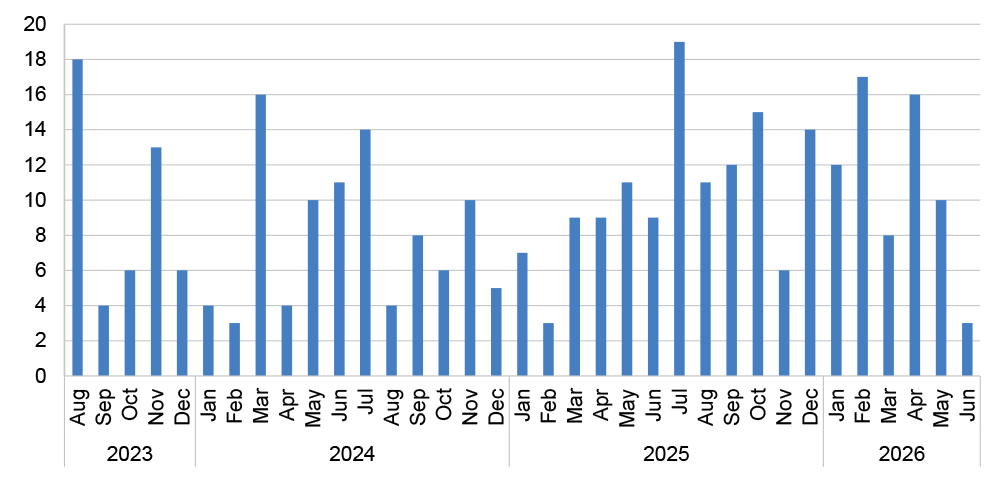
Source: ANAO analysis of Snowy Hydro documentation.
4.7 The timely resolution of NCRs is important in supporting quality. To achieve the baseline criteria of the incentive framework (see paragraphs 2.60 to 2.65), a key requirement includes that NCRs must be closed or timeframes agreed for closure within three months of the NCR being raised. In December 2025, Snowy Hydro advised the ANAO that long-pending NCRs are NCRs that cannot be closed until later and therefore extensions are granted or acknowledgement for completion date is noted. NCRs that require to be closed out immediately are not granted an extension of time. As at September 2025, FGJV did not receive 27 incentive payments due to baseline criteria not being met.
Internal audits on quality
4.8 In February 2025, Snowy Hydro completed part one of a two-part internal audit on quality management focused on Snowy 2.0 construction. The scope of the audit covered governance, project quality management processes, and monitoring and reporting.54
4.9 There were positive findings in relation to Snowy Hydro’s management of NCRs. Findings included that root causes are identified, corrective actions are taken, and that there was a documented process being used to track issues and solutions. An opportunity was identified for Snowy Hydro to perform analysis on NCRs to identify recurring and systemic issues.
4.10 Despite the NCR findings, the overall audit opinion was a ‘deficient control environment’. The internal audit found weaknesses in processes and controls, with key quality documents including the QMP outdated, audits were not performed, and review workflows were ineffective. Specific findings included:
- as the QMP and related procedures were outdated and not followed, this control was not working effectively;
- quality audits55 had not been scheduled or performed between mid-2023 to November 2024, and the forward schedule for quality audits did not meet target frequency;
- workflows developed to manage the review of project documents including NCRs, inspection and test plans and construction method statements can be changed without approvals, impacting the integrity of the workflow;
- the QMP lacked guidelines in identifying when it is required for a verification point to be a ‘hold point’ or a ‘witness point’ and was without specifications regarding the justification for changing hold points to witness points56; and
- there were mismatches between the final review status (documentation of objection or approval) of documents held in the document management system and in formal responses to FGJV.
4.11 The ANAO assessed that as of August 2025, of the 13 management actions from the internal audit: seven were completed; four were partly completed; and two were not completed.57
4.12 The internal audit management actions that were partly completed included the requirement to ‘Develop an audit [quality] plan which includes resource allocation and audit schedule (due date: 31 May 2025)’. An audit schedule has been created, but this does not include clear allocations of resources to undertake the identified audits. It does not document how the outcomes of quality audits are reported back to FGJV or to Snowy Hydro management to provide quality oversight. Since May 2025, the monthly contractor review meeting has a regular agenda item discussing quality audit outcomes.
4.13 Snowy Hydro has taken steps to improve its quality management resourcing. It has employed one quality assurance and improvement lead, and had developed a position description for a Quality Assurance and Improvement Engineer. On 28 January 2026, Snowy Hydro advised the ANAO that it will be part of the team’s responsibilities to update the quality audit plan, including allocating resources, and perform the quality audits under the quality audit plan.
Opportunity for improvement
4.14 Snowy Hydro could continue to undertake actions to identify and allocate resources to delivering the quality audit function.
4.15 In May 2025, Snowy Hydro completed a further internal audit on quality management, focused on the quality governance and management processes related to the manufacture of electrical and mechanical equipment. The overall report rating found that there was a ‘satisfactory control environment, but with room for improvement’. The internal audit identified nine management actions. As at January 2026, Snowy Hydro’s internal recommendation tracker recorded all recommendations as being completed and closed.
Schedule management
4.16 Schedule management is a critical process for Snowy 2.0 to realise value for money. A key aspect of schedule management is the project schedule which must be: a ‘single source of truth’ that reflects reality; should regularly report the actual forecast completion; and regularly report the variance between the current project schedule and target milestones.
4.17 As a part of the reset, FGJV and Snowy Hydro agreed a baseline schedule. In December 2023, Snowy Hydro approved a revision to the baseline schedule. The reset revised the commercial operation date (COD) to 31 December 2028 and the time for completion of works to 30 June 2029, from original baseline completion dates of February 2025 for first power, and May 2026 for COD.
Management plan
4.18 A schedule management plan helps to operationalise the provisions of the contract and puts in place procedures and guidance for schedule management by Snowy Hydro. In May 2025, Snowy Hydro created a program (schedule) management plan to describe its approach to the management of: an integrated project schedule58; progress reporting; and schedule risk. Prior to May 2025, Snowy Hydro did not have an approved schedule management plan.
Baseline schedule
4.19 In November 2024, FGJV submitted an updated baseline schedule (dated October 2024). Snowy Hydro objected to this schedule on the basis that the submission was not in compliance with the contract, and that the cover letter to the submission included commercial issues. Despite objections to the schedule, it was agreed for use ‘for ongoing monitoring purposes only’. As at April 2026, Snowy Hydro has not agreed an updated schedule to address the objections raised.
Monthly progress reporting and review
4.20 FGJV is required to submit ‘on an open book basis’ an updated schedule monthly, which accurately reflects the actual progress of the works. Snowy Hydro is required to review the updated schedule and may respond with a statement covering the extent to which the contractor does not comply or is inconsistent with the contract, or that its reporting ceases to reflect actual progress.
4.21 Snowy Hydro reviews the monthly reports. It has direct data from FGJV’s systems to monitor compliance with the schedule. It issued 23 notices of non-compliance with the schedule (along with detailed review comments) to FGJV between February 2024 and December 2025. In addition to monthly reviews, Snowy Hydro, FGJV and Voith discuss project schedule and progress at governance meetings.
4.22 If at any time Snowy Hydro believes that actual progress is too slow, or progress has fallen behind the baseline schedule, Snowy Hydro may instruct FGJV to submit an amended ‘schedule update report’ describing the revised methods which FGJV will adopt to expedite progress to Snowy Hydro’s reasonable satisfaction.
4.23 On 19 September 2025, FGJV provided Snowy Hydro with the August update to the program. This update suggested an approximately five months delay to the date for completion as against the 31 October 2024 schedule, with a first power date of 20 July 2028, and a full commercial operation date of 3 May 2029. On 3 October 2025, Snowy Hydro issued an objection to the monthly update, and also issued a reminder that FGJV should provide an ‘advanced warning’59 and corrective action plan, as it had become aware of events or circumstances which may delay the completion of the works.
4.24 On 28 October 2025, Snowy Hydro issued a notice of objection to the September monthly update of the schedule, on the basis that the update was not compliant with the project’s completion timeline, as well as documenting a number of other actions required by FGJV. A similar objection was raised in November to the October monthly update of the schedule, and in December to the November update.
4.25 On 11 November 2025, FGJV submitted a corrective action plan. On 27 November and 19 December 2025, Snowy Hydro reiterated its requirements for a plan to bring the project completion date in line with the agreed completion timeline. On 23 March 2026, FGJV submitted an acceleration program to Snowy Hydro. As of 9 April 2026, Snowy Hydro has continued to object to the program due to non-compliance with the contract, including due to a forecast completion materially later than the contractual time for completion. This response included a detailed review outlining observations and actions required. In its consideration of this plan, Snowy Hydro noted increasing delays to the project completion dates across schedules submitted between August 2025 and February 2026, to which Snowy Hydro assessed that it had not received a satisfactory explanation from FGJV.
Internal audit
4.26 In March 2025, Snowy Hydro completed an internal audit covering whether the schedule is developed in a suitable manner and reviewing the schedule management governance effectiveness. The overall internal audit report rating was ‘satisfactory control environment’. Observations included ‘high levels of collaboration’ between Snowy Hydro and FGJV planning teams, and a project team focus on actively identifying and developing scheduling opportunities.
4.27 The internal audit identified seven findings and 12 management actions related to: the need for a current and valid schedule management plan and procedures; a formal agreement on the baseline schedule, and an agreed schedule quality check methodology to be used by the contractor; and an opportunity for Snowy Hydro to streamline its review of the contractor’s schedule update reports.
4.28 The internal audit examined the baseline schedule submitted by FGJV in November 2024, and found it did not comply with the contract, and key forecast information was not provided by FGJV in accordance with the contractual requirements in the four months of project schedule update reports examined through the internal audit. All 12 management actions were completed within agreed timeframes between February and June 2025 according to Snowy Hydro’s tracker for management actions.
Project acceleration and efficiency initiatives
4.29 As agreed at reset, to meet the delivery dates, project acceleration and efficiency activities are needed to ‘turnaround [schedule] performance’. Integrated Snowy Hydro and FGJV teams design these acceleration activities. In June 2023, Snowy Hydro engaged McKinsey Pacific Rim (McKinsey) to identify activities as an owner-initiated intervention to support timely delivery of the project.
4.30 In May 2025, Snowy Hydro created a project acceleration plan to accelerate progress of activities that are running behind schedule and that could delay project delivery; and de-risk areas of the project that are uncertain and pose a significant schedule risk.60 The project acceleration plan states that its scope for 2025 are works that are either on the critical path or have ‘very little float’ in the schedule.61
4.31 Prior to May 2025, acceleration activities were identified and project acceleration meetings were held ‘to drive progress on acceleration and efficiency initiatives to achieve required production’. There are no minutes of these meetings. Sixty-two project acceleration meeting dashboards show that initiatives were being monitored between September 2023 and July 2025.62
4.32 The project acceleration plan states that ‘Measuring impact is a critical element of Project Acceleration. Without measured impact it is impossible to gauge whether it was useful to spend the time on an initiative in the first place’. In January 2025, Snowy Hydro established the current form of the initiatives register as the ‘single source of truth for all ideas and initiatives as well as their impact’. This has not been well maintained and did not meet the expectations established under the project acceleration plan. There were 222 unique entries in the July 2025 register, which included 17 entries (7.6 per cent) that contained an ‘updated’ date occurring after July 2025. Information on the initiatives and their impact on the project schedule was not always entered into the register.63
4.33 On 29 January 2026, Snowy Hydro advised the ANAO that the Project Acceleration teams’ ‘capacity restricts it to work on a prioritised set of initiatives, explaining why 17 were updated after July’. Snowy Hydro indicated that ‘the majority of initiatives were in a status not requiring an update (i.e. cancelled, to be monitored, implemented)’. Of the initiatives in the list assigned a status (221), the performance acceleration team were marked as supporting 157. Of these, 57 were listed as ‘implemented’; 26 were ‘in progress’ or ‘to be monitored’; 55 were ‘cancelled’ or ‘on hold’; and the others were either opportunities or ideas.
Reporting on schedule
4.34 The project has used four approaches to monitor delivery against the schedule. These include the following.
- The risk-adjusted trajectory approach is a projection of the completion date of key work fronts and the resulting end date of the project. The purpose of the risk-adjusted trajectory is to provide a realistic view of schedule outcomes based on current performance and unmitigated risks.64
- The line-of-sight approach applies the estimated impacts of project acceleration activities to the trajectory, calculating new forecast project delivery dates.
- The line-of-sight plus pipeline approach uses the line-of-sight calculation and includes additional potential project efficiency or acceleration opportunities.
- The S-curve approach represents a weighted aggregate view of the total project works across different construction work fronts.
4.35 Using the measures of trajectory and line-of-sight, over the period December 2023 to December 2024, the gap between the commercial operation date (COD) and line-of-sight gradually reduced (see Table 4.1). Since December 2024, the gap has increased. To meet the COD, as of July 2025, additional acceleration and efficiency opportunities generating schedule improvements of at least 262 days were required to be implemented.
Table 4.1: Trajectory and line-of-sight towards commercial operation date (COD)
|
Date of update |
Trajectory |
Line-of-sight |
Target COD |
Days behind schedule |
|
December 2023 |
August 2030 |
March 2030 |
December 2028 |
453 |
|
July 2024 |
March 2031 |
June 2029 |
December 2028 |
181 |
|
September 2024 |
April 2030 |
June 2029 |
December 2028 |
174 |
|
December 2024 |
September 2029 |
April 2029 |
December 2028 |
114 |
|
March 2025 |
July 2029 |
June 2029 |
December 2028 |
172 |
|
July 2025 |
September 2029 |
September 2029 |
December 2028 |
262 |
|
December 2025 |
In the December 2025, Snowy Hydro modified its trajectory and line of sight reporting to report on individual tunnel boring machine and excavation areas, rather than whole of project reporting. |
|||
Source: ANAO analysis of Snowy Hydro documentation.
S-curves
4.36 S-curve reporting shows: monthly planned, actual and forecast progress; and cumulative planned, actual and forecast schedule (see Figure 4.2). The S-curve in December 2025 indicated that between July 2023 and October 2024, actual progress matched planned progress. From November 2024 onwards, actual progress was below planned progress. Overall, between July 2023 and December 2025 monthly progress was an average of 0.83 per cent — below the 1.27 per cent monthly progress planned.
4.37 The December 2025 version of the S-curve estimation shows a forecast underachievement of planned outcomes from May 2026, with four exceptions between August and October 2026, and in January 2027 (see Figure 4.2). In September 2025, Snowy Hydro informed the shareholder ministers (the shareholders) through the corporate plan process that productivity gains assumed at reset are proving difficult to realise, placing pressure on the target cost. On 9 June 2026, Snowy Hydro advised the ANAO that overall project progress percentage as at 31 March 2026 is 73 per cent.
Figure 4.2: Overall S-curve as at December 2025
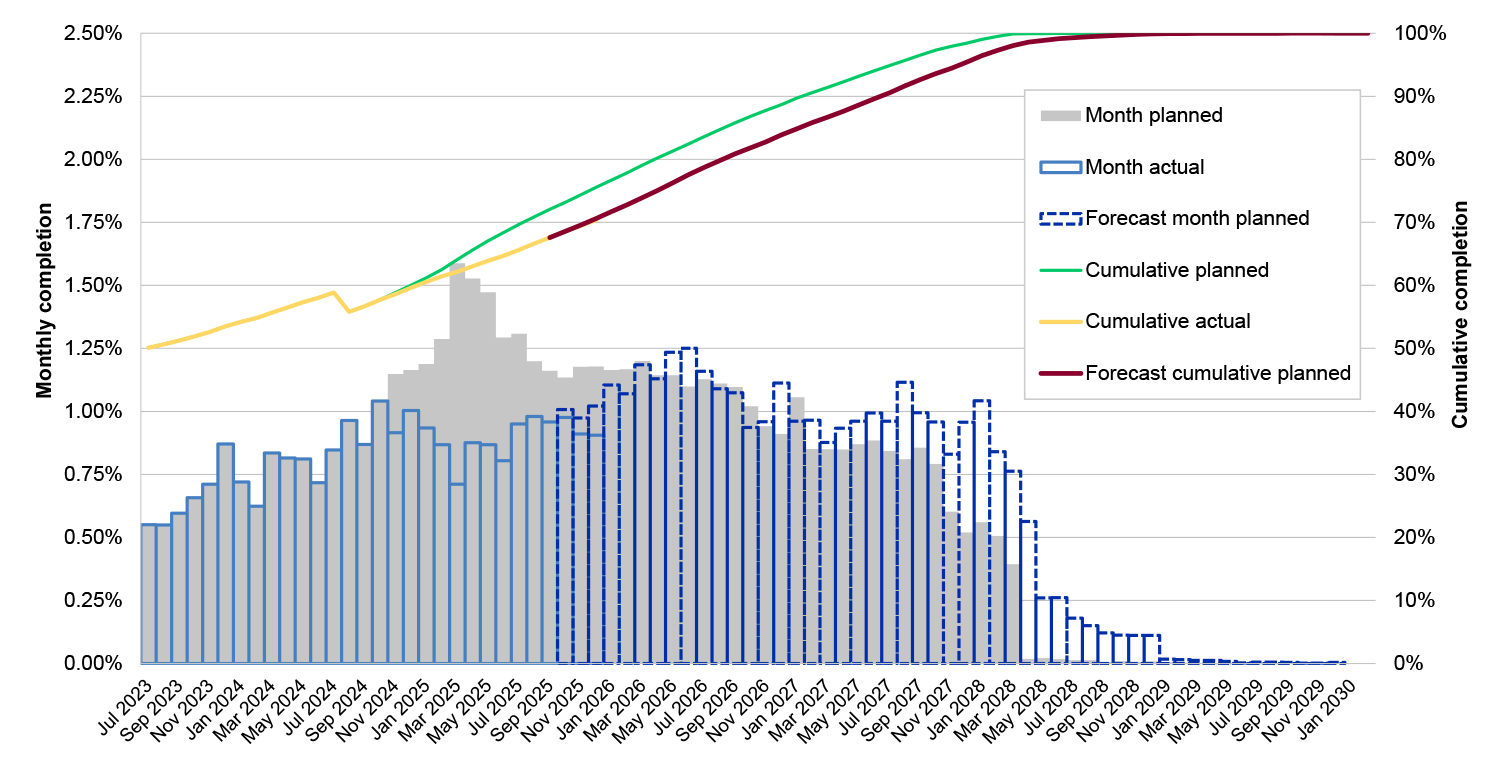
Note: The change at July 2024 reflects the inclusion of tunnel boring machine 4.
Source: ANAO from Snowy Hydro documentation. ANAO has edited this for clarity.
Reporting
4.38 Project schedule challenges, including: work stoppages due to safety concerns; continuing challenges with geology; and disruptions associated with industrial action during the re-negotiation of the enterprise agreement for FGJV blue collar workers have been reported internally and publicly. Snowy Hydro‘s 2024–25 Annual Report reported that the project ‘is facing persistent and material cost pressures’ and that Snowy Hydro is ‘reassessing the project’s cost to complete’.65
4.39 In April 2025, project delivery and schedule management was reported amongst the top risks for the project — the likelihood of the project delivery exceeding the approved timeframes by five months was reported as ‘likely’ (60 to 80 per cent), and impact was rated as ‘catastrophic’. Associated treatment actions noted were cost risk quantification to ascertain the certainty of exposure and implementation of improvement initiatives, cost management processes and meticulous contract administrations (see paragraphs 4.29 to 4.33).
4.40 In relation to critical path activities, the Snowy 2.0 project team reported at the Management Review Group in September 2025 that the four critical path activities were behind target — between 22.8 and 76.0 per cent completed against targets.
4.41 In October 2025, Snowy Hydro published a media release that included a statement from the Chief Executive Officer that ‘since the reset, the project has generally been progressing well and is now 67 per cent complete’. This statement was based on the S-curve measure of progress. Commentary at Senate Estimates in February 2026, also used this measurement of progress. At that time, the Minister for Industry and Innovation representing the Minister for Climate Change and the Energy reported the project to be 70 per cent complete, and reiterated the government’s commitment to transparent reporting of project progress.66
4.42 Based on the reported delays to the critical path, and public statements made by Snowy Hydro, there is a recognised risk that the project will not be completed on schedule. This risk is not adequately reflected in the S-curve, as it is not linked to project risks or criticality of project works, and may not provide a holistic view of the project progress.
Recommendation no.3
4.43 Snowy Hydro develops regular public reporting on project schedule that includes information on project progress against published targets.
Snowy Hydro Limited response: Partially Agreed.
4.44 Snowy Hydro’s current public reporting framework is consistent with its Statement of Expectations issued by Shareholder Ministers, Government Business Enterprise requirements and recognised infrastructure delivery reporting methodologies, which provide indicators of progress against published targets.
4.45 Snowy Hydro will continue to review and refine its public reporting arrangements as appropriate, noting that internal risk-adjusted and critical path forecasting tools are used to support project management and assurance activities, but are not typically adopted for external reporting due to commercial sensitivities.
Cost management
4.46 Snowy Hydro is allocated with the risk related to the cost of the project, with the contractors incentivised to control cost through the ‘pain-share gain-share’ mechanism (see paragraphs 2.58 to 2.59). Snowy Hydro approved the Snowy 2.0 commercial management plan (CMP) in February 2025 to provide an overview of how commercial and contract management activities are performed for the project. Prior to this, there were no finalised management plans or other documented procedures. There was a contract administration management plan, which as at January 2026 was unapproved. Costs claimed by FGJV and Voith are reviewed monthly by an external consultant, EY (see paragraphs 4.92 to 4.101).
4.47 Internal audits on cost management have been delayed. As part of the 2024–25 internal audit plan, an internal audit on Snowy 2.0 direct cost forecast was planned — as at January 2026, Snowy Hydro advised the ANAO that the audit was ‘in the process of findings drafting’.67
Reviews of forecast costs to complete
4.48 The project’s expenditure as of 31 March 2026 was $11.1 billion.
4.49 Since the reset, there has been volatility in cost forecasts provided by both FGJV and Voith, with the largest degree of variance being within FGJV’s forecast. (See paragraphs 3.9 to 3.13 discussing transition planning, and paragraphs 3.20 to 3.25 discussing data).
4.50 At the time of the reset, the board was advised that FGJV’s forecast cost to complete was $6.6 billion (including both target outturn cost, TOC, and reimbursable allowable costs, RAC68) (for an explanation of the different cost categories see Appendix 3 and Appendix 4). Snowy Hydro advised the ANAO in February 2026 that it considered:
FGJV’s forecast cost to complete of $6.6 billion reflected FGJV’s estimate based on the information available at that point in the reset process. The reset did not involve Snowy Hydro accepting the forecast as a fixed or settled cost position.
4.51 In June 2025, FGJV submitted a revised forecast. Snowy Hydro assessed that this included a potential variance of up to 30 per cent (prior to errors and omissions identified by Snowy Hydro, which Snowy Hydro noted accounted for five per cent of the variance, and prior to the impacts of FGJV’s revised enterprise bargaining agreement).69
4.52 In August 2024, Snowy Hydro engaged an external consultant, Rider Levett Bucknall (RLB), to review FGJV’s cost forecast. Between 11 February 2025 and 11 March 2025, RLB submitted its review and assessment of the validity of the forecast of 26 items within FGJV’s budget. RLB agreed with two of the 26 forecasts — concurring without any caveats that FGJV’s assessments were ‘fair and reasonable’. For the remaining 24 items, issues were identified.70
4.53 Due to the processes used by FGJV to forecast the cost to complete, Snowy Hydro rated its confidence in FGJV’s forecasts as ‘low’ in September 2025. An ongoing lack of confidence in FGJV’s cost forecasting and an expectation that costs to complete will exceed approved target costs have resulted in Snowy Hydro commencing a series of ‘deep dive’ reviews into project costs and schedule (see paragraph 3.29).
Reporting on cost management
4.54 ANAO analysis of Snowy Hydro board (board) meeting papers and minutes between October 2023 and March 2025 found reporting related to costs risks was escalated over the period September 2024 to March 2025. In March 2025, reporting stated that the risk of exceeding target cost to complete was ‘extreme’ and ‘almost certain’ to be realised.
4.55 In July 2025, the monthly report to the Governance Committee outlined that the planned amount of work when compared to the actual work completed resulted in a negative earned value of $834 million, which indicated that the project was over budget.
4.56 In September 2025, Snowy Hydro shared its Strategic Corporate Plan 2026 to 2035 with the shareholder ministers (the shareholders). The plan noted that due to ‘the persistent and significant cost pressures’ Snowy Hydro was undertaking a ‘full cost and schedule review’ over the next six to nine months and that project expenditure was expected to exceed the approved project cost of $12 billion. It also reflected that while Snowy Hydro expected to fund 2026 operational liquidity requirements from refinancing from the bank debit market, additional government support was ‘expected to be required by the end of FY26’.
4.57 In October 2025, Snowy Hydro publicly announced a cost reassessment for Snowy 2.0. The announcement stated that sources of cost pressures included: costs associated with FGJV’s productivity targets not being realised; tunnel boring machine (TBM) 4 costs no longer being covered within the project costs as per initial assessment; and supply chain cost increases.
Resource management
4.58 In July 2025, the monthly report to the Governance Committee stated that there were approximately 200 Snowy Hydro full-time employees on the project, and that recruitment needs remained high with 19 roles open for recruitment (approximately 10 per cent). In January 2026, FGJV reported having 1,219 budgeted white collar positions, with 141 (11.6 per cent) positions not filled. On 12 May 2026, FGJV advised the ANAO that it had 1,989 budgeted blue collar positions, with 66 (three per cent) budgeted positions not filled, and hiring ongoing. Voith staffing is expected to significantly increase during the installation of the generators, which are manufactured offshore.
Enterprise bargaining agreement negotiations
4.59 Snowy Hydro was aware, at the time of reset, that there would be a requirement to renegotiate the enterprise bargaining agreement (EBA) covering FGJV’s71 blue collar workers during the project delivery (see paragraph 2.83). It implemented contractual provisions with the aim of ensuring that the terms and conditions agreed were ‘reasonable’. FGJV also retained responsibility for the management of industrial relations, including retaining responsibility for all losses, delay or disruption it suffers arising from industrial action.
4.60 The reset and April 2024 contractors forecast included an EBA renewal rate of escalation equivalent to existing EBA with a small increase on base labour rates.
4.61 In October 2024, the board discussed the industrial relations strategy and potential EBA escalation (cost) implications, including requesting an update that would include the potential impacts on costs and productivity opportunities arising from the negotiation.
4.62 In March 2025, the board discussed the impact of the EBA on costs and ‘challenged the assumptions assumed at Project Reset’. It noted risks related to two other relevant EBAs72 that had been agreed since the reset, noting that if these were determined to be ‘the market’ there may be a potential for a significant blue collar, and subsequent white collar cost increase. It then requested cost impact updates related to the negotiations. EBA related risks were also included in a presentation to the board on cost scenarios.
4.63 The August 2025 project risk register included a risk of ‘labour cost increases resulting from EBA re-negotiation’ impact project costs or delivery schedule. This was assessed as a high risk, with a resulting potential impact up to $100 million. There were no treatment actions identified.
4.64 There was another risk related to industrial relations activities impacting on project costs or delivery schedule. This risk recorded a residual risk rating of ‘medium’ based on the consequence of risk event being assessed as project schedule delays of up to one month resulting from ‘IR [industrial relations] activity / disputes’. The register noted that treatments of ‘FG [FGJV] Review of EBA Agreements / Planning’ and ‘Proactive action plan’ were completed.
4.65 The 2025 EBA negotiation covered workers on site employed by SC Hydro (employer of FGJV’s blue collar workforce), with EBAs for other key workers including those employed by Voith to be negotiated after this EBA. There is a potential that other workers may seek similar changes to wages.
4.66 On 25 March 2025, Snowy Hydro engaged an external advisor to assess whether the terms of the proposed EBA were reasonable. On 4 September 2025, advice was provided confirming that the terms were reasonable. This advice provided no supporting documentation or evidence of analysis, despite internal acknowledgement that it represented validation of ‘$100m’s’ in costs.
4.67 In September 2025, outcomes from the negotiation of the revised EBA were made public. In the corporate planning process, Snowy Hydro included the impact of the renewed EBA as one of the pressures on the project achieving the target cost.
4.68 Snowy Hydro underestimated the impact of this risk on cost, with full impacts still to be assessed once other contractors negotiate wage updates. Risk treatments relied on FGJV negotiation.73 Although the contract included provisions to validate that the outcome was reasonable, as FGJV did not hold the majority of this cost risk (excluding the costs associated with industrial action), the impact of negotiation outcomes on itself in the context of this project were limited.
Indirect procurement via secondary subcontracts established by FGJV or Voith
4.69 FGJV and Voith may have their project activities performed through secondary subcontracts.74 This is also referred to as indirect procurement.
4.70 To support indirect procurement, under the reset contract, FGJV and Voith are required to have procurement management plans in place that are approved by Snowy Hydro.
- Since reset, Snowy Hydro has approved two versions of FGJV’s procurement management plan — the first version was approved in October 2023, and the second in March 2025.
- Voith’s initial subcontractor procurement management plan was approved by Snowy Hydro in October 2023.
4.71 In April 2025, a reward key performance indicator (KPI) was established to incentivise Voith’s delivery of a procurement strategy for onshore work by 31 December 2024. In June 2025 Snowy Hydro agreed to reset the incentive target date to 15 July 2025.75 In July 2025, Voith was issued with a further revised target to submit the onshore procurement strategy complete with a procurement management plan by August 2025. On 5 May 2026, Snowy Hydro advised the ANAO that this incentive was split into parts and adjusted based on Snowy Hydro’s awareness of the complexity of the work. It advised the ANAO that its own procurement team worked with Voith in a co-located space to facilitate this work.
4.72 Voith submitted a portion of the requirement, its procurement management plan, in August 2025. In December 2025, Snowy Hydro reviewed the plan, noting a number of outstanding items in relation to the overall procurement strategy. Snowy Hydro developed an alternative incentive reward (KRA), with the updated requirement that Voith achieve Snowy Hydro approval of the full strategy no later than 28 February 2026. See paragraphs 4.117 to 4.125 for a discussion on the implications of amending reward KPIs, including how changing the delivery requirements may suggest to contractors that the KRA is not in jeopardy if not achieved in the required timeframe.
Reviews on FGJV and Voith procurement compliance
4.73 Depending on the value of the relevant secondary subcontract, procurement documents must be provided to Snowy Hydro for information (if requested), or for review and approval.76 Snowy Hydro is expected to review and challenge procurement recommendations to verify contract compliance and procurement effectiveness; ensuring that all secondary subcontract tender documentation is prepared, and all tender processes are conducted on terms which maximise value for money for Snowy Hydro.
4.74 In September 2024, Snowy Hydro wrote to FGJV, identifying that Snowy Hydro was aware that FGJV had entered ‘a number’ of subcontracts without following proper process and without Snowy Hydro’s approval.
4.75 In May 2025, Snowy Hydro contractor, Scyne Advisory, delivered two reviews focused on verifying FGJV’s and Voith’s compliance with its contractual obligations related to subcontracting and procurement, with specific focus on required Snowy Hydro approvals.
4.76 Key findings from the Scyne Advisory review included that FGJV: was unable to provide a record of approval for 385 (82.4 per cent) of 467 subcontracts with an individual value greater than $200,00077; did not have arrangements to systematically track whether subcontracts were awarded through direct appointment or a competitive process; was not tracking whether relevant approval thresholds were being exceeded; did not have oversight over subcontract approvals; and was unable to provide the actual spend for each subcontract.
4.77 In April 2025, FGJV provided a response to the review and an initial plan to address deficiencies. As of September 2025, Snowy Hydro advised the ANAO that it had not accepted FGJV’s remediation plan.
4.78 Snowy Hydro engaged EY to repeat the procurement review to verify that action has been taken to address the review findings. EY’s review covered the period 1 January 2025 to 30 September 2025. Key findings in this draft report include that, across the 116 agreements ($365.1 million) executed in the scope period with values equal to or above $200,000:
- FGJV ‘did not appear to obtain’ required approvals from Snowy Hydro for 79 agreements ($228 million) with a value equal to or over $200,000 — this represents 69 per cent of the value of all agreements executed in the scope period; and
- FGJV ‘did not appear to obtain’ Recommendation for Award Approvals from Snowy Hydro for 16 agreements ($105.1 million) with a value over $1,000,000 — this represents 32 per cent of the value of all agreements over $1,000,000 executed in the scope period.
4.79 EY also found that FGJV had not made changes or improvements to processes since the previous report (issued 30 May 2025), and that ‘all findings set out in the Scyne Report remain unresolved and have not been adequately addressed by FGJV’.
4.80 Further findings of this report included that FGJV did not resubmit a revised version of subcontract proposals to Snowy Hydro in response to comments on 80 per cent of relevant occasions, and that there was evidence of unstructured communications with bidders on tenders. The report notes that all suppliers are not provided consistent information meaning equal treatment is not ensured during the tendering process.
4.81 This report also noted that:
[c]ontrary to Contract requirements under the definition of ‘Supply Tracking System’, SHL does not have real-time access to electronic procurement system(s) maintained by FGJV. SHL therefore has limited ability to accurately monitor procurement activities under the Contract, including whether procurement activities comply with requirements set out in the Contract.
4.82 Snowy Hydro provided this follow up report to FGJV on 19 December 2025, noting it:
continues to have serious concerns with the Contractor’s apparent ongoing non-compliance with the Contract and is further concerned at the Contractor’s apparent inability to provide the necessary information required to determine what approvals are required for each Subcontract (including the assessment of aggregate award value …
4.83 This correspondence requested an update of FGJV’s Procurement Management Plan confirming details of the additional measures that will put in place to ensure that further breaches do not occur by no later than close of business on 16 January 2025’. FGJV failed to respond to this request. On 20 February 2026, Snowy Hydro reiterated its requests related to the procurement management plan.
4.84 In July 2025, reporting to the Governance Committee reflected that ‘FGJV procurement remains a significant issue impacting the project’. Snowy Hydro reported internally in December 2025 its assessment that FGJV’s ‘procurement performance continues to deteriorate’ and that procurement leadership remains an issue. These review results, including where the follow up audits failed to identify contractor improvements, indicate the need for increased and more frequent oversight of the contractor’s management of secondary subcontracts by Snowy Hydro.
4.85 Under the reset contract, Snowy Hydro can exercise the right to ‘clawback’ the costs of unapproved secondary subcontracts. As at December 2025, Snowy Hydro has not used that right, and advised the ANAO that FGJV claims relating to the non-approved subcontract packages are being held in the ‘parking lot’ (see paragraph 4.102).
4.86 In relation to Voith’s compliance, the May 2025 Scyne Advisory review found all 18 contracts executed by Voith, since the reset, received Snowy Hydro approval in relation to negotiation results and procurement recommendations. It observed that eight of the 13 subcontracts valued greater than one million euros did not have the required approval for the request for quote documentation.78 There were no recommendations included in the review.
Recommendation no.4
4.87 Snowy Hydro strengthens it management of risks to schedule, quality and cost, to safeguard that its contractors are meeting the requirements of the contract.
Snowy Hydro Limited response: Agreed.
4.88 Snowy Hydro has established governance and assurance arrangements consistent with its role as Employer under the project delivery model, including governance forums, coordination and interface arrangements, and independent assurance and audit activities. Snowy Hydro actively manages schedule, quality and cost risks through these oversight and assurance processes and will continue to enhance reporting, performance monitoring and contractor oversight activities as part of ongoing project delivery. Snowy Hydro will pursue opportunities to strengthen documentation, reporting traceability and performance measurement relating to project management activities.
Is Snowy Hydro effectively managing payments and variations?
Snowy Hydro has implemented payment management processes for interim payments, including engaging a third party to verify claims for payments from the contractor. There are risks related to Snowy Hydro’s oversight of payments to secondary subcontractors. It has also not implemented sufficient controls over its payments to contractors other than its primary contractor for civil works and subcontractor for engineering and mechanical works. The incentive framework is not working to incentivise performance as intended. Snowy Hydro does not monitor contract adjustments to provide sufficient oversight of their impact on the delivery of the project, particularly in relation to cost impacts.
Payment management
4.89 According to the Australian Government Contract Management Guide, there should be clear processes to verify that deliverables are received and the supplier has fulfilled the required obligations under the contract prior to making a payment.
4.90 To support the application of the pain-share or gain-share process under the reset contract, there needs to be a clear understanding of costs which should and should not be paid as reimbursable costs, and those costs which are more appropriately paid as part of the contractor’s fee (target outturn cost, TOC and reimbursable allowable costs, RAC) (see Appendix 3, Table A.1).
Interim payments to FGJV and Voith
4.91 Monthly payments made to the contractor are not final payments — they are considered interim and are open for review. This means that payments are made, but making a payment at this point does not equate to acceptance of deliverables — payment finalisation is expected to occur within 65 days of the final delivery of the project.
4.92 Snowy Hydro has engaged EY to complete monthly and quarterly inspections of the interim payment claims. The inspection process is completed on a risk and sampling basis, to confirm claimed costs are accurate, have been accurately allocated to the respective costs categories and are not excluded costs or duplicate costs. EY completes this assessment by accessing contractor and subcontractor systems, which it has access to on an ‘open book’ basis.79
4.93 Interim payment claims with insufficient supporting information are identified and moved to the ‘parking lot’ for further assessment. The purpose of the parking lot is to allow payment assessments to be completed within the Building and Construction Industry Security of Payment Act 1999 (SOPA)80 timeframe while segregating items that require further substantiation, clarification or reallocation. All costs in the parking lot are paid, until their status is determined.
4.94 The parking lot is not defined in the contract and there is no documented process or similar agreed with FGJV and Voith to govern this process.
4.95 The parking lot process has identified costs claimed by contractors that were:
- excluded as per the contract;
- incorrectly classified between the TOC and RAC categories;
- related to the pre-reset period, which were extinguished as a part of the reset; and
- a resubmission of costs that were previously identified as excluded.
4.96 Between reset and November 2025, $770.8 million was directed to the parking lot. This is approximately 13 per cent of post reset costs paid to FGJV and Voith excluding incentive payments. Of this:
- $116.3 million was confirmed as allowable costs (including allowable costs that required recategorisation between RAC and TOC costs); and
- $23.3 million of claims were assessed as excluded costs.81
4.97 Of the remaining $500.1 million, as of November 2025, $19.3 million required escalation to FGJV and Snowy Hydro management teams for resolution. Reassessments were pending on $131.4 million and $0.3 million related to pre-December 2023 cost claims and leasing arrangements which were under discussion The remaining amount in the parking lot was $480.9 million.
4.98 In November 2023, Snowy Hydro had noted that delays in recovering large sums may result in FGJV ‘book[ing]’ the money, which could result in a dispute. It also noted that efficiently working through cost items sooner rather than later will ensure:
- good habits are developed;
- the contractor won’t attempt to slip in inappropriate costs; and
- expectations are managed — everyone knows where they stand.
4.99 As of November 2025, the value of costs in the parking lot is above Snowy Hydro’s security bond from FGJV. Although the majority of costs in the parking lot are classified as allowable costs after review, there is a risk that if FGJV was to become insolvent and more than this amount was awaiting finalisation in the parking lot, that money may be at risk of not being recovered.
4.100 In November 2025, Snowy Hydro provided the ANAO with an overview of processes to move items out of the parking lot ‘given the current backlog’. This included additional workshops targeting aged transactions, where FGJV is given additional time to provide supporting documentation, after which EY would reassess new information leading to a final position. Snowy Hydro advised the ANAO that once the historical parking lot has been cleared, the reassessment of current items aged less than 90 business days will move to a 90-business day timeline (that is, that all costs within the parking lot would be assessed within 90 business days). As at December 2025, FGJV has issued the escalation paperwork relating to $4 million of excluded costs. This was to be tabled at the Management Review Group.
4.101 As of November 2025, the process to finalise assessments was immature, and the ANAO was unable to assess if it was reducing aged cost claims in the parking lot.
4.102 The reset incorporates provisions that Snowy Hydro could use to escalate the management of incorrect or poorly supported claims for payment. This includes payment constraints, which can be used to draw down on future payments to the contractor. As of 4 August 2025, Snowy Hydro had not enacted the payment constraint provision of the reset contract.
Allocation of costs
4.103 EY and Snowy Hydro have identified that there is a lack of clarity regarding the allocation of costs between the TOC and RAC categories, including where payments may be split across the two categories, which has implications for the achievement of pain-share or gain-share and the payment of overheads and profit margin.
4.104 In July 2025, a report to the Governance Committee raised concerns related to contractor behaviour with respect to allocating costs between the TOC and RAC categories. It reported that FGJV was likely to be exposed to ‘significant’ pain-share costs, and noted that ‘FGJV continues to misallocate costs between TOC and RAC so as to keep the TOC forecast below the Painshare levels’ [sic]. On 25 August 2025, Snowy Hydro advised the ANAO that a cost allocation (between TOC and RAC costs) methodology is expected to be finalised by 8 September 2025.
4.105 Ongoing misallocation of costs between categories increases the risk that Snowy Hydro may not identify all incorrect allocations, resulting in the overpayment of FGJV or Voith including through the incorrect application of the pain-share and gain-share provisions of the contract as well as management and profit percentages which are impacted by cost allocations.
Opportunity for improvement
4.106 Snowy Hydro could finalise the cost allocation methodology to ensure that there are no overpayments and that there is clarity regarding payment categories.
Payment of secondary subcontracts established by FGJV or Voith
4.107 The reset increased provisions for Snowy Hydro to oversee and review the contractor’s subcontracts.82
4.108 In November 2024, Snowy Hydro finalised a review (the review was undertaken by Scyne Advisory) of FGJV’s payment of its subcontractors. The review identified that 41 per cent of transactions were not compliant with Building and Construction Industry Security of Payment Act 1999 (SOPA). While this result was reported as an improvement from the previous review (2023)83, it was noted that ‘this may be causing cash flow issues with subcontractors who are dependent on timely payments from FGJV to remain financially viable’.
4.109 The review incorporated proposed management actions directed at both Snowy Hydro and FGJV, and management responses proposed by FGJV including due dates. On 20 December 2024, Snowy Hydro provided the review to FGJV, and instructed it to submit an action plan to address the issues set out in the report by no later than 31 January 2025.
4.110 FGJV responded on 12 February 2025. The response did not outline any additional management actions or plans FGJV intended to undertake, or provide assurance that it had implemented responses outlined in the audit by their due dates. The response noted that based on FGJV review, of the 37 payments that experienced delays, 29 were primarily due to the late submission of tax invoices by the suppliers, and of the remaining delayed payments, six experienced only a minimal delay of one day. One of FGJV’s management responses included a request for an additional audit of FGJV’s process changes to be undertaken.
4.111 The review findings indicate that Snowy Hydro’s oversight of FGJV and Voith could be enhanced to ensure contractor compliance with the requirements of the contract in relation to their payment of secondary subcontractors.
Assurance over payments for direct contracts other than FGJV
4.112 Since reset, Snowy Hydro has undertaken annual, targeted, risk-based testing of the operating effectiveness of the controls over payments to contractors other than FGJV.
4.113 One test was whether payments were made within 30 days of invoice. The 202484 testing found that 43 per cent of payments were made late against the payment terms in the system, and observed that 698 (33 per cent) of on-time or early payments would have been late ‘if calculated against the issue date on the invoice’ rather than information recorded in Snowy Hydro’s payment management system.85
4.114 The 2025 payment testing found overall deficiencies in the control environment for payments and procurement.86 The testing found that there was excessive reliance on Non-Order Invoices (NOI)87, demonstrating limited regard for established controls, with evidence of controls being bypassed for process expediency. The testing determined that deficiencies in the control environment had undermined the integrity of the control framework for the 2024 period. The outcomes of this review were reported to the Board Audit and Compliance Committee on 21 November 2025.
Recommendation no.5
4.115 Snowy Hydro continues to monitor its payment of contractors to ensure that controls are not bypassed and that payments are made on time.
Snowy Hydro Limited response: Agreed.
4.116 Snowy Hydro will continue to close out the actions associated with the Internal Audit Report relating to Snowy Hydro’s payments to contractors other than FGJV and Voith, which form the basis of this recommendation. In addition, Snowy Hydro will consider further monitoring improvements relating to payment performance.
Management of incentive framework
4.117 After the reset, Snowy Hydro implemented the incentive framework which incorporated key result areas (KRAs) and KPIs. Each KPI is to incentivise the contractor to achieve or exceed the minimum performance requirement, through the opportunity to achieve additional payments. Further information on the design of the incentive framework is at paragraphs 2.60 to 2.65.
4.118 Snowy Hydro does not have detailed, approved procedures for the management of the incentive framework, beyond the relevant schedule of the contract.88 There are internal procedure and guideline documents which are limited in detail and scope.
4.119 Under the reset contract, a KRA or KPI can be omitted, replaced, amended, or inserted, if agreed between the parties.89 The KPI performance pool, that is the amount of money that can be used to incentivise performance, is fixed, and cannot be adjusted even where individual KPIs are modified. As at November 2025, amendments to KPIs have been made, as well as negotiations to modify KPIs. There is no guidance in the commercial management plan as to how Snowy Hydro will implement this flexibility within the incentive framework to motivate the contract to achieve or exceed the minimum performance requirement, or to drive behaviours that are linked to key project outcomes.
4.120 In April 2024, the project team reported to the board that it had considered revised incentive payments for criteria that were not fully met and for criteria with future targets that were no longer achievable. In March 2025, the project director informed the board that it had reallocated a portion of KPI amounts that had previously been withheld due to non-compliance with baseline requirements (and was considering further reallocations).90 Paragraphs 4.71 to 4.72 describes the establishment and reallocation of incentive payments related to the Voith procurement strategy.
4.121 The reallocation of KRA payments where the contractor has underperformed or not met the relevant criteria may result in the contactor not perceiving the payment to be in jeopardy, which may reduce their effectiveness as a performance incentive.
4.122 As at September 2025, there were 165 KPIs and sub-KPIs for FGJV, and 31 for Voith. As of September 2025, FGJV had achieved and was paid for 39 KRAs, and was forecast to achieve a further 25. Fifty-two payments have not been made due to either the KRA requirement not having been achieved, or the baseline requirements for payment not having been met. See Table 4.2 for a summary of the results under the incentive framework and paragraph 2.62 for further discussion on baseline requirements.
Table 4.2: Summary of results under the incentive framework, September 2025
|
Status of KPIs and sub-KPIs |
Count |
|
|
|
FGJV |
Voith |
|
Achieved and KRA payment paid |
39 |
3 |
|
Achieved and KRA payment not paid due to baseline criteria not being met |
27 |
0 |
|
Not achieved and KRA payment not paid |
23 |
2 |
|
Unlikely to be achieved |
43 |
0 |
|
Forecast to be achieved |
25 |
0 |
|
Status not recorded |
1 |
24 |
|
KPI not in use |
7 |
2 |
|
Total |
165 |
31 |
Source: ANAO analysis of Snowy Hydro documentation.
4.123 In April 2025, Snowy Hydro identified issues in relation to the incentive framework, including that:
- there were still many areas where incentives had not achieved the desired outcome, and that areas not focused on through the incentive regime were neglected;
- the baseline criteria were not as effective as envisaged — ‘safety and environment have such a low threshold of achievement that there was no real change in behaviour’, and that there were flaws in the system for assessing criteria on quality management;
- there was a general expectation by FGJV and Voith that they should receive incentives; and
- there was a lack of interim milestones, as a large portion of KRA rewards were available on final completion.
4.124 The board was informed that a review of performance incentive effectiveness was underway in April 2025. In January 2026, Snowy Hydro advised the ANAO that this review had been put on hold, pending the outcomes of the cost forecasting deep dives, and a focus on the achievement of baseline criteria.
4.125 Findings on the effectiveness of the incentive framework increases the recognised risk that the contractors do not consider these payments to be in jeopardy, potentially reducing their effectiveness as a performance management tool.
Management of contract adjustments
4.126 The Australian Government Contract Management Guide provides practical guidance to support effective contract management for Commonwealth entities.
4.127 The Snowy 2.0 commercial management plan (CMP) summarises contract provisions related to variations, instructions, directions and target cost adjustments. This is primarily a process document, and does not include advice on the consideration of matters such as those outlined in the Australian Government Contract Management Guide.91 On 28 January 2026, Snowy Hydro advised the ANAO that it was updating the CMP with respect to variations to reflect recently revised processes.
4.128 There have been no amendments to the contract. There are contractual mechanisms to adjust time and costs for the project.
4.129 Snowy Hydro established an adjustment register for changes to cost and time. The total number of contract adjustments that have occurred since reset cannot be determined based on the entries in the register, as the register contained incomplete information. The final outcome or status of the adjustment — that is whether it was approved, not approved or under consideration — was not consistently documented in the register and project correspondence. In September 2025, Snowy Hydro advised the ANAO that actual incurred costs are not tracked as part of the adjustment.
4.130 Complex contracts can benefit from well-managed adjustment registers, reflecting agreed costs, that provide a record of the evolution of the project, and document the impact of subsequent decisions on the value for money of the project outcomes.
Opportunity for improvement
4.131 Snowy Hydro could improve its adjustment register to effectively track cost and schedule implications related to project changes to allow for ongoing value for money analysis in the management of the project.
4.132 In January 2026, Snowy Hydro provided the ANAO with examples of updated documentation for adjustments. If completed, this documentation should provide the decision-maker with key information including the reason for the change, and estimated cost and schedule impact. The ANAO has not assessed if these provide sufficient detail to support decision-making.
Appendices
Appendix 1 Entity response
Snowy Hydro Limited
Future Generation Joint Venture
Voith Hydro GmbH & Co
Appendix 2 Improvements observed by the ANAO
1. The existence of independent external audit, and the accompanying potential for scrutiny improves performance. Improvements in administrative and management practices usually occur: in anticipation of ANAO audit activity; during an audit engagement; as interim findings are made; and/or after the audit has been completed and formal findings are communicated.
2. The Joint Committee of Public Accounts and Audit (JCPAA) has encouraged the ANAO to consider ways in which the ANAO could capture and describe some of these impacts. The ANAO’s corporate plan states that the ANAO’s annual performance statements will provide a narrative that will consider, amongst other matters, analysis of key improvements made by entities during a performance audit process based on information included in tabled performance audit reports.
3. Performance audits involve close engagement between the ANAO and the audited entity as well as other stakeholders involved in the program or activity being audited. Throughout the audit engagement, the ANAO outlines to the entity the preliminary audit findings, conclusions and potential audit recommendations. This ensures that final recommendations are appropriately targeted and encourages entities to take early remedial action on any identified matters during the course of an audit. Remedial actions entities may take during the audit include:
- strengthening governance arrangements;
- introducing or revising policies, strategies, guidelines or administrative processes; and
- initiating reviews or investigations.
4. In this context, the below actions were observed by the ANAO during the course of the audit. It is not clear whether these actions and/or the timing of these actions were planned in response to proposed or actual audit activity. The ANAO has not sought to obtain assurance over the source of these actions or whether they have been appropriately implemented. Snowy Hydro has:
- through the Project Leadership Group, endorsed the charters for all of the six contractually required project groups and committees, and endorsed eight of the nine charters for the additional operational project groups and committees;
- approved project governance and contract management documentation (see paragraph 3.7);
- commenced a process of drafting a data assurance process (see paragraph 3.24);
- commenced a process of drafting risk management improvements (see paragraph 3.70);
- employed one quality assurance and improvement lead, and had developed a position description for a Quality Assurance and Improvement Engineer (see paragraph 4.13);
- agreed a revised framework and policy for the management of conflicts of interest and gifts and benefits (see paragraph 3.43); and
- commenced introducing changed process and updates to the commercial management plan to improve internal change management related to contract adjustments (see paragraph 4.132).
Appendix 3 Overview of cost categorisations
Table A.1: Overview of cost categorisations
|
|
Cost categorya |
Description |
|
Excluded costs |
These are costs the contractor cannot recover. |
|
|
Allowable Costs |
Deemed allowable costs |
Certain items are automatically allowable even if not defined in the contract as eligible allowable costs. These costs are attributed to the target outturn cost (TOC), which is used to determine the end of project pain-share or gain-share amount. |
|
Reimbursable allowable costs (RAC)a |
A subset of allowable costs that are payable on a cost-reimbursable basis. These are reimbursed in full plus applicable management fees. These costs are excluded from the end of project pain-share or gain-share calculation. |
|
|
Eligible allowable costsb |
These are the core cost categories (e.g., labour, plant, materials, subcontractors, site costs) that are recoverable if incurred in connection with the contractor’s activities. These costs are attributed to the TOC, which is used to determine the end of project pain-share or gain-share amount. |
|
Note a: If and to the extent there is any conflict, ambiguity or discrepancy between the cost categories, the order of priority will be as set out in this table (from top to bottom).
Note b: The TOC is the baseline against which pain-share or gain-share is measured. It comprises the initial target cost and adjustments to target cost under the contract (for instance, employer-approved variations or annual adjustments).
Source: ANAO analysis of Snowy Hydro documentation.
Appendix 4 Overview of cost structure
Table A.2: FGJV Payment Structure
|
Reimbursable Tunnelling Works |
All works required to complete Headrace and Tailrace Tunnels and Inclined Pressure Shaft |
Reimbursable costs
|
Incentive framework payments |
|
|
Balance of Works |
Balance of works required to achieve commercial operation of the works |
Incentivised Target Cost
|
Reimbursable costs
|
|
|
Post Commercial Operation Works |
Remaining works, including landscaping, permanent access roads and infrastructure |
|||
Source: ANAO analysis of Snowy Hydo documentation.
Table A.3: Voith Payment Structure
|
Onshore Subcontractor’s Activities |
Cost of subcontractor’s activities that are performed in Australia and incurred and paid in AUD |
Reimbursable costs
|
Incentive framework payments |
|
Other |
|
||
|
All other Eligible Allowable and Deemed Allowable Costs |
Core cost categories (e.g., labour, plant, materials, subcontractors, site costs) that are recoverable if incurred in connection with the contractor’s activities. These costs are attributed to the TOC, which is used to determine the end of project pain-share or gain-share amount. |
Incentivised Target Cost
|
|
Source: ANAO analysis of Snowy Hydo documentation.
Footnotes
1 Snowy Hydro Limited, Snowy 2.0 Updated Business Case, Snowy Hydro Limited, Sydney, 2024, p. 5. The project cost, including exploratory works, was estimated to be $6.1 billion.
2 Australian Government, Budget Paper No. 2: Budget Measures 2019–20, Commonwealth of Australia, Canberra, 2019, p. 74, available from https://archive.budget.gov.au/2019-20/bp2/download/bp2.pdf [accessed 21 May 2025].
3 Australian Government, Budget Paper No. 2: Budget Measures 2024–25, Commonwealth of Australia, Canberra, 2024, p. 101, available from https://archive.budget.gov.au/2024-25/bp2/download/bp2_2024-25.pdf [accessed 14 April 2025].
4 Snowy Hydro Limited, About Snowy 2.0, Snowy Hydro, Sydney, 2025, available from https://www.snowyhydro.com.au/snowy-20/about/ [accessed 20 May 2025] and Snowy Hydro Limited, Snowy 2.0 Factsheet, Snowy Hydro, Sydney, 2026, p. 3, available from https://www.snowyhydro.com.au/wp-content/uploads/2026/05/Snowy-2.0-Overarching-Factsheet_Digital-Ready.pdf [accessed 20 May 2026].
5 Snowy Hydro Limited, Snowy 2.0 Updated Business Case, Snowy Hydro, Sydney, 2024, p. 7, available from https://www.snowyhydro.com.au/wp-content/uploads/2024/05/Snowy-2.0-Updated-Business-Case.pdf [accessed 14 April 2025].
6 Snowy Hydro, About Snowy 2.0.
7 Snowy Hydro Limited, Australian ingenuity. Unrivalled energy, Snowy Hydro, Sydney, 2026, p. 1, available from Snowy-2.0-Overarching-Factsheet_Digital-Ready.pdf [accessed 13 March 2026].
8 Snowy Hydro Limited, Annual Report for the year ended 30 June 2019, Snowy Hydro, Sydney, 2019, p. 6, available from https://www.snowyhydro.com.au/wp-content/uploads/2020/04/Snowy-Hydro-Limited-Annual-report-for-the-year-ended-30-June-2019.pdf [accessed 20 May 2025].
9 On 8 May 2026, Voith advised the ANAO that its responsibility included electrical and mechanical services within the project, including design, supply and installation of the hydro-generation technology in the underground power station as well as balance of plant mechanical and electrical services above and below ground as a subcontractor to the main contractor.
10 Australian Government, Budget Paper No. 2: Budget Measures 2019–20, Commonwealth of Australia, Canberra, 2019, p. 74, available from https://archive.budget.gov.au/2019-20/bp2/download/bp2.pdf [accessed 21 May 2025].
11 Snowy Hydro Limited, Project Update – August 2020, Snowy Hydro, Sydney, 2020, p. 4, available from https://www.snowyhydro.com.au/wp-content/uploads/2020/08/Snowy-2.0-booklet_August-2020.pdf [accessed 21 May 2025].
12 Traditional contracts, such as an EPC contract, generally work on a lump sum, fixed price basis, with a hard completion obligation with penalties for late delivery. ITC contracts are intended to be more collaborative in nature. ITC contracts are often supported with pain-share or gain-share productivity incentive frameworks.
13 Snowy Hydro Limited, Securing the Future of Critical Energy Transformation Projects, Snowy Hydro, Sydney, 2023, available from https://www.snowyhydro.com.au/news/securing-the-future-of-critical-energy-transformation-resets/ [accessed 13 May 2025].
14 Snowy Hydro, Snowy 2.0 Updated Business Case.
15 Department of Climate Change, Energy, the Environment and Water, Rewiring the Nation, DCCEEW, Canberra, 2025, available from https://www.dcceew.gov.au/energy/renewable/rewiring-the-nation [accessed 12 March 2026].
16 Auditor-General Report No. 33 2021–22, Snowy 2.0 Governance of Early Implementation, ANAO, Canberra, 2022, paragraph 7, available from https://www.anao.gov.au/work/performance-audit/snowy-20-governance-early-implementation [accessed 14 April 2025].
17 Australian Government, Budget Paper No. 2: Budget Measures 2024–25, Commonwealth of Australia, Canberra, 2024, p. 101, available from https://archive.budget.gov.au/2024-25/bp2/download/bp2_2024-25.pdf [accessed 14 April 2025].
18 Department of Finance, Australian Government Contract Management Guide, Finance, Canberra, 2025, p. 52, available from https://www.finance.gov.au/sites/default/files/2025-09/Australian-Contract-Management-Guide-August_2025.pdf [accessed 10 December 2025].
Requirement also in Department of Finance, Australian Government Contract Management Guide, Finance, Canberra, 2023, p. 37, available from https://www.finance.gov.au/sites/default/files/2023-07/australian-government-contract-management-guide-july-2023.pdf [accessed 10 December 2025].
19 This report uses the term ‘the project team’ to refer to the Snowy Hydro team managing the project.
20 Webuild, Webuild reaches agreement to acquire assets from Australian company Clough, 2022, p. 1, available from https://www.webuildgroup.com/en/media/press-releases/webuild-reaches-agreement-to-acquire-assets-from-australian-company-clough/ [accessed 21 November 2025].
21 This included design, procurement and manufacturing schedules.
22 The project advisory subcommittee of the board was established on 9 November 2020. Its role was to review Snowy Hydro’s management of key project risks. The subcommittee was suspended in June 2023, when its duties and responsibilities were assumed by the board.
23 A safety metric showing the number of work-related fatalities, lost time injuries, substitute work cases, and injuries needing medical treatment per million hours worked.
24 The contract uses the term ‘programme’, meaning an overarching view of all of the activities, milestones, and expected timeframes required for the delivery of the project. Another contract term is ‘resource loaded program’ which links the project schedule to required resources. Unless directly quoting Snowy 2.0 documentation, this audit generally uses the term ‘schedule’.
25 ‘Earned value’ is a project management approach used to measure project performance against a project plan. This approach enables the connection between a project’s cost and schedule. It compares the planned amount of work with actual work completed, to determine if the cost, schedule, and work completed are progressing in accordance with the plan. Work is considered ‘earned’ once the work is completed.
26 Department of Infrastructure and Regional Development, National Alliance Contracting Guidelines, Policy Principles, DIRD, Canberra, 2015, p. 11.
27 Cost estimation included upfront costs, bidder stipend, a surcharge for balance of works, surcharge for completed works, mobilisation and site inspection costs, rectification of works completed, additional escalation, an allowance for finalising outstanding claims, delay costs and demobilisation costs.
28 Department of Finance, Commonwealth Procurement Rules, Finance, Canberra, 2022, paragraph 4.1. These rules were in effect at the time of the reset and have since been updated. This requirement remains in the 2025 Commonwealth Procurement Rules.
29 Other components of the reset put forward through the HOA included the promotion of: productivity, cooperation, collaboration and best-for project behaviour; best practice management processes for (but not limited to) quality control, environmental, maintenance and safety deliverables, the documentation of additional items offered by the contractor as part of the reset, including an increase to the capacity of the project and the closing out of quality non-conformances.
30 The ‘reset contract’ as described in this audit includes a number of parts variously between Snowy Hydro, FGJV, and Voith. Key elements are listed below.
- The Deed of Settlement and Amendment, dated 13 September 2023, which sets out the terms on which the parties agreed to settle various matters between them and attaches to the EPC contract (as amended).
- EPC Contract (as amended), dated 13 September 2023, which sets out the terms on which the FGJV will carry out the engineering, design, procurement, supply, construction, testing, commissioning and delivery of the project.
- Tripartite Agreement, dated 14 September 2023, which is between Snowy Hydro, FGJV and Voith, and sets out Snowy Hydro’s rights and obligations against Voith and FGJV, and establishes various committees for the resolution of design and interface issues.
- Direct Payment Deed, dated 14 September 2023, between Snowy Hydro, FGJV and Voith which sets out the terms on which Voith can seek direct payment from Snowy Hydro.
- Electrical and Mechanical Deed of Settlement and Amendment, dated 14 September 2023, is between FGJV and Voith, and sets out the terms on which the parties agreed to settle various matters between them and attaches the Electrical and Mechanical Subcontract (as amended).
31 The contract sets out that the target outturn cost will be adjusted annually (either up or down) based on a calculation that takes into account changs to the bond index, cement, fuel, labour, machinery materials, steel and iron prices. This is the target cost escalation methodology.
32 McKinsey was an advisor to the reset focussed on reviewing the project operating model and identifying performance and productivity improvements.
33 Incentive payments are not linked to pain-share or gain-share.
34 Reasonable terms and conditions were defined as being consistent with the prevailing pay and conditions in the relevant industry for equivalent work, having regard to the type of work engaged and the relevant geographical area in which the work is performed.
35 Adherence to the CCF did not limit Snowy Hydro’s other termination rights or relieve the parties from or alter their rights or obligations under the reset contract.
36 On 28 January 2026, Snowy Hydro advised the ANAO that this risk was retired as the provisions of the EPC contract put FGJV in a cash neutral position.
37 A material change is defined as ‘one or more matters, whenever occurring, that individually or when aggregated with all other matters, has or is reasonable likely to materially adversely affect the Project [Snowy 2.0] or prevent the Company [Snowy Hydro] from materially discharging its obligations’ under the equity agreement made with government.
38 Snowy Hydro Limited, Corporate Plan for Financial Years 2024 to 2028, Snowy Hydro, Cooma, 2023, pp. 29–30, available from https://www.snowyhydro.com.au/wp-content/uploads/2023/08/Snowy_Hydro_Corporate_Plan_2023.pdf [accessed 1 December 2025].
39 Commonwealth, Environment and Communications Legislation Committee, 23 October 2023, Mr Barnes, representing Snowy Hydro Limited.
40 Department of Finance, Australian Government Contract Management Guide, Finance, Canberra, 2025, available from https://www.finance.gov.au/sites/default/files/2025-09/Australian-Contract-Management-Guide-August_2025.pdf [accessed 10 December 2025].
41 ibid., pp. 1, 24 and 32.
42 ibid., p. 32.
43 As of October 2023, of the total 74 actions, 18 (24.3 per cent) were marked as ‘completed’. As at July 2025, 70 (94.6 per cent) were marked ‘completed’ and four (5.4 per cent) were marked ‘in progress’.
44 Under the contract, the number and content of criteria varied between six-month and 12-month reviews.
45 Each criterion had its own definition underlying the ‘at risk’ status.
46 Open book means in its original format, full functionality, clear, transparent, and fully auditable.
47 This includes issues raised through the payment management audit process undertaken by EY.
48 There is a limitation to the delegation of $1 million for general or charitable payments, for example, community related donations such as: sponsorships, grants and transactions with registered charities.
49 This figure excludes advice related to environmental or safety elements of the project delivery, which are out of scope for this audit.
50 Prior to August 2025, there were versions of the risk management framework approved in June 2024, September 2024 and January 2025.
51 Tier 1 risks include: construction productivity; design readiness; design adequacy and quality; construction quality; engineering and mechanical quality; resourcing and capability; industrial relations; procurement and supply chain; environment; health and safety; geotechnical; reputation and social licence; transmission and National Energy Rules; and cyber security.
52 In October 2025, Snowy Hydro advised the ANAO a series of factors impacted the committee, including role vacancy, lack of contractor dedicated resources for an integrated forum and decentralised risk tracking.
53 An example of a recurring NCR related to repeated breaches to the requirement for all works to not commence until after relevant design documents have been reviewed and provided ‘No-Objection’ by Snowy Hydro. This NCR was opened in December 2023 by Snowy Hydro. In August 2024, it was noted in the NCR that ‘Despite raising and discussing these issues at various levels, SHL [Snowy Hydro] is concerned over the lack of action to address the issue and to try & improve compliance to agreed processes and procedures’. In September 2024, FGJV acknowledged Snowy Hydro’s concerns and corrective action details were included in the NCR. In March 2025, FGJV ‘closed out’ the NCR: ‘All the corrections and corrective actions have been implemented’.
54 The internal audit scope did not include: contractors and other parties, including the processes and controls managed by FGJV and Voith (including their subcontractors) to comply with the requirements of the engineering, procurement and construction (EPC) contract and/or Owners Requirements; technology and data integrity; and quality in manufacturing.
55 Snowy Hydro is to ‘conduct quality assurance and compliance audits on FGJV works’. The purpose of these audits is to ensure that ‘all construction activities are conducted in accordance with: employer requirements, statutory and regulatory compliance, relevant no-objection contractor’s documents, [and] Australian / International standards, as relevant’.
56 A hold point is a mandatory verification point beyond which a work cannot proceed without Snowy Hydro’s approval to release the hold point. A witness point is an identified point where Snowy Hydro may choose to attend or not at the date and time nominated in the contractor’s written notification.
57 Snowy Hydro’s internal audit recommendations tracker recorded that it had implemented the management actions, with closed dates between May and July 2025. The ANAO assessed that where documents were in draft with no evidence of approval, these did not represent the completion of a task. Where system updates were still pending, these were not considered to be complete, and where team members had not been engaged, they were not delivering team duties.
58 Integrated project schedule combines the contractor’s and subcontractor’s work activities and interface milestones. An interface is a point of connection or interaction between different components, systems, or stakeholders on a project, for example the connection point between project deliverables provided by FGJV and Voith.
59 An advance warning shall be issued, under the contract, by Snowy Hydro or FGJV in relation to any matter that may increase cost, delay completion, or otherwise affect the outcomes or delivery of the project. The contractor must do this within five days of becoming aware of an event. If an advance warning is issued, FGJV must immediately provide Snowy Hydro with an initial corrective action plan, followed by a detailed corrective action plan. Snowy Hydro may give notice to FGJV if it believes that the implementation of the corrective action plan will not enable FGJV to mitigate the effects of the delay or increased costs.
60 On the Snowy 2.0 project, de-risking means to gain a better understanding of a given risk and its potential impact, as well as to implement actions to reduce its impact.
61 The critical path is a sequence of activities that determine the earliest possible completion date for the project. Float refers to the amount of time that an activity or task may be delayed after its early start without delaying the project finish date.
62 For example, in relation to tunnel boring machine three (TBM 3), 147 hours were being lost per month during shift changes. Initiatives to minimise time lost during shift changeover included having a floating crew initiative, whereby splitting the regular crew in half and staggering their fly-in fly-out days. It was estimated that the initiatives accelerated TBM 3 progress by approximately 320 days.
63 Information that was not always entered into the register included: initiative status (such as complete, implemented, in progress, or cancelled); updated date; production impact; impact logic; estimated impact on area productivity key performance indicator; expected implementation date; and schedule impact days.
64 The project reported to the Governance Committee in May 2025 that the risk-adjusted trajectory is developed by applying adjustments to the integrated schedule that factor in estimated risks and changes to schedule drivers based on data from subject matter experts, including productivity adjustments and delay risks. Adjustments are based on measured performance, using proxies or expert estimates when needed.
65 Snowy Hydro, Annual Report for the Financial Year ended 30 June 2025, 2025, pp. 2, 39, 111 and 117.
66 Commonwealth, Environment and Communications Legislation Committee, 9 February 2026, Senator Ayres, the Minister representing the government.
67 The terms of reference stated that the target final report date was June 2025.
68 This cost forecast was noted but not agreed by Snowy Hydro at the time of reset.
69 On 12 May 2026, FGJV advised the ANAO that it believed there was a potential variance of 20 per cent against the initial estimated cost to complete.
70 These issues included: 12 instances where the forecast could not be determined due to data issues; two instances where the ‘costs associated with this item are deemed to [be] included elsewhere’; seven line items for which could not be concluded due to a lack of supporting documentation; and three line items for which there was a variance between FGJV’s and RLB’s assessment of the forecast items (ranging between negative $3.3 million to negative $25 million).
71 The employing entity for these personnel is SC Hydro not FGJV.
72 The EBAs mentioned were for other large construction projects, the Western Sydney Tunnel and North East Link (NEL), with NEL including Webuild in the delivery consortium.
73 On 29 September 2025, Snowy Hydro advised the ANAO that it attended weekly meetings with FGJV throughout the bargaining period, and facilitated the review of reasonable terms and conditions as described under the reset contract. It stated that it could not legally direct FGJV on how to negotiate. FGJV had to ensure that good faith bargaining was not compromised. The negotiation was between the employer, their employees and their representatives.
74 A secondary subcontract is any subcontract entered into between the contractor and a subcontractor in connection with the execution of any part of the subcontract works or the provision of goods or services in connection with the works.
75 The establishment of this reward KPI was an amendment to the reset contract.
76 Subcontracting is required to be in accordance with the procurement management plan.
77 The remaining 82 contracts that had either a workflow approval or Recommendation for Award had a combined total value of approximately $614.5 million. The report further noted that there was a high likelihood that the number of contracts requiring strategy approval or recommendation for award approval is more than 467 contracts, given that FGJV was unable to provide information which enabled determination of whether contracts for like works were required to be aggregated for the purpose of approval. The 467 contracts had a combined total value of approximately $1.7 billion.
78 All eight contracts had the required approval for the negotiation results and procurement recommendation.
79 ‘Open book’ basis in the context of payment verification means the provision of ‘pricing, costing and all other relevant information to enable an assessment of actual costs and (to the extent the Contractor has such information or the right to such information) subcontractor profit margins’. This is to be provided in native format with full functionality and in a clear, transparent and fully auditable manner.
80 Due to the timeframes required through the Building and Construction Industry Security of Payment Act 1999 (NSW), initial review of costs occurs within eight days of receiving the application for payment.
81 Of the excluded costs, FGJV had actioned $17.1 million by reducing a subsequent application for interim payment, the remaining $6.2 million were still to be actioned.
82 The delayed payment of subcontractors was an issue raised to the shareholders under the original contract.
83 The previous review found that: approximately 62 per cent of sampled purchase order invoices were paid late; and approximately 51 per cent of sampled subcontracts were paid after their due date.
84 This review covered 1 January to 31 December 2023.
85 The testing recorded payment dates as identified in the Ellipse payment system. The testing noted that ‘the receipt date recorded in Ellipse is the date that it is received by the Accounts Payables team (and not Snowy Hydro as an organisation). It is common for vendors to issue the invoices to other Snowy employees and not directly to Accounts Payables’.
86 This testing focused payments made between 1 January to 31 December 2024.
87 A NOI can be used to pay for specific charges such as taxes, rates (e.g., council), business arranged medical, and Commonwealth / state licences and leases. Use of NOIs outside of permitted cases should be limited to emergency situations only and must, in all cases, be supported by appropriate prior written approval.
88 Snowy Hydro’s commercial management plan contains a high-level description of the incentive payment process.
89 The contract includes provision for a six-monthly review of the operation of the incentive framework including consideration of whether the framework is driving the intended behaviours and outcomes of the contract.
90 Due to a failure to meet the Baseline Criteria in December 2023, $84 million in potential KRA payments were not paid to FGJV. In late 2024, Snowy Hydro paid $30 million of the $84 million to FGJV for an incentive related to restarting Tunnel Boring Machine 3, and a proposal was issued to FGJV to re-allocate $54 million for Tunnel Boring Machine 4 related incentives.
91 The Australian Government Contract Management Guide states that prior to initiating or agreeing to variations, the contract manager should determine matters such as: whether the variation is needed; the effect of proposed variation on delivery and contract price; whether the variation will create or transfer risk; and the effect on the original value for money assessment. Contract variations should be agreed by both parties to be legally binding. The contract manager’s decision-making process needs to be documented to ensure that their position is defensible and that the contract remains value for money.
Finance, Australian Government Contract Management Guide, pp. 40–41, 52.