Browse our range of reports and publications including performance and financial statement audit reports, assurance review reports, information reports and annual reports.
Auditor-General Report No. 44 of 2025–26
Delivery of the Urban Rivers and Catchments Program
Published
Monday 29 June 2026
Portfolio
Climate Change, Energy, the Environment and Water
Entity
Department of Climate Change, Energy, the Environment and Water
Contact
Please direct enquiries through our contact page.
Activity
Grants administration
Sector
Environment
Audit snapshot
Why did we do this audit?
- Natural and human-made aquatic and vegetated urban spaces are known as blue and green spaces. The quality of blue and green spaces is important for our species and habitats to survive and thrive, while also supporting community health and wellbeing.
- The Urban Rivers and Catchments Program (the program) represents nearly $200 million investment in Australia’s urban waterways including creeks, lakes, ponds, and wetlands.
- This audit provides assurance to the Parliament about whether the Department of Climate Change, Energy, the Environment and Water (DCCEEW) is effectively delivering the program.
Key facts
- Round One is delivering specific election commitments made during the 2022 Federal Election campaign.
- Round Two projects were selected through an open competitive grant opportunity.
What did we find?
- DCCEEW‘s delivery of the program has been largely effective.
- DCCEEW designed and planned the program consistent with the Australian Government’s election commitment.
- Application assessment and funding decision-making was largely appropriate, although improvements could be made to the quality of some records.
- Monitoring and reporting arrangements in place are effectively supporting timely payment processes. Program evaluation is to be conducted in 2029.
What did we recommend?
- The ANAO identified four opportunities for improvement, related to improving the efficiency and effectiveness of its administration of projects.
140+
plant and animal species expected to benefit from the program.
8
out of 46 projects from Round One completed as of May 2026, totalling $4.93 million.
210
applications received for Round Two, with 56 projects established.
Summary and recommendations
Background
1. Biodiversity conservation is a priority for the Australian Government. The Department of Climate Change, Energy, the Environment and Water (DCCEEW) states that the main threats to Australia’s biodiversity are loss, fragmentation and degradation of habitat; the spread of invasive species; unsustainable use of natural resources; climate change; inappropriate fire regimes; and changes to the aquatic environment and water flows.
2. The October 2022–23 and the May 2023–24 Federal Budgets included environment-related measures that reflected commitments made by the Australian Labor Party as part of its May 2022 federal election campaign. This included $200 million for the Urban Rivers and Catchments Program (the program) to fund projects in urban and peri-urban waterways and catchments that would help to protect listed threatened species and create recreational spaces for local communities.
Rationale for undertaking the audit
3. The program is delivering an election commitment through two rounds with different project selection and administrative arrangements. Projects included in the first funding round were selected through a closed process and funded under a Federation Funding Agreement. The second funding round was designed as an open, competitive grant opportunity and funded from the Natural Heritage Trust. The design and delivery of programs to fulfil election commitments, including funding arrangements and grants administration, is an area of audit interest for the ANAO.
4. This audit was conducted to provide assurance to the Parliament on the design and delivery of the program.
Audit objective and criteria
5. The objective of the audit was to assess the effectiveness of the design and delivery of the Urban Rivers and Catchments Program in support of achievement of program outcomes.
6. To form a conclusion against the objective, the following high-level audit criteria were applied.
- Was the program designed and planned appropriately?
- Was an appropriate approach taken to assessing the applications and making decisions for the program?
- Have effective monitoring and reporting arrangements been established?
7. The scope of this audit looked at the design, planning, assessment, and monitoring and reporting arrangements for both rounds of the program. The audit did not examine the quality of the Business Grants Hub’s (BGH’s)1 service delivery to DCCEEW in the assessment and administration of Round Two.
Conclusion
8. DCCEEW is largely effective in its delivery of the Urban Rivers and Catchments Program. Program planning, assessment, and decision-making has occurred in accordance with requirements. Evaluation arrangements were finalised in May 2026, with a program evaluation planned for 2029. The program largely is on track to deliver 102 projects that are consistent with the election commitment. As at May 2026, eight projects totalling $4.93 million have been completed.
9. Appropriate program design and planning was undertaken to meet the Australian Government’s objectives. DCCEEW provided appropriate advice to the Australian Government on the design of the overall program. Round One was designed and executed as a non-competitive closed process to fulfil specific election commitments. For Round Two, the delivery model of an open competitive opportunity was designed and executed to meet stakeholder expectations and complete the overall election commitment. Planning arrangements were in place for both rounds. Planning arrangements to support program administration including establishing roles and responsibilities, and conducting stakeholder engagement were appropriate.
10. Assessment of applications was largely appropriate. Assessment of applications was conducted in accordance with established program guidance and probity advice. DCCEEW placed conditions on almost all projects to manage delivery risks. DCCEEW relied on internal corporate knowledge and external subject matter experts to make final recommendations to the Minister for the Environment and Water.
11. DCCEEW has established largely effective monitoring and reporting arrangements for the program. DCCEEW is monitoring the delivery of projects and supporting the making of payments by other Australian Government entities. DCCEEW finalised a program evaluation plan in February 2026. In May 2026, DCCEEW updated the evaluation plan to indicate how project-level performance results and other data will be used to evaluate the program.
Design and planning
12. Advice provided to the Australian Government included the requisite elements and was timely. DCCEEW identified risks associated with the design of the program and the conditions required to mitigate these, and applied these conditions where needed. (See paragraphs 2.1 to 2.42)
13. DCCEEW designed Round One in line with the election commitment made; relevant legislation and guidelines; and appropriate advice from other Government entities. Round Two was designed to be an open competitive opportunity to meet stakeholder expectations and deliver the ‘remainder’ of the election commitment. DCCEEW applied the CGRGs in designing and planning the program, including in the development of assessment criteria. Criteria and guidelines were approved by the minister. (See paragraphs 2.43 to 2.54)
Assessment of applications
14. DCCEEW assessed Round One proposals largely in accordance with established criteria with some exceptions. DCCEEW assessed all applications for Round Two in accordance with the criteria established in the grant opportunity guidelines. Six applications progressed to the merit assessment stage were subsequently identified by the Assessment Committee as ineligible and not merit assessed. Arrangements to manage probity were in place across both rounds. The quality and management of conflict-of-interest records could be improved. (See paragraphs 3.3 to 3.51)
15. DCCEEW assessed the appropriateness of applications for inclusion in the program in both Round One and Round Two. Funding decisions were supported by evidence and advice and made by the appropriate decision-maker. (See paragraphs 3.52 to 3.59)
Monitoring and reporting
16. Each agreement for a project in the program uses milestone monitoring as the basis for examining progress and making payments. Timeliness of milestone submission and assessment is improving as the program progresses. DCCEEW provides confirmation of its monitoring of projects to the two other entities making payments for the program. Round One project milestone reporting is often submitted late by funding recipients, with the length of delay varying from one day up to 387 days. Round Two project proponents are incentivised to deliver target measures and complete reporting on time as payment is contingent on both DCCEEW and the payment entity being satisfied that milestones and reporting requirements have been met. (See paragraphs 4.3 to 4.43)
17. DCCEEW recently finalised the program evaluation strategy, and a mid-term review is expected to occur in 2026. Baseline data is required to be collected for each project in the program and DCCEEW is tracking the establishment of baselines. Progress reporting for both rounds was designed to support program-level evaluation over the longer term, aligned with the Australian Government natural resource management framework. (See paragraphs 4.44 to 4.66)
Summary of entity response
18. The proposed audit report was provided to DCCEEW. DCCEEW’s summary response to the report is provided below and the full response is at Appendix 1. Improvements observed by the ANAO during the audit are listed in Appendix 2.
Department of Climate Change, Energy, the Environment and Water
The department notes the ANAO’s conclusion that the department is largely effective in delivering the Urban Rivers and Catchments Program, with appropriate program design and planning, and that applications and funding decisions were largely undertaken in accordance with established requirements. The department also notes the ANAO finding that monitoring, reporting and evaluation arrangements are in place to support program delivery and assessment of program outcomes.
The ANAO’s observations will be used to strengthen existing controls and processes and will inform ongoing efforts to improve program delivery.
Key messages from this audit for all Australian Government entities
19. Below is a summary of key messages, including instances of good practice, which have been identified in this audit and may be relevant for the operations of other Australian Government entities.
Group title
Program design
Key learning reference
1. Background
Introduction
1.1 According to the 2021 State of the Environment report, the general outlook for Australia’s environment is deteriorating, and its biodiversity was assessed as poor on the basis of accelerating threats to and decline of its species, flora, and fauna. The Department of Climate Change, Energy, the Environment and Water (DCCEEW) has stated that ‘nearly half of all nationally listed threatened animals and a quarter of threatened plants occur in urban areas [and] … share these areas with 96 per cent of Australia’s population’.2
Urban Rivers and Catchments Program
1.2 In November 2021, as part of its campaign for the May 2022 federal election, the Australian Labor Party committed $200 million to the Urban Rivers and Catchments Program (the program). The commitment was to provide grants for community groups and local and state governments to fund ‘up to 100’ projects to improve water quality and the local environment; create improved public spaces for the community; and create local jobs.
1.3 DCCEEW is responsible for administering funding for programs within the climate change, energy, environment and water portfolio. This includes managing the process of realising election commitments as programs, including planning for and developing programs; providing advice to the Australian Government; administration of programs, including oversight of the disbursement of funds; and monitoring and reporting on progress.
1.4 The election commitment noted that project work could include:
- creating wetlands to slow water flow and filter stormwater before it reaches our rivers;
- citizen science and education projects for pre-schoolers and school age children;
- removing cement walls and returning them to natural riverbanks; and
- revegetation and tree planting.
1.5 DCCEEW designed the program to fulfil this commitment in two separate rounds. The program aims to invest $200 million in urban rivers and catchments.3
Round One
1.6 Round One was designed for the proposals announced during the election campaign.4 Round One funding is being paid directly to states and territories who have engaged delivery agents to carry out the project work.5 DCCEEW was allocated $91.1 million in the 2022–23 October Budget for Round One. There are 46 projects in Round One, eight of which have been completed as of May 2026.
1.7 Round One funding is being delivered to state and territory governments under the Environment Federation Funding Agreement (Environment FFA). The Environment FFA and other governance arrangements for Round One are established under the Federal Financial Relations Act 2009.6 The Urban Rivers and Catchments Program Schedule (URCP Schedule) under the Environment FFA for Round One was first executed in September 2023, and is expected to expire in June 2029.7 Payments under the FFA Framework are made by the Department of the Treasury.
Round Two
1.8 Round Two was an open competitive grant opportunity comprising the ‘remainder’ of the election commitment. DCCEEW was allocated $118.5 million, including program administration costs, over six years in the 2023–24 March Federal Budget for Round Two. Elements of the grant opportunity assessment were undertaken by Business Grants Hub (BGH).8 BGH makes payments for Round Two projects. The Commonwealth Grant Rules and Guidelines 2017 applied to Round Two.
1.9 Round Two is divided into two streams as follows.
- Stream One — for small- to medium-sized projects with a grant amount between $150,000 and $2 million.
- Stream Two — for large-scale projects with a grant amount between $2 million and $10 million.
1.10 Applications for Round Two were open from 27 November 2023 and closed on 13 February 2024. The first grant agreement was executed in October 2024. Grantees include local government authorities, non-profit organisations including community groups, water authorities, and state governments. There are 56 projects in Round Two, all of which are in progress as of May 2026.9 All projects are required to be completed by 28 February 2028.
Rationale for undertaking the audit
1.11 The program is delivering an election commitment through two rounds with different project selection and administrative arrangements. Projects included in the first round were selected through a closed process and funded under a Federation Funding Agreement. The second round was designed as an open competitive grant opportunity and funded from the Natural Heritage Trust. The design and delivery of programs to fulfil election commitments, including funding arrangements and grants administration, is an area of audit interest for the ANAO.
1.12 This audit was conducted to provide assurance to the Parliament on the design and delivery of the program.
Audit approach
Audit objective, criteria and scope
1.13 The objective of the audit was to assess the effectiveness of the design and delivery of the Urban Rivers and Catchments Program in support of achievement of program outcomes.
1.14 To form a conclusion against the objective, the following high-level audit criteria were applied.
- Was the program designed and planned appropriately?
- Was an appropriate approach taken to assessing the applications and making decisions for the program?
- Have effective monitoring and reporting arrangements been established?
1.15 The scope of this audit looked at the design, planning, assessment, and monitoring and reporting arrangements for both rounds of the program. The audit did not examine the quality of BGH’s service delivery to DCCEEW in the assessment and administration of Round Two.
Audit methodology
1.16 The audit methodology involved:
- examining departmental records including planning and design documentation, governance body papers, advice to decision-makers, and program reporting;
- analysis of the initial assessment process including the use of eligibility and merit criteria to assess applications;
- analysis of milestone and payment reporting including documentation developed by BGH or the Department of the Treasury;
- reviewing relevant legislation, standards, policies and guidelines; and
- meetings with departmental staff.
1.17 The audit was conducted in accordance with ANAO Auditing Standards at a cost to the ANAO of approximately $271,729.
1.18 The team members for this audit were Sam Khaw, Tatenda Zembe, Liset Campos Manrique, and Nathan Callaway.
2. Design and planning
Areas examined
The chapter examines whether the Department of Climate Change, Energy, the Environment and Water (DCCEEW) designed and planned the Urban Rivers and Catchments Program (the program) appropriately.
Conclusion
Appropriate program design and planning was undertaken to meet the Australian Government’s objectives. DCCEEW provided appropriate advice to the Australian Government on the design of the overall program. Round One was designed and executed as a non-competitive closed process to fulfil specific election commitments. For Round Two, the delivery model of an open competitive opportunity was designed and executed to meet stakeholder expectations and complete the overall election commitment. Planning arrangements were in place for both rounds. Planning arrangements to support program administration including establishing roles and responsibilities, and conducting stakeholder engagement were appropriate.
Was appropriate advice provided to the Australian Government on the design of the program, including delivery options, timeframes, and risks?
Advice provided to the Australian Government included the requisite elements and was timely. DCCEEW identified risks associated with the design of the program and the conditions required to mitigate these, and applied these conditions where needed.
2.1 The Delivering Great Policy Model outlines four key components of policy advice.10 These are clear on intent; well informed; practical to implement; and influential. Part of being ‘clear on intent’ is being clear on the intended outcomes and how they will be measured from the planning stages. Part of being ‘well-informed’ is involving key stakeholders within and outside the APS.
Initial advice
2.2 The 2022 Incoming Government Brief (IGB) prepared for the Minister for the Environment and Water (the Minister) following the May 2022 election noted that ‘The Government has committed $200 million for community groups and state and local governments to deliver improvements to water quality and the local environment, create improved open spaces and create local jobs’. The IGB noted the expectation was ‘to provide grants for up to 100 projects … with $1 million for smaller community-led projects and up to $10 million for larger projects involving state and local governments’. This aligns with the election commitment made by the Australian Labor Party.
2.3 DCCEEW originally considered the program would be focused on delivering grants including designing and publishing grant guidelines, assessment of applications, and signing funding agreements. No alternative delivery models were proposed by DCCEEW for the program as part of the initial advice to the government, noting that Round Two was subsequently designed and executed as an open, competitive grants opportunity to balance the closed nature of Round One. There is no current APS-wide guidance that supports entities in designing and delivering policies or programs that originated as election commitments.11 The Office of Impact Analysis in the Department of the Prime Minister and Cabinet (PMC) has stated that if the proposed policy approach is an election commitment, ‘no alternative options need to be considered’.12
2.4 DCCEEW advised the ANAO in February 2026 that as Round One consisted of election commitments with the Australian Government (the government) determining the projects, delivery agents, and funding amounts, DCCEEW ‘did not consult with external stakeholders … on the design of Round One, as this would not have been appropriate and could have implied influence over fixed Government decisions’.
2.5 DCCEEW consulted with the Department of the Treasury, PMC, and jurisdictions as part of agreeing the funding mechanism for the program, and as part of drafting the subsequent agreements with jurisdictions. In the initial stages of policy design and providing advice, DCCEEW considered conducting targeted consultation with non-government stakeholders, however this was not undertaken until the design of Round Two.
2.6 External consultation provides an opportunity to work with potential recipients of funding to explain and refine application processes. This can help to limit issues that may arise from misunderstood requirements. These issues may increase the administrative burden if controls are later required to be implemented, approved, and monitored for completion. See paragraphs 2.26–2.29 and 3.39–3.40 on the conditions and controls enacted on projects in the program, and paragraphs 4.19–4.27 and 4.37–4.45 on reporting requirements.
Round One
2.7 Commencing in June 2022, DCCEEW began to validate and confirm the announced proposals that would be included in Round One of the program. This included open-ended searches of social media and other websites; considering information provided by the Minister through their office13; and making requests to the Minister through their office to relevant Members of Parliament for further proposal details. In August 2022, DCCEEW received legal advice that the policy proposal was low constitutional risk and medium legislative authority risk.14
2.8 A list collated by an electorate office indicated that 37 announcements were made prior to the election, with the notional total funding figure of $91.1 million. The list of announcements comprised a broad location or description and attached funding. For example, an item on the list is ‘Projects in the Hawkesbury’ for $1 million.
2.9 DCCEEW determined that the 37 announcements covered at least 40 separate proposals and included the figure of 40 in the policy proposal submitted as part of the October 2022–23 Federal Budget process. The process to validate and confirm the precise number of proposals continued after the Budget process. At the end of the validation and assessment process in March 2024, there were 46 projects in Round One, including some proposals that had been split into multiple projects, and two proposals that had been transferred from another program.15 See paragraphs 3.3–3.21 on the assessment process for Round One.
2.10 The funding mechanism for Round One was determined prior to proposals being assessed by DCCEEW. The policy proposal submitted for the October 2022–23 Federal Budget stated the Round One funding and delivery mechanism would be the Environment Federation Funding Agreement (Environment FFA). Based on discussions with central agencies regarding potential funding mechanisms, the policy proposal noted DCCEEW would use the existing federal financial relations system as the most straightforward means of delivering Round One, and therefore election commitments, in a timely manner. The policy proposal included the view that using the FFA mechanism would mitigate constitutional risk; and enable the election commitments to be realised quickly.
2.11 As part of the process to manage Round One projects after approval, DCCEEW determined that there were 39 announcements comprising 46 ‘subprojects’. These 46 subprojects are spread over at least 44 different electorates.16 Of the 44 electorates, at least 10 had more than one subproject announced.
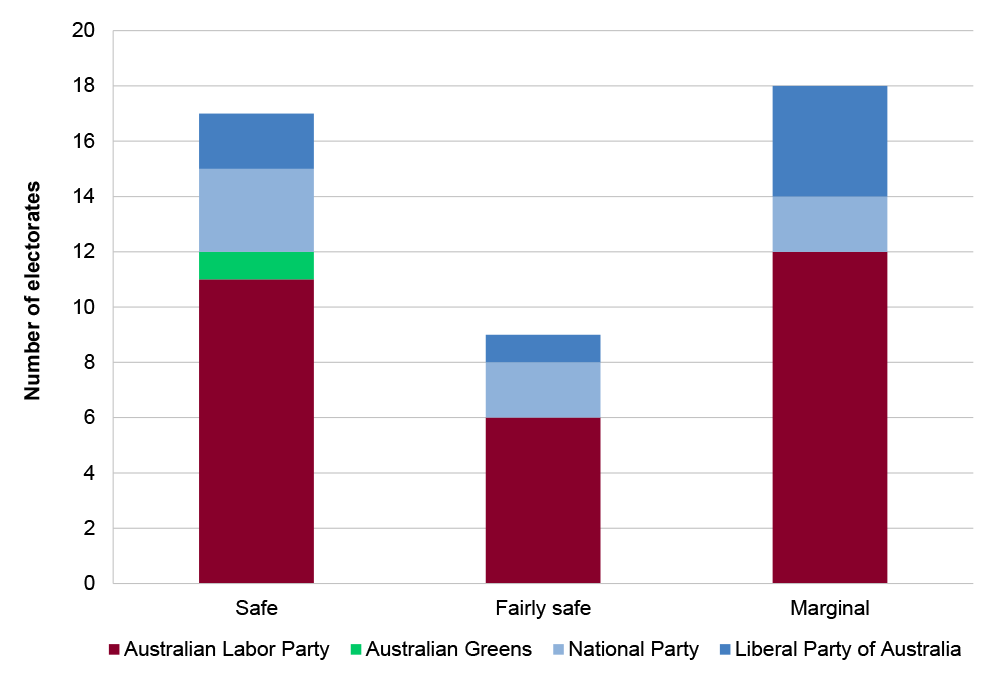
2.12 Figure 2.1 illustrates the proportion of commitments by the seat status of the 44 electorates, including the sitting party.17 Proportionally, more commitments were made in marginal seats than in safe or in fairly safe seats. In absolute terms, more commitments were made in safe and fairly safe seats combined than in marginal seats.
- Of the 67 ‘safe’ seats, 17 (25 per cent) had announced commitments.
- Of the 35 ‘fairly safe’ seats, nine (26 per cent) had announced commitments.
- Of the 49 ‘marginal’ seats, 18 (37 per cent) had announced commitments.
2.13 Figure 2.1 shows that most commitments announced (29 of 44 or 65.9 per cent) were in seats held by the Australian Labor Party before the 2022 federal election.
Figure 2.1: Number of electorates with announced commitments by seat status and sitting party
Source: ANAO analysis of DCCEEW documentation and Australian Electoral Commission information.
Federal financial relations system
2.14 The Federal Financial Relations Act 2009 (FFR Act) establishes the objects and definitions of financial relations between the Commonwealth and states and territories. The FFR Act sets out the roles, responsibilities, and guiding principles for how the Commonwealth pays states and territories for certain services or purposes.
2.15 In 2020, the Council on Federal Financial Relations (CFFR) implemented the current Federation Funding Agreements Framework (FFA Framework). The FFA Framework is the guiding governance structure for federal financial relations and comprises the overarching Intergovernmental Agreement on Federal Financial Relations; the CFFR itself; the FFA Architecture; and the FFA Principles.
2.16 Under the FFA Framework, there are National Agreements or sectoral agreements, and these are collectively referred to as the FFA Architecture.18 Sectoral agreements are also known as Federation Funding Agreements (FFAs).19 Each FFA has subsidiary ‘Schedules’ which are new agreements specific to programs and projects in that sector. Schedules outline the program funding and how the agreements will take effect. The Urban Rivers and Catchments Program Schedule (URCP Schedule) was executed in September 2023.
2.17 Appendices to the URCP Schedule have also been executed with each jurisdiction. Details of the approved projects including funding amounts and key reporting milestones were drafted into relevant appendices, which were negotiated and executed with states and territories from September 2023 to March 2024.20
2.18 Delivery agents were attached to the election commitments to deliver the projects in Round One. Delivery agents include state and territory government departments, water utilities21, councils, conservation groups, and other non-government community organisations. Delivery agents are contracted by the state or territory government and do not have a direct agreement with the Commonwealth. The states and territories are responsible for providing project reporting to the Commonwealth.
2.19 Entities are required to use templates when developing new agreements with jurisdictions under the federal financial relations system.22 Drafting instructions included in the standard schedule template under the Environment FFA state that ‘any additional requirements should be kept to the minimum necessary for the successful delivery and oversight of the project’.23 The URCP Schedule and appendices as executed largely follow the content requirements set out under the FFA Framework with additional requirements such as Project Work Plans (PWP) and hold points.
2.20 The executed appendices to the URCP Schedule specify that a PWP can be used ‘where required to support the delivery of approved Projects agreed under [the] Schedule’. DCCEEW had the option to require a PWP be developed as part of project approval conditions. More than half of projects in Round One are required to have a PWP in place (see paragraphs 2.26–2.29).
Briefing to the Minister
2.21 Section 71 of the Public Governance, Performance and Accountability Act 2013 (PGPA Act) states that ‘A Minister must not approve a proposed expenditure of relevant money unless the Minister is satisfied, after making reasonable inquiries, that the expenditure would be a proper use of relevant money’. Under the Commonwealth Grant Rules and Guidelines 2017 (CGRGs), officials must ensure that awarding a grant represents proper use of public resources.
2.22 In January 2023, DCCEEW requested that the Minister write to relevant Members of Parliament to confirm details or request further information on the proposals identified as election commitments (see paragraph 2.7). Letters were sent to 40 Members of Parliament. These letters included a preliminary details form and an overview of the review process, including the criteria for proposal assessment.
2.23 The cover letter to Members of Parliament stated the program objective was:
To support projects that re-naturalise or enhance the natural qualities of waterways in urban, peri-urban or exurban areas by:
- Establishing and/or improving riparian and aquatic habitat to benefit native species including threatened species; and/or
- Improving water quality, hydrology, or in-stream connectivity to benefit native aquatic species including threatened aquatic species; and
- Improving urban green space, to provide community access to nature, and to help diminish heat-related impacts in urban areas due to climate change.
2.24 The eligibility and assessment criteria as stated in the preliminary details form were:
- Project outcomes – to determine whether, and how, the project contributes to the objectives of the Urban Rivers and Catchments Program;
- Project viability and sustainability – to consider the technical and financial viability of the proposed project associated with its delivery and ongoing management; and
- Funding proponent capability – to deliver and maintain the project.
2.25 Round One is not subject to CGRGs and is governed by the federal financial relations framework and legislation (see paragraphs 2.14–2.16). Notwithstanding this, DCCEEW’s briefing to the Minister met the overall intention of the CGRGs. DCCEEW provided six decision briefs detailing the assessment process and the proposals recommended to be included in Round One to the Minister for the Environment and Water. These briefs:
- explicitly note the type of funding mechanism to be used;
- provide information on the applicable requirements of the administration of the funding, including the legal authority for the funding mechanism;
- outline the application and selection process, including the selection criteria, that were used to validate potential funding recipients; and
- include the merits of the funding, including assessment against the eligibility and assessment criteria and the key consideration of achieving value with public money.
2.26 To support the use of a PWP ‘where required’ as noted in paragraph 2.20, DCCEEW developed a PWP template that could be used for Round One projects. The inclusion of a PWP was designed to cover key delivery risks that DCCEEW identified as inherent to projects, and to establish the controls proposed to manage those risks. As part of approval, DCCEEW required that 25, or more than half of Round One proposals, be approved on the condition that a PWP be developed and accepted.
2.27 The Minister approved the 25 proposals with the specified condition of a PWP being developed and accepted by the Commonwealth. Nine of these 25 were approved with the PWP condition and a specific reference to ‘Attachment B’ also applying. Attachment B comprised key program risks and controls, some of which were predicated on the development of a PWP. Key risks regarded limited information being available for some proposals; projects or elements of projects not yet demonstrating technical viability; the capability of delivery agents to deliver the project; and accuracy in costings and budgeting. A further 15 proposals were approved with specific reference to Attachment B applying.24
2.28 Five proposals were approved without any conditions specified, including the development of a PWP or specific reference to Attachment B. The jurisdictions responsible for three of these five proposals opted to have PWPs to support project administration and risk management. There are agreed PWPs for 43 out of the 46 projects in Round One. This comprises the 25 proposals for which a PWP was a specified condition; the 15 proposals for which Attachment B controls including the potential development of a PWP were specified; and the three proposals whose jurisdictions responsible opted to have a PWP.
2.29 Of the 25 projects approved with the specified PWP condition, three projects had additional conditions specified to mitigate delivery risks.25 These additional conditions related to providing a fully scoped project plan for a subset of works; requiring a technical report be attached to a payment milestone; and implementing a project hold point. These additional conditions were included in the respective agreements with jurisdictions. DCCEEW has accepted completion of one condition and is monitoring the remaining conditions for completion.
2.30 As part of the process of developing the policy proposal described in paragraph 2.9 and in addition to the letters described in paragraph 2.22, DCCEEW issued a form to the project delivery agents of 31 proposals originally identified as election commitments, requesting further information. The form re-stated the eligibility and assessment criteria (see paragraph 2.23) and included an objective for the program.
2.31 The program objective was stated in the form as being:
[To] support projects that improve waterways in urban, peri-urban or exurban areas by:
- establishing and/or improving riparian and aquatic habitat to benefit native species, including threatened species; and/or
- improving water quality, hydrology, or in-stream connectivity to benefit native aquatic species, including threatened aquatic species; and
- improving urban green space, to provide community access to nature, and to help reduce heat-related impacts in urban areas due to climate change.
2.32 The form stated that proposals were required to address either Objective 1 or Objective 2 at a minimum, as Objective 3 was related to secondary benefits. The form also specified that the request for information was part of DCCEEW’s assessment process to provide advice to the Minister.
2.33 For 16 proposals that were assessed and approved as part of the first tranche, DCCEEW considered that the information available for these proposals was sufficient to undertake assessment and did not request further information. The decision brief for these 16 proposals states that they were assessed against the three eligibility and assessment criteria. See paragraphs 3.3–3.20 for the full assessment process.
Round Two
2.34 Round Two was designed as an open competitive grant process to provide an opportunity for community stakeholders to engage with the program, balancing the closed nature of Round One and delivering the ‘remainder’ of the election commitment in full. The design for Round Two was agreed in the March 2023–24 Federal Budget, with the government providing $118.5 million over six years from 2023–24, which included program administration costs.
2.35 As part of the design of Round Two, DCCEEW undertook consultation with government and non-government stakeholders from August 2022 to July 2023. DCCEEW informed the ANAO in February 2026 that consultation:
- excluded potential grant applicants;
- was conducted before draft guidelines were settled;
- was conducted before the opportunity opened for applications; and
- did not include sharing draft guidelines, assessment criteria, or eligibility information with stakeholders.
Natural Heritage Trust of Australia
2.36 Funding for Round Two is from the Natural Heritage Trust (NHT). The NHT is established by the Natural Heritage Trust of Australia Act 1997 (NHT Act) and is a Special Account under section 80 of the PGPA Act. The NHT is administered by DCCEEW to fund environment, sustainable agriculture, and natural resources management initiatives.
2.37 Under section 20 of the NHT Act, the terms and conditions on which financial assistance is granted to a person or a body, other than a state are to be set out in a written agreement between the Commonwealth and the person or body. For Round Two of the program, the terms and conditions were set out in the grant opportunity guidelines (guidelines) and agreed by successful parties in the executed grant agreements. See paragraphs 4.29–4.43 for monitoring and reporting of grant agreements for Round Two.
2.38 DCCEEW sought advice on the design of Round Two from the Australian Government Solicitor (AGS) in June 2023. Based on the proposed design, AGS advised that the constitutional risk was low, and the legislative authority risk was medium based on the funding source and the breadth of activities. DCCEEW drafted the guidelines for Round Two in collaboration with the Department of Industry, Science and Resources’ Business Grants Hub (BGH).
2.39 BGH undertook a risk assessment of the guidelines and determined an overall rating of medium, taking into account the legislative authority risk advised by AGS. DCCEEW sought the Minister for Finance’s agreement to release the guidelines given the medium rating. In November 2023, the Minister for Finance agreed to the release of the guidelines, requesting that DCCEEW closely monitor the grant activities to ensure the risks continued to be mitigated.
2.40 The objective of the program as initially stated in the guidelines was ‘to improve the ecological health of waterways in urban, outer urban/peri-urban and regional centres’. The guidelines later elaborate that the objectives of both streams are to:
- conserve native plants and animals including EPBC-listed threatened plants and animals in urban, outer urban/peri-urban and regional centres [and]
- improve the ecological health of Threatened Ecological Communities and wetlands of international significance, i.e. Ramsar sites, in urban, outer urban/peri-urban and regional centres.
2.41 The intended outcomes of the overall program and repeated as being the outcome for both streams were listed as the following:
- restored and/or improved riparian areas, stream banks or aquatic habitats, to benefit native species including threatened species, or aquatic areas of significance;
- improved water quality, water in the landscape, and waterway connectivity to benefit native aquatic species including threatened aquatic species, or aquatic areas of significance; [and]
- improved urban green and blue space, including improved community access to nature, improved water quality to benefit public health, and increased shading to help reduce urban heat-related impacts due to climate change.
2.42 The objective and intended outcomes were communicated to applicants for Round Two in November 2023 when the guidelines were released. The application of the guidelines in the full assessment and approval process for Round Two projects is at paragraphs 3.22–3.51 and 3.56–3.59.
Was the approach to designing and planning to deliver the program fit for purpose, including the development and approval of criteria and guidelines?
DCCEEW designed Round One in line with the election commitment made; relevant legislation and guidelines; and appropriate advice from other government entities. Round Two was designed to be an open competitive opportunity to meet stakeholder expectations and deliver the ‘remainder’ of the election commitment. DCCEEW applied the CGRGs in designing and planning the program, including in the development of assessment criteria. Criteria and guidelines were approved by the minister.
Round One
2.43 The design and planning of Round One, including the development of assessment criteria, was iterative and occurred through the ministerial briefing and approval process described in paragraphs 2.7–2.10. Round One was designed to deliver the government’s election commitments made as part of the Australian Labor Party’s campaign for the May 2022 federal election.
2.44 Following the October 2022 Federal Budget, DCCEEW began to develop plans, strategies, and other arrangements to support the management and delivery of Round One. This included a project plan, a program logic, risk management framework and procedures, and engagement and communications strategies. DCCEEW’s planning documentation included consideration of risk, including establishing and identifying appropriate channels for keeping senior management and ministers informed.
2.45 Reporting to DCCEEW management on the development and early implementation of Round One was limited to divisional reporting.
- Fortnightly program status updates from August 2023 to December 2024 at the divisional level.26
- Eight progress reports in the period February 2023 to March 2024 to the Biodiversity Division Natural Heritage and Biodiversity Program Board.27
- By request to the Biodiversity Division’s Finance and Risk Committee from August 2024 onwards. This committee replaced the Natural Heritage and Biodiversity Program Board.
Round Two
Planning in accordance with requirements
2.46 The CGRGs require that practices and procedures be in place that ensure that the conduct of grants administration is consistent with the seven key principles for grants administration.28 This includes the CGRGs’ principles of robust planning and design.
2.47 DCCEEW was compliant with the relevant requirements and principles of the CGRGs in its planning for and design of Round Two. This is set out in Table 2.1.
Table 2.1: Commonwealth Grants Rules and Guidelines Section 7 — Round Two
|
CGRG Section 7 element |
ANAO assessment |
|
Did officials work with government and non-government stakeholders in the plan, design, and undertaking of grants administration? (clause 7.2) |
◆ |
|
Was the grants administration process proportional to the scale and risk profile of the grant opportunity? (clause 7.3) |
◆ |
|
Did officials have regard to all relevant planning issues? (clause 7.5) |
◆ |
|
Was risk identification and engagement built into the grants administration process? (clause 7.7) |
◆ |
|
Did officials ensure that risk identification and engagement is supported by performance information, procedures and systems that continuously identify and treat emerging risks throughout the grants lifecycle? (clause 7.12) |
◆ |
Key: ◆ Element was fully or largely considered during planning ▲ Element was partly considered during planning ■ Element was not considered during planning.
Source: ANAO analysis of DCCEEW documentation, and CGRGs.
Development of grant opportunity guidelines
2.48 To promote open, transparent and equitable access to available funding, clause 4.4 of the CGRGs requires that grant opportunity guidelines be developed and made publicly available where grant applications are to be sought. The CGRGs state that officials are responsible for the development of clear and concise grant opportunity guidelines that consider grant objectives; eligibility criteria; assessment criteria; the weight of assessment criteria; and the approval process.
2.49 In keeping with the roles and responsibilities of working with BGH to deliver a grant opportunity, BGH developed the guidelines with input from DCCEEW.
2.50 DCCEEW developed additional application requirements for BGH to implement. These included a site condition report; project plan with budget breakdown; letters of support from significant stakeholders29; and digital project site information. DCCEEW advised the ANAO in December 2025 that these additional items were required to support assessment of applications against program criteria, and to ascertain whether projects were appropriately located within the eligible area.
2.51 DCCEEW used substantially the same high-level assessment criteria as Round One for Round Two (see Appendix 3). Round Two criteria were published in the guidelines, released in November 2023. The guidelines covered both Stream One and Stream Two. DCCEEW applied a weighting to the criteria for Round Two.
- Assessment criterion 1 – your project’s contribution to meeting program objectives – 40 per cent weighting.
- Assessment criterion 2 – the quality of your proposal, the project’s impact, and the impact of the project grant funding – 35 per cent weighting.
- Assessment criterion 3 – your organisation’s capacity, capability and resources to deliver the project – 25 per cent weighting.
2.52 The published guidelines clearly set out:
- that the opportunity was an open competitive process;
- the eligibility requirements;
- the assessment criteria, including minimum scoring to be considered for funding; and
- the process through which applications would be assessed, including the roles of departmental staff, assessors, experts, and the Minister.
2.53 The Assessment and Evaluation Plan (the plan) for Round Two was drafted by BGH with input from DCCEEW. The final version was approved by DCCEEW in February 2024. The plan ‘provides a roadmap for the process of collecting, assessing, evaluating, recommending and approving applications for funding’. Addendums were made to the plan in April and June 2024 to clarify and update some details.
Approval of grant opportunity guidelines
2.54 The guidelines were finalised on 28 September 2023. As the decision–maker for the program, the Minister for the Environment and Water approved the guidelines on 19 October 2023. Agreement from the Minister for Finance to release the guidelines was sought on 19 October 2023 and provided on 1 November 2023. The guidelines were released on 15 November 2023.
3. Assessment of applications
Areas examined
The chapter examines whether the Department of Climate Change, Energy, the Environment and Water (DCCEEW) appropriately assessed applications for inclusion in the Urban Rivers and Catchments Program (the program).
Conclusion
Assessment of applications was largely appropriate. Assessment of applications was conducted in accordance with established program guidance and probity advice. DCCEEW placed conditions on almost all projects to manage delivery risks. DCCEEW relied on internal corporate knowledge and external subject matter experts to make final recommendations to the Minister for the Environment and Water.
Areas for improvement
The ANAO identified two opportunities for improvement relating to administrative arrangements; and ensuring sufficient detail in conflict-of-interest records.
3.1 Documenting and applying approved assessment processes and requirements, including where elements of discretion may be exercised or flexibility is warranted, helps retain public confidence in program administration and the proper use of public resources.30 This may also support the entity in identifying ‘lessons learned’ for delivering future programs.
3.2 The program consists of two rounds that are being delivered through different funding mechanisms and administrative means. DCCEEW conducted eligibility and merit assessment for each round, with Round Two being conducted in collaboration with the Department of Industry, Science and Resources’ (DISR) Business Grants Hub (BGH). This chapter also examines whether appropriate probity arrangements were in place and followed throughout the assessment process.
Were applications assessed in accordance with the relevant criteria and guidelines?
DCCEEW assessed Round One proposals largely in accordance with established criteria with some exceptions. DCCEEW assessed all applications for Round Two in accordance with the criteria established in the grant opportunity guidelines. Six applications progressed to the merit assessment stage were subsequently identified by the Assessment Committee as ineligible and not merit assessed. Arrangements to manage probity were in place across both rounds. The quality and management of conflict-of-interest records could be improved.
Round One
3.3 As noted in paragraph 2.9, the initial policy proposal for the program was based on the understanding that at least 40 site-specific projects were announced as part of the election campaign. DCCEEW undertook a process to confirm that the proposals announced were suitable for funding under the program. DCCEEW advised the ANAO in March 2026 that to be eligible for assessment, details of every commitment, and confirmation of the Australian Government’s nominated delivery agent, had to be confirmed by the Minister for the Environment and Water (the Minister) through their office (see paragraphs 2.21–2.33).
3.4 Merit assessment for 45 out of 46 Round One proposals was undertaken from February 2023 and concluded in February 2024. Projects were assessed as met; or conditionally or partially met. Ministerial approval of one project was provided in December 2024.
3.5 DCCEEW developed definitions of project complexity and risk and used these to structure merit assessment processes into tranches. DCCEEW originally estimated there would be three tranches of increasing complexity. Assessments were ultimately completed over six tranches as proposals were deferred to later tranches until further project information could be obtained. Less complex proposals that received less funding had less detailed assessment processes (Tranche 1) compared to more complex proposals that received higher funding (Tranches 2 to 6).
3.6 DCCEEW developed the following criteria to assess whether Round One proposals were appropriate for program funding.
- Criterion 1 (C1): Project outcomes — to determine whether, and how, the project contributes to the objectives of the program.
- C1 had four sub-criteria for Tranche 1 assessment, and five sub-criteria for Tranches 2 to 6 assessment.
- Criterion 2 (C2): Project viability and sustainability — to consider the technical and financial viability of the proposed project associated with its delivery and ongoing management.
- C2 had three sub-criteria for Tranches 1 and 2 assessment, and four sub-criteria for Tranches 3 to 6 assessment.
- Criterion 3 (C3): Funding proponent capability — to deliver and maintain the project.
- C3 had four sub-criteria for Tranches 2 to 6 assessment. See paragraph 3.10 regarding Tranche 1.
3.7 The objective and criteria were also set out in a template that DCCEEW used to gather further information on proposed projects as part of the assessment process (see paragraphs 2.30–2.32). As outlined in paragraph 2.32, DCCEEW required that ‘the project MUST, at a minimum, address either Objective 1 or Objective 2 … project activities cannot be solely limited to Objective 3 (which focuses on secondary benefits)’.
3.8 The assessment criteria for Round One were set out in assessment documents provided to assessors for each tranche. Assessors and the moderator for Round One were DCCEEW officials. Tranche 1 projects were assessed by one officer at the APS or EL1 level, and moderated by an EL2 officer.31 Tranches 2 to 6 were assessed by two DCCEEW officers and an EL2 moderator. Some projects were split into subprojects for assessment.
3.9 DCCEEW required all Round One assessors to attend a briefing and training session before being assigned projects to assess. Briefing materials included an overview of the program, and an overview of the review process including the assessment criteria. Briefing materials were revised after Tranche 1 and Tranche 3 to update program details and minor refinements to the process32, however the assessment criteria were unchanged across tranches.
3.10 Proposals in Tranche 1 underwent a ‘streamlined’ assessment process. Proposals were assessed against the first two criteria by a single assessor. There were nine assessors in total, eight of which each assessed two proposals; the ninth assessed three proposals. The moderator was to provide an assessment against the third criterion.
3.11 As noted in paragraph 3.6, there were four sub-criteria to C1, and three sub-criteria to C2 for Tranche 1. The assessors considered all sub-criteria and provided an overall assessment for C1 and C2 for all 16 proposals in Tranche 1. There are four proposals where the moderator’s assessment against C3 is not clearly documented.
3.12 Proposals in Tranches 2 to 6 were assessed against all three criteria. Assessors for Tranches 2 to 6 provided ratings for all sub-criteria, and an overall assessment for each criterion. The moderator provided an overall rating for all proposals in Tranches 2 to 6.
3.13 Assessors and the moderator could propose conditions as controls to mitigate delivery risks identified during the assessment process. Of the 46 projects recommended for approval, 41 had conditions attached to the approval. See paragraphs 2.27–2.28.
3.14 DCCEEW’s assessment process for Round One did not include a documented option to find any of the identified election commitment proposals ‘clearly unacceptable’ or unsuitable for funding. Proponents of the proposals were instead given the opportunity to provide more information until DCCEEW was satisfied that it could undertake an assessment of whether the proposal was appropriate.
3.15 DCCEEW did not use a quantitative rubric, weighting, or other scoring methodology in its assessment of Round One projects against the criteria. In the absence of these, the ANAO applied a basic point scoring system to DCCEEW’s assessment of Round One proposals. A ‘Yes’ response from the assessor against any of the sub-criterion was allocated one point under the ANAO system.33
3.16 Using this scoring system, proposals that assessors scored higher were generally rated by the moderator as either met or conditionally met. Proposals that assessors scored lower were generally rated by the moderator as not met. Below is an overview of the scores by tranche, as calculated by the ANAO.
- In Tranche 2, averaged assessor scores ranged from seven to 11 out of a possible 12 across five proposals. One proposal was rated as ‘met’ although it scored lower than two projects that were rated as ‘conditionally met’.
- In Tranche 3, averaged assessor scores ranged from two to 13 out of a possible 13 across 18 proposals. Five proposals rated as ‘not met’ had averaged assessor scores ranging from 3.25 to eight.
- In Tranche 4, averaged assessor scores were 7.5, 10, and 11 out of a possible 13 across three proposals, with all proposals being rated as ‘conditionally met’.
- In Tranche 5, averaged assessor scores ranged from 8.25 to 11.25 out of a possible 13 across seven proposals. The highest scoring project was rated as ‘conditionally met’ while the only proposal rated as ‘met’ had a lower score.
- In Tranche 6, averaged assessor scores were 8.5, 8.75, and 12, with all three proposals being rated as ‘conditionally met’.
3.17 Case study 1 shows how an initial assessment of two proposals as ‘not met’ by assessors was handled by DCCEEW, including requesting further information to conduct assessment, and the re-assessment resulting in both proposals being awarded the requested funding. The scores in the case study are calculated by the ANAO as described above.
|
Case study 1. Round One proposal reassessment – comparison |
|
Two proposals were initially assessed in Tranche 3 by DCCEEW assessors and the moderator as ‘not met’. One proposal was in New South Wales, and one was in South Australia. Both were deferred to Tranche 5 for reassessment. Both proposals were assessed in both tranches by the same two assessors and the moderator. The proposal in New South Wales had a difference of seven points between assessors in Tranche One. Further information was requested and supplied by the jurisdiction. When the proposal was reassessed, its overall score increased by five and a half points, with a difference of five and a half points remaining between the assessors. The moderator noted that ‘The justification for the broad range of activities proposed, and likely outcomes to be achieved, remain inadequately described, despite the request for additional information.’ The project was awarded $4 million in funding and is due to be completed in May 2029. One proposal in South Australia had a difference of three points between assessors in Tranche One. Further information was requested and supplied by the jurisdiction. When the proposal was reassessed, its overall score increased by two points, with a difference of two points remaining between the assessors. The moderator noted that there was a difference of opinion between the assessors ‘as to whether the revised information submitted meets the criteria’. The project was awarded $2.3 million in funding and was to be completed in January 2026. The project was completed ahead of schedule in July 2025. |
3.18 There were areas that could have been strengthened. This includes that guidance for assessors did not define application requirements, including whether enough information was supplied to conduct assessment of proposals, or how to determine what other information was required. DCCEEW continued to gather further details on some of the proposals during the merit assessment process, however without utilising some form of quantitative assessment, it could not easily determine the additional conditions or administrative effort required to appropriately manage the spectrum of different projects.
Opportunity for improvement
3.19 There is an opportunity for DCCEEW to ensure its administrative arrangements are commensurate with the scale and risk of projects, including the volume, frequency, and detail of information required from funding recipients. This includes at application and assessment stages.
3.20 Initial appendices to the Urban Rivers and Catchments Program Schedule (URCP Schedule) were progressively executed from September 2023 to March 2024. Variations to the appendices have been executed to include projects that were assessed later in the tranche process. Variations to appendices have been approved from April 2024 to March 2025. Some of the decision briefs for execution and variation of appendices included project approvals.
Round One probity
3.21 DCCEEW maintained a register for conflict-of-interest declarations for Round One. Across the six tranches, assessment of Round One projects was conducted by 23 assessors and two moderators. All declarations were made before the assessment for each respective tranche commenced and was completed. No potential conflicts raised gave rise to an actual conflict, and no management actions were required to be taken.
Round Two
3.22 In contrast to Round One, Round Two applications went through defined eligibility and merit assessment as part of an open competitive grant opportunity. Eligibility assessment for Round Two of the program was conducted by BGH with DCCEEW input. Merit assessment for Round Two was conducted with administrative support from BGH.
3.23 On 1 October 2024, the Commonwealth Grants Rules and Principles 2024 replaced the Commonwealth Grants Rules and Guidelines 2017 (CGRGs).34 Assessment of applications and selection of projects for Round Two of the program was completed prior to October 2024.
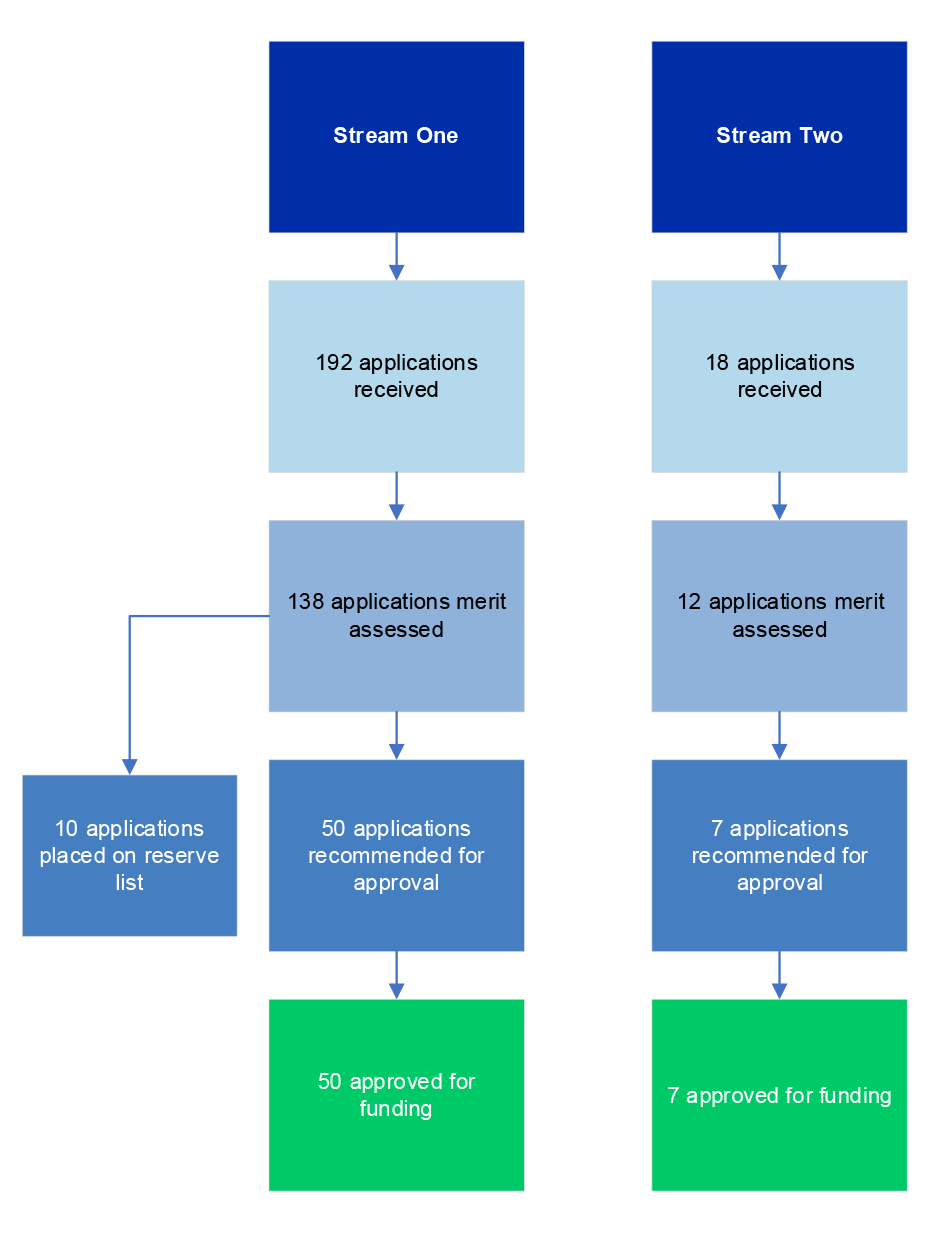
3.24 The grant opportunity guidelines (guidelines) for Round Two were released on 15 November 2023. The opportunity closed on 13 February 2024. Figure 3.1 shows the number of applications received, merit assessed, recommended for funding, and funded under the two streams of Round Two.
3.25 The 50 applications recommended for approval in Stream One were the same applications that were rated as meritorious and ranked above the 10 on the reserve list. The Minister approved the 50 applications on 20 September 2024. Separate approval from the Minister is required if DCCEEW proposes to use the reserve list. As of May 2026, DCCEEW has not proposed use of the reserve list.
3.26 The seven applications recommended for approval in Stream Two were the same seven that were assessed as meritorious. The Minister approved the seven applications on 5 July 2024.
Figure 3.1: Applications received, merit assessed, recommended for approval, and funded in Round Two
Source: ANAO analysis of DCCEEW documentation.
Structure and process
3.27 The Assessment and Evaluation Plan for Round Two was drafted by BGH with input from DCCEEW. It was approved in February 2024 by the DCCEEW Program Delegate. The Assessment and Evaluation Plan for Round Two outlines the flow of process, roles and responsibilities, and probity requirements for assessment of applications submitted. The key stages were as follows.
- Eligibility assessment
- Merit assessment
- Final recommendation
- Approval
Eligibility
3.28 The guidelines established who could apply for a grant. Eligibility to apply was based initially on applicants’ legal status as a company or organisation, then by applicants’ declarations in relation to authorisation, funding arrangements, and relevant stakeholder support for the proposed project.
3.29 The guidelines included the split of Round Two into two ‘streams’ based on eligible entity type, grant value requested, and expenditure that could be funded.
- Stream One — small to medium projects, with a grant value from $150,000 up to $2 million across one or more project sites. Up to 100 per cent of eligible expenditure would be funded for successful Stream One applications.
- Stream Two — large projects, with grant value from $2 million up to $10 million with a total project value of at least $4 million across one or more project sites. Up to 50 per cent of eligible expenditure would be funded for successful Stream Two applications.
3.30 DCCEEW advised the ANAO in December 2025 that nine elements of evidence and information were included in the application requirements by BGH at the request of DCCEEW. DCCEEW included these elements to ensure applicants could demonstrate that proposed projects were aligned with program objectives; technically sound; and supported by relevant stakeholders, in addition to demonstrating the project boundaries.
3.31 Eligibility was assessed by BGH with input from DCCEEW, including the elements noted in paragraph 3.30. DCCEEW’s eligibility check related to the project boundaries (mapping) and environmental offset analysis of applications, using expertise drawn from different areas of the department.
3.32 The applications for Stream One were assessed in batches. All applications had an eligibility recommendation approved by the DCCEEW Program Delegate (SES Band 1), signed off by the BGH Senior Responsible Officer. The DCCEEW Program Delegate approved the eligibility assessments from April 2024 to June 2024. Eligibility assessment was considered finalised on 22 July 2024 to proceed to merit assessment.
3.33 Key roles and responsibilities for Round Two eligibility assessment are set out in the following table.
Table 3.1: Roles and responsibilities — eligibility assessment
|
Role |
Responsibility |
Members |
|
BGH Eligibility Assessor |
Complete eligibility checklist and make recommendation on eligibility and completeness of application. |
Multiple officers from DISR |
|
DCCEEW Eligibility Assessor |
Input to BGH Assessor completed checklist with separate checklist. |
Three officers from DCCEEW Biodiversity Division |
|
BGH Quality Assessor |
Review BGH and DCCEEW completed checklists and provide signoff. |
Multiple officers from DISR |
|
BGH Program Manager |
Review recommendation and provide signoff. |
DISR EL1 |
|
BGH Senior Responsible Officer |
Provide signoff of eligibility assessment. |
DISR EL2 |
|
Urban Rivers and Catchments Program Round Two Management Committee |
Review outcome of eligibility assessment and provide recommendation to DCCEEW Program Delegate. |
DCCEEW and BGH officers |
|
DCCEEW Program Delegate |
Approve eligibility assessment. |
Branch Head of Biodiversity Programs Branch, Biodiversity Division |
Source: DCCEEW documentation.
Merit
3.34 Once the DCCEEW Program Delegate approved the eligibility assessment findings and the BGH Senior Responsible Officer signed off on the eligibility assessments, eligible applications progressed to merit assessment. The merit assessment criteria for Round Two were set out in the guidelines. The assessment criteria were substantially the same as used in Round One (see Table A.2 in Appendix 3). In addition to establishing program objectives and outcomes, the guidelines establish how the money could be used.
3.35 Key roles and responsibilities for Round Two merit assessment are set out in the table below.
Table 3.2: Roles and responsibilities — merit assessment
|
Role |
Responsibility |
Members |
|
DCCEEW Merit Assessor |
Score eligible applications according to program criteria. |
Officers from multiple divisions of DCCEEW |
|
DCCEEW Advisory Panel (DAP) |
Provide quality assurance over merit assessments including seeking technical advicea; requesting Merit Assessors reconsider scoring; and providing advice to the AC. |
Officers from multiple divisions of DCCEEW |
|
Assessment Committee (AC) |
Consider the eligibility and merit assessments and:
The AC determines the funding recommendations, including ranking, to the decision-maker. |
Independent urban waterway experts |
|
BGH |
Collate meritorious applications and determine total funds requested to support AC determination of B) final ranking of applications. |
BGH Program Manager and support staff |
|
Decision-maker |
Provide final decision (approval) of recommended meritorious applications. |
Minister for the Environment and Water |
Note a: DCCEEW originally established the role of Technical Referral Officers to provide this technical advice, however did not end up using these officers during merit assessment.
Source: DCCEEW documentation.
3.36 Stream One received 192 applications. Of these applications, BGH assessed 138 as eligible and 54 as ineligible. The DCCEEW Merit Assessors and the DAP then assessed 60 as meritorious and 78 as non-meritorious.
3.37 ANAO review of the assessment documents shows that all meritorious Stream One applications were assessed against the stated criteria, with a score recorded for each criterion out of 40, 35, and 25 in accordance with the weighting.
3.38 During the merit assessment stage in August 2024, six applications were identified as ineligible by the AC. This occurred at the merit assessment stage as a more detailed review of the applications identified issues with specific activities; site locations, particularly relative to eligible geographic boundaries; and the proportion of on-ground expenditure. These six applications were returned to BGH for eligibility reassessment and not considered in the merit assessment process. The eligibility reassessment findings were subsequently approved by the DCCEEW Program Delegate, and the BGH Senior Responsible Officer signed off five of the reassessments on 16 August 2024 and one on 11 October 2024.
3.39 The DCCEEW Merit Assessors and DAP did not always agree with the scores given for each criterion. Where an assessor or DAP had a concern, conditions were proposed to manage the risks identified. Common potential risks to project delivery identified included environmental damage from on-ground project activities; unavailability of contractors and poor responses to tender; delays due to permits and approvals; delays due to adverse weather; occupational work health and safety risks; and loss of project benefits due to a lack of ongoing site surveillance and maintenance.
3.40 Of the 60 meritorious applications that were put forward for ministerial approval, 56 applications had conditions proposed. DAP proposed conditions for 23 of the 56 applications, in addition to due diligence conditions proposed for 43 of the 56 applications.35 The most common conditions proposed by DAP were as follows.
- Submission of amended risk plan to cover potential risks to project delivery (53 instances).
- Update or submission of a site plan (20 instances).
- Submission of a revised project governance structure and arrangements (including financial arrangements) that better demonstrates how the applicant will engage the partnering organisations in project decision making and delivery across the project sites and/or better manage finances and outcomes (18 instances).
- Submission of a stakeholder engagement plan that ensures appropriate consultation with all relevant stakeholders for the project sites, including Traditional Owners and the land managers (14 instances).
3.41 The final score for applications was determined by the AC. The AC did not utilise a scoring rubric or formula to adjust scores. DCCEEW advised the ANAO in April 2026 that the approach was consensus based, informed by collective expert judgement. ANAO analysis indicates the following.
- Stream One — 34 scores changed, comprising 30 applications determined by the AC as non-meritorious from meritorious; and four applications determined by the AC as meritorious from non-meritorious.
- Stream Two — three scores changed, all determined by the AC as non-meritorious from meritorious.
3.42 Both the DAP and the AC operated as established in respective Terms of Reference and in the Assessment and Evaluation Plan. Case study 2 shows how an application assessed by the DCCEEW Merit Assessors and DAP as non-meritorious was assessed by the AC as meritorious and recommended for funding.
|
Case study 2. Case study Example of Round Two Stream Two merit assessment |
|
For an eligible application to be assessed as meritorious, a score of at least half of the potential value for each criterion and an overall merit score of above 50 was required. One application in Round Two Stream Two had been assessed as non-meritorious by the DCCEEW Merit Assessors and DAP as it did not meet the score of at least half of the potential value for two criteria. The scores given by the DCCEEW Merit Assessors indicated that this application did not meet the requirements to be considered meritorious, and DAP agreed with the Merit Assessors score and rationale. The application scored 52.5 out of 100, which was the lowest of all meritorious projects in Stream Two. In accordance with the Assessment and Evaluation Plan, the AC can substitute its own assessment and scores following a discussion in which consensus was reached. The AC revised the score for this application to 63.5 out of 100, increasing the scores for the first two criteria but reducing the score for the third. The AC put forward the application for approval with pre-conditions and conditions to mitigate any risks, with a final score of 58. The application was approved and awarded funding of up to $9.8 million. |
Final recommendation and approval
3.43 The AC determined the application funding recommendations to the Minister, as established in the Assessment and Evaluation Plan. DCCEEW and BGH documented and kept records of all stages of the assessment, including deliberations and final recommendations.
Round Two probity
3.44 DCCEEW maintained a conflict of interest, probity briefing, and confidentiality register for DCCEEW staff participating in the program design and eligibility assessment. There was also a probity briefing register for merit assessors. BGH maintained a corresponding register for BGH staff participating in eligibility assessment; and a conflict of interest register for all DCCEEW merit assessors and members of the DAP.
3.45 All BGH officers completed declarations of interest prior to the commencement of the eligibility process. All relevant DCCEEW officers completed declarations of interest prior to the commencement of the eligibility process.
3.46 As part of the DCCEEW register for merit assessment, some Merit Assessors noted that they would be unable to participate as a DAP member over applications that they had initially assessed for merit. One Merit Assessor became a member of DAP over the course of the assessment process, and three Merit Assessors were Departmental Observers for DAP meetings.
3.47 The Merit Assessors who had a dual role in DAP as part of the panel or as a Departmental Observer either did not attend DAP meetings where the applications they had assessed were discussed; or recused themselves from the meeting for the period in which the relevant application was being discussed.
3.48 The records of the eight AC meetings were created by BGH in its role as secretariat. The AC meeting records show that conflicts declared by AC members were noted and confirmed by the Chair at each meeting. These meeting records do not clearly state the action taken to manage the conflicts. The meeting records do not clearly state in which meeting or when during the meeting that applications for which members of the AC identified potential conflicts of interest were considered.
3.49 There were 11 separate applications for which two members of the AC identified potential conflicts of interest prior to assessment proceedings. One member identified three applications, and another member identified eight applications. The third member did not identify any potential conflicts of interest or applications. Two of the 11 identified applications were ineligible and not progressed to merit assessment. Of the nine remaining identified applications, it was only stated in one instance that the affected AC member was removed from deliberation of the application. It is unclear if the conflict of interest was appropriately managed on the other eight occasions.
Opportunity for improvement
3.50 There is an opportunity for DCCEEW to improve the quality of its documentation in relation to managing conflicts of interest to clearly and consistently state the action undertaken to manage the conflict, in line with established protocols. This includes where DCCEEW does not create the documentation but is expected to rely on the information contained within.
3.51 An external probity adviser was engaged for Round Two of the program. The probity adviser provided advice on various issues throughout Round Two.
Were funding decisions supported by clear evidence and advice?
DCCEEW assessed the appropriateness of applications for inclusion in the program in both Round One and Round Two. Funding decisions were supported by evidence and advice and made by the appropriate decision-maker.
3.52 Section 71 of the Public Governance, Performance and Accountability Act 2013 (PGPA Act) states that ‘A Minister must not approve a proposed expenditure of relevant money unless the Minister is satisfied, after making reasonable inquiries, that the expenditure would be a proper use of relevant money’. Under the CGRGs, officials must ensure that awarding a grant represents proper use of public resources.
3.53 DCCEEW’s use of two different funding mechanisms in the single program emphasises the need for assessment processes to be conducted in a manner that minimises concerns about equitable treatment, especially where the geographic distribution of funding may be seen as party-political bias. Good record-keeping practices can demonstrate that the process was conducted in a fair, equitable, and defensible manner.
Round One
3.54 Projects in Round One of the program are election commitments that were assessed for inclusion and validated by DCCEEW as described in paragraphs 2.7 to 2.33. The evidence and advice provided to the Minister to support funding decisions was set out in the approval briefs as noted in paragraphs 2.21 to 2.22.
3.55 DCCEEW maintained appropriate records of the evidence and advice provided to the Minister to support funding decisions.
Round Two
3.56 Accountable authorities and officials involved in grants administration must comply with certain requirements in applying the CGRGs, including advising the relevant minister on the relevant requirements of the PGPA Act, PGPA Rule, and the CGRGs where the minister is considering expenditure of relevant money for a grant.
3.57 In setting out the assessment process, the guidelines also established the evidence and information that would be collected to support advice to the decision-maker regarding projects to fund. DCCEEW advised the ANAO in December 2025 that nine elements of evidence and information were included in the application requirements by BGH at the request of DCCEEW. These requirements were checked at the eligibility stage by BGH with input from DCCEEW (see paragraph 3.31). These requirements informed the advice to the decision-maker regarding projects to fund.
3.58 The guidelines identified that specific project conditions could be attached to the approval of the grant, as ‘determined by the assessment process or other considerations made by the Minister’. Including both Stream One and Stream Two, 67 projects (60 in Stream One and seven in Stream Two) were recommended as meritorious, including 10 on the Stream One reserve list (see Figure 3.1). Of the Round Two projects approved for funding, the Minister agreed there should be conditions attached to 53 of the 57 approved projects.36 These additional conditions related to:
- submission of further information on project activities;
- submission of updated or finalised planning documentation, including risk plans, site plans, budgets, governance arrangements, and design plans;
- the quality of data to be collected; and
- confirmation that projects would not overlap with current or future projects in the area.
3.59 The Ministerial Submissions for Round Two project approvals meet the requirements of the CGRGs regarding:
- the Minister being satisfied after reasonable inquiries that the expenditure would be a proper use of relevant money; and
- the duty of Commonwealth officials to advise the Minister of the requirements of the CGRGs, including in relation to the legal basis for the proposed expenditure; the definition of the proposal as a grant; the need to document decisions; and other relevant considerations.
4. Monitoring and reporting
Areas examined
The ANAO examined whether the Department of Climate Change, Energy, the Environment and Water (DCCEEW) established effective monitoring and reporting arrangements for the Urban Rivers and Catchments Program (the program).
Conclusion
DCCEEW has established largely effective monitoring and reporting arrangements for the program. The department is monitoring the delivery of projects and supporting the making of payments by third party Australian Government entities. DCCEEW finalised a program evaluation plan in February 2026. In May 2026, DCCEEW updated its evaluation plan to indicate how it will use project-level performance results and other data to evaluate the program.
Areas for improvement
The ANAO identified two opportunities for improvement relating to encouraging use of DCCEEW’s preferred reporting system; and to ensure monitoring is also used for performance management of funding recipients.
4.1 Projects and programs funded by the Australian Government should be actively managed, including through regular, risk-based monitoring to support the evaluation of progress against agreed objectives. Entities should respond in a timely manner when the recipient of funds demonstrates or reports progress, or lack thereof. For the program, DCCEEW should actively oversee milestone delivery; clearly specify the information required from proponents to assess progress; and proactively manage the risks of jointly delivered grant programs through appropriate oversight and controls.37
4.2 DCCEEW’s key reporting mechanism for Commonwealth-funded natural resource management projects is the Monitoring, Evaluation, Reporting and Improvement (MERI) Tool (MERIT). According to DCCEEW, ‘MERIT is designed to collect and store planning, monitoring and reporting data for conservation projects, both for record-keeping purposes and to enable the structured evaluation of conservation actions and the outcomes achieved’.
Are there effective arrangements for making payments and active monitoring of projects?
Each agreement for a project in the program uses milestone monitoring as the basis for examining progress and making payments. Timeliness of milestone submission and assessment is improving as the program progresses. DCCEEW provides confirmation to the two other entities making payments for the program based on DCCEEW’s monitoring of projects. Round One project milestone reporting is often submitted late by funding recipients, with the length of delay varying from one day up to 387 days. Round Two project proponents are incentivised to deliver target measures and complete reporting on time as payment is contingent on both DCCEEW and the payment entity being satisfied that milestones and reporting requirements have been met.
Round One
4.3 Under the Intergovernmental Agreement on Federal Financial Relations (IGA FFR)38, reporting on financial relations ‘will be in respect of the achievement by governments of objectives, outcomes, outputs and performance benchmarks in National Partnership agreements’. The National Partnership agreement relevant to Round One of the program is the Environment Federation Funding Agreement (Environment FFA).
4.4 Under the FFA Framework, there are several major National Agreements and sectoral agreements, and these are collectively referred to as the FFA Architecture.39 Sectoral agreements are also known as Federation Funding Agreements (FFAs).40 Each FFA has subsidiary ‘Schedules’ which are new agreements specific to programs and projects in that sector. Schedules outline the program funding and how the agreements will take effect. The Urban Rivers and Catchments Program Schedule (URCP Schedule) was executed in September 2023.
4.5 Appendices to the URCP Schedule have been executed with each jurisdiction.41 Details of the approved projects including funding amounts and key reporting milestones were drafted into relevant appendices, which were negotiated and executed with states and territories from September 2023 to March 2024.42
4.6 The Environment FFA states that specific performance monitoring and reporting requirements will be set out and agreed to by parties in Schedules. The Commonwealth ‘will make payments subject to the performance report demonstrating the relevant milestone has been met’. As noted in paragraph 2.19, reporting requirements under the FFAs are minimal by design.43
4.7 Under the standard terms of the URCP Schedule and overarching FFA system, DCCEEW cannot require jurisdictions or delivery agents to report project progress directly in MERIT. As of May 2026, the Australian Capital Territory and the Northern Territory choose to do so. This comprises three of the 46 projects in Round One being reported directly into MERIT by those two jurisdictions. DCCEEW is maintaining entries for the other 43 projects in MERIT based on information provided in Project Work Plans (PWPs) or other documents.44 Under the MERI Framework, progress reports in MERIT are generally required at least annually.
Opportunity for improvement
4.8 There is an opportunity for DCCEEW to consider, during planning, opportunities to promote use of its preferred reporting system to enable streamlined, compliant electronic program reporting.
4.9 Appendices for Round One were initially executed as follows:
- South Australia — September 2023;
- New South Wales — November 2023;
- Northern Territory — November 2023;
- Queensland — December 2023;
- Australian Capital Territory — January 2024;
- Victoria — January 2024;
- Tasmania — February 2024; and
- Western Australia — March 2024.
4.10 Appendices have been in place with all jurisdictions since March 2024. Performance milestones are summarised in each appendix. Variations to appendices have occurred from April 2024 to March 2025. Appendices have primarily been varied to include projects approved in the tranche assessment process (see paragraph 3.20).
4.11 Some appendices have been varied to incorporate changes to project details, including one appendix that was varied to move an end of project milestone from June 2028 to May 2029. This is beyond the program end date of 30 June 2028 originally established in the URCP Schedule.
4.12 Variations also occur at the project level and can be documented in the PWPs that is accepted by DCCEEW.45 These project level variations to a PWP do not result in a varied appendix or URCP Schedule. Variations that are not documented in either an appendix or PWP occur through other means such as formal letters of variation, or email correspondence.
4.13 The forum for or format of the variation is dependent on the significance of the change including the level of oversight or approval required. For example, minor corrections to project details such as spelling errors can occur through email correspondence. Significant changes to projects or project details such as milestone dates, scope of works, and financial arrangements should occur through formal letters of variation.
4.14 In total, 28 projects in Round One have undergone a variation, eight of which have resulted in a variation to the relevant appendix, and seven of which have resulted in a variation to the relevant PWP. The other 13 projects have undergone variations which have not varied the relevant appendix or PWP.
4.15 DCCEEW is also conducting site visits as part of monitoring Round One projects. In 2025, DCCEEW visited six of the eight jurisdictions, viewing 29 project sites.
Department of the Treasury and the Federal Payments Management System
4.16 Under arrangements set out in the FFR Act and the federal financial relations system, payments to states and territories are managed by the Department of the Treasury (Treasury). Payments made to jurisdictions for Round One of the program are National Partnership Payments.
4.17 Treasury manages the Federal Payments Management System (FPMS). Commonwealth entities use FPMS to submit payment requests to Treasury for processing. Commonwealth entities are responsible for assessing whether milestones have been achieved to support making payment requests. Delegate-approved milestone assessment reports are uploaded to FPMS. Treasury notifies DCCEEW when payments are made.
4.18 Under the Environment FFA, it is DCCEEW’s responsibility to ensure appropriate assessment of milestones. DCCEEW must be satisfied that performance benchmarks are met as specified in the agreement with state or territory jurisdiction before payments can be made by Treasury. There is no interface between MERIT and FPMS.
Round One milestones and progress reporting
4.19 DCCEEW uses eight spreadsheets to manage and oversee Round One projects. These spreadsheets are intended to track the progress of Round One projects, including milestone achievement, payments, ‘health checks’, and continuing risk assessment and management.
4.20 Key elements assessed at milestones include the sufficiency of documentation; the project’s alignment with program outcomes and whether it is on track to achieving them; and whether a PWP is in place. Progress against the PWP is also assessed at milestones. Management actions specified include increasing contact with the state or territory (meetings or phone calls); requesting further information on the status and financial state of the project, including at assessment points; directing more resources to management of the project; and conducting a site visit.
4.21 As part of its program management guidance for Round One, DCCEEW notes that further negotiations and ‘additional work’ may be required to support the assessment of whether progress at milestones or hold points have been satisfactorily met. This requires DCCEEW officials to confirm that documentation provided is sufficient to progress assessment of milestones. It is DCCEEW’s responsibility to raise documentation and reporting issues with states and territories. Termination of the contract is noted as a last resort as part of assessing hold points.
4.22 All milestones for Round One projects noted in appendices are reporting-based, marking achievement of project commencement; project progress; and project finalisation. There are no milestones solely for completion of works or other physical elements of projects as payment is conditional upon the Commonwealth’s acceptance of reporting and evidenced delivery of works or other physical elements. Measurement of outcomes is contemplated in project finalisation and other end-of-project documentation. See paragraphs 4.46–4.66 on program evaluation.
4.23 DCCEEW established project-level conditions for 41 of 46 Round One projects, which are derivatives of generic controls (see paragraphs 2.26–2.29). Project-level conditions are monitored by DCCEEW at each milestone. Conditions remain ‘open’ at each milestone until DCCEEW is satisfied that they are fully met. As part of DCCEEW’s milestone assessment process, the project’s MERI Plan is assessed by a program officer and endorsement is provided by the program manager.
4.24 Recommendations to approve milestones are made by a program officer at the APS6 or EL1 level. Endorsement is provided by another program officer before final approval by the delegate at the SES Band 1 level. Upon delegate approval, DCCEEW submits a payment request through the FPMS.
4.25 The ANAO reviewed the assessment of Round One milestone completion. There are 272 milestones across all projects in Round One, with 133 expected due in 2024–25. Of the 272 total milestones, 270 are associated with a payment. The volume and frequency of reporting under the program is high, with jurisdictions being the coordination point between DCCEEW and the delivery agent. This creates delays and additional administration for DCCEEW.
4.26 Milestone reports from jurisdictions are often submitted late. As of 31 March 2026, a total of 176 milestones across all projects were due to be submitted by jurisdictions as per the relevant appendices. Of these 176 milestones, 167 (95 per cent) have been submitted. Of the 167 milestones that have been submitted, 21 (13 per cent) were submitted to DCCEEW on time. Length of delay varies from one day to up 387 days. Length of delay is decreasing as the program progresses.
4.27 DCCEEW advised the ANAO in April 2026 that milestone assessment is often delayed because DCCEEW cannot undertake assessment until all required information has been provided. For example, the second milestone of a project in South Australia was submitted for assessment on 7 July 2024. DCCEEW requested further information, which was not received from the jurisdiction until 101 days later on 15 October 2024. After receiving the information, DCCEEW assessed and approved the milestone in six days. This may indicate that there is an issue with what information is required from proponents to assess progress. See the opportunity for improvement at paragraph 3.19.
4.28 Legislative authority for the delegation of milestone payment approvals was executed on 2 November 2023.46 All payments for Round One have been made after the delegation was executed. Two milestone payments out of 144 were signed by the Program Manager instead of the Branch Head. Both milestones fell within the 2023–24 financial year. These payments were included in an overarching payment brief signed by the Branch Head.
Round Two
4.29 Round Two was funded through the Natural Heritage Trust (NHT). The NHT is designed to fund environment, sustainable agriculture, and natural resources management initiatives. Under Section 20 of the Natural Heritage Trust Act 1997, the terms and conditions on which financial assistance is granted to a person or a body other than a State are to be set out in a written agreement between the Commonwealth and the person or body.
4.30 Grant agreements have been executed with each project proponent for Round Two projects across both streams. As of May 2026, BGH and DCCEEW are managing 56 projects in Round Two.47
4.31 The grant opportunity guidelines (guidelines) stated that variations to a grant agreement could be requested, including changing project milestones; extending the timeframe for completing the project within the maximum period48; and changing project activities. The guidelines stated that ‘the program does not allow for an increase of grant funds’, and that the maximum grant amount as specified in the grant agreement would not be exceeded under any circumstances.
4.32 As of March 2026, 25 (44.64 per cent) of the 56 projects have had grant agreement variations. Of the 25 projects, 22 are in Stream One and three are in Stream Two. Seventeen of 23 projects have been varied once; eight of the 23 projects are on a second variation. No variations have extended the time the project is expected to take to complete.
4.33 DCCEEW advised the ANAO in April 2025 that variations reflect minor changes, with six of the 25 projects undergoing variations to correct technical issues or administrative errors in grant agreements.
Business Grants Hub and the Business Grant Management System
4.34 Round Two grant payment administration is facilitated by BGH. Grantees submit progress reporting and evidence to BGH through BGH’s Business Grant Management System (BGMS). BGH officers assess the reporting and attachments submitted and request ‘technical input’ from DCCEEW where required. Milestone payments are made by BGH to project proponents through BGMS.
4.35 DCCEEW is separately collecting Round Two project progress information in MERIT. The guidelines for Round Two stated that grantees would be required to use MERIT. The grant agreements signed by grantees also note the requirement to use MERIT. Since December 2025, all 56 projects in Round Two have been listed in MERIT.49 As part of the BGH payment process, DCCEEW is to provide BGH with confirmation that a grantee has met the MERIT reporting obligations for the period.
4.36 There is no interface between BGMS and MERIT. Information submitted to each portal must be reviewed by the respective entity officers. DCCEEW advised the ANAO in April 2026 that as BGH milestones support financial administration and MERIT provides project monitoring including focus on performance and outcomes, alignment is not expected. Payments are not made unless both BGH and DCCEEW are satisfied and have confirmed that the milestone has been completed.
Round Two milestones
4.37 Projects in Round Two are expected to take from 26 to 39 months to complete. According to DCCEEW records, there are 1444 milestones across the 56 projects in Round Two. These are categorised as activity, reporting, or payment milestones.
- Stream One has 49 projects with 1251 milestones, comprising 367 activity milestones; 613 reporting milestones; and 271 payment milestones.
- Stream Two has seven projects with 193 milestones, comprising 59 activity milestones; 88 reporting milestones; and 46 payment milestones.
4.38 As of 30 May 2026:
- Of the 56 projects in Stream One, 46 have at least one overdue milestone, totalling 71 overdue milestones. Of these, seven are activity milestones; 13 are payment milestones; and 51 are reporting milestones. Of the 13 overdue payment milestones, all are marked as ‘not paid’.
- Of the seven projects in Stream Two, six have at least one overdue reporting milestone. Two of these six projects also have one overdue payment milestone. Both overdue payment milestones are marked as ‘not paid’.
Round Two progress reporting
4.39 DCCEEW is assessing Round Two project progress using reports submitted through MERIT. Progress reports are required every six months, aligned to MERIT reporting periods in June and December of each year. The first progress reports for Round Two covering the January to June 2025 period are due by the end of March 2026. The next MERIT progress reports covering January to June 2026 are due at the end of July 2026.
4.40 As of 30 May 2026, DCCEEW advised the ANAO that:
- 54 of the 56 (96 per cent) Round Two projects have had their first MERIT progress report for January to June 2025 approved; and
- 42 of the 56 (75 per cent) have had their second MERIT progress report for July to December 2025 approved.
4.41 DCCEEW is also conducting site visits as part of monitoring Round Two projects. DCCEEW advised the ANAO in June 2026 that it visited ten sites in 2025, comprising seven Stream One and three Stream Two projects. There is a file note template for Round Two site visits to support DCCEEW officers in documenting key issues, adaptations, modifications, or risks at project sites.
4.42 The arrangements for Round One and Round Two noted above are focused on payment compliance. DCCEEW’s operational documents for managing the projects refer to actions that can be taken if funding recipients do not demonstrate adequate progress. DCCEEW has not yet identified or managed significant underperformance in either round.
Opportunity for improvement
4.43 There is an opportunity for DCCEEW to ensure that as the program progresses, monitoring is also used for active performance management of funding recipients, not just payment compliance.
Has DCCEEW established effective evaluation arrangements?
DCCEEW recently finalised the program evaluation strategy, and a mid-term review is expected to occur in 2026. Baseline data is required to be collected for each project in the program and DCCEEW is tracking the establishment of baselines. Progress reporting for both rounds was designed to support program-level evaluation over the longer term, aligned with the Australian Government natural resource management framework.
4.44 The Commonwealth Evaluation Policy states that Australian Government entities are expected to deliver support and services for Australians by setting clear objectives and consistently measuring progress towards achieving those objectives.50 Performance reporting and impact measurement are key elements of effective program design and implementation as they provide the evidence-based data that assist entities in determining whether intended outcomes have been achieved.
4.45 DCCEEW intends to evaluate and report on the progress of the overall program primarily using information in MERIT.
Program evaluation planning
4.46 DCCEEW finalised a version of its evaluation plan for the program in May 2026.51 The monitoring, evaluation and reporting framework for the program as established in the evaluation plan consists of the program logic, monitoring plans and MERI Plans, and key evaluation questions for evaluation and reporting.
4.47 The evaluation plan proposes a mid-program administrative evaluation for 2026. This mid-program evaluation will examine initial implementation, administration, and delivery of the program. The evaluation plan also proposes an end-of-program evaluation that will focus on program impact evaluation, and the extent to which the program has achieved its intended and secondary outcomes. DCCEEW intends to publish the end-of-program evaluation on its website once complete.
4.48 The program logic documents short-, medium- and long-term outcomes. Current MERIT guidance notes that short-term outcome statements are mandatory for all projects and must be reported on at either the end of the project, where a project period is three years or less; or halfway through the project, where a project period is more than three years. DCCEEW included short-term outcome statements for all projects as required by MERIT and will report on these at the end of the program. DCCEEW advised the ANAO in May 2026 that short-term outcomes are not proposed to be separately and formally evaluated because project durations are typically up to four years, and evaluating these would duplicate existing monitoring and reporting arrangements.
4.49 The medium-term outcomes are five years to 2028; and the long-term outcomes are 10 years to 2033. The program logic includes project- and program-level indicators, as well as program evaluation metrics, and was endorsed by the Biodiversity Conservation Division Program Board in September 2023.
4.50 As outlined in Chapter 2, the program objective and outcomes as stated for Round One (paragraphs 2.23–2.24) and Round Two (paragraphs 2.40–2.41) were substantially the same. Program outcomes as stated in the evaluation plan are substantially the same as those outlined for Round One and Round Two. Program outcomes including time scales per the evaluation plan are set out in Table 4.1 below.
Table 4.1: Program outcomes per the May 2026 evaluation plan
|
Outcome |
Description |
|
Primary long-term outcome |
The ecological health and condition of waterways is improved to benefit native species (including threatened species and ecological communities), and significant aquatic areas (including wetlands of international significance i.e. Ramsar sites) in urban, outer urban / peri-urban and regional centres. |
|
Long-term outcome (Secondary) |
The condition and quality of green and blue space in urban, outer urban / peri-urban and regional centres is improved and/or repaired to benefit local communities. |
|
Medium-term outcomes (Primary) |
By 30 June 2028, there is measurable restoration and improvement of riparian areas, stream banks or aquatic habitats (in-stream and terrestrial), to benefit native species (including threatened species and ecological communities), or significant aquatic areas (including wetlands of international significance i.e. Ramsar sites) in urban, outer urban / peri-urban and regional centres. |
|
By 30 June 2028, there is measurable improvement of water quality, water in the landscape, and waterway connectivity to benefit native aquatic species (including threatened species and ecological communities), or significant aquatic areas (including wetlands of international significance i.e. Ramsar sites) in urban, outer urban / peri-urban and regional centres. |
|
|
Medium-term outcome (Secondary) |
By June 2028 there is a measurable improvement to the condition and quality of urban green and blue space to benefit local communities in urban, outer urban / peri-urban and regional centres. |
Source: DCCEEW documentation.
4.51 The evaluation plan includes program level ‘headline’ indicators, including the metric or units by which the indicators will be measured. This is replicated in Table 4.2 below.
Table 4.2: Program level indicators per the May 2026 Evaluation Plan
|
Indicator |
Metric/Unit |
Notes/Alignment |
|
Total hectares of aquatic and riparian habitat restored |
Reported total hectares |
P01 — biophysical repair and habitat improvement |
|
Total kilometres of waterways improved (reported total) |
Reported total kilometres |
P01 & 2 — connectivity metrics |
|
Proportion of projects showing ecological improvement |
X of Y relevant projects (Target 75%+) |
P01 & 2 — includes habitat and species outcomes |
|
Proportion of projects showing hydrological improvement |
X of Y relevant projects (Target 75%+) |
P01 & 2 — hydrology improvements |
|
Total plastic pollution intercepted |
Total tonnes |
P02 — pollutant reduction |
|
Total projects demonstrating ecosystem service benefits |
X of Y relevant projects (Target 75%+) |
S01 — ecological and community services benefits |
|
Total projects demonstrating First Nations employment, participation, or engagement |
Total number employed, participating, or engaged |
S01 — community benefits |
|
Total urban green/blue space improved (hectares) |
Total hectares |
S01 — ecological and community services benefits |
|
Proportion of projects reporting community benefits |
Total number |
S01 — shading, public access |
Source: DCCEEW documentation.
4.52 Performance indicators are linked to program outcomes, as shown in Appendix 4. The outcome is broken down into multiple domains, with indicators and program-level expectations for each. Supporting indicators are also provided.
4.53 The indicators and data to be collected to assess outcomes are also documented within the program logic. The evaluation plan notes that MERI Plans are to provide a ‘structured framework to support accountability, consistent monitoring, transparent reporting, and evaluation across the program.’ MERI plans ‘define project-level outcomes aligned with the program logic (including contribution to program-level outcomes)’.
4.54 As of May 2026, there were 41 of 46 projects in Round One with approved MERI Plans. All projects in Round One have a presence in MERIT. DCCEEW is using information from the grant agreements executed with grantees to create initial MERI Plans, then negotiating with grantees to complete further details such as project outcome statements, project services (activities to be undertaken), and targets. The grantee is then responsible for formally submitting the MERI Plan for DCCEEW approval. Four of the jurisdictions are currently submitting MERI Plans directly in MERIT (see paragraph 4.7 on jurisdictions’ use of MERIT for project reporting).
4.55 All Round Two projects have a presence in MERIT. Fifty-four of the 56 projects have approved MERI Plans in MERIT.52 Round Two project proponents are responsible for developing MERI plans and submitting them in MERIT for DCCEEW approval.
4.56 The key evaluation questions are aligned to one of five themes: effectiveness, appropriateness, impact, efficiency, and legacy. The evaluation themes are consistent with the Australian Government’s 2009 Natural Resource Management Monitoring, Evaluation, Reporting and Improvement framework (NRM MERI framework).
4.57 The evaluation plan proposes a mid-term evaluation take place in 2026. This mid-term evaluation will focus on program administration and delivery. Program impact evaluation is proposed to occur at the end of the program, when final project reports of Round One and Round Two have been submitted. The last project is planned to finish in May 2029 (see paragraph 4.11).
4.58 The time to deliver projects varies from 167 days up to five years in Round One; and 35 months up to 44 months in Round Two. For Round One, South Australia had the shortest average timeframe to deliver projects at 30 months, while the Northern Territory had the longest at 54 months.53 For Round Two, the average timeframe to deliver projects by jurisdiction ranges from 36 to 38 months. Under the terms of the agreements enacted for the program, projects in Round One are expected to be completed by 2029 at the latest, and all projects in Round Two must be completed by 28 February 2028.
4.59 As of 31 March 2026, six projects in Round One had been completed. Two of the six were completed and reporting was submitted earlier than the agreed completion date. Four of the six were completed and reporting was submitted after the agreed completion date. One of these four projects had an approved variation to extend the final milestone submission date. Final reporting for this project was submitted after the extended date.
4.60 As of 31 March 2026, no projects in Round Two have been completed, with the first project due to be completed in November 2027.
4.61 The evaluation plan includes the assumption that the achievement of outcomes is based on, amongst other things, sufficient baseline data. Baseline data provides the reference point against which change can be measured. Baselines are to be documented in each project MERI Plan. The NRM MERI framework notes that mid- and end-of-project outcomes reporting against short- and medium-term outcomes need to summarise the state of change detected between the baseline established at the commencement of the project and follow up monitoring.
4.62 All projects in the program require baseline data to be established and verified. Depending on the project, baseline data may be established before or at the commencement of works.54 There are several types of baseline surveys that may be used for projects in both rounds of the program. These include fauna surveys; flora surveys; habitat condition assessment surveys; seed germination and plant survival surveys; water quality or hydrology surveys; and weed distribution surveys.
4.63 DCCEEW advised the ANAO in April 2026 that baseline data may not be established at the same time that the MERI Plan is approved. DCCEEW also advised the ANAO in April 2026 that the establishment of baseline data is verified through the six-monthly MERIT progress reports (see paragraph 4.39) or later depending on the nature of the project.
4.64 DCCEEW does not maintain a single consolidated report showing all baseline survey types and whether baselines have been established. DCCEEW advised the ANAO in June 2026 that this information is captured in MERIT and can be extracted if required.
4.65 The ANAO examined progress against baseline data for the six Round One projects that were complete as of March 2026 (see paragraph 4.59). There are 12 short-term outcome statements across the six projects. Seven of the 12 define the collection of baseline data points. The remaining five use pre-project images (photographs) as the baseline measure. One short-term outcome statement collected data points through a research partnership with a tertiary institution. One short-term outcome statement identified the specific techniques to be used for water quality baseline monitoring.
4.66 Projects that utilise other methods of baseline data collection such as surveys (see paragraph 4.62) have not yet been completed.
Appendices
Appendix 1 Entity response
Appendix 2 Improvements observed by the ANAO
1. The existence of independent external audit, and the accompanying potential for scrutiny improves performance. Improvements in administrative and management practices usually occur: in anticipation of ANAO audit activity; during an audit engagement; as interim findings are made; and/or after the audit has been completed and formal findings are communicated.
2. The Joint Committee of Public Accounts and Audit (JCPAA) has encouraged the ANAO to consider ways in which the ANAO could capture and describe some of these impacts. The ANAO’s corporate plan states that the ANAO’s annual performance statements will provide a narrative that will consider, amongst other matters, analysis of key improvements made by entities during a performance audit process based on information included in tabled performance audit reports.
3. Performance audits involve close engagement between the ANAO and the audited entity as well as other stakeholders involved in the program or activity being audited. Throughout the audit engagement, the ANAO outlines to the entity the preliminary audit findings, conclusions and potential audit recommendations. This ensures that final recommendations are appropriately targeted and encourages entities to take early remedial action on any identified matters during the course of an audit. Remedial actions entities may take during the audit include:
- strengthening governance arrangements;
- introducing or revising policies, strategies, guidelines or administrative processes; and
- initiating reviews or investigations.
4. In this context, the below actions were observed by the ANAO during the course of the audit. It is not clear whether these actions and/or the timing of these actions were planned in response to proposed or actual audit activity. The ANAO has not sought to obtain assurance over the source of these actions or whether they have been appropriately implemented.
- DCCEEW reviewed and finalised policy documents for the Urban Rivers and Catchments Program. This included reviewing and finalising the Communications Strategy and the Stakeholder Engagement Strategy in December 2025 (paragraph 2.44); and finalising a version of the Evaluation Plan in March 2026 (footnote 50 to paragraph 4.46).
- DCCEEW revised the Evaluation Plan again in May 2026 to include detail on how it intends to evaluate program-level outcomes (paragraph 4.46).
Appendix 3 Comparison of Round One and Round Two key elements
1. Table A.1 below sets out the program objective/s and outcomes for both rounds.
Table A.1: Program objectives and outcomes
|
Round One |
Round Two |
|
Objective |
Objective |
|
To support projects that re-naturalise or enhance the natural qualities of waterways in urban, peri-urban or exurban areas by: |
To improve the ecological health of waterways in urban, outer urban/peri-urban and regional centres. |
|
To conserve native plants and animals including EPBC-listed threatened plants and animals in urban, outer urban/peri-urban and regional centres. |
|
|
To improve the ecological health of Threatened Ecological Communities and wetlands of international significance, i.e. Ramsar sites, in urban, outer urban/peri-urban and regional centres. |
|
|
Outcomes |
|
|
Establishing and/or improving riparian and aquatic habitat to benefit native species including threatened species; and/or |
Restored and/or improved riparian areas, stream banks or aquatic habitats, to benefit native species including threatened species, or aquatic areas of significance. |
|
Improving water quality, hydrology, or in-stream connectivity to benefit native aquatic species including threatened aquatic species; and |
Improved water quality, water in the landscape, and waterway connectivity to benefit native aquatic species including threatened aquatic species, or aquatic areas of significance. |
|
Improving urban green space, to provide community access to nature, and to help diminish heat-related impacts in urban areas due to climate change. |
Improved urban green and blue space, including improved community access to nature, improved water quality to benefit public health, and increased shading to help reduce urban heat-related impacts due to climate change. |
Source: DCCEEW documentation.
2. Table A.2 below sets out the assessment criteria used to assess proposals for Round One and applications for Round Two. The ANAO has arranged this to demonstrate the best corresponding clause from Round One in Round Two, noting the assessment criteria were slightly different according to the funding mechanism to be employed.
Table A.2: Assessment criteria
|
Round One |
Round Two |
|
Criterion 1: Project Outcomes — to determine whether, and how, the project contributes to the objectives of the Urban Rivers and Catchments Program. |
1. Your project’s contribution to meeting program objectives (40% weighting). |
|
1.1 Does the project clearly align with either objective one or objective two of the Program? [Objective … to support projects that improve waterways in urban, peri-urban or exurban areas by: One: Establishing and/or improving riparian and aquatic habitat to benefit native species, including threatened species; and/or Two: improving water quality, hydrology, or in-stream connectivity to benefit native aquatic species, including threatened aquatic species] |
(a) how your project will restore or improve waterway habitat, improve water quality, water in the landscape, or waterway connectivity, to benefit native plants and animals, or aquatic areas of significance. You should demonstrate outcomes for a nationally listed threatened species or ecological community, or a wetland of international significance namely a Ramsar site, or priority species and places identified in the 2022–2032 Threatened Species Action Plan |
|
1.2 Does the project have secondary benefits aligned against objective three of the Program? [Objective … to support projects that improve waterways in urban, peri-urban or exurban areas by: Three: improving urban green space, to provide community access to nature, and to help reduce heat-related impacts in urban areas due to climate change.] |
(b) how your project will benefit the community and improve urban ‘blue’ and/or ‘green’ space |
|
1.3 Are the proposed activities appropriate to meet the Program objectives? For example, what direct or ‘on ground’ benefits will be achieved for native species, including threatened species, and the environment? |
(c) the extent to which the project will contribute to the program outcomes, including the local and regional setting, the condition and stresses on the catchment, project site and waterway habitat, the significance of the project site to the endemic flora and/or fauna present (inc. threatened species), the recovery potential for the site, and the significance of actions to be undertaken. |
|
1.4 Projects should be focused on activities that clearly deliver change on-the-ground against the objectives. For those project elements focused on capacity building, awareness raising and/or education, is evidence provided to demonstrate these activities are strategic and well targeted to achieve change on-the-ground? |
(d) how your project site and on-ground actions have been strategically prioritised e.g. through a formal assessment process, or alignment with strategic waterway planning. |
|
1.5 Do the proposed activities appear to be additional or complementary to works which have previously been funded? Note: Proposals which are more appropriately funded by other organisations, or which duplicate work already funded, may not be approved for funding under this Program. |
– |
|
Criterion 2: Project viability and sustainability — to consider the technical and financial viability of the proposed project associated with its delivery and ongoing management. |
2. The quality of your proposal, the project’s impact, and the impact of the project grant funding (35% weighting). |
|
2.1 Are the proposed activities technically viable and achievable? For example, are there engineering considerations? Are the methods proposed likely to lead to the stated outcomes? |
(a) describing how your project is best practice in restoring or improving waterway habitat, or improving water quality, water in the landscape, or waterway connectivity, to benefit native plants and animals, or aquatic areas of significance. |
|
2.2 Does the proposal address how the proposed activities will have ongoing benefit beyond the life of the project? |
– |
|
2.3 Are the costing realistic and appropriate for the proposed activities? Do they include co-contributions (cash or in kind)? Do the proposed activities represent value for money? |
(b) attaching your project budget, including any additional investment that your project will leverage, such as cash or in-kind co-contributions (including volunteer hours) that will enhance the achievement of intended outcomes. For projects located on public land, include information on any contribution from the public land manager. |
|
– |
(c) your project design. You will be required to attach a plan including: a. the project scope/description, project outcomes (i.e. the degree of change that will be achieved by the project), the implementation methodology, implementation time frames (milestones), and activity targets/outputs. |
|
– |
b. the project monitoring, evaluation, reporting, and adaptive management processes |
|
2.4 Have the appropriate stakeholders and project partners been identified e.g. Traditional Owners, catchment management authorities where relevant, community groups, local councils? |
c. stakeholder and community engagement (including First Nations Australians) |
|
– |
d. project risk assessment and risk management (including work, health and safety, financial, land access, technical and environmental risks) |
|
– |
e. project governance, and management |
|
– |
f. contact details for the project manager |
|
– |
g. required permit, regulatory, or other approvals, and the timeframe to secure them. |
|
Criterion 3: Funding proponent capability — to deliver and maintain the project. |
3. Your organisation’s capacity, capability and resources to deliver the project (25% weighting). |
|
3.1 Has the delivery partner provided clear evidence they have successfully delivered a previous project(s) commensurate with the size and scale of project proposed e.g. level of funding, complexity, risk, procurement, contract management, partner management, WHS management, project monitoring and evaluation? |
You should demonstrate this by describing: (a) the experience and track record of the organisation in managing waterway projects of a similar scale and complexity |
|
3.2 If not, have they nominated another lead project organisation? Does this organisation demonstrate they have successfully delivered a previous project(s) commensurate with the size and scale of project proposed e.g. level of funding, complexity, risk, procurement, contract management, partner management, WHS management, project monitoring and evaluation? |
– |
|
3.3 Has the delivery partner identified the critical risks associated with the delivery of the project and demonstrated a capability to manage these risks appropriately and effectively? |
(b) your organisation’s access to the resources required to successfully deliver the project including a description of the: a. skills and experience of the personnel including anticipated management and technical staff |
|
– |
b. capital equipment, technology, and intellectual property |
|
3.4 Has the delivery partner detailed appropriate governance arrangements for the project to ensure the project is planned, implemented, and managed effectively? |
c. partnership arrangements, including how you will partner or engage with First Nations/Indigenous groups or businesses (e.g. Indigenous-owned nurseries) where appropriate. |
|
– |
(c) your capacity and commitment to maintain your project site and interventions beyond the date of project completion/life of the grant i.e. ongoing management of the project site. For projects located on public land, the commitment of the responsible land manager to maintain the project site and interventions. |
Source: DCCEEW documentation and published Grant Opportunity Guidelines.
Appendix 4 Alignment of program outcomes
1. The table below is a replication of the information from DCCEEW’s program evaluation plan (see paragraph 4.52). Performance indicators are linked to program outcomes. The outcome is broken down into multiple domains, with indicators and program-level expectations for each. Supporting indicators are also provided.
|
Primary Outcome 1 |
||
|
Long-term — Riparian, aquatic, and habitat improvement of riparian areas, stream banks or aquatic habitats (in-stream and terrestrial), to benefit native species (including threatened species and ecological communities), or significant aquatic areas (including wetlands of international significance i.e. Ramsar sites) in urban, outer urban / peri-urban and regional centres. By 30 June 2028, there is measurable restoration and improvement of riparian areas, stream banks or aquatic habitats (in-stream and terrestrial), to benefit native species (including threatened species and ecological communities), or significant aquatic areas (including wetlands of international significance i.e. Ramsar sites) in urban, outer urban / peri-urban and regional centres. |
||
|
Domain |
Indicator |
Program-level expectation |
|
Species & Ecological Community Benefit To what degree have native species and ecological communities benefited? |
% of projects showing measurable benefit to target species or ecological communities |
A high proportion of projects demonstrate improvement against baseline (target range: ~75% or higher, depending on project type and risk profile) High proportion: ≥75% Moderate proportion: 50–74% Unsatisfactory proportion: ≤49% |
|
Ecological Condition & Habitat Connectivity (Direct ecological improvement) To what degree have habitats improved? |
% of projects improving habitat condition or connectivity |
Majority of projects demonstrate measurable improvement (target range: ~75% or higher where applicable) High proportion: ≥75% Moderate proportion: 50–74% Unsatisfactory proportion: <49% |
|
Physical habitat restoration What total area of habitat was restored? |
Total hectares restored |
Total program delivery reported (no fixed figure due to project variability) |
|
Waterway restoration What was the total length of waterways restored or rehabilitated? |
Total kilometres restored or rehabilitated |
Total program delivery reported |
|
Supporting indicators:
|
||
|
Primary Outcome 2 |
||
|
Medium-term — Water Quality, flows & connectivity to benefit native species (including Threatened Species), Threatened Ecological Communities, or nationally significant aquatic areas By 30 June 2028, there is measurable improvement of water quality, water in the landscape, and waterway connectivity to benefit native aquatic species (including threatened species and ecological communities), or significant aquatic areas (including wetlands of international significance i.e. Ramsar sites) in urban, outer urban / peri-urban and regional centres. |
||
|
Domain |
Indicator |
Program-level expectation |
|
Water quality and hydrology To what degree did the program improve water quality and hydrology? |
% of projects that achieved measurable improvement in hydrological function and water quality |
Majority of relevant projects show measurable improvement (75%+) against their project baseline High proportion: ≥75% Moderate proportion: 50–74% Unsatisfactory proportion: ≤49% |
|
Aquatic connectivity To what degree did the program improve aquatic connectivity? |
% of projects that achieved measurable improvement in aquatic connectivity |
Majority of relevant projects show measurable improvement (75%+) against their project baseline High proportion: ≥75% Moderate proportion: 50–74% Unsatisfactory proportion: ≤49% |
|
Nutrient and sediment reduction To what degree did the program reduce excess nutrient and sediment inputs to waterways? |
% of applicable projects showing a reduction in nutrient and sediment inputs |
Majority of projects show measurable improvement (75%+) against their project baseline High proportion: ≥75% Moderate proportion: 50–74% Unsatisfactory proportion: ≤49% |
|
Connectivity restored What was the total length of waterways re-opened to passage for aquatic species? |
Total kms of waterways with restored connectivity, i.e. unimpeded passage |
Reported as total delivery across projects |
|
Supporting indicators:
|
||
|
Secondary Outcome 1 |
||
|
Urban Green and Blue Space & Community Benefit By June 2028 there is a measurable improvement to the condition and quality of urban green and blue space to benefit local communities in urban, outer urban /peri-urban and regional centres. |
||
|
Domain |
Indicator |
Program-level expectation |
|
Green/blue space condition To what degree did the program improve green/blue space condition? |
% of projects that show measurable restoration or enhancement of green/blue space |
Majority of projects (75%+) show measurable improvement High proportion: ≥75% Moderate proportion: 50–74% Unsatisfactory proportion: ≤49% |
|
Area improved What total area of green/blue space was improved? |
Total hectares improved |
Reported as total delivery |
|
First Nations engagement What number of First Nations Australians were employed, participated, or engaged through the program? |
Total numbers employed, participated, or engaged |
Reported as total delivery |
|
Public access improvements How many sites across Australia had public access to nature improved through the program? |
Number of sites improved |
Reported as total delivery |
|
Supporting indicators:
|
||
Source: DCCEEW Urban Rivers and Catchments Program Evaluation Plan May 2026.
Footnotes
1 BGH is part of the Department of Industry, Science and Resources, and is one of two grants hubs established to deliver grant administration. The other grants hub is part of the Department of Social Services. DCCEEW is one of 14 entities that must deliver grants programs through one of the two grants hubs.
2 Department of Climate Change, Energy, the Environment and Water, ‘Urban Rivers and Catchments Program’ webpage, DCCEEW, Canberra, 2026, available from https://www.dcceew.gov.au/environment/biodiversity/conservation/urban-rivers-catchments-program [accessed 18 February 2026].
3 DCCEEW defined urban rivers and catchments as rivers or catchments occurring primarily or wholly in Significant Urban Areas (SUAs) and SUA boundaries as defined by the Australian Bureau of Statistics. The ABS Australian Statistical Geography Standard (ASGS) Edition 3, July 2021–June 2026 defines SUAs as ‘urban centres, or groups of urban centres, that contain population of 10,000 persons or more’.
Australian Bureau of Statistics, Significant Urban Areas — ASGS Edition 3, ABS, Canberra, 2022, available from https://www.abs.gov.au/statistics/standards/australian-statistical-geography-standard-asgs-edition-3/jul2021-jun2026/significant-urban-areas-urban-centres-and-localities-section-state/significant-urban-areas [accessed 27 March 2026].
4 At the time the program was being developed, RMG 412 Australian Government Grants— Briefing, Reporting, Evaluating and Election Commitments was in effect. RMG 412 was replaced by RMG 410 — Commonwealth Grants in September 2024. This occurred as the Commonwealth Grant Rules and Guidelines 2017 (CGRGs) were replaced by the Commonwealth Grants Rules and Principles 2024 (CGRPs).
5 Delivery agents were selected by the Australian Government, however the agreement to deliver project works is between the jurisdiction and the delivery agent.
6 The Federation Funding Agreements (FFA) Framework is the guiding governance structure for federal financial relations and includes the overarching Intergovernmental Agreement on Federal Financial Relations; the Council on Federal Financial Relations; the FFA Architecture; and FFA Principles.
The FFA Architecture comprises National Agreements and sectoral FFAs.
7 Appendices to the URCP Schedule have also been executed with each jurisdiction. Details of the approved projects including funding amounts and key reporting milestones were drafted into relevant appendices, which were negotiated and executed with states and territories from September 2023 to March 2024.
8 BGH is part of the Department of Industry, Science and Resources, and is one of two grants hubs established to deliver grant administration. The other grants hub is part of the Department of Social Services. DCCEEW is one of 14 entities that must deliver grants programs through one of the two grants hubs.
9 The expected completion date for the first project in Round Two is July 2027.
10 Australian Public Service Academy, Delivering Great Policy Model, APSC, Canberra, December 2024, available from https://www.apsacademy.gov.au/aps-craft/strategy-policy-evaluation/delivering-great-policy [accessed 6 March 2026].
11 Both RMG 412 and RMG 410 note the importance of election commitments that are delivered through the award of a grant being ‘consistent with’ the Public Governance, Performance and Accountability Act 2013 and PGPA Rule, and the Commonwealth Grant Rules and Guidelines 2017 or Commonwealth Grants Rules and Principles 2024.
12 Office of Impact Assessment, Impact Analysis Policy Options guidance note, Department of the Prime Minister and Cabinet, Canberra, May 2023, p. 2, available from https://oia.pmc.gov.au/sites/default/files/2023-08/impact-analysis-policy-options.pdf [accessed 24 April 2026].
13 In 2022, the electorate office of the Member for Griffith was coordinating the commitments announced as part of the Australian Labor Party’s Federal Election campaign. The Member for Griffith was not returned in the 47th Parliament of Australia. Information from this electorate office was provided to DCCEEW by the Minister’s office.
14 Entities are not required to reduce medium legislative authority risk to low in order for a policy proposal to be considered.
15 These two projects were transferred from the Investing in Our Communities program, managed by the Department of Infrastructure, Transport, Regional Development, Communications, Sport and the Arts. The Minister for the Environment and Water approved the transfer in December 2023.
16 The 46 subprojects include commitments made that involved multiple electorates.
17 The ANAO analysis uses the Australian Electoral Commission’s definition of seat status as a result of the 2019 Federal Election.
Australian Electoral Commission, National seat status — fact sheet, AEC, Canberra, 2022, available from https://www.aec.gov.au/Elections/federal_elections/2022/files/downloads/fact-sheet-national-seat-status-2022-federal-election.pdf [accessed 23 February 2025].
18 As of May 2026, there are seven National Agreements in effect. These are National Agreement on Foundational Supports; National Access to Justice Partnership; National Agreement on Social Housing and Homelessness; National Health Reform Agreement; National Mental Health and Suicide Prevention Agreement; Better and Fairer Schools Agreement; and National Skills Agreement..
19 As of October 2025, there are five sector-specific FFAs in operation between the Commonwealth and jurisdictions. These are for Affordable Housing, Community Services, and Other; Education and Skills; Environment; Health; and Infrastructure.
20 Variations to appendices have occurred from April 2024 to March 2025. See paragraph 4.11.
21 Water utilities are water and wastewater service providers.
22 The Federal financial relations system and website are managed by the Department of the Treasury. The website contents include details of all existing and historic funding arrangements (agreements) and guidance materials for Commonwealth entities drafting new agreements.
23 This is the default position for new Schedules drafted since 2020.
24 These 15 did not have specific reference to developing a PWP.
25 Two projects had one additional condition, and one project had two additional conditions attached.
26 The program is being managed by the Biodiversity Division within DCCEEW. This division was formerly known as the Biodiversity Conservation Division.
27 The Natural Heritage and Biodiversity Program Board (NHBP Board) was an interim arrangement that continued the oversight function of the previous Biodiversity Conservation Division Board (BCD Board). The purpose of both was to oversee programs, functions, and activities of the division. Membership included the First Assistant Secretary of the division and the divisional senior executive team; a senior executive from another division in DCCEEW; and a representative from DCCEEW’s financial management branch.
28 The Commonwealth Grants Rules and Principles 2024 (CGRPs) replaced the CGRGs in October 2024. The CGRGs are applicable to Round Two of the program.
29 Significant stakeholders included First Nations persons or organisations, land or site owners, and organisational executives.
30 Sections 12.4; 12.6; 12.7; 13.3; 13.7; 13.9; and 13.14 of the Commonwealth Grants Rules and Guidelines 2017 (CGRGs).
31 The same EL2 officer was the sole moderator of Tranches 1 to 5, and another EL2 officer was the sole moderator for Tranche 6.
32 Minor refinements include the number of proposals per tranche; the desired closing date for assessments; and guidance notes provided within the assessment template.
33 Using this scoring system, Tranche 1 proposals were scored out of seven points; Tranche 2 proposals were scored out of 12 points; and Tranches 3 to 6 were scored out of 13 points. Half points were possible if an assessor rated a sub-criterion as ‘partially met’.
34 The Commonwealth Grants Rules and Principles 2024 (CGRPs) contain mandatory requirements designed to strengthen integrity, accountability and transparency in grants administration. The key changes from the CGRGs regard obligations on ministers and those briefing them; GrantConnect and transparency; design and administration of grant opportunities with new key principles; and clarification and definitions.
Department of Finance, Summary of changes, Finance, Canberra, 2024, available from https://www.finance.gov.au/government/commonwealth-grants/changes-commonwealth-grants-framework-2024/summary-changes [accessed 15 October 2025].
35 Due diligence conditions were proposed by BGH as part of the eligibility assessment step in the process. These due diligence conditions related to revising budgets, confirming that there was no overlap with other grant programs, and reduction of the grant amount awarded to ensure that only eligible expenditures were being funded.
36 ANAO considers ‘pre-conditions’ to be conditions. Of the seven Stream Two approved projects, one project had pre-conditions attached; one project had conditions attached; and five projects had both pre-conditions and conditions attached. There were no pre-conditions attached to the projects in Stream One.
37 Payment for both rounds occurs through a third party. Round One payments are processed by the Department of the Treasury. Round Two payments are processed by Business Grants Hub (BGH) in the Department of Industry, Science, and Resources.
38 See paragraphs 2.14 to 2.19 on the federal financial relations system and framework.
39 As of May 2026, there are seven National Agreements in effect. These are National Agreement on Foundational Supports; National Access to Justice Partnership; National Agreement on Social Housing and Homelessness; National Health Reform Agreement; National Mental Health and Suicide Prevention Agreement; Better and Fairer Schools Agreement; and National Skills Agreement.
40 As of October 2025, there are five sector-specific FFAs in operation between the Commonwealth and jurisdictions. These are for Affordable Housing, Community Services, and Other; Education and Skills; Environment; Health; and Infrastructure.
41 Under the FFA terminology, one multilateral schedule (the URCP Schedule) has been implemented for Round One projects, with eight bilateral appendices for each jurisdiction. This report refers to appendices where relevant to a specific jurisdiction.
42 Variations to appendices have occurred and have been approved from April 2024 to March 2025. See paragraph 4.10.
43 The Environment FFA notes that ‘States will report minimum required to demonstrate that milestones have been met against the agreed performance benchmarks or milestones, that is, yearly and at most six-monthly’.
44 New South Wales and Western Australia are providing reporting using MERIT-based document templates. DCCEEW is entering the data from these templates into MERIT.
45 PWPs include outcome statements; quantifiable outputs to deliver the outcomes; project delivery schedule including key deliverables at milestone dates; and a monitoring, evaluation, reporting and improvement plan (MERI Plan). PWPs are considered ‘living documents’ that are to be ‘updated as necessary’.
46 This authority was provided to enable senior officials from DCCEEW to approve milestone payments for projects instead of the Minister for the Environment and Water.
47 Fifty-seven projects were originally approved for funding. One project did not execute a grant agreement and no funds were disbursed. The approval decision for this project is considered lapsed.
48 The maximum project period was stated in the guidelines as 44 months to 28 February 2028. Under this clause, the latest a project with a 44-month project period could start is 28 June 2024.
49 Reporting products are not available on the public-facing MERIT website.
50 Australian Centre for Evaluation, Commonwealth Evaluation Policy, Department of the Treasury, Canberra, available from https://evaluation.treasury.gov.au/index.php/about/commonwealth-evaluation-policy [accessed 2 February 2026]. The Commonwealth Evaluation Policy took effect from 1 December 2021.
51 A version of the plan was previously finalised in March 2026.
52 Reporting products are not available on the public-facing MERIT website.
53 The Northern Territory only had one project in Round One.
54 For example, some project proponents may establish a baseline after some on-ground work is completed to show that the works have a directly measurable impact on species, instead of the absence or presence of species.