Areas examined
This chapter examines whether the Department of Industry, Science and Resources (DISR) implemented the agreed recommendations appropriately and within required timeframes.
Conclusion
DISR was largely effective in implementing the recommendations appropriately and within required timeframes. It has a process for implementing agreed Auditor-General recommendations within 12 months of report tabling. This covers reporting on progress and endorsement of extension where relevant and closure. DISR followed this process to implement the recommendations but did not meet its agreed timeframe for one recommendation. Of the 16 agreed recommendations across two ANAO reports, it implemented 12 recommendations, largely implemented three and partly implemented one. For the implemented recommendations DISR fully addressed the recommendation intent. It took an enterprise-wide approach to uplifting its procurement practices. DISR closed the recommendation assessed as partly implemented before the National Measurement Institute (NMI) had fully implemented Resource Management Guide 128: Regulator Performance (RMG 128), with activities continuing during the audit.
Areas for improvement
The ANAO made one recommendation for DISR, on strengthening its implementation process by incorporating into its procedures consideration of applying Auditor-General recommendations across the enterprise. It identified two opportunities for improvement, on incorporating post-implementation assurance testing where relevant and adopting an enterprise-wide approach to managing risk across its regulatory responsibilities.
2.1 Good procurement can deliver more effective public services, better value for money and savings to the taxpayer. High-quality regulation is crucial for the protection and proper functioning of the economy, society and environment.
2.2 The appropriate and timely implementation of agreed recommendations is an important part of realising the full benefit of a parliamentary inquiry or an audit, and for demonstrating accountability to parliament. Auditor-General reports identify areas where administration can be improved and make recommendations to improve the delivery of outcomes. Once entities have agreed to implement performance audit recommendations, implementation in line with the intended outcome of the recommendation is important in achieving the full value of the recommendation.
Did DISR have a process for planning and monitoring implementation of Auditor-General recommendations?
DISR has a documented process for planning and monitoring implementation of Auditor-General recommendations made to the department. It covers responding to published report recommendations, and reporting on implementation progress and closure. DISR’s procedures should document how it assesses and applies the findings from Auditor-General recommendations across the enterprise.
Monitoring and closing recommendations
2.3 DISR’s Chief Internal Auditor (Executive Level 2) leads the Internal Audit team and oversees the governance for DISR’s response and implementation of ANAO recommendations, including liaising with business areas, reviewing evidence to support progress updates and closure, and reporting to the Audit and Risk Committee (ARC) on implementation. The Internal Audit team sits in the Chief Operating Officer Division and comprises six officers, with the Chief Internal Auditor reporting to the General Manager, Communications (SES Band 1).
2.4 During the performance audit process, the Auditor-General provides a proposed performance audit report or relevant extract to the entity’s accountable authority for response (including on whether it agrees to implement the recommendations) within 28 calendar days.
2.5 DISR has a protocol and a standard operating procedure for responding to ANAO audit reports and recommendations. The protocol states that Internal Audit coordinates the response and provides reference material for relevant business areas. It notes ANAO report confidentiality requirements and sets out what business areas need to prepare for the ANAO in response. The protocol notes that, where DISR and the ANAO have ‘significant differences’, the relevant deputy secretary should advise the ANAO audit team.
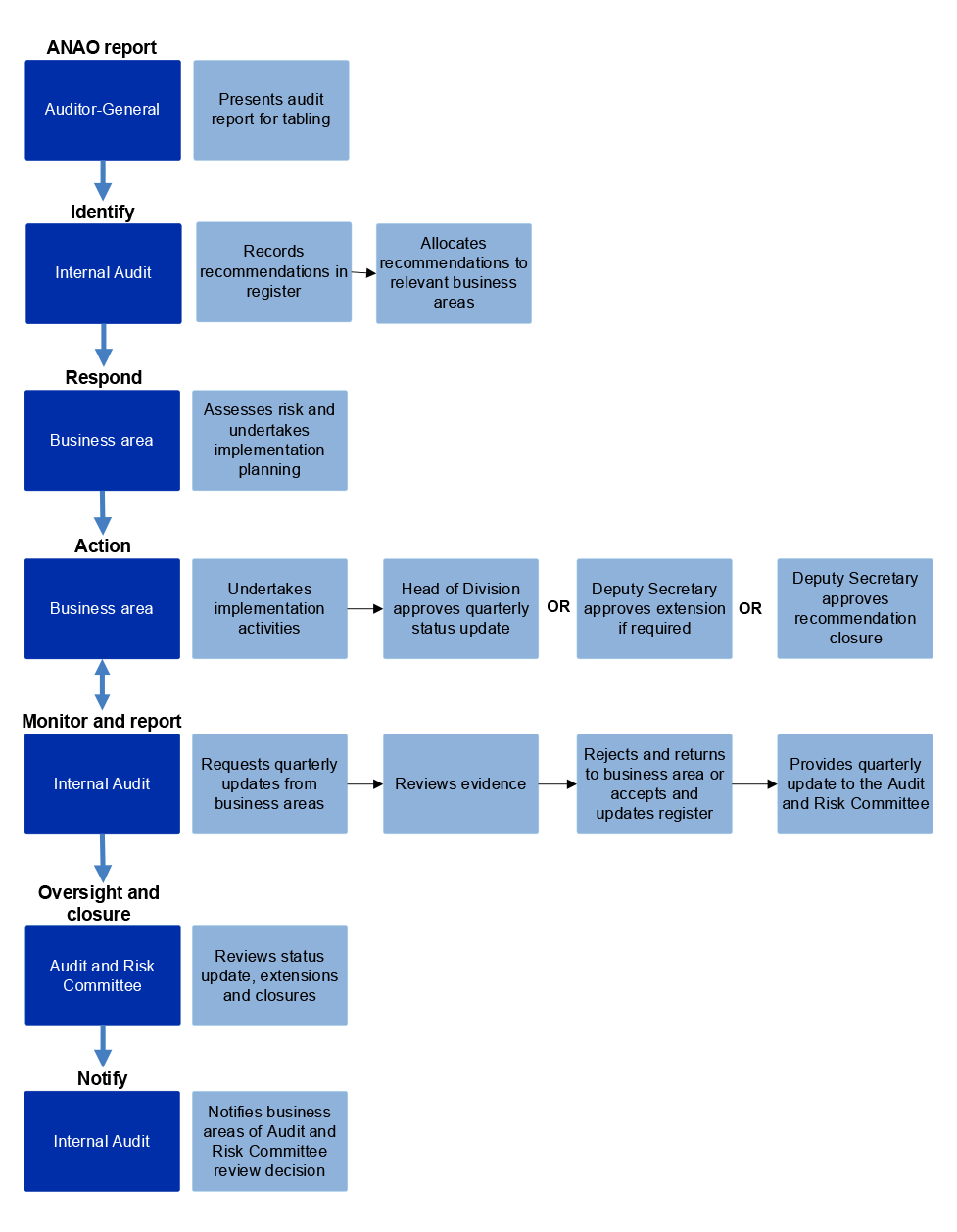
2.6 DISR has a documented process for monitoring implementation and closing ANAO recommendations. Figure 2.1 sets out the process, roles and responsibilities.
Figure 2.1: ANAO recommendation implementation roles and responsibilities
Source: ANAO analysis of DISR documentation.
2.7 The Chief Internal Auditor records in a central register (the recommendation register) all ANAO recommendations for DISR, allocating these to relevant business areas. DISR’s standard operating procedure advises that it generally requires that business areas implement ANAO recommendations within 12 months of report tabling ‘unless the tabled ANAO report has specified a different timeframe’. Internal Audit oversees the implementation process by following up with business areas, reviewing evidence and reporting to the Audit and Risk Committee (ARC). It updates the recommendation register on implementation progress.
2.8 For each ANAO recommendation, business areas assess risks, plan, undertake implementation activities and report progress to Internal Audit quarterly. The Head of Division (SES Band 2) endorses these quarterly updates, and the Deputy Secretary (SES Band 3) oversees, validates and approves recommendation extension if relevant and closure. The Chief Internal Auditor reviews documentary evidence and action to support implementation status, delegate endorsement and action taken, and briefs the ARC each quarter. This briefing includes:
- number of open, closed and overdue recommendations;
- status by business area;
- comments on delays and escalations; and
- summary of activities undertaken by relevant business areas to implement each open recommendation.
2.9 The Chief Internal Auditor provides the ARC with recommendation closure reports for each ANAO recommendation. These summarise the intent of the recommendation, provide an assessment of business area evidence of implementation and support recommendation closure. The internal documentation describes the ARC’s role as to consider and endorse or reject the status for each recommendation, with DISR advising the ANAO in December 2025 that it considers ARC endorsement final approval. The Chief Internal Auditor advises business areas of the ARC review outcome, specifying additional work or evidence required as necessary. The Chief Internal Auditor also briefs the Performance and Risk Committee (PaRC) (see paragraphs 2.11 and 2.12).
Reporting to governance committees
Audit and Risk Committee
2.10 The ARC charter provides that it will ‘review … ANAO audit reports … and the implementation of agreed actions in accordance with the department’s agreed approach.’ DISR’s Internal Audit documentation describes the role of the ARC as to ‘review and endorse the implementation status, extension, and closure requests’ (standard operating procedure) and to ‘approve’ them for closure (protocols). For the two in-scope audits the documented ARC outcomes referred to it ‘endorsing’ or ‘noting’ recommendations (for example, see paragraphs 2.17 and 2.22). The Chief Internal Auditor provides quarterly updates together with a copy of the recommendation register.
Performance and Risk Committee
2.11 The PaRC was established in February 2023 and is one of three sub-committees of the DISR Executive Board. It provides strategic direction on:
implementation and prioritisation of programs, projects, policy, legislation, complex procurements and grants, to ensure effective progress and tracking of the department’s key outcomes and management … [and] annual Audit program planning and monitoring of implementation of recommendations from internal and external audits.
2.12 It oversees DISR’s enterprise risk maturity, monitors performance measures, tracks implementation of audit recommendations and monitors key risks. Membership consists of the Chair (Deputy Secretary), the Deputy Chair (Head of Division nominated by the Executive Board), and up to eight departmental SES Band 2 and SES Band 1 members appointed by the Executive Board. It meets monthly or as determined by the chair. The Chief Internal Auditor briefs the PaRC around five times a year and shares the recommendation register.
Assessing implementation risk
2.13 DISR assigns risk ratings and corresponding delegation level for sign-off to its internal audit recommendations. DISR does not assign risk ratings to ANAO recommendations at an enterprise level but requires head of division and deputy secretary sign-off for progress updates and closure, corresponding with delegation levels applied to high-risk internal audit recommendations. Business areas are responsible for assessing risk and planning and implementing recommendations as required. They do not assess risks or issues identified in ANAO reports at the enterprise level. Entities should ensure that they address the risks or issues that led to a recommendation across all operations. DISR does not capture in its process documents how it ensures that risks or lessons are addressed and embedded across the entity.
Recommendation no.1
2.14 The Department of Industry, Science and Resources document in its procedures how it will assess whether Auditor-General recommendations are relevant at the enterprise level and what action needs to be taken across the department.
Department of Industry, Science and Resources response: Agreed
2.15 The department will document procedures to support the continued assessment of the enterprise-wide relevance of Auditor-General recommendations, and where relevant will take necessary action.
Did DISR close the recommendations in accordance with implementation process requirements and relevant timeframes?
DISR closed all Entrepreneurs’ Programme recommendations and five of the six NMI recommendations within established timeframes. For one NMI recommendation it exceeded the extended timeframe. DISR could document a process to confirm that its implementation activities have achieved the intended outcomes and ensure it realises the full benefits across the enterprise.
Procurement of Delivery Partners for the Entrepreneurs’ Programme report recommendations
2.16 DISR agreed to nine and agreed in principle to one of the 10 recommendations made in the audit and reported on implementation progress as required (see Appendix 4). It allocated the closure date of 24 June 2023 for implementation of all 10 recommendations. DISR followed its documented process to monitor implementation, report to the ARC and close the 10 recommendations.
2.17 On 17 November 2022 the Chief Internal Auditor advised the ARC that all recommendations were in progress and on track for completion, with updates endorsed by the Head of Division, AusIndustry. The ARC noted the update. A December 2022 departmental restructure separated responsibility for the recommendations so that the Grants Delivery and Business Services division oversaw implementation of procurement-related recommendations and AusIndustry those related to the Entrepreneurs’ Programme. On 23 March 2023 Internal Audit reported to the ARC on implementation progress for each recommendation, with recommendations 1, 2, 3, 4, 5, 8 and 10 endorsed by the Head of Division, Grants Delivery and Business Services, and recommendations 5, 6, 7, 8 and 9 by the Head of Division, AusIndustry. The ARC noted the status of the recommendations at both meetings. On 3 May 2023 the Deputy Secretary, Enabling and Business Services Group, approved closure of all 10 recommendations. On 16 June 2023 the ARC noted closure of the recommendations.
Recommendation closure briefing
2.18 On 3 February 2023 DISR prepared a briefing to the Deputy Secretary to close the 10 recommendations. The brief included a 531-page evidence package, noted the audit findings on ‘serious non-compliance with the Commonwealth Procurement Rules, an inability to demonstrate value for money and a failure to management [sic] probity risks’, and stated that DISR had accepted the deficiencies identified and agreed to implement all recommendations.
2.19 The briefing also described the actions taken to address the recommendations. This included the taskforce established to address the findings and recommendations and assure a sample of high-risk/high-value procurements, and new processes and requirements to be established under the business improvement framework (see paragraph 2.34). The briefing set out that DISR had addressed the findings specific to the Entrepreneurs’ Programme, procurement, capability and probity, and described its activities on cultural change and improving Executive visibility of similar projects and programs. The evidence package included its published response to each recommendation and all documentation developed or updated to support closure of the recommendations — such as updated conflict-of-interest, procurement and probity policies; intranet guidance; SES-specific guidance and tip sheets; templates; and training slides. The briefing was approved by the Deputy Secretary on 3 May 2023.
2.20 The briefing did not refer to any testing/assurance of the actions taken to address the recommendations before recommending closure. Testing would provide assurance that its activities achieved the intent of the recommendation.
Trade Measurement Compliance Activities report recommendations
2.21 DISR agreed to five and partially agreed to one of the six recommendations made in the audit and reported on implementation progress as required (see Appendix 4). It allocated the closure date of 5 September 2024 for implementation of all six recommendations. DISR followed its documented process to monitor implementation, report to the ARC and close the six recommendations.
2.22 On 15 November 2023, 21 March 2024 and 13 June 2024 Internal Audit advised the ARC that implementation was in progress and on track for all recommendations, with updates endorsed by the NMI Head of Division. The ARC noted the status of the recommendations at each meeting. DISR closed the recommendations as follows:
- On 8 July 2024 the Deputy Secretary, Science and Technology Group, approved closure of recommendation 1.
- On 16 August 2024 Internal Audit reported closure of recommendation 1 to the ARC and advised that recommendations 2 to 6 were in progress and on track for completion, with updates endorsed by the Head of Division. On 16 August 2024 the ARC endorsed closure of recommendation 1. On 12 September 2024 the Deputy Secretary approved closure of recommendations 2 to 5 and an extension for recommendation 6 to 2 February 2025. On 19 November 2024 the ARC endorsed closure of these recommendations (2 to 5).
- On 5 November 2024 the Deputy Secretary approved an additional extension for recommendation 6 to 28 February 2025. On 14 March 2025 the Deputy Secretary approved closure of recommendation 6. On 20 March 2025 the ARC asked for further information on the evidence to close the recommendation. On 17 June 2025 the ARC endorsed closure.
Recommendation closure briefing
2.23 On 2 July 2024 DISR prepared a briefing to the Deputy Secretary, Science and Technology Group, to close recommendation 1 (approved on 8 July 2024). The brief noted that the ANAO recommendations went to ‘strengthening the NMI’s governance arrangements and improving its approach to compliance’ and that the NMI had agreed to implement the recommendations. The brief provided a table of evidence and attached relevant documentation.
2.24 On 3 September 2024 DISR prepared a brief to the Deputy Secretary, Science and Technology Group, to close recommendations 2 to 5. DISR attached a document providing the text of the recommendations, summaries of its responses and supporting evidence, procedures, manuals, policies, a risk assessment, a meeting record and database changes.
2.25 On 3 March 2025 DISR prepared a brief to the Deputy Secretary, Science and Technology Group, to close recommendation 6. DISR included the text of the recommendation and set out actions taken to address it: updating and reporting on its annual priorities, updating its performance measures, and receiving the ministerial statement of expectations and preparing its regulator statement of intent. The brief provided a table of evidence and attached relevant documentation. The Deputy Secretary approved the brief on 14 March 2025.
2.26 DISR followed its process and met its timeframes to implement five of the six Trade Measurement Compliance Activities recommendations. For the remaining recommendation, it sought two extensions and closed the recommendation after the date approved for the second extension (see paragraph 2.22).
2.27 DISR did not routinely undertake testing of its implementation actions for the six recommendations for assurance on appropriateness in addressing intent of the recommendation before closure.
2.28 DISR could establish and document a process to confirm that its implementation of ANAO and parliamentary recommendations has achieved the intended outcome through ongoing assurance where appropriate. It could consider having the ARC identify suitable recommendations such as those with broader implications across the enterprise.
2.29 The ANAO surveys entities two years after audits have been tabled on whether they have implemented the recommendations (see paragraph 1.2). DISR reported closure of Procurement of Delivery Partners for the Entrepreneurs’ Programme report recommendations in the ANAO’s July 2024 survey (after it closed the recommendations in June 2023). The ANAO has not yet surveyed DISR on its implementation of the Trade Measurement Compliance Activities report recommendations.
Did DISR implement the recommendations in full and to meet the intent of the recommendations?
DISR implemented 12 of the 16 recommendations, largely implemented three and partly implemented one. For the Entrepreneurs’ Programme recommendations DISR took an enterprise-wide approach to implementation and uplift of its procurement practices. DISR could have improved its approach to implementation of the NMI recommendations by addressing intent more broadly and fully embedding revised practices. DISR could have improved its approach to implementation of NMI recommendations by ensuring it fully addressed intent before closure, with it finalising activities for one closed recommendation during the audit. DISR introduced or updated several controls to implement the recommendations and following closure established some ongoing internal assurance processes, particularly in enterprise-wide procurement assurance activities. This assurance indicates DISR has opportunities to continue monitoring on a risk basis to address the recommendation intent, fully rectify the deficiencies identified and ensure improvements are embedded.
2.30 The ANAO assessed the implementation status of the 10 Procurement of Delivery Partners for the Entrepreneurs’ Programme report recommendations (Table 2.2) and the six Trade Measurement Compliance Activities report recommendations (Table 2.3), and noted assurance activities undertaken as at November 2025. The ANAO implementation assessment categories used by the audit team to assess the implementation status are set out in Table 1.1.
Summary of implementation of report recommendations
2.31 Table 2.1 provides a summary of the ANAO’s assessment of DISR’s implementation of the 16 recommendations in scope.
Table 2.1: ANAO assessment of implementation status, recommendations in scope
|
Entrepreneurs’ Programmea
|
9
|
1
|
–
|
–
|
–
|
10
|
|
National Measurement Instituteb
|
3
|
2
|
1
|
–
|
–
|
6
|
|
Total
|
12
|
3
|
1
|
–
|
–
|
16
|
| |
|
|
|
|
|
|
Note a: Procurement of Delivery Partners for the Entrepreneurs’ Programme, ANAO report tabled June 2022.
Note b: Trade Measurement Compliance Activities, ANAO report tabled September 2023.
Source: ANAO analysis of DISR’s recommendation closure activities.
Procurement of Delivery Partners for the Entrepreneurs’ Programme report recommendations
2.32 Table 2.2 sets out the audit recommendations, DISR’s assessment and results of the ANAO’s assessment of the implementation.
Table 2.2: Procurement of Delivery Partners for the Entrepreneurs’ Programme, implementation of recommendations, summary
|
1
|
When planning to employ a staged process to evaluating tenders, the Department of Industry, Science, Energy and Resources clearly identify this in its approach to market along with the criteria that will be used to shortlist potential suppliers, and if applicable, any expected limits on the number of potential suppliers that will be shortlisted at each stage.
|
Implemented
|
Implemented
|
2.39 to 2.41
|
|
2
|
When evaluating tender responses, the Department of Industry, Science, Energy and Resources fully evaluate responses received consistent with the approach set out in the approach to the market, with the results of this work relied upon to select the successful candidate(s).
|
Implemented
|
Implemented
|
2.42 to 2.43
|
|
3
|
The Department of Industry, Science, Energy and Resources improve its procurement framework to specifically address the engagement of probity advisers, including ensuring that advisers are independent and objective by not engaging the same probity advisers on an ongoing or serial basis.
|
Implemented
|
Largely implemented
|
2.44 to 2.46
|
|
4
|
The Department of Industry, Science, Energy and Resources improve its procurement framework to specifically address how it will manage the risk of any incumbency advantages when conducting procurement processes.
|
Implemented
|
Implemented
|
2.47 to 2.49
|
|
5
|
The Department of Industry, Science, Energy and Resources improve its procurement record keeping so that accurate and concise information exists on:
- the process that was followed;
- how value for money was considered and achieved;
- relevant approvals; and
- relevant decisions and basis of those decisions.
|
Implemented
|
Implemented
|
2.50 to 2.51
|
|
6
|
The Department of Industry, Science, Energy and Resources:
- not exercise the extension options in the awarded contracts;
- commences work to conduct a new procurement process that will be completed before the existing contracts expire on 30 June 2023; and
- conducts the next procurement process in a manner that fully complies with the Commonwealth Procurement Rules.
|
Implemented
|
Implemented
|
2.52
|
|
7
|
The Department of Industry, Science, Energy and Resources develop contract management plans for each of the delivery partner contracts.
|
Implemented
|
Implemented
|
2.53
|
|
8
|
The Department of Industry, Science, Energy and Resources adopt a proactive approach to managing delivery partner conflicts of interest by:
- ensuring conflict of interest declarations are completed, updated regularly or their ongoing currency otherwise confirmed; and
- regular review of delivery partner reporting of conflict of interest in order to monitor compliance with contractual obligations.
|
Implemented
|
Implemented
|
2.54
|
|
9
|
The Department of Industry, Science, Energy and Resources strengthen its management of the Entrepreneurs’ Programme delivery contracts, including by taking prompt action in circumstances where delivery deadlines are not met and verifying that services have been provided before payments are made.
|
Implemented
|
Implemented
|
2.55
|
|
10
|
When contracting for the delivery of services, the Department of Industry, Science, Energy and Resources apply competitive pressure when establishing performance expectations, and how these will relate to contractual payments. This can be achieved by the department setting out its expected performance management system and standards in the approach to the market documentation, or by asking respondents to set out their proposals to inform a comparative evaluation.
|
Implemented
|
Implemented
|
2.56 to 2.57
|
| |
|
|
|
|
Source: DISR and ANAO analysis of DISR’s recommendation closure activities.
2.33 Recommendations 1, 2, 3, 4, 5 and 10 related to enterprise-wide procurement and contract management, and recommendations 6, 7, 8 and 9 to the Entrepreneurs’ Programme specifically. DISR undertook activities at the enterprise-wide level and to address specific Entrepreneurs’ Programme recommendations, and has continued enterprise-wide assurance and improvement activities past closing the recommendations. This section sets out DISR’s enterprise-wide actions in response to the report, its activities in addressing each recommendation, ANAO testing of the effectiveness of these as applied to its Industry Growth Program (IGP) procurement (see paragraph 2.58 and Case study 1) and DISR’s ongoing procurement governance activities.
Initial enterprise-wide response activities
2.34 In July 2022 DISR established the Enterprise Program and Probity Review Taskforce to ‘review the department’s approach to the administration of grants programs, procurement, and contract management.’ The taskforce updated the ARC in August 2022, noting the significance of the ANAO findings on probity, procurement and contract management and activities it had undertaken to date. It advised that it was ‘actively working to address the issues as a matter of priority’, focusing on probity governance, procurement and contract management, grant administration, forming a program management office, and enterprise governance and assurance. It set out its objective to:
Design, coordinate and implement Enterprise Reform initiatives to address ANAO/internal Audit and Assurance Review recommendations to strengthen Program Design and Delivery across the lifecycle, including Probity, Procurement, Contract Management, Grants and Governance and Assurance.
2.35 Internal Audit noted in its update to the ARC at that meeting that several ANAO reports tabled over the preceding 18 months had identified the need to improve departmental conflict-of-interest and probity frameworks, and reported that DISR had engaged an external consultant to audit the effectiveness of DISR’s implementation of related ANAO recommendations and compliance with these frameworks. It proposed an internal audit of conflict-of-interest and probity frameworks.
2.36 The ARC at its August 2022 meeting noted the establishment of the taskforce and its progress to date, and agreed to make the taskforce a standing agenda item. In quarter 3, 2022–23, DISR reclassified operational risk 3 (‘Ensuring the department maintains good governance and ethical standards and adheres to our legal obligations’) as amber, noting work on integrity the department had commenced but not yet embedded and classification of future procurement risk management as adequate in divisional risk registers.
2.37 In November 2022 the taskforce updated the ARC on progress to address the ANAO recommendations. It attached a document setting out its three-phase work plan: stabilise (establish governance structures — September to October 2022), foundation (identify and develop actions — October 2022 to March 2023) and implementation (hand over to business areas — April 2023). In the foundation phase the taskforce commissioned RSM Australia Pty Ltd to undertake a review of procurements across DISR to ‘identify the broader enterprise level themes around the effectiveness of procurement and contract management activities across the department’. In March 2023 RSM made 12 recommendations — relating to documenting procurement planning including on probity and conflicts of interest, assessing risk across the procurement and contract management life cycles, and formalising records management.
2.38 The taskforce updated the ARC at its March 2023 meeting on activities undertaken and advised that all 10 ANAO recommendations were on track for closure in June 2023. In May 2023 DISR established an Integrity Branch, which subsumed the taskforce. In June 2023 the ARC noted closure of the recommendations.
Implementation of individual recommendations
Recommendation 1 (implemented)
When planning to employ a staged process to evaluating tenders, the Department of Industry, Science, Energy and Resources clearly identify this in its approach to market along with the criteria that will be used to shortlist potential suppliers, and if applicable, any expected limits on the number of potential suppliers that will be shortlisted at each stage.
2.39 DISR updated its Procurement Policy (November 2022), request for offer template and procurement intranet pages to include advice that for a multistage procurement process the initial approach to market must include, for every stage, the criteria that will be used to select potential suppliers. DISR advised the ANAO in December 2025 that it updated its request for tender template in April 2023, and it included this in its closure documentation for recommendation 10. DISR included its draft Probity Framework in the closure briefing. It set out the requirement for fair treatment and transparent processes, accountability and transparency, and an instruction to contact the ‘central probity function’ or visit the probity intranet page for advice. DISR’s Procurement Policy and request for tender template include the instruction that the initial approach to market must include, for every stage, any limitations on the number of potential suppliers to be shortlisted.
2.40 Its procurement intranet pages and request for offer and tender templates instruct officials to include criteria and weighting for evaluating tenders in the request for tender and align these with the evaluation plan. It advises delegates to confirm that approach-to-market documentation includes evaluation criteria and methodology, and that these are consistent with the tender evaluation plan.
2.41 In its July 2023 request for tender for IGP advisers, DISR included the selection criteria and advice that it would apply a multi-stage evaluation process (see paragraph 2.58 and Case study 1). In July 2024 DISR introduced a procurement e-form through which the central procurement team reviews and provides advice across procurements (see paragraphs 2.60 and 2.61). This requires that officers:
- determine how they will evaluate responses before approaching the market and prepare an evaluation plan;
- only use criteria in the approach to market to assess tenderers; and
- make clear any intention to use a staged process to evaluate tenders and number of tenderers for shortlisting.
Recommendation 2 (implemented)
When evaluating tender responses, the Department of Industry, Science, Energy and Resources fully evaluate responses received consistent with the approach set out in the approach to the market, with the results of this work relied upon to select the successful candidate(s).
2.42 DISR’s Procurement Policy (November 2022) provides that supplier responses must be assessed against the statement of requirements and evaluation criteria. Procurement intranet pages advise that assessment panels must use the evaluation criteria in the evaluation plan to assess the responses and identify the one that represents best value for money. Delegate guidance emphasises robustness of process, consistency in application and logical and documented outcome. SES training and probity and procurement factsheets cover governance arrangements and ensuring alignment of the evaluation report with the approach to market. DISR included its draft Probity Framework in the closure briefing, covering the need for fair treatment and transparent processes.
2.43 In its IGP procurement request for tender DISR included the selection criteria and advice on its intended multi-stage evaluation process, incorporated these into its evaluation and probity plans and applied these consistently (see Case study 1). The procurement e-form provides templates for evaluation process, preferred tenderer(s) and recommendations to the delegate (see paragraphs 2.60 and 2.61).
Recommendation 3 (largely implemented)
The Department of Industry, Science, Energy and Resources improve its procurement framework to specifically address the engagement of probity advisers, including ensuring that advisers are independent and objective by not engaging the same probity advisers on an ongoing or serial basis.
2.44 DISR’s implementation activities did not fully address the recommendation intent. It describes risks related to repeated engagements of probity advisors in selected guidance and considers ongoing or repeated probity adviser engagement in its central procurement team assurance processes but has limited controls to identify these.
2.45 In its closure briefing DISR provided new or updated probity guidance, SES factsheets and training on probity, intranet advice on probity in procurement and its business improvement framework guidance. This included general advice on use of probity advisers and set out DISR’s expectation that officers avoid repeatedly engaging the same adviser but not on how overly frequent levels of engagement might be identified. DISR did not provide detail on the role and functions of probity advisers or differentiate between their role with respect to procurement and other departmental activities. For example:
- the draft Probity Framework provided general advice on appointing a probity adviser;
- the ‘Probity in procurement’ intranet page advises that officials should avoid using the same probity adviser regularly without considering other options because any perceived or real relationship may influence them towards the department; and
- advice for SES delegates notes that ‘probity advisers can lose their objectivity if constantly used throughout the department’.
2.46 DISR could embed for its ongoing assurance strengthened guidance on repeated and ongoing engagement of probity advisers. For the IGP procurement DISR engaged an external probity adviser but did not note on the approval documentation whether the department had used the adviser previously (see Case study 1). The procurement e-form does not refer to probity advisers but includes links to the procurement plan template and the ‘Probity in procurement’ intranet page (see paragraphs 2.60 and 2.61, and paragraph 2.45). The template provides guidance on engagement and use of a probity adviser. Use of the template is optional — the delegate determines the complexity of the procurement based on risk and therefore whether to complete and provide a procurement plan using the template for review.,
Recommendation 4 (implemented)
The Department of Industry, Science, Energy and Resources improve its procurement framework to specifically address how it will manage the risk of any incumbency advantages when conducting procurement processes.
2.47 To close the recommendation DISR addressed incumbency risk through its probity framework:
- The draft Probity Framework advises that officials must manage probity to ensure that existing suppliers do not receive an unfair advantage and includes high-level controls that should be put in place for procurement, such as disclosing information to all potential suppliers to limit any advantage held by the current supplier.
- Probity and Conflict of Interest training advised delegates to ensure that procurement teams manage incumbency fairly and preserve the integrity of the process in their interactions with incumbent providers.
- The Probity in Procurement factsheet for SES advises delegates to check for incumbency bias and ensure that it is managed adequately.
- The Probity Principles intranet page provides guidance on managing probity to minimise risk of advantaging incumbent suppliers.
2.48 ANAO testing of the IGP adviser procurement indicated that DISR established measures to manage incumbency risk (see Case study 1). The external probity adviser concluded that these measures were ‘reasonable’, noting that:
- 12 of the 19 tenderers it found suitable were incumbent;
- the evaluation panel agreed on a ‘reasonable price’ after closure of the request for tender, with some non-incumbent tenderers excluded due to their quoted price; and
- for the next IGP procurement the market would be aware of pricing.
2.49 DISR may further improve its approach to managing incumbency risk in procurement — for example, by considering depending on context whether to disclose pricing information (such as estimated or indicative pricing) as part of an approach to market to provide clarity on its expectations to new market entrants. The procurement e-form advises officers that procurements with high incumbency risk may require increased support and oversight (see paragraphs 2.60 and 2.61). It requires delegates to confirm that they have considered incumbency risk and to note whether suppliers or their personnel have worked with the department in the previous 12 months.
Recommendation 5 (implemented)
The Department of Industry, Science, Energy and Resources improve its procurement record keeping so that accurate and concise information exists on:
- the process that was followed;
- how value for money was considered and achieved;
- relevant approvals; and
- relevant decisions and basis of those decisions.
2.50 DISR updated its procurement guidance for delegates to use when approving an approach to market and entering into a contract. For example, it requires delegates to:
- confirm that all procurement documentation has been completed and the process is consistent with the planned approach; and
- provide approval if they ‘are satisfied that the attached documentation provides you with sufficient information and evidence to fully inform your decision’.
2.51 ANAO testing of the IGP adviser procurement indicated that DISR kept accurate records (see Case study 1). The procurement e-form requires that officers document and justify the process followed, value-for-money justification and approvals, and attach mandatory supporting documentation (see paragraphs 2.60 and 2.61). This becomes DISR’s official record of the procurement.
Recommendation 6 (implemented)
The Department of Industry, Science, Energy and Resources:
- not exercise the extension options in the awarded contracts;
- commences work to conduct a new procurement process that will be completed before the existing contracts expire on 30 June 2023; and
- conducts the next procurement process in a manner that fully complies with the Commonwealth Procurement Rules.
2.52 On 9 May 2023 the Australian Government closed the Entrepreneurs’ Programme and on 10 May 2023 announced the IGP. DISR did not exercise the Entrepreneurs’ Programme suppliers contract extension option past 30 June 2023.
Recommendation 7 (implemented)
The Department of Industry, Science, Energy and Resources develop contract management plans for each of the delivery partner contracts.
2.53 DISR put in place contract management plans for each delivery partner before the Entrepreneurs’ Programme closure. DISR sought Department of Finance guidance in developing the plans and implemented suggestions. DISR also developed a compliance plan for all delivery partners. The compliance plan sets out the actions to be taken by the delivery partners (in accordance with the delivery contract) for each relevant month over a financial year.
Recommendation 8 (implemented)
The Department of Industry, Science, Energy and Resources adopt a proactive approach to managing delivery partner conflicts of interest by:
- ensuring conflict of interest declarations are completed, updated regularly or their ongoing currency otherwise confirmed; and
- regular review of delivery partner reporting of conflict of interest in order to monitor compliance with contractual obligations.
2.54 In September 2022 DISR surveyed delivery partners on their management of facilitator conflicts of interest and their maintenance of conflict-of-interest registers. It collated these into a spreadsheet and highlighted those that met contract requirements, were unclear or did not meet requirements. In November 2022 DISR advised all delivery partners of the key components of its conflict-of-interest processes to minimise risk, record conflicts and escalate issues appropriately. These included requirements that facilitators (engaged by delivery partners) attend mandatory training, and make declarations annually and each time they engage a new client.
Recommendation 9 (implemented)
The Department of Industry, Science, Energy and Resources strengthen its management of the Entrepreneurs’ Programme delivery contracts, including by taking prompt action in circumstances where delivery deadlines are not met and verifying that services have been provided before payments are made.
2.55 DISR established standard operating procedures for processing Entrepreneurs’ Programme delivery partner invoices. These set out the actions and tasks to verify and approve that services had been delivered to meet contractual obligations before payments were made. The Service Verification Checklist quality criteria captured the verification assessment. The Performance and Capability Policy set out performance support and measurement for the Entrepreneurs’ Programme. It included a process for managing delivery partner performance and advised contract managers that, where services have not been received in line with contractual obligations, they must investigate and resolve or implement a mitigation plan.
Recommendation 10 (implemented)
When contracting for the delivery of services, the Department of Industry, Science, Energy and Resources apply competitive pressure when establishing performance expectations, and how these will relate to contractual payments. This can be achieved by the department setting out its expected performance management system and standards in the approach to the market documentation, or by asking respondents to set out their proposals to inform a comparative evaluation.
2.56 DISR’s request for tender and contract templates include guidance on performance measures and performance assessment clauses. These advise officials to include specific deliverables, timing, performance standards, progress reports and meeting requirements in request for tender documentation and to advise officials to demonstrate in their response how they have the capacity and capability to provide the goods/services consistent with the statement of requirements. The contract template for services includes a section on measuring contractor performance. This covers meeting frequency and type, reporting, assessment against performance criteria, approach to performance management and rectification should services not meet contractual requirements. It requires that the contractor not invoice DISR for services not provided or not provided to the standard set out in the contract, and that DISR may defer or reduce the payment amount if the contractor does not supply the services to its satisfaction. It also includes a right to terminate should the contractor fail to meet the contractual obligations twice or more.
2.57 The IGP request for tender documentation detailed performance management requirements (see Case study 1).
Industry Growth Program
2.58 The aim of the IGP is to support small-to-medium businesses to commercialise or grow to build capability in National Reconstruction Fund priority areas such as renewables, medical science and value-add for primary industries (see paragraph 2.52). It includes a selection of advisers to deliver specialised advice and had initial funding of $392 million over four years from 2023–24. On 19 July 2023 the IGP issued its initial request for tender for advisers, and the program launched in November 2023. The ANAO reviewed the initial IGP procurement process for compliance with DISR’s updated policies and procedures, and relevant Commonwealth Procurement Rules (CPRs) based on recommendation 6 (CPRs 6.6, 7.2, 7.3, 7.15 and 10.8). See Case study 1.
|
Approach to market documentation and evaluation
The IGP adviser procurement request for tender included the selection criteria and advised that DISR would apply a multi-stage evaluation process. It stated that DISR would engage up to 20 contractors and did not specify a limit on the number of advisers to be assessed at each stage. This was consistent with the evaluation plan. It also included the shortlisting criteria and scoring methodology. The tender assessment panel undertook this process consistent with the approved evaluation and probity plans.
Probity advisers, incumbency advantage and conflicts of interest
DISR engaged external probity provider Procure Group (Procure) from the whole-of-government Management Advisory Services (MAS) Panel to advise on its IGP adviser procurement tender evaluation. The approval documentation did not note whether the department had used this provider previously (see paragraph 2.46).
DISR acknowledged the risk in the probity plan that former Entrepreneurs’ Programme advisers may have an incumbency advantage and set out how it would manage this risk (for example, by not involving Entrepreneurs’ Programme advisers in the program design and not preferencing Entrepreneurs’ Programme adviser experience in its evaluation over any other relevant experience), concluding that its controls led to low residual risk.a
Procure noted in its report that DISR mitigated incumbent advantage through ‘reasonable’ measures including defining service specifications clearly, having DISR staff solely design the program and prepare tender documentation, and the tender assessment panel discussing incumbency and its appetite to include non-incumbents in the program (see paragraphs 2.47 to 2.49).b
The tender assessment panel recommended 19 tenderers, with 11 of those having been involved in the Entrepreneurs’ Programme and one in a separate DISR program. Procure noted that the tender assessment panel had rated several other non-incumbent tenderers highly on their technical capability but ultimately excluded them due to their prices exceeding the ‘reasonable price’ it had determined and other tenderer quotes. Procure’s assessment indicates that the panel discussed incumbency advantage and evaluated the tenders impartially. It reported that the tender assessment panel:
speculated that incumbents understood the likely quantum of the Reasonable Price and noted that for future Adviser procurements the contract values for this procurement will have been publicly disclosed, providing the market with a benchmark.
The probity plan set out measures for managing conflicts of interest and conditions relating to gifts, hospitality and business opportunities. Procure noted that it had not identified probity issues or unresolved conflicts of interest. It did not consider declared associations actual conflicts — including those it identified as ‘largely professional’ or ‘occasional personal’ — concluding that they were appropriately managed. It also noted that, where a tender assessment panel member had an association with a referee, the member did not participate in related discussions.
Record keeping and value-for-money assessment
DISR documented the procurement process, value-for-money justification and approvals. The tender assessment panel shortlisted 40 tenders, after excluding those it considered to offer low technical competence, high price or insufficient service. For the 40 shortlisted it evaluated value for money by analysing price, ‘normalising’ responses and comparing against the reasonable price.c The panel considered non-weighted criteria concurrently and then reviewed its rankings against final risk ratings to assess whether it needed to further consider any of its value-for-money assessments. It did not alter any of the value-for-money ratings following this review. It further shortlisted 27 tenders for interview and subsequently recommended 19 to the Deputy Secretary for approval. The panel recorded the value-for-money assessments and results in an evaluation matrix, and included this in the briefing.
Contract and performance management
DISR established contract management plans for each IGP adviser. Each one included a conflict-of-interest declaration with a requirement that advisers update it annually. IGP staff maintain a central adviser conflict-of-interest and probity register, noting conflicts and management responses. The IGP Executive Director meets fortnightly with advisers and confirms that their conflict-of-interest declarations are completed and updated regularly.d
DISR’s IGP performance management framework sets out adviser performance standards, expectations, assessment and reporting. It includes a standard procedure for verifying service delivery before approving invoices, six-monthly performance meetings (which DISR documents in a performance assessment report) and processes for managing poor performance. Examples of the report noted discussion on service delivery, adviser behaviours and values, quality and satisfaction of adviser services, provided service plans for the forthcoming six months and concluded that the adviser met performance requirements. In July 2025 DISR identified that an adviser had not met contract requirements and reduced the corresponding monthly payment accordingly.
The IGP request for tender documentation included scope of services, key deliverables, roles and responsibilities, and performance management. It detailed scope, deliverables and performance management requirements — including quarterly reviews, invoice verification and processes to address poor performance — and advised that DISR would add an initial performance management plan to the contract on commencement of the service and review it quarterly.e The template contract included in the request for tender reflects the performance expectations set out in the statement of requirements.
|
Note a: The probity plan did not address risk related to tenderers who had previously or were currently providing goods or services to DISR other than with respect to the Entrepreneurs’ Programme.
Note b: In Procurement of Delivery Partners for the Entrepreneurs’ Programme (paragraph 2.91), the ANAO found that DISER had engaged five of the 10 incumbent providers in redesign before commencing the request for tender. See Auditor-General Report No. 42 2021–22, Procurement of Delivery Partners for the Entrepreneurs’ Programme.
Note c: The panel used a normalising process to standardise responses to enable a like-for-like comparison. For example, where tenders specified a different number of working days each week but the same overall fee, the panel calculated an hourly rate for fair evaluation.
Note d: The IGP Executive Director oversees the program and supports the advisers.
Note e: DISR advised the ANAO in December 2025 that it did not provide tenderers with any additional information. In Procurement of Delivery Partners for the Entrepreneurs’ Programme (paragraph 2.117), the ANAO found that during the procurement process the department had met with a tenderer and provided additional information but not offered this opportunity to other tenderers.
Enterprise-wide changes and risk management — procurement
2.59 After the closure of the recommendations DISR continued to roll out enterprise-wide changes to its procurement process. The ANAO reviewed DISR’s approach to managing similar risks and ensuring the effectiveness of its updated controls.
Procurement e-form
2.60 On 1 July 2024 DISR introduced the procurement e-form for all procurements over $10,000 to address issues raised by RSM Australia Pty Ltd in its review (see paragraph 2.37). The purpose of the e-form is to ‘bring procurement planning forward in the procurement process, provide earlier visibility of procurements to delegates and to ensure complete procurement information is captured by TechnologyOne’. DISR staff must use the form to plan and seek relevant approvals. It covers three stages: approval to approach the market, section 23(3) approval and contract execution.
2.61 After the officer completes each stage, the form automatically workflows to the central procurement team for review and comment or assistance. The procurement team has a standard operating procedure. After reviewing it forwards the form to the delegate for endorsement and approval when complete. The e-form will only progress with mandatory fields completed and relevant evidence attached (such as procurement plan, risk assessment, request for tender documents and conflict-of-interest declarations, and in addition for higher-value procurements an evaluation plan and report). The delegate must then declare that they are satisfied that the procurement approach is well documented and meets requirements of the CPRs. DISR advised the ANAO in December 2025 that up to 30 November 2025 it had reviewed 1,340 e-forms.
Procurement Quality Assessment Framework
2.62 On 11 October 2024 DISR launched its Procurement Quality Assessment Framework as a ‘risk-based approach to identify key procurement capability and compliance issues across DISR’. DISR advised the ANAO in July 2025 that it uses the procurement e-form data in applying the framework to identify systematic issues, trends and risks in procurement capability and practices through a structured and repeatable process, and to target training to address issues identified. The documentation sets out the phasing-in of the framework over 2024 and 2025, with the central procurement team initially conducting quality assurance for procurements under $80,000, broadening to include those under $200,000 and then all procurements — randomly selecting approximately 200 procurements annually. It notes that resourcing would comprise staff dedicated to the work full time plus staff rotating in and out. It assesses:
- compliance with rules, policies and guidelines;
- effectiveness of actions to enhance buying outcomes; and
- practices in managing the process effectively.
2.63 DISR advised the ANAO in December 2025 that up to 30 September 2025 it had assessed 107 procurements under $80,000 and 36 under $200,000. As at January 2026 it had not reviewed, analysed or reported on the assessments. The results of this analysis will be key to understanding the effectiveness of these reviews and identifying any areas for further improvement.
Internal audit
2.64 In April 2025 Internal Audit completed a review of the procurement e-form and Quality Assurance Framework under its 2024–25 Annual Internal Audit and Assurance Plan (see paragraphs 2.60 to 2.63). The Procurement and Contract Management Phase 1 report concluded that the e-form encourages early planning and delegate engagement, offers comprehensive guidance, and emphasises ethical considerations and value-for-money assessments, and that the team responsible records and acts on user feedback. It also found that application of the QA framework addresses compliance issues but identified opportunities for improvement. It made one recommendation related to QA activities (with closure endorsed by the ARC on 21 August 2025) and a management improvement suggestion for the e-form (to have been implemented by 31 January 2026). DISR does not document implementation and closure of management improvement suggestions.
2.65 The Annual Internal Audit and Assurance Plan 2024–2027 lists Procurement and Contract Management Phase 2 as a proposed audit for 2025–26.
Trade Measurement Compliance Activities report recommendations
2.66 Table 2.3 sets out the audit recommendations, DISR’s assessment and results of the ANAO’s assessment of the implementation.
Table 2.3: Trade Measurement Compliance Activities, implementation of recommendations, summary
|
1
|
The Department of Industry, Science and Resources implement stronger controls that ensure persons undertaking monitoring and compliance activities have been appointed in accordance with the relevant legislation, and that appropriate records are made and retained of all appointments.
|
Implemented
|
Implemented
|
2.68 to 2.70
|
|
2
|
The Department of Industry, Science and Resources improve its record keeping processes to ensure that trade measurement business information and records are accurate, fit-for-purpose and are appropriately stored within departmental systems.
|
Implemented
|
Implemented
|
2.71 to 2.72
|
|
3
|
The Department of Industry, Science and Resources put in place an improved approach to assessing the risk of legal metrology regulatory non-compliance at the industry and trader levels, and a transparent process that reflects the assessment of risk for selecting industries for targeting under its annual National Compliance Plans.
|
Implemented
|
Largely implemented
|
2.73 to 2.77
|
|
4
|
In its activities related to the Tobacco Plain Packaging Act 2011 and the Tobacco Plain Packaging Regulations 2011, the Department of Industry, Science and Resources ensures that:
- appropriate priority is given to its responsibilities under the National Measurement Act 1960;
- its directions to officers are limited to the undertaking of education and investigation activities to promote compliance with the provisions of the legislation; and
- it is complying with its duties and obligations to those officers under the Work Health and Safety Act 2011.
|
Implemented
|
Largely implemented
|
2.78 to 2.84
|
|
5
|
The Department of Industry, Science and Resources strengthen its approach to conducting follow-up audits where an initial trader audit identifies non-compliance such that follow-up activities are conducted in a timely manner, regulatory action taken where there is continuing non-compliance and appropriate records made and retained.
|
Implemented
|
Implemented
|
2.85 to 2.86
|
|
6
|
As regulator of Australia’s legal metrology system, the Department of Industry, Science and Resources:
- apply Resource Management Guide 128: Regulator Performance; and
- establish indicators of, and report on, the effectiveness of its regulatory approach.
|
Implemented
|
Partly implemented
|
2.87 to 2.90
|
| |
|
|
|
|
Source: DISR and ANAO analysis of DISR’s recommendation closure activities.
Implementation activities
2.67 DISR undertook several activities to address the individual recommendations but did not take an enterprise-wide approach to addressing similar risks in other DISR regulators (see paragraphs 2.91 to 2.97).
Recommendation 1 (implemented)
The Department of Industry, Science and Resources implement stronger controls that ensure persons undertaking monitoring and compliance activities have been appointed in accordance with the relevant legislation, and that appropriate records are made and retained of all appointments.
2.68 DISR formalised its process to appoint trade measurement inspectors in procedures on authorisations and appointments, and assisting and observing inspectors. These set out:
- the qualifications for a trade measurement inspector, the process for appointment and record-keeping requirements.
- the activities that an assistant (or trainee) trade measurement inspector, an observer and an assisting inspector can undertake under the National Measurement Act.
2.69 DISR introduced an instrument to record trade measurement inspector appointments and store these centrally in its enterprise records management system. It adds and removes inspector names from the instrument as required and conducts six-monthly reviews to monitor accuracy. DISR conducted its two most recent audits in March and October 2025. The March 2025 audit identified the requirement to remove four names, and the instrument was updated to reflect this. The October 2025 audit found no changes required. Two names had been removed from the instrument since the March audit.
2.70 DISR requires inspectors to return their documentation and destroys it if they leave DISR, if their role changes and their appointment is no longer required or if the delegate revokes their appointment. It reviews the list of appointed inspectors every six months for currency and accuracy.
Recommendation 2 (implemented)
The Department of Industry, Science and Resources improve its record keeping processes to ensure that trade measurement business information and records are accurate, fit-for-purpose and are appropriately stored within departmental systems.
2.71 DISR trained its administrative staff and inspectors in record keeping and storage in its Trade Measurement Activity Recording System (TMARS) database and created/updated procedures on supervisor responsibilities to check records. It also established a community of practice for TMARS.
2.72 The NMI Inspectors Manual covers inspector record-keeping procedures and combined instructions formerly spread across several documents. It specifies detail inspectors must include in notebooks and other evidence to be retained for follow-up reference. The manual together with TMARS training set out requirements for inspectors in recording/correcting trader business information. Inspector training includes instructions on trader audit document storage and instructions for SharePoint access. DISR produces monthly reports on inspector record keeping. It requires supervisors to quality check 20 per cent of records and upgraded TMARS to enable them to record these checks and subsequent actions. The ANAO reviewed the data quality checks undertaken for each of the 15 regions and all met the 20 per cent requirement, with results for records checked ranging from 21.8 per cent to 53.5 per cent.
Recommendation 3 (largely implemented)
The Department of Industry, Science and Resources put in place an improved approach to assessing the risk of legal metrology regulatory non-compliance at the industry and trader levels, and a transparent process that reflects the assessment of risk for selecting industries for targeting under its annual National Compliance Plans.
2.73 DISR’s implementation activities did not fully address the recommendation intent. The documents it included in the closure briefing set out its intention to take a risk-based approach to selecting industries and traders for its compliance program. ANAO’s testing and other external assessment indicates that DISR has not yet fully embedded this practice.
2.74 In July 2024 DISR updated its policy methodology and procedure on use of industry risk assessments, describing how it would use data to inform its risk-based approach to compliance programs. The methodology lists its risk priorities, with ‘significant harm’ at the top of the list. The procedure details how it will rank industries according to its risk assessments.
2.75 DISR included in the closure briefing Legal metrology priorities 2023–24 (published 1 February 2024) and Legal metrology priorities 2024–25 (published 26 August 2024) as examples of transparency in its compliance program target areas. These documents set out its approach to selecting program activities but do not describe how DISR based its selection of activities on risk. DISR advised the ANAO in July 2025 that these were strategic documents that represented the work of the relevant branch, noting that for future versions it intended to provide more clarity on its selection of target industries and traders.
2.76 In April 2024 DISR completed one-, three- and five-year industry risk assessments to inform its 2024–25 compliance program. DISR ranked industries by compliance risk using 2016 to 2024 data and the Australian and New Zealand Standard Industrial Classification (ANZSIC) code. The ANAO reviewed the alignment of DISR’s risk assessment with the 2024–25 compliance program and found that it included three of the 10 highest-ranked industries, and only documented its reasons for not including two of the remaining seven.
2.77 In May 2025 DISR engaged Nous Group to review its NMI compliance program risk framework, with Nous providing the report to DISR on 20 June 2025. It found that the NMI’s compliance program planning was not clearly linked to risk analysis, that it did not use all the data it had available, that its risk assessments did not effectively measure harm and that different business areas approached risk differently. It made eight recommendations, on NMI’s risk-based approach, data collection, risk analysis and compliance program planning and administration. Recommendation 6, that NMI ‘strengthen the compliance planning process to ensure it is risk informed, transparent, and responsive’, largely reflects the ANAO Trade Measurement Compliance Activities recommendation. DISR agreed to implement the Nous recommendations, and the delegate approved its implementation plan in October 2025.
Recommendation 4 (largely implemented)
In its activities related to the Tobacco Plain Packaging Act 2011 and the Tobacco Plain Packaging Regulations 2011, the Department of Industry, Science and Resources ensures that:
- appropriate priority is given to its responsibilities under the National Measurement Act 1960;
- its directions to officers are limited to the undertaking of education and investigation activities to promote compliance with the provisions of the legislation; and
- it is complying with its duties and obligations to those officers under the Work Health and Safety Act 2011.
2.78 DISR undertook implementation activities but did not fully address the intent of the first two parts of the recommendation. The ANAO found in Trade Measurement Compliance Activities that DISR prioritised its responsibilities under its memorandum of understanding (MOU) with the Department of Health and Aged Care on tobacco plain packaging over those provided for in its enabling legislation, with numbers of inspections planned and completed decreasing between 2017–18 and 2021–22. DISR’s implementation focused on updating documents to set out NMI functions and inspection activity reporting but did not make clear its process to allocate inspection activity effort to risks and in alignment with its priorities.
2.79 DISR updated documents to set out its core functions and map its priorities but did not map its resources to those priorities. In July 2024 NMI updated its compliance program governance policy to include its intention to conduct monthly reviews and reporting on alignment of its inspection activities with DISR priorities. It developed an activity statement template to set out business area responsibilities to achieve compliance program targets and meet MOU commitments, and a tool to report against its performance measures and targets using TMARS data.
2.80 Data suggest that numbers of inspections and items inspected largely decreased between 2023–24 and 2024–25 (when implementation activities took effect). DISR’s Legal metrology priorities 2024–25 (published August 2024) set out its program of activities but did not detail expected number of inspections overall or by industry under its compliance program (see paragraph 2.75). Its Compliance with measurement regulation in 2024–25 (published November 2025) reported on its trader, instrument and prepackaged goods inspections — with the number and type of inspections decreasing between 2023–24 and 2024–25 in four of the five inspection types.
Table 2.4: DISR trader inspections, 2023–24 to 2024–25a
|
2023–24
|
5,161
|
8,526
|
222
|
61,263
|
236,163
|
|
2024–25
|
5,152
|
7,427
|
272
|
55,615
|
213,773
|
| |
|
|
|
|
|
Note a: Auditor-General Report No. 5 2023–24, Trade Measurement Compliance Activities, was tabled in September 2023, and DISR closed the recommendation in November 2024.
Source: https://www.industry.gov.au/publications/compliance-measurement-regulation-2024-25#regulatory-compliance-programs.
2.81 DISR advised the ANAO in December 2025 that it had not undertaken tobacco plain packaging inspections under its MOU with the Department of Health, Disability and Ageing (Health) since April 2024. During the first half of 2025–26 DISR undertook educational activities on behalf of Health in place of planned 2024–25 inspection activities. It did not report on these in Compliance with measurement regulation in 2024–25.
2.82 DISR’s Trade Measurement Services (TMS) staff are responsible for trader audits. In Trade Measurement Compliance Activities the ANAO found that the number of full-time equivalent (FTE) staff decreased in four of the five years from 2017–18 to 2021–22. The ANAO compared TMS FTE with number of inspections completed for 2023–24 (report tabling) and 2024–25 (recommendation closure). Table 2.5 shows that between 2023–24 and 2024–25 the number of TMS staff increased by six per cent but the number of inspections per TMS FTE decreased by seven per cent. The ANAO notes that the number of inspections conducted in 2024–25 (107) was 94.5 per cent higher than in 2021–22 (55).
Table 2.5: NMI Trade Measurement Services full-time equivalent staff to number of trader inspections, 2023–24 to 2024–25a
|
2023–24
|
45.03
|
5,161
|
115
|
|
2024–25
|
48.00
|
5,152
|
107
|
| |
|
|
|
Note a: Auditor-General Report No. 5 2023–24, Trade Measurement Compliance Activities, was tabled in September 2023, and DISR closed the recommendation in November 2024.
Note: FTE = full-time equivalent.
Source: ANAO analysis of DISR records.
2.83 When DISR finalises the updated MOU with Health it should consider and map its resourcing to demonstrate that it is prioritising its enabling legislation responsibilities.
2.84 DISR officers attended Health training on conducting inspections under the MOU, noting that their responsibilities did not include tobacco excise and duty inspections. It covered work health and safety support for inspectors and messaging prioritised inspectors’ safety. DISR approved additional documentation on the role of its inspectors under the MOU, particularly with respect to their coverage of suspected breaches of the tobacco plain packaging legislation. It provides annual training clarifying the extent of the inspector remit and reviews all Health requests for inspections before resourcing.
Recommendation 5 (implemented)
The Department of Industry, Science and Resources strengthen its approach to conducting follow-up audits where an initial trader audit identifies non-compliance such that follow-up activities are conducted in a timely manner, regulatory action taken where there is continuing non-compliance and appropriate records made and retained.
2.85 DISR established procedures and documentation on inspector and manager responsibilities with respect to completing follow-up audits after detecting trader non-compliance and appropriate record keeping. It also established review processes to confirm tasks were performed consistent with these procedures, requiring supervisors to review 20 per cent of trader inspection records and setting the performance measure at 95 per cent. DISR set out expectations on reporting and follow-up and enforcement actions in the Inspectors Manual and on supervisor responsibilities in its Accountable Leadership document, including for record keeping, reporting, escalation timeframes and follow-up audits where required.
2.86 In November 2023 DISR updated the TMARS platform/measurement database so that it automatically prompts inspectors to schedule a follow-up trader audit when they record a non-compliance. DISR introduced a procedure specifying that its supervisors undertake internal reviews of their regulatory activities quarterly, with focus areas covering Inspectors Manual procedures, non-compliance and enforcement protocols, TMARS record keeping and inspector notebooks and notices. It undertook the first of these internal reviews in February and March 2025, examining timeliness of follow-up actions against Inspectors Manual requirements. It identified opportunities for improvement with 21 separate actions — on setting targets and performance reporting, monitoring tools, monitoring and practice, and completion of follow-up trader audits in accordance with key performance indicators. As at December 2025 it reported completion of all but one action. In its 2024–25 annual report DISR reported as met its performance measure 12 ‘Increasing compliance with fair measure regulations through National Measurement Institute trader engagement’ with the target ‘Follow-up trader audit compliance rate is higher than the initial trader audit compliance rate’. In October 2025 NMI reported as on track its priority ‘Regulatory responses are timely, consistent, proportional and transparent, and focus on changing non-compliant behaviour’, providing that all infringement notices and 97 per cent of warning letters had been issued within the required time frames.
Recommendation 6 (partly implemented)
As regulator of Australia’s legal metrology system, the Department of Industry, Science and Resources:
- apply Resource Management Guide 128: Regulator Performance; and
- establish indicators of, and report on, the effectiveness of its regulatory approach.
2.87 RMG 128 sets out Commonwealth regulator requirements and guidance on:
- the three best practice principles;
- performance reporting; and
- ministerial statements of expectation and regulator statements of intent.
2.88 DISR’s implementation activities fell well short of the intent of the recommendation as agreed. It did not explicitly or fully address the three best practice principles in the recommendation closure briefing and did not publish the ministerial statement of expectation or its statement of intent before closing the recommendation. It addressed the performance reporting component of RMG 128.
2.89 In the recommendation closure briefing, DISR referred to the three best practice principles and to several documents but did not map the content of these to the RMG principles. It set out how it addressed performance reporting and ministerial and regulator statements (Table 2.6).
Table 2.6: NMI activities to address Resource Management Guide 128: Regulator Performance
|
Best practice principles:
- Continuous improvement and building trust
- Risk based and data driven
- Collaboration and engagement
|
In the closure briefing NMI did not map its activities to the three best practice principles.
It included some evidence of activities it had undertaken. For example, it updated the publication on its compliance program activities and rationale, Legal metrology priorities 2023–24 (published annually), referring to its alignment with the three principles. It reported against these priorities at a high level in Compliance with measurement regulation in 2023–24 (published annually), referring to principle 1.
|
▲
|
|
Performance reporting
|
NMI established objectives and corresponding performance measures in Legal metrology priorities documents for 2023–24 and 2024–25.
On 1 July 2024 DISR established key activity 1.2, ‘The National Measurement Institute (NMI) engagement with traders increases compliance with fair measure regulations’ and performance measure 12: ‘Increasing compliance with fair measure regulations through National Measurement Institute trader engagement’, with the target ‘Follow up trader audit compliance rate is higher than the initial trader audit compliance rate’ in its corporate plan 2024–2028.
NMI reported against activities, outcomes and priorities in Compliance with measurement regulation 2023–24: 71.6% of its follow-up inspections were compliant, up from 67.1% of initial audits/inspections. In its annual report 2023–24 DISR assessed the target as having been met.a
|
◆
|
|
Ministerial statement of expectations and regulator statement of intent
|
On 16 August 2024 DISR briefed the minister on the statement of expectations. On 25 November 2024 the minister provided the statement of expectations, and on 14 March 2025 DISR provided NMI’s responding regulator statement of intent to the minister’s office.b DISR did not publish these before caretaker commenced on 28 March 2025 ahead of the May 2025 federal election. The Minister for Industry and Innovation and Minister for Science was sworn in following the election on 13 May 2025. DISR closed this recommendation before publishing the statement of expectations and the statement of intent.
|
■
|
| |
|
|
Key: ◆ Met ▲ Partially met ■ Not met
Note a: The ANAO checks DISR’s performance against its Public Governance, Performance and Accountability Act 2013 responsibilities and not against RMG 128.
Note b: On 14 March 2025 the Deputy Secretary approved closure of the recommendation and on 17 June 2025 the ARC endorsed this. See paragraph 2.22.
Source: ANAO analysis of DISR documentation.
2.90 In November 2025 DISR briefed the new minister (sworn in on 13 May 2025) on the draft statement of expectations. In December 2025 the minister provided the statement of expectations to the DISR Secretary and the NMI Chief Executive Officer, and DISR published this on 15 December 2025. DISR published its responding statement of intent on 25 March 2026. The documents DISR identified in its closure briefing did not explicitly set out how its activities addressed the RMG 128 best practice principles. It did not publish the statements of expectation or intent in its 2024–25 annual report or 2025–2029 corporate plan.
Enterprise-wide changes and risk management — regulation
2.91 The ANAO reviewed whether DISR acknowledged the significance of the findings and recommendations on regulation in its enterprise-wide approach to addressing similar risks by implementing an ongoing approach to ensure the effectiveness of its new controls.
2.92 DISR lists seven regulators under the Industry, Science and Resources portfolio:
- Anti-Dumping Commission;
- Australian Industry Participation Authority;
- IP Australia;
- National Measurement Institute;
- National Offshore Petroleum Safety and Environment Management Authority;
- National Offshore Petroleum Titles Administrator; and
- Office of the Space Regulator.
2.93 DISR’s August 2024 Regulatory Functions Internal Audit Report reviewed governance and oversight arrangements for a sample of five regulators not including NMI. It recommended that DISR establish a regulatory community of practice to address the risk that regulators do not have a continuous improvement mindset, and report to departmental committees on performance against statements of expectation and intent (for implementation by 31 December 2024). In December 2024 the NMI shared details of two whole-of-government communities of practice with other DISR regulators, with Internal Audit supporting this evidence as closure of the recommendation.
2.94 The report also made two management improvement suggestions:
- DISR’s regulators address the risk that they do not meet government expectations by working with relevant ministers’ offices to develop statements of expectation and extent, and preparing a roadmap for completion, review and updates (by 31 July 2024), and report on their performance against these statements (by 31 December 2024); and
- DISR’s regulators establish version control and proposed review dates for documentation to address the risk that they rely on outdated guidance (by 30 September 2024).
2.95 DISR advised the ANAO in January 2026 that it does not monitor implementation or closure of management improvement suggestions (see paragraph 2.64).
2.96 In implementing the Trade Measurement Compliance Activities report recommendations, DISR did not conduct an enterprise-wide risk assessment with respect to its other regulators’ administration of their responsibilities. In October 2025 it advised the ANAO that it had not established a central regulation coordination function due to capacity and resourcing limitations and that its regulators differed in function, maturity and size.
2.97 DISR could take an enterprise-wide approach similar to that taken for its procurement practices to reviewing and addressing risks related to administration of its regulatory responsibilities.