Browse our range of reports and publications including performance and financial statement audit reports, assurance review reports, information reports and annual reports.
Request for audit
5% Deposit Scheme and the Help to Buy Scheme
Response provided
Responded: Thursday 15 October 2026
Contact
Please direct enquiries through our contact page.
The Auditor-General responded on 15 October 2026 to correspondence from Senator Andrew Bragg dated 22 September 2026, requesting that the Auditor-General conduct an assessment of the Australian Government's 5% Deposit Scheme and the Help to Buy Scheme.
Auditor-General's response
15 October 2026
Senator Andrew Bragg
Shadow Minister for Housing and Homelessness
Senator for New South Wales
Parliament House
CANBERRA ACT 2600
By email: Senator.Bragg@aph.gov.au
Dear Senator Bragg
Request for performance audit: 5% Deposit Scheme and Help to Buy Scheme
Thank you for your correspondence dated 22 September 2026 requesting that the Australian National Audit Office (ANAO) undertake a performance audit of the Australian Government’s 5% Deposit Scheme and Help to Buy Scheme.
In your letter you identify concerns with:
- the financial risks being accepted by the Commonwealth, and contingent liabilities in particular;
- assumptions and sensitivities in modelling informing the design of the program and its potential future cost;
- the potential for unintended outcomes in the housing market, especially in relation to property prices; and
- the general governance of the two programs in relation to efficiency and delivery of intended outcomes.
The ANAO reviews exposure presented by schemes such as the 5% Deposit and Help to Buy schemes as part of our annual financial statements audit of the Department of the Treasury. If the ANAO was to undertake performance audit work in this area, it could consider program effectiveness and efficiency and examine the matters you raise.
The Annual Audit Work Program (AAWP) for 2026–27 was published on 22 July 2026. The AAWP reflects the ANAO’s audit strategy and informs the Parliament, government entities and the public of the planned audit coverage for the Australian Government sector. The forward AAWP for 2027-29 contains a topic related to affordable housing: Effectiveness of the Commonwealth and state and territory government delivery under the National Housing Accord.
The ANAO will consider the matters you raised in your letter as part of developing the 2027–28 Annual Audit Work Program (AAWP). Planning for the 2027–28 AAWP is expected to commence in the coming months, with consultation on the priorities of the Parliament expected to commence in February 2027. The Joint Committee of Public Accounts and Audit will coordinate feedback from parliamentary committees and convey the Parliament’s audit priorities to the ANAO.
Yours sincerely
Dr Caralee McLiesh PSM
Auditor-General
Correspondence from Senator Andrew Bragg
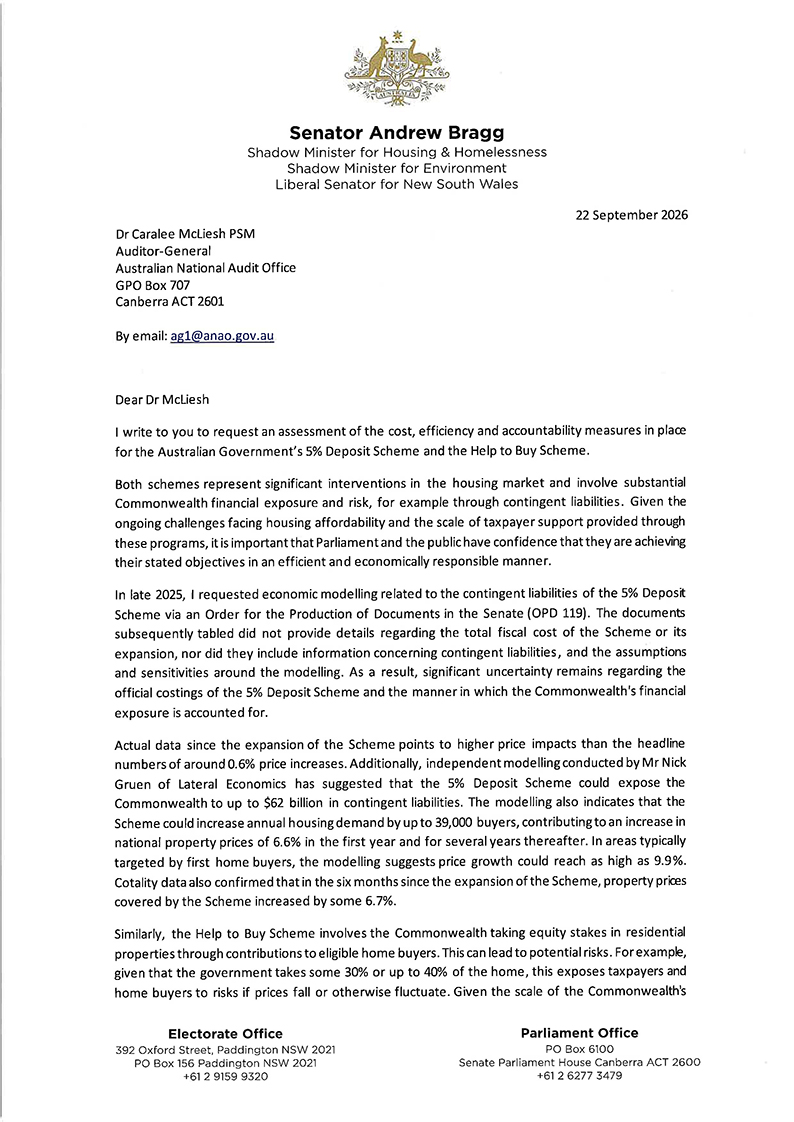
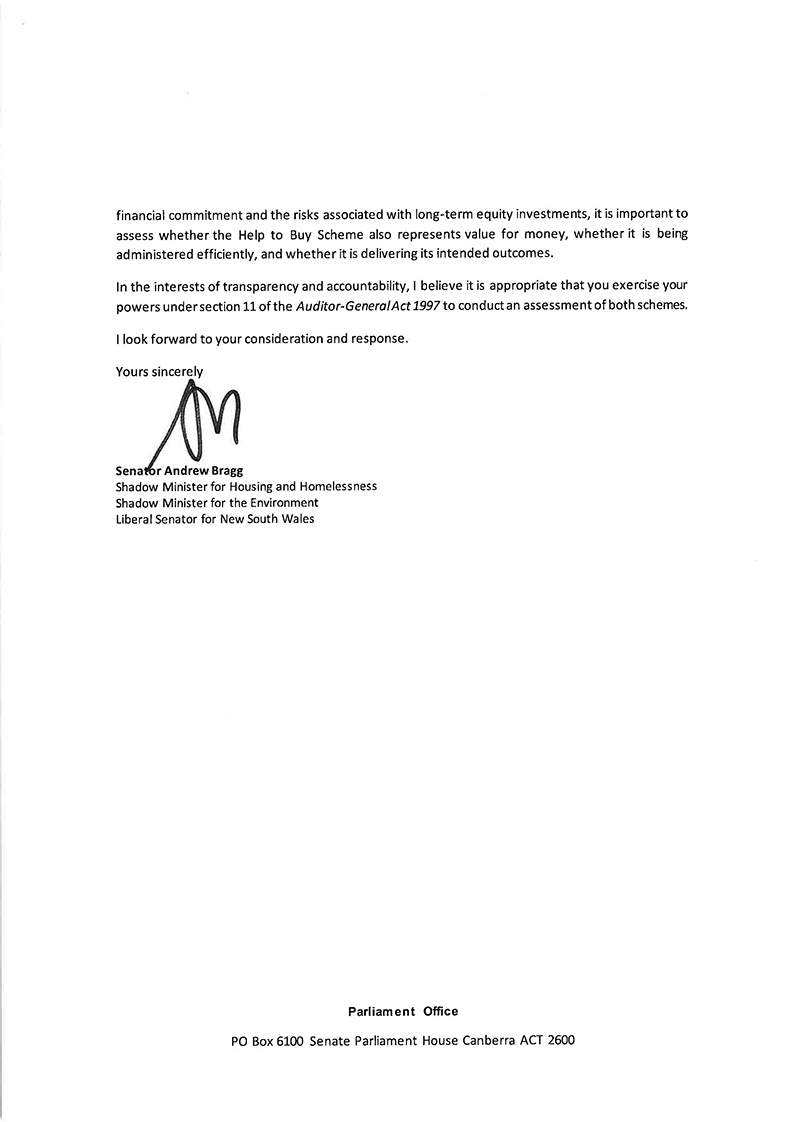
Transcript of letter from Senator Andrew Bragg
22 September 2026
Dr Caralee McLiesh PSM
Auditor-General
Australian National Audit Office
GPO Box 707
Canberra ACT 2601
By email: ag1@anao.gov.au
Dear Dr McLiesh
I write to you to request an assessment of the cost, efficiency and accountability measures in place for the Australian Government's 5% Deposit Scheme and the Help to Buy Scheme.
Both schemes represent significant interventions in the housing market and involve substantial Commonwealth financial exposure and risk, for example through contingent liabilities. Given the ongoing challenges facing housing affordability and the scale of taxpayer support provided through these programs, it is important that Parliament and the public have confidence that they are achieving their stated objectives in an efficient and economically responsible manner.
In late 2025, I requested economic modelling related to the contingent liabilities of the 5% Deposit Scheme via an Order for the Production of Documents in the Senate (OPD 119). The documents subsequently tabled did not provide details regarding the total fiscal cost of the Scheme or its expansion, nor did they include information concerning contingent liabilities, and the assumptions and sensitivities around the modelling. As a result, significant uncertainty remains regarding the official costings of the 5% Deposit Scheme and the manner in which the Commonwealth's financial exposure is accounted for.
Actual data since the expansion of the Scheme points to higher price impacts than the headline numbers of around 0.6% price increases. Additionally, independent modelling conducted by Mr Nick Gruen of Lateral Economics has suggested that the 5% Deposit Scheme could expose the Commonwealth to up to $62 billion in contingent liabilities. The modelling also indicates that the Scheme could increase annual housing demand by up to 39,000 buyers, contributing to an increase in national property prices of 6.6% in the first year and for several years thereafter. In areas typically targeted by first home buyers, the modelling suggests price growth could reach as high as 9.9%. Cotality data also confirmed that in the six months since the expansion of the Scheme, property prices covered by the Scheme increased by some 6.7%.
Similarly, the Help to Buy Scheme involves the Commonwealth taking equity stakes in residential properties through contributions to eligible home buyers. This can lead to potential risks. For example, given that the government takes some 30% or up to 40% of the home, this exposes taxpayers and home buyers to risks if prices fall or otherwise fluctuate. Given the scale of the Commonwealth's financial commitment and the risks associated with long-term equity investments, it is important to assess whether the Help to Buy Scheme also represents value for money, whether it is being administered efficiently, and whether it is delivering its intended outcomes.
In the interests of transparency and accountability, I believe it is appropriate that you exercise your powers under section 11 of the Auditor-General Act 1997 to conduct an assessment of both schemes.
I look forward to your consideration and response.
Yours sincerely
Senator Andrew Bragg
Shadow Minister for Housing and Homelessness
Shadow Minister for the Environment
Liberal Senator for New South Wales