Browse our range of reports and publications including performance and financial statement audit reports, assurance review reports, information reports and annual reports.
Capacity Investment Scheme
Please direct enquiries through our contact page.
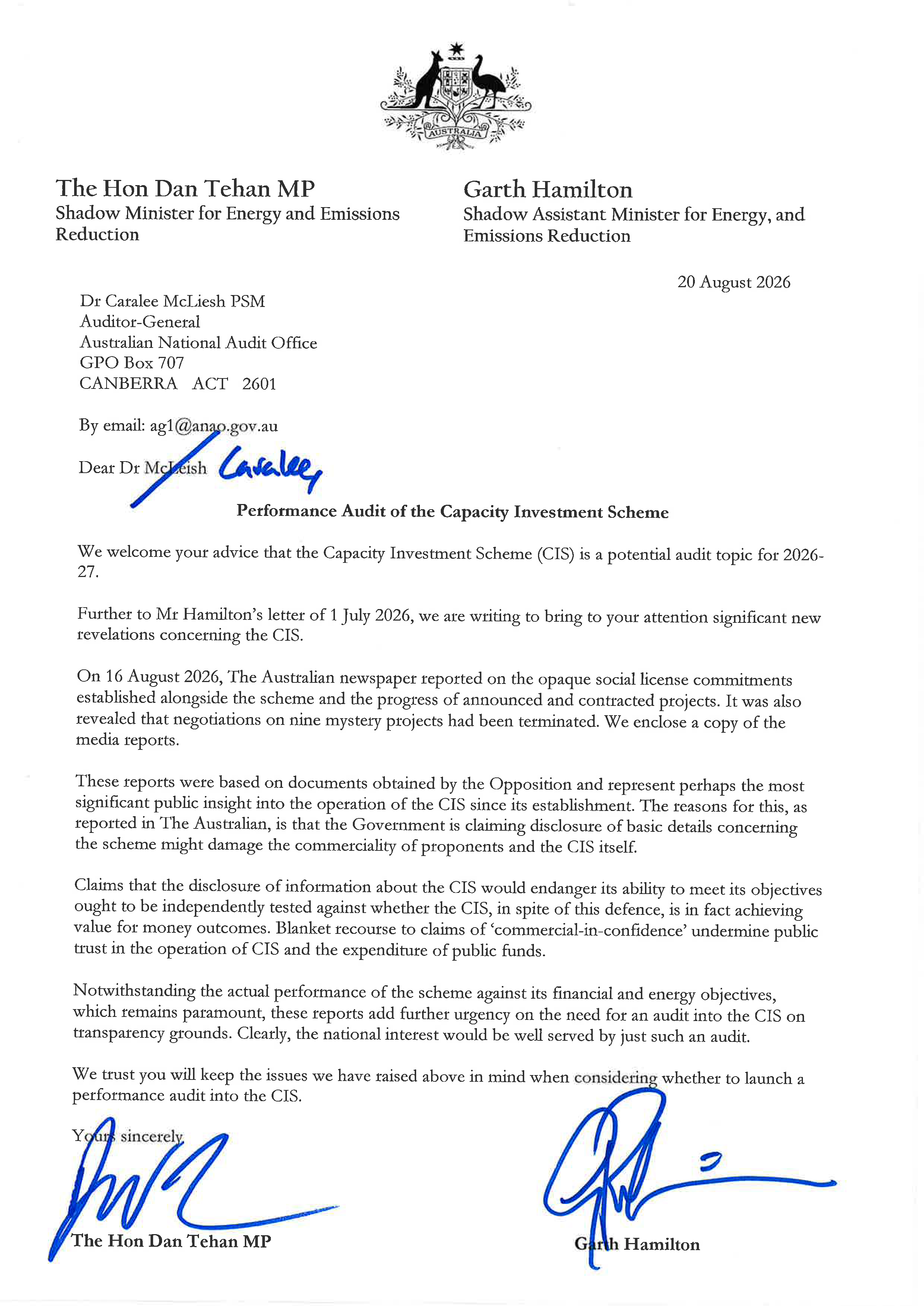
The Auditor-General has received correspondence from Garth Hamilton MP dated 1 July 2026, requesting that the Auditor-General undertake an assessment of the Capacity Investment Scheme (CIS). This request is under consideration and the response will be published here.
Correspondence from Garth Hamilton MP
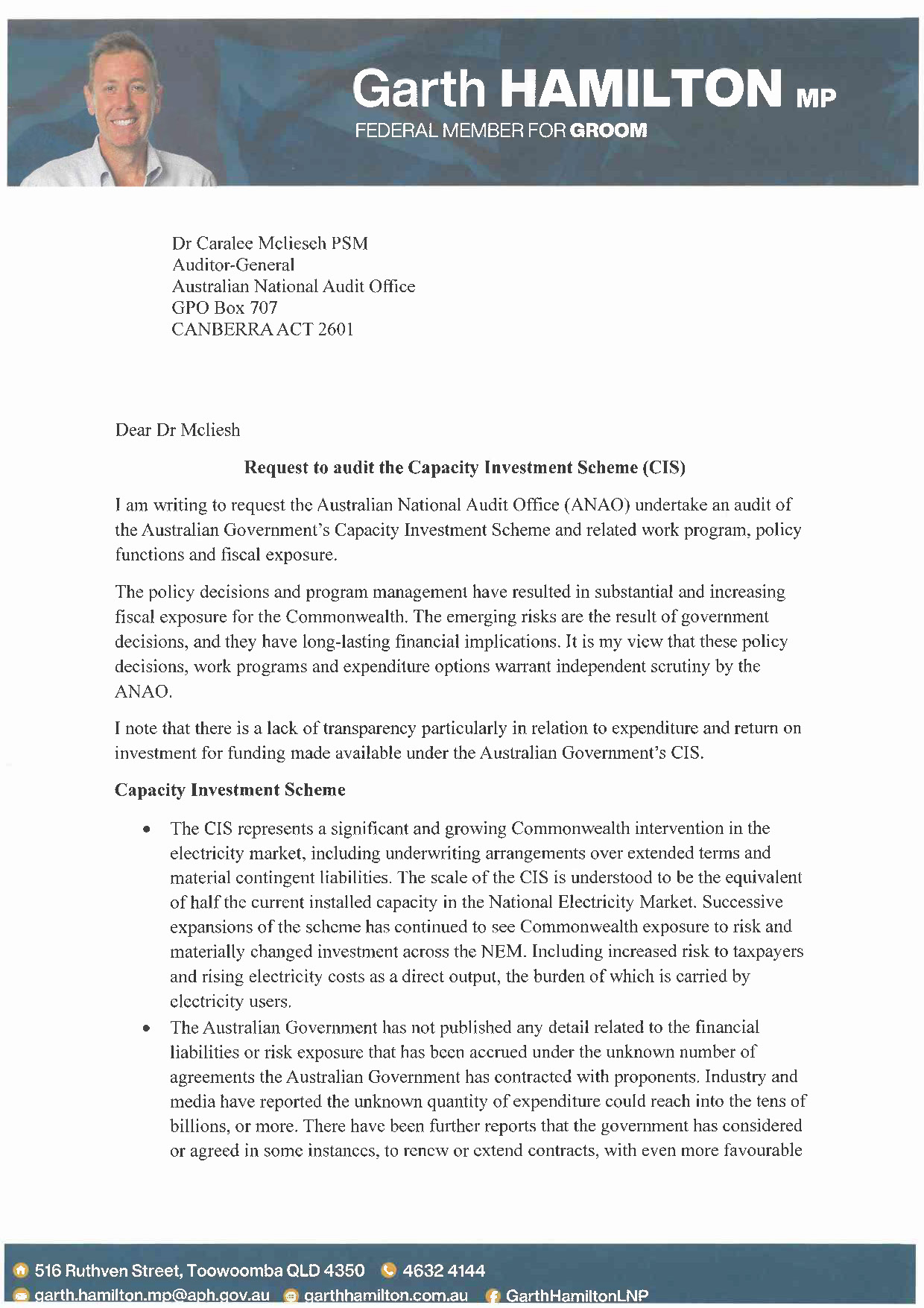
Transcript of letter from Garth Hamilton MP
Dr Caralee Mclieseh PSM
Auditor-General
Australian National Audit Office
GPO Box 707
CANBERRA ACT 2601
Dear Dr Mcliesh
Request to audit the Capacity Investment Scheme (CIS)
I am writing to request the Australian National Audit Office (ANAO) undertake an audit of the Australian Government's Capacity Investment Scheme and related work program, policy functions and fiscal exposure.
The policy decisions and program management have resulted in substantial and increasing fiscal exposure for the Commonwealth. The emerging risks are the result of government decisions, and they have long-lasting financial implications. It is my view that these policy decisions, work programs and expenditure options warrant independent scrutiny by the ANAO.
I note that there is a lack of transparency particularly in relation to expenditure and return on investment for funding made available under the Australian Government's CIS.
Capacity Investment Scheme
- The CIS represents a significant and growing Commonwealth intervention in the electricity market, including underwriting arrangements over extended terms and material contingent liabilities. The scale of the CIS is understood to be the equivalent of half the current installed capacity in the National Electricity Market. Successive expansions of the scheme has continued to see Commonwealth exposure to risk and materially changed investment across the NEM. Including increased risk to taxpayers and rising electricity costs as a direct output, the burden of which is carried by
electricity users. - The Australian Government has not published any detail related to the financial liabilities or risk exposure that has been accrued under the unknown number of agreements the Australian Government has contracted with proponents. Industry and media have reported the unknown quantity of expenditure could reach into the tens of billions, or more. There have been further reports that the government has considered or agreed in some instances, to renew or extend contracts, with even more favourable terms for project proponents that increase Commonwealth financial risk, while benefit proponents.
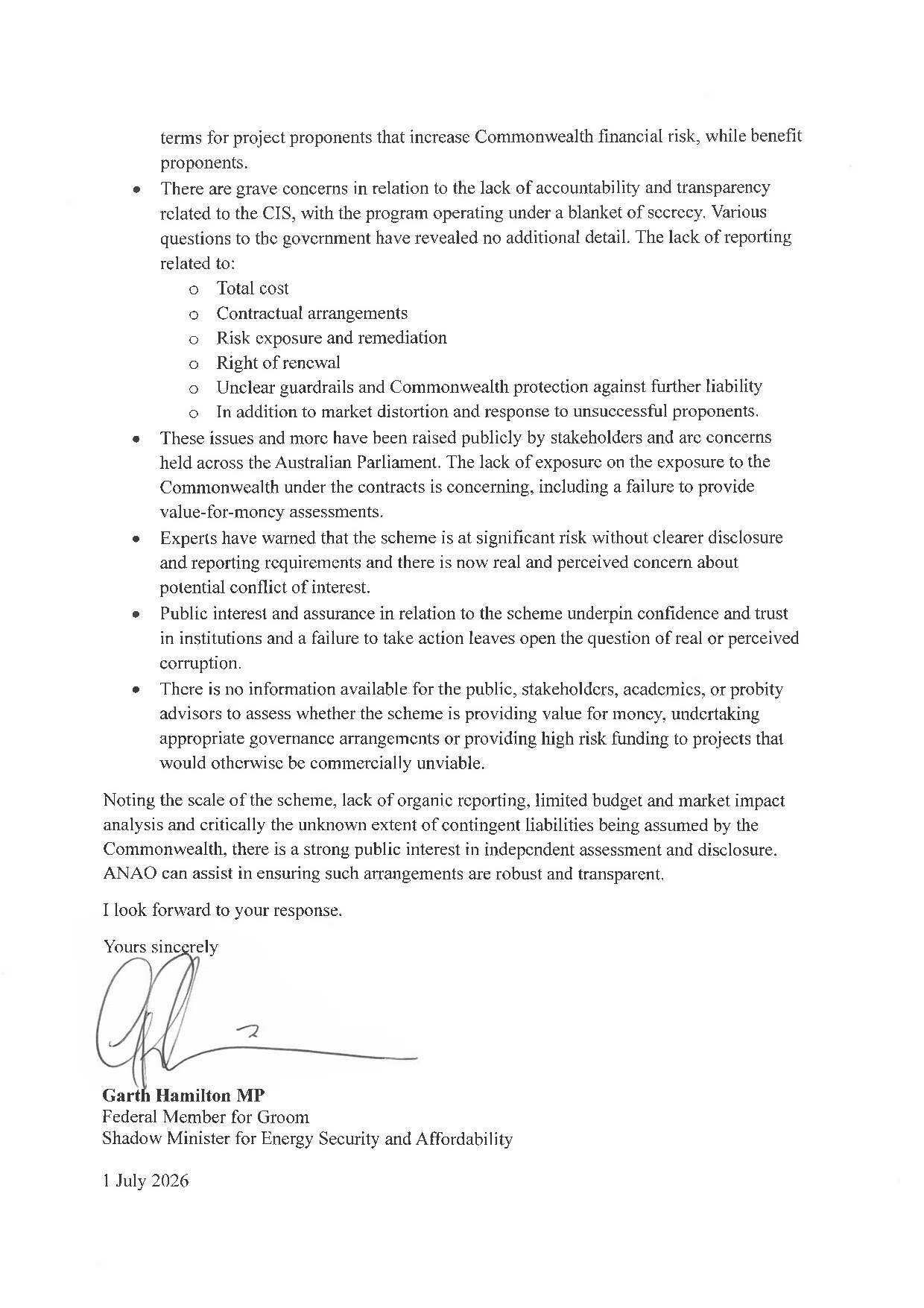
- There are grave concerns in relation to the lack of accountability and transparency related to the CIS, with the program operating under a blanket of secrecy. Various questions to the government have revealed no additional detail. The lack of reporting related to:
- Total cost
- Contractual arrangements
- Risk exposure and remediation
- Right of renewal
- Unclear guardrails and Commonwealth protection against further liability
- In addition to market distortion and response to unsuccessful proponents.
- These issues and more have been raised publicly by stakeholders and are concerns held across the Australian Parliament. The lack of exposure on the exposure to the Commonwealth under the contracts is concerning, including a failure to provide value-for-money assessments.
- Experts have warned that the scheme is at significant risk without clearer disclosure and reporting requirements and there is now real and perceived concern about potential conflict of interest.
- Public interest and assurance in relation to the scheme underpin confidence and trust in institutions and a failure to take action leaves open the question of real or perceived corruption.
- There is no information available for the public, stakeholders, academics, or probity advisors to assess whether the scheme is providing value for money, undertaking appropriate governance arrangements or providing high risk funding to projects that would otherwise be commercially unviable.
Noting the scale of the scheme, lack of organic reporting, limited budget and market impact analysis and critically the unknown extent of contingent liabilities being assumed by the Commonwealth, there is a strong public interest in independent assessment and disclosure. ANAO can assist in ensuring such arrangements are robust and transparent.
I look forward to your response.
Yours sincerely,
Garth Hamilton MP
Federal Member for Groom
Shadow Minister for Energy Security and Affordability
1 July 2026