Browse our range of reports and publications including performance and financial statement audit reports, assurance review reports, information reports and annual reports.
Performance audit (Auditor-General Report No. 30 of 2018–19)

Published: Monday 18 March 2019
Published
The audit objective was to examine whether the Department of Defence has effective and efficient sustainment arrangements for the Royal Australian Navy’s fleet of eight ANZAC class frigates.
Entity
Department of Defence
Contact
Please direct enquiries through our contact page.
Performance audit (Auditor-General Report No. 35 of 2013–14)
Published: Wednesday 4 June 2014
Published
The objective of the audit was to assess the effectiveness of the ATO’s activities to promote tax compliance by high wealth individuals.
Entity
Australian Taxation Office
Contact
Please direct enquiries relating to reports through our contact page.
Performance audit (Auditor-General Report No. 37 of 2013–14)
Published: Wednesday 11 June 2014
Published
The audit objective was to assess the Department of Employment’s management of the effectiveness and quality of employment services delivered by Job Services Australia providers.
Entity
Department of Employment
Contact
Please direct enquiries relating to reports through our contact page.
Performance audit (Auditor-General Report No. 44 of 2004–05)
Published: Wednesday 25 May 2005
Published
The objective of the audit was to examine Defence's management of leases that have resulted from property sale and leaseback transactions. Leases subject to review were for a period of ten or more years and included the following six properties: the Defence Plazas in Sydney and Melbourne; the Hydrographic Office Wollongong; DNSDC Moorebank; Campbell Park Offices in Canberra; and ADC Weston Creek in Canberra. The audit examined the process for identifying the properties for sale and leaseback and the sale approval process. The audit sought to determine the basis on which the properties were proposed for sale and leaseback and the financial impact for the Government. The audit also reviewed the lease terms and conditions to determine whether they protect the Government's interests, and examined Defence's management of commitments arising from the leases.
Entity
Across Agencies
Performance audit (Auditor-General Report No. 43 of 2010–11)
Published: Wednesday 25 May 2011
Published
The objective of the audit was to examine whether the UP and CPP services provided by the Australian Federal Police Protection Service are being managed effectively. In particular, the audit examined:
- whether the Protection function has been effectively integrated into the AFP, and sound arrangements are in place to strategically plan Protection services and manage risks;
- whether Protection staff have access to appropriate training and guidance; and
- the management arrangements for UP and CPP services.
Entity
Australian Federal Police
Performance audit (Auditor-General Report No. 2 of 2012–13)
Published: Thursday 30 August 2012
Published
To assess the effectiveness of the Department of Broadband, Communications and the Digital Economy’s (DBCDE’s) administration of the Regional Backbone Blackspots Program (RBBP), involving the establishment and ongoing management of the program.
Entity
Department of Broadband and Communications and the Digital Economy
Performance audit (Auditor-General Report No. 39 of 2007–08)
Published: Thursday 5 June 2008
Published
The objective of this follow-up audit is to examine DEEWR's implementation of the six recommendations made in the ANAO's 2003 report. This audit has had regard to the issues underlying the recommendations, and new administrative issues affecting their implementation.
Entity
Department of Education, Employment and Workplace Relations
Performance audit (Auditor-General Report No. 16 of 2016–17)

Published: Tuesday 13 September 2016
Published
The objective of the audit was to assess whether the Department of Immigration and Border Protection (DIBP) had appropriately managed the procurement of garrison support and welfare services at offshore processing centres in Nauru and Papua New Guinea (Manus Island); and whether the processes adopted met the requirements of the Commonwealth Procurement Rules (CPRs) including consideration and achievement of value for money.
Entity
Department of Immigration and Border Protection
Contact
Please direct enquiries relating to reports through our contact page.
Performance audit (Auditor-General Report No. 18 of 2011–12)
Published: Tuesday 20 December 2011
Published
The objective of the audit was to assess the effectiveness of the management of risks arising from the use of PSDs in selected Australian Government agencies. The PSDs included within the scope of this audit were: USB flash drives; CDs and DVDs; external hard drives; laptop computers and smartphones.
Entity
Across agencies
Performance audit (Auditor-General Report No. 30 of 2003–04)
Published: Friday 20 February 2004
Published
The objective of this audit was: to form an opinion on the adequacy of selected agencies' approaches to monitoring and evaluation of government programs and services delivered on the Internet; and to identify better practices and opportunities for improvement. In order to achieve this objective, the audit examined the websites and Internet-delivered services of five agencies.
Entity
Across Entities
Performance audit (Auditor-General Report No. 32 of 2009–10)
Published: Wednesday 28 April 2010
Published
The objective of the audit was to assess the effectiveness of OPO's management of the overseas owned estate. In particular, the audit examined whether:
- sound arrangements are in place to effectively plan and oversight the management of the overseas estate;
- OPO effectively manages owned property on a day-to-day basis;
- the condition of the overseas owned estate is adequately maintained by structured and systematic repair and maintenance arrangements; and
- OPO has appropriate information to facilitate the effective management of the owned estate, and appropriately consults with stakeholders.
Entity
Department of Foreign Affairs and Trade
Performance audit (Auditor-General Report No. 56 of 2003–04)
Published: Thursday 24 June 2004
Published
The objective of this audit was to assess the extent to which PV applications in Australia are processed in accordance with relevant laws and policies, and whether DIMIA employs appropoiate mechanisms to ensure compliance with those laws and policies.
Entity
Department of Immigration and Multicultural and Indigenous Affairs
Performance audit (Auditor-General Report No. 27 of 2007–08)
Published: Wednesday 16 April 2008
Published
The objective of the audit was to assess how well EMA is meeting its objective of providing national leadership in the development of measures to reduce risk to communities and manage the consequences of disasters.
Entity
Attorney-General's Department
Performance audit (Auditor-General Report No. 19 of 2011–12)
Published: Tuesday 20 December 2011
Published
The objective of the audit was to assess the development of Defence’s oversight and management of its portfolio of ICT investments and projects. In particular, the audit examined Defence’s:
- governance, strategic processes and decision-making structures that set out, prioritise and coordinate the integrated ICT reform portfolio and programs;
- ICT risk management and capacity to identify and plan to achieve the benefits of its SRP ICT stream reforms (including methodologies to measure the realisation of savings and non-savings benefits);
- level of portfolio and program management maturity; and
- the impact of improvement efforts on Defence’s ability to deliver the ICT services capacity required to support the SRP.
Entity
Department of Defence
Performance audit (Auditor-General Report No. 26 of 2003–04)
Published: Friday 6 February 2004
Published
The audit examined aspects of financial management in the Health Insurance Commission (HIC). The audit objective was to examine the effectiveness of the HIC's internal control structures, as well as its financial management framework and processes, in order to form an opinion on their ability to support HIC Commissioners and managers to make informed decisions on the efficient and effective use of Commonwealth resources.
Entity
Health Insurance Commission
Performance audit (Auditor-General Report No. 37 of 2009–10)
Published: Thursday 20 May 2010
Published
The objective of this audit was to review the effectiveness of Defence's and the DMO's management of the acquisition arrangements for JP 2070.
Entity
Department of Defence
Performance audit (Auditor-General Report No. 48 of 2012–13)
Published: Wednesday 19 June 2013
Published
The objective of the audit was to assess the effectiveness of the Department of Families, Housing, Community Services and Indigenous Affairs' (FaHCSIA) administration and management of the Targeted Community Care (Mental Health) Program.
Entity
Department of Families, Housing, Community Services and Indigenous Affairs
Contact
Please direct enquiries relating to reports through our contact page.
Performance audit (Auditor-General Report No. 13 of 2008–09)
Published: Tuesday 16 December 2008
Published
The audit objective was to assess how well agencies manage their websites. Particular attention was given to the audited agencies' website purposes, risk management and planning, policies, content management procedures, and performance monitoring and reporting. These elements provide the framework for the design, implementation and operation of websites.
Entity
Australian Bureau of Statistics; Department of Agriculture, Fisheries and Forestry; Department of Foriegn Affairs and Trade
Performance audit (Auditor-General Report No. 23 of 2002–03)
Published: Friday 20 December 2002
Published
Physical Security Arrangements in Commonwealth Agencies, No.23 2002-2003 Protective security involves the total concept of information, personnel, physical, information technology and telecommunications security. The Commonwealth's Protective Security policy is outlined in the Protective Security Manual (PSM). It provides specific guidance to agencies on the protection of the Commonwealth's assets, personnel and clients from potential security threats. This audit evaluated the protective security policies and practices of seven Commonwealth agencies to determine whether they had established an appropriate physical security control framework based on the principles outlined in Part E of the Commonwealth's Protective Security Manual. The ANAO also examined whether agencies had considered the risks of, and developed an appropriate policy statement on, the physical security arrangements for employees who work from home.
Entity
Across Agency
Performance audit (Auditor-General Report No. 13 of 1999–2000)
Published: Monday 11 October 1999
Published
The Department of Defence spends some $2.4 billion a year on major equipment acquisition projects. The audit objective was to assess Defence's arrangements for higher-level management of major equipment acquisition projects. The principal aim was to formulate practical recommendations that would both enhance Defence's management of major acquisition projects and provide a degree of assurance about its ongoing apparent capacity to do so efficiently and effectively.
Entity
Department of Defence
Performance audit (Auditor-General Report No. 9 of 1997–98)
Published: Thursday 23 October 1997
Published
The audit objectives were to report on the efficiency and effectiveness of selected agencies' management of telecommunications services. The specific purpose was to:
- identify the potential for more effective management of telecommunications services;
- consider the appropriateness of Commonwealth agencies' management of telecommunications services to take advantage of technological opportunities; and
- identify the elements of sound administration in the management of telecommunications services.
The audit criteria addressed agencies' performance against benchmarks of sound administrative practice in relation to procurement; planning; business process re-engineering; financial management; and performance management. The audit focussed primarily on telecommunications services, as distinct from capital items and equipment.
Entity
Across Agency
Performance audit (Auditor-General Report No. 30 of 2005–06)
Published: Tuesday 28 February 2006
Published
The objective of the audit was to assess the ATO's strategies to address tax evasion in the cash economy, with emphasis on: the ATO's strategic focus; aspects of governance, management processes and compliance activities; and responses to the ANAO Report No.35 2001–02 ATO Progress in Addressing the Cash Economy.
Entity
Australian Taxation Office
Performance audit (Auditor-General Report No. 28 of 2008–09)
Published: Wednesday 22 April 2009
Published
The objective of the audit was to examine the quality and integrity of DVA's income support records and to report on the effectiveness of the department's management of the data and how it impacts on service delivery.
Entity
Department of Veterans' Affairs
Annual report
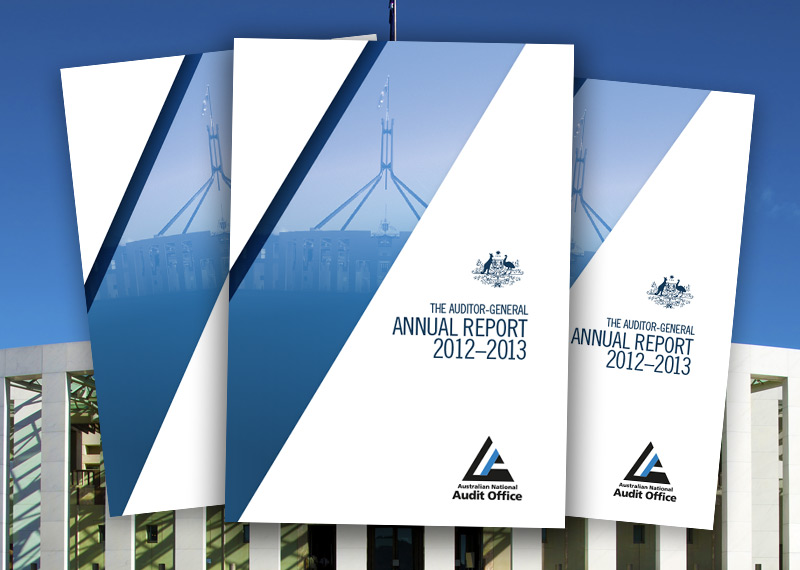
Published: Monday 30 September 2013
Published
This annual report documents the performance of the Australian National Audit Office (ANAO) in the financial year ending on 30 June 2013. It addresses the Requirements for Annual Reports for Departments, Executive Agencies and FMA Act Bodies approved by the Joint Committee of Public Accounts and Audit in June 2013; the performance measures set out in the outcomes and programs framework in the 2012–13 Portfolio Budget Statements; section 28 of the Auditor-General Act 1997; and other annual reporting requirements set out in legislation.
Performance audit (Auditor-General Report No. 34 of 2013–14)
Published: Thursday 29 May 2014
Published
The objective of this audit was to assess the effectiveness of arrangements for implementing and monitoring the implementation of ANAO performance audit recommendations in the Department of Agriculture and the Department of Human Services.
Entity
Department of Agriculture, Department of Human Services
Contact
Please direct enquiries relating to reports through our contact page.
Performance audit (Auditor-General Report No. 25 of 2009–10)
Published: Thursday 15 April 2010
Published
The objective of the audit was to assess the effectiveness of security awareness and training arrangements at selected Australian Government organisations, including whether they addressed selected security issues from the PSM.
Entity
Attorney-General's Department; CrimTrac; Department of Finance and Deregulation; Department of Health and Ageing; National Archives of Australia; National Gallery of Australia
Performance audit (Auditor-General Report No. 36 of 2005–06)
Published: Tuesday 2 May 2006
Published
The objective of the audit was to assess the effectiveness of management of the procurement of a major, new capability for the ADF by the DMO and Defence. The audit reviewed the initial capability requirements and approval process; analysed the contract negotiation process; and examined management of the Acquisition and Through-Life-Support Contracts. Coverage of the audit extended from development of the concept for the requirement, to acceptance of deliverables in the period prior to the award of the Australian Military Type Certificate (see shaded area of Figure 1). The audit fieldwork was undertaken during the delivery phase of the Project, following delivery of ARH numbers 1, 2 and 5.
Entity
Department of Defence; Defence Material Organisation
Performance audit (Auditor-General Report No. 37 of 2011–12)
Published: Thursday 31 May 2012
Published
The objective of the audit was to examine the effectiveness of CSP’s feedback management system. CSP’s performance was assessed against the following criteria:
- CSP has appropriate channels to collect customer feedback;
- CSP effectively manages and resolves complaints; and
- CSP accurately reports on customer feedback, and analyses the information to improve aspects of child support administration.
Entity
Department of Human Services
Performance audit (Auditor-General Report No. 42 of 2007–08)
Published: Thursday 19 June 2008
Published
The objective of this follow-up audit was to examine Centrelink's progress in implementing the recommendations of the 2004–05 audit and the subsequent JCPAA inquiry.
Entity
Centrelink; Department of Employment, and Workplace Relations; Department of Families, Housing and Community Services and Indigenous Affairs
Performance audit (Auditor-General Report No. 20 of 2004–05)
Published: Tuesday 21 December 2004
Published
The audit concluded that the ATO has an administratively effective framework for managing the Energy Grants (Credits) Scheme (EGCS), introduced in mid-2003. The planning, monitoring and reporting framework is structured and appropriate, the risk and compliance management framework is generally well-developed and the processes and controls framework is comprehensive. Changes in the Scheme, as foreshadowed in Government's Energy White Paper, Securing Australia's Energy Future, present the opportunity to enhance the transparency of Scheme objectives and develop ways to evaluate performance against these objectives
Entity
Australian Taxation Office