Browse our range of reports and publications including performance and financial statement audit reports, assurance review reports, information reports and annual reports.
Performance audit (Auditor-General Report No. 39 of 2005–06)
Published: Thursday 11 May 2006
Published
The objectives of the audit were to provide assurance that Artbank was effectively meeting its charter of: acquiring art by contemporary artists; expanding the number of public places that Artbank's collection is rented and displayed; and managing its collection and rental scheme. The audit also examined Artbank's governance arrangements, and its programmes for marketing, client development, performance management, budgeting, debt management and also sought client feedback on Artbank's operations via a survey.
Entity
Agriculture Fisheries and Forestry Australia; Department of Communications Information Technology and the Arts
Performance audit (Auditor-General Report No. 31 of 1995–96)
Published: Monday 24 June 1996
Published
The purpose of the audit was to examine the environmental management mechanisms in place across some of the major Commonwealth land management and oversighting entities. In particular, the audit examined Commonwealth environmental management practices to identify current strengths and weaknesses, and provide a framework and direction for the adoption of better practice and continuous improvement. The audit has not been designed to judge past Commonwealth performance using current environmental standards and practices. Rather, the audit focused on encouraging the development of better practice by illustrating the implications and lessons learned from past and present practices.
Entity
Department of Communications, Information Technology and the Arts; Department of Defence; Department of Transport and Regional Development; Department of Administrative Services; Department of Environment, Sport and Territories
Performance audit (Auditor-General Report No. 46 of 2011–12)
Published: Wednesday 20 June 2012
Published
The objective of the audit was to assess the effectiveness of the Department of Agriculture, Fisheries and Forestry’s administration of the Northern Australia Quarantine Strategy. The ANAO examined whether the department had established effective:
- administrative and governance arrangements to support NAQS;
- processes for identifying biosecurity risks and conducting scientific activities to address identified risks;
- arrangements for managing the quarantine aspects of Torres Strait border movements; and
- public awareness activities that reflect identified biosecurity risks and support the program’s objectives.
Entity
Department of Agriculture, Fisheries and Forestry
Speeches and papers
Published: Saturday 26 October 1996
Published
Mr P.J. Barrett (AM) - Auditor-General for Australia, presented at the CPA Congress '96 - Profit from our Experience - Melbourne
Speeches and papers
Published: Thursday 2 October 2014
Published
Mr Mr Ian McPhee - Auditor-General for Australia, presented at the 2014 National Conference of the Risk Management Institution of Australasia, Brisbane
Performance audit (Auditor-General Report No. 37 of 2008–09)
Published: Monday 25 May 2009
Published
The objectives of the audit were to:
- determine the extent to which government entities complied with the requirement to publish and maintain documents online that were presented to the Parliament;
- evaluate selected government entities' policies and practices regarding online publishing; and
- assess AGIMO's policy and guidance in support of online publishing.
To address this objective the audit was conducted in three parts. Firstly, we reviewed a sample of papers tabled between 2000 and 2008 in order to assess their availability online. Next, we examined the online publishing practices of five government entities. These were the: Australian Federal Police (AFP); Department of the House of Representatives (DHR); Department of Infrastructure, Transport, Regional Development and Local Government (Infrastructure); Department of the Treasury (Treasury); and National Archives of Australia (NAA). Finally, we reviewed AGIMO's role in supporting government entities in their online publishing practices.
Entity
Across Agencies
Performance audit (Auditor-General Report No. 48 of 2010–11)
Published: Thursday 16 June 2011
Published
The audit objective was to assess the effectiveness of monitoring arrangements (by the Accreditation Agency) and compliance activities (by DoHA) put in place to achieve residential aged care homes’ compliance with the Accreditation Standards and their other, related, responsibilities under the Act and its associated instruments.
The ANAO’s assessment considered whether:
— a sector-wide compliance strategy was in place and aligned with effective monitoring and compliance activities at the operational level;
— there was a clear articulation of the separat but complementary roles and responsibilities of DoHA and the Accreditation Agency; and
— performance information gathered by both agencies to support public reporting and business improvements was useful and enabled comparison of performance over time.
Entity
Department of Health and Ageing; Aged Care Standards and Accreditation Agency Ltd
Annual report
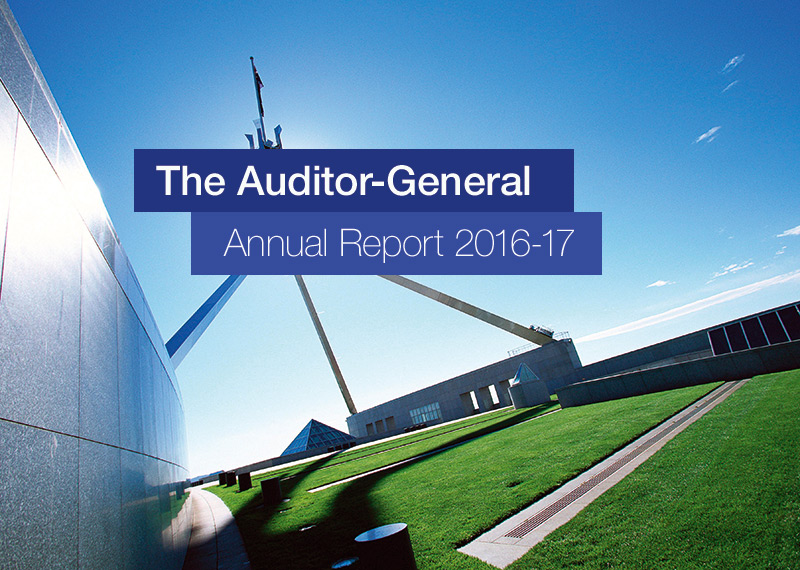
Published: Monday 4 September 2017
Published
This annual report documents the performance of the Australian National Audit Office (ANAO) in the financial year ending on 30 June 2017. The report addresses all applicable obligations under the Public Governance, Performance and Accountability Act 2013 (PGPA Act); the Public Governance, Performance and Accountability Rule 2014 (PGPA Rule); the Auditor-General Act 1997; the performance measures set out in the outcome and programs framework in the ANAO’s 2016–17 Portfolio Budget Statements (PBS) and the ANAO 2016–20 Corporate Plan and annual reporting requirements set out in other relevant legislation.
Contact
Please direct enquiries relating to annual reports through our contact page.
Performance audit (Auditor-General Report No. 58 of 2016–17)

Published: Monday 26 June 2017
Published
The objective of the audit was to examine the implementation of the annual performance statements requirements under the Public Governance, Performance and Accountability Act 2013 and the enhanced Commonwealth performance framework.
Entity
Department of Agriculture and Water Resources; Australian Federal Police; Department of Finance
Contact
Please direct enquiries relating to reports through our contact page.
Performance audit (Auditor-General Report No. 19 of 2003–04)
Published: Wednesday 17 December 2003
Published
The objective of the audit was to assess whether the property management function, including the management of leases, was being performed efficiently and was providing an effective level of support for the delivery of the organisation's services (outputs). The audit evaluated property management policies and practices across the following dimensions:
- planning and control;
- business processes and practices; and
- information and performance management.
Within each of these areas, a series of desirable proceses and controls (described as the evaluation criteria) were developed to assist in the assessment of each organisation's performance.
Entity
Australian Communications Authority; Australian Film, Television and Radio School; Civil Aviation Safety Authority; Department of Employment and Workplace Relations; National Library of Australia; Department of Finance and Administration