Browse our range of reports and publications including performance and financial statement audit reports, assurance review reports, information reports and annual reports.
Auditor-General Report No. 6 of 2026–27
Effectiveness of the Strategic Commissioning Framework
Published
Monday 28 September 2026

Portfolio
Prime Minister and Cabinet
Entity
Australian Public Service Commission
Contact
Please direct enquiries through our contact page.
Activity
Governance
Sector
Prime Minister & Cabinet
Audit snapshot
Why did we do this audit?
- The Strategic Commissioning Framework (the Framework) was designed to reduce the Australian Public Service’s (APS’s) reliance on the external workforce, bring ‘core work’ in‑house, and strengthen APS capability.
- The audit was conducted to provide assurance to Parliament on the effectiveness of the Framework, including the Australian Public Service Commission’s (APSC’s) design and implementation of the Framework.
Key facts
- Australian Government entities (that employ staff under the Public Service Act 1999) spend about $20 billion on an external workforce each year. This includes labour hire, contractors, consultants and outsourced service providers.
- All entities employing staff under the Public Service Act 1999 were required to start embedding the Framework and reducing supplier expenditure on core work from 2024–25.
What did we find?
- The Framework has been partly effective. The APSC was largely effective in supporting entities to implement the Framework and reported that the APS-wide 2024–25 reduction target was exceeded. However, the design of the Framework limited the scope to a narrow part of external workforce spending, and entities could meet targets while overall spending on the external workforce increased.
- The APSC engaged effectively with stakeholders during implementation. However, the Framework was not practical to implement and overlapped with existing requirements, contributing to inconsistency.
- Implementation of the Framework was largely effective, but weaknesses in target design, evaluation and public reporting limited transparency over whether the Framework achieved its intended outcomes.
What did we recommend?
- There was: one recommendation to the Australian Government to improve publicly reported data on external workforce expenses; and one recommendation to the APSC to align and integrate the Framework with other requirements.
- The Department of Finance noted the first recommendation, and the APSC agreed to the second recommendation.
75
Number of entities that set Framework targets to reduce supplier expenditure on core work in 2024–25.
$527.6m
Collective target set under the Framework for 2024–25.
$542.3m
Total entity self-reported reductions against Framework targets for 2024–25.
Summary and recommendations
Background
1. The Australian Public Service Commission’s (APSC’s) 2024–25 State of the Service report showed the number of staff employed as Australian Public Service (APS) employees under the Public Service Act 1999 (PS Act) was 159,179 at 30 June 2022 and 198,529 at 30 June 2025.
2. In October 2022, the Minister for the Public Service (the Minister) outlined a new APS reform agenda with four priority areas or ’pillars’ for an APS that: (1) embodies integrity in everything it does; (2) puts people and business at the centre of policy and services; (3) is a model employer; and (4) has the capability to do its job well. This would later be supported by eight outcomes and 59 initiatives.1
3. Pillar 4 of the APS reform agenda (the APS has the capability to do its job well) was supported by 14 initiatives that aimed to strengthen the capability of APS employees and reduce reliance on the external workforce. The external workforce consists of labour hire, contractors, consultants and outsourced service providers (see Table 1.1 and Figure 1.1). Three of the 14 initiatives were started as a joint APS reform which was undertaken by the Department of Finance (Finance), the Department of the Prime Minister and Cabinet (PM&C) and the APSC in 2023: an audit of employment, an in-house consulting model and the Strategic Commissioning Framework (the Framework).
4. The APSC administers the Framework, which was agreed by the Minister, endorsed by the Secretaries Board, and launched by the Minister in October 2023. The Framework’s intent, as published in October 2023, was:
The core work of the APS must be done by our core workforce – APS employees. This expectation will wind back excessive outsourcing and its impacts on the skills held and used in APS agencies … Agency heads are accountable for rebalancing their workforce to prioritise direct employment, strengthen capability, and ensure any use of external expertise enhances the work and knowledge of the APS … Most roles will be delivered by APS employees … Over time — when supported by APS recruitment, skilling and mobility — this approach will deepen system-wide capability and reduce the risks to integrity, expertise and public trust posed by excessive outsourcing.2
5. The Framework applies to all entities employing staff under the PS Act. Under the Framework, entities were asked to identify ‘core work’ and set their own targets for reducing expenditure on the external workforce conducting ‘core work’ for 2024–25 and 2025–26. Across the Australian Government, the combined target was a reduction of $527.6 million in 2024–25 and a further reduction of $438.9 million in 2025–26.3
Rationale for undertaking the audit
6. APS management of contractors and consultants was examined by the ANAO in a series of performance audits published in June 2022.4 These audits described a lack of data for external labour and the impact on transparency and effective workforce planning. Finance’s first audit of employment (2021–22) found that the annual cost to the Australian Government for the APS external workforce was $20.8 billion in 2021–22, of which $6.5 billion was for external labour (labour hire, contractors and consultants) and $14.3 billion was for outsourced service providers. The 2023–24 audit of employment found that APS external labour (labour hire, contractors and consultants) cost $6.0 billion in 2023–24.
7. In December 2025 the APSC reported that the APS reduced supplier expenditure on outsourced ‘core work’ by $542.3 million in 2024–25, exceeding its combined target of $527.6 million. The combined target for 2025–26 was to reduce supplier expenditure by an additional $438.9 million. This audit provides the Parliament with assurance over the effectiveness of the Strategic Commissioning Framework.
Audit objective and criteria
8. The audit objective was to examine the effectiveness of the Strategic Commissioning Framework. To form a conclusion against the objective, the ANAO adopted the following high-level criteria.
- Was the Framework designed and communicated to stakeholders effectively?
- Is the implementation of the Framework achieving its intended outcomes?
Conclusion
9. The Strategic Commissioning Framework (the Framework) has been partly effective. The APSC was largely effective in supporting entities to implement the Framework and reported that the APS-wide 2024–25 reduction target was exceeded. However, the design of the Framework limited the scope of the Framework to a narrow part of total external workforce spending, and entities could meet targets while overall spending on the external workforce increased. As a result, reporting on the Framework does not provide enough transparency about whether the Framework is achieving its intended objectives of reducing reliance on the external workforce, bringing ‘core work’ in house and strengthening APS capability.
10. The ANAO’s analysis of a sample of 22 Australian Government entities found that reported expenses for both suppliers and APS employees increased in 2024–25. More than half of the sampled entities — 12 of 22 — increased spending on external labour, comprising labour hire, contractors and consultants. Continued issues with the availability and consistency of publicly reported data on external workforce expenses limit transparency over trends in the use and cost of the external workforce.
11. The design of the Framework was partly effective. The APSC consulted with entities, but it did not test the most consequential design element — targets — with stakeholders before implementation. Available information and research were not used to their full advantage, and advice to decision-makers did not fully present options, risks or evidence for key design choices. The design of targets meant entities could report that they had met Framework targets and reduced supplier expenditure on core work, even if they increased spending on the external workforce. Although the APSC engaged effectively with stakeholders during implementation, the Framework was not practical to implement and overlapped with existing guidance and requirements, contributing to inconsistency.
12. Implementation of the Framework was largely effective, but weaknesses in target design, evaluation and public reporting limited transparency over whether the Framework achieved its intended outcomes.
- The APSC implemented and reported on the Framework in a timely and organised way, with a focus on embedding the Framework in entities and collecting data.
- The APSC evaluated the first year of implementation, which helped it assess short-term outcomes. The evaluation did not assess whether the APS had reduced reliance on the external workforce or strengthened its capability.
- The APSC publicly reported that the APS-wide target to reduce supplier expenditure by $527.6 million had been slightly exceeded, with 74 per cent of the reported reduction attributable to two entities. The public update did not include the evaluation finding that 40 per cent of entities had fully met their individual targets. Public reporting improved transparency over implementation and target achievement but did not show whether the Framework had reduced reliance on the external workforce for APS ‘core work’ or strengthened APS capability.
Supporting findings
Design and stakeholder engagement
13. Design work was not fully consistent with elements of the Australian Government’s Delivering Great Policy model.
- Incomplete use of evidence — The Framework was informed by evidence (such as the Department of Finance’s audit of employment and stakeholder feedback), however evidence was not used to its full advantage in the design of the Framework, potentially impacting on the feasibility of implementation and the achievement of outcomes.
- Lack of stakeholder consultation on key elements — Elements of the Framework that would impact entities the most (the setting and reporting of targets to reduce supplier expenditure) were not tested with stakeholders during consultation on design.
- Limited presentation of options and risks in advice to decision-makers — The APSC advised decision-makers on the Framework’s intended scope and timeframes. The scope was narrowed to focus on ‘core work’ with no other options presented. Presentation of risks was limited.
- Elements of the Framework were impractical and not well designed — Concepts such as entity-defined ‘core work’ and ‘limited circumstances’, while allowing for flexibility to entity circumstances, diminished consistency and transparency to an extent that reduced the Framework’s effectiveness. Entities were not well placed to report on supplier expenditure for core work. Targets did not effectively measure whether the Framework was achieving its intended outcomes. An unintended consequence of the target design was that entities could report they had ‘met’ the targets to reduce supplier expenditure for core work, even if their overall expenditure on the external workforce had increased. Most of the Framework’s principles overlapped with existing government requirements and processes, which reduced efficiency of the Framework. (See paragraphs 3.3–3.57)
14. Following the publication of the Framework in October 2023, the APSC consulted with entities to support their implementation of the Framework. Stakeholder engagement arrangements during the implementation period were largely fit for purpose. The APSC engaged and supported entities through a working group, one-on-one support, user testing sessions and guidance documents. (See paragraphs 3.58–3.65)
Implementation
15. The APSC established a data protocol for the Framework and collected information from entities (including how the Framework was being embedded and reporting against targets) in a systematic and organised way. Some entities provided feedback that lack of alignment to existing data systems meant that reporting resulted in manual work, administrative cost and potential data reliability issues. The APSC undertook some quality assurance and analysis on the data provided by entities and provided resources for entities to conduct their own quality assurance. As the steward of the Framework, the APSC could have undertaken additional data analysis to identify trends in how the external workforce was being used more broadly and to maximise the value of data provided by entities. (See paragraphs 4.6–4.21)
16. The APSC prepared a fit-for-purpose monitoring and evaluation plan and undertook an evaluation of short-term implementation outcomes. Long-term outcomes were identified but were deemed out of scope for monitoring and evaluation. The APSC reported on the Framework in its annual performance statements. The robustness of evaluation and performance reporting could have been improved by greater evaluator independence, reducing the potential for bias, and clearer definitions.
17. The APSC’s 2024 and 2025 public updates showed intended short-term outcomes of the Framework were partly achieved, including partial embedding of the Framework in entities and APS-wide achievement of combined targets. Two entities were responsible for achieving 74 per cent of the total 2024–25 targets. Weaknesses in the target design, and the absence of controls to ensure target achievement reflected genuine reductions in expenditure on outsourced core work, limited the APSC’s ability to assess whether reported results represented actual reductions in overall expenditure on the external workforce, or whether reported reductions were offset by increases in other spending on the external workforce.
18. The APSC sought and received approval to streamline reporting on the Framework in 2026–27, which included the removal of the Framework targets. Although the Framework targets, as designed, were not an effective way to measure whether the Framework was achieving its intent, entities should be held accountable for whether they are reducing reliance on the external workforce. (See paragraphs 4.22–4.52)
Recommendations
Recommendation no. 1
Paragraph 2.17
To support more efficient and consistent collection of data to inform effective workforce planning, strategic commissioning, ongoing oversight of Australian Public Service reform objectives, and public transparency, the Australian Government strengthen and standardise requirements for entities’ public reporting on supplier expenses, including on external workforce expenses.
Department of Finance response: Noted.
Recommendation no. 2
Paragraph 3.40
The Australian Public Service Commission work with the Department of Finance to simplify implementation of the Strategic Commissioning Framework by: aligning or integrating its requirements with existing Commonwealth procurement and workforce frameworks and guidance; and reducing duplication and administrative effort while maintaining the Framework’s policy intent.
Australian Public Service Commission response: Agreed.
Summary of entity responses
Australian Public Service Commission
The Australian Public Service Commission (APSC) welcomes the ANAO’s findings in this report, including the conclusion that the APSC was largely effective in supporting entities to implement the APS Strategic Commissioning Framework (SCF) and the design of the SCF was partially effective. The APSC is committed to continuous improvement – we agree with the recommendation made to the APSC and agree in principle to the opportunities for improvement. These findings are timely given this is the third year of the SCF’s initial implementation period. Audit findings will be considered as we make recommendations to the Minister for the Public Service about future SCF arrangements.
The APSC has worked with the Department of Finance throughout the SCF’s development and implementation, to ensure it aligns with the broader suite of Government initiatives aimed at reducing reliance on contractors and consultants. The APSC will continue to work closely with the Department of Finance to identify opportunities to simplify SCF requirements and align with related Commonwealth procurement frameworks, guidance and reporting processes.
The APSC will also continue to work closely with agencies to refine broader implementation arrangements for the policy over time.
Department of Finance
Finance notes the recommendation. Imposing more prescriptive financial reporting obligations on Australian Government reporting entities is a matter for the Australian Government and the Minister for Finance.
Key messages from this audit for all Australian Government entities
19. Below is a summary of key messages, including instances of good practice, which have been identified in this audit and may be relevant for the operations of other Australian Government entities.
Group title
Policy/program design
Key learning reference
1. Background
Introduction
1.1 The Australian Public Service Commission’s (APSC’s) 2024–25 State of the Service report showed the number of Australian Public Service (APS) staff employed under the Public Service Act 1999 (PS Act) was 159,179 at 30 June 2022 and 198,529 at 30 June 2025.5
1.2 In October 2022, the Minister for the Public Service (the Minister) outlined a new APS reform agenda with four priority areas or ‘pillars’ for an APS that: (1) embodies integrity in everything it does; (2) puts people and business at the centre of policy and services; (3) is a model employer; and (4) has the capability to do its job well.6 This would later be supported by eight outcomes and 59 initiatives.
1.3 Pillar 4 of the APS reform agenda (the APS has the capability to do its job well) was supported by 14 initiatives that aimed to strengthen the capability of APS employees and reduce reliance on an external workforce (Appendix 3). Three of these initiatives were started as a joint APS reform project.
- Audit of employment — The Department of Finance (Finance) conducted two audits of employment aimed at providing an overview of the external workforce, comprising external labour (labour hire, contractors, consultants) and outsourced service providers (see Table 1.1). The first audit was described as ‘the first time this kind of data had been collected across the APS’.
- The first audit (2021–22) found the cost to the Australian Government for the APS external workforce was $20.8 billion, which comprised $6.5 billion for external labour and $14.3 billion for outsourced service providers. The Department of Defence (Defence) represented 76 per cent of the total spending on the external workforce. After Defence, the four entities with next highest expenditure collectively represented 12 per cent of total expenditure.
- The second audit (2023–24) found the cost to the Australian Government for external labour was $6.0 billion.7
- In-house consulting model — The in-house consulting concept led to the formation of an APS-run management consultancy in the Department of the Prime Minister and Cabinet (PM&C), Australian Government Consulting, in late 2023.
- Strategic Commissioning Framework (the Framework) — The Framework, which is administered by the APSC, was agreed by the Minister, endorsed by the Secretaries Board, and launched by the Minister in October 2023.8
1.4 The purpose of the APSC is to be ‘stewards of the [APS] as custodians of public service integrity, workforce management and capability’.9
1.5 The Framework applies to all entities employing staff under the PS Act. It focuses on reducing reliance on the external workforce and bringing outsourced ‘core work’ back into the APS. The Framework’s intent, as published in October 2023, was:
The core work of the APS must be done by our core workforce – APS employees. This expectation will wind back excessive outsourcing and its impacts on the skills held and used in APS agencies … Agency heads are accountable for rebalancing their workforce to prioritise direct employment, strengthen capability, and ensure any use of external expertise enhances the work and knowledge of the APS … Most roles will be delivered by APS employees … Over time — when supported by APS recruitment, skilling and mobility — this approach will deepen system-wide capability and reduce the risks to integrity, expertise and public trust posed by excessive outsourcing.10
1.6 The Framework defines the ‘external workforce’ as including:
workers providing a service or conducting work for an APS agency where there is no direct employment relationship between the worker and that APS agency. The worker is not an APS employee engaged under the Public Service Act 1999. The external workforce captured by the framework includes workers procured through labour hire, contracting and consulting arrangements.
1.7 The scope of the Framework comprises:
- external labour, which comprises: labour hire; contractors; and consultants; and
- outsourced service providers (Table 1.1 and Figure 1.1).
Table 1.1: External workforce definitions
|
Term |
Definition |
Types of roles and services |
|
Labour hire |
A ‘triangular employment arrangement’ where a government entity procures a labour hire company to provide a worker to undertake a temporary role which is often generalist in nature. There is no direct employment contract between the government entity and the individual employee. The labour hire company contracts the worker to provide that labour and is responsible for paying the worker. The output is generally regarded a Commonwealth product and is produced under the supervision of the Commonwealth entity. |
Temporary generalist roles. |
|
Contractors (also known as professional contractors) |
Individuals, sole traders or service providers procured by a government entity to perform a specialised role for a short and fixed term. A contractor will generally hold requisite qualifications and licenses in their chosen field of work and bring relevant industry experience to the role. Use of contractors is for short term arrangements involving a one-off or irregular tasks. The output is generally regarded as a Commonwealth product and services are performed under the direction and supervision of the Commonwealth entity. |
Services provided by professional contractors are grouped into four categories: financial and audit services; corporate services (e.g. human resources); commercial services (e.g. procurement, contract management and research); and other services (e.g. writing, security and scientific services).a |
|
Consultants |
Individuals, partnerships or corporations procured by a government entity to provide professional or expert services or independent advice as part of a one-off or irregular task to support entity decision-making. The output reflects the independent view or findings of the consultancy or consultant, and the output may not belong to the contracting entity unless specifically required under the contract. Consultants generally operate under a lower level of direction and control. |
Types of consultancy services are grouped under three broad categories: financial services (e.g. audit and accounting); corporate services (e.g. human resources); and commercial services (e.g. policy development and analysis, program management, procurement and risk management).b |
|
Outsourced service providers |
External services procured via commercial arrangement to deliver a function of Government to, or on behalf of, an entity. |
Services provided by outsourced service providers include security, cleaning and facilities management.c |
Note a: Department of Finance, Professional Contractor Services, Scope of Services [Internet], available from https://www.finance.gov.au/government/procurement/whole-australian-government-procurement/people-panel/phase-3-professional-contractor-services [accessed 14 July 2026].
Note b: Department of Finance, Management Advisory Services Panel, Scope of Services [Internet], available from https://www.finance.gov.au/government/procurement/whole-australian-government-procurement/management-advisory-services-panel [accessed 14 July 2026].
Note c: Department of Finance, Report on the 2023–24 Audit of Employment, December 2025, p. 16, available from https://www.finance.gov.au/publications/reviews/australian-governments-report-audit-employment [accessed 13 February 2026].
Source: Adapted from APS Strategic Commissioning Framework, v.2, pp. 8–9 and Department of Finance documentation
1.8 Supplier expenses are reported in entities’ annual financial statements and include the cost of goods and services. Goods and services expenses include services provided by the external workforce (Figure 1.1).
Figure 1.1: Categories of Australian Public Service supplier expensesa
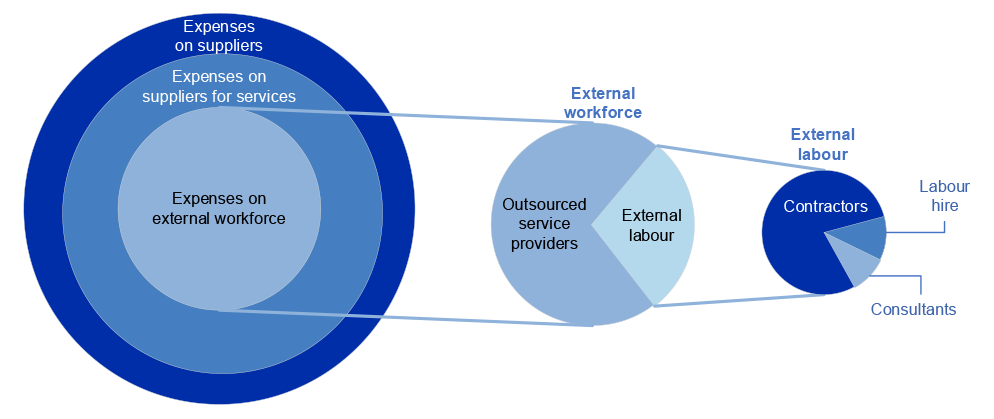
Note a: This diagram is for illustrative purposes. It is not to scale. For expense figures, see discussion on the audits of employment at paragraphs 3.16–3.17.
Source: ANAO analysis.
1.9 Under the Framework, for 2024–25 and 2025–26, entities were asked to identify ‘core work’ (see paragraphs 3.45–3.46) and set targets for reducing expenditure on the external workforce conducting this work. Across the Australian Government, the combined 2024–25 expenditure reduction target was $527.6 million and the combined 2025–26 target was $438.9 million.11 Entities were not asked to set and report on targets from 2026–27 (see paragraphs 4.50–4.52).
Reviews and audits related to the Strategic Commissioning Framework
1.10 The 2019 Independent Review of the Australian Public Service (the Thodey Review) recommended (among other things) that the APSC develop an APS-wide workforce strategy (Recommendation 19) and that Finance develop a strategic approach to using external providers to ‘deliver value for money and better outcomes’ (Recommendation 35) (Table 1.2).
Table 1.2: Related Thodey Review findings and recommendations
|
Thodey Review findings and recommendations |
Government response |
|
Recommendation 19 — An APS-wide workforce strategy |
|
|
The review identified four reasons for APS capability decline, including ‘labour contractors and consultants are increasingly being used to perform work that has previously been core in-house capability’. The review noted that the use of external capability should be informed by a whole-of-service workforce strategy, which should identify the core capabilities the APS should invest in building in-house, with external capability used to perform non-core or variable work activity.a Recommendation 19 was:
|
The government agreed ‘in part’, stating:
|
|
Recommendation 35 — A strategic approach to using external providers |
|
|
The review noted that external workforce data was not gathered or analysed centrally and was often inadequate. The review noted concerns about APS capability to deliver value for money outcomes from procurement. It stated the APS should take steps to build its procurement capability. Recommendation 35 was:
The recommendation included that Finance develop a framework for APS use of external providers, which should (among other things) ‘include advice on the use of contractors or consultants, to ensure lasting knowledge transfer and capability building for the APS’ and ‘build service-wide capability in procurement, contracting and commissioning’.d |
The government agreed ‘in part’, stating:
|
Note a: Department of the Prime Minister and Cabinet, Our Public Service, Our Future: Independent Review of the Australian Public Service [Internet], 13 December 2019, p. 187.
Note b: ibid., p. 192.
Note c: Department of the Prime Minister and Cabinet, Delivering for Australians. A world-class Australian Public Service: The Government’s APS reform agenda, Commonwealth of Australia, 2019, p. 20.
Note d: Department of the Prime Minister and Cabinet, Our Public Service, Our Future: Independent Review of the Australian Public Service [Internet], 13 December 2019, p. 268.
Note e: Department of the Prime Minister and Cabinet, Delivering for Australians. A world-class Australian Public Service: The Government’s APS reform agenda, Commonwealth of Australia, 2019, p. 25.
Source: Department of the Prime Minister and Cabinet, Our Public Service, Our Future: Independent Review of the Australian Public Service [Internet], 13 December 2019; and Department of the Prime Minister and Cabinet, Delivering for Australians. A world-class Australian Public Service: The Government’s APS reform agenda, Commonwealth of Australia, 2019.
1.11 Table 1.3 outlines other recent reviews and audits that include findings and recommendations related to the use and management of the external workforce. The reviews called for a more strategic approach to, and better data collection on, the external workforce.
Table 1.3: Reviews and audits related to Australian Government use of external workforce
|
Date |
Report |
Selected findings and recommendations |
|
October 2021 |
Senate Select Committee on Job Security, Second interim report: insecurity in publicly-funded jobs |
As with the Thodey Review, the committee was critical of the lack of data collection relating to the external workforce:
Recommendation 31 was that:
Government response (February 2025): ‘As a result of the passage of time … a substantive Government response is no longer appropriate.’ |
|
November 2021 |
Senate Finance and Public Administration References Committee, APS Inc: undermining public sector capability and performance: the current capability of the Australian Public Service |
Drawing on information in the Thodey Review, recommendation 3 was that:
Government response (May 2024): ‘Given the passage of time … a substantive Government response is no longer appropriate.’ |
|
June 2022 |
Auditor-General Reports No. 43 (Department of Defence), 44 (Services Australia) and 45 (Department of Veterans’ Affairs) of 2021–22, Effectiveness of the Management of Contractors |
The audits identified different approaches across the APS to the definition, collection and collation of data on the external workforce.d The audits stated that without a whole-of-APS consistent approach, standardised data was not available to support whole-of-APS reporting, which affects transparency to the Parliament and community on workforce arrangements used by the APS, and the capacity for agency-level and APS-wide workforce planning.e |
Note a: Senate Select Committee on Job Security, Second interim report: insecurity in publicly-funded jobs, October 2021, paragraph 11.13, available from https://www.aph.gov.au/Parliamentary_ Business/Committees/Senate/Job_Security/JobSecurity/Second_Interim_Report [accessed 17 July 2026].
Note b: ibid., paragraph 15.26.
Note c: Senate Finance and Public Administration References Committee, Australian Parliament, APS Inc: undermining public sector capability and performance: the current capability of the Australian Public Service (2021), pp. xi–xii, available from https://www.aph.gov.au/Parliamentary_Business/Committees /Senate/Finance_and_Public_Administration/CurrentAPSCapabilities/Report [accessed 17 July 2026].
Note d: Auditor-General Report No. 43 2021–22, Effectiveness of the Management of Contractors — Department of Defence, ANAO, Canberra, paragraph 5.1, available from https://www.anao.gov.au/work/performance-audit/effectiveness-the-management-contractors-department-defence [accessed 24 April 2026].
Note e: ibid., Box ‘Observations’ in Chapter 5.
Source: ANAO.
Rationale for undertaking the audit
1.12 APS management of contractors and consultants was examined by the ANAO in a series of performance audits published in June 2022.12 These audits described a lack of data for the external workforce and the impact on transparency and effective workforce planning. Finance’s first audit of employment (2021–22) found that the annual cost to the Australian Government for the APS external workforce was $20.8 billion in 2021–22, of which $6.5 billion was for external labour (labour hire, contractors and consultants) and $14.3 billion was for outsourced service providers. The 2023–24 audit of employment found that APS external labour (labour hire, contractors and consultants) cost $6.0 billion in 2023–24.13
1.13 The Strategic Commissioning Framework is one of 14 Pillar 4 initiatives under the APS reform agenda. Its aim is to: deepen system-wide capability and reduce the risks to integrity, expertise and public trust posed by excessive outsourcing.’14 In December 2025 the APSC reported that the APS reduced supplier expenditure on ‘core work’ by $542.3 million in 2024–25, exceeding its combined target of $527.6 million. The combined target for 2025–26 was to reduce supplier expenditure by $438.9 million.15 The audit provides the Parliament with assurance over the effectiveness of the Strategic Commissioning Framework.
Audit approach
Audit objective, criteria and scope
1.14 The audit objective was to assess the effectiveness of the Strategic Commissioning Framework. To form a conclusion against the objective, the ANAO adopted the following high-level criteria.
- Was the Framework designed and communicated to stakeholders effectively?
- Is the implementation of the Framework achieving its intended outcomes?
Audit methodology
1.15 The audit methodology involved:
- analysis of documentation and data held by the APSC;
- examination of annual reports and other reporting by Australian Government entities;
- meetings with APSC staff and senior officers; and
- reviewing entity and public submissions to the audit.
1.16 In April 2026, the ANAO invited submissions to the audit from 22 Australian Government entities (see Appendix 4), seeking entities’ views on: the design of the Framework; APSC’s stakeholder engagement activities; and Framework data collection and reporting. In April–May 2026, the ANAO received submissions from 14 of the 22 entities, a 64 per cent response rate. De-identified entity comments are presented throughout the report.
1.17 The audit was open for public contributions. One public contribution was received.
1.18 The audit was conducted in accordance with ANAO Auditing Standards at a cost to the ANAO of approximately $262,000.
1.19 The team members for this audit were Jennifer Eddie, Katiloka Ata, Ashley Stephens and Christine Chalmers.
2. Government spending on the external workforce
Areas examined
The chapter examines the broader context for the development and implementation of the Strategic Commissioning Framework (the Framework), including: Australian Public Service Commission (APSC) reporting on the Australian Public Service (APS) reform agenda’s achievements; budget measures to reduce spending on external labour; and Australian Government entities’ reported expenditure and reliance on the external workforce.
Summary
The ANAO’s analysis of a sample of 22 Australian Government entities found that reported expenses for both suppliers and APS employees increased in 2024–25. More than half of the sampled entities — 12 of 22 — increased spending on external labour, comprising labour hire, contractors and consultants. Continued issues with the availability and consistency of publicly reported data on external workforce expenses limit transparency over trends in the use and cost of the external workforce.
Area for improvement
The ANAO made one recommendation to the Australian Government aimed at improving reporting on external workforce expenses.
Context
Australian Public Service reform agenda
2.1 As discussed in Chapter 1, the Framework sits under Pillar 4 of the APS reform agenda, as one of 14 initiatives that were intended to achieve ‘An APS that has the capability to do its job well’.
2.2 In June 2026 the APSC published evaluation findings on the APS reform agenda.16 The section on Pillar 4 discusses ‘the increase in use of external contractors, labour and consultants in the public sector’, highlighting that potential efficiencies and cost savings associated with contracting out work have been decreasing over time.17
Despite some studies indicating that contracting out can improve efficiency and reduce costs, systematic analysis of the international evidence finds that cost savings have been decreasing over time, and that such cost savings are greater in technical services than in social services.18
2.3 Under ‘emerging outcomes and early impacts’ for Pillar 4, the evaluation report states:
APS capability is being strengthened by investing back into the APS workforce through:
- Less use of consultants and contractors
- Reduced expenditure on consultancies (a reduction of $624M in FY2023–2024, Budget paper 4, 2024/25)
- Decrease of $527M expected in supplier expenditure as agencies bring work in-house in 2024–25 (Strategic Commissioning Framework public update Nov 2024).19
Relevant budget measures
2.4 A series of federal Budget measures since 2022–23 have outlined expected savings through reducing reliance on external labour (labour hire, contractors and consultants), which amounted to total expected savings of $14.8 billion between 2022–23 and 2029–30.
2.5 In a November 2024 media release, the Minister for the Public Service (the Minister) stated:
the public service has set a target for more than $527 million worth of work to be brought back in-house in 2024–25. This supports the public service’s work to achieve the $4 billion in savings from reducing spending on consultants, contractors, and labour hire that the Government has delivered since the election. … Agencies will also achieve additional savings through reduced external labour spending on non-core work to deliver the Government’s $4 billion saving, but this is outside the scope of the Strategic Commissioning Framework.20
2.6 The APSC advised the ANAO in June 2026 that:
these savings measures relate to the overall government intention to reduce reliance on external labour. The Framework is consistent with this objective but is a separate initiative aimed at bringing the core work of the APS in-house over time.
ANAO analysis
Supplier and external labour expenditure
2.7 The ANAO analysed reported Australian Government spending on the external workforce, based on a sample of 22 entities (see Appendix 4).
2.8 The analysis found expenses for suppliers (see paragraph 1.8 and Figure 1.1) and APS employees21 increased from 2023–24 to 2024–25, with supplier expenses increasing from $32.7 billion to $35.6 billion; and employee expenses increasing from $29.3 billion to $32.4 billion. Overall, supplier and employee expenses as a percentage of total government expenses remained relatively stable from 2023–24 to 2024–25 (Table 2.1 and Appendix 5). Across the 22 sampled entities, as a percentage of total expenses:
- 14 entities decreased supplier expenses in 2024–25 (from 2023–24) and eight entities increased supplier expenses; and
- seven entities decreased employee expenses in 2024–25 (from 2023–24) and 15 entities increased employee expenses.
Table 2.1: Supplier and employee expenses, 2023–24 and 2024–25
|
Expenses |
Value ($b) |
Percentage of total expenses (%) |
||
|
|
2023–24 |
2024–25 |
2023–24 |
2024–25 |
|
Suppliers |
32.7 |
35.6 |
27.6 |
27.4 |
|
Employees |
29.3 |
32.4 |
24.8 |
24.9 |
|
95 |
78 |
78 |
130 |
130 |
Source: ANAO analysis of entities’ financial statements.
2.9 Sampled entities’ expenses for external labour (contractors, consultants, and where reported as a separate line item, labour hire) decreased by 1.9 per cent, from $6.5 billion in 2023–24 to $6.4 billion in 2024–25 (Table 2.2 and Appendix 6).22 Across the 22 sampled entities:
- 10 entities decreased expenses on external labour from between 2.6 per cent (Department of Employment and Workplace Relations) to 40.4 per cent (Attorney-General’s Department); and
- 12 entities increased expenses on external labour, from between 1.8 per cent (Department of Finance) to 43.1 per cent (Department of Health, Disability and Ageing).
Table 2.2: External labour expenses, 2023–24 and 2024–25
|
Expenses |
Value ($b) |
Percentage of total expenses (%) |
||
|
|
2023–24 |
2024–25 |
2023–24 |
2024–25 |
|
External labour |
6.5 |
6.4 |
5.5 |
4.9 |
|
121 |
78 |
78 |
130 |
130 |
Source: ANAO analysis of entities’ financial statements.
Data availability, consistency and transparency
2.10 The Department of Finance (Finance) provides guidance to assist entities with preparing their annual financial statements and meeting their obligations under the Public Governance, Performance and Accountability Act 2013. The guidance includes information on how supplier expenses could be itemised in a note to the statement of comprehensive income — with separate line items for consultants and contractors (but not labour hire).23 This guidance is not mandatory.
2.11 There were inconsistencies and gaps in reporting of expenses on the external workforce across the financial statements examined for the sample of 22 entities.
- Nine entities (41 per cent) reported on external labour expenses and had separate line items for at least one category of external labour (contractors, consultants and labour hire).
- Seven entities (32 per cent) separately itemised two categories of external labour (contractors and consultants) — which aligns with Finance’s guidance.
- One entity (4.5 per cent) separately itemised all three categories of external labour.
- One entity (4.5 per cent) itemised one category of external labour (contractors).
- Eleven entities (50 per cent) reported on external labour expenses but combined categories.
- Seven entities (32 per cent) combined ‘contractors and consultants’ on one line.
- Four entities (18 per cent) combined contractors and consultants with other supplier categories (such as legal services and secondees).
- Two entities (nine per cent) did not separately report on expenses for contractors, consultants or labour hire, with these external workforce expenses potentially covered under a range of other reported items (such as professional services, project management, administration, research or advisory).
2.12 Expenses for outsourced service providers were reported in a range of ways in financial statements — with this usually being itemised under categories such as property management, security or information technology. Sixteen (73 per cent) of the 22 entities also included an ‘other’ or ‘general’ supplier expenses line item (a total of $2 billion across the 16 entities). Given the broad categorisations in reporting, entities’ financial statements did not provide clarity over the specific nature of these expenses.24
2.13 The Thodey Review (2019) stated that external workforce data was not gathered or analysed centrally and was often inadequate, and in 2021, two Senate committees made recommendations with the goal of having service-wide expenditure data on contractors, consultants, and labour hire workers (see paragraphs 1.10–1.11 and Table 1.3).
2.14 Similar issues were noted by the ANAO in a series of performance audits published in June 2022 (see Table 1.3). These audits described a lack of data availability for external labour and the impact on transparency.
Data availability: Without a whole-of-APS approach to the collection and collation of data on the non-APS workforce involved in Australian government administration, each APS agency has discretion to define the non-APS personnel types it uses and to decide how data on its non-APS workforce is collected and collated. Variation in the definitions employed by APS agencies and differences in the collection and collation of relevant data means that standardised data is not available to support whole-of-APS reporting on the non-APS workforce.
Transparency: Data availability affects transparency to the Parliament and community on workforce arrangements used by the APS, and the capacity for agency-level and APS-wide workforce planning.25
2.15 The ANAO did not make a recommendation on these issues at the time, noting that relevant recommendations had recently been made by committees of the 46th Parliament. However, these recommendations were not progressed (discussed at paragraphs 1.10–1.11 and Table 1.3).
2.16 Finance has conducted two audits of employment (on 2021–22 and 2023–24 data) (see paragraph 1.3). While these audits provided ‘point in time’ insights on the extent of the external workforce, data was not disaggregated by entity and both audits of employment included caveats about data collection and consistency.26 The audits of employment have not resulted in systemic ongoing changes to how entities collect and report data on the external workforce. The absence of complete and consistent data on external workforce expenditure by Australian Government entities reduces transparency and accountability and makes it challenging to determine whether efforts to reduce reliance on the external workforce, including for core work, are effective and continuing year on year.
Recommendation no.1
2.17 To support more efficient and consistent collection of data to inform effective workforce planning, strategic commissioning, ongoing oversight of Australian Public Service reform objectives, and public transparency, the Australian Government strengthen and standardise requirements for entities’ public reporting on supplier expenses, including on external workforce expenses.
Department of Finance response: Noted.
2.18 Finance notes the recommendation. Imposing more prescriptive financial reporting obligations on Australian Government reporting entities is a matter for the Australian Government and the Minister for Finance. Financial statements, including Australian Government financial statements, are required to be prepared according to the principles of materiality as set out in the Australian Accounting Standards. The Public Governance, Performance and Accountability Act 2013 is a devolved framework and accountable authorities are responsible for determining the appropriate level of disaggregation of supplier expenses in their entity’s financial statements. Finance considers that it remains appropriate for accountable authorities to continue to apply the principles of materiality and exercise judgement on the level of aggregation and disaggregation in the primary financial statements and notes, including for supplier expenses.
3. Design and stakeholder engagement
Areas examined
This chapter examines whether the Australian Public Service Commission (APSC) effectively designed the Strategic Commissioning Framework (the Framework) and engaged with stakeholders.
Conclusion
The design of the Framework was partly effective. The APSC consulted with entities, but it did not test the most consequential design element — targets — with stakeholders before implementation. Available information and research were not used to their full advantage, and advice to decision-makers did not fully present options, risks or evidence for key design choices. The design of targets meant entities could report that they had met Framework targets and reduced supplier expenditure on core work, even if they increased spending on the external workforce. Although the APSC engaged effectively with stakeholders during implementation, the Framework was not practical to implement and overlapped with existing guidance and requirements, contributing to inconsistency.
Areas for improvement
The ANAO made one recommendation aimed at aligning and integrating the Framework with other Commonwealth requirements. The ANAO suggested improving policy advice to decision-makers.
3.1 The APSC’s Delivering Great Policy model (launched in June 2019 and expanded in 2023 under the Australian Public Service (APS) reform agenda) comprises four elements: clear on intent; well informed; influential advice; and practical to implement.27
3.2 Effective stakeholder engagement can encourage new ideas and innovation, support evidence-based advice and contribute to meeting objectives. The APS Framework for Engagement and Participation includes standards for engaging with external stakeholders, which include defining the engagement’s objectives and choosing the right engagement approach.28 The APSC’s Getting stakeholder engagement right provides additional guidance on preparing an engagement plan and identifying relevant stakeholders.29
Was the Strategic Commissioning Framework designed effectively?
Design work was not fully consistent with elements of the Australian Government’s Delivering Great Policy model.
- Incomplete use of evidence — The Framework was informed by evidence (such as the Department of Finance’s audit of employment and stakeholder feedback), however evidence was not used to its full advantage in the design of the Framework, potentially impacting on the feasibility of implementation and the achievement of outcomes.
- Lack of stakeholder consultation on key elements — Elements of the Framework that would impact entities the most (the setting and reporting of targets to reduce supplier expenditure) were not tested with stakeholders during consultation on design.
- Limited presentation of options and risks in advice to decision-makers — The APSC advised decision-makers on the Framework’s intended scope and timeframes. The scope was narrowed to focus on ‘core work’ with no other options presented. Presentation of risks was limited.
- Elements of the Framework were impractical and not well designed — Concepts such as entity-defined ‘core work’ and ‘limited circumstances’, while allowing for flexibility to entity circumstances, diminished consistency and transparency to an extent that reduced the Framework’s effectiveness. Entities were not well placed to report on supplier expenditure for core work. Targets did not effectively measure whether the Framework was achieving its intended outcomes. An unintended consequence of the target design was that entities could report they had ‘met’ the targets to reduce supplier expenditure for core work, even if their overall expenditure on the external workforce had increased. Most of the Framework’s principles overlapped with existing government requirements and processes, which reduced efficiency of the Framework.
Clear on policy intent
3.3 Policy advice that is ‘clear on intent’ includes: having a clearly defined problem and understanding the real reasons for the policy, not just those stated up-front; being clear on the intended outcomes and how they’ll be measured; and having clarity on scope and timeframes.30
Laying the groundwork
3.4 In February 2022 the Secretaries Board established the Future of Work (FoW) sub-committee (renamed the Capability and Workforce Committee in July 2024), which was co-chaired by the APS Commissioner and Secretary of the Attorney-General’s Department. Terms of reference described the FoW sub-committee’s role as ‘to provide advice to the Secretaries Board on practical and evidence-based ways to ensure that the APS has the right people in the right places to meet existing and emerging workforce demands’. The FoW sub-committee and its taskforce (established in March 2022 and led by the APSC) started laying the groundwork for the Framework from 2022.
- February 2022 — The FoW sub-committee discussed the appropriate use of contractors and consultants, noting that ‘the lag in development of new capabilities, such as digital, generates reliance on contractors and highlights the importance of foresight about our emerging needs’; and ‘what skills are needed in the APS workforce and what can be best delivered by a contingent workforce’.
- April 2022 — A workplan was established, which noted a ‘strategic commissioning framework’ was being developed to ‘optimise how the APS leverages external expertise’.
- June 2022 — The Department of Finance (Finance) gave an update on a proposed audit of employment, which would establish ‘a baseline on the nature and scale of the use of contractors, consultants and labour hire across the APS, with a view to rebalancing this over time’ and achieving savings. It would also inform a strategic commissioning framework ‘to support decision-making around when to utilise external expertise, such as when specialist knowledge is required, and when there is an intermittent function or surge requirement’. Finance stated it was developing approaches to deliver on the government’s May 2022 election commitments, including $3 billion in savings in contractor and consultancy expenditure.
Defining the problem
3.5 In October 2022 the APSC, Finance and the Department of the Prime Minister and Cabinet (PM&C) provided a paper to the FoW sub-committee that listed ongoing projects to ‘reduce reliance on contractors and consultants’, comprising the audit of employment, the in-house consulting model (see paragraph 1.3) and the Framework. The intended outcome of the three ongoing projects was to reduce reliance on the external workforce in order to strengthen internal capability, drive efficiencies and make the APS a model employer.31
3.6 The intended outcomes specific to the Framework were ‘to guide decision-making across the APS for building internal capability and accessing external expertise’, by providing ‘principles-based support for decisions around identifying the most appropriate resourcing option – whether to engage an APS employee or procure external expertise’. The paper noted that the Framework would be informed by the audit of employment and ‘consistent with the Thodey Review’. The APSC noted in the paper that the next steps would be to seek agencies’ views on the scope of the Framework and to design a prototype with partner agencies (Finance and PM&C). This paper introduced the concept of ‘core work’ in a series of questions to be put to entities during consultation.
3.7 At the October 2022 meeting the FoW sub-committee agreed that the APSC should design a Framework to support agencies to reduce their reliance on external labour, and agreed to the proposed scope and next steps. In September 2023 the APSC established a baseline report for reporting on the Framework’s contribution to broader APS reforms, which stated:
The APS is committed to reducing reliance on the external workforce, including consultants, contractors and labour hire. This will strengthen our internal capability, drive efficiencies and help make the APS a model employer. There are a suite of measures to progress this work, including the Strategic Commissioning Framework.
Clarity on scope and timeframes
Scope
3.8 The APSC advised the FoW sub-committee on the scope of the Framework. Between October 2022 and May 2023, the APSC had discussed with the FoW sub-committee a larger scope for the Framework, which included all APS resourcing and outsourcing.
- October 2022 — The potential scope of the Framework was presented in a paper that stated it was ‘an update on work underway to deliver the Government’s commitment to reduce the APS’ reliance on consultants and contractors’. The Framework was to be ‘consistent with the Thodey Review’ and would guide decision-making for building internal capability and accessing external expertise. It was to provide principles-based support for decisions about whether to engage APS employees or procure external expertise.
- May 2023 — A draft Framework would include ‘a set of principles that should be considered by agencies before engaging the external workforce’.
3.9 The first clear advice to the FoW sub-committee that the Framework would be limited to outsourcing of ‘core work’ was in August 2023, when the sub-committee was asked to agree to the Framework in principle. The advice noted ‘Agencies agreed core work should only be outsourced as a last resort, but had different notions of what is “core”’.
3.10 Better clarity on scope could have assisted the APSC in ensuring the Framework would be effective at achieving all aspects of the policy intent. The APSC’s scope for the Framework was an unclearly defined and small part of all government external workforce spending. As ‘core work’ is not a clearly established and consistently applied APS concept, the APSC does not have an estimate of what ‘core work’ represents across APS supplier or external workforce expenditure (see paragraphs 3.44–3.47). When compared with all government expenditure on the external workforce (about $20 billion), the scope of the Framework (as indicated by targets set under the Framework to reduce supplier expenditure on ‘core work’ for 2024–25, which totalled $527.6 million) represented less than three per cent of this expenditure (Figure 3.1).
Figure 3.1: Framework targets compared to external workforce expenditure
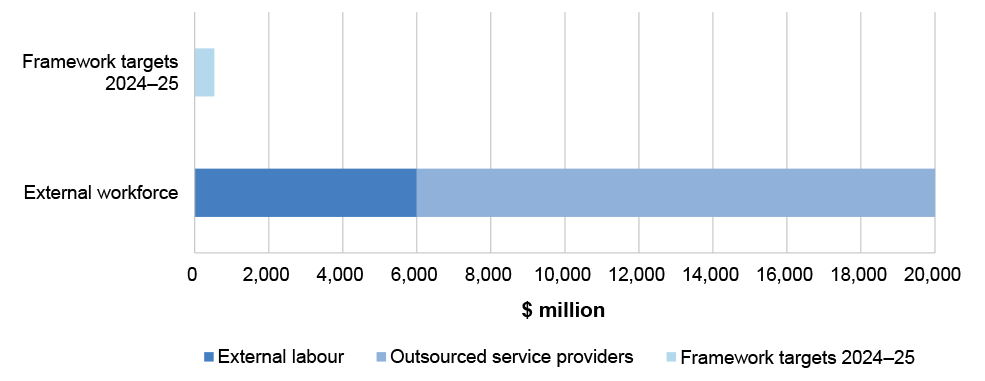
Source: ANAO analysis of APSC documentation and the 2021–22 and 2023–24 audits of employment.
3.11 In October 2023 the FoW sub-committee reported to the Secretaries Board on the project to ‘reduce reliance on contractors and consultants’ (which included the Framework). This report indicated that the FoW sub-committee still considered that the key intent for the project was reducing overall expenditure on external labour, which would, in turn, help build APS capability.
In the 2022–23 Budget, the Government committed to achieving savings of $3.6 billion over four years by reducing spending on external labour, advertising, travel and legal expenses. Reducing reliance on external labour will provide more opportunities for direct employment and more varied and interesting work opportunities for staff, which will help to build internal staff capability and improve the employee value proposition.
3.12 The APSC advised the ANAO in July 2026 on its reasons for the scope.
‘Core work’ draws on a concept from public administration, which was brought forward because it addressed the highest priority concerns raised by the Minister and her office in the policy design discussions – namely, to target areas where the work should specifically be done in the public service, because not doing so raised specific concerns regarding integrity or longer-term capability.
There is not a single or universal definition of the operationalisation of the ‘core work’ concept. Accordingly, it was recognised that core work would be different for different agencies, and hence the framework was designed to give agencies the flexibility to define what work is core for their agency, in their unique context. This enabled agencies to make individualised risk assessments as to what they would look to bring in-house over time.
Timeframe
3.13 The FoW sub-committee agreed in October 2022 that the APSC would design the prototype Framework by early 2023. A prototype was circulated to stakeholders in July and August 2023. The Framework was released in October 2023. The APSC advised the ANAO in March 2026 that a range of factors delayed progress. This included that the audit of employment was not completed until May 2023. Following the release of the audit of employment, the FoW sub-committee asked the APSC to consult with entities on the audit’s findings in May–June 2023.
Well informed
3.14 The APSC’s Delivering Great Policy model defines ‘well informed’ policy as that which has been: informed by robust evidence; and developed in collaboration with key stakeholders, including people affected by the policy.32
3.15 In October 2022, the FoW sub-committee agreed to the APSC’s proposal that it would develop a Framework prototype informed by:
- the Thodey Review (see paragraph 1.10 and Table 1.2);
- the 2021–22 audit of employment (see paragraphs 3.16–3.22); and
- feedback from entities and other stakeholders (see paragraphs 3.23–3.26).
Audit of employment
3.16 The 2021–22 audit of employment was released on 6 May 2023. It found that the external workforce cost about $20.8 billion, including about $6.5 billion on labour hire, contractors and consultants (Table 3.1). The audit stated that the external workforce represented 27.2 per cent of the ‘Government workforce’.33
Table 3.1: APS external workforce by employment type, 2021–22a
|
External workforce type |
Number of FTE |
Expenditure ($) |
Average cost per FTE ($) |
|
Labour hire |
6,716 |
800,000,000 |
119,119 |
|
Contractors |
18,196 |
5,121,500,000b |
281,463 |
|
Consultants |
954 |
563,400,000 |
590,566 |
|
Subtotal — external labour |
25,866 |
6,484,900,000 |
250,711 |
|
Outsourced service provider |
28,045 |
14,300,000,000 |
509,895 |
|
Total / average |
53,911 |
20,784,900,000 |
385,541 |
Note a: The ANAO has not verified the accuracy of this data. The report contained a data caveat that this was the first time data of this nature had been collected across the APS, entities’ responses were based on the reporting possible from their accounting and reporting systems, and neither Finance nor the APSC had undertaken quality assurance of the data provided by entities. Caution was urged when analysing the data, comparing the data with other data, and drawing conclusions. Finance also included table notes stating ‘there are slight differences in rows, columns and totals in due to rounding’.
Note b: Elsewhere in the audit of employment, this is rounded to $5.1 billion.
Source: ANAO analysis based on the Report on the Audit of Employment 2021–22, May 2023, p. 5 and p. 8. Average cost per FTE (full-time equivalent) calculated by the ANAO.
3.17 The 2021–22 audit of employment identified that the Department of Defence (Defence) represented 76 per cent of the total spending on external workforce, with an expenditure of $15.7 billion.34 After Defence, the four entities with next highest expenditure on external workforce collectively represented 12 per cent of total expenditure.
3.18 The audit of employment included some analysis on external workforce expenditure based on APS ‘job families’. The APS job family framework is based on occupational groupings in the APS. At the time, it contained 75 job functions under 18 overarching job families.35 The audit of employment noted that Defence was unable to break down its external workforce expenditure by APS job family.
3.19 Version 1 (October 2023) of the Framework defined ‘core work’ as ‘work essential to delivering the enduring functions of an agency, required on a regular and ongoing basis’.36 Under the Framework there are two types of core work: APS-wide core work (which is defined by the APSC and applies to all entities) and entity-specific core work (which is defined by, and applicable to, each entity individually).
3.20 APS-wide core work covered five of 18 job families: service delivery (for example, administering grants programs); policy (for example, developing cabinet submissions and policy); accounting and finance; legal and parliamentary (for example, drafting legislation and regulations); and senior executive (roles on the entity’s executive).
3.21 The ANAO mapped the 2021–22 audit of employment results for contractors and consultants (two categories of external labour) to the five job families covered by APS-wide core work (as defined by the APSC) and found:
- 56.5 per cent ($3.2 billion) of the spending on contractors and consultants in 2021–22 could not be classified by job family; and
- the five job families covered by APS-wide core work represented 6.2 per cent ($349.9 million) of the $5.7 billion spent on contractors and consultants in 2021–22 (Table 3.2).
Table 3.2: Expenditure on contractors and consultants, by job family and mapped to APS-wide ‘core work’, 2021–22a
|
Job family |
Expenditure on contractors and consultants ($) |
Job family as percentage of total (%) |
|
Not recorded (unclassified) |
3,209,600,000 |
56.5 |
|
Job families that are not covered by APS-wide ‘core work’ (as identified by the APSC) |
||
|
ICT and Digital Solutions |
1,344,100,000 |
23.6 |
|
Portfolio, Program and Project Management |
239,800,000 |
4.2 |
|
Data and Research |
166,200,000 |
2.9 |
|
Compliance and Regulation |
88,000,000 |
1.5 |
|
Science and Health |
66,200,000 |
1.2 |
|
Monitoring and Audit |
45,100,000 |
0.8 |
|
Administration |
39,600,000 |
0.7 |
|
Communications and Marketing |
38,800,000 |
0.7 |
|
Engineering and Technical |
29,000,000 |
0.5 |
|
Intelligence |
28,800,000 |
0.5 |
|
Human Resources |
22,300,000 |
0.4 |
|
Information and Knowledge Management |
13,400,000 |
0.2 |
|
Trades and Labour |
3,900,000 |
0.1 |
|
Subtotal |
2,125,200,000 |
37.4 |
|
Job families that are covered by APS-wide ‘core work’ (as identified by the APSC) |
||
|
Service Delivery |
122,000,000 |
2.1 |
|
Policy |
82,300,000 |
1.4 |
|
Accounting and Finance |
80,200,000 |
1.4 |
|
Legal and Parliamentary |
61,000,000 |
1.1 |
|
Senior Executive |
4,400,000 |
0.1 |
|
Subtotal |
349,900,000 |
6.2 |
|
Total |
5,684,700,000 |
100.0 |
Note a: The audit of employment analysis only included expenditure on contractors and consultants. Labour hire and outsourced service providers were not included. Finance included the table note ‘there are slight differences in rows, columns and totals in due to rounding’.
Source: ANAO analysis of audit of employment and APSC documentation.
3.22 The audit of employment highlighted the following potential challenges in the Framework’s design, which the APSC did not include in its advice to government.
- It was difficult for entities to determine which APS job families applied to the work of contractors and consultants, meaning that it would also be difficult to determine whether the work was core work, impacting on both the practicality of implementation and the measurement and reporting of outcomes.
- Job families related to APS-wide core work covered only a small percentage of expenditure on contractors and consultants, meaning that a focus on this type of work might not be effective for reducing the APS’s reliance on contractors and consultants overall.
Stakeholder consultation on design
3.23 In May 2023, the APSC set out its stakeholder engagement approach at a high level in an update to the FoW sub-committee. This included that the APSC would: ‘engage with a number of partner agencies over May and June [2023]’ with the objective ‘to further unpack [audit of employment] findings and refine the Framework’; follow this with a ‘broader consultation with APS agencies’; and once agreed by the committee, pilot the Framework ‘with a smaller number of agencies to ensure it is fit for broader roll-out across the APS’.
3.24 The APSC consulted with PM&C in June 2023 and the pilot was not pursued. The idea of a trial, pilot or soft launch was not mentioned in subsequent engagement with the FoW sub-committee. The APSC advised the ANAO in June 2026 that ‘delivering a pilot would not have been feasible given the Government’s interest in seeing the [Framework] released as a priority’.
3.25 During the design phase, the APSC consulted:
- the Minister and Assistant Minister for the Public Service (Assistant Minister);
- ‘partner agencies’ PM&C and Finance;
- 10 other entities that would be required to implement the Framework; and
- the Community and Public Sector Union, Professionals Australia and the Australian Manufacturing Workers Union (Table 3.3).
Table 3.3: Stakeholder consultation on Strategic Commissioning Framework design
|
Framework draft (and timing) |
Stakeholder consulted |
Nature of feedback and next action |
|
Draft 1 (July–August 2023) |
Minister |
Feedback from the Minister related to: using more direct language; establishing the intended outcome; and providing clearer direction to decision-makers. |
|
Finance, PM&C and 10 other entities |
Ten entities met with the APSC and the two partner agencies between 31 July and 9 August 2023. Issues raised by entities included: a lack of clarity in the title of the Framework; core work and entity-specific core work; and defining limited circumstances for outsourcing core work. The APSC made changes in a second draft of the Framework, based on feedback, which included:
|
|
|
3 unions |
One union expressed support for the direction of the Framework. Two unions did not provide comments. |
|
|
Draft 2 (August 2023) |
Minister and Assistant Minister |
Feedback included: Accountability of agency heads should be considered; alignment with budget numbers; and questions about whether there had been engagement with non-APS agencies and how ‘core work’ would be defined. |
|
Finance, PM&C and 10 other entities |
Two (of the 12) entities provided feedback: context and intent of the Framework should be refined; the Framework should be clearer about the accountability of agency heads; and that the principles relating to core APS work should be reconsidered. |
|
|
Draft 3 (September 2023) |
Minister and Assistant Minister |
Feedback included the proposed edit that entities be required to report all spending for their external workforce with comparisons across years. This proposed edit was not included in the final draft. |
|
Finance |
Finance provided additional feedback on the definition for contractors and the list of core work, stating that ‘undertaking procurement and managing contracts’ should be removed from the list of APS-wide core work that must not be outsourced as ‘it is not feasible to bring these services immediately in-house as the APS does not have capacity to meet this demand’. These suggested edits were accepted, with these types of work moved to a secondary list to be brought in-house as a priority (see paragraph 3.45 and Box 1). |
|
Source: ANAO.
3.26 In June 2023, the APSC prepared a ‘consultation paper’, which it sent to PM&C as a ‘partner agency’ for review. PM&C provided feedback that: there should be alignment between the Framework’s guidance and other Commonwealth guidance; and that entities should be asked to report on spending on the external workforce. In July 2023, the APSC reframed the consultation paper into a draft Framework before sending it out for consultation. The APSC consulted stakeholders between July and September 2023. The APSC sought and received feedback across three drafts of the Framework (Table 3.3).
3.27 Framework drafts included that entities ‘should collect data on their use of the external workforce and how it is reducing over time’ but did not mention setting targets for reducing supplier expenditure, a key aspect of the final Framework released in October 2023. This concept was not discussed with entities during design consultation. The APSC advised the ANAO in May 2026:
The concept of targets was informed by consultation with agencies, the [FoW] Sub-committee and the Minister’s Office. Consultation highlighted the [Framework] needed to drive measurable change and include robust assurance processes and accountability mechanisms, and that future audits of employment would not be the appropriate mechanism for tracking progress. In discussions, at least one agency reported using targets within their agency to support efforts to bring outsourced work in house. The draft [Framework], including targets, was formalised through a brief to the Minister, which was signed by the Minister on 1 October 2023.
Influential advice
3.28 The Delivering Great Policy model states that ‘influential advice is built by engaging early and often with those who can support or block the ideas you are formulating’. This includes that those developing the advice: engage those with influence from the start; consider the broader context; provide options, including the key risks and benefits for the various options; and make clear recommendations on the best option backed by evidence.
3.29 During the design consultation phase in June to September 2023, the APSC engaged with those who would have influence on the development of the Framework including: the Minister, Assistant Minister; the FoW sub-committee; and Secretaries Board (see Table 3.3).
- In August 2023, the APSC presented the FoW sub-committee with a paper titled ‘Rebuilding APS capability through reducing reliance on contractors and consultants via the Strategic Commissioning Framework’. The paper included the second draft of the Framework, which did not include a requirement for setting targets for reducing supplier expenditure. Members agreed the Framework in principle.
- In mid-September 2023 the APS Commissioner reviewed the third draft of the Framework and wrote to another APSC senior official that the Framework would need to include ‘robust assurance processes’, as ‘raised before’. A senior official responded ‘it’s covered in the brief but not the Framework itself. We can add it’.
- The APSC met with the Minister on 19 September 2023 to provide an update on the Framework. The annotated meeting agenda noted that a brief to the Minister would ‘set out mechanisms to support agency heads accountability for implementation of the framework’. The Minister’s office followed up with written comments on 22 September 2023, which recommended that the Framework accountability mechanism be stated as:
Agency heads are expected to report on the use of labour hire, contractors, consultants and outsourced service providers in the agency annual report, including a comparison with previous year usage. - The APSC provided advice to the Minister on 25 September 2023. The advice included a fourth draft of the Framework, a list of entities consulted and next steps. It did not discuss the Minister’s recommendation that the APSC require reporting on all spending on the external workforce in annual reports. The fourth draft of the Framework included, for the first time, the requirement that entities set and report on targets to reduce supplier expenditure. The Minister requested one wording change and agreed to the Framework on 1 October 2023.
- The APSC sought and received Secretaries Board approval of the Framework on 11 October 2023.
3.30 There were deficiencies in the APSC’s advice to decision-makers.
- A key design element in the final Framework — the setting of targets for reducing supplier expenditure and target reporting — was not included in advice to the FoW subcommittee, which left these key stakeholders out of that final decision. Advice to the FoW sub-committee, Minister and Secretaries Board did not provide evidence supporting targets as the best option for ensuring accountability.
- Advice to the FoW sub-committee noted issues raised during stakeholder consultation, including that: while the Framework offered flexibility, ‘it may need to go further to drive change’; and entities ‘had different notions of what is “core” [work]’. The advice did not explain how the APSC proposed to address these issues. Advice to decision-makers also did not discuss the trade-off between consistency and flexibility (for example, in defining ‘core work’) and the risks and benefits of the APSC’s proposed approach, which favoured flexibility (see paragraphs 3.12 and 3.57).
- Advice to the Minister did not close the loop on all feedback from the Minister’s office during consultation, with the feedback that entities should be asked to report all external workforce expenditure in annual reports not incorporated into the final version (or discussed in the advice). The APSC did not document the reason for not addressing this feedback.
- Advice to the Minister included one of the 14 risks from the APSC’s Framework risk register (that it would take time to achieve results and reductions may not show up until Year 2). Two other ‘sensitivities’ listed in the advice related to the conversion of Senior Executive Service (SES) roles and entities’ concerns about Average Staffing Level (ASL) constraints.37 The advice to the Secretaries Board did not discuss risks to implementation.
- Implementation options were not provided in advice to the FoW sub-committee, Minister and Secretaries Board. Decision-makers were given only one option.
Opportunity for improvement
3.31 The Australian Public Service Commission could establish controls to ensure that its policy advice to decision-makers includes clear options; the risks and benefits of various options; and a recommended option that is evidence based.
Practical to implement
3.32 The Delivering Great Policy model states ‘Advice that’s practical to implement involves collaborating with implementers early to test multiple solutions to understand what works best.’38 This includes: solutions that will lead to the desired policy outcomes; exploring and testing multiple options, and evaluating them with genuine input from implementers and end users; being clear that the policy can work in the real world; and considering the long-term impacts, perverse incentives and unintended outcomes.
3.33 The ANAO examined:
- distinction from other Commonwealth requirements;
- definitions and foundational concepts; and
- target-setting requirements.
Distinction from other Commonwealth requirements
3.34 The Framework was published in an environment where guidance and requirements for workforce planning and procuring external labour already existed. For example:
- the APSC has prepared other guidance on workforce planning, including the 2021 Delivering for Tomorrow: APS Workforce Strategy 2025 (Workforce Strategy), the 2023 Workforce Planning Guide; and the 2021 APS Mobility Framework39; and
- Finance administers rules and guidance, to support entities in meeting Public Governance, Performance and Accountability Act 2013 (PGPA Act) requirements, including the Commonwealth Procurement Rules (CPRs), resource management guides and the Contract Management Guide.40
3.35 A comparison of the Framework’s principles to existing guidance and requirements shows that three of the seven principles set new expectations for entities (Table 3.4).
Table 3.4: Framework principles compared to other Commonwealth requirements
|
Framework principle |
Principle sets new expectation |
ANAO analysis |
|
Start with rigorous planning |
✘ |
The Workforce Strategy states ‘agency-specific workforce planning is a key enabler of success’. The Workforce Planning Guide outlines key elements of workforce planning, including analysing the workforce, forecasting workforce needs and identify gaps. |
|
APS employment is the default [for core work]a |
✔ |
This concept that certain types of work is ‘core’ and that APS employment must be the default for this work was new. The Workforce Strategy stated that a key element of a successful mixed workforce model is taking ‘a structured approach to the use of non-APS employees — including considering where work would be best delivered by an APS employee’. |
|
Use APS networks first [for core work]a |
✘ |
The Workforce Strategy has a section on the benefits of mobility across the APS network. The APS Mobility Framework aims to help use mobility as a strategic workforce tool. The Framework does not refer to the Workforce Strategy or APS Mobility Framework. |
|
Use external support in limited circumstances |
✔ |
This concept that there are ‘limited circumstances’ where procurement of the external workforce is appropriate was new. The Framework outlines considerations for decision-makers before deciding to outsource work, including existing requirements, such as the PGPA Act and CPRs. |
|
Maximise the benefits and minimise the risk of any external arrangements |
✘ |
The Workforce Strategy discusses key elements of successful mixed workforce models including establishing knowledge transfer and capability uplift arrangements. Finance contract management guidance includes sections on assessing risk and developing risk management plans. Finance has also produced a model clause on ‘knowledge transfer’ to be used ‘where achieving value for money from the engagement of the Supplier, in part, relies on the knowledge, skills and deliverables resulting from the contract being captured and retained within the Customer agency’.b |
|
Apply merit when converting roles |
✘ |
The APS Employment Principles, set out in section 10A of the Public Service Act 1999, stipulate that decisions relating to engagement and promotion be based on merit. The APSC Guide on merit in the Australian Public Service outlines five requirements for applying merit in a recruitment process. |
|
Monitoring and accountability |
✔ |
The requirement for entities to collect information on their use of the external workforce for core work was new. In the first three years of Framework implementation, this included the setting and reporting of targets to reduce supplier expenditure for core work. This requirement was removed in the third version of the Framework published in July 2026 (see paragraph 4.52). |
Note a: In July 2024, ‘for core work’ was added to principles two and three.
Note b: Department of Finance, Knowledge Transfer (Clausebank), available from https://www.finance.gov.au /government/procurement/clausebank/knowledge-transfer accessed 7 July 2026].
Source: ANAO analysis; APSC, Strategic Commissioning Framework, APSC, 2023, Version 1, p. 2–4, APSC, Workforce planning resources [Internet], available from https://www.apsc.gov.au/initiatives-and-programs/aps-workforce-strategy-2025/workforce-planning-resources and APS Mobility Framework [Internet], 2021, available from https://www.apsc.gov.au/initiatives-and-programs/aps-mobility-framework [both accessed 7 July 2026]; and Department of Finance, Procurement [Internet], available from https://www.finance.gov.au/government/procurement; and Managing Commonwealth Resources [Internet], available from https://www.finance.gov.au/government/managing-commonwealth-resources [both accessed 7 July 2026].
3.36 The Framework and resources toolkit refer to some existing requirements, but these do not clearly state how the Framework aligns with, or distinguishes itself from, these other requirements. Keeping a policy streamlined to just the new elements makes it easier and more efficient for entities to implement and reduces administrative cost.
3.37 In June 2026 Finance released a procurement policy note on consultancy contracts, which includes a template to assist entities with meeting relevant requirements.41 The template includes a question on whether the Framework has been applied, distilling the Framework requirements to two sentences:
If outsourcing core work: identify the relevant limited circumstance and describe any internal consultation undertaken.
If not core work: provide a brief explanation of why the services are not considered core work.42
3.38 This template is specific to consultancy contracts, but it provides an example of how guidance could be simplified and aligned to make implementation more practical for entities.
3.39 Submissions to the audit (see paragraph 1.16) included comments that the Framework could be simplified and better aligned with existing requirements. For example:
The Framework could be improved through simplification and greater alignment (or incorporation) to existing budget processes and [CPRs]. Incorporating the principles contained in the Framework to the CPRs would provide a straightforward way for Commonwealth entities to ensure procurement activities are working to achieve the intent of the Framework.
Recommendation no.2
3.40 The Australian Public Service Commission work with the Department of Finance to simplify implementation of the Strategic Commissioning Framework by: aligning or integrating its requirements with existing Commonwealth procurement and workforce frameworks and guidance; and reducing duplication and administrative effort while maintaining the Framework’s policy intent.
Australian Public Service Commission: Agreed.
3.41 The APSC has worked with the Department of Finance throughout the [Framework’s] development and implementation, to ensure it aligns with the broader suite of Government initiatives aimed at reducing reliance on contractors and consultants. The APSC will continue to work closely with the Department of Finance to identify opportunities to simplify [Framework] requirements and align with related Commonwealth procurement frameworks, guidance and reporting processes.
3.42 The APSC will also continue to work closely with agencies to refine broader implementation arrangements for the policy over time.
Definitions and foundational concepts
3.43 Clear and consistent definitions of key concepts facilitate effective implementation. The Framework does not define or mention ‘commissioning’, other than in the title. As mentioned in Table 3.3, the title’s lack of clarity was raised by stakeholders, which led the APSC to add the sub-title ‘strengthening APS capability through reduced reliance on contractors and consultants’.
Core work
3.44 The Framework introduced the concept of ‘core work’ and linked core work to APS ‘job families’. The 2021–22 audit of employment showed that entities could not classify the majority of supplier expenditure by job family. As such, entities are not well placed to determine which supplier expenditure is on core work (see paragraphs 3.18–3.22). In preparation for the first public update on the Framework in November 2024, the APSC added a new job family called ‘Defence’ (in line with the approach taken by Finance in the audits of employment), as Defence could not break its Framework target down by job family or type of labour.
3.45 In August 2023 the Minister, through their office, asked that the Framework be strengthened to provide clear guidance on what is core work. The APSC provided examples of core work in the released Framework (Box 1).
|
Box 1: Strategic Commissioning Framework examples of core work, October 2023 |
|
Agencies need to be using and strengthening core APS capability. ‘Core’ means work essential to delivering the enduring functions of an agency, required on a regular and ongoing basis. There are core functions that must be done by the APS and must not be outsourced to an external workforce. These include:
Other core APS functions should be brought back in-house as a priority, including: procurement and managing contracts; cost benefit analysis; delivering programs; and managing grants. In line with Principle 7, each agency must determine what it considers core work that should not be outsourced, building on the whole-of-APS list above. |
Source: APS Strategic Commissioning Framework, v.1 (October 2023).
3.46 In addition to APS-wide core work as specified by the APSC (see paragraph 3.19), entities were asked to identify other types of core work relevant to their entity (entity-specific core work). While this offered flexibility to entities, it resulted in inconsistent data on ‘core work’ across the APS. Table 3.5 shows the number of entities (out of about 100 entities) identifying core work across the 18 APS job families in both years.43 Work identified as entity-specific core work changed within entities between 2024–25 and 2025–26, leading to further inconsistencies. The number of times entities identified a job family as including core work decreased overall in 2025–26 (936 times) compared to 2024–25 (1,029 times). For 13 of 18 job families, the number of entities identifying core work within the job family decreased between 2024–25 and 2025–26.
Table 3.5: Entities identifying entity-specific core work, by APS job family, 2024–25 and 2025–26
|
Job family |
Number of entities identifying job family as including core work |
Difference in number of entities |
|
|
|
2024–25 |
2025–26 |
|
|
Accounting and Finance |
89 |
92 |
+3 |
|
Senior Executive |
78 |
87 |
+9 |
|
Legal and Parliamentary |
78 |
85 |
+7 |
|
Policy |
80 |
83 |
+3 |
|
Service Delivery |
71 |
80 |
+9 |
|
ICT and Digital Solutions |
67 |
59 |
-8 |
|
Communications and Marketing |
65 |
56 |
-9 |
|
Portfolio, Program and Project Management |
65 |
55 |
-10 |
|
Administration |
65 |
53 |
-12 |
|
Data and Research |
64 |
51 |
-13 |
|
Human Resources |
68 |
51 |
-17 |
|
Compliance and Regulation |
50 |
42 |
-8 |
|
Information and Knowledge Management |
49 |
36 |
-13 |
|
Monitoring and Audit |
43 |
36 |
-7 |
|
Intelligence |
45 |
34 |
-11 |
|
Science and Health |
23 |
20 |
-3 |
|
Engineering and Technical |
19 |
11 |
-8 |
|
Trades and Labour |
10 |
5 |
-5 |
|
Total number of instances entities identified job families as containing ‘core work’ |
1,029 |
936 |
-93 |
|
Average number of entities per job family |
57 |
52 |
-5 |
|
340 |
97 |
97 |
93 |
Source: ANAO analysis of APSC documentation.
3.47 Sixty-five per cent of entities identified core work under the job family Human Resources in 2024–25; this decreased to 49 per cent of entities in 2025–26. APSC reporting did not explain how an entity could consider work to be core in one year and not core in the next year.
3.48 Submissions to the audit (paragraph 1.16) included comments from 11 entities that core work could be better defined (see Box 4 for entity comments on the APSC’s guidance on core work).
Targets and reporting requirements
3.49 The Framework outlines, under Principle 7, monitoring and accountability requirements. As at July 2026, there have been three versions of the Framework. The first released version (October 2023) set targets for reducing supplier expenditure. Changes to data collection requirements in the second version (July 2024) included that entities ‘must’ (instead of ‘should’) collect data on their use of the external workforce and the addition of the modifier ‘for core work’. Changes to data collection requirements in the third version (July 2026) included the removal of the line ‘to support central monitoring of the Framework’s impact’. Changes to target-setting requirements included adding ‘core work’ (second version) and removing the requirement to set targets (third version). Changes to monitoring and accountability requirements across the three versions are shown at Table 3.6.
Table 3.6: Framework monitoring and accountability requirements, 2023 to 2026a
|
Requirement |
October 2023 (v.1) |
July 2024 (v.2) |
July 2026 (v.3) |
|
Data collection |
Agencies should collect data on their use of the external workforce and how it is reducing over time, to support central monitoring of the Framework’s impact. |
Agencies must collect data on their use of the external workforce for core work and how it is reducing over time, to support central monitoring of the Framework’s impact. |
Agencies must collect data on their use of the external workforce for core work and how it is reducing over time. |
|
Targets |
Agency heads must set targets to reduce their agency’s reliance on inappropriate outsourcing. These targets must be in place by June 2024 and should outline which parts of the agency’s operations will be brought back in-house, how many roles will be affected and the anticipated reduction in expenditure. |
Agency heads must set targets to reduce their agency’s reliance on inappropriate outsourcing of core work. Initial targets must be in place by June 2024. Targets will be set annually and should outline which parts of the agency’s operations will be brought back in-house and the anticipated reduction in supplier expenditure on core work. |
[Requirement to set targets removed] |
|
Public reporting |
Targets must be reported in each agency’s corporate plan from 2024–25. Updates on progress against the targets should be reported in the agency’s annual report. |
Targets must be summarised in each agency’s corporate plan from 2024–25. Updates on progress against the targets should be reported in the agency’s annual report. |
Corporate plans to include: information on agencies’ core work, which job families will be the focus of reduction in outsourcing that year and proposed steps in embed the Framework and strengthen capability. Annual reports to include: any outsourcing of core work outside limited circumstances (as a dollar figure), steps taken to embed the Framework and strengthen capability, and progress against targets (if applicable).b |
Note a: Changes to requirements (from previous year) in bold.
Note b: Agencies that set targets for 2025–26 are still required to report on them in their 2025–26 annual reports.
Source: APS Strategic Commissioning Framework, v.1 (October 2023), v.2 (July 2024) and v.3 (July 2026).
3.50 Further information on targets was provided to entities through an online resources toolkit, in April 2024.44
- Targets were to specify the expected reductions in supplier expenditure.
- ‘It is not expected that agencies will eliminate all outsourcing of core work in the first year of implementation’.
- ‘Agencies have discretion in how they calculate the estimated reduction in supplier expenditure.’
- ‘The Government has a strong expectation that agencies will reduce their spending on external labour.’
3.51 Submissions to the audit (see paragraph 1.16) included comments from 13 entities that stated that the design of the Framework could be improved, with 12 entities mentioning the design of the Framework targets (Box 2).
|
Box 2: Submissions to the audit — Framework targets |
|
Twelve entities stated that the concept of targets could be improved or reconsidered or had hampered the effectiveness of the Framework. Comments highlighted a misalignment between implementation mechanisms and intended outcomes. For example:
One entity highlighted that APSC advice to entities sometimes focused on technical compliance rather than achieving actual reductions in outsourcing.
|
3.52 Framework targets were not practical to implement and did not provide an understanding of whether the Framework’s policy intent — reducing reliance on the external workforce, bringing core work in-house and strengthening APS capabilities — was being achieved.
- The concept of ‘core work’ did not exist prior to the Framework and has not been consistently defined, which has resulted in entities creating individual definitions of core work that are not consistent across the APS, or consistent within the same entity year on year (see paragraphs 3.44–3.48).
- Entity targets were not intended to (and did not) encompass all outsourced core work in the first year. In 2025, many entities stated that they would not be setting new targets for 2025–26 as they outsourced little to no core work or where they did, this was covered by a ‘limited circumstance’. This included entities that had not met their first year target (see paragraphs 3.54–3.56). It is not clear from reporting on targets whether outsourcing of core work had reduced in real terms or outsourcing had been relabelled (as non-core work) or assigned to a limited circumstance to remove the spending from the accountability of the Framework.
- The collection of data for targets and reporting came with significant administrative cost to entities and resulted in data that was published with caveats that it could not be relied upon (see paragraph 4.39).
- The targets are reported without the context of total spending on the external workforce (or external labour) year on year. Reporting that entities had decreased supplier expenditure by over $527 million in 2024–25 could be seen as misleading as, overall, entities increased spending on supplier expenditure in 2024–25. Further, as entities are not required to report how much work they were outsourcing in total, it is not clear if the targets are meaningful reductions.
3.53 The APSC requested and received approval from the Minister to remove targets for 2026–27, the final year of the Framework’s implementation (see paragraphs 4.50–4.52).
Limited circumstances
3.54 The Framework’s Principle 4 outlined the ‘limited circumstances’ where entities could outsource core work. The APSC provided further information in its resources toolkit (Box 3).
|
Box 3: Limited circumstances, as defined in the Framework Resources Toolkit |
|
For core work, contractors/labour hire is only appropriate if at least one of the following is true.
For core work, use of consultants is only appropriate if at least one of the following is true.
|
Source: APSC’s Resources Toolkit for the Strategic Commissioning Framework, available from https://www.apsc.gov.au/initiatives-and-programs/workforce-information/aps-strategic-commissioning-framework/resources-toolkit-strategic-commissioning-framework [accessed 21 May 2026].
3.55 For 2025–26, of 105 relevant entities, 49 determined that ‘outsourcing of core work is minimal and in line with limited circumstances’ and a further 13 stated that they had no outsourced APS-wide or entity-specific core work.45 In other words, 62 of 105 entities (59 per cent) implied that the Framework did not apply to them due to a lack of relevant outsourcing. The combination of entity-specific core work identified by each entity, and exemptions based on entity-determined limited circumstances, reduces transparency and the potential impact of the Framework.
3.56 The ANAO drew a targeted sample of 22 entities that set the largest Framework targets in 2024–25 to obtain a deeper understanding of entity reporting (see Appendix 4). Of the 22 entities in the sample, five (23 per cent) did not subsequently set a reduction in supplier expenditure target for 2025–26. Of these, four did not set a target because the entity reported that ‘outsourcing of core work is minimal and in line with limited circumstances’. In 2024–25, two of these four entities increased expenses on contractors and consultants compared to 2023–24, and the four entities spent $268.6 million on contractors and consultants, an average of $67.2 million each (Table 3.7).
Table 3.7: Expenses on contractors and consultants, sampled entities that did not set a supplier expenditure reduction target for 2025–26
|
Entity |
Expenses on contractors and consultants |
Difference |
|
|
|
2023–24 |
2024–25 |
|
|
Department of Education |
$29,684,000 |
$37,050,000 |
$7,366,000 |
|
Department of Employment and Workplace Relations |
$159,390,000 |
$155,254,000 |
($4,136,000) |
|
Department of Infrastructure, Transport, Regional Development, Communications, Sport and the Arts |
$38,344,000 |
$46,878,000 |
$8,534,000 |
|
Department of the Prime Minister and Cabinet |
$30,780,000 |
$29,428,000 |
($1,352,000) |
|
Total |
$258,198,000 |
$268,610,000 |
$10,412,000 |
|
Average |
$64,549,500 |
$67,152,500 |
$2,603,000 |
|
274 |
117 |
117 |
106 |
Source: ANAO sample.
3.57 In relation to the Framework’s use of concepts such as ‘core work’ and ‘limited circumstances’ and entities’ inconsistent application of these concepts, the APSC advised the ANAO in June 2026 that ‘there are trade-offs to be made between heavy prescription and flexibility’ and that flexibility was ‘intended to support practical implementation’ (see also paragraph 3.12).
Were stakeholder engagement arrangements for the implementation period fit for purpose?
Following the publication of the Framework in October 2023, the APSC consulted with entities to support their implementation of the Framework. Stakeholder engagement arrangements during the implementation period were largely fit for purpose. The APSC engaged and supported entities through a working group, one-on-one support, user testing sessions and guidance documents.
3.58 The Framework was released in October 2023, with Framework targets for 2024–25 identified in 2024, and an initial implementation period of three years (from 2024–25 to 2026–27).
Stakeholder engagement planning
3.59 APSC guidance Getting stakeholder engagement right (see paragraph 3.2) advises that engagement with stakeholders is more successful when there is a plan from the outset and emphasises the importance of identifying the relevant stakeholders. In 2024 the APSC drafted a stakeholder engagement plan that largely aligned with the APSC guidance. The plan identified a range of relevant stakeholders, including APS entities. The plan did not specify which areas within entities would be included — with early stakeholder engagement focused on workforce planning and human resources teams and little engagement with procurement and finance teams.
3.60 In addition to the draft stakeholder engagement plan, the APSC developed communications plans in 2024 and 2025 for public updates on the Framework and to support entities to understand their obligations and implementation challenges. The 2025 plan identified business areas within entities that were relevant to the implementation of the Framework — this included human resources and finance teams.
Stakeholder engagement
3.61 Following the release of the Framework in October 2023, the APSC established a Framework implementation working group. The APSC and Finance co-chair the working group, and at 30 June 2026, 11 other entities were members. As with stakeholder engagement planning, most entity representatives on the working group were from workforce planning and human resources teams, with very little representation from procurement or commissioning teams. This may have had unintended consequences on the implementation of the Framework — which focused more on internal workforce planning and APS capability than on external commissioning. Over the first two years of implementation, between November 2023 and December 2025, the working group met 19 times. It did not meet between January and June 2026. The APSC advised the ANAO in July 2026 that it intends to reconvene the working group later in 2026, once entities had completed Framework reporting, including in entities’ 2026–27 corporate plans and 2025–26 annual reports.
3.62 The APSC sought feedback on implementation of the Framework through mechanisms including: approximately 20 drop-in sessions for entities to seek support and provide feedback; a 2023-24 APS Agency Survey, which asked about steps taken by agencies to embed the Framework; two user testing sessions to seek feedback on the 2024–25 ‘reporting workbook’ for reporting progress against the Framework; and one-on-one meetings.
3.63 The APSC provided entities with guidance. In 2024 the APSC distributed a Framework communications pack to entities, which included assurance prompts, guidance and reporting information. The APSC published an online resources toolkit, which included a process map and guidance on defining core work, limited circumstances and setting targets.46
3.64 The APSC’s stakeholder engagement on the implementation of the Framework largely aligned with ten standards set out in the APS Framework for Engagement and Participation.47 The APS Framework for Engagement and Participation notes that it is important to record stakeholder feedback and interactions, ensure that stakeholder views are fairly considered, and provide feedback to stakeholders in a timely manner. The APSC established communications and issues logs, which captured some, but not all, engagement and feedback received during the implementation of the Framework. There was no consolidated tracking of all feedback from agencies on the implementation of the Framework or how this feedback was addressed.
3.65 Submissions to the audit (see paragraph 1.16) included comments on the APSC’s engagement with stakeholders (Box 4).
|
Box 4: Submissions to the audit — Stakeholder engagement during implementation |
|
Seven submissions stated that entities felt adequately supported by the APSC. For example:
Seven submissions indicated that APSC guidance could have been improved, particularly in relation to defining core work. For example:
|
4. Implementation
Areas examined
This chapter examines whether the Australian Public Service Commission’s (APSC’s) implementation of the Strategic Commissioning Framework (the Framework) is achieving its intended outcomes.
Conclusion
Implementation of the Framework was largely effective, but weaknesses in target design, evaluation and public reporting limited transparency over whether the Framework achieved its intended outcomes.
- The APSC implemented and reported on the Framework in a timely and organised way, with a focus on embedding the Framework in entities and collecting data.
- The APSC evaluated the first year of implementation, which helped it assess short-term outcomes. The evaluation did not assess whether the Australian Public Service (APS) had reduced reliance on the external workforce or strengthened its capability.
- The APSC publicly reported that the APS-wide target to reduce supplier expenditure by $527.6 million had been slightly exceeded, with 74 per cent of the reported reduction attributable to two entities. The public update did not include the evaluation finding that 40 per cent of entities had fully met their individual targets. Public reporting improved transparency over implementation and target achievement but did not show whether the Framework had reduced reliance on the external workforce for APS ‘core work’ or strengthened APS capability.
Areas for improvement
The ANAO suggested the APSC could improve the robustness of future evaluation processes.
4.1 The Framework’s intent, as published in October 2023, was:
The core work of the APS must be done by our core workforce — APS employees. This expectation will wind back excessive outsourcing and its impacts on the skills held and used in APS agencies … Over time — when supported by APS recruitment, skilling and mobility — this approach will deepen system-wide capability and reduce the risks to integrity, expertise and public trust posed by excessive outsourcing.48
4.2 A program logic for the Framework developed in late 2023 included the following objective.
To ensure core work is done by our core workforce — APS employees. Over time, when supported by APS recruitment, skilling and mobility, this approach will deepen system-wide capability.
4.3 Analysis of information collected by a policy owner assists in determining if the policy is meeting its objectives. Where the policy owner relies on entity self-reporting, quality assurance provides transparency over the meaningful achievement of outcomes.
4.4 Effective evaluation helps an entity to monitor and report on whether its activities and programs are delivering intended outcomes. The evidence gained from evaluation also helps entities to adapt to changing circumstances and make judgements that support government decision-making.49
4.5 Policy stewardship includes ongoing monitoring of how well the policy is being implemented and reporting on the achievement of outcomes. In 2023 a new value, ‘stewardship’, was added to the APS Values.50
Stewardship is a practice of caring for something that we have been trusted to look after. Being a good steward means accepting responsibility for that care, and working to ensure the long-term integrity and sustainability of what has been entrusted to us.51
Was information collected, quality assured and analysed?
The APSC established a data protocol for the Framework and collected information from entities (including how the Framework was being embedded and reporting against targets) in a systematic and organised way. Some entities provided feedback that lack of alignment to existing data systems meant that reporting resulted in manual work, administrative cost and potential data reliability issues. The APSC undertook some quality assurance and analysis on the data provided by entities and provided resources for entities to conduct their own quality assurance. As the steward of the Framework, the APSC could have undertaken additional data analysis to identify trends in how the external workforce was being used more broadly and to maximise the value of data provided by entities.
Data collection
4.6 The APSC collected information from entities on the Framework’s implementation.
- In June–August 2024, the APSC collected information on the establishment of targets to reduce supplier expenditure under the Framework. The targets were established in Year 1 (2023–24) for reducing supplier expenditure in Year 2 (2024–25).
- In August–September 2025, the APSC collected information on the progress entities had made in Year 2 on reducing supplier expenditure against their targets and on embedding the Framework and information on entity targets for Year 3 (2025–26).
4.7 In 2023–24 the APSC established a data protocol for the collection of Framework information from entities, the purpose of which was to ‘record high level processes that inform future reporting’, including: key aspects of data handling and quality assurance; and assumptions and decisions about agency data. The protocol also set out roles and responsibilities and that data analysis was to include ‘advice, data visualisation, analysis support’. The protocol was updated in 2025 to reflect changes in the data collection process.
4.8 In April 2024 the APSC provided an information pack to entities that outlined how to embed the Framework, what agencies needed to do and a preview of a reporting template. The reporting template was to form part of the year’s APS Agency Survey. Agencies were required to complete the following Year 1 milestones by 30 June 2024:
- identify the agency’s core work that should only be done by APS employees;
- set targets for Year 2, specifying the core work that will be brought in-house and the associated reduction expected in outsourcing (as a dollar value and number of external full-time equivalent (FTE) positions);
- prepare to publish targets in their 2024–25 corporate plan to support public accountability;
- establish new procurement processes that captured information on whether outsourced work was core work (see paragraph 3.19); and
- set up systems to track and report progress to the APSC.
4.9 In April 2024 entities indicated to the APSC that calculating meaningful FTE figures for the purpose of setting and reporting reduction in supplier expenditure targets would be ‘impossible’ for consulting contracts and for some labour hire and contract roles. The APSC decided to ask entities to provide FTE figures ‘where possible’.
4.10 Information was collected from entities in the following ways.
- For Year 1 reporting, the APS Agency Survey included a workbook for entities to outline core work and establish targets for reducing supplier expenditure.
- For Year 2 reporting, progress against the targets and embedding the Framework were reported to the APSC directly through ‘bespoke reporting workbooks’.
4.11 In mid-2024, the APSC set up a log for data collection issues. Issues included in the log were not recorded or analysed by theme. The log did not clearly indicate whether the issues had been resolved. The issues log was improved for 2025, with space added to show whether issues had been resolved.
4.12 Submissions to the audit (paragraph 1.16) included comments on data collection (Box 5).
|
Box 5: Submissions to the audit — Framework data collection |
|
Six entities stated that data collection was resource intensive and/or required manual processes. For example:
|
Data quality assurance
4.13 Data quality assurance procedures were documented in three ways.
- Data protocol — According to the 2024 and 2025 data protocols, data validation involved ‘quality assurance work undertaken prior to the data being merged’. This included the APSC working with entities and making data cleaning decisions. The data protocols outlined a tiered approach to follow up on data quality. The 2024 data protocol also recorded decisions and actions taken during processing entities’ reported information.
- Standard operating procedure (SOP) — For Year 2 reporting, the APSC developed a SOP for processing bespoke reporting workbooks that outlined quality assurance checks (including for complete data, discrepancies and ‘sense’ checks on FTE and dollar figures). Where discrepancies were identified, the team was required to resolve these with the entity. A further check was to be undertaken on the merged data.
- Entity assurance checklist — In early 2025, the APSC created a list of assurance ‘prompts’ for entities for Year 2 data.
4.14 Entities returned completed reporting workbooks with Year 2 data to the APSC in August–September 2025. In September–October 2025, the APSC combined entity data. Where data discrepancies were identified, these were recorded in an issues log. The 2025 issues log recorded who had done quality assurance and when, any issues that had arisen and how these were resolved. Examples of issues included: missing data; broken formulas; reference errors; incorrect job families; and changes to entity-specific core work from year to year.
4.15 The data protocols stated that ‘any briefing based on preliminary reporting insights [should] include clear caveats, indicating the data is indicative and subject to change as quality assurance processes are finalised.’ The implementation plan for the Framework noted that the APSC would not be auditing entities’ internal implementation of the Framework.
Data analysis
4.16 The 2019 Thodey Review (see paragraph 1.10 and Table 1.2) mentioned the importance of data analysis when recommending ‘a new strategic, service-wide approach to using external providers’:
By aggregating and applying sophisticated data analytics to a wide range of procurement information (including on performance), the APS will be able to deliver both procurement efficiencies and better services. A strategic whole-of-service approach to procurement and contracting, supported by analysis of APS data, will help identify and mitigate risks that arise from over-reliance of providers.52
4.17 As the steward of the Framework, the APSC has a responsibility for analysing and using data to determine whether the Framework is achieving its intent.
4.18 The Framework data protocols included responsibilities for data analysis. For Year 1 and Year 2 data, the APSC managed data analysis in two tranches, with the first tranche focused on individual entity data and the second tranche focused on the merged data, which included further quality assurance.
4.19 The APSC briefed the Minister for the Public Service (the Minister) at the end of August 2024 on data from Year 1 establishment of targets, which included information on the number of entities that had established targets, targets set by portfolio and some analysis on the distribution of established targets by agency function.
4.20 The August 2024 ministerial brief stated that ‘target data will be compared with 2023–24 audit of employment data, once available, to identify any meaningful alignment’. This was not done. The APSC advised the ANAO in April 2026:
While it was intended that the Audits of Employment would inform a basis for [Framework] reporting and analysis, as both initiatives progressed, it became clear that each had a specific and separate focus. The Audits of Employment were useful context for [Framework] work, including the approach and definitions, but the different scope and objectives limited opportunities for alignment.
4.21 As mentioned at paragraph 4.10, the APSC used reporting workbooks to collect data from entities on their progress against targets. This process involved manual calculations, administrative cost and considerable effort from entities and the APSC. The resulting data could not be relied upon, and data analysis was limited. Analysis did not cover trends in use of the external workforce or whether the Framework was having real impact on reducing reliance on the external workforce or strengthening APS capability.
Does reporting show whether intended outcomes have been achieved?
The APSC prepared a fit-for-purpose monitoring and evaluation plan and undertook an evaluation of short-term implementation outcomes. Long-term outcomes were identified but were deemed out of scope for monitoring and evaluation. The APSC reported on the Framework in its annual performance statements. The robustness of evaluation and performance reporting could have been improved by greater evaluator independence, reducing the potential for bias, and clearer definitions.
The APSC’s 2024 and 2025 public updates showed intended short-term outcomes of the Framework were partly achieved, including partial embedding of the Framework in entities and APS-wide achievement of combined targets. Two entities were responsible for achieving 74 per cent of the total 2024–25 targets. Weaknesses in the target design, and the absence of controls to ensure target achievement reflected genuine reductions in expenditure on outsourced core work, limited the APSC’s ability to assess whether reported results represented actual reductions in overall expenditure on the external workforce, or whether reported reductions were offset by increases in other spending on the external workforce.
The APSC sought and received approval to streamline reporting on the Framework in 2026–27, which included the removal of the Framework targets. Although the Framework targets, as designed, were not an effective way to measure whether the Framework was achieving its intent, entities should be held accountable for whether they are reducing reliance on the external workforce.
Planning for monitoring and evaluation
4.22 Preparing a detailed evaluation plan ‘can help ensure there is a common understanding of exactly what needs to be evaluated and why’.53 The APSC developed a monitoring and evaluation plan for the Framework in 2023–24, which was updated in 2024–25 and 2025–26. The plan set out the design of evaluation, roles and responsibilities, timeframes and a program logic. In addition to stating the intent of the Framework (see paragraph 4.1), the program logic outlined short-, medium- and long-term outcomes (Figure 4.1). The short-term outcomes were focused on implementation (rather than outcomes of the Framework).
Figure 4.1: Intended outcomes for the Strategic Commissioning Framework
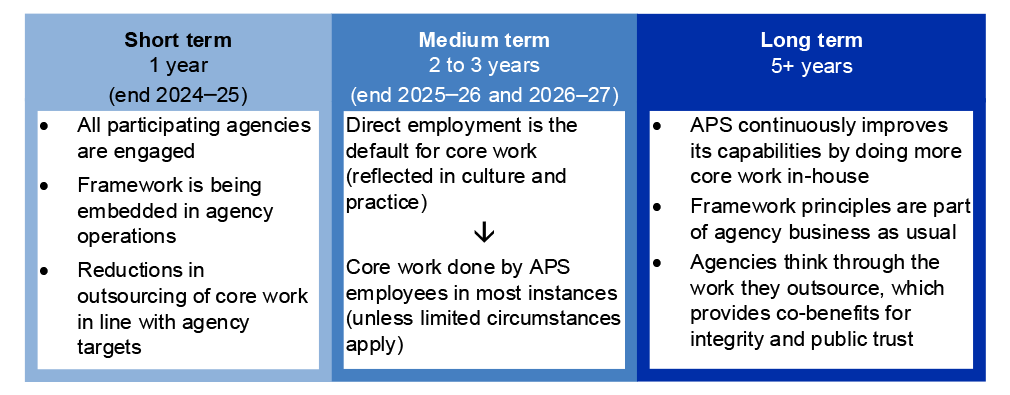
Source: APSC.
4.23 The program logic outlined the evaluation metrics. Short- and medium-term outcomes are measurable, but long-term outcomes may be difficult to measure. For example, it will be difficult to evaluate whether, in the long term, ‘agencies think through the work they outsource, which provides co-benefits for integrity and public trust’. The monitoring and evaluation plan outlined that: short-term outcomes would be evaluated in 2025–26 and medium-term outcomes would be evaluated in 2026–27. As the Framework had a three-year timeframe (to 2026–27), the program logic stated that long-term outcomes were out of scope of the evaluation plan, and would be measured by parties other than the APSC, such as through: APS capability reviews; the APS Employee Census; any future audits of employment; and ANAO audits (Figure 4.2). A lack of structured planning for long-term evaluation beyond June 2027 reduces the likelihood that the Framework’s success in achieving the ultimate intended outcomes will be determined.
Figure 4.2: APSC Evaluation metrics for short-, medium-, and long-term outcomes
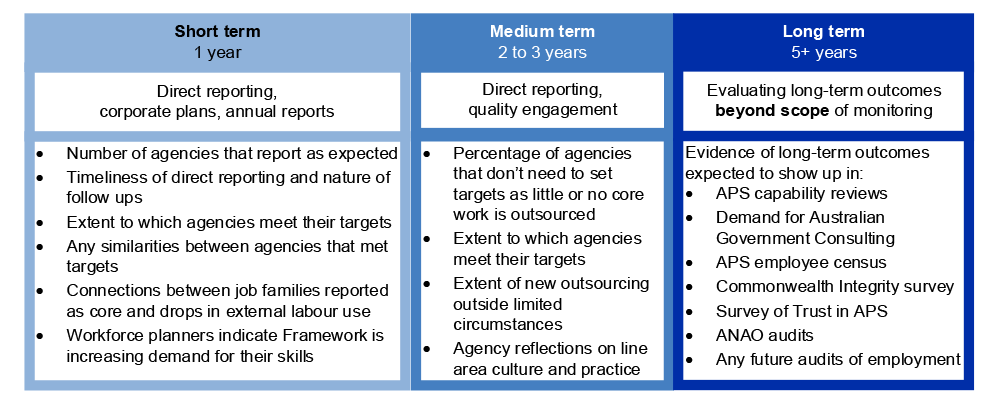
Source: APSC.
Monitoring and evaluation activities
4.24 The monitoring and evaluation plan outlined key milestones for monitoring and evaluating the short- and medium-term outcomes of the Framework until late 2027. As at August 2026 all key milestones had been completed as planned (Table 4.1).
Table 4.1: Completion of key milestones for monitoring and evaluation short- and medium-term outcomes
|
Milestone |
Due date |
Status at June 2026 |
|
Post-commencement check |
Late 2024 |
Completed November 2024 |
|
First report to Minister (targets) |
Late 2024 |
Completed October 2024 |
|
Public reporting (targets)a |
Late 2024 |
Completed November 2024 |
|
Second report to Minister (progress against targets) |
Late 2025 |
Completed November 2025 |
|
Public reporting (progress against targets)a |
Late 2025 |
Completed December 2025 |
|
Evaluation on Year 1 (short-term outcomes) |
Early 2026 |
Completed April 2026 |
|
Third report to Minister (progress against targets) |
End of 2026 |
Not yet due |
|
Public reporting (progress against targets)a |
End of 2026 |
No longer to be doneb |
|
Evaluation on Year 2 (medium-term outcomes) |
Early 2027 |
Not yet due |
|
Summative evaluation |
Late 2027 |
Not yet due |
Note a: External reporting.
Note b: In April 2026, the APSC sought and received approval from the Minister to streamline reporting for 2026–27, which included that the APSC would not prepare a public update at the end of 2026.
Source: ANAO analysis of APSC documentation.
4.25 The APSC finalised its first evaluation report in April 2026, which focused on early implementation and short-term outcomes. It concluded:
Overall, findings indicate that implementation of the Framework remains aligned with original policy objectives and short-term outcomes, supporting the Government’s goal of reducing reliance on contractors and consultants … Reporting results for the first year of implementation (2024–25) provided a snapshot of the significant foundational work done by agencies to reduce outsourcing of core work. It also provided valuable insights for possible adjustments to future reporting requirements … Evidence indicated that agency reporting was enabled by clear guidance on reporting requirements.
4.26 The APSC found that it had ‘substantially achieved’ all three intended short-term outcomes, with ‘substantially achieved’ being defined as ‘61–99 per cent achieved’ (Table 4.2). All entities had engaged with the APSC. Results for embedding the Framework were mixed, with over 60 per cent of entities updating relevant policies and forms and 46 per cent reporting that they had updated financial, procurement and human resources systems to enable better reporting. Alignment with targets was also mixed, with the overall target achieved, but with 40 per cent of entities meeting their individual Framework targets in full.
Table 4.2: APSC evaluation of intended short-term outcomes, April 2026
|
Intended short-term outcomes |
APSC evaluation |
Supporting information, (percentage of relevant entities, as self-reported) |
|
Engaged — All participating agencies are engaged |
Substantially achieved |
|
|
Embedded — Framework is being embedded in agency operations |
Substantially achieved |
|
|
Alignment — Reductions in outsourcing of core work in line with agency targets |
Substantially achieved |
Overall target of $527.6 million reduction achieved.
|
Source: ANAO analysis of APSC documentation.
4.27 The evaluation on Year 1 largely aligned with the principles of the Commonwealth Evaluation Policy, which applies to all Commonwealth entities subject to the Public Governance, Performance and Accountability Act 2013 (PGPA Act) (Table 4.3).
Table 4.3: ANAO assessment of the APSC’s Evaluation of Year 1 of the Strategic Commissioning Frameworka
|
Commonwealth Evaluation Policy principle |
ANAO assessment |
ANAO comments |
|
Fit for purpose |
◆ |
Evaluation questions included those to inform both Framework administration decisions and Framework policy decisions. |
|
Useful |
▲ |
The evaluation included an assessment against the intended short-term outcomes and evaluation questions that were useful. The evaluation could have been more useful if it had evaluated whether the Framework was delivering real reductions in supplier expenditure on core work. This could have assisted with both monitoring delivery and decision-making on changes to the design of the Framework. |
|
Robustb |
▲ |
The evaluation provided clear information for decision-makers on limitations (which affected its robustness), including:
Lack of separation between the evaluators and the administrators of the Framework introduced a potential for evaluator bias. |
|
Ethicalb |
◆ |
|
|
Credible |
◆ |
The collection and analysis of evidence was undertaken in a systematic way and the methodology for assessment of intended short-term outcomes was provided. The limitations of the evaluation were explained. Credibility could be impacted by the lack of independence. |
|
Transparent, where appropriate |
Not yet determined. |
The APSC advised the ANAO in April 2026 that a decision regarding publication or distribution of the evaluation had not been made. |
Key: ◆ Fully or largely aligned; ▲ Partly aligned; ■ Not aligned.
Note a: The Framework was introduced in October 2023, with entities required in 2023–24 to identify core work and set 2024–25 reduction in supplier expenditure targets. For the purposes of the evaluation, the APSC defines Year 1 as 2024–25, which was the first year entities were required to report against targets. In this audit report, 2024–25 is described as Year 2.
Note b: For the principle ‘robust, ethical and culturally appropriate’, this assessment did not include whether the evaluation was ‘culturally appropriate’, as stakeholders for the Framework were mainly government entities.
Source: ANAO analysis of the Commonwealth Evaluation Policy and APSC documentation.
Opportunity for improvement
To strengthen future evaluation processes, the Australian Public Service Commission could:
- reduce potential evaluator bias and improve independence by involving officers beyond the team responsible for the activity;
- ensure data and supporting evidence is robust; and
- ensure the evaluation plan includes practical plans for measuring longer-term outcomes.
Public reporting of Framework outcomes
Reporting on Australian Public Service Commission performance
4.28 Australian Government entities are subject to performance measurement and reporting requirements under the PGPA Act and the Public Governance, Performance and Accountability Rule 2014 (PGPA Rule). The APSC introduced an APSC performance measure that included the Framework in its 2024–25 Corporate Plan: ‘right settings are in place to support an effective APS workforce’. The measure included three ‘planned performance results’ including:
>90% APS agencies meet the required milestones under the [Framework].
4.29 This measure largely aligned with requirements for effective performance measurement that are set out in Sections 16E and 16EA of the PGPA Rule (Table 4.4).
Table 4.4: Assessment of APSC corporate plan performance measure on the Strategic Commissioning Framework, 2024–25 and 2025–26
|
Requirements |
2024–25 |
2025–26 |
ANAO assessment |
|
Relate directly |
◆ |
◆ |
The measure relates directly to the key activity ‘lead and support the development of quality APS workforce management policy’ and implementation of the Framework. |
|
Use information and methodologies that are reliable (trustworthy) and verifiable (able to be substantiated) |
◆ |
◆ |
The ‘required milestone’ under the Framework:
The methodology and information that underpins this is reliable and verifiable. |
|
Unbiased |
▲ |
◆ |
See paragraphs 4.30 to 4.34. |
|
Basis for assessment over time |
◆ |
◆ |
The measure was the same in 2024–25 and 2025–26, with the 2025–26 Corporate Plan noting that it would be the same measure in 2026–27, but that would be the last year of reporting (as the APSC’s Framework implementation is due to cease in 2027–28). |
|
Targets specified |
◆ |
◆ |
The target was specified in both years: >90% |
Key: ◆ Fully or largely aligned; ▲ Partly aligned; ■ Not aligned.
Source: ANAO analysis of APSC corporate plans.
4.30 The ‘required milestones’ that needed to be met by entities were set out in the first version of the Framework, which was released in October 2023. In Year 1:
- targets for 2024–25 must be in place by June 2024;
- the established targets must be provided in each agency’s 2024–25 corporate plan; and
- the established targets will be provided to the APSC in the APS Agency Survey.54
4.31 In April 2024 the Framework resources toolkit included the following additional guidance:
Agencies should include a short paragraph [in corporate plans] outlining the areas of focus (for instance the focus job families) and expected reductions in supplier expenditure.
4.32 The description of the APSC’s performance measure in the APSC’s 2024–25 Corporate Plan was based on how many entities met ‘required milestones’ but did not state what those milestones were. The absence of a clear statement about the meaning of ‘milestones’ introduced the potential for bias when reporting performance against the measure. An August 2024 methodology document outlined that an entity had met ‘required milestones’ if it had ‘submit[ed] reporting on core work and targets directly to the APSC and include[d] content on the [Framework] in their 2024–25 corporate plan’. This was inconsistent with the published requirement of establishing and reporting a ‘target’ for reducing supplier expenditure in the corporate plan.
4.33 The APSC’s 2024–25 annual performance statements stated that ‘86% of agencies included content on the Framework in their 2024–25 corporate plans’, and that their target had been ‘substantially achieved’. If the APSC had used the ‘required milestones’ as set out in the Framework (including that entities establish and report a target dollar figure in their corporate plans), the APSC performance measure would have been ‘partially achieved’, with 65 per cent of agencies reporting targets under the Framework in their corporate plans. The APSC’s 2024–25 Annual Report included information on the performance measure methodology, which provided transparency over how it was determined whether an entity met the milestone requirements; however, it did not explain the rationale for general ‘content’ (without a dollar figure target) being considered sufficient.55
4.34 An APSC internal report noted lessons learned from the 2024–25 performance statement process, which included that for Year 2, the APSC would conduct user testing to confirm instructions were clear, avoid points of confusion from Year 1, and factor timing of corporate plans into entity reporting requirements. The APSC performance measure was improved in the APSC 2025–26 Corporate Plan, which outlined more detail on the required milestones.
Reporting on Strategic Commissioning Framework targets and progress
4.35 In November 2024 the APSC published its first public update on the Framework, which outlined that 75 (of 104) entities had set reduction in supplier expenditure targets for 2024–25, totalling more than $527 million in reduced labour workforce expenditure. Of the 75 entities that had set targets, 64 (85 per cent) reported on progress against targets in their 2024–25 annual reports and 100 per cent reported on progress directly to the APSC.
4.36 In December 2025 the APSC published a second public update on progress against 2024–25 targets. This included reporting that the APS had slightly exceeded the combined APS-wide 2024–25 reduced supplier expenditure target of $527.6 million. Collectively, entities reported actual reductions of $542.3 million (102.8 per cent of the APS-wide target). The APSC noted that two agencies had driven much of this reduction, comprising:
- the Department of Defence (Defence), which reported that it achieved its $308 million target; and
- the Australian Taxation Office, which reported that it achieved an $80.4 million reduction, exceeding its $31.9 million target by about $48.5 million.56
4.37 These two entities reported combined reductions of $388.4 million, which is 74 per cent of the APS target ($527.6 million).
4.38 The APSC reported that the remaining 73 entities achieved 82 per cent of their combined target and approximately one third of entities had not met or partially met their targets. The update did not clearly state that of the 75 entities that had set a target, 40 per cent (30) had fully met their targets and 60 per cent (45) had not fully met their targets (information that was included in the APSC’s evaluation documents, see Table 4.2).
4.39 The 2025 Framework update included the following caveat on the data:
While this update provides useful insights, it is important to note the limitations of the data. The information gathered is based on self-reporting and agencies relied heavily on manual processes as they assembled information. The Australian Public Service Commission has not undertaken quality assurance of data provided by agencies and, as such, caution should be taken when analysing the data and drawing definitive conclusions.57
4.40 Table 4.5 shows the reported achievement of targets for the 22 entities sampled by the ANAO. In total, six entities reported exceeding their targets, six entities reported meeting their targets; and 10 entities reported not meeting their targets.
Table 4.5: Reported results against Framework targets, ANAO sample, 2024–25
|
Entity |
2024–25 target ($) |
2024–25 reported reduction ($) |
Percentage of target achieved |
Difference between reduction and target ($) |
|
Attorney-General’s Department (AGD) |
1,887,144 |
1,887,144 |
100% |
0 |
|
Australian Taxation Office (ATO) |
31,950,212 |
80,421,027 |
252% |
48,470,815 |
|
Bureau of Meteorology (BoM) |
19,421,287 |
13,711,401 |
71% |
(5,709,886) |
|
Department of Agriculture, Fisheries and Forestry (DAFF) |
7,492,684 |
3,723,590 |
50% |
(3,769,094) |
|
Department of Climate Change, Energy, the Environment and Water (DCCEEW) |
2,125,000 |
1,796,667 |
85% |
(328,333) |
|
Department of Defence (Defence) |
308,000,000 |
308,000,000 |
100% |
0 |
|
Department of Education (Education) |
30,000 |
30,000 |
100% |
0 |
|
Department of Employment and Workplace Relations (DEWR) |
0 |
N/A |
N/A |
N/A |
|
Department of Finance (Finance) |
371,000 |
554,300 |
149% |
183,300 |
|
Department of Foreign Affairs and Trade (DFAT) |
6,140,000 |
3,907,055 |
64% |
(2,232,945) |
|
Department of Health, Disability and Ageing (DHDA) |
8,948,250 |
1,476,000 |
16% |
(7,472,250) |
|
Department of Home Affairs (Home Affairs) |
4,866,000 |
1,203,692 |
25% |
(3,662,308) |
|
Department of Industry, Science and Resources (DISR) |
1,870,000 |
1,566,827 |
84% |
(303,173) |
|
Department of Infrastructure, Transport, Regional Development, Communications, Sport and the Arts (Infrastructure) |
1,080,000 |
1,080,000 |
100% |
0 |
|
Department of Social Services (DSS) |
814,999 |
3,219,980 |
395% |
2,404,981 |
|
Department of the Prime Minister and Cabinet (PM&C) |
580,000 |
635,065 |
109% |
55,065 |
|
Department of the Treasury (Treasury) |
290,907 |
343,562 |
118% |
52,655 |
|
Department of Veterans’ Affairs (DVA) |
10,612,129 |
8,603,840 |
81% |
(2,008,289) |
|
Future Fund Management Agency (FFMA) |
7,058,545 |
7,016,014 |
99% |
(42,531) |
|
National Disability Insurance Agency (NDIA) |
68,482,391 |
70,401,958 |
103% |
1,919,567 |
|
National Indigenous Australians Agency (NIAA) |
380,000 |
380,000 |
100% |
0 |
|
Services Australia |
9,397,263 |
2,586,154 |
28% |
(6,811,109) |
|
Total |
491,797,811 |
512,544,276 |
104% |
20,746,465 |
Source: ANAO analysis of information from the APSC’s 2024 and 2025 public updates on the Framework.
4.41 The APSC’s 2024 Framework update made the following comment on targets:
This is the expected reduction in supplier expenditure as agencies bring work in-house in 2024–25. This figure is not a saving, as agencies will have related employee costs as core work is brought in-house.58
4.42 The ANAO notes that ‘expected reduction in supplier expenditure’ was not intended to be a savings to the entity’s bottom line in 2024–25. However, as implied by the above statement, it was intended that there would be an actual reduction in supplier expenditure, even if this reduction was offset by ‘related employee costs’. ANAO analysis set out in paragraph 2.8 shows overall expenses for both suppliers and employees increased in 2024–25.
4.43 Further, of the 22 entities in the ANAO sample, 12 entities (55 per cent): reported reductions in supplier expenditure under the Framework (totalling $90.3 million) in 2024–25; and had actually increased overall expenses on external labour (by $375.4 million) in 2024–25 (Table 4.6 and Appendix 6).
Table 4.6: Entities that reported reductions under the Framework but had increased overall expenses on external labour, ANAO sample, 2024–25
|
Entity |
Reported reduction under the Framework, 2024–25 ($) |
Total external labour expenses, 2023–24 ($) |
Total external labour expenses, 2024–25 ($) |
Increase in external labour expenses, 2024–25 (compared to 2023–24) ($) |
|
DAFF |
3,723,590 |
172,341,000 |
186,055,000 |
13,714,000 |
|
DCCEEW |
1,796,667 |
172,758,000 |
220,089,000 |
47,331,000 |
|
Education |
30,000 |
29,684,000 |
37,050,000 |
7,366,000 |
|
Finance |
554,300 |
31,441,000 |
32,013,000 |
572,000 |
|
DFAT |
3,907,055 |
33,455,000 |
41,439,000 |
7,984,000 |
|
DHDA |
1,476,000 |
200,627,000 |
287,121,000 |
86,494,000 |
|
Home Affairs |
1,203,692 |
326,211,000 |
344,681,000 |
18,470,000 |
|
Infrastructure |
1,080,000 |
38,344,000 |
46,878,000 |
8,534,000 |
|
DSS |
3,219,980 |
51,446,000 |
61,316,000 |
9,870,000 |
|
Treasury |
343,562 |
44,368,000 |
49,708,000 |
5,340,000 |
|
NDIA |
70,401,958 |
395,558,000 |
446,144,000 |
50,586,000 |
|
Services Australia |
2,586,154 |
287,601,000 |
406,707,000 |
119,106,000 |
|
Total |
90,322,958 |
1,783,834,000 |
2,159,201,000 |
375,367,000 |
Source: ANAO analysis.
4.44 The APSC had not established controls to ensure that achievement of a Framework target reflected a real reduction in supplier expenditure on core work. Reporting on the achievement of targets, without reporting whether there had been real spending reductions on outsourced ‘core work’ or all spending on the external workforce, undermines the value of the reporting and impedes understanding of whether the APS’s reliance on the external workforce is decreasing (in line with Framework objectives).
4.45 The November 2024 and December 2025 Framework updates included reporting on whether intended short-term outcomes were being achieved. The December 2025 update stated that the three short-term outcomes had been largely achieved: entities were engaged; key principles of the Framework were being embedded; and agencies were meeting targets for reducing expenditure. These claims were adequately demonstrated in the public updates.
4.46 Submissions to the audit (see paragraph 1.16) included comments on whether reporting showed that the Framework was achieving its objectives (Box 6).
|
Box 6: Submissions to the audit — Framework reporting |
|
Several entities questioned whether the focus on target reporting was effectively demonstrating the achievement of Framework objectives. For example:
|
4.47 The December 2025 Framework update reported on the targets that had been set for Year 3 (2025–26), with 40 entities setting a collective target of $438.9 million and Defence responsible for 86 per cent ($378 million) of this collective target. The update stated:
The drop in target values is not unexpected, as many agencies made strong progress in 2024–25 to bring core work in-house, and a greater number of agencies now report that they outsource little or no core work. However, there is more work to be done to reduce inappropriate outsourcing of core work.59
4.48 The update did not explain why some of the 45 entities that did not fully meet their Framework targets in Year 2 had not set new targets for Year 3. The update stated:
62 agencies said they did not set a target because they outsource little or no core work and operate in line with the limited circumstances.60
4.49 The Framework contained mechanisms that allowed entities to reduce their reporting obligations without necessarily reducing reliance on the external workforce. Entities could define their own core work, which could change over time, determine whether outsourced core work met a range of ‘limited circumstances’, and did not need to report on any outsourcing that they self-determined to be out of scope. The administrative costs associated with Framework reporting created an incentive for entities to make decisions that exempted them from setting and reporting on Framework targets.
Streamlined reporting from 2026–27
4.50 In April 2026 the APSC advised the Minister it had observed that reporting on the Framework was complex and process heavy for entities and recommended reducing the reporting burden. It also noted the APSC’s administrative cost for data collection and producing the Framework update and stated that continuing to do this for 2026–27 was ‘not achievable within the APSC’s budgeted resourcing allocation for this function’. The advice included two options for reporting in 2026–27 (the final year of Framework implementation), with the recommended option being to streamline reporting without new target setting or reporting on targets. The Minister approved the recommended option.
4.51 In its advice to the Minister, the APSC stated that it would collect information through the APS Agency Survey including on: entities’ identified core work for 2026–27 by job family; whether entities outsourced core work outside of limited circumstances; and actions entities had taken to embed the Framework. Information would be included in the annual State of the Service report, and entities would continue to report on the Framework in their annual reports.
4.52 The APSC noted that this change meant there would not be an APS-wide total dollar figure of anticipated reductions in outsourcing of core work in any public reporting and the APSC would not produce a stand-alone public update on the Framework in 2026, as it had done in November 2024 and December 2025. In May 2026 the Secretaries Board endorsed an updated version of the Framework, which no longer included the requirement to set and report on targets. The new version of the Framework was released on 3 July 2026.
Appendices
Appendix 1 Entity responses
Australian Public Service Commission
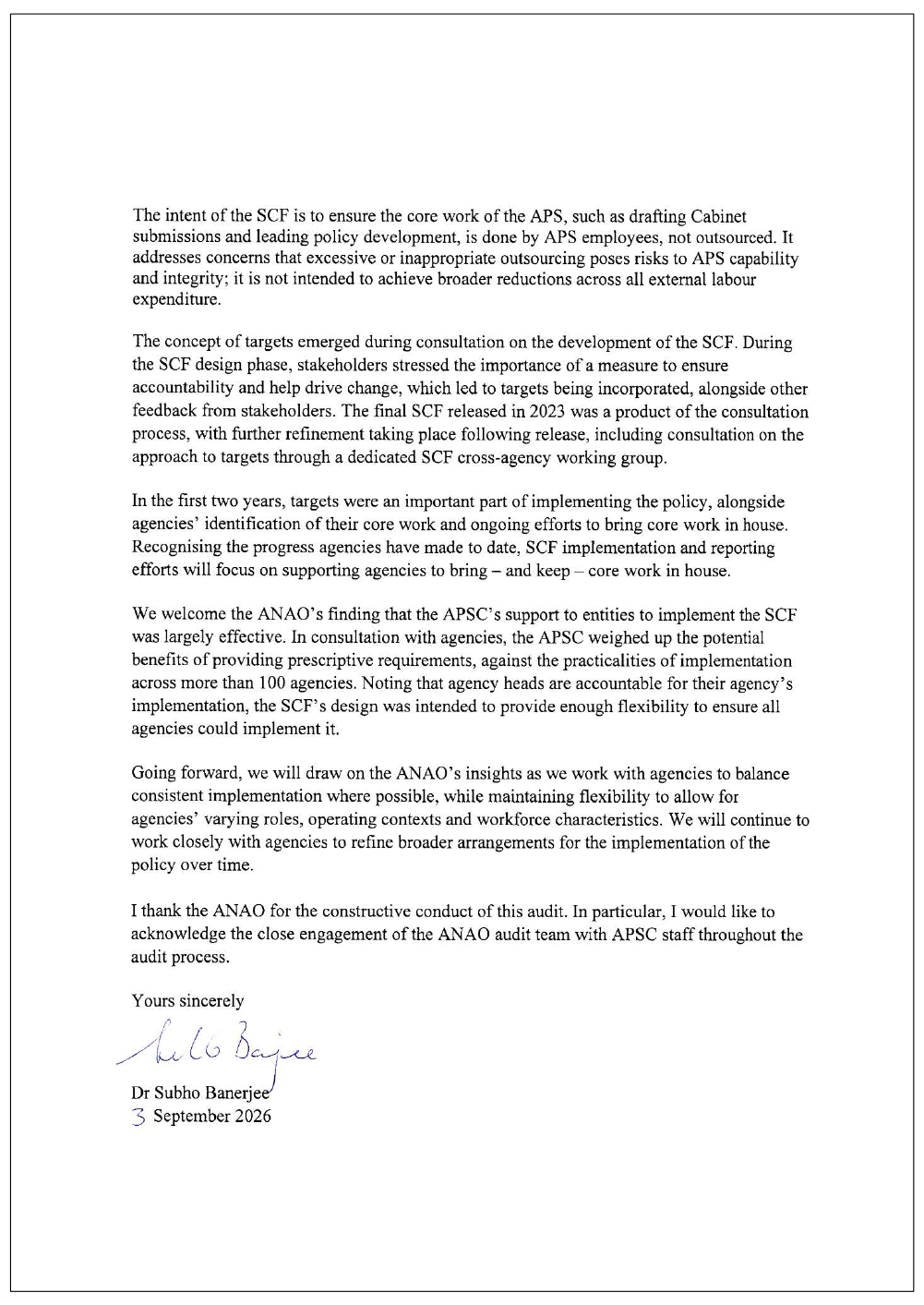
Department of Finance
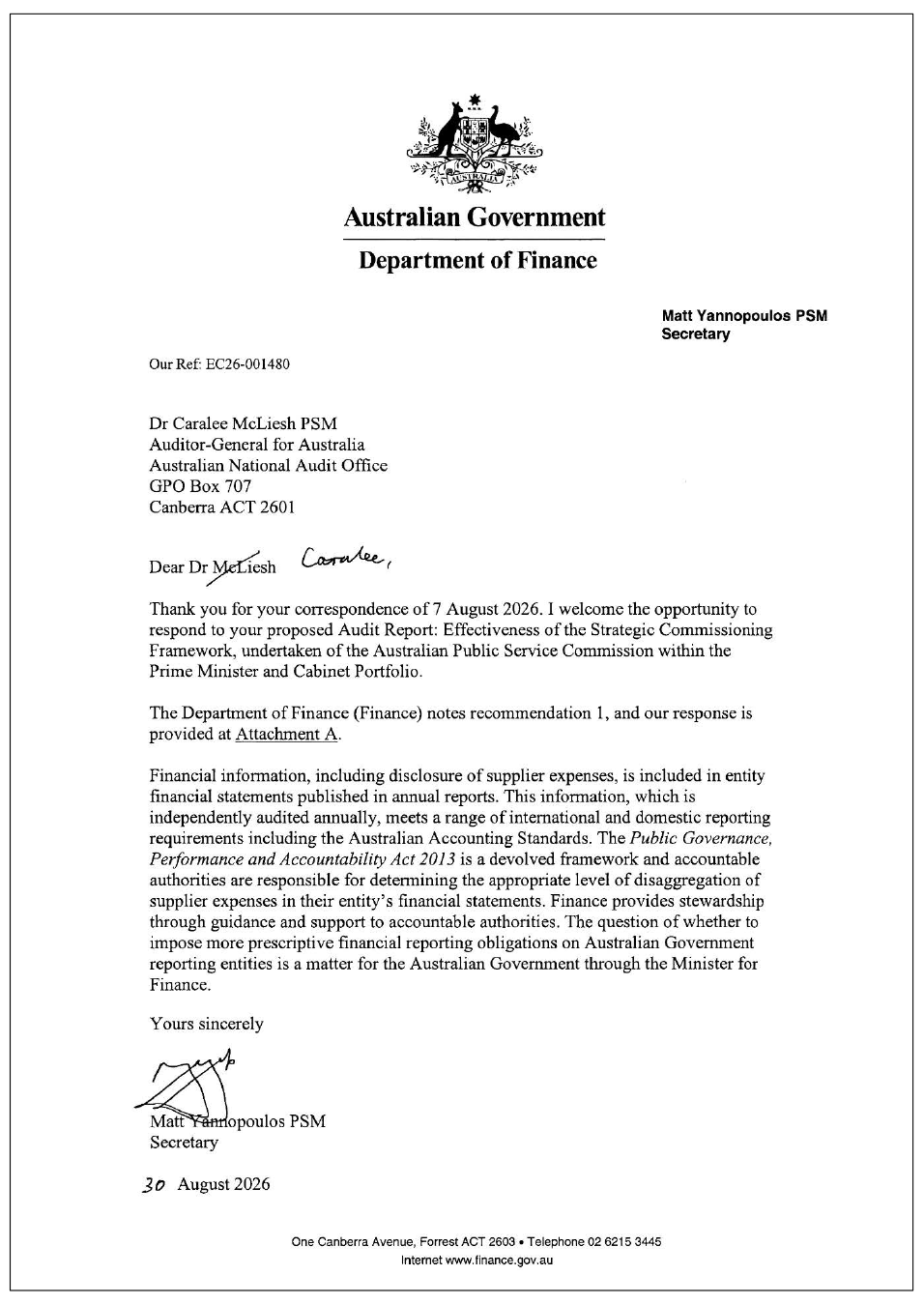
Appendix 2 Improvements observed by the ANAO
1. The existence of independent external audit, and the accompanying potential for scrutiny improves performance. Improvements in administrative and management practices usually occur: in anticipation of ANAO audit activity; during an audit engagement; as interim findings are made; and/or after the audit has been completed and formal findings are communicated.
2. The Joint Committee of Public Accounts and Audit (JCPAA) has encouraged the ANAO to consider ways in which the ANAO could capture and describe some of these impacts. The ANAO’s corporate plan states that the ANAO’s annual performance statements will provide a narrative that will consider, amongst other matters, analysis of key improvements made by entities during a performance audit process based on information included in tabled performance audit reports.
3. Performance audits involve close engagement between the ANAO and the audited entity as well as other stakeholders involved in the program or activity being audited. Throughout the audit engagement, the ANAO outlines to the entity the preliminary audit findings, conclusions and potential audit recommendations. This ensures that final recommendations are appropriately targeted and encourages entities to take early remedial action on any identified matters during the course of an audit. Remedial actions entities may take during the audit include:
- strengthening governance arrangements;
- introducing or revising policies, strategies, guidelines or administrative processes; and
- initiating reviews or investigations.
4. In this context, the below actions were observed by the ANAO during the course of the audit. It is not clear whether these actions and/or the timing of these actions were planned in response to proposed or actual audit activity. The ANAO has not sought to obtain assurance over the source of these actions or whether they have been appropriately implemented.
Table A.1: Improvements observed by the ANAO
|
Improvement |
Report reference |
|
Evaluation of Year 1 of the Framework finalised |
Paragraph 4.24 and Table 4.1 |
|
February and April 2026 advice to the Minister for the Public Service included options for reporting in 2026–27. |
Paragraph 4.50 |
Source: ANAO.
Appendix 3 Australian Public Service reform Pillar 4 initiatives
1. At December 2025, 14 initiatives were established to support Australian Public Service (APS) Reform Pillar 4 (an APS that has the capability to do its job well). Progress against these initiatives was publicly reported by the Australian Public Service Commission (APSC) in annual progress reports between 2023 and 2025.
Table A.2: Pillar 4 initiatives
|
Initiative |
APSC reported status |
||
|
|
2023 |
2024 |
2025 |
|
APS Capability Reinvestment Fund |
Round 1: Complete |
Round 2: Delivery |
Round 1 and 2: Complete |
|
Audit of employment |
Complete |
Complete |
Complete |
|
Capability reviews |
Delivery |
Complete |
Complete |
|
Expansion of Delivering Great Policy learning resources |
Complete |
Complete |
Complete |
|
Embed a culture of evaluation |
Planning |
Delivery |
Delivery |
|
Establish Asia and the Pacific Capability |
Design |
Delivery |
Complete |
|
In-house consulting model (later, Australian Government Consulting)a |
Complete |
Delivery |
Complete |
|
Optimal Management Structures guidance |
Delivery |
Complete |
Complete |
|
Strategic Commissioning Framework |
Design |
Delivery |
Complete |
|
Strategic foresight capability |
Design |
Complete |
Complete |
|
Strengthening APS partnerships with Ministers course |
Delivery |
Complete |
Complete |
|
Leadership at all levels and at scale |
– |
Delivery |
Complete |
|
APS Data, Digital and Cyber Workforce Plan |
– |
Planning |
Complete |
|
Second round Capability Reinvestment Fund |
– |
Delivery |
Delivery |
|
327 |
84 |
84 |
106 |
Note a: In the 2023 progress report, the in-house consulting model was reported as ‘complete’ because it had been established and was due to commence operation. In the 2024 progress report, it was reported as in ‘delivery’ because it was operational and delivering services.
Source: Australian Public Service Commission, APS Reform Annual Progress Report 2023, p. 15; APSC, APS Reform Annual Progress Report 2024, pp. 12 and 21–22; and APSC, APS Reform Annual Progress Report 2025, p. 13. Reports available from https://www.apsc.gov.au/initiatives-and-programs/aps-reform/progress-aps-reform [accessed 29 May 2026].
Appendix 4 Sampling
1. In 2024, the Australian Public Service Commission (APSC) identified that 104 Australian Government entities were in scope for the Strategic Commissioning Framework (the Framework). Of these, 75 entities set a target to reduce supplier expenditure on their external workforce and reported on progress directly to the APSC. The 75 entities set targets totalling $527.6 million for 2024–25.
2. The ANAO publishes the interim report on key financial controls of major entities each year. The interim report for 2024–25 included 27 of the largest Australian Government sector entities.61 Collectively, these 27 entities contribute to 95 per cent of the Australian Government’s assets, liabilities, income and expenditure, and deliver diverse and essential services to the Australian community.62 The ANAO took these 27 entities as the basis for a sample and removed five entities that did not employ staff under the Public Service Act 1999 (PS Act), as the Framework did not apply to them. The ANAO wrote to the remaining 22 entities to seek submissions to the audit and received 14 responses.
3. Of the 22 entities, two entities did not set targets under the Framework: one reported no spending on an external workforce (Australian Office of Financial Management) and was excluded from the ANAO sample; and one had external workforce expenditure (Department of Employment and Workforce Relations) and was included in the sample (except where noted).
4. Using this sampling methodology, all entities with targets over $5 million had been included in the sample, except for one — the Bureau of Meteorology (which set a target of $19.4 million in 2024–25). The Bureau of Meteorology was added to the ANAO sample, resulting in a total sample of 22 entities and coverage across the entities with the largest Framework targets.
5. The targets set by these 22 entities ($491.8 million) represent 93 per cent of the combined APS-wide target ($527.6 million) for 2024–25 (Table A.3).
Table A.3: ANAO 22 sample entities and their targets, 2024–25
|
Entity |
2024–25 target ($) |
|
Attorney-General’s Department (AGD) |
1,887,144 |
|
Australian Taxation Office (ATO) |
31,950,212 |
|
Bureau of Meteorology (BoM) |
19,421,287 |
|
Department of Agriculture, Fisheries and Forestry (DAFF) |
7,492,684 |
|
Department of Climate Change, Energy, the Environment and Water (DCCEEW) |
2,125,000 |
|
Department of Defence (Defence) |
308,000,000 |
|
Department of Education (Education) |
30,000 |
|
Department of Employment and Workplace Relations (DEWR) |
0 |
|
Department of Finance (Finance) |
371,000 |
|
Department of Foreign Affairs and Trade (DFAT) |
6,140,000 |
|
Department of Health, Disability and Ageing (DHDA) |
8,948,250 |
|
Department of Home Affairs (Home Affairs) |
4,866,000 |
|
Department of Industry, Science and Resources (DISR) |
1,870,000 |
|
Department of Infrastructure, Transport, Regional Development, Communications and the Arts (Infrastructure) |
1,080,000 |
|
Department of Social Services (DSS) |
814,999 |
|
Department of the Prime Minister and Cabinet (PM&C) |
580,000 |
|
Department of the Treasury (Treasury) |
290,907 |
|
Department of Veterans’ Affairs (DVA) |
10,612,129 |
|
Future Fund Management Agency (FFMA) |
7,058,545 |
|
National Disability Insurance Agency (NDIA) |
68,482,391 |
|
National Indigenous Australians Agency (NIAA) |
380,000 |
|
Services Australia |
9,397,263 |
|
Total |
491,797,811 |
Source: ANAO.
Appendix 5 Supplier and employee expenses
1. For the ANAO sample overall, total expenses increased from $118.4 billion to $130.1 billion from 2023–24 to 2024–25. Supplier expenses and employee expenses both increased from 2023–24 to 2024–25:
- supplier expenses increased by $2.9 billion, from $32.7 billion to $35.6 billion; and
- employee expenses increased by $3 billion, from $29.3 billion to $32.4 billion (Table A.4 and Table A.5).
2. These expenses as a percentage of total expenses stayed relatively stable from 2023–24 to 2024–25:
- supplier expenses as a percentage of total expenses decreased slightly from 27.6 per cent to 27.4 per cent (Table A.6); and
- employee expenses as a percentage of total expenses increased slightly from 24.8 per cent to 24.9 per cent (Table A.7).
Table A.4: Supplier and employee expenses, as percentage of total expenses, ANAO sample, 2023–24
|
Entity |
Total expenses, 2023–24 ($) |
Supplier expenses, 2023–24 ($) |
Supplier expenses, as % of total expenses, 2023–24 |
Employee expenses, 2023–24 ($) |
Employee expenses, as % of total expenses, 2023–24 |
|
Attorney-General’s Department (AGD) |
498,681,000 |
117,609,000 |
23.6% |
326,172,000 |
65.4% |
|
Australian Taxation Office (ATO) |
4,490,958,000 |
1,550,147,000 |
34.5% |
2,501,608,000 |
55.7% |
|
Bureau of Meteorology (BoM) |
633,616,000 |
242,052,000 |
38.2% |
244,958,000 |
38.7% |
|
Department of Agriculture, Fisheries and Forestry (DAFF) |
1,292,525,000 |
441,532,000 |
34.2% |
711,712,000 |
55.1% |
|
Department of Climate Change, Energy, the Environment and Water (DCCEEW) |
1,210,338,000 |
465,126,000 |
38.4% |
584,480,000 |
48.3% |
|
Department of Defence (Defence) |
46,297,957,000 |
23,248,553,000 |
50.2% |
13,986,166,000 |
30.2% |
|
Department of Education (Education) |
366,976,000 |
121,246,000 |
33.0% |
231,633,000 |
63.1% |
|
Department of Employment and Workplace Relations (DEWR) |
1,050,512,000 |
300,631,000 |
28.6% |
504,909,000 |
48.1% |
|
Department of Finance (Finance) |
1,265,916,000 |
209,483,000 |
16.5% |
229,141,000 |
18.1% |
|
Department of Foreign Affairs and Trade (DFAT) |
2,373,017,000 |
855,564,000 |
36.1% |
1,115,767,000 |
47.0% |
|
Department of Health, Disability and Ageing (DHDA) |
1,677,892,000 |
671,095,000 |
40.0% |
875,096,000 |
52.2% |
|
Department of Home Affairs (Home Affairs) |
3,819,424,000 |
1,398,559,000 |
36.6% |
1,809,674,000 |
47.4% |
|
Department of Industry, Science and Resources (DISR) |
763,348,000 |
246,713,000 |
32.3% |
444,946,000 |
58.3% |
|
Department of Infrastructure, Transport, Regional Development, Communications, Sport and the Arts (Infrastructure) |
523,379,000 |
156,931,000 |
30.0% |
302,170,000 |
57.7% |
|
Department of Social Services (DSS) |
626,046,000 |
174,691,000 |
27.9% |
390,849,000 |
62.4% |
|
Department of the Prime Minister and Cabinet (PM&C) |
334,023,000 |
118,125,000 |
35.4% |
194,329,000 |
58.2% |
|
Department of the Treasury (Treasury) |
373,034,000 |
90,850,000 |
24.4% |
258,472,000 |
69.3% |
|
Department of Veterans’ Affairs (DVA) |
683,727,000 |
204,630,000 |
29.9% |
376,571,000 |
55.1% |
|
Future Fund Management Agency (FFMA) |
527,146,000 |
163,909,000 |
31.1% |
89,199,000 |
16.9% |
|
National Disability Insurance Agency (NDIA) |
43,978,581,000 |
653,950,000 |
1.5% |
758,603,000 |
1.7% |
|
National Indigenous Australians Agency (NIAA) |
350,693,000 |
97,767,000 |
27.9% |
215,943,000 |
61.6% |
|
Services Australia |
5,234,674,000 |
1,189,964,000 |
22.7% |
3,176,953,000 |
60.7% |
|
Total |
118,372,463,000 |
32,719,127,000 |
27.6% |
29,329,351,000 |
24.8% |
Source: ANAO analysis of relevant entities’ financial statements, 2024–25.
Table A.5: Supplier and employee expenses, as percentage of total expenses, ANAO sample, 2024–25
|
Entity |
Total expenses, 2024–25 ($) |
Supplier expenses, 2024–25 ($) |
Supplier expenses, as % of total expenses, 2024–25 |
Employee expenses, 2024–25 ($) |
Employee expenses, as % of total expenses, 2024–25 |
|
AGD |
531,083,000 |
128,835,000 |
24.3% |
344,869,000 |
64.9% |
|
ATO |
4,452,198,000 |
1,439,053,000 |
32.3% |
2,635,800,000 |
59.2% |
|
BoM |
627,592,000 |
195,566,000 |
31.2% |
253,101,000 |
40.3% |
|
DAFF |
1,467,920,000 |
481,851,000 |
32.8% |
848,423,000 |
57.8% |
|
DCCEEW |
1,384,051,000 |
536,257,000 |
38.7% |
655,808,000 |
47.4% |
|
Defence |
50,386,401,000 |
25,282,036,000 |
50.2% |
15,051,909,000 |
29.9% |
|
Education |
416,861,000 |
134,769,000 |
32.3% |
265,282,000 |
63.6% |
|
DEWR |
1,115,472,000 |
309,805,000 |
27.8% |
581,532,000 |
52.1% |
|
Finance |
1,503,120,000 |
198,615,000 |
13.2% |
259,079,000 |
17.2% |
|
DFAT |
2,626,982,000 |
969,510,000 |
36.9% |
1,234,510,000 |
47.0% |
|
DHDA |
2,060,884,000 |
883,889,000 |
42.9% |
1,035,192,000 |
50.2% |
|
Home Affairs |
4,167,277,000 |
1,587,293,000 |
38.1% |
1,993,514,000 |
47.8% |
|
DISR |
795,598,000 |
247,136,000 |
31.1% |
477,670,000 |
60.0% |
|
Infrastructure |
571,978,000 |
170,773,000 |
29.9% |
349,087,000 |
61.0% |
|
DSS |
737,022,000 |
213,058,000 |
28.9% |
472,512,000 |
64.1% |
|
PM&C |
296,387,000 |
78,218,000 |
26.4% |
196,168,000 |
66.2% |
|
Treasury |
415,452,000 |
99,626,000 |
24.0% |
291,904,000 |
70.3% |
|
DVA |
698,977,000 |
187,829,000 |
26.9% |
416,463,000 |
59.6% |
|
FFMA |
556,128,000 |
154,209,000 |
27.7% |
122,204,000 |
22.0% |
|
NDIA |
48,976,626,000 |
780,612,000 |
1.6% |
1,066,884,000 |
2.2% |
|
NIAA |
337,669,000 |
82,929,000 |
24.6% |
218,071,000 |
64.6% |
|
Services Australia |
5,934,654,000 |
1,463,823,000 |
24.7% |
3,593,092,000 |
60.5% |
|
Total |
130,060,332,000 |
35,625,692,000 |
27.4% |
32,363,074,000 |
24.9% |
Source: ANAO analysis of relevant entities’ financial statements, 2024–25.
3. The ANAO examined supplier expenses in 2023–24 and 2024–25. For the 22 entities in the ANAO sample, supplier expenses increased from a total of $32.7 billion in 2023–24 to $35.6 billion in 2024–25, an 8.9 per cent increase. Supplier expenses as a percentage of total expenses decreased slightly in 2024–25 to 27.4 per cent (from 27.6 per cent in 2023–24). Of the 22 entities, 14 entities decreased supplier expenses as a percentage of total expenses in 2024–25 (from 2023–24) and eight increased (Table A.6).
Table A.6: Change in supplier expenses as percentage of total expenses, ANAO sample, 2023–24 to 2024–25
|
Entity |
Supplier expenses, 2023–24 ($) |
Supplier expenses, 2024–25 ($) |
Percentage change in supplier expenses (%) |
Supplier expenses as percentage of total expenses, 2023–24 (%) |
Supplier expenses as percentage of total expenses, 2024–25 (%) |
Change in supplier expenses as % of total expenses |
|
AGD |
117,609,000 |
128,835,000 |
+9.5 |
23.6 |
24.3 |
↑ |
|
ATO |
1,550,147,000 |
1,439,053,000 |
-7.2 |
34.5 |
32.3 |
↓ |
|
BoM |
242,052,000 |
195,566,000 |
-19.2 |
38.2 |
31.2 |
↓ |
|
DAFF |
441,532,000 |
481,851,000 |
+9.1 |
34.2 |
32.8 |
↓ |
|
DCCEEW |
465,126,000 |
536,257,000 |
+15.3 |
38.4 |
38.7 |
↑ |
|
Defence |
23,248,553,000 |
25,282,036,000 |
+8.7 |
50.2 |
50.2 |
↓ |
|
Education |
121,246,000 |
134,769,000 |
+11.2 |
33.0 |
32.3 |
↓ |
|
DEWR |
300,631,000 |
309,805,000 |
+3.1 |
28.6 |
27.8 |
↓ |
|
Finance |
209,483,000 |
198,615,000 |
-5.2 |
16.5 |
13.2 |
↓ |
|
DFAT |
855,564,000 |
969,510,000 |
+13.3 |
36.1 |
36.9 |
↑ |
|
DHDA |
671,095,000 |
883,889,000 |
+31.7 |
40.0 |
42.9 |
↑ |
|
Home Affairs |
1,398,559,000 |
1,587,293,000 |
+13.5 |
36.6 |
38.1 |
↑ |
|
DISR |
246,713,000 |
247,136,000 |
+0.2 |
32.3 |
31.1 |
↓ |
|
Infrastructure |
156,931,000 |
170,773,000 |
+8.8 |
30.0 |
29.9 |
↓ |
|
DSS |
174,691,000 |
213,058,000 |
+22.0 |
27.9 |
28.9 |
↑ |
|
PM&C |
118,125,000 |
78,218,000 |
-33.8 |
35.4 |
26.4 |
↓ |
|
Treasury |
90,850,000 |
99,626,000 |
+9.7 |
24.4 |
24.0 |
↓ |
|
DVA |
204,630,000 |
187,829,000 |
-8.2 |
29.9 |
26.9 |
↓ |
|
FFMA |
163,909,000 |
154,209,000 |
-5.9 |
31.1 |
27.7 |
↓ |
|
NDIA |
653,950,000 |
780,612,000 |
+19.4 |
1.5 |
1.6 |
↑ |
|
NIAA |
97,767,000 |
82,929,000 |
-15.2 |
27.9 |
24.6 |
↓ |
|
Services Australia |
1,189,964,000 |
1,463,823,000 |
+23.0 |
22.7 |
24.7 |
↑ |
|
Total |
32,719,127,000 |
35,625,692,000 |
+8.9 |
27.6 |
27.4 |
↓ |
|
Total (NDIA removed)a |
32,065,177,000 |
34,845,080,000 |
+8.7 |
43.1 |
43.0 |
↓ |
Key: ↓ Decrease ↑ Increase
Note a: NDIA is an outlier, with supplier expenses representing only 1.59 per cent of total expenses in 2024–25. Of its total expenses for 2024–25 ($48.98 billion), 95 per cent ($46.35 billion) was administered in nature and was for ‘participant plan expenses’.
Source: ANAO analysis of relevant entities’ financial statements, 2024–25.
4. Employee expenses increased from a total of $29.3 billion in 2023–24 to $32.4 billion in 2024–25, a 10.3 per cent increase. Employee expenses as a percentage of total expenses increased slightly in 2024–25 to 24.9 per cent (from 24.8 per cent in 2023–24). Of the 22 entities, seven entities decreased employee expenses as a percentage of total expenses in 2024–25 (from 2023–24) and 15 increased (Table A.7).
Table A.7: Change in employee expenses as percentage of total expenses, ANAO sample, 2023–24 to 2024–25
|
Entity |
Employee expenses, 2023–24 ($) |
Employee expenses, 2024–25 ($) |
Percentage change in employee expenses (%) |
Employee expenses as percentage of total expenses, 2023–24 (%) |
Employee expenses as percentage of total expenses, 2024–25 (%) |
Change in employee expenses as % of total expenses |
|
AGD |
326,172,000 |
344,869,000 |
+5.7 |
65.4 |
64.9 |
↓ |
|
ATO |
2,501,608,000 |
2,635,800,000 |
+5.4 |
55.7 |
59.2 |
↑ |
|
BoM |
244,958,000 |
253,101,000 |
+3.3 |
38.7 |
40.3 |
↑ |
|
DAFF |
711,712,000 |
848,423,000 |
+19.2 |
55.1 |
57.8 |
↑ |
|
DCCEEW |
584,480,000 |
655,808,000 |
+12.2 |
48.3 |
47.4 |
↓ |
|
Defence |
13,986,166,000 |
15,051,909,000 |
+7.6 |
30.2 |
29.9 |
↓ |
|
Education |
231,633,000 |
265,282,000 |
+14.5 |
63.1 |
63.6 |
↑ |
|
DEWR |
504,909,000 |
581,532,000 |
+15.2 |
48.1 |
52.1 |
↑ |
|
Finance |
229,141,000 |
259,079,000 |
+13.1 |
18.1 |
17.2 |
↓ |
|
DFAT |
1,115,767,000 |
1,234,510,000 |
+10.6 |
47.0 |
47.0 |
↓ |
|
DHDA |
875,096,000 |
1,035,192,000 |
+18.3 |
52.2 |
50.2 |
↓ |
|
Home Affairs |
1,809,674,000 |
1,993,514,000 |
+10.2 |
47.4 |
47.8 |
↑ |
|
DISR |
444,946,000 |
477,670,000 |
+7.4 |
58.3 |
60.0 |
↑ |
|
Infrastructure |
302,170,000 |
349,087,000 |
+15.5 |
57.7 |
61.0 |
↑ |
|
DSS |
390,849,000 |
472,512,000 |
+20.9 |
62.4 |
64.1 |
↑ |
|
PM&C |
194,329,000 |
196,168,000 |
+0.9 |
58.2 |
66.2 |
↑ |
|
Treasury |
258,472,000 |
291,904,000 |
+12.9 |
69.3 |
70.3 |
↑ |
|
DVA |
376,571,000 |
416,463,000 |
+10.6 |
55.1 |
59.6 |
↑ |
|
FFMA |
89,199,000 |
122,204,000 |
+37.0 |
16.9 |
22.0 |
↑ |
|
NDIA |
758,603,000 |
1,066,884,000 |
+40.6 |
1.7 |
2.2 |
↑ |
|
NIAA |
215,943,000 |
218,071,000 |
+1.0 |
61.6 |
64.6 |
↑ |
|
Services Australia |
3,176,953,000 |
3,593,092,000 |
+13.1 |
60.7 |
60.5 |
↓ |
|
Total |
29,329,351,000 |
32,363,074,000 |
+10.3 |
24.8 |
24.9 |
↑ |
|
Total (NDIA removed)a |
28,570,748,000 |
31,296,190,000 |
+9.5 |
38.4 |
38.6 |
↑ |
Key: ↓ Decrease ↑ Increase
Note a: NDIA is an outlier, with employee expenses representing only 1.7 per cent of its total expenses. Of its total expenses for 2024–25 ($48.98 billion), 95 per cent ($46.35 billion) was administered in nature and was for ‘participant plan expenses’.
Source: ANAO analysis of relevant entities financial statements, 2024–25.
Appendix 6 External labour expenses
1. For the ANAO sample of 22 entities, the ANAO examined expenses for external labour (contractors, consultants, and where reported as a separate line item, labour hire) in 2023–24 and 2024–25. Overall, external labour expenses decreased by 1.9 per cent, from $6.5 billion in 2023–24 to 6.4 billion in 2024–25 (Table A.8). Across the 22 sampled entities:
- 10 entities decreased expenses, from between 2.6 per cent (Department of Employment and Workplace Relations) to 40.4 per cent (Attorney-General’s Department); and
- 12 entities increased expenses, from between 1.8 per cent (Finance) to 43.1 per cent (Department of Health, Disability and Ageing).
Table A.8: Change in external labour expenses, ANAO sample, 2023–24 to 2024–25
|
Entity |
External labour expenses, 2023–24 ($) |
External labour expenses, 2024–25 ($) |
Change 2023–24 to 2024–25 ($) |
Change 2023–24 to 2024–25 (%) |
Change 2023–24 to 2024–25 (increase or decrease) |
|
Attorney-General’s Department (AGD) |
13,553,000 |
8,084,000 |
(5,469,000) |
-40.4 |
↓ |
|
Australian Taxation Office (ATO) |
485,399,000 |
324,316,000 |
(161,083,000) |
-33.2 |
↓ |
|
Bureau of Meteorology (BoM) |
110,006,000 |
81,028,000 |
(28,978,000) |
-26.3 |
↓ |
|
Department of Agriculture, Fisheries and Forestry (DAFF) |
172,341,000 |
186,055,000 |
13,714,000 |
+8.0 |
↑ |
|
Department of Climate Change, Energy, the Environment and Water (DCCEEW) |
172,758,000 |
220,089,000 |
47,331,000 |
+27.4 |
↑ |
|
Department of Defence (Defence) |
3,729,467,000 |
3,465,300,000 |
(246,167,000) |
-7.1 |
↓ |
|
Department of Education (Education) |
29,684,000 |
37,050,000 |
7,366,000 |
+24.8 |
↑ |
|
Department of Employment and Workplace Relations (DEWR) |
159,390,000 |
155,254,000 |
(4,136,000) |
-2.6 |
↓ |
|
Department of Finance (Finance) |
31,441,000 |
32,013,000 |
572,000 |
+1.8 |
↑ |
|
Department of Foreign Affairs and Trade (DFAT) |
33,455,000 |
41,439,000 |
7,984,000 |
+23.9 |
↑ |
|
Department of Health, Disability and Ageing (DHDA) |
200,627,000 |
287,121,000 |
86,494,000 |
+43.1 |
↑ |
|
Department of Home Affairs (Home Affairs) |
326,211,000 |
344,681,000 |
18,470,000 |
+5.7 |
↑ |
|
Department of Industry, Science and Resources (DISR) |
101,480,000 |
89,870,000 |
(11,610,000) |
-11.4 |
↓ |
|
Department of Infrastructure, Transport, Regional Development, Communications, Sport and the Arts (Infrastructure) |
38,344,000 |
46,878,000 |
8,534,000 |
+22.3 |
↑ |
|
Department of Social Services (DSS) |
51,446,000 |
61,316,000 |
9,870,000 |
+19.2 |
↑ |
|
Department of the Prime Minister and Cabinet (PM&C) |
30,780,000 |
29,428,000 |
(1,352,000) |
-4.4 |
↓ |
|
Department of the Treasury (Treasury) |
44,368,000 |
49,708,000 |
5,340,000 |
+12.0 |
↑ |
|
Department of Veterans’ Affairs (DVA) |
51,834,000 |
44,824,000 |
(7,010,000) |
-13.5 |
↓ |
|
Future Fund Management Agency (FFMA) |
49,579,000 |
46,131,000 |
(3,448,000) |
-7.0 |
↓ |
|
National Disability Insurance Agency (NDIA) |
395,558,000 |
446,144,000 |
50,586,000 |
+12.8 |
↑ |
|
National Indigenous Australians Agency (NIAA) |
21,639,000 |
11,831,000 |
(9,808,000) |
-45.3 |
↓ |
|
Services Australia |
287,601,000 |
406,707,000 |
119,106,000 |
+41.4 |
↑ |
|
Total |
6,536,961,000 |
6,415,267,000 |
(121,694,000) |
-1.9 |
↓ |
Key: ↓ Decrease ↑ Increase
Source: ANAO analysis of relevant entities’ financial statements, 2024–25.
2. There was also a slight overall decrease in external labour expenses as a percentage of total expenses, with this expenditure being 5.5 per cent of total expenses in 2023–24 and 4.9 per cent in 2024–25. Across the 22 entities:
- nine entities increased external labour expenses, as a percentage of total expenses;
- one entity’s external labour expenses, as a percentage of total expenses, stayed the same; and
- 12 entities decreased external labour expenses, as a percentage of total expenses (Table A.9).
Table A.9: External labour expenses, as percentage of total expenses, ANAO sample, 2023–24 and 2024–25
|
Entity |
Total expenses, 2023–24 ($) |
External labour expenses, 2023–24 ($) |
External labour expenses, as % of total expenses, 2023–24 |
Total expenses, 2024–25 ($) |
External labour expenses, 2024–25 ($) |
External labour expenses, as % of total expenses, 2024–25 |
Change in external labour expenses, as % of total expenses |
|
AGD |
498,681,000 |
13,553,000 |
2.7% |
531,083,000 |
8,084,000 |
1.5% |
↓ |
|
ATO |
4,490,958,000 |
485,399,000 |
10.8% |
4,452,198,000 |
324,316,000 |
7.3% |
↓ |
|
BoM |
633,616,000 |
110,006,000 |
17.4% |
627,592,000 |
81,028,000 |
12.9% |
↓ |
|
DAFF |
1,292,525,000 |
172,341,000 |
13.3% |
1,467,920,000 |
186,055,000 |
12.7% |
↓ |
|
DCCEEW |
1,210,338,000 |
172,758,000 |
14.3% |
1,384,051,000 |
220,089,000 |
15.9% |
↑ |
|
Defence |
46,297,957,000 |
3,729,467,000 |
8.1% |
50,386,401,000 |
3,465,300,000 |
6.9% |
↓ |
|
Education |
366,976,000 |
29,684,000 |
8.1% |
416,861,000 |
37,050,000 |
8.9% |
↑ |
|
DEWR |
1,050,512,000 |
159,390,000 |
15.2% |
1,115,472,000 |
155,254,000 |
13.9% |
↓ |
|
Finance |
1,265,916,000 |
31,441,000 |
2.5% |
1,503,120,000 |
32,013,000 |
2.1% |
↓ |
|
DFAT |
2,373,017,000 |
33,455,000 |
1.4% |
2,626,982,000 |
41,439,000 |
1.6% |
↑ |
|
DHDA |
1,677,892,000 |
200,627,000 |
12.0% |
2,060,884,000 |
287,121,000 |
13.9% |
↑ |
|
Home Affairs |
3,819,424,000 |
326,211,000 |
8.5% |
4,167,277,000 |
344,681,000 |
8.3% |
↓ |
|
DISR |
763,348,000 |
101,480,000 |
13.3% |
795,598,000 |
89,870,000 |
11.3% |
↓ |
|
Infrastructure |
523,379,000 |
38,344,000 |
7.3% |
571,978,000 |
46,878,000 |
8.2% |
↑ |
|
DSS |
626,046,000 |
51,446,000 |
8.2% |
737,022,000 |
61,316,000 |
8.3% |
↑ |
|
PM&C |
334,023,000 |
30,780,000 |
9.2% |
296,387,000 |
29,428,000 |
9.9% |
↑ |
|
Treasury |
373,034,000 |
44,368,000 |
11.9% |
415,452,000 |
49,708,000 |
12.0% |
↑ |
|
DVA |
683,727,000 |
51,834,000 |
7.6% |
698,977,000 |
44,824,000 |
6.4% |
↓ |
|
FFMA |
527,146,000 |
49,579,000 |
9.4% |
556,128,000 |
46,131,000 |
8.3% |
↓ |
|
NDIA |
43,978,581,000 |
395,558,000 |
0.9% |
48,976,626,000 |
446,144,000 |
0.9% |
– |
|
NIAA |
350,693,000 |
21,639,000 |
6.2% |
337,669,000 |
11,831,000 |
3.5% |
↓ |
|
Services Australia |
5,234,674,000 |
287,601,000 |
5.5% |
5,934,654,000 |
406,707,000 |
6.9% |
↑ |
|
Total |
118,372,463,000 |
6,536,961,000 |
5.5% |
130,060,332,000 |
6,415,267,000 |
4.9% |
↓ |
Key: ↓ Decrease ↑ Increase
Source: ANAO analysis of relevant entities’ financial statements, 2024–25.
Footnotes
1 Australian Public Service Commission, APS Reform, APSC, Canberra, 2025, available from https://www.apsc.gov.au/initiatives-and-programs/aps-reform [accessed 13 February 2026].
2 Australian Public Service Commission, APS Strategic Commissioning Framework: Strengthening APS capability through reduced reliance on contractors and consultants, APSC, Canberra, 2023, Version 1, p. 1.
3 Australian Public Service Commission, 2025 Public Update — Implementation of the APS Strategic Commissioning Framework, APSC, Canberra, December 2025, p. 1 and p. 10, available from https://www.apsc.gov.au/sites/default/files/2025-12/2025%20Public%20Update%20-%20Strategic%20Commissioning%20Framework.pdf [accessed 13 February 2026].
4 Auditor-General Report No. 43 2021–22, Effectiveness of the Management of Contractors — Department of Defence, ANAO, Canberra, available from https://www.anao.gov.au/work/performance-audit/effectiveness-the-management-contractors-department-defence;
Auditor-General Report No. 44 2021–22, Effectiveness of the Management of Contractors — Services Australia, ANAO, Canberra, available from https://www.anao.gov.au/work/performance-audit/effectiveness-the-management-contractors-services-australia; and
Auditor-General Report No. 45 2021–22, Effectiveness of the Management of Contractors — Department of Veterans’ Affairs, ANAO, Canberra, available from https://www.anao.gov.au/work/performance-audit/effectiveness-the-management-contractors-department-veterans-affairs [all accessed on 17 July 2026].
5 Australian Public Service Commission, State of the Service Report 2024–25, APSC, Canberra, 2025, available from https://www.apsc.gov.au/initiatives-and-programs/workforce-information/research-analysis-and-publications/state-service/state-service-report-2024-25 [accessed 28 May 2026].
Under section 44 of the Public Service Act 1999 the Australian Public Service Commission must give a report to the Minister, for presentation to Parliament on the state of the APS during the past year.
6 When the APS reform agenda was released in October 2022, these were called the four ‘priority areas’. They were later referred to as ‘pillars’ in APS Reform reporting.
7 Australian Government, Report on the Audit of Employment 2021–22, Finance, Canberra, May 2023, pp. 3, 5 and 8; and Department of Finance, Report on the 2023–24 Audit of Employment, Finance, Canberra, December 2025, p. 5. The audits focused on entities that employ staff under the Public Service Act 1999. Both reports are available from https://www.finance.gov.au/publications/reviews/australian-governments-report-audit-employment [accessed 11 May 2026].
8 The Secretaries Board is comprised of the heads of Australian Government departments and under the Public Service Act 1999, has responsibility for stewardship of the APS and for developing and implementing strategies to improve the APS.
Department of the Prime Minister and Cabinet, Secretaries Board, PM&C, Canberra, available from https://www.pmc.gov.au/about-us/accountability-and-reporting/corporate-reporting/secretaries-board [accessed 14 May 2026].
9 Australian Public Service Commission, Corporate Plan 2025–29, 2025, APSC, Canberra, 2025, p. 6, available from https://www.apsc.gov.au/publication/corporate-plan-2025-29 [accessed 14 May 2026].
10 Australian Public Service Commission, APS Strategic Commissioning Framework, APSC, Canberra, 2023, Version 1, p. 1.
11 APSC, 2025 Public Update — Implementation of the APS Strategic Commissioning Framework, p. 1 and p. 10.
12 Auditor-General Report No. 43 2021–22, Effectiveness of the Management of Contractors — Department of Defence; Auditor-General Report No. 44 2021–22, Effectiveness of the Management of Contractors — Services Australia; and Auditor-General Report No. 45 2021–22, Effectiveness of the Management of Contractors — Department of Veterans’ Affairs.
13 Department of Finance, Report on the 2023–24 Audit of Employment, December 2025, p. 5, available from https://www.finance.gov.au/publications/reviews/australian-governments-report-audit-employment [accessed 13 February 2026].
14 APSC, APS Strategic Commissioning Framework: Strengthening APS capability through reduced reliance on contractors and consultants, p. 1.
15 APSC, 2025 Public Update — Implementation of the APS Strategic Commissioning Framework, p. 1 and p. 10.
16 Australian Public Service Commission, Public service reform in a complex world: Continuity, change and opportunity — Evaluation findings on the APS Reform Program 2022–2025, APSC, 2026, available from https://www.apsc.gov.au/publication/evaluation-aps-reform-program-2022-2025 [accessed 17 July 2026].
17 ibid., p. 66.
18 ibid., p. 67.
19 ibid., p. 70.
20 Minister for the Public Service, ‘APS set to bring more than half a billion dollars of core work in-house’, media release, 4 November 2024, available from https://ministers.pmc.gov.au/gallagher/2024/aps-set-bring-more-half-billion-dollars-core-work-house [accessed 17 July 2026].
21 Employee expenses include wages and salaries, superannuation, leave and other entitlements.
22 As expenditure on outsourced service providers is not reported as a line item in the financial statements, ANAO analysis is focused external labour (as opposed to the wider external workforce).
23 Department of Finance, Financial reporting for Commonwealth entities, Finance, Canberra, 2026, available from https://www.finance.gov.au/government/financial-reporting-and-accounting-policy/financial-reporting-commonwealth-entities [accessed 6 July 2026]. See Primary reporting and information management aid (PRIMA) documents.
24 Australian Accounting Standards permit the aggregation of immaterial information on the basis that financial statements fairly present the entity’s financial position and performance. See Australian Accounting Standards Board (AASB) 101, paragraphs 29–31, available from https://standards.aasb.gov.au/ [accessed 14 September 2026].
25 Auditor-General Report No. 44 2021–22, Effectiveness of the Management of Contractors — Services Australia, Chapter 5.
26 Australian Government, Report on the Audit of Employment 2021–22, p. 2; and Finance, Report on the 2023–24 Audit of Employment, pp. 3–4.
27 Australian Public Service Commission, Delivering Great Policy, APSC, Canberra, available from https://www.apsacademy.gov.au/aps-craft/strategy-policy-evaluation/delivering-great-policy [accessed 5 March 2026].
28 Department of Industry, Science and Resources, APS Framework for Engagement and Participation, DISR, 2019, available from https://www.industry.gov.au/publications/aps-framework-engagement-and-participation [accessed 28 May 2026].
29 Australian Public Service Commission, Getting stakeholder engagement right, APSC, Canberra, 2024, available from https://www.apsc.gov.au/initiatives-and-programs/aps-mobility-framework/taskforce-toolkit/stakeholder-engagement/getting-stakeholder-engagement-right [accessed 6 July 2026].
30 Australian Public Service Commission, Delivering Great Policy: Clear on Intent, APSC, Canberra, available from https://www.apsacademy.gov.au/aps-craft/strategy-policy-evaluation/delivering-great-policy/clear-intent [accessed 5 March 2026].
31 At this time, the Strategic Commissioning Framework was positioned under Pillar 3 (‘The APS is a model employer’). In October 2023, it was announced as an initiative under Pillar 4.
32 Australian Public Service Commission, Delivering Great Policy — Well informed, APSC, Canberra, 2025, available from https://www.apsacademy.gov.au/aps-craft/strategy-policy-evaluation/delivering-great-policy/well-informed [accessed 17 July 2026].
33 Finance defined ‘Government workforce’ in this context as ‘public servants plus external labour’. Public servants were represented by the average staffing level (ASL) for the APS workforce for the 112 entities that employed staff under the Public Service Act 1999 at 30 June 2022. This number had changed by 2023–24 and 2024–25 due to machinery of government changes. Australian Government, Report on the Audit of Employment 2021–22, Finance, Canberra, May 2023, p. 3.
34 Australian Government, Report on the Audit of Employment 2021–22, Finance, Canberra, May 2023, p. 6.
35 The Centre of Excellence for Workforce Planning conducted a review of the APS Job Family Framework in 2025, which reduced the number of job families from 18 to 16.
Australian Public Service Commission, APS Job Family Framework, APSC, Canberra, 2025, available from https://www.apsc.gov.au/initiatives-and-programs/aps-workforce-strategy… [accessed 19 May 2026].
36 Australian Public Service Commission, APS Strategic Commissioning Framework, APSC, Canberra, 2023, Version 1, p. 5. Version 3 (May 2026) of the Framework defines core work as ‘work that should be done by APS employees, not outsourced’.
Australian Public Service Commission, APS Strategic Commissioning Framework, APSC, Canberra, 2026, Version 3, p. 5.
37 ASL estimates reflect the average number of employees receiving salary or wages over the financial year, with adjustments for casual and part-time employees to show the full time equivalent. These are estimates as they are reported in budget papers prior to the completion of the financial year.
38 Australian Public Service Commission, Delivering Great Policy — Practical to implement, APSC, Canberra, available from https://www.apsacademy.gov.au/aps-craft/strategy-policy-evaluation/delivering-great-policy/practical-implement [accessed 17 July 2026].
39 Australian Public Service Commission, Workforce planning resources, APSC, Canberra, May 2024, available from https://www.apsc.gov.au/initiatives-and-programs/aps-workforce-strategy-2025/workforce-planning-resources; and
Australian Public Service Commission, APS Mobility Framework, APSC, Canberra, 2021, available from https://www.apsc.gov.au/initiatives-and-programs/aps-mobility-framework [both accessed 7 July 2026].
40 Department of Finance, Procurement, Finance, Canberra, available from https://www.finance.gov.au/government/procurement; and
Department of Finance, Managing Commonwealth Resources, Finance, Canberra, available from https://www.finance.gov.au/government/managing-commonwealth-resources [both accessed 7 July 2026].
41 Department of Finance, Reporting of consultancy contracts valued at $2 million or more, Finance, Canberra, 2026, available from https://www.finance.gov.au/government/procurement/procurement-policy-notes/reporting-consultancy-contracts-valued-2-million-or-more [accessed 30 June 2026].
42 ibid.
43 The total population of relevant entities was 104 in 2024–25 and 105 in 2025–26.
44 The resources toolkit was updated in July 2026, to remove the information on target setting.
45 APSC, 2025 Public Update — Implementation of the APS Strategic Commissioning Framework, p. 9.
46 Australian Public Service Commission, Resources toolkit, APSC, Canberra, available from https://www.apsc.gov.au/initiatives-and-programs/workforce-information/aps-strategic-commissioning-framework/resources-toolkit-strategic-commissioning-framework [accessed 8 May 2026].
47 Department of Industry, Science and Resources, APS framework for engagement and participation.
48 Australian Public Service Commission, APS Strategic Commissioning Framework: Strengthening APS capability through reduced reliance on contractors and consultants, Version 1, p. 1.
49 Department of the Treasury, Evaluation Toolkit: Why evaluate, Treasury, Canberra, available from https://evaluation.treasury.gov.au/toolkit/why-evaluate [accessed 28 May 2026].
50 The APS Values outline the Parliament’s expectations of public servants regarding performance and behaviour and are enshrined in the Public Service Act 1999.
51 Australian Public Service Commission, Stewardship guidance, APSC, Canberra, 2024, available from https://www.apsc.gov.au/working-aps/information-aps-employment/aps-values/stewardship-guidance#what-is-stewardship [accessed 4 May 2026].
52 Department of the Prime Minister and Cabinet, Our Public Service, Our Future: Independent Review of the Australian Public Service, PM&C, Canberra, 13 December 2019, pp. 266 and 268.
53 Department of the Treasury, Evaluation toolkit: Determine scope and approach, Treasury, Canberra, available from https://evaluation.treasury.gov.au/toolkit/determine-scope-and-approach. [accessed 2 June 2026].
54 APSC, APS Strategic Commissioning Framework, 2023, version 1, p. 4.
55 Australian Public Service Commission, Annual Report 2024–25, APSC, Canberra, 2025, p. 43, https://www.apsc.gov.au/annual-report/australian-public-service-commission-annual-report-2024-25 [accessed 2 June 2026].
56 Australian Public Service Commission, 2025 Public Update: APS Strategic Commissioning Framework, APSC, Canberra, 2025, p. 1.
57 ibid.
58 Australian Public Service Commission, APS Strategic Commissioning Framework: 2024 Public Update, APSC, Canberra, 2024, p. 1, available from https://www.apsc.gov.au/sites/default/files/2024-11/APS%20Strategic%20Commissioning%20Framework%202024%20Public%20Update.pdf [accessed 2 June 2026]
59 APSC, 2025 Public Update: APS Strategic Commissioning Framework, 2025, p. 9.
60 ibid.
61 Auditor-General Report No. 39 2024–25, Interim Report on Key Financial Controls of Major Entities, ANAO, Canberra, paragraph 1.2, available from https://www.anao.gov.au/work/financial-statement-audit/interim-report-key-financial-controls-of-major-entities-2024-25 [accessed 21 April 2026].
62 ibid.