Browse our range of reports and publications including performance and financial statement audit reports, assurance review reports, information reports and annual reports.
Performance audit (Auditor-General Report No. 22 of 1998–99)
Published: Tuesday 15 December 1998
Published
The audit reviewed six budget-funded agencies (Australian Customs Service, Australian Taxation Office, Centrelink, Department of Defence, Department of Education, Training and Youth Affairs, and Department of Immigration and Multicultural Affairs) and two off-budget entities (Airservices Australia and Reserve Bank of Australia). The ANAO also examined the Office for Government Online's (OGO, formerly the Office of Government Information Technology, or OGIT) whole-of-government coordination of the Commonwealth's Year 2000 efforts.
Entity
Australian Customs Service; Australian Taxation Office; Centrelink; Department of Defence; Department of Education, Training and Youth Affairs; Department of Immigration and Multicultural Affairs
Performance audit (Auditor-General Report No. 61 of 2001–02)
Published: Tuesday 25 June 2002
Published
This benchmarking study across 14 agencies examined how line managers plan for and manage their staff and how the human resource (HR) function supports them to do that. People management was categorised into nine, practice areas, to enable comparisons between the participating agencies. The study also assessed each people management practice area against four criteria: quality, HR integration, effectiveness & efficiency and business contribution.
Entity
Across Agency
Performance audit (Auditor-General Report No. 54 of 2013–14)
Published: Thursday 26 June 2014
Published
The objective of the audit was to assess the extent to which agencies have arrangements to establish and use multi-use lists to support value for money, efficiency and effectiveness in procurement.
Entity
Across Agencies
Contact
Please direct enquiries relating to reports through our contact page.
Performance audit (Auditor-General Report No. 36 of 2004–05)
Published: Wednesday 9 March 2005
Published
Given the importance of customer feedback to Centrelink's business, the ANAO considered it timely to conduct a series of performance audits relating to Centrelink's customer feedback systems, particularly in relation to its delivery of the services then provided on behalf of FaCS. The overarching objective of this series of ANAO performance audits of Centrelink's customer feedback systems was to assess whether Centrelink has effective processes and systems for gathering, measuring, reporting and responding effectively to customer feedback, including in relation to customer satisfaction with Centrelink services and processes.
Entity
Centrelink
Performance audit (Auditor-General Report No. 62 of 2002–03)
Published: Monday 30 June 2003
Published
The objectives of the audit was to examine the effectiveness and efficiency of DIMIA's decision-making processes and management systems for delivering the parent and partner aspects of the family stream of the Migration Program.
The family stream of Australia's Migration Program enables the reunion of immediate family members of Australian citizens, permanent residents or eligible New Zealand citizens. It consists of four main categories;
- Partner;
- Child;
- Parent; and
- Other family.
Entity
Department of Immigration and Multicultural and Indigenous Affairs
Performance audit (Auditor-General Report No. 1 of 2010–11)
Published: Thursday 15 July 2010
Published
The objective of the audit was to assess the effectiveness of the selection, implementation, operation and monitoring of FRCs by AGD and FaHCSIA. The three main criteria for this audit assessed whether AGD and FaHCSIA had effectively:
- planned and implemented the FRC initiative, including the FRC selection and funding processes;
- undertaken administration activities to guide the operation and progress of the FRC initiative towards meeting its objectives; and
- monitored, evaluated and reported on the performance of FRCs.
Entity
Attorney-General's DepartmentDepartment of Families, Housing, Community Services and Indigenous Affairs
Performance audit (Auditor-General Report No. 54 of 2000–01)
Published: Friday 29 June 2001
Published
The audit reviewed the process of engaging consultants in four Commonwealth agencies. The objective of the audit was to provide assurance to Parliament that Commonwealth agencies comply with relevant procurement policies and procedures that have been developed to ensure value for money in government procurement.
Entity
Across Agency
Performance audit (Auditor-General Report No. 17 of 2002–03)
Published: Tuesday 5 November 2002
Published
The objective of the audit was to assess whether the controls employed by the Department of Family and Community Services (FACS) and Centrelink to ensure the correctness of payments made under the Age Pension program were effective and efficient. The ANAO focused on:
- business arrangements between FACS and Centrelink and the Business Assurance Framework;
- whether the source of error was correctly attributed in customer records assessed by FACS and Centrelink as containing an error in the 2000-01 Age Pension Random Sample Survey:
- the correctness of Centrelink's processing of reassessments, including Pensioner Entitlements Reviews, Customer Initiated Reassessments and automated reassessments: and
- progress in implementing the recommendations of previous ANAO audits concerning the preventive quality controls that underpin correct payments.
Entity
Department of Family and Community Services; Centrelink
Annual report
Published: Tuesday 7 October 2003
Published
This annual report documents the performance of the Australian National Audit Office (ANAO) in the financial year ending on 30 June 2003. It includes a comment by the Auditor-General; an overview of the report; a report on performance; details about management and accountability, and the financial statement for the year.
Performance audit (Auditor-General Report No. 19 of 1998–99)
Published: Tuesday 8 December 1998
Published
The objective of the audit was to form an opinion on the administrative effectiveness and efficiency of DHAC's processes for planning the Commonwealth's Aged and Community Care program, in particular, on the questions of how well the planning process has contributed to realising the program objectives of achieving an equitable distribution of places between regions, and selecting suitable service providers.
Entity
Department of Health and Aged Care
Performance audit (Auditor-General Report No. 11 of 1998–99)
Published: Wednesday 21 October 1998
Published
Fedlink was to comprise two elements: a high capacity telecommunications infrastructure (phase 1) and information technology applications which support Internet and Intranet communication, and transactions in a secure environment (phase 2) [which never went ahead]. OGIT sought the services of the ANAO to provide an opinion on the probity of the methodology and procedures applied in the evaluation process for phase 1. Therefore the objectives of this audit were to assist OGIT in the timely identification of any deficiencies in the evaluation of responses from suppliers and options for addressing the deficiencies.
Entity
Department of Finance and Administration; Office of Government Information Technology
Performance audit (Auditor-General Report No. 37 of 1999–2000)
Published: Tuesday 4 April 2000
Published
The audit reviewed the construction of facilities for the Australian Defence Force and the Department of Defence by the Defence Estate Organisation. The objective of the audit was to assess the efficiency and administrative effectiveness of the Organisation's project delivery function, highlighting effective practice and, where appropriate, making practical recommendations to enhance facilities project management. The main projects examined were the facilities required for the Army Presence in the North and the Russell Hill Redevelopment.
Entity
Department of Defence
Performance audit (Auditor-General Report No. 12 of 1997–98)
Published: Thursday 13 November 1997
Published
The objective of the audit was to evaluate the Department's performance in pursuit of selected PBS program objectives and outcomes, including to investigate and evaluate the economy, efficiency, administrative effectiveness and accountability of the management of the listing process as a significant element of the program. This involved a review of the developments in the listing process over recent years including: the establishment of a comprehensive database of major applications for PBS listing between 1991 and 1996, which facilitated a detailed analysis of the time taken to list drugs on the PBS schedule; a technical consultancy into the DHFS' Guidelines to industry for preparation of applications for PBS listing, and into the use of the economic analysis in assessing proposals for PBS listing; and a review of the selection process including the operations of the PBS advisory committees.
Entity
Department of Health and Family Services
Annual report
Published: Thursday 7 September 2006
Published
This annual report documents the performance of the Australian National Audit Office (ANAO) in the financial year ending on 30 June 2006. It includes highlights and areas of focus for the coming year; a forward by the Auditor-General; an overview of the report; a report on performance; details about management and accountability, and the financial statement for the year.
Performance audit (Auditor-General Report No. 30 of 2000–01)
Published: Wednesday 7 March 2001
Published
The audit examined the efficiency and effectiveness of DEWRSBs administrative arrangements for the Work for the Dole Programme. The audit focused on the Community Work Coordinator tender assessment process, selection of projects, contract management arrangements and the mechanisms used for measuring the performance of the Programme against its objectives.
Entity
Department of Employment Workplace Relations and Small Business
Performance audit (Auditor-General Report No. 7 of 1998–99)
Published: Monday 7 September 1998
Published
The objective of the audit was to determine the extent to which the new employment services market had been implemented effectively and efficiently in accordance with announced Government policy and timeframe.
Entity
Department of Education, Training and Youth Affairs
Annual report
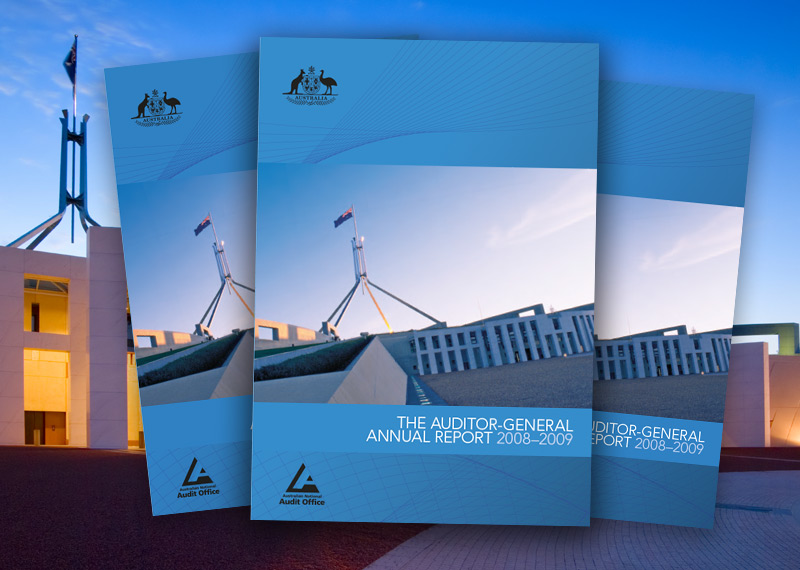
Published: Wednesday 16 September 2009
Published
This annual report documents the performance of the Australian National Audit Office (ANAO) in the financial year ending on 30 June 2009. It includes a foreword by the Auditor-General, an overview of the Office, a report on performance, details about management and accountability, and the financial results.
Performance audit (Auditor-General Report No. 25 of 1997–98)
Published: Thursday 18 December 1997
Published
The main objectives of the audit were to examine and form an opinion on:
- the efficiency, economy and administrative effectiveness with which the Commonwealth planned and coordinated implementation of the gun buy-back scheme;
- the management of firearms surrender and destruction in the Australian Capital Territory by the Australian Federal Police; and
- the management of the competitive tendering process for the national public education campaign.
Audit criteria were developed which examined program policy and planning, coordination with and payment of funds to the States.
Entity
Attorney-General's Department
Performance audit (Auditor-General Report No. 3 of 2004–05)
Published: Friday 23 July 2004
Published
The objective of the audit was to assess whether selected Commonwealth organisations had utilised better practice principles when establishing the role, and managing the use of their internal audit groups. In order to evaluate internal audit, the Australian National Audit Office (ANAO) first considered the status and accountabilities of internal audit within the overall governance framework of the organisations audited, in particular its accountabilities to the audit committee.
Entity
Department of Defence
Annual report
Published: Wednesday 19 September 2007
Published
This annual report documents the performance of the Australian National Audit Office (ANAO) in the financial year ending on 30 June 2007. It includes highlights and areas of focus for the coming year; a forward by the Auditor-General; an overview of the report; a report on performance; details about management and accountability, and the financial statement for the year.
Performance audit (Auditor-General Report No. 15 of 1998–99)
Published: Tuesday 24 November 1998
Published
The objective of this audit was to examine the efficiency and administrative effectiveness of processes the Australian Customs Service uses to screen incoming and outgoing mail. It also considers the involvement of other stakeholders such as Australia Post and Australian Quarantine Inspection Service.
Entity
Australian Customs Service
Annual report
Published: Wednesday 28 September 2005
Published
This annual report documents the performance of the Australian National Audit Office (ANAO) in the financial year ending on 30 June 2005. It includes highlights and areas of focus for the year; a forward by the Auditor-General; an overview of the report; a report on performance; details about management and accountability, and the financial statement for the year.
Annual report
Published: Thursday 16 October 2008
Published
This annual report documents the performance of the Australian National Audit Office (ANAO) in the financial year ending on 30 June 2008. It includes highlights and areas of focus for the coming year; a forward by the Auditor-General; an overview of the report; a report on performance; details about management and accountability, and the financial statement for the year.
Performance audit (Auditor-General Report No. 30 of 1997–98)
Published: Thursday 18 December 1997
Published
The objectives of the audit were to:
- assist OGIT in the timely identification and correction of any deficiencies in the evaluation process;
- provide advice to the Parliament, the Government and other interested parties on the probity of the evaluation process; and
- test for adherence to legislative and other specified requirements, such as in industry development.
Entity
Office of Government Information Technology
Performance audit (Auditor-General Report No. 54 of 2001–02)
Published: Thursday 6 June 2002
Published
The objective of the audit was to assess the administrative effectiveness of Australian Customs Services (Customs) drug detection strategies for air and containerised sea cargo and small craft activity. Within the scope of the audit, the following areas were examined :
- intelligence and law enforcement cooperation;
- air and containerised sea cargo;
- cargo examinations and technology;
- small craft activities;
- Customs funding arrangements (including funding for NIDS initiatives): and
- governance, including performance reporting.
Entity
Australian Customs Service
Performance audit (Auditor-General Report No. 21 of 2001–02)
Published: Tuesday 20 November 2001
Published
The audit reviewed the policy advising functions of the Departments of Education, Training and Youth Affairs, Employment, Workplace Relations and Small Business, and Family and Community Services. The objective of the audit was to determine whether departmental quality management systems for policy advising were appropriate and the advice provided met expected standards for policy outputs.
Entity
Department of Education Training and Youth Affairs; Department of Employment Workplace Relations and Small Business; Department of Family and Community Services
Annual report
Published: Thursday 26 September 2002
Published
This annual report documents the performance of the Australian National Audit Office (ANAO) in the financial year ending on 30 June 2002. It includes a comment by the Auditor-General on Audit independence and effectiveness; an overview of the Auditor-General’s role and responsibilities; a report on performance; details about management and accountability, and the financial statement for the year.
Performance audit (Auditor-General Report No. 56 of 2001–02)
Published: Thursday 13 June 2002
Published
The objective of the audit was to determine whether DIMIA's workforce planning systems are effectively supporting human resource management practices, which contribute to the efficient and effective achievement of project outcomes.
Entity
Department of Immigration and Multicultural And Indigenous Affairs
Performance audit (Auditor-General Report No. 30 of 1999–2000)
Published: Thursday 3 February 2000
Published
The examined the $1 billion Federation Fund program, which was established by the Government to mark the Centenary of Federation. The objectives of the examination were to assess the:
- extent to which the administration of the FCHP program complied with better practice in the assessment of applications, especially in relation to the transparency and rigour of the decision-making process;
- equity of the geographic spread of grants to States and electorates; and
- process for the announcement of the results of grant applications.
Entity
Across Agency
Performance audit (Auditor-General Report No. 11 of 1997–98)
Published: Thursday 30 October 1997
Published
The objectives of the audit were to:
- review the implementation arrangements in relation to the transfer of the delivery of AUSTUDY to Centrelink and its subsequent inclusion as part of the Youth Allowance; and
- to form an opinion on the efficiency and effectiveness of the front-end processing aspects of AUSTUDY applications.
Entity
Department of Employment, Education, Training and Youth Affairs