Browse our range of reports and publications including performance and financial statement audit reports, assurance review reports, information reports and annual reports.
Performance audit (Auditor-General Report No. 18 of 2005–06)
Published: Wednesday 30 November 2005
Published
The objective of the audit was to assess the administrative effectiveness of the CCAS. The audit focused on the following key areas: targeting non-compliance; real time compliance activity; post transaction compliance activity; and planning and performance evaluation. As the imports phase of the Integrated Cargo System (ICS) was only introduced in October 2005, this system was not reviewed as part of the audit. Our audit programme for 2005–06 includes ICS as a potential audit topic.
Entity
Australian Customs Service
Performance audit (Auditor-General Report No. 24 of 2005–06)
Published: Monday 23 January 2006
Published
The audit objective was to assess the effectiveness of DMO's JORN and JFASmaintenance and support arrangements. The audit examined the maintenanceand operation of the JORN and JFAS radars, and their facilities.
Entity
Department of Defence
Performance audit (Auditor-General Report No. 30 of 2013–14)
Published: Wednesday 7 May 2014
Published
The audit objective was to assess the effectiveness of the Therapeutic Goods Administration’s (TGA) application of the Code of Good Manufacturing Practice (Code of GMP) for prescription medicines.
Entity
Department of Health
Contact
Please direct enquiries relating to reports through our contact page.
Performance audit (Auditor-General Report No. 59 of 2003–04)
Published: Wednesday 30 June 2004
Published
The objective of this audit was to provide an independent assurance on the effectiveness of Defence's management of the acqusition of armoured infantry mobility vehicles (IMV) for the Australian Defence Force (ADF). The audit sought to identify the initial capability requirements; analyse the tendering and evaluation process; and examine the management of the project by Defence. As such, this was not an audit of contractor performance, but of the formation and contract management of the aquisition project by Defence.
Entity
Department of Defence
Performance audit (Auditor-General Report No. 50 of 2003–04)
Published: Friday 4 June 2004
Published
The objectives of the audit were to assess whether DOTARS had developed and implemented an appropriate framework and procedures to administer lessee obligations entered into as part of the 1997 and 1998 leasehold sales of 17 Federal airports. In particular, the audit sought to: - review DOTARS' monitoring of lessee compliance with the Airport Leases and supporting sale documentation; - examine the effectiveness of the framework and procedures developed by DOTARS to administer lessee development commitments; and assess the impact of changes in the aviation environment on the management and monitoring of lessee obligations.
Entity
Department of Transport and Regional Services
Performance audit (Auditor-General Report No. 47 of 2005–06)
Published: Wednesday 21 June 2006
Published
The objective of the audit was to assess whether FaCSIA administers grants effectively, according to better practice guidelines, and consistently across geographic areas and the range of programmes included in the scope of the audit. The scope of the audit included grants administered by FaCSIA between 1 July 2002 and 30 June 2005, relating to programmes falling within four of the five groups of programmes providing funding for families and communities namely: Community Support; Family Assistance; Childcare Support; and Youth and Student Support. In total, these groups involved total expenditure of some $533 million in 2004–05.
Entity
Department of Families Community Services and Indigenous Affairs
Performance audit (Auditor-General Report No. 56 of 2003–04)
Published: Thursday 24 June 2004
Published
The objective of this audit was to assess the extent to which PV applications in Australia are processed in accordance with relevant laws and policies, and whether DIMIA employs appropoiate mechanisms to ensure compliance with those laws and policies.
Entity
Department of Immigration and Multicultural and Indigenous Affairs
Performance audit (Auditor-General Report No. 33 of 2005–06)
Published: Thursday 2 March 2006
Published
The objective of this follow-up audit was to examine the ATO's implementation of the 20 recommendations in: The Administration of Petroleum Excise Collections (Audit Report No.17, 2001(02); and The Administration of Tobacco Excise (Audit Report No. 55, 2001(02), having regard to any changed circumstances, or new administrative issues, affecting implementation of those recommendations. The audit also aimed to identify scope for improvement in the ATO's administration of petroleum and tobacco excise. Follow-up audits are recognised as an important element of the accountability processes of Commonwealth administration. The Parliament looks to the Auditor-General to report, from time to time, on the extent to which Commonwealth agencies have implemented recommendations of previous audit reports. Follow-up audits keep the Parliament informed of progressive improvements and current challenges in areas of Commonwealth administration that have previously been subject to scrutiny through performance audits.
Entity
Australian Taxation Office
Performance audit (Auditor-General Report No. 39 of 2005–06)
Published: Thursday 11 May 2006
Published
The objectives of the audit were to provide assurance that Artbank was effectively meeting its charter of: acquiring art by contemporary artists; expanding the number of public places that Artbank's collection is rented and displayed; and managing its collection and rental scheme. The audit also examined Artbank's governance arrangements, and its programmes for marketing, client development, performance management, budgeting, debt management and also sought client feedback on Artbank's operations via a survey.
Entity
Agriculture Fisheries and Forestry Australia; Department of Communications Information Technology and the Arts
Performance audit (Auditor-General Report No. 18 of 2013–14)
Published: Wednesday 5 February 2014
Published
The objective of the audit was to assess the effectiveness of the Bureau of Meteorology’s implementation of the Improving Water Information Program.
Entity
Bureau of Meteorology
Contact
Please direct enquiries relating to reports through our contact page.
Performance audit (Auditor-General Report No. 39 of 2003–04)
Published: Tuesday 6 April 2004
Published
The objective of this audit was to determine the progress made by the AEC in implementing the ANAO's recommendations, taking into account any changed circumstances, or new administrative issues, affecting implementation of those recommendations.
Entity
Australian Electoral Commission
Performance audit (Auditor-General Report No. 9 of 2010–11)
Published: Wednesday 29 September 2010
Published
On 3 February 2010, Senator Christine Milne wrote to the Auditor General raising concerns about DEWHA's administration of the Green Loans program and requesting a performance audit of the program. Issues raised included: uncapped assessor numbers; problems with the delivery of the program; the quality of assessor training and assessments provided to households; the lack of an audit facility within the program; and equitable access to work under the program.
In light of Senator Milne's request and other concerns in relation to the administration of the program, the Auditor-General agreed on 25 February 2010 to conduct a performance audit of the program. The objective of the audit was to examine key aspects of the establishment and administration of the Green Loans program by DEWHA and the program's transition to DCCEE. Particular emphasis was given to the program's three main elements:
- training, registration and contracting of assessors;
- scheduling, conduct, and reporting of home sustainability assessments, and the associated payments to assessors; and
- provision of green loans to householders, and the associated payments to participating financial institutions.
The audit also examined the extent to which steps had been taken by DEWHA and DCCEE to assess whether the Green Loans program was achieving its objectives.
Entity
Department of the Environment, Water, Heritage and the Arts; Department of Climate Change and Energy Efficiency
Annual report
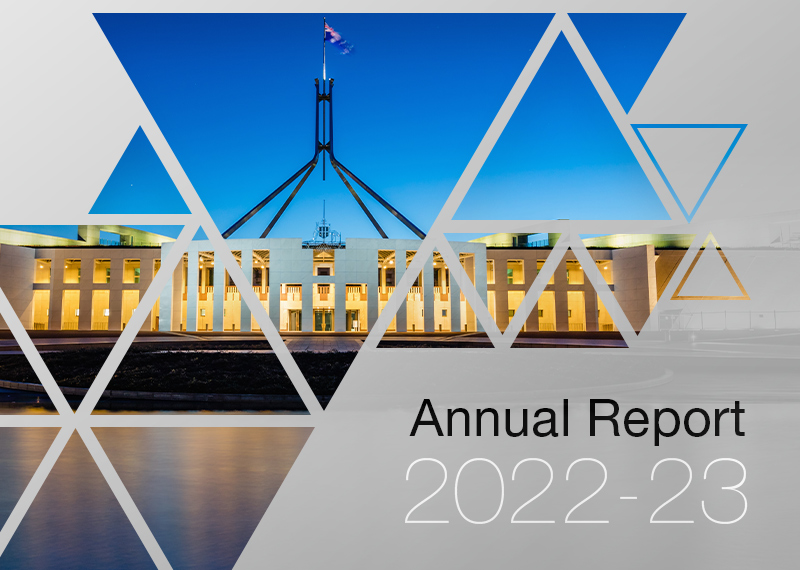
Published: Thursday 24 August 2023
Published
This annual report documents the performance of the Australian National Audit Office (ANAO) in the financial year ended 30 June 2023. The report addresses all applicable obligations under the Public Governance, Performance and Accountability Act 2013; the Public Governance, Performance and Accountability Rule 2014; the Auditor-General Act 1997; the performance measures set out in the outcome and programs framework in the ANAO’s Portfolio Budget Statements 2022–23 and in the ANAO Corporate Plan 2022–23; and annual reporting requirements set out in other relevant legislation.
Contact
Please direct enquiries through our contact page.
Speeches and papers
Published: Friday 26 February 2010
Published
Mr Ian McPhee - Auditor-General for Australia, presented at the Canberra Evaluation Forum, The Lobby, Canberra
Financial statement audit (Auditor-General Report No. 40 of 2020–21)
Published: Wednesday 2 June 2021
Published
This report is the first in the series of reports for the 2020–21 financial year and focuses on the results of the interim audits, including an assessment of entities’ key internal controls, supporting the 2020–21 financial statements audits. This report examines 25 entities, including all departments of state and a number of major Australian government entities. The entities included in the report are selected on the basis of their contribution to the income, expenses, assets and liabilities of the 2019–20 Consolidated Financial Statements.
Contact
Please direct enquiries through our contact page.
Performance audit (Auditor-General Report No. 14 of 2005–06)
Published: Wednesday 19 October 2005
Published
The audit assessed whether FaCS effectively undertakes its coordination, monitoring and other roles according to the CSTDA. The audit examined all disability services provided for under the CSTDA, except for disability employment services. The ANAO met relevant officers from FaCS' national office and State and Territory offices, and with 22 stakeholder organisations including: advocacy groups; peak national and State bodies representing the interests of disability service providers and people with disabilities; members of national and State Disability Advisory Bodies funded by FaCS; State and Territory governments; relevant Australian Government agencies; In particular, the Department of Health and Ageing and the Australian Institute of Health and Welfare. and local government bodies. Fieldwork for the audit was primarily undertaken during the period September 2004 to February 2005.
Entity
Department of Family and Community Services
Performance audit (Auditor-General Report No. 43 of 2005–06)
Published: Wednesday 31 May 2006
Published
The overall objective of the audit was to assess whether the RSS Programme is effective and efficient in providing assurance on the levels of payment error and the resultant risks to the integrity of Australian Government outlays for payments administered by Centrelink. Specifically, the audit assessed whether: the RSS Programme meets the objectives outlined for it in the Portfolio Budget Statements under which funding was provided; there is an adequate methodology underpinning the RSS reviews; the RSS reviews are conducted effectively and efficiently, and adequate quality assurance mechanisms exist to assure the results obtained from the RSS reviews; and reporting by the agencies of the results of the RSS Programme is adequate and takes into consideration the issues identified in Audit Report No. 44 2002–03 Review of the Parenting Payment Single Program, and Audit Report No. 17 2002–03 Age Pension Entitlements.
Entity
Department of Family Community Services and Indigenous Affairs; Department of Employment and Workplace Relations; Department of Education Science and Training; Centrelink
Performance audit (Auditor-General Report No. 57 of 2003–04)
Published: Thursday 24 June 2004
Published
The audit objectives were to assess: the appropriateness of agencies' policies for dealing with requests for information in accordance with the FOI Act; and assess agencies' compliance with the provisions of the FOI Act, in relation to selected requests for information.
Entity
Australian Federal Police; Attorney-General’s Department; Department of Communications, Information Technology and the Arts; Department of Veterans’ Affairs; Australian Customs Service; Civil Aviation Safety Authority
Performance audit (Auditor-General Report No. 7 of 2001–02)
Published: Thursday 9 August 2001
Published
The report summarises the audit and other related activities of the ANAO in the period January to June 2001. Key issues arising from performance audits tabled in this period are summarised against ANAO themes of:
- corporate governance including human resource management, financial management, and performance information;
- service delivery including the impact of e-government;
- procurement and contract management; and
- information technology.
Appendix 1 of the Activity Report provides a short summary of each of the performance audits tabled between 1 January 2001 and 30 June 2001.
Entity
NO-DEPTS-LISTED
Speeches and papers
Published: Thursday 15 December 2005
Published
Mr Ian McPhee. Auditor-General for Australia, presented to the Heads of Cultural Organisations Meeting
Performance audit (Auditor-General Report No. 36 of 2003–04)
Published: Thursday 25 March 2004
Published
The audit assessed the Commonwealth's administration of the two major elements of the Dairy Industry Adjustment Package; the Dairy Structural Adjustment Program (DSAP) and the supplementary Dairy Assitance Program (SDA). The audit addressed the implementation and delivery of the programs, governance arrangements and the management of the Dairy Structural Adjustment Fund.
Entity
Department of Agriculture Fisheries and Forestry; Dairy Adjustment Package
Performance audit (Auditor-General Report No. 8 of 2005–06)
Published: Friday 26 August 2005
Published
The objective of the audit was to assess the Personnel Management Key Solution Project's planning and approval processes and its contract and project management. The audit addresses the scope of the delivered system, the expectations of end-users, and the system's ability to meet their capability requirements.
Entity
Department of Defence
Financial statement audit (Auditor-General Report No. 38 of 2019–20)
Published: Thursday 28 May 2020
Published
This report focuses on the results of the interim financial statements audits, including an assessment of entities’ key internal controls, supporting the 2019–20 financial statements audits. This report examines 24 entities, including all departments of state and a number of major Australian government entities. The entities included in the report are selected on the basis of their contribution to the income, expenses, assets and liabilities of the 2018–19 Consolidated Financial Statements (CFS). Significant and moderate findings arising from the interim audits are reported to the responsible Minister(s), and all findings are reported to those charged with governance of each entity.
Contact
Please direct enquiries through our contact page.
Performance audit (Auditor-General Report No. 41 of 2005–06)
Published: Wednesday 24 May 2006
Published
The audit objective was to assess Health's administration of primary care funding, with a focus on the administrative practices of the Primary Care Division and Health's State and Territory Offices. In forming an opinion on the audit objective, the ANAO reviewed 41 agreements, with a combined value of $252 million. The ANAO also reviewed relevant documentation and files, interviewed programme officers and met with a number of stakeholders. The audit comments on a range of issues, including the utility of funding agreements, monitoring, payments, and support for administrators.
Entity
Department of Health and Ageing
Performance audit (Auditor-General Report No. 13 of 2005–06)
Published: Tuesday 18 October 2005
Published
The objective of the audit was to assess the administrative effectiveness of the ATO's management of GST compliance in the large business market segment. In conducting the audit the ANAO examined three key areas: governance - ILEC's corporate planning and reporting arrangements relevant to the management of GST compliance in the large business market segment; assessing and identifying compliance risks- how ILEC collects information relating to the large business market segment and how it uses this information to support risk identification and assessment; and managing compliance- compliance planning and the products and processes used by ILEC to manage GST compliance in the large business market segment and evaluating compliance outcomes to support future compliance planning and the targeting of GST compliance risks. In undertaking the audit, the ANAO took account of the findings of previous reviews, in particular the LCCP Review.
Entity
Australian Taxation Office
Performance audit (Auditor-General Report No. 37 of 1998–99)
Published: Wednesday 5 May 1999
Published
The purpose of the report was to report to the Parliament on how effectively and efficiently the Australian Taxation Office administers the Tax File Number System, and to identify opportunities for improvement of that system. The ANAO developed a methodological framework for the evaluation of the efficiency and effectiveness of the ATO's administration of the TFN system. The framework examined the TFN system; individuals and their TFNs; TFN withholding tax arrangements; and TFN information matching.
Entity
Australian Taxation Office
Speeches and papers
Published: Monday 7 October 2002
Published
Mr P.J. Barrett (AM) - Auditor-General for Australia, presented at the 18th Commonwealth Auditors-General Conference, Malaysia
Performance audit (Auditor-General Report No. 24 of 2003–04)
Published: Saturday 31 January 2004
Published
A Special Account is a mechanism used to record amounts in the Consolidated Revenue Fund that are set aside for specified purposes. A total of $3.40 billion was reported as held in Special Accounts as of 30 June 2003, with $10.33 billion reported as credited to Special Accounts in 2002-03 and $10.06 billion in reported payments (debits) from these Accounts. The audit examined the establishment, management and abolition of Special Accounts by Commonwealth agencies, as well as compliance with legal requirements
Entity
Across Agency
Performance audit (Auditor-General Report No. 6 of 1996–97)
Published: Thursday 12 September 1996
Published
The objectives for the audit were to examine Commonwealth guarantees, indemnities and letters of comfort in relation to:
- the potential size of the Commonwealth's exposure to these instruments;
- the extent to which the overall exposures of the Commonwealth are managed and monitored;
- the adequacy of administrative reporting arrangements;
- areas of better administrative practice relating to their management; and
- to raise agencies' awareness of appropriate risk management and accountability practices in relation to these instruments.
The audit set out to quantify the Commonwealth's exposure to guarantees, indemnities and letters of comfort.
Entity
Across Agency
Performance audit (Auditor-General Report No. 47 of 2013–14)
Published: Monday 23 June 2014
Published
The audit objective was to determine whether Australian Government agencies were implementing appropriate policies and processes to identify and manage conflicts of interest.
Entity
Across Agencies
Contact
Please direct enquiries relating to reports through our contact page.