Browse our range of reports and publications including performance and financial statement audit reports, assurance review reports, information reports and annual reports.
Performance audit (Auditor-General Report No. 20 of 1997–98)
Published: Thursday 4 December 1997
Published
The objective of the audit was to ascertain how efficiently and effectively the ATO administers sales tax collections. The audit excluded an examination of the Australian Customs Service's sales tax administration, although it did examine coordination and liaison arrangements between the ATO and ACS. The audit approach involved analysing the ATO's performance against the five elements of the ATO's established compliance improvement process, namely:
- interpreting and clarifying sales tax law;
- identifying and understanding clients and markets (enabling tax officers to identify and analyse risks of non-compliance);
- providing education and information to clients regarding sales tax obligations, based on identified compliance risks;
- implementing administrative arrangements which ensure and/or assist taxpayers to meet their obligations; and
- detecting non-compliance and taking action to remedy instances of non-compliance.
Entity
Australian Taxation Office
Corporate

Published: Friday 11 July 2025
Published
The ANAO Corporate Plan 2025–26 updates the previous corporate plan and outlines how we intend to deliver against our purpose over the next four years (2025–26 to 2028–29). The corporate plan is the ANAO’s primary planning document — it outlines our purpose; our strategic priorities; our operating context; and the priorities, activities and performance measures by which we will be held to account.
Contact
Please direct enquiries through our contact page.
Performance audit (Auditor-General Report No. 39 of 2021–22)

Published: Tuesday 21 June 2022
Published
The objective of the audit was to assess the effectiveness of the Department of Foreign Affairs and Trade’s overseas crisis management and response arrangements in meeting the government’s objectives for returning Australians from overseas in response to the COVID-19 global pandemic.
Entity
Department of Foreign Affairs and Trade
Contact
Please direct enquiries through our contact page.
Annual report
Published: Thursday 26 August 2021
Published
This annual report documents the performance of the Australian National Audit Office (ANAO) in the financial year ended 30 June 2021. The report addresses all applicable obligations under the Public Governance, Performance and Accountability Act 2013; the Public Governance, Performance and Accountability Rule 2014; the Auditor-General Act 1997; the performance measures set out in the outcome and programs framework in the ANAO’s Portfolio Budget Statements 2020–21 and the ANAO Corporate Plan 2020–21; and annual reporting requirements set out in other relevant legislation.
Contact
Please direct enquiries relating to annual reports through our contact page.
Performance audit (Auditor-General Report No. 12 of 2014–15)
Published: Thursday 11 December 2014
Published
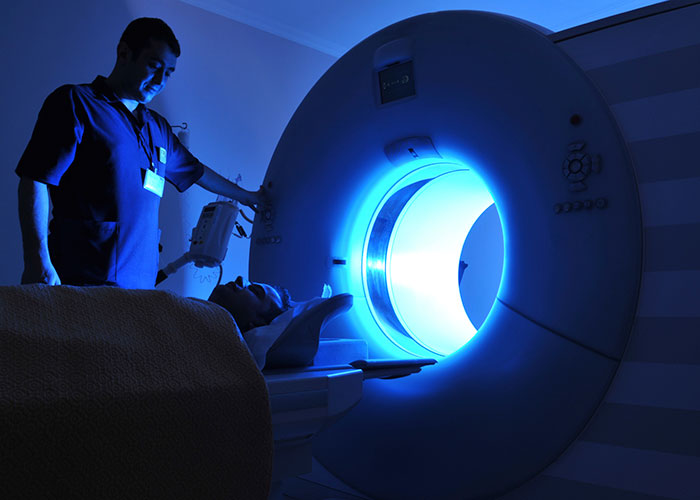
The audit objective was to assess the effectiveness of Health's implementation of the Diagnostic Imaging Review Reform Package, some three years into the five year reform period.
Entity
Department of Health
Contact
Please direct enquiries relating to reports through our contact page.
Performance audit (Auditor-General Report No. 18 of 2013–14)
Published: Wednesday 5 February 2014
Published
The objective of the audit was to assess the effectiveness of the Bureau of Meteorology’s implementation of the Improving Water Information Program.
Entity
Bureau of Meteorology
Contact
Please direct enquiries relating to reports through our contact page.
Performance audit (Auditor-General Report No. 29 of 2010–11)
Published: Wednesday 16 February 2011
Published
The objective of the audit was to examine the effectiveness of the AFP's approach to its management of the implementation of NPIs.
Entity
Australian Federal Police
Performance audit (Auditor-General Report No. 53 of 2006–07)
Published: Friday 29 June 2007
Published
The objective of the audit is to examine and report on the efficiency and effectiveness of AFP's administration and management of its overseas deployments. The audit specifically examines two deployments and focuses on strategic and operational planning and logistics. The audit examines a planned, long-term overseas deployment (as part of the Participating Police Force (PPF) within the Regional Assistance Mission to Solomon Islands (RAMSI)) and a crisis-driven deployment in response to a specific event (Disaster Victim Identification (DVI) assistance to Thailand following the Indian Ocean Tsunamis of 26 December 2004).
Entity
Australian Federal Police
Performance audit (Auditor-General Report No. 43 of 2005–06)
Published: Wednesday 31 May 2006
Published
The overall objective of the audit was to assess whether the RSS Programme is effective and efficient in providing assurance on the levels of payment error and the resultant risks to the integrity of Australian Government outlays for payments administered by Centrelink. Specifically, the audit assessed whether: the RSS Programme meets the objectives outlined for it in the Portfolio Budget Statements under which funding was provided; there is an adequate methodology underpinning the RSS reviews; the RSS reviews are conducted effectively and efficiently, and adequate quality assurance mechanisms exist to assure the results obtained from the RSS reviews; and reporting by the agencies of the results of the RSS Programme is adequate and takes into consideration the issues identified in Audit Report No. 44 2002–03 Review of the Parenting Payment Single Program, and Audit Report No. 17 2002–03 Age Pension Entitlements.
Entity
Department of Family Community Services and Indigenous Affairs; Department of Employment and Workplace Relations; Department of Education Science and Training; Centrelink
Performance audit (Auditor-General Report No. 9 of 2003–04)
Published: Wednesday 22 October 2003
Published
The audit assessed whether Centrelink has effective Business Continuity Management and/or associated risk management procedures and plans in place that: minimise the likelihood of a significant business outage; and in the event of such an outage, minimise disruption of critical services to customers. The audit also assessed whether Centrelink services satisfy special community demands in times of emergency.
Entity
Centrelink
Annual report
Published: Tuesday 7 October 2003
Published
This annual report documents the performance of the Australian National Audit Office (ANAO) in the financial year ending on 30 June 2003. It includes a comment by the Auditor-General; an overview of the report; a report on performance; details about management and accountability, and the financial statement for the year.
Annual report
Published: Thursday 26 September 2002
Published
This annual report documents the performance of the Australian National Audit Office (ANAO) in the financial year ending on 30 June 2002. It includes a comment by the Auditor-General on Audit independence and effectiveness; an overview of the Auditor-General’s role and responsibilities; a report on performance; details about management and accountability, and the financial statement for the year.
Performance audit (Auditor-General Report No. 26 of 1999–2000)
Published: Friday 14 January 2000
Published
In a military context, individual readiness refers to the ability of an individual member to be deployed, within a specified notice period, on operations, potentially in a combat environment, to perform the specific skills in which he or she has been trained. Individual readiness is the foundation on which military preparedness is built. Maintenance of a specified level of individual readiness in peacetime (along with other factors such as equipment readiness and collective training) influences the speed with which personnel can deploy on operations. The objective of this audit is to ensure that members can be deployed on operations, potentially in a combat environment, to perform their specific skills within a notice period of 30 days.
Entity
Department of Defence
Performance audit (Auditor-General Report No. 19 of 1999–2000)
Published: Monday 22 November 1999
Published
The audit reviewed the operations of the Civil Aviation Authority (CASA), which has prime responsibility for regulating aviation safety in Australia. The audit objectives were to assess the efficiency and effectiveness of the management systems and procedures used by CASA to ensure compliance with regulatory controls by Air Operator's Certificate holders operating passenger-carrying aircraft within High Capacity Regular Public Transport; Low Capacity Regular Public Transport and charter industry sectors; and Certificate of Approval holders. Aviation safety compliance includes entry control, surveillance and enforcement.
Entity
Civil Aviation Safety Authority
Performance audit (Auditor-General Report No. 19 of 2024–25)

Published: Tuesday 17 December 2024
Published
The objective of the audit was to assess the effectiveness of the administration of the Pharmaceutical Benefits Scheme.
Entity
Department of Health and Aged Care; Services Australia
Contact
Please direct enquiries through our contact page.
Performance audit (Auditor-General Report No. 19 of 2023–24)

Published: Tuesday 27 February 2024
Published
The objective of this audit was to assess the effectiveness of the Department of Health and Aged Care’s (DHAC) performance management of the Primary Health Network program.
Entity
Department of Health and Aged Care
Contact
Please direct enquiries through our contact page.
Performance audit (Auditor-General Report No. 4 of 2020–21)

Published: Monday 31 August 2020
Published
The objective of this audit was to assess the extent to which entities’ establishment and use of ICT related procurement panels and arrangements supported the achievement of value for money outcomes.
Entity
Across Entities
Contact
Please direct enquiries through our contact page.
Performance audit (Auditor-General Report No. 52 of 2010–11)
Published: Wednesday 22 June 2011
Published
The objective of the audit was to assess the effectiveness of the ATO’s administration of DGR endorsements and associated arrangements.
Entity
Australian Taxation Office
Performance audit (Auditor-General Report No. 49 of 2009–10)
Published: Thursday 24 June 2010
Published
The objective of the audit was to assess whether Defence is effectively managing the delivery of health services to ADF personnel in Australia (chiefly Garrison Health Services).
Entity
Department of Defence
Annual report
Published: Thursday 16 October 2008
Published
This annual report documents the performance of the Australian National Audit Office (ANAO) in the financial year ending on 30 June 2008. It includes highlights and areas of focus for the coming year; a forward by the Auditor-General; an overview of the report; a report on performance; details about management and accountability, and the financial statement for the year.
Performance audit (Auditor-General Report No. 38 of 2006–07)
Published: Wednesday 23 May 2007
Published
The audit objective was to assess the effectiveness of DoHA's management of CACPs in fulfilling the legislated objectives of the program.
Entity
NO-DEPTS-LISTED
Performance audit (Auditor-General Report No. 46 of 2003–04)
Published: Thursday 20 May 2004
Published
The objective of the audit was to examine and report on the economy, efficiency and effectiveness of the courts' client service arrangements for family law clients. The audit also assessed the effectiveness of the coordination between the two courts, and of their administration of Primary Dispute Resolution (PDR) services.
Entity
Family Court of Australia; Federal Magistrates Court
Performance audit (Auditor-General Report No. 54 of 2001–02)
Published: Thursday 6 June 2002
Published
The objective of the audit was to assess the administrative effectiveness of Australian Customs Services (Customs) drug detection strategies for air and containerised sea cargo and small craft activity. Within the scope of the audit, the following areas were examined :
- intelligence and law enforcement cooperation;
- air and containerised sea cargo;
- cargo examinations and technology;
- small craft activities;
- Customs funding arrangements (including funding for NIDS initiatives): and
- governance, including performance reporting.
Entity
Australian Customs Service
Performance audit (Auditor-General Report No. 5 of 1998–99)
Published: Monday 24 August 1998
Published
The objectives of the audit were to provide assurance to Parliament concerning the adequacy of Commonwealth security planning and preparations for the Games and to identify areas for improvement early enough for any corrective action to be taken.
Entity
Across Agency
Financial statement audit (Auditor-General Report No. 9 of 2023–24)
Published: Thursday 14 December 2023
Published
This report complements the Interim Report on Key Financial Controls of Major Entities financial statement audit report published in May 2023. It provides a summary of the final results of the audits of the Consolidated Financial Statements for the Australian Government and the financial statements of 243 Australian Government entities for the period ended 30 June 2023.
Entity
Across Entities
Contact
Please direct enquiries through our contact page.
Performance audit (Auditor-General Report No. 38 of 2011–12)
Published: Tuesday 5 June 2012
Published
The objective of the audit was to assess the effectiveness of DSEWPaC's administration of PIIOP, including the acquisition of water access entitlements and progress towards achieving the program's objectives.
Entity
Department of Sustainability, Environment, Water, Population and Communities
Performance audit (Auditor-General Report No. 5 of 2010–11)
Published: Wednesday 15 September 2010
Published
The objective of the audit was to assess DoHA's effectiveness:
- in undertaking PIP program planning, program monitoring and review; and
- with Medicare Australia, in ensuring PIP program delivery to general practices and their medical practitioners.
In undertaking the audit, the ANAO considered the 12 incentives that comprised the PIP up to August 2009. The three most recently introduced incentives at the time of audit fieldwork, namely, Domestic Violence, GP Aged Care Access and eHealth incentives, were examined in greater detail and formed case studies to support audit analysis. The ANAO also sought views on the program administration from industry, including from general practices directly through an online survey.
With regard to accreditation of general practice, the audit scope did not include an assessment of the Standards nor the work of the bodies that undertake accreditation of general practices. The ANAO's focus on general practice accreditation related to DoHA's management of program entry criteria.
Entity
Department of Health and AgeingMedicare Australia
Performance audit (Auditor-General Report No. 8 of 2009–10)
Published: Thursday 29 October 2009
Published
The objective of this audit was to provide a strategic review on the progress of the Tax Office's implementation of the Change Program.
To achieve this, the ANAO examined:
- the planning for, and governance of, the Change Program, particularly in relation to the management of risk and the assurance framework established by the Tax Office, and its management of contractual arrangements for the project;
- implementation issues associated with Releases 1 and 2 of the Change Program, and more specifically in relation to Release 3, the first use of the new ICP system to process FBT returns; and
- the funding of the Change Program, including measurement and attribution of the costs of the project and consideration of any benefits realisation to date.
Entity
Australian Taxation Office
Performance audit (Auditor-General Report No. 25 of 2008–09)
Published: Wednesday 11 March 2009
Published
The objective of this audit was to assess and report on the progress being made by Government agencies in achieving better practice in green office procurement and sustainable office management. The scope of the audit included agencies incorporated under the Financial Management and Accountability Act 1997 as well as a sample of bodies incorporated under the Commonwealth Authorities and Companies Act 1997. Sixty-three agencies were included in an audit survey. Detailed validation was carried out in nine of these agencies.
Entity
Across Entities
Performance audit (Auditor-General Report No. 44 of 2006–07)
Published: Thursday 14 June 2007
Published
The objective of the audit was to assess the effectiveness of the Tribunals' management of their operations. To this end, the audit examined whether the MRT and the RRT:
- have achieved intended operational efficiencies from the introduction of common facilities, services and resourcing;
- have established appropriate arrangements for governance, business planning and guidance of Members and staff, and for performance monitoring and reporting of Tribunal operations;
- finalise cases within Tribunal time and productivity standards; and
- provide applicants with services in accordance with service standards.
The audit covered Tribunal operations for review of visa decisions. The correctness of individual decisions was not assessed as part of the audit.
The audit focused particularly on developments in the Tribunals' management performance in the four year period from 2001–02 to 2004–05.
Entity
Migration Review Tribunal; Refugee Review Tribunal
Performance audit (Auditor-General Report No. 22 of 2005–06)
Published: Thursday 22 December 2005
Published
The objective of the audit was to assess and report on the progress being made by agencies subject to the Financial Management & Accountability Act 1997 and entities subject to the Commonwealth Authorities & Companies Act 1997: in realising value for money from the procurement process, with a specific focus on buildings, services and products using whole of life cycle assessments; and in the consideration and management of environmental impacts in specifications and contracts. The emphasis of the audit was on green office procurement and sustainable business practices and the value for money within this context. As such, the audit report provides a status report on the implementation of ESD within the office environment of the Australian Government. The audit used a survey approach in conjunction with selected audit investigations to obtain information across 71 agencies and entities selected on the basis of materiality in procurement and coverage across large, medium and small organisations. The agencies selected represented approximately 35 per cent of all government bodies and over 95 per cent of all procurement spending noted on the Department of Finance and Administration (Finance) database on contracts.
Entity
across agency
Performance audit (Auditor-General Report No. 42 of 1999–2000)
Published: Wednesday 10 May 2000
Published
The audit reviewed the effectiveness and probity of the policy development processes and implementation of improved access to Magnetic Resonance Imaging services. The objective of the audit was to examine and report on the effectiveness and probity of the processes involved in:
(a) the development and announcement of the proposal to improve access to Magnetic Resonance Imaging (MRI) services announced in the 1998 Budget, including negotiation with the diagnostic imaging profession; and
(b) the registration of 'eligible providers' and 'eligible equipment' to enable the payment of claims for MRI services on the Medicare Benefits Schedule
Entity
Across Agency
Performance audit (Auditor-General Report No. 41 of 1999–2000)
Published: Friday 28 April 2000
Published
The Commonwealth has significant involvement in national emergency management arrangements through its roles in planning, coordination between agencies, operational response, financial support, education and training, public awareness and research activities. The objectives of this performance audit were to identify the Commonwealth's current emergency management arrangements; to provide assurance to Parliament concerning the adequacy of the arrangements; and to highlight areas for improvement.
Entity
Across Agency
Performance audit (Auditor-General Report No. 29 of 2006–07)
Published: Wednesday 7 March 2007
Published
The objective of the audit was to assess the implementation and administration of the movement limit and the Slot Management Scheme at Sydney Airport.
The scope of the audit included the development and administration of the SADM Act. The scope also included the development and administration of the relevant legislative instruments and determinations, particularly those which put in place the monitoring and compliance frameworks that support the legislation.
Entity
NO-DEPTS-LISTED
Annual report
Published: Wednesday 28 September 2005
Published
This annual report documents the performance of the Australian National Audit Office (ANAO) in the financial year ending on 30 June 2005. It includes highlights and areas of focus for the year; a forward by the Auditor-General; an overview of the report; a report on performance; details about management and accountability, and the financial statement for the year.
Performance audit (Auditor-General Report No. 1 of 2022–23)

Published: Thursday 28 July 2022
Published
The objective of the audit was to assess whether the award of funding under the Building Better Regions Fund was effective as well as being consistent with the Commonwealth Grant Rules and Guidelines.
Entity
Department of Industry, Science and Resources; Department of Infrastructure, Transport, Regional Development, Communications and the Arts
Contact
Please direct enquiries through our contact page.
Performance audit (Auditor-General Report No. 42 of 2014–15)

Published: Thursday 4 June 2015
Published
The objective of this audit was to assess the effectiveness of Finance’s administration of travel entitlements provided to Parliamentarians.
Entity
Department of Finance
Contact
Please direct enquiries relating to reports through our contact page.
Performance audit (Auditor-General Report No. 33 of 2000–01)
Published: Monday 7 May 2001
Published
The objective of the ANAO audit was to identify possible areas for improvement in the Australian Defence Force's management of its Reserve forces. The audit focused on major aspects of the Reserves including roles and tasks, force structure, capability, training, individual readiness, equipment, facilities, recruitment, retention, conditions of service and administration. The audit covered the Australian Naval Reserve, the Australian Army Reserve and the Royal Australian Air Force Reserve. However, due to its size and cost, the Army Reserve was a major focus of the audit activity.
Entity
Department of Defence
Performance audit (Auditor-General Report No. 45 of 1999–2000)
Published: Wednesday 31 May 2000
Published
The Commonwealth has significant foreign exchange risk exposures including $A8.4 billion of foreign currency transactions with the Reserve Bank of Australia in 1998-99. Under the Financial Management and Accountability Act and its associated Regulations, all agencies are required to assess and, where possible, manage, foreign exchange risk. The audit reviewed four agencies that have substantial foreign currency payment exposures namely:
- the Department of Defence;
- the Australian Agency for International Development;
- the Department of Foreign Affairs and Trade; and
- the Department of Finance and Administration.
The objective of the audit was to identify and assess the efficiency and cost effectiveness of the management of foreign exchange risk across the selected agencies, also to identify opportunities to improve the management of foreign exchange risk, including any associated potential financial savings that could accrue to the Commonwealth.
Entity
Department of Defence; Australian Agency for International Development; Department of Foreign Affairs and Trade; Department of Finance and Administration
Performance audit (Auditor-General Report No. 13 of 1999–2000)
Published: Monday 11 October 1999
Published
The Department of Defence spends some $2.4 billion a year on major equipment acquisition projects. The audit objective was to assess Defence's arrangements for higher-level management of major equipment acquisition projects. The principal aim was to formulate practical recommendations that would both enhance Defence's management of major acquisition projects and provide a degree of assurance about its ongoing apparent capacity to do so efficiently and effectively.
Entity
Department of Defence
Annual report
Published: Thursday 27 September 2012
Published
This annual report documents the performance of the Australian National Audit Office (ANAO) in the financial year ending on 30 June 2012. It presents an overview including the role and vision of the Office, a report on performance, details about management and accountability, and the financial results.
Financial statement audit (Auditor-General Report No. 33 of 2016–17)

Published: Monday 23 January 2017
Published
This report complements the interim phase report published in August 2016, and provides a summary of the final results of the audits of the Consolidated Financial Statements for the Australian Government and the financial statements of Australian Government entities.
Entity
Across Entities
Financial statement audit (Auditor-General Report No. 24 of 2017–18)
Published: Wednesday 20 December 2017
Published
This report complements the Interim Report on Key Financial Controls of Major Entities financial statement audit report published in June 2017. It provides a summary of the final results of the audits of the Consolidated Financial Statements for the Australian Government and the financial statements of Australian Government entities for the period ended 30 June 2017.
Entity
Across Entities
Contact
Please direct enquiries through our contact page.
Performance audit (Auditor-General Report No. 45 of 2006–07)
Published: Tuesday 19 June 2007
Published
The objective of this performance audit was to assess the administration of the National Black Spot Programme. It was undertaken in a manner similar to the audit of the Roads to Recovery Programme. Specifically, the audit approach involved:
- examination of DOTARS records and discussions with officers in DOTARS and four of the State road transport authorities responsible for administering the Programme;
- analysis of project monitoring, reporting and payment arrangements; and
- selecting a sample of 45 LGA areas across four States so that ANAO could examine projects delivered with Commonwealth funding.
Entity
NO-DEPTS-LISTED
Performance audit (Auditor-General Report No. 5 of 2001–02)
Published: Tuesday 7 August 2001
Published
The audit was conducted in response to a November 2000 resolution of the Senate that the Auditor-General examine all expenditures and entitlements accruing to Parliamentarians in 1999-2000. The objectives of the audit were to:
- provide assurance to the Parliament regarding the administration by Finance, the chamber departments and the portfolio departments of all expenditures and entitlements accruing to Parliamentarians, including Ministers, in 1999-2000;
- assess the administrative and control structures governing expenditures and entitlements accruing to Parliamentarians and Ministers in 1999-2000; and
- identify opportunities to improve the current framework.
Entity
Across Agency
Performance audit (Auditor-General Report No. 3 of 2009–10)
Published: Tuesday 8 September 2009
Published
The focus of this audit was on those entitlements administered by Finance. Similar to the 2001-02 Audit Report, the audit scope did not include entitlements provided to persons employed under the Members of Parliament (Staff) Act 1984 (MOP(S) Act). It also did not examine the administration of entitlements provided through other agencies (such as Parliamentarians' salary and electorate allowance, which are paid by the Chamber Departments, and entitlements provided to Ministers by their home department).
Entity
Department of Finance and Deregulation
Annual report
Published: Thursday 24 August 2023
Published
This annual report documents the performance of the Australian National Audit Office (ANAO) in the financial year ended 30 June 2023. The report addresses all applicable obligations under the Public Governance, Performance and Accountability Act 2013; the Public Governance, Performance and Accountability Rule 2014; the Auditor-General Act 1997; the performance measures set out in the outcome and programs framework in the ANAO’s Portfolio Budget Statements 2022–23 and in the ANAO Corporate Plan 2022–23; and annual reporting requirements set out in other relevant legislation.
Contact
Please direct enquiries through our contact page.
Annual report
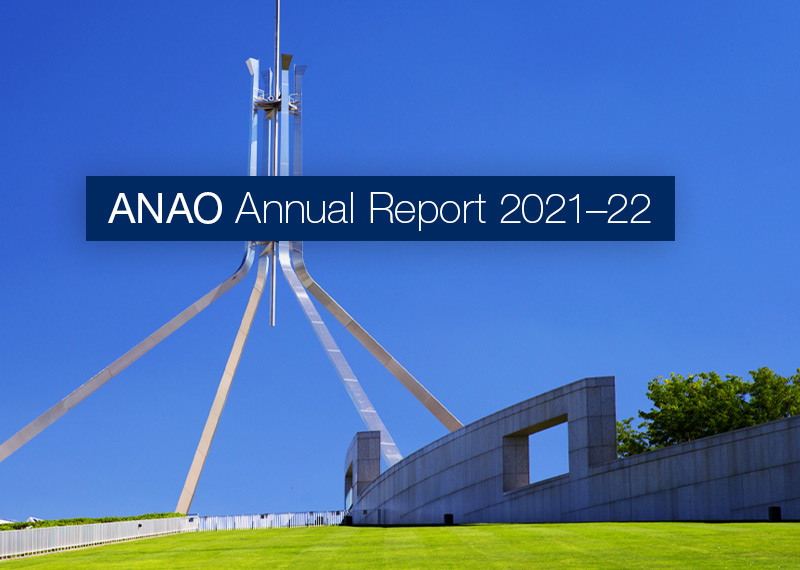
Published: Thursday 25 August 2022
Published
This annual report documents the performance of the Australian National Audit Office (ANAO) in the financial year ended 30 June 2022. The report addresses all applicable obligations under the Public Governance, Performance and Accountability Act 2013; the Public Governance, Performance and Accountability Rule 2014; the Auditor-General Act 1997; the performance measures set out in the outcome and programs framework in the ANAO’s Portfolio Budget Statements 2021–22 and the ANAO Corporate Plan 2021–22; and annual reporting requirements set out in other relevant legislation.
Contact
Please direct enquiries through our contact page.
Financial statement audit (Auditor-General Report No. 20 of 2019–20)
Published: Tuesday 17 December 2019
Published
This report complements the Interim Report on Key Financial Controls of Major Entities financial statement audit report published in June 2019. It provides a summary of the final results of the audits of the Consolidated Financial Statements for the Australian Government and the financial statements of Australian Government entities for the period ended 30 June 2019.
Contact
Please direct enquiries through our contact page.