Browse our range of reports and publications including performance and financial statement audit reports, assurance review reports, information reports and annual reports.
Performance audit (Auditor-General Report No. 17 of 2024–25)

Published: Thursday 12 December 2024
Published
The objective of the audit was to assess the effectiveness of the management of conflicts of interest by Aboriginal Hostels Limited (AHL), Aboriginal Investment NT and Outback Stores.
Entity
Aboriginal Hostels Limited; Aboriginal Investment NT; Outback Stores Pty Ltd
Contact
Please direct enquiries through our contact page.
Performance audit (Auditor-General Report No. 35 of 2023–24)

Published: Tuesday 11 June 2024
Published
The objective of this audit was to examine the effectiveness of DAFF’s administration of the Digital Services to Take Farmers to Markets (TFTM) program.
Entity
Department of Agriculture, Fisheries and Forestry
Contact
Please direct enquiries through our contact page.
Performance audit (Auditor-General Report No. 24 of 2022–23)

Published: Tuesday 23 May 2023
Published
The objective of this audit was to assess whether the Department of Defence (Defence) is managing its Australian Defence Force health services contract to achieve efficient and effective delivery of the contracted services.
Entity
Department of Defence
Contact
Please direct enquiries through our contact page.
Performance audit (Auditor-General Report No. 37 of 2014–15)

Published: Tuesday 19 May 2015
Published
The audit objective was to assess the effectiveness and efficiency of the Department of Human Services’ management of Smart Centres’ Centrelink telephone services.
Entity
Department of Human Services
Contact
Please direct enquiries relating to reports through our contact page.
Performance audit (Auditor-General Report No. 26 of 2018–19)

Published: Friday 15 February 2019
Published
The audit objective was to assess the effectiveness of risk management, data monitoring and public reporting arrangements associated with the Australian Government's funding of public hospital services under the 2011 National Health Reform Agreement (NHRA).
Entity
Department of Health; Independent Hospital Pricing Authority; National Health Funding Body
Contact
Please direct enquiries through our contact page.
Performance audit (Auditor-General Report No. 33 of 2020–21)

Published: Monday 29 March 2021
Published
The objective of this audit was to assess the efficiency and effectiveness of the Independent Parliamentary Expenses Authority’s administration of parliamentary expenses.
Entity
Independent Parliamentary Expenses Authority
Contact
Please direct enquiries through our contact page.
Performance audit (Auditor-General Report No. 15 of 2021–22)

Published: Thursday 16 December 2021
Published
The objective of the audit was to assess the effectiveness to date of the Department of Defence’s procurement of six evolved Cape class patrol boats.
Entity
Department of Defence
Contact
Please direct enquiries through our contact page.
Performance audit (Auditor-General Report No. 17 of 2007–08)
Published: Wednesday 19 December 2007
Published
The overall objective of the audit was to assess the effectiveness of Refresh and, in particular:
- the extent to which Centrelink has used the funds invested by the Government to develop its IT capability and realise the anticipated service delivery, financial and other benefits; and
- how Centrelink's programme management approach and Refresh's oversight arrangements have contributed to the achievement of the outcomes of the programme.
Entity
Centrelink
Performance audit (Auditor-General Report No. 4 of 2004–05)
Published: Monday 2 August 2004
Published
The audit assessed whether Centrelink effectively manages customer debt, excluding debt relating to Family Tax Benefit, consistently across its network, ensuring integrity of payments made on behalf of the Department of Family and Community Services (FaCS). The audit assessed five components of Centrelink's debt management processes, including administration, prevention, identification, raising and recovery.
Entity
Centrelink
Performance audit (Auditor-General Report No. 34 of 2000–01)
Published: Thursday 17 May 2001
Published
The Age Pension is a social security income support payment available to Australian residents and eligible Australians residing overseas who have reached Age Pension age and whose income and assets are under certain limits. In 1999-2000, approximately $14 billion was paid to approximately 1.7 million Age Pension recipients. Payment of Age Pension is made under the Social Security Law and in accordance with the Guide to the Social Security Law prepared by the Department of Family and Community Services (FaCS). FaCS has contracted Centrelink under a Business Partnership Agreement (BPA) to administer the payment of Age Pension to eligible customers. The objective of the audit was to assess the extent to which new claims for Age Pension had been assessed in compliance with the legislation and other relevant guidelines developed by Centrelink, and whether Centrelink employed appropriate mechanisms to help ensure such compliance. In particular, the ANAO sought evidence with respect to: payment at the right rate, from the right date, to the right person with the right product, for new claims assessed during the audit sample period (that is, in accordance with the working definition of accuracy within Centrelink); the accuracy of Centrelink?s own reporting on compliance, as reported to FaCS under the BPA; and the application of appropriate mechanisms to help ensure such compliance.
Entity
Centrelink
Performance audit (Auditor-General Report No. 10 of 2009–10)
Published: Monday 16 November 2009
Published
The objective of this audit is to assess Customs and Border Protection's processing of incoming international air passengers in the primary line, in particular the extent to which: (a) systems and controls effectively support the referral of incoming air passengers who pose a risk and those carrying prohibited items; (b) air passengers presenting an immigration risk are processed appropriately; and (c) Customs and Border Protection has arrangements in place to effectively promote co-operation and information sharing between Customs and Border Protection and DIAC.
Entity
Australian Customs and Border Protection Service
Performance audit (Auditor-General Report No. 44 of 2005–06)
Published: Thursday 1 June 2006
Published
The objective of the audit was to examine how effectively Health manages the risk of PBS drugs not being used according to PBS subsidy conditions. The audit examined two areas: during listing, how Health identified and implemented measures to decrease the risks of PBS drugs being used outside subsidy conditions; and following listing, how Health confirmed that usage and expenditure on PBS drugs was consistent with estimates. The report examines selected approaches used by Health, which have evolved in recent years, to manage the risk of PBS drugs being used outside subsidy conditions. The report also acknowledges and describes the role of the expert committees. The scope of the audit was limited to PBS drugs for which Health pays a subsidy. The audit did not examine Health's role in educating consumers, prescribers, and other health professionals, or the implications of the Australia–United States Free Trade Agreement for the PBS. Additionally, the ANAO did not form an opinion on the success of Medicare Australia's compliance role. To form an opinion against the audit objective, the ANAO interviewed Health personnel, committee members and stakeholders, examined relevant documents and files, analysed drug usage and expenditure data, and attended a number of committee meetings. To assist the audit process, the ANAO selected a sample of eight drugs. The drugs were selected due to their high cost to the PBS and/or high usage, or because the drug has had a particularly interesting PBS history. The sample is not representative of all drugs on the PBS. In 2004–05, 15.3 million prescriptions were written for these eight drugs, with the Government subsidy totalling $1.05 billion.
Entity
Department of Health and Ageing
Performance audit (Auditor-General Report No. 35 of 2001–02)
Published: Monday 11 March 2002
Published
The Australian Taxation Office (ATO) established a task force in 1996 to develop a greater understanding of the factors involved and to devise a coordinated approach in dealing with the cash economy. The objective of the performance audit was to report to Parliament on the ATO's progress in addressing the cash economy, including its monitoring and reporting of outcomes. The audit focused on the ATO's implementation of its Cash Economy Task Force recommendations in the light of the tax reform that has taken place over the last two years.
Entity
Australian Taxation Office
Speeches and papers
Published: Tuesday 1 May 2001
Published
Mr P.J. Barrett (AM) - Auditor-General for Australia, presented at the IIR Conference 'Risks in Outsourcing in the Public Sector'
Performance audit (Auditor-General Report No. 4 of 2000–01)
Published: Monday 14 August 2000
Published
This report summarises audit and other related activities of the Australian National Audit Office in the period January to June 2000.
Entity
Audit Activity Report
Performance audit (Auditor-General Report No. 29 of 1999–2000)
Published: Friday 4 February 2000
Published
The audit objective was to form an opinion on the Department of Veterans' Affairs administration of its activities to maintain and enhance the health and independence of veterans and war widows in their homes and in the community.
Entity
Department of Veterans' Affairs
Speeches and papers
Published: Friday 13 October 1995
Published
Mr P.J. Barrett (AM) - Auditor-General for Australia, presented to the International Consortium on Governmental Financial Management - Washington
Performance audit (Auditor-General Report No. 23 of 2003–04)
Published: Thursday 29 January 2004
Published
The audit sought to assess how well the Australian Taxation Office (ATO) manages aggressive tax planning. We did this by exploring the nature of aggressive tax planning and the ATO's approach to its management. In the latter context, we looked at:
- the ATO's previous experience with aggressive tax planning and action on previous significant external reviews, particularly dealing with mass marketed investment schemes;
- strategy and operations, intelligence gathering and use; and the identification and management of promoters given their significant role in aggressive tax planning.
Entity
Australian Taxation Office
Corporate
Published: Thursday 6 July 2023
Published
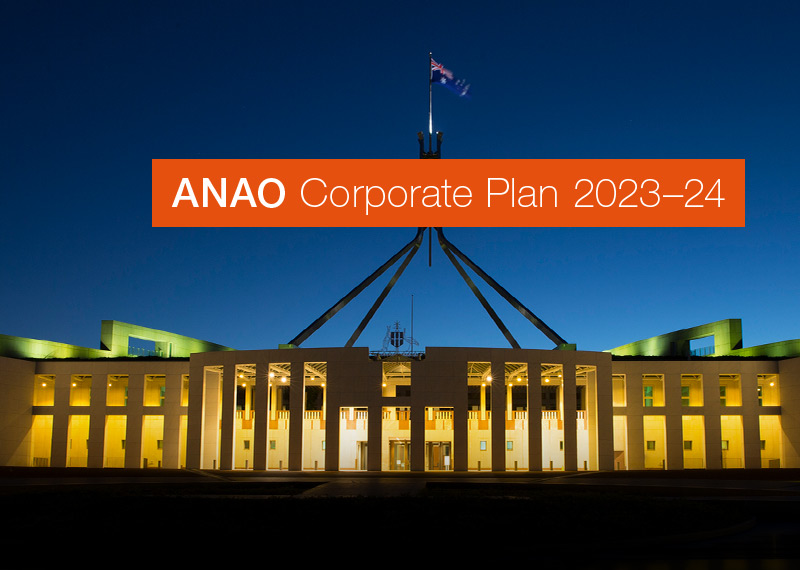
The ANAO Corporate Plan 2023–24 outlines how we intend to deliver against our purpose over the next four years (2023–24 to 2026–27). The corporate plan is the ANAO’s primary planning document – it outlines our purpose; the dynamic environment in which we operate; our commitment to building capability; and the priorities, activities and performance measures by which we will be held to account. The corporate plan is complemented by the annual audit work program, which reflects the ANAO’s audit strategy for the coming year.
This corporate plan was updated on 26 March 2024:
- organisational structure changes — ‘Professional Services and Relationships Group’ to ‘Professional Services Group’
- Measure 3 — change type from ‘Efficiency / Qualitative’ to ‘Efficiency / Quantitative’
- Measure 15, reporting mechanism 4 — replaced text to reflect updated JCPAA feedback process
- Measure 16, reporting mechanism 3 — replaced references to ‘insights’ with ‘lessons’
Contact
Please direct enquiries through our contact page.
Performance audit (Auditor-General Report No. 8 of 2023–24)

Published: Monday 11 December 2023
Published
The objective of the audit was to assess whether the design and early implementation of the Australian Government’s response to Recommendation 86 of the Royal Commission into Aged Care Quality and Safety has been effective.
Entity
Department of Health and Aged Care; Aged Care Quality and Safety Commission
Contact
Please direct enquiries through our contact page.
Performance audit (Auditor-General Report No. 34 of 2022–23)

Published: Wednesday 7 June 2023
Published
The objective of this audit was to assess whether the Department of Home Affairs’ procurement process for the Permissions Capability employed open and effective competition and achieved value for money, consistent with the Commonwealth Procurement Rules.
Entity
Department of Home Affairs
Contact
Please direct enquiries through our contact page.
Performance audit (Auditor-General Report No. 25 of 2022–23)

Published: Wednesday 24 May 2023
Published
The objective of this audit was to assess the effectiveness of the governance of the Tiwi Land Council under the Aboriginal Land Rights (Northern Territory) Act 1976 and the Public Governance, Performance and Accountability Act 2013.
Entity
Tiwi Land Council
Contact
Please direct enquiries through our contact page.
Performance audit (Auditor-General Report No. 33 of 2017–18)

Published: Wednesday 28 March 2018
Published
The objective of the audit was to continue to examine the progress of the implementation of the annual performance statements requirements under the PGPA Act and the PGPA Rule by the selected entities. The audit was also designed to:
- provide insights to entities more broadly, to encourage improved performance; and
- continue the development of the ANAO’s methodology to support the possible future implementation of annual audits of performance statements.
Entity
Across Entities
Contact
Please direct enquiries through our contact page.
Performance audit (Auditor-General Report No. 42 of 2018–19)

Published: Thursday 30 May 2019
Published
The objective of this audit was to assess the effectiveness of the Australian Taxation Office’s (ATO’s) management of small business tax debt arising from compliance activities.
Entity
Australian Taxation Office
Contact
Please direct enquiries through our contact page.
Performance audit (Auditor-General Report No. 13 of 2008–09)
Published: Tuesday 16 December 2008
Published
The audit objective was to assess how well agencies manage their websites. Particular attention was given to the audited agencies' website purposes, risk management and planning, policies, content management procedures, and performance monitoring and reporting. These elements provide the framework for the design, implementation and operation of websites.
Entity
Australian Bureau of Statistics; Department of Agriculture, Fisheries and Forestry; Department of Foriegn Affairs and Trade
Performance audit (Auditor-General Report No. 8 of 2005–06)
Published: Friday 26 August 2005
Published
The objective of the audit was to assess the Personnel Management Key Solution Project's planning and approval processes and its contract and project management. The audit addresses the scope of the delivered system, the expectations of end-users, and the system's ability to meet their capability requirements.
Entity
Department of Defence
Performance audit (Auditor-General Report No. 19 of 2000–01)
Published: Monday 4 December 2000
Published
The objective of this follow-up audit was to provide assurance to the Parliament on the cost-effectiveness of public sector travel by:
- ascertaining the degree of acceptance, and the extent of implementation, of the previous audit recommendations and better practice principles; and
- establishing whether organisations were managing travel effectively, taking into consideration recommendations and findings detailed in the above Audit Reports and the Better Practice Guide Public Sector Travel.
Entity
Across Agency
Performance audit (Auditor-General Report No. 51 of 1999–2000)
Published: Thursday 29 June 2000
Published
The objective of the audit was to examine program management in the Training and Youth Division of the Department of Education, Training and Youth Affairs. In broad terms, the audit focused on the management frameworks at both Divisional and program level. Three of the Division's programs were selected for more detailed review as follows:
- Workplace English Language and Literacy;
- Literacy and Numeracy; and
- Support for New Apprentices.
Entity
Department of Education, Training and Youth Affairs
Performance audit (Auditor-General Report No. 37 of 1999–2000)
Published: Tuesday 4 April 2000
Published
The audit reviewed the construction of facilities for the Australian Defence Force and the Department of Defence by the Defence Estate Organisation. The objective of the audit was to assess the efficiency and administrative effectiveness of the Organisation's project delivery function, highlighting effective practice and, where appropriate, making practical recommendations to enhance facilities project management. The main projects examined were the facilities required for the Army Presence in the North and the Russell Hill Redevelopment.
Entity
Department of Defence
Performance audit (Auditor-General Report No. 11 of 1999–2000)
Published: Tuesday 21 September 1999
Published
In November 1998, the Minister for Communications wrote to the Auditor-General requesting an assessment of the actual costs of Phase 1 digital conversion for the ABC and SBS, the sources of funds applied and the efficiency with which the funds had been used before the government considered further funding. The purpose of this limited scope performance audit was to assess a range of financial issues associated with the ABC and SBS conversion to digital broadcasting.
Entity
Australian Broadcasting Corporation; Special Broadcasting Service Corporation
Annual report
Published: Monday 30 September 2013
Published
This annual report documents the performance of the Australian National Audit Office (ANAO) in the financial year ending on 30 June 2013. It addresses the Requirements for Annual Reports for Departments, Executive Agencies and FMA Act Bodies approved by the Joint Committee of Public Accounts and Audit in June 2013; the performance measures set out in the outcomes and programs framework in the 2012–13 Portfolio Budget Statements; section 28 of the Auditor-General Act 1997; and other annual reporting requirements set out in legislation.
Annual report
Published: Wednesday 16 September 2009
Published
This annual report documents the performance of the Australian National Audit Office (ANAO) in the financial year ending on 30 June 2009. It includes a foreword by the Auditor-General, an overview of the Office, a report on performance, details about management and accountability, and the financial results.
Performance audit (Auditor-General Report No. 4 of 2008–09)
Published: Wednesday 24 September 2008
Published
The audit objective was to form an opinion on the administrative effectiveness of the arrangements between DEEWR (previously DEWR) and Centrelink for the delivery of working age employment services under the Business Partnership Agreement (BPA).
Entity
Department of Education, Employment and Workplace Relations; Centrelink
Financial statement audit (Auditor-General Report No. 22 of 2024–25)
Published: Thursday 6 February 2025
Published
This report complements the Interim Report on Key Financial Controls of Major Entities financial statement audit report published in June 2024. It provides a summary of the final results of the audits of the Consolidated Financial Statements for the Australian Government and the financial statements of Australian Government entities for the period ended 30 June 2024.
Entity
Across Entities
Contact
Please direct enquiries through our contact page.
Speeches and papers
Published: Monday 19 May 2003
Published
Mr P.J. Barrett (AM) - Auditor-General for Australia, presented at the 2nd Annual New Directions in Australian Auditing Accounting Standards Conference
Performance audit (Auditor-General Report No. 46 of 2000–01)
Published: Wednesday 6 June 2001
Published
The objective of the audit was to report to Parliament on the ATO's management of its performance reporting within the outcomes and outputs framework and to identify potential areas for improvement in specifying, measuring, administering and reporting under that framework.
Entity
Australian Taxation Office
Performance audit (Auditor-General Report No. 23 of 2025–26)
Recent

Published: Thursday 5 March 2026
Published
The audit objective was to assess whether Department of Health and Aged Care effectively developed and monitored suicide prevention measures.
Entity
Department of Health, Disability and Ageing
Contact
Please direct enquiries through our contact page.
Performance audit (Auditor-General Report No. 49 of 2024–25)

Published: Thursday 26 June 2025
Published
The objective of this audit was to assess the effectiveness of the design and establishment of the National Reconstruction Fund Corporation.
Entity
National Reconstruction Fund Corporation; Department of Industry, Science and Resources; Department of Finance
Contact
Please direct enquiries through our contact page.
Performance audit (Auditor-General Report No. 48 of 2024–25)

Published: Wednesday 25 June 2025
Published
The objective of the audit was to assess the effectiveness of the NDIA’s management of claimant compliance with NDIS claim requirements.
Entity
National Disability Insurance Agency
Contact
Please direct enquiries through our contact page.
Performance audit (Auditor-General Report No. 49 of 2014–15)

Published: Wednesday 10 June 2015
Published
The audit objective is to assess the effectiveness of the Department of Agriculture’s administration of the Imported Food Inspection Scheme.
Entity
Department of Agriculture
Contact
Please direct enquiries relating to reports through our contact page.
Performance audit (Auditor-General Report No. 51 of 2014–15)

Published: Thursday 25 June 2015
Published
The objective of the audit was to assess the effectiveness of the Australian Taxation Office’s administration of capital gains tax for individual and small business taxpayers.
Entity
Australian Taxation Office
Contact
Please direct enquiries relating to reports through our contact page.
Performance audit (Auditor-General Report No. 3 of 2015–16)

Published: Thursday 13 August 2015
Published
The objective of this audit was to assess the effectiveness of the Great Barrier Reef Marine Park Authority’s regulation of permits and approvals within the Great Barrier Reef Marine Park.
Entity
Great Barrier Reef Marine Park Authority
Contact
Please direct enquiries relating to reports through our contact page.
Performance audit (Auditor-General Report No. 52 of 2016–17)

Published: Tuesday 23 May 2017
Published
The audit objective was to assess the effectiveness of the management of underperformance in the Australian Public Service (APS) and identify opportunities for improvement.
Entity
Across Entities
Contact
Please direct enquiries relating to reports through our contact page.
Performance audit (Auditor-General Report No. 41 of 2009–10)
Published: Wednesday 26 May 2010
Published
The audit objective was to assess whether agreements between Australian Government (Commonwealth) agencies reflect sound administrative practices. To meet this objective, the audit reviewed current government policy and a range of better practice guidelines, conducted interviews with agencies and examined cross-agency agreements, to formulate suitable audit criteria and subsequently develop better practice principles.
Entity
Across Entities
Performance audit (Auditor-General Report No. 22 of 2009–10)
Published: Thursday 11 February 2010
Published
The objective of the audit was to assess how effectively Geoscience Australia provides geoscientific and geospatial information and services to assist the Australian Government and key stakeholders. Particular emphasis was given to:
- the collection and management of geoscientific and geospatial data and information, including accessibility;
- the provision of products and services; and
- governance arrangements.
The ANAO examined a number of datasets and product and service projects to assess Geoscience Australia's performance in providing geoscientific and geospatial information and services.
Entity
Geoscience Australia
Performance audit (Auditor-General Report No. 38 of 2008–09)
Published: Wednesday 27 May 2009
Published
The objective of the ANAO's audit was to examine the effectiveness of DAFF's implementation and administration of the buyback of fishing concessions under the Securing our Fishing Future structural adjustment package.
Entity
Department of Agriculture, Fisheries and Forestry
Performance audit (Auditor-General Report No. 41 of 2005–06)
Published: Wednesday 24 May 2006
Published
The audit objective was to assess Health's administration of primary care funding, with a focus on the administrative practices of the Primary Care Division and Health's State and Territory Offices. In forming an opinion on the audit objective, the ANAO reviewed 41 agreements, with a combined value of $252 million. The ANAO also reviewed relevant documentation and files, interviewed programme officers and met with a number of stakeholders. The audit comments on a range of issues, including the utility of funding agreements, monitoring, payments, and support for administrators.
Entity
Department of Health and Ageing
Performance audit (Auditor-General Report No. 32 of 2004–05)
Published: Wednesday 9 March 2005
Published
Given the importance of customer feedback to Centrelink's business, the ANAO considered it timely to conduct a series of performance audits relating to Centrelink's customer feedback systems, particularly in relation to its delivery of the services then provided on behalf of FaCS. The overarching objective of this series of ANAO performance audits of Centrelink's customer feedback systems was to assess whether Centrelink has effective processes and systems for gathering, measuring, reporting and responding effectively to customer feedback, including in relation to customer satisfaction with Centrelink services and processes.
Entity
Centrelink
Performance audit (Auditor-General Report No. 39 of 1999–2000)
Published: Thursday 13 April 2000
Published
The audit reviewed the coordination of export development and promotion activities across Commonwealth agencies. The objective of the audit was to assess the extent to which export development and promotion activities are managed in a coordinated manner to maximise their effectiveness and transparency, and to minimise duplication. Particular attention was given to:
- Austrade's role in coordinating and advising on the development of export programs across Commonwealth agencies; and
- the design, delivery and evaluation of programs consistent with the Mortimer review design criteria agreed by Government.
Entity
Across Agency
Performance audit (Auditor-General Report No. 32 of 1999–2000)
Published: Thursday 17 February 2000
Published
Industry levies play a significant role in the provision of many public services and fund a range of activities undertaken by regulatory bodies such as the Australian Prudential Regulation Authority (APRA), through to financing reform of the Australian waterfront labour force. The objectives of this audit were to assess:
- the coverage, revenue and expenses of non-primary industry levies;
- the effectiveness of selected entities' financial management of non-primary industry levies; and
- areas of better administrative practice relating to the financial management of non-primary industry levies.
Entity
Across Agency
Performance audit (Auditor-General Report No. 34 of 1996–97)
Published: Tuesday 27 May 1997
Published
The objective of the audit was to assess the efficiency and effectiveness of the provision of health services to the Australian Defence Force Regular forces. Audit criteria were developed which examined health services policy and strategic planning, resource management, the tri-Service provision of medical, dental and other health care, the operation of and planning for major medical facilities, health care management information systems, occupational health and safety and the supply of health materiel.
Entity
Department of Defence
Annual report
Published: Thursday 30 September 2010
Published
This annual report documents the performance of the Australian National Audit Office (ANAO) in the financial year ending on 30 June 2010. It includes a foreword by the Auditor-General, an overview including the role and responsibilities and vision of the Office, a report on performance, details about management and accountability, and the financial results.
Performance audit (Auditor-General Report No. 3 of 2011–12)
Published: Tuesday 30 August 2011
Published
The objective of this audit is to examine the effectiveness of the TGA’s administration of complementary medicines regulation in Australia. The primary focus is on listed complementary medicines, which comprise about 98 per cent of these medicines.
Entity
Department of Health and Ageing
Performance audit (Auditor-General Report No. 19 of 2002–03)
Published: Monday 2 December 2002
Published
The audit examined the ATO's management of its relationship with tax practitioners (tax agents and the wider group of professionals working on taxation matters for clients). However, our main focus was the ATO's management of its relationship with tax agents because they are the core element of the tax practitioner grouping and their role is fundamental to the effective operation of the tax system. The objective of the audit was to assess how well the ATO manages its relationship with tax practitioners, focussing on selected ATO relationships with tax practitioners, in particular its regulatory relationship with tax agents, its service support relationship with tax agents and its relationship with tax agents and members of the wider tax practitioner group in the professional bodies as key stakeholders in tax administration.
Entity
Australian Taxation Office
Performance audit (Auditor-General Report No. 47 of 2013–14)
Published: Monday 23 June 2014
Published
The audit objective was to determine whether Australian Government agencies were implementing appropriate policies and processes to identify and manage conflicts of interest.
Entity
Across Agencies
Contact
Please direct enquiries relating to reports through our contact page.
Performance audit (Auditor-General Report No. 46 of 2008–09)
Published: Thursday 25 June 2009
Published
The objectives of this audit were to:
- assess the current status of BCM and EM arrangements in Centrelink and identify opportunities for improvement; and
- review Centrelink's response to the recommendations.
Entity
Centrelink
Performance audit (Auditor-General Report No. 20 of 2005–06)
Published: Tuesday 6 December 2005
Published
The objective of this audit was to assess the Private Health Insurance Administration Council's (PHIAC's) administrative effectiveness as a regulator of private health insurance. In making this assessment, the Australian National Audit Office (ANAO) addressed the following criteria: whether PHIAC monitored compliance with its legislative requirements and analysed related data; whether PHIAC addressed and managed non-compliance with its legislative requirements; and whether PHIAC's governance and organisation supported the performance of its legislative functions. Although the Department of Health and Ageing (Health) also has a role in the regulation of the private health insurance industry under the National Health Act 1953 (Health Act), Health's regulatory activities were outside the scope of this audit.
Entity
Private Health Insurance Administration Council
Performance audit (Auditor-General Report No. 31 of 2004–05)
Published: Wednesday 9 March 2005
Published
Given the importance of customer feedback to Centrelink's business, the ANAO considered it timely to conduct a series of performance audits relating to Centrelink's customer feedback systems, particularly in relation to its delivery of the services then provided on behalf of FaCS. The overarching objective of this series of ANAO performance audits of Centrelink's customer feedback systems was to assess whether Centrelink has effective processes and systems for gathering, measuring, reporting and responding effectively to customer feedback, including in relation to customer satisfaction with Centrelink services and processes.
Entity
Centrelink
Performance audit (Auditor-General Report No. 36 of 2003–04)
Published: Thursday 25 March 2004
Published
The audit assessed the Commonwealth's administration of the two major elements of the Dairy Industry Adjustment Package; the Dairy Structural Adjustment Program (DSAP) and the supplementary Dairy Assitance Program (SDA). The audit addressed the implementation and delivery of the programs, governance arrangements and the management of the Dairy Structural Adjustment Fund.
Entity
Department of Agriculture Fisheries and Forestry; Dairy Adjustment Package
Performance audit (Auditor-General Report No. 28 of 2003–04)
Published: Thursday 12 February 2004
Published
The report summarises performance audit, financial statement audit and other related activities for the ANAO for the period July to December 2003. The key issues arising from performance audits tabled in this period are summarised against the ANAO themes. The report also summarises financial audits and other financial audit activities conducted by the ANAO during the period July to December 2003. It discusses significant issues such as the: consolidated financial statements and the final budget outcome; harmonisation of Australian Generally accepted accounting practices and Government Finance Statistics; adoption of International Financial Reporting Standards; timing for Financial Statements Preparation; and the audit of the CFS 2002-03.
Entity
ANAO