Browse our range of reports and publications including performance and financial statement audit reports, assurance review reports, information reports and annual reports.
Auditor-General Report No. 26 of 2025–26
Defence’s Procurement of Infantry Fighting Vehicles (Land 400 Phase 3)
Published
Monday 30 March 2026
Portfolio
Defence
Entity
Department of Defence
Contact
Please direct enquiries through our contact page.
Activity
Procurement
Sector
Defence
Audit snapshot
Why did we do this audit?
- Land 400 Phase 3 involves the acquisition of infantry fighting vehicles known as the Redback. It is a major Defence capability project intended to replace the M113AS4 vehicles and provide protected mobility, survivability and lethality for land forces.
- This audit was conducted to provide Parliament with independent assurance on whether the Department of Defence’s (Defence) tender process and contracting arrangements to date have been effective in supporting value for money and the delivery of the intended capability.
Key facts
- The project’s estimated budget increased over time, from around $10–15 billion in the 2016 Integrated Investment Program to $18.1–27.1 billion in the 2020 Force Structure Plan for up to 450 vehicles, or three battalions.
- Following the 2023 Defence Strategic Review, the project was confirmed as strategically important but re‑scoped and accelerated, with approved expenditure of $7.3 billion as at February 2026 to deliver 129 vehicles, or one battalion.
What did we find?
- Defence’s procurement and contract management of the Land 400 Phase 3 project to date has been partly effective.
- Defence’s acquisition approach evolved from its original intent to pursue a mature and proven solution, resulting in a more developmental pathway with greater exposure to integration and schedule risk.
- Inconsistencies in how tendered prices and risks were adjusted reduced the transparency and defensibility of the value for money assessment.
- Defence has waived certain contractual requirements and managed project progress through remediation, which has masked underlying schedule pressures.
- Two very high technical risks related to the vehicle’s mobility and lethality capabilities require resolution.
What did we recommend?
- There were two recommendations to Defence aimed at strengthening advice to government and improving the timeliness of Defence’s payment of supplier invoices.
- Defence agreed to both recommendations.
$7.3 bn
approved project expenditure at February 2026.
2
very high risks to vehicle mobility and lethality remained unresolved at February 2026.
Dec 2028
scheduled final delivery date, assessed by independent reviewers as highly challenging.
Summary and recommendations
Background
1. Department of Defence’s (Defence) Land Combat Vehicle System comprises 211 Boxer combat reconnaissance vehicles (Land 400 Phase 2) and 129 Redback infantry fighting vehicles (Land 400 Phase 3). They replace now obsolete vehicles and reflect the 2023 Defence Strategic Review’s call for Army to be transformed for littoral manoeuvre operations from Australia.
Rationale for undertaking the audit
2. With approved project expenditure (at 30 June 2025) of $7.3 billion, the Land 400 Phase 3 project is one of the largest capability acquisition projects in the history of the Army. This audit has been undertaken to provide the Parliament with independent assurance of the effectiveness to date of Defence’s acquisition and contract management of the project.
Audit objective and criteria
3. The objective of the audit was to assess the effectiveness to date of Defence’s procurement of infantry fighting vehicles (Land 400 Phase 3).
4. To form a conclusion against the audit objective, the following high-level criteria were adopted:
- Did Defence conduct an effective tender process?
- Have effective contracting arrangements been established with the contractor to support the achievement of value for money outcomes?
Conclusion
5. Defence’s procurement of infantry fighting vehicles (IFVs) through Land 400 Phase 3 has been partly effective, reflecting trade-offs made between delivery timeframes, future upgrade potential and risk. Defence moved away from its original intent to address an identified capability gap by pursuing a platform with high technical readiness, instead progressing a more developmental acquisition approach that increased exposure to integration and schedule risk. These risks were not clearly communicated to government, nor consistently reflected in tender evaluation and contracting decisions. Defence-mandated integration requirements and moving to design solutions that were not mature and proven in a vehicle of this nature and size have had implications for Defence’s ability to deliver the capability as planned. Consequently, as at February 2026, very high technical risks related to the vehicle’s mobility and lethality capabilities require resolution.
6. Defence’s management of the tender process was partly effective. The process demonstrated broad compliance with procurement requirements and probity controls were adequate at the project level. Defence did not clearly document or communicate to government how its acquisition approach evolved over time, including in response to the developmental nature of the tendered solutions, nor did it provide advice on the presence of vehicle models and components already available on the market.
7. The tender evaluation process was weakened by inconsistent treatment of risk and price adjustments, as well as the absence of clearly articulated weighting or prioritisation of evaluation criteria in the tender documentation. While Defence documented its rationale for certain cost treatments during evaluation, these approaches were not applied consistently or transparently across tenders. Collectively, these factors reduced the transparency and defensibility of the value for money assessment and limited the extent to which the tender process supported fully informed decision-making.
8. Defence established partly effective contracting arrangements with Hanwha Defence Australia (HDA) to support the delivery of intended contract outcomes. However, there are a number of very high risks to core elements of the vehicle, the impact of which on the long-term project schedule, cost and overall capability are unknown at this stage.
9. The contract includes appropriate arrangements for Defence to assess contractor performance and monitor project progress. Notwithstanding this, Defence has waived certain contractual requirements and is managing contract progress through remediation actions, which overstates the extent to which the project is on schedule. Defence has also not made timely payments to HDA, resulting in a total of $483,929.39 in penalty interest payable by Defence to HDA.
Supporting findings
Land 400 Phase 3 tender
10. Defence complied with process requirements for the development and issuing of the request for tender (RFT) documentation, and the initial screening of tenders. However, the RFT did not provide potential tenderers with a clear and consistent basis for responding to Defence’s documented risk posture and acquisition strategy. Defence’s planning documents consistently indicated a preference to avoid bespoke or developmental outcomes. (See paragraphs 2.4 to 2.18, and paragraphs 2.24 to 2.30)
11. While the RFT stated that Defence was pursuing a ‘mature, proven technology’, it did not define this term, specify minimum system maturity thresholds, or include evaluation criteria addressing system readiness, integration risk or design maturity. Instead, the structure of the RFT — including requirements for non-recurring engineering, system integration and future growth activities — was consistent with outcomes involving material design development. Defence did not document how this approach aligned with its earlier acquisition planning or explain the implications for risk, schedule and cost. As a result, all tender submissions involved varying levels of development and integration risk. (See paragraphs 2.19 to 2.23)
12. Defence’s evaluation criteria were not weighted or prioritised in the published tender documents, reducing transparency and limiting the extent to which Defence’s priorities were communicated to potential tenderers. Although Defence placed greater emphasis on price and capability during the evaluation, this was not documented in the RFT — as required by the Commonwealth Procurement Rules (CPRs). This limited tenderers’ ability to effectively tailor their responses and represented a shortcoming in the procurement process. Defence did not assess tenders more favourably for being non-developmental, nor did it adjust its overall risk posture when all tendered platforms were assessed as developmental to varying extents. (See paragraphs 2.40 to 2.63)
13. Inconsistent application of pricing adjustments between tenderers introduced uncertainty into value-for-money assessments, understating HDA’s cost at Stage 3 by $852.6 million. These factors impacted the reliability of the value for money assessment and the cost per unit of capability, which was a key factor in the final recommendation. By not specifying explicit system-maturity requirements, including the extent to which a non-developmental outcome was sought, Defence did not clearly signal its expectations to the market and was subsequently limited in its ability to adjust risk settings when only developmental solutions were received. (See paragraphs 2.64 to 2.91)
14. Defence established a probity framework for Land 400 Phase 3, requiring personnel to declare any potential conflicts of interest arising from association with potential tenderers and adhere to strict confidentiality obligations. In 13 instances, declarations were reviewed by the probity adviser and additional measures taken (such as statutory declarations to reinforce confidentiality obligations). At the project level, all but one of 174 relevant personnel completed a declaration. In signing declarations, personnel acknowledged a continuing obligation to declare any potential conflicts of interest that might arise in the future. (See paragraphs 2.92 to 2.101)
15. SES/Star ranked personnel were additionally required to complete annual declarations of personal and financial interests. Where a potential conflict of interest existed, personnel were required to outline a strategy to manage it and have this endorsed by their supervisor. Across the six-year period examined by the ANAO, just over half (51.2 per cent) of SES/Star ranked officers fully complied with the requirement to complete an annual declaration. (See paragraphs 2.102 to 2.113)
16. The ANAO did not identify any serious breaches of the policy prohibiting hospitality, gifts or benefits. (See paragraphs 2.114 to 2.117)
17. Contrary to successive Defence procurement reviews, Defence did not provide government with advice on potential mature and proven options for Land 400 Phase 3, even though it possessed this information. Submissions to government omitted reference to the earlier acquisition strategy for a military-off-the-shelf (MOTS) solution and did not discuss the existence or potential cost advantages of MOTS options, nor that all tenders received were developmental. Advice to the Minister for Defence Industry (the Minister) similarly did not address these options, with only limited updates noting the developmental status of prototype vehicles. Progress reporting to the Minister was limited. Progress reporting to senior Defence leadership was regular, but quarterly reports and monthly narratives were limited to project milestones. (See paragraphs 2.118 to 2.127)
Contracting arrangements
18. Defence’s governance arrangements with HDA provide a clear path for escalation and direction on the management of risks and issues to the Land 400 Phase 3 project. There are two very high risks related to the core elements of the vehicle, of which Defence was aware during the Risk Mitigation Activity (RMA). These risks are impacting the project schedule and cost. (See paragraphs 3.5 to 3.33)
19. Defence was advised by independent reviewers that (see paragraphs 3.34 to 3.40):
- delivering the capability within the required compressed schedule is extremely challenging, given there is limited time for issue remediation; and
- it will be a significant, if not impossible, challenge to deliver 129 fully capable IFVs by the end of 2028.
20. Defence’s lack of implementation of recommendations from independent reviews to mitigate technical risks has resulted in delays to the schedule that are yet to be defined. The Land 400 Phase 3 project has also recently been included on the Capability Acquisition and Sustainment Group’s Watch List.1 (See paragraphs 3.41 and 3.42)
21. The contract includes adequate provisions that allow Defence to monitor and assess HDA’s performance and project progress. Defence has waived certain contractual requirements in order to keep the project on schedule, despite independent advice against this approach. This has resulted in a large number of action items that remain open and remediation action, which has caused delays to the completion of several milestones by agreed dates. Defence has instructed HDA to proceed with contract milestones despite issues with the quality and accuracy of contract deliverables and HDA’s advice to Defence of challenges and risks. Defence is managing contract progress through remediation actions, which obscures underlying schedule slippage. (See paragraphs 3.43 to 3.76)
22. The payment terms included in the December 2023 contract with HDA were noncompliant with government policy. In March 2024, Defence updated the contract to align with the government policy payment terms. Between contract execution and 30 June 2025, 19 (of 83) invoices were paid late, resulting in a total of $483,929.39 in interest penalties payable by Defence to HDA. As at 31 October 2025, Defence had paid HDA a total of $148,129.37, leaving $335,889.48 outstanding for penalties on invoices that were not paid in accordance with the government policy. (See paragraphs 3.77 to 3.93)
Recommendations
Recommendation no. 1
Paragraph 2.31
When presenting capability investment proposals to government, Defence include explicit advice about the extent to which mature or proven options exist in the market. The advice should include:
- whether the proposal is seeking to address an existing capability gap and if so, the urgency with which it needs to be addressed;
- whether the mature or proven options can adequately meet the operational requirement and if not, why not; and
- the difference between mature and developmental options in terms of schedule and cost.
Relevant guidance, instructions, manuals and directions be updated to reflect this requirement.
Department of Defence response: Agreed.
Recommendation no. 2
Paragraph 3.94
Defence strengthen compliance with Australian Government policy to ensure that:
- contract payment terms are in accordance with government policy;
- the date a valid invoice is received by the department is accurately recorded;
- upon receipt of a valid invoice from a supplier, process receipt and acceptance as soon as practicable to enable the timely payment of invoice; and
- make interest payments for late invoices promptly in accordance with government policy
Department of Defence response: Agreed.
Summary of entity response
23. The proposed audit report was provided to Defence. Defence’s summary response is provided below. The full response is reproduced at Appendix 1.
Department of Defence
Defence acknowledges the findings contained in the Auditor General’s report.
Following a rigorous tender evaluation process, the Hanwha Redback Infantry Fighting Vehicle was selected. In 2023, following the Defence Strategic Review, the project was accelerated to deliver the vehicles two years ahead of the original schedule. This required a risk-based delivery approach in partnership with Australian industry.
The acquisition strategy articulated an open approach to market. Military-Off-The-Shelf options were not the agreed acquisition strategy, nor Defence policy at the time.
Defence acknowledges the ‘very high’ risks identified in the report and notes that these risk are subject to mitigation action by the project.
The preferred tenderer offered the best capability to meet Defence’s requirements and the best Value for Money.
Key messages from this audit for all Australian Government entities
24. Below is a summary of key messages, including instances of good practice, which have been identified in this audit and may be relevant for the operations of other Australian Government entities.
Group title
Procurement
Key learning reference
Group title
Contract management
Key learning reference
Group title
Records management
Key learning reference
1. Background
Introduction
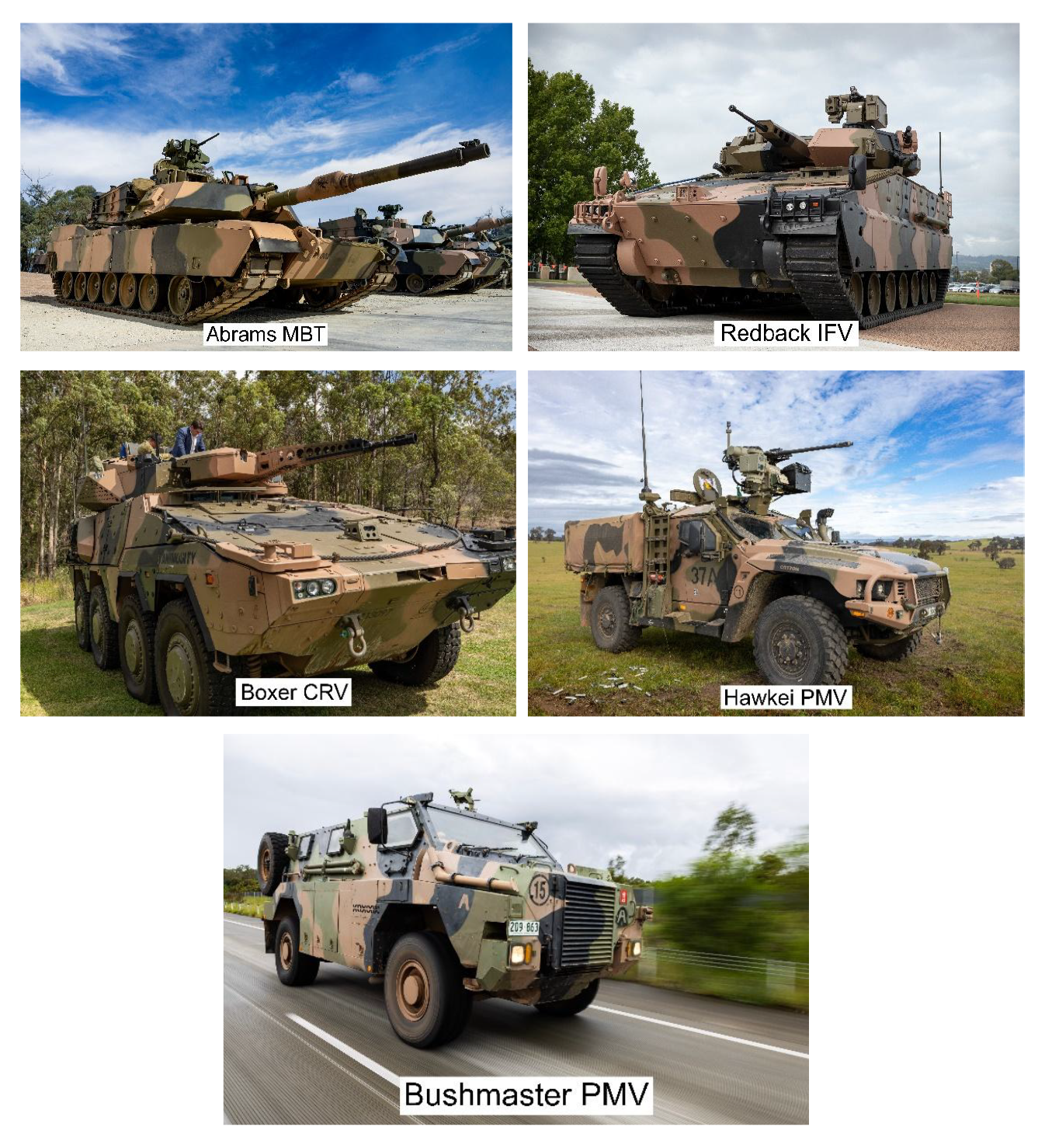
1.1 Armoured fighting vehicles (AFV) is a collective term for a number of different vehicles used by the Australian Defence Force (ADF). The specific purpose of each AFV is outlined in Table 1.1 and shown in Figure 1.1. The shaded row in Table 1.1 is the subject of this audit.
Table 1.1: Army’s armoured fighting vehicles
|
Vehicle |
Weight (tonnes) |
Purpose |
|
Abrams main battle tank (MBT) |
Heavy (> 50) |
Very heavily armed and armoured tracked vehicle that provides direct fire in close combat. The Abrams M1A1 was due to be replaced in 2025 by Abrams M1A2. |
|
Redback infantry fighting vehicle (IFV) |
Medium (25–50) |
Heavily armed and armoured tracked vehicle that transports infantry soldiers into battle. The Redback IFV replaces obsolete M113AS4. The first vehicle is scheduled to be delivered in 2027. |
|
Boxer combat reconnaissance vehicle (CRV) |
Medium (25–50) |
Lightly armed and armoured wheeled vehicle that gains information about the enemy and combat terrain. The Boxer CRV replaces the Australian light armoured vehicle (ASLAV). |
|
Hawkei and Bushmaster protected mobility vehicle (PMV) |
Light (5–25) |
Lightly armed and armoured wheeled vehicle that transports personnel, stores and equipment. |
Source: L Purdy, ‘Understanding Armour and why the IFV matters to Australia’, Australian Defence Monthly, 26 July 2022, available from https://www.australiandefence.com.au/defence/land/understanding-armour-and-why-the-ifv-matters-to-australia [accessed 26 July 2025].
ANAO analysis, based on information reported on the Department of Defence website.
Figure 1.1: Army’s armoured fighting vehicles
Source: Department of Defence.
1.2 With the tabling of this report, the ANAO will have audited the procurements of all of the vehicles referred to in Table 1.12, including the two vehicles being replaced (M113AS43 and ASLAV4).
1.3 The Land 400 Land Combat Vehicle System (LCVS) program was first identified in the Department of Defence’s (Defence) Capability Plan 2004–2014 in November 2003 as a broad program to deliver protected survivability and lethality systems to the Land Forces. As originally conceived, the LCVS program had four phases as shown in Table 1.2.
Table 1.2: Land 400 phases
|
Land 400 phase |
Description |
Approved project expenditurea ($b) |
|
Phase 1 |
Project definition study (prior to 2009) |
– |
|
Phase 2 |
Combat reconnaissance vehicles |
5.9 |
|
Phase 3 |
Infantry fighting vehicles |
7.3 |
|
Phase 4b |
Integrated training system |
– |
|
Total |
|
13.2 |
Note a: Approved project expenditure as at 30 June 2025. Numbers include acquisition costs and other project inputs to capability, which ‘could include facilities, information communications technology, and research and development’.
Note b: In July 2025, Defence advised that Land 400 Phase 4 had been cancelled as an outcome of the 2023 Defence Strategic Review.
Source: Australian Government, Budget related paper No. 1.4A, Portfolio Budget Statements 2025–26, Commonwealth of Australia, Canberra, May 2025, available from https://www.defence.gov.au/sites/default/files/2025-03/2025-26_Defence_PBS_00_Complete.pdf [accessed 25 July 2025].
1.4 Land 400 Phase 3 was given First Pass approval by government in March 2018 and Second Pass approval in November 2023.5 In the intervening period, Defence conducted a three-stage evaluation process, beginning with the release of an open tender on 24 August 2018. The stages of the tender process are shown in Table 1.3 and were based on the original approval by government for up to 450 vehicles. This was reduced to 129 vehicles following the government’s acceptance of the recommendations of the Defence Strategic Review (DSR)6 in April 2023.7
Table 1.3: Land 400 Phase 3 tender evaluation process
|
Stage |
Detail |
Period |
|
Stage 1 |
|
March 2019 to September 2019 |
|
Stage 2 |
|
September 2019 to October 2021 |
|
Stage 3 |
|
October 2021 to December 2021 |
Source: ANAO analysis of Defence documentation.
1.5 A contract was signed with Hanwha Defence Australia (HDA) on 1 December 2023.8 The initial contract value, as reported on AusTender on 14 December 2023, was $4,630,817,353.45.
1.6 A timeline of key events from First Pass approval to contract signature is at Appendix 3.
Rationale for undertaking the audit
1.7 Notwithstanding the reduction in size of the procurement from 450 vehicles to 129, at the time of the Ministerial announcement in July 2023, the Land 400 Phase 3 project was one of the largest capability acquisition projects in the history of the Army.9 The acquisition was subject to time pressure both because it was to address an existing capability gap (see paragraph 2.21) and the government’s announcement in July 2023 that it would accelerate delivery ‘by a number of years’.10
1.8 This audit has been undertaken to provide the Parliament with independent assurance of the effectiveness to date of Defence’s procurement and contract management of the Redback infantry fighting vehicles (IFVs) under Land 400 Phase 3.
Audit approach
Audit objective, criteria and scope
1.9 The objective of the audit was to assess the effectiveness to date of Defence’s procurement of IFVs under Land 400 Phase 3.
1.10 To form a conclusion against the audit objective, the following high-level criteria were adopted:
- Did Defence conduct an effective tender process?
- Have effective contracting arrangements been established with the contractor to support the achievement of value for money outcomes?
1.11 The contract included interim support services to support activities such as training, which continue until to the commencement of a separate support contract. Although the support contract with HDA was signed on 1 December 2023 at the same time as the acquisition contract, the operative date for the support contract is August 2028. This audit did not examine the development or negotiation of the support contract.
Audit methodology
1.12 The audit procedures included:
- reviewing Defence records, including procurement planning, tender assessments, advice to decision-makers, and contract management documentation;
- meetings with Defence personnel and Defence contractors;
- walkthroughs of Defence systems; and
- on-site fieldwork at Defence premises in Canberra and Melbourne and HDA’s H-ACE facility in Geelong.
1.13 The audit was open to contributions from the public. The ANAO received and considered two submissions.
1.14 The audit was conducted in accordance with ANAO Auditing Standards at a cost to the ANAO of approximately $1,040,000.
1.15 The team members for this audit were Julian Mallett, Maja Dimopoulos, Adam Reddiex and Amy Willmott.
2. Land 400 Phase 3 tender
Areas examined
This chapter examines whether the Department of Defence (Defence) conducted an effective tender process that was consistent with relevant requirements and supported the achievement of value for money.
Conclusion
Defence’s management of the open tender process was partly effective. The process demonstrated broad compliance with procurement requirements and probity controls were adequate at the project level. Defence did not clearly document or communicate to government how its acquisition approach evolved over time, including in response to the developmental nature of the tendered solutions, nor did it provide advice on the presence of vehicle models and components already available on the market. The tender evaluation process was weakened by inconsistent treatment of risk and price adjustments, as well as by the absence of clearly articulated weighting or prioritisation of evaluation criteria in the tender documentation. While Defence documented its rationale for certain cost treatments during evaluation, these approaches were not applied consistently or transparently across tenders. Collectively, these factors reduced the transparency and defensibility of the value for money assessment and limited the extent to which the tender process supported fully informed decision-making.
Area for improvement
The ANAO made one recommendation aimed at ensuring that in all future capability proposals, Defence provides advice to government about the availability and suitability of existing vehicle models and components on the market.
2.1 The Commonwealth Procurement Rules (CPRs) are the core of the legislative and administrative framework for procurement by relevant Australian Government entities. Compliance with the CPRs is mandatory for officials of relevant entities. Large entities such as Defence may issue complementary guidance for staff involved in procurement but the core rule of achieving value for money remains the same.
Did the tender process comply with relevant requirements?
Defence complied with process requirements for the development and issuing of the request for tender (RFT) documentation, and the initial screening of tenders. However, the RFT did not provide potential tenderers with a clear and consistent basis for responding to Defence’s documented risk posture and acquisition strategy. Defence’s planning documents consistently indicated a preference to avoid bespoke or developmental outcomes.
While the RFT stated that Defence was pursuing a ‘mature, proven technology’, it did not define this term, specify minimum system maturity thresholds, or include evaluation criteria addressing system readiness, integration risk or design maturity. Instead, the structure of the RFT — including requirements for non-recurring engineering, system integration and future growth activities — was consistent with outcomes involving material design development. Defence did not document how this approach aligned with its earlier acquisition planning or explain the implications for risk, schedule and cost. As a result, all tender submissions involved varying levels of development and integration risk.
2.2 Successive Defence procurement reviews and parliamentary inquiries have emphasised that clear, comparative advice to government is critical when major capability investments involve trade-offs between capability ambition, cost, schedule and risk. These expectations are particularly relevant for complex and high-value acquisitions, where government decision-making relies on Defence clearly setting out available options and their implications.
2.3 The Land 400 Phase 3 project was required to comply with a range of government directions, Defence strategies and numerous procedural and project-specific requirements that apply to Defence procurements. This section outlines that policy and governance context.
Government direction and strategies from 2003 to 2023
2.4 The Land 400 Phase 3 project had its genesis more than 20 years ago. In November 2003, the Minister for Defence released the Defence Capability Plan 2004–2014 (the plan) to ‘keep Australian industry abreast of Defence’s acquisition planning so that it can effectively perform its role as a crucial component of our national Defence capability’. The plan listed 115 ‘major capital equipment proposals that are planned to be approved in the period 2004 to 2014’. It also noted that the service life of then-current land fighting vehicle systems (M113AS3 and ASLAV) would end in ‘about 2020’ and foreshadowed that the Land 400 project would ‘enhance survivability of land forces in combat operations’.11
2.5 At the same time, the 2003 Defence Procurement Review (Kinnaird Review) highlighted that off-the-shelf or mature solutions, are often cheaper and faster to deliver, and recommended that at least one off-the-shelf option be included in capability proposals as a benchmark against which cost, schedule and risk could be assessed. The review emphasised that government confidence in Defence decision-making depends on Defence clearly setting out available options and associated trade-offs, and that any departure from off-the-shelf solutions through Australian-unique modification should be explicitly justified in terms of cost, schedule and risk.12
2.6 At the request of the Joint Committee of Public Accounts and Audit (JCPAA), the ANAO’s Major Projects Reports have examined the delivery performance of different acquisition approaches.13 This analysis has indicated that projects based on mature or off-the-shelf platforms have, on average, experienced less schedule slippage and cost growth than more developmental or Australianised projects, reinforcing the rationale articulated in the Kinnaird Review.14 The purpose of this analysis has been to inform parliamentary oversight of systemic acquisition risk, rather than to mandate a particular acquisition model.15
2.7 More recently, the JCPAA noted that the 2023 Defence Strategic Review (DSR) reaffirmed the importance of prioritising off-the-shelf acquisition where capability is readily available. Defence advised the JCPAA in June 2024 that it no longer requires an explicit military off-the-shelf exemplar to be presented to government, as acquisition requirements are developed through a ‘Smart Buyer’ process. The committee observed that Defence’s Smart Buyer framework, introduced in 2016, is a risk-informed decision-making tool, but not a substitute for comparative analysis of available acquisition options and questioned why its introduction appeared to coincide with a reduced emphasis on explicit consideration of off-the-shelf alternatives.16
2.8 Taken together, this body of policy, review and parliamentary material indicates that Defence advice to government on major capability investments should:
- identify whether mature or established options exist in the market;
- explain the implications of selecting more developmental approaches, particularly for cost, schedule and delivery risk; and
- clearly articulate the basis on which risks are accepted, transferred or mitigated.
2.9 These expectations provide the context against which Defence’s acquisition strategy and advice to government for Land 400 Phase 3 are examined in the remainder of this chapter.
Government decisions on Land 400 Phase 3
2.10 The 2016 Defence White Paper announced that ‘the Government will replace the Army’s current ageing fleet of mobility and reconnaissance vehicles with a new generation of armoured combat reconnaissance and infantry fighting vehicles’. The 2016 Integrated Investment Program reported an approximate investment value of $10–15 billion for infantry fighting vehicles (IFVs), while the Force Structure Plan 2020 quoted a value of $18.1–27.1 billion.17
2.11 In June 2018, the Minister for Defence announced that government had given First Pass approval for a ‘multi-billion dollar project [to] replace Army’s M113 Armoured Personnel Carriers with a fleet of up to 450 modern Infantry Fighting Vehicles and 17 Manoeuvre Support Vehicles’. The announcement also stated that Defence would be ‘seeking input from Australian industry on the proposed tender timeline for LAND 400 Phase 3.’18
2.12 The April 2023 DSR endorsed the Land 400 Phase 3 project but recommended reducing the acquisition from 450 to 129 vehicles (enough for one mechanised battalion, rather than three). The government accepted this recommendation.19
Defence’s procurement processes
2.13 The CPRs are issued by the Minister for Finance under subsection 105B(1) of the Public Governance, Performance and Accountability Act 2013 (PGPA Act).20 The CPRs apply to all noncorporate Commonwealth entities, including Defence. As a legislative instrument under the PGPA Act, the CPRs are legally binding on those entities.21 The Minister of Finance’s foreword to the CPRs states:
Achieving value for money is the core rule of the CPRs as it is critical in ensuring that public resources are used in the most efficient, effective, ethical and economic manner.22
2.14 Defence has issued various internal guides and manuals to assist its personnel when conducting procurements. These documents recognise that they complement, rather than supplant, the CPRs and require Defence personnel to comply with the CPRs when undertaking procurement activities. Like the CPRs, Defence’s guidance materials are periodically revised and reissued. Table 2.1 lists the guidance documents most relevant to this audit and Figure 2.1 shows the key stages of Defence procurements.
Table 2.1: Defence’s procurement guidance relevant to this audit
|
Document |
Issue date |
|
Defence Procurement Policy Manual |
October 2014, December 2017 and July 2019 |
|
Defence Capability Development Handbookª |
June 2014 |
|
Interim Capability Life Cycle Manualª |
April 2016 and August 2017 |
|
Complex Procurement Guide |
April 2017, June 2022 and October 2023 |
|
Materiel Acquisition Agreement Preparation Guidance |
June 2017 |
|
Defence Capability Manualª |
December 2020 |
|
Defence Procurement Manual |
July 2021, June 2022 and October 2023 |
Note a: The first version of the Interim Capability Life Cycle (CLC) Manual was issued in April 2016, replacing the Defence Capability Development Handbook. The CLC manual was then replaced in December 2020 by the Defence Capability Manual.
Note: This table lists only selected versions of Defence procurement guidance that applied at relevant times to the Land 400 Phase 3 procurement. Other versions of these documents were issued during the period but are not listed. Unless specifically stated otherwise, a reference in this report to ‘Defence guidance’ should be taken as a reference to the relevant version (or versions) of these documents that applied at the relevant point in time in the acquisition process.
Source: ANAO analysis of Defence information.
Figure 2.1: Stages in Defence procurement

Note: Some Defence procurement guidance documents include disposal of an asset as the final stage of the procurement process. This has not been included in the figure.
Source: ANAO analysis of Defence documentation.
2.15 In April 2016, Defence issued the Interim Capability Development Life Cycle Manual, replacing the Defence Capability Development Handbook. Defence guidance in both frameworks describes capability documentation as ‘progressively refined’ across the capability life cycle. Earlier documents are retained as part of the project’s documented decision trail, enabling decision-makers to understand how and why acquisition strategy, risk settings and delivery approaches have evolved over time.23 As a result, documents developed prior to April 2016 for Land 400 Phase 3 remain relevant to understanding subsequent changes in the project’s approach.
Development of Army’s requirements
2.16 The Land Systems Division within Defence’s Capability Acquisition and Sustainment Group (CASG) is responsible for managing delivery of Land 400 Phase 3 on behalf of the Chief of Army (the capability manager). A Materiel Acquisition Agreement sets out Army’s requirements in terms of capability, performance and budget, and CASG’s agreement to deliver those requirements.
2.17 Consistent with these responsibilities — and prior to releasing the RFT in August 2018 — Defence undertook a series of activities and developed planning documents to define the requirements for Land 400 Phase 3. These are described in Table 2.2.
Table 2.2: Land 400 Phase 3 development of requirements
|
Approval date |
Document or activity |
Lead group |
Purpose |
|
9 December 2014 |
Operational Concept Document |
Capability Manager (Army) |
Describes the high-level strategic and tactical purpose of the overall Land 400 project. It also outlines the fundamental inputs to capability (FIC).a |
|
6 July 2015 |
Concept Acquisition and Support Implementation Strategy (ASIS) |
Delivery Group (CASG) |
Considers acquisition options, such as limited or open tender process. The ASIS was later subsumed into the Project Execution Strategy. |
|
January 2017 |
Smart Buyer Workshops |
Both |
The Smart Buyer framework uses workshops to develop a project risk profile and contributes to the development of the Project Execution Strategy. |
|
16 January 2018 |
Project Execution Strategy (PES) |
Delivery Group |
Presents the LAND 400 Phase 3 strategy for execution of the project through Gate 1b to Gate 2, and the broad approach to address project risks. |
|
24 January 2018 |
Investment Committee Business Casec |
Capability Manager |
Approves submission of proposal to government for First Pass approval. |
|
21 June 2018 |
Joint Capability Needs Statement |
Capability Manager |
States the capability deficiency, capability need and project scope. |
|
23 July 2018 |
Combat Vehicle Program Strategy |
Capability Manager |
Guides the activities of the Sponsor organisation [Army], Delivery and Enabling Groups [CASG]. |
|
July 2018d |
Integrated Program Management Plan (IPMP) |
Delivery Group |
Provides an overview of the work required to be undertaken for LAND 400 and identifies key resources, decisions and review points. |
|
23 July 2020 |
Materiel Acquisition Agreement |
Both |
States in concise terms what services and products CASG will deliver to Army, for how much and when. |
Note a: Fundamental Inputs to Capability (FIC) are organisation, personnel, collective training, major systems, supplies, facilities and training areas, support, command and management.
Note b: Gates are internal stages of a project’s approval process. Gate 0 is an early high-level review of the capability need, options development, risk and strategy. Gate 1 is only required for complex and high-risk proposals or when a government decision is required in order to narrow the field of options. Gate 2 is the development of a business case that forms the basis of the proposal to government for approval.
Note c: The Investment Committee, an internal committee chaired by the Vice Chief of the Defence Force, is responsible for ‘exercising strategic control over the investment portfolio’.
Note d: The Integrated Program Management Plan (IPMP) was issued in July 2018 without formal approval or endorsement by a delegate.
Source: ANAO representation of Defence information.
2.18 Table 2.2 outlines documents generated to inform the Land 400 Phase 3 acquisition strategy. Box 1 explains the concept and history of military-off-the-shelf (MOTS), which was Defence’s documented acquisition strategy in 2015.
|
Box 1: What is MOTS? |
|
Successive reviews of Defence procurement have used the term military-off-the-shelf (MOTS) equipment to describe acquisition approaches that minimise developmental risk by relying on existing, in-service capabilities. A 2003 procurement review (the Kinnaird Review) stated ‘Off-the-shelf equipment is often cheaper and can usually be delivered faster.’a A 2008 review of Defence procurement and sustainment defined MOTS as equipment that:
The 2008 review stated that:
The Kinnaird Review stated:
The 2009 Defence White Paper stated that:
This policy was reiterated in the 2013 Defence White Paper that affirmed ‘Off-the-shelf solutions will continue to provide the basis against which the risks and benefits of more developmental or bespoke procurement proposals will be assessed.e’ Although it post-dates the period under review, the 2023 Defence Strategic Review, from which the recommendations were accepted by the government, reaffirmed that:
Auditor-General Report No. 18 2020-21 Defence’s Procurement of Combat Reconnaissance Vehicles (Land 400 Phase 2) highlighted that Defence had issued a request for tender for MOTS and ‘MOTS Plus’ vehicles without explaining to the Minister or government (at First or Second pass) what the difference was between the two terms or the implications for schedule and cost. A ‘MOTS Plus’ option was selected.g |
Note a: Department of Defence, Defence Procurement Review, [known as the Kinnaird Review], Canberra, 2003.
Note b: David Mortimer AO, Going to the next level: report of the Defence Procurement and Sustainment Review [known as the Mortimer Report], Canberra, 2008, available from https://web.archive.org.au/awa/20210121122702mp_/https://www.defence.gov.au/publications/docs/mortimerReview.pdf [accessed 16 July 2025].
Note c: ‘Judgements need to be made across numerous issues including: the possible contingencies judged to be most critical; the type, number and mix of equipment required; and the trade-off between building local industry or buying overseas, including procuring off-the-shelf versus adaptation for Australian conditions’.
Note d: Department of Defence, Defending Australia in the Asia Pacific Century: Force 2030 (Defence White Paper 2009), Canberra, 2009, available from https://www.defence.gov.au/about/strategic-planning/defence-white-paper [accessed 16 July 2025].
Note e: Department of Defence, Defence White Paper 2013, Canberra, 2013, available from https://www.defence.gov.au/about/strategic-planning/defence-white-paper [accessed 16 July 2025].
Note f: Department of Defence, National Defence: Defence Strategic Review, Canberra, 2023, available from https://www.defence.gov.au/about/reviews-inquiries/defence-strategic-review [accessed 16 July 2025]
Note g: Auditor-General Report No. 18 2020-21, Defence’s Procurement of Combat Reconnaissance Vehicles (Land 400 Phase 2), ANAO, Canberra, 2020 available from https://www.anao.gov.au/work/performance-audit/defence-procurement-combat-reconnaissance-vehicles-land400-phase2 [accessed 17 July 2025].
A preference for mature, non-developmental acquisition approaches
2.19 Prior to completing a Smart Buyer process in 2017, Defence’s procurement planning documents described a preference for a MOTS approach for Land 400 Phase 3. The December 2014 (version 4.0) Operational Concept Document (OCD) identified a MOTS solution as ‘a major element of the Program’s risk mitigation strategy’ and preferable to a ‘bespoke Australian solution’, citing cost, schedule and capability risks. It noted that earlier requests for information (RFIs) in 2006 and 2010 had ‘identified several MOTS [armoured fighting vehicles] that could meet the [Capability Manager’s] … requirements’.24 The OCD stated that the ‘only anticipated developmental work’ would involve integrating existing and future Australian Government Furnished Equipment25 essential to enabling the Land Combat Vehicle System (LCVS) to fulfil its primary roles within the Combined Arms Fighting System.
2.20 In November 2015, Defence issued a third RFI using the phrase ‘LAND 400 Phase 3 will procure mature technologies with a robust technological growth and design path’ instead of the earlier MOTS/MOTS Plus terminology.26 Internal Defence advice confirmed that this was a change in wording only, and that the underlying strategy remained focused on minimising developmental risk. Defence reiterated this approach at an industry briefing in November 2015.27
2.21 Across successive planning and risk assessment documents, Defence continued to describe an acquisition approach centred on mature, proven technologies, and the avoidance of bespoke or developmental solutions, even where the term MOTS was no longer used, as follows.
- The Concept Acquisition and Support Implementation Strategy (July 2015) recommended a staged procurement of MOTS-based vehicles.
- The 2017 Smart Buyer Workshops identified that Defence was seeking mature, proven technologies to meet Defence’s capability needs.
- The Technical Risk Assessment (January 2018) assessed the technical risks and issues of a fully tracked IFV fleet as ‘medium’, which was based on the ‘assumption that the Project’s MOTS acquisition constraint takes precedence over Defence’s desire to achieve all capability needs and requirements’ listed in the OCD.28 It also stated that ‘technological developments (e.g. advancement optics protection technologies) are excluded even if able to help mitigate potential capability deficits in the MOTS option.’
- The Project Execution Strategy (PES) (January 2018) described an acquisition approach based on Defence having ‘a comprehensive understanding of the global IFV offerings’ following several RFI activities. It stated that there was ‘likely to be five Original Equipment Manufacturers (OEMs) capable of providing a tracked and turreted IFV compliant with the Capability Manager’s requirements’29 and indicated that, prior to release of the RFT, solicitation activities might focus on these companies to reduce tendering costs in line with Smart Buyer principles.
- The Joint Capability Needs Statement (June 2018) described an urgent ‘capability deficiency’ in the ADF’s mounted close combat mobility (MCCM) capability as follows (emphasis in original):
Capability Gap Statement. The ADF does not currently have a survivable MCCM response option to offer Government for operations in the medium to high threat environment. The cause of this capability gap is summarised as follows;
- The M113AS4 has insufficient firepower, protection, mobility and connectivity to survive operations in the current medium to high threat environment. The M113AS4 lacks blast protection in all operating environments.
- The ADF therefore chooses not to offer M113AS4 to Government as a viable option to deploy to medium to high threat environments. This issue cannot be addressed though upgrades to M113AS4.
- Neither the M113AS4, the ASLAV or the PMV families of vehicles has a platform dedicated to delivering an armoured engineering effect.
- All families of vehicles lack digital connectivity, and therefore the ability to interoperate with the Joint Force and Coalition partners.
The ASLAV and PMV provide a different capability to the Joint Force and are not a viable replacement or redundancy for the M113AS4.
Timing and urgency. The above gap exists now. LAND 400 Phase 3 is currently the only means being considered to address this gap. Unless this changes, the gap will therefore exist until LAND 400 Phase 3 Final Operating Capability.
- Version 5.0 of the OCD (March 2019) confirmed that the 2015 RFI had ‘identified several MOTS AFV that could meet the [capability manager’s] LCVS requirements. As such, the preferred acquisition concept is to acquire a high technical readiness materiel solution and not develop a bespoke Australian solution, as the latter is considered high risk in terms of cost, schedule and capability’. This version was approved after tenders had closed on 1 March 2019 but before completion of initial screening on 20 March 2019 (see paragraph 2.36).
2.22 Despite successive Defence reviews emphasising that off-the-shelf options should be identified and, where available, ‘presented for government consideration’ (see Box 1), neither the First Pass nor Second Pass submissions to government for Land 400 Phase 3 addressed whether such options existed. Although Defence policies in force at the time did not require explicit advice on MOTS options be provided to government, Defence was still required to consider alternative acquisition options informed by market analysis, risk, cost, schedule and value-for-money factors, and to document the basis on which preferred approaches were selected.
2.23 The possibility of an off-the-shelf option was not referred to at all.30 This omission was inconsistent with internal Defence records, which indicated that several manufacturers offered vehicles capable of meeting Army’s requirements (see paragraphs 2.19 and 2.21).
Divergence between documented acquisition intent and tender outcomes
2.24 The RFT was released on 24 August 2018 through an open tender process. The covering letter to the tender documents stated that ‘The Commonwealth is pursuing a mature, proven technology’. However, the RFT documentation did not define this term or specify minimum system maturity thresholds. Nor did it provide tenderers with a clear and consistent articulation of Defence’s documented risk posture or acquisition strategy. In particular, the RFT did not include evaluation criteria that emphasised system readiness, integration risk or design maturity, and it did not clearly distinguish between non-developmental and developmental responses. As a result, the tender design did not clearly signal a preference for non-developmental proposals.
2.25 Rather, the structure of the RFT — including requirements for non-recurring engineering activities31, system integration32, and future growth and development33 — was consistent with acquisition outcomes involving material design development. Defence did not document how this approach aligned with earlier acquisition planning documents that sought to minimise developmental risk.
2.26 Following receipt and initial examination of the four RFT responses, Defence was aware that none represented non-developmental solutions. Minutes of the Tender Evaluation Steering Group (TESG) meeting on 12 August 2019 recorded that all platforms were ‘considered to be developmental, to varying extent, with no tendered configurations having been produced to date.’
2.27 As set out in Box 1, bespoke or developmental options may generate ‘disproportionately large increases to the cost, schedule and risk of projects’. The receipt of only developmental tenders was inconsistent with Defence’s earlier planning documents, which had indicated a preference to avoid these risks. The divergence between the documented acquisition intent and tender outcomes was examined in an Independent Assurance Review (IAR) in July 2020.34 The independent review35 commented:
The initial tender evaluation has resulted in a change of acquisition strategy from a mature, proven IFV, to a more developmental family of vehicles. In my opinion, the implications for project planning, including schedule and the commercial and industry consequences, do not appear to be fully understood and integrated into strategy and plans. For example, I noted that many of the Project’s planning documents are dated, or not yet endorsed, and a number refer to the acquisition of a mature, proven IFV family, rather than a more developmental vehicle. Whilst I acknowledge that some documents cannot be finalised until negotiations with tenderers are more advanced, the key documents required at Second Pass (and to inform tenderers) require priority attention to ensure proper recognition of this change is considered and uniformly understood before final solicitation.
2.28 The September 2019 interim source evaluation report (I-SER) and December 2021 final source evaluation report (SER) both recorded that the tendered vehicles were developmental but did not analyse or report on the divergence from the acquisition strategy.
2.29 As noted at paragraph 2.22, Defence did not advise the minister or government of the change in acquisition strategy or its potential implications for cost, schedule and capability risk (see Box 1).
Capability risks arising from the shift in acquisition strategy
2.30 The divergence between Defence’s documented intent to minimise developmental risk and the acquisition outcome has resulted in several issues attributable to the Redback IFV being a developmental vehicle. These are discussed further in Chapter 3 and include:
- two ‘very high’ technical risks related to the vehicle’s mobility and lethality (see paragraph 3.18);
- a compressed delivery schedule with less time to resolve unforeseen technical issues as a result of the government’s acceptance of the recommendations of the DSR (see paragraph 3.35); and
- Defence waiving certain contract requirements in order to maintain the accelerated schedule as expected by government (see paragraph 3.53).
Recommendation no.1
2.31 When presenting capability investment proposals to government, Defence include explicit advice about the extent to which mature or proven options exist in the market. The advice should include:
- whether the proposal is seeking to address an existing capability gap and if so, the urgency with which it needs to be addressed;
- whether the mature or proven options can adequately meet the operational requirement and if not, why not; and
- the difference between mature and developmental options in terms of risk, schedule and cost.
Relevant guidance, instructions, manuals and directions be updated to reflect this requirement.
Department of Defence response: Agreed.
Tender release and initial screening
2.32 Prior to public release of the tender, Defence received clearance from its legal and probity advisers with some qualifications.36 The qualifications included that they had not been provided with the entirety of the draft RFT (which was around 900 pages in total) and that they assumed that Defence would have considered their advice and made any consequent revisions to the documents that Defence considered necessary.
2.33 The RFT was published on AusTender on 24 August 2018 with a closing date of 1 March 2019.37 Prospective tenderers were invited to attend an industry briefing on 5 September 2018 and a separate classified briefing on 7 September 2018.38
2.34 During the open tender period, Defence issued 14 addenda (via AusTender), which included a total of 170 amendments to the RFT.
2.35 By the closing date, four tenders had been received electronically, comprising more than 25,000 pages. A small number of classified documents from each tenderer were delivered by hand.
2.36 The initial screening process was conducted in accordance with the Tender Evaluation Plan.39 The main focus of initial screening was to ensure that each tender met a number of ‘threshold’ requirements set out in the RFT.40 These included that:
- the tender was received before the closing time and date;
- the tender documentation was in English and used ‘Australian’ (metric) units;
- the tender was complete;
- the tenderer was a single legal entity;
- the tenderer had completed an executed Deed of Undertaking41;
- the tenderer was not on Defence’s Projects of Concern list42; and
- the tender complied with the ‘essential’ requirements.43
2.37 One tenderer submitted 67 documents in a language other than English. In accordance with the tender conditions, these documents were not released to the Tender Evaluation Working Groups (TEWGs) responsible for the detailed assessment of proposals. During evaluation of the tenders, it became apparent that these were likely to contain key information necessary to fully understand the tender. It also became apparent that the other tenderers had referred to (but not included) documents that could constitute ‘objective quality evidence’. Defence discussed the matter with its probity adviser44 who advised that accepting additional documentation would be acceptable from a probity point of view provided that:
- all four tenderers were given an opportunity to correct identified deficiencies in documentation; and
- Defence was satisfied that any additional documentation provided did not constitute an improvement to tenders.
2.38 Defence documented the matter and the advice received and accepted the additional documents from the four tenders, which were admitted into consideration. Defence also required a statutory declaration from the tenderer who had submitted documents in a foreign language to attest that the translated documents were an accurate translation.
2.39 Defence tasked four small teams with undertaking the initial screening. The process was described in a report that was approved by the delegate on 20 March 2019.45 The report concluded that each tender substantially met the ‘threshold requirements’ and recommended that the tenderers be advised that their tenders had been accepted for detailed evaluation.
Did Defence conduct an effective tender evaluation?
Defence’s evaluation criteria were not weighted or prioritised in the published tender documents, reducing transparency and limiting the extent to which Defence’s priorities were communicated to potential tenderers. Although Defence placed greater emphasis on price and capability during the evaluation, this was not documented in the RFT — as required by the CPRs. This limited tenderers’ ability to effectively tailor their responses and represented a shortcoming in the procurement process. Defence did not assess tenders more favourably for being non-developmental, nor did it adjust its overall risk posture when all tendered platforms were assessed as developmental to varying extents.
Inconsistent application of pricing adjustments between tenderers introduced uncertainty into value-for-money assessments, understating Hanwha Defence Australia’s (HDA’s) cost at Stage 3 by $852.6 million. These factors impacted the reliability of the value for money assessment and the cost per unit of capability, which was a key factor in the final recommendation. By not specifying explicit system-maturity requirements, including the extent to which a non-developmental outcome was sought, Defence did not clearly signal its expectations to the market and was subsequently limited in its ability to adjust risk settings when only developmental solutions were received.
2.40 The objective of the Land 400 Phase 3 tender evaluation was to determine the tender that best met Defence’s requirements and represented the best value for money for the supply and support of IFVs. The evaluation was conducted in three stages as shown in Table 2.3.
Table 2.3: Land 400 Phase 3 tender evaluation process
|
Stage |
Detail |
Period |
|
Stage 1 |
|
March 2019 to September 2019 |
|
Stage 2 |
|
September 2019 to October 2021 |
|
Stage 3 |
|
October 2021 to December 2021 |
Source: ANAO from Defence documentation.
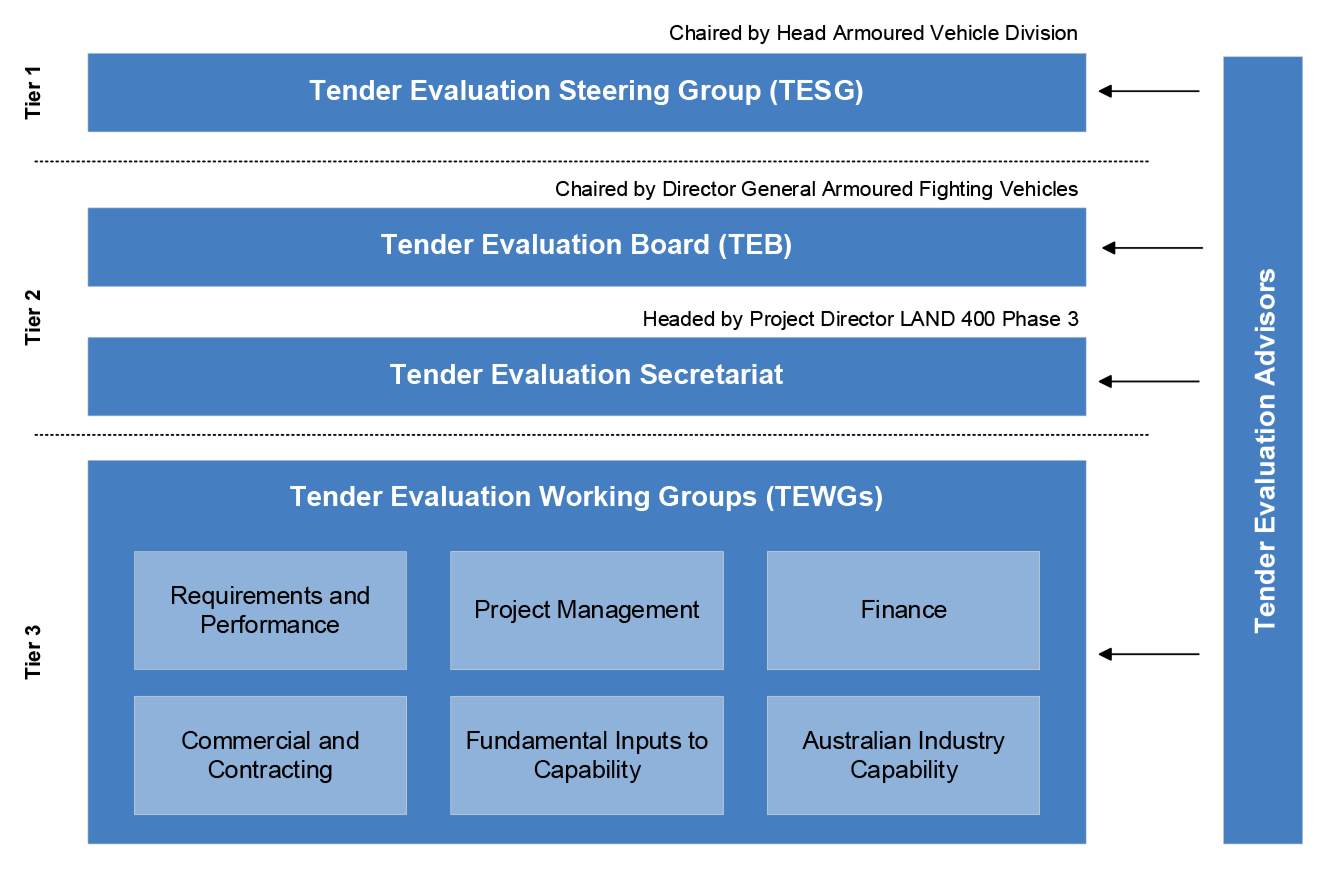
2.41 Defence’s Tender Evaluation Plan detailed the arrangements and framework for evaluating the tenders submitted in response to the RFT. The Tender Evaluation Organisation (TEO) is shown at Figure 2.2 and the responsibilities of the various parts of the TEO are shown in Table 2.4.
Figure 2.2: Tender evaluation organisation
Source: Defence documentation.
Table 2.4: Responsibilities of the tender evaluation organisation
|
Tier |
Description |
|
Tier 1 — Tender Evaluation Steering Group (TESG) |
|
|
Tier 2 — Tender Evaluation Board (TEB) |
|
|
Tier 2 — Tender Evaluation Secretariat |
|
|
Tier 3 — Tender Evaluation Working Groups (TEWGs) |
|
|
Test and Evaluation Team — Stage 2 only |
|
|
Tender evaluation advisors |
|
Source: ANAO analysis of Defence documentation.
2.42 Defence’s Complex Procurement Guide permits the use of unweighted evaluation criteria. For this procurement, the Tender Evaluation Plan stated that the evaluation criteria had ‘not been weighted or otherwise put in an order of priority’ and listed 13 unweighted criteria, consistent with those set out in the RFT and summarised in Table 2.5.
Table 2.5: Tender evaluation criteria for Land 400 Phase 3
|
Criterion |
Description |
|
1 |
The extent to which the tenderer demonstrates its compliance with the draft RMA Contract, draft Contract (Acquisition) and draft Contract (Support). |
|
2 |
The extent to which the tenderer demonstrates that the tendered mission system meets the operational needs and technical requirements. |
|
3 |
The extent to which the tenderers’ organisation demonstrates its engineering capability, including system integration, to provide the Supplies and Services in accordance with Commonwealth requirements. |
|
4 |
The extent to which the tenderer demonstrates that it has a suitable growth strategy for the mission and support systems that will assure capability effectiveness through life of type in order to meet changing threats and technology development. |
|
5 |
The extent to which the tendered Support System meets the Commonwealth’s requirements. |
|
6 |
The extent to which the tendered Training System meets the Commonwealth’s requirements. |
|
7 |
The extent to which the tendered Contract Master Schedule is complete, credible, resourced and capable of achieving the Commonwealth’s requirements. |
|
8 |
The extent to which the tenderer demonstrates the managerial capability to deliver the Commonwealth’s requirements, including the tenderers’ designation as an Original Equipment Manufacturer (OEM) or a Prime Systems Integrator (PSI). |
|
9 |
The extent to which the tenderer demonstrates that its price and pricing structure accords with the Commonwealth’s requirements and provides fidelity of data. |
|
10 |
The tenderers’ financial and corporate capability. |
|
11 |
The extent to which the tenderer meets the Commonwealth requirements for IP rights and provision of associated technical data and software rights. |
|
12 |
The tenderers’ past performance, including recent performance with the Commonwealth and other countries. |
|
13 |
The extent and manner in which the tenderer will achieve the Australian Industry Capability (AIC)a requirements of the draft Contract (Acquisition) and draft Contract (Support), the proposed value of the work to be performed in Australia, and the economic benefit for the Australian economy. |
Note a: The AIC program requires potential contractors to demonstrate how their tenders provide opportunities for Australian companies. The requirements apply to materiel contracts valued at $50 million and over.
Source: ANAO analysis of Defence documentation.
2.43 The CPRs require evaluation criteria to reflect the key objectives, requirements and value-for-money drivers of a procurement. This includes designing criteria that are tailored to the specific risks, capability needs and performance factors of the procurement. Where relevant, criteria may also be weighted to indicate their relative importance. These design choices are intended to support a transparent assessment of value for money against the matters that are most material to the procurement.
2.44 The Tender Evaluation Plan reiterated that the evaluation criteria had ‘not been weighted or otherwise put in an order of priority.’ The RFT did not otherwise communicate Defence’s relative priorities or explain how Defence would balance price, capability and risk in assessing value for money, including where all tendered solutions involved developmental or integration effort. However, the ANAO observed that during the evaluation, Defence placed greater emphasis on certain evaluation criteria, particularly price (criterion 9) and capability (criterion 2), in informing the Tier 2 evaluation (see Table 2.4). These indications of relative importance were not reflected in the published RFT documents. As a result, the transparency of the procurement process was reduced, and the communication of Defence’s evaluation priorities to potential tenderers was not clear. Defence’s evaluation approach is discussed further from paragraph 2.60.
Stage 1: shortlisting
2.45 The Tender Evaluation Plan stated:
The objective of Stage-1 is to differentiate clearly and defensibly between tenderers with sufficient resolution to allow the most competitive and best value for money responses to be identified, and for one or more tenderers to then be shortlisted for Stage-2. The intent is to shortlist no more than two preferred tenderers.
2.46 Each of the tender evaluation working groups (TEWGs) (see Figure 2.2) undertook detailed assessment and evaluation of the four tenders against a specific subset of the 13 evaluation criteria assigned to its area of responsibility. Each TEWG prepared a report of its evaluation that was provided to the Tender Evaluation Secretariat.
2.47 The Tender Evaluation Secretariat consolidated the TEWG reports into the Interim Source Evaluation Report (I-SER), which ranked the four tenders and recommended that HDA and Rheinmetall Defence Australia (RDA) be invited to proceed to Stage 2 of the tender evaluation, Risk Mitigation Activity (RMA). The ISER recommendation was endorsed by the Tender Evaluation Board on 19 August 2019 and the Tender Evaluation Steering Group (TESG) on 27 August 2019, and approved by the TESG Chair (the delegate) on 10 September 2019.
2.48 As discussed at paragraph 2.26, all tendered platforms were considered developmental. There was no evidence that Defence reviewed its overall approach to risk in light of the fact that only developmental vehicles had been tendered. The I-SER stated:
There is a risk associated with taking two more developmental platforms through to the RMA stage, but this is assessed as acceptable, based on the proven performance of both tenderers in developing and fielding complex vehicle systems and the opportunity for the Commonwealth to work closely with them through the continuing design and production process.
Stage 2: Risk Mitigation Activity
2.49 The Tender Evaluation Plan stated:
The purpose of RMA is undertake further evaluation and testing of the tendered vehicle solutions, to clarify and refine the tender offers and to negotiate with tenderers, in order to mitigate risk to the Commonwealth. The RMA Stage will culminate with the submission of second, revised Final Offers by the shortlisted tenderers.
2.50 Defence entered into contracts with HDA and RDA for $50 million (GST exclusive) each for their participation in the RMA. Under the terms of the contracts, each tenderer provided three prototype vehicles, which arrived in Australia in November 2020 and January 2021.
2.51 The activities conducted during Stage 2 of the tender evaluation are shown in Table 2.6.
Table 2.6: Risk mitigation activities conducted during Stage 2 of the Land 400 Phase 3 tender evaluation process
|
Activity |
Description and timing |
|
Test and Evaluation |
|
|
Workshops |
|
|
Parallel negotiations |
|
|
Australian industry roadshow |
|
|
Cost investigations |
|
Note a: Defence transitioned from in-person meetings to videoconferencing due to the impacts of COVID-19.
Source: Defence documentation (ANAO emphasis added).
2.52 Defence identified six ‘significant’ negotiation issues for HDA and 10 ‘significant’ negotiations issues for RDA that ‘must be resolved during [parallel] negotiations’.46 Defence also identified ‘clarification issues’, which it intended to clarify with tenderers during parallel negotiations but not engage in substantive negotiations.47
2.53 At the conclusion of the parallel negotiations Defence prepared a parallel negotiations report for endorsement by the delegate, which was to:
be prepared showing the positions reached, highlighting any significant differences with the RMA baseline contract, pre-negotiation expectations or relevant aspects of [the parallel negotiations directive]. The report is to prepare recommendations on further actions deemed necessary to conclude satisfactory contractual arrangements following Final Evaluation, including identifying issues which may require further negotiation.48
2.54 The parallel negotiations report provided a summary of the negotiation outcomes for significant issues identified by Defence.49 It stated that Defence had ‘achieved at least the minimum fall-back position for each of the issues’, except for two matters for each tenderer relating to intellectual property and suspended payments for Australian Industry Capability (AIC) remediation. The ANAO identified that this conclusion, as presented to the delegate, was inaccurate.
2.55 Based on Defence’s documented outcomes, the ANAO identified that Defence had achieved at least the minimum fallback position on only two of six negotiation issues for HDA and two of 10 issues for RDA. Examples of significant issues where the ANAO identified that Defence did not achieve at least the minimum fallback position during parallel negotiations are provided in Table 2.7.
Table 2.7: Examples of Defence’s negotiation positions and outcomes during parallel negotiations in June and July 2021
|
Defence’s preferred positiona |
Defence’s minimum fallback positiona |
Negotiation outcomea |
Achievement of at least minimum fallback positionb |
|
Tenderer to agree to a profit margin not exceeding the percentage specified by Defence. |
Tenderer to agree to a slightly reduced profit margin as determined by Defence. |
The tenderer’s profit margin remained unchanged. Tenderer provided Defence ‘clarification regarding the slight increase’ to profit margin and committed ‘to work through the CASG Profit Principles’ prior to the Final Offer. |
✘ |
|
Tenderer to agree to the performance requirements for a specified item. |
Defence to contract ‘off-the-platform’ safety and performance requirements and then provide it as Government Furnished Material for integration during acquisition. |
Tenderer declined to include the specified performance requirement in the vehicle, offering instead to provide the specified item with modified requirements. |
✘ |
|
Tenderer to detail the reliability performance of its vehicle and accept new statement of work clauses for reliability growth and acceptance testing. |
Tenderer to agree to new statement of work clauses for both reliability growth and acceptance testing. |
Defence and the tenderer agreed to include modified statement of work clauses. Specifically, Defence reduced its minimum total reliability testing length by 40 per cent. |
✘ |
Note a: ANAO representation of the matrices for each tenderer, which were included as annexes to the parallel negotiations report provided to the delegate.
Note b: ANAO’s analysis of Defence’s documented negotiations positions and outcomes, as per the matrices for each tenderer included in the annexes to the parallel negotiations report.
Source: ANAO analysis of Defence documentation.
2.56 On 1 September 2021, the delegate endorsed the parallel negotiations report and acknowledged that, for the matters outlined at paragraph 2.54, the minimum fallback position had not been achieved. The report did not include recommendations on any further actions required to finalise satisfactory contractual arrangements or identify any issues requiring further negotiation.
2.57 The results from the risk mitigation activity formed part of the final evaluation assessment.
Stage 3: final evaluation
2.58 The Tender Evaluation Plan stated:
The purpose of Stage-3 is to evaluate the Final Offers received from the tenderers using all of the available data and reports from Stage-2. Detailed individual and comparative evaluations will be undertaken, using the same methodology used during Stage-1, to produce the final SER.
2.59 Table 2.8 shows the rankings given to HDA and RDA in the SER.
Table 2.8: Defence’s ranking of shortlisted tenders against evaluation criteria in Stage 3 of the Land 400 Phase 3 tender evaluation
|
Evaluation criteria (EC) |
Rank |
|
|
|
HDA |
RDA |
|
EC1: Contract compliance |
2 |
1 |
|
EC2: Technical requirements and operational needsa |
1 |
2 |
|
EC3: Engineering capability |
Equal |
|
|
EC4: Growth programab |
2 |
1 |
|
EC5: Support system |
1 |
2 |
|
EC6: Training systems |
2 |
1 |
|
EC7: Contract master schedule |
2 |
1 |
|
EC8: Managerial capability |
Equal |
|
|
EC9: Price and price structurea |
2 |
1 |
|
EC10: Corporate capability |
2 |
1 |
|
EC11: Intellectual property |
2 |
1 |
|
EC12: Past performance |
Equal |
|
|
EC13: AIC |
1 |
2 |
Note a: Defence categorised these criteria as ‘discriminating’ (i.e. representing major differences between tenders).
Note b: Between 7 and 13 December 2021, Defence determined that EC 4 was no longer a discriminator.
Source: Defence documentation.
Discriminating criteria
2.60 In January 2026, Defence advised the ANAO that, by the end of the Stage 3 assessment, it had ‘identified two criteria (2 and 9) that were able to discriminate between the tenders’. Defence further advised that the remaining criteria were either rated equally across tenders or ‘were not considered significant enough to offer clear discrimination between the tenderers.’
2.61 Criteria 2 and 9 were strongly aligned with priorities identified through Army feedback during the 2017 Smart Buyer workshops, which emphasised ‘buy[ing] the best capability available’50 within the project’s funding limits and ‘trade-off BOP [basis of provisioning] if necessary’. In other words, the Army was prepared to adjust the quantity of vehicles (the BOP) to afford a higher-capability option.51 The PES allowed for flexibility in the number of vehicles procured, stating that the ‘indicative [BOP]’ (initially 450 vehicles plus support variants) was not fixed and that the fleet size and mix was to ‘be investigated following First Pass’ approval.
2.62 To the extent that these priorities informed the aspects of the assessment that ultimately discriminated between tenders, they were not clearly reflected in the RFT documentation. The RFT did not include weightings or prioritisation of the evaluation criteria, which meant that Defence’s relative preferences were not explicitly communicated to tenderers. The use of weighted criteria — particularly where Defence placed greater emphasis, such as capability and price — was one mechanism that could have assisted tenderers to better understand how Defence intended to assess ‘mature, proven’ solutions and value for money.
2.63 Where Defence intends to rely on particular criteria, sub-criteria or attributes to differentiate between tenders, the CPRs require those matters to be sufficiently disclosed to tenderers. This includes disclosing the relative importance of criteria where it is relevant to how tenders will be assessed. An evaluation approach that relies on undisclosed sub-criteria or unstated relative importance does not meet this requirement and reduces transparency in the assessment of value for money.52
Cost modelling
2.64 To allow a ‘like for like’ comparison of price, Defence estimated total cost of acquisition53 for the two tenders through a bottom-up cost modelling approach.54 The cost modelling approach:
- integrated tenderer’s price and schedule information;
- integrated non-contract costs to Defence;
- identified missing elements in the tendered prices and added the estimated value of the missing element (referred to as ‘gaps in RFT response’):
- adjusted cost estimates to include the impact of schedule slippage due to risks identified during tender evaluation;
- included allowances for future inflationary cost increases and foreign exchange (referred to as out-turning); and
- modelled uncertainty in the cost estimate (i.e. outputted a range of values that the cost will likely fall between).
2.65 The adjustments that Defence made to each tenderer’s price as a result of the cost modelling exercise are shown in Table 2.9.
Table 2.9: Outcome of cost modelling exercise and tender price adjustments conducted by Defence during Stage 3 of the Land 400 Phase 3 tender evaluation
|
|
HDA |
RDA |
Difference |
|
Tendered price |
10,749 |
6,760 |
3,989 |
|
Non-contract acquisition costsa |
4,252 |
4,292 |
-40 |
|
Gaps in RFT response |
-186 |
617 |
-803 |
|
Analysis of potential schedule slippage |
–b |
1,318 |
1,318 |
|
Out-turning |
2,845 |
2,883 |
-38 |
|
Uncertainty cost at 75% confidence level |
1,922 |
3,415 |
-1,493 |
|
Cost model pricec |
19,583 |
19,285 |
298 |
Note a: Examples of non-contract costs include government furnished equipment, personnel costs and ammunition.
Note b: This value was estimated but not included in the final cost model price, which Defence described as being ‘zeroed out’. See paragraph 2.66.
Note c: Discrepancies between totals and the sum of constituent parts are due to rounding.
Source: Defence documentation.
2.66 In some instances, Defence applied adjustments inconsistently between the two tenderers. For example:
- Both tenderers included ‘management challenges’ in their proposals, representing anticipated price reductions to be negotiated with subcontractors. For RDA, these challenges totalled $230.0 million and were added to RDA’s price as part of the ‘Gaps in RFT response’ adjustments. For HDA, the equivalent amount was $308.6 million but was not added to HDA’s price.
- Defence estimated potential schedule slippage for each tenderer.55 For RDA, an amount of $1,318 million was added to its price. For HDA, the estimated amount was $545 million but was not added to its price.
2.67 If each of these amounts had been added to the tenderers’ prices on a consistent basis, HDA’s price would have been $1,150.6 million higher than RDA’s. However, due to these discrepancies, HDA’s price was only $298 million more than RDA’s — a difference of $852.6 million.
2.68 Defence’s tender evaluation documentation recorded a rationale for why certain cost adjustments identified for HDA were not applied to HDA’s estimated price during the evaluation. Defence documented its treatment of the Joint Acquisition Cost Schedule (JACS) adjustment and management challenge amounts for HDA, and how these were considered alongside anticipated cost reductions identified during evaluation. Defence’s documented explanation is set out below.
While HDA’s JACS analysis indicates a required adjustment of $545m, this was not applied to the “As Estimated” acquisition cost for HDA. This was due to a range of likely cost reductions identified by the FTEWG during evaluation that exceeded the value of the HDA JACS adjustment. These identified reductions were not applied to HDA’s “As Estimated” acquisition cost because they will need to be confirmed during negotiations, hence the DSA team considered it inappropriate to increase HDA’s cost further when cost reductions were likely to be achieved in negotiations.’ The Finance TEWG conducted price normalisations for both tenders and reported a $1,145 million reduction for HDA, which included HDA’s ‘management challenge’ amount of $308.6 million.
2.69 Reliance on unconfirmed future negotiations to offset identified cost risks reduced transparency in Defence’s value for money assessment, as the cost comparison was partly based on optimism and not solely on confirmed, comparable prices at the time of the assessment.
2.70 In the value for money assessment, the SER stated that HDA was ‘ranked first, providing a higher level of capability, at a higher price but offering the best cost per unity of capability’ and represented the best overall value for money. The Redback was ranked first against all six of the Consolidated Operational Needs56 of:
- protection;
- mobility;
- lethality;
- knowledge/C4ISR [Command, Control, Communications, Computers, Intelligence, Surveillance and Reconnaissance];
- sustainability; and
- suitability.
2.71 The SER recommendation was endorsed by the Tender Evaluation Board on 7 December 2021 and approved by the delegate on 17 December 2021.
Contract negotiations
2.72 On 27 July 2023, the Minister for Defence Industry announced that HDA had been selected as the preferred tenderer to deliver 129 IFVs to the Australian Army.57 Defence conducted contract negotiations with HDA between 15 August and 27 September 2023 to ‘formally agree to finalise and recommend for signature’ the acquisition and support contracts for Land 400 Phase 3.
2.73 Prior to negotiations with HDA, Defence identified 78 individual negotiation points, which were categorised into five ‘significant’ issues that ‘must be resolved during negotiations’. These issues comprised:
- an alternate ballistic and fragmentation remediation plan;
- a gross vehicle mass weight reduction program;
- a plan to address main weapon accuracy deficiencies;
- liability caps and liquidated damages daily rates; and
- minimisation of the caveats imposed on Defence through HDA’s restrictions on technical data and software rights (TDSR) schedules.58
2.74 Defence also identified 52 ‘minor’ issues to be resolved through ‘minor issue workshops’ and 29 ‘letter’ issues to be resolved via correspondence, aiming to reduce time spent in face-to-face negotiations.59
2.75 The contract negotiation report summarised the outcomes for the significant issues60 and included an annex, detailing Defence’s preferred and minimum fallback positions as well as negotiation outcomes for all issues. Defence advised the delegate, through the contract negotiation report, that its minimum fallback position had been achieved for all issues except two minor issues relating to final acceptance payment and the at-risk amount of profit. The ANAO identified that this advice was inaccurate.
2.76 The ANAO identified that Defence’s documentation showed that minimum fallback positions were not achieved on 81 individual negotiation points, including five ‘letter’ issues, 10 ‘minor’ issues and 66 individual negotiation points across two ‘significant’ issues.61 Table 2.10 provides examples of significant issues where Defence did not achieve at least the minimum fallback position during contract negotiations with HDA, as identified by the ANAO.
Table 2.10: Examples of Defence’s negotiation positions and outcomes during contract negotiations with HDA in August to September 2023
|
Defence’s preferred positiona |
Defence’s minimum fallback positiona |
Negotiation outcomea |
Achievement of at least minimum fallback positionb |
|
|
|
✘ |
|
|
|
✘ |
|
|
|
✘ |
Note a: ANAO representation of the matrix included as an annex to the contract negotiations report provided to the delegate.
Note b: ANAO’s analysis of Defence’s documented negotiation positions and outcomes as per the matrix included as annexes to the contract negotiations report.
Note c: HDA agreed to a new requirement for gross vehicle mass to be included in the specification and that fully laden mass be less than gross vehicle mass.
Note d: There was no difference between Defence’s preferred and minimum fallback positions.
Source: ANAO analysis of Defence’s documentation.
2.77 Although Defence advised that it had achieved its minimum fallback position on all issues during contract negotiations — including gross vehicle mass and main weapon accuracy — current project documentation indicates that significant risks to the project remain. As at October 2025, Defence has recorded that:
- all engineering options to reduce fully laden vehicle mass without compromising capability have been exhausted62; and
- main weapon accuracy performance of the turret has not improved since contract execution.63
2.78 Defence’s contract negotiation strategy outlined an intent to identify opportunities to optimise the delivery schedule and ensure completion of vehicle deliveries by 2028. Defence indicated it would advise HDA that it was ‘open to options that offered slightly higher risk than the tendered scheduled, but remain practical.’ These included options to:
- remove the reliability growth program from scope;
- remove the reliability acceptance testing from the critical path;
- defer certification activities for specific elements of the IFV until after Initial Operational Capability (IOC)64; and
- use of previous verification and validation results, or alternate verification methods, to reduce the verification and validation schedule.
2.79 This approach during contract negotiations has also contributed to ongoing project risks. As at July 2025, Defence has recorded ‘high’ risks that:
- IFV reliability ‘will be affected by an inadequate reliability program during acquisition or lack of design maturity’; and
- delivery of vehicles prior to the completion of subsystem certification ‘will be affected by failures or the need to change the design to meet requirements’.
Endorsement of the contract negotiation report
2.80 The contract negotiation report recommended that the delegate approve proceeding to contract execution for the full value of the proposed contract.65 On 23 October 2023, the lead negotiator for Defence’s negotiation team, Assistant Secretary Armoured Fighting Vehicles (ASAFV), provided this approval while acting on behalf of Head Armoured Vehicles (HAV) — the substantive delegate with authority to commit public money and enter into a contract. ASAFV was formally authorised to act as HAV, including performing all duties and exercising all delegations of HAV during the period from 6 September to 2 November 2023.
2.81 The approval process for the negotiation report concentrated significant decision-making authority in a single individual. The deputy lead negotiator signed off on the contract negotiation report and then submitted it to the lead negotiator — acting as HAV — for approval. In this arrangement, the lead negotiator was responsible for approving the very document that recommended contract execution, without an independent review step.66 Defence did not implement an appropriate administrative control to minimise any potential conflicts of interest.
2.82 This lack of separation between negotiation and approval functions limited independent scrutiny at a critical juncture. The risk associated with this arrangement was heightened by the fact that the contract negotiation report contained inaccurate advice regarding Defence’s achievement of its minimum fallback positions, except for two minor issues. The absence of additional review mechanisms increased the likelihood that such inaccuracies could go unchallenged, potentially influencing major procurement outcomes.
2.83 In March 2025, Defence advised the ANAO that while HAV was absent on duty overseas and ASAFV was acting on behalf of HAV, a ‘deep dive’ was conducted prior to the contract negotiation report being signed and HAV was copied into advice provided to Deputy Secretary CASG in relation to positions reached and the negotiated outcomes.
Changes to number of vehicles to be acquired
2.84 After the SER had been approved on 17 December 2021 — but before the outcome had been announced — Defence sought price and schedule information from both tenderers regarding alternative quantities of IFVs of 300 and 129 vehicles.
2.85 The first request for 300 IFVs occurred after concerns were raised at Defence’s Investment Committee in February 2022 about the in-year affordability of the project. In March 2022, HDA and RDA were asked to provide updated pricing details accordingly.
2.86 Following the government’s acceptance of the recommendations of the DSR in April 2023, Defence formalised the reduction of the quantity to 129 IFVs.67 As before, Defence requested HDA and RDA to provide updated price and delivery schedules based on the changed quantity.68 HDA and RDA were informed that the information they provided would be ‘solely for the purpose of informing Defence and Government consideration’.
2.87 Defence revised the cost modelling exercise and the adjustments made are shown in Table 2.11.
Table 2.11: Outcome of revised cost modelling and tender price adjustments conducted by Defence following the acquisition reduction of vehicles for Land 400 Phase 3
|
|
HDA |
RDA |
Difference |
|
Tendered price |
3,436 |
2,092 |
1,344 |
|
Non-contract acquisition costsa |
1,778 |
1,634 |
144 |
|
Gaps in RFT response |
– |
570 |
-570 |
|
Analysis of potential schedule slippage |
– |
344 |
-344 |
|
Out-turning |
1,001 |
845 |
156 |
|
Uncertainty cost at 75% confidence level |
395 |
685 |
-290 |
|
Cost model price |
6,610 |
6,170 |
440 |
Note a: Examples of non-contract costs include government furnished equipment, personnel costs and ammunition.
Source: ANAO, based on Defence documentation.
2.88 As with the original cost modelling (see paragraph 2.66), there were a number of inconsistencies in the revised pricing:
- Vehicle variant reduction: The reduction in vehicle variants following the DSR recommendations should have resulted in Defence removing $45 million from RDA’s price. This adjustment was not made. Defence advised the ANAO that this was an oversight, but considered it ‘not material to the source selection outcome’.69
- Customs duty: Neither HDA nor RDA included customs duty in their revised prices. For RDA, Defence estimated customs duty at $45 million and added this amount to RDA’s price, but did not add an equivalent amount to HDA’s price.
- Schedule slippage allowance: Consistent with the original cost model, Defence estimated an allowance for possible schedule slippage only for RDA, adding $344 million to RDA’s price. No equivalent estimate was made for HDA. The ANAO applied the same methodology that Defence used to revise RDA’s amount, as advised to the ANAO in July 2025, and determined that $156 million should have been added to HDA’s price to account for possible schedule slippage.
2.89 If each of these amounts had been added to the tenderers’ prices on a consistent basis, HDA’s price would have been $686 million higher than RDA’s. However, due to these discrepancies, HDA’s price was only $440 million more than RDA’s — a difference of $246 million.70
2.90 Defence did not revise the value for money assessment presented in the SER (see paragraph 2.70). At Second Pass in November 2023, Defence advised government that HDA was the more expensive vehicle71 but was considered to be the best value for money.
2.91 Table 2.12 sets out the changes in acquisition cost throughout the tender process. While vehicle quantities reduced substantially between Stage 1 and Update 2, the associated reduction in the total acquisition cost was materially smaller and did not occur in proportion to the reduction in vehicle numbers. As a result, the decrease in overall funding did not reflect the scale of the reduction in vehicles to 129, indicating that aspects of the acquisition cost were not sensitive to changes in fleet size.
Table 2.12: Land 400 Phase 3 shortlisted tenderers changes in acquisition cost during the tender period
|
Tender process stagea |
Year |
Number of vehicles |
Total priceb |
|
|
|
|
|
HDA |
RDA |
|
Stage 1 |
2019 |
400 |
10,154 |
11,294 |
|
Stage 2c |
2021 |
467d |
– |
– |
|
Stage 3 |
2021 |
467d |
19,583 |
19,285 |
|
Update 1e |
2022 |
450 |
18,866 |
17,150 |
|
Update 1e |
2022 |
300 |
16,180 |
13,701 |
|
Update 2 |
2023 |
129 |
6,610 |
6,170 |
Note a: For tender evaluation stages, see Table 2.3. Updates 1 and 2 relate to Defence requests for revised pricing.
Note b: Values are derived from Defence’s cost models that included tenderers’ price submissions and non-contract costs, such as government furnished equipment and Defence personnel.
Note c: Defence did not conduct cost modelling at this stage of the evaluation.
Note d: Included 17 Manoeuvre Support Vehicles.
Note e: In 2022, Defence requested HDA and RDA provide revised prices for both 450 and 300 vehicles.
Source: ANAO analysis of Defence documentation.
Did Defence manage probity effectively?
Defence established a probity framework for Land 400 Phase 3, requiring personnel to declare any potential conflicts of interest arising from association with potential tenderers and adhere to strict confidentiality obligations. In 13 instances, declarations were reviewed by the probity adviser and additional measures taken (such as statutory declarations to reinforce confidentiality obligations). At the project level, all but one of 174 relevant personnel completed a declaration. In signing declarations, personnel acknowledged a continuing obligation to declare any potential conflicts of interest that might arise in the future.
SES/Star ranked personnel were additionally required to complete annual declarations of personal and financial interests. Where a potential conflict of interest existed, personnel were required to outline a strategy to manage it and have this endorsed by their supervisor. Across the six-year period examined by the ANAO, just over half (51.2 per cent) of SES/Star ranked officers fully complied with the requirement to complete an annual declaration.
The ANAO did not identify any serious breaches of the policy prohibiting hospitality, gifts or benefits.
2.92 Department of Finance (Finance) guidance on ethics and probity in procurement describes probity as the ‘evidence of ethical behaviour, and can be defined as complete and confirmed integrity, uprightness and honesty in a particular process’.72 The guidance by Finance sets out a number of principles underpinning ethics and probity in Australian Government Procurement.73 These include:
- officials must act ethically, in accordance with the APS Values (set out in section 10 of the Public Service Act 1999) and Code of Conduct (set out in section 13 of the Public Service Act 1999), at all times in undertaking procurement;
- officials must not make improper use of their position;
- officials should avoid placing themselves in a position where there is the potential for claims of bias;
- officials must not accept hospitality, gifts or benefits from any potential suppliers;
- all tenderers must be treated equitably; and
- conflicts of interest must be managed appropriately.
2.93 On 28 February 2019, HAV issued a Legal Process and Probity Plan (probity plan) that outlined the:
ethical principles and process that we will apply across the Armoured Vehicle products capabilities, and it applies to us all whether you are in acquisition or sustainment operations or the people who directly support us.
2.94 The probity plan included guidance and directions to Armoured Vehicle Division (AVD) staff on:
- conflicts of interest;
- acceptance of gifts and hospitality;
- communicating with tenderers and potential tenderers;
- handling confidential information; and
- responsibilities of key people such as the project director and the probity adviser.74
Conflicts of interest
Project-specific conflict of interest declarations
2.95 The probity plan contained a requirement for all AVD team members to complete a conflict of interest (COI) declaration form.75 The form (which was included in the probity plan) required people to declare whether they had an ‘actual, perceived or potential conflict of interest’. Examples given of what might comprise a COI included:
a direct financial or business interest in relation to a Project or Sustainment Product activity76, such as a personal interest (including a shareholding) in, or a position with, a party who has expressed interest in or submitted a tender in response to a Project or Sustainment Product activity;
an indirect interest through family members or close friends, which may lead to an actual or perceived misuse of their position or information obtained in the course of their duties in respect of a Project or Sustainment Product activity or through inappropriate contact with a tenderer or potential tenderer of a Project or Sustainment Product activity;
any personal bias or inclination which would in any way affect an individual’s decisions in relation to a Project or Sustainment Product activity; or
any personal obligation, allegiance or loyalties that would in any way affect an individual’s decisions in relation to a Project or Sustainment Product activity.
2.96 Additionally, the form listed 70 companies considered at the time to be potential tenderers and required people to declare whether they had any ‘personal association’ with any of the companies ‘including any directors, officers or employees’.77
2.97 Defence created a probity framework register that it used to track completion of COI declarations. At January 2025, the register contained 472 names of people who were shown as belonging to the Land 400 Phase 2 or Phase 3 workgroups.
2.98 The ANAO identified 174 people who were in a position that could potentially influence the course of the tender evaluation process78 and established that:
- the 174 people completed a total of 276 declarations79;
- 95 people (56.3 per cent) declared no conflict of interest;
- 73 people (43.1 per cent) declared a potential conflict of interest80;
- one person (0.6 per cent) did not make a declaration;
- one person (0.6 per cent) did not make a declaration until seven days after the commencement of the assessment period; and
- five people (2.9 per cent) were exempt.81
2.99 Of the 73 people who declared a potential conflict of interest, 67 were referred for ‘independent review’. Forty-five of these reviews were undertaken by Defence’s Material Procurement branch and no further action was taken beyond reinforcing with them the undertaking of probity and confidentiality in their declarations.82 Thirteen of the ‘independent reviews’ were undertaken by the project’s probity adviser, the Australian Government Solicitor (AGS). In four of those 13 cases, the declarant was required to complete a statutory declaration or confidentiality agreement referring to the particular circumstances of their declaration. The remaining nine declarants were issued with a ’reminder’ of their obligations. Appendix 4 provides some additional details (with necessary redactions).
2.100 In September 2025, Defence advised the ANAO that ‘no individual was removed or excluded from the LAND 400 Phase 3 tender process for any reason (including a real or perceived conflict of interest or exhibition of bias)’.
2.101 While statutory declarations or confidentiality agreements represent a formal commitment by personnel to uphold confidentiality and ethical obligations, this approach alone places substantial reliance on individual integrity and ongoing compliance.83 In the absence of additional practical controls — such as recusal from decision-making, restricted access to sensitive information or enhanced supervisory oversight — there remains a risk that actual, potential, or perceived conflicts may not be adequately managed. Sole reliance on statutory declarations may not provide sufficient assurance to stakeholders and does not align with best practice guidance, which typically requires a combination of mitigations to safeguard probity and maintain confidence in procurement processes.
Senior Executive Service/Star Ranked Officers declarations of interest
2.102 Separately, and in addition to any project-specific COI declarations that they may have been asked to complete, all SES/Star ranked officers are required to submit an annual declaration of interests.84 The online annual declaration of interest form is broader in scope than the project-specific conflict of interest declarations and requires officers to declare any ‘material personal interest that would relate to the affairs of Defence within the meaning of subsection 29(1) of the PGPA Act’.85
2.103 Guidance provided states:
The need to manage conflicts of interest is based on three possible scenarios:
- Actual conflict of interest - means there is a clear conflict between an individual’s official duties and responsibilities, and their private interests.
- Potential conflict of interest - means an individual has private interests that may conflict with their official duties now, or in the future.
- Perceived conflict of interest - means a third party could reasonably form the view that an individual’s private interests may influence the performance of their official duties, now or in the future.
2.104 The online annual declaration of interest form requires officers to disclose:
- any ‘disclosable’ criminal convictions86;
- any history of bankruptcy, debt agreements under Part IX of the Bankruptcy Act 1996 or personal insolvency agreements under Part X of the Bankruptcy Act 1996;
- any business or commercial enterprise for which the officer (or a partner) has entered receivership, or a similar scheme or arrangement; and
- registration as a lobbyist on the Australian Government or state or territory lobbyist registers.
2.105 Officers must also declare ‘any financial interest in any company or business, (or his or her immediate family) is employed or engaged by any company or business, which might have dealings with, or an interest in the decisions of, the office to which he or she may be appointed’. Where a conflict is identified, the officer must propose appropriate management strategies to mitigate resultant risks. The declaration is subject to Group Head/Service Chief approval87, and where a conflict of interest is validated, strategies to manage the conflict must be identified.
2.106 Similar to project-specific conflict of interest declarations, officers must submit a new declaration whenever circumstances change that require a variation to their annual declaration.
2.107 There were 28 SES/Star ranked officers who were potentially in a position to influence the outcome of the Land 400 Phase 3 tender process.88
2.108 Twelve of the 28 SES/Star ranked officers declared some form of personal interest at some point in the period 2019 to 2024 and 16 declared no personal interest.89 Examples of the types of personal interests declared were:
- ownership of shares in companies that were not directly Defence-related (such as Telstra and Qantas);
- previous employment by Defence-related companies; or
- a spouse, relative, friends or acquaintances who were employed by Defence-related companies.
2.109 Of the 12 declarations, the respective Group Heads/Service Chief advised that they did not consider that there was a conflict of interest in four cases.
2.110 The ANAO also examined whether declarations had been submitted annually as required. Table 2.13 shows that across the six-year period, 51.2 per cent of the 28 SES/Star ranked officers fully complied with the requirement to submit an annual declaration of interest in all of the years examined. One officer did not submit any declarations. Two officers submitted only one out of the six required over the period 2019 to 2024. By comparison, 99.4 per cent of the people required to submit project-specific declarations complied with the requirement.
Table 2.13: Selected SES/Star ranked officers compliance with requirement to submit annual declarations of interest
|
Declarations |
2019 |
2020 |
2021 |
2022 |
2023 |
2024 |
Total |
|||||||
|
|
Number of officers |
% |
Number of officers |
% |
Number of officers |
% |
Number of officers |
% |
Number of officers |
% |
Number of officers |
% |
Number of officers |
% |
|
Submitted as required |
15 |
53.6 |
11 |
39.3 |
11 |
39.3 |
20 |
71.4 |
15 |
53.6 |
14 |
50.0 |
86 |
51.2 |
|
Not required |
5 |
17.9 |
3 |
10.7 |
3 |
10.7 |
4 |
14.3 |
7 |
25.0 |
10 |
35.7 |
32 |
19.0 |
|
Not submitted |
8 |
28.6 |
14 |
50.0 |
14 |
50.0 |
4 |
14.3 |
4 |
14.3 |
4 |
14.3 |
50 |
29.8 |
|
Total |
28 |
100.0 |
28 |
100.0 |
28 |
100.0 |
28 |
100.0 |
28 |
100.0 |
28 |
100.0 |
168 |
100.0 |
Note: This table relates to annual Declarations of Interests required to be submitted by SES/Star rank personnel, who were potentially in a position to influence the outcome of the Land 400 Phase 3 tender process. This may include where a non SES/Star ranked individual acted in a position for a period of more than three months. The requirement to submit an annual declaration of interest ceases when an individual retires or ceases employment, inclusive of any period of long-term leave leading up to this date. Officers who transition to SERCAT 3 reservist status are only required to submit an annual declaration of interest within two weeks of the commencement of any specified task/duties.
Source: ANAO analysis of data provided by Defence.
Referrals to probity adviser
2.111 Defence engaged AGS as its probity adviser. The probity plan (see paragraph 2.93) explained the probity adviser’s role in the following terms:
The Probity Adviser (if engaged) is to assist those responsible for the relevant Project or Sustainment Product activity in meeting the legal process and probity requirements outlined in this [probity plan] and to provide advice in the event that any legal process or probity issues arise during the conduct of that Project or Sustainment Product activity.
The Probity Adviser is responsible for advice to senior managers on the conduct of the Project or Sustainment Product activity, including involvement in the development and review of Project or Sustainment Product activity documentation to ensure that:
a. applicable rules and procedures are followed; and
b. processes for managing communication with parties external to the Project or Sustainment Product activity, including potential tenderers and tenderers to the Project or Sustainment Product activity, are established and complied with.
2.112 Defence established a probity register, which contained 128 ‘probity notifications’ over the period from August 2020 to July 2023. It also listed 65 occasions when Defence formally wrote to AGS seeking its advice on various probity issues.90 Examples of matters upon which Defence sought AGS advice included:
- whether tenderers should be permitted to include documents inadvertently omitted from their submitted bids;
- whether some documents that had initially been excluded during screening because they were in a foreign language could properly be included (see paragraph 2.37);
- whether the 2012 conviction of the chairman of Hanwha for embezzlement would be an impediment to entering into a contact with the company;
- probity review of key documents such as the RFT, SER and contracts; and
- various potential conflict of interest matters.91
2.113 In the evidence reviewed by the ANAO, Defence followed AGS advice.
Hospitality, gifts and benefits
2.114 The probity plan for Land 400 Phase 3 prohibits the acceptance or solicitation of gifts or hospitality from parties with an actual or potential interest in the project, including tenderers.
2.115 No serious breaches were identified by this audit.92 Social interactions, including suggestions to have coffee or lunch were consistent with the ordinary course of business or associated with official events. Post contract execution, there were some references to dinners, but these were either associated with official events, such as a conference or a work meeting.
2.116 Following contract execution, a joint team building event in the form of a trivia night was held at the Victoria Barracks Officers’ Mess for project staff and representatives from Defence and the contractor. 93 During Defence preparations for this event, a request was made to HDA for promotional items to be provided as prizes. The event itself was attended by both Defence and HDA personnel, with no evidence that participation or associated costs resulted in a probity breach.
2.117 In 2011, Defence introduced a requirement that personnel must enter the details of any gifts and hospitality they receive into a register created for that purpose. Subsequently, an online register was developed. No declared gifts were identified but HLS (a two-star officer) declared three instances of hospitality he had received from two of the Land 400 Phase 3 tenderers while on international business travel.
Did Defence advise senior leadership and government appropriately?
Contrary to successive Defence procurement reviews, Defence did not provide government with advice on potential mature and proven options for Land 400 Phase 3, even though it possessed this information. Submissions to government omitted reference to the earlier acquisition strategy for a MOTS solution and did not discuss the existence or potential cost advantages of MOTS options, nor that all tenders received were developmental. Advice to the Minister similarly did not address these options, with only limited updates noting the developmental status of prototype vehicles. Progress reporting to the Minister for Defence Industry was limited. Progress reporting to senior Defence leadership was regular, but quarterly reports and monthly narratives were limited to project milestones.
Advice to government
First Pass and Second Pass approval
2.118 All procurement proposals require First Pass and Second Pass approval from government. Defence guidance describes this process as follows:
First Pass consideration - Government considers the capability options to be further developed, the engagement of industry in that development, and the resources (workforce and financial) required for Defence to undertake detailed analysis of the agreed capability options. The outcome is approval to expend funds to conduct further development of a reduced options set and, generally, to obtain tender quality costs for consideration at Second Pass.
Second Pass consideration - Government considers funding the acquisition of the recommended capability option which has a well-defined budget, schedule and risk profile, and the future provision for through-life support costs, including the workforce allocation. The outcome is approval to acquire a specific capability system (or systems), including any changes to associate FIC elements, within the parameters (eg cost, schedule, scope) agreed by Government.
2.119 Defence submitted the Land 400 Phase 3 project to government for First Pass approval in May 2018. While the proposal referred to the procurement strategy, it did not mention that:
- Defence’s 2015 acquisition strategy had been for a MOTS solution (see paragraph 2.21);
- Defence had previously identified that there were potentially MOTS options available (see paragraph 2.19); or
- MOTS options could potentially be cheaper (see Box 1).
2.120 Defence’s advice to government also did not discuss potential mature or proven options, nor that all four tenders received were ‘developmental’. Second pass approval for the award of the contract to HDA was achieved on 27 November 2023 by exchange of letters between the Prime Minister, the Minister for Finance and the Minister for Defence Industry.
Advice to the Minister
2.121 No submissions or briefs provided to the Minister for Defence Industry in the period 2018 to 2022 referred to the earlier MOTS acquisition strategy or the extent to which there were potential mature or proven options on the market. Defence provided three written updates to Ministers on progress after tenders had closed and detailed evaluation had commenced.
2.122 A project update provided to the Minister on 13 July 2020 noted that the two prototype vehicles then undergoing testing and evaluation were both developmental.
Progress reporting to senior leadership
2.123 Defence has a number of mechanisms by which it reports to senior leadership on the progress of acquisition projects.
2.124 For example, CASG issues quarterly performance reports with the purpose to:
focus on significant events, developments within Projects and Products of Concern and Interest, and projects and products identified for elevation through Independent Assurance Reviews. The report identifies performance trends across the quarter and provides insight into delivery of acquisition projects and sustainment products against approved baselines.94
2.125 Quarterly performance reports for the period June 202395 to March 2025 were limited to listing the Land 400 Phase 3 project milestones.
2.126 In August 2020, Defence replaced its previous Monthly Reporting System with the Project Performance Review Information Platform (PPRIP),which includes a Monthly Reporting Module (MRM).96 The MRM includes a free text field which allows the Project Director, the Branch Head (ASAFV) and Division Head (Head Land Systems, HLS) to include a brief narrative.
2.127 PPRIP reporting for Land 400 Phase 3 had been completed since November 2023 and the MRM narratives had been completed by the Project Director, ASAFV and HLS for all months, except December 2023 and December 2024.97
3. Contracting arrangements
Areas examined
This chapter examines whether the Department of Defence (Defence) has established effective contracting arrangements with the preferred tenderer to ensure contract requirements are met and intended contract outcomes are delivered, including the achievement of value for money.
Conclusion
Defence established partly effective contracting arrangements with Hanwha Defence Australia (HDA) to support the delivery of intended contract outcomes. However, there are two very high risks to core elements of the vehicle, the impact of which on the long-term project schedule, cost and overall capability are unknown at this stage.
The contract includes appropriate arrangements for Defence to assess contractor performance and monitor project progress. Notwithstanding this, Defence has waived certain contractual requirements and is managing contract progress through remediation actions, which overstates the extent to which the project is on schedule. Defence has also not made timely payments to HDA, which has resulted in a total of $483,929.39 in penalty interest payable by Defence to HDA.
Area for improvement
The ANAO made one recommendation aimed at ensuring that Defence contracts are aligned to Australian Government policy and that acceptance of invoices is processed accurately and as soon as practical after receipt to enable timely payment. The ANAO’s recommendation also aimed to ensure Defence complies with its obligations for paying interest penalties on late payments.
3.1 The Commonwealth Procurement Rules (CPRs) state that delivery of and payment for goods and services, as well as ongoing management of contracts are important elements in achieving the objectives of procurements.
3.2 On 1 December 2023, Defence executed a contract with HDA valued at $4.63 billion (GST inclusive) for the acquisition of 129 infantry fighting vehicles (IFVs) in two variants.98 The contract specifies that the first batch of two vehicles is due to be delivered by April 2027 and delivery is planned to be completed by December 2028.99 Initial Operational Capability (IOC) is expected by 2027–28 and Army has directed that Final Operational Capability (FOC) is delivered by 2028–29.100
3.3 In its response to the recommendations of the 2023 Defence Strategic Review (DSR), the government agreed to synchronise the delivery of Land 400 Phase 3 with landing craft and longrange fires projects. In May 2025, Defence advised the ANAO that ‘LAND 400 Phase 3 remains on-track to achieve [IOC] in FY2027/2028, to synchronise delivery with landing craft and long-range fires project.’ As at 31 October 2025, Defence has not documented any delay to the Land 400 Phase 3 project schedule, despite its awareness that current risks to the project will impact the schedule (discussed further in this chapter).
3.4 The Australian Government Contract Management Guide outlines that sound contract management is essential to achieving the anticipated value for money outcomes from a procurement.101 Under the Land 400 Phase 3 contract, Defence is responsible for effectively managing HDA’s performance to ensure it receives the goods and services as required and achieves value for money in delivery of the capability.102 As part of its suite of procurement guidance documents, Defence has issued a Contract Management Framework, which outlines that successful contract performance and achievement of value for money requires:
- suitably skilled and qualified contract management personnel;
- mechanisms to drive the right behaviours and ability to objectively measure performance;
- effective contract risk management; and
- implementation of an effective contract governance structure.
Does the contract have appropriate governance and reporting arrangements?
Defence’s governance arrangements with HDA provide a clear path for escalation and direction on the management of risks and issues to the Land 400 Phase 3 project. There are a number of very high risks related to the core elements of the vehicle, of which Defence was aware during the Risk Mitigation Activity (RMA). These risks are impacting the project schedule and cost.
Defence was advised by independent reviewers that:
- delivering the capability within the required compressed schedule is extremely challenging, given there is limited time for issue remediation; and
- it will be a significant, if not impossible, challenge to deliver 129 fully capable IFVs by the end of 2028.
Defence’s lack of implementation of recommendations from independent reviews to mitigate technical risks has resulted in delays to the schedule that are yet to be defined. The Land 400 Phase 3 project has also recently been included on the Capability Acquisition and Sustainment Group (CASG) Watch List.103
Contract governance
3.5 The Land 400 Phase 3 contract includes a Contract Governance Framework that sets out the governance arrangements through which Defence and HDA ‘manage their bilateral relationship, oversee and guide performance of the contract, and perform their respective obligations.’ The framework establishes a Strategic Relationship Board (SRB) and a Contract Team to:
- provide leadership, oversight and guidance on performance of the contract;
- facilitate informed, effective and timely decision making; and
- facilitate proactive problem solving and dispute resolution.
3.6 A summary of the members, functions and meeting arrangements of the SRB and Contract Team is at Table 3.1.
Table 3.1: Land 400 Phase 3 contract governance bodies
|
|
Strategic Relationship Board |
Contract Progress Meeting |
|
Members |
|
|
|
Principal functions |
|
|
|
Meeting frequency |
|
|
|
Chairing arrangements |
|
|
Note a: Representatives from CASG and Army Headquarters (AHQ).
Source: ANAO analysis of Defence documentation.
3.7 Under the contract, HDA is required to provide the facilities for these meetings, prepare the agenda and produce meeting minutes for approval by the co-chairs.
3.8 In addition to the contractual governance arrangements, Defence has also established two ‘counterpart supporting forums’ with HDA as ‘routine touchpoints to review progress and address issues.’ These include weekly meetings between project directors and fortnightly meetings between management and senior representatives. There are no formal meeting minutes or records of discussion from these forums.
3.9 Defence’s governance arrangements with HDA support contract performance issues between parties to be addressed at the lowest practical level. Issues that are not resolved at the three-monthly contract team meetings may be escalated to the counterpart supporting forums or the SRB for senior direction.
3.10 While the contract team meets every three months, as required, and the counterpart supporting forums meet regularly, the SRB has not met every four months as contractually required. The first SRB meeting occurred in September 2024 (nine months after contract execution), the second occurred in March 2025 (six months after the first meeting), the third occurred in August 2025 (five months after the second meeting) and the fourth meeting occurred in October 2025 (two months after the third meeting).104
3.11 At the SRB meeting held on 21 October 2025, Defence advised HDA that it was ‘very concerned about potential delay on [Land 400 Phase 3]’ and that the ‘project is on the watch list’.105 HDA assured Defence that it was taking all available measures to address the delays but noted that it was ‘not seeing the progress [it] would like to see’.
Contract risk management
3.12 Defence undertook a risk assessment prior to delegate approval and contract execution to identify and consider the risks that may affect its ability to deliver the Land 400 Phase 3 project.
3.13 In its liability risk assessment, Defence identified a ‘High’ rated risk that HDA ‘completes the contract but not on time or one or more milestone dates are not met.’ The controls and treatments that Defence identified to mitigate this risk and manage contractor performance included:
- a bank guarantee and deed of guarantee and indemnity;
- regular progress and management meetings to support early corrective action; and
- inclusion of contract clauses that allow for Defence to terminate the contract and seek liquidated damages or compensation for any loss.
3.14 In the submission seeking approval to progress the project to Second Pass in October 2023, Defence’s Investment Committee was advised that:
Project risks have been reduced following Government DSR direction and through Final Negotiations.
The overall project risk rating is assessed as Medium [emphasis in original]. Individual risks within the project have been substantially reduced.
3.15 By October 2025, the overall project risk rating had increased to high. At that time, Defence had not exercised all available contractual mechanisms to ensure contractor performance, despite one or more of the agreed contract milestone dates not being met by HDA (refer to paragraph 3.47).106 As noted in paragraph 3.53, Defence has waived certain contractual requirements to keep the project progressing as scheduled.
3.16 The overall project high risk rating, as at October 2025, is due to107:
- HDA not achieving a contract milestone as scheduled;
- data quality issues in Earned Value Performance Reports (EVPRs) prepared by HDA (discussed at paragraph 3.72); and
- the presence of two ‘Very High’ rated technical risks recorded in Defence’s risk register relating to the vehicle’s mobility and lethality.
3.17 The elevated risk rating was closely linked to the Detailed Design Review of the infantry fighting vehicle (DDR-IFV), which was scheduled for completion by 31 July 2025. Due to the many action items arising from the review, Defence expected that completion would be delayed to December 2025. In December 2025, there were still three outstanding major action items from the DDR-IFV and HDA advised Defence that it expected to close the final action item in March 2026.
3.18 As at 31 October 2025, Defence was managing two Very High technical risks which108, if not effectively mitigated, have the potential to materially affect the vehicle’s mobility and lethality.109 These risks arose from Defence-mandated systems integration requirements and the use of components that were not yet mature and proven in a vehicle of the IFV’s nature. The compressed delivery schedule further compounded these risks by reducing the time available to identify, test and remediate issues before key milestones. While Defence progressed the project through remediation and risk acceptance mechanisms, the underlying technical risks remained unresolved at that point in time, limiting Defence’s ability to provide assurance on schedule certainty and the capability expected to be delivered.
Contract risk management and reporting
3.19 Risks that may impact the achievement of Land 400 Phase 3 objectives are owned and managed separately by Army, Defence and HDA. This is consistent with the CPRs that state as a general principle, risks should be borne by the party that is best placed to manage them.110
3.20 Defence and HDA use Predict! to maintain their individual risk registers and HDA provides Defence access to its risk register, as requested.111 Army uses Capability One to maintain its risk register, which operates on a different network from Capability Acquisition and Sustainment Group’s (CASG’s) risk register and does not allow for the electronic transfer of risk information.112 Predict! is hosted on the Defence Protected Network while Capability One is hosted on the more highly classified Defence Secret Network. Consequently, there is no automatic digital communication or linkage between the two systems despite their broadly similar functions.113
Risks owned and managed by Defence
3.21 As at 31 October 2025, a total of 23 risks were recorded in Defence’s risk register for Land 400 Phase 3. Two risks were rated ‘Very High’, seven were rated ‘High’, ten were rated ‘Medium’, three were rated ‘Low’, and one was rated ‘Very Low’. Of the two ‘Very High’ rated risks, Head Land Systems (HLS) had accepted only one. This was not consistent with Defence’s risk management arrangements, which require all ‘Very High’ risks to be escalated to HLS for acceptance.114
3.22 Defence reviews all its risks at monthly risk workshops with function leads, risk owners and representatives from Army. Of the 16 workshops conducted between contract execution and October 2025, nine have been attended by a representative from Army.115 Meeting minutes are recorded and the assigned risk owner updates the risk information in Defence’s risk register following these meetings. Risks that are managed by HDA are not reported at these meetings and representatives from HDA are not invited to attend.116
Risks owned and managed by HDA
3.23 HDA is responsible for managing risks that may impact its ability to deliver its contractual obligations. It reports its top 10 risks to Defence in Contract Status Reports (CSRs), which are provided to Defence every three months. The risks and issues reported by HDA in its status reports are then discussed with Defence at the contract team meetings, which also occur every three months (see Table 3.1).117
3.24 Between contract execution and October 2025, HDA has consistently reported the following three ‘Extreme’ rated risks in all status reports delivered to Defence:
- Issues with Remote Weapon Station (RWS) integration with the turret due to a lack of sufficient data, which is causing a delay to the schedule.118
- Risk of vehicle system rework due to vehicle production commencing prior to completion of acceptance verification and validation in order meet the contract delivery schedule.119
- Risk of HDA subcontractor costs exceeding budgets as a result of incorrect estimation and subcontractors not ‘fully understanding the project requirements and/or HDA not fully informing subcontractors of changes in requirements.’
3.25 At contract execution, HDA agreed to deliver 129 IFVs by 2028 at a fixed price. As such, it is appropriate that HDA own and manage the risks associated with potential vehicle rework and under-estimated subcontractor costs.120 However, the Electro Optic System (EOS) R400 RWS was mandated by Defence. In August 2024, HDA advised Defence of EOS RWS non-compliances with technical requirements and foreshadowed schedule delays (see Appendix 5).121
3.26 In May 2025, Defence reinforced the mandate for HDA to acquire the EOS R400 RWS, despite HDA conducting a compliance assessment activity and approaching Defence with alternative solutions. In its assessment, HDA stated that integration of the EOS RWS represented ‘the most significant schedule risk for the program, as it may take longer than assumed for the EOS RWS to be successfully integrated into the Redback turret.’ At the same time, HDA assessed the EOS RWS as the lower risk option in terms of system maturity, development schedule, and Australian Industry Capability requirements.
3.27 In June 2025, Defence advised the ANAO that it preferred this contracting approach for the following reasons:
As the Prime, HDA with their subcontractor EOS, will be contractually obliged to deliver a capability that can meet these requirements. This is specifically the reason why Defence preferred this approach over the RWS as [Government Furnished Equipment (GFE)]. Had Defence pursued a GFE solution, Defence would be responsible for warranting the integration, delivery schedule, commercial risk and performance of the EOS RWS, which would limit HDA’s contractual obligation to deliver.
3.28 Although Defence’s contracting approach sought to allocate responsibility for integration and delivery to HDA, contracting arrangements do not remove Defence’s accountability for governance, risk management or the capability outcomes ultimately delivered.122 Defence is ultimately responsible for the management and acceptance of integration and delivery risks, including where those risks materialised through subcontractor performance or schedule pressure.
3.29 In July and September 2025, a Delivery Assurance Review (DAR) of Land 400 Phase 3 was considered by the Defence Committee. The DAR’s observations were broadly consistent with the findings in this audit, including that the project involved a developmental acquisition, with elevated integration and schedule risk being managed through concurrent engineering, testing and production activities. The DAR also noted risks associated with integration of the RWS, including the commercial and technical dependencies created by Defence’s mandated RWS approach, and recommended the following.
The Project should conduct a SCRAM [Schedule Confidence Risk Assurance Methodology] review after completion of the Detailed Design Review (DDR) to provide an updated evaluation of the key risks to the project schedule, and identify potential mitigations. The SCRAM review should:
- Evaluate any schedule slippage;
- Determine the probability of achieving current IOC and FOI milestones; and
- Recommend courses of action to ensure delivery achieves minimum viable capability (MVC) requirements.
3.30 The DAR’s recommendation called for a second SCRAM review, noting that the project had undertaken an earlier SCRAM review in 2024 (see paragraphs 3.34–3.40).123 Defence advised the ANAO (in March 2026) that a ‘minimum viable capability’124 approach for the RWS — described as delivery of an initial subset of functionality with a pathway to full capability — was being pursued ‘as a potential risk mitigation strategy given RWS schedule pressure’.125
3.31 On 3 October 2025, HDA executed a subcontract with EOS for the R400 RWS. HDA expected to advise Defence by 19 December 2025 of the schedule delay caused by the process to resolve the RWS integration issues. As at March 2026, the schedule delay caused by the RWS integration remains unknown. HDA advised Defence of a ‘best practicable assessment of the current status’ of the RWS integration issues, which reflected an estimated three month delay to final acceptance. However, it further advised that the dates were provided as an ‘interim until CCPs [contract change proposals] are executed’.
3.32 HDA’s contract status reporting has identified ‘Extreme’ rated risks associated with meeting capability delivery within the contracted schedule, including risks linked to design change activity and vehicle mass management. Defence’s governance arrangements require these risks to be monitored and addressed through agreed remediation and verification activities.126
3.33 Since contract execution, HDA has consistently emphasised to Defence the impact of the compressed schedule on the delivery of capability and informed Defence of risks to meeting contractual milestones. For example, at the first contract team meeting in April 2024, HDA advised Defence that ‘overall schedule compression is the highest level driver of risk into the program — impact is seen across majority of risks raised.’ It also raised concerns with its ability to enter the upcoming contract milestone, the Integrated Baseline Review (IBR).127
Schedule Confidence Risk Assurance Methodology (SCRAM) Review
3.34 Defence commissioned an independent Schedule Confidence Risk Assurance Methodology (SCRAM) review in May 2024 to identify key risks to HDA’s schedule and assess HDA’s preparedness to enter the IBR as scheduled.128
3.35 The SCRAM review report delivered to Defence in June 2024 stated:
Delivering the capability within the required fixed schedule is extremely challenging as there is limited time for issue remediation. The mandated 2028 delivery date of the 129 vehicles has resulted in a heavily compressed schedule e.g. the required six-month mobilisation or ramp-up period was removed, major project and sequential systems engineering phases are being conducted in parallel, i.e. Prototypes, V&V [validation and verification], Design and Production. Finally, some task durations appear to be optimistic.
Based on the collective historical experience of the SCRAM Team members, given the highly compressed schedule, it is considered that it will be a significant, if not impossible challenge to deliver 129 fully capable IFVs by the end of 2028 [emphasis added by the ANAO].
A number of design activities are being scheduled concurrently with production. This approach may help to maintain the project schedule but, to some extent, it diminishes the ability to transfer learnings from design to the vehicle. The planned concurrent approach also risks design rework and absorbs resources that perhaps could be better applied to finalisation of design.
If the schedule were not compressed, these phases would ideally be conducted sequentially, leaving time for design rework prior to production. The result observed from structuring such a high degree of concurrency on other complex projects is often technical debt which may take the form of deciding to go with a suboptimal solution and address any deficiencies after delivery.
In order to meet the compressed schedule, do not pursue enhanced capabilities that require substantial changes to the technical solution.
3.36 The SCRAM review noted that ‘as production of prototype vehicles, along with verification and validation activities are progressing without the final design agreed’ it ‘highly recommended that IBR be postponed until after PDR [Preliminary Design Review].’129
3.37 The SCRAM review report also identified ‘serious issues related to the EOS-RWS’ and ‘strongly recommended that alternate RWS’s be immediately evaluated with a view of finding a suitable replacement’. The EOS RWS is discussed further in Appendix 5.
3.38 On 25 June 2024, as recommended by the SCRAM review report, Defence advised HDA that the IBR would not proceed as scheduled on 1 July 2024. It did not advise HDA to pursue alternative RWS options. The 2024 SCRAM review is also discussed at paragraphs 3.55 – 3.57.
3.39 An Independent Assurance Review (IAR) conducted in March 2025 identified that the same emerging risks remained as reported by the SCRAM review. The IAR reported that ‘vehicle design/technical risks are emerging relating to issues’ with core elements of the vehicle and that:
This [the DSR] has necessitated schedule compression beyond that originally planned by the vendor, which has manifested in the adoption of concurrent engineering on what is essentially an unqualified first of type vehicle, and for which an extensive technology transfer is planned, to local companies which possess limited prior experience of producing vehicles of this type.
The risks inherent with this overall approach have yet to manifest, but are evident within the project plan with essentially zero float available within the schedule.
We consider it highly likely that the project will strike challenges during the development, qualification, and production phases, with little to no ability to accommodate these delays before experiencing a direct impact to IOC and FOC.
3.40 The IAR recommended Defence arrange for annual SCRAM reviews and the project ‘be considered for inclusion on the CASG Watch List’.130 In his response to the IAR in May 2025, HLS stated:
I do not support the project being considered for the CASG Watch List, as I remain comfortable with the progress being made. The project team is working collaboratively with HDA and is continuing to make progress in the delivery of a complex project within a tight timeline. The project continues to achieve milestones within schedule and budget parameters.
3.41 In his response to the IAR, HLS also outlined that:
- testing on locally produced vehicles ‘would be ideal’ but that ‘is not feasible within the project’s compressed schedule to meet the delivery timeline directed in the DSR’;
- this risk needs to be considered within the context of speed to capability;
- he did not support the revalidation of protection levels as the project is ‘well advanced with the vehicle design program’; and
- Defence is working with Army to ‘identify deployment fits that will ensure a balanced outcome on protection levels and mass is achieved.’
3.42 As outlined at paragraph 3.11, in October 2025, HLS expressed concern to HDA ‘about potential delay on [Land 400 Phase 3]’ and advised the SRB that the ‘project is on the watch list.’
Does the contract provide for appropriate assessment of contractor performance?
The contract includes adequate provisions that allow Defence to monitor and assess HDA’s performance and project progress. Defence has waived certain contractual requirements in order to keep the project on schedule, despite independent advice against this approach. This has resulted in a large number of action items that remain open and remediation action, which has caused delays to the completion of several milestones by agreed dates. Defence has instructed HDA to proceed with contract milestones despite issues with the quality and accuracy of contract deliverables and HDA’s advice to Defence of challenges and risks. Defence is managing contract progress through remediation actions, which obscures underlying schedule slippage.
3.43 The acquisition contract between Defence and HDA is a fixed-price contract with payments made to HDA upon the completion of milestones to an agreed schedule.131 The milestones include the completion of sequential design reviews and delivery of vehicles in planned batches.132
Contract changes
3.44 At execution in December 2023, the contract included 51 milestones.133 As at 31 October 2025, the contract included 53 milestones as Defence has removed one milestone and inserted three additional milestones by amending the contract through executed Contract Change Proposals (CCPs).
3.45 Defence records show that the contract was amended 17 times between March 2024 and October 2025. Of the 17 executed CCPs, 12 had no impact on the price of the contract and five had increased its value. The five documented changes increased the contract price by $46.1 million.134
Contract design reviews
3.46 In December 2024, Defence advised the ANAO that the contract arrangements are in accordance with ‘the Commonwealth’s preference, [which] is to make payments for deliverables, or otherwise for tangible points of risk reduction, such as design reviews.’ At execution, the contract included 14 reviews as payment milestones, which were scheduled to be conducted sequentially from July 2024 to July 2027.135 As at 31 July 2025, Defence removed one review and added an additional review.136
3.47 The contract stipulated 10 milestones that were scheduled to be completed by 31 July 2025. One milestone was the mobilisation payment, three milestones were data deliverables, and six milestones were reviews.137 As at 31 October 2025, two milestones had not been completed as scheduled. These are outlined in Table 3.2. Defence has also informed HDA that it plans to conduct an additional milestone (another IBR) by the end of 2025.
Table 3.2: Land 400 Phase 3 milestones not completed by HDA as scheduled by 31 July 2025.
|
Milestone |
Scheduled due datea |
Date completedb |
|
Integrated Baseline Review (IBR)
|
31 July 2024 |
11 December 2024 (4.3-month delay) |
|
Detailed Design Review (DDR)-IFV
|
31 July 2025 |
Expected date: 22 December 2025c (expected 4.6-month delay) |
Note a: Based on agreed schedule of payments included in the executed contract.
Note b: Date Defence provided confirmation to HDA via formal letter that it had ‘met’ all ‘exit criteria’ for the milestone.
Note c: As at 31 October 2025, Defence expected that HDA would have met all exit criteria to complete this milestone by 22 December 2025.
Source: ANAO analysis of Defence documentation.
3.48 The contract includes a checklist for each review that HDA is required to complete, which sets Defence’s ‘requirements and minimum expectations for the conduct of [the review].’ Each checklist provides the entry and exit criteria for the review.138 It also provides an item checklist for the conduct of the review.
3.49 The contract specifies that HDA ‘shall not’ enter a review (unless otherwise agreed by the parties) until:
- all CDRL [contract data requirements list] items required to be delivered before the review have been delivered, and the Commonwealth Representative considers the CDRL items to be acceptable for the purposes of conducting the review;
- all entry criteria defined in the governing plans for the review have been achieved;
- all action items from any previous reviews affecting this review have been successfully addressed or action plans agreed with the Commonwealth Representative; and
- any pre-requisite activities defined in the Contract have been successfully conducted.139
3.50 The contract also specifies that HDA ‘shall not’ exit a review (unless otherwise agreed by the parties) until:
- all exit criteria defined in the governing plans for the review have been achieved;
- the Minutes of the [review] have been Approved by the Commonwealth Representative;
- all Contract plans, schedules, and activities for future phases have been reviewed and confirmed as appropriate, realistic and achievable with acceptable risk;
- all major action items have been closed;
- all minor action items have agreed action plans; and
- the [review] has achieved its objectives, as defined in the clause and the governing plans relating to that review.
3.51 Under the contract, HDA cannot claim completion for a review until both Defence and HDA are satisfied that all exit criteria have been met. However, the criteria for HDA to claim payment for the milestone is dependent on it being able to enter and conduct a review as scheduled, and Defence’s approval of meeting minutes from the review produced by HDA.
3.52 Defence approved HDA’s entry into all six reviews conducted up to 31 July 2025 despite its assessment that HDA did not achieve all the entry criteria. A summary of Defence’s assessment of HDA’s achievement of the entry criteria is presented in Table 3.3.
Table 3.3: Summary of entry criteria Defence had assessed that HDA had ‘met’ for reviews conducted by 31 July 2025.
|
Review |
Total entry criteria HDA is required to achieve |
Total entry criteria Defence assessed HDA had ‘met’ |
Date scheduled to be completed |
Date completed |
|
Integrated Baseline Reviewa |
5 |
2 |
31 July 2024 |
11 December 2024 |
|
Preliminary Design Review-IFVb |
9 |
6 |
31 August 2024 |
30 September 2024 |
|
System Requirements Review-Training Systemc |
13 |
1 |
31 October 2024 |
8 October 2024 |
|
Preliminary Design Review-JFd |
9 |
6 |
28 February 2025 |
27 February 2025 |
|
Long Lead Time Item Review 1e |
2 |
1 |
31 March 2025 |
11 March 2025 |
|
Detailed Design Review-IFVf |
6 |
2 |
31 July 2025 |
As at October 2025, not completed. |
Note a: Assesses whether the technical scope can be accomplished within baseline cost and schedule constraints and that resources have been appropriately distributed by HDA to its contractual tasks. The objective is to approve the Performance Measurement Baseline (PMB).
Note b: Confirms that the ‘evolving’ IFV design addresses the system specification requirements.
Note c: Confirms that the training system is as per the specifications.
Note d: Confirms that the ‘evolving’ Joint Fires (JF) design addresses the system specification requirements.
Note e: First of two scheduled reviews to review the recommended list of long lead time items and determine the best balance between price and risk.
Note f: Demonstrates how the ‘mature’ IFV design satisfies the system specification requirements.
Source: ANAO analysis of Defence documentation.
3.53 Defence consistently elected to approve HDA’s entry into the reviews, despite HDA not achieving all the entry criteria as contractually required, to ensure the project progressed as scheduled. In its letter to HDA approving the entry into the DDR-IFV, which as at 31 October 2025 is not complete (see Table 3.3), Defence stated:
The Commonwealth notes that some Entry Criteria are identified as Not Met and others as Partially Met, and a number of [deliverables to] support the DDR have not yet been, or will not be, approved … In order to maintain program schedule and to allow joint focus on areas where the design required finalisation, the Commonwealth considers that it is important to enter and conduct the DDR to allow the critical review of the design be undertaken, and manage the progress going forward through actions arising from conduct of the DDR.140
3.54 Defence advised the ANAO in January 2026 that it ‘has waived Entry Criteria where it represents a risk-based approach to progress the project’ and that ‘Defence has not waived any Exit Criteria.’ As a result, the premature conduct of these reviews generated a significant number of action items that remain open. Defence documented a total of 59 action items from the IBR, 66 action items from the Preliminary Design Review-IFV (PDF-IFV), 34 actions items from the System Requirements Review-Training System (SRR-TS) and 102 action items from the DDR-IFV. On 23 September 2025, Defence advised the ANAO that all action items from the PDR-IFV and SRRTS were closed, and that 64 (of 102) action items from the DDR-IFV remained open.
3.55 The implications of Defence waiving the criteria of these reviews is a significant risk to delivering the capability. The SCRAM review conducted in May 2024 reported that:
It is acknowledged that Entry and Exit criterion can be waived by the Commonwealth to progress the IBR and PDR Major Systems Reviews (MSRs). However, commonly seen in less successful projects is a pattern of entering and exiting MSRs such that numerous open issues remain as the project continues moving forward. MSRs are too frequently signed off to meet contract milestones and as such give the appearance of making progress but is actually accumulating a technical debt that requires repayment down the line with ever increasing interest, a situation that cannot get out of hand else it will impede successfully delivering the LAND400 Phase 3 capability within the constricted schedule.
3.56 Following a recommendation from the SCRAM report, in June 2024, Defence advised HDA that it would not proceed with the IBR as scheduled on 1 July 2025 as a result of HDA’s ongoing failure to achieve the agreed entry criteria. As at 31 October 2025, this is the only instance of Defence not approving HDA’s entry into a review, despite it not achieving the agreed entry criteria for other milestones.
3.57 In October 2024, three months after advising HDA that it would not proceed with the IBR as scheduled, Defence approved HDA’s entry into the IBR noting that it had not met all the entry criteria and that there were significant issues identified with IBR-deliverables. As outlined in Table 3.3, Defence has waived entry criteria to progress the project’s milestones. It did not amend its approach despite the SCRAM report advising that this is common in ‘less successful projects’ and that such actions would impede successful delivery of the Land 400 Phase 3 project.
Contract progress reporting
3.58 Defence primarily uses the Contract Master Schedule (CMS) to monitor HDA’s progress against contractual obligations.141 It also uses the CSRs and EVPRs prepared by HDA to monitor and review HDA’s performance under the contract.
Contract Master Schedule (CMS)
3.59 The CMS describes HDA’s planned activities, milestones and decision points to achieve contract objectives. It also defines the current schedule status and provides a comparison to the agreed schedule. The CMS is integral for establishing a valid Performance Measurement Baseline (PMB) and a critical deliverable for the conduct of a successful IBR.142
3.60 Defence reviewed and provided feedback to HDA on five versions of the CMS delivered from contract execution to June 2024.143 In July 2024, Defence advised HDA that the CMS was ‘Not Approved’, noting 51 unresolved comments from previous reviews and additional feedback on version five of the CMS.
3.61 The SCRAM review conducted in May 2024 found that HDA’s changes to the CMS — made to reflect reductions in the vehicles, variants and schedule following the DSR — resulted in a CMS with deficient structure and logic.144 The SCRAM review stated that the CMS required a complete restructure to make it a usable product for performance analysis and decision making. It also concluded that the CMS required a substantial increase in maturity for the IBR scheduled on 1 July 2024.
3.62 Defence approved a final version of the CMS in January 2025, in which HDA forecasted a five-month delay to milestone 10 (DDR-IFV).145 HDA attributed the delay to RWS challenges and forecasted a 92-day slippage to final acceptance.
3.63 In February 2025, Defence instructed HDA ‘to proceed as per the Contracted schedule date, with acknowledgement that the RWS integration aspects will not be at a suitably mature level to support the [milestone] requirements at that point in time.’ Defence advised HDA that it would amend the DDR-IFV criteria to remove the design elements impacted by the RWS to support HDA to proceed with the milestone as scheduled. Defence directed HDA to change the DDR-IFV and other impacted milestones to the agreed baseline in its next CMS update.146
3.64 In March 2025, in accordance with Defence’s instructions, HDA reported that the ‘activities driving a delay to the DDR-IFV have been disconnected, restoring the timing of this event back in line with baseline planning.’ However, it noted broader RWS impacts and delays to turret production affecting vehicle deliveries.147 Its subsequent CMS (also delivered in March 2025), reported an 81-day delay to final acceptance due to delayed turret production and lethality design.148
3.65 From May 2025 to August 2025, HDA’s CMS has not reported a delay to the final acceptance. However, HDA has stated that the turret design and production schedule remains disconnected from the master schedule, in accordance with Defence’s request and ‘the full impact of the RWS issue is not being reflected through the program schedule.’ HDA has also reported that the turret manufacturer’s schedule ‘continues to show a day for day slip due to RWS scope.’
3.66 In preparation for the SRB held on 7 August 2025, HLS was briefed to advise HDA that:
[DEPSEC CASG] has been direct with me that I am to deliver this capability on schedule. To that end, I am interested in getting an updated [CMS] that incorporates any amendments due to the RWS matter. I ask for HDA to [take] an Action Item to commit to a date for the completion of this work, and also for the Minutes of this SRB to note that the Commonwealth intends to conduct a further [IBR] post the delivery of that CMS, at the direction of DEPSEC CASG.149
3.67 As outlined in Table 3.2, at October 2025, the DDR-IFV was not completed. The contract with EOS for the RWS was executed on 3 October 2025 (refer to Appendix 5) and in the CMS delivered by HDA to Defence in October 2025, HDA advised Defence that it expected to provide a CMS that reflected the impact of the RWS by 19 December 2025.
Contract Status Reports (CSRs)
3.68 CSRs are HDA’s ‘principal statement and explanation of the status of the work required under the Contract at the end of each reporting period.’ HDA delivers CSRs to Defence for review every three months and provides a summary on contract progress.150
3.69 HDA has delivered six CSRs to Defence from contract execution to June 2025. In its June 2025 CSR, HDA advised Defence that:
The [nominated item] remains the major technical challenge to resolve at the time of reporting due to further issues being identified during trials in April and May.
The [vehicle] test identified a number of issues requiring rectification … Impacts on [delivery and schedule] are yet to be determined and will be provided to the CoA during the next reporting period.
The associated turrets … have been further delayed however and are now not due to be completed until mid August. The delays have been escalated for senior … management attention with a request for mitigation plans to bring the deliverables further forward and improved status reporting to be provided for regular HDA and CoA review.
Significant challenges remain to have the chassis work packages issued for quote and contracted in time to support Material Required Dates (MRD) at [HDA’s] H-ACE [facility] for the first serial production build in 2026.
The expected schedule delays reported via the letter issued to CoA on 16 August 2024 remain extant until the RWS development schedule can be further refined with [the manufacturers] to identify if any schedule may be recoverable.
Of the Approved Subcontractors, contracts are now executed with all except EOS. The EOS contract was not progressed to execution while technical issues remained outstanding and CoA advice was sought on whether to proceed to contract given the risk of using the CoA mandated EOS RWS … HDA received advice from the CoA on 26 May 2025 to progress to contract execution with EOS following review of all technical, schedule and commercial risks presented by HDA to CoA.
3.70 At a meeting in July 2025, HDA further advised Defence that it:
- would be challenging to conduct the ‘delta DDR’ concurrently with the JFR-DDR by 30 November 2025151;
- was unlikely that the contract with EOS would be executed in the week commencing 21 July 2025, as expected by Defence, ‘given RWS program schedule is still to be agreed between [all parties]’;
- downgraded the ‘Extreme’ rated risk related to RWS integration to ‘High’ (discussed at paragraph 3.24); and
- would not downgrade the ‘Extreme’ rated risk related to the underestimated subcontractor costs ‘until the majority of large contracts are executed.’
3.71 HDA executed a contract with EOS for the RWS on 3 October 2025. The requirement to contract with EOS for the RWS is discussed further in Appendix 5.
Earned Value Performance Reports (EVPRs)
3.72 EVPRs provide Defence and HDA with objective cost, schedule and technical performance data to identify early signs of cost overruns and support decision making.152 Defence uses the EVPRs to:
- identify the magnitude and impact of actual and potential problem areas causing significant cost and schedule variances; and
- provide valid and timely status information to senior leadership.
3.73 HDA is required to provide Defence with an initial report 20 days prior to the IBR and monthly after completion of the IBR.153 Defence reviewed two initial EVPRs delivered by HDA prior to the IBR in 2024 and eight EVPRs delivered by HDA between completion of the IBR (in December 2024) to July 2025.
3.74 Defence’s reviews of HDA’s EVPRs consistently raise issues with the accuracy of the information reported by HDA. In April 2025, Defence noted that HDA had ‘made improvements in key areas such as actual costs, resource forecasts, and progress from previous reporting.’ However, Defence’s review of HDA’s EVRPs remains to document issues in relation to the accuracy of information reported by HDA.
3.75 A ‘Major’ action item from the IBR was a requirement for HDA to deliver an updated EVPR to address the data quality issues identified by Defence. Defence downgraded this to a ‘Minor’ action item to support HDA’s exit from the IBR, acknowledging that ‘data quality issues relating to forecasting and actuals for overheads/G&A remain.’154
3.76 On 29 July 2025, Defence agreed to the closure of this action item ‘as there have been significant improvements to the quality, accuracy and analysis being provided through the EVPRs.’ Defence provided HDA with the ‘major data quality issues that made up this action item’ and suggested that ‘further improvements should be made in particular with regards to forecasting to further improve the quality of data being produced.’ As at September 2025, data quality issues in EVPRs prepared by HDA continue to impact the project and are a contributing factor to the overall project risk rating of ‘high’ (see paragraph 3.16).
Does the contract include appropriate payment arrangements and have payments to date been made in accordance with the contract?
The payment terms included in the December 2023 contract with HDA were non-compliant with government policy. In March 2024, Defence updated the contract to align with the government policy payment terms. Between contract execution and 30 June 2025, 19 (of 83) invoices were paid late, resulting in a total of $483,929.39 in interest penalties payable by Defence to HDA. As at 31 October 2025, Defence had paid HDA a total of $148,129.37, leaving $335,889.48 outstanding for penalties on invoices that were not paid in accordance with the government policy.
3.77 The Australian Government Supplier Pay On-Time or Pay Interest Policy (the policy) provides for timely payments to suppliers to assist with their cash flow and reduce the cost of supplying to the Commonwealth.155 Background information on the policy is provided in Box 2.
|
Box 2: What is the Supplier Pay On-Time or Pay Interest Policy? |
|
The Australian Government Supplier Pay On-Time or Pay Interest Policy replaced the Procurement On-Time Payment Policy for Small Business from 1 July 2014. The policy recognises the importance to business of the prompt payment of invoices and that government entities should be capable of paying invoices they receive within a reasonable period. Under the revised policy, non-corporate Commonwealth entities (NCEs) were required to automatically pay interest on correctly rendered and unpaid invoices after 30 days for contracts valued up to $1 million (GST inclusive).a This change to the policy reduced the payment time from 60 days and removed the requirement for small businesses to apply to receive interest for late payment.b In November 2017, the Australian Government further reduced payment time to 20 days in response to an ombudsman inquiry into payment times and practices in Australia. From 1 July 2022, the $1 million threshold was removed and the maximum payment terms applied to all contracts regardless of value. This change was an extension to changes to the CPRs to ensure that all suppliers were entitled to timely payments under Australian Government contracts.c |
Note a: The Treasury, Australian Government Payments to Small Business Performance Report 2014, available at https://treasury.gov.au/publication/australian-government-payments-to-s… [accessed 18 July 2025].
Note b: Senator the Hon. Mathias Cormann, Minister for Finance and the Hon Bruce Billson MP, Minister for Small Business, ‘Small businesses to benefit from on-type payments’, joint media release, 30 June 2014, available at https://ministers.finance.gov.au/financeminister/media-release/2014/06/… [accessed 18 July 2025].
Note c: Foreword by Minister for Finance, Simon Birmingham, Department of Finance, Commonwealth Procurement Rules, Canberra, 2022.
3.78 The policy applies to all contracts executed from 1 July 2022 and requires NCEs to:
- make all payments to suppliers within 20 days, following the acknowledgement of the satisfactory delivery of goods or services and the receipt of a correctly rendered invoice156;
- calculate interest in accordance with the formula provided in the policy and pay that interest to the supplier if the amount accrued is more than $100, where a NCE has not made payment in full within the maximum payment terms; and
- include clauses that reflect the policy in any written approach to market documentation or written contract with the supplier.157
3.79 The Land 400 Phase 3 contract executed between Defence and HDA on 1 December 2023 provided for 30-day payment terms. This did not comply with the government policy or Defence’s default position for maximum payment terms of 20 calendar days, which were both effective from 1 July 2022.158 Defence updated the contract on 4 March 2024 to provide that it will ‘make payment 20 days after the milestone date or the submission of the claim, whichever occurs last.’159
3.80 The updated contract between Defence and HDA aligned with the payment terms set out in the government policy. It included the following clauses in relation to late payments:
If payment of an amount due to the Contractor under the Contract is made late, interest shall be payable by the Commonwealth to the Contractor in accordance with the formula at clause 7.9.3. Any payment not made within 60 days after the date it is to be made under the Contract shall be a breach of the Contract.
If the interest payment is not offset or paid as part of the subject claim, the Commonwealth Representative shall adjust the next Approved payment under the Contract.
Payment of invoices by Defence
3.81 As at 30 June 2025, Defence had made payment on 83 invoices received from HDA for milestone payments.160 Of the 83 invoices, the ANAO identified that Defence had not made payment on 19 invoices within 20 days of the submission of the claim for payment by HDA.
3.82 The ANAO calculated that the 19 identified late payments had resulted in a total of $483,929.39 in interest payable by Defence to HDA.161 Defence advised the ANAO that it did not consider invoices 1–14 as late payments as these invoices were paid in accordance with the 30day payment terms of the contract executed on 1 December 2023.162
Defence’s invoice payment process
3.83 Defence advised the ANAO that after HDA meets its contractual obligations for a payment, it sends an invoice to Defence. The invoice is validated and accepted by the Land 400 Phase 3 project team before being forwarded to the Accounts Payable area of Defence for processing. Defence further advised the ANAO that an ‘invoice ingestion BOT scans the email for the earliest [receipt] date’, which is then recorded as the date the invoice was first received by Defence. This approach offers a structured method for recording invoice receipt dates, though its accuracy depends on correct email handling.
3.84 Of the 19 invoices not paid to HDA within 20 days of submission to Defence, Accounts Payable processed payment to HDA within an average of 19.5 days of receiving the invoice from the Land 400 Phase 3 project team. However, the Land 400 Phase 3 team did not consistently process invoices for acceptance in a timely manner and, in some cases, did not forward them to Accounts Payable with the original email thread from HDA. These practices affected the accuracy of the recording by the ‘invoice ingestion BOT’ of the date the invoice was received by Defence. The 20-day payment period runs from the date Defence receives an invoice, rather than from the date it is received by Accounts Payable. On that basis, the ANAO identified 19 invoices that were paid late.163 Table 3.4 sets out these invoices and the associated late payment penalties identified by the ANAO.
Table 3.4: Land 400 Phase 3 invoices not paid by Defence within 20 days of submission by HDA
|
Invoice number |
Invoice amounta ($) |
Number of days lateb |
Penalty interestc ($) |
Penalty interest paid by Defence to HDA?d |
|
1 |
55,337,785.21 |
3 |
51,759.78 |
✘ |
|
2 |
15,259,572.39 |
3 |
14,272.93 |
✘ |
|
3 |
4,987,932.87 |
3 |
4,665.43 |
✘ |
|
4 |
3,294,176.33 |
3 |
3,081.18 |
✘ |
|
5 |
70,544,612.96 |
3 |
65,983.37 |
✘ |
|
6 |
9,928,667.22 |
2 |
6,191.14 |
✘ |
|
7 |
1,232,309.82 |
2 |
768.42 |
✘ |
|
8 |
512,228.17 |
2 |
319.41 |
✘ |
|
9 |
618,573.02 |
2 |
385.72 |
✘ |
|
10 |
430,769.86 |
2 |
268.61 |
✘ |
|
11 |
695,047.65 |
2 |
433.41 |
✘ |
|
12 |
60,063,584.90 |
10 |
187,266.74 |
✘ |
|
13 |
158,237.79 |
10 |
493.36 |
✘ |
|
14 |
16,131.23 |
10 |
50.29 |
✘ |
|
15 |
11,345,596.76 |
14 |
49,348.68 |
✔ |
|
16 |
26,136.66 |
10 |
81.20 |
✔ |
|
17 |
2,664.01 |
10 |
8.28 |
✔ |
|
18 |
39,362,596.90 |
8 |
98,525.12 |
✔ |
|
19 |
75,836.05 |
7 |
166.09 |
✔ |
|
Total |
483,929.39e |
148,129.37f |
||
Note a: For invoices in foreign currencies, the Reserve Bank of Australia (RBA) exchange rate at the due date of payment was used to determine the penalty interest. This was based on the information provided by Defence to the ANAO on 5 June 2025 that the ‘currency at the time of payment for Defence records is the RBA spot rate’.
Note b: Calculated as 20 calendar days after the submission of the claim for payment by HDA to Defence. Where the due date fell on a non-business day, the due date was amended to the following business day.
Note c: Calculated as per the ‘interest payment’ formula in the contract.
Note d: As at 31 October 2025.
Note e: Does not include amounts less than $100 as the policy states that interest is only payable to the supplier if the amount accrued is more than $100.
Note f: Included a total of $89.48 that was not required to be paid to HDA under the government policy as it did not meet the $100 threshold for payment.
Source: ANAO analysis of Defence documentation.
3.85 The revised government policy was effective from 1 July 2022, 17 months before the execution of the LAND 400 Phase 3 contract. The Supplier Pay On-Time or Pay Interest Policy — RMG 417 — Additional Information advised entities that:
While the policy comes into effect on 1 July 2022, entities are encouraged to consider implementing the changes in the revised Policy prior to 1 July 2022. The advanced notification of the updates is to allow NCEs to make the necessary arrangements within their entities in regards to systems, businesses processes, internal policies, communications etc. Any contracts entered into after 1 July 2022 that do not reflect the Policy will be non-compliant with the Policy.164
3.86 The contract executed on 1 December 2023 therefore did not comply with government policy. In September 2025, Defence further advised that:
The contract with HDA from 01 December 2023 until 04 March 2024, contained 30 day payment terms. This was permissible under the policy, which exempts contracts ‘in process of being negotiated’ prior to 01 July 2022 policy effective date. A Contract Change Proposal was executed on 04 March 2024 to amend the payment terms to 20 days to align with the policy.
3.87 The Land 400 Phase 3 contract was not in the process of being negotiated before 1 July 2022. There was no approved negotiation directive authorising Defence personnel to engage in negotiations or an authority to act for Defence.165 The only negotiation directives were approved by the delegate authorising the ASAFV to ‘act as the lead negotiator for [Defence] and negotiate the draft [contracts] for the Land Combat Vehicle System (Infantry Fighting Vehicle) Capability sought under Project Land 400 Phase 3’ on 10 June 2021 and 1 August 2023 for defined negotiations periods.166
3.88 The Supplier Pay On-Time or Pay Interest Policy — RMG 417 — Additional Information requires that approach to market documentation for procurements with an estimated value greater than $1 million include payment terms consistent with the revised policy for contracts expected to be entered into from 1 July 2022. The policy applies even if relevant clauses are not included in a written contract or approach to market.167
3.89 On 25 November 2022, the Minister for Defence Industry announced that a decision on the tender for the Land 400 Phase 3 project would be deferred until government considered the findings of the DSR.168 The DSR was issued in April 2023 and Defence entered into final contract negotiations with HDA in August 2023. This presented an opportunity to update the payment terms of the contract to be in accordance with the Australian Government policy.169
Payment of interest by Defence for late payments
3.90 Defence advised the ANAO that it became aware of the late penalty associated with invoice 15 in June 2024 and that it was ‘confirming this with Hanwha and will follow up with them regarding their expectation, and if required we will make payment.’ For invoices 18 and 19, Defence stated to the ANAO that ‘Hanwha were advised of the late payment. Both Hanwha and the Commonwealth’s commercial teams are in discussion to address the late payment interest amounts owing’.
3.91 The government policy and the contract do not require confirmation with HDA about whether a late penalty needs to be made. The contract between Defence and HDA clearly states that Defence will make interest payments as part of the subject claim or by adjusting the next payment under the Contract.170
3.92 The invoices identified in Table 3.4 were received by Defence between 13 December 2024 and 28 February 2025. On 13 October 2025, Defence provided the ANAO with evidence that interest payments for invoices 15–19 only (refer to Table 3.4) were paid to HDA on 9 October 2025. Defence maintained that invoices 1–14 were paid in accordance with the contractual terms, despite the contract payment terms being non-compliant with the government policy and Defence’s internal instructions.
3.93 As at 31 October 2025, Defence had paid HDA a total of $148,129.37 in interest penalties, with $335,889.48 remaining to be paid.171
Recommendation no.2
3.94 Defence strengthen compliance with Australian Government policy to ensure that:
- contract payment terms are in accordance with government policy;
- the date a valid invoice is received by the department is accurately recorded;
- upon receipt of a valid invoice from a supplier, process receipt and acceptance as soon as practicable to enable the timely payment of invoice; and
- make interest payments for late invoices promptly in accordance with government policy
Department of Defence response: Agreed.
Appendices
Appendix 1 Entity response
Department of Defence
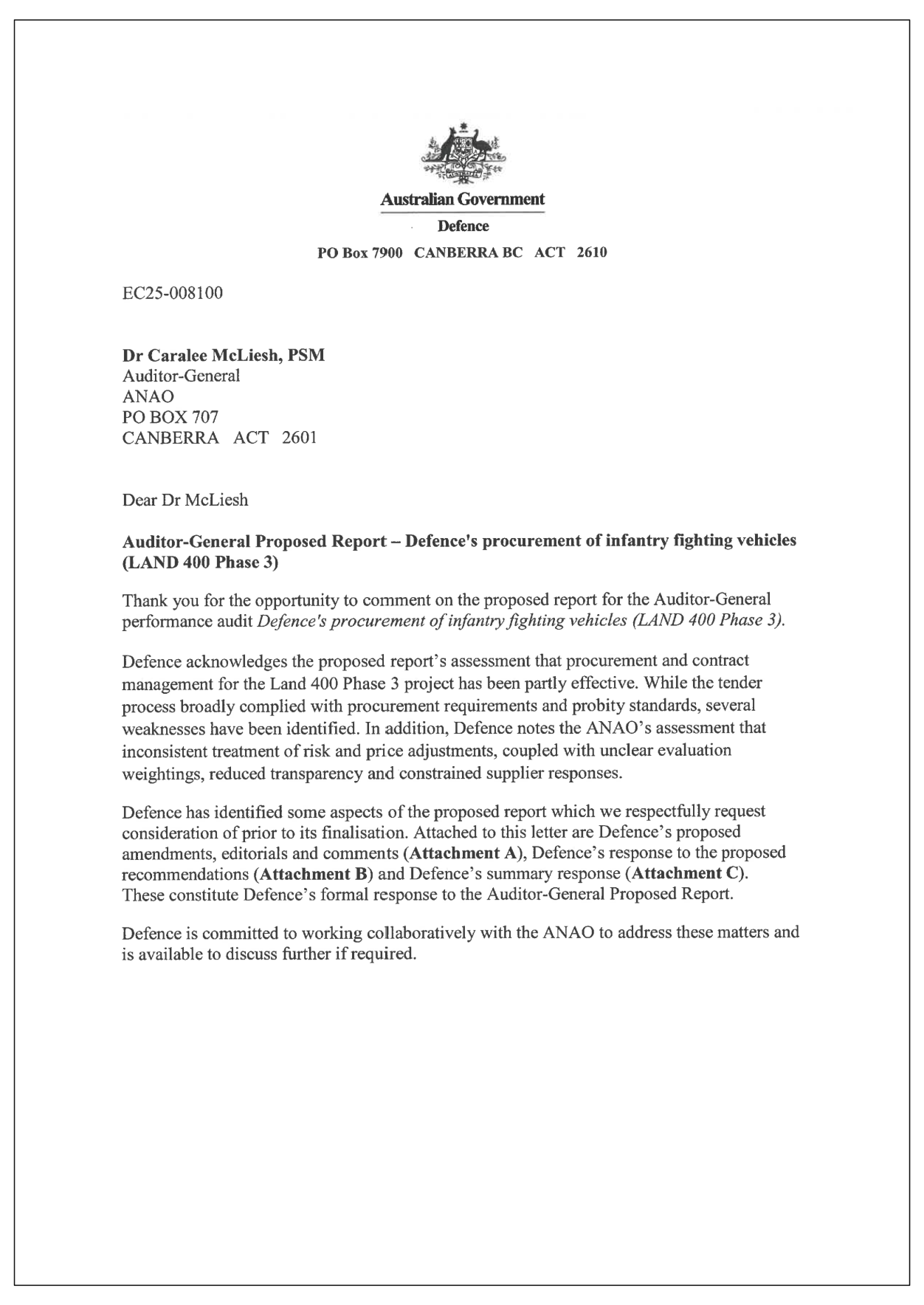
Appendix 2 Improvements observed by the ANAO
1. The existence of independent external audit, and the accompanying potential for scrutiny improves performance. Improvements in administrative and management practices usually occur:
- in anticipation of ANAO audit activity;
- during an audit engagement;
- as interim findings are made; and/or
- after the audit has been completed and formal findings are communicated.
2. The Joint Committee of Public Accounts and Audit (JCPAA) has encouraged the ANAO to consider ways in which the ANAO could capture and describe some of these impacts. The ANAO’s corporate plan states that the ANAO’s annual performance statements will provide a narrative that will consider, amongst other matters, analysis of key improvements made by entities during a performance audit process based on information included in tabled performance audit reports.
3. Performance audits involve close engagement between the ANAO and the audited entity as well as other stakeholders involved in the program or activity being audited. Throughout the audit engagement, the ANAO outlines to the entity the preliminary audit findings, conclusions and potential audit recommendations. This ensures that final recommendations are appropriately targeted and encourages entities to take early remedial action on any identified matters during the course of an audit. Remedial actions entities may take during the audit include:
- strengthening governance arrangements;
- introducing or revising policies, strategies, guidelines or administrative processes; and
- initiating reviews or investigations.
4. During the course of the audit, the ANAO did not observe changes in Defence’s approach to its management of Land 400 Phase 3.
Appendix 3 Timeline of Land 400 Phase 3 procurement
Figure A.1: Timeline of Land 400 Phase 3 procurement
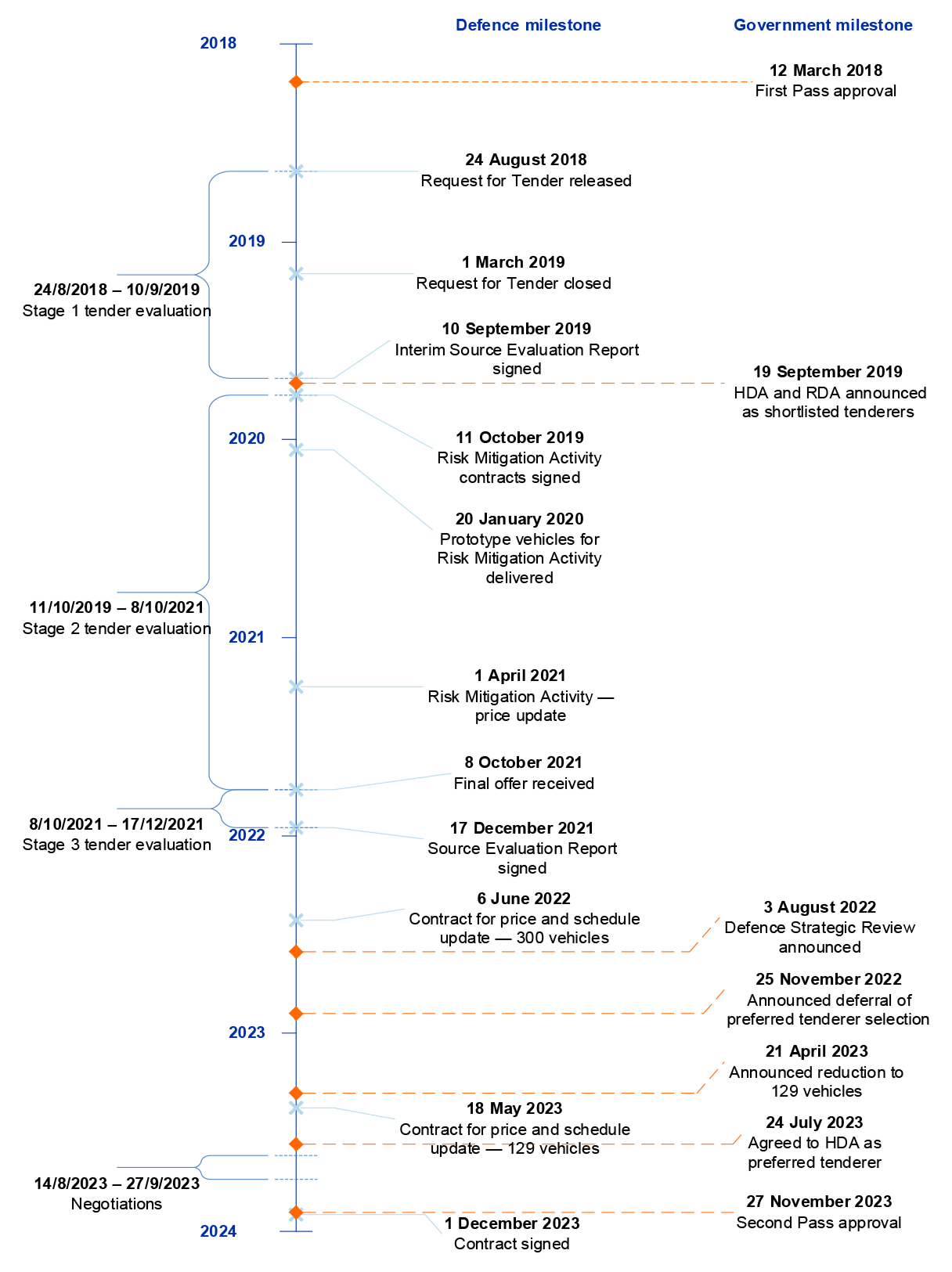
Source: ANAO analysis of Defence documentation.
Appendix 4 Conflict of interest referrals to Australian Government Solicitor
1. As discussed at paragraph 2.99, 13 conflict-of-interest declarations were referred to the project’s probity adviser, the Australian Government Solicitor (AGS) for advice. Table A.1 summarises the nature of the individual’s declared conflict of interest, AGS’ advice and the risk mitigation that was applied in each case.
Table A.1: Conflict of interest referrals for advice to Australian Government Solicitor
|
Defence personnel reference |
Interest declared |
AGS risk assessment |
Mitigation |
|
1 |
Personal association or close personal friendship with [four named individuals] at [two tenderers]. |
[Name’s] declared relationships with [two names] of [tenderer] represent a low probity risk. [Name’s] declared relationships with [two names] of [tenderer] represent medium to high probity risks. |
Statutory declaration |
|
2 |
I have personal friendships with two members of [company] as well as the CEO of [tenderer]. I have numerous other friends across the defence industry. |
We consider that the probity risk presented by [name’s] relationships is medium. |
Reminder of obligations |
|
3 |
I’ve worked with the following staff at [tenderer] [three names]. |
We agree with your determination that [name’s] declared relationships with [three names] of [tenderer] represent a medium probity risk. |
Statutory declaration |
|
4 |
Yes, [name] from [tenderer]. Yes I know many people on a personal basis employed by [tenderer] and [tenderer] many of whom were former CASG employees. |
We may consider this to represent a medium probity risk … we consider that it can be adequately managed by reminding [name] of his probity obligations under the AVD LPPP. |
Reminder of obligations |
|
5 |
Former APS colleague now works for [tenderer] on the [named project]. Second cousin that works for a subcontractor to [tenderer]. |
We consider that they each represent a low probity risk. |
Reminder of obligations |
|
6 |
Current Friendship with [six names] of [three tenderers]. |
[Two names]: low to medium risk. [One name]: medium risk |
Statutory declaration |
|
7 |
[Four names] involved in the [tenderer] bid. |
Low probity risk. |
Reminder of obligations |
|
8 |
Personal connection: [two names] of [two tenderers]. Personal connection: [one name] of [company] |
Relationships with [two names] represent low probity risks. Relationship with [name] of [tenderer] may represent medium to high probity risk. |
Confidentiality Agreement |
|
9 |
I have some friends who work for [tenderer] but not on this tender. Infrequent contact with [name] of [tenderer]. Good friend: [name] of [tenderer]. |
[Name’s] declared relationship with [name] of [tenderer] represents a low probity risk. [Name’s] declared relationship with [name] of [tenderer] represents a low to medium probity risk. |
Reminder of obligations |
|
10 |
Previously worked with and have known [name] of [tenderer] for an extended period. I consider him a friend. |
We consider that their friendship may pose a low to medium probity risk. |
Reminder of obligations |
|
11 |
Whilst working with [tenderer] I became friends with my colleagues. I’m currently still in touch (as personal associations) with 4 of my [named] colleagues who are still employees at [tenderer]. |
[Name’s] ongoing relationship with her former colleagues at [tenderer] may present a probity risk, depending on the type of information she accesses in her work on the Land 400 Phase 3 project … we recommend issuing [name] a reminder of her confidentiality obligations. |
Reminder of obligations |
|
12 |
Friends with [name], a former [employee] in CASG, has joined [tenderer]. Currently I believe he is working on L400-2, and I work on L400-3, however he may do some work on Phase 3 in the future. [Name] - Former [Defence employee] and friend works for [tenderer] on [project]. |
We consider the associations declared with [two names] to pose a low probity risk |
Reminder of obligations |
|
13 |
I was a classmate at ADFA with the CEO of [tenderer], [name]. [Name] married one of my childhood friends. |
The declared relationship could represent a high degree of probity risk. It is our view however that this risk is mostly mitigated by the significant amount of time that has passed (15 years) since [name] has been in contact with [name] … We agree with your assessment that [name’s] declared relationship with [name] represents a low probity risk. |
Reminder of obligations |
Source: ANAO analysis of Defence documentation.
2. The statutory declarations and the confidentiality agreement made specific reference to the content and nature of the individual’s declaration. The reminders of obligations took the form of the following:
In response to your declaration, this email is to remind you of the significance of LAND 400 and the importance of probity. You are also reminded of your obligations in regards to handling classified, including Confidential Information, and that no LAND 400 information should be disclosed (in any form) to those who are not covered by the AVD LPPP and without a genuine need-to-know. Any access to LAND 400 information is to be managed strictly in accordance with the LPPP.
Should, at any time, LAND 400 be brought up in discussion with anyone who does not have a genuine need-to-know, please declare this to Deputy Program Manager LAND 400 Ph2 and/or Project Director LAND 400 Ph3 (as relevant) immediately.
3. For the four individuals who executed a statutory declaration or confidentiality agreement, there was no evidence that any such discussions had been reported to the Project Director.
Appendix 5 Defence-mandated subsystem — risk allocation and integration issues
1. The Redback infantry fighting vehicle (IFV) will be equipped with a Remote Weapon Station (RWS). An RWS can include offensive capabilities such as weapons and grenade launchers as well as cameras and sensor equipment. It allows the operator to remain safely inside the vehicle.
2. The Department of Defence (Defence) has fitted RWS to most of its armoured vehicles. Since 2004, it has purchased about 300 RWS from either Kongsberg Defence & Aerospace of Norway (Kongsberg) or Electro Optic Systems (EOS), a Canberra-based Australian company.
3. For the Land 400 Phase 3 IFVs, an RWS will be mounted on top of the vehicle’s turret.
4. An RWS manufactured by EOS was mandated in the Land 400 Phase 2 tender, to be supplied as ‘government furnished equipment (GFE).’172 For Land 400 Phase 3, the covering letter to the request for tender (RFT) issued on 24 August 2018 stated that ‘Defence seeks tender responses that include the integration/use of the following items common with LAND 400 Phase 2: … EOS Remote Weapon Station’. The statement of works in the RFT made it clear that the provision of the EOS RWS was mandatory.
5. The difference in approach that Defence has ultimately taken for Land 400 Phase 2 and Land 400 Phase 3 meant that for the former, Defence would actually purchase the RWS from EOS as GFE, while for the latter, Hanwha Defence Australia (HDA) (as the successful tenderer) would have to purchase the RWS via a sub-contract with EOS.
6. On 15 May 2025, Defence advised the ANAO:
Defence sought for Tenderers to establish their own relationships with EOS to deliver the capability, which meant the integration risk was held by the Prime.
If Defence had included the EOS RWS as Government Furnished Equipment, LAND 400 Phase 3 would have then taken on integration risk. The LAND 400 Phase 3 solution requires significant integration, noting that the Remote Weapon Station is also the Commanders Sight.
7. A number of technical performance issues began arising in September 2023 in Land 400 Phase 2 with the integration of the EOS RWS with the turret (which was made by a different company). An Independent Assurance Review of Land 400 Phase 2 noted the ‘challenges’ in integrating the RWS and recommended ‘a detailed review of continuing the present path with the EOS RWS’. The Head Armoured Vehicles (HAV) did not accept the recommendation.
8. On 7 August 2024, HDA wrote to Defence outlining similar issues to those described in paragraph 7 as well as ‘non-compliances with the technical requirements of the Commonwealth’, foreshadowed ‘schedule delays’ and sought Defence’s direction as to how it should proceed. On 18 September 2024, HDA lodged a formal ‘notice of delay’ under the terms of the contract.
9. On 16 September 2024, a brief from Assistant Secretary Armoured Fighting Vehicles (ASAFV) to the Head Land Systems (HLS) stated that ‘there is no credible pathway for EOS to deliver the RWS capability on schedule’. It recommended that the Capability Manager’s (Army) agreement be sought to rescind the direction for the EOS RWS to be the RWS solution under the contract. This would enable HDA to pursue an alternate lower risk solution to meet the Commonwealth’s requirements. HLS accepted the recommendation.
10. On 23 October 2024, HDA advised Defence that ‘key program dates’ (including the date of final IFV delivery) ‘are now in delay by 3 months compared to current contract schedule.’
11. On 8 January 2025, HDA wrote to Defence to advise that EOS had provided an updated submission to address its non-compliances that may impact Defence’s deliberations. On 15 January 2025, HDA provided data to assist in Defence deliberations.
12. On 6 February 2025, Defence wrote to HDA and asked it to execute a contract with EOS by the end of February 2025. HDA replied on 20 February 2025 and acknowledged the direction but stated it would not be able to commit to meeting the timeline due to complexities and risks that needed to be mitigated.
13. On 4 March 2025 — more than five months after HDA had lodged the notice of delay — HDA was asked to ‘consider Remote Weapon Station options which may better meet Defence’s capability requirements’. It is not clear why the recommendation in the September 2024 minute (see paragraph 9) was not followed.
14. On 17 April 2025, HDA wrote to Defence with its analysis of the risks associated with using RWS from three suppliers (including EOS). It asked Defence to ‘provide direction based on its own assessment of the lowest holistic risk for the program …’.
15. On 9 May 2025, HDA wrote to Defence and provided further information and RWS solution advice for consideration.
16. On 14 May 2025, a brief from ASAFV to the HLS recommended that he approve HDA being advised that:
Defence does not rescind the direction to the EOS RWS to be the RWS solution under the Contract, and that Defence expects HDA to enter into Contract with EOS as soon as reasonably practicable.
17. As noted at paragraph 3.70, Defence expected HDA to finalise a contract with EOS in the week commencing 21 July 2025. HDA executed a contract with EOS on 3 October 2025.
Footnotes
1 The Capability Acquisition and Sustainment Group within Defence is responsible for the delivery of the Land 400 Phase 3 acquisition project.
2 Auditor-General Report No. 59 2003–04, Defence’s Project Bushranger: Acquisition of Infantry Mobility Vehicles, ANAO, Canberra, 2004, available from https://www.anao.gov.au/work/performance-audit/defences-project-bushranger-acquisition-infantry-mobility-vehicles [accessed 23 July 2025].
Auditor-General Report No. 9 2006–07, Management of the Acquisition of the Australian Light Armoured Vehicle Capability, ANAO, Canberra, 2006, available from https://www.anao.gov.au/work/performance-audit/management-the-acquisition-the-australian-light-armoured-vehicle-capability [accessed 23 July 2025].
Auditor-General Report No. 1 2007–08, Acquisition of the ABRAMS Main Battle Tank, ANAO, Canberra, 2007, available from https://www.anao.gov.au/work/performance-audit/acquisition-the-abrams-main-battle-tank [accessed 23 July 2025].
Auditor-General Report No. 6 2018–19, Army’s Protected Mobility Vehicle — Light, ANAO, Canberra, 2018, available from https://www.anao.gov.au/work/performance-audit/army-protected-mobility-vehicle-light [accessed 13 July 2025].
Auditor-General Report No. 18 2020–21, Defence’s Procurement of Combat Reconnaissance Vehicles (LAND 400 Phase 2), ANAO, Canberra, 2020, available from https://www.anao.gov.au/work/performance-audit/defence-procurement-combat-reconnaissance-vehicles-land400-phase2 [accessed 23 July 2025].
3 Auditor-General Report No. 3 2005–06, Management of the M113 Armoured Personnel Carrier Upgrade Project, ANAO, Canberra, 2005, available from https://www.anao.gov.au/work/performance-audit/management-the-m113-armoured-personnel-carrier-upgrade-project-0 [accessed 27 October 2025].
Auditor-General Report No. 27 2008–09, Management of the M113 Armoured Personnel Carrier Upgrade Project, ANAO, Canberra, 2009, available from https://www.anao.gov.au/work/performance-audit/management-the-m113-armoured-personnel-carrier-upgrade-project [accessed 27 October 2025].
Auditor-General Report No. 34 2011–12, Upgrade of the M113 Fleet of Armoured Vehicles, ANAO, Canberra, 2012, available from https://www.anao.gov.au/work/performance-audit/upgrade-the-m113-fleet-armoured-vehicles [accessed 27 October 2025].
4 Auditor-General Report No. 9 2006–07, Management of the Acquisition of the Australian Light Armoured Vehicle Capability.
5 First Pass is the process that gives government the opportunity to narrow the alternatives being examined by Defence to meet an agreed capability gap. First Pass approval allocates funds from the Integrated Investment Program to enable options endorsed by government to be investigated in further detail.
Second Pass is the final milestone at which point government endorses a specific capability solution and approves funding for acquisition. The project cannot proceed to acquisition until this approval is obtained from government.
6 In August 2022, the Australian Government announced an independent review (the DSR) to assess whether Australia had the necessary defence capability, posture, and preparedness to best defend Australia and its interests in the strategic environment. A report was provided to government on 14 February 2023, and the public version was released on 24 April 2023. The government’s response to the DSR set out the blueprint for Australia’s strategic policy, defence planning and resourcing. The DSR also recommended that the government produce a biennial National Defence Strategy to include ‘a comprehensive outline of Defence policy, planning, capabilities and resourcing, including reprioritisation of the Integrated Investment Program’.
Department of Defence, National Defence: Defence Strategic Review, Defence, Canberra, 2023, available from https://www.defence.gov.au/about/reviews-inquiries/defence-strategic-review [accessed 11 July 2025].
7 In February 2021, the Minister for Defence announced a budget of between $18.1 billion and $27.1 billion for the Land 400 Phase 3 program for up to 450 infantry fighting vehicles. At 30 June 2025, the approved project expenditure for 129 vehicles was $7.3 billion.
8 Hanwha Defence Australia Pty Ltd (HDA) is a subsidiary of Hanwha Aerospace, a South Korean company. HDA was incorporated in Australia in February 2019. HDA constructed a facility (Hanwha Armoured Vehicle Centre of Excellence (H-ACE)) near Avalon airport in Geelong. The Prime Minister and Minister for Defence attended the H-ACE sod-turning in April 2022. Stage 1 was completed in August 2024, and Stage 2 is scheduled for completion by the end of 2026. The infantry fighting vehicles will be assembled at H-ACE. In this report, Hanwha Defence Australia Pty Ltd will be referred to as HDA.
9 Minster for Defence Industry, ‘Delivering next generation infantry fighting vehicles for Australia’, media release, Parliament House, Canberra, 27 July 2023, available from https://www.minister.defence.gov.au/media-releases/2023-07-27/delivering-next-generation-infantry-fighting-vehicles-australia [accessed 15 October 2025].
10 At a press conference on 27 July 2023, the Minister for Defence Industry said ‘We will be beginning delivery of these vehicles in early 2027 with the final vehicles to be delivered in late ’28. That is bringing it forward by a number of years’.
Minister for Defence Industry, ‘Announcement of preferred tenderer to supply infantry fighting vehicles for the Australian Army’, press conference, Parliament House, Canberra, 27 July 2023, available from https://www.minister.defence.gov.au/transcripts/2023-07-27/press-confer…. [accessed 15 October 2025].
11 The ‘estimated phase expenditure’ for Land 400 Phase 1 was $1 billion to $1.5 billion with delivery in 2015 to 2017. Although, the plan noted that the project was then ‘in the very first stages of the Capability Life Cycle.’
12 Department of Defence, Defence Procurement Review 2003 [known as the Kinnaird Review], Canberra, 2003, 2003, p. 18.
13 Joint Committee of Public Accounts and Audit, Inquiry into the 2022–23 Major Projects Report, Report 507: Defence 2022–23 Major Projects Report, JCPAA, December 2024, para 2.159 – 2.162, available from https://parlinfo.aph.gov.au/parlInfo/download/committees/reportjnt/RB000358/toc_pdf/Report507.pdf [accessed 19 March 2026].
14 ANAO analysis in successive Major Projects Reports has identified differences in average cost and schedule performance between projects based on mature or off-the-shelf platforms and those involving greater levels of development or Australian-unique modification. See, for example, Auditor-General Report No. 40 of 2016–17, 2015–16 Major Projects Report, ANAO, Canberra, 2020, para 2.39 – 2.41, available from https://www.anao.gov.au/work/major-projects-report/2015-16-major-projects-report [accessed 6 March 2026].
15 Auditor-General Report No. 23 of 2019–20, 2019–20 Major Projects Report, ANAO, Canberra, 2020, para 2.26 and 2.31, available from https://www.anao.gov.au/work/major-projects-report/major-projects-report-2019-20 [accessed 3 March 2026].
16 JCPAA, Report 507 — Defence 22–23 Major Projects Report, para 2.159 - 2.163.
17 The 2016 Integrated Investment Program was released at the same time as the 2016 White Paper.
18 Minister for Defence, Minister for Defence Industry, ‘Land 400 Phase 3 — consulting with industry’, media release, Parliament House, Canberra, 20 June 2018, available from https://www.minister.defence.gov.au/media-releases/2018-06-20/land-400-phase-3-consulting-industry-0 [accessed 15 October 2025].
19 Department of Defence, National Defence: Defence Strategic Review, Defence, Canberra, 2023, available from https://www.defence.gov.au/about/reviews-inquiries/defence-strategic-review [accessed 11 July 2025].
20 The CPRs are revised and reissued periodically.
Department of Finance, Commonwealth Procurement Rules, Finance, Canberra, 2024, available from https://www.finance.gov.au/sites/default/files/2024-06/Commonwealth_Procurement_Rules-1-July-2024.pdf [accessed 12 June 2025].
21 Paragraph 2.6 of the CPRs allows the accountable authority (usually the Secretary or CEO) to determine that parts of the CPRs should not apply for ‘the protection of essential security interests’. However, obligations under the PGPA Act continue to apply in relation to the proper use and management of public resources.
22 Department of Finance, Commonwealth Procurement Rules.
23 Defence Capability Development Handbook (June 2014), para. 1.3.3(k); Interim Capability Development Life Cycle Manual (August 2017), paras 2.41–2.44.
24 Defence had released RFIs in 2006 and 2010. RFIs are not requests for tender and are to help Defence to gain an understanding of what equipment is available on the market;
The Capability Managers are nominally the Chief of Army, Chief of Air Force and Chief of Navy although in practice, these roles are delegated.
25 Auditor-General Report No. 12 2020–21 Defence’s Procurement of Offshore Patrol Vessels — SEA 1180 Phase 1 described GFE as ‘items provided to the contractor by the Government. It may be incorporated into the end item or may be consumed in the performance of a contract.’;
Auditor-General Report No. 12 2020–21 Defence’s Procurement of Offshore Patrol Vessels — SEA 1180 Phase 1, ANAO, Canberra, 2020, available from https://www.anao.gov.au/work/performance-audit/defence-procurement-offshore-patrol-vessels-sea-1180-phase-1%20%20 [accessed 23 August 2025].
26 The RFI stated that ‘The Commonwealth is seeking solutions to meet the LAND 400 Phase 3 technical, functional and performance requirements detailed in the annex and respondents should have regard for the Commonwealth’s intent to minimise developmental risk’.
27 The RFI invited potential respondents to attend an industry briefing. An internal document prepared just prior to the release of the RFI stated:
DGCAFS advised rather than using the LAND 400 Phase 2 Military-Off-The-Shelf (MOTS)/MOTS Plus terminology, the RFI would use ‘procure mature technologies with robust and technology growth and design path’. At the RFI Industry Brief, DGCAFS will inform industry that LAND 400 Phase 3 will not pursue a developmental acquisition strategy.
28 Defence Science and Technology Group, Project LAND 400 Phase 3 Mounted Close Combat Capability Gate 1, Technical Risk Assessment, Version 1.2, January 2018.
29 These were: ‘BAES Hagglunds (CV90) …. GDLS-A (AJAX Common Based Platform), Hanwha (AS-21 South Korea), and Rheinmetall (LYNX). There remains a possibility that PSM (a joint venture company between Rheinmetall and Krauss Maffei-Wegmann) may also bid the PUMA IFV. Prior to RFT release …. and in line with Smart Buyer principles and Departmental policy to reduce the cost of tendering, the project may focus its solicitation activities on these companies – to be confirmed via a Smart Buyer workshop post First Pass.’ Four of the five manufacturers subsequently tendered.
30 In response to a draft of this audit report, Defence advised the ANAO in September 2025 that documents such as the Concept Acquisition and Support Implementation Strategy (see paragraph 2.21 and Table 2.2) — which referred to MOTS — were superseded by the Project Execution Strategy, ‘which does not mention the phrase ‘Military-Off-The-Shelf’.
31 Non-recurring engineering (NRE) is defined as a ‘one-time cost to research, design, develop and test a new product or product enhancement’.
32 System integration is the systems engineering activity of planning and integrating existing and/or new components/systems so they work together as a single capability.
33 In the Land 400 Phase 3 RFT, Defence used the concept of a ‘growth path’ to describe planned capability evolution over time. The RFT stated that Defence would initially seek a manned turret solution, while engaging shortlisted tenderers during the Risk Mitigation Activity ‘to explore the growth path to a potential future unmanned turret solution’.
34 Following internal consultation, the final report was signed by the reviewer on 16 September 2020. The recommendations and actions were approved by the Deputy Secretary CASG on 6 November 2020.
35 The Chair of the Independent Assurance Review board was a Deputy Secretary from a different part of Defence.
36 The legal adviser was Ashurst Australia and the probity adviser was the Australian Government Solicitor.
37 AusTender is the Australian Government’s procurement information system. All open Approaches to Market are published on AusTender by Australian Government agencies.
38 Seventy-nine companies attended the industry briefing and five companies (including the four companies that ultimately tendered) attended the classified briefing.
39 In accordance with Defence guidance, the tender evaluation plan had been approved prior to tender closure.
40 Failure to comply with the threshold requirements would have been grounds to exclude a tender at that point.
41 The Deed of Undertaking included a variety of commitments by the tenderer such as agreement to abide by the terms of ‘any law, regulation or code that would be relevant to any resultant Contract’, that none of the tenderer’s officers had been convicted of bribery of Commonwealth officials and that the tender is ‘accurate, complete and not misleading’.
42 The Projects of Concern regime was established in 2008 as a framework to manage the remediation of underperforming materiel acquisition projects. The objective of the regime is ‘to remediate the project by implementing an agreed plan to resolve any significant commercial, technical, cost and/or schedule difficulties’. Projects of Concern receive targeted senior management attention and must be reported regularly to the government.
43 The essential requirements were that the tendered vehicles should be capable of being transported by a C17A Globemaster Aircraft or a RAN Canberra Class Amphibious Assault Ship (landing helicopter dock) and that they can accommodate ‘six seated, restrained dismounts’ [soldiers].
44 Defence’s referral of matters to the Australian Government Solicitor (AGS) for probity advice is discussed further at paragraph 2.111.
45 The delegate was Head Armoured Vehicles (HAV).
46 Defence advised that all negotiation issues were classified ‘significant’ by the respective contract managers in consultation with the Workstream Leads. No ‘critical’ or ‘minor’ issues were identified. Defence documented its preferred and minimum fallback position for all the negotiation issues, but did not document its rationale for six issues.
47 Forty-eight clarification issues for HDA and 53 clarification issues for RDA.
48 The report was endorsed by HAV on 1 September 2021.
49 The parallel negotiations report also provided matrices for each tenderer (as annexes), which detailed Defence’s preferred position, minimum fallback positions and the negotiation outcomes for each significant issue.
50 From that Smart Buyer activity, Defence documented that ‘LAND 400-3 will acquire and support the next generation of Armoured Fighting Vehicles (IFV) with the firepower, protection and mobility to defeat increasingly lethal and adaptive adversaries’; and ‘to ensure that the overall effect to be achieved is specified and to retain flexibility in the means (e.g. in relation to BOP).’
51 Defence also documented the following: ‘After extensive engagement with industry, there is confidence that the capability can be delivered within the total IIP [Integrated Investment Program] provision’, reflecting that any chosen option was expected to stay within budget.
52 This approach did not comply with paragraph 10.6(d) of Division 2 of the CPRs (2018 and 2019), which requires that, where applicable, the relative importance of evaluation criteria be stated in request documentation. For procurements at or above $200,000, Defence’s framework requires the Endorsement to Proceed (ETP) approver to document any exemption and the Section 23 Commitment Approval delegate to confirm its appropriateness. Defence did not record an exemption from Division 2 until December 2023, immediately before contract execution. The 2018 ETP indicated an open tender, while the 2023 Section 23 approval reported a limited tender — inconsistent with both the earlier ETP and AusTender, which recorded an open tender. Defence’s internal guidance notes that, even where a procurement is exempt from Division 2, its requirements are regarded as good practice.
53 Total cost of support and total cost of ownership were also estimated.
54 Defence used a proprietary software tool called ACEIT (Automated Cost Estimating Integrated Tool). ACEIT is used by entities such as the U.S. Department of Defense and National Aeronautics and Space Administration (NASA) to perform cost, schedule and uncertainty analysis to support cost estimates for major acquisition programs.
55 To analyse schedule slippage, Defence identified key schedule risks and estimated the potential delays for each. Defence did not adequately record the criteria used to select those risks or the method for estimating the duration of the associated delays.
56 Consolidated Operational Needs (CONs) are the characteristics needed to achieve the infantry fighting vehicle’s mission to ‘provide enhanced land combat survivability and lethality to the CAT [Combined Arms Team] through the provision of combat vehicle systems with superior mobility, knowledge, firepower, protection and connectivity which can fight and win close combat engagements in open or complex terrain’. They were established in the Operational Concept Document (see Table 2.2).
57 Minister for Defence Industry, ‘Delivering next generation infantry fighting vehicles for Australia’, media release, Parliament House, Canberra, 27 July 2023, available from https://www.minister.defence.gov.au/media-releases/2023-07-27/delivering-next-generation-infantry-fighting-vehicles-australia [accessed 16 October 2025].
58 Defence’s contract negotiation strategy stated that ‘significant issues were identified through tender evaluation and throughout engagement with Defence, Government Senior Leaders, and discussions during the Defence Committee process.’
59 Defence’s negotiation strategy stated that ‘minor issues were identified through the tender evaluation.’
60 On completion of contract negotiations, Defence personnel prepare a negotiation report summarising the key outcomes of the negotiation.
61 Of the 66 individual negotiation points, one related to gross vehicle mass weight reduction and 65 to TDSR schedule restrictions imposed on Defence by HDA.
62 Defence’s documentation as at May 2025 reported that fully laden vehicle mass still exceeds gross vehicle mass and that ‘[gross vehicle mass] is to be managed through deployment fits noting there is no compromise to protection requirements.’
63 On 23 September 2025, Defence advised the ANAO that it has been actively managing gross vehicle mass and main weapon accuracy deficiencies since they were first identified during RMA in 2021. It also advised that these risks were common across both tenderers.
64 Deferred certification activities were for air transportability, active protection system, anti-tank guided weapon and counter improvised explosive device.
65 The negotiated outcomes are presented to the delegate with authority to commit the spending of public money and enter into a contract to support informed decision-making and ensure the proper use of public resources.
66 The negotiation report is intended to document how the negotiations were conducted ethically, effectively and delivered a value for money outcome for the Australian Government.
67 The DSR recommended that the LAND 400 Phase 3 acquisition should be reduced to 129 vehicles to provide one mechanised battalion and that landing craft, long-range fires, and infantry fighting vehicles should be synchronised.
68 HDA and RDA were paid $1 million (GST exclusive) for each request for updated price and delivery schedules. This amount was an estimate by Defence based on 10 contractors at $2,000 per day for 40 days plus $0.2 million for overheads. Defence did not seek to verify HDA’s and RDA’s actual costs but advised the ANAO verbally that the actual costs would have been more than $1 million (GST exclusive).
69 The recommendations of the DSR resulted in a reduction in the variant types sought by Defence for Land 400 Phase 3.
70 For the purpose of calculating this differential, the ANAO assumed that the value of customs duty that should have been added to HDA’s price is the same as that added by Defence to RDA’s price — $45 million.
71 The CPRs provide that ‘Price is not the sole factor when assessing value for money’. They state that officials must consider relevant financial and non-financial costs. These include the quality of the goods and services, fitness for purpose of the proposal and whole-of-life costs.
Department of Finance, Commonwealth Procurement Rules.
72 Department of Finance, Ethics and Probity in Procurement, Finance, 2025, available from https://www.finance.gov.au/government/procurement/buying-australian-government/ethics-and-probity-procurement [accessed 24 Apr 2025].
73 Department of Finance, Ethics and Probity in Procurement.
74 In 2011, AGS was engaged as the probity adviser for the overall Land 400 project.
75 ‘Team members’ was defined to include both Defence personnel involved in the Land 400 Phase 3 acquisition and support and external service providers (personnel engaged on contract to Defence).
76 This was expressed to include Land 400 Phase 3 as well as a number of other projects.
77 The list was compiled from companies that attended an industry briefing for Land 400 Phase 3 held in Adelaide in August 2018. The four companies that ultimately submitted Land 400 Phase 3 tenders in response to the RFT were included in the form.
78 These included the Chair, members or observers of the TESG and Tender Evaluation Board, leads, members, advisors and subject matter experts of the TEWGs, key project management personnel and SES/Star ranked personnel with line responsibility for Land 400 Phase 3.
79 Some people made more than one declaration. This could include an earlier Land 400 Phase 2 declaration. The number of declarations per person ranged from zero to six.
80 Generally, this involved having a friend, acquaintance or relative who worked for one of the 70 companies referred to at paragraph 2.96.
81 SES/Star ranked officers who were members of the Defence, Investment and Enterprise Business Committees and the Contestability organisation were not required to complete declarations. The Legal Process and Probity Plan stated ‘Members of these Committees and the Contestability organisation acknowledge under their respective business rules the legislative and policy obligations that apply in relation to confidential information and conflicts of interests. Accordingly, these Defence personnel are not required to provide any specific AVD probity declarations unless requested by HAV or DGAFV’.
82 The Material Procurement branch is within CASG. To that extent, it is not ‘independent’ of Defence.
83 The probity plan imposed a continuing obligation on people to provide an updated declaration to the Project Director if ‘any actual, perceived or potential conflict’ arose during the course of a project. Such an updated declaration was required to be submitted as soon as possible after the AVD team member becomes aware that the actual, perceived or potential conflict of interest had arisen.
84 These declarations are required to be completed by 31 October each year. The administration of these declarations is not the responsibility of the Land 400 Phase 3 project team.
85 Subsection 29(1) of the PGPA Act states that ‘An official of a Commonwealth entity who has a material personal interest that relates to the affairs of the entity must disclose details of the interest.’
86 Convictions as an adult except for ‘spent’ convictions as defined by the Crimes Act 1914.
87 For SES Band 3 personnel within the Associate Secretary Organisation, approval must be provided by the Associate Secretary. For all other Band 3 or 3-Star ranked personnel, the appropriate approver is either the Secretary or the Chief of Defence Force, in accordance with their Group Reporting Lines.
88 These included SES/Star ranked officers who were part of the Land 400 Phase 3 senior executive chain of command or were the Chair, member, observer or advisor to TESG, Tender Evaluation Board or any of the TEWGs.
89 The period was established on the basis that the Land 400 Phase 3 RFT closed in 2019.
90 The last date shown in the probity register on which Defence wrote to AGS was 19 May 2021. The register therefore appears to be incomplete.
91 Based on ANAO analysis of a sample of 33 matters in the probity register.
92 Such as the acceptance of significant gifts or hospitality from tenderers.
93 Affiliate membership of the Officers’ Mess is open to ‘retired APS who held APS5 or higher appointment’. Consequently, any individual who satisfies the affiliate membership requirement is eligible to attend VBMOM events. This would include people who are employed by companies which are current or potential tenderers for Defence contracts. Examples of Officers’ Mess events include wine tastings, ‘black tie’ dinners and AFL Grand Final events. Members are also able to purchase wine at discounted prices.
94 Projects of Interest (POI) are identified by Defence as those underperforming at any point in the capability lifecycle that require management action to avoid becoming a Project of Concern (POC). A POC is a project that Defence regards as seriously underperforming. Land 400 Phase 3 is neither a POI nor a POC, but Land 400 Phase 2 is a POI. Prior to being escalated to a POI, a project may be placed on a Watch List.
95 Prior to Land 400 Phase 3 contract signature in December 2023.
96 PPRIP is a web-based tool that uses standardised project data from Defence financial and risk systems (such as BORIS, ROMAN and Predict!) to obtain a project data overview.
97 Defence advised the ANAO that December is not a reporting period due to the Defence reduced activity period.
98 The two variants are the Infantry Fighting role (IFV) and Command and Control/Joint Fires role (JF). The contract also included the acquisition of associated training and support systems, spares, support and test equipment, and explosive ordnance.
99 The vehicles are scheduled to be delivered in 21 batches of between two and nine vehicles.
100 The Defence Capability Handbook states ‘Initial Operational Capability (IOC) is when the first subset of a capability system that can be operationally employed is realised. Final Operational Capability (FOC) is when the final subset of a capability system that can be operationally employed is realised’. Defence advised that IOC is a Defence milestone and the achievement of IOC is determined by Army as the Capability Manager. HDA is contracted to deliver the mission, training and support systems, but is not responsible for the achievement of IOC. Army will declare IOC when it has determined that it is capable of providing initial support to one deployable Armoured Infantry Combat Team based on 20 IFVs.
101 Department of Finance, Australian Government Contract Management Guide, Finance, Canberra, 2025, available from https://www.finance.gov.au/sites/default/files/2025-09/Australian-Contract-Management-Guide-August_2025.pdf [accessed 31 October 2025].
102 The Land Systems Division (LSD) within Capability Acquisition and Sustainment Group (CASG) of the Armoured Fighting Vehicle (AFV) Division within Defence is responsible for the delivery of the Land 400 Phase 3 project.
103 As outlined in footnote 94, a project is placed on a Watch List prior to being considered for escalation to a Project of Interest. A project on the Watch List may also be subsequently removed from the Watch List. A Project of Interest is identified by Defence as that which is underperforming at any point in the capability lifecycle that requires management action to avoid becoming a Project of Concern.
104 As of March 2025, Defence has combined the Land 400 Phase 3 SRB and Land 8116 Steering Committee. Land 8116 Phase 1 is a $1 billion defence contract for new self-propelled howitzers for the Army that was awarded to HDA in December 2021. Defence advised that the Land 8116 Steering Committee meetings ‘are equivalent to SRBs, for the purposes of conducting discussions/engagements with Hanwha at the strategic level.’ The Land 8116 Steering Committee meetings are the ‘most senior forum for the management of the relationship of the parties’ with membership including only the contract senior representatives and the Capability Manager, and meetings required only twice yearly.
105 As outlined in footnote 94, a project is placed on a Watch List prior to being escalated to a Project of Interest. A Project of Interest is identified by Defence as that which is underperforming at any point in the capability lifecycle that requires management action to avoid becoming a Project of Concern.
106 In January 2026, Defence advised the ANAO that it ‘utilised contractual mechanisms to ensure contractor performance’, including escalating matters to the strategic relationship board and not permitting the completion (or ‘exiting’) of the ‘DDR-IFV [Detailed Design Review-Infantry Fighting Vehicle] Milestone due to enforcing the resolution of outstanding Major Action Items’.
107 The overall status of the project is reported as ‘Red’ in Defence’s Project Performance Review Information Platform (PPRIP), which uses a traffic light system of Red, Amber or Green. Red indicates that at least one project aspect status is red and requires urgent attention. Defence advised the ANAO in September 2025 that the inclusion of a ‘Very High’ risk automatically flags the project as ‘Red’, regardless of other aspects.
108 The two very high risks were first recorded on Defence’s risk register in May 2024 and July 2025 respectively and remained rated as Very High on 31 October 2025. With respect to the latter risk, HDA advised Defence that it had been working with the subcontractor to resolve the issue and provided Defence with additional details for its consideration. At 31 October 2025, acceptance of the risk by Defence was pending further information from HDA.
109 Army describes lethality as ‘the capacity to cause death or serious harm or damage’ and emphasises that ‘in combat, soldiers must be able to apply lethality as quickly and efficiently as possible in any given situation.’ It describes mobility as the ‘ability to rapidly move forces and sustain operational efforts’, noting that mobility ‘[is] critical to the development of a credible close combat system and the ongoing success of Army operations.’
110 That is, relevant entities should not accept risk that another party is better placed to manage. Similarly, when a relevant entity is best placed to manage a particular risk, it should not seek to inappropriately transfer that risk to the supplier.
Department of Finance, Commonwealth Procurement Rules.
111 Predict! and Capability One are business tools to document risks, issues and opportunities. Predict! is mandated for Defence. HDA is not contractually required to use Predict!.
112 Defence reports its retired or new risks at monthly Integrated Project Management Team (IPMT) meetings, which are attended by Army representatives. Any issues that require direction are escalated to the Project Management Steering Group (PMSG) or to the Army Capability Committee for decision by HLS, Head Land Capability (HLC) and Deputy Chief of Army. HDA representatives do not attend any of these meetings.
113 On 23 September 2025, Defence advised the ANAO that Army representatives have access to both systems to assure alignment of risk.
114 A decision brief for the ‘Very High’ risk, first recorded in Defence’s risk register in July 2025, was submitted to HLS on 24 September 2025.
115 Defence advised the ANAO in September 2025 that Army attendance is ‘not essential’ at these risk workshops and that ‘copies of all risk workshop minutes are provided to Army.’
116 Defence advised the ANAO in September 2025 that ‘risks that are managed by HDA are reported through other forums, with HDA in attendance’ including, the SRB, during mandated system reviews and at interface control working groups.
117 HDA is contractually required to prepare and deliver CSRs to Defence every three months.
118 Upgraded from ‘High’ rated risk to ‘Extreme’ as at second CSR delivered to Defence in June 2024. Since December 2024, HDA has also reported ‘High’ rated risks related to the EOS.
119 HDA has consistently reported that ‘hulls must start production in 2025’ to meet the last delivery by end 2028 and that ‘schedule is driven by CoA.’ This risk was upgraded from ‘High’ to ‘Extreme’ as at second CSR delivered to Defence in June 2024.
120 HDA’s mitigation strategy for the risk of vehicle system rework is to certify systems during design, test and evaluation and verification and validation based on risk of change at specified milestones. In relation to the under-estimated subcontractor costs, HDA has advised Defence that it is looking into other options with different subcontractors and engaging with the current subcontractors to review pricing.
121 HDA issued a formal notice of delay to Defence in September 2024 and requested direction on the options previously presented by HDA to address ‘technical non-compliances of the [EOS RWS]’.
122 See also: Auditor-General Report No. 39 of 2024–25 Interim Report on Key Financial Controls of Major Entities, ANAO, Canberra, 2025, paragraph 3.25, available from https://www.anao.gov.au/work/financial-statement-audit/interim-report-key-financial-controls-of-major-entities-2024-25 [accessed 6 March 2026].
123 In response to the ANAO in March 2026, Defence advised that the finalised action arising from the Defence Committee was for the project to conduct an Integrated Baseline Review (IBR), not a SCRAM review, and report back on any issues identified. Defence advised that the IBR was planned for the week commencing 23 March 2026, with a SCRAM review to be undertaken later in 2026 and annually thereafter.
124 Following the 2023 DSR, Defence introduced the term Minimum Viable Capability (MVC) as an acquisition milestone. MVC is designed to deliver capabilities faster, more flexibly, and with greater responsiveness to strategic priorities.
Auditor-General Report No. 16 of 2025–26 2024–25 Major Projects Report, paragraphs 2.19–2.21, available from https://www.anao.gov.au/work/major-projects-report/2024-25-major-projec… [accessed 6 March 2026]; and
Department of Defence, National Defence Strategy, Defence, Canberra, 2024, available from https://www.defence.gov.au/about/strategic-planning/2024-national-defence-strategy-2024-integrated-investment-program [accessed 6 March 2026].
125 Defence also advised that this ‘approach aligns with Defence’s direction on delivering minimum viable capability as outlined in the Defence Strategic Review’.
126 In its first status report in March 2024, HDA listed as a ‘high’ risk ‘Schedule is driven by CoA [Defence] - to meet CoA required timing for all vehicles delivered by end 2028, production must commence prior to [acceptance verification and validation] being complete’. The risk was raised to ‘extreme’ in the September 2024 and subsequent CSRs.
127 Defence’s Integrated Baseline Review and Earned Value Management System Review Instruction describes the IBR as a:
risk-based process enabling technical and schedule review, focusing on the assignment, definition, scheduling and resourcing of work, thus establishing early visibility into the acceptability of the contractor’s contract planning. The IBR also reviews the methods and metrics used to measure contract performance or progress.
The contract specifies that the objective of the IBR is to approve the Performance Measurement Baseline (PMB), which is used as the reference point to objectively assess project progress and contractor performance.
128 A SCRAM review is an independent schedule risk analysis to identify risks to schedule compliance. Defence’s IBR and Earned Value Management System Review Instruction recommends that projects conduct a SCRAM review prior to an IBR in order to identify project execution risks early to enable effective mitigation. HDA is contractually required to participate in SCRAM reviews initiated by Defence. The other purposes of the SCRAM included an independent assessment of the maturity of HDA’s Contract Master Schedule (CMS), potential Defence mitigations, feedback on how to improve engagement and processes, and advice on what is MVC.
129 Recommendations of a SCRAM review are not mandatory. The Preliminary Design Review (PDR) is a contract milestone scheduled to be completed by 31 August 2024. The SCRAM review report noted that the PDR is critical for progression of the project from a technical and engineering perspective.
130 As noted at footnote 94, the inclusion of a project on a Watch List may be a precursor to being listed as a Project of Interest or a Project of Concern.
131 Prices are defined (subject to escalations) with the exception of any further quantities or optional extras that are yet to be agreed, or any ‘Cost Reimbursement’ component included within the scope of the contract.
132 The other agreed milestones include delivery of significant data items, such as HDA’s project management plan, completion of configuration audits and delivery of training.
133 In November 2024, Defence advised the ANAO that it ‘worked with shortlisted tenderers during the [RMA] to agree a Scheule of Payments with Milestone Payments that generally supported cash flow neutrality.’ The largest milestone payment was $165 million, which was a mobilisation payment due at contract execution on 1 December 2023. The smallest milestone payment is $28.7 million scheduled for 30 September 2027.
134 The ANAO identified that the contract price reported on AusTender as at 3 November 2025 was increased by $54.4 million. In January 2026, Defence advised the ANAO that the additional $8.2 million was ‘due to a re-evaluation of funding requirement to cover anticipated cost reimbursement payments under the contract. This additional commitment was not driven by a CCP, therefore would not be observable in the project’s internal CCP register.’
135 Defence also included a requirement for HDA to complete configuration audits and system audits, which it collectively referred to as ‘mandated system reviews’ alongside design reviews.
136 Defence removed the Facilities Readiness Review (milestone 6), amended the Long Lead Time Item Review checklist (milestone 8), and added an additional Long Lead Time Item Review (milestone 16A). Defence also advised HDA that the Detailed Design Review-IFV (milestone 10) would be conducted without incorporating the RWS integration aspect of the project and a ‘delta Detailed Design Review’ would be conducted at a later date incorporating the RWS integration aspects into the project.
137 The data deliverables included the project management plan, contract master schedule and earned value management plan, as well as approval of the technical data and software rights schedule and IFV driver compartment components.
138 Reviews can be a single meeting or numerous working meetings that cumulate into a relevant review based on the complexity and risks associated with the project. Consistent with the contract requirements outlined in paragraph 3.49, the entry criteria generally require HDA to provide all data items, develop any required technical documents, complete hazard and security analyses, review contract plans and ensure that action items from any previous reviews have been successfully addressed or action plans agreed. The exit criteria generally covers the requirements set out in the contract and as outlined in paragraph 3.50.
139 The Commonwealth Representative of the contract is the Land 400 Phase 3 Project Director.
140 In September 2025, Defence advised the ANAO that it expected HDA to complete the DDR-IFV in December 2025.
141 Defence also uses the Contract Work Breakdown Structure (CWBS) which forms the framework for contract planning, management and status reporting and for estimating costs, schedule and technical achievements at completion. The CWBS is related to and consistent with the CMS.
142 See footnote 127 for description of IBR and PMB.
143 Under the contract HDA is required to deliver draft versions monthly to Defence for review until the final version of the CMS, which is due 20 days prior to the IBR. After the IBR, HDA is required to provide monthly updates to Defence until the final System Acceptance Audit, which is scheduled for October 2028.
144 The SCRAM report cited excessive artificial float and overlapping phases (prototype, design, verification and validation, and production) that produced a CMS that was ‘unwieldy and hard to use.’
145 Twenty comments from Defence’s review of previous versions still remained open (from the initial draft delivered in February 2024 to version eight delivered in October 2024). The ‘final’ version does not constitute the last version delivered to Defence. It is the version that is approved by Defence after the conduct of the IBR and then updated monthly by HDA thereafter. As at 31 October 2025, there is an expected 4.6 month delay to the DDR-IFV.
146 HDA continued to report a delay to final acceptance of 81 days in March 2025 and 22 days in April 2025.
147 HDA’s CMS reported a 25-day delay to final acceptance. As noted in paragraph 3.54, the DDR-IFV was conducted as scheduled and resulted in 102 action items. In August 2025, HDA advised Defence that it expects to complete and close the action items and the milestone in December 2025 (five months after the scheduled date).
148 In April 2025, HDA reported a 25 day delay to final acceptance. It noted that the turret production schedule continues to show a delay due to ‘unresolved RWS design direction’ and that the magnitude of the delay is still to be verified when RWS direction is confirmed.
149 At the SRB meeting, HDA took an action item to update Defence on an anticipated date for contract execution with EOS and ‘conduct further CMS baselining based on the contract signature date.’ Defence also advised HDA that it plans to conduct an additional IBR after 30 November 2025 ‘in accordance with DEPSEC requirements as described in Defence Committee’ and that additional details would be provided to HDA.
150 CSRs also include a risk report, problem identification report, configuration change register, quality assurance report, Australian Industry Capability report, technical data and software rights report, subcontractor report, health safety and environment report, Commonwealth Assets stocktaking report and management of the material system, as well as details of interim support services delivery activities.
151 The ‘delta DDR’ would incorporate the RWS integration aspects into the review as the DDR-IFV conducted in July 2025 did not incorporate the RWS integration aspect of the project.
152 EVPRs are an output of an Earned Value Management System (EVMS), which HDA is required to establish within six months of contract execution. In May 2025, Defence advised the ANAO that HDA had an existing EVMS that was developed for Land 8116 Phase 1. HDA’s Earned Value Management Plan, which outlines its methods and processes for meeting its requirements under the contract was approved by Defence in February 2025 (14 months after contract execution). An EVMS relies on input data from the CWBS and CMS prepared by HDA.
153 The objective of the IBR is approval of the PMB, which is used as the reference point to assess actual progress of the project and report in EVPRs. Since May 2025, the manufacturer of the turret to which the RWS is to be integrated, produces and delivers its own separate EVPRs to Defence on a monthly basis. Defence advised the ANAO that this was ‘in accordance with the requirements of their Approved Subcontract’ and did not provide further details.
154 As at 8 September 2025, this action item remained classified as a ‘Major’ action item Defence’s action item register. On 23 September 2025, Defence advised the ANAO that a separate action item register demonstrated that this item was downgraded to Minor. In January 2026, Defence further advised the ANAO that it ‘manages Action Items collaboratively with HDA, with weekly exchanges of the Action Item Register between Project Managers.’ It referred to another action item register that demonstrated this item was ‘downgraded to minor’.
155 Department of Finance, Supplier Pay On-Time or Pay Interest Policy, 1 July 2022, available at https://www.finance.gov.au/publications/resource-management-guides/supplier-pay-time-or-pay-interest-policy-rmg-417/part-1-policy-and-practice [accessed 18 July 2025].
156 On 1 July 2022, the Defence Secretary issued the Accountable Authority Instructions (AAI) 2 — Spending Defence Money — Procurement, which aligned Defence’s payment terms with the government payment policy.
157 The Policy still applies even if the written contract or approach to market fails to include clauses that reflect this policy, or if no written contract exists between the NCE and the supplier.
158 The Australian Government Supplier Pay On-Time or Pay Interest Policy and Defence’s AAI 2 — Spending Defence Money — Procurement issued by the Defence Secretary.
159 EVPRs are an output of an Earned Value Management System (EVMS), which HDA is required to establish within six months of contract execution. In May 2025, Defence advised the ANAO that HDA had an existing EVMS that was developed for Land 8116 Phase 1. HDA’s Earned Value Management Plan, which outlines its methods and processes for meeting its requirements under the contract was approved by Defence in February 2025 (14 months after contract execution). An EVMS relies on input data from the CWBS and CMS prepared by HDA.
160 Including invoices for adjustments for fluctuations in the cost of labour and materials, as allowed for under the contract.
161 Based on the interest payment formula in the contract.
162 The 30-day payment terms included in the contract at execution were non-complaint with the government policy.
163 The 19 identified invoices were paid within an average of 25.7 days of the Land 400 Phase 3 project team receiving the invoice from HDA.
164 Department of Finance, Supplier Pay On-Time or Pay Interest Policy — Resource Management Guide (RMG) 417 — Additional information, Finance, Canberra, June 2024, available from https://www.finance.gov.au/publications/resource-management-guides/supplier-pay-time-or-pay-interest-policy-rmg-417/supplier-pay-time-or-pay-interest-policy-resource-management-guide-no-417-policy-additional-information [accessed 18 July 2025].
165 Defence’s Procurement Manual requires Defence personnel to prepare a negotiation directive that describes the plan for undertaking the negotiations and includes details about the aim, objective and constraints of the negotiations, clearly defined roles and responsibilities for team members, the authority of the negotiation team, resources and Defence’s preferred, acceptable and fallback positions on key negotiation issues. This directive is prepared and approved by the delegate prior to Defence officials entering into negotiations.
166 The negotiation directive approved on 10 June 2021 was for the conduct of parallel negotiations with HDA and RDA during the period 15 June to 23 July 2021. The negotiation directive approved by the delegate on 1 August 2023 was for final contract negotiations with HDA during the period 15 August to 27 September 2023. Defence did not advise why the payment terms were not updated during negotiations with HDA in 2023.
167 Department of Finance, Supplier Pay On-Time or Pay Interest Policy — Resource Management Guide (RMG) 417 — Additional information.
168 Minister for Defence Industry, ‘Land 400 Phase 3 consideration’, media release, Canberra, November 2022, available from https://www.minister.defence.gov.au/media-releases/2022-11-25/land-400-phase-3-consideration [accessed 13 October 2025].
The DSR was publicly released in April 2023 and HDA was announced as the preferred tenderer for Land 400 Phase 3 in July 2023.
169 In January 2026, Defence advised the ANAO that ‘a change prior to 1 July 2022 would have required a change to the payment terms in the draft contract, resulting in tenderers having to renegotiate with all subcontractors to establish updated pricing and cash flow, with tenderers then required to reprice to reflect a change in payment terms and corresponding payment term risk.’ As identified in paragraph 2.86, Defence requested updated pricing and delivery schedules from tenderers in April 2023 based on the reduced quantity of vehicles as recommended by the DSR. This would have required ‘renegotiate with all subcontractors to establish updated pricing and cash flow’.
170 The Supplier Pay On-Time or Pay Interest Policy does not specify a timeframe within which interest payments are to be made. However, it advises that NCEs should pay interest promptly, preferably at the same time as the late payment.
171 Defence made a total interest payment to HDA of $148,129.37. This total included interest penalties for invoices 16 and 17, which Defence was not required to pay as they were below the $100 threshold for interest payment outlined by the Supplier Pay On-Time or Pay Interest Policy.
172 Auditor-General Report No. 12 2020–21 Defence’s Procurement of Offshore Patrol Vessels — SEA 1180 Phase 1 has described government furnished equipment as ‘items provided to the contractor by the Government. It may be incorporated into the end item or may be consumed in the performance of a contract.’
Auditor-General Report No. 12 2020–21 Defence’s Procurement of Offshore Patrol Vessels — SEA 1180 Phase 1, ANAO, Canberra, 2020, available from https://www.anao.gov.au/work/performance-audit/defence-procurement-offshore-patrol-vessels-sea-1180-phase-1 [accessed 23 August 2025].