Browse our range of reports and publications including performance and financial statement audit reports, assurance review reports, information reports and annual reports.
Performance audit (Auditor-General Report No. 16 of 2024–25)

Published: Wednesday 11 December 2024
Published
The objective of this audit was to assess the effectiveness of the design process for the Energy Price Relief Plan.
Entity
Department of the Treasury; Department of Climate Change, Energy, the Environment and Water
Contact
Please direct enquiries through our contact page.
Performance audit (Auditor-General Report No. 40 of 2023–24)

Published: Tuesday 18 June 2024
Published
The objective of this audit was to assess whether the Federal Court of Australia is effectively managing the use of corporate credit cards for official purposes in accordance with legislative and entity requirements.
Entity
Federal Court of Australia
Contact
Please direct enquiries through our contact page.
Performance audit (Auditor-General Report No. 44 of 2020–21)

Published: Thursday 17 June 2021
Published
The audit objective was to examine the effectiveness of the Great Barrier Reef Marine Park Authority’s regulation of permits and approvals, including its implementation of recommendations from Auditor-General Report No.3 of 2015–16 Regulation of Great Barrier Reef Marine Park Permits and Approvals.
Entity
Great Barrier Reef Marine Park Authority
Contact
Please direct enquiries through our contact page.
Performance audit (Auditor-General Report No. 7 of 2019–20)

Published: Monday 26 August 2019
Published
The objective of this audit is to assess the effectiveness of the Department of Finance’s and selected entities’ implementation of the Australian Government’s campaign advertising framework.
Entity
Across Entities
Contact
Please direct enquiries through our contact page.
Performance audit (Auditor-General Report No. 17 of 2022–23)

Published: Monday 3 April 2023
Published
The objective of this audit is to assess the effectiveness of the design and implementation of the Department of Agriculture, Water and the Environment’s cultural reform program prior to the July 2022 Machinery of Government changes.
Entity
Department of Agriculture, Fisheries and Forestry
Contact
Please direct enquiries through our contact page.
Performance audit (Auditor-General Report No. 10 of 2021–22)

Published: Thursday 25 November 2021
Published
The objective of the audit was to assess the effectiveness of Industry Innovation and Science Australia's, the Department of Industry, Science, Energy and Resources', and the Australian Taxation Office's administration of the Research and Development Tax Incentive program.
Entity
Australian Taxation Office; Industry Innovation and Science Australia; Department of Industry, Science, Energy and Resources
Contact
Please direct enquiries through our contact page.
Performance audit (Auditor-General Report No. 11 of 2018–19)

Published: Monday 12 November 2018
Published
The objective of this audit was to assess the effectiveness of the Department of Education and Training’s design and implementation of the Vocational Education and Training (VET) Student Loans program.
Entity
Department of Education and Training
Contact
Please direct enquiries through our contact page.
Performance audit (Auditor-General Report No. 18 of 2021–22)

Published: Tuesday 22 February 2022
Published
The objective of this audit was to assess the effectiveness of the National Indigenous Australians Agency’s administration of funding for remote housing in the Northern Territory.
Entity
National Indigenous Australians Agency
Contact
Please direct enquiries through our contact page.
Performance audit (Auditor-General Report No. 31 of 2022–23)

Published: Monday 5 June 2023
Published
The objective of this audit was to assess the effectiveness of the Department of Health’s administration of the Community Health and Hospitals Program.
Entity
Department of Health and Aged Care
Contact
Please direct enquiries through our contact page.
Performance audit (Auditor-General Report No. 10 of 2018–19)
Published: Monday 5 November 2018
Published
The objective of the audit was to assess the effectiveness of the design and implementation of the Department of Human Services' Quality Framework.
Entity
Department of Human Services
Contact
Please direct enquiries through our contact page.
Performance audit (Auditor-General Report No. 43 of 2018–19)

Published: Friday 31 May 2019
Published
The objective of the audit was to assess whether the Department of Infrastructure, Regional Development and Cities had designed and implemented appropriate governance and administration arrangements for the transition and delivery of sustainable reforms to services on Norfolk Island.
Entity
Department of Infrastructure, Regional Development and Cities
Contact
Please direct enquiries through our contact page.
Performance audit (Auditor-General Report No. 33 of 2021–22)

Published: Wednesday 15 June 2022
Published
The audit objective was to examine the effectiveness of Snowy Hydro Limited’s governance arrangements for early implementation of Snowy 2.0, the expansion to the Snowy Hydro Scheme.
Entity
Snowy Hydro Limited
Contact
Please direct enquiries through our contact page.
Performance audit (Auditor-General Report No. 10 of 2001–02)
Published: Monday 17 September 2001
Published
The objectives of the audit were to determine whether agencies have implemented appropriate risk management strategies for the new banking arrangements, which came into operation on 1 July 1999 and whether cash funds are being managed in accordance with the appropriate legislation, the Commonwealth's agency banking guidance and generally accepted accounting practices. The scope of the audit was restricted to the departmental cash funds management and focused on risk management processes and management accounting controls adopted in the forecasting of cash flows, operation of bank accounts and placement of funds. The audit examined seven agencies, which are not named in the report.
Entity
Across Agency
Performance audit (Auditor-General Report No. 46 of 2024–25)

Published: Friday 20 June 2025
Published
The objective of the audit was to assess the effectiveness of Airservices’ contract management for the OneSKY program.
Entity
Airservices Australia; Department of Defence
Contact
Please direct enquiries through our contact page.
Performance audit (Auditor-General Report No. 20 of 2025–26)

Published: Tuesday 27 January 2026
Published
The audit objective was to assess the effectiveness of the Department of Social Services’ and Services Australia’s administration of the age pension.
Entity
Services Australia; Department of Social Services
Contact
Please direct enquiries through our contact page.
Performance audit (Auditor-General Report No. 34 of 2000–01)
Published: Thursday 17 May 2001
Published
The Age Pension is a social security income support payment available to Australian residents and eligible Australians residing overseas who have reached Age Pension age and whose income and assets are under certain limits. In 1999-2000, approximately $14 billion was paid to approximately 1.7 million Age Pension recipients. Payment of Age Pension is made under the Social Security Law and in accordance with the Guide to the Social Security Law prepared by the Department of Family and Community Services (FaCS). FaCS has contracted Centrelink under a Business Partnership Agreement (BPA) to administer the payment of Age Pension to eligible customers. The objective of the audit was to assess the extent to which new claims for Age Pension had been assessed in compliance with the legislation and other relevant guidelines developed by Centrelink, and whether Centrelink employed appropriate mechanisms to help ensure such compliance. In particular, the ANAO sought evidence with respect to: payment at the right rate, from the right date, to the right person with the right product, for new claims assessed during the audit sample period (that is, in accordance with the working definition of accuracy within Centrelink); the accuracy of Centrelink?s own reporting on compliance, as reported to FaCS under the BPA; and the application of appropriate mechanisms to help ensure such compliance.
Entity
Centrelink
Performance audit (Auditor-General Report No. 33 of 2015–16)

Published: Thursday 5 May 2016
Published
The audit objective was to assess whether Defence is effectively controlling the use of Commonwealth credit cards for official purposes in accordance with legislative and policy requirements.
Entity
Department of Defence
Contact
Please direct enquiries relating to reports through our contact page.
Performance audit (Auditor-General Report No. 40 of 1999–2000)
Published: Wednesday 26 April 2000
Published
Tactical fighter operations (TFOs) form the basis of Australia's current military capability to ensure air superiority. Air superiority over the Australian territory and maritime approaches is an essential element in Australia's defence strategy. The audit objectives were to:
- assess whether the resources used to provide the F/A-18 tactical fighter force operational capability are managed cost-effectively; and
- identify areas for improvement in the coordination, planning and practices employed in administration of tactical fighter operations.
Entity
Department of Defence
Performance audit (Auditor-General Report No. 34 of 2020–21)

Published: Monday 12 April 2021
Published
The audit objective was to examine whether the Department of Defence implemented a selection of agreed parliamentary committee recommendations and ANAO performance audit recommendations.
Entity
Department of Defence
Contact
Please direct enquiries through our contact page.
Performance audit (Auditor-General Report No. 45 of 2000–01)
Published: Tuesday 5 June 2001
Published
The audit reviewed the fraud control arrangements in the Department of Family and Community Services (FaCS), a policy formulation, and advising body and major purchaser of social welfare services from Centrelink. The objective was to assess whether FaCS had:
- implemented appropriate fraud control arrangements in line with the Fraud Control Policy of the Commonwealth and that these arrangements operated effectively in practice; and
- fulfilled its responsibilities as a purchaser of services in relation to fraud control.
This audit is one in a series of fraud control audit and is complemented by a similar audit of Centrelink, a major provider of services on behalf of FaCS.
Entity
Department of Family and Community Services
Performance audit (Auditor-General Report No. 20 of 2017–18)

Published: Tuesday 12 December 2017
Published
The audit objective was to assess the effectiveness of the Department of Industry, Innovation and Science in administering the low emission technologies for fossil fuels (LETFF) program.
Entity
Department of Industry, Innovation and Science
Contact
Please direct enquiries relating to reports through our contact page.
Performance audit (Auditor-General Report No. 13 of 1996–97)
Published: Monday 18 November 1996
Published
The purpose of the audit was to examine how efficiently and effectively the ATO managed its collection of outstanding tax debt. A framework for analysing the ATO's approach to collecting outstanding debt was established by the ANAO. This framework reflected five key criteria in the collection process as they apply to managing outstanding debt, namely:
- initiatives to promote timely payment;
- identification of outstanding debt;
- setting priorities for collecting outstanding debt;
- management of collection practices; and
- collection results.
Entity
Australian Taxation Office
Corporate
Published: Thursday 6 July 2023
Published
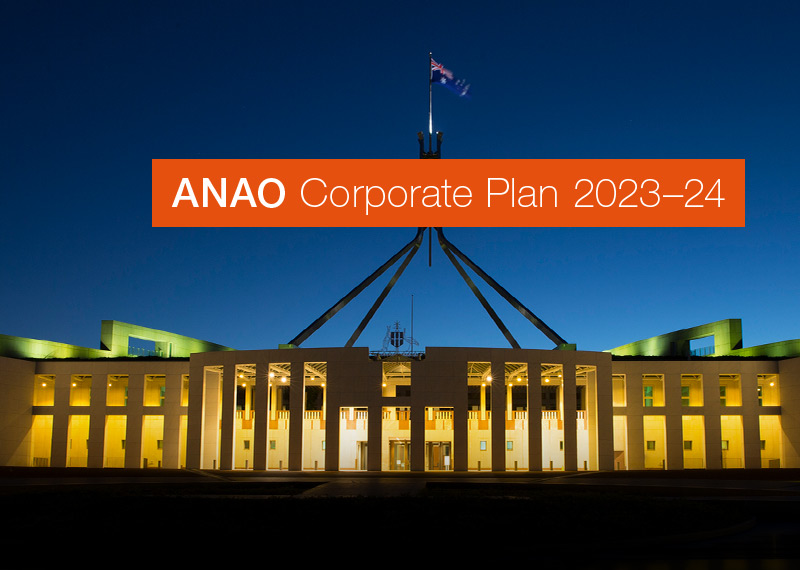
The ANAO Corporate Plan 2023–24 outlines how we intend to deliver against our purpose over the next four years (2023–24 to 2026–27). The corporate plan is the ANAO’s primary planning document – it outlines our purpose; the dynamic environment in which we operate; our commitment to building capability; and the priorities, activities and performance measures by which we will be held to account. The corporate plan is complemented by the annual audit work program, which reflects the ANAO’s audit strategy for the coming year.
This corporate plan was updated on 26 March 2024:
- organisational structure changes — ‘Professional Services and Relationships Group’ to ‘Professional Services Group’
- Measure 3 — change type from ‘Efficiency / Qualitative’ to ‘Efficiency / Quantitative’
- Measure 15, reporting mechanism 4 — replaced text to reflect updated JCPAA feedback process
- Measure 16, reporting mechanism 3 — replaced references to ‘insights’ with ‘lessons’
Contact
Please direct enquiries through our contact page.
Performance audit (Auditor-General Report No. 28 of 2015–16)

Published: Thursday 28 April 2016
Published
The objective of the audit was to assess the Department of Agriculture and Water Resources' establishment and administration of the Farm Finance and Drought Concessional Loans programs.
Entity
Department of Agriculture and Water Resources
Contact
Please direct enquiries relating to reports through our contact page.
Performance audit (Auditor-General Report No. 2 of 2024–25)

Published: Wednesday 11 September 2024
Published
The audit objective was to assess the effectiveness of the Department of Defence’s arrangements to manage the security authorisation of its ICT systems.
Entity
Department of Defence
Contact
Please direct enquiries through our contact page.
Performance audit (Auditor-General Report No. 28 of 2003–04)
Published: Thursday 12 February 2004
Published
The report summarises performance audit, financial statement audit and other related activities for the ANAO for the period July to December 2003. The key issues arising from performance audits tabled in this period are summarised against the ANAO themes. The report also summarises financial audits and other financial audit activities conducted by the ANAO during the period July to December 2003. It discusses significant issues such as the: consolidated financial statements and the final budget outcome; harmonisation of Australian Generally accepted accounting practices and Government Finance Statistics; adoption of International Financial Reporting Standards; timing for Financial Statements Preparation; and the audit of the CFS 2002-03.
Entity
ANAO
Performance audit (Auditor-General Report No. 39 of 2019–20)

Published: Thursday 4 June 2020
Published
The objective of this audit was to assess whether the Commonwealth Scientific and Industrial Research Organisation (CSIRO) designed and is implementing its property investment strategy in a way that is delivering the intended benefits, and how any lessons learned are being reflected in a new strategy that is being developed.
Entity
Commonwealth Scientific and Industrial Research Organisation (CSIRO)
Contact
Please direct enquiries through our contact page.
Performance audit (Auditor-General Report No. 8 of 2002–03)
Published: Wednesday 18 September 2002
Published
This is the second audit report under the Senate Order, which requires all Financial Management and Accountability Act 1997 (FMA Act) agencies to place on the Internet, lists of contracts of $100 000 and more by the tenth day of the Spring and Autumn sittings of Parliament. It relates to the audit of the contract information to be listed on the Internet by the tenth day of the Autumn 2002 sitting. The audit involved a desktop review of all FMA Act agencies' Internet listings; and a detailed review at six selected agencies, of the process for making the Internet listings, and the policies and practices for determining confidentiality provisions in contracts.
Entity
Across Agency
Corporate
Updated: Thursday 22 January 2026
Updated
The objective of the Risk Framework and associated programs of risk management activities is to support effective risk management across all ANAO operations.
Contact
Any queries about risk management in the ANAO should be directed to the Senior Director Governance, Corporate Management Group, through our contact page.
Performance audit (Auditor-General Report No. 32 of 2020–21)

Published: Friday 19 March 2021
Published
The objective of the audit was to assess the effectiveness of cyber security risk mitigation strategies implemented by selected non-corporate Commonwealth entities to meet mandatory requirements under the Protective Security Policy Framework, and the support provided by the responsible cyber policy and operational entities.
Entity
Across Entities
Contact
Please direct enquiries through our contact page.