Browse our range of reports and publications including performance and financial statement audit reports, assurance review reports, information reports and annual reports.
Speeches and papers
Published: Sunday 29 February 2004
Published
Mr P.J. Barrett (AM) - Auditor-General for Australia, presented at the MBA Governance Students at Macquarie University Graduate School of Management
Performance audit (Auditor-General Report No. 38 of 2003–04)
Published: Wednesday 31 March 2004
Published
In April 2002, the ANAO tabled Audit Report No.40 2001-02 Corporate Governance in the Australian Broadcasting Corporation ( the 2002 audit). In August 2003, the ABC submitted a report to the Joint Committee of Public Accounts and Audit (JCPAA) on its progress in implementing the recommendations from the 2002 audit and the JCPAA report. This follow-up audit examined the ABC's implementation of recommendations from both reports, using the ABC's progress report as its base.
Entity
Australian Broadcasting Corporation
Performance audit (Auditor-General Report No. 21 of 2023–24)

Published: Thursday 11 April 2024
Published
The objective of this audit was to assess whether the Australian War Memorial is effectively managing the development project.
Entity
Australian War Memorial
Contact
Please direct enquiries through our contact page.
Performance audit (Auditor-General Report No. 5 of 2022–23)

Published: Wednesday 21 September 2022
Published
The objective of the audit was to assess the effectiveness of the Digital Transformation Agency’s procurement of ICT-related services.
Entity
Digital Transformation Agency
Contact
Please direct enquiries through our contact page.
Performance audit (Auditor-General Report No. 41 of 2024–25)

Published: Tuesday 10 June 2025
Published
The objective of the audit was to assess the effectiveness of the governance of the Board of the National Disability Insurance Agency.
Entity
National Disability Insurance Agency
Contact
Please direct enquiries through our contact page.
Performance audit (Auditor-General Report No. 4 of 2020–21)

Published: Monday 31 August 2020
Published
The objective of this audit was to assess the extent to which entities’ establishment and use of ICT related procurement panels and arrangements supported the achievement of value for money outcomes.
Entity
Across Entities
Contact
Please direct enquiries through our contact page.
Performance audit (Auditor-General Report No. 11 of 2021–22)

Published: Monday 29 November 2021
Published
The audit objective was to assess the effectiveness of the Australian National University’s governance and control framework.
Entity
Australian National University
Contact
Please direct enquiries through our contact page.
Performance audit (Auditor-General Report No. 1 of 2019–20)

Published: Thursday 4 July 2019
Published
The objective of this audit was to assess the effectiveness of the management of cyber security risks by three government business enterprises or corporate Commonwealth entities. The entities selected for audit are ASC Pty Ltd, the Australian Postal Corporation and the Reserve Bank of Australia.
Entity
ASC Pty Ltd; Australian Postal Corporation; Reserve Bank of Australia
Contact
Please direct enquiries through our contact page.
Performance audit (Auditor-General Report No. 50 of 2024–25)

Published: Friday 27 June 2025
Published
The audit objective was to examine the effectiveness of Defence’s sustainment arrangements for Navy’s Canberra class fleet of amphibious assault ships (or LHDs).
Entity
Department of Defence
Contact
Please direct enquiries through our contact page.
Performance audit (Auditor-General Report No. 44 of 2018–19)

Published: Thursday 6 June 2019
Published
The objective of this audit was to assess the effectiveness of the Export Finance and Insurance Corporation (Efic).
Entity
Export Finance and Insurance Corporation
Contact
Please direct enquiries through our contact page.
Performance audit (Auditor-General Report No. 45 of 2005–06)
Published: Tuesday 13 June 2006
Published
The audit objective was to form an opinion on the adequacy of a select group of Australian Government agencies' management of Internet security, including following-up on agencies' implementation of recommendations from the ANAO's 2001 audit. The agencies audited were Australian Customs Service (ACS), Australian Federal Police (AFP), Australian Radiation Protection and Nuclear Safety Agency (ARPANSA), Department of Employment and Workplace Relations (DEWR), Department of Industry, Tourism and Resources (DITR) and Medicare Australia. Factors considered in selecting agencies were agency size based on funding levels, whether the agency was included in ANAO's 2001 audit (ACS, ARPANSA, and DEWR), whether the agency's ICT was managed in-house or outsourced, and the nature of the agency's website (that is, general or restricted access).
Entity
across agencies
Performance audit (Auditor-General Report No. 34 of 2022–23)

Published: Wednesday 7 June 2023
Published
The objective of this audit was to assess whether the Department of Home Affairs’ procurement process for the Permissions Capability employed open and effective competition and achieved value for money, consistent with the Commonwealth Procurement Rules.
Entity
Department of Home Affairs
Contact
Please direct enquiries through our contact page.
Performance audit (Auditor-General Report No. 48 of 2006–07)
Published: Friday 22 June 2007
Published
The objective of this audit was to determine the extent to which selected agencies have implemented the two recommendations of the previous audit; and the appropriateness of advice provided by Finance and the ATO. To address this audit objective, the audit assessed:
- the roles of Finance and the ATO in clarifying: the interaction of the PB and SG Act; the ongoing role of the PB Act; and mechanisms to monitor Australian Government organisations' compliance with the PB Act;
- the extent to which Finance and the ATO have provided guidance and other support to assist Australian Government organisations manage and meet statutory superannuation obligations for eligible contractors; and
- whether Australian Government organisations have managed and met statutory superannuation obligations for contractors in past and current contracts.
Entity
NO-DEPTS-LISTED
Performance audit (Auditor-General Report No. 15 of 2007–08)
Published: Thursday 29 November 2007
Published
The objective of this follow-up audit is to assess the Tax Office's progress in implementing the recommendations of Audit Report No.59 2002–03, Administration of Australian Business Number Registrations, having regard to any changed circumstances, or new administrative issues, affecting the implementation of those recommendations.
Entity
Australian Taxation Office
Performance audit (Auditor-General Report No. 4 of 2004–05)
Published: Monday 2 August 2004
Published
The audit assessed whether Centrelink effectively manages customer debt, excluding debt relating to Family Tax Benefit, consistently across its network, ensuring integrity of payments made on behalf of the Department of Family and Community Services (FaCS). The audit assessed five components of Centrelink's debt management processes, including administration, prevention, identification, raising and recovery.
Entity
Centrelink
Performance audit (Auditor-General Report No. 27 of 2017–18)

Published: Wednesday 14 February 2018
Published
The objective of the audit was to assess the effectiveness of the Department of the Prime Minister and Cabinet’s management of the Australian Government’s Register of Lobbyists.
Entity
Department of the Prime Minister and Cabinet
Contact
Please direct enquiries through our contact page.
Performance audit (Auditor-General Report No. 3 of 2003–04)
Published: Wednesday 27 August 2003
Published
The objectives of the audit were to evaluate the administrative systems and frameworks in Commonwealth organisations used in the management of risk and insurance. Specifically, the audit evaluated the adequacy and effectiveness of: the development and application of risk management and insurance frameworks and plans within organisations; organisations' records for the determination of risk treatments, including insurance cover; and procedures, and their application, for actively managing risk exposures and insurance experience.
Entity
Across Entities
Performance audit (Auditor-General Report No. 41 of 2023–24)

Published: Tuesday 18 June 2024
Published
The objective of this audit was to assess whether the Productivity Commission is effectively managing the use of corporate credit cards for official purposes in accordance with legislative and entity requirements.
Entity
Productivity Commission
Contact
Please direct enquiries through our contact page.
Performance audit (Auditor-General Report No. 25 of 1997–98)
Published: Thursday 18 December 1997
Published
The main objectives of the audit were to examine and form an opinion on:
- the efficiency, economy and administrative effectiveness with which the Commonwealth planned and coordinated implementation of the gun buy-back scheme;
- the management of firearms surrender and destruction in the Australian Capital Territory by the Australian Federal Police; and
- the management of the competitive tendering process for the national public education campaign.
Audit criteria were developed which examined program policy and planning, coordination with and payment of funds to the States.
Entity
Attorney-General's Department
Performance audit (Auditor-General Report No. 48 of 2003–04)
Published: Thursday 27 May 2004
Published
The objective of the performance audit was to report to Parliament our assessment as to how well the ATO manages and uses the AIIR data in taxation administration. The ANAO considered the following four key areas in addressing the audit objective. 1. Governance arrangements within the ATO, focussing on whole of ATO and whole-of-government aspects of the AIIR data, as distinct from solely business line applications. 2. Receipt of AIIR data and how well the ATO facilitates the collection of complete and valid AIIR data from investment bodies 3. Management of AIIR data through the construction by the ATO of valid entity records by using the AIIR data in conjunction with existing ATO client identification master files. 4: Use of the AIIR data on a systematic basis to inform active compliance activities.
Entity
Australian Taxation Office
Performance audit (Auditor-General Report No. 30 of 2019–20)

Published: Thursday 2 April 2020
Published
The objective of this audit was to examine the effectiveness of bilateral agreement arrangements between Services Australia and other entities.
Entity
Across Entities
Contact
Please direct enquiries through our contact page.
Performance audit (Auditor-General Report No. 20 of 2017–18)

Published: Tuesday 12 December 2017
Published
The audit objective was to assess the effectiveness of the Department of Industry, Innovation and Science in administering the low emission technologies for fossil fuels (LETFF) program.
Entity
Department of Industry, Innovation and Science
Contact
Please direct enquiries relating to reports through our contact page.
Performance audit (Auditor-General Report No. 51 of 2004–05)
Published: Wednesday 15 June 2005
Published
The objective of this audit was to assess whether DEWR's oversight of the Job Network ensures that job seekers are provided with high quality services. In particular, the ANAO examined whether DEWR had: an appropriate strategic approach to, and focus on, service quality across the Job Network; appropriate specification of the services to be provided to eligible job seekers, and of the quality of service provision; provided job seekers with a high quality of service at key Job Network service points; and appropriately monitored and reported the quality of service delivery, and appropriately managed service performance. As well, the ANAO examined whether the Job Network has appropriate mechanisms for identifying, assessing and implementing improvements to service delivery.
Entity
Department of Employment and Workplace Relations; Centrelink
Performance audit (Auditor-General Report No. 44 of 2003–04)
Published: Tuesday 27 April 2004
Published
The audit examined ATSIS' implementation of recommendations from Audit Report No.39, 1998-1999 National Aboriginal Health Strategy - Delivery of Housing and Infrastructure to Aboriginal and Torres Strait Islander Communities (the previous audit). In addition to assessing ATSIS' progress in implementing the recommendations of the previous audit, this follow-up audit examined ATSIS' performance reporting of the NAHS program, and concluded that the current level of aggregation of performance reporting makes it difficult to identify the particular contribution that the NAHS Program makes in improving services to Indigenous communities.
Entity
Aboriginal and Torres Strait Islander Services
Performance audit (Auditor-General Report No. 21 of 2025–26)

Published: Thursday 29 January 2026
Published
The objective of the audit was to assess whether Services Australia has effective arrangements to comply with domestic and international travel requirements.
Entity
Services Australia
Contact
Please direct enquiries through our contact page.
Performance audit (Auditor-General Report No. 21 of 2014–15)

Published: Tuesday 10 February 2015
Published
The objective of the audit was to assess the effectiveness of the Department of Foreign Affairs and Trade’s delivery of services to Australians travelling or residing abroad.
Entity
Department of Foreign Affairs and Trade
Contact
Please direct enquiries relating to reports through our contact page.
Performance audit (Auditor-General Report No. 37 of 2018–19)

Published: Thursday 2 May 2019
Published
The objective of the audit was to assess the effectiveness of the governance board in the Sydney Harbour Federation Trust.
Entity
Sydney Harbour Federation Trust
Contact
Please direct enquiries through our contact page.
Performance audit (Auditor-General Report No. 10 of 2019–20)

Published: Monday 30 September 2019
Published
The audit objective was to assess the effectiveness of the Department of Education’s design and governance of the Child Care Package.
Entity
Department of Education
Contact
Please direct enquiries through our contact page.
Financial statement audit (Auditor-General Report No. 7 of 2016–17)

Published: Wednesday 31 August 2016
Published
The Australian National Audit Office (ANAO) publishes two reports annually addressing the outcomes of the financial statement audits of Commonwealth entities, and the Consolidated Financial Statements of the Australian Government, to provide Parliament an independent examination of the financial accounting and reporting of public sector entities. This report focuses on the results of the interim audit phase, including an assessment of entities’ key internal controls, of the 2015–16 financial statements audits of 21 departments and other major General Government Sector (GGS) entities. These entities contribute 95 per cent of GGS revenues and expenses.
Entity
Across Entities
Contact
Please direct enquiries relating to reports through our contact page.
Speeches and papers
Published: Thursday 31 July 2014
Published
Mr Mr Ian McPhee - Auditor-General for Australia, participated in a panel discussion at the Australian Government Leadership Network Annual Conference (Queensland)
Performance audit (Auditor-General Report No. 8 of 2006–07)
Published: Wednesday 18 October 2006
Published
On 9 May 2006, the Auditor-General advised the then Minister for Transport and Regional Services that he would undertake a performance audit and that the specific audit objectives and approach would be established once officers of the Australian National Audit Office (ANAO) had the opportunity to undertake preliminary enquiries with senior staff in Airservices Australia and the Department of Transport and Regional Services (DOTARS). On 31 May 2006, the Auditor-General designated a performance audit under Section 18 of the Auditor-General Act 1997 (Auditor-General Act). The objectives of the performance audit were to: examine the development and administration by Airservices Australia of its contracts with the Solomon Islands Government for upper airspace management; assess the regularity of payments made under the contracts and steps taken by Airservices Australia in respect of any irregularities; and make recommendations for any improvements in the processes employed by Airservices Australia in developing and administering these and similar contractual arrangements.
Entity
Airservices Australia
Performance audit (Auditor-General Report No. 42 of 2024–25)

Published: Monday 16 June 2025
Published
The objective of the audit was to assess the effectiveness of the management and oversight of compliance activities within the Child Care Subsidy program.
Entity
Department of Education; Services Australia
Contact
Please direct enquiries through our contact page.
Performance audit (Auditor-General Report No. 36 of 2006–07)
Published: Wednesday 16 May 2007
Published
The audit objectives were to examine if:
- DCITA had effectively planned and administered the HiBIS and BC Stage 1 programs; and
- the programs had achieved their objectives.
The audit focused on DCITA's activities to support the planning, implementation, monitoring and reporting of HiBIS and BC Stage 1 programs.
Entity
NO-DEPTS-LISTED
Performance audit (Auditor-General Report No. 6 of 2007–08)
Published: Tuesday 11 September 2007
Published
The objective of this audit was to examine Australia's preparedness to respond to a human influenza pandemic and an outbreak of avian influenza in domestic poultry. The audit assessed:
- the whole of government arrangements for an influenza pandemic;
- action taken by DAFF to implement the recommendations from Exercise Eleusis, which tested the response arrangements for avian influenza;
- DoHA's planning for, and execution of, Exercise Cumpston, which tested the preparedness and response to an influenza pandemic; and
- the establishment, management and deployment arrangements of the National Medical Stockpile.
Entity
Department of Health and Ageing; Department of Agriculture, Fisheries and Forestry
Performance audit (Auditor-General Report No. 42 of 2020–21)

Published: Monday 7 June 2021
Published
The objective of the audit was to assess the Department of Agriculture, Water and the Environment’s effectiveness in responding to non-compliance with plant and animal biosecurity requirements.
Entity
Department of Agriculture, Water and the Environment
Contact
Please direct enquiries through our contact page.
Corporate
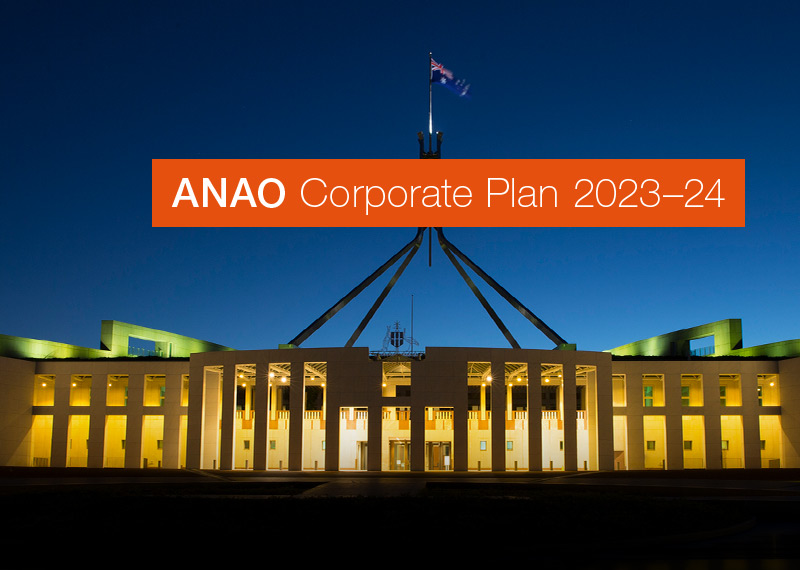
Published: Thursday 6 July 2023
Published
The ANAO Corporate Plan 2023–24 outlines how we intend to deliver against our purpose over the next four years (2023–24 to 2026–27). The corporate plan is the ANAO’s primary planning document – it outlines our purpose; the dynamic environment in which we operate; our commitment to building capability; and the priorities, activities and performance measures by which we will be held to account. The corporate plan is complemented by the annual audit work program, which reflects the ANAO’s audit strategy for the coming year.
This corporate plan was updated on 26 March 2024:
- organisational structure changes — ‘Professional Services and Relationships Group’ to ‘Professional Services Group’
- Measure 3 — change type from ‘Efficiency / Qualitative’ to ‘Efficiency / Quantitative’
- Measure 15, reporting mechanism 4 — replaced text to reflect updated JCPAA feedback process
- Measure 16, reporting mechanism 3 — replaced references to ‘insights’ with ‘lessons’
Contact
Please direct enquiries through our contact page.
Performance audit (Auditor-General Report No. 11 of 2023–24)

Published: Monday 22 January 2024
Published
The objective of this audit was to assess the effectiveness of Geoscience Australia’s 2020 to 2022 procurement of the Southern Positioning Augmentation Network (SouthPAN).
Entity
Geoscience Australia
Contact
Please direct enquiries through our contact page.
Major projects report (Auditor-General Report No. 20 of 2024–25)

Published: Wednesday 18 December 2024
Published
Increased transparency and accountability on progress with major Defence equipment acquisitions has been a focus of parliamentary interest for some time. Beginning in 2007–08, an annual program has been established in conjunction with the Department of Defence to enable the ANAO to review and report to the Parliament on the status of major Defence acquisition projects, as set out in the major projects report. The review includes information relating to the cost, schedule and progress towards delivery of required capability of individual projects as at 30 June each year, and is undertaken at the request of the Joint Committee of Public Accounts and Audit.
Entity
Department of Defence
Contact
Please direct enquiries through our contact page.
Performance audit (Auditor-General Report No. 23 of 2017–18)

Published: Tuesday 19 December 2017
Published
The objective of the audit was to assess whether the contractual arrangements that have been put in place for the delivery of the Moorebank Intermodal Terminal (MIT) will provide value for money and achieve the Australian Government’s policy objectives for the project.
Entity
Moorebank Intermodal Company Limited; Department of Infrastructure and Regional Development; Department of Finance
Contact
Please direct enquiries relating to reports through our contact page.
Major projects report (Auditor-General Report No. 12 of 2022–23)

Published: Thursday 9 February 2023
Published
Increased transparency and accountability on progress with major Defence equipment acquisitions has been a focus of parliamentary interest for some time. Beginning in 2007–08, an annual program has been established in conjunction with the Department of Defence to enable the ANAO to review and report to the Parliament on the status of major Defence acquisition projects, as set out in the Major Projects Report. The review includes information relating to the cost, schedule and progress towards delivery of required capability of individual projects as at 30 June each year, and is undertaken at the request of the Joint Committee of Public Accounts and Audit.
Entity
Department of Defence
Contact
Please direct enquiries through our contact page.
Performance audit (Auditor-General Report No. 44 of 2001–02)
Published: Wednesday 24 April 2002
Published
The audit sought to assess the efficiency and effectiveness of the ADF's management of fuel and lubricants and to identify possible areas for improvement. The audit focused on major aspects of the fuel supply chain, in particular the strategic management of fuel (eg. the coordination of fuel requirements and stockholding policy). The audit also reviewed fuel procurement practices, storage and handling issues. The audit coverage addressed the fuel supply aspects of these matters rather than transport, distribution and equipment issues. Although directed principally towards operational fuels, the audit took into consideration issues associated with ADF's requirement for oils and lubricants.
Entity
Department of Defence
Performance audit (Auditor-General Report No. 36 of 2009–10)
Published: Wednesday 19 May 2010
Published
The scope of the audit covered Centrelink's emergency management framework and community recovery assistance operations in general, with a specific focus on the 2009 North Queensland floods and Victorian bushfires. FaHCSIA's role during those disaster events was also considered as it played a key role in establishing the policy parameters of the services Centrelink delivered and addressing issues arising from policy implementation.
Entity
Centrelink; Department of Families, Housing, Community Services and Indigenous Affairs
Performance audit (Auditor-General Report No. 4 of 2009–10)
Published: Tuesday 15 September 2009
Published
The objective of this audit was to determine whether selected Australian Government organisations had effective processes for managing the annual leave entitlements of their staff, and whether systems and controls over the processing of annual leave were working as intended. In addressing this objective, the audit also assessed progress being made by the audited organisations in implementing the recommendations in ANAO Audit Report No.16 2005-06.
Entity
Australian Bureau of Statistics; Australian Taxation Office; Department of Broadband, Communications and the Digital Economy
Financial statement audit (Auditor-General Report No. 15 of 2015–16)

Published: Thursday 17 December 2015
Published
This report complements the interim phase report published in June 2015, and provides a summary of the final audit results of the audits of the Consolidated Financial Statements for the Australian Government and the financial statements of 253 Australian Government entities.
Entity
Across Entities
Performance audit (Auditor-General Report No. 29 of 2013–14)
Published: Wednesday 7 May 2014
Published
The objective of the audit was to assess the effectiveness of ARPANSA’s management of the regulation of Commonwealth nuclear, radiation facilities and sources, including ARPANSA’s compliance with its legislative requirements.
Entity
Australian Radiation Protection and Nuclear Safety Agency
Contact
Please direct enquiries relating to reports through our contact page.
Performance audit (Auditor-General Report No. 16 of 2019–20)

Published: Wednesday 4 December 2019
Published
The objective of the audit was to examine whether WSA Co Limited’s procurement framework and procurement activities are achieving value for money.
Entity
WSA Co Limited
Contact
Please direct enquiries through our contact page.
Performance audit (Auditor-General Report No. 26 of 1996–97)
Published: Tuesday 11 February 1997
Published
The objective of Phase Two of the audit was to examine the efficiency and effectiveness of operations of ATSIC Central, State and Regional Offices in relation to the administration of the Community Development Employment Projects Scheme. The ANAO established key criteria to assess progress against the implementation of the Phase One recommendations and further assess the efficiency and effectiveness of CDEP administration. The main areas examined were: planning, including reports of progress against plans and the development and use of performance information; monitoring, including client feedback and the review process at the Regional Office level; the implementation and effectiveness of management information systems in relation to CDEP; and the development and implementation of quality assuranced processes at State/Regional level.
Entity
Aboriginal and Torres Strait Islander Commission
Performance audit (Auditor-General Report No. 27 of 2018–19)

Published: Wednesday 20 February 2019
Published
The objective of the audit was to assess the effectiveness of arrangements for monitoring, evaluating and reporting progress towards Closing the Gap in Aboriginal and Torres Strait Islander disadvantage.
Entity
Department of the Prime Minister and Cabinet; Productivity Commission
Contact
Please direct enquiries through our contact page.
Performance audit (Auditor-General Report No. 44 of 2005–06)
Published: Thursday 1 June 2006
Published
The objective of the audit was to examine how effectively Health manages the risk of PBS drugs not being used according to PBS subsidy conditions. The audit examined two areas: during listing, how Health identified and implemented measures to decrease the risks of PBS drugs being used outside subsidy conditions; and following listing, how Health confirmed that usage and expenditure on PBS drugs was consistent with estimates. The report examines selected approaches used by Health, which have evolved in recent years, to manage the risk of PBS drugs being used outside subsidy conditions. The report also acknowledges and describes the role of the expert committees. The scope of the audit was limited to PBS drugs for which Health pays a subsidy. The audit did not examine Health's role in educating consumers, prescribers, and other health professionals, or the implications of the Australia–United States Free Trade Agreement for the PBS. Additionally, the ANAO did not form an opinion on the success of Medicare Australia's compliance role. To form an opinion against the audit objective, the ANAO interviewed Health personnel, committee members and stakeholders, examined relevant documents and files, analysed drug usage and expenditure data, and attended a number of committee meetings. To assist the audit process, the ANAO selected a sample of eight drugs. The drugs were selected due to their high cost to the PBS and/or high usage, or because the drug has had a particularly interesting PBS history. The sample is not representative of all drugs on the PBS. In 2004–05, 15.3 million prescriptions were written for these eight drugs, with the Government subsidy totalling $1.05 billion.
Entity
Department of Health and Ageing
Performance audit (Auditor-General Report No. 7 of 1998–99)
Published: Monday 7 September 1998
Published
The objective of the audit was to determine the extent to which the new employment services market had been implemented effectively and efficiently in accordance with announced Government policy and timeframe.
Entity
Department of Education, Training and Youth Affairs
Insights: Audit lessons

Published: Monday 16 October 2023
Published
The aim of Insights: Audit Lessons (formerly Audit Insights) is to communicate lessons from our audit work and to make it easier for people working within the Australian public sector to apply those lessons.
This edition of Insights: Audit Lessons is targeted at Australian Government officials who are working in governance roles or who have responsibility for ensuring effective oversight and management of probity. Although it is based on audits of financial regulators, the lessons for managing probity risks can be applied across the public sector.
Contact
Please direct enquiries through our contact page.
Performance audit (Auditor-General Report No. 22 of 2020–21)

Published: Thursday 10 December 2020
Published
The audit examined whether the COVID-19 National Medical Stockpile (NMS) procurement requirement was met through effective planning and governance arrangements.
Entity
Department of Health; Department of Industry, Science, Energy and Resources
Contact
Please direct enquiries through our contact page.
Performance audit (Auditor-General Report No. 29 of 1999–2000)
Published: Friday 4 February 2000
Published
The audit objective was to form an opinion on the Department of Veterans' Affairs administration of its activities to maintain and enhance the health and independence of veterans and war widows in their homes and in the community.
Entity
Department of Veterans' Affairs
Performance audit (Auditor-General Report No. 32 of 2002–03)
Published: Wednesday 5 March 2003
Published
This is the third audit report undertaken by the ANAO in response to a request made by the Senate in the Senate Order for Departmental and Agency Contracts, which requires all Financial Management and Accountability Act 1997 (FMA Act) agencies to place on the Internet, lists of contracts of $100 000 and more by the tenth day of the Spring and Autumn sittings of Parliament. It relates to the audit of the contract information to be listed on the Internet by the tenth day of the Autumn 2002 sitting. The audit involved a desktop review of all FMA Act agencies' Internet listings; and a detailed review in six selected agencies, of the process for making the Internet listings, and the policies and practices for determining and identifying whether contracts contained either confidential provisions and other requirements of confidentiality.
Entity
Across Agency
Speeches and papers
Published: Saturday 26 October 1996
Published
Mr P.J. Barrett (AM) - Auditor-General for Australia, presented at the CPA Congress '96 - Profit from our Experience - Melbourne
Performance audit (Auditor-General Report No. 32 of 2024–25)

Published: Wednesday 21 May 2025
Published
The objective of the audit was to assess the effectiveness of the Department of Agriculture, Fisheries and Forestry’s management of the biosecurity workforce.
Entity
Department of Agriculture, Fisheries and Forestry
Contact
Please direct enquiries through our contact page.
Performance audit (Auditor-General Report No. 27 of 2007–08)
Published: Wednesday 16 April 2008
Published
The objective of the audit was to assess how well EMA is meeting its objective of providing national leadership in the development of measures to reduce risk to communities and manage the consequences of disasters.
Entity
Attorney-General's Department
Performance audit (Auditor-General Report No. 52 of 2006–07)
Published: Thursday 28 June 2007
Published
This is the first of two audit reports concerning the Tax Office's administration of SMSFs pursuant to the provisions of the Superannuation Industry (Supervision) Act 1993.
This audit report examines the efficiency and effectiveness of the Tax Office's approach to regulating and registering self managed superannuation funds. Specifically the ANAO examined the:
- Environment in which SMSFs operate, including the Tax Office's regulatory roles and responsibilities;
- Tax Office's governance of its SMSF regulatory role; and
- Systems, processes and controls the Tax Office uses to register SMSFs, and enforce the lodgement of fund income tax and regulatory returns.
Entity
Australian Taxation Office
Speeches and papers
Published: Monday 15 October 2007
Published
Mr Ian McPhee - Auditor-General for Australia, presented at the Australian Institute of Project Management, Hobart
Financial statement audit (Auditor-General Report No. 32 of 2021–22)
Published: Thursday 9 June 2022
Published
This report is the first of the two reports and focuses on the results of the interim audits, including an assessment of entities’ key internal controls, supporting the 2021–22 financial statements audits. This report examines 25 entities, including all departments of state and a number of major Australian government entities. The majority of entities included in the report are selected on the basis of their contribution to the income, expenses, assets and liabilities of the 2020–21 Consolidated Financial Statements.
Contact
Please direct enquiries through our contact page.
Performance audit (Auditor-General Report No. 58 of 2004–05)
Published: Wednesday 29 June 2005
Published
The objective of the audit was to assess the effectiveness of Health's administration of the National Respite for Carers Program.
Entity
Department of Health and Ageing
Performance audit (Auditor-General Report No. 19 of 2013–14)
Published: Wednesday 12 February 2014
Published
The objective of the audit was to assess the effectiveness of the Australian Taxation Office’s (ATO’s) complaints and other feedback management systems in supporting service delivery.
Entity
Australian Taxation Office
Contact
Please direct enquiries relating to reports through our contact page.
Performance audit (Auditor-General Report No. 22 of 2006–07)
Published: Tuesday 6 February 2007
Published
The audit objective was to examine progress in the development of an overarching approach and guidance for the management of the Commonwealth's intellectual property (Recommendation No. 2 of Audit Report No. 25 of 2003–04).
Entity
NO-DEPTS-LISTED
Speeches and papers
Published: Thursday 25 May 2000
Published
Mr P.J. Barrett (AM) - Auditor-General for Australia, presented at the Government in Excellence Summit 2000 - Reinventing Government - A Manifesto for Achieving Excellence and Managing for Results; Singapore
Performance audit (Auditor-General Report No. 40 of 2023–24)

Published: Tuesday 18 June 2024
Published
The objective of this audit was to assess whether the Federal Court of Australia is effectively managing the use of corporate credit cards for official purposes in accordance with legislative and entity requirements.
Entity
Federal Court of Australia
Contact
Please direct enquiries through our contact page.
Performance audit (Auditor-General Report No. 37 of 2001–02)
Published: Friday 15 March 2002
Published
This was a follow-up of Audit Report No. 40 of 1997-98, Purchase of Hospital Services from State Governments. That audit examined the administration by the Department of Veterans' Affairs of the Purchase of Hospital Services from State Governments. The objective of this audit was to assess the extent to which the Department had implemented the nine recommendations of Report No. 40, taking account of any changed circumstances or administrative issues that the Department identified as affecting their implementation; and to offer continued assurance to the Parliament on the management of the purchase of hospital services.
Entity
Department of Veterans' Affairs
Performance audit (Auditor-General Report No. 16 of 2016–17)

Published: Tuesday 13 September 2016
Published
The objective of the audit was to assess whether the Department of Immigration and Border Protection (DIBP) had appropriately managed the procurement of garrison support and welfare services at offshore processing centres in Nauru and Papua New Guinea (Manus Island); and whether the processes adopted met the requirements of the Commonwealth Procurement Rules (CPRs) including consideration and achievement of value for money.
Entity
Department of Immigration and Border Protection
Contact
Please direct enquiries relating to reports through our contact page.
Performance audit (Auditor-General Report No. 49 of 2010–11)
Published: Tuesday 21 June 2011
Published
The objective of the audit was to assess the effectiveness of the ATO’s administration of the Fuel Tax Credits Scheme. Particular emphasis was given to the Fuel Scheme’s governance and reporting arrangements, risk management strategies and compliance management program.
Entity
Australian Taxation Office
Performance audit (Auditor-General Report No. 6 of 2006–07)
Published: Thursday 12 October 2006
Published
The objective of the audit was to assess the extent to which entities were meeting their recordkeeping responsibilities. In particular, the audit examined how effectively the entities were managing records that were created and stored electronically in corporate recordkeeping systems and in other electronic systems in accordance with recordkeeping requirements.
Entity
The Attorney General’s Department; The Australian Electoral Commission; The Department of the Prime Minister and Cabinet
Performance audit (Auditor-General Report No. 10 of 2012–13)
Published: Tuesday 13 November 2012
Published
The objective of the audit was to assess the Department of Health and Ageing’s (DoHA’s) implementation and ongoing management of the Aged Care Complaints Scheme and the effectiveness of DoHA’s complaint management systems in supporting service delivery and regulatory outcomes.
Entity
Department of Health and Ageing
Performance audit (Auditor-General Report No. 23 of 2002–03)
Published: Friday 20 December 2002
Published
Physical Security Arrangements in Commonwealth Agencies, No.23 2002-2003 Protective security involves the total concept of information, personnel, physical, information technology and telecommunications security. The Commonwealth's Protective Security policy is outlined in the Protective Security Manual (PSM). It provides specific guidance to agencies on the protection of the Commonwealth's assets, personnel and clients from potential security threats. This audit evaluated the protective security policies and practices of seven Commonwealth agencies to determine whether they had established an appropriate physical security control framework based on the principles outlined in Part E of the Commonwealth's Protective Security Manual. The ANAO also examined whether agencies had considered the risks of, and developed an appropriate policy statement on, the physical security arrangements for employees who work from home.
Entity
Across Agency
Financial statement audit (Auditor-General Report No. 42 of 2023–24)
Published: Thursday 20 June 2024
Published
The ANAO prepares two reports annually that provide insights at a point in time to the financial statements risks, governance arrangements and internal control frameworks of Commonwealth entities, drawing on information collected during our audits.
This report is the first of the two reports and focuses on the results of the interim financial statements audits, including an assessment of entities’ key internal controls, supporting the 2023–24 financial statements audits. This report examines 27 entities, including all: departments of state; the Department of Parliamentary Services; and other Commonwealth entities that significantly contribute to the revenues, expenses, assets and liabilities within the 2022–23 Australian Government Consolidated Financial Statements (CFS). The National Indigenous Australians Agency is also included in this report given the role it plays working across government with indigenous communities and stakeholders.
Entity
Across Entities
Contact
Please direct enquiries through our contact page.
Audit manual
Updated: Tuesday 9 September 2025
Updated
The shared content volume of the ANAO Audit Manual applies to all assurance activity performed by the ANAO, including financial statements and performance auditing. The shared volume addresses key matters affecting compliance with the Auditor-General Act 1997 and other aspects of the ANAO’s legislative framework. It sets out the main requirements of the ANAO’s overall system of quality control in accordance with ASQC1 Quality Control for Firms that Perform Audits and Reviews of Financial Reports and Other Financial Information, Other Assurance Engagements and Related Services Engagements.
Contact
Please direct enquiries through our contact page.
Performance audit (Auditor-General Report No. 36 of 2024–25)

Published: Monday 26 May 2025
Published
The objective of the audit was to assess the effectiveness of the Australian Taxation Office’s procurement of IT managed services.
Entity
Australian Taxation Office
Contact
Please direct enquiries through our contact page.
Performance audit (Auditor-General Report No. 51 of 2012–13)
Published: Monday 24 June 2013
Published
The objective of the audit was to assess the effectiveness of the Australian Taxation Office’s management of its property portfolio.
Entity
Australian Taxation Office
Contact
Please direct enquiries relating to reports through our contact page.
Financial statement audit (Auditor-General Report No. 8 of 2022–23)
Published: Wednesday 14 December 2022
Published
This report complements the Interim Report on Key Financial Controls of Major Entities financial statement audit report published in June 2022. It provides a summary of the final results of the audits of the Consolidated Financial Statements for the Australian Government and the financial statements of Australian Government entities for the period ended 30 June 2022.
Entity
Across Entities
Contact
Please direct enquiries through our contact page.
Performance audit (Auditor-General Report No. 33 of 2010–11)
Published: Wednesday 23 March 2011
Published
The objective of the audit was to assess the effectiveness of Australian Government agencies' management and implementation of measures to protect and secure their electronic information, in accordance with Australian Government protective security requirements.
Entity
Across agencies
Performance audit (Auditor-General Report No. 41 of 2019–20)

Published: Wednesday 17 June 2020
Published
The objective of this audit was to assess the effectiveness of the design and establishment of the Regional Investment Corporation.
Entity
Across Entities
Contact
Please direct enquiries through our contact page.
Performance audit (Auditor-General Report No. 30 of 2003–04)
Published: Friday 20 February 2004
Published
The objective of this audit was: to form an opinion on the adequacy of selected agencies' approaches to monitoring and evaluation of government programs and services delivered on the Internet; and to identify better practices and opportunities for improvement. In order to achieve this objective, the audit examined the websites and Internet-delivered services of five agencies.
Entity
Across Entities
Performance audit (Auditor-General Report No. 59 of 2002–03)
Published: Friday 27 June 2003
Published
As part of the Government's Taxation Reform Initiatives, the Australian Taxation Office (ATO) was given responsibility for implementing the Australian Business Number (ABN) and Australian Business Register (ABR) initiatives. The objective of the audit was to assess the administrative effectiveness of the ABN registration process and the ATO's implementation and management of the ABR.
Entity
Australian Taxation Office
Performance audit (Auditor-General Report No. 24 of 2022–23)

Published: Tuesday 23 May 2023
Published
The objective of this audit was to assess whether the Department of Defence (Defence) is managing its Australian Defence Force health services contract to achieve efficient and effective delivery of the contracted services.
Entity
Department of Defence
Contact
Please direct enquiries through our contact page.
Performance audit (Auditor-General Report No. 8 of 2012–13)
Published: Wednesday 24 October 2012
Published
The objective of the audit was to assess the effectiveness of FaHCSIA‘s performance of its lead agency role in coordinating whole-of-government commitments to closing the gap in Indigenous disadvantage.
Entity
Department of Families, Housing, Community Services and Indigenous Affairs
Performance audit (Auditor-General Report No. 45 of 2012–13)
Published: Monday 17 June 2013
Published
The audit objective was to assess the administrative effectiveness of the Department of Education, Employment and Workplace Relations(DEEWR), Department of Human Services (DHS) partnership arrangement in supporting the delivery of employment programs.
Entity
Department of Education, Employment and Workplace Relations; Department of Human Services
Contact
Please direct enquiries relating to reports through our contact page.
Speeches and papers
Published: Thursday 22 May 2003
Published
Mr P.J. Barrett (AM) - Auditor-General for Australia, presented to the Queensland Commonwealth Regional Heads Forum 15th Annual Government Business Conference
Performance audit (Auditor-General Report No. 48 of 2012–13)
Published: Wednesday 19 June 2013
Published
The objective of the audit was to assess the effectiveness of the Department of Families, Housing, Community Services and Indigenous Affairs' (FaHCSIA) administration and management of the Targeted Community Care (Mental Health) Program.
Entity
Department of Families, Housing, Community Services and Indigenous Affairs
Contact
Please direct enquiries relating to reports through our contact page.
Performance audit (Auditor-General Report No. 19 of 2010–11)
Published: Thursday 9 December 2010
Published
The audit assessed FaHCSIA's management of AACAP and how the department monitors the contribution the program is making to the improvement of primary and environmental health, and living conditions, in remote Indigenous communities.
The audit examined program delivery under the 2006–2009 MoU, as well as the planning for the 2010 project under the variation to the 2006–2009 MoU. As part of the audit the ANAO considered:
- program strategy and implementation including the roles and responsibilities of the major stakeholders, community selection and scope of works (Chapter 2);
- the financial management of the program and the changing role of the Contracted Program Manager (Chapter 3); and
- performance measures, including FaHCSIA's performance reporting framework, and approach to monitoring and reporting performance against the stated program objectives (Chapter 4).
The audit focused on AACAP in so far as it relates to Indigenous community outcomes. It did not consider the program from the perspective of the Australian Defence Force capability building.
Entity
Department of Families, Housing, Community Services and Indigenous Affairs
Performance audit (Auditor-General Report No. 40 of 2003–04)
Published: Tuesday 13 April 2004
Published
The objective of the audit was to assess the effectiveness of Health's management of the MPSP and the RHSP. To achieve the audit's objective, the ANAO examined whether Health; had an effective approach to planning the programs; had an effective approach to delivering the programs; effectively used performance information to manage the programs; and effectively managed its relationship with all stakeholders of the programs.
Entity
Department of Health and Ageing
Corporate

Published: Monday 8 July 2024
Published
The ANAO Corporate Plan 2024–25 updates the previous corporate plan and outlines how we intend to deliver against our purpose over the next four years (2024–25 to 2027–28). The corporate plan is the ANAO’s primary planning document — it outlines our purpose; the dynamic environment in which we operate; our commitment to building capability; and the priorities, activities and performance measures by which we will be held to account.
Contact
Please direct enquiries through our contact page.
Performance audit (Auditor-General Report No. 31 of 2018–19)

Published: Tuesday 26 March 2019
Published
The objective of the audit was to assess whether the Department of Defence’s Projects of Concern regime is effective in managing the recovery of underperforming projects.
Entity
Department of Defence
Contact
Please direct enquiries through our contact page.
Performance audit (Auditor-General Report No. 18 of 2000–01)
Published: Thursday 30 November 2000
Published
The audit assessed the management by ISR and, in particular, by AusIndustry of the implementation of the changes arising from the Government's December 1997 policy statement in Investing for Growth. This statement required ISR to separate administration of policy from the delivery of products and to improve its service to customers through a ‘one stop shop' approach and by streamlining its processes. The audit focussed in particular on the overall strategic management of the change process by AusIndustry; the detailed implementation of the new service delivery arrangements, notably the separation of policy and product delivery; and the implementation of the enhanced customer focus.
Entity
Department of Industry, Science and Resources
Performance audit (Auditor-General Report No. 36 of 2012–13)
Published: Tuesday 21 May 2013
Published
The objective of the audit was to assess the effectiveness of the Commonwealth Environmental Water Office’s administration of environmental water holdings.
Entity
Department of Sustainability, Environment, Water, Population and Communities
Contact
Please direct enquiries relating to reports through our contact page.
Financial statement audit (Auditor-General Report No. 20 of 2019–20)
Published: Tuesday 17 December 2019
Published
This report complements the Interim Report on Key Financial Controls of Major Entities financial statement audit report published in June 2019. It provides a summary of the final results of the audits of the Consolidated Financial Statements for the Australian Government and the financial statements of Australian Government entities for the period ended 30 June 2019.
Contact
Please direct enquiries through our contact page.
Performance audit (Auditor-General Report No. 23 of 1999–2000)
Published: Monday 20 December 1999
Published
The objectives of this audit were to improve: the accountability of the Australian Taxation Office to Parliament and the Government by the provision of advice that follows up on the ATO's implementation of the previous ANAO Report; and on the recommendations of the then Joint Committee of Public Accounts arising from its consideration of that Report and the efficiency, effectiveness and equity of debt collection by the ATO.
Entity
Australian Taxation Office
Performance audit (Auditor-General Report No. 56 of 2003–04)
Published: Thursday 24 June 2004
Published
The objective of this audit was to assess the extent to which PV applications in Australia are processed in accordance with relevant laws and policies, and whether DIMIA employs appropoiate mechanisms to ensure compliance with those laws and policies.
Entity
Department of Immigration and Multicultural and Indigenous Affairs
Performance audit (Auditor-General Report No. 49 of 2023–24)

Published: Thursday 27 June 2024
Published
The objective of this audit was to assess the effectiveness of the Australian Research Council’s (ARC) management of corporate credit cards.
Entity
Australian Research Council
Contact
Please direct enquiries through our contact page.
Performance audit (Auditor-General Report No. 54 of 2003–04)
Published: Friday 18 June 2004
Published
The objective of the audit was to assess the effectiveness of DIMIA's management of its detention agreements with ACM to operate Australia's mainland immigration detention centres. In particular, the ANAO examined: DIMIA's strategic approach to the management and coordination of the contract; how DIMIA defined the services to be delivered by ACM; the systems in place to monitor and report against contract performance; the effectiveness of controls over contract payment arrangements; and DIMIA's management of infrastructure through the detention agreements.
Entity
Department of Immigration and Multicultural and Indigenous Affairs
Performance audit (Auditor-General Report No. 27 of 2010–11)
Published: Thursday 10 February 2011
Published
The audit examined key aspects of the first four tenders for the RtB program. These tenders provided coverage across the Basin and resulted in expenditure in excess of $1 billion. The 2008–09 tenders included the largest single purchase under the program—$303 million to Twynam Agricultural Group. The audit also examined the Commonwealth's contribution to the purchase of Toorale station, the only purchase outside a tender process.
Entity
Department of Sustainability, Environment, Water, Population and Communities
Performance audit (Auditor-General Report No. 23 of 2010–11)
Published: Tuesday 21 December 2010
Published
The objective of the audit was to assess the administrative effectiveness of FaHCSIA's and IBA's management of the HOIL program. In particular, the audit examined the administrative design of the program, its implementation and progress in achieving the expected results.
Entity
Department of Families, Housing, Community Services & Indigenous Affairs; Indigenous Business Australia
Performance audit (Auditor-General Report No. 42 of 2017–18)

Published: Thursday 24 May 2018
Published
The objective of the audit was to examine the effectiveness of monitoring and payment arrangements under National Partnership Agreements.
Entity
Across Entities
Contact
Please direct enquiries through our contact page.
Performance audit (Auditor-General Report No. 46 of 2003–04)
Published: Thursday 20 May 2004
Published
The objective of the audit was to examine and report on the economy, efficiency and effectiveness of the courts' client service arrangements for family law clients. The audit also assessed the effectiveness of the coordination between the two courts, and of their administration of Primary Dispute Resolution (PDR) services.
Entity
Family Court of Australia; Federal Magistrates Court
Performance audit (Auditor-General Report No. 2 of 2009–10)
Published: Monday 7 September 2009
Published
As an element of the arrangements implemented to support the role of the ANAO in reviewing campaigns' compliance with the Guidelines announced on 2 July 2008, the ANAO advised the chair of the JCPAA that the ANAO will provide regular summary reports to Parliament. Section 25 of the Auditor-General's Act 1997 provides for the tabling of such reports.
Entity
Across Agencies
Performance audit (Auditor-General Report No. 34 of 2008–09)
Published: Wednesday 20 May 2009
Published
The objective of the audit was to assess the administrative effectiveness of the Tax Office's strategies to address serious non-compliance. In conducting the audit, the ANAO examined the Tax Office's management framework and arrangements to deter, detect and deal with fraud and serious evasion.
Entity
Australian Taxation Office
Performance audit (Auditor-General Report No. 18 of 2020–21)

Published: Thursday 26 November 2020
Published
The objective of the audit was to assess the effectiveness and value for money to date of the Department of Defence’s acquisition of combat reconnaissance vehicles under project Land 400 Phase 2.
Entity
Department of Defence
Contact
Please direct enquiries through our contact page.
Performance audit (Auditor-General Report No. 5 of 2002–03)
Published: Friday 23 August 2002
Published
The audit examined the administrative effectiveness of arrangements between Health and HIC, in relation to the management and administration of the Medicare Benefits Scheme and the Pharmaceutical Benefits Scheme. Health predominantly exercises a policy and leadership role within the health portfolio - HIC delivers a range of health services directly to the public and members of the health industry. Both agencies have stated that they recognise the importance of working together, as partners in their respective roles, to maximise their performance in the achievement of health portfolio outcomes and to discharge their respective responsibilities. This joint commitment is embodied in a written agreement - called the Strategic Partnership Agreement (SPA).
Entity
Department of Health and Aged Care; Health Insurance Commission
Performance audit (Auditor-General Report No. 3 of 2011–12)
Published: Tuesday 30 August 2011
Published
The objective of this audit is to examine the effectiveness of the TGA’s administration of complementary medicines regulation in Australia. The primary focus is on listed complementary medicines, which comprise about 98 per cent of these medicines.
Entity
Department of Health and Ageing
Performance audit (Auditor-General Report No. 57 of 2010–11)
Published: Tuesday 28 June 2011
Published
The objective of the audit was to report on the effectiveness of Defence’s approach to the acceptance into service of Navy capability, and to identify where better practice may be used by CDG, DMO and Navy.
Entity
Department of Defence; Defence Materiel Organisation
Performance audit (Auditor-General Report No. 52 of 2012–13)
Published: Tuesday 25 June 2013
Published
The objective of the audit was to assess the effectiveness of the Australian Taxation Office’s administration of debt relief arrangements.
Entity
Australian Taxation Office
Contact
Please direct enquiries relating to reports through our contact page.
Performance audit (Auditor-General Report No. 8 of 2003–04)
Published: Monday 20 October 2003
Published
The audit is a follow-up of ANAO Audit Report No.33 of 1997-98, which assessed the effectiveness and efficiency of the Commonwealth's management of the Great Barrier Reef and made seven recommendations for improvement. The objective of the follow-up audit was to assess the extent to which the Great Barrier Reef Marine Park Authority, which is responsible for advising the Commonwealth on the care and developement of the Marine Park, has implemented the recommendations of the earlier audit.
Entity
The Great Barrier Reef Marine Park Authority
Financial statement audit (Auditor-General Report No. 22 of 2024–25)
Published: Thursday 6 February 2025
Published
This report complements the Interim Report on Key Financial Controls of Major Entities financial statement audit report published in June 2024. It provides a summary of the final results of the audits of the Consolidated Financial Statements for the Australian Government and the financial statements of Australian Government entities for the period ended 30 June 2024.
Entity
Across Entities
Contact
Please direct enquiries through our contact page.
Performance audit (Auditor-General Report No. 14 of 2004–05)
Published: Friday 5 November 2004
Published
The objectives of the audit were to determine whether: citizenship services were planned based on a risk assessment, especially in relation to fraud; and were monitored and reported on appropriately; decision-making was accurate, consistent and in line with relevent laws and policies and was supported by appropriate training and quality assurance (QA) mechanisms; client and outsourced services were managed effectively; and promotion strategies were effective and have been evaluated appropriately.
Entity
Department of Immigration and Multicultural Affairs
Performance audit (Auditor-General Report No. 37 of 2007–08)
Published: Tuesday 3 June 2008
Published
The objective of this audit was to assess whether agencies had effectively administered credit cards, including having complied with legislative and internal requirements.
Entity
NO-DEPTS-LISTED
Performance audit (Auditor-General Report No. 34 of 2006–07)
Published: Tuesday 1 May 2007
Published
The objective of the audit was to assess the effectiveness of the management by Defence and the DMO of the procurement of the modernised High Frequency communication capability for the ADF. The audit focussed on Phase 3A of the Project which commenced in the mid 1990's and involved the selection of the Prime Contractor; negotiation of the Prime Contract and the Network Operation and Support Contract; and the development and implementation of the Communication System.
Entity
Defence Materiel Organisation
Performance audit (Auditor-General Report No. 23 of 2024–25)

Published: Wednesday 12 February 2025
Published
The audit objective was to assess the effectiveness of the department’s strategic procurement of water entitlements to meet the Bridging the Gap target under the Basin Plan.
Entity
Department of Climate Change, Energy, the Environment and Water
Contact
Please direct enquiries through our contact page.
Performance audit (Auditor-General Report No. 4 of 2013–14)
Published: Thursday 26 September 2013
Published
The audit objective was to assess the appropriateness of the use and reporting of confidentiality provisions in Australian Government contracts for the 2012 calendar year reporting period.
Entity
Attorney-General's Department; Australian Transaction Reports and Analysis Centre; ComSuper; Department of Health and Ageing
Contact
Please direct enquiries relating to reports through our contact page.
Performance audit (Auditor-General Report No. 46 of 2008–09)
Published: Thursday 25 June 2009
Published
The objectives of this audit were to:
- assess the current status of BCM and EM arrangements in Centrelink and identify opportunities for improvement; and
- review Centrelink's response to the recommendations.
Entity
Centrelink
Speeches and papers
Published: Saturday 21 August 2004
Published
Mr P.J. Barrett (AM) - Auditor-General for Australia, Address to the Challenge of Change : Driving Governance and Accountability CPA Forum 2004
Performance audit (Auditor-General Report No. 22 of 2008–09)
Published: Tuesday 17 February 2009
Published
The objective of the audit was to review the effectiveness and efficiency of Centrelink's customer feedback system and the progress Centrelink had made in implementing the recommendations of the 2004–05 audit and the subsequent JCPAA inquiry.
Entity
Centrelink
Performance audit (Auditor-General Report No. 16 of 2009–10)
Published: Wednesday 16 December 2009
Published
The objective of the audit was to assess the ACMA's effectiveness in operating, managing and monitoring the Register, including compliance with legislative requirements.
Entity
The Australian Communications and Media Authority
Performance audit (Auditor-General Report No. 28 of 2012–13)
Published: Tuesday 23 April 2013
Published
The Australian National Audit Office has undertaken a pilot project to assess the status of the Australian Government performance measurement and reporting framework as a basis for implementation of a future program of audits of entities’ key performance indicators, and to develop a suitable audit methodology. This report presents a summary of the work completed to date.
Entity
Across Agencies
Performance audit (Auditor-General Report No. 20 of 1999–2000)
Published: Monday 22 November 1999
Published
Special Benefit is a social security income support payment for people who are unable to support themselves or their dependents, and who are not otherwise entitled to any other income support payment. Its objective is to ensure that such people have adequate levels of income. The objective of the audit was to assess the extent to which new claims for Special Benefit had been determined in compliance with the Social Security Act, the Guide to the Act and other relevant guidelines, and whether Centrelink and FaCS had appropriate procedures to help ensure such compliance.
Entity
Centrelink; Department of Family and Community Services