Browse our range of reports and publications including performance and financial statement audit reports, assurance review reports, information reports and annual reports.
Performance audit (Auditor-General Report No. 1 of 2017–18)

Published: Monday 10 July 2017
Published
The objective of the audit was to assess the effectiveness of the Department of the Environment and Energy’s arrangements for the preparation and reporting of Australia’s greenhouse gas emissions estimates and projections.
Entity
Department of the Environment and Energy
Contact
Please direct enquiries relating to reports through our contact page.
Request for audit
Responded: Thursday 24 September 2015
Response provided
The Auditor-General (A/g) responded on 24 September 2015 to correspondence from the Hon Warren Truss MP on 18 September 2015 regarding probity and conflict of interest arrangements in place for the OneSKY Australia programme being led by Airservices Australia.
Contact
Please direct enquiries relating to requests for audit through our contact page.
Speeches and papers
Published: Friday 24 March 2023
Published
The ANAO provided an article to the March 2023 edition of the PASAI newsletter on the development of a methodology for auditing ethics. The article was titled SAI Australia develops methodology for auditing ethics.
Contact
Please direct enquiries through our contact page.
Performance audit (Auditor-General Report No. 44 of 2021–22)

Published: Wednesday 29 June 2022
Published
The objective of the audit was to examine the effectiveness of Services Australia’s arrangements for the management of contractors.
Entity
Services Australia
Contact
Please direct enquiries through our contact page.
Performance audit (Auditor-General Report No. 28 of 2022–23)

Published: Wednesday 31 May 2023
Published
The objective of this audit was to assess the effectiveness of Services Australia's management of social security and welfare debt.
Entity
Services Australia
Contact
Please direct enquiries through our contact page.
Performance audit (Auditor-General Report No. 12 of 2025–26)

Published: Tuesday 9 December 2025
Published
The objective of the audit was to assess the effectiveness of Services Australia’s management of the privacy of client information.
Entity
Services Australia
Contact
Please direct enquiries through our contact page.
Performance audit (Auditor-General Report No. 2 of 2008–09)
Published: Wednesday 6 August 2008
Published
The objective of this audit was to assess the effectiveness of Tourism Australia's governance arrangements, the management of its marketing contracts, and whether outcomes are being achieved. The audit reviewed Tourism Australia's:
- procurement processes for selecting service providers;
- management of service provider contracts; and
- governance framework including planning, performance management and reporting.
Entity
Tourism Australia
Performance audit (Auditor-General Report No. 22 of 2009–10)
Published: Thursday 11 February 2010
Published
The objective of the audit was to assess how effectively Geoscience Australia provides geoscientific and geospatial information and services to assist the Australian Government and key stakeholders. Particular emphasis was given to:
- the collection and management of geoscientific and geospatial data and information, including accessibility;
- the provision of products and services; and
- governance arrangements.
The ANAO examined a number of datasets and product and service projects to assess Geoscience Australia's performance in providing geoscientific and geospatial information and services.
Entity
Geoscience Australia
Performance audit (Auditor-General Report No. 11 of 2017–18)

Published: Thursday 28 September 2017
Published
The objective of this audit was to examine whether the Australian Postal Corporation (Australia Post) is meetings its Community Service and International obligations efficiently and the effectiveness of Commonwealth shareholders in monitoring value for money.
Entity
Australian Postal Corporation (Australia Post); Department of Finance; Department of Communications and the Arts
Contact
Please direct enquiries relating to reports through our contact page.
Performance audit (Auditor-General Report No. 21 of 2025–26)

Published: Thursday 29 January 2026
Published
The objective of the audit was to assess whether Services Australia has effective arrangements to comply with domestic and international travel requirements.
Entity
Services Australia
Contact
Please direct enquiries through our contact page.
Performance audit (Auditor-General Report No. 30 of 2019–20)

Published: Thursday 2 April 2020
Published
The objective of this audit was to examine the effectiveness of bilateral agreement arrangements between Services Australia and other entities.
Entity
Across Entities
Contact
Please direct enquiries through our contact page.
Performance audit (Auditor-General Report No. 36 of 2010–11)
Published: Thursday 14 April 2011
Published
The audit objective was to assess the effectiveness of CRS Australia’s delivery of Disability Management Services. In assessing CRS Australia’s performance, the ANAO examined whether:
- services are delivered in accordance with CRS Australia’s operating procedures, which incorporate the Disability Services Standards and the requirements of the DEEWR MOU;
- CRS Australia has an effective client feedback (including complaints) system, which is used to identify and address business risks and areas for improving service delivery; and
- sound governance arrangements (including performance monitoring and reporting) are in place to monitor service delivery.
The audit did not specifically examine issues and information relating to the commercial nature of the business, such as profitability levels and competitive neutrality arrangements.
Entity
Department of Human Services
Performance audit (potential)
Potential audit: 2025-26
Potential
This audit would assess the effectiveness of Services Australia’s processes to ensure that payments are made in accordance with the law.
Services Australia delivers a wide range of services and payments on behalf of other Australian Government entities, including social security, child support, student payments, family assistance, aged care, and health programs. Services Australia operates under a legal framework that includes various pieces of legislation and regulatory commitments including the Human Services (Centrelink) Act 1997, Child Support (Registration and Collection) Act 1988, Child Support (Assessment) Act 1989, Public Governance, Performance and Accountability Act 2013, and the Commonwealth Fraud Control Framework. Services Australia operates a compliance program that aims to maintain the integrity of Australia’s welfare system and ensure that all operations are conducted within the legal framework. Components of the approach include payment reviews, data-matching and data mining, investigations, and various compliance activities, including identity checks and educating customers about their rights and obligations to support voluntary compliance.
Entity
Services Australia
Contact
Please direct enquiries through our contact page.
Performance audit (Auditor-General Report No. 3 of 2012–13)
Published: Wednesday 19 September 2012
Published
The objective of the audit was to assess the effectiveness of Regional Australia’s management of the design and implementation of the first application round of the RDAF program.
The establishment of a new infrastructure program to fund projects identified by Regional Development Australia committees in regional areas was one of the initiatives established to deliver on the Government's September 2010 agreement with the Independent Members for Lyne and New England. The program was to fund projects that support the infrastructure needs and economic and community growth of Australia’s regions.
Entity
Department of Regional Australia, Local Government, Arts and Sport
Performance audit (Auditor-General Report No. 47 of 2016–17)

Published: Thursday 27 April 2017
Published
The objective of this audit was to assess the effectiveness to date of the implementation of the Tourism 2020 strategy by the Australian Trade and Investment Commission (Austrade) and Tourism Australia.
Entity
Australian Trade and Investment Commission (Austrade); Tourism Australia
Contact
Please direct enquiries relating to reports through our contact page.
Performance audit (Auditor-General Report No. 7 of 2017–18)

Published: Tuesday 22 August 2017
Published
The audit objective was to determine whether selected grant programs are being administered efficiently by the Australia Council in relation to suitable comparators. The selected grant programs are collectively known as the Australia Council Grants Program.
Entity
Australia Council; Department of Social Services; National Health and Medical Research Council
Contact
Please direct enquiries relating to reports through our contact page.
Performance audit (Auditor-General Report No. 31 of 2019–20)

Published: Thursday 9 April 2020
Published
The objective of the audit was to assess whether Defence Housing Australia administers its functions efficiently and effectively, and in accordance with the Government Business Enterprise guidelines.
Entity
Defence Housing Australia; Department of Defence; Department of Finance
Contact
Please direct enquiries through our contact page.
Performance audit (Auditor-General Report No. 16 of 1998–99)
Published: Monday 23 November 1998
Published
The primary objective of the audit was to assess the economy, efficiency and effectiveness of DoTRD's implementation of Annex 17 in the Australian aviation environment. The ANAO concluded that DoTRD has established a regulatory regime which ensures Australia's compliance with the standards embodied in Annex 17. However, there are areas where Australia's aviation security regime can be strengthened even further including; developing a more robust approach to risk management, developing a longer-term perspective to DoTRD's planning structure, development of proactive alliances with aviation regulators in neighbouring countries in the Asia-Pacific region, further improvement of the airport audit process, development and implementation of an evaluation strategy, development of a formal transparent approach to enforcement.
Entity
Department of Transport and Regional Services
Performance audit (Auditor-General Report No. 39 of 2009–10)
Published: Monday 24 May 2010
Published
The objective of this audit was to examine the effectiveness of Medicare Australia's administration of the PBS. In assessing the objective, the audit considered three key areas:
- Medicare Australia's relationship with the PBS policy agency (DoHA) and service delivery policy agency (Department of Human Services (DHS));
- the management arrangements and processes underpinning Medicare Australia's delivery of the PBS (including the means by which Medicare Australia gains assurance over the integrity of the PBS); and
- how Medicare Australia undertakes its three main responsibilities relating to the delivery of the PBS, namely: approving pharmacies; approving authority prescriptions; and processing PBS claims.
Entity
Medicare Australia; Department of Human Services; Department of Health and Ageing
Performance audit (Auditor-General Report No. 7 of 2023–24)

Published: Monday 27 November 2023
Published
The objective of the audit was to assess the effectiveness of the establishment of the Workforce Australia Services panel.
Entity
Department of Employment and Workplace Relations
Contact
Please direct enquiries through our contact page.
Request for audit
Responded: Friday 18 May 2018
Response provided
The Auditor-General responded on 19 April 2017, and followed-up on 19 July 2017 and 18 May 2018, to correspondence from the Hon. Wayne Swan MP dated 27 March 2017, requesting that the Auditor-General conduct an investigation to examine the operation of the Northern Australia Infrastructure Facility (NAIF), its independence and the quality of the systems and analyses being implemented.
Contact
Please direct enquiries relating to requests for audit through our contact page.
Request for audit
Responded: Wednesday 19 July 2017
Response provided
The Acting Auditor-General responded on 11 May 2017, and the Auditor-General followed-up on 19 July 2017, to correspondence from Ms Cathy McGowan AO MP dated 10 April 2017. Ms McGowan had requested that the Auditor-General conduct an audit of the Regional Australia Impact Statement process, which is administered by the Department of Infrastructure and Regional Development.
Contact
Please direct enquiries relating to requests for audit through our contact page.
Performance audit (Auditor-General Report No. 45 of 2022–23)

Published: Thursday 29 June 2023
Published
The objective of this audit was to examine the effectiveness of the Department of Defence’s development and implementation of Australia’s approach to providing military assistance to the Government of Ukraine.
Entity
Department of Defence
Contact
Please direct enquiries through our contact page.
Performance audit (Auditor-General Report No. 18 of 2024–25)

Published: Monday 16 December 2024
Published
The audit objective was to assess whether Tourism Australia’s procurement and contract management activities are complying with the Commonwealth Procurement Rules and demonstrating the achievement of value for money.
Entity
Tourism Australia
Contact
Please direct enquiries through our contact page.
Speeches and papers
Published: Thursday 10 November 2005
Published
Mr Ian McPhee - Auditor-General for Australia, presented to the CPA Australia
Speeches and papers
Published: Monday 4 May 2015
Published
Mr Mr Ian McPhee, AO PSM - Auditor-General for Australia, reflected on his 10 years as Auditor-General for Australia during a presentation to the Australasian Council of Public Accounts Committees in Adelaide, South Australia
Performance audit (Auditor-General Report No. 33 of 2018–19)

Published: Wednesday 10 April 2019
Published
The objective of the audit was to examine the effectiveness of governance and integrity arrangements for the Northern Australia Infrastructure Facility (NAIF).
Entity
Northern Australia Infrastructure Facility
Contact
Please direct enquiries through our contact page.
Performance audit in-progress

Due to table: June 2026
Report preparation
The objective of this audit is to assess whether IP Australia’s use of artificial intelligence (AI) and automated decision-making systems in the patent examination process is effective.
Entity
IP Australia
Contact
Please direct enquiries through our contact page.
Performance audit (Auditor-General Report No. 36 of 2021–22)

Published: Monday 20 June 2022
Published
The objective of the audit was to assess the effectiveness of the governance board in Hearing Australia.
Entity
Hearing Australia
Contact
Please direct enquiries through our contact page.
Performance audit (Auditor-General Report No. 27 of 2009–10)
Published: Tuesday 20 April 2010
Published
The objective of this audit was to assess the coordination of Australian, State and Territory Government climate change programs and the integrity of measuring and reporting of Australia's greenhouse gas emissions and abatement. Particular emphasis was given to the:
- coordination of Australian Government and State/Territory climate change programs;
- integrity of the national inventory to measure Australia's greenhouse gas emissions; and
- integrity of measuring and reporting government abatement measures.
Entity
Department of Climate Change and Energy Efficiency; Department of Innovation, Industry, Science and Research
Performance audit (Auditor-General Report No. 45 of 2024–25)

Published: Thursday 19 June 2025
Published
The objective of the audit was to assess the effectiveness of Creative Australia’s fraud and corruption control arrangements.
Entity
Creative Australia
Contact
Please direct enquiries through our contact page.
Speeches and papers
Published: Friday 12 March 2004
Published
Mr P.J. Barrett (AM) - Auditor-General for Australia, presented to the Institute of Chartered Accountants of India
Performance audit (Auditor-General Report No. 15 of 2001–02)
Published: Tuesday 2 October 2001
Published
In August 1997, Works Australia, a former business unit of the former Department of Administrative Services,was sold by the then Office of Asset Sales (OAS). For a price of $4.2 million, the purchaser acquired the assets of Works Australia and accepted certain liabilities. At the time the sale was completed, Works Australia held $43.7 million in cash belonging to Commonwealth agencies (known as client advances). ANAO programmed an audit to examine oversight of the post-sale contractual arrangements for each of the 307 Commonwealth client advances totalling $43.7 million transferred to the purchaser and found that the $43.7 million in client advances transferred to the purchaser of Works Australia in August 1997 has been effectively accounted for as of July 2001 by the Commonwealth agencies concerned. In addition, the relevant financial security arrangements over the Works Australia client advances have been effectively administered in accordance with the terms and conditions of the Works Australia Sale Agreement by Finance.
Entity
Across Agency
Performance audit (Auditor-General Report No. 5 of 2017–18)

Published: Tuesday 8 August 2017
Published
The audit objective is to examine the effectiveness of measures taken to strengthen the protection of Australia’s missions and staff overseas.
Entity
Department of Foreign Affairs and Trade
Contact
Please direct enquiries relating to reports through our contact page.
Request for audit
Responded: Tuesday 5 July 2022
Response provided
The Auditor-General responded on 5 July 2022 to correspondence from the Hon Richard Marles MP dated 31 May 2022, requesting that the Auditor-General conduct an investigation to review the Workforce Australia procurement processes.
Contact
Please direct enquiries relating to requests for audit through our contact page.
Performance audit in-progress

Due to table: June 2026
Report preparation
The objective of this audit is to assess the effectiveness of the Department of the Treasury’s (Treasury) design and delivery of the Housing Australia Future Fund.
Entity
Department of the Treasury
Contact
Please direct enquiries through our contact page.
Performance audit (potential)
Potential audit: 2025-26
Potential
This audit would assess the effectiveness and efficiency of cost recovery activities conducted by IP Australia. Areas to be examined would be cost recovery models used by IP Australia, including business processes, fee structures, how this links to the delivery of its business and how IP Australia ensures arrangements remain fit for purpose with changes to its operating environment. Following the Productivity Commission inquiry in 2016 and the government’s response, IP Australia has completed two fee reviews. In 2023–24 IP Australia recovered more than 98 per cent of its costs by charging for its services.
Entity
IP Australia
Contact
Please direct enquiries through our contact page.
Performance audit (Auditor-General Report No. 33 of 1996–97)
Published: Thursday 15 May 1997
Published
The objectives of the audit were to examine and evaluate the efficiency, economy and administrative effectiveness of the non-judicial activities of the Family Court of Australia. A major aim of the audit was to identify administrative better practices that could be promulgated throughout the Court. The criteria for the audit address the following issues: corporate planning; performance measurement; organisational structure; human resource management; human resource development; management information and reporting systems; and operational processes and procedures.
Entity
Across Agency
Performance audit (Auditor-General Report No. 46 of 2011–12)
Published: Wednesday 20 June 2012
Published
The objective of the audit was to assess the effectiveness of the Department of Agriculture, Fisheries and Forestry’s administration of the Northern Australia Quarantine Strategy. The ANAO examined whether the department had established effective:
- administrative and governance arrangements to support NAQS;
- processes for identifying biosecurity risks and conducting scientific activities to address identified risks;
- arrangements for managing the quarantine aspects of Torres Strait border movements; and
- public awareness activities that reflect identified biosecurity risks and support the program’s objectives.
Entity
Department of Agriculture, Fisheries and Forestry
Performance audit (Auditor-General Report No. 6 of 2007–08)
Published: Tuesday 11 September 2007
Published
The objective of this audit was to examine Australia's preparedness to respond to a human influenza pandemic and an outbreak of avian influenza in domestic poultry. The audit assessed:
- the whole of government arrangements for an influenza pandemic;
- action taken by DAFF to implement the recommendations from Exercise Eleusis, which tested the response arrangements for avian influenza;
- DoHA's planning for, and execution of, Exercise Cumpston, which tested the preparedness and response to an influenza pandemic; and
- the establishment, management and deployment arrangements of the National Medical Stockpile.
Entity
Department of Health and Ageing; Department of Agriculture, Fisheries and Forestry
Performance audit (Auditor-General Report No. 7 of 2013–14)
Published: Thursday 31 October 2013
Published
The objective of the audit was to assess the effectiveness of Australia’s arrangements to meet its treaty obligations under three selected treaties:
- International Convention on Civil Liability for Bunker Oil Pollution Damage 2001;
- Agreement between Australia and the International Atomic Energy Agency for the Application of Safeguards in connection with the Treaty on the Non-Proliferation of Nuclear Weapons of 1 July 1968 and Additional Protocol; and
- Convention on the Rights of the Child 1990.
Entity
Across Agencies
Contact
Please direct enquiries relating to reports through our contact page.
Performance audit (Auditor-General Report No. 15 of 2010–11)
Published: Thursday 18 November 2010
Published
The objective of the audit was to assess FSANZ's administration of its food standard functions, as specified in the Food Standards Australia New Zealand Act, 1991 (last amended 2007).
Particular emphasis was given to whether:
- FSANZ's performance management and reporting provided effective support and ensures accountability;
- FSANZ effectively administered its food standard development and variation function, including its stakeholder management; and
- FSANZ effectively monitored the implementation of its standards and coordinates relevant jurisdictions to address market failures.
Entity
Food Standards Australia New Zealand
Performance audit (Auditor-General Report No. 23 of 2018–19)

Published: Thursday 17 January 2019
Published
The objective of this audit was to assess the extent to which the Department of Agriculture and Water Resources (Agriculture) has addressed the recommendations from ANAO Audit Report No. 46 of 2011–12, Administration of the Northern Australia Quarantine Strategy (NAQS).
Entity
Department of Agriculture and Water Resources
Contact
Please direct enquiries through our contact page.
Performance audit (Auditor-General Report No. 36 of 2020–21)

Published: Friday 7 May 2021
Published
The objective of this audit was to assess the effectiveness and efficiency of Indigenous Business Australia’s (IBA's) management of its business support and investment activities.
Entity
Indigenous Business Australia
Contact
Please direct enquiries through our contact page.
Insights: Audit practice
Published: Wednesday 17 May 2017
Published
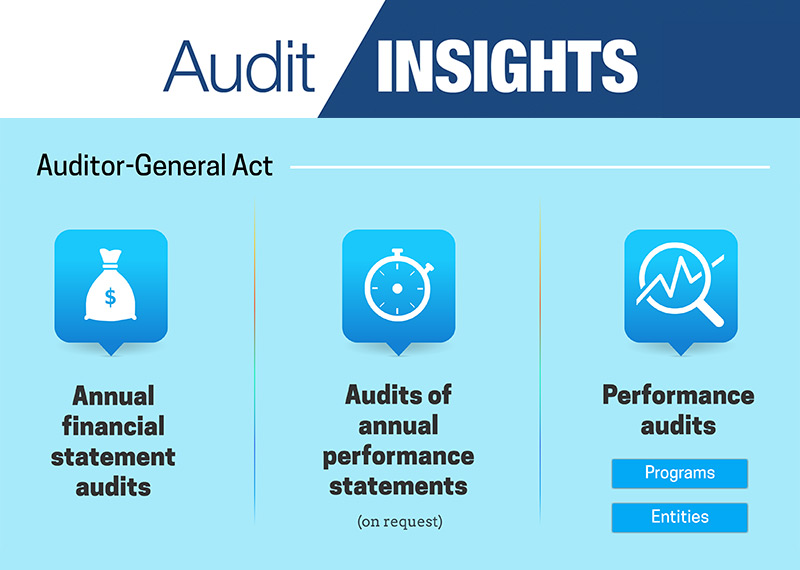
In this inaugural edition of audit insights, we look at the history and mandate of the Auditor-General of Australia, the functions delivered under the Auditor-General Act, the purpose of the Australian National Audit Office (ANAO) and our relationship with the Australian Parliament.
Contact
Please direct enquiries relating to audit insights through our contact page.
Request for audit
Responded: Wednesday 6 April 2016
Response provided
The Auditor-General responded on 6 April 2016 to correspondence from Senator Hanson-Young on 30 March 2016 regarding Refugee resettlement deal established between the Commonwealth Government of Australia and the Kingdom of Cambodia in September of 2014.
Contact
Please direct enquiries relating to requests for audit through our contact page.
Speeches and papers
Published: Friday 26 February 2010
Published
Presentation by the Indonesian Ambassador, His Excellency, Primo Alui Joelianto Embassy of the Republic of Indonesia, to the Auditor-General for Australia, Mr Mr Ian McPhee
Performance audit (Auditor-General Report No. 23 of 2009–10)
Published: Tuesday 23 February 2010
Published
The objective of the audit was to assess the effectiveness of Customs and Border Protection's performance in managing and coordinating enforcement operations against illegal foreign fishing in Australia's northern waters. The audit focused on Customs and Border Protection's role within the whole of government policy coordination framework; the effectiveness of its intelligence support for operational planning and policy and strategy development; its performance in planning, prioritising and administering effective enforcement operations; and its performance in measuring and reporting on the effectiveness of the program.
Entity
Australian Customs and Border Protection Service
Performance audit (Auditor-General Report No. 27 of 2024–25)

Published: Monday 3 March 2025
Published
The purpose of the audit was to assess the effectiveness of Sport Integrity Australia’s management of the National Anti-doping Scheme.
Entity
Sport Integrity Australia
Contact
Please direct enquiries through our contact page.
Performance audit (Auditor-General Report No. 8 of 2006–07)
Published: Wednesday 18 October 2006
Published
On 9 May 2006, the Auditor-General advised the then Minister for Transport and Regional Services that he would undertake a performance audit and that the specific audit objectives and approach would be established once officers of the Australian National Audit Office (ANAO) had the opportunity to undertake preliminary enquiries with senior staff in Airservices Australia and the Department of Transport and Regional Services (DOTARS). On 31 May 2006, the Auditor-General designated a performance audit under Section 18 of the Auditor-General Act 1997 (Auditor-General Act). The objectives of the performance audit were to: examine the development and administration by Airservices Australia of its contracts with the Solomon Islands Government for upper airspace management; assess the regularity of payments made under the contracts and steps taken by Airservices Australia in respect of any irregularities; and make recommendations for any improvements in the processes employed by Airservices Australia in developing and administering these and similar contractual arrangements.
Entity
Airservices Australia
- Services Australia’s personal leave policy requires documentary evidence supporting personal leave applications to be submitted within five working days of returning to work following absence. Entities should, where appropriate develop policies for unscheduled leave such as personal (and carer’s) leave that include specific requirements for unscheduled leave applications and supporting documentary evidence to be submitted within an appropriate and measurable timeframe.

- AgriFutures Australia fully documented its handling of probity allegations, which demonstrated a positive, transparent approach to managing probity. Such matters also represent an opportunity to test controls to ensure they are effective and can be used as a case study to train staff.

Speeches and papers
Published: Wednesday 14 October 2009
Published
Mr Ian McPhee - Auditor-General for Australia, presented at the Australian Institute of Company Directors Public Sector Governance Conference
Performance audit (Auditor-General Report No. 9 of 2005–06)
Published: Tuesday 6 September 2005
Published
The objective of this audit was to assess the provision of export assistance and support to new and irregular exporters in rural and regional Australia through the TradeStart program. The focus on rural and regional Australia reflects the priority given by the Government to providing effective business and trade assistance to small businesses and rural and regional businesses. However, broader aspects of TradeStart management, such as contract and risk management, have been assessed across the program as a whole.
Entity
Australian Trade Commission (Austrade)
Performance audit (Auditor-General Report No. 23 of 2020–21)

Published: Thursday 10 December 2020
Published
The objective of the audit was to assess whether Services Australia had effectively managed risks related to the rapid preparation for and delivery of COVID-19 economic response measures.
Entity
Services Australia
Contact
Please direct enquiries through our contact page.
Performance audit (Auditor-General Report No. 40 of 2023–24)

Published: Tuesday 18 June 2024
Published
The objective of this audit was to assess whether the Federal Court of Australia is effectively managing the use of corporate credit cards for official purposes in accordance with legislative and entity requirements.
Entity
Federal Court of Australia
Contact
Please direct enquiries through our contact page.
Performance audit in-progress

Due to table: December 2026
Open for contribution
The objective of this audit is to examine the effectiveness of the Pacific Australia Labour Mobility (PALM) scheme management by the Department of Employment and Workplace Relations (DEWR).
Entity
Department of Employment and Workplace Relations
Contact
Please direct enquiries through our contact page.
Parliamentary briefing (48th Parliament)
New
Briefing date
Recipient
Senate Select Committee on Productivity in Australia
Topic
The functions of the ANAO and audit work relevant to the Committee’s portfolio coverage
Performance audit (Auditor-General Report No. 41 of 2013–14)
Published: Tuesday 17 June 2014
Published
The audit objective was to assess the effectiveness of the Department of Industry's administration of the Commercialisation Australia Program.
Entity
Department of Industry
Contact
Please direct enquiries relating to reports through our contact page.
Performance audit (Auditor-General Report No. 27 of 2007–08)
Published: Wednesday 16 April 2008
Published
The objective of the audit was to assess how well EMA is meeting its objective of providing national leadership in the development of measures to reduce risk to communities and manage the consequences of disasters.
Entity
Attorney-General's Department
- AgriFutures Australia maintained a comprehensive gifts register, which helped it demonstrate that it is appropriately managing its risks of inappropriate external influence. Similarly, retaining records of credit card transactions and their timely review, as the Grains Research and Development Corporation generally did, helps demonstrate that an entity is appropriately managing its credit card risks.
Performance audit (Auditor-General Report No. 1 of 2016–17)

Published: Wednesday 31 August 2016
Published
The audit objective was to examine whether Airservices Australia has effective procurement arrangements in place, with a particular emphasis on whether consultancy contracts entered into with International Centre for Complex Project Management (ICCPM) in association with the OneSKY Australia project were effectively administered.
Entity
Airservices Australia
Contact
Please direct enquiries relating to reports through our contact page.
Performance audit (Auditor-General Report No. 1 of 2003–04)
Published: Thursday 31 July 2003
Published
The audit objective was to assess the adequacy of the Commonwealth's administration of three key components of the Agriculture - Advancing Australia package: the FarmBis II program, the Farm Help program and the Farm Management Deposits scheme. Broadly, the audit examined the areas of strategic management, managing compliance, program promotion, performance monitoring and evaluation, and performance results.
Entity
Department of Agriculture, Fisheries and Forestry; Centrelink; Australian Taxation Office
Performance audit (Auditor-General Report No. 27 of 1998–99)
Published: Friday 18 December 1998
Published
The audit reviewed the sale of DAS Interiors Australia, a business unit of the Department of Administrative Services, which provided a range of services covering strategic advice and accommodation planning, design and documentation, and supervision of office fit-outs. The objectives of the audit were to review the efficiency and effectiveness of the management of the sale.
Entity
Department of Finance; Office of Asset Sales and Information Technology Outsourcing
Performance audit (Auditor-General Report No. 26 of 2002–03)
Published: Thursday 16 January 2003
Published
The main objectives of the audit were to examine DOTARS' response to the heightened threat environment following the events of 11 September 2001, and to determine the extent to which DOTARS' monitoring and compliance regime ensures that the aviation industry complies with its security obligations. The scope of the audit included:
- the respective roles and responsibilities of the organisations involved in aviation security;
- the setting of security settings; DOTARS' monitoring of airport, airline and cargo security;
- the action DOTARS takes in response to security breaches; and
- evaluation of aviation security.
Entity
Department of Transport and Regional Services
Performance audit (Auditor-General Report No. 21 of 2014–15)

Published: Tuesday 10 February 2015
Published
The objective of the audit was to assess the effectiveness of the Department of Foreign Affairs and Trade’s delivery of services to Australians travelling or residing abroad.
Entity
Department of Foreign Affairs and Trade
Contact
Please direct enquiries relating to reports through our contact page.
Performance audit (Auditor-General Report No. 29 of 2011–12)
Published: Tuesday 3 April 2012
Published
The audit objective was to report on the administration of the Australia Network tender process and to identify lessons learned from the conduct of the process to inform future procurement activities.
Entity
Department of Foreign Affairs and Trade, Department of Broadband, Communications and the Digital Economy and Department of the Prime Minister and Cabinet
Performance audit (Auditor-General Report No. 21 of 2009–10)
Published: Thursday 4 February 2010
Published
The objective of this audit was to assess whether the WSA program has been administered effectively by the NWC/DEWHA, as relevant, and is achieving its stated program objective. Specifically, the ANAO examined whether:
- funding proposals have been assessed and approved in a fair, consistent manner and in accordance with applicable criteria, program guidelines and better practice;
- appropriate funding arrangements have been established with proponents, having regard to the size of the grant, the type of entity involved and the nature of the project; and
- DEWHA (and previously the NWC) is actively monitoring whether proponents are complying with their obligations, and grant payments are made only in accordance with funding agreements.
More broadly, the audit examined DEWHA's strategy for evaluating and reporting on the long-term benefits of the program.
Entity
Department of the Environment, Water, Heritage and the Arts; National Water Commission
Performance audit (Auditor-General Report No. 6 of 2012–13)
Published: Thursday 27 September 2012
Published
The audit objective was to assess the progress of the AIR 6000—New Air Combat Capability project in delivering the required combat aircraft within approved cost, schedule and performance parameters.
Entity
Department of Defence, Defence Materiel Organisation
Performance audit (Auditor-General Report No. 20 of 2025–26)

Published: Tuesday 27 January 2026
Published
The audit objective was to assess the effectiveness of the Department of Social Services’ and Services Australia’s administration of the age pension.
Entity
Services Australia; Department of Social Services
Contact
Please direct enquiries through our contact page.
Performance audit (Auditor-General Report No. 9 of 2014–15)

Published: Thursday 27 November 2014
Published
The objective of the audit was to assess the effectiveness of the design and conduct of the third and fourth funding rounds of the Regional Development Australia Fund.
Entity
Department of Infrastructure and Regional Development
Contact
Please direct enquiries relating to reports through our contact page.
Performance audit (Auditor-General Report No. 3 of 2022–23)

Published: Wednesday 17 August 2022
Published
The objective of the audit was to assess the effectiveness of the planning and implementation of the COVID-19 vaccine rollout.
Entity
Department of Health and Aged Care
Contact
Please direct enquiries through our contact page.
Assurance review (Auditor-General Report No. 62 of 2016–17)
Published: Friday 30 June 2017
Published
The Auditor-General undertook a limited assurance engagement of the Department of Finance’s management of the lease between the Commonwealth of Australia and the New South Wales Rifle Association over the Malabar Headland. The limited assurance engagement examined whether the management was, in all material respects, in accordance with the Commonwealth Property Management Framework.
Entity
Department of Finance; Department of the Environment and Energy
Contact
Please direct enquiries through our contact page.
Performance audit (potential)
Potential audit: 2025-26
Potential
This audit would assess the effectiveness of measures the Northern Australian Infrastructure Facility has taken to strengthen the integrity and transparency in decision making regarding funding decisions for projects. As at 30 June 2024, there was $4.4 billion in committed loans.
Auditor-General Report No. 33 2018–19 Governance and Integrity of the Northern Australia Infrastructure Facility made six recommendations.
Entity
Department of Infrastructure, Transport, Regional Development, Communications, Sport and the Arts; None
Contact
Please direct enquiries through our contact page.
Performance audit (Auditor-General Report No. 34 of 1999–2000)
Published: Thursday 16 March 2000
Published
In late 1996, the Government announced its commitment to establish new facilities for the National Museum of Australia and the Australian Institute of Aboriginal and Torres Strait Islander Studies on Acton Peninsula in Canberra. The objectives of the audit were to examine the project's compliance with the Commonwealth Procurement Guidelines for the procurement of public works and effectiveness of the project's management.
Entity
Department of Communications, Information Technology and the Arts
Performance audit (Auditor-General Report No. 37 of 2013–14)
Published: Wednesday 11 June 2014
Published
The audit objective was to assess the Department of Employment’s management of the effectiveness and quality of employment services delivered by Job Services Australia providers.
Entity
Department of Employment
Contact
Please direct enquiries relating to reports through our contact page.
Performance audit (Auditor-General Report No. 5 of 1999–2000)
Published: Monday 9 August 1999
Published
The audit reviewed the productivity and client service of IP Australia, a division of the Department of Industry, Science and Resources, which provides intellectual property rights in respect of patents, trade marks and designs. The objective of the audit was to examine the effectiveness of IP Australia's management of productivity and client service.
Entity
Department of Industry, Science and Resources
Request for audit
Responded: Wednesday 17 September 2025
Response provided
The Auditor-General responded on 31 July 2025 to correspondence from Senator Andrew Bragg dated 3 July 2025, requesting that the Auditor-General conduct an investigation to examine Housing Australia Future Fund's financial performance to 30 June 2025.
The Auditor-General received further clarification correspondence from Senator Andrew Bragg dated 6 August 2025. The Auditor-General provided a clarification response to Senator Bragg on 17 September 2025.
Contact
Please direct enquiries through our contact page.
Performance audit (Auditor-General Report No. 16 of 2022–23)

Published: Monday 27 March 2023
Published
The objective of this audit was to assess the effectiveness of the Department of Home Affairs' management of family-related visas.
Entity
Department of Home Affairs
Contact
Please direct enquiries through our contact page.
Performance audit (Auditor-General Report No. 50 of 2005–06)
Published: Tuesday 27 June 2006
Published
The objective of the audit was to assess the framework being put in place to manage and account for aid funds provided under the AIPRD. In particular, the audit addressed: structures for oversighting the development and delivery of the AIPRD; planning and risk management (including those relating to fraud and corruption); financial management; and arrangements for ongoing monitoring and reporting. The audit focussed on the arrangements being established to monitor, evaluate and report on AIPRD implementation, rather than the management of activities and outcomes achieved. This reflects the fact that the long lead times associated with establishing such a large programme of assistance had meant that only limited activities were underway at the time of audit fieldwork. The ANAO anticipates undertaking an audit in the future of the management of activities and outcomes achieved, when more funds have been expended. It was not the purpose of this audit to examine Australia's immediate emergency and humanitarian response to the tsunami crisis.
Entity
Australian Agency for International Development; Department of Foreign Affairs and Trade
- As Services Australia demonstrated through the COVID-19 response entities should adapt resourcing inputs in response to emerging need. Workforce resourcing may need to transition between activities to provide continuity over critical functions and subsequent remediation efforts, as required.

Request for audit
Responded: Monday 27 October 2025
Response provided
The Auditor-General responded on 27 October 2025 to correspondence from Senator Andrew Bragg dated 10 October 2025, requesting that the Auditor-General undertake a performance audit into the Housing Australia Future Fund availability payments.
Contact
Please direct enquiries through our contact page.
Performance audit (Auditor-General Report No. 13 of 2025–26)

Published: Wednesday 10 December 2025
Published
The objective of the audit was to assess whether the Department of Infrastructure, Transport, Regional Development, Communications and the Arts’ management of service delivery arrangements for the external territories was effective.
Entity
Department of Infrastructure, Transport, Regional Development, Communications, Sport and the Arts
Contact
Please direct enquiries through our contact page.
Performance audit (Auditor-General Report No. 46 of 2003–04)
Published: Thursday 20 May 2004
Published
The objective of the audit was to examine and report on the economy, efficiency and effectiveness of the courts' client service arrangements for family law clients. The audit also assessed the effectiveness of the coordination between the two courts, and of their administration of Primary Dispute Resolution (PDR) services.
Entity
Family Court of Australia; Federal Magistrates Court
Performance audit (Auditor-General Report No. 13 of 1997–98)
Published: Wednesday 12 November 1997
Published
The audit objectives were to review the extent to which the Government's sale objectives have been achieved; the effectiveness of the management of the share offer and share buy-back processes; the management and reporting arrangements associated with on-going Commonwealth exposures; and the consideration of improved administrative practices for future asset sales. The audit criteria addressed the performance of the Task Force in managing the sale in relation to the results of the sale against the stated objectives; the management of the preparation for the sale including the selection of the selling syndicate, its fees and selling commissions; the offer structure including the nature of the sale, the bids and allocation procedures; post sale financial management; and the exposures of the Commonwealth as a result of sale by instalment, contracts, guarantees and indemnities.
Entity
Across Agency
Request for audit
Responded: Friday 3 February 2023
Response provided
The Auditor-General responded on 3 February 2023 to correspondence from Senator Nick McKim dated 10 January 2023, requesting that the Auditor-General conduct an investigation into decisions by the Department of Home Affairs to engage Management & Training Corporation Pty. Ltd (MTC Australia) to run garrison and welfare services in Nauru for refugees and people who sought asylum in Australia.
Contact
Please direct enquiries relating to requests for audit through our contact page.
Performance audit (Auditor-General Report No. 45 of 1998–99)
Published: Wednesday 2 June 1999
Published
The audit is a follow-up to Audit Report 12, 1995-96 Risk Management by Commonwealth Consumer Product Safety Regulators. The objectives of this follow-up audit were to determine the extent to which ANZFA had implemented the agreed recommendations contained in the 1995 Audit Report, and to determine the effectiveness of the implemented recommendations in improving food safety regulation.
Entity
Australian New Zealand Food Authority
Performance audit (Auditor-General Report No. 26 of 1998–99)
Published: Friday 18 December 1998
Published
The audit reviewed the sale of Works Australia, a business unit of the Department of Administrative Services, which provided project, architectural and engineering design and documentation services to the Commonwealth and State Governments and private enterprise. The objectives of the audit were to review the efficiency and effectiveness of the management of the sale.
Entity
Office of Asset Sales and Information Technology Outsourcing
Performance audit (Auditor-General Report No. 9 of 2009–10)
Published: Thursday 5 November 2009
Published
The objective of the follow-up audit was to assess the extent to which Airservices Australia, and where relevant, the Department of Infrastructure, Transport, Regional Development and Local Government (DITRDLG), have implemented the four ANAO recommendations contained in the previous audit report.
Entity
Airservices Australia; Department of Infrastructure, Transport, Regional Development and Local Government
Performance audit (Auditor-General Report No. 49 of 2009–10)
Published: Thursday 24 June 2010
Published
The objective of the audit was to assess whether Defence is effectively managing the delivery of health services to ADF personnel in Australia (chiefly Garrison Health Services).
Entity
Department of Defence
Performance audit in-progress

Due to table: September 2026
Report preparation
The objective of this audit is to assess whether the award of funding under Department of Defence’s (Defence’s) Industry grants programs was consistent with the Commonwealth Grant Rules and Guidelines (CGRGs).
Entity
Department of Defence; Department of Industry, Science and Resources
Contact
Please direct enquiries through our contact page.
Request for audit
Responded: Wednesday 4 March 2026
Response provided
The Auditor-General responded on 4 March 2026 to correspondence from Senator Andrew Bragg dated 4 February 2026, requesting that the Auditor-General expand the ANAO Audit into the Housing Australia Future Fund (HAFF).
Contact
Please direct enquiries through our contact page.
Performance audit (Auditor-General Report No. 34 of 2014–15)
Published: Thursday 30 April 2015
Published
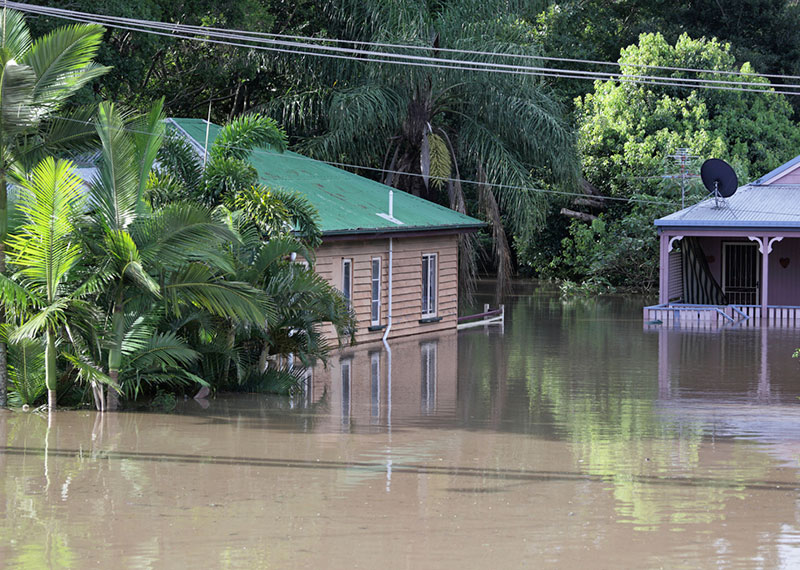
The objective of the audit was to assess the effectiveness of the Attorney-General’s Department’s administration of the terms of the Natural Disaster Relief and Recovery Arrangements Ministerial determination.
Entity
Attorney-General's Department; Emergency Management Australia
Contact
Please direct enquiries relating to reports through our contact page.
Government advertising review
Published: Thursday 25 February 2010
Published
The Digital Switchover campaign aims to provide all Australians with a smooth transition from analogue to digital television. The first region to switch over to digital television will be Mildura/Sunraysia on 30 June 2010 and the second region will be Regional South Australia & Broken Hill on 15 December 2010. Tailored local communications will be launched in Regional South Australia and Broken Hill from 28 March 2010, and they will include the date of digital switchover for that region.
- An effective Electronic Data and Records Management System is essential for the management of digital records. The National Archives of Australia does not consider that network drives are acceptable for the storage of official records.

Request for audit
Responded: Friday 24 July 2020
Response provided
The Auditor-General responded on 11 March 2020 to follow-up correspondence from Senator Sarah Hanson-Young, requesting an audit into the Federal and South Australian governments’ agreement to reduce SA’s Murray-Darling river water allocation by 100GL and Commonwealth funding provided to increase the use of the state’s desalination plant to replace the water. The Auditor-General responded to the original correspondence from Senator Hanson-Young on 19 December 2019. The Auditor-General provided a follow-up response to Senator Hanson-Young on 24 July 2020.
Contact
Please direct enquiries relating to requests for audit through our contact page.
Performance audit (Auditor-General Report No. 2 of 2010–11)
Published: Friday 23 July 2010
Published
The objective of this performance audit was to assess the effectiveness of the conduct of the first National Infrastructure Audit and development of the Infrastructure Priority List.
Entity
Infrastructure Australia
Performance audit (Auditor-General Report No. 20 of 2001–02)
Published: Friday 16 November 2001
Published
The ANAO reviewed arrangements for the development of the department's fraud policy, fraud risk assessment and fraud control plan within the core functional areas of the department that are responsible for these activities. The audit also examined the operational procedures and guidelines that were in place to implement the department's fraud policy. The objective of the audit was to assess whether AFFA has implemented appropriate fraud control arrangements in line with the Fraud Control Policy of the Commonwealth and whether these arrangements operate effectively in practice.
Entity
Agriculture Fisheries and Forestry - Australia
Performance audit (Auditor-General Report No. 5 of 2012–13)
Published: Thursday 27 September 2012
Published
To assess the upgrade and sustainment of the F/A-18A/B Hornet fleet, and the sustainment of the newly acquired F/A-18F Super Hornet fleet.
Entity
Department of Defence, Defence Materiel Organisation
Performance audit (Auditor-General Report No. 12 of 2005–06)
Published: Thursday 13 October 2005
Published
The objectives of the audit were to: assess the effectiveness of the key evaluation methods used to review the efficacy of the Australian Government's national counter-terrorism coordination arrangements; and examine the effectiveness of the links between the key evaluation methods, and how the key evaluation methods contribute to the process of continuous improvement.
Entity
Attorney General's Department; The Department of the Prime Minister and Cabinet
Performance audit in-progress
Due to table: February 2027
Open for contribution
The objective of this audit is to assess the effectiveness of Services Australia’s management of Centrelink automated decision-making.
Entity
Services Australia
Contact
Please direct enquiries through our contact page.
Performance audit in-progress

Due to table: November 2026
Report preparation
The objective of this audit is to assess the effectiveness of Services Australia’s use of its enforcement powers for child support debt.
Entity
Services Australia
Contact
Please direct enquiries through our contact page.
Performance audit (Auditor-General Report No. 10 of 2020–21)

Published: Thursday 24 September 2020
Published
The audit objective was to assess whether Services Australia appropriately managed risks to operating the current welfare payment system and appropriately prepared to transition to the future system.
Entity
Services Australia
Contact
Please direct enquiries through our contact page.
Performance audit (Auditor-General Report No. 44 of 2022–23)

Published: Wednesday 28 June 2023
Published
This audit examined the effectiveness of the National Archives of Australia’s implementation of the Building Trust policy and selected entities’ management of information assets (records, information and data).
Entity
Australian National Maritime Museum; National Archives of Australia; Department of the Prime Minister and Cabinet
Contact
Please direct enquiries through our contact page.
Performance audit (Auditor-General Report No. 4 of 2023–24)

Published: Thursday 31 August 2023
Published
The objective of the audit was to assess the effectiveness of the Department of Social Services’ (DSS’s) and Services Australia’s management of the accuracy and timeliness of welfare payments.
Entity
Services Australia; Department of Social Services
Contact
Please direct enquiries through our contact page.
Request for audit
Responded: Friday 24 August 2018
Response provided
The Auditor-General responded on 24 August 2018 to a request from Mr Ross Vasta MP dated 30 July 2018, asking that the Auditor-General consider correspondence from the Sporting Shooters Association of Australia (Brisbane) dated 12 July 2018. The association is requesting an audit of the Australian Communications and Media Authority (ACMA) Spectrum Management & Analysis Section project that installed radio monitoring infrastructure on Mount Petrie.
Contact
Please direct enquiries relating to requests for audits through our contact page.
- As Australia’s cyber security regulatory landscape evolves and reforms, it is important for an entity to consider how their legal function will support their governance committees during the external reporting process to manage increasing scrutiny and liability risks following a significant or reportable cyber security incident.

Performance audit (potential)
Potential audit: 2025-26
Potential
This audit would assess the effectiveness of Services Australia administration of Medicare Compensation Recovery.
Medicare compensation recovery aims to recover any Medicare benefits, nursing home benefits, residential care, or home care government subsidies paid to a claimant resulting from compensable injury or illness. When a person receives a lump sum compensation payment of more than $5000, they may have to pay the costs of these back to the Australian Government before they receive their compensation payment. In 2023–24 46,634 cases were finalised and $29.2 million in benefits was recovered.
Entity
Services Australia
Contact
Please direct enquiries through our contact page.
Performance audit (Auditor-General Report No. 53 of 2017–18)

Published: Thursday 28 June 2018
Published
The objective of the audit was to assess the effectiveness of the management of cyber risks by the Department of the Treasury, National Archives of Australia and Geoscience Australia.
Entity
Department of the Treasury; National Archives of Australia; Geoscience Australia
Contact
Please direct enquiries through our contact page.
Performance audit (potential)
Potential audit: 2025-26
Potential
This audit would assess the effectiveness of the administration of the Paid Parental Leave scheme (PPL scheme) by the Department of Social Services (DSS) and Services Australia.
The Australian Government provides a range of payments to support families with children. The PPL scheme provides up to 22 weeks of payment to support parents to take time off paid work after a birth or adoption. This entitlement will be expanding to 24 weeks for births and adoptions on or after 1 July 2025 and to 26 weeks for births and adoptions on or after 1 July 2026. DSS has policy responsibility for the PPL scheme and Services Australia administers payments on behalf of DSS. In the October 2022–23 Budget, $531.6 million was allocated over four years to ‘modernise’ the PPL scheme and promote a more equal distribution of work within households. In 2023–24, the PPL scheme cost $2.83 billion and 246,725 people received payment under the PPL scheme.
Entity
Services Australia; Department of Social Services
Contact
Please direct enquiries through our contact page.
Speeches and papers
Published: Wednesday 4 March 1998
Published
Mr P.J. Barrett (AM) - Auditor-General for Australia, presented at the Institute of Internal Auditors (IIA) - Australia SOPAC ?98 The IIA - Australia, South Pacific and Asia Conference
Speeches and papers
Published: Friday 20 January 2006
Published
Mr Ian McPhee - Auditor-General for Australia, presented to the CPA Australia
Speeches and papers
Published: Friday 30 November 2001
Published
Mr P.J. Barrett (AM) - Auditor-General for Australia, presented to the Institute of Public Administration Australia
Speeches and papers
Published: Wednesday 21 March 2007
Published
Mr Ian McPhee - Auditor-General for Australia, presented at the ACAG Panel Forum, CPA Australia
Performance audit (Auditor-General Report No. 24 of 2004–05)
Published: Thursday 27 January 2005
Published
Medicare is Australia's universal health insurance scheme. Underpinning Medicare is one of Australia's largest and more complex computer databases the Medicare enrolment database. At the end of 2004 the Medicare enrolment database contained information on over 24 million individuals. This audit examines the quality of data stored on that database and how the Health Insurance Commission (HIC) manages the data.
Entity
Health Insurance Commission; Medicare Australia; Human Services
Speeches and papers
Published: Wednesday 21 April 2010
Published
Mr Ian McPhee - Auditor-General for Australia, presented at the CPA Australia - CFO Public Sector Lunch
Speeches and papers
Published: Friday 16 November 2001
Published
Mr P.J. Barrett (AM) - Auditor-General for Australia, presented at the CPA South Australia Conference 2001
Speeches and papers
Published: Thursday 4 December 2003
Published
Mr P.J. Barrett (AM) - Auditor-General for Australia, presented at the Chartered Secretaries Australia, Discussion Luncheon, Canberra
Speeches and papers
Published: Thursday 17 August 2006
Published
Mr Ian McPhee - Auditor-General for Australia, presented at the CPA Australia Public Sectore Finance and Management Conference
Speeches and papers
Published: Friday 1 May 2009
Published
Mr Ian McPhee - Auditor-General for Australia, presented at the Institute of Chartered Accountants in Australia, Audit Conference, Melbourne