Browse our range of reports and publications including performance and financial statement audit reports, assurance review reports, information reports and annual reports.

Entity overview
The National Disability Insurance Scheme (NDIS or the Scheme) falls under the Health, Disability and Ageing portfolio. It was established under the National Disability Insurance Scheme Act 2013 (NDIS Act). The Scheme is designed to support individuals with significant and permanent disability (participants) to be more independent and engage socially and economically by providing reasonable and necessary disability related supports. Further information is available from the National Disability Insurance Scheme website.
There are three entities responsible for administering the NDIS. The Department of Health, Disability and Ageing has policy responsibility for the NDIS and foundational disability supports (audit considerations for the department are discussed in the Health, Disability and Ageing portfolio overview). The National Disability Insurance Agency (NDIA) is responsible for delivering the NDIS. The NDIS Quality and Safeguards Commission (NDIS Commission) is responsible for regulating NDIS providers.
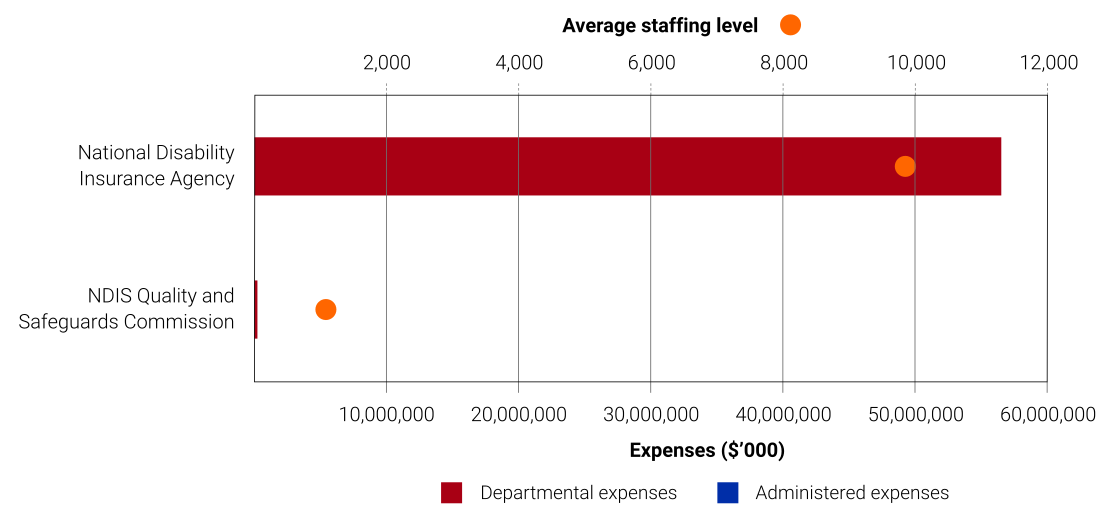
In the 2025–26 Portfolio Budget Statements (PBS) for the Health, Disability and Ageing portfolio, the aggregated budgeted expenses for the NDIA and NDIS Commission for 2026–27 total $56.7 billion. The PBS contain budgets for those entities in the general government sector (GGS) that receive appropriations directly or indirectly through annual appropriation Acts.
The level of budgeted departmental expenses, and the average staffing levels are shown in Figure 1. The NDIA only receives departmental appropriations.
Figure 1: National Disability Insurance Agency and NDIS Commission – total expenses and average staffing level
Source: ANAO analysis of 2026–27 Portfolio Budget Statements.
Audit focus
In determining the 2026–27 audit work program, the ANAO considers prior-year audit and other review findings and what these indicate about portfolio risks and areas for improvement. The ANAO also considers emerging risks from new investments or changes in the operating environment.
The primary risks identified for the NDIS are that the scale and growth of the Scheme, combined with a substantial and ongoing reform agenda, continue to outpace the maturity of arrangements to manage sustainability, integrity and delivery performance. These risks arise in a context of shared responsibilities across governments, heavy reliance on third-party service delivery providers, and increasing dependence on complex digital systems to support decision-making, payments and assurance.
Specific risks in the NDIS relate to service delivery, procurement, policy stewardship, regulation, and financial management and integrity.
Service delivery
The NDIS supported more than 739,000 participants in 2024–25 (projected to exceed one million over the next decade). It funds essential supports relied upon by people with significant and permanent disability, many of whom have limited capacity to navigate complex systems without effective assistance. Service delivery risks increase where delivery models are complex and heavily reliant on partners and third-party providers.
ANAO audit work has highlighted that participant complaints, feedback and service delivery data are not always used to identify systemic issues or drive continuous improvement. This limits assurance that changes to processes, systems or provider arrangements are improving participant experience and outcomes.
Equity risks may emerge where service access and delivery arrangements do not adequately meet the needs of First Nations participants and participants in regional and remote areas, particularly in thin or fragile markets.
Procurement
The NDIA relies heavily on procurement to deliver services and enable reform, including large-scale Information and Communication Technology investments, outsourced delivery arrangements and professional services. Procurement risks increase where planning, sequencing and contract management do not keep pace with the scale and complexity of reform activity. There is also a risk that the NDIA is not fully prepared for the proposed expanded coverage of the Commonwealth Procurement Rules to corporate Commonwealth entities, requiring changes to systems, capability and controls.
Policy stewardship
A major NDIS reform program is underway to improve the financial sustainability of the NDIS and participant pathways, including legislative change and redesign of access, planning, assessment and foundational support arrangements. There is a risk that the pace and breadth of reform results in uneven implementation, with gaps between policy intent and operational practice across the scheme.
The long term sustainability of the NDIS depends on reforms being translated into clear accountabilities, effective sequencing and measurable outcomes. Prior ANAO audits and reviews have highlighted that stewardship is weakened where evidence, evaluation and operational feedback are not consistently used to inform decision-making and refine implementation approaches. Reform delivery risks increase where changes to systems, processes and roles are implemented in parallel, limiting organisational capacity to embed reforms and demonstrate that intended benefits are being realised.
Regulation
The NDIS provider market is large and diverse, encompassing over 17,000 registered and over 250,000 unregistered providers delivering a wide range of supports, which creates challenges for effective regulation and safeguarding. The scale of the market, combined with growth in complaints and compliance activity, increase the importance of risk-based and intelligence-led regulation. Ineffective market stewardship, particularly in thin or remote markets, may undermine service availability, quality and participant outcomes.
The ANAO has found that the NDIS Commission is only partly effective in exercising its regulatory functions, with weaknesses in regulatory risk frameworks, intelligence use and performance reporting. Regulatory effort is not yet sufficiently risk-responsive or proportionate to the size and risk profile of the market.
Safeguarding risks increase where information sharing, market oversight and monitoring arrangements are not sufficiently mature to anticipate emerging risks, including provider non-compliance and unplanned service withdrawal. There is a related risk that ineffective arrangements to identify, respond to and learn from critical incidents involving NDIS participants limit agencies’ ability to safeguard participants and address systemic issues.
Financial management and integrity
The NDIS involves a large volume of payments to participants and providers ($46.4 billion in 2024–25, projected to increase to $95.8 billion by 2034–35), making strong financial management and payment controls central to scheme sustainability and public confidence. Prior ANAO work has identified that key fraud and non-compliance controls were not embedded for much of the Scheme’s operation and are still being strengthened.
Financial management risks increase where assurance arrangements, debt identification and recovery processes, and quality assurance over decision-making are complex or inconsistently applied across different claiming and management pathways. This reduces confidence that public funds are being used as intended and in accordance with legislative requirements.
Previous performance audit coverage
The ANAO’s performance audit activities involve the independent and objective assessment of all or part of an entity’s operations and administrative support systems. Performance audits may involve multiple entities and examine common aspects of administration or the joint administration of a program or service.
During the performance audit process, the ANAO gathers and analyses the evidence necessary to draw a conclusion on the audit objective. Audit conclusions can be grouped into four categories:
- unqualified;
- qualified (largely positive);
- qualified (partly positive); and
- adverse.
In the period between 2021–22 to 2025–26 the National Disability Insurance Scheme was included in seven performance audits. The conclusions directed toward the NDIS were as follows:
- none were unqualified;
- two were qualified (largely positive);
- five were qualified (partly positive); and
- none were adverse.
Figure 2 shows the number of audit conclusions for the NDIS that were included in ANAO performance audits between 2021–22 and 2025–26 compared with all audits tabled in this period.
Figure 2: Audit conclusions 2021–22 to 2025–26: the National Disability Insurance Scheme compared with all audits tabled
Source: ANAO data.
The ANAO’s annual audit work program is intended to deliver a mix of performance audits across seven audit activities: governance; service delivery; grants administration; procurement; policy development; regulation; and asset management and sustainment. These activities are intended to cover the scope of activities undertaken by the public sector. Each performance audit considers a primary audit activity. Figure 3 shows audit conclusions by primary audit activity for audits involving the National Disability Insurance Scheme.
Figure 3: Audit conclusions by activity for audits involving the National Disability Insurance Scheme, 2021–22 to 2025–26
Source: ANAO data.
Performance statements audits
The audit of the 2025–26 National Disability Insurance Agency (NDIA) annual performance statements is being conducted following a request from the Minister for Finance on 29 September 2025, under section 40 of the Public Governance, Performance and Accountability Act 2013. The audit is conducted under section 15 of the Auditor-General Act 1997. The NDIA is in its third year of inclusion in the annual performance statements audit program.
The NDIA has been classified as a high risk engagement. This engagement risk rating reflects the results from the 2024–25 performance statements audit, including a qualified audit conclusion relating to two material omissions of performance information, and unresolved significant and moderate findings, as well as: the level of external scrutiny of the NDIS; the continuing reform of the NDIS including the implementation of legislative changes; and the complex decision-making required in the operation of the Scheme, which is supported by a complex and partially outsourced Information Technology (IT) environment. Key risks for the NDIA’s performance statements that the ANAO has highlighted include:
- whether the NDIA’s performance measures and targets are complete and measure the performance of key aspects of its functions;
- whether the NDIA’s performance measures and targets comply with the requirements of the Commonwealth Performance Framework, and how effectively it reports performance; and
- whether the NDIA has appropriate data governance and management processes to support performance reporting.
Financial statements audits
Overview
Entities within the National Disability Insurance Scheme, and the risk profile of each entity, are shown in Table 1.
Table 1: National Disability Insurance Scheme entities and risk profile
|
|
Type of entity |
Engagement risk |
Number of higher risks |
Number of moderate risks |
|
Material entities |
||||
|
National Disability Insurance Agency |
Corporate |
High |
3 |
1 |
|
Non-material entities |
||||
|
NDIS Quality and Safeguards Commission |
Non-corporate |
Low |
|
|
Material entities
National Disability Insurance Agency
The NDIA was established under the National Disability Insurance Scheme Act 2013. The NDIA has responsibility for delivering the Scheme. The Scheme is designed to support individuals with a significant and permanent disability (participants) to be more independent and engage socially and economically by providing reasonable and necessary disability related supports.
The NDIA’s total budgeted expenses for 2026–27 are $56.5 billion, with 95 per cent of these attributable to participant plan expenses, as shown in Figure 4. Participant plan provisions account for 72 per cent of total liabilities.
Figure 4: National Disability Insurance Agency’s budgeted financial statements by category ($’000)
Source: ANAO analysis of 2026–27 Portfolio Budget Statements.
The engagement risk rating reflects the number and quantum of key areas of financial statements risk that will be a focus of the audit, as well as the: level of external scrutiny of the Scheme; continuing reform of the NDIS including the implementation of legislative changes; and the complex decision-making required in the operation of the Scheme, which is supported by a complex and partially outsourced IT environment. There are four key risks for the NDIA’s 2025–26 financial statements that the ANAO has highlighted for specific audit coverage and consideration, including three as potential key audit matters (KAMs).
- The volume and complexity of payments made to participants and providers. (KAM – Accuracy and occurrence of participant plan expenses)
- The significant judgement and assumptions required in the actuarial estimate of outstanding claims at year-end. (KAM – Valuation of participant plan provisions)
- The recognition of in-kind contributions due to reliance on data from the States and Territories around agreed services provided to people with a disability. Contributions are accounted for as revenue received free of charge at the date the services are provided. The use of these services is also recognised as an equivalent expense. Terms and conditions for determining the cash and in-kind contributions for the funding of the Scheme are set out in the bilateral agreements between each State and Territory and the Commonwealth. (KAM – Completeness, occurrence and accuracy of in-kind revenue and expenses)
- Completeness and accuracy of data transitioned from SAP customer relationship management system to PACE (a new Salesforce-based customer relationship management system). The risk relates to whether the NDIA has controls over the transition of data and established systemised controls in line with business requirements.
Potential topics
Potential topic: 2026-27
Activity
Potential topic: 2026-27
Activity
Potential topic: 2026-27
Activity
Potential topic: 2027-29
Activity
Potential topic: 2027-29
Activity
Potential topic: 2027-29
Activity